EP1140933B1 - Process for preparing n6-substituted deaza-adenosine derivatives - Google Patents
Process for preparing n6-substituted deaza-adenosine derivatives Download PDFInfo
- Publication number
- EP1140933B1 EP1140933B1 EP99966299A EP99966299A EP1140933B1 EP 1140933 B1 EP1140933 B1 EP 1140933B1 EP 99966299 A EP99966299 A EP 99966299A EP 99966299 A EP99966299 A EP 99966299A EP 1140933 B1 EP1140933 B1 EP 1140933B1
- Authority
- EP
- European Patent Office
- Prior art keywords
- methyl
- chlorothien
- propyl
- amino
- alkyl
- Prior art date
- Legal status (The legal status is an assumption and is not a legal conclusion. Google has not performed a legal analysis and makes no representation as to the accuracy of the status listed.)
- Expired - Lifetime
Links
- 238000004519 manufacturing process Methods 0.000 title claims abstract description 12
- -1 N6-substituted adenosine Chemical class 0.000 claims abstract description 142
- 238000000034 method Methods 0.000 claims abstract description 39
- 125000002496 methyl group Chemical group [H]C([H])([H])* 0.000 claims description 113
- 125000001436 propyl group Chemical group [H]C([*])([H])C([H])([H])C([H])([H])[H] 0.000 claims description 105
- 125000002924 primary amino group Chemical group [H]N([H])* 0.000 claims description 84
- KZVGZLACPFFNNO-UHFFFAOYSA-N n-ethyl-2,2-dimethyl-4,5,6,6a-tetrahydro-3ah-cyclopenta[d][1,3]dioxole-4-carboxamide Chemical compound O1C(C)(C)OC2C(C(=O)NCC)CCC21 KZVGZLACPFFNNO-UHFFFAOYSA-N 0.000 claims description 65
- 125000000217 alkyl group Chemical group 0.000 claims description 49
- 150000001875 compounds Chemical class 0.000 claims description 37
- 125000003349 3-pyridyl group Chemical group N1=C([H])C([*])=C([H])C([H])=C1[H] 0.000 claims description 29
- 230000008569 process Effects 0.000 claims description 21
- 125000003118 aryl group Chemical group 0.000 claims description 18
- 125000000623 heterocyclic group Chemical group 0.000 claims description 18
- 229910052739 hydrogen Inorganic materials 0.000 claims description 18
- 239000001257 hydrogen Substances 0.000 claims description 18
- BEWIQKYGRIAYST-UHFFFAOYSA-N 2,4-difluoro-3-nitropyridine Chemical compound [O-][N+](=O)C1=C(F)C=CN=C1F BEWIQKYGRIAYST-UHFFFAOYSA-N 0.000 claims description 16
- 125000003917 carbamoyl group Chemical group [H]N([H])C(*)=O 0.000 claims description 16
- 125000002252 acyl group Chemical group 0.000 claims description 15
- 229910052760 oxygen Inorganic materials 0.000 claims description 14
- 125000003545 alkoxy group Chemical group 0.000 claims description 13
- 125000005115 alkyl carbamoyl group Chemical group 0.000 claims description 13
- QHKDGCNDOZYUPZ-GFCCVEGCSA-N n-[(2r)-1-(3-chlorothiophen-2-yl)butan-2-yl]-4-methylbenzenesulfonamide Chemical compound C([C@@H](CC)NS(=O)(=O)C=1C=CC(C)=CC=1)C=1SC=CC=1Cl QHKDGCNDOZYUPZ-GFCCVEGCSA-N 0.000 claims description 13
- 229910052717 sulfur Inorganic materials 0.000 claims description 13
- RTXYIHGMYDJHEU-UHFFFAOYSA-N 2,4-dichloro-3-nitropyridine Chemical compound [O-][N+](=O)C1=C(Cl)C=CN=C1Cl RTXYIHGMYDJHEU-UHFFFAOYSA-N 0.000 claims description 11
- UFHFLCQGNIYNRP-UHFFFAOYSA-N Hydrogen Chemical compound [H][H] UFHFLCQGNIYNRP-UHFFFAOYSA-N 0.000 claims description 10
- 125000003282 alkyl amino group Chemical group 0.000 claims description 10
- 125000002768 hydroxyalkyl group Chemical group 0.000 claims description 10
- 229910052799 carbon Inorganic materials 0.000 claims description 9
- 229910052801 chlorine Inorganic materials 0.000 claims description 9
- 229910052731 fluorine Inorganic materials 0.000 claims description 9
- 229910052736 halogen Inorganic materials 0.000 claims description 9
- 150000002367 halogens Chemical class 0.000 claims description 9
- SHQOWGHUZNHQIZ-UTONKHPSSA-N n-[(2r)-1-(3-chlorothiophen-2-yl)butan-2-yl]-4-methylbenzenesulfonamide;lithium Chemical compound [Li].C([C@@H](CC)NS(=O)(=O)C=1C=CC(C)=CC=1)C=1SC=CC=1Cl SHQOWGHUZNHQIZ-UTONKHPSSA-N 0.000 claims description 9
- 125000002947 alkylene group Chemical group 0.000 claims description 8
- WPYMKLBDIGXBTP-UHFFFAOYSA-N benzoic acid Chemical compound OC(=O)C1=CC=CC=C1 WPYMKLBDIGXBTP-UHFFFAOYSA-N 0.000 claims description 8
- 150000001721 carbon Chemical group 0.000 claims description 8
- 125000004435 hydrogen atom Chemical group [H]* 0.000 claims description 8
- QJGQUHMNIGDVPM-UHFFFAOYSA-N nitrogen group Chemical group [N] QJGQUHMNIGDVPM-UHFFFAOYSA-N 0.000 claims description 8
- 229910052701 rubidium Inorganic materials 0.000 claims description 8
- 125000004001 thioalkyl group Chemical group 0.000 claims description 8
- GKASDNZWUGIAMG-UHFFFAOYSA-N triethyl orthoformate Chemical compound CCOC(OCC)OCC GKASDNZWUGIAMG-UHFFFAOYSA-N 0.000 claims description 8
- 125000003710 aryl alkyl group Chemical group 0.000 claims description 7
- 229940124530 sulfonamide Drugs 0.000 claims description 7
- 150000003456 sulfonamides Chemical class 0.000 claims description 7
- ZSXGLVDWWRXATF-UHFFFAOYSA-N N,N-dimethylformamide dimethyl acetal Chemical compound COC(OC)N(C)C ZSXGLVDWWRXATF-UHFFFAOYSA-N 0.000 claims description 6
- 125000004453 alkoxycarbonyl group Chemical group 0.000 claims description 5
- 150000001408 amides Chemical class 0.000 claims description 5
- 125000005161 aryl oxy carbonyl group Chemical group 0.000 claims description 5
- 150000004657 carbamic acid derivatives Chemical class 0.000 claims description 5
- 125000005117 dialkylcarbamoyl group Chemical group 0.000 claims description 5
- 150000002148 esters Chemical class 0.000 claims description 5
- 239000012025 fluorinating agent Substances 0.000 claims description 5
- 125000005724 cycloalkenylene group Chemical group 0.000 claims description 4
- 125000002993 cycloalkylene group Chemical group 0.000 claims description 4
- 238000000746 purification Methods 0.000 claims description 4
- IRUNKQSGDBYUDC-UHFFFAOYSA-N diethoxymethyl acetate Chemical compound CCOC(OCC)OC(C)=O IRUNKQSGDBYUDC-UHFFFAOYSA-N 0.000 claims description 3
- 238000002955 isolation Methods 0.000 claims description 3
- 239000000543 intermediate Substances 0.000 abstract description 9
- XEKOWRVHYACXOJ-UHFFFAOYSA-N Ethyl acetate Chemical compound CCOC(C)=O XEKOWRVHYACXOJ-UHFFFAOYSA-N 0.000 description 110
- 239000000203 mixture Substances 0.000 description 66
- YXFVVABEGXRONW-UHFFFAOYSA-N Toluene Chemical compound CC1=CC=CC=C1 YXFVVABEGXRONW-UHFFFAOYSA-N 0.000 description 60
- OKKJLVBELUTLKV-UHFFFAOYSA-N Methanol Chemical compound OC OKKJLVBELUTLKV-UHFFFAOYSA-N 0.000 description 57
- 235000019439 ethyl acetate Nutrition 0.000 description 37
- WYURNTSHIVDZCO-UHFFFAOYSA-N Tetrahydrofuran Chemical compound C1CCOC1 WYURNTSHIVDZCO-UHFFFAOYSA-N 0.000 description 36
- XLYOFNOQVPJJNP-UHFFFAOYSA-N water Substances O XLYOFNOQVPJJNP-UHFFFAOYSA-N 0.000 description 35
- HEDRZPFGACZZDS-MICDWDOJSA-N Trichloro(2H)methane Chemical compound [2H]C(Cl)(Cl)Cl HEDRZPFGACZZDS-MICDWDOJSA-N 0.000 description 32
- 238000006243 chemical reaction Methods 0.000 description 31
- 239000007787 solid Substances 0.000 description 29
- IJGRMHOSHXDMSA-UHFFFAOYSA-N Atomic nitrogen Chemical compound N#N IJGRMHOSHXDMSA-UHFFFAOYSA-N 0.000 description 27
- 239000000243 solution Substances 0.000 description 27
- IMNFDUFMRHMDMM-UHFFFAOYSA-N N-Heptane Chemical compound CCCCCCC IMNFDUFMRHMDMM-UHFFFAOYSA-N 0.000 description 26
- SECXISVLQFMRJM-UHFFFAOYSA-N N-Methylpyrrolidone Chemical compound CN1CCCC1=O SECXISVLQFMRJM-UHFFFAOYSA-N 0.000 description 25
- YMWUJEATGCHHMB-UHFFFAOYSA-N Dichloromethane Chemical compound ClCCl YMWUJEATGCHHMB-UHFFFAOYSA-N 0.000 description 24
- VEXZGXHMUGYJMC-UHFFFAOYSA-N Hydrochloric acid Chemical compound Cl VEXZGXHMUGYJMC-UHFFFAOYSA-N 0.000 description 21
- CSNNHWWHGAXBCP-UHFFFAOYSA-L Magnesium sulfate Chemical compound [Mg+2].[O-][S+2]([O-])([O-])[O-] CSNNHWWHGAXBCP-UHFFFAOYSA-L 0.000 description 21
- DTQVDTLACAAQTR-UHFFFAOYSA-N Trifluoroacetic acid Chemical compound OC(=O)C(F)(F)F DTQVDTLACAAQTR-UHFFFAOYSA-N 0.000 description 20
- 238000004128 high performance liquid chromatography Methods 0.000 description 18
- YLQBMQCUIZJEEH-UHFFFAOYSA-N tetrahydrofuran Natural products C=1C=COC=1 YLQBMQCUIZJEEH-UHFFFAOYSA-N 0.000 description 18
- 238000002360 preparation method Methods 0.000 description 17
- 239000002585 base Substances 0.000 description 16
- BWHMMNNQKKPAPP-UHFFFAOYSA-L potassium carbonate Chemical compound [K+].[K+].[O-]C([O-])=O BWHMMNNQKKPAPP-UHFFFAOYSA-L 0.000 description 16
- WFDIJRYMOXRFFG-UHFFFAOYSA-N Acetic anhydride Chemical compound CC(=O)OC(C)=O WFDIJRYMOXRFFG-UHFFFAOYSA-N 0.000 description 15
- 239000002904 solvent Substances 0.000 description 15
- 229910052757 nitrogen Inorganic materials 0.000 description 14
- DKPFZGUDAPQIHT-UHFFFAOYSA-N butyl acetate Chemical compound CCCCOC(C)=O DKPFZGUDAPQIHT-UHFFFAOYSA-N 0.000 description 13
- 238000001914 filtration Methods 0.000 description 13
- 239000011541 reaction mixture Substances 0.000 description 13
- 230000002829 reductive effect Effects 0.000 description 13
- HPALAKNZSZLMCH-UHFFFAOYSA-M sodium;chloride;hydrate Chemical compound O.[Na+].[Cl-] HPALAKNZSZLMCH-UHFFFAOYSA-M 0.000 description 13
- 238000005160 1H NMR spectroscopy Methods 0.000 description 12
- 239000012267 brine Substances 0.000 description 12
- NROKBHXJSPEDAR-UHFFFAOYSA-M potassium fluoride Chemical compound [F-].[K+] NROKBHXJSPEDAR-UHFFFAOYSA-M 0.000 description 12
- 239000010410 layer Substances 0.000 description 11
- RTZKZFJDLAIYFH-UHFFFAOYSA-N Diethyl ether Chemical compound CCOCC RTZKZFJDLAIYFH-UHFFFAOYSA-N 0.000 description 10
- AFVFQIVMOAPDHO-UHFFFAOYSA-N Methanesulfonic acid Chemical compound CS(O)(=O)=O AFVFQIVMOAPDHO-UHFFFAOYSA-N 0.000 description 10
- 229910052943 magnesium sulfate Inorganic materials 0.000 description 10
- 235000019341 magnesium sulphate Nutrition 0.000 description 10
- 239000012044 organic layer Substances 0.000 description 10
- BASFCYQUMIYNBI-UHFFFAOYSA-N platinum Chemical compound [Pt] BASFCYQUMIYNBI-UHFFFAOYSA-N 0.000 description 10
- 239000011698 potassium fluoride Substances 0.000 description 10
- KFZMGEQAYNKOFK-UHFFFAOYSA-N Isopropanol Chemical compound CC(C)O KFZMGEQAYNKOFK-UHFFFAOYSA-N 0.000 description 9
- ZMXDDKWLCZADIW-UHFFFAOYSA-N N,N-Dimethylformamide Chemical compound CN(C)C=O ZMXDDKWLCZADIW-UHFFFAOYSA-N 0.000 description 9
- 239000000460 chlorine Substances 0.000 description 9
- 238000003756 stirring Methods 0.000 description 9
- 229910000027 potassium carbonate Inorganic materials 0.000 description 8
- 235000011181 potassium carbonates Nutrition 0.000 description 8
- 239000002253 acid Substances 0.000 description 7
- 239000003153 chemical reaction reagent Substances 0.000 description 7
- QLLIPBVYTKAGER-UHFFFAOYSA-N n-ethyl-2,3-dihydroxycyclopentane-1-carboxamide Chemical compound CCNC(=O)C1CCC(O)C1O QLLIPBVYTKAGER-UHFFFAOYSA-N 0.000 description 7
- 230000009467 reduction Effects 0.000 description 7
- 238000010992 reflux Methods 0.000 description 7
- JRMUNVKIHCOMHV-UHFFFAOYSA-M tetrabutylammonium bromide Chemical compound [Br-].CCCC[N+](CCCC)(CCCC)CCCC JRMUNVKIHCOMHV-UHFFFAOYSA-M 0.000 description 7
- 238000001644 13C nuclear magnetic resonance spectroscopy Methods 0.000 description 6
- QTBSBXVTEAMEQO-UHFFFAOYSA-N Acetic acid Chemical compound CC(O)=O QTBSBXVTEAMEQO-UHFFFAOYSA-N 0.000 description 6
- LFQSCWFLJHTTHZ-UHFFFAOYSA-N Ethanol Chemical compound CCO LFQSCWFLJHTTHZ-UHFFFAOYSA-N 0.000 description 6
- BZLVMXJERCGZMT-UHFFFAOYSA-N Methyl tert-butyl ether Chemical compound COC(C)(C)C BZLVMXJERCGZMT-UHFFFAOYSA-N 0.000 description 6
- JUJWROOIHBZHMG-UHFFFAOYSA-N Pyridine Chemical compound C1=CC=NC=C1 JUJWROOIHBZHMG-UHFFFAOYSA-N 0.000 description 6
- CDBYLPFSWZWCQE-UHFFFAOYSA-L Sodium Carbonate Chemical compound [Na+].[Na+].[O-]C([O-])=O CDBYLPFSWZWCQE-UHFFFAOYSA-L 0.000 description 6
- UIIMBOGNXHQVGW-UHFFFAOYSA-M Sodium bicarbonate Chemical compound [Na+].OC([O-])=O UIIMBOGNXHQVGW-UHFFFAOYSA-M 0.000 description 6
- ZMANZCXQSJIPKH-UHFFFAOYSA-N Triethylamine Chemical compound CCN(CC)CC ZMANZCXQSJIPKH-UHFFFAOYSA-N 0.000 description 6
- 125000005843 halogen group Chemical group 0.000 description 6
- 235000003270 potassium fluoride Nutrition 0.000 description 6
- 239000000047 product Substances 0.000 description 6
- XYJQBHCHAZPWHA-UHFFFAOYSA-N CC(C)C([CH2-])=O Chemical compound CC(C)C([CH2-])=O XYJQBHCHAZPWHA-UHFFFAOYSA-N 0.000 description 5
- QWOJMRHUQHTCJG-UHFFFAOYSA-N CC([CH2-])=O Chemical compound CC([CH2-])=O QWOJMRHUQHTCJG-UHFFFAOYSA-N 0.000 description 5
- FYYHWMGAXLPEAU-UHFFFAOYSA-N Magnesium Chemical compound [Mg] FYYHWMGAXLPEAU-UHFFFAOYSA-N 0.000 description 5
- 125000004432 carbon atom Chemical group C* 0.000 description 5
- 239000012065 filter cake Substances 0.000 description 5
- 239000000706 filtrate Substances 0.000 description 5
- 238000010438 heat treatment Methods 0.000 description 5
- 230000007062 hydrolysis Effects 0.000 description 5
- 238000006460 hydrolysis reaction Methods 0.000 description 5
- 125000002887 hydroxy group Chemical group [H]O* 0.000 description 5
- 229940098779 methanesulfonic acid Drugs 0.000 description 5
- LPNYRYFBWFDTMA-UHFFFAOYSA-N potassium tert-butoxide Chemical compound [K+].CC(C)(C)[O-] LPNYRYFBWFDTMA-UHFFFAOYSA-N 0.000 description 5
- 229920006395 saturated elastomer Polymers 0.000 description 5
- HNKJADCVZUBCPG-UHFFFAOYSA-N thioanisole Chemical compound CSC1=CC=CC=C1 HNKJADCVZUBCPG-UHFFFAOYSA-N 0.000 description 5
- 0 *c1ccnc(*)c1[N+]([O-])=O Chemical compound *c1ccnc(*)c1[N+]([O-])=O 0.000 description 4
- GVWIBAQTEVKJFP-UHFFFAOYSA-N 1-(3-chlorothiophen-2-yl)butan-2-amine Chemical compound CCC(N)CC=1SC=CC=1Cl GVWIBAQTEVKJFP-UHFFFAOYSA-N 0.000 description 4
- XEZNGIUYQVAUSS-UHFFFAOYSA-N 18-crown-6 Chemical compound C1COCCOCCOCCOCCOCCO1 XEZNGIUYQVAUSS-UHFFFAOYSA-N 0.000 description 4
- IAZDPXIOMUYVGZ-UHFFFAOYSA-N Dimethylsulphoxide Chemical compound CS(C)=O IAZDPXIOMUYVGZ-UHFFFAOYSA-N 0.000 description 4
- KRHYYFGTRYWZRS-UHFFFAOYSA-M Fluoride anion Chemical compound [F-] KRHYYFGTRYWZRS-UHFFFAOYSA-M 0.000 description 4
- DGAQECJNVWCQMB-PUAWFVPOSA-M Ilexoside XXIX Chemical compound C[C@@H]1CC[C@@]2(CC[C@@]3(C(=CC[C@H]4[C@]3(CC[C@@H]5[C@@]4(CC[C@@H](C5(C)C)OS(=O)(=O)[O-])C)C)[C@@H]2[C@]1(C)O)C)C(=O)O[C@H]6[C@@H]([C@H]([C@@H]([C@H](O6)CO)O)O)O.[Na+] DGAQECJNVWCQMB-PUAWFVPOSA-M 0.000 description 4
- MZRVEZGGRBJDDB-UHFFFAOYSA-N N-Butyllithium Chemical compound [Li]CCCC MZRVEZGGRBJDDB-UHFFFAOYSA-N 0.000 description 4
- VYPSYNLAJGMNEJ-UHFFFAOYSA-N Silicium dioxide Chemical compound O=[Si]=O VYPSYNLAJGMNEJ-UHFFFAOYSA-N 0.000 description 4
- 150000001412 amines Chemical class 0.000 description 4
- 238000004458 analytical method Methods 0.000 description 4
- 230000015572 biosynthetic process Effects 0.000 description 4
- 229910052751 metal Inorganic materials 0.000 description 4
- 239000002184 metal Substances 0.000 description 4
- 239000003921 oil Substances 0.000 description 4
- 235000019198 oils Nutrition 0.000 description 4
- 239000012074 organic phase Substances 0.000 description 4
- 239000003960 organic solvent Substances 0.000 description 4
- 229910052697 platinum Inorganic materials 0.000 description 4
- 125000006239 protecting group Chemical group 0.000 description 4
- 239000003586 protic polar solvent Substances 0.000 description 4
- 239000011734 sodium Substances 0.000 description 4
- 239000007921 spray Substances 0.000 description 4
- 239000000725 suspension Substances 0.000 description 4
- 125000005147 toluenesulfonyl group Chemical group C=1(C(=CC=CC1)S(=O)(=O)*)C 0.000 description 4
- 238000010792 warming Methods 0.000 description 4
- OKTJSMMVPCPJKN-UHFFFAOYSA-N Carbon Chemical compound [C] OKTJSMMVPCPJKN-UHFFFAOYSA-N 0.000 description 3
- 235000019502 Orange oil Nutrition 0.000 description 3
- HEMHJVSKTPXQMS-UHFFFAOYSA-M Sodium hydroxide Chemical compound [OH-].[Na+] HEMHJVSKTPXQMS-UHFFFAOYSA-M 0.000 description 3
- 150000004703 alkoxides Chemical class 0.000 description 3
- 150000004945 aromatic hydrocarbons Chemical class 0.000 description 3
- 239000003054 catalyst Substances 0.000 description 3
- 238000009903 catalytic hydrogenation reaction Methods 0.000 description 3
- 150000001768 cations Chemical class 0.000 description 3
- 238000002425 crystallisation Methods 0.000 description 3
- 230000008025 crystallization Effects 0.000 description 3
- 239000012467 final product Substances 0.000 description 3
- 239000012458 free base Substances 0.000 description 3
- 150000003840 hydrochlorides Chemical class 0.000 description 3
- 150000002500 ions Chemical class 0.000 description 3
- 229910052744 lithium Inorganic materials 0.000 description 3
- 239000011777 magnesium Substances 0.000 description 3
- 229910052749 magnesium Inorganic materials 0.000 description 3
- 239000010502 orange oil Substances 0.000 description 3
- 125000003170 phenylsulfonyl group Chemical group C1(=CC=CC=C1)S(=O)(=O)* 0.000 description 3
- 239000003880 polar aprotic solvent Substances 0.000 description 3
- UMJSCPRVCHMLSP-UHFFFAOYSA-N pyridine Natural products COC1=CC=CN=C1 UMJSCPRVCHMLSP-UHFFFAOYSA-N 0.000 description 3
- 150000003839 salts Chemical class 0.000 description 3
- 229910000030 sodium bicarbonate Inorganic materials 0.000 description 3
- 235000017557 sodium bicarbonate Nutrition 0.000 description 3
- 229910000029 sodium carbonate Inorganic materials 0.000 description 3
- 125000001424 substituent group Chemical group 0.000 description 3
- 125000005420 sulfonamido group Chemical group S(=O)(=O)(N*)* 0.000 description 3
- FTVLMFQEYACZNP-UHFFFAOYSA-N trimethylsilyl trifluoromethanesulfonate Chemical compound C[Si](C)(C)OS(=O)(=O)C(F)(F)F FTVLMFQEYACZNP-UHFFFAOYSA-N 0.000 description 3
- CTUOTGYJTHYEDK-BFHBGLAWSA-N (2r)-1-(benzenesulfonyl)-2-ethylaziridine Chemical compound CC[C@@H]1CN1S(=O)(=O)C1=CC=CC=C1 CTUOTGYJTHYEDK-BFHBGLAWSA-N 0.000 description 2
- SOZHJILDDBQJHA-UHFFFAOYSA-N 2-chloro-4-fluoro-3-nitropyridine Chemical compound [O-][N+](=O)C1=C(F)C=CN=C1Cl SOZHJILDDBQJHA-UHFFFAOYSA-N 0.000 description 2
- DCJKCNUUSRPAPJ-LLVKDONJSA-N 4-bromo-n-[(2r)-1-(3-chlorothiophen-2-yl)butan-2-yl]benzenesulfonamide Chemical compound C([C@@H](CC)NS(=O)(=O)C=1C=CC(Br)=CC=1)C=1SC=CC=1Cl DCJKCNUUSRPAPJ-LLVKDONJSA-N 0.000 description 2
- ZCYVEMRRCGMTRW-UHFFFAOYSA-N 7553-56-2 Chemical compound [I] ZCYVEMRRCGMTRW-UHFFFAOYSA-N 0.000 description 2
- WEVYAHXRMPXWCK-UHFFFAOYSA-N Acetonitrile Chemical compound CC#N WEVYAHXRMPXWCK-UHFFFAOYSA-N 0.000 description 2
- QGZKDVFQNNGYKY-UHFFFAOYSA-N Ammonia Chemical compound N QGZKDVFQNNGYKY-UHFFFAOYSA-N 0.000 description 2
- VVNCNSJFMMFHPL-VKHMYHEASA-N D-penicillamine Chemical group CC(C)(S)[C@@H](N)C(O)=O VVNCNSJFMMFHPL-VKHMYHEASA-N 0.000 description 2
- IAZDPXIOMUYVGZ-WFGJKAKNSA-N Dimethyl sulfoxide Chemical compound [2H]C([2H])([2H])S(=O)C([2H])([2H])[2H] IAZDPXIOMUYVGZ-WFGJKAKNSA-N 0.000 description 2
- XEEYBQQBJWHFJM-UHFFFAOYSA-N Iron Chemical compound [Fe] XEEYBQQBJWHFJM-UHFFFAOYSA-N 0.000 description 2
- 239000002841 Lewis acid Substances 0.000 description 2
- WHXSMMKQMYFTQS-UHFFFAOYSA-N Lithium Chemical compound [Li] WHXSMMKQMYFTQS-UHFFFAOYSA-N 0.000 description 2
- 229920001410 Microfiber Polymers 0.000 description 2
- LRHPLDYGYMQRHN-UHFFFAOYSA-N N-Butanol Chemical compound CCCCO LRHPLDYGYMQRHN-UHFFFAOYSA-N 0.000 description 2
- SJRJJKPEHAURKC-UHFFFAOYSA-N N-Methylmorpholine Chemical compound CN1CCOCC1 SJRJJKPEHAURKC-UHFFFAOYSA-N 0.000 description 2
- 125000001931 aliphatic group Chemical group 0.000 description 2
- CSKNSYBAZOQPLR-UHFFFAOYSA-N benzenesulfonyl chloride Chemical compound ClS(=O)(=O)C1=CC=CC=C1 CSKNSYBAZOQPLR-UHFFFAOYSA-N 0.000 description 2
- 125000003178 carboxy group Chemical group [H]OC(*)=O 0.000 description 2
- 230000003197 catalytic effect Effects 0.000 description 2
- 239000003795 chemical substances by application Substances 0.000 description 2
- HVYWMOMLDIMFJA-DPAQBDIFSA-N cholesterol Chemical compound C1C=C2C[C@@H](O)CC[C@]2(C)[C@@H]2[C@@H]1[C@@H]1CC[C@H]([C@H](C)CCCC(C)C)[C@@]1(C)CC2 HVYWMOMLDIMFJA-DPAQBDIFSA-N 0.000 description 2
- 239000012230 colorless oil Substances 0.000 description 2
- 239000013058 crude material Substances 0.000 description 2
- 239000013078 crystal Substances 0.000 description 2
- 125000004093 cyano group Chemical group *C#N 0.000 description 2
- 125000000753 cycloalkyl group Chemical group 0.000 description 2
- 238000007865 diluting Methods 0.000 description 2
- 230000000694 effects Effects 0.000 description 2
- 238000003818 flash chromatography Methods 0.000 description 2
- 239000011521 glass Substances 0.000 description 2
- 150000004678 hydrides Chemical class 0.000 description 2
- 229910052806 inorganic carbonate Inorganic materials 0.000 description 2
- 229910052740 iodine Inorganic materials 0.000 description 2
- 239000011630 iodine Substances 0.000 description 2
- 150000007517 lewis acids Chemical class 0.000 description 2
- 239000000463 material Substances 0.000 description 2
- 229910052987 metal hydride Inorganic materials 0.000 description 2
- 150000004681 metal hydrides Chemical class 0.000 description 2
- 239000003658 microfiber Substances 0.000 description 2
- 230000004048 modification Effects 0.000 description 2
- 238000012986 modification Methods 0.000 description 2
- PGWNCKPPMITFPF-SSDOTTSWSA-N n-[(2r)-1-(3-chlorothiophen-2-yl)butan-2-yl]methanesulfonamide Chemical compound CS(=O)(=O)N[C@H](CC)CC=1SC=CC=1Cl PGWNCKPPMITFPF-SSDOTTSWSA-N 0.000 description 2
- 230000000269 nucleophilic effect Effects 0.000 description 2
- NTTOTNSKUYCDAV-UHFFFAOYSA-N potassium hydride Chemical compound [KH] NTTOTNSKUYCDAV-UHFFFAOYSA-N 0.000 description 2
- 229910000105 potassium hydride Inorganic materials 0.000 description 2
- ZRLVQFQTCMUIRM-UHFFFAOYSA-N potassium;2-methylbutan-2-olate Chemical compound [K+].CCC(C)(C)[O-] ZRLVQFQTCMUIRM-UHFFFAOYSA-N 0.000 description 2
- 239000002516 radical scavenger Substances 0.000 description 2
- 229910052708 sodium Inorganic materials 0.000 description 2
- 229910000104 sodium hydride Inorganic materials 0.000 description 2
- 239000012258 stirred mixture Substances 0.000 description 2
- WROMPOXWARCANT-UHFFFAOYSA-N tfa trifluoroacetic acid Chemical compound OC(=O)C(F)(F)F.OC(=O)C(F)(F)F WROMPOXWARCANT-UHFFFAOYSA-N 0.000 description 2
- 125000003441 thioacyl group Chemical group 0.000 description 2
- JOXIMZWYDAKGHI-UHFFFAOYSA-N toluene-4-sulfonic acid Chemical compound CC1=CC=C(S(O)(=O)=O)C=C1 JOXIMZWYDAKGHI-UHFFFAOYSA-N 0.000 description 2
- 125000002088 tosyl group Chemical group [H]C1=C([H])C(=C([H])C([H])=C1C([H])([H])[H])S(*)(=O)=O 0.000 description 2
- VIYXXANHGYSBLY-UHFFFAOYSA-N trimethylsilyl 2,2,2-trifluoroacetate Chemical compound C[Si](C)(C)OC(=O)C(F)(F)F VIYXXANHGYSBLY-UHFFFAOYSA-N 0.000 description 2
- JCBPETKZIGVZRE-SCSAIBSYSA-N (2r)-2-aminobutan-1-ol Chemical compound CC[C@@H](N)CO JCBPETKZIGVZRE-SCSAIBSYSA-N 0.000 description 1
- LJCZNYWLQZZIOS-UHFFFAOYSA-N 2,2,2-trichlorethoxycarbonyl chloride Chemical compound ClC(=O)OCC(Cl)(Cl)Cl LJCZNYWLQZZIOS-UHFFFAOYSA-N 0.000 description 1
- HFFXLYHRNRKAPM-UHFFFAOYSA-N 2,4,5-trichloro-n-(5-methyl-1,2-oxazol-3-yl)benzenesulfonamide Chemical compound O1C(C)=CC(NS(=O)(=O)C=2C(=CC(Cl)=C(Cl)C=2)Cl)=N1 HFFXLYHRNRKAPM-UHFFFAOYSA-N 0.000 description 1
- 125000000954 2-hydroxyethyl group Chemical group [H]C([*])([H])C([H])([H])O[H] 0.000 description 1
- QOXOZONBQWIKDA-UHFFFAOYSA-N 3-hydroxypropyl Chemical group [CH2]CCO QOXOZONBQWIKDA-UHFFFAOYSA-N 0.000 description 1
- KMMHZIBWCXYAAH-UHFFFAOYSA-N 4-bromobenzenesulfonyl chloride Chemical compound ClS(=O)(=O)C1=CC=C(Br)C=C1 KMMHZIBWCXYAAH-UHFFFAOYSA-N 0.000 description 1
- JXRGUPLJCCDGKG-UHFFFAOYSA-N 4-nitrobenzenesulfonyl chloride Chemical compound [O-][N+](=O)C1=CC=C(S(Cl)(=O)=O)C=C1 JXRGUPLJCCDGKG-UHFFFAOYSA-N 0.000 description 1
- GEDPMGNQPZLRIT-UHFFFAOYSA-N 4h-cyclopenta[d][1,3]dioxole-4-carboxamide Chemical compound O1COC2=C1C(C(=O)N)C=C2 GEDPMGNQPZLRIT-UHFFFAOYSA-N 0.000 description 1
- USFZMSVCRYTOJT-UHFFFAOYSA-N Ammonium acetate Chemical compound N.CC(O)=O USFZMSVCRYTOJT-UHFFFAOYSA-N 0.000 description 1
- 239000005695 Ammonium acetate Substances 0.000 description 1
- BVKZGUZCCUSVTD-UHFFFAOYSA-M Bicarbonate Chemical compound OC([O-])=O BVKZGUZCCUSVTD-UHFFFAOYSA-M 0.000 description 1
- WKBOTKDWSSQWDR-UHFFFAOYSA-N Bromine atom Chemical compound [Br] WKBOTKDWSSQWDR-UHFFFAOYSA-N 0.000 description 1
- USXVVNIRRNOMNP-UHFFFAOYSA-N C[NH+](CC[NH+](C)[O-])[NH-] Chemical compound C[NH+](CC[NH+](C)[O-])[NH-] USXVVNIRRNOMNP-UHFFFAOYSA-N 0.000 description 1
- 239000004215 Carbon black (E152) Substances 0.000 description 1
- ZAMOUSCENKQFHK-UHFFFAOYSA-N Chlorine atom Chemical compound [Cl] ZAMOUSCENKQFHK-UHFFFAOYSA-N 0.000 description 1
- PXGOKWXKJXAPGV-UHFFFAOYSA-N Fluorine Chemical compound FF PXGOKWXKJXAPGV-UHFFFAOYSA-N 0.000 description 1
- 239000012359 Methanesulfonyl chloride Substances 0.000 description 1
- VWBYXJRDIQCSLW-UHFFFAOYSA-N O=[P](c1ccccc1)c1ccccc1 Chemical group O=[P](c1ccccc1)c1ccccc1 VWBYXJRDIQCSLW-UHFFFAOYSA-N 0.000 description 1
- ATJFFYVFTNAWJD-UHFFFAOYSA-N Tin Chemical compound [Sn] ATJFFYVFTNAWJD-UHFFFAOYSA-N 0.000 description 1
- DTQVDTLACAAQTR-UHFFFAOYSA-M Trifluoroacetate Chemical compound [O-]C(=O)C(F)(F)F DTQVDTLACAAQTR-UHFFFAOYSA-M 0.000 description 1
- 238000002441 X-ray diffraction Methods 0.000 description 1
- HCHKCACWOHOZIP-UHFFFAOYSA-N Zinc Chemical compound [Zn] HCHKCACWOHOZIP-UHFFFAOYSA-N 0.000 description 1
- SEZRQGZXDDZMKB-UHFFFAOYSA-N [Li]C=1SC=CC=1Cl Chemical compound [Li]C=1SC=CC=1Cl SEZRQGZXDDZMKB-UHFFFAOYSA-N 0.000 description 1
- 125000002777 acetyl group Chemical group [H]C([H])([H])C(*)=O 0.000 description 1
- 230000002378 acidificating effect Effects 0.000 description 1
- 238000013019 agitation Methods 0.000 description 1
- 150000001298 alcohols Chemical class 0.000 description 1
- 125000004183 alkoxy alkyl group Chemical group 0.000 description 1
- 125000006242 amine protecting group Chemical group 0.000 description 1
- 125000003277 amino group Chemical group 0.000 description 1
- 229910021529 ammonia Inorganic materials 0.000 description 1
- 229940043376 ammonium acetate Drugs 0.000 description 1
- 235000019257 ammonium acetate Nutrition 0.000 description 1
- 150000008064 anhydrides Chemical class 0.000 description 1
- 230000003276 anti-hypertensive effect Effects 0.000 description 1
- 230000002253 anti-ischaemic effect Effects 0.000 description 1
- 230000003243 anti-lipolytic effect Effects 0.000 description 1
- 239000000010 aprotic solvent Substances 0.000 description 1
- 239000008346 aqueous phase Substances 0.000 description 1
- 150000004982 aromatic amines Chemical class 0.000 description 1
- 150000005840 aryl radicals Chemical class 0.000 description 1
- 125000004429 atom Chemical group 0.000 description 1
- 150000001558 benzoic acid derivatives Chemical class 0.000 description 1
- 125000001164 benzothiazolyl group Chemical group S1C(=NC2=C1C=CC=C2)* 0.000 description 1
- 125000003236 benzoyl group Chemical group [H]C1=C([H])C([H])=C(C([H])=C1[H])C(*)=O 0.000 description 1
- 125000001797 benzyl group Chemical group [H]C1=C([H])C([H])=C(C([H])=C1[H])C([H])([H])* 0.000 description 1
- 238000009835 boiling Methods 0.000 description 1
- GDTBXPJZTBHREO-UHFFFAOYSA-N bromine Substances BrBr GDTBXPJZTBHREO-UHFFFAOYSA-N 0.000 description 1
- 229910052794 bromium Inorganic materials 0.000 description 1
- 125000001246 bromo group Chemical group Br* 0.000 description 1
- 125000004181 carboxyalkyl group Chemical group 0.000 description 1
- 229940045200 cardioprotective agent Drugs 0.000 description 1
- 239000012659 cardioprotective agent Substances 0.000 description 1
- 229940125692 cardiovascular agent Drugs 0.000 description 1
- 239000002327 cardiovascular agent Substances 0.000 description 1
- 125000001309 chloro group Chemical group Cl* 0.000 description 1
- 229910052681 coesite Inorganic materials 0.000 description 1
- 229910052906 cristobalite Inorganic materials 0.000 description 1
- 150000003983 crown ethers Chemical class 0.000 description 1
- 239000012043 crude product Substances 0.000 description 1
- 230000005595 deprotonation Effects 0.000 description 1
- 238000010537 deprotonation reaction Methods 0.000 description 1
- 238000004090 dissolution Methods 0.000 description 1
- 238000001035 drying Methods 0.000 description 1
- 125000003754 ethoxycarbonyl group Chemical group C(=O)(OCC)* 0.000 description 1
- 125000001495 ethyl group Chemical group [H]C([H])([H])C([H])([H])* 0.000 description 1
- JBTWLSYIZRCDFO-UHFFFAOYSA-N ethyl methyl carbonate Chemical compound CCOC(=O)OC JBTWLSYIZRCDFO-UHFFFAOYSA-N 0.000 description 1
- 239000000284 extract Substances 0.000 description 1
- 238000000605 extraction Methods 0.000 description 1
- 239000011737 fluorine Substances 0.000 description 1
- 125000001153 fluoro group Chemical group F* 0.000 description 1
- 125000002485 formyl group Chemical group [H]C(*)=O 0.000 description 1
- 125000002541 furyl group Chemical group 0.000 description 1
- 229930195733 hydrocarbon Natural products 0.000 description 1
- 150000002430 hydrocarbons Chemical class 0.000 description 1
- 125000004029 hydroxymethyl group Chemical group [H]OC([H])([H])* 0.000 description 1
- 125000002883 imidazolyl group Chemical group 0.000 description 1
- 239000012535 impurity Substances 0.000 description 1
- 239000002198 insoluble material Substances 0.000 description 1
- 125000002346 iodo group Chemical group I* 0.000 description 1
- 229910052742 iron Inorganic materials 0.000 description 1
- 208000037906 ischaemic injury Diseases 0.000 description 1
- 125000002183 isoquinolinyl group Chemical group C1(=NC=CC2=CC=CC=C12)* 0.000 description 1
- 150000002632 lipids Chemical class 0.000 description 1
- 229910003002 lithium salt Inorganic materials 0.000 description 1
- 159000000002 lithium salts Chemical class 0.000 description 1
- MJGFBOZCAJSGQW-UHFFFAOYSA-N mercury sodium Chemical compound [Na].[Hg] MJGFBOZCAJSGQW-UHFFFAOYSA-N 0.000 description 1
- 150000002739 metals Chemical class 0.000 description 1
- QARBMVPHQWIHKH-UHFFFAOYSA-N methanesulfonyl chloride Chemical compound CS(Cl)(=O)=O QARBMVPHQWIHKH-UHFFFAOYSA-N 0.000 description 1
- 125000001160 methoxycarbonyl group Chemical group [H]C([H])([H])OC(*)=O 0.000 description 1
- 239000012452 mother liquor Substances 0.000 description 1
- 208000010125 myocardial infarction Diseases 0.000 description 1
- 208000031225 myocardial ischemia Diseases 0.000 description 1
- LJVKIEIGEWWIEZ-SNVBAGLBSA-N n-[(2r)-1-(3-chlorothiophen-2-yl)butan-2-yl]-4-nitrobenzenesulfonamide Chemical compound C([C@@H](CC)NS(=O)(=O)C=1C=CC(=CC=1)[N+]([O-])=O)C=1SC=CC=1Cl LJVKIEIGEWWIEZ-SNVBAGLBSA-N 0.000 description 1
- 125000006606 n-butoxy group Chemical group 0.000 description 1
- GFTIEAYKUPOUIC-UHFFFAOYSA-N n-chloro-4-thiophen-2-ylbutan-1-amine Chemical compound ClNCCCCC1=CC=CS1 GFTIEAYKUPOUIC-UHFFFAOYSA-N 0.000 description 1
- 125000001624 naphthyl group Chemical group 0.000 description 1
- 125000000449 nitro group Chemical group [O-][N+](*)=O 0.000 description 1
- 239000012071 phase Substances 0.000 description 1
- 239000003444 phase transfer catalyst Substances 0.000 description 1
- 125000001997 phenyl group Chemical group [H]C1=C([H])C([H])=C(*)C([H])=C1[H] 0.000 description 1
- 125000003386 piperidinyl group Chemical group 0.000 description 1
- 235000015497 potassium bicarbonate Nutrition 0.000 description 1
- 229910000028 potassium bicarbonate Inorganic materials 0.000 description 1
- 239000011736 potassium bicarbonate Substances 0.000 description 1
- TYJJADVDDVDEDZ-UHFFFAOYSA-M potassium hydrogencarbonate Chemical compound [K+].OC([O-])=O TYJJADVDDVDEDZ-UHFFFAOYSA-M 0.000 description 1
- 239000000843 powder Substances 0.000 description 1
- 239000002244 precipitate Substances 0.000 description 1
- 125000002098 pyridazinyl group Chemical group 0.000 description 1
- 125000004076 pyridyl group Chemical group 0.000 description 1
- 125000000714 pyrimidinyl group Chemical group 0.000 description 1
- 125000000719 pyrrolidinyl group Chemical group 0.000 description 1
- 125000000168 pyrrolyl group Chemical group 0.000 description 1
- 125000002294 quinazolinyl group Chemical group N1=C(N=CC2=CC=CC=C12)* 0.000 description 1
- 125000002943 quinolinyl group Chemical group N1=C(C=CC2=CC=CC=C12)* 0.000 description 1
- 230000035484 reaction time Effects 0.000 description 1
- 230000009257 reactivity Effects 0.000 description 1
- 238000001953 recrystallisation Methods 0.000 description 1
- 238000007363 ring formation reaction Methods 0.000 description 1
- 230000000630 rising effect Effects 0.000 description 1
- 125000000467 secondary amino group Chemical class [H]N([*:1])[*:2] 0.000 description 1
- 210000002966 serum Anatomy 0.000 description 1
- 239000000741 silica gel Substances 0.000 description 1
- 229910002027 silica gel Inorganic materials 0.000 description 1
- 239000000377 silicon dioxide Substances 0.000 description 1
- 239000007858 starting material Substances 0.000 description 1
- 229910052682 stishovite Inorganic materials 0.000 description 1
- 125000003107 substituted aryl group Chemical group 0.000 description 1
- 238000003786 synthesis reaction Methods 0.000 description 1
- IMCGHZIGRANKHV-AJNGGQMLSA-N tert-butyl (3s,5s)-2-oxo-5-[(2s,4s)-5-oxo-4-propan-2-yloxolan-2-yl]-3-propan-2-ylpyrrolidine-1-carboxylate Chemical compound O1C(=O)[C@H](C(C)C)C[C@H]1[C@H]1N(C(=O)OC(C)(C)C)C(=O)[C@H](C(C)C)C1 IMCGHZIGRANKHV-AJNGGQMLSA-N 0.000 description 1
- 125000005931 tert-butyloxycarbonyl group Chemical group [H]C([H])([H])C(OC(*)=O)(C([H])([H])[H])C([H])([H])[H] 0.000 description 1
- 150000003512 tertiary amines Chemical class 0.000 description 1
- 125000003718 tetrahydrofuranyl group Chemical group 0.000 description 1
- 125000001412 tetrahydropyranyl group Chemical group 0.000 description 1
- 125000000335 thiazolyl group Chemical group 0.000 description 1
- 125000001544 thienyl group Chemical group 0.000 description 1
- 239000011135 tin Substances 0.000 description 1
- 229910052718 tin Inorganic materials 0.000 description 1
- 229910052723 transition metal Inorganic materials 0.000 description 1
- 150000003624 transition metals Chemical class 0.000 description 1
- 229910052905 tridymite Inorganic materials 0.000 description 1
- 125000004044 trifluoroacetyl group Chemical group FC(C(=O)*)(F)F 0.000 description 1
- 125000001889 triflyl group Chemical group FC(F)(F)S(*)(=O)=O 0.000 description 1
- UFTFJSFQGQCHQW-UHFFFAOYSA-N triformin Chemical compound O=COCC(OC=O)COC=O UFTFJSFQGQCHQW-UHFFFAOYSA-N 0.000 description 1
- 125000004385 trihaloalkyl group Chemical group 0.000 description 1
- 125000004953 trihalomethyl group Chemical group 0.000 description 1
- 238000005406 washing Methods 0.000 description 1
- 238000010626 work up procedure Methods 0.000 description 1
- 239000011701 zinc Substances 0.000 description 1
- 229910052725 zinc Inorganic materials 0.000 description 1
Classifications
-
- C—CHEMISTRY; METALLURGY
- C07—ORGANIC CHEMISTRY
- C07D—HETEROCYCLIC COMPOUNDS
- C07D409/00—Heterocyclic compounds containing two or more hetero rings, at least one ring having sulfur atoms as the only ring hetero atoms
- C07D409/02—Heterocyclic compounds containing two or more hetero rings, at least one ring having sulfur atoms as the only ring hetero atoms containing two hetero rings
- C07D409/12—Heterocyclic compounds containing two or more hetero rings, at least one ring having sulfur atoms as the only ring hetero atoms containing two hetero rings linked by a chain containing hetero atoms as chain links
-
- A—HUMAN NECESSITIES
- A61—MEDICAL OR VETERINARY SCIENCE; HYGIENE
- A61P—SPECIFIC THERAPEUTIC ACTIVITY OF CHEMICAL COMPOUNDS OR MEDICINAL PREPARATIONS
- A61P3/00—Drugs for disorders of the metabolism
- A61P3/06—Antihyperlipidemics
-
- A—HUMAN NECESSITIES
- A61—MEDICAL OR VETERINARY SCIENCE; HYGIENE
- A61P—SPECIFIC THERAPEUTIC ACTIVITY OF CHEMICAL COMPOUNDS OR MEDICINAL PREPARATIONS
- A61P9/00—Drugs for disorders of the cardiovascular system
- A61P9/10—Drugs for disorders of the cardiovascular system for treating ischaemic or atherosclerotic diseases, e.g. antianginal drugs, coronary vasodilators, drugs for myocardial infarction, retinopathy, cerebrovascula insufficiency, renal arteriosclerosis
-
- A—HUMAN NECESSITIES
- A61—MEDICAL OR VETERINARY SCIENCE; HYGIENE
- A61P—SPECIFIC THERAPEUTIC ACTIVITY OF CHEMICAL COMPOUNDS OR MEDICINAL PREPARATIONS
- A61P9/00—Drugs for disorders of the cardiovascular system
- A61P9/12—Antihypertensives
-
- C—CHEMISTRY; METALLURGY
- C07—ORGANIC CHEMISTRY
- C07D—HETEROCYCLIC COMPOUNDS
- C07D401/00—Heterocyclic compounds containing two or more hetero rings, having nitrogen atoms as the only ring hetero atoms, at least one ring being a six-membered ring with only one nitrogen atom
- C07D401/02—Heterocyclic compounds containing two or more hetero rings, having nitrogen atoms as the only ring hetero atoms, at least one ring being a six-membered ring with only one nitrogen atom containing two hetero rings
- C07D401/04—Heterocyclic compounds containing two or more hetero rings, having nitrogen atoms as the only ring hetero atoms, at least one ring being a six-membered ring with only one nitrogen atom containing two hetero rings directly linked by a ring-member-to-ring-member bond
-
- C—CHEMISTRY; METALLURGY
- C07—ORGANIC CHEMISTRY
- C07D—HETEROCYCLIC COMPOUNDS
- C07D471/00—Heterocyclic compounds containing nitrogen atoms as the only ring hetero atoms in the condensed system, at least one ring being a six-membered ring with one nitrogen atom, not provided for by groups C07D451/00 - C07D463/00
- C07D471/02—Heterocyclic compounds containing nitrogen atoms as the only ring hetero atoms in the condensed system, at least one ring being a six-membered ring with one nitrogen atom, not provided for by groups C07D451/00 - C07D463/00 in which the condensed system contains two hetero rings
- C07D471/04—Ortho-condensed systems
Definitions
- This invention is directed to a process for preparing N6-substituted adenosine derivatives, to intermediates useful therefor and to methods of preparing these intermediates.
- N6-substituted adenosine derivatives as exemplified by [1S-[1a,2b,3b,4a(S*)]]-4-[7-[[1-(3-chloro-2-thienyl)methyl]propyl]amino]-3H-imidazo[4,5-b]pyridin-3-yl]-N-ethyl-2,3-dihydroxycyclopentanecarboxamide, are useful as a cardiovascular agents, more particularly as antihypertensive and anti-ischemic agents, as cardioprotective agents which ameliorate ischemic injury or myocardial infarct size consequent to myocardial ischemia, and as antilipolytic agents which reduce plasma lipid levels, serum triglyceride levels, and plasma cholesterol levels. See U.S. Patents Nos. 5,364,862 and 5,561,134 and International Patent Application No. PCT/US97/11320.
- the process of the present invention offers improved yields, purity, ease of preparation and/or isolation of intermediates and final product, and more industrially useful reaction conditions and workability over previously disclosed methods of preparation.
- the term “about” or “approximately” means within 20%, preferably within 10%, and more preferably within 5% of a given value or range.
- reaction of the 2,4-dihalo-3-nitropyridine compound (II) and the N-protected amine (III) provides the 2-halo-3-nitro-4-N-protected aminopyridine compound (IV).
- the reaction is carried out in the presence of an alkoxide such as potassium tert -butoxide or potassium tert -amylate, and the like; an inorganic carbonate base such as potassium carbonate; a metal hydride base such as sodium or potassium hydride; an alkyllithium base such as butyllithium; or a fluoride base such as potassium fluoride.
- a crown ether such as 18-crown-6, or a phase transfer catalyst, such as tetrabutyl ammonium bromide may be added to achieve a reasonable rate of conversion.
- the reaction is carried out in an etheral solvent such as tetrahydrofuran, tert-butyl methyl ether, and the like; an aromatic hydrocarbon solvent such as toluene; or in a polar aprotic solvent such as dimethylformamide, 1-methyl-2-pyrrolidone, dimethylsulfoxide, and the like at a temperature of from about ambient temperature to the reflux temperature of the solvent.
- the reaction is preferably accomplished using potassium tert -butoxide in tetrahydrofuran at about 65 °C.
- the product is preferably purified by washing with methanol and heptane.
- the 2-haio-3-nitro-4-N-protected aminopyridine compound (IV) is then reacted with the protected dihydroxyaminocyclopentane compound (V) in the presence of an inorganic bicarbonate base, such as potassium bicarbonate; a tertiary or aromatic amine base such as 4-methylmorpholine; an alkoxide such as potassium tert -butoxide or potassium tert -amylate, and the like; an inorganic carbonate base such as potassium carbonate; a metal hydride base such as sodium or potassium hydride; an alkyllithium base such as butyllithium; or a fluoride base such as potassium fluoride, in an ester solvent such as ethyl acetate; an etheral solvent such as tetrahydrofuran, tert -butyl methyl ether, and the like; an aromatic hydrocarbon solvent such as toluene; or a polar aprotic solvent such as dimethylformamide, 1-methyl
- the protected dihydroxyaminocyclopentane compound (V) may be utilized as the free base, or as the acid addition salt.
- Preferred acid addition salts are the trifluoroacetate or benzoate salts.
- the reduction of the 4-N-protected-2,4-diamino-3-nitropyridine compound (VI) to form the 4-N-protected-2,3,4-triiaminopyridine compound (VII) is accomplished using methods well known in the art for the reduction of aromatic nitro compounds such as catalytic hydrogenation using a transition metal catalyst such as platinum.
- the reduction is also accomplished using a metal such as zinc, iron or tin in the presence of a proton source such as ammonium acetate.
- Solvents are generally alcohols, or mixtures of non-protic organic solvents such as ethyl acetate or toluene and an alcohol such as methanol.
- the reduction is preferably accomplished by catalytic hydrogenation at about 50 psi of hydrogen in the presence of platinum on carbon, in a mixture of ethyl acetate and methanol at room temperature.
- the 4-N-protected-2,3,4-triiaminopyridine compound (VII) is then converted to the N-protected N6-substituted adenosine derivative (VIII) by a reaction with triethyl orthoformate or diethoxymethyl acetate, in a polar aprotic solvent such as dimethylformamide; a higher boiling alcohol such as n-butanol; an ester such as n-butyl acetate; an anhydride such as acetic anhydride; or an aromatic hydrocarbon such as toluene.
- a polar aprotic solvent such as dimethylformamide
- a higher boiling alcohol such as n-butanol
- an ester such as n-butyl acetate
- anhydride such as acetic anhydride
- aromatic hydrocarbon such as toluene.
- the reagent itself e.g. triethylorthoformate
- the solvent for this reaction can be used
- the reaction is optionally catalyzed by an acid such as hydrochloric acid or p -toluenesulfonic acid.
- the reaction is accomplished at a temperature of from about ambient temperature to the reflux temperature of the solvent.
- Preferred reaction conditions are triethyl orthoformate in acetic anhydride at about 120 °C.
- Removal of the amine protecting group P is accomplished using reagents known in the art for the removal of nitrogen protecting groups.
- P is sulfonamido, such as p -toluenesulfonyl
- the protecting group is cleaved using a strong acid, such as methanesulfonic acid, hydrochloric acid, trifluoroacetic acid, and the like, or a strong Lewis acid, such as trimethylsilyl trifluoromethanesulfonate in a polar protic solvent such as acetic acid, trifluoroacetic acid, water and the like.
- a cation scavenger such as thioanisole generally is also employed, resulting in increased purity of the final product.
- the groups R 7 and R 8 together form the dimethyl acetonide, in which case the strongly acidic conditions described above for the removal of P typically also result in hydrolysis of the acetonide.
- Preferred conditions for removal of the nitrogen protecting group P are trimethylsilyl trifluoroacetate with thioanisole in trifluoroacetic acid at about 70 °C.
- the tosyl group can be selectively removed by a reductive process using metals such as lithium, sodium, sodium-mercury couple, magnesium and the like.
- metals such as lithium, sodium, sodium-mercury couple, magnesium and the like.
- ammonia is typically used as the solvent (dissolving metal reduction).
- Magnesium reduction is generally carried out in an alcohol such as methanol.
- the tosyl group might also be removed with a hydride reagent, such as lithium triethylborohydride in an aprotic solvent such as THF, or electrolytically.
- the groups R 7 and R 8 are then removed using techniques known in the art for removal of hydroxyl protecting groups.
- the acetonide is hydrolyzed using an acid such as hydrochloric acid or trifluoroacetic acid, in a protic solvent such as water or an alcohol; or an organic solvent such as tetrahydrofuran can also be used.
- Acetonide hydrolysis is preferably accomplished using a mixture of aqueous concentrated hydrochloric acid and tetrahydrofuran at a temperature ranging from ambient temperature to about 35 °C.
- Q is CH 2 ;
- R 1 , R 2 , R 3 , R 4 , R 5 and R 6 are independently H or alkyl;
- R 7 and R 8 are independently hydrogen or alkyl, or R 7 and R 8 together may form where R d and R e are independently hydrogen or alkyl, or together with the carbon atom to which they are attached may form a 1,1-cycloalkyl group; and
- R a and R b are independently H, OH, alkyl, hydroxyalkyl, alkyl mercaptyl, thioalkyl, alkoxy, alkyoxyalkyl, amino, alkyl amino, carb
- P is selected from the group consisting of sulfonamides, carbamates, amides, N-alkyl derivatives and N-phosphinyl derivatives.
- P is a sulfonamide derivative.
- the 2,4-dihalo-3-nitropyridine compound (II) is 2,4-difluoro-3-nitropyridine, which is prepared by reaction of 2,4-dichloro-3-nitropyridine with a nucleophilic fluoride reagent, preferably KF. Incomplete reaction of 2,4-dichloro-3-nitropyridine with the nucleophilic fluoride reagent results in formation of a mixture of 2,4-difluoro-3-nitropyridine and 2-chloro-4-fluoro-3-nitropyridine.
- a nucleophilic fluoride reagent preferably KF.
- the reaction is preferably accomplished using excess alkoxide base, preferably potassium carbonate, at about 80 °C in an organic solvent such as ethyl acetate or 1-methyl-2-pyrrolidinone.
- an organic solvent such as ethyl acetate or 1-methyl-2-pyrrolidinone.
- 1-methyl-2-pyrrolidinone is the preferred solvent when halo is a mixture of Cl and F.
- 3aR-[3a ⁇ ,4 ⁇ ,6a,6a ⁇ ]-6-amino-N-ethyltetrahydro-3,3-dimethyl-2,4-dioxabicyclo [3.3.0]octan-8-carboxamide, benzoate is described in U.S. Pat. Nos. 5,808,093, 5,670,649 and 5,684,159, the contents of which are hereby incorporated herein by reference.
- Selective removal of the toluenesulfonyl group is preferably accomplished using magnesium metal in a mixture of methanol and toluene at about 40 °C or using a hydride reagent such as lithium triethylborohydride in tetrahydrofuran at about 0 °C.
- the dimethyl acetonide is then hydrolyzed using an acid such as hydrochloric acid or trifluoroacetic acid, in a protic solvent such as water or an alcohol or an organic solvent such as tetrahydrofuran.
- Acetonide hydrolysis is preferably accomplished using a mixture of aqueous concentrated hydrochloric acid and tetrahydrofuran at ambient temperature to about 35 °C.
- Simultaneous removal of the toluenesulfonyl group and hydrolysis of the acetonide is accomplished using a strong acid, such as methanesulfonic acid, hydrochloric acid, trifluoroacetic acid, and the like, or a strong Lewis acid, such as trimethylsilyl trifluoromethanesulfonate in a polar protic solvent such as acetic acid, trifluoroacetic acid, water and the like.
- a cation scavenger such as thioanisole generally is also employed, resulting in increased purity of the final product.
- Simultaneous removal of the toluenesulfonyl group and the dimethyl acetonide is accomplished by heating a mixture of [3aR-[3a ⁇ ,4 ⁇ ,6a(R*),6a ⁇ ]]-6-[7-[[1-[(3-chlorothien-2-yl)methyl]propyl] [4-methylbenzenesulfonyl]amino]-3H-imidazo[4,5-b]pyrid-3-yl] N-ethyl tetrahydro-2,2-dimethyl-4H-cyclopenta-1,3-dioxole-4-carboxamide and trimethylsilyl trifluoroacetate in trifluoroacetic acid/toluene at about 70 °C or by heating a mixture of [3aR-[3a ⁇ ,4 ⁇ ,6a(R*),6a ⁇ ]]-6-[7-[[1-[(3-chlorothien-2-yl)
- this invention is directed to a process for preparing [3aR-[3a ⁇ ,4 ⁇ ,6a(R*),6a ⁇ ]]-6-[7-[[1-[(3-chlorothien-2-yl)methyl]propyl] [4-methylbenzenesulfonyl]amino]-3H-imidazo[4,5-b]pyrid-3-yl] N-ethyl tetrahydro-2,2-dimethyl-4H-cyclopenta-1,3-dioxole-4-carboxamide comprising
- the ethyl acetate solution is washed with water and brine to remove water-soluble impurities and then the ethyl acetate solution is diluted with methanol, a platinum catalyst is added and the mixture is hydrogenated under about 50 psi of hydrogen to give a solution in ethyl acetate/methanol of [3aR-[3a ⁇ ,4 ⁇ ,6a(R*),6a ⁇ ]]-6-[4-[[1-[(3-chlorothien-2-yl)methyl]propyl] [4-methylbenzenesulfonyl]amino]-3-aminopyrid-2-ylamino] N-ethyl tetrahydro-2,2-dimethyl-4H-cyclopenta-1,3-dioxole-4-carboxamide.
- Heating of the mixture effects conversion to [3aR-[3a ⁇ ,4 ⁇ ,6a(R*),6a ⁇ ]]-6-[7-[[1-[(3-chlorothien-2-yl)methyl]propyl] [4-methylbenzenesulfonyl]amino]-3H-imidazo[4,5-b]pyrid-3-yl] N-ethyl tetrahydro-2,2-dimethyl-4H-cyclopenta-1,3-dioxole-4-carboxamide, which is isolated by crystallization, preferably using 2-propanol.
- this invention is directed to a process for preparing (R)-N-[1-[3-chlorothien-2-yl)methyl]propyl]-N-(2-halo-3-nitropyrid-4-yl)-4-methylbenzenesulfonamide, wherein halo is Cl or F, comprising
- excess KF acts as the fluorinating agent in the first step and the base in the second step, thereby making it possible to utilize (R)-N-[1-[(3-chlorothien-2-yl)methyl]propyl]-4-methylbenzenesulfonamide rather than the lithium salt.
- this invention is directed to a process for preparing [3aR-[3a ⁇ ,4 ⁇ ,6a(R*),6a ⁇ ]]-6-[7-[[1-[(3-chlorothien-2-yl)methyl]propyl] [4-methylbenzenesulfonyl]amino]-3H-imidazo[4,5-b]pyrid-3-yl] N-ethyl tetrahydro-2,2-dimethyl-4H-cyclopenta-1,3-dioxole-4-carboxamide comprising
- Preferred compounds have formula (XVI) wherein P is selected from sulfonamides, carbamates, amides, N-alkyl derivatives and N-phosphinyl derivatives.
- More preferred compounds have formula (XVI) wherein P is sulfonamido.
- Representative still more preferred compounds include, but are not limited to [3aR-[3a ⁇ ,4 ⁇ ,6a(R*),6a ⁇ ]]-6-[4-[[1-[(3-chlorothien-2-yl)methyl]propyl] [4-methylbenzenesulfonyl]amino]-3-nitropyrid-2-ylamino] N-ethyl tetrahydro-2,2-dimethyl-4H-cyclopenta-1,3-dioxole-4-carboxamide; [3aR-[3a ⁇ ,4 ⁇ ,6a(R*),6a ⁇ ]]-6-[4-[[1-[(3-chlorothien-2-yl)methyl]propyl][4-methylbenzenesulfonyl]amino]-3-aminopyrid-2-ylamino] N-ethyl tetrahydro-2,2-dimethyl-4H-cyclopenta-1,3-di
- Step 1 Four grams of 2-(R)-aminobutanol and 7.2 grams ofNaOH are suspended in toluene in a round bottom flask at ambient temperature. Benzenesulfonyl chloride (16.7g) is added with agitation in one portion. The resulting white suspension is heated at 62 °C for 6 hours. Water (90 mL) is added and the layers are separated. The organic layer is washed with 70 ml of water, dried over magnesium sulfate and concentrated to provide 1-benzenesulfonyl-2(R)-ethylaziridine (6.7g) as a colorless oil which is purified by flash chromatography over silica gel. MS: m/z (EI, 70EV) 212 (20%)
- Step 2 The 1-benzenesulfonyl-2(R)-ethylaziridine is opened with 2-lithio-3-chlorothiophene to generate benzene sulfonyl protected chlorothienylbutylamine as described in PCT/US97/15729.
- 1 H NMR 200 MHz; CDCl 3 ): ⁇ 0.82 (3H, t, CH 3 ), 1.6 (2H, m, CH 2 ), 2.85 (2H, d, CH 2 ), 3.45 (1H, m, CH), 6.8 (1H, d, CH), 7.1 (1H, d, CH), 7.4 - 8.2 (5H, m, Ph).
- 2,4-Difluoro-3-nitropyridine is prepared by modification of the procedure of Kroon et al., Recl . Trav . Chim . Pays-Bas 95 : 127, 1976 as described below.
- a reaction vessel is charged with I eq. of 2,4-dichloro-3-nitropyridine, 3.5 eq. of KF, 0.05 eq. of 18-crown-6 and 1-methyl-2-pyrrolidinone.
- the mixture is heated to 100 °C for 15 hours and then cooled to 22 °C.
- Ethyl acetate is added to the reaction vessel and the mixture stirred for 15 minutes.
- the mixture is washed with water and then with brine.
- the ethyl acetate layer is dried with magnesium sulfate and the ethyl acetate removed under reduced pressure to provide the title compound.
- reaction may be performed with 0.3 eq. of tetrabutyl ammonium bromide, in place of 18-crown-6, in toluene at 110 °C.
- TBAB tetrabutylammonium bromide
- the product is air-dried on the filter, then dried under vacuum at room temperature with a nitrogen bleed for 16 hours to give (R)-N-[1-[3-chlorothien-2-yl)methyl]propyl]-N-(2-fluoro-3-nitropyrid-4-yl)-4-methylbenzenesulfonamide (225.7 g, 60% yield, 95 A% pure (HPLC).
- the product contains approximately 2 A% of (R)-N-[1-[3-chlorothien-2-yl)methyl]propyl]-N-(2-chloro-3-nitropyrid-4-yl)-4-methylbenzenesulfonamide.
- a first solution containing 43.55 g (0.127 mol) of (R)-N-[1-[(3-chlorothien-2-yl)methyl)propyl]-4-methylbenzenesulfonamide in 71 ml of tetrahydrofuran (THF) is prepared and cooled to 4 °C.
- 138 ml (0.138 mol) of a 1.0 M solution of potassium tert -butoxide in tetrahydrofuran is added dropwise to the first solution. The resulting mixture is stirred for 15 minutes at 20 °C.
- Step 1 [3aR-[3a ⁇ ,4 ⁇ ,6a(R*),6a ⁇ ]]-6-[4-[[1-[(3-chlorothien-2-yl)methyl]propyl] [4-methylbenzenesulfonyl]amino]-3-nitropyrid-2-ylamino] N-ethyl tetrahydro-2,2-dimethyl-4H-cyclopenta-1,3-dioxole-4-carboxamide.
- Step 2 [3aR-[3a ⁇ ,4 ⁇ ,6a(R*)-6a ⁇ ]]-6-[4-[[1-[(3-chlorothien-2-yl)methyl]propyl] [4-methylbenzenesulfonyl]amino]-3-aminopyrid-2-ylamino] N-ethyl tetrahydro-2,2-dimethyl-4H-cyclopenta-1,3-dioxole-4-carboxamide.
- the solution is then hydrogenated in the presence of platinum on carbon (3.5 g, Degussa type F101 RA/W, 5% Pt, 50% water) under 50-55 psi of hydrogen for 24 hours at room temperature.
- platinum on carbon 3.5 g, Degussa type F101 RA/W, 5% Pt, 50% water
- the mixture is filtered through a glass microfiber filter and the filter cake washed with 100 ml of hot ethyl acetate.
- the combined filtrates are concentrated under vacuum to give the title compound ( 90 A% (HPLC)) as an oil.
- Step 3 [3aR-[3a ⁇ ,4 ⁇ ,6a(R*),6a ⁇ ]]-6-[7-[[1-[(3-chlorothien-2-yl)methyl]propyl] [4-methylbenzenesulfonyl]amino]-3H-imidazo[4,5-b]pyrid-3-yl] N-ethyl tetrahydro-2,2-dimethyl-4H-cyclopenta-1,3-dioxole-4-carboxamide.
- the mixture is cooled to room temperature.
- the cooled reaction mixture is diluted with 168 ml of 2-propanol and stirred for I hour, resulting in the formation of a solid suspension.
- the mixture is cooled to 4 °C and the solid is isolated by filtration.
- An additional crop of product is obtained by adding heptane to the mother liquor and isolating the solid by filtration.
- the combined filter cakes are washed with 90 ml of cold 2-propanol, air dried, and then dried under vacuum with a nitrogen bleed for two days to give the title compound (25.57 g, 95.82 A% (HPLC)) as a white powder.
- Step 1 [3aR-[3a ⁇ ,4 ⁇ ,6a(R*),6a ⁇ ]]-6-[4-[[1-[(3-chlorothien-2-yl)methyl]propyl][4-methylbenzenesulfonyl]amino]-3-nitropyrid-2-ylamino] N-ethyl tetrahydro-2,2-dimethyl-4H-cyclopenta-1,3-dioxole-4-carboxamide.
- reaction mixture is cooled to room temperature and poured into 2.5 L of water with stirring. A solid is isolated by filtration and the filtercake is washed with 10 L water. The filtercake is air-dried on the filter overnight and then dried under vacuum with a nitrogen bleed for 4 days to provide the title compound (179 g, 98 A% (HPLC)) as a yellow solid.
- 1-methyl-2-pyrrolidinone NMP
- EtOAc ethyl acetate
- the work up involves a water wash to remove remaining 3aR-[3a ⁇ ,4 ⁇ ,6a,6a ⁇ ]-6-amino-N-ethyltetrahydro-3,3-dimethyl-2,4-dioxabicyclo [3.3.0]octan-8-carboxamide benzoate.
- the NMP solvent accelerates the reactivity of the chloro compound, i.e., (R)-N-[1-[3-chlorothien-2-yl)methyl]propyl]-N-(2-chloro-3-nitropyrid-4-yl)-4-methylbenzenesulfonamide which reacts very slowly in ethyl acetate.
- Step 2 [3aR-[3a ⁇ ,4 ⁇ ,6a(R*),6a ⁇ ]]-6-[4-[[1-[(3-chlorothien-2-yl)methyl]propyl] [4-methylbenzenesulfonyl]amino]-3-aminopyrid-2-ylamino] N-ethyl tetrahydro-2,2-dimethyl-4H-cyclopenta-1,3-dioxole-4-carboxamide.
- the solution is then diluted with 300 ml of methanol and hydrogenated in the presence of platinum on carbon (8.8 g, Degussa type F101 RA/W, 5% Pt, 50% water) under 50-55 psi of hydrogen for 24 hours at room temperature.
- platinum on carbon (8.8 g, Degussa type F101 RA/W, 5% Pt, 50% water) under 50-55 psi of hydrogen for 24 hours at room temperature.
- the reaction mixture is filtered through a glass microfiber filter and the filter is washed with 300 ml of hot ethyl acetate.
- the combined filtrates are evaporated under reduced pressure to give a solid which is then slurried with 800 ml of heptane and isolated by filtration.
- the filtercake is dried under vacuum with a nitrogen bleed for 2 days to provide the title compound (94.5 g, 89 A% (HPLC)).
- Step 3 [3aR-[3a ⁇ ,4 ⁇ ,6a(R*),6a ⁇ ]]-6-[7-[[1-[(3-chlorothien-2-yl)methyl]propyl] [4-methylbenzenesulfonyl]amino]-3H-imidazo[4,5-b]pyrid-3-yl] N-ethyl tetrahydro-2,2-dimethyl 4H-cyclopenta-1,3-dioxole-4-carboxamide.
- reaction mixture is cooled to room temperature.
- the cooled reaction mixture is diluted with 1 L of heptane and stirred for I hour.
- the solids formed are isolated by filtration, washed with 500 ml of cold heptane and dried under vacuum with a nitrogen bleed for two days to provide the title compound (65.0 g, 75% yield, 97.0 A% (HPLC)).
- the mixture is stirred at about 40 °C for approximately 3 hours.
- the mixture is then cooled to room temperature, concentrated to 1/2 of the original volume and filtered through ca. 50 g celite.
- the filter is washed with 150 ml of ethyl acetate and the combined filtrate is washed with 150 ml of water and 150 ml of brine.
- the organic phase is dried with magnesium sulfate and concentrated under reduced pressure to provide the title compound (15.4 g, 85 A%, (HPLC)).
- a solution of lithium triethylborohydride (1.0 N in THF, 18.6 ml, 1.86 mmol, 2.5 eq.) is added dropwise to a magnetically stirred solution containing 5.0 g (7.43 mmol) of [3aR-[3a ⁇ ,4 ⁇ ,6a(R*),6a ⁇ ]]-6-[7-[[1-[(3-chlorothien-2-yl)methyl]propyl] [4-methylbenzenesulfonyl]amino]-3H-imidazo[4,5-b]pyrid-3-yl] N-ethyl tetrahydro-2,2-dimethyl-4H-cyclopenta-1,3-dioxole-4-carboxamide in 66 ml of THF at about 4 °C under nitrogen.
- the mixture is cooled to 20 °C and 50 ml of toluene is added, followed by 50 ml of concentrated hydrochloric acid.
- the mixture is stirred for 45 minutes and then the layers are separated.
- the aqueous layer is extracted with 20 ml of tetrahydrofuran and then with 65 ml of toluene. The combined organic layers are discarded.
- n-BuOAc n -butyl acetate
- the mixture is cooled to ca. 4 °C and basified with ca. 37 g of sodium carbonate.
- the layers are separated and the aqueous layer is extracted twice with 50 ml of n-butyl acetate.
- the organic layers are combined and washed twice with 50 ml of water.
- the organic layer is concentrated to approximately 40% of the original volume and seeded with [1S-[1 ⁇ ,2 ⁇ ,3 ⁇ ,4 ⁇ (S*)]]-4-[7-[[1-[(3-chlorothien-2-yl)methyl]propyl]amino]-3H-imidazo[4,5-b]pyrid-3-yl] N-ethyl 2,3-dihydroxycyclopentanecarboxamide.
- the mixture is cooled to ca. 4 °C and is maintained at this temperature until the crystallization is complete.
- the solid is isolated by filtration and dried under vacuum with a nitrogen bleed to constant weight to provide the title compound (2.51 g, 70% yield) as the hemi-hydrate.
- the reaction mixture is heated at 85 °C for 3 hours.
- the solvents are removed in vacuo .
- 25 ml of toluene is added and removed under reduced pressure (azeotrope).
- the resulting tan-colored oily solid is partitioned between ethyl acetate and 175 ml of cold 1N aqueous NaOH.
- the aqueous phase is extracted with 100 ml of ethyl acetate and the combined organic extracts are washed with 100 ml of brine, dried over magnesium sulfate and concentrated under reduced pressure to provide 3.4 g of a tan-colored solid.
- the crude material is dissolved in 25 ml of ethyl acetate. The solution is stirred and 2.0 ml of concentrated HCl is added dropwise over 1 minute. A gummy solid precipitates and solidifies within 5 minutes. 25 ml of ethyl acetate is added and the suspension is stirred at room temperature overnight. A resulting off-white solid is isolated by filtration, washed with 20 ml of cold ethyl acetate and dried under reduced pressure at 40-50 °C to give the title compound (2.4 g, 58% yield) as the bis HCl salt. The free base can be liberated using the second part of the "Hydrolysis" procedure below.
- the HCl salt is partitioned between 100 ml of n-butyl acetate and 50 ml of a saturated aqueous sodium carbonate solution.
- the organic phase is washed with water and brine, cooled to room temperature and stirred for 16 hours.
- the reaction mixture is filtered and the solid is dried at 40-50 °C under reduced pressure to give the title compound (10 g, 75% yield).
Landscapes
- Chemical & Material Sciences (AREA)
- Organic Chemistry (AREA)
- Health & Medical Sciences (AREA)
- Engineering & Computer Science (AREA)
- Bioinformatics & Cheminformatics (AREA)
- General Health & Medical Sciences (AREA)
- Veterinary Medicine (AREA)
- Chemical Kinetics & Catalysis (AREA)
- General Chemical & Material Sciences (AREA)
- Medicinal Chemistry (AREA)
- Nuclear Medicine, Radiotherapy & Molecular Imaging (AREA)
- Pharmacology & Pharmacy (AREA)
- Life Sciences & Earth Sciences (AREA)
- Animal Behavior & Ethology (AREA)
- Public Health (AREA)
- Cardiology (AREA)
- Heart & Thoracic Surgery (AREA)
- Obesity (AREA)
- Vascular Medicine (AREA)
- Diabetes (AREA)
- Hematology (AREA)
- Urology & Nephrology (AREA)
- Pharmaceuticals Containing Other Organic And Inorganic Compounds (AREA)
- Saccharide Compounds (AREA)
- Heterocyclic Carbon Compounds Containing A Hetero Ring Having Oxygen Or Sulfur (AREA)
- Nitrogen And Oxygen Or Sulfur-Condensed Heterocyclic Ring Systems (AREA)
- Nitrogen Condensed Heterocyclic Rings (AREA)
- Plural Heterocyclic Compounds (AREA)
Abstract
Description
- This invention is directed to a process for preparing N6-substituted adenosine derivatives, to intermediates useful therefor and to methods of preparing these intermediates.
- N6-substituted adenosine derivatives, as exemplified by [1S-[1a,2b,3b,4a(S*)]]-4-[7-[[1-(3-chloro-2-thienyl)methyl]propyl]amino]-3H-imidazo[4,5-b]pyridin-3-yl]-N-ethyl-2,3-dihydroxycyclopentanecarboxamide, are useful as a cardiovascular agents, more particularly as antihypertensive and anti-ischemic agents, as cardioprotective agents which ameliorate ischemic injury or myocardial infarct size consequent to myocardial ischemia, and as antilipolytic agents which reduce plasma lipid levels, serum triglyceride levels, and plasma cholesterol levels. See U.S. Patents Nos. 5,364,862 and 5,561,134 and International Patent Application No. PCT/US97/11320.
- Methods of preparing these compounds and intermediates thereto are disclosed in U.S. Patents Nos. 5,364,862 and 5,561,134 and International Patent Application Nos. PCT/US97/11320, PCT/US97/15729 and PCT/US97/21439.
- This invention is directed to a process for preparing an N-protected N6-substituted adenosine compound of formulawherein
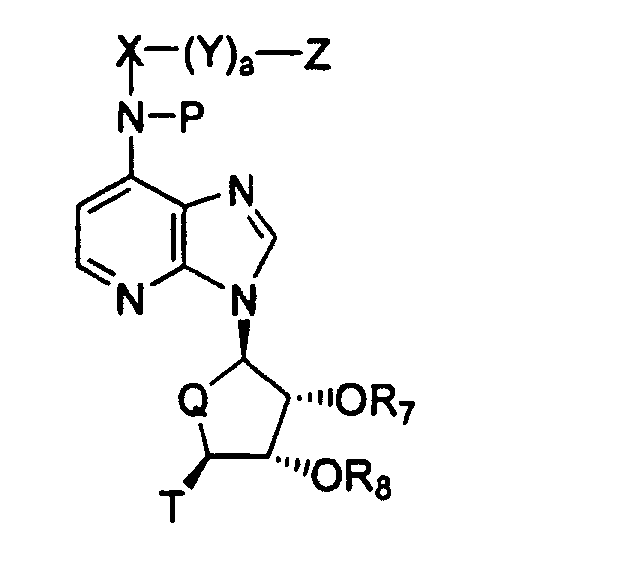
P is a nitrogen protecting group;
Q is CH2 or O;
T isor R3O-CH2;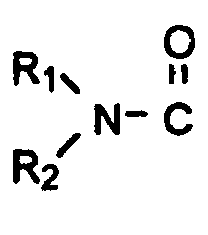
X is a straight or branched chain alkylene, cycloalkylene or cycloalkenylene group;
Y is NR4, O or S;
a = 0 or 1;
Z is of the formulaZ1 is N, CR5, (CH)m-CR5 or (CH)m-N, m being 1 or 2;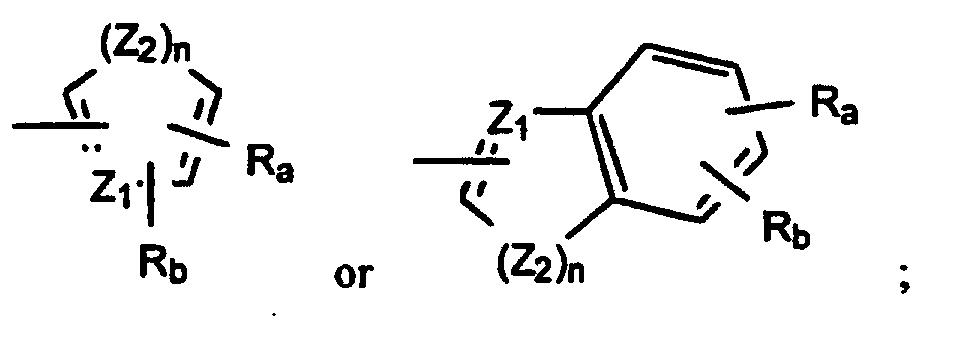
Z2 is N, NR6, O or S;
n is 0 or 1;
R1, R2, R3, R4, R5 and R6 are independently H, alkyl, aryl or heterocyclyl;
R7 and R8 are independently H, alkyl, aralkyl, carbamoyl, alkyl carbamoyl, dialkylcarbamoyl, acyl, alkoxycarbonyl, aralkoxycarbonyl, or aryloxycarbonyl; or R7 and R8 together may formwhere Rc is hydrogen or alkyl,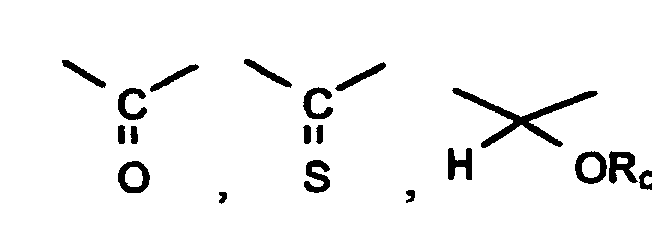 where Rd and Re are independently hydrogen, or alkyl, or Rd and Re together with the carbon atom to which they are attached may form a 1,1-cycloalkyl group; and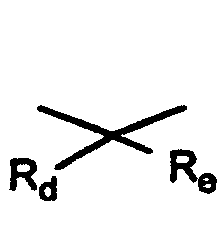
Ra and Rb are independently H, OH, alkyl, hydroxyalkyl, alkyl mercaptyl, thioalkyl, alkoxy, alkyoxyalkyl, amino, alkyl amino, carboxyl, acyl, halogen, carbamoyl, alkyl carbamoyl, aryl or heterocyclyl, this process comprising reacting a 4-N-protected-2,3,4-triaminopyridine compound of formulawith triethyl orthoformate, diethoxymethyl acetate or dimethylformamide dimethyl acetal.
- The process of the present invention offers improved yields, purity, ease of preparation and/or isolation of intermediates and final product, and more industrially useful reaction conditions and workability over previously disclosed methods of preparation.
- As used above and throughout the description of the invention, the following terms, unless otherwise indicated, have the following meanings:
- "Acyl" means a straight or branched alkyl-C=O group. "Thioacyl" means a straight or branched alkyl-C=S group. Preferred acyl and thioacyl groups are lower alkanoyl and lower thioalkanoyl having from 1 to about 6 carbon atoms in the alkyl group.
- "Alkyl" means a saturated aliphatic hydrocarbon group which may be straight or branched and has 1 to about 20 carbon atoms in the chain. Preferred alky groups may be straight or branched and has 1 to about 10 carbon atoms in the chain. Branched means that a lower alkyl group such as methyl, ethyl or propyl is attached to a linear alkyl chain.
- "Lower alkyl" means an alkyl group having 1 to about 6 carbons.
- "Cycloalkyl" means an aliphatic ring having 3 to about 10 carbon atoms in the ring. Preferred cycloalkyl groups have 4 to about 7 carbon atoms in the ring.
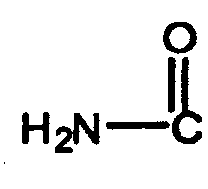
- "Carbamoyl" means an
group. Alkylcarbamoyl and dialkylcarbamoyl means that the nitrogen of the carbamoyl is substituted by one or two alkyl groups, respectively.
- "Carboxyl" means a COOH group.
- "Alkoxy" means an alkyl-O group in which "alkyl" is as previously described. Lower alkoxy groups are preferred. Exemplary groups include methoxy, ethoxy, n-propoxy, i-propoxy and n-butoxy.
- "Alkoxyalkyl" means an alkyl group, as previously described, substituted by an alkoxy group, as previously described.
- "Alkoxycarbonyl means an alkoxy-C=O group.
- "Aralkyl" means an alkyl group substituted by an aryl radical, wherein "aryl" means a phenyl or naphthyl. "Substituted aralkyl" and "substituted aryl" means that the aryl group, or the aryl group of the aralkyl group is substituted with one or more substituents which include alkyl, alkoxy, amino, nitro, carboxy, carboalkoxy, cyano, alkyl amino, halo, hydroxy, hydroxyalkyl, mercaptyl, alkylmercaptyl, trihaloalkyl, carboxyalkyl or carbamoyl.
- "Aralkoxycarbonyl" means an aralkyl-O-C=O group.
- "Aryloxycarbonyl" means an aryl-O-C=O group.
- "Carbalkoxy" means a carboxyl substituent esterified with an alcohol of the formula CnH2n+1 OH, wherein n is from 1 to about 6.
- "Halogen" (or "halo") means chlorine (chloro), fluorine (fluoro), bromine (bromo) or iodine (iodo).
- "Heterocyclyl" means about a 4 to about a 10 membered ring structure in which one or more of the atoms in the ring is an element other than carbon, e.g., N, O or S. Heterocyclyl may be aromatic or non-aromatic, i.e., may be saturated, partially or fully unsaturated. Preferred heterocyclyl groups include pyridyl, pyridazinyl, pyrimidinyl, isoquinolinyl, quinolinyl, quinazolinyl, imidazolyl, pyrrolyl, furanyl, thienyl, thiazolyl, benzothiazolyl, piperidinyl, pyrrolidinyl, tetrahydrofuranyl, tetrahydropyranyl, and morphonlinyl groups.
- "Substituted heterocyclyl" means that the heterocyclyl group is substituted by one or more substituents wherein the substituents include alkoxy, alkylamino, aryl, carbalkoxy, carbamoyl, cyano, halo, heterocyclyl, trihalomethyl, hydroxy, mercaptyl, alkylmercaptyl or nitro.
- "Hydroxyalkyl" means an alkyl group substituted by a hydroxy group. Hydroxy lower alkyl groups are preferred. Exemplary preferred groups include hydroxymethyl, 2-hydroxyethyl, 2-hydroxypropyl and 3-hydroxypropyl.
- "Nitrogen protecting group" means an easily removable group which is known in the art to protect an amino group against undesirable reaction during synthetic procedures and to be selectively removable. The use ofN-protecting groups is well known in the art for protecting groups against undesirable reactions during a synthetic procedure and many such protecting groups are known, CF, for example, T.H. Greene and P.G.M. Wuts, Protective Groups in Organic Synthesis, 2nd edition, John Wiley & Sons, New York (1991), incorporated herein by reference. Representative N-protecting groups include sulfonamides such as methanesufonyl (Ms), trifluoromethanesulfonyl (Tf), benzenesulfonyl (or phenylsulfonyl), p-toluenesulfonyl (Ts), p-methoxybenzenesulfonyl, phenacylsulfonyl, and the like; carbamates such as methoxycarbonyl, ethoxycarbonyl, 2,2,2-trichloroethoxycarbonyl (Troc), 2-trimethylsilylethyloxycarbonyl (Teoc), tert-butoxycarbonyl (Boc), and the like; amides such as formyl, acetyl, benzoyl, trifluoroacetyl, and the like; N-alkyl derivatives such as benzyl; and N-phosphinyl derivatives such as diphenylphosphinoyl.
-
- In a specific embodiment, the term "about" or "approximately" means within 20%, preferably within 10%, and more preferably within 5% of a given value or range.
- The preparation of N6-substituted adenosine derivatives of formula (I) wherein X1, X2, X, Y, a, Z, P, Q, T, R7 and R8 are defined above is outlined in Scheme 1.

- As shown in the foregoing Scheme 1, reaction of the 2,4-dihalo-3-nitropyridine compound (II) and the N-protected amine (III) provides the 2-halo-3-nitro-4-N-protected aminopyridine compound (IV). The reaction is carried out in the presence of an alkoxide such as potassium tert-butoxide or potassium tert-amylate, and the like; an inorganic carbonate base such as potassium carbonate; a metal hydride base such as sodium or potassium hydride; an alkyllithium base such as butyllithium; or a fluoride base such as potassium fluoride. When weaker bases such as potassium carbonate or potassium fluoride are utilized, a crown ether such as 18-crown-6, or a phase transfer catalyst, such as tetrabutyl ammonium bromide may be added to achieve a reasonable rate of conversion. The reaction is carried out in an etheral solvent such as tetrahydrofuran, tert-butyl methyl ether, and the like; an aromatic hydrocarbon solvent such as toluene; or in a polar aprotic solvent such as dimethylformamide, 1-methyl-2-pyrrolidone, dimethylsulfoxide, and the like at a temperature of from about ambient temperature to the reflux temperature of the solvent.
- The reaction is preferably accomplished using potassium tert-butoxide in tetrahydrofuran at about 65 °C. The product is preferably purified by washing with methanol and heptane.
- Alternatively, a metalated version of the protected amine (III) of formula P-NM-X-(Y)a-Z, where M is a metal cation such as Li+ may be used, in which case use of additional base is unnecessary.
- The 2-haio-3-nitro-4-N-protected aminopyridine compound (IV) is then reacted with the protected dihydroxyaminocyclopentane compound (V) in the presence of an inorganic bicarbonate base, such as potassium bicarbonate; a tertiary or aromatic amine base such as 4-methylmorpholine; an alkoxide such as potassium tert-butoxide or potassium tert-amylate, and the like; an inorganic carbonate base such as potassium carbonate; a metal hydride base such as sodium or potassium hydride; an alkyllithium base such as butyllithium; or a fluoride base such as potassium fluoride, in an ester solvent such as ethyl acetate; an etheral solvent such as tetrahydrofuran, tert-butyl methyl ether, and the like; an aromatic hydrocarbon solvent such as toluene; or a polar aprotic solvent such as dimethylformamide, 1-methyl-2-pyrrolidone, dimethylsulfoxide, and the like, at a temperature of from about ambient temperature to the reflux temperature of the solvent to form the 4-N-protected-2,4-diamino-3-nitropyridine compound (VI). The reaction is preferably accomplished using potassium carbonate in ethyl acetate at about 80 °C.
- The protected dihydroxyaminocyclopentane compound (V) may be utilized as the free base, or as the acid addition salt. Preferred acid addition salts are the trifluoroacetate or benzoate salts.
- The reduction of the 4-N-protected-2,4-diamino-3-nitropyridine compound (VI) to form the 4-N-protected-2,3,4-triiaminopyridine compound (VII) is accomplished using methods well known in the art for the reduction of aromatic nitro compounds such as catalytic hydrogenation using a transition metal catalyst such as platinum. The reduction is also accomplished using a metal such as zinc, iron or tin in the presence of a proton source such as ammonium acetate. Solvents are generally alcohols, or mixtures of non-protic organic solvents such as ethyl acetate or toluene and an alcohol such as methanol. The reduction is preferably accomplished by catalytic hydrogenation at about 50 psi of hydrogen in the presence of platinum on carbon, in a mixture of ethyl acetate and methanol at room temperature.
- The 4-N-protected-2,3,4-triiaminopyridine compound (VII) is then converted to the N-protected N6-substituted adenosine derivative (VIII) by a reaction with triethyl orthoformate or diethoxymethyl acetate, in a polar aprotic solvent such as dimethylformamide; a higher boiling alcohol such as n-butanol; an ester such as n-butyl acetate; an anhydride such as acetic anhydride; or an aromatic hydrocarbon such as toluene. Alternatively, the reagent itself (e.g. triethylorthoformate) can be used as the solvent for this reaction. The reaction is optionally catalyzed by an acid such as hydrochloric acid or p-toluenesulfonic acid. The reaction is accomplished at a temperature of from about ambient temperature to the reflux temperature of the solvent. Preferred reaction conditions are triethyl orthoformate in acetic anhydride at about 120 °C.
- Removal of the amine protecting group P is accomplished using reagents known in the art for the removal of nitrogen protecting groups. When P is sulfonamido, such as p-toluenesulfonyl, the protecting group is cleaved using a strong acid, such as methanesulfonic acid, hydrochloric acid, trifluoroacetic acid, and the like, or a strong Lewis acid, such as trimethylsilyl trifluoromethanesulfonate in a polar protic solvent such as acetic acid, trifluoroacetic acid, water and the like. A cation scavenger such as thioanisole generally is also employed, resulting in increased purity of the final product. In a preferred aspect of the foregoing process, the groups R7 and R8 together form the dimethyl acetonide, in which case the strongly acidic conditions described above for the removal of P typically also result in hydrolysis of the acetonide. Preferred conditions for removal of the nitrogen protecting group P are trimethylsilyl trifluoroacetate with thioanisole in trifluoroacetic acid at about 70 °C.
- Alternatively, the tosyl group can be selectively removed by a reductive process using metals such as lithium, sodium, sodium-mercury couple, magnesium and the like. For lithium and sodium, ammonia is typically used as the solvent (dissolving metal reduction). Magnesium reduction is generally carried out in an alcohol such as methanol. The tosyl group might also be removed with a hydride reagent, such as lithium triethylborohydride in an aprotic solvent such as THF, or electrolytically.
- In the event that the nitrogen protecting group P is selectively removed, the groups R7 and R8 are then removed using techniques known in the art for removal of hydroxyl protecting groups. When R7 and R8 together form the dimethyl acetonide, the acetonide is hydrolyzed using an acid such as hydrochloric acid or trifluoroacetic acid, in a protic solvent such as water or an alcohol; or an organic solvent such as tetrahydrofuran can also be used. Acetonide hydrolysis is preferably accomplished using a mixture of aqueous concentrated hydrochloric acid and tetrahydrofuran at a temperature ranging from ambient temperature to about 35 °C.
- In a preferred aspect of the foregoing process,
Q is CH2;
T isX is a straight or branched chain alkylene;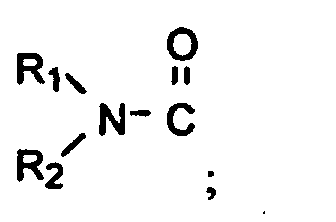
a = 0;
Z isZ1 is N, CR5, (CH)m-CR5 or (CH)m-N, m being 1 or 2;
Z2 is N, NR6, O or S; n is 0 or 1;
R1, R2, R3, R4, R5 and R6 are independently H or alkyl;
R7 and R8 are independently hydrogen or alkyl, or R7 and R8 together may formwhere Rd and Re are independently hydrogen or alkyl, or together with the carbon atom to which they are attached may form a 1,1-cycloalkyl group; and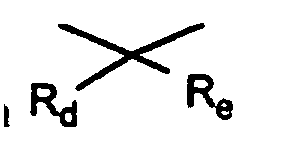
Ra and Rb are independently H, OH, alkyl, hydroxyalkyl, alkyl mercaptyl, thioalkyl, alkoxy, alkyoxyalkyl, amino, alkyl amino, carboxyl, acyl, halogen, carbamoyl, alkyl carbamoyl, aryl or heterocyclyl. - In a more preferred aspect of the foregoing process, P is selected from the group consisting of sulfonamides, carbamates, amides, N-alkyl derivatives and N-phosphinyl derivatives.
- In a still more preferred aspect of the foregoing process, P is a sulfonamide derivative.
- In a still yet more preferred aspect of the foregoing process, P isp-toluenesulfonyl.
- A process for preparing [1S-[1α,2β,3β,4α(S*)]]-4-[7-[[1-[(3-chlorothien-2-yl)methyl]propyl]amino]-3H-imidazo[4,5-b]pyrid-3-yl] N-ethyl 2,3-dihydroxycyclopentanecarboxamide (XV) is shown in Scheme 2.


- As shown in the foregoing Scheme 2, 2,4-dihalo-3-nitropyridine (II) (X1 = F, X2 = Cl or F) is reacted with the (R)-N-[1-[(3-chlorothien-2-yl)methyl]propyl]-4-methylbenzenesulfonamide compound (IX) to form the (R)-N-[1-[3-chlorothien-2-yl)methyl]propyl]-N-(2-halo-3-nitropyrid-4-yl)- 4-methylbenzenesulfonamide compound (X) (X2 = Cl or F).
- When P' is H, the reaction is performed by deprotonation of the secondary amine by reaction with base, preferably potassium tert-butoxide in tetrahydrofuran at a temperature of about 0 °C to about ambient temperature, followed by addition of the 2,4-dihalo-3-nitropyridine compound and heating at about 65 °C. When P' is Li, no additional base is required and the reaction of (II) and (IX) is preferably performed in refluxing 1-methyl-2-pyrrolidinone or toluene.
- In one preferred aspect of the foregoing, the 2,4-dihalo-3-nitropyridine compound (II) is 2,4-difluoro-3-nitropyridine, which is prepared by reaction of 2,4-dichloro-3-nitropyridine with a nucleophilic fluoride reagent, preferably KF. Incomplete reaction of 2,4-dichloro-3-nitropyridine with the nucleophilic fluoride reagent results in formation of a mixture of 2,4-difluoro-3-nitropyridine and 2-chloro-4-fluoro-3-nitropyridine. Use of this mixture for reaction with the (R)-N-[1-[(3-chlorothien-2-yl)methyl]propyl]-4-methylbenzenesulfonamide, compound (IX), results in formation of the (R)-N-[1-[3-chlorothien-2-yl)methyl]propyl]-N-(2-halo-3-nitropyrid-4-yl)- 4-methylbenzenesulfonamide, compound (X), wherein halo is a mixture of Cl and F.
- The (R)-N-[1-[3-chlorothien-2-yl)methyl]propyl]-N-(2-halo-3-nitropyrid-4-yl)- 4-methylbenzenesulfonamide, compound (X), is then reacted with 3aR-[3aα,4α,6a,6aα]-6-amino-N-ethyltetrahydro-3,3-dimethyl-2,4-dioxabicyclo [3.3.0]octan-8-carboxamide, benzoate (XI), to form [3aR-[3aα,4α,6a(R*),6aα]]-6-[4-[[1-[(3-chlorothien-2-yl)methyl]propyl] [4-methylbenzenesulfonyl]amino]-3-nitropyrid-2-ylamino] N-ethyl tetrahydro-2,2-dimethyl-4H-cyclopenta-1,3-dioxole-4-carboxamide (XII). The reaction is preferably accomplished using excess alkoxide base, preferably potassium carbonate, at about 80 °C in an organic solvent such as ethyl acetate or 1-methyl-2-pyrrolidinone. 1-methyl-2-pyrrolidinone is the preferred solvent when halo is a mixture of Cl and F. The preparation of 3aR-[3aα,4α,6a,6aα]-6-amino-N-ethyltetrahydro-3,3-dimethyl-2,4-dioxabicyclo [3.3.0]octan-8-carboxamide, benzoate is described in U.S. Pat. Nos. 5,808,093, 5,670,649 and 5,684,159, the contents of which are hereby incorporated herein by reference.
- Reduction of [3aR-[3aα,4α,6a(R*),6aα]]-6-[4-[[1-[(3-chlorothien-2-yl)methyl]propyl] [4-methylbenzenesulfonyl]amino]-3-nitropyrid-2-ylamino] N-ethyl tetrahydro-2,2-dimethyl-4H-cyclopenta-1,3-dioxole-4-carboxamide (XII) to form [3aR-[3aα,4α,6a(R*),6aα]]-6-[4-[[1-[(3-chlorothien-2-yl)methyl]propyl] [4-methylbenzenesulfonyl]amino]-3-aminopyrid-2-ylamino] N-ethyl tetrahydro-2,2-dimethyl-4H-cyclopenta-1,3-dioxole-4-carboxamide (XIII) is then accomplished as described in Scheme 1 above, preferably by catalytic hydrogenation at about 50 to about 55 psi of hydrogen in the presence of catalytic platinum on carbon in a mixture of ethyl acetate and methanol at about ambient temperature.
- Cyclization of [3aR-[3aα,4α,6a(R*),6aα]]-6-[4-[[1-[(3-chlorothien-2-yl)methyl]propyl] [4-methylbenzenesulfonyl]amino]-3-aminopyrid-2-ylamino] N-ethyl tetrahydm-2,2-dimethyl-4H-cyclopenta-1,3-dioxole-4-carboxamide (XIII) to form [3aR-[3aα,4α,6a(R*),6aα]]-6-[7-[[1-[(3-chlorothien-2-yl)methyl]propyl] [4-methylbenzenesulfonyl]amino]-3H-imidazo[4,5-b]pyrid-3-yl]N-ethyl tetrahydro-2,2-dimethyl-4H-cyclopenta-1,3-dioxole-4-carboxamide (XIV) is then accomplished as described in Scheme 1 above.
- Conversion of [3aR-[3aα,4α,6a(R*),6aα]]-6-[7-[[1-[(3-chlorothien-2-yl)methyl]propyl] [4-methylbenzenesulfonyl]amino]-3H-imidazo[4,5-b]pyrid-3-yl] N-ethyl tetrahydro-2,2-dimethyl-4H-cyclopenta-1,3-dioxole-4-carboxamide (XIV) to [1S-[1α,2β,3β,4α(S*)]]-4-[7-[[1-[(3-chlorothien-2-yl)methyl]propyl]amino]-3H-imidazo[4,5-b]pyrid-3-yl] N-ethyl 2,3-dihydroxycyclopentanecarboxamide (XV) is accomplished by the simultaneous or sequential removal of the toluenesulfonyl group and the dimethyl acetonide as described in Scheme 1 above.
- Selective removal of the toluenesulfonyl group is preferably accomplished using magnesium metal in a mixture of methanol and toluene at about 40 °C or using a hydride reagent such as lithium triethylborohydride in tetrahydrofuran at about 0 °C. The dimethyl acetonide is then hydrolyzed using an acid such as hydrochloric acid or trifluoroacetic acid, in a protic solvent such as water or an alcohol or an organic solvent such as tetrahydrofuran. Acetonide hydrolysis is preferably accomplished using a mixture of aqueous concentrated hydrochloric acid and tetrahydrofuran at ambient temperature to about 35 °C.
- Simultaneous removal of the toluenesulfonyl group and hydrolysis of the acetonide is accomplished using a strong acid, such as methanesulfonic acid, hydrochloric acid, trifluoroacetic acid, and the like, or a strong Lewis acid, such as trimethylsilyl trifluoromethanesulfonate in a polar protic solvent such as acetic acid, trifluoroacetic acid, water and the like. A cation scavenger such as thioanisole generally is also employed, resulting in increased purity of the final product. Simultaneous removal of the toluenesulfonyl group and the dimethyl acetonide is accomplished by heating a mixture of [3aR-[3aα,4α,6a(R*),6aα]]-6-[7-[[1-[(3-chlorothien-2-yl)methyl]propyl] [4-methylbenzenesulfonyl]amino]-3H-imidazo[4,5-b]pyrid-3-yl] N-ethyl tetrahydro-2,2-dimethyl-4H-cyclopenta-1,3-dioxole-4-carboxamide and trimethylsilyl trifluoroacetate in trifluoroacetic acid/toluene at about 70 °C or by heating a mixture of [3aR-[3aα,4α,6a(R*),6aα]]-6-[7-[[1-[(3-chlorothien-2-yl)methyl]propyl] [4-methylbenzenesulfonyl]amino]-3H-imidazo[4,5-b]pyrid-3-yl] N-ethyl tetrahydro-2,2-dimethyl-4H-cyclopenta-1,3-dioxole-4-carboxamide, methanesulfonic acid and thioanisole in trifluoroacetic acid at about 85 °C.
- In another aspect, this invention is directed to a process for preparing [3aR-[3aα,4α,6a(R*),6aα]]-6-[7-[[1-[(3-chlorothien-2-yl)methyl]propyl] [4-methylbenzenesulfonyl]amino]-3H-imidazo[4,5-b]pyrid-3-yl] N-ethyl tetrahydro-2,2-dimethyl-4H-cyclopenta-1,3-dioxole-4-carboxamide comprising
- (i) reacting (R)-N-[1-[3-chlorothien-2-yl)methyl]propyl]-N-(2-fluoro-3-nitropyrid-4-yl)-4-methylbenzenesulfonamide with 3aR-[3aα,4α,6a,6aα]-6-amino-N-ethyltetrahydro-3,3-dimethyl-2,4-dioxabicyclo [3.3.0]octan-8-carboxamide, benzoate to form [3aR-[3aα,4α,6a(R*),6aα]]-6-[4-[[1-[(3-chlorothien-2-yl)methyl]propyl] [4-methylbenzenesulfonyl]amino]-3-nitropyrid-2-ylamino] N-ethyl tetrahydro-2,2-dimethyl-4H-cyclopenta-1,3-dioxole-4-carboxamide,
- (ii) reducing the [3aR-[3aα,4α,6a(R*),6aα]]-6-[4-[[1-[(3-chlorothien-2-yl)methyl]propyl] [4-methylbenzenesulfonyl]amino]-3-nitropyrid-2-ylamino] N-ethyl tetrahydro-2,2-dimethyl-4H-cyclopenta-1,3-dioxole-4-carboxamide prepared in step (i) to form [3aR-[3aα,4α,6a(R*),6aα]]-6-[4-[[1-[(3-chlorothien-2-yl)methyl]propyl] [4-methylbenzenesulfonyl]amino]-3-aminopyrid-2-ylamino] N-ethyl tetrahydro-2,2-dimethyl-4H-cyclopenta-1,3-dioxole-4-carboxamide and
- (iii) reacting the [3aR-[3aα,4α,6a(R*),6aα]]-6-[4-[[1-[(3-chlorothien-2-yl)methyl]propyl] [4-methylbenzenesulfonyl]amino]-3-aminopyrid-2-ylamino] N-ethyl tetrahydro-2,2-dimethyl-4H-cyclopenta-1,3-dioxole-4-carboxamide prepared in step 2 above with an orthoformate ester or dimethylformamide dimethyl acetal, wherein steps (i)-(iii) are performed in a concatenated fashion without purification of the intermediate compounds, [3aR-[3aα,4α,6a(R*),6aα]]-6-[4-[[1-[(3-chlorothien-2-yl)methyl]propyl] [4-methylbenzenesulfonyl]amino]-3-nitropyrid-2-ylamino]-N-ethyl tetrahydro-2,2-dimethyl-4H-cyclopenta-1,3-dioxole-4-carboxamide and [3aR-[3aα,4α,6a(R*),6aα]]-6-[4-[[1-[(3-chlorothien-2-yl)methyl]propyl][4-methylbenzenesulfonyl]amino]-3-aminopyrid-2-ylamino] N-ethyl tetrahydro-2,2-dimethyl-4H-cyclopenta-1,3-dioxole-4-carboxamide.
-
- For example, (R)-N-[ 1-[3-chlorothien-2-yl)methyl]propyl]-N-(2-fluoro-3-nitropyrid-4-yl)-4-methylbenzenesulfonamide and 3aR-[3aα,4α,6a,6aα]-6-amino-N-ethyltetrahydro-3,3-dimethyl-2,4-dioxabicyclo [3.3.0]octan-8-carboxamide, benzoate and potassium carbonate are heated in ethyl acetate to form an ethyl acetate solution of [3aR-[3aα,4α,6a(R*),6aα]]-6-[4-[[1-[(3-chlorothien-2-yl)methyl]propyl] [4-methylbenzenesulfonyl]amino]-3-nitropyrid-2-ylamino] N-ethyl tetrahydro-2,2-dimethyl-4H-cyclopenta-1,3-dioxole-4-carboxamide. The ethyl acetate solution is washed with water and brine to remove water-soluble impurities and then the ethyl acetate solution is diluted with methanol, a platinum catalyst is added and the mixture is hydrogenated under about 50 psi of hydrogen to give a solution in ethyl acetate/methanol of [3aR-[3aα,4α,6a(R*),6aα]]-6-[4-[[1-[(3-chlorothien-2-yl)methyl]propyl] [4-methylbenzenesulfonyl]amino]-3-aminopyrid-2-ylamino] N-ethyl tetrahydro-2,2-dimethyl-4H-cyclopenta-1,3-dioxole-4-carboxamide. The catalyst is filtered off, the filtrate is concentrated, and triethyl orthoformate and acetic anhydride are added to the crude [3aR-[3aα,4α,6a(R*),6aα]]-6-[4-[[1-[(3-chlorothien-2-yl)methyl]propyl][4-methylbenzenesulfonyl]amino]-3-aminopyrid-2-ylamino] N-ethyl tetrahydro-2,2-dimethyl-4H-cyclopenta-1,3-dioxole-4-carboxamide. Heating of the mixture effects conversion to [3aR-[3aα,4α,6a(R*),6aα]]-6-[7-[[1-[(3-chlorothien-2-yl)methyl]propyl] [4-methylbenzenesulfonyl]amino]-3H-imidazo[4,5-b]pyrid-3-yl] N-ethyl tetrahydro-2,2-dimethyl-4H-cyclopenta-1,3-dioxole-4-carboxamide, which is isolated by crystallization, preferably using 2-propanol.
- In another aspect, this invention is directed to a process for preparing (R)-N-[1-[3-chlorothien-2-yl)methyl]propyl]-N-(2-halo-3-nitropyrid-4-yl)-4-methylbenzenesulfonamide, wherein halo is Cl or F, comprising
- (i) reacting 2,4-dichloro-3-nitropyridine with a fluorinating agent to form 2,4-difluoro-3-nitropyridine or a mixture of 2,4-difluoro-3-nitropyridine and 2-chloro-4-fluoro-3-nitropyridine and
- (ii) reacting the product of step (i) with (R)-N-[1-[(3-chlorothien-2-yl)methyl]propyl]-4-methylbenzenesulfonamide lithium salt or (R)-N-[1-[(3-chlorothien-2-yl)methyl]propyl]-4-methylbenzenesulfonamide, wherein steps (i) and (ii) are performed in a concatentated fashion without isolation of the product of step (i).
-
- For example, heating a mixture of 2,4-dichloro-3-nitropyridine with KF and catalytic tetrabutylammonium bromide in toluene or toluene/1-methyl-2-pyrrolidinone results in the formation of a solution of 2,4-difluoro-3-nitropyridine. (R)-N-[1-[(3-chlorothien-2-yl)methyl]propyl]-4-methylbenzenesulfonamide lithium salt is then added to the solution and the mixture is heated to effect conversion to the (R)-N-[1-[3-chlorothien-2-yl)methyl]propyl]-N-(2-fluoro-3-nitropyrid-4-yl)-4-methylbenzenesulfonamide, which is isolated by crystallization, preferably by aqueous extraction of the reaction mixture followed by addition of a hydrocarbon solvent such as heptane to the organic solution.
- In another aspect of the foregoing process, excess KF is utilized, which acts as the fluorinating agent in the first step and the base in the second step, thereby making it possible to utilize (R)-N-[1-[(3-chlorothien-2-yl)methyl]propyl]-4-methylbenzenesulfonamide rather than the lithium salt.
- In another aspect, this invention is directed to a process for preparing [3aR-[3aα,4α,6a(R*),6aα]]-6-[7-[[1-[(3-chlorothien-2-yl)methyl]propyl] [4-methylbenzenesulfonyl]amino]-3H-imidazo[4,5-b]pyrid-3-yl] N-ethyl tetrahydro-2,2-dimethyl-4H-cyclopenta-1,3-dioxole-4-carboxamide comprising
- (i) reacting 2,4-dichloro-3-nitropyridine with a fluorinating agent to form 2,4-difluoro-3-nitropyridine,
- (ii) reacting the 2,4-difluoro-3-nitropyridine with (R)-N-[1-[(3-chlorothien-2-yl)methyl]propyl]-4-methylbenzenesulfonamide lithium salt or (R)-N-[1-[(3-chlorothien-2-yl)methyl]propyl]-4-methylbenzenesulfonamide to form (R)-N-[1-[3-chlorothien-2-yl)methyl]propyl]-N-(2-fluoro-3-nitropyrid-4-yl)-4-methylbenzenesulfonamide,
- (iii) reacting the (R)-N-[1-[3-chlorothien-2-yl)methyl]propyl]-N-(2-fluoro-3-nitropyrid-4-yl)-4-methylbenzenesulfonamide with 3aR-[3aα,4α,6a,6aα]-6-amino-N-ethyltetrahydro-3,3-dimethyl-2,4-dioxabicyclo [3.3.0]octan-8-carboxamide, benzoate to form [3aR-[3aα,4α,6a(R*),6aα]]-6-[4-[[1-[(3-chlorothien-2-yl)methyl]propyl] [4-methylbenzenesulfonyl]amino]-3-nitropyrid-2-ylamino] N-ethyl tetrahydro-2,2-dimethyl-4H-cyclopenta-1,3-dioxole-4-carboxamide,
- (iv) reducing the [3aR-[3aα,4α,6a(R*),6aα]]-6-[4-[[1-[(3-chlorothien-2-yl)methyl]propyl] [4-methylbenzenesulfonyl]amino]-3-nitropyrid-2-ylamino] N-ethyl tetrahydro-2,2-dimethyl-4H-cyclopenta-1,3-dioxole-4-carboxamide prepared in step (i) to form [3aR-[3aα,4α,6a(R*),6aα]]-6-[4-[[1-[(3-chlorothien-2-yl)methyl]propyl] [4-methylbenzenesulfonyl]amino]-3-aminopyrid-2-ylamino] N-ethyl tetrahydro-2,2-dimethyl-4H-cyclopenta-1,3-dioxole-4-carboxamide and
- (v) reacting the [3aR-[3aα,4α,6a(R*),6aα]]-6-[4-[[1-[(3-chlorothien-2-yl)methyl]propyl] [4-methylbenzenesulfonyl]amino]-3-aminopyrid-2-ylamino] N-ethyl tetrahydro-2,2-dimethyl-4H-cyclopenta-1,3-dioxole-4-carboxamide with an orthoformate ester or dimethylformamide dimethyl acetal, wherein steps (i)-(v) are performed in a concatenated fashion without purification of the intermediate compounds 2,4-dilfuoro-3-nitropyridine, (R)-N-[1-(3-chlorothien-2-yl)methyl]propyl]-N-(2-halo-3-nitropyrid-4-yl)-4-methylbenzenesulfonamide, [3aR-[3aα,4α,6a(R*),6aα]]-6-[4-[[1-[(3-chlorothien-2-yl)methyl]propyl] [4-methylbenzenesulfonyl]amino]-3-nitropyrid-2-ylamino] N-ethyl tetrahydro-2,2-dimethyl-4H-cyclopenta-1,3-dioxole-4-carboxamide and [3aR-[3aα,4α,6a(R*),6aα]]-6-[4-[[1-[(3-chlorothien-2-yl)methyl]propyl] [4-methylbenzenesulfonyl]amino]-3-aminopyrid-2-ylamino] N-ethyl tetrahydro-2,2-dimethyl-4H-cyclopenta-1,3-dioxole-4-carboxamide, wherein the concatenation is effected by combining the concatenated processess described above.
-
- In another aspect, this invention is directed to a compound of formula (XVI)wherein

A is NH2 or N02;
P is a nitrogen protecting group;
W is Cl, F or a group of formulaQ is CH2 or O;
T isor R3O-CH2;
X is a straight or branched chain alkylene, cycloalkylene or cycloalkenylene group;
Y is NR4, O or S;
a = 0 or 1;
Z is of the formulaZ1 is N, CR5, (CH)m-CR5 or (CH)m-N, m being 1 or 2;
Z2 is N, NR6, O or S;
n is 0 or 1;
R1, R2, R3, R4, R5 and R6 are independently H, alkyl, aryl or heterocyclyl;
R7 and R8 are independently H, alkyl, aralkyl, carbamoyl, alkyl carbamoyl, dialkylcarbamoyl, acyl, alkoxycarbonyl, aralkoxycarbonyl, or aryloxycarbonyl, or R7 and R8 together may formwhere Rc is hydrogen or alkyl,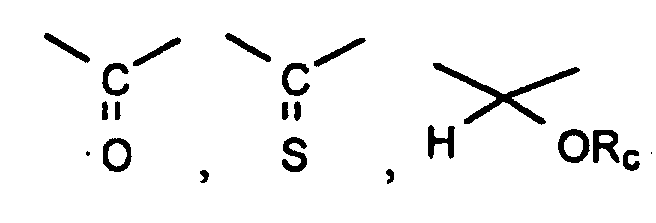 where Rd and Re are independently hydrogen, alkyl, or Rd and Re together with the carbon atom to which they are attached may form a 1,1-cycloalkyl group; and
Ra and Rb are independently H, OH, alkyl, hydroxyalkyl, alkyl mercaptyl, thioalkyl, alkoxy, alkyoxyalkyl, amino, alkyl amino, carboxyl, acyl, halogen, carbamoyl, alkyl carbamoyl, aryl or heterocyclyl, which compound is a useful intermediate in the preparation of N-protected N6-substituted adenosine compounds using the processes described herein. - Preferred compounds have formula (XVI) wherein P is selected from sulfonamides, carbamates, amides, N-alkyl derivatives and N-phosphinyl derivatives.
- More preferred compounds have formula (XVI) wherein P is sulfonamido.
- Still more preferred compounds have formula (XVI) wherein
P is sulfonamido;
Q is CH2;
T isX is a straight or branched chain alkylene;
a = 0;
Z isZ1 is N, CR5, (CH)m-CR5 or (CH)m-N, m being 1 or 2;
Z2 is N, NR6, O or S, n being 0 or 1;
R1, R2, R5 and R6 are independently H or alkyl;
R7 and R8 are alkyl, or R7 and R8 together may formwhere Rd and Re are independently hydrogen or alkyl, or together with the carbon atom to which they are attached may form a 1,1-cycloalkyl group; and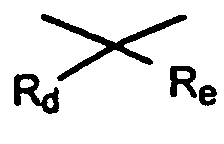
Ra and Rb are independently H, OH, alkyl, hydroxyalkyl, alkyl mercaptyl, thioalkyl, alkoxy, alkyoxyalkyl, amino, alkyl amino, carboxyl, acyl, halogen, carbamoyl, alkyl carbamoyl, aryl or heterocyclyl. - Representative still more preferred compounds include, but are not limited to [3aR-[3aα,4α,6a(R*),6aα]]-6-[4-[[1-[(3-chlorothien-2-yl)methyl]propyl] [4-methylbenzenesulfonyl]amino]-3-nitropyrid-2-ylamino] N-ethyl tetrahydro-2,2-dimethyl-4H-cyclopenta-1,3-dioxole-4-carboxamide;
[3aR-[3aα,4α,6a(R*),6aα]]-6-[4-[[1-[(3-chlorothien-2-yl)methyl]propyl][4-methylbenzenesulfonyl]amino]-3-aminopyrid-2-ylamino] N-ethyl tetrahydro-2,2-dimethyl-4H-cyclopenta-1,3-dioxole-4-carboxamide; and
[3aR-[3aα,4α,6a(R*),6aα]]-6-[7-[[1-[(3-chlorothien-2-yl)methyl]propyl][4-methylbenzenesulfonyl]amino]-3H-imidazo[4,5-b]pyrid-3-yl] N-ethyl tetrahydro-2,2-dimethyl-4H-cyclopenta-1,3-dioxole-4-carboxamide. - The foregoing may be better understood by reference to the following examples, which are presented for purposes of illustration and are not intended to limit the scope of the invention.
-

- Five grams of 3-chloro-2-(2-aminobutyl)thiophene is dissolved in 10 ml of methylene chloride in a 3-neck round bottomed flask blanketed with an inert atmosphere at 0 °C. Pyridine (2.2 ml) is added in one portion followed by 3.37 ml of benzenesulfonyl chloride. The latter reagent is added at such a rate as to allow the methylene chloride solution to warm to 15 °C. After warming to ambient temperature, the mixture is stirred for 4 hours and diluted with 100 ml of diethyl ether. The solution is poured into a separatory funnel and washed with water, dilute 1N HCl, saturated aqueous sodium bicarbonate and brine. The organic phase is dried over magnesium sulfate, filtered and concentrated in vacuo to provide (R)-N-[1-[(3-chlorothien-2-yl)methyl]propyl]-4-methylbenzenesulfonamide (6.7 g) as an orange oil. MS: m/z (EI, 70EV) 330 (20%).
1H NMR (200 MHz; CDCl3): δ 0.82 (3H, t, CH3), 1.6 (2H, m, CH2), 2.85 (2H, d, CH2), 3.45 (1H, m, CH), 6.8 (1H, d, CH), 7.1 (1H, d, CH), 7.4 - 8.2 (5H, m, Ph). -

- Step 1: Four grams of 2-(R)-aminobutanol and 7.2 grams ofNaOH are suspended in toluene in a round bottom flask at ambient temperature. Benzenesulfonyl chloride (16.7g) is added with agitation in one portion. The resulting white suspension is heated at 62 °C for 6 hours. Water (90 mL) is added and the layers are separated. The organic layer is washed with 70 ml of water, dried over magnesium sulfate and concentrated to provide 1-benzenesulfonyl-2(R)-ethylaziridine (6.7g) as a colorless oil which is purified by flash chromatography over silica gel. MS: m/z (EI, 70EV) 212 (20%)
- Step 2: The 1-benzenesulfonyl-2(R)-ethylaziridine is opened with 2-lithio-3-chlorothiophene to generate benzene sulfonyl protected chlorothienylbutylamine as described in PCT/US97/15729. 1H NMR (200 MHz; CDCl3): δ 0.82 (3H, t, CH3), 1.6 (2H, m, CH2), 2.85 (2H, d, CH2), 3.45 (1H, m, CH), 6.8 (1H, d, CH), 7.1 (1H, d, CH), 7.4 - 8.2 (5H, m, Ph).
-

- Five grams of 3-chloro-2-(2-aminobutyl)thiophene is dissolved in 10 ml of methylene chloride in a 3-neck round bottomed flask blanketed with an inert atmosphere at 0 °C. Pyridine (2.2 ml) is added in one portion followed by 6.74 g of 4-bromobenzenesulfonyl chloride which had been previously dissolved in 10 ml of methylene chloride. After the addition is complete, the mixture is stirred at ambient temperature for 3 hours and then at reflux for 2 hours. Two equivalents of triethylamine are added and the mixture is allowed to stir for 14 hours at ambient temperature before diluting with 100 ml of diethyl ether. The solution is poured into a separatory funnel and washed with water, dilute 1N HCl, saturated aqueous sodium bicarbonate and brine, dried over magnesium sulfate, filtered and concentrated in vacuo to provide (R)-N-[1-[(3-chlorothien-2-yl)methyl]propyl]-4-bromobenzenesulfonamide (8.3 g) as an orange oil which solidifies on standing. MS: m/z (EI, 70EV) 410 (15%). 1H NMR (200 MHz; CDCl3): δ 0.9 (3H, t, CH3), 1.6 (2H, m, CH2), 2.85 (2H, d, CH2), 3.45 (1H, m, CH), 6.75 (1H, d, CH), 7.1 (1H, d, CH), 7.4 - 7.8 (4H, m, Ph).
-
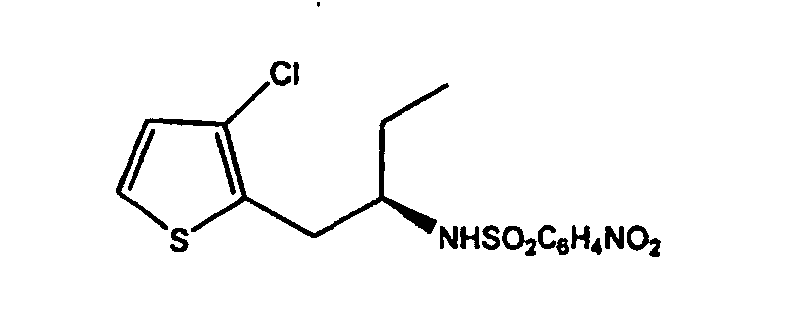
- Six grams of 3-chloro-2-(2-aminobutyl)thiophene is dissolved in 10 ml of methylene chloride in a 3-neck round bottomed flask blanketed with an inert atmosphere at 0 °C. Triethylamine (6.6 ml) is added in one portion followed by 7.8 g of 4-nitrobenzenesulfonyl chloride which had been previously dissolved in 10 ml of methylene chloride. After stirring for I hour at ambient temperature, the methylene chloride is removed under vacuum and 40 ml of methanol is added with warming to dissolve all solids. The resulting solution is poured into cold water, agitated for 30 minutes, filtered and washed with cold water, and the isolated material is dried in a vacuum oven to provide (R)-N-[1-[(3-chlorothien-2-yl)methyl]propyl]-4-nitrobenzeuesulfonamide (11.3 g) as a tan solid. MS: m/z (EI, 70EV) 375 (10%). 1H NMR (200 MHz; CDCl3): δ 0.95 (3H, t, CH3), 1.7 (2H, m, CH2), 2.85 (2H, m, CH2), 3.5 (1H, m, CH), 6.65 (1H, d, CH), 7.0 (1H, d, CH), 7.9 (2H, d, Ph), 8.2 (2H, d, Ph).
-

- Five grams of 3-chloro-2-(2-aminobutyl)thiophene is dissolved in 10 ml of methylene chloride in a 3-neck round bottomed flask blanketed with an inert atmosphere at 0 °C. Pyridine (2.2 ml) is added in one portion followed by 2.05 ml of methanesulfonyl chloride. After warming to room temperature, the mixture is stirred for 4 hours before diluting with 100 ml of diethyl ether. The solution is poured into a separatory funnel and washed with water, dilute 2N HCl, saturated aqueous sodium bicarbonate and brine, dried over magnesium sulfate, filtered and concentrated in vacuo to provide (R)-N-[1-[(3-chlorothien-2-yl)methyl]propyl]methanesulfonamide (5.5 g) as an orange oil which solidifies upon standing in a refrigerator overnight. MS: m/z (EI, 70EV) 267 (5%). 1H NMR (200 MHz; CDCl3): δ 1.0 (3H, t, CH3), 1.6 (2H, m, CH2), 2.65 (3H, s, CH3), 3.0 (2H, m, CH2), 3.6 (1H, m, CH), 6.9 (1H, d, CH), 7.2 (1H, d, CH).
- 2,4-Difluoro-3-nitropyridine is prepared by modification of the procedure of Kroon et al., Recl. Trav. Chim. Pays-Bas 95: 127, 1976 as described below.
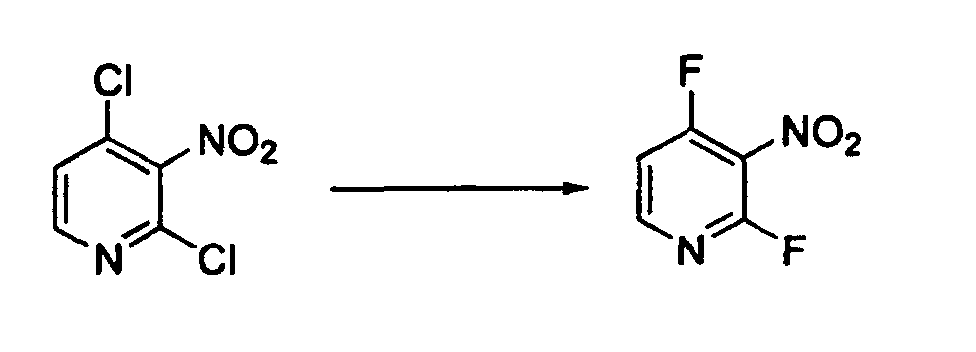
- A reaction vessel is charged with I eq. of 2,4-dichloro-3-nitropyridine, 3.5 eq. of KF, 0.05 eq. of 18-crown-6 and 1-methyl-2-pyrrolidinone. The mixture is heated to 100 °C for 15 hours and then cooled to 22 °C. Ethyl acetate is added to the reaction vessel and the mixture stirred for 15 minutes. The mixture is washed with water and then with brine. The ethyl acetate layer is dried with magnesium sulfate and the ethyl acetate removed under reduced pressure to provide the title compound.
- A mixture of 300 g (1.56 mol, 1 eq.) of 2,4-dichloro-3-nitropyridine, 1.0 L of 1-methyl-2-pyrrolidinone, 270.5 g (4.65 mol, 2.97 eq.) of potassium fluoride and 66.0 g (0.25 mol, 0.16 eq.) of 18-crown-6 is heated with stirring at 100 °C for 2 hours. The reaction mixture is cooled to 20 °C and 1.75 L of water is added. The mixture is stirred until the inorganic salts are dissolved. 1.75 L of tert-butyl methyl ether (TMBE) is added. The mixture is stirred and the layers are separated. The organic layer is washed with 300 ml of brine and dried over magnesium sulfate. The organic layer is then concentrated under reduced pressure. 2,4-Difluoro-3-nitro-pyridine (208 g, 83% yield) is obtained as a brown oil with a purity of 97 A% (HPLC). The oil may be used as is or distilled. 42.61 g of the 2,4-difluoro-3-nitropyridine is distilled at 61-64 °C at 4.0 torr to give the title compound (38.15 g, 90% yield, 99.6 A% (HPLC)) as a colorless oil. 1H NMR (200 MHz, CDCl3): δ 8.45 (1H, ap. t), 7.28 (1H, dd). MS (EI, 70 eV, relative intensity): 160 (M+, 75), 114 (25).
- Alternatively, the reaction may be performed with 0.3 eq. of tetrabutyl ammonium bromide, in place of 18-crown-6, in toluene at 110 °C.
-

- A mixture of 50.0 g (0.143 mol) of (R)-N-[1-[(3-chlorothien-2-yl)methyl]propyl]-4-methylbenzenesulfonamide lithium salt, prepared as described in PCT/US97/15729, in 50 g methanol is heated with stirring at 65 °C until dissolution of the solids is completed. The solution is cooled to 60 °C and 85 g water is added to the mixture dropwise. The mixture is stirred for 1.5 hours and then cooled to 20 °C. The solids are isolated by filtration. Drying under vacuum with nitrogen bleed affords 46.6 g (95%) of the free base (R)-N-[1-[(3-chlorothien-2-yl)methyl]propyl]-4-methylbenzenesulfonamide.
- HPLC A% is 99.74 A%, water content (by Karl Fisher analysis) 0.2%, Mp.: 68-70 °C. MS (EI, 70 eV): 344/346 (M+, 20), 212 (100). 1H NMR (200 MHz, CDCl3):δ 7.71 (d, 2H), 7.23 (d, 2H), 7.08 (d, 1H), 6.75 (d, 1H), 4.74 (broad d, 1H), 3.42 (6-line m, 1H), 2.88 (d, 2H), 2.41 (s, 3H), 1.68-1.25 (m, 2H), 0.85 (t, 3H). 13C NMR (50 MHz, CDCl3): δ 143.08, 137.69, 132.12, 129.56, 127.43, 126.96, 123.63, 123.34, 55.88, 32.66, 27.33, 21.50, 9.79. Analysis calculated for C15H18ClNO2S2: C, 52.39; H, 5.28; N, 4.10. Found: C, 52.25; H, 4.99; N, 3.87.
-

- A mixture of 100 g (0.52 mol, 1 eq.) of 2,4-dichloro-3-nitropyridine, 105 g (1.81 mol, 3.48 eq.) of potassium fluoride and 11.73 g (0.036 mol, 0.07 eq.) of tetrabutylammonium bromide (TBAB) in 500 ml of toluene and 330 ml of 1-methyl-2-pyrrolidinone is heated with stirring in a first reaction vessel at 115-120 °C for 4.5 hours. The reaction mixture is cooled to 20 °C and filtered into a second reaction vessel using 170 ml of 1-methylpyrrolidinone to transfer the batch. 160 g (0.456 mol, 0.88 eq.) of (R)-N-[1-[(3-chlorothien-2-yl)methyl]propyl]-4-methylbenzenesulfonamide lithium salt is then added to the mixture at 35 °C. The reaction mixture is stirred at 85 °C for 3.5 hours and then cooled to 20 °C. The cooled mixture is partitioned between 500 ml of brine, 1.6 L tert-butylmethyl ether and 200 ml of toluene. The organic layer is washed with 1 L of water, dried over magnesium sulfate and concentrated under reduced pressure. The resulting solid is dissolved in 200 ml of ethyl acetate and triturated with 65 ml of heptane. The mixture is cooled at -6 °C for 48 hours and the resulting solid is isolated by filtration and washed with a cold (-8 °C) mixture of ethyl acetate/heptane (4:1 v/v). The solid is dried under vacuum with a nitrogen bleed at 40-45 °C to give (R)-N-[1-[3-chlorothien-2-yl)methyl]propyl]-N-(2-fluoro-3-nitropyrid-4-yl)-4-methylbenzenesulfonamide (138.7 g. 63% yield, 95.4 A% pure (HPLC)).
- A mixture of 150.0 g (0.781 mol) of 2,4-dichloro-3-nitropyridine, 226.5 g (3.9 mol) of potassium fluoride (spray dried), 75.0 g (0.233 mol) tetrabutyl-ammonium bromide (TBAB) and 800 ml of toluene is heated to reflux with a Dean-Stark trap attached to the reaction vessel. Approximately 100 ml of toluene is distilled off, after which the mixture is cooled to 60 °C and 254.7 g (0.741 mol) (R)-N-[1-[(3-chlorothien-2-yl)methyl]propyl]-4-methylbenzenesulfonamide lithium salt is added. The mixture is heated at reflux for 4 hours and then cooled to room temperature. 800 ml of water is added and the reaction mixture stirred for 10 minutes. The layers are separated. The organic layer is washed twice with 800 ml of water, insoluble material is removed by filtration and the filtrate is concentrated under reduced pressure. Crystallized solid is slurried with 1 L of methanol for 1 hour at room temperature. The methanol is removed by filtration and the solid is slurried with 1 L of heptane for 1 hour. The heptane is removed by filtration and the solid is slurried with 1 L of methanol for 1 hour. The product is air-dried on the filter, then dried under vacuum at room temperature with a nitrogen bleed for 16 hours to give (R)-N-[1-[3-chlorothien-2-yl)methyl]propyl]-N-(2-fluoro-3-nitropyrid-4-yl)-4-methylbenzenesulfonamide (225.7 g, 60% yield, 95 A% pure (HPLC). The product contains approximately 2 A% of (R)-N-[1-[3-chlorothien-2-yl)methyl]propyl]-N-(2-chloro-3-nitropyrid-4-yl)-4-methylbenzenesulfonamide.
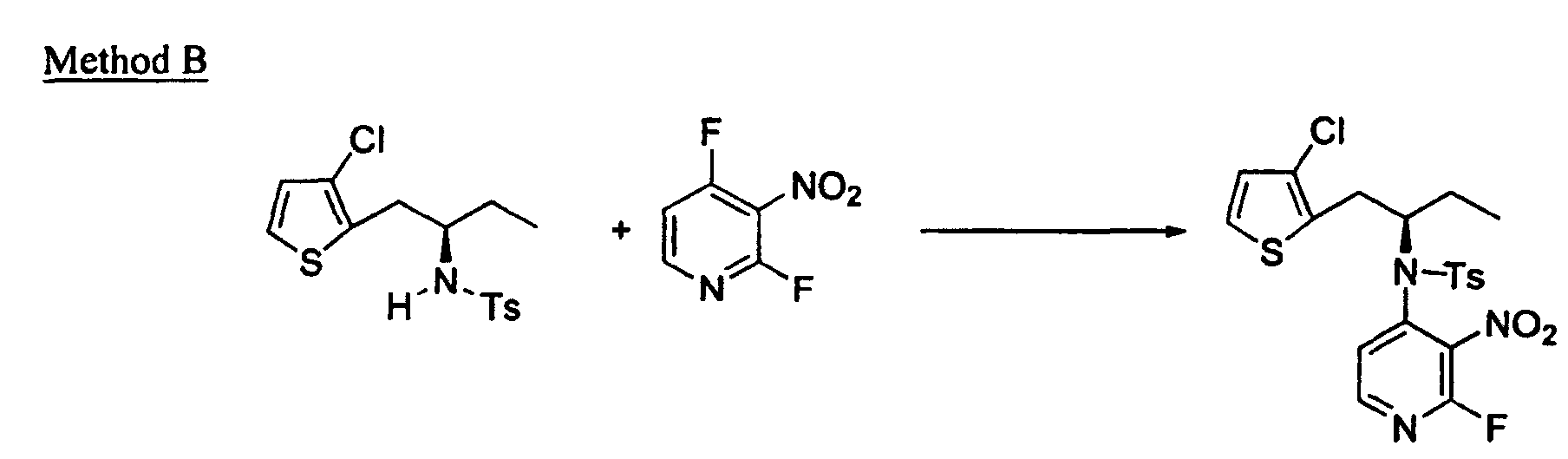
- A first solution containing 43.55 g (0.127 mol) of (R)-N-[1-[(3-chlorothien-2-yl)methyl)propyl]-4-methylbenzenesulfonamide in 71 ml of tetrahydrofuran (THF) is prepared and cooled to 4 °C. 138 ml (0.138 mol) of a 1.0 M solution of potassium tert-butoxide in tetrahydrofuran is added dropwise to the first solution. The resulting mixture is stirred for 15 minutes at 20 °C. 23.7 g (0.149 mol) of 2,4-difluoro-3-nitropyridine in 10 ml of tetrahydrofuran is then added and the mixture heated at 65 °C for 1 hour. The mixture is cooled to room temperature and partitioned between 150 ml of water and 300 ml of ethyl acetate. The layers are separated. The organic layer is washed twice with 150 ml of water, once with 100 ml of brine, dried over anhydrous magnesium sulfate and concentrated under reduced pressure. The residue is slurried with 100 ml of methanol, then with 150 ml of heptane and then with 60 ml of methanol. The residue is vacuum dried at room temperature with a nitrogen bleed to afford (R)-N-[1-[3-chlorothien-2-yl)methyl]propyl]-N-(2-fluoro-3-nitropyrid-4-yl)-4-methylbenzenesulfonamide (51.1 g, 83.4% yield, 97.6 A% (HPLC)) as a white solid. MS (ion spray)(relative intensity) 484/486 (75), 312 (100).
- A small sample of the crude product is recrystallized from THF/CH3CN/H2O. Mp: 139 °C. 1H NMR (200 MHz, CDCl3): δ 8.30 (1H, d broad), 7.73 (2H, d broad), 7.38-7.15 (3H, m), 7.16 (1H, d), 6.82 (1H, d), 3.95 (1H, m), 3.27 (1H, dd), 3.02 (1H, dd), 2.45 (3H, s), 1.6 (2H, m broad), 0.70 (3H, t broad). 13C NMR (50 MHz, CDCl3): δ 157.565, 152.696, 148.771, 148.445, 145.131, 132.348, 129.945, 128.224, 127.757, 125.370, 125.267, 123.966, 123.768, 67.078, 32.346, 26.081, 21.648, 11.617. Analysis calculated for C20H19ClFN3O4S2: C, 49.64; H, 3.96; N, 8.68. Found: C, 49.68; H, 3.96; N, 8.76.
-

- A mixture of 25.0 g (0.052 mol) (R)-N-[1-[3-chlorothien-2-yl)methyl]propyl]-N-(2-fluoro-3-nitropyrid-4-yl)-4-methylbenzenesulfonamide, 19.9 g (0.057 mol) 3aR-[3aα,4α,6a,6aα]-6-amino-N-ethyltetrahydro-3,3-dimethyl-2,4-dioxabicyclo [3.3.0]octan-8-carboxamide, benzoate, 21.5 g (0.155 mol) of potassium carbonate (325 mesh) and 200 ml of ethyl acetate is heated at 80 °C with stirring for 1.5 hours. The mixture is cooled to 20°C. 100 ml of water is added and the layers are separated. The organic layer is washed with 100 ml of half saturated brine. HPLC shows the [3aR-[3aα,4α,6a(R*),6aα]]-6-[4-[[1-[(3-chlorothien-2-yl)methyl]propyl] [4-methylbenzenesulfonyl]amino]-3-nitropyrid-2-ylamino] N-ethyl tetrahydro-2,2-dimethyl-4H-cyclopenta-1,3-dioxole-4-carboxamide to be 94.9 A% pure. This ethyl acetate solution is used "as is" in the next step.
- A small sample of the solution is concentrated under vacuum and then purified by flash chromatography (SiO2, ethyl acetate/heptane 1:1) to give a bright yellow solid showing 98 A% purity by HPLC. HRMS (FAB) calculated for C31H38ClN5O7S2 (M+H)+ 692.1979, found 692.1931. 1H NMR (500 MHz, CDCl3) (mixture of conformational isomers, ratio ca. 7:3, all signals reported): 8.33 (d), 8.25 (d, minor conformer), 7.94 (d), 7.87 (d), 7.76 (d), 7.34 (d), 7.30 (d), 7.13 (m), 6.81 (m), 6.56 (d), 6.47 (d, min. conf.), 5.66 (m), 4.81 (d, min. conf.), 4.74 (m), 4.58 (d, min. conf.), 4.56 (d), 3.99 (m), 3.87 (m), 3.35 (m), 3.21 (dd, min. conf.), 3.10 (dd), 2.90 (dd), 2.82 (dd), 2.55 (m), 2.41 (s), 2.13 (d), 1.96 (d, min. conf.), 1.64 (m), 1.60 (s), 1.52 (s), 1.30 (s), 1.22 (s), 1.40-1.20 (m), 1.15 (t), 0.88 (t), 0.64 (t, min. conf.), 0.51 (t). 13C NMR (50 MHz, CDCl3) (mixture of conformational isomers, as above): 173.781, 151.181, 144.504, 139.049, 135.972, 133.204, 129.715, 128.772, 128.089, 127.654, 123.641, 123.411, 114.768, 110.787, 86.284, 84.833, 64.913, 57.380, 53.328, 34.788, 32.361, 31.085, 30.680, 26.692, 24.297, 21.632, 14.718, 11.395.
- The ethyl acetate solution of [3aR-[3aα,4α,6a(R*),6aα]]-6-[4-[[1-[(3-chlorothien-2-yl)methyl]propyl] [4-methylbenzenesulfonyl]amino]-3-nitropyrid-2-ylamino] N-ethyl tetrahydro-2,2-dimethyl-4H-cyclopenta-1,3-dioxole-4-carboxamide from the previous step is diluted with 220 ml of methanol. The solution is then hydrogenated in the presence of platinum on carbon (3.5 g, Degussa type F101 RA/W, 5% Pt, 50% water) under 50-55 psi of hydrogen for 24 hours at room temperature. The mixture is filtered through a glass microfiber filter and the filter cake washed with 100 ml of hot ethyl acetate. The combined filtrates are concentrated under vacuum to give the title compound ( 90 A% (HPLC)) as an oil.
- A small sample of the oil is triturated with Et2O to give the title compound as an off-white solid. Mp: 175-177 °C. HRMS (FAB) calculated for C31H41ClN5O5S2 (M+H)+ 662.2237, found 662.222. 1H NMR (200 MHz, CDCl3) (mixture of conformational isomers, ratio ca. 7:3, all signals reported): δ 7.75 (d), 7.63 (d), 7.54 (d), 7.27 (d), 7.21 (s), 7.15 (dd), 6.82 (dd), 6.64 (d), 6.48 (d, minor conformer), 5.95 (d, min. conf.), 5.83 (d), 5.80 (br. m), 4.78 (m), 4.60 (m), 4.39 (m), 3.99 (s), 3.75 (s, min. conf.), 3.27 (dt), 3.12 (dd, min. conf.), 2.90-2.45 (m), 2.42 (s), 2.41 (1s, min. conf.), 2.04 (apparent t), 1.81 (s), 1.48 (s), 1.47 (s, min. conf.), 1.55-1.22 (m), 1.30 (s), 1.29 (s, min. conf.), 1.16 (t), 1.15 (t, min. conf.), 1.04 (t), 0.73 (t). 13C NMR (50 MHz, CDCl3) (mixture of confonnational isomers, all signals reported): δ 174.97, 174.84, 149.88, 149.53, 143.77, 143.60, 137.42, 136.47, 136.32, 133.45, 131.55, 131.08, 129.66, 129.38, 127.94, 127.73, 127.59, 125.99, 125.88, 123.59, 123.23, 123.10, 114.47, 114.05, 110.71, 86.36, 85.94, 85.13, 84.72, 64.46, 64.20, 56.90, 56.75, 53.99, 53.74, 34.92, 34.83, 32.58, 32.13, 31.23, 26.84, 26.78, 26.05, 24.96, 24.44, 21.59, 14.70, 12.57, 12.08.
- A mixture of ≤ 0.052 mol of the crude [3aR-[3aα,4α,6a(R*),6aα]]-6-[4-[[1-[(3-chlorothien-2-yl)methyl]propyl] [4-methylbenzenesulfonyl]amino]-3-aminopyrid-2-ylamino] N-ethyl tetrahydro-2,2-dimethyl-4H-cyclopenta-1,3-dioxole-4-carboxamide from the previous step, 74.0 g (0.50 mol) of triethylorthoformate and 100 ml (108.2 g, 1.06 mol) of acetic anhydride is heated at 100-105 °C for 2 hours. The mixture is cooled to room temperature. The cooled reaction mixture is diluted with 168 ml of 2-propanol and stirred for I hour, resulting in the formation of a solid suspension. The mixture is cooled to 4 °C and the solid is isolated by filtration. An additional crop of product is obtained by adding heptane to the mother liquor and isolating the solid by filtration. The combined filter cakes are washed with 90 ml of cold 2-propanol, air dried, and then dried under vacuum with a nitrogen bleed for two days to give the title compound (25.57 g, 95.82 A% (HPLC)) as a white powder. The yield is 73% overall for the three steps from (R)-N-[1-[3-chlorothien-2-yl)methyl]propyl]-N-(2-fluoro-3-nitropyrid-4-yl)-4-methylbenzenesulfonamide and 61% from 2,4-difluoro-3-nitropyridine. MS (ion spray): 672/674 (100). 1H NMR (200 MHz, CDCl3): δ 8.38 (1H, d), 8.15 (1H, s), 7.85 (2H, d), 7.25 (1H, s), 7.22 (1H, d), 7.15 (2H, dd), 6.78 (1H, d), 5.85 (1H, t), 5.05 (3H, m), 4.25 (1H, m), 3.28 (3H, m), 2.85 (3H, m), 2.60 (1H, q), 2.40 (3H, s), 1.60 (3H, s), 1.45 (2H, q), 1.25 (3H, s), 1.20 (3H, t), 0.90 (3H,t). 13C NMR (500 MHz CDCl3): δ 171.36, 149.04, 144.51, 143.53, 142.90, 137.70, 136.37, 135.34, 133.86, 129.45, 128.11, 127.46, 123.39, 123.21, 121.08, 114.22, 83.86, 81.88, 64.99, 60.69, 50.24, 34.63, 34.38, 33.35, 27.45, 25.26, 25.07, 21.58, 14.81, 11.64.
- A sample of the crude material is recrystallized from ethyl acetate/CH3CN. Mp: 197-199 °C. The structure of [3aR-[3aα,4α,6a(R*),6aα]]-6-[7-[[1-[(3-chlorothien-2-yl)methyl]propyl] [4-methylbenzenesulfonyl]amino]-3H-imidazo[4,5-b]pyrid-3-yl] N-ethyl tetrahydro-2,2-dimethyl-4H-cyclopenta-1,3-dioxole-4-carboxamide, including the absolute configuration, is confirmed by single crystal X-ray analysis.
- A mixture of 123.0 g (0.254 mol) of (R)-N-[1-[3-chlorothien-2-yl)methyl]propyl]-N-(2-fluoro-3-nitropyrid-4-yl)-4-methylbenzenesulfonamide, 97.8 g (0.279 mol) of 3aR-[3aα,4α,6a,6aα]-6-amino-N-ethyltetrahydro-3,3-dimethyl-2,4-dioxabicyclo [3.3.0]octan-8-carboxamide benzoate, 105.3 g (0.762 mol) of potassium carbonate (325 mesh) and 1 L of 1-methyl-2-pyrrolidinone is heated at 85 °C with stirring for 1.5 hours. The reaction mixture is cooled to room temperature and poured into 2.5 L of water with stirring. A solid is isolated by filtration and the filtercake is washed with 10 L water. The filtercake is air-dried on the filter overnight and then dried under vacuum with a nitrogen bleed for 4 days to provide the title compound (179 g, 98 A% (HPLC)) as a yellow solid.
- It should be noted that 1-methyl-2-pyrrolidinone (NMP) may be replaced with ethyl acetate (EtOAc). The solvent volume, temperature and reaction time (80 °C) are nearly identical. The work up involves a water wash to remove remaining 3aR-[3aα,4α,6a,6aα]-6-amino-N-ethyltetrahydro-3,3-dimethyl-2,4-dioxabicyclo [3.3.0]octan-8-carboxamide benzoate. The NMP solvent accelerates the reactivity of the chloro compound, i.e., (R)-N-[1-[3-chlorothien-2-yl)methyl]propyl]-N-(2-chloro-3-nitropyrid-4-yl)-4-methylbenzenesulfonamide which reacts very slowly in ethyl acetate.
- A solution of [3aR-[3aα,4α,6a(R*),6aα]]-6-[4-[[1-[(3-chlorothien-2-yl)methyl]propyl] [4-methylbenzenesulfonyl]amino]-3-nitropyrid-2-ylamino] N-ethyl tetrahydro-2,2-dimethyl-4H-cyclopenta-1,3-dioxole-4-carboxamide (90.0 g, 0.13 mol) in 1.1 L of ethyl acetate is washed three times with 500 ml of water. The solution is then diluted with 300 ml of methanol and hydrogenated in the presence of platinum on carbon (8.8 g, Degussa type F101 RA/W, 5% Pt, 50% water) under 50-55 psi of hydrogen for 24 hours at room temperature. The reaction mixture is filtered through a glass microfiber filter and the filter is washed with 300 ml of hot ethyl acetate. The combined filtrates are evaporated under reduced pressure to give a solid which is then slurried with 800 ml of heptane and isolated by filtration. The filtercake is dried under vacuum with a nitrogen bleed for 2 days to provide the title compound (94.5 g, 89 A% (HPLC)).
- A mixture of 94.5 g (0.13 mol) of [3aR-[3aα,4α,6a(R*),6aα]]-6-[4-[[1-[(3-chlorothien-2-yl)methyl]propyl] [4-methylbenzenesulfonyl]amino]-3-nitropyrid-2-ylamino] N-ethyl tetrahydro-2,2-dimethyl-4H-cyclopenta-1,3-dioxole-4-carboxamide from the previous step, 141.0 ml (0.85 mol) of triethylorthoformate and 114.0 ml (1.21 mol) of acetic anhydride is heated at 100-105 °C for 2 hours. The reaction mixture is cooled to room temperature. The cooled reaction mixture is diluted with 1 L of heptane and stirred for I hour. The solids formed are isolated by filtration, washed with 500 ml of cold heptane and dried under vacuum with a nitrogen bleed for two days to provide the title compound (65.0 g, 75% yield, 97.0 A% (HPLC)).
-
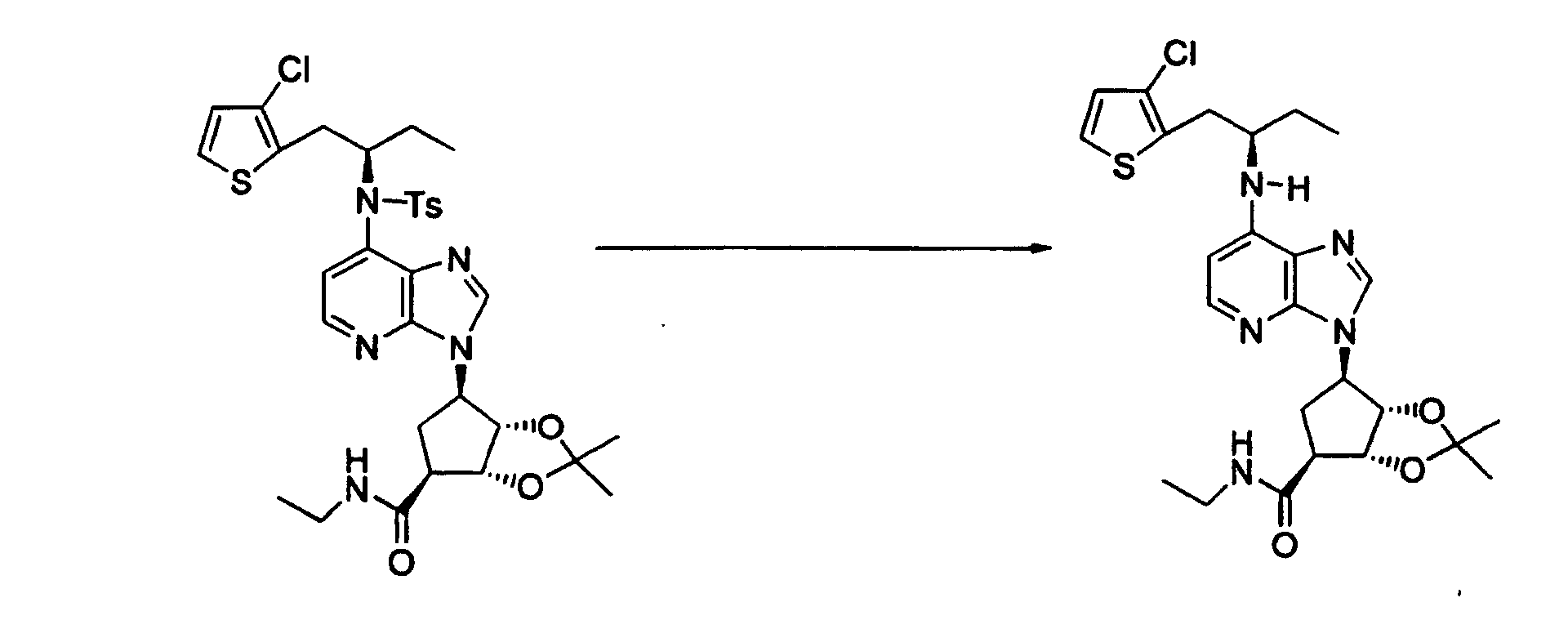
- 1-2 small crystals of iodine are added to a mechanically stirred suspension of 3.9 g (0.16 mol) of magnesium turnings in 30 ml of methanol under nitrogen. Bubbles are observed rising from the magnesium as the mixture starts warming up. A solution containing 20 g (0.03 mol) of [3aR-[3aα,4α,6a(R*),6aα]]-6-[7-[[1-[(3-chlorothien-2-yl)methyl]propyl] [4-methylbenzenesulfonyl]amino]-3H-imidazo[4,5-b]pyrid-3-yl] N-ethyl tetrahydro-2,2-dimethyl-4H-cyclopenta-1,3-dioxole-4-carboxamide in a mixture of 65 ml of methanol and 55 ml of toluene is added over 20 minutes, while maintaining the reaction temperature at about 40 °C. The mixture is stirred at about 40 °C for approximately 3 hours. The mixture is then cooled to room temperature, concentrated to 1/2 of the original volume and filtered through ca. 50 g celite. The filter is washed with 150 ml of ethyl acetate and the combined filtrate is washed with 150 ml of water and 150 ml of brine. The organic phase is dried with magnesium sulfate and concentrated under reduced pressure to provide the title compound (15.4 g, 85 A%, (HPLC)).
- A solution of lithium triethylborohydride (1.0 N in THF, 18.6 ml, 1.86 mmol, 2.5 eq.) is added dropwise to a magnetically stirred solution containing 5.0 g (7.43 mmol) of [3aR-[3aα,4α,6a(R*),6aα]]-6-[7-[[1-[(3-chlorothien-2-yl)methyl]propyl] [4-methylbenzenesulfonyl]amino]-3H-imidazo[4,5-b]pyrid-3-yl] N-ethyl tetrahydro-2,2-dimethyl-4H-cyclopenta-1,3-dioxole-4-carboxamide in 66 ml of THF at about 4 °C under nitrogen. Following the end of the addition, the mixture is stirred at room temperature for 2 hours. HPLC showed ≤ 3 A% of starting material and ca. 90 A% of [3aR-[3aα,4α,6a(R*),6aα]]-6-[7-[[1-[(3-chlorothien-2-yl)methyl]propyl]amino]-3H-imidazo[4,5-b]pyrid-3-yl] N-ethyl tetrahydro-2,2-dimethyl-4H-cyclopenta-1,3-dioxole-4-carboxamide.
- 30 ml of water and 20 ml of ethyl acetate are added and the phases are separated. The organic phase is washed with water and with brine, dried over magnesium sulfate and concentrated under reduced pressure to provide the title compound (3.7 g, 85 A% (HPLC)) as a light yellow solid
-

- A mixture of 5.0 g (0.0074 mol) of [3aR-[3aα,4α,6a(R*),6aα]]-6-[7-[[1-[(3-chlorothien-2-yl)methyl]propyl] [4-methylbenzenesulfonyl]amino]-3H-imidazo[4,5-b]pyrid-3-yl] N-ethyl tetrahydro-2,2-dimethyl-4H-cyclopenta-1,3-dioxole-4-carboxamide, 8.88 g (6.0 ml, 0.0778 mol, 10.5 eq.) of trifluoroacetic acid (TFA) and 4.42 g (3.6 ml, 0.0186 mol, 2.51 eq.) of trimethylsilyl trifluoromethanesulfonate in 15 ml of toluene is heated with stirring at 70 °C for 2 hours. The mixture is cooled to 20 °C and 50 ml of toluene is added, followed by 50 ml of concentrated hydrochloric acid. The mixture is stirred for 45 minutes and then the layers are separated. The aqueous layer is extracted with 20 ml of tetrahydrofuran and then with 65 ml of toluene. The combined organic layers are discarded.
- 50 ml of n-butyl acetate (n-BuOAc) is added to the aqueous layer. The mixture is cooled to ca. 4 °C and basified with ca. 37 g of sodium carbonate. The layers are separated and the aqueous layer is extracted twice with 50 ml of n-butyl acetate. The organic layers are combined and washed twice with 50 ml of water. The organic layer is concentrated to approximately 40% of the original volume and seeded with [1S-[1α,2β,3β,4α(S*)]]-4-[7-[[1-[(3-chlorothien-2-yl)methyl]propyl]amino]-3H-imidazo[4,5-b]pyrid-3-yl] N-ethyl 2,3-dihydroxycyclopentanecarboxamide. The mixture is cooled to ca. 4 °C and is maintained at this temperature until the crystallization is complete. The solid is isolated by filtration and dried under vacuum with a nitrogen bleed to constant weight to provide the title compound (2.51 g, 70% yield) as the hemi-hydrate. Analysis calculated for C22H28ClN5O3Sx0.5(H2O): C, 54.26; H, 6.00; N, 14.38; Cl, 7.28. Found: C, 54.06; H, 5.94; N, 14.38; Cl, 7.28. MS (ion spray) 478/480 ((M+H)+, 100), 346 (55). 1H NMR (200 MHz, DMSO-D6): δ 8.23 (1H, s), 8.06 (1H, t), 7.84 (1H, d), 7.42 (1H, d), 6.96 (1H, d), 6.63 (1H, broad d), 6.34 (1H, d), 5.16 (1H, broad d), 4.94(1H, d), 4.76 (1H, q), 4.33 (1H, m), 4.11 (1H, q), 3.12 (2H, q), 3.07 (2H, m), 2.73 (1H, m), 2.51 (1H, m), 2.39 (1H, dt), 2.09 (1H, dt), 1.63 (2H, m), 1.05 (3H, t), 0.92 (3H, t). 13C NMR (50 MHz, DMSO-D6): δ 172.73 (C), 147.42 (C), 146.12 (C), 144.37 (CH), 138.74 (CH), 134.079 (C), 126.671 (CH), 124.516 (C), 122.779 (C), 121.626 (CH), 96.938 (CH), 75.073 (CH), 73.07 (CH), 58.61 (CH), 54.20 (CH), 48.81 (CH), 33.45 (CH2), 32.19 (CH2), 30.06 (CH2), 27.23 (CH2), 14.66 (CH3), 10.40 (CH3).
- 0.0146 mol of methanesulfonic acid is added to a mechanically stirred mixture of 0.0074 mol of [3aR-[3aα,4α,6a(R*),6aα]]-6-[7-[[1-[(3-chlorothien-2-yl)methyl]propyl] [4-methylbenzenesulfonyl]amino]-3H-imidazo[4,5-b]pyrid-3-yl] N-ethyl tetrahydro-2,2-dimethyl-4H-cyclopenta-1,3-dioxole-4-carboxamide in 10 ml of trifluoroacetic acid (TFA) and 0.0146 mol thioanisole under nitrogen. The reaction mixture is heated at 85 °C for 3 hours. The solvents are removed in vacuo. 25 ml of toluene is added and removed under reduced pressure (azeotrope). The resulting tan-colored oily solid is partitioned between ethyl acetate and 175 ml of cold 1N aqueous NaOH. The aqueous phase is extracted with 100 ml of ethyl acetate and the combined organic extracts are washed with 100 ml of brine, dried over magnesium sulfate and concentrated under reduced pressure to provide 3.4 g of a tan-colored solid.
- The crude material is dissolved in 25 ml of ethyl acetate. The solution is stirred and 2.0 ml of concentrated HCl is added dropwise over 1 minute. A gummy solid precipitates and solidifies within 5 minutes. 25 ml of ethyl acetate is added and the suspension is stirred at room temperature overnight. A resulting off-white solid is isolated by filtration, washed with 20 ml of cold ethyl acetate and dried under reduced pressure at 40-50 °C to give the title compound (2.4 g, 58% yield) as the bis HCl salt. The free base can be liberated using the second part of the "Hydrolysis" procedure below.
- Alternatively, a mixture of leq of [3aR-[3aa,4a,6a(R*),6aa]]-6-[7-[[1-[(3-chlorothien-2-yl)methyl]propyl] [4-methylbenzenesulfonyl]amino]-3H-imidazo[4,5-b]pyrid-3-yl] N-ethyl tetrahydro-2,2-dimethyl-4H-cyclopenta-1,3-dioxole-4-carboxamide, 2.1 eq of methane sulfonic acid and 2eq of water in trifluoroacetic acid is heated at 60 °C. The reaction mixture is then washed with heptane (4x), made basic with Na2CO3/ethyl acetate/H,O and concentrated in vacuo. The residue is taken up in n-butyl acetate and the title compound (73% yield, 96% pure (HPLC)) is crystallized by addition of methyl tert-butyl ether. This material is further purified by recrystallization from n-butyl acetate (with 2eq water) to give the title compound (97% pure (HPLC)).
-

- 9.4 ml of concentrated (37%) HCl is added to a magnetically stirred mixture of 14.2 g (ca. 0.027 mol) of crude [3aR-[3aα,4α,6a(R*),6aα]]-6-[7-[[1-[(3-chlorothien-2-yl)methyl]propyl]amino]-3H-imidazo[4,5-b]pyrid-3-yl] N-ethyl tetrahydro-2,2-dimethyl-4H-cyclopenta-1,3-dioxole-4-carboxamide in 32 ml oftetrahydrofuran over 10 minutes while maintaining the mixture temperature below 35 °C. Following the end of the addition, the mixture is stirred for 3 hours at room temperature, after which a precipitated solid is isolated by filtration. The solid is washed with cold (5-10°C) ethyl acetate and dried to constant weight to give the title compound (8.0 g) as its bis HCl salt.
- The HCl salt is partitioned between 100 ml of n-butyl acetate and 50 ml of a saturated aqueous sodium carbonate solution. The organic phase is washed with water and brine, cooled to room temperature and stirred for 16 hours. The reaction mixture is filtered and the solid is dried at 40-50 °C under reduced pressure to give the title compound (10 g, 75% yield).
- While the invention has been described in connection with what is presently considered to be the most practical and preferred embodiments, it is to be understood that the invention is not limited to the disclosed embodiments, but on the contrary is intended to cover various modifications and equivalent arrangements included within the spirit and scope of the appended claims.
- Thus, it is to be understood that variations in the present invention can be made without departing from the novel aspects of this invention as defined in the claims. All patents and articles cited herein are hereby incorporated herein by reference in their entirety and relied upon.
Claims (18)
- A process for preparing an N-protected N6-substituted adenosine compound of formulawherein
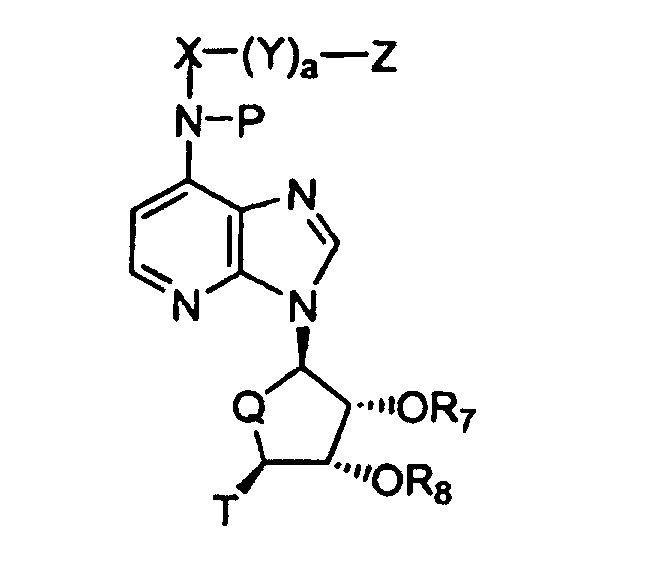
P is a nitrogen protecting group;
Q is CH2 or O;
Tisor R3O-CH2;
X is a straight or branched chain alkylene, cycloalkylene or cycloalkenylene group;
Y is NR4, O or S;
a = 0 or 1;
Z is of the formulaZ1 is N, CR5, (CH)m-CR5 or (CH)m-N, m being 1 or 2;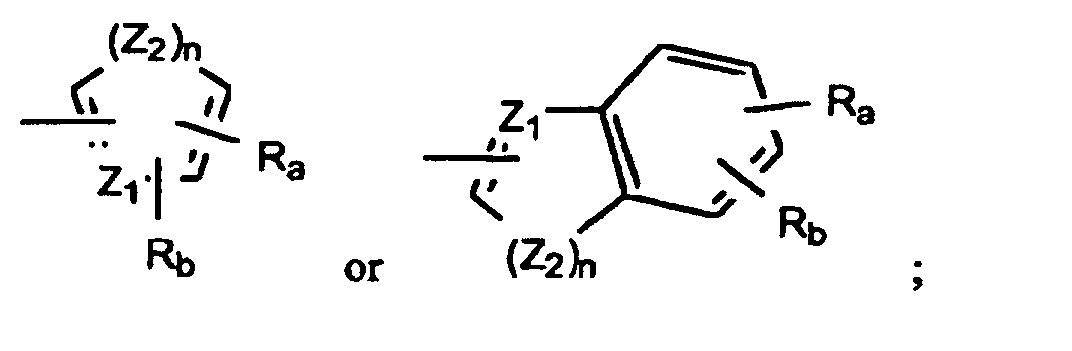
Z2 is N, NR6, O or S;
n is 0 or 1;
R1, R2, R3, R4, R5 and R6 are independently H, alkyl, aryl or heterocyclyl;
R7 and R8 are independently H, alkyl, aralkyl, carbamoyl, alkyl carbamoyl, dialkylcarbamoyl, acyl, alkoxycarbonyl, aralkoxycarbonyl, aryloxycarbonyl, or R7 and R8 together may formwhere Rc is hydrogen or alkyl, where Rd and Re are independently hydrogen, alkyl, or Rd and Re together with the carbon atom to which they are attached may form a 1,1-cycloalkyl group; and
Ra and Rb are independently H, OH, alkyl, hydroxyalkyl, alkyl mercaptyl, thioalkyl, alkoxy, alkyoxyalkyl, amino, alkyl amino, carboxyl, acyl, halogen, carbamoyl, alkyl carbamoyl, aryl or heterocyclyl, said process comprising reacting a 4-N-protected-2,3,4-triaminopyridine compound of formulawith triethyl orthoformate, diethoxymethyl acetate or dimethylformamide dimethyl acetal.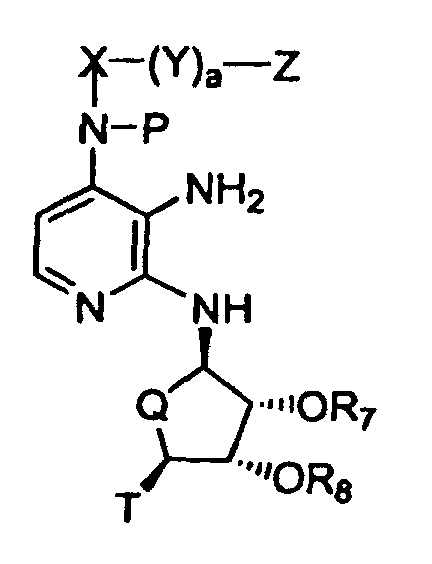
- The process of claim 1 wherein P is selected from the group consisting of sulfonamides, carbamates, amides, N-alkyl derivatives and N-phosphinyl derivatives.
- The process of claim 1 wherein P is a sulfonamide.
- The process of claim 3 wherein
Q is CH2;
TisX is a straight or branched chain alkylene;
a=0;
Z isZ1 is N, CR5, (CH)m-CR5 or (CH)m-N, m being 1 or 2;
Z2 is N, NR6, O or S;
n is 0 or 1;
R1, R2, R5 and R6 are independently H or alkyl;
R7 and R8 are alkyl, or R7 and R8 together may formwhere Rd and Re are independently hydrogen or alkyl, or together with the carbon atom to which they are attached may form a 1,1-cycloalkyl group; and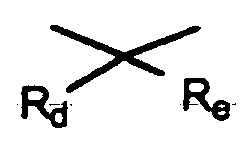
Ra and Rb are independently H, OH, alkyl, hydroxyalkyl, alkyl mercaptyl, thioalkyl, alkoxy, alkyoxyalkyl, amino, alkyl amino, carboxyl, acyl, halogen, carbamoyl, alkyl carbamoyl, aryl or heterocyclyl. - The process of claim 1 further comprising removing the nitrogen protecting group P.
- The process of claim 1 further comprising reducing a 4-N-protected 3-nitro-2,4-diaminopyridine compound of formulato form the 4-N-protected-2,3,4-triaminopyridine compound of formula
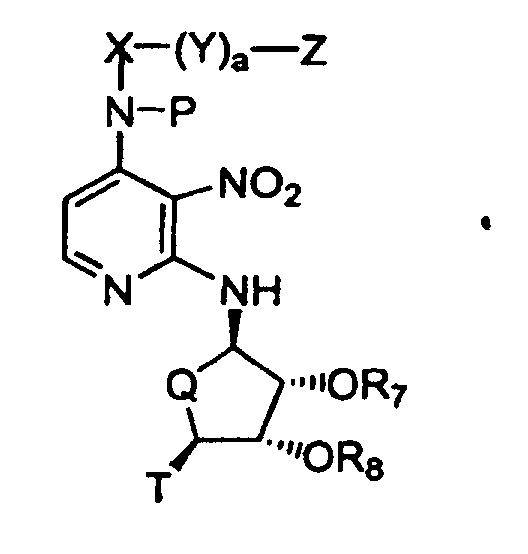
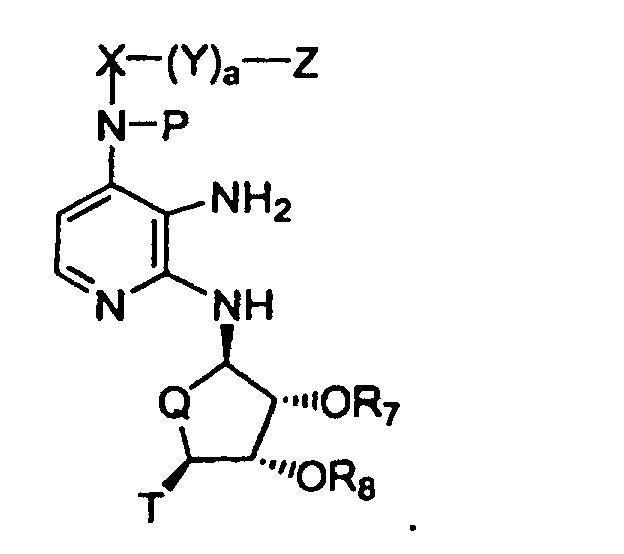
- The process of claim 6 further comprising reacting an N-protected amino compound of formula P-NH-X-(Y)a-Z with a 2,4-dihalo-3-nitropyridine compound of formulawherein X1 and X2 are independently Cl or F to form a 2-halo-3-nitro-4-N-protected aminopyridine compound of formula
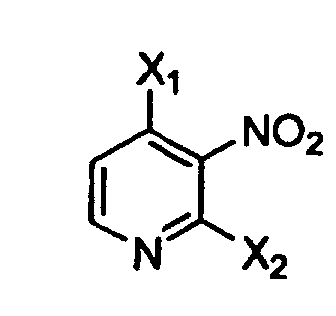

- The process of claim 1 wherein the 4-N-protected 2,3,4-triaminopyridine compound is [3aR-[3aα,4α,6a(R*),6aα]]-6-[4-[[1-[(3-chlorothien-2-yl)methyl]propyl] [4-methylbenzenesulfonyl]amino]-3-aminopyrid-2-ylamino] N-ethyl tetrahydro-2,2-dimethyl-4H-cyclopenta-1,3-dioxole-4-carboxamide.
- The process of claim 6 wherein the 4-N-protected 3-nitro-2,4-diaminopyridine compound is [3aR-[3aα,4α,6a(R*),6aα]]-6-[4-[[1-[(3-chlorothien-2-yl)methyl]propyl] [4-methylbenzenesulfonyl]amino]-3-nitropyrid-2-ylamino] N-ethyl tetrahydro-2,2-dimethyl-4H-cyclopenta-1,3-dioxole-4-carboxamide.
- The process of claim 7 wherein the N-protected amino compound of formula P-NH-X-(Y)a-Z is (R)-N-[1-[(3-chlorothien-2-yl)methyl]propyl]-4-methylbenzenesulfonamide or (R)-N-[1-[(3-chlorothien-2-yl)methyl]propyl]-4-methylbenzenesulfonamide lithium salt.
- A process for preparing [3aR-[3aα,4α,6a(R*),6aα]]-6-[7-[[1-[(3-chlorothien-2-yl)methyl]propyl] [4-methylbenzenesulfonyl]amino]-3H-imidazo[4,5-b]pyrid-3-yl] N-ethyl tetrahydro-2,2-dimethyl-4H-cyclopenta-1,3-dioxole-4-carboxamide comprisingwherein steps (i)-(iii) are performed in a concatenated fashion without purification of the intermediate compounds [3aR-[3aα,4α,6a(R*),6aα]]-6-[4-[[1-[(3-chlorothien-2-yl)methyl]propyl] [4-methylbenzenesulfonyl]amino]-3-nitropyrid-2-ylamino] N-ethyl tetrahydro-2,2-dimethyl-4H-cyclopenta-1,3-dioxole-4-carboxamide and [3aR-[3aα,4α,6a(R*),6aα]]-6-[4-[[1-[(3-chlorothien-2-yl)methyl]propyl] [4-methylbenzenesulfonyl]amino]-3-aminopyrid-2-ylamino] N-ethyl tetrahydro-2,2-dimethyl-4H-cyclopenta-1,3-dioxole-4-carboxamide.(i) reacting (R)-N-[1-[3-chlorothien-2-yl)methyl]propyl]-N-(2-fluoro-3-nitropyrid-4-yl)-4-methylbenzenesulfonamide with 3aR-[3aα,4α,6a,6aα]-6-amino-N-ethyltetrahydro-3,3-dimethyl-2,4-dioxabicyclo [3.3.0]octan-8-carboxamide, benzoate to form [3aR-[3aα,4α,6a(R*),6aα]]-6-[4-[[1-[(3-chlorothien-2-yl)methyl]propyl] [4-methylbenzenesulfonyl]amino]-3-nitropyrid-2-ylamino] N-ethyl tetrahydro-2,2-dimethyl-4H-cyclopenta-1,3-dioxole-4-carboxamide,(ii) reducing the [3aR-[3aα,4α,6a(R*),6aα]]-6-[4-[[1-[(3-chlorothien-2-yl)methyl]propyl] [4-methylbenzenesulfonyl]amino]-3-nitropyrid-2-ylamino] N-ethyl tetrahydro-2,2-dimethyl-4H-cyclopenta-1,3-dioxole-4-carboxamide prepared in step (i) to form [3aR-[3aα,4α,6a(R*),6aα]]-6-[4-[[1-[(3-chlorothien-2-yl)methyl]propyl] [4-methylbenzenesulfonyl]amino]-3-aminopyrid-2-ylamino] N-ethyl tetrahydro-2,2-dimethyl-4H-cyclopenta-1,3-dioxole-4-carboxamide and(iii) reacting the [3aR-[3aα,4α,6a(R*),6aα]]-6-[4-[[1-[(3-chlorothien-2-yl)methyl]propyl] [4-methylbenzenesulfonyl]amino]-3-aminopyrid-2-ylamino] N-ethyl tetrahydro-2,2-dimethyl-4H-cyclopenta-1,3-dioxole-4-carboxamide prepared in step 2 above with an orthoformate ester or dimethylformamide dimethyl acetal,
- A process for preparing (R)-N-[1-[3-chlorothien-2-yl)methyl]propyl]-N-(2-fluoro-3-nitropyrid-4-yl)-4-methylbenzenesulfonamide comprising(i) reacting 2,4-dichloro-3-nitropyridine with a fluorinating agent to form 2,4-difluoro-3-nitropyridine and(ii) reacting the product of step (i) with (R)-N-[1-[(3-chlorothien-2-yl)methyl]propyl]-4-methylbenzenesulfonamide lithium salt or (R)-N-[1-[(3-chlorothien-2-yl)methyl]propyl]-4-methylbenzenesulfonamide, wherein steps (i) and (ii) are performed in a concatenated fashion without isolation of the product of step (i).
- A process for preparing [3aR-[3aα,4α,6a(R*),6aα]]-6-[7-[[1-[(3-chlorothien-2-yl)methyl]propyl] [4-methylbenzenesulfonyl]amino]-3H-imidazo[4,5-b]pyrid-3-yl] N-ethyl tetrahydro-2,2-dimethyl-4H-cyclopenta-1,3-dioxole-4-carboxamide comprisingwherein steps (i)-(v) are performed in a concatenated fashion without purification of the intermediate compounds 2,4-dilfuoro-3-nitropyridine, (R)-N-[1-[3-chlorothien-2-yl)methyl]propyl]-N-(2-halo-3-nitropyrid-4-yl)r4-methylbenzenesulfonamide, [3aR-[3aα,4α,6a(R*),6aα]]-6-[4-[[1-[(3-chlorothien-2-yl)methyl]propyl] [4-methylbenzenesulfonyl]amino]-3-nitropyrid-2-ylamino] N-ethyl tetrahydro-2,2-dimethyl-4H-cyclopenta-1,3-dioxole-4-carboxamide and [3aR-[3aα,4α,6a(R*),6aα]]-6-[4-[[1-[(3-chlorothien-2-yl)methyl]propyl] [4-methylbenzenesulfonyl]amino]-3-aminopyrid-2-ylamino] N-ethyl tetrahydro-2,2-dimethyl-4H-cyclopenta-1,3-dioxole-4-carboxamide.(i) reacting 2,4-dichloro-3-nitropyridine with a fluorinating agent to form 2,4-difluoro-3-nitropyridine,(ii) reacting the 2,4-difluoro-3-nitropyridine with (R)-N-[1-[(3-chlorothien-2-yl)methyl]propyl]-4-methylbenzenesulfonamide lithium salt or (R)-N-[1-[(3-chlorothien-2-yl)methyl]propyl]-4-methylbenzenesulfonamide to form (R)-N-[1-[3-chlorothien-2-yl)methyl]propyl]-N-(2-fluoro-3-nitropyrid-4-yl)-4-methylbenzenesulfonamide,(iii) reacting the (R)-N-[1-[3-chlorothien-2-yl)methyl]propyl]-N-(2-fluoro-3-nitropyrid-4-yl)-4-methylbenzenesulfonamide with 3aR-[3aα,4α,6a,6aα]-6-amino-N-ethyltetrahydro-3,3-dimethyl-2,4-dioxabicyclo [3.3.0]octan-8-carboxamide, benzoate to form [3aR-[3aα,4α,6a(R*),6aα]]-6-[4-[[1-[(3-chlorothien-2-yl)methyl]propyl] [4-methylbenzenesulfonyl]amino]-3-nitropyrid-2-ylamino] N-ethyl tetrahydro-2,2-dimethyl-4H-cyclopenta-1,3-dioxole-4-carboxamide,(iv) reducing the [3aR-[3aα,4α,6a(R*),6aα]]-6-[4-[[1-[(3-chlorothien-2-yl)methyl]propyl] [4-methylbenzenesulfonyl]amino]-3-nitropyrid-2-ylamino] N-ethyl tetrahydro-2,2-dimethyl-4H-cyclopenta-1,3-dioxole-4-carboxamide prepared in step (iii) to form [3aR-[3aα,4α,6a(R*),6aα]]-6-[4-[[1-[(3-chlorothien-2-yl)methyl]propyl] [4-methylbenzenesulfonyl]amino]-3-aminopyrid-2-ylamino] N-ethyl tetrahydro-2,2-dimethyl-4H-cyclopenta-1,3-dioxole-4-carboxamide and(v) reacting the [3aR-[3aα,4α,6a(R*),6aα]]-6-[4-[[1-[(3-chlorothien-2-yl)methyl]propyl] [4-methylbenzenesulfonyl]amino]-3-aminopyrid-2-ylamino] N-ethyl tetrahydro-2,2-dimethyl-4H-cyclopenta-1,3-dioxole-4-carboxamide with an orthoformate ester or dimethylformamide dimethyl acetal,
- A compound of formulawherein
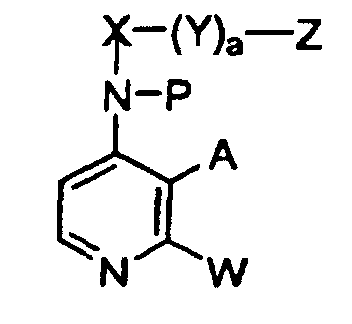
A is NH2 or NO2;
P is a nitrogen protecting group;
W is Cl, F or a group of formulaQ is CH2 or O;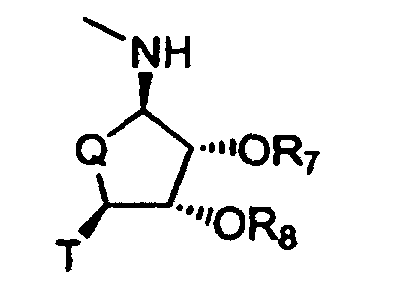
T isor R3O-CH2;
X is a straight or branched chain alkylene, cycloalkylene or cycloalkenylene group;
Y is NR4, O or S;
a = 0 or 1;
Z is of the formulaZ1 is N, CR5, (CH)m-CR5 or (CH)m-N, m being 1 or 2;
Z2 is N, NR6, O or S;
n is 0 or 1;
R1, R2, R3, R4, R5 and R6 are independently H, alkyl, aryl or heterocyclyl;
R7 and R8 are independently H, alkyl, aralkyl, carbamoyl, alkyl carbamoyl, dialkylcarbamoyl, acyl, alkoxycarbonyl, aralkoxycarbonyl, or aryloxycarbonyl, or R7 and R8 together may formwhere Rc is hydrogen or alkyl, where Rd and Re are independently hydrogen, or alkyl, or Rd and Re together with the carbon atom to which they are attached may form a 1,1-cycloalkyl group; and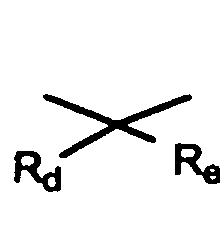
Ra and Rb are independently H, OH, alkyl, hydroxyalkyl, alkyl mercaptyl, thioalkyl, alkoxy, alkyoxyalkyl, amino, alkyl amino, carboxyl, acyl, halogen, carbamoyl, alkyl carbamoyl, aryl or heterocyclyl. - The compound of claim 14 wherein P is selected from the group consisting of sulfonamides, carbamates, amides, N-alkyl derivatives and N-phosphinyl derivatives.
- The compound of claim 14 wherein P is a sulfonamide.
- The compound of claim 16 wherein
Q is CH2;
T isX is a straight or branched chain alkylene;
a=0;
Z isZ1 is N, CR5, (CH)m-CR5 or (CH)m-N, m being 1 or 2;
Z2 is N, NR6, O or S, n being 0 or 1;
R1, R2, R5 and R6 are independently H or alkyl;
R7 and R8 are alkyl, or R7 and R8 together may formwhere Rd and Re are independently hydrogen or alkyl, or together with the carbon atom to which they are attached may form a 1,1-cycloalkyl group; and
Ra and Rb are independently H, OH, alkyl, hydroxyalkyl, alkyl mercaptyl, thioalkyl, alkoxy, alkyoxyalkyl, amino, alkyl amino, carboxyl, acyl, halogen, carbamoyl, alkyl carbamoyl, aryl or heterocyclyl. - A compound selected from
[3aR-[3aα,4α,6a(R*),6aα]]-6-[4-[[1-[(3-chlorothien-2-yl)methyl]propyl] [4-methylbenzenesulfonyl]amino]-3-nitropyrid-2-ylamino] N-ethyl tetrahydro-2,2-dimethyl-4H-cyclopenta-1,3-dioxole-4-carboxamide;
[3aR-[3aα,4α,6a(R*),6aα]]-6-[4-[[1-[(3-chlorothien-2-yl)methyl]propyl) [4-methylbenzenesulfonyl]amino]-3-aminopyrid-2-ylamino] N-ethyl tetrahydro-2,2-dimethyl-4H-cyclopenta-1,3-dioxole-4-carboxamide; and
[3aR-[3aα,4α,6a(R*),6aα]]-6-[7-[[1-[(3-chlorothien-2-yl)methyl]propyl] [4-methylbenzenesulfonyl]amino]-3H-imidazo[4,5-b]pyrid-3-yl] N-ethyl tetrahydro-2,2-dimethyl-4H-cyclopenta-1,3-dioxole-4-carboxamide.
Priority Applications (2)
| Application Number | Priority Date | Filing Date | Title |
|---|---|---|---|
| SI9930688T SI1140933T1 (en) | 1998-12-31 | 1999-12-15 | Process for preparing n6-substituted deaza-adenosine derivatives |
| DK99966299T DK1140933T3 (en) | 1998-12-31 | 1999-12-15 | Process for the preparation of N6-substituted deaza-adenosine derivatives |
Applications Claiming Priority (5)
| Application Number | Priority Date | Filing Date | Title |
|---|---|---|---|
| US11448698P | 1998-12-31 | 1998-12-31 | |
| US114486P | 1998-12-31 | ||
| US11602899P | 1999-01-15 | 1999-01-15 | |
| US116028P | 1999-01-15 | ||
| PCT/US1999/029841 WO2000040584A2 (en) | 1998-12-31 | 1999-12-15 | Process for preparing n6-substituted deaza-adenosine derivatives |
Publications (2)
| Publication Number | Publication Date |
|---|---|
| EP1140933A2 EP1140933A2 (en) | 2001-10-10 |
| EP1140933B1 true EP1140933B1 (en) | 2004-09-08 |
Family
ID=26812247
Family Applications (1)
| Application Number | Title | Priority Date | Filing Date |
|---|---|---|---|
| EP99966299A Expired - Lifetime EP1140933B1 (en) | 1998-12-31 | 1999-12-15 | Process for preparing n6-substituted deaza-adenosine derivatives |
Country Status (15)
| Country | Link |
|---|---|
| US (1) | US6429315B1 (en) |
| EP (1) | EP1140933B1 (en) |
| JP (1) | JP2002534430A (en) |
| KR (1) | KR20010089751A (en) |
| CN (1) | CN1383427A (en) |
| AT (1) | ATE275565T1 (en) |
| AU (1) | AU2187100A (en) |
| BR (1) | BR9917000A (en) |
| CA (1) | CA2358962A1 (en) |
| DE (1) | DE69920045T2 (en) |
| DK (1) | DK1140933T3 (en) |
| ES (1) | ES2228163T3 (en) |
| PT (1) | PT1140933E (en) |
| SI (1) | SI1140933T1 (en) |
| WO (1) | WO2000040584A2 (en) |
Families Citing this family (11)
| Publication number | Priority date | Publication date | Assignee | Title |
|---|---|---|---|---|
| PT1140933E (en) | 1998-12-31 | 2004-12-31 | Aventis Pharma Inc | PROCESS FOR PREPARING N6-SUBSTITUTED DERIVATIVES OF DISASA-ADENOSIN |
| GT200500281A (en) * | 2004-10-22 | 2006-04-24 | Novartis Ag | ORGANIC COMPOUNDS. |
| GB0500785D0 (en) * | 2005-01-14 | 2005-02-23 | Novartis Ag | Organic compounds |
| ATE549337T1 (en) | 2006-04-21 | 2012-03-15 | Novartis Ag | PURINE DERIVATIVES FOR USE AS ADENOSINE A2A RECEPTOR AGONISTS |
| GB0607953D0 (en) * | 2006-04-21 | 2006-05-31 | Novartis Ag | Organic compounds |
| GB0607944D0 (en) * | 2006-04-21 | 2006-05-31 | Novartis Ag | Organic compounds |
| GB0607948D0 (en) * | 2006-04-21 | 2006-05-31 | Novartis Ag | Organic compounds |
| GB0607950D0 (en) * | 2006-04-21 | 2006-05-31 | Novartis Ag | Organic compounds |
| EP1889846A1 (en) | 2006-07-13 | 2008-02-20 | Novartis AG | Purine derivatives as A2a agonists |
| EP1903044A1 (en) * | 2006-09-14 | 2008-03-26 | Novartis AG | Adenosine Derivatives as A2A Receptor Agonists |
| JP2010508835A (en) * | 2006-11-10 | 2010-03-25 | ノバルティス アーゲー | Cyclopentenediol monoacetate derivative |
Family Cites Families (11)
| Publication number | Priority date | Publication date | Assignee | Title |
|---|---|---|---|---|
| US5652366A (en) | 1990-09-25 | 1997-07-29 | Rhone-Poulenc Rorer Pharmaceuticals Inc. | DI (1R)-(-)camphosulfonic acid) salt, preparation thereof and use thereof |
| CA2092305C (en) | 1990-09-25 | 2003-02-11 | Alfred P. Spada | Compounds having antihypertensive and anti-ischemic properties |
| US5561134A (en) | 1990-09-25 | 1996-10-01 | Rhone-Poulenc Rorer Pharmaceuticals Inc. | Compounds having antihypertensive, cardioprotective, anti-ischemic and antilipolytic properties |
| US5545769A (en) | 1994-09-29 | 1996-08-13 | E. I. Du Pont De Nemours And Company | Process for the manufacture of selected halogenated hydrocarbons containing fluorine and hydrogen and compositions provided therein |
| US5684159A (en) | 1995-05-30 | 1997-11-04 | Rhone-Poulenc Rorer S.A. | L-tartaric acid salt of a (1R) diastereomer of a 2-azadihydroxybicyclo 2.2.1!heptane compound and the preparation of 2-azabicyclo 2.2.1!heptane compounds |
| FR2734822B1 (en) | 1995-05-30 | 1997-07-04 | Rhone Poulenc Rorer Sa | NEW 2-AZABICYCLO (2.2.1) HEPTANE DERIVATIVES, THEIR PREPARATION AND THEIR APPLICATION |
| CZ203998A3 (en) | 1996-01-02 | 1999-11-17 | Rhone-Poulenc Rorer Pharmaceuticals Inc. | Process for preparing 2,4-dihydroxypyridine and 2,4-dihydroxy-3-nitropyridine |
| UA51716C2 (en) * | 1996-07-08 | 2002-12-16 | Авентіс Фармасьютікалз Продактс Інк. | combinations possessing hypotensive, cardioprotective, anti-ishemic, and antilipolytic agents, a pharmaceutical composition and METHOD OF TREATMENT |
| KR100317871B1 (en) | 1996-09-12 | 2002-01-18 | 오흘러 로스 제이. | Stereospecific preparation of chiral 1-aryl- and 1-heteroaryl-2-substituted ethyl-2-amines, and intermediates thereto |
| IL130397A (en) | 1996-12-11 | 2005-11-20 | Aventis Pharma Inc | Preparation of Ä1S-Ä1alpha,2beta,3beta,4alpha (S*)ÜÜ-4-Ä7-ÄÄ-3-chloro-2-thienyl)methylÜpropylÜaminoÜ-3H-imidazo Ä4,5-BÜpyridin-3-ylÜ-N-ethyl-2,3 dihydroxycyclopentane carboxamide |
| PT1140933E (en) | 1998-12-31 | 2004-12-31 | Aventis Pharma Inc | PROCESS FOR PREPARING N6-SUBSTITUTED DERIVATIVES OF DISASA-ADENOSIN |
-
1999
- 1999-12-15 PT PT99966299T patent/PT1140933E/en unknown
- 1999-12-15 BR BR9917000-0A patent/BR9917000A/en not_active IP Right Cessation
- 1999-12-15 DK DK99966299T patent/DK1140933T3/en active
- 1999-12-15 CN CN99815953A patent/CN1383427A/en active Pending
- 1999-12-15 SI SI9930688T patent/SI1140933T1/en unknown
- 1999-12-15 CA CA002358962A patent/CA2358962A1/en not_active Abandoned
- 1999-12-15 DE DE69920045T patent/DE69920045T2/en not_active Expired - Fee Related
- 1999-12-15 JP JP2000592292A patent/JP2002534430A/en active Pending
- 1999-12-15 ES ES99966299T patent/ES2228163T3/en not_active Expired - Lifetime
- 1999-12-15 KR KR1020017008416A patent/KR20010089751A/en not_active Ceased
- 1999-12-15 WO PCT/US1999/029841 patent/WO2000040584A2/en not_active Ceased
- 1999-12-15 AU AU21871/00A patent/AU2187100A/en not_active Abandoned
- 1999-12-15 EP EP99966299A patent/EP1140933B1/en not_active Expired - Lifetime
- 1999-12-15 AT AT99966299T patent/ATE275565T1/en not_active IP Right Cessation
-
2000
- 2000-01-21 US US09/489,276 patent/US6429315B1/en not_active Expired - Fee Related
Also Published As
| Publication number | Publication date |
|---|---|
| BR9917000A (en) | 2001-12-11 |
| CN1383427A (en) | 2002-12-04 |
| PT1140933E (en) | 2004-12-31 |
| EP1140933A2 (en) | 2001-10-10 |
| AU2187100A (en) | 2000-07-24 |
| WO2000040584A3 (en) | 2000-11-02 |
| SI1140933T1 (en) | 2005-02-28 |
| DE69920045D1 (en) | 2004-10-14 |
| US6429315B1 (en) | 2002-08-06 |
| DK1140933T3 (en) | 2004-12-20 |
| KR20010089751A (en) | 2001-10-08 |
| HK1040239A1 (en) | 2002-05-31 |
| ATE275565T1 (en) | 2004-09-15 |
| ES2228163T3 (en) | 2005-04-01 |
| DE69920045T2 (en) | 2005-09-29 |
| CA2358962A1 (en) | 2000-07-13 |
| JP2002534430A (en) | 2002-10-15 |
| WO2000040584A2 (en) | 2000-07-13 |
Similar Documents
| Publication | Publication Date | Title |
|---|---|---|
| EP3298012B1 (en) | Synthesis of heterocyclic compounds | |
| CZ297862B6 (en) | Intermediates and process for preparing derivatives of camptothecin (CPT-11) and related compounds | |
| AU2005300311A1 (en) | Methods for preparing indazole compounds | |
| US6429315B1 (en) | Process for preparing N6-substituted adenosine derivatives | |
| JP2006232802A (en) | Process for producing (Z) -1-phenyl-1- (N, N-diethylaminocarbonyl) -2-phthalimidomethylcyclopropane | |
| HK1040239B (en) | Process for preparing n6-substituted deaza-adenosine derivatives | |
| CZ294957B6 (en) | Process for preparing a substituted imidazopyridine compound | |
| EP1175420B1 (en) | Process for preparing n6-substituted deaza-adenosine derivatives | |
| JPS61186381A (en) | Manufacture of ergoline derivative | |
| JPH07121931B2 (en) | Benzo [b] furan derivative | |
| US6143894A (en) | Preparation of [1S-[1A,2B,3B,4A(S*)]]-4-[7-[[1-(3-chloro-2-thienyl)methyl propyl]amino] -3H-imidazo[4,5-B]pyridin-3-yl]-N-ethyl-2,3-dihydroxycyclopentanecarboxa mide | |
| CN110573521B (en) | Process for the preparation of novel compounds of 4'-thionucleosides and intermediates in the process | |
| JPS6055507B2 (en) | Oxoazetidine | |
| US20030004353A1 (en) | Process for preparing integrin antagonist intermediates | |
| US20020019532A1 (en) | Process for the synthesis of (2S)-phenyl-3-piperidone | |
| JP2002544276A (en) | Method for producing fused ring imidazo-containing compound | |
| CA2319424A1 (en) | Processes and intermediates useful to make antifolates | |
| IL152921A (en) | Preparation of 4-hydroxy-3-nitro-2(1h)-pyridone from 2-hydroxy-3-cyano-4-methoxypyridine | |
| WO1997046559A1 (en) | Process for preparing 9-hydroxyellipticine | |
| JPH0327364A (en) | Production of 1,4-benzodiazepine derivative | |
| KR19990022103A (en) | 2-azabicyclo [2.2.1] heptane derivative, preparation method thereof and method of use | |
| JPS61145161A (en) | Method for producing 1,4-dihydropyridine-3,5-dicarboxylic acid ester derivative | |
| HK1248238B (en) | Synthesis of heterocyclic compounds | |
| HK1248238A1 (en) | Synthesis of heterocyclic compounds | |
| MXPA99005488A (en) | PREPARATION OF [1S-[1a,2b,3b,4a(S*)]]-4-[7-[[1-(3-CHLORO-2-THIENYL) METHYL]PROPYL]AMINO]-3H-IMIDAZO[4,5-b]PYRIDIN-3-yl]-N-ETHYL-2,3-DIHYDROXYCYCLOPENTANECARBOXAMIDE |
Legal Events
| Date | Code | Title | Description |
|---|---|---|---|
| PUAI | Public reference made under article 153(3) epc to a published international application that has entered the european phase |
Free format text: ORIGINAL CODE: 0009012 |
|
| 17P | Request for examination filed |
Effective date: 20010720 |
|
| AK | Designated contracting states |
Kind code of ref document: A2 Designated state(s): AT BE CH CY DE DK ES FI FR GB GR IE IT LI LU MC NL PT SE |
|
| AX | Request for extension of the european patent |
Free format text: AL;LT;LV;MK PAYMENT 20010720;RO PAYMENT 20010720;SI |
|
| 17Q | First examination report despatched |
Effective date: 20030731 |
|
| GRAP | Despatch of communication of intention to grant a patent |
Free format text: ORIGINAL CODE: EPIDOSNIGR1 |
|
| RAP1 | Party data changed (applicant data changed or rights of an application transferred) |
Owner name: AVENTIS PHARMACEUTICALS INC. |
|
| GRAS | Grant fee paid |
Free format text: ORIGINAL CODE: EPIDOSNIGR3 |
|
| GRAA | (expected) grant |
Free format text: ORIGINAL CODE: 0009210 |
|
| AK | Designated contracting states |
Kind code of ref document: B1 Designated state(s): AT BE CH CY DE DK ES FI FR GB GR IE IT LI LU MC NL PT SE |
|
| AX | Request for extension of the european patent |
Extension state: RO SI |
|
| REG | Reference to a national code |
Ref country code: GB Ref legal event code: FG4D |
|
| REG | Reference to a national code |
Ref country code: CH Ref legal event code: EP |
|
| REG | Reference to a national code |
Ref country code: IE Ref legal event code: FG4D |
|
| REF | Corresponds to: |
Ref document number: 69920045 Country of ref document: DE Date of ref document: 20041014 Kind code of ref document: P |
|
| REG | Reference to a national code |
Ref country code: GR Ref legal event code: EP Ref document number: 20040403929 Country of ref document: GR |
|
| REG | Reference to a national code |
Ref country code: DK Ref legal event code: T3 |
|
| REG | Reference to a national code |
Ref country code: SE Ref legal event code: TRGR |
|
| REG | Reference to a national code |
Ref country code: PT Ref legal event code: SC4A Free format text: AVAILABILITY OF NATIONAL TRANSLATION Effective date: 20041103 |
|
| LTIE | Lt: invalidation of european patent or patent extension |
Effective date: 20040908 |
|
| REG | Reference to a national code |
Ref country code: ES Ref legal event code: FG2A Ref document number: 2228163 Country of ref document: ES Kind code of ref document: T3 |
|
| REG | Reference to a national code |
Ref country code: HK Ref legal event code: GR Ref document number: 1040239 Country of ref document: HK |
|
| PLBE | No opposition filed within time limit |
Free format text: ORIGINAL CODE: 0009261 |
|
| STAA | Information on the status of an ep patent application or granted ep patent |
Free format text: STATUS: NO OPPOSITION FILED WITHIN TIME LIMIT |
|
| ET | Fr: translation filed | ||
| 26N | No opposition filed |
Effective date: 20050609 |
|
| PGFP | Annual fee paid to national office [announced via postgrant information from national office to epo] |
Ref country code: NL Payment date: 20051116 Year of fee payment: 7 |
|
| PGFP | Annual fee paid to national office [announced via postgrant information from national office to epo] |
Ref country code: MC Payment date: 20051121 Year of fee payment: 7 Ref country code: AT Payment date: 20051121 Year of fee payment: 7 |
|
| PGFP | Annual fee paid to national office [announced via postgrant information from national office to epo] |
Ref country code: PT Payment date: 20051122 Year of fee payment: 7 |
|
| PGFP | Annual fee paid to national office [announced via postgrant information from national office to epo] |
Ref country code: GB Payment date: 20051207 Year of fee payment: 7 |
|
| PGFP | Annual fee paid to national office [announced via postgrant information from national office to epo] |
Ref country code: FR Payment date: 20051216 Year of fee payment: 7 |
|
| PGFP | Annual fee paid to national office [announced via postgrant information from national office to epo] |
Ref country code: ES Payment date: 20051226 Year of fee payment: 7 |
|
| PGFP | Annual fee paid to national office [announced via postgrant information from national office to epo] |
Ref country code: SE Payment date: 20051227 Year of fee payment: 7 Ref country code: CH Payment date: 20051227 Year of fee payment: 7 |
|
| PGFP | Annual fee paid to national office [announced via postgrant information from national office to epo] |
Ref country code: FI Payment date: 20051228 Year of fee payment: 7 |
|
| PGFP | Annual fee paid to national office [announced via postgrant information from national office to epo] |
Ref country code: GR Payment date: 20051229 Year of fee payment: 7 |
|
| PGFP | Annual fee paid to national office [announced via postgrant information from national office to epo] |
Ref country code: LU Payment date: 20051230 Year of fee payment: 7 Ref country code: DK Payment date: 20051230 Year of fee payment: 7 |
|
| PGFP | Annual fee paid to national office [announced via postgrant information from national office to epo] |
Ref country code: IE Payment date: 20060103 Year of fee payment: 7 |
|
| PGFP | Annual fee paid to national office [announced via postgrant information from national office to epo] |
Ref country code: DE Payment date: 20060131 Year of fee payment: 7 |
|
| PGFP | Annual fee paid to national office [announced via postgrant information from national office to epo] |
Ref country code: BE Payment date: 20060202 Year of fee payment: 7 |
|
| PG25 | Lapsed in a contracting state [announced via postgrant information from national office to epo] |
Ref country code: IE Free format text: LAPSE BECAUSE OF NON-PAYMENT OF DUE FEES Effective date: 20061215 Ref country code: FI Free format text: LAPSE BECAUSE OF NON-PAYMENT OF DUE FEES Effective date: 20061215 |
|
| PG25 | Lapsed in a contracting state [announced via postgrant information from national office to epo] |
Ref country code: SE Free format text: LAPSE BECAUSE OF NON-PAYMENT OF DUE FEES Effective date: 20061216 |
|
| PG25 | Lapsed in a contracting state [announced via postgrant information from national office to epo] |
Ref country code: MC Free format text: LAPSE BECAUSE OF NON-PAYMENT OF DUE FEES Effective date: 20061231 Ref country code: LI Free format text: LAPSE BECAUSE OF NON-PAYMENT OF DUE FEES Effective date: 20061231 Ref country code: CH Free format text: LAPSE BECAUSE OF NON-PAYMENT OF DUE FEES Effective date: 20061231 Ref country code: BE Free format text: LAPSE BECAUSE OF NON-PAYMENT OF DUE FEES Effective date: 20061231 |
|
| PGFP | Annual fee paid to national office [announced via postgrant information from national office to epo] |
Ref country code: IT Payment date: 20061231 Year of fee payment: 8 |
|
| PG25 | Lapsed in a contracting state [announced via postgrant information from national office to epo] |
Ref country code: PT Free format text: LAPSE BECAUSE OF NON-PAYMENT OF DUE FEES Effective date: 20070615 |
|
| REG | Reference to a national code |
Ref country code: PT Ref legal event code: MM4A Free format text: LAPSE DUE TO NON-PAYMENT OF FEES Effective date: 20070615 |
|
| PG25 | Lapsed in a contracting state [announced via postgrant information from national office to epo] |
Ref country code: NL Free format text: LAPSE BECAUSE OF NON-PAYMENT OF DUE FEES Effective date: 20070701 |
|
| PG25 | Lapsed in a contracting state [announced via postgrant information from national office to epo] |
Ref country code: DE Free format text: LAPSE BECAUSE OF NON-PAYMENT OF DUE FEES Effective date: 20070703 |
|
| REG | Reference to a national code |
Ref country code: DK Ref legal event code: EBP |
|
| REG | Reference to a national code |
Ref country code: CH Ref legal event code: PL |
|
| EUG | Se: european patent has lapsed | ||
| GBPC | Gb: european patent ceased through non-payment of renewal fee |
Effective date: 20061215 |
|
| NLV4 | Nl: lapsed or anulled due to non-payment of the annual fee |
Effective date: 20070701 |
|
| REG | Reference to a national code |
Ref country code: IE Ref legal event code: MM4A |
|
| REG | Reference to a national code |
Ref country code: FR Ref legal event code: ST Effective date: 20070831 |
|
| REG | Reference to a national code |
Ref country code: SI Ref legal event code: KO00 Effective date: 20070802 |
|
| PG25 | Lapsed in a contracting state [announced via postgrant information from national office to epo] |
Ref country code: GB Free format text: LAPSE BECAUSE OF NON-PAYMENT OF DUE FEES Effective date: 20061215 Ref country code: CY Free format text: LAPSE BECAUSE OF NON-PAYMENT OF DUE FEES Effective date: 20061215 Ref country code: AT Free format text: LAPSE BECAUSE OF NON-PAYMENT OF DUE FEES Effective date: 20061215 |
|
| BERE | Be: lapsed |
Owner name: *AVENTIS PHARMACEUTICALS INC. Effective date: 20061231 |
|
| PG25 | Lapsed in a contracting state [announced via postgrant information from national office to epo] |
Ref country code: DK Free format text: LAPSE BECAUSE OF NON-PAYMENT OF DUE FEES Effective date: 20070102 |
|
| REG | Reference to a national code |
Ref country code: ES Ref legal event code: FD2A Effective date: 20061216 |
|
| PG25 | Lapsed in a contracting state [announced via postgrant information from national office to epo] |
Ref country code: FR Free format text: LAPSE BECAUSE OF NON-PAYMENT OF DUE FEES Effective date: 20070102 Ref country code: ES Free format text: LAPSE BECAUSE OF NON-PAYMENT OF DUE FEES Effective date: 20061216 |
|
| PGFP | Annual fee paid to national office [announced via postgrant information from national office to epo] |
Ref country code: CY Payment date: 20051215 Year of fee payment: 7 |
|
| PG25 | Lapsed in a contracting state [announced via postgrant information from national office to epo] |
Ref country code: LU Free format text: LAPSE BECAUSE OF NON-PAYMENT OF DUE FEES Effective date: 20061215 |
|
| PG25 | Lapsed in a contracting state [announced via postgrant information from national office to epo] |
Ref country code: GR Free format text: LAPSE BECAUSE OF NON-PAYMENT OF DUE FEES Effective date: 20070704 |
|
| PG25 | Lapsed in a contracting state [announced via postgrant information from national office to epo] |
Ref country code: IT Free format text: LAPSE BECAUSE OF NON-PAYMENT OF DUE FEES Effective date: 20071215 |