EP1140904B1 - Farnesyl protein transferase inhibitors - Google Patents
Farnesyl protein transferase inhibitors Download PDFInfo
- Publication number
- EP1140904B1 EP1140904B1 EP99967139A EP99967139A EP1140904B1 EP 1140904 B1 EP1140904 B1 EP 1140904B1 EP 99967139 A EP99967139 A EP 99967139A EP 99967139 A EP99967139 A EP 99967139A EP 1140904 B1 EP1140904 B1 EP 1140904B1
- Authority
- EP
- European Patent Office
- Prior art keywords
- compound
- alkyl
- title compound
- preparative example
- listed
- Prior art date
- Legal status (The legal status is an assumption and is not a legal conclusion. Google has not performed a legal analysis and makes no representation as to the accuracy of the status listed.)
- Expired - Lifetime
Links
- 0 CN1CC(C**)*CC1 Chemical compound CN1CC(C**)*CC1 0.000 description 49
- GHJPZQCAVQYABA-UHFFFAOYSA-N C(C1)CNCC1Oc1cnccc1 Chemical compound C(C1)CNCC1Oc1cnccc1 GHJPZQCAVQYABA-UHFFFAOYSA-N 0.000 description 1
- JCQBWMAWTUBARI-SNVBAGLBSA-N CC(C)(C)OC(N(CCC1)C[C@@H]1C=C)=O Chemical compound CC(C)(C)OC(N(CCC1)C[C@@H]1C=C)=O JCQBWMAWTUBARI-SNVBAGLBSA-N 0.000 description 1
- JHHKLQLCJHWZMV-YOWDQXJLSA-N CC(C)(C)OC(N(CCN(C1)C(C2N=CC(Br)=CC2CCc2c3)c2ccc3Cl)[C@H]1C=O)=O Chemical compound CC(C)(C)OC(N(CCN(C1)C(C2N=CC(Br)=CC2CCc2c3)c2ccc3Cl)[C@H]1C=O)=O JHHKLQLCJHWZMV-YOWDQXJLSA-N 0.000 description 1
- GRKAHMQAJBNHMR-PSDZMVHGSA-N CC(C)(C)OC(N(CCN(C1)C(c(c(CCc2c3)c4)ccc4Cl)c2ncc3Cl)[C@H]1C(OC)=O)=O Chemical compound CC(C)(C)OC(N(CCN(C1)C(c(c(CCc2c3)c4)ccc4Cl)c2ncc3Cl)[C@H]1C(OC)=O)=O GRKAHMQAJBNHMR-PSDZMVHGSA-N 0.000 description 1
- PTBRHICEMYAVGK-UHFFFAOYSA-N CC(C)(C)OC(N(CCN(C1)C(c(cc2)c(CCc3c4)cc2Cl)c3ncc4Br)C1C(N1C(CC[n]2cncc2)CCCC1)=O)=O Chemical compound CC(C)(C)OC(N(CCN(C1)C(c(cc2)c(CCc3c4)cc2Cl)c3ncc4Br)C1C(N1C(CC[n]2cncc2)CCCC1)=O)=O PTBRHICEMYAVGK-UHFFFAOYSA-N 0.000 description 1
- LDZYSGKJIKCETH-VSZORKFZSA-N CC(C)(C)OC(N(CCN(C1)C2C(N=CC(C)(C3)F)=C3CCc3cc(Cl)ccc23)[C@H]1C(OC)=O)=O Chemical compound CC(C)(C)OC(N(CCN(C1)C2C(N=CC(C)(C3)F)=C3CCc3cc(Cl)ccc23)[C@H]1C(OC)=O)=O LDZYSGKJIKCETH-VSZORKFZSA-N 0.000 description 1
- XYUSXTCFOYQJEA-UHFFFAOYSA-N CC(C)(C)OC(N1CCC(CCC[n]2cncc2)CC1)=O Chemical compound CC(C)(C)OC(N1CCC(CCC[n]2cncc2)CC1)=O XYUSXTCFOYQJEA-UHFFFAOYSA-N 0.000 description 1
- ZHMHJCUTSNXGFX-GFCCVEGCSA-N CC(C)(C)OC(N1C[C@@H](C[n]2cncc2)CCC1)=O Chemical compound CC(C)(C)OC(N1C[C@@H](C[n]2cncc2)CCC1)=O ZHMHJCUTSNXGFX-GFCCVEGCSA-N 0.000 description 1
- PBOYEPGAGJCLRP-UHFFFAOYSA-N CC(C)(C)OC(N1c2ccccc2CC(CO)C1)=O Chemical compound CC(C)(C)OC(N1c2ccccc2CC(CO)C1)=O PBOYEPGAGJCLRP-UHFFFAOYSA-N 0.000 description 1
- GXPQWIPJXBPWPD-UHFFFAOYSA-N CC(C1)(C=NC2=C1CCc1ccccc1C2=O)N Chemical compound CC(C1)(C=NC2=C1CCc1ccccc1C2=O)N GXPQWIPJXBPWPD-UHFFFAOYSA-N 0.000 description 1
- DQKHGLNYDWBGFF-PBRIBJEASA-N CC(CC1)(CCC1OC(N(CCN(C1)[C@@H]2c3ncccc3CCc3cc(Cl)ccc23)[C@H]1C(N1C[C@H](C[n]2cnc(C)c2)CCC1)=O)=O)O Chemical compound CC(CC1)(CCC1OC(N(CCN(C1)[C@@H]2c3ncccc3CCc3cc(Cl)ccc23)[C@H]1C(N1C[C@H](C[n]2cnc(C)c2)CCC1)=O)=O)O DQKHGLNYDWBGFF-PBRIBJEASA-N 0.000 description 1
- ZWXSCACYMQXVRQ-UHFFFAOYSA-N CC(NC(C1)C1N1CC=NCC1)=C Chemical compound CC(NC(C1)C1N1CC=NCC1)=C ZWXSCACYMQXVRQ-UHFFFAOYSA-N 0.000 description 1
- RUYPDZUOLYBUBS-UHFFFAOYSA-N CC(OC(CC1)CCC1O)=O Chemical compound CC(OC(CC1)CCC1O)=O RUYPDZUOLYBUBS-UHFFFAOYSA-N 0.000 description 1
- RVGUDSXMIIXRKF-UHFFFAOYSA-N CC(OC(CC1)CCC1OC(Cl)=O)=O Chemical compound CC(OC(CC1)CCC1OC(Cl)=O)=O RVGUDSXMIIXRKF-UHFFFAOYSA-N 0.000 description 1
- BGTOKULRBXLYFB-CBNASQMGSA-N CC(O[C@H](CC1)CC[C@H]1OC(N(CCN(C1)[C@@H](c(cc2)c(CC3)cc2Cl)c2c3cccn2)[C@H]1C(N1CC(C[n]2cnc(C)c2)CCC1)=O)=O)=O Chemical compound CC(O[C@H](CC1)CC[C@H]1OC(N(CCN(C1)[C@@H](c(cc2)c(CC3)cc2Cl)c2c3cccn2)[C@H]1C(N1CC(C[n]2cnc(C)c2)CCC1)=O)=O)=O BGTOKULRBXLYFB-CBNASQMGSA-N 0.000 description 1
- TXAUOMUWMZDLDC-UHFFFAOYSA-N CC1(CN2CNCC2)C[NH]=CCC1 Chemical compound CC1(CN2CNCC2)C[NH]=CCC1 TXAUOMUWMZDLDC-UHFFFAOYSA-N 0.000 description 1
- PIBHPRCAUCJIML-UHFFFAOYSA-N CC1N(CCC2NCCC2)C=NC1C Chemical compound CC1N(CCC2NCCC2)C=NC1C PIBHPRCAUCJIML-UHFFFAOYSA-N 0.000 description 1
- PSRCBRFNAHXZGZ-OAHLLOKOSA-N CCOC([C@]1(Cc2ccccc2)CNCCC1)=O Chemical compound CCOC([C@]1(Cc2ccccc2)CNCCC1)=O PSRCBRFNAHXZGZ-OAHLLOKOSA-N 0.000 description 1
- KYXSVGVQGFPNRQ-UHFFFAOYSA-N CN(CC1)Cc2c1cccc2 Chemical compound CN(CC1)Cc2c1cccc2 KYXSVGVQGFPNRQ-UHFFFAOYSA-N 0.000 description 1
- FDDKIOBSNZVSGD-UHFFFAOYSA-N COC(CC1N(Cc2ccccc2)CCC1)=O Chemical compound COC(CC1N(Cc2ccccc2)CCC1)=O FDDKIOBSNZVSGD-UHFFFAOYSA-N 0.000 description 1
- NVNPKINMXCVTPV-WDEREUQCSA-N C[C@H]([C@H](CCC1)CN1C(OC(C)(C)C)=O)C=O Chemical compound C[C@H]([C@H](CCC1)CN1C(OC(C)(C)C)=O)C=O NVNPKINMXCVTPV-WDEREUQCSA-N 0.000 description 1
- BLHTXORQJNCSII-UHFFFAOYSA-N Cc1c[n](C)cn1 Chemical compound Cc1c[n](C)cn1 BLHTXORQJNCSII-UHFFFAOYSA-N 0.000 description 1
- FSNSUSQYNLCLRF-UHFFFAOYSA-N N#CCC1N(Cc2ccccc2)CCC1 Chemical compound N#CCC1N(Cc2ccccc2)CCC1 FSNSUSQYNLCLRF-UHFFFAOYSA-N 0.000 description 1
- LZPXJUZSKHRCFQ-UHFFFAOYSA-N NC1=CCC=N1 Chemical compound NC1=CCC=N1 LZPXJUZSKHRCFQ-UHFFFAOYSA-N 0.000 description 1
- AYPXTHMBDUCIAE-UHFFFAOYSA-N O=C(C(C1)NCCN1C(c(c(CCc1c2)c3)ccc3Cl)c1ncc2Br)N1C(CC[n]2cncc2)CCCC1 Chemical compound O=C(C(C1)NCCN1C(c(c(CCc1c2)c3)ccc3Cl)c1ncc2Br)N1C(CC[n]2cncc2)CCCC1 AYPXTHMBDUCIAE-UHFFFAOYSA-N 0.000 description 1
- MPZSOZLVSHMFJK-INIRZFJWSA-N O=C([C@@H]1NCCN(CC(c(c(CCc2c3)c4)ccc4Cl)c2ncc3Br)C1)N(CCC1)CC1C#C[n]1cncc1 Chemical compound O=C([C@@H]1NCCN(CC(c(c(CCc2c3)c4)ccc4Cl)c2ncc3Br)C1)N(CCC1)CC1C#C[n]1cncc1 MPZSOZLVSHMFJK-INIRZFJWSA-N 0.000 description 1
- XUMKIAODVFSHKM-UHFFFAOYSA-N O=[I]OC1CCCCC1 Chemical compound O=[I]OC1CCCCC1 XUMKIAODVFSHKM-UHFFFAOYSA-N 0.000 description 1
- PQANGXXSEABURG-UHFFFAOYSA-N OC1C=CCCC1 Chemical compound OC1C=CCCC1 PQANGXXSEABURG-UHFFFAOYSA-N 0.000 description 1
- MGNFFGHGSYCBIA-UHFFFAOYSA-N OC=C=CC1CNCCC1 Chemical compound OC=C=CC1CNCCC1 MGNFFGHGSYCBIA-UHFFFAOYSA-N 0.000 description 1
- PWWRXANDKQBKRW-UHFFFAOYSA-N OCC1CNc2ccccc2C1 Chemical compound OCC1CNc2ccccc2C1 PWWRXANDKQBKRW-UHFFFAOYSA-N 0.000 description 1
Classifications
-
- C—CHEMISTRY; METALLURGY
- C07—ORGANIC CHEMISTRY
- C07D—HETEROCYCLIC COMPOUNDS
- C07D231/00—Heterocyclic compounds containing 1,2-diazole or hydrogenated 1,2-diazole rings
- C07D231/02—Heterocyclic compounds containing 1,2-diazole or hydrogenated 1,2-diazole rings not condensed with other rings
- C07D231/10—Heterocyclic compounds containing 1,2-diazole or hydrogenated 1,2-diazole rings not condensed with other rings having two or three double bonds between ring members or between ring members and non-ring members
- C07D231/12—Heterocyclic compounds containing 1,2-diazole or hydrogenated 1,2-diazole rings not condensed with other rings having two or three double bonds between ring members or between ring members and non-ring members with only hydrogen atoms, hydrocarbon or substituted hydrocarbon radicals, directly attached to ring carbon atoms
-
- A—HUMAN NECESSITIES
- A61—MEDICAL OR VETERINARY SCIENCE; HYGIENE
- A61P—SPECIFIC THERAPEUTIC ACTIVITY OF CHEMICAL COMPOUNDS OR MEDICINAL PREPARATIONS
- A61P35/00—Antineoplastic agents
-
- A—HUMAN NECESSITIES
- A61—MEDICAL OR VETERINARY SCIENCE; HYGIENE
- A61P—SPECIFIC THERAPEUTIC ACTIVITY OF CHEMICAL COMPOUNDS OR MEDICINAL PREPARATIONS
- A61P43/00—Drugs for specific purposes, not provided for in groups A61P1/00-A61P41/00
-
- C—CHEMISTRY; METALLURGY
- C07—ORGANIC CHEMISTRY
- C07D—HETEROCYCLIC COMPOUNDS
- C07D233/00—Heterocyclic compounds containing 1,3-diazole or hydrogenated 1,3-diazole rings, not condensed with other rings
- C07D233/54—Heterocyclic compounds containing 1,3-diazole or hydrogenated 1,3-diazole rings, not condensed with other rings having two double bonds between ring members or between ring members and non-ring members
- C07D233/56—Heterocyclic compounds containing 1,3-diazole or hydrogenated 1,3-diazole rings, not condensed with other rings having two double bonds between ring members or between ring members and non-ring members with only hydrogen atoms or radicals containing only hydrogen and carbon atoms, attached to ring carbon atoms
-
- C—CHEMISTRY; METALLURGY
- C07—ORGANIC CHEMISTRY
- C07D—HETEROCYCLIC COMPOUNDS
- C07D249/00—Heterocyclic compounds containing five-membered rings having three nitrogen atoms as the only ring hetero atoms
- C07D249/02—Heterocyclic compounds containing five-membered rings having three nitrogen atoms as the only ring hetero atoms not condensed with other rings
- C07D249/08—1,2,4-Triazoles; Hydrogenated 1,2,4-triazoles
-
- C—CHEMISTRY; METALLURGY
- C07—ORGANIC CHEMISTRY
- C07D—HETEROCYCLIC COMPOUNDS
- C07D401/00—Heterocyclic compounds containing two or more hetero rings, having nitrogen atoms as the only ring hetero atoms, at least one ring being a six-membered ring with only one nitrogen atom
- C07D401/02—Heterocyclic compounds containing two or more hetero rings, having nitrogen atoms as the only ring hetero atoms, at least one ring being a six-membered ring with only one nitrogen atom containing two hetero rings
- C07D401/04—Heterocyclic compounds containing two or more hetero rings, having nitrogen atoms as the only ring hetero atoms, at least one ring being a six-membered ring with only one nitrogen atom containing two hetero rings directly linked by a ring-member-to-ring-member bond
-
- C—CHEMISTRY; METALLURGY
- C07—ORGANIC CHEMISTRY
- C07D—HETEROCYCLIC COMPOUNDS
- C07D401/00—Heterocyclic compounds containing two or more hetero rings, having nitrogen atoms as the only ring hetero atoms, at least one ring being a six-membered ring with only one nitrogen atom
- C07D401/14—Heterocyclic compounds containing two or more hetero rings, having nitrogen atoms as the only ring hetero atoms, at least one ring being a six-membered ring with only one nitrogen atom containing three or more hetero rings
Definitions
- WO 95/10516 published April 20, 1995
- WO96/314708 published October 10, 1996
- appending Application Serial No. 09/094687 filed June 15, 1998 and WO 98/57960 disclose tricyclic compounds useful for inhibiting farnesyl protein transferase.
- This invention provides compounds useful for the inhibition of farnesyl protein transferase (FPT).
- FPT farnesyl protein transferase
- a compound of the formula: or a pharmaceutically acceptable salt or solvate thererof wherein: one of a, b, c and d represents N or N + O - , and the remaining a, b, c and d groups represent CR 1 or CR 2 ; or each of a, b, c, and d are independently selected from CR 1 or CR 2 ; each R 1 and each R 2 is independently selected from H, halo, -CF 3 , -OR 10 (e.g., -OCH 3 ), -COR 10 , -SR 10 (e.g., -SCH 3 and -SCH 2 C 6 H 5 ), -S(O) t R 11 (wherein t is 0, 1 or 2, e.g., -SOCH 3 and -SO 2 CH 3 ), -N(R 10 ) 2 , -NO 2 , -OC(O)R 10 , -CO 2 R 10 , -OCO 2 R 11
- R 9 is 12.0. In another embodiment R 9 is 13.0. In another embodiment R 9 is 14.0. In another embodiment R 9 is 15.0. In another embodiment R 9 is 16.0.
- the compounds of this invention (i) potently inhibit farnesyl protein transferase, but not geranylgeranyl protein transferase I, in vitro ; (ii) block the phenotypic change induced by a form of transforming Ras which is a farnesyl acceptor but not by a form of transforming Ras engineered to be a geranylgeranyl acceptor; (iii) block intracellular processing of Ras which is a farnesyl acceptor but not of Ras engineered to be a geranylgeranyl acceptor; and (iv) block abnormal cell growth in culture induced by transforming Ras.
- the compounds of this invention inhibit farnesyl protein transferase and the farnesylation of the oncogene protein Ras.
- this invention further provides a method of inhibiting farnesyl protein transferase, (e.g., ras farnesyl protein transferase) in mammals, especially humans, by the administration of an effective amount of the tricyclic compounds described above.
- farnesyl protein transferase e.g., ras farnesyl protein transferase
- the administration of the compounds of this invention to patients, to inhibit farnesyl protein transferase is useful in the treatment of the cancers described below.
- This invention provides a method for inhibiting or treating the abnormal growth of cells, including transformed cells, by administering an effective amount of a compound of this invention.
- Abnormal growth of cells refers to cell growth independent of normal regulatory mechanisms (e.g., loss of contact inhibition). This includes the abnormal growth of: (1) tumor cells (tumors) expressing an activated Ras oncogene; (2) tumor cells in which the Ras protein is activated as a result of oncogenic mutation in another gene; and (3) benign and malignant cells of other proliferative diseases in which aberrant Ras activation occurs.
- This invention also provides a method for inhibiting or treating tumor growth by administering an effective amount of the tricyclic compounds, described herein, to a mammal (e.g., a human) in need of such treatment.
- this invention provides a method for inhibiting or treating the growth of tumors expressing an activated Ras oncogene by the administration of an effective amount of the above described compounds.
- tumors which may be inhibited or treated include, but are not limited to, lung cancer (e.g., lung adenocarcinoma), pancreatic cancers (e.g., pancreatic carcinoma such as, for example, exocrine pancreatic carcinoma), colon cancers (e.g., colorectal carcinomas, such as, for example, colon adenocarcinoma and colon adenoma), myeloid leukemias (for example, acute myelogenous leukemia (AML)), thyroid follicular cancer, myelodysplastic syndrome (MDS), bladder carcinoma, epidermal carcinoma, melanoma, breast cancer and prostate cancer.
- lung cancer e.g., lung adenocarcinoma
- pancreatic cancers e.g., pancreatic carcinoma such as, for example, exocrine pancreatic carcinoma
- colon cancers e.g., colorectal carcinomas, such as, for example, colon adenocarcinoma and colon
- this invention also provides a method for inhibiting or treating proliferative diseases, both benign and malignant, wherein Ras proteins are aberrantly activated as a result of oncogenic mutation in other genes--i.e., the Ras gene itself is not activated by mutation to an oncogenic form--with said inhibition or treatment being accomplished by the administration of an effective amount of the tricyclic compounds described herein, to a mammal (e.g., a human) in need of such treatment.
- a mammal e.g., a human
- the benign proliferative disorder neurofibromatosis, or tumors in which Ras is activated due to mutation or overexpression of tyrosine kinase oncogenes may be inhibited or treated by the tricyclic compounds described herein.
- the tricyclic compounds useful in the methods of this invention inhibit or treat the abnormal growth of cells.
- these compounds may function through the inhibition of G-protein function, such as ras p21, by blocking G-protein isoprenylation, thus making them useful in the treatment of proliferative diseases such as tumor growth and cancer.
- G-protein function such as ras p21
- G-protein isoprenylation thus making them useful in the treatment of proliferative diseases such as tumor growth and cancer.
- these compounds inhibit ras farnesyl protein transferase, and thus show antiproliferative activity against ras transformed cells.
- the compounds of formula 1.0 include the 2R and 2S isomers shown below (2R is preferred):
- R 12 or R 12A examples include: -CH 3 , -CH 2 OH, -CH 2 OC(O)O-cyclohexyl, -CH 2 OC(O)O-cyclopentyl, ethyl, isopropyl, NH 2 , and -NHC(O)CF 3 .
- R 17 examples include: -C(O)NH-cyclohexyl, -C(phenyl) 3 , H, methyl or ethyl.
- R 20 examples include t-butyl, i-propyl, neopentyl, cyclohexyl, cyclopropylmethyl,
- R 20 for group 12.0 examples include: t-butyl, ethyl, benzyl, -CH(CH 3 ) 2 , -CH 2 CH(CH 3 ) 2 , -(CH 2 ) 2 CH 3 , n-butyl, n-hexyl, n-octyl, p-chlorophenyl, cyclohexyl, cyclopentyl, neopentyl, cyclopropylmethyl or
- R 20 and R 21 for 13.0 include: cyclohexyl, t-butyl, H, -CH(CH 3 ) 2 , ethyl, -(CH 2 ) 2 CH 3 , phenyl, benzyl, -(CH 2 ) 2 phenyl, and -CH 3 .
- R 20 for 14.0 examples include: 4-pyridylNO, -OCH 3 , -CH(CH 3 ) 2 , -t-butyl, H, propyl, cyclohexyl and
- R 22 for 15.0 examples include: t-butyl, cyclohexyl, cyclopentyl, cyclobutyl, cyclopropyl, cyclopropylmethyl, phenyl, substitued phenyl (e.g., halo, such as F or Cl),
- R 20 for 16.0 examples include: methyl, phenyl, isopropyl and cyclohexylmethyl.
- R 13 and R 14 examples include: H, F, phenyl, -CH 3 , -CH 2 CH(CH 3 ) 2 , -(CH 2 ) 3 CH 3 , benzyl, ethyl, p-chlorophenyl, and -OH (provided that that there can only be one OH on each carbon).
- Cyclopropyl is an Example of the R 13 and R 14 group being taken together with the carbon atom to which they are bound to form a cycloalkyl ring.
- R 1 , R 2 , R 3 , and R 4 are preferably selected from H and halo, and are more preferably selected from H, Br, F and Cl.
- Representative compounds of formula 1.0 include trihalo, dihalo and monohalo substituted compounds, such as, for example: (1) 3,8,10-trihalo; (2) 3,7,8-trihalo; (3) 3,8-dihalo; (4) 8-halo; (5) 10-halo; and (6) 3-halo (i.e., no substituent in Ring III) substituted compounds; wherein each halo is independently selected.
- Preferred compounds of formula 1.0 include: (1) 3-Br-8-Cl-10-Br-substituted compounds; (2) 3-Br-7-Br-8-Cl-substituted compounds; (3) 3-Br-8-Cl- substituted compounds; (4) 3-Cl-8-Cl-substituted compounds; (5) 3-F-8-Cl-substituted compounds; (6) 8-Cl-substituted compounds; (7) 10-Cl-substituted compounds; (8) 3-Cl-substituted compounds; (9) 3-Br-substituted compounds; and (10) 3-F-substituted compounds.
- Substituent a is preferably N or N + O - with N being preferred.
- a and B are preferably H 2 , i.e., the optional bond is absent and the C5-C6 bridge is unsubstituted.
- R 5 , R 6 , and R 7 are preferably H.
- X is preferably N or CH (i.e., the optional bond is absent), and more preferably X is N.
- the substituents are generally selected from: -N(R 15 ) 2 , -NHC(O)R 15 , -C(R 18 ) 2 OR 19 , or alkyl, e.g., -CH 3 , -CH 2 OH, -CH 2 OC(O)O-cyclohexyl, -CH 2 OC(O)O-cyclopentyl, ethyl, isopropyl, NH 2 , or -NHC(O)CF 3 .
- R 17 is preferably H or alkyl, most preferably H, methyl or ethyl, and more preferably methyl.
- R 20 in substituent 12.0 is preferably selected from: alkyl or cycloalkyl, most preferably t-butyl, isopropyl, neopentyl, cyclohexyl or cyclopropylmethyl.
- R 20 in substituent 13.0 is preferably selected from: alkyl or cycloalkyl; most preferably t-butyl, isopropyl or cyclohexyl.
- R 21 is preferably selected from: H or alkyl; most preferably H, methyl or isopropyl; and more preferably H.
- R 20 in substituent 14.0 is preferably selected from: cycloalkyl or alkyl.
- R 22 in substituent 15.0 is preferably selected from: phenyl, cyclopropyl, cyclobutyl, cyclopentyl, cyclohexyl, t-butyl, cyclopropylmethyl, and most preferably selected from: t-butyl, cyclopropyl, cyclobutyl, cyclopentyl or cyclohexyl.
- R 20 in substituent 16.0 is preferably selected from: alkyl or cycloalkylalkyl; most preferably methyl, isopropyl or cyclohexylmethyl; more preferably methyl or isopropyl; and even more preferably methyl.
- R 13 and R 14 are preferably selected from: H, F, C 1 to C 4 alkyl (e.g., methyl or isopropyl), -CON(R 15 ) 2 (e.g., -CONH 2 ), -OR 15 (e.g., -OH), aryl (e.g., phenyl) or arylalkyl (e.g., benzyl); or when R 13 and R 14 are taken together to form a cycloalkyl ring, said ring is preferably cyclopropyl cyclopentyl or cyclohexyl. Most preferably R 13 and R 14 are H.
- n is preferably 1-3, most preferably 1-2.
- the -(CR 13 R 14 ) n -R 12 substituent can be in the 2-, 3- or 4- position relative to the ring nitrogen, provided that the -(CR 13 R 14 ) n -R 12 substituent is not in the 4-position when Y is O, S, SO or SO 2 .
- the -(CR 13 R 14 ) n -R 12 substituent is in the 2- or 3- position, and most preferably in the 3- position. More preferably, the -(CR 13 R 14 ) n -R 12 substituent is in the 2- position when n is 2, and in the 3- position when n is 1.
- Compounds of this invention include the C-11 R- and S-isomers having the 2S stereochemistry.
- Compounds of this invention include:
- Compounds of the invention also include compounds corresponding to 19.0-42.0 DD, except that Ring I is phenyl instead of pyridyl.
- Compounds of the invention also include compounds corresonding to 19.0-42.0DD, except that Ring I is phenyl instead of Pyridyl, and the compounds have the 2S stereochemistry.
- Compounds of this invention also include compounds corresponding to 19.0-42.0DD, except that the compounds have the 2S stereochemistry.
- Compounds of formula 1.0 include compounds of formula 1.0(C) wherein R 1 is H or halo (preferably Br, Cl or F), and R 2 is H or halo (preferably Cl), and R 9 is as defined for formula 1.0.
- R 1 is halo (most preferably Br, Cl or F)
- R 2 is H or halo (preferably Cl).
- compounds of formula 1.0(C) include compounds of formulas 1.0(D) to 1.0(G): and
- Lines drawn into the ring systems indicate that the indicated bond may be attached to any of the substitutable ring carbon atoms of any ring when more than one ring is present (e.g., ring 5.0).
- Certain compounds of the invention may exist in different isomeric (e.g., enantiomers, diastereoisomers, atropisomers) forms.
- the invention contemplates all such isomers both in pure form and in admixture, including racemic mixtures. Enol forms are also included.
- Certain tricyclic compounds will be acidic in nature, e.g. those compounds which possess a carboxyl or phenolic hydroxyl group. These compounds may form pharmaceutically acceptable salts. Examples of such salts may include sodium, potassium, calcium, aluminum, gold and silver salts. Also contemplated are salts formed with pharmaceutically acceptable amines such as ammonia, alkyl amines, hydroxyalkylamines, N-methylglucamine and the like.
- Certain basic tricyclic compounds also form pharmaceutically acceptable salts, e.g., acid addition salts.
- the pyrido-nitrogen atoms may form salts with strong acid, while compounds having basic substituents such as amino groups also form salts with weaker acids.
- suitable acids for salt formation are hydrochloric, sulfuric, phosphoric, acetic, citric, oxalic, malonic, salicylic, malic, fumaric, succinic, ascorbic, maleic, methanesulfonic and other mineral and carboxylic acids well known to those in the art.
- the salts are prepared by contacting the free base form with a sufficient amount of the desired acid to produce a salt in the conventional manner.
- the free base forms may be regenerated by treating the salt with a suitable dilute aqueous base solution such as dilute aqueous NaOH, potassium carbonate, ammonia and sodium bicarbonate.
- a suitable dilute aqueous base solution such as dilute aqueous NaOH, potassium carbonate, ammonia and sodium bicarbonate.
- the free base forms differ from their respective salt forms somewhat in certain physical properties, such as solubility in polar solvents, but the acid and base salts are otherwise equivalent to their respective free base forms for purposes of the invention.
- the compounds of formula 1.0 can exist in unsolvated as well as solvated forms, including hydrated forms, e.g., hemi-hydrate.
- solvated forms including hydrated forms, e.g., hemi-hydrate.
- pharmaceutically acceptable solvents such as water, ethanol and the like are equivalent to the unsolvated forms for purposes of the invention.
- the amine can be coupled to the di-BOC-protected acid intermediate prior to incorporation of the tricycle (Scheme 4).
- anhydride derivative can be opened with the appropriate amine (rt, CH 2 Cl 2 ), followed by acylation, alkylation, or amidation of the resulting free amine. From there, a similar sequence as illustrated in Scheme 4 (Scheme 5) may be employed for the synthesis of the desired derivatives.
- the corresponding 2- and 3-substituted piperazine derivatives can generally be accessed through the anhydride (Scheme 5) as shown in Scheme 7.
- Ring opening of the anhydride with EtOH followed by reduction with NaBH 4 gives the amino alcohol which can be converted to the N-substituted derivative by reductive amination with paraformaldehyde or another relevant aldehyde.
- Conversion to the desired imidazole derivative can be accomplished by displacement of the mesylate or tosylate with the sodium salt of the imidazole which upon removal of the BOC-protecting group gives the desired amine.
- the 4-membered ring analogs can be synthesized as illustrated in Schemes 9 and 10.
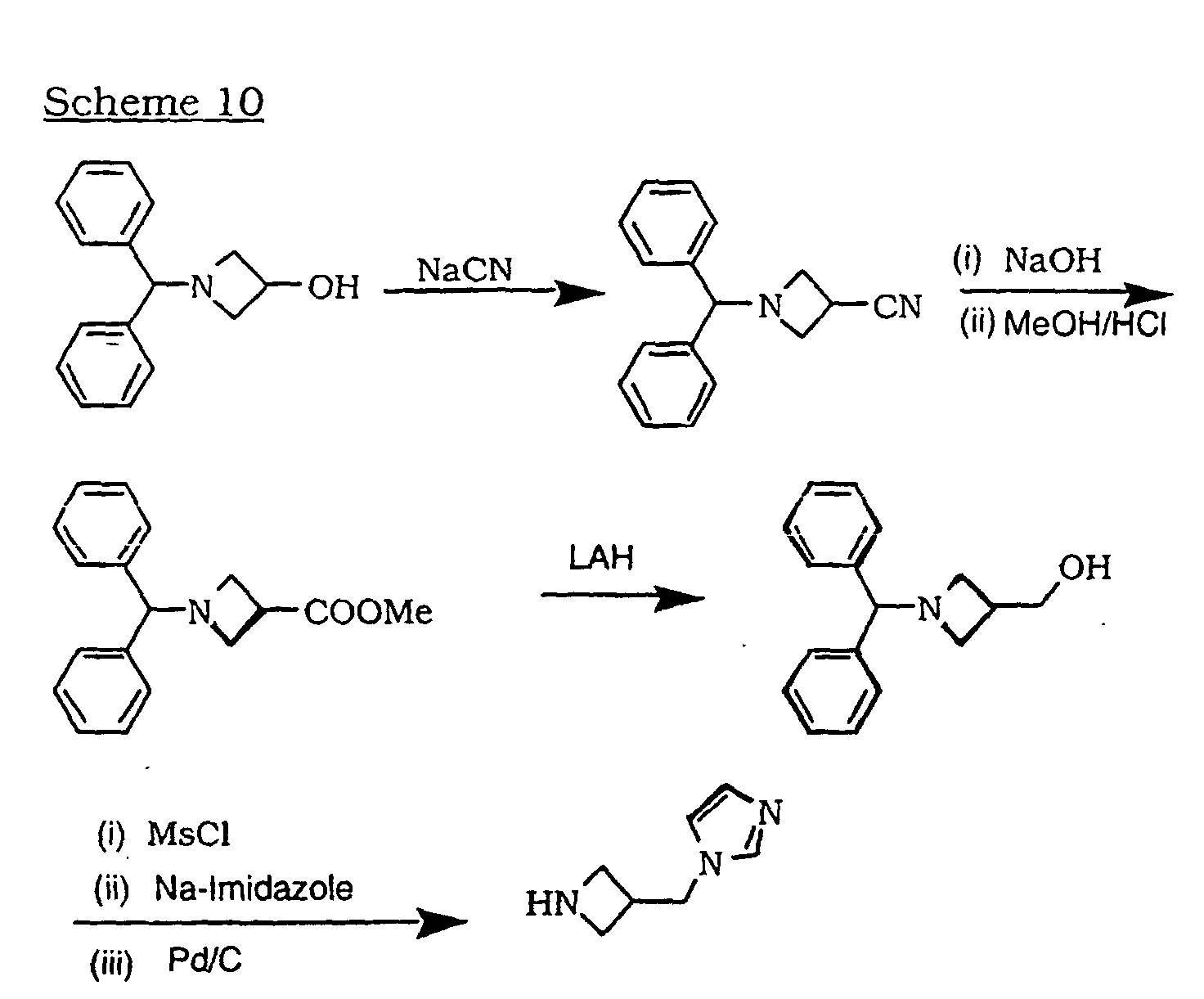
- the sequence begins with mesylation of the alcohol followed by displacement with the sodium salt of the desired imidazole derivative. Removal of the benzhydryl protecting group is accomplished by catalytic hydrogenation.
- the morpholino side chains are prepared beginning with the epichlorohydrin as shown in Scheme 11 (Heterocycle, 38, 1033, 1994). Ring opening of the epoxide with benzyl amine followed by alkylation of the resulting amino alcohol gives the amide. Reduction of the amide with BH 3 gives the morpholine into which the imidazole is incorporated by previously discussed methodology. Removal of the N-benzyl protecting group gives the desired amine.
- the 4-substituted piperidine-3-methanol derivatives can be synthesized as illustrated in Scheme 13. Protection of the carboxylic acid as the oxazoline also serves to activate the pyridine ring toward nucleophilic attack by MeLi. Rearomatization with sulfur, hydrolysis of the oxazoline, and esterification gives the ester which upon quatemization and reduction gives the enoate. Conjugate addition with Mel gives the 4,4-dimethyl derivative. This ester may be converted into the desired compound by previously described procedures.
- Reaction Step a Isatoic anhydride/methylene chloride
- Reaction Step b sodium nitrite/hydrochloric acid/methanol/cuprous chloride
- Reaction Step c (i) aq. hydrochloric acid/methanol/reflux (ii) sodium hydroxide/sodium cyanide
- Reaction Step d conc. hydrochloric acid/reflux.
- Reaction Step e di- tert .butyldicarbonate/-sodium hydroxide/tetrahydrofuran.
- reaction was checked by tlc (30% MeOH/NH 3 /CH 2 Cl 2 ) and if not complete, more (Boc) 2 O was added keeping the pH at ⁇ 10.5.
- the reaction mixture was washed with Et 2 O (2 X 180 mL) (check that the product is not in the Et 2 O layer and dispose of the Et 2 O layer).
- the aqueous layer was cooled in an ice bath and pH to adjusted to 2.0 with 1N HCl (slowly) (get bubbling initially).
- the aqueous layer was extracted with EtOAc (3 X 200 mL) and the combined organics dried over MgSO 4 , filtered and evaporated in vacuo to obtain a white solid (9.68 g, 88% yield).
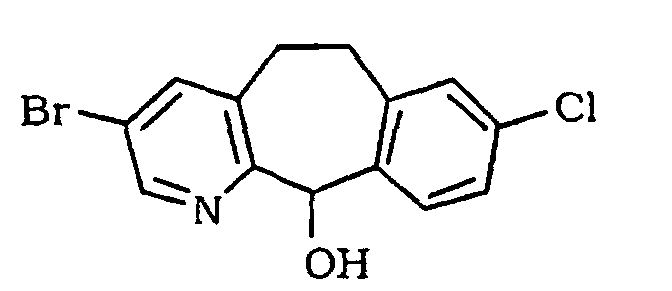
- the tricyclic alcohol (5.6 gm, 17.33 mmol) was dissolved in CH 2 Cl 2 (56 mL) and SOCl 2 (2.46 mL) was added while stirring under a dry N 2 atmosphere. After 5 hrs. the tlc was checked ( by adding an aliquot of the reaction mixture to 1N NaOH and shaking with CH 2 Cl 2 and checking the CH 2 Cl 2 layer by tlc using 50% EtOAc/Hexanes as the eluent). The mixture was evaporated to give a gum which was evporated from dry toluene twice and once from CH 2 Cl 2 to give a foamy solid.
- the solution was cooled to 0 °C and treated with a 2.0 M aqueous ammonia solution (25 ml, 50.00 mmol, excess) to give a snow-white suspension.
- the suspension was filtered through a Celite® 521 plug and the filtrate was extracted with diethyl ether (4 x 25 ml).
- the ethereal extracts were combined and washed with brine (10 ml), dried over Na 2 SO 4 , filtered, and concentrated under house vacuum at 30 °C.
- Methanesulfonyl chloride (296 ⁇ l, 3.80 mmol, 1.25 eq.) was added dropwise to a stirred solution of the title compound from Step B (700 mg, 3.04 mmol, 1.0 eq.) and triethylamine (640 ⁇ l, 4.56 mmol, 1.50 eq.) in anhydrous dichloromethane (5 ml) at 0 °C under a nitrogen atmosphere. The resulting yellow suspension was stirred at 0 °C for 1h and at room temperature for another 3h. The mixture was poured onto brine (25 ml) and extracted with dichloromethane (5 x 10 ml).
- the crude tile compound from Step C was dissolved in 30 ml of THF, cooled in an ice bath, and stirred.
- a 2M THF solution of Lithium borohydride (9 mL, 18 mmol) was added dropwise and the reaction mixture stirred for 3 hours.
- 1N HCl ( ⁇ 10 mL) was added slowly and the mixture stirred for 5 min.
- 1N NaOH ( ⁇ 20 mL) was added and the crude product extracted with ethylacetate, dried over magnesium sulfate, filtered, and evaporated to obtain a crude oil.
- Example 2 The title compound from Example 1 was separated into individual (R)- and (S)-isomers by Preparative HPLC with a CHIRALPAK AD column using a 15% iPrOH in hexanes solution with 0.2% DEA as eluent.
- Example 10 By essentially the same procedure set forth in Example 10 and 11 except using the title compound from Example 2, the title compounds were prepared.
- Tricyclic chloride (5.04g, 1.1 eq.) was added to a solution of the title compound from Preparative Example 5 (4.0g, 17.3 mmol) and TEA (12.05 mL, 5 eq.) in DMF (60 mL). The resulting solution was stirred at room temperature 72 hours at which time the reaction mixture was concentrated under reduced pressure. The residue was diluted with 3M NaOH and extracted with EtOAc. The aqueous layer was neutralized with 50% citric acid and extracted with EtOAc. The combine organics were dried over Na 2 SO 4 , filtered, and concentrated in vacuo.
- the crude product was purified by flash chromatography using a 12% (10% NH 4 OH in MeOH) solution in CH 2 Cl 2 as eluent to give the C-11 (S)-isomer (2.13g, 54%) as the first eluting isomer and the C-11 (R)-isomer (2.4g, 61%) as the second eluting isomer.
- Example 48 By essentially the same procedure set forth in Example 48 only substituting the title compounds from the Preparative Example listed in column 2 of Table 8, the title compounds of the formula shown below with R 8 listed as in column 4 of Table 8 are obtained.
- (S) isomer was prepared from 3(S)-(3-Methanesulfonyloxymethyl)pyrrolidine (0.993g, 3.56 mmoles to give the title compound (1.1409g, 100%).
- Example 2 The title compound from Example 1 was separated into individual 11-(R)- and 11-(S)- isomers by Preparative HPLC with a CHIRALPAK AD column using a 15% iPrOH in hexane solution with 0.2% DEA as eluant.
- 3-Hydroxymethylquinoline (0.45g, 2.83mmoles) (prepared as described in: B. R. Brown, D. Ll. Hammick and B. H. Thewlis, J. Chem. Soc., 1951 ,1145-1149.) was dissolved in methanol (100mL) and placed in a Parr bomb. Platinum (IV) oxide monohydrate (0.225g. 0.918mmoles) was added and the mixture was hydrogenated at 50psi at 25°C for 6h. The catalyst was removed by decantation and washed with methanol. The methanol was evaporated to dryness and the product was chromatographed on silica gel using 3% (10% conc.
- 6-Hydroxymethylquinoline (0.4325g, 2.72mmoles) (prepared by the method of: C. E. Kaslow and W. R. Clark, J. Org. Chem., 1953, 18 , 55-58.) and triethylamine (1.5147mL, 10.87mmoles) were dissolved in anhydrous dichloromethane (16mL) and the mixture was cooled to 0°C. Methanesulfonyl chloride (0.421mL, 5.43mmoles) was added and the mixture was stirred under argon at 0°C for 1h.
- 6-Hydroxymethylquinoline (1g, 6.28mmoles) (prepared by the method of: C. E. Kaslow and W. R. Clark, J. Org. Chem., 1953, 18 , 55-58.) and methanol (200mL) were placed in a Parr bomb and platinum (IV) oxide monohydrate (0.5g, 2.04mmoles) was added. The mixture was hydrogenated at 50psi at 25°C for 2h. The catalyst was filtered off and washed with methanol. The combined filtrates were evaporated to dryness and the product was chromatographed on silica gel using 1.5% (10% conc.
- the title compound may be prepared by catalytic hydrogenation of 4-isoquinolinecarboxaldehyde using 10% Pd-Al 2 O 3 as the catalyst (as described in: J. Valich, G, Smets, J. P. Declercq, G. Germain and M. Van Meerssche, J. Org. Chem., 1980, 45 , 1557-1565).
- the title compound may be prepared by catalytic hydrogenation of 4-isoquinolinecarboxaldehyde using 10% Pd-Al 2 O 3 as the catalyst (as described in: J. Valich, G, Smets, J. P. Declercq, G. Germain and M. Van Meerssche, J. Org. Chem., 1980, 45 , 1557-1565).
- the title compound from Step A above may be selectively reduced with freshly prepared zinc borohydride (as described in: D. C. Sakar, A. R. Das and B. C. Ranu, J. Org. Chem., 1990, 55, 5799-5801.) to give title allylic alcohol.
- the regio-isomers may be separated by chiral HPLC on a Chiralpak® column, or by treatment with trityl chloride as described above.
- the single tlc spot is a mixture of four isomers.
- the imidazole (reagent 2) (220mg,0.92mmol) was added to a solution of the Boc-acid (reagent 1), (0.45g,0.842mmol), EDCI (200mg, 1.043mmol),HOBT (130mg, 0.962mmol),and N-methyl morpholine (0.2ml,1.81mmol) in DMF (anhydrous, 3ml) at room temperature (20°C). The resultant solution was stirred overnight at 20°C. The solvent was evaporated, water (70ml) and EtOAC (120 ml) were added.
- 1,4-Di-N-tert-butoxycarbonylpiperazine-2(R)-carboxylate prepared as described in Preparative Example 2 (0.6946g, 2.1mmoles), 2(R/S)-[2-(1H-imidazol-1-yl)ethyl]piperidine (0.49g, 2.73mmoles) (prepared as described in Preparative Example 57, Step D) (IN0972), 1-(3-dimethylaminopropyl)-3-ethylcarbodiimide hydrochloride (0.524g, 2.73mmoles), 1-hydroxybenzotriazole (0.3693g, 2.73mmoles) and 4-methylmorpholine (0.2765g, 0.3005mL, 2.73mmoles) were dissolved in anhydrous DMF (3mL) and the mixture was stirred under argon at 25°C for 122h.
- Example 2 The title compound from Example 2 (0.225g, 0.363mmoles) was dissolved in methanol (2mL). A 10% (v/v) solution of conc. H 2 SO 4 in dioxane (v/v) (4.92mL) was added and the mixture was stirred at 25°C for 30h. The mixture was diluted with methanol (300mL) and then treated with BioRad AG1-X8 (OH - ) resin until it was basic. The resin was filtered off and washed with methanol. The combined filtrates were evaporated to dryness and the residue was chromatographed on silica gel using 4% (10% conc.
- 4-Methylimidazole (6.46g, 78.64mmoles) was dissolved in anhydrous DMF (300mL) and 95% sodium hydride (1.987g, 86.5mmoles) was added in portions over 0.25h to the stirred solution at 25°C under argon. The mixture was stirred for 1.5h.
- a solution of 1-tert-butoxycarbonyl-2(R/S)-(2-methanesulfonyloxyethyl)piperidine (21.97g, 71.49mmoles) (prepared as described in Preparative Example 57, Step B) in anhydrous DMF (70mL) was added and the mixture was heated under reflux at 65°C for 2.25h.
- 1,4-Di-N-tert-butoxycarbonylpiperazine-2(R)-carboxylate (0.521g, 1.6mmoles) (prepared as described in Preparative Example 2), 1-(3-dimethylaminopropyl)-3-ethylcarbodiimide hydrochloride (0.393g, 2.1mmoles), 1-hydroxybenzotriazole (0.0.277g, 2.1mmoles) and 4-methylmorpholine (0.225mL, 2.1mmoles) were dissolved in anhydrous DMF (3mL) and the mixture was stirred under argon at 25°C for 150h.
Landscapes
- Chemical & Material Sciences (AREA)
- Organic Chemistry (AREA)
- Health & Medical Sciences (AREA)
- Chemical Kinetics & Catalysis (AREA)
- Life Sciences & Earth Sciences (AREA)
- General Chemical & Material Sciences (AREA)
- Medicinal Chemistry (AREA)
- Nuclear Medicine, Radiotherapy & Molecular Imaging (AREA)
- Veterinary Medicine (AREA)
- Pharmacology & Pharmacy (AREA)
- Public Health (AREA)
- Animal Behavior & Ethology (AREA)
- General Health & Medical Sciences (AREA)
- Engineering & Computer Science (AREA)
- Bioinformatics & Cheminformatics (AREA)
- Pharmaceuticals Containing Other Organic And Inorganic Compounds (AREA)
- Plural Heterocyclic Compounds (AREA)
Abstract
Description
- WO 95/10516, published April 20, 1995, WO96/31478, published October 10, 1996, and appending Application Serial No. 09/094687 filed June 15, 1998 and WO 98/57960 disclose tricyclic compounds useful for inhibiting farnesyl protein transferase.
- In view of the current interest in inhibitors of farnesyl protein transferase, a welcome contribution to the art would be compounds useful for the inhibition of farnesyl protein transferase. Such a contribution is provided by this invention.
- This invention provides compounds useful for the inhibition of farnesyl protein transferase (FPT). The compounds of this invention are represented by the formula:
- A compound of the formula:or a pharmaceutically acceptable salt or solvate thererof, wherein:

one of a, b, c and d represents N or N+O-, and the remaining a, b, c and d groups represent CR1 or CR2; or
each of a, b, c, and d are independently selected from CR1 or CR2;
each R1 and each R2 is independently selected from H, halo, -CF3, -OR10 (e.g., -OCH3), -COR10, -SR10 (e.g., -SCH3 and -SCH2C6H5), -S(O)tR11 (wherein t is 0, 1 or 2, e.g., -SOCH3 and -SO2CH3), -N(R10)2, -NO2, -OC(O)R10, -CO2R10, -OCO2R11, -CN, -NR10COOR11, -SR11C(O)OR11 (e.g., -SCH2CO2CH3), -SR11N(R75)2 (provided that R11 in -SR11N(R75)2 is not -CH2-) wherein each R75 is independently selected from H or -C(O)OR11 (e.g., -S(CH2)2NHC(O)O-t-butyl and -S(CH2)2NH2), benzotriazol-1-yloxy, tetrazol-5-ylthio, or substituted tetrazol-5-ylthio (e.g., alkyl substituted tetrazol5-ylthio such as 1-methyl-tetrazol-5-ylthio), alkynyl, alkenyl or alkyl, said alkyl or alkenyl group optionally being substituted with halo, -OR10 or -CO2R10;
R3 and R4 are the same or different and each independently represents H, any of the substituents of R1 and R2, or R3 and R4 taken together represent a saturated or unsaturated C5-C7 fused ring to the benzene ring (Ring III);
R5, R6, and R7 each independently represents H, -CF3, -COR10, alkyl or aryl, said alkyl or aryl optionally being substituted with -OR10, -SR10, -S(O)tR11, -NR10COOR11, -N(R10)2, -NO2, -COR10, -OCOR10, -OCO2R11, -CO2R10, OPO3R10, or R5 is combined with R6 to represent =O or =S; provided that for the groups -OR10, -SR10, and -N(R10)2 R10 is not H;
R10 represents H, alkyl, aryl, or aralkyl (e.g., benzyl);
R11 represents alkyl or aryl;
X represents N, CH or C, and when X is C the optional bond (represented by the dotted line) to carbon atom 11 is present, and when X is CH the optional bond (represented by the dotted line) to carbon atom 11 is absent;
the dotted line between carbon atoms 5 and 6 represents an optional bond, such that when a double bond is present, A and B independently represent -R10, halo, -OR11, -OCO2R11 or -OC(O)R10, and when no double bond is present between carbon atoms 5 and 6, A and B each independently represent H2, -(OR11)2, H and halo, dihalo, alkyl and H, (alkyl)2, -H and -OC(O)R10, H and -OR10, =O, aryl and H, =NOR10 or -O-(CH2)p-O- wherein p is 2, 3 or 4;
R8 represents a heterocyclic ring selected from:
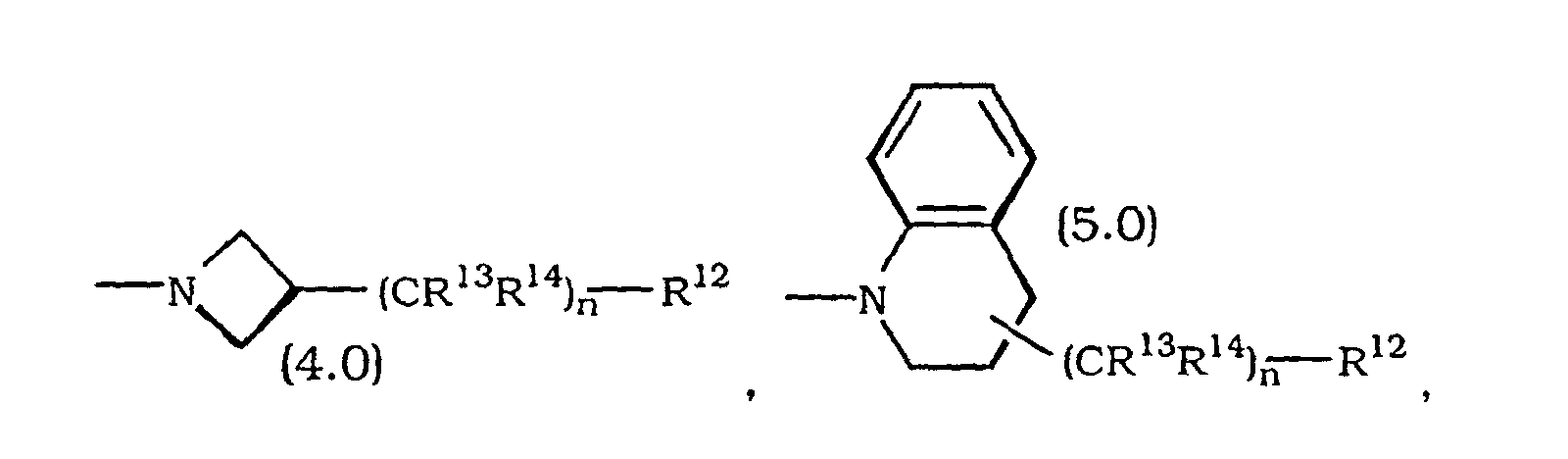
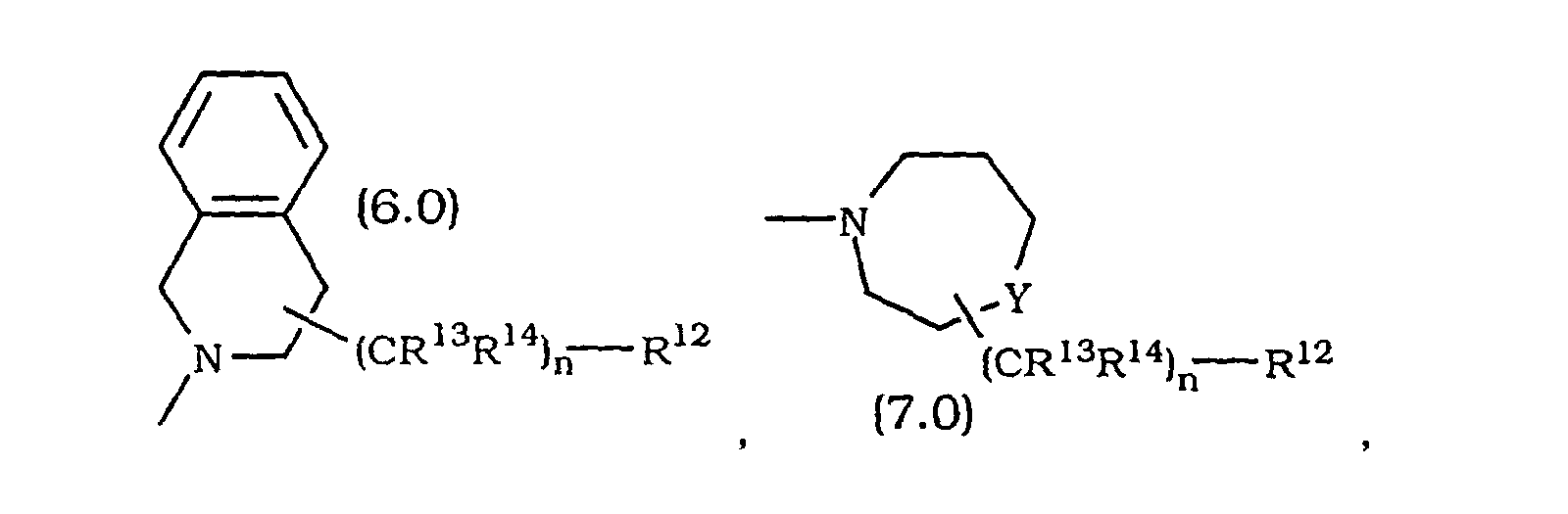
 said heterocyclic rings (2.0 to 7.0 and 2.1 to 7.1) being optionally substituted with one or more substituents independently selected from: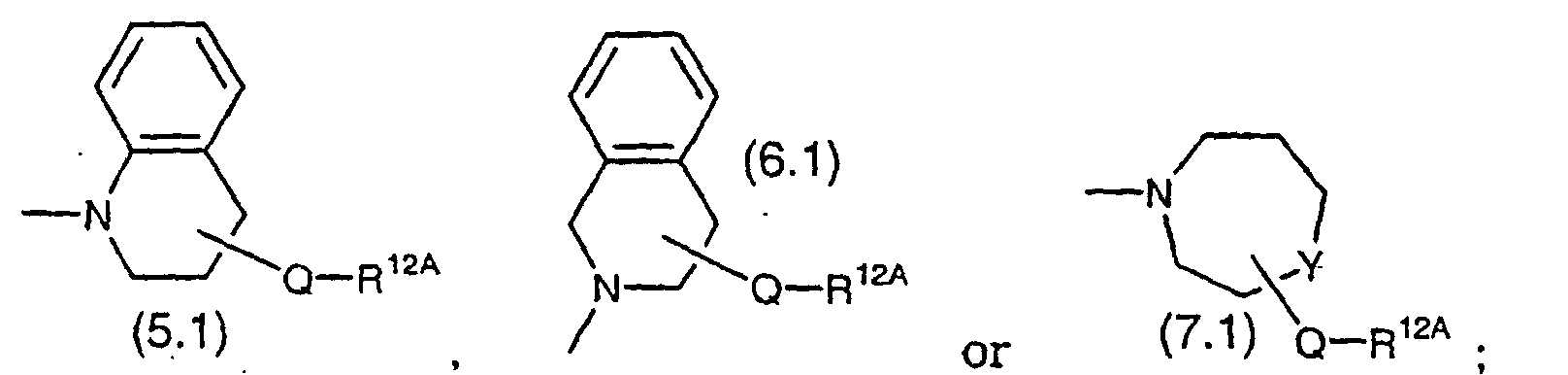
- (a) alkyl (e.g., methyl, ethyl, isopropyl, and the like),
- (b) substituted alkyl wherein said substituents are selected from: halo, aryl, -OR15 or -N(R15)2, heteroaryl, heterocycloalkyl, cycloalkyl, wherein each R15 group is the same or different, provided that said optional substituent is not bound to a carbon atom that is adjacent to an oxygen or nitrogen atom, and wherein R15 is selected from : H, alkyl, aryl, arylalkyl, heteroaryl, heteroarylalkyl, cycloalkyl, or cycloalkylalkyl;
- (c) hydroxyl, with the proviso that carbon atoms adjacent to the nitrogen, sulfur or oxygen atoms of the ring are not substituted with hydroxyl;
- (d) alkyloxy or
- (e) arylalkyloxy; (i.e., each substitutable H atom on each substitutable carbon atom in said heterocyclic rings is optionally replaced with substituents selected from (a) to (e) defined above);
-
- Thus, in one embodiment of this invention R9 is 12.0. In another embodiment R9 is 13.0. In another embodiment R9 is 14.0. In another embodiment R9 is 15.0. In another embodiment R9 is 16.0.
- The compounds of this invention: (i) potently inhibit farnesyl protein transferase, but not geranylgeranyl protein transferase I, in vitro; (ii) block the phenotypic change induced by a form of transforming Ras which is a farnesyl acceptor but not by a form of transforming Ras engineered to be a geranylgeranyl acceptor; (iii) block intracellular processing of Ras which is a farnesyl acceptor but not of Ras engineered to be a geranylgeranyl acceptor; and (iv) block abnormal cell growth in culture induced by transforming Ras.
- The compounds of this invention inhibit farnesyl protein transferase and the farnesylation of the oncogene protein Ras. Thus, this invention further provides a method of inhibiting farnesyl protein transferase, (e.g., ras farnesyl protein transferase) in mammals, especially humans, by the administration of an effective amount of the tricyclic compounds described above. The administration of the compounds of this invention to patients, to inhibit farnesyl protein transferase, is useful in the treatment of the cancers described below.
- This invention provides a method for inhibiting or treating the abnormal growth of cells, including transformed cells, by administering an effective amount of a compound of this invention. Abnormal growth of cells refers to cell growth independent of normal regulatory mechanisms (e.g., loss of contact inhibition). This includes the abnormal growth of: (1) tumor cells (tumors) expressing an activated Ras oncogene; (2) tumor cells in which the Ras protein is activated as a result of oncogenic mutation in another gene; and (3) benign and malignant cells of other proliferative diseases in which aberrant Ras activation occurs.
- This invention also provides a method for inhibiting or treating tumor growth by administering an effective amount of the tricyclic compounds, described herein, to a mammal (e.g., a human) in need of such treatment. In particular, this invention provides a method for inhibiting or treating the growth of tumors expressing an activated Ras oncogene by the administration of an effective amount of the above described compounds. Examples of tumors which may be inhibited or treated include, but are not limited to, lung cancer (e.g., lung adenocarcinoma), pancreatic cancers (e.g., pancreatic carcinoma such as, for example, exocrine pancreatic carcinoma), colon cancers (e.g., colorectal carcinomas, such as, for example, colon adenocarcinoma and colon adenoma), myeloid leukemias (for example, acute myelogenous leukemia (AML)), thyroid follicular cancer, myelodysplastic syndrome (MDS), bladder carcinoma, epidermal carcinoma, melanoma, breast cancer and prostate cancer.
- It is believed that this invention also provides a method for inhibiting or treating proliferative diseases, both benign and malignant, wherein Ras proteins are aberrantly activated as a result of oncogenic mutation in other genes--i.e., the Ras gene itself is not activated by mutation to an oncogenic form--with said inhibition or treatment being accomplished by the administration of an effective amount of the tricyclic compounds described herein, to a mammal (e.g., a human) in need of such treatment. For example, the benign proliferative disorder neurofibromatosis, or tumors in which Ras is activated due to mutation or overexpression of tyrosine kinase oncogenes (e.g., neu, src, abl, lck, and fyn), may be inhibited or treated by the tricyclic compounds described herein.
- The tricyclic compounds useful in the methods of this invention inhibit or treat the abnormal growth of cells. Without wishing to be bound by theory, it is believed that these compounds may function through the inhibition of G-protein function, such as ras p21, by blocking G-protein isoprenylation, thus making them useful in the treatment of proliferative diseases such as tumor growth and cancer. Without wishing to be bound by theory, it is believed that these compounds inhibit ras farnesyl protein transferase, and thus show antiproliferative activity against ras transformed cells.
- As used herein, the following terms are used as defined below unless otherwise indicated:
- MH+-represents the molecular ion plus hydrogen of the molecule in the mass spectrum;
- BOC-represents tert-butyloxycarbonyl;
- BOC-ON-represents 1-(tert-butoxycarbonyl)-2-tert-butyl-3-methyl-4-imidazolidinone nitrile;
- CBZ-represents -C(O)OCH2C6H5 (i.e., benzyloxycarbonyl);
- CBZ-OSUC-represents benzyloxycarbonyl-O-succinimide;
- CH2Cl2-represents dichloromethane;
- CIMS-represents chemical ionization mass spectrum;
- DEAD-represents diethylazodicarboxylate;
- DEC-represents EDC which represents 1-(3-dimethylaminopropyl)-3-ethylcarbodiimide hydrochloride;
- DMF-represents N,N-dimethylformamide;
- Et-represents ethyl;
- EtOAc-represents ethyl acetate;
- EtOH-represents ethanol;
- HOBT-represents 1-hydroxybenzotriazole hydrate;
- IPA-represents isopropanol;
- iPrOH-represents isopropanol;
- LAH-represents lithium aluminum hydride;
- LDA-represents lithium diisopropylamide;
- MCPBA-represents meta-chloroperbenzoic acid;
- Me-represents methyl;
- MeOH-represents methanol;
- MS-represents mass spectroscopy;
- NMM-represents N-methylmorpholine;
- Ph-represents phenyl;
- Pr-represents propyl;
- TBDMS-represents tert-butyldimethylisilyl;
- TEA-represents triethylamine;
- TFA-represents trifluoroacetic acid;
- THF-represents tetrahydrofuran;
- Tr-represents trityl;
- alkyl-represents straight and branched carbon chains and contains from one to twenty carbon atoms, preferably one to six carbon atoms;
- acyl-represents a G-C(O)- group wherein G represents alkyl, aryl, heteroaryl, cycloalkyl, heterocycloalkyl, -O-alkyl, -O-aryl, or NR25R26 wherein R25 and R26 are independently selected from alkyl or aryl;
- arylalkyl-represents an alkyl group, as defined above, substituted with an aryl group, as defined below, such that the bond from another substituent is to the alkyl moiety;
- aryl-(including the aryl portion of arylalkyl)-represents a carbocyclic group containing from 6 to 15 carbon atoms and having at least one aromatic ring (e.g., aryl is a phenyl ring), with all available substitutable carbon atoms of the carbocyclic group being intended as possible points of attachment, said carbocyclic group being optionally substituted (e.g., 1 to 3) with one or more of halo, alkyl, hydroxy, alkoxy, phenoxy, CF3, -C(O)N(R18)2, -SO2R18, -SO2N(R18)2, amino, alkylamino, dialkylamino, -COOR23 or - NO2, wherein R23 represents alkyl or aryl;
- aroyl-represents -C(O)aryl wherein aryl is as defined above (e.g., -C(O)phenyl);
- cycloalkyl-represents saturated carbocyclic rings of from 3 to 20 carbon atoms, preferably 3 to 7 carbon atoms, said cycloalkyl ring optionally substituted with one or more (e.g., 1, 2 or 3) alkyl groups (e.g., methyl or ethyl) and when there is more than one alkyl group each alkyl group can be the same or different;
- cycloalkylalkyl-represents a cycloalkyl group, as defined above, substituted with an alkyl group, as defined above, such that the bond from another substituent is to the alkyl moiety;
- halo-represents fluoro, chloro, bromo and iodo;
- heteroaralkyl-represents an alkyl group, as defined above, substituted with a heteroaryl group, as defined below, such that the bond from another substituent is to the alkyl moiety;
- heteroaryl-represents cyclic groups, optionally substituted
with R3 and R4, having at least one heteroatom selected from O, S
or N, said heteroatom interrupting a carbocyclic ring structure and
having a sufficient number of delocalized pi electrons to provide
aromatic character, with the aromatic heterocyclic groups
preferably containing from 2 to 14 carbon atoms, e.g., 2- or 3-furyl,
2- or 3-thienyl, 2-, 4- or 5-thiazolyl, 2-, 4- or 5-imidazolyl, 2-, 4- or
5-pyrimidinyl, 2-pyrazinyl, 3- or 4-pyridazinyl, 3-, 5- or 6-[1,2,4-triazinyl],
3- or 5-[1,2,4-thiadizolyl], 2-, 3-, 4-, 5-, 6- or 7-benzofuranyl,
2-, 3-, 4-, 5-, 6- or 7-indolyl, 3-, 4- or 5-pyrazolyl, 2-,
4- or 5-oxazolyl, triazolyl, 2-, 3- or 4-pyridyl or pyridyl N-oxide
(optionally substituted with R3 and R4), wherein pyridyl N-oxide can
be represented as:
and

- heterocycloalkyl-represents a saturated, branched or unbranched carbocylic ring containing from 3 to 15 carbon atoms, preferably from 4 to 6 carbon atoms, which carbocyclic ring is interrupted by 1 to 3 hetero groups selected from -O-, -S- or - NR24, wherein R24 represents alkyl, aryl, -C(O)N(R18)2 wherein R18 is as above defined (e.g., -C(O)NH2) or acyl-(suitable heterocycloalkyl groups include 2- or 3-tetrahydrofuranyl, 2- or 3- tetrahydrothienyl, tetrahydropyranyl, 2-, 3- or 4-piperidinyl, 2- or 3-pyrrolidinyl, 2- or 3-piperazinyl, 2- or 4-dioxanyl, morpholinyl, etc.).
-
- The positions in the tricyclic ring system are:

- The compounds of formula 1.0 include the 2R and 2S isomers shown below (2R is preferred):

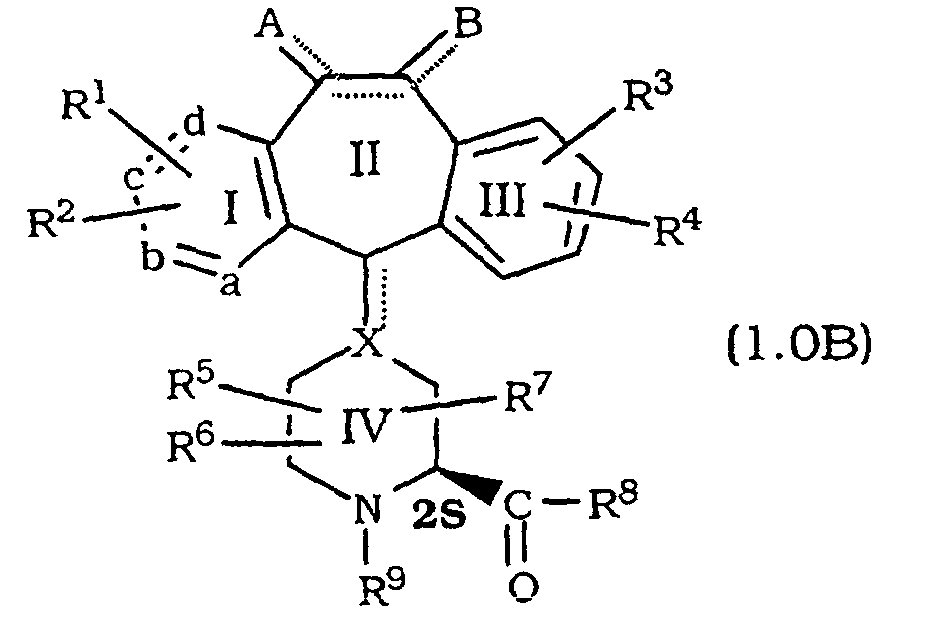
- Examples of the optional substituents for the R12 or R12A moiety include: -CH3, -CH2OH, -CH2OC(O)O-cyclohexyl, -CH2OC(O)O-cyclopentyl, ethyl, isopropyl, NH2, and -NHC(O)CF3.
- Examples of R17 include: -C(O)NH-cyclohexyl, -C(phenyl)3, H, methyl or ethyl.
- Examples of R20 include t-butyl, i-propyl, neopentyl, cyclohexyl, cyclopropylmethyl,
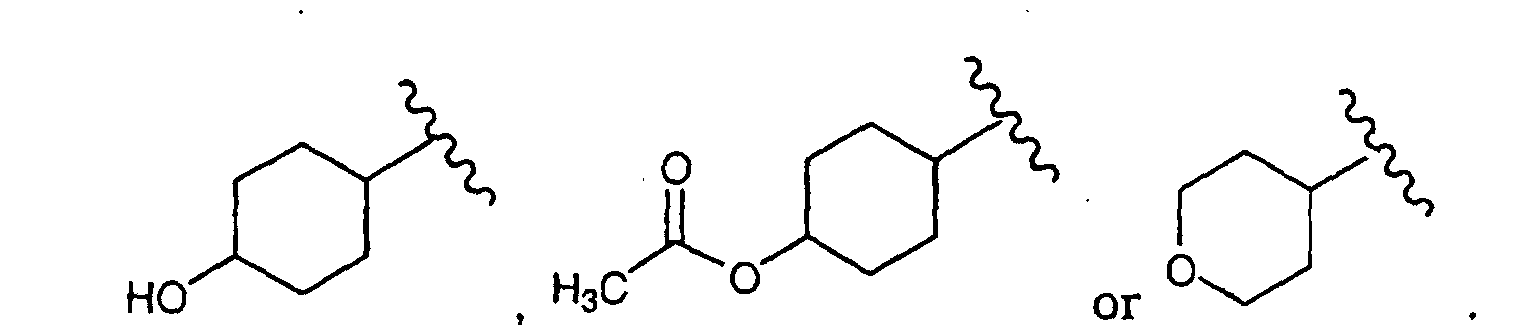
- Examples of R20 for group 12.0 include: t-butyl, ethyl, benzyl, -CH(CH3)2, -CH2CH(CH3)2, -(CH2)2CH3, n-butyl, n-hexyl, n-octyl, p-chlorophenyl, cyclohexyl, cyclopentyl, neopentyl, cyclopropylmethyl or
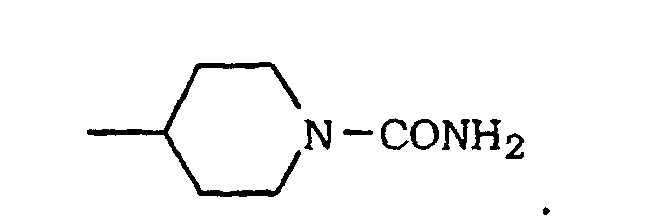
- Examples of R20 and R21 for 13.0 include: cyclohexyl, t-butyl, H, -CH(CH3)2, ethyl, -(CH2)2CH3, phenyl, benzyl, -(CH2)2phenyl, and -CH3.
- Examples of R20 for 14.0 include: 4-pyridylNO, -OCH3, -CH(CH3)2, -t-butyl, H, propyl, cyclohexyl and

- Examples for R22 for 15.0 include: t-butyl, cyclohexyl, cyclopentyl, cyclobutyl, cyclopropyl, cyclopropylmethyl, phenyl, substitued phenyl (e.g., halo, such as F or Cl),

- Examples for R20 for 16.0 include: methyl, phenyl, isopropyl and cyclohexylmethyl.
- Examples of R13 and R14 include: H, F, phenyl, -CH3, -CH2CH(CH3)2, -(CH2)3CH3, benzyl, ethyl, p-chlorophenyl, and -OH (provided that that there can only be one OH on each carbon).
- Cyclopropyl is an Example of the R13 and R14 group being taken together with the carbon atom to which they are bound to form a cycloalkyl ring.
- R1, R2, R3, and R4 are preferably selected from H and halo, and are more preferably selected from H, Br, F and Cl. Representative compounds of formula 1.0 include trihalo, dihalo and monohalo substituted compounds, such as, for example: (1) 3,8,10-trihalo; (2) 3,7,8-trihalo; (3) 3,8-dihalo; (4) 8-halo; (5) 10-halo; and (6) 3-halo (i.e., no substituent in Ring III) substituted compounds; wherein each halo is independently selected. Preferred compounds of formula 1.0 include: (1) 3-Br-8-Cl-10-Br-substituted compounds; (2) 3-Br-7-Br-8-Cl-substituted compounds; (3) 3-Br-8-Cl- substituted compounds; (4) 3-Cl-8-Cl-substituted compounds; (5) 3-F-8-Cl-substituted compounds; (6) 8-Cl-substituted compounds; (7) 10-Cl-substituted compounds; (8) 3-Cl-substituted compounds; (9) 3-Br-substituted compounds; and (10) 3-F-substituted compounds.
- Substituent a is preferably N or N+O- with N being preferred.
- A and B are preferably H2, i.e., the optional bond is absent and the C5-C6 bridge is unsubstituted.
- R5, R6, and R7 are preferably H.
- X is preferably N or CH (i.e., the optional bond is absent), and more preferably X is N.
- When one or more of the carbon atoms of the imidazole ring 8.0 or 9.0 are substituted, the substituents are generally selected from: -N(R15)2, -NHC(O)R15, -C(R18)2OR19, or alkyl, e.g., -CH3, -CH2OH, -CH2OC(O)O-cyclohexyl, -CH2OC(O)O-cyclopentyl, ethyl, isopropyl, NH2, or -NHC(O)CF3.
- R17 is preferably H or alkyl, most preferably H, methyl or ethyl, and more preferably methyl.
- R20 in substituent 12.0 is preferably selected from: alkyl or cycloalkyl, most preferably t-butyl, isopropyl, neopentyl, cyclohexyl or cyclopropylmethyl.
- R20 in substituent 13.0 is preferably selected from: alkyl or cycloalkyl; most preferably t-butyl, isopropyl or cyclohexyl. R21 is preferably selected from: H or alkyl; most preferably H, methyl or isopropyl; and more preferably H.
- R20 in substituent 14.0 is preferably selected from: cycloalkyl or alkyl.
- R22 in substituent 15.0 is preferably selected from: phenyl, cyclopropyl, cyclobutyl, cyclopentyl, cyclohexyl, t-butyl, cyclopropylmethyl,and most preferably selected from: t-butyl, cyclopropyl, cyclobutyl, cyclopentyl or cyclohexyl.

- R20 in substituent 16.0 is preferably selected from: alkyl or cycloalkylalkyl; most preferably methyl, isopropyl or cyclohexylmethyl; more preferably methyl or isopropyl; and even more preferably methyl.
- R13 and R14 are preferably selected from: H, F, C1 to C4 alkyl (e.g., methyl or isopropyl), -CON(R15)2 (e.g., -CONH2), -OR15 (e.g., -OH), aryl (e.g., phenyl) or arylalkyl (e.g., benzyl); or when R13 and R14 are taken together to form a cycloalkyl ring, said ring is preferably cyclopropyl cyclopentyl or cyclohexyl. Most preferably R13 and R14 are H.
- For compounds of the invention, n is preferably 1-3, most preferably 1-2.
- For compounds wherein R8 is ring 2.0 or 7.0, the -(CR13R14)n-R12 substituent can be in the 2-, 3- or 4- position relative to the ring nitrogen, provided that the -(CR13R14)n-R12 substituent is not in the 4-position when Y is O, S, SO or SO2. Preferably, the -(CR13R14)n-R12 substituent is in the 2- or 3- position, and most preferably in the 3- position. More preferably, the -(CR13R14)n-R12 substituent is in the 2- position when n is 2, and in the 3- position when n is 1.
- Compounds of formula 1.0, wherein X is N or CH, include, with reference to the C-11 bond, the R- and S- isomers:

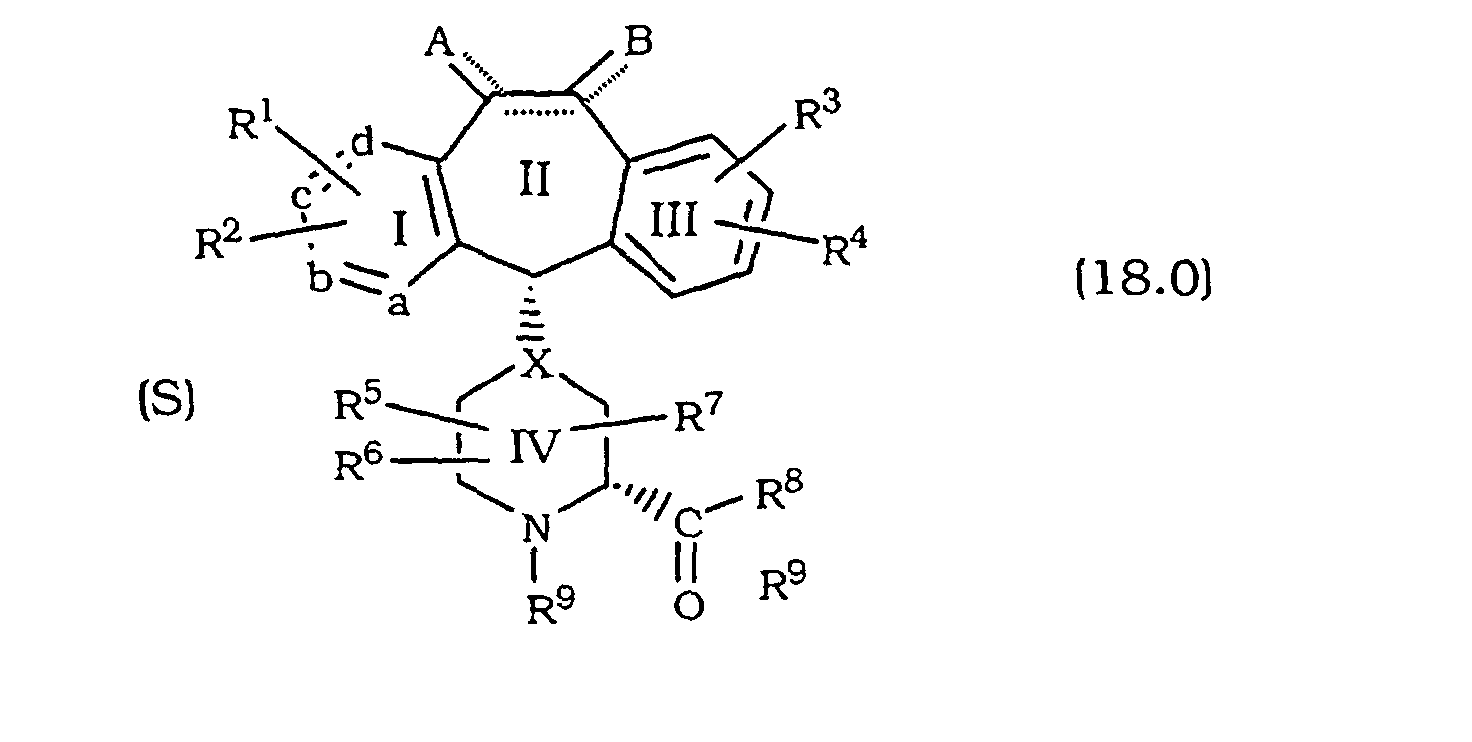
- Compounds of this invention include the C-11 R- and S-isomers having the 2S stereochemistry.
- Compounds of this invention include:
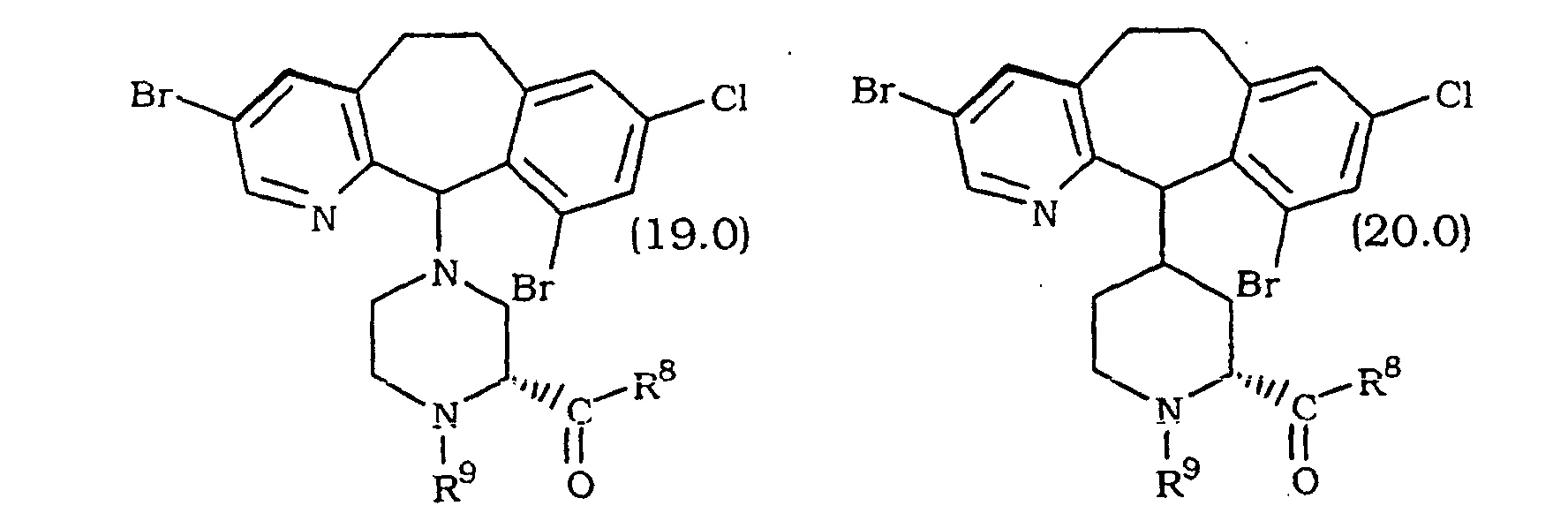
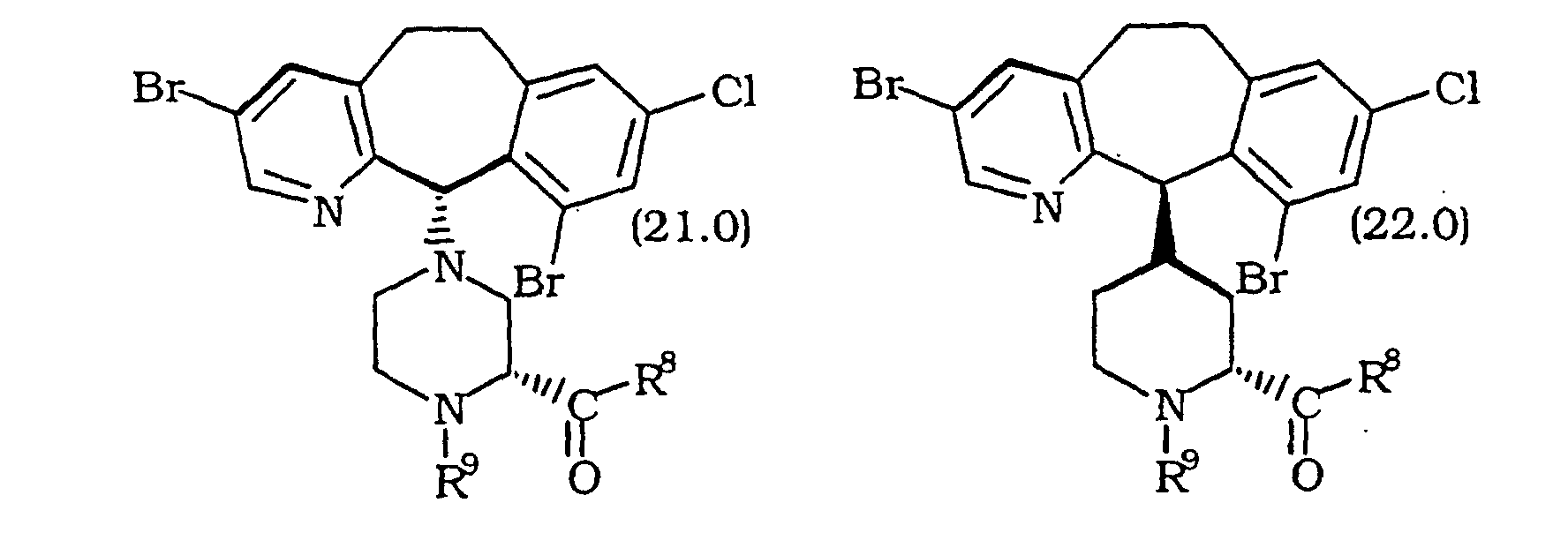

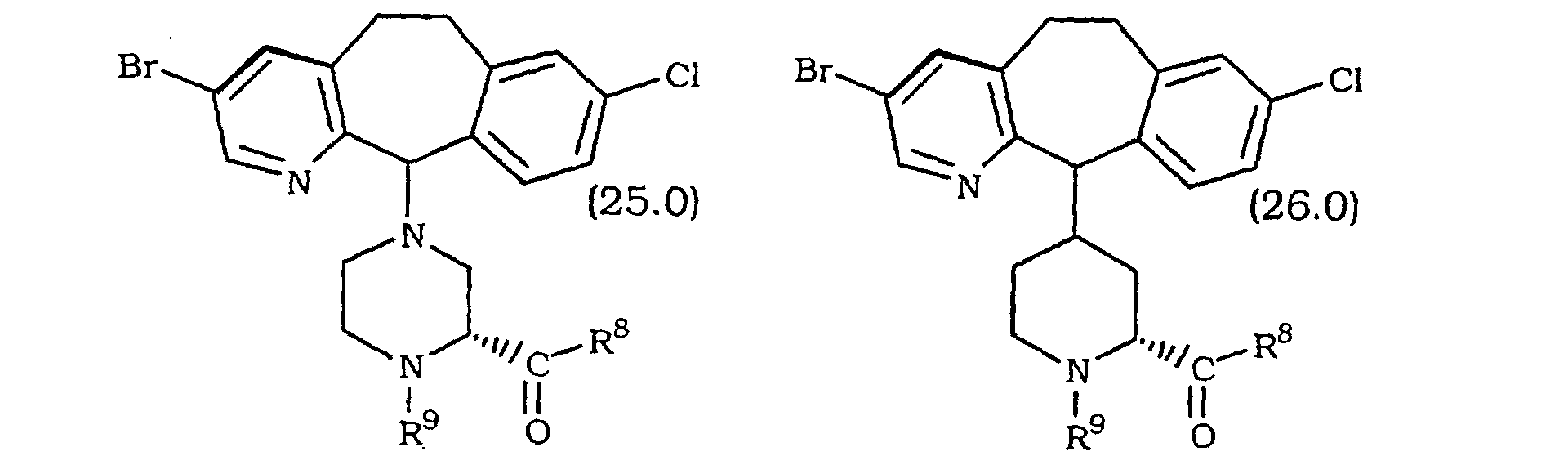
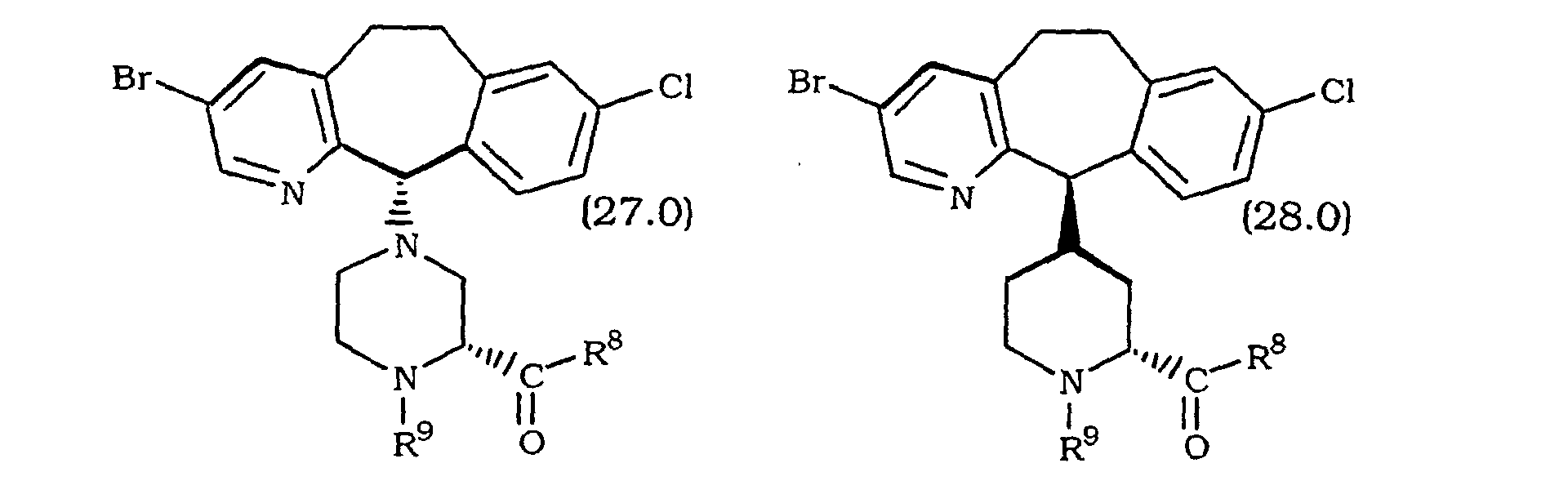
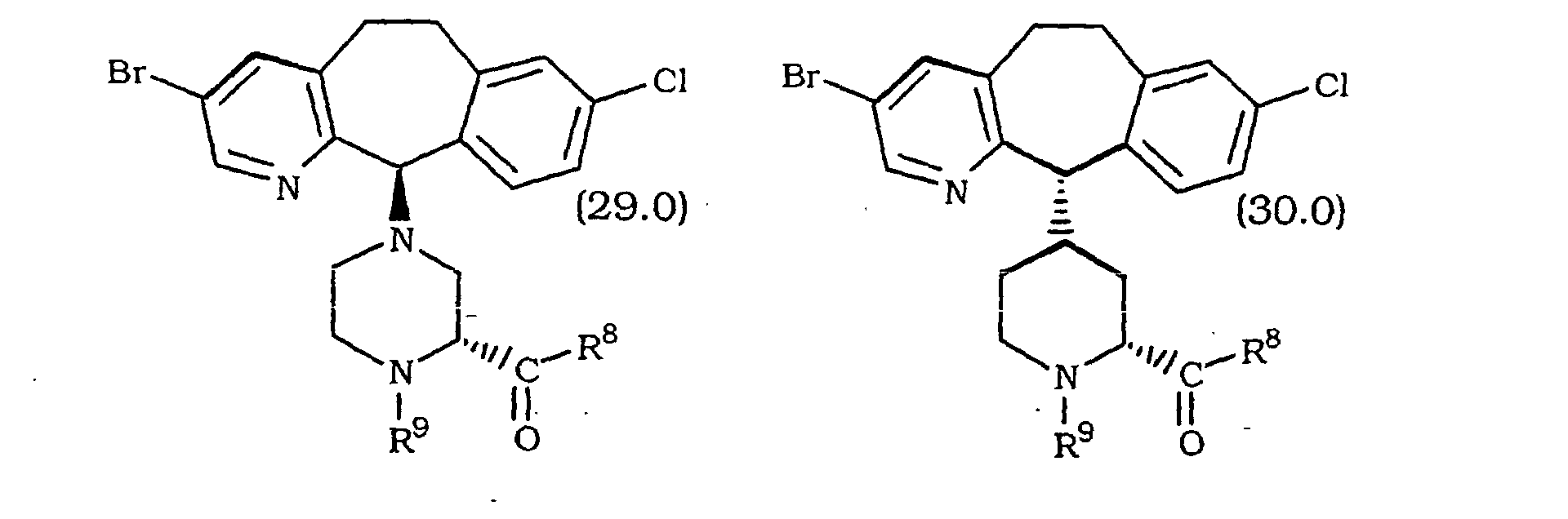

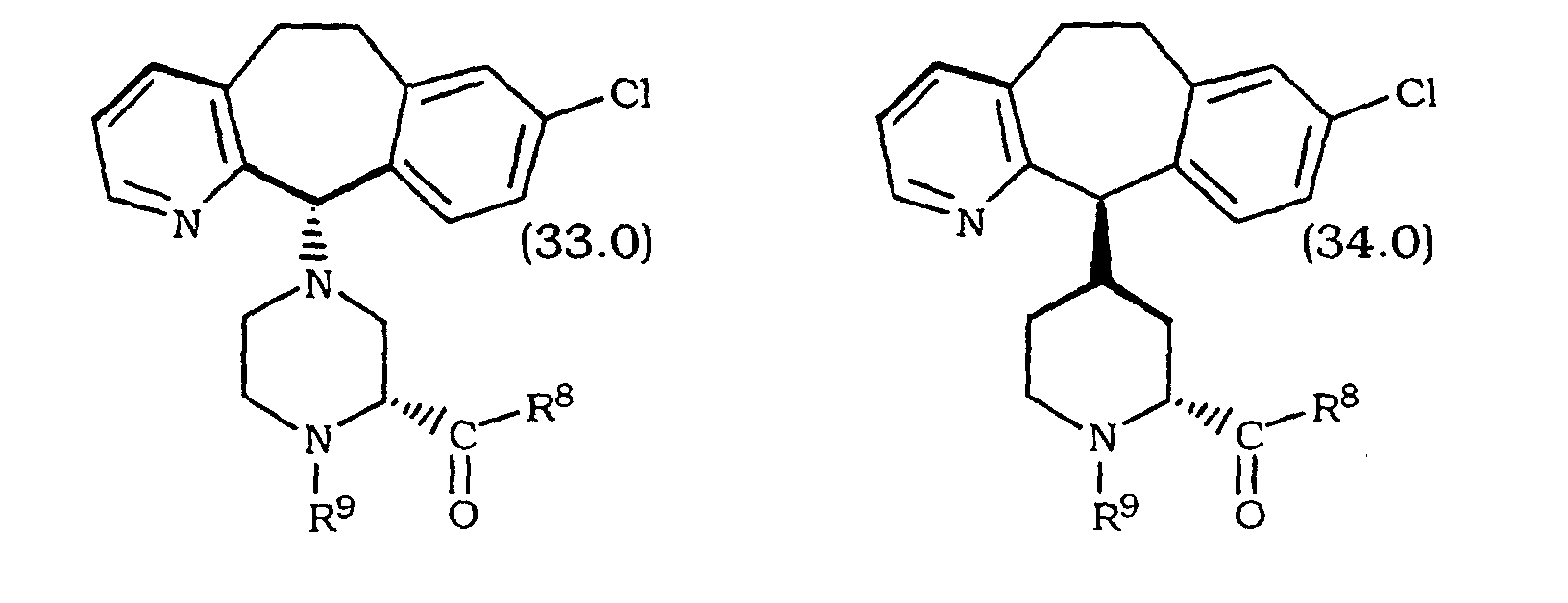
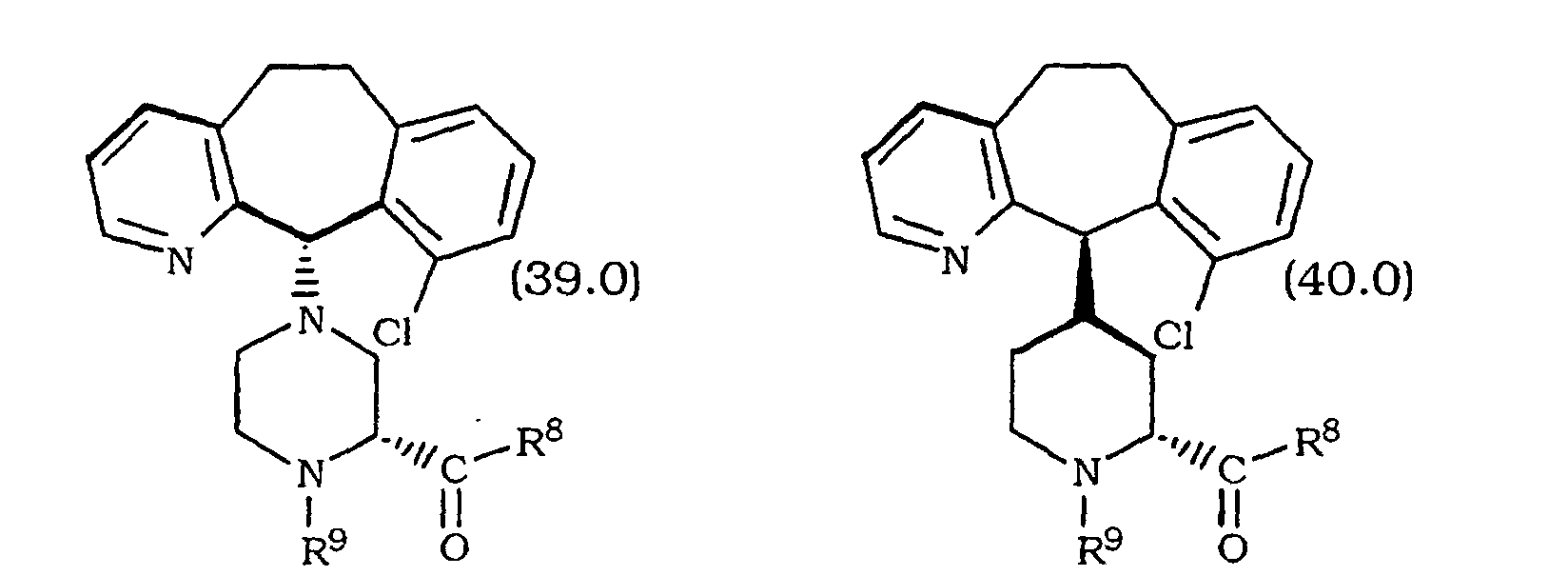
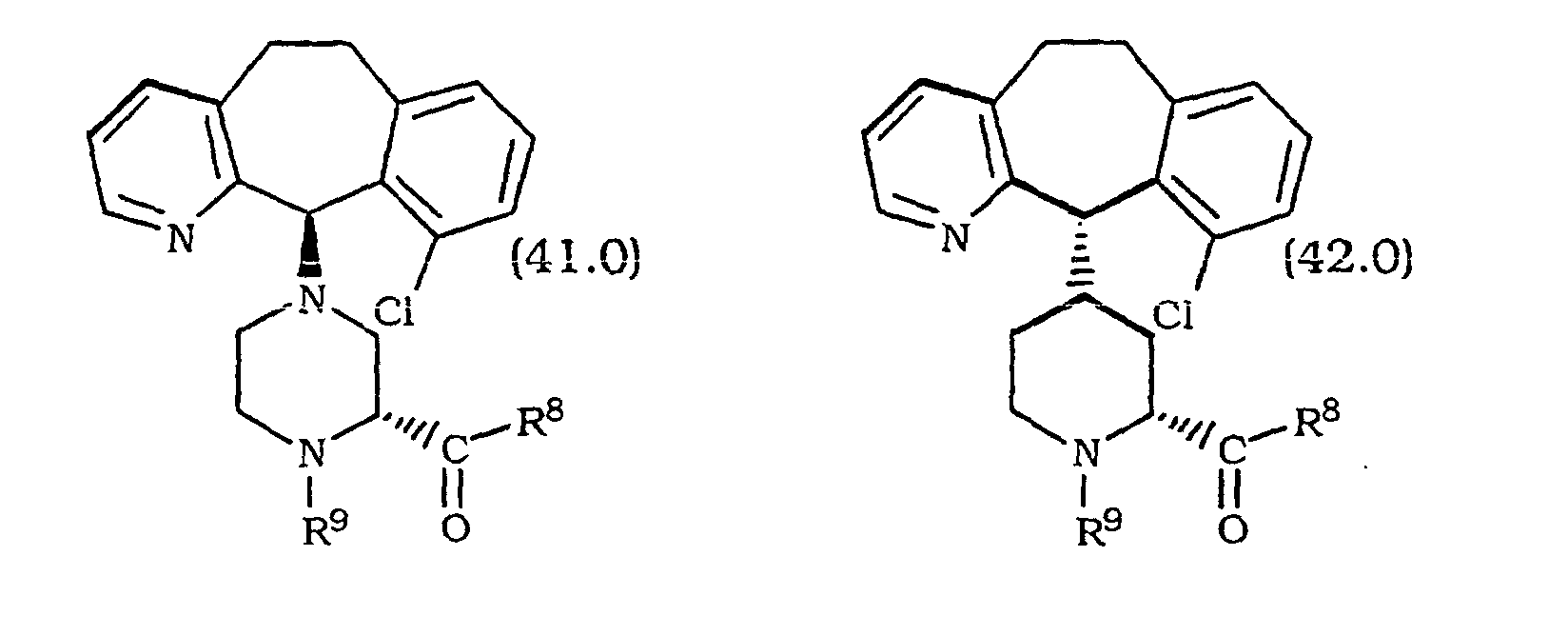
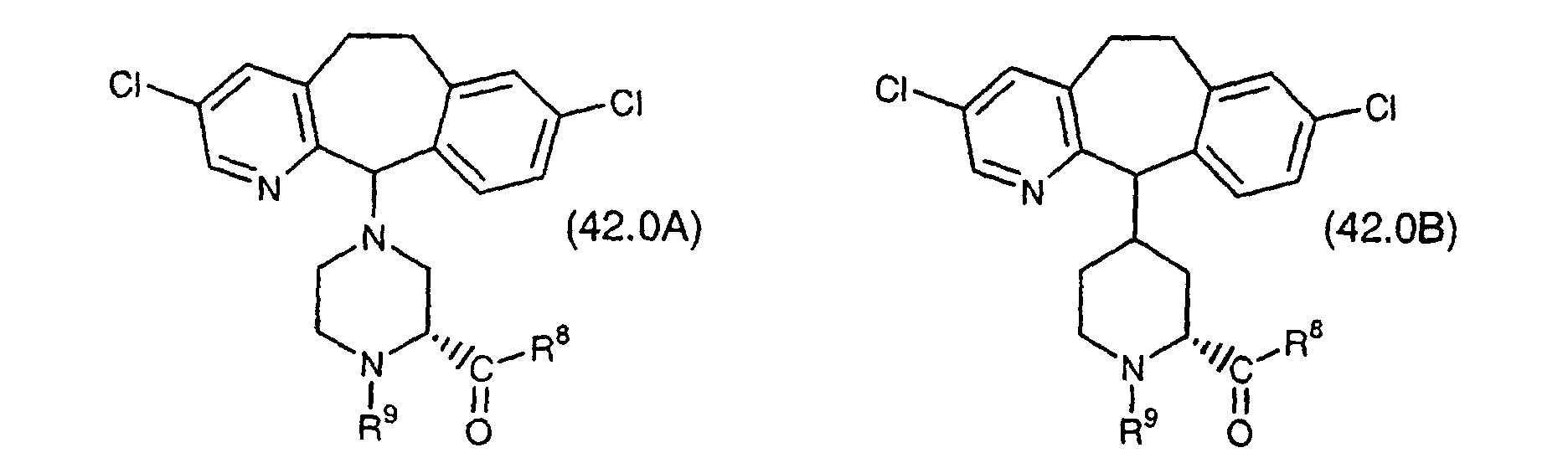
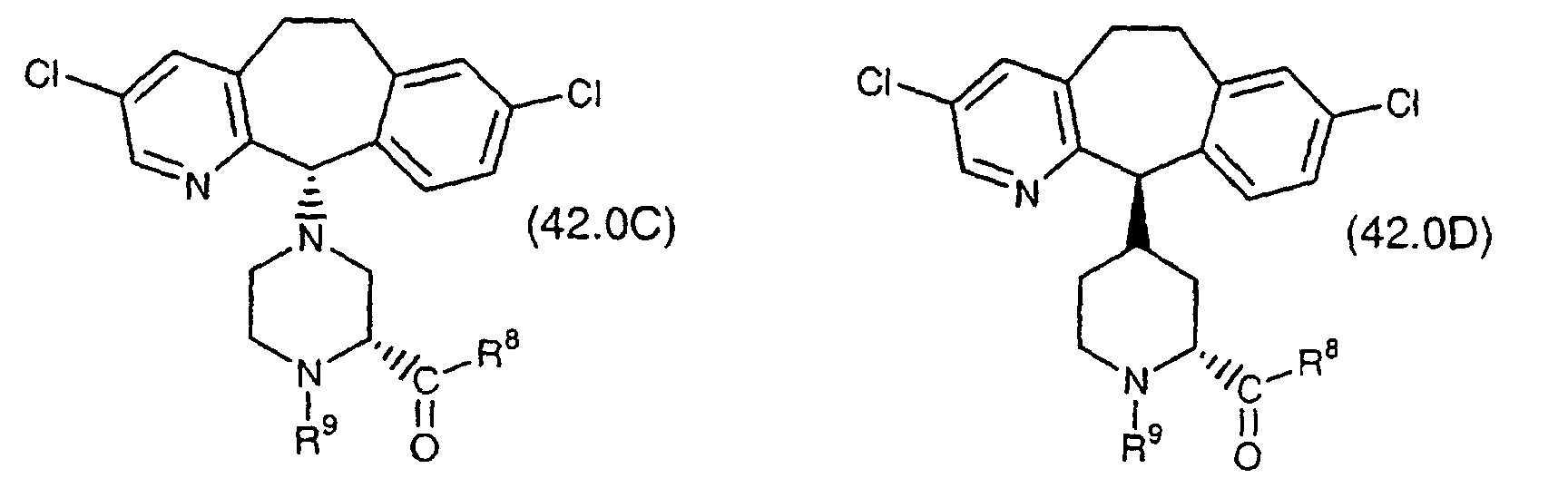
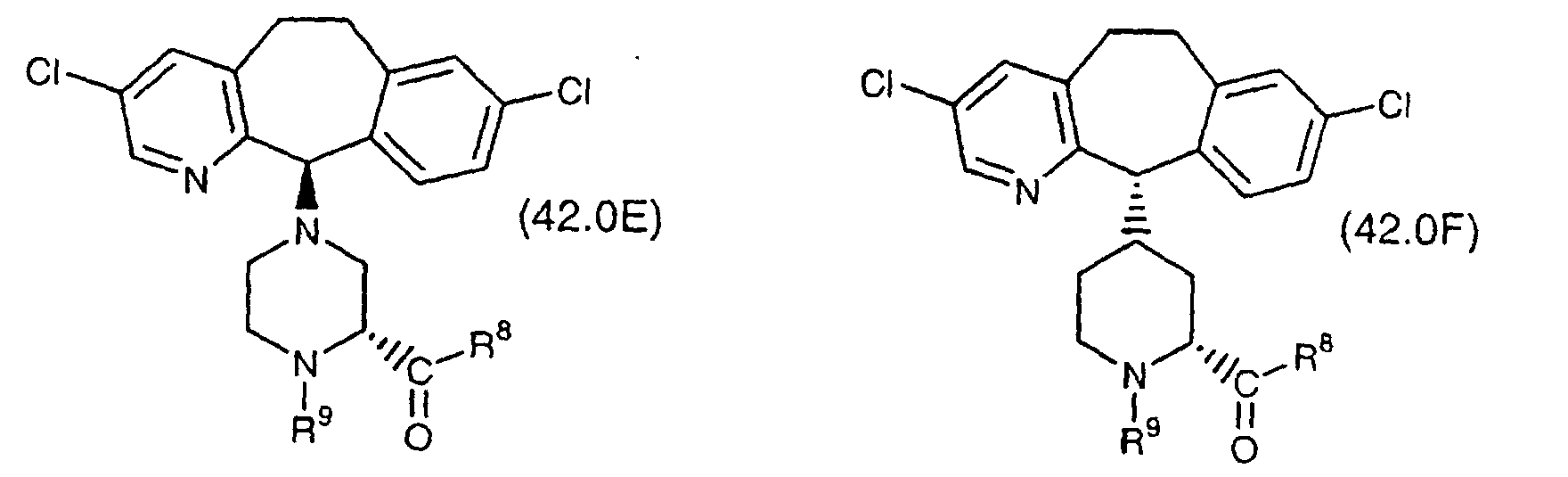
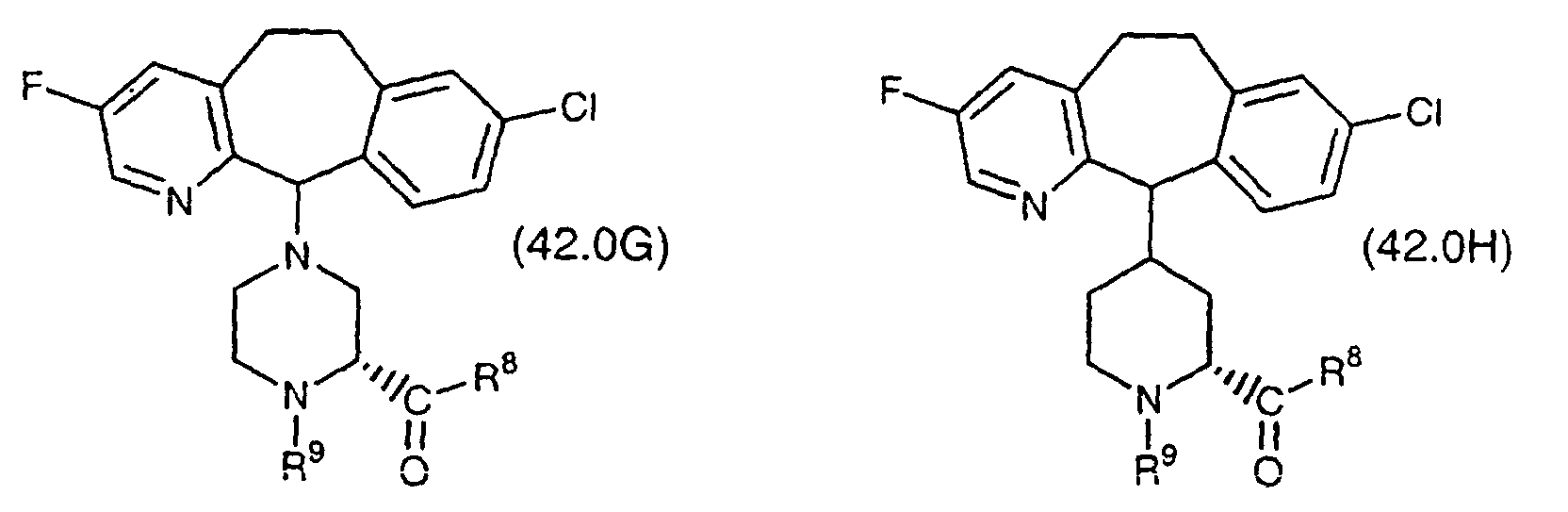
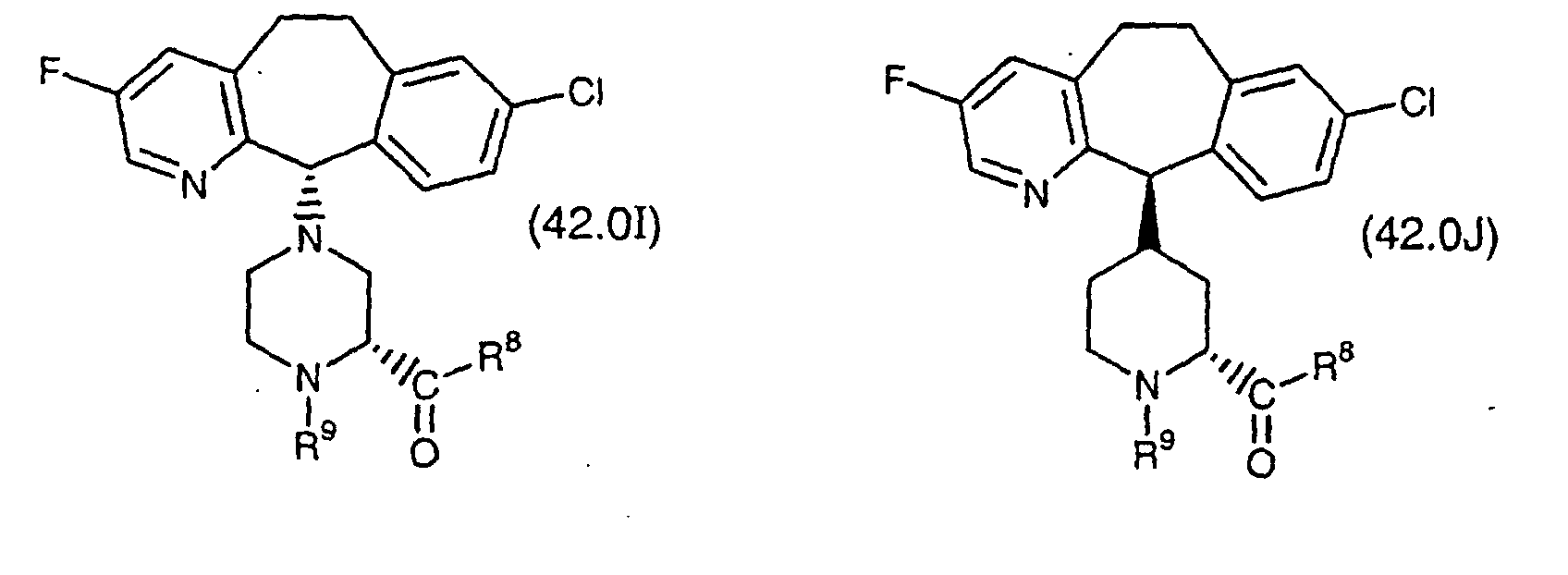
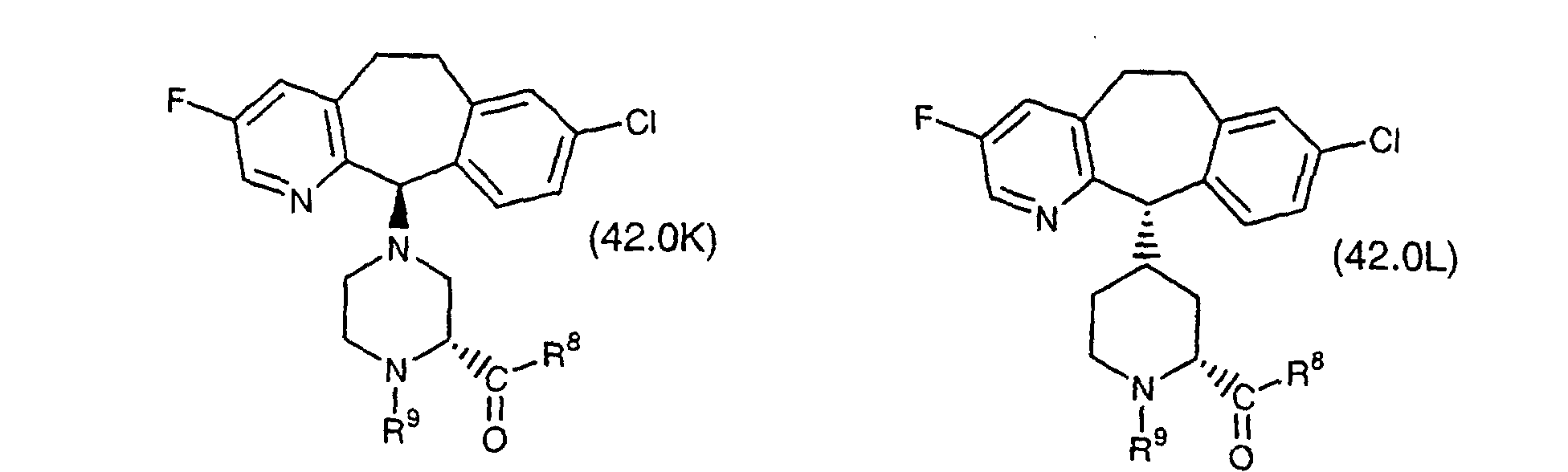

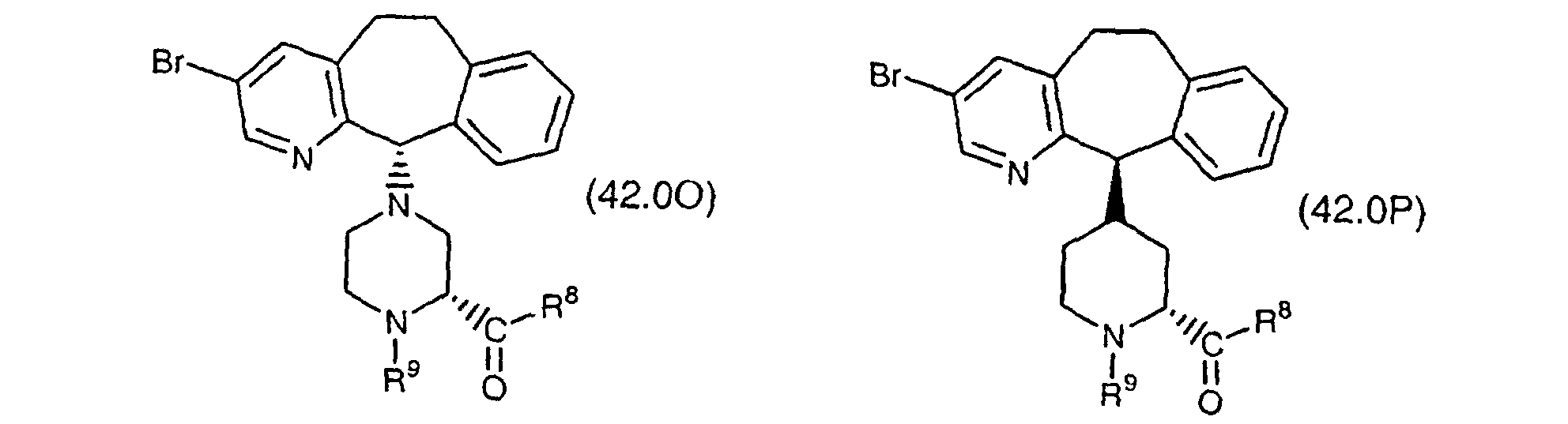

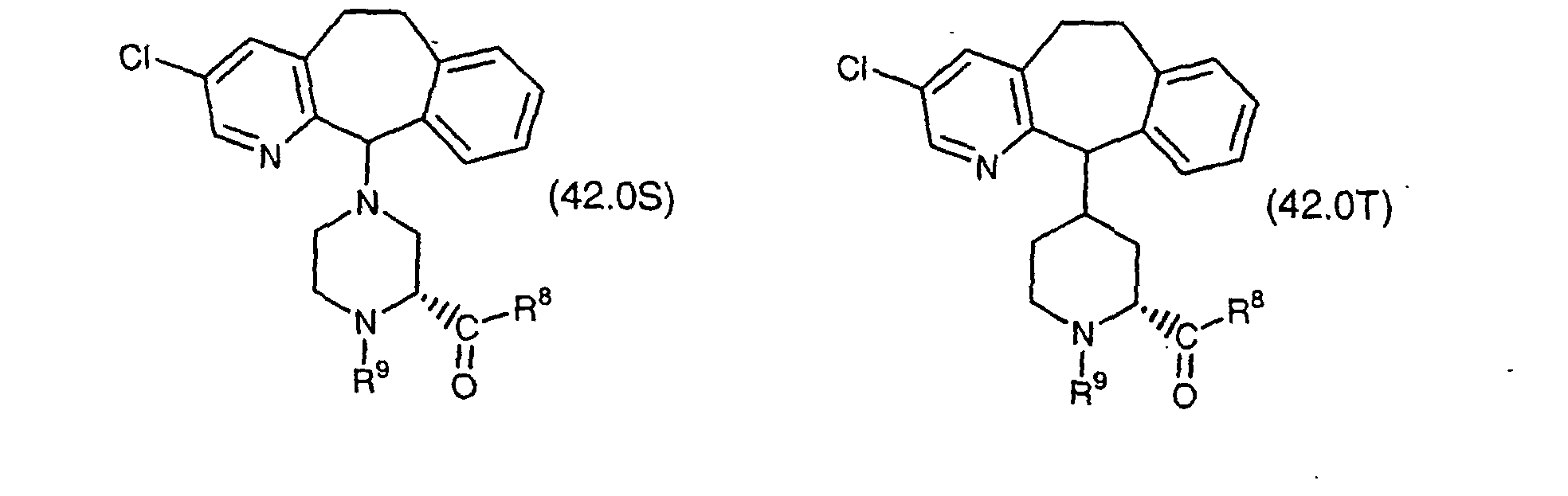


- Compounds of the invention also include compounds corresponding to 19.0-42.0 DD, except that Ring I is phenyl instead of pyridyl.
- Compounds of the invention also include compounds corresonding to 19.0-42.0DD, except that Ring I is phenyl instead of Pyridyl, and the compounds have the 2S stereochemistry.
- Compounds of this invention also include compounds corresponding to 19.0-42.0DD, except that the compounds have the 2S stereochemistry.
- Compounds of formula 1.0 include compounds of formula 1.0(C)wherein R1 is H or halo (preferably Br, Cl or F), and R2 is H or halo (preferably Cl), and R9 is as defined for formula 1.0. Preferably, R1 is halo (most preferably Br, Cl or F), and R2 is H or halo (preferably Cl). Those skilled in the art will appreciate that compounds of formula 1.0(C) include compounds of formulas 1.0(D) to 1.0(G):
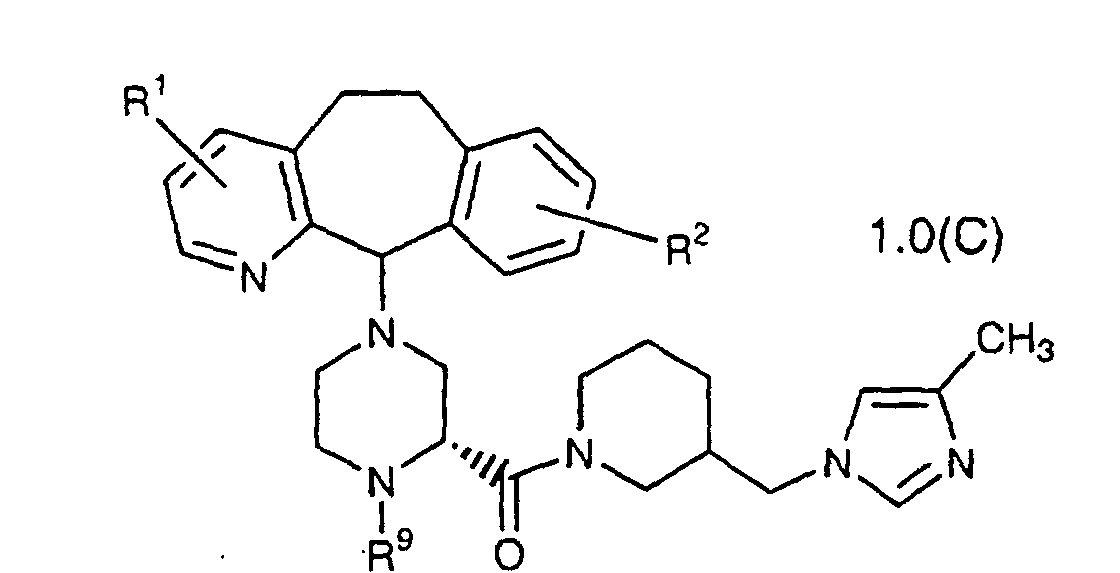
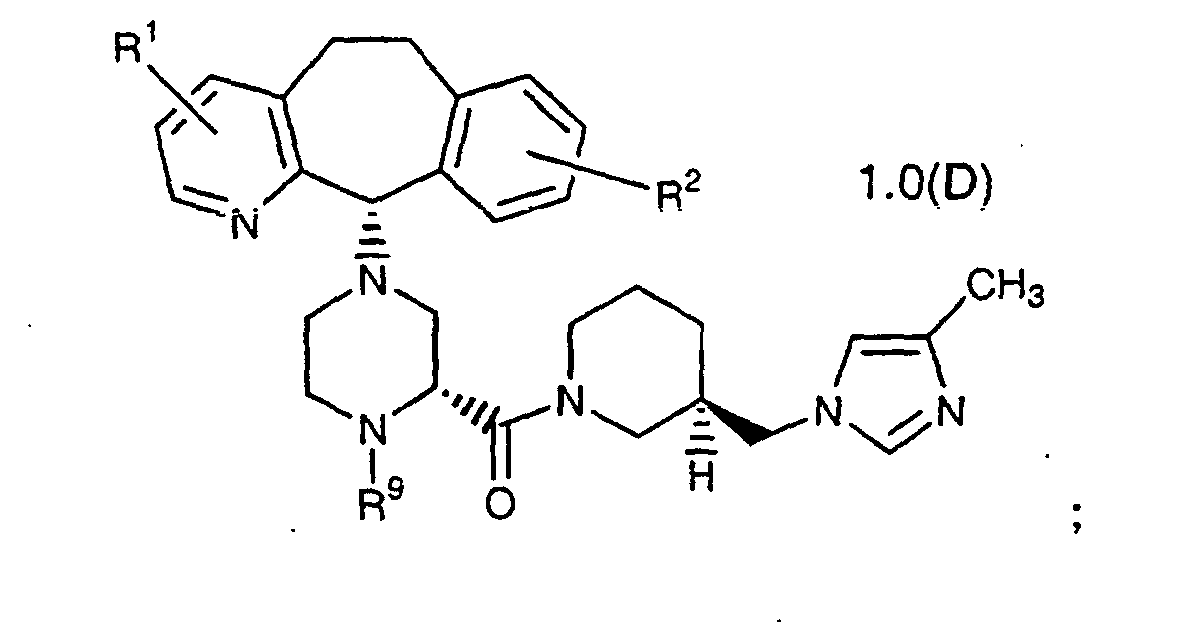
 and
and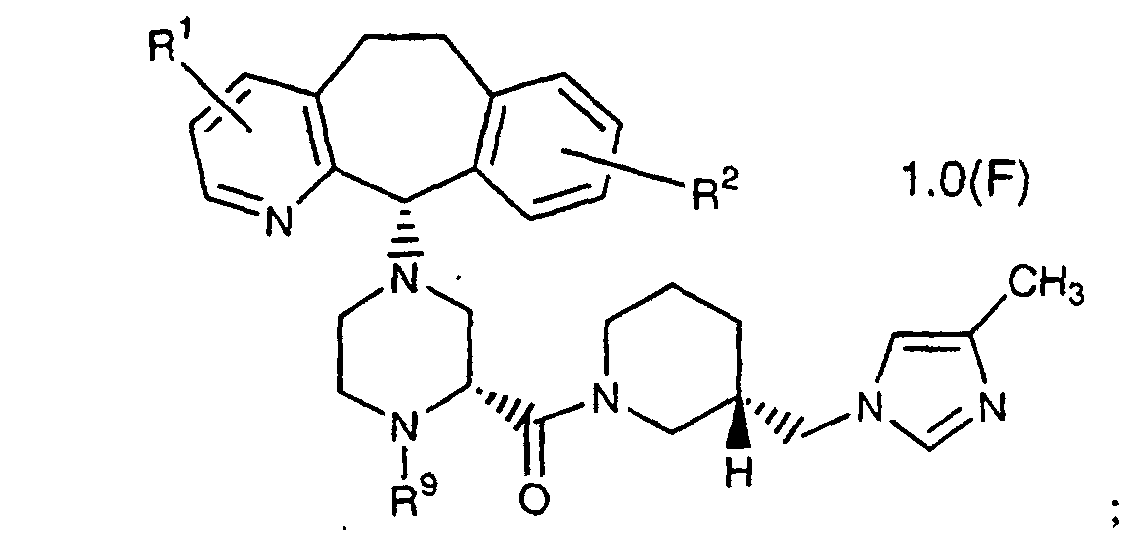

- Lines drawn into the ring systems indicate that the indicated bond may be attached to any of the substitutable ring carbon atoms of any ring when more than one ring is present (e.g., ring 5.0).
- Certain compounds of the invention may exist in different isomeric (e.g., enantiomers, diastereoisomers, atropisomers) forms. The invention contemplates all such isomers both in pure form and in admixture, including racemic mixtures. Enol forms are also included.
- Certain tricyclic compounds will be acidic in nature, e.g. those compounds which possess a carboxyl or phenolic hydroxyl group. These compounds may form pharmaceutically acceptable salts. Examples of such salts may include sodium, potassium, calcium, aluminum, gold and silver salts. Also contemplated are salts formed with pharmaceutically acceptable amines such as ammonia, alkyl amines, hydroxyalkylamines, N-methylglucamine and the like.
- Certain basic tricyclic compounds also form pharmaceutically acceptable salts, e.g., acid addition salts. For example, the pyrido-nitrogen atoms may form salts with strong acid, while compounds having basic substituents such as amino groups also form salts with weaker acids. Examples of suitable acids for salt formation are hydrochloric, sulfuric, phosphoric, acetic, citric, oxalic, malonic, salicylic, malic, fumaric, succinic, ascorbic, maleic, methanesulfonic and other mineral and carboxylic acids well known to those in the art. The salts are prepared by contacting the free base form with a sufficient amount of the desired acid to produce a salt in the conventional manner. The free base forms may be regenerated by treating the salt with a suitable dilute aqueous base solution such as dilute aqueous NaOH, potassium carbonate, ammonia and sodium bicarbonate. The free base forms differ from their respective salt forms somewhat in certain physical properties, such as solubility in polar solvents, but the acid and base salts are otherwise equivalent to their respective free base forms for purposes of the invention.
- All such acid and base salts are intended to be pharmaceutically acceptable salts within the scope of the invention and all acid and base salts are considered equivalent to the free forms of the corresponding compounds for purposes of the invention.
- The compounds of formula 1.0 can exist in unsolvated as well as solvated forms, including hydrated forms, e.g., hemi-hydrate. In general, the solvated forms, with pharmaceutically acceptable solvents such as water, ethanol and the like are equivalent to the unsolvated forms for purposes of the invention.
- Compounds of the invention may be prepared according to the procedures described in WO 95/10516 published April 20, 1995, WO96/31478 published October 10, 1996, WO 97/23478 published July 3, 1997, U.S. 5,719,148 issued February 17, 1998, and copending Application Serial No. 09/094687 filed June 15, 1998 (see also WO98/57960 Published December 23, 1998); the disclosures of each being incorporated herein by reference thereto; and according to the procedures described below.
- Compounds of the invention can be prepared according to the reaction schemes described below.

- The synthesis of the carboxylic acid (Scheme 1) begins with the differential protection (J. Med. Chem. (1994) 37, 3443-3451) of the piperazine dicamphorsulfonic acid salt (Helv. Chim. Acta, (1960) 117, 888-896) as illustrated in Scheme 2. Reaction of the distal amine with CBZ-OSuc at pH 11 followed by acylation with (BOC)2O gives the differentially protected acid. Hydrogenation over Pd-C selectively removes the CBZ group and the resulting amino acid was coupled with the desired tricyclic chloride. Compounds containing various functional groups can also be prepared by the different protection strategy shown in Scheme 3, except for the compounds wherein R20 is tert-butyl.

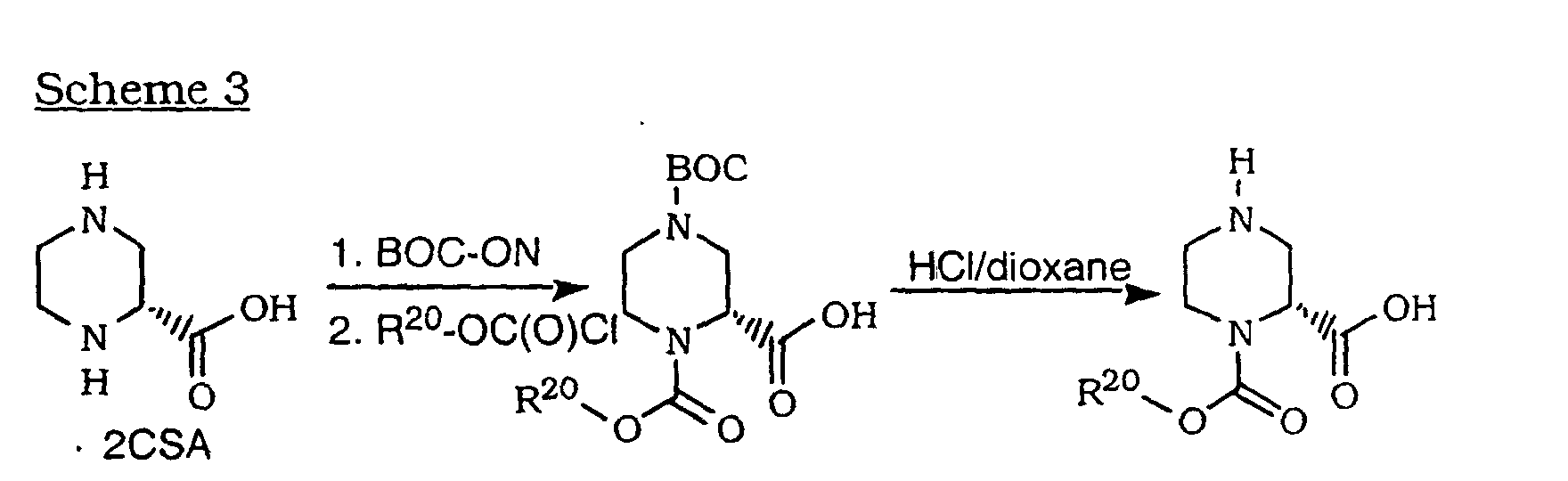
- Alternatively, the amine can be coupled to the di-BOC-protected acid intermediate prior to incorporation of the tricycle (Scheme 4). This derivative can be prepared from the di-CSA salt (Scheme 1) upon treatment of the salt with two equivalents (BOC)2O under basic conditions. Coupling of the desired amine to this intermediate under standard conditions (DEC, HOBT, NMM) gives the amide, which upon TFA-mediated removal of the BOC-protecting groups can be selectively alkylated by the desired tricyclic chloride (TEA, DMF, rt, 48 hours). At this stage, the free amine can be acylated, alkylated, or amidated under conditions obvious to one skilled in the art. When R=Br, chiral HPLC separation can be employed to readily resolve the C-11 diastereomers.

- Finally, the anhydride derivative can be opened with the appropriate amine (rt, CH2Cl2), followed by acylation, alkylation, or amidation of the resulting free amine. From there, a similar sequence as illustrated in Scheme 4 (Scheme 5) may be employed for the synthesis of the desired derivatives.

- The synthesis of the requisite amines are described generally in the following schemes. In each, one skilled in the art can appreciate the areas where synthetic generalities can be applied for the synthesis of a wider variety of compounds than those specifically illustrated.
- The majority of the 2-and 3-substituted piperidine and pyrrolidine derivatives can be prepared through similar methods as illustrated in Scheme 6 beginning with the appropriate amino alcohol. Likewise, various imidazole derivatives may be prepared by employing the sodium salt of the desired imidazole derivative. This general scheme is not applicable where indicated i.e. piperidines with a 2-hydroxymethyl substitutent cannot be prepared using an N-carbamoyl protecting group due to the formation of undesired oxazolones. In these cases the NH must be protected as the N-benzyl or N-allyl derivative.
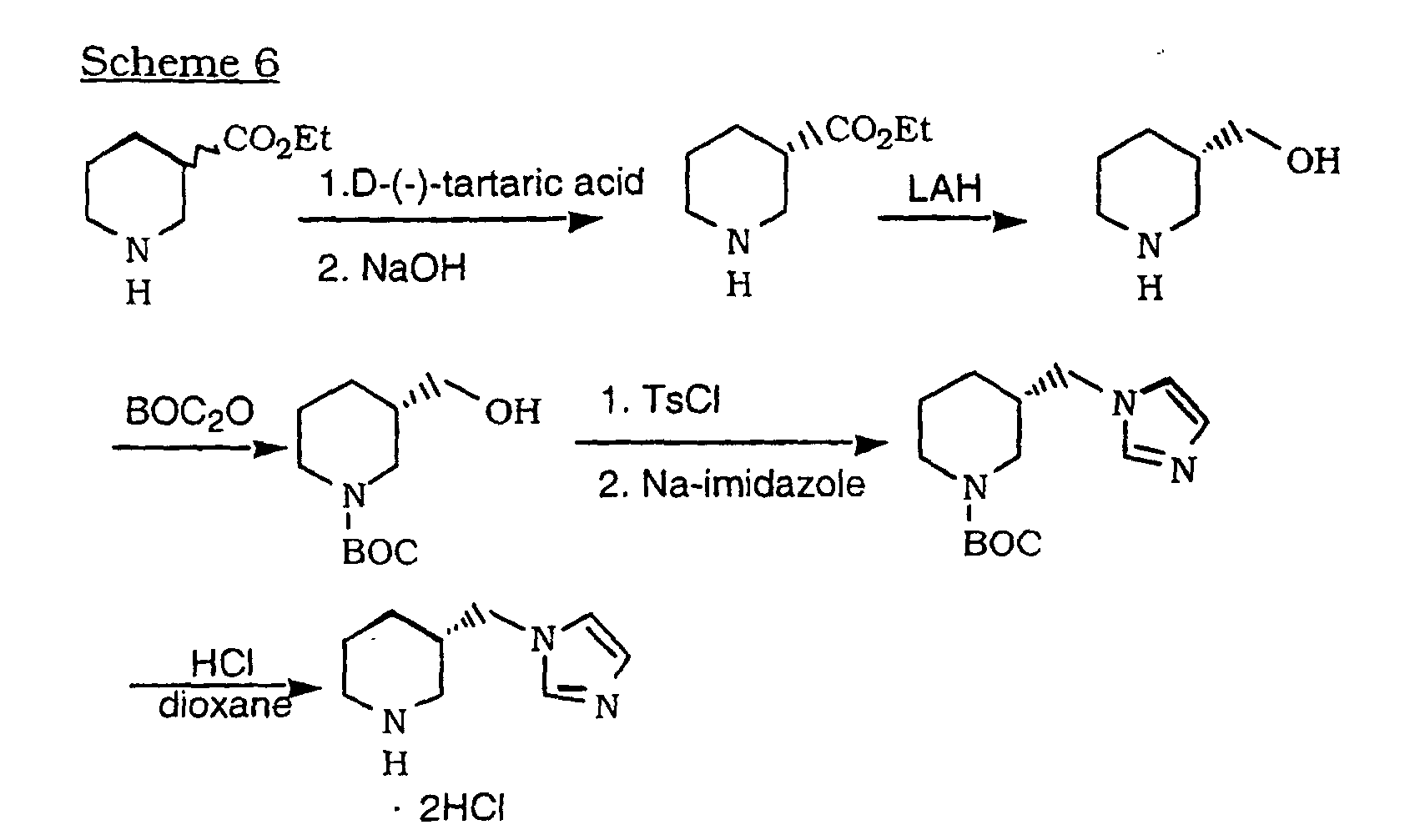
- Resolution of ethyl nipecotate with D- or L-tartaric acid (J. Org. Chem. (1991) 56, 1166-1170; Gazz. Chim. Ital. (1972) 102, 189-195.) gives the desired enantiomer which is converted to the free base by treatment with NaOH. Reduction of the acid with LAH followed by protection of the amine as the BOC derivative gives the alcohol. Treatment of the alcohol with p-toluenesulfonyl chloride in pyridine at 0 °C, followed by displacement with the sodium salt of the desired imidazole derivative and removal of the BOC-protecting group with Hcl/dioxane results in the desired amine as the hydrochloride salt.
- The corresponding 2- and 3-substituted piperazine derivatives can generally be accessed through the anhydride (Scheme 5) as shown in Scheme 7. Ring opening of the anhydride with EtOH followed by reduction with NaBH4 gives the amino alcohol which can be converted to the N-substituted derivative by reductive amination with paraformaldehyde or another relevant aldehyde. Conversion to the desired imidazole derivative can be accomplished by displacement of the mesylate or tosylate with the sodium salt of the imidazole which upon removal of the BOC-protecting group gives the desired amine.
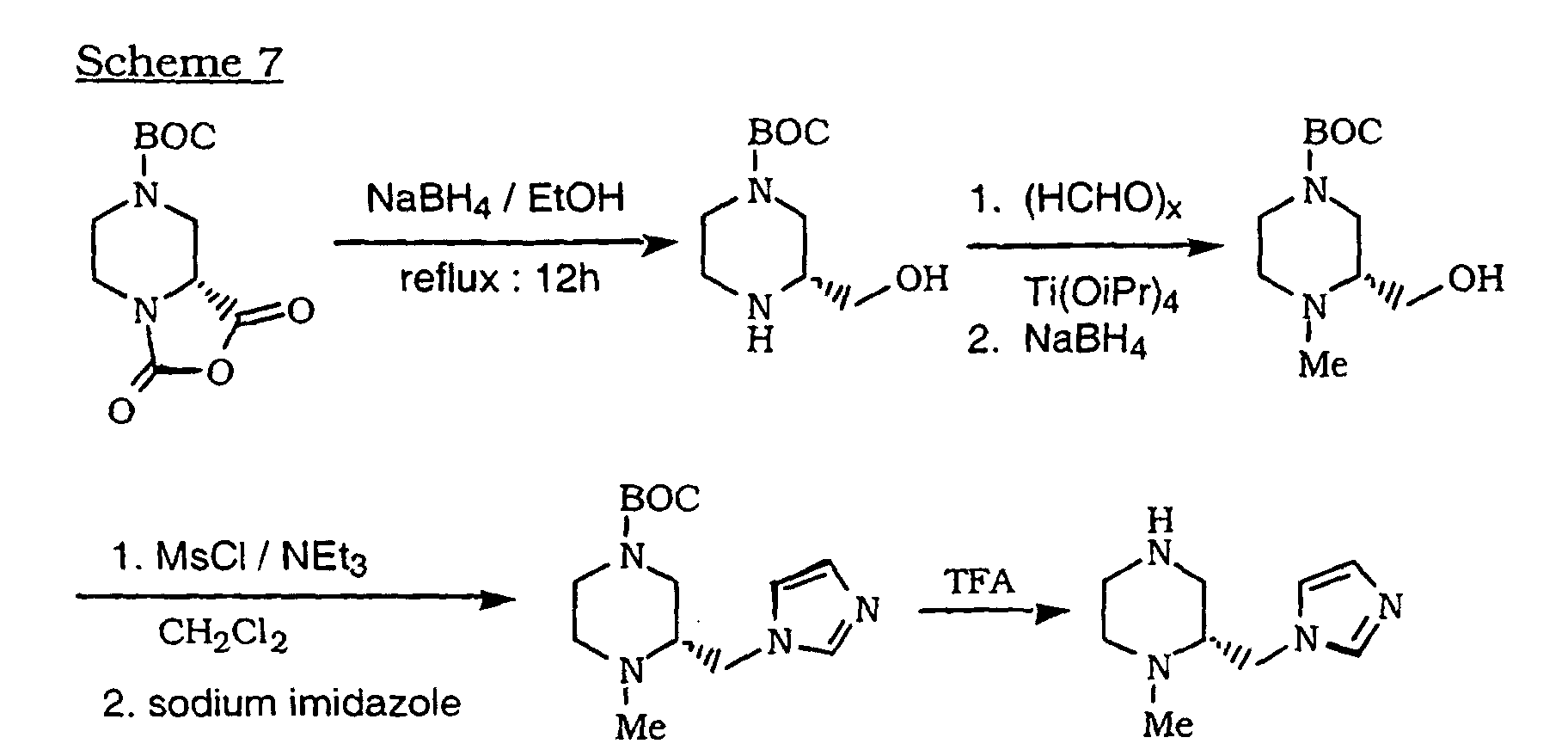
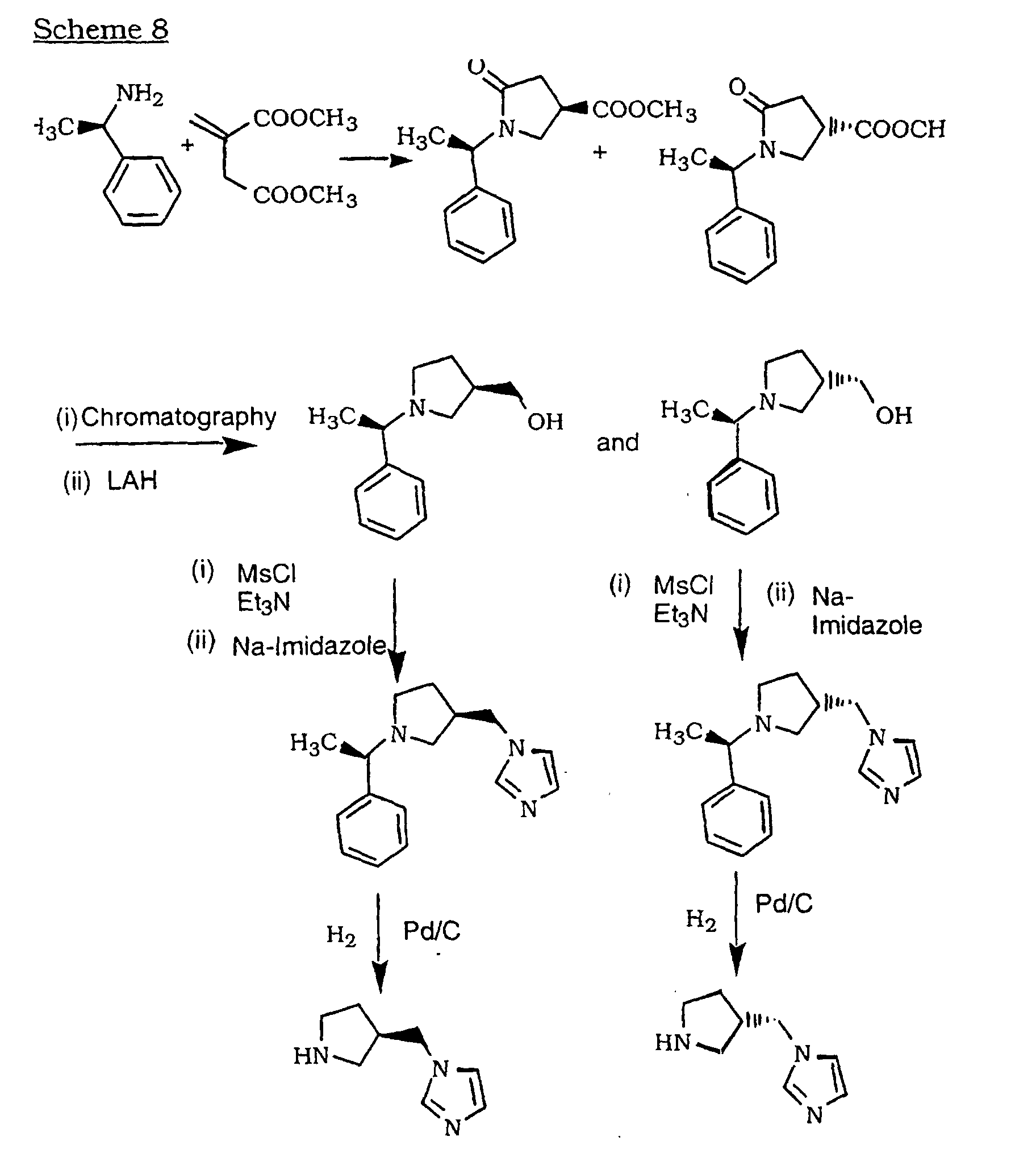
- The 3-pyrrolidinemethanol intermediates can be synthesized as shown in Scheme 8 (J. Med. Chem. 1990, 71-77). Treatment of the amine with the enoate gives a mixture of diastereomers which are readily separated by silica gel chromatography. Reduction of the amide with LAH and conversion to the imidazole derivative can be carried out as previously described. Catalytic hydrogenation gives the free amine.
- The 4-membered ring analogs can be synthesized as illustrated in Schemes 9 and 10. When the imidazole is directly attached to the ring, the sequence begins with mesylation of the alcohol followed by displacement with the sodium salt of the desired imidazole derivative. Removal of the benzhydryl protecting group is accomplished by catalytic hydrogenation.

- For 4-membered ring compounds with a methylene spacer between the imidazole and the ring, displacement of the mesylate with NaCN gives the nitrile which is readily hydrolyzed to the acid with NaOH and esterified under Fischer esterification conditions. The desired amine can be realized via transformations previously discussed.
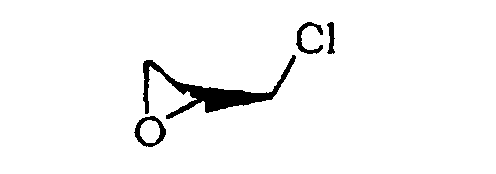
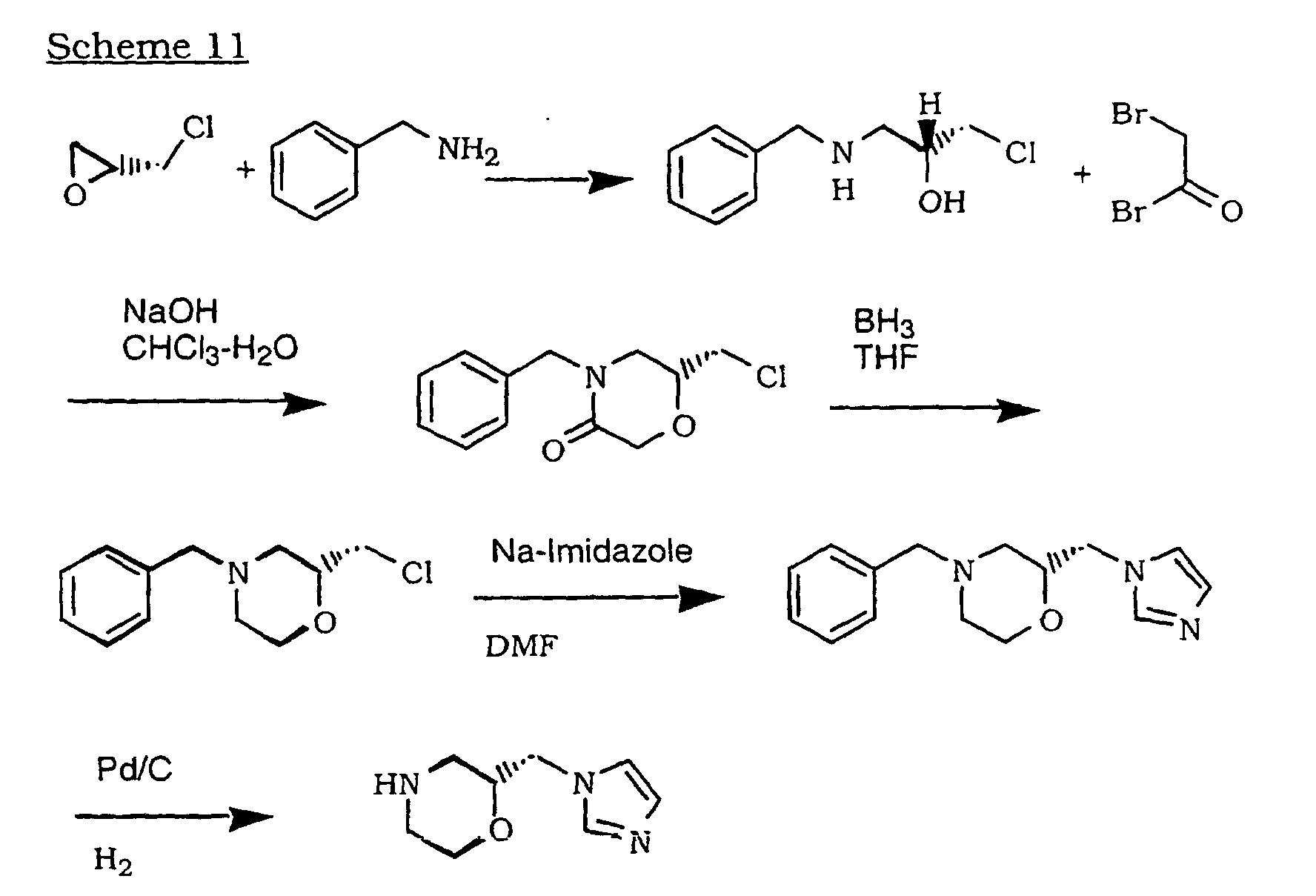
- The morpholino side chains are prepared beginning with the epichlorohydrin as shown in Scheme 11 (Heterocycle, 38, 1033, 1994). Ring opening of the epoxide with benzyl amine followed by alkylation of the resulting amino alcohol gives the amide. Reduction of the amide with BH3 gives the morpholine into which the imidazole is incorporated by previously discussed methodology. Removal of the N-benzyl protecting group gives the desired amine.
- Following the above procedure, but using the epichlorohydringives the amine

- Compounds with a 7-membered ring in the side-chain may be prepared as shown in Scheme 12. α-Bromination of caprolactam followed by displacement with NaCN gives the nitrile. Methanolysis and subsequent reduction with LAH gives the amino alcohol which can easily be converted to the desired compound by previously described methodology.

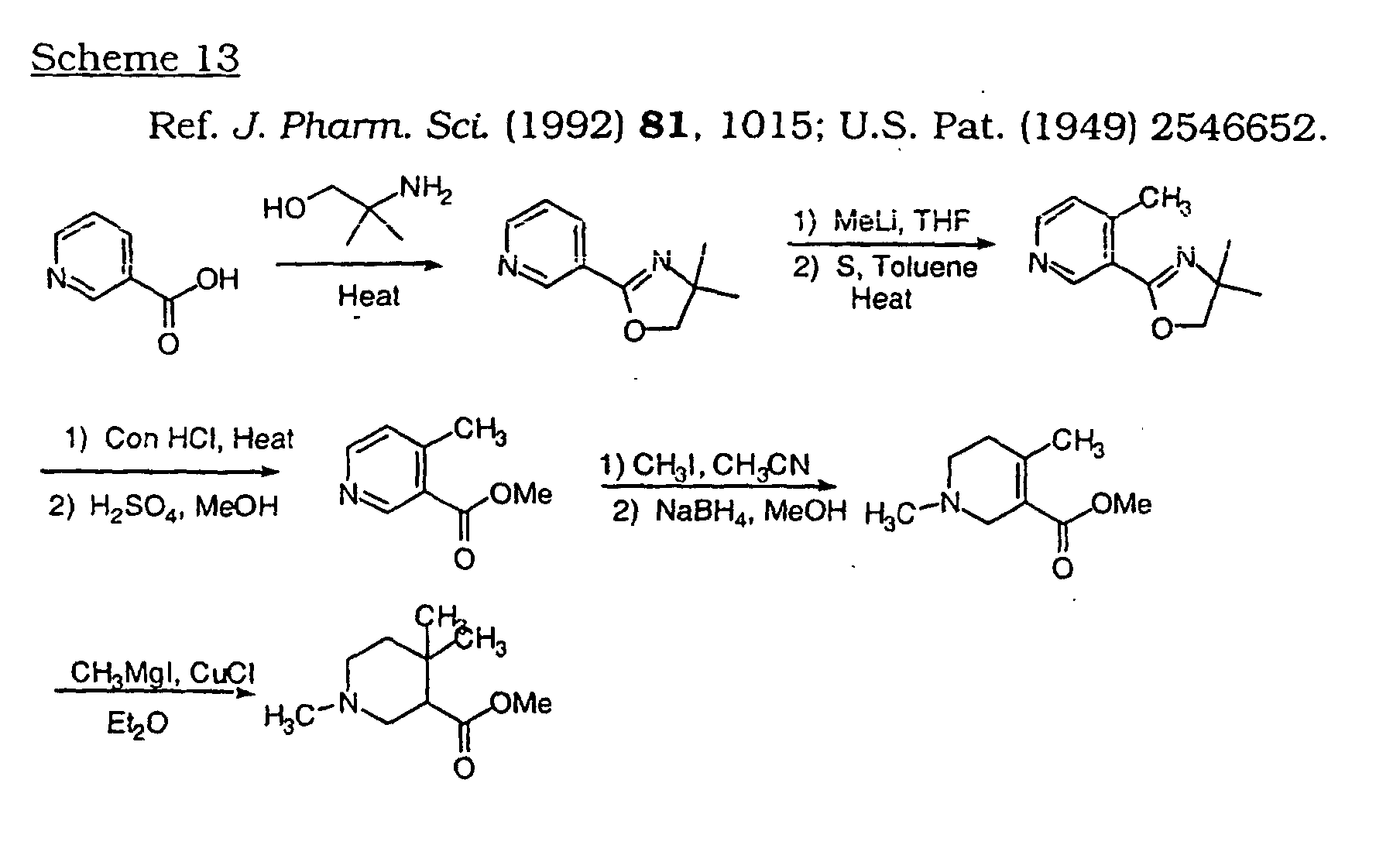
- The 4-substituted piperidine-3-methanol derivatives can be synthesized as illustrated in Scheme 13. Protection of the carboxylic acid as the oxazoline also serves to activate the pyridine ring toward nucleophilic attack by MeLi. Rearomatization with sulfur, hydrolysis of the oxazoline, and esterification gives the ester which upon quatemization and reduction gives the enoate. Conjugate addition with Mel gives the 4,4-dimethyl derivative. This ester may be converted into the desired compound by previously described procedures.
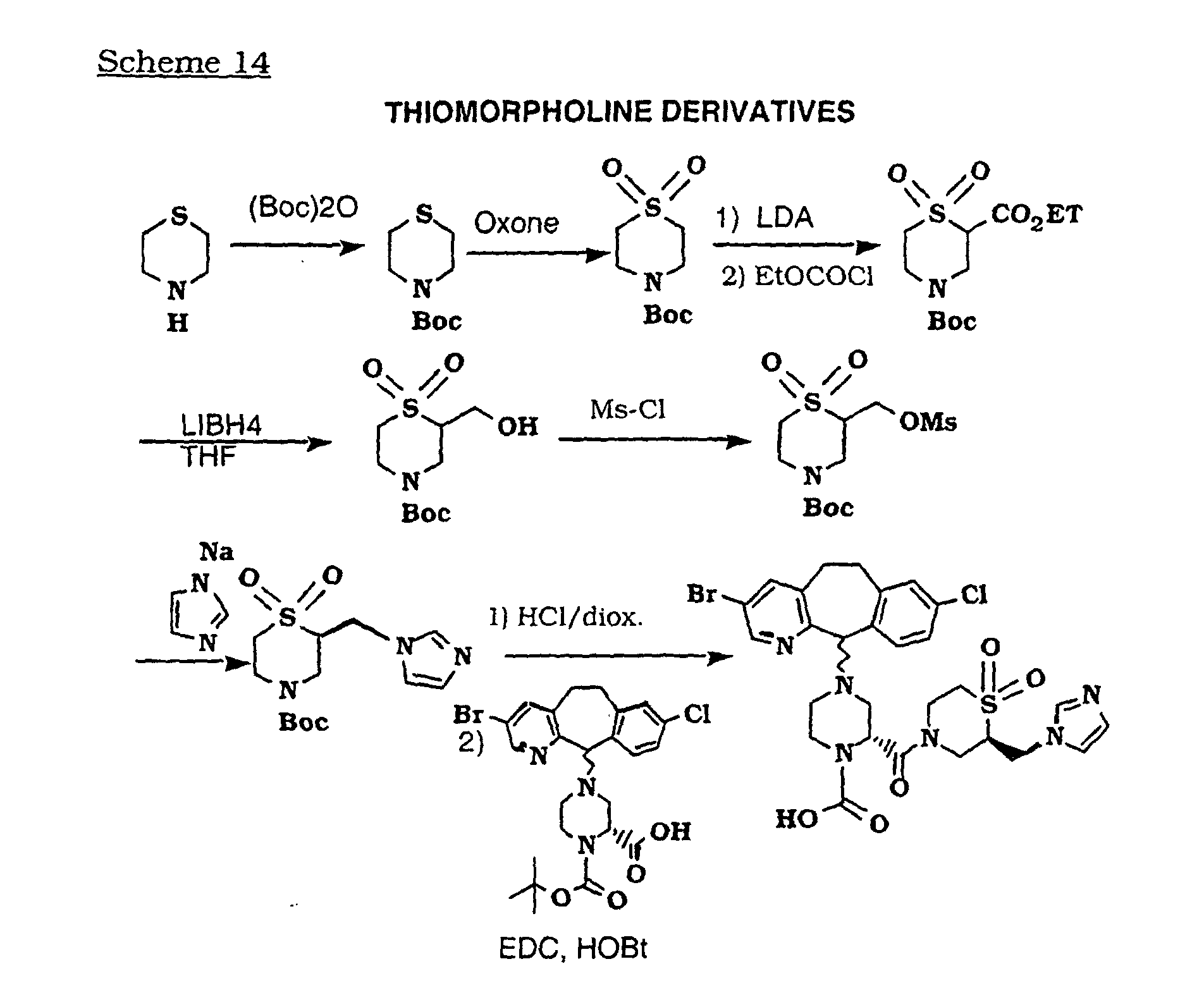

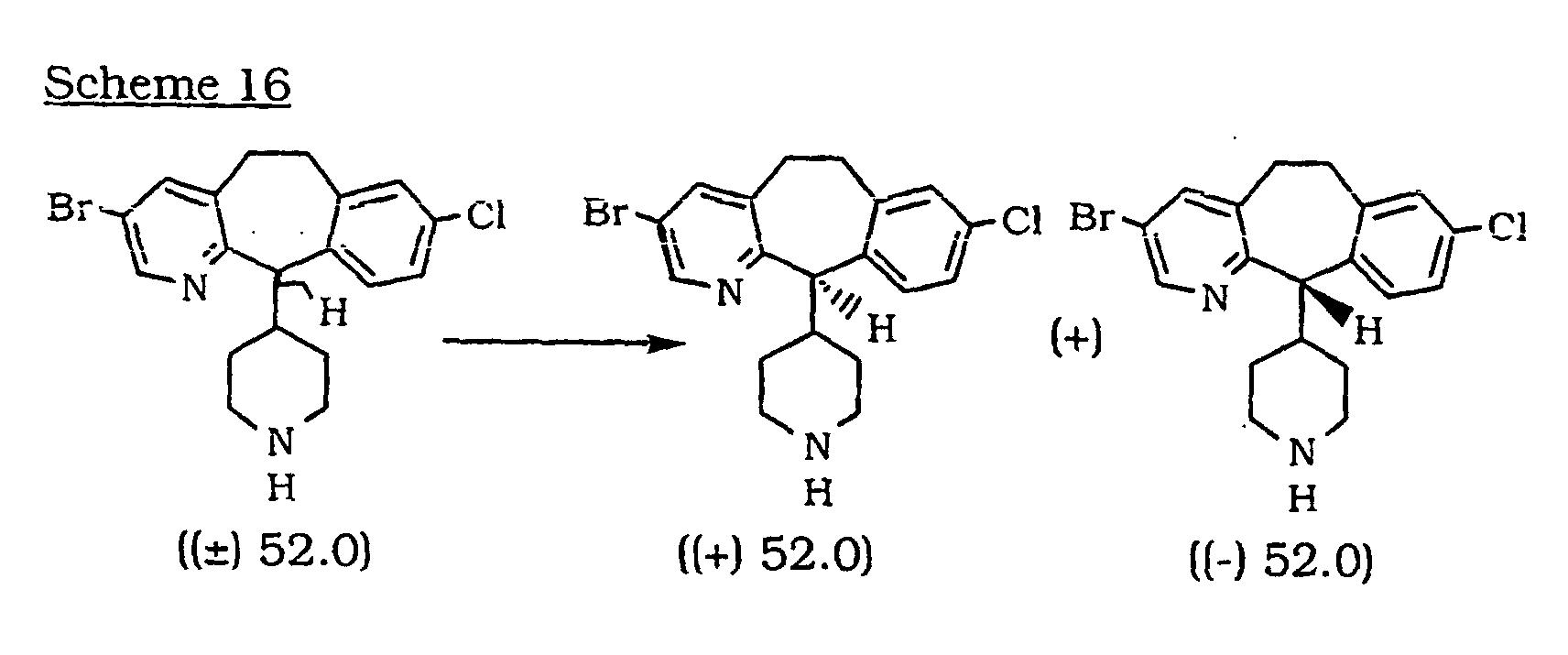
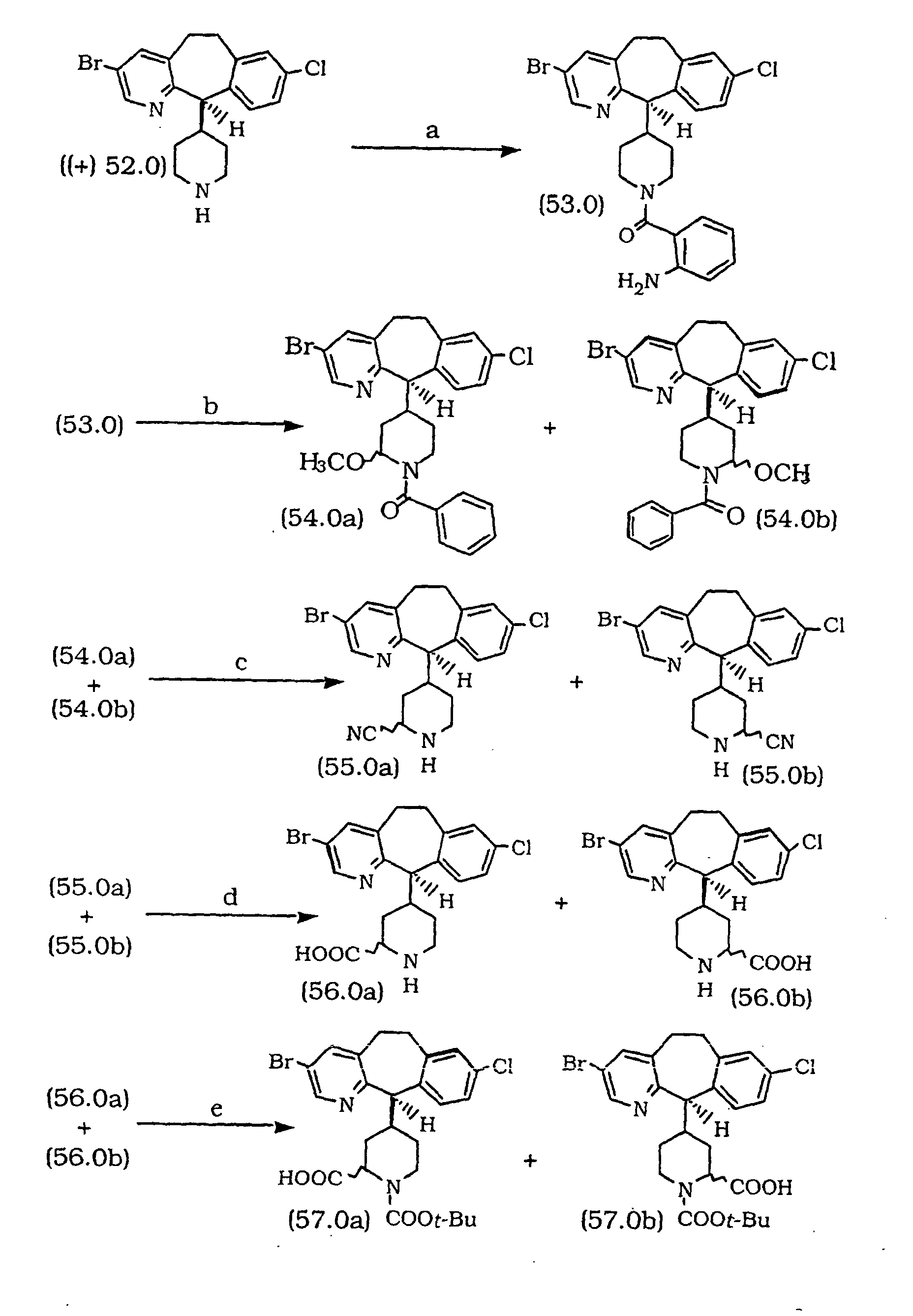
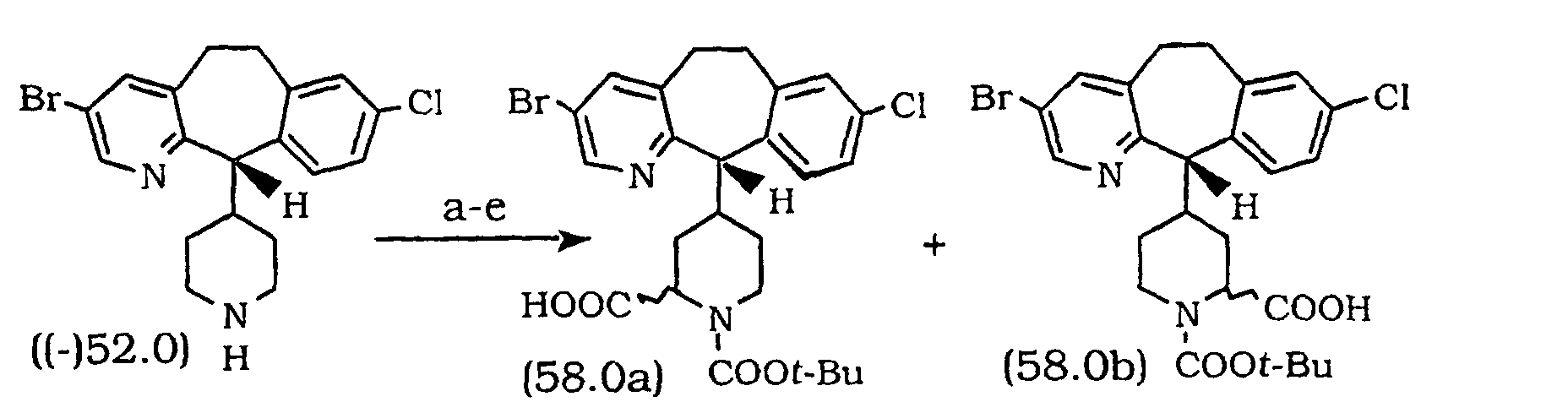
- Those skilled in the art will appreciate that in Scheme 16 the wavy bond to H (± 52.0), -OCH3 (54.0a and 54.0b), -CN (55.0a and 55.0b), -COOH (56.0a and 56.0b), -COOH (57.0a, 57.0b, 58.0a and 58.0b) indicates that the band can be either
or .
.
- Compound (±) 52.0 is resolved following procedures similar to those disclosed in WO97/23478 (published July 3, 1997).
- The reagents used in Reaction Scheme 3 are: Reaction Step a: Isatoic anhydride/methylene chloride; Reaction Step b: sodium nitrite/hydrochloric acid/methanol/cuprous chloride; Reaction Step c: (i) aq. hydrochloric acid/methanol/reflux (ii) sodium hydroxide/sodium cyanide; Reaction Step d: conc. hydrochloric acid/reflux.; and Reaction Step e: di-tert.butyldicarbonate/-sodium hydroxide/tetrahydrofuran.
- Compounds useful in this invention are exemplified by the following preparative examples, which should not be construed to limit the scope of the disclosure. Alternative mechanistic pathways and analogous structures within the scope of the invention may be apparent to those skilled in the art.
-
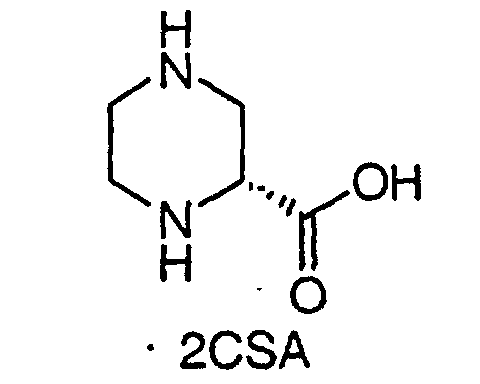
- To (R)-(-)-camphorsulfonic acid (2.5 kg) in distilled water (1250 mL) at 60 °C was added a solution of the potassium salt of 2-carboxypiperazine (565 gm, 3.35 mol). The mixture was allowed to stir at 95 °C until completely dissolved. The solution was cooled to room temperature and allowed to stand 48 hrs. The resulting precipitate was filtered to obtain a damp solid (1444g). The solids were then dissolved in distilled water (1200 mL) and heated on a steam bath until all solids dissolved. The resulting solution was cooled slowly to room temperature and let stand 72 hrs. The crystalline solids were filtered to give a white crystalline solid (362 g). [α]D=-14.9°.
-
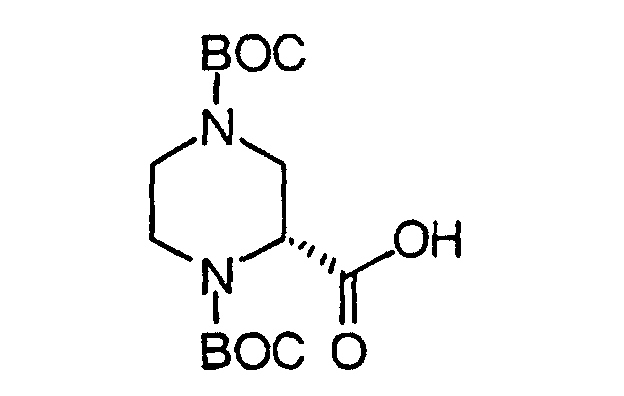
- The title compound from Preparative Example 1 (362 gm, 0. 608 mol) was dissolved in distilled water (1400 mL) and methanol (1400 mL). 50% NaOH was added to the stirred reaction mixture until the pH reached ∼9.5. To this solution was added di-tert.butyl-dicarbonate (336 gm, 1.54 mol) portionwise. The pH of the reaction mixture was maintained at 9.5 with 50% NaOH (total of 175 ml), and the reaction mixture stirred for 2.5 hours to obtain a white precipitate. The reaction mixture was diluted with ice/water (9000 mL) and washed with Et2O (2000 mL). The Et2O was discarded and the pH of the aqueous layer adjusted to pH 3.0 by the portionwise addition of solid citric acid and extracted with CH2Cl2 (3 X 2000 mL). The organic layers were combined, dried over Na2SO4, filtered and evaporated to give the title compound as a white glassy solid (201.6g). FABMS: MH+=331.
-
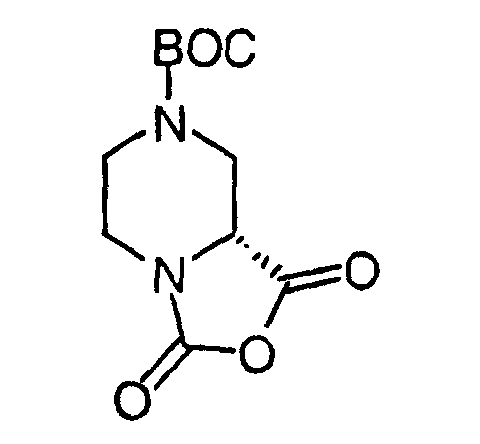
- To an ice cold solution DMF ( 49.6 ml) under a nitrogen atmosphere was added, dropwise, SOCl2 (46.7 ml) over a period of 5 minutes in a 5 L round bottom flask The reaction mixture was allowed to stir for 5 minutes, warmed to room temperature, and stirred 30 minutes. The resulting solution was cooled to 0 °C and the title compound from Preparative Example 2 (201.6 gm, 0.61 mmol) in pyridine (51.7 mL) and CH3CN (1900 mL) was added via canulae. The resulting solution was warmed to room temperature to obtain a yellowish turbid solution and stirred 18 hours. The reaction mixture was filtered and the filtrate poured into ice water (7L) and then extracted with EtOAc (4 X 2000 mL). The combined organics were dried over Na2SO4, filtered, and evaporated to dryness in vacuo to give the title product as a white solid ( 115.6g, 73% yield).
-

- The title compound from Preparative Example 1 (17.85 gm, 30 mmol) was dissolved in distilled water (180 mL). Dioxane (180 mL) was added and the pH adjusted to ∼11.0 with 50% NaOH. The reaction mixture was cooled to 0-5°C in an ice-MeOH bath and a solution of benzylchloroformate (4.28 mL, 30 mmol) in dioxane (80 mL) was added over a period of 30-45 minutes while stirring at 0-5°C and keeping the pH at 10.5 to 11.0 with 50% NaOH. After the addition was complete, stirring was continued for 1 hr. The reaction mixture was then concentrated under reduced pressure. The residue was dissolved in distilled water (180 mL), the pH adjusted slowly to 4.0 with 1N HCl, and extracted with EtOAc (3 X 180 mL). The combined organics were dried over MgSO4, filtered, and evaporated to obtain the N,N-di-CBZ-2-carboxy-piperazine byproduct. The pH of the aqueous layer was adjusted to ∼10.5 with 50% NaOH and solid (Boc)2O (7.86 gm, 36 mmol) was added and the mixture was stirred while keeping the pH at ∼10.5 with 50% NaOH. After 1 hr. the pH stablized. The reaction was checked by tlc (30% MeOH/NH3/CH2Cl2) and if not complete, more (Boc)2O was added keeping the pH at ∼10.5. When reaction was shown to be complete by TLC, the reaction mixture was washed with Et2O (2 X 180 mL) (check that the product is not in the Et2O layer and dispose of the Et2O layer). The aqueous layer was cooled in an ice bath and pH to adjusted to 2.0 with 1N HCl (slowly) (get bubbling initially). The aqueous layer was extracted with EtOAc (3 X 200 mL) and the combined organics dried over MgSO4, filtered and evaporated in vacuo to obtain a white solid (9.68 g, 88% yield).
-

- The title compound from Prepartive Example 4 (9.6 gm, 26.3 mmol) was dissolved in absoluteEtOH (100 mL) in a hydrogenation vessel. The vessel was flushed with N2 and 10% Pd/C (3.0g, 50% by weight with water) was added. The mixture was hydrogenated at 55 psi of H2 for 18 hours during which time a precipitate formed. When the reaction was complete (TLC, 30% MeOH/NH3/CH2Cl2), the reaction mixture was filtered through a pad of celite, and the pad washed with EtOH followed by distilled H2O. The filtrate was evaporated to ∼1/3 the volume and distilled H2O (200 mL) was added. The resulting solution was extracted with EtOAc (contains pure N,N-Di-Boc-2-carboxy-piperazine which was saved). The water layer was evaporated to dryness with azeotropic removal of residual H2O with methanol (2X) to give pure product (3.98g).
-
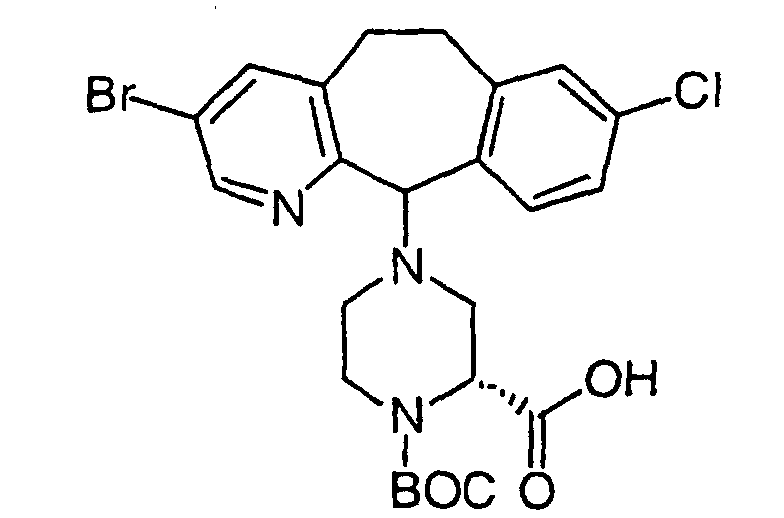
- The tricyclic alcohol(5.6 gm, 17.33 mmol) was dissolved in CH2Cl2 (56 mL) and SOCl2 (2.46 mL) was added while stirring under a dry N2 atmosphere. After 5 hrs. the tlc was checked ( by adding an aliquot of the reaction mixture to 1N NaOH and shaking with CH2Cl2 and checking the CH2Cl2 layer by tlc using 50% EtOAc/Hexanes as the eluent). The mixture was evaporated to give a gum which was evporated from dry toluene twice and once from CH2Cl2 to give a foamy solid. The resulting chloro-tricyclic compound was dissolved in dry DMF (100 mL) and the title compound from Preparative Example 5 (3.98 gm) was added followed by triethylamine (12.11 mL) and the mixture stirred at ambient temperature under a nitrogen atmosphere. After 24 hours, the reaction mixture was concentrated and the residue dissolved in EtOAc (200 mL) and washed with brine. The brine layer was extracted with EtOAc (2X) and the combined organics were dried over MgSO4, filtered, and evaporated to give a foamy solid. The solid was chromatographed on a 1 1/2" X 14" column of silica gel eluting with 2L of 0.4% 7N MeOH/NH3:CH2Cl2, 6L of 0.5% 7N MeOH/NH3:CH2Cl2, 2L of 0.65% 7N MeOH/NH3:CH2Cl2, 2L of 0..8% 7N MeOH/NH3:CH2Cl2, 4L of 1% 7N MeOH/NH3:CH2Cl2, 2L of 3% 2N MeOH/NH3:CH2Cl2, 2L of 5% 2N MeOH/NH3:CH2Cl2, 2L of 10% 2N MeOH/NH3:CH2Cl2, 2L of 15% 2N MeOH/NH3:CH2Cl2, 4L of 20% 2N MeOH/NH3:CH2Cl2 to obtain 4.63 gm of final product.
- Ref: Gazz. Chim. Ital. (1972) 102, 189-195; J. Org. Chem. (1991) 56, 1166-1170.
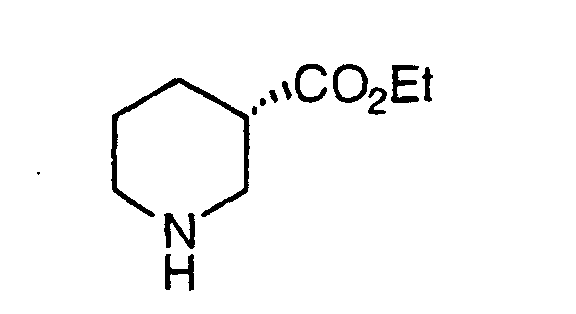
- Ethyl nipecotate (70.16g, 0.446 mmol) and D-tartaric acid (67g, 1.0 eq) were dissolved in hot 95% EtOH (350 mL). The resulting solution was cooled to room temperature and filtered and the crystals washed with ice-cold 95% EtOH. The crystals were then recrystallized from 95% EtOH (550 mL) to give the tartrate salt (38.5g, 56% yield). The salt (38.5g) was dissolved in water (300 mL) and cooled to 0 °C before neutralizing with 3M NaOH. The solution was extracted with CH2Cl2 (5 X 100 mL) and the combined organics dried over Na2SO4 and concentrated under reduced pressure to give a clear oil (19.0g, 89% yield). CIMS: MH+= 158.
-

- LAH (118 mL, 1.0 M in Et2O, 1.0 eq.) was added to a solution of the title compound from Step A (18.5g, 0.125 mmol) in THF (250 mL) at 0 °C over 20 minutes. The resulting solution was warmed slowly to room temperature and then heated at reflux 2 hours. The reaction was cooled to room temperature and quenched by the slow addition of saturated Na2SO4. The resulting slurry was dried by the addition of Na2SO4, filtered through Celite and concentrated to give a colorless oil (13.7g, 98% crude yield). CIMS: MH+=116; [α]20 D= - 8.4° (5.0 mg in 2 mL MeOH).
-
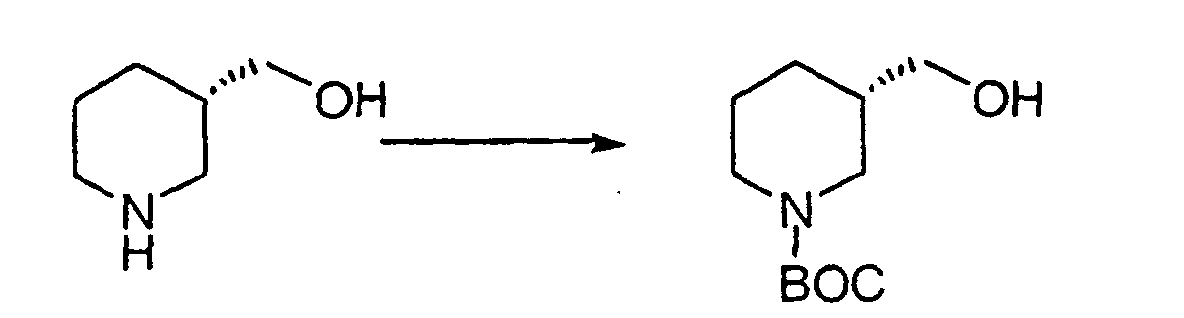
- The title compound from Step B (13.6g, 0.104 mmol) was dissolved in MeOH (100 mL) and H2O (100 mL) and di-tert-butyl dicarbonate (27.24, 1.2 eq.) was added portionwise keeping the pH >10.5 by the addition of 50% NaOH. The reaction mixture was stirred at room temperature an additional 2.5 hours and concentrated in vacuo. The residue was diluted with H2O (350 mL) and extracted with CH2Cl2 (3 X 150 mL). The combined organics were dried over Na2SO4, filtered, and concentrated under reduced pressure. The crude product was purified by flash chromatography using a 50% EtOAc in hexanes solution as eluent to give a white solid (12.13g, 48% yield). FABMS: MH+= 216; [α]20 D= +15.2 (5.0 mg in MeOH).
-

- p-Toluenesulfonyl chloride (12.75g, 1.2 eq.) was added portionwise to the title compound from Step C (12.00g, 55.74 mmol) in pyridine (120 mL) at 0 °C. The resulting solution was stirred 0 °C overnight. Thereaction mixture was diluted with EtOAc (300 mL) and washed with cold 1N HCl (5 X 300 mL), saturated NaHCO3 (2 X 150 mL), H2O (1 X 100 mL), brine (1 X 100 mL) , and dried over Na2SO4 and concentrated in vacuo to give a pale yellow solid (21.0g, 100% crude yield). FABMS: MH+= 370.
-
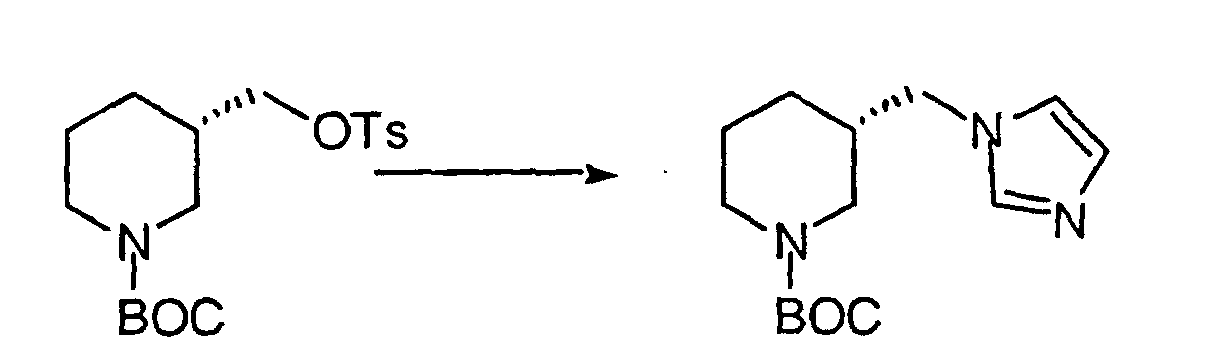
- The title compound from Step D (21.0g, 55.74 mmol) in DMF (300 mL) was treated with sodium imidazole (8.37g, 1.5 eq.) and the resulting solution heated at 60 °C for 2 hours. The reaction mixture was cooled to room temperature and concentrated in vacuo. The residue was diluted with H2O (300 mL) and extracted with CH2Cl2 (3 X 150 mL). The combined organics were dried over Na2SO4, filtered, and concentrated. The crude product was purified by flash chromatography using a 7% MeOH in CH2Cl2 solution as eluent to give a pale yellow solid (7.25g, 49% yield). FABMS: MH+= 266; [α]20 D= +8.0 (5.0 mg in MeOH).
-

- The title compound from Step E (5.50g, 20.73 mmol) stirred at room temperature in 4M HCl in dioxane (50 mL) overnight. The resutlig solution was concentrated and the residue triturated with Et2O to give a yellow solid (4.90g, 99% yield). CIMS: MH+= 166.
-
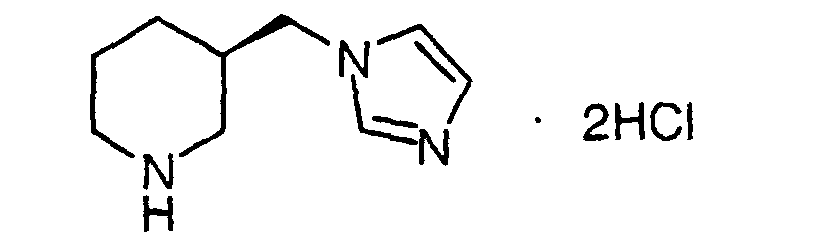
- By essentially the same procedure set forth in Preparative Example 7 except using L-tartaric acid instead of D-tartaric acid in Step A, the title compound was prepared.
-
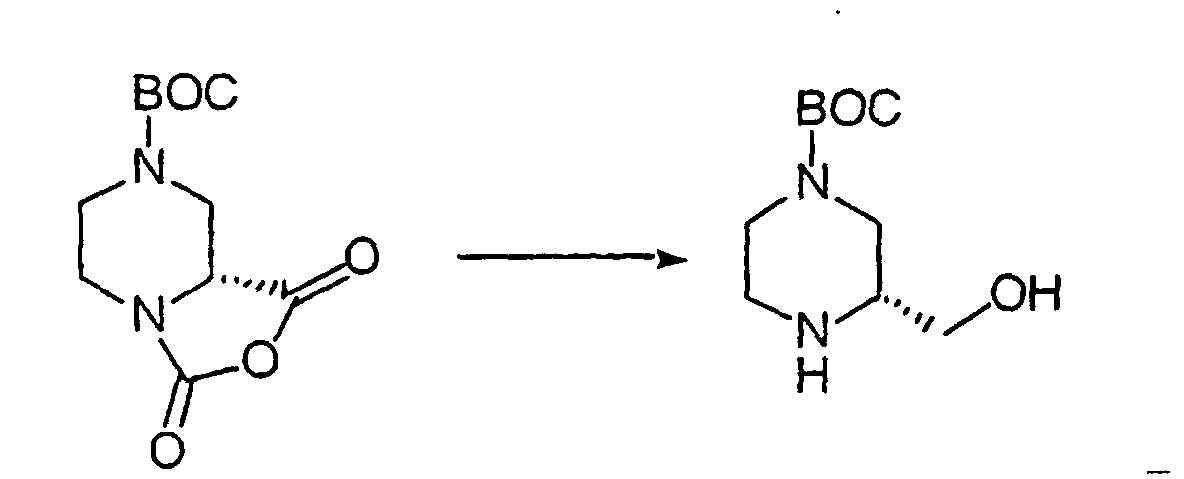
- A mixture of the piperazine anhydride (2.56 g, 10.00 mmol, 1.0 eq.) and sodium borohydride (965 mg, 25.00 mmol, 2.5 eq.) in absolute ethanol (50 ml) was gently refluxed under a nitrogen atmosphere for 48h. The reaction volume was decreased to approximately 10 ml under house vacuum and diluted with brine (50 ml). The mixture was extracted with ethyl acetate (8 x 25 ml). The combined organic extracts were washed with brine (50 ml), dried over Na2SO4, filtered, and concentrated under house vacuum at 30 °C. The residue was flash chromatographed (CH2Cl2 : 10% NH4OH/MeOH = 17:1 v/v) over silica gel to give the title compound (1.09 g, 50%) as a light-yellow, viscous oil. EIMS: m/z 217 ([M+H]+, 46%), 161 (B+). HR-MS (FAB): Calculated for C10H21N2O3 ([M+H]+): 217.1552. Found: 217.1549.
- (Bhattacharyya, S. Tetrahedron Lett. 1994, 35, 2401.)
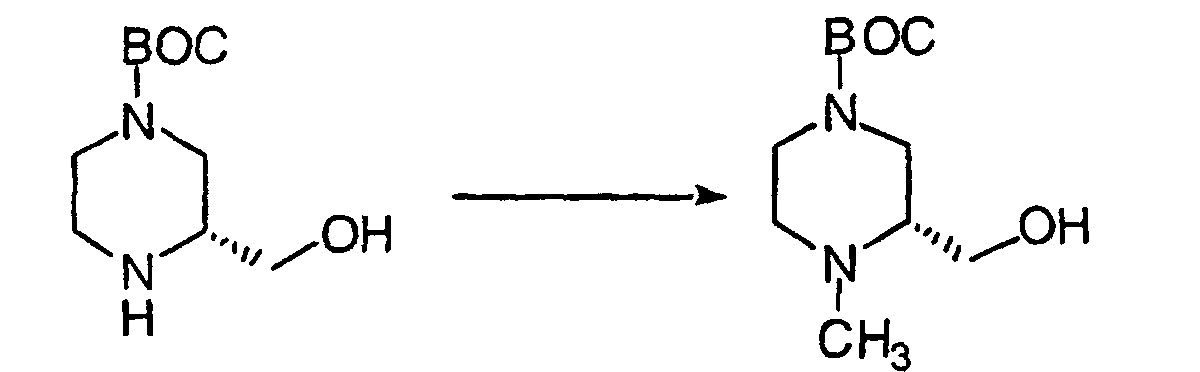
- A mixture of the title compound from Step A (1.09 g, 5.04 mmol, 1.0 eq.), paraformaldehyde (300 mg, • 10.08 mmol, 2.0 eq.), and titanium isopropoxide (1.5 ml, 5.04 mmol, 1.0 eq.) in absolute ethanol (5 ml) was stirred at 70 °C for 30 minutes and at room temperature for another 30 minutes. Sodium borohydride (195 mg, 5.04 mmol, 1.0 eq.) was added to the colorless solution. The solution was stirred at room temperature for 12h and at 60 °C for another 3h. The solution was cooled to 0 °C and treated with a 2.0 M aqueous ammonia solution (25 ml, 50.00 mmol, excess) to give a snow-white suspension. The suspension was filtered through a Celite® 521 plug and the filtrate was extracted with diethyl ether (4 x 25 ml). The ethereal extracts were combined and washed with brine (10 ml), dried over Na2SO4, filtered, and concentrated under house vacuum at 30 °C. The residue was flash chromatographed (CH2Cl2 : 10% NH4OH/MeOH = 9:1 v/v) over silica gel to give the title compound (1.10 g, 95%) as a light-yellow, viscous oil. MS (EI): m/z 231 ([M+H]+, 59%), 175(B+). HR-MS(FAB):Calculated for C11H22N2O3 ([M+H]+): 231.1709. Found: 231.1716.
-
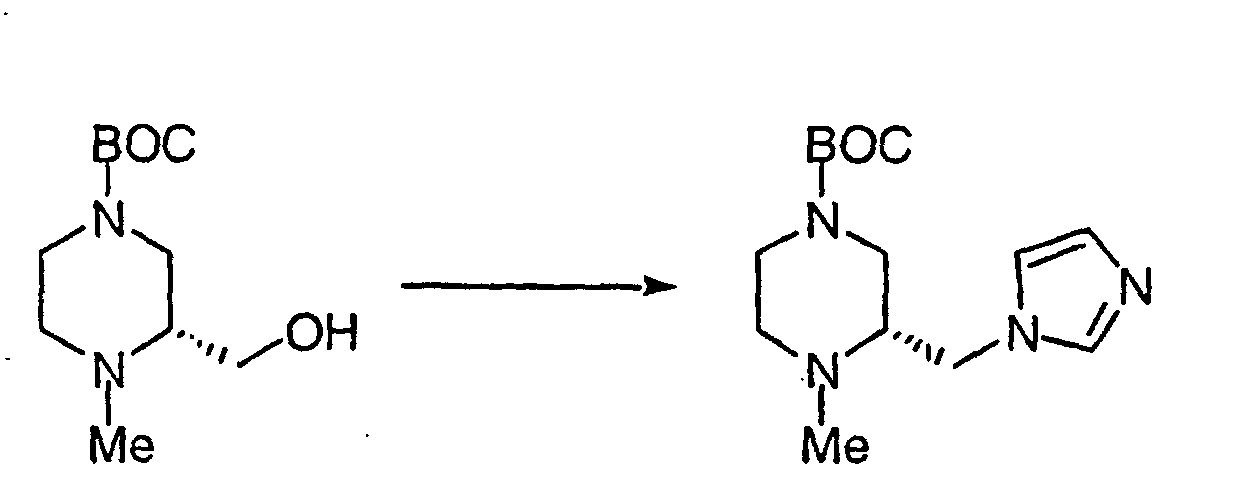
- Methanesulfonyl chloride (296 µl, 3.80 mmol, 1.25 eq.) was added dropwise to a stirred solution of the title compound from Step B (700 mg, 3.04 mmol, 1.0 eq.) and triethylamine (640 µl, 4.56 mmol, 1.50 eq.) in anhydrous dichloromethane (5 ml) at 0 °C under a nitrogen atmosphere. The resulting yellow suspension was stirred at 0 °C for 1h and at room temperature for another 3h. The mixture was poured onto brine (25 ml) and extracted with dichloromethane (5 x 10 ml). The combined organic extracts were dried over Na2SO4, filtered, and concentrated under house vacuum at 25 °C to give a quantitative yield (940 mg) of crude mesylate, which was used directly in the next transformation (vide infra) without any attempts at characterization or purification.
- A mixture of crude mesylate (940 mg, 3.05 mmol, 1.0 eq.) and sodium imidazole (608 mg, 6.08 mmol, 2.0 eq.) in anhydrous N,N-dimethylformamide (10 ml) was stirred at 60 °C for 12h under a nitrogen atmosphere. The brownish mixture was cooled to room temperature and diluted with brine (25 ml). The layers were separated and the aqueous layer was extracted with dichloromethane (4 x 25 ml). The combined organic extracts were dried over Na2SO4, filtered, and concentrated under house vacuum at 50 °C. The residue was flash chromatographed (CH2Cl2 : 10% NH4OH/MeOH = 19:1 v/v) over silica gel to give the title compound (432 mg, 1.54 mmol, 51%) as a thick, greenish oil. MS (EI): m/z 281 ([M+H]+, B+), 225 (79), 157 (91). HR-MS (FAB): Calculated for C14H25N4O2 ([M+H]+): 281.1978. Found: 281.1976.
-

- A solution of the title compound from Step C (400 mg, 1.43 mmol, 1.0 eq.) in anhydrous trifluoroacetic acid-dichloromethane (10 ml, 1:1 v/v) was stirred at room temperature under a nitrogen atmosphere for 12h. The volatiles were removed under house vacuum at 40 °C and the residue was redissolved in 2.0 M aqueous NaOH solution (10 ml). The volatiles were again removed under house vacuum, but at a bath temperature of 60 °C. The residue was flash chromatographed (CH2Cl2 : 10% NH4OH/MeOH = 6:4 v/v) over silica gel to give the title compound (136 mg, 0.76 mmol, 53%) as a thick, yellow oil. MS (EI): m/z 181 ([M+H]+, B+), 161 (76). HR-MS (FAB): Calculated for C9H17N4 ([M+H]+): 181.1453. Found: 181.1458.
-

- Thiomorpholine (6 gm, 58 mmol) was dissolved in CH2Cl2 (200 mL) under a dry nitrogen atmosphere and the reaction mixture cooled in an ice bath. A solution of di-tert.butyl-dicarbonate (15.3 gm, 70 mmol) in CH2Cl2 (50 mL) was added dropwise and the reaction mixture stirred for 4 hours. The reaction mixture was washed with brine, followed by saturated NaHCO3, dried over MgSO4, filtered, and evaporated to obtain 14.37 gm of title product as a crystalline solid. mp= 72.9-78.9°C.
-
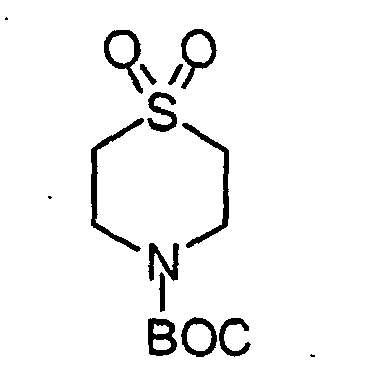
- The title compound from Step A (16 gm, 78.7 mmol) was dissolved in 50% CH3OH-H2O (500 mL) at 0°C. A slurry of Oxone® ( 72.6 gm, 118.05 mmol) was added portionwise while monitoring the pH at 10.5 with 25 % NaOH. After 2 hours, the reaction mixture was filtered and the CH3OH was evaporated under reduced pressure. The residue was extracted with EtOAc 3 times to obtain 15.5 gm (84%) of title product as a crystalline solid. mp= 157-159.2 °C.
-
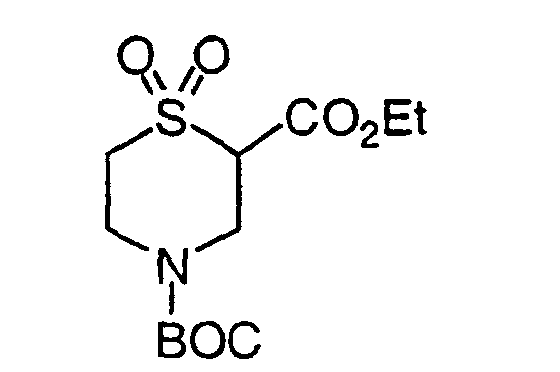
- The title compound from Step B (3.0 gm, 12.7 mmol) was dissolved in THF (30 mL). The reaction mixture was cooled to -78°C in a dryice acetone bath under a dry nitrogen atmosphere and 8.5 ml of a 1.5 Molar solution of lithium diisopropylamide in cyclohexane (LDA) was added dropwise and the solution stirred for 1/2 hour. Ethylchloroformate (1.83 mL, 19.05 mmol) was added dropwise and the solution stirred at -78 °C for 1 hour. The temperature was allowed to rise to ambient and the reaction mixture stirred an additional 2 hours. The reaction mixture was added to brine and the product extracted three times with EtOAc to obtain 2.87 gm of crude product which was used in the next step without purification.
-

- The crude tile compound from Step C was dissolved in 30 ml of THF, cooled in an ice bath, and stirred. A 2M THF solution of Lithium borohydride (9 mL, 18 mmol) was added dropwise and the reaction mixture stirred for 3 hours. 1N HCl (∼ 10 mL) was added slowly and the mixture stirred for 5 min. 1N NaOH (∼20 mL) was added and the crude product extracted with ethylacetate, dried over magnesium sulfate, filtered, and evaporated to obtain a crude oil. The crude oil was chromatographed on silica gel using 20% ethyl acetate/hexanes to 40% ethylacetate/hexanes to obtain 0.88 gm of title product as a solid. mp= 126.9-131.9 °C.
-
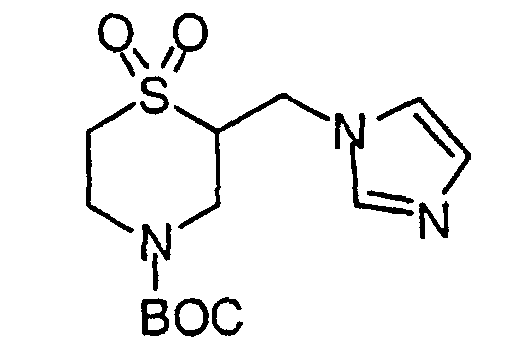
- The title compound from Step D (0.56gm, 2.14 mmol) and diisopropylethylamine( 0.372 ml, 2.14 mmol) was dissolved in 5 mL of dichloromethane. Methanesulfonyl chloride ( 0.198 ml, 2.56 mmol) was added and the reaction mixture stirred under a dry nitrogen atmosphere for 30 min. The reaction mixture was added slowly to melted imidazole (2.9 gm, 20 eq.) at 120 °C. After the dichloromethane evaporated the reaction mixture was cooled to ambient to obtain a brown solid. The solid was dissolved in water and the product extracted with ethylacetate three times to obtain 0.449 gm of title product. mp= 149.7-151.3 °C, FABMS (M+1)=316.2.
-
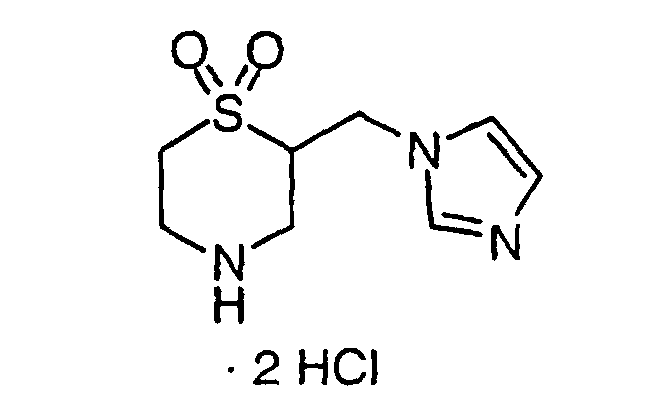
- The title compound from Step E (0.44 gm, 1.4 mmol) was dissolved in 5 ml of 4NHCl/dioxane and stirred for 1 hr. The mixture was evaporated to obtain 0.45 gm of title product.
-
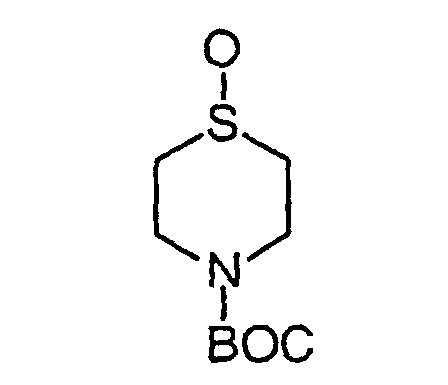
- N-Butoxycarbonyl-thiomorpholine from Preparative Example 10 Step A (7.07 gm, 58 mmol) was dissolved in 200 ml of dichloromethane. 50-60% mCPBA (13.7 gm, 80 mmol) was added portionwise over a period of 15 min. After 2 hours at ambient temperature the reaction mixture was washed with sat. sodium bisulfite, followed by sat. sodium bicarbonate, and the dried over magnesium sulfate, filtered, and evaporated to obtain 13.08 gm of a white solid. FABMS (M+ 1)=220.
-
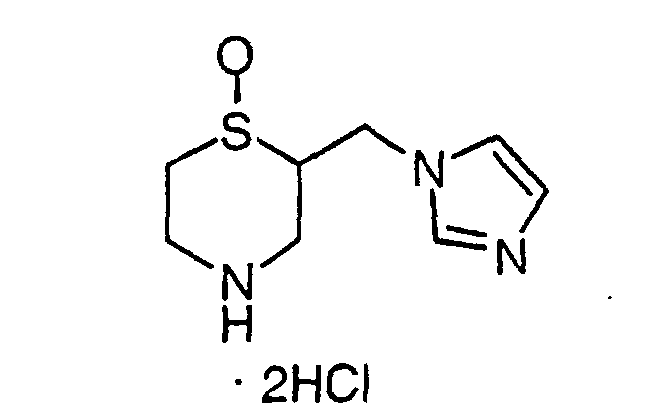
- By essentially the same procedures set forth in Preparative Example 10 Step C-F, the title compound was prepared.
-
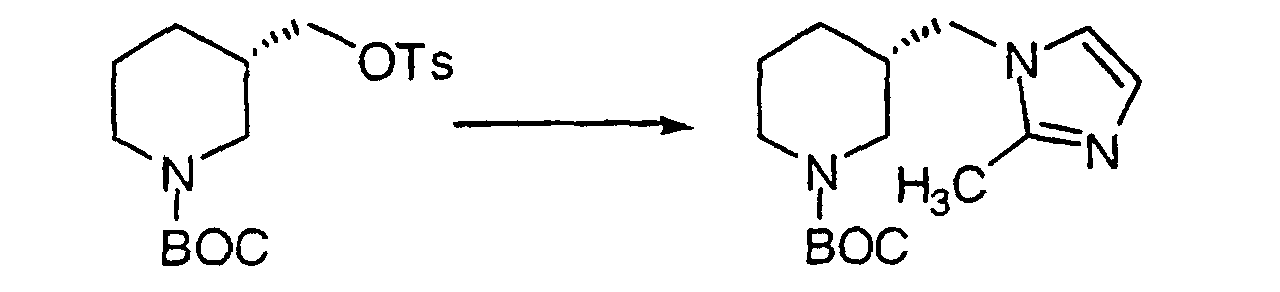
- 2-Methylimidazole (0.27g, 1.3 eq.) was added to a solution of NaH (0.13g, 1.3 eq., 60% in mineral oil) in DMF (5 mL) at room temperature and the resulitng solution stirred 20 minutes before adding the title compound from Preparative Example 7 Step D (0.94g, 2.54 mmol). The reaction mixture was heated to 60 °C for 2 hours, cooled to room temperature and concentrated. The crude product was diluted with H2O (50 mL) and extracted with CH2Cl2 (3 X 75 mL). The combined organics were dried over Na2SO4, filtered and concentrated in vacuo. The product was purified by flash chromatography using a 7% MeOH in CH2Cl2 solution as eluent to give a white solid (0.66g, 93% yield). CIMS: MH+= 280; [α]20 D= +4.9 (6.5 mg in 2.0 mL MeOH).
- By essentially the same procedure set forth in Preparative Example 7 Step E, the following title compounds in Column 4 were synthesized beginning with the tosylate in column 2, using the imidazole derivative in Column 3, Table 1:

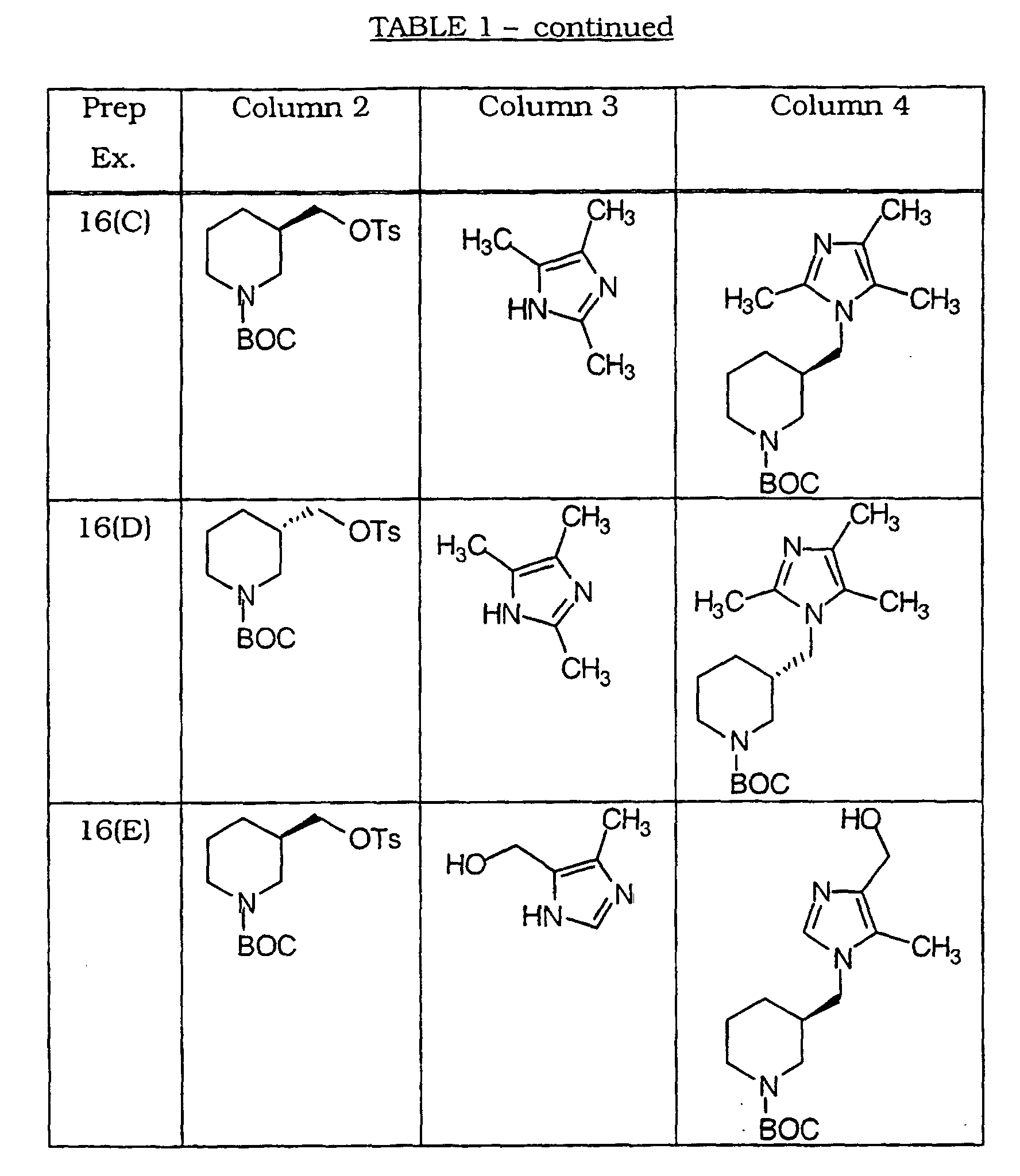
-
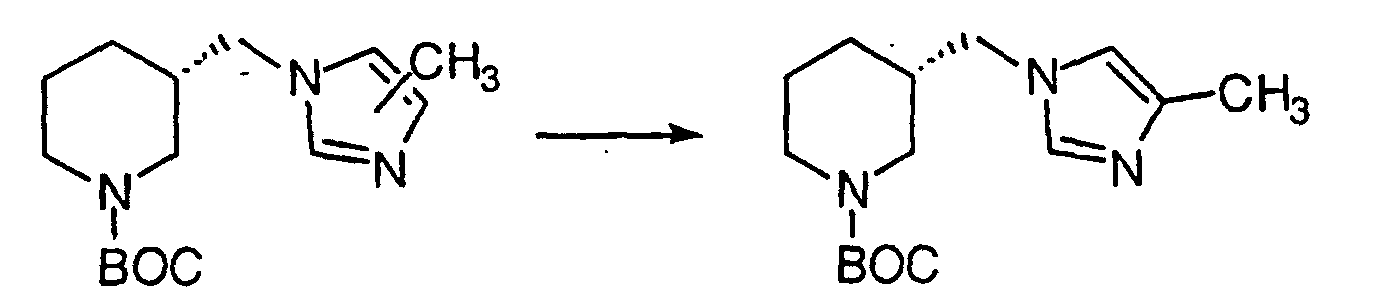
- To the title compound from Preparative Example 13 (1.0g, 3.58 mmol, 69 : 31 4-Me : 5-Me) in CH2Cl2 (10 mL) at 0 °C was added TrCl (0.32g, 1.05 eq. based on 5-Me). The resulting solution was stirred at 0 °C for 2 hours and concentrated under reduced pressure. The crude mixture was purifed by flash chromatography using a 50 % acetone in EtOAc solution as eluent to give the title compound as a clear oil (0.50g, 72% yield). CIMS: MH+= 280.
-
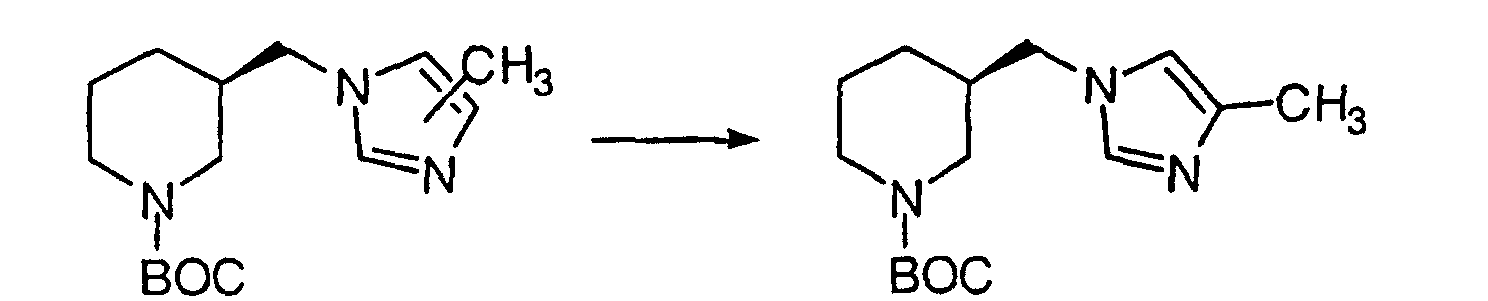
- By essentially the same procedure set forth in Preparative Example 17, the title compound was prepared (0.49g, 82% yield).
- By essentially the same procedure set forth in Preparative Example 7 Step F except using the compounds prepared in Preparative Examples 12, 13, 14, 15, 16 (Column 2, Table 2), 16A, 16B, 16C, 16D, 17, 18, 71A (step D), 71A (step F) 16E, 72A, 74A, 75A and 76, the amine hydrochlorides in Column 3, Table 2 were prepared:
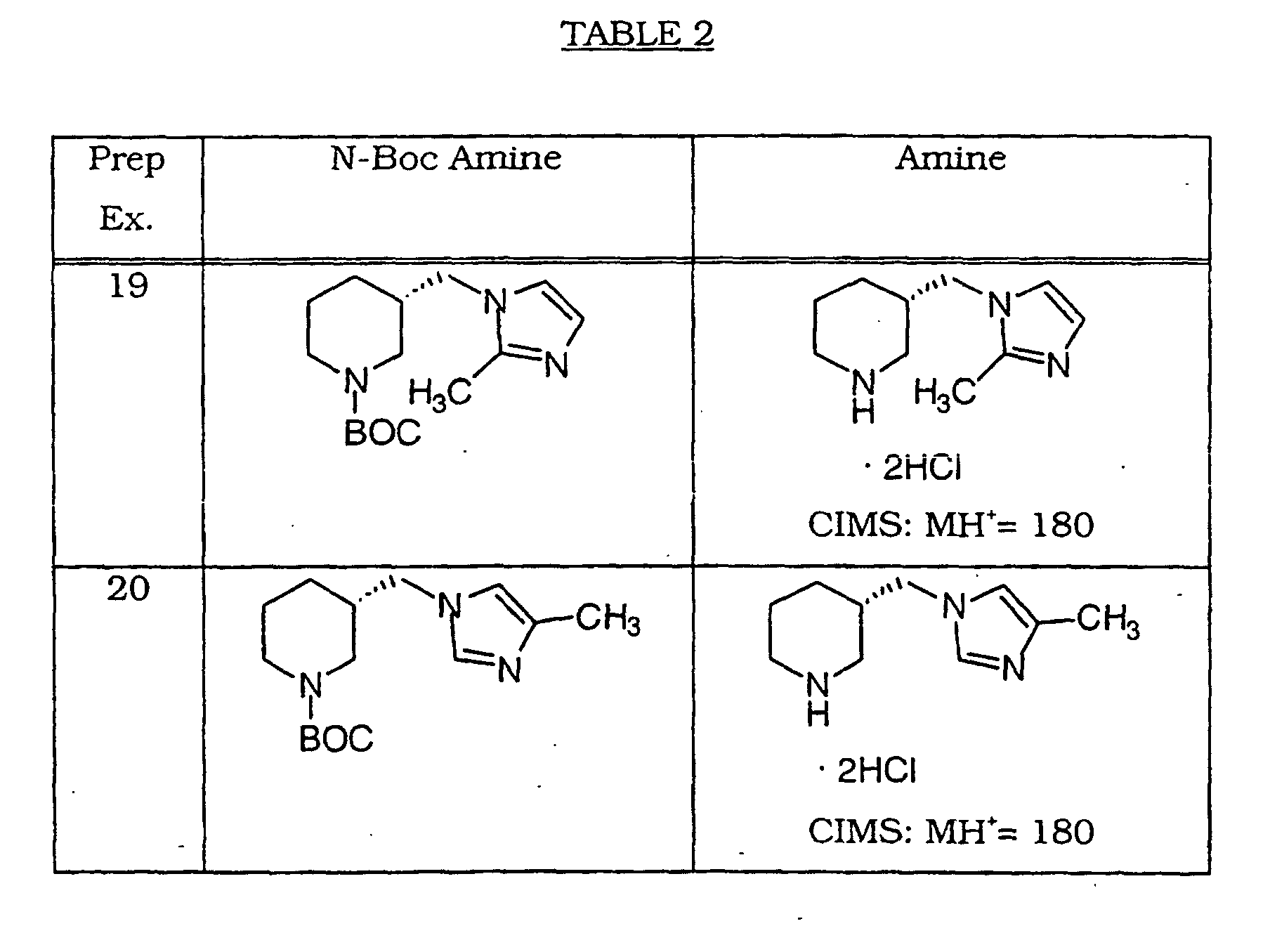


-
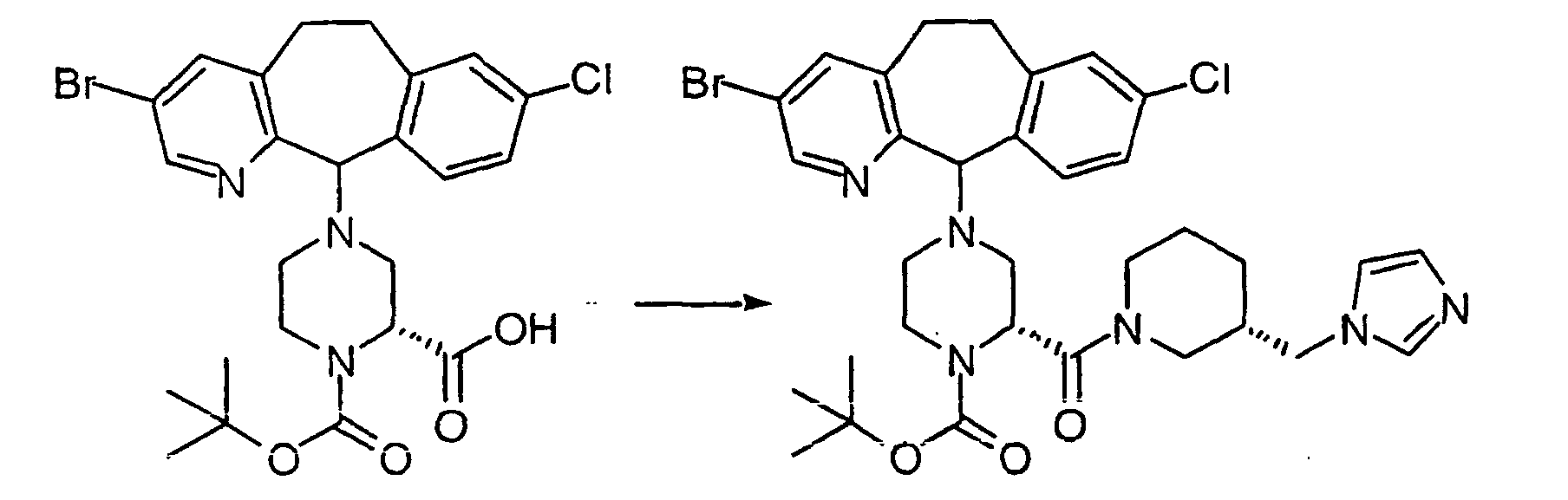
- The title compound from Preparative Example 6 (1.0g, 1.15 eq.) was added to a solution of the title compound from Preparative Example 1 (2.43g, 3.81 mmol), DEC (0.95g, 1.3 eq.), HOBT (2.57g, 5 eq.) and NMM (2.51 mL, 6.0 eq.) in DMF (50 mL). The resulting solution was stirred at room temperature 24 hours. The reaction mixture was diluted with H2O until precipitation ceased and the slurry filtered. The precipitate was diluted with CH2Cl2 (200 mL), washed with H2O (2 X 100 mL), dried over Na2SO4 and concentrated. The crude product was purified by flash chromatography using a 5% (10%NH4OH in MeOH) solution in CH2Cl2 as eluent to give a pale yellow solid (1.8g, 68% yield). LCMS: MH+= 683.
- By essentially the same procedure set forth in Example 1 only substituting the appropriate amine, one can obtain compounds of the formula shown below with R as listed in Column 2 of Table 3.

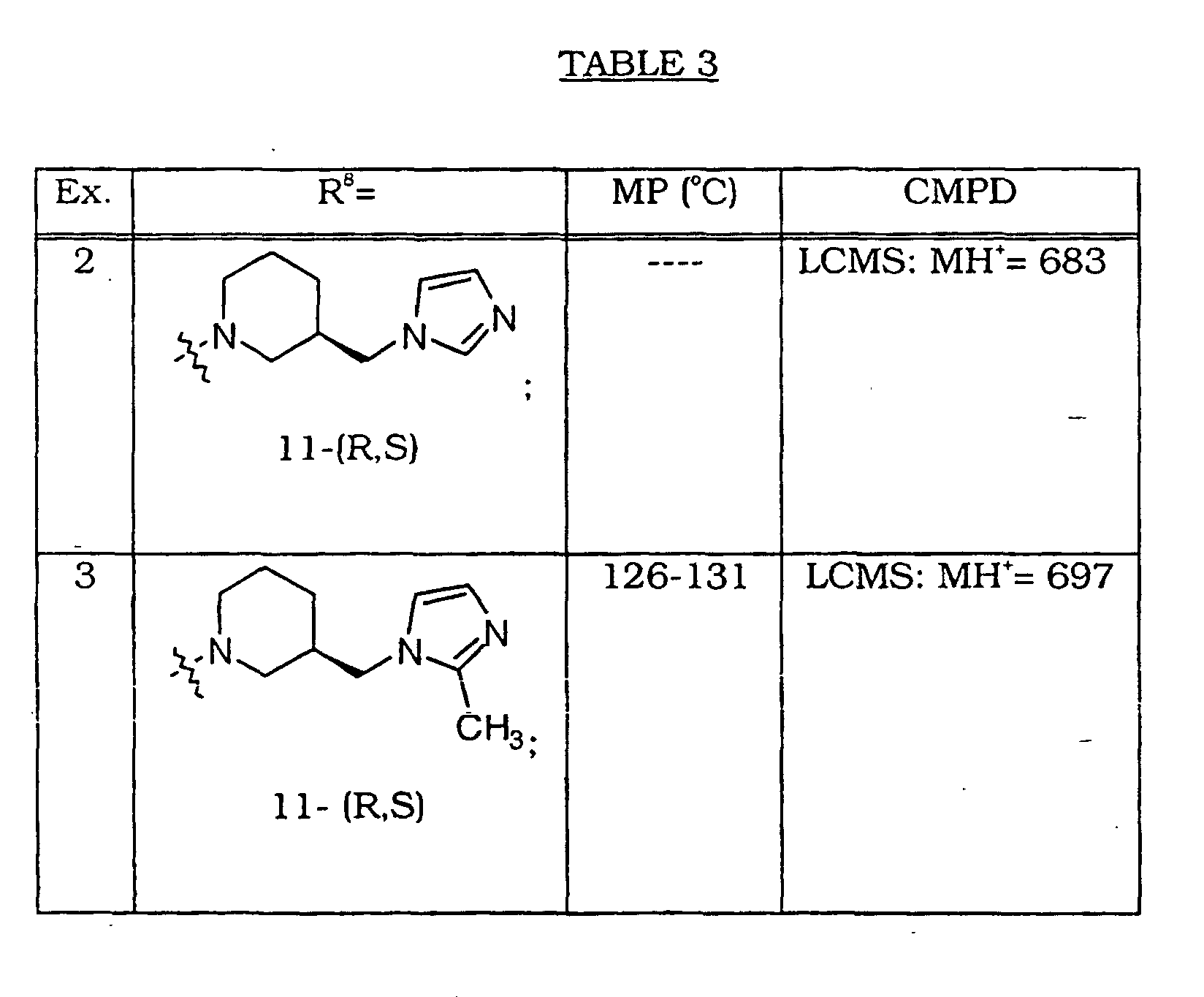
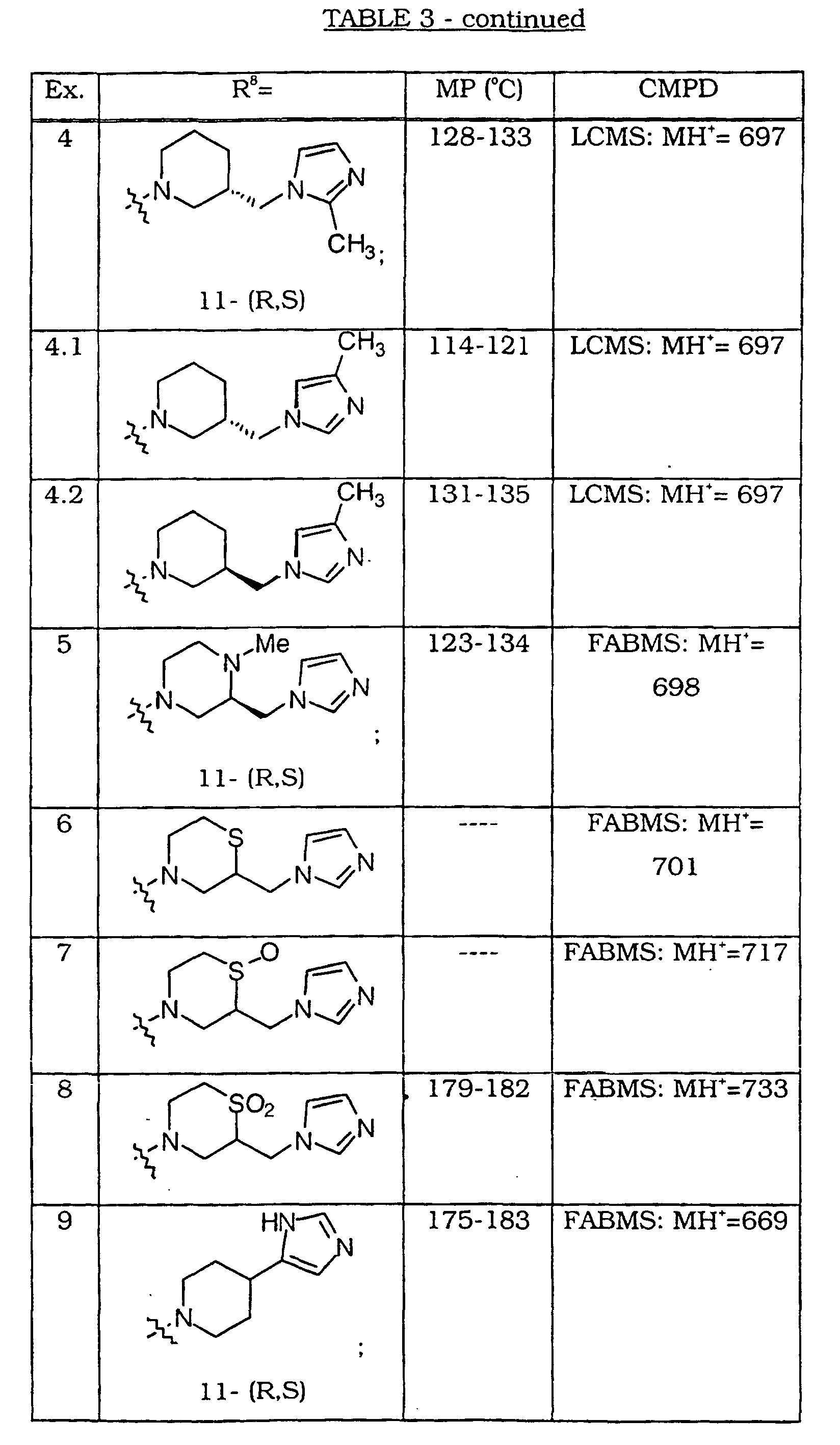
- The title compound from Example 1 was separated into individual (R)- and (S)-isomers by Preparative HPLC with a CHIRALPAK AD column using a 15% iPrOH in hexanes solution with 0.2% DEA as eluent.
-
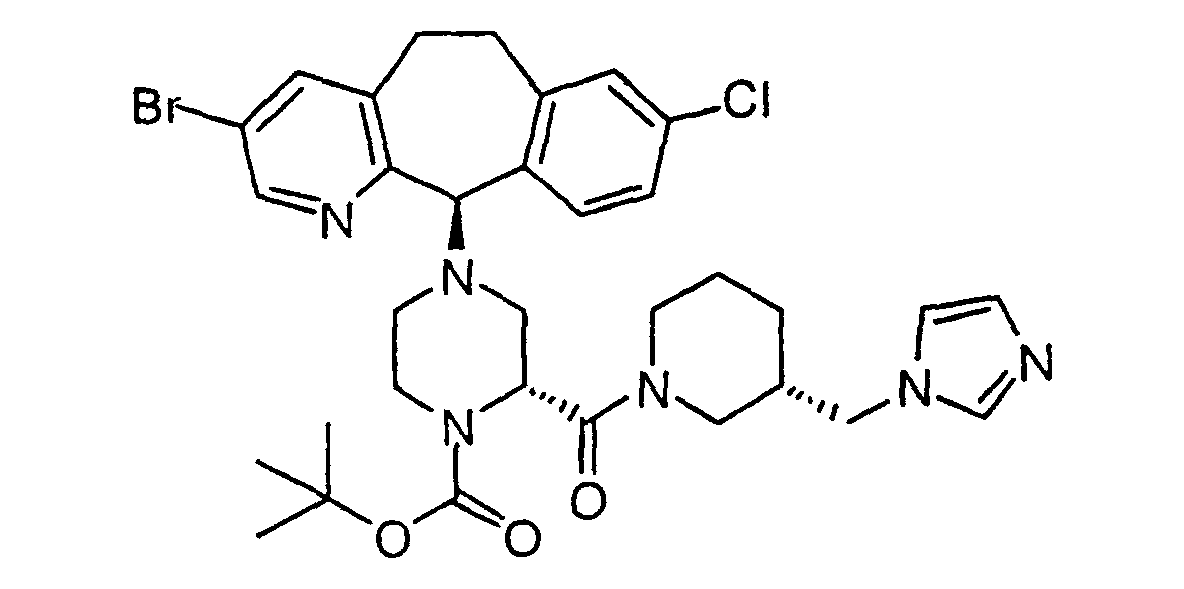
- 11-(R)-isomer: retention time (analytical) =8.845 minutes; [α]D= +14.0 (2.72 mg in 2.0 mL MeOH); mp=130-134 °C; LCMS: MH+= 683.
-
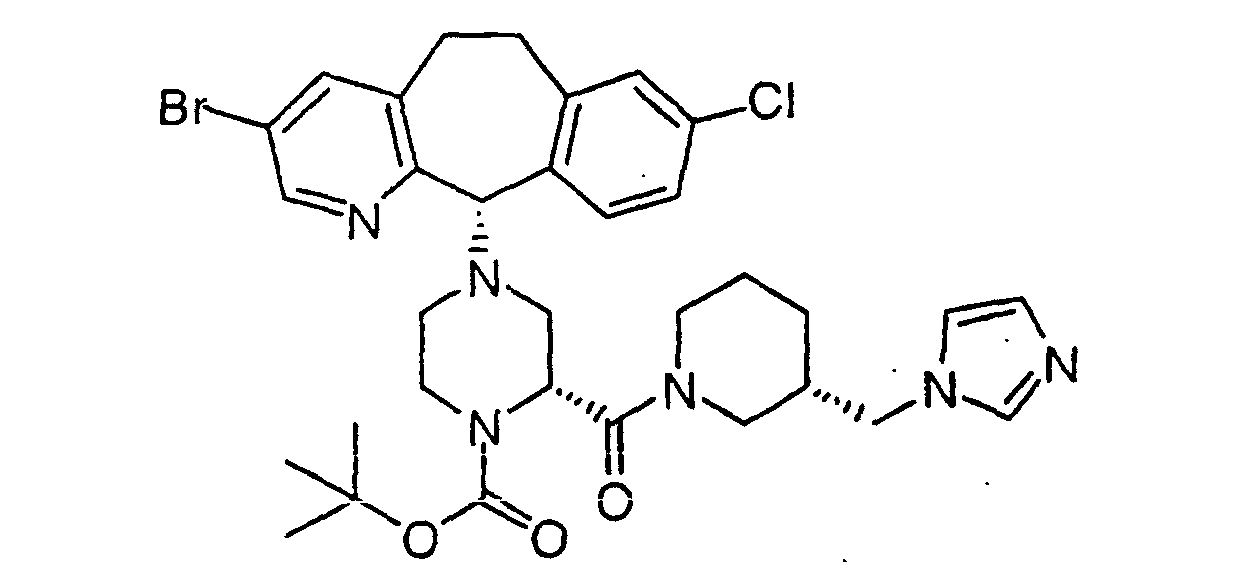
- 11- (S)-isomer: retention time (analytical)=15.416 minutes; [α]D=; mp=122-127 °C; LCMS: MH+= 683.
- By essentially the same procedure set forth in Example 10 and 11 except using the title compound from Example 2, the title compounds were prepared.
-

- 11- (R)-isomer: retention time (analytical-15% iPrOH: 0.2% DEA in hexanes)= 18.84 minutes; [α]D=; mp=135-138 °C; MS: MH+=683.
-
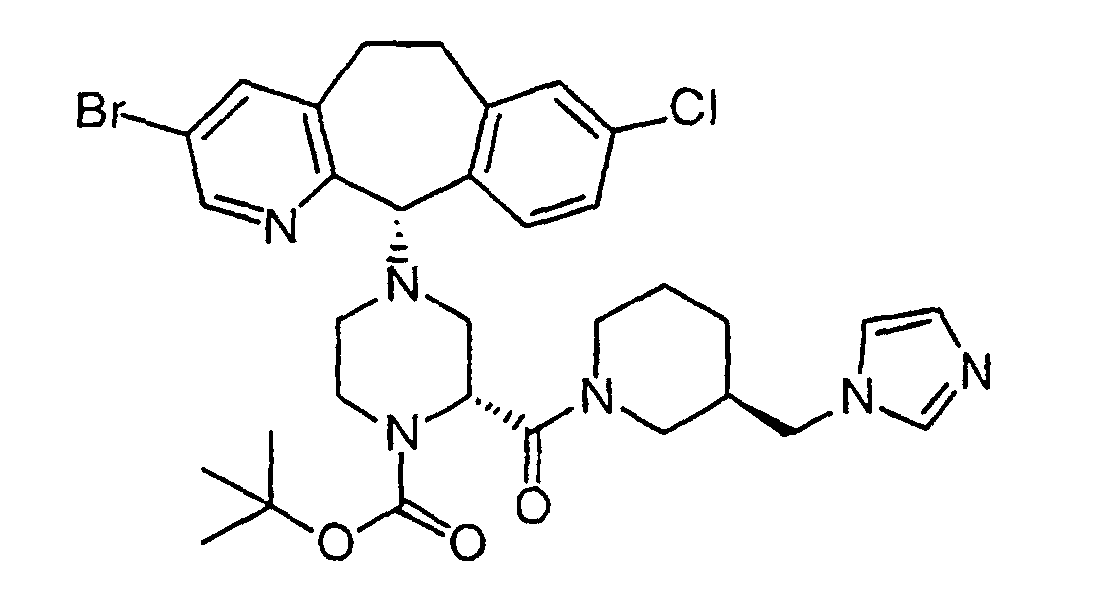
- 11- (S)-isomer: retention time (analytical-15% iPrOH : 0.2% DEA in hexanes)= 23.758 minutes; [α]D=; mp=127-130 °C; MS: MH+=683.
-
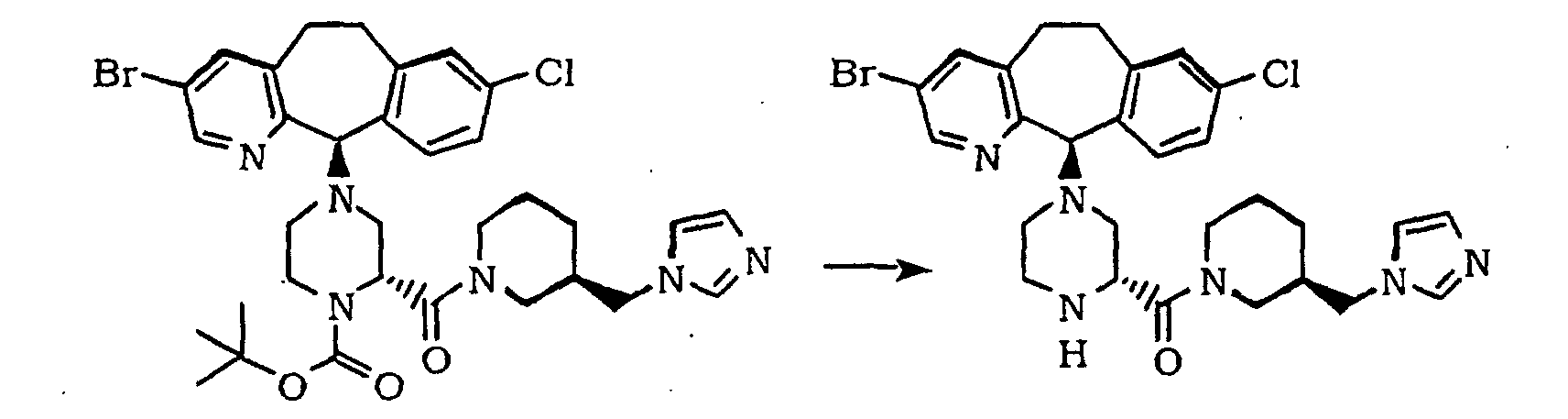
- The title compound from Example 12 (0.87g, 1.27 mmol) in CH2Cl2 (9.0 mL) was stirred with TFA (9.0 mL) at room temperature 1 hour. The reaction mixture was cooled to 0 °C and neutralized with 50% NaOH, separated, and the aqueous layer extracted with CH2Cl2 (3 X 200 mL). The combined organics were dried over Na2SO4, filtered, and concentrated in vacuo (0.56g, 75% crude yield).
-
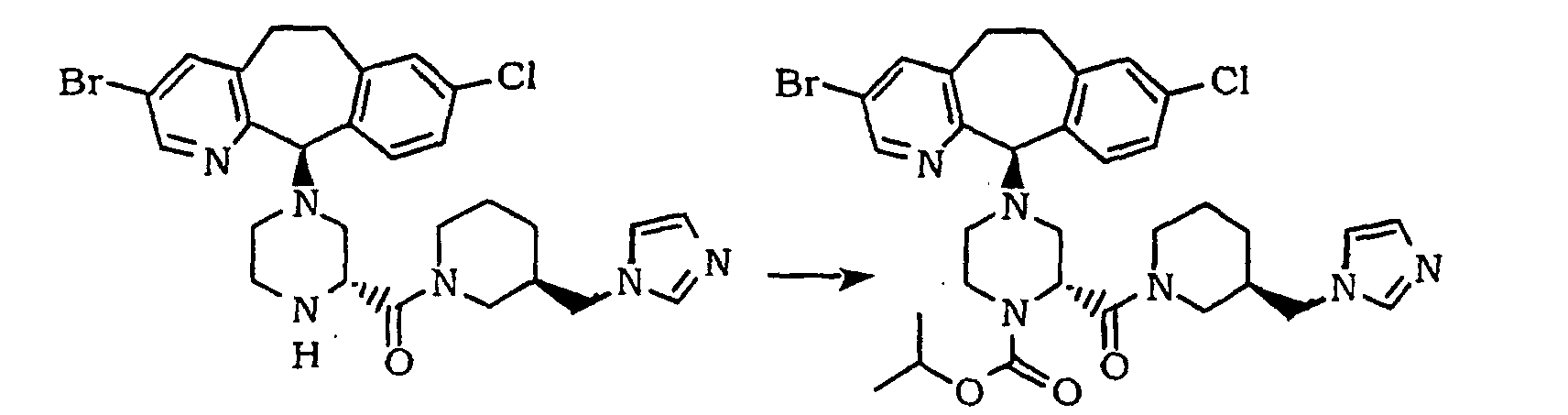
- The title compound from Preparative Example 24 (0.12g, 0.21 mmol) and TEA (0.15 mL, 5.0 eq.) were dissolved in CH2Cl2 (5.0 mL) and isopropyl chloroformate (1.05 mL, 5.0 eq.) was added. The reaction mixture was stirred at room temperature overnight before adding H2O (15.0 mL) and extracting with CH2Cl2 (2 X 100 mL). The combined organics were dried over Na2SO4, filtered, and concentrated in vacuo. The crude product was purified by flash chromatography using a 2.5% (10% NH4OH in MeOH) solution in CH2Cl2 as eluent (0.096g, 69% yield). FABMS: MH+= 669; mp= 126-128 °C.
-
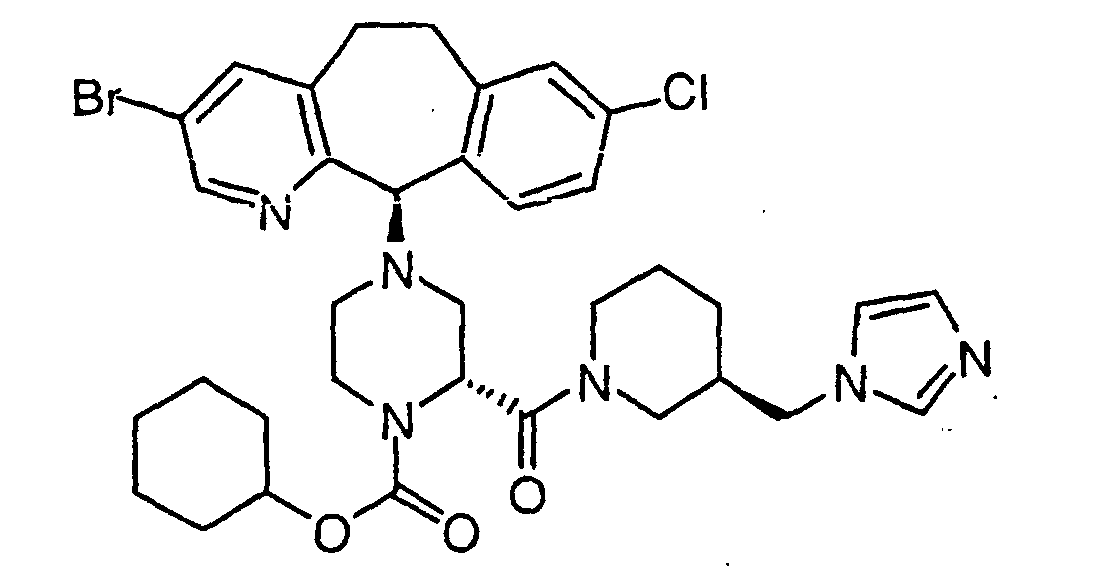
- By essentially the same procedure set forth in Example 14 only substituting cyclohexyl chloroformate, the title compound was prepared (0.053g, 44% yield). FABMS: MH+=709; mp= 140-144 °C.
-
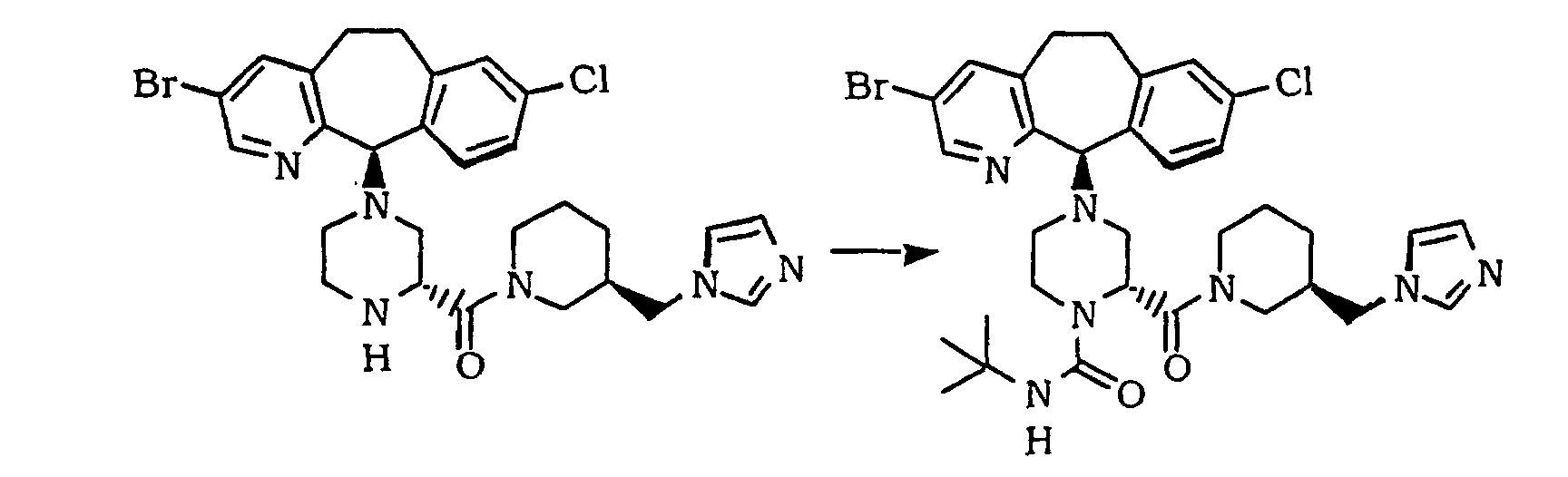
- The title compound from Preparative Example 24 (0.13g, 0.23 mmol)was dissolved in CH2Cl2 (4.0 mL) and t-butylisocyanate (0.13 mL, 5.0 eq.) was added. The resulting solution was stirred at room temperature 2 hours, diuted with H2O (15 mL) and extracted with CH2Cl2 (3 X 50 mL). The combined organics were dried over Na2SO4, filtered, and concentrated in vacuo. The crude product was purified by flash chromatography using gradient of 2.5% MeOH in CH2Cl2, 5%MeOH in CH2Cl2, and finally a 10% (10% NH4OH in MeOH) in CH2Cl2 as eluent (0.069g, 44% yield). LCMS: MH+= 682; mp= 148-153°C.
-
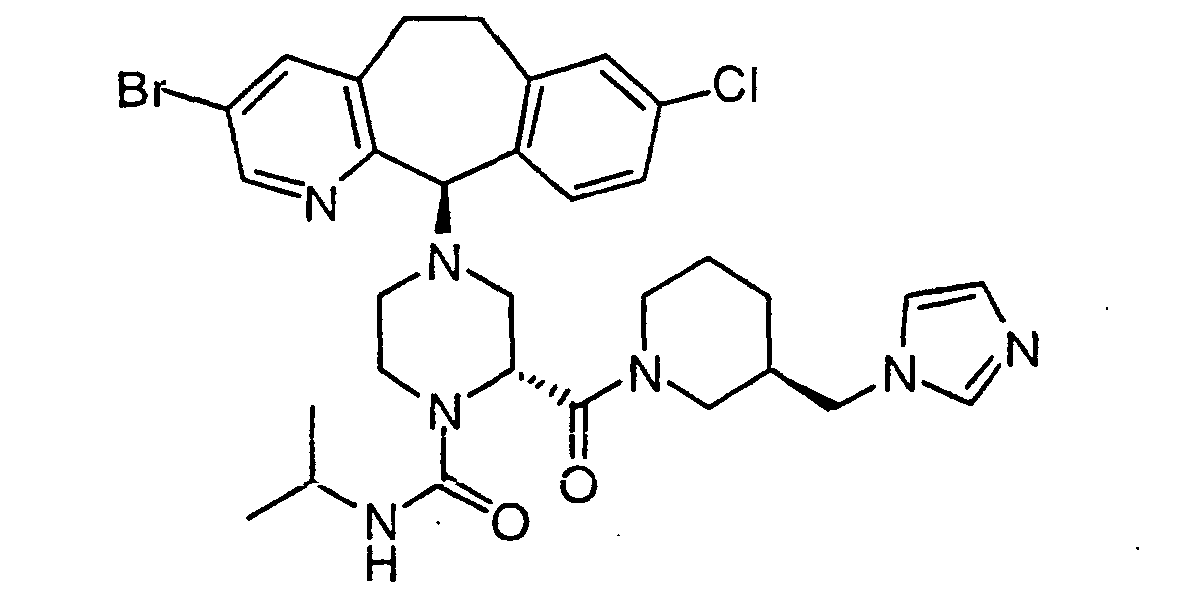
- By essentially the same procedure set forth in Example 16 only substituting the isopropylisocyanate, the title compound was prepared (0.09g, 64% yield). LCMS: MH+= 668; mp= 132-136 °C.
-

- By essentially the same procedure set forth in Preparative Example 24 only using the title compound from Example 10, the title compound was prepared.
-
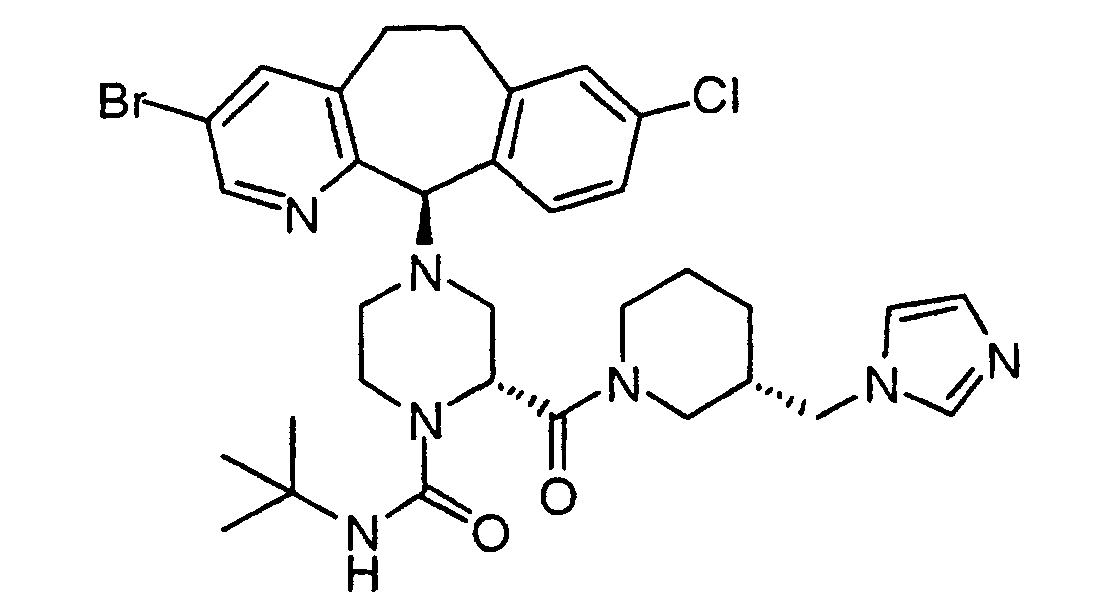
- By essentially the same procedure set forth in Example 16 only substituting the title compound from Preparative Example 25, the title compound was prepared. FABMS: MH+=682; mp=112-120 °C.
-

- By essentially the same procedure set forth in Example 14 only substituting the title compound from Preparative Example 25, the title compound was prepared. FABMS: MH+=669; mp= 123-132 °C; [α]20 D= +16.4° (4.5 mg in 2.0 mL MeOH)
-

- By essentially the same procedure set forth in Preparative Example 7Steps C to F only beginning with L-prolinol, the title compound was prepared.
-
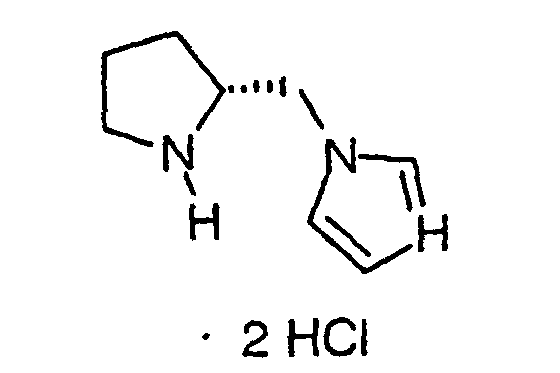
- By essentially the same procedure set forth in Preparative Example 24, only beginning with D-prolinol, the title compound was prepared.
-
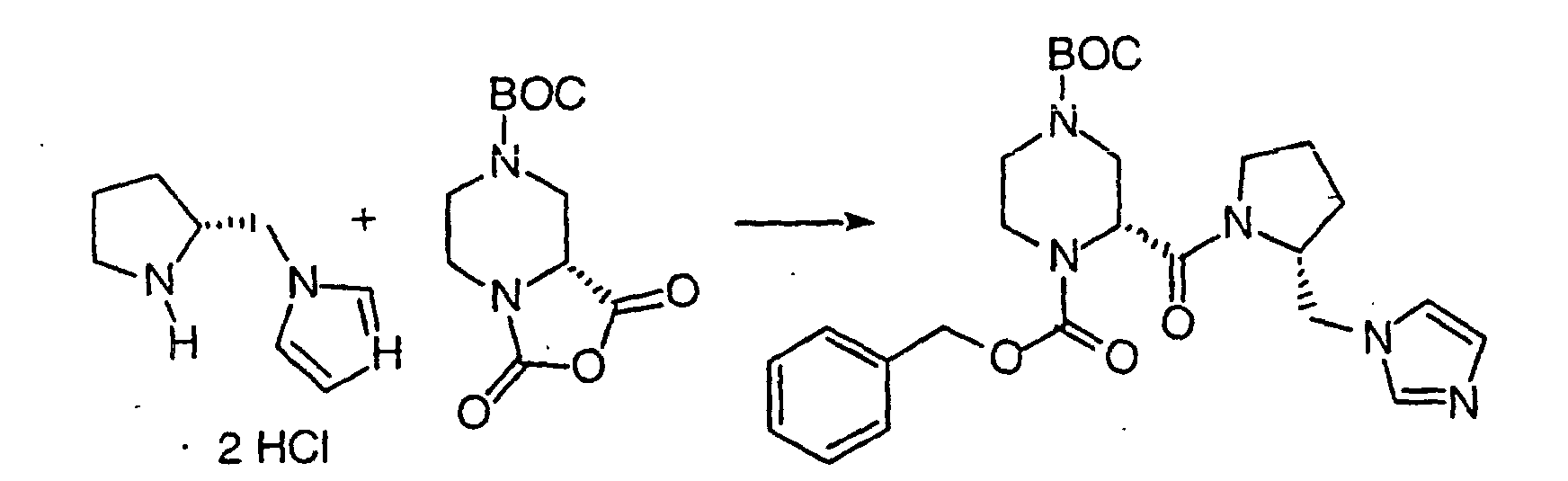
- Piperazine anhydride (1.03g, 1.2 eq.) was added portionwise to a solution of the title compound from Preparative Example 27 (0.75g, 3.35 mmol) in CH2Cl2 (5.0 mL) and TEA (2.33 mL, 5.0 eq.) and the resulting solution was stirred 10 minutes at room temperature before adding CBZ-OSuc (1.00g, 1.0eq.) The resulting mixture was stirred at room temperature overnight, and concentrated in vacuo. The crude product was purified by flash chromatography using a5% MeOH in CH2Cl2 solution as eluent to yield a white solid (0.94g, 56% yield). LCMS: MH+= 498; [α]20 D= +61.6° (3.8 mg in 2.0 mL CHCl3).
-
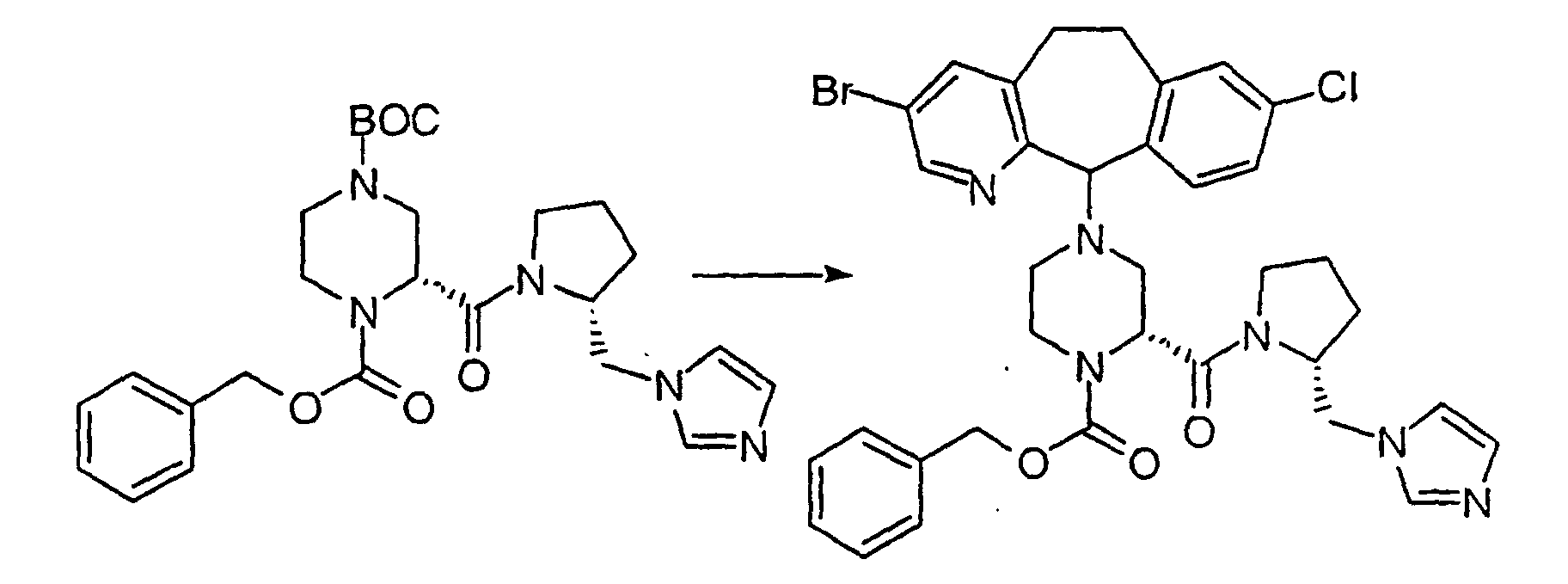
- A solution of the title compound from Preparative Example 28 (0.85g, 1.71 mmol) was stirred at room temperature in CH2Cl2 (10 mL) and TFA (3 mL) three hours. The reaction mixture was concentrated under reduced pressure and the compound was redissolved in CH2Cl2 (7 mL), treated with chloride {Scheme7 4} (0.29g, 1.0 eq.) and TEA (1.75 mL, 15 eq.). The resulting solution was stirred at room temperature 96 hours. The reaction mixture was diluted with saturated NaHCO3 (50 mL), water (50 mL), and CH2Cl2 (50 mL) and separated. The aqueous layer was extracted with CH2Cl2 (2 X 75 mL) and the combined organics dried over Na2SO4, filtered, and concentrated under reduced pressure. The crude product was purified by flash chromatography using a 6% (10% NH4OH in MeOH) solution in CH2Cl2 as eluent to yield a tan solid (0.29g, 48% yield). mp 80-84 °C; LCMS: MH+= 703.
-

- The title compound from Example 20 (0.24g, 0.341 mmol) was stirred at room temperature in HBr/AcOH (2.0 mL) 2 hours. The reaction mixture was triturated with Et2O and any remaining AcOH removed by azeotroping with toluene to give the HBr salt which was neutralized with 1N NaOH and extracted into CH2Cl2 (3 X 50 mL). The combined organics were dried over Na2SO4, filtered, and concentrated in vacuo to give a tan solid (0.18g, 95% yield) which was used without further purification. LCMS: MH+= 569.
-
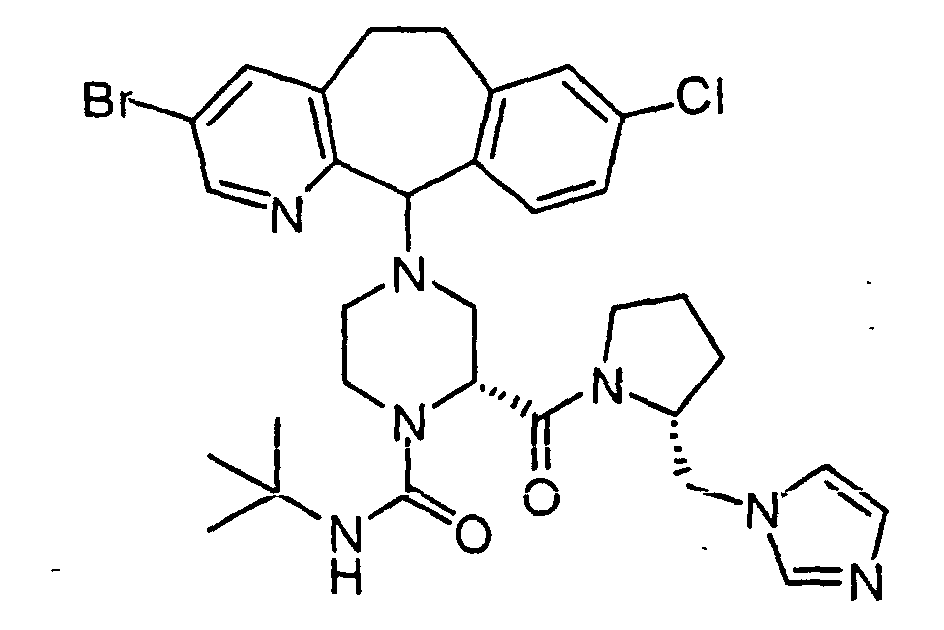
- By essentially the same procedure set forth in Example 16, only using the title compound from Preparative Example 29, the title compound was prepared (0.029g, 50% yield). LCMS: MH+= 668; mp=137-139°C.
-
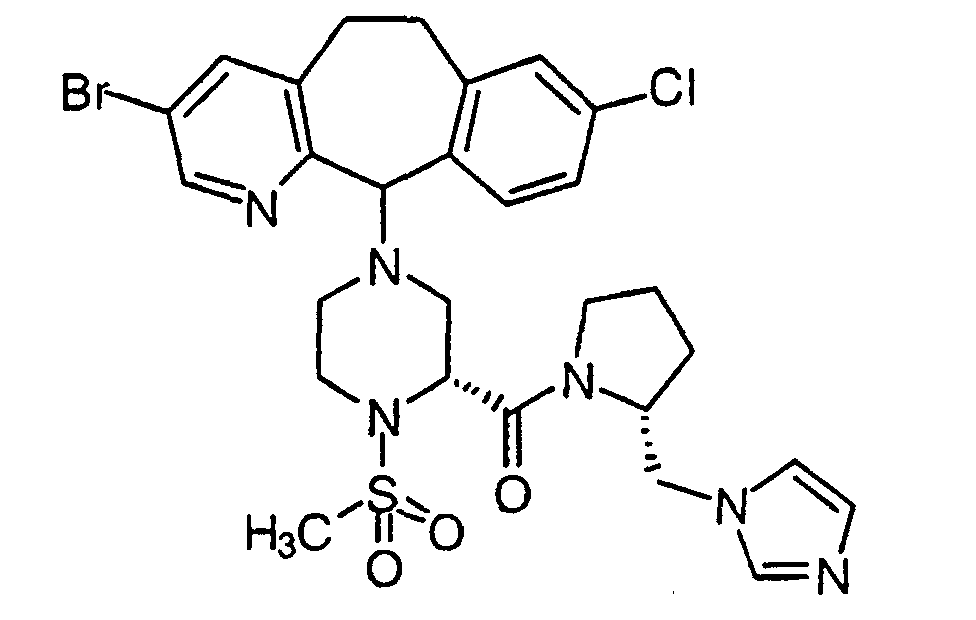
- To the title compound from Preparative Example 29 (0.10g, 0.175 mmol) and TEA (0.037 mL, 1.5 eq.) in CH2Cl2 (5.0 mL) was added MsCl (0.16 uL, 1.2 eq.) and the resulting solution was stirred at room temperature overnight. The resulting solution was quenched by the addition of saturated NaHCO3 (10 mL), diluted with H2O (25 mL) and extracted with CH2Cl2 (3 X 25 mL). The combined organics were dried over Na2SO4, filtered, and concentrated in vacuo. The crude product was purified by flash chromatography using a 10% (10% NH4OH in MeOH) solution in CH2Cl2 as eluent to yield a tan solid (0.70g, 64% yield). LCMS: MH+= 647; mp= 135-141 °C.
-
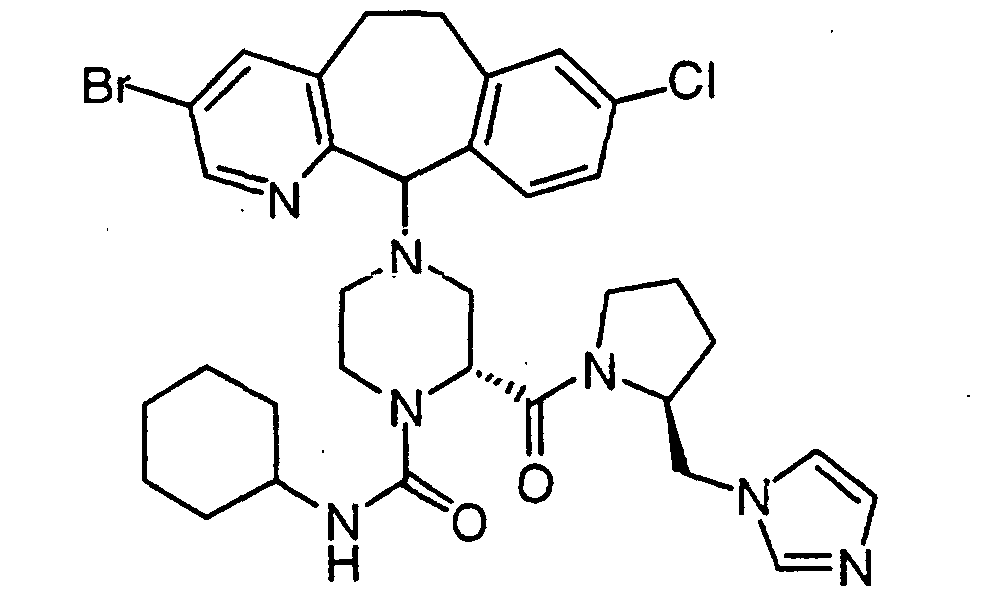
- By essentially the same procedure set forth in Example 22 only substituting the amine hydrochloride from Preparative Example 26 and quenching with cyclohexyl isocyanate in place of CBC-OSuc, the title compound was prepared. LCMS: MH+= 669; mp=187.
-
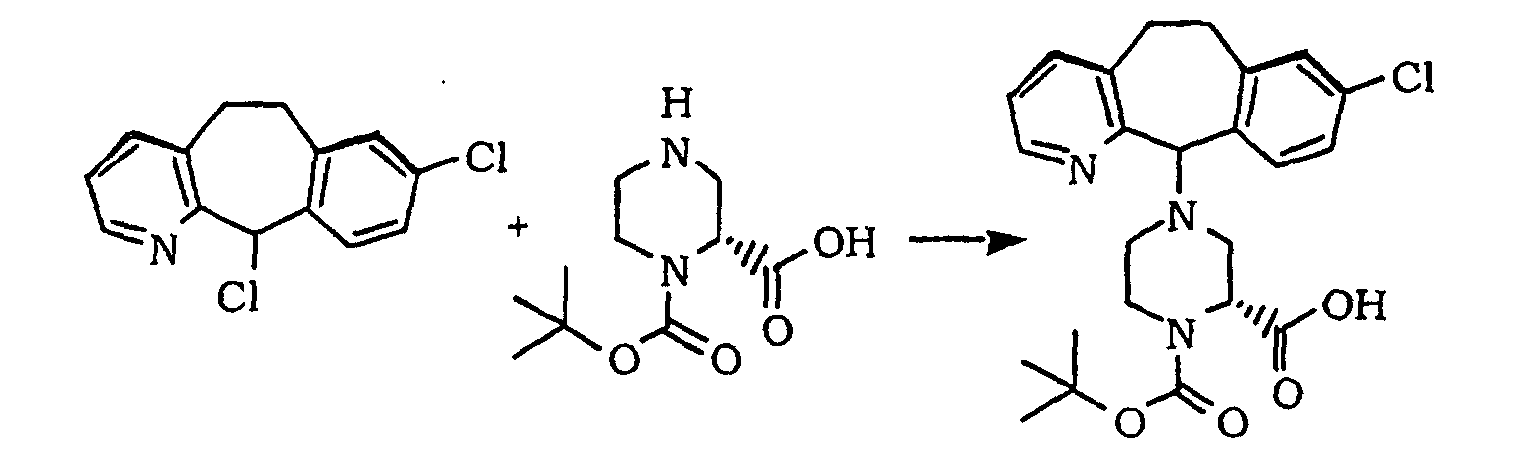
- Tricyclic chloride (5.04g, 1.1 eq.) was added to a solution of the title compound from Preparative Example 5 (4.0g, 17.3 mmol) and TEA (12.05 mL, 5 eq.) in DMF (60 mL). The resulting solution was stirred at room temperature 72 hours at which time the reaction mixture was concentrated under reduced pressure. The residue was diluted with 3M NaOH and extracted with EtOAc. The aqueous layer was neutralized with 50% citric acid and extracted with EtOAc. The combine organics were dried over Na2SO4, filtered, and concentrated in vacuo. The crude product was purified by flash chromatography using a 12% (10% NH4OH in MeOH) solution in CH2Cl2 as eluent to give the C-11 (S)-isomer (2.13g, 54%) as the first eluting isomer and the C-11 (R)-isomer (2.4g, 61%) as the second eluting isomer.
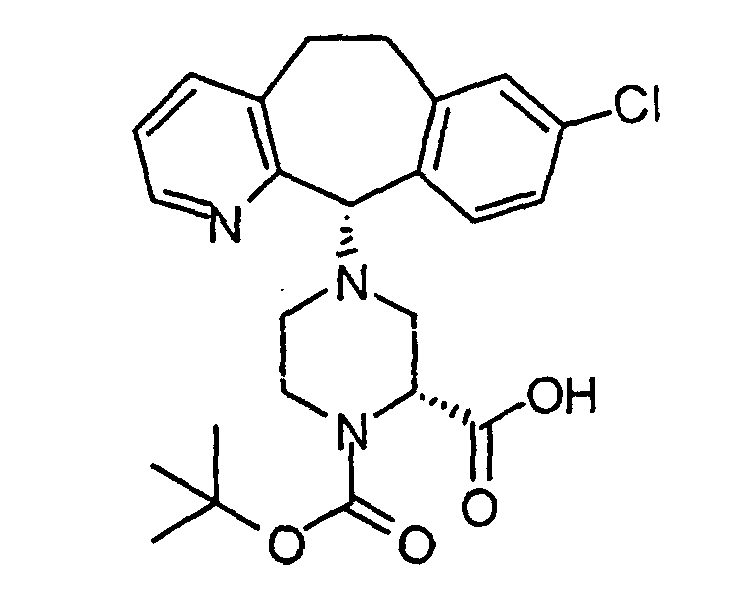
- 11- (S)-isomer (first eluting isomer): [α]20 D= -13.4° (3.72 mg in 2.0 mL MeOH); LCMS: MH+= 458.
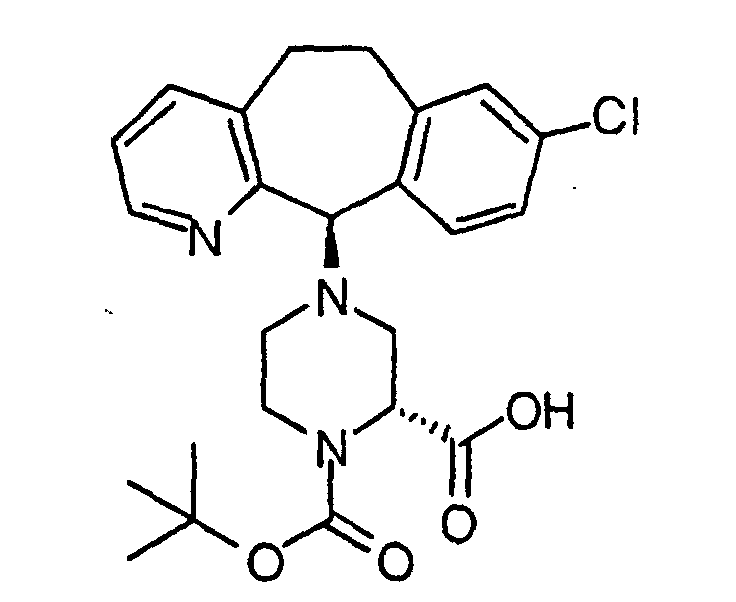
- 11- (R)-isomer (second eluting isomer): [α]20 D=+84.9° (5.18 mg in 5.0 mL MeOH); FABMS: MH+= 458.
- By essentially the same procedure set forth in Example 1 only using the title compounds from Preparative Example 30 (individual C-11 (S)- and (R)-isomers) as listed in column 2 of Table 4 and substituting the appropriate amine, the title compounds of the formula shown below with R8 as listed in column 3 of Table 4 are obtained.
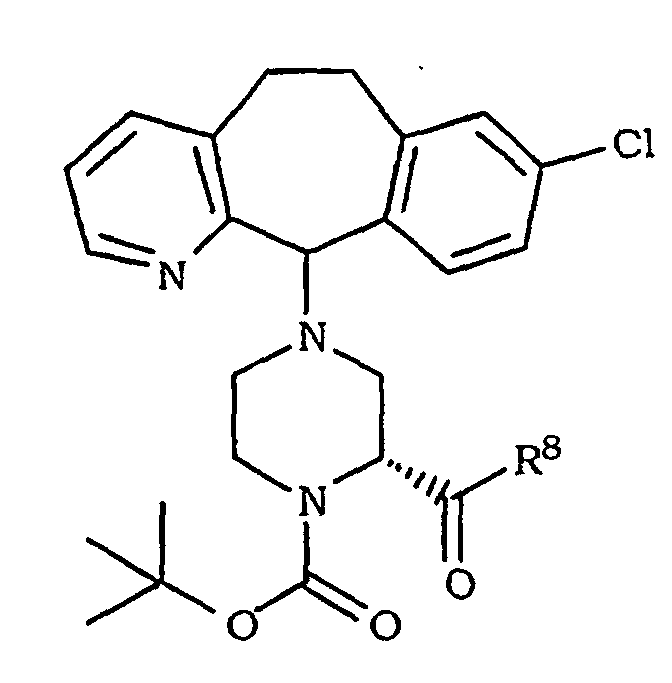


-
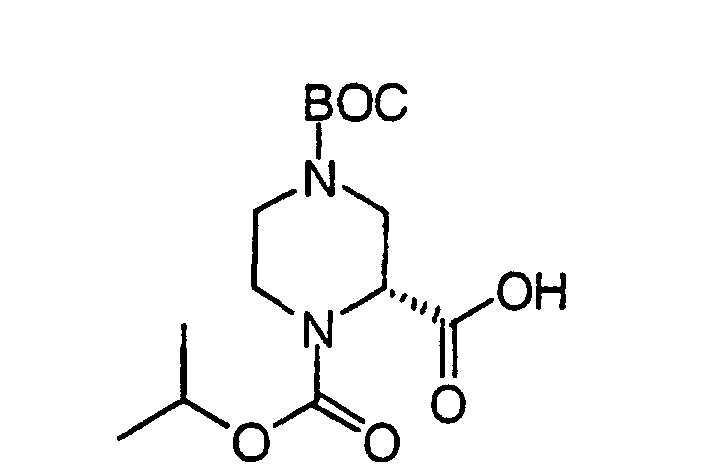
- 50% NaOH was added to a solution of the title compound from Preparative Example 1 (11.47g, 19.28 mmol) in dioxane : H2O (1:1, 64 mL) until the pH was ∼11.5 and BOC-ON (5.22g, 1.1 eq.) was added in two portions. 50% NaOH was added to keep the pH at ∼11.5. When the pH stabilized the resulting solution was stirred at room temperature overnight. The pH was adjusted to ∼9.5 ny the addition of 1M HCl and isopropyl chloroformate (21.21 mL, 1.0 M in toluene, 1.1 eq.) was added. The resulting solution was kept at pH ∼9.5 and stirred 3 days. The reaction mixture was concentrated and extracted with Et2O, readjusting the pH to 9.5 following each extraction. When the pH stabilized at ∼9.5 for 3 consecutive extractions the aqueous layer was acidified to pH ∼4.5 with 50% citric acid and to pH∼3 with 1M HCl and extracted with EtOAc (3 x 100 mL). The combined organics were dried over Na2SO4, filtered, and concentrated under reduced pressure to give a white solid (5.8g, 90% yield).FABMS: MH+= 317. Treatment of the product with TFA yielded the deprotected amine which was used without further purification.
-
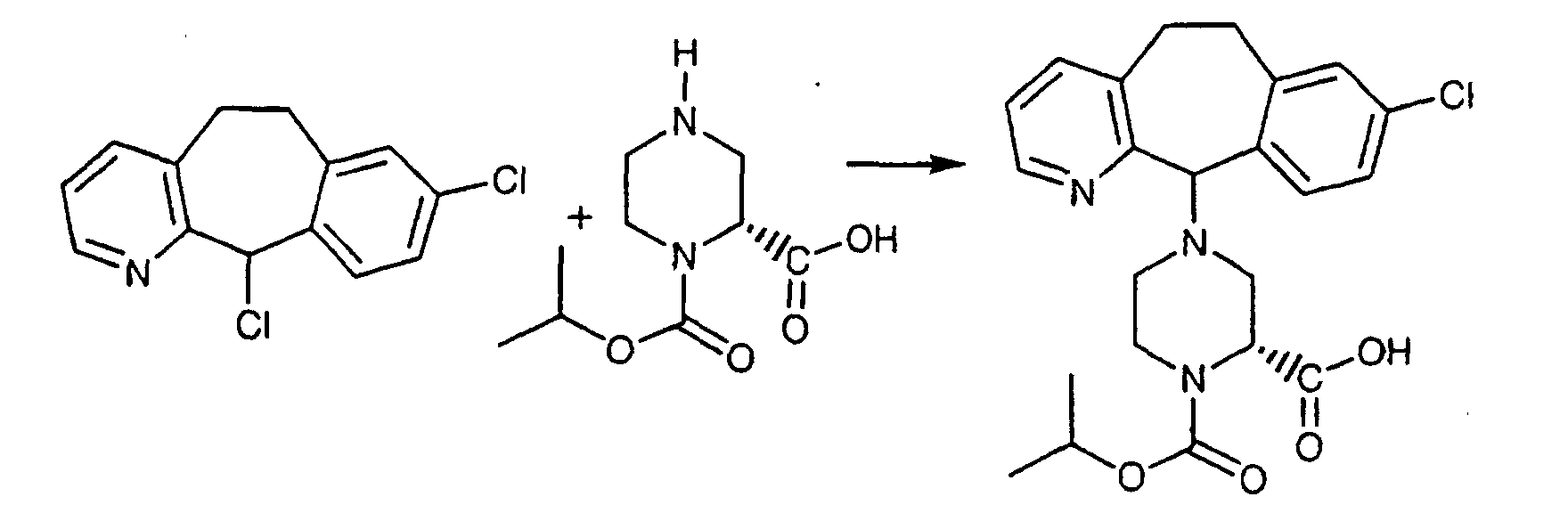
- By essentially the same procedure set forth in Preparative Example 30 only substituting the compound from Preparative Example 31 Step A, the title compound was prepared and separated into C-11 isomers:
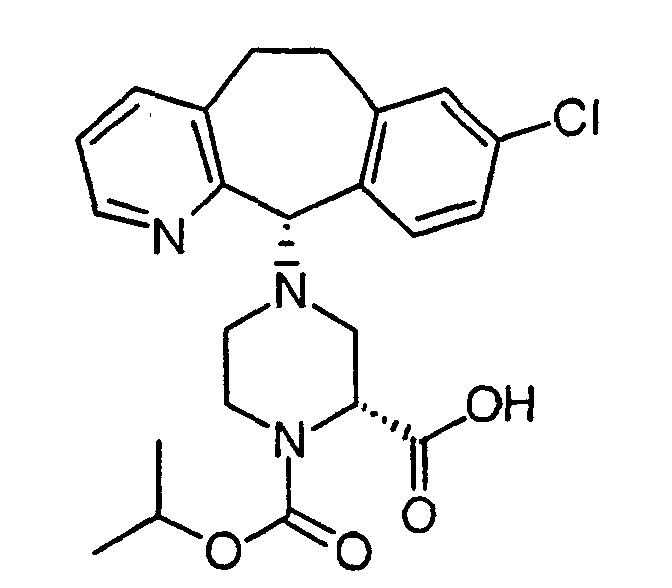
- 11- (S)-isomer (first eluting isomer): LCMS: MH+= 444.
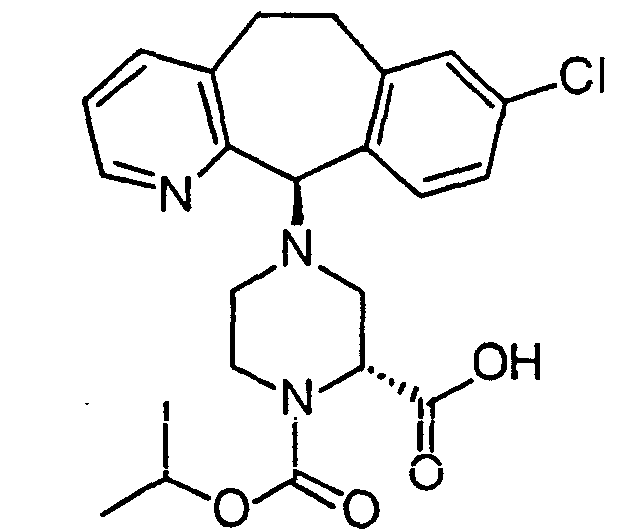
- 11- (R)-isomer (second eluting isomer): LCMS: MH+=444.
- By essentially the same procedure set forth in Example 1 only substituting the title compounds from Preparative Example 31 (individual C-11 (S)- and (R)-isomers) and substituting the appropriate amine, the compounds of the formula shown below with R8 as listed in column 3 of Table 5 are obtained.


-

- By essentially the same procedure set forth in Preparative Example 31 only substituting cyclohexyl chloroformate for isopropyl chloroformate in Step A, the title compounds (C-11 (S)- and (R)-isomers) were prepared and separated into individual diastereomers:
- 11-(S)-isomer (first eluting isomer): FABMS: MH+=484.
- 11-(R)-isomer (second eluting isomer): FABMS: MH+=484.
- By essentially the same procedure set forth in Example 1 only substituting the title compounds from Preparative Example 32 (individual C-11 (S)- and (R)-isomers) and substituting the appropriate amine, the compounds of the formula shown below with R8 as listed in Column 3 of Table 6 can be obtained.
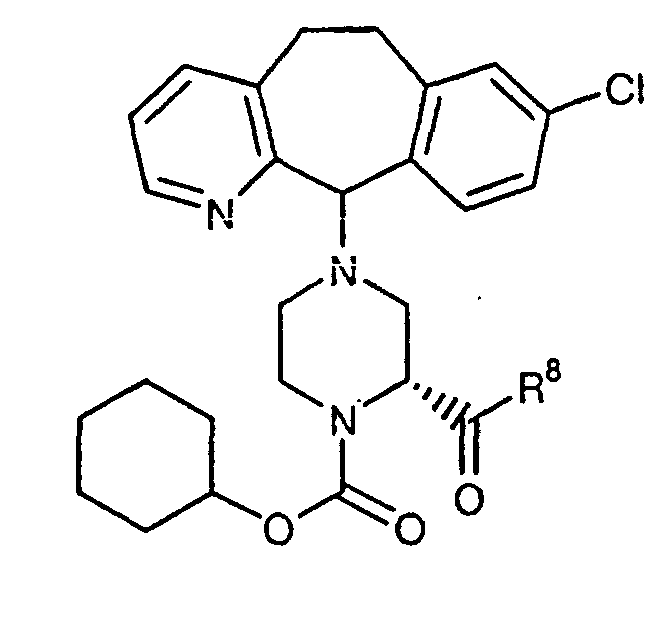
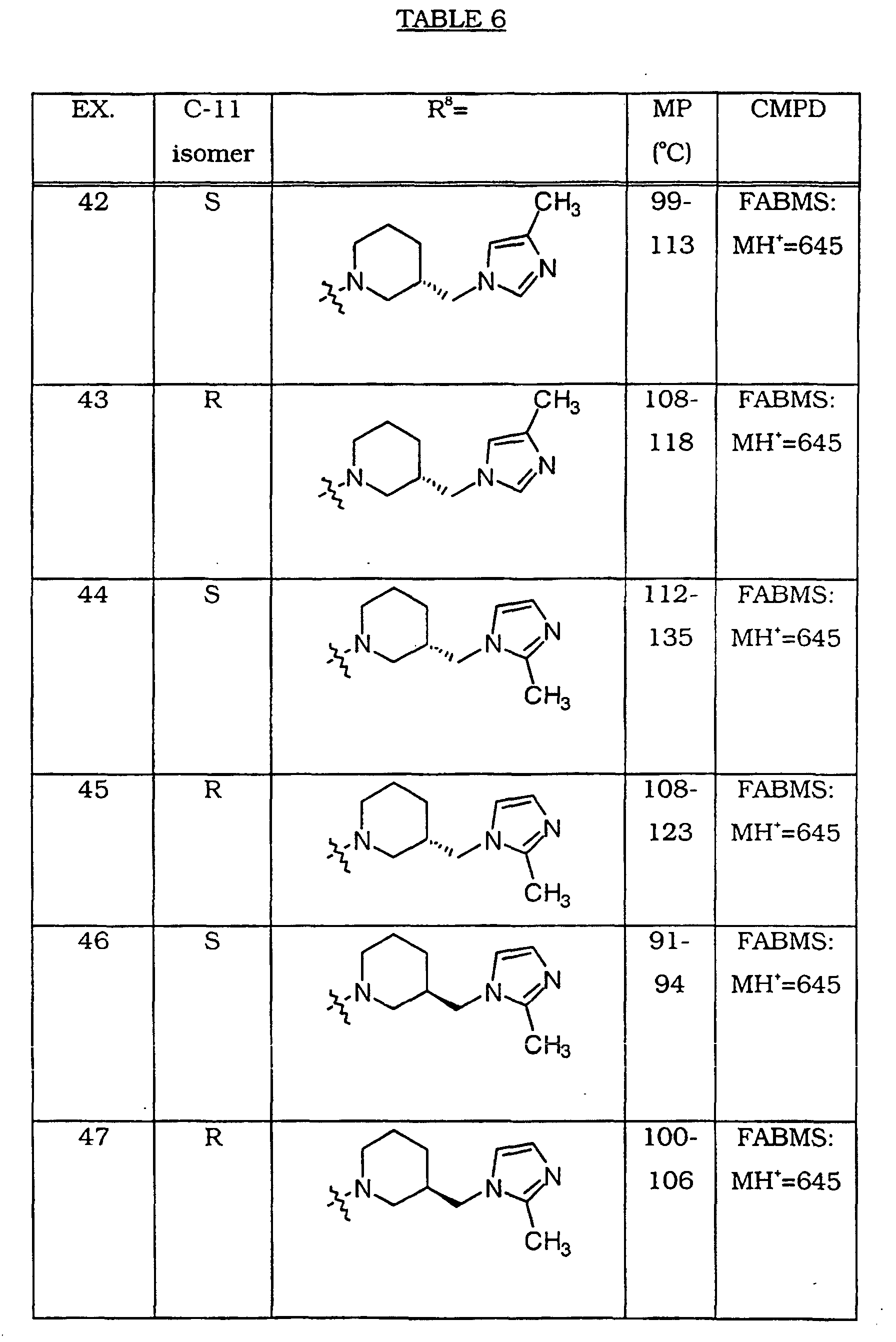


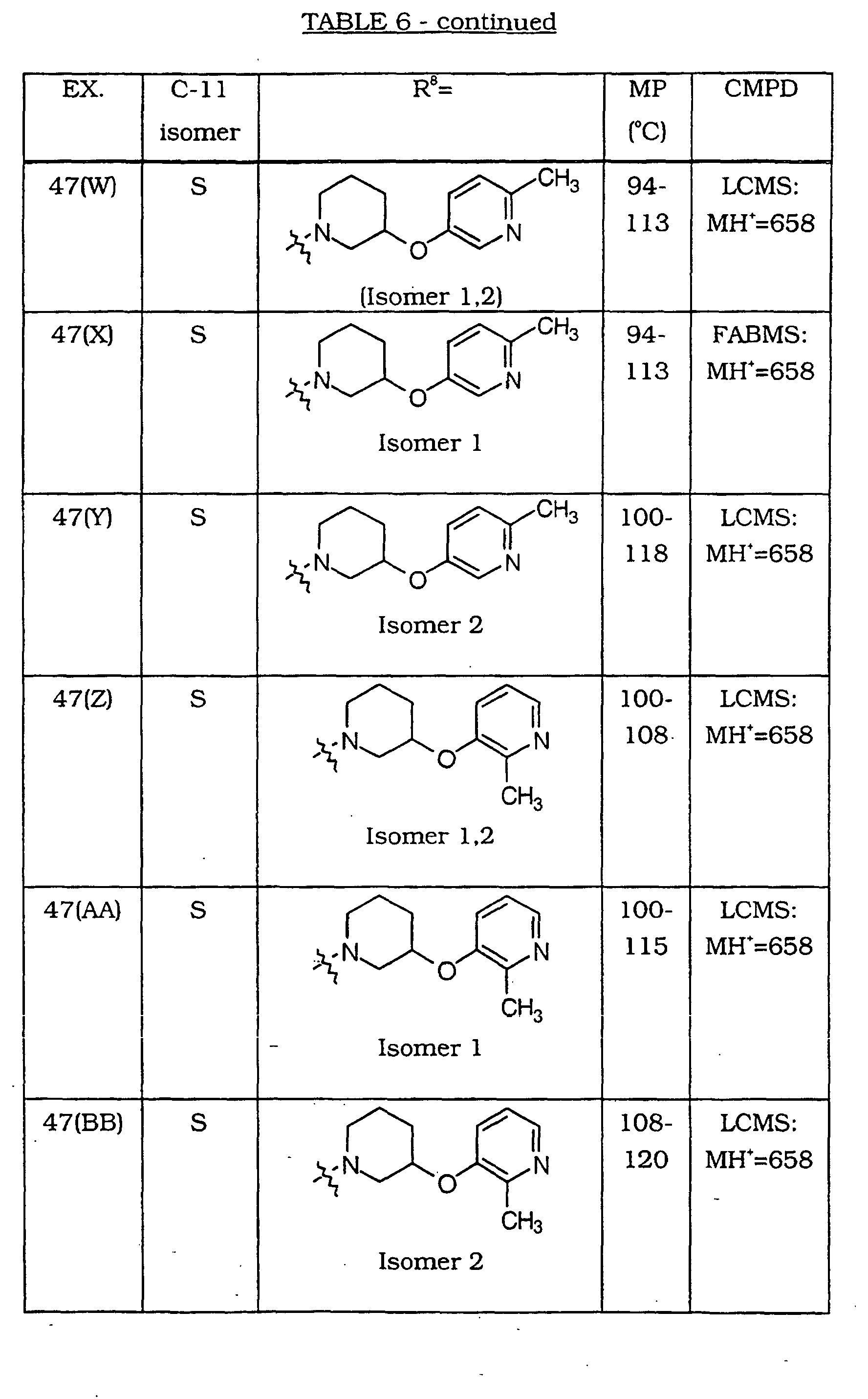
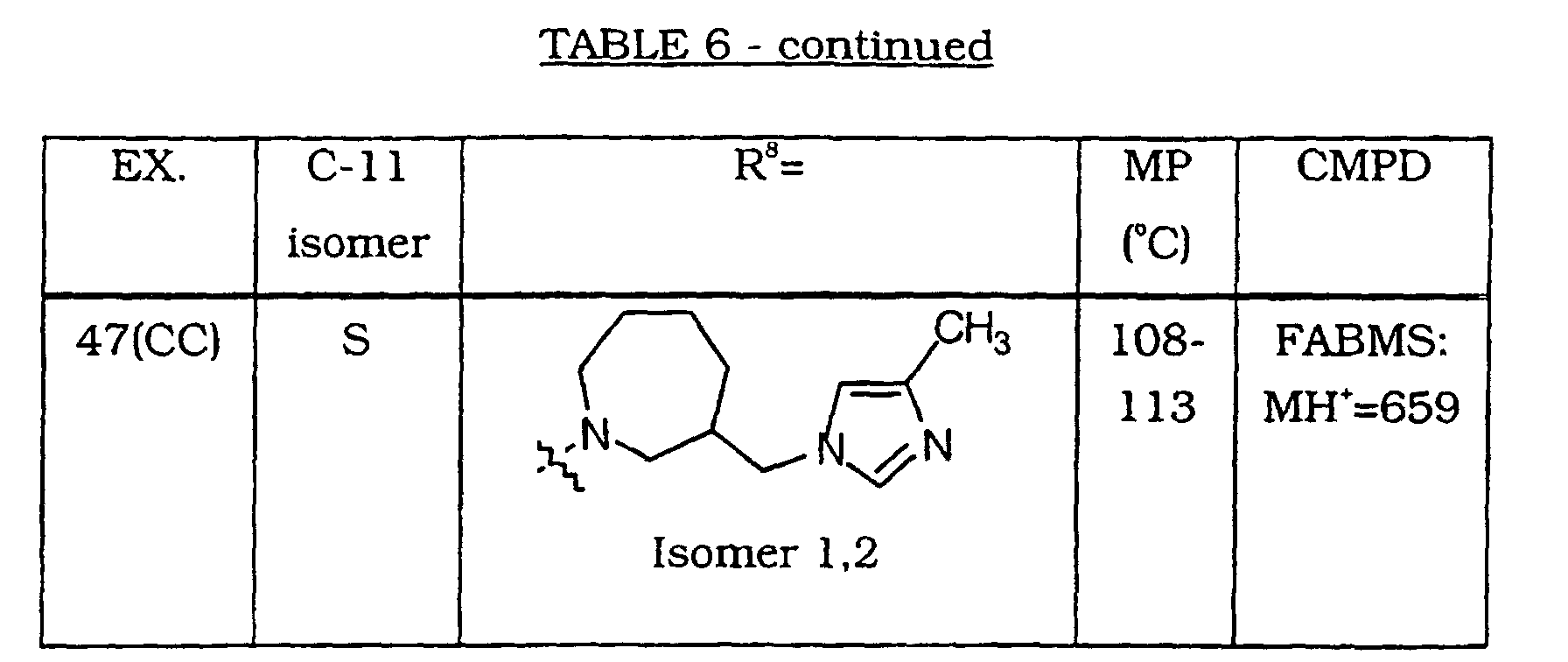
-
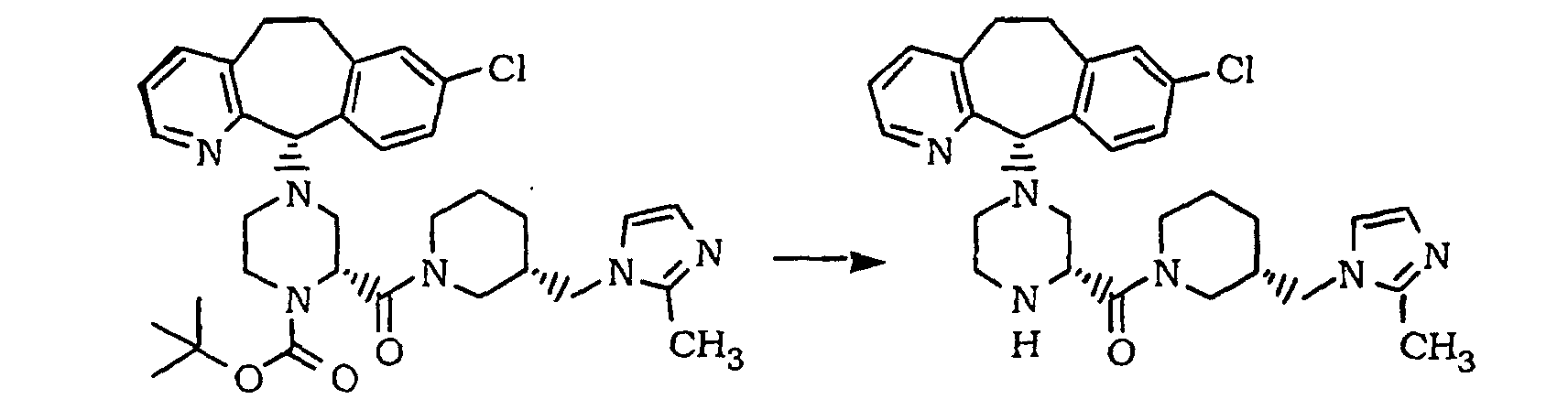
- By essentially the same procedure set forth in Preparative Example 24, only using the title compounds from Example 26, the title compound was prepared.
- By essentially the same procedure set forth in Preparative Example 33 only substituting the compound from the example listed in column 2 of Table 7, the title compounds of the formula shown below with R8 as in column 4 of Table 7 were prepared:
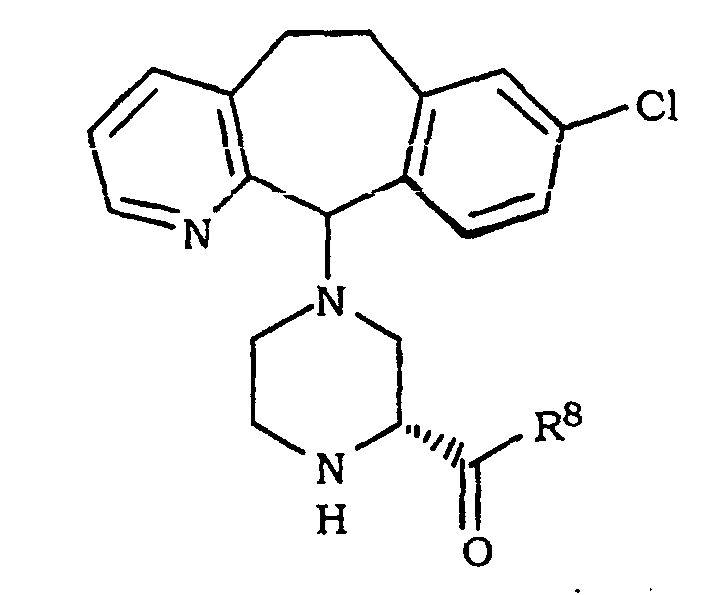

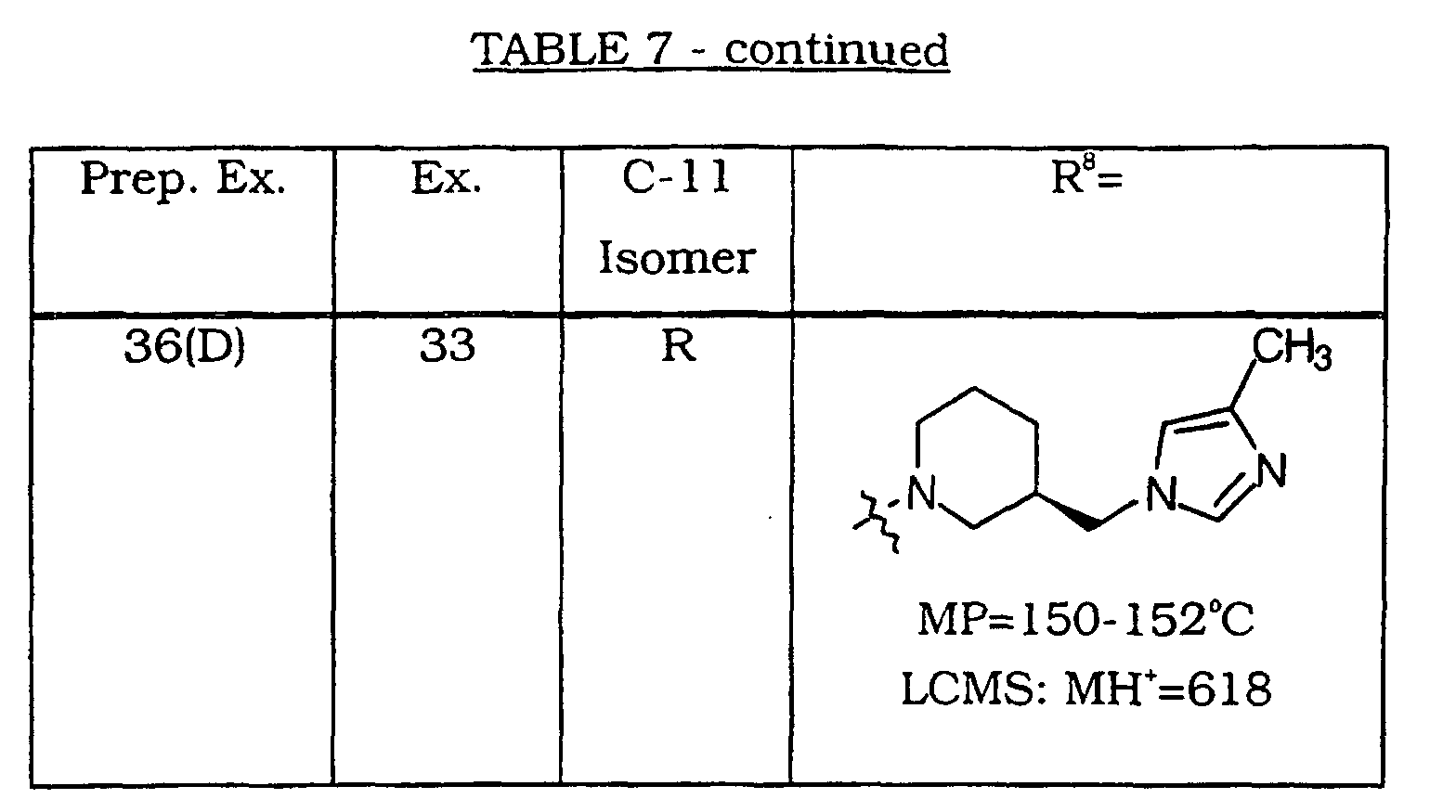
-

- By essentially the same procedure set forth in Example 16 only substituting the title compound from Preparative Example 33, the title compound was prepared. FABMS: MH+=618; mp= 111-140 °C.
- By essentially the same procedure set forth in Example 48 only substituting the title compounds from the Preparative Example listed in column 2 of Table 8, the title compounds of the formula shown below with R8 listed as in column 4 of Table 8 are obtained.
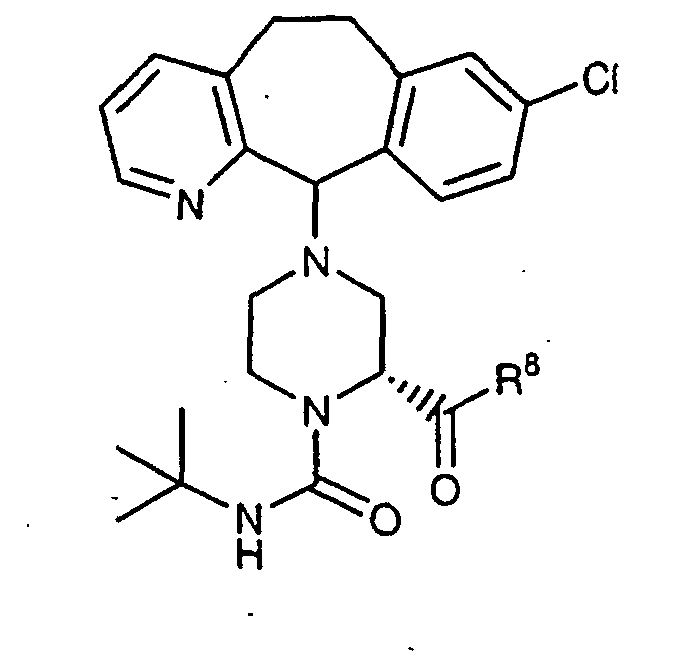
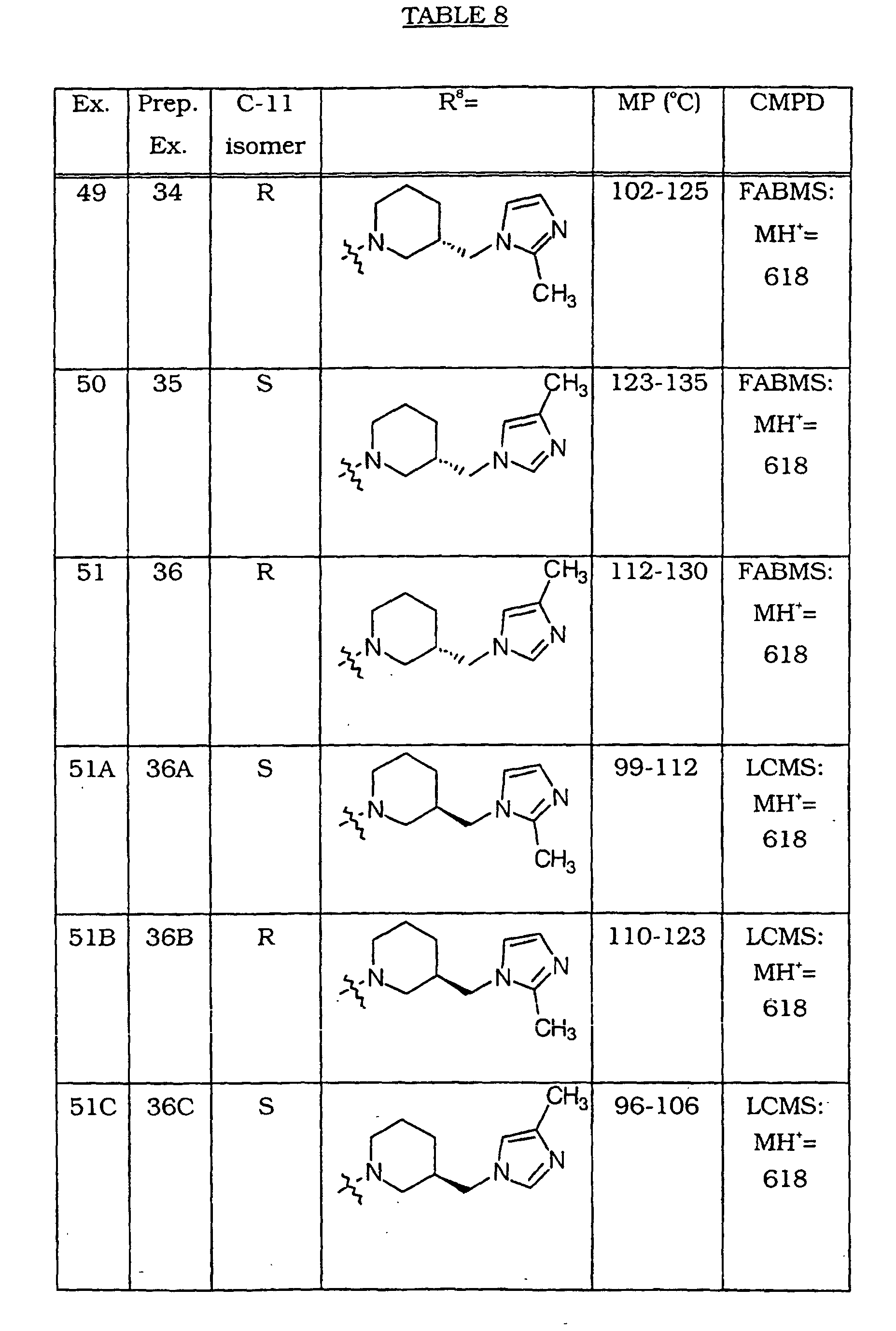

-

- (T.Mori et al Heterocycles 38,5 1033, 1994)
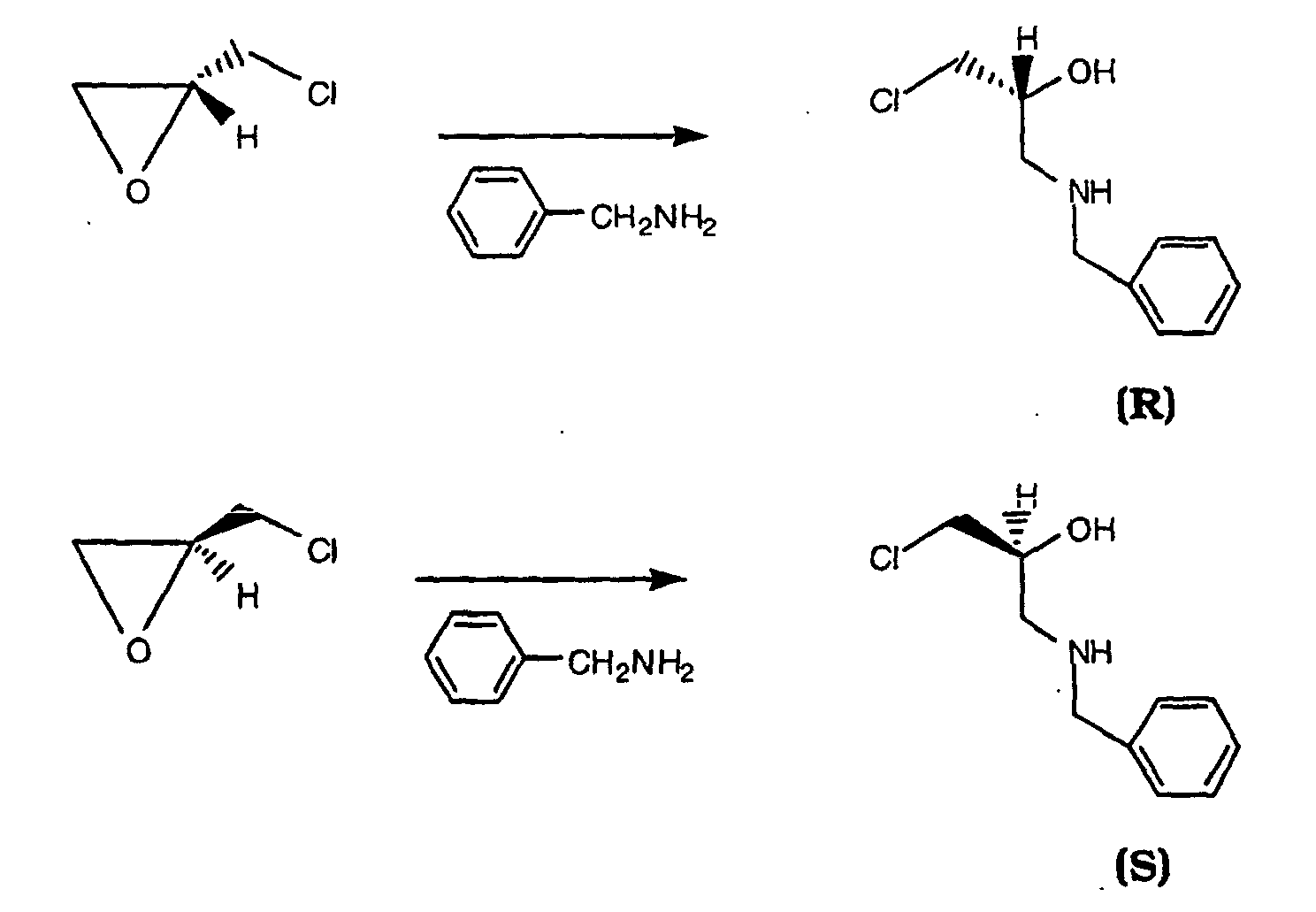
- A mixture of (R)- epichlorohydrin (5g, 54.03 mmoles) and benzylamine (5.8g,54.03 mmoles) in cyclohexane (50 mL) was stirred at room temperature for 16 h. The resulting precipitates were collected to give the title compound (5.4g, 50.09%): δH (DMSO-d6) 2.28 (bs, 1H), 2.43- 2.67 (m, 2H), 3.45-3.85 (m, 5H), 5.13 (bs, 1H), 7.05-7.48 (m, 5H).
- In a similar manner (S) isomer was prepared from (S)-epichlorohydrin in 67% yield.
-

- To a mixture of the title compound from step A above (5.3g, 26.57 mmoles), NaOH (10.62g, 265 mmoles) CHCl3 (50mL) and H2O (20mL) was added dropwise a solution of bromoacetyl bromide (14.98g, 74.25 mmoles) in CHCl3 (15mL) over a period of 1h at 0°C and then at room temperature for 16h. The organic layer was separated and washed successively with water, 1NHCl, and brine. The solvent evaporated to leave the title compound ((R) isomer) (5.43g, 84.4%): FABMS (M+1) =240 ; δH (CDCl3) 3.2-3.33 (m,2H). 3.50 (dd, 1H), 3.51 (dd, 1H), 4.0 (m, 1H), 4.25 (d, 1H), 4.4 (d, 1H), 4.52 (d, 1H), 4.7 (d. 1H), 7.20-7.33 (m, 5H),
- In a similar manner (S) isomer was prepared (67 %). FABMS (M+1) = 240; δH (CDCl3) 3.2-3.33 (m,2H). 3.50 (dd, 1H), 3.51 (dd, 1H), 4.0 (m,1H), 4.25 (d, 1H), 4.4 (d, 1H), 4.52 (d, 1H), 4.7 (d. 1H), 7.20-7.33 (m, 5H).
-
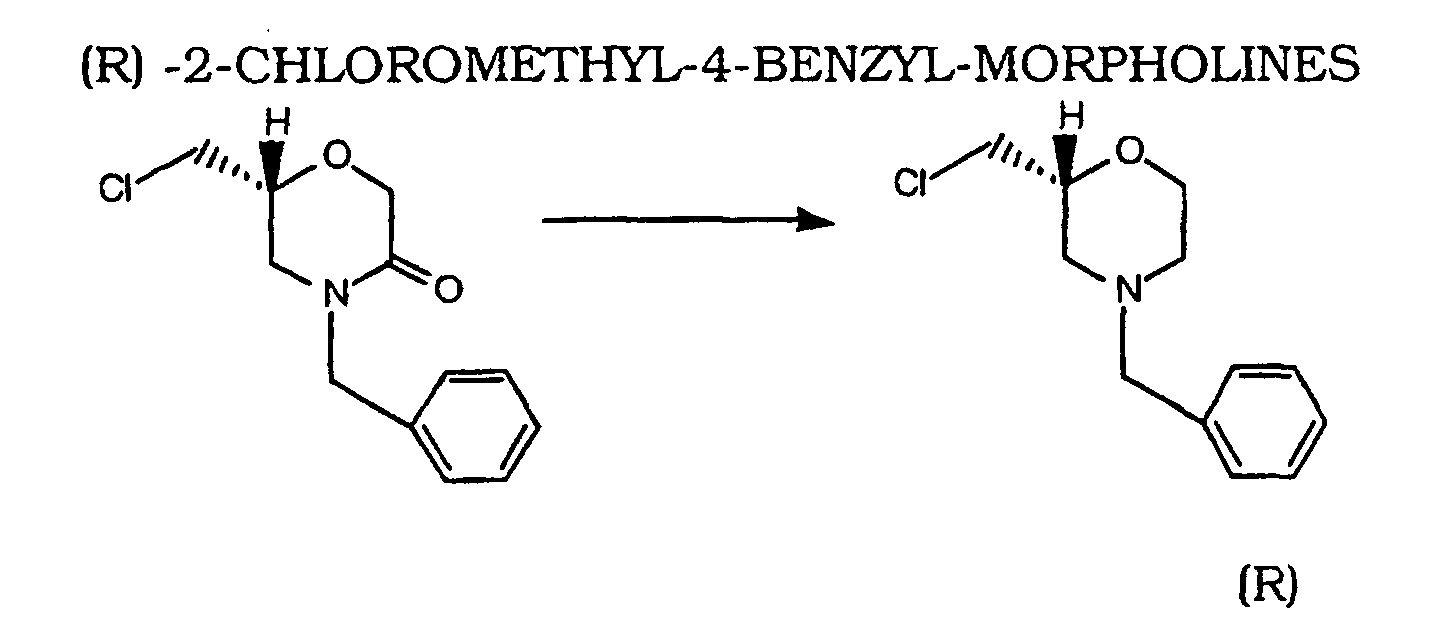
- A solution of the title compound from Step B (5.09g, 21.23 mmoles) in anhydrous THF (55 mL) was added to a stirred 1.0M BH3-THF complex (109 mL) over a period of 0. 5h at -15° C under nitrogen atmosphere. The mixture was stirred at room temperature for 1h, heated to reflux overnight and then cooled to 0° C. After concentrated HCl (75mL) was added to the reaction mixture, THF was evaporated in vacuo. The resulting aqueous solution was basified with 10% NaOH and extracted with CH2Cl2. The extract was successively washed with water and brine, and the CH2Cl2 was evaporated to leave a crude product, which was chromatographed on silica gel with CH2Cl2-2% acetone to give the title compound (3.2 g, 80%). FABMS (M+1)= 226, δH (CDCl3) 2.1 (dd,1H). 2.3 (dd, 1H), 2.72 (m, 1H),2.84 (m,1H), 3.5-3.6 (s, 2H), 3.62- 3.98 (m, 31H), 7.2-7.4 (m, 5H).
-
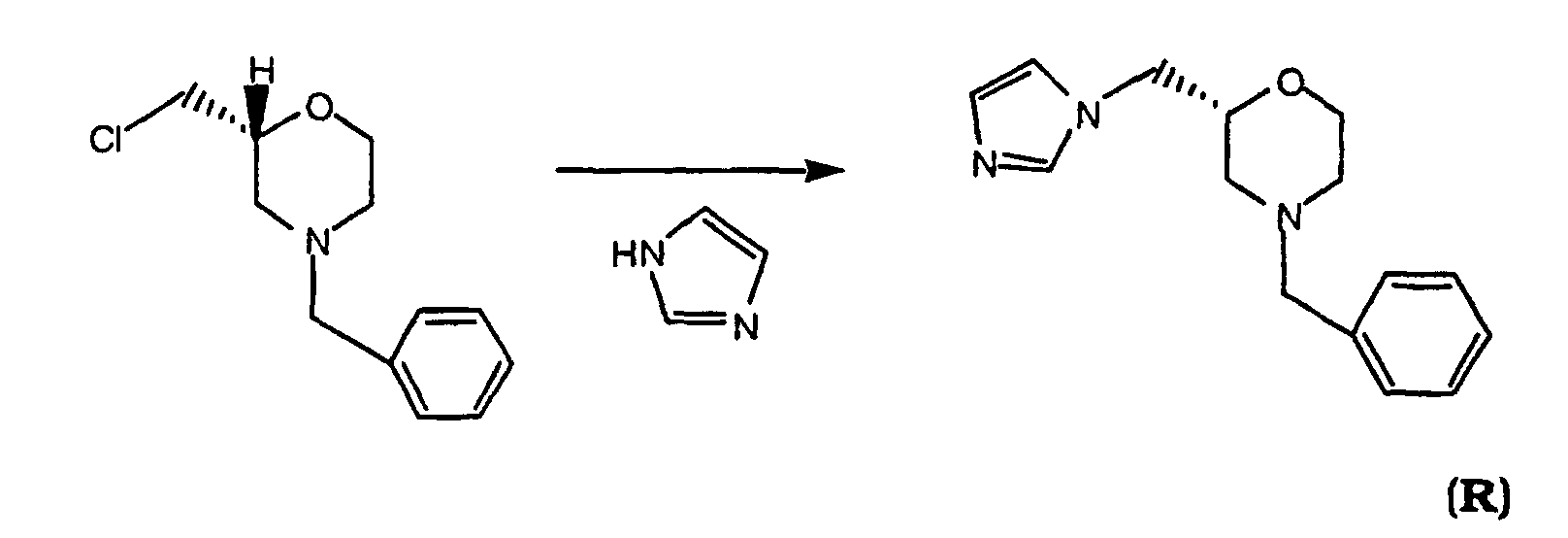
- A solution of the title compound from Step C (3.1g, 13.77 mmoles) in DMF (15 mL) was added to a stirred solution of NaH (1.29g 53.75 mmoles) and imidazole (3.67g, 53.97 mmoles) in DMF (50mL) under nitrogen atmosphere. The mixture was stirred at 60° C for 16h. DMF was evaporated in vacuo. The resulting crude product was extracted with CH2Cl2 and the extract was successively washed with water and brine, and the CH2Cl2 was evaporated to leave a crude product, which was chromatographed on silica gel with CH2Cl2-5 % (10% NH4OH in methanol) to give the title compound (1.65 g, 45%). FABMS (M+1) = 258 (MH+); δH (CDCl3) 1.8 (m, 1H), 2.15 (m, 1H), 2.8 (m, 2H), 3.4-3.8 (m, 7H), 6.9 (S, 1H), 7.02 (S, 1H), 7.3 (m. 5H), 7.5 (S, 1H).
-
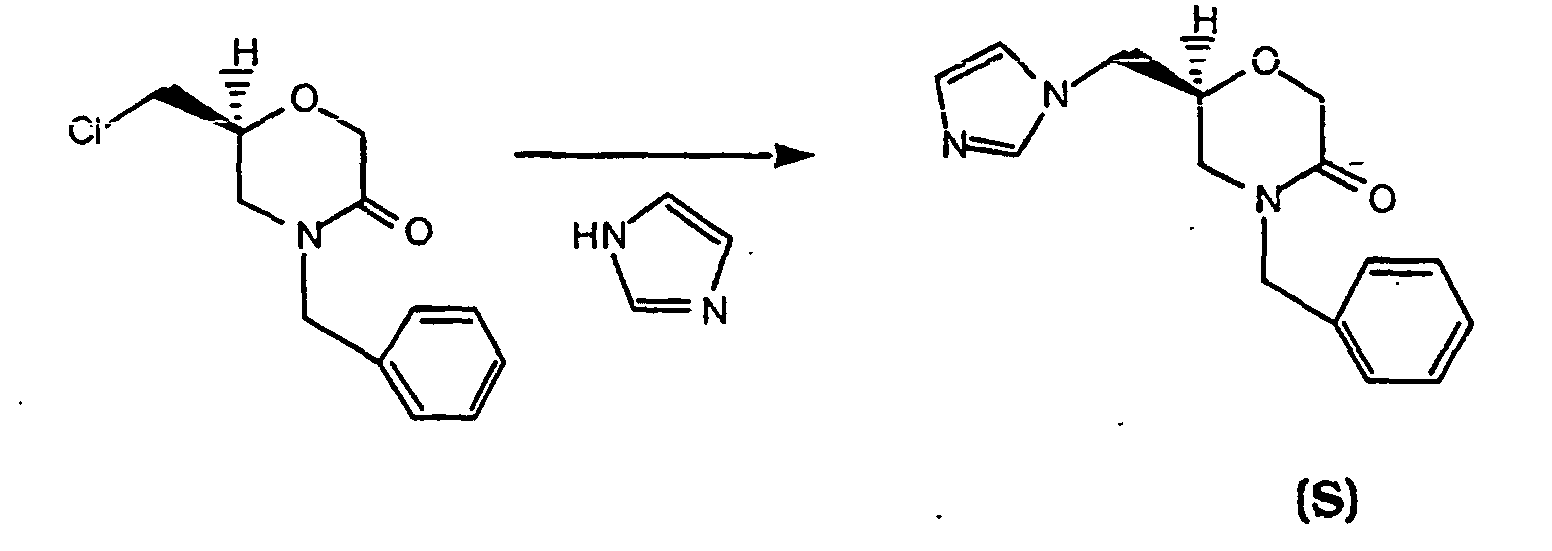
- A solution of the title compound from Step B (2.73g, 11.37 mmoles) in DMF (15 mL) was added to a stirred solution of NaH (1.55g 22.79 mmoles) and imidazole 0.55g, 22.75 mmoles) in DMF (25 mL) under-nitrogen atmosphere. The mixture was stirred at 60° C for 16h. DMF was evaporated in vacuo. The resulting crude product was extracted with CH2Cl2 and the extract was successively washed with water and brine, and the CH2Cl2 was evaporated to leave a crude product, which was chromatographed on silica gel with CH2Cl22-5 % (10% NH4OH in methanol) to give the title compound (0.761 g, 24.7%). FABMS (M+1) = 272 (MH+) ; δH (CDCl3 3.12 (m, 2H), 3.98 -4.71 (m, 7H), 6.98 (S,1H), 7.1 (S, 1H), 7.2- 7.4 (m. 5H), 7.98 (S, 1H).
-

- 1 N LAH in ether (5.5 mL) was added to a stirred solution of the title compound (0.75g, 2.75 mmole) from step E in anhydrous THF (25 mL) dropwise over a period of 0.5h and the resuting mixture was refluxed for 4h. The reaction mixture was slowly decomposed with ice-water and extracted with CH2Cl2. The extract was washed with with water and brine and dried (MgSO4 ), filtered and evaporated to dryness to give the title compound (0.53g, 75%). FABMS (M+1) = 258 δH (CDCl3) 1.8 (m,1H), 2.15 (m, 1H), 2.8 (m, 2H), 3.4-3.8 (m, 7H), 6.9 (S, 1H), 7.02 (S, 1H), 7.3 (m. 5H), 7.5 (S, 1H).
-

- A mixture of the title compound(1.6g) from Step D and Pd(OH)2 on carbon (0.32g) in EtOH (20 mL) was stirred at 50 psi under an atmosphere of hydrogen for 24h. The catalyst was filtered to give the title compound (1.03g, 99.9%). FABMS (M+1) = 168 ; δH (CDCl3) 2.4- 2.5 (m, 1H), 2.8 (m, 3H), 3.5 - 3.9 (m, 5H), 6.9 (S,1H), 7.02 (S, 1H), 7.45 (S, 1H).
- In a similar manner (S) isomer was prepared from (0.5g) and Pd(OH)2 on carbon (0.2g) in 99% yield. FABMS (M+1) = 168 ; δH (CDCl3) 2.4- 2.5 (m, 1H), 2.8 (m, 3H), 3.5 - 3.9 (m, 5H), 6.9 (S, 1H), 7.02 (S, 1H), 7.45 (S, 1H).
-
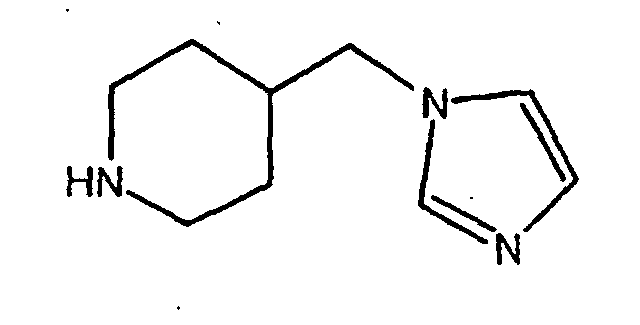
-

- To a solution of 4-hydroxymethyl-piperidine (5g, 43.41 mmoles) and triethylamine (8.78g, 86.82 mmoles) in CH2Cl2 (100mL), di-tert-butyldicarbonate (18.95g, 86.82 mmoles) was added and stirred at room temperature for 16h. The solution was diluted with CH2Cl2 and washed with water, dried(MgSO4) filtered and evaporated to give the title compound (9.04g, 99%). FABMS (M+1) = 216 .
-

- The title compound from Step A above (8.8g, 40.87 mmoles) and triethylamine (8.55 mL, 61.31 mmoles) were dissolved in CH2Cl2 (100 mL) and the mixture was stirred under nitrogen at 0°C. Methanesulfonylchloride (3.8 mL mL, 49.05 mmoles) was added and the solution was stirred at room temperature for 2h. The solution was diluted with CH2Cl2 and washed with saturated aqueous sodium bicarbonate, water and dried (MgSO4), filtered and evaporated to dryness to give the title compound (12.8g) FABMS (M+1) = 294.3.
-

- A solution of the title compound from Step B (1.0g, 3.408 mmoles) in DMF (15 mL) was added to a stirred solution of NaH (0.27g, 6.817 mmoles) and imidazole (0.464g, 6.817 mmoles) in DMF (15 mL) under nitrogen atmosphere. The mixture was stirred at 60° C for 16h. DMF was evaporated in vacuo. The resulting crude product was extracted with CH2Cl2 and the extract was successively washed with water and brine, and the CH2Cl2 was evaporated to leave the title residue which was chromatographed on silica gel using 3% (10% conc NH4OH in methanol)- CH2Cl2 as eluant to give the title compound (0.823 g). FABMS (M+1) = 266.2, δH (CDCl3 ) 0.8-1.0 (m, 2H), 1.2 (s, 9H), 1.2- 1.4 (m, 1H), 1.65 (m, 1H), 2.4 (dt, 2H), 3.6 (d, 2H), 4.8 ( d, 2H), 6.7 (s, 1H), 6.8 (s, 1H), 7.2 (s, 1H).
-

- The title compound(0.187g, 0.705 mmoles) from Step C was stirred in 4N HCl in dioxane (20 mL) for 2h and then evaporated to dryness to give the title compound which was used to couple with the tricyclic acid.
-

-

- 3(R)-(3-Methanesulfonyloxymethyl)pyrrolidine (J. Med. Chem. 1990, 33, 77-77) (0.993g, 3.56 mmoles) was dissolved in anhydrous DMF (25 mL) and sodium imidazole (0.6g, 10 mmoles) was added. The mixture was heated at 60° C for 2h and then evaporated to dryness. The product was extracted with CH2Cl2 and washed with brine. CH2Cl2 extract was evaporated to dryness to give the titled compound (1.1409g, 100%), ESMS: FABMS (M+1) = 252; δH (CDCl3) 1.45 (s, 9H), 1.5-1.7 (m, 1H), 1.9 - 2.1 (m, 1H), 2.5-2.7 (m, 1H), 3.0-3.2 (m, 1H), 3.3- 3.6 (m, 2H), 3.9 (dd, 2H), 6.9 (s, 1H), 7.1(s, 1H), 7.45 (s, 1H)
- In a similar manner, (S) isomer was prepared from 3(S)-(3-Methanesulfonyloxymethyl)pyrrolidine (0.993g, 3.56 mmoles to give the title compound (1.1409g, 100%).
-

- The title compound(0.48g, 1.91 mmoles) from Step A was stirred in 4N HCl in dioxane (10 mL) for 2h and then evaporated to dryness to give the title compound which was used to couple with the tricylic acid.
- In a similar manner (S) isomer was prepared.
-
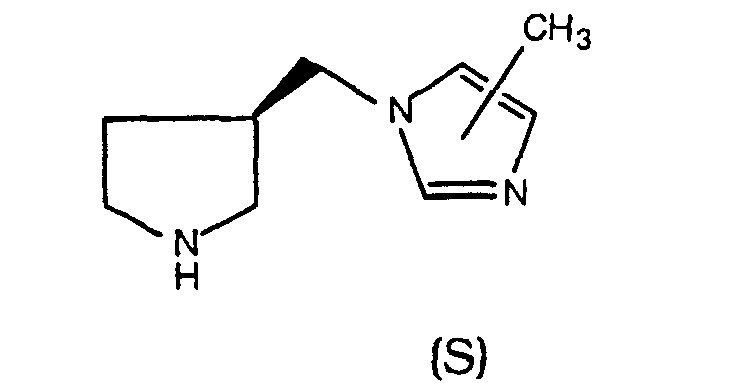
-
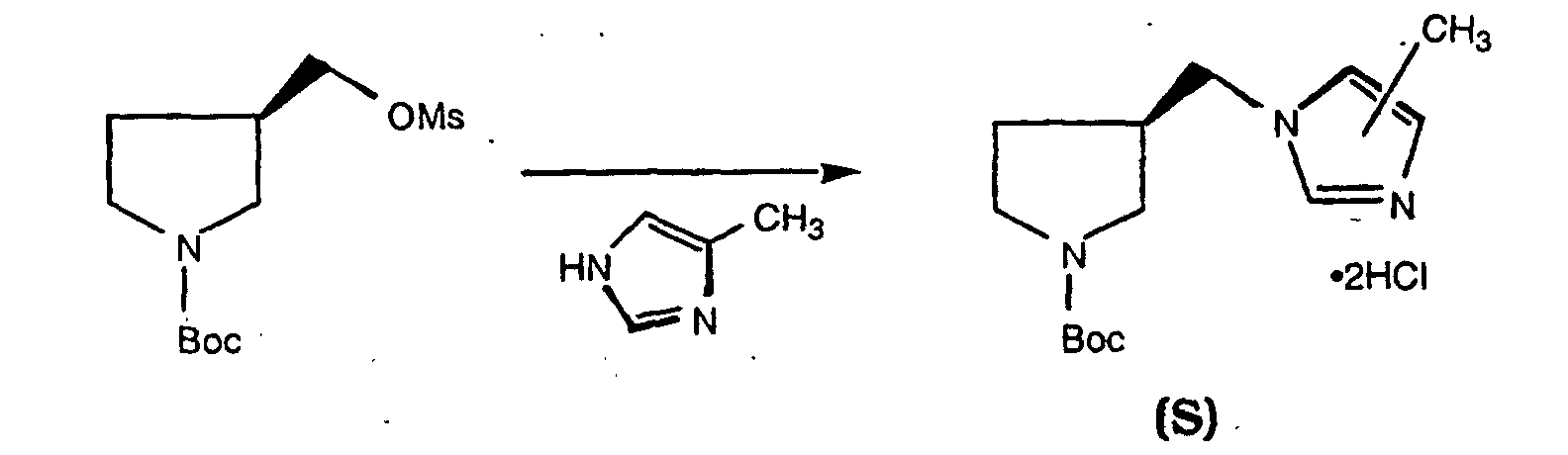
- 3(S)-(3-Methanesulfonyloxymethyl)pyrrolidine (1.05g, 3.77 mmoles) was dissolved in anhydrous DMF (25 mL) and sodium 4-methylimidazole (0.74g, 10 mmoles) was added. The mixture was heated at 60° C for 2h and then evaporated to dryness. The product was extracted with CH2Cl2 and washed with brine. CH2Cl2was evaporated to dryness to give the titled compound (0.92g, 100%), FABMS (M+1) = 266.
-
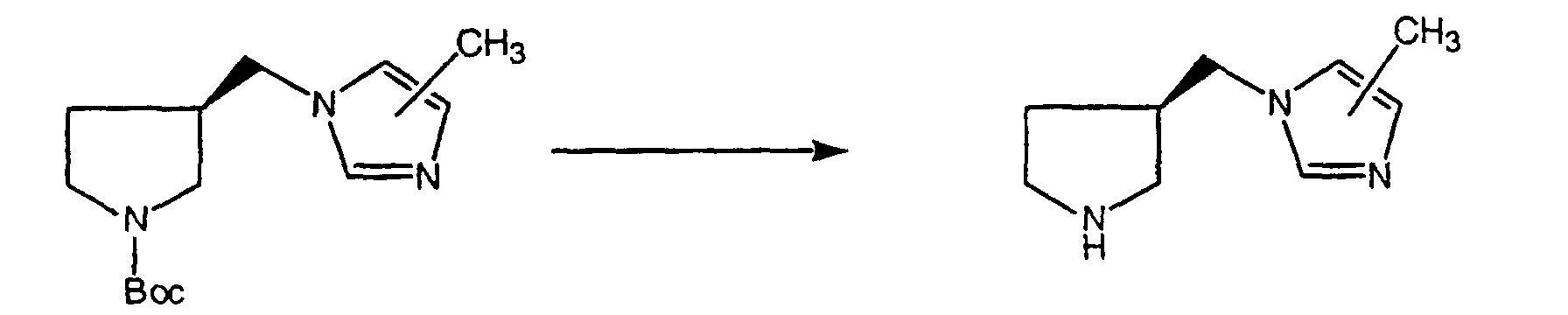
- The title compound(0.31g, 1.17 mmoles) from Step A was stirred in 4N HCl in dioxane (10 mL) for 2h and then evaporated to dryness to give the title compound which was used to couple with the tricylic acid.
-
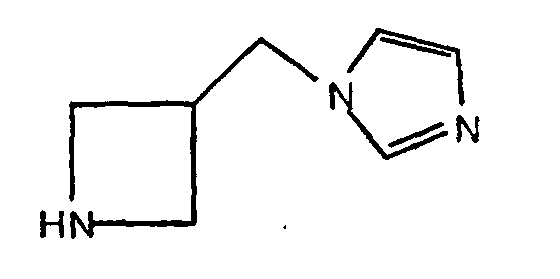
-
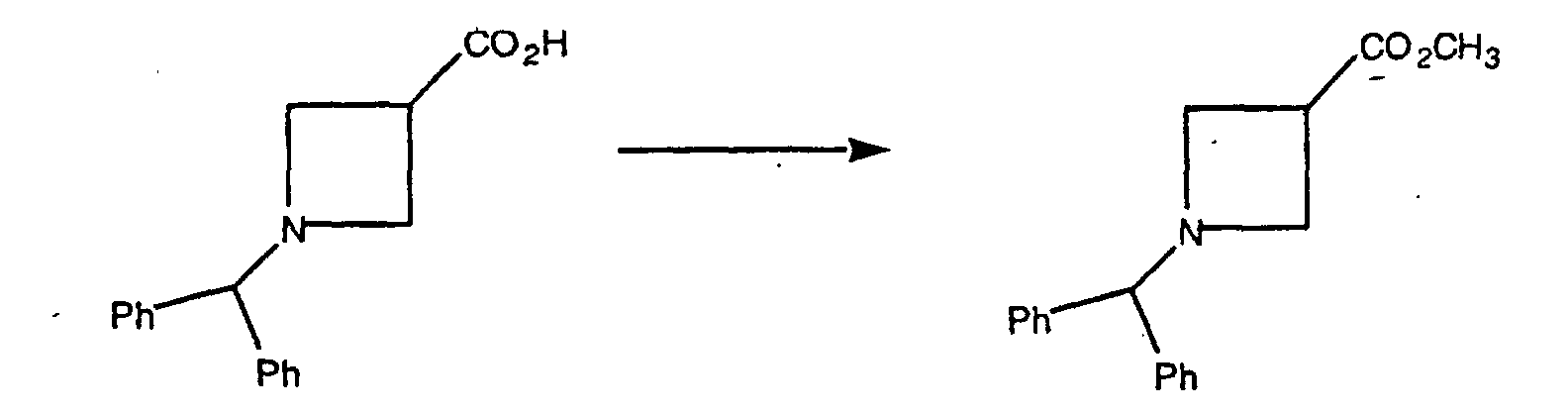
- 1N-Diphenylmethyl-azetidine-3-carboxylic acid (J. Chem. Res. 1996, 430) (5.38g, 20.16 mmoles) was refluxed with conc,H2SO4 (2mL) and MgSO4 (5g) in anhydrous methanol (25 mL) for 16h. Evaporated to dryness and the residue was extracted with ethylacetate and washed the extract with 10% sodiumbicarbonate and water. Ethylacetate was evaporated to give a residue which was chromatographed on silica gel using hexane-10% ethylacetate as the eluant afforded the title compound (2.2g, 40.64%), FABMS (M+1) = 282; δH (CDCl3) 3.2- 3.6 (m, 5H), 3.7 (s, 3H), 4.45 (s, 1H), 7.2 - 7.4 (m, 10H).
-
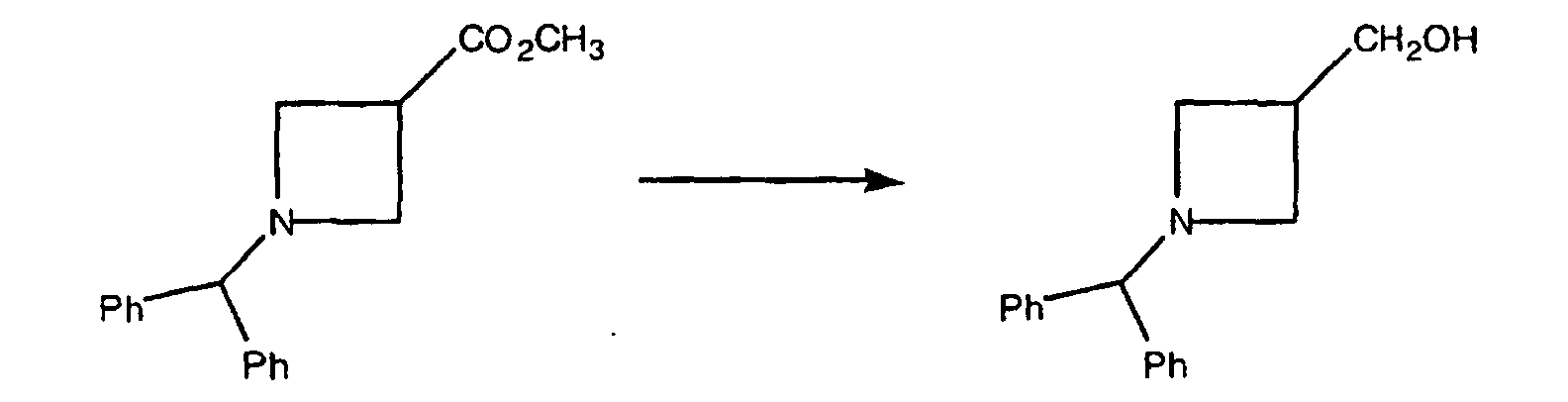
- 1 N LAH in ether (20 mL) was added to a stirred solution of the title compound (2g, 7.11 mmole) from Step A in anhydrous ether (25 mL) dropwise over a period of 0.5h and the resuting mixture was refluxed for 4h. The reaction mixture was slowly decomposed with ice-water and extracted with ethylacetate. The extract was washed with with water and brine and dried (MgSO4), filtered and evaporated to dryness to give title compound (1.72g, 98%). FABMS (M+1) = 254 .
-

- The title compound from Step B above (1.7g, 6.72 mmoles) and triethylamine (1.1g, 10.87 mmoles) were dissolved in CH2Cl2 (20 mL) and the mixture was stirred under nitrogen at 0°C . Methanesulfonylchloride (1.1g, 9.6 mmoles) was added and the solution was stirred at room temperature for 2h. The solution was diluted with CH2Cl2 and washed with saturated aqueous sodium bicarbonate, water and dried (MgSO4), filtered and evaporated to dryness to give the title compound (2.32g, 99%). FABMS (M+1) = 332.
-

- A solution of the title compound from Step C (2.3g, 6.95 mmoles) in DMF (15 mL) was added to a stirred solution of NaH (0.25g, 10.42 mmoles) and imidazole (0.71g, 10.44 mmoles) in DMF (10 mL) under nitrogen atmosphere. The mixture was stirred at 60° C for 16h. DMF was evaporated in vacuo. The resulting crude product was extracted with CH2Cl2 and the extract was successively washed with water and brine, and the CH2Cl2 was evaporated to leave the title compound (2.1 g, 100%). FABMS (M+1) = 304
-
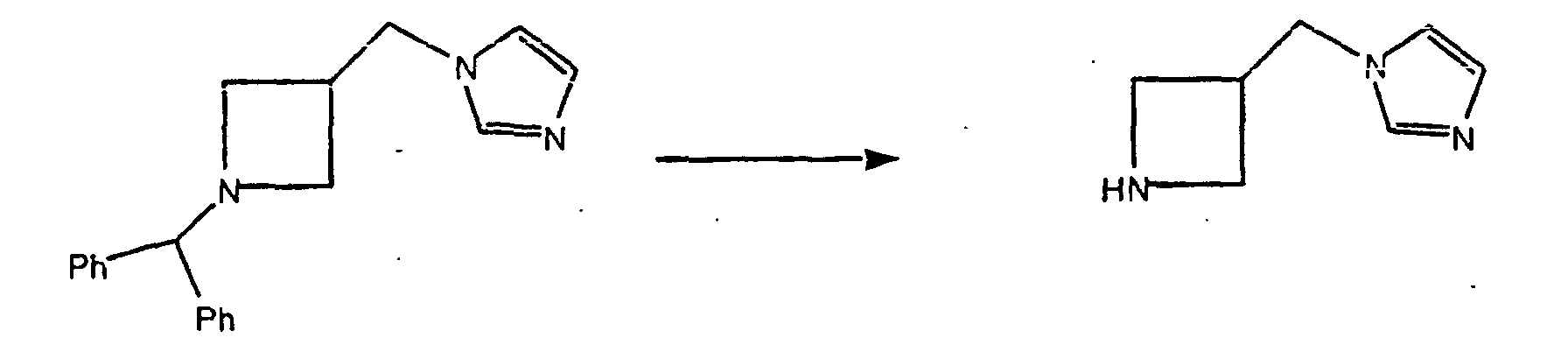
- A mixture of the title compound(1.7g) from Step D and Pd(OH)2 on carbon (0.2g) in EtOH (20 mL) was stirred at 50 psi under an atmosphere of hydrogen for 24h. The catalyst was filtered to give the title compound (0.508g, 66.8%). m/z =137 (MH+)
-

-

- To a solution of 4-hydroxy-piperidine (2g, 19.78 mmoles) and triethylamine (4.16 mL, 29.67 mmoles) in CH2Cl2 (20mL), di-tert-butyldicarbonate (5.18g, 23.72 mmoles) was added and stirred at room temperature for 16h. The solution was diluted with CH2Cl2 and washed with water, dried(MgSO4) filtered and evaporated to give the title compound (3.95g, 99%). FABMS (M+1) = 202.
-

- The title compound from Step A above (3.5g, 17.39 mmoles) and triethylamine (4.85mL, 34.79 mmoles) were dissolved in CH2Cl2 (30 mL) and the mixture was stirred under nitrogen at 0°C. Methanesulfonylchloride (1.62 mL, 20.88 mmoles) was added and the solution was stirred at room temperature for 2h. The solution was diluted with CH2Cl2 and washed with saturated aqueous sodium bicarbonate, water and dried (MgSO4), filtered and evaporated to dryness to give the title compound (4.68g , 96.4 %). ESMS: m/z= 280 (MH+)
-

- A solution of the title compound from Step B (4.0g, 14.32 mmoles) in DMF (120 mL) was added to a stirred solution of NaH (0.52g, 21.66 mmoles) and imidazole (1.46g, 21.47 mmoles) in DMF (20 mL) under nitrogen atmosphere. The mixture was stirred at 60° C for 16h. DMF was evaporated in vacuo. The resulting crude product was extracted with CH2Cl2 and the extract was successively washed with water and brine, and the CH2Cl2 was evaporated to leave the title residue which was chromatographed on silica gel using 3% (10% conc NH4OH in methanol)- CH2Cl2 as eluant to give the title compound (0.94 g, 26%). FABMS (M+1) = 252; δH (CDCl3) 1.4 (s, 9H), 1.6-1.8 (m, 2H), 2.0 (dd, 2H), 2.8 (dt, 2H), 4.05 (m, 1H), 4.2 m, 2H), 6.9 (s, 1H), 7.0 (s, 1H), 7.65 (s, 1H).
-

- The title compound(0.21g, 0.836 mmoles) from Step C was stirred in 4N HCl in dioxane (5 mL) for 2h and then evaporated to dryness to give the title compound which was used to couple with the tricylic acid.
-
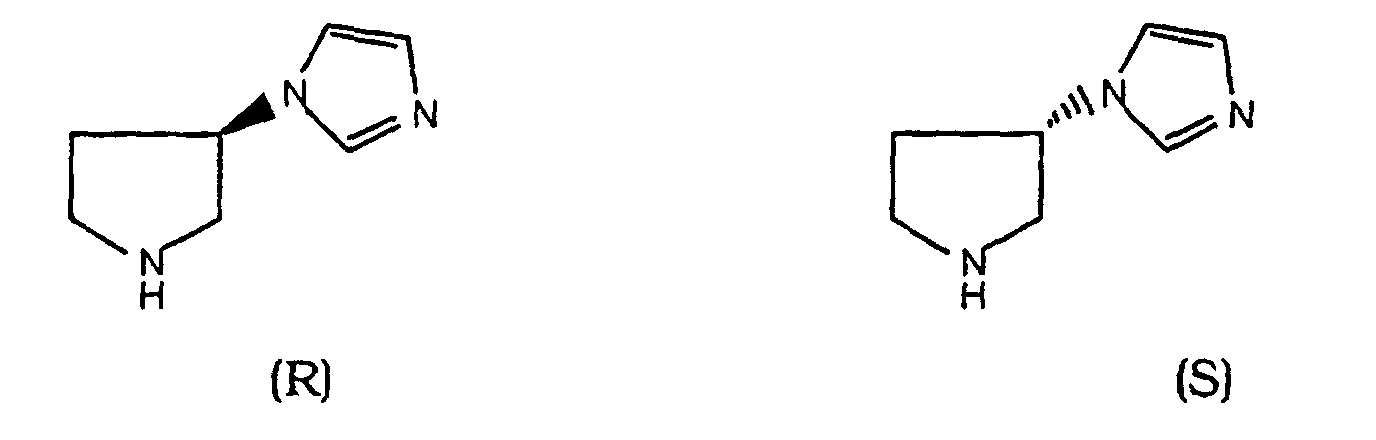
-
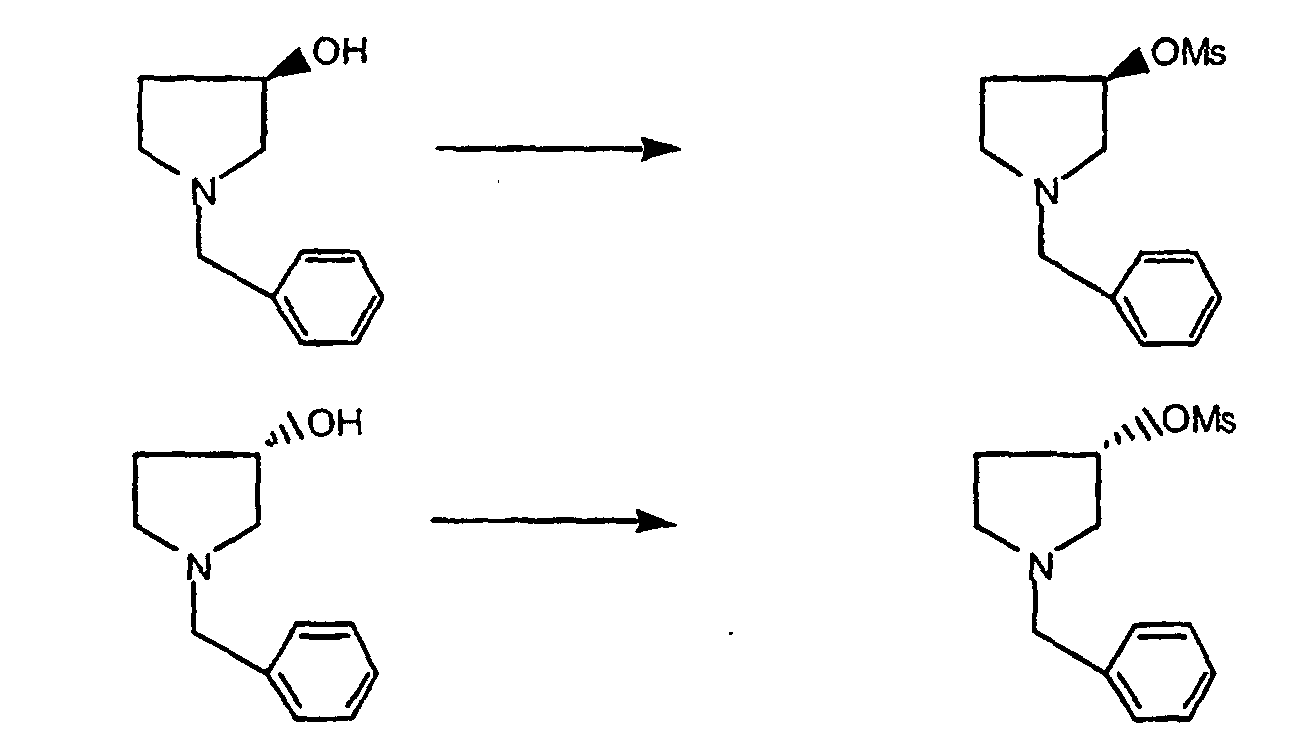
- 1N-Benzyl-3(R) -hydroxy -pyrrolidines (5g, 28.21 mmoles) and triethylamine (7.86 mL, 56.35 mmoles) were dissolved in CH2Cl2 (50 mL) and the mixture was stirred under nitrogen at 0°C . Methanesulfonylchloride (2.62 mL, 33.87 mmoles) was added and the solution was stirred at room temperature for 2h. The solution was diluted with CH2Cl2 and washed with saturated aqueous sodium bicarbonate, water and dried (MgSO4), filtered and evaporated to dryness to give the title compound (7.2g, 96.4 %). FABMS (M+1) = 256; δH (CDCl3 ) 2.2 (m, 1H), 2.3 (m, 1H), 2.52 (m, 1H), 2.7-2.85 (m, 3H), 2.95 (s, 3H), 3.65 (q, 2H), 5.16 (m, 1H), 7.3 (s, 5H).
- In a similar way (S) isomer was prepared from 1N-Benzyl-3(S)-hydroxy-pyrrolidines (5g, 28.21 mmoles) to give the title compound (7.15g, 98%)
-

- A solution of the title compound from Step A (2.0g, 7.84 mmoles) was added to a stirred solution imidazole (1.1g, 16.17 mmoles) in DMF (25 mL) under nitrogen atmosphere. The mixture was stirred at 60° C for 16h. DMF was evaporated in vacuo..The resulting crude product was extracted with CH2Cl2 and the extract was successively washed with water and brine, and the CH2Cl2 was evaporated to leave the title residue which was chromatographed on silica gel using 3% (10% conc NH4OH in methanol)- CH2Cl2 as eluant to give the title compound (0.95 g, 50.56%). FABMS (M+1) = 228.
- In a similar fashion the other isomer was prepared.
-
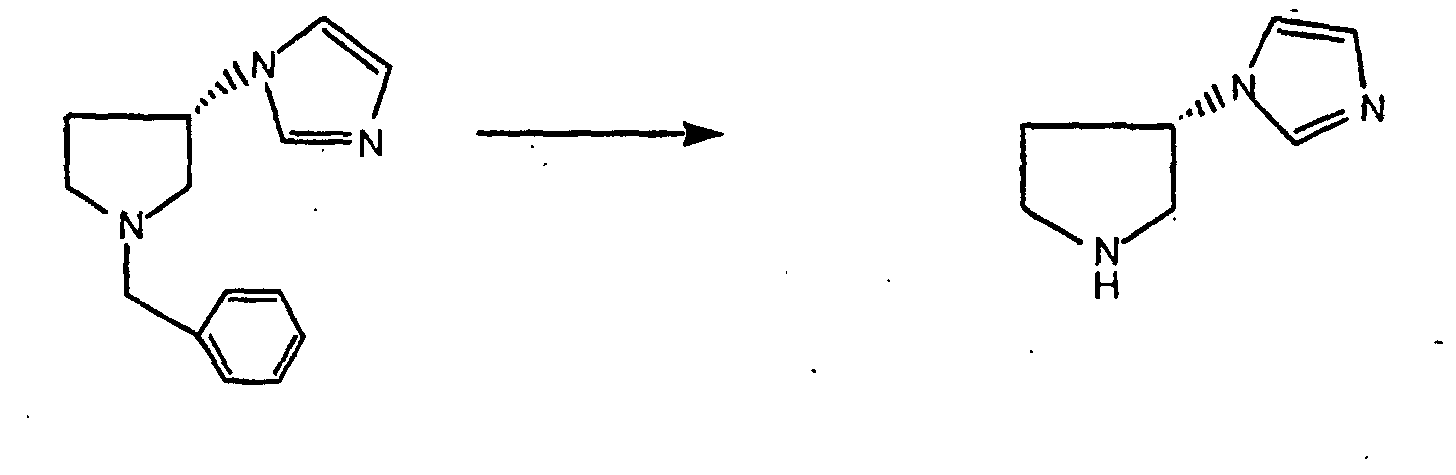
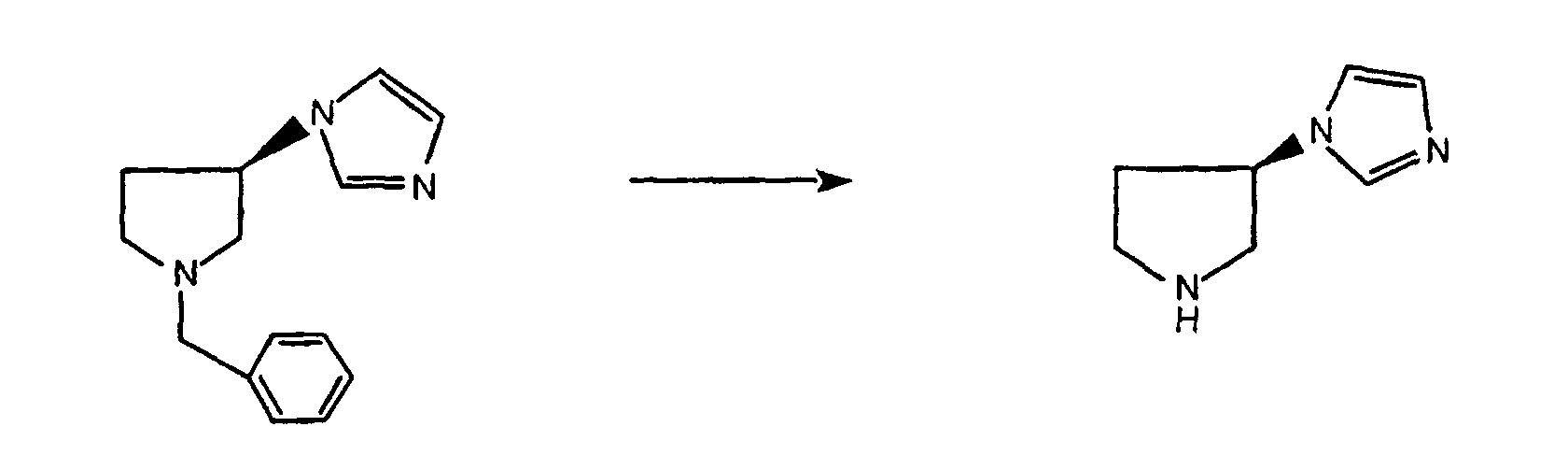
- A mixture of the title compound(0.95 g) from Step B and 10% Pd on carbon (0.5 g) in EtOH (20 mL) was stirred at 50 psi under an atmosphere of hydrogen for 24h. The catalyst was filtered to give the title compound (0.522 g, 99.9%) which was used to couple with the tricylic acid.
- In a similar manner (R) isomer was prepared from (1.0 g) and 10% Pd on carbon on carbon (0.6 g) in 99% yield.
-
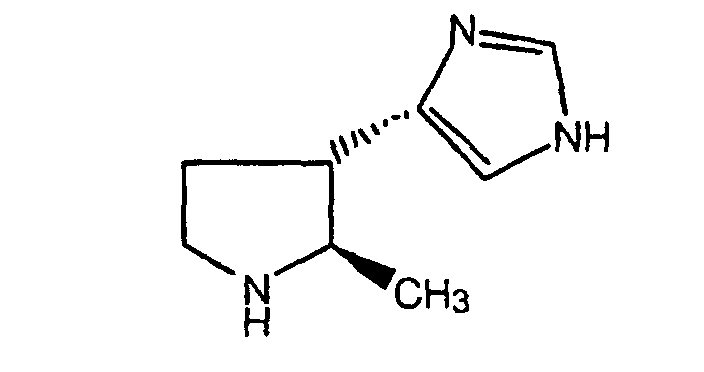
- This compound was prepared according to the procedure in J. Med. Chem. 1995, 1593-1599.
-
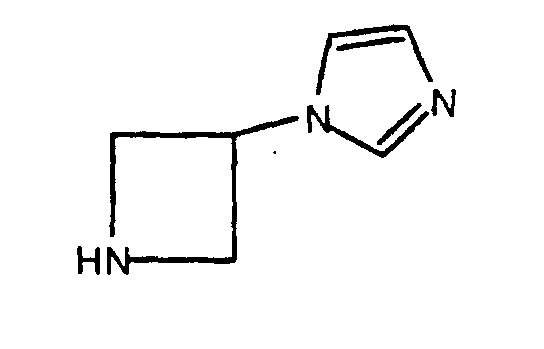
-

- 1N-Diphenylmethyl-3-methanesulfonyloxy-azetidine (J. Che. Res. 1996, 430) (10.0g, 29.26 mmoles) was added to a stirred solution imidazole (5.96g, 87.78 mmoles) in DMF (100 mL) under nitrogen atmosphere. The mixture was stirred at 60° C for 16h. DMF was evaporated in vacuo. The resulting crude product was extracted with CH2Cl2 and the extract was successively washed with water and brine, and the CH2Cl2 was evaporated to leave the title residue which was chromatographed on silica gel using 4 % (10% conc NH4OH in methanol)- CH2Cl2 as eluent to give the title compound (2.87 g, 33.9 %). FABMS (M+1) = 290; δH (CDCl3 ) 3.3 (dd, 2H), 3.65 (dt, 2H), 4.45 (s, 1H), 4.8 (m, 1H), 7.1-7.5 (m, 12H), 7.8 (s, 1H).
-
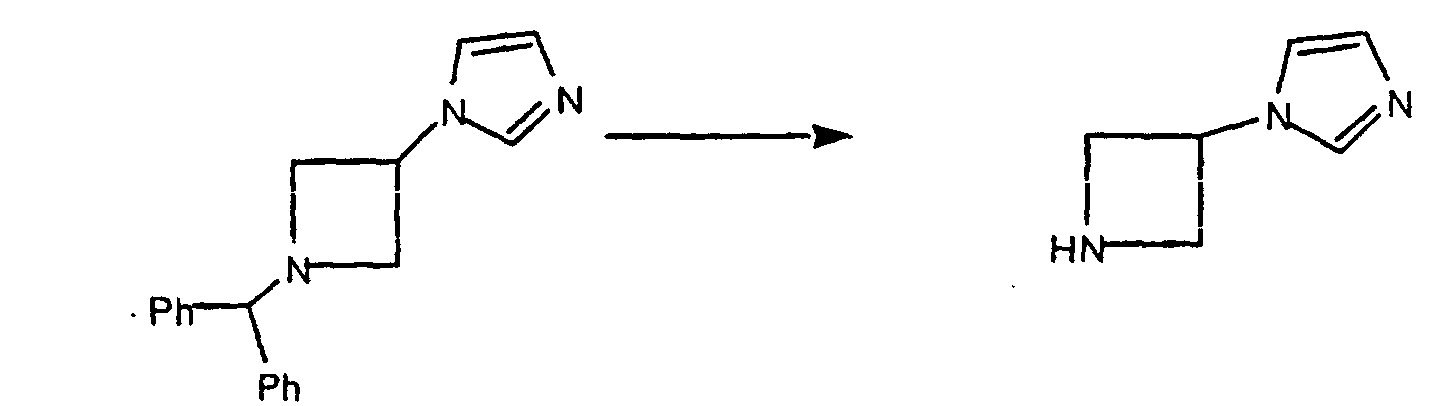
- A mixture of the title compound(2.8g) from Step A and 10% Pd on carbon (1.1g) in MeOH (25 mL) was stirred at 50 psi under an atmosphere of hydrogen for 24h. The catalyst was filtered to give the title compound (1.05 g, 99.9%) which was used to couple with the tricylic acid.
-
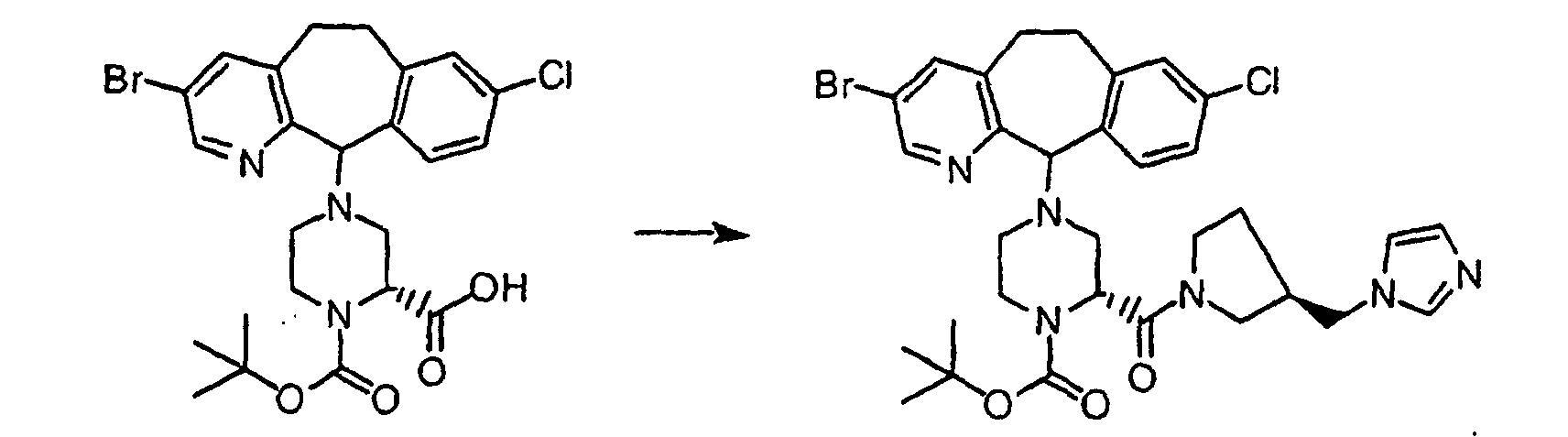
- 4-(3-bromo-8-chloro-6,1 1-dihydro-5H-benzo[5,6]cyclohepta[1,2-b]pyridin-11-yl)-1-[(1,1-dimethylethoxy)carbonyl]-2(R)-piperazinecarboxylic acid (2g, 3.8 mmoles.) was added to a solution of the title compound from Preprative Example 50 (1.1g, 4.7 mmol), DEC (1.8g, 9.4 mmoles.), HOBT (1.28, 9.48 mmoles.) and NMM (2.6 mL, 23.7 mmoles.) in DMF (100 mL). The resulting solution was stirred at room temperature 24 hours. The reaction mixture was diluted with H2O until precipitation ceased and the slurry filtered. The precipitate was diluted with CH2Cl2 ,washed with brine,dried over Na2SO4 and concentrated. The crude product was purified by flash chromatography using a 5% (10%NH4OH in MeOH) solution in CH2Cl2 as eluent to give the title compound (1.48g, 55 % yield).FABMS (M+1)= 669.
- The title compound from Example 1 was separated into individual 11-(R)- and 11-(S)- isomers by Preparative HPLC with a CHIRALPAK AD column using a 15% iPrOH in hexane solution with 0.2% DEA as eluant.
-

- Isomer A: retention time (analytical) = 8.885 minutes; [α]D = -13.1 (3.06 mg in 2.0 mL MeOH); FABMS (M+1)= 669.
-
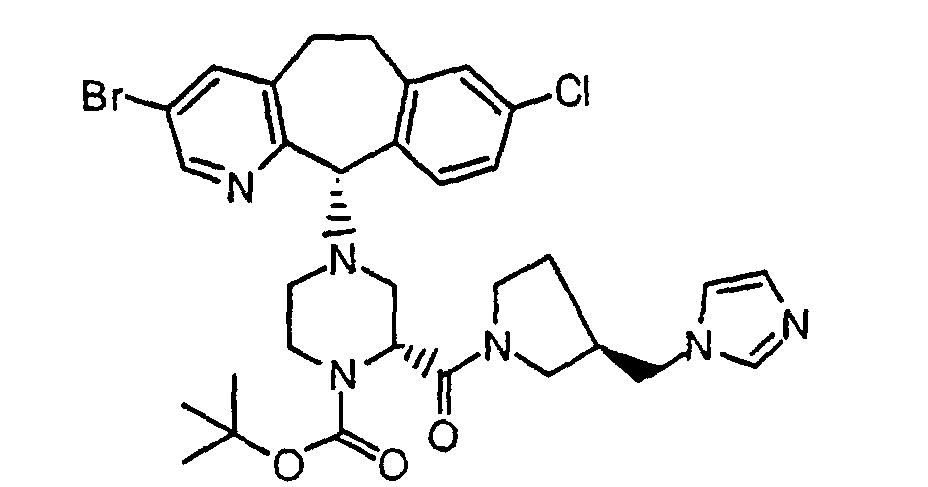
- Isomer B: retention time (analytical) = 8.885 minutes; [α]D = + 12.1 ( 2.32 mg in 2.0 mL MeOH) ; FABMS (M+1)= 669.
- By essentially the same procedure set forth in Example 1 only substituting the appropriate amines, one can obtain compounds of the formula shown below wherein R8 is defined in Table 9 below.
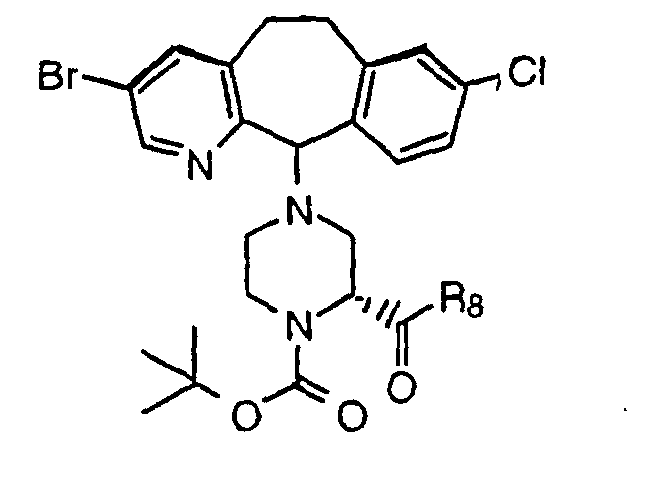

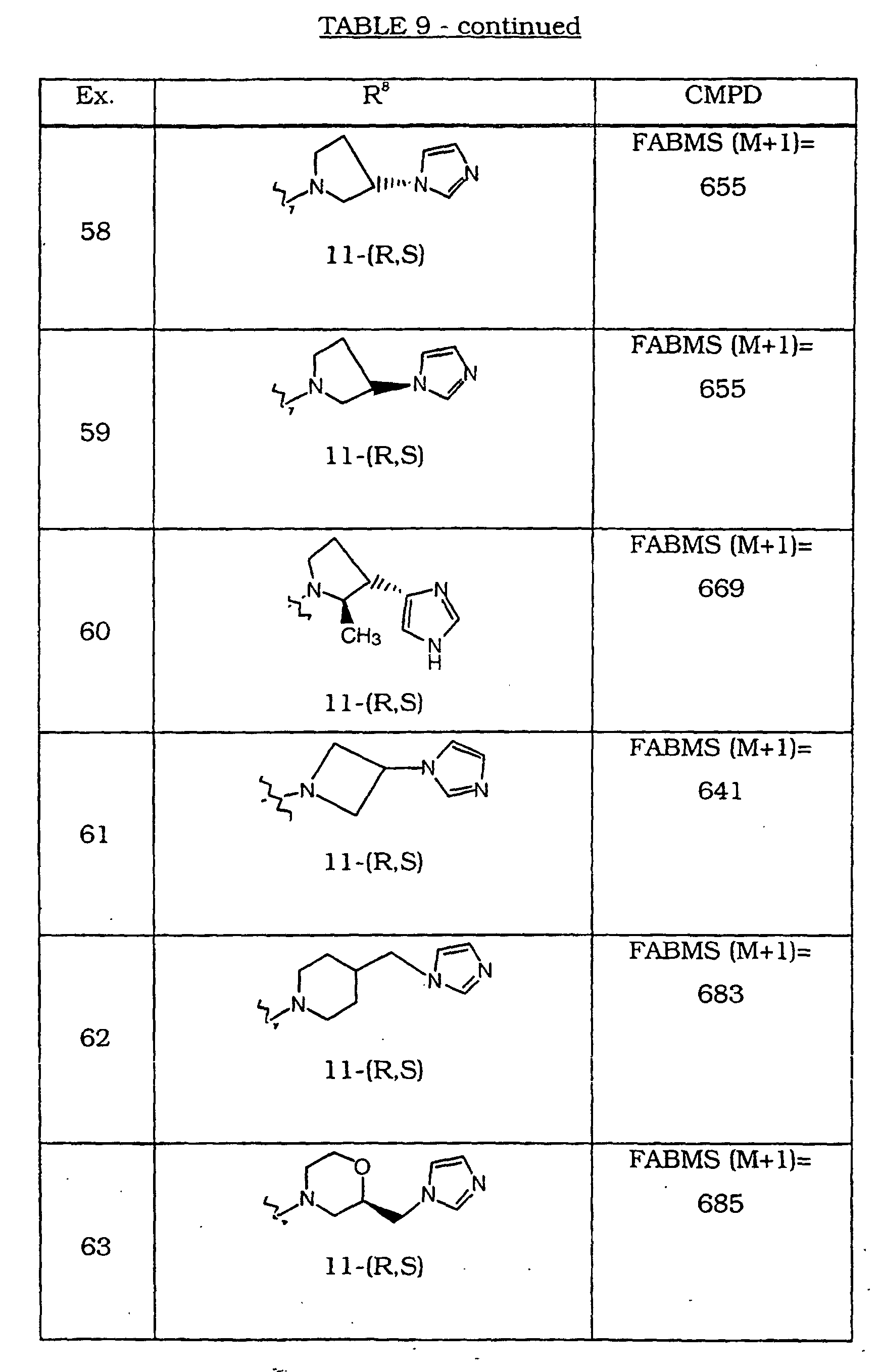

-
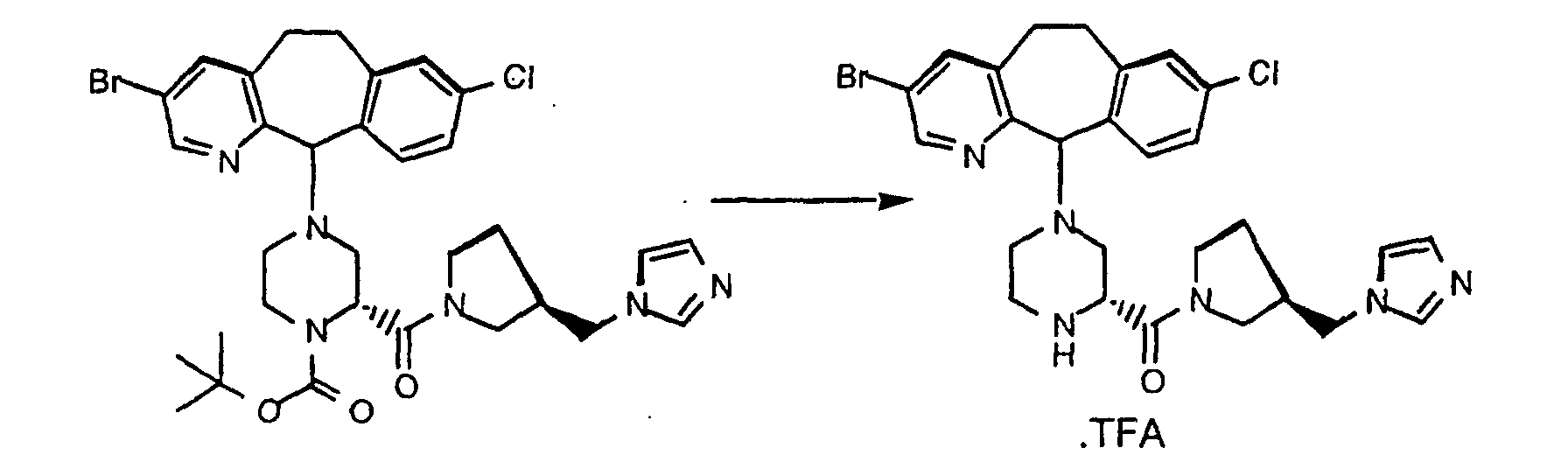
- The title compound from Example 54 (0.1g, 0.15 mmoles) was stirred at room temperature in CH2Cl2 (20 mL) and TFA (1 mL) for 2h. The reaction mixture was evaporated to dryness to give the title compound which was used as such in Step B below.
-
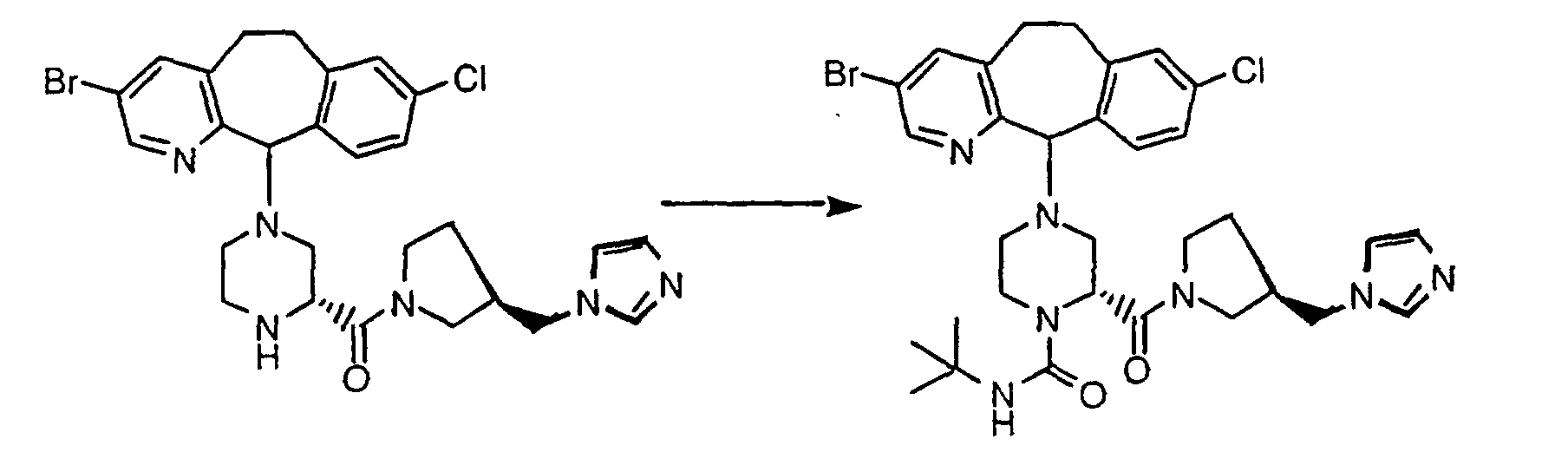
- The title compound from Step A ( 0.186g, 0.182 mmoles ) dissilved in CH2Cl2 (20 mL) and triethyl amine (0.063 g, 0.621 mmoles) and t-butylisocyanate (0.0185g, 0.187 mmoles ) was added. The resulting solution was stirred at room temperature for 2 h, diluted with water and extracted with CH2Cl2. CH2Cl2extract was dried (MgSO4) and filtered and concentrated in CH2Cl2as eluant to give the title compound (0.084g ) FABMS (M+1)= 668.
- By essentially the same procedure set forth in Example 1 only substituting with different isocyanates, one can obtain compounds of the formula shown below wherein R9 is as defined in Table 10 below.


-
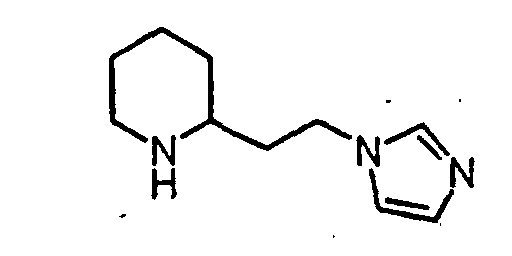
-

- 2(R/S)-(2-Hydroxyethyl)piperidine (5g, 38.7mmoles) and sodium hydroxide (1.55g, 67.4mmoles) were dissolved in THF-water (1:1) (100mL) and di-tert-butyldicarbonate (9.29g, 42.6mmoles) was added and the mixture was stirred at 25°C for 120h. The solution was treated with BioRad 50W-X4 (RSO3H) resin (42mL) and filtered. The resin was washed with water and THF and the combined filtrates were evaporated to dryness. Chromatography on silica gel using 1% (10% conc. NH4OH in methanol)-dichloromethane as the eluant afforded the title compound (8.87g, 95%): CIMS: m/z 230.2 (MH+); δH (CDCl3) 1.47ppm (9H, s, CH3); δC (CDCl3) CH3: 28.4, 28.4, 28.4; CH2: 19.2, 25.6, 29.6, 32.3, ∼39.6, ∼58.3; CH: ∼45.9; C: 80.1, carbonyl not visible.
-

- The title compound from Step A above (2g, 8.72mmoles) and triethylamine (7.29mL; 52.4mmoles) were dissolved in dichloromethane (50mL) and the mixture was stirred under argon at 0°C. Methanesulfonyl chloride (2.03mL; 26.2mmoles) was added and the solution was stirred at 25°C for 2h. The solution was diluted with dichloromethane and washed with saturated aqueous sodium bicarbonate, water and dried (MgSO4), filtered and evaporated to dryness. The product was chromatographed on silica gel using 2% (10% conc. NH4OH in methanol)-dichloromethane as the eluant to give the title compound (1.25g, 61%): ESMS: m/z 308.1 (MH+); δC (CDCl3) 28.5, 28.5, 28.5, 37.4/39.3; CH2: 19.1, 23.8/25.5, 28.9/29.6, 33.1, 45.2; CH: 54.2; C: 79.8, ∼155.2.
-

- The title compound from Step B above (2.68g, 8.72mmoles) (crude product, prior to chromatography) was dissolved in anhydrous DMF (30mL) and sodium imidazole (1.18g, 13.1mmoles) was added. The mixture was heated at 70°C for 2h and then evaporated to dryness. The product was directly chromatographed on silica gel using 1% (10% conc. NH4OH in methanol)-dichloromethane as the eluant to give the title compound (1.69g, 69%): ESMS: m/z 280.1 (MH+); dH (CDCl3) 1.48ppm (9H, s, CH3); dc (CDCl3) CH3: 28.5, 28.5, 28.5; CH2: 19.1, 25.5, 28.9, 31.8, ∼39.1, 44.3; CH: 48.1, 118.9, 129.5, 137.1; C: 80.1, carbonyl not visible.
-

- The title compound from Step C above (1.6g, 5.73mmoles) was dissolved in methanol (10mL) and 10% conc. H2SO4 in dioxane (v/v) (40mL) was added and the solution was stirred at 25°C for 2h. The mixture was treated with BioRad AG1-X8 (OH-) resin until basic. The resin was filtered off and washed with methanol. The combined filtrates were evaporated to dryness and the product was chromatographed on silica gel using 5% (10% conc. NH4OH in methanol)-dichloromethane as the eluant to give the title compound (1.02g, 99%): CIMS: m/z 180.35 (MH+); δH (CDCl3) 6.94 (1H, s, Im-H5), 7.18 (1H, s, Im-H4) and 7.50ppm (1H, s, Im-H2); δC (CDCl3) CH2: 24.6, 26.8, 33.2, 38.6, 43.8, 47.0; CH: 53.9, 118.9, 129.5, 118.8.
-
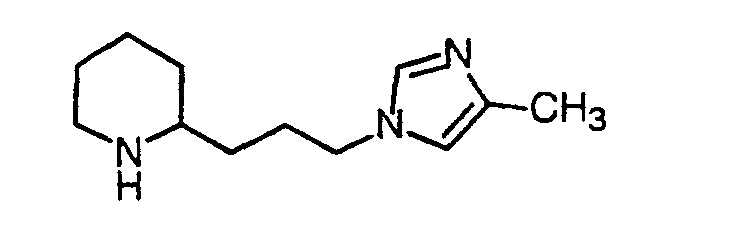
-

- 2-(3-Hydroxypropyl)pyridine (5g, 36.4mmoles) was dissolved in 1N HCl (36.4mL, 36.4mmoles) and water (63.6mL) and platinum (IV) oxide monohydrate (1g, 4.08mmoles) was added under an argon atmosphere. The mixture was hydrogenated at 55psi in a Parr bomb at 25°C for 96h. The catalyst was filtered off through Celite® and washed with water. The combined filtrates were treated with BioRad AG1-X8 (OH-) resin until basic. The resin was filtered off and washed with water. The combined filtrates were evaporated to dryness and the product was chromatographed on silica gel using 10% increasing to 20% (10% conc. NH4OH in methanol)-dichloromethane as the eluant to give the title compound (5.22g, 100%): CIMS: m/z 144.40 (MH+); δC (d6-DMSO) CH2: 24.0, 25.3, 28.8, 31.5, 32.8, 45.9, 60.8; CH: 56.1.
-

- The title compound from Step A above (3g, 20.9mmoles) was reacted with di-tert-butyldicarbonate (5.03g, 23mmoles) and sodium hydroxide (0.8378g, 20.9mmoles) essentially as described in Preparative Example 57, Step A above, but allowing the reaction to proceed for 166h. The product was chromatographed on silica gel using 3% (10% conc. NH4OH in methanol)-dichloromethane as the eluant to give the title compound (4.04g, 79%): ESMS: m/z 244.0 (MH+); δH (CDCl3) 1.45ppm (9H, s, CH3); δC (CDCl3) CH3: 28.5, 28.5, 28.5; CH2: 19.0, 25.6, 26.2, 29.2, ∼38.8, 62.8; CH: ∼50.0; C: 79.3, ∼155.2.
-

- The title compound from Step B above (2g, 8.22mmoles) was dissolved in anhydrous pyridine (10mL) and the solution was cooled with stirring to 0°C, 4-Toluenesulfonyl chloride (1.88g, 9.86mmoles) was added and the mixture was stirred at 0°C for 2h. The mixture was evaporated to dryness and the residue was taken up in dichloromethane and washed with saturated aqueous sodium bicarbonate, water, dried (MgSO4), filtered and evaporated to dryness. The product was chromatographed on silica gel using 0.25% methanol in dichloromethane as the eluant to give the title compound (2.53g, 77%): ESMS: m/z 398.1 (MH+).
- δH (CDCl3) 1.41 (9H, s, CH3), 2.45 (3H, s, Ar-CH3), 4.06 (2H, m, CH2O), 7.36 (2H, d, Ar-H3 and Ar-H5) and 7.79ppm (2H, m, Ar-H2 and Ar-H6); δC(CDCl3) CH3: 19.1, 28.5, 28.5, 28.5; CH2: 21.7, 22.8, 25.7, 25.8, 28.8, 38.7, 70.6; CH: ∼49.6, 127.9, 127.9, 129.9, 129.9; C: 71.1, 133.2, 144.6, 155.1.
-

- 4-Methylimidazole (0.5453g, 6.64mmoles) was dissolved in anhydrous DMF(15mL) and 95% sodium hydride (0. 1678g, 6,64mmoles) was added. The mixture was stirred at 25°C for 0.5h. under argon. The title compound from Preparative Example 58, Step C, (2.4g, 6.04mmoles) in anhydrous DMF (10mL) was added and the mixture was stirred at 25°C for 1h. The product was worked up as described in Preparative Example 2, Step A and chromatographed on silica gel using 3% methanol in dichloromethane as the eluant to give a mixture of the title compounds (1.459g, 79%) (4-Me:5-Me::63:37): CIMS; m/z 308.25 (MH+); 4-Me: δH (CDCl3) 1.43 (9H, s, CH3), 2.18 (3H, s, Im-4-Me), 3.87 (2H, m, CH2-Im), 6.58 (1H, s, Im-H5) and 7.33ppm (1H, s, Im-H2); δC(CDCl3) CH3: 13.8, 28.5. 28.5, 28.5; CH2: 19.0, 25.6, 26.4, 27.7, 28.7, 38.9, 46.5; CH: ∼49.4, 115.2, 136.2; C: 79.4, 138.7, 155.1 and 5-Me: δH (CDCl3) 1.43 (9H, s, CH3), 2.16 (3H, s, Im-5-Me), 3.87 (2H, m, CH2-Im), 6.74 (1H, s, Im-H4) and 7.37ppm (1H, s, Im-H2); δC(CDCl3) CH3: 9.3, 28.5, 28.5, 28.5; CH2: 19.0, 25.6, 26.5, 27.3, 28.7, 39.0, 44.4; CH: ∼49.4, 126.9, 136.8; C: 79.4, ∼138.7, 155.1.
-
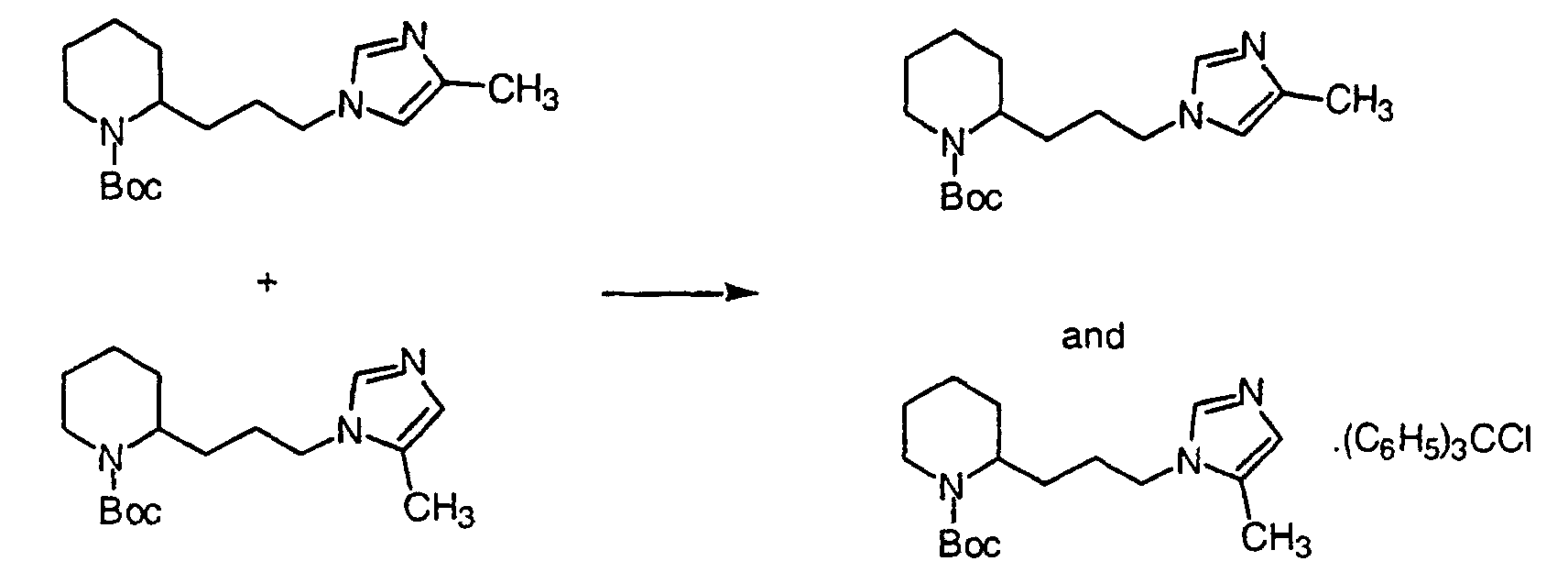
- The mixture of compounds from Step D above (1.054g) was dissolved in anhydrous CH2Cl2 (10mL) at 0°C under argon. Trityl chloride (0.3891g, 1.1 equivalents per equivalent of the 5-methyl isomer) was added and the mixture was stirred at 0°C for 2h. The reaction mixture was introduced directly onto a silica gel column and the column was eluted with 50% ethyl acetate in acetone to give the pure 4-methyl isomer (0.7242g, 69%): 4-Me: CIMS: m/z 308.30 (MH+); δH (CDCl3) 1.43 (9H, s, CH3), 2.18 (3H, s, Im-4-Me), 3.84 (2H, m, CH2-Im), 6.58 (1H, s, Im-H5) and 7.30ppm (1H, s, Im-H2); δC(CDCl3) CH3: 13.8, 28.5, 28.5, 28.5; CH2: 19.0, 25.5, 26.4, 27.7, 28.7, 38.8, 46.5; CH: ∼49.4, 115.2, 136.2; C: 79.3, 138.4, 155.1.
-

- The title compound from Step E above (0.4456g, 1.5mmoles) was deprotected as described in Preparative Example 57, Step D and the product was chromatographed on silica gel using 20% (10% conc. NH4OH in methanol)-dichloromethane as the eluant to give the title compound (0.2627g, 87%): CIMS: m/z 208.25 (MH+); δH (CDCl3) 2.14 (3H, s, Im-4-Me), 3.79 (2H, m, CH2-Im), 6.52 (1H, s, Im-H5) and 7.24ppm (1H, s, Im-H2); δC(CDCl3) CH3: 13.7; CH2: 24.7, 26.6, 27.5, 32.9, 34.3, 47.0, 47.1; CH: 56.3, 115.2, 136.1; C: 138.4.
-

-

- 4-(3-Hydroxypropyl)pyridine (5g, 36.4mmoles) was dissolved in 1N HCl (36.4mL, 36.4mmoles) and water (63.6mL) and platinum (IV) oxide monohydrate (1g, 4.08mmoles) was added under an argon atmosphere. The mixture was hydrogenated at 55psi in a Parr bomb at 25°C for 66h. The catalyst was filtered off through Celite® and washed with water. The combined filtrates were treated with BioRad AG1-X8 (OH-) resin until basic. The resin was filtered off and washed with water. The combined filtrates were evaporated to dryness and the product was chromatographed on silica gel using 7% (10% conc. NH4OH in methanol)-dichloromethane as the eluant to give the title compound (4.91g, 94%): CIMS: m/z 144.40 (MH+); δC (d6-DMSO) CH2: 29.4, 31.6, 31.6, 32.8, 45.1, 45.1, 60.8; CH: 34.8.
-

- The title compound from Step A above (3g, 20.9mmoles) was reacted with di-tert-butyldicarbonate (5.03g, 23mmoles) and sodium hydroxide (0.8378g, 20.9mmoles) essentially as described in Preparative Example 57, Step A above, but allowing the reaction to proceed for 166h. The product was chromatographed on silica gel using 3% (10% conc. NH4OH in methanol)-dichloromethane as the eluant to give the title compound (3.33g, 65%): ESMS: m/z 244.2 (MH+); δH (CDCl3) 1.47ppm (9H, s, CH3); δC (CDCl3) CH3: 28.5, 28.5, 28.5; CH2: 29.9, 29.9, 32.2, 32.6, 44.1, 44.1; CH: 35.9; C: 79.3, ∼154.8.
-
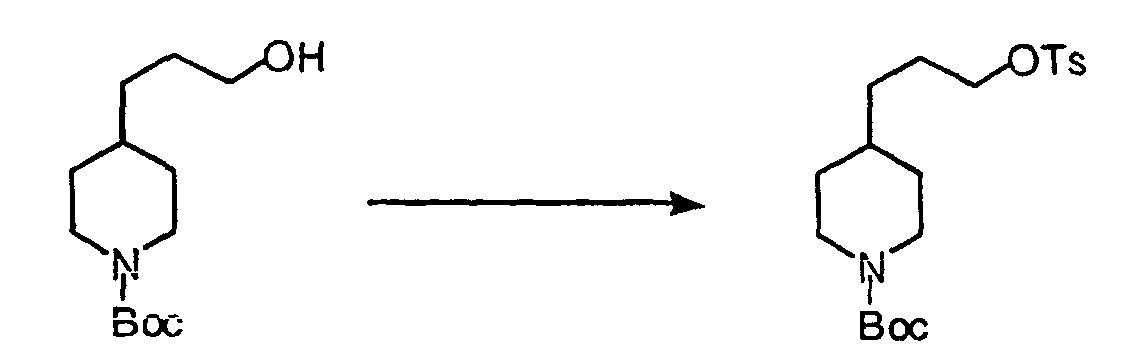
- The title compound from Step B above (2g, 8.22mmoles) was dissolved in anhydrous pyridine (10mL) and the solution was cooled with stirring to 0°C. 4-Toluenesulfonyl chloride (1.88g, 9.86mmoles) was added and the mixture was stirred at 0°C for 2h. The mixture was evaporated to dryness and the residue was taken up in dichloromethane and washed with saturated aqueous sodium bicarbonate, water, dried (MgSO4), filtered and evaporated to dryness. The product was chromatographed on silica gel using 0.5% methanol in dichloromethane as the eluant to give the title compound (2.86g, 88%): ESMS: m/z 398.1 (MH+).
- δH (CDCl3) 1.44 (9H, s, CH3), 2.46 (3H, s, Ar-CH3), 4.01 (2H, m, CH2O), 7.35 (2H, d, Ar-H3 and H5) and 7.79ppm (2H, d, Ar-H2 and H6); δC(CDCl3) CH3: 21.7, 28.6, 28.6, 28.6; CH2: 26.1, 32.0, 32.0, 32.1, 43.9, 43.9, 70.7; CH: 35.5, 127.9, 127.9, 129.9, 129.9; C: 79.3, 133.1, 144.8, 154.9.
-
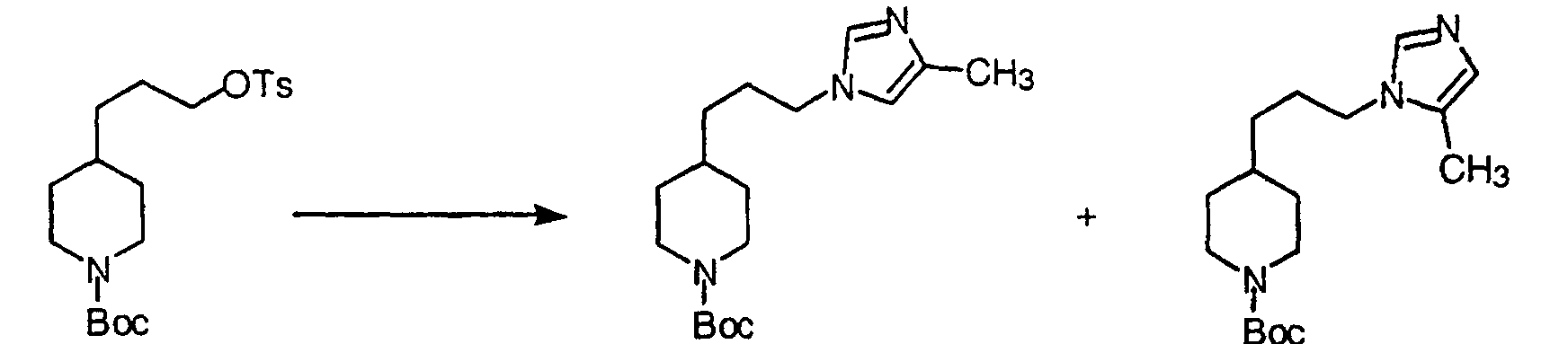
- 4-Methylimidazole (0.5453g, 6.64mmoles) was dissolved in anhydrous DMF (15mL) and 95% sodium hydride (0.1678g, 6.64mmoles) was added to the stirred solution at 25°C under argon. The solution was stirred at 25°C for 0.5h. The title compound from Preparative Example 59, Step C, (2.4g, 6.04mmoles) in anhydrous DMF (10mL) was added and the mixture was stirred at 25°C for 1h. The product was worked up as described in Preparative Example 2, Step A and chromatographed on silica gel using 3% methanol in dichloromethane as the eluant to give the title mixture of compounds (1.584g, 85%) (4-Me:5-Me::58:42): CIMS: m/z 308.25 (MH+); 4-Me: δH (CDCl3) 1.44 (9H, s, CH3), 2.21 (3H, s, Im-4-Me), 3.82 (2H, m, CH2-Im), 6.59 (1H, s, Im-H5) and 7.33ppm (1H, s, Im-H2); δC(CDCl3) CH3: 13.8, 28.5, 28.5, 28.5; CH2: 28.3, 32.1, 33.4, 33.4, 44.0, 47.1, 47.1; CH: 35.8, 115.2, 136.2; C: 79.3, 138.5, 154.9 and 5-Me: δH (CDCl3) 1.44 (9H, s, CH3), 2.19 (3H, s, Im-5-Me), 3.82 (2H, m, CH2-Im), 6.77 (1H, s, Im-H4) and 7.39ppm (1H, s, Im-H2); δC(CDCl3) CH3: 9.3, 28.5, 28.5, 28.5; CH2: 28.1, 32.1, 33.4, 33.4, 44.0, 44.0, 44.9; CH: 35.8, 127.0, 136.2; C: 79.3, 133.7, 154.9.
-

- The mixture of compounds from Step D above (1.51g) was dissolved in anhydrous CH2Cl2 (10mL) at 0°C under argon. Trityl chloride (1.15g, 2 equivalents per equivalent of the 5-methyl isomer) was added and the mixture was stirred at 0°C for 2h. The reaction mixture was introduced directly onto a silica gel column and the column was eluted with 50% ethyl acetate in acetone to give the pure 4-methyl isomer (0.635g, 65%): 4-Me: CIMS: m/z 308.30 (MH+); δH (CDCl3) 1.44 (9H, s, CH3), 2.22 (3H, s, Im-4-Me), 3.83 (2H, m, CH2-Im), 6.60 (1H, s, Im-H5) and 7.33ppm (1H, s, Im-H2); δC(CDCl3) CH3: 13.8, 28.5, 28.5, 28.5; CH2: 28.2, 32.0, 33.4, 33.4, 43.9, 47.1, 47.1; CH: 35.7, 115.2, 136.2; C: 79.3, 138.5, 154.8.
-

- The title compound was deprotected as described in Preparative Example 57, Step D to give after chromatography on silica gel using 20% (10% conc. NH4OH in methanol)-dichloromethane as the eluant, the title compound (0.3581g, 89%): CIMS: m/z 208.25 (MH+); δH (CDCl3) 2.12 (3H, s, Im-4-Me), 3.74 (2H, m, CH2-Im), 6.51 (1H, s, Im-H5) and 7.25ppm (1H, s, Im-H2); δC(CDCl3) CH3: 13.6; CH2: 28.1, 33.3, 33.3, 33.9, 46.5, 46.5, 47.1; CH: 35.8, 115.1, 136.0; C: 138.2.
-
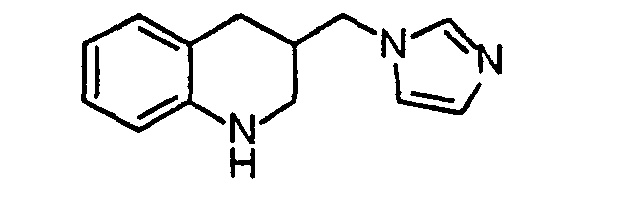
-

- 3-Hydroxymethylquinoline (0.45g, 2.83mmoles) (prepared as described in: B. R. Brown, D. Ll. Hammick and B. H. Thewlis, J. Chem. Soc., 1951,1145-1149.) was dissolved in methanol (100mL) and placed in a Parr bomb. Platinum (IV) oxide monohydrate (0.225g. 0.918mmoles) was added and the mixture was hydrogenated at 50psi at 25°C for 6h. The catalyst was removed by decantation and washed with methanol. The methanol was evaporated to dryness and the product was chromatographed on silica gel using 3% (10% conc. NH4OH in methanol)-dichloromethane as the eluant to give the title compound (0.3843g, 83%): CIMS: m/z 164.35 (MH+); δH (CDCl3) 6.50 (1H, d, Ar-H8), 6.64 (1H, t, Ar-H6), 6.98 (1H, d, Ar-H5) and 6.99ppm(1H, m, Ar-H7); δC (CDCl3) CH2: 29.5, 44.0, 65.2; CH: 34.9, 114.2, 117.4, 126.9, 129.8; C: 120.2, 144.5.
-

- The title compound from Step A above (2.578g, 15.79mmoles) was dissolved in THF (51.5mL) and sodium hydroxide (0.634g, 15.79mmoles) in water (51.5mL) was added. Di-tert-butyldicarbonate (6.888g, 31.58mmoles) was added and the mixture was stirred at 25°C for 187h. Additional di-tert-butyl dicarbonate (0.6888g, 3.16mmoles) was added and the reaction was allowed to proceed for a total of 301h. The product was worked up and purified as described in Preparative Example 1, Step A to give the title compound (3.794g, 91%): FABMS; m/z 264.1 (MH+); δH (CDCl3) 1.50 (9H, s, CH3), 7.03 (1H, m, Ar-H), 7.19-7.10 (2H, m, Ar-H) and 7.58ppm (1H, d, Ar-H); δC (CDCl3) CH3: 28.3, 28.3, 28.3; CH2: 29.5, 45.1, 63.6; CH: 36.1, 124.0, 124.6, 125.6, 129.2; C: 81.5, 128.2, ∼138.8, ∼154.7.
-

- The title racemic compound from Step B above (0.322g, 1.22mmoles) was dissolved in anhydrous pyridine (2mL) and the solution was cooled to 0°C. 4-Toluenesulfonyl chloride (0.28g, 1.464mmoles) was added and the reaction was stirred at 0°C for 5h. The mixture was then heated at 40°C for 13h and worked up as described in Preparative Example 2, Step C to give the title compound (0.481g) which was used directly in Step E below.
- The individual pure enantiomers from Step C above may be similarly treated to give the 3(R) and 3(S) enantiomers of the title compound.
-

- The title racemic product from Step D above was dissolved in anhydrous DMF (5mL) and sodium imidazole (0.1652g, 1.83mmoles) was added. The mixture was heated at 65°C under argon for 4h. The solution was evaporated to dryness and the residue was taken up in dichloromethane, washed with water, dried (MgSO4), filtered and evaporated to dryness. Chromatography on silica gel using 2.5% (10% conc. NH4OH in methanol)-dichloromethane afforded the title compound (0.3284g, 86%): ESMS: m/z 314.1 (MH+); δH (CDCl3) 1.51 (9H, s, CH3), 6.97 (1H, s, Im-H5), 7.01 (1H, t, Ar-H6), 7.06 (1H, t, Ar-H7), 7.12 (1H, s, Im-H4), 7.17 (1H, t, Ar-H5), 7.51 (1H, s, Im-H2) and 7.68ppm (1H, d, Ar-H8); δC(CDCl3) CH3: 28.4, 28.4, 28.4; CH2: 31.0, 46.7, 49.5; CH: 35.9, 119.1, 123.8/123.9, 126.4, 126.9, 129.0, 129.8, 137.5; C: 81.5, 137.5, 138.2, 153.7.
- The individual pure enantiomers from Step D above may be similarly treated to give the 3(R) and 3(S) enantiomers of the title compound.
-

- The title racemic compound from Step E above (0.3208g, 1.024mmoles) was dissolved in anhydrous methanol (5.42mL) and 10% conc. H2SO4 / dioxane (v/v) (13.95mL) was added and the mixture was stirred at 25°C for 1h. The product was worked up as described in Preparative Example 1, Step D above. Chromatography on silica gel using 2.5% (10% conc. NH4OH in methanol)-dichloromethane as the eluant gave the title compound (0.19g, 90%): CIMS: m/z 214.2 (MH+); δH (CDCl3) 3.97 (2H, m, Im-CH 2), 6.51 (1H, d, Ar-H8), 6.65 (1H, t, Ar-H6), 6.95 (1H, s, Im-H5), 6.96 (1H, t, Ar-H7), 7.01 (1H, t. Ar-H5), 7.09 (1H, s, Im-H4) and 7.50ppm (1H, s, Im-H2); δC (CDCl3) CH2: 30.2, 43.5, 49.0; CH: 33.7, 114.2, 117.7, 119.3, 127.3, 129.5, 130.0, 137.7; C: 118.4, 143.9.
-

- The racemic title compound (0.6545g) from Step E above was separated by preparative HPLC on a Chiralpak® AD column (50X5cm) using hexane-iso-propanol-diethylamine::80:20:0.2 as the eluant to give a less polar (-)-enantiomer (0.3244g): CIMS: m/z 214.15 (MH+); δH (CDCl3) 3.97 (2H, m, Im-CH2), 6.52 (1H, d, Ar-H8), 6.68 (1H, t, Ar-H6), 6.96 (1H, s, Im-H5), 6.96 (1H, t, Ar-H7), 7.02 (1H, t, Ar-H5), 7.10 (1H, s, Im-H4) and 7.49ppm (1H, s, Im-H2); δC (CDCl3) CH2: 30.2, 43.5, 49.0; CH: 33.7, 114.2, 117.7, 119.3, 127.3, 129.6, 130.0, 137.7; C: 118.5, 143.9; [α]D 20°C -57.3° (c=10.43mg/2mL, methanol) and a more polar (+)-enantiomer (0.3286g): CIMS: m/z 214.15 (MH+); δH (CDCl3) 3.97 (2H, m, Im-CH2), 6.52 (1H, d, Ar-H8), 6.67 (1H, t, Ar-H6), 6.96 (1H, s, Im-H5), 6.96 (1H, t, Ar-H7), 7.01 (1H, t, Ar-H5), 7.11 (1H, s, Im-H4) and 7.50ppm (1H, s, Im-H2); δC (CDCl3) CH2: 30.2, 43.5, 49.0; CH: 33.7, 114.2, 117.7, 119.3, 127.3, 129.6, 130.1, 137.7; C: 118.5, 143.9; [α]D 20°C +56.8° (c=10.70mg/2mL, methanol), corresponding to the title compounds.
-

-

- 4-Methylimidazole (0.9504g, 11.6mmoles) was dissolved in anhydrous DMF (52mL) and 95% sodium hydride (0.2924g, 11.6mmoles) was added in portions to the stirred solution at 25°C under argon. The mixture was stirred for 1h. The title racemic compound from Preparative Example 60, Step C (4.394g, 10.5mmoles) in anhydrous DMF (25mL) was added and the mixture was stirred at 25°C for 1h and then at 55-60°C for 7h. The mixture was evaporated to dryness and the residue was chromatographed on silica gel using 0.5%-2%-4%--6%-10% (10% conc. NH4OH in methanol)-dichloromethane as the eluant to give the racemic title compound (1.93g, 56%) (4-Me:5-Me::1.46:1.0): CIMS: m/z 328.25 (MH+); δH (CDCl3) 1.51 (9H, s, CH3), 2.20/2.24 (3H, s, 5-Me/4-Me), 3.81/3.88 (2H, m, 5-Me-Im-CH2/4-Me-Im-CH2), 6.65/6.83 (1H, s, 4-Me-Im-H5/5-Me-Im-H4), 6.99-7.07 (2H, m, Ar-H7 and Ar-H8), 7.17/7.20 (1H, d, Ar-H6), 7.36/7.43 (1H, s, 4-Me-Im-H2/5-Me-Im-H2) and 7.67/7.71ppm (1H, d, Ar-H9); δC (CDCl3) 4-Me: CH3: 13.8, 28.4, 28.4, 28.4; CH2: 31.0, 46.8, 49.4; CH: 35.8, 115.6, 123.8, 123.9, 126.3, 129.1, 136.7; C: 81.4, 127.0, 138.2, 153.7; and 5-Me: CH3: 9.4, 28.4, 28.4, 28.4; CH2: 31.0, 46.9, 47.1; CH: 35.3, 123.9, 123.9, 126.4, 126.9, 129.1, 137.3; C: 81.5, 127.3, 138.9, 153.7.
-

- The title compound from Step A above was deprotected essentially as described in Preparative Example 57, Step D above and chromatographed on silica gel to give the title compound.
-

-

- 6-Hydroxymethylquinoline (0.4325g, 2.72mmoles) (prepared by the method of: C. E. Kaslow and W. R. Clark, J. Org. Chem., 1953, 18 , 55-58.) and triethylamine (1.5147mL, 10.87mmoles) were dissolved in anhydrous dichloromethane (16mL) and the mixture was cooled to 0°C. Methanesulfonyl chloride (0.421mL, 5.43mmoles) was added and the mixture was stirred under argon at 0°C for 1h. Additional triethylamine (0.758mL, 5.435mmoles) and methanesulfonyl chloride (0.211mL, 2.72mmoles) were added and the reaction was allowed to proceed for a further 1h at 0°C. The mixture was evaporated to dryness to give the title compound which was used without further purification in the next step.
-

- The title product from Step A above was dissolved in anhydrous DMF (10mL) and sodium imidazole (0.367g, 4.08mmoles) was added. The mixture was heated at 70°C under argon for 2h and then evaporated to dryness. The product was chromatographed on silica gel to give the title compound (0.1559g, 27%): FABMS: m/z 210.0 (MH+); δH (CDCl3) 5.34 (1H, s, CH2), 6.97 (1H, s, Im-H5), 7.15 (1H, s, Im-H4), 7.44 (1H, dd, Ar-H3), 7.52 (2H, m, Ar-H5 and Ar-H7), 7.64 (1H, s, Im-H2), 8.12 (2H, d, Ar-H4 and Ar-H8) and 8.95ppm (1H, d, Ar-H2); δC (CDCl3) CH2: 50.6; CH: 119.4, 121.8, 125.9, 128.4, 130.1, 130.5, 136.0, 137.6, 151.0; C: 128.2, 134.6, 147.9.
-

- The title compound from Step B above (0.045g, 0.215mmoles) and methanol (11mL) were placed in a Parr bomb and platinum (IV) oxide monohydrate (0.05g, 0.204mmoles) was added. The mixture was hydrogenated at 50psi at 25°C for 2h. The catalyst was removed by decantation and washed with methanol. The methanol was evaporated to dryness and the product was chromatographed on silica gel using 3% (10% conc. NH4OH in methanol)-dichloromethane as the eluant to give the title compound (0.0325g, 71%): CIMS: m/z 214.15 (MH+); δH (CDCl3) 1.92 (2H, t, 3-CH2), 2.61 (2H, m, 4-CH2), 3.30 (2H, m, 2-CH2), 4.93 (2H, s, CH2), 6.42 (1H, d, Ar-H3), 6.77 (1H, s, Ar-H5), 6.79 (1H, d, Ar-H7), 6.90 (1H, bs, Im-H5), 7.07 (1H, bs, Im-H4) and 7.52ppm (1H, bs, Im-H2); δC (CDCl3) CH2: 21.9, 27.0, 41.9, 50.8; CH: 114.2, 119.2(b), 126.4, 128.7, 129.1, 137.2(b); C: 121.6, 123.8, 144.8.
-

- 6-Hydroxymethylquinoline (1g, 6.28mmoles) (prepared by the method of: C. E. Kaslow and W. R. Clark, J. Org. Chem., 1953, 18 , 55-58.) and methanol (200mL) were placed in a Parr bomb and platinum (IV) oxide monohydrate (0.5g, 2.04mmoles) was added. The mixture was hydrogenated at 50psi at 25°C for 2h. The catalyst was filtered off and washed with methanol. The combined filtrates were evaporated to dryness and the product was chromatographed on silica gel using 1.5% (10% conc. NH4OH in methanol)-dichloromethane as the eluant to give the title compound (0.7044g, 68%): CIMS: m/z 164.35 (MH+); δH (CDCl3) 1.93 (2H, m, 3-CH2) and 2.76 (2H, t, 4-CH2), 3.30 (2H, m, 2-CH2), 4.50 (2H, s, CH2OH), 6.45 (1H, d, Ar-H8), 6.96ppm (2H, m, Ar-H5 and Ar-H7); δC (CDCl3) CH2: 22.1, 27.0, 42.0, 65.6; CH: 114.2, 126.4, 129.2; C: 121.5, 129.4, 144.5.
-

- The title compound from Step A above (0.684g, 4.19mmoles) was dissolved in THF (25mL) and sodium hydroxide 0.21g, 5.25mmoles) in water (10mL) was added. Di-tert-butyldicarbonate (1.26g, 5.76mmoles was added and the mixture was stirred at 25°C for 92h. Additional di-tert-butyldicarbonate (0.628g, 2.88mmoles) was added and the reaction was continued for a total of 116h. The reaction was worked up as described in Preparative Example 1 Step A above and the product was chromatographed on silica gel using 0.5% (10% conc. NH4OH in methanol)-dichloromethane as the eluant to give the title compound (0.7978g, 72%): ESMS: m/z 264.1 (MH+); δH (CDCl3) 1.52 (9H, s, CH3), 1.91 (2H, m, 3-CH2), 2.76 (2H, t, 4-CH2), 3.70 (2H, m, 2-CH2), 4.60 (2H, s, CH2OH), 7.09 (1H, s, Ar-H5), 7.12 (1H, d, Ar-H7) and 7.64ppm (1H, d, Ar-H8); δC (CDCl3) CH3: 28.4, 28.4, 28.4; CH2: 23.5, 27.6, 44.7, 65.1; CH: 124.3, 124.7, 127.4; C: 80.9, 130.1, 135.6, ∼138.4, ∼154.2.
-

- The title compound from Step B above may be reacted with 4-toluenesulfonyl chloride and pyridine under essentially the same conditions as described in Preparative Example 58, Step C and chromatographed on silica gel to give the title compound.
-

- The title compound from Step C above may be reacted with sodium imidazole in anhydrous DMF under essentially the same conditions as described in Preparative Example 62, Route 1, Step B and chromatographed on silica gel to give the title compound.
- Alternatively:

- The title compound from Route 2, Step B above (0.5166g, 1.96mmoles) was dissolved in anhydrous THF (5.5mL) and N,N'-carbonyldiimidazole (0.668g, 4.12mmoles) was added and the mixture was heated under reflux at 75°C for 4.5h. The solution was evaporated to dryness and chromatographed on silica gel using 2% (10% conc. NH4OH in methanol)-dichloromethane as the eluant to give the title compound (0.0612g, 10%): CIMS: m/z 314.25 (MH+); δH (CDCl3) 1.51 (9H, s, CH3), 1.92 (2H, m, 3-CH2), 2.72 (2H, d, 4-CH2), 3.69 (2H, d, 2-CH2), 5.04 (2H, s, CH2-Im), 6.85 (1H, s, Im-H5), 6.91 (1H, s, Ar-H6), 6.97 (1H, d, Ar-H8), 7.08 (1H, s, Im-H4), 7.59 (1H, s, Im-H2) and 7.67ppm (1H, d, Ar-H9); δC (CDCl3) CH3: 28.4, 28.4, 28.4; CH2: 23.4, 27.6, 44.8, 50.5; CH: 119.4, 124.5, 125.0, 127.6, 129.4, 137.3; C: 81.1, 130.5, 130.5, 138.7, 153.9.
-

- The title compound from Step D above may be deprotected essentially as described in Preparative Example 57, Step D and chromatographed on silica gel to give the title compound.
-

-

- 4-Isoquinolinecarboxaldehyde (6.15g, 39.13mmoles) (prepared by the method of: J. B. Wommack, T. G. Barbee, Jr., D. J. Thoennes, M. A. McDonald and D. E. Pearson, J. Heterocyclic Chem., 1969, 6 , 243-245.) was dissolved in anhydrous dichloromethane (369mL) and the solution was cooled to 0°C. Borane-dimethyl sulfide complex (1M in THF) (5.23mL, 5.09mmoles) (as described in: E. Mincione, J. Org. Chem., 1978, 43 , 1829-1830) was added and the mixture was stirred at 0°C for a 1.5h. Additional borane-dimethylsulfide complex (1M in THF) (10.455mL, 1.35mmoles) was added and the reaction was stirred for an additional 2h at 0°C. Methanol (93.3mL) was added and the solution was evaporated to dryness and chromatographed on silica gel using 2-3% (10% conc. NH4OH in methanol)-dichloromethane as the eluant to give unreacted 4-Isoquinolinecarboxaldehyde (∼23%), 4(1.2-dihydroisoquinoline)carboxaldehyde (identical to that described in Preparative Example 63, Route 3, Step A (∼27%) and the title compound (1.94g, 31%).
- Alternatively the title compound may be prepared by catalytic hydrogenation of 4-isoquinolinecarboxaldehyde using 10% Pd-Al2O3 as the catalyst (as described in: J. Vassant, G, Smets, J. P. Declercq, G. Germain and M. Van Meerssche, J. Org. Chem., 1980, 45 , 1557-1565).
-

- To a stirred solution of the title compound from Step A above (1.94g, 12.2mmoles) in anhydrous pyridine (14mL) at 0°C was added 4-toluenesulfonyl chloride (2.784g, 14.6mmoles) and the mixture was stirred at 0°C for 2.5h. The solution was evaporated to dryness and the product was azeotroped with toluene and then taken up in dichloromethane and washed with saturated aqueous sodium bicarbonate, filtered and evaporated to give the title compound which was used without purification in the next step.
-

- 4-Methylimidazole (1.099g, 13.38mmoles) was dissolved in anhydrous DMF (33.5mL) and 95% sodium hydride (0.338g, 13.42mmoles) was added in portions to the stirred solution at 25°C. The title compound from Step B above was dissolved in anhydrous DMF (14mL) and added dropwise to the stirred solution at 25°C over 20min. The mixture was stirred at 25°C for 17h and evaporated to dryness. The residue was taken up in dichloromethane and washed with water, dried(MgSO4), filtered and evaporated to dryness. The product was chromatograped on silica gel using 2.5% methanol in dichloromethane as the eluant to give a mixture of the title compounds (0.5085g, 19%) (4-Me:5-Me::1.2:1): δH (CDCl3) 2.18/2.22 (3H, s, 4-Me/5-Me), 5.46 (2H, s, CH2-Im), 6.63/6.89 (1H, s, 4-Me: Im-H5/5-Me: Im-H4), 7.43/7.55 (1H, s, 5-Me: Im-H2/4-Me: Im-H2), 7.63-7.86 (3H, d and t, Ar-H6,7,8), 8.02/8.38 (1H, s, 5-Me: Ar-H3/ 4-Me: Ar-H3), 8.05 (0.5H, d, 5-Me: Ar-H3) and 9.26/9.28ppm (1H, s, 5-Me: Ar-H1/4-Me: Ar-H1), δC (CDCl3) 4-Me: CH3: 13.6; CH2: 46.5; CH: 115.7, 121.8, 127.8, 128.7, 131.6, 136.3, 143.3, 154.1; C: 124.7, 128.5, 133.8, 138.7; and 5-Me: CH3: 9.5; CH2: 44.4; CH: 121.6, 127.4, 127.8, 128.7, 131.5, 137.2, 142.0, 153.7; C: 124.8, 128.2, 133.4, 138.7.
-

- The title mixture of regio-isomers from Step C above (0.45g) was subjected to chiral HPLC on a Chiralpak® HPLC column using hexane: iso - propanol:diethylamine::85:15:09.2 to give first the 4-methyl isomer (0.0406g): FABMS: m/z 224.0 (MH+); δH (CDCl3) 2.18 (3H, s, 4-CH3), 5.46 (2H, s, CH2-Im), 6.62 (1H, s, Im-H5), 7.54 (1H, s, Im-H2), 7.67 (1H, t, Ar-H8), 7.76 (1H, t, Ar-H7), 7.84 (1H, d, Ar-H6), 8.04 (1H, d, Ar-H9), 8.39 (1H, s, Ar-H3) and 9.27ppm (1H, s, Ar-H1); δC (CDCl3) CH3: 13.6; CH2: 46.5; CH: 115.7, 121.8, 127.8, 128.7, 131.6, 138.3, 143.3, 154.1; C: 124.7, 128.7, 133.8, 138.8; and then the 5-methyl isomer (0.0361g): FABMS: m/z 224.1 (MH+); δH (CDCl3) 2.20 (3H, s, 5-CH3), 5.45 (2H, s, CH2-Im), 6.86 (1H, s, Im-H4), 7.41 (1H, s, Im-H2), 7.68 (1H, t, Ar-H8), 7.98 (1H, t, Ar-H7), 7.84 (1H, d, Ar-H6), 8.02 (1H, s, Ar-H3), 8.05 (1H, d, Ar-H9) and 9.22ppm (1H, s, Ar-H1); δC (CDCl3) CH3: 9.4; CH2: 44.3; CH: 121.5, 126.9, 127.9, 128.8, 131.7, 137.0, 141.7, 153.6; C: 124.9, 128.2, 133.4, 138.7 and an overlap fraction (0.28g).
-

- The title compound from Step C above (0.346g, 1.55mmoles) was dissolved in anhydrous methanol (80mL) and platinum (IV) oxide.monohydrate (0.11g) was added. The mixture was hydrogenated at 25°C at 50psi in a Parr bomb for 2h. The catalyst was filtered off and washed with methanol and the methanol filtrates were evaporated to dryness. The residue was chromatographed on silica gel using 3% (10% conc. NH4OH in methanol)-dichloromethane as the eluant to give the title 4-methyl compound (0.0299g, 9%): ESMS: m/z 228.0; δH (CDCl3) 2.24 (3H, s, Im-4-CH3), 2.81 (1H, bs, NH), 2.93 (2H, m, 3-CH2), 3.03 (1H, m, 4-CH), 4.04 (2H, s, 1-CH2), 4.08, 4.27 (2H, dd, CH2-Im), 6.68 (1H, Im-H2), 7.01-7.09 (2H, m, Ar-H), 7.18 (2H, m, Ar-H) and 7.36ppm (1H, s, Im-H5); δC (CDCl3) CH3: 13.8; CH2: 45.0, 48.4, 51.1; CH: 39.6, 115.6, 126.5, 126.8, 126.9, 129.1, 136.9; C: 134.5, 135.7, 138.6, and the title 5-methyl compound (0.0641g, 18%): CH3: 9.3; CH2: 44.9, 48.8, 50.5; CH: 39.4, 126.5, 126.9, 126.9, 129.0, 136.7; C: 127.0, 134.4, 135.7, 138.5.
-
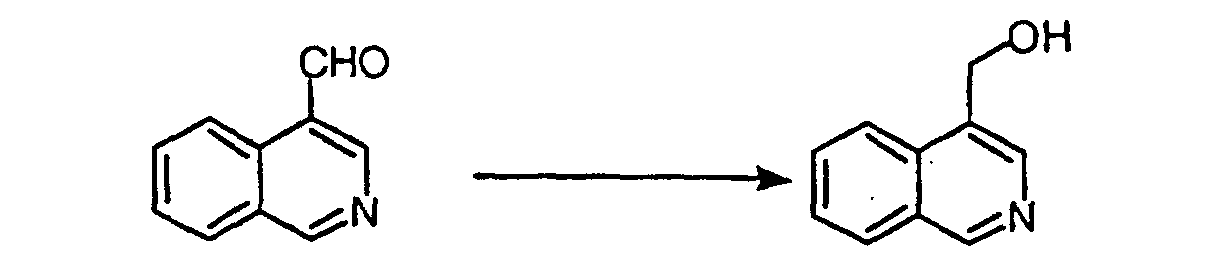
- 4-Isoquinolinecarboxaldehyde (1mmole) (prepared by the method of: J. B. Wommack, T. G. Barbee, Jr., D. J. Thoennes, M. A. McDonald and D. E. Pearson, J. Heterocyclic Chem., 1969, 6 , 243-245.) is dissolved in anhydrous THF (50mL) and treated with borane-methyl sulfide (0.3mmoles) (as described in: E. Mincione, J. Org. Chem., 1978, 43 , 1829-1830) at 0°C for 0.5-1h and worked up in the usual way to give the title compound.
- Alternatively the title compound may be prepared by catalytic hydrogenation of 4-isoquinolinecarboxaldehyde using 10% Pd-Al2O3 as the catalyst (as described in: J. Vassant, G, Smets, J. P. Declercq, G. Germain and M. Van Meerssche, J. Org. Chem., 1980, 45 , 1557-1565).
-

- The title compound from Step A above is dissolved in anhydrous pyridine and cooled to 0°C with stirring. 4-Toluenesulfonyl chloride is added and the reaction is carried out as described in Preparative Example 60, Step D to give the title compound which may be used without further purification.
-

- The title compound from Step A above may be selectively reduced with freshly prepared zinc borohydride (as described in: D. C. Sakar, A. R. Das and B. C. Ranu, J. Org. Chem., 1990, 55, 5799-5801.) to give title allylic alcohol.
-

- The title compound from Step B above is reacted with zinc borohydride as described in Step C above to give the title compound.
- Alternatively:

- The title compound from Step C above is reacted with di-tert-buylydicarbonate and sodium hydroxide as described in Preparative Example 57, Step A to give the title compound.
-
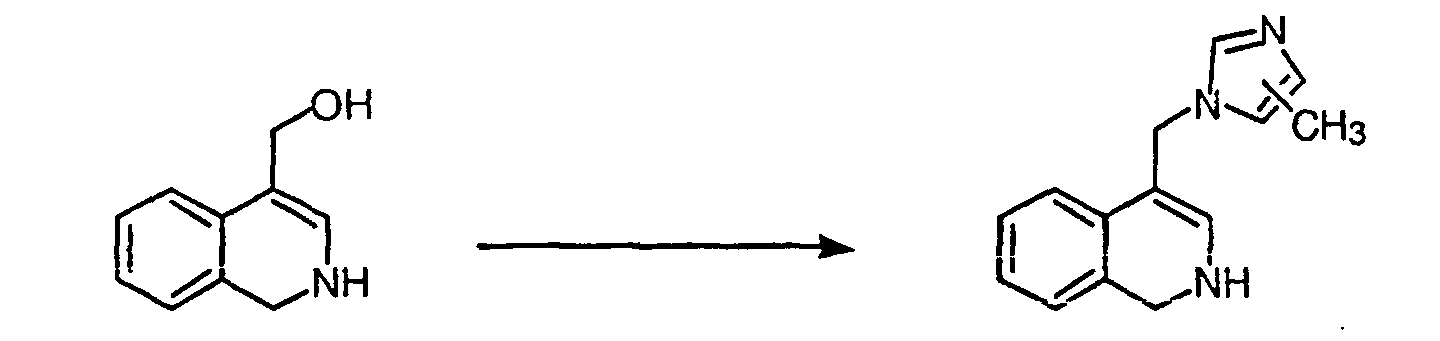
- The title compound from Step C above may be reacted with N,N'-carbonyldiimidazole using the procedure described in Preparative Example 22, part two of Step D, to give the title compounds.
-
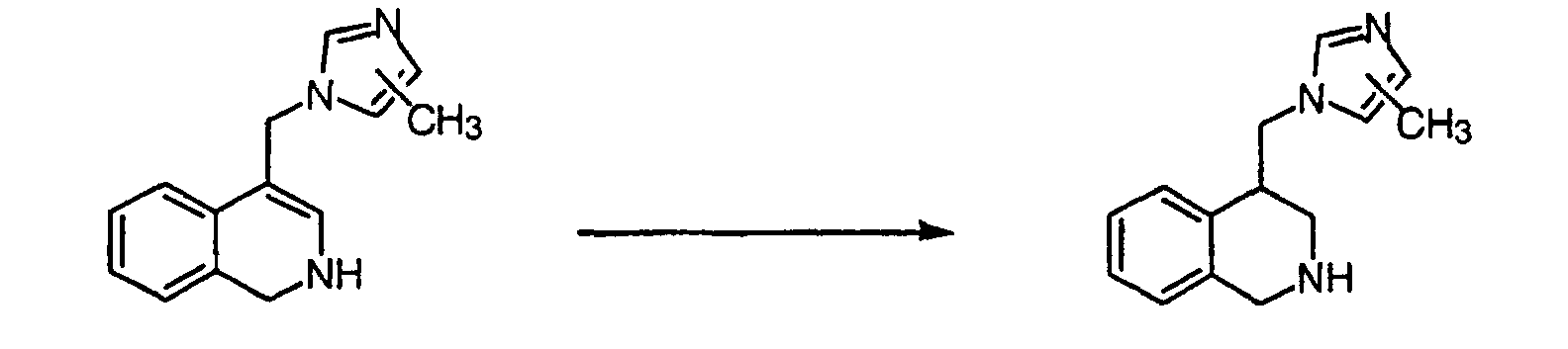
- The title compounds of Step E above is reduced with platinum (IV) oxide as described in Route 1, Step D above to give the title compounds.
-

- The title compound from Step D above is reacted with 4-toluenesulfonyl chloride in pyridine as described in Preparative Example 4, Step D to give the title compound.
-
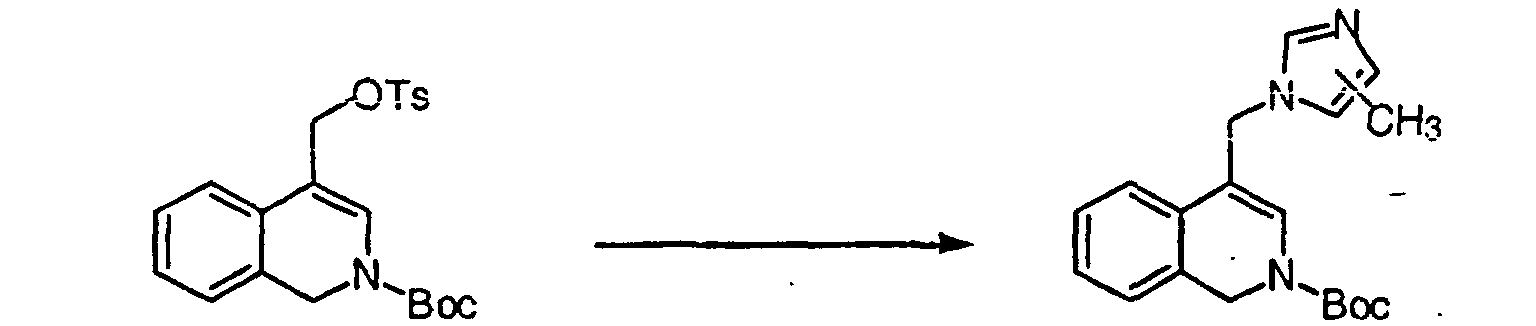
- The title compounds from Step G above was reacted with sodium 4-methylimidazole as described in Route 1, Step C above to give the title compounds.
- The regio-isomers may be separated by chiral HPLC on a Chiralpak® column, or by treatment with trityl chloride as described above.
-
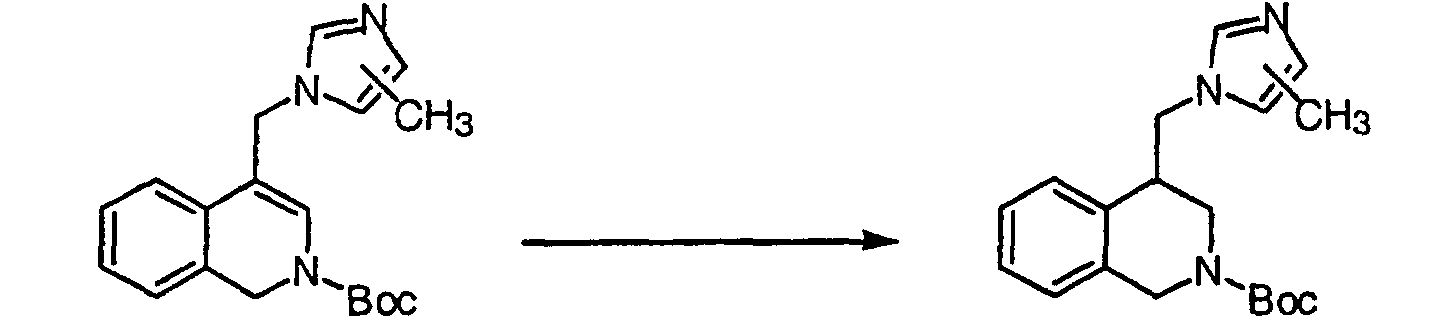
- The title compounds from Step H above were reduced with platinum (IV) oxide as described in Route 1 Step D above to give the title compounds.
-
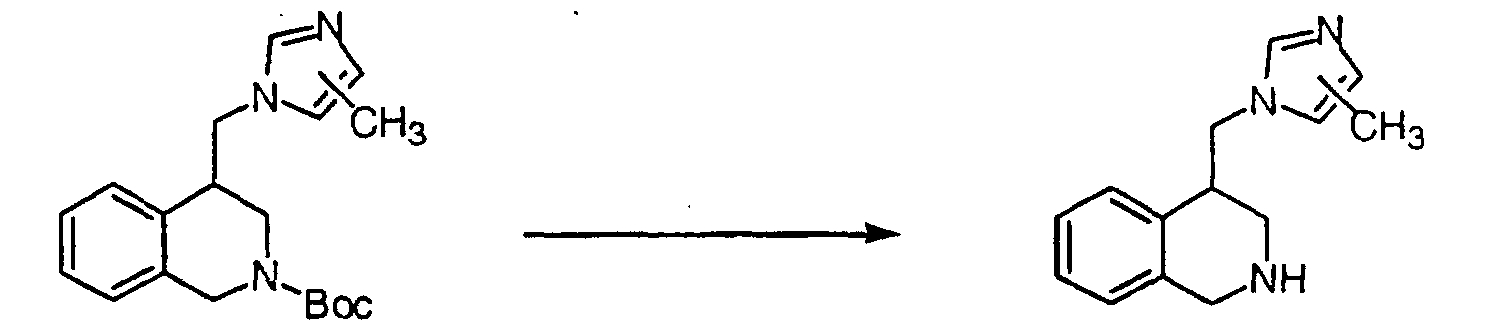
- The title compounds from Step H above were deprotected as described in Preparative Example 57, Step D, to give the title compounds.
-
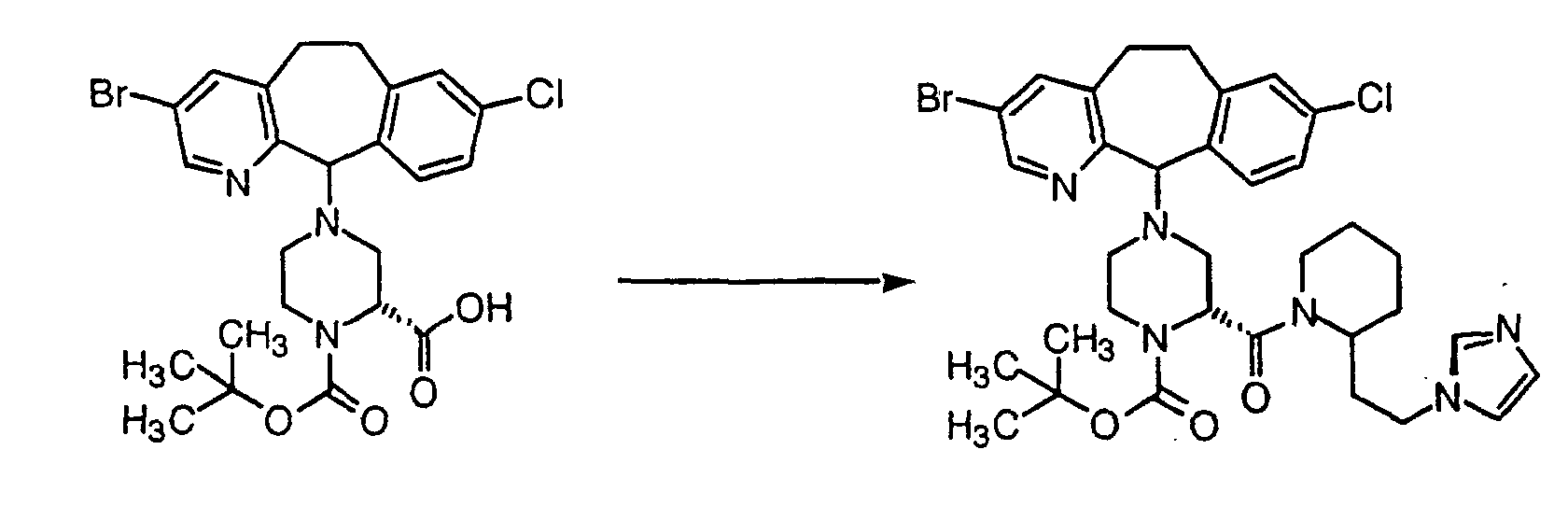
- 1,1-Dimethylethyl-4-(3-bromo-8-chloro-6,11-dihydro-5H-benzo[5,6]cyclohepta[1,2-b]pyridin-11-yl)-2(R)-carboxy-1-piperazinecarboxylate (0.250g, 0.466mmoles) (prepared as described in Preparative Example 6), 2-[2-(1H-imidazol-1-yl)ethyl]piperidine (0. 1085g, 0.6054mmoles) (prepared as described in Preparative Example 1), 1-(3-dimethylamino-propyl)-3-ethylcarbodiimide hydrochloride (0.116g, 0.6054mmoles), 1-hydroxybenzotriazole (0.0818g, 0.6054mmoles) and 4-methylmorpholine (0.0665mL, 0.6054mmoles) were dissolved in anhydrous DMF (10mL) and the mixture was stirred under argon at 25°C for 18h. The solution was evaporated to dryness and the residue was washed with water, dried (MgSO4), filtered and evaporated to dryness. The residue was chromatographed silica gel using 1% (10% conc. NH4OH in methanol)-dichloromethane as the eluant to give the title compound (0.0617g, 19%): ESMS: m/z 697.2 (MH+); δH (CDCl3) 6.97 (1H, broad s, Im-H5), 7.04 (1H, broad s, Im-H4), 7.09-7.20 (broad m, Ar-H), 7.56 (2H, broad s, Ar-H and Im-H2) and 8.38ppm (1H, broad s, Ar-H2); δC (CDCl3) CH3: 28.4, 28.4, 28.4; CH2: 18.9/19.1, 25.2/25.3/25.8, 30.4, 30.5, 31.4/31.6, 36.6, 40.2, 42.9, 43.4/43.7, 50.3, 52.7/53.0; CH: 45.8/46.4, 50.1/51.7/52.2, 78.3/78.4/∼79.3, ∼119.0, 126.3, ∼129.8, 130.7/130.8, 132.5/132.6, ∼137.1, 141.4/141.5, 146.9; C: 80.4, 120.0, 134.3, 134.8, 137.5, 141.0, 155.9, 156.8, 157.2.
-

- 3-Bromo-8,11-dichloro-6,11-dihydro-5H-benzo[5,6]cyclohepta[1,2-b]pyridine (prepared as described in Preparative Example 40 (U.S. 5,719,148) was reacted with the title compound from Peparative Example 1, Step B, and triethylamine, in a mixture of anhydrous THF and dichloromethane at 25°C to give the title compound.
-
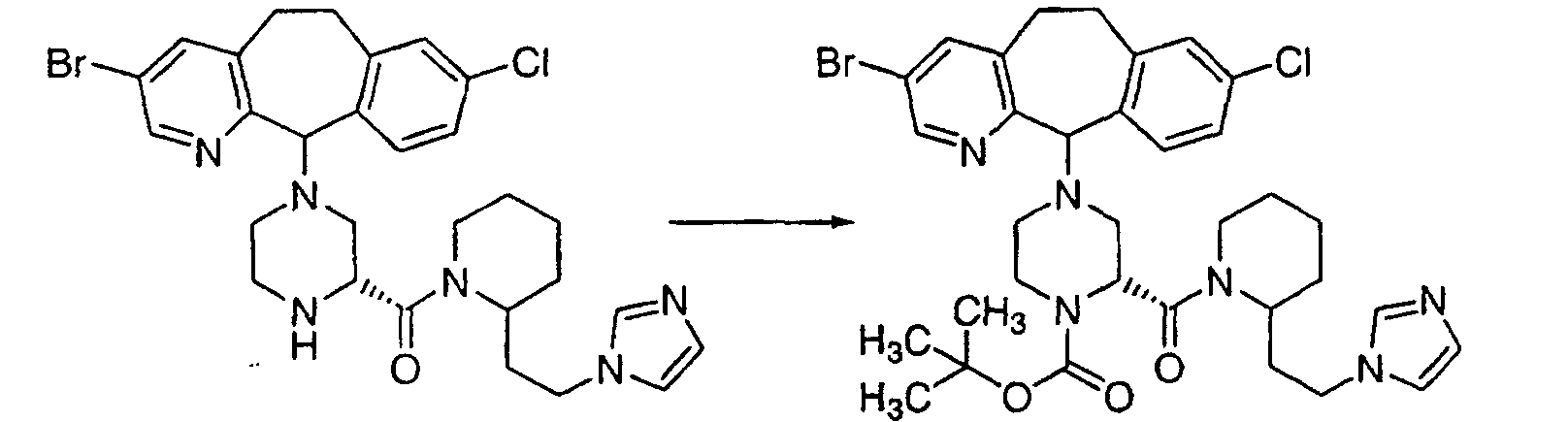
- The title compound from Example 74, Step A was reacted with di-tert-butyldicarbonate and sodium hydroxide in THF-water (1:1) at 25°C as described in Preparative Example 57, Step A, and the product was chromatographed on silica gel, to give the title compound.
- Where
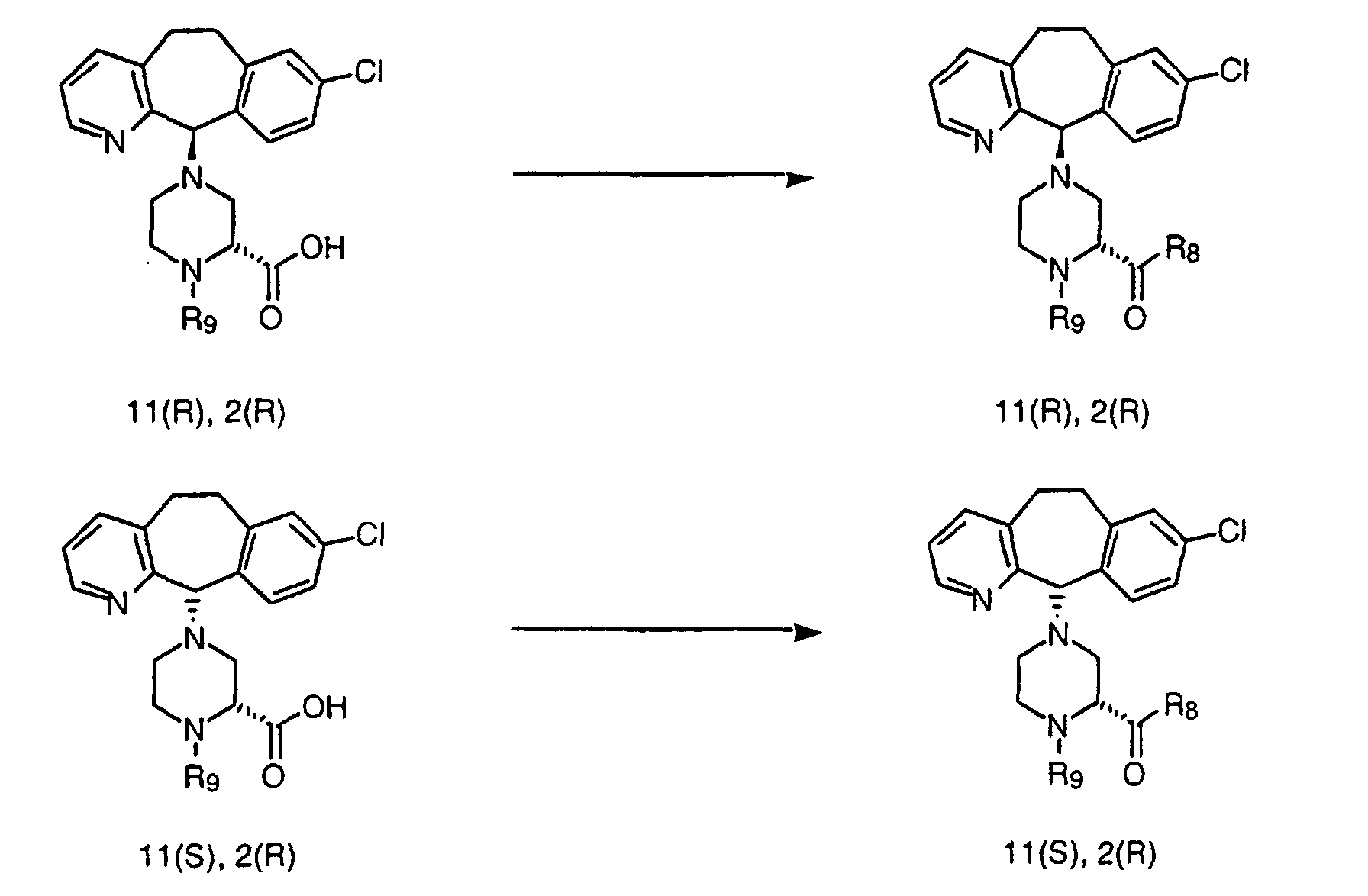

- Using essentially the same procedure as described in Example 74 above the 11(R),2(R) and 11(S),2(R) acids from Preparative Example 30, may be reacted with the product from Preparative Example 58, Step E to give the targets of Examples 75-80; or with the product from Preparative Example 59, Step E to give the targets of Examples 81-86, respectively (Table 11).


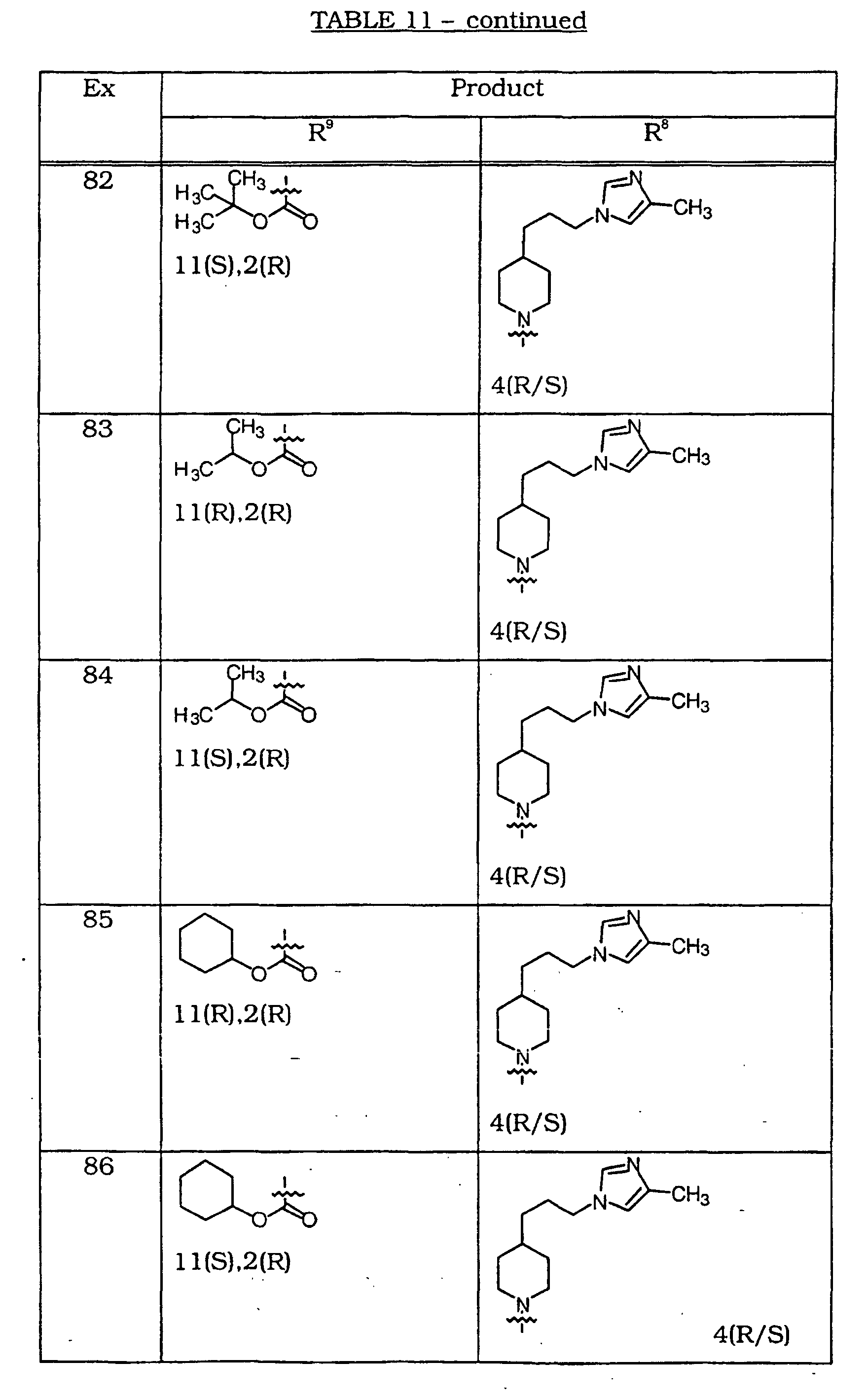
-

- By reacting the anhydride from Preparative Example 3 as shown in the scheme above, with the product of Preparative Example 60, Steps E, or F, one may obtain the intermediate of Examples 87-98; or with the product of Preparative Example 61, Step B, one may obtain the intermediate of Examples 99-102; or with the product of Preparative Example 62, Step C, one may obtain the intermediate of Examples 103-106; or with the intermediate of Preparative Example 63, Step D of Route 1, or Steps F or J of Route 2 one may obtain the intermediate of Examples 107-110. By reacting the intermediates so obtained with 8,11-dichloro-6,11-dihydro-5H-benzo[5,6]cyclohepta[1,2-b]pyridine (prepared as described in US 5,807,853, Sept. 15, 1998) one may obtain, after reaction with either di-tert- butyldicarbonate and sodium hydroxide, or with iso-propyl chloroformate and triethylamine, or with cyclohexyl chloroformate and triethylamine as described herein, the title compounds of Examples 87-110 (Table 12).
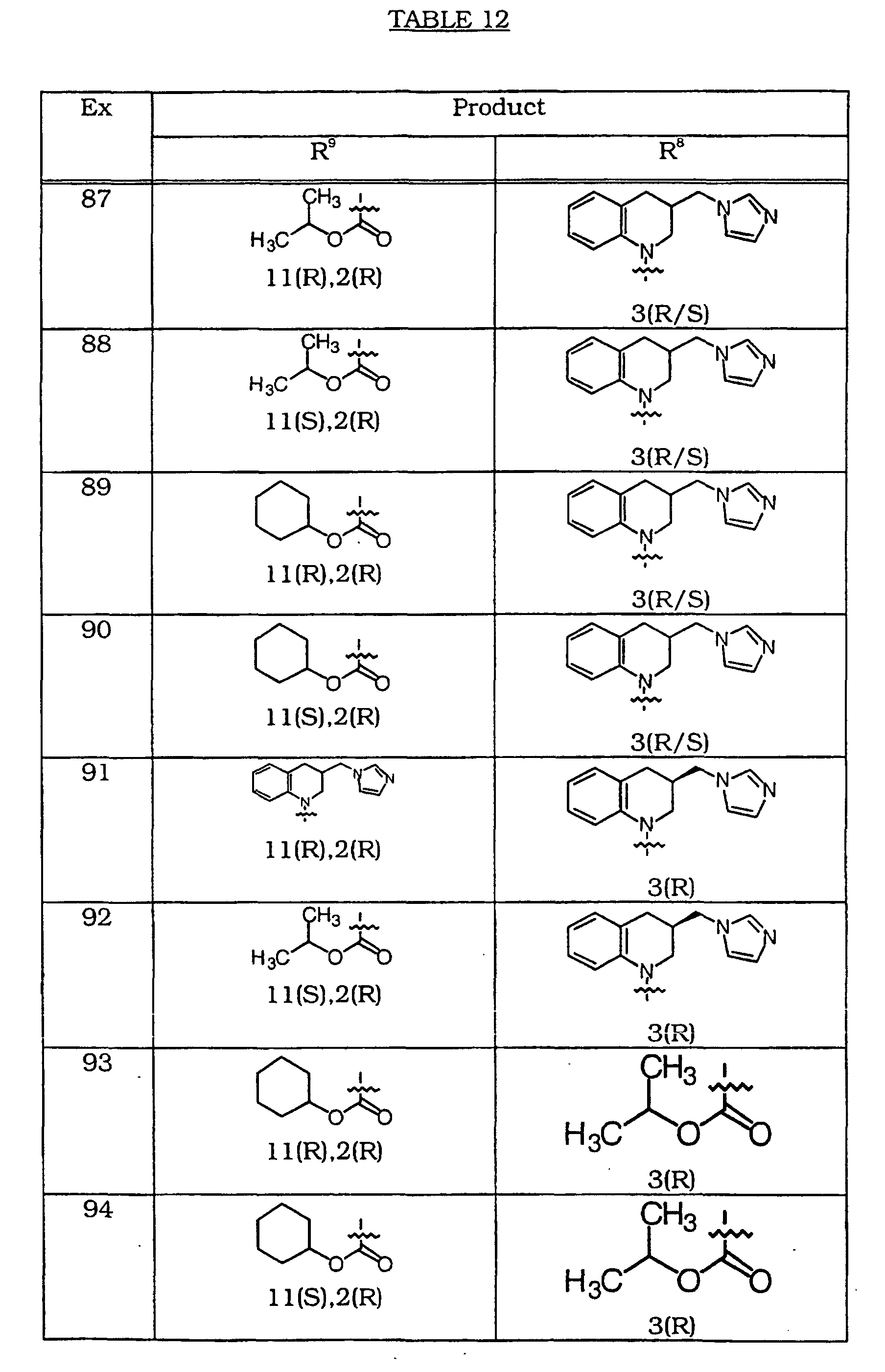
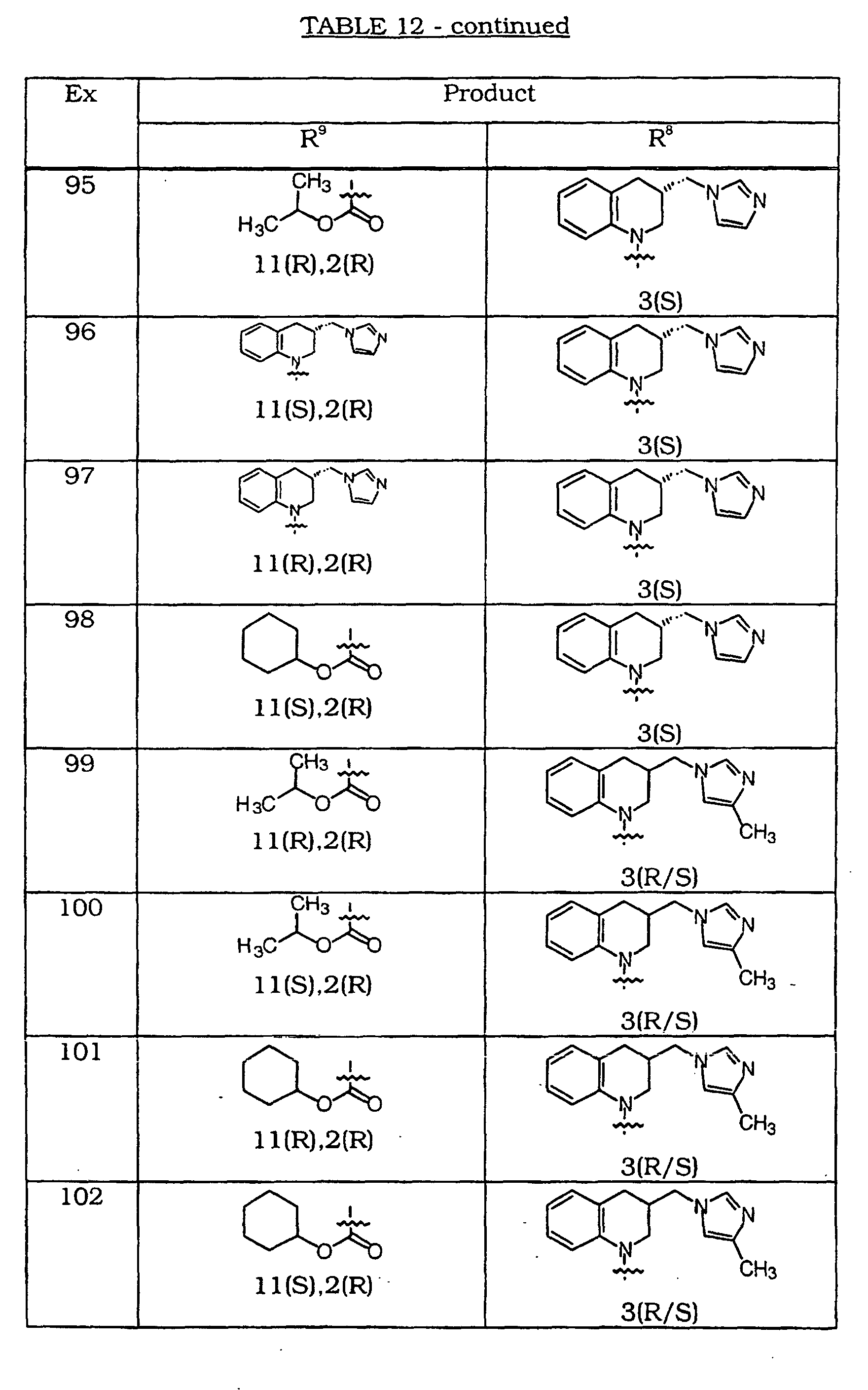


-

- A solution of 52.i (J. Med. Chem. 4890-4902 (1988))(205 g) in conc. HCl (1 L) and water (100 mL) is refluxed for 18h, then poured into ice (3 Kg). Aq. 50% NaOH is added to pH 12 followed by extraction with EtOAc (3x4 L), the extracts are washed with brine, dried and evaporated to afford 52.ii (166 g).
-
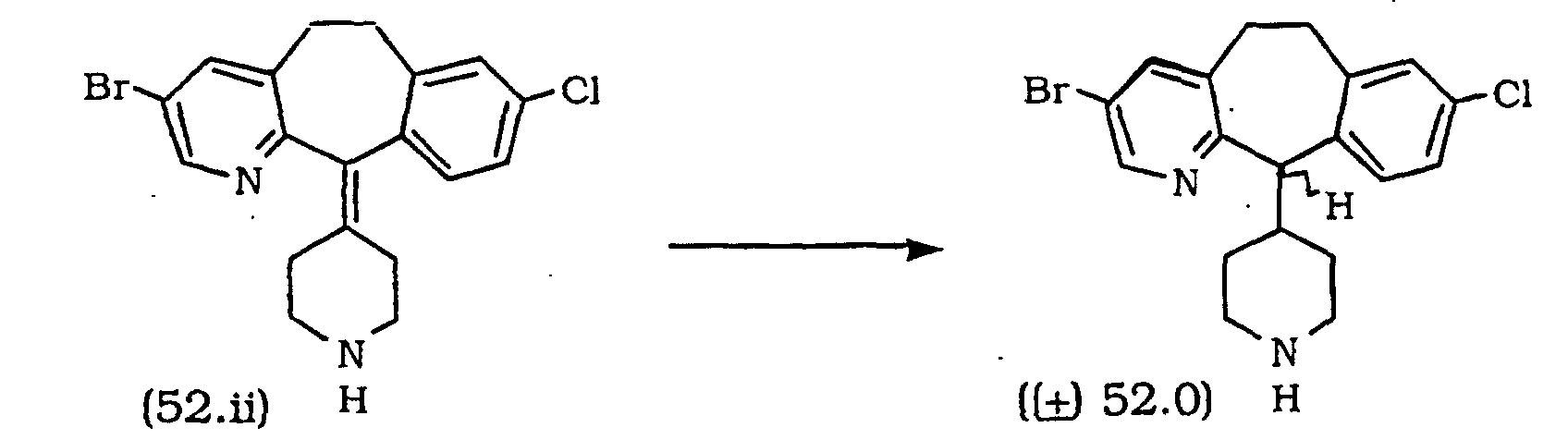
- A 1M solution of DIBAL in toluene (908 mL) is added dropwise during 2h to a solution of 52.ii (166 g) in toluene (4 L) at rt. followed by stirring for 18 h. The mixture is cooled to 0- 5°C and stirred for 1h and extracted with 1N HCl (2 L). The aqueous extract is basified to pH 10 with 50% NaOH and extracted with EtOAc ( 3x2 L). The extracts are evaporated and chromatographed on silica-gel (1 Kg). Elution with 10% MeOH/CH2Cl2 affords the title compound (±) 52.0 (104 g): HRMS (FAB) calcd for C19H21N2 79BrCl 393.0556, found 393.0554.
- The racemate (±) 52.0 (96 g) is resolved by HPLC on a 8x30 cm CHIRALPAK AD column at 25°C with the UVdetector set at 290 nm. Elution with 0.05% diethylamine-methanol affords: Peak 1 (-) 52.0 (40 g): [α] 20 / D -28.4° (c 0.3, MeOH); Further elution with the same solvent affords: Peak 2 (+) 52.0 (42 g): [α] 20 / D +27.5° (c 0.3, MeOH).
-

- A solution of (+)-52.0 (2.3 g) in dimethylformamide (30 ml) is reacted with isatoic anhydride (1.25 g) in the presence of DMAP (0.1 g) at r.t. for 3hrs and is then evaporated under reduced pressure and residual dimethylformamide is azeotroped with toluene. The residue is dissolved in ethylacetate (50 ml) and the solution is extracted with 10% sodium carbonate (3x100 ml). The organic layer is filtered through silica-gel (100ml) followed by elution with ethylacetate. The filtrate is evaporated under reduced pressure to afford the title compound 53.0 as an amorphous solid (3.68 g). MS(FAB): m/z 510 (MH)+.
-
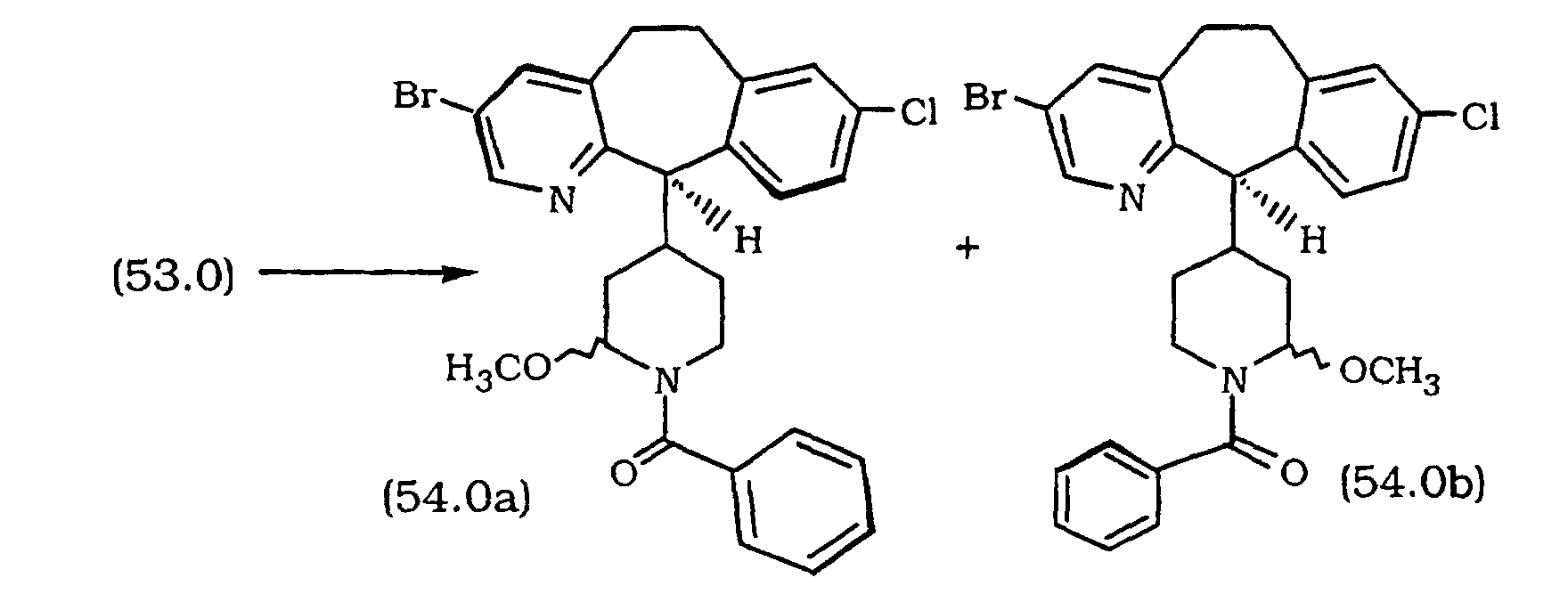
- A solution of 53.0 (3.1 g) and sodium nitrite (0.8 g) in methanol (500 ml) is stirred at r.t. under nitrogen with cuprous chloride (0.15 g) while adding dropwise over 10 minutes a 4M hydrochloric acid/dioxane solution (3.9 ml). The reaction mixture is stirred for 24hrs followed by the addition of 10% sodium carbonate to pH 8, concentrated under reduced pressure, diluted with water (200 ml) and extracted with dichloromethane (4x100ml). The combined extract is evaporated under reduced pressure and the crude reaction product is flash chromatographed on silica-gel (400 ml). Elution with 25% ethylacetate-hexane affords after evaporation the title compound 54.0a and 54.0b as an off-white amorphous solid (2.97 g). 1H NMR (CDCl3, 300 MHz) d 3.30 (s, 3H); MS (FAB) m/e 525 (MH)+.
-

- A solution of 54.0a and 54.0b (17 g) in methanol (150 ml) and 2N hydrochloric acid (170 ml) and conc. HCl (60 ml) is heated under reflux for 17 hrs, followed by evaporation under reduced pressure. The resulting amorphous solid is dissolved in methanol (160 ml) and sodium cyanide (15 g) is added with stirring until the reaction is basic (pH 8). The reaction is stirred for 2 h, diluted with dichloromethane (300 ml) and filtered. The filtrate is evaporated and the residue is dissolved in conc HCl (150 ml) and the mixture is heated in an oil bath (120°C) for 4h and is then evaporated under reduced pressure. The residue is dissolved in THF (100 ml) and 10% NaOH (30 ml) is added to pH>8 followed by the dropwise addition of a solution of (BOC)2O (9 g) in THF (50 ml) with vigorous stirring for 24 h. The solution is concentrated to a low volume, stirred with hexane (2x120 ml) and ice-water followed by acidification of the aqueous layer with citric acid and extraction with EtOAc. The crude product obtained by evaporating the extract is purified by flash chromatography to afford the mixture of 57.0a and 57.0b as light tan solid that appears as a single tlc spot (16 g). 1H NMR (CDCl3, 300 MHz) d 1.40 (s, 9H); MS (FAB) m/z 535 (MH)+.
- The single tlc spot is a mixture of four isomers.
- Following the above procedure (Steps A-E), except using Compound (-)-52.0 (17 g), a mixture of 58.0a and 58.0b is obtained as a light solid that appears as a single tlc spot (17 g). MS(ES) m/z 535 (MH+).
-

- The imidazole (reagent 2), (220mg,0.92mmol) was added to a solution of the Boc-acid (reagent 1), (0.45g,0.842mmol), EDCI (200mg, 1.043mmol),HOBT (130mg, 0.962mmol),and N-methyl morpholine (0.2ml,1.81mmol) in DMF (anhydrous, 3ml) at room temperature (20°C).The resultant solution was stirred overnight at 20°C.The solvent was evaporated, water (70ml) and EtOAC (120 ml) were added. The organic layer was separated,and washed with 10% Na2CO3 solution (50ml),then dried over MgSO4, filtered and evaporated solvent yielding an oil, which chromatographed on silica gel eluting with 5% MeOH:MeCl2 yielding the product as a white solid (425mg,74%). Mixture of 4 isomers A,B,C,D.
- Mass Spec (ES,MH,682) High Resolution Mass Spec Estimated(MH) 684.2139(Br =81) Observed 684.2120
-
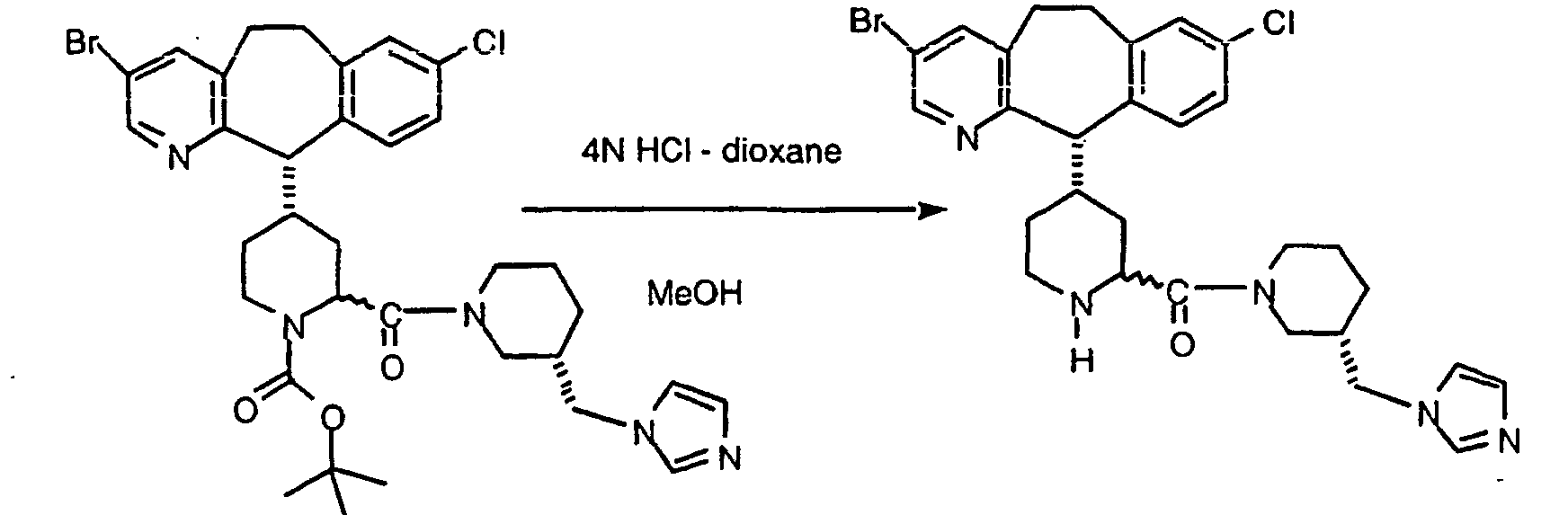
- A solution of the tricycle Isomers (A,B,C,D) from Example 118 (150mg,0.205mmol) in 4N Hcl-dioxane (3ml) and MeOH(3ml) was stirred at 20°C for 3 hours. The solvent was evaporated,water (25ml) and 10% NaOH (4ml) were added,then extracted with MeCl2 (2x100ml). The organic layer was separated,dried over MgSO4, and solvent evaporated yielding a solid which was purified by chromatography on silica gel eluting with 3% MeOH-MeCl2 containing 2% NH4OH yielding the product as a white solid (70mg,54% yield). Mixture of 2 Isomers(C,D) (PRODUCT 1) Mass Spec ES (MH) 582.
- Further elution yielded a white solid (25mg, 20% yield). Mixture of 2 isomers.(A,B) (PRODUCT 2) Mass Spec ES (MH) 582.
-
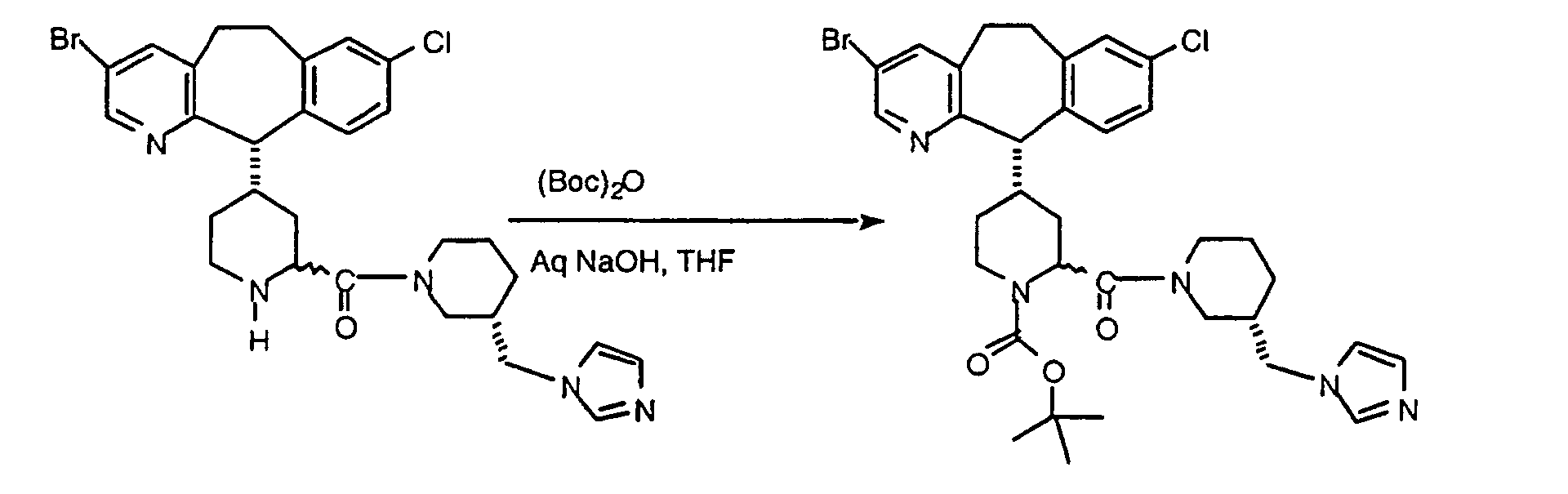
- A solution of Boc dicarbonate (100mg, 0.45mmol) in THF(2ml) was added to a solution of the tricycle (170mg, 0.29mmol )-(Isomers (C,D) Product 1 Step A in THF:H2O(V/V 1:1) (10ml), and 10% NaOH (2ml) at 20°C. Then stirred at this temperature for 60 minutes. Water (5ml), and MeCl2 (10ml) were added. The organic layer was separated, dried over MgSO4, filtered and solvent evaporated yielding an oil, which chromatographed on silica gel , eluting with 3% v/v MeOH: MeCl2 yielding the product as a white solid (170mg) as a mixture of 2 isomers. Isomers C,D. Mass Spec (ES,MH) 682.
- Following the above procedure but, substituting Product 2 from Step A (isomers A/B) for Product 1, the title Product 2 was obtained as a mixture of 2 isomers (A/B). Mass Spec (ES.MH) 682
-

- Compounds with (R) stereochemistry at C11 were obtained using the procedures of Examples 118 and 119, but substituting reagent 1, Example 118 with the corresponding (R) tricyclic isomer.
- By substituting reagent 2, Example 118, with the corresponding 2-methyl imidazole analog, the following structures were obtainedwherein R9 is defined in Table 14 below.

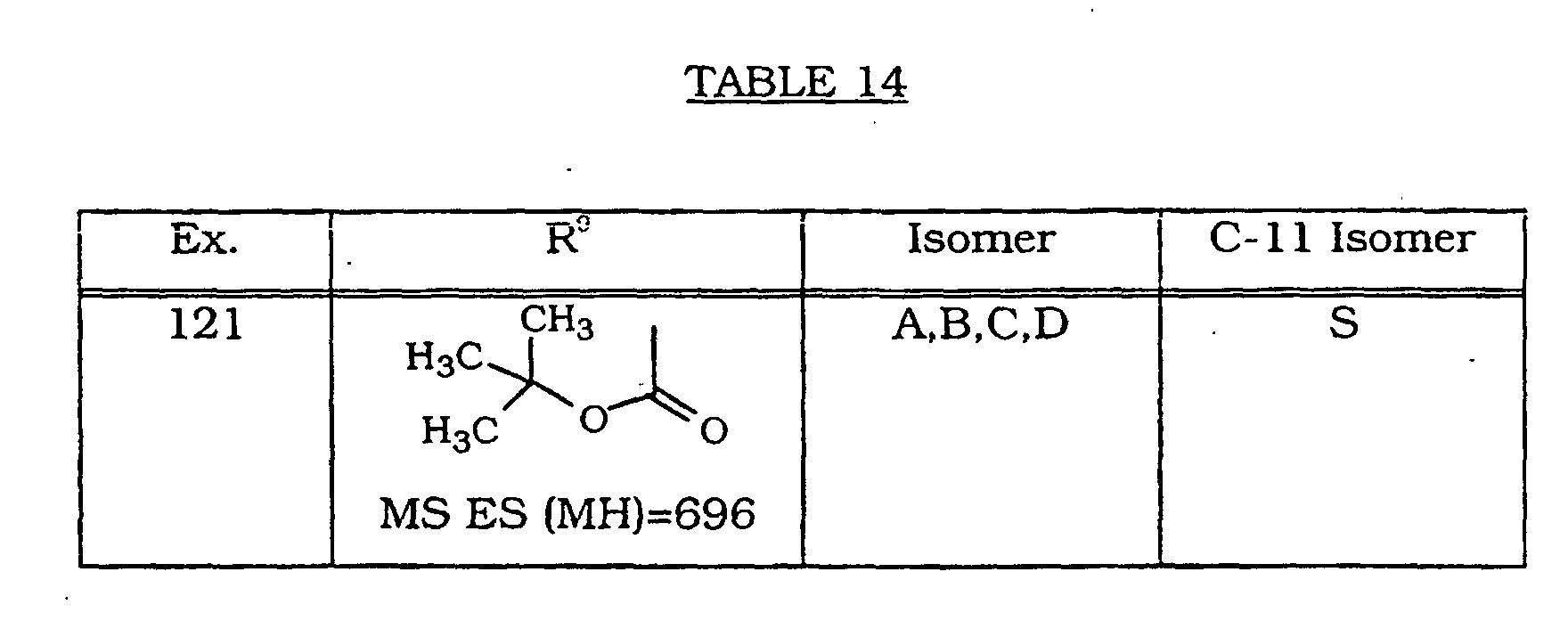
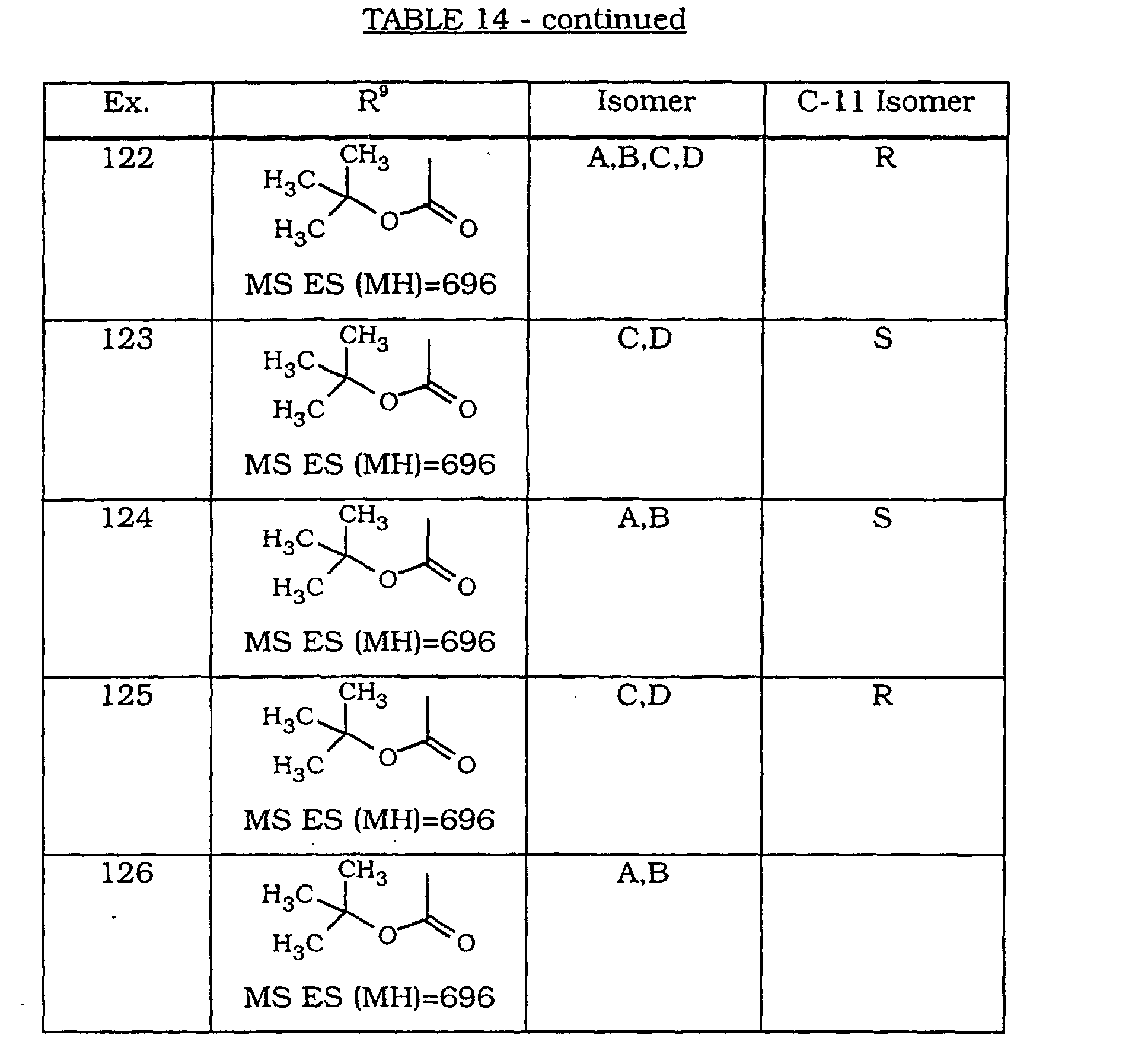
-
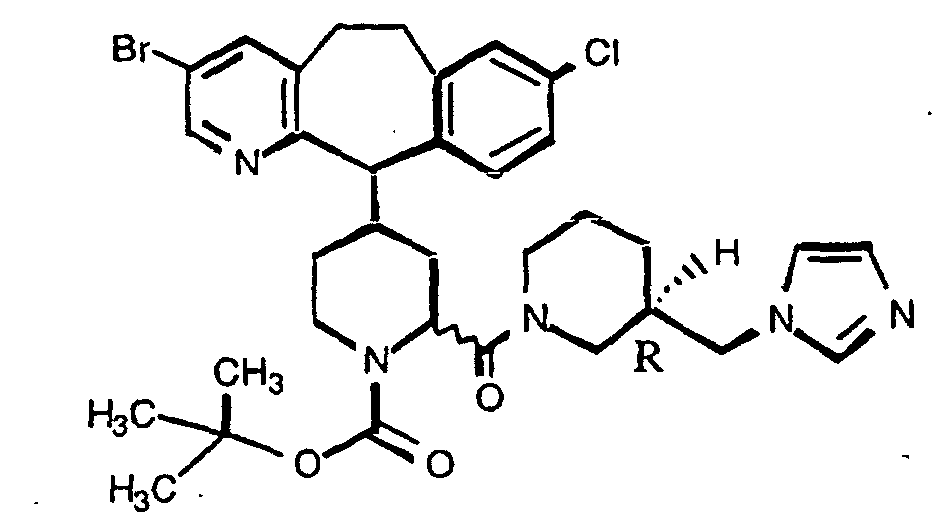
- Following the procedures of Examples 118 and 119 the isomers identified in Table 15 below are obtained.
Ex. C-11 Isomer Isomer mass spectra observed (estimate) 127 R A,B,C,D 684.2123
(684.2139)128 R A,B 684.2163
(684.2139)129 R C,D 684.2163
(684.2139)130 S A,B,C,D 684.2149
684.2139131 S A,B, 684.2139
(684.2139) -

- A solution of 6-methylnicotinic acid ( 9.97 g, 72.7 mmol), water (100 mL) and ammonium hydroxide was hydrogenated (40 psi) in a Parr low-pressure hydrogenation apparatus with 5% Rh-Al2O3 (3.22g) catalyst over 72 hours. The mixture was filtered and the filtrate was concentrated in vacuo to give the title compound as a white solid (10.58g, 100%, MH+ = 144).
-
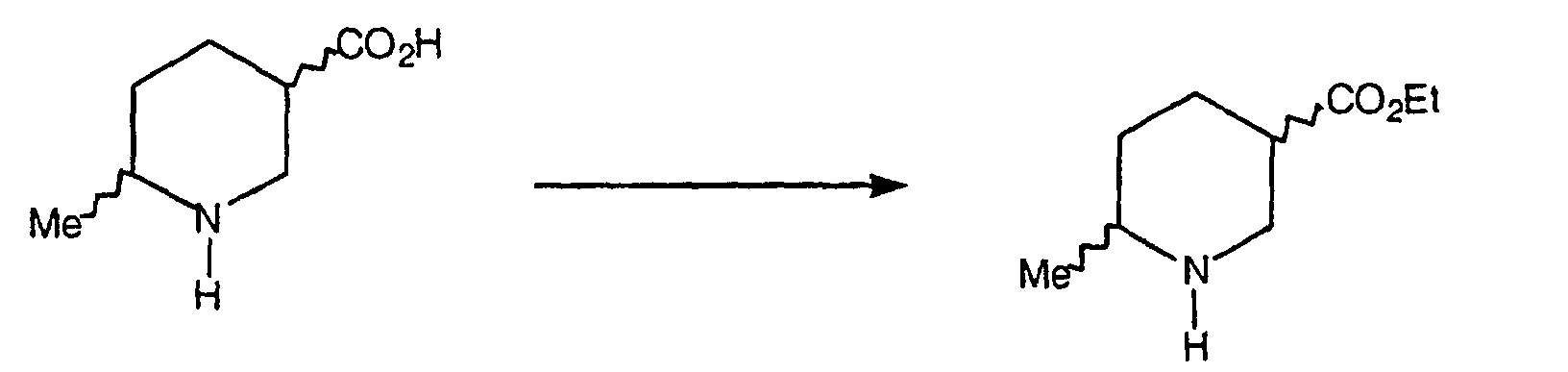
- A mixture of the title compound from Step A (10.40 g, 72.72 mmol), ethyl alcohol (190 proof, 50 ml) and HCl (4ml) was stirred at reflux for 4 hours. The reaction mixture was cooled to room temperature and poured into water. Basification of the mixture to pH=10 with 10% aqueous NaOH, extraction of the aqueous layer with EtOAc and drying of the organic phase over anhydrous Na2SO4 gave the title compound after filtration and concentration in vacuo (1.85 g, 15%, MH+ =172).
-
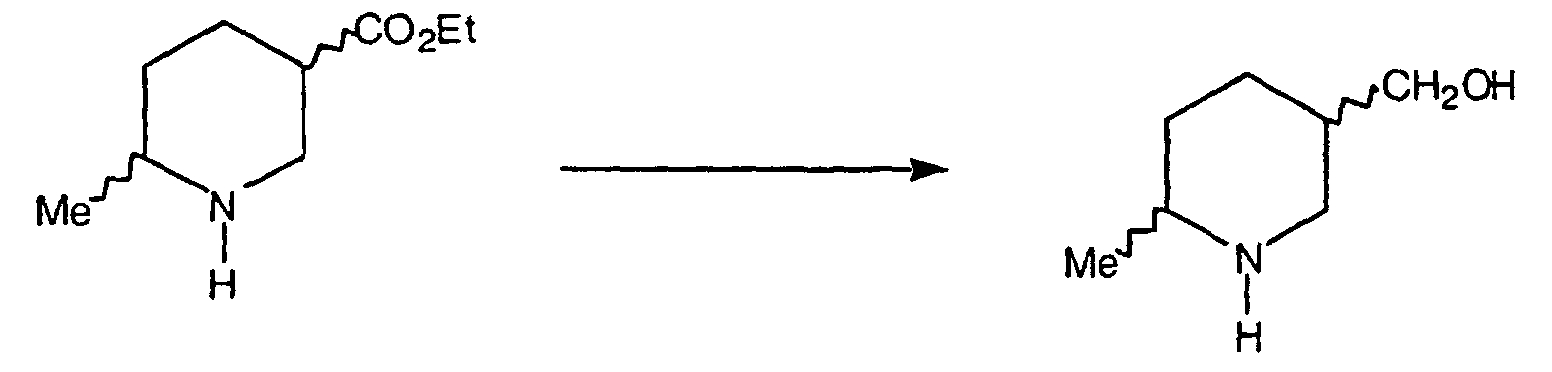
- Following the procedure set forth in Preparative Example 7 Step B but using the title compound from Preparative Example 66 Step B instead of the title compound from Preparative Example 7 Step A, the product was isolated as a mixture of diastereomers and used directly in Step D (MH+ = 130).
-
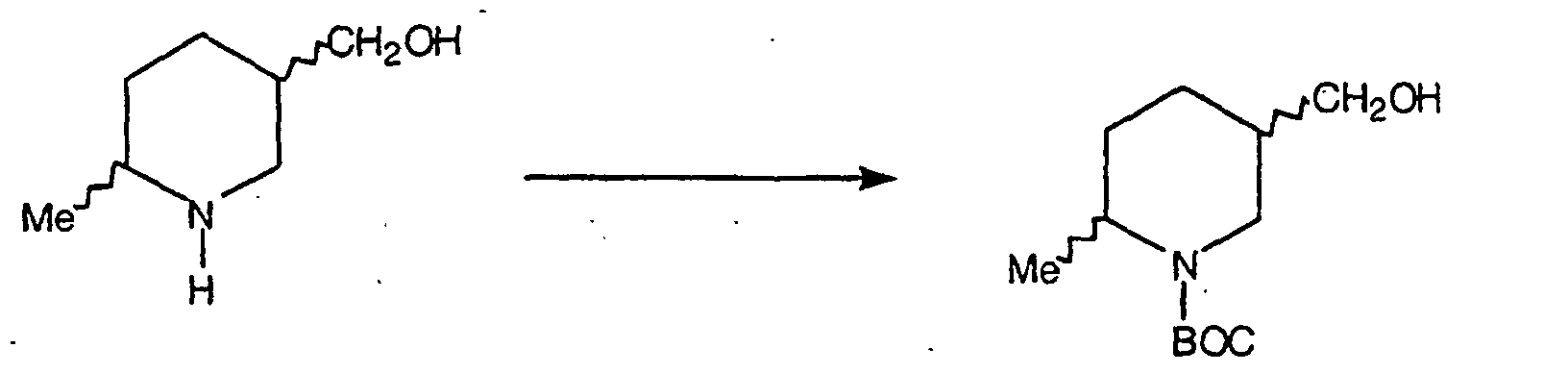
- Following the procedure set forth in Preparative Example 7 Step C but using the title compound from Preparative Example 66 Step C instead of the title compound from Preparative Example 7 Step B, the product was isolated as a mixture of diastereomers (1.7 g, 70%, MH+ = 230).
-
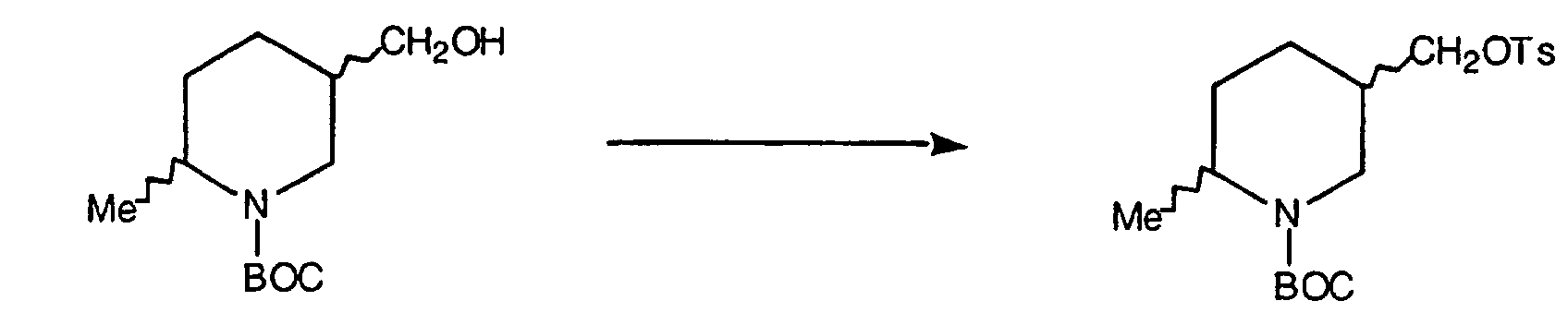
- Following the procedure set forth in Preparative Example 7 Step D but using the title compound from Preparative Example 66 Step D instead of the title compound from Preparative Example 7 Step C, the product was isolated as a mixture of diastereomers and used directly in Step F (MH+ = 384).
-
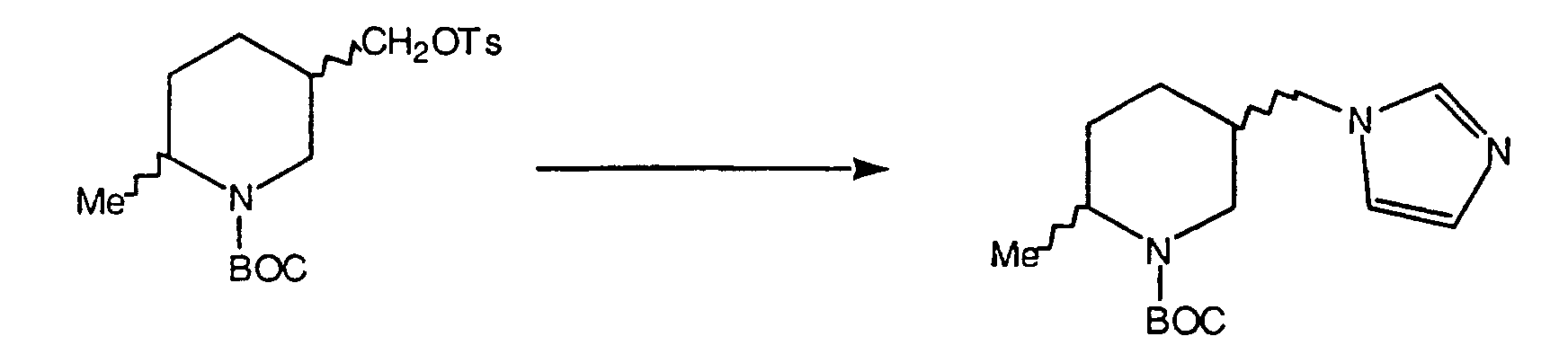
- Following the procedure set forth in Preparative Example 7 Step E but using the title compound from Preparative Example 66 Step E instead of the title compound from Preparative Example 7 Step D, the product was isolated as a 5:1 mixture of diastereomers (328 mg, 16 %, MH+ = 280).
-
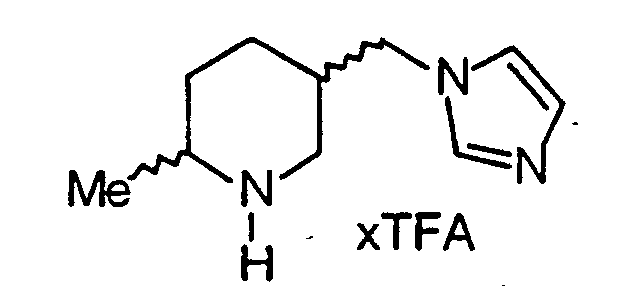
- Following the procedure set forth in Preparative Example 7, Step F, except using the title compound from Preparative Example 66, Step F instead of the title compound from Preparative Example 7, Step E, the amine hydrochloride was obtained (290 mg, 100%): MH+ = 180.
- If the procedures set forth in Preparative Example 66 Steps A-E were followed, except using 5-hydroxynicotinic acid instead of 6-methylnicotinic acid in Step A, the alcoholwould be obtained.
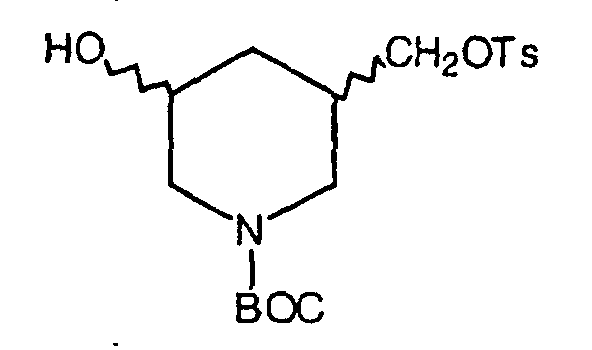
- If the product from Step A were treated with PCC according to standard procedures set forth in the literature, then the ketonewould be obtained.
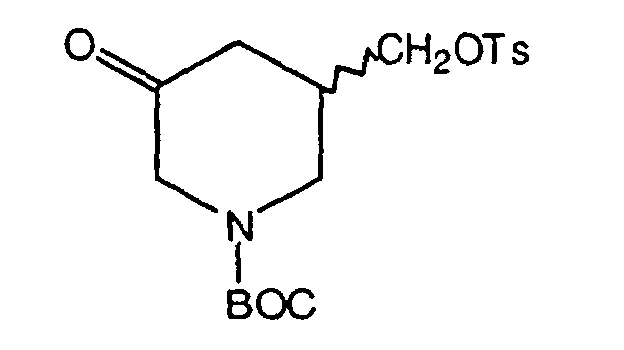
- If the procedures set forth in Preparative Example 7 Steps E-F were followed, except using the title compound from Preparative Example 67 Step B instead of the title compound from Preparative Example 7 Step D in Step E, the amine hydrochloridewould be obtained.

- If the product from Preparative Example 67 Step C were treated with excess NaBH4 according to standard procedures set forth in the literature, then the alcoholwould be obtained.

-

- Following the procedure set forth in Preparative Example 7 Step C, except using the title compound from Preparative Example 7, Step A instead of the title compound from Preparative Example 7, Step B the ester was obtained (62 g, 96%): MH+ =258.
-
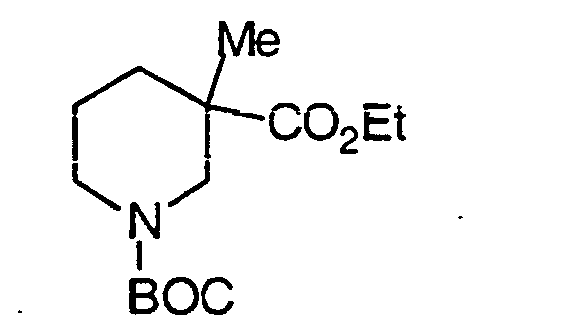
- The product from Preparative Example 68, Step A was treated with LDA in anhydrous THF and the resulting anion was alkylated with methyl iodide to afford the title product (3.53 g, 82%): MH+ =272.
-
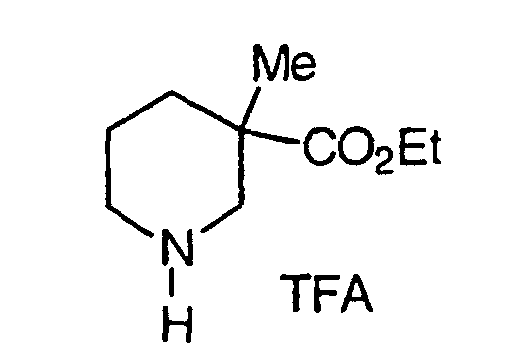
- The title compound from Preparative Example 68, Step B was treated with TFA in CH2Cl2 to afford the amine as a TFA salt (1.63 g, 84%): MH+ =172.
-

- Following the procedures set forth in Preparative Example 7, Steps B-E, except using the title compound from Preparative Example 68, Step C instead of the title compound from Preparative Example 7,Step A in Step B, the imidazole product was obtained (0.445g, 100%): MH+= 280.
-
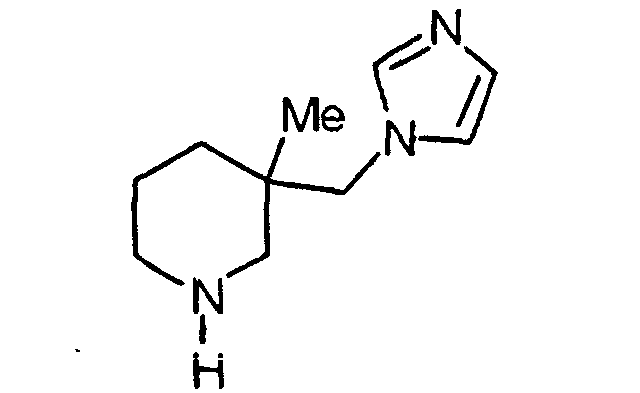
- Following the procedure set forth in Preparative Example 68 Step C, except using the title compound from Preparative Example 68 Step D, the amine was obtained as its TFA salt. The mixture was basified with 1N NaOH and extracted with CH2Cl2 to afford the product (14.6 g, 96%): MH+= 194.
- Following the procedures set forth in Preparative Example 68 Steps A-D, except using benzyl bromide in Preparative Example 68 Step B instead of methyl iodide, the amine hydrochloridewould be obtained.
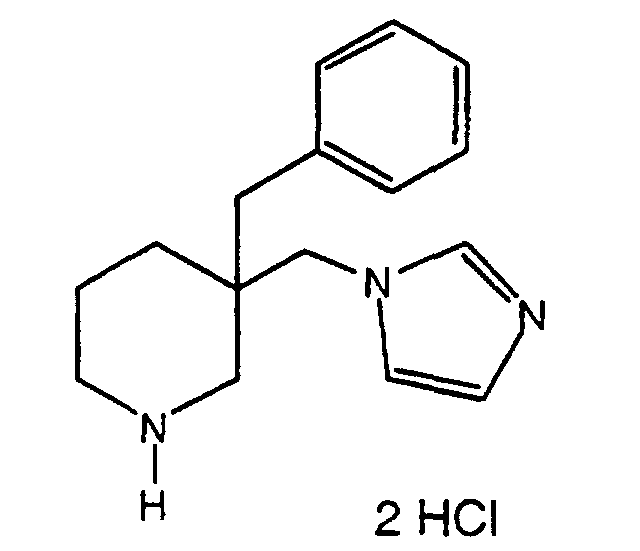
-

- If the procedure set forth for preparing the compounds in Table 4 were followed using the title compound from Preparative Example 66 Step G, the 11 (S) or 11(R) isomers of the carboxylic acid from Preparative Example 30, DEC, HOBt and NMM, the title products would be obtained.
-
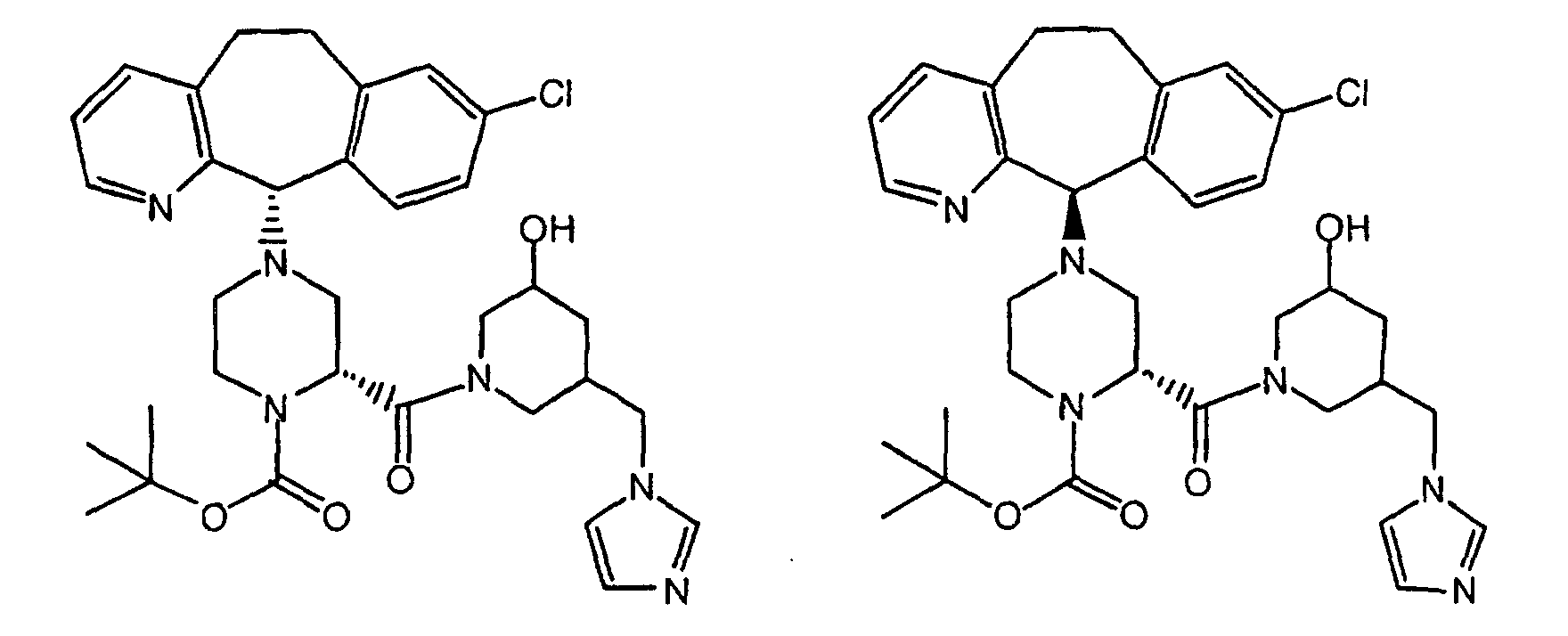
- If the procedure set forth for preparing the compounds in Table 4 were followed using the title compound from Preparative Example 67 Step D, the 11(S) or 11(R) isomers of the carboxylic acid from Preparative Example 30, DEC, HOBt and NMM, the title products would be obtained.
-
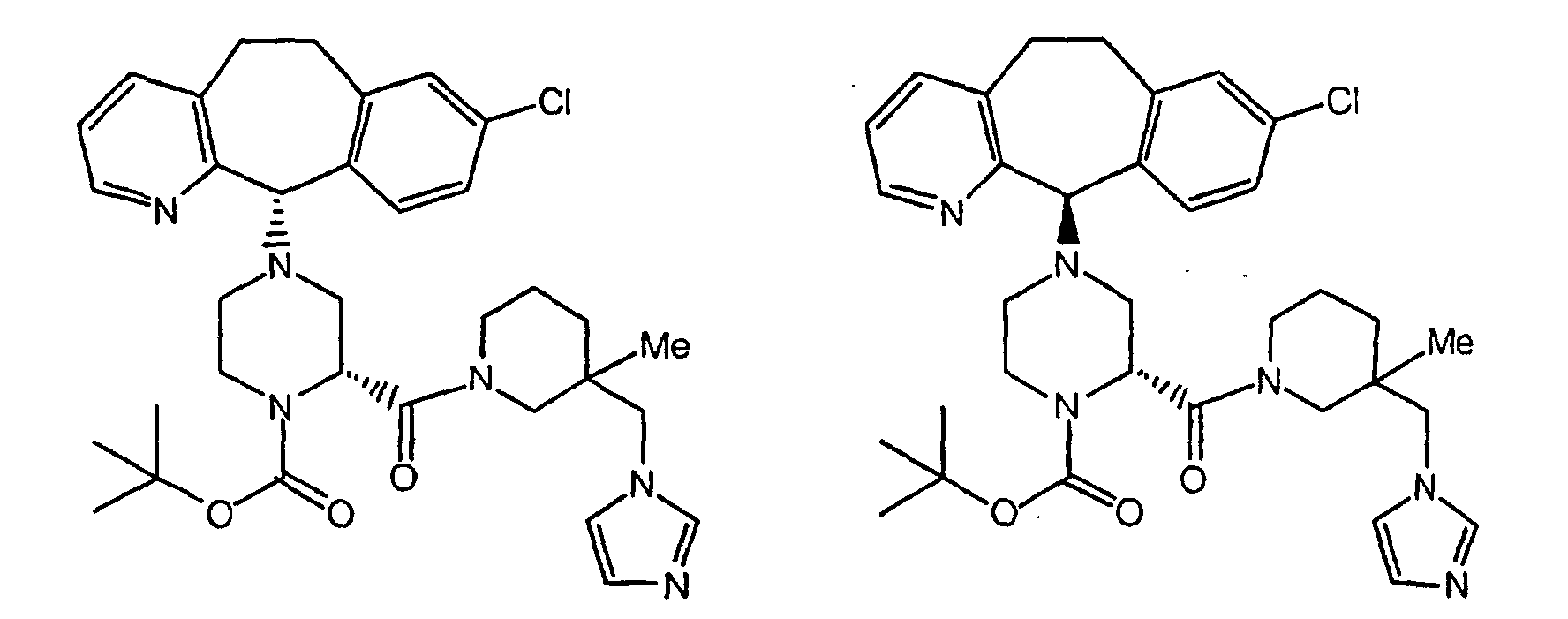
- If the procedure set forth for preparing the compounds in Table 4 were followed using the title compound from Preparative Example 68 Step D, the 11(S) or 11(R) isomers of the carboxylic acid from Preparative Example 30, DEC, HOBt and NMM, the title products would be obtained.
-
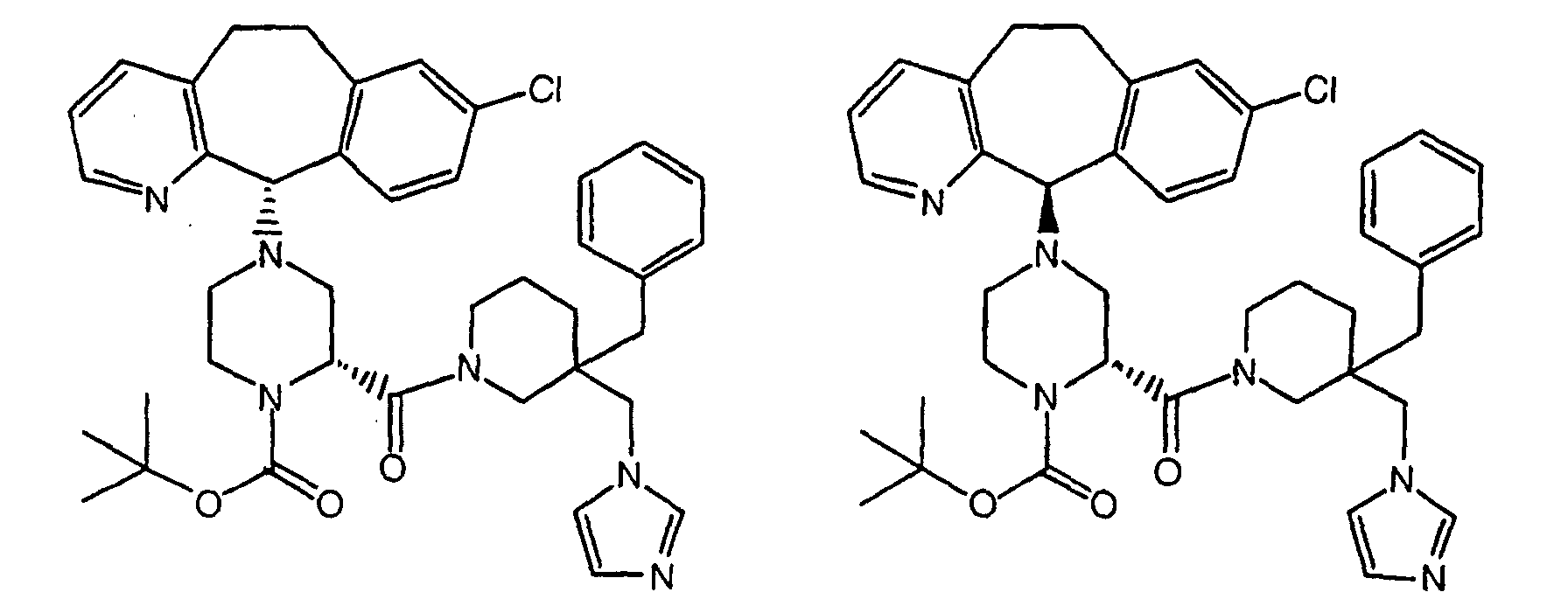
- If the procedure set forth for preparing the compounds in Table 4 were followed using the title compound from Preparative Example 69, the 11(S) or 11 (R) isomers of the carboxylic acid from Preparative Example 30, DEC, HOBt and NMM, the title products would be obtained.
-
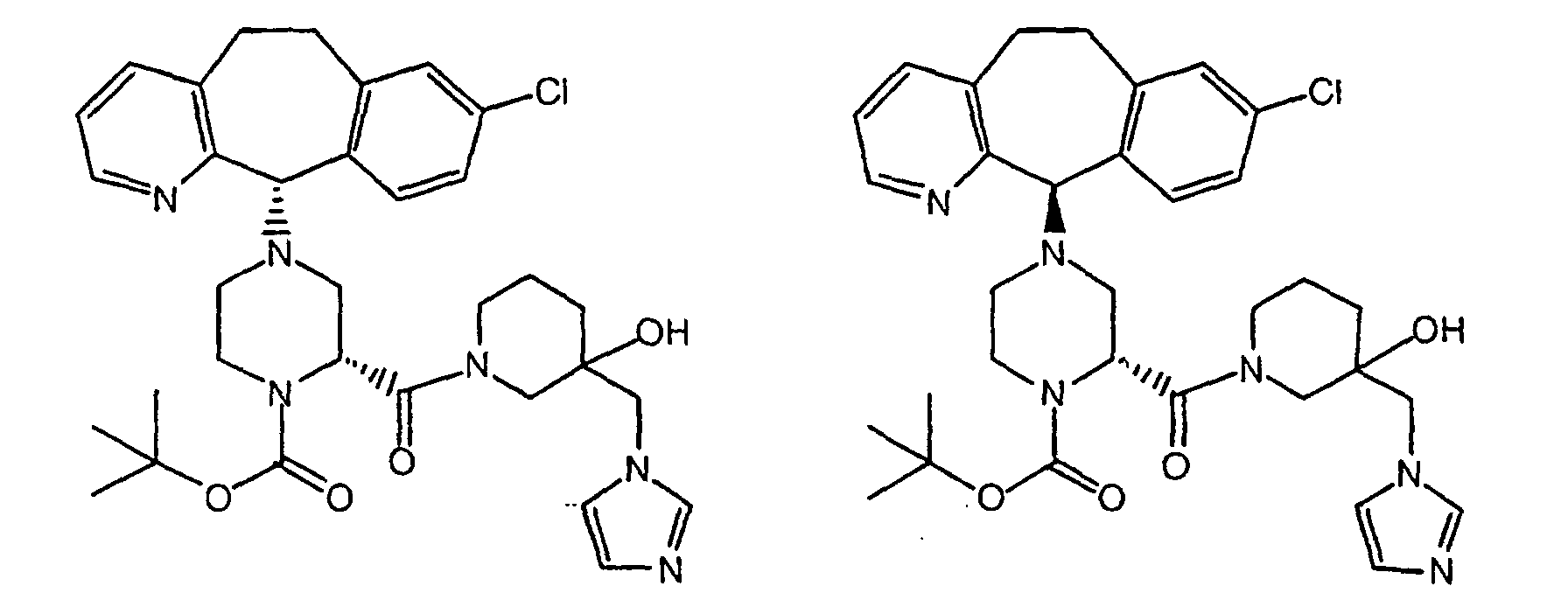
- If the procedure set forth for preparing the compounds in Table 4 were followed using the title compound from Preparative Example 70 Step B, the 11(S) or 11 (R) isomers of the carboxylic acid from Preparative Example 30, DEC, HOBt and NMM, the title products would be obtained.
-
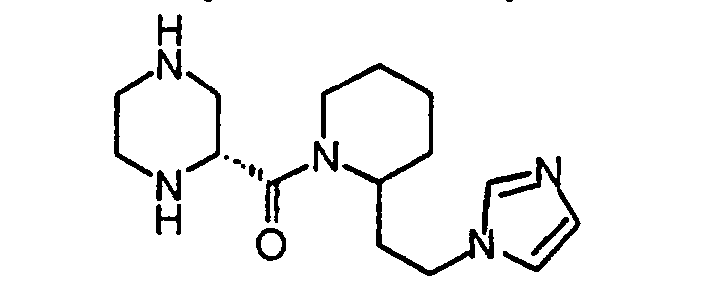
-
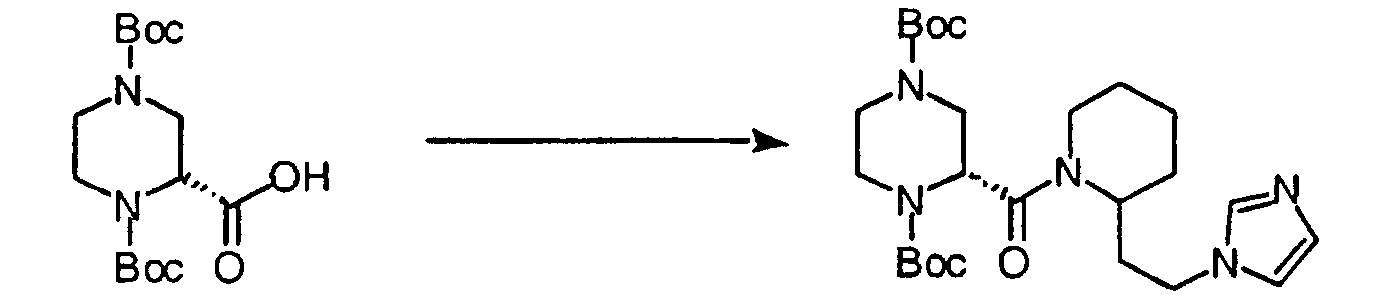
- 1,4-Di-N-tert-butoxycarbonylpiperazine-2(R)-carboxylate (prepared as described in Preparative Example 2) (0.6946g, 2.1mmoles), 2(R/S)-[2-(1H-imidazol-1-yl)ethyl]piperidine (0.49g, 2.73mmoles) (prepared as described in Preparative Example 57, Step D) (IN0972), 1-(3-dimethylaminopropyl)-3-ethylcarbodiimide hydrochloride (0.524g, 2.73mmoles), 1-hydroxybenzotriazole (0.3693g, 2.73mmoles) and 4-methylmorpholine (0.2765g, 0.3005mL, 2.73mmoles) were dissolved in anhydrous DMF (3mL) and the mixture was stirred under argon at 25°C for 122h. The mixture was evaporated to dryness and chromatographed on silica gel using 2-3%(10% conc. ammonium hydroxide in methanol)-dichloromethane as the eluant to give the title compound (0.3127g, 30%): CIMS: m/z 492.4 (MH+); δH (CDCl3) 1.47 (18H, s, CH3), 7.01 (1H, s, Im-H5), 7.05 (1H, s, Im-H4) and 7.63ppm (1H, s, Im-H2); δC (CDCl3) CH3: 28.2, 28.2, 28.2, 28.4, 28.4, 28.4; CH2: 19.1, 25.9, 26.2, 31.9, 40.8/41.3, 41.7, 43.0, 44.0; CH: 46.0, ∼52.1, 128.4, 137.2; C:∼80.4, 80.6, ∼154.3, ∼154.3 and ∼169.8.
-

- The title compound from Step A above was deprotected as described in Preparative Example 57, Step D and chromatographed on silica gel to give the title compound.
-

- Sodium 1,1-dimethylethyl 4-(3-bromo-8-chloro-6,11-dihydro-5H-benzo[5,6]cyclohepta[1,2-b]pyridin-11(S)-yl)-2(R)-carboxy-1-piperazinecarboxylate (prepared as described in Preparative Example 6 (sodium salt)) (0.1g, 0.179mmoles), 2-[2-(1H-imidazol-1-yl)ethyl]piperidine (prepared as described in Preparative Example 57, Step D) (0.0417g, 0.233mmoles), 1-(3-dimethylaminopropyl)-3-ethylcarbodiimide hydrochloride (0.0446g, 0.233mmoles), 1-hydroxybenzotriazole (0.0314g, 0.233mmoles) and 4-methylmorpholine (0.0512mL, 0.466mmoles) were dissolved in anhydrous DMF (4mL) and the mixture was stirred under argon at 25°C for 42h. The solution was evaporated to dryness and the residue was taken up in dichloromethane and washed with 1N NaOH, dried (MgSO4), filtered and evaporated to dryness. The residue was chromatographed on silica gel using 2.5%-4.5%-7.5% (10% conc. NH4OH in methanol)-dichloromethane as the eluant to give the title compound (0.0172g, 14%): HRFABMS: m/z 697.2285 (MH+) (Calcd. m/z 697.2269); δH (CDCl3) 1.38/1.41 (9H, s, CH3), 4.31 (1H, s, H11), 4.68 (1H, bs, H2.), 7.03-7.20 (5H, bm, Ar-H and Im-H4 and Im-H5), 7.57 (1H, s, Im-H2), 7.83/8.19 (s, Ar-H) and 8.38ppm (1H, s, Ar-H2); δC (CDCl3) CH3: 28.4, 28.4, 28.4; CH2: 19.1, 24.8/24.9, 28.3, 30.3, 30.5, 31.4, 40.3, 42.9/43.2, 44.1/44.6, 45.6, 50.2/50.5; CH: 44.1/44.6, 52.4, 78.4, 119.2, 126.2, 127.9, 130.8/130.9, 132.6, 136.7, 141.6, 146.9/147.2; C: 80.4, 119.8/120.2, 134.4, 135.9, 137.0, 141.5, 155.0, 156.7/157.1, 170.3/170.9.
-

- Sodium 1,1-dimethylethyl 4-(8-chloro-6,11-dihydro-5H-benzo[5,6]cyclohepta[1,2-b]pyridin-11(S)-yl)-2(R)-carboxy-1-piperazinecarboxylate (prepared as described in Preparative Example 6 (sodium salt)) (0.5239g, 1.09mmoles), 2-[2-(1H-imidazol-1-yl)ethyl]piperidine (prepared as described in Preparative Example 57, Step D) (0.2544g, 1.42mmoles), 1-(3-dimethylaminopropyl)-3-ethylcarbodiimide hydrochloride (0.272g, 1.42mmoles), 1-hydroxybenzotriazole (0.1918g, 1.42mmoles) and 4-methylmorpholine (0.156mL, 1.42mmoles) were dissolved in anhydrous DMF (23.5mL) and the mixture was stirred under argon at 25°C for 286h. The solution was evaporated to dryness and the residue was taken up in dichloromethane and washed with 1N NaOH, dried (MgSO4), filtered and evaporated to dryness. The residue was chromatographed on silica gel using 2. 5% (10% conc. NH4OH in methanol)-dichloromethane as the eluant to give the title compound (0.2298g, 32%): HRFABMS: m/z 619.3169 (MH+) (Calcd. m/z 691.3163).
-
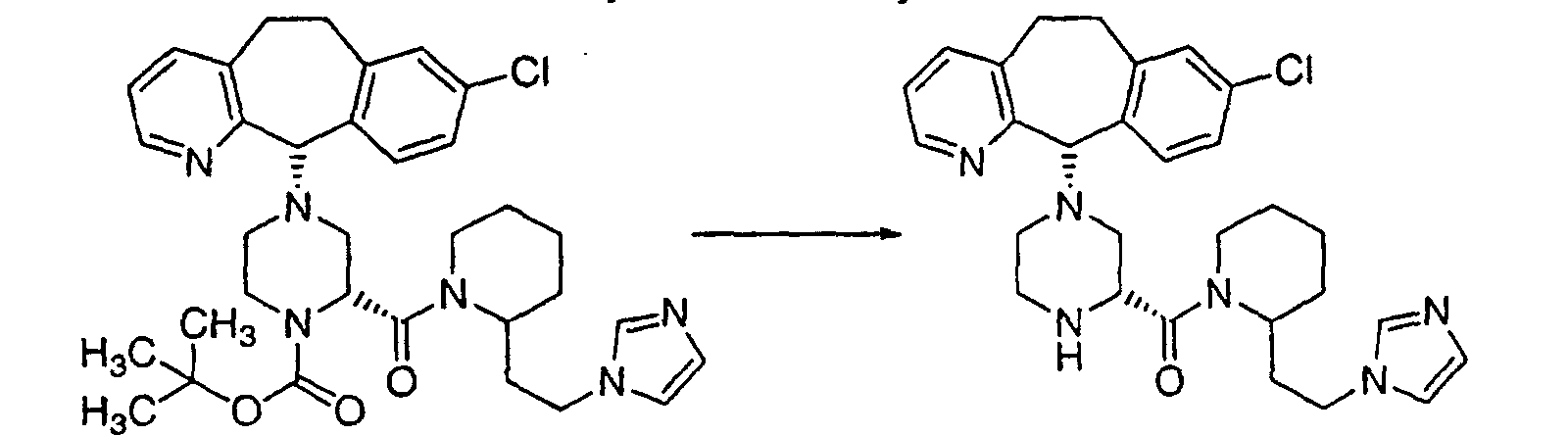
- The title compound from Example 2 (0.225g, 0.363mmoles) was dissolved in methanol (2mL). A 10% (v/v) solution of conc. H2SO4 in dioxane (v/v) (4.92mL) was added and the mixture was stirred at 25°C for 30h. The mixture was diluted with methanol (300mL) and then treated with BioRad AG1-X8 (OH-) resin until it was basic. The resin was filtered off and washed with methanol. The combined filtrates were evaporated to dryness and the residue was chromatographed on silica gel using 4% (10% conc. NH4OH in methanol)-dichloromethane as the eluant to give the title compound (0.1692g, 90%): HRFABMS: m/z 519.2655 (MH+) (Calcd. m/z 519.26390), δH (CDCl3) 4. 43 (1H, s, H11), 6.89, 6.93,7.00, 7.10, 7.13, 7.19, 7.21, 7.43, 7.45, 7.50, 7.58, 8.03, 8.30 and 8.33ppm (8H, Ar-H and Im-H); δC(CDCl3) CH2: 19.0/19.1, 25.0/25.7/26.1, 28.3/29.0, 30.7/30.8, 30.9/31.0, 31.5/31.9, 40.0/40.7, 43.5, 44.1/44.2/44.4, 49.3, 51.5/52.3; CH: 45.7/46.1, 54.4/55.8, 79.5/79.7, 118.3/118.9, 123.1, 126.1/126.2, 129.1/129.5/129.7, 130.4/130.5, 132.7/132.8, 137.0/137.5, 138.9, 146.3; C: 134.0, 134.9, 135.5, 141.3, 157.1 and 169.8/170.5.
-

- The title compound from Example 3 (0.165g, 0.318mmoles) and triethylamine (0.1329mL, 0.954mmoles) were dissolved in anhydrous dichloromethane (5mL). Cyclohexylchloroformate (0.0517g, 0.318mmoles) dissolved in anhydrous dichloromethane (3.18mL) was added and the mixture was stirred at 25°C for 18h. Additional cyclohexylchloroformate (0.0129g, 0.0795mmoles) was added and the stirring was continued for a total of 43h. Methanol (10mL) was added and the mixture was evaporated to dryness. The residue was chromatographed on silica gel using 2% (10% conc. NH4OH in methanol)-dichloromethane as the eluant to give the title compound (0.153g, 75%): HRFABMS: m/z 645.3323 (MH+) (Calcd. MH+ for C36H46N6O3Cl: m/z 645.3320).
- and
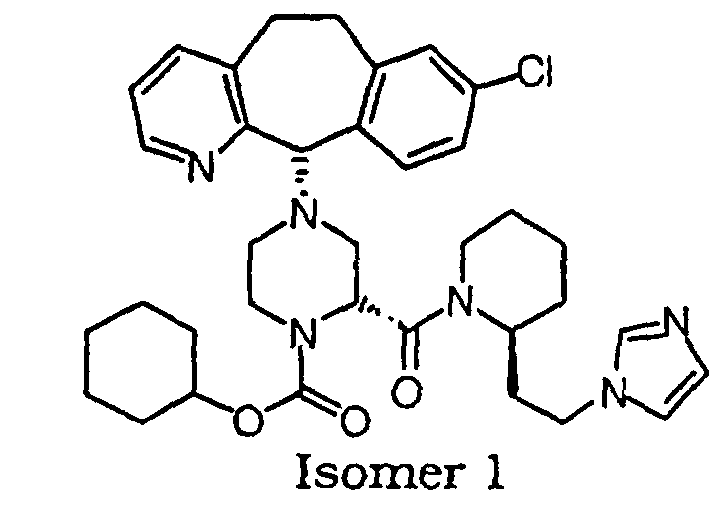
-
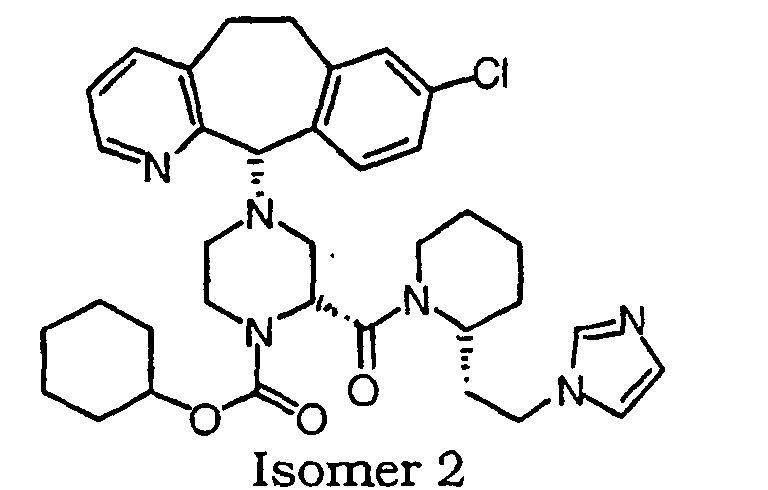
- The diastereoisomeric mixture of compounds from Example 4 (0.154g) was separated using chiral HPLC on a Chiralpak AD® analytical column using hexane: iso- propanol: diethylamine::85:15:0.2 as the eluant to give firstly isomer 1 (0.0376g): HRFABMS: m/z 645.3305 (MH+) (Calcd. MH+ for C36H46N6O3Cl: m/z 645.3320); δH (CDCl3) 4.30 (1H, s, H11), 6.69, 7.00, 7.08, 7.11, 7.16, 7.18, 7.42, 7.70, 8.32ppm (9H, s and m, Ar-H and Im-H); δC(CDCl3) CH2: 18.9, 23.6, 23.6, 24.8/25.1, 25.5, 28.0/28.2, 30.7/30.8, 30.9, 31.4, 31.8, 31.8, 42.7, 43.9/44.2, 50.9, 52.7; CH: 49.9/50.5, 52.3, 73.6, 79.3/79.9, 119.1/119.3, 123.3, 126.0, 128.7, 132.8, 137.1, 139.0/139.3, 146.3/146.9; C: 134.0, 135.1, 136.4, 141.8/ 142.0, 156.1, 157.0 and 170.1; [α] 20°C / D 0° (c=6.89mg/2mL, MeOH) and then isomer 2 (0.0867g): HRFABMS: m/z 645.3305 (MH+) (Calcd. MH+ for C36H46N6O3Cl: m/z 645.3320); δH (CDCl3) 4.34 (1H, s, H11), 6.93, 6.99, 7.06, 7.12, 7.17, 7.21, 7.43, 7.70 and 8.33ppm (9H, s and m, Ar-H and Im-H); δC(CDCl3) CH2: 19.1, 23.5, 23.5, 24.7/24.8, 25.5, 28.9, 30.6/30.8, 31.5, 31.7, 31.7, 36.7, 40.4, 42.8, 44.1, 50.5, 52.5; CH: 45.9, 52.3, 73.7, 79.2/79.4, 119.4, 123.4, 126.0, 128.1, 130.7, 132.7, 137.1, 139.4, 146.3/146.9; C: 134.1, 135.1, 136.6, 142.0, 156.1, 157.0 and 170.2; [α] 20°C / D -44.1° (c=10.05mg/2mL, MeOH). An overlap cut consisting of a mixture of isomer 1 and isomer 2 was also obtained (0.0196g).
-
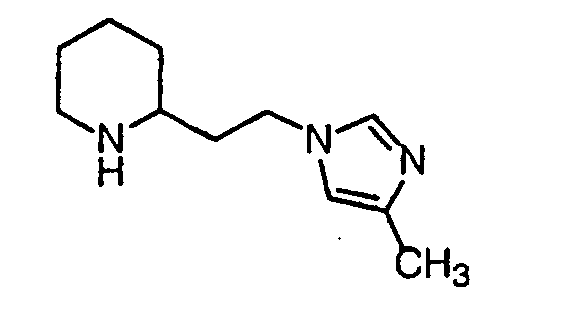
-

- 4-Methylimidazole (6.46g, 78.64mmoles) was dissolved in anhydrous DMF (300mL) and 95% sodium hydride (1.987g, 86.5mmoles) was added in portions over 0.25h to the stirred solution at 25°C under argon. The mixture was stirred for 1.5h. A solution of 1-tert-butoxycarbonyl-2(R/S)-(2-methanesulfonyloxyethyl)piperidine (21.97g, 71.49mmoles) (prepared as described in Preparative Example 57, Step B) in anhydrous DMF (70mL) was added and the mixture was heated under reflux at 65°C for 2.25h. The mixture was evaporated to dryness and the residue was taken up in dichloromethane and washed with water, dried (MgSO4), filtered and evaporated to dryness. The product was chromatographed on silica gel using 1% (10% conc. NH4OH in methanol)-dichloromethane to give a mixture of the title compounds (12.06g, 58%) (4-Me:5-Me::63:37): CIMS: m/z 294.25 (MH+); 4-Me: δH (CDCl3) 1.43 (9H, s, CH3), 2.20 (3H, s, Im-4-CH3), 6.63 (1H, s, Im-H5) and 7.35ppm (1H, s, Im-H2); δC(CDCl3) CH3: 13.6, 28.4, 28.4, 28.4; CH2: 19.0, 25.4, 28.7, 31.6, 38.8, 44.1; CH: 48.0, 115.2, 136.1; C: 79.7, 138.3, 155.0 and 5-Me: δH (CDCl3) 1.43 (9H, s, CH3), 2.19 (3H, s, Im-5-Me), 6.75 (1H, s, Im-H4) and 7.41ppm (1H, s, Im-H2); δC(CDCl3) CH3: 9.2, 28.4, 28.4, 28.4; CH2: 19.0, 25.4, 28.7, 31.4, 38.8, 42.0; CH: 48.0, 126.9, 136.5; C: 79.7, 138.3, 155.0.
-
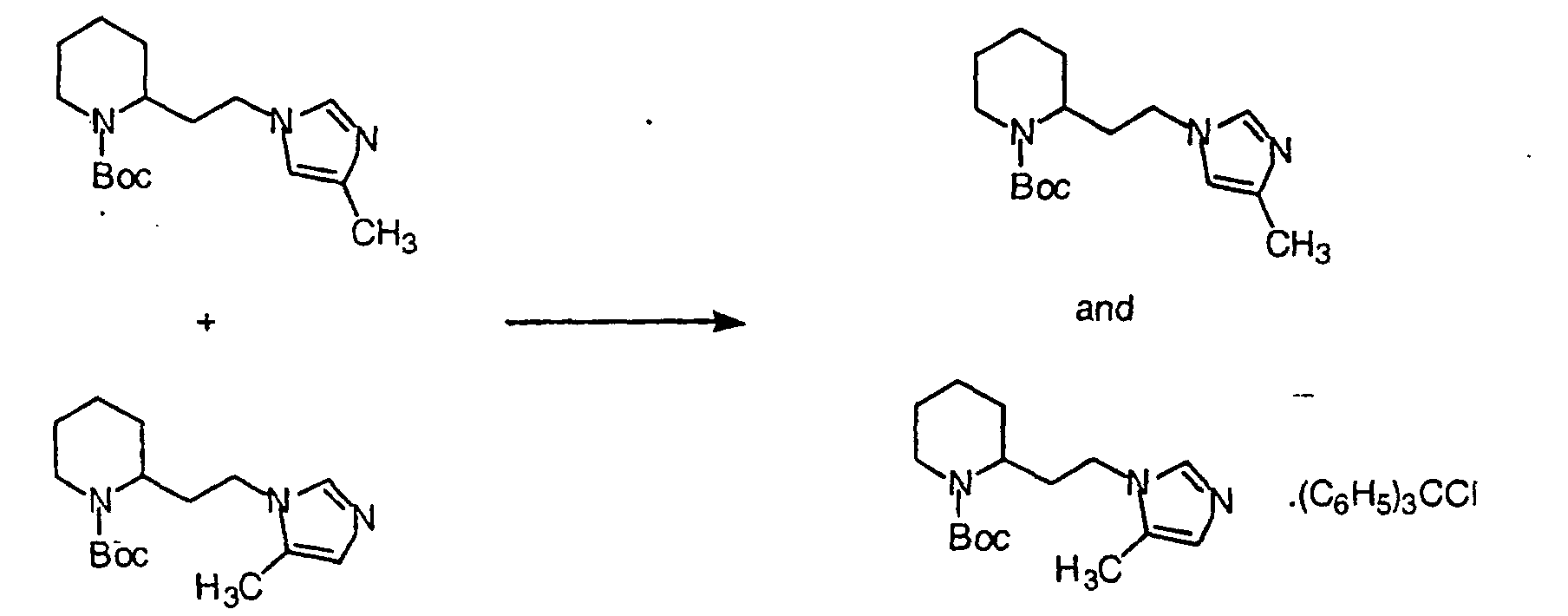
- The mixture of compounds from Step A above (1.77g) was dissolved in anhydrous CH2Cl2 (18.6mL) at 0°C under argon. Trityl chloride (1.2445g, 2 equivalents per equivalent of the 5-methyl isomer) was added and the mixture was stirred at 0°C for 2h. The reaction mixture was introduced directly onto a silica gel column and the column was eluted with 50% ethyl acetate in acetone to give the pure 4-methyl isomer (0.6267g, 56%): 4-Me: δH (CDCl3) 1.44 (9H, s, CH3), 2.20 (3H, s, Im-4-CH3), 6.64 (1H, s, Im-H5) and 7.36ppm (1H, s, Im-H2); δC(CDCl3) CH3: 13.7, 28.5, 28.5, 28.5; CH2: 19.1, 25.5, 28.9, 31.7, 39.0, 44.2; CH: 48.1, 115.1, 136.2; C: 79.8, 138.4, 155.1.
- The pure 4-methyl isomer (0.7518g, 2.,56mmoles) was deprotected as described in Preparative Example 57, Step D, to give after purification, the title compound (0.4366g, 88%): FABMS: m/z 194.2 (MH+); δH (CDCl3) 1.76 (2H, m, CH2), 2.19 (3H, s, Im-4-CH3), 3.94 (2H, m, CH2-Im), 6.60 (1H, s, Im-H5) and 7.33ppm (1H, s, Im-H2); δC(CDCl3) CH3: 13.7; CH2: 24.5, 26.6, 32.9, 38.4, 43.6, 46.8; CH: 53.9, 115.2, 136.2; C: 138.4.
-
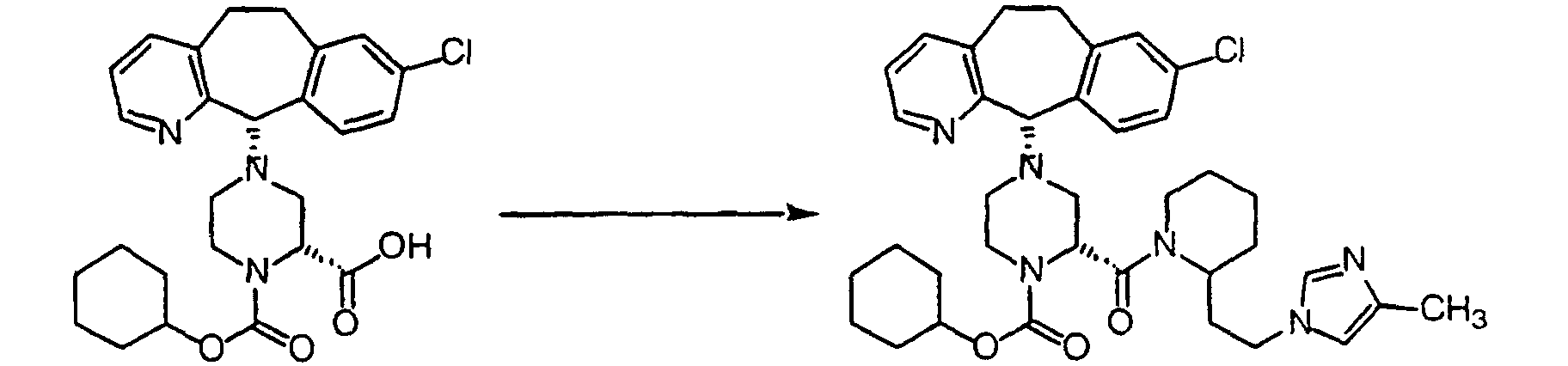
- Cyclohexyl 4-(8-chloro-6,11-dihydro-5H-benzo[5,6]cyclohepta[1,2-b]pyridin-11(S)-yl)-2(R)-carboxy-1-piperazinecarboxylate (0.275g, 0.568mmoles) (prepared as described in Preparative Example 32), 2-[2(R/S)-(4-methyl-1H-imidazol-1-yl)ethyl]piperidine (0.1428g, 0.7386mmoles) (prepared as described in Preparative Example 2, Step C), 1-(3-dimethylaminopropyl)-3-ethylcarbodiimide hydrochloride (0.1416g, 0.7386mmoles), 1-hydroxybenzotriazole (0.0998g, 0.7386mmoles) and 4-methylmorpholine (0.0812mL, 0.7386mmoles) were dissolved in anhydrous DMF (12.2mL) and the mixture was stirred at 25°C for 212h under argon. The solution was evaporated to dryness and taken up in dichloromethane and washed with 1N NaOH. The aqueous layer was extracted 3X with dichloromethane (200mL) and the combined organic layers were dried (MgSO4), filtered and evaporated. The product was chromatographed on silica gel using 2% (10% conc. NH4OH in methanol)-dichloromethane as the eluant to give the title compound (0.149g, 40%): FABMS: m/z 659.62 (MH+).
- and
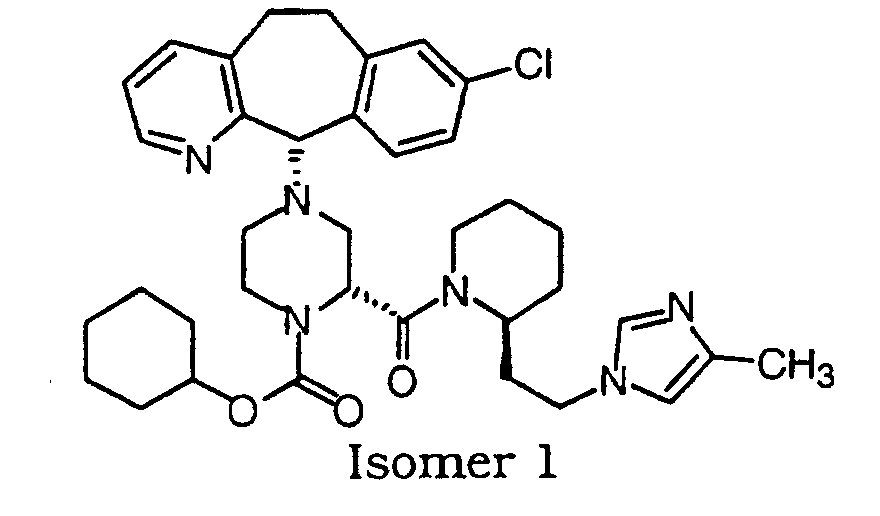
-
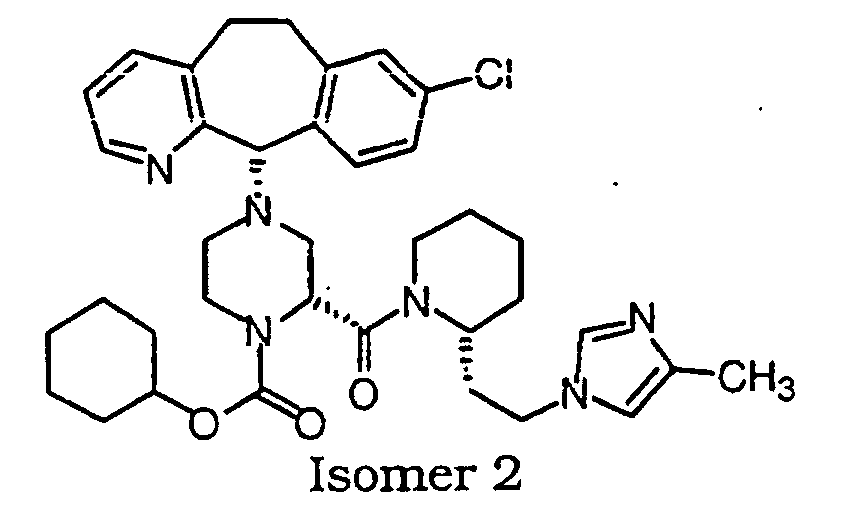
- The diastereoisomeric mixture of compounds from Example 6 (0.145g) was separated using chiral HPLC on a Chiralpak AD® analytical column using hexane: iso-propanol: diethylamine::70:30:0.2 as the eluant to give firstly isomer 1 (0.0475g): FABMS: m/z 659.4 (MH+); δH (CDCl3) 1.66 (2H, m, CH2), 2.23 (3H, s, Im-4-CH3), 3.71 (2H, m, CH2-Im), 4.32 (1H, s, H11), 6.58, 6.72, 6.75, 7.10, 7.14, 7.20, 7.41, 7.60 and 8.34ppm (9H, s and m, Ar-H and Im-H); δC(CDCl3) CH3: 13.4/13.7; CH2: 18.9, 23.5, 23.5, 24.2/25.1, 25.5, 28.1, 30.7, 30.8, 31.4, 31.8, 31.8, 36.7, 42.4/42.6, 43.8/44.1, 50.5/50.8, 52.8; CH: 49.8, 52.3, 73.6, 79.3/80.0, 115.5/115.8, 123.3, 126.0, 130.6/130.8, 132.8, 136.0, 139.2/139.3, 146.3; C: 134.0, 135.0/135.1, 136.2/136.5, 137.8, 141.8/142.0, 156.1, 157.0, 170.1; [α] 20°C / D -4.3° (c=8.07mg/2mL, MeOH), and then isomer 2 (0.852g): HRFABMS: m/z 659.3492 (MH+) (Calcd. MH+ for C37H48N6O3Cl: m/z 659.3476); δH (CDCl3) 1.64 (2H, m, CH2), 2.22 (3H, s, Im-4-CH3), 3.72 (2H, m, CH2-Im), 4.35 (1H, s, H11), 6.61, 6.67, 7.12, 7.17, 7.22, 7.43, 7.57 and 8.35ppm (9H, s and m, Ar-H and Im-H); δC (CDCl3) CH3: 13.3/13.5; CH2: 19.1, 23.5, 23.5, 24.7, 25.5, 28.7/28.9, 30.6, 30.8, 31.5, 31.7, 31.7, 40.3, 42.1/42.8, 44.1/44.2, 50.5/50.7, 52.6/52.7; CH: 46.0/46.2, 52.5, 73.7, 79.3/79.4, 115.6/115.8, 123.4, 126.0, 130.7, 132.7, 136.0/136.2, 139.4, 146.3; C: 134.1, 135.1, 136.2/136.6, 137.2, 142.0, 156.1, 157.1, 170.3; [α] 20°C / D -44.7° (c=9.0mg/2mL, MeOH).
-

-

- The title compound from Preparative Example 58, Step C, (1.29g, 4.3mmoles) was dissolved in anhydrous DMF (15mL). Sodium imidazole (0.3215g, 4.7mmoles) was added and the mixture was stirred at 25°C under argon for 3h. The solution was evaporated to dryness and the residue was chromatographed on silica gel using 2% (10% conc. NH4OH in methanol)-dichloromethane as the eluant to give the title compound (0.6813g, 72%): CIMS: m/z 294.25 (MH+); δH (CDCl3) 1.43 (9H, s, CH3), 3.97 (2H, m, CH2-Im), 6.90 (1H, s, Im-H5), 7.04 (1H, s, Im-H4) and 7.45ppm (1H, s, Im-H2); δC(CDCl3) CH2: 28.4, 28.4, 28.4; CH2: 18.9, 25.4, 26.3, 27.7, 28.6, 38.8, 46.5; CH: ∼49.0, 118.6, 129.4, 137.1; C: 79.3, 155.0.
-

- The title compound from Step A above (0.6075g, 2.1mmoles) was deprotected as described in Preparative Example 57, Step D, and chromatographed on silica gel using 10% (10% conc. NH4OH in methanol)-dichloromethane as the eluant to give the title compound (0.3805g, 95%): CIMS: m/z 194.20 (MH+); δH (CDCl3) 3.89 (2H, m, CH2-Im), 6.84 (1H, s, Im-H5), 6.99 (1H, s, Im-H4) and 7.41ppm (1H, s, Im-H2); δC(CDCl3) CH2: 24.9, 26.7, 27.2, 33.1, 34.4, 47.2, 47.2; CH: 56.4, 118.8, 129.6, 137.1.
-

- 1, 1-dimethylethyl 4-(3-bromo-8-chloro-6,11-dihydro-5H-benzo[5,6]cyclohepta[1,2-b]pyridin-11-yl)-2(R)-carboxy-1-piperazinecarboxylate (0.7225g, 1.3mmoles) (prepared as described in Preparative Example 6), the title compound from Preparative Example 8, Step B (0.3382g, 1.7mmoles), 1-(3-dimethylaminopropyl)-3-ethylcarbodiimide hydrochloride (0.3354g, 1.7mmoles), 1-hydroxybenzotriazole (0.2364g, 1.7mmoles) and 4-methylmorpholine (0.192mL, 1.7mmoles) were dissolved in anhydrous DMF (3mL) and the mixture was stirred under argon at 25°C for 319h. The solution was evaporated to dryness and the residue was taken up in dichloromethane and washed with saturated aqueous sodium bicarbonate, water, dried (MgSO4), filtered and evaporated to dryness. The residue was chromatographed on silica gel using 3% (10% conc. NH4OH in methanol)-dichloromethane as the eluant to give the partially purified title compounds. The appropriate fractions were rechromatographed using 1.5% (10% conc. NH4OH-methanol)-dichloromethane as the eluant to give title compound as a mixture of 4 diastereoisomers (0.3718g, 39%): FABMS: m/z 711.4 (MH+); δH (CDCl3) 1.39 (9H, s, CH3), 6.91, 7.08, 7.13, 7.17, 7.56, 7.67 (Ar-H), 6.97 (1H, s, Im-H5), 7.04 (1H, s, Im-H4), 7.58 (1H, s, Im-H2) and 8.38ppm (1H, m, Ar-H2); δC(CDCl3) CH3: 28.3/28.4, 28.3/28.4, 28.3/28.4; CH2: 18.9, 24.9/25.0/25.5, 26.8, 30.2, 30.5, 36.2, 40.1, 42.7/43.0, 46.5/46.7, 50.1/50.3/50.7, 52.7/52.9; CH: 46.9, 51.6/52.0, 78.5, 119.0, 126.2/126.3, 128.6, 130.8/130.9, 132.6, 137.0, 141.5, 146.9/147.2; C: 80.2. ∼120.1, 134.3, 134.9, 137.6, 140.8. ∼155.1/156.1, ∼156.8, ∼170.3.
- A portion of the diastereomeric mixture (0.28g) was subjected to chiral HPLC on a Chiralpak© AD column using hexane: iso-propanol: diethylamine::85:15:0.2 as the eluant to give only a partial separation. Isomer 1 (0.0604g) was obtained pure while isomers 3 and 4 (0.0376g) were obtained as a 97% pure mixture. The remaining overlap cuts could not be separated.
- Isomer 1: HRFABMS: m/z 711.2429 (MH+) (Calcd. MH+ for C35H45N6O3BrCl: m/z 711.2425); δH (CDCl3) 1.41 (9H, s, CH3), 4.29 (1H, s, H11), 6.92, 7.14, 7.18, 7.20 (Ar-H), 6.98 (1H, s, Im-H5), 7.08 (1H, s, Im-H4), 7.58 (1H, s, Im-H2), 7.63 (1H, s, Ar-H4) and 8.38ppm (1H, s, Ar-H2); δC(CDCl3) CH3: 28.3, 28.3, 28.3; CH2: 18.9, 24.7, 25.4, 26.7, 28.8, 30.3, 30.5, 40.2, 43.1, 46.6, 50.6/50.7, 52.6; CH: 46.9/47.1, 52.1, 78.5/78.6, 119.1, 126.2, 128.3, 130.9, 132.6, 136.9, 141.5, 146.9/147.2; C: 79.7/80.2, 120.2, 133.6, 134.2, 136.9, 136.9, 155.1, 156.7, 170.2; [α] 20°C / D -22.2° (c=6.74mg/2mL, MeOH).
- Isomers 3 and 4: FABMS: m/z 711.3 (MH+); δH (CDCl3) 1.39, 1.42 (9H, s, CH3), 4.27, 4.29 (1H, s, H11), 6.85, 6.91, 7.05, 7.12-7.18, 7.43 (Ar-H), 6.98 (1H, s, Im-H5), 7.08 (1H, s, Im-H4), 7.56 (1H, s, Im-H2), 7.60, 7.71 (1H, s, Ar-H4) and 8.38ppm (1H, s, Ar-H2); δc(CDCl3) CH3: 28.3/28.4, 28.3/28.4, 28.3/28.4; CH2: 18.8, 25.2, 25.3, 26.8, 28.6, 30.2, 30.4/30.5, 36.4, 42.8, 46.6, 50.5, 52.7/53.3; CH: 46.9/47.2, 51.6/52.2, 78.5/78.6, 119.2, 126.2, 128.6, 130.7/130.8, 132.6, 137.0, 141.5, 146.9; C: 80.1, 80.1, 120.0, 134.4, 134.8, 137.5/137.6, 141.0, 156.1, 156.6, 156.6, 170.0/170.2, 170.0/170.2.
-

-

- The title compound from Preparative Example 59, Step C (1.39g, 3.5mmoles) was dissolved in anhydrous DMF (10mL) and sodium imidazole (0.3464g, 3.85mmoles) was added and the mixture was stirred at 25°C for 3h under argon. The solution was evaporated to dryness and the residue was chromatographed on silica gel using 2% (10% conc. NH4OH in methanol)-dichloromethane as the eluant to give the title compound (0.7637g, 74%): FABMS: m/z 294.20 (MH+); δH (CDCl3) 1.39 (9H, s, CH3), 3.88 (2H, m, CH2-Im), 6.85 (1H, s, Im-H5), 7.00 (1H, s, Im-H4) and 7.40ppm (1H, s, Im-H2); δC(CDCl3) CH3: 28.5, 28.5, 28.5; CH2: 28.3, 32.0, 33.3, 33.3, 44.0, 44.0, 47.2, 118.7, 129.5, 137.1; CH: 35.7; C: 79.3, 154.8.
-
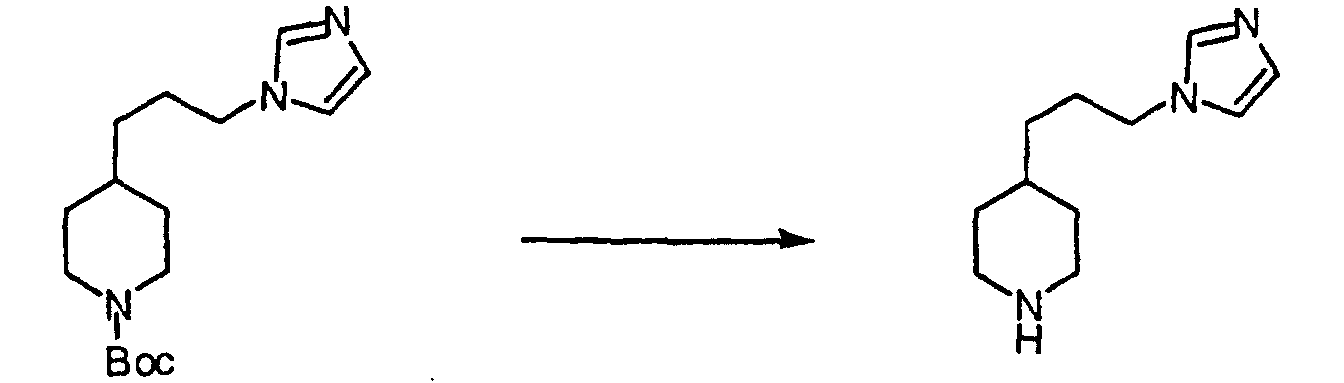
- The title compound from Preparative Example 4, Step A above was deprotected as described in Preparative Example 57, Step D, to give after chromatography on silica gel using 20% (10% conc. NH4OH in methanol)-dichloromethane as the eluant, the title compound (0.4346g, 95%): CIMS: m/z 194.20 (MH+); δH (CDCl3) 3.89 (2H, m, CH2-Im), 6.88 (1H, s, Im-H5), 7.02 (1H, s, Im-H4) and 7.42ppm (1H, s, Im-H2); δC(CDCl3) CH2: 28.3, 33.5, 33.5, 34.1, 46.7, 46.7, 47.4; CH: 36.0, 118.8, 129.6, 137.2.
-

-

- 1,4-Di-N-tert-butoxycarbonylpiperazine-2(R)-carboxylate (0.521g, 1.6mmoles) (prepared as described in Preparative Example 2), 1-(3-dimethylaminopropyl)-3-ethylcarbodiimide hydrochloride (0.393g, 2.1mmoles), 1-hydroxybenzotriazole (0.0.277g, 2.1mmoles) and 4-methylmorpholine (0.225mL, 2.1mmoles) were dissolved in anhydrous DMF (3mL) and the mixture was stirred under argon at 25°C for 150h. The solution was evaporated to dryness and the residue was taken up in dichloromethane and washed with saturated aqueous sodium bicarbonate, water, dried (MgSO4), filtered and evaporated to dryness. The residue was chromatographed on silica gel using 3% (10% conc. NH4OH in methanol)-dichloromethane as the eluant to give the title compound (0.693g, 87%): CIMS: m/z 506.35 (MH+); δH (CDCl3) 1.42 (18H, s, CH3), 3.91 (2H, m, CH2-Im.), 6.88 (1H, s, Im-H5), 7.03 (1H, s, Im-H4) and 7.43ppm (1H, s, Im-H2); δC(CDCl3) CH3: 28.4, 28.4, 28.4, 28.4, 28.4, 28.4; CH2: 28.4, 31.8, 33.1, 33.1, 41.2/41.6, 43.8, 43.8, 45.6, 47.1, ∼51.0; CH: 35.8, 52,9, 118.7, 129.6, 137.1; C: 80.1, 80.4, 168.1, 168.1 168.1.
-

- The title compound from Preparative Example 5, Step A above (0.6344g, 1.26mmoles) was deprotected as described in Preparative Example 57, Step D, and the product was chromatographed on silica gel using 10% (10% conc. NH4OH in methanol)-dichloromethane as the eluant to give the title compound (0.3076g, 80%): CIMS: m/z 306.30 (MH+); δH (CDCl3) 3.87 (2H, m, CH2-Im), 6.82 (1H, s, Im-H5), 6.99 (1H, s, Im-H4) and 7.38ppm (1H, s, Im-H2); δC(CDCl3) CH2: 28.1, 31.7, 32.6/32.9, 33.0/33.1, 42.0/42.2, 45.2/45.5, 46.9/47.0, 46.9/47.0, 46.9; CH: 35.7/35.8, 55.6, 118.7, 129.4, 137.0; C: 169.7.
-
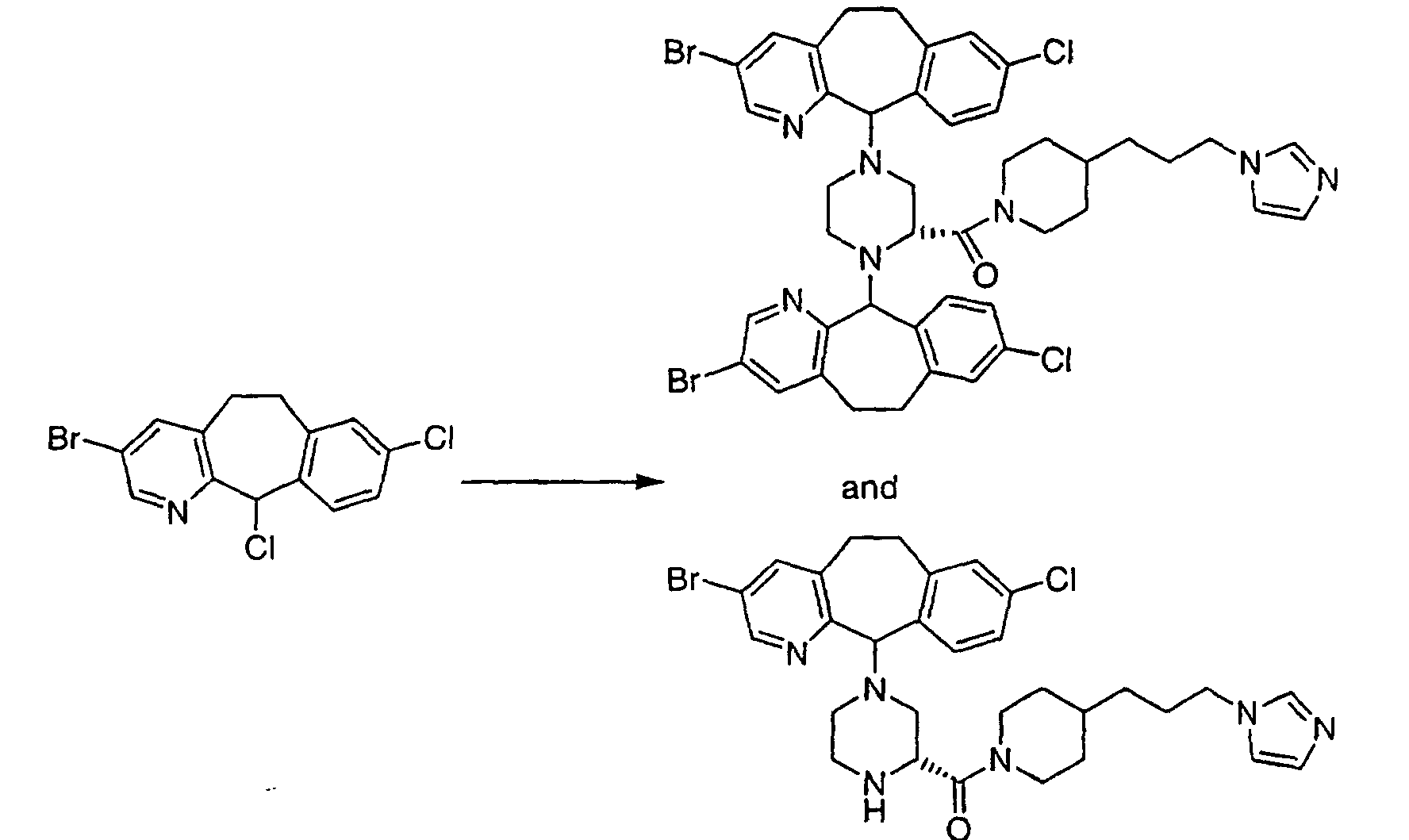
- 3-Bromo-8,11-dichloro-6,11-dihydro[5,6]cyclohepta[1,2-b]pyridine (0.2043g, 0.596mmoles) (prepared as described in Preparative Example 40 (U.S. 5,719,148)), the titled compound from Preparative Example 5, Step B (0.2729g, 0.894mmoles) and triethylamine (0.249mL, 1.79mmoles) were dissolved in anhydrous THF (8mL) and anhydrous dichloromethane (20mL) and the mixture was stirred at 25°C for 72h under argon. The solution was evaporated to dryness and the residue was chromatographed on silica gel using 3% then 5% and the 10% (10% conc. NH4OH in methanol)-dichloromethane as the eluant to give first the dimer (Sch 377314) (0.0681g, 12%): SIMS: m/z 916.2 (MH+); δH (CDCl3) 3.99 (4H, m, CH2-Im), 6.95, 7.08, 7.10, 7.12, 7.26, 7.54, 7.69, 8.28, 8.31 and 8.34ppm (13H, s and m, Ar-H and Im-H); δC(CDCl3) CH2: 28.3/28.5, 30.3/30.4, 30.5, 31.3/31.5, 33.1, 33.1. 41.0/41.1, 41.0/41.1, 45.0, 47.5, 51.2/51.3/52.0, 53.9/54.1/54.2; CH: 35.7, 78.8/79.0, 119.7/119.9, 125.9/126.0/126.2, 128.6/128.7, 130.7, 133.8/134.1, 136.9/137.6, 141.5, 146.7/146.9; C: 119.0, 130.0, 132.5/133.2, 134.6, 141.1/141.3, 156.2, 156.8, 170.0 and the then monomer (Sch 377318) (0.2291g, 63%): CIMS: m/z 611.20 (MH+); δH (CDCl3) 3.93 (2H, m, CH2-Im), 6.90, 6.92, 7.07, 7.12, 7.14, 7.47, 7.49, 7.57, 7.59, 8.33, 8.35and 8.38ppm (8H, s and m, Ar-H and Im-H); δC(CDCl3) CH2: 28.3, 30.6, 30.6, 31.6/31.7/31.9, 33.1/33.3, 33.1/33.3, 41.6/42.2, 44.4/44.9, 44.4/44 9, 45.3/45.7, 47.2, 52.2/52.7, 55.0; CH: 35.6, 55.4, 78.8, 118.8, 126.2/126.3, 129.6, 130.3/130.6, 133.0/133.2, 137.1, 141.3,146.9/147.1; C: 120.1, 134.1, 135.0, 137.2, 141.1, 154.4/155.9, 169.0/170.0.
-

- The title compound from Example 9 (0.1768g, 0.29mmoles) was reacted with di-tert-butyldicarbonate (0.0694g, 0.319mmoles) and sodium hydroxide (0.0116g, 0.29mmoles) in THF-water (1:1) (5mL) and purified as described in Preparative Example 57, to give the title compound (0.1294g, 63%): FABMS: m/z 711.1 (MH+); δH (CDCl3) 1.38/1.40 (9H, s, CH3), 3.98 (2H, m, CH2-Im), 6.93, 7.03, 7.09, 7.18, 7.54, 7.58, 7.63, 8.32 and 8.38ppm (8H, s and m, Ar-H and Im-H); δC (CDCl3) CH3: 28.4, 28.4, 28.4; CH2: 28.3, 30.2, 30.7, 31.3/31.8, 33.2, 33.2, 42.2/42.6, 44.4/45.4, 44.6, 44.6, 47.4, ∼50.4, ∼50.9; CH: 35.8, 78.6/78.8, 118.9, 126.3, 130.2, 130.8, 132.7, 137.0, 140.7/141.5, 147.2; C: 80.0, 119.9, 133.4, 134.0, 137.5, 141.4, 156.2, 156.2, 168.8.
-
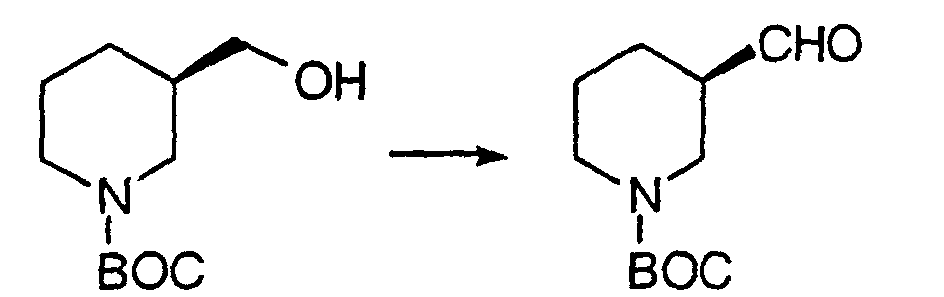
- To the title compound from Preparative Example 8, Step B (1.63g, 7.57 mmol) in DMSO (5.0 mL) was added iPr2NEt (6.59 mL, 5.0 eq.) followed by pyr• SO3 (7.23g, 3.0 eq.) in DMSO (10 mL). The resulting solution was stirred 1 hour, diluted with EtOAc and washed with 1N HCl, H2O, and sat. NaHCO3. The organics were dried over Na2SO4, filtered, and concentrated under reduced pressure. The residue was used without purification (1.26g, 76% yield): LCMS: MH+=214.
-

- NaHMDS (14.7 mL, 1M in THF, 1.5 eq.) was added to a solution of CH3OCH2P+Ph3Cl- (5.06g, 1.5 eq.) in THF (25 mL) at 0 °C. The resulting solution was stirred 15 minutes before adding via canulae to a solution of the title compound from Preparative Example 71A, Step A (2.1g, 9.80 mmol) in THF (25 mL) at -78 °C. The reaction mixture was stirred 1 hour at - 78 °C, warmed to 0 °C and stirred 1 hour. The resulting solution was diluted with Et2O, washed with H2O, and dried over Na2SO4. The organics were dried over Na2SO4, filtered and concentrated. The crude product was purified by flash chromatography using a 65 : 35 hexanes EtOAc solution as eluent (1.51g, 64% yield).
-
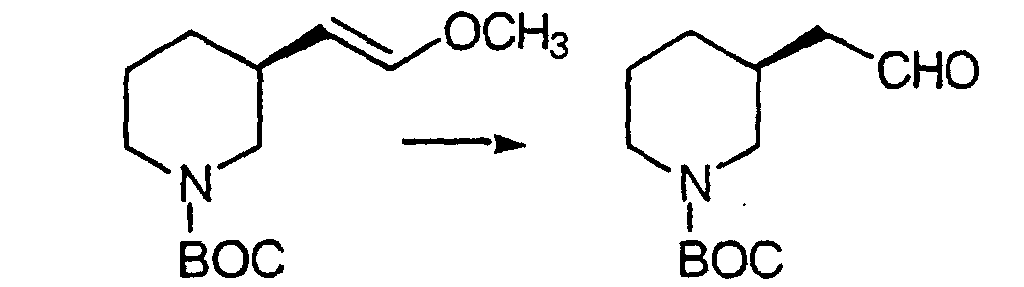
- The title compound from Preparative Example 71A, Step B (0.70g, 2.90 mmol) was stirred in 40% HCl (6.6 mL) at room temperature overnight at which time additional 40% HCl (3.0 mL) was added and the reaction mixture stirred an additional 4 hours. The resulting solution was neutralized with Na2CO3 (aq.) and extracted with Et2O. The combined organics were dried over Na2SO4, filtered, and concentrated in vacuo. The residue was purified by flash chromatography using a 65 : 35 hexanes : EtOAc solution as eluent (0.30g, 46% yield + SM): LCMS: MH+=228.
-
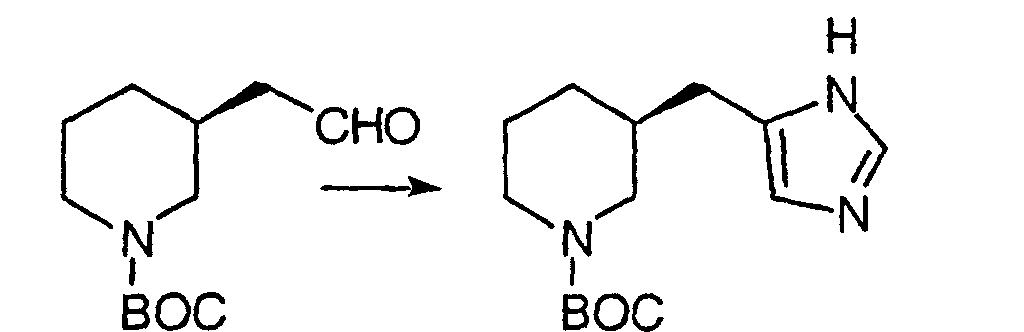
- The title compound from Prepartive Example 71A, Step C (0.90g, 1.02 eq.) was stirred with TosMIC (0.77g, 3.88 mmol) and NaCN (0.0194g, 0.1eq.) in EtOH (7.0 mL) for 30 minutes. The reaction mixture was transferred to a sealed tube, diluted with 7M NH3 in MeOH (13.0 mL) and heated to 90 °C for 22 hours. The resulting solution was cooled, concentrated under reduced pressure, diluted with 1N NaOH and extracted with CH2Cl2. The combined organics were dried over Na2SO4, filtered, and concentrated. The crude product was purified by flash chromatography using a 5% (10% NH4OH in MeOH) solution in CH2Cl2 as eluent (0.53g, 51% yield): LCMS: MH+=266.
-

- The title compound from Preparative Example 71A, Step D (0.34g, 1.28 mmol) in CH2Cl2 was treated with TrCl (0.38g, 1.05 eq.) and TEA (0.27 mL, 1.5 eq.). The resulting solution was stirred 2 hours at room temperature, diluted with saturated NaHCO3, and extracted with CH2Cl2. The combined organics were dried over Na2SO4, filtered, and concentrated in vacuo. The crude product was purified by flash chromatography using a 3% (10% NH4OH in MeOH) solution in CH2Cl2 as eluent (0.43g, 66%): LCMS: MH+=508.
-
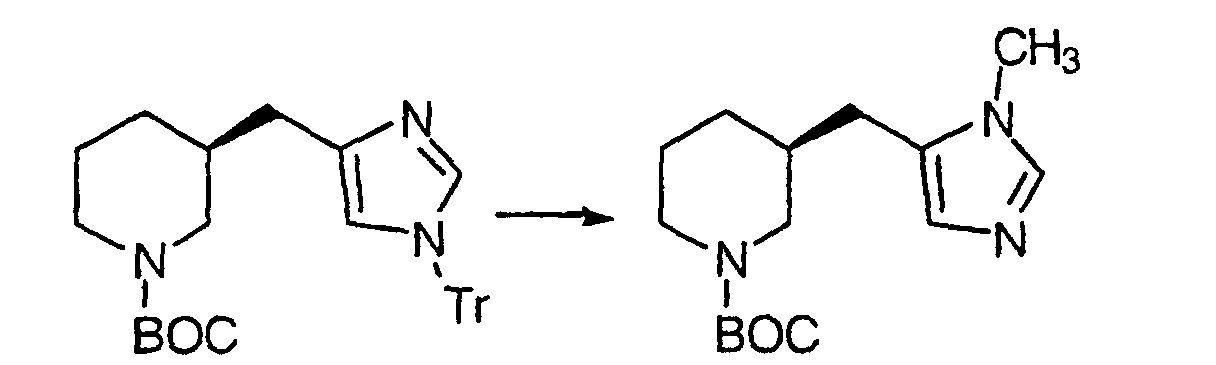
- The title compound from Prepartive Example 71A, Step E (0.43g, 0.846mmol) in Et2O was treated with MeI (0.79 mL, 15 eq.) and stirred overnight and filtered. The resulting solid washed with Et2O, dissolved in MeOH and heated at reflux overnight. The reaction mixture was concentrated in vacuo and purified by flash chromatography using a 5% (10% NH4OH in MeOH) solution in CH2Cl2 as eluent (0.14g, 79% yield): LCMS: MH+=280.
-
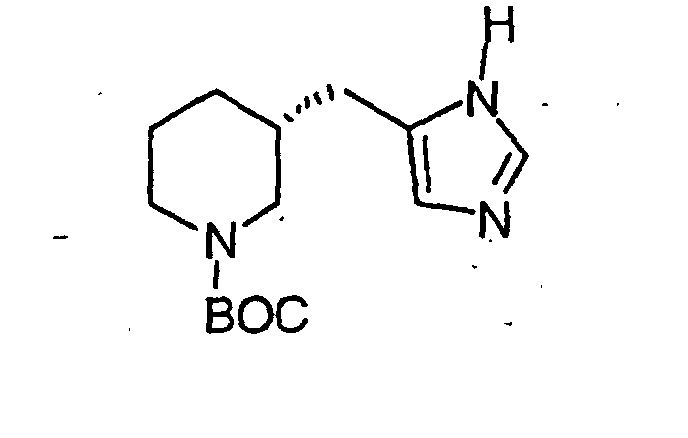
- By essentially the same procedure set forth in Preparative Example 71A, the title compound was prepared.
-

- A solution of ε-caprolactam (6.86 g, 60 mmol, 1.0 eq.) in anhydrous THF (50 mL) was added dropwise over a period of 50 minutes to a stirred suspension of sodium hydride (1.59 g, 1.05 eq.) in anhydrous THF (20 mL) at 0 °C under a nitrogen atmosphere. The snow-white mixture was stirred at room temperature for 2h, whereupon a solution of benzyl bromide (7.65 mL, 1.05 eq.) in anhydrous THF (20 mL) was added dropwise over a period of 30 minutes. The mixture was stirred at room temperature for 2h and filtered through CELITE 521 to remove sodium bromide. The volatiles were evaporated under house vacuum at 30°C to give the title compound as a dark-yellow oil which was used without further purification(10.60 g, 87% yield). FABMS: MH+=204.
-
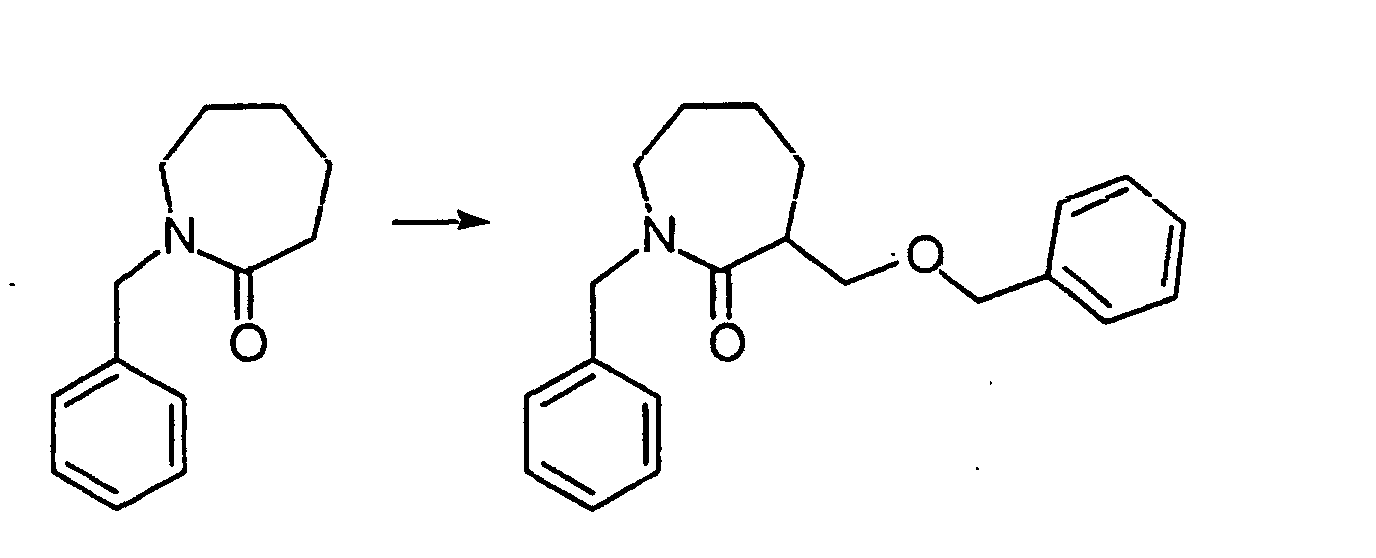
- A 2.45 M solution of n-butyllithium in hexanes (18.1 mL, 44.3 mmol, 1.44 eq.) was added dropwise over a period of 30 minutes to a stirred solution of diisopropylamine (5.2 mL, 36.9 mmol, 1.2 eq.) in anhydrous THF (100 mL) at 0 °C under a nitrogen atmosphere. The yellow solution was stirred at 0 °C for another 30 minutes and was then cooled to - 78 °C. A solution of the title compound from Preparative Example 73A, Step A (6.25 g, 1.0eq.) in anhydrous THF (50 mL) was subsequently added dropwise over a period of 25 minutes and the solution was stirred at - 78 °C for another 3h. Neat benzyl chloromethyl ether (7.0 mL, 1.3 eq.) was added dropwise over a period of 10 minutes. The dirty-brown solution was slowly (3h) warmed to room temperature and stirred for another 12h. The volatiles were removed under house vacuum at 30 °C. The residual deep-yellow oil was partitioned between distilled water (100 mL) and diethyl ether (100 mL). The layers were separated and the aqueous phase was extracted with diethyl ether (5 x 50 mL). The organic layer of earlier and the ethereal extracts were combined and washed with brine (50 mL), dried over Na2SO4, filtered, and concentrated under house vacuum at 30 °C. The oily residue was flash-chromatographed (hexanes:acetone = 8:2 v/v) over silica gel to give the title compound as a lime-green oil (6.77g, 68% yield). [M+H+]: 324; HRMS (FAB+): Calculated for C21H26NO2 ([M + H]+): 324.1961; Observed: 324.1964.
-
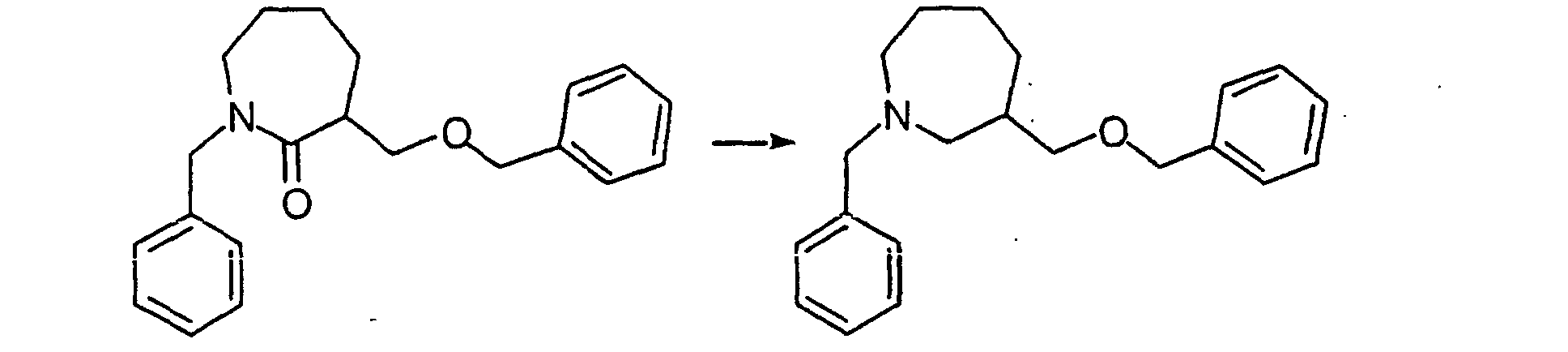
- A 1 M solution of lithium aluminum hydride in diethyl ether (23 mL, 1.1 eq.) was added dropwise over a period of 25 minutes to a stirred solution of the title compound from Preparative Example 73A, Step B (6.77 g, 20.9 mmol) in anhydrous THF (100 mL) at - 20 °C under a nitrogen atmosphere. The yellow solution was slowly (3h) warmed to room temperature and stirred for another 12h. The solution was cooled to 0 °C and carefully treated with a saturated, aqueous Na2SO4 solution (10 mL) to give a snow-white slurry. The mixture was filtered and the precipitate was carefully washed with diethyl ether (3 x 50 mL) and absolute alcohol (3 x 50 mL). The filtrate was concentrated under house vacuum at 30°C, redissolved in acetone (100 mL) and dried over Na2SO4, filtered, and again concentrated under house vacuum at 30°C. The oily residue was flash-chromatographed (hexanes:acetone = 9:1 v/v) over silica gel to give the title compound as a lime-green oil (5.08 g, 78% yield): [M + H]+: 310; HRMS (FAB+): Calculated for C21H28NO ([M + H]+): 310.2173; Observed: 310.2171.
-
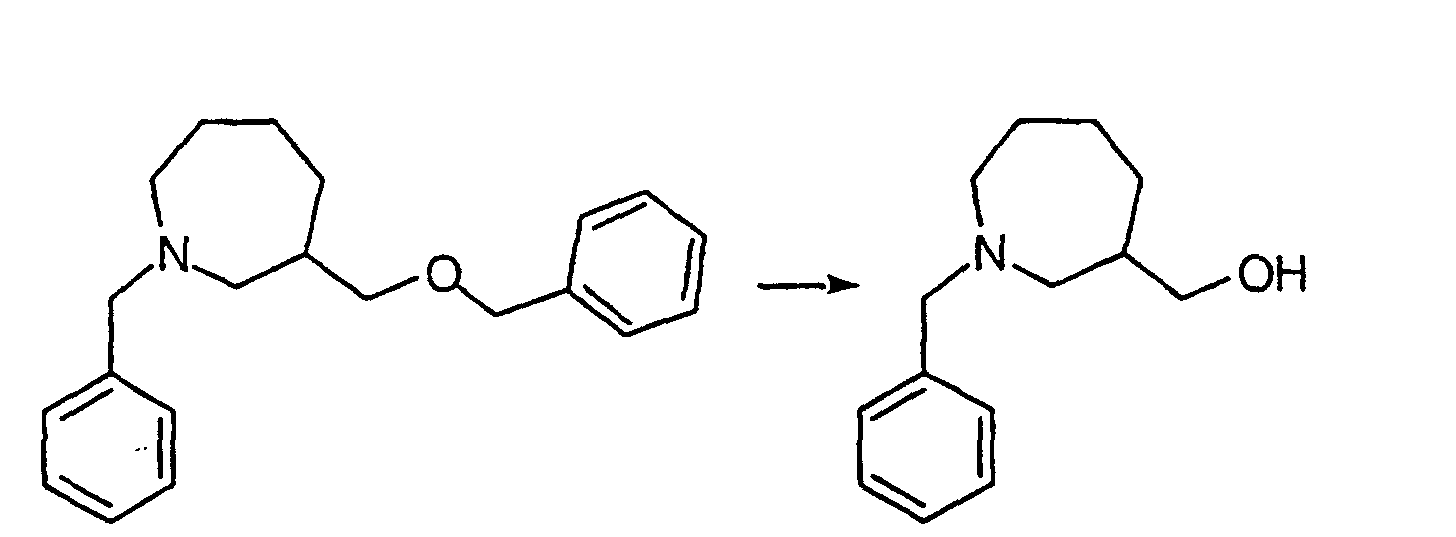
- A mixture of the title cmpound from Preparative Example 73A, Step C (5.08 g, 16.4 mmol) 20 wt. % Pd(OH)2 ("Pearlman's catalyst," 2.54 g, 50 wt. % reagent), and absolute alcohol (100 mL) was hydrogenated at 4.5 atmosphere pressure and room temperature for 8h. The mixture was filtered through CELITE 521 and the filtrate was concentrated under house vacuum at 30 °C. The residual oil was flash-chromatographed (CH2Cl2:10% NH4OH-MeOH=9:1 v/v) over silica gel to give the title compound as a yellow oil (2.86 g, 79% yield): [M + H]+: 220; HRMS (FAB+): Calculated for C14H22NO ([M + H]+): 220.1698; Observed: 220.1701.
-
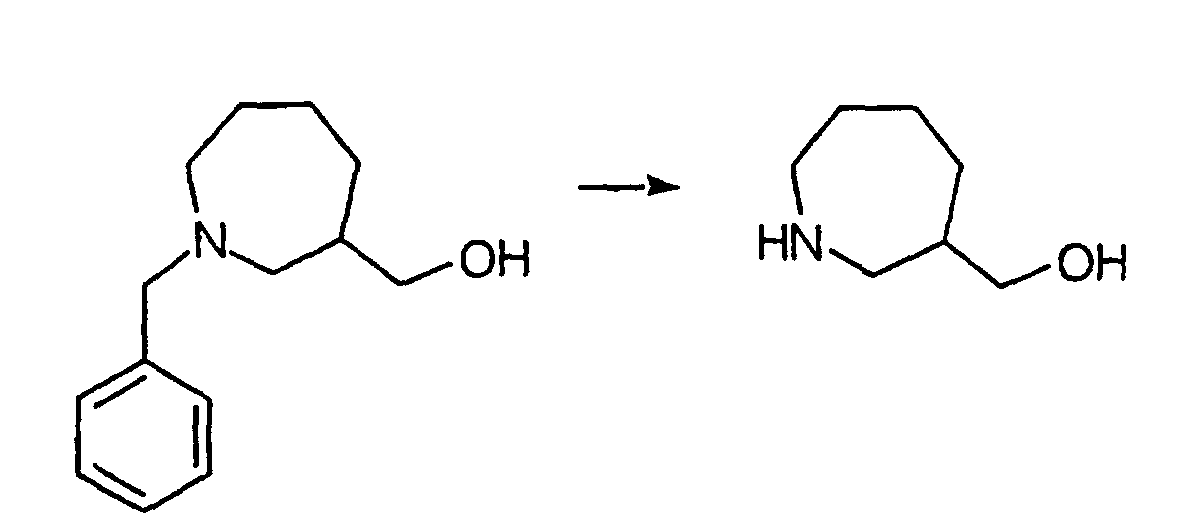
- Potassium metal (2.60 g, 5.0 eq.) was added portionwise to a stirred solution of the title compound fro Preparaive Example 73A, Step D (2.86 g, 13.0 mmol) and t-butanol (1.5 mL, 1.2 eq.) in a mixture of liquefied ammonia (125 mL) and anhydrous THF (125 mL) at -60 °C under a nitrogen atmosphere. The dark-blue mixture was slowly (12h) warmed to room temperature and the volatiles were removed under house vacuum at 30 °C. The residue was taken up in distilled water (50 mL) and extracted with diethyl ether (5 x 50 mL). The ethereal extracts were discarded and the aqueous layer was concentrated under house vacuum at 50 °C to give the title compound (1.70 g, 100% crude yield): [M + H]+: 130; HRMS (FAB+): Calculated for C7H16NO ([M + H]+): 130.1232; Observed: 130.1231.
-
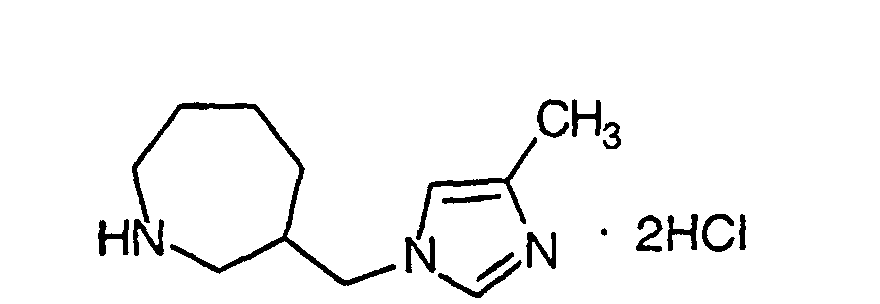
- By essentially the same procedure set forth in Preparative Example 7, Step C through Step F only substituting the title compound from Preparative Example 73A, Step F, the title compound was prepared.
-
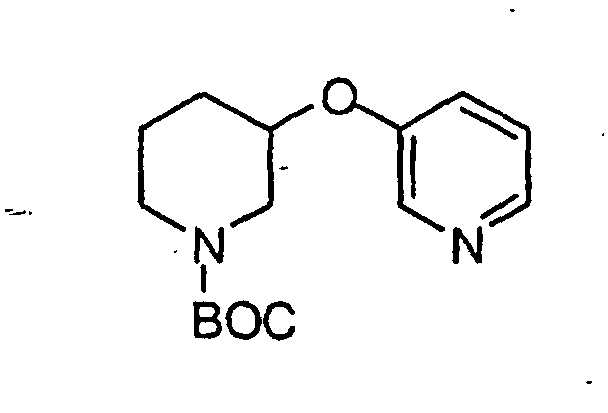
- Di-isopropyl azodicarboxylate (0.54 mL, 1.5eq.) was added to N-t-butoxycarbonylpiperidin-3-ol (0.37, 1.83 mmol), 3-hydroxypyridine (0.26g, 1.5eq.), and PPh3 (0.72g, 1.5 eq.) in THF (5.0 mL). The resulting solution was stirred at room temperature overnight, concentrated in vacuo, and purified by flash chromatography using a 30% hexanes in EtOAc solution as eluent (0.14g, 27% yield): LCMS: MH+=279.
-
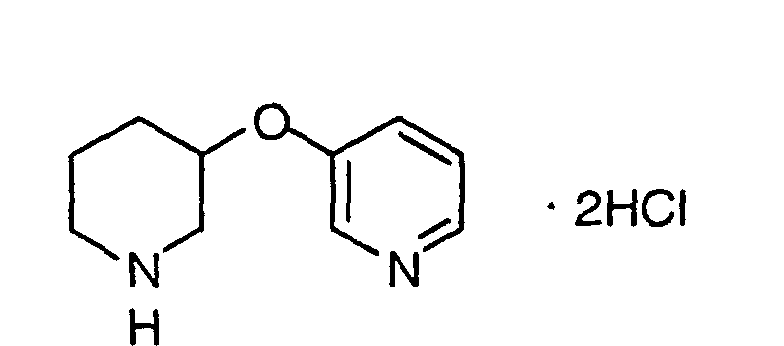
- By essentially the same procedure set forth in Preparative Example 8, the title compound was prepared.
- The title compound from Preparative Example 74A was separated into individual C-3 isomers by Preparative HPLC using a CHIRALPAK AD column using a20% iPrOH in hexanes with 0.2% DEA as eluent.
-
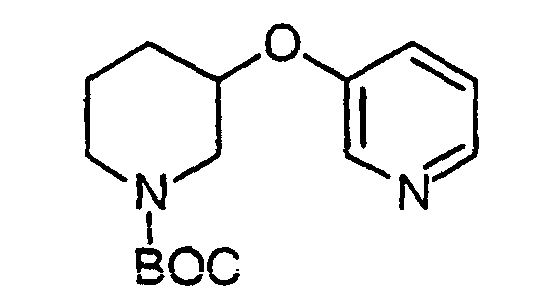
- First eluting isomer: LCMS: MH+=279.
-
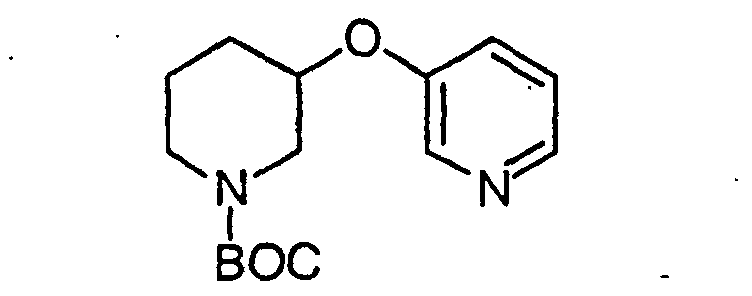
- Second eluting isomer: LCMS: MH+=279.
-

- By essentially the same procedure set forth in Preparative Example 8 only substituting the title compound from Preparative Example 74A, the title compound was prepared.
- By essentially the same procedure as set forth in Preparative Example 74A, the title compounds in Column 4 of Table 16 were prepared using the 3-hydroxypyridine derivative in Column 2 of Table 16.
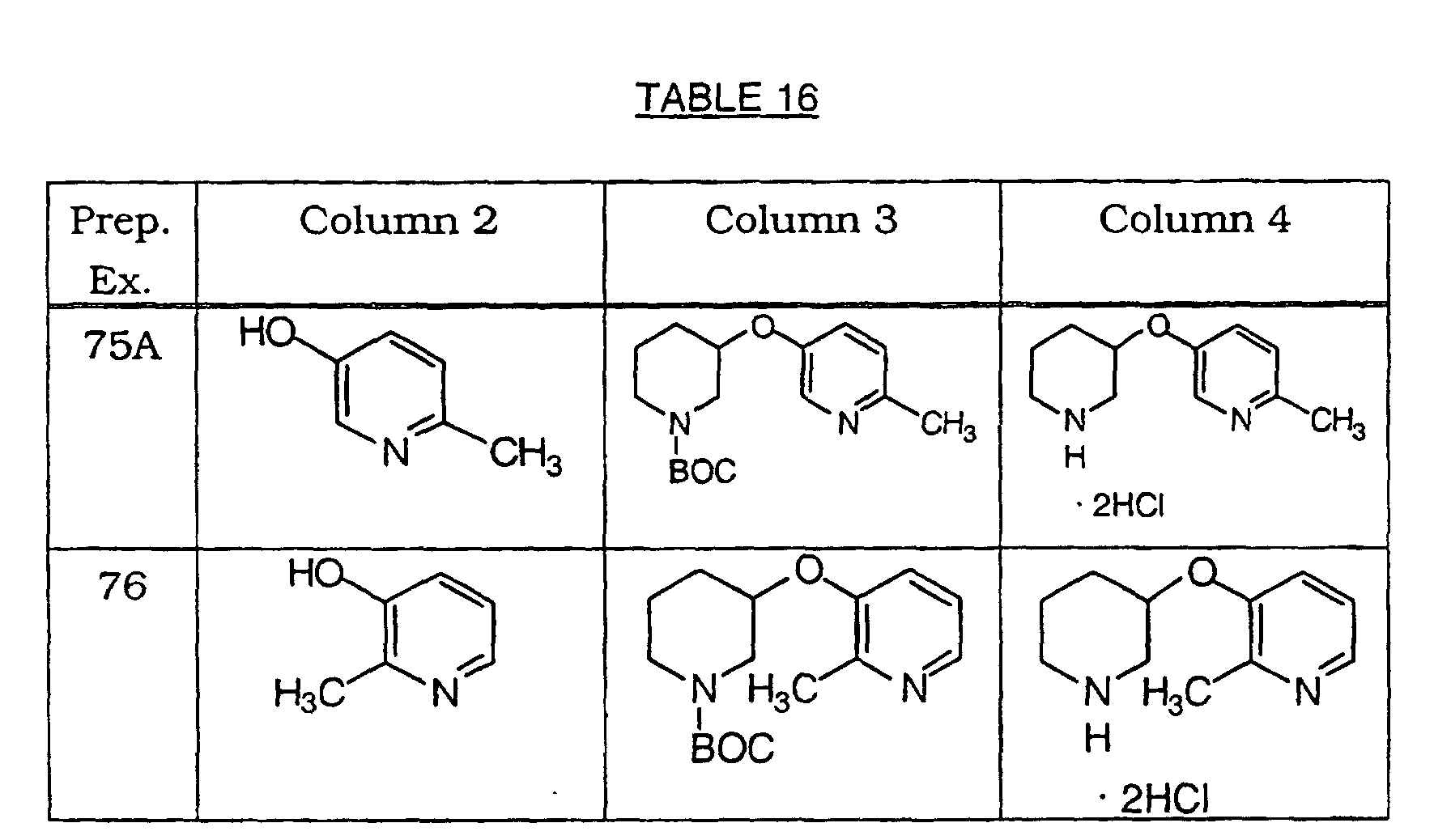
-
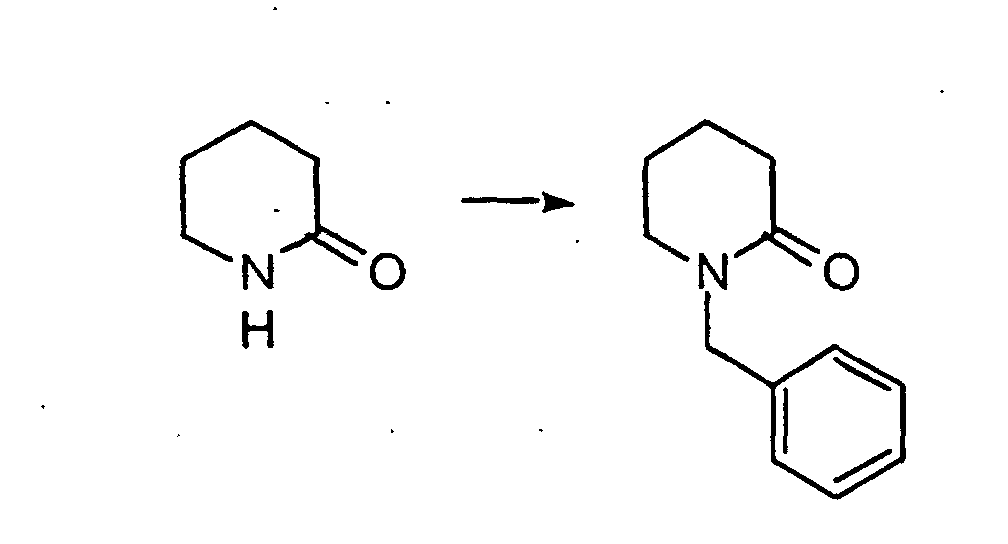
- By essentially the same procedure set forth in Preparative Example 73A, Step A, the title compound was prepared: LCMS: MH+=190.
-
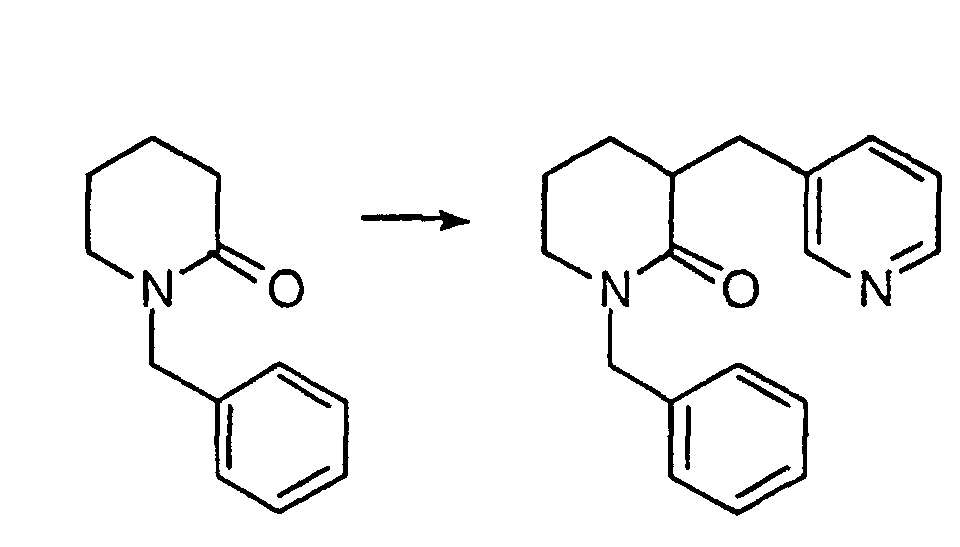
- To a solution of the title compound from Preparative Example 77, Step A (3.68g, 2.4eq.) in THF (50 mL) was added LiHMDS (19.4 mL, 2.4 eq., 1M solution in THF) at -78 °C. The resulting solution was stirred at - 78 °C for 2.5 hours before adding 3-bromomethylpyridine hydrobromide (1.39g, 8.09 mmol). The reaction mixture was warmed slowly to room temperature and stirred overnight. The resulting solution was diluted with saturated NH4Cl (20 mL), extracted with CH2Cl2 (3 X 75 mL), dried over Na2SO4, filtered and concentrated to give a yellow oil (0.63g, 28% yield): LCMS:MH+=281.
-
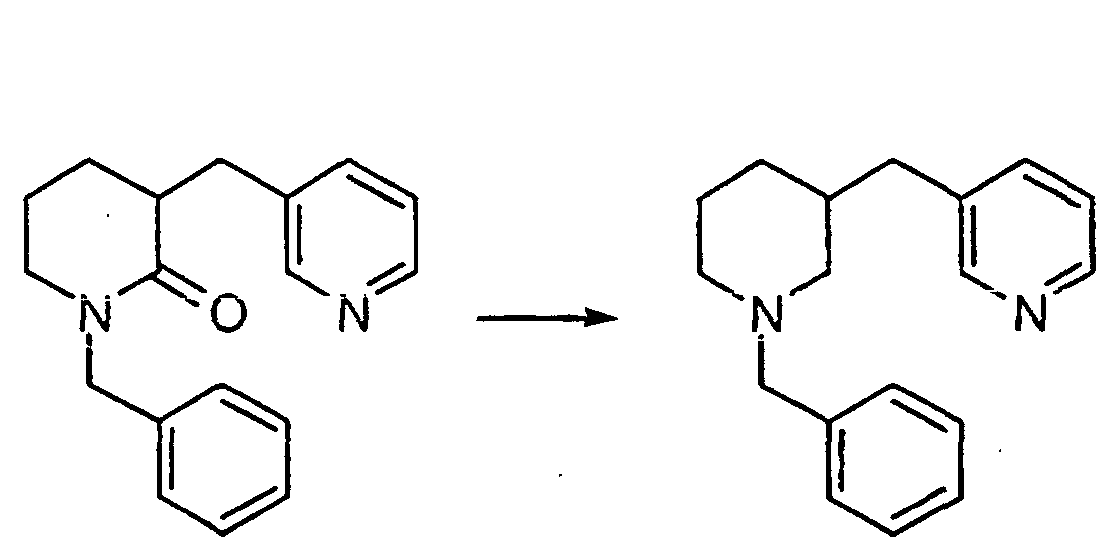
- To a solution of the title compound from Preparative Example 77, Step B (0.65g, 2.31 mmol) in THF (3.0 mL) was added LAH (2.54 mL, 1M in Et2O) and the resulting solution stirred at room temperature overnight. The reaction mixture was quenched by the addition of saturated Na2SO4, filtered through Celite and concentrated under reduced pressure. The product was purified by flash chromatography using a 20% hexanes in EtOAc solution as eluent a give a yellow oil (0.42g, 68% yield): LCMS: MH+=267.
-
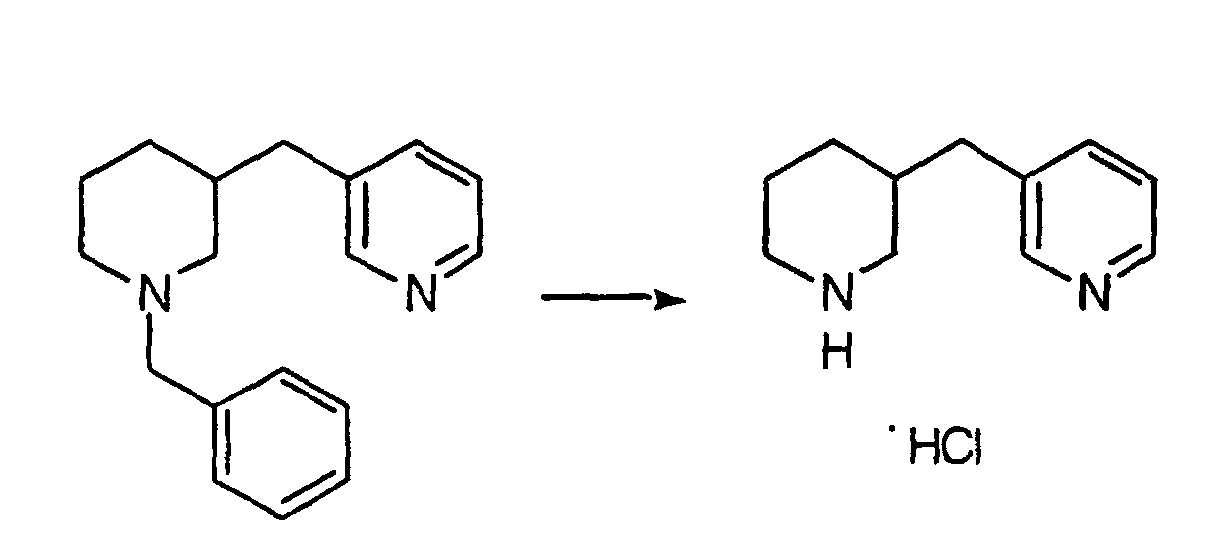
- The title compound from Preparative Example 77, Step C (0.40g, 1.50 mmol) in dichloroethane (3 mL) was treated with 1-chloroethylchloroformate (0.37 mL, 2.3 eq.). The resulting solution was stirred 3 hours, concentrated under reduced pressure, diluted with MeOH, and heated at reflux for 3 hours. The recation mixture was cooled, concentrated under educed pressure, and purified by flash chromatography using a 10% (10%NH4OH in MeOH) in CH2Cl2 solution as eluent (0.20g, 63% yield): LCMS: MH+=177.
-
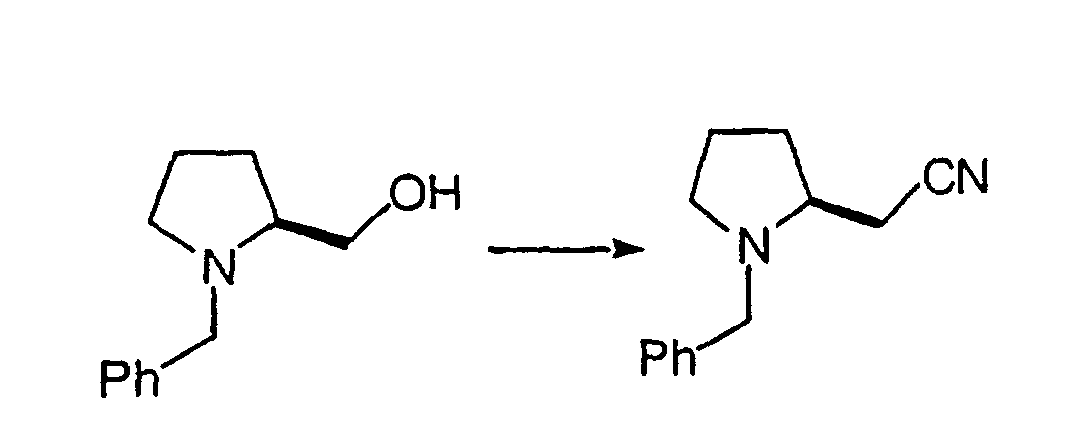
- To a solution of (S)-1-benzyl-2-pyrrolidinemethanol (15.5 g, 81.03 mmoles) and TEA (16.38 g, 161.93 mmoles) in CH2Cl2 (200 mL). MsCl (11.13 g, 97.16 mmoles) was added at 10 °C and stirred at room temperature overnight. Washed with H2O and evaporated to dryness to give mesylate (15.6 g) which without further purification, was mixed with NaCN (5.64 g, 115 mmoles) and heated at 80° C in DMF (100 mL) overnight. The reaction mixture was evaporated to dryness and extracted with EtOAc, washed with H2O, and dried (MgSO4). The solvent evaporated to give (S)-1-benzyl-2-cyanomethyl-pyrrolidine (11.5 g): (MS, MH+ = 201.
-
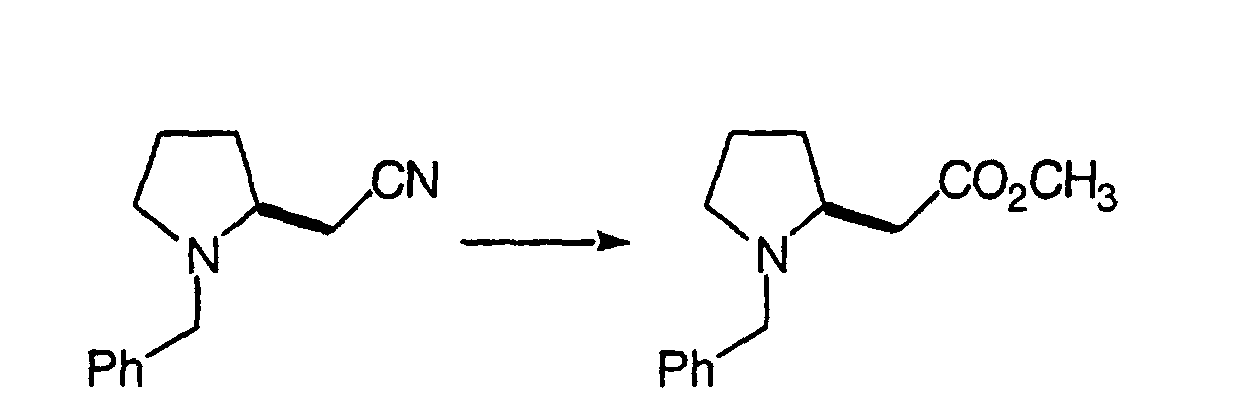
- The title compound from Preparative Example 78, Step A (13.0 g) was refluxed in concentrated HCl (100 mL) overnight and evaporated to dryness. The semisolid residue was stirred in MeOH (100 mL), MgSO4 (5 g) and concentrated H2SO4 (2 mL) at 80 °C overnight. The reaction mixture was evaporated to dryness to give (S)-1-benzyl-methy-2-pyrrolidineacetate (11.5 g ): MS, MH+ = 234.
-
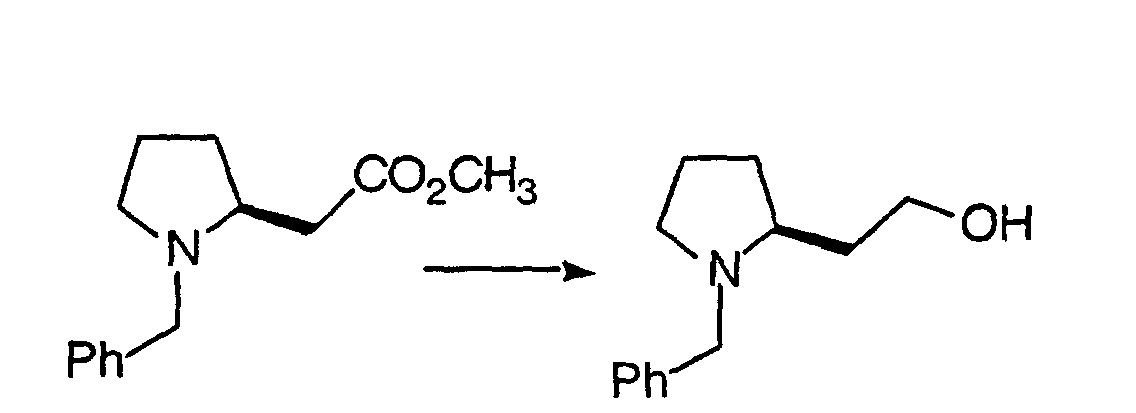
- The title compound from Preparative Example 78, Step B (13 g, 55.76 mmoles) was dissolved in THF (100 mL) and cooled to 10 °C (ice water bath). 1M LAH in ether (111.52 mL, 111.46 mmoles) was added slowly and the resulting mixture was refluxed for 2h. The reaction mixture was cooled to room temperature and decomposed with the addition of ice. The residue was extracted with EtOAc and washed with brine and H2O. The organics were dried and evaporated to a residue which was flash chromatographed on a silica gel column in CH2Cl2 / 5% CH3OH to give (S)-benzyl-hydroxyethyl-pyrrolidine (7.8 g): MS, MH+ = 206.
-
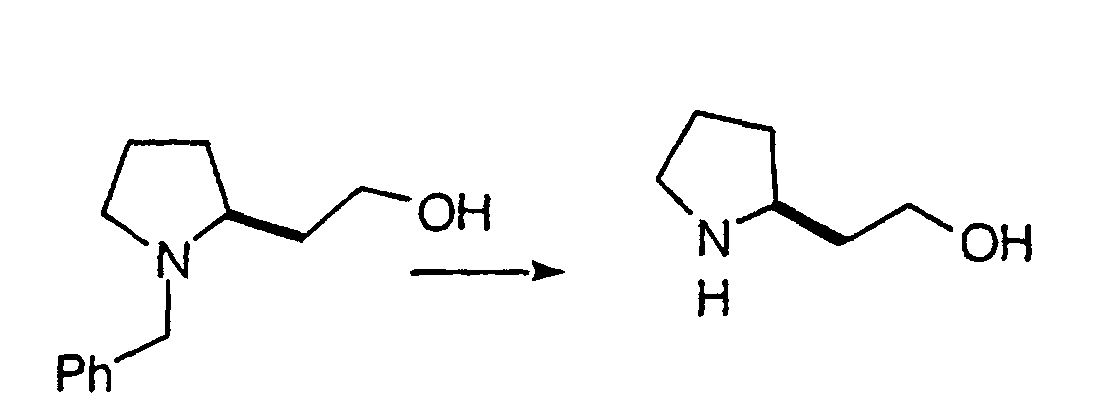
- The title compound from Preparative Example 78, Step C (7.7 g) was dissolved in EtOH (80 mL) and hydrogenated over Pd(OH)2 (2.5 g) at room temperature at 50 psi overnight. The catalyst was filtered and solvent was removed to give (S)- 2-hydroxyethylpyrrolidine (4.4 g): MS, MH+ = 116.
-
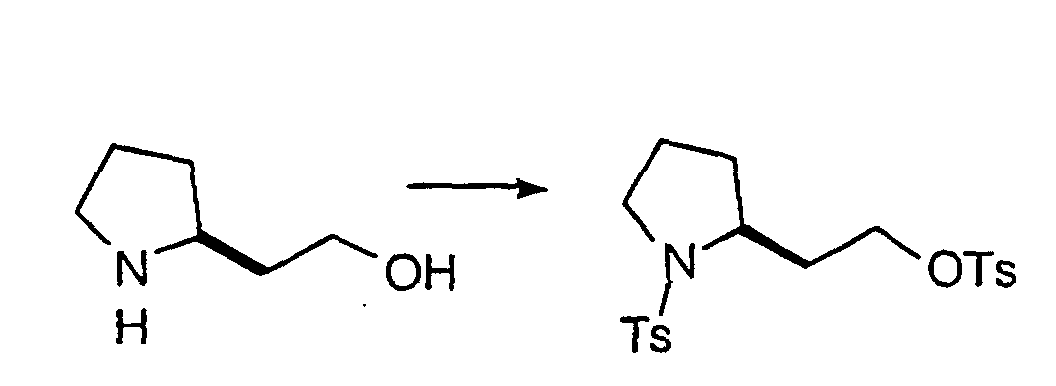
- The title compound from Preparative Example 78, Step D (2.4 g , 20.85 mmoles) was dissolved in CH2Cl2 (250 mL) and cooled to 10 °C. TsCl (11.92 g, 62.52 mmloes) followed by TEA (10.54 g, 104.2 mmoles) were added and stirred at room temperature overnight. The reaction mixture was diluted with CH2Cl2 and washed with brine and H2O. The organics were dried and solvent evaporated to give (S)-tosyl-2-O-tosylethyl-pyrrolidine (3.96 g): MS, MH+ = 332.
-
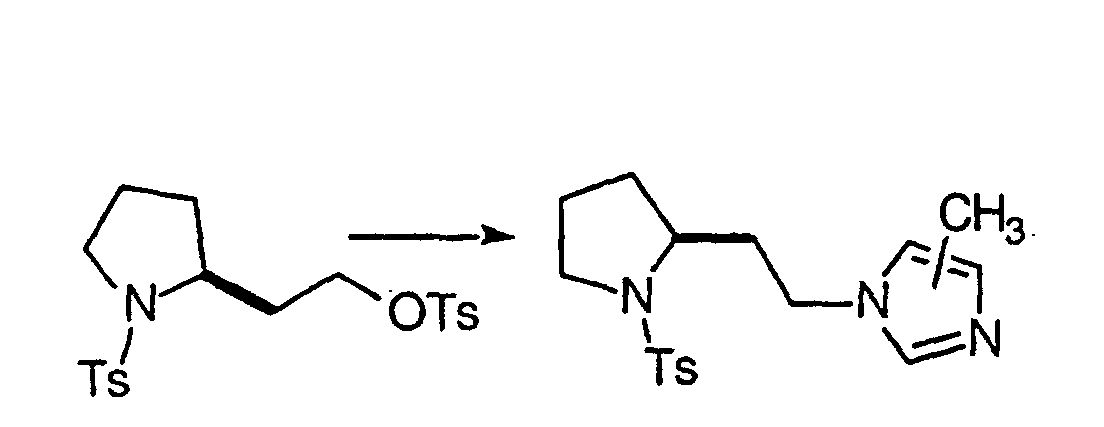
- The title compound from Preparative Example 78, Step E (3.96 g, 9.2 mmoles) was dissolved in DMF (15 mL) and cooled to 10 °C. NaH (0.74 g , 60%, 18.43 mmoles) was added slowly and stirred at room temperature until a clear solution was obtained. 4-Methylimidazole (1.51 g, 18.43 mmoles) was then added and heated at 80° C overnight. The resulting solution was evaporated to dryness and the residue was extracted with CH2Cl2 and washed with brine and H2O. The comboned organics were dried and solvent evaporated to give a crude product which was flash chromatographed on a silica get column in CH2Cl2/ 5% (CH3OH-10%NH4OH) to give a mixture (S)-tosyl-2- (4 -methyl- 1H-imidazol)-ethyl-1-pyrrolidine (2.98 g, MS, MH+ = 334 ) and (S)-tosyl-2- (5 -methyl- 1H-imidazol)-ethyl-1-pyrrolidine (2.98 g): MS, MH+ = 334.
-
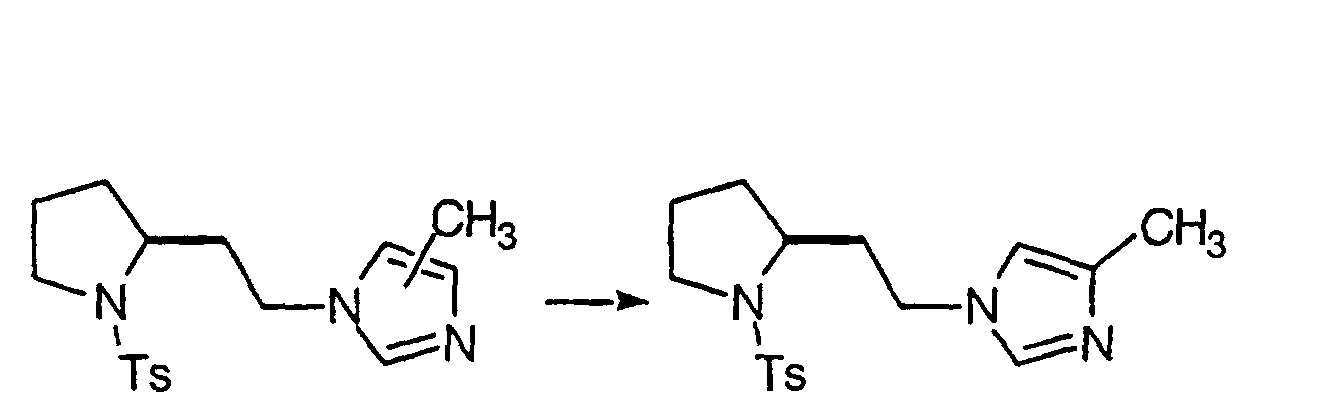
- The title compound from 78, Step F (2.9 g) and trityl chloride (1.5 g) were stirred in CH2Cl2 (35 mL) at 10 °C overnight. The reaction mixture was flash chromatographed on a silica gel column in acetone / ethyl acetate (1:1) to give (S)-tosyl-2-(4-methyl-1H-imidazol)-ethyl-1-pyrrolidine (0.827 g): (MS, MH+ = 334).
-
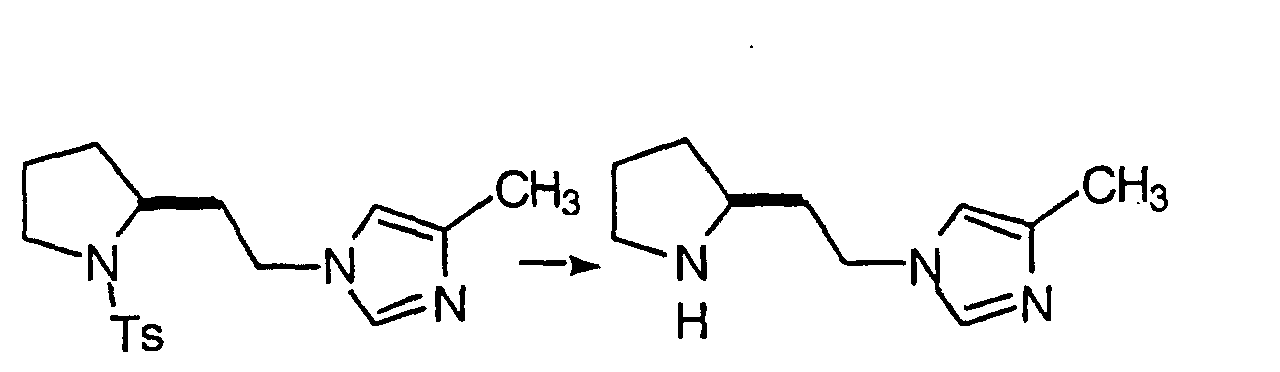
- The title compound from Preparative Example 78, Step G (0.82 g) was dissolved in dry THF (2 mL) and liquid ammonia (150 mL). Sodium pieces were added until the blue colour remained and the resulting solution was stirred for 1/2 hr. EtOH was added dropwise until the blue coloured disappeared. The resulting solution was evaporated to dryness to give sticky white solid which was chromatographed on a flash silica gel column in CH2Cl2 / 20% (CH3OH-10% NH4OH) to give the title compound (S)-2-(4-methyl-1H-imidazol)-ethyl-1-pyrrolidine, (0.375 g): MS, MH+ = 180.
-

- By essentially the same procedure as that set forth in Preparative Example 78, (R)-2-(4-methyl-1H-imidazol)-ethyl-1-pyrrolidine was prepared from (R)-1-benzyl-2-pyrrolidinemethanol.
-
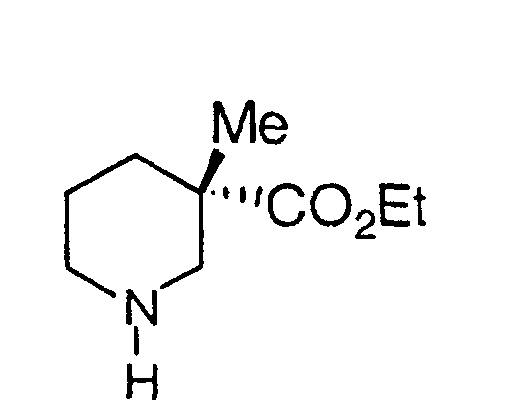
- The title compound from Preparative Example 68, Step C was treated with D-(-)-Tartaric acid and recrystallized from acetone-water to afford a piperidine salt enriched in the 3-(S) isomer which was neutralized with hydroxide to afford the title compound (11.1 g, 18%): MH+=172.
-

- Following the procedures set forth in Preparative Example 7, Steps B-E, except using the title compound from Preparative Example 80, Step A instead of the title compound from Preparative Example 7, Step A in Step B, and using 4-methylimidazole and NaH instead of sodium imidazole in Step E, the regioisomeric imidazole products were obtained (1.1 g, 84%): MH+ =294.
-

- Following the procedure set forth in Preparative Example 17, except using the title compound from Preparative Example 80, Step B instead of the title compound from Preparative Example 13, the 4-methylimidazole product was obtained (0.501 g, 68%): MH+ =294.
-
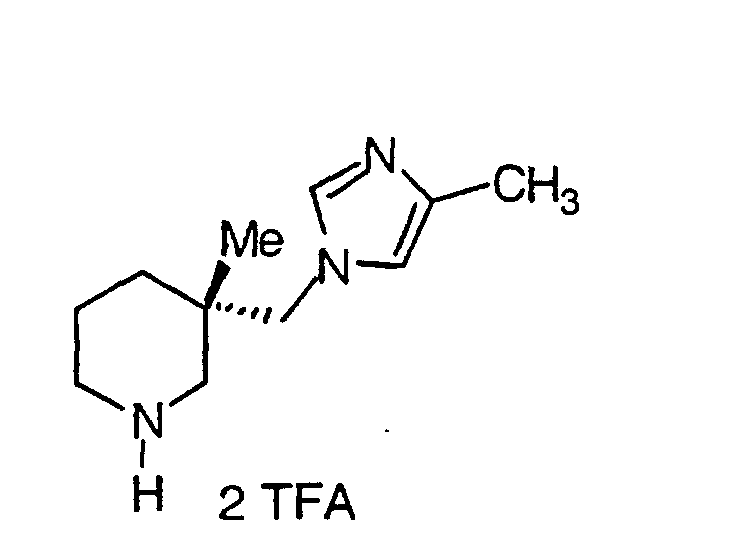
- Following the procedure set forth in Preparative Example 68 Step C, except using the title compound from Preparative Example 80 Step C, the amine was obtained as its TFA salt (0.72 g, 100%): MH+= 194.
-

- Following essentially the same procedures set forth in Preparative Example 80, Steps A-D, except using L-(+)-Tartaric acid instead of D-(-)-Tartaric acid in Step A, the amine enriched in the 3-(R) isomer was obtained as its TFA salt (0.157 g, 100%): MH+= 194.
-
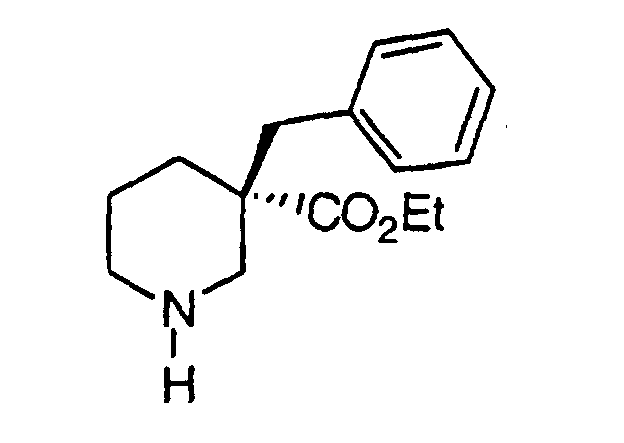
- Following essentially the same procedure set forth in Preparative Example 80, Steps A, except using the benzylpiperidine prepared as described in J. Med. Chem. 41, 2439 (1998) instead of the title compound from Preparative Example 68, Step C, the amine enriched in the 3-(S) enantiomer was obtained (6.81 g, 25%): MH+ = 248.
-
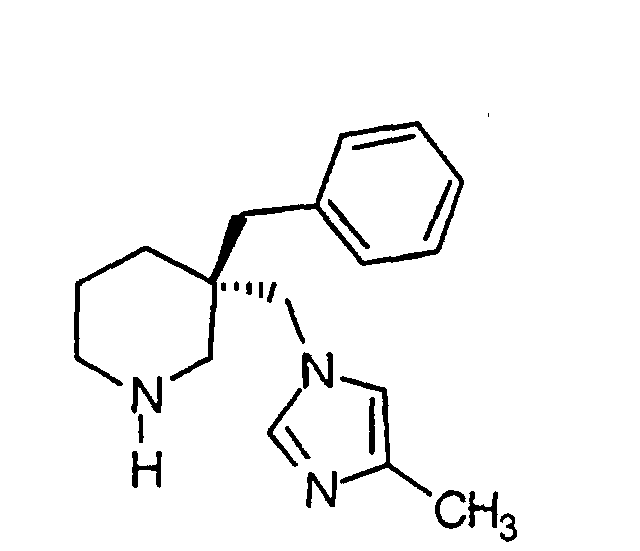
- Following the procedures set forth in Preparative Example 80, Steps B-D, except using the title compound from Preparative Example 82, Step A instead of the title compound from Preparative Example 80, Step A in Step B, the 4-methylimidazole product was obtained as its TFA salt which was neutralized with NaOH (aq.) to give the amine product (0.163 g, 86%): MH+ = 270.
-
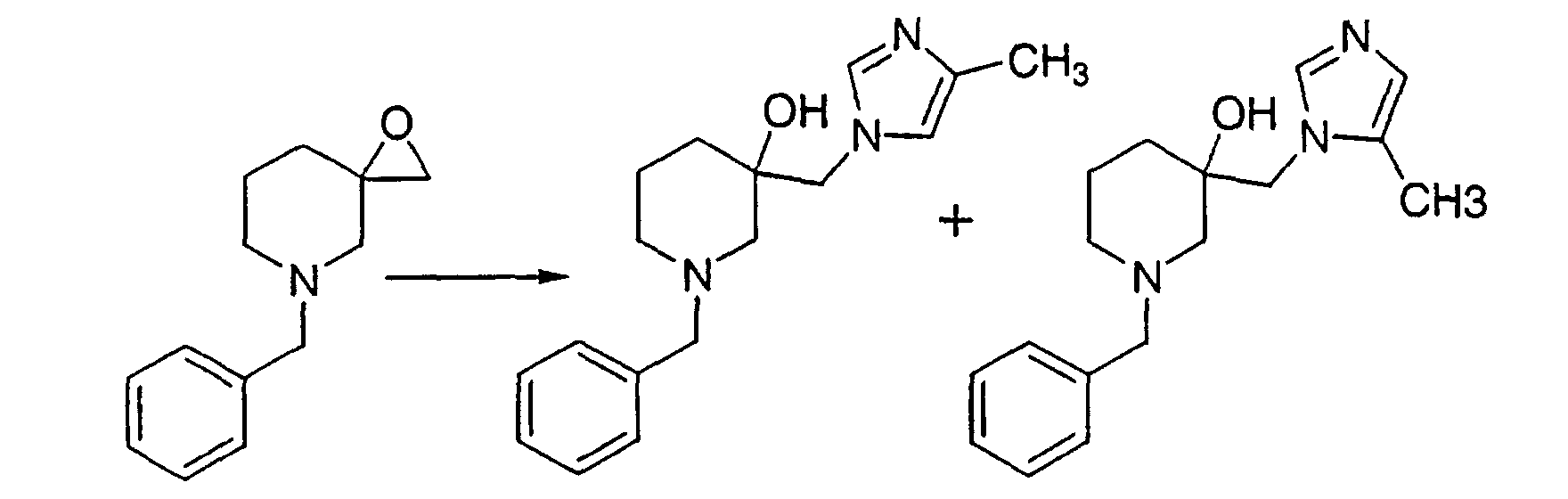
- The epoxide (J. Med. Chem. 30(1), 1987, pps. 222-225) was treated with 4-methylimidazole and NaH in anhydrous DMF to obtain the resulting mixture of regioisomeric imidazole products (7.77 g, 100%): MH+=302.
-
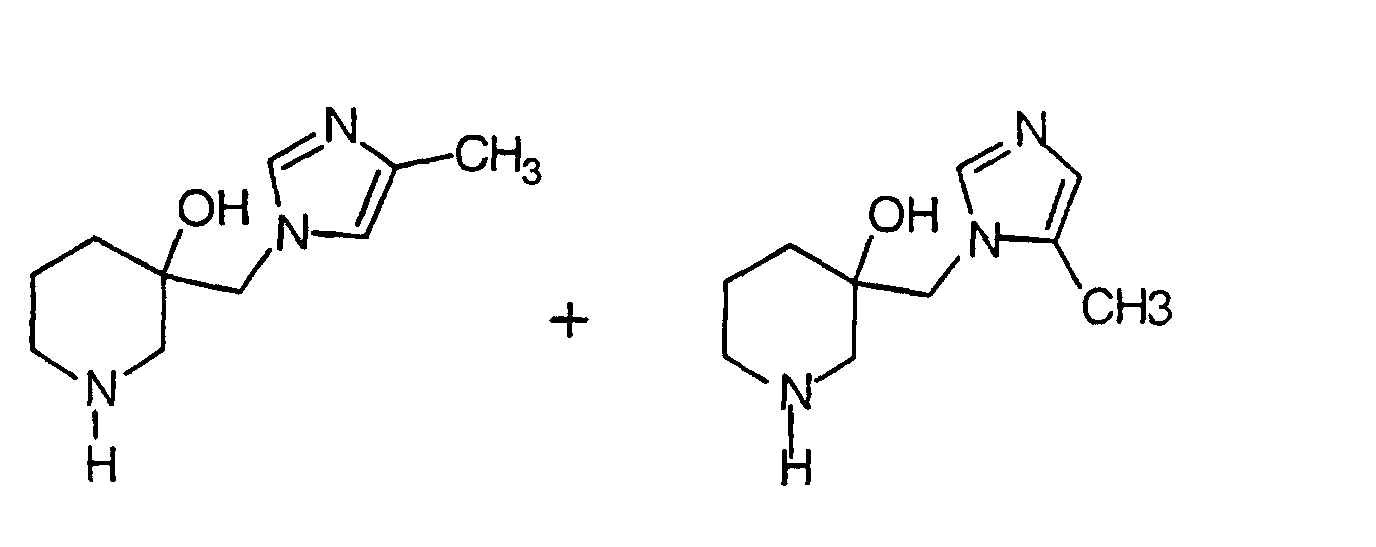
- The product from Preparative Example 83, Step A was treated with H2, Pd(OH)2/C and EtOH in a Parr hydrogenator to afford the amine as a mixture of imidazole regioisomers which were used directly in Step C.
-

- Following the procedure set forth in Preparative Example 7, Step C except using the title compound from Preparative Example 83, Step B instead of the title compound from Preparative Example 7, Step B the BOC derivatives of the regioisomeric methylimidazole products were obtained (5.4 g, 87%): MH+= 296.
-
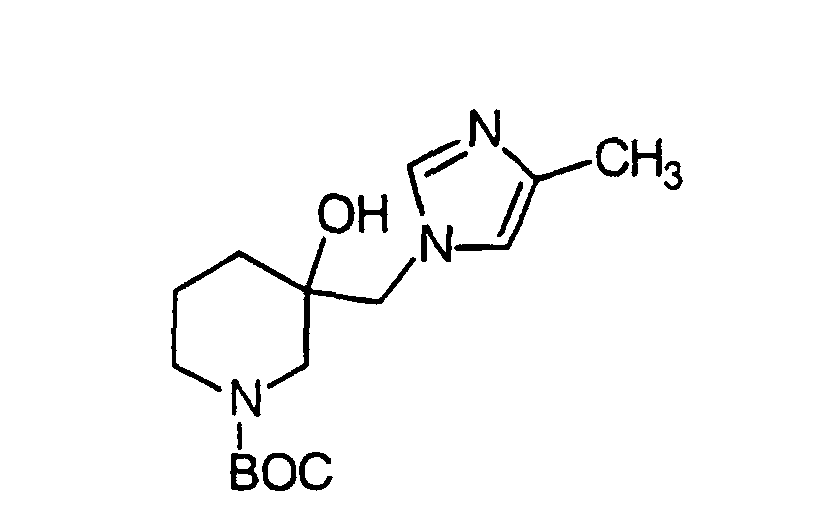
- Following the procedure set forth in Preparative Example 17, except using the title compound from Preparative Example 83, Step C instead of the title compound from Preparative Example 13, the 4-methylimidazole products were obtained as an enantiomeric mixture (1.03 g, 43%): MH+= 296.
-
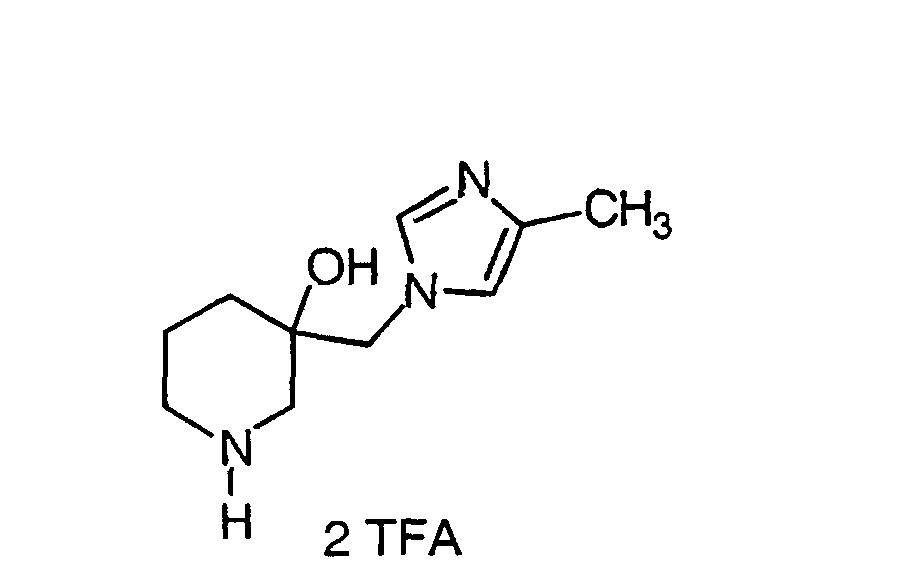
- Following the procedure set forth in Preparative Example 68, Step C except using the title compound from Preparative Example 83, Step D the amine was obtained as its TFA salt (6.3 g, 100%): MH+= 197.
-
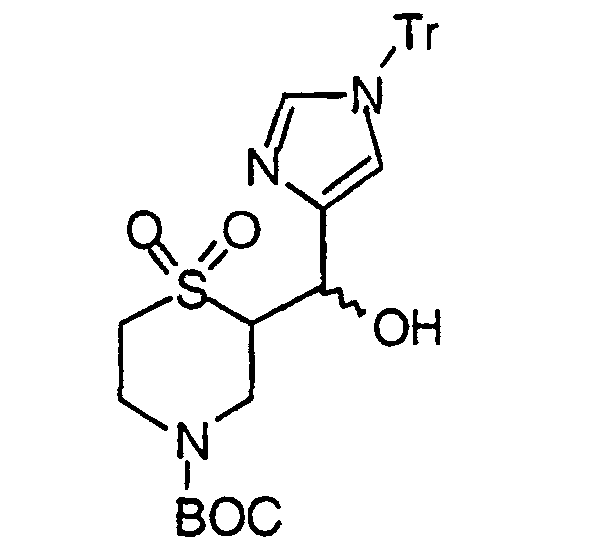
- N-Butoxycarbonyl-thiomorpholine (3.19 gm, 13.5 mmol) was dissolved in 70 ml of THF and cooled to -78 °C under a nitrogen atmosphere. 1.2 equivalents of LDA was added to the reaction mixture and stirred for 20 minutes. 1-N-trityl-imidazole-4-carboxaldehyde (4.62 gm, 13.6 mmol) was dissolved in in 70 ml of THF and added to the reaction mixture. After 4 hours the reaction mixture was poured into sat. NH4Cl solution and extracted with EtOAc three times. The extracts were combined, dried over MgSO4 and the solvent evaporated under reduced pressure. The crude mixture was chromatographed on a silica gel column using 1% MeOH/CH2Cl2 to obtain 3.21 gm of title product.
-
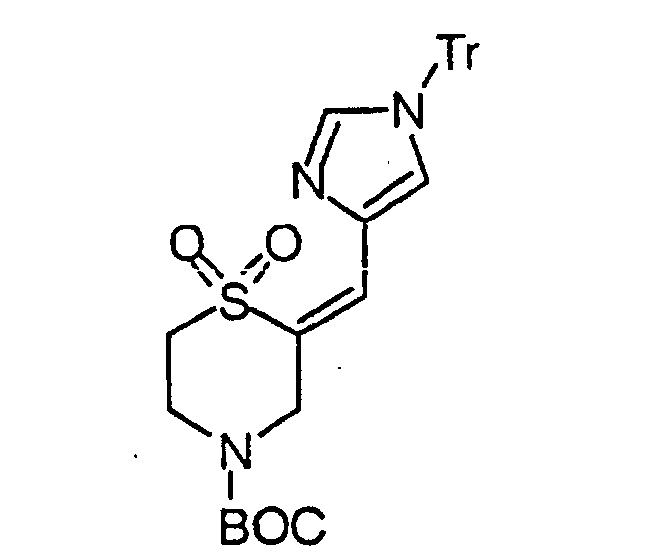
- N-Butoxycarbonyl-[(1triazolyl-imidazol-5-yl)hydroxymethyl]-4-thiomorpholinyl]carbonyl]-1-piperazinecarboxylate s,s-dioxide (2.4 gm) was dissolved in CH2Cl2 (48 mL). TEA (1.32 ml) and MsCl (0.4 ml) was added and the reaction mixture stirred under dry nitrogen. After 24 hours the reaction mixture was added to brine and the product extracted with CH2Cl2 to obtain 1.56 gm of title product.
-
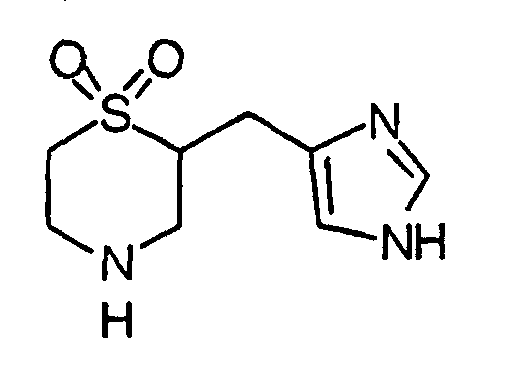
- N-Butoxycarbonyl-[(1triazolyl-imidazol-5-yl)methylene]-4-thiomorpholinyl]carbonyl]-1-piperazinecarboxylate s,s-dioxide (0.68 gm) was dissolved in EtOH. 10% Pd/C (0.1g) was added and the mixture hydrogenated under balloon H2 conditions for 24 hours. The catalyst was filtered and the filtrate evaporated to obtain 0.3g of a mixture which was then treated with 1N HCl/Et2O to obtain the HCl salt.
-
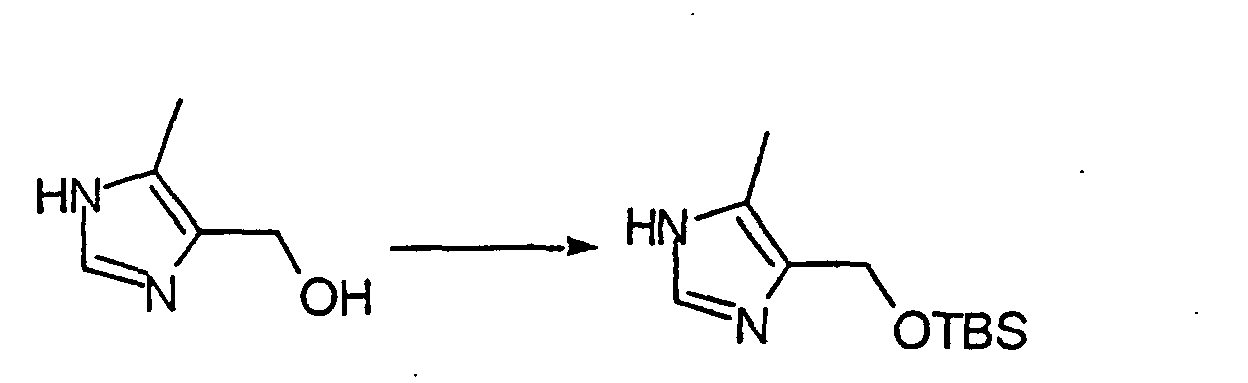
- 4-Hydroxymethyl-5-methylimidazole hydrochloride (4 g; 30 mmol) was dissolved in DMF. TBDMSCl (6.1 g, 45 mmol) and imidazole (5.1 g, 75 mmol) were added and the reaction mixture stirred at ambient temperature for 24 hours. The reaction mixture was poured into water and extracted with EtOAc to obtain 7 gms of title product.
-
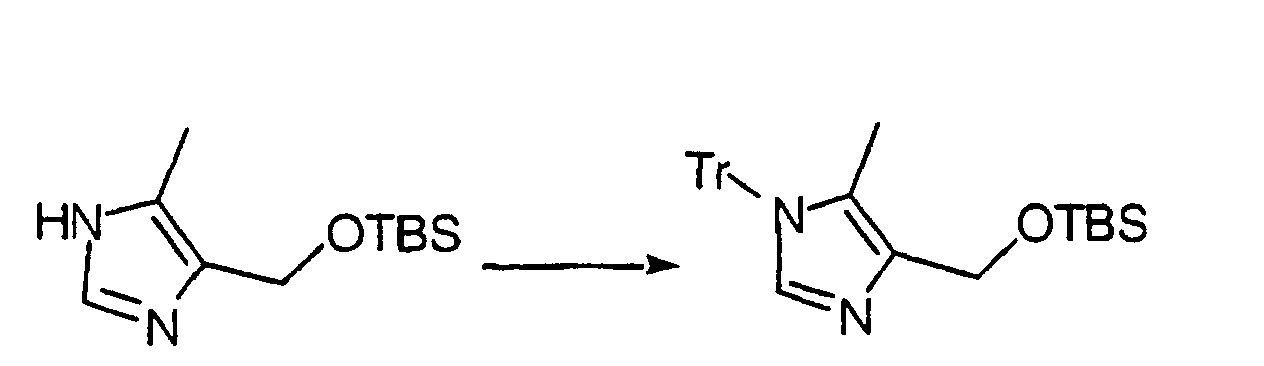
- 4-tert.butyldimethylsilyloxymethyl-5-methyl-imidazole (9 gm, 40 mmol) was dissolved in 100 ml of CH2Cl2. TEA (6 ml) and TrCl (11 gm, 40 mmol) were added and the reaction mixture stirred for six hours. The reaction mixture was added to brine, extracted with EtOAc, and purified on a silica gel column to obtain 7.97 gm of title product as a white solid.
-
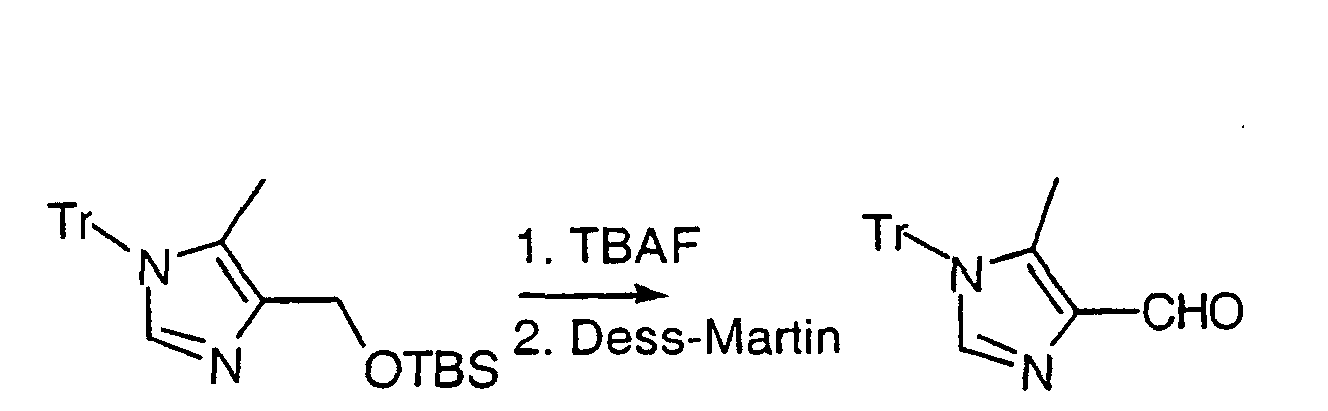
- 1-trityl-4-tert.butyldimethylsilyloxymethyl-5-methyl-imidazole (7.92 gm, 17 mmol) was dissolved in dry THF and 17ml of 1M TBAF in THF was added. The reaction mixture was stirred at room temperature for 3 hours. 100 ml of H2O was added and the precipitate was filtered and dried under vacuum to obtain 5.33 gm of title product.
-
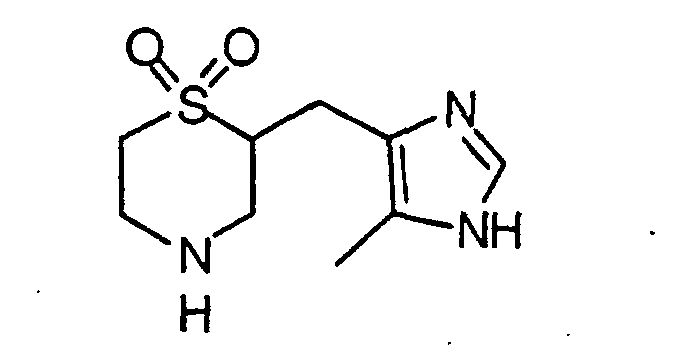
- By essentially the same procedure set forth in Preparative Example 84, Step 1 through Step C, the title product was prepared.
-

- By essentially the same procedure set forth in Njoroge et. al. (J. Med. Chem. (1997),40, 4290) for the preparation of 3-aminoloratadine only substituting the 3-H ketone (J. Het. Chem (1971) 8, 73) for loratadine, the title compound was prepared.
-

- The title compound from Preparative Example 85A (1.0g, 3.87 mmol) was added portionwise to t-butyl nitrite (0.69 mL, 1.5 eq.) and CuCl2 (0.62g, 1.2 eq.) in CH3CN (20 mL) at 0 °C. The resulting solution was warmed slowly to room temperature and stirred 72 hours. The reaction mixture was quenched with 1N HCl (10 mL), neutralized with 15% NH4OH and extracted with EtOAc (3X50 mL). The combined organics were dried over Na2SO4, filtered, and concentrated under reduced pressure. The crude product was purified by flash chromatography using a 50 : 50 EtOAc : hexanes mixture as eluent to give a pale yellow solid (0.72g, 67% yield). FABMS: MH+=278.
-
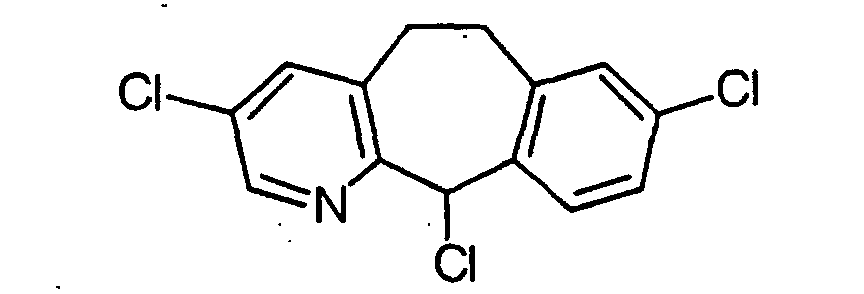
- The title compound from Preparative Example 85A (0.72g, 2.59 mmol) was dissolved in THF (10 mL) and treated with NaBH4 (0.13g, 1.3 eq.). The resulting solution was stirred at room temperature 1 hour. The reacton mixture was quenched by the addition of 1N NaOH and the resulting solution extracted with EtOAc (3 X 50 mL). The combined organics were dried over Na2SO4, filtered, and concentrated under reduced pressure to give a tan solid which was used without further purification (0.71g. 97% crude yield). The crude product was dissolved in toluene (15 mL), cooled to 0 °C, and treated with SOCl2 (0.32 mL, 1.75 eq.). The resulting solution was stirred at 0 °C for 1 hour and room temperature for 2 additional hours. The reaction mixture was diluted with CH2Cl2 (30 mL) and washed with 1N NaOH (20 mL) and the organic layer dried over Na2SO4,. filtered, concentrated, and used without further purification (0.76g, 100 crude yield).
-
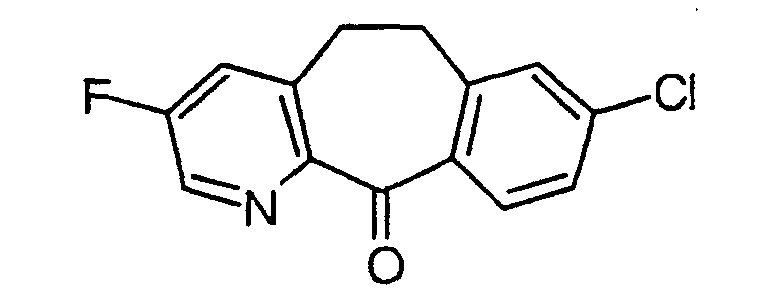
- The title compound from Preparative Example 85A (1.62g, 6.26 mmol) was added portionwise to NO+BF4- (0.81g, 1.1 eq.) in toluene (10 mL) at 0 °C. The resulting slurry was stirred at 0 °C for 2.5 hours before warming to room temperature. The reaction mixture was heated at reflux for 2 hours, cooled, neutralized with 1N NaOH and extracted with EtOAc (3 X 50 mL). The combined organics were washed with 1N HCl (2 X 25 ml), saturated NaHCO3 (1 X 25 mL), and water (1 X 15 mL), dried over Na2SO4, filtered, and concentrated under reduced pressure. The crude product was purified by flash chromatography using a 70 : 30 hexanes : EtOAc mix as eluent to yield a yellow solid (0.68g, 42% yield). LCMS: MH+=262.
-

- By essentially the same procedure set forth in Preparative Example 87, the title compound was prepared and used without further purification (0.66g, 100% crude yield).
-
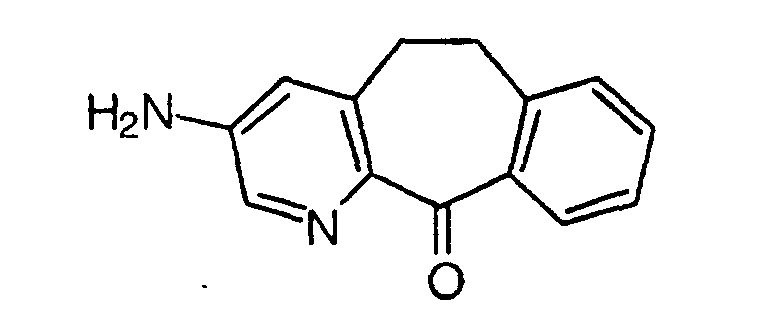
- +NH4HCO2 - (2.44g, 10eq.) was added to a solution of the title compound from Preparative Example 73A (2.00g, 7.74 mmol) and 5% Pd/C (0.50g) in EtOH (100 mL) and the resulting solution was heated to reflux 2 hours. The reaction mixture was cooled, filtered through a plug of Celite and concentrated under reduced pressure. The residue was diluted with H2O (100 mL) and extracted with CH2Cl2 (3 x 75 mL). The combined organics were dried over Na2SO4, filtered, and concentrated in vacuo to give a yellow solid (1.22g, 70% yield) which was used without further purification: FABMS: MH+= 225.
-

- By essentially the same procedure set forth in Preparative Example 86, the title compound was prepared (0.81g, 61% yield):FABMS: MH+= 244.
-
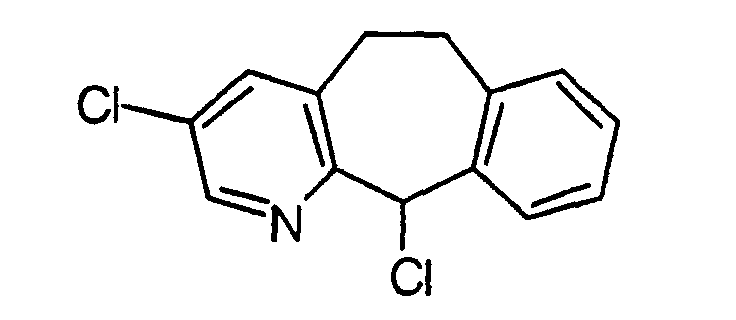
- By essentially the same procedure set forth in Preparative Example 87, the title compound was prepared and used without further purification.
-
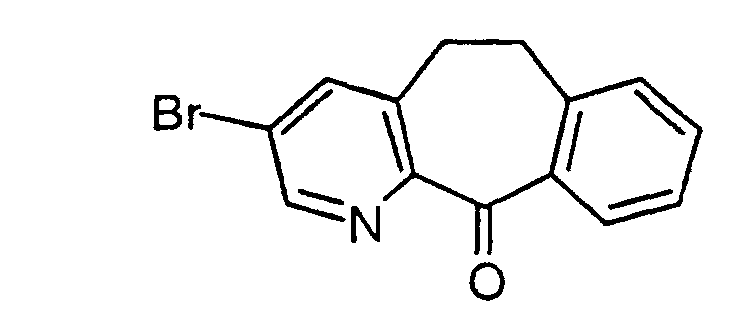
- By essentially the same procedure set forth in Preparative Example 86, only substituting CuBr2 for CuCl2 the title compound was prepared (1.33g, 60% yield):FABMS: MH+= 244.
-
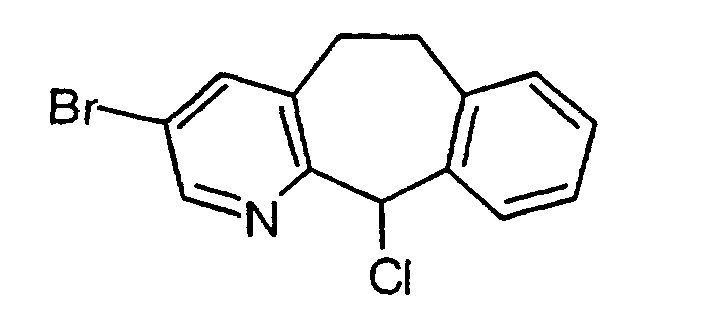
- By essentially the same procedure set forth in Preparative Example 87, the title compound was prepared and used without further purification.
-

- By essentially the same procedure set forth in Preparative Example 88 only substituting the title compound from Preparative Example 90, the title compound was prepared. FABMS: MH+=228.
-
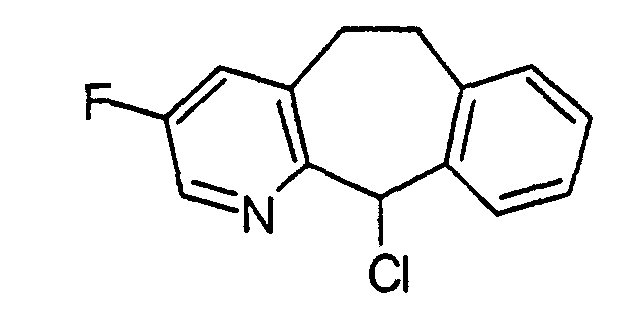
- By essentially the same procedure set forth in Preparative Example 87, the title compound was prepared.
-
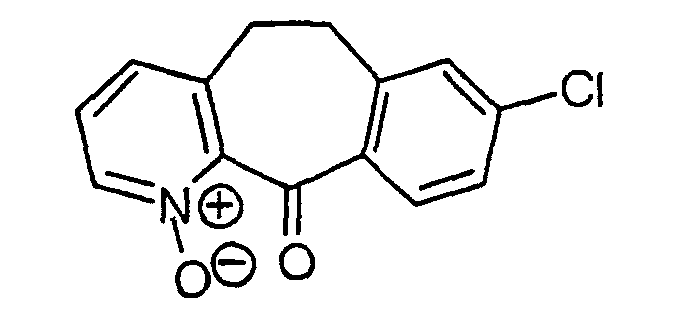
- A solution of 3-peroxybenzoic acid (25 g, 2.5 eq.) in anhydrous dichloromethane (250 mL) was added dropwise over a period of one hour to a stirred solution of 8-chloro-4-aza-10,11-dihydro-5H-dibenzo[a,d]cyclohepten-5-one (10 g, 41.04 mmol) in anhydrous CH2Cl2 (100 mL) at 0 °C under a nitrogen atmosphere. The solution was slowly (3h) warmed to room temperature and stirred for another 12h. The solution was extracted with 1 M NaOH (5 x 100 mL), washed with brine (2 x 100 mL), dried over Na2SO4, filtered, and concentrated under house vacuum at 30 °C to give a canary-yellow solid which was used without purification (10 g, 94% yield): [M + H]+: 260; HRMS (FAB+): Calculated for C14H11ClNO2 ([M + H]+): 260.0475 Observed: 260.0478.
-

- By essentially the same procedure set forth in Preparative Example 87, the title compound was prepared (9.55g, 99% yield).
-

- The title compound was prepared according to the methods described in U.S. Patent No. 3,419,565.
-

- By essentially the same procedure set forth in Preparative Example 87, the title compound was prepared (2.4g, 87% yield).
-

- MeI (1.75 mL, 3.0 eq.) added to a solution of Cs2CO3 (9.12g, 3.0 eq.) and the title compound from Preparative Example 4 (3.40g, 9.33 mmol) in DMF (10 mL). The resulting solution was stirred at room temperature 4 hours. The reaction mixture was concentrated under reduced pressure, diluted with H2O (50 mL) and extracted with CH2Cl2 (3 X 50 mL). The combined organics were dried over Na2SO4, filtered, and concentrated in vacuo. The crude product was purified using a 50 : 50 EtOAc : hexanes mix as eluent (1.4g, 40% yield). FABMS: MH+=379.
-
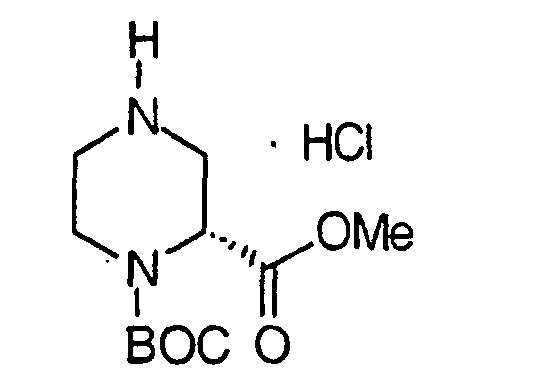
- A solution of the title compound from Preparative Example 100 (1.40g, 3.70 mmol) and 5% Pd/C (0.50g) in MeOH (20 mL) and 1N HCl (5 mL) was stirred under 1 atm of H2 overnight. The reaction mixture was filtered through a plug of Celite and concentrated in vacuo to give a white solid (1.02g, 98% yield) which was used without purification. FABMS: MH+=245.
-
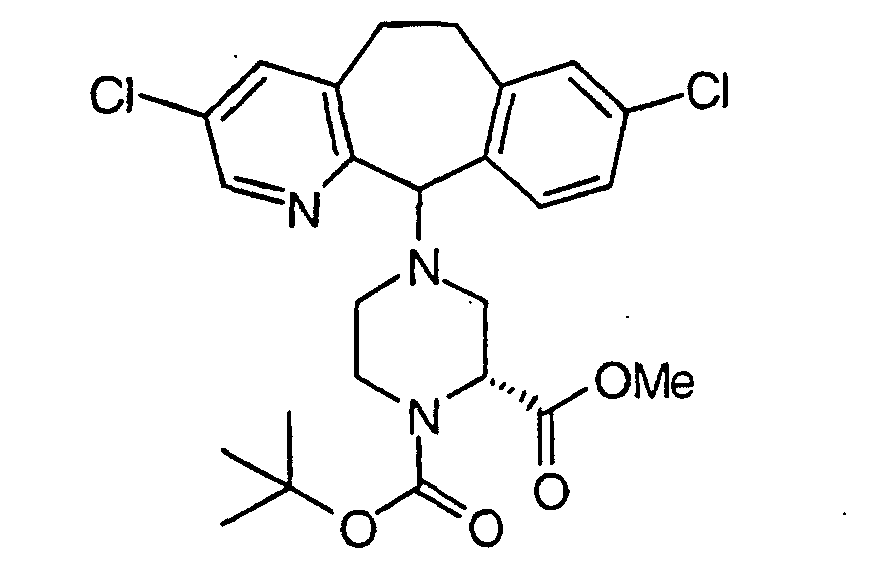
- A solution of the title compound from Preparative Example 101 (1.01g, 3.78 mmol) and TEA (2.63 mL, 5 eq.) in DMF (10 mL) were stirred at room temperature for 30 minutes before adding the title compound from Preparative Example 87 (1.68g, 1.5eq.). The resulting solution was stirred at room temperature overnight and concentrated under reduced pressure. The residue wasdiluted with saturated NaHCO3 (25 mL) and extrated with CH2Cl2 (3 X 50 mL). The combined orgaincs were dried over Na2SO4, filtered, and concentrated and the crude product purified by flash chromatography using a 3% EtOAc in CH2Cl2 solution as eluent to give an off-white solid (1.1g, 39% yield): LCMS: MH+=506.
- The individual C-11 (R)- and (S)-isomers were separated by Preparative HPLC using a CHIRALPAK AD column using a 15% iPrOH in hexanes with 0.2% DEA solution as eluent.
- 11-(R)-isomer (first eluting isomer): FABMS: MH+= 506; [α]D= +70° (5.0 mg in 2.0 mL MeOH).
- 11-(S)-isomer (second eluting isomer): FABMS: MH+=506; [α]D= ° (28 mg in 2.0 mL MeOH).
-
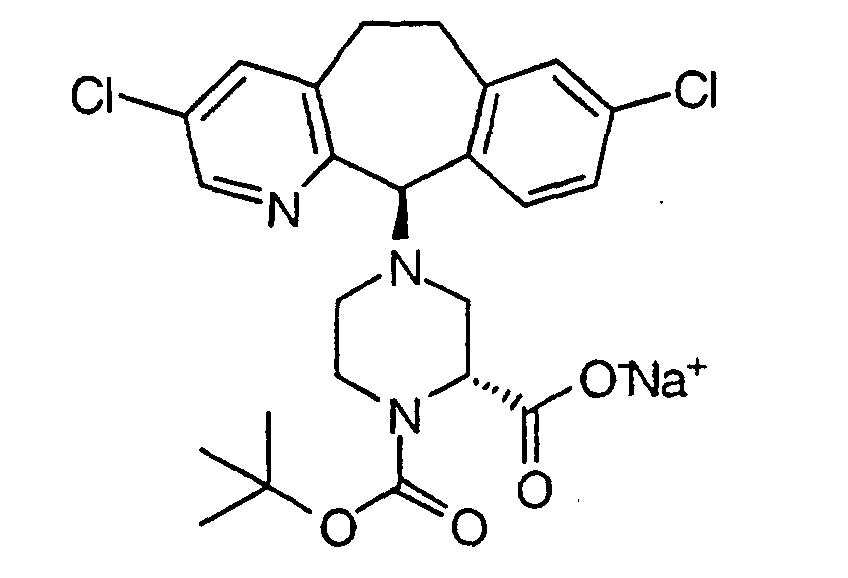
- A solution of the title compound (C-11 (R)-isomer) from Preparative Example 102 (0.465g, 0.918 mmol) and 1N NaOH (2.76 mL, 3.0 eq.) in MeOH (15 mL) was heated at reflux 2 hours. The reaction mixture was cooled, concentrated, diluted with EtOAc (25 mL) and washed with brine (10 mL). The organics were dried over Na2SO4, filtered, and concentrated under reduced pressure to give a white solid (0.45g, 96% yield): FABMS: MH+= 492; [α]D= +57.4° (5.0 mg in 2.0 mL MeOH).
-

- By essentially the same procedure set forth in Preparative Example 103, the title compound (C-11 (S)-isomer) was prepared (0.45g, 96% yield): FABMS: MH+= 492; [α]D= +13.7° (5.0 mg in 2.0 mL MeOH).
-

- By essentially the same procedure set forth in Prepartive Example 102, the title compound (C-11 (R)- and (S)-isomers) was prepared only the C-11 (R)- and (S)-isomers were separated by flash chromatography using a 3% EtOAc in CH2Cl2 solution as eluent.
-
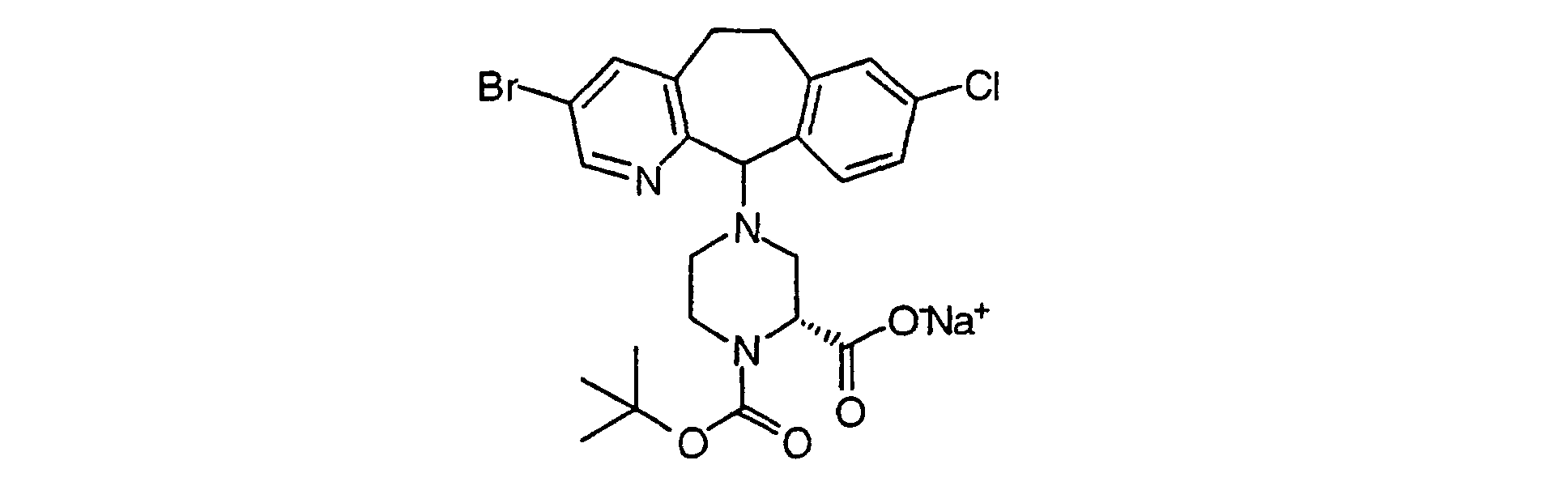
- By essentially the same procedure set forth in Preparative Example 103, the title compounds (individual C-11 (R)-and (S)-isomers) were prepared.
-
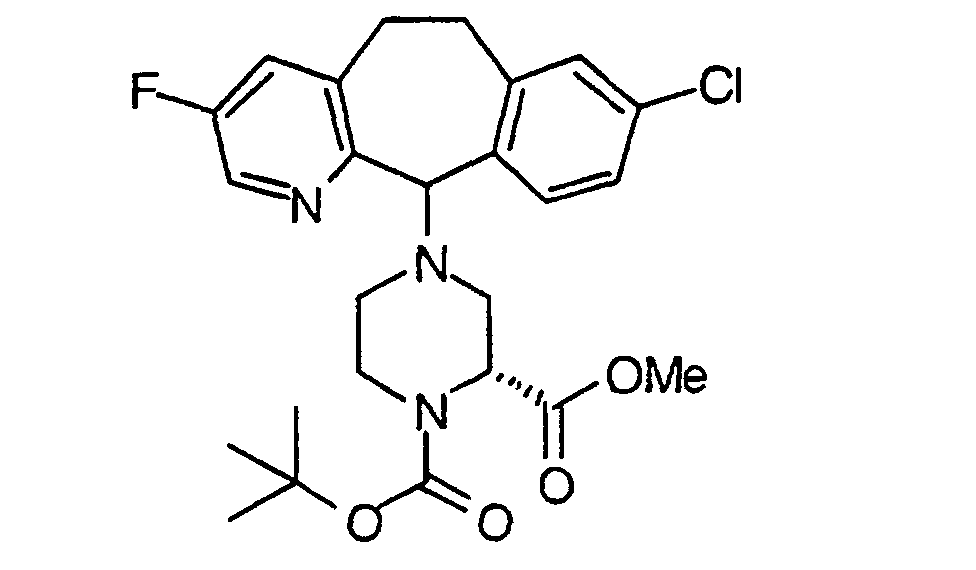
- By essentially the same procedure set forth in Preparative Example 102 only substituting the title compound from Preparative Example 89, the title smpound was prepared (C-11 (R)- and (S)-isomers) (0.71g, 57% yield): FABMS: MH+=490.
-
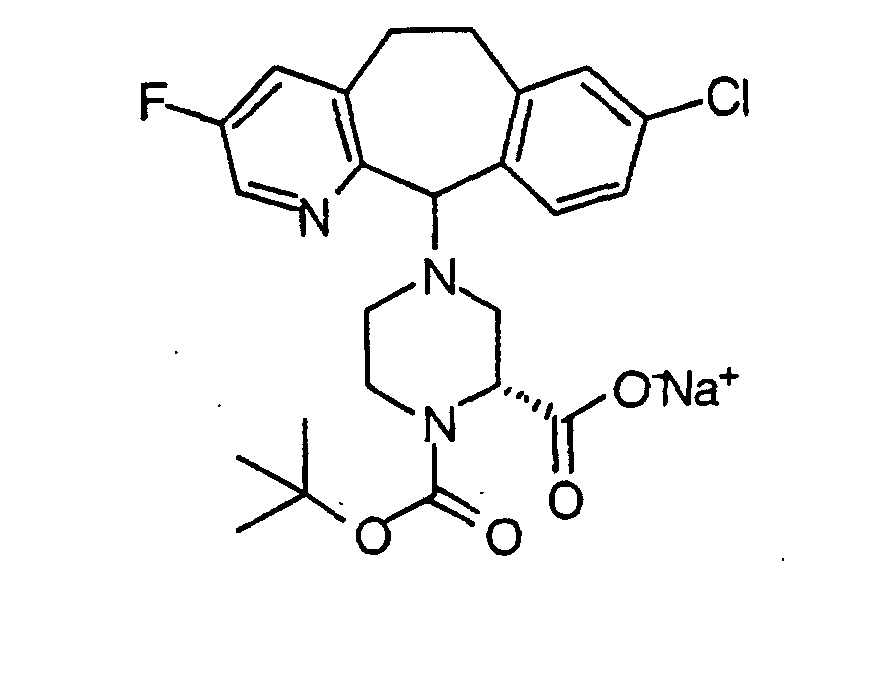
- By essentially the same procedure set forth in Preparative Example 103, only using the title compounds (C-11 (R)- and (S)-isomers) from Preparative Example 107, the title compound were prepared. The individual C-11 (R)- and (S)-isomers were separated by flash chromatography using a 12% (10% NH4OH in MeOH) solution in CH2Cl2 as eluent:
- C-11 (S)-isomer (first eluting isomer): FABMS: MH+= 476.
- C-11 (R)-isomer (second eluting isomer): FABMS: MH+= 476.
-
-

- By essentially the same procedure set forth in Preparative Example 102, only substituting the 3-Cl, 8-H title compound from Preparative Example 92 for the 3-Cl, 8-Cl title compound from Preparative Example 101, the title compound (individual C-11 (R)-and C-11 (S)-isomers) was prepared. LCMS: MH+-479.
-
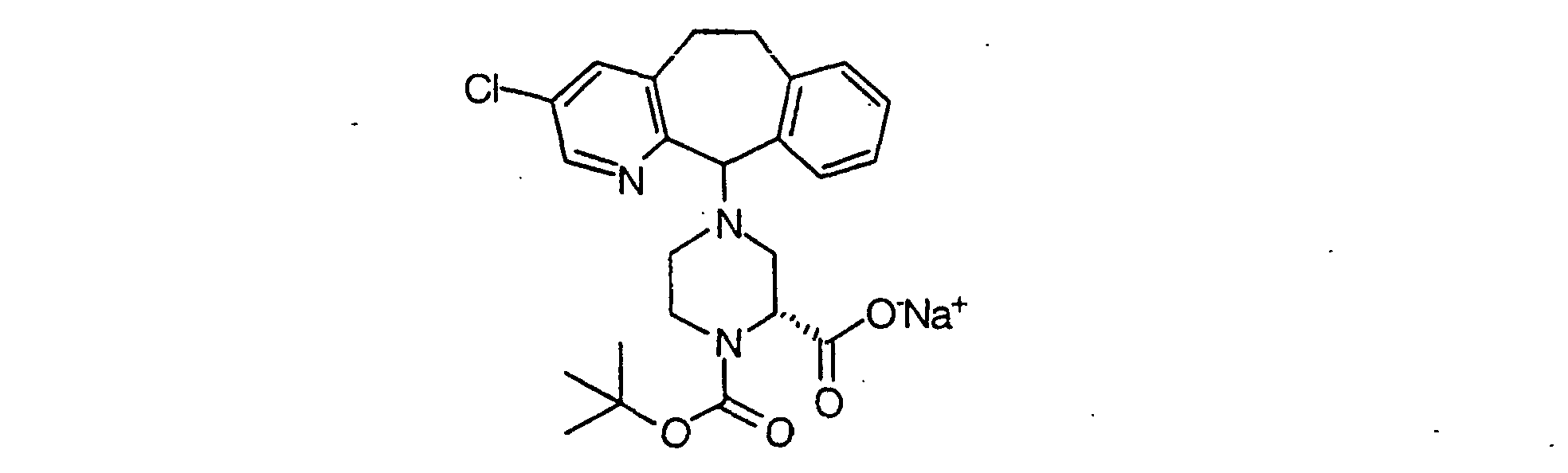
- By essentially the same procedure set forth in Preparative Example 103, the title compound (individual C-11 (R)- and C-11 (S)-isomers) was prepared. LCMS MH+=458.
-

- By essentially the same procedure set forth in Preparative Example 102, only substituting the 3-Br, 8-H title compound from Preparative Example 93 for the 3-Cl, 8-Cl title compound from Preparative Example 101, the title compound (individual C-11 (R)-and C-11 (S)-isomers) was prepared.
-

- By essentially the same procedure set forth in Preparative Example 103, the title compound (individual C-11 (R)- and C-11 (S)-isomers) was prepared.
-
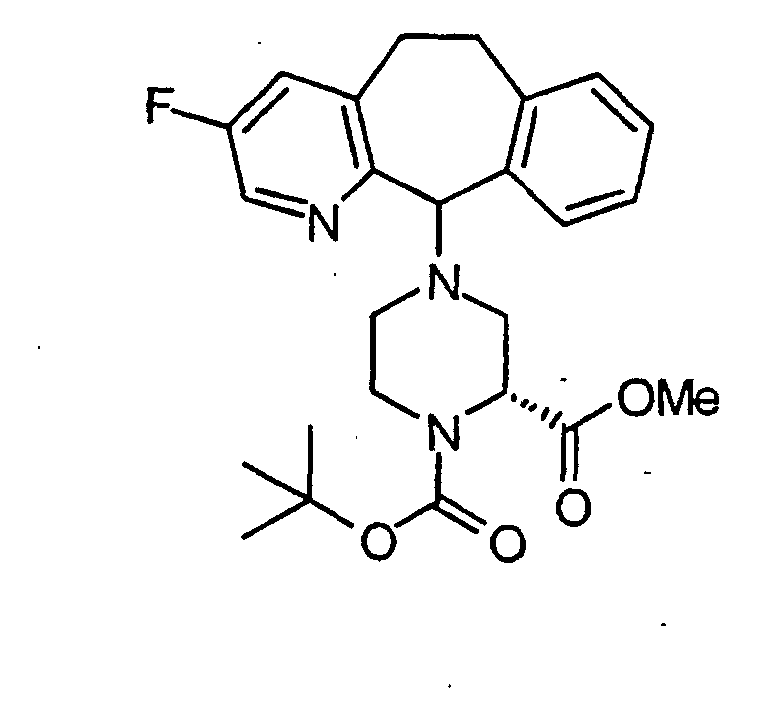
- By essentially the same procedure set forth in Preparative Example 102, only substituting the 3-F, 8-H title compound from Preparative Example 95 for the 3-Cl, 8-Cl title compound from Preparative Example 101, the title compound (individual C-11 (R)-and C-11 (S)-isomers) can be prepared.
-
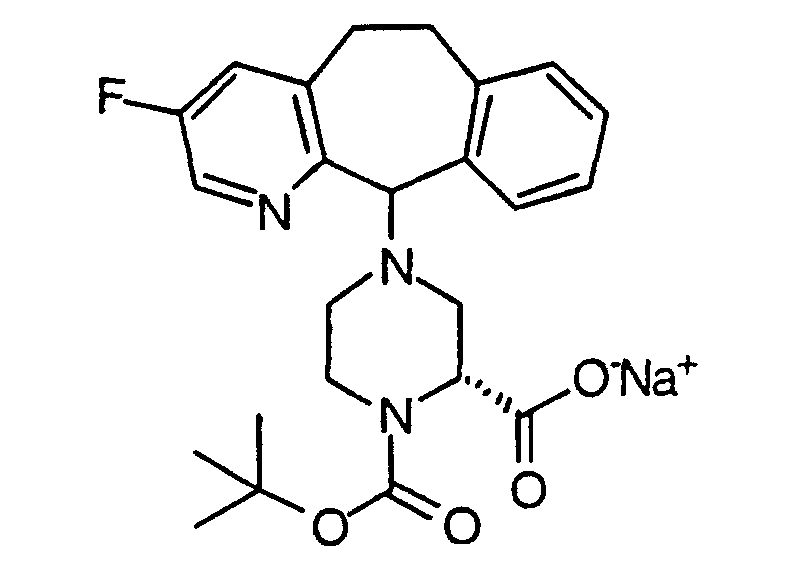
- By essentially the same procedure set forth in Preparative Example 103, the title compound (individual C-11 (R)- and C-11 (S)-isomers) can be prepared.
- By essentially the same procedure set forth in Example 1 only substituting the title compounds from Preparative Example 106 (individual (R)- and (S)-isomers) and substituting the appropriate amine, the compunds of the formula shown below with R8 listed in column 3 of Table 17 were obtained.


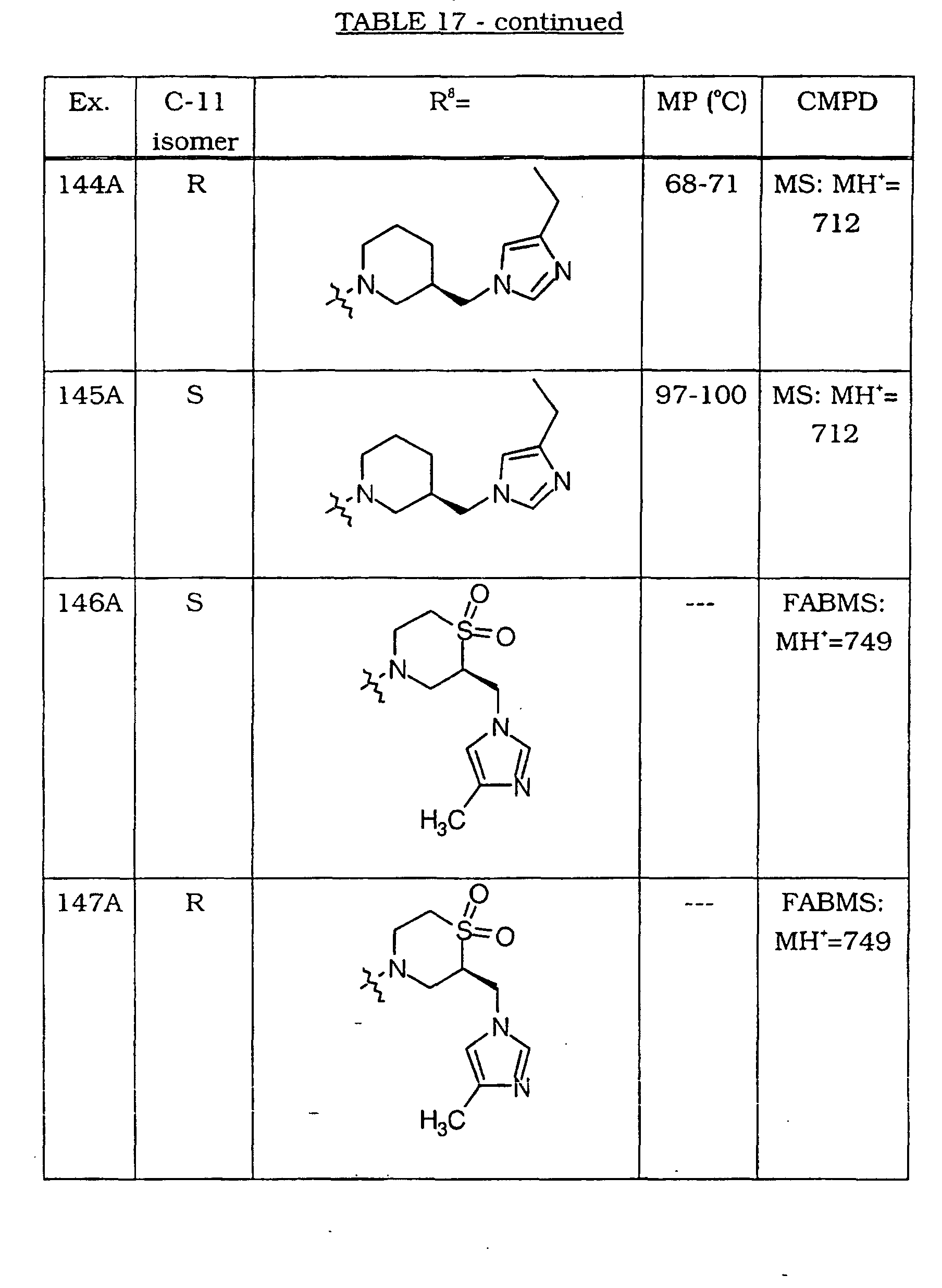
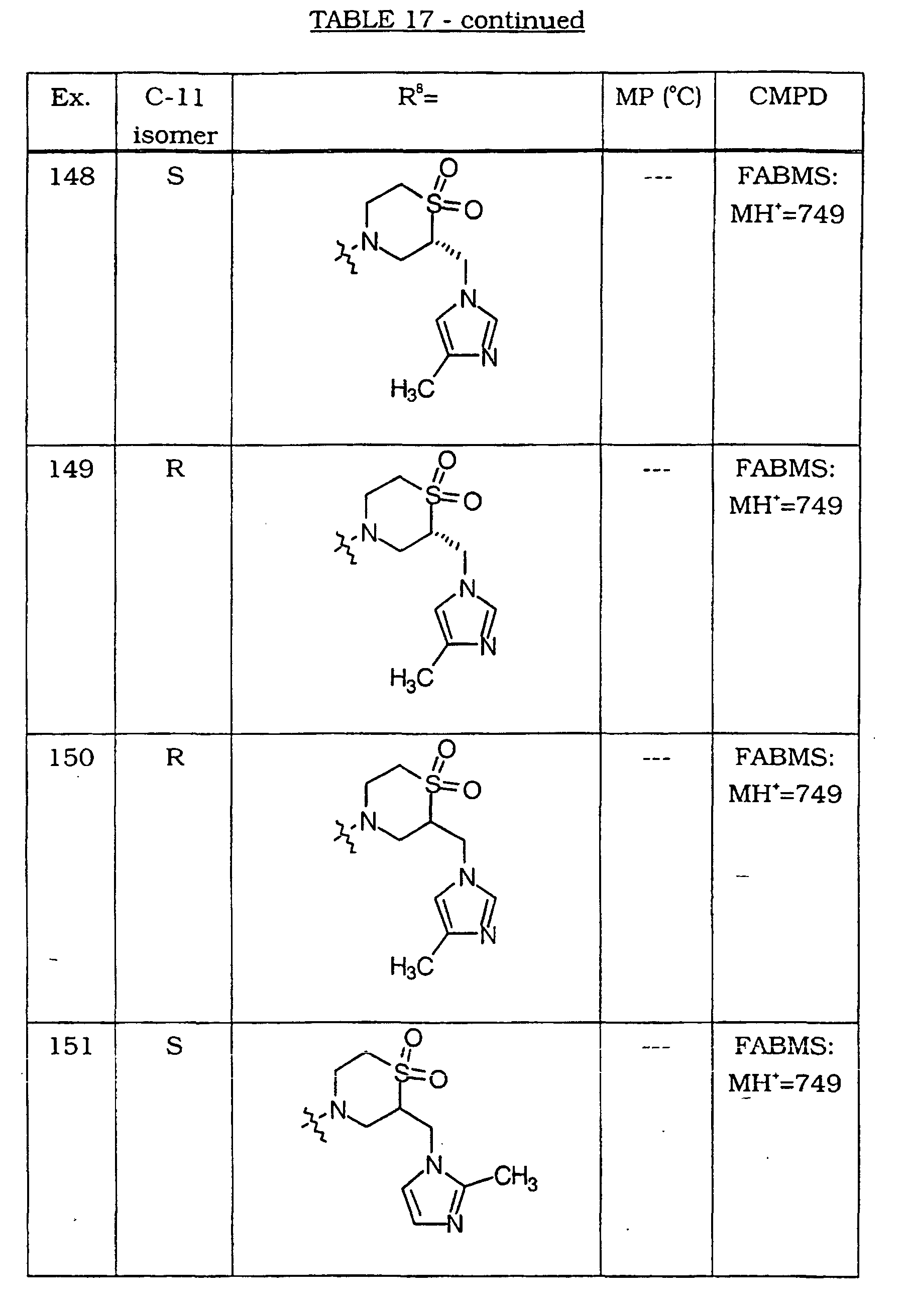


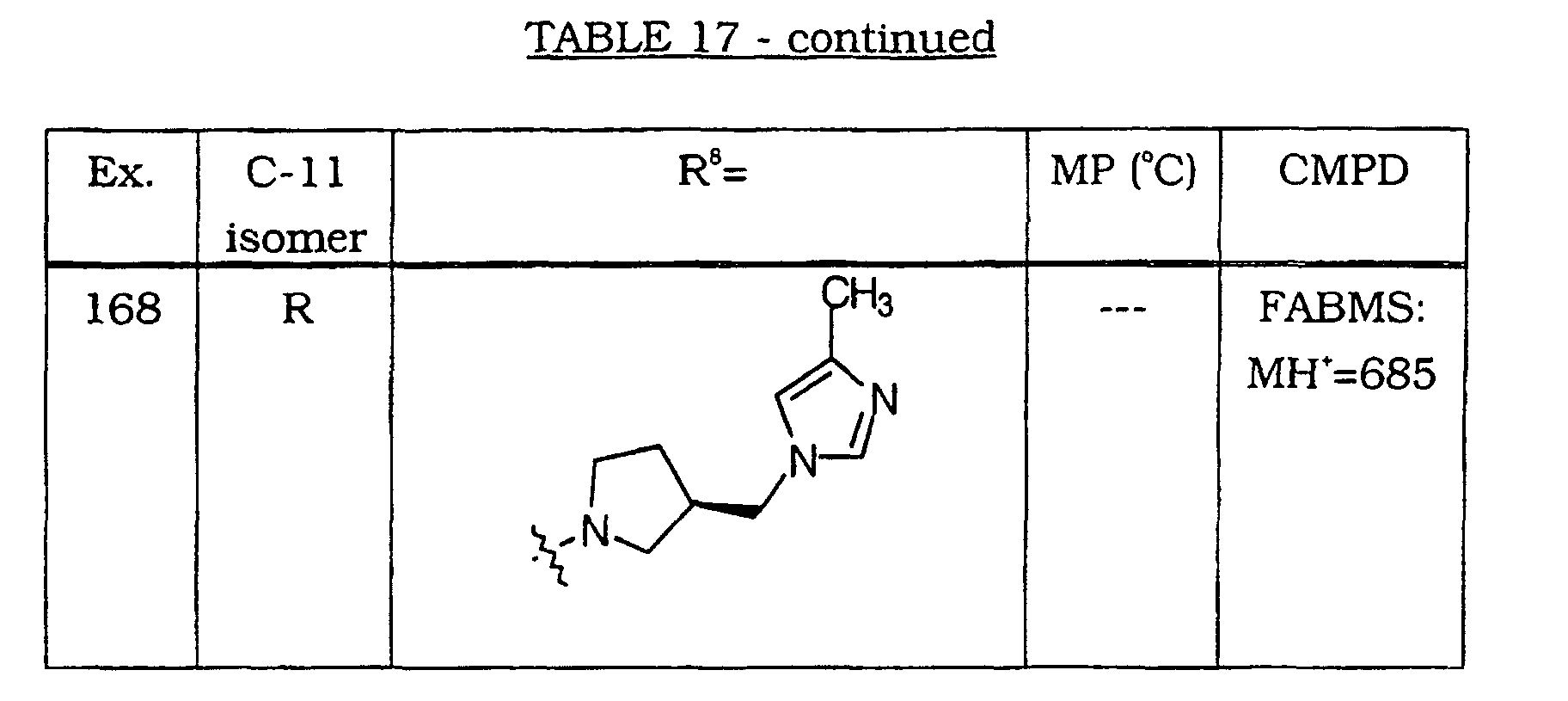
-

- By essentially the same procedure set forth in Preparative Example 24 only using the title compound from Example 73A, the title compound was prepared: FABMS: MH+= 599.
- By essentially the same procedure set forth in Preparative Example 115 only substituting the title compounds from the example listed in column 2, the title compounds of formula shown below with R8 as listed in column 4 of Table 18 can be obtained.
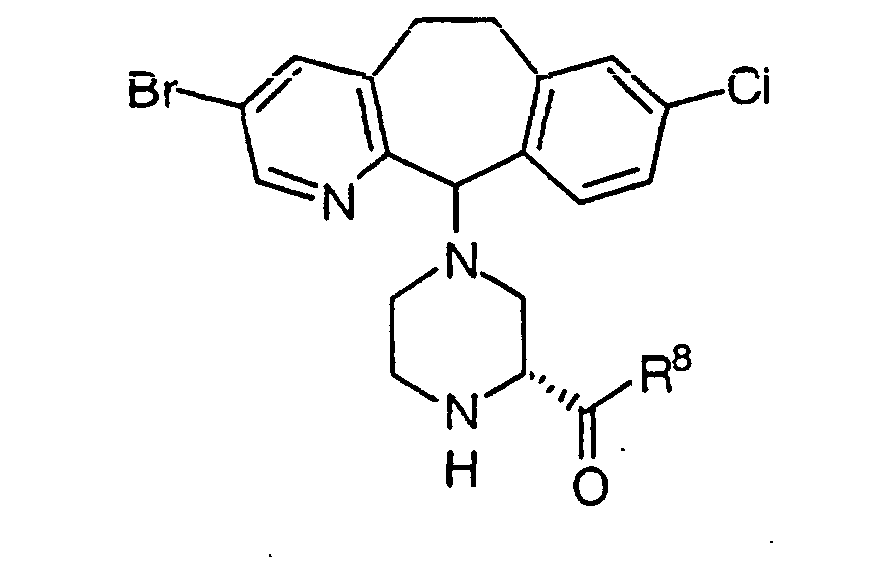

- By essentially the same procedure set forth in Example 14, only substituting the title compounds from the Preparative Example listed in column 2 of Table 19, the compounds of the formula shown below with R9 as listed in Column 4 of Table 19, were obtained (where data is provided) or can be obtained (where no data is provided) by using the appropriate electrophile.
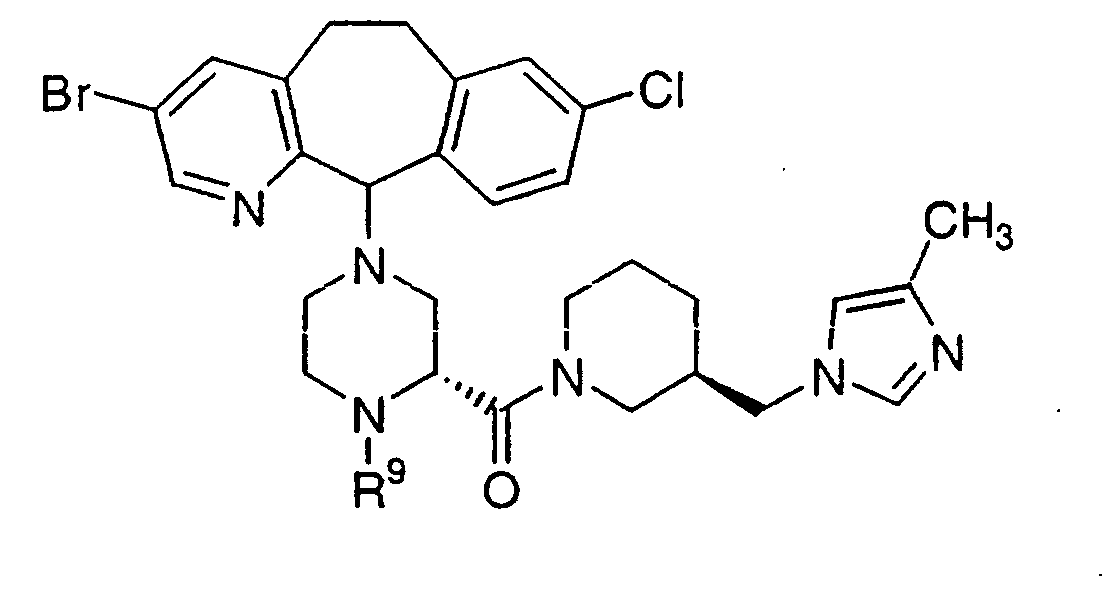
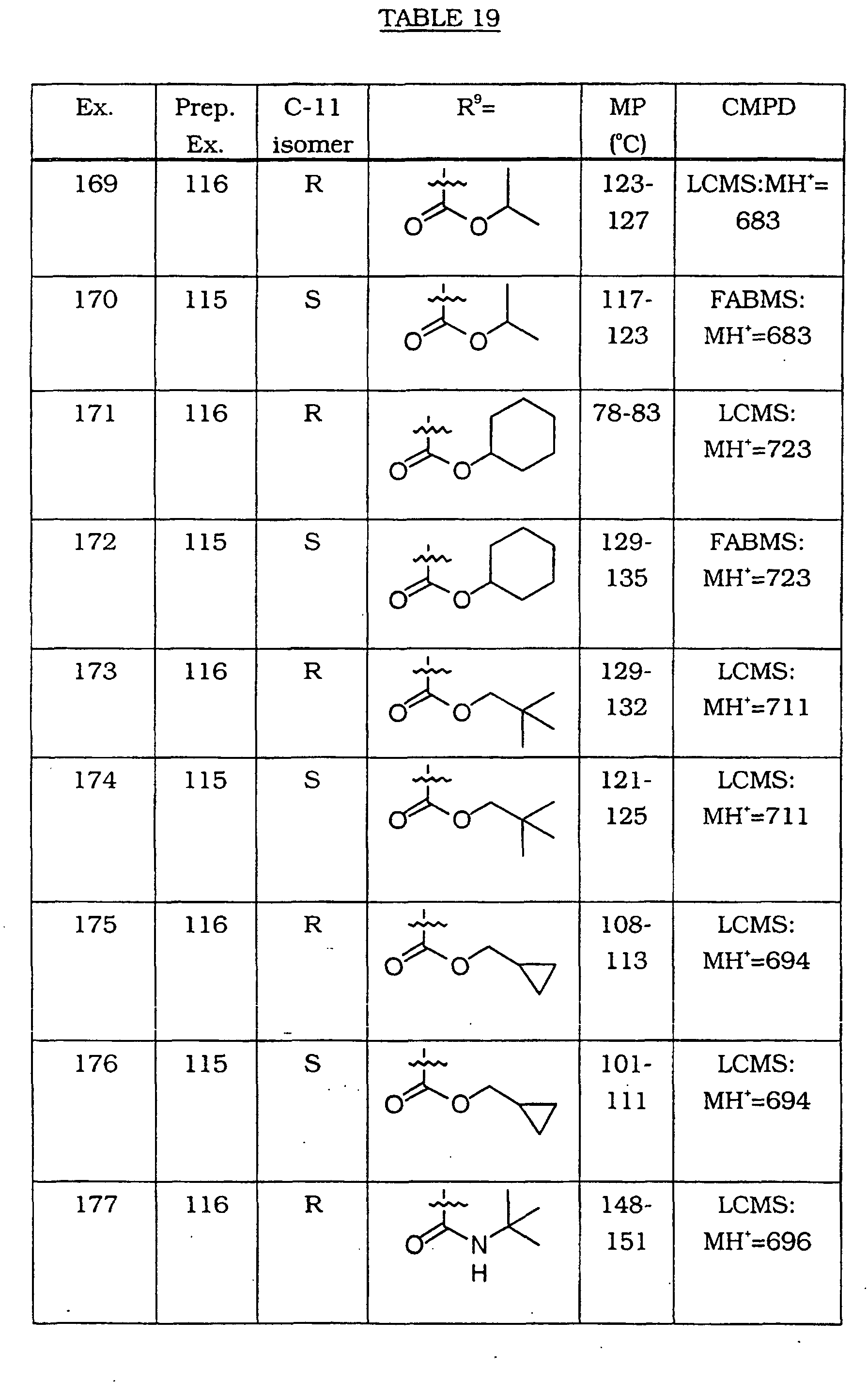

- By essentially the same procedure set forth in Example 14, only substituting the title compounds from the Preparative Example listed in column 2 of Table 20, the compounds of the formula shown below, with R9 as listed in Column 4 of Table 20 were obtained (where data is provided) or can be obtained (where data is not provided) by using the appropriate electrophile.

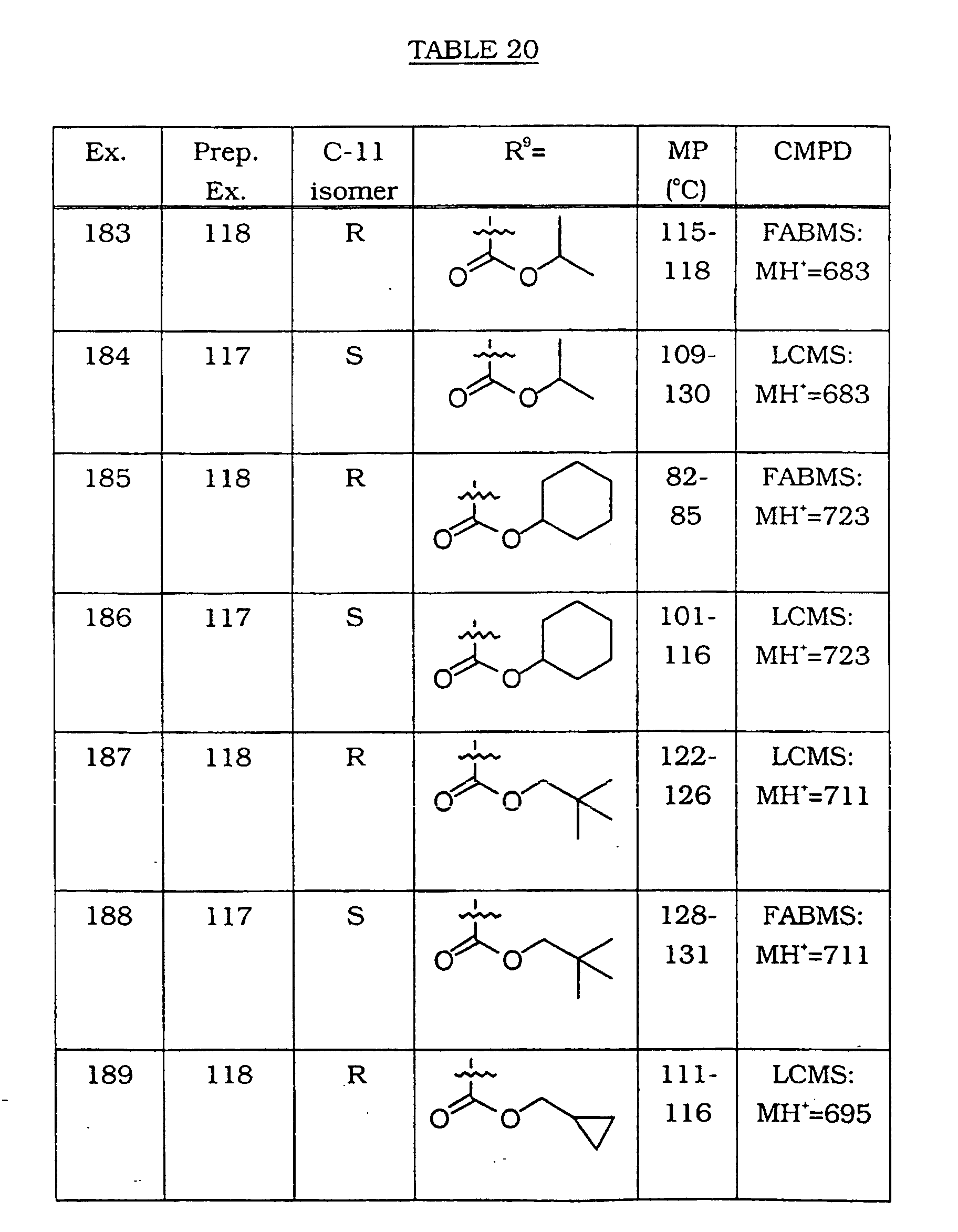
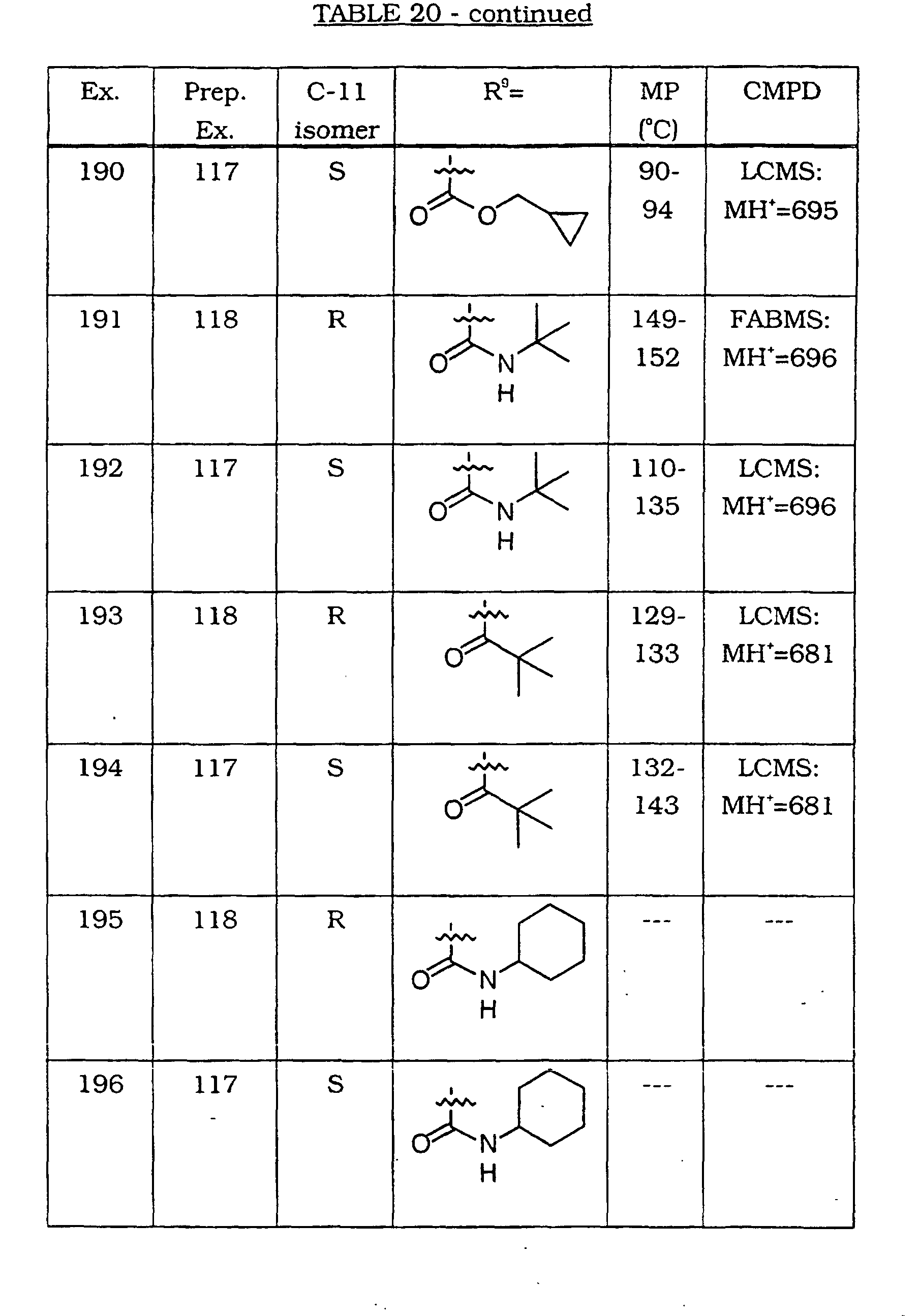
-
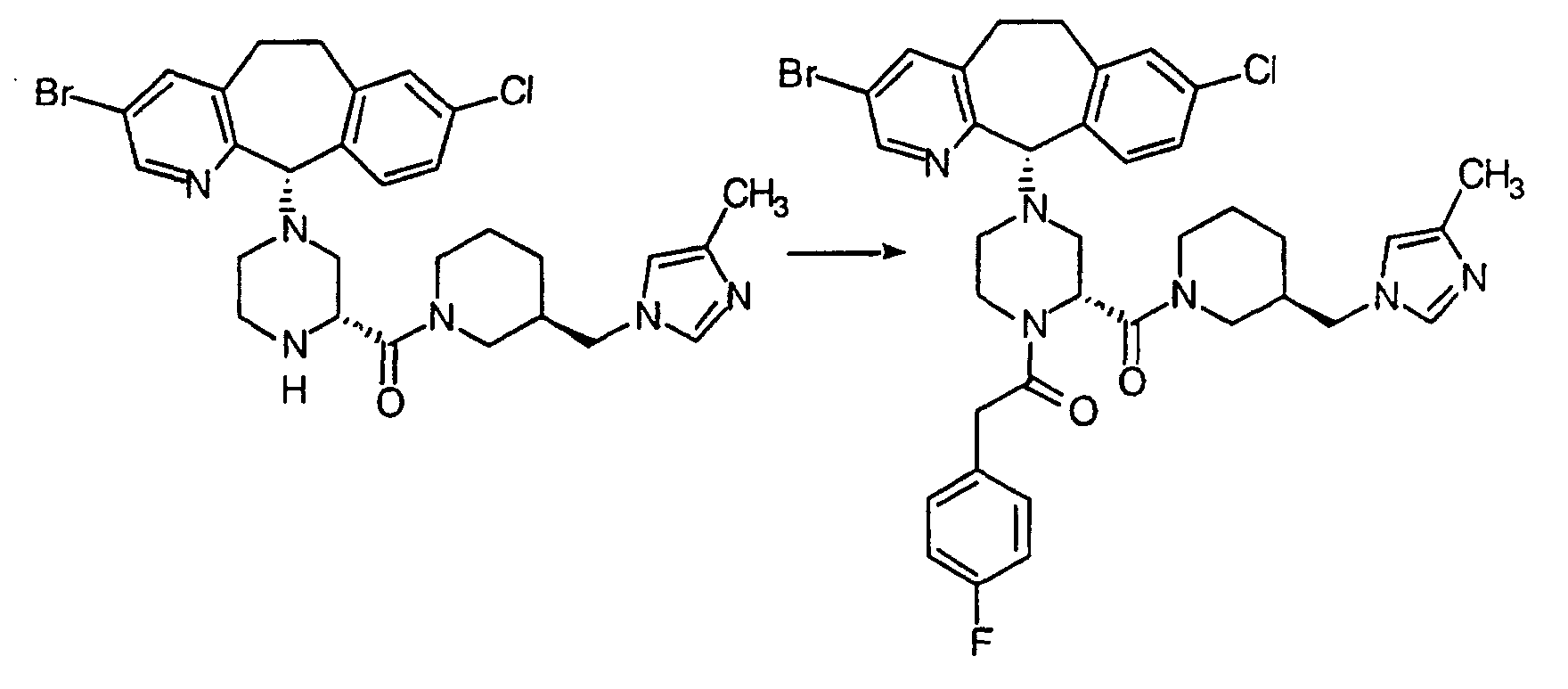
- A solution of the title compound from Preparative Example 115 (0.10g, 0.17 mmol) in CH2Cl2 (5.0 mL) was treated with p-fluorophenylacetic acid (0.034g, 1.3 eq.), NMM (0.11 mL, 6.0 eq.), HOBt (0.029g, 1.3 eq.), and DEC (0.042g, 1.3 eq.) and the resulting solution was stirred at room temperature overnight. The reaction mixture was concentrated in vacuo and the crude product purified by flash chromatography using a 5% (10%NH4OH in MeOH) solution in CH2Cl2 as eluent (0.066g, 53% yield): mp = 105-110 °C; LCMS: MH+= 733.
- By essentially the same procedure set forth in Example 197, only using the title compounds from the Preparative Example listed in column 2 of Table 21, the title compounds of the formula shown below, with R8 as listed in column 4 of Table 21, were obtained.
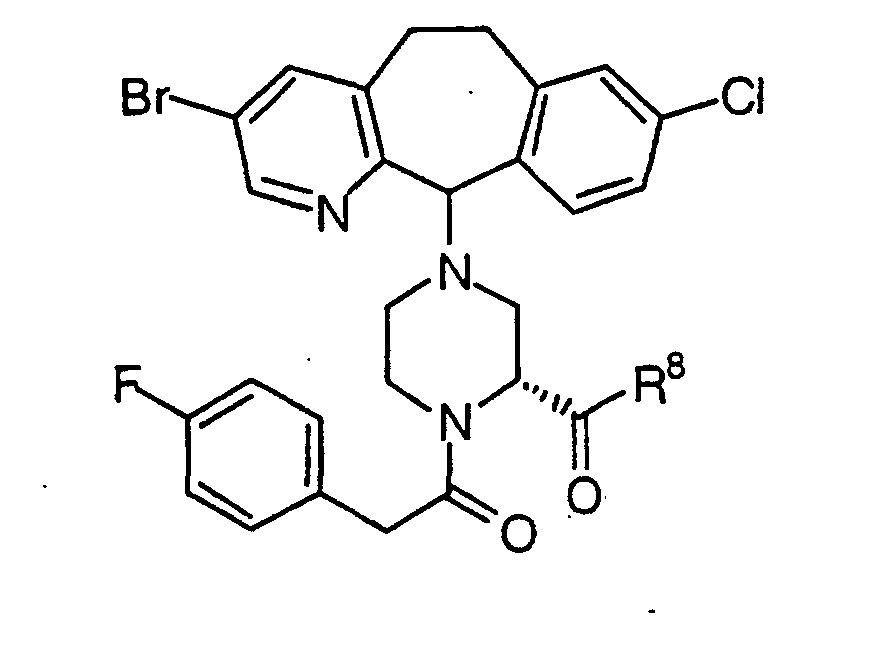
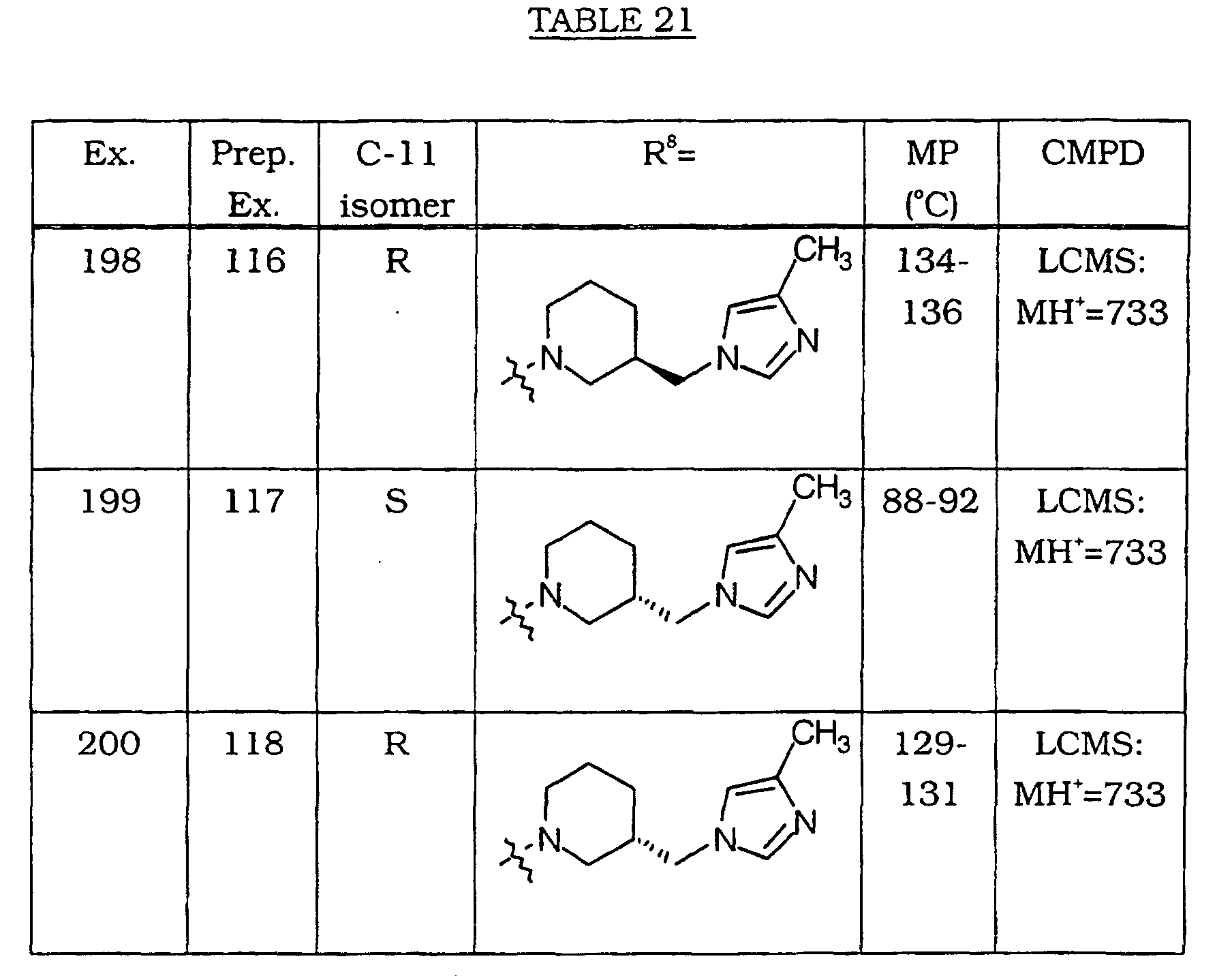
- By essentially the same procedure set forth in Example 197, only substituting cyclopropylmethylacetic acid in place of p-fluorophenylacetic acid, and using the title compounds from the Preparative Example listed in column 2 of Table 22, the title compounds of the formula shown below, with R8 as listed in column 4 of Table 22, were obtained (Examples 201 and 203) or can be obtained (Examples 202 and 204).
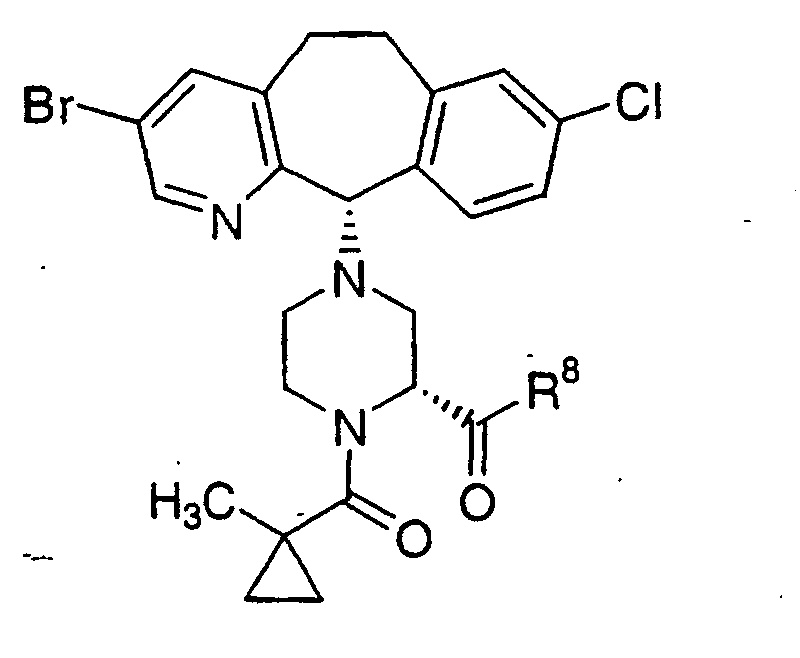

- By essentially the same procedure set forth in Preparative Example 115, only substituting the title compounds from the example listed in column 2 of Table 23, the title compounds of the formula shown below, with R8 as listed in column 4 of Table 23 were obtained.
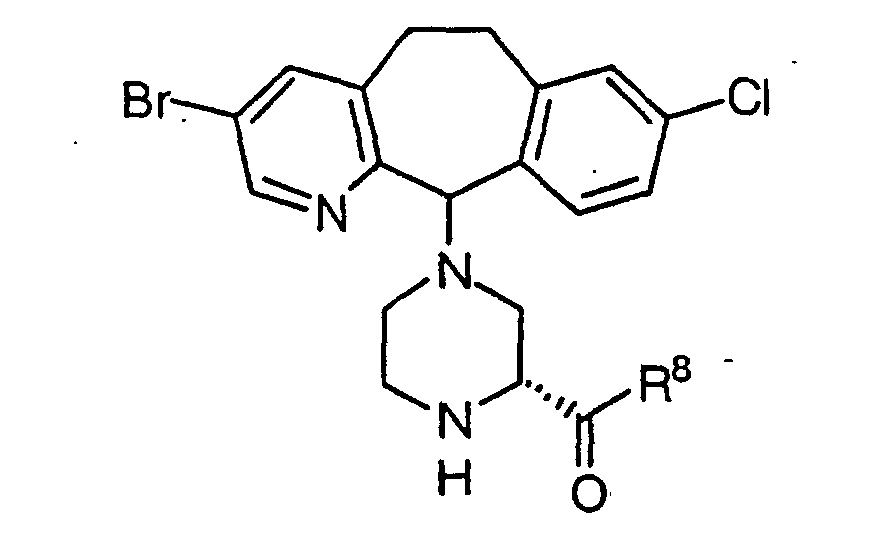
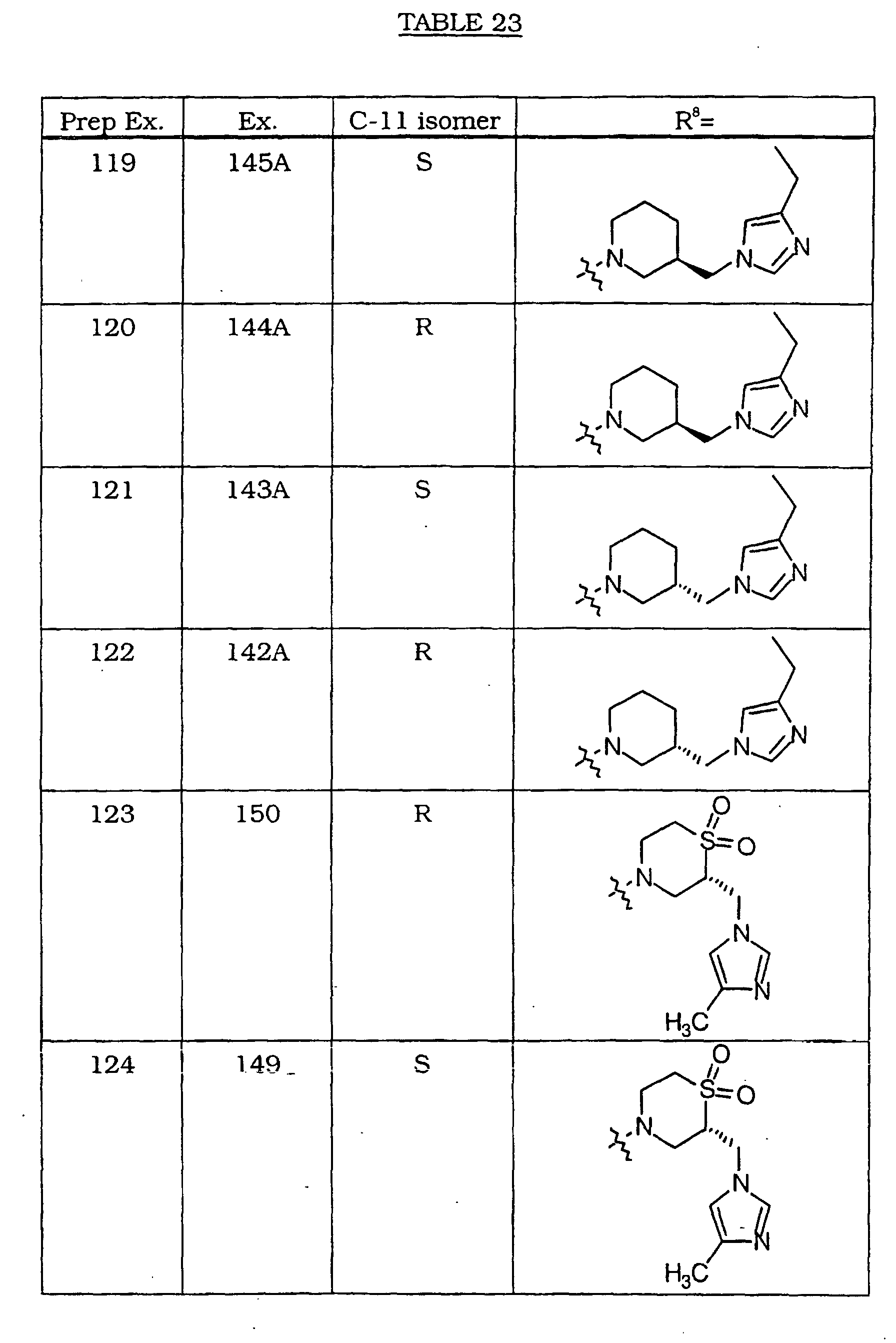
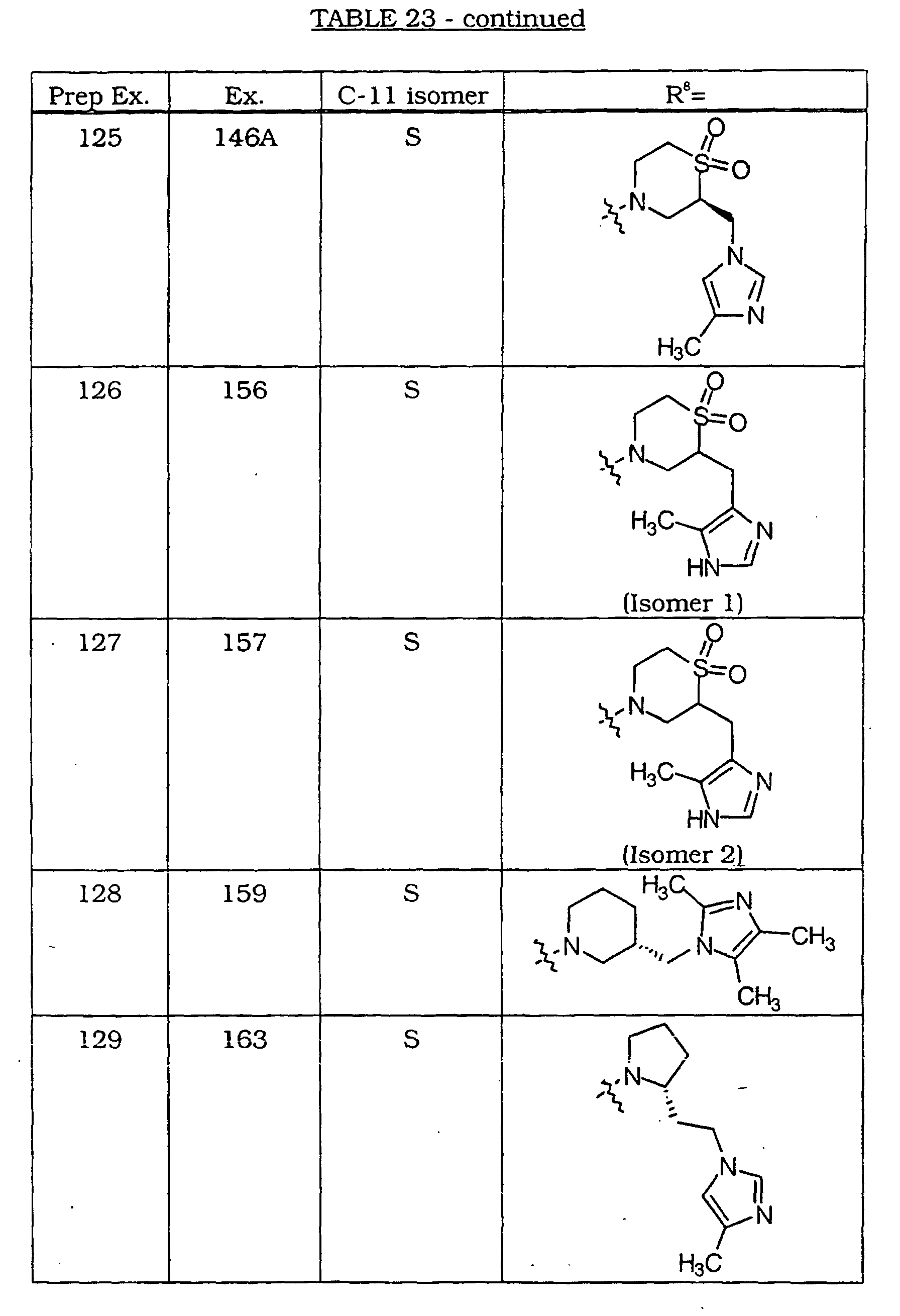
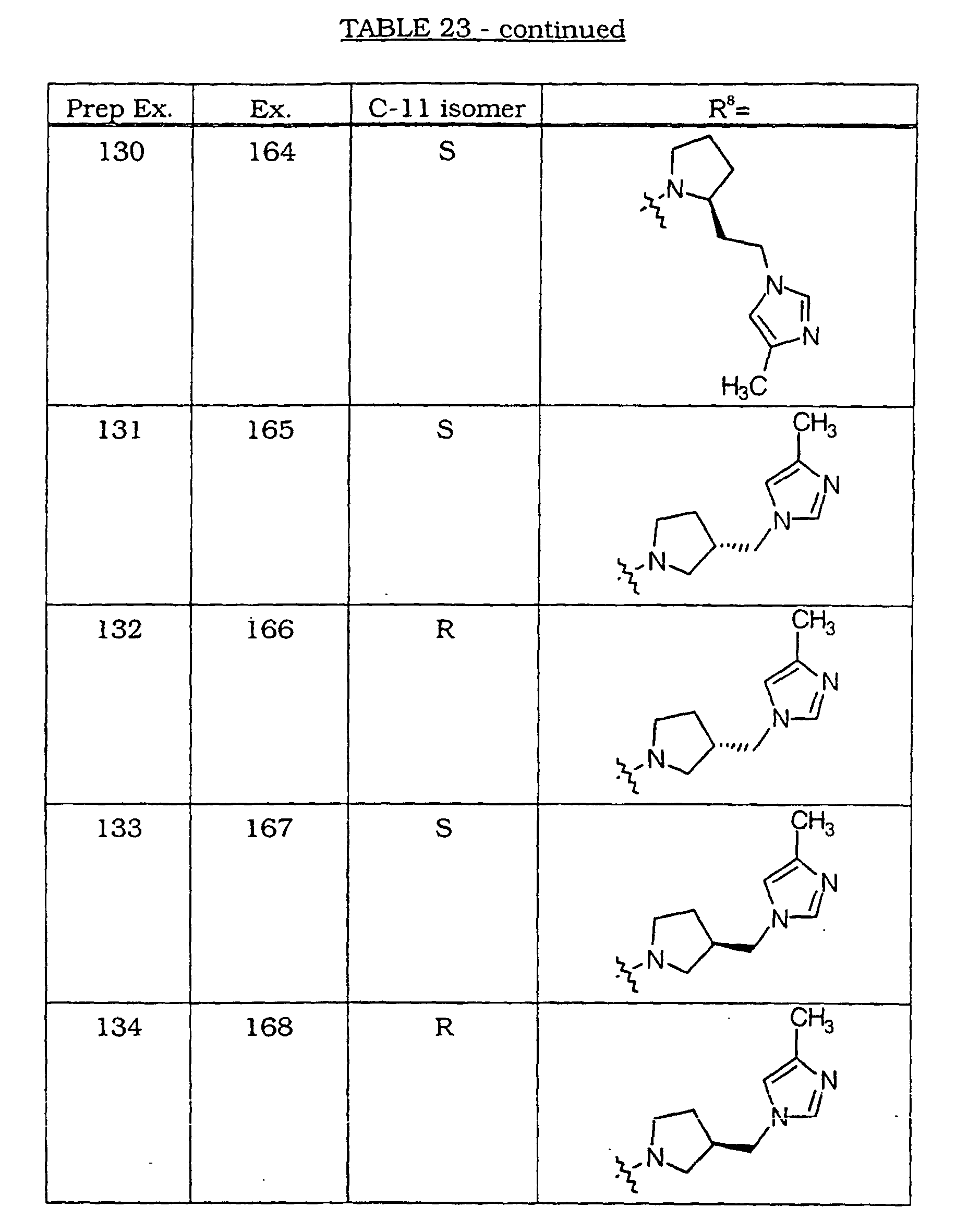
- By essentially the same procedure set forth in Example 14, only substituting the title compounds from the Preparative Example listed in column 2 of Table 24, the compounds of the formula shown below, with R8 as listed in column 4 of Table 24, were obtained.
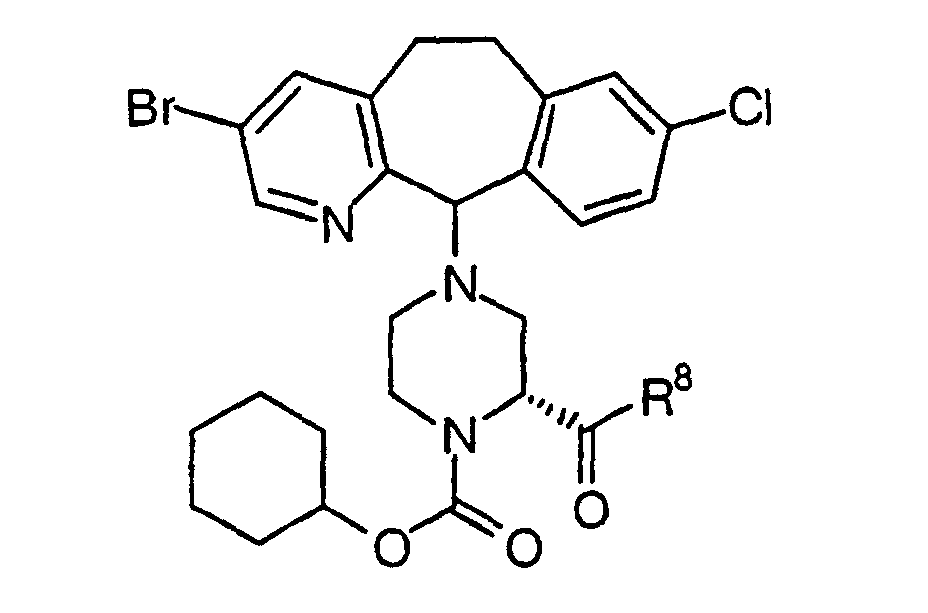

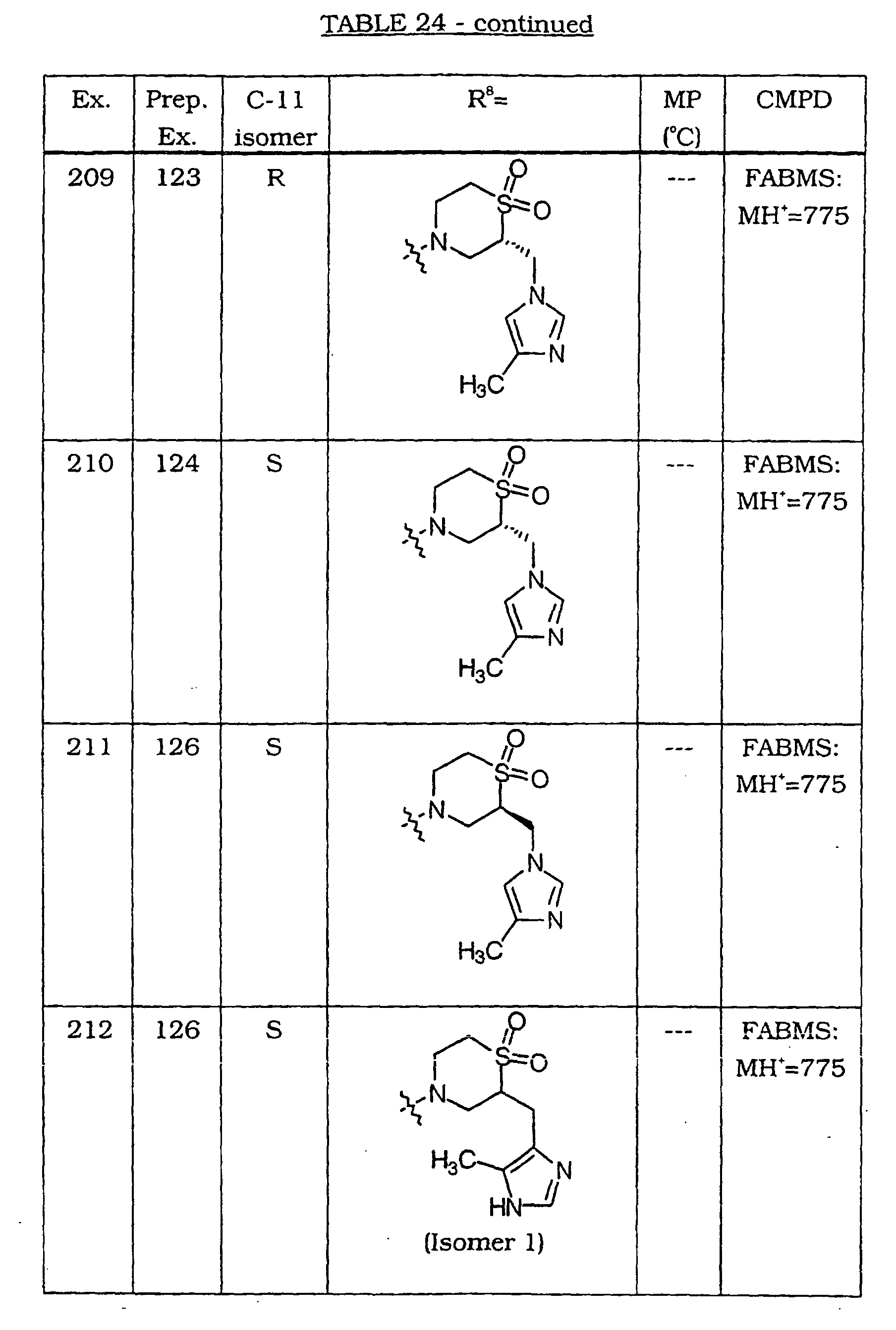
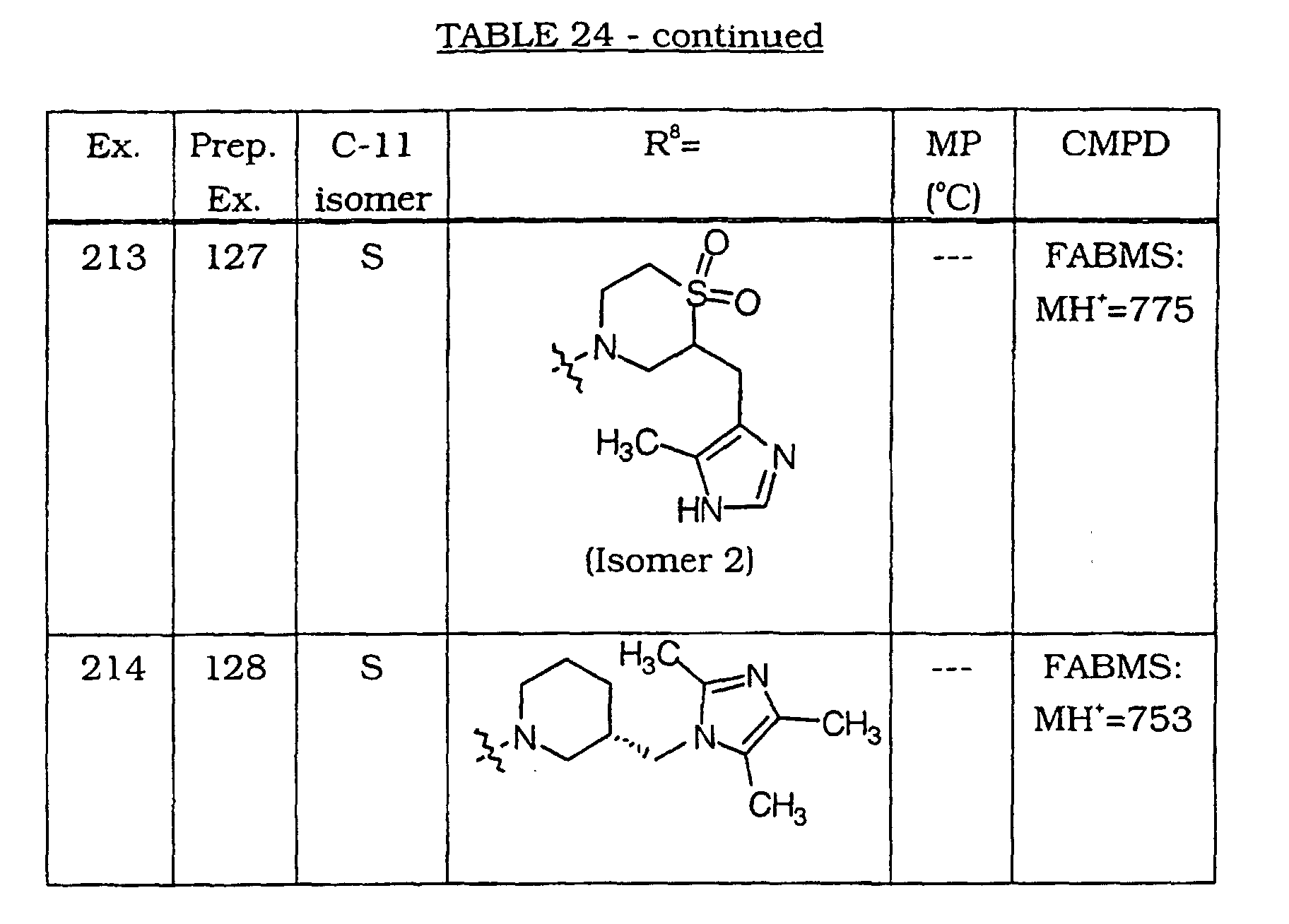
- By essentially the same procedure set forth in Example 14, only substituting the title compound from Preparative Example 129, and using the appropriate electrophile, the compound of formulawas obtained (C-11 S isomer). FABMS: MH+=725.
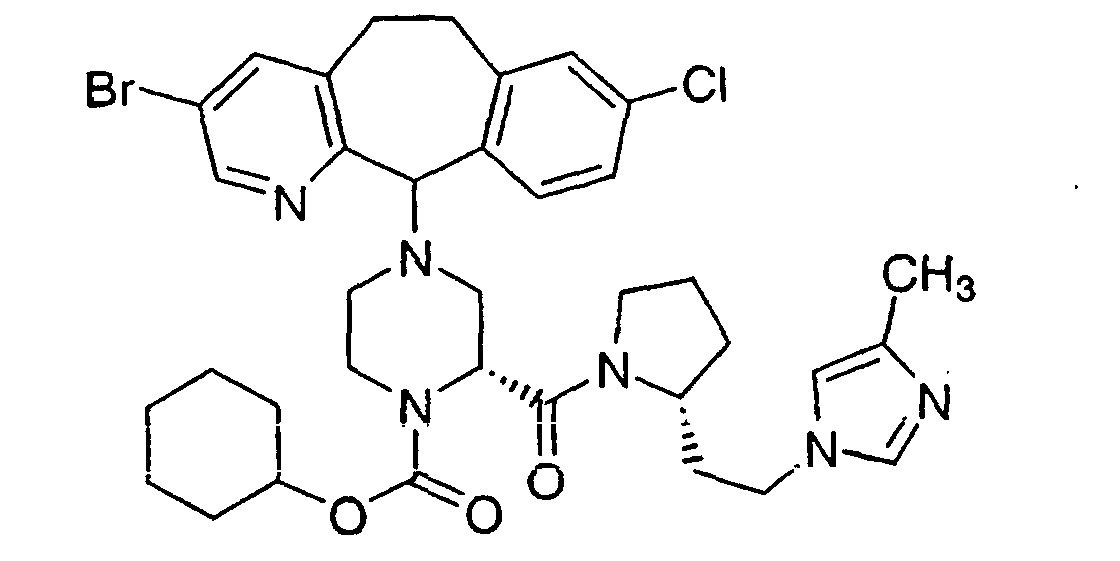
- By essentially the same procedure set forth in Example 14, only substituting the title compound from the Preparative Example 130, and using the appropriate electrophile, the compound of formulacan be obtained (C-11 S isomer). FABMS: MH+=725.
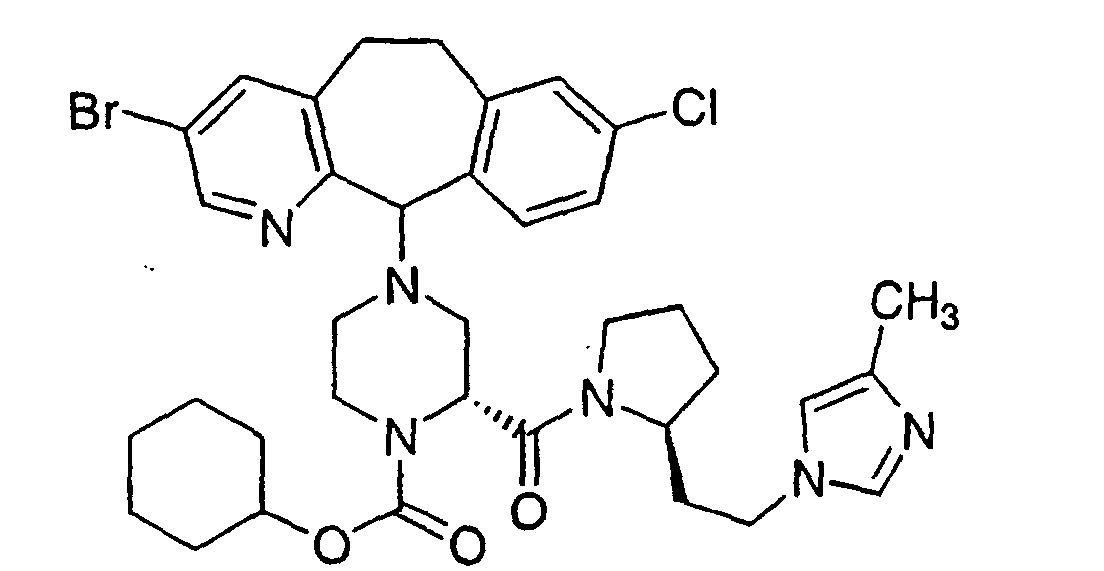
- By essentially the same procedure set forth in Example 14, only substituting the title compounds from the Preparative Example listed in column 2 OF Table 25, the compounds of the formula shown below, with R9 as listed in column 4 of Table 25, were obtained by using the appropriate electrophile.
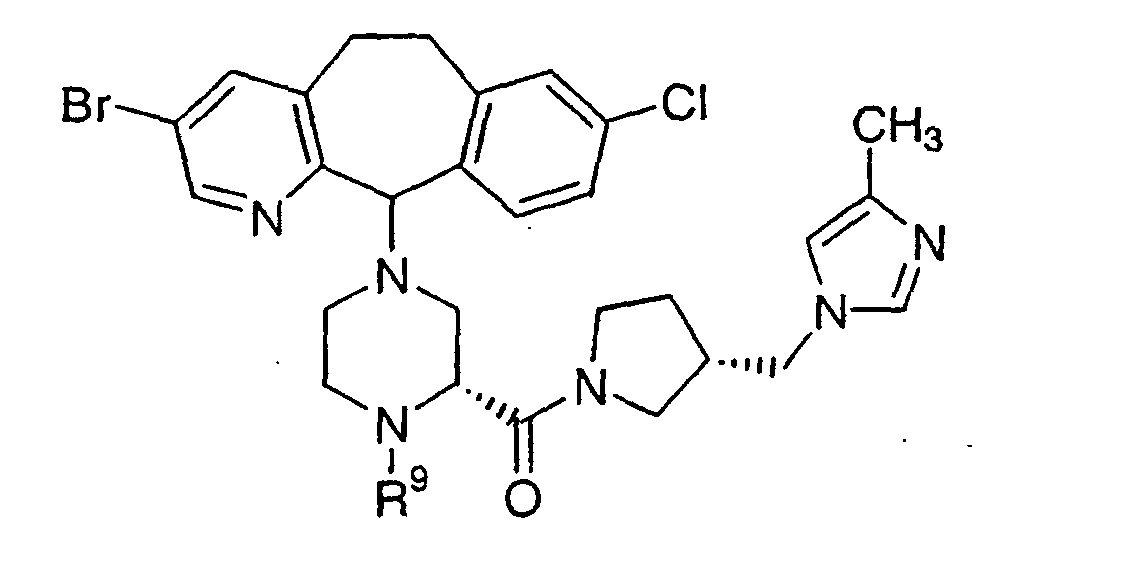


- By essentially the same procedure set forth in Example 14, only substituting the title compounds from the Preparative Example listed in column 2 of Table 26, the compounds of the formula shown below, with R9 as listed in column 4 of Table 26, were obtained by using the appropriate electrophile.
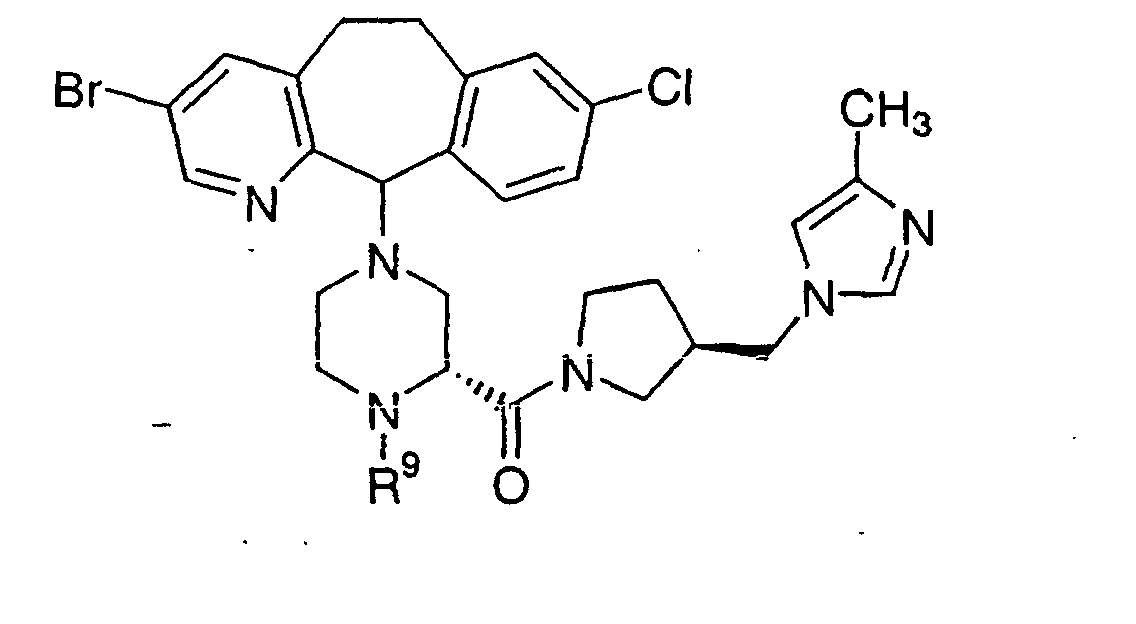
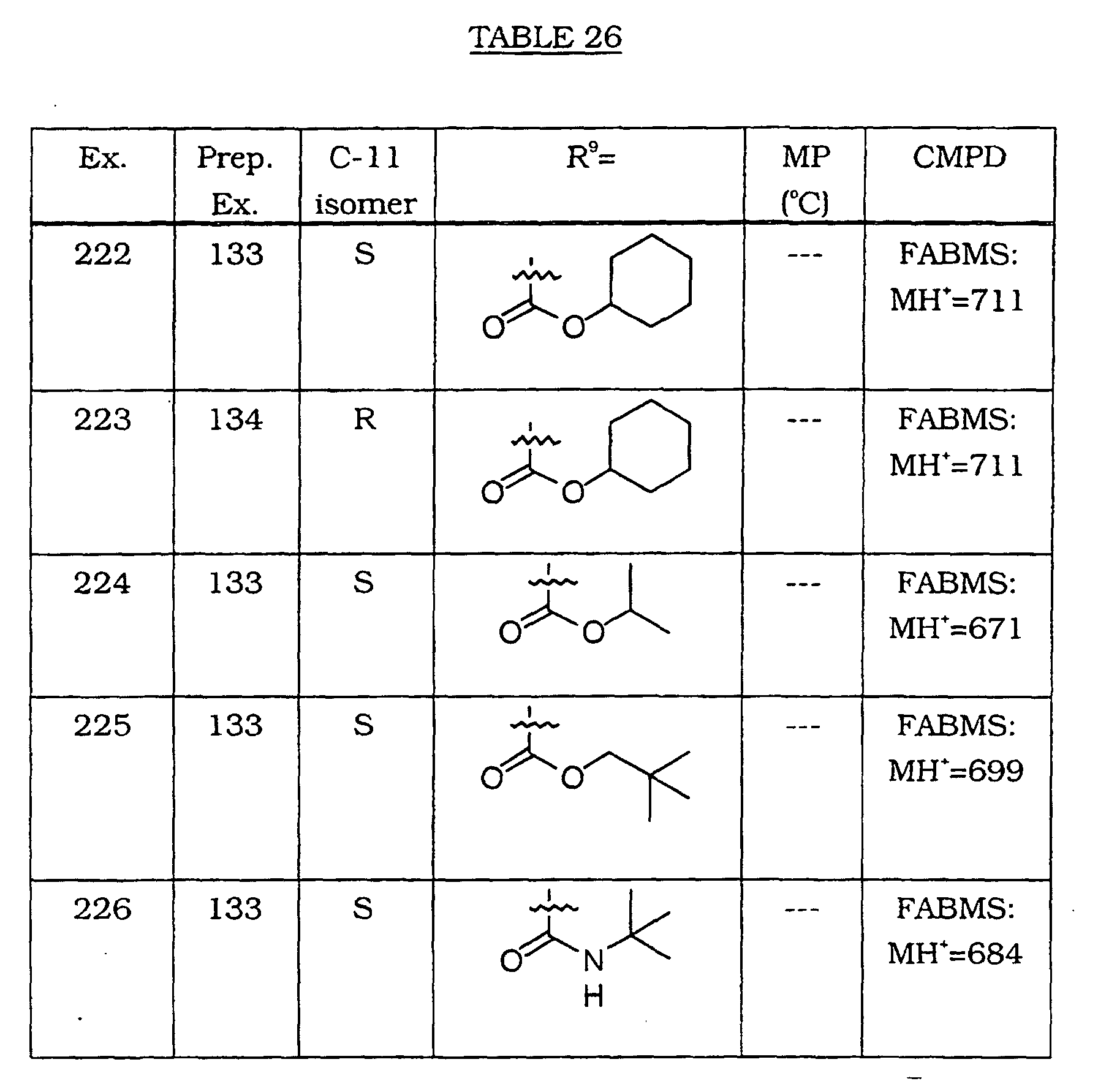
- By essentially the same procedure set forth in Example 1, only substituting the title compounds from Preparative Example 87 and Preparative Example 101, and substituting the appropriate amine, the compounds of the formula shown below with R8 listed in column 3 of Table 27 were obtained.
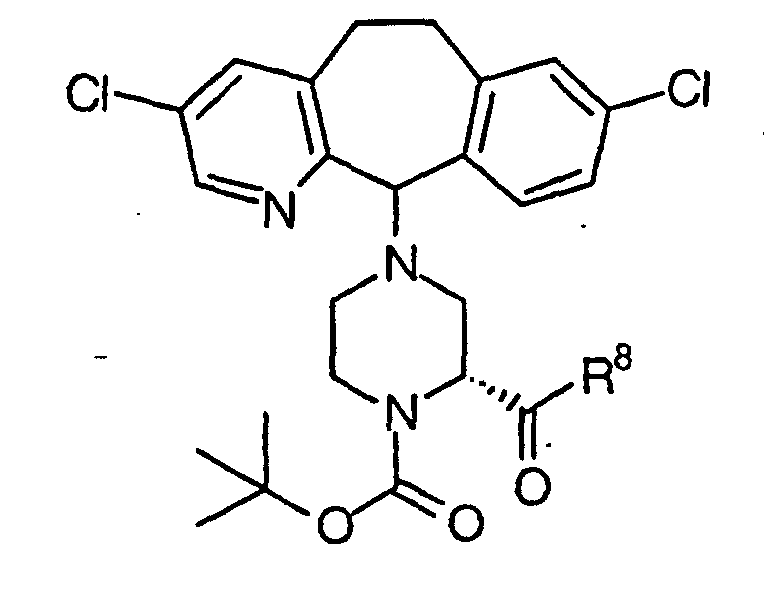

-
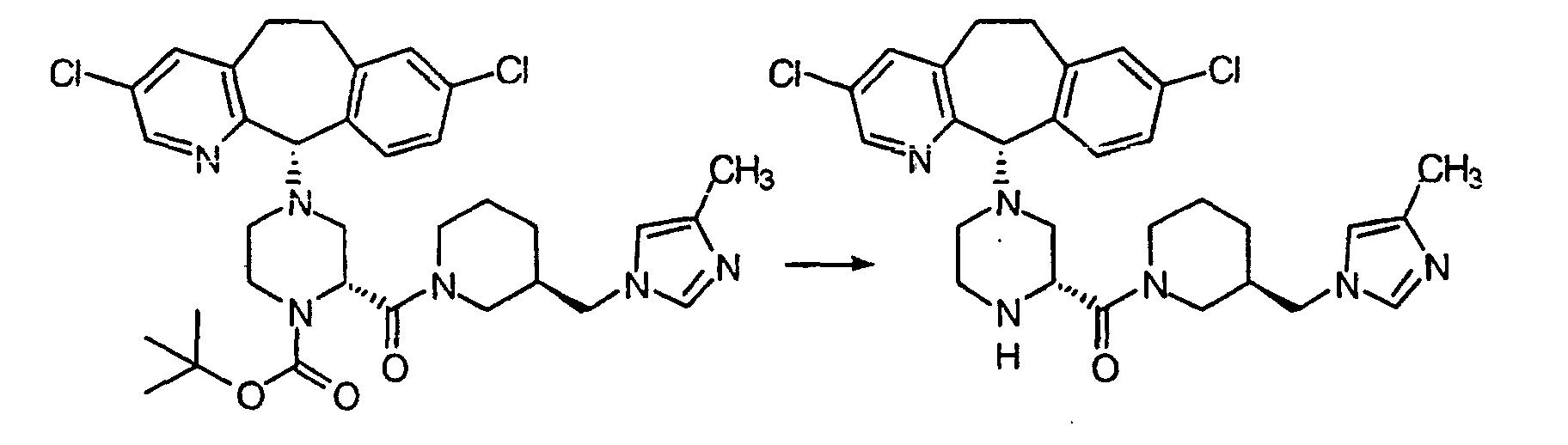
- By essentially the same procedure set forth in Preparative Example 24, only using the title compound from Example 227, the title compound was prepared: LCMS: MH+=553.
- By essentially the same procedure, only substituting the title compounds from the example listed in column 2 of Table 28, the title compounds of the formula shown below, with R8 as listed in column 3 of 28, were obtained.
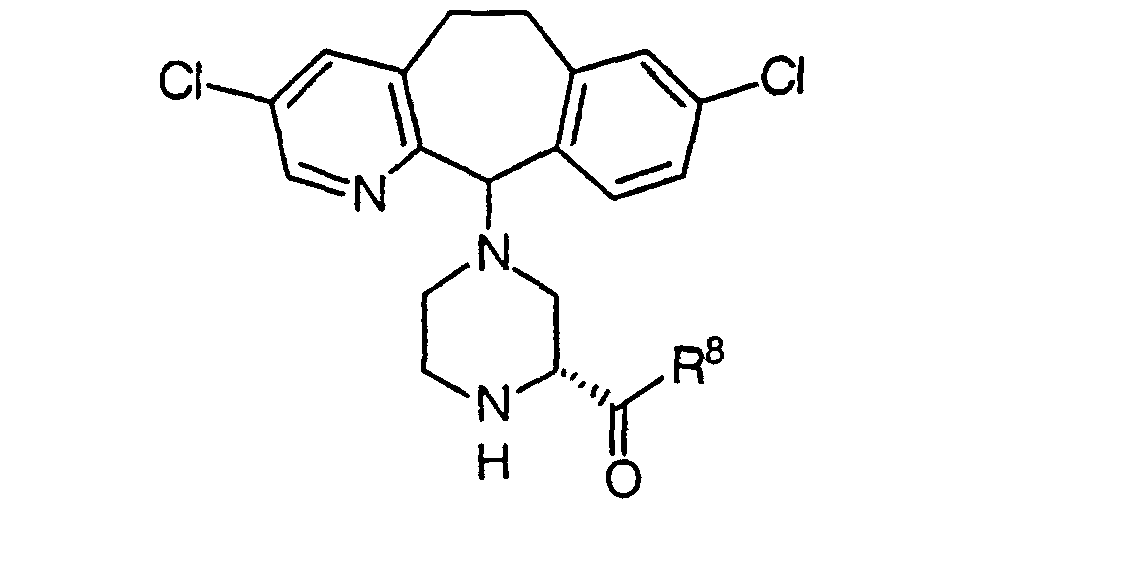
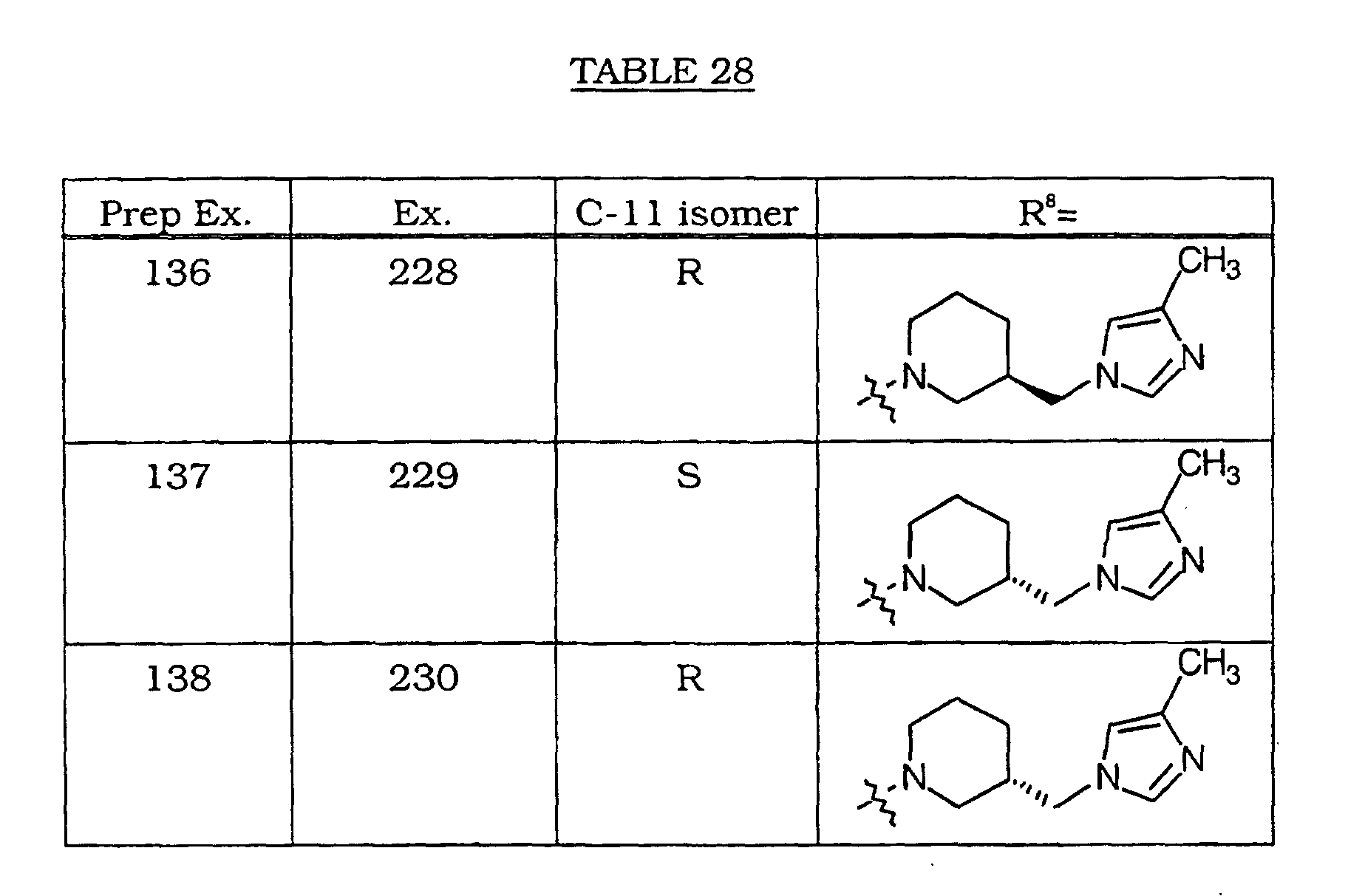
- By essentially the same procedure set forth in Example 14, only substituting the title compounds from the Preparative Example listed in column 2 of Table 29, the compounds of the formula shown below, with R9 as listed in column 4 of Table 29 were obtained (where data is provided) or can be obtained (were no data is provided) by using the appropriate electrophile.
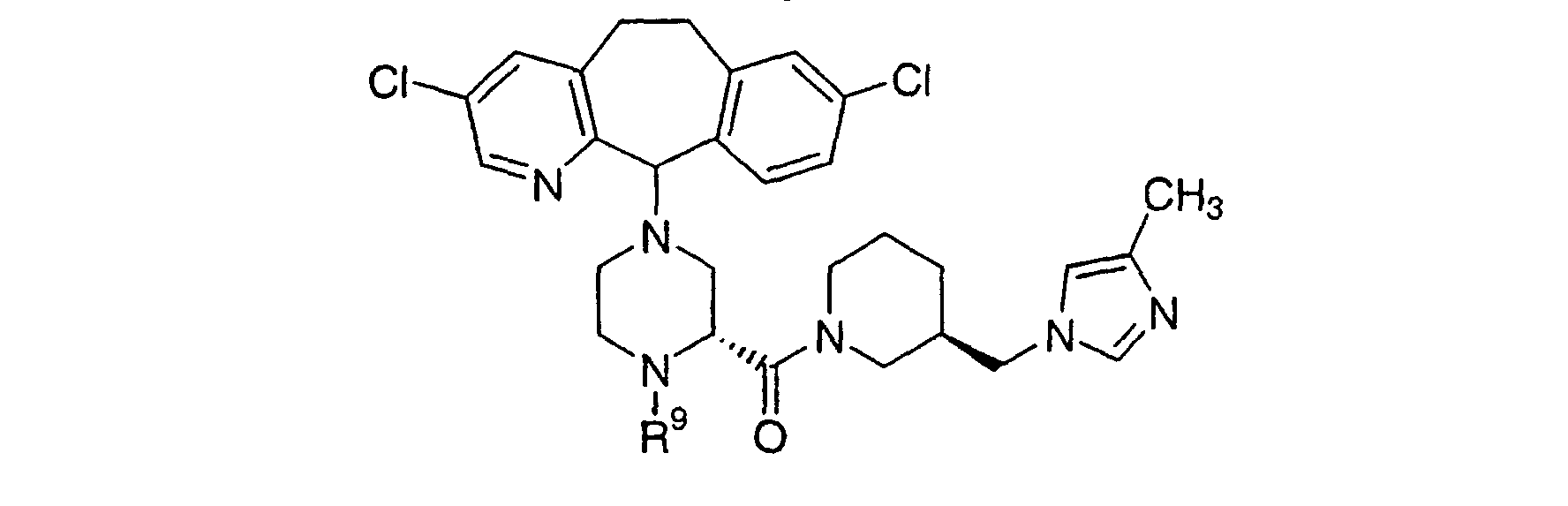
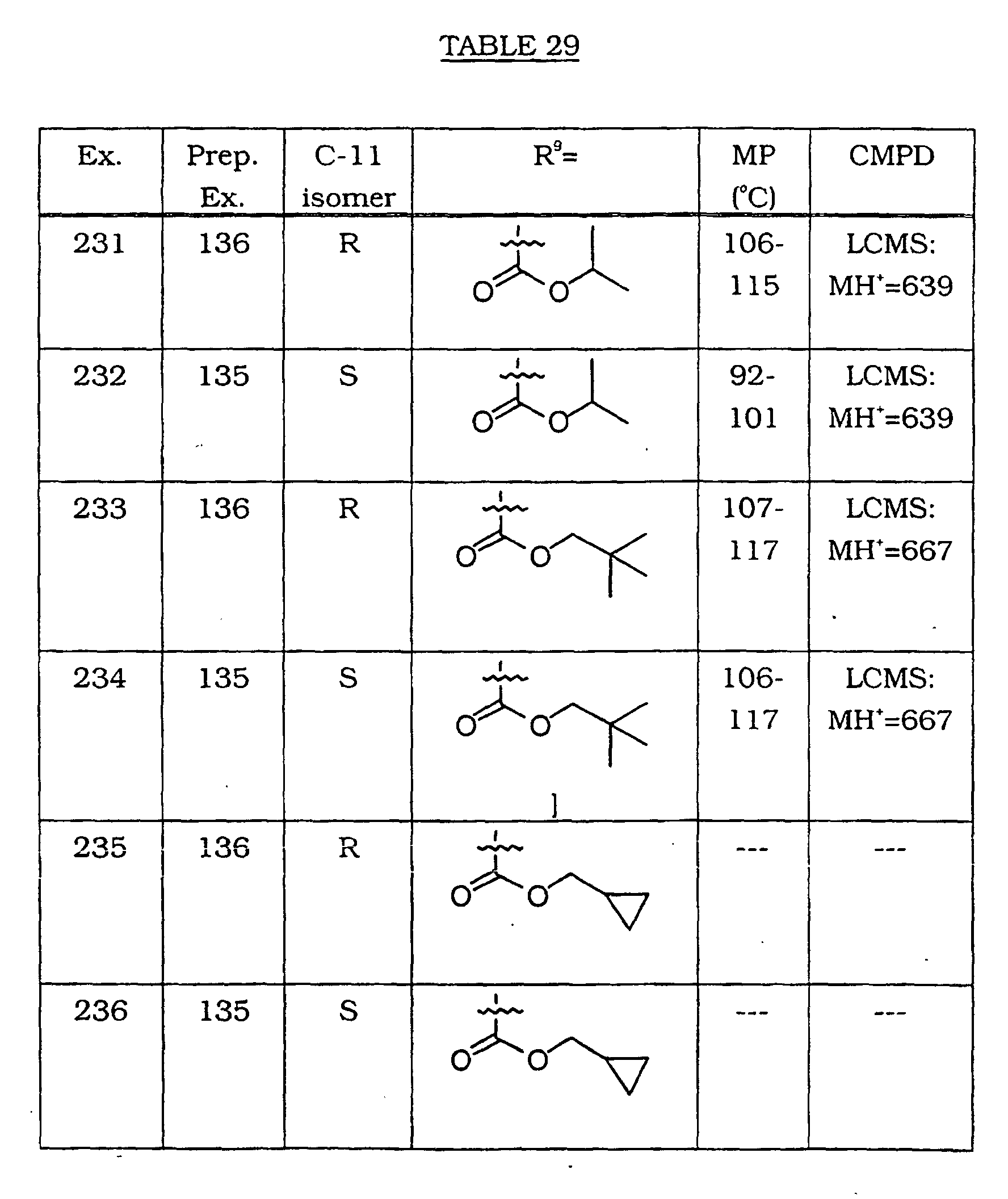
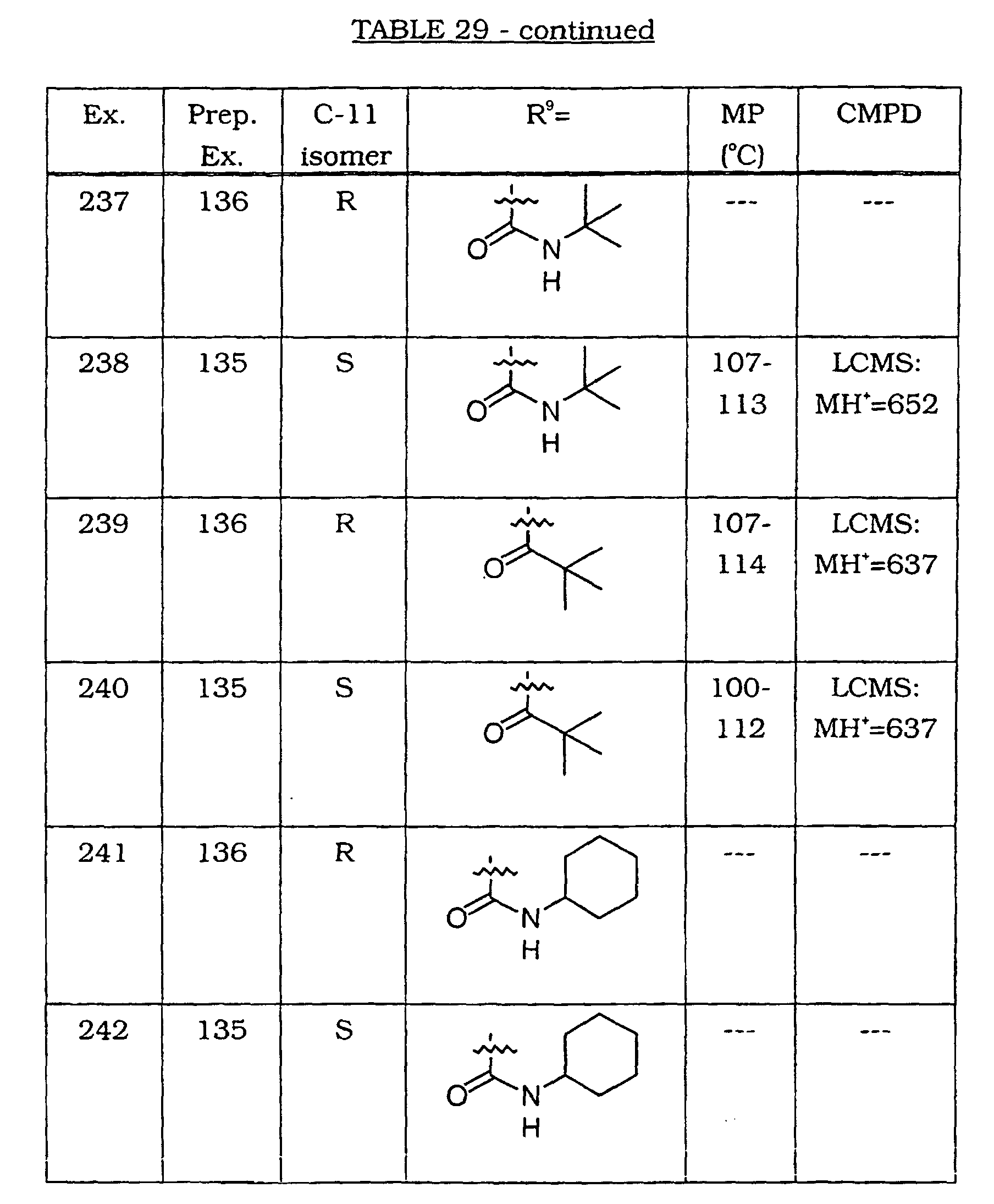
- By essentially the same procedure set forth in Example 14, only substituting the title compounds from the Preparative Example listed in column 2 of Table 30, the compounds of the formula shown below, with R9 as listed in column 4 of Table 30, were obtained (where data is provided) or can be obtained (where no data is provided) by using the appropriate electrophile.
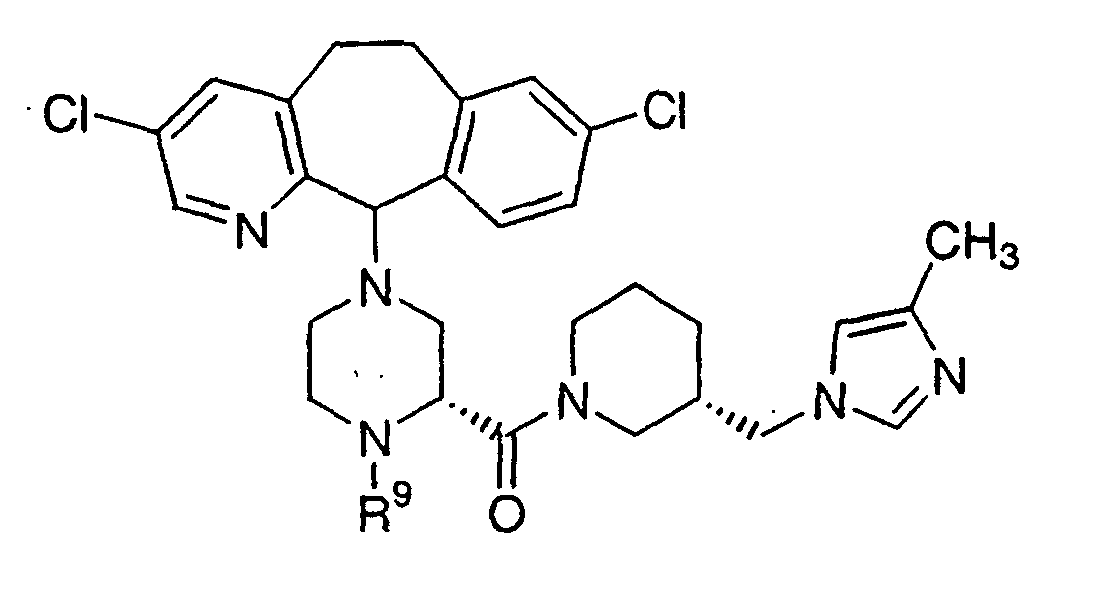
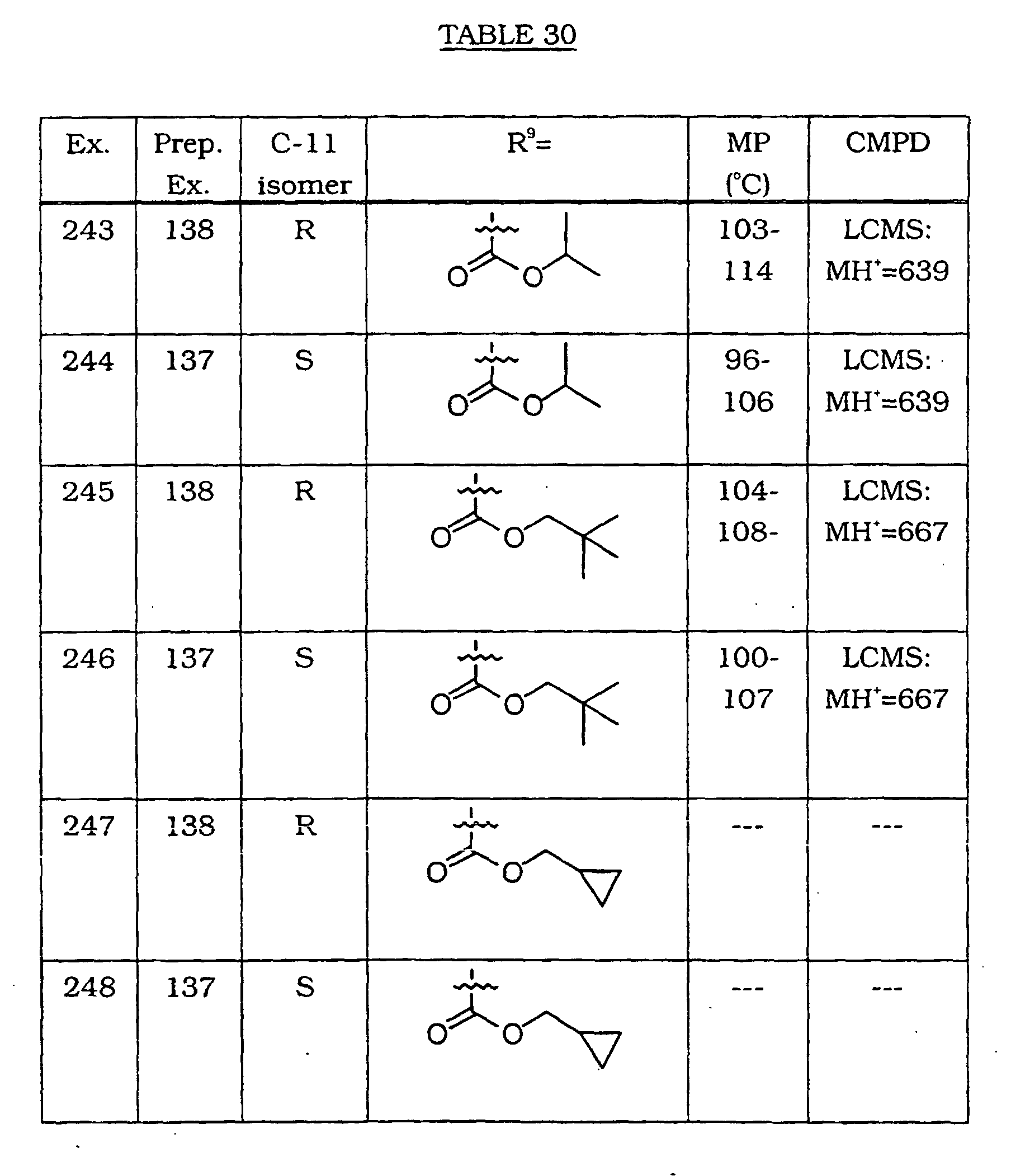

-

- By essentially the same procedure set forth in Preparative Example 32 only substituting the 3-Cl, 8-Cl tricyclic chloride prepared in Preparative Example 87 for the 3-H, 8-Cl tricyclic chloride in Step B, the title compound was prepared. FABMS: MH+=518.
- By essentially the same procedure set forth in Example 1, only substituting the appropriate amine, the compounds of the formula shown below, with R8 as listed in column 3 of Table 31, were obtained.
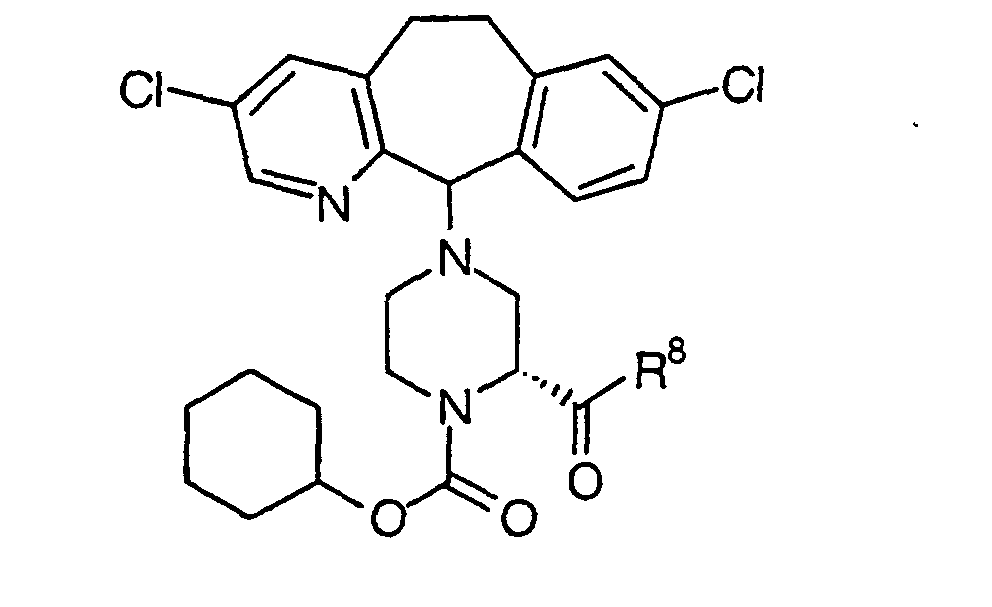
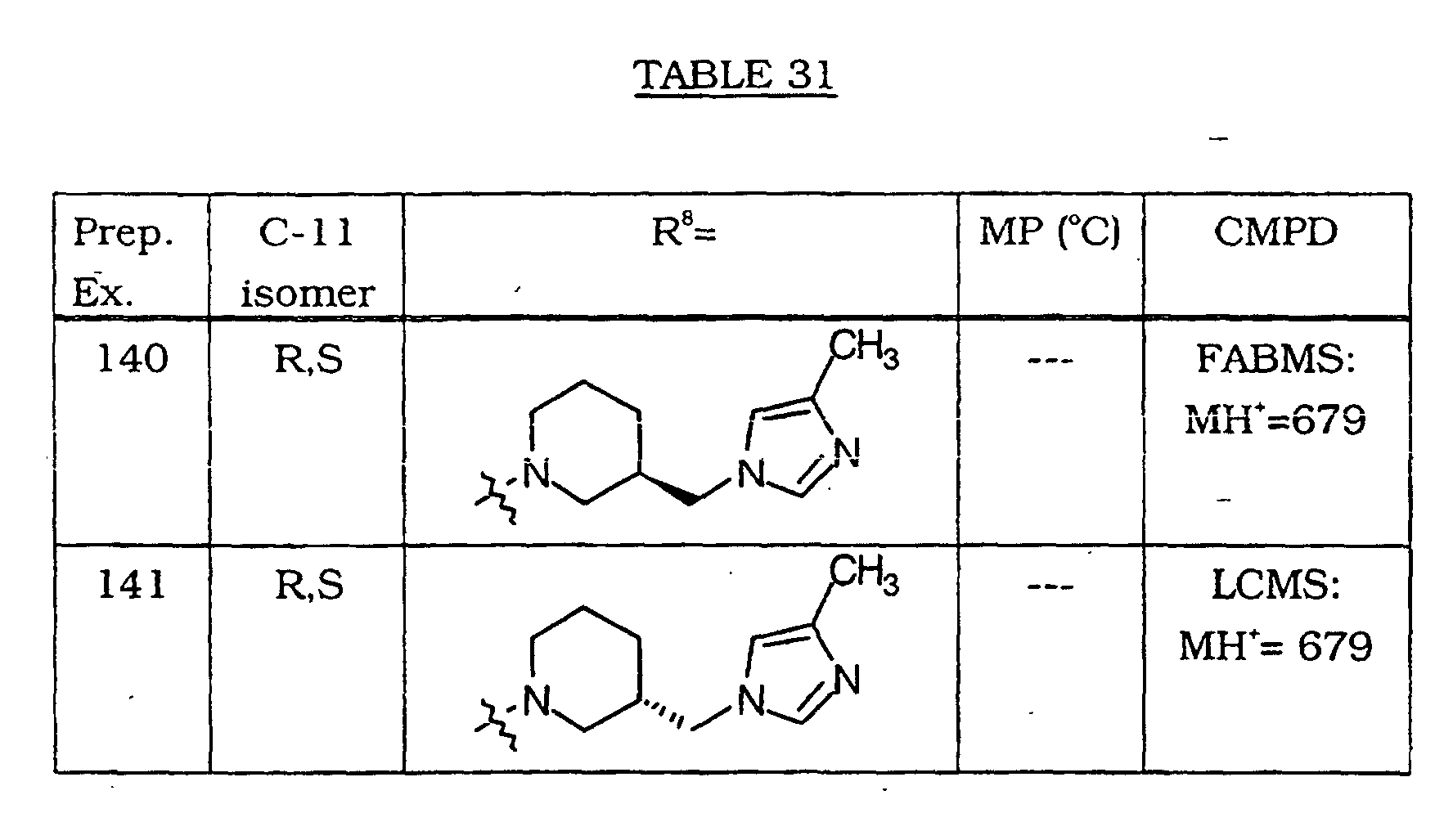
-
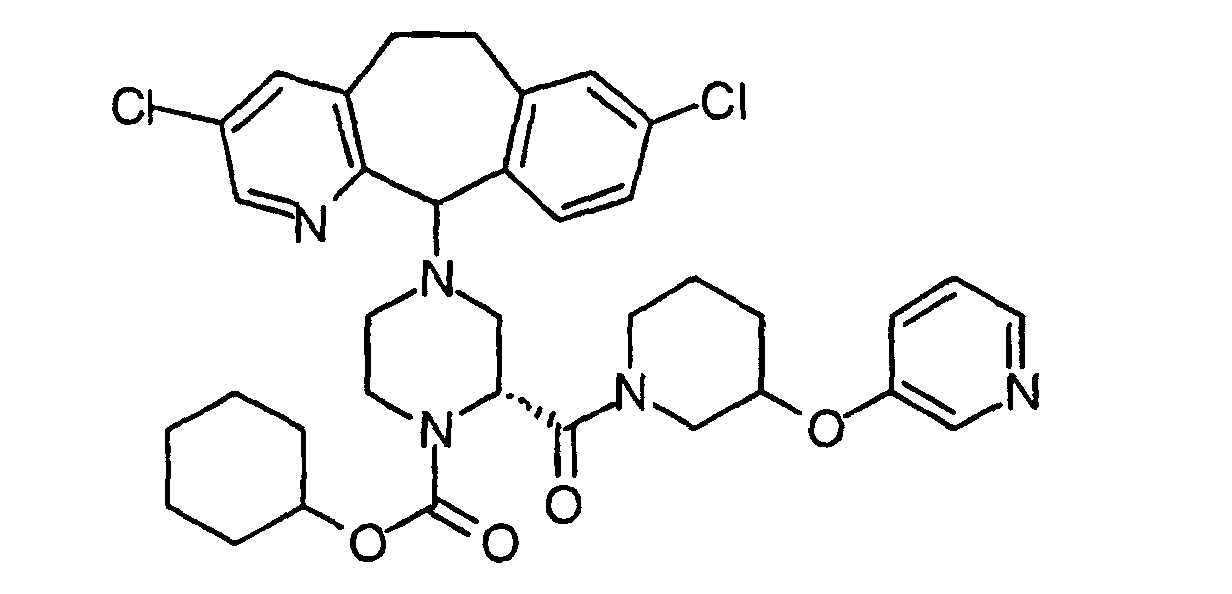
- By essentially the same procedure set forth in Example 1 only substituting the title compound from Preparative Example 139 and the amine from Preparative Example 74B, the title compound was prepared. mp=105-113; LCMS: MH+=678.
- The title compounds from Preparative Examples 140 and 141 were separated into individual C-11 (S)- and (R)-diastereomers by Preparative HPLC with a CHIRALPAK AD column using a 20% iPrOH in hexanes solution with 0.2% DEA as eluent to give the compounds of the formula shown below with R8 as listed in Column 3 of Table 32.
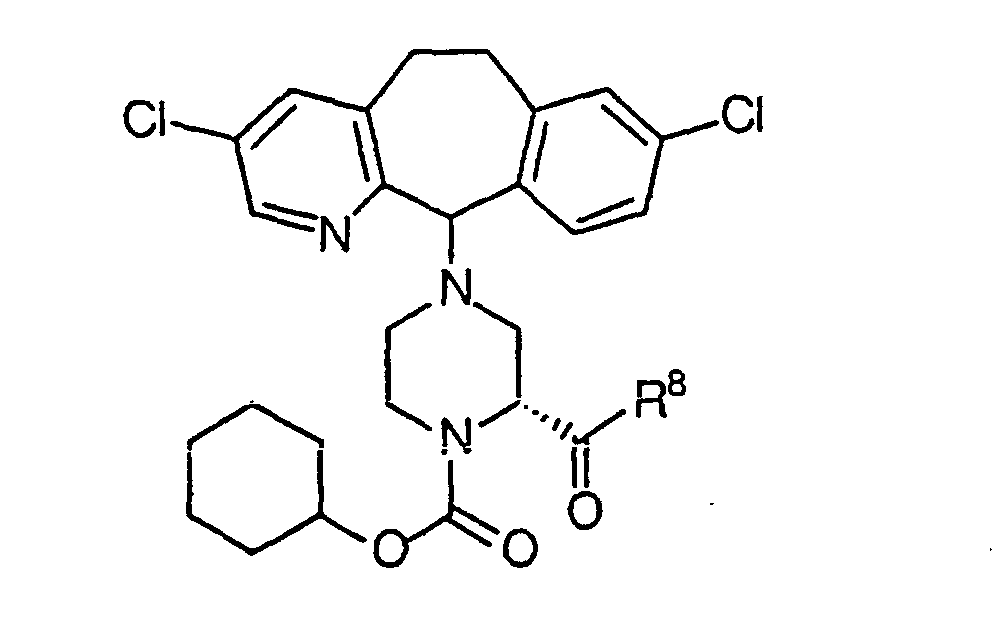
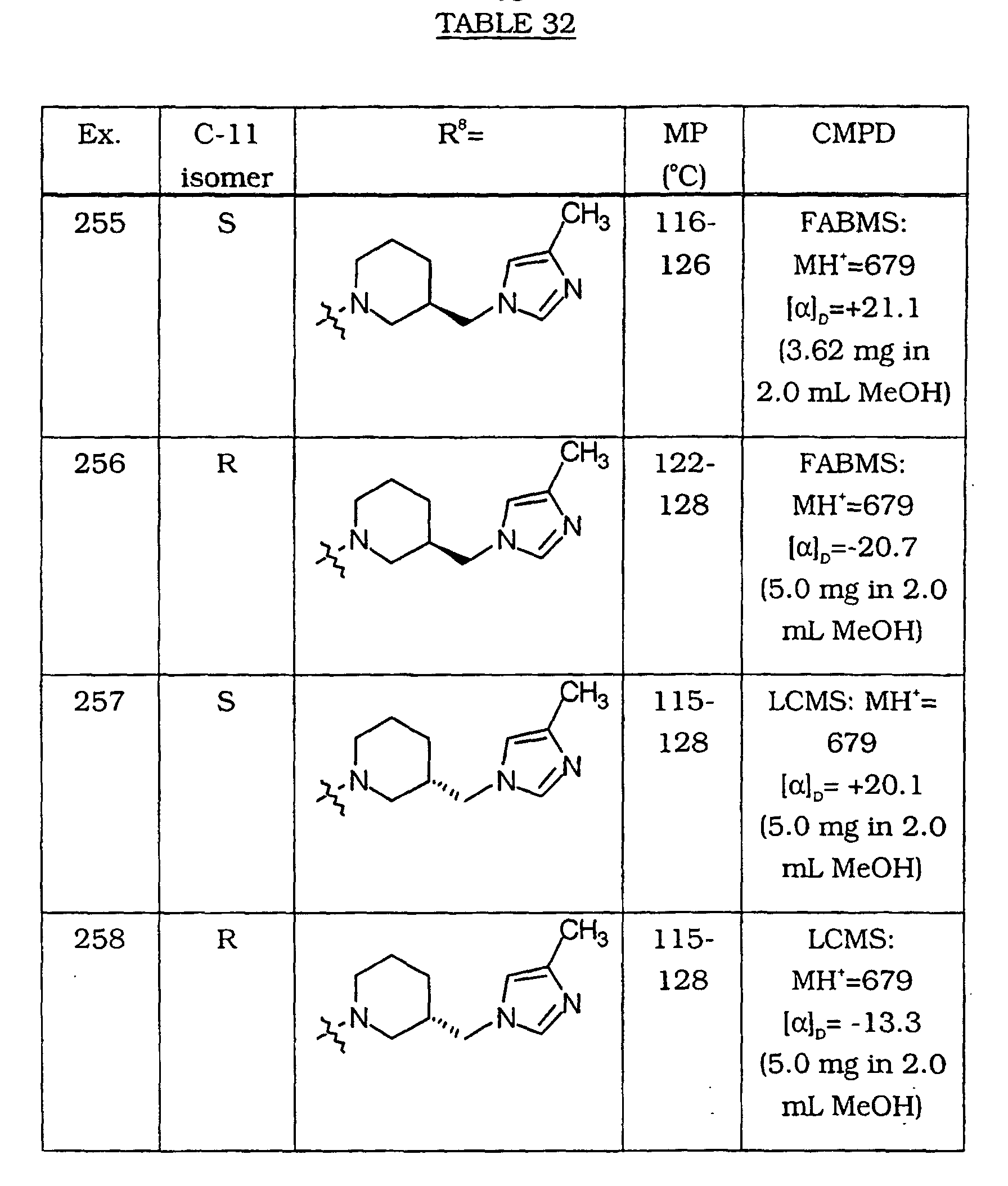
- By essentially the same procedure set forth in Example 1, only substituting the title compounds from Preparative Example 89 and Preparative Example 101 and substituting the appropriate amine, the compounds of the formula shown below, with R8 listed in column 3 of Table 33 were obtained.
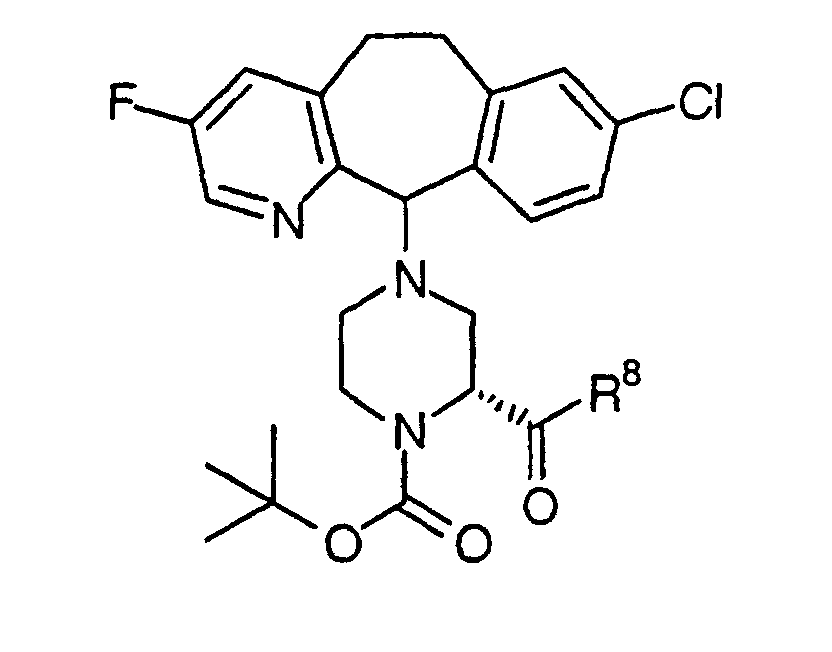

-

- By essentially the same procedure set forth in Preparative Example 24, only using the title compound from Example 259, the title compound can be prepared.
- By essentially the same procedure, only substituting the title compounds from the example listed in column 2 of Table 34, the title compounds of the formula shown below, with R8 as listed in column 3 of Table 34, can be prepared.

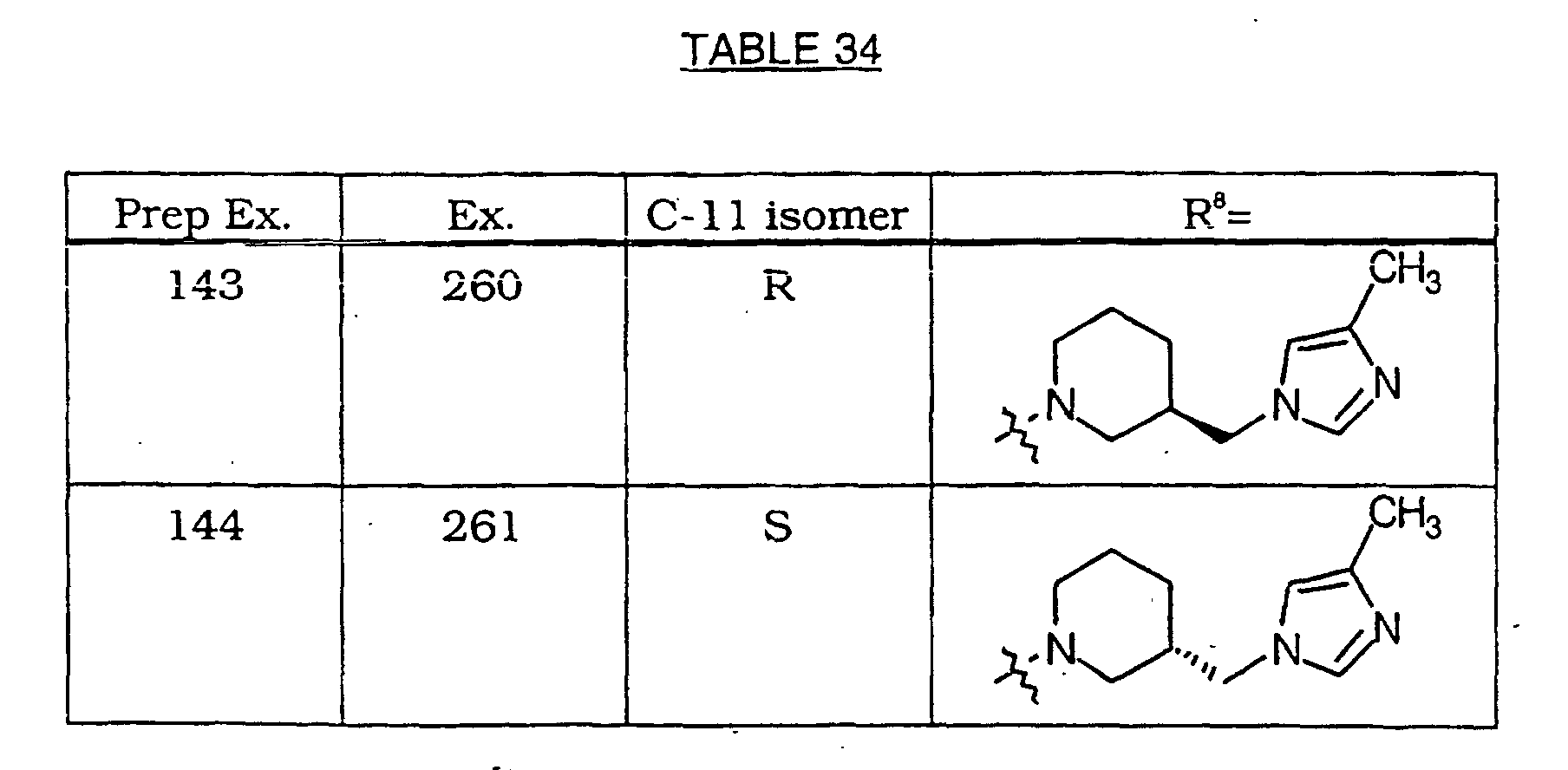
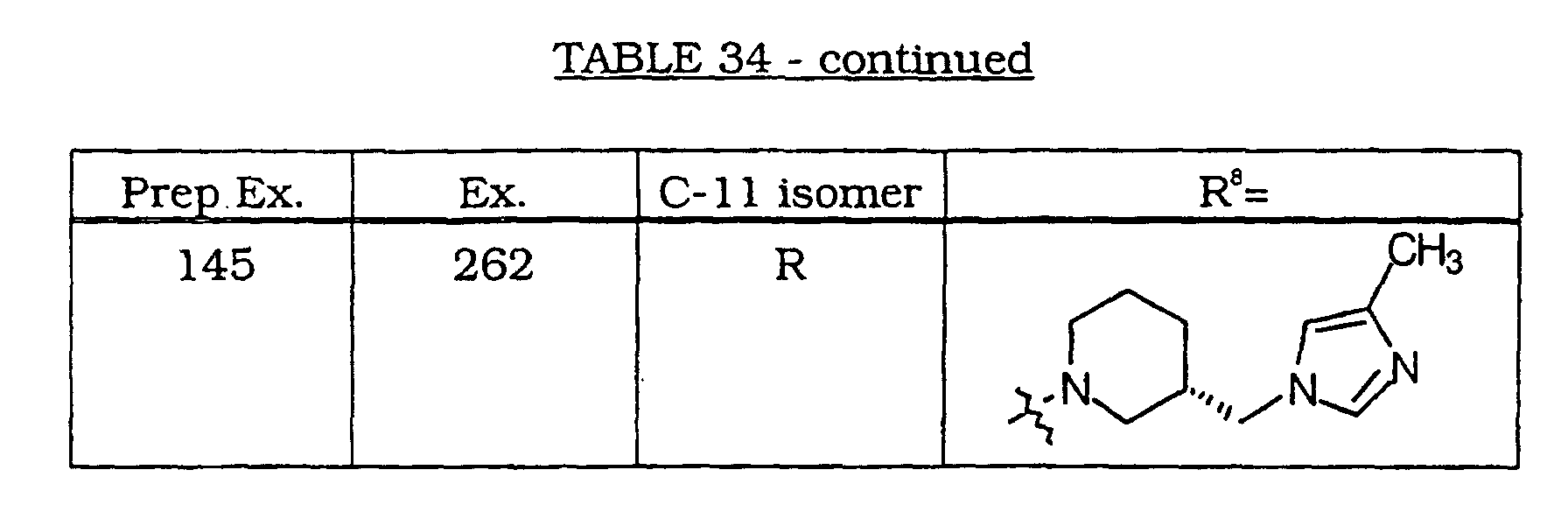
- By essentially the same procedure set forth in Example 14, only substituting the title compounds from the Preparative Example listed in column 2 of Table 35, the compounds of the formula shown below, with R9 as listed in column 4 of Table 35, were obtained (where data is provided) or can be obtained (where no data is provided) by using the appropriate electrophile.
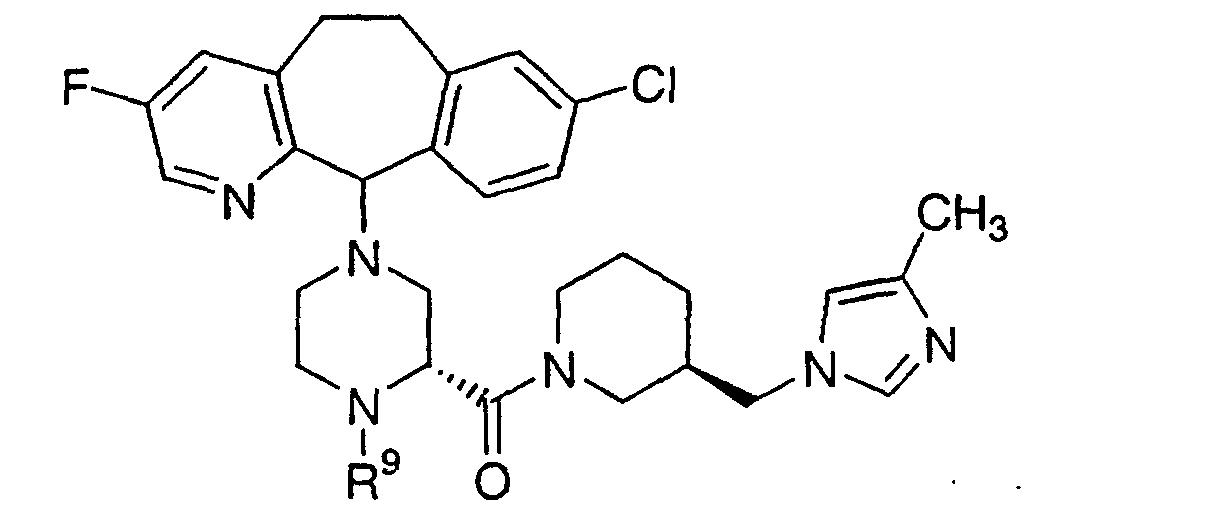


- By essentially the same procedure set forth in Example 14, only substituting the title compounds from the Preparative Example listed in column 2 of Table 36, the compounds of the formula shown below, with R9 as listed in column 4 of Table 36, can be obtained by using the appropriate electrophile.

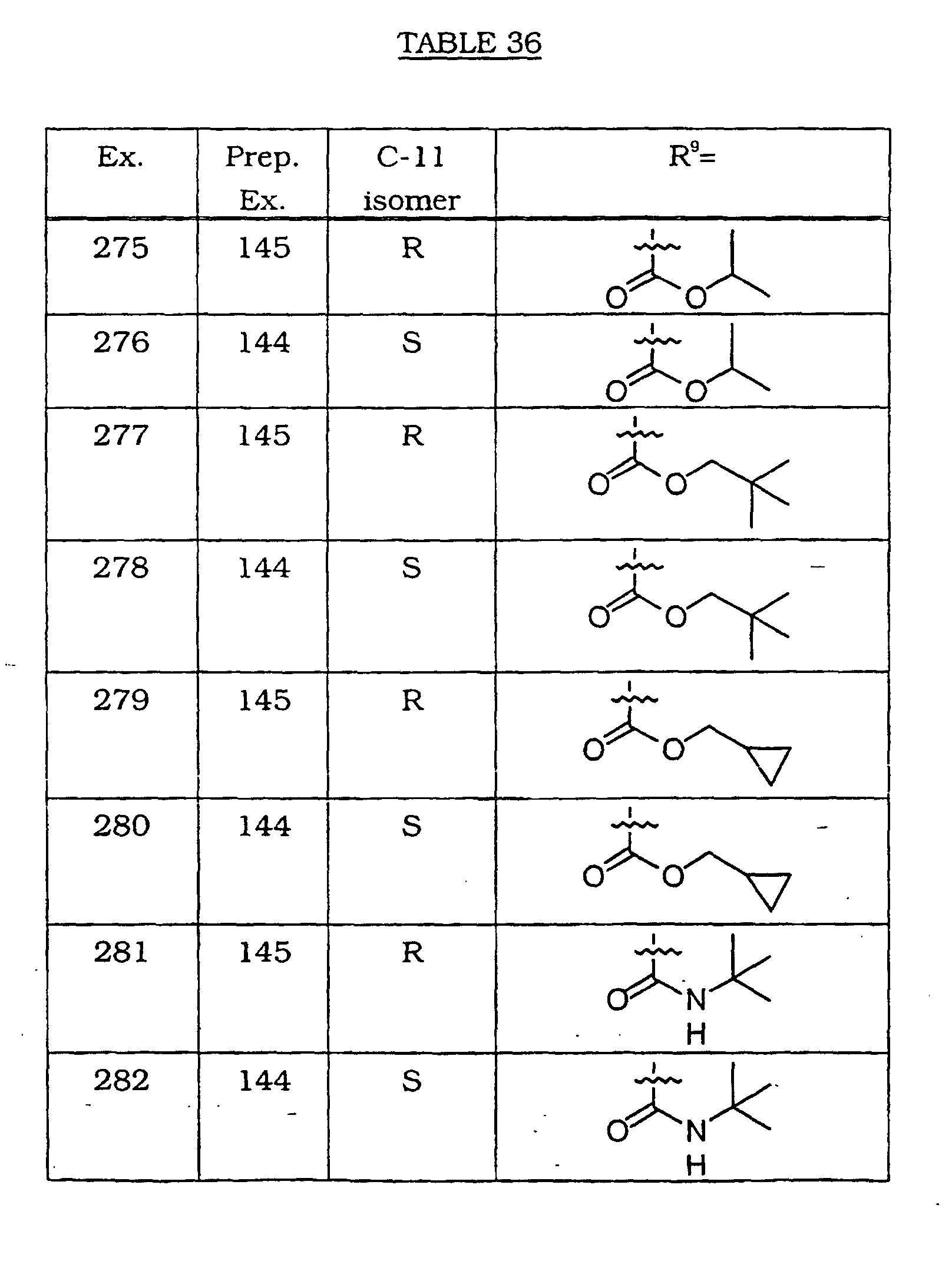
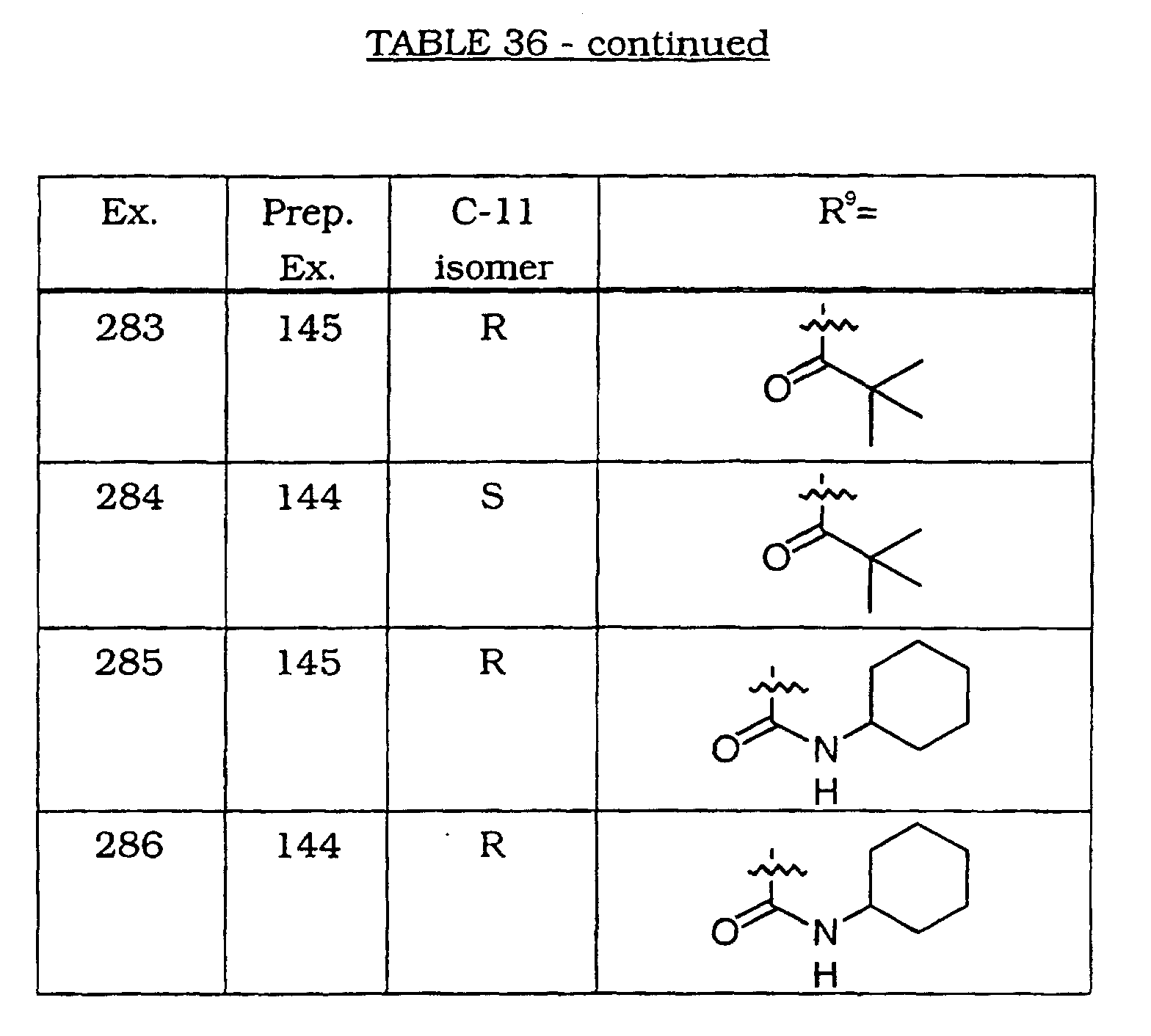
-

- By essentially the same procedure set forth in Preparative Example 36, only substituting the 3-F, 8-Cl tricyclic chloride prepared in Preparative Example 89 for the 3-H, 8-Cl tricyclic chloride in Step B, the title compounds (C-11(S)- and (R)-isomers) were prepared and separated into individual diasteromers by flash chromatography using a 12% (10% NH4OH in MeOH) solution in CH2Cl2:
- 11-(S)-isomer (first eluting isomer): FABMS: MH+=502; [α]D= +7.7° (5.0 mg in 2 mL MeOH).
- 11-(R)-isomer (second eluting isomer): FABMS: MH+=502; [α]D= +74.6° (5.0 mg in 2 mL MeOH.
- By essentially the same procedure set forth in Example 1, only substituting the title compounds from Preparative Example 132 (individual (S)- and (R)-isomers) and substituting the appropriate amine, the compunds of the formula shown below, with R8 as listed in Column 3 of Table 37 were obtained.
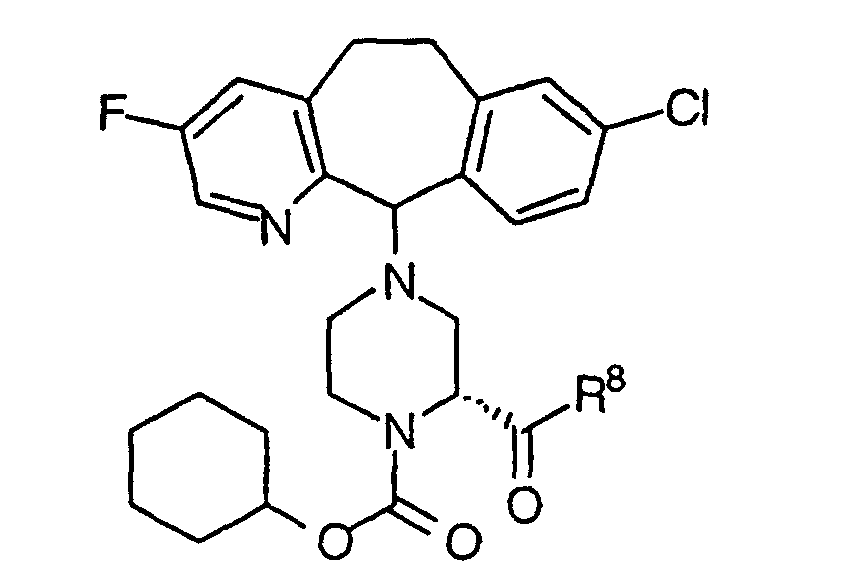
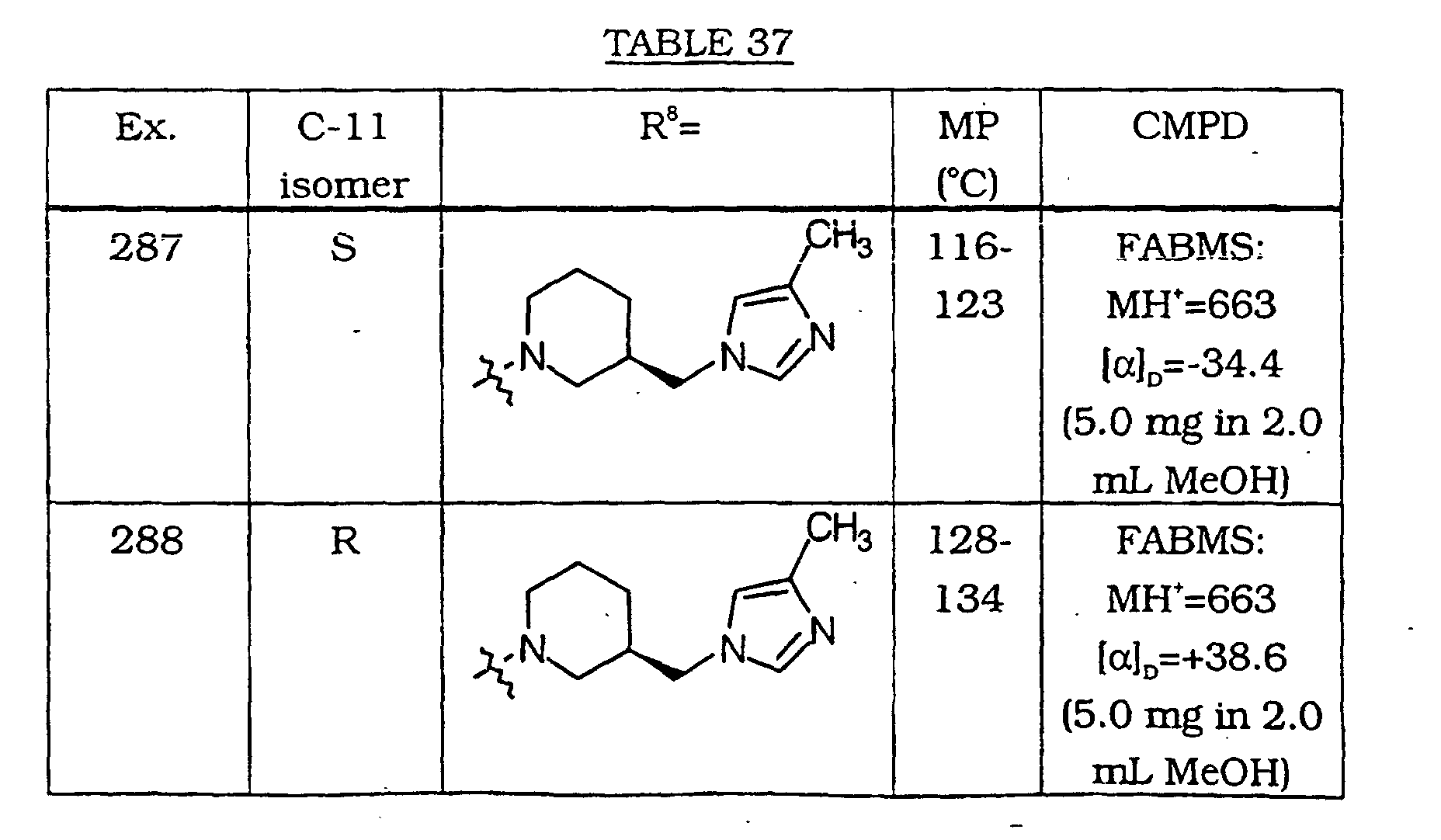
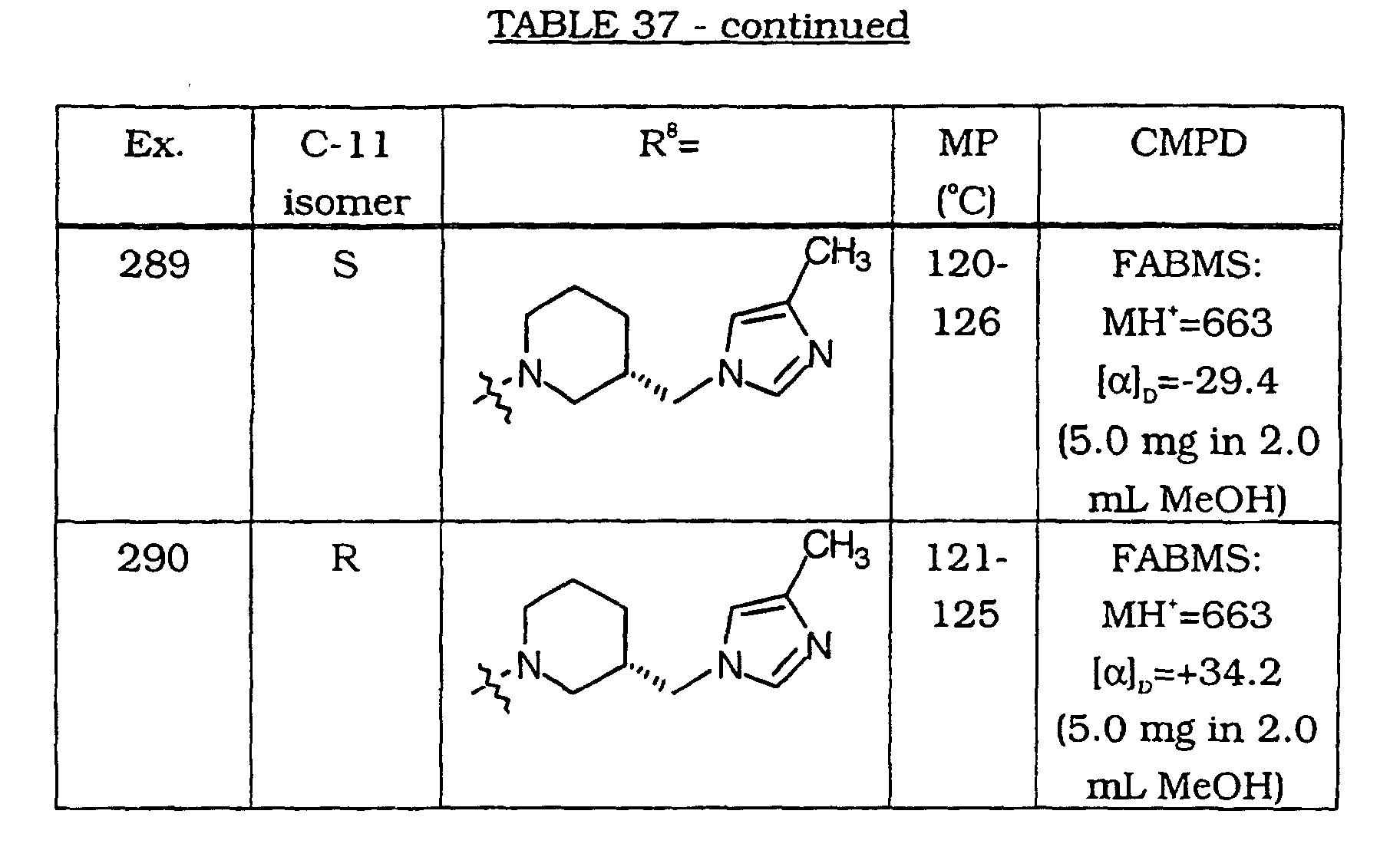
- By essentially the same procedure set forth in Example 1, only substituting the title compounds from Preparative Example 110 and substituting the appropriate amine, the compounds of the formula shown below, with R8 listed in column 3 of Table 38 were prepared.
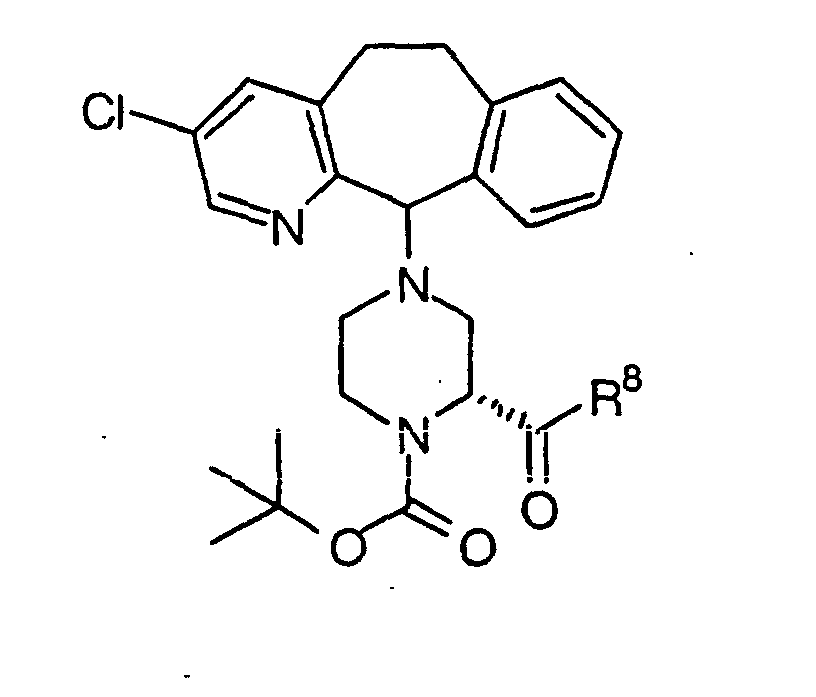
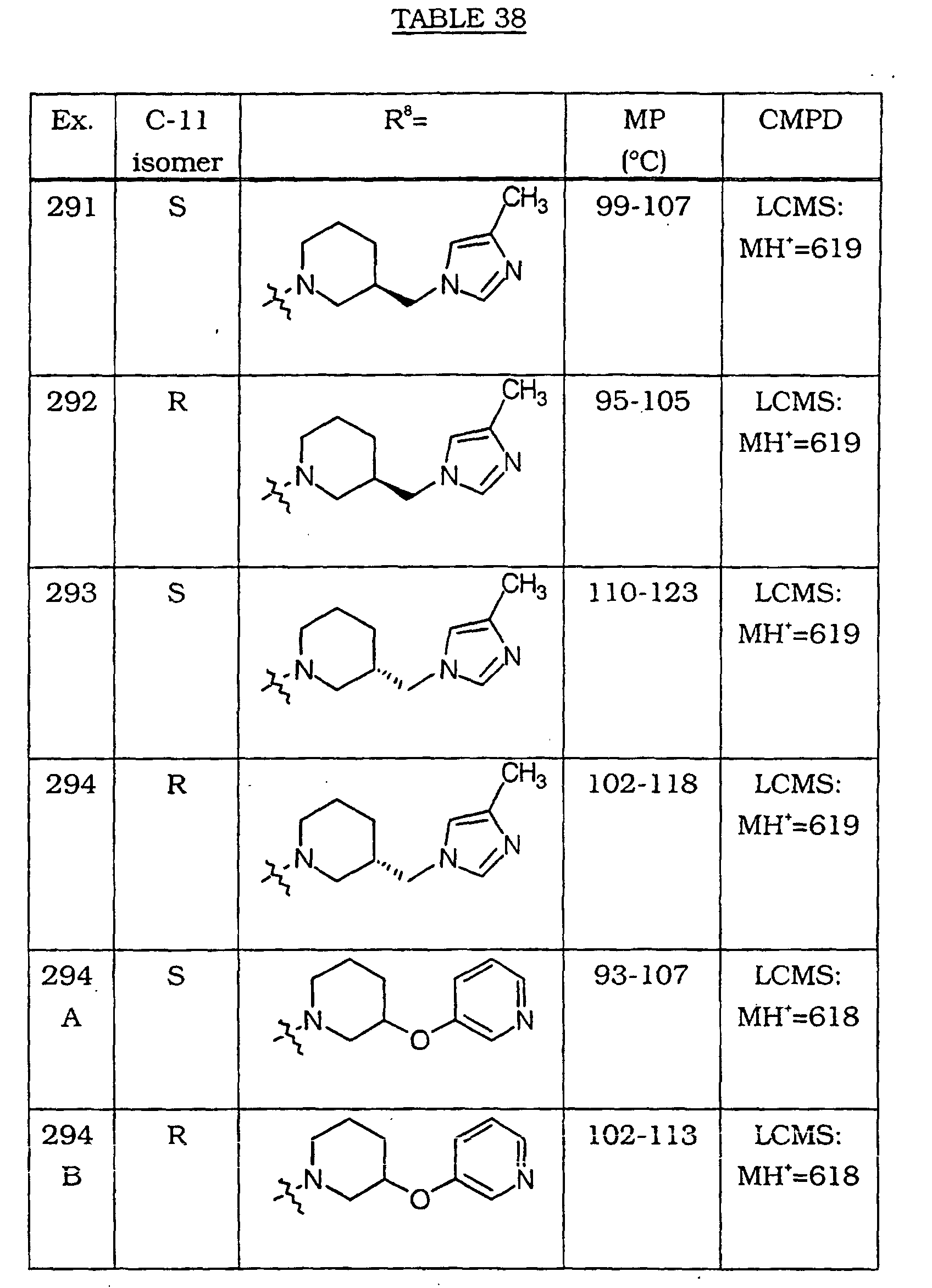
- By essentially the same procedure set forth in Preparative Example 107, only substituting the title compounds from the example listed in column 2 of Table 39, the title compounds of formula shown below, with R8 as listed in column 4 of Table 39, were prepared.

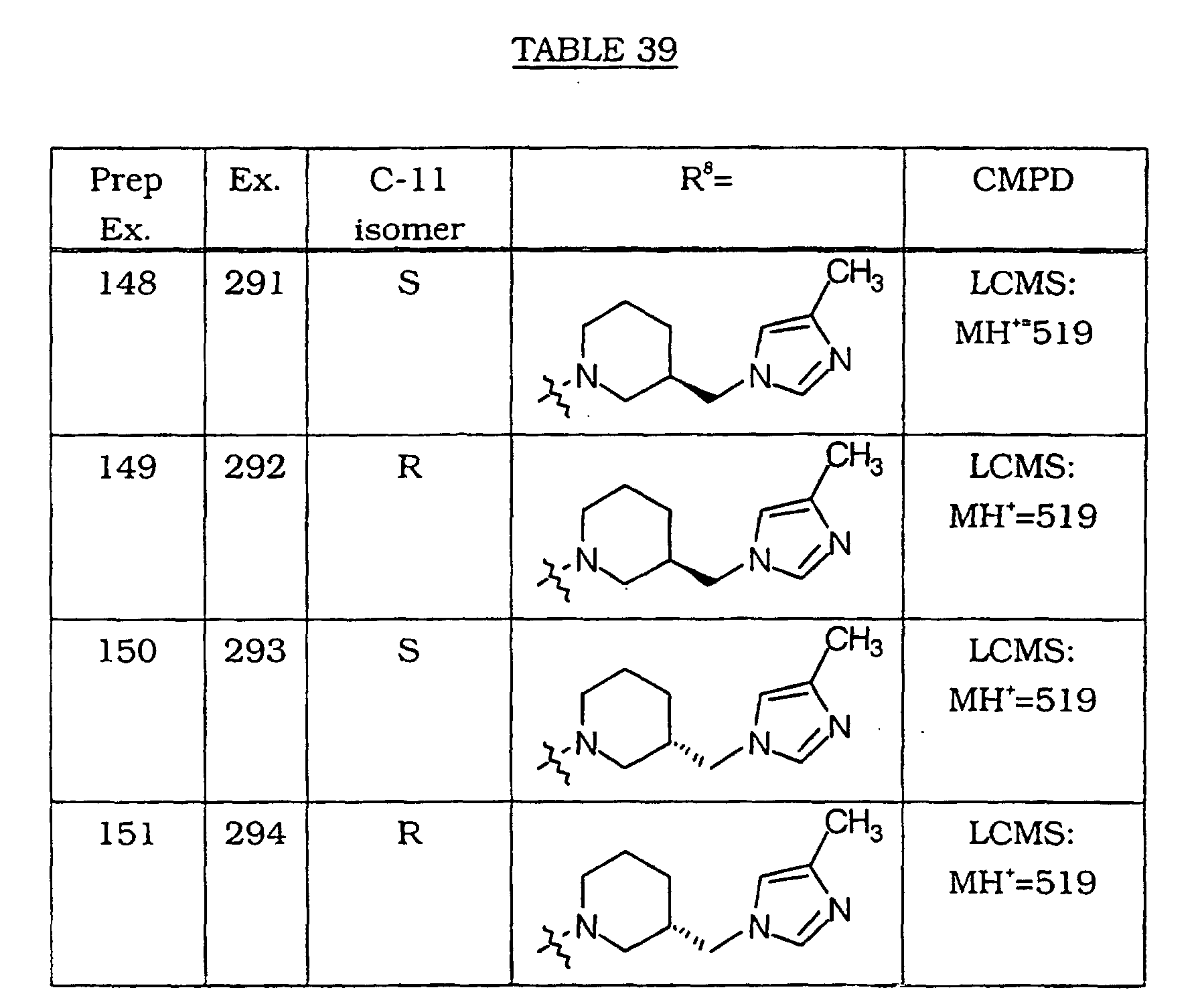
- By essentially the same procedure set forth in Example 14, only substituting the title compounds from the Preparative Example listed in column 2 of Table 40, the compounds of the formula shown below, with R9 as listed in column 4 of Table 40, were obtained (where data is provided) or can be obtained (where no data is provided) by using the appropriate electrophile.
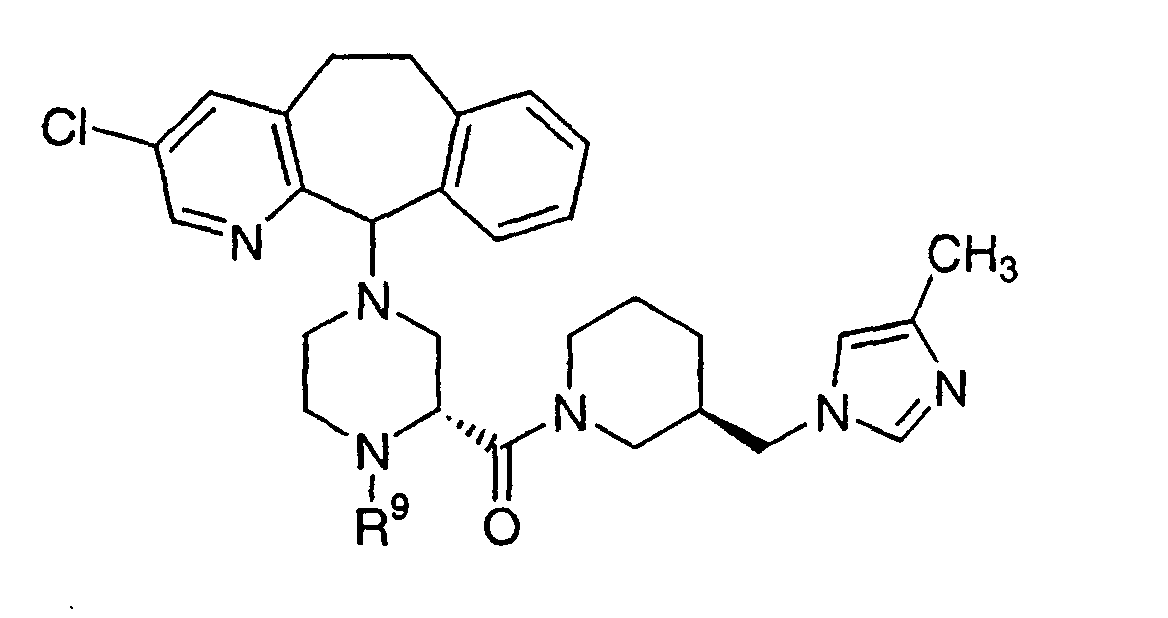
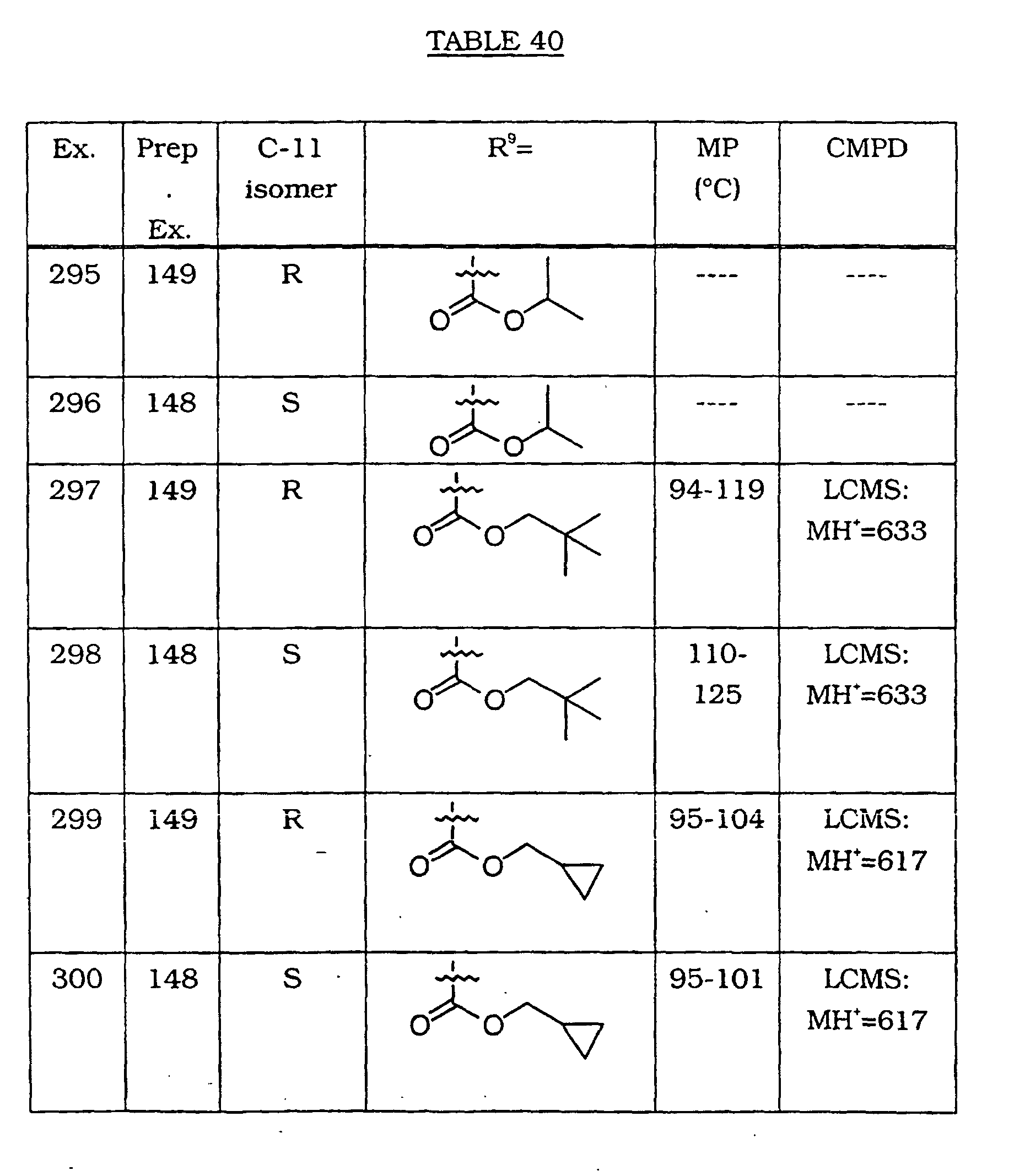
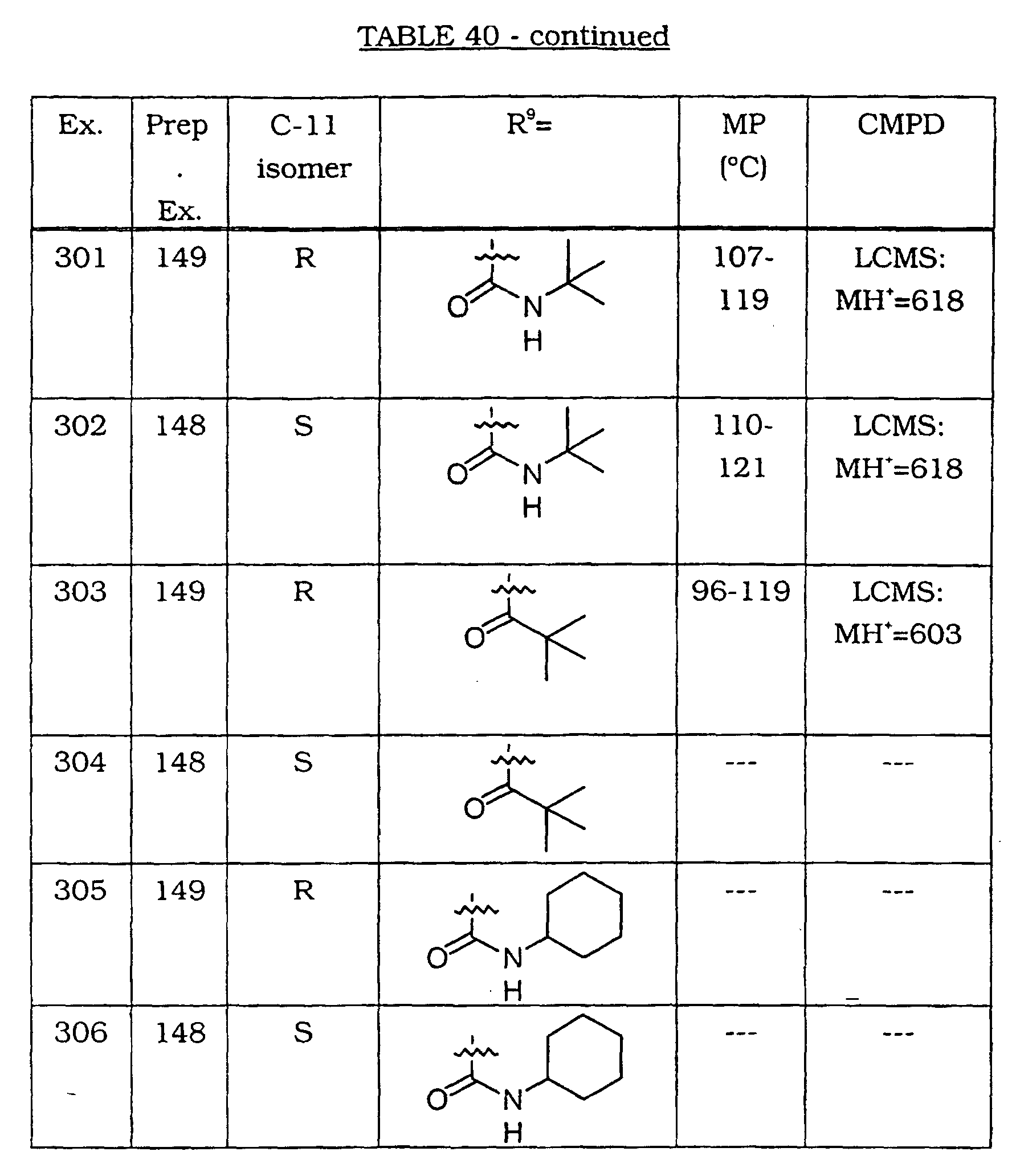
- By essentially the same procedure set forth in Example 14, only substituting the title compounds from the Preparative Example listed in column 2 of Table 41, the compounds of the formula shown below, with R9 as listed in column 4 of Table 41, can be obtained by using the appropriate electrophile.

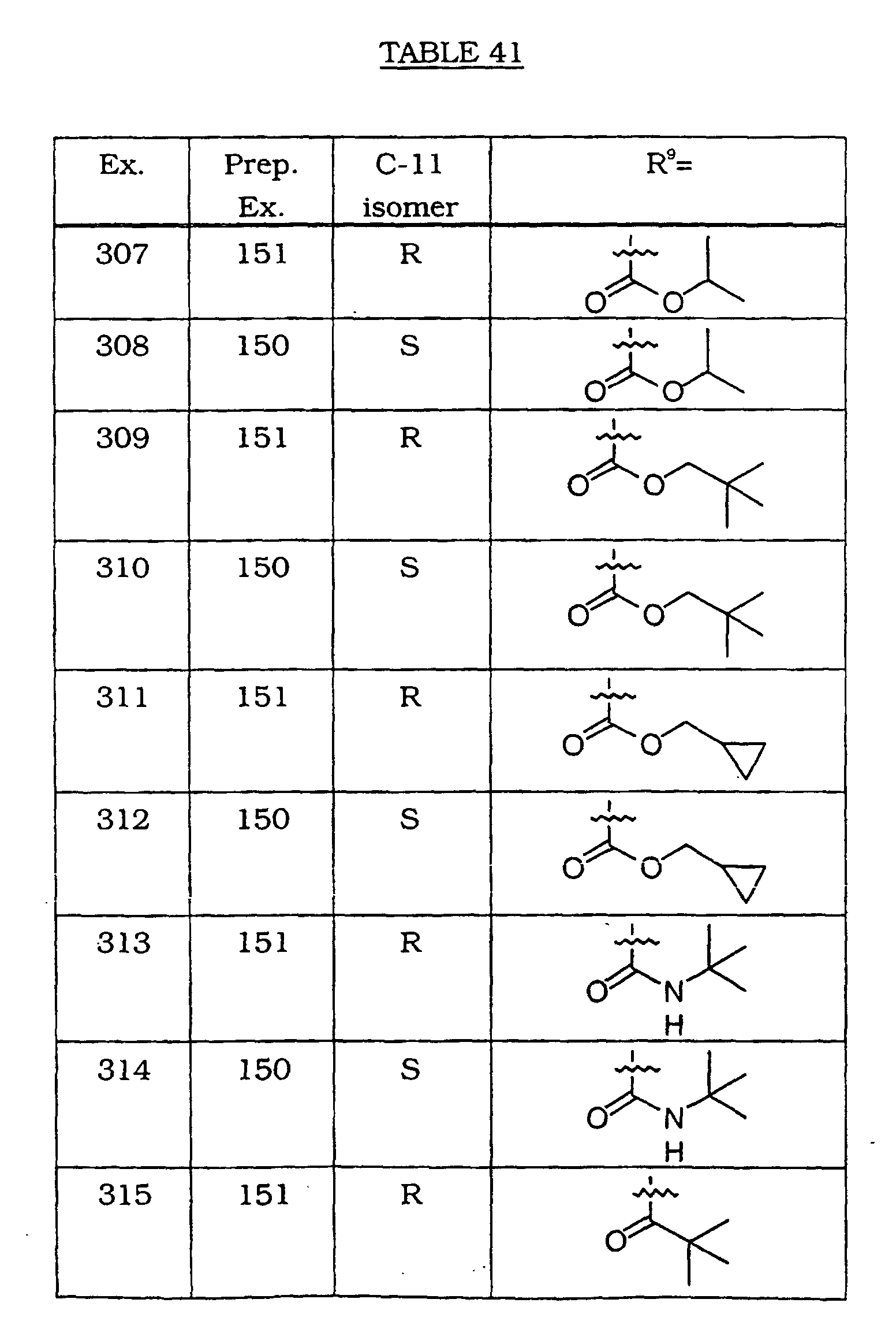
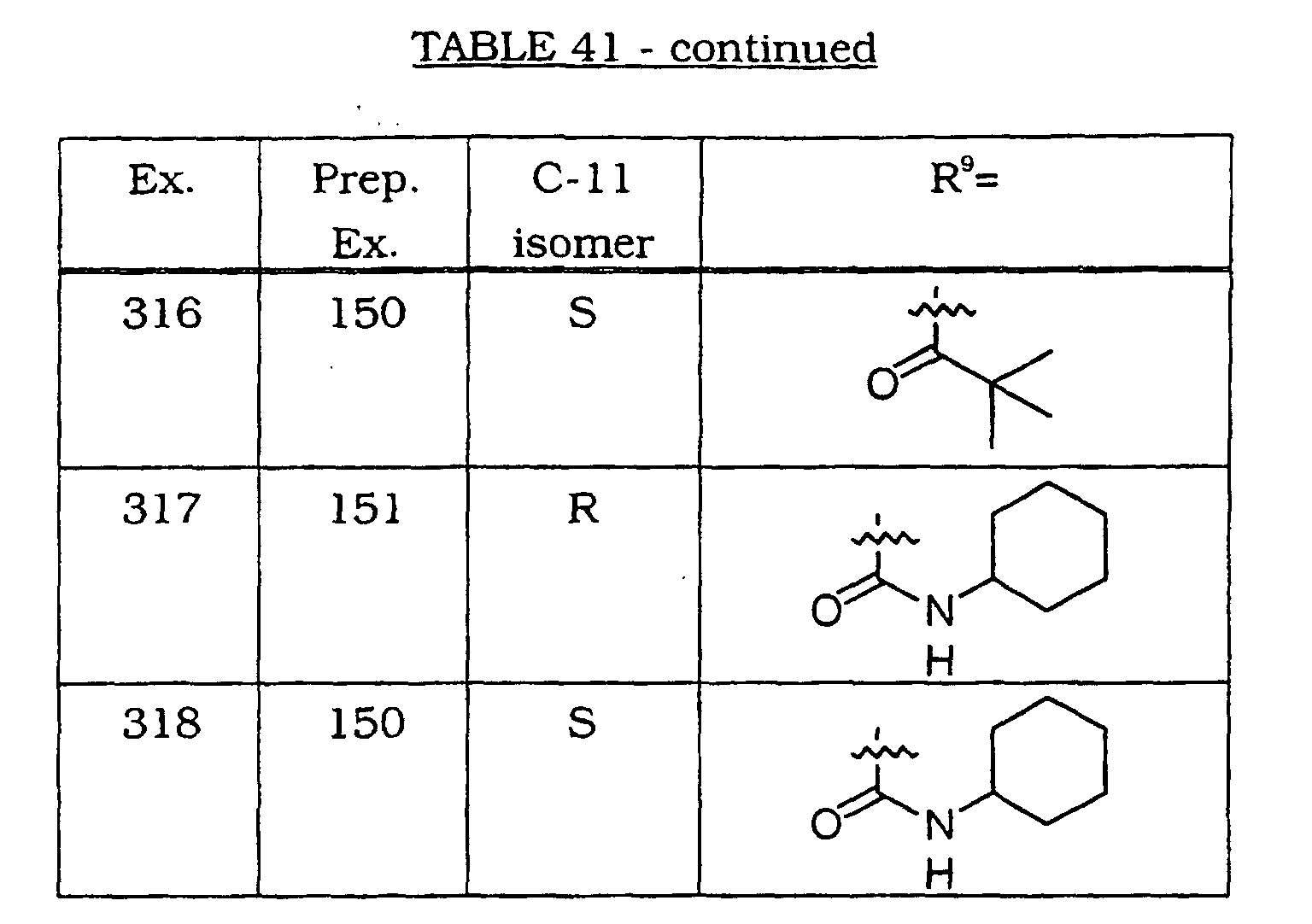
-
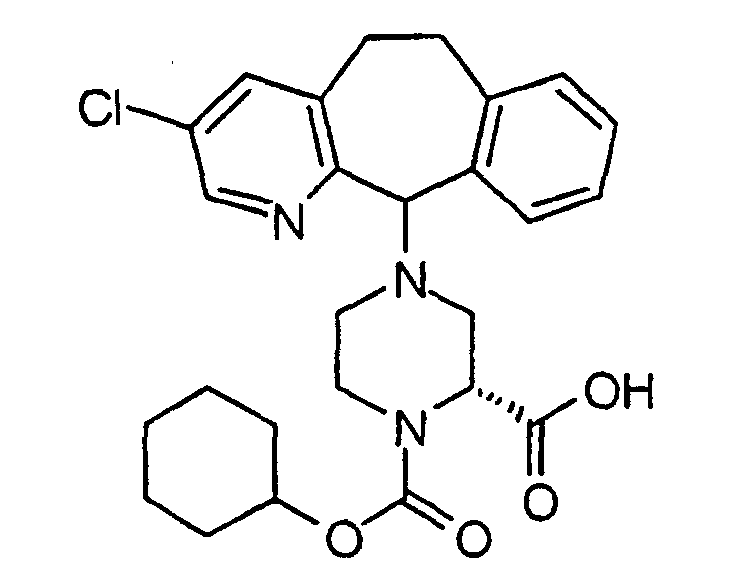
- By essentially the same procedure set forth in Preparative Example 36, only substituting the 3-Cl, 8-H tricyclic chloride prepared in Preparative Example 92 for the 3-H, 8-Cl tricyclic chloride in Step B, the title compounds (C-11(S)- and (R)-isomers) was prepared. FABMS: MH+= 484.
- By essentially the same procedure set forth in Example 1, only substituting the title compounds from Preparative Example 152 and substituting the appropriate amine, the compounds of the formula shown below, with R8 as listed in column 3 of Table 42, were obtained.
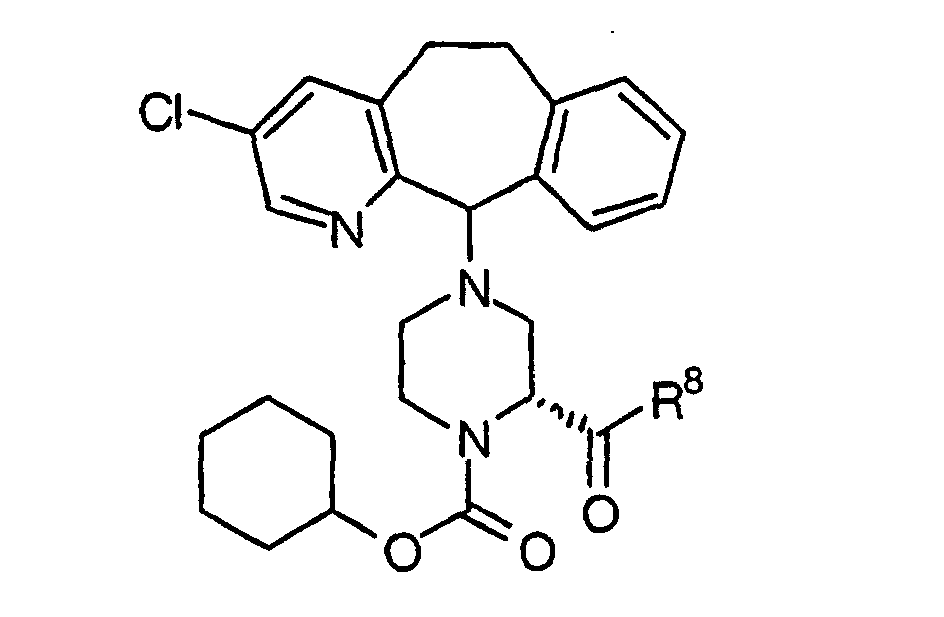
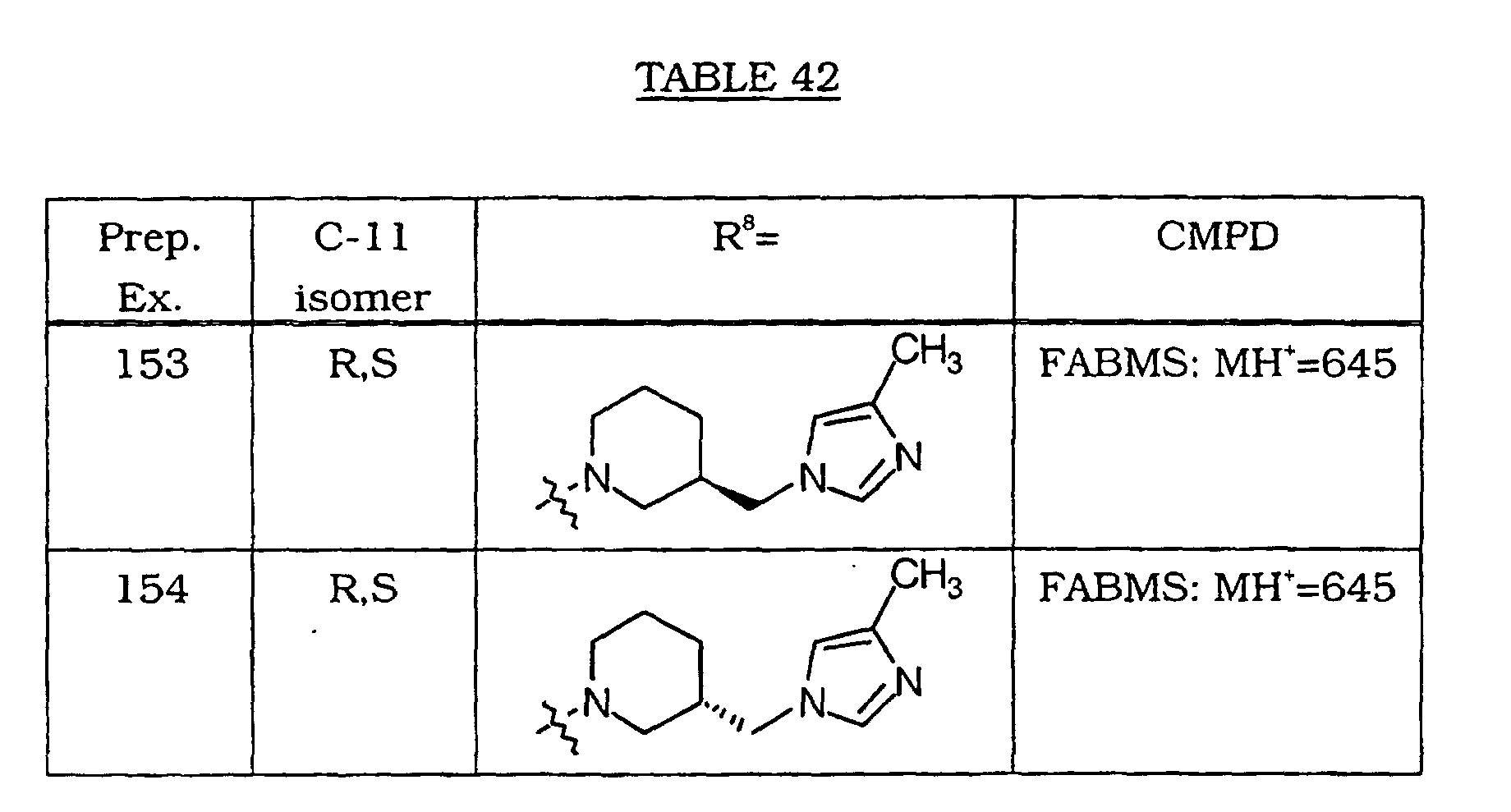
- The title compounds from Preparative Examples 153 and 154 were separated into individual C-11 (S)- and (R)-diastereomers by Preparative HPLC with a CHIRALPAK AD column using a 25% iPrOH in hexanes solution with 0.2% DEA as eluent to give the compounds of the formula shown below with R8 as listed in column 3 of Table 43.

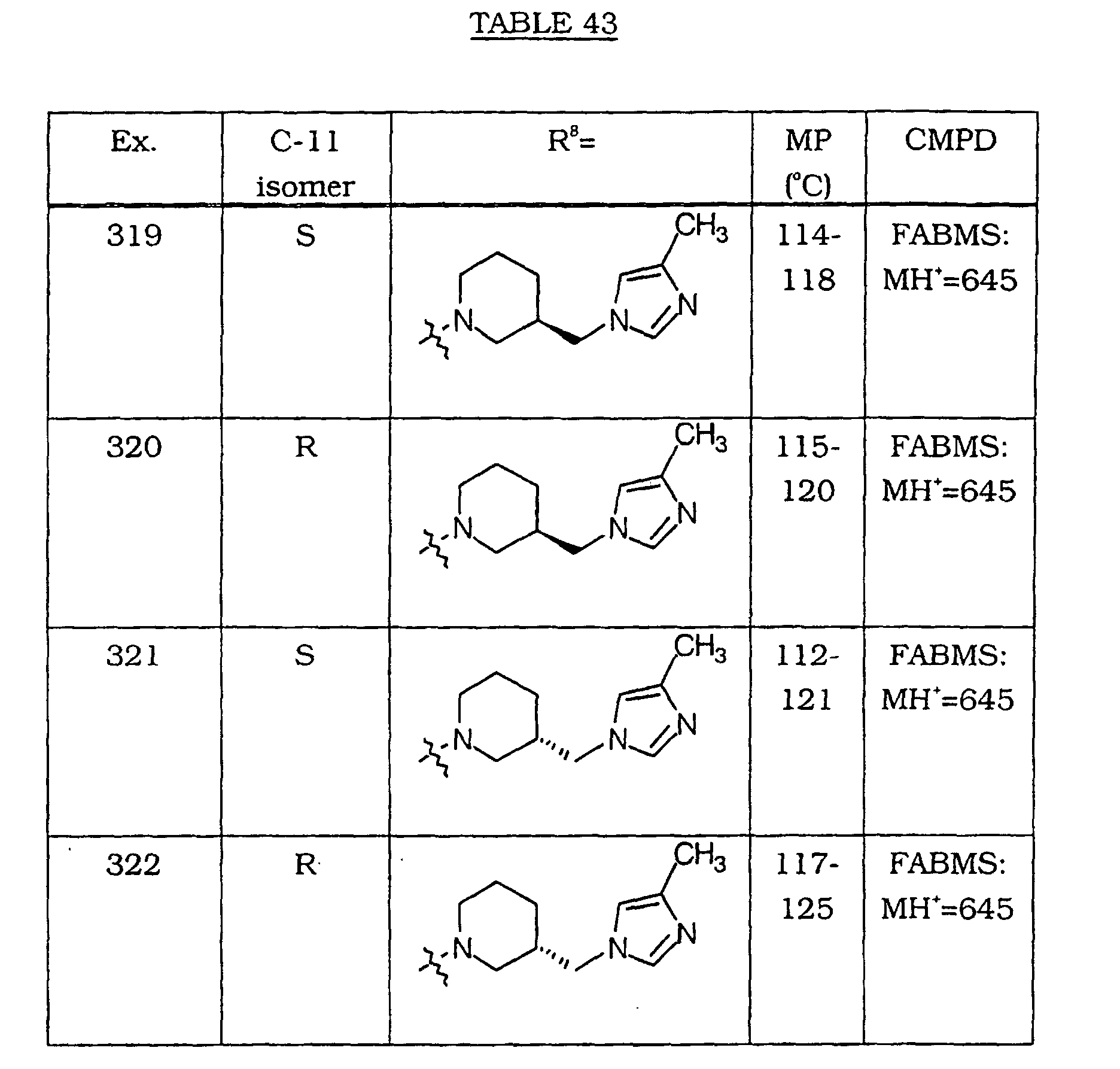
- By essentially the same procedure set forth in Example 1, only substituting the title compounds from Preparative Example 112 and substituting the appropriate amine, the compounds of the formula shown below, with R8 listed in column 3 of Table 44, can be obtained.


- By essentially the same procedure set forth in Preparative Example 115, only substituting the title compounds from the example listed in column 2 of Table 45, the title compounds of the formula shown below, with R8 as listed in column 4 of Table 45, can be prepared.

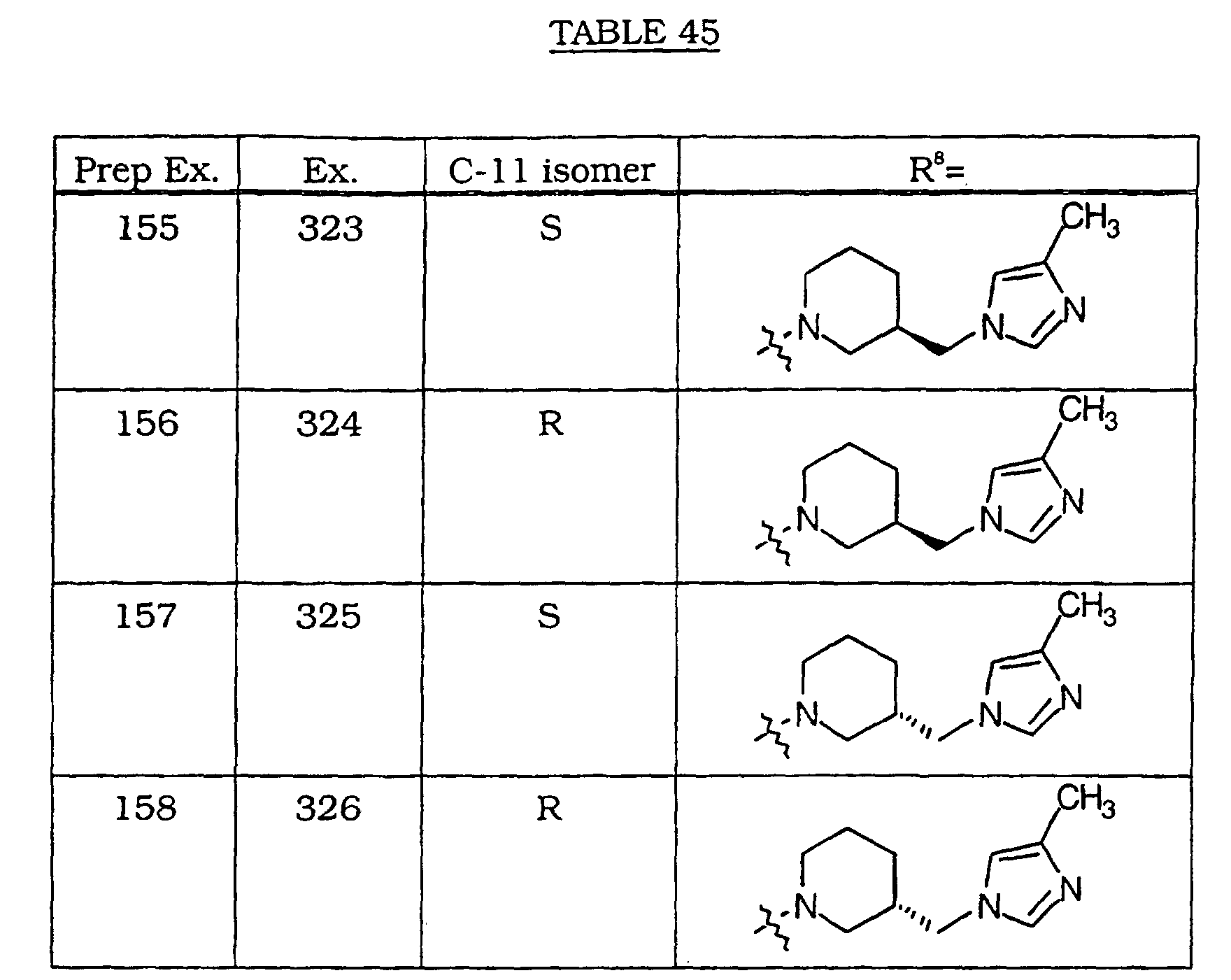
- By essentially the same procedure set forth in Example 14, only substituting the title compounds from the Preparative Example listed in column 2 of Table 46, the compounds of the formula shown below, with R9 as listed in column 4 of Table 46, were obtained (where data is provided) or can be obtained (where no data is provided) by using the appropriate electrophile.
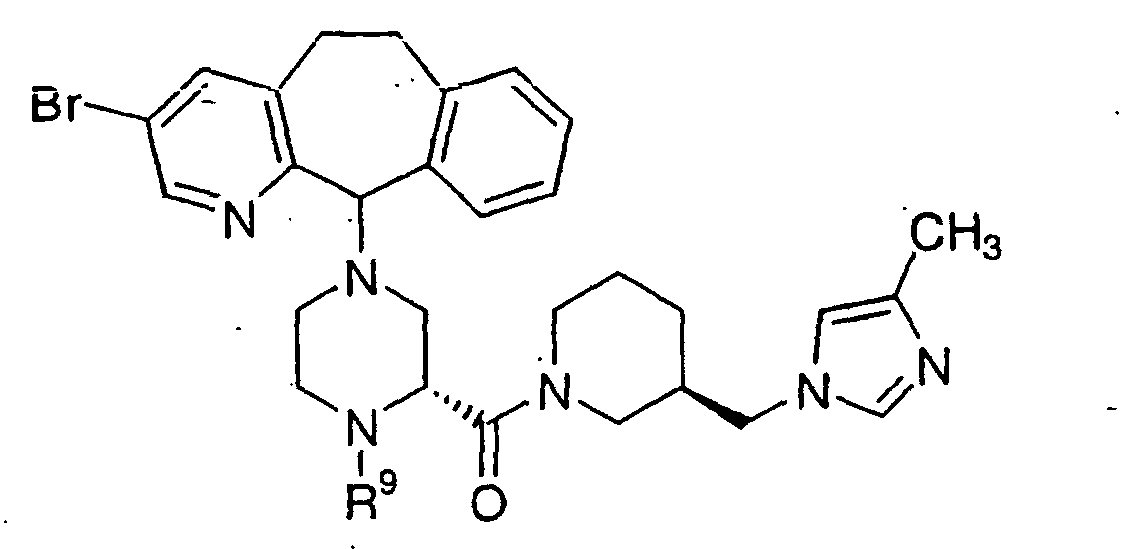
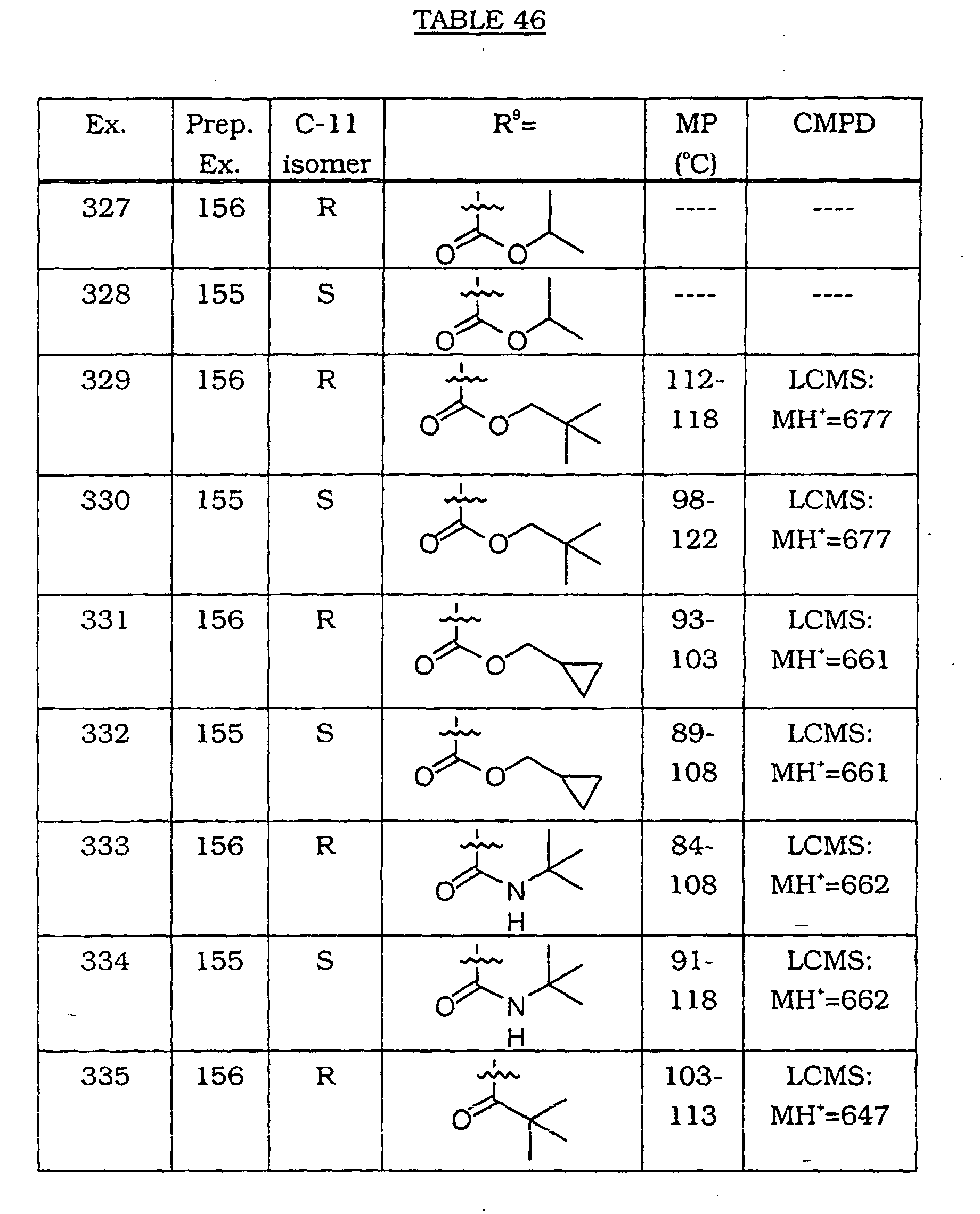
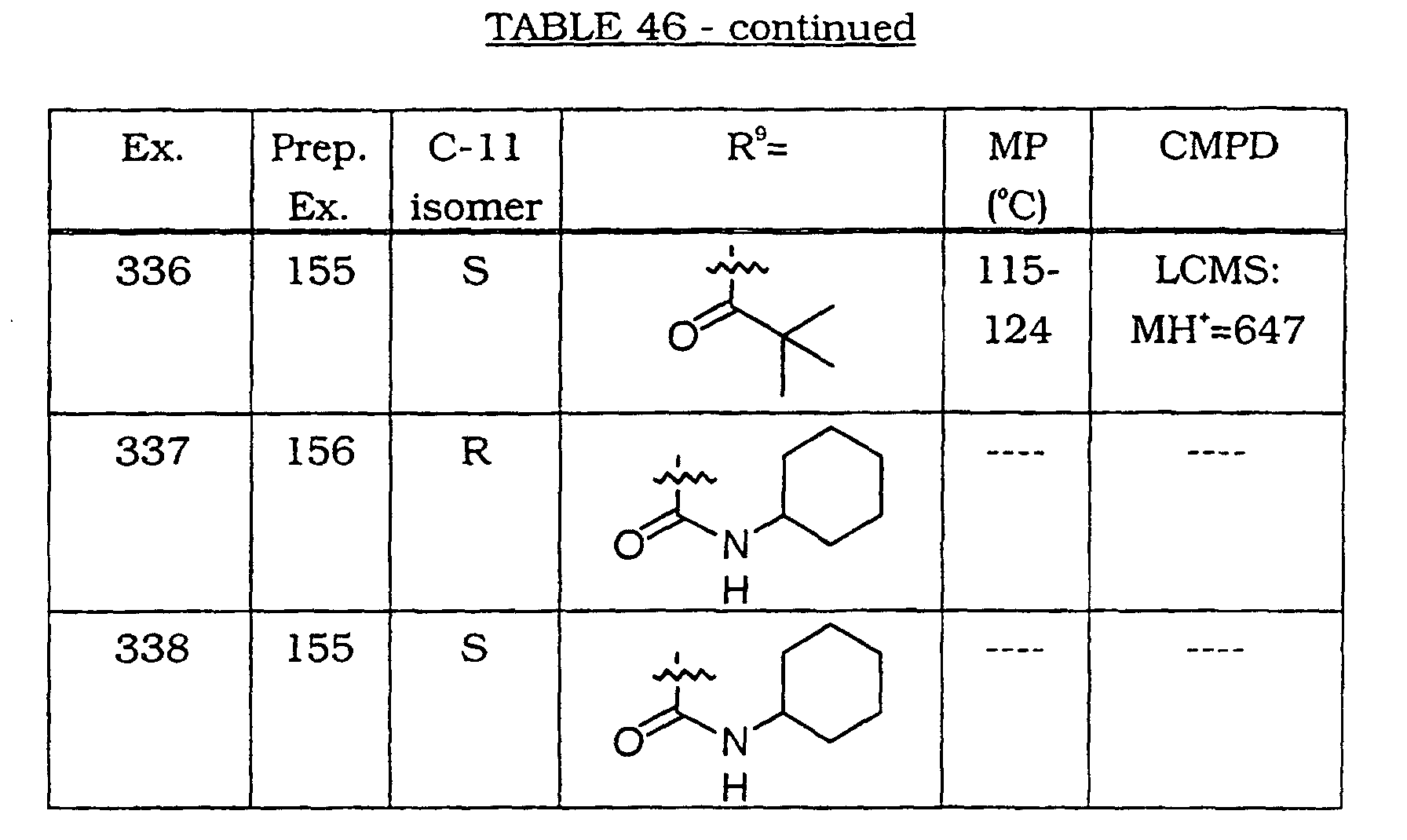
- By essentially the same procedure set forth in Example 14, only substituting the title compounds from the Preparative Example listed in column 2 of Table 47, the compounds of the formula shown below with R9 as listed in column 4 of Table 47, can be obtained by using the appropriate electrophile.
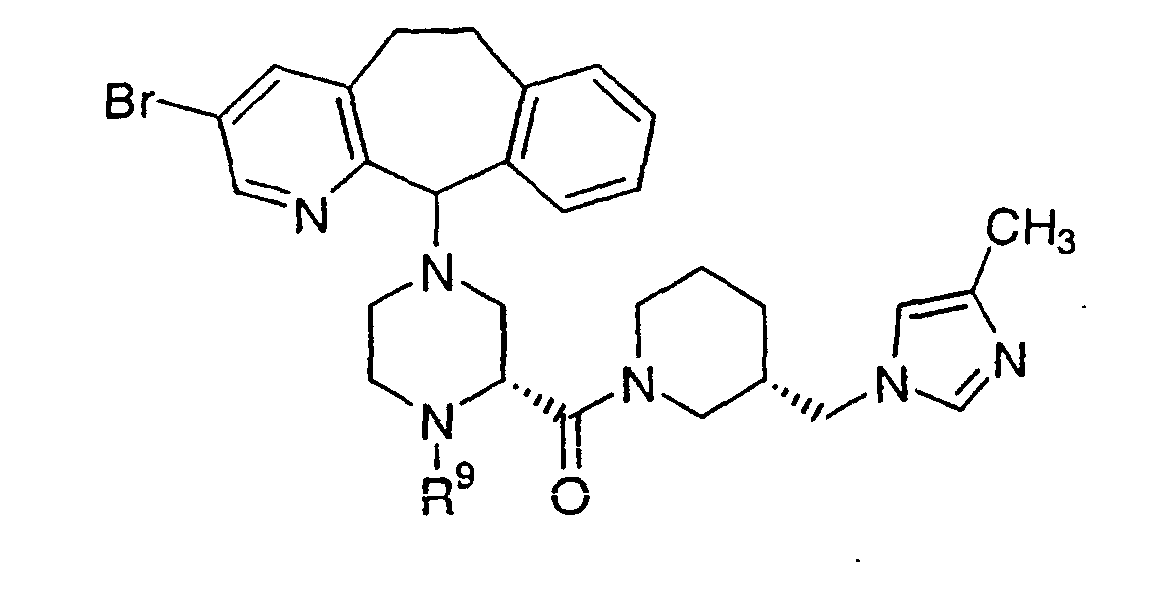

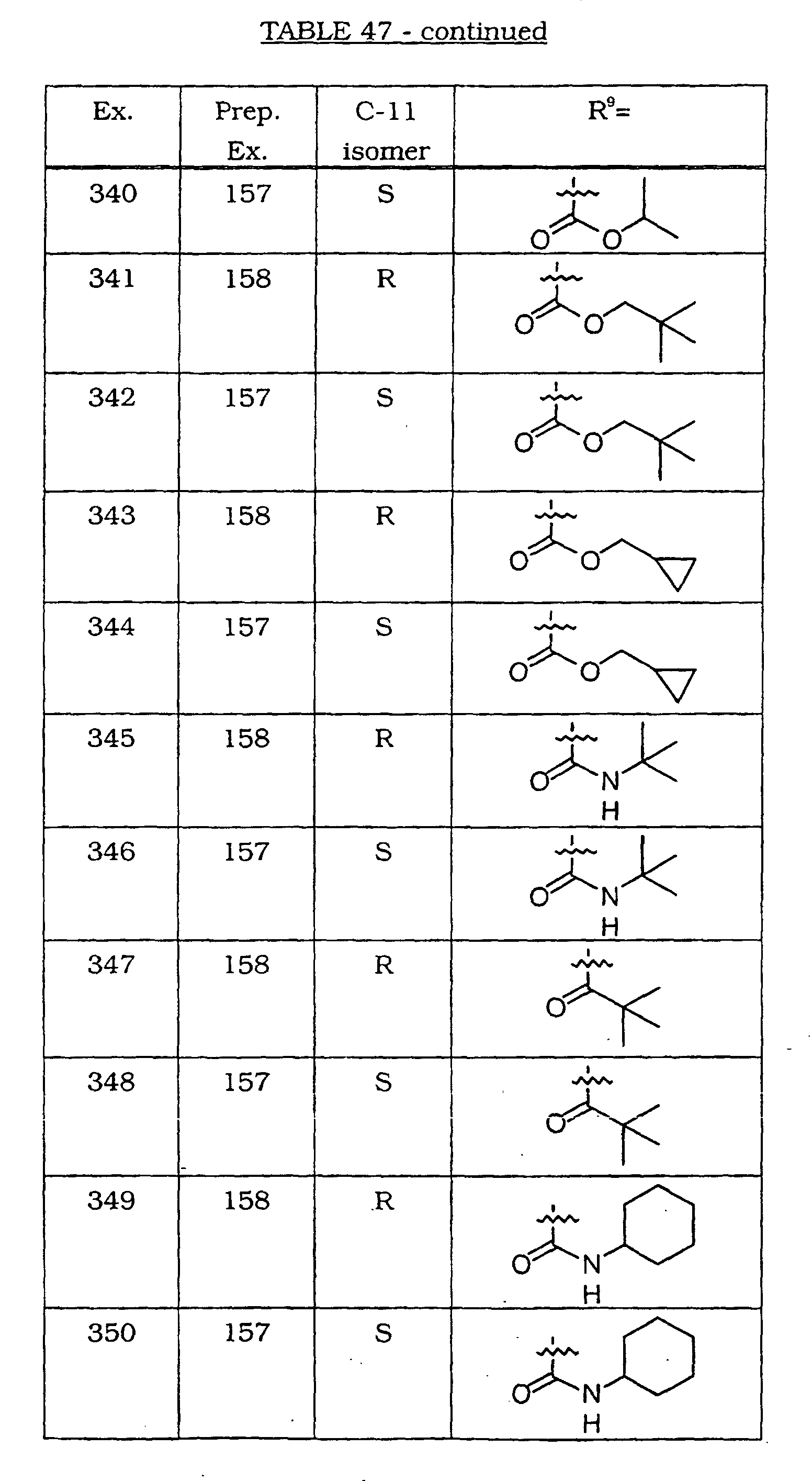
-

- By essentially the same procedure set forth in Preparative Example 36, only substituting the 3-Br, 8-H tricyclic chloride prepared in Preparative Example 93 for the 3-H, 8-C1 tricyclic chloride in Step B, the title compounds (C-11(S)- and (R)-isomers) were prepared. FABMS: MH+=528.
- By essentially the same procedure set forth in Preparative Example 126, only substituting the title compounds from Preparative Example 144 and substituting the appropriate amine, the compounds of the formula shown below, with R8 as listed in column 3 of Table 48, were obtained.
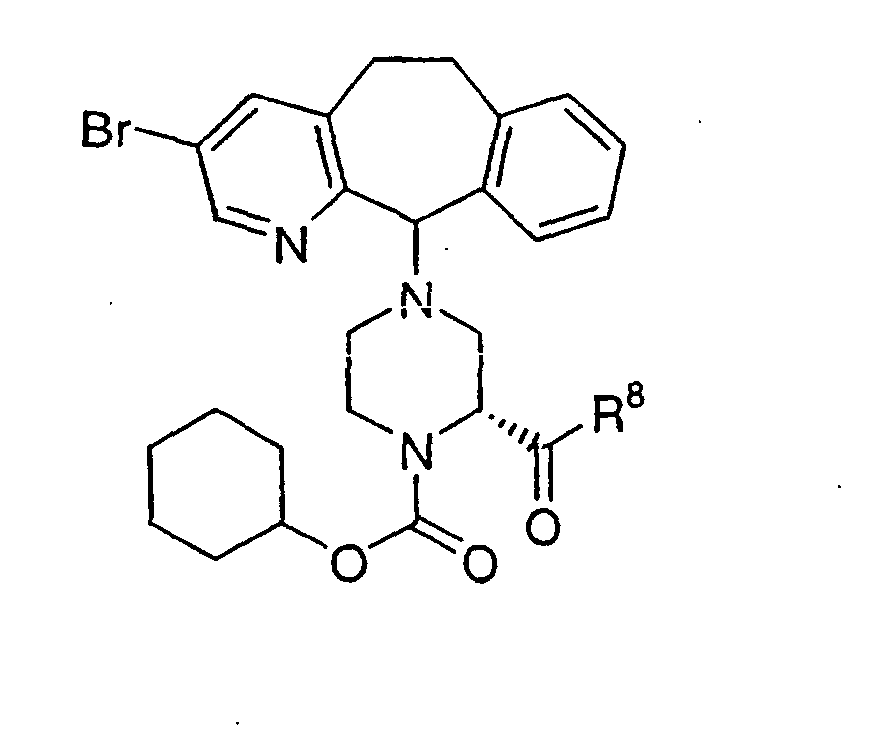

- The title compounds from Preparative Examples 160 and 161 were separated into individual C-11 (S)- and (R)-diastereomers by Preparative HPLC with a CHIRALPAK AD column using a iPrOH in hexanes solution with 0.2% DEA as eluent to give the compounds of the formula shown below with R8 as listed in column 3 of Table 49.
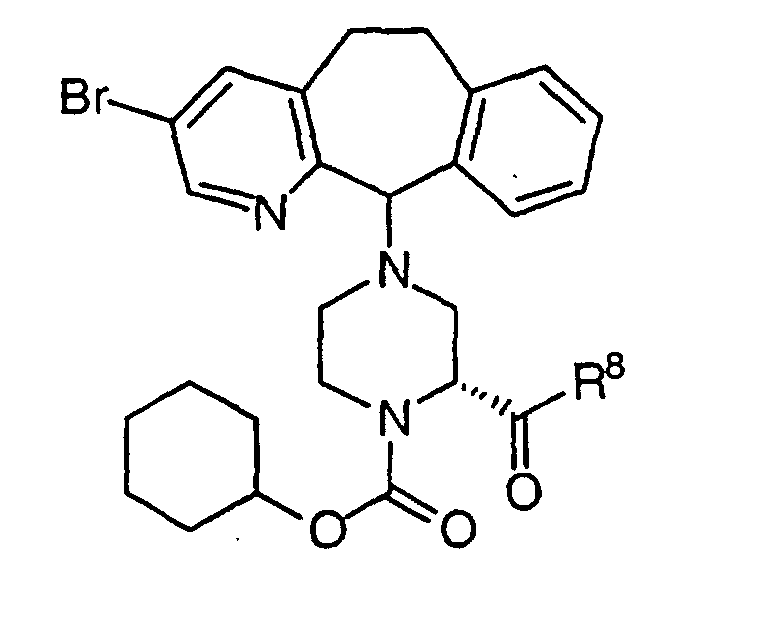
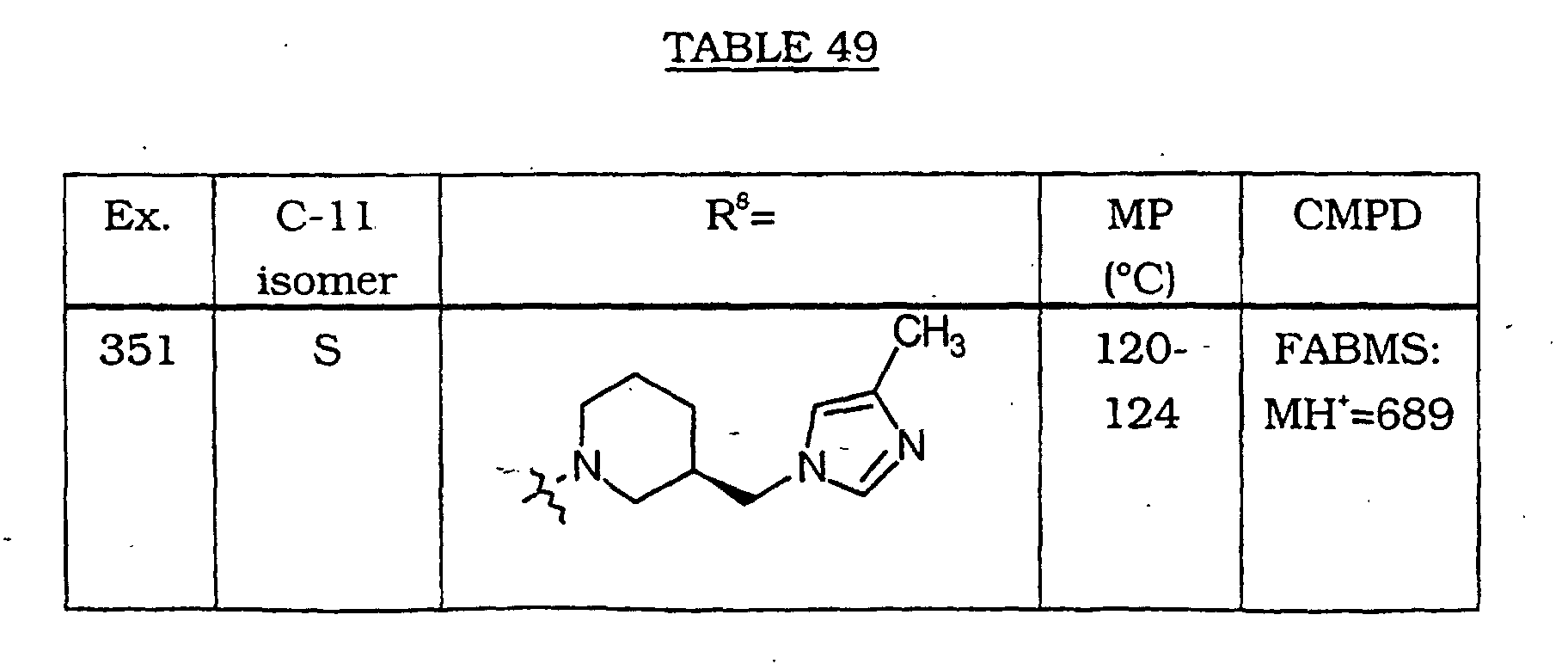
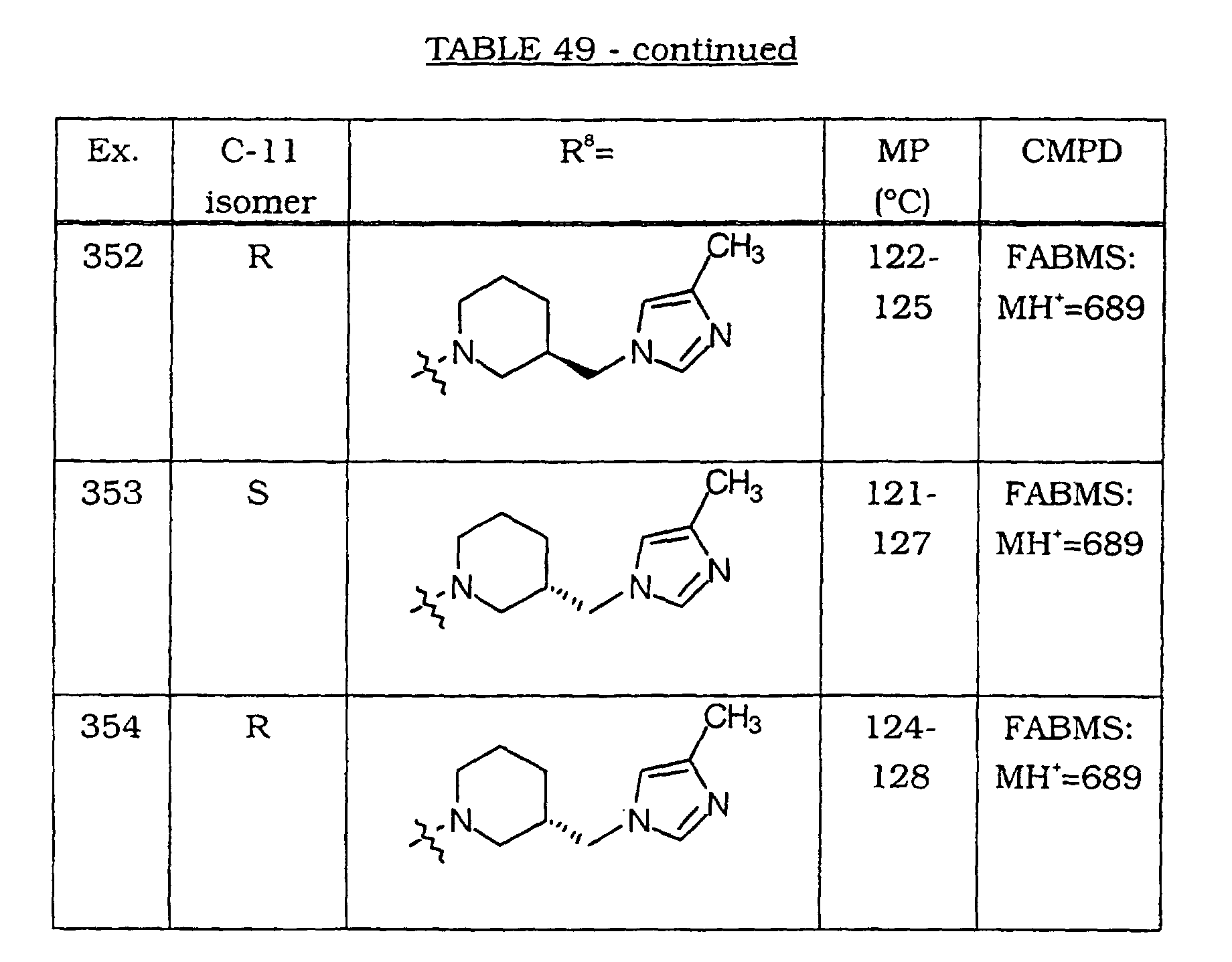
- By essentially the same procedure set forth in Example 1 only substituting the title compounds from Preparative Example 114 and substituting the appropriate amine, the compounds of the formula shown below, with R8 listed in column 3 of Table 50, can be obtained.
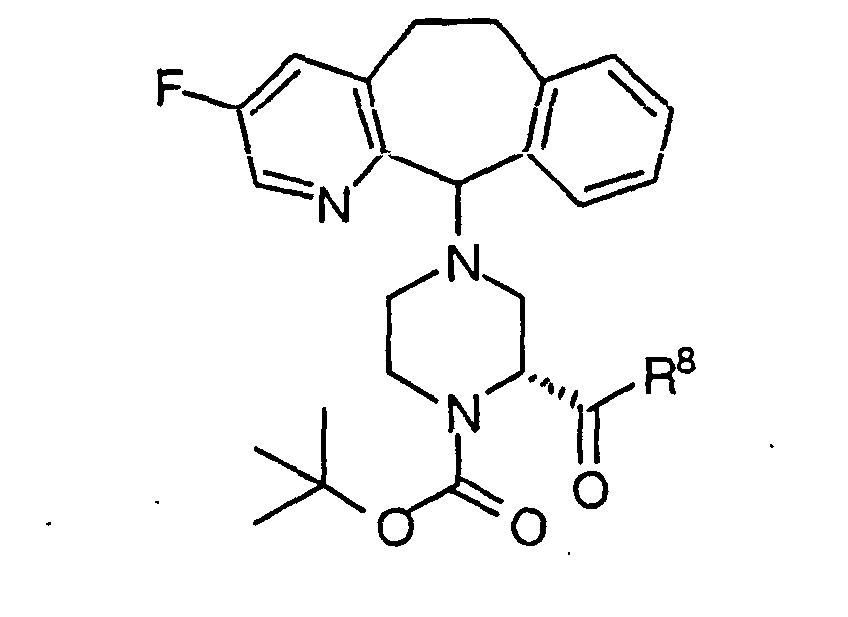
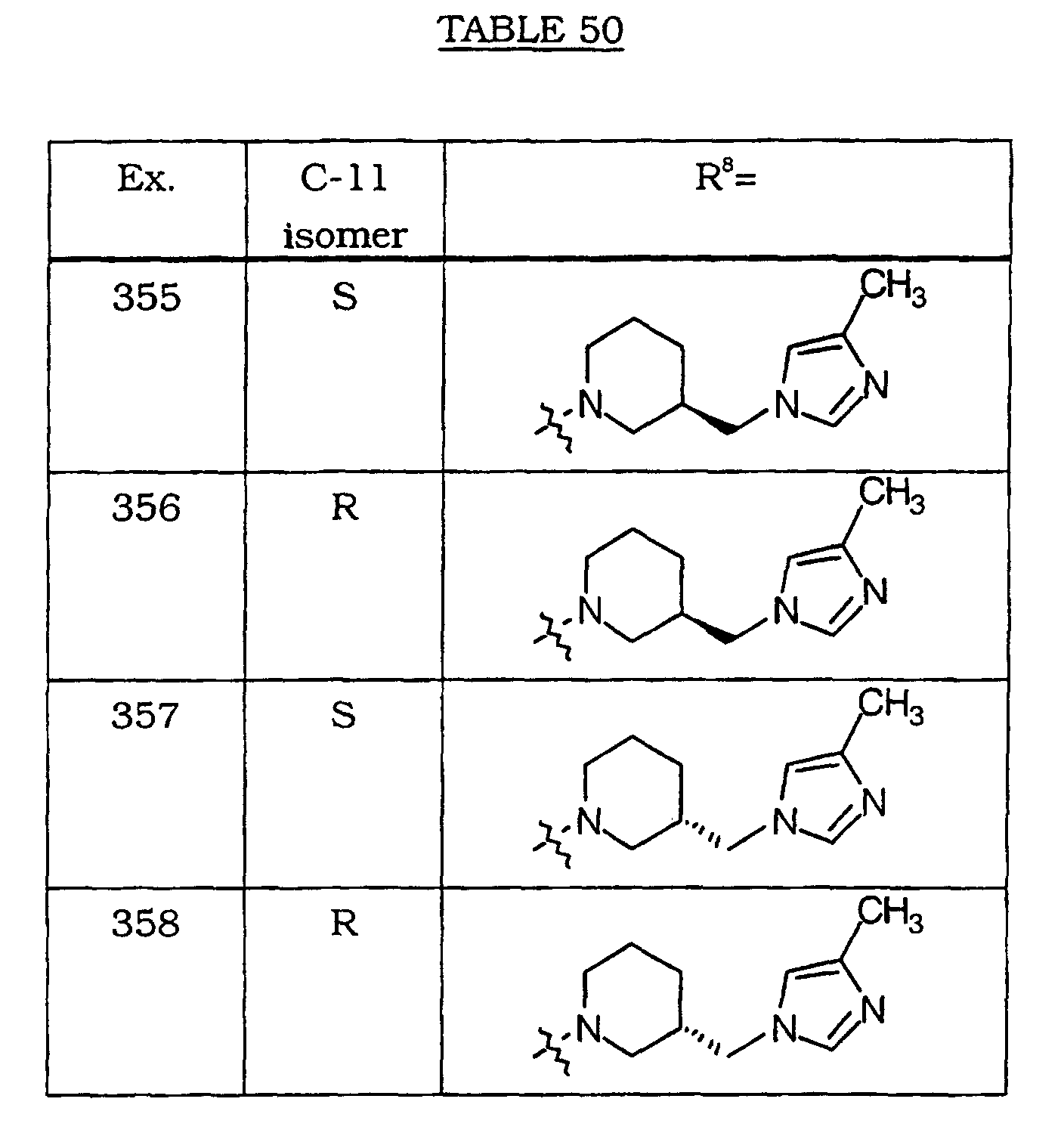
- By essentially the same procedure set forth in Preparative Example 115, only substituting the title compounds from the example listed in column 2 of Table 51, the title compounds of the formula shown below, with R8 as listed in column 4 of Table 51, can be prepared.
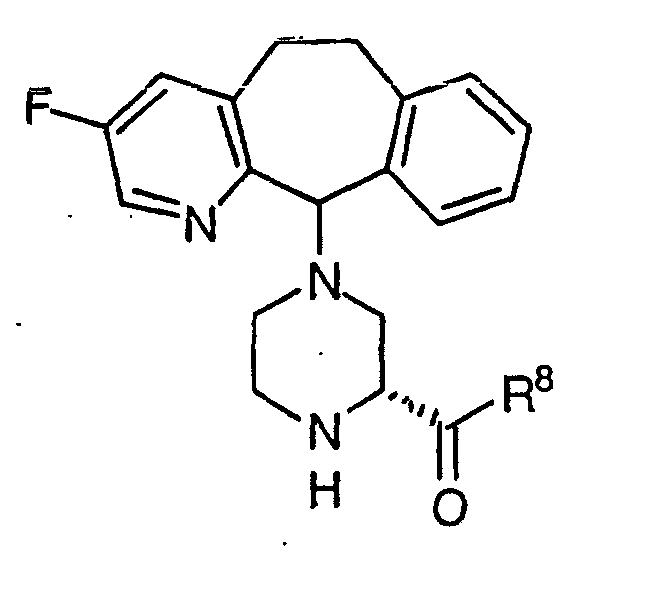
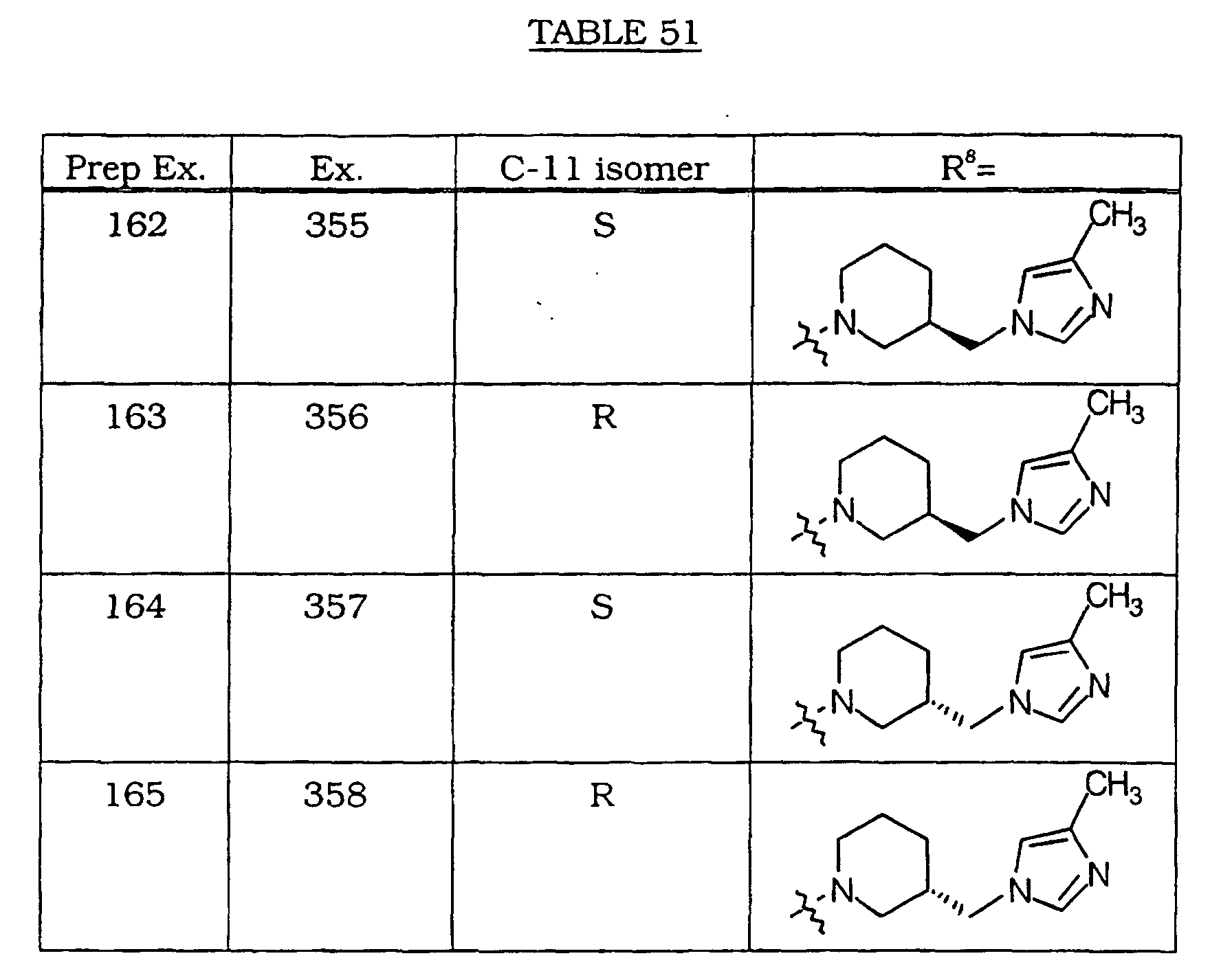
- By essentially the same procedure set forth in Example 14, only substituting the title compounds from the Preparative Example listed in column 2 of Table 52, the compounds of the formula shown below, with R9 as listed in column 4 of Table 52, can be obtained by using the appropriate electrophile.
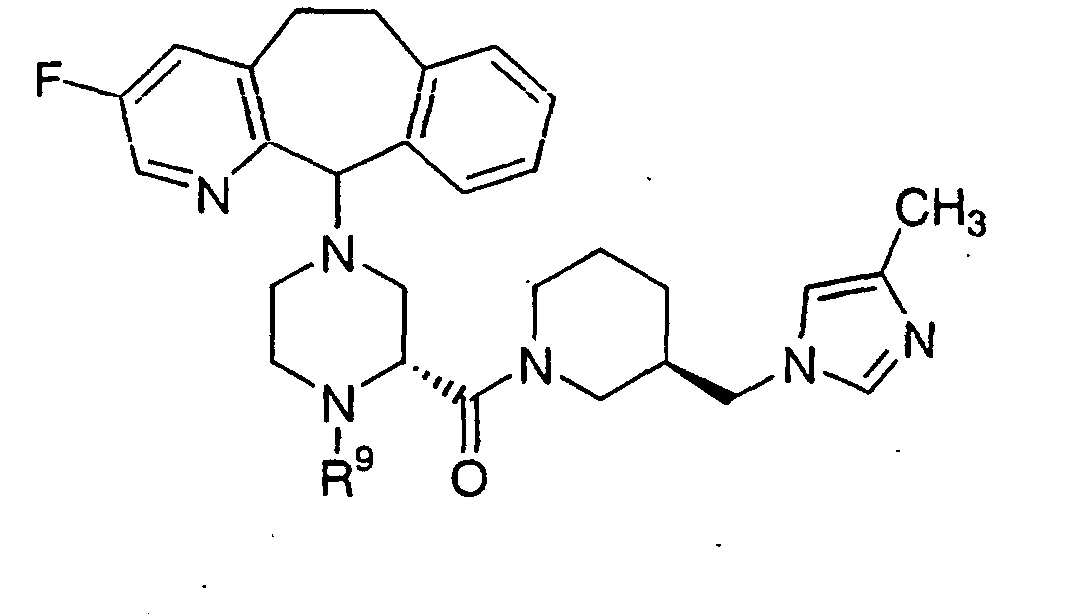
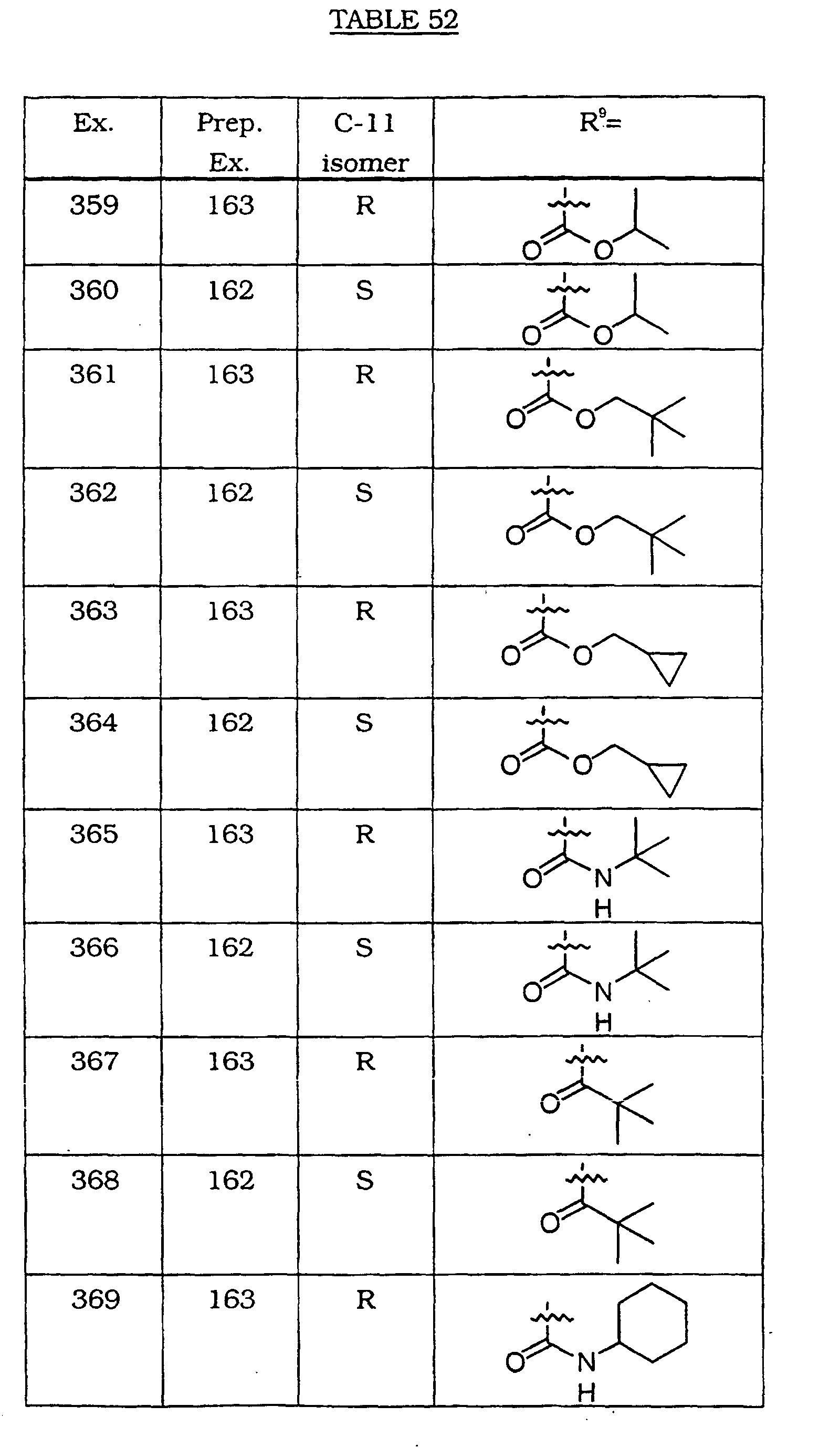
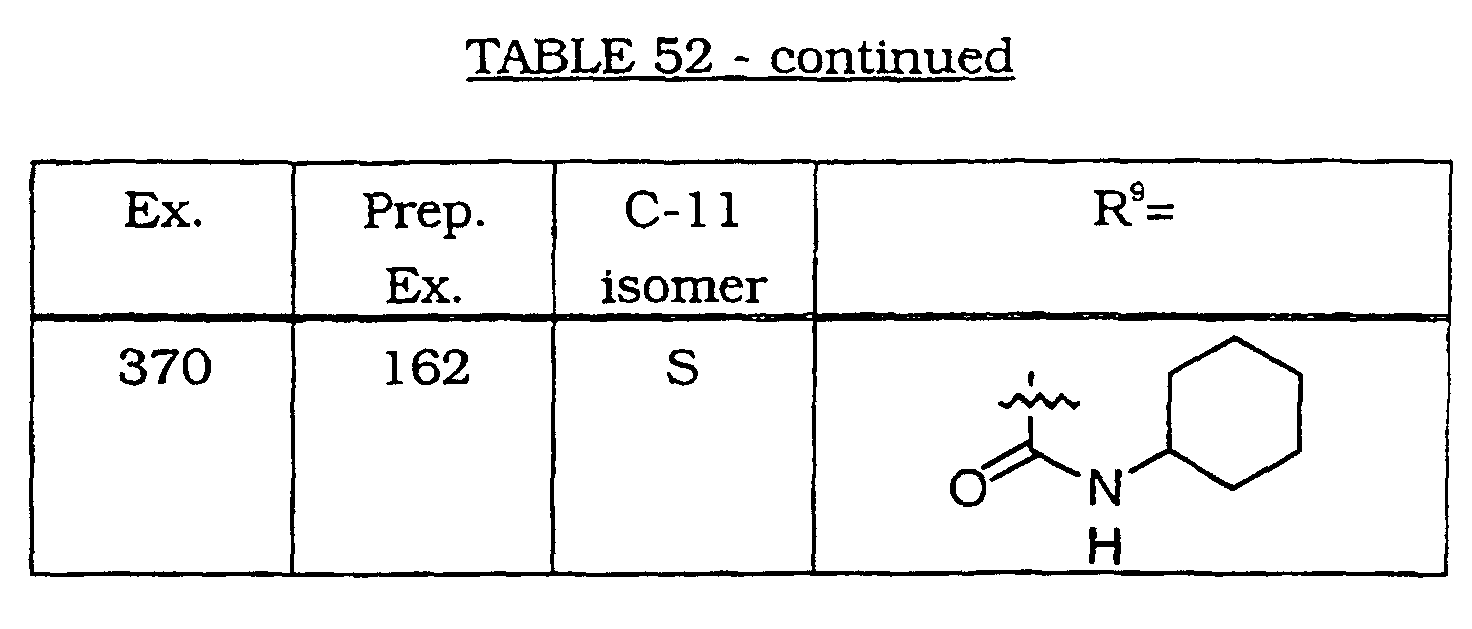
- By essentially the same procedure set forth in Example 14, only substituting the title compounds from the Preparative Example listed in column 2 of Table 53, the compounds of the formula shown below, with R9 as listed in Column 4 of Table 53, can be obtained by using the appropriate electrophile.

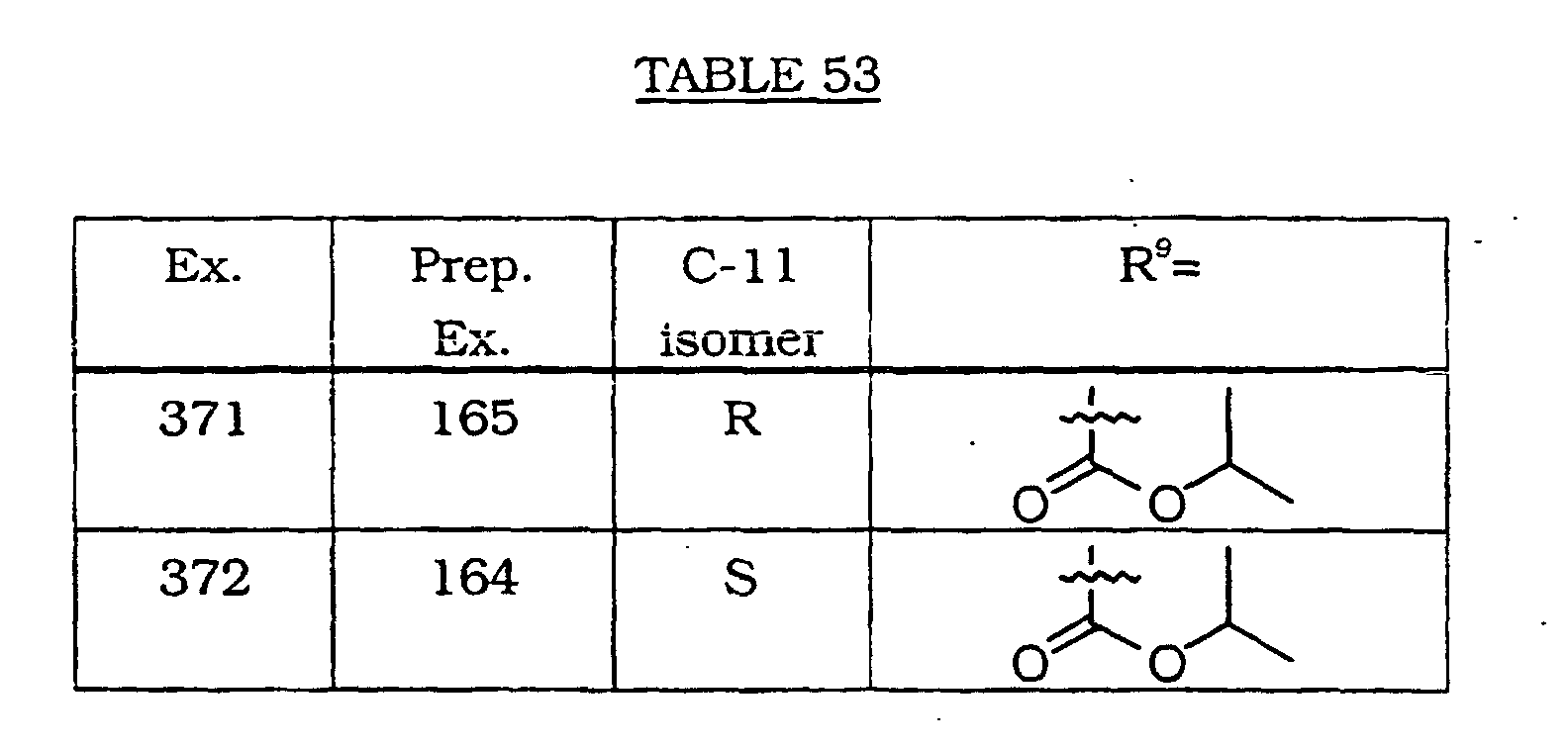
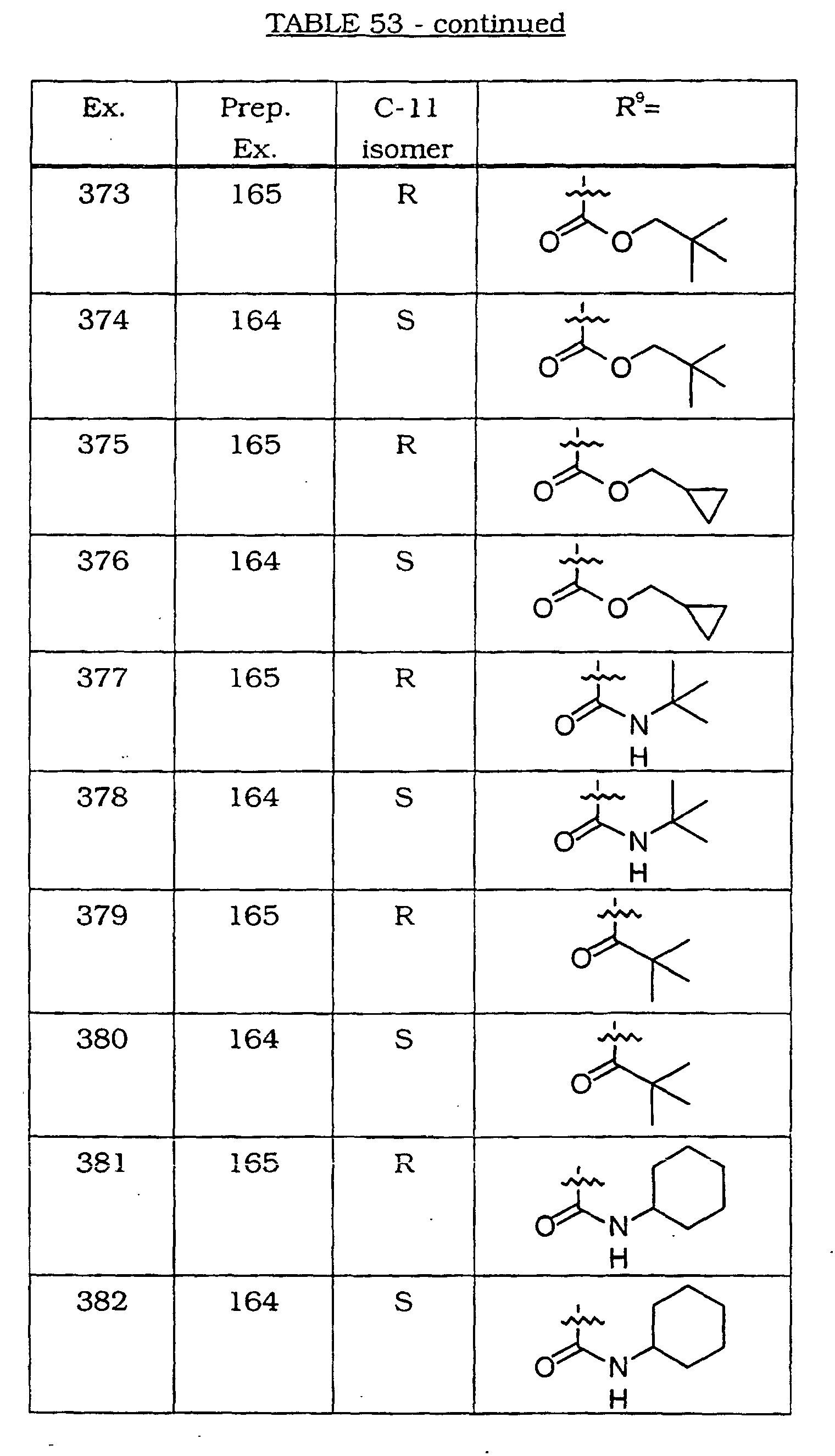
-

- By essentially the same procedure set forth in Example 1 only substituting the title compound from Preparative Example 32 Step A and the title amine from Preparative Example 21, the title compound was prepared. FABMS: MH+=518.
-
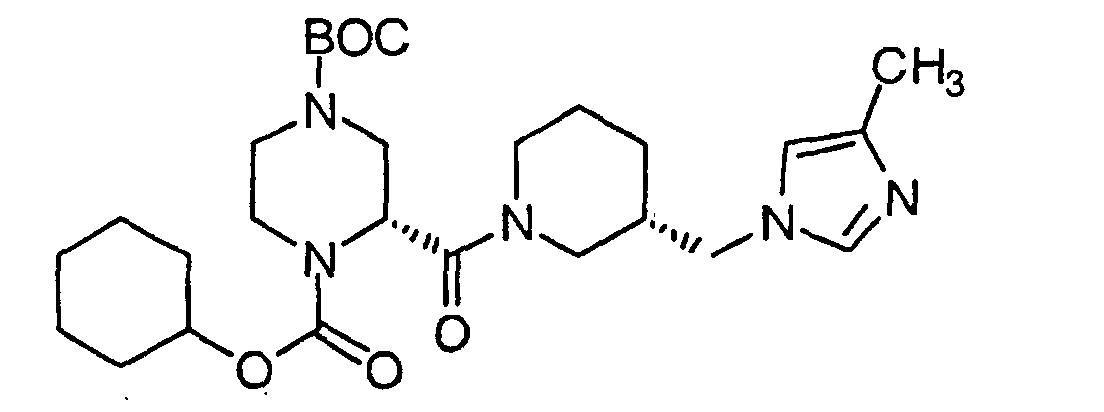
- By essentially the same procedure set forth in Example 1 only substituting the title compound from Preparative Example 32 Step A and the title amine from Preparative Example 20, the title compound ca be prepared.
- By essentially the same procedure set forth in Preparative Example 32. only substituting the title compounds from Preparative Example 166 and 166A and the 3-F, 8-H tricyclic chloride from Preparative Example 95, the compound of the formula shown below with R8 as listed in Column 3 of Table 54 was prepared (Prep. Example 167) or can be prepared (Prep. Example 168).
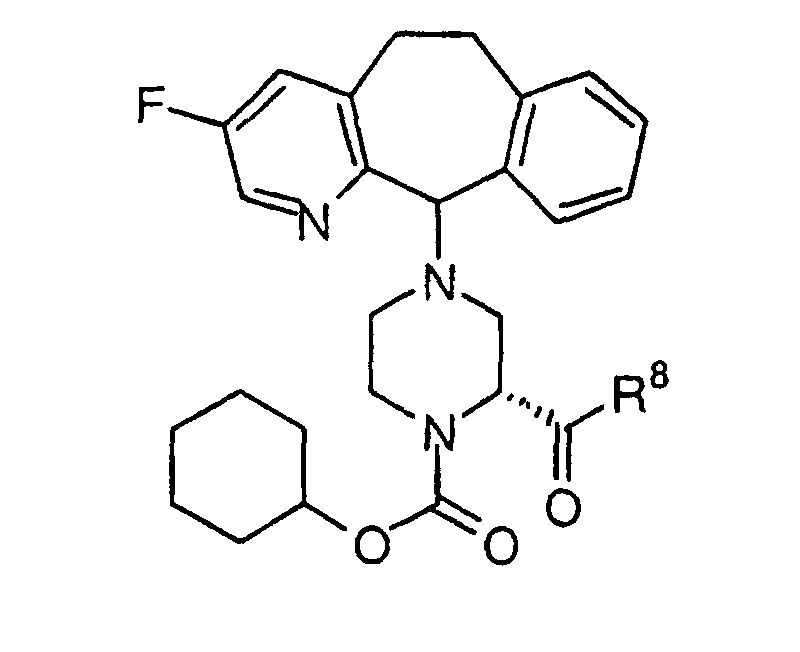
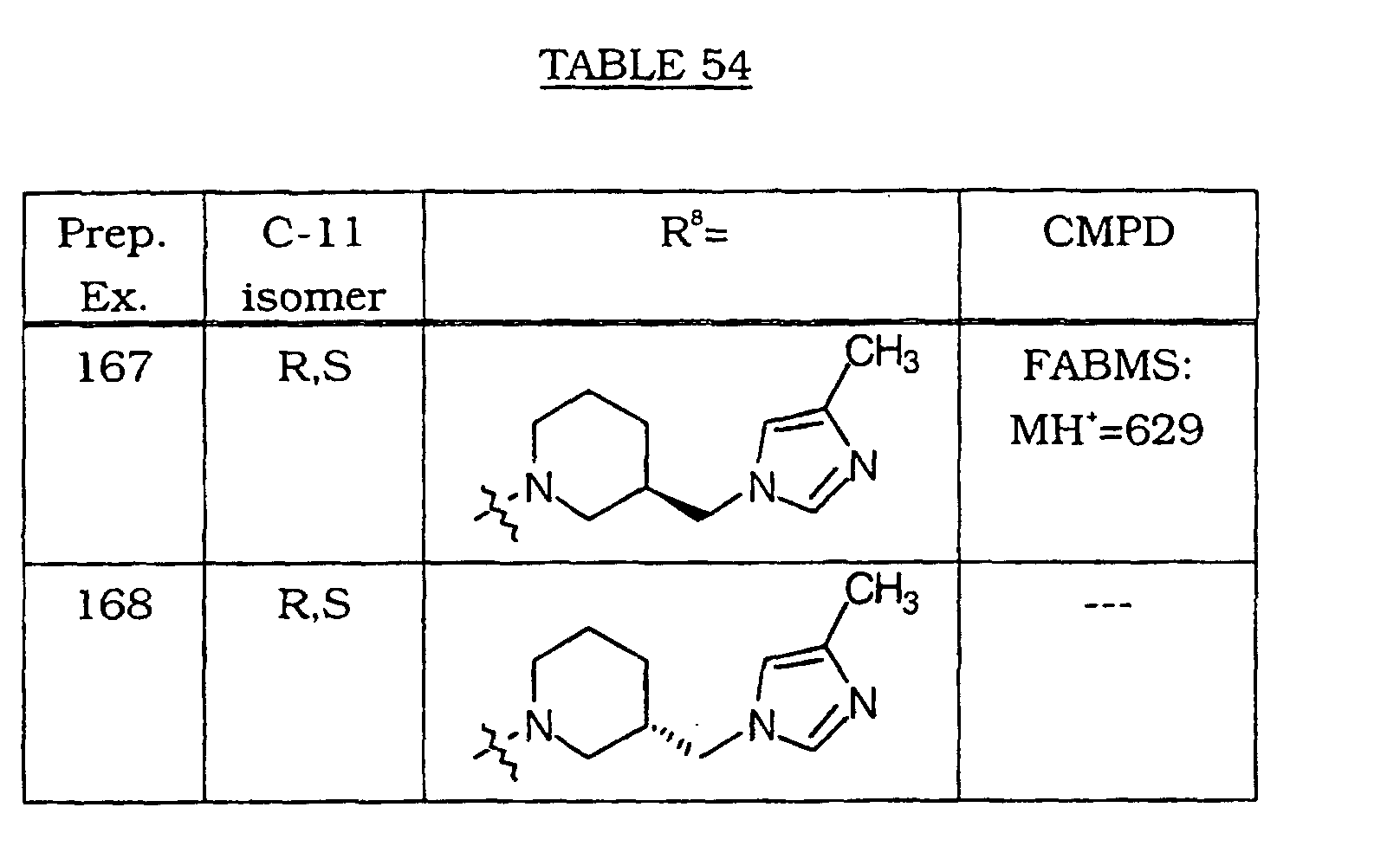
- The title compounds from Preparative Examples 167 and 168 were (Preparative Examples 167) and can be (Preparative Example 168) separated into individual C-11 (S)- and (R)-diastereomers by Preparative HPLC with a CHIRALPAK AD column using an iPrOH in hexanes solution with 0.2% DEA as eluent to give the compounds of the formula shown below with R8 as listed in Column 3 of Table 55.


-
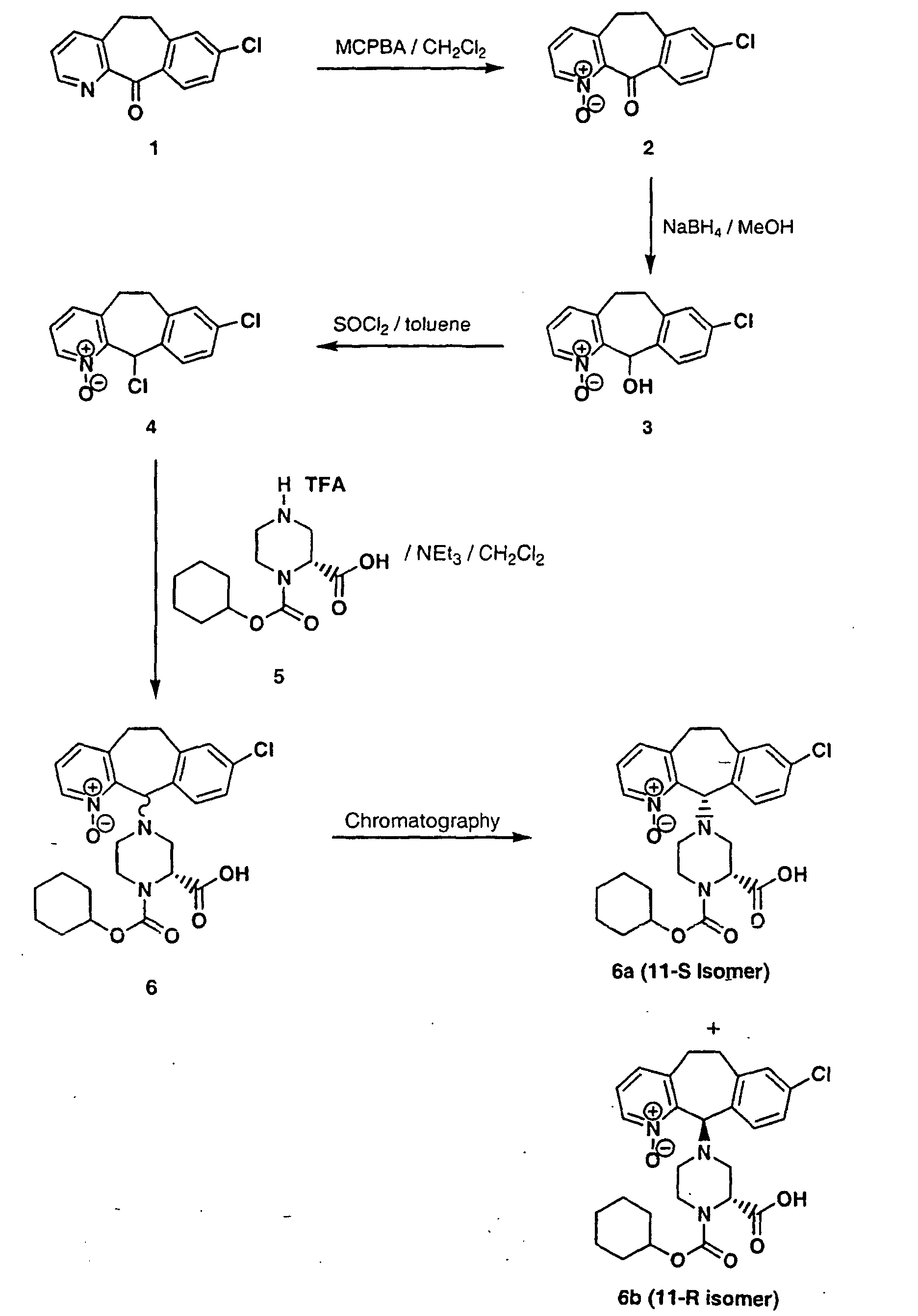
- 1→2 A solution of 3-peroxybenzoic acid (25 g, 102.59 mmol, 2.5 eq.) in anhydrous dichloromethane (250 mL) was added dropwise over a period of one hour to a stirred solution of 8-chloro-4-aza-10,11-dihydro-5H-dibenzo[a,d]cyclohepten-5-one 1 (10 g, 41.04 mmol, 1.0 eq.) in anhydrous dichloromethane (100 mL) at 0 °C under a nitrogen atmosphere. The solution was slowly (3h) warmed to room temperature and stirred for another 12h. The solution was extracted with 1 M aqueous sodium hydroxide solution (5 x 100 mL), washed with brine (2 x 100 mL), dried over Na2SO4, filtered, and concentrated under house vacuum at 30 °C to give 2 as a canary-yellow solid. The title compound 2 was used directly without further attempts at purification.
Yield: 10 g = 38.51 mmol ≡ 94%
[M + H]+: 260
HRMS (FAB+):
Calculated for C14H11ClNO2 ([M + H]+): 260.0475
Observed: 260.0478 - 2→3 Sodium borohydride (2.21 g, 57.76 mmol, 1.5 eq.) was added portionwise over a period of 15 minutes to a solution of 2 (10 g, 38.51 mmol, 1.0 eq.) in anhydrous methanol (500 mL) at 0 °C under a nitrogen atmosphere. The resulting suspension was stirred at 0 °C for one hour and at room temperature for another hour. The volatiles were removed under house vacuum at 30 °C and the residue was taken up in 1 M aqueous NaOH solution (250 mL). The aqueous solution was extracted with dichloromethane (5 x 100 mL). The combined organic extracts were washed with brine (100 mL), dried over Na2SO4, filtered, and concentrated under house vacuum at 30 °C to give 3 as a lime-green solid. Compound 3 was used directly without any attempts at purification.
Yield: 9 g ≡ 34.39 mmol ≡ 89%
[M + H]+: 262
HRMS (FAB+):
Calculated for C14H13ClNO2 ([M + H]+): 262.0635
Observed: 262.0636 - 3→4 Thionyl chloride (5 mL, 68.78 mmol, 2.0 eq.) was added dropwise over a period of 10 minutes to a stirred suspension of 3 (9 g, 34.39 mmol, 1.0 eq.) and anhydrous toluene (150 mL) at 0 °C under a nitrogen atmosphere. The cream-colored suspension was slowly (3h) warmed to room temperature and stirred for another 12h. The volatiles were removed under house vacuum at 30°C. The residue was taken up in dichloromethane (250 mL) and washed with ice-cold, saturated aqueous NaHCO3 solution (5 x 100 mL) until the aqueous washings were moderately basic at pH 9. The organic layer was washed with brine (100 mL), dried over Na2SO4, filtered, and concentrated under house vacuum at 30 °C to give 4 as a cream-colored solid in essentially quantitative yield. Due to its high reactivity, compound 4 was used directly without any attempts at purification or characterization (other than 1H NMR).
Yield: 9.55 g ≡ 34.09 mmol ≡ 99% - 4→6 Triethylamine (18 mL, 126.65 mmol, 5.0 eq.) was added dropwise to a stirred solution of 5 (previously described in the art; 9.38 g, 25.33 mmol, 1.0 eq.) in anhydrous dichloromethane (50 mL) at room temperature under a nitrogen atmosphere. The solution was stirred at room temperature for 30 minutes and was cooled to 0 °C. A solution of 4 (8.52 g, 30.39 mmol, 1.2 eq.) in anhydrous dichloromethane (50 mL) was added dropwise over a period of 25 minutes. The mixture was slowly (3h) warmed to room temperature and stirred for another 12h. The volatiles were removed under house vacuum at 30 °C. The residue was taken up in 50% m/v aqueous citric acid solution (100 mL) and extracted with ethyl acetate (5 x 100 mL). The organic extracts were combined and dried over Na2SO4, filtered, and concentrated under house vacuum at 30 °C. The residual cream-colored solid was flash-chromatographed (CH2Cl2:MeOH = 19:1 v/v) to give the diastereomerically pure isomers 6a and 6b at C-11 of the tricycle.
- For 6a:
Yield: 5.75 g ≡ 11.50 mmol ≡ 45%
Off-white foam; M.p.: 78-83 °C
[M + H]+: 500
HRMS (FAB+):
Calculated for C26H31ClN3O5 ([M + H]+): 500.1953
Observed: 500.1952 - For 6b:
Yield: 3.00 g ≡ 6.00 mmol ≡ 24%
Off-white solid; M.p.: 94-99 °C
[M + H]+: 500
HRMS (FAB+):
Calculated for C26H31ClN3O5 ([M + H]+): 500.1953
Observed: 500.1952 -
-

- By essentially the same procedure set forth in Example 47A, only substituting the title compound from Preparative Example 168A, the title compound was prepared: mp = 85-90 °C; [M+H]+: 661.
-

- By essentially the same procedure set forth in Example 42 (see Table 6), only substituting the title compound from Preparative Example 168A, the title compound was prepared: mp = 108-113 °C; [M+H]+: 661.
-
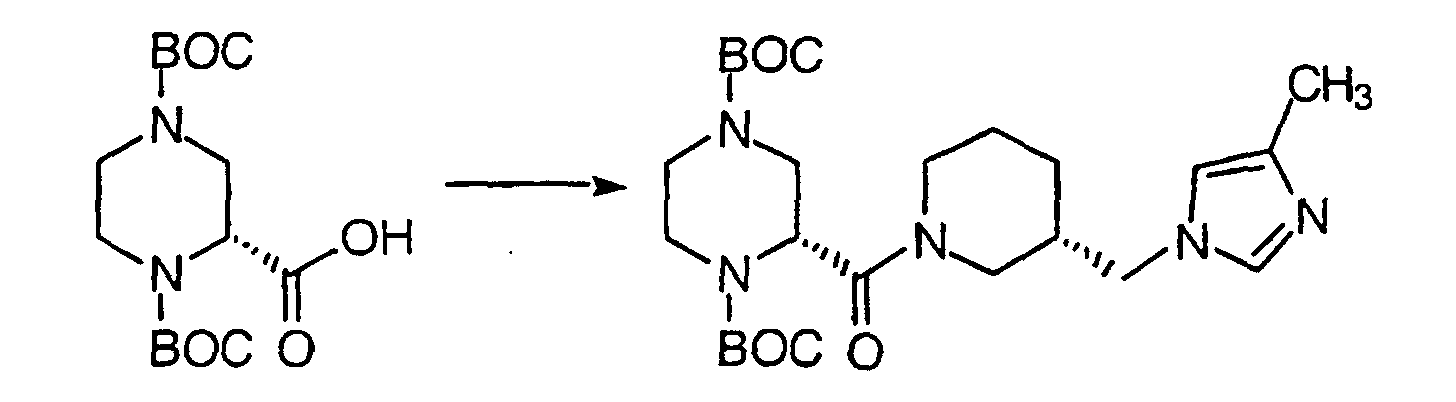
- By essentially the same procedure set forth in Example 1, only substituting the title compound from Preparative Example 2 and susbtituting the appropriate amine, the title compound was prepared.
-

- By essentially the same procedure set forth in Preparative Example 147, the title compound was prepared.
-
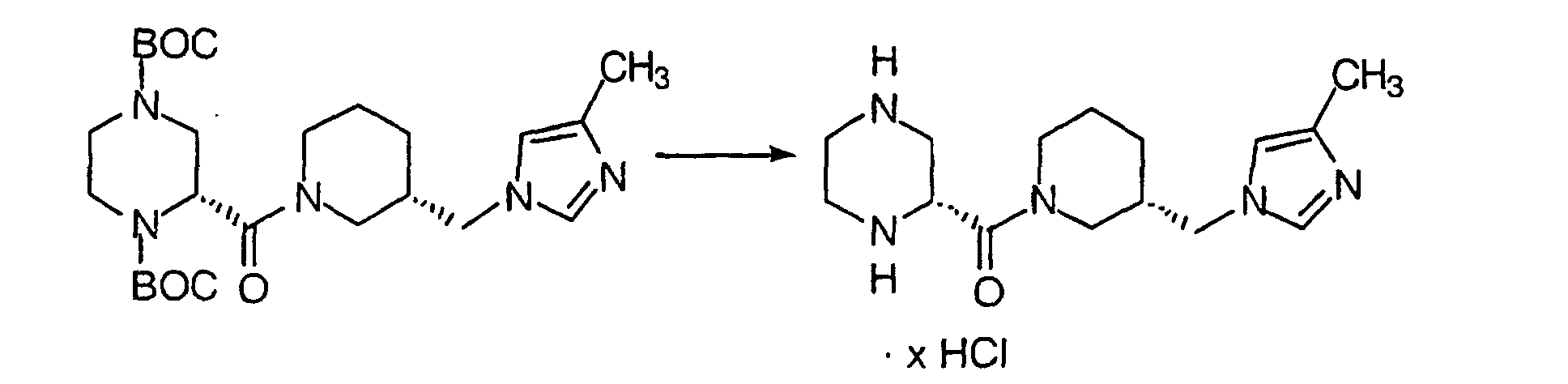
- By essentially the same procedure set forth in Preparative Example 8, the title compound was prepared and used without further purification.
-
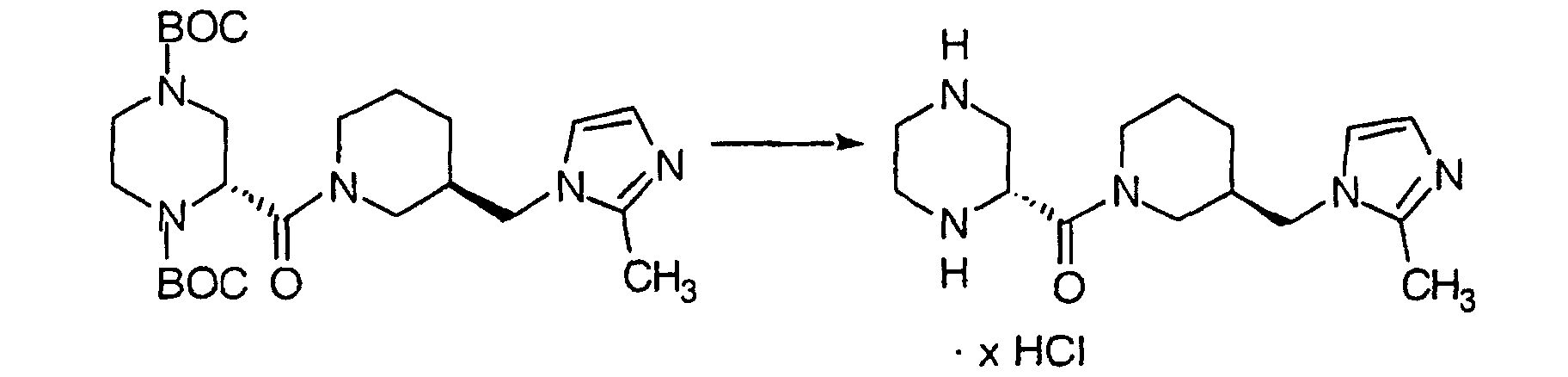
- By essentially the same procedure set forth in Preparative Example 8, the title compound was prepared and used without further purification.
-

- By essentially the same procedure set forth in Preparative Example 6, only substituting the title compounds from Preparative Example 171 and Preparative Example 99, the title compound was obtained: FABMS: MH+=519.
- By essentially the same procedure set forth in Example 14, only substituting the title compounds from the Preparative Example listed in column 2 of Table 56, the compounds of the formula shown below, with R9 as listed in column 4 of Table 56, were obtained by using the appropriate acylating agent.
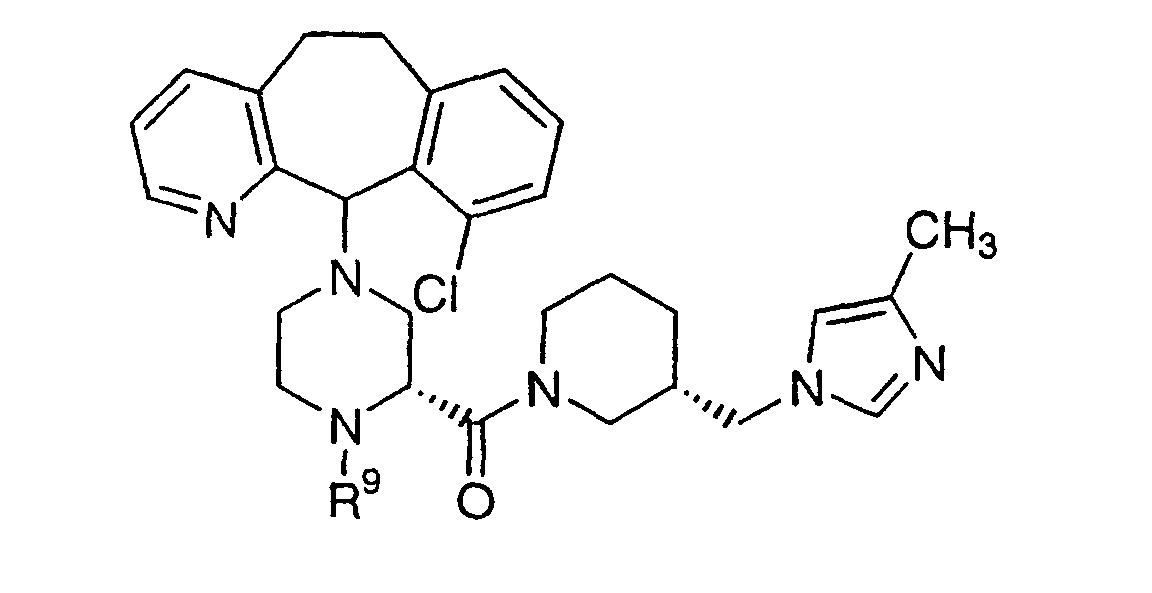
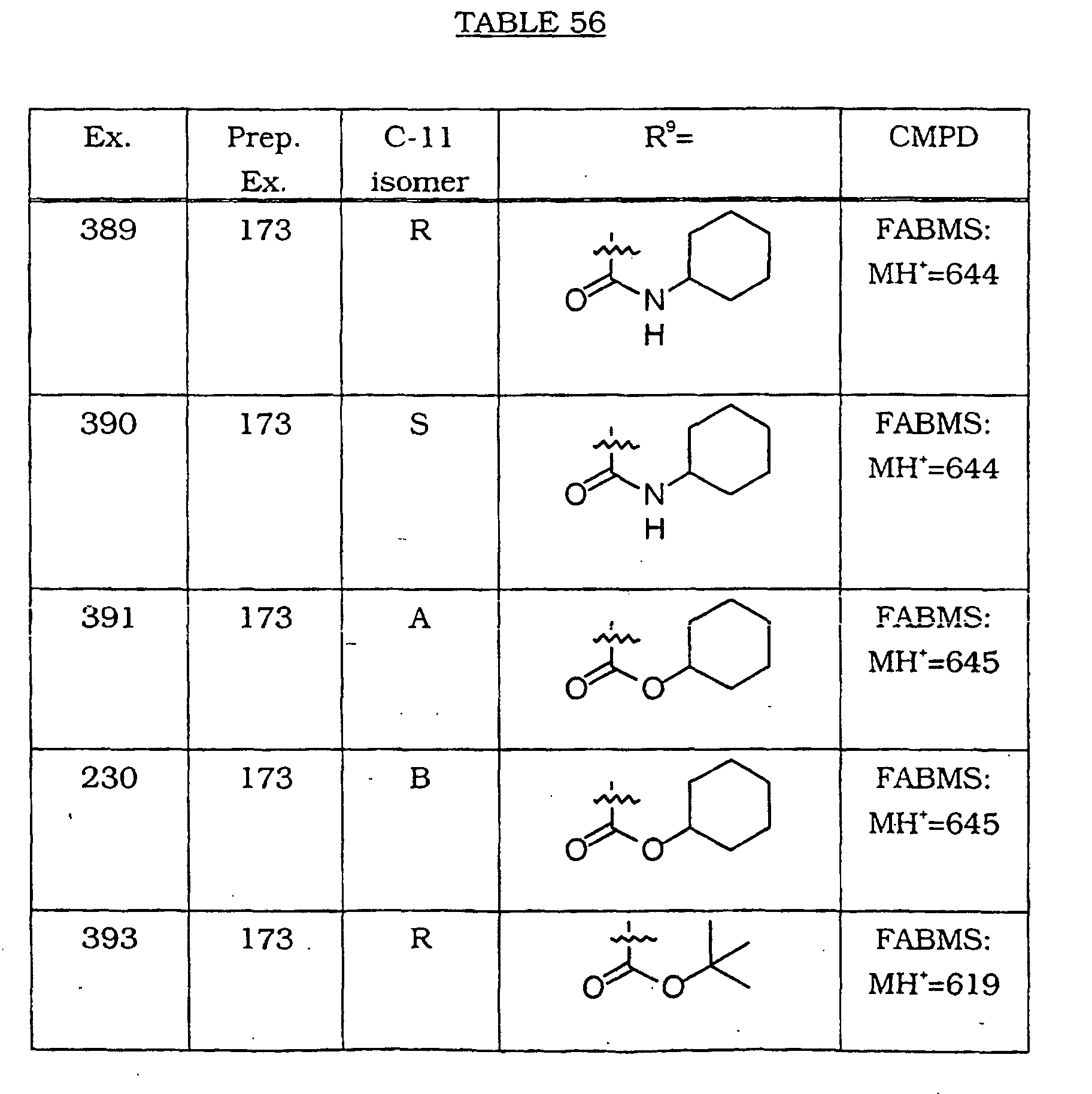

-
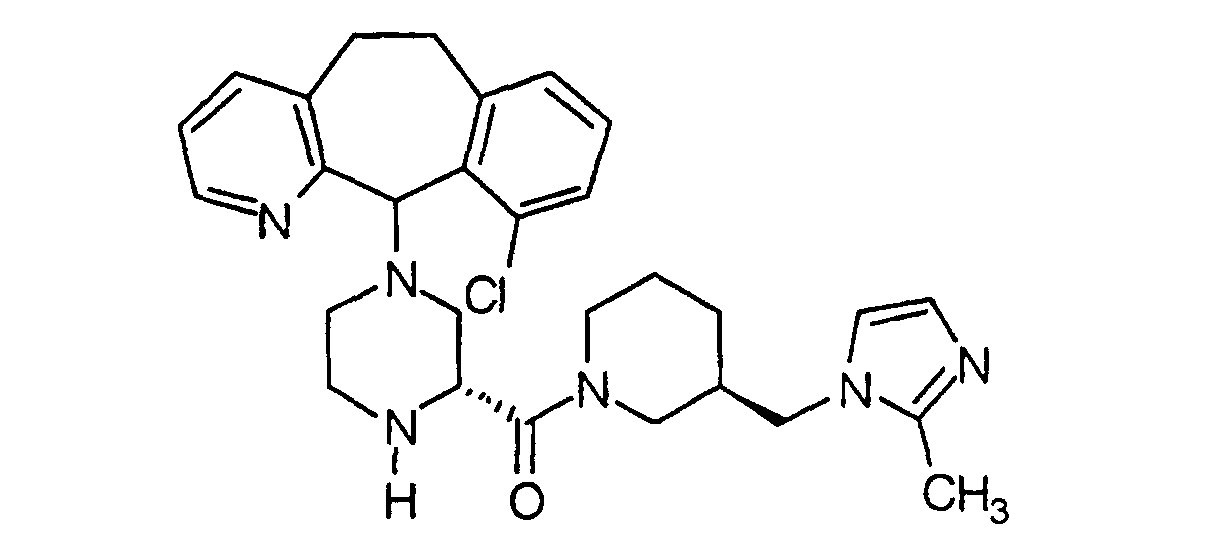
- By essentially the same procedure set forth in Preparative Example 6, only substituting the title compounds from Preparative Example 172 and Preparative Example 99 the title compound was obtained: FABMS: MH+=519.
- By essentially the same procedure set forth in Example 14, only substituting the title compounds from the Preparative Example listed in column 2 of Table 57, the compounds of the formula shown below, with R9 as listed in column 4 of Table 57, was obtained by using the appropriate acylating agent.
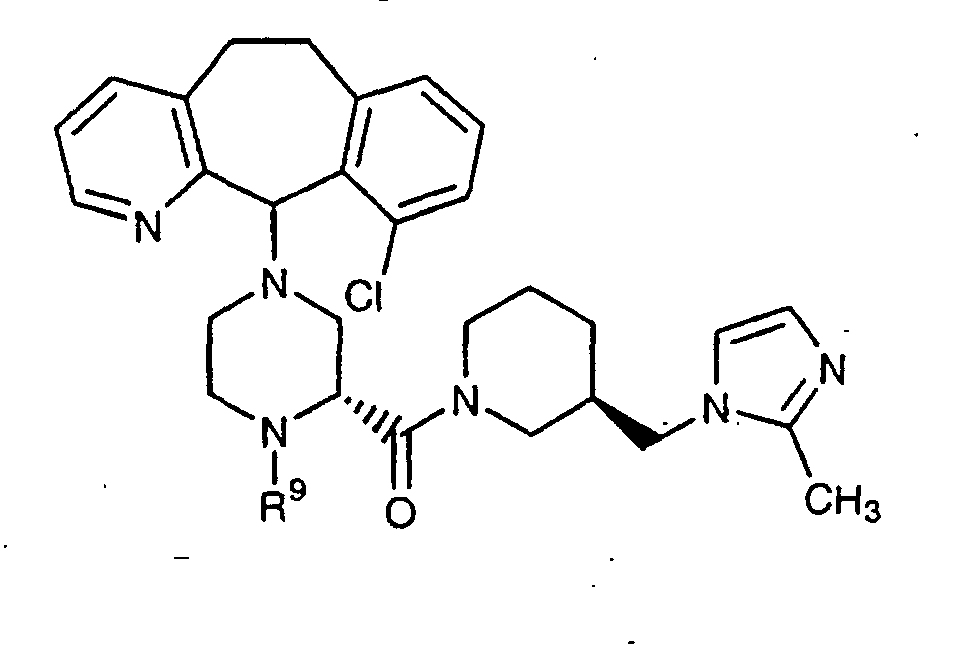

-

- The title compound from Example 165 (0.076 g) was balloon hydrogenated over 10% Pd/C (0.025 g) in EtOH (15 mL) overnight at room temperature. The catalyst and the solvent removed to give the title compound: MS MH+= 606.
- By essentially the same procedures set forth in Preparative Example 24 and Example 14, only using the title compound from Example 398, the title compounds of the formula shown below, with R9 listed in column 3 of Table 58, were obtained.


- By essentially the same procedure set forth in Example 399, compounds of the formula shown below, with R9 listed in column 4 of Table 59, were obtained.


- By essentially the same procedure set forth in Example 1, only substituting the appropriate amine, the compounds of the formula shown below, with R8 as listed in column 3 of Table 60 were obtained.

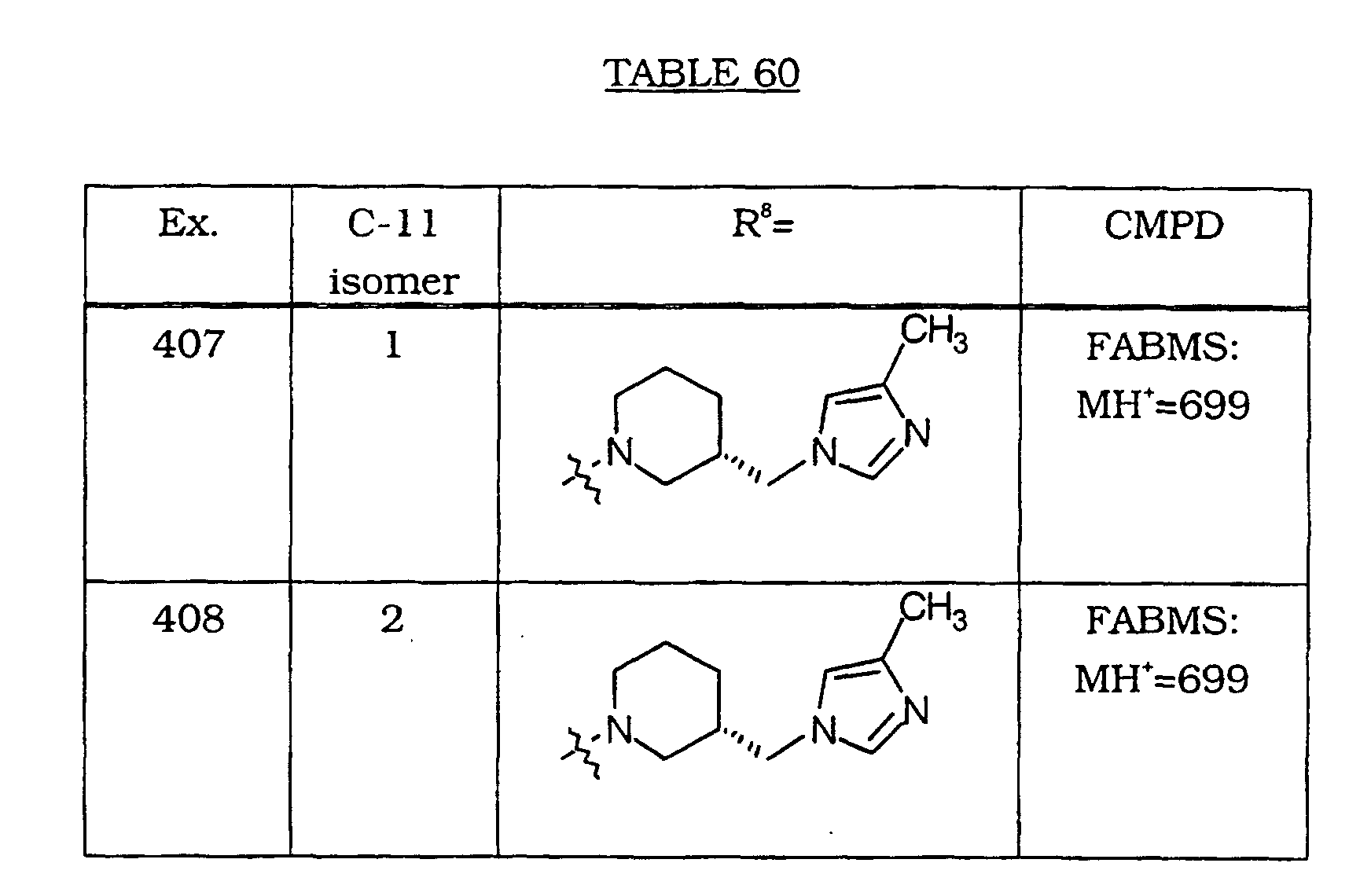
- The title compound from Example 47(CC) was separated into individual diasteromers using a CHIRALPAK AD column using a 15% iPrOH in hexanes with 0.2% DEA as eluent to give the title compounds of formula shown below wherein R8 is as defined in column 3 of Table 60A.
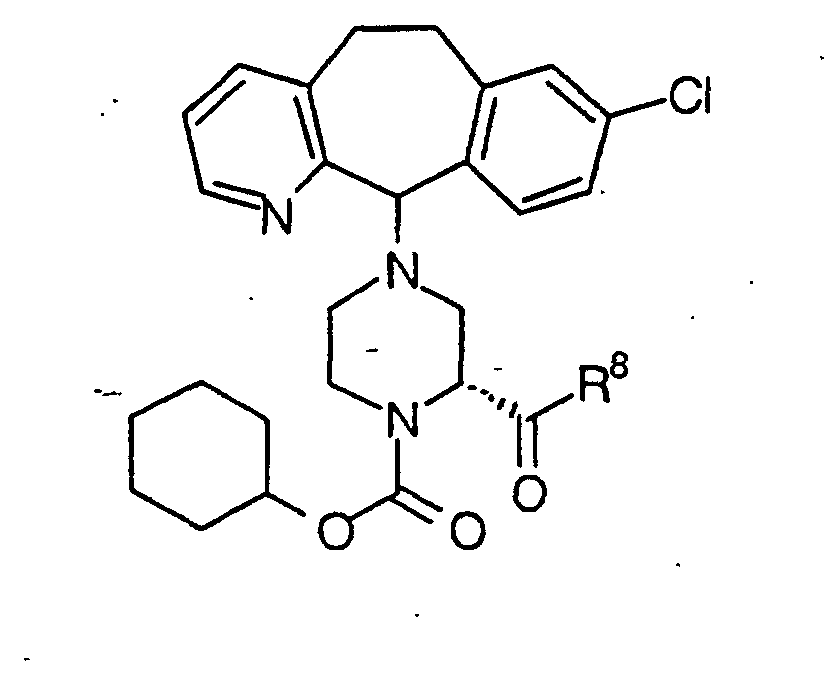 PREPARATIVE EXAMPLE 175

- By essentially the same procedure put forth in Preparative Example 115 only substituting the title compound from Example 32, the title compound was prepared.
-
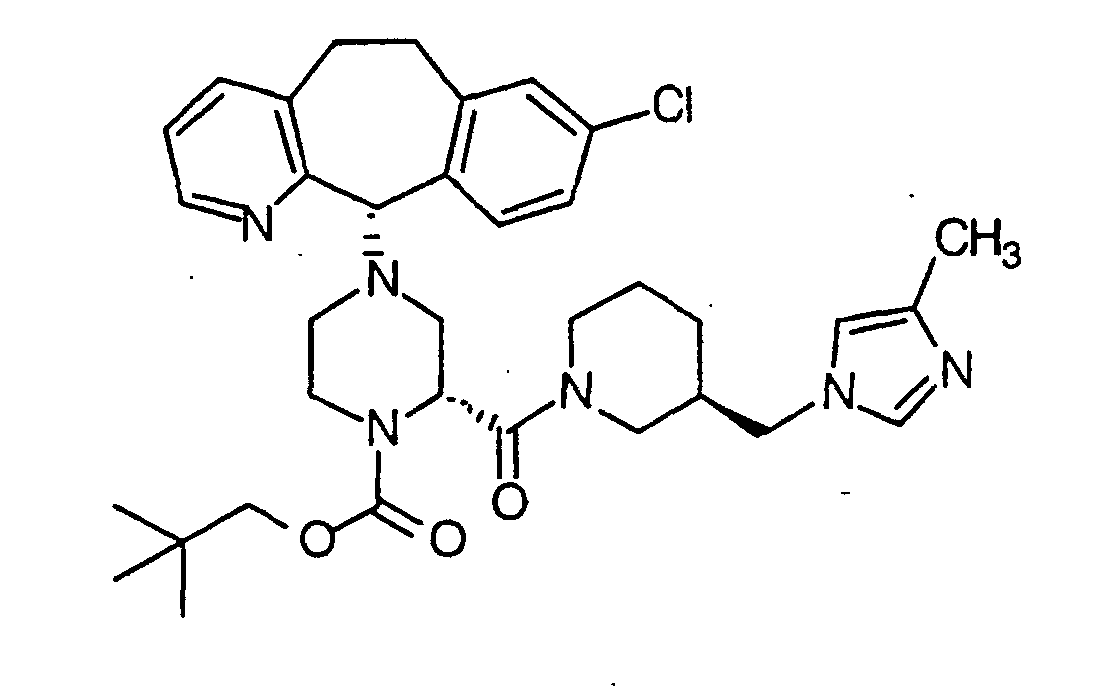
- By essentially the same procedure set forth in Example 14, only substituting the title compound from Preparative Example 175 and neopentyl chloroformate, the title compound was prepared: mp=103-115 °C; LCMS: MH+=633. ]
- The title compounds of the formula shown below with R9 as listed in column 3 of the Table 61 were prepared by essentially the same procedure as set forth in Example 1, only substituting the title compound from Preparative Example 175 and the appropriate carboxylic acid.
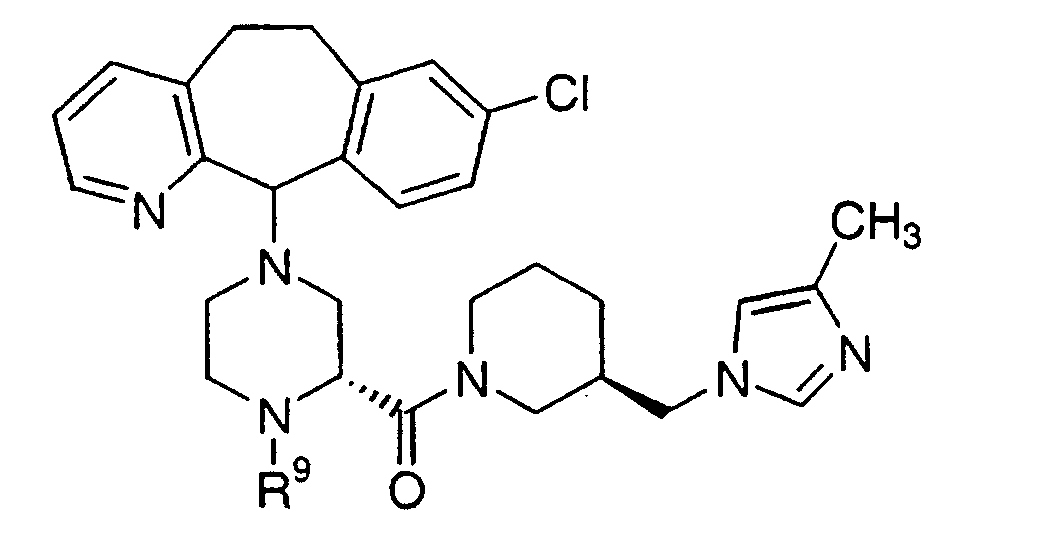

-
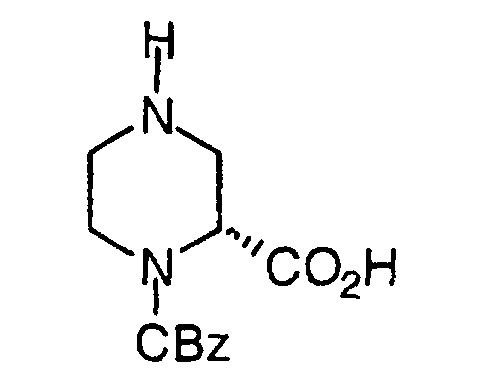
- By essentially the same procedure set forth in Preparative Example 31, Step A only substituting CBz-NOS for isopropyl chloroformate, the title compound was prepared.
-

- By essentially the same procedure set forth in Preparative Example 31, Step B only substituting the title compound from Preparative Example 175A, the title compounds (individual C-11 (S)- and (R)-isomers) were prepared.
- Example 175B: C-11 (S)-isomer, Yield=13%, MH+=492.
- Example 175C: C-11 (R)-isomer, Yield=13%, MH+=492.
-
-

- By essentially the sames procedure set forth in Preparative Example 31, Step B only substituting the title compounds from Preparative Example 97 and Preparative Example 175A, the title compounds (individual C-11 (S)- and (R)-isomers) were prepared.
- Example 175D: C-11 (S)-isomer, Yield= 12%, MH+=508.
- Example 175E: C-11 (R)-isomer, Yield=15%, MH+=508.
-
-
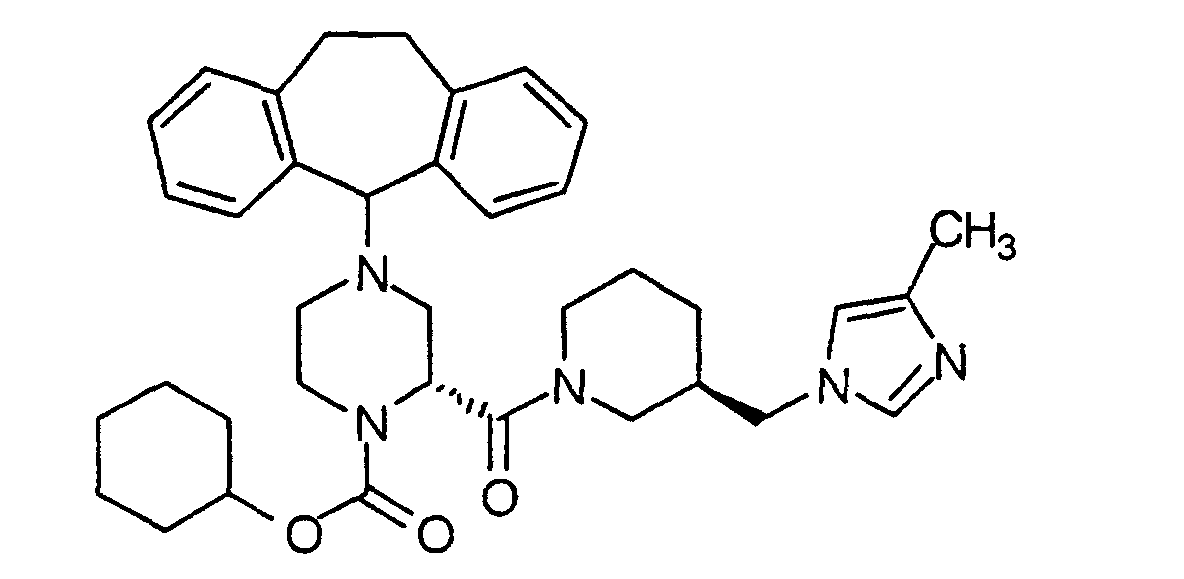
- The title compound was prepared by essentially the same procedure as set forth in Example 387, only substituting the dibenzosuberyl chloride for the tricyclic chloride: mp=98-112 °C; FABMS: MH+=610. ]
- Following essentially the same procedure set forth in Example 1, only substituting the Carboxylic acid (11-(S) or 11-(R) isomer) from the Preparative Example listed in Table 62 and the appropriately substituted piperidine (Amine), the pure isomeric products were prepared and separated by Preparative HPLC (AD column) using IPA-hexanes.
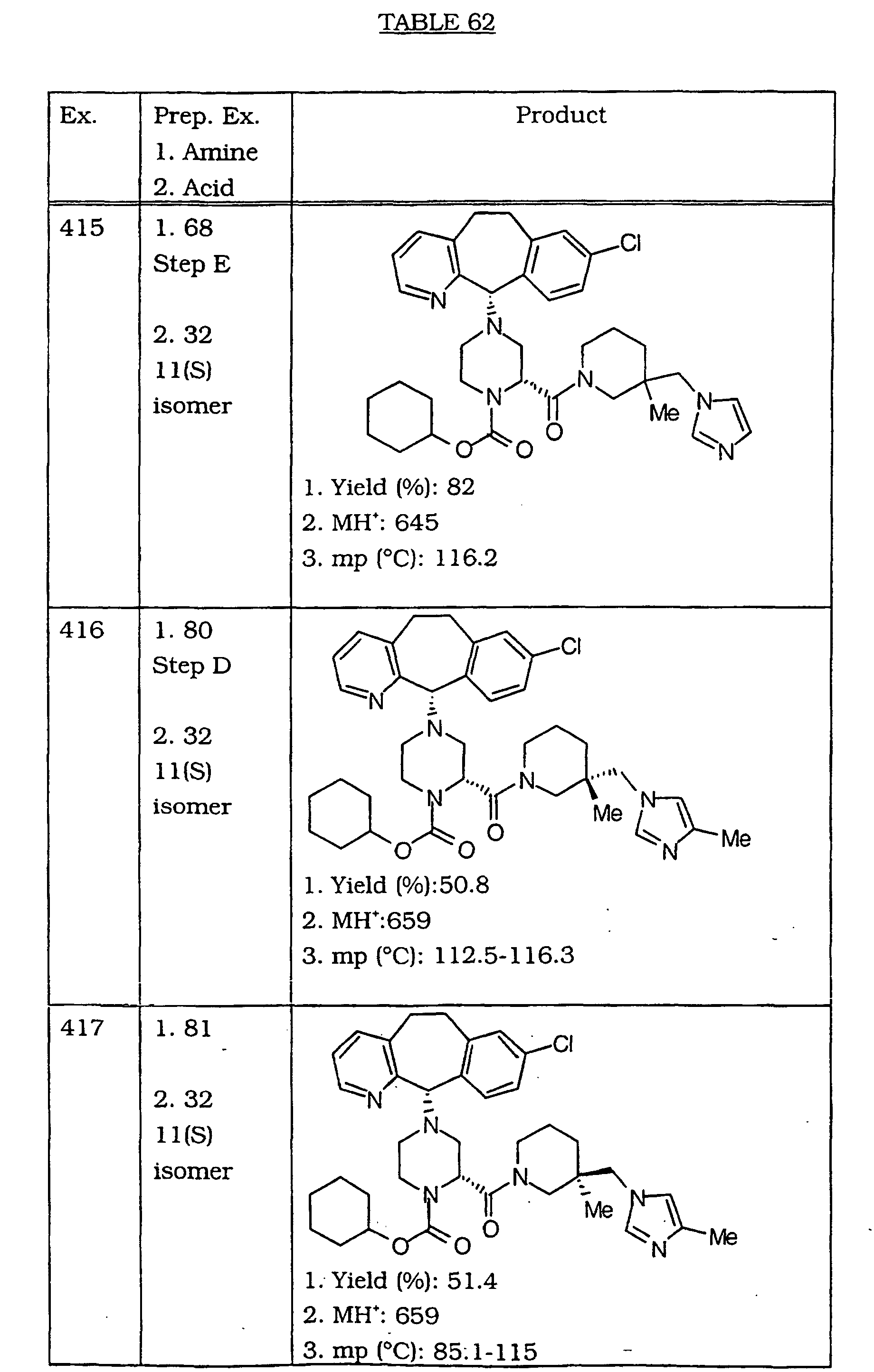

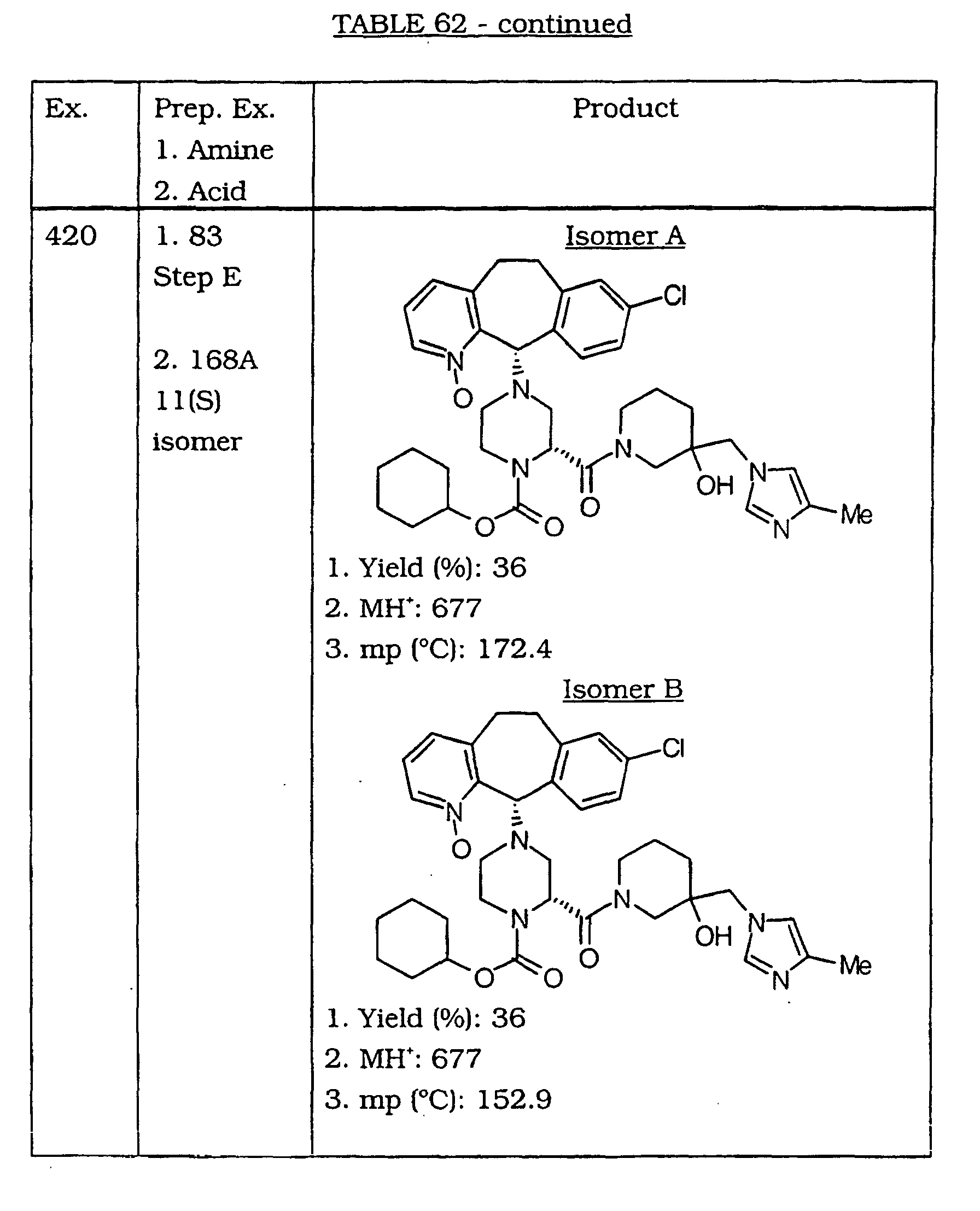
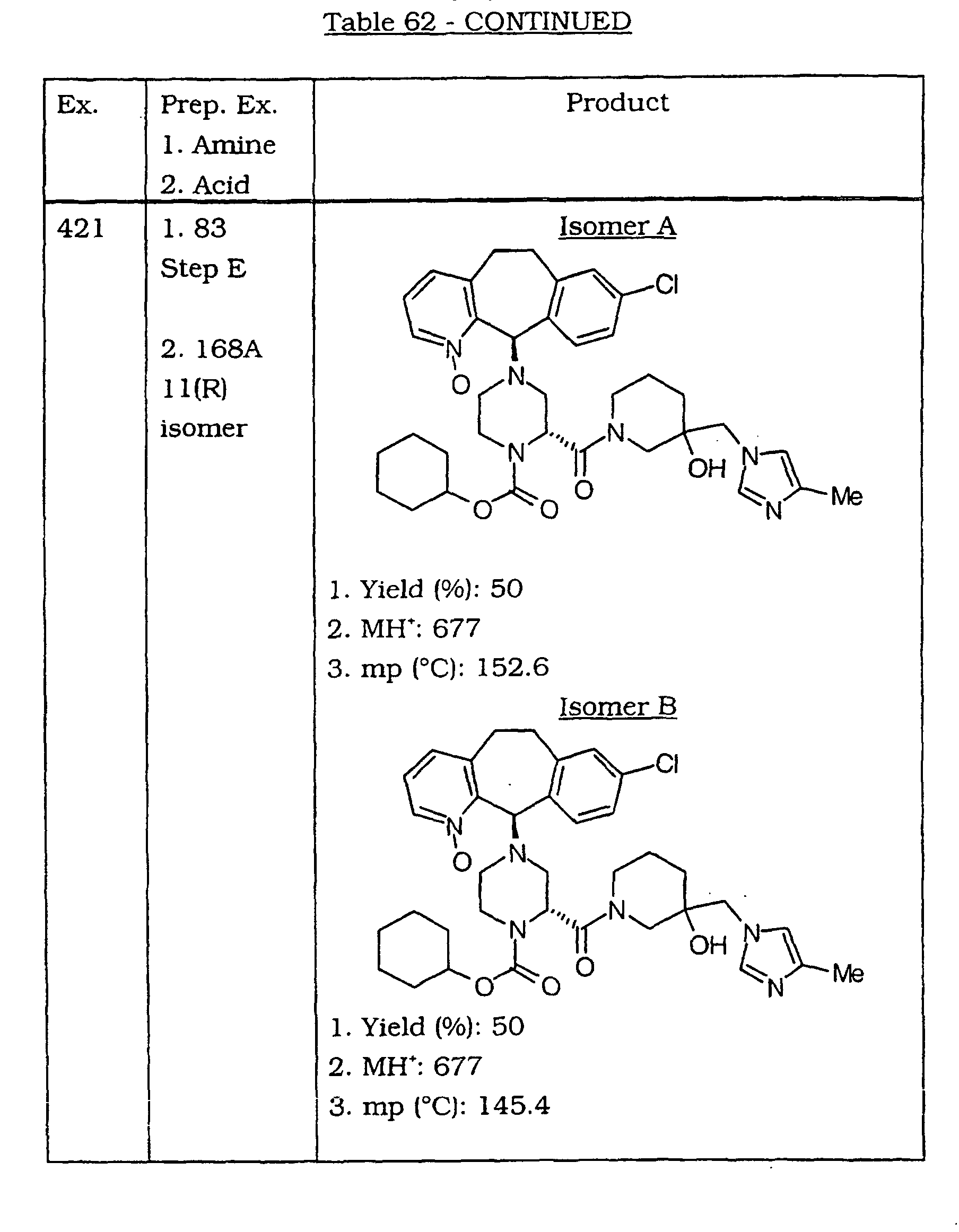


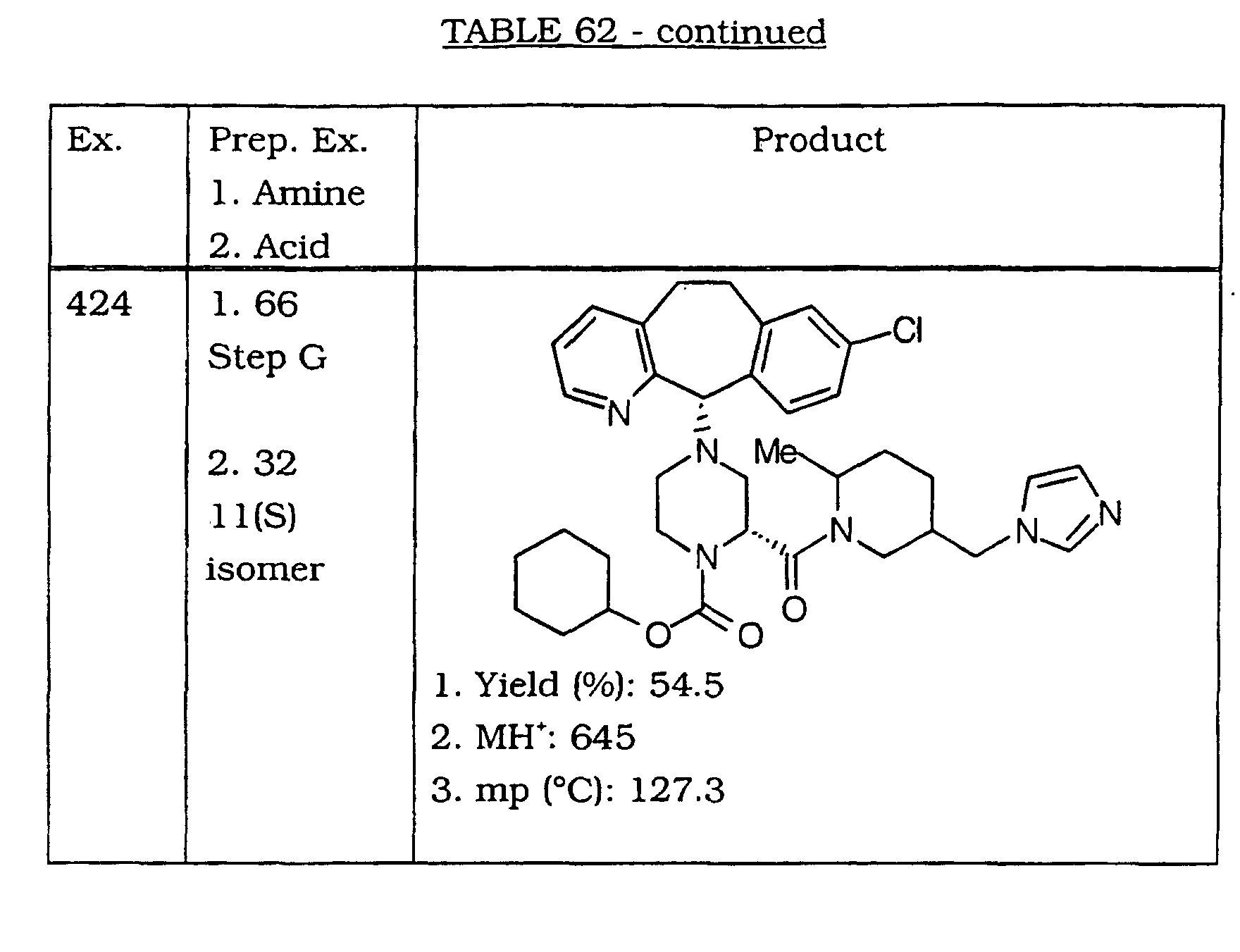
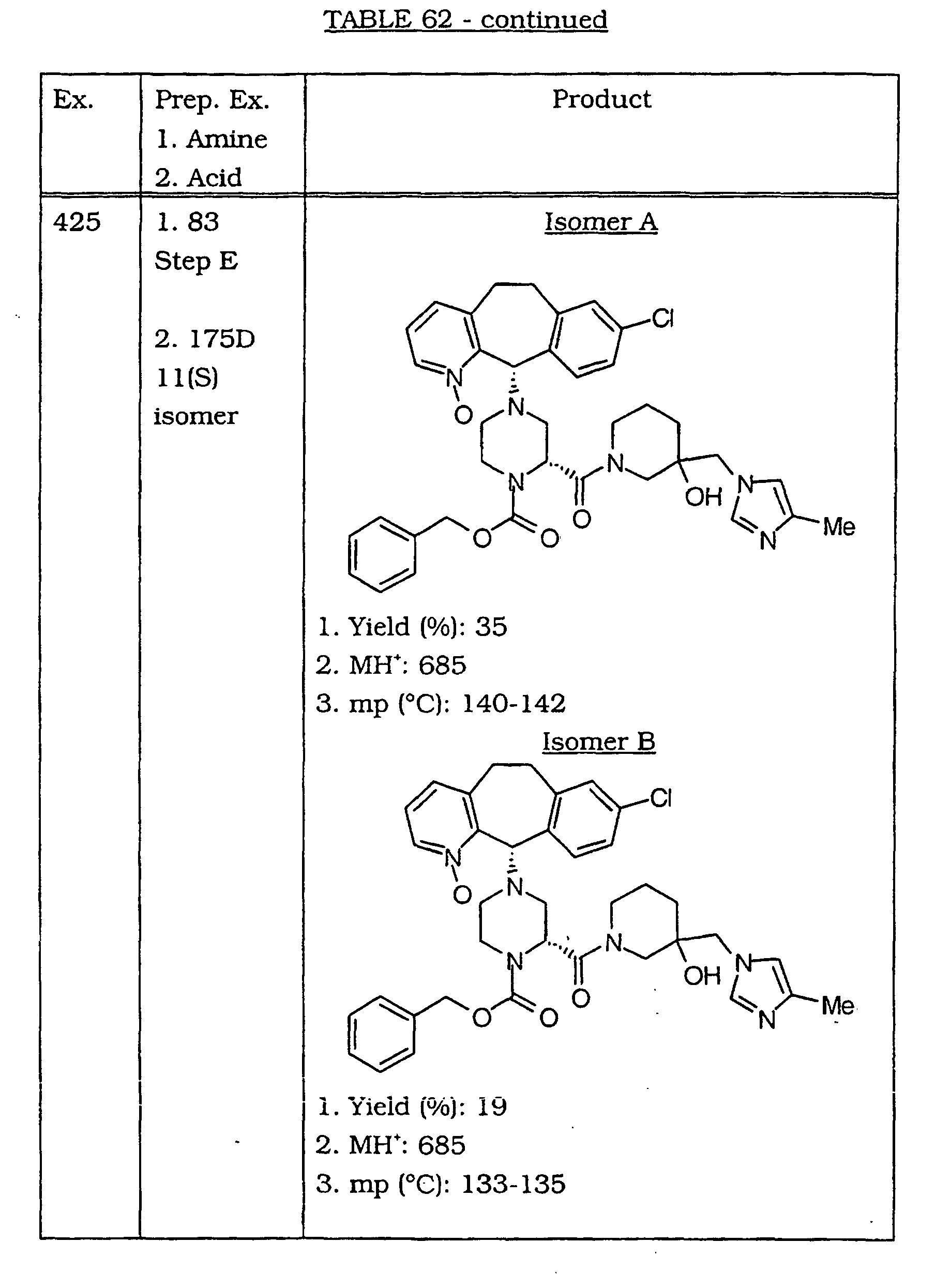
- Stirring the benzyloxycarbonyl (CBZ) compounds listed in Column 2 of Table 63 and Palladium on carbon catalyst in EtOH under 1 atmosphere of hydrogen gas afforded the Product amines.


-

- By essentially the same procedure as set forth in Example 14, only substituting the piperazine amines (isomer A or B) listed in column 2 of Table 64 for the title compound from Preparative Example 24, and using as the Electrophile either an isocyanate to give the urea products, or a carboxylic acid, HOBt, DEC and DMF to give the amide products listed in Table 64.

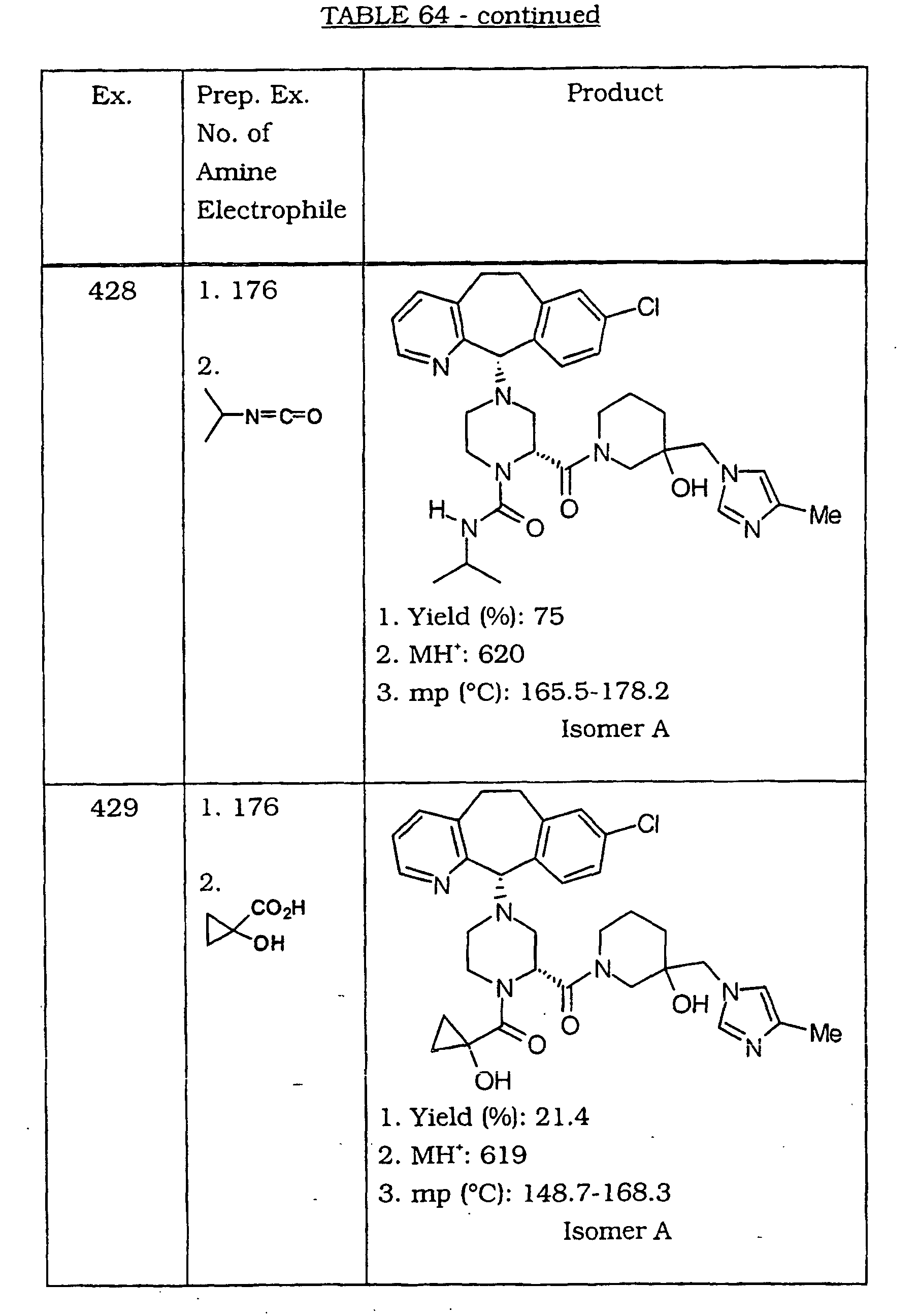
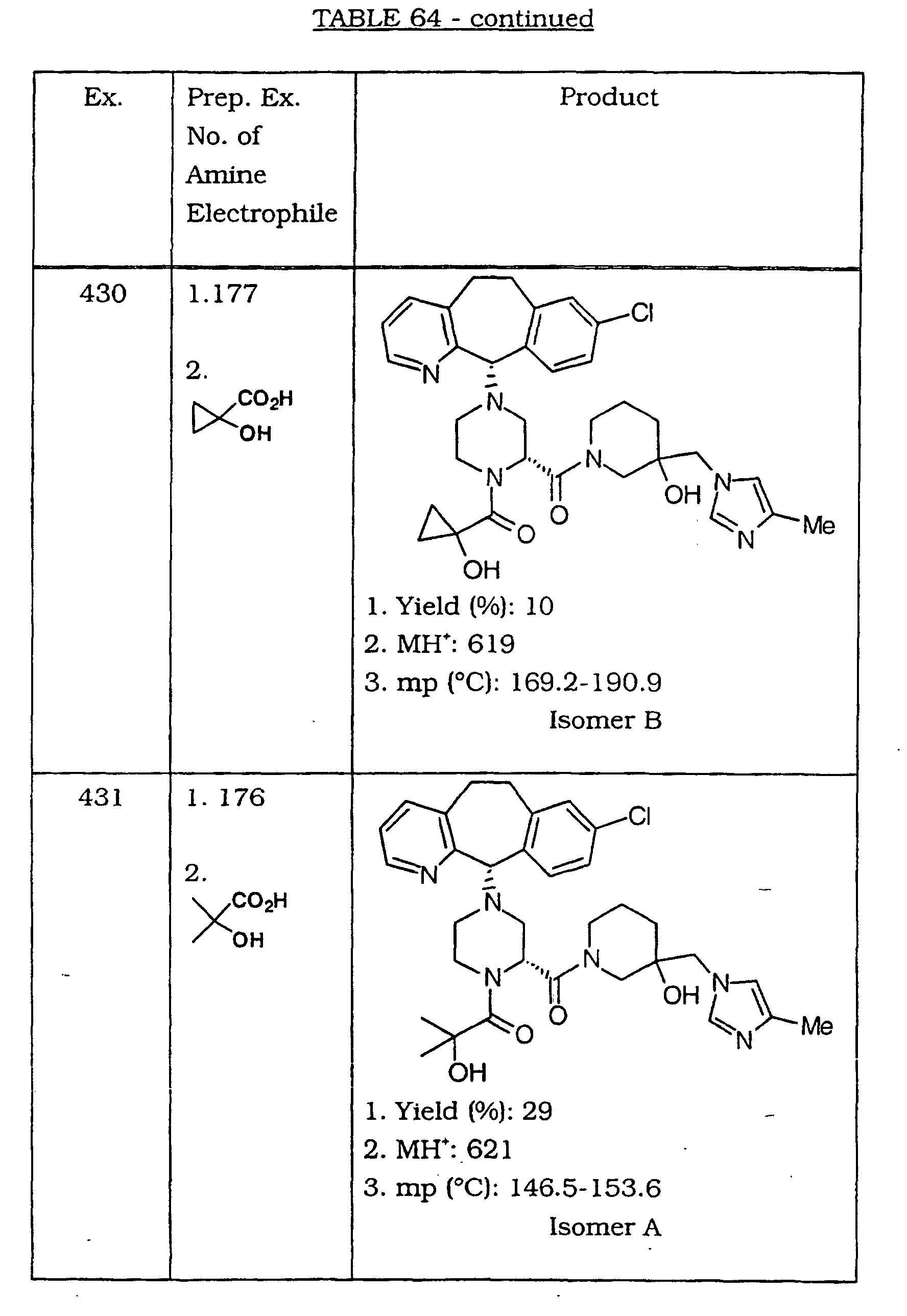
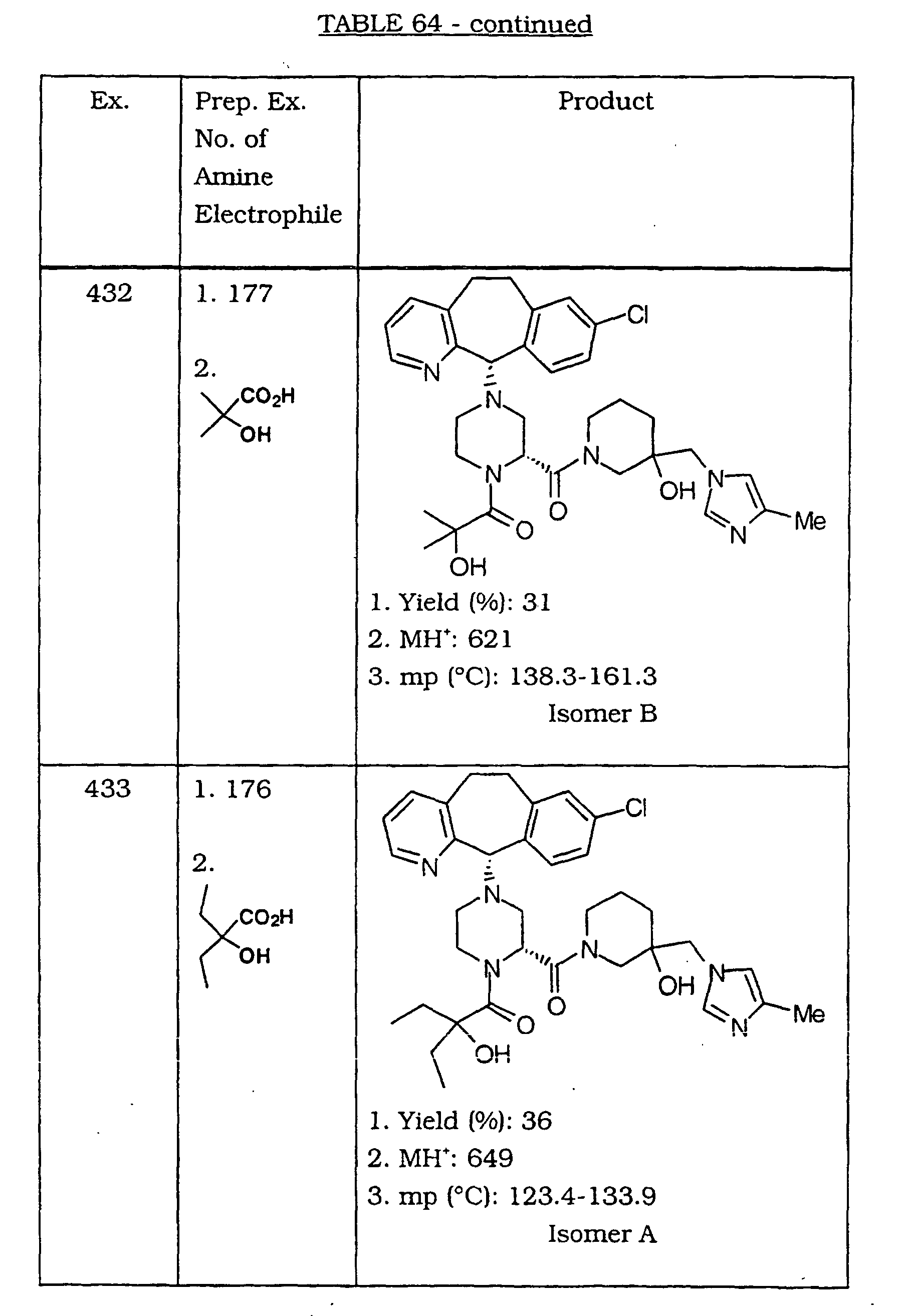


-

- If the procedure described for Example 426 were followed using the piperazine amines (isomer A or B) listed in column 2 of Table 65 and, as the Electrophile, either an isocyanate, or a carboxylic acid and HOBt, DEC and DMF, then the urea or amide products, respectively, listed in Table 65 would be obtained.

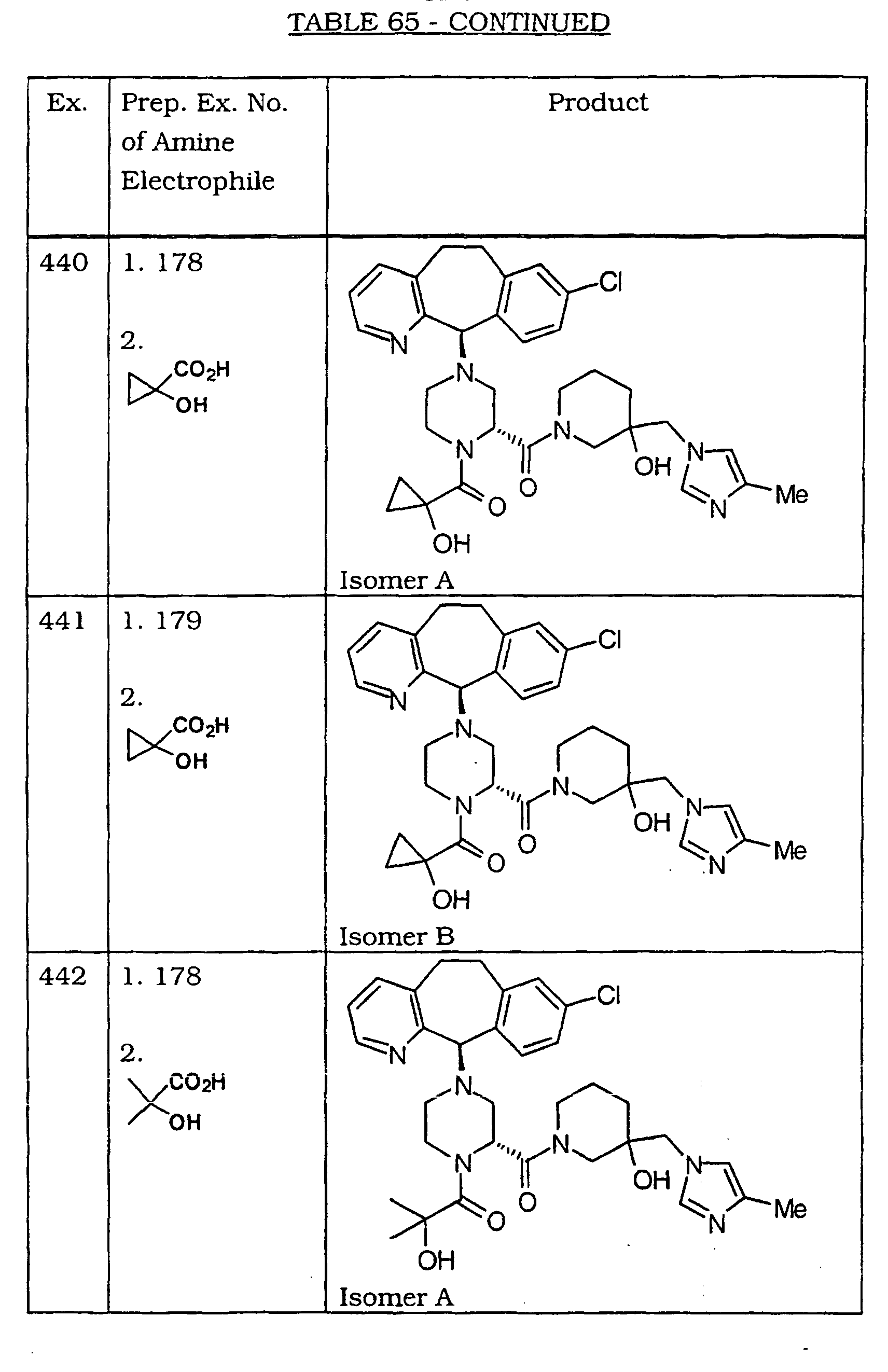
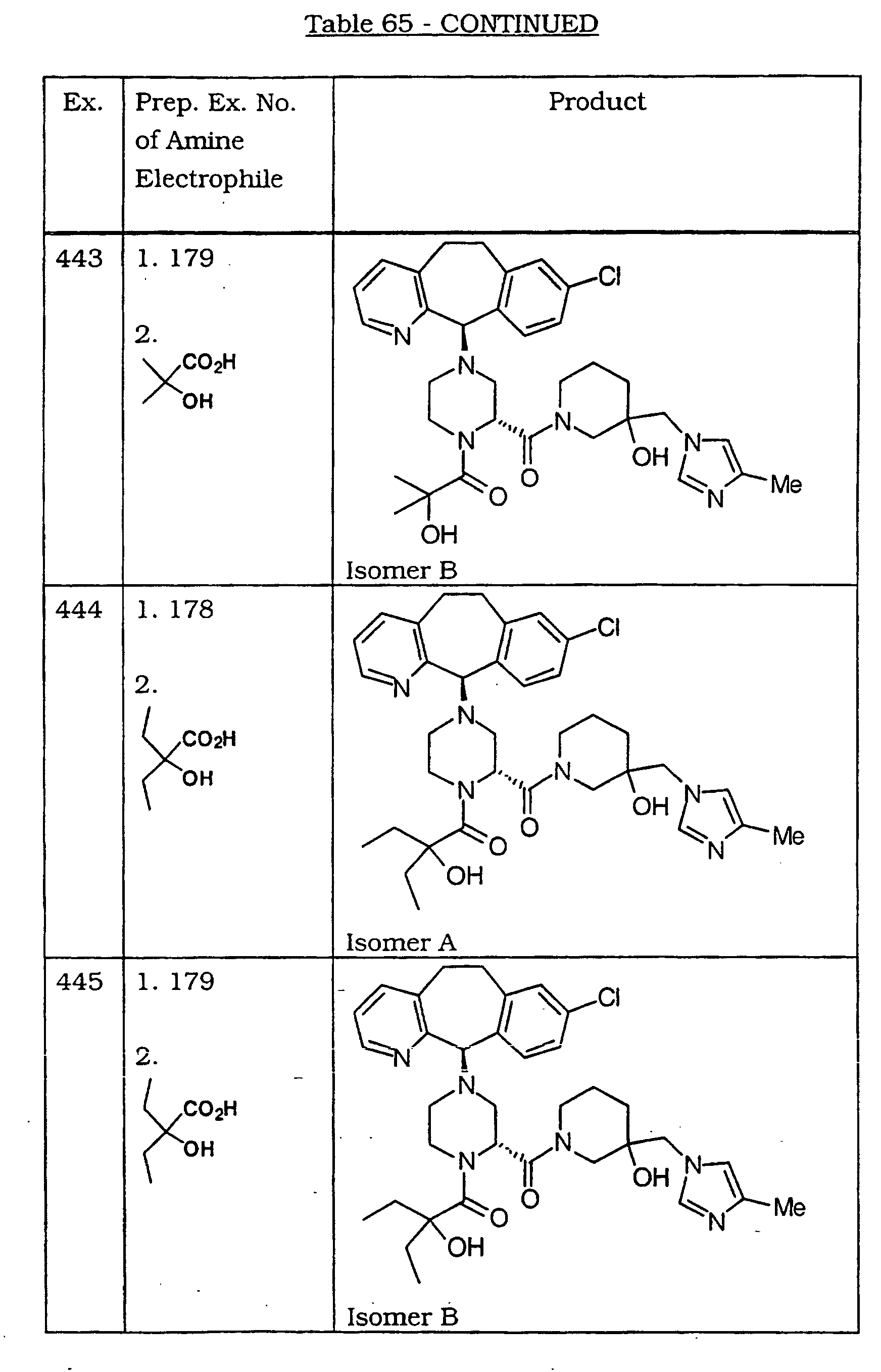

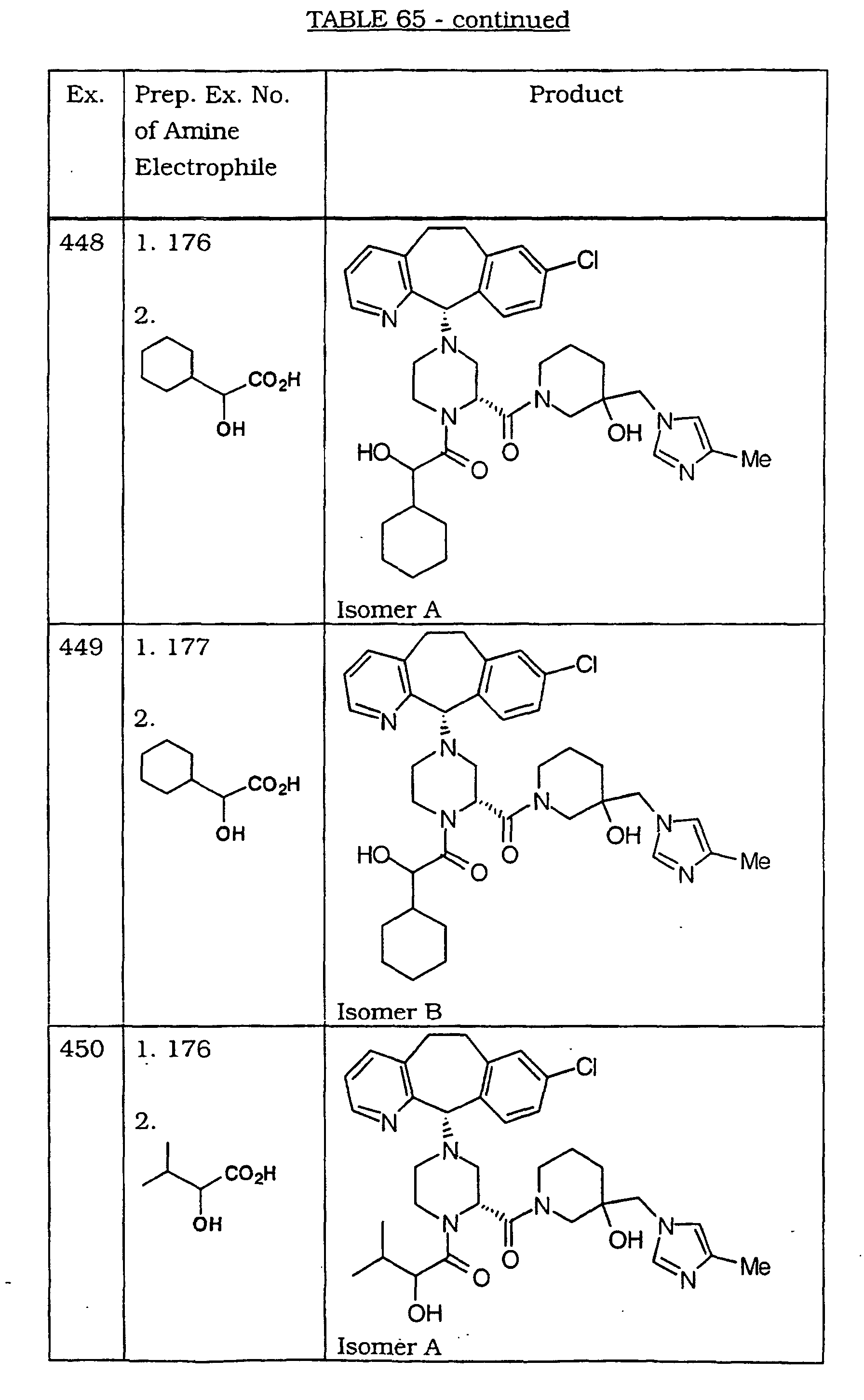

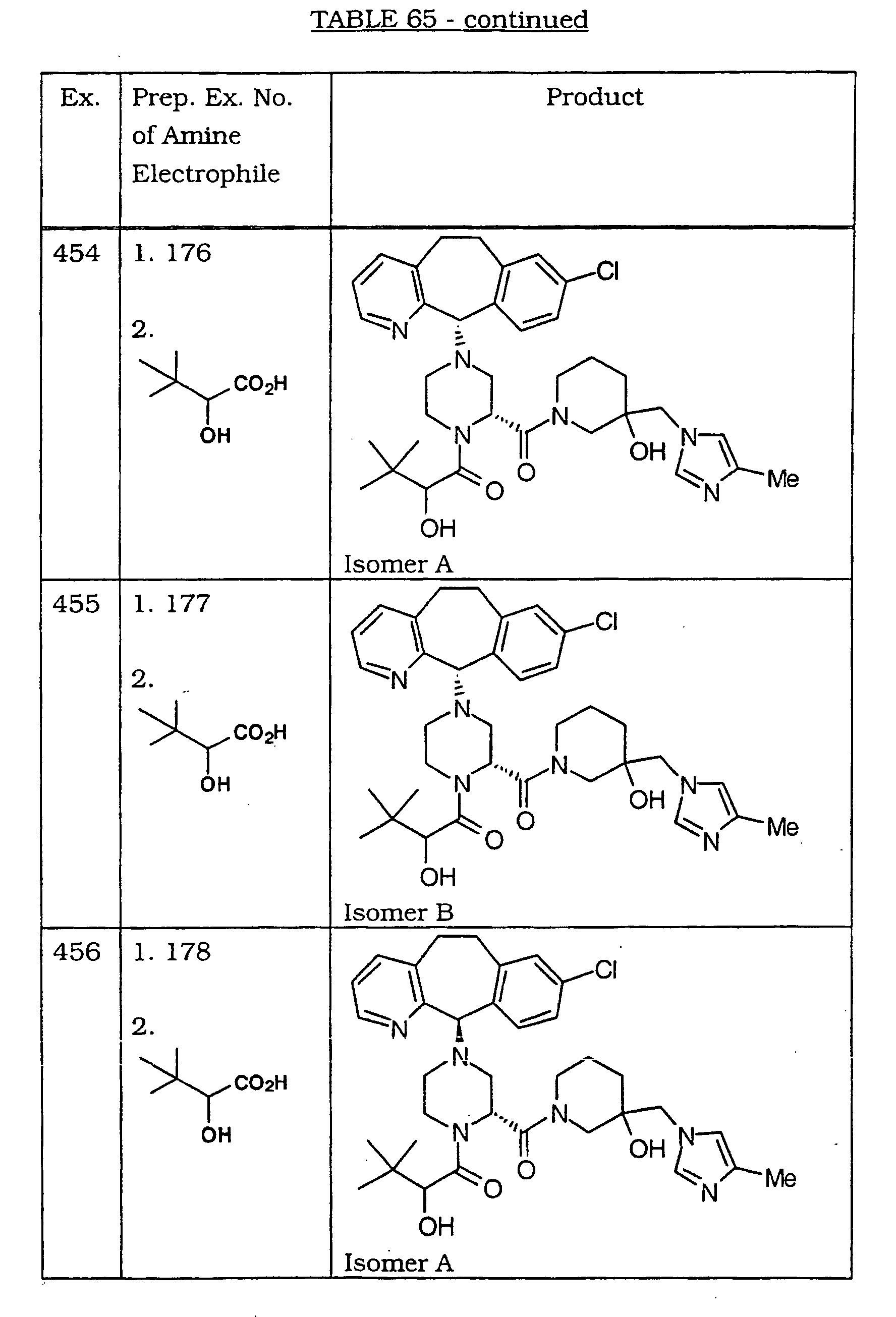
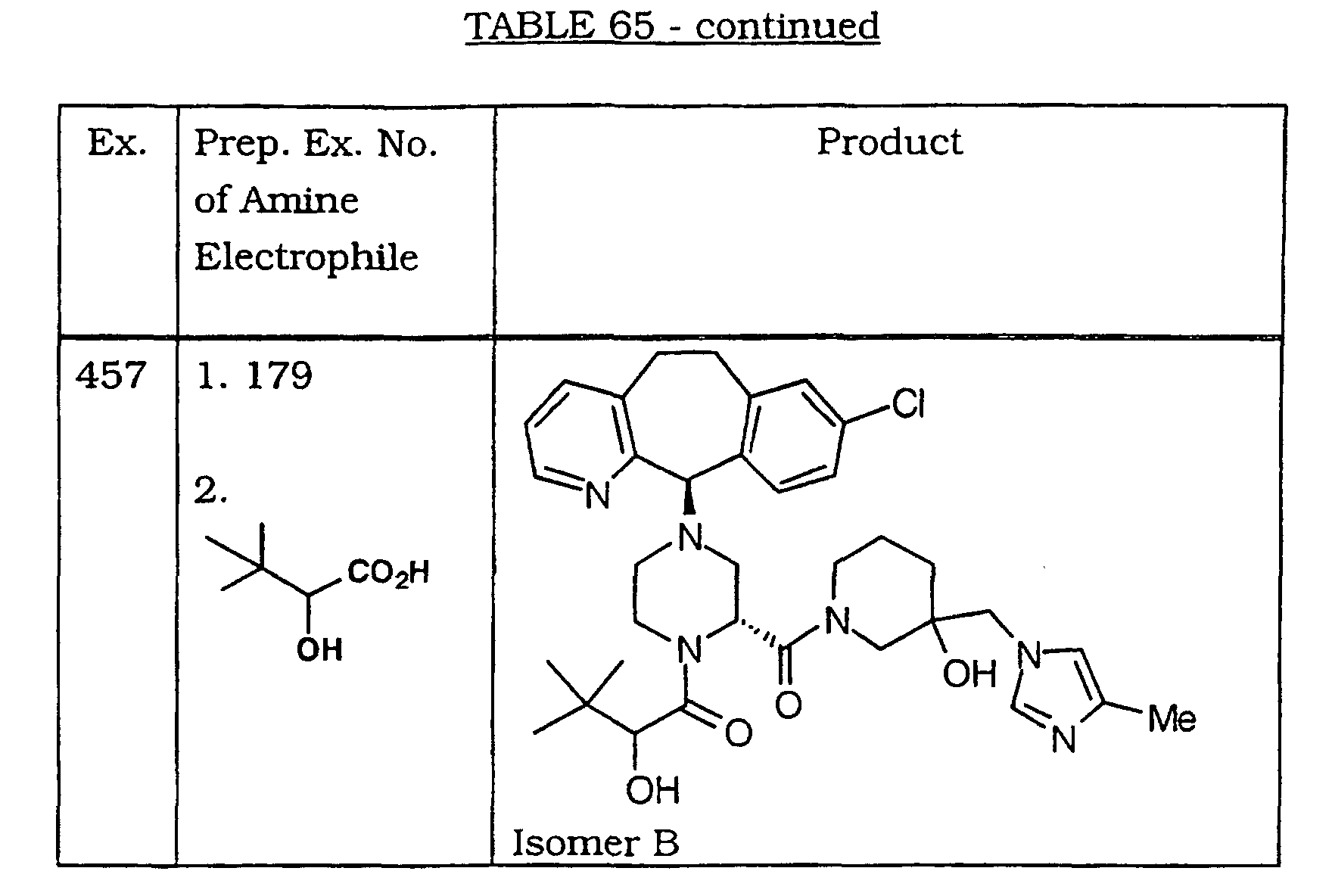
- Using a similar procedure as that described for Example 14, only using the piperazine amine from Preparative Example 175 instead of the title compound from Preparative Example 24, and using as the Electrophile either a chloroformate to give a carbamate or an anhydride, or a carboxylic acid, HOBt, DEC and DMF to give the amide products listed in Table 66.
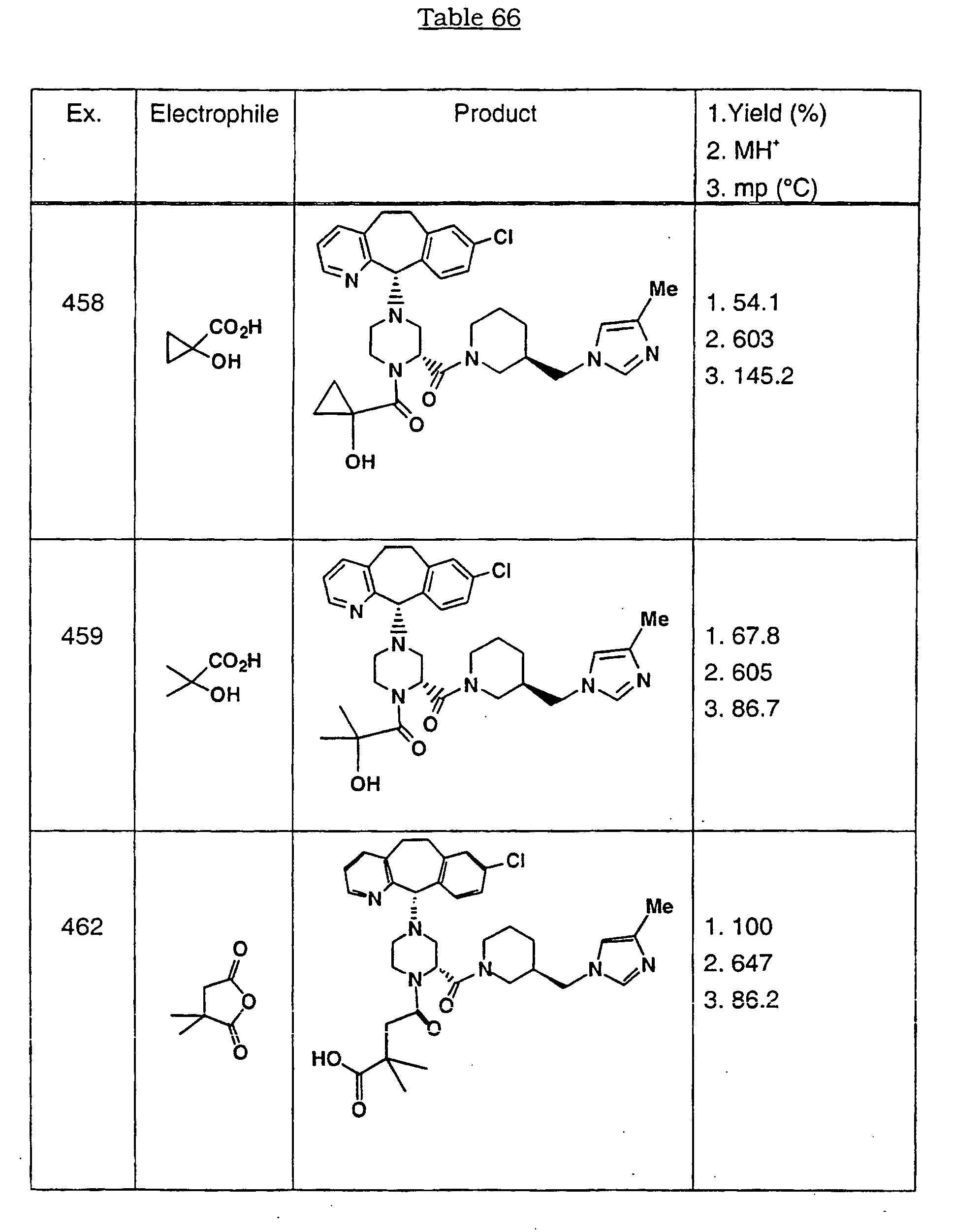 PREPARATIVE EXAMPLE 180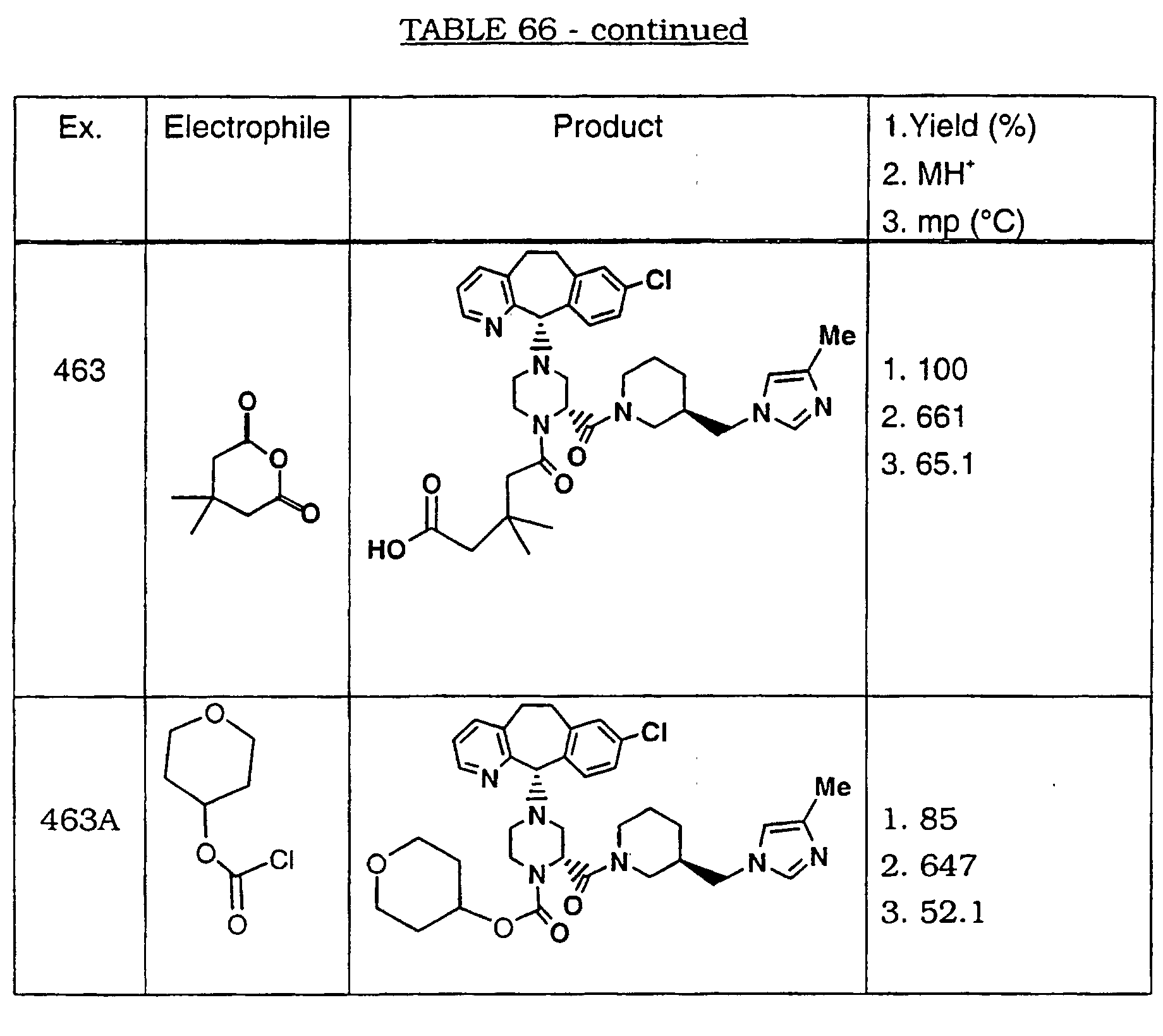
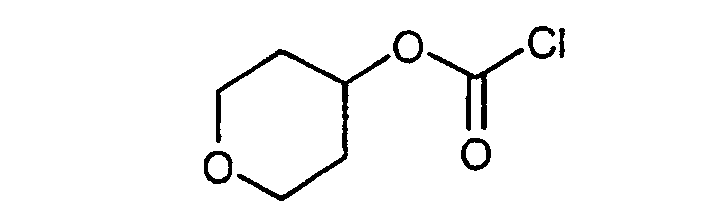
- Following essentially the same procedure as that used in Example 466 Step A, except using tetrahydro-4H-pyran-4-ol, the title compound was prepared (3.1g, 78%, MH+=165).
-
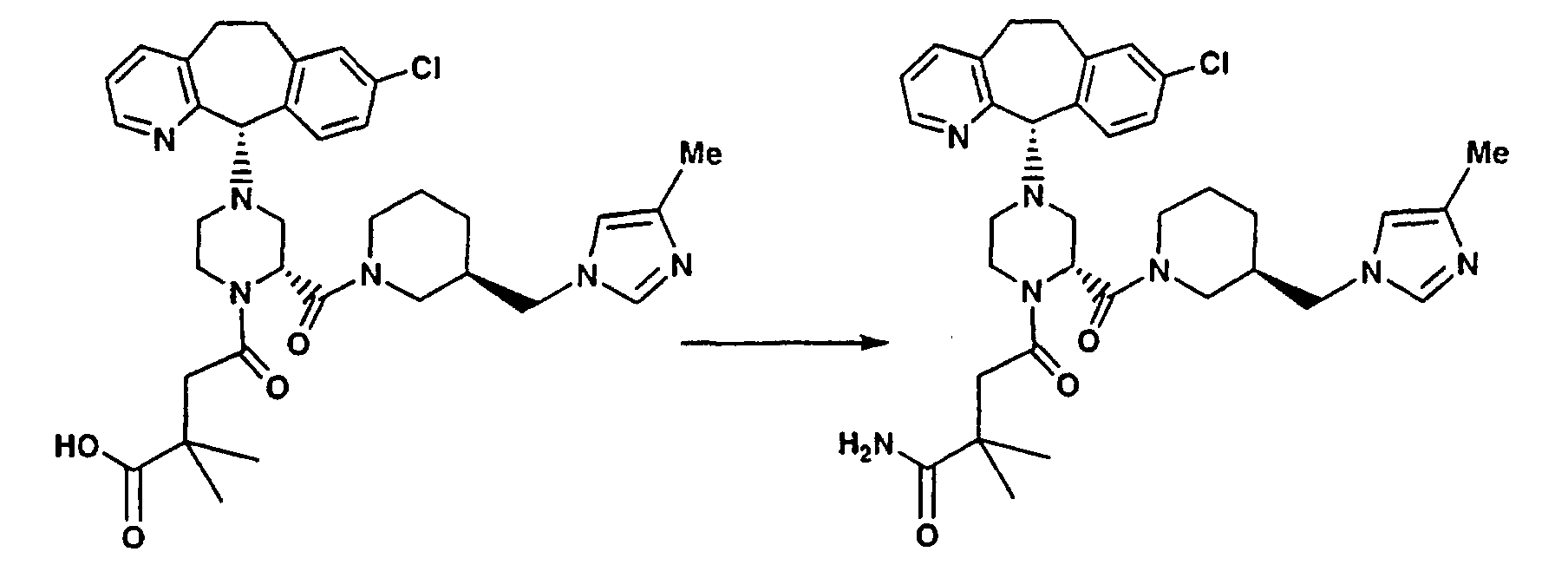
- The title compound from Preparative Example 462 (0.205 g), 0.5M ammonia in dioxane (2 mL), DEC (0.175 g), HOBt (0.123 g) and anhydrous DMF (5 mL) were stirred at room temperature overnight. Purification by preparative plate chromatography (silica, 5% MeOH-CH2Cl2, NH4OH saturated) afforded the title compound (0.136 g, 66%, MH+ = 646).
-
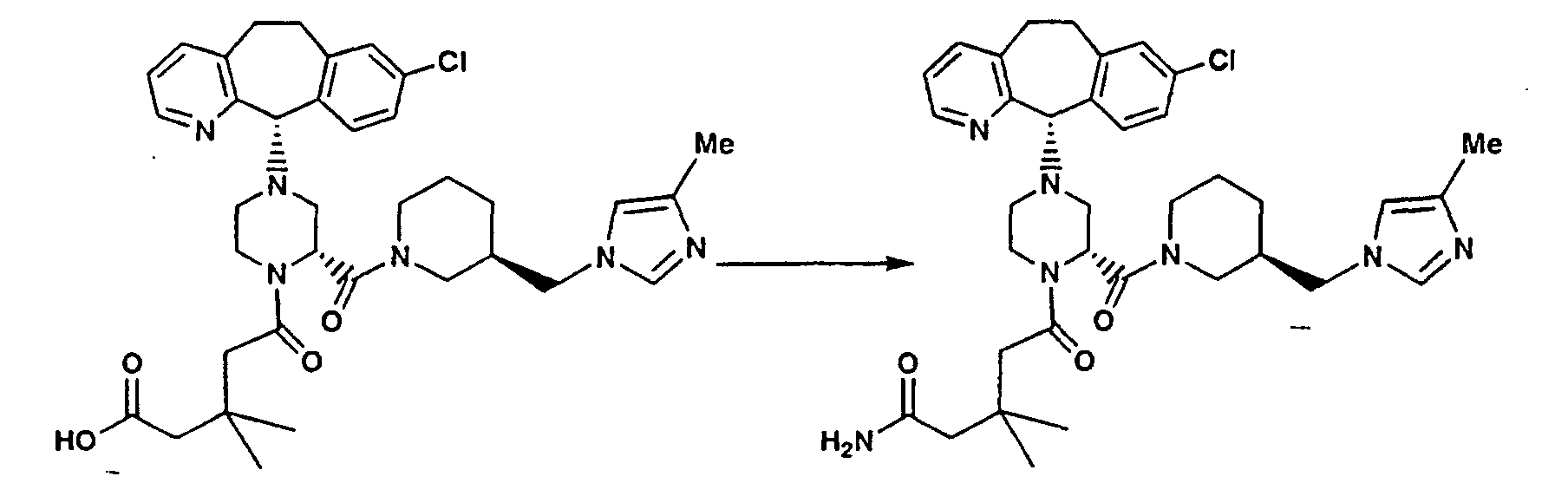
- The title compound from Preparative Example 463 (0.228 g), 0.5M ammonia in dioxane (2 mL), DEC (0.175 g), HOBt (0.123 g) and anhydrous DMF (5 mL) were stirred at room temperature overnight. Purification by preparative plate chromatography (silica, 5% MeOH-CH2Cl2, NH4OH saturated) afforded the title compound (0.139 g, 61%, MH+ = 660).
-
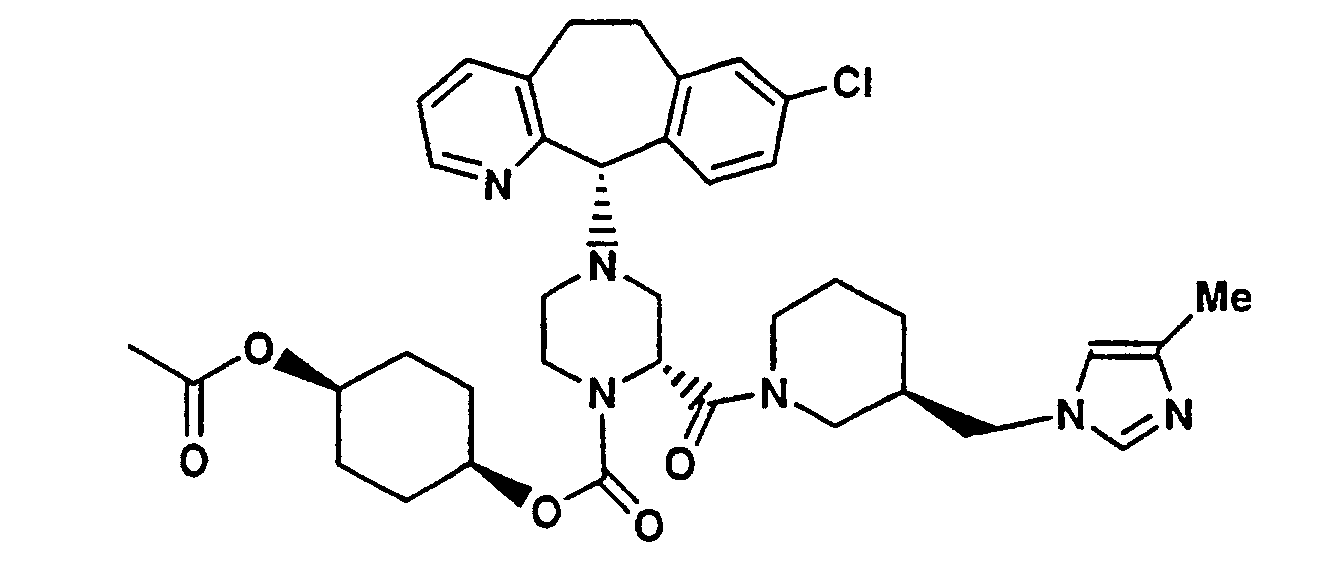
-

- The commercially available cis-acetoxycyclohexanol (0.25 g) was treated with phosgene (2 mL). Concentration in vacuo afforded the chloroformate (0.307 g, 88%).
-
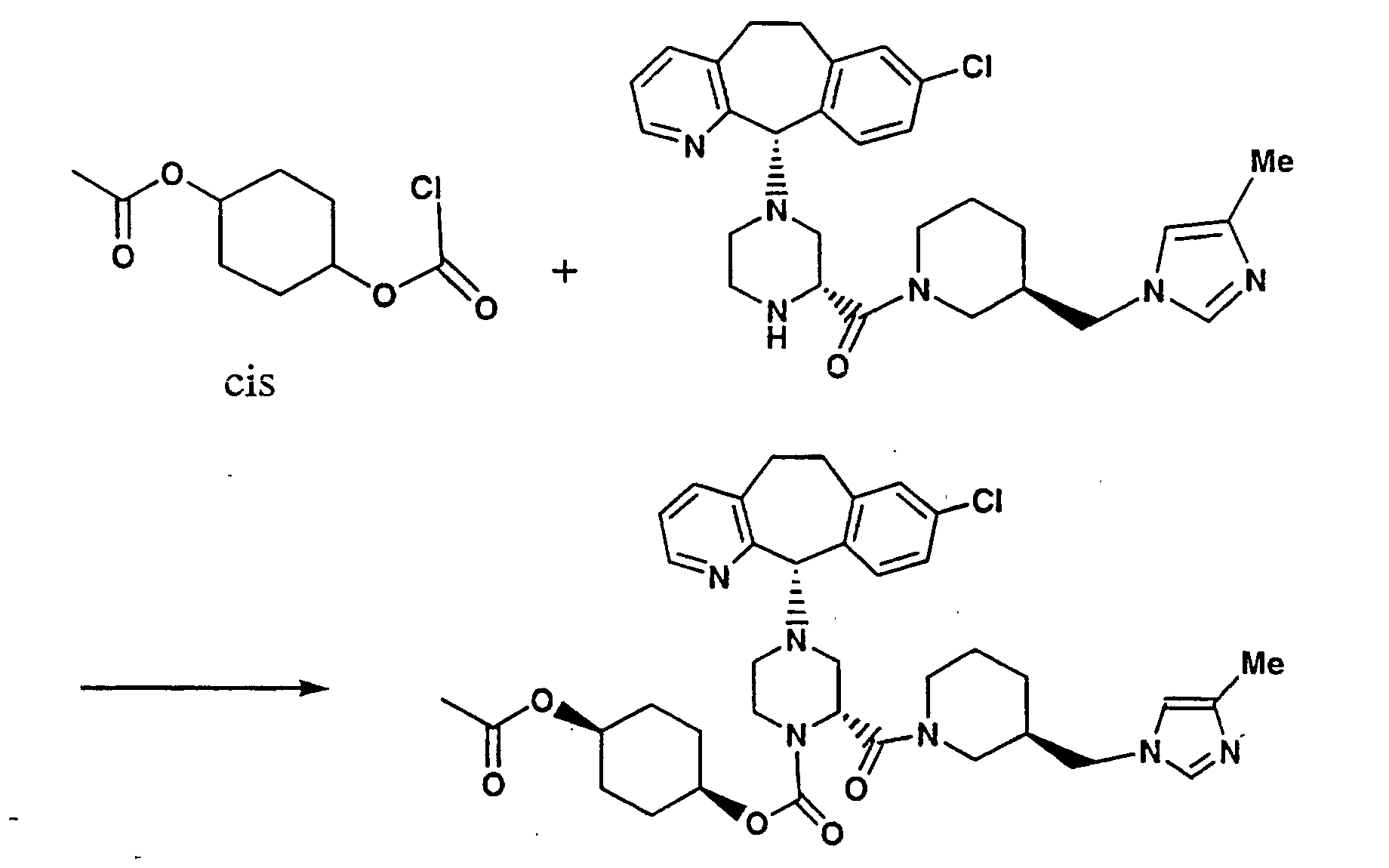
- Combining the chloroformate (0.052 g) from Step A with the piperazine amine (0.103 g) from Preparative Example 175 and following a similar procedure as that described in Example 14, the title compound was obtained (0.07 g, 50%, MH+ = 703).
-

- Treatment of the product from Example 466 (0.06 g) with potassium carbonate (0.2 g) in MeOH (2 mL) afforded the title compound (0.056 g, 100%, MH+ = 661).
-

-

- The commercially available trans-acetoxycyclohexanol (0.05 g) was treated with phosgene (0.5 mL). Concentration in vacuo afforded the chloroformate (0.062 g, 89%).
-
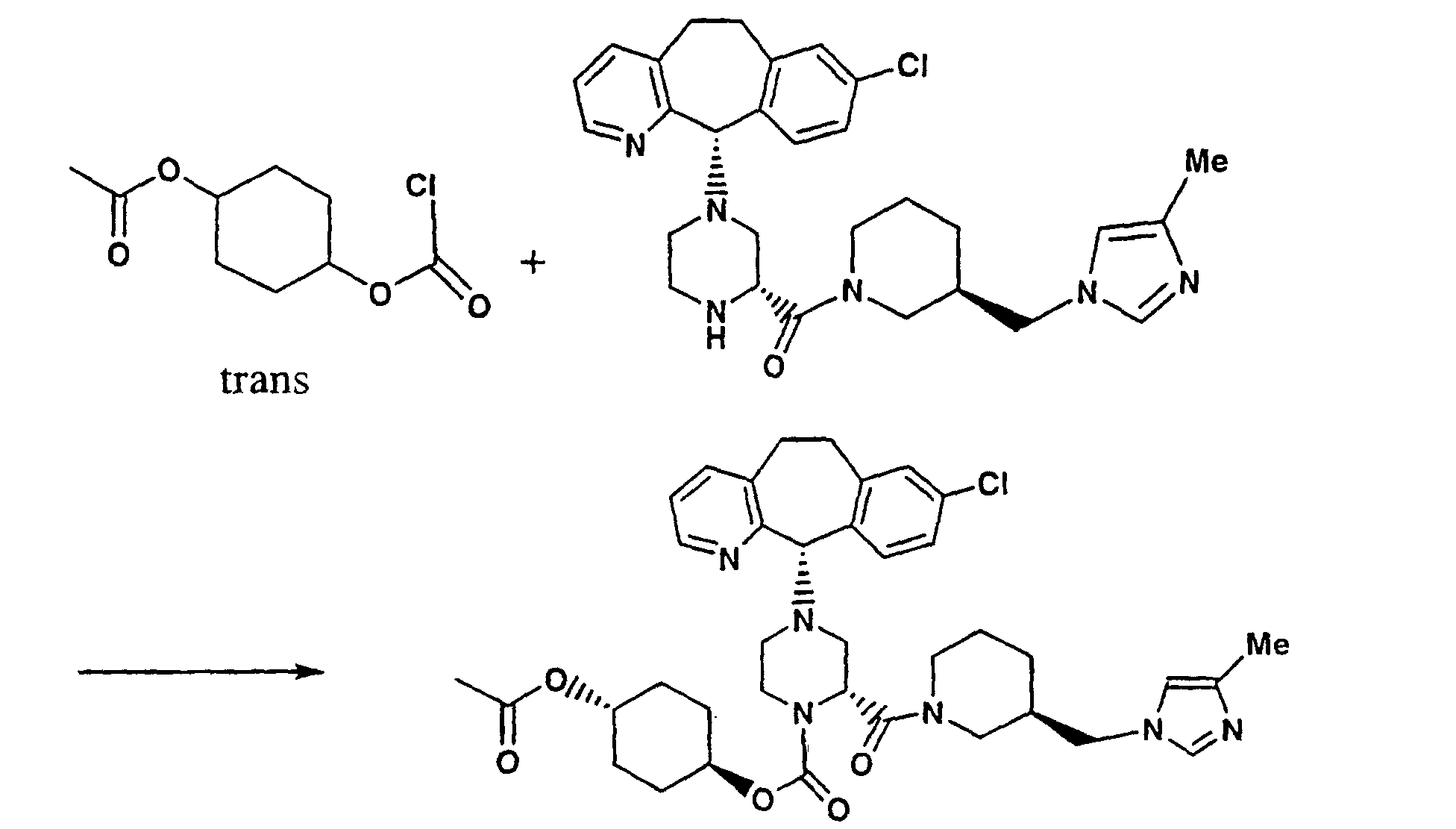
- Combining the chloroformate (0.062g) from Step A with the piperazine amine (0.103 g) from Preparative Example 175 and following a similar procedure as that described in Example 14, the title compound was obtained (0.058 g, 42%, MH+ = 703).
-

- Treatment of the product from Example 466 (0.05 g) with potassium carbonate (0.2 g) in MeOH (2 mL) afforded the title compound (0.047 g, 100%, MH+ = 661).
-

-

- If the commercially available cyclohexanol were treated with phosgene then the chloroformate would be obtained.
-
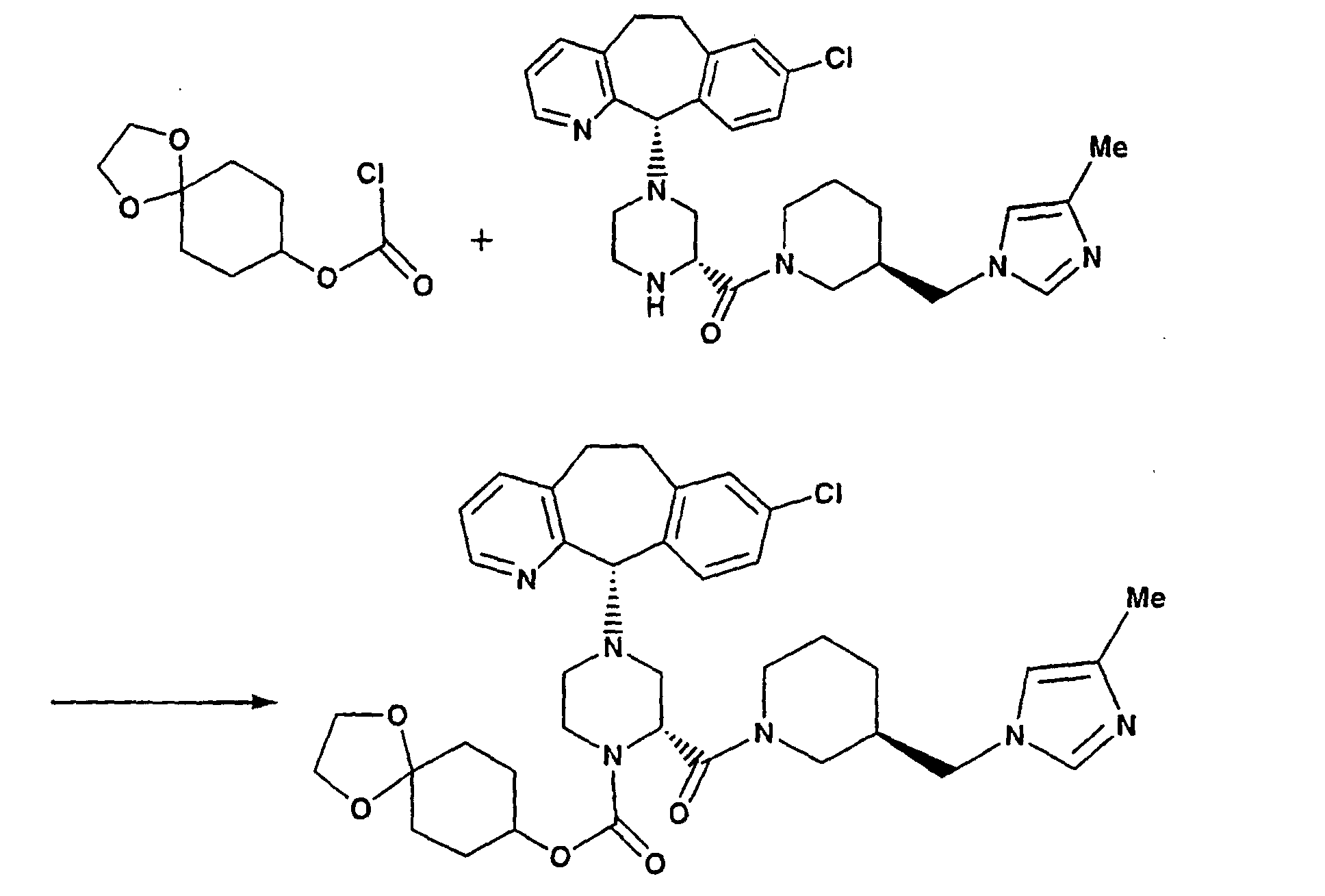
- If the chloroformate from Step A were combined with the piperazine amine shown above according to the procedure described for Example 461 then the ketal would be obtained.
-

- If the product of Step B were treated with aqueous acid the ketone would be obtained.
- If the product of Step C were treated with MeMgBr or MeLi then the title product would be obtained.
-
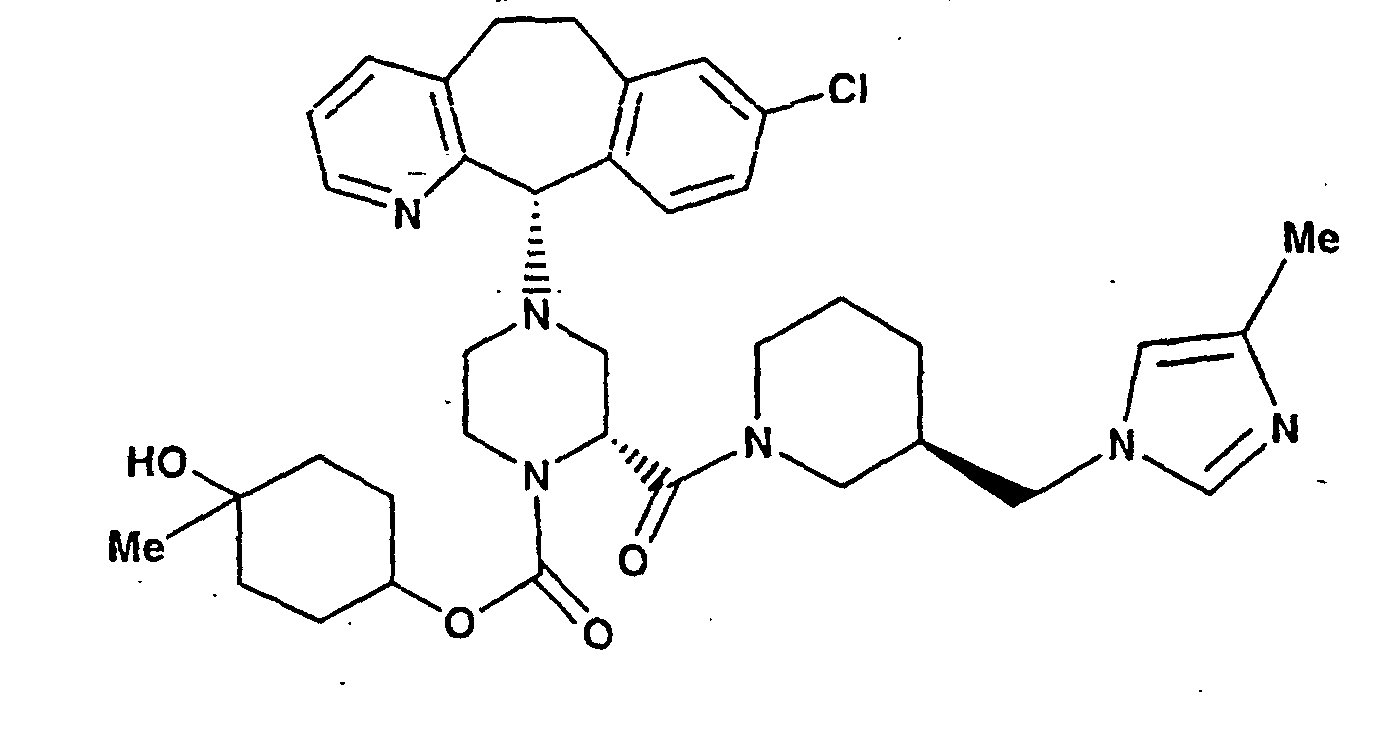
-

- If the commercially available ketone were treated with methyl magnesium bromide, then the desired alcohol would be obtained.
-
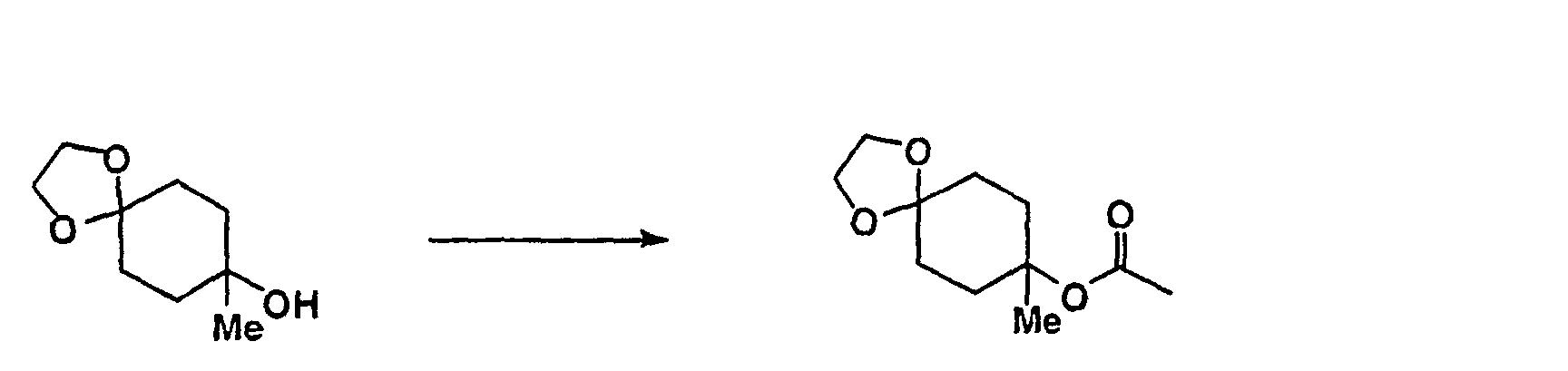
- If the product of Step A above were treated with acetic anhydride, then the desired acetate would be obtained.
-
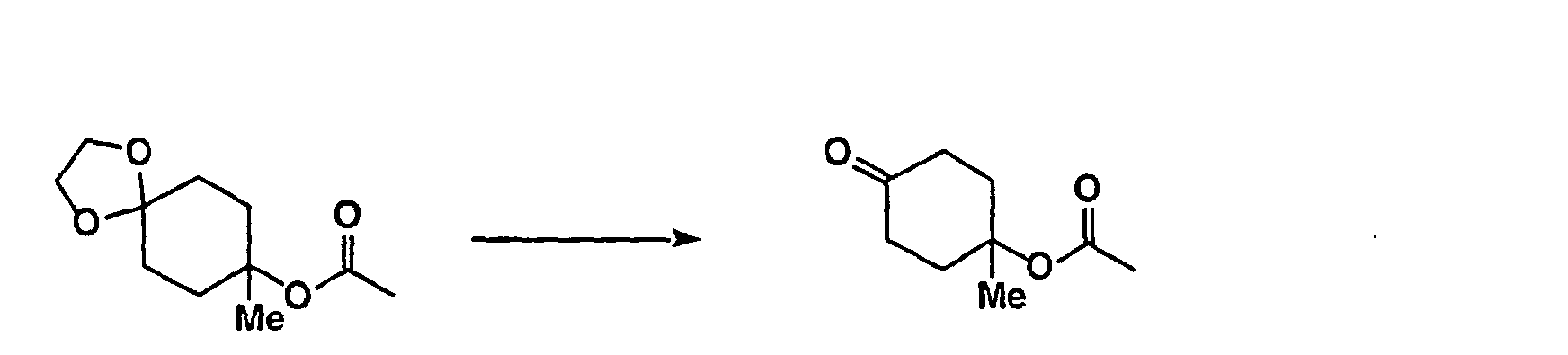
- If the product of Step B were treated with formic acid, then the desired ketone would be obtained.
- FPT IC50 (inhibition of farnesyl protein transferase, in vitro enzyme assay) was determined following the assay procedures described in WO 95/10516, published April 20, 1995. GGPT IC50 (inhibition of geranylgeranyl protein transferase, in vitro enzyme assay), Cell Mat Assay, COS Cell IC50 (Cell-Based Assay), and anti-tumor activity (in vivo anti-tumor studies) could be determined by the assay procedures described in WO 95/10516. The disclosure of WO 95/10516 is incorporated herein by reference thereto.
- Additional assays can be carried out by following essentially the same procedure as described above, but with substitution of alternative indicator tumor cell lines in place of the T24-BAG cells. The assays can be conducted using either DLD-1-BAG human colon carcinoma cells expressing an activated K-ras gene or SW620-BAG human colon carcinoma cells expressing an activated K-ras gene. Using other tumor cell lines known in the art, the activity of the compounds of this invention against other types of cancer cells could be demonstrated.
- Anchorage-independent growth is a characteristic of tumorigenic cell lines. Human tumor cells can be suspended in growth medium containing 0.3% agarose and an indicated concentration of a farnesyl transferase inhibitor. The solution can be overlayed onto growth medium solidified with 0.6% agarose containing the same concentration of farnesyl transferase inhibitor as the top layer. After the top layer is solidified, plates can be incubated for 10-16 days at 37°C under 5% CO2 to allow colony outgrowth. After incubation, the colonies can be stained by overlaying the agar with a solution of MTT (3-[4,5-dimethyl-thiazol-2-yl]-2,5-diphenyltetrazolium bromide, Thiazolyl blue) (1 mg/mL in PBS). Colonies can be counted and the IC50's can be determined.
- Compounds of this invention had an FPT IC50 within the range of <0.04nM to 20nM, and a Soft Agar IC50 within the range of <0.5nM to >500nM.
- Compounds of Examples 1-4, 4.1, 4.2, 5, 7, 8, 10-19, 24-51, and 74, 138, 142, 144, 145 had an FPT IC50 within the range of <0.04nM to 2.7nM. Compounds of Examples 1-4, 4.1, 4.2, 5, 7, 10-19, 24-51, and 74, 138, 142, 144, 145 had a Soft Agar IC50 within the range of <0.5nM to 30nM.
- Compounds of Examples 35(A), 35(C), 35(D), 35(E), 35(F), 41(A), 41(B), 41(C), 47(A), 47(B), 47(D), 47(G), 47(H), 47(I), 47(K), 47(L), 47(M), 47(N), 47(O), 47(P), 47(R), 47(S), 47(T), 47(U), 47(CC), 51(A) to 51 (D), 138 A to 147A, 148 to 158, 160, 161, 163, 169 to 180, 183 to 188, 191, 192, 197, 201, 207 to 216, 227 to 234, 238 to 240, 245, 255 to 262, 287 to 294, 297 to 303, 316 to 324, 351 to 354, 383, 384, 387, 388, 391, 392, 394 to 397, 407, 408, 409, 410, 411, 412, 414, 415 to 417, 419, 422 and 424 had an FPT IC50 within the range of <0.04 to 2.7 nM, and a Soft Agar IC50 within the range of <0.05 to 30 nM.
- For preparing pharmaceutical compositions from the compounds described by this invention, inert, pharmaceutically acceptable carriers can be either solid or liquid. Solid form preparations include powders, tablets, dispersible granules, capsules, cachets and suppositories. The powders and tablets may be comprised of from about 5 to about 95 percent active ingredient. Suitable solid carriers are known in the art, e.g. magnesium carbonate, magnesium stearate, talc, sugar or lactose. Tablets, powders, cachets and capsules can be used as solid dosage forms suitable for oral administration. Examples of pharmaceutically acceptable carriers and methods of manufacture for various compositions may be found in A. Gennaro (ed.), Remington's Pharmaceutical Sciences, 18th Edition, (1990), Mack Publishing Co., Easton, Pennsylvania.
- Liquid form preparations include solutions, suspensions and emulsions. As an example may be mentioned water or water-propylene glycol solutions for parenteral injection or addition of sweeteners and opacifiers for oral solutions, suspensions and emulsions. Liquid form preparations may also include solutions for intranasal administration.
- Aerosol preparations suitable for inhalation may include solutions and solids in powder form, which may be in combination with a pharmaceutically acceptable carrier, such as an inert compressed gas, e.g. nitrogen.
- Also included are solid form preparations which are intended to be converted, shortly before use, to liquid form preparations for either oral or parenteral administration. Such liquid forms include solutions, suspensions and emulsions.
- The compounds of the invention may also be deliverable transdermally. The transdermal compositions can take the form of creams, lotions, aerosols and/or emulsions and can be included in a transdermal patch of the matrix or reservoir type as are conventional in the art for this purpose.
- Preferably, the pharmaceutical preparation is in a unit dosage form. In such form, the preparation is subdivided into suitably sized unit doses containing appropriate quantities of the active component, e.g., an effective amount to achieve the desired purpose.
- The quantity of active compound in a unit dose of preparation may be varied or adjusted from about 0.01 mg to about 1000 mg, preferably from about 0.01 mg to about 750 mg, more preferably from about 0.01 mg to about 500mg, and most preferably from about 0.01 mg to about 250mg, according to the particular application.
- The actual dosage employed may be varied depending upon the requirements of the patient and the severity of the condition being treated. Determination of the proper dosage regimen for a particular situation is within the skill of the art. For convenience, the total daily dosage may be divided and administered in portions during the day as required.
- The amount and frequency of administration of the compounds of the invention and/or the pharmaceutically acceptable salts thereof will be regulated according to the judgment of the attending clinician considering such factors as age, condition and size of the patient as well as severity of the symptoms being treated. A typical recommended daily dosage regimen for oral administration can range from about 0.04 mg/day to about 4000 mg/day, in two to four divided doses.
- While the present invention has been described in conjunction with the specific embodiments set forth above, many alternatives, modifications and variations thereof will be apparent to those of ordinary skill in the art. All such alternatives, modifications and variations are intended to fall within the spirit and scope of the present invention.
Y represents CH2, NR16, O, S, SO, or SO2 wherein R16 is selected from: H, alkyl, cycloalkyl, cycloalkylalkyl, aryl, arylalkyl, heteroaryl, heteroarylalkyl, acyl, aroyl, carbamoyl, carboxamido, alkylsulfonyl, arylsulfonyl, arylalkylsulfonyl, sulfonamido, alkylsulfonamido, arylsulfonamido and arylalkylsulfonamido;
n is 0 to 6 (preferably 1-3);
Q represents O or N, provided that Q is not adjacent to a heteroatom in the heterocycloalkyl rings of 2.1, 3.1, 4.1, 5.1, 6.1 and 7.1;
R12 is selected from:

wherein R17 is selected from: (1) H, (2) alkyl, (3) aryl, (4) arylalkyl, (5) substituted arylalkyl wherein the substituents are selected from halo (e.g., F and Cl) or CN, (6) -C(aryl)3 (e.g., -C(phenyl)3, i.e., trityl), (7) cycloalkyl, (8) substituted alkyl (as defined above in (b)), or (9) cycloalkylalkyl;
R12A is selected from rings 8.0, 8.1 or 9.1, defined above;
said imidazolyl ring 8.0 and 8.1 optionally being substituted with one or two substituents, said imidazole ring 9.0 optionally being substituted with 1-3 substituents, and said pyridyl ring 9.1 optionally being substituted with 1-4 substituents, wherein said optional substituents for rings 8.0, 8.1, 9.0 and 9.1 are bound to the carbon atoms of said rings and are independently selected from: -NHC(O)R15, -C(R18)2OR19, -OR15, -SR15, F, Cl, Br, alkyl (e.g., methyl, such as 4-methyl in 9.0), substituted alkyl (as defined above in (b)), aryl, arylalkyl, cycloalkyl, or -N(R15)2; R15 is as defined above; each R18 is independently selected from H or alkyl (preferably -CH3), preferably H; R19 is selected from H or -C(O)NHR20, and R20 is as defined below;
R13 and R14 for each n are independently selected from: H, F, alkyl, aryl, arylalkyl, heteroaryl, heteroarylalkyl, cycloalkyl, cycloalkylalkyl or -CON(R15)2 (wherein R15 is as defined above), -OR15 or -N(R15)2 provided that the -OR15 and -N(R15)2 groups are not bound to a carbon atom that is adjacent to a nitrogen atom, and provided that there can be only one -OH group on each carbon; and the substitutable R13 and R14 groups are optionally substituted with one or more (e.g., 1-3) substituents selected from: F, alkyl (e.g., methyl, ethyl, isopropyl, and the like), cycloalkyl, arylalkyl, or heteroarylalkyl (i.e., the R13 and/or R14 groups can be unsubtituted or can be substituted with 1-3 of the substitutents described above, except when R13 and/or R14 is H); or
R13 and R14, for each n, together with the carbon atom to which they are bound, form a C3 to C6 cycloalkyl ring;
R9 is selected from:
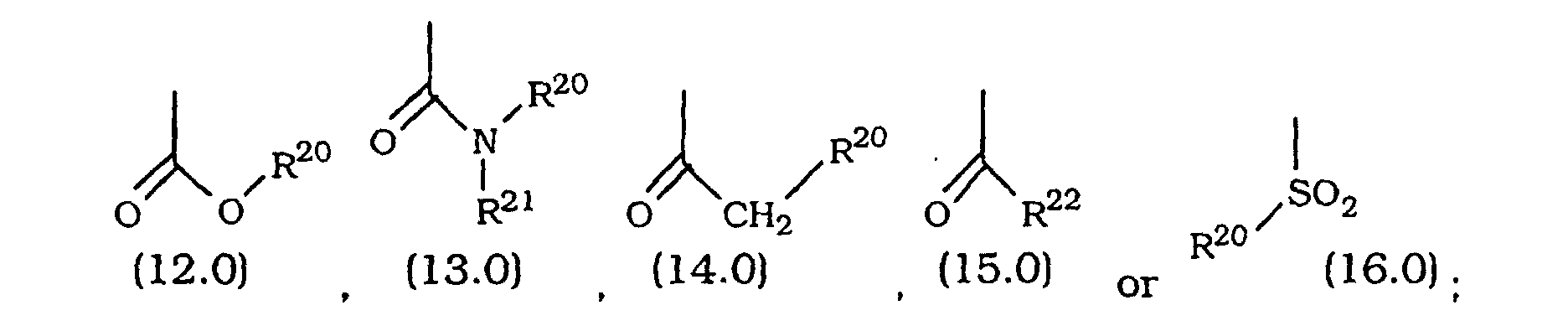
when R20 is other than H, then said R20 group is optionally substituted with one or more (e.g., 1-3) substituents selected from: halo, alkyl, aryl, -OC(O)R15 (e.g., -OC(O)CH3), -OR15 or -N(R15)2, wherein each R15 group is the same or different, and wherein R15 is as defined above, provided that said optional substituent is not bound to a carbon atom that is adjacent to an oxygen or nitrogen atom;
R21 is selected from: H, alkyl, aryl, arylalkyl, cycloalkyl, cycloalkylalkyl, heteroaryl, heteroarylalkyl, heterocycloalkyl or heterocycloalkylalkyl;
when R21 is other than H, then said R21 group is optionally substituted with one or more (e.g., 1-3) substituents selected from: alkyl, aryl, wherein each R15 group is the same or different, and wherein R15 is as defined above; and
R22 is selected from cycloalkyl (e.g., cyclopropylmethyl, i.e.,
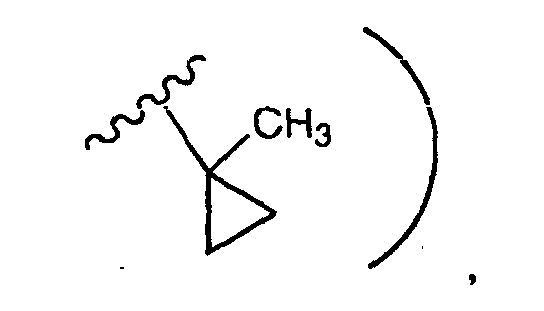
Claims (30)
- A compound of the formula:or a pharmaceutically acceptable salt or solvate thererof, wherein:

one of a, b, c and d represents N or N+O-, and the remaining a, b, c and d groups represent CR1 or CR2; or
each of a, b, c, and d are independently selected from CR1 or CR2;
each R1 and each R2 is independently selected from H, halo, -CF3, -OR10, -COR10, -SR10 , -S(O)tR11 (wherein t is 0, 1 or 2), -N(R10)2, -NO2, -OC(O)R10, -CO2R10, -OCO2R11, -CN, -NR10COOR11, -SR11C(O)OR11 , -SR11N(R75)2 (provided that R11 in -SR11N(R75)2 is not -CH2-) wherein each R75 is independently selected from H or -C(O)OR11, benzotriazol-1-yloxy, tetrazol-5-ylthio, or substituted tetrazol-5-ylthio, alkynyl, alkenyl or alkyl, said alkyl or alkenyl group optionally being substituted with halo, -OR10 or -CO2R10;
R3 and R4 are the same or different and each independently represents H, any of the substituents of R1 and R2, or R3 and R4 taken together represent a saturated or unsaturated C5-C7 fused ring to the benzene ring (Ring III);
R5, R6, and R7 each independently represents H, -CF3, -COR10, alkyl or aryl, said alkyl or aryl optionally being substituted with -OR10, -SR10, -S(O)tR11, -NR10COOR11, -N(R10)2, -NO2, -COR10, -OCOR10, -OCO2R11, -CO2R10, OPO3R10, or R5 is combined with R6 to represent =O or =S; provided that for the groups -OR10, -SR10, and -N(R10)2 R10 is not H;
R10 represents H, alkyl, aryl, or aralkyl;
R11 represents alkyl or aryl;
X represents N, CH or C, and when X is C the optional bond (represented by the dotted line) to carbon atom 11 is present, and when X is CH the optional bond (represented by the dotted line) to carbon atom 11 is absent;
the dotted line between carbon atoms 5 and 6 represents an optional bond, such that when a double bond is present, A and B independently represent -R10, halo, -OR11, -OCO2R11 or -OC(O)R10, and when no double bond is present between carbon atoms 5 and 6, A and B each independently represent H2, -(OR11)2, H and halo, dihalo, alkyl and H, (alkyl)2, -H and -OC(O)R10, H and -OR10, =O, aryl and H, =NOR10 or -O-(CH2)p-O- wherein p is 2, 3 or 4;
R8 represents a heterocyclic ring selected from: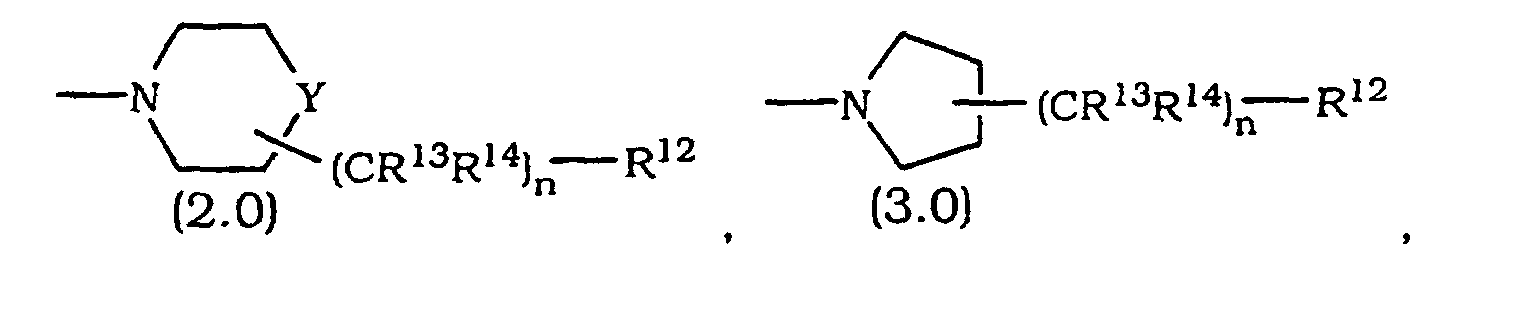

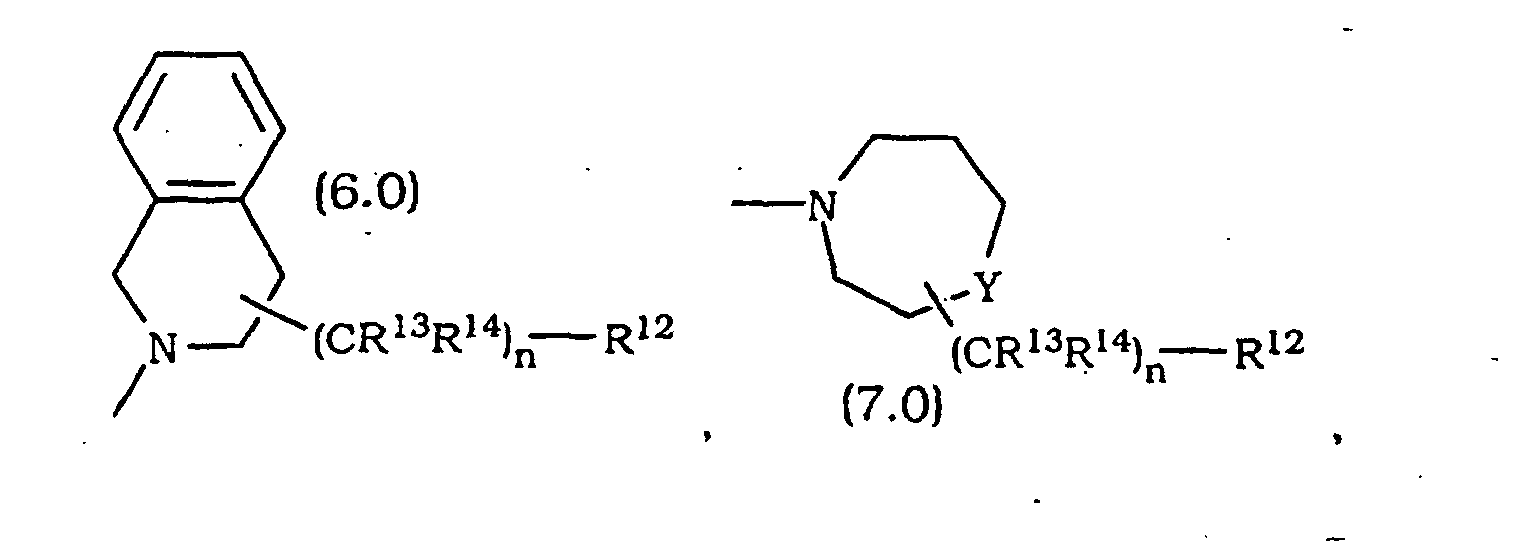
 said heterocyclic rings (2.0 to 7.0 and 2.1 to 7.1) being optionally substituted with one or more substituents independently selected from:
 Y represents CH2, NR16, O, S, SO, or SO2 wherein R16 is selected from: H, alkyl, cycloalkyl, cycloalkylalkyl, aryl, arylalkyl, heteroaryl, heteroarylalkyl, acyl, aroyl, carbamoyl, carboxamido, alkylsulfonyl, arylsulfonyl, arylalkylsulfonyl, sulfonamido, alkylsulfonamido, arylsulfonamido and arylalkylsulfonamido;(a) alkyl,(b) substituted alkyl wherein said substituents are selected from: halo, aryl, -OR15 or -N(R15)2, heteroaryl, heterocycloalkyl, cycloalkyl, wherein each R15 group is the same or different, provided that said optional substituent is not bound to a carbon atom that is adjacent to an oxygen or nitrogen atom, and wherein R15 is selected from : H, alkyl, aryl, arylalkyl, heteroaryl, heteroarylalkyl, cycloalkyl, or cycloalkylalkyl;(c) hydroxyl, with the proviso that carbon atoms adjacent to the nitrogen, sulfur or oxygen atoms of the ring are not substituted with hydroxyl;(d) alkyloxy or(e) arylalkyloxy;
n is 0 to 6 ;
Q represents O or N, provided that Q is not adjacent to a heteroatom in the heterocycloalkyl rings of 2.1, 3.1, 4.1, 5.1, 6.1 and 7.1;
R12 is selected from:wherein R17 is selected from: (1) H, (2) alkyl, (3) aryl, (4) arylalkyl, (5) substituted arylalkyl wherein the substituents are selected from halo or CN, (6) -C(aryl)3, (7) cycloalkyl, (8) substituted alkyl (as defined above in (b)), or (9) cycloalkylalkyl;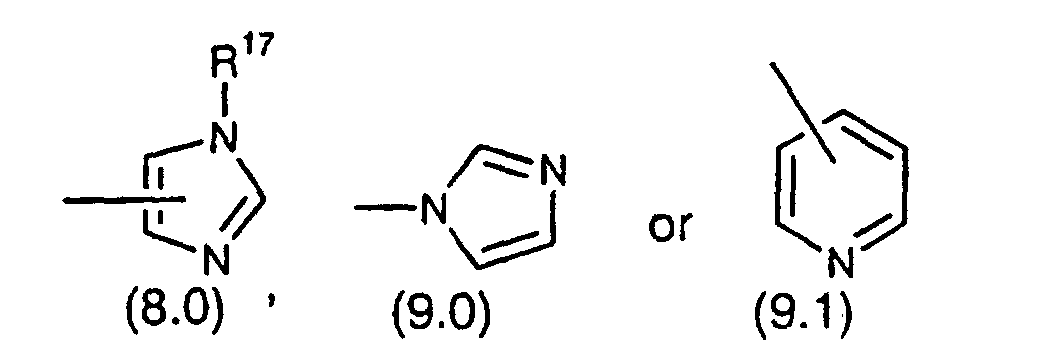
R12A is selected from rings 8.0 or 9.1, defined above;
said imidazolyl ring 8.0 optionally being substituted with one or two substituents, said imidazole ring 9.0 optionally being substituted with 1-3 substituents, and said pyridyl ring 9.1 optionally being substituted with 1-4 substituents, wherein said optional substituents for rings 8.0, 9.0 and 9.1 are bound to the carbon atoms of said rings and are independently selected from: -NHC(O)R15, -C(R18)2OR19, -OR15, -SR15, F, Cl, Br, alkyl, substituted alkyl (as defined above in (b)), aryl, arylalkyl, cycloalkyl, or -N(R15)2; R15 is as defined above; each R18 is independently selected from H or alkyl; R19 is selected from H or -C(O)NHR20, and R20 is as defined below;
R13 and R14 for each n are independently selected from: H, F, alkyl, aryl, arylalkyl, heteroaryl, heteroarylalkyl, cycloalkyl, cycloalkylalkyl or -CON(R15)2 (wherein R15 is as defined above), -OR15 or -N(R15)2 provided that the -OR15 and -N(R15)2 groups are not bound to a carbon atom that is adjacent to a nitrogen atom, and provided that there can be only one -OH group on each carbon; and the substitutable R13 and R14 groups are optionally substituted with one or more substituents selected from: F, alkyl, cycloalkyl, arylalkyl, or heteroarylalkyl; or
R13 and R14, for each n, together with the carbon atom to which they are bound, form a C5 to C6 cycloalkyl ring;
R9 is selected from:R20 is selected from: H, alkyl, aryl, arylalkyl, cycloalkyl, cycloalkylalkyl, heteroaryl, heteroarylalkyl, heterocycloalkyl, or heterocyloalkylalkyl, provided that R20 is not H when R9 is group 12.0 or 16.0;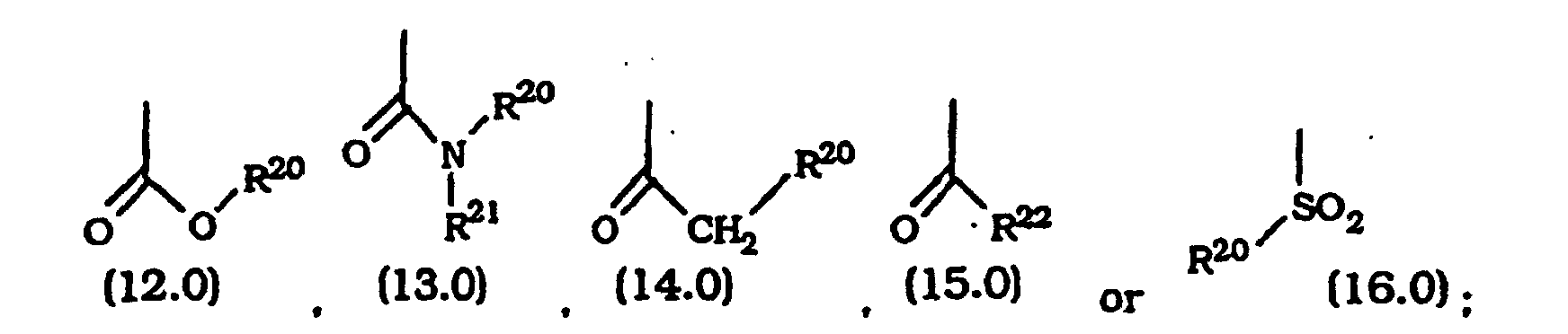
when R20 is other than H, then said R20 group is optionally substituted with one or more substituents selected from: halo, alkyl, aryl, -OC(O)R15, -OR15 or -N(R15)2, wherein each R15 group is the same or different, and wherein R15 is as defined above, provided that said optional substituent is not bound to a carbon atom that is adjacent to an oxygen or nitrogen atom;
R21 is selected from: H, alkyl, aryl, arylalkyl, cycloalkyl, cycloalkylalkyl, heteroaryl, heteroarylalkyl, heterocycloalkyl or heterocycloalkylalkyl;
when R21 is other than H, then said R21 group is optionally substituted with one or more substituents selected from: alkyl, aryl, wherein each R15 group is the same or different, and wherein R15 is as defined above; and
R22 is selected from cycloalkyl which is optionally substituted with one or more substituents selected from alkyl, -OH, -CO2H and -C(O)NH2; heterocycloalkyl; aryl; substutited aryl; and alkyl which is optionally substituted with one or more substituents selected from alkyl, -OH, -CO2H, -C(O)NH2,
alkyl-represents straight and branched carbon chains and contains from one to twenty carbon atoms, preferably one to six carbon atoms said cycloalkyl ring being optionally substituted with one or more alkyl groups and when there is more than one alkyl group each alkyl group can be the same or different;
acyl-represents a G-C(O)- group wherein G represents alkyl, aryl, heteroaryl, cycloalkyl, heterocycloalkyl, -O-alkyl, -O-aryl, or NR25R26 wherein R25 and R26 are independently selected from alkyl or aryl;
arylalkyl-represents an alkyl group, as defined above, substituted with an aryl group, as defined below, such that the bond from another substituent is to the alkyl motety;
aryl-(including the aryl portion of arylalkyl)-represents a carbocyclic group containing from 6 to 15 carbon atoms and having at least one aromatic ring with all available substitutable carbon atoms of the carbocyclic group being intended as possible points of attachment, said carbocyclic group being optionally substituted with one or more of halo, alkyl, hydroxy, alkoxy, phenoxy, CF3, -C(O)N(R10)2, -SO2R10, -SO2N(R10)2, amino, alkylamino, dialkylamino, -COOR23 or - NO2, wherein R23 represents alkyl or aryl;
aroyl-represents -C(O)aryl wherein aryl is as defined above;
cycloalkyl-represents saturated carbocyclic rings of from 3 to 20 carbon atoms, preferably 3 to 7 carbon atoms, said cycloalkyl ring optionally substituted with one or more alkyl groups and when there is more than one alkyl group each alkyl group can be the same or different;
cycloalkylalkyl-represents a cycloalkyl group, as defined above, substituted with an alkyl group, as defined above, such that the bond from another substituent is to the alkyl moiety;
halo-represents fluoro, chloro, bromo and iodo;
heteroaralkyl-represents an alkyl group, as defined above. substituted with a heteroaryl group, as defined below, such that the bond from another substituent is to the alkyl moiety;
heteroaryl-represents cyclic groups, optionally substituted with R3 and R4, having at least one heteroatom selected from O, S or N, said heteroatom interrupting a carbocyclic ring structure and having a sufficient number of delocalized pi electrons to provide aromatic character, with the aromatic heterocyclic groups preferably containing from 2 to 14 carbon atoms, e.g., 2- or 3-furyl, 2- or 3-thienyl, 2-, 4- or 5-thiazolyl, 2-, 4- or 5-imidazolyl, 2-, 4- or 5-pyrimidinyl, 2-pyrazinyl, 3- or 4-pyridazinyl, 3-, 5- or 6-[1,2,4-triazinyl], 3- or 5-[1,2,4-thiadizolyl], 2-, 3-, 4-, 5-, 6- or 7-benzofuranyl, 2-, 3-, 4-, 5-, 6- or 7-indolyl, 3-, 4- or 5-pyrazolyl, 2-, 4- or 5-oxazolyl, triazolyl, 2-, 3- or 4-pyridyl or pyridyl N-oxide (optionally substituted with R3 and R4), wherein pyridyl N-oxide can be represented as:and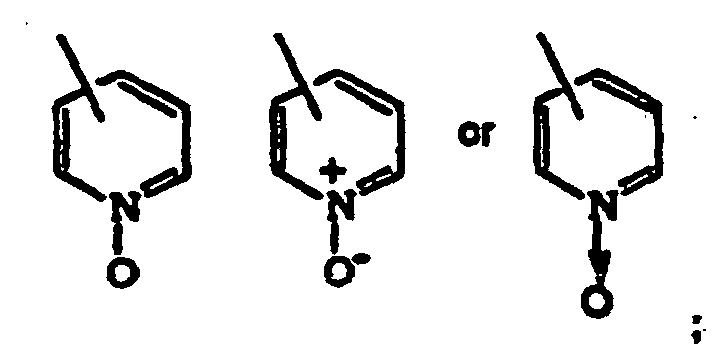
heterocycloalkyl-represents a saturated, branched or unbranched carbocylic ring containing from 3 to 15 carbon atoms, preferably from 4 to 6 carbon atoms, which carbocyclic ring is interrupted by 1 to 3 hetero groups selected from -O-, -S- or - NR24, wherein R24 represents alkyl, aryl, -C(O)N(R18)2 wherein R18 is as above defined or acyl-(suitable heterocycloalkyl groups include 2- or 3-tetrahydrofuranyl, 2- or 3- tetrahydrothienyl. tetrahydropyranyl, 2-, 3- or 4-piperidinyl, 2- or 3-pyrrolidinyl, 2- or 3-piperazinyl, 2- or 4-dioxanyl, morpholinyl. - The compound of Claim 1 having the structureor
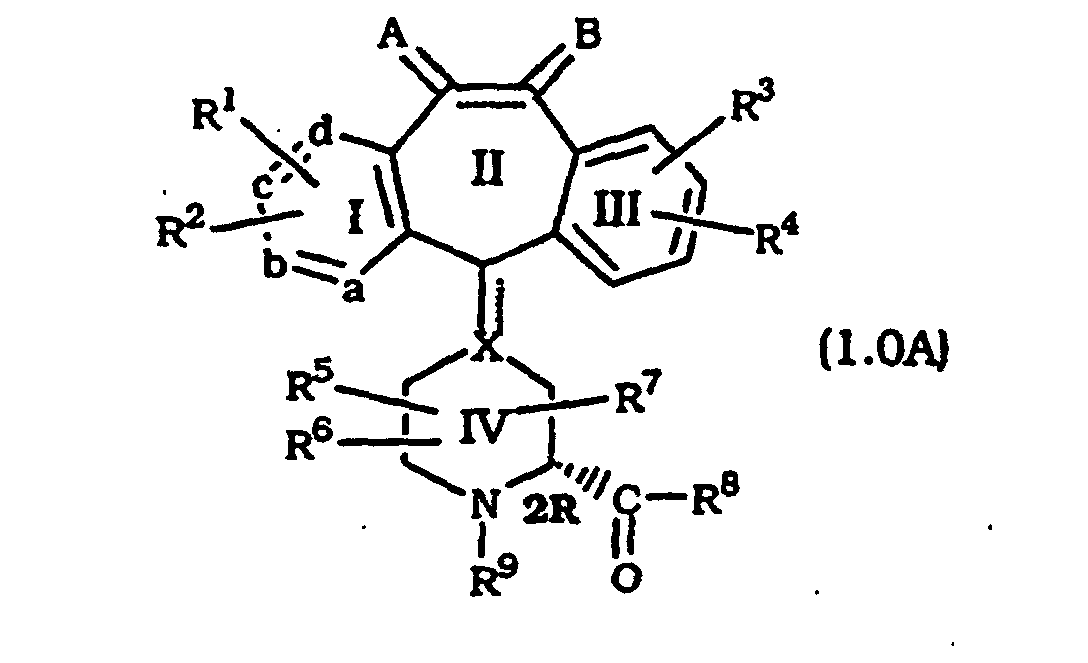
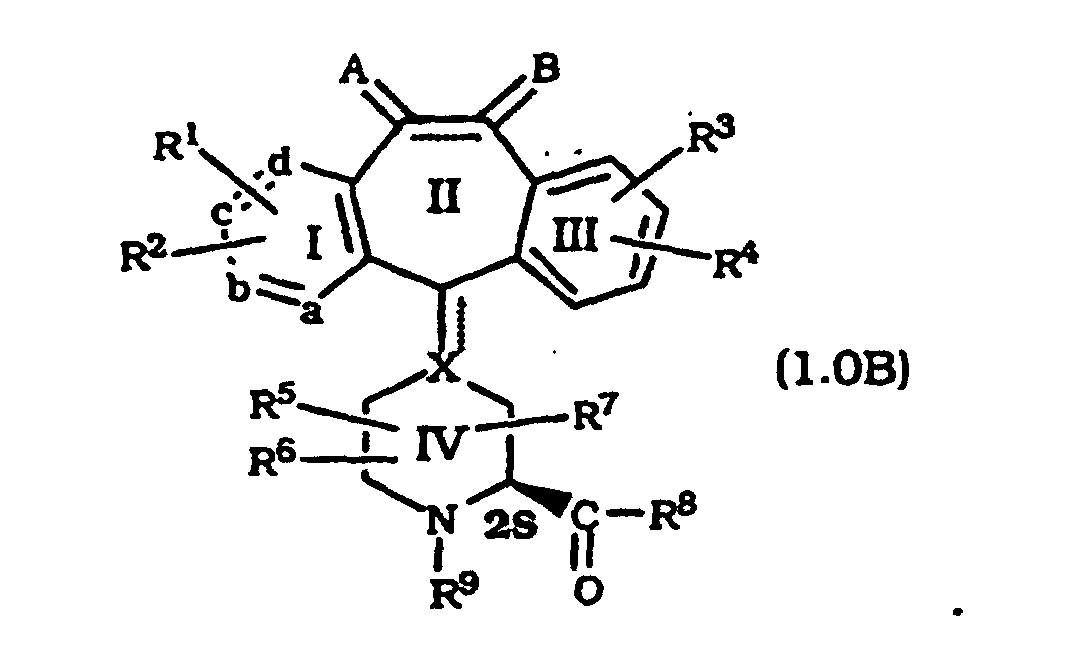
- The compound of Claim 1 wherein R1 to R4 is independently selected from H, Br, F or Cl; R5 to R7 is H; a is N and the remaining b, c and d substituents are carbon, or a, b, c, and d are carbon; A and B are H2; and n is 1 to 3.
- The compound of Claim 1 wherein R6 is ring 2.0 and the -(CR13R14)n-R12 substituent is in the 2- or 3- position.
- The compound of Claim 1 wherein R8 is ring 2.0 and the -(CR13R14)n-R12 substituent is in the 2- or 3- position, and Y is CH2.
- The compound of claim 1 wherein R13 and R14 are H.
- The compound of Claim 1 wherein Y is selected from S. SO, or SO2.
- The compound of Claim 1 wherein Y is O.
- The compound of Claim 1 wherein Y is NR16.
- The compound of Claim 1 wherein R9 is selected from: 12.0, 13.0 or 15.0.
- The compound of Claim 1 wherein R1 to R4 is independently selected from H, Br, F or Cl; R5 to R7 is H, a is N and the remaining b, c and d substituents are carbon; A and B are H2; and n is 1 to 3: R8 is ring 2.0 and the -(CR13R14)n-R12 substituent is in the 2- or 3- position, and Y is CH2.
- The compound of Claim 11 having the structure:

- The compound of Claim 12 wherein R13 and R14 are H.
- The compound of Claim 13 wherein R12 is 9.0.
- The compound of Claim 12 wherein R9 is selected form: 12.0. 13.0 or 15.0.
- The compound of Claim 12 wherein R20 is selected from t-butyl, i-propyl, neopentyl, cyclohexyl, cyclopropylmethyl,
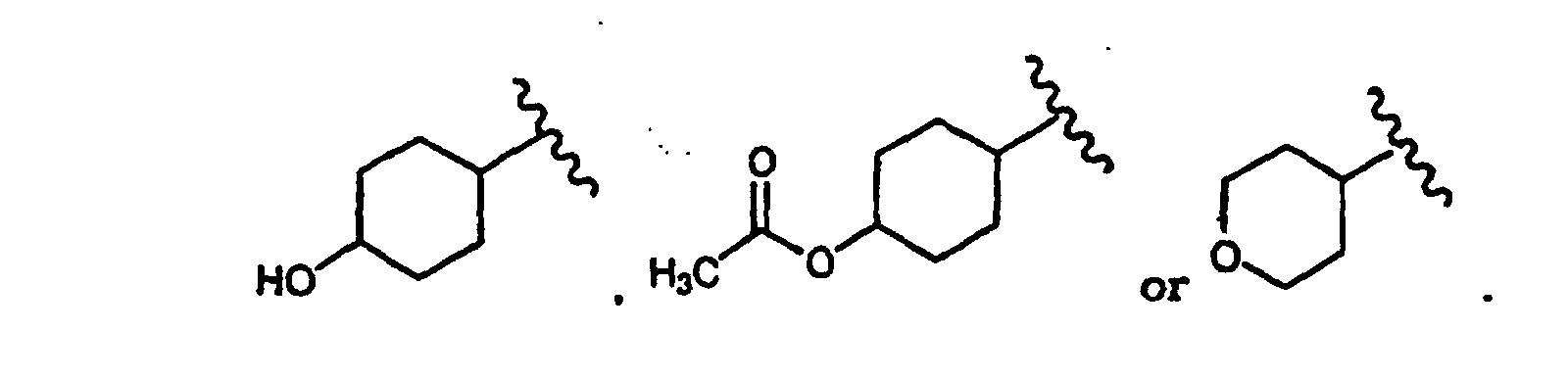
- The compound of Claim 13 wherein R9 is selected from 12.0 or 13.0, and wherein R21 for 13.0 is H.
- A compound selected from the compounds of Examples 1-4, 4.1, 4.2, 10-19, 24-51, 74, 138, 142, 144, 145, 35(A), 35(C), 35(D), 35(E), 35(F), 41(A), 41(B), 41(C), 47(A), 47(B), 47(D), 47(G), 47(H), 47(I), 47(K), 47(L), 47(M), 47(N), 47(O), 47(P), 47(R), 47(S), 47(T), 47(U), 47(CC), 51(A) to 51 (D), 138 A to 147A, 148 to 158, 160, 161, 163, 169 to 180, 183 to 188, 191, 192, 197, 201, 207 to 216, 227 to 234, 238 to 240, 245, 255 to 262, 287 to 294, 297 to 303, 316 to 324, 351 to 354, 383, 384, 387, 388, 391, 392, 394 to 397, 407, 408, 409, 410, 411, 412, 414, 415 to 417, 419, 422, 424, 463A or 466-469, which have the structures shown below; the compoundwherein R8 is as listed in the tables below,
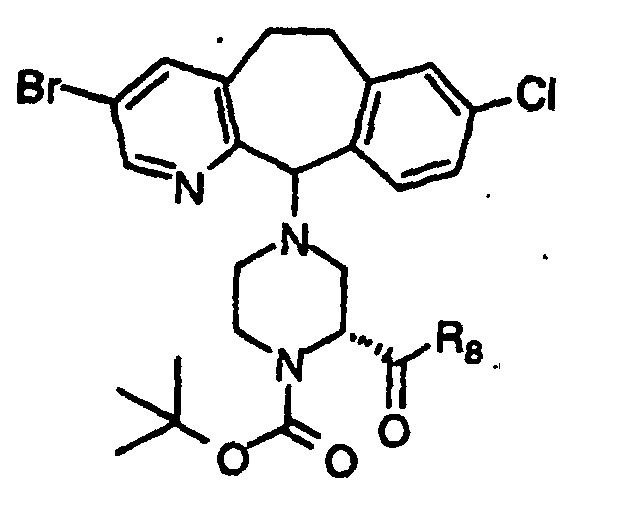
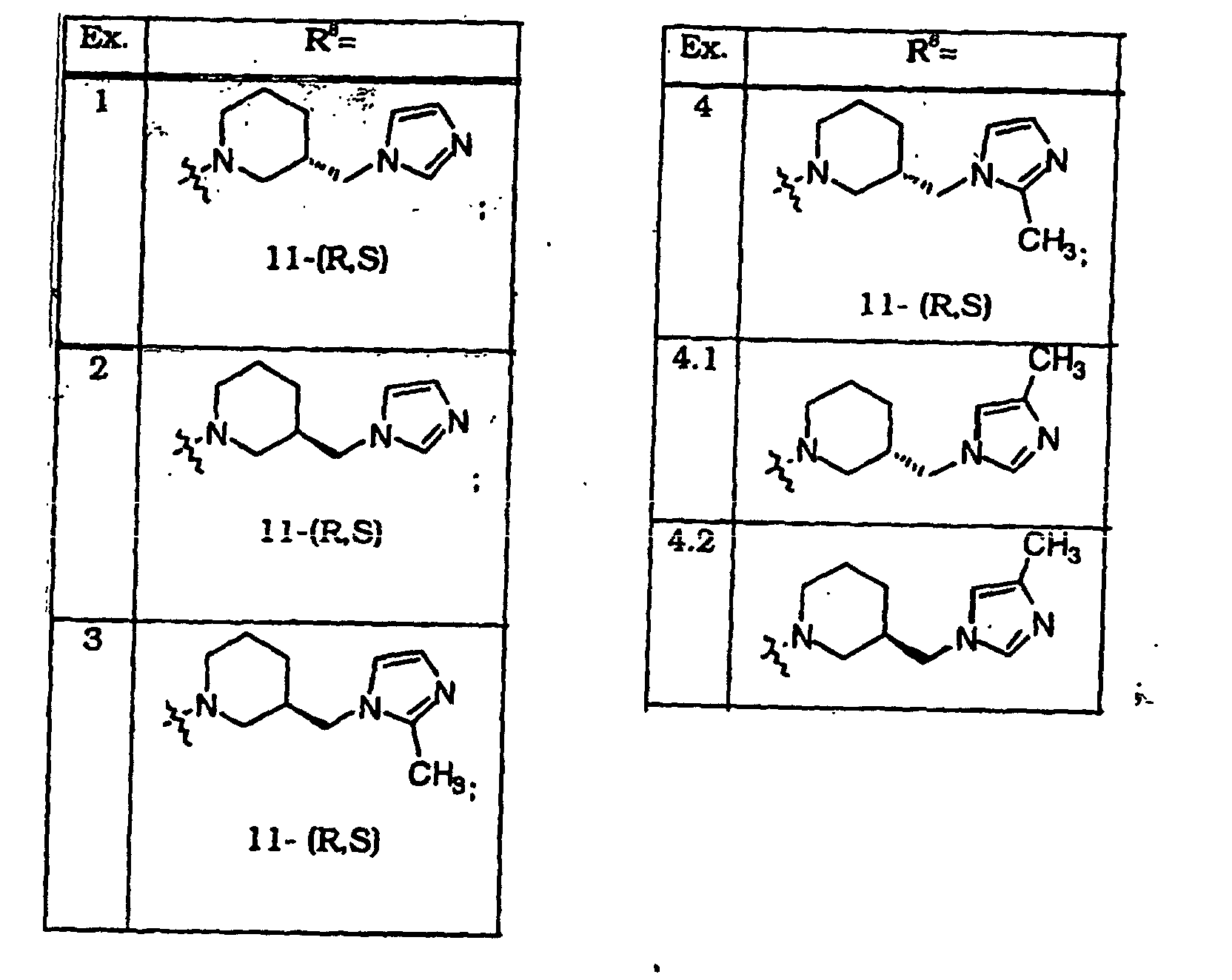
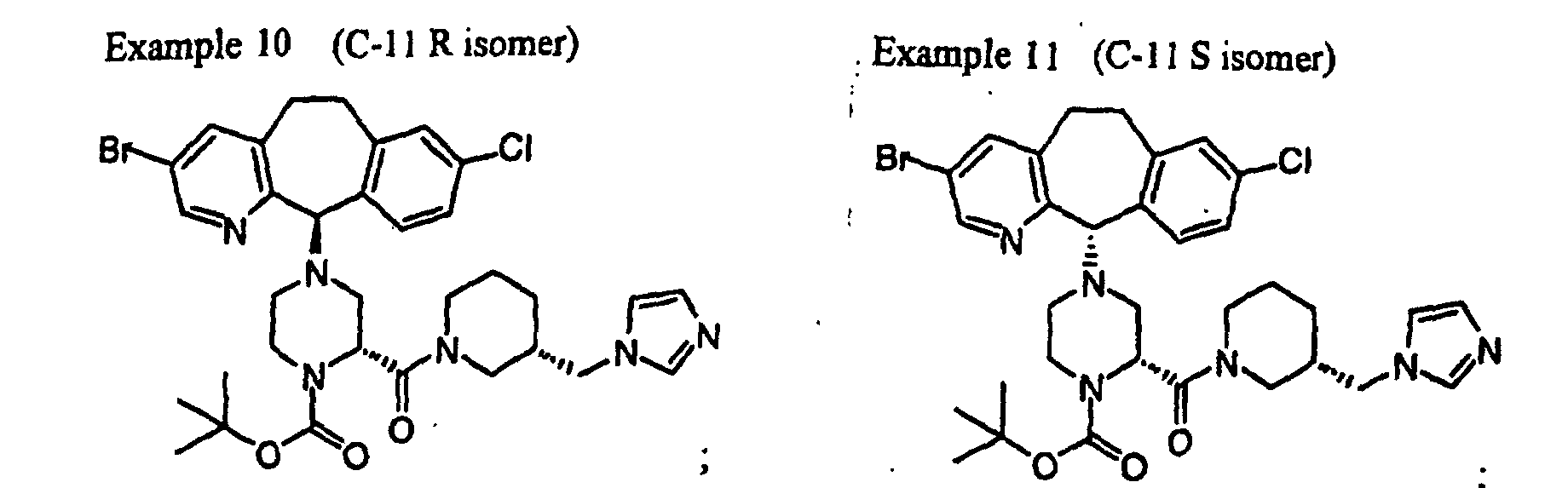
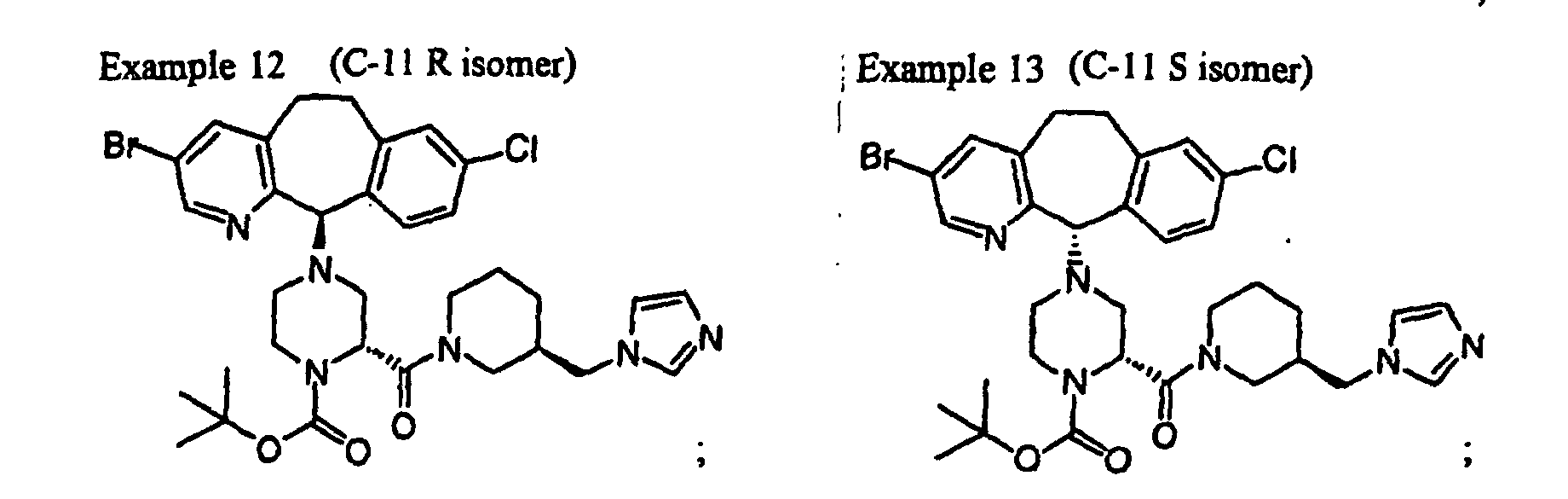
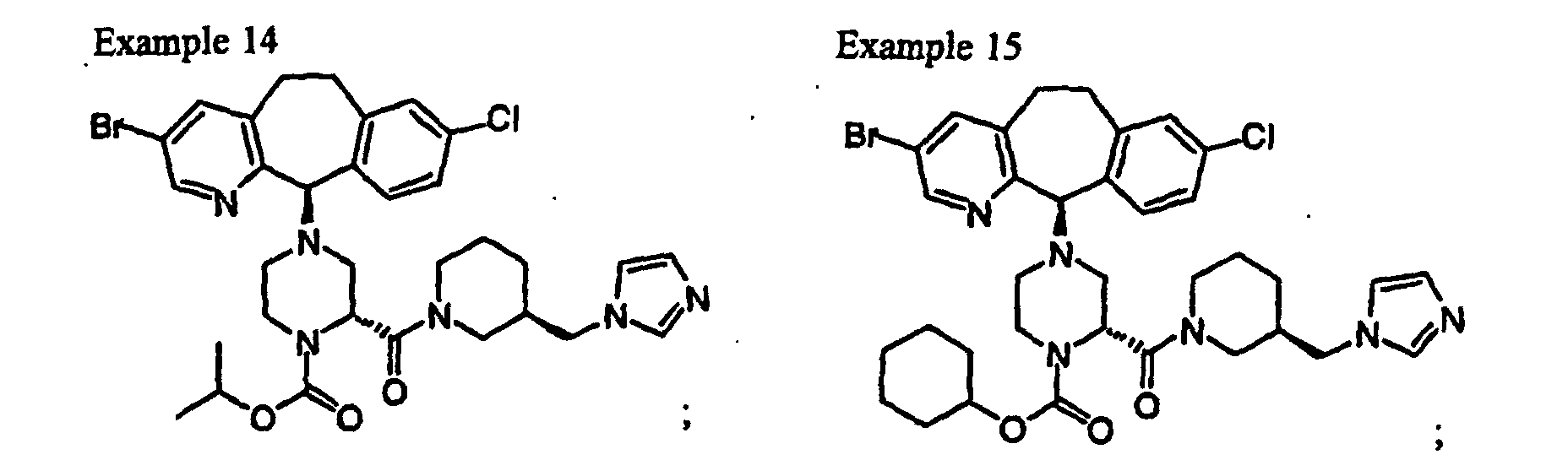
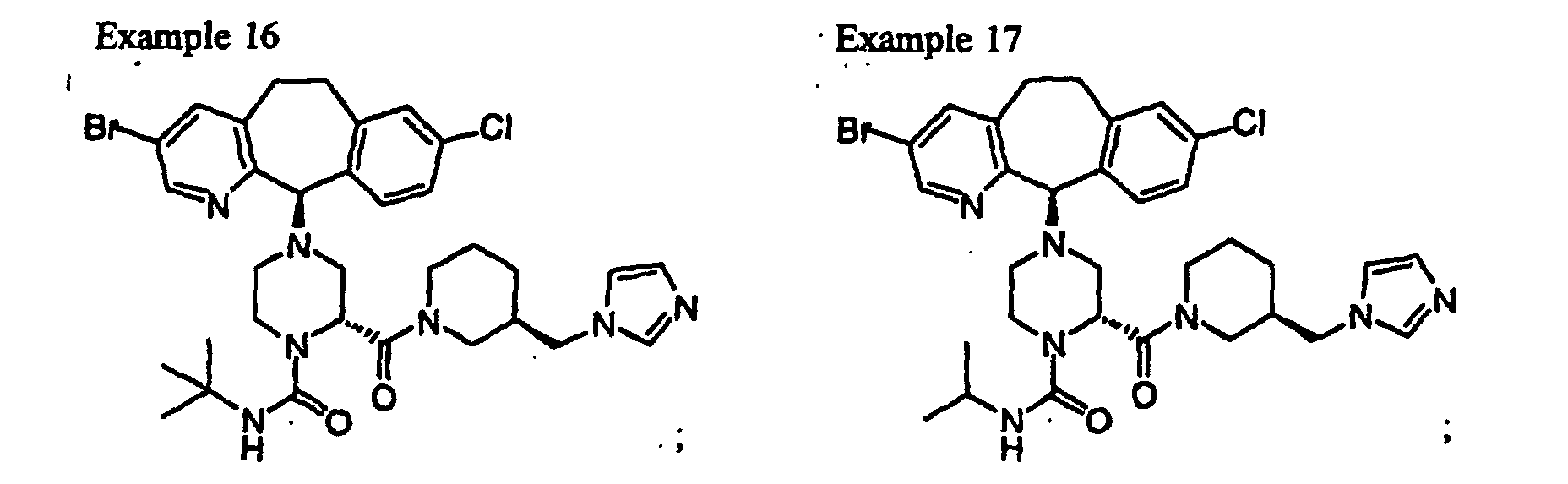 the compound
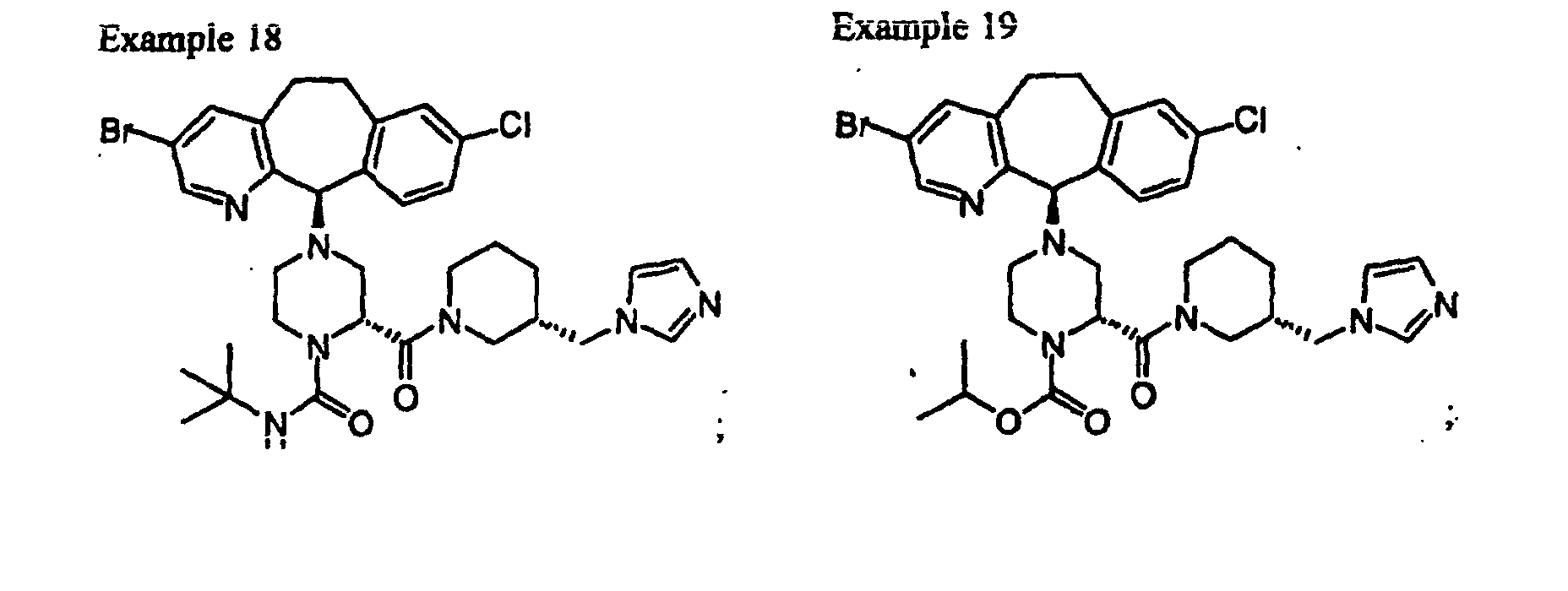 wherein R8 is as listed in the tables below,
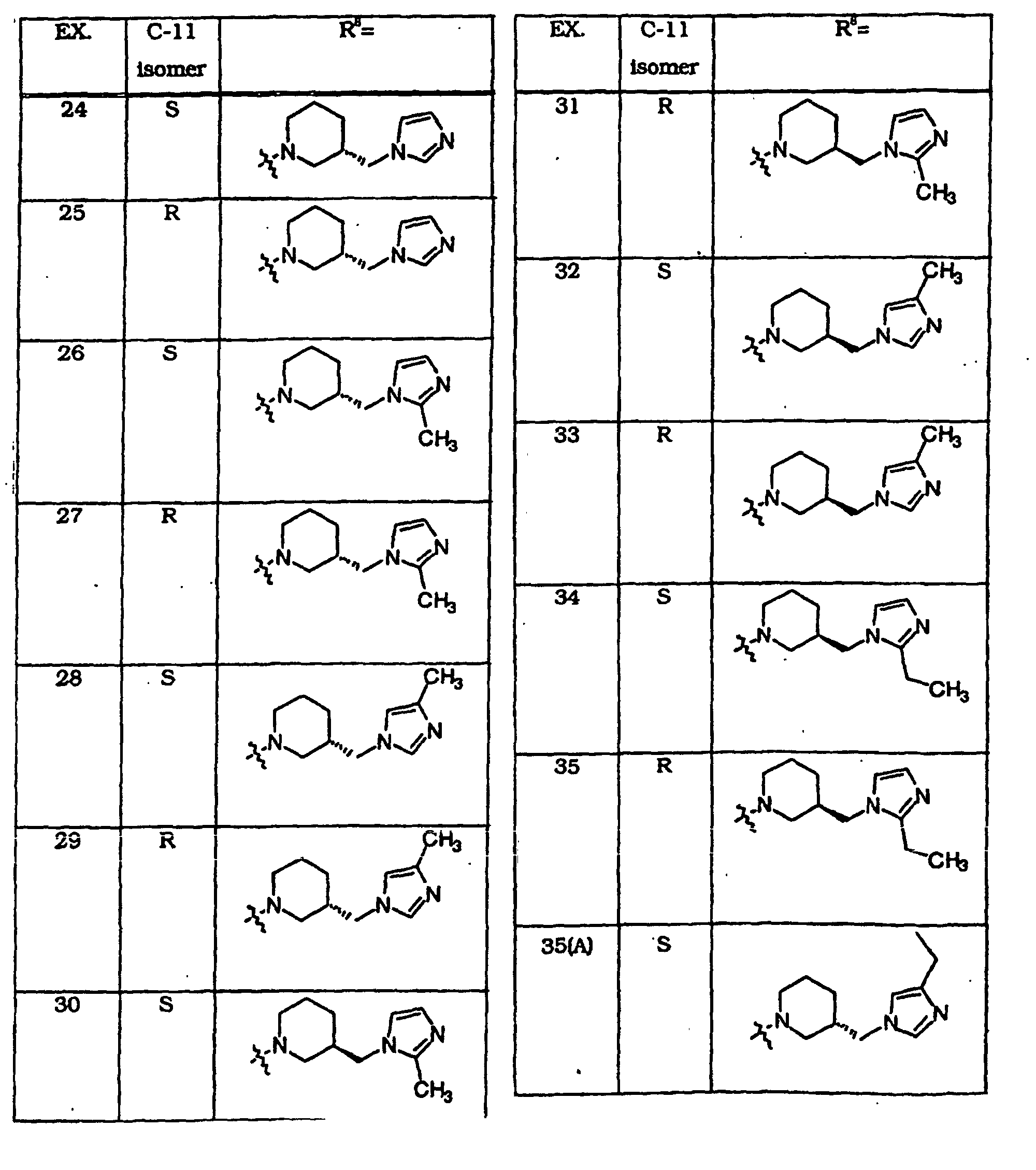 the compound
 wherein R8 is as listed in the tables below,
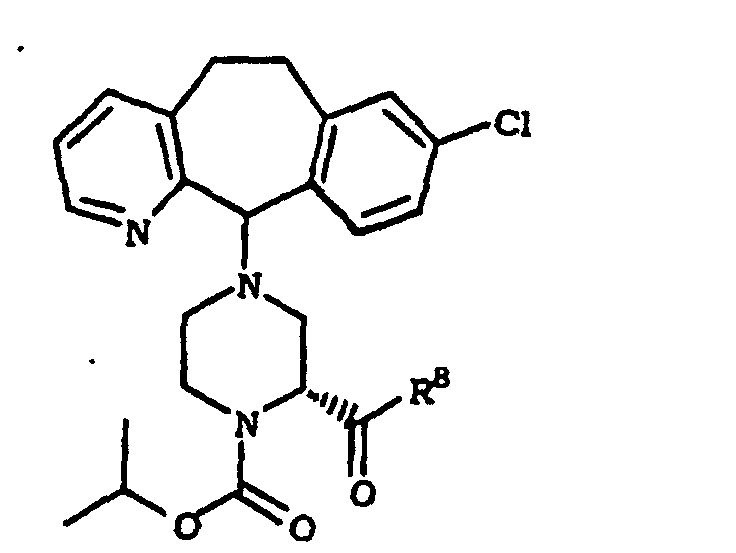 the compound
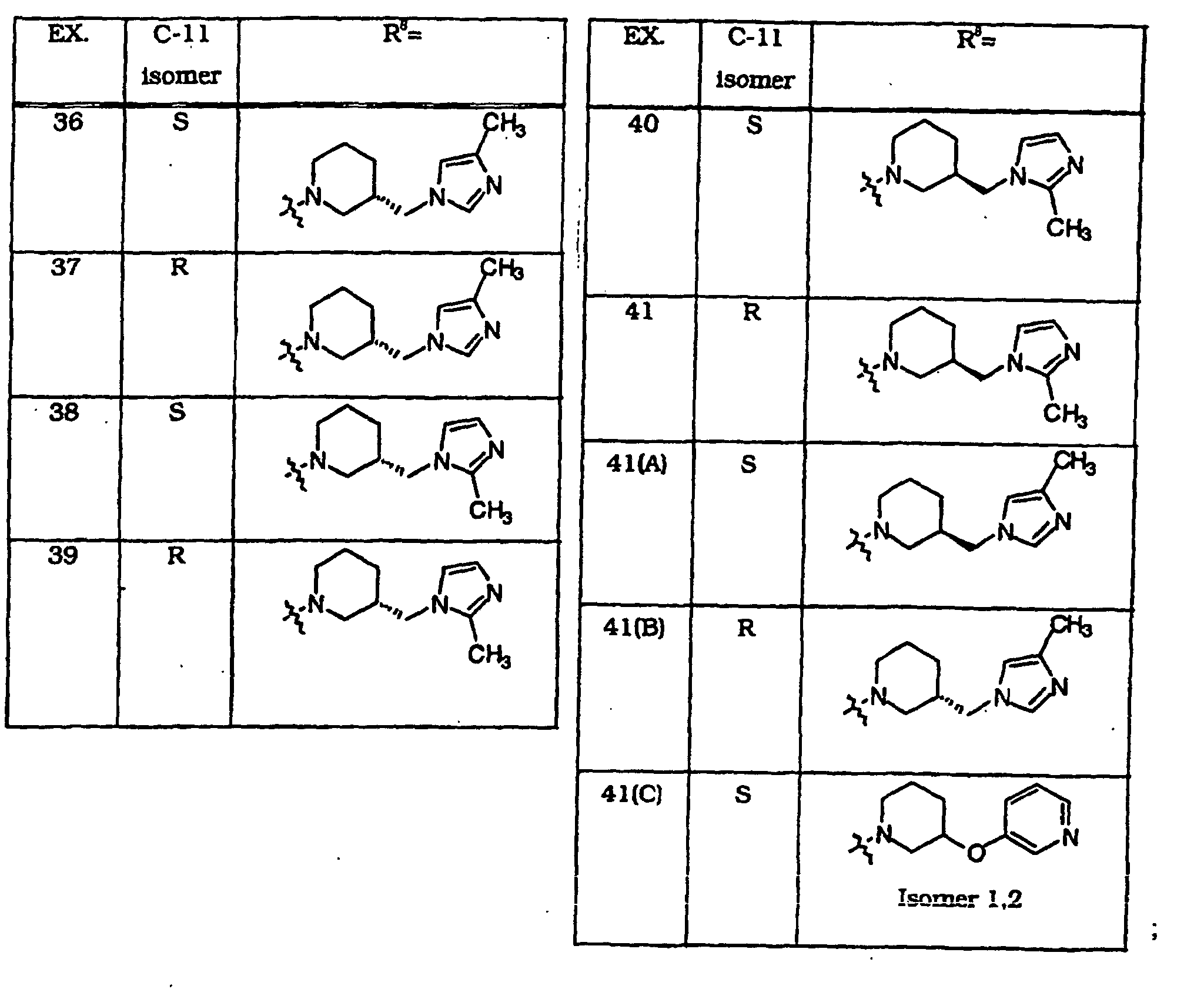 wherein R8 is as listed in the tables below,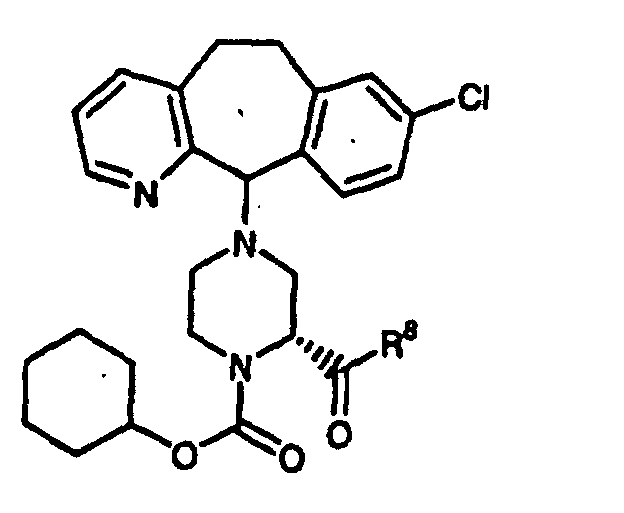
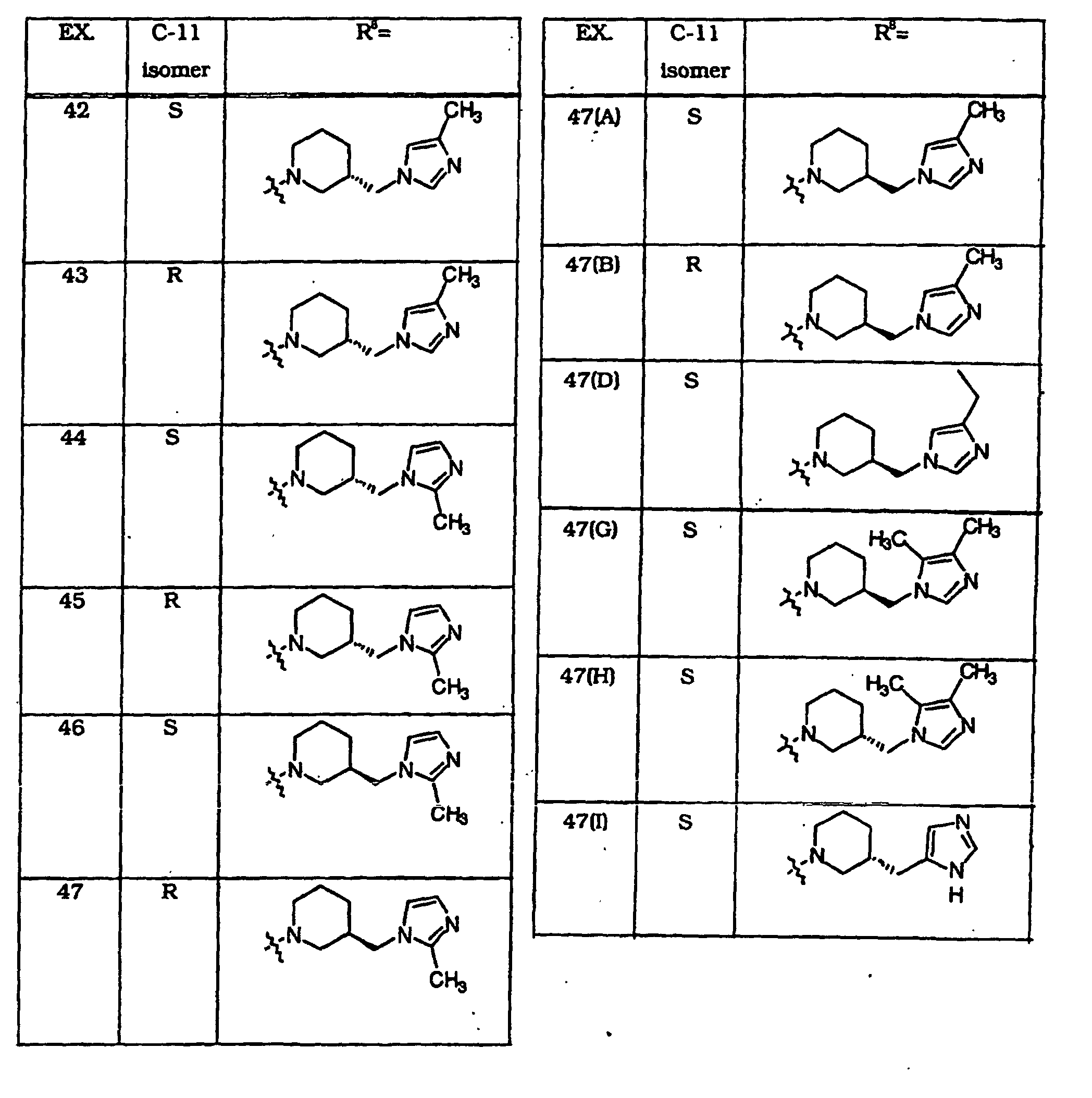
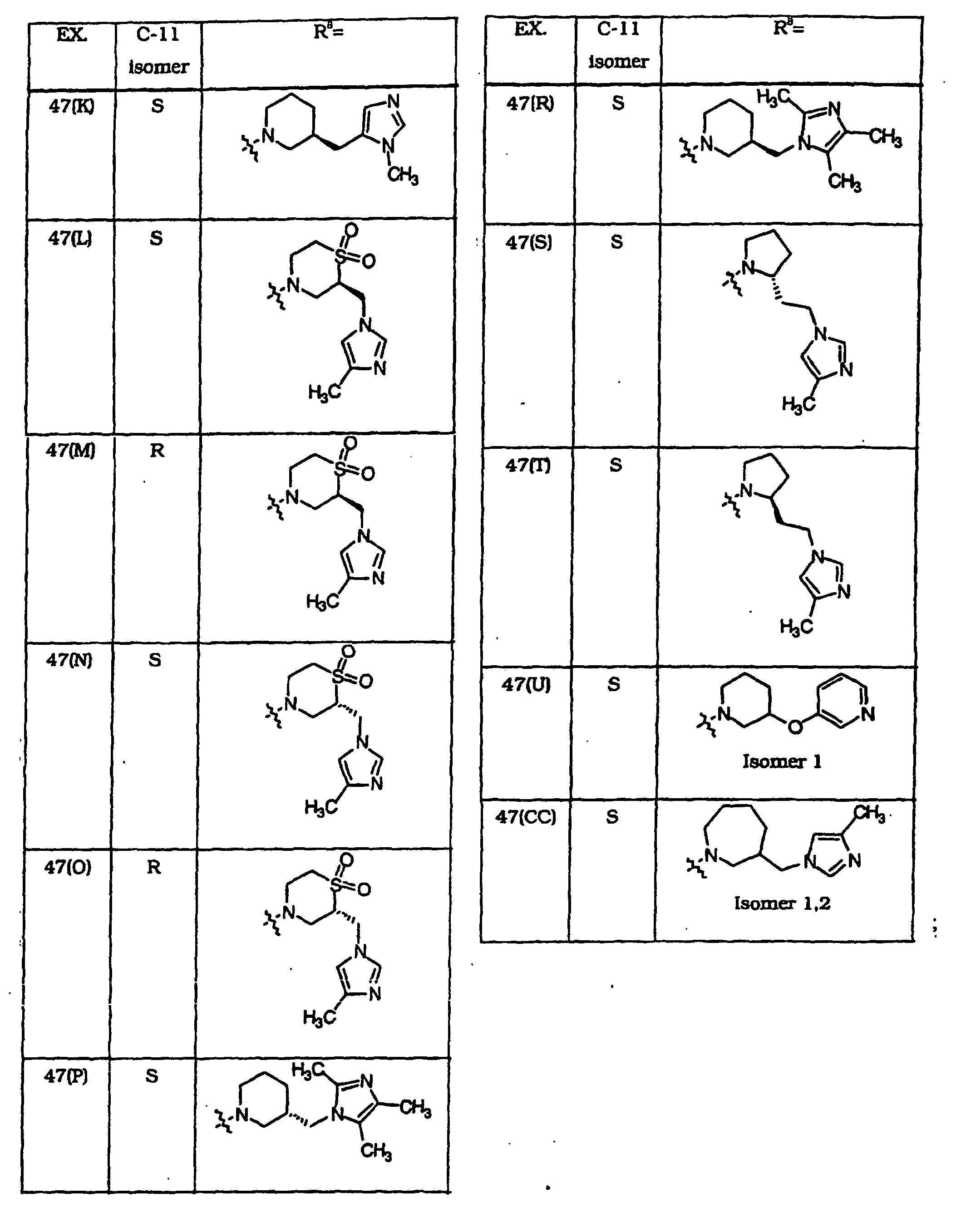 the compound
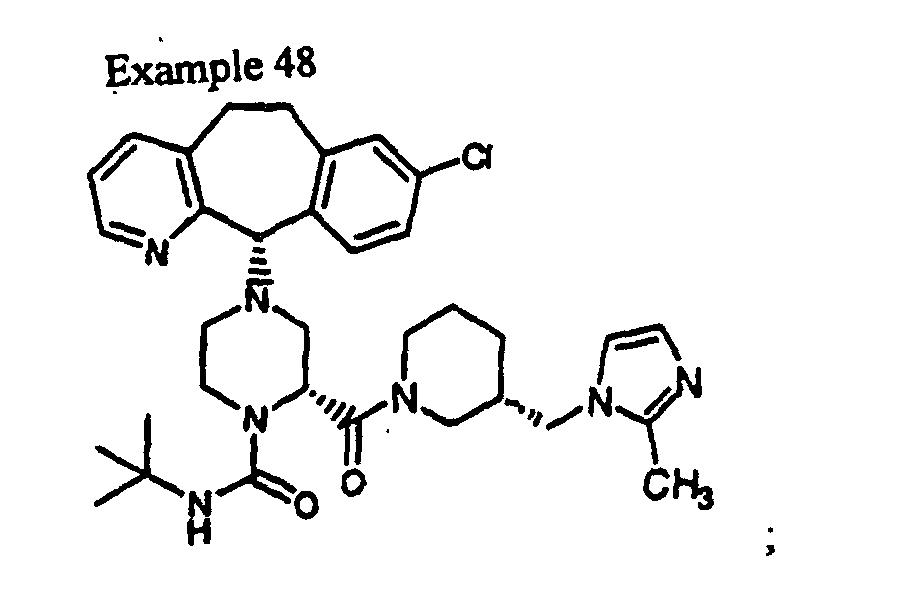 wherein R8 is as listed in the tables below,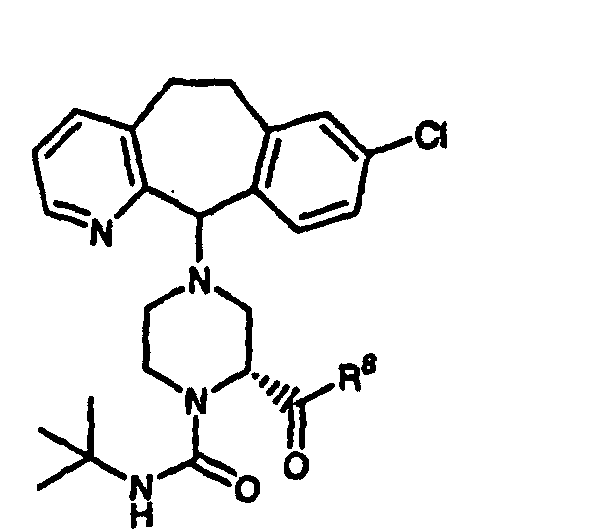


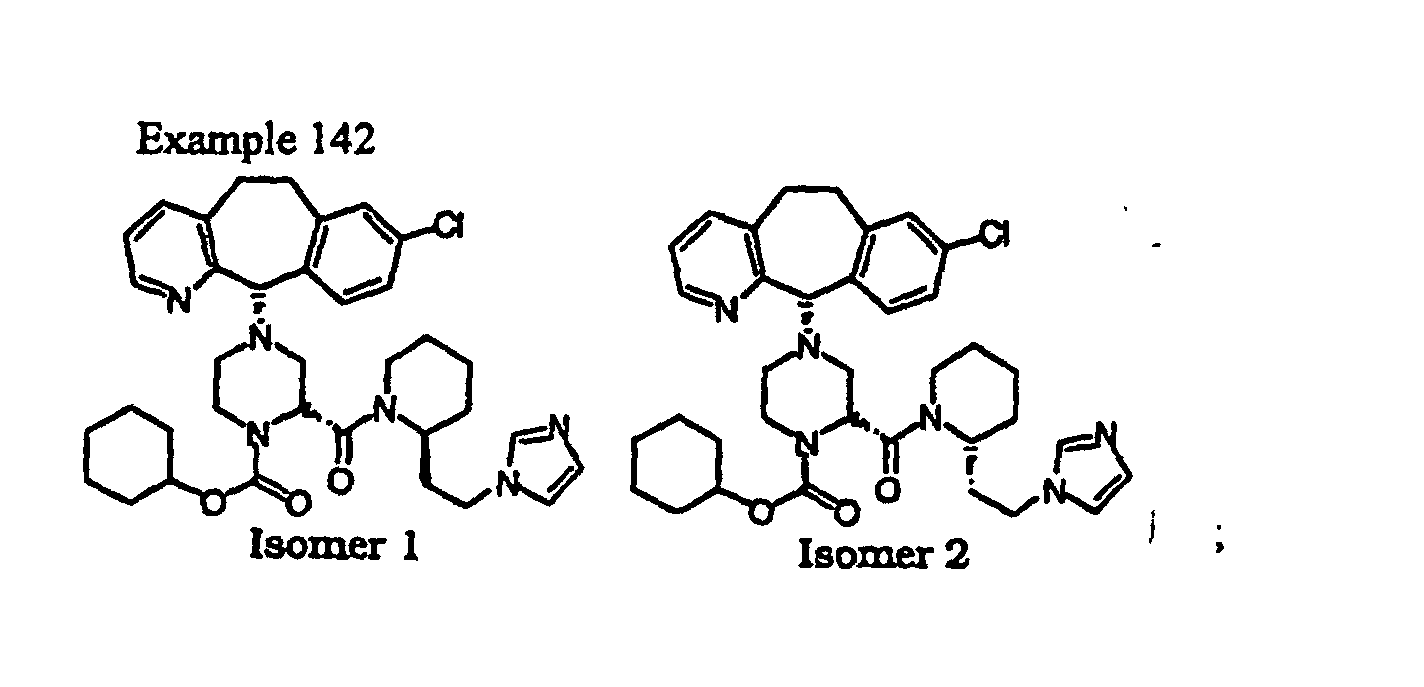
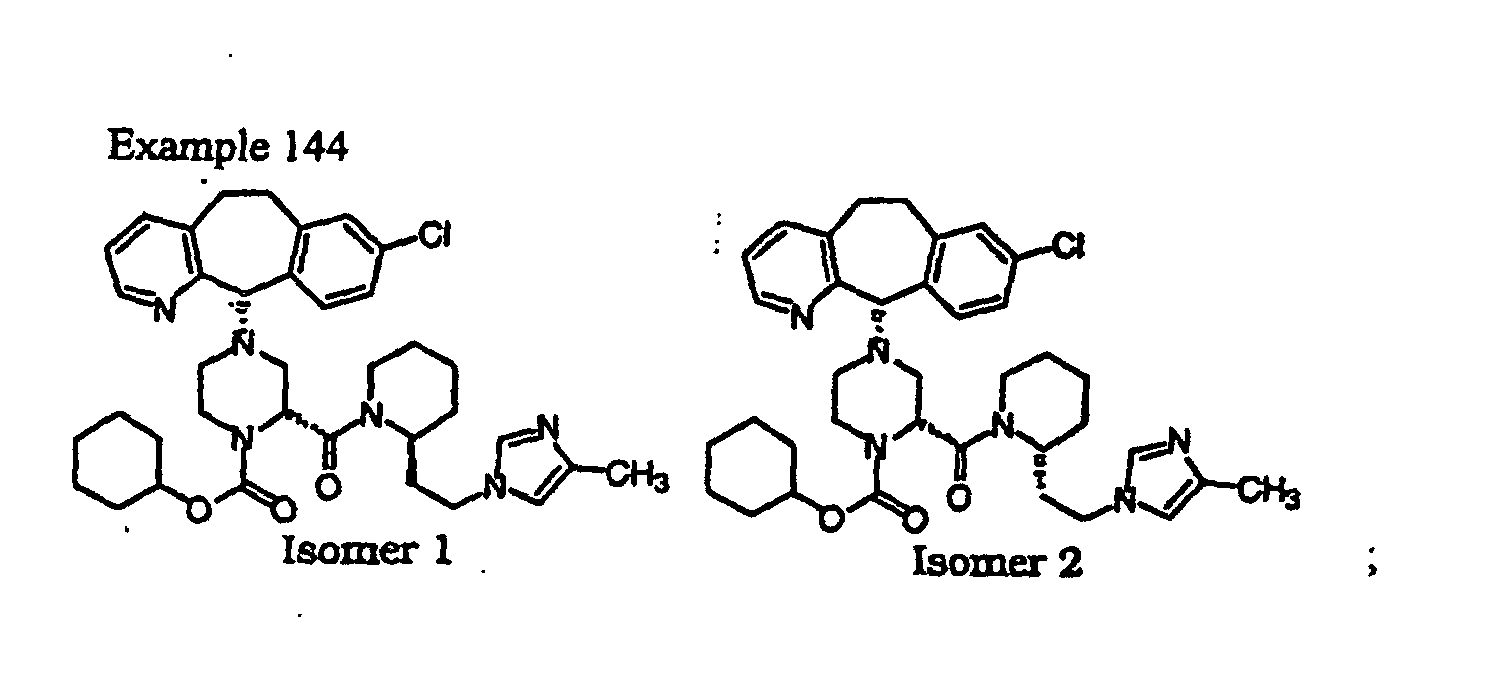 the compound
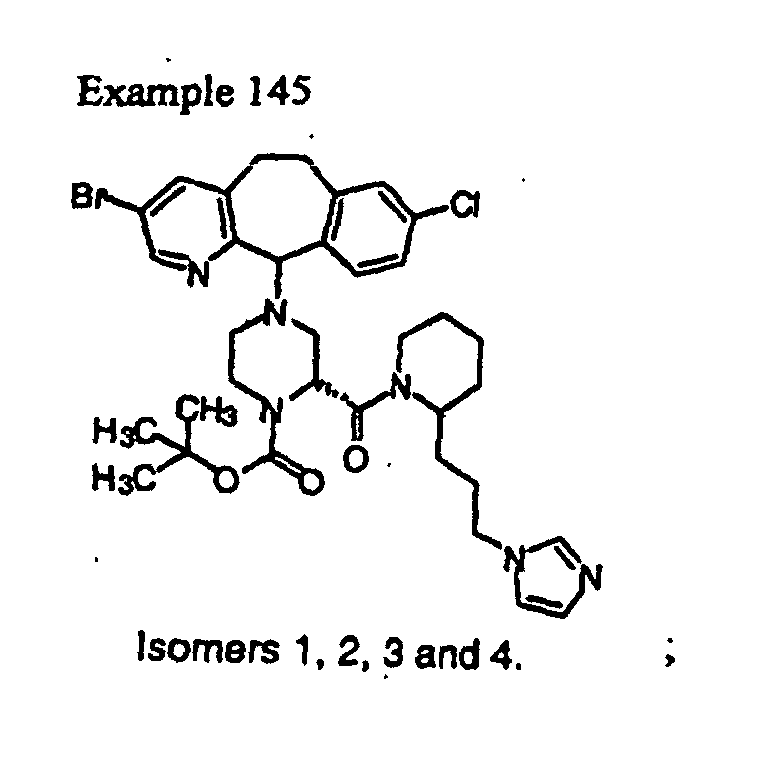 wherein R8 is as listed in the tables below,
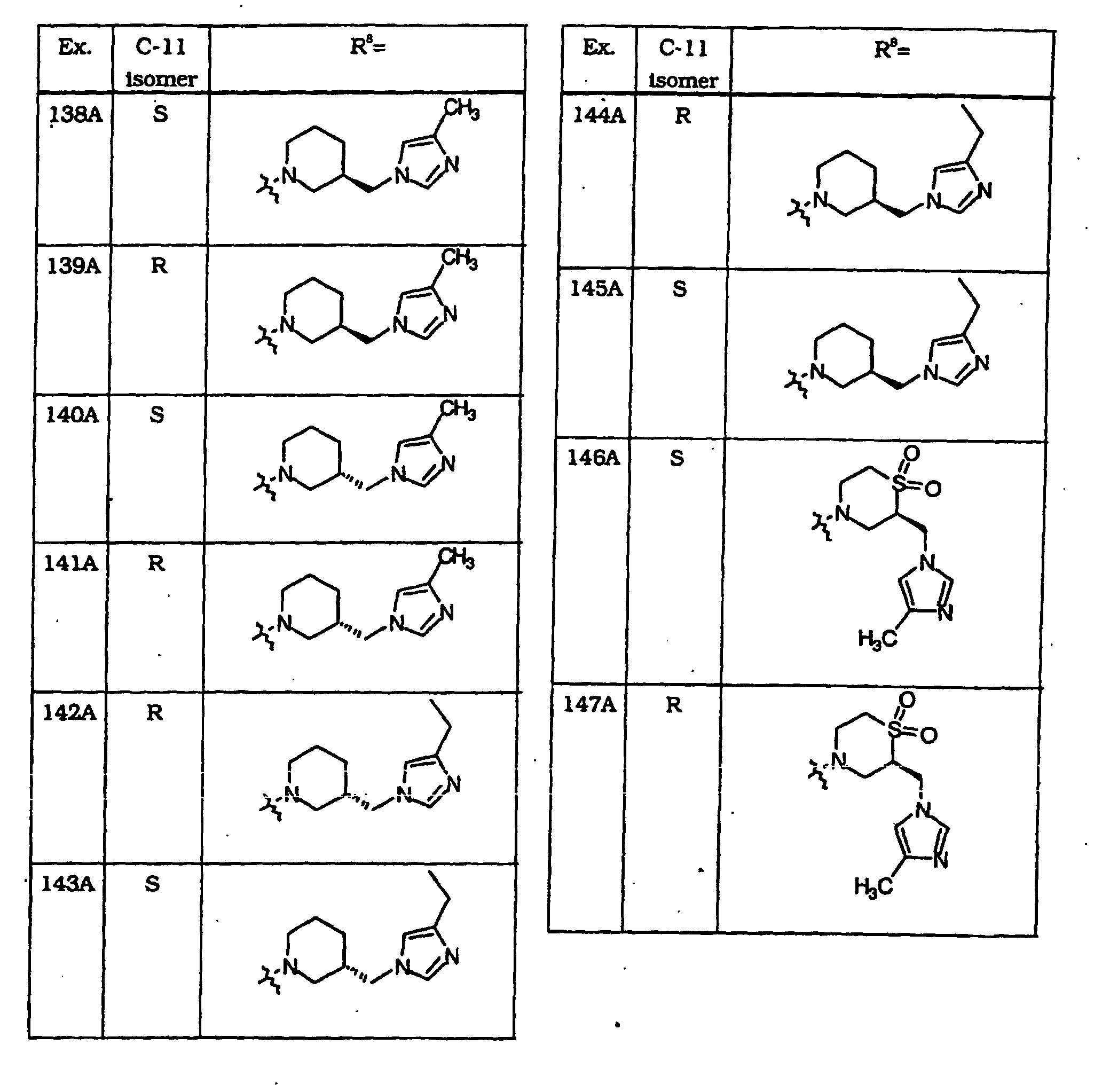
 the compound
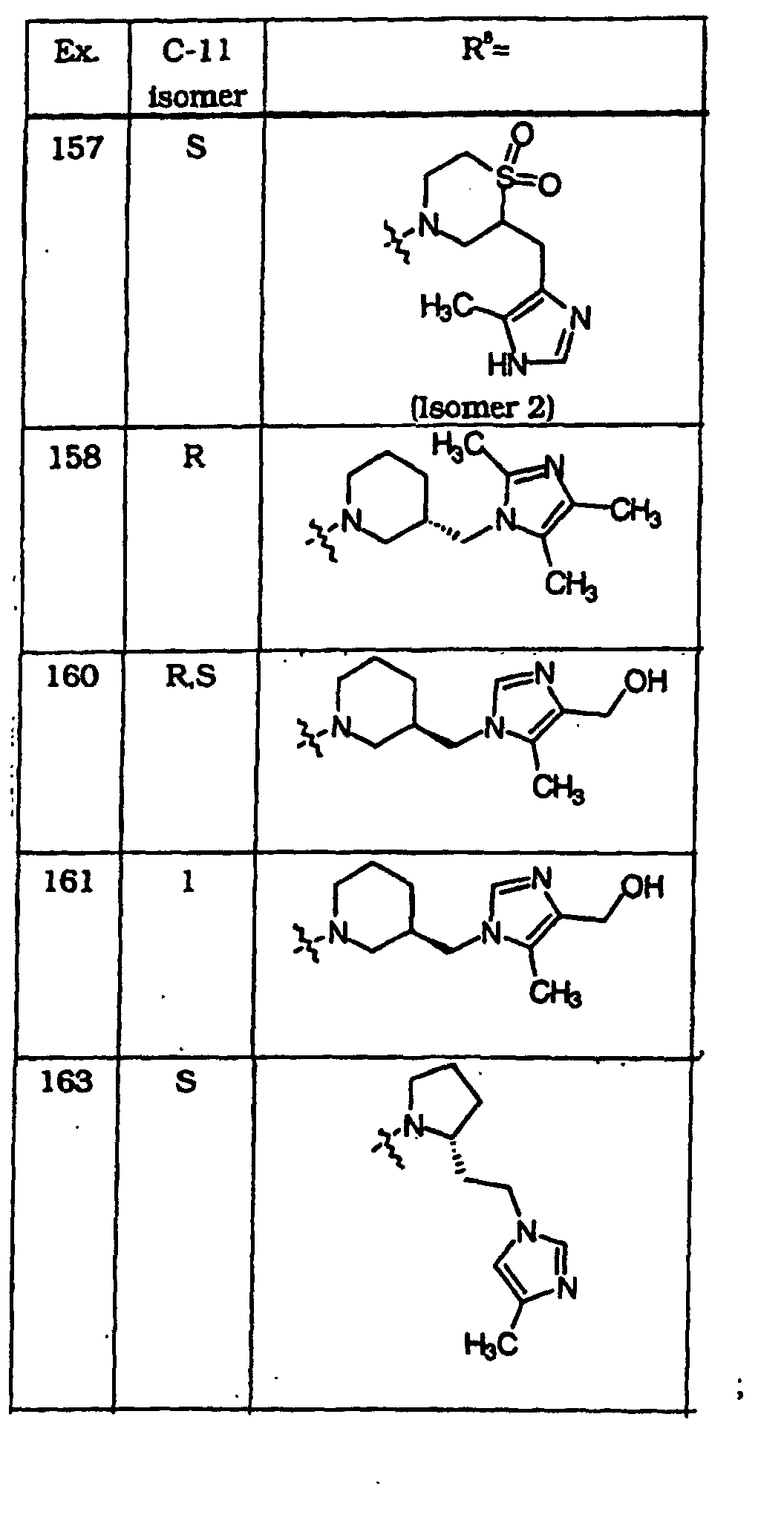 wherein R9 is as listed in the tables below,
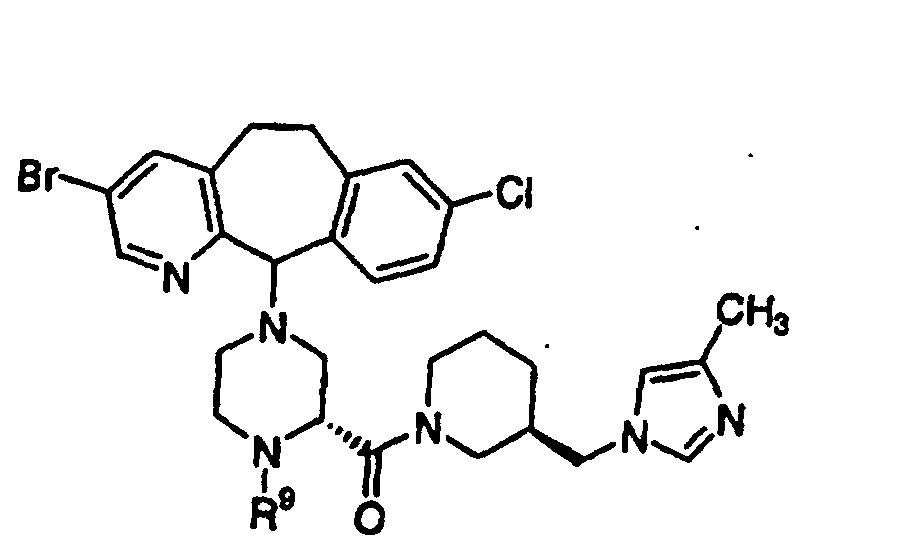 the compound
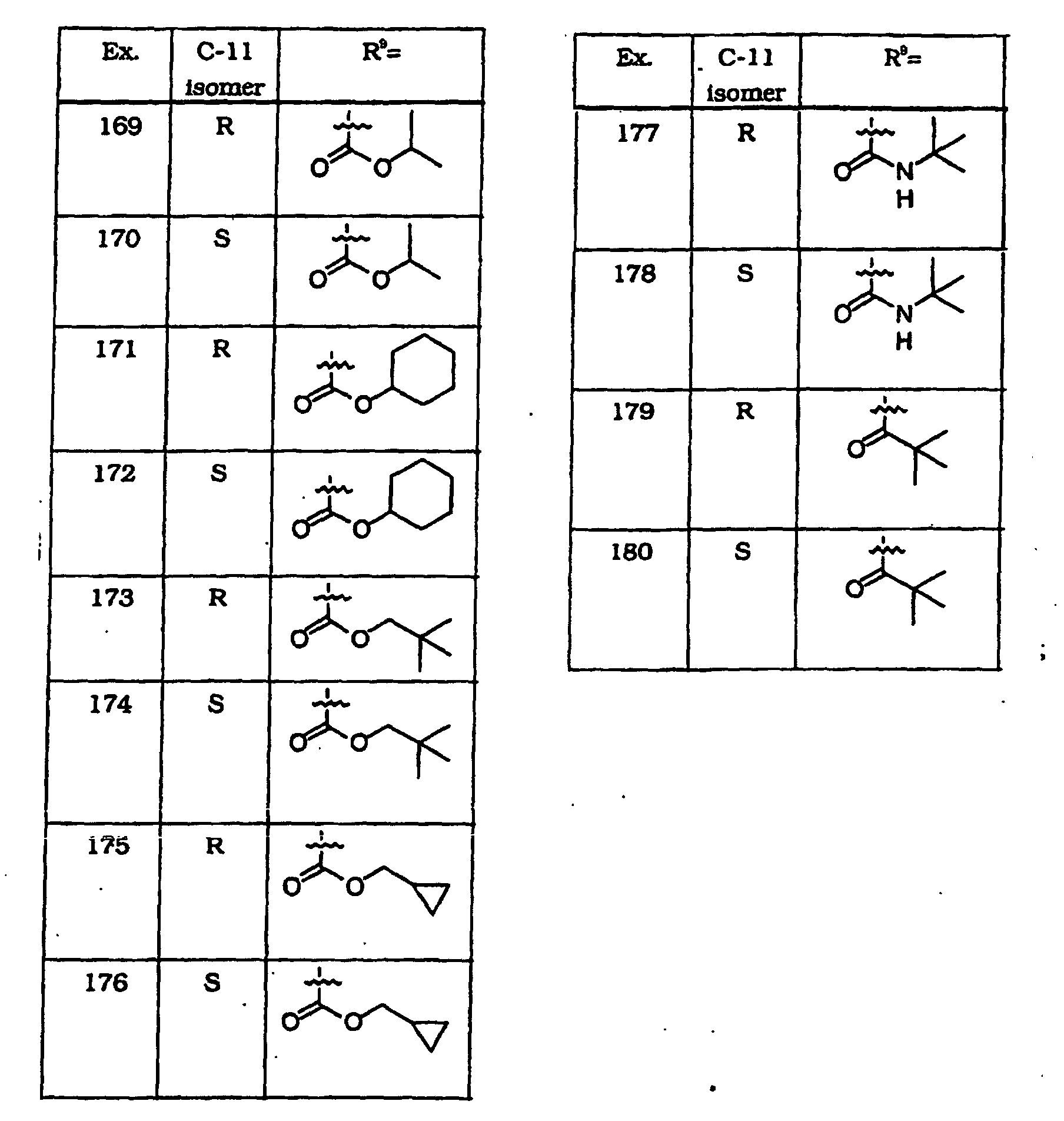 wherein R9 is as listed in the table below,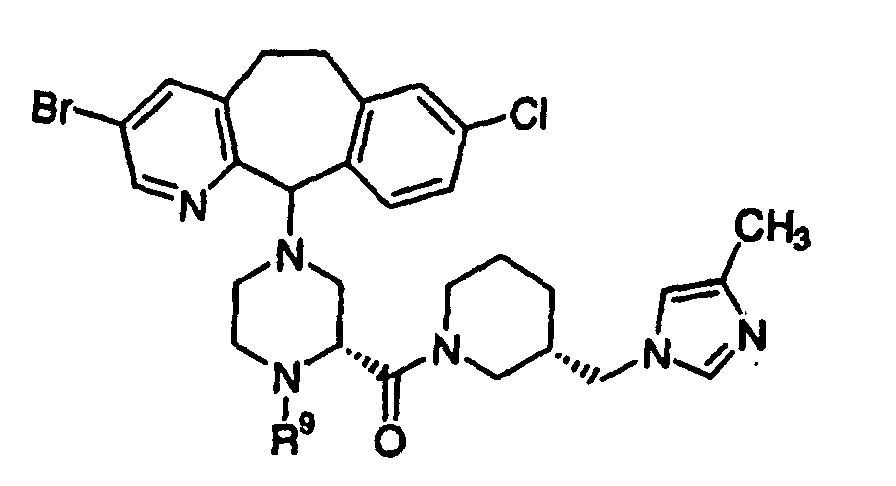
 the compound
 wherein R8 is as listed in the tables below,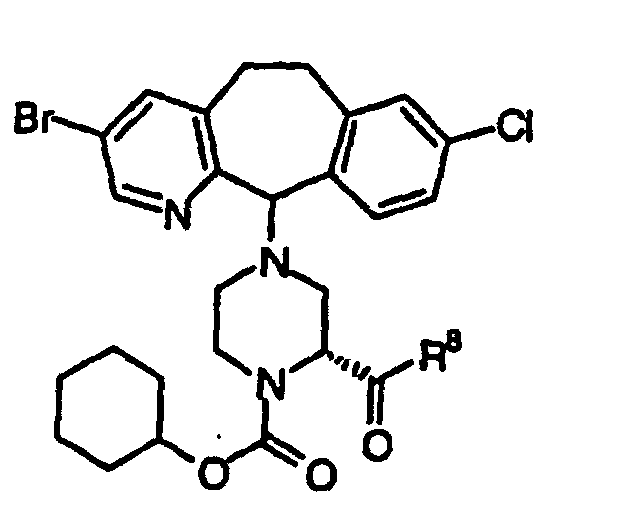
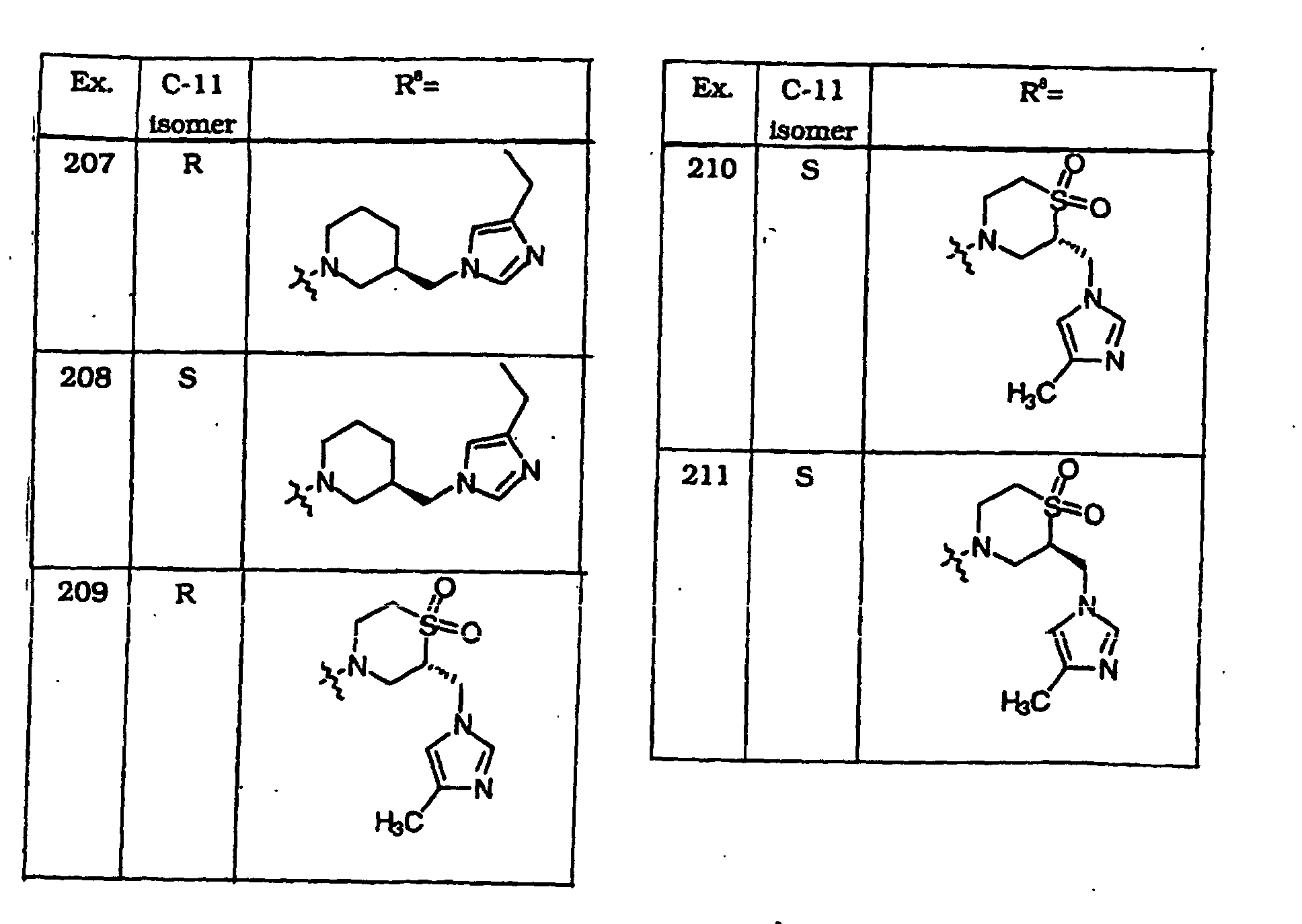
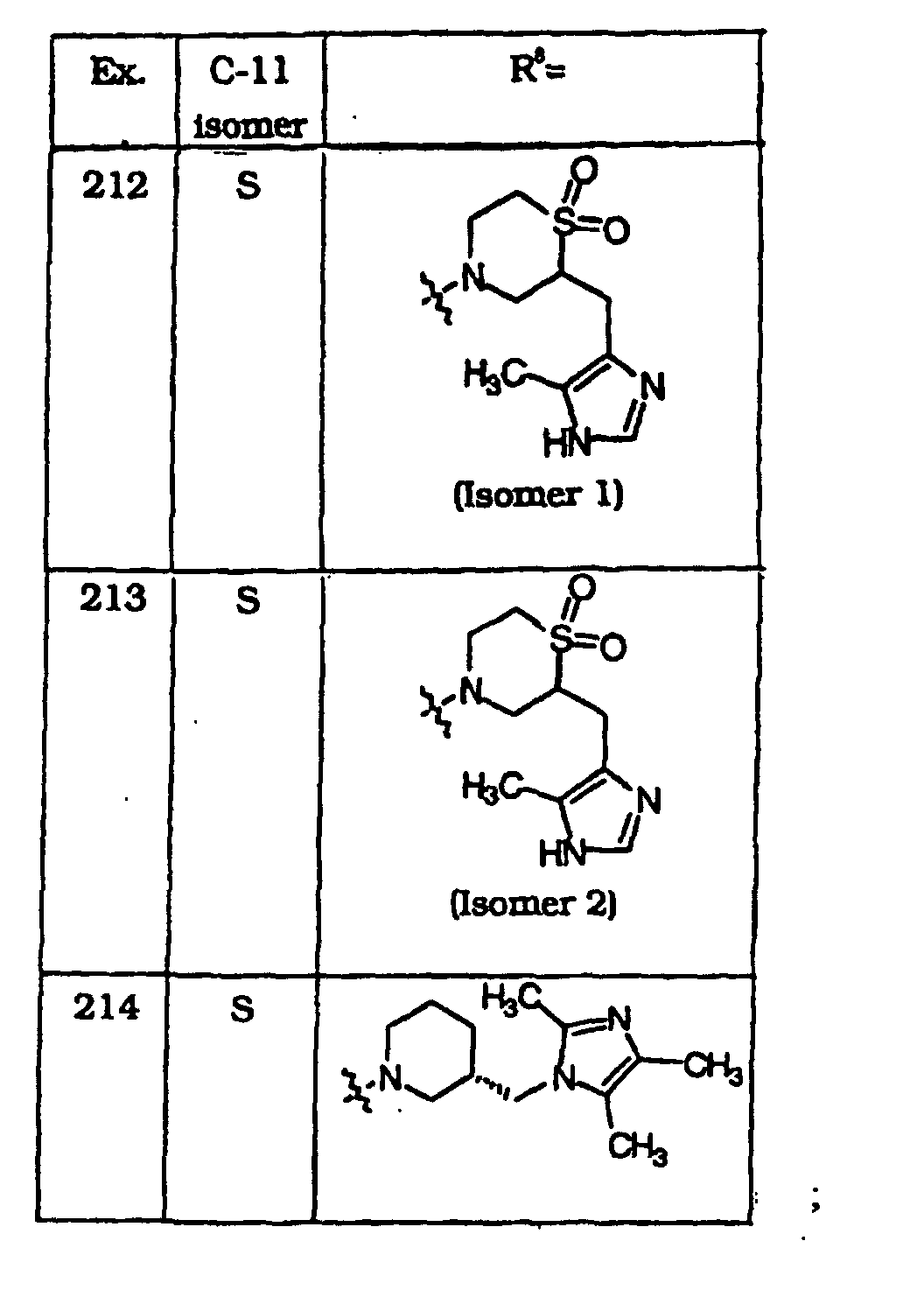 the compound
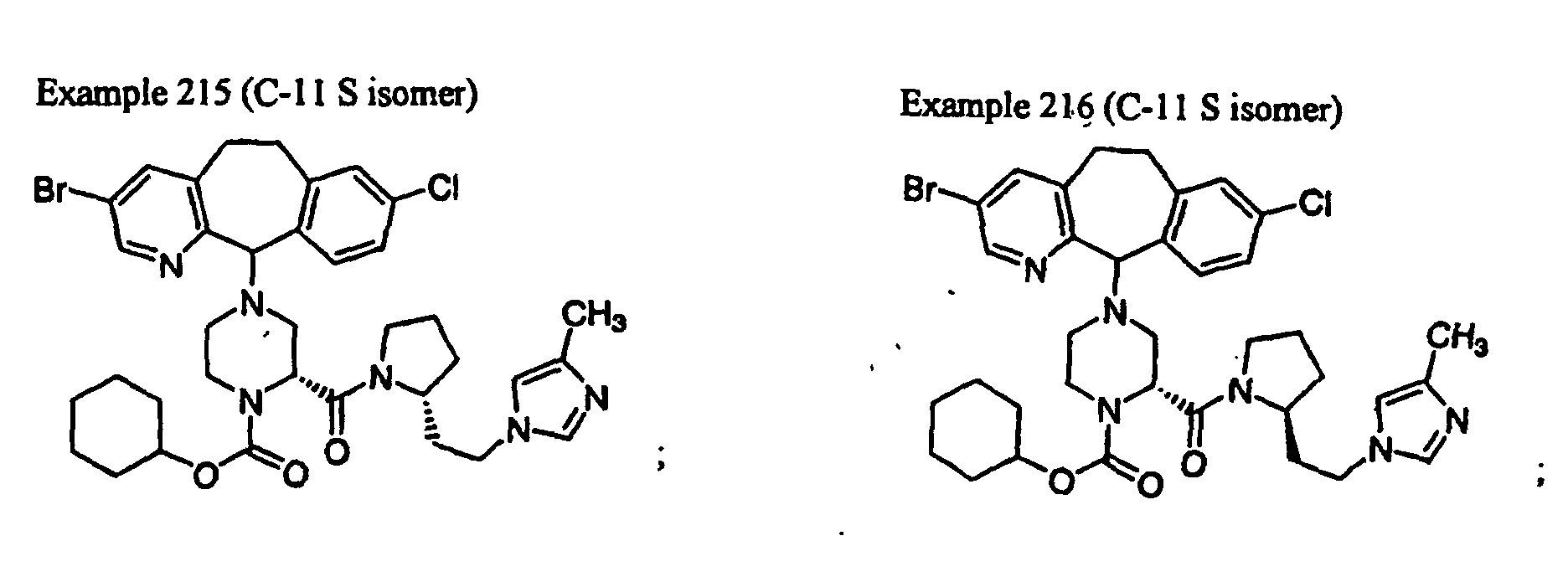 wherein R8 is as listed in the table below,
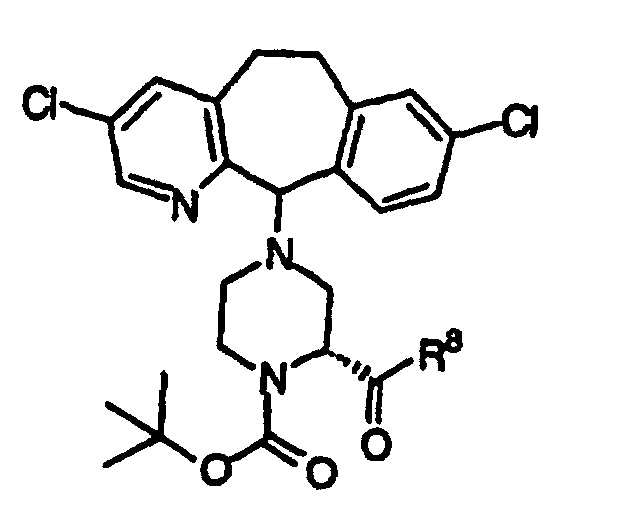 the compound
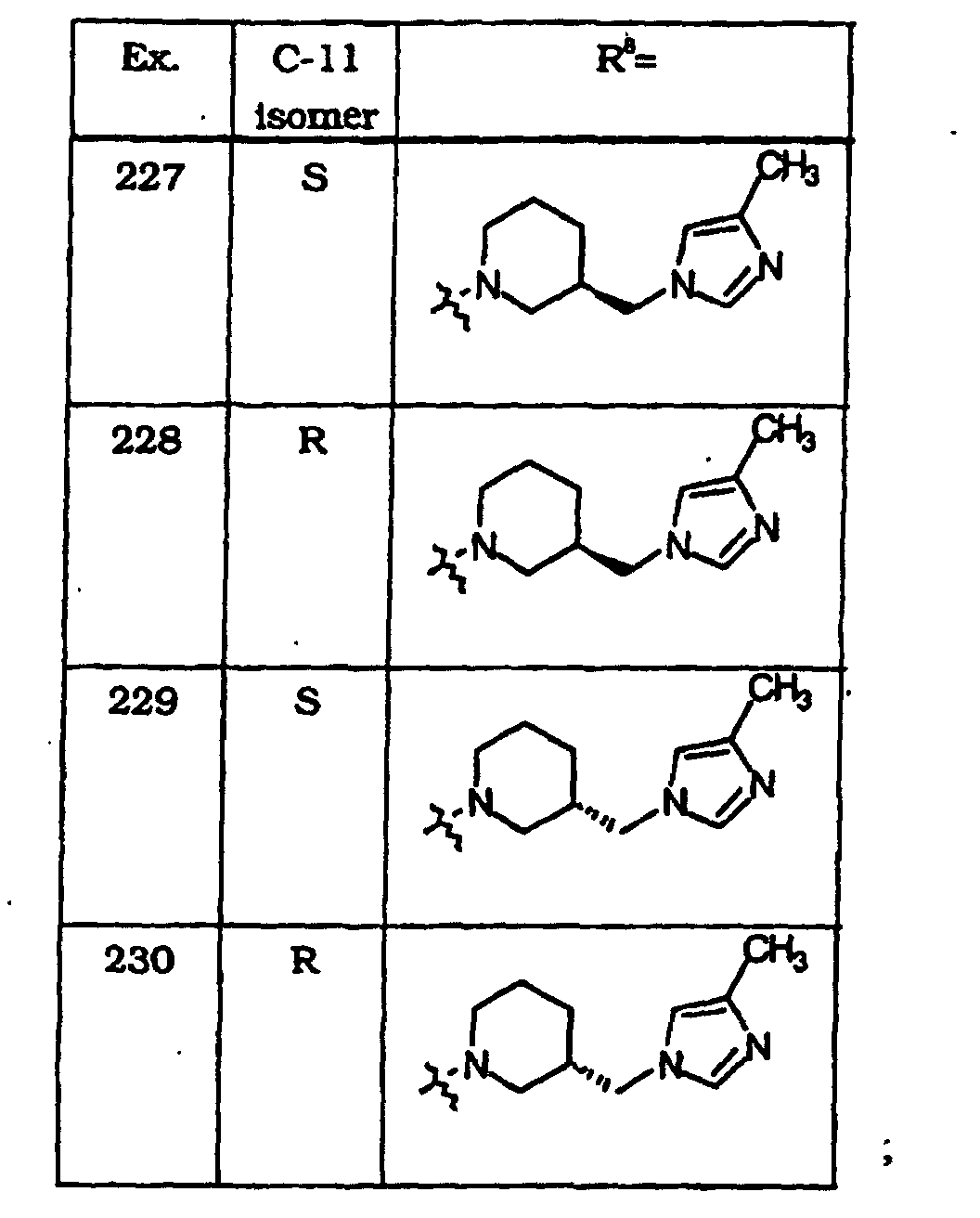 wherein R9 is as listed in the table below,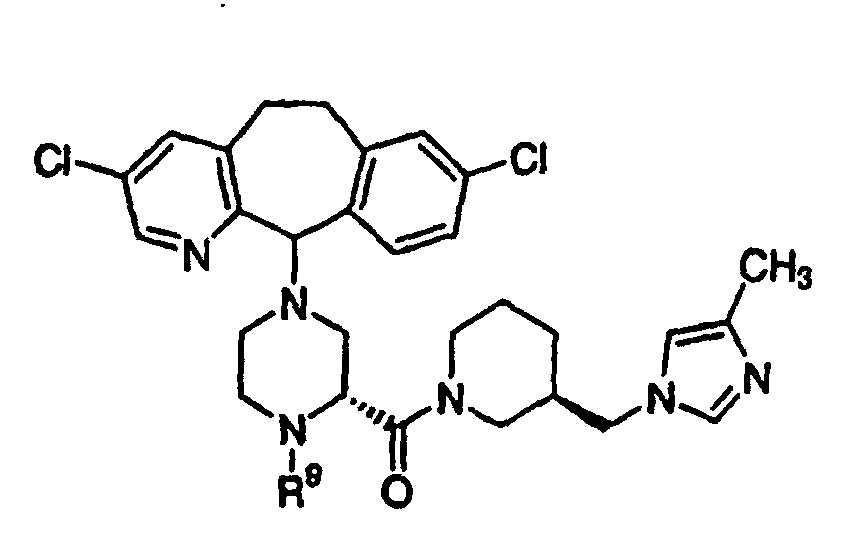
 the compound
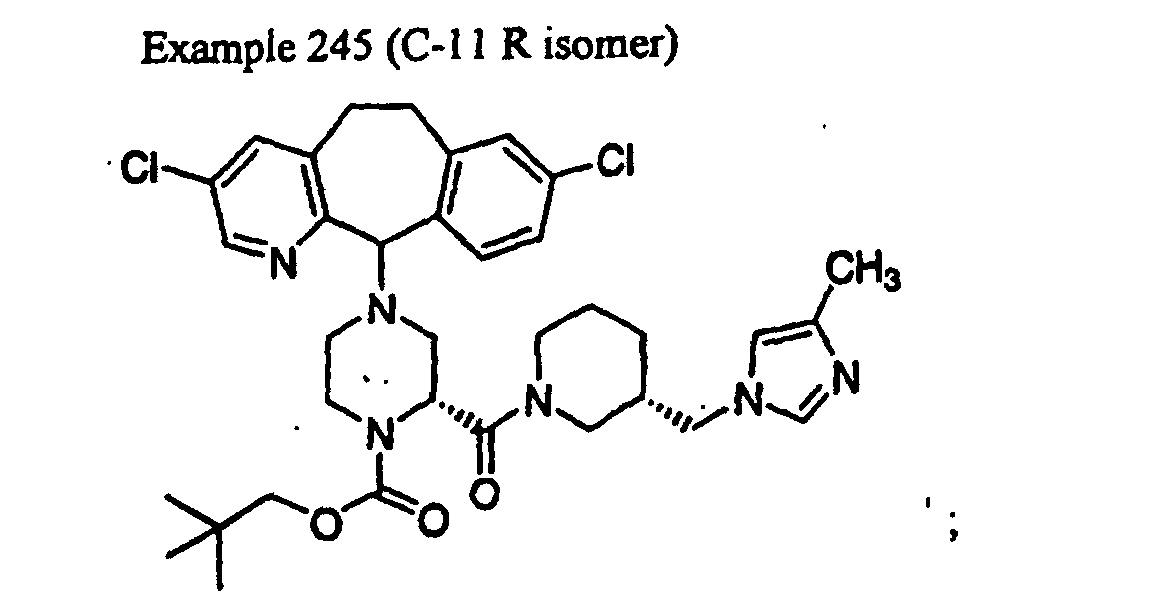 wherein R8 is as listed in the table below,
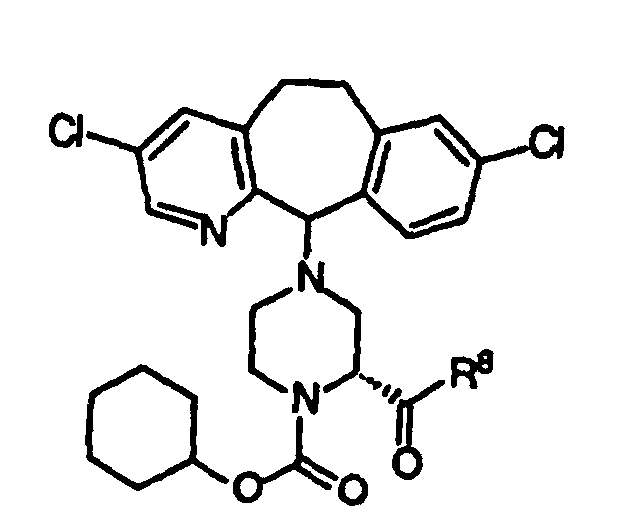 the compound
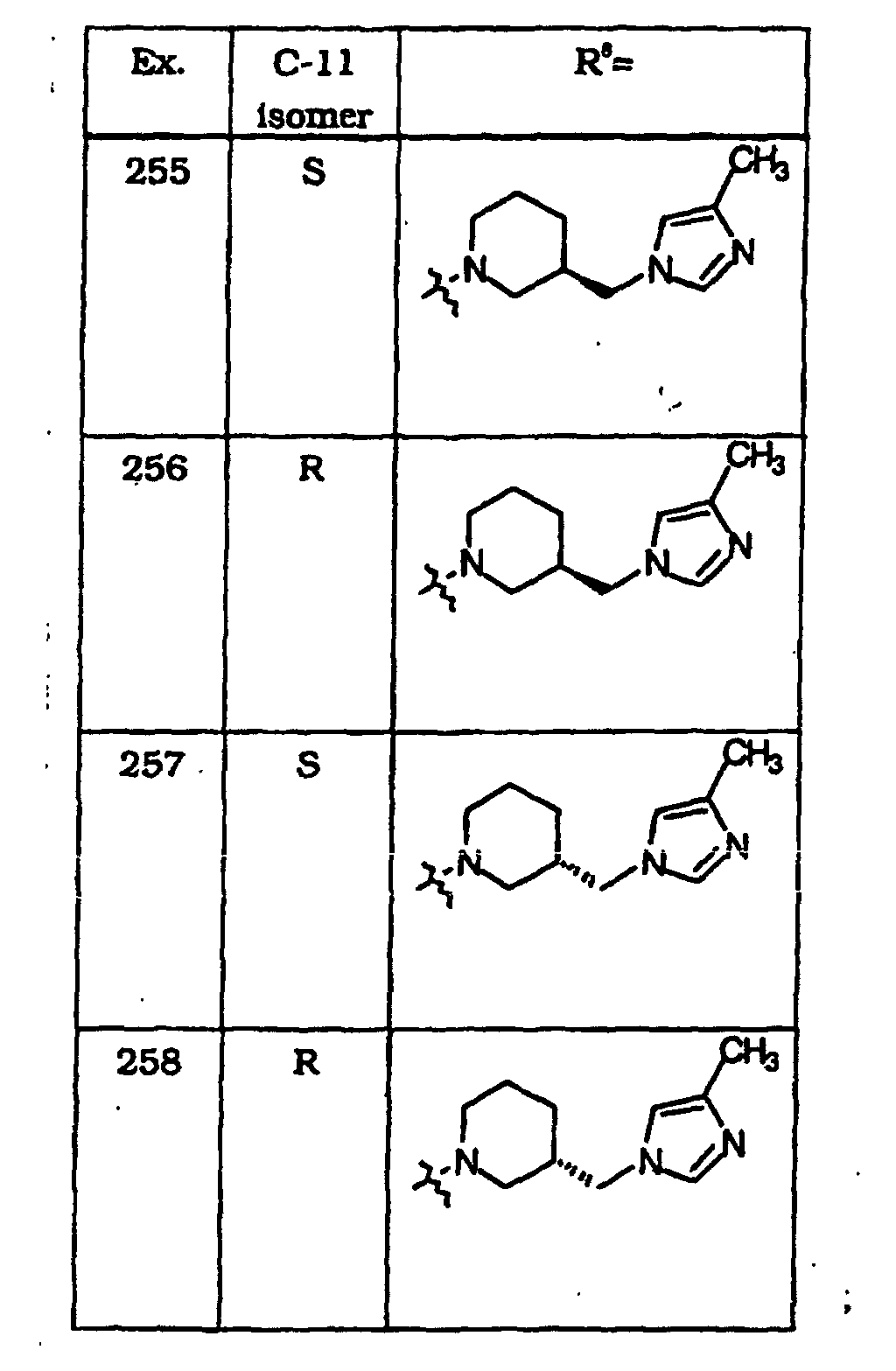 wherein R8 is as listed in the table opposite,
 the compound
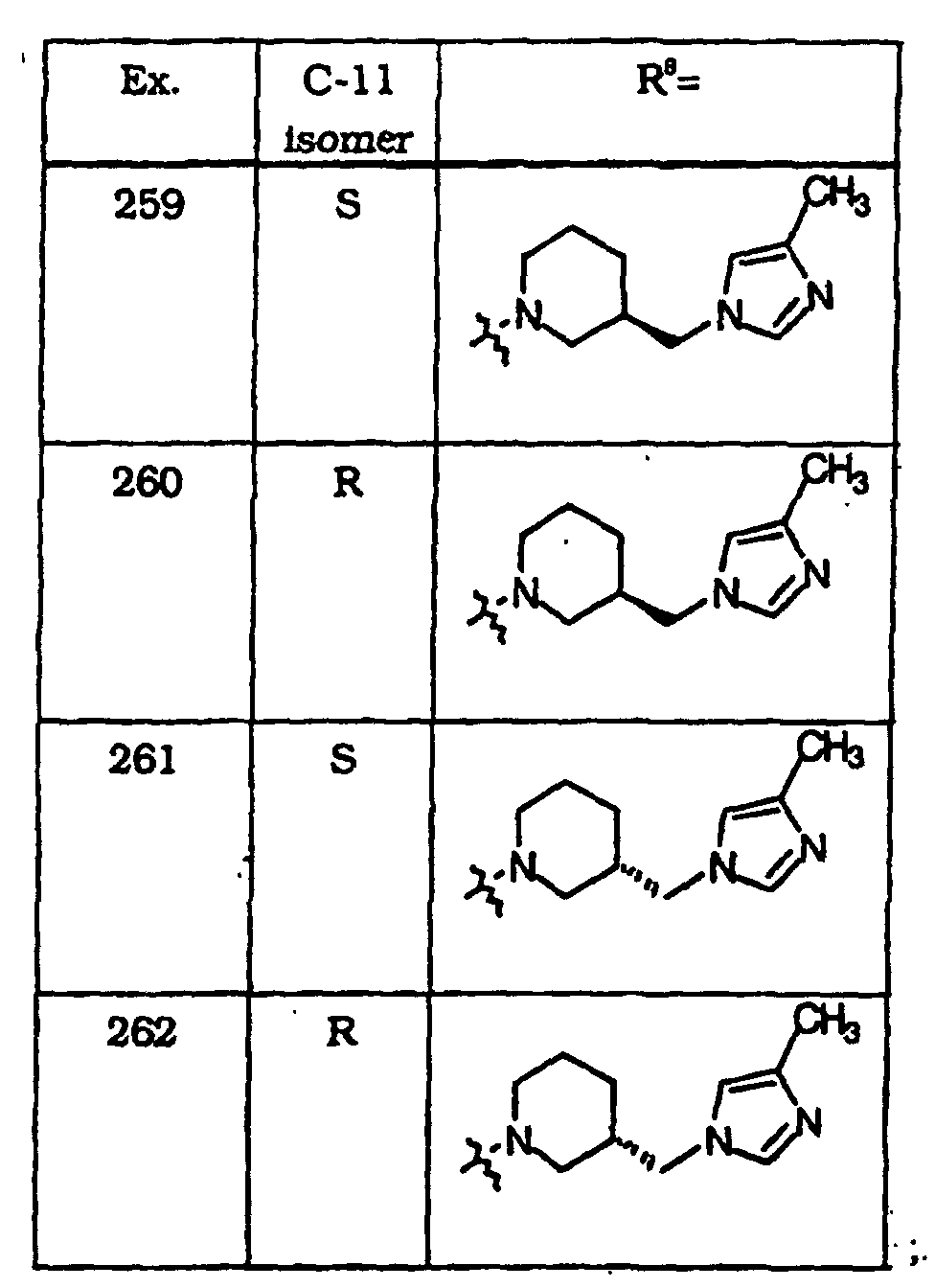 wherein R8 is as listed in the table opposite,
 the compound
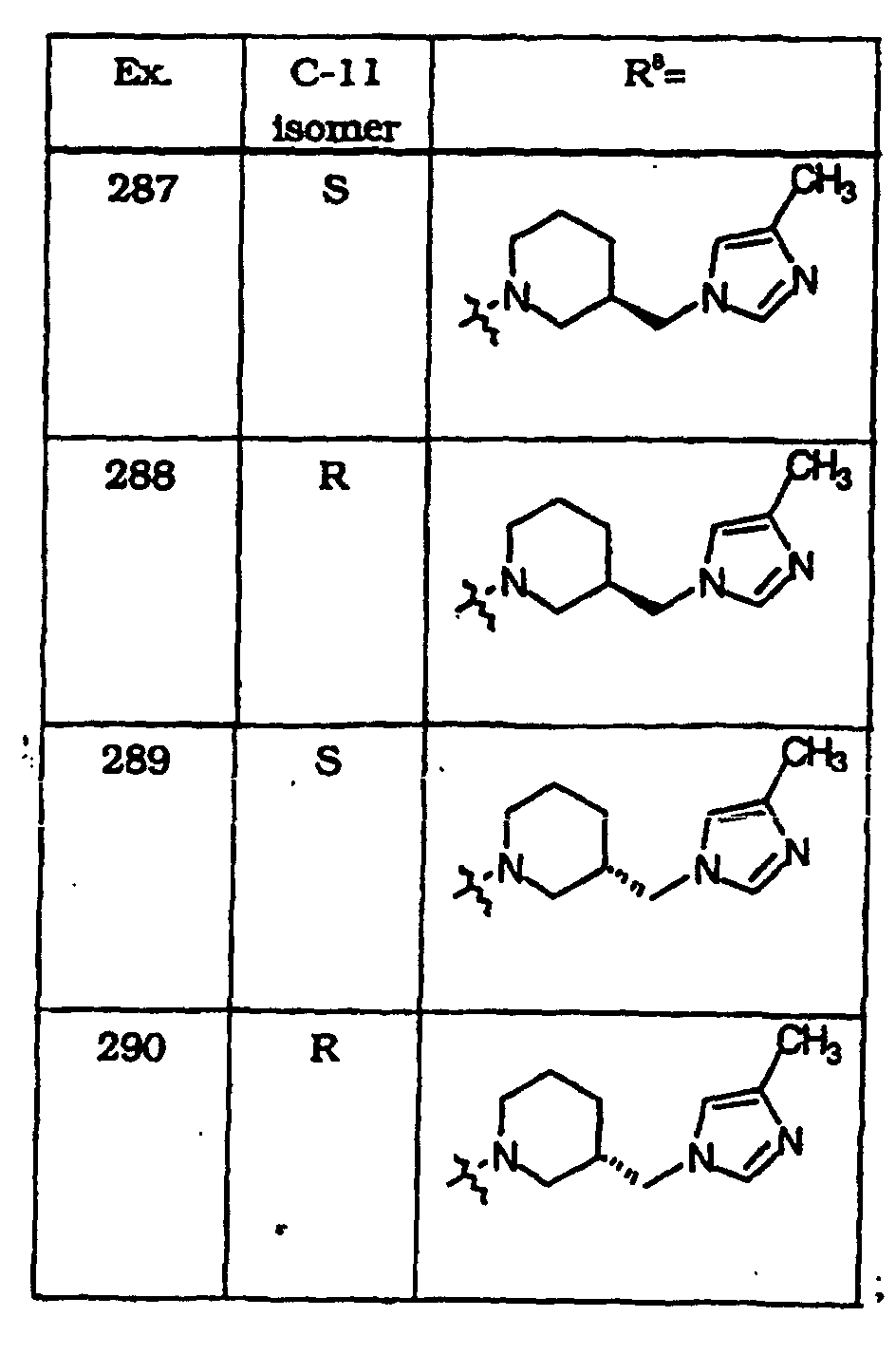 wherein R8 is as listed in the table below,
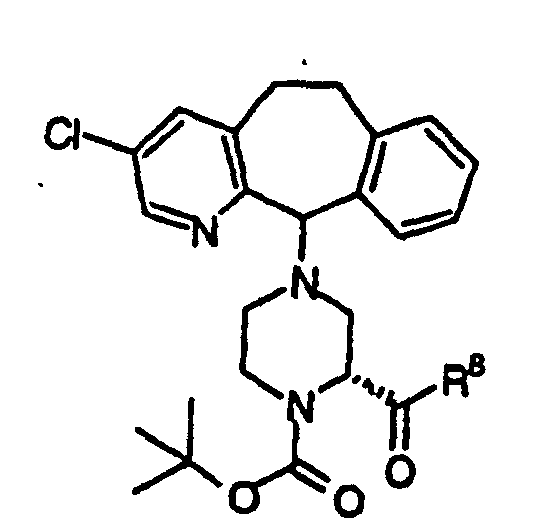 the compound
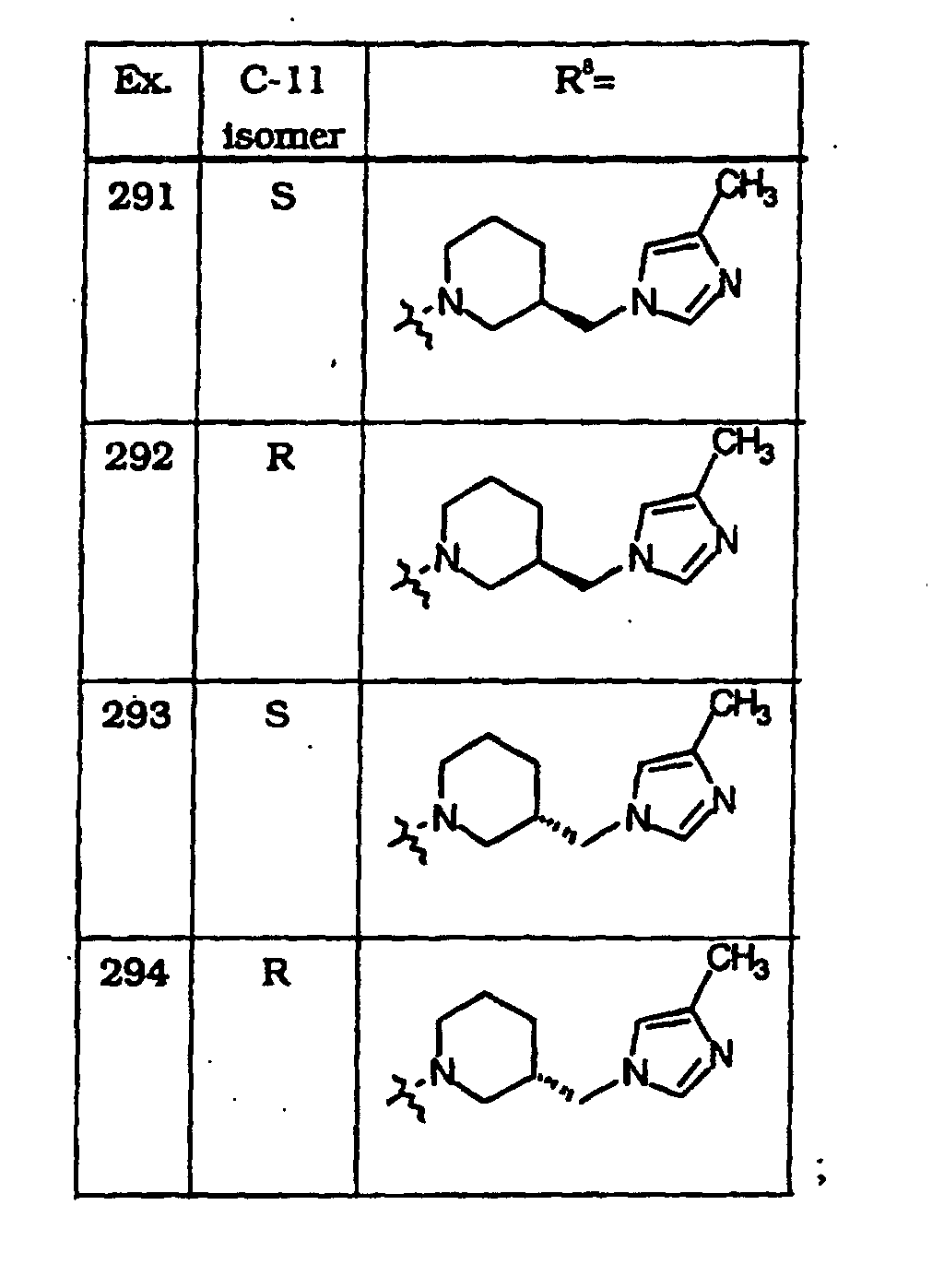 wherein R9 is as listed in the table below,
 the compound
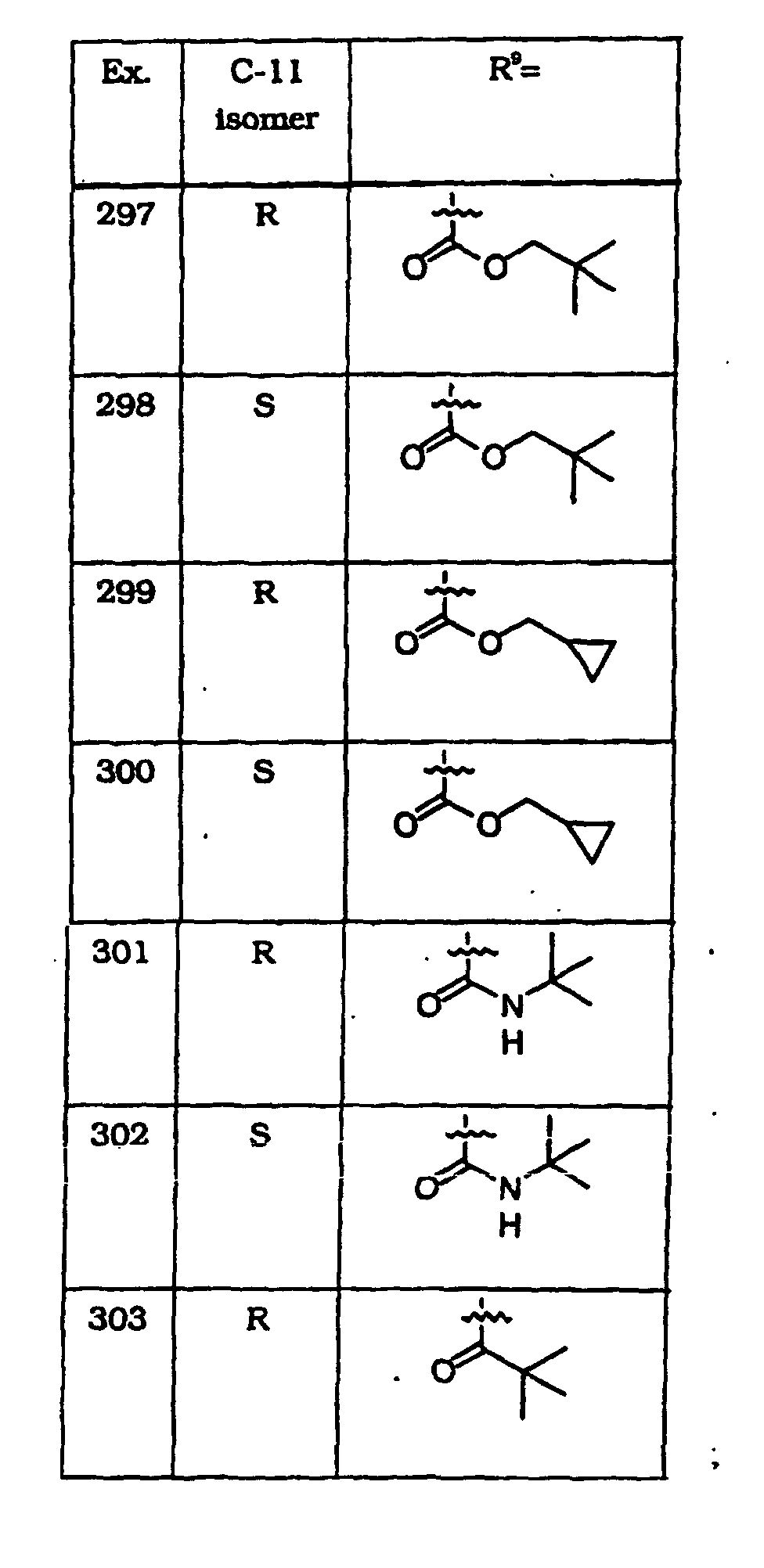 wherein R9 is as listed in the table below,
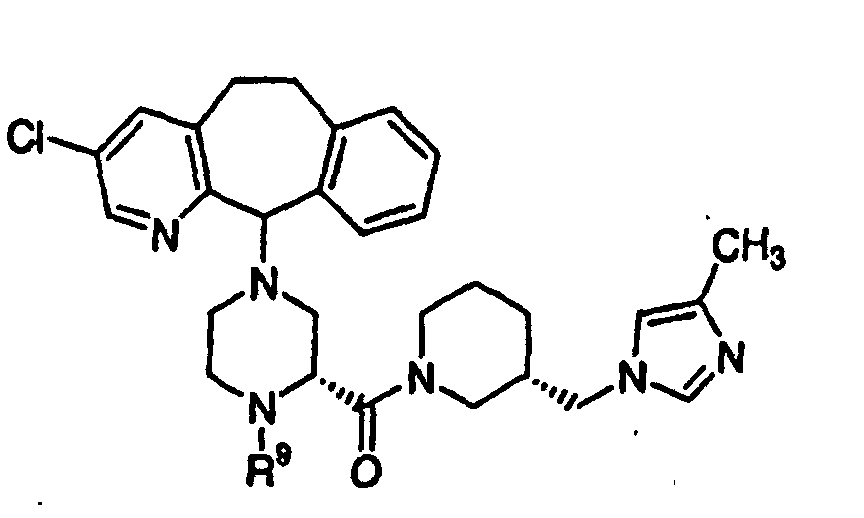 the compound
 wherein R8 is as listed in the table opposite,
 the compound
 wherein R8 is as listed in the table opposite,
 the compound
 wherein R8 is as listed in the table opposite,
 the compound
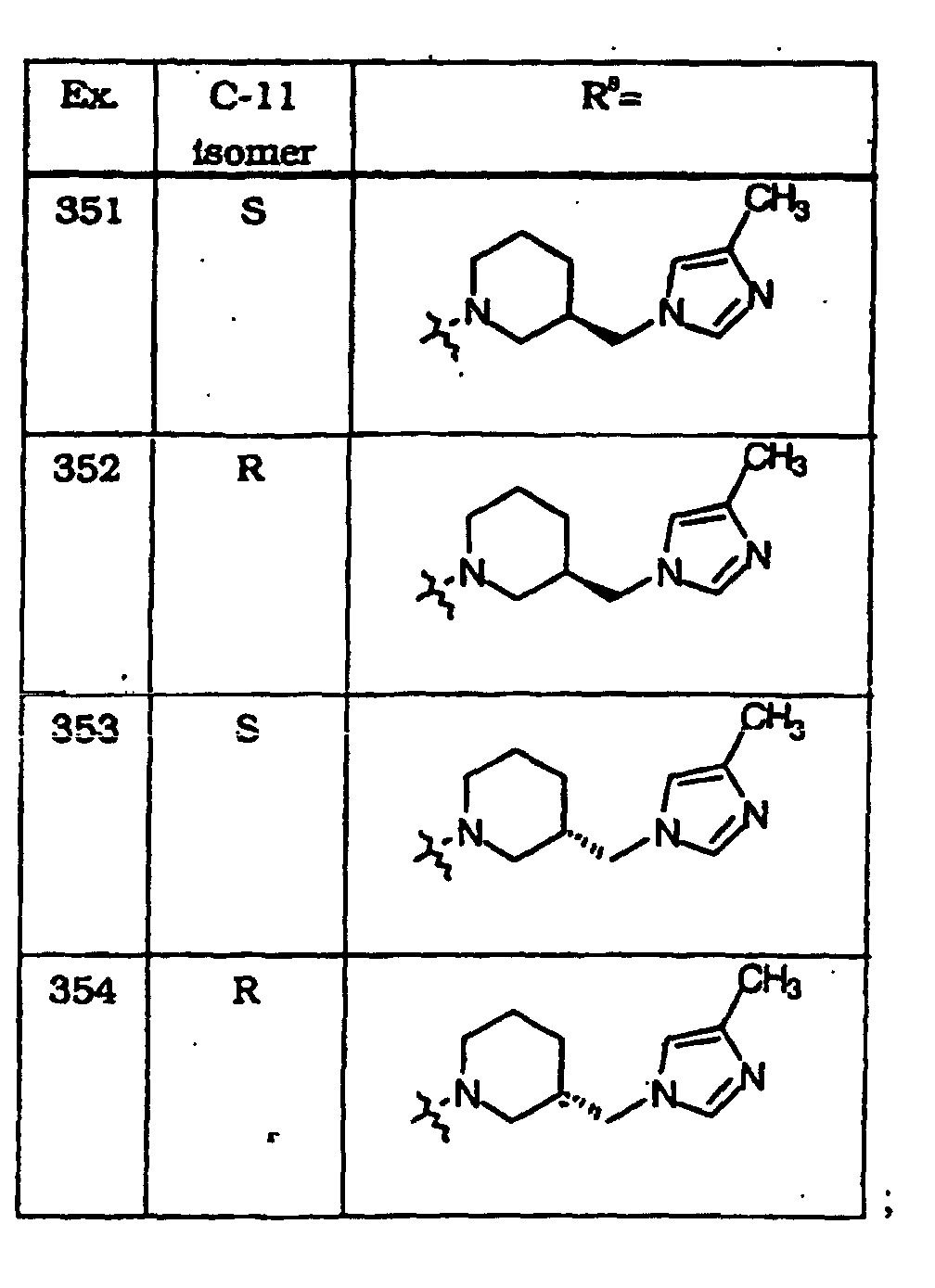 wherein R8 is as listed in the table below,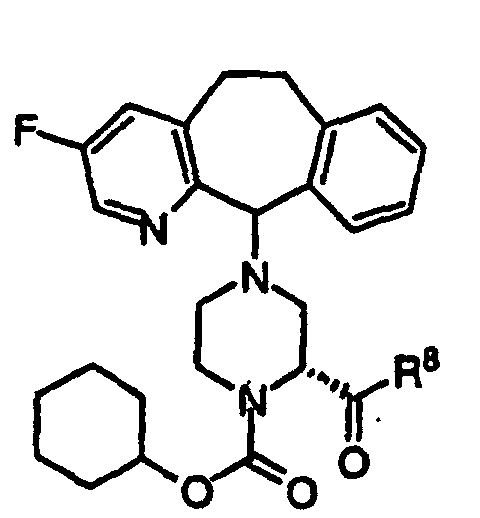
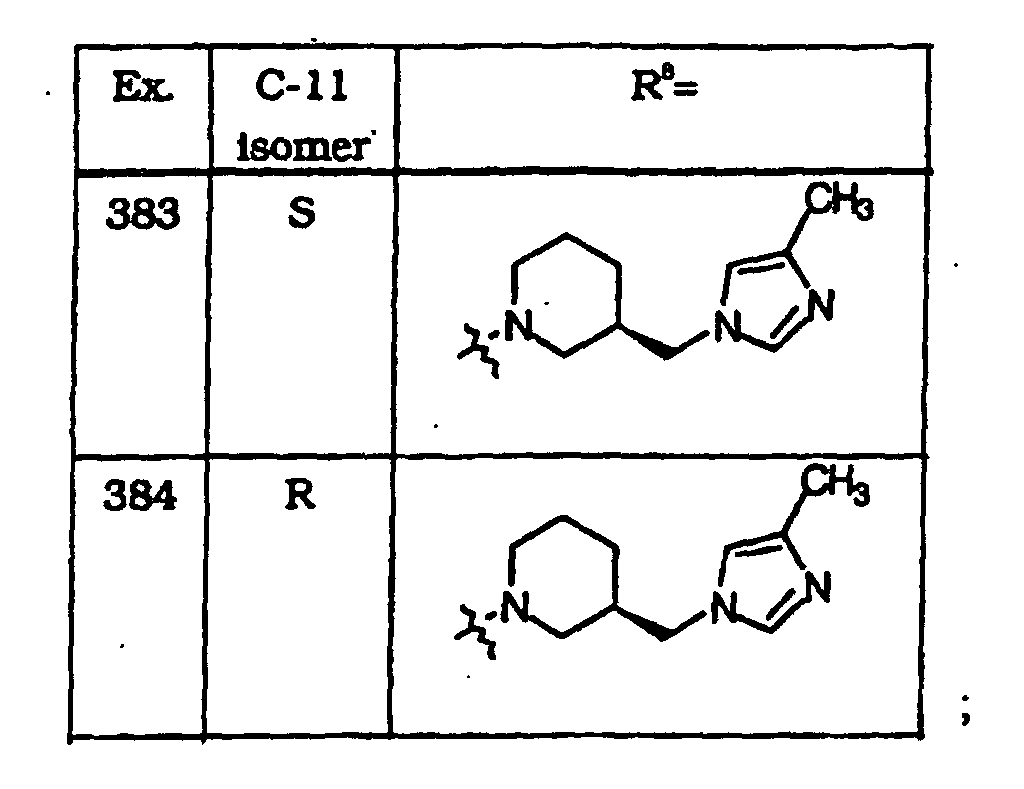 the compound
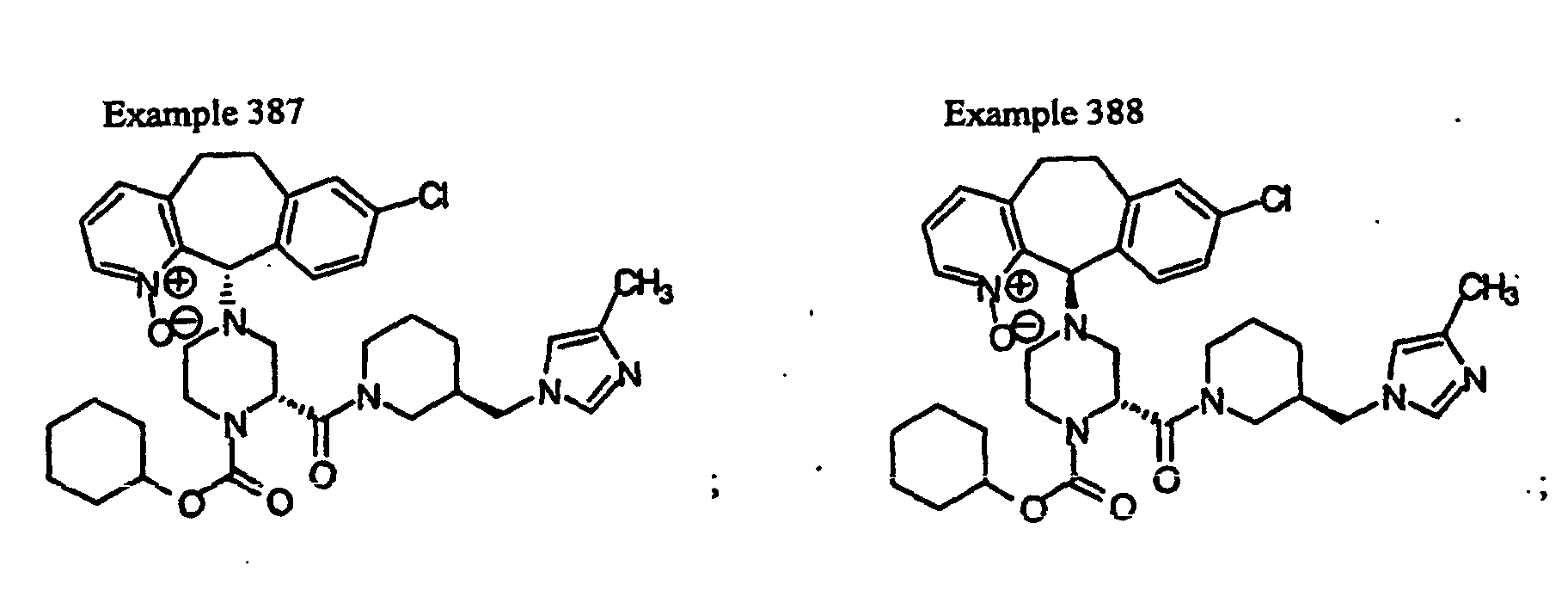 wherein R9 is as listed in the table below,
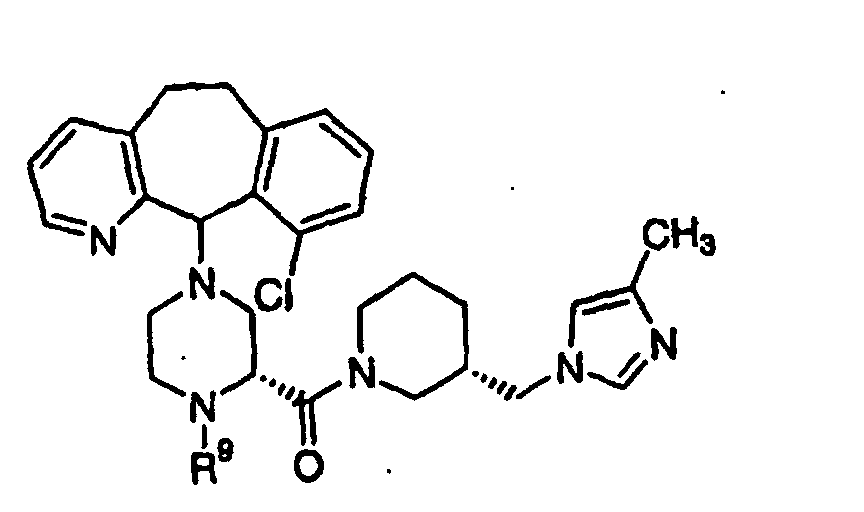 the compound
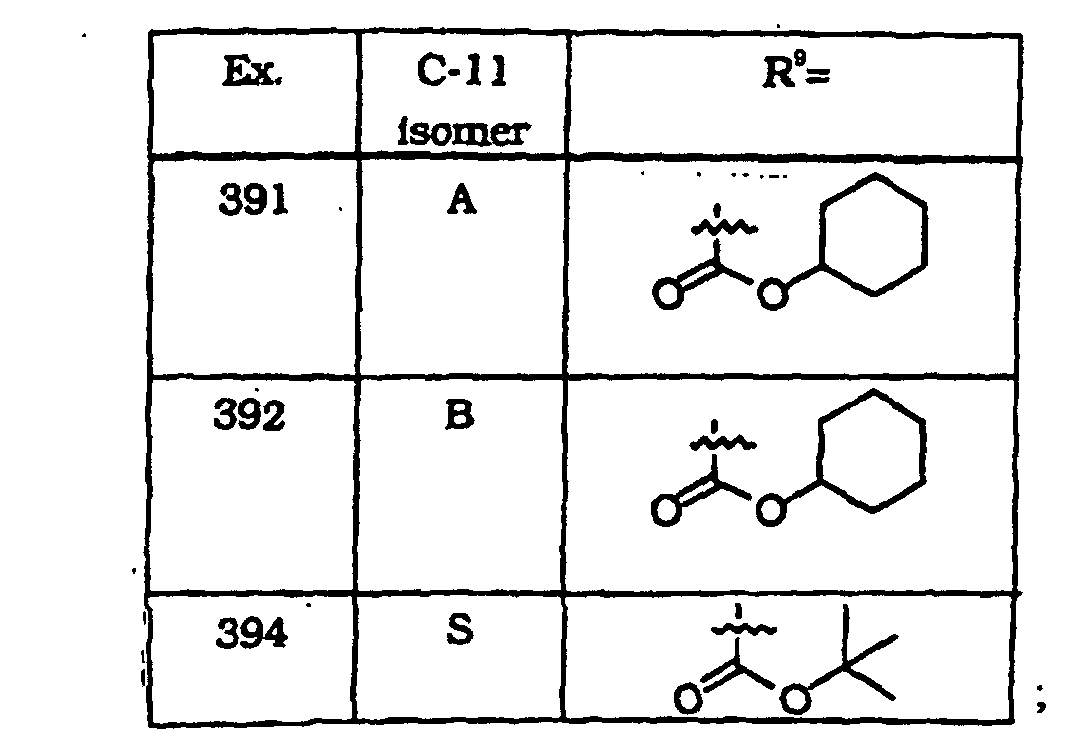 wherein R9 is as listed in the table below,
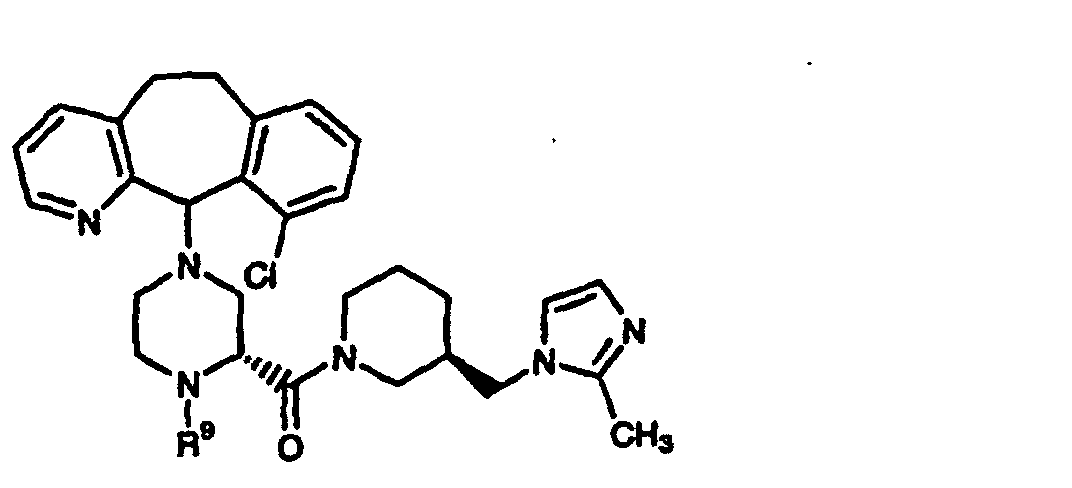 the compound
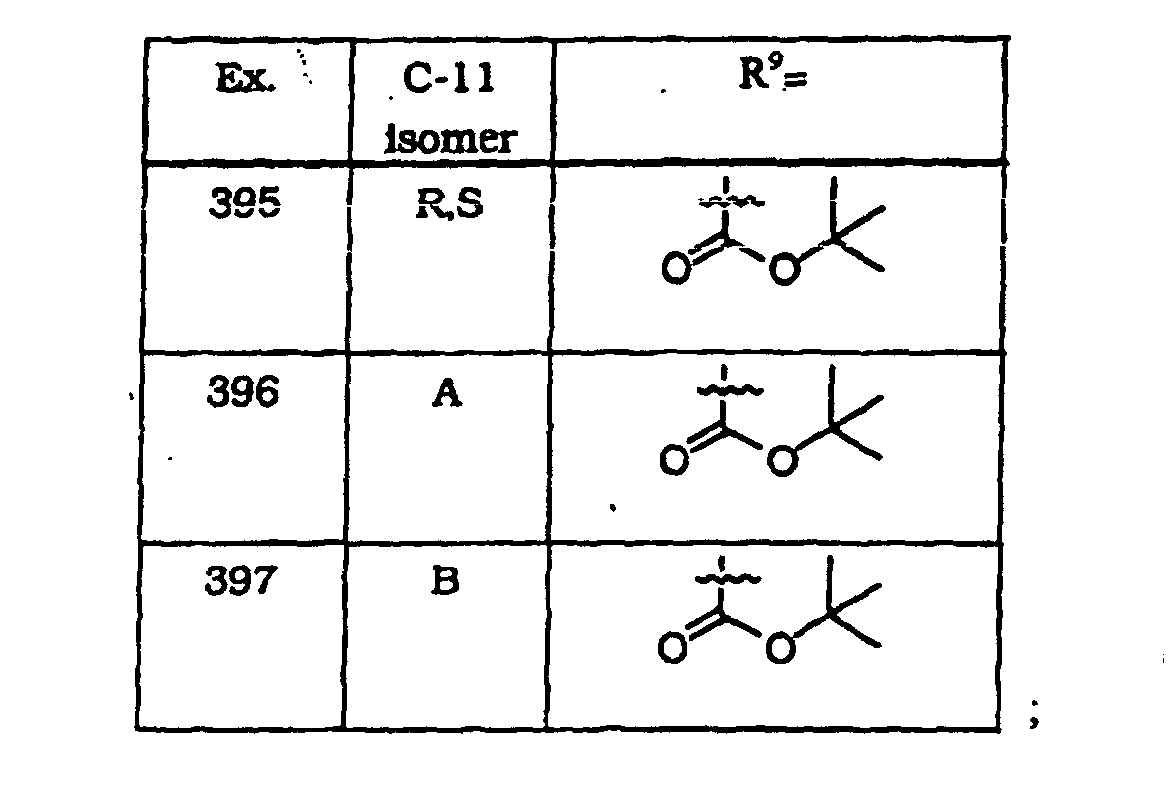 wherein R8 is as listed in the table below,
 the compound
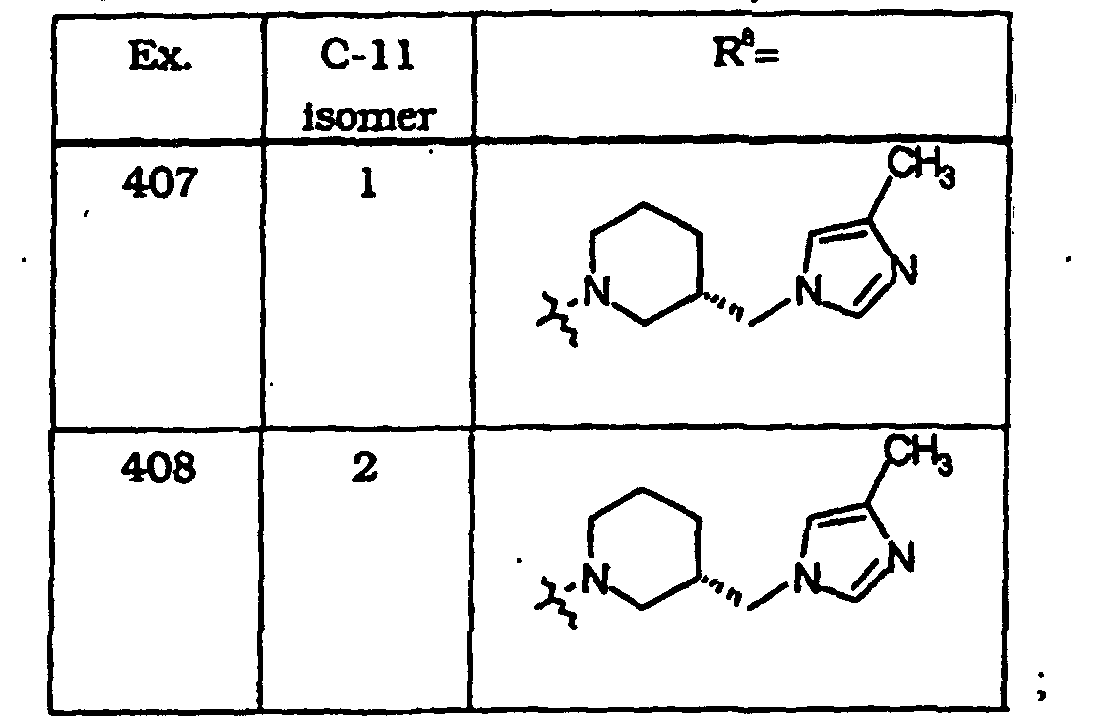 wherein R8 is as listed in the table below,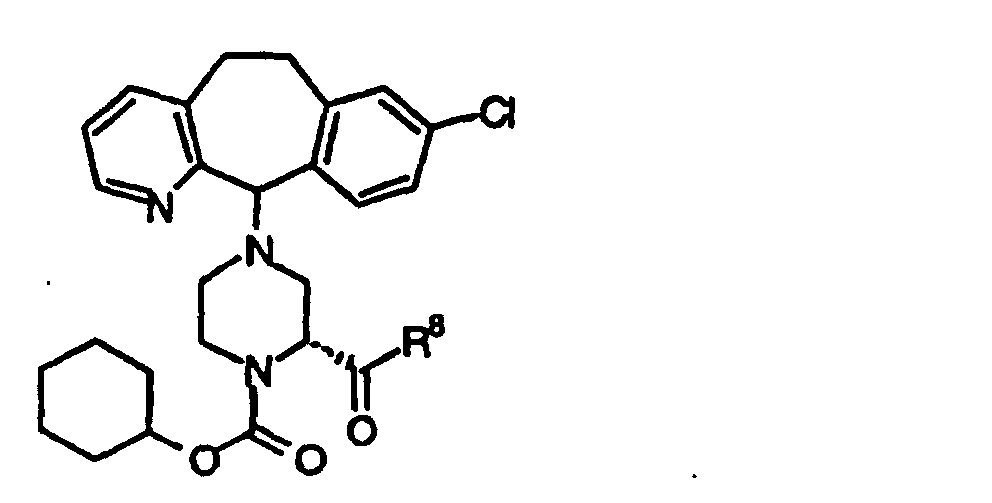
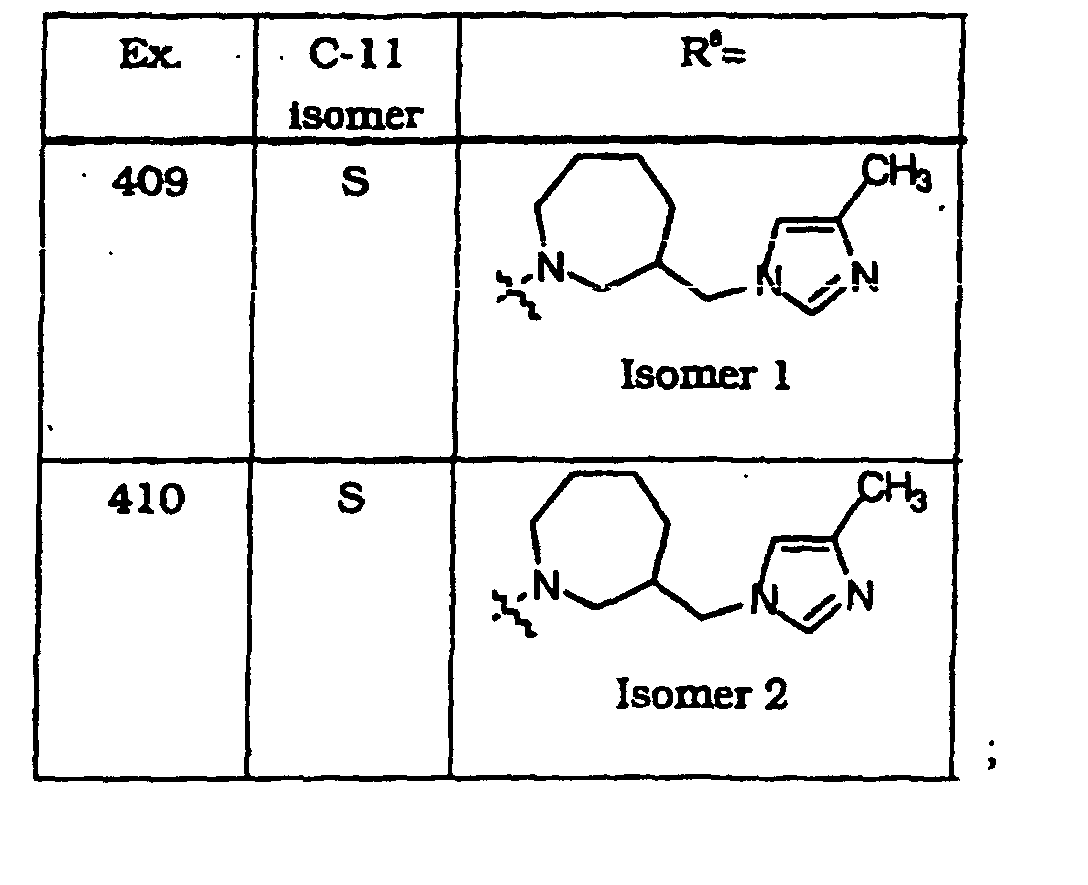


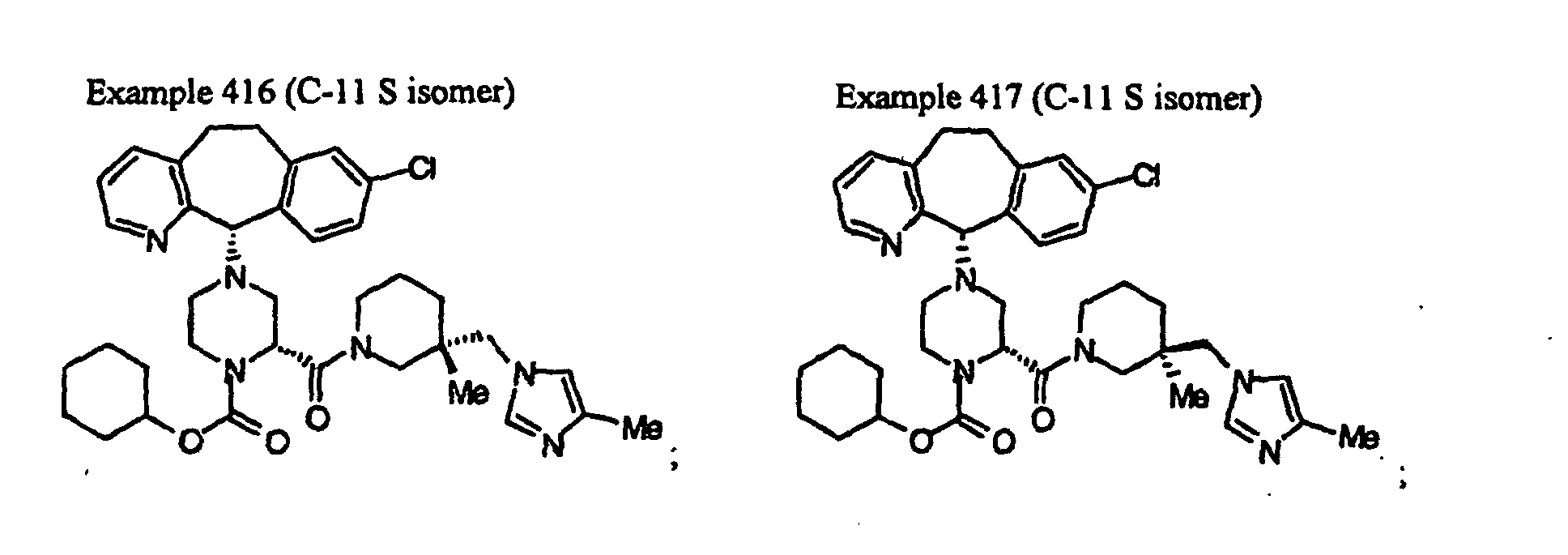
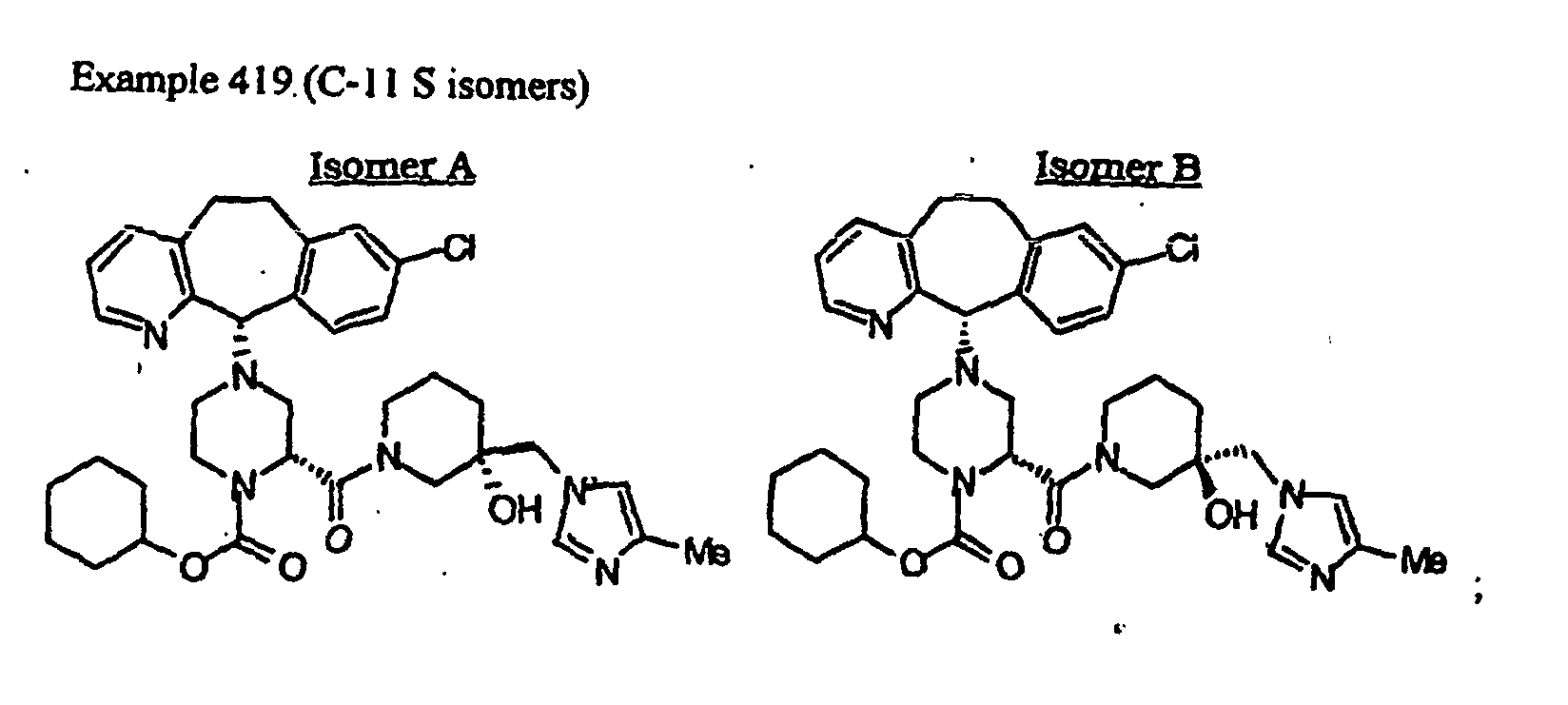
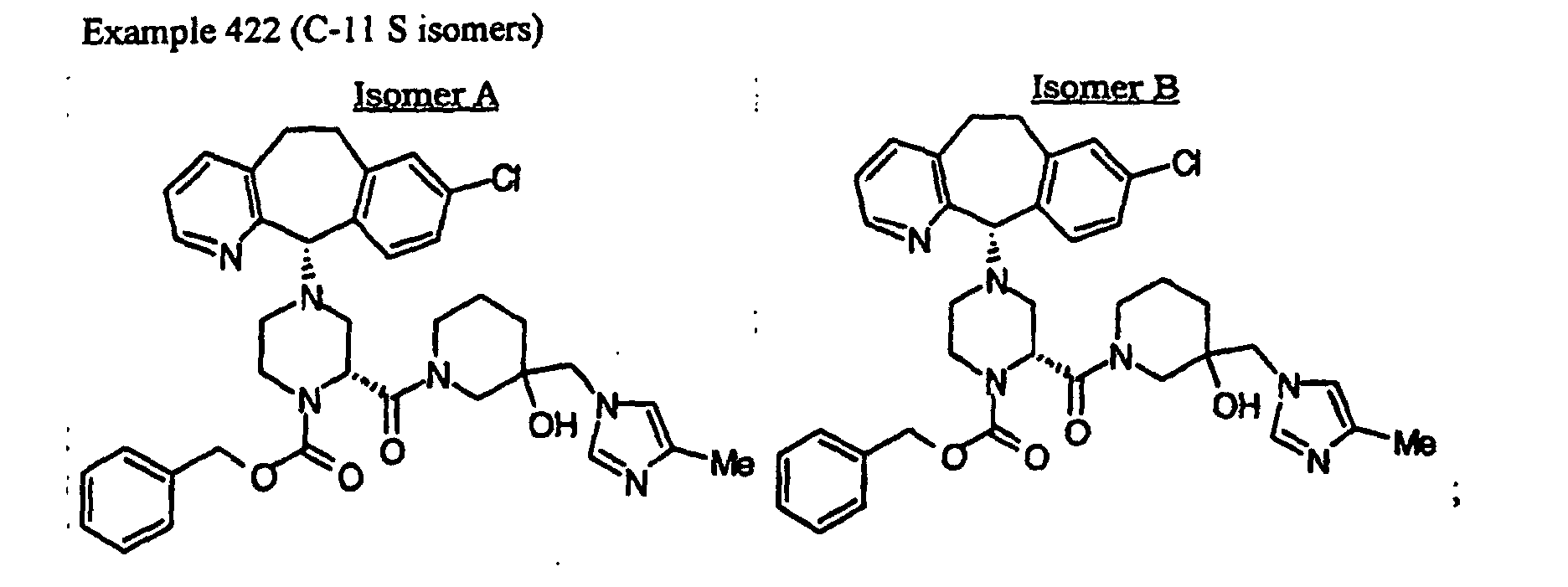
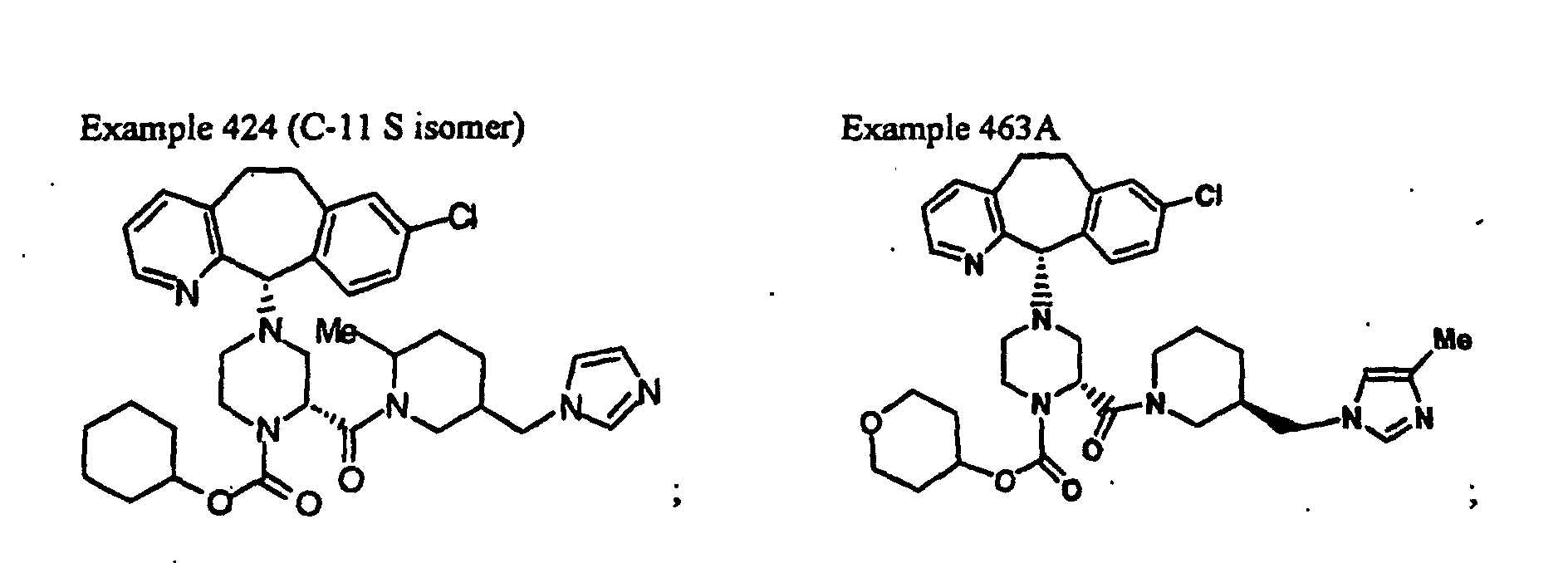

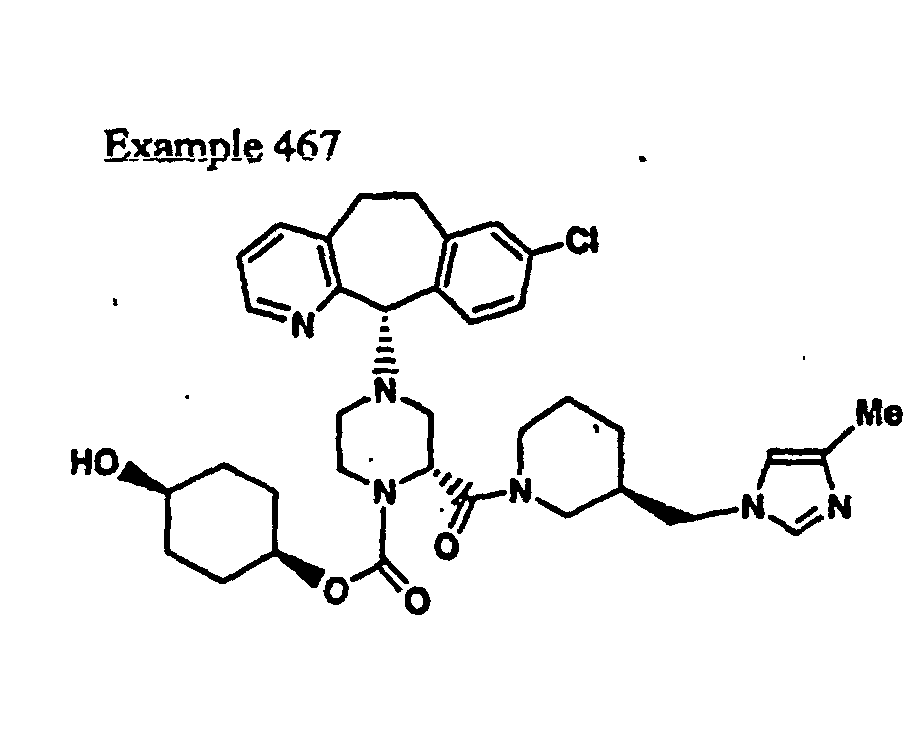

- The compound of Claim 18 selected from a compound of Examples 35(C), 41(A), 47(S), 47(T), 140A, 144 isomer 1, 144 isomer 2, 163, 164, 183, 185, 215, 238, 258, 259, 287, 291, 292, 298, 300, 320, 351, 353, 411 or 416.
- The compound of Claim 18 selected from a compound of Examples 47(a) or 140A.
- A pharmaceutical composition for inhibiting farnesyl protein transferase comprising an effective amount of compound of any of Claims 1 to 20 in combination with a pharmaceutically acceptable carrier.
- A compound of any of Claims 1 to 20 for use as a medicament.
- A compound of any of Claims 1 to 20 for use in inhibiting farnesyl protein transferase.
- A compound of any of Claims I to 20 for use in inhibiting farnesyl protein transferase.
- A compound of any of Claims 1 to 20 for use in treating tumor cells.
- A compound of Claim 23 wherein said compound is for use in the treatment of pancreatic tumor cells, lung cancer cells, myeloid leukemia tumor cells, thyroid follicular tumor cells, myelodysplastic tumor cells, epidermal carcinoma tumor cells, bladder carcinoma tumor cells, colon tumor cells, melanoma, breast tumor cells and prostate tumor cells.
- The use of a compound of any of Claims 1 to 20 in the manufacture of a pharmaceutical composition, for treating tumor cells.
- The use of Claim 27 wherein the tumor cells treated are pancreatic tumor cells, lung cancer cells, myeloid leukemia tumor cells, thyroid follicular tumor cells, myelodysplastic tumor cells, epidermal carcinoma tumor cells, bladder carcinoma tumor cells, colon tumor cells, melanoma, breast tumor cells and prostate tumor cells.
- The use of a compound of any of Claims 1 to 20 in the manufacture of a pharmaceutical composition for inhibiting farnesyl protein transferase.
- The use according to Claim 29, wherein said pharmaceutical composition is for treating tumor cells wherein the Ras protein is activated as a result of oncogenic mutation in genes other than the Ras gene.
Applications Claiming Priority (3)
| Application Number | Priority Date | Filing Date | Title |
|---|---|---|---|
| US21656098A | 1998-12-18 | 1998-12-18 | |
| US216560 | 1998-12-18 | ||
| PCT/US1999/027938 WO2000037458A1 (en) | 1998-12-18 | 1999-12-16 | Farnesyl protein transferase inhibitors |
Publications (2)
| Publication Number | Publication Date |
|---|---|
| EP1140904A1 EP1140904A1 (en) | 2001-10-10 |
| EP1140904B1 true EP1140904B1 (en) | 2005-04-20 |
Family
ID=22807539
Family Applications (1)
| Application Number | Title | Priority Date | Filing Date |
|---|---|---|---|
| EP99967139A Expired - Lifetime EP1140904B1 (en) | 1998-12-18 | 1999-12-16 | Farnesyl protein transferase inhibitors |
Country Status (23)
| Country | Link |
|---|---|
| EP (1) | EP1140904B1 (en) |
| JP (1) | JP2002533335A (en) |
| KR (1) | KR20010081115A (en) |
| CN (1) | CN1285588C (en) |
| AR (1) | AR021716A1 (en) |
| AT (1) | ATE293622T1 (en) |
| AU (1) | AU2347900A (en) |
| BR (1) | BR9916328A (en) |
| CA (1) | CA2354774C (en) |
| CO (1) | CO5160344A1 (en) |
| CZ (1) | CZ20011900A3 (en) |
| DE (1) | DE69924876T2 (en) |
| ES (1) | ES2237963T3 (en) |
| HU (1) | HUP0203054A3 (en) |
| ID (1) | ID29065A (en) |
| IL (1) | IL143409A0 (en) |
| NO (1) | NO20012960L (en) |
| PE (1) | PE20001516A1 (en) |
| PL (1) | PL348294A1 (en) |
| SK (1) | SK7582001A3 (en) |
| TR (1) | TR200101754T2 (en) |
| WO (1) | WO2000037458A1 (en) |
| ZA (1) | ZA200104236B (en) |
Families Citing this family (25)
| Publication number | Priority date | Publication date | Assignee | Title |
|---|---|---|---|---|
| DE60036568T2 (en) * | 1999-11-10 | 2008-06-26 | Sanofi-Aventis Deutschland Gmbh | N-ACYLPYRROLIDIN-2-YL ALKYLBENZAMIDINE DERIVATIVES AS INHIBITORS OF FACTOR XA |
| US7361663B2 (en) | 1999-11-10 | 2008-04-22 | Aventis Pharmaceuticals Inc. | N-acylpyrrolidin-2-ylalkylbenzamidine derivatives as inhibitors of factor Xa |
| US6589978B2 (en) * | 2000-06-30 | 2003-07-08 | Hoffman-La Roche Inc. | 1-sulfonyl pyrrolidine derivatives |
| US7342016B2 (en) | 2000-08-30 | 2008-03-11 | Schering Corporation | Farnesyl protein transferase inhibitors as antitumor agents |
| AR033680A1 (en) * | 2000-08-30 | 2004-01-07 | Schering Corp | USEFUL TRICICLIC COMPOUNDS AS INHIBITORS OF FARNESIL PROTEINO TRANSFERASA AND ITS USE FOR THE MANUFACTURE OF MEDICINES AS ANTITUMOR AGENTS |
| US6693099B2 (en) | 2000-10-17 | 2004-02-17 | The Procter & Gamble Company | Substituted piperazine compounds optionally containing a quinolyl moiety for treating multidrug resistance |
| US6376514B1 (en) | 2000-10-17 | 2002-04-23 | The Procter & Gamble Co. | Substituted six-membered heterocyclic compounds useful for treating multidrug resistance and compositions and methods thereof |
| US6809093B2 (en) | 2000-10-17 | 2004-10-26 | H. Lee Moffitt Cancer & Research Institute, Inc. | 2-substituted heterocyclic compounds |
| AU2002236813A1 (en) * | 2001-01-22 | 2002-07-30 | Schering Corporation | Treatment of malaria with farnesyl protein transferase inhibitors |
| ATE412638T1 (en) | 2001-02-16 | 2008-11-15 | Aventis Pharma Inc | HETEROCYCLIC SUBSTITUTED CARBONYL DERIVATIVES AND THEIR USE AS DOPAMINE D3 RECEPTOR LIGANDS |
| AU2002257114A1 (en) * | 2001-04-06 | 2002-10-21 | Schering Corporation | Treatment of malaria with farsenyl protein transferase inhibitors |
| FR2825705B1 (en) * | 2001-06-08 | 2005-05-20 | Aventis Pharma Sa | NOVEL HETEROCYCLIC COMPOUNDS, THEIR PREPARATION AND THEIR USE AS MEDICAMENTS, IN PARTICULAR AS ANTI-BACTERIANS |
| GB0115862D0 (en) | 2001-06-28 | 2001-08-22 | Smithkline Beecham Plc | Compounds |
| US6740757B2 (en) * | 2001-08-29 | 2004-05-25 | Pfizer Inc | Enantiomers of 6-[(4-chloro-phenyl)-hydroxy-(3-methyl-3h-imidazol-4-yl)-methyl]-4-[3-(3-hydroxy-3-methyl-but-1-ynyl)-phenyl]-1-methyl-1h-quinolin-2-one and salts thereof, useful in the treatment of cancer |
| FR2835186B1 (en) | 2002-01-28 | 2006-10-20 | Aventis Pharma Sa | NOVEL HETEROCYCLIC COMPOUNDS ACTIVE AS BETA-LACTAMASES INHIBITORS |
| FR2844273B1 (en) | 2002-09-05 | 2008-04-04 | Aventis Pharma Sa | NOVEL HETEROCYCLIC COMPOUNDS, METHOD AND INTERMEDIARY PREPARATION AND USE AS MEDICAMENT, IN PARTICULAR AS INHIBITORS OF BETA-LACTAMASES AND ANTI-BACTERIALS. |
| AU2003293555A1 (en) * | 2002-12-17 | 2004-07-29 | Schering Corporation | 17 beta-hydroxysteroid dehydrogenase type 3 inhibitors for the treatment of androgen dependent diseases |
| US7585864B2 (en) * | 2004-12-13 | 2009-09-08 | Schering Corporation | Farnesyl protein transferase inhibitors and their use to treat cancer |
| EP1833481A1 (en) | 2004-12-14 | 2007-09-19 | Schering Corporation | Farnesyl protein transferase inhibitors and methods for treating proliferative diseases |
| CA2637572A1 (en) * | 2006-01-19 | 2007-07-26 | Schering Corporation | Piperazine derivatives as farnesyl protein transferase inhibitors |
| CA2724648A1 (en) * | 2008-05-22 | 2009-11-26 | Merck Sharp & Dohme Corp. | Process for the preparation of an orexin receptor antagonist |
| HU231150B1 (en) | 2017-03-13 | 2021-03-29 | Richter Gedeon Nyrt | Process for the separation of optical isomers of racemic ethyl 3-alkylpiperidine-3-carboxylic acid |
| AU2020286381C1 (en) | 2019-06-04 | 2025-07-10 | Hager Biosciences, Llc | Imidazolo derivatives, compositions and methods as orexin antagonists |
| TWI907472B (en) | 2020-08-05 | 2025-12-11 | 匈牙利商羅特格登公司 | Pharmacologically active heterocyclic-substituted pyrazolo〔1 ,5-a〕 pyrimidine derivatives |
| CN114349711B (en) * | 2022-02-28 | 2023-08-15 | 四川依维欣医药科技有限公司 | Synthesis method of (R) -1-Boc-3-hydroxymethyl piperazine |
Family Cites Families (4)
| Publication number | Priority date | Publication date | Assignee | Title |
|---|---|---|---|---|
| IL111235A (en) * | 1993-10-15 | 2001-03-19 | Schering Plough Corp | Pharmaceutical compositions for inhibition of g-protein function and for treatment of proliferative diseases containing tricyclic compounds some such compounds and process for preparing part of them |
| GB9420172D0 (en) * | 1994-10-06 | 1994-11-23 | Boots Co Plc | Therapeutic agents |
| IL117798A (en) * | 1995-04-07 | 2001-11-25 | Schering Plough Corp | Tricyclic compounds useful for inhibition of g-protein function and for treatment of proliferative diseases and pharmaceutical compositions comprising them |
| KR100640672B1 (en) * | 1997-06-17 | 2006-11-02 | 파마코페이아 드럭 디스커버리, 인크. | Benzpyrido Cycloheptane Compounds Useful for Inhibiting Farnesyl Protein Transferase and Pharmaceutical Compositions Comprising the Same |
-
1999
- 1999-12-16 AT AT99967139T patent/ATE293622T1/en not_active IP Right Cessation
- 1999-12-16 SK SK758-2001A patent/SK7582001A3/en unknown
- 1999-12-16 KR KR1020017007535A patent/KR20010081115A/en not_active Withdrawn
- 1999-12-16 EP EP99967139A patent/EP1140904B1/en not_active Expired - Lifetime
- 1999-12-16 ID IDW00200101310A patent/ID29065A/en unknown
- 1999-12-16 CN CNB998162078A patent/CN1285588C/en not_active Expired - Fee Related
- 1999-12-16 CZ CZ20011900A patent/CZ20011900A3/en unknown
- 1999-12-16 CO CO99078838A patent/CO5160344A1/en unknown
- 1999-12-16 TR TR2001/01754T patent/TR200101754T2/en unknown
- 1999-12-16 BR BR9916328-4A patent/BR9916328A/en not_active IP Right Cessation
- 1999-12-16 HU HU0203054A patent/HUP0203054A3/en unknown
- 1999-12-16 PL PL99348294A patent/PL348294A1/en not_active Application Discontinuation
- 1999-12-16 AR ARP990106459A patent/AR021716A1/en unknown
- 1999-12-16 DE DE69924876T patent/DE69924876T2/en not_active Expired - Fee Related
- 1999-12-16 AU AU23479/00A patent/AU2347900A/en not_active Abandoned
- 1999-12-16 ES ES99967139T patent/ES2237963T3/en not_active Expired - Lifetime
- 1999-12-16 IL IL14340999A patent/IL143409A0/en unknown
- 1999-12-16 WO PCT/US1999/027938 patent/WO2000037458A1/en not_active Ceased
- 1999-12-16 JP JP2000589530A patent/JP2002533335A/en active Pending
- 1999-12-16 CA CA002354774A patent/CA2354774C/en not_active Expired - Fee Related
- 1999-12-17 PE PE1999001293A patent/PE20001516A1/en not_active Application Discontinuation
-
2001
- 2001-05-23 ZA ZA200104236A patent/ZA200104236B/en unknown
- 2001-06-15 NO NO20012960A patent/NO20012960L/en not_active Application Discontinuation
Also Published As
| Publication number | Publication date |
|---|---|
| CN1285588C (en) | 2006-11-22 |
| JP2002533335A (en) | 2002-10-08 |
| SK7582001A3 (en) | 2002-03-05 |
| ATE293622T1 (en) | 2005-05-15 |
| CZ20011900A3 (en) | 2002-02-13 |
| CO5160344A1 (en) | 2002-05-30 |
| PL348294A1 (en) | 2002-05-20 |
| BR9916328A (en) | 2001-10-02 |
| CN1352642A (en) | 2002-06-05 |
| KR20010081115A (en) | 2001-08-27 |
| HUP0203054A2 (en) | 2003-01-28 |
| PE20001516A1 (en) | 2001-01-06 |
| ES2237963T3 (en) | 2005-08-01 |
| CA2354774C (en) | 2009-05-26 |
| NO20012960L (en) | 2001-08-15 |
| EP1140904A1 (en) | 2001-10-10 |
| IL143409A0 (en) | 2002-04-21 |
| WO2000037458A1 (en) | 2000-06-29 |
| ZA200104236B (en) | 2002-08-23 |
| DE69924876D1 (en) | 2005-05-25 |
| ID29065A (en) | 2001-07-26 |
| DE69924876T2 (en) | 2006-03-02 |
| HUP0203054A3 (en) | 2004-01-28 |
| NO20012960D0 (en) | 2001-06-15 |
| TR200101754T2 (en) | 2002-05-21 |
| HK1036279A1 (en) | 2001-12-28 |
| AR021716A1 (en) | 2002-07-31 |
| AU2347900A (en) | 2000-07-12 |
| CA2354774A1 (en) | 2000-06-29 |
Similar Documents
| Publication | Publication Date | Title |
|---|---|---|
| US6362188B1 (en) | Farnesyl protein transferase inhibitors | |
| WO2000037458A1 (en) | Farnesyl protein transferase inhibitors | |
| US6372747B1 (en) | Farnesyl protein transferase inhibitors | |
| US6432959B1 (en) | Inhibitors of farnesyl-protein transferase | |
| WO1997016443A1 (en) | Farnesyl transferase inhibiting 2-quinolone derivatives | |
| US6800636B2 (en) | Farnesyl protein transferase inhibitors | |
| EP0989983B1 (en) | Benzpyrido cycloheptane compounds useful for inhibition of farnesyl protein transferase | |
| EP1140902A1 (en) | Tricyclic farnesyl protein transferase inhibitors | |
| WO1998011106A1 (en) | Tricyclic compounds useful as fpt inhibitors | |
| EP0931079A1 (en) | Substituted benzocycloheptapyridine derivatives useful for inhibition of farnesyl protein transferase | |
| WO1998011091A2 (en) | Tricyclic compounds useful for inhibition of farnesyl protein transferase | |
| WO2000039119A1 (en) | Novel inhibitors of farnesyl-protein transferase | |
| HK1036279B (en) | Farnesyl protein transferase inhibitors | |
| MXPA01006153A (en) | Farnesyl protein transferase inhibitors | |
| EP0942906B1 (en) | Compounds useful for inhibition of farnesyl protein transferase | |
| EP0927179B1 (en) | Substituted benzocycloheptapyridine derivatives useful for inhibition of farnesyl protein transferase | |
| MXPA01006611A (en) | Novel inhibitors of farnesyl-protein transferase | |
| MXPA01006241A (en) | Tricyclic farnesyl protein transferase inhibitors | |
| MXPA98002067A (en) | Derivatives of the 2-quinolone inhibitors of the farnesil transfer |
Legal Events
| Date | Code | Title | Description |
|---|---|---|---|
| PUAI | Public reference made under article 153(3) epc to a published international application that has entered the european phase |
Free format text: ORIGINAL CODE: 0009012 |
|
| 17P | Request for examination filed |
Effective date: 20010531 |
|
| AK | Designated contracting states |
Kind code of ref document: A1 Designated state(s): AT BE CH CY DE DK ES FI FR GB GR IE IT LI LU MC NL PT SE |
|
| AX | Request for extension of the european patent |
Free format text: AL;LT;LV;MK;RO PAYMENT 20010531;SI PAYMENT 20010531 |
|
| 17Q | First examination report despatched |
Effective date: 20020304 |
|
| GRAP | Despatch of communication of intention to grant a patent |
Free format text: ORIGINAL CODE: EPIDOSNIGR1 |
|
| GRAS | Grant fee paid |
Free format text: ORIGINAL CODE: EPIDOSNIGR3 |
|
| GRAA | (expected) grant |
Free format text: ORIGINAL CODE: 0009210 |
|
| AK | Designated contracting states |
Kind code of ref document: B1 Designated state(s): AT BE CH CY DE DK ES FI FR GB GR IE IT LI LU MC NL PT SE |
|
| AX | Request for extension of the european patent |
Extension state: RO SI |
|
| PG25 | Lapsed in a contracting state [announced via postgrant information from national office to epo] |
Ref country code: NL Free format text: LAPSE BECAUSE OF FAILURE TO SUBMIT A TRANSLATION OF THE DESCRIPTION OR TO PAY THE FEE WITHIN THE PRESCRIBED TIME-LIMIT Effective date: 20050420 Ref country code: LI Free format text: LAPSE BECAUSE OF FAILURE TO SUBMIT A TRANSLATION OF THE DESCRIPTION OR TO PAY THE FEE WITHIN THE PRESCRIBED TIME-LIMIT Effective date: 20050420 Ref country code: FI Free format text: LAPSE BECAUSE OF FAILURE TO SUBMIT A TRANSLATION OF THE DESCRIPTION OR TO PAY THE FEE WITHIN THE PRESCRIBED TIME-LIMIT Effective date: 20050420 Ref country code: CH Free format text: LAPSE BECAUSE OF FAILURE TO SUBMIT A TRANSLATION OF THE DESCRIPTION OR TO PAY THE FEE WITHIN THE PRESCRIBED TIME-LIMIT Effective date: 20050420 Ref country code: BE Free format text: LAPSE BECAUSE OF FAILURE TO SUBMIT A TRANSLATION OF THE DESCRIPTION OR TO PAY THE FEE WITHIN THE PRESCRIBED TIME-LIMIT Effective date: 20050420 Ref country code: AT Free format text: LAPSE BECAUSE OF FAILURE TO SUBMIT A TRANSLATION OF THE DESCRIPTION OR TO PAY THE FEE WITHIN THE PRESCRIBED TIME-LIMIT Effective date: 20050420 |
|
| REG | Reference to a national code |
Ref country code: GB Ref legal event code: FG4D |
|
| REG | Reference to a national code |
Ref country code: CH Ref legal event code: EP |
|
| REG | Reference to a national code |
Ref country code: IE Ref legal event code: FG4D |
|
| REF | Corresponds to: |
Ref document number: 69924876 Country of ref document: DE Date of ref document: 20050525 Kind code of ref document: P |
|
| PG25 | Lapsed in a contracting state [announced via postgrant information from national office to epo] |
Ref country code: SE Free format text: LAPSE BECAUSE OF FAILURE TO SUBMIT A TRANSLATION OF THE DESCRIPTION OR TO PAY THE FEE WITHIN THE PRESCRIBED TIME-LIMIT Effective date: 20050720 Ref country code: GR Free format text: LAPSE BECAUSE OF FAILURE TO SUBMIT A TRANSLATION OF THE DESCRIPTION OR TO PAY THE FEE WITHIN THE PRESCRIBED TIME-LIMIT Effective date: 20050720 Ref country code: DK Free format text: LAPSE BECAUSE OF FAILURE TO SUBMIT A TRANSLATION OF THE DESCRIPTION OR TO PAY THE FEE WITHIN THE PRESCRIBED TIME-LIMIT Effective date: 20050720 |
|
| REG | Reference to a national code |
Ref country code: ES Ref legal event code: FG2A Ref document number: 2237963 Country of ref document: ES Kind code of ref document: T3 |
|
| REG | Reference to a national code |
Ref country code: HK Ref legal event code: GR Ref document number: 1036279 Country of ref document: HK |
|
| PG25 | Lapsed in a contracting state [announced via postgrant information from national office to epo] |
Ref country code: PT Free format text: LAPSE BECAUSE OF FAILURE TO SUBMIT A TRANSLATION OF THE DESCRIPTION OR TO PAY THE FEE WITHIN THE PRESCRIBED TIME-LIMIT Effective date: 20050920 |
|
| REG | Reference to a national code |
Ref country code: CH Ref legal event code: PL |
|
| NLV1 | Nl: lapsed or annulled due to failure to fulfill the requirements of art. 29p and 29m of the patents act | ||
| PG25 | Lapsed in a contracting state [announced via postgrant information from national office to epo] |
Ref country code: IE Free format text: LAPSE BECAUSE OF NON-PAYMENT OF DUE FEES Effective date: 20051216 Ref country code: CY Free format text: LAPSE BECAUSE OF FAILURE TO SUBMIT A TRANSLATION OF THE DESCRIPTION OR TO PAY THE FEE WITHIN THE PRESCRIBED TIME-LIMIT Effective date: 20051216 |
|
| PG25 | Lapsed in a contracting state [announced via postgrant information from national office to epo] |
Ref country code: MC Free format text: LAPSE BECAUSE OF NON-PAYMENT OF DUE FEES Effective date: 20051231 Ref country code: LU Free format text: LAPSE BECAUSE OF NON-PAYMENT OF DUE FEES Effective date: 20051231 |
|
| ET | Fr: translation filed | ||
| PLBE | No opposition filed within time limit |
Free format text: ORIGINAL CODE: 0009261 |
|
| STAA | Information on the status of an ep patent application or granted ep patent |
Free format text: STATUS: NO OPPOSITION FILED WITHIN TIME LIMIT |
|
| 26N | No opposition filed |
Effective date: 20060123 |
|
| REG | Reference to a national code |
Ref country code: IE Ref legal event code: MM4A |
|
| PGFP | Annual fee paid to national office [announced via postgrant information from national office to epo] |
Ref country code: ES Payment date: 20081222 Year of fee payment: 10 |
|
| PGFP | Annual fee paid to national office [announced via postgrant information from national office to epo] |
Ref country code: IT Payment date: 20081216 Year of fee payment: 10 |
|
| PGFP | Annual fee paid to national office [announced via postgrant information from national office to epo] |
Ref country code: FR Payment date: 20081205 Year of fee payment: 10 |
|
| PGFP | Annual fee paid to national office [announced via postgrant information from national office to epo] |
Ref country code: DE Payment date: 20081230 Year of fee payment: 10 |
|
| PGFP | Annual fee paid to national office [announced via postgrant information from national office to epo] |
Ref country code: GB Payment date: 20081110 Year of fee payment: 10 |
|
| GBPC | Gb: european patent ceased through non-payment of renewal fee |
Effective date: 20091216 |
|
| REG | Reference to a national code |
Ref country code: FR Ref legal event code: ST Effective date: 20100831 |
|
| PG25 | Lapsed in a contracting state [announced via postgrant information from national office to epo] |
Ref country code: FR Free format text: LAPSE BECAUSE OF NON-PAYMENT OF DUE FEES Effective date: 20091231 |
|
| PG25 | Lapsed in a contracting state [announced via postgrant information from national office to epo] |
Ref country code: DE Free format text: LAPSE BECAUSE OF NON-PAYMENT OF DUE FEES Effective date: 20100701 |
|
| PG25 | Lapsed in a contracting state [announced via postgrant information from national office to epo] |
Ref country code: GB Free format text: LAPSE BECAUSE OF NON-PAYMENT OF DUE FEES Effective date: 20091216 |
|
| REG | Reference to a national code |
Ref country code: ES Ref legal event code: FD2A Effective date: 20110310 |
|
| PG25 | Lapsed in a contracting state [announced via postgrant information from national office to epo] |
Ref country code: IT Free format text: LAPSE BECAUSE OF NON-PAYMENT OF DUE FEES Effective date: 20091216 |
|
| PG25 | Lapsed in a contracting state [announced via postgrant information from national office to epo] |
Ref country code: ES Free format text: LAPSE BECAUSE OF NON-PAYMENT OF DUE FEES Effective date: 20110309 |
|
| PG25 | Lapsed in a contracting state [announced via postgrant information from national office to epo] |
Ref country code: ES Free format text: LAPSE BECAUSE OF NON-PAYMENT OF DUE FEES Effective date: 20091217 |