EP1140894B1 - Process for the synthesis of 5-(alpha -hydroxyalkyl) benzo 1, 3]dioxols - Google Patents
Process for the synthesis of 5-(alpha -hydroxyalkyl) benzo 1, 3]dioxols Download PDFInfo
- Publication number
- EP1140894B1 EP1140894B1 EP99953826A EP99953826A EP1140894B1 EP 1140894 B1 EP1140894 B1 EP 1140894B1 EP 99953826 A EP99953826 A EP 99953826A EP 99953826 A EP99953826 A EP 99953826A EP 1140894 B1 EP1140894 B1 EP 1140894B1
- Authority
- EP
- European Patent Office
- Prior art keywords
- benzo
- dioxole
- formula
- reaction
- process according
- Prior art date
- Legal status (The legal status is an assumption and is not a legal conclusion. Google has not performed a legal analysis and makes no representation as to the accuracy of the status listed.)
- Expired - Lifetime
Links
- 238000000034 method Methods 0.000 title claims abstract description 35
- 230000015572 biosynthetic process Effects 0.000 title claims abstract description 17
- 238000003786 synthesis reaction Methods 0.000 title claims abstract description 10
- 125000005605 benzo group Chemical group 0.000 title claims description 7
- FTNJQNQLEGKTGD-UHFFFAOYSA-N 1,3-benzodioxole Chemical class C1=CC=C2OCOC2=C1 FTNJQNQLEGKTGD-UHFFFAOYSA-N 0.000 claims abstract description 48
- 238000006243 chemical reaction Methods 0.000 claims abstract description 33
- YCIMNLLNPGFGHC-UHFFFAOYSA-N catechol Chemical compound OC1=CC=CC=C1O YCIMNLLNPGFGHC-UHFFFAOYSA-N 0.000 claims abstract description 19
- 238000005917 acylation reaction Methods 0.000 claims abstract description 9
- 230000010933 acylation Effects 0.000 claims abstract description 8
- 150000001875 compounds Chemical class 0.000 claims description 20
- ZMXDDKWLCZADIW-UHFFFAOYSA-N N,N-Dimethylformamide Chemical compound CN(C)C=O ZMXDDKWLCZADIW-UHFFFAOYSA-N 0.000 claims description 15
- 239000003054 catalyst Substances 0.000 claims description 12
- 125000000217 alkyl group Chemical group 0.000 claims description 9
- VLTRZXGMWDSKGL-UHFFFAOYSA-N perchloric acid Chemical compound OCl(=O)(=O)=O VLTRZXGMWDSKGL-UHFFFAOYSA-N 0.000 claims description 9
- 239000011541 reaction mixture Substances 0.000 claims description 9
- XKTYXVDYIKIYJP-UHFFFAOYSA-N 3h-dioxole Chemical compound C1OOC=C1 XKTYXVDYIKIYJP-UHFFFAOYSA-N 0.000 claims description 8
- 239000002253 acid Substances 0.000 claims description 8
- VHVOLFRBFDOUSH-UHFFFAOYSA-N Isosafrole Natural products CC=CC1=CC=C2OCOC2=C1 VHVOLFRBFDOUSH-UHFFFAOYSA-N 0.000 claims description 7
- 239000000010 aprotic solvent Substances 0.000 claims description 6
- MYEIDJPOUKASEC-UHFFFAOYSA-N Dihydrosafrole Chemical compound CCCC1=CC=C2OCOC2=C1 MYEIDJPOUKASEC-UHFFFAOYSA-N 0.000 claims description 5
- VHVOLFRBFDOUSH-NSCUHMNNSA-N Isosafrole Chemical compound C\C=C\C1=CC=C2OCOC2=C1 VHVOLFRBFDOUSH-NSCUHMNNSA-N 0.000 claims description 5
- 150000008064 anhydrides Chemical class 0.000 claims description 5
- PXFYAFDHWSXVLU-UHFFFAOYSA-N 1-(3,4-Methylenedioxyphenyl)-propane-1-ol Chemical compound CCC(O)C1=CC=C2OCOC2=C1 PXFYAFDHWSXVLU-UHFFFAOYSA-N 0.000 claims description 4
- -1 aliphatic anhydride Chemical class 0.000 claims description 4
- 125000003545 alkoxy group Chemical group 0.000 claims description 4
- NRSXSFHVWXSMOO-UHFFFAOYSA-N 5-prop-2-enyl-3a,4-dihydro-1,3-benzodioxole Chemical compound C1C(CC=C)=CC=C2OCOC21 NRSXSFHVWXSMOO-UHFFFAOYSA-N 0.000 claims description 3
- IAZDPXIOMUYVGZ-UHFFFAOYSA-N Dimethylsulphoxide Chemical compound CS(C)=O IAZDPXIOMUYVGZ-UHFFFAOYSA-N 0.000 claims description 3
- 238000006297 dehydration reaction Methods 0.000 claims description 3
- 125000001495 ethyl group Chemical group [H]C([H])([H])C([H])([H])* 0.000 claims description 3
- 125000001449 isopropyl group Chemical group [H]C([H])([H])C([H])(*)C([H])([H])[H] 0.000 claims description 3
- 125000002496 methyl group Chemical group [H]C([H])([H])* 0.000 claims description 3
- 125000004123 n-propyl group Chemical group [H]C([H])([H])C([H])([H])C([H])([H])* 0.000 claims description 3
- 238000004064 recycling Methods 0.000 claims description 3
- WKBOTKDWSSQWDR-UHFFFAOYSA-N Bromine atom Chemical compound [Br] WKBOTKDWSSQWDR-UHFFFAOYSA-N 0.000 claims description 2
- ZAMOUSCENKQFHK-UHFFFAOYSA-N Chlorine atom Chemical compound [Cl] ZAMOUSCENKQFHK-UHFFFAOYSA-N 0.000 claims description 2
- PXGOKWXKJXAPGV-UHFFFAOYSA-N Fluorine Chemical compound FF PXGOKWXKJXAPGV-UHFFFAOYSA-N 0.000 claims description 2
- 229910021577 Iron(II) chloride Inorganic materials 0.000 claims description 2
- 229910021578 Iron(III) chloride Inorganic materials 0.000 claims description 2
- FXHOOIRPVKKKFG-UHFFFAOYSA-N N,N-Dimethylacetamide Chemical compound CN(C)C(C)=O FXHOOIRPVKKKFG-UHFFFAOYSA-N 0.000 claims description 2
- NBIIXXVUZAFLBC-UHFFFAOYSA-N Phosphoric acid Chemical compound OP(O)(O)=O NBIIXXVUZAFLBC-UHFFFAOYSA-N 0.000 claims description 2
- XLOMVQKBTHCTTD-UHFFFAOYSA-N Zinc monoxide Chemical compound [Zn]=O XLOMVQKBTHCTTD-UHFFFAOYSA-N 0.000 claims description 2
- 125000001931 aliphatic group Chemical group 0.000 claims description 2
- GDTBXPJZTBHREO-UHFFFAOYSA-N bromine Substances BrBr GDTBXPJZTBHREO-UHFFFAOYSA-N 0.000 claims description 2
- 229910052794 bromium Inorganic materials 0.000 claims description 2
- 239000000460 chlorine Substances 0.000 claims description 2
- 229910052801 chlorine Inorganic materials 0.000 claims description 2
- 239000011737 fluorine Substances 0.000 claims description 2
- 229910052731 fluorine Inorganic materials 0.000 claims description 2
- 239000012442 inert solvent Substances 0.000 claims description 2
- PNDPGZBMCMUPRI-UHFFFAOYSA-N iodine Chemical compound II PNDPGZBMCMUPRI-UHFFFAOYSA-N 0.000 claims description 2
- 150000002496 iodine Chemical class 0.000 claims description 2
- NMCUIPGRVMDVDB-UHFFFAOYSA-L iron dichloride Chemical compound Cl[Fe]Cl NMCUIPGRVMDVDB-UHFFFAOYSA-L 0.000 claims description 2
- UQSXHKLRYXJYBZ-UHFFFAOYSA-N iron oxide Inorganic materials [Fe]=O UQSXHKLRYXJYBZ-UHFFFAOYSA-N 0.000 claims description 2
- RBTARNINKXHZNM-UHFFFAOYSA-K iron trichloride Chemical compound Cl[Fe](Cl)Cl RBTARNINKXHZNM-UHFFFAOYSA-K 0.000 claims description 2
- BAUYGSIQEAFULO-UHFFFAOYSA-L iron(2+) sulfate (anhydrous) Chemical compound [Fe+2].[O-]S([O-])(=O)=O BAUYGSIQEAFULO-UHFFFAOYSA-L 0.000 claims description 2
- 229910000359 iron(II) sulfate Inorganic materials 0.000 claims description 2
- JEIPFZHSYJVQDO-UHFFFAOYSA-N iron(III) oxide Inorganic materials O=[Fe]O[Fe]=O JEIPFZHSYJVQDO-UHFFFAOYSA-N 0.000 claims description 2
- 229910000360 iron(III) sulfate Inorganic materials 0.000 claims description 2
- 229920000137 polyphosphoric acid Polymers 0.000 claims description 2
- 239000011592 zinc chloride Substances 0.000 claims description 2
- JIAARYAFYJHUJI-UHFFFAOYSA-L zinc dichloride Chemical compound [Cl-].[Cl-].[Zn+2] JIAARYAFYJHUJI-UHFFFAOYSA-L 0.000 claims description 2
- 230000018044 dehydration Effects 0.000 claims 1
- 229960001760 dimethyl sulfoxide Drugs 0.000 claims 1
- 239000002917 insecticide Substances 0.000 abstract description 5
- 230000007613 environmental effect Effects 0.000 abstract description 3
- 230000003197 catalytic effect Effects 0.000 abstract description 2
- YMWUJEATGCHHMB-UHFFFAOYSA-N Dichloromethane Chemical compound ClCCl YMWUJEATGCHHMB-UHFFFAOYSA-N 0.000 description 26
- 239000000203 mixture Substances 0.000 description 22
- 239000000047 product Substances 0.000 description 19
- 239000003153 chemical reaction reagent Substances 0.000 description 13
- OKKJLVBELUTLKV-UHFFFAOYSA-N Methanol Chemical compound OC OKKJLVBELUTLKV-UHFFFAOYSA-N 0.000 description 12
- KDLHZDBZIXYQEI-UHFFFAOYSA-N Palladium Chemical compound [Pd] KDLHZDBZIXYQEI-UHFFFAOYSA-N 0.000 description 10
- HEMHJVSKTPXQMS-UHFFFAOYSA-M Sodium hydroxide Chemical compound [OH-].[Na+] HEMHJVSKTPXQMS-UHFFFAOYSA-M 0.000 description 9
- 238000002360 preparation method Methods 0.000 description 7
- 238000006722 reduction reaction Methods 0.000 description 7
- 238000010992 reflux Methods 0.000 description 7
- 239000002904 solvent Substances 0.000 description 7
- XLYOFNOQVPJJNP-UHFFFAOYSA-N water Substances O XLYOFNOQVPJJNP-UHFFFAOYSA-N 0.000 description 7
- KFZMGEQAYNKOFK-UHFFFAOYSA-N Isopropanol Chemical compound CC(C)O KFZMGEQAYNKOFK-UHFFFAOYSA-N 0.000 description 6
- YXFVVABEGXRONW-UHFFFAOYSA-N Toluene Chemical compound CC1=CC=CC=C1 YXFVVABEGXRONW-UHFFFAOYSA-N 0.000 description 6
- 239000003921 oil Substances 0.000 description 6
- 239000012074 organic phase Substances 0.000 description 6
- 239000003795 chemical substances by application Substances 0.000 description 5
- SATCULPHIDQDRE-UHFFFAOYSA-N piperonal Chemical compound O=CC1=CC=C2OCOC2=C1 SATCULPHIDQDRE-UHFFFAOYSA-N 0.000 description 5
- QPFMBZIOSGYJDE-UHFFFAOYSA-N 1,1,2,2-tetrachloroethane Chemical compound ClC(Cl)C(Cl)Cl QPFMBZIOSGYJDE-UHFFFAOYSA-N 0.000 description 4
- XILIYVSXLSWUAI-UHFFFAOYSA-N 2-(diethylamino)ethyl n'-phenylcarbamimidothioate;dihydrobromide Chemical compound Br.Br.CCN(CC)CCSC(N)=NC1=CC=CC=C1 XILIYVSXLSWUAI-UHFFFAOYSA-N 0.000 description 4
- IJGRMHOSHXDMSA-UHFFFAOYSA-N Atomic nitrogen Chemical compound N#N IJGRMHOSHXDMSA-UHFFFAOYSA-N 0.000 description 4
- 238000007792 addition Methods 0.000 description 4
- TZCXTZWJZNENPQ-UHFFFAOYSA-L barium sulfate Chemical compound [Ba+2].[O-]S([O-])(=O)=O TZCXTZWJZNENPQ-UHFFFAOYSA-L 0.000 description 4
- UHOVQNZJYSORNB-UHFFFAOYSA-N benzene Substances C1=CC=CC=C1 UHOVQNZJYSORNB-UHFFFAOYSA-N 0.000 description 4
- 150000005528 benzodioxoles Chemical class 0.000 description 4
- 238000004821 distillation Methods 0.000 description 4
- 150000007529 inorganic bases Chemical class 0.000 description 4
- BASFCYQUMIYNBI-UHFFFAOYSA-N platinum Chemical compound [Pt] BASFCYQUMIYNBI-UHFFFAOYSA-N 0.000 description 4
- BWHMMNNQKKPAPP-UHFFFAOYSA-L potassium carbonate Chemical compound [K+].[K+].[O-]C([O-])=O BWHMMNNQKKPAPP-UHFFFAOYSA-L 0.000 description 4
- 239000000243 solution Substances 0.000 description 4
- 238000003756 stirring Methods 0.000 description 4
- RVBJGSPBFIUTTR-UHFFFAOYSA-N 3,4-Methylenedioxypropiophenone Chemical compound CCC(=O)C1=CC=C2OCOC2=C1 RVBJGSPBFIUTTR-UHFFFAOYSA-N 0.000 description 3
- QTBSBXVTEAMEQO-UHFFFAOYSA-N Acetic acid Chemical compound CC(O)=O QTBSBXVTEAMEQO-UHFFFAOYSA-N 0.000 description 3
- VEXZGXHMUGYJMC-UHFFFAOYSA-N Hydrochloric acid Chemical compound Cl VEXZGXHMUGYJMC-UHFFFAOYSA-N 0.000 description 3
- BHUIUXNAPJIDOG-UHFFFAOYSA-N Piperonol Chemical compound OCC1=CC=C2OCOC2=C1 BHUIUXNAPJIDOG-UHFFFAOYSA-N 0.000 description 3
- KWYUFKZDYYNOTN-UHFFFAOYSA-M Potassium hydroxide Chemical compound [OH-].[K+] KWYUFKZDYYNOTN-UHFFFAOYSA-M 0.000 description 3
- KJTLSVCANCCWHF-UHFFFAOYSA-N Ruthenium Chemical compound [Ru] KJTLSVCANCCWHF-UHFFFAOYSA-N 0.000 description 3
- 238000009835 boiling Methods 0.000 description 3
- 239000000686 essence Substances 0.000 description 3
- 239000012467 final product Substances 0.000 description 3
- 238000004519 manufacturing process Methods 0.000 description 3
- 238000002156 mixing Methods 0.000 description 3
- SCYULBFZEHDVBN-UHFFFAOYSA-N 1,1-Dichloroethane Chemical compound CC(Cl)Cl SCYULBFZEHDVBN-UHFFFAOYSA-N 0.000 description 2
- RTZKZFJDLAIYFH-UHFFFAOYSA-N Diethyl ether Chemical compound CCOCC RTZKZFJDLAIYFH-UHFFFAOYSA-N 0.000 description 2
- LFQSCWFLJHTTHZ-UHFFFAOYSA-N Ethanol Chemical compound CCO LFQSCWFLJHTTHZ-UHFFFAOYSA-N 0.000 description 2
- UFHFLCQGNIYNRP-UHFFFAOYSA-N Hydrogen Chemical compound [H][H] UFHFLCQGNIYNRP-UHFFFAOYSA-N 0.000 description 2
- LRHPLDYGYMQRHN-UHFFFAOYSA-N N-Butanol Chemical compound CCCCO LRHPLDYGYMQRHN-UHFFFAOYSA-N 0.000 description 2
- CDBYLPFSWZWCQE-UHFFFAOYSA-L Sodium Carbonate Chemical compound [Na+].[Na+].[O-]C([O-])=O CDBYLPFSWZWCQE-UHFFFAOYSA-L 0.000 description 2
- PMZURENOXWZQFD-UHFFFAOYSA-L Sodium Sulfate Chemical compound [Na+].[Na+].[O-]S([O-])(=O)=O PMZURENOXWZQFD-UHFFFAOYSA-L 0.000 description 2
- FAPWRFPIFSIZLT-UHFFFAOYSA-M Sodium chloride Chemical compound [Na+].[Cl-] FAPWRFPIFSIZLT-UHFFFAOYSA-M 0.000 description 2
- WYURNTSHIVDZCO-UHFFFAOYSA-N Tetrahydrofuran Chemical compound C1CCOC1 WYURNTSHIVDZCO-UHFFFAOYSA-N 0.000 description 2
- DTQVDTLACAAQTR-UHFFFAOYSA-N Trifluoroacetic acid Chemical compound OC(=O)C(F)(F)F DTQVDTLACAAQTR-UHFFFAOYSA-N 0.000 description 2
- 235000019568 aromas Nutrition 0.000 description 2
- 239000007810 chemical reaction solvent Substances 0.000 description 2
- NNBZCPXTIHJBJL-UHFFFAOYSA-N decalin Chemical compound C1CCCC2CCCCC21 NNBZCPXTIHJBJL-UHFFFAOYSA-N 0.000 description 2
- 238000000605 extraction Methods 0.000 description 2
- 229910052739 hydrogen Inorganic materials 0.000 description 2
- 239000001257 hydrogen Substances 0.000 description 2
- UAEPNZWRGJTJPN-UHFFFAOYSA-N methylcyclohexane Chemical compound CC1CCCCC1 UAEPNZWRGJTJPN-UHFFFAOYSA-N 0.000 description 2
- 229910052757 nitrogen Inorganic materials 0.000 description 2
- 229910052763 palladium Inorganic materials 0.000 description 2
- 229940081310 piperonal Drugs 0.000 description 2
- 229910000027 potassium carbonate Inorganic materials 0.000 description 2
- WYVAMUWZEOHJOQ-UHFFFAOYSA-N propionic anhydride Chemical compound CCC(=O)OC(=O)CC WYVAMUWZEOHJOQ-UHFFFAOYSA-N 0.000 description 2
- 239000012279 sodium borohydride Substances 0.000 description 2
- 229910000033 sodium borohydride Inorganic materials 0.000 description 2
- 239000000758 substrate Substances 0.000 description 2
- 238000005809 transesterification reaction Methods 0.000 description 2
- 238000011282 treatment Methods 0.000 description 2
- HBQUIIALDZGRDX-UHFFFAOYSA-N 5-prop-2-enyl-1,3-benzodioxole Chemical compound C=CCC1=CC=C2OCOC2=C1.C=CCC1=CC=C2OCOC2=C1 HBQUIIALDZGRDX-UHFFFAOYSA-N 0.000 description 1
- 0 COc1ccc(**)cc1OC* Chemical compound COc1ccc(**)cc1OC* 0.000 description 1
- XDTMQSROBMDMFD-UHFFFAOYSA-N Cyclohexane Chemical compound C1CCCCC1 XDTMQSROBMDMFD-UHFFFAOYSA-N 0.000 description 1
- 238000003747 Grignard reaction Methods 0.000 description 1
- 229910010084 LiAlH4 Inorganic materials 0.000 description 1
- FYYHWMGAXLPEAU-UHFFFAOYSA-N Magnesium Chemical compound [Mg] FYYHWMGAXLPEAU-UHFFFAOYSA-N 0.000 description 1
- GRYLNZFGIOXLOG-UHFFFAOYSA-N Nitric acid Chemical compound O[N+]([O-])=O GRYLNZFGIOXLOG-UHFFFAOYSA-N 0.000 description 1
- CTQNGGLPUBDAKN-UHFFFAOYSA-N O-Xylene Chemical compound CC1=CC=CC=C1C CTQNGGLPUBDAKN-UHFFFAOYSA-N 0.000 description 1
- 244000227633 Ocotea pretiosa Species 0.000 description 1
- 235000004263 Ocotea pretiosa Nutrition 0.000 description 1
- 229910019020 PtO2 Inorganic materials 0.000 description 1
- WQDUMFSSJAZKTM-UHFFFAOYSA-N Sodium methoxide Chemical compound [Na+].[O-]C WQDUMFSSJAZKTM-UHFFFAOYSA-N 0.000 description 1
- QAOWNCQODCNURD-UHFFFAOYSA-N Sulfuric acid Chemical compound OS(O)(=O)=O QAOWNCQODCNURD-UHFFFAOYSA-N 0.000 description 1
- 229910021536 Zeolite Inorganic materials 0.000 description 1
- 150000007513 acids Chemical class 0.000 description 1
- YKIOKAURTKXMSB-UHFFFAOYSA-N adams's catalyst Chemical compound O=[Pt]=O YKIOKAURTKXMSB-UHFFFAOYSA-N 0.000 description 1
- 150000001299 aldehydes Chemical class 0.000 description 1
- 229930013930 alkaloid Natural products 0.000 description 1
- 230000029936 alkylation Effects 0.000 description 1
- 238000005804 alkylation reaction Methods 0.000 description 1
- 239000008346 aqueous phase Substances 0.000 description 1
- 239000007864 aqueous solution Substances 0.000 description 1
- SRSXLGNVWSONIS-UHFFFAOYSA-N benzenesulfonic acid Chemical compound OS(=O)(=O)C1=CC=CC=C1 SRSXLGNVWSONIS-UHFFFAOYSA-N 0.000 description 1
- 150000001649 bromium compounds Chemical class 0.000 description 1
- 244000309464 bull Species 0.000 description 1
- 150000004649 carbonic acid derivatives Chemical class 0.000 description 1
- 239000000470 constituent Substances 0.000 description 1
- 239000013078 crystal Substances 0.000 description 1
- 238000004042 decolorization Methods 0.000 description 1
- 239000002781 deodorant agent Substances 0.000 description 1
- NKDDWNXOKDWJAK-UHFFFAOYSA-N dimethoxymethane Chemical compound COCOC NKDDWNXOKDWJAK-UHFFFAOYSA-N 0.000 description 1
- HNPSIPDUKPIQMN-UHFFFAOYSA-N dioxosilane;oxo(oxoalumanyloxy)alumane Chemical compound O=[Si]=O.O=[Al]O[Al]=O HNPSIPDUKPIQMN-UHFFFAOYSA-N 0.000 description 1
- 238000001704 evaporation Methods 0.000 description 1
- 230000008020 evaporation Effects 0.000 description 1
- 229930003944 flavone Natural products 0.000 description 1
- 150000002213 flavones Chemical class 0.000 description 1
- 235000011949 flavones Nutrition 0.000 description 1
- 150000004795 grignard reagents Chemical class 0.000 description 1
- 229910052736 halogen Inorganic materials 0.000 description 1
- 125000005843 halogen group Chemical group 0.000 description 1
- 150000002367 halogens Chemical group 0.000 description 1
- 125000000623 heterocyclic group Chemical group 0.000 description 1
- 230000000749 insecticidal effect Effects 0.000 description 1
- 239000000543 intermediate Substances 0.000 description 1
- 239000007788 liquid Substances 0.000 description 1
- 239000012280 lithium aluminium hydride Substances 0.000 description 1
- 208000019423 liver disease Diseases 0.000 description 1
- 239000011777 magnesium Substances 0.000 description 1
- 229910052749 magnesium Inorganic materials 0.000 description 1
- 239000011159 matrix material Substances 0.000 description 1
- AUHZEENZYGFFBQ-UHFFFAOYSA-N mesitylene Substances CC1=CC(C)=CC(C)=C1 AUHZEENZYGFFBQ-UHFFFAOYSA-N 0.000 description 1
- 125000001827 mesitylenyl group Chemical group [H]C1=C(C(*)=C(C([H])=C1C([H])([H])[H])C([H])([H])[H])C([H])([H])[H] 0.000 description 1
- 229910052751 metal Inorganic materials 0.000 description 1
- 239000002184 metal Substances 0.000 description 1
- 150000002739 metals Chemical class 0.000 description 1
- GYNNXHKOJHMOHS-UHFFFAOYSA-N methyl-cycloheptane Natural products CC1CCCCCC1 GYNNXHKOJHMOHS-UHFFFAOYSA-N 0.000 description 1
- 125000000325 methylidene group Chemical group [H]C([H])=* 0.000 description 1
- 150000007522 mineralic acids Chemical class 0.000 description 1
- 239000005445 natural material Substances 0.000 description 1
- 229910017604 nitric acid Inorganic materials 0.000 description 1
- 150000007524 organic acids Chemical class 0.000 description 1
- 239000003960 organic solvent Substances 0.000 description 1
- 239000002304 perfume Substances 0.000 description 1
- 239000012071 phase Substances 0.000 description 1
- 229910052697 platinum Inorganic materials 0.000 description 1
- BDERNNFJNOPAEC-UHFFFAOYSA-N propan-1-ol Chemical compound CCCO BDERNNFJNOPAEC-UHFFFAOYSA-N 0.000 description 1
- 238000000746 purification Methods 0.000 description 1
- 150000003254 radicals Chemical class 0.000 description 1
- 229910052707 ruthenium Inorganic materials 0.000 description 1
- 150000003839 salts Chemical class 0.000 description 1
- 239000012047 saturated solution Substances 0.000 description 1
- 239000000344 soap Substances 0.000 description 1
- 229910000029 sodium carbonate Inorganic materials 0.000 description 1
- 239000011780 sodium chloride Substances 0.000 description 1
- 229910052938 sodium sulfate Inorganic materials 0.000 description 1
- 235000011152 sodium sulphate Nutrition 0.000 description 1
- 239000007787 solid Substances 0.000 description 1
- 125000001424 substituent group Chemical group 0.000 description 1
- 239000001117 sulphuric acid Substances 0.000 description 1
- 235000011149 sulphuric acid Nutrition 0.000 description 1
- YLQBMQCUIZJEEH-UHFFFAOYSA-N tetrahydrofuran Natural products C=1C=COC=1 YLQBMQCUIZJEEH-UHFFFAOYSA-N 0.000 description 1
- PXXNTAGJWPJAGM-UHFFFAOYSA-N vertaline Natural products C1C2C=3C=C(OC)C(OC)=CC=3OC(C=C3)=CC=C3CCC(=O)OC1CC1N2CCCC1 PXXNTAGJWPJAGM-UHFFFAOYSA-N 0.000 description 1
- 239000000341 volatile oil Substances 0.000 description 1
- 239000008096 xylene Substances 0.000 description 1
- 239000010457 zeolite Substances 0.000 description 1
Classifications
-
- C—CHEMISTRY; METALLURGY
- C07—ORGANIC CHEMISTRY
- C07D—HETEROCYCLIC COMPOUNDS
- C07D317/00—Heterocyclic compounds containing five-membered rings having two oxygen atoms as the only ring hetero atoms
- C07D317/08—Heterocyclic compounds containing five-membered rings having two oxygen atoms as the only ring hetero atoms having the hetero atoms in positions 1 and 3
- C07D317/44—Heterocyclic compounds containing five-membered rings having two oxygen atoms as the only ring hetero atoms having the hetero atoms in positions 1 and 3 ortho- or peri-condensed with carbocyclic rings or ring systems
- C07D317/46—Heterocyclic compounds containing five-membered rings having two oxygen atoms as the only ring hetero atoms having the hetero atoms in positions 1 and 3 ortho- or peri-condensed with carbocyclic rings or ring systems condensed with one six-membered ring
-
- C—CHEMISTRY; METALLURGY
- C07—ORGANIC CHEMISTRY
- C07D—HETEROCYCLIC COMPOUNDS
- C07D317/00—Heterocyclic compounds containing five-membered rings having two oxygen atoms as the only ring hetero atoms
- C07D317/08—Heterocyclic compounds containing five-membered rings having two oxygen atoms as the only ring hetero atoms having the hetero atoms in positions 1 and 3
- C07D317/44—Heterocyclic compounds containing five-membered rings having two oxygen atoms as the only ring hetero atoms having the hetero atoms in positions 1 and 3 ortho- or peri-condensed with carbocyclic rings or ring systems
- C07D317/46—Heterocyclic compounds containing five-membered rings having two oxygen atoms as the only ring hetero atoms having the hetero atoms in positions 1 and 3 ortho- or peri-condensed with carbocyclic rings or ring systems condensed with one six-membered ring
- C07D317/48—Methylenedioxybenzenes or hydrogenated methylenedioxybenzenes, unsubstituted on the hetero ring
- C07D317/50—Methylenedioxybenzenes or hydrogenated methylenedioxybenzenes, unsubstituted on the hetero ring with only hydrogen atoms, hydrocarbon or substituted hydrocarbon radicals, directly attached to atoms of the carbocyclic ring
- C07D317/54—Radicals substituted by oxygen atoms
Definitions
- the present invention regards the field of synthesis of benzodioxoles, with ( particular in the perfumery industry and in the sector of insecticides.
- 5-(2-propenyl)-benzo[1,3]dioxole is a constituent of many essential oils among which oil of sassafras, of which it constitutes approximately 75%. (Oswald et al., Biochim. Biophys. Acta 230,237 (1971).).
- isosafrole is an essence used in perfumery and as a deodorant for soaps; isosafrole is in turn used in the synthesis of piperonal (heliotropin, benzo[1,3]dioxole-5-carboxyaldehyde), another essence used industrially for producing perfumes and aromas.
- the prior art describes a number of processes having this purpose.
- the most widely used method consists in reacting an aldehyde of formula with Grignard reagents, (alkylmagnesium bromides), to obtain benzodioxole derivatives substituted in position 5 with an ⁇ -hydroxyalkyl group (see, for example, US-A-3946040).
- Grignard reagents alkylmagnesium bromides
- the present invention regards a three-step process for the synthesis of 5-( ⁇ -hydroxyalkyl)benzo[1,3]dioxoles.
- the process comprises: (i) the reaction of pyrocatechin (1,2-dihydroxybenzene) with a dihalo or di-alkoxyalkane, with the formation of a benzo[1,3]dioxole derivative; (ii) 5-selective catalytic acylation of the benzo[1,3]dioxole derivative, with formation of a 5-alkanoylbenzo[1,3]dioxole and its subsequent (iii) reduction to 5-( ⁇ -hydroxyalyl)benzo[1,3]dioxole.
- the process of the invention is industrially simple and has low environmental impact; it allows to obtain in high yields derivatives of considerable interest, in particular for the perfumery industry, and in the sector of insecticides.
- the subject of the present invention is a new process for the synthesis of 5-( ⁇ -hydroxyalkyl)benzo[1,3]dioxoles.
- the process comprises the following steps:
- the temperature of the reaction is that of reflux of the reaction mixture, and is generally between 70°C and 190°C. In the case where N,N -dimethylformamide is used as reaction solvent, this temperature is generally between 110°C and 150°C, or more preferably between 110°C and 130°C.
- Reaction a) may be carried out in the presence of an iodine salt.
- the salt is preferably chosen from among Lil, Nal, Kl, Cal 2 .
- the choice of the reagent of formula (II) to be used in reaction a) /depends upon the nature of the final product (VII) that is to be synthesized: if the aim is to obtain benzo[1,3]dioxoles not substituted in position 2, reagents of formula (II) will be chosen in which R 1 H. Examples of such products are methylene chloride and dimethoxymethane. If the aim is to obtain benzo[1,3]dioxoles alkyl-substituted in position 2, the reagent of formula (II) will be chosen in which R 1 is the same as the alkyl radical that it is intended to introduce on the benzodioxole ring. Appropriate R 1 radicals are methyl, ethyl, n -propyl, and isopropyl.
- reaction a) is carried out in the presence of an inorganic base, preferably chosen from among NaOH, KOH, Na 2 CO 3 , and K 2 CO 3 .
- the inorganic bases of a solid nature e.g., carbonates
- reaction a) is carried out in the presence of a transesterification catalyst, preferably chosen from among CH 3 ONa C 2 H 5 ONa, (C 4 H 9 ) 2 SnO, and Ti (OC 4 H 9 ) 4 .
- a transesterification catalyst preferably chosen from among CH 3 ONa C 2 H 5 ONa, (C 4 H 9 ) 2 SnO, and Ti (OC 4 H 9 ) 4 .
- reaction a) is carried out as follows: Compound (II) is mixed with the dipolar aprotic solvent and with the inorganic base (or transesterification catalyst). To the resulting mixture, heated up to the reflux temperature, pyrocatechin is then added. This addition is preferably made by dripping a liquid mixture obtained by mixing pyrocatechin, derivative, (II) and dipolar aprotic solvent.
- the mixture thus obtained is heated up to reflux for a period of between 1 and 3 hours, thus terminating the reaction.
- the final product (III) is separated from the reaction solvent and from the non-reacted derivative (II) by means of fractionated distillation or distillation in a vapour stream.
- the acylation reaction b) leads to the formation of the 5-alkanoylbenzo[1,3]dioxoles of formula (VI).
- This reaction involves the adoption of appropriate acids or anhydrides as acylating agents, and is catalysed preferably by a compound chosen from among ZnO, ZnCl 2 , FeCl 2 , FeCl 3 , FeSO 4 , Fe 2 (SO 4 ) 3 , FeO, Fe 2 O 3 , H 3 PO 4 , HClO 4 , and polyphosphoric acid.
- the particularly preferred catalyst for this reaction is perchloric acid (HClO 4 ).
- the reaction takes place in the presence of inert solvents; examples of such solvents are cyclohexane, methylcyclohexane, decalin, dichloroethane, and tetrachloroethane.
- the benzodioxole/acid (V) molar ratio used ranges between 5:1 and 0.5:1, and is preferably 1:1.
- the benzodioxole/anhydride (IV) molar ratio ranges between 3:1 and 1:1, and is preferably 2:1.
- the reaction temperature is between 0°C and the boiling point of the most low-boiling component of the reaction mixture.
- the benzo[1,3]dioxole (III) is mixed with the acylation catalyst, and to the mixture the acid or anhydride chosen for the reaction is then added slowly. The reaction is completed in a period of between 1 and 7 hours.
- the 5-alkanoylbenzo[1,3]dioxole (VI) is obtained from the reaction mixture by extraction with organic solvent, preferably methylene chloride, and by subsequent fractionated distillation of the organic phase.
- the reaction mixture obtained at the end of step b) undergoes recycling: this process is carried out by adding to the exhausted mixture a fresh amount of the acylation catalyst previously used and a further amount of the acylating agent of formula (IV) or (V); possibly, but not necessarily, a further amount of benzo[1,3]dioxole of formula (III) may be added; these additions are made preferably keeping the molar ratio of benzodioxole and acylating agent within the range of values indicated above.
- the mixture thus enriched is then left to react in the same reaction conditions (times and temperature) as those of the first cycle.
- the said recycling operation may be carried out once or a number of times.
- step c) the 5-alkanoylbenzo[1,3]dioxole (VI) is reduced to 5-( ⁇ -hydroxyalkyl)benzo[1,3]dioxole (VII).
- any reduction reaction may be used in this step.
- catalysts such as palladium, platinum or ruthenium.
- the catalyst may be on an inert matrix substrate: examples of such systems are Pd on carbon, Pt on carbon, Ru on carbon, Pd on alumina, and Pd on barium sulphate.
- PtO 2 , PtO, Ni-Raney, NaBH 4 , and LiAlH 4 it is possible to mention PtO 2 , PtO, Ni-Raney, NaBH 4 , and LiAlH 4 .
- reaction conditions times, temperature, pressure
- proportions of the reagents are those commonly used in the state of the art for these types of reactions.
- the operating temperature is preferably between 20°C and 100°C, with a pressure of between 1 bar and 60 bar, possibly in the presence of an appropriate solvent such as methanol, ethanol, propanol, isopropanol, and butanol.
- the process described in the present invention represents the first example of synthesis of 5-( ⁇ -hydroxyalkyl)benzo[1,3]dioxoles, starting from a non-heterocyclic reagent that is readily available and has a low cost (pyrocatechin).
- a non-heterocyclic reagent that is readily available and has a low cost (pyrocatechin).
- pyrocatechin pyrocatechin
- Reaction step a) moreover enables 2-alkyl-substituted benzo[1,3]dioxoles to be obtained, without resorting to a separate alkylation step in position 2.
- a preferred group of products of formula VIII is the one in which R1 represents methyl, ethyl, n-propyl, and isopropyl.
- the preferred example of these compounds is represented by the 5-alkylbenzo[1,3]dioxoles, and in particular by 5-propylbenzo[1,3]dioxole(dihydrosafrole).
- the present invention thus includes also the preparation of these products, which are obtained by subjecting the derivatives of formula (VII), previously obtained by means of step c), to a further reduction.
- the 5-alkylbenzo[1,3]dioxoles may also be obtained directly with a single reduction reaction starting from the compounds of formula (VI). Proceeding in this way, the derivatives of formula (VII) are formed as intermediates, but are not isolated: in this case it is preferable to use, as reduction catalysts, metals on an inert substrate, such as Pd/C, Pt/C, and Pd/BaSO 4 .
- 5-(1-propenyl)-benzo[1,3]dioxol, (isosafrole) is another example of a derivative obtainable through the process that forms the subject of the present invention.
- the 5-hydroxyalkylbenzo[1,3]dioxoles of formula (VII) obtained in step c) undergo dehydration reactions.
- Such dehydration reactions may be carried out in the presence of a suitable solvent, such as benzene, toluene, xylene, mesitylene, dichloroethane, and tetrachloroethane, in the presence of an organic or inorganic acid, such as, for example, nitric acid, sulphuric acid, hydrochloric acid, perchloric acid, acetic acid, trifluoroacetic acid, benzenesulphonic acid, and p -lotuenesulphonic acid at the boiling temperature of the solvent, and by removing the reaction water by means of azeotropation.
- a suitable solvent such as benzene, toluene, xylene, mesitylene, dichloroethane, and tetrachloroethane
- an organic or inorganic acid such as, for example, nitric acid, sulphuric acid, hydrochloric acid, perchloric acid, acetic acid
- 5-(1-propenyl)-benzo[1,3]dioxole is in turn convertible into piperonal, or else, by means of a further reduction reaction, into 5-propylbenzol[1,3]dioxole (dihydrosafrole).
- the mixture was heated up to reflux for a further 2 hours, cooled and then filtered.
- the mixture was left under stirring for a further 3 hours, allowing the temperature to rise to room temperature.
- the mixture was diluted with 50 ml of dichloromethane and 50 ml of water, stirred for half an hour, and the organic phase was then separated.
- the organic phase was washed with 30 ml of sodium hydroxide 2M aqueous solution and with water, and, finally dried on sodium sulphate.
- the organic phase was distilled at room pressure, collecting the dichloromethane at 40-41 °C, distilling benzo[1,3]dioxole that had not reacted (44 g) at 55°C/1.3 mbar and, finally, the product (34.5 g) at 125-130°C/1.3 mbar.
- 5-( ⁇ -hydroxypropyl)benzo[1,3]dioxole was prepared as follows: Into a 1-litre autoclave, 30 g of 5-propanoylbenzo[1,3]dioxole (0.168 mol) dissolved in 150 ml of isopropanol and 1 g of Ru/C 5% were poured.
- the mixture was put into an autoclave and hydrogenated at a pressure of 4 bar and a temperature of 40°C.
Landscapes
- Chemical & Material Sciences (AREA)
- Organic Chemistry (AREA)
- Organic Low-Molecular-Weight Compounds And Preparation Thereof (AREA)
- Low-Molecular Organic Synthesis Reactions Using Catalysts (AREA)
- Heterocyclic Compounds That Contain Two Or More Ring Oxygen Atoms (AREA)
- Heterocyclic Carbon Compounds Containing A Hetero Ring Having Oxygen Or Sulfur (AREA)
- Fats And Perfumes (AREA)
- Plural Heterocyclic Compounds (AREA)
Abstract
Description
- The present invention regards the field of synthesis of benzodioxoles, with ( particular in the perfumery industry and in the sector of insecticides.
- Various biologically active natural substances, such as flavones and alkaloids contain the methylene dioxy-1,2-benzene (also known as benzo[1,3]dioxole) group. For example, derivatives of benzo[1,3]dioxole are used in the treatment of liver disorders (Chem. Abstracts, 1990, 452534).
- The most widespread applications of these derivatives are, however, those in the field of perfumery, flavouring, and insecticides. Compounds having insecticidal action containing the benzo[1,3]dioxole group have been described in various publications (e.g., Bull. Soc. Chim. France, 1964, 1892-1895).
- 5-(2-propenyl)-benzo[1,3]dioxole (safrole) is a constituent of many essential oils among which oil of sassafras, of which it constitutes approximately 75%. (Oswald et al., Biochim. Biophys. Acta 230,237 (1971).).
- 5-(1-propenyl)-benzo[1,3]dioxole (isosafrole), is an essence used in perfumery and as a deodorant for soaps; isosafrole is in turn used in the synthesis of piperonal (heliotropin, benzo[1,3]dioxole-5-carboxyaldehyde), another essence used industrially for producing perfumes and aromas.
- Likewise, also 5-hydroxymethyl-benzo[1,3]dioxole (piperonyl alcohol) and its derivatives are of considerable industrial interest in the sectors cited above. The present invention meets the need of identifying effective methods for the synthesis of piperonyl alcohol and its derivatives.
- The prior art describes a number of processes having this purpose. The most widely used method consists in reacting an aldehyde of formulawith Grignard reagents, (alkylmagnesium bromides), to obtain benzodioxole derivatives substituted in position 5 with an α-hydroxyalkyl group (see, for example, US-A-3946040). The same compounds may be obtained starting from 5-keto-substituted derivatives of benzo[1,3]dioxole (DE-A-2210374).

- The above processes of synthesis, albeit useful from the analytical standpoint, present significant limitations as regards their industrial applicability. These reactions, in fact, call for the availability of products already containing the benzodioxole cycle: such products are far from being readily available and are very expensive. In addition, Grignard reactions are carried out with reagents and anhydrous solvents that are highly unstable and difficult to handle (e.g., magnesium, ethyl ether, tetrahydrofuran), so entailing the adoption of costly safety precautions for the production plants.
- Selective acylation, as a means for introducing substituents on the benzodioxole cycle, has so far proved difficult to apply industrially in view of the low yields and the difficulty of purification of the acylated product; for example, in WOA-9639133 the acylated benzodioxole was difficult to purify and involved repeated treatments of decolourization. Other authors have obtained selective acylation of benzodioxoles using expensive solutions, such as passing the product over a bed of zeolite catalysts (J. Chem. Soc. Chem. Commun., 1994, 717).
- In view of the limitations pointed out, the need is felt for an effective process for the production of 5-hydroxyalkylbenzodioxoles. In particular, a process is sought which is industrially applicable on a wide scale and which may be carried out with reactions that are easy to apply and with a low environmental impact. Finally, the need is felt for a synthetic process that uses as reagents products which are readily available and of low cost.
- The present invention regards a three-step process for the synthesis of 5-(α-hydroxyalkyl)benzo[1,3]dioxoles. The process comprises: (i) the reaction of pyrocatechin (1,2-dihydroxybenzene) with a dihalo or di-alkoxyalkane, with the formation of a benzo[1,3]dioxole derivative; (ii) 5-selective catalytic acylation of the benzo[1,3]dioxole derivative, with formation of a 5-alkanoylbenzo[1,3]dioxole and its subsequent (iii) reduction to 5-(α-hydroxyalyl)benzo[1,3]dioxole. Also described are new benzodioxoles obtainable using the above-mentioned process. The process of the invention is industrially simple and has low environmental impact; it allows to obtain in high yields derivatives of considerable interest, in particular for the perfumery industry, and in the sector of insecticides.
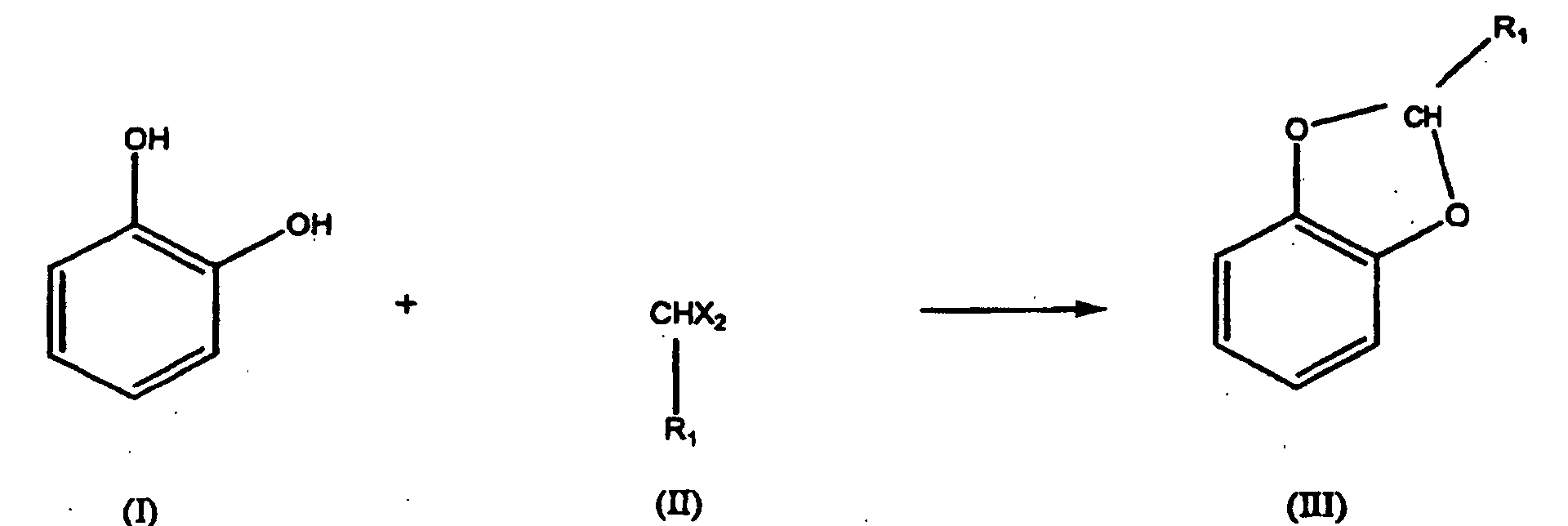
- The subject of the present invention is a new process for the synthesis of 5-(α-hydroxyalkyl)benzo[1,3]dioxoles. The process comprises the following steps:
- a) reacting 1,2-dihydroxybenzene (pyrocatechin) (I) in a dipolar aprotic solvent, at
a temperature comprised between 70°C and 190°C, with a compound of formula
(II), where R1 is chosen from H, and a C1 - C3 linear or branched alkyl, and X is
chosen from chlorine, fluorine, bromine, iodine, and a C1 - C5 linear or branched
alkoxy, obtaining the product of formula (III), where R1 has the meanings
described above.
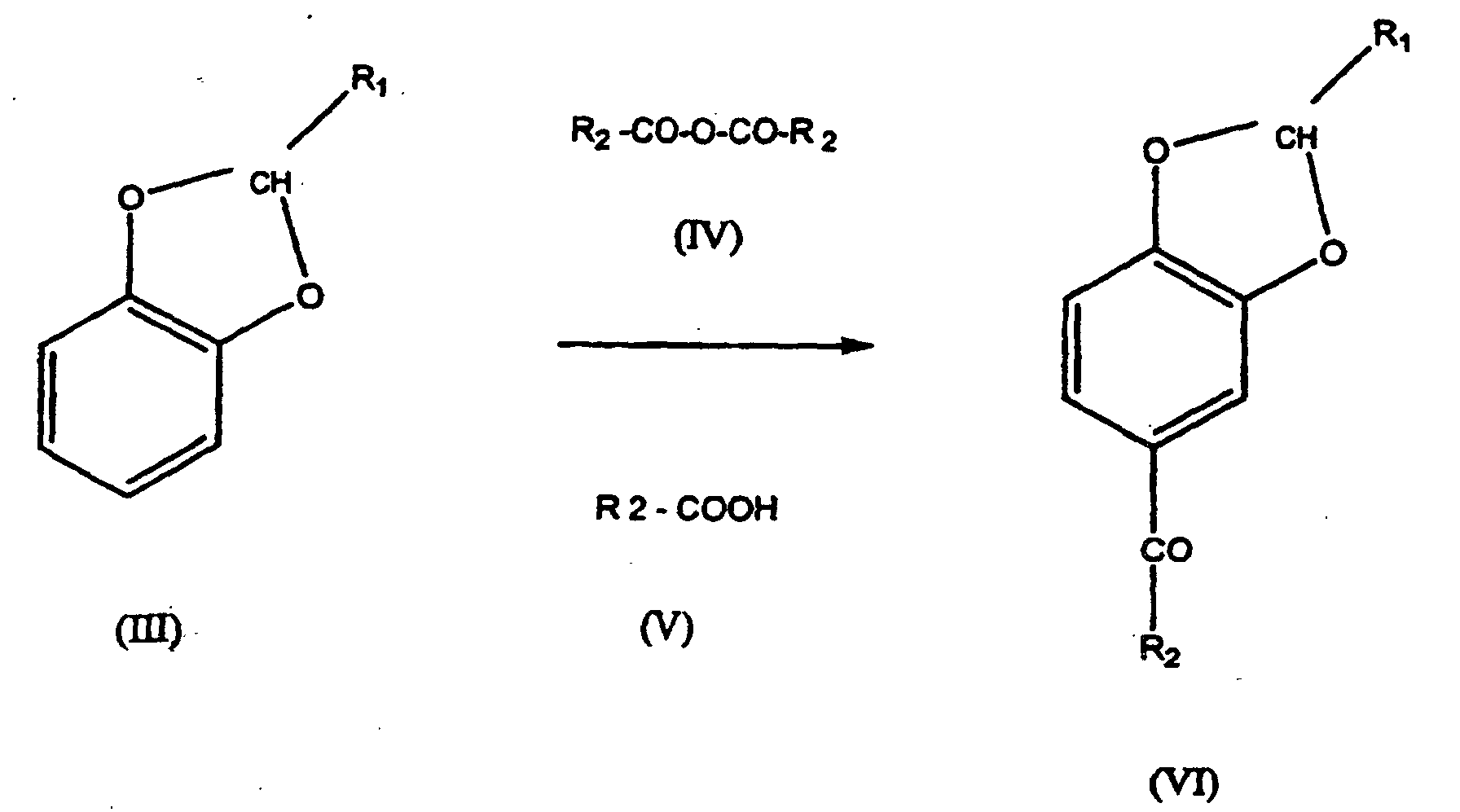
- b) reacting the compound (III) with an aliphatic anhydride of formula (IV) or with
an aliphatic acid of formula (V), where R2 is a C1-C19 linear or branched alkyl, in the
presence of an acylation catalyst, obtaining a compound of formula (VI), where R1
and R2 have the aforesaid meanings.

- c) reducing of the compound (VI), obtaining the 5-(α-hydroxyalkyl)benzo[1,3]dioxole
of formula (VII)
Reaction a) is carried out in dipolar aprotic solvents. Preferred solvents of this type are N,N-dimethylformamide, N,N-dimethylacetamide and dimethylsulfoxide.

-
- The temperature of the reaction is that of reflux of the reaction mixture, and is generally between 70°C and 190°C. In the case where N,N-dimethylformamide is used as reaction solvent, this temperature is generally between 110°C and 150°C, or more preferably between 110°C and 130°C.
- Reaction a) may be carried out in the presence of an iodine salt. In this case, the salt is preferably chosen from among Lil, Nal, Kl, Cal2.
- The choice of the reagent of formula (II) to be used in reaction a) /depends upon the nature of the final product (VII) that is to be synthesized: if the aim is to obtain benzo[1,3]dioxoles not substituted in position 2, reagents of formula (II) will be chosen in which R1 = H. Examples of such products are methylene chloride and dimethoxymethane. If the aim is to obtain benzo[1,3]dioxoles alkyl-substituted in position 2, the reagent of formula (II) will be chosen in which R1 is the same as the alkyl radical that it is intended to introduce on the benzodioxole ring. Appropriate R1 radicals are methyl, ethyl, n-propyl, and isopropyl.
- As has been seen above, the reagent of formula (II) contains two X = halogen groups or else two X = C1 - C5 alkoxy groups, either linear or branched.
- If derivatives of formula (II) are used, where X = halogen, reaction a) is carried out in the presence of an inorganic base, preferably chosen from among NaOH, KOH, Na2CO3, and K2CO3. The inorganic bases of a solid nature (e.g., carbonates) are preferably added to the reaction mixture in a finely ground form.
- In the case where derivatives of formula (II) are used, where X = C1 - C5 linear or branched alkoxy, reaction a) is carried out in the presence of a transesterification catalyst, preferably chosen from among CH3ONa C2H5ONa, (C4H9)2SnO, and Ti (OC4H9)4.
- Various ways of mixing the aforesaid reagents are possible.
- In a preferred embodiment, reaction a) is carried out as follows: Compound (II) is mixed with the dipolar aprotic solvent and with the inorganic base (or transesterification catalyst). To the resulting mixture, heated up to the reflux temperature, pyrocatechin is then added. This addition is preferably made by dripping a liquid mixture obtained by mixing pyrocatechin, derivative, (II) and dipolar aprotic solvent.
- The mixture thus obtained is heated up to reflux for a period of between 1 and 3 hours, thus terminating the reaction. The final product (III) is separated from the reaction solvent and from the non-reacted derivative (II) by means of fractionated distillation or distillation in a vapour stream.
- The reagents are preferably used in the following molar proportions: pyrocatechin : inorganic base: compound (II) = 1 : 1 : 2, the said proportion of compound (II) being preferably shared between the initial mixture and the one dripped which contains the pyrocatechin.
- The reaction described above leads to the products of formula (III) with yields of more than 90%, typically of around 95%.
- The acylation reaction b) leads to the formation of the 5-alkanoylbenzo[1,3]dioxoles of formula (VI). This reaction involves the adoption of appropriate acids or anhydrides as acylating agents, and is catalysed preferably by a compound chosen from among ZnO, ZnCl2, FeCl2, FeCl3, FeSO4, Fe2(SO4)3, FeO, Fe2O3, H3PO4, HClO4, and polyphosphoric acid. The particularly preferred catalyst for this reaction is perchloric acid (HClO4). Optionally the reaction takes place in the presence of inert solvents; examples of such solvents are cyclohexane, methylcyclohexane, decalin, dichloroethane, and tetrachloroethane.
- In the case where the acid (V) is used as acylating agent, the benzodioxole/acid (V) molar ratio used ranges between 5:1 and 0.5:1, and is preferably 1:1. In the case where the anhydride (IV) is used as acylating agent, the benzodioxole/anhydride (IV) molar ratio ranges between 3:1 and 1:1, and is preferably 2:1.
- The reaction temperature is between 0°C and the boiling point of the most low-boiling component of the reaction mixture.
- Various ways of mixing the aforesaid reagents are possible. In a preferred embodiment, the benzo[1,3]dioxole (III) is mixed with the acylation catalyst, and to the mixture the acid or anhydride chosen for the reaction is then added slowly. The reaction is completed in a period of between 1 and 7 hours. The 5-alkanoylbenzo[1,3]dioxole (VI) is obtained from the reaction mixture by extraction with organic solvent, preferably methylene chloride, and by subsequent fractionated distillation of the organic phase.
- In a preferred embodiment, the reaction mixture obtained at the end of step b) undergoes recycling: this process is carried out by adding to the exhausted mixture a fresh amount of the acylation catalyst previously used and a further amount of the acylating agent of formula (IV) or (V); possibly, but not necessarily, a further amount of benzo[1,3]dioxole of formula (III) may be added; these additions are made preferably keeping the molar ratio of benzodioxole and acylating agent within the range of values indicated above.
- The mixture thus enriched is then left to react in the same reaction conditions (times and temperature) as those of the first cycle. The said recycling operation may be carried out once or a number of times.
- In step c), the 5-alkanoylbenzo[1,3]dioxole (VI) is reduced to 5-(α-hydroxyalkyl)benzo[1,3]dioxole (VII). In general, any reduction reaction may be used in this step. For example, it is possible to use hydrogen in the presence of catalysts such as palladium, platinum or ruthenium. The catalyst may be on an inert matrix substrate: examples of such systems are Pd on carbon, Pt on carbon, Ru on carbon, Pd on alumina, and Pd on barium sulphate. Among the other reduction reagents it is possible to mention PtO2, PtO, Ni-Raney, NaBH4, and LiAlH4.
- The reaction conditions (times, temperature, pressure) and the proportions of the reagents are those commonly used in the state of the art for these types of reactions. For example, in the case where gaseous hydrogen on catalyst is used, the operating temperature is preferably between 20°C and 100°C, with a pressure of between 1 bar and 60 bar, possibly in the presence of an appropriate solvent such as methanol, ethanol, propanol, isopropanol, and butanol.
- The process described in the present invention represents the first example of synthesis of 5-(α-hydroxyalkyl)benzo[1,3]dioxoles, starting from a non-heterocyclic reagent that is readily available and has a low cost (pyrocatechin). The high yield obtainable in the three steps of the reaction described above enables large quantities of final product to be obtained.
- Reaction step a) moreover enables 2-alkyl-substituted benzo[1,3]dioxoles to be obtained, without resorting to a separate alkylation step in position 2.
- The 2-alkyl-substituted products obtainable by means of the process described above are new and as such constitute a further aspect of the present invention. These compounds have the formula of structure (VIII):where R1 is chosen from among C1 - C3 linear or branched alkyl, and R2 is a C1 - C19 alkyl, either linear or branched alkyl.

- A preferred group of products of formula VIII is the one in which R1 represents methyl, ethyl, n-propyl, and isopropyl.
- The derivatives of formula (VII), irrespective of whether they are substituted or not in position 2 on the benzo[1,3]dioxole ring, in addition to being of interest on their own account as essences and aromas, are also usable as reagents in the preparation of similar derivatives, and are of particular interest for the perfumery industry or in the production of insecticides. The preferred example of these compounds is represented by the 5-alkylbenzo[1,3]dioxoles, and in particular by 5-propylbenzo[1,3]dioxole(dihydrosafrole). The present invention thus includes also the preparation of these products, which are obtained by subjecting the derivatives of formula (VII), previously obtained by means of step c), to a further reduction. The 5-alkylbenzo[1,3]dioxoles may also be obtained directly with a single reduction reaction starting from the compounds of formula (VI). Proceeding in this way, the derivatives of formula (VII) are formed as intermediates, but are not isolated: in this case it is preferable to use, as reduction catalysts, metals on an inert substrate, such as Pd/C, Pt/C, and Pd/BaSO4.
- 5-(1-propenyl)-benzo[1,3]dioxol, (isosafrole) is another example of a derivative obtainable through the process that forms the subject of the present invention. In this case, the 5-hydroxyalkylbenzo[1,3]dioxoles of formula (VII) obtained in step c) undergo dehydration reactions. Such dehydration reactions, which are in themselves known in the literature, may be carried out in the presence of a suitable solvent, such as benzene, toluene, xylene, mesitylene, dichloroethane, and tetrachloroethane, in the presence of an organic or inorganic acid, such as, for example, nitric acid, sulphuric acid, hydrochloric acid, perchloric acid, acetic acid, trifluoroacetic acid, benzenesulphonic acid, and p-lotuenesulphonic acid at the boiling temperature of the solvent, and by removing the reaction water by means of azeotropation.
- 5-(1-propenyl)-benzo[1,3]dioxole is in turn convertible into piperonal, or else, by means of a further reduction reaction, into 5-propylbenzol[1,3]dioxole (dihydrosafrole).
- The invention in question is illustrated in the sequel by the following non-limiting examples.
- To a mixture of 104 g (0.75 mol) of potassium carbonate finely ground in 440 ml of N,N-dimethylformamide were added 45 ml (0.7 mol) of methylene chloride, and the mixture thus obtained was heated up to the reflux temperature (128-130°C). Then a solution of 75 g (0.68 mol) of pyrocatechin dissolved in 110 ml of N,N-dimethylformamide and 45 ml (0.7 mol) of methylene chloride was added drop by drop.
- At the end of dripping, the mixture was heated up to reflux for a further 2 hours, cooled and then filtered.
- The solution thus obtained was distilled at room pressure, and 42 ml of dichloromethane were collected (40-41°C). To this was subsequently added, at portions of 50 ml each, 400 ml of water, distilling at 98-100°C an azeotrope consisting of benzo[1,3]dioxole and water, and, finally distilling the N,N-dimethyfformamide at 152-153°C.
- From the mixture of benzo[1,3]dioxole and water was separated the product, and the aqueous phase was added with a saturated solution of sodium chloride, followed by two extractions with 60 ml of dichloromethane.
- The product and the organic solution were reunited, evaporated at 25°C/20 mbar, obtaining 78 g of benzo[1,3]dioxole.
- To a mixture of 73.2 g (0.6 mol) of benzo[1,3]dioxole and 1 ml of 70% perchloric acid, cooled to 0-5°C, were slowly added 38.1 ml (0.3 mol) of propionic anhydride, keeping the temperature at 0-5°C during the addition.
- Once the addition was complete, the mixture was left under stirring for a further 3 hours, allowing the temperature to rise to room temperature. The mixture was diluted with 50 ml of dichloromethane and 50 ml of water, stirred for half an hour, and the organic phase was then separated. The organic phase was washed with 30 ml of sodium hydroxide 2M aqueous solution and with water, and, finally dried on sodium sulphate.
- The organic phase was distilled at room pressure, collecting the dichloromethane at 40-41 °C, distilling benzo[1,3]dioxole that had not reacted (44 g) at 55°C/1.3 mbar and, finally, the product (34.5 g) at 125-130°C/1.3 mbar.
- To the reaction mixture containing 44 g of non-reacted benzo[1,3]dioxole were added 29.2 g ( 0.24 mol) of benzo[1.3]dioxole and 1 ml of 70% perchloric acid. To the resulting mixture, cooled to 0-5°C, was added 38.1 ml (0.3 mol) of propionic anhydride. Using the method described in the previous paragraph, 44 g of non-reacted benzo[1,3]dioxole and 34.5 g of the desired product were isolated.
- Into a 250-ml multiple-necked flask were introduced, under nitrogen flow, 30 g of 5-propanoylbenzo[1,3]dioxole (0.268 mol) dissolved in 100 ml of methanol. At 25°C, 7 g of NaBH4 (0.185 mol) dissolved in 50 ml of methanol were dripped in 20 minutes; then the reaction mixture was brought to reflux. After 2 hours the mixture was cooled, the methanol was removed at reduced pressure, and the mixture was diluted with 100 ml of HCl 2M and extracted twice with CH2Cl2. The reunited organic phases were washed with 100 ml of H2O and concentrated at reduced pressure to obtain 30.07 g of dense, clear oil, the analysis of which - GC, MS, NMR (1H, 13C, DEPT) - was in conformity with the desired product. Alternatively, 5-(α-hydroxypropyl)benzo[1,3]dioxole was prepared as follows: Into a 1-litre autoclave, 30 g of 5-propanoylbenzo[1,3]dioxole (0.168 mol) dissolved in 150 ml of isopropanol and 1 g of Ru/C 5% were poured. The autoclave was closed, rendered inert with nitrogen, and brought to the pressure of 1 bar with H2 under stirring. The mixture was left under stirring with H2 pressure constant at 1 bar for 1 hour; then it was washed with N2 and filtered. By evaporation of the solvent at reduced pressure, 30 g of a dense oil were obtained, the analysis of which - GC, MS, NMR (1H,13C, DEPT) - was in conformity with the desired product.
- 34.5 g of 5-propanoylbenzo[1,3]dioxole(0.19 mol) were dissolved in 100 ml of isopropanol, and 2 g of 50% wet Pd/C 5% were added.
- The mixture was put into an autoclave and hydrogenated at a pressure of 4 bar and a temperature of 40°C.
- The mixture was filtered, and evaporated at 40°C/20 mbar, to obtain an oil (31 g), which was distilled at 108-109°C/18 mbar, the analysis of which - GC, MS, NMR (1H,13C, DEPT) - was in conformity with the desired product.
- Into a 100-ml multiple-necked flask were introduced 5 g of 5-(α-hydroxyethyl)benzo[1,3]dioxole(27 mmol) dissolved in 50 ml of toluene and a crystal of ρ-toluenesulphonic acid. The reaction mixture was brought to reflux, and the water formed by the reaction was collected by azeotropation. After 2 hours, 10 ml of NaOH 2M were added to the cooled mixture, and the mixture was left under stirring for 15 minutes. Once the two phases had been separated, the organic phase was concentrated at reduced pressure obtaining a yellow oil, which was purified by distillation (90°C, 1,3 mbar).
- 4.1 g of clear, yellowish oil were obtained, the analysis of which - GC, MS, NMR, (1H, 13C, DEPT) - was in conformity with the desired product.
Claims (14)
- Process for the synthesis of 5-(α-hydroxyalkyl)benzo[1,3]dioxoles, comprising the following steps:a) reacting the 1,2-dihydroxybenzene (pyrocatechin) (I) in a dipolar aprotic solvent at a temperature of between 70°C and 190°C, with a compound of formula (II), where R1 is chosen from H, a C1 - C3, linear or branched alkyl, and X is chosen from chlorine, fluorine, bromine, iodine, and a C1 - C5 linear or branched alkoxy, obtaining the product of fomwla (III), where R1 has the meanings described above.
 b) Reacting the compound (III) with an aliphatic anhydride of formula (IV) or with an aliphatic acid of formula (V), where R2 is a C1-C19 linear or branched alkyl, in the presence of an acylation catalyst, obtaining a compound of formula (VI), where R1 and R2 have the aforesaid meanings.
 c) Reducing compound (VI), obtaining the 5-(α-hydroxyalkyl)benzo[1,3]dioxole of formula (VII)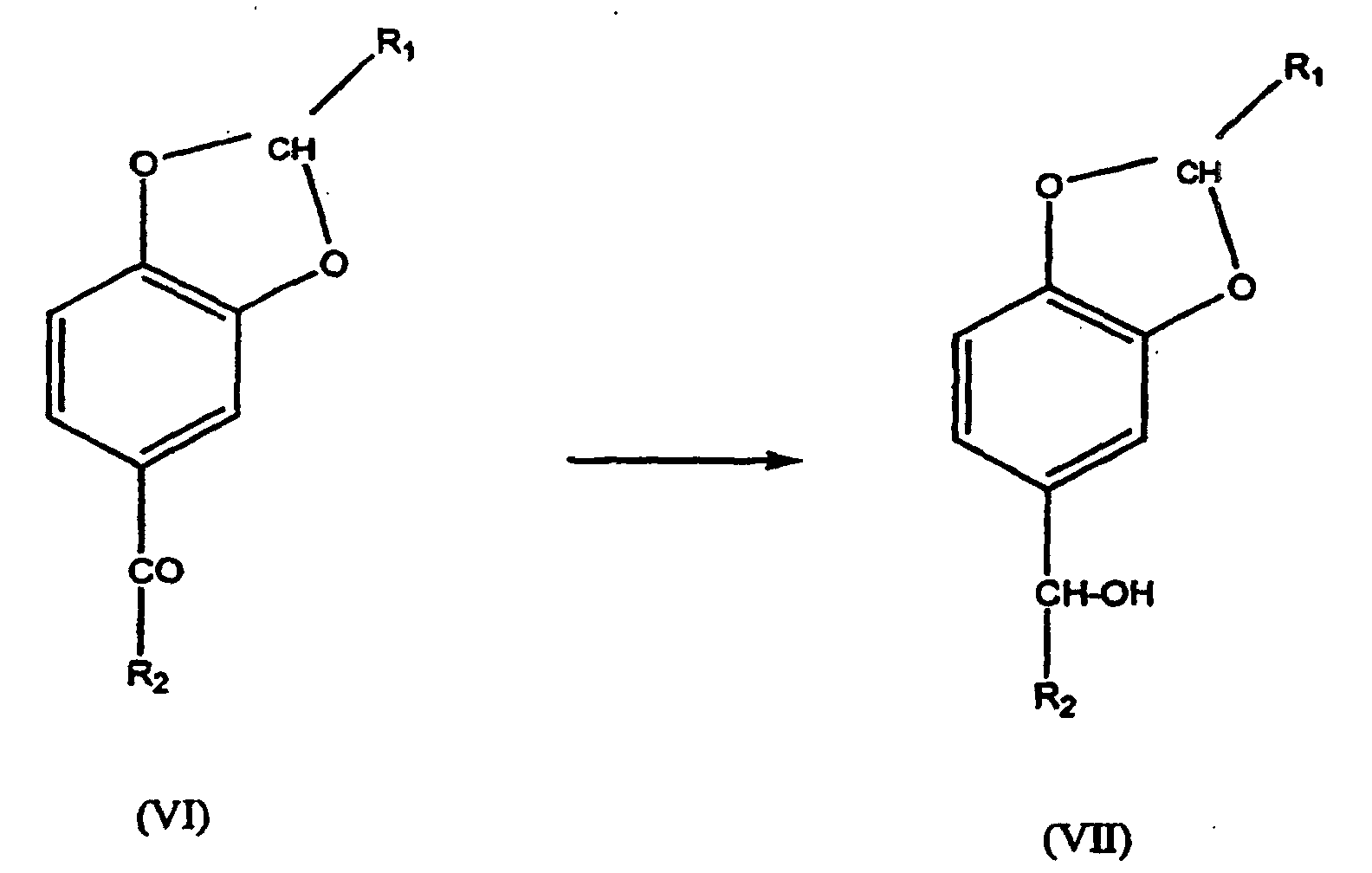
- Process according to claim 1, where the dipolar aprotic solvent used in reactiona) is chosen from N,N-dimethylformamide, N,N-dimethylacetamide, and dimethylsulphoxide.
- Process according to either of claims 1-2, where reaction a) is carried out in the presence of an iodine salt.
- Process according to any one of the claims 1-3, where the reaction b) is catalysed by a compound chosen from HClO4, ZnO, ZnCl2, FeCl2, FeCl3, FeSO4, Fe2(SO4)3, FeO, Fe2O3, H3PO4, and polyphosphoric acid.
- Process according to any one of the claims 1-4, where reaction b) takes place in the presence of inert solvents.
- Process according to any one of the claims 1-5, where in reaction b) the benzodioxole/acid (V) molar ratio is between 5:1 and 0.5:1.
- Process according to any one of the claims 1-5, where in reaction b) the benzodioxole/anhydride (IV) molar ratio is between 3:1 and 1:1.
- Process according to any one of the claims 1-7, where the reaction mixture resulting from reaction b) undergoes recycling.
- Process according to any one of the claims 1-8, where the derivative of formula (VII) is subjected to further reduction, with the formation of a 5-alkylbenzo[1,3]dioxole.
- Process according to claim 9, where the said derivative of formula (VII) is 5-(α-hydroxypropyl)benzo[1,3]dioxole and the said 5-alkylbenzo[1,3]dioxol is 5-propylbenzo[1,3]dioxole(dihydrosafrole).
- Process according to any one of the claims 1-8, where the derivative of formula (VII) is further subjected to dehydration, with the formation of a 5-(1-alkenyl)benzo[1,3]dioxole.
- Process according to claim 11, where the said derivative of formula (VII) is 5-(α-hydroxypropyl)benzo[1,3]dioxole and the said 5-(1-alkenyl)benzo[1,3]dioxole is 5-(1-propenyl)benzo[1,3]dioxole(isosafrole).
- Compounds of formula (VIII)where R1 is chosen from C1 - C3 linear of branched alkyl, and R2 is a C1 - C19 linear or branched alkyl.

- Compounds according to claim 13, where R1 represents methyl, ethyl, n-propyl, or isopropyl.
Applications Claiming Priority (3)
| Application Number | Priority Date | Filing Date | Title |
|---|---|---|---|
| IT1998MI002857A IT1304513B1 (en) | 1998-12-30 | 1998-12-30 | PROCESS FOR THE SYNTHESIS OF 5- (ALPHA-HYDROXIALKYL) BENZO (1,3) DIOXINS. |
| ITMI982857 | 1998-12-30 | ||
| PCT/EP1999/007743 WO2000040575A1 (en) | 1998-12-30 | 1999-10-14 | PROCESS FOR THE SYNTHESIS OF 5-(α -HYDROXYALKYL) BENZO[1, 3]DIOXOLS |
Publications (2)
| Publication Number | Publication Date |
|---|---|
| EP1140894A1 EP1140894A1 (en) | 2001-10-10 |
| EP1140894B1 true EP1140894B1 (en) | 2003-12-17 |
Family
ID=11381378
Family Applications (1)
| Application Number | Title | Priority Date | Filing Date |
|---|---|---|---|
| EP99953826A Expired - Lifetime EP1140894B1 (en) | 1998-12-30 | 1999-10-14 | Process for the synthesis of 5-(alpha -hydroxyalkyl) benzo 1, 3]dioxols |
Country Status (13)
| Country | Link |
|---|---|
| US (1) | US6342613B1 (en) |
| EP (1) | EP1140894B1 (en) |
| JP (1) | JP4845266B2 (en) |
| KR (1) | KR100682160B1 (en) |
| CN (1) | CN1138769C (en) |
| AT (1) | ATE256676T1 (en) |
| AU (1) | AU756172B2 (en) |
| BR (1) | BR9916471B1 (en) |
| CA (1) | CA2352249C (en) |
| DE (1) | DE69913735T2 (en) |
| IT (1) | IT1304513B1 (en) |
| RU (1) | RU2243224C2 (en) |
| WO (1) | WO2000040575A1 (en) |
Cited By (1)
| Publication number | Priority date | Publication date | Assignee | Title |
|---|---|---|---|---|
| WO2022162223A1 (en) | 2021-01-29 | 2022-08-04 | Endura S.P.A. | Process for the preparation of 3,4-methylenedioxypropiophenone |
Families Citing this family (9)
| Publication number | Priority date | Publication date | Assignee | Title |
|---|---|---|---|---|
| CN100572375C (en) * | 2004-01-28 | 2009-12-23 | 霍夫曼-拉罗奇有限公司 | Spiro-benzene and dioxole and as the application of CB1 antagonist |
| EP2385934B1 (en) * | 2009-01-12 | 2016-05-18 | Council of Scientific & Industrial Research | Inhibitors of phosphatidylinositol-3-kinase (pi3) and inducers of nitric oxide (no) |
| EP2289889A1 (en) | 2009-08-18 | 2011-03-02 | Endura S.p.a. | Substituted alkynyl phenoxy compounds and their uses |
| CN102070596B (en) * | 2011-01-22 | 2013-02-27 | 浙江大学 | Preparation method for dihydrosafrole |
| GB201104156D0 (en) | 2011-03-11 | 2011-04-27 | Rothamstead Res Ltd | Compositions and methods for controlling pesticide resistant pests |
| PL3141116T3 (en) | 2015-09-09 | 2019-04-30 | Agchem Access Ltd | 5,7-disubstituted 2,3-dihydrobenzofurans and their use as synergists |
| EP3141115A1 (en) | 2015-09-09 | 2017-03-15 | Endura S.p.a. | Substituted methylenedioxybenzyl compounds and their uses as synergists |
| CN106632228B (en) * | 2016-08-05 | 2019-07-02 | 成都建中香料香精有限公司 | A kind of preparation method of dihydrosafrole |
| WO2018150230A1 (en) | 2017-02-14 | 2018-08-23 | Anthea Aromatics Private Limited | A process for preparation of alkenyl and alkyl derivatives of alkylenedioxybenzene |
Family Cites Families (13)
| Publication number | Priority date | Publication date | Assignee | Title |
|---|---|---|---|---|
| GB1097270A (en) * | 1965-10-13 | 1968-01-03 | Shell Int Research | Process for the preparation of methylene dioxybenzene, 1,3-benzoxathiole and derivatives thereof |
| US3908000A (en) * | 1971-03-19 | 1975-09-23 | Hoffmann La Roche | Propynyl benzyl ethers as insecticidal agents |
| US3946040A (en) * | 1971-03-19 | 1976-03-23 | Hoffmann-La Roche Inc. | Propynyl benzyl ethers |
| CH583677A5 (en) * | 1972-02-03 | 1977-01-14 | Basf Ag | |
| JPS56164178A (en) * | 1980-05-23 | 1981-12-17 | Mitsubishi Chem Ind Ltd | Preparation of 4-hydroxy-1,3-benzodioxole |
| EP0095454A3 (en) * | 1982-05-13 | 1985-04-03 | Gerot-Pharmazeutika Gesellschaft m.b.H. | Nuclens-substituted pyrogallol derivatives |
| JP2521739B2 (en) * | 1987-01-27 | 1996-08-07 | 新日本薬品株式会社 | Liver disease treatment agent |
| EP0302980B1 (en) * | 1987-08-03 | 1991-03-13 | Laboratorios Delagrange S.A. | 1,4-dihydropyridines, process for their preparation and their use as medicaments |
| US5420301A (en) * | 1988-03-18 | 1995-05-30 | Ciba-Geigy Corporation | Process for the preparation of substituted difluorobenzo-1,3-dioxoles |
| JP2760998B2 (en) * | 1988-08-16 | 1998-06-04 | 新日本薬品株式会社 | Liver disease treatment |
| SU1703648A1 (en) * | 1989-12-26 | 1992-01-07 | Туркменский Государственный Университет Им.А.М.Горького | 2-(2-cyancethyl)-4ъ5-benzo-1ъ3-dioxolane with acaricidic impact on x-shaped ticks |
| DE4133155A1 (en) * | 1991-10-07 | 1993-04-08 | Bayer Ag | METHOD FOR THE PRODUCTION OF 2,2-DIFLUORBENZO (1,3) -DIOXOL-CARBALDEHYDES AND NEW INTERMEDIATE PRODUCTS |
| US5696301A (en) * | 1996-01-23 | 1997-12-09 | Ube Industries, Ltd. | Process for preparing protocatechualdehyde |
-
1998
- 1998-12-30 IT IT1998MI002857A patent/IT1304513B1/en active
-
1999
- 1999-10-14 WO PCT/EP1999/007743 patent/WO2000040575A1/en not_active Ceased
- 1999-10-14 CA CA002352249A patent/CA2352249C/en not_active Expired - Lifetime
- 1999-10-14 AU AU10377/00A patent/AU756172B2/en not_active Expired
- 1999-10-14 AT AT99953826T patent/ATE256676T1/en not_active IP Right Cessation
- 1999-10-14 BR BRPI9916471-0A patent/BR9916471B1/en not_active IP Right Cessation
- 1999-10-14 KR KR1020017007081A patent/KR100682160B1/en not_active Expired - Lifetime
- 1999-10-14 US US09/856,752 patent/US6342613B1/en not_active Expired - Lifetime
- 1999-10-14 EP EP99953826A patent/EP1140894B1/en not_active Expired - Lifetime
- 1999-10-14 JP JP2000592283A patent/JP4845266B2/en not_active Expired - Lifetime
- 1999-10-14 CN CNB998151173A patent/CN1138769C/en not_active Expired - Lifetime
- 1999-10-14 RU RU2001117199/04A patent/RU2243224C2/en active
- 1999-10-14 DE DE69913735T patent/DE69913735T2/en not_active Expired - Lifetime
Cited By (2)
| Publication number | Priority date | Publication date | Assignee | Title |
|---|---|---|---|---|
| WO2022162223A1 (en) | 2021-01-29 | 2022-08-04 | Endura S.P.A. | Process for the preparation of 3,4-methylenedioxypropiophenone |
| WO2022161628A1 (en) | 2021-01-29 | 2022-08-04 | Endura S.P.A. | Process for the preparation of 3,4-methylenedioxypropiophenone |
Also Published As
| Publication number | Publication date |
|---|---|
| KR20010083955A (en) | 2001-09-03 |
| CN1138769C (en) | 2004-02-18 |
| ITMI982857A0 (en) | 1998-12-30 |
| JP4845266B2 (en) | 2011-12-28 |
| JP2002534423A (en) | 2002-10-15 |
| CA2352249A1 (en) | 2000-07-13 |
| CA2352249C (en) | 2007-09-11 |
| IT1304513B1 (en) | 2001-03-19 |
| DE69913735D1 (en) | 2004-01-29 |
| BR9916471B1 (en) | 2010-12-14 |
| ATE256676T1 (en) | 2004-01-15 |
| AU756172B2 (en) | 2003-01-09 |
| CN1332736A (en) | 2002-01-23 |
| EP1140894A1 (en) | 2001-10-10 |
| KR100682160B1 (en) | 2007-02-12 |
| DE69913735T2 (en) | 2004-07-29 |
| AU1037700A (en) | 2000-07-24 |
| RU2243224C2 (en) | 2004-12-27 |
| US6342613B1 (en) | 2002-01-29 |
| WO2000040575A1 (en) | 2000-07-13 |
| ITMI982857A1 (en) | 2000-06-30 |
| BR9916471A (en) | 2001-09-18 |
Similar Documents
| Publication | Publication Date | Title |
|---|---|---|
| AU8950798A (en) | A method for producing para-menthane-3,8-diol | |
| US6342613B1 (en) | Process for the synthesis of 5-(α-hydroxyalkyl) benzo[1,3]dioxols | |
| RU2282633C1 (en) | METHOD FOR PREPARING 1,11-DIALKYL-3,5-DIHYDROFURO-[2',3':3,4]-CYCLOHEPTA[c]ISOCHROMENS | |
| CA1089492A (en) | Process for the preparation of cyclohexanedione-(1,4)- tetra-methyl diketal | |
| JP4087329B2 (en) | Muscon manufacturing method | |
| EP1048664B1 (en) | Process for the synthesis of 5-alkybenzodioxoles | |
| MXPA01006505A (en) | PROCESS FOR THE SYNTHESIS OF 5-(&agr;-HYDROXYALKYL) BENZO[1, 3]DIOXOLS | |
| CN121574113B (en) | A method for synthesizing the natural molecule 5-(4-hydroxybenzofuran-2-yl)benzene-1,3-diol | |
| US5200531A (en) | Process for the production of threo-4-alkoxy-5- (arylhydroxymethyl)-2(5h)-furanones | |
| CN109503531B (en) | A kind of preparation method of benzofuran compounds | |
| WO2005105774A1 (en) | Process for the preparation of 3-(3,4-methylenedioxyphenyl)-2-methylpropanal | |
| JPH0386840A (en) | Production of alpha,beta-unsaturated carbonyl compound | |
| KR100625886B1 (en) | Method for Purifying L-Muscon or Di-Muscon Using Stereoselective Separation Method | |
| JPS6165879A (en) | Production of tetrahydroedulan | |
| Bellassoued et al. | A Very Short and Efficient Total Synthesis of Otanthus Maritima Amide. | |
| JPS6236023B2 (en) | ||
| JPS6310933B2 (en) | ||
| JPH08277256A (en) | Optically active (s)-2-benzyloxycarbonylamino-1-(4-methoxyphenyl)ethanol and its production | |
| JPS6236018B2 (en) | ||
| EP0298695A2 (en) | Tartaric acid amide derivative and method of producing the same | |
| ES8206529A1 (en) | Process for the preparation of 6-aminopenicillanic-acid derivatives, and intermediates therefor. | |
| JPS6310934B2 (en) | ||
| KR20010099122A (en) | Resolution process for preparing l-muscone or d-muscone | |
| JPS6338975B2 (en) | ||
| JPS6159632B2 (en) |
Legal Events
| Date | Code | Title | Description |
|---|---|---|---|
| PUAI | Public reference made under article 153(3) epc to a published international application that has entered the european phase |
Free format text: ORIGINAL CODE: 0009012 |
|
| 17P | Request for examination filed |
Effective date: 20010724 |
|
| AK | Designated contracting states |
Kind code of ref document: A1 Designated state(s): AT BE CH CY DE DK ES FI FR GB GR IE IT LI LU MC NL PT SE |
|
| AX | Request for extension of the european patent |
Free format text: AL;LT;LV;MK;RO;SI |
|
| GRAH | Despatch of communication of intention to grant a patent |
Free format text: ORIGINAL CODE: EPIDOS IGRA |
|
| GRAS | Grant fee paid |
Free format text: ORIGINAL CODE: EPIDOSNIGR3 |
|
| GRAA | (expected) grant |
Free format text: ORIGINAL CODE: 0009210 |
|
| AK | Designated contracting states |
Kind code of ref document: B1 Designated state(s): AT BE CH CY DE DK ES FI FR GB GR IE IT LI LU MC NL PT SE |
|
| PG25 | Lapsed in a contracting state [announced via postgrant information from national office to epo] |
Ref country code: NL Free format text: LAPSE BECAUSE OF FAILURE TO SUBMIT A TRANSLATION OF THE DESCRIPTION OR TO PAY THE FEE WITHIN THE PRESCRIBED TIME-LIMIT Effective date: 20031217 Ref country code: FI Free format text: LAPSE BECAUSE OF FAILURE TO SUBMIT A TRANSLATION OF THE DESCRIPTION OR TO PAY THE FEE WITHIN THE PRESCRIBED TIME-LIMIT Effective date: 20031217 Ref country code: CY Free format text: LAPSE BECAUSE OF FAILURE TO SUBMIT A TRANSLATION OF THE DESCRIPTION OR TO PAY THE FEE WITHIN THE PRESCRIBED TIME-LIMIT Effective date: 20031217 Ref country code: BE Free format text: LAPSE BECAUSE OF FAILURE TO SUBMIT A TRANSLATION OF THE DESCRIPTION OR TO PAY THE FEE WITHIN THE PRESCRIBED TIME-LIMIT Effective date: 20031217 Ref country code: AT Free format text: LAPSE BECAUSE OF FAILURE TO SUBMIT A TRANSLATION OF THE DESCRIPTION OR TO PAY THE FEE WITHIN THE PRESCRIBED TIME-LIMIT Effective date: 20031217 |
|
| REG | Reference to a national code |
Ref country code: GB Ref legal event code: FG4D |
|
| REG | Reference to a national code |
Ref country code: CH Ref legal event code: EP |
|
| REG | Reference to a national code |
Ref country code: IE Ref legal event code: FG4D |
|
| REF | Corresponds to: |
Ref document number: 69913735 Country of ref document: DE Date of ref document: 20040129 Kind code of ref document: P |
|
| PG25 | Lapsed in a contracting state [announced via postgrant information from national office to epo] |
Ref country code: SE Free format text: LAPSE BECAUSE OF FAILURE TO SUBMIT A TRANSLATION OF THE DESCRIPTION OR TO PAY THE FEE WITHIN THE PRESCRIBED TIME-LIMIT Effective date: 20040317 Ref country code: GR Free format text: LAPSE BECAUSE OF FAILURE TO SUBMIT A TRANSLATION OF THE DESCRIPTION OR TO PAY THE FEE WITHIN THE PRESCRIBED TIME-LIMIT Effective date: 20040317 Ref country code: DK Free format text: LAPSE BECAUSE OF FAILURE TO SUBMIT A TRANSLATION OF THE DESCRIPTION OR TO PAY THE FEE WITHIN THE PRESCRIBED TIME-LIMIT Effective date: 20040317 |
|
| PG25 | Lapsed in a contracting state [announced via postgrant information from national office to epo] |
Ref country code: ES Free format text: LAPSE BECAUSE OF FAILURE TO SUBMIT A TRANSLATION OF THE DESCRIPTION OR TO PAY THE FEE WITHIN THE PRESCRIBED TIME-LIMIT Effective date: 20040328 |
|
| REG | Reference to a national code |
Ref country code: CH Ref legal event code: NV Representative=s name: N&G PATENT SERVICES SA |
|
| LTIE | Lt: invalidation of european patent or patent extension |
Effective date: 20031217 |
|
| NLV1 | Nl: lapsed or annulled due to failure to fulfill the requirements of art. 29p and 29m of the patents act | ||
| ET | Fr: translation filed | ||
| PG25 | Lapsed in a contracting state [announced via postgrant information from national office to epo] |
Ref country code: LU Free format text: LAPSE BECAUSE OF NON-PAYMENT OF DUE FEES Effective date: 20041014 Ref country code: IE Free format text: LAPSE BECAUSE OF NON-PAYMENT OF DUE FEES Effective date: 20041014 |
|
| PLBE | No opposition filed within time limit |
Free format text: ORIGINAL CODE: 0009261 |
|
| STAA | Information on the status of an ep patent application or granted ep patent |
Free format text: STATUS: NO OPPOSITION FILED WITHIN TIME LIMIT |
|
| PG25 | Lapsed in a contracting state [announced via postgrant information from national office to epo] |
Ref country code: MC Free format text: LAPSE BECAUSE OF NON-PAYMENT OF DUE FEES Effective date: 20041031 |
|
| 26N | No opposition filed |
Effective date: 20040920 |
|
| REG | Reference to a national code |
Ref country code: IE Ref legal event code: MM4A |
|
| PG25 | Lapsed in a contracting state [announced via postgrant information from national office to epo] |
Ref country code: IT Free format text: LAPSE BECAUSE OF NON-PAYMENT OF DUE FEES Effective date: 20051014 |
|
| PG25 | Lapsed in a contracting state [announced via postgrant information from national office to epo] |
Ref country code: PT Free format text: LAPSE BECAUSE OF NON-PAYMENT OF DUE FEES Effective date: 20040517 |
|
| PGRI | Patent reinstated in contracting state [announced from national office to epo] |
Ref country code: IT Effective date: 20110616 |
|
| REG | Reference to a national code |
Ref country code: FR Ref legal event code: PLFP Year of fee payment: 17 |
|
| REG | Reference to a national code |
Ref country code: FR Ref legal event code: PLFP Year of fee payment: 18 |
|
| REG | Reference to a national code |
Ref country code: FR Ref legal event code: PLFP Year of fee payment: 19 |
|
| REG | Reference to a national code |
Ref country code: FR Ref legal event code: PLFP Year of fee payment: 20 |
|
| PGFP | Annual fee paid to national office [announced via postgrant information from national office to epo] |
Ref country code: FR Payment date: 20180913 Year of fee payment: 20 Ref country code: IT Payment date: 20180920 Year of fee payment: 20 |
|
| PGFP | Annual fee paid to national office [announced via postgrant information from national office to epo] |
Ref country code: DE Payment date: 20181002 Year of fee payment: 20 |
|
| PGFP | Annual fee paid to national office [announced via postgrant information from national office to epo] |
Ref country code: CH Payment date: 20181015 Year of fee payment: 20 Ref country code: GB Payment date: 20181010 Year of fee payment: 20 |
|
| REG | Reference to a national code |
Ref country code: DE Ref legal event code: R071 Ref document number: 69913735 Country of ref document: DE |
|
| REG | Reference to a national code |
Ref country code: CH Ref legal event code: PL |
|
| REG | Reference to a national code |
Ref country code: GB Ref legal event code: PE20 Expiry date: 20191013 |
|
| PG25 | Lapsed in a contracting state [announced via postgrant information from national office to epo] |
Ref country code: GB Free format text: LAPSE BECAUSE OF EXPIRATION OF PROTECTION Effective date: 20191013 |