EP1138920A1 - Control method and control apparatus for a multiple-acting valve within a fuel injection system - Google Patents
Control method and control apparatus for a multiple-acting valve within a fuel injection system Download PDFInfo
- Publication number
- EP1138920A1 EP1138920A1 EP00106987A EP00106987A EP1138920A1 EP 1138920 A1 EP1138920 A1 EP 1138920A1 EP 00106987 A EP00106987 A EP 00106987A EP 00106987 A EP00106987 A EP 00106987A EP 1138920 A1 EP1138920 A1 EP 1138920A1
- Authority
- EP
- European Patent Office
- Prior art keywords
- predefined
- seat
- acting
- control
- monitored
- Prior art date
- Legal status (The legal status is an assumption and is not a legal conclusion. Google has not performed a legal analysis and makes no representation as to the accuracy of the status listed.)
- Granted
Links
- 238000002347 injection Methods 0.000 title claims abstract description 144
- 239000007924 injection Substances 0.000 title claims abstract description 144
- 238000000034 method Methods 0.000 title claims abstract description 56
- 239000000446 fuel Substances 0.000 title claims abstract description 51
- 230000004048 modification Effects 0.000 claims abstract description 15
- 238000012986 modification Methods 0.000 claims abstract description 15
- 238000012544 monitoring process Methods 0.000 claims abstract description 11
- 230000001360 synchronised effect Effects 0.000 claims description 11
- 238000007599 discharging Methods 0.000 description 50
- 239000003990 capacitor Substances 0.000 description 11
- 230000004913 activation Effects 0.000 description 10
- 238000010586 diagram Methods 0.000 description 7
- 238000005259 measurement Methods 0.000 description 5
- 230000007423 decrease Effects 0.000 description 4
- 230000000694 effects Effects 0.000 description 4
- 238000002485 combustion reaction Methods 0.000 description 3
- 239000000470 constituent Substances 0.000 description 2
- 230000003071 parasitic effect Effects 0.000 description 2
- 230000008569 process Effects 0.000 description 2
- 230000004044 response Effects 0.000 description 2
- 230000008901 benefit Effects 0.000 description 1
- 230000005540 biological transmission Effects 0.000 description 1
- 230000015556 catabolic process Effects 0.000 description 1
- 230000001419 dependent effect Effects 0.000 description 1
- 238000005265 energy consumption Methods 0.000 description 1
- 230000007613 environmental effect Effects 0.000 description 1
- 239000012530 fluid Substances 0.000 description 1
- 230000003993 interaction Effects 0.000 description 1
- 239000000203 mixture Substances 0.000 description 1
- 230000009467 reduction Effects 0.000 description 1
- 238000000926 separation method Methods 0.000 description 1
- 238000012546 transfer Methods 0.000 description 1
Images


Classifications
-
- F—MECHANICAL ENGINEERING; LIGHTING; HEATING; WEAPONS; BLASTING
- F02—COMBUSTION ENGINES; HOT-GAS OR COMBUSTION-PRODUCT ENGINE PLANTS
- F02M—SUPPLYING COMBUSTION ENGINES IN GENERAL WITH COMBUSTIBLE MIXTURES OR CONSTITUENTS THEREOF
- F02M63/00—Other fuel-injection apparatus having pertinent characteristics not provided for in groups F02M39/00 - F02M57/00 or F02M67/00; Details, component parts, or accessories of fuel-injection apparatus, not provided for in, or of interest apart from, the apparatus of groups F02M39/00 - F02M61/00 or F02M67/00; Combination of fuel pump with other devices, e.g. lubricating oil pump
- F02M63/0012—Valves
- F02M63/0014—Valves characterised by the valve actuating means
- F02M63/0015—Valves characterised by the valve actuating means electrical, e.g. using solenoid
- F02M63/0026—Valves characterised by the valve actuating means electrical, e.g. using solenoid using piezoelectric or magnetostrictive actuators
-
- F—MECHANICAL ENGINEERING; LIGHTING; HEATING; WEAPONS; BLASTING
- F02—COMBUSTION ENGINES; HOT-GAS OR COMBUSTION-PRODUCT ENGINE PLANTS
- F02D—CONTROLLING COMBUSTION ENGINES
- F02D41/00—Electrical control of supply of combustible mixture or its constituents
- F02D41/20—Output circuits, e.g. for controlling currents in command coils
- F02D41/2096—Output circuits, e.g. for controlling currents in command coils for controlling piezoelectric injectors
-
- F—MECHANICAL ENGINEERING; LIGHTING; HEATING; WEAPONS; BLASTING
- F02—COMBUSTION ENGINES; HOT-GAS OR COMBUSTION-PRODUCT ENGINE PLANTS
- F02D—CONTROLLING COMBUSTION ENGINES
- F02D41/00—Electrical control of supply of combustible mixture or its constituents
- F02D41/30—Controlling fuel injection
- F02D41/38—Controlling fuel injection of the high pressure type
- F02D41/3809—Common rail control systems
-
- F—MECHANICAL ENGINEERING; LIGHTING; HEATING; WEAPONS; BLASTING
- F02—COMBUSTION ENGINES; HOT-GAS OR COMBUSTION-PRODUCT ENGINE PLANTS
- F02M—SUPPLYING COMBUSTION ENGINES IN GENERAL WITH COMBUSTIBLE MIXTURES OR CONSTITUENTS THEREOF
- F02M47/00—Fuel-injection apparatus operated cyclically with fuel-injection valves actuated by fluid pressure
- F02M47/02—Fuel-injection apparatus operated cyclically with fuel-injection valves actuated by fluid pressure of accumulator-injector type, i.e. having fuel pressure of accumulator tending to open, and fuel pressure in other chamber tending to close, injection valves and having means for periodically releasing that closing pressure
- F02M47/027—Electrically actuated valves draining the chamber to release the closing pressure
Definitions
- Fig. 5 is a schematic representation of a fuel injection system using a piezoelectric element 2010 as an actuator.
- piezoelectric element 2010 is electrically energized to expand and contract in response to a given activation voltage.
- Piezoelectric element 2010 is coupled to a piston 2015.
- piezoelectric element 2010 causes piston 2015 to protrude into hydraulic adapter 2020 which contains a hydraulic fluid, for example fuel.
- double-acting control valve 2025 is hydraulically pushed away from hydraulic adapter 2020 and valve plug 1000 is extended away from first closed position, or seat, 1.
- the group selector switches 310, 320 are arranged between a coil 240 and the respective groups G1 and G2 (the coil-side terminals thereof) and are implemented as transistors.
- Side drivers 311, 321 are implemented which transform control signals received from the activation IC E into voltages which are eligible for closing and opening the switches as required.
Landscapes
- Engineering & Computer Science (AREA)
- Chemical & Material Sciences (AREA)
- Combustion & Propulsion (AREA)
- Mechanical Engineering (AREA)
- General Engineering & Computer Science (AREA)
- Physics & Mathematics (AREA)
- Fluid Mechanics (AREA)
- Fuel-Injection Apparatus (AREA)
Abstract
Description
- The present invention concerns a method as defined in the preamble of
claim 1 and an apparatus as defined in the preamble ofclaim 23, i.e. a control method and a control apparatus for a multiple-acting valve within a fuel injection system. - Fuel injection systems are essential components of internal combustion engines. They may be implemented either with individual or with shared fuel supply lines for each fuel injection nozzle (the second alternative is also referred to as common rail systems, shortly: CR systems). In each case, fuel injections are controlled by means of opening and closing fuel injection nozzles in a predefined way.
- In case of a fuel injection system with multiple-acting valves, the multiple-acting valves are used to execute the opening and the closing of the fuel injection nozzles. A piezoelectric element may be used to actuate the multiple-acting valve.
- Fig. 5 is a schematic representation of a fuel injection system using a
piezoelectric element 2010 as an actuator. Referring to Fig. 1,piezoelectric element 2010 is electrically energized to expand and contract in response to a given activation voltage.Piezoelectric element 2010 is coupled to apiston 2015. In the expanded state,piezoelectric element 2010 causespiston 2015 to protrude intohydraulic adapter 2020 which contains a hydraulic fluid, for example fuel. As a result of the piezoelectric element's expansion, double-actingcontrol valve 2025 is hydraulically pushed away fromhydraulic adapter 2020 andvalve plug 1000 is extended away from first closed position, or seat, 1. The combination of double-actingcontrol valve 2025 andhollow bore 2050 is often referred to as double-acting, double seat valve for the reason that whenpiezoelectric element 2010 is in an unexcited state, double-actingcontrol valve plug 1000 rests in first closedposition 1. On the other hand, whenpiezoelectric element 2010 is fully extended,valve plug 1000 rests in second closed position, or seat, 2. The later position ofvalve plug 1000 is schematically represented with ghost lines in Fig. 5. - The fuel injection system comprises an
injection needle 2070 allowing for injection of fuel from a pressurizedfuel supply line 2060 at a pressure p into the cylinder (not shown). When thepiezoelectric element 2010 is unexcited or when it is fully extended, the double-acting control valve plug 1000 rests respectively in its first closedposition 1 or in its second closedposition 2. In either case, the hydraulic rail pressure p maintainsinjection needle 2070 at a closed position. Thus, the fuel mixture does not enter into the cylinder (not shown). Conversely, when thepiezoelectric element 2010 is excited such that double-actingcontrol valve plug 1000 is in the so-called midposition M with respect to thehollow bore 2050, then there is a pressure drop in the pressurizedfuel supply line 2060. This pressure drop results in a pressure differential in the pressurizedfuel supply line 2060 between the top and the bottom of theinjection needle 2070 so that theinjection needle 2070 is lifted allowing for fuel injection into the cylinder (not shown). Midposition M is schematically represented with ghost lines in Fig. 5. - Hence, in this example, fuel injection is controlled by means of applying voltages to the piezoelectric actuator which expands or contracts itself as a function of the voltage applied. Resulting thereof (but possibly with further use of transmission elements), the
valve plug 1000 moves a corresponding distance Δ1 between thefirst seat 1 and the open position M, and a distance Δ2 between the open position M and thesecond seat 2, respectively. A more detailed description of a corresponding system can be found at German patent application Nos. DE 197 42 073 A1 and DE 1976 29 844 A1, which are hereby incorporated by reference herein in their entirety. These patent applications disclose piezoelectric elements with double-acting, double seat valves for controlling injection needles in a fuel injection system. - Generally, for such applications it is of importance, to achieve predefined quantities of injected fuel with high accuracy. Hence, it is of importance to have an accurate control of the system. However, occurring system conditions may oppose this aim.
- It is an object of the present invention, to provide an improved control method and control apparatus for a multiple-acting valve within a fuel injection system.
- This object of the present invention is achieved by an object of
method claim 1, i.e. by a control method for a multiple-acting valve within a fuel injection system, characterized in that the multiple-acting valve is controlled by a control unit as according to a predefined control scheme. At least one system parameter is monitored. The predefined control scheme and therefore the control of the multiple-acting valve is modified in case one or more of the monitored system parameters match predefined conditions. - This object of the present invention is further achieved by an object of the
apparatus claim 23, i.e. a control apparatus for a multiple-acting valve within a fuel injection system, characterized in that a control unit is implemented for control of the multiple-acting valve as according to a predefined control scheme. Monitoring means are implemented for monitoring at least one system parameter. Modification means are implemented for modification of the predefined control scheme and therefore the control of the multiple-acting valve in case one or more of the monitored system parameters match predefined conditions. - Generally, it is the aim of any predefined control scheme to allow an optimized system control. However, even though a predefined control scheme might generally match this purpose, it might be better to have a different control scheme under certain system conditions. Hence, a corresponding modification is advantageous.
- The modification of any predefined control scheme and therefore the control of the multiple-acting valve can be done on several ways. For example, an existing control scheme which is "stored" (i.e. the information of which is physically located) in any suitable storage of a control unit can be modified by means of replacing parts of it with new parts. However, the same result is obtained by means of replacing the whole scheme with a new scheme, for example comprising the in the first case remaining old parts as well as the new parts. Moreover, it is possible, to modify the treatment and therefore the meaning of the control scheme instead of the scheme as it is stored itself (for example, the control unit could move the double-acting
control valve 2025 into itsfirst seat 1 no matter if the control scheme requires either thefirst seat 1 or the second seat 2). Furthermore, any other suitable way of obtaining a modified control of the fuel injection system can be used with the invention. Hence, by terms of "modification of a predefined control scheme" any measure is addressed which results in a system control which is different from what it would be without the measure. - As according to
claim 2, the multiple-acting control valve is a double-acting control valve which has a first seat corresponding to a first closed position, a second seat corresponding to a second closed position and an open position. - For the control of a corresponding control valve the inventive method is particular advantageous.
- Furthermore, as according to
claim 3, the multiple-acting control valve is actuated by means of a piezoelectric element. The first seat corresponds to a first voltage applied to the piezoelectric element. The second seat corresponds to a second voltage applied to the piezoelectric element which is larger than the first voltage. The open position corresponds to a medium voltage applied to the piezoelectric element which is in between the first and the second voltage. - Within a corresponding system, full advantage can be taken out of the invention.
- Advantageously, the fuel pressure is monitored and the predefined control scheme is modified in case the monitored pressure exceeds a predefined threshold (claim 4).
- This allows to compensate for pressure dependencies of the control valve. Since pressure dependencies are likely to occur within a fuel injections system dealing with pressurized fuel a corresponding compensation is particular advantageous.
- Furthermore, the number and kind of injections (Stinj) are monitored and the predefined control scheme is modified if no pre-injections are to be performed (claim 5).
- As according to a further advantageous implementation, according to the predefined control scheme an injection is executed by means of moving the multiple-acting control valve from the first seat into the open position and instead of doing so, the multiple-acting control valve is moved from the second seat into the open position in case the monitored pressure exceeds a predefined threshold (claim 6).
- For example, in case of a double-acting control valve as described above, the double-acting
control valve 2025 is moved from itsfirst seat 1 to the open position M against the pressure force but from itssecond seat 2 to the open position M with the pressure force. Hence, in case of very high pressures it is advantageous to open the double-actingcontrol valve 2025 from thesecond seat 2 rather than from thefirst seat 1. This is because a relatively large force would be required to move the double-actingcontrol valve 2025 from itsfirst seat 1 against the pressure p into its open position M and hence it is difficult to accurately stop the movement when the double-actingcontrol valve 2025 is in its open position M. If the movement fromseat 1 toseat 2 is fast enough, there will be no injection during this operation. - As according to
claim 6, according to the predefined control scheme an injection is executed by means of moving the multiple-acting valve from the first seat into the open position, the multiple-acting control valve is placed in its first seat, but, however, in order to execute the injection, the multiple-acting control valve is firstly moved from the first seat into the second seat before it is moved into the open position in case the monitored pressure exceeds a predefined threshold (claim 7). - This allows to improve the accuracy of an injection even in case the double-acting
control valve 2025 is in its less eligible seat before. - Advantageously, according to the predefined control scheme two pre-injections are executed before a main injection takes place and the multiple-acting valve is moved into the first seat between the two pre-injections and instead, the multiple-acting control valve is moved into the second seat between the two pre-injections (claim 8).
- If high pressures occur, it is especially advantageous to apply a corresponding modification to the predefined control scheme between the two pre-injections.
- Advantageously, the system temperature is monitored and the predefined control scheme is modified in case the monitored temperature is below a predefined threshold (claim 9).
- This allows to compensate for temperature dependencies of the fuel injection system.
- Additionally, the time gap between injections is monitored; and the predefined control scheme is modified in case the time gap between injections exceeds a predefined value (claim 10).
- Advantageously, the status of the synchronicity of the system with respect to the camshaft and the crankshaft signal is monitored and the predefined control scheme is modified in case the system is not finally synchronized (claim 11).
- Furthermore, according to the predefined control scheme the multiple-acting control valve is moved into the second seat after an injection is executed and instead of doing so, the multiple-acting control valve is moved into the first seat in case the monitored temperature and/or the time gap between these injections exceeds a predefined value and/or the system is not finally synchronized (claim 12).
- This is particularly advantageous in case of a system with piezoelectric actuators, since in case of very low temperatures the lifting ability of piezoelectric elements might be reduced. Hence, for example in case of a double-acting
control valve 2025, it is easier to move the double-actingcontrol valve 2025 into itsfirst seat 1 than into itssecond seat 2 with a sufficient accuracy and security. - Advantageously, according to the predefined control scheme an injection is executed by means of moving the multiple-acting control valve from the second seat into the open position and instead of doing so, the multiple-acting control valve is moved from the first seat into the open position in case the monitored temperature and/or the time gap between these injections exceeds a predefined value and/or the system is not finally synchronized (claim 13).
- This is advantageous, because it might be more difficult to achieve a sufficient accuracy while starting with the
second seat 2 in case of low temperatures. - Advantageously, according to the predefined control scheme there is a pre-injection before a main injection and the multiple-acting control valve is moved into the second seat between the pre-injection and the main injection and instead of doing so, the multiple-acting control valve is moved into the first seat between the pre-injection and the main injection in case the monitored temperature and/or the time gap between these injections exceeds a predefined value and/or the system is not finally synchronized (claim 14).
- This is advantageous, since in particular while starting a car low temperatures may be relevant and hence the main injections should be executed while starting from the
first seat 1. - Advantageously, both the fuel pressure and the system temperature are monitored and in case the pressure exceeds the predefined threshold and at the same time the temperature is below the predefined threshold the multiple-acting valve is controlled as if the pressure would not exceed the predefined threshold (claim 15).
- In a corresponding case, the temperature dependency might be of major importance than the pressure dependency is. This in particular holds, in case the reduction of the lifting ability of the piezoelectric element is too large to safely have the double-acting
control valve 2025 in itssecond seat 2. Hence, it is advantageous to ignore the exceeding of the pressure threshold which would lead to a preferred use of thesecond seat 2 without this rule. - According to claims 16-21, the multiple-acting control valve is actuated by means of a piezoelectric element. In an advantageous implementation according to claims 16-21, the buffer voltage in the charging circuit of the piezoelectric element is monitored and the control of the double-acting control valve is accordingly modified.
- Advantageously, as long as the system is not finally synchronized with respect to the engine speed signals of the crankshaft and the camshaft, any injection is executed by moving the valve from
first seat 1 to the midway portion and back tofirst seat 1 instead of moving it tosecond seat 2. This rule has priority over other rules. - When the time between the pre-injection and the main injection or the time in any other situation between two injection events during which the valve is moved to the second seat exceeds a predefined value the valve is moved to
first seat 1 instead ofsecond seat 2. - According to
claim 22, the monitored system parameters and/or any combination of two or more of the monitored system parameters are ranked in a priority ordering and the predefined control scheme and therefore the control of the multiple-acting valve is modified based on the monitored system parameter or combination of the monitored system parameters having the highest priority ranking. - The invention will be explained below in more detail with reference to exemplary embodiments, referring to the figures in which:
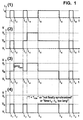
- Fig. 1
- shows a depiction of four graphs illustrating the inventive method;
- Fig. 2
- shows a depiction of two graphs illustrating the inventive method;
- Fig. 3
- shows a depiction of two further graphs illustrating the inventive method;
- Fig. 4
- shows a block diagram of an exemplary embodiment of a control system in which the invention is implemented; and
- Fig. 5
- shows a schematic representation of an exemplary fuel injection system using a piezoelectric element as an actuator;
- Fig. 6
- shows a schematic representation of an exemplary piezoelectric element control system for a fuel injection system;
- Fig. 7a
- shows a schematic circuit diagram for explaining a first
charging phase (charging
switch 220 closed) in the apparatus of Fig. 6; - Fig. 7b
- shows a schematic circuit diagram for explaining a second
charging phase (charging
switch 220 open) in the apparatus of Fig. 6; - Fig. 7c
- shows a schematic circuit diagram for explaining a first
discharging phase (discharging
switch 230 closed) in the apparatus of Fig. 6; and - Fig. 7d
- shows a schematic circuit diagram for explaining a second
discharging phase (discharging
switch 230 open) in the apparatus of Fig. 6. - Fig. 6, which shows a schematic diagram of an exemplary piezoelectric element control system for a fuel injection system. In Fig. 6 there is a detailed area A and a non-detailed area B, the separation of which is indicated by a dashed line c. The detailed area A comprises a circuit for charging and discharging
piezoelectric elements piezoelectric elements - As mentioned above, the circuit within the detailed area A comprises six
piezoelectric elements piezoelectric elements - The
piezoelectric elements piezoelectric elements piezoelectric elements piezoelectric elements - The group selector switches 310, 320 are arranged between a
coil 240 and the respective groups G1 and G2 (the coil-side terminals thereof) and are implemented as transistors.Side drivers -
Diodes 315 and 325 (referred to as group selector diodes), respectively, are provided in parallel with the group selector switches 310, 320. If the group selector switches 310, 320 are implemented as MOSFETs or IGBTs, for example, thesegroup selector diodes diodes piezoelectric elements - Within each group Gl resp. G2 the
piezoelectric elements piezo branches piezoelectric element resistor transistor diode - The branch resistors 13, 23, 33, 43, 53 resp. 63 cause each corresponding
piezoelectric element piezoelectric element branch resistors piezoelectric element branch resistors piezoelectric elements branch resistors - The branch selector switch/branch diode pairs in the individual
piezo branches diode 12 inpiezo branch 110,selector switch 21 anddiode 22 inpiezo branch 120, and so on, can be implemented using electronic switches (i.e., transistors) with parasitic diodes, for example MOSFETs or IGBTs (as stated above for the group selector switch/diode pairs 310 and 315 resp. 320 and 325). The branch selector switches 11, 21, 31, 41, 51 resp. 61 can be used to establish which of thepiezoelectric elements piezoelectric elements - The
branch diodes piezoelectric elements - Returning to the
piezoelectric elements piezo terminals diodes resistor 300. - The purpose of
resistor 300 is to measure the currents that flow during charging and discharging of thepiezoelectric elements piezo terminals piezoelectric elements opening charging switch 220 and dischargingswitch 230 in a manner dependent on the magnitude of the currents, it is possible to set the charging current and discharging current to predefined average values and/or to keep them from exceeding or falling below predefined maximum and/or minimum values as is explained in further detail below. - In the example considered, the measurement itself further requires a
voltage source 621 which supplies a voltage of, for example, 5 V DC and a voltage divider implemented as tworesistors point 620 and which cannot be handled by means of activation IC E: such negative voltages are changed into positive voltages by means of addition with a positive voltage setup which is supplied by saidvoltage source 621 andvoltage divider resistors - The other terminal of each
piezoelectric element piezo terminal group selector switch 310 resp. 320 or via thegroup selector diode 315 resp. 325 as well as via acoil 240 and a parallel circuit made up of a chargingswitch 220 and a chargingdiode 221, and alternatively or additionally connected to ground via thegroup selector switch 310 resp. 320 or viadiode 315 resp. 325 as well as via thecoil 240 and a parallel circuit made up of a dischargingswitch 230 or a dischargingdiode 231. Chargingswitch 220 and dischargingswitch 230 are implemented as transistors which are controlled viaside drivers 222 resp. 232. - The voltage source comprises an element having capacitive properties which, in the example being considered, is the (buffer)
capacitor 210.Capacitor 210 is charged by a battery 200 (for example a motor vehicle battery) and aDC voltage converter 201 downstream therefrom.DC voltage converter 201 converts the battery voltage (for example, 12 V) into substantially any other DC voltage (for example 250 V), and charges capacitor 210 to that voltage.DC voltage converter 201 is controlled by means oftransistor switch 202 andresistor 203 which is utilized for current measurements taken from ameasuring point 630. - For cross check purposes, a further current measurement at a
measuring point 650 is allowed by activation IC E as well as byresistors DC voltage source 654; moreover, a voltage measurement at ameasuring point 640 is allowed by activation IC E as well as byvoltage dividing resistors - Finally, a resistor 330 (referred to as total discharging resistor), a stop switch implemented as a transistor 331 (referred to as stop switch), and a diode 332 (referred to as total discharging diode) serve to discharge the
piezoelectric elements Stop switch 331 is preferably closed after "normal" discharging procedures (cycled discharging via discharge switch 230). It thereby connectspiezoelectric elements resistors piezoelectric elements total discharging diode 332 prevents negative voltages from occurring at thepiezoelectric elements - Charging and discharging of all the
piezoelectric elements battery 200,DC voltage converter 201,capacitor 210, chargingswitch 220 and dischargingswitch 230, chargingdiode 221 and dischargingdiode 231 andcoil 240. - The charging and discharging of each piezoelectric element works the same way and is explained in the following while referring to the first
piezoelectric element 10 only. - The conditions occurring during the charging and discharging procedures are explained with reference to Figs. 3a through 3d, of which Figs. 7a and 7b illustrate the charging of
piezoelectric element 10, and Figs. 7c and 7d the discharging ofpiezoelectric element 10. - The selection of one or more particular
piezoelectric elements - Concerning the charging procedure, firstly any particular
piezoelectric element piezoelectric element 10, the branch selector switch 11 of thefirst branch 110 is closed, whereas all other branch selector switches 21, 31, 41, 51 and 61 remain opened. In order to exclusively charge any otherpiezoelectric element - Then, the charging procedure itself may take place:
- Generally, within the example considered, the charging procedure requires a positive potential difference between
capacitor 210 and the group selectorpiezo terminal 14 of the firstpiezoelectric element 10. However, as long as chargingswitch 220 and dischargingswitch 230 are open no charging or discharging ofpiezoelectric element 10 occurs. In this state, the circuit shown in Fig. 6 is in a steady-state condition, i.e.,piezoelectric element 10 retains its charge state in substantially unchanged fashion, and no currents flow. - In order to charge the first
piezoelectric element 10, chargingswitch 220 is closed. Theoretically, the firstpiezoelectric element 10 could become charged just by doing so. However, this would produce large currents which might damage the elements involved. Therefore, the occurring currents are measured at measuringpoint 620 and switch 220 is opened again as soon as the detected currents exceed a certain limit. Hence, in order to achieve any desired charge on the firstpiezoelectric element 10, chargingswitch 220 is repeatedly closed and opened whereas dischargingswitch 230 remains open. - In more detail, when charging
switch 220 is closed, the conditions shown in Fig. 7a occur, i.e., a closed circuit comprising a series circuit made up ofpiezoelectric element 10,capacitor 210, andcoil 240 is formed, in which a current iLE(t) flows as indicated by arrows in Fig. 7a. As a result of this current flow both positive charges are brought to the group selectorpiezo terminal 14 of the firstpiezoelectric element 10 and energy is stored incoil 240. - When charging
switch 220 opens shortly (for example, a few µs) after it has closed, the conditions shown in Fig. 7b occur: a closed circuit comprising a series circuit made up ofpiezoelectric element 10, chargingdiode 221, andcoil 240 is formed, in which a current iLA(t) flows as indicated by arrows in Fig. 7b. The result of this current flow is that energy stored incoil 240 flows intopiezoelectric element 10. Corresponding to the energy delivery to thepiezoelectric element 10, the voltage occurring in the latter, and its external dimensions, increase. Once energy transport has taken place fromcoil 240 topiezoelectric element 10, the steady-state condition of the circuit, as shown in Fig. 6 and already described, is once again attained. - At that time, or earlier, or later (depending on the desired time profile of the charging operation), charging
switch 220 is once again closed and opened again, so that the processes described above are repeated. As a result of the re-closing and re-opening of chargingswitch 220, the energy stored inpiezoelectric element 10 increases (the energy already stored in thepiezoelectric element 10 and the newly delivered energy are added together), and the voltage occurring at thepiezoelectric element 10, and its external dimensions, accordingly increase. - If the aforementioned closing and opening of charging
switch 220 are repeated numerous times, the voltage occurring at thepiezoelectric element 10, and the expansion of thepiezoelectric element 10, rise in steps. - Once charging
switch 220 has closed and opened a predefined number of times, and/or oncepiezoelectric element 10 has reached the desired charge state, charging of the piezoelectric element is terminated by leaving chargingswitch 220 open. - Concerning the discharging procedure, in the example considered, the
piezoelectric elements - Firstly, the group selector switch(es) 310 and/or 320 of the group or groups G1 and/or G2 the piezoelectric elements of which are to be discharged are closed (the branch selector switches 11, 21, 31, 41, 51, 61 do not affect the selection of
piezoelectric elements branch diodes piezoelectric element 10 as a part of the first group G1, the firstgroup selector switch 310 is closed. - When discharging
switch 230 is closed, the conditions shown in Fig. 7c occur: a closed circuit comprising a series circuit made up ofpiezoelectric element 10 andcoil 240 is formed, in which a current iEE(t) flows as indicated by arrows in Fig. 7c. The result of this current flow is that the energy (a portion thereof) stored in the piezoelectric element is transported intocoil 240. Corresponding to the energy transfer frompiezoelectric element 10 tocoil 240, the voltage occurring at thepiezoelectric element 10, and its external dimensions, decrease. - When discharging
switch 230 opens shortly (for example, a few µs) after it has closed, the conditions shown in Fig. 7d occur: a closed circuit comprising a series circuit made up ofpiezoelectric element 10,capacitor 210, dischargingdiode 231, andcoil 240 is formed, in which a current iEA (t) flows as indicated by arrows in Fig. 7d. The result of this current flow is that energy stored incoil 240 is fed back intocapacitor 210. Once energy transport has taken place fromcoil 240 tocapacitor 210, the steady-state condition of the circuit, as shown in Fig. 6 and already described, is once again attained. - At that time, or earlier, or later (depending on the desired time profile of the discharging operation), discharging
switch 230 is once again closed and opened again, so that the processes described above are repeated. As a result of the re-closing and re-opening of dischargingswitch 230, the energy stored inpiezoelectric element 10 decreases further, and the voltage occurring at the piezoelectric element, and its external dimensions, also accordingly decrease. - If the aforementioned closing and opening of discharging
switch 230 are repeated numerous times, the voltage occurring at thepiezoelectric element 10, and the expansion of thepiezoelectric element 10, decrease in steps. - Once discharging
switch 230 has closed and opened a predefined number of times, and/or once the piezoelectric element has reached the desired discharge state, discharging of thepiezoelectric element 10 is terminated by leaving dischargingswitch 230 open. - In the following, by way of example, a fuel injection system with a double-acting
control valve 10 as described above (while referring to Fig. 5) is considered. Hence, the double-actingcontrol valve 10 has afirst seat 1 corresponding to a first closed position, asecond seat 2 corresponding to a second closed position and an open position M. However, any other multiple-acting control valve may be used with the invention. For example, instead of having two closed positions and one open position, a further double-acting control valve might have one closed position and two open positions; or, generally, the multiple-acting valve might have more open and/or closed positions. - Moreover, in the example considered, the double-acting
control valve 2025 is actuated by means of a piezoelectric element (not shown). Hence, thefirst seat 1 corresponds to a first voltage applied to the piezoelectric element; thesecond seat 2 corresponds to a second voltage applied to the piezoelectric element which is larger than the first voltage; and the open position corresponds to a medium voltage applied to the piezoelectric element which is in between the first and the second voltage. - Reference is now had to Figs. 1 to 3.
- Within Fig. 1, four graphs (1), (2), (3) and (4) are shown. In each graph (1), (2), (3) and (4) quantities are depicted as functions of the time during the same time slot. Hence, the base axis of each graph (1), (2), (3) and (4) is a time axis t, with the time axes t of the four graphs (1), (2), (3) and (4) being equal one to another. Moreover, within the first graph (1), the remaining axis is a amount-of-injection axis I and injections are depicted. Furthermore, within the three remaining graphs (2),(3) and (4), the remaining axes are a voltage axes and voltages applied to the piezoelectric actuators are depicted.
- In more detail, within graph (1) an exemplary injection profile is depicted, which comprises a first pre-injection starting at a first time t1 and terminated at a second time t2, a second pre-injection starting at a third time t3 and terminated at a fourth time t4, a main injection starting at a fifth time t5 and terminated at a sixth time t6, and a post-injection starting at a seventh time t7 and terminated at a eighth time t8. Each injection is indicated by means of an injection amount IM which corresponds to the injection occurring while the double-acting
control valve 2025 is in its open position M and which, for simplicity, is depicted as constant during the starting time and the termination time. However, any other injection profile as well as any function of the injection amount I over the time can be used without any effect to the invention. - Within graph (2), by way of example, a predefined control scheme for the double-acting
control valve 2025 is depicted, which is eligible to execute the above described injection profile. According hereto, initially the double-actingcontrol valve 2025 is in itsfirst seat 1 and a corresponding low voltage V1 is applied to the piezoelectric actuator. At the first time t1, the double-actingcontrol valve 2025 is moved into its open position M and a corresponding medium voltage VM is applied to the piezoelectric actuator. At the second time t2 the double-actingcontrol valve 2025 is moved back into itsfirst seat 1 and the corresponding low voltage V1 is applied to the piezoelectric actuator. At the third time t3 the double-actingcontrol valve 2025 is moved into its open position M and a corresponding medium voltage VM is applied to the piezoelectric actuator. At the fourth time t4 the double-actingcontrol valve 2025 is moved into itssecond seat 2 and a corresponding high voltage V2 is applied to the piezoelectric actuator. At the fifth time t5 the double-actingcontrol valve 2025 is moved into its open position M and a corresponding medium voltage VM is applied to the piezoelectric actuator. At the sixth time t6 the double-actingcontrol valve 2025 is moved into itsfirst seat 1 and the corresponding low voltage V1 is applied to the piezoelectric actuator. At the seventh time t7 the double-actingcontrol valve 2025 is moved into its open position M and a corresponding medium voltage VM is applied to the piezoelectric actuator. Finally, at the eighth time t8 the double-actingcontrol valve 2025 is moved back into itsfirst seat 1 and the corresponding low voltage V1 is applied to the piezoelectric actuator. - It is to be understood, that any other suitable predefined control scheme for the double-acting
control valve 2025 may be used with the invention. Moreover, the voltages applied to the piezoelectric actuator may be obtained immediately or in accordance with any suitable function of the voltage over the time without any effect to the invention. For example, the voltages may be obtained in steps. Moreover, the voltages applied to the actuator to realize an injection may differ depending on whether the valve is moved fromseat 1 orseat 2 into the midway position. - Within graph (3), a first modification of the afore described predefined control scheme is shown. In this example, at the second time t2 the double-acting
control valve 2025 is not returned into itsfirst seat 1 as described above, but it is moved into thesecond seat 2. As a result, at the third time t3 the double-actingcontrol valve 2025 is moved into its open position M from thesecond seat 2 instead of thefirst seat 1. - Within the example considered, the corresponding modification is executed because the fuel pressure within the fuel injection system, which is monitored for this purpose, exceeds a predefined threshold (p>p-max). Hence, in case the fuel pressure p exceeds the predefined threshold pmax, the double-acting
control valve 2025 is moved from the open position M into thesecond seat 2 instead offirst seat 1 and into the open position M from thesecond seat 2 instead the offirst seat 1. - The reason for a corresponding rule is as follows: As can be seen from Fig. 5, the double-acting
control valve 2025 opens from itsfirst seat 1 against the fuel pressure p but from itssecond seat 2 with the fuel pressure p. However, the fuel pressure p is changing over the time in dependence of the operating point of the system. Hence, there is a corresponding asymmetry in the system performance. Generally, this asymmetry increases in accordance with a raise of the fuel pressure p. In more detail, for high pressures p large forces (and corresponding large medium voltages VM across the piezoelectric actuator) are required in order to move the double-actingcontrol valve 2025 out of itsfirst seat 1. However, with large forces it is rather difficult to precisely move the double-actingcontrol valve 2025 into its open position M and not to move it further away and back again first. As a result, starting with a threshold pmax of, for example, about 1600 bar in a common fuel injection system, sufficiently precise results are better obtained while opening the double-actingcontrol valve 2025 from its second seat 2 (and therefore with the pressure force) instead of itsfirst seat 1. - As a further reason, it has to be considered, that large forces are obtained by means of applying relatively large medium voltages VM to the piezoelectric actuator. If, for example, for the first seat 1 a zero voltage and for the second seat 2 a maximum voltage of 200 V is applied to the piezoelectric actuator, in case of high pressures p for moving and holding the double-acting
control valve 2025 in its open position M, a medium voltage VM is required which is much larger than 100 V. Resulting thereof, the voltage difference between the high voltage V2 of 200 V and the medium voltage VM is much smaller than the corresponding difference between the medium voltage VM and the low voltage V1 of 0 V. Hence, a smaller amount of currents is required in order to charge the piezoelectric actuator from the medium voltage VM to the high voltage V2 than it would be required in order to charge it from the low voltage V1 to the medium voltage VM. For this reason, in total a less amount of currents is required while performing an injection by means of discharging the piezoelectric actuator from the high voltage V2 to the medium voltage VM and charging it again from the medium voltage VM to the high voltage V2 than it would be required while starting from thefirst seat 1. Hence, the inventive modification of the predefined control scheme helps to reduce the energy consumption of the system. Moreover, the times necessary for charging and discharging the piezoelectric element are reduced. Hence, the ability of the system to quickly afterwards charge another piezoelectric element for another double-acting control valve (not shown) within the system in order to partly drive two (or more) cylinders of the engine in parallel is increased. - Within graph (4), a second modification of the afore described predefined control scheme is shown. In this example, at the fourth time t4 the double-acting
control valve 2025 is not moved into itssecond seat 2 as described above, but it is moved into itsfirst seat 1. As a result, at the fifth time t5 the double-actingcontrol valve 2025 is moved into its open position M from thefirst seat 1 instead of thesecond seat 2. Hence, the double-acting control valve is driven like a single-acting valve which only has one open and one closed position. - The reason for a corresponding modification of the control scheme can be a temperature of the system which is below a predefined threshold. This is because the lifting ability of piezoelectric actuators is reduced for low temperatures (for example temperatures which are significantly below 0° C). Hence, it is difficult to properly expand piezoelectric elements to the length required for having the double-acting
control valve 2025 in itssecond seat 2 and for this reason it might be better to switch the double-acting control valve between itsfirst seat 1 and its open position M only. Corresponding situations particularly occur when a car engine is started when the environmental temperature is low. Other reasons for such a control scheme include: 1) the system not being fully synchronized, and 2) the time gap between two injection events, e.g., pre-injection and main injection exceeding a predefined threshold. - Within Fig.2, three graphs (1), (2) and (3) are shown. In each graph (1), (2) and (3) quantities are depicted as functions of the time during the same time slot. Hence, the base axis of each graph (1), (2) and (3) is a time axis t and the time axes t of the three graphs (1), (2) and (3) are equal one to another. Moreover, within the first graph (1), the remaining axis is a amount-of-injection axis I and injections are depicted. Furthermore, within the two remaining graphs (2) and (3), the remaining axes are a voltage axes and voltages applied to the piezoelectric actuators are depicted.
- In more detail, within graph (1) an exemplary injection profile is depicted, which comprises one injection starting at a first time t1 and terminated at a second time t2. The injection is indicated by means of an injection amount IM which corresponds to the injection occurring while the double-acting
control valve 2025 is in its open position M and which, for simplicity, is depicted as constant during the starting time and the termination time. However, any other injection profile as well as any occurring function of the injection amount I over the time can be used without any effect to the invention. - Within graph (2), by way of example, a predefined control scheme for the double-acting
control valve 2025 is depicted, which is eligible to execute the above described injection profile. According hereto, before the first time t1 the low voltage V1 is applied to the piezoelectric element and hence the double-actingcontrol valve 2025 is in itsfirst seat 1. At the first time t1 a medium voltage VM is applied to the piezoelectric element and hence the double-actingcontrol valve 2025 is moved into its open position M. Finally, at the second time t2 the low voltage V1 is applied to the piezoelectric element and hence is returned into itsfirst seat 1. -
Withing graph 3 the predefined control scheme is modified as follows: the double-actingcontrol valve 2025 is moved from itsfirst seat 1 into itssecond seat 2 at a time t0 which is in advance to the first time t1 and hence the high voltage V2 is applied to the piezoelectric element which initially was on the low voltage V1. However, since this happens immediately and with no or no substantial time in which the voltage remains on the level of the medium voltage VM, no (or basically no) injection occurs while doing so. Then, the injection is executed by means of reducing the high voltage V2 to the medium voltage VM at the first time t1 and therefore moving the double-actingcontrol valve 2025 into its open position M. - The reason to do so would be that a high pressure p occurred according to which it would be difficult to move the double-acting
control valve 2025 from itsfirst seat 1 into its open position M with sufficiently high accuracy as described above. Hence, it might be desired to move the double-actingcontrol valve 2025 from itssecond seat 2 into its open position M only. However, since the double-actingcontrol valve 2025 initially was in itsfirst seat 1 it is therefore required to move the double-actingcontrol valve 2025 from itsfirst seat 1 into itssecond seat 2 first. - Another reason for the profile depicted in Fig. 3 may be when, in contrast to the usual profile, a main injection with no pre-injection is to be performed. This may be desirable in certain situations. In such a case, in order to leave unchanged conditions for the main injection, it may also be desirable to realize a profile as shown in Fig. 3.
- Within Fig.3, again three graphs (1), (2) and (3) are shown. In each graph (1), (2) and (3) quantities are depicted as functions of the time during the same time slot. Hence, the base axis of each graph (1), (2) and (3) is a time axis t and the time axes t of the three graphs (1), (2) and (3) are equal one to another. Moreover, within the first graph (1), the remaining axis is a amount-of-injection axis I and injections are depicted. Furthermore, within the two remaining graphs (2) and (3), the remaining axes are a voltage axes and voltages applied to the piezoelectric actuators are depicted.
- In more detail, within graph (1) an exemplary injection profile is depicted, which comprises one injection starting at a first time t1 and terminated at a second time t2. The injection is indicated by means of an injection amount IM which corresponds to the injection occurring while the double-acting
control valve 2025 is in its open position M and which, for simplicity, is depicted as constant during the starting time and the termination time. However, any other injection profile as well as any occurring function of the injection amount I over the time can be used without any effect to the invention. - Within graph (2), by way of example, a predefined control scheme for the double-acting
control valve 2025 is depicted, which is eligible to execute the above described injection profile. According hereto, before the first time t1 the high voltage V2 is applied to the piezoelectric element and hence the double-actingcontrol valve 2025 is in itssecond seat 2. At the first time t1 a medium voltage VM is applied to the piezoelectric element and hence the double-actingcontrol valve 2025 is moved into its open position M. Finally, at the second time t2 the high voltage V2 is applied to the piezoelectric element and hence is returned into itssecond seat 2. - Withing graph (3) the predefined control scheme is modified as follows: the double-acting
control valve 2025 is moved from itssecond seat 2 into its 1 at a time t0 which is in advance to the first time t1 and hence the low voltage V1 is applied to the piezoelectric element which initially was on the high voltage V2. However, since this happens immediately and with no or no substantial time in which the voltage remains on the level of the medium voltage VM, no (or basically no) injection occurs while doing so. Then, the injection is executed by means of increasing the low voltage V1 to the medium voltage VM at the first time t1 and therefore moving the double-actingcontrol valve 2025 into its open position M. Finally, the double-actingcontrol valve 2025 is returned into itsfirst seat 1 at the second time t2 while applying the low voltage V1 to the piezoelectric element. - The reason to do so would be that a low temperature occurred according to which it would be difficult to hold and/or move the double-acting
control valve 2025 in itssecond seat 2 with sufficiently high accuracy as described above. Hence, it might be desired to switch the double-actingcontrol valve 2025 between itsfirst seat 1 and itssecond seat 2 only. However, since the double-actingcontrol valve 2025 initially was in itssecond seat 2 it is therefore required to move the double-actingcontrol valve 2025 from itssecond seat 2 into itsfirst seat 1 first. - In similar fashion, other system parameters may be monitored and the control of the double-acting control valve accordingly modified. For example, the voltage (VB) across a buffer capacitor in the charging circuit for the piezoelectric element used to actuate the double-acting control valve may be monitored. See the description above regarding the piezoelectric element control system with reference to Figs. 6 and 7a to d.
- Fig. 4, as mentioned above, shows a block diagram of an exemplary embodiment of a control system in which the invention is implemented. Hence, there are
first determination components 100 for the determination and monitoring of the system temperature, particularly for the determination of the temperature occurring atpiezoelectric elements second determination component 105 provided for indicating the status of synchronicity Stsync of the system. Moreover, athird determination component 110 is provided for determination and monitoring of the fuel pressure occurring in the fuel injection system. Furthermore, there are afourth determination component 135 for monitoring buffer capacitor voltage VB, afifth determination component 115 for monitoring the time gap between two injections ΔT and asixth determination component 125 for monitoring the kind of injections to be realized at the actual operating point of the fuel injection system. Stinj describes this actual status of injections. Alldetermination components 100, 105,110, 115, 125 and 135 are connected to acontrol unit 120 which may control piezoelectric elements according to a predefined control scheme as well modify the control scheme in response to values of the determination components, either alone or in combination, mentioned above. The control scheme may be modified, for example, if: 1) the status of synchronicity Stsync indicates that the system is not finally synchronized; 2) the status of injections (Stinj) indicates that no pre-injection is to be performed; and/or 3) the time gap between injections (ΔT) exceeds a predefined value (ΔTMAX) and/or values of any of the other determination components mentioned above exceeding a threshold value. Thecontrol unit 120 immediately controls anactivation IC 130 which again activates thepiezoelectric elements - It is to be understood, that any other control system and any other control scheme may be used with the present invention. Moreover, any further system parameter of interest may by monitored.
Claims (23)
- Control method for a multiple-acting valve (10) within a fuel injection system, characterized in thata) the multiple-acting valve (10) is controlled by a control unit (120) as according to a predefined control scheme;b) at least one system parameter (p, T, VB, Stsync, ΔT, Stinj) is monitored; andc) the predefined control scheme and therefore the control of the multiple-acting valve is modified in case one or more of the monitored system parameters (p, T, VB, Stsync, ΔT, Stinj) match predefined conditions.
- Control method as according to claim 1, characterized in that the multiple-acting control valve (10) is a double-acting control valve which has a first seat (1) corresponding to a first closed position, a second seat (2) corresponding to a second closed position and an open position (M).
- Control method as according to one of the foregoing claims, characterized in thata) the multiple-acting control valve (10) is actuated by means of a piezoelectric element (140, 141, 142);b) the first seat (1) corresponds to a first voltage (V1) applied to the piezoelectric element (140, 141, 142);c) the second seat (2) corresponds to a second voltage (V2) applied to the piezoelectric element (140, 141, 142) which is larger than the first voltage (V1) ; andd) the open position (M) corresponds to a medium voltage (VM) applied to the piezoelectric element (140, 141, 142) which is in between the first and the second voltage (V2, V1).
- Control method as according to one of the foregoing claims, characterized in thata) the fuel pressure (p) is monitored; andb) the predefined control scheme is modified in case the monitored pressure (p) exceeds a predefined threshold (pmax).
- Control method as according to one of the foregoing claims, characterized in thata) the number and kind of injections (Stinj) are monitored; andb) the predefined control scheme is modified if no pre-injections are to be performed.
- Control method as according to one of the foregoing claims, characterized in thata) according to the predefined control scheme an injection is executed by means of moving the multiple-acting control valve (10) from the first seat (1) into the open position (M); andb) instead of doing so, the multiple-acting control valve (10) is moved from the second seat (2) into the open position (M) in case the monitored pressure (p) exceeds the predefined threshold (pmax).
- Control method as according to one of the foregoing claims, characterized in thata) according to the predefined control scheme an injection is executed by means of moving the multiple-acting valve (10) from the first seat (1) into the open position (M) ;b) the multiple-acting control valve (10) is placed in itsc) in order to execute the injection, the multiple-acting control valve (10) is firstly moved from the first seat (1) into the second seat (2) before it is moved into the open position (M) in case the monitored pressure (p) exceeds a predefined threshold (pmax).
- Control method as according to one of the foregoing claims, characterized in thata) according to the predefined control scheme two pre-injections are executed before a main injection takes place and the multiple-acting valve (10) is moved into the first seat (1) between the two pre-injections; andb) instead, the multiple-acting control valve (10) is moved into the second seat (2) between the two pre-injections.
- Control method as according to one of the foregoing claims, characterized in thata) the system temperature (T) is monitored; andb) the predefined control scheme is modified in case the monitored temperature (T) is below a predefined threshold (Tmin).
- Control method as according to one of the foregoing claims, characterized in thata) the time gap between injections (ΔT) is monitored; andb) the predefined control scheme is modified in case the time gap between injections (ΔT) exceeds a predefined value.
- Control method as according to one of the foregoing claims, characterized in thata) the status of the synchronicity of the system with respect to the camshaft and the crankshaft signal (Stsync) is monitored; andb) the predefined control scheme is modified in case the system is not finally synchronized.
- Control method as according to one of the foregoing claims, characterized in thata) according to the predefined control scheme the multiple-acting control valve (10) is moved into the second seat (2) after an injection is executed; andb) instead of doing so, the multiple-acting control valve (10) is moved into the first seat (1) in case the monitored temperature (T) is below a predefined threshold (Tmin) and/or the time gap (ΔT) between these injections exceeds a predefined value (ΔTMAX) and/or the system is not finally synchronized.
- Control method as according to one of the foregoing claims, characterized in thata) according to the predefined control scheme an injection is executed by means of moving the multiple-acting control valve (10) from the second seat (2) into the open position (M); andb) instead of doing so, the multiple-acting control valve (10) is moved from the first seat (1) into the open position (M) in case the monitored temperature (T) is below a predefined threshold (Tmin) and/or the time gap (ΔT) between these injections exceeds a predefined value (ΔTMAX) and/or the system is not finally synchronized.
- Control method as according to one of the foregoing claims, characterized in thata) according to the predefined control scheme there is a pre-injection before a main injection and the multiple-acting control valve (10) is moved into the second seat (2) between the pre-injection and the main injection; andb) instead of doing so, the multiple-acting control valve (10) is moved into the first seat (1) between the pre-injection and the main injection in case the monitored temperature (T) is below the predefined threshold (Tmin) and/or the time gap (ΔT) between these injections exceeds a predefined value (ΔTMAX) and/or the system is not finally synchronized.
- Control method as according to one of the foregoing claims, characterized in thata) both the fuel pressure (p) and the system temperature (T) are monitored; andb) in case the pressure (p) exceeds the predefined threshold (pmax) and at the same time the temperature (T) is below the predefined threshold (Tmin) the multiple-acting valve (10) is controlled as if the pressure (p) would not exceed the predefined threshold (pmax).
- Control method as according to one of claims 1, 2 and 4 through 12, characterized in thata) the multiple-action control valve (10) is actuated by means of a piezoelectric element;b) the buffer voltage (VB) in the charging circuit of the piezoelectric element is monitored; andc) the predefined control scheme is modified in case the monitored buffer voltage (VB) is below a predefined threshold (VB min).
- Control method as according to one of claims 1, 2 and 4 through 12, characterized in thata) the multiple-action control valve (10) is actuated by means of a piezoelectric element;b) according to the predefined control scheme the multiple-acting control valve (10) is moved into the second seat (2) after an injection is executed; andc) instead of doing so, the multiple-acting control valve (10) is moved into the first seat (1) in case the monitored buffer voltage (VB) is below a predefined threshold (VBmin).
- Control method as according to one of claims 1, 2 and 4 through 12, characterized in thata) the multiple-action control valve (10) is actuated by means of a piezoelectric element;b) according to the predefined control scheme an injection is executed by means of moving the multiple-acting control valve (10) from the second seat (2) into the open position (M); andc) instead of doing so, the multiple-acting control valve (10) is moved from the first seat (1) into the open position (M) in case the monitored buffer voltage (VB) is below a predefined threshold (VBmin).
- Control method as according to claim 3, characterized in thata) the buffer voltage (VB) in the charging circuit of the piezoelectric element is monitored; andb) the predefined control scheme is. modified in case the monitored buffer voltage (VB) is below a predefined threshold (VBmin).
- Control method as according to claim 3, characterized in thata) according to the predefined control scheme the multiple-acting control valve (10) is moved into the second seat (2) after an injection is executed; andb). instead of doing so, the multiple-acting control valve (10) is moved into the first seat (1) in case the monitored buffer voltage (VB) is below a predefined threshold (VBmin).
- Control method as according to claim 3, characterized in thata) according to the predefined control scheme an injection is executed by means of moving the multiple-acting control valve (10) from the second seat (2) into the open position (M); andb) instead of doing so, the multiple-acting control valve (10) is moved from the first seat (1) into the open position (M) in case the monitored buffer voltage (VB) is below a predefined threshold (VB min).
- Control method as according to one of the foregoing claims, characterized in thata) the monitored system parameters (p, T, VB, Stsync, ΔT, Stinj) and/or any combination of two or more of the monitored system parameters are ranked in a priority ordering; andb) the predefined control scheme and therefore the control of the multiple-acting valve is modified based on the monitored system parameter (p, T, VB, Stsync, ΔT, Stinj) or combination of the monitored system parameters having the highest priority ranking.
- Control apparatus for a multiple-acting valve within a fuel injection system, characterized in thata) a control unit (120) is implemented for control of the multiple-acting valve (10) as according to a predefined control scheme;b) monitoring means (100, 110) are implemented for monitoring at least one system parameter (p, T, VB, Stsync, ΔT, Stinj); andc) modification means (120) are implemented for modification of the predefined control scheme and therefore the control of the multiple-acting valve in case at least one of the monitored system parameters (p, T, VB, Stsync, ΔT, Stinj) match predefined conditions.
Priority Applications (2)
| Application Number | Priority Date | Filing Date | Title |
|---|---|---|---|
| DE2000615922 DE60015922T2 (en) | 2000-04-01 | 2000-04-01 | Control method and apparatus for multi-position valve actuation in a fuel injection system |
| EP20000106987 EP1138920B1 (en) | 2000-04-01 | 2000-04-01 | Control method and control apparatus for a multiple-acting valve within a fuel injection system |
Applications Claiming Priority (1)
| Application Number | Priority Date | Filing Date | Title |
|---|---|---|---|
| EP20000106987 EP1138920B1 (en) | 2000-04-01 | 2000-04-01 | Control method and control apparatus for a multiple-acting valve within a fuel injection system |
Publications (2)
| Publication Number | Publication Date |
|---|---|
| EP1138920A1 true EP1138920A1 (en) | 2001-10-04 |
| EP1138920B1 EP1138920B1 (en) | 2004-11-17 |
Family
ID=8168327
Family Applications (1)
| Application Number | Title | Priority Date | Filing Date |
|---|---|---|---|
| EP20000106987 Expired - Lifetime EP1138920B1 (en) | 2000-04-01 | 2000-04-01 | Control method and control apparatus for a multiple-acting valve within a fuel injection system |
Country Status (2)
| Country | Link |
|---|---|
| EP (1) | EP1138920B1 (en) |
| DE (1) | DE60015922T2 (en) |
Cited By (1)
| Publication number | Priority date | Publication date | Assignee | Title |
|---|---|---|---|---|
| WO2003085245A1 (en) * | 2002-04-09 | 2003-10-16 | Robert Bosch Gmbh | Fuel injection system for an internal combustion engine and method for operating a fuel injection system |
Citations (3)
| Publication number | Priority date | Publication date | Assignee | Title |
|---|---|---|---|---|
| DE19729844A1 (en) * | 1997-07-11 | 1999-01-14 | Bosch Gmbh Robert | Fuel injector |
| DE19742073A1 (en) * | 1997-09-24 | 1999-03-25 | Bosch Gmbh Robert | Fuel injection arrangement for internal combustion engines |
| US5924403A (en) * | 1997-06-06 | 1999-07-20 | Detroit Diesel Corporation | Method for enhanced split injection in internal combustion engines |
-
2000
- 2000-04-01 DE DE2000615922 patent/DE60015922T2/en not_active Expired - Fee Related
- 2000-04-01 EP EP20000106987 patent/EP1138920B1/en not_active Expired - Lifetime
Patent Citations (3)
| Publication number | Priority date | Publication date | Assignee | Title |
|---|---|---|---|---|
| US5924403A (en) * | 1997-06-06 | 1999-07-20 | Detroit Diesel Corporation | Method for enhanced split injection in internal combustion engines |
| DE19729844A1 (en) * | 1997-07-11 | 1999-01-14 | Bosch Gmbh Robert | Fuel injector |
| DE19742073A1 (en) * | 1997-09-24 | 1999-03-25 | Bosch Gmbh Robert | Fuel injection arrangement for internal combustion engines |
Cited By (1)
| Publication number | Priority date | Publication date | Assignee | Title |
|---|---|---|---|---|
| WO2003085245A1 (en) * | 2002-04-09 | 2003-10-16 | Robert Bosch Gmbh | Fuel injection system for an internal combustion engine and method for operating a fuel injection system |
Also Published As
| Publication number | Publication date |
|---|---|
| DE60015922T2 (en) | 2005-03-31 |
| EP1138920B1 (en) | 2004-11-17 |
| DE60015922D1 (en) | 2004-12-23 |
Similar Documents
| Publication | Publication Date | Title |
|---|---|---|
| EP1138907B1 (en) | Fuel injection system | |
| EP1138917B2 (en) | Fuel injection system | |
| US6680620B2 (en) | Method for timed measurements of the voltage across a device in the charging circuit of a piezoelectric element | |
| EP1139442B1 (en) | Apparatus and method for detecting a short circuit to the battery voltage when driving piezoelectric elements | |
| EP1138905B1 (en) | Apparatus and method for detecting a load decrease when driving piezoelectric elements | |
| EP1138909B1 (en) | Method and apparatus for controlling a fuel injection process | |
| EP1138912A1 (en) | Online optimization of injection systems having piezoelectric elements | |
| EP1138904B1 (en) | Method and apparatus for charging a piezoelectric element | |
| EP1138920B1 (en) | Control method and control apparatus for a multiple-acting valve within a fuel injection system | |
| EP1138914B1 (en) | Determining the piezoelectric element temperature using a model of the energy balance of the piezoelectric element | |
| JP2002034271A (en) | Method and apparatus for controlling system parameters | |
| EP1138908B1 (en) | Controlling a injection system with piezoelectric elements | |
| JP4950385B2 (en) | Apparatus for charging a piezoelectric element and method for charging a piezoelectric element | |
| EP1138935B1 (en) | Determination of the piezoelectric element temperature and its utilization for correcting the drive voltage | |
| EP1138906B1 (en) | Optimization of injection systems having piezoelectric elements by compensating for temperature dependence | |
| EP1139441A1 (en) | Method and apparatus for controlling system parameters, particularly in fuel injection systems | |
| EP1138911B1 (en) | Method and apparatus for charging a piezoelectric element | |
| EP1138918A1 (en) | Method and apparatus for providing control parameters to or within a control system | |
| EP1139449A1 (en) | Fuel injection system | |
| EP1138913A1 (en) | Method and apparatus for charging a piezoelectric element based on measured charge/discharge times |
Legal Events
| Date | Code | Title | Description |
|---|---|---|---|
| PUAI | Public reference made under article 153(3) epc to a published international application that has entered the european phase |
Free format text: ORIGINAL CODE: 0009012 |
|
| AK | Designated contracting states |
Kind code of ref document: A1 Designated state(s): AT BE CH CY DE DK ES FI FR GB GR IE IT LI LU MC NL PT SE Kind code of ref document: A1 Designated state(s): DE |
|
| AX | Request for extension of the european patent |
Free format text: AL;LT;LV;MK;RO;SI |
|
| 17P | Request for examination filed |
Effective date: 20020404 |
|
| AKX | Designation fees paid |
Free format text: DE |
|
| 17Q | First examination report despatched |
Effective date: 20030227 |
|
| GRAP | Despatch of communication of intention to grant a patent |
Free format text: ORIGINAL CODE: EPIDOSNIGR1 |
|
| GRAS | Grant fee paid |
Free format text: ORIGINAL CODE: EPIDOSNIGR3 |
|
| GRAA | (expected) grant |
Free format text: ORIGINAL CODE: 0009210 |
|
| AK | Designated contracting states |
Kind code of ref document: B1 Designated state(s): DE |
|
| REF | Corresponds to: |
Ref document number: 60015922 Country of ref document: DE Date of ref document: 20041223 Kind code of ref document: P |
|
| PLBE | No opposition filed within time limit |
Free format text: ORIGINAL CODE: 0009261 |
|
| STAA | Information on the status of an ep patent application or granted ep patent |
Free format text: STATUS: NO OPPOSITION FILED WITHIN TIME LIMIT |
|
| 26N | No opposition filed |
Effective date: 20050818 |
|
| PGFP | Annual fee paid to national office [announced via postgrant information from national office to epo] |
Ref country code: DE Payment date: 20060613 Year of fee payment: 7 |
|
| PG25 | Lapsed in a contracting state [announced via postgrant information from national office to epo] |
Ref country code: DE Free format text: LAPSE BECAUSE OF NON-PAYMENT OF DUE FEES Effective date: 20071101 |