EP1138715A1 - Organosilicon compositions from cyclosiloxanes - Google Patents
Organosilicon compositions from cyclosiloxanes Download PDFInfo
- Publication number
- EP1138715A1 EP1138715A1 EP01301491A EP01301491A EP1138715A1 EP 1138715 A1 EP1138715 A1 EP 1138715A1 EP 01301491 A EP01301491 A EP 01301491A EP 01301491 A EP01301491 A EP 01301491A EP 1138715 A1 EP1138715 A1 EP 1138715A1
- Authority
- EP
- European Patent Office
- Prior art keywords
- group
- cyclosiloxane
- cyclosiloxanes
- mixture
- copolymeric
- Prior art date
- Legal status (The legal status is an assumption and is not a legal conclusion. Google has not performed a legal analysis and makes no representation as to the accuracy of the status listed.)
- Withdrawn
Links
- 239000000203 mixture Substances 0.000 title claims abstract description 92
- 125000004432 carbon atom Chemical group C* 0.000 claims abstract description 38
- 125000005702 oxyalkylene group Chemical group 0.000 claims abstract description 24
- 229910052799 carbon Inorganic materials 0.000 claims abstract description 23
- 229920001577 copolymer Polymers 0.000 claims abstract description 21
- 239000003054 catalyst Substances 0.000 claims abstract description 18
- 238000000034 method Methods 0.000 claims abstract description 18
- 238000006116 polymerization reaction Methods 0.000 claims abstract description 14
- 238000010438 heat treatment Methods 0.000 claims abstract description 9
- -1 oxypropylene units Chemical group 0.000 claims description 72
- 125000000217 alkyl group Chemical group 0.000 claims description 12
- 125000002877 alkyl aryl group Chemical group 0.000 claims description 9
- 125000003710 aryl alkyl group Chemical group 0.000 claims description 9
- 125000003118 aryl group Chemical group 0.000 claims description 9
- 125000006353 oxyethylene group Chemical group 0.000 claims description 4
- 125000004665 trialkylsilyl group Chemical group 0.000 claims description 4
- 125000000963 oxybis(methylene) group Chemical group [H]C([H])(*)OC([H])([H])* 0.000 claims 1
- 229920001519 homopolymer Polymers 0.000 abstract description 5
- 125000002496 methyl group Chemical group [H]C([H])([H])* 0.000 description 25
- HMMGMWAXVFQUOA-UHFFFAOYSA-N octamethylcyclotetrasiloxane Chemical compound C[Si]1(C)O[Si](C)(C)O[Si](C)(C)O[Si](C)(C)O1 HMMGMWAXVFQUOA-UHFFFAOYSA-N 0.000 description 19
- 239000003921 oil Substances 0.000 description 16
- 238000003756 stirring Methods 0.000 description 14
- 125000001997 phenyl group Chemical group [H]C1=C([H])C([H])=C(*)C([H])=C1[H] 0.000 description 12
- 238000009835 boiling Methods 0.000 description 10
- ZUOUZKKEUPVFJK-UHFFFAOYSA-N diphenyl Chemical compound C1=CC=CC=C1C1=CC=CC=C1 ZUOUZKKEUPVFJK-UHFFFAOYSA-N 0.000 description 10
- 238000006243 chemical reaction Methods 0.000 description 9
- UIIMBOGNXHQVGW-UHFFFAOYSA-M Sodium bicarbonate Chemical compound [Na+].OC([O-])=O UIIMBOGNXHQVGW-UHFFFAOYSA-M 0.000 description 8
- 125000001797 benzyl group Chemical group [H]C1=C([H])C([H])=C(C([H])=C1[H])C([H])([H])* 0.000 description 8
- BASFCYQUMIYNBI-UHFFFAOYSA-N platinum Chemical compound [Pt] BASFCYQUMIYNBI-UHFFFAOYSA-N 0.000 description 8
- 125000003944 tolyl group Chemical group 0.000 description 8
- 238000001644 13C nuclear magnetic resonance spectroscopy Methods 0.000 description 7
- 238000005133 29Si NMR spectroscopy Methods 0.000 description 7
- 239000004205 dimethyl polysiloxane Substances 0.000 description 7
- KPUWHANPEXNPJT-UHFFFAOYSA-N disiloxane Chemical class [SiH3]O[SiH3] KPUWHANPEXNPJT-UHFFFAOYSA-N 0.000 description 7
- 239000012530 fluid Substances 0.000 description 7
- 238000005227 gel permeation chromatography Methods 0.000 description 7
- 229920000435 poly(dimethylsiloxane) Polymers 0.000 description 7
- 238000010992 reflux Methods 0.000 description 7
- 125000005999 2-bromoethyl group Chemical group 0.000 description 5
- 125000000094 2-phenylethyl group Chemical group [H]C1=C([H])C([H])=C(C([H])=C1[H])C([H])([H])C([H])([H])* 0.000 description 5
- 125000003903 2-propenyl group Chemical group [H]C([*])([H])C([H])=C([H])[H] 0.000 description 5
- LCGLNKUTAGEVQW-UHFFFAOYSA-N Dimethyl ether Chemical compound COC LCGLNKUTAGEVQW-UHFFFAOYSA-N 0.000 description 5
- 229920003171 Poly (ethylene oxide) Polymers 0.000 description 5
- 125000003342 alkenyl group Chemical group 0.000 description 5
- 230000008901 benefit Effects 0.000 description 5
- 235000010290 biphenyl Nutrition 0.000 description 5
- 239000004305 biphenyl Substances 0.000 description 5
- 125000004799 bromophenyl group Chemical group 0.000 description 5
- 125000004218 chloromethyl group Chemical group [H]C([H])(Cl)* 0.000 description 5
- 125000000068 chlorophenyl group Chemical group 0.000 description 5
- 125000001188 haloalkyl group Chemical group 0.000 description 5
- 125000003106 haloaryl group Chemical group 0.000 description 5
- 125000006038 hexenyl group Chemical group 0.000 description 5
- 125000000286 phenylethyl group Chemical group [H]C1=C([H])C([H])=C(C([H])=C1[H])C([H])([H])C([H])([H])* 0.000 description 5
- 239000011541 reaction mixture Substances 0.000 description 5
- 125000000547 substituted alkyl group Chemical group 0.000 description 5
- 125000000391 vinyl group Chemical group [H]C([*])=C([H])[H] 0.000 description 5
- 229920002554 vinyl polymer Polymers 0.000 description 5
- 125000005023 xylyl group Chemical group 0.000 description 5
- 239000004721 Polyphenylene oxide Substances 0.000 description 4
- DOSPGQVUPLVLAS-UHFFFAOYSA-N [SiH3][O-].CCCC[P+](CCCC)(CCCC)CCCC Chemical compound [SiH3][O-].CCCC[P+](CCCC)(CCCC)CCCC DOSPGQVUPLVLAS-UHFFFAOYSA-N 0.000 description 4
- 229910052783 alkali metal Inorganic materials 0.000 description 4
- 239000003995 emulsifying agent Substances 0.000 description 4
- 239000007789 gas Substances 0.000 description 4
- 229910052697 platinum Inorganic materials 0.000 description 4
- 229920000570 polyether Polymers 0.000 description 4
- 125000001453 quaternary ammonium group Chemical group 0.000 description 4
- 239000000376 reactant Substances 0.000 description 4
- 229910000030 sodium bicarbonate Inorganic materials 0.000 description 4
- 235000017557 sodium bicarbonate Nutrition 0.000 description 4
- YOIAWAIKYVEKMF-UHFFFAOYSA-N trifluoromethanesulfonic acid Chemical compound OS(=O)(=O)C(F)(F)F.OS(=O)(=O)C(F)(F)F YOIAWAIKYVEKMF-UHFFFAOYSA-N 0.000 description 4
- WEVYAHXRMPXWCK-UHFFFAOYSA-N Acetonitrile Chemical compound CC#N WEVYAHXRMPXWCK-UHFFFAOYSA-N 0.000 description 3
- VEXZGXHMUGYJMC-UHFFFAOYSA-N Hydrochloric acid Chemical compound Cl VEXZGXHMUGYJMC-UHFFFAOYSA-N 0.000 description 3
- ZMXDDKWLCZADIW-UHFFFAOYSA-N N,N-Dimethylformamide Chemical compound CN(C)C=O ZMXDDKWLCZADIW-UHFFFAOYSA-N 0.000 description 3
- 229910007161 Si(CH3)3 Inorganic materials 0.000 description 3
- YXFVVABEGXRONW-UHFFFAOYSA-N Toluene Chemical compound CC1=CC=CC=C1 YXFVVABEGXRONW-UHFFFAOYSA-N 0.000 description 3
- 230000002378 acidificating effect Effects 0.000 description 3
- 239000003513 alkali Substances 0.000 description 3
- 150000001340 alkali metals Chemical class 0.000 description 3
- IJOOHPMOJXWVHK-UHFFFAOYSA-N chlorotrimethylsilane Chemical compound C[Si](C)(C)Cl IJOOHPMOJXWVHK-UHFFFAOYSA-N 0.000 description 3
- 239000002537 cosmetic Substances 0.000 description 3
- 239000008240 homogeneous mixture Substances 0.000 description 3
- 239000006210 lotion Substances 0.000 description 3
- 125000002347 octyl group Chemical group [H]C([*])([H])C([H])([H])C([H])([H])C([H])([H])C([H])([H])C([H])([H])C([H])([H])C([H])([H])[H] 0.000 description 3
- 229920001296 polysiloxane Polymers 0.000 description 3
- 238000007151 ring opening polymerisation reaction Methods 0.000 description 3
- 125000000026 trimethylsilyl group Chemical group [H]C([H])([H])[Si]([*])(C([H])([H])[H])C([H])([H])[H] 0.000 description 3
- RFFLAFLAYFXFSW-UHFFFAOYSA-N 1,2-dichlorobenzene Chemical compound ClC1=CC=CC=C1Cl RFFLAFLAYFXFSW-UHFFFAOYSA-N 0.000 description 2
- WZJUBBHODHNQPW-UHFFFAOYSA-N 2,4,6,8-tetramethyl-1,3,5,7,2$l^{3},4$l^{3},6$l^{3},8$l^{3}-tetraoxatetrasilocane Chemical compound C[Si]1O[Si](C)O[Si](C)O[Si](C)O1 WZJUBBHODHNQPW-UHFFFAOYSA-N 0.000 description 2
- IAZDPXIOMUYVGZ-UHFFFAOYSA-N Dimethylsulphoxide Chemical compound CS(C)=O IAZDPXIOMUYVGZ-UHFFFAOYSA-N 0.000 description 2
- 229910020388 SiO1/2 Inorganic materials 0.000 description 2
- 229910020447 SiO2/2 Inorganic materials 0.000 description 2
- XUIMIQQOPSSXEZ-UHFFFAOYSA-N Silicon Chemical group [Si] XUIMIQQOPSSXEZ-UHFFFAOYSA-N 0.000 description 2
- QAOWNCQODCNURD-UHFFFAOYSA-N Sulfuric acid Chemical compound OS(O)(=O)=O QAOWNCQODCNURD-UHFFFAOYSA-N 0.000 description 2
- WYURNTSHIVDZCO-UHFFFAOYSA-N Tetrahydrofuran Chemical compound C1CCOC1 WYURNTSHIVDZCO-UHFFFAOYSA-N 0.000 description 2
- VSCWAEJMTAWNJL-UHFFFAOYSA-K aluminium trichloride Chemical compound Cl[Al](Cl)Cl VSCWAEJMTAWNJL-UHFFFAOYSA-K 0.000 description 2
- 239000002585 base Substances 0.000 description 2
- WTEOIRVLGSZEPR-UHFFFAOYSA-N boron trifluoride Chemical compound FB(F)F WTEOIRVLGSZEPR-UHFFFAOYSA-N 0.000 description 2
- 239000000969 carrier Substances 0.000 description 2
- NNBZCPXTIHJBJL-UHFFFAOYSA-N decalin Chemical compound C1CCCC2CCCCC21 NNBZCPXTIHJBJL-UHFFFAOYSA-N 0.000 description 2
- KCIDZIIHRGYJAE-YGFYJFDDSA-L dipotassium;[(2r,3r,4s,5r,6r)-3,4,5-trihydroxy-6-(hydroxymethyl)oxan-2-yl] phosphate Chemical compound [K+].[K+].OC[C@H]1O[C@H](OP([O-])([O-])=O)[C@H](O)[C@@H](O)[C@H]1O KCIDZIIHRGYJAE-YGFYJFDDSA-L 0.000 description 2
- 230000001815 facial effect Effects 0.000 description 2
- UQEAIHBTYFGYIE-UHFFFAOYSA-N hexamethyldisiloxane Chemical compound C[Si](C)(C)O[Si](C)(C)C UQEAIHBTYFGYIE-UHFFFAOYSA-N 0.000 description 2
- 150000002500 ions Chemical class 0.000 description 2
- 238000006386 neutralization reaction Methods 0.000 description 2
- 125000000913 palmityl group Chemical group [H]C([*])([H])C([H])([H])C([H])([H])C([H])([H])C([H])([H])C([H])([H])C([H])([H])C([H])([H])C([H])([H])C([H])([H])C([H])([H])C([H])([H])C([H])([H])C([H])([H])C([H])([H])C([H])([H])[H] 0.000 description 2
- 229920000642 polymer Polymers 0.000 description 2
- 239000000344 soap Substances 0.000 description 2
- ZMQBAPPSYGILGT-UHFFFAOYSA-N sodium;2,3-bis(hydroxymethyl)butanedioic acid Chemical compound [Na+].OCC(C(O)=O)C(CO)C(O)=O ZMQBAPPSYGILGT-UHFFFAOYSA-N 0.000 description 2
- 239000002904 solvent Substances 0.000 description 2
- 125000001424 substituent group Chemical group 0.000 description 2
- WGTYBPLFGIVFAS-UHFFFAOYSA-M tetramethylammonium hydroxide Chemical compound [OH-].C[N+](C)(C)C WGTYBPLFGIVFAS-UHFFFAOYSA-M 0.000 description 2
- DURPTKYDGMDSBL-UHFFFAOYSA-N 1-butoxybutane Chemical compound CCCCOCCCC DURPTKYDGMDSBL-UHFFFAOYSA-N 0.000 description 1
- NPDACUSDTOMAMK-UHFFFAOYSA-N 4-Chlorotoluene Chemical compound CC1=CC=C(Cl)C=C1 NPDACUSDTOMAMK-UHFFFAOYSA-N 0.000 description 1
- 208000002874 Acne Vulgaris Diseases 0.000 description 1
- 239000004254 Ammonium phosphate Substances 0.000 description 1
- 229910015900 BF3 Inorganic materials 0.000 description 1
- 241000195940 Bryophyta Species 0.000 description 1
- DCERHCFNWRGHLK-UHFFFAOYSA-N C[Si](C)C Chemical compound C[Si](C)C DCERHCFNWRGHLK-UHFFFAOYSA-N 0.000 description 1
- XMSXQFUHVRWGNA-UHFFFAOYSA-N Decamethylcyclopentasiloxane Chemical compound C[Si]1(C)O[Si](C)(C)O[Si](C)(C)O[Si](C)(C)O[Si](C)(C)O1 XMSXQFUHVRWGNA-UHFFFAOYSA-N 0.000 description 1
- 241000021559 Dicerandra Species 0.000 description 1
- IUMSDRXLFWAGNT-UHFFFAOYSA-N Dodecamethylcyclohexasiloxane Chemical compound C[Si]1(C)O[Si](C)(C)O[Si](C)(C)O[Si](C)(C)O[Si](C)(C)O[Si](C)(C)O1 IUMSDRXLFWAGNT-UHFFFAOYSA-N 0.000 description 1
- UFHFLCQGNIYNRP-UHFFFAOYSA-N Hydrogen Chemical compound [H][H] UFHFLCQGNIYNRP-UHFFFAOYSA-N 0.000 description 1
- 239000002841 Lewis acid Substances 0.000 description 1
- 235000010654 Melissa officinalis Nutrition 0.000 description 1
- 239000004909 Moisturizer Substances 0.000 description 1
- CTQNGGLPUBDAKN-UHFFFAOYSA-N O-Xylene Chemical compound CC1=CC=CC=C1C CTQNGGLPUBDAKN-UHFFFAOYSA-N 0.000 description 1
- ZLMJMSJWJFRBEC-UHFFFAOYSA-N Potassium Chemical compound [K] ZLMJMSJWJFRBEC-UHFFFAOYSA-N 0.000 description 1
- 229910020487 SiO3/2 Inorganic materials 0.000 description 1
- 229910020485 SiO4/2 Inorganic materials 0.000 description 1
- RJRZPEGSCQEPNL-UHFFFAOYSA-N [B+3].P Chemical class [B+3].P RJRZPEGSCQEPNL-UHFFFAOYSA-N 0.000 description 1
- SNINSNSIRVDOJS-UHFFFAOYSA-N [Na+].[Na+].[O-][SiH](c1ccccc1)c1ccccc1.[O-][SiH](c1ccccc1)c1ccccc1 Chemical compound [Na+].[Na+].[O-][SiH](c1ccccc1)c1ccccc1.[O-][SiH](c1ccccc1)c1ccccc1 SNINSNSIRVDOJS-UHFFFAOYSA-N 0.000 description 1
- ADANNTOYRVPQLJ-UHFFFAOYSA-N [dimethyl(trimethylsilyloxy)silyl]oxy-[[dimethyl(trimethylsilyloxy)silyl]oxy-dimethylsilyl]oxy-dimethylsilane Chemical compound C[Si](C)(C)O[Si](C)(C)O[Si](C)(C)O[Si](C)(C)O[Si](C)(C)O[Si](C)(C)C ADANNTOYRVPQLJ-UHFFFAOYSA-N 0.000 description 1
- YFCGDEUVHLPRCZ-UHFFFAOYSA-N [dimethyl(trimethylsilyloxy)silyl]oxy-dimethyl-trimethylsilyloxysilane Chemical compound C[Si](C)(C)O[Si](C)(C)O[Si](C)(C)O[Si](C)(C)C YFCGDEUVHLPRCZ-UHFFFAOYSA-N 0.000 description 1
- 239000002253 acid Substances 0.000 description 1
- 239000003377 acid catalyst Substances 0.000 description 1
- 206010000496 acne Diseases 0.000 description 1
- 239000013543 active substance Substances 0.000 description 1
- 239000000654 additive Substances 0.000 description 1
- 239000000443 aerosol Substances 0.000 description 1
- 150000008044 alkali metal hydroxides Chemical class 0.000 description 1
- 125000005376 alkyl siloxane group Chemical group 0.000 description 1
- 239000001099 ammonium carbonate Substances 0.000 description 1
- 235000011162 ammonium carbonates Nutrition 0.000 description 1
- 235000019289 ammonium phosphates Nutrition 0.000 description 1
- 238000012653 anionic ring-opening polymerization Methods 0.000 description 1
- 230000001166 anti-perspirative effect Effects 0.000 description 1
- 239000003213 antiperspirant Substances 0.000 description 1
- 239000003139 biocide Substances 0.000 description 1
- 239000001913 cellulose Substances 0.000 description 1
- 229920002678 cellulose Polymers 0.000 description 1
- 239000003795 chemical substances by application Substances 0.000 description 1
- 238000004140 cleaning Methods 0.000 description 1
- 230000003750 conditioning effect Effects 0.000 description 1
- 239000000470 constituent Substances 0.000 description 1
- 239000008406 cosmetic ingredient Substances 0.000 description 1
- 125000004122 cyclic group Chemical group 0.000 description 1
- DDJSWKLBKSLAAZ-UHFFFAOYSA-N cyclotetrasiloxane Chemical class O1[SiH2]O[SiH2]O[SiH2]O[SiH2]1 DDJSWKLBKSLAAZ-UHFFFAOYSA-N 0.000 description 1
- 239000002781 deodorant agent Substances 0.000 description 1
- 230000002951 depilatory effect Effects 0.000 description 1
- UHVTVEZQSYJWOL-UHFFFAOYSA-N dipotassium benzyl(oxido)silane Chemical compound C1(=CC=CC=C1)C[SiH2][O-].[K+].[K+].C1(=CC=CC=C1)C[SiH2][O-] UHVTVEZQSYJWOL-UHFFFAOYSA-N 0.000 description 1
- LHKKBWFLTVCWGE-UHFFFAOYSA-N dipotassium dimethyl(oxido)silane Chemical compound [K+].[K+].C[SiH](C)[O-].C[SiH](C)[O-] LHKKBWFLTVCWGE-UHFFFAOYSA-N 0.000 description 1
- FBZANXDWQAVSTQ-UHFFFAOYSA-N dodecamethylpentasiloxane Chemical compound C[Si](C)(C)O[Si](C)(C)O[Si](C)(C)O[Si](C)(C)O[Si](C)(C)C FBZANXDWQAVSTQ-UHFFFAOYSA-N 0.000 description 1
- 229940087203 dodecamethylpentasiloxane Drugs 0.000 description 1
- 239000003814 drug Substances 0.000 description 1
- 239000000499 gel Substances 0.000 description 1
- 239000008266 hair spray Substances 0.000 description 1
- 239000004009 herbicide Substances 0.000 description 1
- NFVSFLUJRHRSJG-UHFFFAOYSA-N hexadecamethylheptasiloxane Chemical compound C[Si](C)(C)O[Si](C)(C)O[Si](C)(C)O[Si](C)(C)O[Si](C)(C)O[Si](C)(C)O[Si](C)(C)C NFVSFLUJRHRSJG-UHFFFAOYSA-N 0.000 description 1
- HTDJPCNNEPUOOQ-UHFFFAOYSA-N hexamethylcyclotrisiloxane Chemical compound C[Si]1(C)O[Si](C)(C)O[Si](C)(C)O1 HTDJPCNNEPUOOQ-UHFFFAOYSA-N 0.000 description 1
- 239000001257 hydrogen Substances 0.000 description 1
- 229910052739 hydrogen Inorganic materials 0.000 description 1
- 125000004435 hydrogen atom Chemical group [H]* 0.000 description 1
- 150000007517 lewis acids Chemical class 0.000 description 1
- 239000000865 liniment Substances 0.000 description 1
- 239000007788 liquid Substances 0.000 description 1
- 239000000463 material Substances 0.000 description 1
- 230000001333 moisturizer Effects 0.000 description 1
- 235000011929 mousse Nutrition 0.000 description 1
- GKTNLYAAZKKMTQ-UHFFFAOYSA-N n-[bis(dimethylamino)phosphinimyl]-n-methylmethanamine Chemical compound CN(C)P(=N)(N(C)C)N(C)C GKTNLYAAZKKMTQ-UHFFFAOYSA-N 0.000 description 1
- CXQXSVUQTKDNFP-UHFFFAOYSA-N octamethyltrisiloxane Chemical compound C[Si](C)(C)O[Si](C)(C)O[Si](C)(C)C CXQXSVUQTKDNFP-UHFFFAOYSA-N 0.000 description 1
- 239000002304 perfume Substances 0.000 description 1
- 239000000575 pesticide Substances 0.000 description 1
- 239000000049 pigment Substances 0.000 description 1
- 229910052700 potassium Inorganic materials 0.000 description 1
- 239000011591 potassium Substances 0.000 description 1
- LBKJNHPKYFYCLL-UHFFFAOYSA-N potassium;trimethyl(oxido)silane Chemical compound [K+].C[Si](C)(C)[O-] LBKJNHPKYFYCLL-UHFFFAOYSA-N 0.000 description 1
- 239000000843 powder Substances 0.000 description 1
- 239000002453 shampoo Substances 0.000 description 1
- 239000002884 skin cream Substances 0.000 description 1
- RTXDMWNDEUYXPG-UHFFFAOYSA-N sodium;oxido(triphenyl)silane Chemical compound [Na+].C=1C=CC=CC=1[Si](C=1C=CC=CC=1)([O-])C1=CC=CC=C1 RTXDMWNDEUYXPG-UHFFFAOYSA-N 0.000 description 1
- HSNUIYJWTSJUMS-UHFFFAOYSA-N sodium;trimethyl(oxido)silane Chemical compound [Na+].C[Si](C)(C)[O-] HSNUIYJWTSJUMS-UHFFFAOYSA-N 0.000 description 1
- 239000007787 solid Substances 0.000 description 1
- 239000000758 substrate Substances 0.000 description 1
- 230000000475 sunscreen effect Effects 0.000 description 1
- 239000000516 sunscreening agent Substances 0.000 description 1
- 229940008424 tetradecamethylhexasiloxane Drugs 0.000 description 1
- YLQBMQCUIZJEEH-UHFFFAOYSA-N tetrahydrofuran Natural products C=1C=COC=1 YLQBMQCUIZJEEH-UHFFFAOYSA-N 0.000 description 1
- 238000011282 treatment Methods 0.000 description 1
- 239000005051 trimethylchlorosilane Substances 0.000 description 1
- 230000037303 wrinkles Effects 0.000 description 1
- 239000008096 xylene Substances 0.000 description 1
Classifications
-
- C—CHEMISTRY; METALLURGY
- C08—ORGANIC MACROMOLECULAR COMPOUNDS; THEIR PREPARATION OR CHEMICAL WORKING-UP; COMPOSITIONS BASED THEREON
- C08G—MACROMOLECULAR COMPOUNDS OBTAINED OTHERWISE THAN BY REACTIONS ONLY INVOLVING UNSATURATED CARBON-TO-CARBON BONDS
- C08G77/00—Macromolecular compounds obtained by reactions forming a linkage containing silicon with or without sulfur, nitrogen, oxygen or carbon in the main chain of the macromolecule
- C08G77/42—Block-or graft-polymers containing polysiloxane sequences
- C08G77/46—Block-or graft-polymers containing polysiloxane sequences containing polyether sequences
-
- A—HUMAN NECESSITIES
- A61—MEDICAL OR VETERINARY SCIENCE; HYGIENE
- A61K—PREPARATIONS FOR MEDICAL, DENTAL OR TOILETRY PURPOSES
- A61K8/00—Cosmetics or similar toiletry preparations
- A61K8/18—Cosmetics or similar toiletry preparations characterised by the composition
- A61K8/30—Cosmetics or similar toiletry preparations characterised by the composition containing organic compounds
- A61K8/58—Cosmetics or similar toiletry preparations characterised by the composition containing organic compounds containing atoms other than carbon, hydrogen, halogen, oxygen, nitrogen, sulfur or phosphorus
- A61K8/585—Organosilicon compounds
-
- A—HUMAN NECESSITIES
- A61—MEDICAL OR VETERINARY SCIENCE; HYGIENE
- A61K—PREPARATIONS FOR MEDICAL, DENTAL OR TOILETRY PURPOSES
- A61K8/00—Cosmetics or similar toiletry preparations
- A61K8/18—Cosmetics or similar toiletry preparations characterised by the composition
- A61K8/72—Cosmetics or similar toiletry preparations characterised by the composition containing organic macromolecular compounds
- A61K8/84—Cosmetics or similar toiletry preparations characterised by the composition containing organic macromolecular compounds obtained by reactions otherwise than those involving only carbon-carbon unsaturated bonds
- A61K8/89—Polysiloxanes
- A61K8/891—Polysiloxanes saturated, e.g. dimethicone, phenyl trimethicone, C24-C28 methicone or stearyl dimethicone
-
- A—HUMAN NECESSITIES
- A61—MEDICAL OR VETERINARY SCIENCE; HYGIENE
- A61Q—SPECIFIC USE OF COSMETICS OR SIMILAR TOILETRY PREPARATIONS
- A61Q19/00—Preparations for care of the skin
-
- C—CHEMISTRY; METALLURGY
- C08—ORGANIC MACROMOLECULAR COMPOUNDS; THEIR PREPARATION OR CHEMICAL WORKING-UP; COMPOSITIONS BASED THEREON
- C08G—MACROMOLECULAR COMPOUNDS OBTAINED OTHERWISE THAN BY REACTIONS ONLY INVOLVING UNSATURATED CARBON-TO-CARBON BONDS
- C08G77/00—Macromolecular compounds obtained by reactions forming a linkage containing silicon with or without sulfur, nitrogen, oxygen or carbon in the main chain of the macromolecule
- C08G77/04—Polysiloxanes
- C08G77/06—Preparatory processes
Definitions
- This invention is directed to methods of preparing organosilicon compositions by reacting one or more cyclosiloxanes bearing different substituent groups.
- This invention relates to a method of preparing certain organosilicon compositions by heating various mixtures of (i) dimethylcyclosiloxanes or methylhydrogencyclosiloxanes, (ii) homopolymeric and copolymeric cyclosiloxanes containing a C5 or more, preferably a C8 or more, carbon atom containing group, and (iii) homopolymeric and copolymeric cyclosiloxanes containing an oxyalkylene segment, in the presence of a catalyst, at a temperature and for a time sufficient to cause polymerization of cyclosiloxanes (i) to (iii) to the desired organosilicon composition.
- Organosilicon compositions containing dimethylsiloxane units, methyl oxyalkylene siloxane units, and methyl higher alkyl siloxane units are known in the art, as evidenced by US Patent 3427271 (February 11, 1969).
- the method for preparing such compositions requires a platinum catalyst.
- the method according to the present invention does not require the use of platinum, and hence it offers an advantage and benefit in opening an avenue to organosilicon compositions that contain significantly reduced levels of residual platinum or to platinum-free organosilicon compositions, for use in consumer markets in which platinum has been determined to be an undesirable constituent, i.e., in personal care applications relating to hair, skin, and underarm.
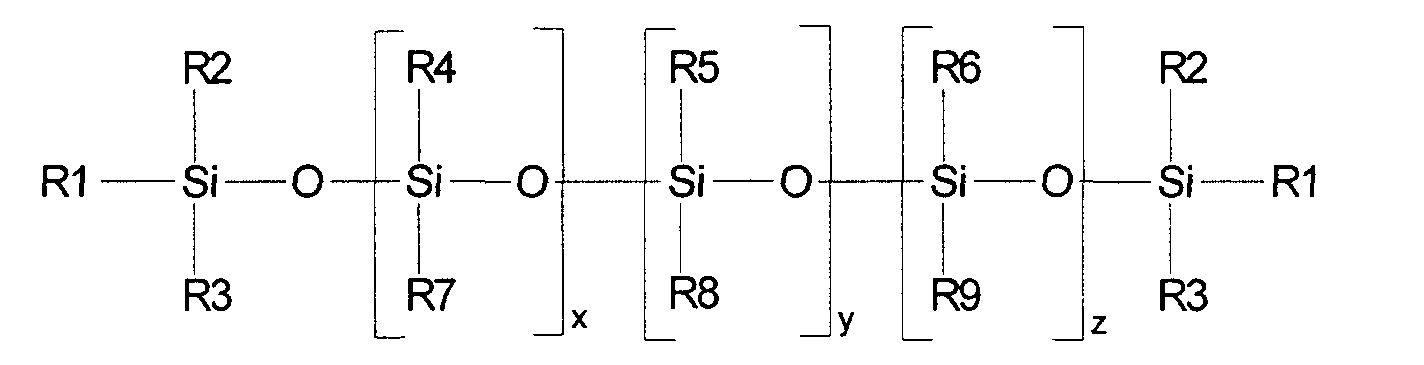
- Organosilicon compositions which can be prepared according to the method of this invention include compositions having the formula: in which all of the groups R1 to R9 are hydrogen or an alkyl group containing 1-40 carbon atoms, preferably methyl, with the first proviso that R5 or R8 is a higher carbon atom containing group, i.e., a C5 or more, preferably a C8 or more group such as -(CH 2 ) 7 CH 3 ,-(CH 2 ) 11 CH 3 , or -(CH 2 ) 15 CH 3 .
- the higher carbon atom containing group therefore, should contain 5-40, preferably 8-40 carbon atoms.
- the second proviso is that R6 or R9 is a group containing an oxyalkylene segment represented by -C a H 2a -O-(C 2 H 4 O) b -(C 3 H 6 O) c -Q.
- R1 to R9 can also constitute an aryl group such as phenyl and xenyl (i.e., biphenyl); an aralkyl group such as benzyl, phenylethyl (i.e., phenethyl), and 2-phenylpropyl; an alkaryl group such as tolyl and xylyl; an haloalkyl group such as chloromethyl, 2-bromoethyl, 3-chloropropyl and 3,3,3-trifluoropropyl; an haloaryl group such as bromophenyl and chlorophenyl; an unsaturated alkenyl group such as vinyl, allyl, and hexenyl; or a substituted alkyl group such as acryloxypropyl, cyanopropyl, glycidoxypropyl, methacryloxypropyl, methoxypropyl, (methylthio) propyl, and ureidopropyl
- Q is a terminating radical which can be an alkyl group of one to six carbon atoms, an aryl group such as phenyl, an aralkyl group such as benzyl, an alkaryl group such as tolyl, or a trialkylsilyl group such as the trimethylsilyl group -Si(CH 3 ) 3 .
- the value of a is 2-8, b is 4-60, and c is 0-60.
- the oxyalkylene segment preferably has 50-99.9 mole percent of oxyethylene units -(C 2 H 4 O) b , and 0.1-50 mole percent of oxypropylene units (C 3 H 6 O) c -.
- terminating radical Q is a methyl group; and a is three whereby the group -C a H 2a - is -(CH 2 ) 3 -.
- x can have a value of 1 to 1,000; y can have a value of 0 to 1,000; and z can have a value of 0 to 1,000.
- x, y, and z are each 1 to 1,000; and all of the groups R1 to R9 are methyl, except for the higher carbon atom containing group, i.e., R5 or R8, and the group containing the oxyalkylene segment, i.e., R6 or R9.
- organosilicon compositions which are higher polymers containing more than x, y, and z units, and containing the same types of functionality as defined for the x, y, and z units, can be prepared according to the method of the invention.
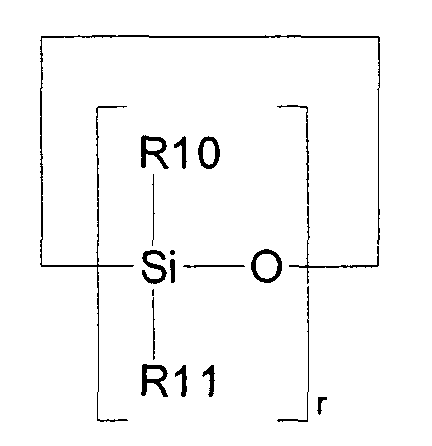
- Cyclosiloxanes used to prepare organosilicon compositions according to this invention include compositions having the formulae: in which r and s represent an integer having a value of 3-10.
- R10 and R11 can be any alkyl group containing 1-40 carbon atoms, preferably methyl, with the proviso that at least R10 or R11 is a higher carbon atom containing group, i.e., a C5 or more, preferably a C8 or more group such as -(CH 2 ) 7 CH 3 , -(CH 2 ) 11 CH 3 , or -(CH 2 ) 15 CH 3 .
- the higher carbon atom containing group R10 or R11 therefore, should contain 5-40, preferably 8-40 carbon atoms.
- Representative cyclosiloxane compositions are 1,3,5,7-tetramethyl-1,3,5,7-tetra(1-octyl)cyclotetrasiloxane and 1,3,5,7-tetra(1-hexadecyl)-1,3,5,7-tetramethylcyclotetrasiloxane.
- r has a value of four.
- R10 or R11 can also constitute an aryl group such as phenyl and xenyl (i.e., biphenyl); an aralkyl group such as benzyl, phenylethyl (i.e., phenethyl), and 2-phenylpropyl; an alkaryl group such as tolyl and xylyl; an haloalkyl group such as chloromethyl, 2-bromoethyl, 3-chloropropyl and 3,3,3-trifluoropropyl; an haloaryl group such as bromophenyl and chlorophenyl; an unsaturated alkenyl group such as vinyl, allyl, and hexenyl; or a substituted alkyl group such as acryloxypropyl, cyanopropyl, glycidoxypropyl, methacryloxypropyl, methoxypropyl, (methylthio)propyl, and ureidopropyl
- R12 can be any alkyl group containing 1-40 carbon atoms, preferably methyl, and R13 is a group containing an oxyalkylene segment represented by -C a H 2a -O-(C 2 H 4 O) b -(C 3 H 6 O) c -Q.
- R12 can also constitute an aryl group such as phenyl and xenyl (i.e., biphenyl); an aralkyl group such as benzyl, phenylethyl (i.e., phenethyl), and 2-phenylpropyl; an alkaryl group such as tolyl and xylyl; an haloalkyl group such as chloromethyl, 2-bromoethyl, 3-chloropropyl and 3,3,3-trifluoropropyl; an haloaryl group such as bromophenyl and chlorophenyl; an unsaturated alkenyl group such as vinyl, allyl, and hexenyl; or a substituted alkyl group such as acryloxypropyl, cyanopropyl, glycidoxypropyl, methacryloxypropyl, methoxypropyl, (methylthio)propyl, and ureidopropyl, for
- Q is a terminating radical which can be an alkyl group of one to six carbon atoms, an aryl group such as phenyl, an aralkyl group such as benzyl, an alkaryl group such as tolyl, or a trialkylsilyl group such as the trimethylsilyl group -Si(CH 3 ) 3 .
- the value of a is 2-8, b is 4-60, and c is 0-60.
- the oxyalkylene segment preferably has 50-99.9 mole percent of oxyethylene units -(C 2 H 4 O) b , and 0.1-50 mole percent of oxypropylene units -(C 3 H 6 O) c -.
- terminating radical Q is a methyl group; and a is three whereby the group -C a H 2a - is -(CH 2 ) 3 -.
- Representative cyclosiloxane compositions are 1,3,5,7-tetramethyl-1,3,5,7-tetra(1-propyl-3-oxy [polyethylene oxide (EO 7 ) methyl ether])cyclotetrasiloxane and 1,3,5,7-tetramethyl-1,3,5,7-tetra(1-propyl-3-oxy[polyethylene oxide(EO 12 ) methyl ether])cyclotetrasiloxane.
- the value of s is four.
- Q is methyl, a is 3, b is 7, and c is zero.
- Q is methyl, a is 3, b is 12, and c is zero.
- copolymeric cyclosiloxanes i.e., co-cyclic siloxanes
- Such copolymeric cyclosiloxane compositions are represented, for example, by the formulae:
- t, u, v, and w each represent an integer having a value of 1-10, wherein the sum of t and u, and the sum of v and w, is greater than two.
- R14 to R17 can be any alkyl group containing 1-40 carbon atoms, preferably methyl, with the proviso that at least one of the groups R14 to R17 is a higher carbon atom containing group, i.e., a C5 or more, preferably a C8 or more group, such as -(CH 2 ) 7 CH 3 , -(CH 2 ) 11 CH 3 , or -(CH 2 ) 15 CH 3 .
- the higher carbon atom containing group therefore, should contain 5-40, preferably 8-40 carbon atoms, while the remaining groups will generally all be methyl.
- R14 to R17 can also constitute an aryl group such as phenyl and xenyl (i.e., biphenyl); an aralkyl group such as benzyl, phenylethyl (i.e., phenethyl), and 2-phenylpropyl; an alkaryl group such as tolyl and xylyl; an haloalkyl group such as chloromethyl, 2-bromoethyl, 3-chloropropyl and 3,3,3-trifluoropropyl; an haloaryl group such as bromophenyl and chlorophenyl; an unsaturated alkenyl group such as vinyl, allyl, and hexenyl; or a substituted alkyl group such as acryloxypropyl, cyanopropyl, glycidoxypropyl, methacryloxypropyl, methoxypropyl, (methylthio)propyl, and ureidopropyl
- R18 to R21 can be any alkyl group containing 1-40 carbon atoms, preferably methyl, with the proviso that at least one of the groups R18 to R21 is a group containing an oxyalkylene segment represented by -C a H 2a -O-(C 2 H 4 O) b -(C 3 H 6 O) c -Q.
- R18 to R21 can also constitute an aryl group such as phenyl and xenyl (i.e., biphenyl); an aralkyl group such as benzyl, phenylethyl (i.e., phenethyl), and 2-phenylpropyl; an alkaryl group such as tolyl and xylyl; an haloalkyl group such as chloromethyl, 2-bromoethyl, 3-chloropropyl and 3,3,3-trifluoropropyl; an haloaryl group such as bromophenyl and chlorophenyl; an unsaturated alkenyl group such as vinyl, allyl, and hexenyl; or a substituted alkyl group such as acryloxypropyl, cyanopropyl, glycidoxypropyl, methacryloxypropyl, methoxypropyl, (methylthio)propyl, and ureidopropyl
- Q is a terminating radical which can be an alkyl group of one to six carbon atoms, an aryl group such as phenyl, an aralkyl group such as benzyl, an alkaryl group such as tolyl, or a trialkylsilyl group such as the trimethylsilyl group -Si(CH 3 ) 3 .
- the value of a is 2-8, b is 4-60, and c is 0-60.
- the oxyalkylene segment preferably has 50-99.9 mole percent of oxyethylene units -(C 2 H 4 O) b , and 0.1-50 mole percent of oxypropylene units (C 3 H 6 O) c -.
- terminating radical Q is a methyl group; and a is three whereby the group -C a H 2a - is -(CH 2 ) 3 -. Except for the group containing the oxyalkylene segment, the remaining groups will generally all be methyl groups.
- copolymeric cyclosiloxanes i.e., co-cyclic siloxanes
- co-cyclic siloxanes are generally know in the art, and are described in, for example, US Patent 3299112 (January 17, 1967) and US Patent 5160494 (November 3, 1992).
- An additional composition which can be included as a component in the ring opening polymerization reaction is a dimethylcyclosiloxane or a methylhydrogencyclosiloxane. Inclusion of this additional composition will reduce the amount of the other of the cyclosiloxanes compositions used in the reaction.
- This composition can be any one or a mixture of cyclic volatile methyl siloxanes such as hexamethylcyclotrisiloxane (D 3 ) a solid at room temperature with a boiling point of 134 °C and formula ⁇ (Me 2 )SiO ⁇ 3 ; octamethylcyclotetrasiloxane (D 4 ) with a boiling point of 176 °C, viscosity of 2.3 mm 2 /s, and formula ⁇ (Me 2 )SiO ⁇ 4 ; decamethylcyclopentasiloxane (D 5 ) with a boiling point of 210 °C, viscosity of 3.87 mm 2 /s, and formula ⁇ (Me 2 )SiO ⁇ 5 ; dodecamethylcyclohexasiloxane (D 6 ) with a boiling point of 245 °C, viscosity of 6.62 mm 2 /s, and formula ⁇ (Me 2 )S
- compositions which can be included as one of the components used in the ring opening polymerization reaction are a relatively short chain low molecular weight linear silicone endblocking composition.
- the inclusion of this composition in the reaction mixture enhances endblocking, i.e., trimethylsiloxy termination, for the organosilicon compositions prepared according to the method of the present invention.
- These relatively short chain low molecular weight linear silicone compositions generally have a structure corresponding to the formula MD e M wherein "e” can be from 0 to 8; "M” represents a monofunctional unit (CH 3 ) 3 SiO 1/2 ; and "D” represents a difunctional unit (CH 3 ) 2 SiO 2/2 .
- relatively short chain low molecular weight linear silicone compositions which can be used are one or mixtures of compositions such as hexamethyldisiloxane (MM) with a boiling point of 100 °C, viscosity of 0.65 mm 2 /s, and formula Me 3 SiOSiMe 3 ; octamethyltrisiloxane (MDM) with a boiling point of 152 °C, viscosity of 1.04 mm 2 /s, and formula Me 3 SiOMe 2 SiOSiMe 3 ; decamethyltetrasiloxane (MD 2 M) with a boiling point of 194 °C, viscosity of 1.53 mm 2 /s, and formula Me 3 SiO(Me 2 SiO) 2 SiMe 3 ; dodecamethylpentasiloxane (MD 3 M) with a boiling point of 229 °C, viscosity of 2.06 mm 2 /s, and formula Me 3 SiO (Me 2 SiO)
- linear methyl siloxanes can be used which have a viscosity of 100 centistoke or less, preferably 50 centistoke or less, and most preferably 5 centistoke or less; in which case the value of "e” would be considerably in excess of 8, i.e., up to 75.
- the catalyst used in the method according to this invention can be any one of a wide variety of catalysts known in the art which are useful in reactions for the ring opening polymerization of cyclosiloxanes.
- examples of some appropriate types of catalysts are alkali metal hydroxides, alkali metal alkoxides, alkali metal silanolates, sulfuric acid, hydrochloric acid, Lewis acids such as boron trifluoride and aluminum chloride, tetramethylammonium hydroxide, tetrabutylphosphonium silanolate, quaternary ammonium and phosphonium boron complexes, quaternary ammonium phosphates, quaternary ammonium borates, quaternary ammonium carbonates, quaternary ammonium silicates, trifluoromethane sulfonic acid (triflic acid), phosphonitrile halides (acidic phosphazenes), and phosphazene bases, which are described in
- alkali metal silanolates and alkali metal siloxanolates which can be used are sodium trimethylsilanolate (CH 3 ) 3 Si(ONa), sodium triphenylsilanolate (C 6 H 5 ) 3 Si(ONa), disodium diphenylsilanolate (C 6 H 5 ) 2 Si(ONa) 2 , disodium dimethylsilanolate (CH 3 ) 2 Si(ONa) 2 , disodium methylaminopropylsilanolate (CH 3 ) [H 2 NCH 2 CH 2 CH 2 ] Si (ONa) 2 , their potassium equivalents, dipotassium dimethylsilanolate KO[(CH 3 ) 2 SiO]K, dipotassium dimethylsiloxanolate KO[(CH 3 ) 2 SiO] n K where n is 4-8, dipotassium phenylmethylsilanolate KO[(C 6 H 5 ) 3 Si(ONa),
- Polymerization of the cyclosiloxane compositions can be carried out at a temperature ranging from 30 to 250 °C for a time ranging from 5 minutes to three days. Generally, polymerization can be accelerated by increasing the reaction temperature.
- the amount of the catalyst can be from one alkali/acidic ion per 100 silicon atoms to one alkali/acidic ion per 200,000 silicon atoms. While polymerization can be achieved by using more or less than these amounts of an alkali/acid catalyst, this is not practical, as in the former case excessive amounts of acid/base would be required for neutralization of the catalyst at the end of the reaction, while in the latter case the use of only trace amounts of catalyst could hinder its effectiveness in the initial reaction.
- the reaction can be conducted in the presence of solvents such as acetonitrile, dimethylformamide, decahydronaphthalene, toluene, p-chloro-toluene, o-dichloro-benzene, tetrahydrofuran, xylene, dimethyl sulfoxide, or dibutyl ether, if desired.
- solvents such as acetonitrile, dimethylformamide, decahydronaphthalene, toluene, p-chloro-toluene, o-dichloro-benzene, tetrahydrofuran, xylene, dimethyl sulfoxide, or dibutyl ether, if desired.
- any of the essential and optional components used in carrying out the polymerization reaction can be combined in stoichiometric quantities, or slight excess, necessary to achieve the desired distribution of repeating units in the polymer chain of the organosilicon composition.
- equivalent amounts of reactants should be employed in the process, although it may be necessary to use an excess of one or more of the reactants.
- the maximum amount is determined, for example, by economical considerations, as there is no benefit in employing an excess of a reactant that is not consumed. The minimum amount will depend on the type and purity of the reactants.
- a 100 ml round bottom flask was equipped with a magnetic stir bar, a thermometer, and a reflux condenser, and was charged with 2.1 g (0.6 mmoles) of 50 centistoke polydimethylsiloxane fluid, 31.9 g (107.5 mmoles) of octamethylcyclotetrasiloxane, and 11.0 g of 1,3,5,7-tetramethyl-1,3,5,7-tetra(1-octyl)cyclotetra-siloxane (16.0 mmoles). To this homogeneous mixture was added 0.045 g (0.1 weight percent) of trifluoromethanesulfonic acid (0.3 mmoles).
- the temperature was raised to and maintained at 75 °C ⁇ 5 ° for 4 hours.
- 3.0 g of sodium bicarbonate was added, and the mixture was allowed to cool to room temperature.
- the mixture was filtered to provide 41.4 g of clear viscous oil.
- This oil was characterized by 29 Si and 13 C NMR spectroscopy and GPC.
- the product mixture was found to contain 93 % of a linear siloxane having a degree of polymerization (DP) of 700, i.e., the sum of x + y where z was zero. It contained 12.1 mole percent of pendant octyl groups.
- DP degree of polymerization
- a 250 ml flask was equipped with a mechanical stirrer, thermometer, and a reflux condenser. To the flask was added 59.9 g (86.9 mmoles) of 1,3,5,7-tetramethyl-1,3,5,7-tetra(1-octyl)cyclotetrasiloxane, 33.1 g (112 mmoles) of octamethylcyclotetrasiloxane and 7.21 g (8.70 mmoles) of 5 centistoke polydimethylsiloxane fluid. To this homogeneous mixture was added 0.10 g (0.1 weight percent) of trifluoromethanesulfonic acid) (0.67 mmoles).
- the temperature was raised to and maintained at 75 °C ⁇ 5° for 4 hours.
- 5.0 g of sodium bicarbonate was added, and the mixture was allowed to cool to room temperature.
- the mixture was filtered to provide 93.2 g of a clear viscous oil.
- the oil was characterized by 29 Si and 13 C NMR spectroscopy and GPC.
- the product mixture was found to contain 86 % of a linear siloxane with a DP of 76, i.e., the sum of x + y where z was zero. It contained 38.1 mole percent of pendant octyl groups.
- a 50 ml round bottom flask was equipped with a magnetic stir bar, a thermometer, a reflux condenser, and a gas inlet and outlet.
- the flask was charged with 0.8 g (0.93 mmoles) of 5 centistoke polydimethylsiloxane fluid, 15.0 g (50.6 mmoles) of octamethylcyclotetrasiloxane, and 15.0 g of 1,3,5,7-tetramethyl-1,3,5,7-tetra(1-octyl)cyclotetrasiloxane (21.8 mmoles).
- the mixture was heated to and maintained at 100 °C ⁇ 5° for 1 hour, at which time the temperature was raised to 120 °C ⁇ 5°.
- a 250 ml flask was equipped with a mechanical stirrer, thermometer, and a reflux condenser. To the flask was added 57.1 g (50.1 mmoles) of 1,3,5,7-tetra(1-hexadecyl)-1,3,5,7-tetramethylcyclotetrasiloxane, 49.9 g (168 mmoles) of octamethylcyclotetrasiloxane, 2.46 g (10.2 mmoles) of 1,3,5,7-tetramethylcyclotetrasiloxane, and 7.76 g (9.36 mmoles) of 5 centistoke polydimethylsiloxane fluid.
- a 25 ml round bottom flask was equipped with a magnetic stir bar, a thermometer, a reflux condenser, and a gas inlet and outlet.
- the flask was charged with 0.76 g (0.92 mmoles) of 5 centistoke polydimethylsiloxane fluid, 10.6 g (35.7 mmoles) of octamethylcyclotetrasiloxane, and 5.00 g of 1,3,5,7-tetramethyl-1,3,5,7-tetra(1-propyl-3-oxy [polyethylene oxide (EO 7 ) methyl ether])cyclotetrasiloxane (2.84 mmoles).
- the mixture was heated to and maintained at 100 °C ⁇ 5 ° for 1 hour, at which time the temperature was raised to 120 °C ⁇ 5 °.
- To the heterogeneous reaction mixture was added 0.016 g (0.12 mmoles, 0.1 weight percent) of potassium trimethylsilanolate. The temperature was maintained for 3 hours. Next, the temperature was lowered to 60 °C ⁇ 5 °, and approximately 0.024 g of (CH 3 ) 3 SiCl, i.e., trimethylchlorosilane, (0.22 mmoles) was added in order to neutralize the silanolate catalyst.
- a 50 ml round bottom flask was equipped with a magnetic stir bar, a thermometer, a reflux condenser, and a gas inlet and outlet.
- the flask was charged with 6.02 g (7.26 mmoles) of 5 centistoke polydimethylsiloxane fluid, and 21.3 g of 1,3,5,7-tetramethyl-1,3,5,7-tetra(1-propyl-3-oxy[polyethylene oxide (EO 12 ) methyl ether])cyclotetrasiloxane (10.7 mmoles).
- the mixture was heated to and maintained at 100 °C ⁇ 5 ° for 1 hour, at which time the temperature was raised to 120 °C ⁇ 5 °.
- a 50 ml round bottom flask was equipped with a magnetic stir bar, a thermometer, a reflux condenser, a gas inlet and outlet.
- the flask was charged with 1.01 g (1.22 mmoles) of a 5 centistoke polydimethylsiloxane fluid, 3.03 g (1.72 mmoles) of 1,3,5,7-tetramethyl-1,3,5,7-tetra(1-propyl-3-oxy[polyethylene oxide (EO 7 ) methyl ether])cyclotetrasiloxane, 16.0 g (14.1 mmoles) of 1,3,5,7-tetra(1-hexadecyl)-1,3,5,7-tetramethylcyclotetrasiloxane,and 6.49 g (21.9 mmoles) of octamethylcyclotetrasiloxane.
- the mixture was heated to and maintained at 100 °C ⁇ 5 ° for 1 hour, at which time the temperature was raised to 120 °C ⁇ 5 °.
- To the heterogeneous reaction mixture was added 0.027 g (0.1 weight percent) of tetrabutylphosphonium silanolate. The temperature was maintained for 4 hours with stirring. Next, the temperature was raised to 170 °C ⁇ 5 ° and held for 2 hours, and then the mixture was allowed to cool. After stirring for 2 hours at room temperature, the mixture was filtered to provide 23.6 g of a clear viscous oil.
- the oil was characterized by 29 Si and 13 C NMR spectroscopy and GPC.
- the product mixture was found to contain 79 % of a linear siloxane with a DP of 80, i.e., the sum of x + y + z and none of x, y, or z was zero. It contained 27.2 mole percent of pendant hexadecyl and 3.7 mole percent of pendant polyether groups.
- organosilicon compositions described herein are useful in applications requiring any benefit attributed to organosilicon materials, these organosilicon compositions are primarily intended for use in personal care. Thus, they can be used alone or combined with cosmetic ingredients to form a number of over-the-counter (OTC) personal care products.
- OTC over-the-counter
- they are useful as carriers or emulsifiers in antiperspirants and deodorants. They are lubricious and can improve the properties of skin creams, skin care lotions, moisturizers, facial treatments such as acne or wrinkle removers, personal and facial cleansers, bath oils, perfumes, colognes, sachets, sunscreens, pre-shave and after-shave lotions, liquid soaps, shaving soaps, and shaving lathers. They can be used in hair shampoos, hair conditioners, hair sprays, mousses, permanents, depilatories, and cuticle coats, to enhance gloss, as emulsifiers, and/or to provide conditioning benefits.
- cosmetics In cosmetics, they can be effective emulsifiers, or function as leveling and spreading agents for pigments in make-ups, color cosmetics, foundations, blushes, lipsticks, lip balms, eyeliners, mascaras, oil removers, color cosmetic removers, and powders.
- emulsifiers or function as leveling and spreading agents for pigments in make-ups, color cosmetics, foundations, blushes, lipsticks, lip balms, eyeliners, mascaras, oil removers, color cosmetic removers, and powders.
- they When incorporated into sticks, gels, lotions, aerosols, and roll-ons, they can impart a dry and silky-smooth feel.
- organosilicon compositions are also capable of functioning as carriers or emulsifiers for pharmaceuticals, biocides, herbicides, pesticides, and other biologically active substances; and they have utility as additives for cellulose or synthetic nonwoven carrier substrates used in wet-like cleansing wipes such as wet-wipes, tissues, and towels, marketed generally for personal hygiene and household cleaning tasks.
- organosilicon compositions are linear in structure, which is defined according to this invention as being a structure containing monofunctional "M” units (CH 3 ) 3 SiO 1/2 and difunctional "D” units (CH 3 ) 2 SiO 2/2 .
- the organosilicon compositions are not believed to contain any significant portion of trifunctional "T” units CH 3 SiO 3/2 or tetrafunctional "Q" units SiO 4/2 .
Landscapes
- Health & Medical Sciences (AREA)
- Life Sciences & Earth Sciences (AREA)
- Chemical & Material Sciences (AREA)
- Veterinary Medicine (AREA)
- General Health & Medical Sciences (AREA)
- Public Health (AREA)
- Animal Behavior & Ethology (AREA)
- Chemical Kinetics & Catalysis (AREA)
- Medicinal Chemistry (AREA)
- Polymers & Plastics (AREA)
- Organic Chemistry (AREA)
- Birds (AREA)
- Epidemiology (AREA)
- Dermatology (AREA)
- Silicon Polymers (AREA)
Abstract
Description
- This invention is directed to methods of preparing organosilicon compositions by reacting one or more cyclosiloxanes bearing different substituent groups.
- While Fish in Makromol. Chem., Macromol. Symp. 32, 241-253, (1990) in an article entitled "Anionic Ring Opening Polymerization of Cyclotetrasiloxanes with Large Substituents"suggests preparing organosilicon compositions by reacting octamethylcyclotetrasiloxane with either (i) a cyclosiloxane containing a higher carbon atom containing group, or (ii) a cyclosiloxane containing an oxyalkylene segment, Fish does not suggest preparing organosilicon compositions by reacting octamethylcyclotetrasiloxane with (i) a cyclosiloxane containing a higher carbon atom containing group and (ii) a cyclosiloxane containing an oxyalkylene segment.
- Nor does Fish suggest preparing organosilicon compositions by reacting methylhydrogencyclosiloxanes with (i) cyclosiloxanes containing a higher carbon atom containing group and (ii) cyclosiloxanes containing an oxyalkylene segment.
- Fish also does not suggest preparing organosilicon compositions by reacting octamethylcyclotetrasiloxane with (i) a copolymeric cyclosiloxane containing a higher carbon atom containing group, (ii) a copolymeric cyclosiloxane containing an oxyalkylene segment, or (iii) a copolymeric cyclosiloxane containing a higher carbon atom containing group, and a copolymeric cyclosiloxane containing an oxyalkylene segment.
- This invention relates to a method of preparing certain organosilicon compositions by heating various mixtures of (i) dimethylcyclosiloxanes or methylhydrogencyclosiloxanes, (ii) homopolymeric and copolymeric cyclosiloxanes containing a C5 or more, preferably a C8 or more, carbon atom containing group, and (iii) homopolymeric and copolymeric cyclosiloxanes containing an oxyalkylene segment, in the presence of a catalyst, at a temperature and for a time sufficient to cause polymerization of cyclosiloxanes (i) to (iii) to the desired organosilicon composition.
- Organosilicon compositions containing dimethylsiloxane units, methyl oxyalkylene siloxane units, and methyl higher alkyl siloxane units, are known in the art, as evidenced by US Patent 3427271 (February 11, 1969). However, the method for preparing such compositions requires a platinum catalyst. In contrast, the method according to the present invention does not require the use of platinum, and hence it offers an advantage and benefit in opening an avenue to organosilicon compositions that contain significantly reduced levels of residual platinum or to platinum-free organosilicon compositions, for use in consumer markets in which platinum has been determined to be an undesirable constituent, i.e., in personal care applications relating to hair, skin, and underarm.
- Organosilicon compositions which can be prepared according to the method of this invention include compositions having the formula:in which all of the groups R1 to R9 are hydrogen or an alkyl group containing 1-40 carbon atoms, preferably methyl, with the first proviso that R5 or R8 is a higher carbon atom containing group, i.e., a C5 or more, preferably a C8 or more group such as -(CH2)7CH3,-(CH2)11CH3, or -(CH2)15CH3. The higher carbon atom containing group, therefore, should contain 5-40, preferably 8-40 carbon atoms. The second proviso is that R6 or R9 is a group containing an oxyalkylene segment represented by -CaH2a-O-(C2H4O)b-(C3H6O)c-Q.
- If desired, R1 to R9 can also constitute an aryl group such as phenyl and xenyl (i.e., biphenyl); an aralkyl group such as benzyl, phenylethyl (i.e., phenethyl), and 2-phenylpropyl; an alkaryl group such as tolyl and xylyl; an haloalkyl group such as chloromethyl, 2-bromoethyl, 3-chloropropyl and 3,3,3-trifluoropropyl; an haloaryl group such as bromophenyl and chlorophenyl; an unsaturated alkenyl group such as vinyl, allyl, and hexenyl; or a substituted alkyl group such as acryloxypropyl, cyanopropyl, glycidoxypropyl, methacryloxypropyl, methoxypropyl, (methylthio) propyl, and ureidopropyl, for example; subject to the same provisos however, as noted above.
- Q is a terminating radical which can be an alkyl group of one to six carbon atoms, an aryl group such as phenyl, an aralkyl group such as benzyl, an alkaryl group such as tolyl, or a trialkylsilyl group such as the trimethylsilyl group -Si(CH3)3. The value of a is 2-8, b is 4-60, and c is 0-60. The oxyalkylene segment preferably has 50-99.9 mole percent of oxyethylene units -(C2H4O)b, and 0.1-50 mole percent of oxypropylene units (C3H6O)c-. Preferably, terminating radical Q is a methyl group; and a is three whereby the group -CaH2a- is -(CH2)3-.
- In the formula, x can have a value of 1 to 1,000; y can have a value of 0 to 1,000; and z can have a value of 0 to 1,000. Preferably, x, y, and z, are each 1 to 1,000; and all of the groups R1 to R9 are methyl, except for the higher carbon atom containing group, i.e., R5 or R8, and the group containing the oxyalkylene segment, i.e., R6 or R9.
- If desired, organosilicon compositions which are higher polymers containing more than x, y, and z units, and containing the same types of functionality as defined for the x, y, and z units, can be prepared according to the method of the invention.
- Cyclosiloxanes used to prepare organosilicon compositions according to this invention include compositions having the formulae:in which r and s represent an integer having a value of 3-10.

- In the first cyclosiloxane composition of the formula:R10 and R11 can be any alkyl group containing 1-40 carbon atoms, preferably methyl, with the proviso that at least R10 or R11 is a higher carbon atom containing group, i.e., a C5 or more, preferably a C8 or more group such as -(CH2)7CH3, -(CH2)11CH3, or -(CH2)15CH3. The higher carbon atom containing group R10 or R11, therefore, should contain 5-40, preferably 8-40 carbon atoms. Representative cyclosiloxane compositions are 1,3,5,7-tetramethyl-1,3,5,7-tetra(1-octyl)cyclotetrasiloxane and 1,3,5,7-tetra(1-hexadecyl)-1,3,5,7-tetramethylcyclotetrasiloxane. In these compositions, r has a value of four.
- If desired, R10 or R11 can also constitute an aryl group such as phenyl and xenyl (i.e., biphenyl); an aralkyl group such as benzyl, phenylethyl (i.e., phenethyl), and 2-phenylpropyl; an alkaryl group such as tolyl and xylyl; an haloalkyl group such as chloromethyl, 2-bromoethyl, 3-chloropropyl and 3,3,3-trifluoropropyl; an haloaryl group such as bromophenyl and chlorophenyl; an unsaturated alkenyl group such as vinyl, allyl, and hexenyl; or a substituted alkyl group such as acryloxypropyl, cyanopropyl, glycidoxypropyl, methacryloxypropyl, methoxypropyl, (methylthio)propyl, and ureidopropyl, for example; subject to the same proviso however, as noted above.
- In the second cyclosiloxane composition of the formula:R12 can be any alkyl group containing 1-40 carbon atoms, preferably methyl, and R13 is a group containing an oxyalkylene segment represented by -CaH2a-O-(C2H4O)b-(C3H6O)c-Q.

- If desired, R12 can also constitute an aryl group such as phenyl and xenyl (i.e., biphenyl); an aralkyl group such as benzyl, phenylethyl (i.e., phenethyl), and 2-phenylpropyl; an alkaryl group such as tolyl and xylyl; an haloalkyl group such as chloromethyl, 2-bromoethyl, 3-chloropropyl and 3,3,3-trifluoropropyl; an haloaryl group such as bromophenyl and chlorophenyl; an unsaturated alkenyl group such as vinyl, allyl, and hexenyl; or a substituted alkyl group such as acryloxypropyl, cyanopropyl, glycidoxypropyl, methacryloxypropyl, methoxypropyl, (methylthio)propyl, and ureidopropyl, for example.
- Q is a terminating radical which can be an alkyl group of one to six carbon atoms, an aryl group such as phenyl, an aralkyl group such as benzyl, an alkaryl group such as tolyl, or a trialkylsilyl group such as the trimethylsilyl group -Si(CH3)3. The value of a is 2-8, b is 4-60, and c is 0-60. The oxyalkylene segment preferably has 50-99.9 mole percent of oxyethylene units -(C2H4O)b, and 0.1-50 mole percent of oxypropylene units -(C3H6O)c-. Preferably, terminating radical Q is a methyl group; and a is three whereby the group -CaH2a- is -(CH2)3-.
- Representative cyclosiloxane compositions are 1,3,5,7-tetramethyl-1,3,5,7-tetra(1-propyl-3-oxy [polyethylene oxide (EO7) methyl ether])cyclotetrasiloxane and 1,3,5,7-tetramethyl-1,3,5,7-tetra(1-propyl-3-oxy[polyethylene oxide(EO12) methyl ether])cyclotetrasiloxane. In these compositions, the value of s is four. In the first composition, Q is methyl, a is 3, b is 7, and c is zero. In the second composition, Q is methyl, a is 3, b is 12, and c is zero.
- It should be understood that while homopolymeric cyclosiloxanes such as shown above are preferred, copolymeric cyclosiloxanes, i.e., co-cyclic siloxanes, can also be used. Such copolymeric cyclosiloxane compositions are represented, for example, by the formulae:

- In these formulae, t, u, v, and w, each represent an integer having a value of 1-10, wherein the sum of t and u, and the sum of v and w, is greater than two.
- In the first copolymeric cyclosiloxane composition of the formula:R14 to R17 can be any alkyl group containing 1-40 carbon atoms, preferably methyl, with the proviso that at least one of the groups R14 to R17 is a higher carbon atom containing group,

i.e., a C5 or more, preferably a C8 or more group, such as
-(CH2)7CH3, -(CH2)11CH3, or -(CH2)15CH3. The higher carbon atom containing group, therefore, should contain 5-40, preferably 8-40 carbon atoms, while the remaining groups will generally all be methyl. - If desired, R14 to R17 can also constitute an aryl group such as phenyl and xenyl (i.e., biphenyl); an aralkyl group such as benzyl, phenylethyl (i.e., phenethyl), and 2-phenylpropyl; an alkaryl group such as tolyl and xylyl; an haloalkyl group such as chloromethyl, 2-bromoethyl, 3-chloropropyl and 3,3,3-trifluoropropyl; an haloaryl group such as bromophenyl and chlorophenyl; an unsaturated alkenyl group such as vinyl, allyl, and hexenyl; or a substituted alkyl group such as acryloxypropyl, cyanopropyl, glycidoxypropyl, methacryloxypropyl, methoxypropyl, (methylthio)propyl, and ureidopropyl, for example; subject to the same proviso however, as noted above.
- In the second copolymeric cyclosiloxane composition of the formula:R18 to R21 can be any alkyl group containing 1-40 carbon atoms, preferably methyl, with the proviso that at least one of the groups R18 to R21 is a group containing an oxyalkylene segment represented by -CaH2a-O-(C2H4O)b-(C3H6O)c-Q.

- If desired, R18 to R21 can also constitute an aryl group such as phenyl and xenyl (i.e., biphenyl); an aralkyl group such as benzyl, phenylethyl (i.e., phenethyl), and 2-phenylpropyl; an alkaryl group such as tolyl and xylyl; an haloalkyl group such as chloromethyl, 2-bromoethyl, 3-chloropropyl and 3,3,3-trifluoropropyl; an haloaryl group such as bromophenyl and chlorophenyl; an unsaturated alkenyl group such as vinyl, allyl, and hexenyl; or a substituted alkyl group such as acryloxypropyl, cyanopropyl, glycidoxypropyl, methacryloxypropyl, methoxypropyl, (methylthio)propyl, and ureidopropyl, for example; subject to the same proviso however, as noted above.
- Q is a terminating radical which can be an alkyl group of one to six carbon atoms, an aryl group such as phenyl, an aralkyl group such as benzyl, an alkaryl group such as tolyl, or a trialkylsilyl group such as the trimethylsilyl group -Si(CH3)3. The value of a is 2-8, b is 4-60, and c is 0-60. The oxyalkylene segment preferably has 50-99.9 mole percent of oxyethylene units -(C2H4O)b, and 0.1-50 mole percent of oxypropylene units (C3H6O)c-. Preferably, terminating radical Q is a methyl group; and a is three whereby the group -CaH2a- is -(CH2)3-. Except for the group containing the oxyalkylene segment, the remaining groups will generally all be methyl groups.
- Such copolymeric cyclosiloxanes, i.e., co-cyclic siloxanes, are generally know in the art, and are described in, for example, US Patent 3299112 (January 17, 1967) and US Patent 5160494 (November 3, 1992).
- An additional composition which can be included as a component in the ring opening polymerization reaction is a dimethylcyclosiloxane or a methylhydrogencyclosiloxane. Inclusion of this additional composition will reduce the amount of the other of the cyclosiloxanes compositions used in the reaction. This composition can be any one or a mixture of cyclic volatile methyl siloxanes such as hexamethylcyclotrisiloxane (D3) a solid at room temperature with a boiling point of 134 °C and formula {(Me2)SiO}3; octamethylcyclotetrasiloxane (D4) with a boiling point of 176 °C, viscosity of 2.3 mm2/s, and formula {(Me2)SiO}4; decamethylcyclopentasiloxane (D5) with a boiling point of 210 °C, viscosity of 3.87 mm2/s, and formula {(Me2)SiO}5; dodecamethylcyclohexasiloxane (D6) with a boiling point of 245 °C, viscosity of 6.62 mm2/s, and formula {(Me2)SiO}6; and the methylhydrogencyclosiloxane 1,3,5,7-tetramethylcyclotetrasiloxane of the formula {(MeH)SiO}4.
- Another composition which can be included as one of the components used in the ring opening polymerization reaction is a relatively short chain low molecular weight linear silicone endblocking composition. As it name implies, the inclusion of this composition in the reaction mixture enhances endblocking, i.e., trimethylsiloxy termination, for the organosilicon compositions prepared according to the method of the present invention. These relatively short chain low molecular weight linear silicone compositions generally have a structure corresponding to the formula MDeM wherein "e" can be from 0 to 8; "M" represents a monofunctional unit (CH3)3SiO1/2; and "D" represents a difunctional unit (CH3)2SiO2/2. Some examples of relatively short chain low molecular weight linear silicone compositions which can be used are one or mixtures of compositions such as hexamethyldisiloxane (MM) with a boiling point of 100 °C, viscosity of 0.65 mm2/s, and formula Me3SiOSiMe3; octamethyltrisiloxane (MDM) with a boiling point of 152 °C, viscosity of 1.04 mm2/s, and formula Me3SiOMe2SiOSiMe3; decamethyltetrasiloxane (MD2M) with a boiling point of 194 °C, viscosity of 1.53 mm2/s, and formula Me3SiO(Me2SiO)2SiMe3; dodecamethylpentasiloxane (MD3M) with a boiling point of 229 °C, viscosity of 2.06 mm2/s, and formula Me3SiO (Me2SiO)3SiMe3; tetradecamethylhexasiloxane (MD4M) with a boiling point of 245 °C, viscosity of 2.63 mm2/s, and formula Me3SiO(Me2SiO)4SiMe3; and hexadecamethylheptasiloxane (MD5M) with a boiling point of 270 °C, viscosity of 3.24 mm2/s, and formula Me3SiO(Me2SiO)5SiMe3. If desired, other linear methyl siloxanes can be used which have a viscosity of 100 centistoke or less, preferably 50 centistoke or less, and most preferably 5 centistoke or less; in which case the value of "e" would be considerably in excess of 8, i.e., up to 75.
- The catalyst used in the method according to this invention can be any one of a wide variety of catalysts known in the art which are useful in reactions for the ring opening polymerization of cyclosiloxanes. Examples of some appropriate types of catalysts are alkali metal hydroxides, alkali metal alkoxides, alkali metal silanolates, sulfuric acid, hydrochloric acid, Lewis acids such as boron trifluoride and aluminum chloride, tetramethylammonium hydroxide, tetrabutylphosphonium silanolate, quaternary ammonium and phosphonium boron complexes, quaternary ammonium phosphates, quaternary ammonium borates, quaternary ammonium carbonates, quaternary ammonium silicates, trifluoromethane sulfonic acid (triflic acid), phosphonitrile halides (acidic phosphazenes), and phosphazene bases, which are described in US Patent 5344906 (September 6, 1994); US Patent 5670596 (September 23, 1997); US Patent 5830969 (November 3, 1998); and US Patent 5883215 (March 16, 1999).
- As a particular example, some suitable alkali metal silanolates and alkali metal siloxanolates which can be used are sodium trimethylsilanolate (CH3)3Si(ONa), sodium triphenylsilanolate (C6H5)3Si(ONa), disodium diphenylsilanolate (C6H5)2Si(ONa)2, disodium dimethylsilanolate (CH3)2Si(ONa)2, disodium methylaminopropylsilanolate (CH3) [H2NCH2CH2CH2] Si (ONa)2, their potassium equivalents, dipotassium dimethylsilanolate KO[(CH3)2SiO]K, dipotassium dimethylsiloxanolate KO[(CH3)2SiO]nK where n is 4-8, dipotassium phenylmethylsilanolate KO[(C6H5)(CH3)SiO]K, and dipotassium phenylmethylsiloxanolate KO[(C6H5) (CH3)SiO]nK where n is 4-8.
- Polymerization of the cyclosiloxane compositions can be carried out at a temperature ranging from 30 to 250 °C for a time ranging from 5 minutes to three days. Generally, polymerization can be accelerated by increasing the reaction temperature.
- The amount of the catalyst can be from one alkali/acidic ion per 100 silicon atoms to one alkali/acidic ion per 200,000 silicon atoms. While polymerization can be achieved by using more or less than these amounts of an alkali/acid catalyst, this is not practical, as in the former case excessive amounts of acid/base would be required for neutralization of the catalyst at the end of the reaction, while in the latter case the use of only trace amounts of catalyst could hinder its effectiveness in the initial reaction.
- While it is preferred to carry out the reaction in the absence of a solvent, the reaction can be conducted in the presence of solvents such as acetonitrile, dimethylformamide, decahydronaphthalene, toluene, p-chloro-toluene, o-dichloro-benzene, tetrahydrofuran, xylene, dimethyl sulfoxide, or dibutyl ether, if desired.
- Any of the essential and optional components used in carrying out the polymerization reaction can be combined in stoichiometric quantities, or slight excess, necessary to achieve the desired distribution of repeating units in the polymer chain of the organosilicon composition. Thus, equivalent amounts of reactants should be employed in the process, although it may be necessary to use an excess of one or more of the reactants. The maximum amount is determined, for example, by economical considerations, as there is no benefit in employing an excess of a reactant that is not consumed. The minimum amount will depend on the type and purity of the reactants.
- A 100 ml round bottom flask was equipped with a magnetic stir bar, a thermometer, and a reflux condenser, and was charged with 2.1 g (0.6 mmoles) of 50 centistoke polydimethylsiloxane fluid, 31.9 g (107.5 mmoles) of octamethylcyclotetrasiloxane, and 11.0 g of 1,3,5,7-tetramethyl-1,3,5,7-tetra(1-octyl)cyclotetra-siloxane (16.0 mmoles). To this homogeneous mixture was added 0.045 g (0.1 weight percent) of trifluoromethanesulfonic acid (0.3 mmoles). The temperature was raised to and maintained at 75 °C ± 5 ° for 4 hours. Next, 3.0 g of sodium bicarbonate was added, and the mixture was allowed to cool to room temperature. After stirring for 2 hours at room temperature, the mixture was filtered to provide 41.4 g of clear viscous oil. This oil was characterized by 29Si and 13C NMR spectroscopy and GPC. The product mixture was found to contain 93 % of a linear siloxane having a degree of polymerization (DP) of 700, i.e., the sum of x + y where z was zero. It contained 12.1 mole percent of pendant octyl groups.
- A 250 ml flask was equipped with a mechanical stirrer, thermometer, and a reflux condenser. To the flask was added 59.9 g (86.9 mmoles) of 1,3,5,7-tetramethyl-1,3,5,7-tetra(1-octyl)cyclotetrasiloxane, 33.1 g (112 mmoles) of octamethylcyclotetrasiloxane and 7.21 g (8.70 mmoles) of 5 centistoke polydimethylsiloxane fluid. To this homogeneous mixture was added 0.10 g (0.1 weight percent) of trifluoromethanesulfonic acid) (0.67 mmoles). The temperature was raised to and maintained at 75 °C ± 5° for 4 hours. Next, 5.0 g of sodium bicarbonate was added, and the mixture was allowed to cool to room temperature. After stirring for 2 hours at room temperature, the mixture was filtered to provide 93.2 g of a clear viscous oil. The oil was characterized by 29Si and 13C NMR spectroscopy and GPC. The product mixture was found to contain 86 % of a linear siloxane with a DP of 76, i.e., the sum of x + y where z was zero. It contained 38.1 mole percent of pendant octyl groups.
- A 50 ml round bottom flask was equipped with a magnetic stir bar, a thermometer, a reflux condenser, and a gas inlet and outlet. The flask was charged with 0.8 g (0.93 mmoles) of 5 centistoke polydimethylsiloxane fluid, 15.0 g (50.6 mmoles) of octamethylcyclotetrasiloxane, and 15.0 g of 1,3,5,7-tetramethyl-1,3,5,7-tetra(1-octyl)cyclotetrasiloxane (21.8 mmoles). The mixture was heated to and maintained at 100 °C ± 5° for 1 hour, at which time the temperature was raised to 120 °C ± 5°. To the homogeneous reaction mixture was added 0.031 g (0.1 weight percent) of tetrabutylphosphonium silanolate. The temperature was maintained for 3 hours. Next, the temperature was raised to 170 °C ±5 ° and held for 2 hours, and then the mixture was allowed to cool. After stirring for 2 hours at room temperature, the mixture was filtered to provide 28.3 g of clear viscous oil. The oil was characterized by 29Si and 13C NMR spectroscopy and GPC. The product mixture was found to contain 88 % of a linear siloxane having a DP of 180, i.e., the sum of x + y where z was zero. It contained 25.3 mole percent of pendant octyl groups.
- A 250 ml flask was equipped with a mechanical stirrer, thermometer, and a reflux condenser. To the flask was added 57.1 g (50.1 mmoles) of 1,3,5,7-tetra(1-hexadecyl)-1,3,5,7-tetramethylcyclotetrasiloxane, 49.9 g (168 mmoles) of octamethylcyclotetrasiloxane, 2.46 g (10.2 mmoles) of 1,3,5,7-tetramethylcyclotetrasiloxane, and 7.76 g (9.36 mmoles) of 5 centistoke polydimethylsiloxane fluid. To this homogeneous mixture was added 0.117 g (0.1 weight percent) of trifluoromethanesulfonic acid) (0.78 mmoles). The temperature was raised to and maintained at 75 °C ± 5° for 4 hours. Next, 5.0 g of sodium bicarbonate was added, and the mixture was allowed to cool to room temperature. After stirring for 2 hours at room temperature, the mixture was filtered to provide 106 g of a clear viscous oil. The oil was characterized by 29Si and 13C NMR spectroscopy and GPC. The product mixture was found to contain 78 % of a linear siloxane having a DP of 75, i.e., the sum of x + y where z was zero. It contained 14.9 mole percent of pendant hexadecyl groups and 3.9 mole percent of methyl hydrogen groups.
- A 25 ml round bottom flask was equipped with a magnetic stir bar, a thermometer, a reflux condenser, and a gas inlet and outlet. The flask was charged with 0.76 g (0.92 mmoles) of 5 centistoke polydimethylsiloxane fluid, 10.6 g (35.7 mmoles) of octamethylcyclotetrasiloxane, and 5.00 g of 1,3,5,7-tetramethyl-1,3,5,7-tetra(1-propyl-3-oxy [polyethylene oxide (EO7) methyl
ether])cyclotetrasiloxane (2.84 mmoles). The mixture was heated to and maintained at 100 °C ± 5 ° for 1 hour, at which time the temperature was raised to 120 °C ± 5 °. To the heterogeneous reaction mixture was added 0.016 g (0.12 mmoles, 0.1 weight percent) of potassium trimethylsilanolate. The temperature was maintained for 3 hours. Next, the temperature was lowered to 60 °C ± 5 °, and approximately 0.024 g of (CH3)3SiCl, i.e., trimethylchlorosilane, (0.22 mmoles) was added in order to neutralize the silanolate catalyst. After mixing at 60 °C ± 5 ° for 2 hours, 2.0 g of sodium bicarbonate was added to neutralize the HCl generated during neutralization of the silanolate catalyst, and the mixture was allowed to cool. After stirring for 2 hours at room temperature, the mixture was filtered to provide 14.6 g of a clear viscous oil. The oil was characterized by 29Si and 13C NMR spectroscopy and GPC. The product mixture was found to contain 90 % of a linear siloxane with a DP of 88, i.e., the sum of x + z where y was zero. It contained 13.1 mole percent of pendant polyether groups. - A 50 ml round bottom flask was equipped with a magnetic stir bar, a thermometer, a reflux condenser, and a gas inlet and outlet. The flask was charged with 6.02 g (7.26 mmoles) of 5 centistoke polydimethylsiloxane fluid, and 21.3 g of 1,3,5,7-tetramethyl-1,3,5,7-tetra(1-propyl-3-oxy[polyethylene oxide (EO12) methyl ether])cyclotetrasiloxane (10.7 mmoles). The mixture was heated to and maintained at 100 °C ± 5 ° for 1 hour, at which time the temperature was raised to 120 °C ± 5 °. To the heterogeneous reaction mixture was added 0.037 g (0.1 weight percent) of tetrabutylphosphonium silanolate. The temperature was maintained for 4 hours with stirring. Next, the temperature was raised to 170 °C ± 5 ° and held for 2 hours, and then the mixture was allowed to cool. After stirring for 2 hours at room temperature, the mixture was filtered to provide 24.8 g of clear viscous oil. The oil was characterized by 29Si and 13C NMR spectroscopy and GPC. The product mixture was found to contain 82 % of a linear siloxane with a DP of 11, i.e., the sum of x + z where y was zero. It contained 23.3 mole percent pendant of polyether groups.
- A 50 ml round bottom flask was equipped with a magnetic stir bar, a thermometer, a reflux condenser, a gas inlet and outlet. The flask was charged with 1.01 g (1.22 mmoles) of a 5 centistoke polydimethylsiloxane fluid, 3.03 g (1.72 mmoles) of 1,3,5,7-tetramethyl-1,3,5,7-tetra(1-propyl-3-oxy[polyethylene oxide (EO7) methyl ether])cyclotetrasiloxane, 16.0 g (14.1 mmoles) of 1,3,5,7-tetra(1-hexadecyl)-1,3,5,7-tetramethylcyclotetrasiloxane,and 6.49 g (21.9 mmoles) of octamethylcyclotetrasiloxane. The mixture was heated to and maintained at 100 °C ± 5 ° for 1 hour, at which time the temperature was raised to 120 °C ± 5 °. To the heterogeneous reaction mixture was added 0.027 g (0.1 weight percent) of tetrabutylphosphonium silanolate. The temperature was maintained for 4 hours with stirring. Next, the temperature was raised to 170 °C ± 5 ° and held for 2 hours, and then the mixture was allowed to cool. After stirring for 2 hours at room temperature, the mixture was filtered to provide 23.6 g of a clear viscous oil. The oil was characterized by 29Si and 13C NMR spectroscopy and GPC. The product mixture was found to contain 79 % of a linear siloxane with a DP of 80, i.e., the sum of x + y + z and none of x, y, or z was zero. It contained 27.2 mole percent of pendant hexadecyl and 3.7 mole percent of pendant polyether groups.
- While the organosilicon compositions described herein are useful in applications requiring any benefit attributed to organosilicon materials, these organosilicon compositions are primarily intended for use in personal care. Thus, they can be used alone or combined with cosmetic ingredients to form a number of over-the-counter (OTC) personal care products. For example, they are useful as carriers or emulsifiers in antiperspirants and deodorants. They are lubricious and can improve the properties of skin creams, skin care lotions, moisturizers, facial treatments such as acne or wrinkle removers, personal and facial cleansers, bath oils, perfumes, colognes, sachets, sunscreens, pre-shave and after-shave lotions, liquid soaps, shaving soaps, and shaving lathers. They can be used in hair shampoos, hair conditioners, hair sprays, mousses, permanents, depilatories, and cuticle coats, to enhance gloss, as emulsifiers, and/or to provide conditioning benefits.
- In cosmetics, they can be effective emulsifiers, or function as leveling and spreading agents for pigments in make-ups, color cosmetics, foundations, blushes, lipsticks, lip balms, eyeliners, mascaras, oil removers, color cosmetic removers, and powders. When incorporated into sticks, gels, lotions, aerosols, and roll-ons, they can impart a dry and silky-smooth feel.
- These organosilicon compositions are also capable of functioning as carriers or emulsifiers for pharmaceuticals, biocides, herbicides, pesticides, and other biologically active substances; and they have utility as additives for cellulose or synthetic nonwoven carrier substrates used in wet-like cleansing wipes such as wet-wipes, tissues, and towels, marketed generally for personal hygiene and household cleaning tasks.
- These organosilicon compositions are linear in structure, which is defined according to this invention as being a structure containing monofunctional "M" units (CH3)3SiO1/2 and difunctional "D" units (CH3)2SiO2/2. The organosilicon compositions are not believed to contain any significant portion of trifunctional "T" units CH3SiO3/2 or tetrafunctional "Q" units SiO4/2.
Claims (8)
- A method of preparing an organosilicon composition comprising heating a mixture of (i) a dimethylcyclosiloxane, (ii) a cyclosiloxane containing a C5 or more carbon atom containing group, and (iii) a cyclosiloxane containing an oxyalkylene segment, in the presence of a catalyst, to cause polymerization of cyclosiloxanes (i), (ii) and (iii).
- A method of preparing an organosilicon composition comprising heating a mixture of (i) a dimethylcyclosiloxane or a methylhydrogencyclosiloxane, and (ii) a copolymeric cyclosiloxane containing a C5 or more carbon atom containing group, in the presence of a catalyst, to cause polymerization of cyclosiloxanes (i) and (ii), the copolymeric cyclosiloxane containing the C5 or more carbon atom containing group having a structure corresponding to the formula (I):in which R14 to R17 are independently alkyl groups containing 1-40 carbon atoms, with the proviso that at least one of the groups R14 to R17 is a C5 or more carbon atom containing group, and t and u each independently have a value of 1 to 10 wherein the sum of t and u is greater than two.

- A method of preparing an organosilicon composition comprising heating a mixture of (i) a dimethylcyclosiloxane or a methylhydrogencyclosiloxane, and (ii) a copolymeric cyclosiloxane containing an oxyalkylene segment, in the presence of a catalyst, to cause polymerization of cyclosiloxanes (i) and (ii), the copolymeric cyclosiloxane containing the oxyalkylene segment having a structure corresponding to the formula (II) :in which R18 to R21 are independently alkyl groups containing 1-40 carbon atoms, with the proviso that at least one of the groups R18 to R21 is a group containing an oxyalkylene segment represented by -CaH2a-O-(C2H4O)b-(C3H6O)c-Q in which Q is a terminating radical selected from an alkyl group of one to six carbon atoms, an aryl group, an aralkyl group, an alkaryl group, and a trialkylsilyl group, a is 2-8, b is 4-60, c is 0.60, the oxyalkylene segment having 50-99.9 mole percent of oxyethylene units - (C2H4O)b, and 0.1-50 mole percent of oxypropylene units - (C3H6O)c-, and v and w each independently has a value of 1 to 10 wherein the sum of v and w is greater than two.

- A method of preparing an organosilicon composition comprising heating a mixture of (i) a dimethylcyclosiloxane or a methylhydrogencyclosiloxane, (ii) a copolymeric cyclosiloxane containing a C5 or more carbon atom containing group, and (iii) a copolymeric cyclosiloxane containing an oxyalkylene segment, in the presence of a catalyst, to cause polymerization of cyclosiloxanes (ii) to (iii),the copolymeric cyclosiloxane containing the C8 or more carbon atom containing group having a structure corresponding to the formula (I) as defined in claim 2,the copolymeric cyclosiloxane containing the oxyalkylene segment having a structure corresponding to the formula (II) as defined in claim 3.
- A method of preparing an organosilicon composition comprising heating a mixture of (i) a methylhydrogencyclosiloxane and (ii) a cyclosiloxane containing a C5 or more carbon atom containing group, in the presence of a catalyst, to cause polymerization of cyclosiloxanes (i) and (ii).
- A method of preparing an organosilicon composition comprising heating a mixture of (i) a methylhydrogencyclosiloxane and (ii) a cyclosiloxane containing an oxyalkylene segment, in the presence of a catalyst, to cause polymerization of cyclosiloxanes (i) and (ii).
- A method of preparing an organosilicon composition comprising heating a mixture of (i) a methylhydrogencyclosiloxane, (ii) a cyclosiloxane containing a C5 or more carbon atom containing group, and (iii) a cyclosiloxane containing an oxyalkylene segment, in the presence of a catalyst, to cause polymerization of cyclosiloxanes (i), (ii) and (iii).
- A method of preparing an organosilicon composition according to any of claims 1, 2, 4, 5 and 7 wherein the cyclosiloxane containing a C5 or more carbon atom containing group has eight or more carbon atoms in said groups.
Applications Claiming Priority (2)
| Application Number | Priority Date | Filing Date | Title |
|---|---|---|---|
| US09/536,141 US6294634B1 (en) | 2000-03-28 | 2000-03-28 | Organosilicon compositions from cyclosiloxanes |
| US536141 | 2000-03-28 |
Publications (1)
| Publication Number | Publication Date |
|---|---|
| EP1138715A1 true EP1138715A1 (en) | 2001-10-04 |
Family
ID=24137325
Family Applications (1)
| Application Number | Title | Priority Date | Filing Date |
|---|---|---|---|
| EP01301491A Withdrawn EP1138715A1 (en) | 2000-03-28 | 2001-02-20 | Organosilicon compositions from cyclosiloxanes |
Country Status (3)
| Country | Link |
|---|---|
| US (1) | US6294634B1 (en) |
| EP (1) | EP1138715A1 (en) |
| JP (1) | JP2001278983A (en) |
Cited By (4)
| Publication number | Priority date | Publication date | Assignee | Title |
|---|---|---|---|---|
| WO2006106361A1 (en) * | 2005-04-06 | 2006-10-12 | Dow Corning Corporation | Organosiloxane compositions |
| US8487037B2 (en) | 2009-03-26 | 2013-07-16 | Dow Corning Corporation | Preparation of organosiloxane polymers |
| US8735493B2 (en) | 2009-03-26 | 2014-05-27 | Dow Corning Corporation | Preparation of organosiloxane polymers |
| CN101151324B (en) * | 2005-04-06 | 2014-06-25 | 陶氏康宁公司 | Organosiloxane compositions |
Families Citing this family (12)
| Publication number | Priority date | Publication date | Assignee | Title |
|---|---|---|---|---|
| FR2802540B1 (en) * | 1999-12-17 | 2002-05-24 | Rhodia Chimie Sa | PROCESS FOR THE PREPARATION OF POLYORGANOSILOXANES BY CATALYZED POLYMERIZATION BY A CATALYTIC SYSTEM BASED ON TRIFLIC ACID OR TRIFLIC ACID DERIVATIVES |
| US20060167117A1 (en) * | 2003-03-27 | 2006-07-27 | Leaym Tine M | Controlled release compositions |
| EP1970397A1 (en) * | 2007-03-12 | 2008-09-17 | Schering Oy | Hydrophilic Polysiloxane Elastomers |
| EP1970398A1 (en) * | 2007-03-12 | 2008-09-17 | Schering Oy | Use of Tocopherol |
| US8044161B2 (en) | 2007-03-12 | 2011-10-25 | Bayer Shering Pharma Oy | Use of tocopherol |
| WO2017201035A1 (en) * | 2016-05-20 | 2017-11-23 | Milliken & Company | Compositions comprising siloxane compounds and methods for using the same |
| US12043638B2 (en) * | 2017-09-22 | 2024-07-23 | 3M Innovative Properties Company | Cyclic siloxanes, compositions, methods, and articles |
| CN111621015A (en) * | 2020-01-21 | 2020-09-04 | 威县星华创新材料有限公司 | A kind of rock wool board hydrophobic agent and preparation method thereof |
| CN112625243B (en) * | 2020-12-17 | 2022-09-02 | 山东东岳高分子材料有限公司 | Fluorine-containing modified polysiloxane, and preparation method and application thereof |
| CN113527688B (en) * | 2021-08-05 | 2022-09-27 | 天津信诚康达药业有限公司 | Preparation method of medicinal simethicone |
| CN113845838B (en) * | 2021-08-30 | 2022-04-05 | 盖科(浙江)生物科技有限公司 | Amphiphilic siloxane gel and preparation method thereof |
| CN116804086B (en) * | 2023-08-25 | 2023-11-07 | 成都思立可科技有限公司 | Long-chain alkyl-polar group co-modified polysiloxane and preparation method thereof |
Citations (7)
| Publication number | Priority date | Publication date | Assignee | Title |
|---|---|---|---|---|
| US3367955A (en) * | 1961-12-18 | 1968-02-06 | Gen Electric | 1, 1-dialkyl-3, 3, 5, 5, 7, 7-cyclotetrasiloxane |
| GB1267568A (en) * | 1968-06-24 | 1972-03-22 | Gen Electric | Polymerization of cyclic organosiloxanes with group ii-a metal complexes |
| US5086148A (en) * | 1988-11-14 | 1992-02-04 | Espe Stiftung & Co., Produktions - Und Vertriebs Kg | Polyether-impression material and method for its preparation and use |
| US5384383A (en) * | 1994-01-31 | 1995-01-24 | Dow Corning Corporation | Pristine phenylpropylalkylsiloxanes |
| DE19631227C1 (en) * | 1996-08-02 | 1998-04-23 | Byk Chemie Gmbh | Cyclic siloxane compounds with polyether side chains |
| EP0860459A2 (en) * | 1997-02-20 | 1998-08-26 | Dow Corning Limited | Polymerisation of cyclosiloxanes in the presence of fillers |
| EP0934946A2 (en) * | 1995-05-03 | 1999-08-11 | Dow Corning Corporation | Methods of making polysiloxanes |
Family Cites Families (13)
| Publication number | Priority date | Publication date | Assignee | Title |
|---|---|---|---|---|
| US2868766A (en) | 1955-07-08 | 1959-01-13 | Dow Corning | Phenylmethylsiloxane diphenylsiloxane copolymers |
| US3002951A (en) | 1959-04-27 | 1961-10-03 | Dow Corning | Method of polymerizing cyclic diorganosiloxanes |
| US2994684A (en) | 1959-05-22 | 1961-08-01 | Dow Corning | Method of copolymerizing cyclic phenylsiloxanes |
| NL133334C (en) | 1964-06-19 | 1900-01-01 | ||
| US3427271A (en) | 1966-11-04 | 1969-02-11 | Dow Corning | Novel organosilicon compositions |
| US4532132A (en) * | 1983-04-11 | 1985-07-30 | Dow Corning Corporation | Skin care formulations comprising a water-in-mineral oil emulsion and siloxane compositions therefor |
| DE3628320A1 (en) | 1986-08-21 | 1988-02-25 | Bayer Ag | HYDROPHOBIC PIGMENTS AND FILLERS FOR INTRODUCTION IN PLASTICS |
| US5160494A (en) | 1992-04-14 | 1992-11-03 | Dow Corning Corporation | Alkylmethylsiloxane containing perfume compositions |
| FR2693466B1 (en) | 1992-07-09 | 1994-09-16 | Oreal | Cosmetic composition in the form of a triple water / silicone oil / gelled water emulsion. |
| GB9218841D0 (en) | 1992-09-05 | 1992-10-21 | Dow Corning | Process for producing organosiloxanes |
| US5510441A (en) | 1993-07-15 | 1996-04-23 | General Electric Company | Process for producing octamethyltrisiloxane |
| US5830969A (en) | 1997-05-28 | 1998-11-03 | Dow Corning Corporation | Silyl ester initiators for ring opening polymerization of cyclosiloxanes |
| GB9703554D0 (en) | 1997-02-20 | 1997-04-09 | Dow Corning | Polymerisation of cyclosiloxanes |
-
2000
- 2000-03-28 US US09/536,141 patent/US6294634B1/en not_active Expired - Lifetime
-
2001
- 2001-02-20 EP EP01301491A patent/EP1138715A1/en not_active Withdrawn
- 2001-03-26 JP JP2001087220A patent/JP2001278983A/en not_active Withdrawn
Patent Citations (7)
| Publication number | Priority date | Publication date | Assignee | Title |
|---|---|---|---|---|
| US3367955A (en) * | 1961-12-18 | 1968-02-06 | Gen Electric | 1, 1-dialkyl-3, 3, 5, 5, 7, 7-cyclotetrasiloxane |
| GB1267568A (en) * | 1968-06-24 | 1972-03-22 | Gen Electric | Polymerization of cyclic organosiloxanes with group ii-a metal complexes |
| US5086148A (en) * | 1988-11-14 | 1992-02-04 | Espe Stiftung & Co., Produktions - Und Vertriebs Kg | Polyether-impression material and method for its preparation and use |
| US5384383A (en) * | 1994-01-31 | 1995-01-24 | Dow Corning Corporation | Pristine phenylpropylalkylsiloxanes |
| EP0934946A2 (en) * | 1995-05-03 | 1999-08-11 | Dow Corning Corporation | Methods of making polysiloxanes |
| DE19631227C1 (en) * | 1996-08-02 | 1998-04-23 | Byk Chemie Gmbh | Cyclic siloxane compounds with polyether side chains |
| EP0860459A2 (en) * | 1997-02-20 | 1998-08-26 | Dow Corning Limited | Polymerisation of cyclosiloxanes in the presence of fillers |
Cited By (12)
| Publication number | Priority date | Publication date | Assignee | Title |
|---|---|---|---|---|
| WO2006106361A1 (en) * | 2005-04-06 | 2006-10-12 | Dow Corning Corporation | Organosiloxane compositions |
| US7754800B2 (en) | 2005-04-06 | 2010-07-13 | Dow Corning Europe Sa | Organosiloxane compositions |
| US8022162B2 (en) | 2005-04-06 | 2011-09-20 | Dow Corning Corporation | Organosiloxane compositions |
| US8067519B2 (en) | 2005-04-06 | 2011-11-29 | Dow Corning Corporation | Organosiloxane compositions |
| US8076411B2 (en) | 2005-04-06 | 2011-12-13 | Dow Corning Corporation | Organosiloxane compositions |
| US8084535B2 (en) | 2005-04-06 | 2011-12-27 | Dow Corning Corporation | Organosiloxane compositions |
| US8088857B2 (en) | 2005-04-06 | 2012-01-03 | Dow Corning Corporation | Organosiloxane compositions |
| US8153724B2 (en) | 2005-04-06 | 2012-04-10 | Dow Corning Corporation | Organosiloxane compositions |
| US8344087B2 (en) | 2005-04-06 | 2013-01-01 | Dow Corning Corporation | Hydrosilylation cured organosiloxanes having diluent therein |
| CN101151324B (en) * | 2005-04-06 | 2014-06-25 | 陶氏康宁公司 | Organosiloxane compositions |
| US8487037B2 (en) | 2009-03-26 | 2013-07-16 | Dow Corning Corporation | Preparation of organosiloxane polymers |
| US8735493B2 (en) | 2009-03-26 | 2014-05-27 | Dow Corning Corporation | Preparation of organosiloxane polymers |
Also Published As
| Publication number | Publication date |
|---|---|
| JP2001278983A (en) | 2001-10-10 |
| US6294634B1 (en) | 2001-09-25 |
Similar Documents
| Publication | Publication Date | Title |
|---|---|---|
| US6294634B1 (en) | Organosilicon compositions from cyclosiloxanes | |
| EP1551923B1 (en) | Silicone elastomers compositions | |
| EP0934959B1 (en) | Method of making (meth)acrylate polyether grafted and crosslinked silicone elastomers | |
| US5929164A (en) | Quenching post cure | |
| EP0882753B1 (en) | Thickening solvents with elastomeric silicone polyethers | |
| US5654362A (en) | Silicone oils and solvents thickened by silicone elastomers | |
| EP0915123B1 (en) | Terminating post cure of silicone elastomers with amino acid esters | |
| US20050069564A1 (en) | Use of siloxanes as evaporable supports | |
| EP1427772B1 (en) | Clear silicone microemulsions | |
| EP1172411B1 (en) | Silicone compositions for personal care products and method of manufacture | |
| AU2006315780A1 (en) | Swollen silicone composition and process of producing same | |
| WO2005103117A1 (en) | Silicone polyether block copolymers | |
| KR20130131401A (en) | Polysiloxane-n,n-dihydrocarbylene sugar-modified multiblock copolymer and method for producing the same | |
| EP1824905B1 (en) | Sulfonate functional organopolysiloxanes | |
| KR20220111291A (en) | Methods for preparing polysiloxazanes and methods of using polysiloxazanes for preparing amino-functional polyorganosiloxanes | |
| WO2011071698A1 (en) | Volatile cyclic siloxanes | |
| WO2004018563A1 (en) | Resin modified silicone elastomers | |
| WO2002006383A1 (en) | Silicone compositions for personal care products and method for making | |
| TWI813652B (en) | Silicone polymer |
Legal Events
| Date | Code | Title | Description |
|---|---|---|---|
| PUAI | Public reference made under article 153(3) epc to a published international application that has entered the european phase |
Free format text: ORIGINAL CODE: 0009012 |
|
| AK | Designated contracting states |
Kind code of ref document: A1 Designated state(s): AT BE CH CY DE DK ES FI FR GB GR IE IT LI LU MC NL PT SE TR Kind code of ref document: A1 Designated state(s): DE FR GB |
|
| AX | Request for extension of the european patent |
Free format text: AL;LT;LV;MK;RO;SI |
|
| 17P | Request for examination filed |
Effective date: 20011121 |
|
| AKX | Designation fees paid |
Free format text: DE FR GB |
|
| 17Q | First examination report despatched |
Effective date: 20021127 |
|
| STAA | Information on the status of an ep patent application or granted ep patent |
Free format text: STATUS: THE APPLICATION IS DEEMED TO BE WITHDRAWN |
|
| 18D | Application deemed to be withdrawn |
Effective date: 20080205 |