EP1138695A1 - Biodegradable elastomer, item made of the same and production method of item - Google Patents
Biodegradable elastomer, item made of the same and production method of item Download PDFInfo
- Publication number
- EP1138695A1 EP1138695A1 EP01104924A EP01104924A EP1138695A1 EP 1138695 A1 EP1138695 A1 EP 1138695A1 EP 01104924 A EP01104924 A EP 01104924A EP 01104924 A EP01104924 A EP 01104924A EP 1138695 A1 EP1138695 A1 EP 1138695A1
- Authority
- EP
- European Patent Office
- Prior art keywords
- elastomer
- general formula
- polymer compound
- denotes
- sugar
- Prior art date
- Legal status (The legal status is an assumption and is not a legal conclusion. Google has not performed a legal analysis and makes no representation as to the accuracy of the status listed.)
- Withdrawn
Links
- 229920001971 elastomer Polymers 0.000 title claims abstract description 90
- 239000000806 elastomer Substances 0.000 title claims abstract description 72
- 238000004519 manufacturing process Methods 0.000 title claims description 7
- 150000001875 compounds Chemical class 0.000 claims abstract description 47
- 229920001282 polysaccharide Polymers 0.000 claims abstract description 45
- 239000003431 cross linking reagent Substances 0.000 claims abstract description 22
- 235000000346 sugar Nutrition 0.000 claims abstract description 17
- 125000001931 aliphatic group Chemical group 0.000 claims abstract description 10
- 125000002887 hydroxy group Chemical group [H]O* 0.000 claims abstract description 10
- 238000006116 polymerization reaction Methods 0.000 claims abstract description 9
- 238000002156 mixing Methods 0.000 claims abstract description 8
- 125000004185 ester group Chemical group 0.000 claims abstract description 7
- 125000005442 diisocyanate group Chemical group 0.000 claims description 18
- 150000002482 oligosaccharides Polymers 0.000 claims description 2
- 125000001483 monosaccharide substituent group Chemical group 0.000 claims 1
- ZMXDDKWLCZADIW-UHFFFAOYSA-N N,N-Dimethylformamide Chemical compound CN(C)C=O ZMXDDKWLCZADIW-UHFFFAOYSA-N 0.000 description 17
- 125000001570 methylene group Chemical group [H]C([H])([*:1])[*:2] 0.000 description 14
- 230000000052 comparative effect Effects 0.000 description 10
- 238000011156 evaluation Methods 0.000 description 9
- WNLRTRBMVRJNCN-UHFFFAOYSA-N adipic acid Chemical compound OC(=O)CCCCC(O)=O WNLRTRBMVRJNCN-UHFFFAOYSA-N 0.000 description 8
- 238000004132 cross linking Methods 0.000 description 7
- 239000000203 mixture Substances 0.000 description 7
- 239000002904 solvent Substances 0.000 description 7
- CSCPPACGZOOCGX-UHFFFAOYSA-N Acetone Chemical compound CC(C)=O CSCPPACGZOOCGX-UHFFFAOYSA-N 0.000 description 6
- OFOBLEOULBTSOW-UHFFFAOYSA-N Malonic acid Chemical compound OC(=O)CC(O)=O OFOBLEOULBTSOW-UHFFFAOYSA-N 0.000 description 6
- OKKJLVBELUTLKV-UHFFFAOYSA-N Methanol Chemical compound OC OKKJLVBELUTLKV-UHFFFAOYSA-N 0.000 description 6
- 239000002243 precursor Substances 0.000 description 6
- 125000002777 acetyl group Chemical group [H]C([H])([H])C(*)=O 0.000 description 5
- 235000011037 adipic acid Nutrition 0.000 description 5
- 238000000034 method Methods 0.000 description 5
- WQZGKKKJIJFFOK-GASJEMHNSA-N Glucose Chemical compound OC[C@H]1OC(O)[C@H](O)[C@@H](O)[C@@H]1O WQZGKKKJIJFFOK-GASJEMHNSA-N 0.000 description 4
- 239000001361 adipic acid Substances 0.000 description 4
- PWAXUOGZOSVGBO-UHFFFAOYSA-N adipoyl chloride Chemical compound ClC(=O)CCCCC(Cl)=O PWAXUOGZOSVGBO-UHFFFAOYSA-N 0.000 description 4
- 230000015572 biosynthetic process Effects 0.000 description 4
- 238000006243 chemical reaction Methods 0.000 description 4
- -1 dicarboxylic acid ester Chemical class 0.000 description 4
- 150000001991 dicarboxylic acids Chemical class 0.000 description 4
- 238000005227 gel permeation chromatography Methods 0.000 description 4
- 239000002689 soil Substances 0.000 description 4
- 150000008163 sugars Chemical class 0.000 description 4
- 238000003786 synthesis reaction Methods 0.000 description 4
- RTZKZFJDLAIYFH-UHFFFAOYSA-N Diethyl ether Chemical compound CCOCC RTZKZFJDLAIYFH-UHFFFAOYSA-N 0.000 description 3
- LUEWUZLMQUOBSB-ZLBHSGTGSA-N alpha-maltotetraose Chemical compound O[C@@H]1[C@@H](O)[C@H](O)[C@@H](CO)O[C@@H]1O[C@@H]1[C@@H](CO)O[C@H](O[C@@H]2[C@H](O[C@H](O[C@@H]3[C@H](O[C@H](O)[C@H](O)[C@H]3O)CO)[C@H](O)[C@H]2O)CO)[C@H](O)[C@H]1O LUEWUZLMQUOBSB-ZLBHSGTGSA-N 0.000 description 3
- 229920003244 diene elastomer Polymers 0.000 description 3
- 229920001973 fluoroelastomer Polymers 0.000 description 3
- 229920002379 silicone rubber Polymers 0.000 description 3
- 239000004945 silicone rubber Substances 0.000 description 3
- 238000003856 thermoforming Methods 0.000 description 3
- 239000002699 waste material Substances 0.000 description 3
- OWEGMIWEEQEYGQ-UHFFFAOYSA-N 100676-05-9 Natural products OC1C(O)C(O)C(CO)OC1OCC1C(O)C(O)C(O)C(OC2C(OC(O)C(O)C2O)CO)O1 OWEGMIWEEQEYGQ-UHFFFAOYSA-N 0.000 description 2
- DBTMGCOVALSLOR-UHFFFAOYSA-N 32-alpha-galactosyl-3-alpha-galactosyl-galactose Natural products OC1C(O)C(O)C(CO)OC1OC1C(O)C(OC2C(C(CO)OC(O)C2O)O)OC(CO)C1O DBTMGCOVALSLOR-UHFFFAOYSA-N 0.000 description 2
- WFDIJRYMOXRFFG-UHFFFAOYSA-N Acetic anhydride Chemical compound CC(=O)OC(C)=O WFDIJRYMOXRFFG-UHFFFAOYSA-N 0.000 description 2
- GUBGYTABKSRVRQ-CUHNMECISA-N D-Cellobiose Chemical compound O[C@@H]1[C@@H](O)[C@H](O)[C@@H](CO)O[C@H]1O[C@@H]1[C@@H](CO)OC(O)[C@H](O)[C@H]1O GUBGYTABKSRVRQ-CUHNMECISA-N 0.000 description 2
- RXVWSYJTUUKTEA-UHFFFAOYSA-N D-maltotriose Natural products OC1C(O)C(OC(C(O)CO)C(O)C(O)C=O)OC(CO)C1OC1C(O)C(O)C(O)C(CO)O1 RXVWSYJTUUKTEA-UHFFFAOYSA-N 0.000 description 2
- WQZGKKKJIJFFOK-QTVWNMPRSA-N D-mannopyranose Chemical compound OC[C@H]1OC(O)[C@@H](O)[C@@H](O)[C@@H]1O WQZGKKKJIJFFOK-QTVWNMPRSA-N 0.000 description 2
- GUBGYTABKSRVRQ-QKKXKWKRSA-N Lactose Natural products OC[C@H]1O[C@@H](O[C@H]2[C@H](O)[C@@H](O)C(O)O[C@@H]2CO)[C@H](O)[C@@H](O)[C@H]1O GUBGYTABKSRVRQ-QKKXKWKRSA-N 0.000 description 2
- GUBGYTABKSRVRQ-PICCSMPSSA-N Maltose Natural products O[C@@H]1[C@@H](O)[C@H](O)[C@@H](CO)O[C@@H]1O[C@@H]1[C@@H](CO)OC(O)[C@H](O)[C@H]1O GUBGYTABKSRVRQ-PICCSMPSSA-N 0.000 description 2
- JUJWROOIHBZHMG-UHFFFAOYSA-N Pyridine Chemical compound C1=CC=NC=C1 JUJWROOIHBZHMG-UHFFFAOYSA-N 0.000 description 2
- FTNIPWXXIGNQQF-UHFFFAOYSA-N UNPD130147 Natural products OC1C(O)C(O)C(CO)OC1OC1C(CO)OC(OC2C(OC(OC3C(OC(OC4C(OC(O)C(O)C4O)CO)C(O)C3O)CO)C(O)C2O)CO)C(O)C1O FTNIPWXXIGNQQF-UHFFFAOYSA-N 0.000 description 2
- 239000000654 additive Substances 0.000 description 2
- WQZGKKKJIJFFOK-PHYPRBDBSA-N alpha-D-galactose Chemical compound OC[C@H]1O[C@H](O)[C@H](O)[C@@H](O)[C@H]1O WQZGKKKJIJFFOK-PHYPRBDBSA-N 0.000 description 2
- WQZGKKKJIJFFOK-UHFFFAOYSA-N alpha-D-glucopyranose Natural products OCC1OC(O)C(O)C(O)C1O WQZGKKKJIJFFOK-UHFFFAOYSA-N 0.000 description 2
- OCIBBXPLUVYKCH-QXVNYKTNSA-N alpha-maltohexaose Chemical compound O[C@@H]1[C@@H](O)[C@H](O)[C@@H](CO)O[C@@H]1O[C@@H]1[C@@H](CO)O[C@H](O[C@@H]2[C@H](O[C@H](O[C@@H]3[C@H](O[C@H](O[C@@H]4[C@H](O[C@H](O[C@@H]5[C@H](O[C@H](O)[C@H](O)[C@H]5O)CO)[C@H](O)[C@H]4O)CO)[C@H](O)[C@H]3O)CO)[C@H](O)[C@H]2O)CO)[C@H](O)[C@H]1O OCIBBXPLUVYKCH-QXVNYKTNSA-N 0.000 description 2
- 229920006167 biodegradable resin Polymers 0.000 description 2
- 125000003178 carboxy group Chemical group [H]OC(*)=O 0.000 description 2
- FTNIPWXXIGNQQF-XHCCAYEESA-N cellopentaose Chemical compound O[C@@H]1[C@@H](O)[C@H](O)[C@@H](CO)O[C@H]1O[C@@H]1[C@@H](CO)O[C@@H](O[C@@H]2[C@H](O[C@@H](O[C@@H]3[C@H](O[C@@H](O[C@@H]4[C@H](OC(O)[C@H](O)[C@H]4O)CO)[C@H](O)[C@H]3O)CO)[C@H](O)[C@H]2O)CO)[C@H](O)[C@H]1O FTNIPWXXIGNQQF-XHCCAYEESA-N 0.000 description 2
- RQFQJYYMBWVMQG-IXDPLRRUSA-N chitotriose Chemical compound O[C@@H]1[C@@H](N)[C@H](O)O[C@H](CO)[C@H]1O[C@H]1[C@H](N)[C@@H](O)[C@H](O[C@H]2[C@@H]([C@@H](O)[C@H](O)[C@@H](CO)O2)N)[C@@H](CO)O1 RQFQJYYMBWVMQG-IXDPLRRUSA-N 0.000 description 2
- 239000002361 compost Substances 0.000 description 2
- VILAVOFMIJHSJA-UHFFFAOYSA-N dicarbon monoxide Chemical compound [C]=C=O VILAVOFMIJHSJA-UHFFFAOYSA-N 0.000 description 2
- TVIDDXQYHWJXFK-UHFFFAOYSA-N dodecanedioic acid Chemical compound OC(=O)CCCCCCCCCCC(O)=O TVIDDXQYHWJXFK-UHFFFAOYSA-N 0.000 description 2
- 238000001035 drying Methods 0.000 description 2
- 238000003912 environmental pollution Methods 0.000 description 2
- 229960003082 galactose Drugs 0.000 description 2
- 238000010438 heat treatment Methods 0.000 description 2
- 239000008101 lactose Substances 0.000 description 2
- AMXOYNBUYSYVKV-UHFFFAOYSA-M lithium bromide Chemical compound [Li+].[Br-] AMXOYNBUYSYVKV-UHFFFAOYSA-M 0.000 description 2
- DJMVHSOAUQHPSN-UHFFFAOYSA-N malto-hexaose Natural products OC1C(O)C(OC(C(O)CO)C(O)C(O)C=O)OC(CO)C1OC1C(O)C(O)C(OC2C(C(O)C(OC3C(C(O)C(OC4C(C(O)C(O)C(CO)O4)O)C(CO)O3)O)C(CO)O2)O)C(CO)O1 DJMVHSOAUQHPSN-UHFFFAOYSA-N 0.000 description 2
- FJCUPROCOFFUSR-UHFFFAOYSA-N malto-pentaose Natural products OC1C(O)C(OC(C(O)CO)C(O)C(O)C=O)OC(CO)C1OC1C(O)C(O)C(OC2C(C(O)C(OC3C(C(O)C(O)C(CO)O3)O)C(CO)O2)O)C(CO)O1 FJCUPROCOFFUSR-UHFFFAOYSA-N 0.000 description 2
- FJCUPROCOFFUSR-GMMZZHHDSA-N maltopentaose Chemical compound O[C@@H]1[C@@H](O)[C@@H](O[C@H]([C@H](O)CO)[C@H](O)[C@@H](O)C=O)O[C@H](CO)[C@H]1O[C@@H]1[C@H](O)[C@@H](O)[C@H](O[C@@H]2[C@@H]([C@@H](O)[C@H](O[C@@H]3[C@@H]([C@@H](O)[C@H](O)[C@@H](CO)O3)O)[C@@H](CO)O2)O)[C@@H](CO)O1 FJCUPROCOFFUSR-GMMZZHHDSA-N 0.000 description 2
- FYGDTMLNYKFZSV-UHFFFAOYSA-N mannotriose Natural products OC1C(O)C(O)C(CO)OC1OC1C(CO)OC(OC2C(OC(O)C(O)C2O)CO)C(O)C1O FYGDTMLNYKFZSV-UHFFFAOYSA-N 0.000 description 2
- 238000000465 moulding Methods 0.000 description 2
- BDJRBEYXGGNYIS-UHFFFAOYSA-N nonanedioic acid Chemical compound OC(=O)CCCCCCCC(O)=O BDJRBEYXGGNYIS-UHFFFAOYSA-N 0.000 description 2
- WLJVNTCWHIRURA-UHFFFAOYSA-N pimelic acid Chemical compound OC(=O)CCCCCC(O)=O WLJVNTCWHIRURA-UHFFFAOYSA-N 0.000 description 2
- CXMXRPHRNRROMY-UHFFFAOYSA-N sebacic acid Chemical compound OC(=O)CCCCCCCCC(O)=O CXMXRPHRNRROMY-UHFFFAOYSA-N 0.000 description 2
- 239000007787 solid Substances 0.000 description 2
- TYFQFVWCELRYAO-UHFFFAOYSA-N suberic acid Chemical compound OC(=O)CCCCCCC(O)=O TYFQFVWCELRYAO-UHFFFAOYSA-N 0.000 description 2
- FYGDTMLNYKFZSV-BYLHFPJWSA-N β-1,4-galactotrioside Chemical compound O[C@@H]1[C@@H](O)[C@H](O)[C@@H](CO)O[C@H]1O[C@@H]1[C@H](CO)O[C@@H](O[C@@H]2[C@@H](O[C@@H](O)[C@H](O)[C@H]2O)CO)[C@H](O)[C@H]1O FYGDTMLNYKFZSV-BYLHFPJWSA-N 0.000 description 2
- HDTRYLNUVZCQOY-UHFFFAOYSA-N α-D-glucopyranosyl-α-D-glucopyranoside Natural products OC1C(O)C(O)C(CO)OC1OC1C(O)C(O)C(O)C(CO)O1 HDTRYLNUVZCQOY-UHFFFAOYSA-N 0.000 description 1
- 238000001644 13C nuclear magnetic resonance spectroscopy Methods 0.000 description 1
- RZUDZAJRBFRQLS-UHFFFAOYSA-N 2-dodecylpropanedioic acid Chemical compound CCCCCCCCCCCCC(C(O)=O)C(O)=O RZUDZAJRBFRQLS-UHFFFAOYSA-N 0.000 description 1
- BTBJCTWMARHHQD-UHFFFAOYSA-N 2-heptadecylpropanedioic acid Chemical compound CCCCCCCCCCCCCCCCCC(C(O)=O)C(O)=O BTBJCTWMARHHQD-UHFFFAOYSA-N 0.000 description 1
- QIGJYVCQYDKYDW-UHFFFAOYSA-N 3-O-alpha-D-mannopyranosyl-D-mannopyranose Natural products OC1C(O)C(O)C(CO)OC1OC1C(O)C(CO)OC(O)C1O QIGJYVCQYDKYDW-UHFFFAOYSA-N 0.000 description 1
- GUBGYTABKSRVRQ-XLOQQCSPSA-N Alpha-Lactose Chemical compound O[C@@H]1[C@@H](O)[C@@H](O)[C@@H](CO)O[C@H]1O[C@@H]1[C@@H](CO)O[C@H](O)[C@H](O)[C@H]1O GUBGYTABKSRVRQ-XLOQQCSPSA-N 0.000 description 1
- 238000005033 Fourier transform infrared spectroscopy Methods 0.000 description 1
- 244000043261 Hevea brasiliensis Species 0.000 description 1
- AYRXSINWFIIFAE-SCLMCMATSA-N Isomaltose Natural products OC[C@H]1O[C@H](OC[C@@H](O)[C@@H](O)[C@H](O)[C@@H](O)C=O)[C@@H](O)[C@@H](O)[C@@H]1O AYRXSINWFIIFAE-SCLMCMATSA-N 0.000 description 1
- 238000005481 NMR spectroscopy Methods 0.000 description 1
- 239000004809 Teflon Substances 0.000 description 1
- 229920006362 Teflon® Polymers 0.000 description 1
- HDTRYLNUVZCQOY-WSWWMNSNSA-N Trehalose Natural products O[C@@H]1[C@@H](O)[C@@H](O)[C@@H](CO)O[C@@H]1O[C@@H]1[C@H](O)[C@@H](O)[C@@H](O)[C@@H](CO)O1 HDTRYLNUVZCQOY-WSWWMNSNSA-N 0.000 description 1
- LUEWUZLMQUOBSB-UHFFFAOYSA-N UNPD55895 Natural products OC1C(O)C(O)C(CO)OC1OC1C(CO)OC(OC2C(OC(OC3C(OC(O)C(O)C3O)CO)C(O)C2O)CO)C(O)C1O LUEWUZLMQUOBSB-UHFFFAOYSA-N 0.000 description 1
- 229920006311 Urethane elastomer Polymers 0.000 description 1
- 238000010521 absorption reaction Methods 0.000 description 1
- 238000000862 absorption spectrum Methods 0.000 description 1
- 239000002253 acid Substances 0.000 description 1
- 125000004018 acid anhydride group Chemical group 0.000 description 1
- 150000008065 acid anhydrides Chemical class 0.000 description 1
- 150000001279 adipic acids Chemical class 0.000 description 1
- 150000001336 alkenes Chemical class 0.000 description 1
- HDTRYLNUVZCQOY-LIZSDCNHSA-N alpha,alpha-trehalose Chemical compound O[C@@H]1[C@@H](O)[C@H](O)[C@@H](CO)O[C@@H]1O[C@@H]1[C@H](O)[C@@H](O)[C@H](O)[C@@H](CO)O1 HDTRYLNUVZCQOY-LIZSDCNHSA-N 0.000 description 1
- OCIBBXPLUVYKCH-FYTDUCIRSA-N beta-D-cellohexaose Chemical compound O[C@@H]1[C@@H](O)[C@H](O)[C@@H](CO)O[C@H]1O[C@@H]1[C@@H](CO)O[C@@H](O[C@@H]2[C@H](O[C@@H](O[C@@H]3[C@H](O[C@@H](O[C@@H]4[C@H](O[C@@H](O[C@@H]5[C@H](O[C@@H](O)[C@H](O)[C@H]5O)CO)[C@H](O)[C@H]4O)CO)[C@H](O)[C@H]3O)CO)[C@H](O)[C@H]2O)CO)[C@H](O)[C@H]1O OCIBBXPLUVYKCH-FYTDUCIRSA-N 0.000 description 1
- GUBGYTABKSRVRQ-QUYVBRFLSA-N beta-maltose Chemical compound OC[C@H]1O[C@H](O[C@H]2[C@H](O)[C@@H](O)[C@H](O)O[C@@H]2CO)[C@H](O)[C@@H](O)[C@@H]1O GUBGYTABKSRVRQ-QUYVBRFLSA-N 0.000 description 1
- DLRVVLDZNNYCBX-ZZFZYMBESA-N beta-melibiose Chemical compound O[C@@H]1[C@@H](O)[C@@H](O)[C@@H](CO)O[C@@H]1OC[C@@H]1[C@@H](O)[C@H](O)[C@@H](O)[C@H](O)O1 DLRVVLDZNNYCBX-ZZFZYMBESA-N 0.000 description 1
- 238000006065 biodegradation reaction Methods 0.000 description 1
- 238000006664 bond formation reaction Methods 0.000 description 1
- 150000001720 carbohydrates Chemical class 0.000 description 1
- 229910052799 carbon Inorganic materials 0.000 description 1
- OCIBBXPLUVYKCH-UHFFFAOYSA-N cellopentanose Natural products OC1C(O)C(O)C(CO)OC1OC1C(CO)OC(OC2C(OC(OC3C(OC(OC4C(OC(OC5C(OC(O)C(O)C5O)CO)C(O)C4O)CO)C(O)C3O)CO)C(O)C2O)CO)C(O)C1O OCIBBXPLUVYKCH-UHFFFAOYSA-N 0.000 description 1
- FYGDTMLNYKFZSV-ZWSAEMDYSA-N cellotriose Chemical compound O[C@@H]1[C@@H](O)[C@H](O)[C@@H](CO)O[C@H]1O[C@@H]1[C@@H](CO)O[C@@H](O[C@@H]2[C@H](OC(O)[C@H](O)[C@H]2O)CO)[C@H](O)[C@H]1O FYGDTMLNYKFZSV-ZWSAEMDYSA-N 0.000 description 1
- 150000001805 chlorine compounds Chemical class 0.000 description 1
- 229920001577 copolymer Polymers 0.000 description 1
- 238000005336 cracking Methods 0.000 description 1
- 150000001990 dicarboxylic acid derivatives Chemical class 0.000 description 1
- 239000010791 domestic waste Substances 0.000 description 1
- 239000003480 eluent Substances 0.000 description 1
- 238000006911 enzymatic reaction Methods 0.000 description 1
- 150000004676 glycans Chemical class 0.000 description 1
- 239000002440 industrial waste Substances 0.000 description 1
- DLRVVLDZNNYCBX-RTPHMHGBSA-N isomaltose Chemical compound O[C@@H]1[C@@H](O)[C@H](O)[C@@H](CO)O[C@@H]1OC[C@@H]1[C@@H](O)[C@H](O)[C@@H](O)C(O)O1 DLRVVLDZNNYCBX-RTPHMHGBSA-N 0.000 description 1
- UYQJCPNSAVWAFU-UHFFFAOYSA-N malto-tetraose Natural products OC1C(O)C(OC(C(O)CO)C(O)C(O)C=O)OC(CO)C1OC1C(O)C(O)C(OC2C(C(O)C(O)C(CO)O2)O)C(CO)O1 UYQJCPNSAVWAFU-UHFFFAOYSA-N 0.000 description 1
- 238000005259 measurement Methods 0.000 description 1
- GBMDVOWEEQVZKZ-UHFFFAOYSA-N methanol;hydrate Chemical compound O.OC GBMDVOWEEQVZKZ-UHFFFAOYSA-N 0.000 description 1
- SNVLJLYUUXKWOJ-UHFFFAOYSA-N methylidenecarbene Chemical compound C=[C] SNVLJLYUUXKWOJ-UHFFFAOYSA-N 0.000 description 1
- 150000002772 monosaccharides Chemical class 0.000 description 1
- 229920003052 natural elastomer Polymers 0.000 description 1
- 229920001194 natural rubber Polymers 0.000 description 1
- QIGJYVCQYDKYDW-NSYYTRPSSA-N nigerose Chemical compound O[C@@H]1[C@@H](O)[C@H](O)[C@@H](CO)O[C@@H]1O[C@H]1[C@H](O)[C@@H](CO)OC(O)[C@@H]1O QIGJYVCQYDKYDW-NSYYTRPSSA-N 0.000 description 1
- BNJOQKFENDDGSC-UHFFFAOYSA-N octadecanedioic acid Chemical compound OC(=O)CCCCCCCCCCCCCCCCC(O)=O BNJOQKFENDDGSC-UHFFFAOYSA-N 0.000 description 1
- JRZJOMJEPLMPRA-UHFFFAOYSA-N olefin Natural products CCCCCCCC=C JRZJOMJEPLMPRA-UHFFFAOYSA-N 0.000 description 1
- 229920001542 oligosaccharide Polymers 0.000 description 1
- 239000008188 pellet Substances 0.000 description 1
- 229920000642 polymer Polymers 0.000 description 1
- 239000005017 polysaccharide Substances 0.000 description 1
- 239000005077 polysulfide Substances 0.000 description 1
- 229920001021 polysulfide Polymers 0.000 description 1
- 150000008117 polysulfides Polymers 0.000 description 1
- 125000001501 propionyl group Chemical group O=C([*])C([H])([H])C([H])([H])[H] 0.000 description 1
- UMJSCPRVCHMLSP-UHFFFAOYSA-N pyridine Natural products COC1=CC=CN=C1 UMJSCPRVCHMLSP-UHFFFAOYSA-N 0.000 description 1
- 238000001226 reprecipitation Methods 0.000 description 1
- 238000001228 spectrum Methods 0.000 description 1
- 239000000126 substance Substances 0.000 description 1
- 238000005809 transesterification reaction Methods 0.000 description 1
- 238000005292 vacuum distillation Methods 0.000 description 1
- XLYOFNOQVPJJNP-UHFFFAOYSA-N water Substances O XLYOFNOQVPJJNP-UHFFFAOYSA-N 0.000 description 1
Images

Classifications
-
- C—CHEMISTRY; METALLURGY
- C08—ORGANIC MACROMOLECULAR COMPOUNDS; THEIR PREPARATION OR CHEMICAL WORKING-UP; COMPOSITIONS BASED THEREON
- C08B—POLYSACCHARIDES; DERIVATIVES THEREOF
- C08B37/00—Preparation of polysaccharides not provided for in groups C08B1/00 - C08B35/00; Derivatives thereof
- C08B37/0006—Homoglycans, i.e. polysaccharides having a main chain consisting of one single sugar, e.g. colominic acid
- C08B37/0009—Homoglycans, i.e. polysaccharides having a main chain consisting of one single sugar, e.g. colominic acid alpha-D-Glucans, e.g. polydextrose, alternan, glycogen; (alpha-1,4)(alpha-1,6)-D-Glucans; (alpha-1,3)(alpha-1,4)-D-Glucans, e.g. isolichenan or nigeran; (alpha-1,4)-D-Glucans; (alpha-1,3)-D-Glucans, e.g. pseudonigeran; Derivatives thereof
-
- C—CHEMISTRY; METALLURGY
- C08—ORGANIC MACROMOLECULAR COMPOUNDS; THEIR PREPARATION OR CHEMICAL WORKING-UP; COMPOSITIONS BASED THEREON
- C08B—POLYSACCHARIDES; DERIVATIVES THEREOF
- C08B37/00—Preparation of polysaccharides not provided for in groups C08B1/00 - C08B35/00; Derivatives thereof
-
- C—CHEMISTRY; METALLURGY
- C08—ORGANIC MACROMOLECULAR COMPOUNDS; THEIR PREPARATION OR CHEMICAL WORKING-UP; COMPOSITIONS BASED THEREON
- C08L—COMPOSITIONS OF MACROMOLECULAR COMPOUNDS
- C08L5/00—Compositions of polysaccharides or of their derivatives not provided for in groups C08L1/00 or C08L3/00
Definitions
- the present invention relates to an elastomer comprised of a sugar polymer and a cross linking agent. More specifically, it relates to a biodegradable elastomer, an item made of the elastomer and the method for producing the item.
- Japanese Patent Application Laid-Open No. 6-166782 discloses a composition of a biodegradable resin and an elastomer. Since the elastomer is not biodegradable, when the discarded composition is disposed in a landfill, the elastomer will remain intact. Thus, there still remains concern for the environment protection.
- An object of the present invention is to solve the foregoing problem of the prior art and to provide a biodegradable elastomer to lessen the load on the environment, items made of the elastomer, and a method for producing such items.
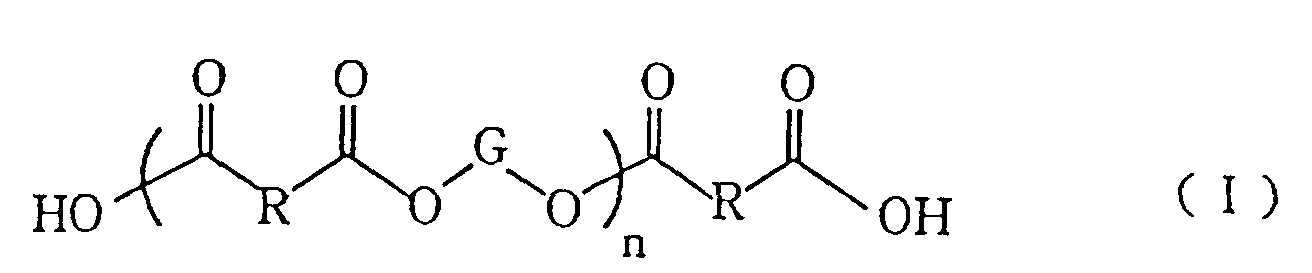
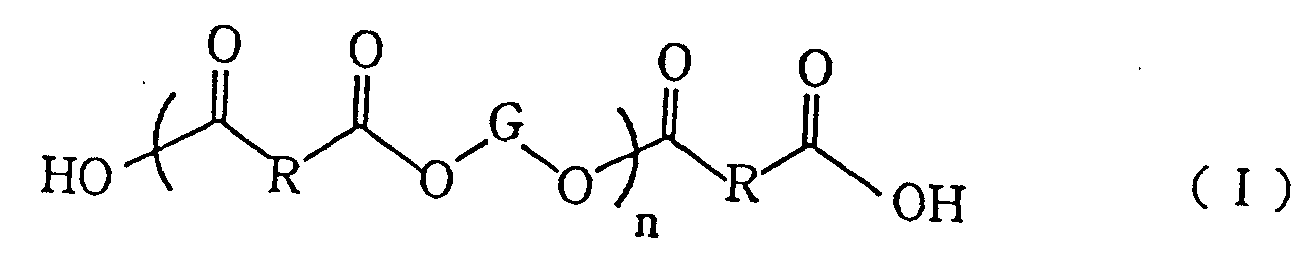
- a biodegradable elastomer obtained by blending a sugar polymer compound represented by general formula (I) with a diepoxide represented by general formula (II) as a cross-linking agent: wherein G denotes a unsubstituted sugar residue or a sugar residue of which at least one hydroxyl group not participating in polymerization is substituted with an ester group; R denotes a substituted or unsubstituted aliphatic hydrocarbon group having 4 to 16 carbons; and n is an integer of from 1 to 5,000, wherein, m is 0 or an integer of from 1 to 12.
- a biodegradable elastomer obtained by blending a sugar polymer compound represented by general formula (I) with a diisocyanate represented by general formula (III) as a cross-linking agent: wherein, G denotes a unsubstituted sugar residue or a sugar residue of which at least one hydroxyl group not participating in polymerization is substituted with an ester group; R denotes a substituted or unsubstituted aliphatic hydrocarbon group having 4 to 16 carbons; and n is an integer of from 1 to 5,000, wherein, L denotes an integer from 1 to 12.
- a method for producing an item which comprises a step of forming one of the above mentioned biodegradable elastomers by applying heat and pressure to the elastomer.
- the inventors of the present invention have studied sugar polymer compounds being a copolymer of sugar and dicarboxylic acid, and found that certain sugar polymer compounds are biodegradable and show excellent rubber elasticity when thermoformed with a cross-linking agent, to complete the present invention.
- the elastomer of the present invention can biologically be decomposed in soil or in compost to reduce the load on the environment.
- an elastomer obtained by mixing a sugar polymer compound with a diepoxide or a diisocyanate as a cross-linking agent has both the excellent rubber elasticity and excellent biodegradability. Further, since such an elastomer is composed of sugars, aliphatic dicarboxylic acid and a cross-linking agent, it would not affect the environment on waste disposal, being an elastomer excellent in compatibility with the environment.
- items made of the biodegradable elastomer of the present invention can be produced easily by applying heat and pressure to a mixture of a sugar polymer and a cross-linking agent in a molding die of a desired shape.
- FIGURE is an infrared absorption spectrum of a sugar polymer compound (compound No. 1-1) synthesized by Synthesis Example 1.
- biodegradable elastomer of the present invention obtained by mixing a sugar polymer compound represented by general formula (I) and a cross-linking agent represented by general formula (II) or (III).
- a sugar polymer compound which is a main component of a biodegradable elastomer of the present invention, has a structure represented by the following general formula (I).
- G denotes a sugar residue in which some of hydroxyl groups not participating to polymerization may be partly substituted with ester groups such as acetyl group and propionyl group.
- R denotes an aliphatic hydrocarbon group having 4 to 16 carbons, or a substituted aliphatic hydrocarbon group having 4 to 16 carbons, preferably an aliphatic hydrocarbon group of 4 to 8 carbons.
- n denotes polymerization degree being an integer of from 1 to 5,000, preferably 100 to 1,000.
- a sugar polymer compound represented by the general formula (I) can be synthesized by one of following methods: an ester bond formation between an hydroxyl group of a sugar and a COOH group or acid anhydride group of a dicarboxylic acid, or a COCl group of a dicarboxylic acid chloride, transesterification between a dicarboxylic acid ester and a sugar, and an enzymatic reaction, for example.
- the weight average molecular weight of a sugar polymer compound having the general formula (I) and produced by such a method is preferably 10,000 to 3,000,000 and more preferably 100,000 to 1,000,000.
- Sugars usable for the present invention include monosaccharides, such as glucopyranose, mannopyranose and galactopyranose, and oligosaccharides such as maltose, lactose, cellobiose, isomaltose, nigerose, trehalose, melibiose, cellotriose, chitotriose, maltotriose, cellotetraose, chitotetraose, maltotetraose, cellopentaose, maltopentaose, chitopentaose, cellohexaose, maltohexaose, chitohexaose, and the like.
- Some of hydroxyl groups of these saccharides nothing to do with the polymerization may be substituted with an ester group such as acetyl group.
- Dicarboxylic acids usable in the present invention are aliphatic dicarboxylic acids having a main chain of 4 to 16 carbons, preferably of 4 to 8 carbons.
- the main chains of the dicarboxylic acids may be substituted with other groups.
- Examples of such dicarboxylic acids are adipic acids, pimelic acid, suberic acid, azelaic acid, sebacic acid, 1,10-decanedicarboxylic acid, tridecanedicarboxylic acid, hexadecanedicarboxylic acid, octadecanedicarboxylic acid and the like.
- acid anhydride or acid chlorides of the above dicarboxylic acids may be used to react with sugars. Accordingly, R in the general formula (I) denotes a dicarboxylic acid or a dicarboxylic acid derivative from which carboxyl groups are eliminated.
- diepoxides defined as the general formula (II) and diisocyanates defined as the general formula (III) can be used.
- a diepoxide having the following general formula (II) is blended with a sugar polymer compound and then thermoformed to carry out the cross-linking reaction of the diepoxide and hydroxyl groups in the sugar polymer compound to form a three-dimensional structure and to provide the rubber elasticity.
- m denotes 0 or an integer of from 1 to 12.
- the diepoxide has the following structural formula.
- the amount of the diepoxide to be added is preferably 5 to 40 wt.%, more preferably 10 to 35 wt.%. If the amount of the diepoxide is less than 5 wt.%, the network by cross-linking of the sugar polymer compound becomes insufficient leading to insufficient rubber elasticity. On the other hand, if the amount of the diepoxide is more than 40 wt.%, the cross-linking becomes dense to make the elastomer solid, leading to insufficient rubber elasticity.
- the diepoxide can be mixed with a sugar polymer compound, for example, by uniformly dissolving the diepoxide and a sugar polymer compound in a solvent (e.g. acetone) which is inert to the diepoxide and capable of dissolving the sugar polymer compound, followed by removing the solvent and sufficiently drying to give a precursor of an elastomer. Any method is applicable so long as it can evenly blend the diepoxide and the sugar polymer compound.
- a solvent e.g. acetone
- a diisocyanate having the following general formula (III) When a diisocyanate having the following general formula (III) is used, it is blended with a sugar polymer compound and then subjected to thermoforming, whereby the cross-linking reaction of the diisocyanate and the hydroxyl groups of the sugar polymer compound occurs to form a three-dimensional structure for the rubber elasticity: wherein L denotes an integer of 1 to 12.
- the addition amount of the diisocyanate is preferably 5 to 40 wt.%, more preferably 10 to 35 wt.%.
- the amount of the diisocyanate less than 5 wt.% or more than 40 wt.% is not effective for the expression of the rubber elasticity of a sugar polymer compound due to the cross-linking reaction by the following reason. If the amount of the diisocyanate is less than 5 wt.%, the cross-linking network of the sugar polymer compound is insufficient to obtain sufficient rubber elasticity, and if the amount of the diisocyanate is more than 40 wt.%, the cross-linking becomes dense making the elastomer solid.
- Diisocyanate can be mixed with a sugar polymer compound, for example, by uniformly dissolving the diisocyanate and a sugar polymer compound in a solvent (e.g. acetone) which is inert to the diisocyanate and capable of dissolving the sugar polymer compound, followed by removing the solvent and sufficiently drying to give a precursor of an elastomer. Any method is applicable so long as it can evenly blend the diisocyanate and the sugar polymer compound.
- a solvent e.g. acetone
- thermoforming is preferably 100 to 130°C, near to the softening temperature of the sugar polymer compound with any cross-linking agent.
- items of a biodegradable elastomer can be produced by applying heat and pressure to a precursor of the elastomer produced by blending a cross-linking agent and a sugar polymer compound in a molding die of a desired shape.
- the heating temperature is preferably 100 to 130°C, near to the softening temperature of the sugar polymer compound.
- a variety of well-known additives may be used for the item so long as the additives would deteriorate rubber elasticity.
- the elastomer of the present invention can biologically be decomposed in soil or in compost to reduce the load on the environment. Further, since such an elastomer is composed of sugars, aliphatic dicarboxylic acid and a cross-linking agent, it would not affect the environment on waste disposal, being an elastomer excellent in compatibility with the environment.
- part(s) means part(s) by weight.
- D-glucopyranose Fifty parts of D-glucopyranose was added to 200 parts of DMF (N,N-dimethylformamide) and 100 parts of pyridine, to which 120 parts of a DMF solution containing 20 parts of adipic acid chloride was slowly and dropwise added, and stirred at a room temperature for 1 hour. Further, another 70 parts of a DMF solution containing 20 parts of adipic acid chloride was dropwise added and stirred at a room temperature for 1 hour. Next, 130 parts of a DMF solution containing 30 parts of acetic acid anhydride was slowly and dropwise added and stirred for 1.5 hours.
- DMF N,N-dimethylformamide
- the molecular weight of the sugar polymer compound synthesized as described above was determined by gel permeation chromatography (GPC) as follows. As a result, the weight average molecular weight was 1,000,000 on polysaccharide basis.
- HLC-8120 GPC made by Tosoh Corporation
- the obtained product was subjected to 13 C-NMR by using FT-NMR DPX 400 (Bruker), carbonyl-carbon of adipic acid at 173 ppm, carbonyl-carbon of acetyl group at 169 ppm, methylene-carbon derived from adipic acid at 24 ppm and 33 ppm, and methyl-carbon of acetyl group at 20 ppm were observed. According to the above-mentioned measurement results, it was confirmed that an object sugar polymer compound was synthesized.
- Each sugar polymer compound obtained in the above Synthetic Examples was mixed with a diepoxide of general formula (II) or a diisocyanate of general formula (III) as a cross-linking agent by dissolving them in acetone which is a solvent inert to the cross-linking agent and capable of dissolving the sugar polymer compound. After that, the solvent was removed and the residue was dried to obtain an elastomer precursor. Further, the precursor was subjected to thermoforming at 100 to 130°C for 5 minutes to obtain an object elastomer.
- the types and the addition amounts of cross-linking agents are shown in Table 2 and Table 3.
- Tufprene A (produced by Asahi Chemical Industry Co., Ltd.), which is a diene rubber, was used as a comparative elastomer and subjected to the evaluation in the same manner as Examples 1 to 13.
- KE 650 U (produced by Shin-Etsu Chemical Co., Ltd.), which is a silicone rubber, was used as a comparative elastomer and subjected to the evaluation in the same manner as Examples 1 to 13.
- Example Elastomer Compound Cross-linking agent Addition amount (wt.%) Rubber elasticity Biodegradability
- Example 1 elastomer 1 No. I-1 diepoxide m 4 10 R
- Example 2 elastomer 2 No. I-2 diisocyanate L 1 20 A
- Example 3 elastomer 3 No. I-3 diepoxide m 0 30 A
- Example 4 elastomer 4 No. I-4 diisocyanate L 2 15 A
- I-5 diepoxide m 7 25 A
- Example 6 elastomer 6 No. I-6 diisocyanate L 6 35 A
- Example 8 elastomer 8 No. I-8 diisocyanate L 12 20 A
- Example 9 elastomer 9 No. I-9 diepoxide m 11 30 A
- Example 10 elastomer 10 No. I-10 diisocyanate L 5 15 A
- Example 11 elastomer 11 No. I-11 diepoxide m 3 25 A
- I-12 diisocyanate L 8 35 A
- Example 13 elastomer 13 No. I-13 diepoxide m 9 10 A
- an elastomer composed of a sugar polymer compound and a cross-linking agent the present invention had the excellent rubber plasticity and biodegradability as well.
- Items of 5 mm thickness were produced by applying heat and pressure to a precursor made from a sugar polymer compound and a cross-linking agent in Examples 1 to 13 in a die (height 10 cm ⁇ width 10 cm) made of Teflon (product name).
- the forming conditions were: temperature: 100 to 130°C, pressure: 9.8 ⁇ 10 -3 to 1.5 ⁇ 10 -2 Pa (10 to 15 kgf/cm 2 ) and the time: 5 minutes.
- temperature 100 to 130°C
- pressure 9.8 ⁇ 10 -3 to 1.5 ⁇ 10 -2 Pa (10 to 15 kgf/cm 2 )
- the time 5 minutes.
Landscapes
- Chemical & Material Sciences (AREA)
- Health & Medical Sciences (AREA)
- Life Sciences & Earth Sciences (AREA)
- Chemical Kinetics & Catalysis (AREA)
- Medicinal Chemistry (AREA)
- Polymers & Plastics (AREA)
- Organic Chemistry (AREA)
- Molecular Biology (AREA)
- General Health & Medical Sciences (AREA)
- Engineering & Computer Science (AREA)
- Biochemistry (AREA)
- Materials Engineering (AREA)
- Biological Depolymerization Polymers (AREA)
- Polyurethanes Or Polyureas (AREA)
- Epoxy Resins (AREA)
- Manufacture Of Macromolecular Shaped Articles (AREA)
Abstract



Description





Column: Mixed-
Eluent: DMF containing 0.1% of LiBr
Column oven temperature: 50°C
| Compound No. | G | R | Weight average molecular weight | Softening temperature °C |
| I-1 | glucopyranose | (CH2)4 | 1,000,000 | 101 |
| I-2 | mannopyranose | (CH2)8 | 110,000 | 90 |
| I-3 | galactopyranose | (CH2)16 | 490,000 | 95 |
| I-4 | maltose | (CH2)6 | 610,000 | 96 |
| I-5 | lactose | (CH2)10 | 240,000 | 92 |
| I-6 | cellobiose | (CH2)14 | 920,000 | 99 |
| I-7 | maltotriose | (CH2)5 | 190,000 | 91 |
| I-8 | chitotriose | (CH2)13 | 290,000 | 93 |
| I-9 | cellotetraose | (CH2)7 | 730,000 | 97 |
| I-10 | maltopentaose | (CH2)12 | 470,000 | 95 |
| I-11 | cellopentaose | (CH2)9 | 120,000 | 91 |
| I-12 | maltohexaose | (CH2)11 | 710,000 | 98 |
| I-13 | chitohexaose | (CH2)15 | 380,000 | 94 |
| Example | Elastomer | Compound | Cross-linking agent | Addition amount (wt.%) | Rubber elasticity | Biodegradability |
| Example 1 | | No. I-1 | diepoxide m = 4 | 10 | R | A |
| Example 2 | | No. I-2 | diisocyanate L = 1 | 20 | A | A |
| Example 3 | | No. I-3 | diepoxide m = 0 | 30 | A | A |
| Example 4 | | No. I-4 | diisocyanate L = 2 | 15 | A | A |
| Example 5 | | No. I-5 | diepoxide m = 7 | 25 | A | A |
| Example 6 | elastomer 6 | No. I-6 | diisocyanate L = 6 | 35 | A | A |
| Example 7 | elastomer 7 | No. I-7 | diepoxide m 10 | 10 | A | A |
| Example 8 | elastomer 8 | No. I-8 | diisocyanate L = 12 | 20 | A | A |
| Example 9 | elastomer 9 | No. I-9 | diepoxide m = 11 | 30 | A | A |
| Example | Elastomer | Compound | Cross-linking agent | Addition amount (wt.%) | Rubber elasticity | Biodegradability |
| Example 10 | elastomer 10 | No. I-10 | diisocyanate L = 5 | 15 | A | A |
| Example 11 | elastomer 11 | No. I-11 | diepoxide m = 3 | 25 | A | A |
| Example 12 | elastomer 12 | No. I-12 | diisocyanate L = 8 | 35 | A | A |
| Example 13 | elastomer 13 | No. I-13 | diepoxide m = 9 | 10 | A | A |
| Comparative Example 1 | elastomer 14 | diene rubber | - | - | A | C |
| Comparative Example 2 | elastomer 15 | silicone rubber | - | - | A | C |
| Comparative Example 3 | elastomer 16 | fluoro-rubber | - | - | A | C |
Claims (6)
- A biodegradable elastomer obtained by blending a sugar polymer compound represented by general formula (I) with a diepoxide represented by general formula (II) as a cross-linking agent:wherein G denotes a unsubstituted sugar residue or a sugar residue of which at least one hydroxyl group not participating in polymerization is substituted with an ester group; R denotes a substituted or unsubstituted aliphatic hydrocarbon group having 4 to 16 carbons; and n is an integer of from 1 to 5,000,
 wherein, m is 0 or an integer of from 1 to 12.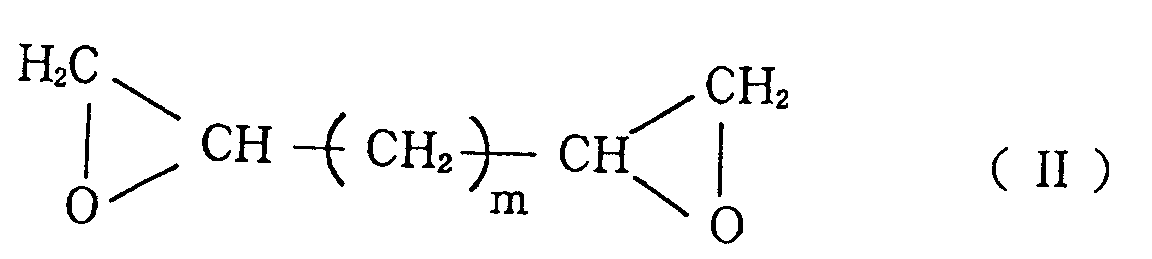
- A biodegradable elastomer obtained by blending a sugar polymer compound represented by general formula (I) with a diisocyanate represented by general formula (III) as a cross-linking agent:wherein, G denotes a unsubstituted sugar residue or a sugar residue of which at least one hydroxyl group not participating in polymerization is substituted with an ester group; R denotes a substituted or unsubstituted aliphatic hydrocarbon group having 4 to 16 carbons; and n is an integer of from 1 to 5,000,
 wherein, L denotes an integer from 1 to 12.
- The biodegradable elastomer of claim 1 or claim 2, wherein G of the general formula (I) is a monosaccharide residue.
- The biodegradable elastomer of claim 1 or claim 2, wherein G of the general formula (I) is an oligosaccharide residue.
- An item being produced by forming a biodegradable elastomer of claim 1 or claim 2.
- A method for producing an item comprising a step of forming a biodegradable elastomer of claim 1 or claim 2 by applying heat and pressure to the elastomer.
Applications Claiming Priority (2)
| Application Number | Priority Date | Filing Date | Title |
|---|---|---|---|
| JP2000054470 | 2000-02-29 | ||
| JP2000054470A JP2001240655A (en) | 2000-02-29 | 2000-02-29 | Biodegradable elastomer, molded article made of the elastomer, and method for producing the same |
Publications (1)
| Publication Number | Publication Date |
|---|---|
| EP1138695A1 true EP1138695A1 (en) | 2001-10-04 |
Family
ID=18575718
Family Applications (1)
| Application Number | Title | Priority Date | Filing Date |
|---|---|---|---|
| EP01104924A Withdrawn EP1138695A1 (en) | 2000-02-29 | 2001-02-28 | Biodegradable elastomer, item made of the same and production method of item |
Country Status (3)
| Country | Link |
|---|---|
| US (1) | US20020002243A1 (en) |
| EP (1) | EP1138695A1 (en) |
| JP (1) | JP2001240655A (en) |
Citations (2)
| Publication number | Priority date | Publication date | Assignee | Title |
|---|---|---|---|---|
| US3950282A (en) * | 1974-12-06 | 1976-04-13 | Gilbert Richard D | Polyanhydroglucose biodegradable polymers and process of preparation |
| EP0761689A1 (en) * | 1995-08-10 | 1997-03-12 | Wolff Walsrode Ag | Thermoplastic biodegradable polysaccharide derivatives, process for their preparation and their uses |
-
2000
- 2000-02-29 JP JP2000054470A patent/JP2001240655A/en active Pending
-
2001
- 2001-02-27 US US09/793,570 patent/US20020002243A1/en not_active Abandoned
- 2001-02-28 EP EP01104924A patent/EP1138695A1/en not_active Withdrawn
Patent Citations (2)
| Publication number | Priority date | Publication date | Assignee | Title |
|---|---|---|---|---|
| US3950282A (en) * | 1974-12-06 | 1976-04-13 | Gilbert Richard D | Polyanhydroglucose biodegradable polymers and process of preparation |
| EP0761689A1 (en) * | 1995-08-10 | 1997-03-12 | Wolff Walsrode Ag | Thermoplastic biodegradable polysaccharide derivatives, process for their preparation and their uses |
Also Published As
| Publication number | Publication date |
|---|---|
| US20020002243A1 (en) | 2002-01-03 |
| JP2001240655A (en) | 2001-09-04 |
Similar Documents
| Publication | Publication Date | Title |
|---|---|---|
| US6468668B1 (en) | Cellulosic composite product and a method of producing the same | |
| US8916628B2 (en) | Thermoplastic compositions based on soluble starch and method for preparing such compositions | |
| CA2156783C (en) | Primerless urethane adhesive compositions | |
| JPWO2013099842A1 (en) | Modified polyrotaxane, method for producing the same, and material formed with modified polyrotaxane | |
| CN1221430A (en) | Polyisocyanate modified isomonoolefin-p-alkylstyrene elastomer composition | |
| CN115181232B (en) | Polyurethane material and preparation method and application thereof | |
| JP2000327841A (en) | Molded product comprising sugar chain polymer composition | |
| CN109970939A (en) | Biomass thermoplastic polyurethane | |
| WO2021015334A1 (en) | Method for manufacturing cellulose fiber modified with epoxidized soybean oil and biodegradable polymer composite comprising modified cellulose fiber | |
| EP3246342B1 (en) | Organosiloxane graft polyvinyl alcohol polymer and method of producing the same | |
| EP1138695A1 (en) | Biodegradable elastomer, item made of the same and production method of item | |
| EP0814093B1 (en) | Polymeric compound comprising glycopolymer and a method for decomposing the same | |
| Frisch et al. | Interpenetrating polymer networks of poly (carbonate‐urethane) and polymethyl methacrylate | |
| CN117567851B (en) | High-temperature-resistant biodegradable polyester material and preparation method thereof | |
| CN113321905A (en) | Modified starch/poly (butylene succinate) composite material | |
| Lu et al. | Interfacial structure and properties of regenerated cellulose films coated with superthin polyurethane/benzoyl konjac glucomannan coating | |
| JPWO2020045325A1 (en) | Polyrotaxane, a thermosetting composition having the polyrotaxane, and a thermosetting crosslinked product, and a method for producing polyrotaxane and a method for producing a thermosetting crosslinked product. | |
| JP3413062B2 (en) | Polymer compound containing sugar chain polymer compound and decomposition method thereof | |
| EP4151662A1 (en) | Polyrotaxane having group that has chain formed by having circular molecule have propyleneoxy repeating unit | |
| CN111171325B (en) | Polycarbonate low-temperature toughening modifier, preparation method and toughening method | |
| CN112778548B (en) | Reversibly crosslinked aliphatic polyesters and process for their preparation | |
| US12139560B2 (en) | Cellulose resin, molding material, molded body, and method for producing cellulose resin | |
| Sasaki et al. | Chemoenzymatic synthesis of amylose-grafted polyacetylene by polymer reaction manner and its conversion into organogel with DMSO by cross-linking | |
| JP4221456B2 (en) | Amphiphilic sugar-containing polymer, its production and use | |
| EP1203776B1 (en) | Resin composite, method for producing the same and articles consisting of the same |
Legal Events
| Date | Code | Title | Description |
|---|---|---|---|
| PUAI | Public reference made under article 153(3) epc to a published international application that has entered the european phase |
Free format text: ORIGINAL CODE: 0009012 |
|
| AK | Designated contracting states |
Kind code of ref document: A1 Designated state(s): AT BE CH CY DE DK ES FI FR GB GR IE IT LI LU MC NL PT SE TR Kind code of ref document: A1 Designated state(s): DE FR GB |
|
| AX | Request for extension of the european patent |
Free format text: AL;LT;LV;MK;RO;SI |
|
| 17P | Request for examination filed |
Effective date: 20020219 |
|
| AKX | Designation fees paid |
Free format text: DE FR GB |
|
| 17Q | First examination report despatched |
Effective date: 20040429 |
|
| STAA | Information on the status of an ep patent application or granted ep patent |
Free format text: STATUS: THE APPLICATION IS DEEMED TO BE WITHDRAWN |
|
| 18D | Application deemed to be withdrawn |
Effective date: 20041110 |