EP1138666A1 - A preparation method for 4-(P-methoxyphenyl)-2-amino-butane and an insecticidal composition comprising it - Google Patents
A preparation method for 4-(P-methoxyphenyl)-2-amino-butane and an insecticidal composition comprising it Download PDFInfo
- Publication number
- EP1138666A1 EP1138666A1 EP00890102A EP00890102A EP1138666A1 EP 1138666 A1 EP1138666 A1 EP 1138666A1 EP 00890102 A EP00890102 A EP 00890102A EP 00890102 A EP00890102 A EP 00890102A EP 1138666 A1 EP1138666 A1 EP 1138666A1
- Authority
- EP
- European Patent Office
- Prior art keywords
- compound
- formula
- methoxyphenyl
- phenolic
- azide
- Prior art date
- Legal status (The legal status is an assumption and is not a legal conclusion. Google has not performed a legal analysis and makes no representation as to the accuracy of the status listed.)
- Granted
Links
Classifications
-
- A—HUMAN NECESSITIES
- A01—AGRICULTURE; FORESTRY; ANIMAL HUSBANDRY; HUNTING; TRAPPING; FISHING
- A01N—PRESERVATION OF BODIES OF HUMANS OR ANIMALS OR PLANTS OR PARTS THEREOF; BIOCIDES, e.g. AS DISINFECTANTS, AS PESTICIDES OR AS HERBICIDES; PEST REPELLANTS OR ATTRACTANTS; PLANT GROWTH REGULATORS
- A01N33/00—Biocides, pest repellants or attractants, or plant growth regulators containing organic nitrogen compounds
- A01N33/02—Amines; Quaternary ammonium compounds
- A01N33/08—Amines; Quaternary ammonium compounds containing oxygen or sulfur
- A01N33/10—Amines; Quaternary ammonium compounds containing oxygen or sulfur having at least one oxygen or sulfur atom directly attached to an aromatic ring system
-
- C—CHEMISTRY; METALLURGY
- C07—ORGANIC CHEMISTRY
- C07C—ACYCLIC OR CARBOCYCLIC COMPOUNDS
- C07C217/00—Compounds containing amino and etherified hydroxy groups bound to the same carbon skeleton
- C07C217/54—Compounds containing amino and etherified hydroxy groups bound to the same carbon skeleton having etherified hydroxy groups bound to carbon atoms of at least one six-membered aromatic ring and amino groups bound to acyclic carbon atoms or to carbon atoms of rings other than six-membered aromatic rings of the same carbon skeleton
- C07C217/56—Compounds containing amino and etherified hydroxy groups bound to the same carbon skeleton having etherified hydroxy groups bound to carbon atoms of at least one six-membered aromatic ring and amino groups bound to acyclic carbon atoms or to carbon atoms of rings other than six-membered aromatic rings of the same carbon skeleton with amino groups linked to the six-membered aromatic ring, or to the condensed ring system containing that ring, by carbon chains not further substituted by singly-bound oxygen atoms
- C07C217/62—Compounds containing amino and etherified hydroxy groups bound to the same carbon skeleton having etherified hydroxy groups bound to carbon atoms of at least one six-membered aromatic ring and amino groups bound to acyclic carbon atoms or to carbon atoms of rings other than six-membered aromatic rings of the same carbon skeleton with amino groups linked to the six-membered aromatic ring, or to the condensed ring system containing that ring, by carbon chains not further substituted by singly-bound oxygen atoms linked by carbon chains having at least three carbon atoms between the amino groups and the six-membered aromatic ring or the condensed ring system containing that ring
Definitions
- the invention provides novel biologically active synthetic molecule 4-(p-methoxyphenyl)-2-amino-butane.
- the invention also provides a process for preparation of said molecule from a naturally occurring compound 4-(p-hydroxyphenyl)butan-2-ol.
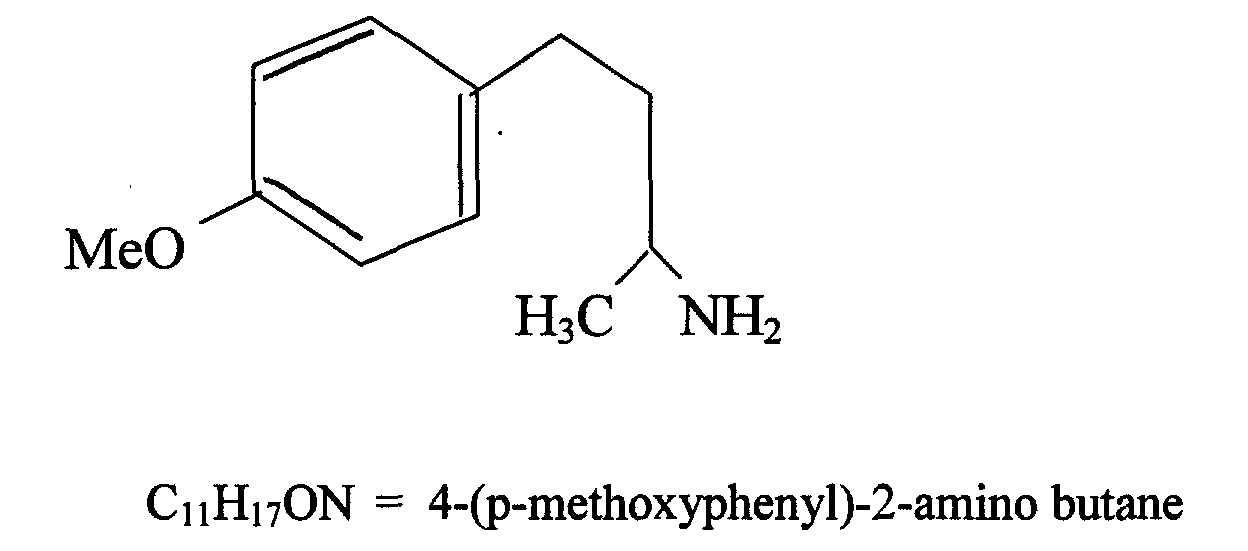
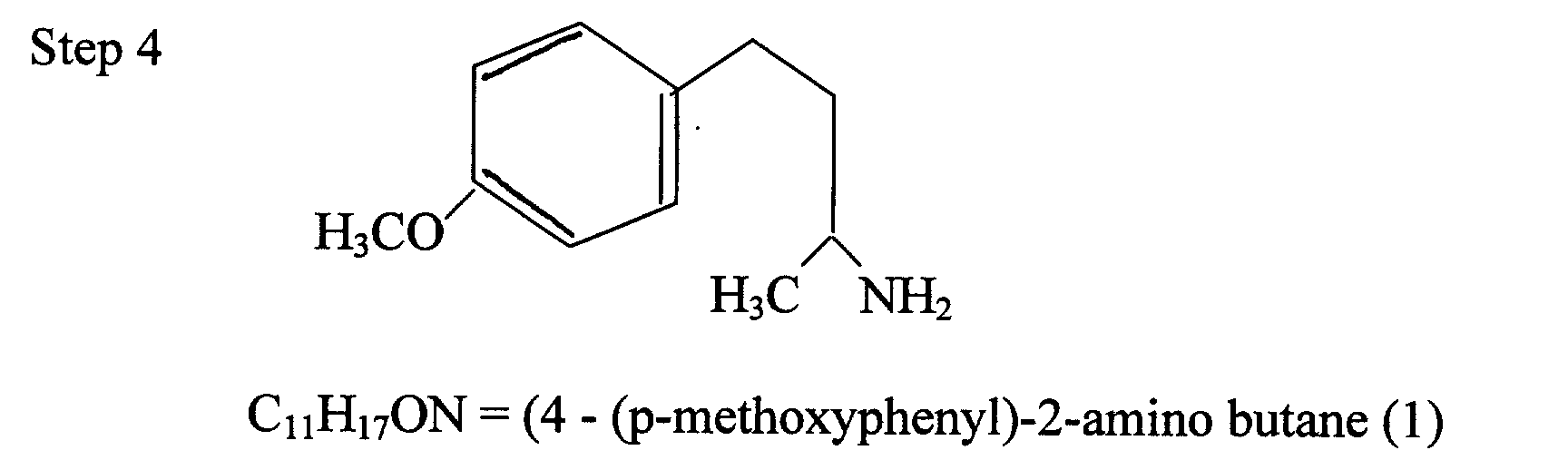
- the molecule of the invention is a colorless crystalline solid, represented by molecular formula , C 11 H 17 ON, and structural formula (1) as shown herein below:
- the invention provides an insecticidal composition
- an insecticidal composition comprising the said molecule 4-(p-methoxyphenyl)-2-amino butane in an effective amount and an adjuvant.
- the product is a new molecule which has been prepared from a readily available starting material 4-(p-hydroxyphenyl)-butan-2-ol represented by formula (2) as shown herein below isolated from the plant Taxus wallichiana .
- Taxus wallichiana which also known as Himalayan yew is now considered to be one of the most needed plants for commercial exploitation as it contains the anticancer drug Taxol.
- Taxol a highly oxygenated diterpenoid molecule and potent anticancer drug was first isolated from the stem bark of Taxus brevifolia . Thereafter, it has also been isolated from other Taxus plants including the Himalayan yew Taxus wallichiana .
- Taxus wallichiana collected from different parts of India for the isolation of taxol, its important analogues and precursor 10-deacetyl baccatin III (DAB).
- DAB 10-deacetyl baccatin III
- the applicants have isolated a major compound from the leaves of Taxus wallichiana, identified as 4-(p-hydroxyphenyl)-butan-2-ol having structural formula (2). This compound can be obtained with a yield of 0.2% from the leaves of Taxus wallichiana . Accordingly, the applicants have developed a simple and cost effective processing technology for isolation of this compound from the leaves of Taxis wallichiana .
- the process of isolation of the compound comprises the steps of defatting air dried pulverised Taxus leaves with aliphatic hydrocarbon solvents, extracting the defatted leaves with chlorinated solvents and polar solvents successively, concentrating the chlorinated solvent soluble fraction to a residue and treating the residue with aqueous solution of alkali and isolating the compound from the alkali soluble fraction by acidifying it and extracting it with ethyl acetate, to obtain the compound having structural formula (2).
- the compound (2) was not found to be active in bioassay studies for evaluation of growth inhibition and antifeedant activity.
- the compound of formula (2) was obtained with high yield (0.2%), its conversion into other structural analogues through a series of chemical reactions.
- the applicants prepared a new molecule represented by formula (1) from the compound represented by formula (2)
- the compound having structural formula (1) shows significant activity as a growth inhibitor and antifeedant.
- the compound having formula(1) was evaluated as feeding deterrent and growth inhibitor against 4 th instar larvae of Spilarctia Obliqua. This insect attacks more than twenty cash crops including urd, mong, arhar, mint and coleus etc.
- Compound having formula (1) is non hazardous in nature and thus is ecologically safe and environmentally sound for its use as an agrochemical.
- the main object of this invention is to provide a new molecule, 4-(p-methoxyphenyl)-2-amino butane, represented by structural formula (1) and represented by molecular formula C 11 H 17 ON.
- Yet another object of the invention is to provide an insecticidal composition
- an insecticidal composition comprising an effective amount of the new molecule 4-(p-methoxy phenyl-2-amino butane and an adjuvant.
- the present invention provides novel molecule 4-(p-methoxyphenyl)-2-amino butane,C 11 H 17 ON, represented by the structural formula (1) as shown herein below.
- the compound exhibits growth inhibitory and antifeedant activity.
- the process for the isolation of the novel compound comprises the steps of:
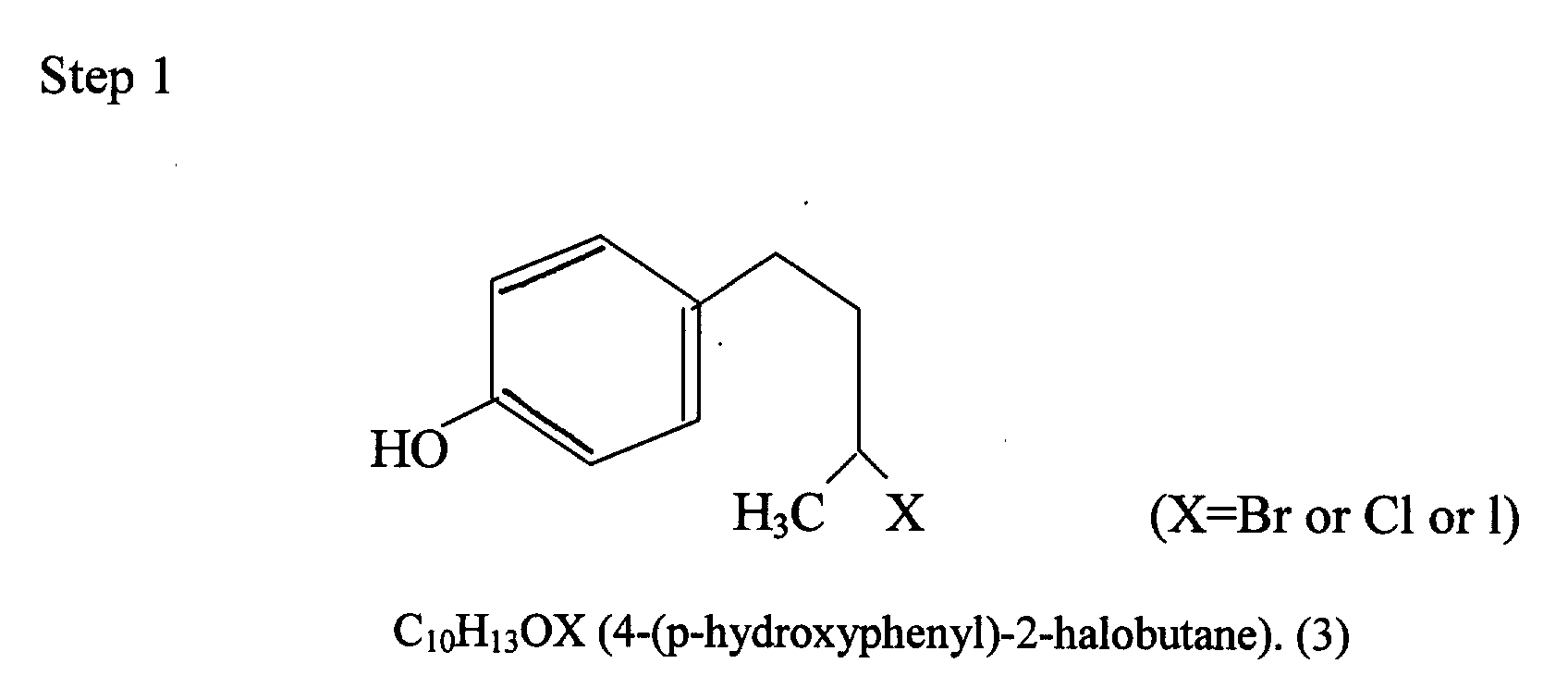
- the aqueous mineral acid used in step (b) may be selected from the group consisting of hydrochloric acid, hydrobromic acid and hydroiodic acid.
- the methylating agent used in step (c) may be selected from methyl iodide or dimethyl sulphate.
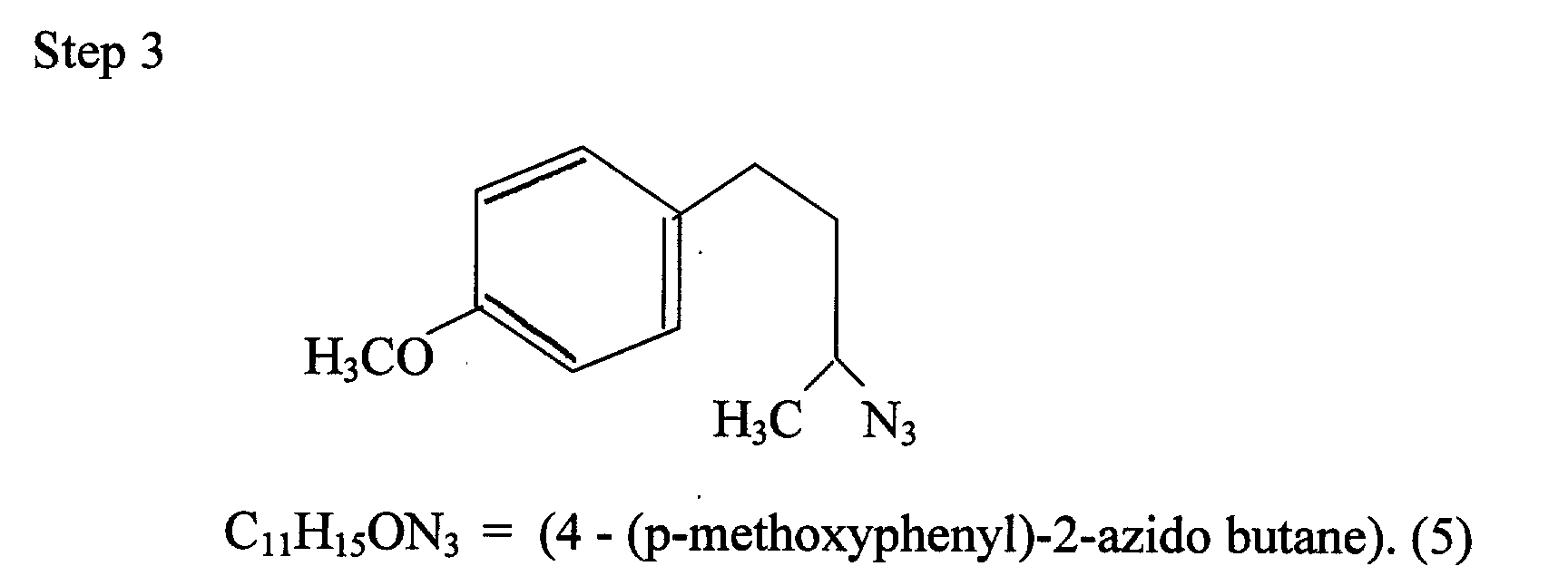
- the azide, used in step (d) is sodium azide or trimethyl silyl azide.
- the catalyst used in the hydrogenation process is selected from palladium charcoal and platinum oxide.
- the lower alcohol used as medium to dissolve the azide derivative in the hydrogenation process may be methyl alcohol, ethyl alcohol.
- the compound 4-(p-methoxy phenyl)-2-amino butane exhibits antifeedant and growth inhibiting activity against certain insects, especially the larvae of Spilarctia Obliqua.
- the compound has potential use as an insecticide, and would have wide spread applications in insecticidal compositions.
- an insecticidal composition comprising an effective amount of the compound 4-(p-methoxy phenyl)-2-amino butane and an adjuvant in an amount sufficient to enhance the activity of the composition may be prepared.
- the novel compound 4-(p-methoxyphenyl)-2-amino butane per se may also be used to control insects in fields, though it is recommended that the compound be mixed with augmenting adjuvants such as distilled water, acetone or such other solvents before use.
- the insecticidal compositions may be sprayed or applied in the soil for control of pests. Further, the said insecticidal composition may be effectively used for the control of insects/their larvae such as Spilarctia Obliqua. In practice, the compound is found to be very useful in controlling phytopathogenic insects and mites.
- Step 1 preparation of 4-(p-hydroxyphenyl)-2 bromobutane (formula 3)-(C 10 H 13 O Br )
- the compound having formula (3) (1g) was dissolved in acetone (10 ml) and to it were added anhydrous potassium carbonate (10g) and dimethyl sulphate (3ml) and refluxed with stirring for 4 hours. Water was added to the reaction flask and stirred for 3 hours. It was then extracted with water CHCl 3 (25ml x 3) and washed with water (25ml x 2). The organic layer was dried over anhydrous sodium sulphate and concentrated in vaccuo to get oily material (4) (1.0g).
- the compound (3) (1g) was dissolved in acetone (10 ml) was dissolved in acetone (10 ml) and to it were added anhydrous potassium carbonate (10g) and methyl iodide (3ml) and refluxed with stirring for 4 hours, water was added to the reaction flask and was stirred for 3 hours. It was then extracted with water CHC 3 (25ml x 3) and washed with water (25ml x 2). The organic layer was dried over anhydrous sodium sulphate and concentrated in vaccuo to get oily material having formula (4)(1g).
- the EI mass spectrum of the compound showed its M + at M/Z 179, thus confirming its molecular formula as C 11 H 17 ON, and other diagnostic fragment peaks at M/Z 162, 147, 121, and 91 IR ⁇ max (KBr) 3360, 2940, 1610, 1515, 14501, 1030 and 850 Cm -1 .
- the molecule has been prepared from a readily available starting material 4-(p-hydroxyphenyl)-butan-2-ol having formula (2) isolated from the plant Taxus wallichiana .
- the compound having formula (1) was evaluated as feeding deterrent and growth inhibitor against 4 th in star larvae of spilarctia obliqua (Bihar hairy caterpillar). This insect attacks more than twenty cash crops like urd, moong, arhar, mint and coleus etc.
- spilarctia obliqua Bacillus subtilis
- This insect attacks more than twenty cash crops like urd, moong, arhar, mint and coleus etc.
- Several synthetic insecticides like quinalphos, Phosphamidon and synthetic pyrethroids are commercially used to manage this insect pest. But, the insect is developing resistance towards some of these insecticides. Therefore, it has now become imperative to search for new ecologically safe, environmentally sound and non-toxic chemicals to manage this pest.
- Diflubenzuron at 5 ppm was taken as a standard in case of growth inhibitory assay.
- the test result of compound having formula (1) in terms of its feeding deterrency and growth inhibition as compared to standards azadirachtin and diflubenzuron are given in table 1.
- Compound Concentration (ppm) % feeding deterrency % growth inhibition Compound 1 1000 32.0 48.0 2000 40.0 59.0 3000 64.0 72.0 4000 82.0 100.0 5000 100.0 128.0 Azadirachtin 1000 100.0 - Diflubenzuron 5 - 100.0
Landscapes
- Life Sciences & Earth Sciences (AREA)
- Organic Chemistry (AREA)
- Chemical & Material Sciences (AREA)
- Dentistry (AREA)
- Health & Medical Sciences (AREA)
- Engineering & Computer Science (AREA)
- Plant Pathology (AREA)
- General Health & Medical Sciences (AREA)
- Wood Science & Technology (AREA)
- Zoology (AREA)
- Environmental Sciences (AREA)
- Pest Control & Pesticides (AREA)
- Agronomy & Crop Science (AREA)
- Organic Low-Molecular-Weight Compounds And Preparation Thereof (AREA)
Abstract
Description



| Compound | Concentration (ppm) | % feeding deterrency | % growth inhibition |
| Compound 1 | 1000 | 32.0 | 48.0 |
| 2000 | 40.0 | 59.0 | |
| 3000 | 64.0 | 72.0 | |
| 4000 | 82.0 | 100.0 | |
| 5000 | 100.0 | 128.0 | |
| Azadirachtin | 1000 | 100.0 | - |
| Diflubenzuron | 5 | - | 100.0 |
Claims (9)
- Novel compound 4-(p-methoxyphenyl)-2-aminobutane exhibiting growth inhibition and antifeedant activity against larvae and represented by the structural formula.
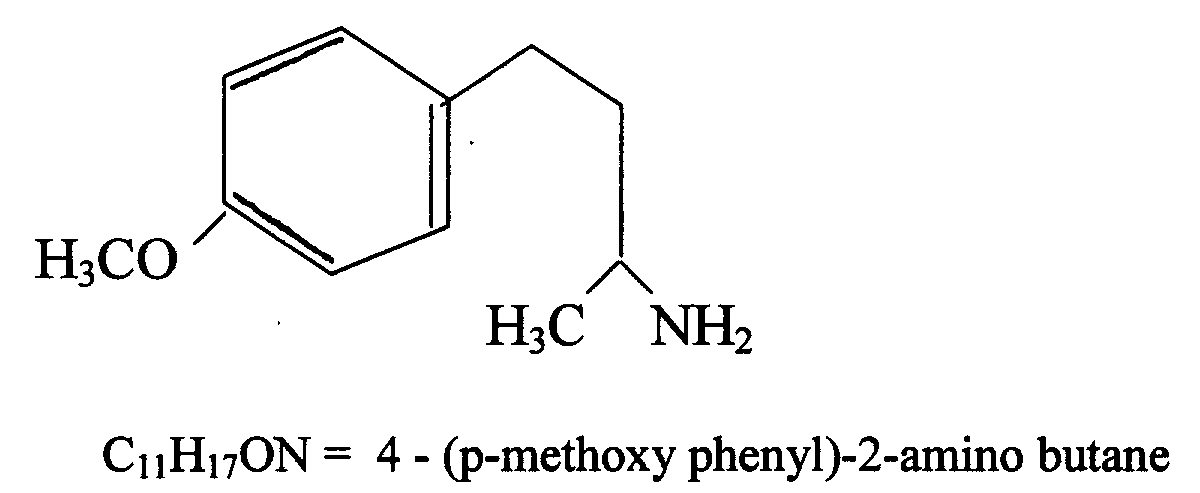
- An insecticidal composition comprising an effective amount of 4-(p-methoxyphenyl)-2-aminobutane represented by structural formula (1) and an adjuvant in an amount sufficient enhance the activity of the insecticidal composition.
- A composition as claimed in claim 2 wherein the adjuvants are selected from distilled water, acetone and organic solvents.
- A process for the preparation of 4-(p-methoxyphenyl)-2-aminobutane as claimed in claim 1, said process comprising the steps of :-(a) isolating a phenolic compound (4-p-hydroxyphenyl)-butan-2-ol having formula (2) from the leaves of Taxus wallichiana by known methods,(b) treating the compound (2) in aqueous mineral acid at 25-100°C for 2-10 hours to obtain a phenolic halide derivative having formula (3),(c) converting the phenolic halide derivative into its methyl ether by treating it with a methating agent to obtain a methyl ether halide having formula (4),(d) reacting the methyl ether halide thus obtained with azide to obtain an azido derivative having formula (5), and(e) hydrogenating the azido compound thus formed by catalytic hydrogenation in presence of a catalyst in lower aliphatic alcohol to obtain a compound having formula (1).
- A process as claimed in claim 4 wherein the aqueous mineral acid in step (b) is selected from hydrochloric acid, hydrobromic acid and hydroiodic acid.
- A process as claimed in claim 4 wherein the methylating agent in step (c) is selected from methyl iodide and dimethyl sulfate.
- A process as claimed in claim 4 wherein the azide in step (d) is selected from sodium azide and trimethyl silyl azide.
- A process as claimed in claim 4 wherein the catalyst in step (e) is selected from palladium charcoal and platinum oxide.
- A process as claimed in claim 4 wherein the lower aliphatic alcohol is selected from methyl alcohol or ethyl alcohol.
Priority Applications (2)
| Application Number | Priority Date | Filing Date | Title |
|---|---|---|---|
| DE2000608697 DE60008697T2 (en) | 2000-03-28 | 2000-03-28 | Process for the preparation of 4- (P-methoxyphenyl) -2-amino-butanes and insecticides |
| EP20000890102 EP1138666B1 (en) | 2000-03-28 | 2000-03-28 | A preparation method for 4-(P-methoxyphenyl)-2-amino-butane and an insecticidal composition comprising it |
Applications Claiming Priority (1)
| Application Number | Priority Date | Filing Date | Title |
|---|---|---|---|
| EP20000890102 EP1138666B1 (en) | 2000-03-28 | 2000-03-28 | A preparation method for 4-(P-methoxyphenyl)-2-amino-butane and an insecticidal composition comprising it |
Publications (2)
| Publication Number | Publication Date |
|---|---|
| EP1138666A1 true EP1138666A1 (en) | 2001-10-04 |
| EP1138666B1 EP1138666B1 (en) | 2004-03-03 |
Family
ID=8175921
Family Applications (1)
| Application Number | Title | Priority Date | Filing Date |
|---|---|---|---|
| EP20000890102 Expired - Lifetime EP1138666B1 (en) | 2000-03-28 | 2000-03-28 | A preparation method for 4-(P-methoxyphenyl)-2-amino-butane and an insecticidal composition comprising it |
Country Status (2)
| Country | Link |
|---|---|
| EP (1) | EP1138666B1 (en) |
| DE (1) | DE60008697T2 (en) |
Cited By (1)
| Publication number | Priority date | Publication date | Assignee | Title |
|---|---|---|---|---|
| WO2012021629A2 (en) | 2010-08-11 | 2012-02-16 | Philadelphia Health & Education Corporation | Novel d3 dopamine receptor agonists to treat dyskinesia in parkinson's disease |
Families Citing this family (1)
| Publication number | Priority date | Publication date | Assignee | Title |
|---|---|---|---|---|
| ES2769780T3 (en) | 2013-10-28 | 2020-06-29 | Univ Drexel | Novel treatments for attention and cognitive disorders and for dementia associated with a neurodegenerative disorder |
Citations (4)
| Publication number | Priority date | Publication date | Assignee | Title |
|---|---|---|---|---|
| DE2728641A1 (en) * | 1976-06-25 | 1978-01-05 | Sterling Drug Inc | 4-HYDROXYPHENYLALKANOLAMINE DERIVATIVES AND PROCESS FOR THE PREPARATION |
| EP0398072A2 (en) * | 1989-05-13 | 1990-11-22 | Bayer Ag | Amino-acid amides |
| EP0443606A2 (en) * | 1990-02-23 | 1991-08-28 | SHIONOGI SEIYAKU KABUSHIKI KAISHA trading under the name of SHIONOGI & CO. LTD. | 4-(4-alkoxyphenyl)-2-butylamine derivatives and process therefor |
| DE19924273A1 (en) * | 1998-07-18 | 2000-01-20 | Bayer Ag | New nitro- or cyano-imideamide derivatives, used as insecticides, acaricides, ectoparasiticides or especially nematocides |
-
2000
- 2000-03-28 DE DE2000608697 patent/DE60008697T2/en not_active Expired - Lifetime
- 2000-03-28 EP EP20000890102 patent/EP1138666B1/en not_active Expired - Lifetime
Patent Citations (4)
| Publication number | Priority date | Publication date | Assignee | Title |
|---|---|---|---|---|
| DE2728641A1 (en) * | 1976-06-25 | 1978-01-05 | Sterling Drug Inc | 4-HYDROXYPHENYLALKANOLAMINE DERIVATIVES AND PROCESS FOR THE PREPARATION |
| EP0398072A2 (en) * | 1989-05-13 | 1990-11-22 | Bayer Ag | Amino-acid amides |
| EP0443606A2 (en) * | 1990-02-23 | 1991-08-28 | SHIONOGI SEIYAKU KABUSHIKI KAISHA trading under the name of SHIONOGI & CO. LTD. | 4-(4-alkoxyphenyl)-2-butylamine derivatives and process therefor |
| DE19924273A1 (en) * | 1998-07-18 | 2000-01-20 | Bayer Ag | New nitro- or cyano-imideamide derivatives, used as insecticides, acaricides, ectoparasiticides or especially nematocides |
Cited By (4)
| Publication number | Priority date | Publication date | Assignee | Title |
|---|---|---|---|---|
| WO2012021629A2 (en) | 2010-08-11 | 2012-02-16 | Philadelphia Health & Education Corporation | Novel d3 dopamine receptor agonists to treat dyskinesia in parkinson's disease |
| AU2011289407B2 (en) * | 2010-08-11 | 2015-06-18 | Philadelphia Health & Education Corporation | Novel D3 dopamine receptor agonists to treat dyskinesia in Parkinson's disease |
| EP2603215A4 (en) * | 2010-08-11 | 2015-08-05 | Philadelphia Health & Educatio | NEW DOPAMINERGIC D3 RECEPTOR AGONISTS FOR TREATING DYSKINESIA IN PARKINSON'S DISEASE |
| US9675565B2 (en) | 2010-08-11 | 2017-06-13 | Drexel University | D3 dopamine receptor agonists to treat dyskinesia in parkinson's disease |
Also Published As
| Publication number | Publication date |
|---|---|
| DE60008697D1 (en) | 2004-04-08 |
| EP1138666B1 (en) | 2004-03-03 |
| DE60008697T2 (en) | 2005-02-10 |
Similar Documents
| Publication | Publication Date | Title |
|---|---|---|
| CN112457288B (en) | Piperine acid derivative and application thereof | |
| JP4596795B2 (en) | Plant inhibitor containing piperitol or its derivatives as active ingredients | |
| Lacey et al. | A male-produced aggregation pheromone blend consisting of alkanediols, terpenoids, and an aromatic alcohol from the cerambycid beetle Megacyllene caryae | |
| Hillbur et al. | Identification of the Sex Pheromone of the Swede Midge, Contarinia nasturtii: Hillbur et al. | |
| JPS63255286A (en) | 13-spiro-2-(tetrahydrofran)-milbemycin derivative, its production, composition containing the same and use thereof for controlling parasite | |
| Liu et al. | Practical synthesis and field application of the synthetic sex pheromone of rice stem borer, Chilo suppressalis (Lepidoptera: Pyralidae) | |
| EP1138666B1 (en) | A preparation method for 4-(P-methoxyphenyl)-2-amino-butane and an insecticidal composition comprising it | |
| US6441205B1 (en) | Synthetic precursors to 4-(P-methoxyphenyl)-2-amino-butane | |
| US6252114B1 (en) | Process for preparing novel biologically active synthetic molecule 4-(p-methoxyphenyl)-2-amino-butane | |
| De Silva et al. | Identification of sex pheromone components of blueberry spanworm Itame argillacearia (Lepidoptera: Geometridae) | |
| Lapointe et al. | Identification and synthesis of a male-produced pheromone for the neotropical root weevil Diaprepes abbreviatus | |
| AU640373B2 (en) | Milbemycin derivatives | |
| AU710995C (en) | Pesticide compounds, compositions and process for the preparation thereof | |
| Pagnocca et al. | Synthetic amides toxic to the leaf-cutting ant Atta sexdens rubropilosa L. and its symbiotic fungus. | |
| Brennan et al. | Fungicidal sesquiterpene dialdehyde cinnamates from Pseudowintera axillaris | |
| CA2776745A1 (en) | Derivatives of dillapiol and related monolignans and use thereof | |
| JPH0616590A (en) | Novel ketones, method for producing the same, and termite control agent containing the compound as an active ingredient | |
| Su et al. | Photochemistry of bioactive compounds. Photolysis of m-(N, N-dimethylformamidine) phenyl N-methylcarbamate hydrochloride in water | |
| US5530030A (en) | Nematicides against pine wood nematodes | |
| US8663621B2 (en) | Identification and synthesis of a male-produced pheromone for the neotropical root weevil Diaperpes abbreviatus (coleoptera: curculionidae) | |
| JP2842586B2 (en) | Novel ketones, production method thereof, and termite control agent containing the compound as active ingredient | |
| Cantrell et al. | Structure–activity relationship studies on the mosquito toxicity and biting deterrency of callicarpenal derivatives | |
| JP4621904B2 (en) | Compound having optically active 3-oxabicyclo [3.3.0] octane skeleton and use thereof | |
| CN110759905B (en) | A kind of 9S-acyloxycinchonine derivatives and preparation method and application thereof, botanical insecticide | |
| CN1293046C (en) | Unsaturated oximino ether compound with fungicidal, insecticidal activity |
Legal Events
| Date | Code | Title | Description |
|---|---|---|---|
| PUAI | Public reference made under article 153(3) epc to a published international application that has entered the european phase |
Free format text: ORIGINAL CODE: 0009012 |
|
| AK | Designated contracting states |
Kind code of ref document: A1 Designated state(s): AT BE CH CY DE DK ES FI FR GB GR IE IT LI LU MC NL PT SE Kind code of ref document: A1 Designated state(s): DE FR GB IT |
|
| AX | Request for extension of the european patent |
Free format text: AL;LT;LV;MK;RO;SI |
|
| 17P | Request for examination filed |
Effective date: 20020322 |
|
| AKX | Designation fees paid |
Free format text: AT BE CH CY LI |
|
| RBV | Designated contracting states (corrected) |
Designated state(s): DE FR GB IT |
|
| REG | Reference to a national code |
Ref country code: DE Ref legal event code: 8566 |
|
| 17Q | First examination report despatched |
Effective date: 20020729 |
|
| GRAP | Despatch of communication of intention to grant a patent |
Free format text: ORIGINAL CODE: EPIDOSNIGR1 |
|
| GRAS | Grant fee paid |
Free format text: ORIGINAL CODE: EPIDOSNIGR3 |
|
| GRAA | (expected) grant |
Free format text: ORIGINAL CODE: 0009210 |
|
| AK | Designated contracting states |
Kind code of ref document: B1 Designated state(s): DE FR GB IT |
|
| REG | Reference to a national code |
Ref country code: GB Ref legal event code: FG4D |
|
| REF | Corresponds to: |
Ref document number: 60008697 Country of ref document: DE Date of ref document: 20040408 Kind code of ref document: P |
|
| ET | Fr: translation filed | ||
| PLBE | No opposition filed within time limit |
Free format text: ORIGINAL CODE: 0009261 |
|
| STAA | Information on the status of an ep patent application or granted ep patent |
Free format text: STATUS: NO OPPOSITION FILED WITHIN TIME LIMIT |
|
| 26N | No opposition filed |
Effective date: 20041206 |
|
| PGFP | Annual fee paid to national office [announced via postgrant information from national office to epo] |
Ref country code: IT Payment date: 20111228 Year of fee payment: 13 |
|
| PGFP | Annual fee paid to national office [announced via postgrant information from national office to epo] |
Ref country code: FR Payment date: 20130405 Year of fee payment: 14 Ref country code: GB Payment date: 20130125 Year of fee payment: 14 |
|
| PGFP | Annual fee paid to national office [announced via postgrant information from national office to epo] |
Ref country code: DE Payment date: 20130511 Year of fee payment: 14 |
|
| REG | Reference to a national code |
Ref country code: DE Ref legal event code: R119 Ref document number: 60008697 Country of ref document: DE |
|
| GBPC | Gb: european patent ceased through non-payment of renewal fee |
Effective date: 20140328 |
|
| REG | Reference to a national code |
Ref country code: FR Ref legal event code: ST Effective date: 20141128 |
|
| REG | Reference to a national code |
Ref country code: DE Ref legal event code: R119 Ref document number: 60008697 Country of ref document: DE Effective date: 20141001 |
|
| PG25 | Lapsed in a contracting state [announced via postgrant information from national office to epo] |
Ref country code: FR Free format text: LAPSE BECAUSE OF NON-PAYMENT OF DUE FEES Effective date: 20140331 Ref country code: DE Free format text: LAPSE BECAUSE OF NON-PAYMENT OF DUE FEES Effective date: 20141001 Ref country code: GB Free format text: LAPSE BECAUSE OF NON-PAYMENT OF DUE FEES Effective date: 20140328 |
|
| PG25 | Lapsed in a contracting state [announced via postgrant information from national office to epo] |
Ref country code: IT Free format text: LAPSE BECAUSE OF NON-PAYMENT OF DUE FEES Effective date: 20140328 |