EP1138658A1 - Molecule stereochemical coding method - Google Patents
Molecule stereochemical coding method Download PDFInfo
- Publication number
- EP1138658A1 EP1138658A1 EP00963083A EP00963083A EP1138658A1 EP 1138658 A1 EP1138658 A1 EP 1138658A1 EP 00963083 A EP00963083 A EP 00963083A EP 00963083 A EP00963083 A EP 00963083A EP 1138658 A1 EP1138658 A1 EP 1138658A1
- Authority
- EP
- European Patent Office
- Prior art keywords
- hierarchy
- atom
- atoms
- molecular
- codes
- Prior art date
- Legal status (The legal status is an assumption and is not a legal conclusion. Google has not performed a legal analysis and makes no representation as to the accuracy of the status listed.)
- Withdrawn
Links
Images















Classifications
-
- G—PHYSICS
- G16—INFORMATION AND COMMUNICATION TECHNOLOGY [ICT] SPECIALLY ADAPTED FOR SPECIFIC APPLICATION FIELDS
- G16C—COMPUTATIONAL CHEMISTRY; CHEMOINFORMATICS; COMPUTATIONAL MATERIALS SCIENCE
- G16C20/00—Chemoinformatics, i.e. ICT specially adapted for the handling of physicochemical or structural data of chemical particles, elements, compounds or mixtures
- G16C20/80—Data visualisation
-
- G—PHYSICS
- G16—INFORMATION AND COMMUNICATION TECHNOLOGY [ICT] SPECIALLY ADAPTED FOR SPECIFIC APPLICATION FIELDS
- G16C—COMPUTATIONAL CHEMISTRY; CHEMOINFORMATICS; COMPUTATIONAL MATERIALS SCIENCE
- G16C20/00—Chemoinformatics, i.e. ICT specially adapted for the handling of physicochemical or structural data of chemical particles, elements, compounds or mixtures
- G16C20/70—Machine learning, data mining or chemometrics
Definitions
- the present invention relates generally to a molecular stereochemical coding method. More specifically, the invention relates to a molecular stereochemical coding method for taking a stereochemistry about each of a plurality of atoms constituting a molecule to code the molecule.
- stereochemical information of a molecular structure so as to be capable of writing and reading the stereochemical information in and out of a computer
- a method for describing the positions of atoms in a three-dimensional coordinate system such as the Cartesian coordinate system or internal coordinate system
- a method for mathematically describing the topological relationship between atoms for the purpose of unique nomenclature of a molecule including stereochemistry there are a method for describing the positions of atoms in a three-dimensional coordinate system such as the Cartesian coordinate system or internal coordinate system.
- a molecular stereochemical coding method for taking a stereochemistry about each of a plurality of atoms constituting a molecule to code the molecule, the method comprising: a hierarchy classifying step of assigning a start atom, which is to be noticed, to a zero-th hierarchy serving as the lowest hierarchy, assigning an atom, which is combined with the start atom on a higher hierarchy side, to a first hierarchy, assigning an atom, which is combined with the atom assigned to the first hierarchy, to a second hierarchy, and similarly, sequentially assigning atoms to hierarchies until the final hierarchy which is set so as to be specially requested; a molecular tree forming step of setting a predetermined precedence rule for placing a plurality of atoms, which belong to the same hierarchy, in the order, and placing the atoms, which belong the same hierarchy, in the order every hierarchy in accordance with the precedence rule, to form a molecular tree
- the group comprising the four atoms is uniquely determined, so that the dihedral angle in this group is uniquely derived. Since the linear notation of the molecular tree expressed by the angular symbols is carried out in the predetermined linear notation rule to form the conformation codes, stereochemical information can be computer-readably coded. By comparing the conformation codes between compared molecules, the difference in conformation can be determined.
- the molecular stereochemical coding method further comprises a configuration code preparing step of preparing a configuration code indicative of a configuration of the molecule every the start atom, wherein the configuration code preparing step causes an atom, which is to be noticed in the n-th hierarchy, to be positioned at a reference position in the angle dividing rule, integrally rotates the atoms belonging to the (n+3)-th hierarchy about a bonding axis, which connects the atom in the (n+1)-th hierarchy to the atom in the (n+2)-th hierarchy, so that an atom, which has a predetermined precedence in accordance with the precedence rule among the atoms belonging to the (n+3)-th hierarchy, is positioned at a predetermined angular position with respect to the reference position, gives an angular symbol according to the angle dividing rule to each of the atoms belonging to the (n+3)-th hierarchy, in accordance with an angular position after
- stereochemistry information including conformation and configuration can be computer-readably coded.
- the molecular stereochemical coding method further comprises a planar structure code preparing step of preparing a planar structure code indicative of a planar structure of the molecule every the start atom, wherein the planar structure code preparing step expresses the molecular tree by a set of planar structure symbols which planar-structurally express a bonding relationship between the plurality of atoms, carries out the linear notation of the set of planar structure symbols in accordance with the predetermined linear notation rule so as to correspond to the molecular tree, prepares a planar structure code indicative of the planar structure of the molecule with respect to the start atom, and similarly, prepares planar structure codes with respect to other start atoms.
- planar structure codes indicative of the linearly expressed molecular planar structure in addition to the conformation codes and configuration codes, it is possible to easily carry out the total comparison between molecules, the planar structures, conformations and configurations of which are compared.
- the conformation codes, the configuration codes and the planar structure codes may be expressed in parallel with respect to the start atoms.
- the conformation codes and the configuration codes may be expressed in parallel with respect to the start atoms.
- the angular symbols given at the coding step may be adopted as they are, and the linear notation of a set of the plurality of angular symbols may be carried out in accordance with the predetermined linear notation rule so as to correspond to the molecular tree, to prepare the configuration codes for every the start atom.
- the planar structural codes may be CANOST linear notations.
- the precedence rule may be a CANOST code precedence rule.
- the predetermined linear notation rule may be a CANOST code linear notation rule.
- a group of atoms having a low degree of notice in the identification of stereochemistry may be replaced with predetermined symbols to be masked.
- the predetermined angle dividing rule may divide an angle of 360 degrees into a predetermined number of clock-dial-like angular ranges, and the divided angular ranges may be reflected in the level of abundance to be unequally divided.
- the predetermined angle dividing rule may divide an angle of 360 degrees into a predetermined number of clock-dial-like angular ranges, and the divided angular ranges may be reflected in the level of abundance to be unequally divided.
- the conformation codes may be prepared with respect to at least two of the start atoms, the hierarchy numbers of which are spaced from each other by three hierarchies or more.
- a computer readable recording media in which a program for executing the molecular stereochemical coding method according to the first aspect of the present invention has been recorded.
- the molecular stereochemical coding method according to the first aspect of the present invention can be easily executed by means of a computer.
- Sugars were used as model molecules since sugars can be expressed in the form of cyclic molecules and chain molecules and have various conformations and many stereoisomers.
- D-glucose (abbreviation: Glc)
- D-galactose (abbreviation: Gal) which is an isomer at the 4-position
- D-mannose (abbreviation: Man) which is an isomer at the 2-position
- a- such as a-Glc
- Gal D-galactose
- Man D-mannose
- 1C and 4C show a conformation wherein a carbon atom at the 1-position or 4-position is arranged at the apex of a chair form
- 14B shows a conformation wherein carbon atoms at the 1-position and 4-position are arranged at both ends of a boat form
- 14TW shows a conformation of a twist-boat form derived from the conformation of 14B.
- sugars also take chain forms wherein a reducing terminal at the 1-position is aldehyde (-CHO).
- a reducing terminal at the 1-position is aldehyde (-CHO).
- a conformation of the original cyclic structure is expressed so that a cyclic conformation, such as 4C-chain, is also described.
- one having "-linear" at the end, such as 4C-chain-linear shows one of stable conformations wherein a carbon chain is linear.
- a-Glc-1C-chain-H-bond shows a conformation capable of forming a hydrogen bond between a hydroxyl group at the 3-position and a carbonyl group at the 1-position.
- the conformation is a planar conformation wherein the central single bond and the double bond are arranged on the same plane.
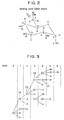
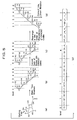
- FIG. 1 shows the procedure for forming a molecular tree and a CANOST linear notation (a planar structure) using a-Glc-4C as a model molecule.
- FIG. 1(a) shows a conformation of a-Glc-4C, and the same conformation is enlarged to be shown in FIG. 2.
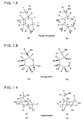
- FIG. 12(a) the planar structure of a-Glc-4C is shown in FIG. 12(a), and the configuration of a-Glc-4C is shown in FIG. 13(a).
- Node numbers 1 through 6 correspond to carbon atoms C1 through C-6, and node numbers 7 through 12 correspond to O-1 through O-6.
- the carbon atom of the node 6 is herein noticed as an example, and the carbon atom of the node 6 is set as a start atom. Subsequent procedures are similarly carried out every noticed start atom.
- a start atom is classified as level 0, and four atoms O, H, H and C combined with the start atom on the higher hierarchy side are classified as level 1.
- the bonds of the four atoms to the start atom are expressed, and the four atoms O, H, H and C are vertically arranged.
- atoms combined with the atoms of level 1 on the higher hierarchy side are classified as level 2, and similarly, atoms are sequentially classified into hierarchies until the final hierarchy which is set so as to be specially requested.
- a first molecular tree shown in FIG. 1(b) is formed at the hierarchy classifying step.
- the final hierarchy which is set so as to be specially requested may be set in accordance with the degree of similarity between molecules serving as objects to be compared, in view of the need for strictly deriving the degree. As the final hierarchy is set to be a deeper or higher hierarchy from the start atom, it is possible to strictly determine the degree of similarity.
- a molecular tree forming step according to the present invention will be described below.
- Atomic symbols in the first molecular tree shown in FIG. 1(b) are converted into CANOST codes in accordance with a CANOST code list (CANOST CODE LIST) shown in FIG. 4.
- CANOST CODE LIST CANOST CODE LIST
- FIG. 1(c) a second molecular tree is formed.
- CANOST code list shown in FIG. 4 a precedence is defined in order of figures included in column “no.”, and partial structures included in column “substructure” are expressed by CANOST codes included in column "code”.
- a predetermined precedence rule for placing a plurality of atoms, which belong to the same hierarchy, in the order is set.
- a precedence rule described in the CANOST code list shown in FIG. 4 is herein adopted as the predetermined precedence rule.
- the CANOST code precedence rule is adopted, lower hierarchies are preferentially sequentially adopted to arrange CANOST codes every hierarchy.
- the CANOST codes are rearranged in accordance with the CANOST code precedence rule to form a third molecular tree shown in FIG. 1(d).
- the third molecular tree the plurality of atoms belonging to the same hierarchy are arranged so that the precedence decreases from top to bottom.
- the third molecular tree enlarged in FIG. 3 corresponds to a molecular tree according to the present invention.
- a predetermined linear notation rule for expressing a molecular tree by a row of characters will be described below.
- a CANOST code linear notation rule adopting a predetermined linear notation rule as an example will be herein described.
- symbol “*” denotes a boundary between adjacent levels
- symbol ";” denotes a boundary between atoms belonging to the same hierarchy
- symbol ",” denotes a boundary between atoms in one lower hierarchy to be connected.
- an under line drawn below C1 at node 2 denotes the position of an atom at which a cyclic structure is cut when the molecular tree is prepared.
- linear notation shown in FIG. 1(e) is a CANOST linear notation which is an example of a planar structure code expressing a planar structure of a molecule, and corresponds to "CANOST" in FIG. 20 and so forth which will be described later.
- planar structure code is formed as follows. That is, as shown in FIG. 1(e), there is prepared a planar structure code expressing the planar structure of a molecule every start atom by carrying out the linear notation of the third molecular tree expressed using planar structure symbols, e.g., CANOST codes, which express the bonding relationship between a plurality of atoms as a planar structure, in accordance with a linear notation rule (a CANOST code linear notation rule) for expressing the third molecular tree by a row of characters.
- planar structure symbols e.g., CANOST codes, which express the bonding relationship between a plurality of atoms as a planar structure, in accordance with a linear notation rule (a CANOST code linear notation rule) for expressing the third molecular tree by a row of characters.
- FIG. 5 shows a molecular tree and a CANOST linear notation which are prepared using a-Glc-4C-chain as a model molecule.
- a first molecular tree shown in (b) is formed from a conformation (a) of a-Glc-4C-chain.
- the first molecular tree is converted into CANOST codes to form a second molecular tree shown in (c).
- a third molecular tree shown in (d) is formed from the second molecular tree using a CANOST code precedence rule.
- a CANOST linear notation shown in (e) is obtained from the third molecular tree using a CANOST code linear notation rule.
- planar structure planar structure
- FIG. 13(b) its configuration (configuration) is shown in FIG. 13(b).
- FIG. 3 is an enlarged view of the molecular tree (third molecular tree) shown in FIG. 1(d).
- “Q1" 11 in level 4 is noticed.
- "C1" 12 in level 3 which is to be combined with the "Q1” 11 in level 3 is extracted.
- the atom in level 3, which is to be combined with the "Q1” 11, is uniquely determined to be the "C1” 12.
- "C1" 13 to be combined with the "C1” 12 in level 2 is extracted.
- the atom in level 2 which is to be combined with the "C1” 12
- the atom in level 2 which is to be combined with the "C1” 12
- the atom in level 2 which is to be combined with the "C1” 12
- the atom in level 2 which is to be combined with the "C1” 12
- “C1" 14 to be combined with the "C1” 13 in level 1 is extracted.
- the atom in level 1, which is to be combined with the "C1" 13, is uniquely determined to be the "C1" 14.
- there is set one group comprising four atoms which comprise the "Q1" 11 in level 4, the "C1" 12 in level 3, the "C1” 13 in level 2, and the "C1" 14 in level 1.
- the group comprising the four atoms is uniquely determined if an atom to be noticed (the "Q1" 11 in level 4 in the above described example) is determined since atoms to be combined are extracted from the higher hierarchy side to the lower hierarchy side in the molecular tree. Therefore, according to the present invention, the stereochemistry of the noticed atom can be uniquely expressed by a dihedral angle which will be described later.
- a dihedral angle means an angle between a plane, which is formed by the "Q1” 11 in level 4, the "C1” 12 in level 3 and the “C1” 13 in level 2, and a plane which is formed by the "C1" 12 in level 3, the “C1” 13 in level 2 and the “C1” 14 in level 1.
- the value of the dihedral angle is obtained from information on the molecular three-dimensional structure of a-Glc-4C.
- the dihedral angle derived with respect to the noticed "Q1" 11 in level 4 is replaced with an angular symbol, which is defined in accordance with a predetermined angle dividing rule, in accordance with the magnitude of the dihedral angle, and the replaced angle symbol is given to the noticed "Q1" 11 in level 4.
- an example of a predetermined angle dividing rule will be described below.
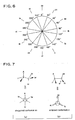
- an angle of 360 degrees is divided into 12 angular ranges in the form of a clock dial.
- a symbol corresponding to a figure of the clock dial is added. As shown in FIG. 6, an example of a predetermined angle dividing rule will be described below.
- the angle division shown in FIG. 6 is mainly based on the abundance ratio in a steric structure taken by atoms of sp 3 type. That is, to a staggered conformation (such as a stable conformation of a chain molecule or a six-membered ring) shown in FIG. 7(a), wide angular ranges of 40 degrees about the angular centers of 60, 180 and 300 degrees are given, and angular symbols of tw, si and te are added, respectively. In addition, to an eclipsed conformation (such as a three-membered ring or a bicyclo ring) shown in FIG.
- a staggered conformation such as a stable conformation of a chain molecule or a six-membered ring
- FIG. 7(a) wide angular ranges of 40 degrees about the angular centers of 60, 180 and 300 degrees are given, and angular symbols of tw, si and te are added, respectively.
- an eclipsed conformation such as
- a dihedral angle is derived with respect to a group comprising four atoms extending over four levels, and an angular symbol is given thereto.
- atoms belonging to level 2 can not form a group comprising four atoms even in a lower hierarchy. Therefore, symbols of "A”, "B” and “C” are uniformly given to atoms in level 0, level 1 and level 2, respectively, as shown in “Stereo” in FIG. 20 and so forth.
- a conformation code preparing step according to the present invention will be described below.
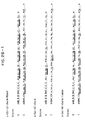
- the linear notation of the molecular tree coded by the angular symbols is carried out in accordance with the CANOST code linear notation rule so as to correspond to the molecular tree. Then, conformation codes using the atom at the node 6 of a-Glc-4C as a start atom are prepared. The prepared conformation codes using the atom at the node 6 of a-Glc-4C as the start atom are shown at the position of number "6" in the left column of "Stereo" in FIG. 20.
- a-Glc-4C is used as a start atom for preparing conformation codes which are shown at the position of number "1" and so forth in the left column of "Stereo" in FIG. 20.
- the conformation codes are derived by the hierarchy classifying step, molecular tree forming step, coding step and conformation code preparing step.
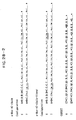
- conformation codes (expressed as “Stereo") derived with respect to various molecules are shown.
- CANOST linear notations which are planer structure codes are described as “CANOST”, and configuration codes which will be described later are described as "Configuration”.
- the conformation code preparing step even if atoms at all of the nodes are used as start atoms, if conformation codes are prepared using two start atoms, the difference between the numbers of the hierarchies of which is three or more, the stereochemistry of the whole molecule can be expressed. Thus, even if atoms at all of the nodes are not adopted as start atoms, if only atoms noticed with respect to stereochemistry or atoms near thereto are adopted as start atoms to derive conformation codes corresponding thereto, it is possible to sufficiently know required stereochemistry.
- a group of atoms having a low degree of notice in the identification of stereochemistry can be replaced with predetermined symbols to be masked.
- the stereochemistry of a group of atoms having a high degree of notice in the identification of stereochemistry can be directly compared.
- configuration codes expressing the configuration of a molecule can be prepared.
- a configuration code preparing step of preparing configuration codes will be described below.
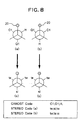
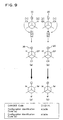
- FIG. 8 is a diagram showing a conformation code preparing step by a Newman projection drawing. This figure shows three atoms C1, H and Q1 which are combined with one atom and which are shown by codes C1, H and Q1 belonging to the (n+3)-th hierarchy, and an atom 20 belonging to the n-th hierarchy which is lower than the hierarchy of the three atoms by three hierarchies. The atom 20 is positioned at a reference position, e.g., "ze" of 0 o'clock.
- an angle required to rotate each of the three atoms C1, H and Q1 belonging to the (n+3)-th hierarchy counterclockwise around a bonding axis, which connects an atom in the (n+1)-th hierarchy to an atom in the (n+2)-th hierarchy, to cause each of the three atoms to overlap with the atom 20 is the magnitude of a dihedral angle.
- a most preferential atom (C1) between the three atoms C1, H and Q1 belonging to the (n+3)-th hierarchy is noticed in accordance with the above described CANOST code precedence rule. Then, all of the three atoms C1, H and Q1 belonging to the (n+3)-th hierarchy are integrally rotated around the bonding axis connecting the atom in the (n+1)-th hierarchy and the atom in the (n+2)-th hierarchy so that the most preferential C1 is arranged at an angular position of "si" which is an angular position of 180 degrees with respect to a reference position "ze".
- configuration codes herein expressed as configuration identification codes
- configuration identification codes in the projection drawing (a) are the same as those in the projection drawing (b), so that the configurations are the same.
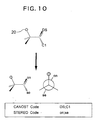
- FIGS. 10 and 11 are diagrams for explaining a conformation and configuration with respect to a single bond of sp 2 type.
- FIG. 10 shows atoms which belong to the (n+3)-th hierarchy and which are denoted by codes of DS and C1, and an atom 20 belonging to the n-th hierarchy which is lower than the hierarchy of the atoms by three hierarchies.
- the atom 20 is positioned at the reference position "ze”.
- each of the two atoms DS and C1 belonging to the (n+3)-th hierarchy is rotated counterclockwise about the bonding axis connecting atoms (not shown) in the (n+1)-th hierarchy to atoms in the (n+2)-th hierarchy, to derive a dihedral angle which serves as an angle required to cause each of the atoms to overlap with the atom 20.
- FIG. 10 shows atoms which belong to the (n+3)-th hierarchy and which are denoted by codes of DS and C1, and an atom 20 belonging to the n-th hierarchy which is lower than the hierarchy of the atoms by three hierarchies.
- the atom 20 is positioned at the reference
- configuration codes (herein expressed as configuration identification codes) are derived in the same manner as that in FIG. 9.
- the atoms belonging to the (n+3)-th hierarchy can not be rotated about the bonding axis connecting the atoms in the (n+1)-th hierarchy to the atoms in the (n+2)-th hierarchy. Therefore, angular symbols in conformation codes may be adopted as they are, so that configuration codes may be prepared.
- the conformation and configuration thereof can be expressed using special codes which express special structures such as a triple bond, a portion surrounding the triple bond or allene.
- the configuration codes expressing the configuration of a molecule can be prepared by the configuration code preparing step.
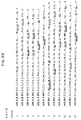
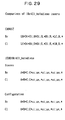
- the configuration codes (herein expressed as Configuration) derived with respect to various molecules are shown in FIGS. 20, 25, 28 and 29.
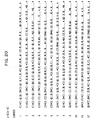
- FIG. 20 shows CANOST linear notations (herein expressed as CANOST) which are planar structure codes, conformation codes (herein expressed as Stereo) and configuration codes (herein expressed as Configuration) with respect to a-Glc-4C.
- CANOST linear notations herein expressed as CANOST
- Stereo conformation codes
- Configuration configuration codes
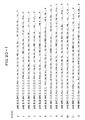
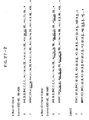
- FIG. 21 shows conformation codes (Stereo) derived by masking a group of atoms having a low degree of notice in the identification of stereochemistry.
- the top stage includes conformation codes which are not masked
- the middle stage includes conformation codes which are obtained by replacing each of hydrogen atoms of a methylene group CH 2 with a code "H” and masking the replaced codes
- the bottom stage includes conformation codes which are obtained by replacing each of hydrogen atoms of a methylene group CH 2 with a code "H”, replacing the hydrogen atom of a hydroxyl group OH with a code "OH” and masking the replaced codes.
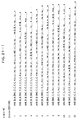
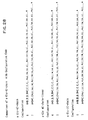
- FIG. 22 shows conformation codes (herein expressed as Stereo) of b-Glc-4C which is an object to be compared with a-Glc-4C.
- the top stage includes conformation codes which are not masked
- the middle stage includes conformation codes which are obtained by masking each of hydrogen atoms included in a methylene group CH 2
- the bottom stage includes conformation codes obtained by masking atoms, which are included in a methylene group CH 2 and hydroxyl group OH, by the above described manner.
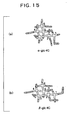
- FIG. 15 shows stereostructural formulae of a-Glc-4C and b-Glc-4C.
- a- such as a-Glc
- b- shows a configuration of ⁇ -Glc
- portions shown by slant lines denotes oxygen
- portions shown by a void denotes carbon
- portions shown by sands denotes hydrogen atoms.
- the conformation codes (Stereo) of a-Glc-4C and b-Glc-4C will be compared with each other.
- portions shown by double under lines are portions to which different codes are assigned in accordance with the difference in stereochemistry at the 1-position.
- portions shown by single under lines are portions showing the difference between the orientations of hydroxyl groups. In order to know the difference between the orientations of hydroxyl groups, the portions shown by the single under lines may be noticed.
- portions shown by wave under lines are produced by the inversion of the precedence of the CANOST code precedence rule, which is caused since serial numbers of two hydrogen atoms of a methylene (CH 2 ) at the 6-position are different when a structure is inputted. In such a case, as described above, they are replaced with other angular symbols to be masked. Thus, it is possible to ignore the difference, which is not based on the essential structural difference, to effectively examine the presence of the considerable difference of the structure.
- node numbers 1 through 6 correspond to C-1 through C-6
- node numbers 7 through 12 correspond to O-1 through O-6.
- a-Glc-4C and b-Glc-4C is an epimer at the 1-position
- all of codes other than those starting from node numbers 1, 2 and 11 are partially different. Since dihedral angle information about a asymmetric center at the 1-position does not exist in conformation codes (Stereo) starting from the vicinity of a asymmetric center at the 1-position, it is possible to identify a molecule by the conformation codes (Stereo) of a start atom which is spaced from the asymmetric center. Furthermore, as described above, the conformation of the whole molecule can be expressed by the conformation codes of two start atoms which are generally spaced by three bonds, and stereoisomerism can be identified.
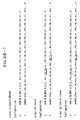
- FIGS. 23 through 25 show the comparison of the obtained results at only two nodes 6 and 7 which are selected as start atoms with respect to various molecules, the stereostructural formulae of which are shown in FIGS. 15 and 16.
- conformation codes (Stereo) which are not masked are compared.
- conformation codes (Stereo) which are masked are compared.
- configuration codes (Configuration) are compared.
- the comparison is carried out with respect to a-Glc-4C, and different portions are shown by single and double under lines similar to the above described case.
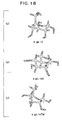
- FIGS. 26 through 28 show the comparison of the obtained results at only two nodes 6 and 7 which are selected as start atoms with respect to various molecules, the stereostructural formulae of which are shown in FIG. 18.
- FIG. 12(b) shows the planar structural formula of a molecule.
- conformation codes (Stereo) which are not masked are compared.
- conformation codes (Stereo) which are masked are compared.
- configuration codes (Configuration) are compared.
- the comparison is carried out with respect to a-Glc-4C-chain, and different portions are shown by single and double under lines.
- Step2 If it is determined at ST2 that the conformation codes (Stereo) are different, it is determined at ST4 whether the configuration codes (Configuration) are the same or different.
- the partial structure recognition is as follows. That is, while the above described example has related to recognition of the whole molecule, it is necessary to identify a partial conformation of a partial structure and to compare relative arrangements in order to apply the present invention to the prediction of the chemical shift of 13 C-NMR. According to the present invention, this can be achieved by combining and comparing conformation codes (Stereo) and configuration codes (Configuration) starting from a node other than H spaced from a carbon atom, which is to be noticed, by three bonds if necessary.
- planar structure codes CANOST
- configuration codes Configuration
- conformation codes Stepo
- a program in which a stereochemical coding method for taking stereochemistry about each of a plurality of atoms constituting a molecule to code the molecule has been described, can be recorded in a computer readable recording media.
Landscapes
- Engineering & Computer Science (AREA)
- Data Mining & Analysis (AREA)
- Chemical & Material Sciences (AREA)
- Crystallography & Structural Chemistry (AREA)
- Life Sciences & Earth Sciences (AREA)
- Bioinformatics & Cheminformatics (AREA)
- Bioinformatics & Computational Biology (AREA)
- Computing Systems (AREA)
- Theoretical Computer Science (AREA)
- Information Retrieval, Db Structures And Fs Structures Therefor (AREA)
- Organic Low-Molecular-Weight Compounds And Preparation Thereof (AREA)
- Nitrogen Condensed Heterocyclic Rings (AREA)
Abstract
There is provided a molecular coding method capable of
being applied to, e.g., the prediction of the NMR chemical shift,
and computer-readably and canonically coding information on a
stereostructural environment, such as conformation and
configuration, of a molecule.
In a molecular stereochemical coding method for taking a
stereochemistry about each of a plurality of atoms constituting
a molecule to code the molecule, atoms are sequentially assigned
to hierarchies, and a predetermined precedence rule for placing
a plurality of atoms belonging the same hierarchy in the order.
Then, molecular trees are formed from a lower hierarchy to a higher
hierarchy so as to express the bonding relationship between the
plurality of atoms. Then, a dihedral angle is derived with
respect to a group comprising an atom in the (n+3)-th hierarchy,
which is to be noted, an atom in the (n+2)-th hierarchy, an atom
in the (n+1)-th hierarchy and an atom in the n-th hierarchy. In
accordance with the magnitude of the dihedral angle, the dihedral
angle is replaced with an angular symbol which is defined in
accordance with a predetermined angle dividing rule, and a symbol
is given to the noticed atom in the (n+3)-th hierarchy. Then,
a predetermined linear rule for expressing the molecular tree
by a row of characters is set, and a linear notation is carried
out so as to correspond to the molecular tree, to prepare codes
concerning a stereochemistry indicative of conformation and
configuration of the molecule with respect to the start atom.
Description
The present invention relates generally to a molecular
stereochemical coding method. More specifically, the invention
relates to a molecular stereochemical coding method for taking
a stereochemistry about each of a plurality of atoms constituting
a molecule to code the molecule.
As methods for describing stereochemical information of
a molecular structure so as to be capable of writing and reading
the stereochemical information in and out of a computer, there
are a method for describing the positions of atoms in a
three-dimensional coordinate system such as the Cartesian
coordinate system or internal coordinate system, and a method
for mathematically describing the topological relationship
between atoms for the purpose of unique nomenclature of a molecule
including stereochemistry.
Since the former method for describing the positions of
atoms in the three-dimensional coordinate system can not uniquely
express them, it is difficult or complicated to compare the
similarity and/or homology of molecules. The latter method for
mathematically describing the topological relationship between
atoms can express the absolute configuration (R, S) of asymmetric
carbon and so forth. However, this method can not describe
relative steric environment between optional atoms, so that it
is not possible to express information on conformation and so
forth in the present circumstances.
For example, when it is intended to predict the NMR chemical
shift from the existing data base, stereochemical information
suitable therefor has not been canonically coded. For that
reason, only information on planar structure has been used in
the present circumstances. The prediction of the chemical shift
based on the data base taking account of stereochemistry has not
been realized even in any conventional chemical shift predicting
computer systems.
In addition, there are not any notation techniques capable
of easily utilizing information on a difference in
stereostructural environment, such as conformation and
configuration, between a plurality of molecules, as computer
readable data.
It is therefore an object of the present invention to solve
the above described problems of the prior art and to provide a
molecular coding method for computer-readably and canonically
coding information on stereostructural environment, such as
conformation and configuration, of a molecule.
In order to the above described object, according to a first
aspect of the present invention, there is provided a molecular
stereochemical coding method for taking a stereochemistry about
each of a plurality of atoms constituting a molecule to code the
molecule, the method comprising: a hierarchy classifying step
of assigning a start atom, which is to be noticed, to a zero-th
hierarchy serving as the lowest hierarchy, assigning an atom,
which is combined with the start atom on a higher hierarchy side,
to a first hierarchy, assigning an atom, which is combined with
the atom assigned to the first hierarchy, to a second hierarchy,
and similarly, sequentially assigning atoms to hierarchies until
the final hierarchy which is set so as to be specially requested;
a molecular tree forming step of setting a predetermined
precedence rule for placing a plurality of atoms, which belong
to the same hierarchy, in the order, and placing the atoms, which
belong the same hierarchy, in the order every hierarchy in
accordance with the precedence rule, to form a molecular tree
every the start atom from a lower hierarchy to a higher hierarchy
so as to express a bonding relationship between the plurality
of atoms; a coding step of noticing one of atoms, which are
assigned to the (n+3)-th hierarchy, with respect to each of
integers n assuming that n is an integer of 0 or more, in the
molecular tree, deriving a dihedral angle between a plane, which
is formed by an atom in the (n+3)-th hierarchy, an atom in the
(n+2)-th hierarchy and an atom in the (n+1)-th hierarchy, and
a plane, which is formed by the atom in the (n+2)-th hierarchy,
the atom in the (n+1)-th hierarchy and an atom in the n-th
hierarchy, with respect to a group comprising four atoms which
consists of the noticed atom in the (n+3)-th hierarchy, the atom
in the (n+2)-th hierarchy which is combined with the atom in the
(n+3)-th hierarchy, the atom in the (n+1)-th hierarchy which is
combined with the atom in the (n+2)-th hierarchy, and the atom
in the n-th hierarchy which is combined with the atom in the
(n+1)-th hierarchy, replacing the derived dihedral angle into
an angular symbol, which is defined in accordance with a
predetermined angle dividing rule, in accordance with the
magnitude of the dihedral angle, giving the replaced angular
symbol to the noticed atom in the (n+3)-th hierarchy, and
similarly, giving angular symbols in accordance with the
magnitudes of the dihedral angles with respect to other atoms
to be noticed; and setting a predetermined linear notation rule
for expressing the molecular tree by a row of characters, carrying
out the linear notation of a set of the plurality of angular
symbols in accordance with the predetermined linear notation rule
so as to correspond to the molecular tree, preparing a
conformation code indicative of a conformation of the molecule
with respect to the start atom, and similarly, preparing
conformation codes with respect to other start atoms.
According to the first aspect of the present invention,
since the four atoms are sequentially assigned from the atom
belonging to the (n+3)-th hierarchy, which is noticed in the
molecular tree, to the atom belonging to the n-th hierarchy to
be set as a group, the group comprising the four atoms is uniquely
determined, so that the dihedral angle in this group is uniquely
derived. Since the linear notation of the molecular tree
expressed by the angular symbols is carried out in the
predetermined linear notation rule to form the conformation codes,
stereochemical information can be computer-readably coded. By
comparing the conformation codes between compared molecules, the
difference in conformation can be determined.
According to a second aspect of the present invention, the
molecular stereochemical coding method according the first
aspect of the present invention further comprises a configuration
code preparing step of preparing a configuration code indicative
of a configuration of the molecule every the start atom, wherein
the configuration code preparing step causes an atom, which is
to be noticed in the n-th hierarchy, to be positioned at a
reference position in the angle dividing rule, integrally rotates
the atoms belonging to the (n+3)-th hierarchy about a bonding
axis, which connects the atom in the (n+1)-th hierarchy to the
atom in the (n+2)-th hierarchy, so that an atom, which has a
predetermined precedence in accordance with the precedence rule
among the atoms belonging to the (n+3)-th hierarchy, is positioned
at a predetermined angular position with respect to the reference
position, gives an angular symbol according to the angle dividing
rule to each of the atoms belonging to the (n+3)-th hierarchy,
in accordance with an angular position after rotation with respect
to the reference position, carries out the linear notation of
a set of the plurality of angular symbols in accordance with the
predetermined linear notation rule so as to correspond to the
molecular tree, and prepares a configuration code every the start
atom.
According to the second aspect of the present invention,
since it is possible to obtain the configuration codes indicative
of the linearly expressed molecular configuration in addition
to the conformation codes, stereochemistry information including
conformation and configuration can be computer-readably coded.
According to a third aspect of the present invention, the
molecular stereochemical coding method according to the second
aspect of the present invention further comprises a planar
structure code preparing step of preparing a planar structure
code indicative of a planar structure of the molecule every the
start atom, wherein the planar structure code preparing step
expresses the molecular tree by a set of planar structure symbols
which planar-structurally express a bonding relationship between
the plurality of atoms, carries out the linear notation of the
set of planar structure symbols in accordance with the
predetermined linear notation rule so as to correspond to the
molecular tree, prepares a planar structure code indicative of
the planar structure of the molecule with respect to the start
atom, and similarly, prepares planar structure codes with respect
to other start atoms.
According to the third aspect of the present invention,
since it is possible to obtain the planar structure codes
indicative of the linearly expressed molecular planar structure
in addition to the conformation codes and configuration codes,
it is possible to easily carry out the total comparison between
molecules, the planar structures, conformations and
configurations of which are compared.
In the molecular stereochemical coding method according
to the third aspect of the present invention, the conformation
codes, the configuration codes and the planar structure codes
may be expressed in parallel with respect to the start atoms.
Thus, it is possible to easily compare the conformation codes
and the configuration codes while referring to the planar
structure codes indicative of the planar structure of the
molecule.
In the molecular stereochemical coding method according
to the third aspect of the present invention, when it is impossible
to rotate the atoms belonging to the (n+3)-th hierarchy about
the bonding axis connecting the atom belonging to the (n+1)-th
hierarchy to the atom belonging to the (n+2)-th hierarchy,
the angular symbols given at the coding step may be adopted as
they are, and the linear notation of a set of the plurality of
angular symbols may be carried out in accordance with the
predetermined linear notation rule so as to correspond to the
molecular tree, to prepare the configuration codes for every the
start atom. Thus, even if it is impossible to rotate the atoms
belonging to the (n+3)-th hierarchy about the bonding axis
connecting the atom belonging to the (n+1)-th hierarchy to the
atom belonging to the (n+2)-th hierarchy, it is possible to form
the configuration codes.
In the molecular stereochemical coding method according
to the third aspect of the present invention, the planar
structural codes may be CANOST linear notations. Thus, it is
possible to utilize the existing technique.
In the molecular stereochemical coding method according
to the first aspect of the present invention, the precedence rule
may be a CANOST code precedence rule. Thus, it is possible to
utilize the existing technique.
In the molecular stereochemical coding method according
to the first aspect of the present invention, the predetermined
linear notation rule may be a CANOST code linear notation rule.
Thus, it is possible to utilize the existing technique.
In the molecular stereochemical coding method according
to the first aspect of the present invention, at the molecular
tree forming step, a group of atoms having a low degree of notice
in the identification of stereochemistry may be replaced with
predetermined symbols to be masked. Thus, it is possible to
ignore a difference, which is not based on the essential
structural difference, to examine a difference which is based
on a considerable structural difference.
In the molecular stereochemical coding method according
to the first aspect of the present invention, the predetermined
angle dividing rule may divide an angle of 360 degrees into a
predetermined number of clock-dial-like angular ranges, and the
divided angular ranges may be reflected in the level of abundance
to be unequally divided. Thus, it is possible to enhance the
applicability and reliability of the conformation codes.
In the molecular stereochemical coding method according
to the first aspect of the present invention, at the conformation
code preparing step, the conformation codes may be prepared with
respect to at least two of the start atoms, the hierarchy numbers
of which are spaced from each other by three hierarchies or more.
According to a fourth aspect of the present invention,
there is provided a computer readable recording media in which
a program for executing the molecular stereochemical coding
method according to the first aspect of the present invention
has been recorded. Thus, the molecular stereochemical coding
method according to the first aspect of the present invention
can be easily executed by means of a computer.
Referring to the accompanying drawings, the preferred
embodiments of a molecular coding method according to the present
invention will be described below.
First, a model molecule adopted to explain a molecular
stereochemical coding method according to the present invention
will be described.
Sugars were used as model molecules since sugars can be
expressed in the form of cyclic molecules and chain molecules
and have various conformations and many stereoisomers.
Specifically, D-glucose (abbreviation: Glc), D-galactose
(abbreviation: Gal) which is an isomer at the 4-position, D-mannose
(abbreviation: Man) which is an isomer at the 2-position,
and so forth were used as model molecules. With respect to
stereochemistry at the 1-position, one having "a-", such as a-Glc,
shows a configuration of α-Glc, and one having "b-" shows a
configuration of β-Glc. Similarly in FIG. 20 and so forth, one
having "a-", such as a-Glc, shows a coordination of α-Glc, and
one having "b-" shows a coordination of β-Glc.
In addition, 1C and 4C show a conformation wherein a carbon
atom at the 1-position or 4-position is arranged at the apex of
a chair form, 14B shows a conformation wherein carbon atoms at
the 1-position and 4-position are arranged at both ends of a boat
form, and 14TW shows a conformation of a twist-boat form derived
from the conformation of 14B.
These sugars also take chain forms wherein a reducing
terminal at the 1-position is aldehyde (-CHO). Among those
taking chain forms, one holding a conformation of the original
cyclic structure is expressed so that a cyclic conformation, such
as 4C-chain, is also described. In addition, one having "-linear"
at the end, such as 4C-chain-linear, shows one of stable
conformations wherein a carbon chain is linear. Moreover, a-Glc-1C-chain-H-bond
shows a conformation capable of forming a
hydrogen bond between a hydroxyl group at the 3-position and a
carbonyl group at the 1-position.
As double bond models, four kinds of geometrical isomers
of 1-bromo-4-chlorobutadiene were used. The conformation is a
planar conformation wherein the central single bond and the double
bond are arranged on the same plane.
Referring to the accompanying drawings, a method for coding
the stereochemistry of a molecule will be specifically described
below.
FIG. 1 shows the procedure for forming a molecular tree
and a CANOST linear notation (a planar structure) using a-Glc-4C
as a model molecule. FIG. 1(a) shows a conformation of a-Glc-4C,
and the same conformation is enlarged to be shown in FIG. 2.
With respect to a-Glc-4c, as compared with a-Glc-4C-chain
which will be described later, the planar structure of a-Glc-4C
is shown in FIG. 12(a), and the configuration of a-Glc-4C is shown
in FIG. 13(a).
The carbon atom of the node 6 is herein noticed as an example,
and the carbon atom of the node 6 is set as a start atom.
Subsequent procedures are similarly carried out every noticed
start atom.
First, a hierarchy classifying process according to the
present invention will be described below.
As shown in FIG. 1(b), a start atom is classified as level
0, and four atoms O, H, H and C combined with the start atom on
the higher hierarchy side are classified as level 1. In addition,
the bonds of the four atoms to the start atom are expressed, and
the four atoms O, H, H and C are vertically arranged. Similarly,
atoms combined with the atoms of level 1 on the higher hierarchy
side are classified as level 2, and similarly, atoms are
sequentially classified into hierarchies until the final
hierarchy which is set so as to be specially requested. Thus,
a first molecular tree shown in FIG. 1(b) is formed at the
hierarchy classifying step.
The final hierarchy which is set so as to be specially
requested may be set in accordance with the degree of similarity
between molecules serving as objects to be compared, in view of
the need for strictly deriving the degree. As the final hierarchy
is set to be a deeper or higher hierarchy from the start atom,
it is possible to strictly determine the degree of similarity.
A molecular tree forming step according to the present
invention will be described below.
Atomic symbols in the first molecular tree shown in FIG.
1(b) are converted into CANOST codes in accordance with a CANOST
code list (CANOST CODE LIST) shown in FIG. 4. As a result, as
shown in FIG. 1(c), a second molecular tree is formed. In the
CANOST code list shown in FIG. 4, a precedence is defined in order
of figures included in column "no.", and partial structures
included in column "substructure" are expressed by CANOST codes
included in column "code".
Then, with respect to a second molecular tree shown in FIG.
1(c), a predetermined precedence rule for placing a plurality
of atoms, which belong to the same hierarchy, in the order is
set. A precedence rule described in the CANOST code list shown
in FIG. 4 is herein adopted as the predetermined precedence rule.
When the CANOST code precedence rule is adopted, lower hierarchies
are preferentially sequentially adopted to arrange CANOST codes
every hierarchy.
The CANOST codes are rearranged in accordance with the
CANOST code precedence rule to form a third molecular tree shown
in FIG. 1(d). In the third molecular tree, the plurality of atoms
belonging to the same hierarchy are arranged so that the
precedence decreases from top to bottom. The third molecular
tree enlarged in FIG. 3 corresponds to a molecular tree according
to the present invention.
A predetermined linear notation rule for expressing a
molecular tree by a row of characters will be described below.
Referring to FIG. 1(e), a CANOST code linear notation rule
adopting a predetermined linear notation rule as an example will
be herein described.
In FIG. 1(e), symbol "*" denotes a boundary between
adjacent levels, symbol ";" denotes a boundary between atoms
belonging to the same hierarchy, and symbol "," denotes a boundary
between atoms in one lower hierarchy to be connected.
Furthermore, in FIG. 1(e), an under line drawn below C1 at node
2 denotes the position of an atom at which a cyclic structure
is cut when the molecular tree is prepared.
Furthermore, the linear notation shown in FIG. 1(e) is a
CANOST linear notation which is an example of a planar structure
code expressing a planar structure of a molecule, and corresponds
to "CANOST" in FIG. 20 and so forth which will be described later.
As can be clearly seen from the foregoing, the planar
structure code according to the present invention is formed as
follows. That is, as shown in FIG. 1(e), there is prepared a
planar structure code expressing the planar structure of a
molecule every start atom by carrying out the linear notation
of the third molecular tree expressed using planar structure
symbols, e.g., CANOST codes, which express the bonding
relationship between a plurality of atoms as a planar structure,
in accordance with a linear notation rule (a CANOST code linear
notation rule) for expressing the third molecular tree by a row
of characters.
FIG. 5 shows a molecular tree and a CANOST linear notation
which are prepared using a-Glc-4C-chain as a model molecule. In
FIG. 5, a first molecular tree shown in (b) is formed from a
conformation (a) of a-Glc-4C-chain. The first molecular tree is
converted into CANOST codes to form a second molecular tree shown
in (c). Then, a third molecular tree shown in (d) is formed from
the second molecular tree using a CANOST code precedence rule.
Moreover, a CANOST linear notation shown in (e) is obtained from
the third molecular tree using a CANOST code linear notation rule.
With respect to a-Glc-4C-chain, as compared with a-Glc-4C, its
planar structure (planar structure) is shown in FIG. 12(b), and
its configuration (configuration) is shown in FIG. 13(b).
A coding step according to the present invention will be
described below.
FIG. 3 is an enlarged view of the molecular tree (third
molecular tree) shown in FIG. 1(d). For example, in FIG. 3, "Q1"
11 in level 4 is noticed. Then, "C1" 12 in level 3, which is to
be combined with the "Q1" 11 in level 3, is extracted. The atom
in level 3, which is to be combined with the "Q1" 11, is uniquely
determined to be the "C1" 12. Then, "C1" 13 to be combined with
the "C1" 12 in level 2 is extracted. Similarly, the atom in level
2, which is to be combined with the "C1" 12, is uniquely determined
to be the "C1" 13. Then, "C1" 14 to be combined with the "C1"
13 in level 1 is extracted. Similarly, the atom in level 1, which
is to be combined with the "C1" 13, is uniquely determined to
be the "C1" 14. Thus, there is set one group comprising four atoms
which comprise the "Q1" 11 in level 4, the "C1" 12 in level 3,
the "C1" 13 in level 2, and the "C1" 14 in level 1.
It should be herein noted that the group comprising the
four atoms is uniquely determined if an atom to be noticed (the
"Q1" 11 in level 4 in the above described example) is determined
since atoms to be combined are extracted from the higher hierarchy
side to the lower hierarchy side in the molecular tree. Therefore,
according to the present invention, the stereochemistry of the
noticed atom can be uniquely expressed by a dihedral angle which
will be described later.
Then, with respect to four groups comprising the "Q1" 11
in level 4, the "C1" 12 in level 3, the "C1" 13 in level 2 and
the "C1" 14 in level 1, a dihedral angle is derived. The dihedral
angle means an angle between a plane, which is formed by the "Q1"
11 in level 4, the "C1" 12 in level 3 and the "C1" 13 in level
2, and a plane which is formed by the "C1" 12 in level 3, the
"C1" 13 in level 2 and the "C1" 14 in level 1. The value of the
dihedral angle is obtained from information on the molecular
three-dimensional structure of a-Glc-4C.
The dihedral angle derived with respect to the noticed "Q1"
11 in level 4 is replaced with an angular symbol, which is defined
in accordance with a predetermined angle dividing rule, in
accordance with the magnitude of the dihedral angle, and the
replaced angle symbol is given to the noticed "Q1" 11 in level
4.
Referring to FIG. 6, an example of a predetermined angle
dividing rule will be described below. In the angle dividing rule
adopted herein, an angle of 360 degrees is divided into 12 angular
ranges in the form of a clock dial. To the center of each of the
divided angular ranges, a symbol corresponding to a figure of
the clock dial is added. As shown in FIG. 6, 12 angular symbols
including ze (zero), on (one), tw (two), th (three), fo (four),
fi (five), si (six), se (seven), ei (eight), ni (nine), te (ten)
and el (eleven) are provided in the angular ranges of one o'clock,
two o'clock, three o'clock, four o'clock, five o'clock, six
o'clock, seven o'clock, eight o'clock, nine o'clock, ten o'clock
and eleven o'clock, respectively. By these 12 angular symbols,
corresponding angular ranges are expressed.
The angle division shown in FIG. 6 is mainly based on the
abundance ratio in a steric structure taken by atoms of sp3 type.
That is, to a staggered conformation (such as a stable
conformation of a chain molecule or a six-membered ring) shown
in FIG. 7(a), wide angular ranges of 40 degrees about the angular
centers of 60, 180 and 300 degrees are given, and angular symbols
of tw, si and te are added, respectively. In addition, to an
eclipsed conformation (such as a three-membered ring or a bicyclo
ring) shown in FIG. 7(b) which has the second greatest abundance
ratio, wide angular ranges of 40 degrees about the angular centers
of 0, 120 and 240 degrees are given, and angular symbols of ze,
fo and ei are added, respectively. To other angular ranges about
the angular centers of 90, 210, 330, 30, 150 and 270 degrees,
six angular symbols of th, se, el, on, fi and ni are given,
respectively.
Furthermore, with respect to other atoms which are included
in alkyne, allene and or the like and which can not define any
dihedral angles, special codes are set therefor to give symbols
thereto, so that the linear notation of the molecular tree can
be carried out in the same manner as that in the above described
case where the angular symbols are given. With respect to atoms
of sp2 type and sp type, codes therefor can be set and expressed.
According to the angle dividing rule shown in FIG. 6, on
the basis of information on the molecular three-dimensional
structure of a-Glc-4C, an angular symbol "si" is given to the
above described noticed "Q1" 11 in level 4.
Similarly, as described above, a dihedral angle is derived
with respect to a group comprising four atoms extending over four
levels, and an angular symbol is given thereto.
Furthermore, atoms belonging to level 2, level 1 or level
0 can not form a group comprising four atoms even in a lower
hierarchy. Therefore, symbols of "A", "B" and "C" are uniformly
given to atoms in level 0, level 1 and level 2, respectively,
as shown in "Stereo" in FIG. 20 and so forth.
Thus, using angular symbols of "A", "B", "C" and "ze", ···,
"el", the molecular tree shown in FIG. 3 is replaced with the
angular symbols.
A conformation code preparing step according to the present
invention will be described below.
The linear notation of the molecular tree coded by the
angular symbols is carried out in accordance with the CANOST code
linear notation rule so as to correspond to the molecular tree.
Then, conformation codes using the atom at the node 6 of a-Glc-4C
as a start atom are prepared. The prepared conformation codes
using the atom at the node 6 of a-Glc-4C as the start atom are
shown at the position of number "6" in the left column of "Stereo"
in FIG. 20.
Similarly, another atom of a-Glc-4C is used as a start atom
for preparing conformation codes which are shown at the position
of number "1" and so forth in the left column of "Stereo" in FIG.
20.
As described above, the conformation codes are derived by
the hierarchy classifying step, molecular tree forming step,
coding step and conformation code preparing step. In FIGS. 20
through 29, conformation codes (expressed as "Stereo") derived
with respect to various molecules are shown. Furthermore, in
FIGS. 20 through 29, CANOST linear notations which are planer
structure codes are described as "CANOST", and configuration
codes which will be described later are described as
"Configuration".
Furthermore, at the conformation code preparing step, even
if atoms at all of the nodes are used as start atoms, if
conformation codes are prepared using two start atoms, the
difference between the numbers of the hierarchies of which is
three or more, the stereochemistry of the whole molecule can be
expressed. Thus, even if atoms at all of the nodes are not adopted
as start atoms, if only atoms noticed with respect to
stereochemistry or atoms near thereto are adopted as start atoms
to derive conformation codes corresponding thereto, it is
possible to sufficiently know required stereochemistry.
The reason why the difference between the numbers of the
hierarchies of two start atoms is three or more is that it is
possible to obtain all of dihedral angles including atoms in level
0, level 1 and level 2.
At the molecular tree forming step, a group of atoms having
a low degree of notice in the identification of stereochemistry
can be replaced with predetermined symbols to be masked. Thus,
the stereochemistry of a group of atoms having a high degree of
notice in the identification of stereochemistry can be directly
compared.
Another preferred embodiment of the present invention will
be described below.
According to the present invention, configuration codes
expressing the configuration of a molecule can be prepared. A
configuration code preparing step of preparing configuration
codes will be described below.
FIG. 8 is a diagram showing a conformation code preparing
step by a Newman projection drawing. This figure shows three
atoms C1, H and Q1 which are combined with one atom and which
are shown by codes C1, H and Q1 belonging to the (n+3)-th hierarchy,
and an atom 20 belonging to the n-th hierarchy which is lower
than the hierarchy of the three atoms by three hierarchies. The
atom 20 is positioned at a reference position, e.g., "ze" of 0
o'clock. Then, an angle required to rotate each of the three atoms
C1, H and Q1 belonging to the (n+3)-th hierarchy counterclockwise
around a bonding axis, which connects an atom in the (n+1)-th
hierarchy to an atom in the (n+2)-th hierarchy, to cause each
of the three atoms to overlap with the atom 20 is the magnitude
of a dihedral angle. That is, the angle between a plane, which
is formed by each of the three atoms C1, H and Q1 belonging to
the (n+3)-th hierarchy and the bonding axis connecting the atom
in the (n+1)-th hierarchy to the atom in the (n+2)-th hierarchy,
and a plane, which is formed by the atom 20 in the n-th hierarchy
and the bonding axis connecting the atoms in the (n+1)-th
hierarchy and the atoms in the (n+2)-th hierarchy, viewed
clockwise from the atom 20 is the magnitude of a dihedral angle.
As can be clearly seen from the stereostructure shown in FIG.
8, in the left projection drawing (a) and the right projection
drawing (b), although it is common in both molecules that the
three atoms belonging to the (n+3)-th hierarchy are C1, H and
Q1, the conformation about the bonding axis connecting the atom
in the (n+1)-th hierarchy and the atom in the (n+2)-th hierarchy
is different. This is shown by the fact that the conformation
codes of the molecule (a) are different from those of the molecule
(b), referring to the conformation codes (herein expressed as
STEREO codes) in FIG. 8.
However, it is not possible to know the difference between
the configurations in the projection drawings (a) and (b) using
only information shown in FIG. 8. Therefore, a configuration
code preparing step capable of identifying the difference between
the configurations of molecules will be described below.
In FIG. 9, a most preferential atom (C1) between the three
atoms C1, H and Q1 belonging to the (n+3)-th hierarchy is noticed
in accordance with the above described CANOST code precedence
rule. Then, all of the three atoms C1, H and Q1 belonging to the
(n+3)-th hierarchy are integrally rotated around the bonding axis
connecting the atom in the (n+1)-th hierarchy and the atom in
the (n+2)-th hierarchy so that the most preferential C1 is
arranged at an angular position of "si" which is an angular
position of 180 degrees with respect to a reference position "ze".
After this rotation, an angular symbol is given to each of the
atoms C1, H and Q1 belonging to the (n+3)-th hierarchy in
accordance with the angular position with respect to the reference
position "ze". It can be seen from FIG. 9 that configuration codes
(herein expressed as configuration identification codes) in the
projection drawing (a) are the same as those in the projection
drawing (b), so that the configurations are the same.
FIGS. 10 and 11 are diagrams for explaining a conformation
and configuration with respect to a single bond of sp2 type.
FIG. 10 shows atoms which belong to the (n+3)-th hierarchy
and which are denoted by codes of DS and C1, and an atom 20
belonging to the n-th hierarchy which is lower than the hierarchy
of the atoms by three hierarchies. The atom 20 is positioned at
the reference position "ze". Then, each of the two atoms DS and
C1 belonging to the (n+3)-th hierarchy is rotated
counterclockwise about the bonding axis connecting atoms (not
shown) in the (n+1)-th hierarchy to atoms in the (n+2)-th
hierarchy, to derive a dihedral angle which serves as an angle
required to cause each of the atoms to overlap with the atom 20.
FIG. 10 shows conformation codes (herein expressed as STEREO
codes) which are derived in the same manner as that in FIG. 8.
Since the atoms DS and C1 belonging to the (n+3)-th hierarchy
are arranged on the same plane as those of the atoms belonging
to the (n+1)-th hierarchy and the atoms belonging to the (n+2)-th
hierarchy, the code of DS is "on", whereas the code of C1 is "se"
which is arranged at an angular position shifted from "on" by
180 degrees.
In FIG. 11, with respect to a single bond of atoms of sp2
type, configuration codes (herein expressed as configuration
identification codes) are derived in the same manner as that in
FIG. 9.
With respect to a double bond portion of atoms of sp2 type,
the atoms belonging to the (n+3)-th hierarchy can not be rotated
about the bonding axis connecting the atoms in the (n+1)-th
hierarchy to the atoms in the (n+2)-th hierarchy. Therefore,
angular symbols in conformation codes may be adopted as they are,
so that configuration codes may be prepared.
With respect to atoms of sp type, the conformation and
configuration thereof can be expressed using special codes which
express special structures such as a triple bond, a portion
surrounding the triple bond or allene.
As described above, the configuration codes expressing the
configuration of a molecule can be prepared by the configuration
code preparing step. The configuration codes (herein expressed
as Configuration) derived with respect to various molecules are
shown in FIGS. 20, 25, 28 and 29.
An example of a molecule to which the present invention
is applied will be described below.
FIG. 20 shows CANOST linear notations (herein expressed
as CANOST) which are planar structure codes, conformation codes
(herein expressed as Stereo) and configuration codes (herein
expressed as Configuration) with respect to a-Glc-4C.
FIG. 21 shows conformation codes (Stereo) derived by
masking a group of atoms having a low degree of notice in the
identification of stereochemistry. In this figure, the top stage
includes conformation codes which are not masked, the middle stage
includes conformation codes which are obtained by replacing each
of hydrogen atoms of a methylene group CH2 with a code "H" and
masking the replaced codes, and the bottom stage includes
conformation codes which are obtained by replacing each of
hydrogen atoms of a methylene group CH2 with a code "H", replacing
the hydrogen atom of a hydroxyl group OH with a code "OH" and
masking the replaced codes.
FIG. 22 shows conformation codes (herein expressed as
Stereo) of b-Glc-4C which is an object to be compared with a-Glc-4C.
In this figure, the top stage includes conformation codes which
are not masked, the middle stage includes conformation codes which
are obtained by masking each of hydrogen atoms included in a
methylene group CH2, and the bottom stage includes conformation
codes obtained by masking atoms, which are included in a methylene
group CH2 and hydroxyl group OH, by the above described manner.
FIG. 15 shows stereostructural formulae of a-Glc-4C and
b-Glc-4C. As described above, with respect to stereochemistry
at the 1-position, one having "a-", such as a-Glc, shows a
configuration of α-Glc, and one having "b-" shows a configuration
of β-Glc. Furthermore, in FIGS. 15 through 18, portions shown
by slant lines denotes oxygen, portions shown by a void denotes
carbon, and portions shown by sands denotes hydrogen atoms.
Referring to FIGS. 20, 21 and 22, the conformation codes
(Stereo) of a-Glc-4C and b-Glc-4C will be compared with each
other.
Although the two molecules of a-Glc-4C and b-Glc-4C have
a common conformation 4C of a carbon skeleton, the stereochemistry
at the 1-position thereof is different from each other. In
addition, the direction of hydrogen of a hydroxyl group at the
2-position is greatly different.
In FIG. 22, portions shown by double under lines are
portions to which different codes are assigned in accordance with
the difference in stereochemistry at the 1-position. By noticing
the portions shown by the double under lines, it is possible to
know that the stereochemistry at the 1-position of a-Glc-4C is
different from that of b-Glc-4C.
In addition, portions shown by single under lines are
portions showing the difference between the orientations of
hydroxyl groups. In order to know the difference between the
orientations of hydroxyl groups, the portions shown by the single
under lines may be noticed.
Moreover, portions shown by wave under lines are produced
by the inversion of the precedence of the CANOST code precedence
rule, which is caused since serial numbers of two hydrogen atoms
of a methylene (CH2) at the 6-position are different when a
structure is inputted. In such a case, as described above, they
are replaced with other angular symbols to be masked. Thus, it
is possible to ignore the difference, which is not based on the
essential structural difference, to effectively examine the
presence of the considerable difference of the structure.
Furthermore, although there are some cases where it is
required to identify the orientation of a hydroxyl group, only
the conformations of basic skeletons ignoring this are generally
often compared. In such cases, a code corresponding to hydrogen
of the hydroxyl group is masked with "OH".
As a start atom, hydrogen is omitted, node numbers 1 through
6 correspond to C-1 through C-6, and node numbers 7 through 12
correspond to O-1 through O-6. Although each of a-Glc-4C and
b-Glc-4C is an epimer at the 1-position, all of codes other than
those starting from node numbers 1, 2 and 11 are partially
different. Since dihedral angle information about a asymmetric
center at the 1-position does not exist in conformation codes
(Stereo) starting from the vicinity of a asymmetric center at
the 1-position, it is possible to identify a molecule by the
conformation codes (Stereo) of a start atom which is spaced from
the asymmetric center. Furthermore, as described above, the
conformation of the whole molecule can be expressed by the
conformation codes of two start atoms which are generally spaced
by three bonds, and stereoisomerism can be identified.
According to FIG. 22, different portions of conformation
codes (Stereo) of b-Glc-4C from those of a-Glc-4C can be quite
obviously known with respect to cases where no masking is carried
out (top stage) and where a masking is carried out (middle and
bottom stages).
FIGS. 23 through 25 show the comparison of the obtained
results at only two nodes 6 and 7 which are selected as start
atoms with respect to various molecules, the stereostructural
formulae of which are shown in FIGS. 15 and 16. In FIG. 23,
conformation codes (Stereo) which are not masked are compared.
In FIG. 24, conformation codes (Stereo) which are masked are
compared. In FIG. 25, configuration codes (Configuration) are
compared. In all of the figures, the comparison is carried out
with respect to a-Glc-4C, and different portions are shown by
single and double under lines similar to the above described case.
FIGS. 26 through 28 show the comparison of the obtained
results at only two nodes 6 and 7 which are selected as start
atoms with respect to various molecules, the stereostructural
formulae of which are shown in FIG. 18. FIG. 12(b) shows the
planar structural formula of a molecule. In FIG. 26,
conformation codes (Stereo) which are not masked are compared.
In FIG. 27, conformation codes (Stereo) which are masked are
compared. In FIG. 28, configuration codes (Configuration) are
compared. In all of the figures, the comparison is carried out
with respect to a-Glc-4C-chain, and different portions are shown
by single and double under lines.
In FIG. 29, only two of Br and Cl atoms are selected as
start atoms with respect to various molecules, the chemical
formulae of which are shown in FIG. 19, and conformation codes
(Stereo) and configuration codes (Configuration) are compared.
In this figure, the comparison is carried out with respect to
(1E, 3E)-1-bromo-4-chlorobutadiene, and different portions are
shown by single and double under lines.
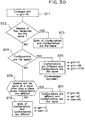
Referring to FIG. 30, an example of the use of conformation
codes (Stereo) and configuration codes (Configuration) will be
described below.
As described above, with respect to various molecules, the
stereostructural formulae of which are shown in FIGS. 15, 16 and
17, conformation codes (Stereo) and configuration codes
(Configuration) were obtained in FIGS. 23 through 25.
At ST1 of FIG. 30, data shown in FIGS. 23 through 25 are
used for comparing stereochemistry between a-Glc-4C and
molecules shown in FIGS. 15 and 16.
If it is determined at ST2 that the conformation codes
(Stereo) are the same, it is determined at ST3 that both have
the same conformation and configuration.
If it is determined at ST2 that the conformation codes
(Stereo) are different, it is determined at ST4 whether the
configuration codes (Configuration) are the same or different.
If it is determined at ST4 that the configuration codes
(Configuration) are the same, it is determined at ST5 that both
have different conformations and the same configuration, so that
both are conformational isomers. With respect to a-Glc-4C,
a-Glc-1C, a-Glc-14B and a-Glc-14TW correspond thereto.
If it is determined at ST4 that the configuration codes
(Configuration) are different, it is determined at ST6 whether
the conformation codes (Stereo) are the same in a place other
than a place where the configuration codes (Configuration) are
different.
If it is determined at ST6 that the conformation codes
(Stereo) are the same in the place other than the place where
the configuration codes (Configuration) are different, it is
determined at ST7 that both have different configurations and
the same conformation. More correctly, it is determined that the
conformations at the place where the configuration codes
(Configuration) are the same are the same. With respect to
a-Glc-4C, b-Glc-4C, a-Gal-4C and a-Man-4C correspond thereto.
If it is determined at ST6 that the conformation codes
(Stereo) are different in the place other than the place where
the configuration codes (Configuration) are different, it is
determined at ST8 that both have different configurations and
conformations. With respect to a-Glc-4C, a-Gal-1C and a-Man-1C
correspond thereto.
As described above, using conformation codes (Stereo) and
configuration codes (Configuration), it is possible to very
easily know the difference in stereochemistry between molecules.
Furthermore, it is also possible to easily determine
whether molecules to be compared have the relationship between
enantiomers (enantiomer), as follows. That is, with respect to
both of conformation codes (Stereo) and configuration codes
(Configuration), codes having the relationship obtained by
reflecting a clock in a mirror are assigned to enantiomers
(enantiomer). For example, the codes have the relationships
between "on" and "el" and between "tw" and "te", and the codes
of "ze" and "si" have the relationship where the codes do not
vary. Therefore, "on" is converted into "el" and "tw" is
converted into "te", and "ze" or "si" remains as it is, so that
codes of one of the conformation codes (Stereo) and so forth are
converted into enantiomorphic codes. Then, it is examined
whether the converted and described conformation codes (Stereo)
are coincident with conformation codes (Stereo) to be compared
therewith, so that it is possible to determine whether molecules
to be compared have the relationship between enantiomers
(enantiomer).
The partial structure recognition is as follows. That is,
while the above described example has related to recognition of
the whole molecule, it is necessary to identify a partial
conformation of a partial structure and to compare relative
arrangements in order to apply the present invention to the
prediction of the chemical shift of 13C-NMR. According to the
present invention, this can be achieved by combining and comparing
conformation codes (Stereo) and configuration codes
(Configuration) starting from a node other than H spaced from
a carbon atom, which is to be noticed, by three bonds if necessary.
With respect to application to 13C-NMR, when the chemical
shift of 13C-NMR is predicted by utilizing an intelligent data
base, conformation codes (Stereo) and configuration codes
(Configuration) starting from a node other than H spaced from
a carbon atom, which is to be noticed, by three bonds may be
compared from a depth of level n of the node of the start atom
to a depth of level n+3 or more thereof. The fact that the codes
are coincident with each other at a deeper level corresponds to
the fact that the codes have higher similarity. By comparing the
codes up to the deepest level, it is possible to compare the whole
molecule. If it is confirmed between molecules to be compared
that the planar structure codes (CANOST) are coincident with each
other and that the configuration codes (Configuration) and
conformation codes (Stereo) are coincident with each other at
a deeper level, it is possible to more precisely predict the
chemical shift of 13C-NMR. As a result, by combining and utilizing
planar structure codes (CANOST), configuration codes
(Configuration) and conformation codes (Stereo), it is possible
to precisely predict the chemical shift of 13C-NMR.
In addition, a program, in which a stereochemical coding
method for taking stereochemistry about each of a plurality of
atoms constituting a molecule to code the molecule has been
described, can be recorded in a computer readable recording media.
As described above, according to the present invention,
it is possible to computer-readably and canonically code
information on the steric structural environment, such as
conformation and configuration, of a molecule.
Claims (12)
- A molecular stereochemical coding method for taking a stereochemistry about each of a plurality of atoms constituting a molecule to code the molecule, said method comprising:a hierarchy classifying step of assigning a start atom, which is to be noticed, to a zero-th hierarchy serving as the lowest hierarchy, assigning an atom, which is combined with said start atom on a higher hierarchy side, to a first hierarchy, assigning an atom, which is combined with said atom assigned to said first hierarchy, to a second hierarchy, and similarly, sequentially assigning atoms to hierarchies until the final hierarchy which is set so as to be specially requested;a molecular tree forming step of setting a predetermined precedence rule for placing a plurality of atoms, which belong to the same hierarchy, in the order, and placing said atoms, which belong the same hierarchy, in the order every hierarchy in accordance with said precedence rule, to form a molecular tree every said start atom from a lower hierarchy to a higher hierarchy so as to express a bonding relationship between said plurality of atoms;a coding step of noticing one of atoms, which are assigned to the (n+3)-th hierarchy, with respect to each of integers n assuming that n is an integer of 0 or more, in said molecular tree, deriving a dihedral angle between a plane, which is formed by an atom in the (n+3)-th hierarchy, an atom in the (n+2)-th hierarchy and an atom in the (n+1)-th hierarchy, and a plane, which is formed by the atom in the (n+2)-th hierarchy, the atom in the (n+1)-th hierarchy and an atom in the n-th hierarchy, with respect to a group comprising four atoms which consists of the noticed atom in the (n+3)-th hierarchy, the atom in the (n+2)-th hierarchy which is combined with the atom in the (n+3)-th hierarchy, the atom in the (n+1)-th hierarchy which is combined with the atom in the (n+2)-th hierarchy, and the atom in the n-th hierarchy which is combined with the atom in the (n+1)-th hierarchy, replacing the derived dihedral angle into an angular symbol, which is defined in accordance with a predetermined angle dividing rule, in accordance with the magnitude of the dihedral angle, giving the replaced angular symbol to the noticed atom in the (n+3)-th hierarchy, and similarly, giving angular symbols in accordance with the magnitudes of the dihedral angles with respect to other atoms to be noticed; andsetting a predetermined linear notation rule for expressing said molecular tree by a row of characters, carrying out the linear notation of a set of said plurality of angular symbols in accordance with said predetermined linear notation rule so as to correspond to said molecular tree, preparing a conformation code indicative of a conformation of the molecule with respect to said start atom, and similarly, preparing conformation codes with respect to other start atoms.
- A molecular stereochemical coding method as set forth in claim 1, which further comprises a configuration code preparing step of preparing a configuration code indicative of a configuration of the molecule for every said start atom, and wherein said configuration code preparing step causes an atom, which is to be noticed in the n-th hierarchy, to be positioned at a reference position in said angle dividing rule, integrally rotates all of said atoms belonging to the (n+3)-th hierarchy around a bonding axis, which connects the atom in the (n+1)-th hierarchy to the atom in the (n+2)-th hierarchy, so that an atom, which has a predetermined precedence in accordance with said precedence rule among said atoms belonging to the (n+3)-th hierarchy, is positioned at a predetermined angular position with respect to said reference position, gives an angular symbol according to said angle dividing rule to each of said atoms belonging to the (n+3)-th hierarchy, in accordance with an angular position after rotation with respect to said reference position, carries out the linear notation of a set of said plurality of angular symbols in accordance with said predetermined linear notation rule so as to correspond to said molecular tree, and prepares a configuration code for every said start atom.
- A molecular stereochemical coding method as set forth in claim 1 or 2, which further comprises a planar structure code preparing step of preparing a planar structure code indicative of a planar structure of the molecule every said start atom, and wherein said planar structure code preparing step expresses said molecular tree by a set of planar structure symbols which planar-structurally express a bonding relationship between said plurality of atoms, carries out the linear notation of said set of planar structure symbols in accordance with said predetermined linear notation rule so as to correspond to said molecular tree, prepares a planar structure code indicative of the planar structure of the molecule with respect to said start atom, and similarly, prepares planar structure codes with respect to other start atoms.
- A molecular stereochemical coding method as set forth in claim 3, wherein said conformation codes, said configuration codes and said planar structure codes are expressed in parallel with respect to said start atoms.
- A molecular stereochemical coding method as set forth in claim 2, wherein when it is impossible to rotate said atoms belonging to the (n+3)-th hierarchy around the bonding axis connecting the atom belonging to the (n+1)-th hierarchy to the atom belonging to the (n+2)-th hierarchy, said angular symbols given at said coding step are adopted as they are, and the linear notation of a set of said plurality of angular symbols is carried out in accordance with said predetermined linear notation rule so as to correspond to said molecular tree, to prepare said configuration codes for every said start atom.
- A molecular stereochemical coding method as set forth in claim 3, wherein said planar structural codes are CANOST linear notations.
- A molecular stereochemical coding method as set forth in claim 1, wherein said precedence rule is a CANOST code precedence rule.
- A molecular stereochemical coding method as set forth in claim 1, wherein said predetermined linear notation rule is a CANOST code linear notation rule.
- A molecular stereochemical coding method as set forth in claim 1, wherein at said molecular tree forming step, a group of atoms having a low degree of notice in the identification of stereochemistry are replaced with predetermined symbols to be masked.
- A molecular stereochemical coding method as set forth in claim 1, wherein said predetermined angle dividing rule divides an angle of 360 degrees into a predetermined number of clock-dial-like angular ranges, and the divided angular ranges are reflected in the level of abundance to be unequally divided.
- A molecular stereochemical coding method as set forth in claim 1, wherein at said conformation code preparing step, said conformation codes are prepared with respect to at least two of said start atoms, the hierarchy numbers of which are spaced from each other by three hierarchies or more.
- A computer readable recording media, in which a program for taking a stereochemistry about each of a plurality of atoms constituting a molecule to code the molecule has been recorded, said program comprising:a hierarchy classifying step of assigning a start atom, which is to be noticed, to a zero-th hierarchy, assigning an atom, which is combined with said start atom on a higher hierarchy side, to a first hierarchy, assigning an atom, which is combined with said atom assigned to said first hierarchy, to a second hierarchy, and similarly, sequentially assigning atoms to hierarchies until the final hierarchy which is set so as to be specially requested;a molecular tree forming step of setting a predetermined precedence rule for placing a plurality of atoms, which belong to the same hierarchy, in the order, and placing said atoms, which belong the same hierarchy, in the order every hierarchy in accordance with said precedence rule, to form a molecular tree every said start atom from a lower hierarchy to a higher hierarchy so as to express a bonding relationship between said plurality of atoms;a coding step of noticing one of atoms, which are assigned to the (n+3)-th hierarchy, with respect to each of integers n assuming that n is an integer of 0 or more, in said molecular tree, deriving a dihedral angle between a plane, which is formed by an atom in the (n+3)-th hierarchy, an atom in the (n+2)-th hierarchy and an atom in the (n+1)-th hierarchy, and a plane, which is formed by the atom in the (n+2)-th hierarchy, the atom in the (n+1)-th hierarchy and an atom in the n-th hierarchy, with respect to a group comprising four atoms which consists of the noticed atom in the (n+3)-th hierarchy, the atom in the (n+2)-th hierarchy which is combined with the atom in the (n+3)-th hierarchy, the atom in the (n+1)-th hierarchy which is combined with the atom in the (n+2)-th hierarchy, and the atom in the n-th hierarchy which is combined with the atom in the (n+1)-th hierarchy, replacing the derived dihedral angle into an angular symbol, which is defined in accordance with a predetermined angle dividing rule, in accordance with the magnitude of the dihedral angle, giving the replaced angular symbol to the noticed atom in the (n+3)-th hierarchy, and similarly, giving angular symbols in accordance with the magnitudes of the dihedral angles with respect to other atoms to be noticed; andsetting a predetermined linear notation rule for expressing said molecular tree by a row of characters, carrying out the linear notation of a set of said plurality of angular symbols in accordance with said predetermined linear notation rule so as to correspond to said molecular tree, preparing a conformation code indicative of a conformation of the molecule with respect to said start atom, and similarly, preparing conformation codes with respect to other start atoms.
Applications Claiming Priority (3)
| Application Number | Priority Date | Filing Date | Title |
|---|---|---|---|
| JP28869199A JP4660675B2 (en) | 1999-10-08 | 1999-10-08 | Methods for stereochemical encoding of molecules |
| JP28869199 | 1999-10-08 | ||
| PCT/JP2000/006887 WO2001027052A1 (en) | 1999-10-08 | 2000-10-03 | Molecule stereochemical coding method |
Publications (2)
| Publication Number | Publication Date |
|---|---|
| EP1138658A1 true EP1138658A1 (en) | 2001-10-04 |
| EP1138658A4 EP1138658A4 (en) | 2005-03-09 |
Family
ID=17733455
Family Applications (1)
| Application Number | Title | Priority Date | Filing Date |
|---|---|---|---|
| EP00963083A Withdrawn EP1138658A4 (en) | 1999-10-08 | 2000-10-03 | METHOD FOR STEREOCHIMIC ENCODING OF A MOLECULE |
Country Status (4)
| Country | Link |
|---|---|
| EP (1) | EP1138658A4 (en) |
| JP (1) | JP4660675B2 (en) |
| CA (1) | CA2354008A1 (en) |
| WO (1) | WO2001027052A1 (en) |
Families Citing this family (3)
| Publication number | Priority date | Publication date | Assignee | Title |
|---|---|---|---|---|
| JP4895689B2 (en) * | 2006-05-30 | 2012-03-14 | 株式会社理論創薬研究所 | System and method for retrieving chemical structure from large-scale chemical structure database at high speed |
| JP5734586B2 (en) * | 2010-07-12 | 2015-06-17 | 公益財団法人野口研究所 | Sugar chain structure recognition analysis method, sugar chain structure recognition analyzer and program |
| CN116364208B (en) * | 2023-05-17 | 2026-03-24 | 摩熵数科(成都)医药科技有限公司 | Atomic chemical environment coding and a method for rapid prediction of nuclear magnetic resonance chemical shift |
Family Cites Families (6)
| Publication number | Priority date | Publication date | Assignee | Title |
|---|---|---|---|---|
| JPS58175077A (en) * | 1982-04-07 | 1983-10-14 | Nippon Kagaku Gijutsu Joho Center | Storage method and apparatus of steric chemical information for chemical compound |
| JPS61171435A (en) * | 1984-12-14 | 1986-08-02 | Suntory Ltd | Method for describing name of organic compound, and apparatus therefor |
| JP2758609B2 (en) * | 1988-07-19 | 1998-05-28 | 日本電気株式会社 | Exact match search method for chemical structural formulas |
| JPH0353380A (en) * | 1989-07-20 | 1991-03-07 | Fuji Photo Film Co Ltd | Processing method for symmetry of compound |
| WO1997044744A1 (en) * | 1996-05-20 | 1997-11-27 | Kureha Kagaku Kogyo Kabushiki Kaisha | Normalized data generator, normalized data generating method and recording medium for generating normalized data |
| JPH10175884A (en) * | 1996-12-12 | 1998-06-30 | Sumitomo Chem Co Ltd | Method for coding partial structure of organic compound and medium recording partial structure coding program |
-
1999
- 1999-10-08 JP JP28869199A patent/JP4660675B2/en not_active Expired - Fee Related
-
2000
- 2000-10-03 CA CA002354008A patent/CA2354008A1/en not_active Abandoned
- 2000-10-03 EP EP00963083A patent/EP1138658A4/en not_active Withdrawn
- 2000-10-03 WO PCT/JP2000/006887 patent/WO2001027052A1/en not_active Ceased
Also Published As
| Publication number | Publication date |
|---|---|
| CA2354008A1 (en) | 2001-04-19 |
| JP4660675B2 (en) | 2011-03-30 |
| JP2001114708A (en) | 2001-04-24 |
| WO2001027052A1 (en) | 2001-04-19 |
| EP1138658A4 (en) | 2005-03-09 |
Similar Documents
| Publication | Publication Date | Title |
|---|---|---|
| Prelog et al. | Basic principles of the CIP‐system and proposals for a revision | |
| Qiu et al. | Neogene land mammal stages/ages of China | |
| Hewson et al. | Objective identification, typing and tracking of the complete life‐cycles of cyclonic features at high spatial resolution | |
| CN104021123B (en) | method and system for data migration | |
| US20100057370A1 (en) | Nucleotide Sequence Screening | |
| CN104834711A (en) | Location-based data service apparatus and method | |
| CN109741798B (en) | Automatic production method of stereoisomeric complete set of organic molecules | |
| MXPA05008803A (en) | Parts search system. | |
| CA2354008A1 (en) | Molecule stereochemical coding method | |
| CN108416137A (en) | It is divided and the method for tracking in a kind of aircraft manufacturing convenient for simplifying expression standard component | |
| CN120354534B (en) | Design method, system and storage medium of aircraft assembly technical specification template | |
| CN102306156A (en) | Method for editing GIS (geographic information system) topological data set interactively | |
| CN104424197B (en) | A kind of IP address library searching method and system | |
| CN119557676B (en) | Stable adsorption configuration global search method based on similarity distribution and active learning | |
| CN1773453A (en) | System constituting method based on data definition | |
| JP2758609B2 (en) | Exact match search method for chemical structural formulas | |
| US6950992B2 (en) | External-character font creation system and program recording medium therefor | |
| Hendrickson et al. | Multiple constructions in synthesis design | |
| Abe et al. | A convenient notation system for organic structure on the basis of connectivity stack | |
| JP2001014311A (en) | Place name expression method, place name character string recognition method and apparatus | |
| Coombes et al. | Developing a local enterprise activity potential (LEAP) index | |
| Clementino et al. | Using kd Trees to Leverage the Performance of the Analog Ensemble Method | |
| CN110379467B (en) | Chemical molecular formula segmentation method | |
| Vladutz et al. | Joint compound/reaction storage and retrieval and possibilities of a hyperstructure-based solution | |
| Mulholland et al. | Practical evaluation of ion chromatography methods developed by an expert system |
Legal Events
| Date | Code | Title | Description |
|---|---|---|---|
| PUAI | Public reference made under article 153(3) epc to a published international application that has entered the european phase |
Free format text: ORIGINAL CODE: 0009012 |
|
| 17P | Request for examination filed |
Effective date: 20010703 |
|
| AK | Designated contracting states |
Kind code of ref document: A1 Designated state(s): AT BE CH CY DE DK ES FI FR GB GR IE IT LI LU MC NL PT SE |
|
| RBV | Designated contracting states (corrected) |
Designated state(s): DE |
|
| A4 | Supplementary search report drawn up and despatched |
Effective date: 20050120 |
|
| 17Q | First examination report despatched |
Effective date: 20070116 |
|
| STAA | Information on the status of an ep patent application or granted ep patent |
Free format text: STATUS: THE APPLICATION IS DEEMED TO BE WITHDRAWN |
|
| 18D | Application deemed to be withdrawn |
Effective date: 20070530 |