EP1138633A1 - Process for producing fluorinated silicon compound - Google Patents
Process for producing fluorinated silicon compound Download PDFInfo
- Publication number
- EP1138633A1 EP1138633A1 EP00957117A EP00957117A EP1138633A1 EP 1138633 A1 EP1138633 A1 EP 1138633A1 EP 00957117 A EP00957117 A EP 00957117A EP 00957117 A EP00957117 A EP 00957117A EP 1138633 A1 EP1138633 A1 EP 1138633A1
- Authority
- EP
- European Patent Office
- Prior art keywords
- group
- formula
- silicon compound
- compound
- compound represented
- Prior art date
- Legal status (The legal status is an assumption and is not a legal conclusion. Google has not performed a legal analysis and makes no representation as to the accuracy of the status listed.)
- Withdrawn
Links
- 150000003377 silicon compounds Chemical class 0.000 title claims abstract description 33
- 238000000034 method Methods 0.000 title claims abstract description 27
- 230000008569 process Effects 0.000 title claims abstract description 25
- 150000001875 compounds Chemical class 0.000 claims abstract description 42
- 125000002887 hydroxy group Chemical group [H]O* 0.000 claims abstract description 37
- 125000003545 alkoxy group Chemical group 0.000 claims abstract description 34
- 125000004104 aryloxy group Chemical group 0.000 claims abstract description 32
- XUIMIQQOPSSXEZ-UHFFFAOYSA-N Silicon Chemical group [Si] XUIMIQQOPSSXEZ-UHFFFAOYSA-N 0.000 claims abstract description 28
- 229910052710 silicon Inorganic materials 0.000 claims abstract description 28
- 125000004433 nitrogen atom Chemical group N* 0.000 claims abstract description 25
- 125000005842 heteroatom Chemical group 0.000 claims abstract description 11
- 125000003118 aryl group Chemical group 0.000 claims abstract description 10
- 229920006395 saturated elastomer Polymers 0.000 claims abstract description 9
- 125000004417 unsaturated alkyl group Chemical group 0.000 claims abstract description 6
- VYPSYNLAJGMNEJ-UHFFFAOYSA-N Silicium dioxide Chemical compound O=[Si]=O VYPSYNLAJGMNEJ-UHFFFAOYSA-N 0.000 claims description 43
- 239000000377 silicon dioxide Substances 0.000 claims description 20
- MGDCBOKBTJIJBT-UHFFFAOYSA-N 2,2-difluoro-1,3-dimethylimidazolidine Chemical compound CN1CCN(C)C1(F)F MGDCBOKBTJIJBT-UHFFFAOYSA-N 0.000 claims description 15
- 125000004432 carbon atom Chemical group C* 0.000 claims description 14
- 125000000217 alkyl group Chemical group 0.000 claims description 9
- 125000004435 hydrogen atom Chemical group [H]* 0.000 claims description 3
- 229910052757 nitrogen Inorganic materials 0.000 claims description 3
- WEVYAHXRMPXWCK-UHFFFAOYSA-N Acetonitrile Chemical compound CC#N WEVYAHXRMPXWCK-UHFFFAOYSA-N 0.000 description 21
- 238000006243 chemical reaction Methods 0.000 description 21
- 229910052731 fluorine Inorganic materials 0.000 description 11
- 239000012025 fluorinating agent Substances 0.000 description 10
- YCKRFDGAMUMZLT-UHFFFAOYSA-N Fluorine atom Chemical compound [F] YCKRFDGAMUMZLT-UHFFFAOYSA-N 0.000 description 8
- 239000011737 fluorine Substances 0.000 description 8
- 125000005372 silanol group Chemical group 0.000 description 8
- 239000010419 fine particle Substances 0.000 description 7
- 238000003682 fluorination reaction Methods 0.000 description 7
- YMWUJEATGCHHMB-UHFFFAOYSA-N Dichloromethane Chemical compound ClCCl YMWUJEATGCHHMB-UHFFFAOYSA-N 0.000 description 6
- NROKBHXJSPEDAR-UHFFFAOYSA-M potassium fluoride Chemical compound [F-].[K+] NROKBHXJSPEDAR-UHFFFAOYSA-M 0.000 description 6
- 230000015572 biosynthetic process Effects 0.000 description 5
- 238000004821 distillation Methods 0.000 description 5
- SAVQQRYWWAGSQW-UHFFFAOYSA-N n-methyl-n-(trifluoro-$l^{4}-sulfanyl)methanamine Chemical compound CN(C)S(F)(F)F SAVQQRYWWAGSQW-UHFFFAOYSA-N 0.000 description 5
- 238000003756 stirring Methods 0.000 description 5
- 239000003153 chemical reaction reagent Substances 0.000 description 4
- 229910052736 halogen Inorganic materials 0.000 description 4
- 150000002367 halogens Chemical class 0.000 description 4
- 238000004519 manufacturing process Methods 0.000 description 4
- 125000002496 methyl group Chemical group [H]C([H])([H])* 0.000 description 4
- -1 phosphorus compound Chemical class 0.000 description 4
- 239000000047 product Substances 0.000 description 4
- SYNPRNNJJLRHTI-UHFFFAOYSA-N 2-(hydroxymethyl)butane-1,4-diol Chemical compound OCCC(CO)CO SYNPRNNJJLRHTI-UHFFFAOYSA-N 0.000 description 3
- 229910016079 MPF6 Inorganic materials 0.000 description 3
- ZMXDDKWLCZADIW-UHFFFAOYSA-N N,N-Dimethylformamide Chemical compound CN(C)C=O ZMXDDKWLCZADIW-UHFFFAOYSA-N 0.000 description 3
- 229910001515 alkali metal fluoride Inorganic materials 0.000 description 3
- 239000007810 chemical reaction solvent Substances 0.000 description 3
- 125000001153 fluoro group Chemical group F* 0.000 description 3
- 125000000524 functional group Chemical group 0.000 description 3
- 235000003270 potassium fluoride Nutrition 0.000 description 3
- 239000011698 potassium fluoride Substances 0.000 description 3
- 239000011541 reaction mixture Substances 0.000 description 3
- 150000003839 salts Chemical class 0.000 description 3
- 239000000126 substance Substances 0.000 description 3
- 238000003786 synthesis reaction Methods 0.000 description 3
- CYSGHNMQYZDMIA-UHFFFAOYSA-N 1,3-Dimethyl-2-imidazolidinon Chemical compound CN1CCN(C)C1=O CYSGHNMQYZDMIA-UHFFFAOYSA-N 0.000 description 2
- 238000001644 13C nuclear magnetic resonance spectroscopy Methods 0.000 description 2
- PTDNHYVEBIHJBK-UHFFFAOYSA-M 2-chloro-1,3-dimethylimidazol-1-ium;chloride Chemical compound [Cl-].CN1C=C[N+](C)=C1Cl PTDNHYVEBIHJBK-UHFFFAOYSA-M 0.000 description 2
- 229910002012 Aerosil® Inorganic materials 0.000 description 2
- PAYRUJLWNCNPSJ-UHFFFAOYSA-N Aniline Chemical compound NC1=CC=CC=C1 PAYRUJLWNCNPSJ-UHFFFAOYSA-N 0.000 description 2
- VEXZGXHMUGYJMC-UHFFFAOYSA-M Chloride anion Chemical compound [Cl-] VEXZGXHMUGYJMC-UHFFFAOYSA-M 0.000 description 2
- KRHYYFGTRYWZRS-UHFFFAOYSA-M Fluoride anion Chemical compound [F-] KRHYYFGTRYWZRS-UHFFFAOYSA-M 0.000 description 2
- 238000004458 analytical method Methods 0.000 description 2
- 238000009835 boiling Methods 0.000 description 2
- XJHCXCQVJFPJIK-UHFFFAOYSA-M caesium fluoride Chemical compound [F-].[Cs+] XJHCXCQVJFPJIK-UHFFFAOYSA-M 0.000 description 2
- 229910052681 coesite Inorganic materials 0.000 description 2
- 238000001816 cooling Methods 0.000 description 2
- 229910052906 cristobalite Inorganic materials 0.000 description 2
- ZZNQQQWFKKTOSD-UHFFFAOYSA-N diethoxy(diphenyl)silane Chemical compound C=1C=CC=CC=1[Si](OCC)(OCC)C1=CC=CC=C1 ZZNQQQWFKKTOSD-UHFFFAOYSA-N 0.000 description 2
- BOMPXIHODLVNMC-UHFFFAOYSA-N difluoro(diphenyl)silane Chemical compound C=1C=CC=CC=1[Si](F)(F)C1=CC=CC=C1 BOMPXIHODLVNMC-UHFFFAOYSA-N 0.000 description 2
- 238000004880 explosion Methods 0.000 description 2
- 150000002222 fluorine compounds Chemical class 0.000 description 2
- 229910021485 fumed silica Inorganic materials 0.000 description 2
- 238000004817 gas chromatography Methods 0.000 description 2
- 238000002290 gas chromatography-mass spectrometry Methods 0.000 description 2
- 150000004820 halides Chemical class 0.000 description 2
- 230000002140 halogenating effect Effects 0.000 description 2
- 238000005259 measurement Methods 0.000 description 2
- BFXIKLCIZHOAAZ-UHFFFAOYSA-N methyltrimethoxysilane Chemical compound CO[Si](C)(OC)OC BFXIKLCIZHOAAZ-UHFFFAOYSA-N 0.000 description 2
- 239000000203 mixture Substances 0.000 description 2
- CTSLXHKWHWQRSH-UHFFFAOYSA-N oxalyl chloride Chemical compound ClC(=O)C(Cl)=O CTSLXHKWHWQRSH-UHFFFAOYSA-N 0.000 description 2
- 239000000843 powder Substances 0.000 description 2
- 230000009257 reactivity Effects 0.000 description 2
- AHLATJUETSFVIM-UHFFFAOYSA-M rubidium fluoride Chemical compound [F-].[Rb+] AHLATJUETSFVIM-UHFFFAOYSA-M 0.000 description 2
- 239000010703 silicon Substances 0.000 description 2
- PUZPDOWCWNUUKD-UHFFFAOYSA-M sodium fluoride Chemical compound [F-].[Na+] PUZPDOWCWNUUKD-UHFFFAOYSA-M 0.000 description 2
- 239000002904 solvent Substances 0.000 description 2
- 229910052682 stishovite Inorganic materials 0.000 description 2
- 238000006467 substitution reaction Methods 0.000 description 2
- 239000000758 substrate Substances 0.000 description 2
- NNCGPRGCYAWTAF-UHFFFAOYSA-N tellurium hexafluoride Chemical compound F[Te](F)(F)(F)(F)F NNCGPRGCYAWTAF-UHFFFAOYSA-N 0.000 description 2
- XGIOBUFWMVEWCO-UHFFFAOYSA-N tert-butyl-fluoro-dimethylsilane Chemical compound CC(C)(C)[Si](C)(C)F XGIOBUFWMVEWCO-UHFFFAOYSA-N 0.000 description 2
- FGWRMMTYIZKYMA-UHFFFAOYSA-N tert-butyl-hydroxy-dimethylsilane Chemical compound CC(C)(C)[Si](C)(C)O FGWRMMTYIZKYMA-UHFFFAOYSA-N 0.000 description 2
- VZGDMQKNWNREIO-UHFFFAOYSA-N tetrachloromethane Chemical compound ClC(Cl)(Cl)Cl VZGDMQKNWNREIO-UHFFFAOYSA-N 0.000 description 2
- FYSNRJHAOHDILO-UHFFFAOYSA-N thionyl chloride Chemical compound ClS(Cl)=O FYSNRJHAOHDILO-UHFFFAOYSA-N 0.000 description 2
- 229910052905 tridymite Inorganic materials 0.000 description 2
- 0 *C(N(*)*C1CC1)N(*)I Chemical compound *C(N(*)*C1CC1)N(*)I 0.000 description 1
- GMEJWUGWFKYZBF-UHFFFAOYSA-N 1,1-difluoro-n,n'-dihexylmethanediamine Chemical compound CCCCCCNC(F)(F)NCCCCCC GMEJWUGWFKYZBF-UHFFFAOYSA-N 0.000 description 1
- RZJKUOYSYYMTID-UHFFFAOYSA-N 1,1-difluoro-n,n,n',n'-tetra(propan-2-yl)methanediamine Chemical compound CC(C)N(C(C)C)C(F)(F)N(C(C)C)C(C)C RZJKUOYSYYMTID-UHFFFAOYSA-N 0.000 description 1
- BECUVKGRMKHUON-UHFFFAOYSA-N 1,1-difluoro-n,n,n',n'-tetramethylmethanediamine Chemical compound CN(C)C(F)(F)N(C)C BECUVKGRMKHUON-UHFFFAOYSA-N 0.000 description 1
- ZEBVGKAMMKIHNE-UHFFFAOYSA-N 1,1-difluoro-n,n,n',n'-tetrapropylmethanediamine Chemical compound CCCN(CCC)C(F)(F)N(CCC)CCC ZEBVGKAMMKIHNE-UHFFFAOYSA-N 0.000 description 1
- WSLDOOZREJYCGB-UHFFFAOYSA-N 1,2-Dichloroethane Chemical compound ClCCCl WSLDOOZREJYCGB-UHFFFAOYSA-N 0.000 description 1
- CMCLBULJKGITSZ-UHFFFAOYSA-N 1,3-dibutyl-2,2-difluoroimidazolidine Chemical compound CCCCN1CCN(CCCC)C1(F)F CMCLBULJKGITSZ-UHFFFAOYSA-N 0.000 description 1
- RKQJLDWSVMTFAB-UHFFFAOYSA-N 1,3-dibutyl-2,2-difluoroimidazolidine-4,5-dione Chemical compound CCCCN1C(=O)C(=O)N(CCCC)C1(F)F RKQJLDWSVMTFAB-UHFFFAOYSA-N 0.000 description 1
- NJGFBCKAFITHNX-UHFFFAOYSA-N 1,3-diethyl-2,2-difluoroimidazolidine Chemical compound CCN1CCN(CC)C1(F)F NJGFBCKAFITHNX-UHFFFAOYSA-N 0.000 description 1
- FYKFDFDOKZJYDK-UHFFFAOYSA-N 1-[difluoro(piperidin-1-yl)methyl]piperidine Chemical compound C1CCCCN1C(F)(F)N1CCCCC1 FYKFDFDOKZJYDK-UHFFFAOYSA-N 0.000 description 1
- 238000005160 1H NMR spectroscopy Methods 0.000 description 1
- IMAZHFVSPVZBRN-UHFFFAOYSA-N 2,2-difluoro-1,3-di(propan-2-yl)imidazolidine Chemical compound CC(C)N1CCN(C(C)C)C1(F)F IMAZHFVSPVZBRN-UHFFFAOYSA-N 0.000 description 1
- YNPHRIZORYWNQX-UHFFFAOYSA-N 2,2-difluoro-1,3-dimethyl-4h-pyrimidine Chemical compound CN1CC=CN(C)C1(F)F YNPHRIZORYWNQX-UHFFFAOYSA-N 0.000 description 1
- MSFBHQRUDQLMOG-UHFFFAOYSA-N 2,2-difluoro-1,3-dipropylimidazolidine Chemical compound CCCN1CCN(CCC)C1(F)F MSFBHQRUDQLMOG-UHFFFAOYSA-N 0.000 description 1
- RJUBITRLCAWKHI-UHFFFAOYSA-N 3,3,3-triphenylpropoxysilane Chemical compound C=1C=CC=CC=1C(C=1C=CC=CC=1)(CCO[SiH3])C1=CC=CC=C1 RJUBITRLCAWKHI-UHFFFAOYSA-N 0.000 description 1
- RTGQKZXGRDZFNO-UHFFFAOYSA-N 4,4,4-triphenylbutoxysilane Chemical compound C=1C=CC=CC=1C(C=1C=CC=CC=1)(CCCO[SiH3])C1=CC=CC=C1 RTGQKZXGRDZFNO-UHFFFAOYSA-N 0.000 description 1
- 125000002373 5 membered heterocyclic group Chemical group 0.000 description 1
- 125000004070 6 membered heterocyclic group Chemical group 0.000 description 1
- CPELXLSAUQHCOX-UHFFFAOYSA-M Bromide Chemical compound [Br-] CPELXLSAUQHCOX-UHFFFAOYSA-M 0.000 description 1
- WKBOTKDWSSQWDR-UHFFFAOYSA-N Bromine atom Chemical group [Br] WKBOTKDWSSQWDR-UHFFFAOYSA-N 0.000 description 1
- KMHNETYIMOLRBR-UHFFFAOYSA-N CCO[SiH](O[SiH3])OCC Chemical compound CCO[SiH](O[SiH3])OCC KMHNETYIMOLRBR-UHFFFAOYSA-N 0.000 description 1
- WYQICGSUKKTDNM-UHFFFAOYSA-N CCO[SiH]([SiH3])OCC Chemical compound CCO[SiH]([SiH3])OCC WYQICGSUKKTDNM-UHFFFAOYSA-N 0.000 description 1
- KZBUYRJDOAKODT-UHFFFAOYSA-N Chlorine Chemical compound ClCl KZBUYRJDOAKODT-UHFFFAOYSA-N 0.000 description 1
- UFHFLCQGNIYNRP-UHFFFAOYSA-N Hydrogen Chemical compound [H][H] UFHFLCQGNIYNRP-UHFFFAOYSA-N 0.000 description 1
- JOOMLFKONHCLCJ-UHFFFAOYSA-N N-(trimethylsilyl)diethylamine Chemical compound CCN(CC)[Si](C)(C)C JOOMLFKONHCLCJ-UHFFFAOYSA-N 0.000 description 1
- PHSPJQZRQAJPPF-UHFFFAOYSA-N N-alpha-Methylhistamine Chemical compound CNCCC1=CN=CN1 PHSPJQZRQAJPPF-UHFFFAOYSA-N 0.000 description 1
- 229910019188 POF2 Inorganic materials 0.000 description 1
- YGYAWVDWMABLBF-UHFFFAOYSA-N Phosgene Chemical compound ClC(Cl)=O YGYAWVDWMABLBF-UHFFFAOYSA-N 0.000 description 1
- RWRDLPDLKQPQOW-UHFFFAOYSA-N Pyrrolidine Chemical group C1CCNC1 RWRDLPDLKQPQOW-UHFFFAOYSA-N 0.000 description 1
- 229910018557 Si O Inorganic materials 0.000 description 1
- 229910008045 Si-Si Inorganic materials 0.000 description 1
- 239000006087 Silane Coupling Agent Substances 0.000 description 1
- 229910006411 Si—Si Inorganic materials 0.000 description 1
- OUIPIYYPTWQWSM-UHFFFAOYSA-N [diethyl(hydroxy)silyl]oxy-[[diethyl(hydroxy)silyl]oxy-diethylsilyl]oxy-diethylsilane Chemical compound CC[Si](O)(CC)O[Si](CC)(CC)O[Si](CC)(CC)O[Si](O)(CC)CC OUIPIYYPTWQWSM-UHFFFAOYSA-N 0.000 description 1
- KYMSHYGFMWOWTJ-UHFFFAOYSA-N [diethyl(hydroxy)silyl]oxy-[diethyl(triethylsilyloxy)silyl]oxy-diethylsilane Chemical compound CC[Si](O)(CC)O[Si](CC)(CC)O[Si](CC)(CC)O[Si](CC)(CC)CC KYMSHYGFMWOWTJ-UHFFFAOYSA-N 0.000 description 1
- LYDOHRFVHHOBBF-UHFFFAOYSA-N [diethyl(hydroxy)silyl]oxy-diethyl-hydroxysilane Chemical compound CC[Si](O)(CC)O[Si](O)(CC)CC LYDOHRFVHHOBBF-UHFFFAOYSA-N 0.000 description 1
- RQQHXLKAANNHJR-UHFFFAOYSA-N [diethyl(hydroxy)silyl]oxy-diethyl-triethylsilyloxysilane Chemical compound CC[Si](O)(CC)O[Si](CC)(CC)O[Si](CC)(CC)CC RQQHXLKAANNHJR-UHFFFAOYSA-N 0.000 description 1
- CZSXTFUJNVGZFO-UHFFFAOYSA-N [dimethyl(trimethylsilyloxy)silyl]oxy-[hydroxy(dimethyl)silyl]oxy-dimethylsilane Chemical compound C[Si](C)(C)O[Si](C)(C)O[Si](C)(C)O[Si](C)(C)O CZSXTFUJNVGZFO-UHFFFAOYSA-N 0.000 description 1
- TUSCSVMLIKTNBU-UHFFFAOYSA-N [dimethyl(trimethylsilyloxy)silyl]oxy-hydroxy-dimethylsilane Chemical compound C[Si](C)(C)O[Si](C)(C)O[Si](C)(C)O TUSCSVMLIKTNBU-UHFFFAOYSA-N 0.000 description 1
- XBOGUHJMXURICT-UHFFFAOYSA-N [diphenyl(triphenylsilyloxy)silyl]oxy-[hydroxy(diphenyl)silyl]oxy-diphenylsilane Chemical compound C=1C=CC=CC=1[Si](C=1C=CC=CC=1)(O)O[Si](C=1C=CC=CC=1)(C=1C=CC=CC=1)O[Si](C=1C=CC=CC=1)(C=1C=CC=CC=1)O[Si](C=1C=CC=CC=1)(C=1C=CC=CC=1)C1=CC=CC=C1 XBOGUHJMXURICT-UHFFFAOYSA-N 0.000 description 1
- FDEULBRXWPILCE-UHFFFAOYSA-N [diphenyl(triphenylsilyloxy)silyl]oxy-hydroxy-diphenylsilane Chemical compound C=1C=CC=CC=1[Si](C=1C=CC=CC=1)(O)O[Si](C=1C=CC=CC=1)(C=1C=CC=CC=1)O[Si](C=1C=CC=CC=1)(C=1C=CC=CC=1)C1=CC=CC=C1 FDEULBRXWPILCE-UHFFFAOYSA-N 0.000 description 1
- 230000002776 aggregation Effects 0.000 description 1
- 238000004220 aggregation Methods 0.000 description 1
- PWIGYBONXWGOQE-UHFFFAOYSA-N alizarin complexone Chemical compound O=C1C2=CC=CC=C2C(=O)C2=C1C=C(CN(CC(O)=O)CC(=O)O)C(O)=C2O PWIGYBONXWGOQE-UHFFFAOYSA-N 0.000 description 1
- 125000005210 alkyl ammonium group Chemical group 0.000 description 1
- QVGXLLKOCUKJST-UHFFFAOYSA-N atomic oxygen Chemical compound [O] QVGXLLKOCUKJST-UHFFFAOYSA-N 0.000 description 1
- HOXJPVIUSOXPJY-UHFFFAOYSA-N bis[[diethyl(hydroxy)silyl]oxy]-diethylsilane Chemical compound CC[Si](O)(CC)O[Si](CC)(CC)O[Si](O)(CC)CC HOXJPVIUSOXPJY-UHFFFAOYSA-N 0.000 description 1
- XYBQTTAROZGWOZ-UHFFFAOYSA-N bis[[hydroxy(dimethyl)silyl]oxy]-dimethylsilane Chemical compound C[Si](C)(O)O[Si](C)(C)O[Si](C)(C)O XYBQTTAROZGWOZ-UHFFFAOYSA-N 0.000 description 1
- HPSAPUFZLRQINY-UHFFFAOYSA-N bis[[hydroxy(diphenyl)silyl]oxy]-diphenylsilane Chemical compound C=1C=CC=CC=1[Si](C=1C=CC=CC=1)(O)O[Si](C=1C=CC=CC=1)(C=1C=CC=CC=1)O[Si](O)(C=1C=CC=CC=1)C1=CC=CC=C1 HPSAPUFZLRQINY-UHFFFAOYSA-N 0.000 description 1
- 125000001246 bromo group Chemical group Br* 0.000 description 1
- 125000004369 butenyl group Chemical group C(=CCC)* 0.000 description 1
- ZZHNUBIHHLQNHX-UHFFFAOYSA-N butoxysilane Chemical compound CCCCO[SiH3] ZZHNUBIHHLQNHX-UHFFFAOYSA-N 0.000 description 1
- 125000002915 carbonyl group Chemical group [*:2]C([*:1])=O 0.000 description 1
- 125000003178 carboxy group Chemical group [H]OC(*)=O 0.000 description 1
- 239000007795 chemical reaction product Substances 0.000 description 1
- 239000003795 chemical substances by application Substances 0.000 description 1
- 239000000460 chlorine Substances 0.000 description 1
- 229910052801 chlorine Inorganic materials 0.000 description 1
- 125000001309 chloro group Chemical group Cl* 0.000 description 1
- 238000005796 dehydrofluorination reaction Methods 0.000 description 1
- OSMIWEAIYFILPL-UHFFFAOYSA-N dibutoxy(diphenyl)silane Chemical compound C=1C=CC=CC=1[Si](OCCCC)(OCCCC)C1=CC=CC=C1 OSMIWEAIYFILPL-UHFFFAOYSA-N 0.000 description 1
- XWUXUIKFVBSHKB-UHFFFAOYSA-N dibutoxy-phenyl-triphenylsilyloxysilane Chemical compound C=1C=CC=CC=1[Si](OCCCC)(OCCCC)O[Si](C=1C=CC=CC=1)(C=1C=CC=CC=1)C1=CC=CC=C1 XWUXUIKFVBSHKB-UHFFFAOYSA-N 0.000 description 1
- ZHVKMNWAABNSIQ-UHFFFAOYSA-N dibutoxy-phenyl-triphenylsilylsilane Chemical compound C=1C=CC=CC=1[Si](C=1C=CC=CC=1)(C=1C=CC=CC=1)[Si](OCCCC)(OCCCC)C1=CC=CC=C1 ZHVKMNWAABNSIQ-UHFFFAOYSA-N 0.000 description 1
- UPJJIHSCJCNYLO-UHFFFAOYSA-N dibutoxysilane Chemical compound CCCCO[SiH2]OCCCC UPJJIHSCJCNYLO-UHFFFAOYSA-N 0.000 description 1
- ZMAPKOCENOWQRE-UHFFFAOYSA-N diethoxy(diethyl)silane Chemical compound CCO[Si](CC)(CC)OCC ZMAPKOCENOWQRE-UHFFFAOYSA-N 0.000 description 1
- JLKREEWENYCBOK-UHFFFAOYSA-N diethoxy-ethyl-triethylsilyloxysilane Chemical compound CCO[Si](CC)(OCC)O[Si](CC)(CC)CC JLKREEWENYCBOK-UHFFFAOYSA-N 0.000 description 1
- BFRZATFLDZSLCR-UHFFFAOYSA-N diethoxy-ethyl-triethylsilylsilane Chemical compound CCO[Si](CC)(OCC)[Si](CC)(CC)CC BFRZATFLDZSLCR-UHFFFAOYSA-N 0.000 description 1
- UTLLQZXIHWYQSV-UHFFFAOYSA-N diethoxy-hydroxy-phenylsilane Chemical compound CCO[Si](O)(OCC)C1=CC=CC=C1 UTLLQZXIHWYQSV-UHFFFAOYSA-N 0.000 description 1
- PSUILUFZVWFSCP-UHFFFAOYSA-N diethoxy-hydroxy-propylsilane Chemical compound CCC[Si](O)(OCC)OCC PSUILUFZVWFSCP-UHFFFAOYSA-N 0.000 description 1
- PMCQHKGXMZGXSO-UHFFFAOYSA-N diethoxy-phenyl-triphenylsilyloxysilane Chemical compound C=1C=CC=CC=1[Si](OCC)(OCC)O[Si](C=1C=CC=CC=1)(C=1C=CC=CC=1)C1=CC=CC=C1 PMCQHKGXMZGXSO-UHFFFAOYSA-N 0.000 description 1
- KOOLMERATGIEKA-UHFFFAOYSA-N diethoxy-phenyl-triphenylsilylsilane Chemical compound C=1C=CC=CC=1[Si](C=1C=CC=CC=1)(C=1C=CC=CC=1)[Si](OCC)(OCC)C1=CC=CC=C1 KOOLMERATGIEKA-UHFFFAOYSA-N 0.000 description 1
- ZXPDYFSTVHQQOI-UHFFFAOYSA-N diethoxysilane Chemical compound CCO[SiH2]OCC ZXPDYFSTVHQQOI-UHFFFAOYSA-N 0.000 description 1
- DAKRXZUXJUPCOF-UHFFFAOYSA-N diethyl(dihydroxy)silane Chemical compound CC[Si](O)(O)CC DAKRXZUXJUPCOF-UHFFFAOYSA-N 0.000 description 1
- NIEVDOKKAAPIJO-UHFFFAOYSA-N diethyl-hydroxy-phenylsilane Chemical compound CC[Si](O)(CC)C1=CC=CC=C1 NIEVDOKKAAPIJO-UHFFFAOYSA-N 0.000 description 1
- QPDJWMFCTPUULR-UHFFFAOYSA-N diethyl-hydroxy-propylsilane Chemical compound CCC[Si](O)(CC)CC QPDJWMFCTPUULR-UHFFFAOYSA-N 0.000 description 1
- BWVQWYXXNNLQMG-UHFFFAOYSA-N diethyl-hydroxy-triethylsilyloxysilane Chemical compound CC[Si](O)(CC)O[Si](CC)(CC)CC BWVQWYXXNNLQMG-UHFFFAOYSA-N 0.000 description 1
- OLLFKUHHDPMQFR-UHFFFAOYSA-N dihydroxy(diphenyl)silane Chemical compound C=1C=CC=CC=1[Si](O)(O)C1=CC=CC=C1 OLLFKUHHDPMQFR-UHFFFAOYSA-N 0.000 description 1
- JJQZDUKDJDQPMQ-UHFFFAOYSA-N dimethoxy(dimethyl)silane Chemical compound CO[Si](C)(C)OC JJQZDUKDJDQPMQ-UHFFFAOYSA-N 0.000 description 1
- AHUXYBVKTIBBJW-UHFFFAOYSA-N dimethoxy(diphenyl)silane Chemical compound C=1C=CC=CC=1[Si](OC)(OC)C1=CC=CC=C1 AHUXYBVKTIBBJW-UHFFFAOYSA-N 0.000 description 1
- GGMZTHUSWCBELM-UHFFFAOYSA-N dimethoxy(silyl)silane Chemical compound CO[SiH]([SiH3])OC GGMZTHUSWCBELM-UHFFFAOYSA-N 0.000 description 1
- UGDALOABNKPMQK-UHFFFAOYSA-N dimethoxy(silyloxy)silane Chemical compound CO[SiH](OC)O[SiH3] UGDALOABNKPMQK-UHFFFAOYSA-N 0.000 description 1
- CSBYFBGXRRMFDS-UHFFFAOYSA-N dimethoxy-methyl-trimethylsilyloxysilane Chemical compound CO[Si](C)(OC)O[Si](C)(C)C CSBYFBGXRRMFDS-UHFFFAOYSA-N 0.000 description 1
- BQLQQEHXQQLKEV-UHFFFAOYSA-N dimethoxy-methyl-trimethylsilylsilane Chemical compound CO[Si](C)(OC)[Si](C)(C)C BQLQQEHXQQLKEV-UHFFFAOYSA-N 0.000 description 1
- RWVXRIHDOHVDQT-UHFFFAOYSA-N dimethoxy-phenyl-triphenylsilyloxysilane Chemical compound C=1C=CC=CC=1[Si](OC)(OC)O[Si](C=1C=CC=CC=1)(C=1C=CC=CC=1)C1=CC=CC=C1 RWVXRIHDOHVDQT-UHFFFAOYSA-N 0.000 description 1
- YQBOVFTVZRQIJZ-UHFFFAOYSA-N dimethoxy-phenyl-triphenylsilylsilane Chemical compound C=1C=CC=CC=1[Si](C=1C=CC=CC=1)(C=1C=CC=CC=1)[Si](OC)(OC)C1=CC=CC=C1 YQBOVFTVZRQIJZ-UHFFFAOYSA-N 0.000 description 1
- XCLIHDJZGPCUBT-UHFFFAOYSA-N dimethylsilanediol Chemical compound C[Si](C)(O)O XCLIHDJZGPCUBT-UHFFFAOYSA-N 0.000 description 1
- YLDKQPMORVEBRU-UHFFFAOYSA-N diphenoxy(diphenyl)silane Chemical compound C=1C=CC=CC=1O[Si](C=1C=CC=CC=1)(C=1C=CC=CC=1)OC1=CC=CC=C1 YLDKQPMORVEBRU-UHFFFAOYSA-N 0.000 description 1
- ADFVHDCWSAZASB-UHFFFAOYSA-N diphenoxy-phenyl-triphenylsilyloxysilane Chemical compound C=1C=CC=CC=1O[Si](C=1C=CC=CC=1)(O[Si](C=1C=CC=CC=1)(C=1C=CC=CC=1)C=1C=CC=CC=1)OC1=CC=CC=C1 ADFVHDCWSAZASB-UHFFFAOYSA-N 0.000 description 1
- LPKOCJLJWHMYPN-UHFFFAOYSA-N diphenoxy-phenyl-triphenylsilylsilane Chemical compound C=1C=CC=CC=1O[Si]([Si](C=1C=CC=CC=1)(C=1C=CC=CC=1)C=1C=CC=CC=1)(C=1C=CC=CC=1)OC1=CC=CC=C1 LPKOCJLJWHMYPN-UHFFFAOYSA-N 0.000 description 1
- AYLOLAANSIXPJA-UHFFFAOYSA-N diphenoxysilicon Chemical compound C=1C=CC=CC=1O[Si]OC1=CC=CC=C1 AYLOLAANSIXPJA-UHFFFAOYSA-N 0.000 description 1
- SLAYMDSSGGBWQB-UHFFFAOYSA-N diphenyl(dipropoxy)silane Chemical compound C=1C=CC=CC=1[Si](OCCC)(OCCC)C1=CC=CC=C1 SLAYMDSSGGBWQB-UHFFFAOYSA-N 0.000 description 1
- AVBCBOQFOQZNFK-UHFFFAOYSA-N dipropoxy(dipropyl)silane Chemical compound CCCO[Si](CCC)(CCC)OCCC AVBCBOQFOQZNFK-UHFFFAOYSA-N 0.000 description 1
- GESAIRMDHCOKTD-UHFFFAOYSA-N dipropoxy(silyl)silane Chemical compound CCCO[SiH]([SiH3])OCCC GESAIRMDHCOKTD-UHFFFAOYSA-N 0.000 description 1
- UUTMRJUJIREXGQ-UHFFFAOYSA-N dipropoxy(silyloxy)silane Chemical compound CCCO[SiH](O[SiH3])OCCC UUTMRJUJIREXGQ-UHFFFAOYSA-N 0.000 description 1
- IKWKAMOYCNVIIF-UHFFFAOYSA-N dipropoxy-propyl-tripropylsilyloxysilane Chemical compound CCCO[Si](CCC)(OCCC)O[Si](CCC)(CCC)CCC IKWKAMOYCNVIIF-UHFFFAOYSA-N 0.000 description 1
- QZTSPWRQHORRCZ-UHFFFAOYSA-N dipropoxy-propyl-tripropylsilylsilane Chemical compound CCCO[Si](CCC)(OCCC)[Si](CCC)(CCC)CCC QZTSPWRQHORRCZ-UHFFFAOYSA-N 0.000 description 1
- SACPKRUZWRIEBW-UHFFFAOYSA-N dipropoxysilane Chemical compound CCCO[SiH2]OCCC SACPKRUZWRIEBW-UHFFFAOYSA-N 0.000 description 1
- 239000006185 dispersion Substances 0.000 description 1
- 230000000694 effects Effects 0.000 description 1
- 238000005516 engineering process Methods 0.000 description 1
- DFJDZTPFNSXNAX-UHFFFAOYSA-N ethoxy(triethyl)silane Chemical compound CCO[Si](CC)(CC)CC DFJDZTPFNSXNAX-UHFFFAOYSA-N 0.000 description 1
- ZVJXKUWNRVOUTI-UHFFFAOYSA-N ethoxy(triphenyl)silane Chemical compound C=1C=CC=CC=1[Si](C=1C=CC=CC=1)(OCC)C1=CC=CC=C1 ZVJXKUWNRVOUTI-UHFFFAOYSA-N 0.000 description 1
- UPLDHCVUKRWAGM-UHFFFAOYSA-N ethoxy-hydroxy-dimethylsilane Chemical compound CCO[Si](C)(C)O UPLDHCVUKRWAGM-UHFFFAOYSA-N 0.000 description 1
- CWAFVXWRGIEBPL-UHFFFAOYSA-N ethoxysilane Chemical compound CCO[SiH3] CWAFVXWRGIEBPL-UHFFFAOYSA-N 0.000 description 1
- 125000001495 ethyl group Chemical group [H]C([H])([H])C([H])([H])* 0.000 description 1
- AXCGWVYNDXPANP-UHFFFAOYSA-N ethyl-hydroxy-dimethylsilane Chemical compound CC[Si](C)(C)O AXCGWVYNDXPANP-UHFFFAOYSA-N 0.000 description 1
- SDOAHIJADAWDDY-UHFFFAOYSA-N ethyl-hydroxy-diphenoxysilane Chemical compound C=1C=CC=CC=1O[Si](O)(CC)OC1=CC=CC=C1 SDOAHIJADAWDDY-UHFFFAOYSA-N 0.000 description 1
- UFAHFMYBTCNZPM-UHFFFAOYSA-N ethyl-hydroxy-diphenylsilane Chemical compound C=1C=CC=CC=1[Si](O)(CC)C1=CC=CC=C1 UFAHFMYBTCNZPM-UHFFFAOYSA-N 0.000 description 1
- 238000001704 evaporation Methods 0.000 description 1
- 230000008020 evaporation Effects 0.000 description 1
- 238000000605 extraction Methods 0.000 description 1
- 238000001914 filtration Methods 0.000 description 1
- XPBBUZJBQWWFFJ-UHFFFAOYSA-N fluorosilane Chemical compound [SiH3]F XPBBUZJBQWWFFJ-UHFFFAOYSA-N 0.000 description 1
- 239000007789 gas Substances 0.000 description 1
- 239000008187 granular material Substances 0.000 description 1
- 238000010438 heat treatment Methods 0.000 description 1
- 125000000623 heterocyclic group Chemical group 0.000 description 1
- 229910052739 hydrogen Inorganic materials 0.000 description 1
- 239000001257 hydrogen Substances 0.000 description 1
- 230000007062 hydrolysis Effects 0.000 description 1
- 238000006460 hydrolysis reaction Methods 0.000 description 1
- NDJGGFVLWCNXSH-UHFFFAOYSA-N hydroxy(trimethoxy)silane Chemical compound CO[Si](O)(OC)OC NDJGGFVLWCNXSH-UHFFFAOYSA-N 0.000 description 1
- ODCVZHDUAQFKHJ-UHFFFAOYSA-N hydroxy-[[[hydroxy(diphenyl)silyl]oxy-diphenylsilyl]oxy-diphenylsilyl]oxy-diphenylsilane Chemical compound C=1C=CC=CC=1[Si](C=1C=CC=CC=1)(O)O[Si](C=1C=CC=CC=1)(C=1C=CC=CC=1)O[Si](C=1C=CC=CC=1)(C=1C=CC=CC=1)O[Si](O)(C=1C=CC=CC=1)C1=CC=CC=C1 ODCVZHDUAQFKHJ-UHFFFAOYSA-N 0.000 description 1
- PFEAZKFNWPIFCV-UHFFFAOYSA-N hydroxy-[hydroxy(dimethyl)silyl]oxy-dimethylsilane Chemical compound C[Si](C)(O)O[Si](C)(C)O PFEAZKFNWPIFCV-UHFFFAOYSA-N 0.000 description 1
- MYZTUAOLAYIKSJ-UHFFFAOYSA-N hydroxy-[hydroxy(diphenyl)silyl]oxy-diphenylsilane Chemical compound C=1C=CC=CC=1[Si](C=1C=CC=CC=1)(O)O[Si](O)(C=1C=CC=CC=1)C1=CC=CC=C1 MYZTUAOLAYIKSJ-UHFFFAOYSA-N 0.000 description 1
- BTFLIPXUMMYIBJ-UHFFFAOYSA-N hydroxy-dimethyl-[(2-methylpropan-2-yl)oxy]silane Chemical compound CC(C)(C)O[Si](C)(C)O BTFLIPXUMMYIBJ-UHFFFAOYSA-N 0.000 description 1
- JTAFRLCKCXGKQW-UHFFFAOYSA-N hydroxy-dimethyl-phenoxysilane Chemical compound C[Si](C)(O)OC1=CC=CC=C1 JTAFRLCKCXGKQW-UHFFFAOYSA-N 0.000 description 1
- FDTBETCIPGWBHK-UHFFFAOYSA-N hydroxy-dimethyl-phenylsilane Chemical compound C[Si](C)(O)C1=CC=CC=C1 FDTBETCIPGWBHK-UHFFFAOYSA-N 0.000 description 1
- VHIORHOXECQKAZ-UHFFFAOYSA-N hydroxy-dimethyl-propoxysilane Chemical compound CCCO[Si](C)(C)O VHIORHOXECQKAZ-UHFFFAOYSA-N 0.000 description 1
- AHBULOFRXMHKGM-UHFFFAOYSA-N hydroxy-dimethyl-propylsilane Chemical compound CCC[Si](C)(C)O AHBULOFRXMHKGM-UHFFFAOYSA-N 0.000 description 1
- FGOLZCPMTWJPOU-UHFFFAOYSA-N hydroxy-dimethyl-trimethylsilyloxysilane Chemical compound C[Si](C)(C)O[Si](C)(C)O FGOLZCPMTWJPOU-UHFFFAOYSA-N 0.000 description 1
- RKYQBBKBWNLIGC-UHFFFAOYSA-N hydroxy-diphenoxy-propylsilane Chemical compound C=1C=CC=CC=1O[Si](O)(CCC)OC1=CC=CC=C1 RKYQBBKBWNLIGC-UHFFFAOYSA-N 0.000 description 1
- ONVJULYGRCXHAY-UHFFFAOYSA-N hydroxy-diphenyl-propylsilane Chemical compound C=1C=CC=CC=1[Si](O)(CCC)C1=CC=CC=C1 ONVJULYGRCXHAY-UHFFFAOYSA-N 0.000 description 1
- IGSXPTYFEXYCFY-UHFFFAOYSA-N hydroxy-diphenyl-triphenylsilyloxysilane Chemical compound C=1C=CC=CC=1[Si](C=1C=CC=CC=1)(O)O[Si](C=1C=CC=CC=1)(C=1C=CC=CC=1)C1=CC=CC=C1 IGSXPTYFEXYCFY-UHFFFAOYSA-N 0.000 description 1
- YBIRZJVXNXOXFH-UHFFFAOYSA-N hydroxy-methyl-diphenoxysilane Chemical compound C=1C=CC=CC=1O[Si](O)(C)OC1=CC=CC=C1 YBIRZJVXNXOXFH-UHFFFAOYSA-N 0.000 description 1
- MLPRTGXXQKWLDM-UHFFFAOYSA-N hydroxy-methyl-diphenylsilane Chemical compound C=1C=CC=CC=1[Si](O)(C)C1=CC=CC=C1 MLPRTGXXQKWLDM-UHFFFAOYSA-N 0.000 description 1
- YAMHXTCMCPHKLN-UHFFFAOYSA-N imidazolidin-2-one Chemical group O=C1NCCN1 YAMHXTCMCPHKLN-UHFFFAOYSA-N 0.000 description 1
- 125000002632 imidazolidinyl group Chemical group 0.000 description 1
- 230000006872 improvement Effects 0.000 description 1
- 239000012442 inert solvent Substances 0.000 description 1
- 125000001449 isopropyl group Chemical group [H]C([H])([H])C([H])(*)C([H])([H])[H] 0.000 description 1
- 239000007788 liquid Substances 0.000 description 1
- 238000004811 liquid chromatography Methods 0.000 description 1
- 229910052744 lithium Inorganic materials 0.000 description 1
- POPACFLNWGUDSR-UHFFFAOYSA-N methoxy(trimethyl)silane Chemical compound CO[Si](C)(C)C POPACFLNWGUDSR-UHFFFAOYSA-N 0.000 description 1
- BKXVGDZNDSIUAI-UHFFFAOYSA-N methoxy(triphenyl)silane Chemical compound C=1C=CC=CC=1[Si](C=1C=CC=CC=1)(OC)C1=CC=CC=C1 BKXVGDZNDSIUAI-UHFFFAOYSA-N 0.000 description 1
- ARYZCSRUUPFYMY-UHFFFAOYSA-N methoxysilane Chemical compound CO[SiH3] ARYZCSRUUPFYMY-UHFFFAOYSA-N 0.000 description 1
- QSGNJWCYVPXGKY-UHFFFAOYSA-N n,n,n',n'-tetrabutyl-1,1-difluoromethanediamine Chemical compound CCCCN(CCCC)C(F)(F)N(CCCC)CCCC QSGNJWCYVPXGKY-UHFFFAOYSA-N 0.000 description 1
- IQYKTDZMKYQWRS-UHFFFAOYSA-N n,n,n',n'-tetraethyl-1,1-difluoromethanediamine Chemical compound CCN(CC)C(F)(F)N(CC)CC IQYKTDZMKYQWRS-UHFFFAOYSA-N 0.000 description 1
- 125000004108 n-butyl group Chemical group [H]C([H])([H])C([H])([H])C([H])([H])C([H])([H])* 0.000 description 1
- 125000001280 n-hexyl group Chemical group C(CCCCC)* 0.000 description 1
- 125000004123 n-propyl group Chemical group [H]C([H])([H])C([H])([H])C([H])([H])* 0.000 description 1
- 239000012299 nitrogen atmosphere Substances 0.000 description 1
- VERNMKKMBJGSQB-UHFFFAOYSA-N octamethyltetrasiloxane-1,7-diol Chemical compound C[Si](C)(O)O[Si](C)(C)O[Si](C)(C)O[Si](C)(C)O VERNMKKMBJGSQB-UHFFFAOYSA-N 0.000 description 1
- 239000003921 oil Substances 0.000 description 1
- 229910052760 oxygen Inorganic materials 0.000 description 1
- 239000001301 oxygen Substances 0.000 description 1
- 239000002245 particle Substances 0.000 description 1
- 239000008188 pellet Substances 0.000 description 1
- 239000003444 phase transfer catalyst Substances 0.000 description 1
- FNJGJIYEZWWABI-UHFFFAOYSA-N phenoxy(triphenyl)silane Chemical compound C=1C=CC=CC=1[Si](C=1C=CC=CC=1)(C=1C=CC=CC=1)OC1=CC=CC=C1 FNJGJIYEZWWABI-UHFFFAOYSA-N 0.000 description 1
- RBCYCMNKVQPXDR-UHFFFAOYSA-N phenoxysilane Chemical compound [SiH3]OC1=CC=CC=C1 RBCYCMNKVQPXDR-UHFFFAOYSA-N 0.000 description 1
- 125000001997 phenyl group Chemical group [H]C1=C([H])C([H])=C(*)C([H])=C1[H] 0.000 description 1
- FABOKLHQXVRECE-UHFFFAOYSA-N phenyl(tripropoxy)silane Chemical compound CCCO[Si](OCCC)(OCCC)C1=CC=CC=C1 FABOKLHQXVRECE-UHFFFAOYSA-N 0.000 description 1
- 229910052698 phosphorus Inorganic materials 0.000 description 1
- 239000011574 phosphorus Substances 0.000 description 1
- FAIAAWCVCHQXDN-UHFFFAOYSA-N phosphorus trichloride Chemical compound ClP(Cl)Cl FAIAAWCVCHQXDN-UHFFFAOYSA-N 0.000 description 1
- 125000003386 piperidinyl group Chemical group 0.000 description 1
- 229920001296 polysiloxane Polymers 0.000 description 1
- 229910052700 potassium Inorganic materials 0.000 description 1
- 150000003138 primary alcohols Chemical class 0.000 description 1
- 239000011164 primary particle Substances 0.000 description 1
- IEKMLKYASCBALX-UHFFFAOYSA-N propoxy(tripropyl)silane Chemical compound CCCO[Si](CCC)(CCC)CCC IEKMLKYASCBALX-UHFFFAOYSA-N 0.000 description 1
- ZMYXZXUHYAGGKG-UHFFFAOYSA-N propoxysilane Chemical compound CCCO[SiH3] ZMYXZXUHYAGGKG-UHFFFAOYSA-N 0.000 description 1
- VTGOHKSTWXHQJK-UHFFFAOYSA-N pyrimidin-2-ol Chemical group OC1=NC=CC=N1 VTGOHKSTWXHQJK-UHFFFAOYSA-N 0.000 description 1
- 125000000714 pyrimidinyl group Chemical group 0.000 description 1
- 239000002994 raw material Substances 0.000 description 1
- 230000035484 reaction time Effects 0.000 description 1
- 150000003333 secondary alcohols Chemical class 0.000 description 1
- 239000011163 secondary particle Substances 0.000 description 1
- 238000007086 side reaction Methods 0.000 description 1
- LIVNPJMFVYWSIS-UHFFFAOYSA-N silicon monoxide Inorganic materials [Si-]#[O+] LIVNPJMFVYWSIS-UHFFFAOYSA-N 0.000 description 1
- 229920002050 silicone resin Polymers 0.000 description 1
- 229920002379 silicone rubber Polymers 0.000 description 1
- 239000011734 sodium Substances 0.000 description 1
- 235000013024 sodium fluoride Nutrition 0.000 description 1
- 239000011775 sodium fluoride Substances 0.000 description 1
- 150000003464 sulfur compounds Chemical class 0.000 description 1
- QHMQWEPBXSHHLH-UHFFFAOYSA-N sulfur tetrafluoride Chemical compound FS(F)(F)F QHMQWEPBXSHHLH-UHFFFAOYSA-N 0.000 description 1
- UQOBCRUILJUQJA-UHFFFAOYSA-N tert-butyl-diethoxy-hydroxysilane Chemical compound CCO[Si](O)(C(C)(C)C)OCC UQOBCRUILJUQJA-UHFFFAOYSA-N 0.000 description 1
- AMWFWKGVCMPZJC-UHFFFAOYSA-N tert-butyl-diethyl-hydroxysilane Chemical compound CC[Si](O)(CC)C(C)(C)C AMWFWKGVCMPZJC-UHFFFAOYSA-N 0.000 description 1
- YJHHCMWYEQQKFS-UHFFFAOYSA-N tert-butyl-hydroxy-diphenoxysilane Chemical compound C=1C=CC=CC=1O[Si](O)(C(C)(C)C)OC1=CC=CC=C1 YJHHCMWYEQQKFS-UHFFFAOYSA-N 0.000 description 1
- UNAYGNMKNYRIHL-UHFFFAOYSA-N tert-butyl-hydroxy-diphenylsilane Chemical compound C=1C=CC=CC=1[Si](O)(C(C)(C)C)C1=CC=CC=C1 UNAYGNMKNYRIHL-UHFFFAOYSA-N 0.000 description 1
- 150000003509 tertiary alcohols Chemical class 0.000 description 1
- LFQCEHFDDXELDD-UHFFFAOYSA-N tetramethyl orthosilicate Chemical class CO[Si](OC)(OC)OC LFQCEHFDDXELDD-UHFFFAOYSA-N 0.000 description 1
- HFRXJVQOXRXOPP-UHFFFAOYSA-N thionyl bromide Chemical compound BrS(Br)=O HFRXJVQOXRXOPP-UHFFFAOYSA-N 0.000 description 1
- 230000001988 toxicity Effects 0.000 description 1
- 231100000419 toxicity Toxicity 0.000 description 1
- 239000011573 trace mineral Substances 0.000 description 1
- 235000013619 trace mineral Nutrition 0.000 description 1
- DEKZKCDJQLBBRA-UHFFFAOYSA-N tributoxy(butyl)silane Chemical compound CCCCO[Si](CCCC)(OCCCC)OCCCC DEKZKCDJQLBBRA-UHFFFAOYSA-N 0.000 description 1
- INUOIYMEJLOQFN-UHFFFAOYSA-N tributoxy(phenyl)silane Chemical compound CCCCO[Si](OCCCC)(OCCCC)C1=CC=CC=C1 INUOIYMEJLOQFN-UHFFFAOYSA-N 0.000 description 1
- UCSBCWBHZLSFGC-UHFFFAOYSA-N tributoxysilane Chemical compound CCCCO[SiH](OCCCC)OCCCC UCSBCWBHZLSFGC-UHFFFAOYSA-N 0.000 description 1
- BHDAUYGTAOOXMR-UHFFFAOYSA-N tributyl-[dibutoxy(butyl)silyl]oxysilane Chemical compound CCCCO[Si](CCCC)(OCCCC)O[Si](CCCC)(CCCC)CCCC BHDAUYGTAOOXMR-UHFFFAOYSA-N 0.000 description 1
- SVGRJKYBUWZWTI-UHFFFAOYSA-N tributyl-[dibutoxy(butyl)silyl]silane Chemical compound CCCCO[Si](CCCC)(OCCCC)[Si](CCCC)(CCCC)CCCC SVGRJKYBUWZWTI-UHFFFAOYSA-N 0.000 description 1
- DENFJSAFJTVPJR-UHFFFAOYSA-N triethoxy(ethyl)silane Chemical compound CCO[Si](CC)(OCC)OCC DENFJSAFJTVPJR-UHFFFAOYSA-N 0.000 description 1
- FYUZFGQCEXHZQV-UHFFFAOYSA-N triethoxy(hydroxy)silane Chemical compound CCO[Si](O)(OCC)OCC FYUZFGQCEXHZQV-UHFFFAOYSA-N 0.000 description 1
- JCVQKRGIASEUKR-UHFFFAOYSA-N triethoxy(phenyl)silane Chemical compound CCO[Si](OCC)(OCC)C1=CC=CC=C1 JCVQKRGIASEUKR-UHFFFAOYSA-N 0.000 description 1
- QQQSFSZALRVCSZ-UHFFFAOYSA-N triethoxysilane Chemical compound CCO[SiH](OCC)OCC QQQSFSZALRVCSZ-UHFFFAOYSA-N 0.000 description 1
- WVMSIBFANXCZKT-UHFFFAOYSA-N triethyl(hydroxy)silane Chemical compound CC[Si](O)(CC)CC WVMSIBFANXCZKT-UHFFFAOYSA-N 0.000 description 1
- ZNOCGWVLWPVKAO-UHFFFAOYSA-N trimethoxy(phenyl)silane Chemical compound CO[Si](OC)(OC)C1=CC=CC=C1 ZNOCGWVLWPVKAO-UHFFFAOYSA-N 0.000 description 1
- YUYCVXFAYWRXLS-UHFFFAOYSA-N trimethoxysilane Chemical compound CO[SiH](OC)OC YUYCVXFAYWRXLS-UHFFFAOYSA-N 0.000 description 1
- AAPLIUHOKVUFCC-UHFFFAOYSA-N trimethylsilanol Chemical compound C[Si](C)(C)O AAPLIUHOKVUFCC-UHFFFAOYSA-N 0.000 description 1
- IXJNGXCZSCHDFE-UHFFFAOYSA-N triphenoxy(phenyl)silane Chemical compound C=1C=CC=CC=1O[Si](C=1C=CC=CC=1)(OC=1C=CC=CC=1)OC1=CC=CC=C1 IXJNGXCZSCHDFE-UHFFFAOYSA-N 0.000 description 1
- VPBNQPICXDPJOF-UHFFFAOYSA-N triphenyl-[phenyl(dipropoxy)silyl]oxysilane Chemical compound C=1C=CC=CC=1[Si](OCCC)(OCCC)O[Si](C=1C=CC=CC=1)(C=1C=CC=CC=1)C1=CC=CC=C1 VPBNQPICXDPJOF-UHFFFAOYSA-N 0.000 description 1
- YUQSBIMLNYKDLD-UHFFFAOYSA-N triphenyl-[phenyl(dipropoxy)silyl]silane Chemical compound C=1C=CC=CC=1[Si](C=1C=CC=CC=1)(C=1C=CC=CC=1)[Si](OCCC)(OCCC)C1=CC=CC=C1 YUQSBIMLNYKDLD-UHFFFAOYSA-N 0.000 description 1
- NLSXASIDNWDYMI-UHFFFAOYSA-N triphenylsilanol Chemical compound C=1C=CC=CC=1[Si](C=1C=CC=CC=1)(O)C1=CC=CC=C1 NLSXASIDNWDYMI-UHFFFAOYSA-N 0.000 description 1
- VUWVDNLZJXLQPT-UHFFFAOYSA-N tripropoxy(propyl)silane Chemical compound CCCO[Si](CCC)(OCCC)OCCC VUWVDNLZJXLQPT-UHFFFAOYSA-N 0.000 description 1
- OZWKZRFXJPGDFM-UHFFFAOYSA-N tripropoxysilane Chemical compound CCCO[SiH](OCCC)OCCC OZWKZRFXJPGDFM-UHFFFAOYSA-N 0.000 description 1
- 238000010977 unit operation Methods 0.000 description 1
Classifications
-
- C—CHEMISTRY; METALLURGY
- C07—ORGANIC CHEMISTRY
- C07F—ACYCLIC, CARBOCYCLIC OR HETEROCYCLIC COMPOUNDS CONTAINING ELEMENTS OTHER THAN CARBON, HYDROGEN, HALOGEN, OXYGEN, NITROGEN, SULFUR, SELENIUM OR TELLURIUM
- C07F7/00—Compounds containing elements of Groups 4 or 14 of the Periodic Table
- C07F7/02—Silicon compounds
- C07F7/08—Compounds having one or more C—Si linkages
- C07F7/12—Organo silicon halides
- C07F7/121—Preparation or treatment not provided for in C07F7/14, C07F7/16 or C07F7/20
- C07F7/123—Preparation or treatment not provided for in C07F7/14, C07F7/16 or C07F7/20 by reactions involving the formation of Si-halogen linkages
-
- C—CHEMISTRY; METALLURGY
- C07—ORGANIC CHEMISTRY
- C07F—ACYCLIC, CARBOCYCLIC OR HETEROCYCLIC COMPOUNDS CONTAINING ELEMENTS OTHER THAN CARBON, HYDROGEN, HALOGEN, OXYGEN, NITROGEN, SULFUR, SELENIUM OR TELLURIUM
- C07F7/00—Compounds containing elements of Groups 4 or 14 of the Periodic Table
- C07F7/02—Silicon compounds
- C07F7/08—Compounds having one or more C—Si linkages
- C07F7/0834—Compounds having one or more O-Si linkage
- C07F7/0838—Compounds with one or more Si-O-Si sequences
- C07F7/0872—Preparation and treatment thereof
- C07F7/0876—Reactions involving the formation of bonds to a Si atom of a Si-O-Si sequence other than a bond of the Si-O-Si linkage
Definitions
- the present invention relates to a process for producing a fluorine-containing compound by fluorination of a hydroxyl group, an alkoxy group, or an aryloxy group. More particularly, it relates to a novel process for producing a fluorinated silicon compound by reacting a silicon-compound in which at least one group selected from the group consisting of a hydroxyl group, an alkoxy group, and an aryloxy group is bonded to silicon atom, with a fluorinating agent, to fluorinate these groups.
- DAST dimethylaminosulfurtrifluoride
- DAST a four-valent sulfur compound not only causes effective substitution of a hydroxyl group of primary, secondary, and tertiary alcohols by fluorine under mild conditions but also is a useful compound as a fluorinating agent for oxygen-containing functional groups such as a carboxyl group and a carbonyl group [US Patent No. 3,976,691].
- DAST is produced by reacting highly dangerous sulfur tetrafluoride and diethylaminotrimethylsilane at a low temperature of -78 to - 60°C, and specific equipment is required. Also, in view of safety, there is a report that an explosion occurred in the production and use of DAST [J. Fluorine Chem., 42, 137 (1989)].
- carbonyl fluoride (COF 2 ) has an effective reactivity as a fluorinating reagent for a hydroxyl group or an alkoxy group bonded to silicon atom.
- carbonyl fluoride is a gas at ordinary temperature, has toxicity and danger of an explosion owing to its high reactivity, and thus is a chemical product which is difficult to handle.
- HF Fluorination of silanol groups on silica surface with HF has been also reported [Teor. Eksp. Khim., 15(4), 400-405(1979); EP 221780].
- HF is an inexpensive fluorine source, but is difficult to handle owing to its harmfulness, and has a possibility of destroying the Si-Si bonds or Si-O bonds of the bulk.
- TeF 6 has a low boiling point and is liable to hydrolysis. Also, Te is a trace element and is fairly expensive even as a simple substance.
- the object of the present invention is to provide a process for producing a fluorinated silicon compound conveniently and effectively.
- R 1 , R 2 , R 3 and R 4 may be the same or different, and each represents a substituted or unsubstituted, saturated or unsaturated alkyl group, or a substituted or unsubstituted aryl group; and R 1 and R 2 or R 3 and R 4 can bond to form a ring having one or more nitrogen atoms or having one or more nitrogen atoms and other hetero atoms; or R 1 and R 3 can bond to form a ring having two or more nitrogen atoms or having two or more nitrogen atoms and other hetero atoms; serves an excellent effect as a novel fluorinating agent capable of replacing a hydroxyl group, an alkoxy group, or an aryloxy group bonded to silicon atom with fluorine atom, and the operations from the production of the fluorinating agent to its use in fluorination can be carried out extremely safely and
- the invention relates to the following.
- a process for producing a fluorinated silicon compound which comprises reacting a silicon compound having at least one group selected from the group consisting of a hydroxyl group, an alkoxy group, and an aryloxy group bonded to silicon atom, with a compound represented by the formula (1) : wherein R 1 , R 2 , R 3 and R 4 may be the same or different, and each represents a substituted or unsubstituted, saturated or unsaturated alkyl group, or a substituted or unsubstituted aryl group; and R 1 and R 2 or R 3 and R 4 can bond to form a ring having one or more nitrogen atoms or having one or more nitrogen atoms and other hetero atoms; or R 1 and R 3 can bond to form a ring having two or more nitrogen atoms or having two or more nitrogen atoms and other hetero atoms, to fluorinate the groups.
- a fluorinated silicon compound can be produced by replacing the hydroxyl group, alkoxy group and/or aryloxy group bonded to silicon atom of the silicon compound with fluorine atom using the compound represented by the formula (1).
- the fluorinating agent can be used without using highly dangerous chemicals and without requiring a specific equipments to produce fluorinated silicon compounds safely and easily as well as economically.
- the process of the invention is useful as an industrial process for producing a fluorinated silicon compound, which solves the problems at the conventional processes.
- the fluorinating agent according to the invention is a compound represented by the formula (1): wherein R 1 to R 4 are the same as described above.
- R 1 to R 4 may be the same or different and each represents a substituted or unsubstituted, saturated or unsaturated alkyl group, or a substituted or unsubstituted aryl group; and R 1 and R 2 or R 3 and R 4 can bond to form a ring having one or more nitrogen atoms or having one or more nitrogen atoms and other hetero atoms.
- R 1 and R 2 or R 3 and R 4 can bond to form a ring having one or more nitrogen atoms or having one or more nitrogen atoms and other hetero atoms.
- Preferred is an alkyl group having 1 to 6 carbon atoms or an aryl group, and the alkyl group may be linear or branched.
- examples include methyl group, ethyl group, n-propyl group, isopropyl group, n-butyl group, butenyl group, n-hexyl group, phenyl group and the like, and the alkyl groups may be the same or different.
- R 1 and R 2 or R 3 and R 4 each can bond to form a heterocyclic ring having one or more nitrogen atoms, preferably having 3 to 5 carbon atoms.
- examples of such a ring include pyrrolidine ring and piperidine ring.
- R 1 and R 3 can bond to form a 5-membered or 6-membered heterocyclic ring having two nitrogen atoms.
- Examples of such a ring include imidazolidine ring, imidazolidinone ring, pyrimidine ring, and pyrimidinone ring.
- the compound in which R 1 and R 3 are combined to form a ring containing two nitrogen atoms is a compound represented by the formula (2): wherein a is an integer of 2 or 3, and R 5 and R 6 may be the same or different and each represents a substituted or unsubstituted, saturated or unsaturated lower alkyl group having 1 to 6 carbon atoms, preferably, 2,2-difluoro-1,3-dimethylimidazolidine represented by the formula (3):
- Examples includes bis-dimethylamino-difluoromethane, bis-diethylamino-difluoromethane, bis-di-n-propylamino-difluoromethane, bis-diisopropylamino-difluoromethane, bis-di-allylamino-difluoromethane, bis-di-n-butylamino-difluoromethane, bis-n-hexylamino-difluoromethane, bis-(1-prrolidyl)-difluoromethane, bis-(1-piperidyl)-difluoromethane, 2,2-difluoro-1,3-dimethyl-imidazolidine, 2,2-difluoro-1,3-diethyl-imidazolidine, 2,2-difluoro-1,3-di-n-propyl-imidazolidine, 2,2-difluoro-1,
- 2,2-difluoro-1,3-dimethyl-imidazolidine represented by the above formula (3).
- the compound represented by the formula (1) according to the invention can be produced by the following process. Namely, the compound can be obtained safely and easily by exchanging halogens of a compound represented by the formula (4): wherein X 1 and X 2 may be the same or different and each represents chlorine or bromine atom; R 1 , R 2 , R 3 , and R 4 may be the same or different, and each represents a substituted or unsubstituted, saturated or unsaturated alkyl group, or a substituted or unsubstituted aryl group; and R 1 and R 2 or R 3 and R 4 can bond to form a ring having one or more nitrogen atoms or having one or more nitrogen atoms and other hetero atoms; or R 1 and R 3 can bond to form a ring having two or more nitrogen atoms or having two or more nitrogen atoms and other hetero atoms, with an alkali metal fluoride in an inert solvent.
- X 1 and X 2 may be the same or different and each represents chlorine
- alkali metal fluoride cesium fluoride, rubidium fluoride, potassium fluoride, sodium fluoride, and the like can be used, and preferred is potassium fluoride for fluorination which is advantageous in view of economy and reaction-efficiency.
- a compound wherein X 1 and X 2 are chlorine atoms is usually used but a compound wherein either or both of them are bromine atoms can be also used with no problem.
- Specific examples thereof include a tetraalkylchloroformamidium chloride, a 2-chloro-1,3-dialkylimidazolium chloride, a 2-bromo-1,3-dialkylimidazolium bromide, and the like.
- the compound of the formula (4) to be used as a raw material for producing the compound represented by the formula (1) can be produced, for example, by halogenating a tetraalkylurea, a tetraalkylthiourea, an N,N'-dialkylimidazolidinone, an N,N'-dialkylimidazolidin-2-thione, or the like with a halogenating agent such as phosgene, thionyl chloride, thionyl bromide, phosphorus trichloride, or phosphorus tribromide.
- a halogenating agent such as phosgene, thionyl chloride, thionyl bromide, phosphorus trichloride, or phosphorus tribromide.
- 1,3-dimethyl-2-chloroimidazolium chloride can be easily produced by the method described in Japanese Patent Laid-Open No. 25375/1984.
- it can be also produced by adding dropwise a solution of oxalyl chloride dissolved in a solvent such as carbon tetrachloride to 1,3-dimethylimidazolidinone and reacting them at room temperature to 60°C for several hours to several ten hours.
- the amount of the alkali metal fluoride to be used for the halogen exchange is preferably 2 equivalents or more, more preferably 2 to 5 equivalents to the tetraalkyl-haloformamidium halide.
- the amount is less than 2 equivalents, the exchange proceeds only incompletely and unexchanged halaide remains. Even when the fluoride is used in an amount exceeding 5 equivalents, the reaction yield is not so largely improved.
- the reaction solvent is not particularly limited as long as the solvent does not react with both the tetraalkyl-haloformamidinium halide and the compound to be produced.
- the amount of the reaction solvent is not particularly limited but, in view of the reaction efficiency and operationality, preferably it is usually from 1 to 100 times by weight as much as the reaction substrate.
- the reaction temperature is not particularly limited but, in view of the reaction rate and stability of the product, it is usually in the range of -20 to 150°C, preferably 0 to 100°C.
- the reaction temperature should be made low as far as possible.
- the fluorine compound produced during the reaction can be isolated from the reaction mixture by a general unit operation, for example, distillation, extraction, or the like.
- the halogen exchange in the process for producing the compound represented by the formula (1) according to the invention can be carried out in the presence of a phase transfer catalyst such as a quaternary alkylammonium salt or a quaternary alkylphosphonium salt.
- a phase transfer catalyst such as a quaternary alkylammonium salt or a quaternary alkylphosphonium salt.
- the compound represented by the formula (1) thus obtained can be used at the successive fluorination in the form of the reaction solution of the halogen exchange as it is, or in the form after removal of inorganic salts by filtration and evaporation of the reaction solvent, or in the form isolated by an operation such as distillation.
- the silicon compound having at least one group selected from the group consisting of a hydroxyl group, an alkoxy group, and an aryloxy group bonded to silicon atom means a compound wherein at least one group selected from the group consisting of a hydroxyl group, an alkoxy group, and an aryloxy group is directly bonded to the silicon atom in the silicon compound.
- These groups may be two or more groups which are the same or different.
- R 7 , R 8 , R 9 , R 10 , R 11 and R 12 each represents an alkyl group having 1 to 6 carbon atoms, an aryl group, hydrogen atom, hydroxyl group, an alkoxy group having 1 to 6 carbon atoms, or an aryloxy group, provided that at least one of R 7 R 8 , R 9 , R 10 , R 11 and R 12 is a hydroxyl group, an alkoxy group having 1 to 6 carbon atoms, or an aryloxy group; n represents an integer of 0 to 100; and m represents 0 or 1.
- Specific examples of the compound represented by the formula (5) include trimethylsilanol, hydroxypentamethyldisiloxane, hydroxyheptamethyltrisiloxane, 1-hydroxynonamethyltetrasiloxane, hydroxypolydimethylsiloxane, triethylsilanol, hydroxypentaethyldisiloxane, hydroxyheptaethyltrisiloxane, hydroxynonaethyltetrasiloxane, hydroxypolydiethylsiloxane, triphenylsilanol, hydroxypentaphenyldisiloxane, hydroxyheptaphenyltrisiloxane, hydroxynonaphenyltetrasiloxane, hydroxypolydiphenylsiloxane, ethyldimethylsilanol, propyldimethylsilanol, t-butyldimethylsil
- silica having at least one group selected from the group consisting of a hydroxyl group, an alkoxy group, and an aryloxy group bonded to silicon atom may be mentioned.
- Silica is a compound constituted mainly by SiO 2 or its composition, and examples thereof include fine-particle silica, silica powder, silicalite, and the like. Such silica usually has hydroxyl group bonded to silicon atom. Also, as silica containing an alkoxy group and/or aryloxy group bonded to silicon atom, there may be mentioned silica synthesized starting with an alkoxysilane such as tetramethoxysilane and silica modified with a silane coupling agent such as trimethoxymethylsilane, for example.
- the shape of primary or secondary particles may be any of particle form, needle form, or amorphous form, and there is no limitation in the aggregation state. Furthermore, the shape of the aggregate is also not limited, and may be any of powder, granule, pellet, or a sintered one having any form, for example.
- the amount of the compound represented by the formula (1) to be used may be usually 1 equivalent or more to the hydroxyl group, the alkoxy group, and /or the aryloxy group bonded to silicon atom.
- the amount of less than 1 equivalent it is not preferred because there is a possibility that unreacted hydroxyl group, alkoxy group, and/or aryloxy group may remain. Also, it is not preferred to use unnecessarily excessive amount from economical viewpoint. Therefore, the amount of the compound represented by the formula (1) is preferably from 1 to 5 equivalent, more preferably 1 to 3 equivalent to the hydroxyl group, alkoxy group, and/or aryloxy group bonded to silicon atom.
- the silicon compound whose hydroxyl group, alkoxy group, and/or aryloxy group are fluorinated with the compound represented by the formula (1) is not restricted by functional groups, number of silicon atom, and number of hydroxyl group, alkoxy group, and/or aryloxy group bonded to single silicon atom.
- a substrate contains a functional group having an active hydrogen or hydroxyl group, alkoxy group, and/or aryloxy group other than the hydroxyl group, alkoxy group, and/or aryloxy group bonded to silicon atom
- the process for producing a fluorinated silicon compound can be also applied even to silicon compounds such as silicone resins, silicone greases, silicone rubbers, and silicon oils without any problem.
- F- fluorine ion
- the surface silanol group concentration of the fine-particle silica before and after the treatment was measured according to the method of Wartmann et al. described in Dissertation ETH Zurich (1958). As a result, the surface silanol group concentration was found to be 1.96 mmol/g before the treatment and 0.21 mmol/g after the treatment, and thus an decrease by the treatment was observed.
- the fluorine content of the fine-particle silica after the treatment was measured by elementary analysis and found to be 3.4 wt%.
Landscapes
- Chemical & Material Sciences (AREA)
- Organic Chemistry (AREA)
- Chemical Kinetics & Catalysis (AREA)
Abstract
There is disclosed a convenient and efficient
process for producing a fluorinated silicon compound which
comprises reacting a silicon compound having at least one
group selected from the group consisting of a hydroxyl group,
an alkoxy group, and an aryloxy group bonded to silicon atom,
with a compound represented by the formula (1):
 wherein R1, R2, R3, and R4 may be the same or different, and
each represents a substituted or unsubstituted, saturated or
unsaturated alkyl group, or a substituted or unsubstituted
aryl group; and R1 and R2 or R3 and R4 can bond to form a ring
having one or more nitrogen atoms or having one or more
nitrogen atoms and other hetero atoms; or R1 and R3 can bond
to form a ring having two or more nitrogen atoms or having
two or more nitrogen atoms and other hetero atoms, to
fluorinate the groups.
wherein R1, R2, R3, and R4 may be the same or different, and
each represents a substituted or unsubstituted, saturated or
unsaturated alkyl group, or a substituted or unsubstituted
aryl group; and R1 and R2 or R3 and R4 can bond to form a ring
having one or more nitrogen atoms or having one or more
nitrogen atoms and other hetero atoms; or R1 and R3 can bond
to form a ring having two or more nitrogen atoms or having
two or more nitrogen atoms and other hetero atoms, to
fluorinate the groups.
Description
- The present invention relates to a process for producing a fluorine-containing compound by fluorination of a hydroxyl group, an alkoxy group, or an aryloxy group. More particularly, it relates to a novel process for producing a fluorinated silicon compound by reacting a silicon-compound in which at least one group selected from the group consisting of a hydroxyl group, an alkoxy group, and an aryloxy group is bonded to silicon atom, with a fluorinating agent, to fluorinate these groups.
- Many studies have hitherto carried out with regard ' to fluorination of a hydroxyl group (also called a silanol group), an alkoxy group, or an aryloxy group bonded to silicon atom, but the known processes have problems to be solved in view of safety of the reagents, convenience of the reaction, and the like.
- For example, it is described in Anal. Chem. vol. 58, 499-501(1986) that dimethylaminosulfurtrifluoride (DAST) causes substitution of almost 50% of a silanol group (hydroxyl group bonded to silicon) on the surface of silica by fluorine.
- DAST, a four-valent sulfur compound not only causes effective substitution of a hydroxyl group of primary, secondary, and tertiary alcohols by fluorine under mild conditions but also is a useful compound as a fluorinating agent for oxygen-containing functional groups such as a carboxyl group and a carbonyl group [US Patent No. 3,976,691].
- However, DAST is produced by reacting highly dangerous sulfur tetrafluoride and diethylaminotrimethylsilane at a low temperature of -78 to - 60°C, and specific equipment is required. Also, in view of safety, there is a report that an explosion occurred in the production and use of DAST [J. Fluorine Chem., 42, 137 (1989)].
- Moreover, it is described in Z. Chem. vol. 11, 382-384 (1971) that carbonyl fluoride (COF2) has an effective reactivity as a fluorinating reagent for a hydroxyl group or an alkoxy group bonded to silicon atom.
- However, carbonyl fluoride is a gas at ordinary temperature, has toxicity and danger of an explosion owing to its high reactivity, and thus is a chemical product which is difficult to handle.
- Fluorination of silanol groups on silica surface with HF has been also reported [Teor. Eksp. Khim., 15(4), 400-405(1979); EP 221780]. HF is an inexpensive fluorine source, but is difficult to handle owing to its harmfulness, and has a possibility of destroying the Si-Si bonds or Si-O bonds of the bulk.
- In addition, there is a report that silanol group has been fluorinated with TeF6 [J. Chem. Soc., Chem. Commun. (20), 1113(1972)].
- However, TeF6 has a low boiling point and is liable to hydrolysis. Also, Te is a trace element and is fairly expensive even as a simple substance.
- Furthermore, a process for producing a fluorosilane by reacting an alkoxysilane with MPF6 (M represents Li, K, or Na) is described in Journal of Fluorine Chemistry, vol. 86, 189-197 (1996). It is described that the reaction can be carried out in a yield as high as 90% or more according to the process, but the process has problems that MPF6, a corrosive reagent, has to be treated at a high temperature of 200°C and MPF6 to be used as a fluorinating agent is expensive.
- As other examples of the reaction of an alkoxy group with a phosphorus compound, there are known an example of using RnPF5-n (n = 0, 1, 2, or 3) as a fluorinating agent [Journal of Fluorine Chemistry, 1, 252-254 (1971/1972)], and an example of using CH3POF2 as a fluorinating agent [J. Org. Chem., 53, 3364-3365 (1988)]. However, both technologies require the improvement of the product yields and the stability of the fluorinating agents and reaction products.
- The object of the present invention is to provide a process for producing a fluorinated silicon compound conveniently and effectively.
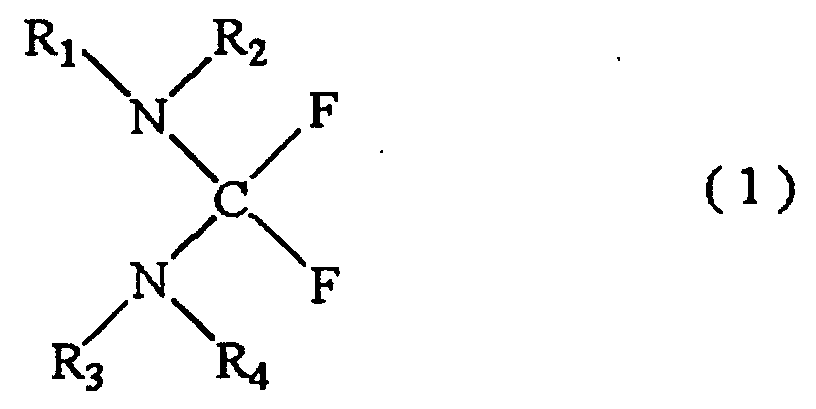
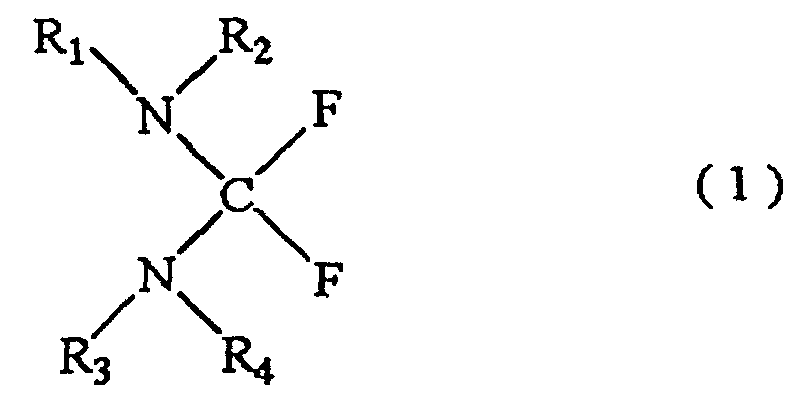
- As a result of the extensive studies for accomplishing the above object, the present inventors have been found that a compound represented by the formula (1):wherein R1, R2, R3 and R4 may be the same or different, and each represents a substituted or unsubstituted, saturated or unsaturated alkyl group, or a substituted or unsubstituted aryl group; and R1 and R2 or R3 and R4 can bond to form a ring having one or more nitrogen atoms or having one or more nitrogen atoms and other hetero atoms; or R1 and R3 can bond to form a ring having two or more nitrogen atoms or having two or more nitrogen atoms and other hetero atoms; serves an excellent effect as a novel fluorinating agent capable of replacing a hydroxyl group, an alkoxy group, or an aryloxy group bonded to silicon atom with fluorine atom, and the operations from the production of the fluorinating agent to its use in fluorination can be carried out extremely safely and easily without requiring any specific equipments. Based on the findings, they have accomplished the invention.
- That is, the invention relates to the following.
- (1) A process for producing a fluorinated silicon compound which comprises reacting a silicon compound having at least one group selected from the group consisting of a hydroxyl group, an alkoxy group, and an aryloxy group bonded to silicon atom, with a compound represented by the formula (1) :wherein R1, R2, R3 and R4 may be the same or different, and each represents a substituted or unsubstituted, saturated or unsaturated alkyl group, or a substituted or unsubstituted aryl group; and R1 and R2 or R3 and R4 can bond to form a ring having one or more nitrogen atoms or having one or more nitrogen atoms and other hetero atoms; or R1 and R3 can bond to form a ring having two or more nitrogen atoms or having two or more nitrogen atoms and other hetero atoms, to fluorinate the groups.
- (2) The process for producing a fluorinated silicon compound as described in the above (1), wherein the compound; represented by the formula (1) is a compound represented by the formula (2):wherein a is an integer of 2 or 3, and R5 and R6 may be the same or different and each represents a substituted or unsubstituted, saturated or unsaturated lower alkyl group having 1 to 6 carbon atoms.

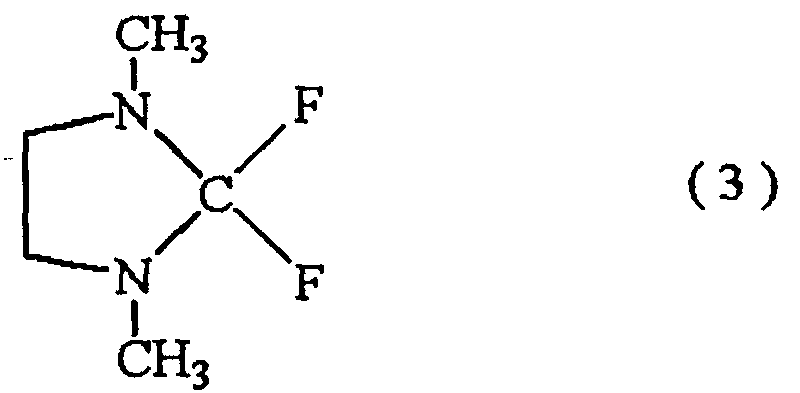
- (3) The process for producing a fluorinated silicon compound as described in the above (2), wherein the compound represented by the formula (2) is 2,2-difluoro-1,3-dimethylimidazolidine represented by the formula (3):

- (4) The process for producing a fluorinated silicon compound as described in the above (1), wherein the silicon compound having at least one group selected from the group consisting of a hydroxyl group, an alkoxy group, and an aryloxy group bonded to silicon atom, is a compound represented by the formula (5):wherein R7, R8, R9, R10, R11 and R12 each represents an alkyl group having 1 to 6 carbon atoms, an aryl group, hydrogen atom, hydroxyl group, an alkoxy group having 1 to 6 carbon atoms, or an aryloxy group, provided that at least one of R7, R8, R9, R10, R11, and R12 is hydroxyl group, an alkoxy group having 1 to 6 carbon atoms, or an aryloxy group; n represents an integer of 0 to 100; and m represents 0 or 1.

- (5) The process for producing a fluorinated silicon compound as described in the above (1), wherein the silicon compound having at least one group selected from the group consisting of a hydroxyl group, an alkoxy group and an aryloxy group bonded to silicon atom, is a silica having at least one of these groups.
- In the invention, starting with the silicon compound having at least one group selected from the group consisting of a hydroxyl group, an alkoxy group and an aryloxy group (hereinafter, simply referred to as the hydroxyl group, alkoxy group and/or aryloxy group") bonded to silicon atom, a fluorinated silicon compound can be produced by replacing the hydroxyl group, alkoxy group and/or aryloxy group bonded to silicon atom of the silicon compound with fluorine atom using the compound represented by the formula (1).
- This process realizes a high selectivity, safety and easiness to handle. Moreover, the fluorinating agent can be used without using highly dangerous chemicals and without requiring a specific equipments to produce fluorinated silicon compounds safely and easily as well as economically.
- Accordingly, the process of the invention is useful as an industrial process for producing a fluorinated silicon compound, which solves the problems at the conventional processes.
- Hereinafter, the present invention will be illustrated in detail.
- The fluorinating agent according to the invention is a compound represented by the formula (1):wherein R1 to R4 are the same as described above.
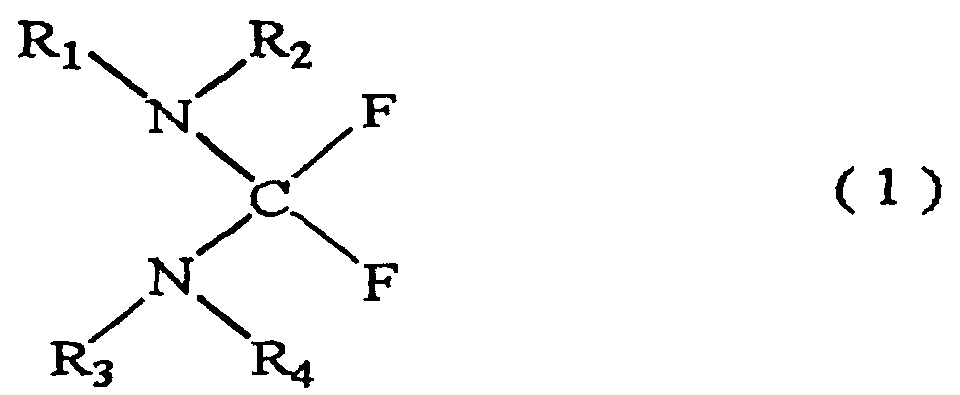
- In the formula (1), R1 to R4 may be the same or different and each represents a substituted or unsubstituted, saturated or unsaturated alkyl group, or a substituted or unsubstituted aryl group; and R1 and R2 or R3 and R4 can bond to form a ring having one or more nitrogen atoms or having one or more nitrogen atoms and other hetero atoms. Preferred is an alkyl group having 1 to 6 carbon atoms or an aryl group, and the alkyl group may be linear or branched. Specifically, examples include methyl group, ethyl group, n-propyl group, isopropyl group, n-butyl group, butenyl group, n-hexyl group, phenyl group and the like, and the alkyl groups may be the same or different.
- Moreover, R1 and R2 or R3 and R4 each can bond to form a heterocyclic ring having one or more nitrogen atoms, preferably having 3 to 5 carbon atoms. Examples of such a ring include pyrrolidine ring and piperidine ring.
- Furthermore, R1 and R3 can bond to form a 5-membered or 6-membered heterocyclic ring having two nitrogen atoms. Examples of such a ring include imidazolidine ring, imidazolidinone ring, pyrimidine ring, and pyrimidinone ring.
- As the compound represented by the formula (1), the compound in which R1 and R3 are combined to form a ring containing two nitrogen atoms is a compound represented by the formula (2):wherein a is an integer of 2 or 3, and R5 and R6 may be the same or different and each represents a substituted or unsubstituted, saturated or unsaturated lower alkyl group having 1 to 6 carbon atoms, preferably, 2,2-difluoro-1,3-dimethylimidazolidine represented by the formula (3):

- As the compound represented by the formula (1), specifically the following compounds may be mentioned but the invention is not limited to these examples.
- Examples includes bis-dimethylamino-difluoromethane, bis-diethylamino-difluoromethane, bis-di-n-propylamino-difluoromethane, bis-diisopropylamino-difluoromethane, bis-di-allylamino-difluoromethane, bis-di-n-butylamino-difluoromethane, bis-n-hexylamino-difluoromethane, bis-(1-prrolidyl)-difluoromethane, bis-(1-piperidyl)-difluoromethane, 2,2-difluoro-1,3-dimethyl-imidazolidine, 2,2-difluoro-1,3-diethyl-imidazolidine, 2,2-difluoro-1,3-di-n-propyl-imidazolidine, 2,2-difluoro-1,3-diisopropyl-imidazolidine, 2,2-difuluoro-1,3-diallyl-imidazolidine, 2,2-difluoro-1,3-di-n-butyl-imidazolidine, bis-(N-methyl-N-phenyl)-difluoromethane, 2,2-difluoro-1,3-di-n-butyl-imidazolidin-4,5-dione, and 2,2-difluoro-1,3-dimethylpyrimidine.
- Particularly preferred is 2,2-difluoro-1,3-dimethyl-imidazolidine represented by the above formula (3).
- The compound represented by the formula (1) according to the invention can be produced by the following process. Namely, the compound can be obtained safely and easily by exchanging halogens of a compound represented by the formula (4):wherein X1 and X2 may be the same or different and each represents chlorine or bromine atom; R1, R2, R3, and R4 may be the same or different, and each represents a substituted or unsubstituted, saturated or unsaturated alkyl group, or a substituted or unsubstituted aryl group; and R1 and R2 or R3 and R4 can bond to form a ring having one or more nitrogen atoms or having one or more nitrogen atoms and other hetero atoms; or R1 and R3 can bond to form a ring having two or more nitrogen atoms or having two or more nitrogen atoms and other hetero atoms, with an alkali metal fluoride in an inert solvent.
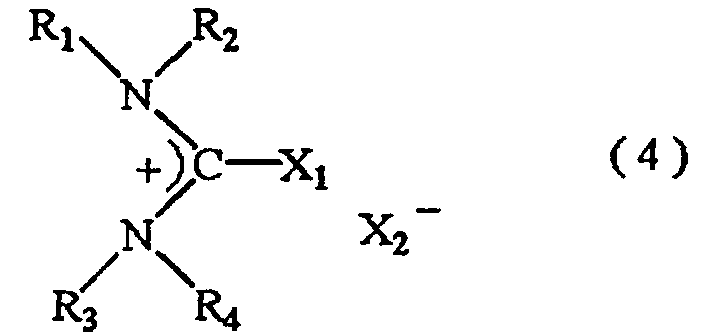
- As the alkali metal fluoride, cesium fluoride, rubidium fluoride, potassium fluoride, sodium fluoride, and the like can be used, and preferred is potassium fluoride for fluorination which is advantageous in view of economy and reaction-efficiency.
- As the compound represented by the formula (4), a compound wherein X1 and X2 are chlorine atoms is usually used but a compound wherein either or both of them are bromine atoms can be also used with no problem.
- Specific examples thereof include a tetraalkylchloroformamidium chloride, a 2-chloro-1,3-dialkylimidazolium chloride, a 2-bromo-1,3-dialkylimidazolium bromide, and the like.
- The compound of the formula (4) to be used as a raw material for producing the compound represented by the formula (1) can be produced, for example, by halogenating a tetraalkylurea, a tetraalkylthiourea, an N,N'-dialkylimidazolidinone, an N,N'-dialkylimidazolidin-2-thione, or the like with a halogenating agent such as phosgene, thionyl chloride, thionyl bromide, phosphorus trichloride, or phosphorus tribromide.
- For example, 1,3-dimethyl-2-chloroimidazolium chloride can be easily produced by the method described in Japanese Patent Laid-Open No. 25375/1984. Alternatively, it can be also produced by adding dropwise a solution of oxalyl chloride dissolved in a solvent such as carbon tetrachloride to 1,3-dimethylimidazolidinone and reacting them at room temperature to 60°C for several hours to several ten hours.
- In the production of the compound represented by the formula (1) of the invention, the amount of the alkali metal fluoride to be used for the halogen exchange is preferably 2 equivalents or more, more preferably 2 to 5 equivalents to the tetraalkyl-haloformamidium halide. When the amount is less than 2 equivalents, the exchange proceeds only incompletely and unexchanged halaide remains. Even when the fluoride is used in an amount exceeding 5 equivalents, the reaction yield is not so largely improved.
- The reaction solvent is not particularly limited as long as the solvent does not react with both the tetraalkyl-haloformamidinium halide and the compound to be produced.
- Preferred are acetonitrile, dimethylformamide, 1,3-dimethyl-2-imidazolidinone, dichloromethane, ethylene dichloride, and the like.
- The amount of the reaction solvent is not particularly limited but, in view of the reaction efficiency and operationality, preferably it is usually from 1 to 100 times by weight as much as the reaction substrate.
- The reaction temperature is not particularly limited but, in view of the reaction rate and stability of the product, it is usually in the range of -20 to 150°C, preferably 0 to 100°C.
- However, in the case that the fluorine compound to be produced has a low boiling point or possesses a structure which tends to occur dehydrofluorination, the reaction temperature should be made low as far as possible. The fluorine compound produced during the reaction can be isolated from the reaction mixture by a general unit operation, for example, distillation, extraction, or the like.
- The halogen exchange in the process for producing the compound represented by the formula (1) according to the invention can be carried out in the presence of a phase transfer catalyst such as a quaternary alkylammonium salt or a quaternary alkylphosphonium salt.
- The compound represented by the formula (1) thus obtained can be used at the successive fluorination in the form of the reaction solution of the halogen exchange as it is, or in the form after removal of inorganic salts by filtration and evaporation of the reaction solvent, or in the form isolated by an operation such as distillation.
- In the invention, the silicon compound having at least one group selected from the group consisting of a hydroxyl group, an alkoxy group, and an aryloxy group bonded to silicon atom means a compound wherein at least one group selected from the group consisting of a hydroxyl group, an alkoxy group, and an aryloxy group is directly bonded to the silicon atom in the silicon compound. These groups may be two or more groups which are the same or different.
- More specifically, for example, the compound represented by the formula (5) :wherein R7, R8, R9, R10, R11 and R12 each represents an alkyl group having 1 to 6 carbon atoms, an aryl group, hydrogen atom, hydroxyl group, an alkoxy group having 1 to 6 carbon atoms, or an aryloxy group, provided that at least one of R7 R8, R9, R10, R11 and R12 is a hydroxyl group, an alkoxy group having 1 to 6 carbon atoms, or an aryloxy group; n represents an integer of 0 to 100; and m represents 0 or 1.
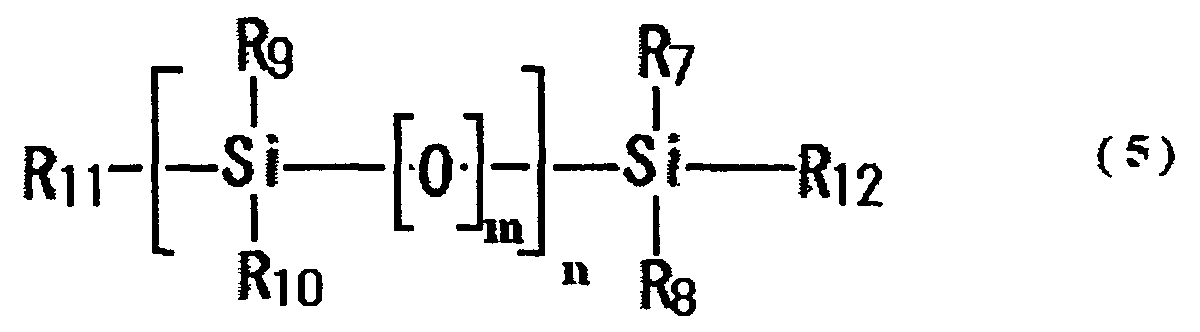
- Specific examples of the compound represented by the formula (5) include trimethylsilanol, hydroxypentamethyldisiloxane, hydroxyheptamethyltrisiloxane, 1-hydroxynonamethyltetrasiloxane, hydroxypolydimethylsiloxane, triethylsilanol, hydroxypentaethyldisiloxane, hydroxyheptaethyltrisiloxane, hydroxynonaethyltetrasiloxane, hydroxypolydiethylsiloxane, triphenylsilanol, hydroxypentaphenyldisiloxane, hydroxyheptaphenyltrisiloxane, hydroxynonaphenyltetrasiloxane, hydroxypolydiphenylsiloxane, ethyldimethylsilanol, propyldimethylsilanol, t-butyldimethylsilanol, phenyldimethylsilanol, propyldiethylsilanol, t-butyldiethylsilanol, phenyldiethylsilanol, methyldiphenylsilanol, ethyldiphenylsilanol, propyldiphenylsilanol, t-butyldiphenylsilanol, dimethylsilanediol, 1,3-dihydroxytetramethyldisiloxane, 1,5-dihydroxyhexamethyltrisiloxane, 1,7-dihydroxyoctamethyltetrasiloxane, α,ω-dihydroxypolydimethylsiloxane, diethylsilanediol, 1,3-dihydroxytetraethyldisiloxane, 1,5-dihydroxyhexaethyltrisiloxane, 1,7-dihydroxyoctaethyltetrasiloxane, α,ω-dihydroxypolydiethylsiloxane, diphenylsilanediol, 1,3-dihydroxytetraphenyldisiloxane, 1,5-dihydroxyhexaphenyltrisiloxane, 1,7-dihydroxyoctaphenyltetrasiloxane, α,ω-dihydroxypolydiphenylsiloxane, trimethoxysilanol, triethoxysilanol, triphenoxysilanol, ethoxydimethylsilanol, propoxydimethylsilanol, t-butoxydimethylsilanol, phenoxydimethylsilanol, propyldiethoxysilanol, t-butyldiethoxysilanol, phenyldiethoxysilanol, methyldiphenoxysilanol, ethyldiphenoxysilanol, propyldiphenoxysilanol, t-butyldiphenoxysilanol, monomethoxysilane, monoethoxysilane, monopropoxysilane, monobutoxysilane, monophenoxysilane, trimethylmethoxysilane, triethylethoxysilane, tripropylpropoxysilane, tributylbutoxysilane, triphenylmethoxysilane, triphenylethoxysilane, triphenylpropoxysilane, triphenylbutoxysilane, triphenylphenoxysilane, diethoxysilane, dipropoxysilane, dibutoxysilane, diphenoxysilane, dimethyldimethoxysilane, diethyldiethoxysilane, dipropyldipropoxysilane, dibutyldibutoxysilane, diphenyldimethoxysilane, diphenyldiethoxysilane, diphenyldipropoxysilane, diphenyldibutoxysilane, diphenyldiphenoxysilane, trimethoxysilane, triethoxysilane, tripropoxysilane, tributoxysilane, triphenoxysilane, methyltrimethoxysilane, ethyltriethoxysilane, propyltripropoxysilane, butyltributoxysilane, phenyltrimethoxysilane, phenyltriethoxysilane, phenyltripropoxysilane, phenyltributoxysilane, phenyltriphenoxysilane, dimethoxydisilane, diethoxydisilane, dipropoxydisilane, dibutoxydisilane, diphenoxydisilane, tetramethyldimethoxydisilane, tetraethyldiethoxydisilane, tetrapropyldipropoxydisilane, tetrabutyldibutoxydisilane, tetraphenyldimethoxydisilane, tetraphenyldiethoxydisilane, tetraphenyldipropoxydisilane, tetraphenyldibutoxydisilane, tetraphenyldiphenoxydisilane, dimethoxydisiloxane, diethoxydisiloxane, dipropoxydisiloxane, dibutoxydisiloxane, diphenoxydisiloxane, tetramethyldimethoxydisiloxane, tetraethyldiethoxydisiloxane, tetrapropyldipropoxydisiloxane, tetrabutyldibutoxydisiloxane, tetraphenyldimethoxydisiloxane, tetraphenyldiethoxydisiloxane, tetraphenyldipropoxydisiloxane, tetraphenyldibutoxydisiloxane, tetraphenyldiphenoxydisiloxane, and the like.
- In addition, among the general silicon compounds, silica having at least one group selected from the group consisting of a hydroxyl group, an alkoxy group, and an aryloxy group bonded to silicon atom may be mentioned.
- Silica is a compound constituted mainly by SiO2 or its composition, and examples thereof include fine-particle silica, silica powder, silicalite, and the like. Such silica usually has hydroxyl group bonded to silicon atom. Also, as silica containing an alkoxy group and/or aryloxy group bonded to silicon atom, there may be mentioned silica synthesized starting with an alkoxysilane such as tetramethoxysilane and silica modified with a silane coupling agent such as trimethoxymethylsilane, for example. The shape of primary or secondary particles may be any of particle form, needle form, or amorphous form, and there is no limitation in the aggregation state. Furthermore, the shape of the aggregate is also not limited, and may be any of powder, granule, pellet, or a sintered one having any form, for example.
- In the case of fluorination of a hydroxyl group, an alkoxy group, and/or an aryloxy group to silicon atom using the compound represented by the formula (1), the amount of the compound represented by the formula (1) to be used may be usually 1 equivalent or more to the hydroxyl group, the alkoxy group, and /or the aryloxy group bonded to silicon atom. The amount of less than 1 equivalent, it is not preferred because there is a possibility that unreacted hydroxyl group, alkoxy group, and/or aryloxy group may remain. Also, it is not preferred to use unnecessarily excessive amount from economical viewpoint. Therefore, the amount of the compound represented by the formula (1) is preferably from 1 to 5 equivalent, more preferably 1 to 3 equivalent to the hydroxyl group, alkoxy group, and/or aryloxy group bonded to silicon atom.
- The silicon compound whose hydroxyl group, alkoxy group, and/or aryloxy group are fluorinated with the compound represented by the formula (1) is not restricted by functional groups, number of silicon atom, and number of hydroxyl group, alkoxy group, and/or aryloxy group bonded to single silicon atom. However, in the case that a substrate contains a functional group having an active hydrogen or hydroxyl group, alkoxy group, and/or aryloxy group other than the hydroxyl group, alkoxy group, and/or aryloxy group bonded to silicon atom, there is a possibility of occurrence of a side-reaction other than the replacement of the aimed hydroxyl group bonded to silicon atom with fluorine atom. For this reason, care must be taken because the necessary amount (equivalent) of the compound represented by the formula (1) required for the objective reaction varies.
- Furthermore, the process for producing a fluorinated silicon compound can be also applied even to silicon compounds such as silicone resins, silicone greases, silicone rubbers, and silicon oils without any problem.
- The following will explain the invention in more detail by reference to Examples but the invention is not limited thereto. In Synthetic Example, the concentration of 2,2-difluoro-1,3-dimethylimidazolidine (DFI) was measured by a high performance liquid chromatographic method after conversion of DFI into its derivative by the reaction with aniline.
- The concentration of fluorine ion (hereinafter abbreviated as F-) was measured by an absorptiometric analysis using Alizarin Complexon reagent.
- To a 500 ml, four-necked reaction flask 80.0 g (0.452 mol) of 1,3-dimethyl-2-chloro-imidazolium chloride, 105.1 g (1.810 mol) of spray-dried potassium fluoride, and 320 ml of acetonitrile were charged, and were reacted at 80°C for 17 hours under a nitrogen atmosphere. The reaction mixture was cooled to 25°C and then inorganic salts were separated from the reaction mixture to obtain 414.2 g of an acetonitrile solution of 2,2-difluoro-1,3-dimethylimidazolidine (MW 136.15). In the solution, the concentration of DFI was 11.4 wt% and the yield was 77%.
Concentration of F- in the solution Calculated value 3.18 wt% Found value 3.10 wt% - With 9 ml (about 12 g) of dichloromethane was mixed under stirring 1.2 g (about 9 mmol) of DFI isolated by distillation. To the solution was added dropwise 1.1 g (about 8.5 mmol) of t-butyl-dimethyl-silanol under ice-cooling. After completion of the addition, the whole was kept at room temperature for 1 hour under stirring. After completion of the reaction, formation of t-butyl-dimethyl-fluoro-silane was confirmed by GC-MS measurement of the reaction solution. The reaction yield was found to be 95% or more on GC analysis.
- With 14.6 ml (about 11.5 g) of acetonitrile was mixed under stirring 1.86 g (about 13.7 mmol) of DFI isolated by distillation. To the solution was added dropwise 1.4 g (about 5.1 mmol) of diethoxy-diphenyl-silane at room temperature. After completion of the addition, the whole was kept at room temperature for 1 hour under stirring. After the lapse of the reaction time, formation of diphenyl-difluoro-silane was confirmed by GC-MS measurement of the reaction solution. The reaction yield was found to be 95% or more on GC analysis.
- Into 100 ml of acetonitrile was dispersed 3 g of fine-particle silica having hydroxyl group bonded to silicon atom on the surface (surface silanol group) (fumed silica, compositional formula: SiO2, AEROSIL, a product of Nippon Aerosil Co., Ltd. may be mentioned as a representative), a specific surface area of 200 m2/g, and a surface silanol group concentration of 2 mmol/g. To the dispersion was added dropwise 3 g of DFI isolated by distillation, at room temperature under stirring. During the addition, the liquid temperature was temporarily raised to about 40°C. The mixture was left for 3.5 hours without cooling and heating. Thereafter, the fine-particle silica was filtered off and washed with acetonitrile. The fine-particle silica thus recovered was dried at 105°C for 8 hours under reduced pressure (10 Torr).
- The surface silanol group concentration of the fine-particle silica before and after the treatment was measured according to the method of Wartmann et al. described in Dissertation ETH Zurich (1958). As a result, the surface silanol group concentration was found to be 1.96 mmol/g before the treatment and 0.21 mmol/g after the treatment, and thus an decrease by the treatment was observed.
- Furthermore, the fluorine content of the fine-particle silica after the treatment was measured by elementary analysis and found to be 3.4 wt%.
Claims (5)
- A process for producing a fluorinated silicon compound which comprises reacting a silicon compound having at least one group selected from the group consisting of a hydroxyl group, an alkoxy group, and an aryloxy group bonded to silicon atom, with a compound represented by the formula (1):wherein R1, R2, R3, and R4 may be the same or different, and each represents a substituted or unsubstituted, saturated or unsaturated alkyl group, or a substituted or unsubstituted aryl group; and R1 and R2 or R3 and R4 can bond to form a ring having one or more nitrogen atoms or having one or more nitrogen atoms and other hetero atoms; or R1 and R3 can bond to form a ring having two or more nitrogen atom or having two or more nitrogen atoms and other hetero atoms, to fluorinate the groups.

- The process for producing a fluorinated silicon compound according to claim 1, wherein the compound represented by the formula (1) is a compound represented by the formula (2):wherein a is an integer of 2 or 3, and R5 and R6 may be the same or different and each represents a substituted or unsubstituted, saturated or unsaturated lower alkyl group having 1 to 6 carbon atoms.

- The process for producing a fluorinated silicon compound according to claim 2, wherein the compound represented by the general formula (2) is 2,2-difluoro-1,3-dimethylimidazolidine represented by the formula (3):

- The process for producing a fluorinated silicon compound according to claim 1, wherein the silicon compound' having at least one group selected from the group consisting of a hydroxyl group, an alkoxy group, and an aryloxy group bonded to silicon atom, is a compound represented by the formula (5):wherein R7, R8, R9, R10, R11, and R12 each represents an alkyl group having 1 to 6 carbon atoms, an aryl group, hydrogen atom, hydroxyl group, an alkoxy group having 1 to 6 carbon atoms, or an aryloxy group, provided that at least one of R7, R8, R9, R10, R11, and R12 is a hydroxyl group, an alkoxy group having 1 to 6 carbon atoms, or an aryloxy group; n represents-an integer of 0 to 100; and m represents 0 or 1.

- The process for producing a fluorinated silicon compound according to claim 1, wherein the silicon compound having at least one group selected from the group consisting of a hydroxyl group, an alkoxy group, and an aryloxy group bonded to silicon atom, is silica having at least one of these groups.
Applications Claiming Priority (5)
| Application Number | Priority Date | Filing Date | Title |
|---|---|---|---|
| JP26284799A JP2001089486A (en) | 1999-09-17 | 1999-09-17 | Method for producing silicon fluoride compound |
| JP26284799 | 1999-09-17 | ||
| JP30322099 | 1999-10-26 | ||
| JP30322099A JP2001122879A (en) | 1999-10-26 | 1999-10-26 | Method for producing fluorinated silicon compound |
| PCT/JP2000/006224 WO2001021528A1 (en) | 1999-09-17 | 2000-09-12 | Process for producing fluorinated silicon compound |
Publications (1)
| Publication Number | Publication Date |
|---|---|
| EP1138633A1 true EP1138633A1 (en) | 2001-10-04 |
Family
ID=26545741
Family Applications (1)
| Application Number | Title | Priority Date | Filing Date |
|---|---|---|---|
| EP00957117A Withdrawn EP1138633A1 (en) | 1999-09-17 | 2000-09-12 | Process for producing fluorinated silicon compound |
Country Status (5)
| Country | Link |
|---|---|
| US (1) | US6344579B1 (en) |
| EP (1) | EP1138633A1 (en) |
| CN (1) | CN1336902A (en) |
| TW (1) | TW486448B (en) |
| WO (1) | WO2001021528A1 (en) |
Families Citing this family (2)
| Publication number | Priority date | Publication date | Assignee | Title |
|---|---|---|---|---|
| US20060025314A1 (en) * | 2004-07-28 | 2006-02-02 | Afton Chemical Corporation | Power transmission fluids with enhanced extreme pressure and antiwear characteristics |
| US8703625B2 (en) * | 2010-02-04 | 2014-04-22 | Air Products And Chemicals, Inc. | Methods to prepare silicon-containing films |
Family Cites Families (9)
| Publication number | Priority date | Publication date | Assignee | Title |
|---|---|---|---|---|
| BE669338A (en) * | 1963-04-17 | 1965-12-31 | ||
| US3408380A (en) * | 1966-03-17 | 1968-10-29 | Agriculture Usa | Preparation of fluorosilanes |
| US3507799A (en) * | 1967-12-12 | 1970-04-21 | Stauffer Wacker Silicone Corp | Transhalogenation reagent composed of tetrahydrofuran and silicon tetrafluoride |
| US3621045A (en) * | 1968-11-04 | 1971-11-16 | Inst Silikon & Fluorkarbonchem | Process for the preparation of organofluorosilanes |
| US3646092A (en) * | 1969-05-20 | 1972-02-29 | Inst Silikon & Fluorkarbonchem | Process for the recovery of trimethylfluorosilane from a mixture of silicontetrachloride trimethylchlorosilane and hydrocarbons boiling at the same range |
| US3655714A (en) * | 1969-05-20 | 1972-04-11 | Inst Silikon Und Fluorkarbonch | Process for preparing fluorine compounds from organosilicon compounds by means of fluorides of the first to third main groups of the periodic system |
| US5468894A (en) * | 1994-03-22 | 1995-11-21 | Tri Chemical Laboratory Inc. | Method of manufacturing FSi(OR)3 |
| US5466850A (en) * | 1995-04-07 | 1995-11-14 | Pcr, Inc. | Process for the preparation of fluorosilanes |
| US6329529B1 (en) | 1997-08-06 | 2001-12-11 | Mitsui Chemicals, Inc. | Nitrogen-based halogenating agents and process for preparing halogen-containing compounds |
-
2000
- 2000-09-12 CN CN00802650A patent/CN1336902A/en active Pending
- 2000-09-12 WO PCT/JP2000/006224 patent/WO2001021528A1/en not_active Ceased
- 2000-09-12 US US09/831,146 patent/US6344579B1/en not_active Expired - Fee Related
- 2000-09-12 EP EP00957117A patent/EP1138633A1/en not_active Withdrawn
- 2000-09-15 TW TW089118910A patent/TW486448B/en not_active IP Right Cessation
Non-Patent Citations (1)
| Title |
|---|
| See references of WO0121528A1 * |
Also Published As
| Publication number | Publication date |
|---|---|
| CN1336902A (en) | 2002-02-20 |
| TW486448B (en) | 2002-05-11 |
| WO2001021528A1 (en) | 2001-03-29 |
| US6344579B1 (en) | 2002-02-05 |
Similar Documents
| Publication | Publication Date | Title |
|---|---|---|
| US6680398B1 (en) | Method of making mercaptoalkylalkoxysilanes | |
| TWI238825B (en) | Process for the preparation of sulfur-containing organosilicon compounds | |
| KR100382705B1 (en) | Fluorinating agent, process for producing the same, and use thereof | |
| CN101184767A (en) | Aqueous phase catalytic method for preparing thiocarboxylate silane | |
| US6344579B1 (en) | Process for producing fluorinated silicon compound | |
| JPH0416476B2 (en) | ||
| JP3459892B2 (en) | Fluorinated surfactant compound and method for producing the same | |
| EP0383566B1 (en) | Process for preparing organic silicon compounds | |
| CN101360754A (en) | Process for producing mercaptoalkylalkoxysilanes | |
| JP2001089486A (en) | Method for producing silicon fluoride compound | |
| JP2001122879A (en) | Method for producing fluorinated silicon compound | |
| US6872861B2 (en) | Process for preparing polyfluoroalkylithium compounds | |
| JP4092746B2 (en) | Method for producing alkoxysilane | |
| JPH02115151A (en) | Oduction of alpha-aminoalkanol | |
| JPS6324980B2 (en) | ||
| JP2793090B2 (en) | Method for producing bromopentafluorobenzene | |
| JP6665437B2 (en) | Method for producing tertiary alkyl silane and tertiary alkyl alkoxy silane | |
| JP3197295B2 (en) | Method for dechlorinating alkoxysilane | |
| EP0577139A1 (en) | Method for preparing triorganomonohalogenosilane | |
| JP2618713B2 (en) | Method for producing β-hydroxyamino compound | |
| US3408380A (en) | Preparation of fluorosilanes | |
| JP3915872B2 (en) | Method for producing tetrakis (trimethylsilyl) silane and tris (trimethylsilyl) silane | |
| JP2021535914A (en) | How to dehydrogenate dichlorosilane | |
| JP3625028B2 (en) | Method for producing fluoroacetone | |
| JPS6023384A (en) | Method for producing silyl esters of alkylphenols |
Legal Events
| Date | Code | Title | Description |
|---|---|---|---|
| PUAI | Public reference made under article 153(3) epc to a published international application that has entered the european phase |
Free format text: ORIGINAL CODE: 0009012 |
|
| 17P | Request for examination filed |
Effective date: 20010601 |
|
| AK | Designated contracting states |
Kind code of ref document: A1 Designated state(s): DE FR GB |
|
| AX | Request for extension of the european patent |
Free format text: AL;LT;LV;MK;RO;SI |
|
| STAA | Information on the status of an ep patent application or granted ep patent |
Free format text: STATUS: THE APPLICATION HAS BEEN WITHDRAWN |
|
| 18W | Application withdrawn |
Effective date: 20040616 |