EP1138381A1 - Sb-Re COMPOSITE OXIDE CATALYST FOR AMMOXIDATION - Google Patents
Sb-Re COMPOSITE OXIDE CATALYST FOR AMMOXIDATION Download PDFInfo
- Publication number
- EP1138381A1 EP1138381A1 EP00956901A EP00956901A EP1138381A1 EP 1138381 A1 EP1138381 A1 EP 1138381A1 EP 00956901 A EP00956901 A EP 00956901A EP 00956901 A EP00956901 A EP 00956901A EP 1138381 A1 EP1138381 A1 EP 1138381A1
- Authority
- EP
- European Patent Office
- Prior art keywords
- isobutylene
- ammoxidation
- catalyst
- aliphatic hydrocarbon
- methacrylonitrile
- Prior art date
- Legal status (The legal status is an assumption and is not a legal conclusion. Google has not performed a legal analysis and makes no representation as to the accuracy of the status listed.)
- Granted
Links
Images



Classifications
-
- C—CHEMISTRY; METALLURGY
- C07—ORGANIC CHEMISTRY
- C07C—ACYCLIC OR CARBOCYCLIC COMPOUNDS
- C07C253/00—Preparation of carboxylic acid nitriles
- C07C253/24—Preparation of carboxylic acid nitriles by ammoxidation of hydrocarbons or substituted hydrocarbons
- C07C253/26—Preparation of carboxylic acid nitriles by ammoxidation of hydrocarbons or substituted hydrocarbons containing carbon-to-carbon multiple bonds, e.g. unsaturated aldehydes
-
- B—PERFORMING OPERATIONS; TRANSPORTING
- B01—PHYSICAL OR CHEMICAL PROCESSES OR APPARATUS IN GENERAL
- B01J—CHEMICAL OR PHYSICAL PROCESSES, e.g. CATALYSIS OR COLLOID CHEMISTRY; THEIR RELEVANT APPARATUS
- B01J23/00—Catalysts comprising metals or metal oxides or hydroxides, not provided for in group B01J21/00
- B01J23/002—Mixed oxides other than spinels, e.g. perovskite
-
- B—PERFORMING OPERATIONS; TRANSPORTING
- B01—PHYSICAL OR CHEMICAL PROCESSES OR APPARATUS IN GENERAL
- B01J—CHEMICAL OR PHYSICAL PROCESSES, e.g. CATALYSIS OR COLLOID CHEMISTRY; THEIR RELEVANT APPARATUS
- B01J23/00—Catalysts comprising metals or metal oxides or hydroxides, not provided for in group B01J21/00
- B01J23/16—Catalysts comprising metals or metal oxides or hydroxides, not provided for in group B01J21/00 of arsenic, antimony, bismuth, vanadium, niobium, tantalum, polonium, chromium, molybdenum, tungsten, manganese, technetium or rhenium
- B01J23/18—Arsenic, antimony or bismuth
-
- B—PERFORMING OPERATIONS; TRANSPORTING
- B01—PHYSICAL OR CHEMICAL PROCESSES OR APPARATUS IN GENERAL
- B01J—CHEMICAL OR PHYSICAL PROCESSES, e.g. CATALYSIS OR COLLOID CHEMISTRY; THEIR RELEVANT APPARATUS
- B01J23/00—Catalysts comprising metals or metal oxides or hydroxides, not provided for in group B01J21/00
- B01J23/16—Catalysts comprising metals or metal oxides or hydroxides, not provided for in group B01J21/00 of arsenic, antimony, bismuth, vanadium, niobium, tantalum, polonium, chromium, molybdenum, tungsten, manganese, technetium or rhenium
- B01J23/32—Manganese, technetium or rhenium
- B01J23/36—Rhenium
-
- C—CHEMISTRY; METALLURGY
- C07—ORGANIC CHEMISTRY
- C07C—ACYCLIC OR CARBOCYCLIC COMPOUNDS
- C07C253/00—Preparation of carboxylic acid nitriles
- C07C253/24—Preparation of carboxylic acid nitriles by ammoxidation of hydrocarbons or substituted hydrocarbons
-
- B—PERFORMING OPERATIONS; TRANSPORTING
- B01—PHYSICAL OR CHEMICAL PROCESSES OR APPARATUS IN GENERAL
- B01J—CHEMICAL OR PHYSICAL PROCESSES, e.g. CATALYSIS OR COLLOID CHEMISTRY; THEIR RELEVANT APPARATUS
- B01J2523/00—Constitutive chemical elements of heterogeneous catalysts
-
- Y—GENERAL TAGGING OF NEW TECHNOLOGICAL DEVELOPMENTS; GENERAL TAGGING OF CROSS-SECTIONAL TECHNOLOGIES SPANNING OVER SEVERAL SECTIONS OF THE IPC; TECHNICAL SUBJECTS COVERED BY FORMER USPC CROSS-REFERENCE ART COLLECTIONS [XRACs] AND DIGESTS
- Y02—TECHNOLOGIES OR APPLICATIONS FOR MITIGATION OR ADAPTATION AGAINST CLIMATE CHANGE
- Y02P—CLIMATE CHANGE MITIGATION TECHNOLOGIES IN THE PRODUCTION OR PROCESSING OF GOODS
- Y02P20/00—Technologies relating to chemical industry
- Y02P20/50—Improvements relating to the production of bulk chemicals
- Y02P20/52—Improvements relating to the production of bulk chemicals using catalysts, e.g. selective catalysts
Definitions
- This invention relates to an Sb-Re ammoxidation reaction catalyst, and to a method for manufacturing a corresponding unsaturated nitrile such as methacrylonitrile or the like from a lower hydrocarbon such as isobutylene, isobutane or the like in the presence of both ammonia and a molecular oxygen-containing gas using this Sb-Re ammoxidation catalyst.
- ammoxidation reaction in which ammonia and oxygen were allowed to act on an organic compound and the methyl groups were directly changed into cyano groups is a well-known conventional method for manufacturing an unsaturated nitrile such as acrylonitrile, methacrylonitrile or the like and numerous ammoxidation reaction catalysts have been proposed up to now.
- proposed catalysts containing molybdenum include an Mo-V-Te-based oxide catalyst (Japanese Laid-Open Patent Application Nos. 02-257, 05-148212, 05-208136, 06-279351, 06-287146, and 07-108101), an Mo-Cr-Bi-based oxide catalyst (Japanese Laid-Open Patent Application Nos.
- V-Sb-W-P-based catalyst Japanese Laid-Open Patent Application No. 02-95439
- V-W-Te-based oxide catalyst Japanese Laid-Open Patent Application No. 06-228073
- Cr-Sb-W-based oxide catalyst Japanese Laid-Open Patent Application No. 07-157461
- Ammoxidation reaction catalysts containing antimony have also been proposed, which include, in addition to those listed above, Sb-Sn-based, V-Sn-Sb-Cu-Bi-based, V-Sn-Sb-Cu-Te-based, and other such oxide catalysts (Japanese Laid-Open Patent Application No. 04-275266), a V-Sb-Ga-based oxide catalyst (Japanese Laid-Open Patent Application No. 06-135922), a Ga-Sb-based oxide catalyst (Soviet Patent Nos. SU547444 and SU698646), V-Sb-Fe-based, V-Sb-Ga-based, and other such oxide catalysts (Japanese Laid-Open Patent Application No.
- Catalysts containing rhenium (Re) exhibit a distinctive activity in regard to the hydrodesulfurization of crude oil and the dehydrogenation and selective hydration of organic compounds, and for these reactions the activity of a rhenium compound is superior to that of a corresponding catalyst containing molybdenum or tungsten, so rhenium compounds are widely used in many industrial processes, such as the refining of crude petroleum products, the metathesis of alkenes and the like.
- a rhenium compound will react with ethanol and methanol, and will react as a promoter (catalysts for cobalt, molybdenum, vanadium and the like, for instance) in the selective oxidation of alkenes and aromatics.
- rhenium has been found to be an important element in many active ammoxidation reaction catalysts containing antimony (Sb), as mentioned above. It was not known, though, that Sb-Re compound oxides are useful as ammoxidation reaction catalysts for an aliphatic hydrocarbon.
- an oxide of rhenium has the same electrical potential for the purposes of an ammoxidation catalyst as vanadium (V), molybdenum (Mo), and tungsten (W), and arrived at the present invention upon discovering that when a compound oxide of a rhenium oxide and one of the above-mentioned antimony oxides, and particularly two novel compounds, is produced, and this Sb-Re compound oxide is used as an ammoxidation reaction catalyst in the reaction of isobutylene or isobutane in the presence of ammonia and a molecular oxygen-containing gas, methacrylonitrile is produced very efficiently in the presence of a high concentration of oxygen and ammonia.
- the present invention relates to a catalyst for the ammoxidation reaction of an aliphatic hydrocarbon, composed of an Sb-Re compound oxide (Claim 1), a catalyst for the ammoxidation reaction of an aliphatic hydrocarbon according to Claim 1, wherein the Sb-Re compound oxide is SbRe 2 O 6 or Sb 4 Re 2 O 13 (Claim 2), and a catalyst for the ammoxidation reaction of an aliphatic hydrocarbon according to Claims 1 or 2, wherein the aliphatic hydrocarbon is isobutylene or isobutane (Claim 3).
- a catalyst for the ammoxidation reaction of an aliphatic hydrocarbon composed of an Sb-Re compound oxide (Claim 1)
- a catalyst for the ammoxidation reaction of an aliphatic hydrocarbon according to Claim 1 wherein the Sb-Re compound oxide is SbRe 2 O 6 or Sb 4 Re 2 O 13
- the present invention also relates to a method for manufacturing an unsaturated nitrile, wherein an aliphatic hydrocarbon is subjected to vapor phase contact ammoxidation with ammonia and a molecular oxygen-containing gas in the presence of an Sb-Re compound oxide catalyst (Claim 4), a method for manufacturing an unsaturated nitrile according to Claim 4, wherein the Sb-Re compound oxide is SbRe 2 O 6 or Sb 4 Re 2 O 13 (Claim 5), a method for manufacturing an unsaturated nitrile according to Claims 4 or 5, wherein the aliphatic hydrocarbon is isobutylene or isobutane, and the unsaturated nitrile is methacrylonitrile (Claim 6), a method for manufacturing an unsaturated nitrile according to any of Claims 4 to 6, wherein the vapor phase contact ammoxidation is carried out under conditions in which the concentration ratio of the aliphatic hydrocarbon, ammonia, and oxygen is 1:(1.5-5):(
- the catalyst of the present invention for subjecting an aliphatic hydrocarbon such as isobutylene, isobutane or the like to an ammoxidation reaction is characterized by being composed of an Sb-Re compound oxide such as SbRe 2 O 6 , Sb 4 Re 2 O 13 or the like.
- the method of the present invention for manufacturing an unsaturated nitrile such as methacrylonitrile or the like is characterized in that an aliphatic hydrocarbon such as isobutylene, isobutane or the like is subjected to vapor phase contact ammoxidation with ammonia and a molecular oxygen-containing gas in the presence of an Sb-Re compound oxide catalyst.
- the Sb-Re compound oxide (double oxide) of the present invention may be any oxide in which metal oxides of antimony and rhenium have formed a compound, but specific examples include SbRe 2 O 6 , Sb 4 Re 2 O 13 , SbOReO 4 ⁇ 2H 2 O and the like.
- the Sb-Re compound oxide of the present invention may also encompasses metals other than antimony and rhenium, and oxides of these metals, to the extent that the catalytic activity thereof is not compromised.
- the method for manufacturing this Sb-Re compound oxide can be any known method for manufacturing a compound oxide, such as mixing and heating metal oxides, and the composition and structure of the compound oxide thus manufactured can be confirmed by examining the crystal structure, valence, and oscillation mode by X-ray diffraction, X-ray photoelectron spectroscopy, or Raman spectroscopy.
- aliphatic hydrocarbon in the present invention refers to an aliphatic hydrocarbon that is a gas at normal temperature, specific examples of which include isobutylene, n-butylene, isobutane, propane, propylene, pentene, pentane, hexene, and other saturated or unsaturated aliphatic hydrocarbons.
- “Corresponding unsaturated nitrile” refers to an unsaturated nitrile corresponding to the aliphatic hydrocarbon in question, specific examples of which include acrylonitrile, methacrylonitrile and the like.
- Examples of the molecular oxygen-containing gas in the present invention include pure oxygen gas, air, and other such oxygen-containing gases.
- the vapor phase contact ammoxidation in the present invention can be carried out by introducing a raw material gas composed of a mixed gas in which a molecular oxygen-containing gas, ammonia, and a diluent gas have been added to an aliphatic hydrocarbon gas such as isobutylene or the like in the presence of an ammoxidation catalyst composed of an Sb-Re compound oxide, into a fixed bed reactor containing the above-mentioned catalyst.
- Examples of the diluent gas include nitrogen, carbon dioxide, helium, water vapor, and mixtures of these gases.
- the ammoxidation reaction of an aliphatic hydrocarbon such as isobutylene or the like using an ammoxidation reaction catalyst composed of the Sb-Re compound oxide of the present invention is preferably carried out in the presence of an excess of ammonia, such as at a concentration ratio with isobutylene of at least 1:1, and preferably with the ammonia being used in an amount of 1.5 to 5 times as much as the amount of isobutylene, and in the presence of an excess of oxygen, such as at a concentration ratio with isobutylene of at least 2 times, preferably 3 to 5 times as much as the latter.
- This is advantageous because it increases the methacrylonitrile selectivity and the isobutylene conversion.
- conducting the ammoxidation reaction at a temperature of at least 400°C, and preferably 450 to 600°C is advantageous because this also increases the methacrylonitrile selectivity and the isobutylene conversion.
- an ammoxidation reaction catalyst composed of the Sb-Re compound oxide of the present invention is used in an ammoxidation reaction of an aliphatic hydrocarbon such as isobutylene or the like, it is preferable to use a catalyst that has been pretreated with pure helium gas or with helium gas containing 15 vol% ammonia, because this increases the conversion.
- This SbOReO 4 ⁇ 2H 2 O was spray dried and pre-calcined, rhenium (Re) or antimony(III) oxide was added, and this mixture was calcined at 500°C, which yielded a compound oxide catalyst of SbRe 2 O 6 and Sb 4 Re 2 O 13 .
- the crystal structure, valence, and oscillation mode were then analyzed using an X-ray diffraction apparatus (made by Rigaku), an X-ray photoelectron spectroscope (made by Rigaku), and a Raman spectroscope (made by JASCO Corporation), which confirmed that the obtained compound was an Sb-Re compound oxide of SbRe 2 O 6 and Sb 4 Re 2 O 13 .
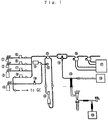
- a quartz reaction tube was packed with 0.15 g of either the compound oxide catalyst obtained above, or rhenium(VII) oxide, antimony(III) oxide, or antimony(IV) oxide (used as reference catalysts), and isobutylene was subjected to an ammoxidation reaction using the fixed layer fluidized reactor shown in Fig. 1.
- Fig. 1 is an isobutylene tank
- 2 is a propane tank
- 3 is an oxygen gas tank
- 4 is a helium gas tank
- 5 is an isobutylene MFC.
- the reaction tube 13 packed with the above-mentioned catalyst was adjusted to a temperature of 400°C by an electric furnace (not shown) controlled by a temperature regulator, after which a mixed gas composed of 10 vol% isobutylene, 15 vol% ammonia, 20 vol% oxygen, and 55 vol% helium was introduced in to the reactor at a gas hourly space velocity (GHSV) of about 20,000/hr by the mass flow controller 18, and an ammoxidation reaction was conducted.
- GHSV gas hourly space velocity
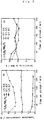
- the product of this reaction was analyzed by gas chromatography, and the isobutylene conversion and the methacrylonitrile selectivity were calculated at various times from the result of this analysis using the equations given above. These results are shown in Fig. 2.
- the next aspect to be examined was the effect of pretreatment with various gases on the SbRe 2 O 6 catalyst used in the ammoxidation reaction of isobutylene.
- the SbRe 2 O 6 was calcined at 400°C in the presence of either helium gas containing 25 vol% oxygen, helium gas alone, helium gas containing 15 vol% ammonia, or a reaction gas composed of 20 vol% oxygen, 15 vol% ammonia, and 10 vol% isobutylene equilibrated directly with helium gas.
- the ammoxidation reaction was conducted in the same manner as in Example 2, and the isobutylene conversion and the methacrylonitrile selectivity were calculated. These results are shown in Fig. 3. It can be seen from these results that pretreatment of the SbRe 2 O 6 with helium gas alone or with helium gas containing 15 vol% ammonia resulted in an ammoxidation reaction that was very stable and had good activity and selectivity.
- the reaction tube 13 packed with SbRe 2 O 6 was adjusted to a temperature of 400°C by an electric furnace controlled by a temperature regulator, after which a mixed gas composed of 10 vol% isobutane, 15 vol% ammonia, 30 vol% oxygen, and 45 vol% helium was introduced at a gas hourly space velocity (GHSV) of about 5,000/hr by the mass flow controller 18, and an ammoxidation reaction was conducted.
- GHSV gas hourly space velocity
- the product of this reaction was analyzed by gas chromatography in the same manner as in Example 2, and the isobutane conversion, the selectivity of the active component consisting of isobutylene and methacrylonitrile, and the methacrylonitrile selectivity were calculated at various times from the result of this analysis using the equations given above. These results are shown in Fig. 6. It can be seen from these results that the selectivity of the active component at an isobutane conversion of 3 to 4% was about 85 to 90%, and the methacrylonitrile selectivity was approximately
- the present invention involves the use of an ammoxidation reaction catalyst composed of an Sb-Re compound oxide, which allows a corresponding unsaturated nitrile such as methacrylonitrile or the like to be manufactured efficiently from a saturated or unsaturated lower aliphatic hydrocarbon such as isobutylene, isobutane or the like in the presence of a high concentration of oxygen and ammonia.
- an ammoxidation reaction catalyst composed of an Sb-Re compound oxide, which allows a corresponding unsaturated nitrile such as methacrylonitrile or the like to be manufactured efficiently from a saturated or unsaturated lower aliphatic hydrocarbon such as isobutylene, isobutane or the like in the presence of a high concentration of oxygen and ammonia.
Landscapes
- Chemical & Material Sciences (AREA)
- Organic Chemistry (AREA)
- Engineering & Computer Science (AREA)
- Materials Engineering (AREA)
- Chemical Kinetics & Catalysis (AREA)
- Organic Low-Molecular-Weight Compounds And Preparation Thereof (AREA)
- Low-Molecular Organic Synthesis Reactions Using Catalysts (AREA)
- Catalysts (AREA)
Abstract
Description
Claims (8)
- A catalyst for the ammoxidation reaction of an aliphatic hydrocarbon, characterized by being composed of an Sb-Re compound oxide.
- The catalyst for the ammoxidation reaction of an aliphatic hydrocarbon according to Claim 1, wherein the Sb-Re compound oxide is SbRe2O6 or Sb4Re2O13.
- The catalyst for the ammoxidation reaction of an aliphatic hydrocarbon according to Claim 1 or 2, wherein the aliphatic hydrocarbon is isobutylene or isobutane.
- A method for manufacturing an unsaturated nitrile, characterized in that an aliphatic hydrocarbon is subjected to vapor phase contact ammoxidation with ammonia and a molecular oxygen-containing gas in the presence of an Sb-Re compound oxide catalyst.
- The method for manufacturing an unsaturated nitrile according to Claim 4, wherein the Sb-Re compound oxide is SbRe2O6 or Sb4Re2O13.
- The method for manufacturing an unsaturated nitrile according to Claim 4 or 5, wherein the aliphatic hydrocarbon is isobutylene or isobutane, and the unsaturated nitrile is methacrylonitrile.
- The method for manufacturing an unsaturated nitrile according to any of Claims 4 to 6, wherein the vapor phase contact ammoxidation is carried out under conditions in which the concentration ratio of the aliphatic hydrocarbon, ammonia, and oxygen is 1:(1.5-5):(2-5).
- The method for manufacturing an unsaturated nitrile according to any of Claims 4 to 7, wherein the vapor phase contact ammoxidation is carried out at a high. temperature of 400 to 600°C.
Applications Claiming Priority (3)
| Application Number | Priority Date | Filing Date | Title |
|---|---|---|---|
| JP25642199A JP3548466B2 (en) | 1999-09-09 | 1999-09-09 | Sb-Re composite oxide catalyst for ammoxidation reaction |
| JP25642199 | 1999-09-09 | ||
| PCT/JP2000/005986 WO2001019511A1 (en) | 1999-09-09 | 2000-09-04 | Sb-Re COMPOSITE OXIDE CATALYST FOR AMMOXIDATION |
Publications (3)
| Publication Number | Publication Date |
|---|---|
| EP1138381A1 true EP1138381A1 (en) | 2001-10-04 |
| EP1138381A4 EP1138381A4 (en) | 2003-05-21 |
| EP1138381B1 EP1138381B1 (en) | 2007-03-14 |
Family
ID=17292440
Family Applications (1)
| Application Number | Title | Priority Date | Filing Date |
|---|---|---|---|
| EP00956901A Expired - Lifetime EP1138381B1 (en) | 1999-09-09 | 2000-09-04 | Ammoxidation process using an Sb-Re double oxide catalyst |
Country Status (5)
| Country | Link |
|---|---|
| US (1) | US6475948B1 (en) |
| EP (1) | EP1138381B1 (en) |
| JP (1) | JP3548466B2 (en) |
| DE (1) | DE60033911T2 (en) |
| WO (1) | WO2001019511A1 (en) |
Family Cites Families (27)
| Publication number | Priority date | Publication date | Assignee | Title |
|---|---|---|---|---|
| CH438274A (en) * | 1964-01-20 | 1967-06-30 | Goodrich Co B F | Method for preparing acrylonitrile |
| US3338952A (en) * | 1965-11-15 | 1967-08-29 | Standard Oil Co | Process for the catalytic ammoxidation of olefins to nitriles |
| US3956378A (en) * | 1972-02-09 | 1976-05-11 | The Standard Oil Company (Ohio) | Process for the manufacture of unsaturated aldehydes and acids from the corresponding olefins |
| SU547444A1 (en) | 1975-07-02 | 1977-02-25 | Ордена Трудового Красного Знамени Институт Катализа Со Ан Ссср | Acrylonitrile Production Method |
| SU698646A1 (en) | 1976-07-06 | 1979-11-25 | Институт катализа СО АН СССР | Catalyst for synthesis of alkylonitrile |
| JP2608768B2 (en) | 1987-11-25 | 1997-05-14 | 三菱化学株式会社 | Nitrile manufacturing method |
| US4871706A (en) | 1987-12-16 | 1989-10-03 | The Standard Oil Company | Catalyst for the ammoxidation of paraffins |
| JPH0295439A (en) | 1988-09-30 | 1990-04-06 | Standard Oil Co:The | Production of vanadium-antimony oxide catalyst supported by abrasion-resistant alumina |
| US5079207A (en) | 1990-12-03 | 1992-01-07 | The Standard Oil Company | Catalyst for ammoxidation of paraffins |
| KR920021498A (en) | 1991-05-09 | 1992-12-18 | 에또 다께또시 | Method of Making Nitrile |
| JP3331629B2 (en) | 1991-08-08 | 2002-10-07 | 三菱化学株式会社 | Catalyst for the production of nitriles from alkanes |
| FR2687670B1 (en) | 1992-02-20 | 1995-05-19 | Rhone Poulenc Chimie | PROCESS FOR AMMOXIDATION OF SATURATED HYDROCARBONS. |
| JP3353345B2 (en) | 1992-10-02 | 2002-12-03 | 三菱化学株式会社 | Nitrile manufacturing method |
| JP3334296B2 (en) | 1993-01-28 | 2002-10-15 | 三菱化学株式会社 | Method for producing unsaturated carboxylic acid |
| JPH06228073A (en) | 1993-02-05 | 1994-08-16 | Mitsubishi Kasei Corp | Nitrile manufacturing method |
| JPH06287146A (en) | 1993-03-31 | 1994-10-11 | Sunstar Inc | External skin preparation |
| JPH07108101A (en) | 1993-10-15 | 1995-04-25 | Terusa Internatl Kk | Liquid production and device therefor |
| JP2798878B2 (en) | 1993-12-03 | 1998-09-17 | 株式会社日本触媒 | Method for producing (meth) acrylonitrile |
| JP2798879B2 (en) | 1993-12-03 | 1998-09-17 | 株式会社日本触媒 | Method for producing (meth) acrylonitrile |
| JPH07215925A (en) | 1993-12-06 | 1995-08-15 | Mitsubishi Chem Corp | Nitrile manufacturing method |
| JPH07215926A (en) | 1993-12-09 | 1995-08-15 | Mitsubishi Chem Corp | Nitrile manufacturing method |
| JPH0857319A (en) | 1994-08-24 | 1996-03-05 | Mitsubishi Chem Corp | Method for activating metal oxide catalyst |
| JPH08141401A (en) | 1994-11-17 | 1996-06-04 | Mitsubishi Chem Corp | Nitrile production catalyst |
| JP3669077B2 (en) | 1995-10-05 | 2005-07-06 | 三菱化学株式会社 | Nitrile production method |
| JP3982869B2 (en) * | 1996-04-18 | 2007-09-26 | 旭化成ケミカルズ株式会社 | Catalyst for nitrile compound production |
| JPH1133399A (en) | 1997-07-10 | 1999-02-09 | Standard Oil Co:The | Improved oxidizing catalyst based on vanadium-antimony oxide and preparation of ammoxidation catalyst |
| JP4179675B2 (en) | 1997-08-11 | 2008-11-12 | 旭化成ケミカルズ株式会社 | Process for producing unsaturated nitriles |
-
1999
- 1999-09-09 JP JP25642199A patent/JP3548466B2/en not_active Expired - Fee Related
-
2000
- 2000-09-04 US US09/831,407 patent/US6475948B1/en not_active Expired - Lifetime
- 2000-09-04 EP EP00956901A patent/EP1138381B1/en not_active Expired - Lifetime
- 2000-09-04 DE DE60033911T patent/DE60033911T2/en not_active Expired - Lifetime
- 2000-09-04 WO PCT/JP2000/005986 patent/WO2001019511A1/en not_active Ceased
Also Published As
| Publication number | Publication date |
|---|---|
| EP1138381B1 (en) | 2007-03-14 |
| WO2001019511A1 (en) | 2001-03-22 |
| US6475948B1 (en) | 2002-11-05 |
| DE60033911D1 (en) | 2007-04-26 |
| JP3548466B2 (en) | 2004-07-28 |
| EP1138381A4 (en) | 2003-05-21 |
| JP2001079396A (en) | 2001-03-27 |
| DE60033911T2 (en) | 2007-12-06 |
Similar Documents
| Publication | Publication Date | Title |
|---|---|---|
| US8003840B2 (en) | Bismuth molybdate-based catalysts, method of preparing thereof and method of preparing 1,3-butadiene using thereof | |
| Concepción et al. | Catalytic and FT-IR study on the reaction pathway for oxidation of propane and propylene on V-or Mo–V-based catalysts | |
| Sprenger et al. | Recent advances in selective propylene oxidation over bismuth molybdate based catalysts: synthetic, spectroscopic, and theoretical approaches | |
| CN101815578B (en) | Preparation method of multi-component bismuth molybdate catalyst comprising four metal components and method for preparing 1,3-butadiene using the catalyst | |
| US5907056A (en) | Catalysts for the oxidation of ethane to acetic acid, processes of making same and processes of using same | |
| US3912787A (en) | Selective partial hydrogenation of aromatics | |
| US5973186A (en) | Process for producing acrylonitrile or methacrylonitrile from propane or isobutane by ammoxidation | |
| Kaddouri et al. | The synthesis of acrolein and acrylic acid by direct propane oxidation with Ni–Mo–Te–P–O catalysts | |
| CA2019509A1 (en) | Process and catalyst for the production of ethylene and acetic acid | |
| US4777319A (en) | Oxidative dehydrogenation of alkanes to unsaturated hydrocarbons | |
| KR100798183B1 (en) | Gas phase catalytic oxidation of hydrocarbons to carboxylic acids and dehydrogenation products | |
| EP1346766B1 (en) | Process for producing oxygen-containing unsaturated compound | |
| Kondratenko et al. | Mechanistic aspects of the oxidative dehydrogenation of propane over an alumina-supported VCrMnWOx mixed oxide catalyst | |
| KR101270679B1 (en) | Bismuth-molybdenum-iron-phosphorus multi-component metal oxide catalyst, Preparing method thereof and Preparing method of 1,3-butadiene using the same | |
| Derouane-Abd Hamid et al. | Propane ammoxidation over gallium-modified MFI zeolites | |
| US6475948B1 (en) | Sb-Re composite oxide catalyst ammoxidation | |
| US5679867A (en) | Carbonylation via solid acid catalysis | |
| Jibril et al. | Effects of reducibility on propane oxidative dehydrogenation over γ-Al2O3-supported chromium oxide-based catalysts | |
| JP4225983B2 (en) | Improved catalytic (ammo) oxidation method for conversion of lower alkanes | |
| JPH03218327A (en) | Production of unsaturated composition | |
| Oh et al. | Effect of preparation and reaction condition on the catalytic performance of Mo–V–Te–Nb catalysts for selective oxidation of propane to acrylic acid by high-throughput methodology | |
| JP3535994B2 (en) | Sb-Re composite oxide catalyst | |
| EP1476420A1 (en) | Ammoxidation of hydrocarbons and hydrogenated metallo oxynitride catalysts therefor | |
| JP3535995B2 (en) | Sb-Re complex oxide catalyst for lower alkane selective oxidation reaction | |
| Widi et al. | Effect of diluent and reaction parameter on selective oxidation of propane over MoVTeNb catalyst using nanoflow catalytic reactor |
Legal Events
| Date | Code | Title | Description |
|---|---|---|---|
| PUAI | Public reference made under article 153(3) epc to a published international application that has entered the european phase |
Free format text: ORIGINAL CODE: 0009012 |
|
| 17P | Request for examination filed |
Effective date: 20010516 |
|
| AK | Designated contracting states |
Kind code of ref document: A1 Designated state(s): AT BE CH CY DE DK ES FI FR GB GR IE IT LI LU MC NL PT SE |
|
| RIC1 | Information provided on ipc code assigned before grant |
Ipc: 7C 07C 255/07 B Ipc: 7C 07C 253/24 B Ipc: 7C 07C 255/08 B Ipc: 7B 01J 23/36 A |
|
| A4 | Supplementary search report drawn up and despatched |
Effective date: 20030408 |
|
| RBV | Designated contracting states (corrected) |
Designated state(s): DE FR GB |
|
| RAP1 | Party data changed (applicant data changed or rights of an application transferred) |
Owner name: JAPAN SCIENCE AND TECHNOLOGY AGENCY |
|
| 17Q | First examination report despatched |
Effective date: 20041013 |
|
| RTI1 | Title (correction) |
Free format text: AMMOXIDATION PROCESS USING AN SB-RE DOUBLE OXIDE CATALYST |
|
| GRAP | Despatch of communication of intention to grant a patent |
Free format text: ORIGINAL CODE: EPIDOSNIGR1 |
|
| GRAS | Grant fee paid |
Free format text: ORIGINAL CODE: EPIDOSNIGR3 |
|
| GRAA | (expected) grant |
Free format text: ORIGINAL CODE: 0009210 |
|
| AK | Designated contracting states |
Kind code of ref document: B1 Designated state(s): DE FR GB |
|
| REG | Reference to a national code |
Ref country code: GB Ref legal event code: FG4D |
|
| REF | Corresponds to: |
Ref document number: 60033911 Country of ref document: DE Date of ref document: 20070426 Kind code of ref document: P |
|
| ET | Fr: translation filed | ||
| PLBE | No opposition filed within time limit |
Free format text: ORIGINAL CODE: 0009261 |
|
| STAA | Information on the status of an ep patent application or granted ep patent |
Free format text: STATUS: NO OPPOSITION FILED WITHIN TIME LIMIT |
|
| 26N | No opposition filed |
Effective date: 20071217 |
|
| PGFP | Annual fee paid to national office [announced via postgrant information from national office to epo] |
Ref country code: GB Payment date: 20090922 Year of fee payment: 10 |
|
| PGFP | Annual fee paid to national office [announced via postgrant information from national office to epo] |
Ref country code: DE Payment date: 20090922 Year of fee payment: 10 |
|
| GBPC | Gb: european patent ceased through non-payment of renewal fee |
Effective date: 20100904 |
|
| REG | Reference to a national code |
Ref country code: FR Ref legal event code: ST Effective date: 20110531 |
|
| REG | Reference to a national code |
Ref country code: DE Ref legal event code: R119 Ref document number: 60033911 Country of ref document: DE Effective date: 20110401 |
|
| PG25 | Lapsed in a contracting state [announced via postgrant information from national office to epo] |
Ref country code: DE Free format text: LAPSE BECAUSE OF NON-PAYMENT OF DUE FEES Effective date: 20110401 Ref country code: FR Free format text: LAPSE BECAUSE OF NON-PAYMENT OF DUE FEES Effective date: 20100930 |
|
| PG25 | Lapsed in a contracting state [announced via postgrant information from national office to epo] |
Ref country code: GB Free format text: LAPSE BECAUSE OF NON-PAYMENT OF DUE FEES Effective date: 20100904 |
|
| PGFP | Annual fee paid to national office [announced via postgrant information from national office to epo] |
Ref country code: FR Payment date: 20091001 Year of fee payment: 10 |