EP1136678A2 - Control system for controlling variable valve type internal combustion engine - Google Patents
Control system for controlling variable valve type internal combustion engine Download PDFInfo
- Publication number
- EP1136678A2 EP1136678A2 EP01107185A EP01107185A EP1136678A2 EP 1136678 A2 EP1136678 A2 EP 1136678A2 EP 01107185 A EP01107185 A EP 01107185A EP 01107185 A EP01107185 A EP 01107185A EP 1136678 A2 EP1136678 A2 EP 1136678A2
- Authority
- EP
- European Patent Office
- Prior art keywords
- engine
- cycle
- cylinders
- cycle operation
- operation range
- Prior art date
- Legal status (The legal status is an assumption and is not a legal conclusion. Google has not performed a legal analysis and makes no representation as to the accuracy of the status listed.)
- Withdrawn
Links
- 238000002485 combustion reaction Methods 0.000 title claims abstract description 17
- 238000000034 method Methods 0.000 claims description 3
- 230000006835 compression Effects 0.000 description 19
- 238000007906 compression Methods 0.000 description 19
- 239000000446 fuel Substances 0.000 description 15
- 238000004880 explosion Methods 0.000 description 9
- 238000002347 injection Methods 0.000 description 9
- 239000007924 injection Substances 0.000 description 9
- 238000011144 upstream manufacturing Methods 0.000 description 3
- 230000001939 inductive effect Effects 0.000 description 2
- 238000005086 pumping Methods 0.000 description 2
- 238000010926 purge Methods 0.000 description 2
- 239000000725 suspension Substances 0.000 description 2
- 230000001133 acceleration Effects 0.000 description 1
- 239000000498 cooling water Substances 0.000 description 1
- 230000000694 effects Effects 0.000 description 1
- 230000006698 induction Effects 0.000 description 1
- 239000000203 mixture Substances 0.000 description 1
- 238000012986 modification Methods 0.000 description 1
- 230000004048 modification Effects 0.000 description 1
- 230000007935 neutral effect Effects 0.000 description 1
- 230000001629 suppression Effects 0.000 description 1
- XLYOFNOQVPJJNP-UHFFFAOYSA-N water Substances O XLYOFNOQVPJJNP-UHFFFAOYSA-N 0.000 description 1
Images


Classifications
-
- F—MECHANICAL ENGINEERING; LIGHTING; HEATING; WEAPONS; BLASTING
- F02—COMBUSTION ENGINES; HOT-GAS OR COMBUSTION-PRODUCT ENGINE PLANTS
- F02D—CONTROLLING COMBUSTION ENGINES
- F02D41/00—Electrical control of supply of combustible mixture or its constituents
- F02D41/008—Controlling each cylinder individually
-
- F—MECHANICAL ENGINEERING; LIGHTING; HEATING; WEAPONS; BLASTING
- F02—COMBUSTION ENGINES; HOT-GAS OR COMBUSTION-PRODUCT ENGINE PLANTS
- F02B—INTERNAL-COMBUSTION PISTON ENGINES; COMBUSTION ENGINES IN GENERAL
- F02B69/00—Internal-combustion engines convertible into other combustion-engine type, not provided for in F02B11/00; Internal-combustion engines of different types characterised by constructions facilitating use of same main engine-parts in different types
- F02B69/06—Internal-combustion engines convertible into other combustion-engine type, not provided for in F02B11/00; Internal-combustion engines of different types characterised by constructions facilitating use of same main engine-parts in different types for different cycles, e.g. convertible from two-stroke to four stroke
-
- F—MECHANICAL ENGINEERING; LIGHTING; HEATING; WEAPONS; BLASTING
- F02—COMBUSTION ENGINES; HOT-GAS OR COMBUSTION-PRODUCT ENGINE PLANTS
- F02D—CONTROLLING COMBUSTION ENGINES
- F02D41/00—Electrical control of supply of combustible mixture or its constituents
- F02D41/30—Controlling fuel injection
- F02D41/3011—Controlling fuel injection according to or using specific or several modes of combustion
- F02D41/3017—Controlling fuel injection according to or using specific or several modes of combustion characterised by the mode(s) being used
- F02D41/3058—Controlling fuel injection according to or using specific or several modes of combustion characterised by the mode(s) being used the engine working with a variable number of cycles
-
- F—MECHANICAL ENGINEERING; LIGHTING; HEATING; WEAPONS; BLASTING
- F02—COMBUSTION ENGINES; HOT-GAS OR COMBUSTION-PRODUCT ENGINE PLANTS
- F02B—INTERNAL-COMBUSTION PISTON ENGINES; COMBUSTION ENGINES IN GENERAL
- F02B1/00—Engines characterised by fuel-air mixture compression
- F02B1/02—Engines characterised by fuel-air mixture compression with positive ignition
- F02B1/04—Engines characterised by fuel-air mixture compression with positive ignition with fuel-air mixture admission into cylinder
-
- F—MECHANICAL ENGINEERING; LIGHTING; HEATING; WEAPONS; BLASTING
- F02—COMBUSTION ENGINES; HOT-GAS OR COMBUSTION-PRODUCT ENGINE PLANTS
- F02B—INTERNAL-COMBUSTION PISTON ENGINES; COMBUSTION ENGINES IN GENERAL
- F02B75/00—Other engines
- F02B75/02—Engines characterised by their cycles, e.g. six-stroke
- F02B2075/022—Engines characterised by their cycles, e.g. six-stroke having less than six strokes per cycle
- F02B2075/025—Engines characterised by their cycles, e.g. six-stroke having less than six strokes per cycle two
-
- F—MECHANICAL ENGINEERING; LIGHTING; HEATING; WEAPONS; BLASTING
- F02—COMBUSTION ENGINES; HOT-GAS OR COMBUSTION-PRODUCT ENGINE PLANTS
- F02B—INTERNAL-COMBUSTION PISTON ENGINES; COMBUSTION ENGINES IN GENERAL
- F02B75/00—Other engines
- F02B75/02—Engines characterised by their cycles, e.g. six-stroke
- F02B2075/022—Engines characterised by their cycles, e.g. six-stroke having less than six strokes per cycle
- F02B2075/027—Engines characterised by their cycles, e.g. six-stroke having less than six strokes per cycle four
-
- F—MECHANICAL ENGINEERING; LIGHTING; HEATING; WEAPONS; BLASTING
- F02—COMBUSTION ENGINES; HOT-GAS OR COMBUSTION-PRODUCT ENGINE PLANTS
- F02B—INTERNAL-COMBUSTION PISTON ENGINES; COMBUSTION ENGINES IN GENERAL
- F02B75/00—Other engines
- F02B75/02—Engines characterised by their cycles, e.g. six-stroke
- F02B75/021—Engines characterised by their cycles, e.g. six-stroke having six or more strokes per cycle
Definitions
- the present invention relates in general to control systems for controlling internal combustion engines of a variable valve type wherein open/close movements of the intake and exhaust valves are controlled in accordance with an operation condition of the engine, and more particularly to the control systems of a type that controls the intake air amount by controlling the close timing (viz., open period) of each intake valve to carry out a so-called non-throttle operation of the engine. More specifically, the present invention is concerned with the control systems of a type that allows the engine to work under various operation cycles.
- variable valve type internal combustion engines are widely employed in motor vehicles for the superiority of the engine.
- fuel consumption and driveability under lower speed and low load engine operation are improved and at the same time due to increased mixture charging effect, sufficient output under high speed and high load engine operation is obtained.
- Laid-open Japanese Patent Application (viz., Tokkaihei) 8-200025 shows a control system.
- the variable valves of this publication are actuated by electromagnetic actuators, and the open/close movements of them are controlled by the control system through the actuators.
- Each cylinder of the engine is equipped with four valves, namely, main and auxiliary intake valves and main and auxiliary exhaust valves, which are independently controlled by electromagnetic actuators in accordance with the engine operation condition, thereby to control the output of the engine.
- control of the intake air amount is effected by controlling the close timing (or open period) of each intake valve thereby carrying out the "non-throttle operation" of the engine.
- the electromagnetic actuators have a limitation in speeding up the actuation to the intake valves.
- reduction of load is almost impossible or at least very difficult. That is, for reducing the engine torque, it is necessary to shorten the open period of each intake valve to reduce the intake air amount. This means that the intake valve has to be closed instantly just after its opening movement.
- variable cycle operation For ease of description, such engine operation as allowing switching between different cycle operations will be referred to as “variable cycle operation” in the following.
- the present invention aims to provide a control system for controlling a variable valve type internal combustion engine, which suppresses or at least minimizes a torque gap that would occur upon cycle switching between 4-cycle operation and the multi-cycle operation.
- a control system for controlling a variable valve type internal combustion engine.
- the engine has cylinders and electromagnetically actuated intake and exhaust valves arranged for each cylinder.
- the intake air amount fed to the cylinder is controlled by controlling the close timing of the intake valve.
- the control system comprises an operation range judging section that judges an operation range of the engine; a variable cycle operating section that switches the operation of the engine between 4-cycle operation and a different cycle operation in accordance with the judgment carried out by the operation range judging section, the different cycle operation being of an operation whose cycle is different from the 4-cycle; and an intermediate variable cycle operating section that allows part of the cylinders of the engine to carry out 4-cycle operation and the remaining part of the cylinders to carry out the different cycle operation when the operation range judging section judges that the engine is under an intermediate operation range between an operation range provided by the 4-cycle operation and an operation range provided by the different cycle operation.
- a control system for controlling a variable valve type internal combustion engine.
- the engine has cylinders and electromagnetically actuated intake and exhaust valves arranged for each cylinder.
- the intake air amount fed to the cylinder is controlled by controlling the close timing of the intake valve.
- the control system comprises means for judging an operation range assumed by the engine; means for switching the operation of the engine between 4-cycle operation and a different cycle operation in accordance with the judgment made by the operation range judging section, the different cycle operation being of an operation whose cycle is different from the 4-cycle; and means for allowing part of the cylinders of the engine to carry out 4-cycle operation and the remaining part of the cylinders to carry out the different cycle operation when the operation range judging section judges that the engine is under an intermediate operation range between an operation range provided by the 4-cycle operation and an operation range provided by the different cycle operation.
- a method for controlling a variable valve type internal combustion engine has cylinders and electromagnetically actuated intake and exhaust valves arranged for each cylinder.
- the intake air amount fed to the cylinder is controlled by controlling the close timing of the intake valve.
- the method comprises judging an operation range assumed by the engine; switching the operation of the engine between 4-cycle operation and a different cycle operation in accordance with the judgment made by the operation range judging section, the different cycle operation being of an operation whose cycle is different from the 4-cycle; and allowing part of the cylinders of the engine to carry out 4-cycle operation and the remaining part of the cylinders to carry out the different cycle operation when said operation range judging section judges that the engine is under an intermediate operation range between an operation range provided by the 4-cycle operation and an operation range provided by the different cycle operation.
- a control apparatus for a multi-cylinder engine comprises a first section that operates a four cycle operation when the engine is in a first engine operation range; a second section that operates a different cycle operation when the engine is in a second engine operation range, the different cycle operation being different from the four cycle operation; and a third section that operates an intermediate cycle operation when the engine is in a third engine operation range, the third engine operation range being arranged between the first engine operation range and the second engine operation range, wherein a part of the cylinders are operated on the four-cycle operation and the remaining part of the cylinders are operated on the different cycle operation, in the intermediate cycle operation.
- FIG. 1 there is schematically shown a variable valve type internal combustion engine 1 to which a control system of a first embodiment of the present invention is practically applied.
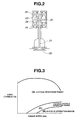
- the intake and exhaust valves 5 and 6 are actuated by electromagnetic actuators, such as one as shown in Fig. 2.
- the electromagnetic actuator comprises an armature plate 22 which is secured to a stem 21 of a valve 20.
- the armature plate 22 is held in a neutral position by upper and lower springs 23 and 24.
- the valve closing coil 26 is deenergized and then the valve opening coil 25 is energized.
- the armature plate 22 is shifted downward together with the valve 20 thereby to induce an open condition of the valve 20.
- the valve opening coil 25 is deenergized and then the valve closing coil 26 is energized.
- the armature plate 22 is shifted upward together with the valve 20 thereby to induce a close condition of the valve 20.
- an electronically controlled throttle valve 9 in the intake passage 7 at position upstream of the intake manifold, there is arranged an electronically controlled throttle valve 9. If desired, at a position upstream of the throttle valve 9, there may be arranged a pressure-charging device, such as turbocharger, supercharger or the like. In each branch of the intake manifold, there is arranged an electromagnetic fuel injection valve 10.
- the open/close movements of the electromagnetically actuated intake and exhaust valves 5 and 6 are controlled.
- the close timing "IVC" of the intake valves 5 is variably controlled for controlling the intake air amount thereby to substantially carry out the non-throttle operation of the engine.
- the throttle valve 9 works to produce a negative pressure in the intake manifold, that is needed for canister purging, crankcase purging and the like.
- the fuel injection amount and fuel injection timing of each fuel injector 10 are controlled in accordance with operation condition of the engine 1. That is, basically, the fuel injection amount is so set as to provide a desired air/fuel ratio based on the intake air amount "Qa" detected by the air flow meter 14, and with the injection ending timing being fixed to a given point before the top dead center "TDC" of intake stroke, the fuel injection starting timing is controlled so as to obtain the set fuel injection amount.
- variable cycle operation will be described in detail with respect to a four cylinder engine 1.
- the engine 1 operates on the four stroke cycle, that is, (1) intake ⁇ (2) compression (ignition) ⁇ (3) explosion ⁇ (4) exhaust (during which, fuel injection takes place in the induction system). The expansion occurs at intervals of 180° in crank angle in case of the four cylinder engine 1.
- the cylinders are subjected to 4-cycle operation or 12-cycle operation respectively. That is, if the ignition order is #1 ⁇ #3 ⁇ #4 ⁇ #2, the cylinders #1 and #4 constitute a first group and the cylinders #2 and #3 constitute a second group, and the cylinders (for example, #1 and #4) of one of the groups are subjected to 4-cycle operation and the cylinders (for example, #2 and #3) of the other group are subjected to 12-cycle operation.
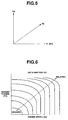
- step S1 the accelerator opening degree "APO” and the engine speed “Ne” are read, and at step S2, a target torque (viz., target intake air amount) "TQ" is looked up from a data map of Fig. 5 which shows the relation between "APO", “Ne” and "TQ".
- a target torque viz., target intake air amount
- the operation range of the engine 1 is judged with reference to a map of Fig. 3 which shows the relation between "Ne", "TQ" and the operation range. If the judgment shows the normal operation range "A”, the operation flow goes to step S4 to carry out 4-cycle operation. If the judgment shows the high-speed and low-load operation range "B”, the operation flow goes to step S5 to carry out 12-cycle operation. While, if the judgment shows the intermediate operation range "C" between the normal operation range "A” and the high-speed and low-load operation range "B”, the operation flow goes to step S6 to cause the cylinders to carry out 4-cycle and 12-cycle operations. That is, two cylinders are subjected to 4-cycle operation and the other two cylinders are subjected to 12-cycle operation.
- a data map for deriving the intake valve close timing "IVC” is selected. Then, at step S10, the intake valve close timing "IVC" for establishing the target torque (viz., target intake air amount) "TQ" is looked up from the selected data map which shows the relation between "Ne", "TQ" and "IVC".
- Fig. 6 shows a data map for looking up the "IVC" in 4-cycle operation.
- the engine 1 upon assuming the high-speed and low-load operation, the engine 1 is subjected to a cycle switching from 4-cycle operation to 12-cycle operation (viz., multi-cycle operation).
- the engine 1 sufficiently reduces its output torque, which brings about expansion of the torque-controllable non-throttle operation range of the engine 1.
- the intermediate operation range between 4-cycle operation range and the multi-cycle operation range a half (viz., two) of the cylinders are subjected to 4-cycle operation and the other half (viz., two) of the same are subjected to the multi-cycle operation (viz., 12-cycle operation), which brings about both control of the torque gap and further expansion of the torque-controllable non-throttle operation range of the engine 1.
- the multi-cycle operation viz., 12-cycle operation
- each cylinder is subjected to the two stroke cycle, in which during downward movement of the piston (namely, in the middle of the explosion stroke after the piston has reached the top dead center "TDC"), the intake and exhaust valves are opened at generally same time to bring about the air intake and gas discharge simultaneously at the time near (namely, just before and after) the bottom dead center “BDC" of the piston, and during upward movement of the piston (namely, in the middle of the piston lifting stroke after the piston has reached the bottom dead center “BDC”), the intake and exhaust valves are closed at generally same time to bring about a so-called compression stroke, and when the piston comes to a position just before the top dead center "TDC", ignition takes place to bring about a subsequent explosion stroke.
- TDC top dead center
- the cylinders are subjected to 4-cycle operation or 2-cycle operation respectively. That is, if the ignition order is #1 ⁇ #3 ⁇ #4 ⁇ #2, the cylinders #1 and #4 constitute a first group and the cylinders #2 and #3 constitute a second group, and the cylinders (for example, #1 and #4) of one of the groups are subjected to 4-cycle operation and the cylinders (for example, #2 and #3) of the other group are subjected to 2-cycle operation.
- step S11 the acceleration opening degree "APO” and the engine speed “Ne” are read and at step S12, a target torque (viz., target intake air amount) "TQ" is looked up from a data map which shows the relation between "APO", “Ne” and “TQ”.
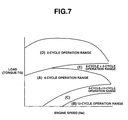
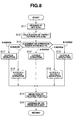
- step S13 the operation range of the engine 1 is judged with reference to the map of Fig. 7 which shows the relation between "Ne", "TQ” and the operation range. If the judgment shows the normal operation range "A”, the operation flow goes to step S14 to carry out 4-cycle operation. If the judgment shows the high-speed and low-load operation range "B”, the operation flow goes to step S15 to carry out 12-cycle operation.
- step S16 If the judgment shows the intermediate operation range "C" between the normal operation range “A” and the high-speed and low-load operation range “B”, the operation flow goes to step S16 to cause the cylinders to carry out 4-cycle and 12-cycle operations. That is, two cylinders are subjected to 4-cycle operation and the other two cylinders are subjected to 12-cycle operation. If the judgment shows the high-load range "D”, the operation flow goes to step S17 to carry out 2-cycle operation. While, if the judgment shows the intermediate operation range "E” of higher-speed side between the normal operation range "A” and the high-load operation range “D”, the operation flow goes to step S18 to cause the cylinders to carry out 4-cycle and 2-cycle operations. That is, two cylinders are subjected to 4-cycle operation and the other two cylinders are subjected to 2-cycle operation.
- step S19 based on the operation range "A", “B”, “C”, “D” or “E” thus judged, a data map for deriving the intake valve close timing "IVC” is selected. Then, at step S20, the intake valve close timing "IVC” for establishing the target torque (viz., target intake air amount) "TQ" is looked up from the selected data map which shows the relation between "Ne", "TQ" and "IVC".
- the present invention is also applicable to a six cylinder engine. In this case, in the high-speed and low-load operation range, it preferable to cause the engine to carry out 16-cycle operation.
Landscapes
- Engineering & Computer Science (AREA)
- Chemical & Material Sciences (AREA)
- Combustion & Propulsion (AREA)
- Mechanical Engineering (AREA)
- General Engineering & Computer Science (AREA)
- Output Control And Ontrol Of Special Type Engine (AREA)
- Valve-Gear Or Valve Arrangements (AREA)
- Valve Device For Special Equipments (AREA)
Abstract
Description
- The present invention relates in general to control systems for controlling internal combustion engines of a variable valve type wherein open/close movements of the intake and exhaust valves are controlled in accordance with an operation condition of the engine, and more particularly to the control systems of a type that controls the intake air amount by controlling the close timing (viz., open period) of each intake valve to carry out a so-called non-throttle operation of the engine. More specifically, the present invention is concerned with the control systems of a type that allows the engine to work under various operation cycles.
- Nowadays, variable valve type internal combustion engines are widely employed in motor vehicles for the superiority of the engine. In fact, fuel consumption and driveability under lower speed and low load engine operation are improved and at the same time due to increased mixture charging effect, sufficient output under high speed and high load engine operation is obtained.
- For controlling such engines, Laid-open Japanese Patent Application (viz., Tokkaihei) 8-200025 shows a control system. The variable valves of this publication are actuated by electromagnetic actuators, and the open/close movements of them are controlled by the control system through the actuators. Each cylinder of the engine is equipped with four valves, namely, main and auxiliary intake valves and main and auxiliary exhaust valves, which are independently controlled by electromagnetic actuators in accordance with the engine operation condition, thereby to control the output of the engine.
- In addition, for much improving the fuel consumption against the pumping loss of the engine, there has been proposed a measure wherein control of the intake air amount is effected by controlling the close timing (or open period) of each intake valve thereby carrying out the "non-throttle operation" of the engine.
- However, even in the above-mentioned measures, it is difficult to obtain a desired operation of the engine at the time when the engine is under high-speed and low-load operation because of the nature of the electromagnetic actuators. That is, the electromagnetic actuators have a limitation in speeding up the actuation to the intake valves. In other words, under high-speed operation of the engine, reduction of load is almost impossible or at least very difficult. That is, for reducing the engine torque, it is necessary to shorten the open period of each intake valve to reduce the intake air amount. This means that the intake valve has to be closed instantly just after its opening movement. However, since the valve actuating speed of the actuator is constant and a certain operation time is needed for closing the intake valve, the minimum open period with respect to the crank angle is not sufficiently small under such high-speed operation. Thus, under such high-speed operation, torque reduction by reducing the intake air amount is substantially impossible.
- In view of the above, the applicants have hitherto proposed a measure that is shown Laid-open Japanese Patent Application (viz., Tokkaihei) 2000-45804. In the measure, by controlling open/close cycle of the intake and exhaust valves in accordance with an operation range of the engine, switching is carried out from a normal 4 (four)-cycle operation to a different cycle operation. More specifically, upon the engine assuming a high-speed and low-load condition, switching is carried out from 4-cycle operation to a so-called multi-cycle operation whose cycle is greater than four (4).
- For ease of description, such engine operation as allowing switching between different cycle operations will be referred to as "variable cycle operation" in the following.
- In view of the above, the present invention aims to provide a control system for controlling a variable valve type internal combustion engine, which suppresses or at least minimizes a torque gap that would occur upon cycle switching between 4-cycle operation and the multi-cycle operation.
- With this control, improved fuel consumption due to expansion of the non-throttle operation range and improved driveability due to suppression of the torque gap are both obtained.
- According to a first aspect of the present invention, there is provided a control system for controlling a variable valve type internal combustion engine. The engine has cylinders and electromagnetically actuated intake and exhaust valves arranged for each cylinder. The intake air amount fed to the cylinder is controlled by controlling the close timing of the intake valve. The control system comprises an operation range judging section that judges an operation range of the engine; a variable cycle operating section that switches the operation of the engine between 4-cycle operation and a different cycle operation in accordance with the judgment carried out by the operation range judging section, the different cycle operation being of an operation whose cycle is different from the 4-cycle; and an intermediate variable cycle operating section that allows part of the cylinders of the engine to carry out 4-cycle operation and the remaining part of the cylinders to carry out the different cycle operation when the operation range judging section judges that the engine is under an intermediate operation range between an operation range provided by the 4-cycle operation and an operation range provided by the different cycle operation.
- According to a second aspect of the present invention, there is provided a control system for controlling a variable valve type internal combustion engine. The engine has cylinders and electromagnetically actuated intake and exhaust valves arranged for each cylinder. The intake air amount fed to the cylinder is controlled by controlling the close timing of the intake valve. The control system comprises means for judging an operation range assumed by the engine; means for switching the operation of the engine between 4-cycle operation and a different cycle operation in accordance with the judgment made by the operation range judging section, the different cycle operation being of an operation whose cycle is different from the 4-cycle; and means for allowing part of the cylinders of the engine to carry out 4-cycle operation and the remaining part of the cylinders to carry out the different cycle operation when the operation range judging section judges that the engine is under an intermediate operation range between an operation range provided by the 4-cycle operation and an operation range provided by the different cycle operation.
- According to a third aspect of the present invention, there is provided a method for controlling a variable valve type internal combustion engine. The engine has cylinders and electromagnetically actuated intake and exhaust valves arranged for each cylinder. The intake air amount fed to the cylinder is controlled by controlling the close timing of the intake valve. The method comprises judging an operation range assumed by the engine; switching the operation of the engine between 4-cycle operation and a different cycle operation in accordance with the judgment made by the operation range judging section, the different cycle operation being of an operation whose cycle is different from the 4-cycle; and allowing part of the cylinders of the engine to carry out 4-cycle operation and the remaining part of the cylinders to carry out the different cycle operation when said operation range judging section judges that the engine is under an intermediate operation range between an operation range provided by the 4-cycle operation and an operation range provided by the different cycle operation.
- According to a fourth aspect of the present invention, there is provided a control apparatus for a multi-cylinder engine. The control apparatus comprises a first section that operates a four cycle operation when the engine is in a first engine operation range; a second section that operates a different cycle operation when the engine is in a second engine operation range, the different cycle operation being different from the four cycle operation; and a third section that operates an intermediate cycle operation when the engine is in a third engine operation range, the third engine operation range being arranged between the first engine operation range and the second engine operation range, wherein a part of the cylinders are operated on the four-cycle operation and the remaining part of the cylinders are operated on the different cycle operation, in the intermediate cycle operation.
-
- Fig. 1 is a schematic view of a variable valve type internal combustion engine to which a control system of a first embodiment of the present invention is practically applied;
- Fig. 2 is a schematic view of an electromagnetic actuator for an intake or exhaust valve of the engine;
- Fig. 3 is a data map used in the first embodiment for judging an operation range of the engine;
- Fig. 4 is a flowchart showing operation steps executed by a control unit for controlling variable valves in the first embodiment;
- Fig. 5 is a flowchart for calculating a target torque (or, target intake air amount);
- Fig. 6 is a data map used for calculating a close timing of an intake valve;
- Fig. 7 is a data map used in a second embodiment for judging the operation range of the engine;
- Fig. 8 is a flowchart showing operation steps executed by a control unit for controlling variable valves in the second embodiment; and
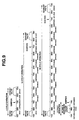
- Fig. 9 is an illustration explaining a variable cycle operation.
-
- Referring to Fig. 1, there is schematically shown a variable valve type
internal combustion engine 1 to which a control system of a first embodiment of the present invention is practically applied. - The
engine 1 has a plurality of cylinders (only one is shown) each having apiston 2 slidably received therein. In each cylinder, there is defined acombustion chamber 3 above thepiston 2. Anignition plug 4 is exposed to thecombustion chamber 3. Anintake passage 7 is connected to intake openings of thecombustion chambers 3 through an intake manifold and anexhaust passage 8 is connected to exhaust openings of thecombustion chambers 3 through an exhaust manifold. Electromagnetically actuated intake andexhaust valves - The intake and
exhaust valves - As shown in Fig. 2, the electromagnetic actuator comprises an
armature plate 22 which is secured to astem 21 of avalve 20. Thearmature plate 22 is held in a neutral position by upper andlower springs armature plate 22, there are arranged valve opening and closingelectromagnetic coils valve 20, thevalve closing coil 26 is deenergized and then thevalve opening coil 25 is energized. With this, thearmature plate 22 is shifted downward together with thevalve 20 thereby to induce an open condition of thevalve 20. While, for closing thevalve 20, thevalve opening coil 25 is deenergized and then thevalve closing coil 26 is energized. With this, thearmature plate 22 is shifted upward together with thevalve 20 thereby to induce a close condition of thevalve 20. - Referring back to Fig. 1, in the
intake passage 7 at position upstream of the intake manifold, there is arranged an electronically controlledthrottle valve 9. If desired, at a position upstream of thethrottle valve 9, there may be arranged a pressure-charging device, such as turbocharger, supercharger or the like. In each branch of the intake manifold, there is arranged an electromagneticfuel injection valve 10. - The intake and
exhaust valves fuel injection valve 10, ignition plug 4 of each cylinder and thethrottle valve 9 are all controlled by acontrol unit 11. Into thecontrol unit 11, there are inputted various information signals, which are a signal issued from acrank angle sensor 12 that represents an crank angle, a signal issued from anaccelerator pedal sensor 13 that represents an accelerator opening degree "APO" (viz., accelerator depression degree), a signal issued from anair flow meter 14 that represents an intake air amount "Qa", a signal issued from awater temperature sensor 15 that represents the temperature "Tw" of engine cooling water. As is known, an engine speed "Ne" is calculated from the crank angle. Theaccelerator pedal sensor 13 is provided with an idle switch which is turned ON (or closed) when the accelerator pedal is released. As shown, theair flow meter 14 is positioned upstream of thethrottle valve 9. - In the
engine 1, for improving fuel consumption against the pumping loss of the engine, the open/close movements of the electromagnetically actuated intake andexhaust valves intake valves 5 is variably controlled for controlling the intake air amount thereby to substantially carry out the non-throttle operation of the engine. In this case, thethrottle valve 9 works to produce a negative pressure in the intake manifold, that is needed for canister purging, crankcase purging and the like. - The fuel injection amount and fuel injection timing of each
fuel injector 10 are controlled in accordance with operation condition of theengine 1. That is, basically, the fuel injection amount is so set as to provide a desired air/fuel ratio based on the intake air amount "Qa" detected by theair flow meter 14, and with the injection ending timing being fixed to a given point before the top dead center "TDC" of intake stroke, the fuel injection starting timing is controlled so as to obtain the set fuel injection amount. - The ignition timing of the
ignition plug 4 is controlled based on operation condition of theengine 1. That is, the ignition timing is set at a given point "MBT" (minimum advance for best torque) before the top dead center "TDC" of compression stroke or at a knocking limit point. - In order to expand the torque controllable range under the non-throttle operation, the
engine 1 is subjected to a variable cycle operation in accordance with the operation range of theengine 1. That is, the open/close cycle of the intake andexhaust valves engine 1, as is depicted in Fig. 3. - In the following, the variable cycle operation will be described in detail with respect to a four
cylinder engine 1. - In a normal operation range "A" of Fig. 3, the
engine 1 operates on the four stroke cycle, that is, (1) intake →(2) compression (ignition)→(3) explosion →(4) exhaust (during which, fuel injection takes place in the induction system). The expansion occurs at intervals of 180° in crank angle in case of the fourcylinder engine 1. - While, in a high-speed and low-load operation range "B", a twelve (12)-cycle operation is carried out in the
engine 1. - As is shown in Fig. 9, in 12-cycle operation, each cylinder is subjected to the twelve stroke cycle, which is, (1) intake →(2) compression →(3) expansion →(4) compression →(5) expansion →(6) compression →(7) expansion →(8) compression →(9) expansion →(10) compression (ignition) →(11) explosion →(12) exhaust. That is, after the intake stroke (1), the compression/expansion strokes are repeated from (2) to (9) with both the intake and
exhaust valves engine 1, and after this, the compression (ignition), explosion and exhaust strokes take place at (10), (11) and (12) respectively. Thus, in 12-cycle operation of the fourcylinder engine 1, the expansion occurs at intervals of 540° in crank angle. Thus, in case of 12-cycle operation, the output torque is 1/3 of that in case of 4-cycle operation. Of course, other cycle operation, such as 8-cycle operation, can be used. However, the applicants have revealed that 12-cycle operation is superior to 8-cycle operation from a vibration performance point of view. - Referring back to Fig. 3, in an intermediate operation range "C" between the normal operation range "A" and the high-speed and low-load operation range "B", that is, in the range "C" wherein the torque control is not carried out by a simple switching, the cylinders are subjected to 4-cycle operation or 12-cycle operation respectively. That is, if the ignition order is #1 →#3 →#4 →#2, the
cylinders # 1 and #4 constitute a first group and thecylinders # 2 and #3 constitute a second group, and the cylinders (for example, #1 and #4) of one of the groups are subjected to 4-cycle operation and the cylinders (for example, #2 and #3) of the other group are subjected to 12-cycle operation. - In the following, the control for the
engine 1 executed by thecontrol unit 11 in the first embodiment will be described with respect to the flowchart of Fig. 4. - At step S1, the accelerator opening degree "APO" and the engine speed "Ne" are read, and at step S2, a target torque (viz., target intake air amount) "TQ" is looked up from a data map of Fig. 5 which shows the relation between "APO", "Ne" and "TQ". While, when the
engine 1 is idling, that is, when an idle switch is kept ON, a deviation "ΔNe" between the engine speed "Ne" and a target idling speed "Nidle", namely, "ΔNe = Ne - Nidle" is calculated, and if the deviation "ΔNe" shows a negative value, the target torque "TQ" is corrected to increase and if it shows a positive value, the target torque "TQ" is corrected to decrease. - At
step 3, the operation range of theengine 1 is judged with reference to a map of Fig. 3 which shows the relation between "Ne", "TQ" and the operation range. If the judgment shows the normal operation range "A", the operation flow goes to step S4 to carry out 4-cycle operation. If the judgment shows the high-speed and low-load operation range "B", the operation flow goes to step S5 to carry out 12-cycle operation. While, if the judgment shows the intermediate operation range "C" between the normal operation range "A" and the high-speed and low-load operation range "B", the operation flow goes to step S6 to cause the cylinders to carry out 4-cycle and 12-cycle operations. That is, two cylinders are subjected to 4-cycle operation and the other two cylinders are subjected to 12-cycle operation. - At step S9, based on the operation range "A", "B" or "C" thus judged, a data map for deriving the intake valve close timing "IVC" is selected. Then, at step S10, the intake valve close timing "IVC" for establishing the target torque (viz., target intake air amount) "TQ" is looked up from the selected data map which shows the relation between "Ne", "TQ" and "IVC". Fig. 6 shows a data map for looking up the "IVC" in 4-cycle operation.
- In the first embodiment, upon assuming the high-speed and low-load operation, the
engine 1 is subjected to a cycle switching from 4-cycle operation to 12-cycle operation (viz., multi-cycle operation). Thus, in the high-speed and low-load operation range, theengine 1 sufficiently reduces its output torque, which brings about expansion of the torque-controllable non-throttle operation range of theengine 1. In the intermediate operation range between 4-cycle operation range and the multi-cycle operation range, a half (viz., two) of the cylinders are subjected to 4-cycle operation and the other half (viz., two) of the same are subjected to the multi-cycle operation (viz., 12-cycle operation), which brings about both control of the torque gap and further expansion of the torque-controllable non-throttle operation range of theengine 1. Thus, fuel consumption and driveability of theengine 1 are further improved. - In the following, description will be directed to a second embodiment of the present invention.
- In the second embodiment, as is seen from the graph of Fig. 7, in a high-load range "D", a two (2)-cycle operation is carried out by the
engine 1. - As is shown in Fig. 9, in 2-cycle operation, each cylinder is subjected to the two stroke cycle, in which during downward movement of the piston (namely, in the middle of the explosion stroke after the piston has reached the top dead center "TDC"), the intake and exhaust valves are opened at generally same time to bring about the air intake and gas discharge simultaneously at the time near (namely, just before and after) the bottom dead center "BDC" of the piston, and during upward movement of the piston (namely, in the middle of the piston lifting stroke after the piston has reached the bottom dead center "BDC"), the intake and exhaust valves are closed at generally same time to bring about a so-called compression stroke, and when the piston comes to a position just before the top dead center "TDC", ignition takes place to bring about a subsequent explosion stroke. Thus, in 2-cycle operation of the four
cylinder engine 1, the explosion occurs at intervals of 90° in crank angle. Thus, the output torque is twice as much as that in case of 4-cycle operation. However, in case of 2-cycle operation, a pressure charger is may be needed because the intake and exhaust are needed at the same time by opening the intake and exhaust valves at the same time. - As is seen from Fig. 7, in an intermediate operation range "E" between the normal operation range "A" and the high-load operation range (viz., 2-cycle operation range) "D", that is, in the range "E" wherein the torque control is not easily carried out by a simple switching, the cylinders are subjected to 4-cycle operation or 2-cycle operation respectively. That is, if the ignition order is #1 →#3 →#4 →#2, the
cylinders # 1 and #4 constitute a first group and thecylinders # 2 and #3 constitute a second group, and the cylinders (for example, #1 and #4) of one of the groups are subjected to 4-cycle operation and the cylinders (for example, #2 and #3) of the other group are subjected to 2-cycle operation. - In the following, the control in the second embodiment will be described with reference to the flowchart of Fig. 8.
- At step S11, the acceleration opening degree "APO" and the engine speed "Ne" are read and at step S12, a target torque (viz., target intake air amount) "TQ" is looked up from a data map which shows the relation between "APO", "Ne" and "TQ". At step S13, the operation range of the
engine 1 is judged with reference to the map of Fig. 7 which shows the relation between "Ne", "TQ" and the operation range. If the judgment shows the normal operation range "A", the operation flow goes to step S14 to carry out 4-cycle operation. If the judgment shows the high-speed and low-load operation range "B", the operation flow goes to step S15 to carry out 12-cycle operation. If the judgment shows the intermediate operation range "C" between the normal operation range "A" and the high-speed and low-load operation range "B", the operation flow goes to step S16 to cause the cylinders to carry out 4-cycle and 12-cycle operations. That is, two cylinders are subjected to 4-cycle operation and the other two cylinders are subjected to 12-cycle operation. If the judgment shows the high-load range "D", the operation flow goes to step S17 to carry out 2-cycle operation. While, if the judgment shows the intermediate operation range "E" of higher-speed side between the normal operation range "A" and the high-load operation range "D", the operation flow goes to step S18 to cause the cylinders to carry out 4-cycle and 2-cycle operations. That is, two cylinders are subjected to 4-cycle operation and the other two cylinders are subjected to 2-cycle operation. - Then, at step S19, based on the operation range "A", "B", "C", "D" or "E" thus judged, a data map for deriving the intake valve close timing "IVC" is selected. Then, at step S20, the intake valve close timing "IVC" for establishing the target torque (viz., target intake air amount) "TQ" is looked up from the selected data map which shows the relation between "Ne", "TQ" and "IVC".
- In the second embodiment, in addition to the advantages possessed by the aforementioned first embodiment, the following advantages are expected.
- That is, upon assuming the high-load operation, the
engine 1 is subjected to a cycle switching from 4-cycle operation to 2-cycle operation. Thus, in the high-load operation range, theengine 1 can further increase its output performance. In the intermediate operation range between 4-cycle operation range and 2-cycle operation range, a half (viz., two) of the cylinders are subjected to 4-cycle operation and the other half (viz., two) of the same are subjected to 2-cycle operation, which brings about reduction in torque gap. - Although the above-mentioned first and second embodiments have been described with reference to a four cylinder engine, the present invention is also applicable to a six cylinder engine. In this case, in the high-speed and low-load operation range, it preferable to cause the engine to carry out 16-cycle operation.
- As is shown in Fig. 9, in 16-cycle operation, each cylinder is subjected to the sixteen stroke cycle, which is, (1) intake →(2) compression →(3) expansion →(4) compression →(5) expansion →(6) compression →(7) expansion →(8) compression →(9) expansion →(10) compression →(11) expansion →(12) compression →(13) expansion →(14) compression (ignition)→(15) explosion →(16) exhaust. That is, after the intake stroke (1), the compression/expansion strokes are repeated from (2) to (13) with both the intake and
exhaust valves - Thus, in case of the six cylinder engine, in an intermediate operation range between a normal operation range (viz., 4-cycle operation range) and a high-speed and low-load operation range (viz., 16-cycle operation range), the six cylinders are subjected to 4-cycle operation or 16-cycle operation respectively. That is, in such range, a half (viz., three) of the cylinders are subjected to 4-cycle operation and the other half (viz., three) of the same are subjected to 16-cycle operation.
- The entire contents of Japanese Patent Application 2000-081891 (filed March 23, 2000) are incorporated herein by reference.
- Although the invention has been described above with reference to the embodiments of the invention, the invention is not limited to such embodiments as described above. Various modifications and variations of such embodiments may be carried out by those skilled in the art, in light of the above description.
Claims (30)
- In a variable valve type internal combustion engine having cylinders and electromagnetically actuated intake and exhaust valves arranged for each cylinder, the intake air amount fed to the cylinder being controlled by controlling the close timing of the intake valve,
a control system for controlling the engine, comprising:an operation range judging section that judges an operation range assured by the engine;a variable cycle operating section that switches the operation of the engine between 4-cycle operation and a different cycle operation in accordance with the judgment made by said operation range judging section, said different cycle operation being of an operation whose cycle is different from the 4-cycle; andan intermediate variable cycle operating section that allows part of the cylinders of the engine to carry out 4-cycle operation and the remaining part of the cylinders to carry out said different cycle operation when said operation range judging section judges that the engine is under an intermediate operation range between an operation range provided by said 4-cycle operation and an operation range provided by said different cycle operation. - A control system as claimed in Claim 1, in which, upon judgment of said intermediate operation range, said intermediate variable cycle operating section forces a half of the cylinders to carry out 4-cycle operation and the other half of the same to carry out said different cycle operation.
- A control system as claimed in Claim 1, in which, upon judgment of a high-speed and low-load operation range of the engine by said operation range judging section, said variable cycle operating section switches the operation of the engine from 4-cycle operation to a multi-cycle operation, said multi-cycle operation being of an operation whose cycle is greater than four.
- A control system as claimed in Claim 3, in which said engine is of a four-cylinder type and in which said multi-cycle operation is 12-cycle operation.
- A control system as claimed in Claim 3, in which said engine is of a six-cylinder type and in which said multi-cycle operation is 16-cycle operation.
- A control system as claimed in Claim 1, in which, upon judgment of a high-load operation range of the engine by said operation range judging section, said variable cycle operating section switches the operation of the engine from 4-cycle operation to 2-cycle operation.
- In a variable valve type internal combustion engine having cylinders and electromagnetically actuated intake and exhaust valves arranged for each cylinder, the intake air amount fed to the cylinder being controlled by controlling the close timing of the intake valve,
a control system for controlling the engine, comprising:means for judging an operation range assumed by the engine;means for switching the operation of the engine between 4-cycle operation and a different cycle operation in accordance with the judgment made by said operation range judging section, said different cycle operation being of an operation whose cycle is different from the 4-cycle; andmeans for allowing part of the cylinders of the engine to carry out 4-cycle operation and the remaining part of the cylinders to carry out said different cycle operation when said operation range judging section judges that the engine is under an intermediate operation range between an operation range provided by said 4-cycle operation and an operation range provided by said different cycle operation. - In a variable valve type internal combustion engine having cylinders and electromagnetically actuated intake and exhaust valves arranged for each cylinder, the intake air amount fed to the cylinder being controlled by controlling the close timing of the intake valve,
a method for controlling the engine, comprising:judging an operation range assumed by the engine;switching the operation of the engine between 4-cycle operation and a different cycle operation in accordance with the judgment made by said operation range judging section, said different cycle operation being of an operation whose cycle is different from the 4-cycle; andallowing part of the cylinders of the engine to carry out 4-cycle operation and the remaining part of the cylinders to carry out said different cycle operation when said operation range judging section judges that the engine is under an intermediate operation range between an operation range provided by said 4-cycle operation and an operation range provided by said different cycle operation. - A control apparatus for a multi-cylinder engine, comprising:a first section that operates a four cycle operation when the engine is in a first engine operation range;a second section that operates a different cycle operation when the engine is in a second engine operation range, the different cycle operation being different from the four cycle operation; anda third section that operates an intermediate cycle operation when the engine is in a third engine operation range, the third engine operation range being arranged between the first engine operation range and the second engine operation range,wherein a part of the cylinders are operated on the four-cycle operation and the remaining part of the cylinders are operated on the different cycle operation, in the intermediate cycle operation.
- A control apparatus as claimed in Claim 9, wherein a half of the cylinders are operated on the four cycle operation and the remaining half of the cylinders are operated on the different cycle operation, in the intermediate cycle operation.
- A control apparatus as claimed in Claim 9, further comprising intake and exhaust valves for each cylinder respectively, wherein an intake air amount fed to the cylinder is controlled in accordance with a closure timing of intake valve.
- A control apparatus as claimed in Claim 11, wherein the intake valve is electromagnetically actuated by an actuator having an electromagnetic coil.
- A control apparatus as claimed in Claim 9, wherein the engine operation range is determined on the basis of an engine operation condition.
- A control apparatus as claimed in Claim 9, wherein the engine operation range is determined on the basis of an engine load.
- A control apparatus as claimed in Claim 14, wherein the cycle of the different cycle operation is greater than four, and the second engine operation range is arranged in a low engine load region, and the first engine operation range is arranged in a high engine load region relative to the second engine operation range.
- A control apparatus as claimed in Claim 15, wherein the engine has four cylinders and the cycle of the different cycle operation is twelve.
- A control apparatus as claimed in Claim 15, wherein the engine has six cylinders, and the cycle of the different cycle operation is sixteen.
- A control apparatus as claimed in Claim 9, wherein the engine operation range is determined on the basis of an engine speed.
- A control apparatus as claimed in Claim 18, wherein the cycle of the different type operation is greater than four, and the second operation range is arranged in a high engine speed region, and the first engine operation range is arranged in a low engine. speed region relative to the second engine operation range.
- A control apparatus as claimed in Claim 19, wherein the engine has four cylinders, and the cycle of the different cycle operation is twelve.
- A control apparatus as claimed in Claim 19, wherein the engine has six cylinders, and the cycle of the different cycle operation is sixteen.
- A control apparatus as claimed in Claim 9, wherein the engine operation range is determined on the basis of both an engine load and an engine load.
- A control apparatus as claimed in Claim 22, wherein the cycle of the different cycle operation is greater than four, and the second engine operation range is arranged in a low engine load region and a high engine speed region, and the first engine operation range is arranged in a high engine load region relative to the second engine operation range.
- A control apparatus as claimed in Claim 23, wherein the engine has four cylinders, and the cycle of the different cycle operation is twelve.
- A control apparatus as claimed in Claim 23, wherein the engine has six cylinders, and the cycle of the different cycle operation is sixteen.
- A control apparatus as claimed in Claim 14, wherein the cycle of the different cycle operation is two, and the second engine operation range is arranged in a higher engine load region relative to the first engine operation range.
- A control apparatus as claimed in Claim 16, wherein a part of the cylinders are operated on the four cycle operation and the remaining part of the cylinders are operated on the twelve cycle operation, in the intermediate cycle operation.
- A control apparatus as claimed in Claim 20, wherein a part of the cylinders are operated on the four cycle operation and the remaining part of the cylinders are operated on the twelve-cycle operation, in the intermediate cycle operation.
- A control apparatus as claimed in Claim 24, wherein a part of the cylinders are operated on the four cycle operation and the remaining part of the cylinders are operated on the twelve cycle operation, in the intermediate cycle operation.
- A control apparatus as claimed in Claim 9, wherein a part of the cylinders are operated on the four cycle operation and the remaining part of the cylinders are operated on the two cycle operation, in the intermediate cycle operation.
Applications Claiming Priority (2)
| Application Number | Priority Date | Filing Date | Title |
|---|---|---|---|
| JP2000081891A JP2001263110A (en) | 2000-03-23 | 2000-03-23 | Control device for variable valve engine |
| JP2000081891 | 2000-03-23 |
Publications (2)
| Publication Number | Publication Date |
|---|---|
| EP1136678A2 true EP1136678A2 (en) | 2001-09-26 |
| EP1136678A3 EP1136678A3 (en) | 2002-08-28 |
Family
ID=18598761
Family Applications (1)
| Application Number | Title | Priority Date | Filing Date |
|---|---|---|---|
| EP01107185A Withdrawn EP1136678A3 (en) | 2000-03-23 | 2001-03-22 | Control system for controlling variable valve type internal combustion engine |
Country Status (3)
| Country | Link |
|---|---|
| US (1) | US6523504B2 (en) |
| EP (1) | EP1136678A3 (en) |
| JP (1) | JP2001263110A (en) |
Cited By (5)
| Publication number | Priority date | Publication date | Assignee | Title |
|---|---|---|---|---|
| EP1447548A1 (en) * | 2003-02-17 | 2004-08-18 | Ford Global Technologies, Inc. | A method and a system for torque control in a vehicle |
| US6910449B2 (en) | 2002-12-30 | 2005-06-28 | Ford Global Technologies, Llc | Method for auto-ignition operation and computer readable storage device for use with an internal combustion engine |
| AT501183A1 (en) * | 2004-08-19 | 2006-07-15 | Avl List Gmbh | Method for running of internal combustion engine entails shutting off cylinders alternately and reactivating them, whereby shut off phase of deactivated cylinder extends over at least two but no more than three working cycles |
| WO2006017870A3 (en) * | 2004-08-19 | 2008-11-27 | Avl List Gmbh | Method for the operation of an internal combustion engine |
| FR3010452A1 (en) * | 2013-09-10 | 2015-03-13 | Peugeot Citroen Automobiles Sa | MOTOR VEHICLE COMBUSTION ENGINE WITH IMPROVED CYLINDER DISENGATION |
Families Citing this family (38)
| Publication number | Priority date | Publication date | Assignee | Title |
|---|---|---|---|---|
| SE523773C2 (en) * | 2001-09-07 | 2004-05-18 | Cargine Engineering Ab | Modulation of torque in an internal combustion engine |
| US7131933B2 (en) * | 2001-12-07 | 2006-11-07 | Toyota Jidosha Kabushiki Kaisha | Vehicle control apparatus having means for changing inertia torque of engine during shifting action or during switching of operating state of lock-up clutch |
| SE524802C2 (en) * | 2002-11-04 | 2004-10-05 | Cargine Engineering Ab | Control method for modulating torque in a piston combustion engine |
| DE10357986B4 (en) * | 2002-12-12 | 2016-09-01 | Denso Corporation | Variable valve control device for an internal combustion engine |
| US7559309B2 (en) | 2004-03-19 | 2009-07-14 | Ford Global Technologies, Llc | Method to start electromechanical valves on an internal combustion engine |
| US7128687B2 (en) * | 2004-03-19 | 2006-10-31 | Ford Global Technologies, Llc | Electromechanically actuated valve control for an internal combustion engine |
| US7031821B2 (en) * | 2004-03-19 | 2006-04-18 | Ford Global Technologies, Llc | Electromagnetic valve control in an internal combustion engine with an asymmetric exhaust system design |
| US7079935B2 (en) * | 2004-03-19 | 2006-07-18 | Ford Global Technologies, Llc | Valve control for an engine with electromechanically actuated valves |
| US7555896B2 (en) | 2004-03-19 | 2009-07-07 | Ford Global Technologies, Llc | Cylinder deactivation for an internal combustion engine |
| US7107946B2 (en) * | 2004-03-19 | 2006-09-19 | Ford Global Technologies, Llc | Electromechanically actuated valve control for an internal combustion engine |
| US7194993B2 (en) * | 2004-03-19 | 2007-03-27 | Ford Global Technologies, Llc | Starting an engine with valves that may be deactivated |
| US7063062B2 (en) * | 2004-03-19 | 2006-06-20 | Ford Global Technologies, Llc | Valve selection for an engine operating in a multi-stroke cylinder mode |
| US7107947B2 (en) * | 2004-03-19 | 2006-09-19 | Ford Global Technologies, Llc | Multi-stroke cylinder operation in an internal combustion engine |
| US7165391B2 (en) | 2004-03-19 | 2007-01-23 | Ford Global Technologies, Llc | Method to reduce engine emissions for an engine capable of multi-stroke operation and having a catalyst |
| US7140355B2 (en) * | 2004-03-19 | 2006-11-28 | Ford Global Technologies, Llc | Valve control to reduce modal frequencies that may cause vibration |
| US7021289B2 (en) * | 2004-03-19 | 2006-04-04 | Ford Global Technology, Llc | Reducing engine emissions on an engine with electromechanical valves |
| US7072758B2 (en) * | 2004-03-19 | 2006-07-04 | Ford Global Technologies, Llc | Method of torque control for an engine with valves that may be deactivated |
| US7032581B2 (en) * | 2004-03-19 | 2006-04-25 | Ford Global Technologies, Llc | Engine air-fuel control for an engine with valves that may be deactivated |
| US7128043B2 (en) | 2004-03-19 | 2006-10-31 | Ford Global Technologies, Llc | Electromechanically actuated valve control based on a vehicle electrical system |
| US7240663B2 (en) * | 2004-03-19 | 2007-07-10 | Ford Global Technologies, Llc | Internal combustion engine shut-down for engine having adjustable valves |
| US7066121B2 (en) * | 2004-03-19 | 2006-06-27 | Ford Global Technologies, Llc | Cylinder and valve mode control for an engine with valves that may be deactivated |
| US7383820B2 (en) | 2004-03-19 | 2008-06-10 | Ford Global Technologies, Llc | Electromechanical valve timing during a start |
| GB2415744B (en) * | 2004-05-13 | 2008-10-29 | Anthony Edgar Blackburn | Engine cycles |
| US7080613B2 (en) * | 2004-07-12 | 2006-07-25 | General Motors Corporation | Method for auto-ignition combustion control |
| US20070068472A1 (en) * | 2005-03-31 | 2007-03-29 | Wilson Wayne M | Variable Valve Operating System for an Internal Combustion Engine |
| US8430067B2 (en) * | 2005-05-12 | 2013-04-30 | Ford Global Technologies, Llc | Engine starting for engine having adjustable valve operation |
| US7377236B2 (en) | 2005-09-09 | 2008-05-27 | Ford Global Technologies, Llc | System and method for exhaust heat generation using electrically actuated cylinder valves and variable stroke combustion cycles |
| US7337762B2 (en) * | 2005-10-06 | 2008-03-04 | Gm Global Technology Operations, Inc. | Fuel adaptation in a homogeneous charge compression ignition engine |
| JP4674180B2 (en) * | 2006-03-31 | 2011-04-20 | 大阪瓦斯株式会社 | Engine and heat pump system |
| US7418928B2 (en) * | 2006-04-28 | 2008-09-02 | Caterpillar Inc. | Engine and method for operating an engine |
| JP2008019835A (en) * | 2006-07-14 | 2008-01-31 | Mazda Motor Corp | Turbocharged engine |
| US20080022666A1 (en) * | 2006-07-31 | 2008-01-31 | Driscoll James J | Balanced partial two-stroke engine |
| JP2006348947A (en) * | 2006-08-18 | 2006-12-28 | Kazuo Oyama | Internal combustion engine with exhaust pressure regenerator |
| US7946259B2 (en) * | 2008-09-10 | 2011-05-24 | Ford Global Technologies, Llc | Multi-stroke internal combustion engine |
| US7997237B2 (en) | 2008-09-10 | 2011-08-16 | Ford Global Technologies, Llc | Multi-stroke internal combustion engine |
| CN102325976A (en) | 2008-12-22 | 2012-01-18 | 卡特彼勒公司 | Engine control system implementing lean burn 6-stroke cycle |
| JP6643930B2 (en) * | 2015-03-31 | 2020-02-12 | 大阪瓦斯株式会社 | Engine system |
| CN106930846B (en) * | 2015-12-29 | 2021-03-19 | 长城汽车股份有限公司 | Control method, system and vehicle for multi-stroke cycle engine |
Citations (2)
| Publication number | Priority date | Publication date | Assignee | Title |
|---|---|---|---|---|
| JPH08200025A (en) | 1995-01-20 | 1996-08-06 | Toyota Motor Corp | Electromagnetically driven valve controller |
| JP2000045804A (en) | 1998-08-04 | 2000-02-15 | Nissan Motor Co Ltd | Internal combustion engine torque control device |
Family Cites Families (14)
| Publication number | Priority date | Publication date | Assignee | Title |
|---|---|---|---|---|
| DE2703067A1 (en) | 1977-01-26 | 1978-07-27 | Peter R Dr Ing Kuhn | Adjustable multi-stroke engine with fuel injection - injects fuel only at every other or third fuel suction stroke |
| DE2740045A1 (en) * | 1977-09-06 | 1979-03-15 | Bayerische Motoren Werke Ag | METHOD FOR PARTIAL LOAD CONTROL OF COMBUSTION MACHINERY |
| JPH01305129A (en) * | 1988-06-02 | 1989-12-08 | Nissan Motor Co Ltd | internal combustion engine |
| US4945870A (en) * | 1988-07-29 | 1990-08-07 | Magnavox Government And Industrial Electronics Company | Vehicle management computer |
| EP0387372B1 (en) | 1989-03-14 | 1994-05-25 | Vasant Mukund Joshi | Improvements in reciprocating piston internal combustion engines and like machines |
| US5022353A (en) * | 1989-04-26 | 1991-06-11 | Isuzu Ceramics Research Institute Co., Ltd. | Variable-cycle engine |
| DE69107021T2 (en) * | 1990-11-13 | 1995-05-18 | Isuzu Ceramics Research Institute Co. Ltd., Fujisawa, Kanagawa | Two or four stroke internal combustion engine and its control system. |
| US5117790A (en) * | 1991-02-19 | 1992-06-02 | Caterpillar Inc. | Engine operation using fully flexible valve and injection events |
| US5154141A (en) * | 1991-11-20 | 1992-10-13 | Mcwhorter Edward M | Dual cycle engine process |
| US5515818A (en) * | 1993-12-15 | 1996-05-14 | Machine Research Corporation Of Chicago | Electromechanical variable valve actuator |
| US5517951A (en) * | 1994-12-02 | 1996-05-21 | Paul; Marius A. | Two stroke/four stroke engine |
| US5699758A (en) * | 1996-02-15 | 1997-12-23 | Caterpillar Inc. | Method and apparatus for multiple cycle internal combustion engine operation |
| DE19810933C2 (en) * | 1998-03-13 | 2001-08-16 | Daimler Chrysler Ag | Internal combustion engine |
| SE521741C2 (en) | 1999-06-24 | 2003-12-02 | Volvo Personvagnar Ab | Method for controlling a multi-stroke engine |
-
2000
- 2000-03-23 JP JP2000081891A patent/JP2001263110A/en active Pending
-
2001
- 2001-03-19 US US09/810,532 patent/US6523504B2/en not_active Expired - Fee Related
- 2001-03-22 EP EP01107185A patent/EP1136678A3/en not_active Withdrawn
Patent Citations (2)
| Publication number | Priority date | Publication date | Assignee | Title |
|---|---|---|---|---|
| JPH08200025A (en) | 1995-01-20 | 1996-08-06 | Toyota Motor Corp | Electromagnetically driven valve controller |
| JP2000045804A (en) | 1998-08-04 | 2000-02-15 | Nissan Motor Co Ltd | Internal combustion engine torque control device |
Cited By (8)
| Publication number | Priority date | Publication date | Assignee | Title |
|---|---|---|---|---|
| US6910449B2 (en) | 2002-12-30 | 2005-06-28 | Ford Global Technologies, Llc | Method for auto-ignition operation and computer readable storage device for use with an internal combustion engine |
| US7400966B2 (en) | 2002-12-30 | 2008-07-15 | Ford Global Technologies, Llc | Method for auto-ignition operation and computer readable storage device for use with an internal combustion engine |
| US7441538B2 (en) | 2002-12-30 | 2008-10-28 | Ford Global Technologies, Llc | Method for auto-ignition operation and computer storage device for use with an internal combustion engine |
| US7793637B2 (en) | 2002-12-30 | 2010-09-14 | Ford Global Technologies, Llc | Method for auto-ignition operation and computer readable storage device for use with an internal combustion engine |
| EP1447548A1 (en) * | 2003-02-17 | 2004-08-18 | Ford Global Technologies, Inc. | A method and a system for torque control in a vehicle |
| AT501183A1 (en) * | 2004-08-19 | 2006-07-15 | Avl List Gmbh | Method for running of internal combustion engine entails shutting off cylinders alternately and reactivating them, whereby shut off phase of deactivated cylinder extends over at least two but no more than three working cycles |
| WO2006017870A3 (en) * | 2004-08-19 | 2008-11-27 | Avl List Gmbh | Method for the operation of an internal combustion engine |
| FR3010452A1 (en) * | 2013-09-10 | 2015-03-13 | Peugeot Citroen Automobiles Sa | MOTOR VEHICLE COMBUSTION ENGINE WITH IMPROVED CYLINDER DISENGATION |
Also Published As
| Publication number | Publication date |
|---|---|
| US20010023667A1 (en) | 2001-09-27 |
| US6523504B2 (en) | 2003-02-25 |
| JP2001263110A (en) | 2001-09-26 |
| EP1136678A3 (en) | 2002-08-28 |
Similar Documents
| Publication | Publication Date | Title |
|---|---|---|
| US6523504B2 (en) | Control system for controlling variable valve type internal combustion engine | |
| EP0659984B1 (en) | Control system and method for engine valves | |
| US5765528A (en) | Idle speed control system for automotive internal combustion engine | |
| US6161521A (en) | Internal combustion engine having deceleration fuel shut off and camshaft controlled charge trapping | |
| US7347170B2 (en) | Frequency modulated VCR-engine | |
| WO2007110774A2 (en) | System and method for determining acceleration of an internal combustion engine | |
| KR100815035B1 (en) | Valve operation control device of internal combustion engine | |
| US7290524B2 (en) | Control apparatus and method for four-stroke premixed compression ignition internal combustion engine | |
| US6269793B1 (en) | Internal combustion engine having deceleration fuel shut off and camshaft controlled charge trapping | |
| US6688293B2 (en) | System and method for auto-ignition support | |
| EP1104842B1 (en) | Intake air control system of engine | |
| JP5116465B2 (en) | Method for operating an internal combustion engine and internal combustion engine implementing the method | |
| US20010006058A1 (en) | System and method of controlling ignition timing in an engine with a variably operated intake valve | |
| JP2000087749A (en) | Spark ignition internal combustion engine | |
| US20200088115A1 (en) | Method for compensating a gas spring effect during cylinder shut-off with exhaust gas trapping | |
| JP2008303744A (en) | Control device for internal combustion engine | |
| JP3827861B2 (en) | Control device for idle cylinder engine | |
| JP4238629B2 (en) | Idle vibration reduction device for internal combustion engine | |
| JP3620381B2 (en) | Control device for variable valve engine | |
| US8151748B2 (en) | Internal combustion engine comprising a variable valve lift profile system and a method for controlling valve lift profile shifting | |
| JP2000045804A (en) | Internal combustion engine torque control device | |
| JP2009052505A (en) | Internal combustion engine | |
| Asmus | Effects of valve events on engine operation | |
| JPH10103092A (en) | Engine controller with electromagnetic intake-exhaust valve | |
| US10550771B2 (en) | Control device of internal-combustion engine |
Legal Events
| Date | Code | Title | Description |
|---|---|---|---|
| PUAI | Public reference made under article 153(3) epc to a published international application that has entered the european phase |
Free format text: ORIGINAL CODE: 0009012 |
|
| 17P | Request for examination filed |
Effective date: 20010322 |
|
| AK | Designated contracting states |
Kind code of ref document: A2 Designated state(s): AT BE CH CY DE DK ES FI FR GB GR IE IT LI LU MC NL PT SE TR |
|
| AX | Request for extension of the european patent |
Free format text: AL;LT;LV;MK;RO;SI |
|
| PUAL | Search report despatched |
Free format text: ORIGINAL CODE: 0009013 |
|
| AK | Designated contracting states |
Kind code of ref document: A3 Designated state(s): AT BE CH CY DE DK ES FI FR GB GR IE IT LI LU MC NL PT SE TR |
|
| AX | Request for extension of the european patent |
Free format text: AL;LT;LV;MK;RO;SI |
|
| AKX | Designation fees paid |
Designated state(s): DE FR GB |
|
| STAA | Information on the status of an ep patent application or granted ep patent |
Free format text: STATUS: THE APPLICATION HAS BEEN WITHDRAWN |
|
| 18W | Application withdrawn |
Effective date: 20041018 |