EP1136508B1 - Cement admixture for improved slump life - Google Patents
Cement admixture for improved slump life Download PDFInfo
- Publication number
- EP1136508B1 EP1136508B1 EP00105910.4A EP00105910A EP1136508B1 EP 1136508 B1 EP1136508 B1 EP 1136508B1 EP 00105910 A EP00105910 A EP 00105910A EP 1136508 B1 EP1136508 B1 EP 1136508B1
- Authority
- EP
- European Patent Office
- Prior art keywords
- polymer
- mol
- formula
- structural unit
- group
- Prior art date
- Legal status (The legal status is an assumption and is not a legal conclusion. Google has not performed a legal analysis and makes no representation as to the accuracy of the status listed.)
- Revoked
Links
- 239000004568 cement Substances 0.000 title claims description 26
- 229920000642 polymer Polymers 0.000 claims description 162
- 239000000203 mixture Substances 0.000 claims description 46
- 125000004435 hydrogen atom Chemical group [H]* 0.000 claims description 19
- 239000004567 concrete Substances 0.000 claims description 18
- 239000004570 mortar (masonry) Substances 0.000 claims description 17
- NIXOWILDQLNWCW-UHFFFAOYSA-N acrylic acid group Chemical group C(C=C)(=O)O NIXOWILDQLNWCW-UHFFFAOYSA-N 0.000 claims description 14
- 125000004430 oxygen atom Chemical group O* 0.000 claims description 13
- 125000004400 (C1-C12) alkyl group Chemical group 0.000 claims description 12
- 239000000178 monomer Substances 0.000 claims description 12
- 125000002947 alkylene group Chemical group 0.000 claims description 11
- 125000000753 cycloalkyl group Chemical group 0.000 claims description 11
- 125000001424 substituent group Chemical group 0.000 claims description 10
- 229920001577 copolymer Polymers 0.000 claims description 9
- IJGRMHOSHXDMSA-UHFFFAOYSA-N Atomic nitrogen Chemical compound N#N IJGRMHOSHXDMSA-UHFFFAOYSA-N 0.000 claims description 8
- 125000003107 substituted aryl group Chemical group 0.000 claims description 8
- QGZKDVFQNNGYKY-UHFFFAOYSA-O Ammonium Chemical compound [NH4+] QGZKDVFQNNGYKY-UHFFFAOYSA-O 0.000 claims description 6
- 239000002253 acid Substances 0.000 claims description 6
- 150000001408 amides Chemical class 0.000 claims description 6
- 229920000233 poly(alkylene oxides) Polymers 0.000 claims description 6
- 239000007787 solid Substances 0.000 claims description 6
- 150000002148 esters Chemical class 0.000 claims description 5
- 229910052757 nitrogen Inorganic materials 0.000 claims description 5
- 229920006163 vinyl copolymer Polymers 0.000 claims description 5
- 229910052717 sulfur Inorganic materials 0.000 claims description 4
- 229920001732 Lignosulfonate Polymers 0.000 claims description 3
- NINIDFKCEFEMDL-UHFFFAOYSA-N Sulfur Chemical compound [S] NINIDFKCEFEMDL-UHFFFAOYSA-N 0.000 claims description 3
- 238000006243 chemical reaction Methods 0.000 claims description 3
- 239000002270 dispersing agent Substances 0.000 claims description 3
- 125000004185 ester group Chemical group 0.000 claims description 3
- 125000005842 heteroatom Chemical group 0.000 claims description 3
- 239000007788 liquid Substances 0.000 claims description 3
- 238000004519 manufacturing process Methods 0.000 claims description 3
- 150000007974 melamines Chemical class 0.000 claims description 3
- 150000001457 metallic cations Chemical class 0.000 claims description 3
- 125000002496 methyl group Chemical group [H]C([H])([H])* 0.000 claims description 3
- 125000001570 methylene group Chemical group [H]C([H])([*:1])[*:2] 0.000 claims description 3
- 150000002790 naphthalenes Chemical class 0.000 claims description 3
- 239000011593 sulfur Substances 0.000 claims description 3
- 239000000843 powder Substances 0.000 claims description 2
- 239000011230 binding agent Substances 0.000 claims 6
- 125000005462 imide group Chemical group 0.000 claims 2
- 230000009435 amidation Effects 0.000 claims 1
- 238000007112 amidation reaction Methods 0.000 claims 1
- 230000032050 esterification Effects 0.000 claims 1
- 238000005886 esterification reaction Methods 0.000 claims 1
- 238000006358 imidation reaction Methods 0.000 claims 1
- XLYOFNOQVPJJNP-UHFFFAOYSA-N water Substances O XLYOFNOQVPJJNP-UHFFFAOYSA-N 0.000 description 20
- 229920001223 polyethylene glycol Polymers 0.000 description 16
- 239000000243 solution Substances 0.000 description 16
- LYCAIKOWRPUZTN-UHFFFAOYSA-N Ethylene glycol Chemical group OCCO LYCAIKOWRPUZTN-UHFFFAOYSA-N 0.000 description 12
- -1 ammonium cations Chemical class 0.000 description 11
- 239000002202 Polyethylene glycol Substances 0.000 description 8
- VYPSYNLAJGMNEJ-UHFFFAOYSA-N Silicium dioxide Chemical compound O=[Si]=O VYPSYNLAJGMNEJ-UHFFFAOYSA-N 0.000 description 8
- 239000004576 sand Substances 0.000 description 8
- 125000000217 alkyl group Chemical group 0.000 description 7
- 239000011398 Portland cement Substances 0.000 description 6
- FQPSGWSUVKBHSU-UHFFFAOYSA-N methacrylamide Chemical class CC(=C)C(N)=O FQPSGWSUVKBHSU-UHFFFAOYSA-N 0.000 description 6
- SMZOUWXMTYCWNB-UHFFFAOYSA-N 2-(2-methoxy-5-methylphenyl)ethanamine Chemical compound COC1=CC=C(C)C=C1CCN SMZOUWXMTYCWNB-UHFFFAOYSA-N 0.000 description 5
- 229910000272 alkali metal oxide Inorganic materials 0.000 description 5
- CERQOIWHTDAKMF-UHFFFAOYSA-N Methacrylic acid Chemical compound CC(=C)C(O)=O CERQOIWHTDAKMF-UHFFFAOYSA-N 0.000 description 4
- QAOWNCQODCNURD-UHFFFAOYSA-N Sulfuric acid Chemical compound OS(O)(=O)=O QAOWNCQODCNURD-UHFFFAOYSA-N 0.000 description 4
- 239000008367 deionised water Substances 0.000 description 4
- 229910021641 deionized water Inorganic materials 0.000 description 4
- 229940093476 ethylene glycol Drugs 0.000 description 4
- 239000000463 material Substances 0.000 description 4
- 229920003145 methacrylic acid copolymer Polymers 0.000 description 4
- 239000006072 paste Substances 0.000 description 4
- NIXOWILDQLNWCW-UHFFFAOYSA-M Acrylate Chemical compound [O-]C(=O)C=C NIXOWILDQLNWCW-UHFFFAOYSA-M 0.000 description 3
- CERQOIWHTDAKMF-UHFFFAOYSA-M Methacrylate Chemical compound CC(=C)C([O-])=O CERQOIWHTDAKMF-UHFFFAOYSA-M 0.000 description 3
- HEMHJVSKTPXQMS-UHFFFAOYSA-M Sodium hydroxide Chemical compound [OH-].[Na+] HEMHJVSKTPXQMS-UHFFFAOYSA-M 0.000 description 3
- 229920002125 Sokalan® Polymers 0.000 description 3
- 239000012670 alkaline solution Substances 0.000 description 3
- 239000000945 filler Substances 0.000 description 3
- 238000005259 measurement Methods 0.000 description 3
- 125000005395 methacrylic acid group Chemical group 0.000 description 3
- 125000000956 methoxy group Chemical group [H]C([H])([H])O* 0.000 description 3
- 238000002156 mixing Methods 0.000 description 3
- 150000003839 salts Chemical class 0.000 description 3
- 239000000126 substance Substances 0.000 description 3
- JHPBZFOKBAGZBL-UHFFFAOYSA-N (3-hydroxy-2,2,4-trimethylpentyl) 2-methylprop-2-enoate Chemical compound CC(C)C(O)C(C)(C)COC(=O)C(C)=C JHPBZFOKBAGZBL-UHFFFAOYSA-N 0.000 description 2
- 125000004178 (C1-C4) alkyl group Chemical group 0.000 description 2
- LCPVQAHEFVXVKT-UHFFFAOYSA-N 2-(2,4-difluorophenoxy)pyridin-3-amine Chemical compound NC1=CC=CN=C1OC1=CC=C(F)C=C1F LCPVQAHEFVXVKT-UHFFFAOYSA-N 0.000 description 2
- QGZKDVFQNNGYKY-UHFFFAOYSA-N Ammonia Chemical compound N QGZKDVFQNNGYKY-UHFFFAOYSA-N 0.000 description 2
- OFOBLEOULBTSOW-UHFFFAOYSA-N Propanedioic acid Natural products OC(=O)CC(O)=O OFOBLEOULBTSOW-UHFFFAOYSA-N 0.000 description 2
- 150000003926 acrylamides Chemical class 0.000 description 2
- 150000001252 acrylic acid derivatives Chemical class 0.000 description 2
- 239000007864 aqueous solution Substances 0.000 description 2
- 150000001768 cations Chemical class 0.000 description 2
- 239000003795 chemical substances by application Substances 0.000 description 2
- 238000003776 cleavage reaction Methods 0.000 description 2
- 230000000694 effects Effects 0.000 description 2
- 125000000623 heterocyclic group Chemical group 0.000 description 2
- 238000004128 high performance liquid chromatography Methods 0.000 description 2
- 125000002887 hydroxy group Chemical group [H]O* 0.000 description 2
- 239000011976 maleic acid Substances 0.000 description 2
- 150000002734 metacrylic acid derivatives Chemical class 0.000 description 2
- 238000000034 method Methods 0.000 description 2
- 125000004433 nitrogen atom Chemical group N* 0.000 description 2
- 229920001515 polyalkylene glycol Polymers 0.000 description 2
- 230000007017 scission Effects 0.000 description 2
- 239000002002 slurry Substances 0.000 description 2
- CHQMHPLRPQMAMX-UHFFFAOYSA-L sodium persulfate Substances [Na+].[Na+].[O-]S(=O)(=O)OOS([O-])(=O)=O CHQMHPLRPQMAMX-UHFFFAOYSA-L 0.000 description 2
- 238000003756 stirring Methods 0.000 description 2
- VZCYOOQTPOCHFL-UHFFFAOYSA-N trans-butenedioic acid Natural products OC(=O)C=CC(O)=O VZCYOOQTPOCHFL-UHFFFAOYSA-N 0.000 description 2
- DEXFNLNNUZKHNO-UHFFFAOYSA-N 6-[3-[4-[2-(2,3-dihydro-1H-inden-2-ylamino)pyrimidin-5-yl]piperidin-1-yl]-3-oxopropyl]-3H-1,3-benzoxazol-2-one Chemical compound C1C(CC2=CC=CC=C12)NC1=NC=C(C=N1)C1CCN(CC1)C(CCC1=CC2=C(NC(O2)=O)C=C1)=O DEXFNLNNUZKHNO-UHFFFAOYSA-N 0.000 description 1
- LSNNMFCWUKXFEE-UHFFFAOYSA-M Bisulfite Chemical compound OS([O-])=O LSNNMFCWUKXFEE-UHFFFAOYSA-M 0.000 description 1
- XBPCUCUWBYBCDP-UHFFFAOYSA-N Dicyclohexylamine Chemical compound C1CCCCC1NC1CCCCC1 XBPCUCUWBYBCDP-UHFFFAOYSA-N 0.000 description 1
- 206010016807 Fluid retention Diseases 0.000 description 1
- DGAQECJNVWCQMB-PUAWFVPOSA-M Ilexoside XXIX Chemical compound C[C@@H]1CC[C@@]2(CC[C@@]3(C(=CC[C@H]4[C@]3(CC[C@@H]5[C@@]4(CC[C@@H](C5(C)C)OS(=O)(=O)[O-])C)C)[C@@H]2[C@]1(C)O)C)C(=O)O[C@H]6[C@@H]([C@H]([C@@H]([C@H](O6)CO)O)O)O.[Na+] DGAQECJNVWCQMB-PUAWFVPOSA-M 0.000 description 1
- 235000019738 Limestone Nutrition 0.000 description 1
- 229920000877 Melamine resin Polymers 0.000 description 1
- WYNCHZVNFNFDNH-UHFFFAOYSA-N Oxazolidine Chemical compound C1COCN1 WYNCHZVNFNFDNH-UHFFFAOYSA-N 0.000 description 1
- 229910019142 PO4 Inorganic materials 0.000 description 1
- ATJFFYVFTNAWJD-UHFFFAOYSA-N Tin Chemical compound [Sn] ATJFFYVFTNAWJD-UHFFFAOYSA-N 0.000 description 1
- HRKAMJBPFPHCSD-UHFFFAOYSA-N Tri-isobutylphosphate Chemical compound CC(C)COP(=O)(OCC(C)C)OCC(C)C HRKAMJBPFPHCSD-UHFFFAOYSA-N 0.000 description 1
- 238000005299 abrasion Methods 0.000 description 1
- 150000007513 acids Chemical class 0.000 description 1
- 125000001931 aliphatic group Chemical group 0.000 description 1
- 150000001340 alkali metals Chemical class 0.000 description 1
- 229910001860 alkaline earth metal hydroxide Inorganic materials 0.000 description 1
- 125000005250 alkyl acrylate group Chemical group 0.000 description 1
- 150000003973 alkyl amines Chemical class 0.000 description 1
- WNROFYMDJYEPJX-UHFFFAOYSA-K aluminium hydroxide Chemical compound [OH-].[OH-].[OH-].[Al+3] WNROFYMDJYEPJX-UHFFFAOYSA-K 0.000 description 1
- 125000003368 amide group Chemical group 0.000 description 1
- 229910021529 ammonia Inorganic materials 0.000 description 1
- 230000015572 biosynthetic process Effects 0.000 description 1
- 239000003575 carbonaceous material Substances 0.000 description 1
- 239000003638 chemical reducing agent Substances 0.000 description 1
- 238000001816 cooling Methods 0.000 description 1
- 238000005260 corrosion Methods 0.000 description 1
- 230000007797 corrosion Effects 0.000 description 1
- 125000004122 cyclic group Chemical group 0.000 description 1
- 239000006185 dispersion Substances 0.000 description 1
- 238000004821 distillation Methods 0.000 description 1
- 238000009826 distribution Methods 0.000 description 1
- 239000000839 emulsion Substances 0.000 description 1
- 239000010881 fly ash Substances 0.000 description 1
- 239000007789 gas Substances 0.000 description 1
- 239000011521 glass Substances 0.000 description 1
- 239000010440 gypsum Substances 0.000 description 1
- 229910052602 gypsum Inorganic materials 0.000 description 1
- 229920001519 homopolymer Polymers 0.000 description 1
- XLYOFNOQVPJJNP-UHFFFAOYSA-M hydroxide Chemical compound [OH-] XLYOFNOQVPJJNP-UHFFFAOYSA-M 0.000 description 1
- 150000003949 imides Chemical class 0.000 description 1
- 239000003112 inhibitor Substances 0.000 description 1
- 239000003999 initiator Substances 0.000 description 1
- NLYAJNPCOHFWQQ-UHFFFAOYSA-N kaolin Chemical compound O.O.O=[Al]O[Si](=O)O[Si](=O)O[Al]=O NLYAJNPCOHFWQQ-UHFFFAOYSA-N 0.000 description 1
- 239000006028 limestone Substances 0.000 description 1
- 239000007791 liquid phase Substances 0.000 description 1
- VZCYOOQTPOCHFL-UPHRSURJSA-N maleic acid Chemical compound OC(=O)\C=C/C(O)=O VZCYOOQTPOCHFL-UPHRSURJSA-N 0.000 description 1
- JDSHMPZPIAZGSV-UHFFFAOYSA-N melamine Chemical class NC1=NC(N)=NC(N)=N1 JDSHMPZPIAZGSV-UHFFFAOYSA-N 0.000 description 1
- 229910000000 metal hydroxide Inorganic materials 0.000 description 1
- 150000004692 metal hydroxides Chemical class 0.000 description 1
- PSZYNBSKGUBXEH-UHFFFAOYSA-N naphthalene-1-sulfonic acid Chemical class C1=CC=C2C(S(=O)(=O)O)=CC=CC2=C1 PSZYNBSKGUBXEH-UHFFFAOYSA-N 0.000 description 1
- 239000004058 oil shale Substances 0.000 description 1
- 150000002978 peroxides Chemical class 0.000 description 1
- 239000010452 phosphate Substances 0.000 description 1
- 239000011505 plaster Substances 0.000 description 1
- 239000004014 plasticizer Substances 0.000 description 1
- 239000004584 polyacrylic acid Substances 0.000 description 1
- 229920001281 polyalkylene Polymers 0.000 description 1
- 229920001522 polyglycol ester Polymers 0.000 description 1
- 238000002360 preparation method Methods 0.000 description 1
- 125000002924 primary amino group Chemical group [H]N([H])* 0.000 description 1
- 239000000376 reactant Substances 0.000 description 1
- 230000035484 reaction time Effects 0.000 description 1
- 239000012966 redox initiator Substances 0.000 description 1
- 238000010992 reflux Methods 0.000 description 1
- 150000003335 secondary amines Chemical class 0.000 description 1
- 229910021487 silica fume Inorganic materials 0.000 description 1
- 239000002893 slag Substances 0.000 description 1
- 229910052708 sodium Inorganic materials 0.000 description 1
- 239000011734 sodium Substances 0.000 description 1
- LDTLADDKFLAYJA-UHFFFAOYSA-L sodium metabisulphite Chemical compound [Na+].[Na+].[O-]S(=O)OS([O-])=O LDTLADDKFLAYJA-UHFFFAOYSA-L 0.000 description 1
- JBJWASZNUJCEKT-UHFFFAOYSA-M sodium;hydroxide;hydrate Chemical compound O.[OH-].[Na+] JBJWASZNUJCEKT-UHFFFAOYSA-M 0.000 description 1
- CSABAZBYIWDIDE-UHFFFAOYSA-N sulfino hydrogen sulfite Chemical compound OS(=O)OS(O)=O CSABAZBYIWDIDE-UHFFFAOYSA-N 0.000 description 1
- 125000004434 sulfur atom Chemical group 0.000 description 1
- 238000003786 synthesis reaction Methods 0.000 description 1
- 150000003752 zinc compounds Chemical class 0.000 description 1
Classifications
-
- C—CHEMISTRY; METALLURGY
- C04—CEMENTS; CONCRETE; ARTIFICIAL STONE; CERAMICS; REFRACTORIES
- C04B—LIME, MAGNESIA; SLAG; CEMENTS; COMPOSITIONS THEREOF, e.g. MORTARS, CONCRETE OR LIKE BUILDING MATERIALS; ARTIFICIAL STONE; CERAMICS; REFRACTORIES; TREATMENT OF NATURAL STONE
- C04B24/00—Use of organic materials as active ingredients for mortars, concrete or artificial stone, e.g. plasticisers
- C04B24/24—Macromolecular compounds
- C04B24/26—Macromolecular compounds obtained by reactions only involving carbon-to-carbon unsaturated bonds
- C04B24/2652—Nitrogen containing polymers, e.g. polyacrylamides, polyacrylonitriles
- C04B24/2658—Nitrogen containing polymers, e.g. polyacrylamides, polyacrylonitriles containing polyether side chains
-
- C—CHEMISTRY; METALLURGY
- C04—CEMENTS; CONCRETE; ARTIFICIAL STONE; CERAMICS; REFRACTORIES
- C04B—LIME, MAGNESIA; SLAG; CEMENTS; COMPOSITIONS THEREOF, e.g. MORTARS, CONCRETE OR LIKE BUILDING MATERIALS; ARTIFICIAL STONE; CERAMICS; REFRACTORIES; TREATMENT OF NATURAL STONE
- C04B24/00—Use of organic materials as active ingredients for mortars, concrete or artificial stone, e.g. plasticisers
- C04B24/24—Macromolecular compounds
- C04B24/26—Macromolecular compounds obtained by reactions only involving carbon-to-carbon unsaturated bonds
- C04B24/2641—Polyacrylates; Polymethacrylates
-
- C—CHEMISTRY; METALLURGY
- C04—CEMENTS; CONCRETE; ARTIFICIAL STONE; CERAMICS; REFRACTORIES
- C04B—LIME, MAGNESIA; SLAG; CEMENTS; COMPOSITIONS THEREOF, e.g. MORTARS, CONCRETE OR LIKE BUILDING MATERIALS; ARTIFICIAL STONE; CERAMICS; REFRACTORIES; TREATMENT OF NATURAL STONE
- C04B24/00—Use of organic materials as active ingredients for mortars, concrete or artificial stone, e.g. plasticisers
- C04B24/24—Macromolecular compounds
- C04B24/26—Macromolecular compounds obtained by reactions only involving carbon-to-carbon unsaturated bonds
- C04B24/2641—Polyacrylates; Polymethacrylates
- C04B24/2647—Polyacrylates; Polymethacrylates containing polyether side chains
-
- C—CHEMISTRY; METALLURGY
- C04—CEMENTS; CONCRETE; ARTIFICIAL STONE; CERAMICS; REFRACTORIES
- C04B—LIME, MAGNESIA; SLAG; CEMENTS; COMPOSITIONS THEREOF, e.g. MORTARS, CONCRETE OR LIKE BUILDING MATERIALS; ARTIFICIAL STONE; CERAMICS; REFRACTORIES; TREATMENT OF NATURAL STONE
- C04B24/00—Use of organic materials as active ingredients for mortars, concrete or artificial stone, e.g. plasticisers
- C04B24/24—Macromolecular compounds
- C04B24/26—Macromolecular compounds obtained by reactions only involving carbon-to-carbon unsaturated bonds
- C04B24/2652—Nitrogen containing polymers, e.g. polyacrylamides, polyacrylonitriles
-
- C—CHEMISTRY; METALLURGY
- C04—CEMENTS; CONCRETE; ARTIFICIAL STONE; CERAMICS; REFRACTORIES
- C04B—LIME, MAGNESIA; SLAG; CEMENTS; COMPOSITIONS THEREOF, e.g. MORTARS, CONCRETE OR LIKE BUILDING MATERIALS; ARTIFICIAL STONE; CERAMICS; REFRACTORIES; TREATMENT OF NATURAL STONE
- C04B24/00—Use of organic materials as active ingredients for mortars, concrete or artificial stone, e.g. plasticisers
- C04B24/24—Macromolecular compounds
- C04B24/26—Macromolecular compounds obtained by reactions only involving carbon-to-carbon unsaturated bonds
- C04B24/2688—Copolymers containing at least three different monomers
-
- C—CHEMISTRY; METALLURGY
- C04—CEMENTS; CONCRETE; ARTIFICIAL STONE; CERAMICS; REFRACTORIES
- C04B—LIME, MAGNESIA; SLAG; CEMENTS; COMPOSITIONS THEREOF, e.g. MORTARS, CONCRETE OR LIKE BUILDING MATERIALS; ARTIFICIAL STONE; CERAMICS; REFRACTORIES; TREATMENT OF NATURAL STONE
- C04B24/00—Use of organic materials as active ingredients for mortars, concrete or artificial stone, e.g. plasticisers
- C04B24/24—Macromolecular compounds
- C04B24/26—Macromolecular compounds obtained by reactions only involving carbon-to-carbon unsaturated bonds
- C04B24/2688—Copolymers containing at least three different monomers
- C04B24/2694—Copolymers containing at least three different monomers containing polyether side chains
-
- C—CHEMISTRY; METALLURGY
- C04—CEMENTS; CONCRETE; ARTIFICIAL STONE; CERAMICS; REFRACTORIES
- C04B—LIME, MAGNESIA; SLAG; CEMENTS; COMPOSITIONS THEREOF, e.g. MORTARS, CONCRETE OR LIKE BUILDING MATERIALS; ARTIFICIAL STONE; CERAMICS; REFRACTORIES; TREATMENT OF NATURAL STONE
- C04B24/00—Use of organic materials as active ingredients for mortars, concrete or artificial stone, e.g. plasticisers
- C04B24/24—Macromolecular compounds
- C04B24/28—Macromolecular compounds obtained otherwise than by reactions only involving carbon-to-carbon unsaturated bonds
- C04B24/32—Polyethers, e.g. alkylphenol polyglycolether
-
- C—CHEMISTRY; METALLURGY
- C04—CEMENTS; CONCRETE; ARTIFICIAL STONE; CERAMICS; REFRACTORIES
- C04B—LIME, MAGNESIA; SLAG; CEMENTS; COMPOSITIONS THEREOF, e.g. MORTARS, CONCRETE OR LIKE BUILDING MATERIALS; ARTIFICIAL STONE; CERAMICS; REFRACTORIES; TREATMENT OF NATURAL STONE
- C04B28/00—Compositions of mortars, concrete or artificial stone, containing inorganic binders or the reaction product of an inorganic and an organic binder, e.g. polycarboxylate cements
- C04B28/02—Compositions of mortars, concrete or artificial stone, containing inorganic binders or the reaction product of an inorganic and an organic binder, e.g. polycarboxylate cements containing hydraulic cements other than calcium sulfates
-
- C—CHEMISTRY; METALLURGY
- C08—ORGANIC MACROMOLECULAR COMPOUNDS; THEIR PREPARATION OR CHEMICAL WORKING-UP; COMPOSITIONS BASED THEREON
- C08F—MACROMOLECULAR COMPOUNDS OBTAINED BY REACTIONS ONLY INVOLVING CARBON-TO-CARBON UNSATURATED BONDS
- C08F220/00—Copolymers of compounds having one or more unsaturated aliphatic radicals, each having only one carbon-to-carbon double bond, and only one being terminated by only one carboxyl radical or a salt, anhydride ester, amide, imide or nitrile thereof
- C08F220/02—Monocarboxylic acids having less than ten carbon atoms; Derivatives thereof
- C08F220/04—Acids; Metal salts or ammonium salts thereof
-
- C—CHEMISTRY; METALLURGY
- C08—ORGANIC MACROMOLECULAR COMPOUNDS; THEIR PREPARATION OR CHEMICAL WORKING-UP; COMPOSITIONS BASED THEREON
- C08F—MACROMOLECULAR COMPOUNDS OBTAINED BY REACTIONS ONLY INVOLVING CARBON-TO-CARBON UNSATURATED BONDS
- C08F220/00—Copolymers of compounds having one or more unsaturated aliphatic radicals, each having only one carbon-to-carbon double bond, and only one being terminated by only one carboxyl radical or a salt, anhydride ester, amide, imide or nitrile thereof
- C08F220/02—Monocarboxylic acids having less than ten carbon atoms; Derivatives thereof
- C08F220/10—Esters
- C08F220/12—Esters of monohydric alcohols or phenols
-
- C—CHEMISTRY; METALLURGY
- C08—ORGANIC MACROMOLECULAR COMPOUNDS; THEIR PREPARATION OR CHEMICAL WORKING-UP; COMPOSITIONS BASED THEREON
- C08L—COMPOSITIONS OF MACROMOLECULAR COMPOUNDS
- C08L33/00—Compositions of homopolymers or copolymers of compounds having one or more unsaturated aliphatic radicals, each having only one carbon-to-carbon double bond, and only one being terminated by only one carboxyl radical, or of salts, anhydrides, esters, amides, imides or nitriles thereof; Compositions of derivatives of such polymers
- C08L33/04—Homopolymers or copolymers of esters
- C08L33/06—Homopolymers or copolymers of esters of esters containing only carbon, hydrogen and oxygen, which oxygen atoms are present only as part of the carboxyl radical
-
- C—CHEMISTRY; METALLURGY
- C08—ORGANIC MACROMOLECULAR COMPOUNDS; THEIR PREPARATION OR CHEMICAL WORKING-UP; COMPOSITIONS BASED THEREON
- C08L—COMPOSITIONS OF MACROMOLECULAR COMPOUNDS
- C08L35/00—Compositions of homopolymers or copolymers of compounds having one or more unsaturated aliphatic radicals, each having only one carbon-to-carbon double bond, and at least one being terminated by a carboxyl radical, and containing at least one other carboxyl radical in the molecule, or of salts, anhydrides, esters, amides, imides or nitriles thereof; Compositions of derivatives of such polymers
-
- C—CHEMISTRY; METALLURGY
- C04—CEMENTS; CONCRETE; ARTIFICIAL STONE; CERAMICS; REFRACTORIES
- C04B—LIME, MAGNESIA; SLAG; CEMENTS; COMPOSITIONS THEREOF, e.g. MORTARS, CONCRETE OR LIKE BUILDING MATERIALS; ARTIFICIAL STONE; CERAMICS; REFRACTORIES; TREATMENT OF NATURAL STONE
- C04B2103/00—Function or property of ingredients for mortars, concrete or artificial stone
- C04B2103/30—Water reducers, plasticisers, air-entrainers, flow improvers
- C04B2103/308—Slump-loss preventing agents
-
- C—CHEMISTRY; METALLURGY
- C08—ORGANIC MACROMOLECULAR COMPOUNDS; THEIR PREPARATION OR CHEMICAL WORKING-UP; COMPOSITIONS BASED THEREON
- C08L—COMPOSITIONS OF MACROMOLECULAR COMPOUNDS
- C08L71/00—Compositions of polyethers obtained by reactions forming an ether link in the main chain; Compositions of derivatives of such polymers
- C08L71/02—Polyalkylene oxides
Definitions
- the present invention relates to an admixture for cementitious compositions which reduces the drop in fluidity with time.
- High range water reducing admixtures also known as superplasticisers, for cementitous compositions such as cement pastes, mortars or concretes, are quite well known and used already since the late 1960's. They improve the workability of the composition and allow a reduction of the water to cement ratio. The improvement of workability can also be attained by use of more water but this influences negatively the properties of the cementitious composition in the hardened state e.g. the tensile and compressive strengths, resistance to frost, resistance to deicing salts, waterproofness, resistance to abrasion and chemical durability.
- Examples for high range water reducers are salts of naphthalene sulfonic acid condensates or salts of melamine sulfonic acid condensates.
- the present invention is based on the discovery that the aforementioned problems can be solved by use of a polymer, and preferably an admixture comprising said polymer and at least one further polymer, designated polymer A, wherein the polymer of the present invention comprises side chains of which at least 10 weight-% can be cleaved in alkaline medium at a pH of from 8-14.
- This polymer, and in particular the admixture can drasticly reduce the slump loss of cementitious compositions.
- the polymer of the present invention comprises a mol% of structural unit A of formula I b mol% of structrural unit B of formula II c mol% of structural unit C of formula III mol% of structural unit D of formula IV and e mol% of structural unit E of formula V
- Polymer B as defined above may contain side chains of formula VI which are connected to the backbone by amide or ester groups. -(A 1 O) x -(B 1 O) y -R9 VI
- Polymer A is a cement dispersing admixture preferably of the group consisting of sulfonated melamine condensates, sulfonated naphthalene condensates, lignosulfonates, substituted maleamid-vinyl-copolymers and acrylic or methacrylic copolymers with polyalkyleneoxide side chains, or mixtures thereof.
- the solid weight ratio of polymers A to the polymers of the present invention usually is from 0.1:10 -10:1 and preferably from 1:10-10:1.
- polymer A and the polymer of the present invention may be used together, either combined in one admixture or they can be added separately to the cementitious composition.
- This invention relates to a polymer and an admixture comprising at least one polymer A and at least one polymer of the present invention, whereby the polymer of the present invention comprises side chains of which at least 10 weight-% can be cleaved in alkaline medium at a pH of from 8-14.
- This polymer, and in particular said admixture can drastically reduce the slump-loss of cementitious compositions.
- the side chains of the polymer of the present invention may be connected to the backbone by ester linkages.
- Said polymer may further contain side chains, which are connected to the backbone by amide groups.
- Side chains which are cleavable in alkaline medium are e.g. ester linkages like in polymerised acrylic esters. Not cleavable in the aforementioned manner are esters like in polymerised methacrylic esters.
- side chains which are connected to the backbone by amide or imide linkages are not considered as cleavable in the idea of this patent.
- the polymer of the present invention comprises a mol% of structural unit A of formula I b mol% of structrural unit B of formula II c mol% of structural unit C of formula III d mol% of structural unit D of formula IV and e mol% of structural unit E of formula V
- the polymer of the present invention may contain side chains of formula VI which are connected to the backbone by amide or ester groups. -(A 1 O) x -(B 1 O) y -R9 VI
- O represents an oxygen atom and A 1 and B 1 represent independently from each other a C 2 -C 3 alkylene group and A 1 ⁇ B 1 and
- R9 represents a hydrogen atom, a C 1 -C 12 alkyl- or cycloalkyl group, a C 2 -C 12 hydroxyalkyl group, or an unsubstituted or substituted aryl group and x represents a number from 1-250 and y represents a number from 0-250 and the sum of x and y is a number of 1-250 and the order (A 1 O) and (B 1 O) is random, alternating or blockwise.
- the inventive polymer comprises 5-90 mol % more preferably 20-80 mol % of structural unit A of formula I and 10-90 mol% more preferably 15-70 mol% of structural unit B of formula II and 0-85 mol % of structural unit C of formula III and 0-50 mole % more preferably 0-20 mole% of structural unit D of formula IV and 0-10 mol% of structural unit E of formula V .
- the polymer of the present invention as defined above may be produced by copolymerisation reactions as described in standard literature.
- the monomers resulting in structural unit A of formula I in said polymer are selected from the group comprising acrylic acid and methacrylic acid which may be fully or partly neutralised before or after the polymerisation with an alkaline substance.
- alkaline substance are metal hydroxides like alkali metal and alkaline earth metal hydroxides, aluminum hydroxid or oxide hydroxide, tin or zinc compounds, ammonia, alkyl amines or hydroxyalkyl amines.
- the monomers resulting in structural unit B of formula II in the polymer B are acrylic esters.
- the acrylic esters are C 1 -C 12 alkyl or cylcoalkyl acrylates, C 2 -C 12 hydroxyalkyl acrylates or hydroxy or alkyl terminated polyalkyleneglycole acrylates as shown in formula VII with R10 representing a polyalkyleneglycole chain shown in formula VIII -(A 2 O) r -(B 2 O) s -R11 VIII
- Monomers VII with different R10 may be used in combinations with each other.
- the monomers resulting in structural unit C of formula III in the polymer of the present invention are methacrylic esters.
- methacrylic esters are C 1 -C 12 alkyl or cylcoalkyl methacrylates, C 2 -C 12 hydroxyalkyl methacrylates, or alkyl terminated polyalkyleneglycole methacrylates as shown in formula IX With R12 representing a polyalkyleneglycol chain shown in formula X -(A 3 O) t -(B 3 O) u -R13 X
- Monomers IX with different R12 may be used in combinations with each other.
- the monomers resulting in structural unit D of formula IV in the polymer of the present invention are acrylamides or methacrylamides or N-substituted acrylamides or methacrylamides.
- Examples, but not exclusive, of these methacrylic amides are methoxypolyalkyleneglycole acrylamides, methoxypolyalkyleneglycole methacrylamides, acryl or methacrylamides of dicylcohexylamine, acryl or methacrylamides of oxazolidine.
- the polymerisation of the mentioned monomers may be carried out in bulk or in solution, initiated by a polymerisation initiator. Further chain transfer agents and redox-initiator systems may be used.
- inventive polymers as defined above may be produced by reacting a polycarboxylic acid or a C 1 -C 5 -ester thereof or a partly neutralised polycarboxylic acid, having all a number average molecular weight of from 500 to 20'000 with a monofunctional polyalkyleneglycol-monoalkylether, represented by formula XI HO-(A 4 O) v -(B 4 O) w -R14 XI and optionally a monofunctional ⁇ -amino-polyalkyleneglycol- ⁇ -alkylether, represented by formula XII H 2 N-(A 5 O) m -(B 5 O) n R15 XII and/or, optionally a primary or secondary amine, represented by formula XIII
- polyacarboxylic acid further comprises also partly neutralised polymers.
- Part of the side chains in the inventive polymer is cleaved in alkaline medium.
- alkaline medium a medium is meant, which may be an aqueous liquid, paste, slurry, emulsion or a dispersion of a pH from 8-14.
- Example for an alkaline medium is the liquid phase of a cement slurry.
- the admixture for preventing drop in fluidity of cementitious admixtures of this invention contains besides the inventive polymer a polymer A which is a cement dispersing agent preferably of the group consisting of sulfonated melamine condensates, sulfonated naphthalene condensates, lignosulfonates, substituted maleamid-vinyl-copolymers and acrylic or methacrylic copolymers with polyalkyleneoxide side chains, or mixtures thereof.
- a polymer A which is a cement dispersing agent preferably of the group consisting of sulfonated melamine condensates, sulfonated naphthalene condensates, lignosulfonates, substituted maleamid-vinyl-copolymers and acrylic or methacrylic copolymers with polyalkyleneoxide side chains, or mixtures thereof.
- a preferred admixture for example comprises a polymer of the present invention consisting of 40-80 mol% of structural unit A of formula I, 20-70 mol% of structural unit B of formula II, 0-50 mol% of structural unit C of formula III, 0-20 mol% of structural unit D of formula IV and 0-5 mol% of structural unit E of formula V and polymer A is a copolymer of (meth)acrylic acid with polyalkyleneoxide methacrylate.
- the solid weight ratio of polymers A to the polymers of the present invention usually is from 0.1:10-10:1 and preferably from 1:10-10:1.
- polymer A and the inventive polymer to the cementitious composition may be in solid form or as liquid admixture or in an adsorbed form on a powder material.
- the addition of said two polymers can be performed combined in one admixture or they can be added separately to the cementitious composition.
- Polymer A and the polymer of the present invention may furthermore be added at the same time or at different times to the cementitious composition.
- the cementitous composition according to the present invention comprises cement, the polymer or cement admixture of the present invention and water and is, for example used as cement paste, mortar or concrete.
- cement which can be used include many kinds of Portland cement like ordinary Portland cement, high early strength or moderate heat Portland cement, white cement, blended cements which contain fly ash, slag, puzzolanic materials, carbonaceous materials, silica fume, burnt oil shale, metakaolin or gypsum.
- the cement composition of the present invention may further comprise conventional admixtures like plasticisers, superplasticisers, air entraining admixtures, defoamers, retarders, set accelerators, hardening accelerators, hydrophobising or shrinkage reducing admixtures or corrosion inhibitors.
- the number of alkylene oxide units is a mean value of a molecular number distribution and the mentioned molecular weights are the mean molecular weights of the used polymer.
- a one litre reactor, equipped with a mechanical stirrer, a dropping funnel, a reflux condenser, a thermometer and two inlet tubes was charged with 308 g deionized water.
- a monomer solution was prepared of 32.4 g acrylic acid, 57 g of a methoxy polyethyleneglycol acrylate with 11 units of ethyleneglycol, 160 g of a polyethyleneglycol methacrylate with 23 units of ethyleneglycol and 110 ml deionized water and filled in the dropping funnel.
- a solution A was prepared of 10.8 g sodium persulfate in 40 g deionized water.
- a solution B was prepared of 8.0 g sodium disulfit in 40 g deionized water.
- the reactor was heated and at a temperature of the water of 80°C the monomer solution was added from the dropping funnel and the solutions A and B were added separately with a tube-pump within 4 hours at 80 °C.
- the mixture was stirred at 80 ° C until the peroxide test was negative. After cooling to room temperature, the pH of the polymer solution was adapted to 5 by addition of 22.7 g 50% sodium hydroxide solution.
- the polymers are produced in the same manner as described in example 1.
- the monomers used and their dosages in grams are listed in table 1.
- 160 g of a 50% aqueous solution of a 4000 molecular weight poly(acrylic acid) and 7.5 g 50 wt.% sulfuric acid were placed in a glass reactor fitted with a thermometer, a stirrer, a gas inlet tube and a distillation assembly.
- the solution was heated to 70°C and 140 g of a 350 number average molecular weight polyethyleneglycol-monomethylether and 200 g of a 2000 number average molecular weight ⁇ -amino-polyethyleneglycol- ⁇ -methylether were added.
- the mixture was heated up under a steady stream of nitrogen and kept at 165°C. After 6 h stirring at 165°C the mixture was cooled down. At 90°C 630 g water were added.
- the alkaline solution had a pH of 12.9 and corresponds to the solution of a cementitious composition with a water/cement ratio of 1.0.
- the amount of polyalkylene glycole in the solution was measured at different times.
- the results are listed in table 3.
- the percentage of cleaved side chains means, the g of side chains that have been cleaved off the main chain per 100 g of all side chains.
- Table 3 Polymer Weight % side chains in polymer Weight % of side chains cleaved after 40 min Weight % of side chains cleaved after 2 hours Weight % side chains cleaved after 24 hours Polymer E1 80 16 20 25 Polymer E2 71 39 50 56 Polymer E3 79 41 43 76 Polymer E6 81 13 16 34 Polymer E7 72 22 31 66 Polymer E13 71 34 52 90 Polymer E14 83 21 37 93 Polymer C3 75 0 0 0 Polymer C2 81 4 4 4 4 4
- Normal Portland cement type I 750 g carbonateous filler 150 g fine sand 0-1.2 mm 950 g sand 1.2-4 mm 800 g sand 4-8 mm 1250 g
- Flow table spread (a measure of the flowability of the mortar) was measured according German Standard DIN 18555 part 2 using the equipment described in German Standard DIN 1060 part 3. The measurement was repeated after 30 and 60 minutes with 30 seconds mixing of the mortar. The decrease of the flow with time is a measure of the loss of fluidity of the mortar.
- the W/C ratio is the weight of the cement divided by the weight of the water.
- the W/C ratio is the weight of the cement divided by the weight of the water.
- the dosage of the admixtures is in weight % of 40% solutions on cement.
- the admixtures were defoamed with 0.2% triisobutyl phosphate.
Landscapes
- Chemical & Material Sciences (AREA)
- Engineering & Computer Science (AREA)
- Ceramic Engineering (AREA)
- Chemical Kinetics & Catalysis (AREA)
- Organic Chemistry (AREA)
- Structural Engineering (AREA)
- Materials Engineering (AREA)
- Medicinal Chemistry (AREA)
- Polymers & Plastics (AREA)
- Health & Medical Sciences (AREA)
- Inorganic Chemistry (AREA)
- Curing Cements, Concrete, And Artificial Stone (AREA)
- Addition Polymer Or Copolymer, Post-Treatments, Or Chemical Modifications (AREA)
Description
- The present invention relates to an admixture for cementitious compositions which reduces the drop in fluidity with time.
- High range water reducing admixtures, also known as superplasticisers, for cementitous compositions such as cement pastes, mortars or concretes, are quite well known and used already since the late 1960's. They improve the workability of the composition and allow a reduction of the water to cement ratio. The improvement of workability can also be attained by use of more water but this influences negatively the properties of the cementitious composition in the hardened state e.g. the tensile and compressive strengths, resistance to frost, resistance to deicing salts, waterproofness, resistance to abrasion and chemical durability. Examples for high range water reducers are salts of naphthalene sulfonic acid condensates or salts of melamine sulfonic acid condensates. These polymers suffer from the problem of drastic loss of fluidity of the cementitious composition, with time. This loss of workability is a big problem for applications where the cementitious composition like concrete, has to be transported over longer distances. Other examples of superplasticizers are copolymers of maleic acid or polyglycol esters thereof as mentioned in
EP 291073 EP 373621 EP 306449 EP 850894 FR 25 169 13 - In view of the foregoing disadvantages of the prior art a novel admixture for cementitious compositions is needed which reduces the drop in fluidity of superplasticised cement pastes, mortars or concretes.
- It is therefore an object of this invention to provide a polymer and an admixture comprising same for cementitious compositions which reduce the drop in fluidity (called slump-loss) with time without excessive retardation of the hardening. The present invention is based on the discovery that the aforementioned problems can be solved by use of a polymer, and preferably an admixture comprising said polymer and at least one further polymer, designated polymer A, wherein the polymer of the present invention comprises side chains of which at least 10 weight-% can be cleaved in alkaline medium at a pH of from 8-14. This polymer, and in particular the admixture, can drasticly reduce the slump loss of cementitious compositions.
- The polymer of the present invention comprises
a mol% of structural unit A of formula I


e mol% of structural unit E of formula V
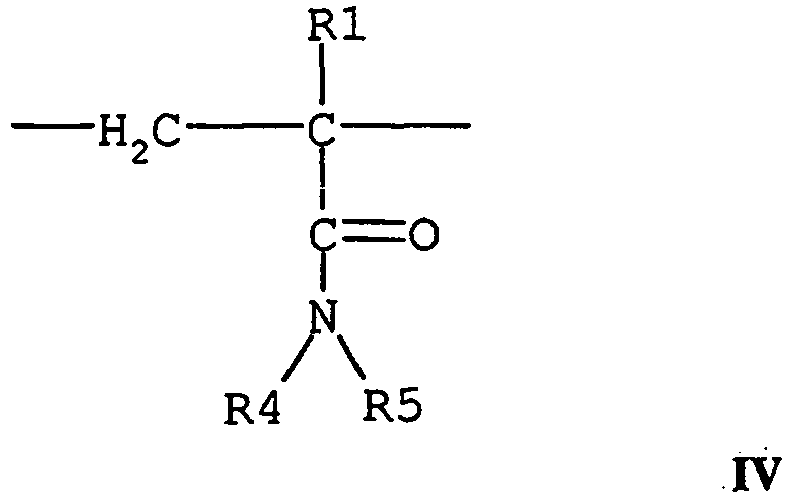
- wherein each R1 independently from each other represents a hydrogen atom or a methyl group or mixtures thereof (wherever the expression "mixtures thereof" occurs in connection with the specification of substituents, it means that structural units of a specific kind with a specific substituent can be present simultaneously with one or more other structural units of the same kind but with other specific substituents, and/or that, where one structural unit comprises several substituents identically designated, said substituents can have different meanings in one and the same structural unit);
- M represents a hydrogen atom, a metallic cation, an ammonium or organic ammonium cation (such as e.g. alkyl and/or alkanol substituted cations with at least one such substituent, in particular C1 to C4 alkyl and/or C1 to C4 alkanol substituted ammonium cations) or mixtures thereof;
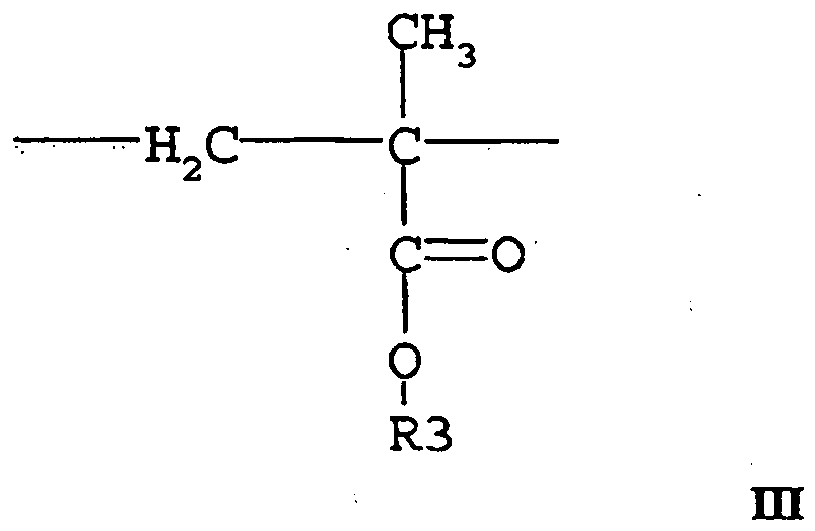
- R2, R20 and R3 independently from each other represent a C1-C12 alkl- or cycloalkyl group, a C2-C12 hydroxyalkyl group or (R7O)zR8 in which O represents an oxygen atom, R7 represents a C2-C3 alkylene group or mixtures thereof, R8 represents a hydrogen atom, a C1-C12 alkyl- or cycloalkyl group, a C2-C12 hydroxyalkyl group, or an unsubstituted or substituted aryl group and z represents a number from 1-250; whereby R2, R3 and R20 may be mixtures thereof,
- R4 and R5 represent independently from each other a hydrogen atom or a substituent as defined for R2, and R4 and R5 may form together a ring structure of which N is part of, this ring structure may further contain other hetero atoms like another nitrogen, sulfur or oxygen atom, or mixtures thereof;
- R6 is a single bond or a methylene group,
- a, b, c, d and e represent numbers where the sum of a+b+c+d+e=100 and b is a number from 10-90, c is a number from 0-85, d is a number from 0-50 and e is a number from 0-10 and a is 100 - (b+c+d+e), whereby a is at least 5.
- Polymer B as defined above may contain side chains of formula VI which are connected to the backbone by amide or ester groups.
-(A1O)x-(B1O)y-R9 VI
- wherein O represents an oxygen atom and A1 and B1 represent independently from each other a C2-C3 alkylene group and A1≠B1 and
- R9 represents a hydrogen atom, a C1-C12 alkyl- or cycloalkyl group, a C2-C12 hydroxyalkyl group, or an unsubstituted or substituted aryl group and x represents a number from 1-250 and y represents a number from 0-250 and the sum of x and y is a number of 1-250 and the order (A1O) and (B1O) is random, alternating or blockwise.
- Polymer A is a cement dispersing admixture preferably of the group consisting of sulfonated melamine condensates, sulfonated naphthalene condensates, lignosulfonates, substituted maleamid-vinyl-copolymers and acrylic or methacrylic copolymers with polyalkyleneoxide side chains, or mixtures thereof.
- The solid weight ratio of polymers A to the polymers of the present invention usually is from 0.1:10 -10:1 and preferably from 1:10-10:1.
- To enhance the effect already obtainable with the polymer of the present invention alone, polymer A and the polymer of the present invention may be used together, either combined in one admixture or they can be added separately to the cementitious composition.
- This invention relates to a polymer and an admixture comprising at least one polymer A and at least one polymer of the present invention, whereby the polymer of the present invention comprises side chains of which at least 10 weight-% can be cleaved in alkaline medium at a pH of from 8-14. This polymer, and in particular said admixture can drastically reduce the slump-loss of cementitious compositions.
- The side chains of the polymer of the present invention may be connected to the backbone by ester linkages. Said polymer may further contain side chains, which are connected to the backbone by amide groups. Side chains which are cleavable in alkaline medium are e.g. ester linkages like in polymerised acrylic esters. Not cleavable in the aforementioned manner are esters like in polymerised methacrylic esters. Furthermore side chains which are connected to the backbone by amide or imide linkages are not considered as cleavable in the idea of this patent.
- The polymer of the present invention comprises
a mol% of structural unit A of formula I


- wherein each R1 independently from each other represents a hydrogen atom or a methyl group or mixtures thereof;
- M represents a hydrogen atom, a metallic cation, an ammonium or organic ammonium cation (such as e.g. alkyl and/or alkanol substituted cations with at least one such substituent, in particular C1 to C4 alkyl and/or C1 to C4 alkanol substituted ammonium cations) or mixtures thereof;
- R2, R20 and R3 independently from each other represent a C1-C12 alkyl- or cycloalkyl group, a C2-C12 hydroxyalkyl group or (R7O)zR8 in which O represents an oxygen atom, R7 represents a C2-C3 alkylene group or mixtures thereof, R8 represents a hydrogen atom, a C1-C12 alkyl- or cycloalkyl group, a C2-C12 hydroxyalkyl group, or an unsubstituted or substituted aryl group and z represents a number from 1-250, whereby R2, R3 and R20 may be mixtures thereof;
- R4 and R5 represent independently from each other a hydrogen atom or a substituent as defined for R2, and R4 and R5 may form together a ring structure of which N is part of, this ring structure may further contain other hetero atoms like another nitrogen, sulfur or oxygen atom, or mixtures thereof;
- R6 is single bond or a methylene group,
- a, b, c, d and e represent numbers where the sum of a+b+c+d+e=100 and b is a number from 10-90, c is a number from 0-85, d is a number from 0-50 and e is a number from 0-10 and a is 100 - (b+c+d+e), whereby a is at least 5.
- The polymer of the present invention, as defined above, may contain side chains of formula VI which are connected to the backbone by amide or ester groups.
-(A1O)x-(B1O)y-R9 VI
- In formula VI O represents an oxygen atom and A1 and B1 represent independently from each other a C2-C3 alkylene group and A1≠B1 and
- R9 represents a hydrogen atom, a C1-C12 alkyl- or cycloalkyl group, a C2-C12 hydroxyalkyl group, or an unsubstituted or substituted aryl group and x represents a number from 1-250 and y represents a number from 0-250 and the sum of x and y is a number of 1-250 and the order (A1O) and (B1O) is random, alternating or blockwise.
- The inventive polymer comprises 5-90 mol % more preferably 20-80 mol % of structural unit A of formula I and 10-90 mol% more preferably 15-70 mol% of structural unit B of formula II and 0-85 mol % of structural unit C of formula III and 0-50 mole % more preferably 0-20 mole% of structural unit D of formula IV and 0-10 mol% of structural unit E of formula V .
- The polymer of the present invention as defined above may be produced by copolymerisation reactions as described in standard literature. The monomers resulting in structural unit A of formula I in said polymer are selected from the group comprising acrylic acid and methacrylic acid which may be fully or partly neutralised before or after the polymerisation with an alkaline substance. Examples for this alkaline substance are metal hydroxides like alkali metal and alkaline earth metal hydroxides, aluminum hydroxid or oxide hydroxide, tin or zinc compounds, ammonia, alkyl amines or hydroxyalkyl amines.
- The monomers resulting in structural unit B of formula II in the polymer B are acrylic esters. Examples, but not exclusive, of the acrylic esters are C1-C12 alkyl or cylcoalkyl acrylates, C2-C12 hydroxyalkyl acrylates or hydroxy or alkyl terminated polyalkyleneglycole acrylates as shown in formula VII

-(A2O)r-(B2O)s-R11 VIII
- wherein O represents an oxygen atom and A2 and B2 represent independently from each other a C2-C3 alkylene group and A2≠B2 and
- R11 represents a hydrogen atom, a C1-C12 alkyl- or cycloalkyl group, a C2-C12 hydroxyalkyl group, or an unsubstituted or substituted aryl group and r represents a number from 1-250 and s represents a number from 0-250 and the sum of r and s is a number of 1-250 and the order (A2O) and (B2O) is random, alternating or blockwise.
- Monomers VII with different R10 may be used in combinations with each other.
- The monomers resulting in structural unit C of formula III in the polymer of the present invention are methacrylic esters. Examples but not exclusive, of these methacrylic esters are C1-C12 alkyl or cylcoalkyl methacrylates, C2-C12 hydroxyalkyl methacrylates, or alkyl terminated polyalkyleneglycole methacrylates as shown in formula IX

-(A3O)t-(B3O)u-R13 X
- Wherein O represents an oxygen atom and A3 and B3represent independently from each other a C2-C3 alkylene group and A3≠B3 and
- R13 represents a hydrogen atom, a C1-C12 alkyl- or cycloalkyl group, a C2-C12 hydroxyalkyl group, or an unsubstituted or substituted aryl group and t represents a number from 1-250 and u represents a number from 0-250 and the sum of t and u is a number of 1-250 and the order (A3O) and (B3O) is random, alternating or blockwise.
- Monomers IX with different R12 may be used in combinations with each other.
- The monomers resulting in structural unit D of formula IV in the polymer of the present invention are acrylamides or methacrylamides or N-substituted acrylamides or methacrylamides. Examples, but not exclusive, of these methacrylic amides are methoxypolyalkyleneglycole acrylamides, methoxypolyalkyleneglycole methacrylamides, acryl or methacrylamides of dicylcohexylamine, acryl or methacrylamides of oxazolidine.
- The polymerisation of the mentioned monomers may be carried out in bulk or in solution, initiated by a polymerisation initiator. Further chain transfer agents and redox-initiator systems may be used.
- The inventive polymers as defined above may be produced by reacting a polycarboxylic acid or a C1-C5-ester thereof or a partly neutralised polycarboxylic acid, having all a number average molecular weight of from 500 to 20'000 with a monofunctional polyalkyleneglycol-monoalkylether, represented by formula XI
HO-(A4O)v-(B4O)w-R14 XI
and optionally
a monofunctional α-amino-polyalkyleneglycol-ω-alkylether, represented by formula XII
H2N-(A5O)m-(B5O)nR15 XII
and/or, optionally
a primary or secondary amine, represented by formula XIII
- wherein O represents an oxygen atom and A4, A5, B4 and B5 represent independently from each other a C2-C3 alkylene group and A4≠B4 and A5≠B5. R14 and R15 independentyl represent a hydrogen atom or a C1-C4 alkyl group and v and m represent a number from 1-250 and w and n represent a number from 0-250 and the sum of v and w and the sum of m and n is a number of 1-250 and the order (A4O) and (B4O) respectively of (A5O) and (B5O) is random, alternating or blockwise.
- R16 and R17 independently from each other represent a hydrogen atom or an C1 - C4 alkyl group, or oxyalkylen groups of the structure R18-(O-R19)p- , where R18 independently represents a C1 - C4 alkyl rest and R19 independently represents a C2 -C3 alkylene group or a mixture thereof, wherein the mixture may be formed by either random, alternating or block addition,
- R16 and R17 represent also cyclic derivatives such as aliphatic C3 - C8 rings, and R16 and R17 together may form a heterocyclic ring structure wherein N is a part of. This heterocyclic ring may contain in addition to the N atom further N, S or O atoms.
- Examples, but not limiting, for polycarboxylic acids which can be used for the production of the polymer of the present invention are polyacrylic acid, copolymers of acrylic acid with methacrylic acid, homo or copolymers of acrylic C1-C5-esters, or copolymers of methacrylic acid with C1-C5 acrylic esters. The term polyacarboxylic acid further comprises also partly neutralised polymers.
- Part of the side chains in the inventive polymer is cleaved in alkaline medium.
- As alkaline medium a medium is meant, which may be an aqueous liquid, paste, slurry, emulsion or a dispersion of a pH from 8-14.
- Example for an alkaline medium is the liquid phase of a cement slurry.
- The admixture for preventing drop in fluidity of cementitious admixtures of this invention contains besides the inventive polymer a polymer A which is a cement dispersing agent preferably of the group consisting of sulfonated melamine condensates, sulfonated naphthalene condensates, lignosulfonates, substituted maleamid-vinyl-copolymers and acrylic or methacrylic copolymers with polyalkyleneoxide side chains, or mixtures thereof.
- A preferred admixture for example comprises a polymer of the present invention consisting of 40-80 mol% of structural unit A of formula I, 20-70 mol% of structural unit B of formula II, 0-50 mol% of structural unit C of formula III, 0-20 mol% of structural unit D of formula IV and 0-5 mol% of structural unit E of formula V and polymer A is a copolymer of (meth)acrylic acid with polyalkyleneoxide methacrylate.
- The solid weight ratio of polymers A to the polymers of the present invention usually is from 0.1:10-10:1 and preferably from 1:10-10:1.
- The addition of polymer A and the inventive polymer to the cementitious composition may be in solid form or as liquid admixture or in an adsorbed form on a powder material. The addition of said two polymers can be performed combined in one admixture or they can be added separately to the cementitious composition. Polymer A and the polymer of the present invention may furthermore be added at the same time or at different times to the cementitious composition.
- The cementitous composition according to the present invention comprises cement, the polymer or cement admixture of the present invention and water and is, for example used as cement paste, mortar or concrete. Examples of cement which can be used include many kinds of Portland cement like ordinary Portland cement, high early strength or moderate heat Portland cement, white cement, blended cements which contain fly ash, slag, puzzolanic materials, carbonaceous materials, silica fume, burnt oil shale, metakaolin or gypsum.
- The cement composition of the present invention may further comprise conventional admixtures like plasticisers, superplasticisers, air entraining admixtures, defoamers, retarders, set accelerators, hardening accelerators, hydrophobising or shrinkage reducing admixtures or corrosion inhibitors.
- The following examples describe the synthesis of the polymer of the invention.
- It is clear for the averagely skilled person that, if polyalkylene oxides or their derivatives are used, the number of alkylene oxide units is a mean value of a molecular number distribution and the mentioned molecular weights are the mean molecular weights of the used polymer.
- A one litre reactor, equipped with a mechanical stirrer, a dropping funnel, a reflux condenser, a thermometer and two inlet tubes was charged with 308 g deionized water.
- A monomer solution was prepared of 32.4 g acrylic acid, 57 g of a methoxy polyethyleneglycol acrylate with 11 units of ethyleneglycol, 160 g of a polyethyleneglycol methacrylate with 23 units of ethyleneglycol and 110 ml deionized water and filled in the dropping funnel.
- A solution A was prepared of 10.8 g sodium persulfate in 40 g deionized water. A solution B was prepared of 8.0 g sodium disulfit in 40 g deionized water.
- The reactor was heated and at a temperature of the water of 80°C the monomer solution was added from the dropping funnel and the solutions A and B were added separately with a tube-pump within 4 hours at 80 °C.
- After the addtions the mixture was stirred at 80 ° C until the peroxide test was negative. After cooling to room temperature, the pH of the polymer solution was adapted to 5 by addition of 22.7 g 50% sodium hydroxide solution.
- The polymers are produced in the same manner as described in example 1. The monomers used and their dosages in grams are listed in table 1.
- The polymers are produced in the same manner as described in example 1. The monomers used and their dosages in grams are listed in table1.
Table 1 Example AS MAS PEO 6A MPEO 11A MPEO 1000MA MPEO 2000MA SPS SDS Total water NaOH 50% Polymer E2 18.0 110.7 9.0 6.7 239 12.3 Polymer E3 18.0 172.0 8.5 6.3 353 18.8 Polymer E4 43.0 133.0 106.8 17.2 12.4 525 18.2 Polymer E5 36.0 133.0 208.0 11.4 8.0 700 22.0 Polymer C1 34.5 165 8.2 5.9 370 33.5 Polymer C2 17.2 26.5 106.8 5.9 4.2 280 6.3 Polymer C3 25.8 106.8 6.9 4.9 246 23.1 AS......acrylic acid
MAS......methacrylic acid
PEO 6A......hydroxy polyethyleneglycol acrylate with 6 units of ethyleneglycol
MPEO 11A......methoxy polyethyleneglycol acrylate with 11 units of ethyleneglycol
MPEO 1000MA, MPEO 2000MA.....methoxy polyethyleneglycol methacrylate with mol. weight of the polyethyleneglycol chain of 1000 resp. 2000
SPS......sodium persulfate
SDS......sodium disulfit - 160 g of a 50% aqueous solution of a 4000 molecular weight poly(acrylic acid) and 7.5 g 50 wt.% sulfuric acid were placed in a glass reactor fitted with a thermometer, a stirrer, a gas inlet tube and a distillation assembly. The solution was heated to 70°C and 140 g of a 350 number average molecular weight polyethyleneglycol-monomethylether and 200 g of a 2000 number average molecular weight α-amino-polyethyleneglycol-ω-methylether were added.
- The mixture was heated up under a steady stream of nitrogen and kept at 165°C. After 6 h stirring at 165°C the mixture was cooled down. At 90°C 630 g water were added.
- The polymers were produced in the same manner as described in example 6 but with the amounts of reactants in grams listed in table 2.
Table 2 All values in grams (except time in hours and minutes) Example PAS 4000 SS 50% PEG 350MME PEG 500MME PEG 1000MME A-PEG 500MME A-PEG 2000MME Reaction Time at 165°C (hh:mm) Polymer E7 160 7.5 0 175 0 26 0 7:30 Polymer E8 160 7.5 123 0 0 100 0 4:00 Polymer E9 160 7.5 0 0 400 0 0 7:00 Polymer E10 160 7.5 0 0 300 52 0 6:00 Polymer E11 160 7.5 0 0 380 10 0 6:00 Polymer E12 160 7.5 123 0 0 0 100 7:00 Polymer E13 160 5.0 200 0 0 0 0 3:00 Polymer E14 160 7.5 350 26 0 6:00 PAS 4000: 50% aqueous solution of a 4000 molecular weight poly(acrylic acid)
SS 50%: sulfuric acid 50wt% in water
PEG 350MME: polyethyleneglycol-monomethylether of average molecular weight of 350
PEG 500MME: polyethyleneglycol-monomethylether of average molecular weight of 500
PEG 1000MME: polyethyleneglycol-monomethylether of average molecular weight of 1000
A-PEG 500MME: alpha-amino-polyethyleneglycol-omega-methylether of average molecular weight of 500
A-PEG 2000MME: alpha-amino-polyethyleneglycol-omega-methylether of average molecular weight of 2000 - To follow the cleavage of side chains of polymer B in alkaline medium the HPLC was used to measure the amount of free polyalkyleneglycol in the solution.
- 100 g water and 100 g normal Portland cement were blended for 30 minutes and the solution was filtered off with the aid of a paper filter.
- The alkaline solution had a pH of 12.9 and corresponds to the solution of a cementitious composition with a water/cement ratio of 1.0.
- 1.0 g of polymer with 40% solids content was dissolved in 100 ml of the aforementioned alkaline solution and analysed by HPLC technique.
- The amount of polyalkylene glycole in the solution was measured at different times.
- The results are listed in table 3. The percentage of cleaved side chains means, the g of side chains that have been cleaved off the main chain per 100 g of all side chains.
Table 3 Polymer Weight % side chains in polymer Weight % of side chains cleaved after 40 min Weight % of side chains cleaved after 2 hours Weight % side chains cleaved after 24 hours Polymer E1 80 16 20 25 Polymer E2 71 39 50 56 Polymer E3 79 41 43 76 Polymer E6 81 13 16 34 Polymer E7 72 22 31 66 Polymer E13 71 34 52 90 Polymer E14 83 21 37 93 Polymer C3 75 0 0 0 Polymer C2 81 4 4 4 -
Normal Portland cement type I 750 g carbonateous filler 150 g fine sand 0-1.2 mm 950 g sand 1.2-4 mm 800 g sand 4-8 mm 1250 g - Filler, sand and cement were blended in a Hobart type mortar mixer for 60 seconds, the water containing the admixtures was added and the mortar mechanically kneaded for 3 minutes.
- Flow table spread (a measure of the flowability of the mortar) was measured according German Standard DIN 18555 part 2 using the equipment described in German Standard DIN 1060 part 3. The measurement was repeated after 30 and 60 minutes with 30 seconds mixing of the mortar. The decrease of the flow with time is a measure of the loss of fluidity of the mortar.
- Results of the mortar tests of the inventive admixtures and comparison admixtures is summarised in table 4.
-
- Polymer A1 is a modified maleamide-vinyl-copolymer;
- Polymers A2, and A3 are copolymers of methacrylic acid with methacrylic ester of methylpolyethyleneglycol.
- The W/C ratio is the weight of the cement divided by the weight of the water.
- All admixtures were used as 35% solutions.
- If necessary, the polymer solutions were defoamed with 0.2% triisobuty-phosphate.
Table 4 Polymer A Polymer of the invention Dosage % on cement W/C Flow Table Spread (mm) 0 min after 30 min after 60 min Polymer A1 1.0 0.44 190 167 144 Polymer A1 Polymer E3 0.7/0.7 0.44 182 170 173 Polymer A1 Polymer E14 0.6/0.6 0.44 190 189 176 Polymer A1 Polymer C3 0.8/0.2 0.44 212 157 142 Polymer A2 - 1.0 0.40 186 163 157 Polymer A2 Polymer E7 0.25/0.75 0.40 184 190 176 Polymer A2 Polymer E6 0.7/0.5 0.40 180 173 171 Polymer A2 Polymer C1 0.5/0.5 0.40 164 148 143 Polymer A2 Polymer C2 0.75/0.25 0.40 168 163 136 Polymer A3 1.0 0.41 187 143 141 Polymer A3 Polymer E3 0.8/0.2 0.41 207 208 187 Polymer A3 Polymer E1 0.4/0.5 0.41 186 176 174 Polymer A3 Polymer E13 0.7/1.1 0.41 176 167 170 - The results of the mortar tests listed in table 4 show clearly the reduction of slump-loss by using polymer A and the polymer of the present invention together.
-
Normal Portland Cement type I 7.5 kg Lime stone filler 1.5 kg Sand 0-1.2mm 9.5 kg Sand 1.2-4.0 mm 8.0 kg Sand 4.0-8.0 mm 4.5 kg Gravel 8-16 mm 9.5 kg Gravel 16-32 mm 17.0 kg Sand and gravel washed and dried - Cement and aggregates were premixed for 30 seconds in a 50 litre forced circulation mixer for concrete. The mixing water including the admixture was added under stirring within 20 seconds and the concrete mixed for additional 40 seconds. A part of the fresh concrete was immediately used for measuring the flow table spread according DIN 1048 part 1. The remaining concrete was left in the mixer and the flow table spread again measured after 30 and 60 minutes where the concrete was remixed for 10 seconds.
- The results of the tests are summarised in table 5
-
- Polymers A1 and A5 are modified maleamide-vinyl-copolymers
- Polymers A3 and A4 are copolymers of methacrylic acid with methacrylic ester of methylpolyethyleneglycol.
- The W/C ratio is the weight of the cement divided by the weight of the water.
- The dosage of the admixtures is in weight % of 40% solutions on cement.
- If necessary, the admixtures were defoamed with 0.2% triisobutyl phosphate.
- The effect of the inventive admixture comprising polymer A and the polymer of the present invention on the slumplife without drastically reduction of the early strength of the concrete is clearly shown in table 5.
Table 5 Polymer A Polymer of the present invention Dosage % on cement W/C Flow Table Spread (cm) Compressive strength after 24 hours 0 min after 30 min after 60 min (N/mm2) Polymer A1 - 0.6 0.47 58 42 39 20.8 Polymer A1 Polymer E14 0.3/0.4 0.47 47 51 51 18.1 Polymer A3* - 0.8 0.45 56 49 47 25.6 Polymer A3* Polymer E14 0.64/0.16 0.45 55 52 49 22.3 Polymer A3 Polymer E14 0.48/0.32 0.45 53 53 53 22.2 Polymer A4 - 0.70 0.41 51 47 42 30.3 Polymer A4 Polymer E14 0.56/0.16 0.41 51 48 46 30.2 Polymer A4 Polymer E14 0.35/0.40 0.41 49 49 48 28.9 Polymer A5 - 0.6 0.45 44 36 33 23.1 Polymer A5 Polymer E14 0.30/0.40 0.45 42 42 40 23.6
Claims (13)
- A polymer comprising side chains of which at least 10 weight-% can be cleaved in alkaline medium at a pH of from 8-14 at 20°C, said side chains being connected to the backbone of said polymer by ester and optionally amide and/or imide groups, whereby said polymer comprises
a mol% of structural unit A of formula I


 wherein each R1 independently from each other represents a hydrogen atom or a methyl group or mixtures thereof;M represents a hydrogen atom, a metallic cation, an ammonium or organic ammonium cation or mixtures thereof;R2, R20 and R3 independently from each other represent a C1-C12 alkyl- or cycloalkyl group, a C2-C12 hydroxyalkyl group or (R7O)zR8 in which O represents an oxygen atom, R7 represents a C2-C3 alkylene group or mixtures thereof, R8 represents a hydrogen atom, a C1-C12 alkyl- or cycloalkyl group, a C2-C12 hydroxyalkyl goup, or an unsubstituted or substituted aryl group and z represents a number from 1-250, whereby R2, R3 and R20 may be mixtures thereof;R4 and R5 represent independently from each other a hydrogen atom or a substituent as defined for R2, and R4 and R5 may form together a ring structure of which N is part of, this ring structure may further contain other hetero atoms like another nitrogen, sulfur or oxygen atom, or mixtures thereof;R6 is single bond or a methylene group,a, b, c, d and e represent numbers where the sum of a+b+c+d+e=100 and b is a number from 10-90, c is a number from 0-85, d is a number from 0-50 and e is a number from 0-10 and a is 100 - (b+c+d+e), whereby a is at least 5;and wherein the polymer contains
side chains of formula VI which are connected to the backbone by amide or ester groups,
-(A1O)x-(B1O)y-R9 VI
and wherein O represents an oxygen atom and A1 and B1 represent independently from each other a C2-C3 alkylene group and A1≠B1 andR9 represents a hydrogen atom, a C1-C12 alkyl- or cycloalkyl group, a C2-C12 hydroxyalkyl group, or an unsubstituted or substituted aryl group and x represents a number from 1-250 and y represents a number from 0-250 and the sum of x and y is a number of 1-250 and the order (A1O) and (B1O) is random, alternating or blockwise. - Polymer according to claim 1, wherein the side chains are connected to the backbone of said polymer by ester and by amide acid/or imide groups.
- Polymer according to claim 1 or 2 obtainable or produced by a copolymerising reaction of (meth)acrylic monomers.
- Polymer according to claim 1 or 2 obtainable or produced by polymer analogues reaction of esterification and optionally amidation and/or imidation of a polycarboxylic acid.
- Polymer according to anyone of claims 1 to 4 comprising 5-90 mol %, preferably 20-80 mol % of structural unit A of formula I; and 10-90 mol%, preferably 15-70 mol% of structural unit B of formula II; and 0-85 mol % of structural unit C of formula III; and 0-50 mole %, preferably 0-20 mole% of structural unit D of formula IV; and 0-10 mol% of structural unit E of formula V.
- Polymer according to anyone of claims 1 to 5 wherein at least 15% of the side groups are cleaved at a pH higher than 12.5 at 22°C within 2 hours.
- Admixture for reducing loss of fluidity of cementitious compositions, mortars and concrete, said admixture comprising at least one polymer A and at least one polymer according to anyone of claims 1 to 6 wherein polymer A is a cement dispersing agent.
- Admixture according to claim 8 wherein polymer A is a cement dispersing agent selected from the group consisting of sulfonated melamine condensates, sulfonated naphthalene condensates, lignosulfonates, substituted maleamid-vinyl-copolymers and acrylic or methacrylic copolymers with polyalkyleneoxide side chains, or mixtures thereof.
- Admixture according to claim 8 wherein the solid weight ratio of polymers A to the polymers of one of claims 1 to 7 is from 0.1:10-10:1, preferably from 1:10-10:1.
- A mortar, concrete or cementitious binder comprising the polymer of anyone of claims 1 to 7.
- A mortar, concrete or cementitious binder comprising the admixture of claim 8 or 9.
- The mortar, concrete or cementitious binder of claim 11 comprising the admixture in an amount of 0.01 to 10 weight % by weight of the binder, said mortar or concrete having a unit content of binder composition of cement or a mixture of cement and latent hydraulic or inert microscopic powder of 100 to 800 kg/m3, preferably of 250 to 650 kg/m3.
- A method for producing a mortar, concrete or cementitious binder of claim 11 or 12, wherein the polymer of anyone of claims 1 to 7 and polymer A are added separately or premixed as admixture in solid or liquid form.
Priority Applications (9)
| Application Number | Priority Date | Filing Date | Title |
|---|---|---|---|
| DE1136508T DE1136508T1 (en) | 2000-03-22 | 2000-03-22 | Cement mix with extended processing time |
| ES00105910T ES2164618T3 (en) | 2000-03-22 | 2000-03-22 | Cement additive for improved settlement duration |
| EP00105910.4A EP1136508B1 (en) | 2000-03-22 | 2000-03-22 | Cement admixture for improved slump life |
| CA2342011A CA2342011C (en) | 2000-03-22 | 2001-03-21 | Cement admixture for improved slump life |
| US09/813,996 US20020007019A1 (en) | 2000-03-22 | 2001-03-22 | Cement admixture for improved slump life |
| JP2001083314A JP5052715B2 (en) | 2000-03-22 | 2001-03-22 | Cement admixture for improved slump life |
| GR20010300069T GR20010300069T1 (en) | 2000-03-22 | 2001-12-31 | Cement admixture for improved slump life |
| US10/682,300 US7026402B2 (en) | 2000-03-22 | 2003-10-10 | Cement admixture for improved slump life |
| US11/329,233 US7375163B2 (en) | 2000-03-22 | 2006-01-11 | Cement admixture for improved slump life |
Applications Claiming Priority (1)
| Application Number | Priority Date | Filing Date | Title |
|---|---|---|---|
| EP00105910.4A EP1136508B1 (en) | 2000-03-22 | 2000-03-22 | Cement admixture for improved slump life |
Publications (2)
| Publication Number | Publication Date |
|---|---|
| EP1136508A1 EP1136508A1 (en) | 2001-09-26 |
| EP1136508B1 true EP1136508B1 (en) | 2013-08-14 |
Family
ID=8168157
Family Applications (1)
| Application Number | Title | Priority Date | Filing Date |
|---|---|---|---|
| EP00105910.4A Revoked EP1136508B1 (en) | 2000-03-22 | 2000-03-22 | Cement admixture for improved slump life |
Country Status (7)
| Country | Link |
|---|---|
| US (3) | US20020007019A1 (en) |
| EP (1) | EP1136508B1 (en) |
| JP (1) | JP5052715B2 (en) |
| CA (1) | CA2342011C (en) |
| DE (1) | DE1136508T1 (en) |
| ES (1) | ES2164618T3 (en) |
| GR (1) | GR20010300069T1 (en) |
Cited By (2)
| Publication number | Priority date | Publication date | Assignee | Title |
|---|---|---|---|---|
| CN107903360A (en) * | 2017-11-24 | 2018-04-13 | 湖北工业大学 | The gas making barrier preparation method of anti-absorbent-type polycarboxylate water-reducer |
| CN110291057A (en) * | 2016-12-01 | 2019-09-27 | 亨茨曼国际有限公司 | Functionalized polyacrylic polymer compositions |
Families Citing this family (49)
| Publication number | Priority date | Publication date | Assignee | Title |
|---|---|---|---|---|
| JP2003327459A (en) * | 2002-05-10 | 2003-11-19 | Nippon Shokubai Co Ltd | Cement admixture |
| FR2853646B1 (en) * | 2003-04-11 | 2007-07-06 | Chryso Sas | USE OF DISPERSANTS TO ENHANCE THE MAINTENANCE OF CONCRETE FLUIDITY |
| EP1577372A1 (en) * | 2004-03-19 | 2005-09-21 | Sika Technology AG | Stable aqueous dispersion of particles , its use and its process of production |
| US20060018863A1 (en) | 2004-07-13 | 2006-01-26 | Nathalie Mougin | Novel ethylenic copolymers, compositions and methods of the same |
| KR20070101224A (en) | 2004-09-06 | 2007-10-16 | 시카 테크놀러지 아게 | Method for preparing coated base material for hydraulic composition, Coated base material for hydraulic composition, additive for hydraulic composition and method for preparing hydraulic composition |
| EP2006258B1 (en) * | 2007-06-11 | 2012-08-15 | Sika Technology AG | Dispersant for gypsum compositions |
| EP2020422A1 (en) | 2007-07-31 | 2009-02-04 | Sika Technology AG | Emulgating polymers and their use |
| EP2072479A1 (en) | 2007-12-20 | 2009-06-24 | Sika Technology AG | Reactivation of delayed cementitious systems |
| ES2402670T3 (en) | 2007-12-20 | 2013-05-07 | Sika Technology Ag | Accelerator for the reactivation of delayed cement systems |
| EP2090596A1 (en) * | 2008-02-13 | 2009-08-19 | Construction Research and Technology GmbH | Copolymer with polyether side chains and hydroxyalkyl and acid building blocks |
| EP2128110B1 (en) | 2008-05-29 | 2016-08-17 | Sika Technology AG | Additive for hydraulic bonding agent with long processing time and high early stability |
| US7973110B2 (en) * | 2008-06-16 | 2011-07-05 | Construction Research & Technology Gmbh | Copolymer synthesis process |
| EP2159203A1 (en) * | 2008-08-26 | 2010-03-03 | Sika Technology AG | Additive for hydraulically setting systems with improved processing and low water reduction rate |
| US8592040B2 (en) | 2008-09-05 | 2013-11-26 | Basf Se | Polymer emulsion coating or binding formulations and methods of making and using same |
| FR2939428B1 (en) * | 2008-12-08 | 2010-11-19 | Coatex Sas | USE AS AN AGENT ENHANCING THE MANEUVERABILITY OF AN AQUEOUS FORMULATION BASED ON HYDRAULIC BINDERS, A COMBINED (METH) ACRYLIC COPOLYMER AND AN ASSOCIATIVE ACRYLIC THICKENER |
| EP2251376A1 (en) * | 2009-05-15 | 2010-11-17 | Sika Technology AG | Aqueous polymer dispersions |
| EP2336094A1 (en) | 2009-12-21 | 2011-06-22 | Mapei S.p.A. | "Superplasticizers for concrete and cement materials and process for producing the same" |
| CN102834566B (en) | 2010-03-23 | 2016-04-27 | 巴斯夫欧洲公司 | Paper Coating or bonding preparaton and its production and use |
| FR2958284B1 (en) | 2010-04-02 | 2012-03-16 | Lafarge Sa | FLUIDIFYING MIXTURE FOR HYDRAULIC COMPOSITION |
| FR2958931B1 (en) | 2010-04-20 | 2012-05-18 | Lafarge Sa | RAPID HYDRAULIC BINDER FOR CONCRETE PARTS AND WORKS |
| FR2961807B1 (en) | 2010-06-24 | 2013-11-01 | Lafarge Sa | METHOD OF TRANSPORTING A HYDRAULIC COMPOSITION |
| FR2961804B1 (en) | 2010-06-24 | 2013-11-01 | Lafarge Sa | HYDRAULIC COMPOSITION |
| FR2961805B1 (en) | 2010-06-24 | 2013-11-01 | Lafarge Sa | DELAYED HYDRAULIC COMPOSITION TRIPPED BY AN ACCELERATOR |
| FR2969155B1 (en) | 2010-12-21 | 2014-02-07 | Chryso | POLYMER COMPRISING A HYDROLYZABLE FUNCTION USEFUL AS FLUIDIFIER |
| FR2969157A1 (en) | 2010-12-21 | 2012-06-22 | Chryso | POLYMER COMPRISING A HYDROLYZABLE FUNCTION USEFUL AS FLUIDIFIER |
| FR2969156B1 (en) | 2010-12-21 | 2013-02-08 | Chryso | POLYMER COMPRISING A HYDROLYZABLE FUNCTION AS A FLUIDIFIER |
| US9102848B2 (en) | 2011-02-28 | 2015-08-11 | Basf Se | Environmentally friendly, polymer dispersion-based coating formulations and methods of preparing and using same |
| ES2528746T3 (en) | 2011-11-11 | 2015-02-12 | Omya International Ag | Aqueous suspensions of materials comprising calcium carbonate with low deposit formation |
| US20130231415A1 (en) * | 2012-03-05 | 2013-09-05 | Ruetgers Polymers Ltd. | Slump Retaining and Dispersing Agent for Hydraulic Compositions |
| EP2641941B1 (en) | 2012-03-23 | 2015-06-10 | Omya International AG | Preparation of pigments |
| WO2013182595A1 (en) | 2012-06-06 | 2013-12-12 | Sika Technology Ag | Hydrolysable polycarboxylate esters |
| PL2679638T3 (en) | 2012-06-28 | 2016-02-29 | Omya Int Ag | High solids aqueous mineral and/or filler and/or pigment suspension in acidic pH environment |
| SI2684999T1 (en) | 2012-07-13 | 2015-03-31 | Omya International Ag | High solids and low viscous aqueous slurries of calcium carbonate-comprising materials with improved rheological stability under increased temperature |
| EP2687498A1 (en) * | 2012-07-20 | 2014-01-22 | Construction Research & Technology GmbH | Additive for hydraulic dissolving masses |
| EP2769964A1 (en) | 2013-02-26 | 2014-08-27 | Construction Research & Technology GmbH | Additive for hydraulic setting compositions |
| EP2784036A1 (en) * | 2013-03-26 | 2014-10-01 | Basf Se | Quickly suspending powder-form compound |
| EP2896603A1 (en) * | 2014-01-21 | 2015-07-22 | Basf Se | Calcium sulphate composition including an additive |
| EP3145891A1 (en) | 2014-05-21 | 2017-03-29 | Sika Technology AG | Accelerator for hydraulic binding agents with long processing time and very high early strength |
| US9919968B2 (en) | 2014-09-30 | 2018-03-20 | Gcp Applied Technologies Inc. | Low-to-mid-range water reduction using polycarboxylate comb polymers |
| JP6718443B2 (en) | 2014-10-31 | 2020-07-08 | ローム アンド ハース カンパニーRohm And Haas Company | Two-component synthetic water retention and rheology modifier for use in cement, mortar and plaster |
| CN104530126B (en) * | 2014-12-18 | 2016-08-24 | 江苏苏博特新材料股份有限公司 | A kind of quaternary alkylphosphonium salt and application thereof |
| EP3313801B1 (en) | 2015-06-26 | 2020-08-05 | Construction Research & Technology GmbH | Additive for hydraulically setting compositions |
| EP3239109A1 (en) | 2016-04-28 | 2017-11-01 | Omya International AG | Surface-treated mineral material and its use in water purification |
| CN108623763B (en) * | 2017-03-16 | 2020-07-03 | 天津大学 | Hydrogel based on linear copolymers and use thereof |
| CN107586366B (en) * | 2017-08-28 | 2020-09-04 | 重庆助扬建材有限公司 | Modified polycarboxylate superplasticizer and preparation method thereof |
| US11021395B2 (en) | 2018-01-29 | 2021-06-01 | Lawrence L Kuo | Method for low-to-mid-range water reduction of cementitious compositions |
| CN109369859B (en) * | 2018-08-16 | 2021-05-07 | 武汉源锦建材科技有限公司 | Concrete tackifying type viscosity regulator and preparation method thereof |
| CN110563893B (en) * | 2019-09-12 | 2022-04-01 | 云南凯威特新材料股份有限公司 | Preparation method of rebound inhibitor for sprayed concrete |
| WO2025156173A1 (en) * | 2024-01-25 | 2025-07-31 | Sika Technology Ag | Use of polycarboxylate ethers for adjusting the setting time of cementitious materials |
Family Cites Families (18)
| Publication number | Priority date | Publication date | Assignee | Title |
|---|---|---|---|---|
| FR2516913B1 (en) * | 1981-11-20 | 1985-11-15 | Norsolor Sa | WATER RETENTION AGENTS FOR PLASTERS AND A METHOD FOR THE PRODUCTION THEREOF |
| JPH0692703A (en) * | 1992-03-24 | 1994-04-05 | Kao Corp | Cement admixture |
| AT399508B (en) * | 1992-09-25 | 1995-05-26 | Chemie Linz Gmbh | POLYMERISATES AND POLYMER DISPERSIONS AND THEIR USE IN HYDRAULIC BINDERS |
| JPH06321596A (en) * | 1993-05-17 | 1994-11-22 | Kao Corp | Concrete admixture |
| JP3184698B2 (en) * | 1994-03-09 | 2001-07-09 | 花王株式会社 | Concrete admixture |
| MY114306A (en) | 1995-07-13 | 2002-09-30 | Mbt Holding Ag | Cement dispersant method for production thereof and cement composition using dispersant |
| JP3327809B2 (en) * | 1996-04-03 | 2002-09-24 | 株式会社日本触媒 | Cement dispersant, method for dispersing cement and cement composition |
| US6166112A (en) | 1997-03-10 | 2000-12-26 | Nippon Shokubai Co., Ltd. | Cement admixture and cement composition |
| JP3221399B2 (en) * | 1997-06-10 | 2001-10-22 | 株式会社日本触媒 | Method for producing polycarboxylic acid for cement admixture |
| US5985989A (en) * | 1997-07-09 | 1999-11-16 | Arco Chemical Technology, Lp | Method of making a water reducing additive for cement |
| JPH1160303A (en) | 1997-08-06 | 1999-03-02 | Nippon Shokubai Co Ltd | Cement admixture and cement composition |
| US6087418A (en) | 1998-01-22 | 2000-07-11 | Nippon Shokubai Co., Ltd. | Cement admixture and cement composition |
| US6294015B1 (en) | 1998-01-22 | 2001-09-25 | Nippon Shokubai Co., Ltd. | Cement admixture and cement composition |
| JP3029828B2 (en) * | 1998-01-22 | 2000-04-10 | 株式会社日本触媒 | Cement admixture and cement composition |
| JP3029827B2 (en) * | 1998-01-22 | 2000-04-10 | 株式会社日本触媒 | Cement admixture and cement composition |
| US6258162B1 (en) | 1998-10-22 | 2001-07-10 | Nippon Shokubai Co., Ltd. | Cement composition |
| ES2380414T3 (en) * | 1999-01-29 | 2012-05-11 | Sika Technology Ag | Procedure for reducing shrinkage of hydraulic binding agents |
| ES2154254T3 (en) * | 1999-06-15 | 2004-11-01 | Sika Schweiz Ag | CEMENT DISPERSANT POLYMERS, OF GENERAL APPLICATIONS, FOR HIGH FLUIDITY CONCRETE AND HIGH RESISTANCE. |
-
2000
- 2000-03-22 DE DE1136508T patent/DE1136508T1/en active Pending
- 2000-03-22 ES ES00105910T patent/ES2164618T3/en not_active Expired - Lifetime
- 2000-03-22 EP EP00105910.4A patent/EP1136508B1/en not_active Revoked
-
2001
- 2001-03-21 CA CA2342011A patent/CA2342011C/en not_active Expired - Fee Related
- 2001-03-22 JP JP2001083314A patent/JP5052715B2/en not_active Expired - Lifetime
- 2001-03-22 US US09/813,996 patent/US20020007019A1/en not_active Abandoned
- 2001-12-31 GR GR20010300069T patent/GR20010300069T1/en unknown
-
2003
- 2003-10-10 US US10/682,300 patent/US7026402B2/en not_active Expired - Lifetime
-
2006
- 2006-01-11 US US11/329,233 patent/US7375163B2/en not_active Expired - Lifetime
Cited By (4)
| Publication number | Priority date | Publication date | Assignee | Title |
|---|---|---|---|---|
| CN110291057A (en) * | 2016-12-01 | 2019-09-27 | 亨茨曼国际有限公司 | Functionalized polyacrylic polymer compositions |
| CN110291057B (en) * | 2016-12-01 | 2022-08-26 | 亨茨曼国际有限公司 | Functionalized polyacrylic polymer compositions |
| CN107903360A (en) * | 2017-11-24 | 2018-04-13 | 湖北工业大学 | The gas making barrier preparation method of anti-absorbent-type polycarboxylate water-reducer |
| CN107903360B (en) * | 2017-11-24 | 2019-10-11 | 湖北工业大学 | Gas-forming barrier preparation method of anti-adsorption polycarboxylate water reducer |
Also Published As
| Publication number | Publication date |
|---|---|
| CA2342011C (en) | 2011-03-15 |
| DE1136508T1 (en) | 2002-04-18 |
| CA2342011A1 (en) | 2001-09-22 |
| US7375163B2 (en) | 2008-05-20 |
| US20070032599A1 (en) | 2007-02-08 |
| US20020007019A1 (en) | 2002-01-17 |
| US7026402B2 (en) | 2006-04-11 |
| US20040127607A1 (en) | 2004-07-01 |
| GR20010300069T1 (en) | 2001-12-31 |
| JP2001316152A (en) | 2001-11-13 |
| JP5052715B2 (en) | 2012-10-17 |
| EP1136508A1 (en) | 2001-09-26 |
| ES2164618T3 (en) | 2013-10-29 |
| ES2164618T1 (en) | 2002-03-01 |
Similar Documents
| Publication | Publication Date | Title |
|---|---|---|
| US7375163B2 (en) | Cement admixture for improved slump life | |
| EP1136507B1 (en) | Cement dispersing polymers for high flow, high strength and selfcompacting concrete | |
| US9126866B2 (en) | Polycarboxylate ethers with branched side chains | |
| US6211317B1 (en) | Copolymers based on unsaturated dicarboxylic acid derivatives and oxyalkylene glycol alkenyl ethers | |
| CA2342061C (en) | Polymers for cement dispersing admixtures | |
| EP1636280B1 (en) | Cement dispersant and methods of making and using the same | |
| US20030144384A1 (en) | Superplasticizer for concrete and self-leveling compounds | |
| JP2001011129A (en) | Multipurpose cement dispersible polymer for high flow and high strength concrete | |
| CA2234210A1 (en) | Acrylic copolymers | |
| WO2006011182A1 (en) | Cement dispersant and concrete composition containing the dispersant | |
| EP2964586B1 (en) | Use of polycarboxylate ethers with branched side chains as dispersants for inorganic binders | |
| CA2745417A1 (en) | Copolymer containing acid building blocks and various types of polyether building blocks | |
| EP4306495A1 (en) | Copolymers of carboxylates and polyethers comprising polyether side chains of different length, and use thereof in mineral binder compositions | |
| US10472283B2 (en) | Use of comb polymers for controlling the rheology of mineral binder compositions | |
| JP2000034151A (en) | Cement admixture | |
| CA3045210C (en) | Functionalized polyacrylate polymer compositions | |
| JP2000072505A (en) | Cement admixture | |
| AU2002336519A1 (en) | Superplasticizer for concrete and self-leveling compounds | |
| JPH10226551A (en) | Method for producing cement admixture and secondary concrete product containing the same | |
| MXPA98002660A (en) | Copolimeros acrili | |
| HK1038759B (en) | Polymers for cement dispersing admixtures |
Legal Events
| Date | Code | Title | Description |
|---|---|---|---|
| PUAI | Public reference made under article 153(3) epc to a published international application that has entered the european phase |
Free format text: ORIGINAL CODE: 0009012 |
|
| AK | Designated contracting states |
Kind code of ref document: A1 Designated state(s): AT BE CH CY DE DK ES FI FR GB GR IE IT LI LU MC NL PT SE |
|
| AX | Request for extension of the european patent |
Free format text: AL;LT;LV;MK;RO;SI |
|
| 17P | Request for examination filed |
Effective date: 20010914 |
|
| TCAT | At: translation of patent claims filed | ||
| EL | Fr: translation of claims filed | ||
| REG | Reference to a national code |
Ref country code: ES Ref legal event code: BA2A Ref document number: 2164618 Country of ref document: ES Kind code of ref document: T1 |
|
| TCNL | Nl: translation of patent claims filed | ||
| DET | De: translation of patent claims | ||
| AKX | Designation fees paid |
Free format text: AT BE CH CY DE DK ES FI FR GB GR IE IT LI LU MC NL PT SE |
|
| AXX | Extension fees paid |
Free format text: RO PAYMENT 20010914;SI PAYMENT 20010914 |
|
| RAP1 | Party data changed (applicant data changed or rights of an application transferred) |
Owner name: SIKA SCHWEIZ AG |
|
| RAP1 | Party data changed (applicant data changed or rights of an application transferred) |
Owner name: SIKA TECHNOLOGY AG |
|
| 17Q | First examination report despatched |
Effective date: 20120709 |
|
| GRAP | Despatch of communication of intention to grant a patent |
Free format text: ORIGINAL CODE: EPIDOSNIGR1 |
|
| GRAS | Grant fee paid |
Free format text: ORIGINAL CODE: EPIDOSNIGR3 |
|
| GRAA | (expected) grant |
Free format text: ORIGINAL CODE: 0009210 |
|
| AK | Designated contracting states |
Kind code of ref document: B1 Designated state(s): AT BE CH CY DE DK ES FI FR GB GR IE IT LI LU MC NL PT SE |
|
| AX | Request for extension of the european patent |
Extension state: RO SI |
|
| REG | Reference to a national code |
Ref country code: GB Ref legal event code: FG4D |
|
| REG | Reference to a national code |
Ref country code: CH Ref legal event code: EP Ref country code: AT Ref legal event code: REF Ref document number: 626826 Country of ref document: AT Kind code of ref document: T Effective date: 20130815 |
|
| REG | Reference to a national code |
Ref country code: IE Ref legal event code: FG4D |
|
| REG | Reference to a national code |
Ref country code: DE Ref legal event code: R096 Ref document number: 60048189 Country of ref document: DE Effective date: 20131010 |
|
| REG | Reference to a national code |
Ref country code: ES Ref legal event code: FG2A Ref document number: 2164618 Country of ref document: ES Kind code of ref document: T3 Effective date: 20131029 |
|
| REG | Reference to a national code |
Ref country code: AT Ref legal event code: MK05 Ref document number: 626826 Country of ref document: AT Kind code of ref document: T Effective date: 20130814 Ref country code: NL Ref legal event code: VDEP Effective date: 20130814 |
|
| PG25 | Lapsed in a contracting state [announced via postgrant information from national office to epo] |
Ref country code: PT Free format text: LAPSE BECAUSE OF FAILURE TO SUBMIT A TRANSLATION OF THE DESCRIPTION OR TO PAY THE FEE WITHIN THE PRESCRIBED TIME-LIMIT Effective date: 20131216 Ref country code: AT Free format text: LAPSE BECAUSE OF FAILURE TO SUBMIT A TRANSLATION OF THE DESCRIPTION OR TO PAY THE FEE WITHIN THE PRESCRIBED TIME-LIMIT Effective date: 20130814 Ref country code: SE Free format text: LAPSE BECAUSE OF FAILURE TO SUBMIT A TRANSLATION OF THE DESCRIPTION OR TO PAY THE FEE WITHIN THE PRESCRIBED TIME-LIMIT Effective date: 20130814 Ref country code: CY Free format text: LAPSE BECAUSE OF NON-PAYMENT OF DUE FEES Effective date: 20130522 |
|
| PG25 | Lapsed in a contracting state [announced via postgrant information from national office to epo] |
Ref country code: BE Free format text: LAPSE BECAUSE OF FAILURE TO SUBMIT A TRANSLATION OF THE DESCRIPTION OR TO PAY THE FEE WITHIN THE PRESCRIBED TIME-LIMIT Effective date: 20130814 Ref country code: FI Free format text: LAPSE BECAUSE OF FAILURE TO SUBMIT A TRANSLATION OF THE DESCRIPTION OR TO PAY THE FEE WITHIN THE PRESCRIBED TIME-LIMIT Effective date: 20130814 Ref country code: GR Free format text: LAPSE BECAUSE OF FAILURE TO SUBMIT A TRANSLATION OF THE DESCRIPTION OR TO PAY THE FEE WITHIN THE PRESCRIBED TIME-LIMIT Effective date: 20131115 |
|
| PG25 | Lapsed in a contracting state [announced via postgrant information from national office to epo] |
Ref country code: CY Free format text: LAPSE BECAUSE OF NON-PAYMENT OF DUE FEES Effective date: 20130814 |
|
| PG25 | Lapsed in a contracting state [announced via postgrant information from national office to epo] |
Ref country code: NL Free format text: LAPSE BECAUSE OF FAILURE TO SUBMIT A TRANSLATION OF THE DESCRIPTION OR TO PAY THE FEE WITHIN THE PRESCRIBED TIME-LIMIT Effective date: 20130814 Ref country code: DK Free format text: LAPSE BECAUSE OF FAILURE TO SUBMIT A TRANSLATION OF THE DESCRIPTION OR TO PAY THE FEE WITHIN THE PRESCRIBED TIME-LIMIT Effective date: 20130814 |
|
| PLBI | Opposition filed |
Free format text: ORIGINAL CODE: 0009260 |
|
| PLAX | Notice of opposition and request to file observation + time limit sent |
Free format text: ORIGINAL CODE: EPIDOSNOBS2 |
|
| 26 | Opposition filed |
Opponent name: MC-BAUCHEMIE MUELLER & CO. Effective date: 20140512 |
|
| REG | Reference to a national code |
Ref country code: DE Ref legal event code: R026 Ref document number: 60048189 Country of ref document: DE Effective date: 20140512 |
|
| PLBB | Reply of patent proprietor to notice(s) of opposition received |
Free format text: ORIGINAL CODE: EPIDOSNOBS3 |
|
| PG25 | Lapsed in a contracting state [announced via postgrant information from national office to epo] |
Ref country code: LU Free format text: LAPSE BECAUSE OF FAILURE TO SUBMIT A TRANSLATION OF THE DESCRIPTION OR TO PAY THE FEE WITHIN THE PRESCRIBED TIME-LIMIT Effective date: 20140322 |
|
| REG | Reference to a national code |
Ref country code: CH Ref legal event code: PL |
|
| GBPC | Gb: european patent ceased through non-payment of renewal fee |
Effective date: 20140322 |
|
| REG | Reference to a national code |
Ref country code: IE Ref legal event code: MM4A |
|
| PG25 | Lapsed in a contracting state [announced via postgrant information from national office to epo] |
Ref country code: GB Free format text: LAPSE BECAUSE OF NON-PAYMENT OF DUE FEES Effective date: 20140322 Ref country code: IE Free format text: LAPSE BECAUSE OF NON-PAYMENT OF DUE FEES Effective date: 20140322 Ref country code: LI Free format text: LAPSE BECAUSE OF NON-PAYMENT OF DUE FEES Effective date: 20140331 Ref country code: CH Free format text: LAPSE BECAUSE OF NON-PAYMENT OF DUE FEES Effective date: 20140331 |
|
| REG | Reference to a national code |
Ref country code: FR Ref legal event code: PLFP Year of fee payment: 17 |
|
| RDAF | Communication despatched that patent is revoked |
Free format text: ORIGINAL CODE: EPIDOSNREV1 |
|
| PG25 | Lapsed in a contracting state [announced via postgrant information from national office to epo] |
Ref country code: MC Free format text: LAPSE BECAUSE OF FAILURE TO SUBMIT A TRANSLATION OF THE DESCRIPTION OR TO PAY THE FEE WITHIN THE PRESCRIBED TIME-LIMIT Effective date: 20130814 |
|
| APBM | Appeal reference recorded |
Free format text: ORIGINAL CODE: EPIDOSNREFNO |
|
| APBP | Date of receipt of notice of appeal recorded |
Free format text: ORIGINAL CODE: EPIDOSNNOA2O |
|
| APAH | Appeal reference modified |
Free format text: ORIGINAL CODE: EPIDOSCREFNO |
|
| PG25 | Lapsed in a contracting state [announced via postgrant information from national office to epo] |
Ref country code: IT Free format text: LAPSE BECAUSE OF NON-PAYMENT OF DUE FEES Effective date: 20160322 |
|
| REG | Reference to a national code |
Ref country code: FR Ref legal event code: PLFP Year of fee payment: 18 |
|
| PG25 | Lapsed in a contracting state [announced via postgrant information from national office to epo] |
Ref country code: IT Free format text: LAPSE BECAUSE OF NON-PAYMENT OF DUE FEES Effective date: 20160322 |
|
| PGRI | Patent reinstated in contracting state [announced from national office to epo] |
Ref country code: IT Effective date: 20170710 |
|
| REG | Reference to a national code |
Ref country code: FR Ref legal event code: PLFP Year of fee payment: 19 |
|
| PGFP | Annual fee paid to national office [announced via postgrant information from national office to epo] |
Ref country code: FR Payment date: 20190329 Year of fee payment: 20 Ref country code: DE Payment date: 20190328 Year of fee payment: 20 |
|
| PGFP | Annual fee paid to national office [announced via postgrant information from national office to epo] |
Ref country code: IT Payment date: 20190329 Year of fee payment: 20 Ref country code: ES Payment date: 20190423 Year of fee payment: 20 |
|
| REG | Reference to a national code |
Ref country code: DE Ref legal event code: R064 Ref document number: 60048189 Country of ref document: DE Ref country code: DE Ref legal event code: R103 Ref document number: 60048189 Country of ref document: DE |
|
| APBU | Appeal procedure closed |
Free format text: ORIGINAL CODE: EPIDOSNNOA9O |
|
| RDAG | Patent revoked |
Free format text: ORIGINAL CODE: 0009271 |
|
| STAA | Information on the status of an ep patent application or granted ep patent |
Free format text: STATUS: PATENT REVOKED |
|
| 27W | Patent revoked |
Effective date: 20190930 |
|
| REG | Reference to a national code |
Ref country code: GR Ref legal event code: NF Ref document number: 20010300069 Country of ref document: GR Effective date: 20200122 |