EP1134887A1 - Frequency domain harmonic analysis methods and apparatus for electric machines - Google Patents
Frequency domain harmonic analysis methods and apparatus for electric machines Download PDFInfo
- Publication number
- EP1134887A1 EP1134887A1 EP01302161A EP01302161A EP1134887A1 EP 1134887 A1 EP1134887 A1 EP 1134887A1 EP 01302161 A EP01302161 A EP 01302161A EP 01302161 A EP01302161 A EP 01302161A EP 1134887 A1 EP1134887 A1 EP 1134887A1
- Authority
- EP
- European Patent Office
- Prior art keywords
- stator
- rotor
- magnetomotive force
- magnetic
- sub
- Prior art date
- Legal status (The legal status is an assumption and is not a legal conclusion. Google has not performed a legal analysis and makes no representation as to the accuracy of the status listed.)
- Withdrawn
Links
- 238000004458 analytical method Methods 0.000 title claims abstract description 38
- 230000005291 magnetic effect Effects 0.000 claims abstract description 67
- 238000009826 distribution Methods 0.000 claims abstract description 40
- 238000000034 method Methods 0.000 claims abstract description 32
- 230000035699 permeability Effects 0.000 claims abstract description 32
- 238000001228 spectrum Methods 0.000 claims abstract description 9
- 238000004519 manufacturing process Methods 0.000 claims abstract description 6
- 238000012360 testing method Methods 0.000 claims description 10
- 238000004804 winding Methods 0.000 abstract description 18
- 238000013461 design Methods 0.000 abstract description 9
- 230000004907 flux Effects 0.000 description 9
- 230000006698 induction Effects 0.000 description 6
- 238000003475 lamination Methods 0.000 description 5
- 241000555745 Sciuridae Species 0.000 description 4
- 239000000463 material Substances 0.000 description 4
- 238000012805 post-processing Methods 0.000 description 3
- RYGMFSIKBFXOCR-UHFFFAOYSA-N Copper Chemical compound [Cu] RYGMFSIKBFXOCR-UHFFFAOYSA-N 0.000 description 2
- XEEYBQQBJWHFJM-UHFFFAOYSA-N Iron Chemical compound [Fe] XEEYBQQBJWHFJM-UHFFFAOYSA-N 0.000 description 2
- 230000015556 catabolic process Effects 0.000 description 2
- 229910052802 copper Inorganic materials 0.000 description 2
- 239000010949 copper Substances 0.000 description 2
- 239000007787 solid Substances 0.000 description 2
- 229910000831 Steel Inorganic materials 0.000 description 1
- 229910052782 aluminium Inorganic materials 0.000 description 1
- XAGFODPZIPBFFR-UHFFFAOYSA-N aluminium Chemical compound [Al] XAGFODPZIPBFFR-UHFFFAOYSA-N 0.000 description 1
- 238000013459 approach Methods 0.000 description 1
- 239000004020 conductor Substances 0.000 description 1
- 239000006185 dispersion Substances 0.000 description 1
- 229910052742 iron Inorganic materials 0.000 description 1
- 229910052751 metal Inorganic materials 0.000 description 1
- 239000002184 metal Substances 0.000 description 1
- 230000000717 retained effect Effects 0.000 description 1
- 229920006395 saturated elastomer Polymers 0.000 description 1
- 239000010959 steel Substances 0.000 description 1
Images

Classifications
-
- H—ELECTRICITY
- H02—GENERATION; CONVERSION OR DISTRIBUTION OF ELECTRIC POWER
- H02P—CONTROL OR REGULATION OF ELECTRIC MOTORS, ELECTRIC GENERATORS OR DYNAMO-ELECTRIC CONVERTERS; CONTROLLING TRANSFORMERS, REACTORS OR CHOKE COILS
- H02P23/00—Arrangements or methods for the control of AC motors characterised by a control method other than vector control
- H02P23/14—Estimation or adaptation of motor parameters, e.g. rotor time constant, flux, speed, current or voltage
-
- H—ELECTRICITY
- H02—GENERATION; CONVERSION OR DISTRIBUTION OF ELECTRIC POWER
- H02K—DYNAMO-ELECTRIC MACHINES
- H02K15/00—Processes or apparatus specially adapted for manufacturing, assembling, maintaining or repairing of dynamo-electric machines
- H02K15/02—Processes or apparatus specially adapted for manufacturing, assembling, maintaining or repairing of dynamo-electric machines of stator or rotor bodies
Definitions
- This invention relates generally to dynamo-electric machines and, more particularly, to processes for designing motors.
- Induction motors including a squirrel cage type, sheet type, or wound type rotor are utilized, for example, in commercial appliances, HVAC, and industrial facilities.
- an induction motor including a squirrel cage type, sheet type, or wound type rotor, rotate at a specific speed.
- a supply source impresses an alternating voltage on stator windings to induce an alternating current in the stator windings.
- the induced current generates an alternating magnetic field that induces currents in the bars of the rotor.
- Current through the rotor bars results in the generation of magnetic fields.
- the magnetic fields generated by the stator windings and the rotor bars couple and create a torque that causes the rotor to rotate.
- the stator and rotor operate as a rotating transformer with a secondary (the rotor) whose secondary impedance is determined by the cross-sectional area of the rotor bars, the bar material and relative speed.
- the magnitude of the current in the stator windings is affected by the rotor dynamic impedance.
- Motors generally are configured to meet certain steady state operating points such as rated, locked rotor, and breakdown points. Design and analysis tools exist that assist in motor design in order to achieve a desired operating profile.
- TAM Two Axis Model
- MCM Magnetic Circuit Model
- FEM Finite Element Method
- TAM Two-Axis Model
- FEM Finite Element Method
- the Magnetic Circuit Model (MCM) analysis when performed in the time domain has an execution time significantly higher than that of the TAM analysis method and significantly lower than that of FEM, but has an acceptable accuracy level when predicting the operating profile of motors, especially single phase induction motors.
- the existing frequency domain analysis method is applicable only to a single frequency standing or travelling electromagnetic wave analysis such as the case for balanced polyphase machines, transformers or single phase machine at standstill.
- Present frequency domain methods cannot handle traveling pulsating waves where at least two distinct frequencies exist in the rotor (when it rotates) such as for a single phase machine or a spatially unbalanced polyphase machine or a polyphase machine fed by an unbalanced and/or harmonic rich power supply. In any of such cases a time domain MCM or FEM ana'ysis is presently used.
- the present invention is in one aspect, a method of doing a Magnetic Circuit Model (MCM) or a Finite Element Method (FEM) motor design analysis in the frequency domain.
- MCM Magnetic Circuit Model
- FEM Finite Element Method
- the method includes the conventional steps of selecting and loading electrical machine manufacturing data, for example rotor and stator geometry, winding designs, rotor speed, and material properties. Further steps include determining if the power source is a voltage source or a current source in order to obtain a stator current, computing a magnetomotive force (mmf) spectrum using the stator current, computing a permeability distribution from the spectrum and testing for magnetic convergence.
- mmf magnetomotive force
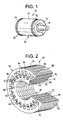
- FIG. 1 A perspective view of a rotor 10 is shown in Figure 1.
- rotor 10 can be a squirrel cage as illustrated in Figure 1 or alternatively it can be either with winding or a solid sheet.
- the rotor conductors' material is usually a non-magnetic conductive metal such as aluminum, copper or GLIDCOP® dispersion strengthened copper (GLIDCOP is a trademark of OMG Americas).
- Rotor 10 can be cast, fabricated or brazed.
- first and second end rings 12 and 14 are at opposite ends of rotor 10, and end rings 12 and 14 short respective first and second ends of rotor bars 16.
- Rotor shaft 18 extends through rotor core 20 formed by a plurality of laminations 22.
- Rotor core 20 may comprise solid iron or may comprise of laminations 22.
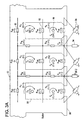
- FIG. 2 illustrates a partial perspective cross-section view of a motor 50 including rotor 10 and a stator 52.
- Stator 52 has a stator core 54 and stator windings (not shown).
- Stator core 54 has a first end 56, a second end 58, and a substantially cylindrical stator bore 60 extending from stator first end 56 to stator second end 58.
- Stator core 54 is formed by a plurality of identical stator laminations 62.
- Each stator lamination 62 includes a plurality of stator winding slots 64 at an inner periphery 66 of stator bore 60.
- Stator windings (not shown) are inserted into stator winding slots 64, and the stator windings form a selected even number of poles, e.g., two poles, four poles, or six poles.
- Rotor 10 is substantially cylindrical and is mounted within stator bore 60, e.g., using a cantilever structure and/or bearings, so that rotor 10 is coaxial with stator bore 60.
- rotor 10 is mounted rotatably within stator bore 60 so that rotor 10 rotates relative to stator 52.
- Rotor 10 alternatively, may be mounted within stator bore 60 so that stator 52 rotates relative to rotor 10.
- Rotor core 20 of rotor 10 is formed by a plurality of identical rotor laminations 22.
- Rotor core 20, alternatively, can be formed from a one-piece steel stock.
- Rotor shaft bore 68 is configured to coaxially receive therein rotor shaft (shown in Figure 1).
- Rotor core 20 further includes a plurality of rotor bar openings 70 at an outer periphery 72 of rotor core 20.
- a plurality of rotor bars 74 are located, e.g.,cast, within respective rotor bar openings 70.
- Each rotor bar 74 has a first end 76 and a second end 78, and extends from rotor first end 80 to rotor second end 82.
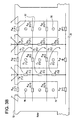
- FIG 3 shows a section of a tooth level distributed MCM (Magnetic Circuit Model) 90 of an electric machine, similar to that of motor 50, shown in Figure 2.
- the tooth level distributed model 90 consists of a network of saturable permeance elements 92 and non-saturable permeance elements 94 as illustrated.
- MMF sources 96 in both the stator 52 and the rotor 10 result in flux flowing in the permeance network.
- stator current I STATOR
- stator current I STATOR
- stator current I STATOR
- magnetic field which induces a rotor current, I ROTOR
- rotor current I ROTOR
- magnetic fields are generated, and the rotor bar magnetic fields couple with the stator magnetic fields to create a torque and rotate the motor.
- Motors typically are configured to satisfy specific performance requirements measured at several steady state operating points.
- the performance requirements include rated operating point torque, current, slip, power factor, and efficiency, pullout (breakdown) torque, locked rotor torque and current, and no-load current.
- the processes described below can be implemented, for example, in a personal computer programmed to execute each described step.
- the processes can be implemented in many different manners and are not limited to being implemented and practiced on a personal computer.
- the processes could be implemented in a server and accessed via a network, such as a local area network and/or a wide area network.
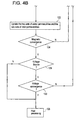
- Figure 4 is a flow chart illustrating an accurate analysis tool 100 for frequency domain harmonic analysis of electric machines accounting for magnetic non-linearity according to one embodiment of the present invention.
- Analysis too 100 uses either MCM or FEM in the frequency domain to predict the behavior of induction machines, both single-phase and multi-phase, and other machines with an acceptable accuracy and a speed faster than known time domain MCM or FEM methods.
- inputs 102 to modeling and analysis tool 100 include stator and rotor geometry, material properties (such as magnetic permeability curves and electrical conductivities), winding design patterns, a source type and spectrum, a number of circuit layers in the rotor and stator, rotor speed, a number of poles used in a model and any other relevant motor design data.
- an initial permeability is loaded 104 into analysis tool 100.
- the source type is a voltage source or a current source. If the source is a voltage source, currents are estimated 108. If the source is a current source, no estimation is required. Using the current estimation if the source is a voltage source, or alternatively, a current value of the current source, and based on the winding design pattern, a magnetomotive force (MMF) distribution is computed 110.
- MMF magnetomotive force
- MMF distribution is computed 110, and if the rotor is determined 112 to be in a locked condition, i.e. the rotor speed is zero, a problem is solved 114 because the electrical frequencies of the stator and rotor are the same. Therefore, MMF components do not need to be decomposed into forward and backward travelling waves. For single phase machines, the lack of need to decompose into travelling waves is especially applicable since a standing wave pattern at each time harmonic is retained. Using direct current (DC) or effective or any other set of B-H curves for the fundamental time harmonic component of the MMF, an electromagnetic problem is solved using conventional single frequency domain MCM or FEM.
- DC direct current
- B-H curves for the fundamental time harmonic component of the MMF
- B represents magnetic flux density and H represents magnetic field intensity.
- H represents magnetic field intensity.
- B-H curves or incremental B-H curves are used if the other time harmonic components are relatively small in amplitude.
- a fundamental frequency solution is now obtained through distributed magnetic saturation convergence.
- An appropriate permeability distribution, such as incremental, is based on local fundamental frequency flux density distribution and assigned to the analysis model and treated as a constant for analysis of all other time harmonics. The total solution is obtained so that machine performance at zero speed can be predicted.
- the stator MMF distribution is decomposed into individual space and time harmonic components.
- Each such component can have forward and backward rotating sub-components.
- the fundamental space and time MMF component with respect to the stator will be viewed by the rotor as if it were a forward travelling sub-component at s * ⁇ , where ⁇ is the fundamental frequency and s is per unit slip, and a backward travelling sub-component at (2-s) * ⁇ .
- These two sub-components are at the fundamental frequency ( ⁇ ) as far as the stator is concerned. If other significant harmonics are present, their respective solutions are also obtained using the same permeability distributions as used for the (2-s) * ⁇ backward MMF sub-component.
- the stator is loaded 116 with a forward rotating MMF sub-component.
- a first one step magnetic solution (via MCM or FEM), using applicable permeabilities, is obtained with fundamental frequency ⁇ , in the stator and s * ⁇ in the rotor.
- a backward rotating MMF sub-component is loaded 118, and a second one step magnetic solution, using applicable permeabilities, is obtained with fundamental frequency ⁇ , in the stator and (2-s) * ⁇ in the rotor.
- the resulting flux density distributions, the s * ⁇ and (2-s) * ⁇ solutions only, are combined 120 only for the stator, to update 122 the two stator magnetic permeability distribution patterns.
- Two sets of rotor magnetic permeability distribution patterns are updated 122 based on their larger amplitude flux density distribution due to the forward travelling MMF sub-component.
- the first flux density distribution uses the DC or effective or any other preferred B-H curve for use with the forward rotating MMF sub-component analysis, while the second flux density distribution may use any of the other above or preferably the incremental B-H curve with the backward rotating MMF sub-component and all other harmonics.
- the magnetic permeability patterns two for stator and two for rotor, are obtained, some or all of them are checked 124 for convergence against similar data from a previous iteration or iterations. If magnetic convergence is obtained, then the motor is checked 126 to see if it is voltage sourced, if not, post processing to compute torque, losses, circuit parameters, etc. is performed 128 as the final step of the analysis. If the motor is voltage sourced, a check is made 130 for voltage convergence. If voltage convergence is obtained, then post processing, as described earlier, is carried out as the final step.
- stator currents are updated and the complete magnetic analysis is redone, until both magnetic and voltage convergence criteria are met, and the post processing is carried out.
- the stator currents are updated based upon the voltage error (the applied voltage minus the voltage calculated from the last solution) using preferably a non-linear system equation solver such as the well known Newton's method.
Landscapes
- Engineering & Computer Science (AREA)
- Power Engineering (AREA)
- Manufacturing & Machinery (AREA)
- Measuring Magnetic Variables (AREA)
- Induction Machinery (AREA)
- Tests Of Circuit Breakers, Generators, And Electric Motors (AREA)
Applications Claiming Priority (2)
| Application Number | Priority Date | Filing Date | Title |
|---|---|---|---|
| US52518700A | 2000-03-14 | 2000-03-14 | |
| US525187 | 2000-03-14 |
Publications (1)
| Publication Number | Publication Date |
|---|---|
| EP1134887A1 true EP1134887A1 (en) | 2001-09-19 |
Family
ID=24092282
Family Applications (1)
| Application Number | Title | Priority Date | Filing Date |
|---|---|---|---|
| EP01302161A Withdrawn EP1134887A1 (en) | 2000-03-14 | 2001-03-09 | Frequency domain harmonic analysis methods and apparatus for electric machines |
Country Status (2)
| Country | Link |
|---|---|
| EP (1) | EP1134887A1 (enExample) |
| JP (1) | JP2001318132A (enExample) |
Cited By (3)
| Publication number | Priority date | Publication date | Assignee | Title |
|---|---|---|---|---|
| CN101334431B (zh) * | 2007-12-20 | 2010-11-17 | 复旦大学 | 电网谐波的频谱插值校正分析方法 |
| CN106324505A (zh) * | 2016-11-17 | 2017-01-11 | 广东工业大学 | 一种电动机谐波分析方法 |
| CN114977937A (zh) * | 2022-03-29 | 2022-08-30 | 华中科技大学 | 一种分数槽分布绕组永磁电机d轴等效磁路分析方法 |
Families Citing this family (6)
| Publication number | Priority date | Publication date | Assignee | Title |
|---|---|---|---|---|
| JP4376546B2 (ja) * | 2002-12-18 | 2009-12-02 | 株式会社日立製作所 | 回転電機の磁界解析方法 |
| JP5210743B2 (ja) * | 2008-07-15 | 2013-06-12 | 株式会社Jsol | 磁界解析装置、磁界解析方法、及びコンピュータプログラム |
| CN106353677B (zh) * | 2016-08-31 | 2019-01-15 | 华南理工大学 | 一种电力系统动态模拟试验系统同步电机的设计方法 |
| CN107329080A (zh) * | 2017-01-18 | 2017-11-07 | 华南理工大学 | 一种电力系统动态模拟试验系统同步电机的设计方法 |
| JP6573649B2 (ja) * | 2017-09-11 | 2019-09-11 | 株式会社日本製鋼所 | モータの製造方法及びモータ |
| MX2022005673A (es) * | 2019-11-11 | 2022-06-09 | Tesla Inc | Tecnicas mejoradas para analizar motores de induccion. |
Family Cites Families (3)
| Publication number | Priority date | Publication date | Assignee | Title |
|---|---|---|---|---|
| SE417883B (sv) * | 1980-03-26 | 1981-04-13 | Elfi Innovationer | Sett och anordning for detektering av en asynkronmotors varvtal |
| JP3345990B2 (ja) * | 1993-11-02 | 2002-11-18 | 株式会社日立製作所 | 誘導電動機の二次電流算出方法および表示方法 |
| JP3218859B2 (ja) * | 1994-05-27 | 2001-10-15 | 株式会社日立製作所 | 磁界解析の方法 |
-
2001
- 2001-03-09 EP EP01302161A patent/EP1134887A1/en not_active Withdrawn
- 2001-03-13 JP JP2001069556A patent/JP2001318132A/ja active Pending
Non-Patent Citations (2)
| Title |
|---|
| KATKYAVICHYUS, I. V. ET AL.: "Magnetic field and equivalent circuit for shaded-pole induction motors", SOVIET ELECTRICAL ENGINEERING, vol. 55, no. 5, 1985, USA, pages 24 - 27, XP002171832 * |
| SUN YUN-PENG: "Analysis of the gap magnetic field in shaded-pole asynchronous motors", ICEM '86 MÜNCHEN. INTERNATIONAL CONFERENCE ON ELECTRICAL MACHINES, 8 September 1986 (1986-09-08) - 10 September 1986 (1986-09-10), München, West Germany, pages 944 - 946, XP001012436 * |
Cited By (4)
| Publication number | Priority date | Publication date | Assignee | Title |
|---|---|---|---|---|
| CN101334431B (zh) * | 2007-12-20 | 2010-11-17 | 复旦大学 | 电网谐波的频谱插值校正分析方法 |
| CN106324505A (zh) * | 2016-11-17 | 2017-01-11 | 广东工业大学 | 一种电动机谐波分析方法 |
| CN114977937A (zh) * | 2022-03-29 | 2022-08-30 | 华中科技大学 | 一种分数槽分布绕组永磁电机d轴等效磁路分析方法 |
| CN114977937B (zh) * | 2022-03-29 | 2024-10-01 | 华中科技大学 | 一种分数槽分布绕组永磁电机d轴等效磁路分析方法 |
Also Published As
| Publication number | Publication date |
|---|---|
| JP2001318132A (ja) | 2001-11-16 |
Similar Documents
| Publication | Publication Date | Title |
|---|---|---|
| Gyselinck et al. | Multi-slice FE modeling of electrical machines with skewed slots-the skew discretization error | |
| Roberts | A study of brushless doubly-fed (induction) machines | |
| Sizov et al. | Automated multi-objective design optimization of PM AC machines using computationally efficient FEA and differential evolution | |
| Williamson et al. | Representation of skew in time-stepped two-dimensional finite-element models of electrical machines | |
| Boglietti et al. | Computational algorithms for induction motor equivalent circuit parameter determination—Part II: Skin effect and magnetizing characteristics | |
| Williamson et al. | Calculation of cage induction motor equivalent circuit parameters using finite elements | |
| Perers et al. | Saturation effects on unbalanced magnetic pull in a hydroelectric generator with an eccentric rotor | |
| Tenhunen et al. | Modelling of induction machines with skewed rotor slots | |
| Faiz et al. | Unified winding function approach for dynamic simulation of different kinds of eccentricity faults in cage induction machines | |
| Xing et al. | Research on weakening measure of radial electromagnetic force waves in permanent magnet synchronous motors by inserting auxiliary slots | |
| Cheaytani et al. | End-region leakage fluxes and losses analysis of cage induction motors using 3-D finite-element method | |
| EP1134887A1 (en) | Frequency domain harmonic analysis methods and apparatus for electric machines | |
| Zhou et al. | Current harmonics in induction machine with closed-slot rotor | |
| Stoll | Simple computational model for calculating the unbalanced magnetic pull on a two-pole turbogenerator rotor due to eccentricity | |
| Ergene et al. | One-slot AC steady-state model of a canned-solid rotor induction motor | |
| Rezaee-Alam | On-load cogging torque calculation in surface-mounted permanent magnet motors using hybrid analytical model | |
| Fu et al. | Multiple coupled circuit modelling approach for squirrel cage induction machine under single‐broken‐bar fault with stator winding functions decomposed in d–q rotor reference frame | |
| Belahcen et al. | Computation of additional losses due to rotor eccentricity in electrical machines | |
| McClay et al. | Influence of rotor skew on cage motor losses | |
| Abdi et al. | Experimental and finite element studies of a 250 kW brushless doubly fed induction generator | |
| Rezaee‐Alam et al. | Modified magnetic equivalent circuit model for magnetic field analysis of one cage‐rotor induction motor used in electric submersible pumps | |
| Faiz et al. | A complete lumped equivalent circuit of three-phase squirrel-cage induction motors using two-dimensional finite-elements technique | |
| Olivo et al. | A new method for the accurate prediction of on-load power factor in two-pole induction motors considering shaft eddy currents | |
| Williamson et al. | Implementation of finite-element analysis in a cage induction motor electrical design program | |
| Kocabas et al. | Performance and magnetic analysis of the novel stator structure compared with a standard induction machine |
Legal Events
| Date | Code | Title | Description |
|---|---|---|---|
| PUAI | Public reference made under article 153(3) epc to a published international application that has entered the european phase |
Free format text: ORIGINAL CODE: 0009012 |
|
| AK | Designated contracting states |
Kind code of ref document: A1 Designated state(s): AT BE CH CY DE DK ES FI FR GB GR IE IT LI LU MC NL PT SE TR Kind code of ref document: A1 Designated state(s): AT CH DE FR GB LI |
|
| AX | Request for extension of the european patent |
Free format text: AL;LT;LV;MK;RO;SI |
|
| 17P | Request for examination filed |
Effective date: 20020319 |
|
| AKX | Designation fees paid |
Free format text: AT CH DE FR GB LI |
|
| GRAP | Despatch of communication of intention to grant a patent |
Free format text: ORIGINAL CODE: EPIDOSNIGR1 |
|
| STAA | Information on the status of an ep patent application or granted ep patent |
Free format text: STATUS: THE APPLICATION IS DEEMED TO BE WITHDRAWN |
|
| 18D | Application deemed to be withdrawn |
Effective date: 20090708 |