EP1134778A2 - Metal halide lamp for curing chemical compositions - Google Patents

Metal halide lamp for curing chemical compositions Download PDF

Info

Publication number
EP1134778A2
EP1134778A2 EP01300662A EP01300662A EP1134778A2 EP 1134778 A2 EP1134778 A2 EP 1134778A2 EP 01300662 A EP01300662 A EP 01300662A EP 01300662 A EP01300662 A EP 01300662A EP 1134778 A2 EP1134778 A2 EP 1134778A2
Authority
EP
European Patent Office
Prior art keywords
iodide
lamp
reflector
metal halide
range
Prior art date
Legal status (The legal status is an assumption and is not a legal conclusion. Google has not performed a legal analysis and makes no representation as to the accuracy of the status listed.)
Withdrawn
Application number
EP01300662A
Other languages
German (de)
French (fr)
Other versions
EP1134778A3 (en
Inventor
Dale E. Brabham
Timothy D. Russell
Douglas M Rutan
Current Assignee (The listed assignees may be inaccurate. Google has not performed a legal analysis and makes no representation or warranty as to the accuracy of the list.)
Welch Allyn Inc
Original Assignee
Welch Allyn Inc
Priority date (The priority date is an assumption and is not a legal conclusion. Google has not performed a legal analysis and makes no representation as to the accuracy of the date listed.)
Filing date
Publication date
Application filed by Welch Allyn Inc filed Critical Welch Allyn Inc
Publication of EP1134778A2 publication Critical patent/EP1134778A2/en
Publication of EP1134778A3 publication Critical patent/EP1134778A3/en
Withdrawn legal-status Critical Current

Links

Images

Classifications

    • CCHEMISTRY; METALLURGY
    • C07ORGANIC CHEMISTRY
    • C07KPEPTIDES
    • C07K14/00Peptides having more than 20 amino acids; Gastrins; Somatostatins; Melanotropins; Derivatives thereof
    • C07K14/435Peptides having more than 20 amino acids; Gastrins; Somatostatins; Melanotropins; Derivatives thereof from animals; from humans
    • C07K14/705Receptors; Cell surface antigens; Cell surface determinants
    • C07K14/715Receptors; Cell surface antigens; Cell surface determinants for cytokines; for lymphokines; for interferons

Definitions

  • the present invention relates in general to lamps, and mote specifically to a metal halide lamp which maximizes UV radiation in the desired useful range for curing chemical compositions.
  • lamps of this type When lamps of this type are attempted to be used in applications where UV radiation is required they arc unsuitable in that even if operating conditions are modified to favorably promote UV radiation, lamp life or stability is compromised. Lamps of this type, therefore, do not satisfactorily operate to provide for enhanced radiation in the UV range, and as currently designed, are not candidates for applications where high UV response is essential.
  • the present invention is directed to a high performance miniature arc lamp.
  • the lamp has a preferred use in curing chemical compositions which react to UV radiation.
  • the lamp is used in an assembly that utilizes a dichroic coating on a reflector to concentrate UV light to the desired target or area.
  • a suitable mixture which accomplishes the objectives of the present invention comprises scandium iodide (or other suitable lanthanide), indium iodide, and alkali halides (sodium iodide and cesium iodide) in total amounts up to about 200 ⁇ g.
  • the dichroic coating is selected to reflect UV radiation in a range from about 300 to 600 nm.
  • the lamp be of an acceptable miniature size, exhibit high radiance, long life and low power.
  • the light source 10 of the present invention in the form of an elongated fused quartz envelope is shown in more detail in FIG. 1 as being a double ended structure having a pair of elongated electrodes 16 (cathode) and 18 (anode) disposed at opposite ends of neck sections 36 and 38, respectively.
  • the electrodes are separated from each other by a predetermined critical distance D or arc gap preferably in the range of about 0.8 mm to about 1.5 mm.
  • the light source is in the shape of an elongated body having an overall length (L in FIG.
  • the light source contains a critical fill mix which comprises an inert noble gas, mercury and metal halides which are formulated to enhance, UV output.
  • the sealed chamber is designed to provide a unique UV spectral response for the lamp of the present invention as evidenced by the plot of spectral power in the UV range of about 300-600 nm as shown in FIG. 4.
  • the radiation illustrated in FIG. 4 is obtained from the lamp described herein operated at 50W with a spectroradiometer traceable to NIST standards.
  • the semi-major axis length (a in FIG. la) for the light source of the present invention is one half of the overall chamber length and in a range of about 4 to 6 mm.
  • the semi-minor axis length (b in FIG. la) is one half of the chamber inner diameter and has a range of about 2 to 3 mm.
  • the preferred range of the chamber volume to yield optimal performance specifications is about 110 to 150 mm 3 .
  • the lamp power divided by the chamber volume is known as the volume-power loading of the lamp. This number calculates out to be 0.4/mm 3 given the preferred range of design factors. This metric is significant because it relates to the amount of heat dissipated power unit size of the lamp and therefore influences the operating temperature of the lamp.
  • the appropriate volume of the chamber is determined in combination with other interrelated design factors, primarily the type and amount of fill materials and operating power.
  • Deviation from the optimal volume could lead to performance degradation as a result of either improper internal operating pressure or improper thermal operation as dictated by the volume-power loading.
  • the electrodes respectively consist of a shank portion the ends of which contain wrapped metal coils 20 and 22, respectively.
  • Proper thermal and electrical design of electrodes arc required to achieve the desired performance.
  • Coils, or wraps of wire, around the primary electrode shank can be added to properly balance the electrical and thermal requirements. Coils can serve the function of providing an additional thermal radiative surface to control the temperature of the electrode shank.
  • the size and length of the coil can be designed to achieve optimal thermal performance.
  • An additional function of coils is to provide the appropriate electrical field properties for efficient and reliable arc initiation, or lamp starting. In certain applications, the coil on the cathode is optional and is not required.
  • the opposite end of the shank portions are respectively connected to one end of a foil member 28 and 30 respectively sealed in the opposite end of the neck portion.
  • the foil mcmbers are made of molybdenum.
  • the foil members have their other end respectively connected to relatively thicker outer lead wires 32 and 34 which in turn are respectively connectcd to the structural members shown more
  • FIG. 2 illustrates the miniature lamp 40 of the present invention which includes a reflector 42 containing the light source 10 having an insulating thermally resistant connector 44 having a pair of pins 46 and 48 suitable for connection to a suitable source of power.
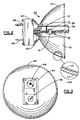
  • Structural members 35, 37 and 39 are used to orient the light source in a substantial horizontal axis with respect to the reflector and form the electrical connections along with lead wire 32.
  • the reflector internal glass surface 43 further contains a coating of dichroic material 45 which function to transmit selected light, and reflect or direct UV radiation to a desired target or location.
  • Suitable dichroic materials are combinations of silicon dioxide (S 1 O 2 ), aluminum oxide (Al 2 O 3 ), zirconium dioxide (ZrO 2 ), or tantalum oxide (Ta 2 O 5 ).
  • the dichroic coating is a submicron layer, typically about .005 to .010 microns thick. Multiple coatings (up to 100) of at least two different oxides are alternately formed on the inside surface of the reflector by a conventional vapor deposition technique.
  • a refractory, insulating material is formed into an elongated envelope into which the following components are inserted and hermetically sealed:
  • Refractory materials for the envelope can be fused silica or alumina oxide.
  • the refractory materials for the electrodes typically are tungsten (with or without thorium) or molybdenum. The description of electrodes is defined in more detail below.
  • the metal halide materials and quantity of mercury is also described below.
  • the envelope material is fused silica and the electrodes are tungsten.
  • Fused silica is easier to handle and process, and tungsten allows for higher operating temperatures and increases light output and life.
  • the opposing electrodes are set apart and separated at a distance to provide optimal performances for projection display applications Maximum utilization of optical component light collection requires the light source to be as near to "point source” as possible.
  • the broad range of separation is 0.8 mm to 1.5 mm.
  • the preferred range of separation is 1.2 mm ⁇ 0.2mm.
  • one electrode is identified as the anode, the other as the cathode, and each is sized appropriately for optimal operation for a given lamp power and current.
  • the electrodes are constructed from known techniques that incorporate an overwound refractory metal coil attached to the metal shank, The optimal design is determined given the range of electrical power and current over which the source is intended to operate. The table below tabulates the electrode wire diameters and power and current ranges for the present invention. Range of Wattage: 40 W-60 W Range of Current: 0.5A-1.5A Preferred Wattage: 50W ⁇ 2W Preferred Current: 0.9 A ⁇ .2 A Anode Shank 0.020 in. ⁇ 0.008 in. 0.020 in. ⁇ 0.001 in.
  • the scandium iodide provides a means of controlling undesired secondary processes within the lamp.
  • the indium iodide contributes radiation emission in the blue to ultraviolet regions to enhance the total spectral output fundamental to this invention.
  • the sodium iodides and cesium iodides are introduced in combination to provide the appropriate electrical, thermal, and convective characteristics of the plasma.
  • a suitable mixture, shown in the table below, which accomplishes the objectives of the present invention is a metal halide dose of 132 ⁇ g of material composed of (by mass percent).
  • the operative concentration range which provides a combination that optimize stable electrical behavior is also listed in the table below: Compound Mass Percent (Wt. %) Operative Range ScI 3 10.9 5-25 ⁇ g InI 5.0 3-15 ⁇ g NaI 79.1 10-200 ⁇ g CsI 5.0 10-200 ⁇ g
  • the quantity of mercury is added such that it will evaporate and enter the discharge in a gaseous state and regulate the electrical operational parameters.
  • the amount of mercury can range from 5 to 15 milligrams and is a function of the internal volume of the envelope.
  • the preferred amount being about 9 milligrams ⁇ -10%.
  • the fill inert gas is added to provide a gas that can be ionized to aid in the starting of the lamp.
  • Suitable fill gasses include Ne, Ar, Kr, and Xe with cold fill pressures in the range of 0.5 atm to several atmospheres.
  • a preferred gas for use in the present invention is Ar at about 500 Torr ⁇ 2%. Excess Ar would cause the required voltage to initiate the discharge to be very high and impose large costs on the electrical operating circuitry.
  • the source size is dictated by the electrode separation (arc gap) in the range of 0.8 mm to 1.5 mm.
  • the overall length of the envelope and associated structure being about 2 inches long. The service life exceeding 2,000 hrs.

Landscapes

  • Health & Medical Sciences (AREA)
  • Chemical & Material Sciences (AREA)
  • Life Sciences & Earth Sciences (AREA)
  • Organic Chemistry (AREA)
  • Biochemistry (AREA)
  • Genetics & Genomics (AREA)
  • Gastroenterology & Hepatology (AREA)
  • Toxicology (AREA)
  • Immunology (AREA)
  • Biophysics (AREA)
  • General Health & Medical Sciences (AREA)
  • Zoology (AREA)
  • Medicinal Chemistry (AREA)
  • Molecular Biology (AREA)
  • Proteomics, Peptides & Aminoacids (AREA)
  • Cell Biology (AREA)
  • Discharge Lamp (AREA)
  • Discharge Lamps And Accessories Thereof (AREA)
  • Optical Elements Other Than Lenses (AREA)

Abstract

An arc lamp assembly includes in combination a reflector (42) and a light source (10) which is surrounded by said reflector. A dichroic coating on the reflector functions to reflect radiation in the range of about 300 to 600 nm. The light source is an arc lamp which contains a metal halide fill component which includes a mixture of scandium iodide, or other suitable lanthanide, indium iodide, cesium iodide and sodium iodide, whereby the lamp assembly emits effective amounts of UV radiation to cure selected chemical compositions.

Description

Background of the Invention
The present invention relates in general to lamps, and mote specifically to a metal halide lamp which maximizes UV radiation in the desired useful range for curing chemical compositions.
It has long been a goal and objective in the field for a low wattage, long life, short are gap lamp which could be used in a wide range of applications. Changing needs of the marketplace have identified the need for a short arc gap lamp in the range of 50 watts. Such an illumination source in one application could be used to irradiate small, light valves. This source would require a miniature source size, high radiance, good spectral properties, long life and low power. This goal was achieved with the development of a 50 watt arc lamp suitable for use as a projection lamp and is more fully described in U.S. Patent 5,942,850.
When lamps of this type are attempted to be used in applications where UV radiation is required they arc unsuitable in that even if operating conditions are modified to favorably promote UV radiation, lamp life or stability is compromised. Lamps of this type, therefore, do not satisfactorily operate to provide for enhanced radiation in the UV range, and as currently designed, are not candidates for applications where high UV response is essential.
It is therefore an object of the present invention to overcome the problems of the prior art described above.
It is a further object of the present invention to provide a high performance UV irradiation or light source which can be used as a curing light to initiate polymeric reactions in plastic and adhesive substrates.
It is a further object of the present invention to provide a high performance lamp for use in systems which require high UV radiation.
It is yet another object of the present invention to provide a compact lamp assembly which exhibits high radiance, long life, and good UV radiation.
Summary of the Invention
The present invention is directed to a high performance miniature arc lamp. The lamp has a preferred use in curing chemical compositions which react to UV radiation. The lamp is used in an assembly that utilizes a dichroic coating on a reflector to concentrate UV light to the desired target or area.
It has been discovered that a unique metal halide mixture of individual compounds selected from the group of cesium iodide, indium iodide, scandium iodide, and sodium iodide provides a fill component which insures high lamp performance, and when used with a reflector having a suitable dichroic coating, is uniquely suited to providing an effective source of UV radiation.
A suitable mixture which accomplishes the objectives of the present invention comprises scandium iodide (or other suitable lanthanide), indium iodide, and alkali halides (sodium iodide and cesium iodide) in total amounts up to about 200 µg. The dichroic coating is selected to reflect UV radiation in a range from about 300 to 600 nm.
For use in the present invention it is essential that the lamp be of an acceptable miniature size, exhibit high radiance, long life and low power.
Brief Description of the Drawing
For a fuller understanding of the nature and objects of the invention, reference should be made to the following detailed description of a preferred mode of practicing the invention, read in connection with the accompanying drawings, in which:
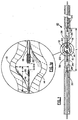
  • FIG. 1 is a side sectional view of the light source of the present invention.
  • FIG. la is an enlarged sectional view of the hermetically sealed chamber of the light source shown in FIG. 1.
  • FIG. 2 is a side sectional view of a lamp containing the light source of FIG. 1.
  • FIG. 3 is a rear view of the lamp shown in FIG 1.
  • FIG. 4 illustrates a plot of the UV output of the lamp of the present invention at three different apertures.
  • Detailed Description of the Invention
    The light source 10 of the present invention in the form of an elongated fused quartz envelope is shown in more detail in FIG. 1 as being a double ended structure having a pair of elongated electrodes 16 (cathode) and 18 (anode) disposed at opposite ends of neck sections 36 and 38, respectively. The electrodes are separated from each other by a predetermined critical distance D or arc gap preferably in the range of about 0.8 mm to about 1.5 mm. The light source is in the shape of an elongated body having an overall length (L in FIG. 1) in the range of about 28 mm to about 32 mm having the neck sections with a diameter in the range of about 3 mm to about 5 mm, and has a generally ellipsoidal shaped central hermetically sealcd chamber 12 having a volume 14 of about 130 mm3± 20 mm3. The wall. thickness of chamber 12 is about I mm. The light source contains a critical fill mix which comprises an inert noble gas, mercury and metal halides which are formulated to enhance, UV output.
    More specifically, the sealed chamber is designed to provide a unique UV spectral response for the lamp of the present invention as evidenced by the plot of spectral power in the UV range of about 300-600 nm as shown in FIG. 4. The radiation illustrated in FIG. 4 is obtained from the lamp described herein operated at 50W with a spectroradiometer traceable to NIST standards.
    The volume of the chamber can be approximated to that of an ellipsoid of semi-major axis a and semi-minor axis b. V=4/3πb2.a The semi-major axis length (a in FIG. la) for the light source of the present invention is one half of the overall chamber length and in a range of about 4 to 6 mm. The semi-minor axis length (b in FIG. la) is one half of the chamber inner diameter and has a range of about 2 to 3 mm.
    The preferred range of the chamber volume to yield optimal performance specifications is about 110 to 150 mm3. The lamp power divided by the chamber volume is known as the volume-power loading of the lamp. This number calculates out to be 0.4/mm3 given the preferred range of design factors. This metric is significant because it relates to the amount of heat dissipated power unit size of the lamp and therefore influences the operating temperature of the lamp.
    The appropriate volume of the chamber is determined in combination with other interrelated design factors, primarily the type and amount of fill materials and operating power.
    Deviation from the optimal volume could lead to performance degradation as a result of either improper internal operating pressure or improper thermal operation as dictated by the volume-power loading.
    The electrodes respectively consist of a shank portion the ends of which contain wrapped metal coils 20 and 22, respectively. Proper thermal and electrical design of electrodes arc required to achieve the desired performance. Coils, or wraps of wire, around the primary electrode shank can be added to properly balance the electrical and thermal requirements. Coils can serve the function of providing an additional thermal radiative surface to control the temperature of the electrode shank. The size and length of the coil can be designed to achieve optimal thermal performance. An additional function of coils is to provide the appropriate electrical field properties for efficient and reliable arc initiation, or lamp starting. In certain applications, the coil on the cathode is optional and is not required. The opposite end of the shank portions are respectively connected to one end of a foil member 28 and 30 respectively sealed in the opposite end of the neck portion. Typically, the foil mcmbers are made of molybdenum. The foil members have their other end respectively connected to relatively thicker outer lead wires 32 and 34 which in turn are respectively connectcd to the structural members shown more clearly in FIG. 2.
    FIG. 2 illustrates the miniature lamp 40 of the present invention which includes a reflector 42 containing the light source 10 having an insulating thermally resistant connector 44 having a pair of pins 46 and 48 suitable for connection to a suitable source of power. Structural members 35, 37 and 39 are used to orient the light source in a substantial horizontal axis with respect to the reflector and form the electrical connections along with lead wire 32. The reflector internal glass surface 43 further contains a coating of dichroic material 45 which function to transmit selected light, and reflect or direct UV radiation to a desired target or location. Suitable dichroic materials are combinations of silicon dioxide (S1O2), aluminum oxide (Al2O3), zirconium dioxide (ZrO2), or tantalum oxide (Ta2O5). Multiple coatings are applied in alternating layers, The dichroic coating is a submicron layer, typically about .005 to .010 microns thick. Multiple coatings (up to 100) of at least two different oxides are alternately formed on the inside surface of the reflector by a conventional vapor deposition technique.
    In the present invention, a refractory, insulating material is formed into an elongated envelope into which the following components are inserted and hermetically sealed:
  • a. a pair of refractory metal electrodes;
  • b. a quantity of metal halide material;
  • c. a quantity of metallic mercury; and
  • d. a quantity of an inert noble gas.
  • The electrodes are aligned in an axial manner facing each other. The light source is operating in a direct current (DC) mode at a low electrical power.
    Refractory materials for the envelope can be fused silica or alumina oxide. The refractory materials for the electrodes typically are tungsten (with or without thorium) or molybdenum. The description of electrodes is defined in more detail below. The metal halide materials and quantity of mercury is also described below.
    Preferably the envelope material is fused silica and the electrodes are tungsten. Fused silica is easier to handle and process, and tungsten allows for higher operating temperatures and increases light output and life.
    The opposing electrodes are set apart and separated at a distance to provide optimal performances for projection display applications Maximum utilization of optical component light collection requires the light source to be as near to "point source" as possible.
    The broad range of separation is 0.8 mm to 1.5 mm.
    The preferred range of separation is 1.2 mm±0.2mm.
    Falling below the preferred range of separation will cause a corresponding loss in lamp luminous efficacy. Exceeding the preferred range will minimize the effectiveness of the lamp as a miniature source for projection optics.
    In operating the light source in a DC mode, one electrode is identified as the anode, the other as the cathode, and each is sized appropriately for optimal operation for a given lamp power and current. The electrodes are constructed from known techniques that incorporate an overwound refractory metal coil attached to the metal shank, The optimal design is determined given the range of electrical power and current over which the source is intended to operate. The table below tabulates the electrode wire diameters and power and current ranges for the present invention.
    Range of Wattage: 40 W-60 W Range of Current: 0.5A-1.5A Preferred Wattage: 50W±2W Preferred Current: 0.9 A ± .2 A
    Anode Shank 0.020 in. ± 0.008 in. 0.020 in. ± 0.001 in.
    Anode Overwind Wire 0.010 in. ± 0.005 in. 0.010.in.± 0.001 in.
    Cathode Shank 0.014 in. ± 0.004 in. 0.014 in, ± 0.001 in.
    Cathode Overwind 0.005 in. ± 0.005 in. 0.007 in. ± 0.001 in.
    Wire
    A mismatch between electrical operating characteristics and electrode design could be disastrous from a product performance standpoint. Generally, a design that permits too high of an operating temperature of the electrodes (high current/small electrodes) will result in rapid electrode erosion, darkening of the envelope, short life and low light output. Too low of an operating temperature of the electrode (low power/large electrodes) will result in an unstable or flickering arc.
    In has been discovered that a unique metal halide mixture of individual compounds selected from the following group of scandium iodide, indium iodide, cesium iodide, and sodium iodide in conjunction with the other fill components results in a lamp which exhibits enhanced UV output. It is the specific dose of metal halide salts in combination with a reflector having a dichroic coating that concentrates only the desired UV radiation that is the key combination of components of the present invention.
    The scandium iodide, or any other suitable lanthanide, provides a means of controlling undesired secondary processes within the lamp. The indium iodide contributes radiation emission in the blue to ultraviolet regions to enhance the total spectral output fundamental to this invention. The sodium iodides and cesium iodides are introduced in combination to provide the appropriate electrical, thermal, and convective characteristics of the plasma.
    A suitable mixture, shown in the table below, which accomplishes the objectives of the present invention is a metal halide dose of 132 µg of material composed of (by mass percent). The operative concentration range which provides a combination that optimize stable electrical behavior is also listed in the table below:
    Compound Mass Percent (Wt. %) Operative Range
    ScI3 10.9 5-25 µg
    InI 5.0 3-15 µg
    NaI 79.1 10-200 µg
    CsI 5.0 10-200 µg
    The quantity of mercury is added such that it will evaporate and enter the discharge in a gaseous state and regulate the electrical operational parameters.
    The amount of mercury can range from 5 to 15 milligrams and is a function of the internal volume of the envelope.
    The preferred amount being about 9 milligrams ± -10%.
    Excess mercury will cause excess pressure within the bulb and could result in early failure. Too low of an amount of Hg could result in improper electrical operating characteristics, primarily thereby reducing luminous efficacy.
    The fill inert gas is added to provide a gas that can be ionized to aid in the starting of the lamp. Suitable fill gasses include Ne, Ar, Kr, and Xe with cold fill pressures in the range of 0.5 atm to several atmospheres.
    A preferred gas for use in the present invention is Ar at about 500 Torr±2%. Excess Ar would cause the required voltage to initiate the discharge to be very high and impose large costs on the electrical operating circuitry.
    The above specification for the electrode arc gap, quantity of metal halide, mercury, and noble gas must be used in conjunction with an hermetically sealed chamber having a critical volume, which in the case of the present invention is about 130 mm3±20 mm3.
    The source size is dictated by the electrode separation (arc gap) in the range of 0.8 mm to 1.5 mm. The overall length of the envelope and associated structure being about 2 inches long. The service life exceeding 2,000 hrs.
    The light source and lamp of the present invention has been particularly shown and described with reference to the preferred mode as illustrated in the drawing, it will be understood by one skilled in the art that various changes in detail may be effected therein without departing from the spirit and scope of the invention as defined by the claims.
    Claims (4)

    1. An arc lamp assembly which includes in combination a reflector and a light source which is surrounded by said reflector, the improvement comprising a dichroic coating on said reflector which functions to reflect radiation in the range of about 300 to 600 nm, and where said light source is an arc lamp which contains a metal halide fill component which includes a mixture of scandium iodide, indium iodide, portions of cesium iodide and sodium iodide, whereby said lamp assembly emits effective amounts of UV radiation to cure selected chemical compositions, and where said metal halide mixture has the following concentrations. Concentration ScI3 5-25 µg InI 3-15 µg NaI 10-200 µg CsI 10-200 µg
    2. A miniature lamp which provides an effective source of UV radiation for curing chemical compositions which includes a reflector which surrounds a light source wherein
      (a) said reflector contains a dichroic coating selected to reflect UV radiation in the range of about 300 to 600 nm; and
      (b) said light source including an elongated fused quartz envelope having a pair of opposite neck portions each with a coaxial central opening having a reduced section and a central hermetically sealed chamber containing a fill comprising;
         an argon pressure at room temperature at a range of about 0.5 atmospheres to about 2.0 atmospheres; mercury in an amount in the range of about 5 mg to about 15 mg; a mixture of metal halide material in an amount from about 50 up to 1000 micrograms wherein said metal halide mixture comprises scandium iodide, indium iodide, cesium iodide and sodium iodide. A pair of axially aligned electrodes respectively positioned at said opposite neck portions and separated from each other by a predetermined distance from about 0.8 to 1.5 mm, said electrodes each having a shank portion which includes a distal end, with at least one of said ends having a coil wrapped around said end.
    3. The lamp of claim 2 in which the metal halide mixture comprises the following: Concentration ScI3 5-25 µg InI 3-15 µg NaI 10-200 µg CsI 10-200 µg
    4. The lamp of claim 2 in which the dichroic coating is a material selected from the group consisting of silicon dioxide, aluminum oxide, zirconium dioxide, tantalum oxide in a plurality of alternating layers of different oxides.
    EP01300662A 2000-01-25 2001-01-25 Metal halide lamp for curing chemical compositions Withdrawn EP1134778A3 (en)

    Applications Claiming Priority (2)

    Application Number Priority Date Filing Date Title
    US491040 2000-01-25
    US09/491,040 US6495844B1 (en) 2000-01-25 2000-01-25 Metal halide lamp for curing adhesives

    Publications (2)

    Publication Number Publication Date
    EP1134778A2 true EP1134778A2 (en) 2001-09-19
    EP1134778A3 EP1134778A3 (en) 2004-09-08

    Family

    ID=23950547

    Family Applications (1)

    Application Number Title Priority Date Filing Date
    EP01300662A Withdrawn EP1134778A3 (en) 2000-01-25 2001-01-25 Metal halide lamp for curing chemical compositions

    Country Status (4)

    Country Link
    US (1) US6495844B1 (en)
    EP (1) EP1134778A3 (en)
    JP (1) JP2001325914A (en)
    CA (1) CA2332100A1 (en)

    Cited By (4)

    * Cited by examiner, † Cited by third party
    Publication number Priority date Publication date Assignee Title
    WO2004025691A1 (en) * 2002-09-10 2004-03-25 Philips Intellectual Property & Standards Gmbh High-pressure discharge lamp with improved color point stability and high luminous efficacy
    WO2004086453A1 (en) * 2003-03-24 2004-10-07 Seiko Epson Corporation Illumination device and projector with the same
    US6888312B2 (en) * 2002-12-13 2005-05-03 Welch Allyn, Inc. Metal halide lamp for curing adhesives
    EP2806019A1 (en) 2013-05-23 2014-11-26 Noform S.r.l. Improved fermentator

    Families Citing this family (11)

    * Cited by examiner, † Cited by third party
    Publication number Priority date Publication date Assignee Title
    US6698892B2 (en) * 2001-06-08 2004-03-02 Infocus Corporation Achieving color balance in image projection systems by injecting compensating light in a controlled amount
    US6988806B2 (en) * 2001-06-08 2006-01-24 Infocus Corporation Instant-on projector
    US6688747B2 (en) * 2001-06-08 2004-02-10 Infocus Corporation Achieving color balance in image projection systems by injecting compensating light
    US7567384B2 (en) * 2001-06-08 2009-07-28 Infocus Corporation Method and apparatus for combining light paths of like-colored light sources
    US7760432B2 (en) * 2002-04-25 2010-07-20 Honeywell International Inc. Photochromic resistant materials for optical devices in plasma environments
    US20080161720A1 (en) * 2002-10-07 2008-07-03 Nicoson Zachary R Registration system
    JP2007026675A (en) * 2003-06-24 2007-02-01 Matsushita Electric Ind Co Ltd Light irradiation device, lamp for light irradiation device, and light irradiation method
    JP2006344383A (en) * 2003-06-24 2006-12-21 Matsushita Electric Ind Co Ltd Light irradiation device
    CN100403094C (en) * 2006-10-25 2008-07-16 秦文红 UV curing irradiation device
    KR101158962B1 (en) * 2007-10-10 2012-06-21 우시오덴키 가부시키가이샤 Excimer lamp
    EP2478546B1 (en) * 2009-09-18 2018-07-04 FEI Company Distributed ion source acceleration column

    Family Cites Families (6)

    * Cited by examiner, † Cited by third party
    Publication number Priority date Publication date Assignee Title
    US3979624A (en) * 1975-04-29 1976-09-07 Westinghouse Electric Corporation High-efficiency discharge lamp which incorporates a small molar excess of alkali metal halide as compared to scandium halide
    DE3842771A1 (en) * 1988-12-19 1990-06-21 Patent Treuhand Ges Fuer Elektrische Gluehlampen Mbh HIGH PRESSURE DISCHARGE LAMP OF SMALL ELECTRICAL POWER AND METHOD FOR OPERATING
    US5184044A (en) * 1990-08-13 1993-02-02 Welch Allyn, Inc. Dental curing lamp
    US5798611A (en) * 1990-10-25 1998-08-25 Fusion Lighting, Inc. Lamp having controllable spectrum
    US5942850A (en) * 1997-09-24 1999-08-24 Welch Allyn, Inc. Miniature projection lamp
    US5914817A (en) * 1998-05-15 1999-06-22 Optical Coating Laboratory, Inc. Thin film dichroic color separation filters for color splitters in liquid crystal display systems

    Cited By (6)

    * Cited by examiner, † Cited by third party
    Publication number Priority date Publication date Assignee Title
    WO2004025691A1 (en) * 2002-09-10 2004-03-25 Philips Intellectual Property & Standards Gmbh High-pressure discharge lamp with improved color point stability and high luminous efficacy
    US6888312B2 (en) * 2002-12-13 2005-05-03 Welch Allyn, Inc. Metal halide lamp for curing adhesives
    USRE42181E1 (en) * 2002-12-13 2011-03-01 Ushio America, Inc. Metal halide lamp for curing adhesives
    WO2004086453A1 (en) * 2003-03-24 2004-10-07 Seiko Epson Corporation Illumination device and projector with the same
    US7377670B2 (en) 2003-03-24 2008-05-27 Seiko Epson Corporation Illumination device and projector equipping the same
    EP2806019A1 (en) 2013-05-23 2014-11-26 Noform S.r.l. Improved fermentator

    Also Published As

    Publication number Publication date
    EP1134778A3 (en) 2004-09-08
    US6495844B1 (en) 2002-12-17
    CA2332100A1 (en) 2001-07-25
    JP2001325914A (en) 2001-11-22

    Similar Documents

    Publication Publication Date Title
    US6495844B1 (en) Metal halide lamp for curing adhesives
    CN101147228B (en) Ceramic metal halide lamp
    JPH06132018A (en) Electrodeless lamp device
    JP2005519435A (en) Short arc type high pressure discharge lamp
    US5942850A (en) Miniature projection lamp
    USRE42181E1 (en) Metal halide lamp for curing adhesives
    US6667575B2 (en) High pressure discharge lamp with reduced bulb thickness
    JP2004288617A (en) High-pressure discharge lamp and lighting device
    US5798612A (en) Metal-halide discharge lamp for photo-optical purposes
    JP4777594B2 (en) High pressure discharge lamp and lamp unit using the same
    US5831388A (en) Rare earth metal halide lamp including niobium
    EP2239761A2 (en) High-intensity discharge lamp and lighting device
    JP2008177160A (en) High pressure discharge lamp and lighting device
    JP2010003488A (en) Metal halide lamp and lighting fixture
    US20080093993A1 (en) Quartz Metal Halide Lamp With Improved Lumen Maintenance
    JP2001283772A (en) Metal halide lamps and lighting equipment
    JP2011175856A (en) High-pressure discharge lamp, and lighting apparatus
    WO1993011555A1 (en) Negative glow discharge lamp having wire anode
    JP2000090877A (en) High pressure discharge lamp and lighting equipment
    JP4575842B2 (en) Light bulb shaped fluorescent lamp
    JP2002008521A (en) High pressure discharge lamp, high pressure discharge lamp lighting device and lighting device
    US20090153048A1 (en) High-pressure gas discharge lamp
    JP2000223068A (en) High pressure discharge lamp and lamp fixture, lighting device, floodlight device, image projection device using this lamp
    JP2010177104A (en) High-pressure discharge lamp, and lighting system
    WO2004055862A2 (en) Mercury-free high-pressure gas discharge lamp

    Legal Events

    Date Code Title Description
    PUAI Public reference made under article 153(3) epc to a published international application that has entered the european phase

    Free format text: ORIGINAL CODE: 0009012

    AK Designated contracting states

    Kind code of ref document: A2

    Designated state(s): AT BE CH CY DE DK ES FI FR GB GR IE IT LI LU MC NL PT SE TR

    AX Request for extension of the european patent

    Free format text: AL;LT;LV;MK;RO;SI

    PUAL Search report despatched

    Free format text: ORIGINAL CODE: 0009013

    AK Designated contracting states

    Kind code of ref document: A3

    Designated state(s): AT BE CH CY DE DK ES FI FR GB GR IE IT LI LU MC NL PT SE TR

    AX Request for extension of the european patent

    Extension state: AL LT LV MK RO SI

    STAA Information on the status of an ep patent application or granted ep patent

    Free format text: STATUS: THE APPLICATION IS DEEMED TO BE WITHDRAWN

    18D Application deemed to be withdrawn

    Effective date: 20040802