EP1134751A2 - Soft magnetic alloy fiber, manufacturing method and tag - Google Patents
Soft magnetic alloy fiber, manufacturing method and tag Download PDFInfo
- Publication number
- EP1134751A2 EP1134751A2 EP01102262A EP01102262A EP1134751A2 EP 1134751 A2 EP1134751 A2 EP 1134751A2 EP 01102262 A EP01102262 A EP 01102262A EP 01102262 A EP01102262 A EP 01102262A EP 1134751 A2 EP1134751 A2 EP 1134751A2
- Authority
- EP
- European Patent Office
- Prior art keywords
- soft magnetic
- magnetic alloy
- alloy fiber
- information recording
- fibers
- Prior art date
- Legal status (The legal status is an assumption and is not a legal conclusion. Google has not performed a legal analysis and makes no representation as to the accuracy of the status listed.)
- Granted
Links
Images


Classifications
-
- G—PHYSICS
- G08—SIGNALLING
- G08B—SIGNALLING SYSTEMS, e.g. PERSONAL CALLING SYSTEMS; ORDER TELEGRAPHS; ALARM SYSTEMS
- G08B13/00—Burglar, theft or intruder alarms
- G08B13/22—Electrical actuation
- G08B13/24—Electrical actuation by interference with electromagnetic field distribution
- G08B13/2402—Electronic Article Surveillance [EAS], i.e. systems using tags for detecting removal of a tagged item from a secure area, e.g. tags for detecting shoplifting
- G08B13/2405—Electronic Article Surveillance [EAS], i.e. systems using tags for detecting removal of a tagged item from a secure area, e.g. tags for detecting shoplifting characterised by the tag technology used
- G08B13/2408—Electronic Article Surveillance [EAS], i.e. systems using tags for detecting removal of a tagged item from a secure area, e.g. tags for detecting shoplifting characterised by the tag technology used using ferromagnetic tags
-
- G—PHYSICS
- G08—SIGNALLING
- G08B—SIGNALLING SYSTEMS, e.g. PERSONAL CALLING SYSTEMS; ORDER TELEGRAPHS; ALARM SYSTEMS
- G08B13/00—Burglar, theft or intruder alarms
- G08B13/22—Electrical actuation
- G08B13/24—Electrical actuation by interference with electromagnetic field distribution
- G08B13/2402—Electronic Article Surveillance [EAS], i.e. systems using tags for detecting removal of a tagged item from a secure area, e.g. tags for detecting shoplifting
- G08B13/2428—Tag details
- G08B13/2437—Tag layered structure, processes for making layered tags
- G08B13/244—Tag manufacturing, e.g. continuous manufacturing processes
-
- G—PHYSICS
- G08—SIGNALLING
- G08B—SIGNALLING SYSTEMS, e.g. PERSONAL CALLING SYSTEMS; ORDER TELEGRAPHS; ALARM SYSTEMS
- G08B13/00—Burglar, theft or intruder alarms
- G08B13/22—Electrical actuation
- G08B13/24—Electrical actuation by interference with electromagnetic field distribution
- G08B13/2402—Electronic Article Surveillance [EAS], i.e. systems using tags for detecting removal of a tagged item from a secure area, e.g. tags for detecting shoplifting
- G08B13/2428—Tag details
- G08B13/2437—Tag layered structure, processes for making layered tags
- G08B13/2442—Tag materials and material properties thereof, e.g. magnetic material details
-
- G—PHYSICS
- G08—SIGNALLING
- G08B—SIGNALLING SYSTEMS, e.g. PERSONAL CALLING SYSTEMS; ORDER TELEGRAPHS; ALARM SYSTEMS
- G08B13/00—Burglar, theft or intruder alarms
- G08B13/22—Electrical actuation
- G08B13/24—Electrical actuation by interference with electromagnetic field distribution
- G08B13/2402—Electronic Article Surveillance [EAS], i.e. systems using tags for detecting removal of a tagged item from a secure area, e.g. tags for detecting shoplifting
- G08B13/2428—Tag details
- G08B13/2437—Tag layered structure, processes for making layered tags
- G08B13/2445—Tag integrated into item to be protected, e.g. source tagging
-
- H—ELECTRICITY
- H01—ELECTRIC ELEMENTS
- H01F—MAGNETS; INDUCTANCES; TRANSFORMERS; SELECTION OF MATERIALS FOR THEIR MAGNETIC PROPERTIES
- H01F1/00—Magnets or magnetic bodies characterised by the magnetic materials therefor; Selection of materials for their magnetic properties
- H01F1/01—Magnets or magnetic bodies characterised by the magnetic materials therefor; Selection of materials for their magnetic properties of inorganic materials
- H01F1/03—Magnets or magnetic bodies characterised by the magnetic materials therefor; Selection of materials for their magnetic properties of inorganic materials characterised by their coercivity
- H01F1/12—Magnets or magnetic bodies characterised by the magnetic materials therefor; Selection of materials for their magnetic properties of inorganic materials characterised by their coercivity of soft-magnetic materials
- H01F1/14—Magnets or magnetic bodies characterised by the magnetic materials therefor; Selection of materials for their magnetic properties of inorganic materials characterised by their coercivity of soft-magnetic materials metals or alloys
- H01F1/143—Magnets or magnetic bodies characterised by the magnetic materials therefor; Selection of materials for their magnetic properties of inorganic materials characterised by their coercivity of soft-magnetic materials metals or alloys in the form of wires
-
- H—ELECTRICITY
- H01—ELECTRIC ELEMENTS
- H01F—MAGNETS; INDUCTANCES; TRANSFORMERS; SELECTION OF MATERIALS FOR THEIR MAGNETIC PROPERTIES
- H01F1/00—Magnets or magnetic bodies characterised by the magnetic materials therefor; Selection of materials for their magnetic properties
- H01F1/01—Magnets or magnetic bodies characterised by the magnetic materials therefor; Selection of materials for their magnetic properties of inorganic materials
- H01F1/03—Magnets or magnetic bodies characterised by the magnetic materials therefor; Selection of materials for their magnetic properties of inorganic materials characterised by their coercivity
- H01F1/12—Magnets or magnetic bodies characterised by the magnetic materials therefor; Selection of materials for their magnetic properties of inorganic materials characterised by their coercivity of soft-magnetic materials
- H01F1/14—Magnets or magnetic bodies characterised by the magnetic materials therefor; Selection of materials for their magnetic properties of inorganic materials characterised by their coercivity of soft-magnetic materials metals or alloys
- H01F1/147—Alloys characterised by their composition
- H01F1/153—Amorphous metallic alloys, e.g. glassy metals
- H01F1/15391—Elongated structures, e.g. wires
-
- Y—GENERAL TAGGING OF NEW TECHNOLOGICAL DEVELOPMENTS; GENERAL TAGGING OF CROSS-SECTIONAL TECHNOLOGIES SPANNING OVER SEVERAL SECTIONS OF THE IPC; TECHNICAL SUBJECTS COVERED BY FORMER USPC CROSS-REFERENCE ART COLLECTIONS [XRACs] AND DIGESTS
- Y10—TECHNICAL SUBJECTS COVERED BY FORMER USPC
- Y10T—TECHNICAL SUBJECTS COVERED BY FORMER US CLASSIFICATION
- Y10T428/00—Stock material or miscellaneous articles
- Y10T428/12—All metal or with adjacent metals
- Y10T428/12431—Foil or filament smaller than 6 mils
-
- Y—GENERAL TAGGING OF NEW TECHNOLOGICAL DEVELOPMENTS; GENERAL TAGGING OF CROSS-SECTIONAL TECHNOLOGIES SPANNING OVER SEVERAL SECTIONS OF THE IPC; TECHNICAL SUBJECTS COVERED BY FORMER USPC CROSS-REFERENCE ART COLLECTIONS [XRACs] AND DIGESTS
- Y10—TECHNICAL SUBJECTS COVERED BY FORMER USPC
- Y10T—TECHNICAL SUBJECTS COVERED BY FORMER US CLASSIFICATION
- Y10T428/00—Stock material or miscellaneous articles
- Y10T428/12—All metal or with adjacent metals
- Y10T428/12465—All metal or with adjacent metals having magnetic properties, or preformed fiber orientation coordinate with shape
-
- Y—GENERAL TAGGING OF NEW TECHNOLOGICAL DEVELOPMENTS; GENERAL TAGGING OF CROSS-SECTIONAL TECHNOLOGIES SPANNING OVER SEVERAL SECTIONS OF THE IPC; TECHNICAL SUBJECTS COVERED BY FORMER USPC CROSS-REFERENCE ART COLLECTIONS [XRACs] AND DIGESTS
- Y10—TECHNICAL SUBJECTS COVERED BY FORMER USPC
- Y10T—TECHNICAL SUBJECTS COVERED BY FORMER US CLASSIFICATION
- Y10T428/00—Stock material or miscellaneous articles
- Y10T428/32—Composite [nonstructural laminate] of inorganic material having metal-compound-containing layer and having defined magnetic layer
Definitions
- the present invention relates to information recording articles requiring various kinds of forgery prevention such as Shinkansen reserved tickets issued by travel agencies and ticket centers, tickets having the value printed on specific forms such as concert tickets, and securities such as bank tickets, bills, stocks, and gift certificates, soft magnetic alloy fibers to be embedded in bases of such articles for forgery prevention, a manufacturing method for soft magnetic alloy fibers, and information recording articles using soft magnetic alloy fibers.
- magnetic output detection capable of high-speed reading comparatively easily is generally used for validity determination.
- the forgery preventive measures for example, when a metallic piece with a width of 0.5 to 1 mm is to be put into the paper base, the material to be inserted is too thick and a problem is imposed in use.
- a metallic piece of the aforementioned dimension and a metal wire of about 100 to 200 ⁇ m in diameter are embedded in a paper, the flexibility of paper sheet in the embedded portion is lost and the shade is often ascertained when looked through, so that there is the possibility of easy forging.
- a polymer material such as a polymer which contains magnetic powder and is formed in an extremely fine wire shape is greatly reduced in magnetic permeability. Therefore, in order to read those embedded elements by an MR head, the SN ratio is too small. Further, since a weak signal is handled the reader often requires installation of a magnetic shield and there are many factors for an increase in cost.
- a material of high magnetic permeability is desirable from the viewpoint of material.
- a material for example, permalloy, ferrite magnetic powder, and amorphous wire may be cited.
- permalloy must be rolled into a thin plate and it is not practical from the viewpoint of cost.
- Ferrite magnetic powder is applicable only to magnetic ink and it is technically difficult to produce a long wire.
- An amorphous wire has a diameter of about 100 to 200 ⁇ m under restrictions of the manufacturing conditions. However, when it is drawn into a diameter of several tens ⁇ m so as to insert into paper sheets, the magnetic property is deteriorated greatly. Therefore, it is not practical for validity determination.
- An object of the present invention is to provide soft magnetic alloy fibers which can be easily compounded with a base, are high in the security property and forgery preventive effect, and can read at high output and high speed.
- Another object of the present invention is to provide an information recording article which is high in the security property and forgery preventive effect, can read at high output and high speed, and can determine the validity easily.
- Still another object of the present invention is to provide a manufacturing method for soft magnetic alloy fibers for easily manufacturing soft magnetic alloy fibers which can be easily compounded with a base, are high in the security property and forgery preventive effect, and can read at high output and high speed.
- soft magnetic alloy fibers are provided and the soft magnetic alloy fibers have a width of 10 ⁇ m or more to less than 500 ⁇ m, a thickness of 2 ⁇ m or more to less than 20 ⁇ m, and a Curie temperature of -50°C or higher.
- an information recording article comprises a base and soft magnetic alloy fibers having a width of 10 ⁇ m or more to less than 500 ⁇ m, a plate thickness of 2 ⁇ m or more to less than 20 ⁇ m, and a Curie temperature of -50°C or higher which are embedded in the base.
- a manufacturing method for soft magnetic alloy fibers comprises a step of dissolving a soft magnetic alloy material in a crucible with a nozzle having an opening with a diameter of 0.1 to 0.2 mm or a slit having a short side of 0.07 to 0.15 mm in length and a long side of 0.1 to 2 mm in length to obtain a molten alloy; and a step of injecting and cooling the molten alloy on a cooler rotating at a peripheral speed of 20 to 50 m/s in an atmosphere at pressure 10 to 750 Torr higher than the peripheral atmosphere.
- Soft magnetic alloy fibers relating to the first viewpoint have a width of 10 ⁇ m or more to 500 ⁇ m, a thickness of 2 ⁇ m or more to less than 20 ⁇ m, and a Curie temperature of -50°C or higher.
- the soft magnetic alloy fibers of the present invention have output sufficient to magnetic detection, can be easily compounded with a base, cannot be visually recognized easily from the compounded base, and cannot be taken out easily as a simple, so that the soft magnetic alloy fibers can read at high speed and are excellent in the security property and forgery preventive effect.
- the soft magnetic alloy fibers of the present invention are 500 ⁇ m or more in width, the existence of a security article is visually clear and furthermore, when they are bent, they may be exposed or torn off from the base and the security property is reduced.
- the width is less than 10 ⁇ m, the output when the soft magnetic alloy fiber property is to be detected magnetically is made excessively smaller and the validity determination becomes difficult.
- the thickness is 20 ⁇ m or more
- the portion occupied by the soft-magnetic ally fibers in the base becomes excessively large and the base is easily damaged by mechanical bending or others, so that the durability of the base is reduced.
- the alloy fibers may appear on the surface or may be torn off and easily taken out, so that the security property and forgery preventive effect is reduced.
- the shape dimensions of the soft magnetic alloy fibers of the present invention are preferably 20 to 300 ⁇ m in width and 4 to 15 ⁇ m in plate thickness and more preferably 30 to 200 ⁇ m in width and 5 to 13 ⁇ m in thickness, though when the main fibers (50% or more) are within this range, it is acceptable.
- the Curie temperature of the soft magnetic alloy fibers of the present invention is -50°C or higher.
- the Curie temperature is within the temperature range effective to set the detection output to 0 or a fixed value or more under control of the detection temperature. By doing this, binary coding (coding of several values) or control of the output waveform can be executed and a higher security property can be provided.
- binary coding coding of several values
- control of the output waveform can be executed and a higher security property can be provided.
- a preferable Curie temperature is between -50°C and 500°C.
- a more preferable Curie temperature is between -50°C and 150°C. When the Curie temperature is more than 150°C, the output may not disappear sufficiently due to ununiformity of heat emission.
- a still more preferable Curie temperature is between -20°C and 120°C and a particularly preferable Curie temperature is between 0°C and 80°C.
- Curie temperatures of -50°C or higher can be set optionally.
- the information recording article relating to the second viewpoint has a base and a security information recording material embedded in the base and the security information recording material is composed of soft magnetic alloy fibers with a width of 10 ⁇ m or more to less than 500 ⁇ m and a thickness of 2 ⁇ m or more to less than 20 ⁇ m having a Curie temperature of -50°C or higher.
- the base is preferable to be a nonmagnetic material such as a paper sheet or plastics.
- the base is a paper sheet
- the soft magnetic alloy fibers of the present invention a particularly satisfactory security property can be realized.
- soft magnetic alloy fibers are arranged on a paper sheet immediately after manufactured, and another paper sheet is overlaid on it, and they are hot-pressed so as to be laminated.
- soft magnetic alloy fibers when soft magnetic alloy fibers are arranged in a predetermined position or at random at the time of paper manufacture, they can be embedded. Or, soft magnetic alloy fibers are dispersed in a plastic film and they may be inserted at least in a part of a paper sheet.
- the ratio of the sectional area (Ap) of fibers of the paper sheet to the sectional area (Am) of the soft magnetic alloy fibers is preferable to be 0.1 ⁇ Ap/Am ⁇ 20.
- the drapeability with paper sheet fibers is extremely satisfactory and highly reliable and furthermore, when the property of the inserted soft magnetic alloy fibers is detected, an information-recording article of an extremely high security property can be realized.
- the image process calculates the sectional areas of 20 fibers or soft magnetic alloy fibers observed by an SEM (Scanning Electron Microscope) and a mean value thereof is obtained.
- soft magnetic alloy fibers are arranged on a plastic film, and another plastic film is overlaid on it, and both are heated and adhered or fused, thereby they can be laminated.
- soft magnetic alloy fibers when soft magnetic alloy fibers are mixed into fused plastics and then formed in a predetermined thickness, they can be embedded.
- the soft magnetic alloy fibers are preferable to have a length of 0.1 mm or longer. When the length is smaller than 0.1 mm, a signal is too small to detect the alloy fibers.
- the length is preferably 200 mm or less from the viewpoint of security property in terms of sight.
- a method for measuring the output voltage by contact or noncontact It is preferable from the viewpoint of the magnitude of output that the excitation direction and detection direction is the same.
- the same frequency as the excited frequency may be used, though detection at a high frequency is advantageous from the viewpoint of noise.
- the sensor width can be detected from the detection width.
- the information recording article of the present invention has a base composed of a nonmagnetic material and soft magnetic alloy fibers with a width of 10 ⁇ m or more to less than 500 ⁇ m and a thickness of 2 ⁇ m or more to less than 20 ⁇ m selectively embedded in the assumed matrix-like divided area on the base and the existence of embedding of soft magnetic alloy fibers can be determined in validity as recording information.
- soft magnetic alloy fibers of the present invention it is preferable to use an amorphous alloy that can obtain high sensitivity from the viewpoint of magnetic property detection.
- the aforementioned amorphous alloy is preferable to be a material expressed by the following general formula from the viewpoint of high sensitivity. (Co 1-a-b Fe a M b ) 100-x (Si 1-c B c ) x
- M is at least one selected from Ti, V, Cr, Mn, Ni, Cu, Zr, Nb, Mo, Hf, Ta, and W,
- Fe can make the magnetic distortion equal to zero depending on the ratio to Co and it is preferable because the magnetic property can be suppressed from deterioration at the time of arrangement.
- the range is less than 0.15 and preferably from 0.02 to 0.12.
- M indicates an element for improving the soft-magnetic property and the output property can be improved by it.
- the range is preferable to be less than 0.20 and more preferable to be less than 0.15.
- M is Ni
- Si and B are elements that are preferably used for amorphous formation.
- the amount is less than 10 atomic percentage, amorphous formation is difficult and when the amount is more than 40 atomic percentage, the Curie temperature is apt to be extremely low.
- the amount of Ni is increased, the melting point of the alloy is lowered comparatively, so that a target material can be particularly produced easily.
- An Fe group amorphous alloy expressed by the following general formula (2) can be used: (Fe 1-m T m ) 100-y (Si 1-n B n ) y
- T is at least one selected from Co, Ni, Ti, Zr, Hf, V, Nb, Ta, Cr, Mo, W, Cu, Mn, Al, and Ga,
- An Fe group alloy may be an alloy that an alloy which is made amorphous once is heat-treated at the crystallization temperature and fine crystal particles with a mean crystal particle diameter of 5 nm or more to 50 nm or less, preferably 10 nm to 30 nm are deposited at an area ratio of 50% or more.
- an alloy expressed by the following general formula (3) is preferable because it realizes an excellent soft-magnetic property and also realizes high sensitivity.
- Ni replacement of up to 60% to Fe is most preferable.
- the mean crystal particle diameter can be obtained by direct observation by the TEM evaluation or by the Scherrer formula from diffraction rays of X-ray diffraction.
- the information recording article of the present invention when paper sheets are used as a base and to be combined with soft magnetic alloy fibers and particularly when fibers are to be mixed beforehand at the time of paper manufacture by the wet paper manufacturing method, from the viewpoint of corrosion resistance, a Co group amorphous alloy is preferable. In this case, in order to improve the corrosion resistance of an Fe group alloy, it is desirable to add Cr.
- the alloy fibers of the present invention when the magnetic property is changed by heat treatment, and for example, magnitude levels of the coercive force are set, and a plurality of detection heads under different excitation conditions are used, a predetermined detection pattern is obtained and the validity can be determined.
- alloy fibers having large coercive force do not need to be an amorphous alloy and for example, in the case of a Co group alloy, it may be an alloy that is crystallized in the same composition from the amorphous phase.
- the soft magnetic alloy material is referred to as a material having coercive force of 8,000 A/m or less.
- Preferable coercive force is 0.08 to 800 A/m.
- alloy fibers of small coercive force relating to the present invention and magnetic ink composed of various magnetic oxides having comparatively large coercive force are combined and a plurality of detection heads under different excitation conditions in the same way as with the aforementioned are used, a predetermined detection pattern is obtained and the validity can be determined.
- NiZn ferrite, MnZn ferrite, CuZn ferrite, and garnet series ferrite may be cited.
- the invention relating to the third viewpoint indicates an example of the manufacturing method suited to the aforementioned soft magnetic alloy fibers.
- This manufacturing method houses a molten material obtained by fusing a soft magnetic alloy material in a decompressed crucible with a nozzle.
- the manufacturing method includes a step of injecting the molten material from the crucible onto the cooler rotating at high speed and forming it in a fiber shape by cooling it rapidly.
- the nozzle of the crucible has an opening with a diameter of 0.1 to 0.2 mm or a slit having a short side of 0.07 to 0.15 mm in length and a long side of 0.1 to 2 mm in length.
- the difference pressure between inside the crucible and the peripheral atmosphere is 10 to 750 Torr.
- the cooler rotates at a peripheral speed of 20 to 50 m/s.
- a single roll method using a nozzle capable of obtaining a target width and thickness at reduced pressure for injecting a molten material prepared so as to obtain a predetermined composition onto a roll rotating at high speed is preferably used.
- the material obtained by this manufacturing method does not require the secondary processing such as rolling and wire drawing and alloy fibers free of property deterioration due to processing can be produced at a low cost.
- alloy fibers under the aforementioned specification that is stably long can be produced.
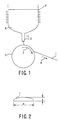
- Fig. 1 shows a drawing for explaining an example of the manufacturing method for alloy fibers used in the present invention.
- Fig. 2 shows a cross sectional view of an alloy fiber in the width direction used in the present invention.
- numeral 1 indicates an alloy fiber and a and b indicate a width and a plate thickness respectively.
- the plate thickness may be obtained by calculation after cutting an alloy fiber in a certain length and measuring the width, weight, and material density and the plate thickness and width measured on the enlarged section obtained by an SEM may be used.
- the alloy fibers used in the present invention can be produced by a device composed of, for example, a rotary cooling roll 3, a crucible 4 for housing a molten material which is installed above the cooling roll 3, and an injection nozzle 2 installed on the lower part of the crucible 4.
- the mother alloy is fused in the crucible 4 by high frequency induction heating and then a molten material 5 is injected onto the cooling roll 3 rotating in the direction of the arrow c from the injection nozzle 2 and cooled rapidly.
- the molten material 5 is conveyed in the direction of the arrow d by this rapid cooling and the alloy fiber 1 is obtained.
- the cooling roll 3 is composed of, for example, an iron alloy or a copper alloy and the shape of the molten material injection outlet at the end of the injection nozzle 2 is made circular, the diameter is within the range from 0.1 to 0.2 mm.
- the short side positioned in parallel with the peripheral direction of the cooling roll 3 is within the range from about 0.07 to 0.15 mm and the long side positioned perpendicularly to the peripheral direction is within the range from about 0.1 to 2 mm.
- the cooling roll rotates at a peripheral speed within the range from about 20 to 50 m/s. It is desirable that the preparation atmosphere is reduced to pressure of 760 Torr or less, and the differential pressure from inside the crucible is set to 10 to 750 Torr, and the molten material 5 is injected onto the cooling roll 3 from the injection nozzle 2 at the aforementioned weak differential pressure.
- an alloy fiber with a width of 10 ⁇ m or more to less than 500 ⁇ m and a plate thickness of 2 ⁇ m or more to less than 20 ⁇ m can be produced.
- Many molten material injection outlets may be provided from the viewpoint of production efficiency.
- An amorphous alloy fiber with a width of 30 to 50 ⁇ m and a plate thickness of 8 to 10 ⁇ m is produced by way of trial for the purpose of obtaining a long sample of 1 km by injecting a soft magnetic alloy material expressed by (Co 0.85 Fe 0.05 Cr 0.10 ) 75 (Si 0.5 B 0.5 ) 25 using the device shown in Fig. 1.
- the roll material is BeCu, and the peripheral speed of the roll is 30 m/s, and the nozzle shape is circular with a diameter of 0.1 mm, and the preparation atmosphere is 400 Torr or less, and the gap between the roll and the nozzle end is 0.15 mm.
- the obtained thin amorphous alloy band is cut into pieces with a length of 25 mm and about 30 pieces are suitably arranged on a paper layer immediately after manufactured and dehydrated. Another paper layer immediately after manufactured and dehydrated is additionally overlaid on it and the whole is hot-pressed and then dried so as to form one paper having a thickness of about 80 ⁇ m.
- the paper is punched, for example, in a size (70 mm ⁇ 165 mm) like a beer coupon ticket which can be exchanged for beer so as to obtain information recording articles.
- a size 70 mm ⁇ 165 mm
- 20 pieces are observed on the sectional area with a scanning electron microscope and it is ascertained by the image process that the mean sectional area is 360 ⁇ m 2 .
- the 180° bending experiment is executed continuously 10 times for every sample.
- the samples of Comparison example 1 are all broken at the time of third bending, and the broken surfaces are exposed, and the metallic materials can be taken out easily.
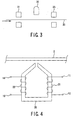
- FIG. 3 A schematic view showing the constitution of the reader used in Embodiment 1 is shown in Fig. 3.
- the reader has a means 30 for conveying an information recording article not shown in the drawing and a first reading sensor 31, a heater 35, and a second reading sensor 32 which are sequentially installed on the conveying means 30.
- Embodiment 1 The validity determining articles (information recording articles) obtained in Embodiment 1 are checked for the output at an exciting frequency of 5 kHz and a magnetic field intensity of 8 A/m using the detecting device shown in Fig. 3. As a result, 200 mVp ⁇ p is obtained and when the temperature is raised to 150°C or higher which is the Curie temperature, the output disappears and when the temperature is returned to the room temperature again, the same output as the initial one is obtained.
- the soft magnetic alloy fibers of the present invention are compounded with resin or paper sheets, the forgery preventive effect is extremely high and an information-recording article can be formed. As a result, the practical advantage is high and the industrial value is extremely great.
- the 180° bending experiment is executed continuously 10 times for every sample.
- the samples of Comparison example 1 are all broken at the time of third bending and the broken surfaces are exposed.
- Embodiment 1 The information recording articles used in Embodiment 1 are checked for the output by the detecting head at an exciting frequency of 5 kHz and a magnetic field intensity of 8 A/m.
- Fig. 4 a drawing for explaining the detection situation using a differential magnetic head that can be used in Embodiment 2 is shown.
- a magnetic head 20 is arranged opposite to a recording medium 40 and as shown in Fig. 4, it has a primary coil 21 having terminals 11 and 12 and a secondary coil 22 having terminals 14 and 15. Two voltage outputs on the side of the secondary coil 22 are amplified using a differential amplifier and can be detected by the voltage difference induced between the terminals 14 and 15.
- the present invention can detect an induced voltage caused by a magnetic flux change that is held by amorphous alloy fibers or iron alloy fibers under the condition that the exciting field is extremely decreased in size.
- the exciting frequency in this case is preferable to be 100 Hz to 100 MHz.
- the exciting frequency is preferable to be 1 kHz to 10 MHz.
- the size of the exciting field is desirable to be within the range from 1 to 800 A/m from the viewpoint of output reliability.
- Comparison example 3 information recording articles are prepared in the same way as with Embodiment 1 except that in place of soft magnetic alloy fibers obtained from an alloy material expressed by (Co 0.85 Fe 0.05 Cr 0.10 ) 75 (Si 0.5 B 0.5 ) 25 , nickel-plated carbon fibers with a diameter of 80 ⁇ m and a length of 5 mm are used and the carbon fibers are detected by the detecting head (magnetic head) in the same way.
- the detecting head magnetic head
- Comparison example 4 information recording articles are prepared in the same way as with Embodiment 1 except that in place of soft magnetic alloy fibers obtained from an alloy material expressed by (Co 0.85 Fe 0.05 Cr 0.10 ) 75 (Si 0.5 B 0.5 ) 25 , a magnetic wire with a diameter of 10 ⁇ m and a length of 5 mm that acrylic resin and magnetic metallic powder of sendust expressed by Al 10.8 Si 15.5 Fe 73.7 are mixed at a rate of 7:3 is used and the magnetic wire is detected by the detecting head (magnetic head) in the same way.
- the detection output of the information recording articles of Embodiment 2 is large such as 300 to 400 mVp-p, while in the case of Comparison examples 2 and 3, little output is obtained by nickel-plated carbon fibers and when the magnetic wire that acrylic resin and magnetic metallic powder of sendust are mixed is used, the output is 30 mVp-p.
- a thin amorphous alloy ribbon of 50 ⁇ m (width) ⁇ 6 ⁇ m (thickness) ⁇ 3 mm (length) having a Curie temperature of 90°C is obtained in the same way as with Embodiment 1 except that soft magnetic alloy fibers expressed by (Co 0.72 Fe 0.08 Ni 0.15 Mo 0.05 ) 75 (Si 0.5 B 0.5 ) 25 are used.
- the obtained thin amorphous alloy band is cut into pieces, and about 30 pieces are suitably arranged on a PET film with a thickness of 0.2 mm having an adhesion layer, and another PET film with a thickness of 0.2 mm having an adhesion layer is additionally overlaid on it, and the whole is hot-pressed and then punched in a cash card size so as to obtain information recording articles.
- the detection output of the information recording articles of Embodiment 4 is large such as 300 to 400 mVp-p, while in the case of the samples of the comparison examples, little output is obtained by nickel-plated carbon fibers and when the wire that acrylic resin and magnetic metallic powder of Mo permalloy are mixed is used, the output is 30 mVp-p.
- Information recording articles are prepared from each material of 80 ⁇ m (width) ⁇ 6 ⁇ m (thickness) ⁇ 3 mm (length) shown in Table 1 indicated below in the same way as with Embodiment 3 and checked by the detecting head in the same way at an exciting frequency of 10 kHz and an exciting field of 4 A/m.
- the uneven parts on the surface are evaluated visually, and a double circle is allocated to each satisfactory part, and x is allocated to an unsatisfactory part as evaluation.
- the obtained results are shown in Table 1 indicated below.
- Fe group alloy fibers are made amorphous by the same method and heat-treated at a crystallization temperature of 50°C or higher of the respective alloy fibers so as to deposit fine crystals.
- the X-ray diffraction method and Scherrer formula obtain the crystal particle diameter.
- Fe 2 O 3 formed as paint is coated in a thickness of 3 ⁇ m. on a PET film with a thickness of 0.2 mm, and another PET film with a thickness of 0.2 mm is overlaid on it, and the whole is hot-pressed and then punched in a cash card size so as to produce information recording articles.
- the detecting head also detects the information recording articles and uneven parts are evaluated.
- information recording articles are prepared in the same way as with Embodiment 3 except that a thin Fe group amorphous alloy ribbon of 2 mm (width) ⁇ 25 ⁇ m (thickness) ⁇ 3 mm (length) expressed by Fe 78 Si 9 B 13 is used in place of the thin amorphous alloy ribbon of Embodiment 3 and also detected by the detecting head and uneven parts are evaluated.
- the information recording articles of Embodiments 5 to 30 in which soft magnetic alloy fibers are embedded are free of uneven parts on the surface and the detection output is 300 to 400 mVp-p.
- the information recording articles with Fe 2 O 3 formed as paint coated are free of uneven parts on the surface, though the detection output is low such as 20 mvp-p and in the thin Fe group amorphous alloy band expressed by Fe 78 Si 9 B 13 , although slight detection output such as 100 mVp-p is obtained, the uneven parts on the surface are unnatural and it may be said that the forgery preventive effect is low.
- amorphous fibers As soft magnetic alloy fibers, two kinds of amorphous fibers are prepared in the same way as with Embodiment 1 except that an alloy (Co 0.90 Fe 0.05 Cr 0.05 ) 75 (Si 0.5 B 0.5 ) 25 having a Curie temperature of 200°C and an alloy (Co 0.84 Fe 0.05 Cr 0.11 ) 75 (Si 0.5 B 0.5 ) 25 having a Curie temperature of 60°C are used. Each fiber is cut into pieces with a length of about 5 to 10 mm and each piece is inserted into paper during manufacture at a rate of 1:2.
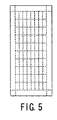
- Fig. 5 shows a matrix assumed in a preferable application example of an information-recording article of the present invention.
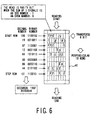
- Fig. 6 is a drawing for explaining divided areas of a matrix assumed in a preferable application example of an information recording article of the present invention, arrangement of amorphous alloy fibers selectively embedded in the divided areas, and a reading method therefor.
- Fig. 7 is a drawing that the dashed lines indicating the divided areas are removed from Fig. 6.
- a matrix as indicated by dashed lines in Fig. 5 is assumed and 2 to 4 amorphous alloy fibers of 50 ⁇ m (width) ⁇ 6 ⁇ m (plate thickness) ⁇ 3 mm (length) expressed by (Co 0.84 Fe 0.05 Nb 0.11 ) 75 (Si 0.5 B 0.5 ) 25 in the same way as with Embodiment 1 are arranged in a single division of the assumed matrix indicated by dashed lines. As shown in Fig. 7, when the dashed lines are removed, it is not easy to judge what a matrix is assumed from the random arrangement of the amorphous alloy fibers.
- a paper layer immediately after manufactured and dehydrated is overlaid on it, and the whole is hot-pressed and then wound, and one sheet of paper with a thickness of about 80 ⁇ m is formed.
- the paper is punched in a size of about 160 mm ⁇ 76 mm so as to obtain information recording articles.
- the 180° bending experiment is executed continuously 10 times for every sample and the samples are neither broken nor exposed on the surface.
- the existence of a bit is determined depending on whether a signal reaches the normal voltage at an interval of 0.5 s.
- the top of one bit is a parity bit.
- Fig. 8 shows an example of a reading waveform diagram. As shown in Fig. 8, it looks likely that the waveform is not regular at a glance. However, when a rule that when the voltage reaches the ON level at least once at an interval of 0.5 s, there is a bit is known, the digital information as shown in Fig. 6 can be read from this waveform. When this embodiment is heated up to 80°C and evaluated in the same way, it can be ascertained that no reading waveform can be obtained at all and different information is provided.
- soft magnetic alloy fibers that can be compounded easily with a base, are high in the security property and forgery preventive effect, and can read at high output and high speed can be obtained.
- the soft magnetic alloy fibers of the present invention when used, information recording articles which are high in the security property and forgery preventive effect, can read at high output and high speed, and can easily determine the validity can be obtained.
- soft magnetic alloy fibers which are high in the security property and forgery preventive effect and can read at high output and high speed can be easily manufactured.
Landscapes
- Physics & Mathematics (AREA)
- Engineering & Computer Science (AREA)
- Electromagnetism (AREA)
- General Physics & Mathematics (AREA)
- Computer Security & Cryptography (AREA)
- Automation & Control Theory (AREA)
- Chemical & Material Sciences (AREA)
- Dispersion Chemistry (AREA)
- Power Engineering (AREA)
- Manufacturing & Machinery (AREA)
- Soft Magnetic Materials (AREA)
- Magnetic Record Carriers (AREA)
- Continuous Casting (AREA)
- Inorganic Fibers (AREA)
- Hard Magnetic Materials (AREA)
Abstract
Description
| COMPOSITION | UNEVEN PARTS ON SURFACE | OUTPUT (mVp-p) | COERCIVE FORCE(A/M) | ||
| EMBODIMENTS | 5 | (Co0.85Fe0.05V0.10)75(Si0.4B0.6)25 | o ○ | 390 | 2.0 |
| 6 | (Co0.87Fe0.03Mn0.10)72(Si0.5B0.5)28 | o ○ | 400 | 1.6 | |
| 7 | (Co0.67Fe0.08Ni0.25)73(Si0.7B0.3)27 | o ○ | 370 | 2.3 | |
| 8 | (Co0.87Fe0.05Cu0.08)70(Si0.4B0.6)30 | o ○ | 330 | 3.0 | |
| 9 | (Co0.85Fe0.05Ti0.10)75(Si0.1B0.9)25 | o ○ | 320 | 3.2 | |
| 10 | (Co0.87Fe0.05Zr0.08)71(Si0.1B0.9)29 | o ○ | 330 | 3.0 | |
| 11 | (Co0.87Fe0.05Hf0.08)71(Si0.5B0.5)29 | o ○ | 310 | 3.9 | |
| 12 | (Co0.85Fe0.05Nb0.10)75(Si0.5B0.5)25 | o ○ | 380 | 2.0 | |
| 13 | (Co0.85Fe0.05Ta0.10)75(Si0.5B0.5)25 | o ○ | 400 | 1.6 | |
| 14 | (Co0.85Fe0.05Mo0.10)75(Si0.5B0.5)25 | o ○ | 420 | 1.2 | |
| 15 | (Co0.85Fe0.05Wo0.10)75(Si0.5B0.5)25 | o ○ | 410 | 1.4 | |
| 16 | (Fe0.5Ni0.5)74Cu1Nb3.5Si14B7.5 | o ○ | 300 | 1.6 | |
| 17 | (Fe0.5Ni0.5)72Cu1Nb3.5Cr1.5Si14B8 | o ○ | 310 | 4.0 | |
| 18 | (Fe0.5Ni0.5)72Cu1Mo3.5Cr1.5Si14B8 | o ○ | 300 | 4.0 | |
| 19 | (Fe0.5Ni0.5)72Cu1Ta3.5Cr1.5Si14B8 | o ○ | 320 | 4.0 | |
| 20 | (Fe0.4Ni0.6)72Cu1W3.5Cr1.5Si14B8 | o ○ | 310 | 4.0 | |
| 21 | (Fe0.4Ni0.6)72Cu1Hf3.5Cr1.5Si14B8 | o ○ | 280 | 4.4 | |
| 22 | (Fe0.4Ni0.6)72Cu1Zr3.5Cr1.5Si14B8 | o ○ | 290 | 4.4 | |
| 23 | (Fe0.4Ni0.6)71.5Cu1Ti5.0Cr2.5Si13B8 | o ○ | 260 | 6.0 | |
| 24 | (Fe0.4Ni0.6)70.5Cu1V7Cr2.0Si13B8 | o ○ | 300 | 4.0 | |
| 25 | (Fe0.9Ni0.1)72Cu1Mo3.5Cr1.5Si14B8 | o ○ | 280 | 5.6 | |
| 26 | (Fe0.8Co0.2)72Cu1Mo3.5Cr1.5Si14B8 | o ○ | 250 | 5.8 | |
| 27 | (Fe0.6Ni0.4)72Cu1Ta3.0Cr1.5Mn0.5Si14E8 | o ○ | 330 | 3.2 | |
| 28 | (Fe0.6Ni0.4)72Cu1W3.5Cr1.0Ga0.5Si14B8 | o ○ | 340 | 3.0 | |
| 29 | (Fe0.6Ni0.4)72Cu1Nb3.5Cr1.0Sn0.5Si14B8 | o ○ | 320 | 3.2 | |
| 30 | (Fe0.6Ni0.4)72Cu1Mo3.5Cr1.0Al1.5Si13B8 | o ○ | 330 | 3.2 | |
| COMPARISON EXAMPLES | 9 | Fe2O3 | o ○ | 20 | 2000 |
| 10 | Fe78Si9B13 | × | 100 | 80 |
Claims (14)
- A soft magnetic alloy fiber having a width of 10µm or more to less than 500 µm, a thickness of 2 µm or more to less than 20 µm, and a Curie temperature of-50°C or higher.
- A soft magnetic alloy fiber according to claim 1, wherein the soft magnetic alloy fiber includes an amorphous alloy.
- A soft magnetic alloy fiber according to claim 1 or 2, wherein the soft magnetic alloy fiber includes cobalt as a main component.
- A soft magnetic allow fiber according to one of claims 1 to 3, wherein the soft magnetic alloy fiber includes iron or nickel and iron as main components.
- A soft magnetic alloy fiber according to claim 4, wherein the soft magnetic alloy fiber has a mean crystal particle diameter of 5 nm or more to 50 nm or less.
- An information recording article comprising:a base; anda soft magnetic alloy fiber according to one of claims 1 to 5 which is embedded in the base.
- An information recording article according to claim 6, wherein the base is at least one kind of nonmagnetic material selected from a paper sheet and synthetic resin.
- An information recording article according to claim 7, wherein a ratio of a sectional area (Ap) of fibers of the paper sheet to a sectional area (Am) of the soft magnetic alloy fiber is 0.1 ≤ Ap/Am ≤ 20.
- An information recording article according to one of claims 6 to 8, wherein the soft magnetic alloy fiber has a length of 0.1 mm or longer.
- An information recording article according to one of claims 6 to 9, wherein the information recording article further includes another soft magnetic alloy fiber having another Curie temperature different from the Curie temperature of the soft magnetic alloy fiber.
- An information recording article according to one of claims 6 to 10, wherein the soft magnetic alloy fiber is selectively embedded in predetermined divided areas assumed in the base and existence of embedding of the alloy fiber is recording information.
- An information recording article according to one of claims 6 to 11, wherein the information recording article includes still another soft magnetic alloy fiber having another coercive force different from coercive force of the soft magnetic alloy fiber.
- A manufacturing method for a soft magnetic alloy fiber, comprising the steps of:dissolving a soft magnetic alloy material in a crucible with a nozzle having an opening with a diameter of 0.1 to 0.2 mm or a slit having a short side of 0.07 to 0.15 mm in length and a long side of 0.1 to 2 mm in length to obtain a molten alloy; andinjecting and cooling the molten alloy on a cooler rotating at a peripheral speed of 20 to 50 m/s in an atmosphere at pressure 10 to 750 Torr higher than a peripheral atmosphere.
- A manufacturing method for a soft magnetic alloy fiber according to claim 13, which is adapted for manufacturing a soft magnetic alloy fiber according to one of claims 1 to 5.
Applications Claiming Priority (2)
| Application Number | Priority Date | Filing Date | Title |
|---|---|---|---|
| JP2000076523 | 2000-03-17 | ||
| JP2000076523A JP4128721B2 (en) | 2000-03-17 | 2000-03-17 | Information record article |
Publications (3)
| Publication Number | Publication Date |
|---|---|
| EP1134751A2 true EP1134751A2 (en) | 2001-09-19 |
| EP1134751A3 EP1134751A3 (en) | 2002-06-05 |
| EP1134751B1 EP1134751B1 (en) | 2004-08-18 |
Family
ID=18594248
Family Applications (1)
| Application Number | Title | Priority Date | Filing Date |
|---|---|---|---|
| EP01102262A Expired - Lifetime EP1134751B1 (en) | 2000-03-17 | 2001-01-31 | Soft magnetic alloy fiber, manufacturing method and tag |
Country Status (4)
| Country | Link |
|---|---|
| US (3) | US6610425B2 (en) |
| EP (1) | EP1134751B1 (en) |
| JP (1) | JP4128721B2 (en) |
| DE (1) | DE60104920T2 (en) |
Cited By (1)
| Publication number | Priority date | Publication date | Assignee | Title |
|---|---|---|---|---|
| RU2219299C1 (en) * | 2002-06-11 | 2003-12-20 | ООО "НПП Вичел (Высокочастотные элементы)" | Sheet material and sheet material authenticity checking method |
Families Citing this family (10)
| Publication number | Priority date | Publication date | Assignee | Title |
|---|---|---|---|---|
| US7338709B1 (en) * | 1999-07-09 | 2008-03-04 | Toska Co., Ltd. | Security yarn and production method therefor |
| JP3560591B2 (en) * | 2002-04-10 | 2004-09-02 | 独立行政法人 科学技術振興機構 | Soft magnetic Co-based metallic glass alloy |
| US20090297782A1 (en) * | 2005-07-01 | 2009-12-03 | Chen-Liang Fan Chiang | Soft magnet with embossed stripe pattern |
| US20070003727A1 (en) * | 2005-07-01 | 2007-01-04 | Chen-Liang Fan Chiang | Soft magnet structure |
| JP5799566B2 (en) * | 2011-04-26 | 2015-10-28 | 富士ゼロックス株式会社 | Paper |
| KR101476690B1 (en) * | 2012-05-24 | 2015-01-06 | 이상민 | Soft magnetic fiber and Processed article of soft magnetic material for the shield of electromagnetic pulse or wave, appratus and method for producing the same |
| WO2013176452A1 (en) * | 2012-05-24 | 2013-11-28 | Lee Sang Min | Soft magnetic fiber, device for producing same, method for producing same, and soft magnetic processed article including same |
| US20190368013A1 (en) * | 2016-12-08 | 2019-12-05 | Carnegie Mellon University | Fe-Ni Nanocomposite Alloys |
| CN107949261B (en) * | 2017-11-15 | 2020-03-03 | 中国科学院宁波材料技术与工程研究所 | A kind of electromagnetic wave absorbing material and preparation method thereof |
| KR102601878B1 (en) * | 2018-11-29 | 2023-11-14 | 가부시끼가이샤 도시바 | Co-based amorphous magnetic thin strip for magnetic sensor, magnetic sensor for security paper, and management system |
Family Cites Families (17)
| Publication number | Priority date | Publication date | Assignee | Title |
|---|---|---|---|---|
| JPS5312719A (en) | 1976-07-22 | 1978-02-04 | Toyota Motor Co Ltd | Device for manufacturing metal fibers |
| US4221257A (en) | 1978-10-10 | 1980-09-09 | Allied Chemical Corporation | Continuous casting method for metallic amorphous strips |
| JPS5831053A (en) * | 1981-08-18 | 1983-02-23 | Toshiba Corp | Amorphous alloy |
| JPH02223205A (en) * | 1988-11-02 | 1990-09-05 | Kurieiteitsuku Japan:Kk | Antenna |
| US5015993A (en) * | 1989-06-29 | 1991-05-14 | Pitney Bowes Inc. | Ferromagnetic alloys with high nickel content and high permeability |
| EP0612082B1 (en) * | 1989-09-01 | 1998-07-15 | Masaaki Yagi | Method for making an Fe-based alloy ribbon with a thickness of not more than 10 micrometer |
| US5198040A (en) * | 1989-09-01 | 1993-03-30 | Kabushiki Kaisha Toshiba | Very thin soft magnetic Fe-based alloy strip and magnetic core and electromagnetic apparatus made therefrom |
| DE69018422T2 (en) * | 1989-12-28 | 1995-10-19 | Toshiba Kawasaki Kk | Iron-based soft magnetic alloy, its manufacturing process and magnetic core made from it. |
| JP2559074B2 (en) * | 1990-04-27 | 1996-11-27 | 株式会社クリエイティックジャパン | Antenna element |
| US5552948A (en) | 1990-12-28 | 1996-09-03 | Canon Denshi Kabushiki Kaisha | Disk drive having a lifting member |
| CN1114835C (en) * | 1995-07-17 | 2003-07-16 | 飞零有限公司 | Improvements relating to magnetic tags or markers |
| DE19533362A1 (en) * | 1995-09-09 | 1997-03-13 | Vacuumschmelze Gmbh | Elongated body as a security label for electromagnetic anti-theft systems |
| WO1998007890A1 (en) * | 1996-08-20 | 1998-02-26 | Alliedsignal Inc. | Thick amorphous alloy ribbon having improved ductility and magnetic properties |
| CA2216897A1 (en) * | 1996-09-30 | 1998-03-30 | Unitika Ltd. | Fe group-based amorphous alloy ribbon and magnetic marker |
| US5825290A (en) * | 1997-02-14 | 1998-10-20 | Sensormatic Electronics Corporation | Active element for magnetomechanical EAS marker incorporating particles of bias material |
| US6011475A (en) * | 1997-11-12 | 2000-01-04 | Vacuumschmelze Gmbh | Method of annealing amorphous ribbons and marker for electronic article surveillance |
| DE19918589A1 (en) * | 1999-04-23 | 2000-10-26 | Vacuumschmelze Gmbh | Magnetic marking strip and method for making a magnetic marking strip |
-
2000
- 2000-03-17 JP JP2000076523A patent/JP4128721B2/en not_active Expired - Fee Related
-
2001
- 2001-01-31 EP EP01102262A patent/EP1134751B1/en not_active Expired - Lifetime
- 2001-01-31 DE DE60104920T patent/DE60104920T2/en not_active Expired - Lifetime
- 2001-03-09 US US09/801,741 patent/US6610425B2/en not_active Expired - Fee Related
-
2003
- 2003-05-29 US US10/446,961 patent/US20030205353A1/en not_active Abandoned
- 2003-05-29 US US10/446,813 patent/US6869700B2/en not_active Expired - Fee Related
Cited By (1)
| Publication number | Priority date | Publication date | Assignee | Title |
|---|---|---|---|---|
| RU2219299C1 (en) * | 2002-06-11 | 2003-12-20 | ООО "НПП Вичел (Высокочастотные элементы)" | Sheet material and sheet material authenticity checking method |
Also Published As
| Publication number | Publication date |
|---|---|
| US20010031373A1 (en) | 2001-10-18 |
| US20030205353A1 (en) | 2003-11-06 |
| US6869700B2 (en) | 2005-03-22 |
| JP4128721B2 (en) | 2008-07-30 |
| EP1134751B1 (en) | 2004-08-18 |
| DE60104920T2 (en) | 2005-08-18 |
| US20030207144A1 (en) | 2003-11-06 |
| EP1134751A3 (en) | 2002-06-05 |
| DE60104920D1 (en) | 2004-09-23 |
| JP2001271229A (en) | 2001-10-02 |
| US6610425B2 (en) | 2003-08-26 |
Similar Documents
| Publication | Publication Date | Title |
|---|---|---|
| EP0824405B1 (en) | Articles employing a magnetic security feature | |
| AU613045B2 (en) | Magnetic devices | |
| US5614824A (en) | Harmonic-based verifier device for a magnetic security thread having linear and non-linear ferromagnetic characteristics | |
| US6610425B2 (en) | Soft magnetic alloy fiber, manufacturing method for soft magnetic alloy fiber, and information recording article using soft magnetic alloy fiber | |
| AU723490B2 (en) | Magnetic detector for security document | |
| EP1134752B1 (en) | Magnetic powder, magnetic ink, printed member and manufacturing method therefor | |
| US5605768A (en) | Magnetic marker and manufacturing method therefor | |
| SK285298B6 (en) | Magnetic particles, substrate comprising such particles, security document and method for detecting such particles | |
| EP0696779B1 (en) | Data recording medium | |
| EP0903758A1 (en) | Magnetic recording medium and magnetic recording/reproducing method | |
| JP4508674B2 (en) | Magnetic paper and its reading method | |
| JP4021570B2 (en) | Authenticity determination method and authenticity determination device | |
| JP2000099937A (en) | Information recording medium | |
| CN113168946A (en) | Co-based amorphous magnetic ribbon for magnetic sensor, magnetic sensor using the same, and management system | |
| JPH08324168A (en) | Gift certificates | |
| KR102661878B1 (en) | Electromagnetic Sensitive Casino Chip And Manufacturing Method Thereof | |
| JP2004125526A (en) | High-precision detection method for magnetic materials | |
| JP7483728B2 (en) | Use of magnetic oxide particles for magnetic marking of metals. | |
| JP2006060025A (en) | Anti-counterfeit body comprising amorphous magnetic thin film and method for determining authenticity of anti-counterfeit body | |
| EP0848355A1 (en) | Method and apparatus for detecting the presence of particles in a substrate | |
| JPH1069603A (en) | Magnetic card and method for preventing illegality of magnetic card | |
| JPH1116110A (en) | Information recording medium and its authenticity determination device | |
| EP0848356A1 (en) | Substrate comprising magnetic particles, security document and method for detecting them | |
| WO2014103460A1 (en) | Medium for magnetic sensor test, method for testing magnetic sensor, and method for manufacturing medium for magn etic sensor test | |
| KR20170041455A (en) | Security documents for preventing of information leakage and manufacturing method thereof |
Legal Events
| Date | Code | Title | Description |
|---|---|---|---|
| PUAI | Public reference made under article 153(3) epc to a published international application that has entered the european phase |
Free format text: ORIGINAL CODE: 0009012 |
|
| 17P | Request for examination filed |
Effective date: 20010131 |
|
| AK | Designated contracting states |
Kind code of ref document: A2 Designated state(s): AT BE CH CY DE DK ES FI FR GB GR IE IT LI LU MC NL PT SE TR |
|
| AX | Request for extension of the european patent |
Free format text: AL;LT;LV;MK;RO;SI |
|
| PUAL | Search report despatched |
Free format text: ORIGINAL CODE: 0009013 |
|
| AK | Designated contracting states |
Kind code of ref document: A3 Designated state(s): AT BE CH CY DE DK ES FI FR GB GR IE IT LI LU MC NL PT SE TR |
|
| AX | Request for extension of the european patent |
Free format text: AL;LT;LV;MK;RO;SI |
|
| 17Q | First examination report despatched |
Effective date: 20020903 |
|
| AKX | Designation fees paid |
Designated state(s): DE FR GB |
|
| GRAP | Despatch of communication of intention to grant a patent |
Free format text: ORIGINAL CODE: EPIDOSNIGR1 |
|
| GRAS | Grant fee paid |
Free format text: ORIGINAL CODE: EPIDOSNIGR3 |
|
| GRAA | (expected) grant |
Free format text: ORIGINAL CODE: 0009210 |
|
| AK | Designated contracting states |
Kind code of ref document: B1 Designated state(s): DE FR GB |
|
| REG | Reference to a national code |
Ref country code: GB Ref legal event code: FG4D |
|
| REG | Reference to a national code |
Ref country code: IE Ref legal event code: FG4D |
|
| REF | Corresponds to: |
Ref document number: 60104920 Country of ref document: DE Date of ref document: 20040923 Kind code of ref document: P |
|
| PLBE | No opposition filed within time limit |
Free format text: ORIGINAL CODE: 0009261 |
|
| STAA | Information on the status of an ep patent application or granted ep patent |
Free format text: STATUS: NO OPPOSITION FILED WITHIN TIME LIMIT |
|
| ET | Fr: translation filed | ||
| 26N | No opposition filed |
Effective date: 20050519 |
|
| PGFP | Annual fee paid to national office [announced via postgrant information from national office to epo] |
Ref country code: FR Payment date: 20120202 Year of fee payment: 12 |
|
| PGFP | Annual fee paid to national office [announced via postgrant information from national office to epo] |
Ref country code: DE Payment date: 20120125 Year of fee payment: 12 |
|
| PGFP | Annual fee paid to national office [announced via postgrant information from national office to epo] |
Ref country code: GB Payment date: 20120125 Year of fee payment: 12 |
|
| GBPC | Gb: european patent ceased through non-payment of renewal fee |
Effective date: 20130131 |
|
| REG | Reference to a national code |
Ref country code: FR Ref legal event code: ST Effective date: 20130930 |
|
| PG25 | Lapsed in a contracting state [announced via postgrant information from national office to epo] |
Ref country code: DE Free format text: LAPSE BECAUSE OF NON-PAYMENT OF DUE FEES Effective date: 20130801 |
|
| REG | Reference to a national code |
Ref country code: DE Ref legal event code: R119 Ref document number: 60104920 Country of ref document: DE Effective date: 20130801 |
|
| PG25 | Lapsed in a contracting state [announced via postgrant information from national office to epo] |
Ref country code: FR Free format text: LAPSE BECAUSE OF NON-PAYMENT OF DUE FEES Effective date: 20130131 Ref country code: GB Free format text: LAPSE BECAUSE OF NON-PAYMENT OF DUE FEES Effective date: 20130131 |