EP1134613A1 - Photobleachable composition, photographic element containing the composition and photobleach method - Google Patents
Photobleachable composition, photographic element containing the composition and photobleach method Download PDFInfo
- Publication number
- EP1134613A1 EP1134613A1 EP01200472A EP01200472A EP1134613A1 EP 1134613 A1 EP1134613 A1 EP 1134613A1 EP 01200472 A EP01200472 A EP 01200472A EP 01200472 A EP01200472 A EP 01200472A EP 1134613 A1 EP1134613 A1 EP 1134613A1
- Authority
- EP
- European Patent Office
- Prior art keywords
- group
- dye
- aryl
- alkyl
- composition
- Prior art date
- Legal status (The legal status is an assumption and is not a legal conclusion. Google has not performed a legal analysis and makes no representation as to the accuracy of the status listed.)
- Withdrawn
Links
- 239000000203 mixture Substances 0.000 title claims abstract description 54
- 238000000034 method Methods 0.000 title claims abstract description 21
- 150000001875 compounds Chemical class 0.000 claims abstract description 69
- 238000004061 bleaching Methods 0.000 claims abstract description 37
- 239000000178 monomer Substances 0.000 claims abstract description 6
- 239000000975 dye Substances 0.000 claims description 157
- -1 arylaminicarbonyl Chemical group 0.000 claims description 90
- 125000003118 aryl group Chemical group 0.000 claims description 47
- 125000000217 alkyl group Chemical group 0.000 claims description 46
- 125000001072 heteroaryl group Chemical group 0.000 claims description 17
- 230000001235 sensitizing effect Effects 0.000 claims description 16
- 125000001424 substituent group Chemical group 0.000 claims description 15
- 229910052709 silver Inorganic materials 0.000 claims description 13
- 239000004332 silver Substances 0.000 claims description 13
- 125000000623 heterocyclic group Chemical group 0.000 claims description 10
- 238000012545 processing Methods 0.000 claims description 10
- 125000003545 alkoxy group Chemical group 0.000 claims description 9
- 125000004093 cyano group Chemical group *C#N 0.000 claims description 9
- 229910052736 halogen Inorganic materials 0.000 claims description 9
- 150000002367 halogens Chemical group 0.000 claims description 9
- 125000004435 hydrogen atom Chemical class [H]* 0.000 claims description 9
- 125000002252 acyl group Chemical group 0.000 claims description 8
- 125000004390 alkyl sulfonyl group Chemical group 0.000 claims description 8
- 125000001997 phenyl group Chemical group [H]C1=C([H])C([H])=C(*)C([H])=C1[H] 0.000 claims description 8
- 125000004423 acyloxy group Chemical group 0.000 claims description 7
- 125000004453 alkoxycarbonyl group Chemical group 0.000 claims description 7
- 125000005161 aryl oxy carbonyl group Chemical group 0.000 claims description 7
- 125000004104 aryloxy group Chemical group 0.000 claims description 7
- 229910052739 hydrogen Inorganic materials 0.000 claims description 7
- 239000001257 hydrogen Substances 0.000 claims description 7
- 230000005855 radiation Effects 0.000 claims description 7
- 125000002777 acetyl group Chemical group [H]C([H])([H])C(*)=O 0.000 claims description 6
- 125000004442 acylamino group Chemical group 0.000 claims description 6
- 125000004457 alkyl amino carbonyl group Chemical group 0.000 claims description 6
- 125000005195 alkyl amino carbonyloxy group Chemical group 0.000 claims description 6
- 125000004414 alkyl thio group Chemical group 0.000 claims description 6
- 125000005281 alkyl ureido group Chemical group 0.000 claims description 6
- 125000003435 aroyl group Chemical group 0.000 claims description 6
- 125000005110 aryl thio group Chemical group 0.000 claims description 6
- 125000005031 thiocyano group Chemical group S(C#N)* 0.000 claims description 6
- 125000004953 trihalomethyl group Chemical group 0.000 claims description 6
- 238000003384 imaging method Methods 0.000 claims description 5
- HCXJFMDOHDNDCC-UHFFFAOYSA-N 5-$l^{1}-oxidanyl-3,4-dihydropyrrol-2-one Chemical group O=C1CCC(=O)[N]1 HCXJFMDOHDNDCC-UHFFFAOYSA-N 0.000 claims description 4
- 125000003282 alkyl amino group Chemical group 0.000 claims description 3
- 125000001118 alkylidene group Chemical group 0.000 claims description 3
- 125000001769 aryl amino group Chemical group 0.000 claims description 3
- 125000002924 primary amino group Chemical group [H]N([H])* 0.000 claims description 3
- 125000000547 substituted alkyl group Chemical group 0.000 claims description 3
- 125000002915 carbonyl group Chemical group [*:2]C([*:1])=O 0.000 claims description 2
- 150000007942 carboxylates Chemical class 0.000 claims description 2
- 125000005647 linker group Chemical group 0.000 claims description 2
- 125000000325 methylidene group Chemical group [H]C([H])=* 0.000 claims description 2
- 125000005245 nitryl group Chemical group [N+](=O)([O-])* 0.000 claims description 2
- 229910052760 oxygen Inorganic materials 0.000 claims description 2
- 229910052711 selenium Inorganic materials 0.000 claims description 2
- 125000003107 substituted aryl group Chemical group 0.000 claims description 2
- 125000005420 sulfonamido group Chemical group S(=O)(=O)(N*)* 0.000 claims description 2
- 229910052717 sulfur Inorganic materials 0.000 claims description 2
- 125000004122 cyclic group Chemical group 0.000 claims 1
- 125000002887 hydroxy group Chemical group [H]O* 0.000 claims 1
- 239000001044 red dye Substances 0.000 claims 1
- 239000010410 layer Substances 0.000 description 34
- WEVYAHXRMPXWCK-UHFFFAOYSA-N Acetonitrile Chemical compound CC#N WEVYAHXRMPXWCK-UHFFFAOYSA-N 0.000 description 30
- DOIRQSBPFJWKBE-UHFFFAOYSA-N dibutyl phthalate Chemical compound CCCCOC(=O)C1=CC=CC=C1C(=O)OCCCC DOIRQSBPFJWKBE-UHFFFAOYSA-N 0.000 description 18
- 238000006243 chemical reaction Methods 0.000 description 16
- 125000004432 carbon atom Chemical group C* 0.000 description 15
- 238000002474 experimental method Methods 0.000 description 11
- 239000011230 binding agent Substances 0.000 description 10
- 239000000839 emulsion Substances 0.000 description 10
- XLYOFNOQVPJJNP-UHFFFAOYSA-N water Substances O XLYOFNOQVPJJNP-UHFFFAOYSA-N 0.000 description 10
- PEDCQBHIVMGVHV-UHFFFAOYSA-N Glycerine Chemical compound OCC(O)CO PEDCQBHIVMGVHV-UHFFFAOYSA-N 0.000 description 9
- 229960002380 dibutyl phthalate Drugs 0.000 description 9
- 238000001035 drying Methods 0.000 description 8
- 125000004429 atom Chemical group 0.000 description 7
- 125000002496 methyl group Chemical group [H]C([H])([H])* 0.000 description 7
- QGKMIGUHVLGJBR-UHFFFAOYSA-M (4z)-1-(3-methylbutyl)-4-[[1-(3-methylbutyl)quinolin-1-ium-4-yl]methylidene]quinoline;iodide Chemical compound [I-].C12=CC=CC=C2N(CCC(C)C)C=CC1=CC1=CC=[N+](CCC(C)C)C2=CC=CC=C12 QGKMIGUHVLGJBR-UHFFFAOYSA-M 0.000 description 6
- CSCPPACGZOOCGX-UHFFFAOYSA-N Acetone Chemical compound CC(C)=O CSCPPACGZOOCGX-UHFFFAOYSA-N 0.000 description 6
- 230000005284 excitation Effects 0.000 description 6
- 229920002037 poly(vinyl butyral) polymer Polymers 0.000 description 6
- 125000001434 methanylylidene group Chemical group [H]C#[*] 0.000 description 5
- 229920002451 polyvinyl alcohol Polymers 0.000 description 5
- 150000005839 radical cations Chemical class 0.000 description 5
- HXCFPBLEWAKKGL-UHFFFAOYSA-M 1-methoxy-4-phenylpyridin-1-ium;4-methylbenzenesulfonate Chemical compound CC1=CC=C(S([O-])(=O)=O)C=C1.C1=C[N+](OC)=CC=C1C1=CC=CC=C1 HXCFPBLEWAKKGL-UHFFFAOYSA-M 0.000 description 4
- BQCADISMDOOEFD-UHFFFAOYSA-N Silver Chemical compound [Ag] BQCADISMDOOEFD-UHFFFAOYSA-N 0.000 description 4
- 125000003710 aryl alkyl group Chemical group 0.000 description 4
- 125000001797 benzyl group Chemical group [H]C1=C([H])C([H])=C(C([H])=C1[H])C([H])([H])* 0.000 description 4
- 125000001495 ethyl group Chemical group [H]C([H])([H])C([H])([H])* 0.000 description 4
- DZVCFNFOPIZQKX-LTHRDKTGSA-M merocyanine Chemical compound [Na+].O=C1N(CCCC)C(=O)N(CCCC)C(=O)C1=C\C=C\C=C/1N(CCCS([O-])(=O)=O)C2=CC=CC=C2O\1 DZVCFNFOPIZQKX-LTHRDKTGSA-M 0.000 description 4
- 229910052757 nitrogen Inorganic materials 0.000 description 4
- 230000001443 photoexcitation Effects 0.000 description 4
- ODIRBFFBCSTPTO-UHFFFAOYSA-N 1,3-selenazole Chemical class C1=C[se]C=N1 ODIRBFFBCSTPTO-UHFFFAOYSA-N 0.000 description 3
- YMWUJEATGCHHMB-UHFFFAOYSA-N Dichloromethane Chemical compound ClCCl YMWUJEATGCHHMB-UHFFFAOYSA-N 0.000 description 3
- OKKJLVBELUTLKV-UHFFFAOYSA-N Methanol Chemical compound OC OKKJLVBELUTLKV-UHFFFAOYSA-N 0.000 description 3
- 239000000654 additive Substances 0.000 description 3
- 239000007844 bleaching agent Substances 0.000 description 3
- 125000003917 carbamoyl group Chemical group [H]N([H])C(*)=O 0.000 description 3
- 125000002837 carbocyclic group Chemical group 0.000 description 3
- 230000009477 glass transition Effects 0.000 description 3
- IJGRMHOSHXDMSA-UHFFFAOYSA-N nitrogen Substances N#N IJGRMHOSHXDMSA-UHFFFAOYSA-N 0.000 description 3
- 230000003287 optical effect Effects 0.000 description 3
- 150000002916 oxazoles Chemical class 0.000 description 3
- 125000001820 oxy group Chemical group [*:1]O[*:2] 0.000 description 3
- 238000001228 spectrum Methods 0.000 description 3
- 125000004964 sulfoalkyl group Chemical group 0.000 description 3
- 150000003557 thiazoles Chemical class 0.000 description 3
- 125000003944 tolyl group Chemical group 0.000 description 3
- WKKIRKUKAAAUNL-UHFFFAOYSA-N 1,3-benzotellurazole Chemical compound C1=CC=C2[Te]C=NC2=C1 WKKIRKUKAAAUNL-UHFFFAOYSA-N 0.000 description 2
- PYWQACMPJZLKOQ-UHFFFAOYSA-N 1,3-tellurazole Chemical class [Te]1C=CN=C1 PYWQACMPJZLKOQ-UHFFFAOYSA-N 0.000 description 2
- ZOBPZXTWZATXDG-UHFFFAOYSA-N 1,3-thiazolidine-2,4-dione Chemical class O=C1CSC(=O)N1 ZOBPZXTWZATXDG-UHFFFAOYSA-N 0.000 description 2
- JLIGQOJMKHMGPV-UHFFFAOYSA-N 1-methoxy-4-phenylpyridin-1-ium Chemical compound C1=C[N+](OC)=CC=C1C1=CC=CC=C1 JLIGQOJMKHMGPV-UHFFFAOYSA-N 0.000 description 2
- 125000000094 2-phenylethyl group Chemical group [H]C1=C([H])C([H])=C(C([H])=C1[H])C([H])([H])C([H])([H])* 0.000 description 2
- QMHIMXFNBOYPND-UHFFFAOYSA-N 4-methylthiazole Chemical compound CC1=CSC=N1 QMHIMXFNBOYPND-UHFFFAOYSA-N 0.000 description 2
- VWMQXAYLHOSRKA-UHFFFAOYSA-N 5-chloro-1,3-benzoxazole Chemical compound ClC1=CC=C2OC=NC2=C1 VWMQXAYLHOSRKA-UHFFFAOYSA-N 0.000 description 2
- ZLLOWHFKKIOINR-UHFFFAOYSA-N 5-phenyl-1,3-thiazole Chemical compound S1C=NC=C1C1=CC=CC=C1 ZLLOWHFKKIOINR-UHFFFAOYSA-N 0.000 description 2
- RTZKZFJDLAIYFH-UHFFFAOYSA-N Diethyl ether Chemical compound CCOCC RTZKZFJDLAIYFH-UHFFFAOYSA-N 0.000 description 2
- JUJWROOIHBZHMG-UHFFFAOYSA-N Pyridine Chemical compound C1=CC=NC=C1 JUJWROOIHBZHMG-UHFFFAOYSA-N 0.000 description 2
- 238000010521 absorption reaction Methods 0.000 description 2
- 239000002253 acid Substances 0.000 description 2
- 125000002947 alkylene group Chemical group 0.000 description 2
- 125000003277 amino group Chemical group 0.000 description 2
- 150000001450 anions Chemical class 0.000 description 2
- 125000005235 azinium group Chemical group 0.000 description 2
- IOJUPLGTWVMSFF-UHFFFAOYSA-N benzothiazole Chemical compound C1=CC=C2SC=NC2=C1 IOJUPLGTWVMSFF-UHFFFAOYSA-N 0.000 description 2
- 238000010504 bond cleavage reaction Methods 0.000 description 2
- 125000000484 butyl group Chemical group [H]C([*])([H])C([H])([H])C([H])([H])C([H])([H])[H] 0.000 description 2
- 125000003178 carboxy group Chemical group [H]OC(*)=O 0.000 description 2
- ZYGHJZDHTFUPRJ-UHFFFAOYSA-N coumarin Chemical compound C1=CC=C2OC(=O)C=CC2=C1 ZYGHJZDHTFUPRJ-UHFFFAOYSA-N 0.000 description 2
- ZOMNIUBKTOKEHS-UHFFFAOYSA-L dimercury dichloride Chemical class Cl[Hg][Hg]Cl ZOMNIUBKTOKEHS-UHFFFAOYSA-L 0.000 description 2
- 230000000694 effects Effects 0.000 description 2
- 125000004185 ester group Chemical group 0.000 description 2
- 125000005842 heteroatom Chemical group 0.000 description 2
- WJRBRSLFGCUECM-UHFFFAOYSA-N hydantoin Chemical compound O=C1CNC(=O)N1 WJRBRSLFGCUECM-UHFFFAOYSA-N 0.000 description 2
- 125000004356 hydroxy functional group Chemical group O* 0.000 description 2
- 150000002460 imidazoles Chemical class 0.000 description 2
- QSHDDOUJBYECFT-UHFFFAOYSA-N mercury Chemical compound [Hg] QSHDDOUJBYECFT-UHFFFAOYSA-N 0.000 description 2
- 229910052753 mercury Inorganic materials 0.000 description 2
- 125000001624 naphthyl group Chemical group 0.000 description 2
- 150000003222 pyridines Chemical class 0.000 description 2
- 150000003248 quinolines Chemical class 0.000 description 2
- 150000003839 salts Chemical group 0.000 description 2
- 239000002904 solvent Substances 0.000 description 2
- 230000003595 spectral effect Effects 0.000 description 2
- 239000000126 substance Substances 0.000 description 2
- 150000003549 thiazolines Chemical class 0.000 description 2
- 125000002023 trifluoromethyl group Chemical group FC(F)(F)* 0.000 description 2
- 229910052724 xenon Inorganic materials 0.000 description 2
- FHNFHKCVQCLJFQ-UHFFFAOYSA-N xenon atom Chemical compound [Xe] FHNFHKCVQCLJFQ-UHFFFAOYSA-N 0.000 description 2
- KYVBNYUBXIEUFW-UHFFFAOYSA-N 1,1,3,3-tetramethylguanidine Chemical compound CN(C)C(=N)N(C)C KYVBNYUBXIEUFW-UHFFFAOYSA-N 0.000 description 1
- JGRCHNVLXORPNM-UHFFFAOYSA-N 1,2-oxazol-4-one Chemical class O=C1CON=C1 JGRCHNVLXORPNM-UHFFFAOYSA-N 0.000 description 1
- UUJOCRCAIOAPFK-UHFFFAOYSA-N 1,3-benzoselenazol-5-ol Chemical compound OC1=CC=C2[se]C=NC2=C1 UUJOCRCAIOAPFK-UHFFFAOYSA-N 0.000 description 1
- AIGNCQCMONAWOL-UHFFFAOYSA-N 1,3-benzoselenazole Chemical compound C1=CC=C2[se]C=NC2=C1 AIGNCQCMONAWOL-UHFFFAOYSA-N 0.000 description 1
- BREUOIWLJRZAFF-UHFFFAOYSA-N 1,3-benzothiazol-5-ol Chemical compound OC1=CC=C2SC=NC2=C1 BREUOIWLJRZAFF-UHFFFAOYSA-N 0.000 description 1
- UPPYOQWUJKAFSG-UHFFFAOYSA-N 1,3-benzoxazol-5-ol Chemical compound OC1=CC=C2OC=NC2=C1 UPPYOQWUJKAFSG-UHFFFAOYSA-N 0.000 description 1
- SAHAKBXWZLDNAA-UHFFFAOYSA-N 1,3-benzoxazol-6-ol Chemical compound OC1=CC=C2N=COC2=C1 SAHAKBXWZLDNAA-UHFFFAOYSA-N 0.000 description 1
- BCMCBBGGLRIHSE-UHFFFAOYSA-N 1,3-benzoxazole Chemical compound C1=CC=C2OC=NC2=C1 BCMCBBGGLRIHSE-UHFFFAOYSA-N 0.000 description 1
- UHNIPFHBUDTBTN-UHFFFAOYSA-N 1,3-diethylimidazolidine-2,4-dione Chemical compound CCN1CC(=O)N(CC)C1=O UHNIPFHBUDTBTN-UHFFFAOYSA-N 0.000 description 1
- CPNYVWWWWXIGMK-UHFFFAOYSA-N 1,3-diphenylimidazolidine-2,4-dione Chemical compound O=C1CN(C=2C=CC=CC=2)C(=O)N1C1=CC=CC=C1 CPNYVWWWWXIGMK-UHFFFAOYSA-N 0.000 description 1
- GJGROPRLXDXIAN-UHFFFAOYSA-N 1,3-thiazol-4-one Chemical class O=C1CSC=N1 GJGROPRLXDXIAN-UHFFFAOYSA-N 0.000 description 1
- NOLHRFLIXVQPSZ-UHFFFAOYSA-N 1,3-thiazolidin-4-one Chemical compound O=C1CSCN1 NOLHRFLIXVQPSZ-UHFFFAOYSA-N 0.000 description 1
- UTZPMJKUOIFUMC-UHFFFAOYSA-N 1-ethyl-3-phenylimidazolidine-2,4-dione Chemical compound O=C1N(CC)CC(=O)N1C1=CC=CC=C1 UTZPMJKUOIFUMC-UHFFFAOYSA-N 0.000 description 1
- HYZJCKYKOHLVJF-UHFFFAOYSA-N 1H-benzimidazole Chemical compound C1=CC=C2NC=NC2=C1 HYZJCKYKOHLVJF-UHFFFAOYSA-N 0.000 description 1
- QRINVLDPXAXANH-UHFFFAOYSA-N 2,3,3a,4-tetrahydro-1,3-benzoselenazole Chemical compound C1C=CC=C2[Se]CNC21 QRINVLDPXAXANH-UHFFFAOYSA-N 0.000 description 1
- ALUQMCBDQKDRAK-UHFFFAOYSA-N 2,3,3a,4-tetrahydro-1,3-benzothiazole Chemical compound C1C=CC=C2SCNC21 ALUQMCBDQKDRAK-UHFFFAOYSA-N 0.000 description 1
- 150000001477 2,4-oxazolidinediones Chemical class 0.000 description 1
- YIQJSUMQWQJBBG-UHFFFAOYSA-N 2-(n-phenylanilino)-1,3-thiazol-4-one Chemical compound O=C1CSC(N(C=2C=CC=CC=2)C=2C=CC=CC=2)=N1 YIQJSUMQWQJBBG-UHFFFAOYSA-N 0.000 description 1
- KVUPQEKUVSNRCD-UHFFFAOYSA-N 2-amino-1,3-oxazol-4-one Chemical compound NC1=NC(=O)CO1 KVUPQEKUVSNRCD-UHFFFAOYSA-N 0.000 description 1
- 125000000143 2-carboxyethyl group Chemical group [H]OC(=O)C([H])([H])C([H])([H])* 0.000 description 1
- KBNKENZGGCODIL-UHFFFAOYSA-N 2-ethylsulfanyl-1,3-thiazol-4-one Chemical compound CCSC1=NC(=O)CS1 KBNKENZGGCODIL-UHFFFAOYSA-N 0.000 description 1
- 125000000954 2-hydroxyethyl group Chemical group [H]C([*])([H])C([H])([H])O[H] 0.000 description 1
- RQSCFNPNNLWQBJ-UHFFFAOYSA-N 2-methyl-1,3,4-thiadiazole Chemical compound CC1=NN=CS1 RQSCFNPNNLWQBJ-UHFFFAOYSA-N 0.000 description 1
- LBLYYCQCTBFVLH-UHFFFAOYSA-M 2-methylbenzenesulfonate Chemical compound CC1=CC=CC=C1S([O-])(=O)=O LBLYYCQCTBFVLH-UHFFFAOYSA-M 0.000 description 1
- ZEOMRHKTIYBETG-UHFFFAOYSA-N 2-phenyl-1,3,4-oxadiazole Chemical compound O1C=NN=C1C1=CC=CC=C1 ZEOMRHKTIYBETG-UHFFFAOYSA-N 0.000 description 1
- GCSVNNODDIEGEX-UHFFFAOYSA-N 2-sulfanylidene-1,3-oxazolidin-4-one Chemical class O=C1COC(=S)N1 GCSVNNODDIEGEX-UHFFFAOYSA-N 0.000 description 1
- UGWULZWUXSCWPX-UHFFFAOYSA-N 2-sulfanylideneimidazolidin-4-one Chemical class O=C1CNC(=S)N1 UGWULZWUXSCWPX-UHFFFAOYSA-N 0.000 description 1
- ZGFUHKORWBWVHF-UHFFFAOYSA-N 3,3,5-trimethylindole Chemical compound CC1=CC=C2N=CC(C)(C)C2=C1 ZGFUHKORWBWVHF-UHFFFAOYSA-N 0.000 description 1
- PEQACLUXOXCYBB-UHFFFAOYSA-N 3,3-diethylindole Chemical compound C1=CC=C2C(CC)(CC)C=NC2=C1 PEQACLUXOXCYBB-UHFFFAOYSA-N 0.000 description 1
- GTZVMEHLIMDKTK-UHFFFAOYSA-N 3,3-dimethylindole Chemical compound C1=CC=C2C(C)(C)C=NC2=C1 GTZVMEHLIMDKTK-UHFFFAOYSA-N 0.000 description 1
- CAAMSDWKXXPUJR-UHFFFAOYSA-N 3,5-dihydro-4H-imidazol-4-one Chemical class O=C1CNC=N1 CAAMSDWKXXPUJR-UHFFFAOYSA-N 0.000 description 1
- QGMPPRWUROZRFF-UHFFFAOYSA-N 3-ethyl-1,3-thiazolidin-4-one Chemical compound CCN1CSCC1=O QGMPPRWUROZRFF-UHFFFAOYSA-N 0.000 description 1
- IKQROFBYABVNTB-UHFFFAOYSA-N 3-ethyl-1,3-thiazolidine-2,4-dione Chemical compound CCN1C(=O)CSC1=O IKQROFBYABVNTB-UHFFFAOYSA-N 0.000 description 1
- ZILKBTSQUZJHOI-UHFFFAOYSA-N 3-ethyl-2-sulfanylidene-1,3-oxazolidin-4-one Chemical compound CCN1C(=O)COC1=S ZILKBTSQUZJHOI-UHFFFAOYSA-N 0.000 description 1
- PVGKKACSLZHMQT-UHFFFAOYSA-N 3-ethylimidazolidine-2,4-dione Chemical compound CCN1C(=O)CNC1=O PVGKKACSLZHMQT-UHFFFAOYSA-N 0.000 description 1
- RRNZCBCXCGGYFL-UHFFFAOYSA-N 3-phenyl-1,3-thiazolidin-4-one Chemical compound O=C1CSCN1C1=CC=CC=C1 RRNZCBCXCGGYFL-UHFFFAOYSA-N 0.000 description 1
- WTGPITKQSNYMJM-UHFFFAOYSA-N 3-phenyl-1,3-thiazolidine-2,4-dione Chemical compound O=C1CSC(=O)N1C1=CC=CC=C1 WTGPITKQSNYMJM-UHFFFAOYSA-N 0.000 description 1
- RUEGAVIENIPHGK-UHFFFAOYSA-N 3-phenylimidazolidine-2,4-dione Chemical compound O=C1CNC(=O)N1C1=CC=CC=C1 RUEGAVIENIPHGK-UHFFFAOYSA-N 0.000 description 1
- WFFZGYRTVIPBFN-UHFFFAOYSA-N 3h-indene-1,2-dione Chemical class C1=CC=C2C(=O)C(=O)CC2=C1 WFFZGYRTVIPBFN-UHFFFAOYSA-N 0.000 description 1
- YVORRVFKHZLJGZ-UHFFFAOYSA-N 4,5-Dimethyloxazole Chemical compound CC=1N=COC=1C YVORRVFKHZLJGZ-UHFFFAOYSA-N 0.000 description 1
- UWSONZCNXUSTKW-UHFFFAOYSA-N 4,5-Dimethylthiazole Chemical compound CC=1N=CSC=1C UWSONZCNXUSTKW-UHFFFAOYSA-N 0.000 description 1
- ODKHOKLXMBWVOQ-UHFFFAOYSA-N 4,5-diphenyl-1,3-oxazole Chemical compound O1C=NC(C=2C=CC=CC=2)=C1C1=CC=CC=C1 ODKHOKLXMBWVOQ-UHFFFAOYSA-N 0.000 description 1
- BGTVICKPWACXLR-UHFFFAOYSA-N 4,5-diphenyl-1,3-thiazole Chemical compound S1C=NC(C=2C=CC=CC=2)=C1C1=CC=CC=C1 BGTVICKPWACXLR-UHFFFAOYSA-N 0.000 description 1
- NDUHYERSZLRFNL-UHFFFAOYSA-N 4,6-dimethyl-1,3-benzoxazole Chemical compound CC1=CC(C)=C2N=COC2=C1 NDUHYERSZLRFNL-UHFFFAOYSA-N 0.000 description 1
- IFEPGHPDQJOYGG-UHFFFAOYSA-N 4-chloro-1,3-benzothiazole Chemical compound ClC1=CC=CC2=C1N=CS2 IFEPGHPDQJOYGG-UHFFFAOYSA-N 0.000 description 1
- WQJKBLBBLUDZEW-UHFFFAOYSA-N 4-ethoxy-1,3-benzothiazole Chemical compound CCOC1=CC=CC2=C1N=CS2 WQJKBLBBLUDZEW-UHFFFAOYSA-N 0.000 description 1
- GQPBBURQQRLAKF-UHFFFAOYSA-N 4-ethyl-1,3-oxazole Chemical compound CCC1=COC=N1 GQPBBURQQRLAKF-UHFFFAOYSA-N 0.000 description 1
- SXIFAEWFOJETOA-UHFFFAOYSA-N 4-hydroxy-butyl Chemical group [CH2]CCCO SXIFAEWFOJETOA-UHFFFAOYSA-N 0.000 description 1
- XQPAPBLJJLIQGV-UHFFFAOYSA-N 4-methoxy-1,3-benzothiazole Chemical compound COC1=CC=CC2=C1N=CS2 XQPAPBLJJLIQGV-UHFFFAOYSA-N 0.000 description 1
- 125000004172 4-methoxyphenyl group Chemical group [H]C1=C([H])C(OC([H])([H])[H])=C([H])C([H])=C1* 0.000 description 1
- PIUXNZAIHQAHBY-UHFFFAOYSA-N 4-methyl-1,3-benzothiazole Chemical compound CC1=CC=CC2=C1N=CS2 PIUXNZAIHQAHBY-UHFFFAOYSA-N 0.000 description 1
- PUMREIFKTMLCAF-UHFFFAOYSA-N 4-methyl-1,3-oxazole Chemical compound CC1=COC=N1 PUMREIFKTMLCAF-UHFFFAOYSA-N 0.000 description 1
- BJATXNRFAXUVCU-UHFFFAOYSA-N 4-methyl-1,3-selenazole Chemical compound CC1=C[se]C=N1 BJATXNRFAXUVCU-UHFFFAOYSA-N 0.000 description 1
- SRGCYOMCADXFJA-UHFFFAOYSA-N 4-methyl-4,5-dihydro-1,3-thiazole Chemical compound CC1CSC=N1 SRGCYOMCADXFJA-UHFFFAOYSA-N 0.000 description 1
- NTFMLYSGIKHECT-UHFFFAOYSA-N 4-phenyl-1,3-oxazole Chemical compound O1C=NC(C=2C=CC=CC=2)=C1 NTFMLYSGIKHECT-UHFFFAOYSA-N 0.000 description 1
- MLBGDGWUZBTFHT-UHFFFAOYSA-N 4-phenyl-1,3-selenazole Chemical compound [se]1C=NC(C=2C=CC=CC=2)=C1 MLBGDGWUZBTFHT-UHFFFAOYSA-N 0.000 description 1
- KXCQDIWJQBSUJF-UHFFFAOYSA-N 4-phenyl-1,3-thiazole Chemical compound S1C=NC(C=2C=CC=CC=2)=C1 KXCQDIWJQBSUJF-UHFFFAOYSA-N 0.000 description 1
- YXGBCQGWEUFUID-UHFFFAOYSA-N 4-thiophen-2-yl-1,3-thiazole Chemical compound C1=CSC(C=2N=CSC=2)=C1 YXGBCQGWEUFUID-UHFFFAOYSA-N 0.000 description 1
- 125000002373 5 membered heterocyclic group Chemical group 0.000 description 1
- IPRDZAMUYMOJTA-UHFFFAOYSA-N 5,6-dichloro-1h-benzimidazole Chemical compound C1=C(Cl)C(Cl)=CC2=C1NC=N2 IPRDZAMUYMOJTA-UHFFFAOYSA-N 0.000 description 1
- HYXKRZZFKJHDRT-UHFFFAOYSA-N 5,6-dimethoxy-1,3-benzothiazole Chemical compound C1=C(OC)C(OC)=CC2=C1SC=N2 HYXKRZZFKJHDRT-UHFFFAOYSA-N 0.000 description 1
- RWNMLYACWNIEIG-UHFFFAOYSA-N 5,6-dimethyl-1,3-benzoxazole Chemical compound C1=C(C)C(C)=CC2=C1OC=N2 RWNMLYACWNIEIG-UHFFFAOYSA-N 0.000 description 1
- KFDDRUWQFQJGNL-UHFFFAOYSA-N 5-bromo-1,3-benzothiazole Chemical compound BrC1=CC=C2SC=NC2=C1 KFDDRUWQFQJGNL-UHFFFAOYSA-N 0.000 description 1
- DUMYZVKQCMCQHJ-UHFFFAOYSA-N 5-chloro-1,3-benzoselenazole Chemical compound ClC1=CC=C2[se]C=NC2=C1 DUMYZVKQCMCQHJ-UHFFFAOYSA-N 0.000 description 1
- YTSFYTDPSSFCLU-UHFFFAOYSA-N 5-chloro-1,3-benzothiazole Chemical compound ClC1=CC=C2SC=NC2=C1 YTSFYTDPSSFCLU-UHFFFAOYSA-N 0.000 description 1
- GWKNDCJHRNOQAR-UHFFFAOYSA-N 5-ethoxy-1,3-benzothiazole Chemical compound CCOC1=CC=C2SC=NC2=C1 GWKNDCJHRNOQAR-UHFFFAOYSA-N 0.000 description 1
- MHWNEQOZIDVGJS-UHFFFAOYSA-N 5-ethoxy-1,3-benzoxazole Chemical compound CCOC1=CC=C2OC=NC2=C1 MHWNEQOZIDVGJS-UHFFFAOYSA-N 0.000 description 1
- HGKWFAVDDRDNHM-UHFFFAOYSA-N 5-ethoxybenzo[f][1,3]benzothiazole Chemical compound C1=C2C(OCC)=CC=CC2=CC2=C1N=CS2 HGKWFAVDDRDNHM-UHFFFAOYSA-N 0.000 description 1
- AHIHYPVDBXEDMN-UHFFFAOYSA-N 5-methoxy-1,3-benzoselenazole Chemical compound COC1=CC=C2[se]C=NC2=C1 AHIHYPVDBXEDMN-UHFFFAOYSA-N 0.000 description 1
- PNJKZDLZKILFNF-UHFFFAOYSA-N 5-methoxy-1,3-benzothiazole Chemical compound COC1=CC=C2SC=NC2=C1 PNJKZDLZKILFNF-UHFFFAOYSA-N 0.000 description 1
- SEBIXVUYSFOUEL-UHFFFAOYSA-N 5-methyl-1,3-benzothiazole Chemical compound CC1=CC=C2SC=NC2=C1 SEBIXVUYSFOUEL-UHFFFAOYSA-N 0.000 description 1
- UBIAVBGIRDRQLD-UHFFFAOYSA-N 5-methyl-1,3-benzoxazole Chemical compound CC1=CC=C2OC=NC2=C1 UBIAVBGIRDRQLD-UHFFFAOYSA-N 0.000 description 1
- ZYMHCFYHVYGFMS-UHFFFAOYSA-N 5-methyl-1,3-oxazole Chemical compound CC1=CN=CO1 ZYMHCFYHVYGFMS-UHFFFAOYSA-N 0.000 description 1
- RLYUNPNLXMSXAX-UHFFFAOYSA-N 5-methylthiazole Chemical compound CC1=CN=CS1 RLYUNPNLXMSXAX-UHFFFAOYSA-N 0.000 description 1
- AAKPXIJKSNGOCO-UHFFFAOYSA-N 5-phenyl-1,3-benzothiazole Chemical compound C=1C=C2SC=NC2=CC=1C1=CC=CC=C1 AAKPXIJKSNGOCO-UHFFFAOYSA-N 0.000 description 1
- NIFNXGHHDAXUGO-UHFFFAOYSA-N 5-phenyl-1,3-benzoxazole Chemical compound C=1C=C2OC=NC2=CC=1C1=CC=CC=C1 NIFNXGHHDAXUGO-UHFFFAOYSA-N 0.000 description 1
- YPYPBEGIASEWKA-UHFFFAOYSA-N 5-phenyl-1,3-oxazole Chemical compound O1C=NC=C1C1=CC=CC=C1 YPYPBEGIASEWKA-UHFFFAOYSA-N 0.000 description 1
- 125000004070 6 membered heterocyclic group Chemical group 0.000 description 1
- HUCHIALSXSAECU-UHFFFAOYSA-N 6-(trifluoromethyl)-1h-benzimidazole Chemical compound FC(F)(F)C1=CC=C2N=CNC2=C1 HUCHIALSXSAECU-UHFFFAOYSA-N 0.000 description 1
- YJOUISWKEOXIMC-UHFFFAOYSA-N 6-bromo-1,3-benzothiazole Chemical compound BrC1=CC=C2N=CSC2=C1 YJOUISWKEOXIMC-UHFFFAOYSA-N 0.000 description 1
- AIBQGOMAISTKSR-UHFFFAOYSA-N 6-chloro-1,3-benzothiazole Chemical compound ClC1=CC=C2N=CSC2=C1 AIBQGOMAISTKSR-UHFFFAOYSA-N 0.000 description 1
- AHOIGFLSEXUWNV-UHFFFAOYSA-N 6-methoxy-1,3-benzothiazole Chemical compound COC1=CC=C2N=CSC2=C1 AHOIGFLSEXUWNV-UHFFFAOYSA-N 0.000 description 1
- FKYKJYSYSGEDCG-UHFFFAOYSA-N 6-methoxy-1,3-benzoxazole Chemical compound COC1=CC=C2N=COC2=C1 FKYKJYSYSGEDCG-UHFFFAOYSA-N 0.000 description 1
- IVKILQAPNDCUNJ-UHFFFAOYSA-N 6-methyl-1,3-benzothiazole Chemical compound CC1=CC=C2N=CSC2=C1 IVKILQAPNDCUNJ-UHFFFAOYSA-N 0.000 description 1
- SZWNDAUMBWLYOQ-UHFFFAOYSA-N 6-methylbenzoxazole Chemical compound CC1=CC=C2N=COC2=C1 SZWNDAUMBWLYOQ-UHFFFAOYSA-N 0.000 description 1
- ZLQIQTPPVHFSPY-UHFFFAOYSA-N 6-phenyl-1,3-benzothiazole Chemical compound C1=C2SC=NC2=CC=C1C1=CC=CC=C1 ZLQIQTPPVHFSPY-UHFFFAOYSA-N 0.000 description 1
- RXEDQOMFMWCKFW-UHFFFAOYSA-N 7-chloro-1,3-benzothiazole Chemical compound ClC1=CC=CC2=C1SC=N2 RXEDQOMFMWCKFW-UHFFFAOYSA-N 0.000 description 1
- REAGHRQKVIAPSF-UHFFFAOYSA-N 7-methoxybenzo[f][1,3]benzothiazole Chemical compound C1=C2N=CSC2=CC2=CC(OC)=CC=C21 REAGHRQKVIAPSF-UHFFFAOYSA-N 0.000 description 1
- DPBXDXMSUBTWCB-UHFFFAOYSA-N 8-methoxybenzo[f][1,3]benzothiazole Chemical compound C1=C2C(OC)=CC=CC2=CC2=C1SC=N2 DPBXDXMSUBTWCB-UHFFFAOYSA-N 0.000 description 1
- NIXOWILDQLNWCW-UHFFFAOYSA-M Acrylate Chemical compound [O-]C(=O)C=C NIXOWILDQLNWCW-UHFFFAOYSA-M 0.000 description 1
- CPELXLSAUQHCOX-UHFFFAOYSA-M Bromide Chemical compound [Br-] CPELXLSAUQHCOX-UHFFFAOYSA-M 0.000 description 1
- MXEZGJQHTRHDQO-UHFFFAOYSA-O C/C(/C=C/c1[n+](CCCCSOO)c(ccc(C)c2)c2[s]1)=C\C=C1/Sc(cc(C)cc2)c2N1CCCCS(O)(=O)=O Chemical compound C/C(/C=C/c1[n+](CCCCSOO)c(ccc(C)c2)c2[s]1)=C\C=C1/Sc(cc(C)cc2)c2N1CCCCS(O)(=O)=O MXEZGJQHTRHDQO-UHFFFAOYSA-O 0.000 description 1
- ARHGLPKOLJUCOE-QYEKGNEQSA-M C/C(/C=C1\SCCN1C)=C\C(C(N1CC([O-])=O)=O)SC1=S Chemical compound C/C(/C=C1\SCCN1C)=C\C(C(N1CC([O-])=O)=O)SC1=S ARHGLPKOLJUCOE-QYEKGNEQSA-M 0.000 description 1
- 0 CC*1NCC1 Chemical compound CC*1NCC1 0.000 description 1
- HTIPMWYSUVTQDS-ZJWIJVOLSA-N CC/C(/C=C1\Sc(cc(c(OC)c2)OC)c2N1CCCS(O)(=O)=O)=C\C(Oc(ccc(-c1ccccc1)c1)c1NCCC(C)S(O)(=O)=O)=[IH] Chemical compound CC/C(/C=C1\Sc(cc(c(OC)c2)OC)c2N1CCCS(O)(=O)=O)=C\C(Oc(ccc(-c1ccccc1)c1)c1NCCC(C)S(O)(=O)=O)=[IH] HTIPMWYSUVTQDS-ZJWIJVOLSA-N 0.000 description 1
- YSXXJJAFMMLFGK-UHFFFAOYSA-N CCCCCCCN1c2ccccc2S/C1=C\C=C\C=C\c1[n+](CC([O-])=O)c(cccc2)c2[o]1 Chemical compound CCCCCCCN1c2ccccc2S/C1=C\C=C\C=C\c1[n+](CC([O-])=O)c(cccc2)c2[o]1 YSXXJJAFMMLFGK-UHFFFAOYSA-N 0.000 description 1
- HEKSZGQXJBUPFR-ZDAIFEOQSA-L CCN(CC)C(/C(/C=C/c(c(C(O)=O)n[n]1-c(cc2)ccc2S(C)(=O)=O)c1O)=C/C=C(\C(C([O-])=O)=NN1c(cc2)ccc2S([O-])(=O)=O)/C1=O)=O Chemical compound CCN(CC)C(/C(/C=C/c(c(C(O)=O)n[n]1-c(cc2)ccc2S(C)(=O)=O)c1O)=C/C=C(\C(C([O-])=O)=NN1c(cc2)ccc2S([O-])(=O)=O)/C1=O)=O HEKSZGQXJBUPFR-ZDAIFEOQSA-L 0.000 description 1
- RAHPGZJHJKESBO-GEYXGFLDSA-N CCN(CC)c(cc1C)ccc1/N=C(/C(C(C)(C)C)=O)\C(/C=N/[C@H](C)c(cc1)ccc1C#N)=O Chemical compound CCN(CC)c(cc1C)ccc1/N=C(/C(C(C)(C)C)=O)\C(/C=N/[C@H](C)c(cc1)ccc1C#N)=O RAHPGZJHJKESBO-GEYXGFLDSA-N 0.000 description 1
- VEXZGXHMUGYJMC-UHFFFAOYSA-M Chloride anion Chemical compound [Cl-] VEXZGXHMUGYJMC-UHFFFAOYSA-M 0.000 description 1
- SNRUBQQJIBEYMU-UHFFFAOYSA-N Dodecane Natural products CCCCCCCCCCCC SNRUBQQJIBEYMU-UHFFFAOYSA-N 0.000 description 1
- 206010073306 Exposure to radiation Diseases 0.000 description 1
- YZCKVEUIGOORGS-UHFFFAOYSA-N Hydrogen atom Chemical compound [H] YZCKVEUIGOORGS-UHFFFAOYSA-N 0.000 description 1
- DGAQECJNVWCQMB-PUAWFVPOSA-M Ilexoside XXIX Chemical compound C[C@@H]1CC[C@@]2(CC[C@@]3(C(=CC[C@H]4[C@]3(CC[C@@H]5[C@@]4(CC[C@@H](C5(C)C)OS(=O)(=O)[O-])C)C)[C@@H]2[C@]1(C)O)C)C(=O)O[C@H]6[C@@H]([C@H]([C@@H]([C@H](O6)CO)O)O)O.[Na+] DGAQECJNVWCQMB-PUAWFVPOSA-M 0.000 description 1
- CERQOIWHTDAKMF-UHFFFAOYSA-M Methacrylate Chemical compound CC(=C)C([O-])=O CERQOIWHTDAKMF-UHFFFAOYSA-M 0.000 description 1
- UOTSALOBWWUFGA-UHFFFAOYSA-N OS(c(cc1S(O)(=O)=O)ccc1C1=C2C=C(CCCN3CCC4)C3=C4[C]2Oc2c1cc1c3c2CCCN3CCC1)(=O)=O Chemical compound OS(c(cc1S(O)(=O)=O)ccc1C1=C2C=C(CCCN3CCC4)C3=C4[C]2Oc2c1cc1c3c2CCCN3CCC1)(=O)=O UOTSALOBWWUFGA-UHFFFAOYSA-N 0.000 description 1
- OAICVXFJPJFONN-UHFFFAOYSA-N Phosphorus Chemical compound [P] OAICVXFJPJFONN-UHFFFAOYSA-N 0.000 description 1
- 206010034960 Photophobia Diseases 0.000 description 1
- ZLMJMSJWJFRBEC-UHFFFAOYSA-N Potassium Chemical compound [K] ZLMJMSJWJFRBEC-UHFFFAOYSA-N 0.000 description 1
- WTKZEGDFNFYCGP-UHFFFAOYSA-N Pyrazole Chemical class C=1C=NNC=1 WTKZEGDFNFYCGP-UHFFFAOYSA-N 0.000 description 1
- 206010070834 Sensitisation Diseases 0.000 description 1
- 206010057040 Temperature intolerance Diseases 0.000 description 1
- FZWLAAWBMGSTSO-UHFFFAOYSA-N Thiazole Chemical compound C1=CSC=N1 FZWLAAWBMGSTSO-UHFFFAOYSA-N 0.000 description 1
- SAVAOXXCGVDKLD-NVJRMKHZSA-M [O-]S(c(cc1)ccc1-[n]1nc(C(O)=O)c(/C=C/C(C/C=C(\C(C(O)=O)=NN2c(cc3)ccc3S(O)(=O)=O)/C2=O)C(N2CCCCC2)=O)c1O)(=O)=O Chemical compound [O-]S(c(cc1)ccc1-[n]1nc(C(O)=O)c(/C=C/C(C/C=C(\C(C(O)=O)=NN2c(cc3)ccc3S(O)(=O)=O)/C2=O)C(N2CCCCC2)=O)c1O)(=O)=O SAVAOXXCGVDKLD-NVJRMKHZSA-M 0.000 description 1
- 238000000862 absorption spectrum Methods 0.000 description 1
- 239000000999 acridine dye Substances 0.000 description 1
- 239000012190 activator Substances 0.000 description 1
- 125000005041 acyloxyalkyl group Chemical group 0.000 description 1
- 230000000996 additive effect Effects 0.000 description 1
- 239000003513 alkali Substances 0.000 description 1
- 125000002877 alkyl aryl group Chemical group 0.000 description 1
- 150000001408 amides Chemical class 0.000 description 1
- 150000001556 benzimidazoles Chemical class 0.000 description 1
- AMTXUWGBSGZXCJ-UHFFFAOYSA-N benzo[e][1,3]benzoselenazole Chemical compound C1=CC=C2C(N=C[se]3)=C3C=CC2=C1 AMTXUWGBSGZXCJ-UHFFFAOYSA-N 0.000 description 1
- WMUIZUWOEIQJEH-UHFFFAOYSA-N benzo[e][1,3]benzoxazole Chemical compound C1=CC=C2C(N=CO3)=C3C=CC2=C1 WMUIZUWOEIQJEH-UHFFFAOYSA-N 0.000 description 1
- FCEUOTOBJMBWHC-UHFFFAOYSA-N benzo[f]cinnoline Chemical compound N1=CC=C2C3=CC=CC=C3C=CC2=N1 FCEUOTOBJMBWHC-UHFFFAOYSA-N 0.000 description 1
- IEICFDLIJMHYQB-UHFFFAOYSA-N benzo[g][1,3]benzoselenazole Chemical compound C1=CC=CC2=C([se]C=N3)C3=CC=C21 IEICFDLIJMHYQB-UHFFFAOYSA-N 0.000 description 1
- IIUUNAJWKSTFPF-UHFFFAOYSA-N benzo[g][1,3]benzothiazole Chemical compound C1=CC=CC2=C(SC=N3)C3=CC=C21 IIUUNAJWKSTFPF-UHFFFAOYSA-N 0.000 description 1
- BVVBQOJNXLFIIG-UHFFFAOYSA-N benzo[g][1,3]benzoxazole Chemical compound C1=CC=CC2=C(OC=N3)C3=CC=C21 BVVBQOJNXLFIIG-UHFFFAOYSA-N 0.000 description 1
- 230000015572 biosynthetic process Effects 0.000 description 1
- 150000001642 boronic acid derivatives Chemical class 0.000 description 1
- 125000001246 bromo group Chemical group Br* 0.000 description 1
- 125000004181 carboxyalkyl group Chemical group 0.000 description 1
- 150000001768 cations Chemical class 0.000 description 1
- 239000003795 chemical substances by application Substances 0.000 description 1
- 125000001309 chloro group Chemical group Cl* 0.000 description 1
- 125000000068 chlorophenyl group Chemical group 0.000 description 1
- WCZVZNOTHYJIEI-UHFFFAOYSA-N cinnoline Chemical compound N1=NC=CC2=CC=CC=C21 WCZVZNOTHYJIEI-UHFFFAOYSA-N 0.000 description 1
- 238000003776 cleavage reaction Methods 0.000 description 1
- 239000011248 coating agent Substances 0.000 description 1
- 238000000576 coating method Methods 0.000 description 1
- 229960000956 coumarin Drugs 0.000 description 1
- 235000001671 coumarin Nutrition 0.000 description 1
- 125000000753 cycloalkyl group Chemical group 0.000 description 1
- 125000000113 cyclohexyl group Chemical group [H]C1([H])C([H])([H])C([H])([H])C([H])(*)C([H])([H])C1([H])[H] 0.000 description 1
- 125000002704 decyl group Chemical group [H]C([H])([H])C([H])([H])C([H])([H])C([H])([H])C([H])([H])C([H])([H])C([H])([H])C([H])([H])C([H])([H])C([H])([H])* 0.000 description 1
- 238000011161 development Methods 0.000 description 1
- 150000008049 diazo compounds Chemical class 0.000 description 1
- UAOMVDZJSHZZME-UHFFFAOYSA-N diisopropylamine Chemical compound CC(C)NC(C)C UAOMVDZJSHZZME-UHFFFAOYSA-N 0.000 description 1
- 238000010494 dissociation reaction Methods 0.000 description 1
- 230000005593 dissociations Effects 0.000 description 1
- 125000003438 dodecyl group Chemical group [H]C([H])([H])C([H])([H])C([H])([H])C([H])([H])C([H])([H])C([H])([H])C([H])([H])C([H])([H])C([H])([H])C([H])([H])C([H])([H])C([H])([H])* 0.000 description 1
- 238000005516 engineering process Methods 0.000 description 1
- 150000002148 esters Chemical class 0.000 description 1
- 125000003754 ethoxycarbonyl group Chemical group C(=O)(OCC)* 0.000 description 1
- 125000006125 ethylsulfonyl group Chemical group 0.000 description 1
- 125000004705 ethylthio group Chemical group C(C)S* 0.000 description 1
- 125000001153 fluoro group Chemical group F* 0.000 description 1
- 239000012634 fragment Substances 0.000 description 1
- 238000013467 fragmentation Methods 0.000 description 1
- 238000006062 fragmentation reaction Methods 0.000 description 1
- 230000006870 function Effects 0.000 description 1
- 125000002541 furyl group Chemical group 0.000 description 1
- 239000011521 glass Substances 0.000 description 1
- 150000004820 halides Chemical class 0.000 description 1
- 125000004051 hexyl group Chemical group [H]C([H])([H])C([H])([H])C([H])([H])C([H])([H])C([H])([H])C([H])([H])* 0.000 description 1
- 150000001469 hydantoins Chemical class 0.000 description 1
- XMBWDFGMSWQBCA-UHFFFAOYSA-N hydrogen iodide Chemical compound I XMBWDFGMSWQBCA-UHFFFAOYSA-N 0.000 description 1
- SMWDFEZZVXVKRB-UHFFFAOYSA-O hydron;quinoline Chemical compound [NH+]1=CC=CC2=CC=CC=C21 SMWDFEZZVXVKRB-UHFFFAOYSA-O 0.000 description 1
- 125000002768 hydroxyalkyl group Chemical group 0.000 description 1
- 238000005286 illumination Methods 0.000 description 1
- UEKDRLRXXAOOFP-UHFFFAOYSA-N imidazolidine-2,4-dione Chemical class O=C1CNC(=O)N1.O=C1CNC(=O)N1 UEKDRLRXXAOOFP-UHFFFAOYSA-N 0.000 description 1
- 150000002475 indoles Chemical class 0.000 description 1
- 125000003387 indolinyl group Chemical class N1(CCC2=CC=CC=C12)* 0.000 description 1
- 239000011229 interlayer Substances 0.000 description 1
- 239000000543 intermediate Substances 0.000 description 1
- 150000002500 ions Chemical class 0.000 description 1
- 125000001449 isopropyl group Chemical group [H]C([H])([H])C([H])(*)C([H])([H])[H] 0.000 description 1
- AWJUIBRHMBBTKR-UHFFFAOYSA-O isoquinolin-2-ium Chemical compound C1=[NH+]C=CC2=CC=CC=C21 AWJUIBRHMBBTKR-UHFFFAOYSA-O 0.000 description 1
- 208000013469 light sensitivity Diseases 0.000 description 1
- 239000000463 material Substances 0.000 description 1
- 125000001160 methoxycarbonyl group Chemical group [H]C([H])([H])OC(*)=O 0.000 description 1
- 125000002816 methylsulfanyl group Chemical group [H]C([H])([H])S[*] 0.000 description 1
- 125000004170 methylsulfonyl group Chemical group [H]C([H])([H])S(*)(=O)=O 0.000 description 1
- 238000002156 mixing Methods 0.000 description 1
- AJDUTMFFZHIJEM-UHFFFAOYSA-N n-(9,10-dioxoanthracen-1-yl)-4-[4-[[4-[4-[(9,10-dioxoanthracen-1-yl)carbamoyl]phenyl]phenyl]diazenyl]phenyl]benzamide Chemical compound O=C1C2=CC=CC=C2C(=O)C2=C1C=CC=C2NC(=O)C(C=C1)=CC=C1C(C=C1)=CC=C1N=NC(C=C1)=CC=C1C(C=C1)=CC=C1C(=O)NC1=CC=CC2=C1C(=O)C1=CC=CC=C1C2=O AJDUTMFFZHIJEM-UHFFFAOYSA-N 0.000 description 1
- 125000004433 nitrogen atom Chemical group N* 0.000 description 1
- QJGQUHMNIGDVPM-UHFFFAOYSA-N nitrogen group Chemical group [N] QJGQUHMNIGDVPM-UHFFFAOYSA-N 0.000 description 1
- 125000006501 nitrophenyl group Chemical group 0.000 description 1
- 150000004866 oxadiazoles Chemical class 0.000 description 1
- CELWCAITJAEQNL-UHFFFAOYSA-N oxan-2-ol Chemical compound OC1CCCCO1 CELWCAITJAEQNL-UHFFFAOYSA-N 0.000 description 1
- 239000007800 oxidant agent Substances 0.000 description 1
- 125000003854 p-chlorophenyl group Chemical group [H]C1=C([H])C(*)=C([H])C([H])=C1Cl 0.000 description 1
- 150000004989 p-phenylenediamines Chemical class 0.000 description 1
- 239000003504 photosensitizing agent Substances 0.000 description 1
- 239000004014 plasticizer Substances 0.000 description 1
- 229920000058 polyacrylate Polymers 0.000 description 1
- 229920000515 polycarbonate Polymers 0.000 description 1
- 239000004417 polycarbonate Substances 0.000 description 1
- 229920002338 polyhydroxyethylmethacrylate Polymers 0.000 description 1
- 229920000193 polymethacrylate Polymers 0.000 description 1
- 229910052700 potassium Inorganic materials 0.000 description 1
- 239000011591 potassium Substances 0.000 description 1
- CMDGQTVYVAKDNA-UHFFFAOYSA-N propane-1,2,3-triol;hydrate Chemical compound O.OCC(O)CO CMDGQTVYVAKDNA-UHFFFAOYSA-N 0.000 description 1
- 125000001436 propyl group Chemical group [H]C([*])([H])C([H])([H])C([H])([H])[H] 0.000 description 1
- JUJWROOIHBZHMG-UHFFFAOYSA-O pyridinium Chemical compound C1=CC=[NH+]C=C1 JUJWROOIHBZHMG-UHFFFAOYSA-O 0.000 description 1
- 125000004076 pyridyl group Chemical group 0.000 description 1
- 125000000168 pyrrolyl group Chemical group 0.000 description 1
- 150000003254 radicals Chemical class 0.000 description 1
- 238000011160 research Methods 0.000 description 1
- 230000027756 respiratory electron transport chain Effects 0.000 description 1
- 239000001022 rhodamine dye Substances 0.000 description 1
- 230000007017 scission Effects 0.000 description 1
- 230000008313 sensitization Effects 0.000 description 1
- 229910052708 sodium Inorganic materials 0.000 description 1
- 239000011734 sodium Substances 0.000 description 1
- 238000010561 standard procedure Methods 0.000 description 1
- 125000005504 styryl group Chemical group 0.000 description 1
- BDHFUVZGWQCTTF-UHFFFAOYSA-M sulfonate Chemical compound [O-]S(=O)=O BDHFUVZGWQCTTF-UHFFFAOYSA-M 0.000 description 1
- 125000000472 sulfonyl group Chemical group *S(*)(=O)=O 0.000 description 1
- 238000003786 synthesis reaction Methods 0.000 description 1
- 230000002194 synthesizing effect Effects 0.000 description 1
- DZLFLBLQUQXARW-UHFFFAOYSA-N tetrabutylammonium Chemical compound CCCC[N+](CCCC)(CCCC)CCCC DZLFLBLQUQXARW-UHFFFAOYSA-N 0.000 description 1
- 150000004867 thiadiazoles Chemical class 0.000 description 1
- CBDKQYKMCICBOF-UHFFFAOYSA-N thiazoline Chemical compound C1CN=CS1 CBDKQYKMCICBOF-UHFFFAOYSA-N 0.000 description 1
- 125000001544 thienyl group Chemical group 0.000 description 1
- 125000004001 thioalkyl group Chemical group 0.000 description 1
- JOXIMZWYDAKGHI-UHFFFAOYSA-M toluene-4-sulfonate Chemical compound CC1=CC=C(S([O-])(=O)=O)C=C1 JOXIMZWYDAKGHI-UHFFFAOYSA-M 0.000 description 1
- 238000012546 transfer Methods 0.000 description 1
- ZMANZCXQSJIPKH-UHFFFAOYSA-O triethylammonium ion Chemical compound CC[NH+](CC)CC ZMANZCXQSJIPKH-UHFFFAOYSA-O 0.000 description 1
- 238000005406 washing Methods 0.000 description 1
- 125000005023 xylyl group Chemical group 0.000 description 1
- 239000001043 yellow dye Substances 0.000 description 1
Classifications
-
- G—PHYSICS
- G03—PHOTOGRAPHY; CINEMATOGRAPHY; ANALOGOUS TECHNIQUES USING WAVES OTHER THAN OPTICAL WAVES; ELECTROGRAPHY; HOLOGRAPHY
- G03C—PHOTOSENSITIVE MATERIALS FOR PHOTOGRAPHIC PURPOSES; PHOTOGRAPHIC PROCESSES, e.g. CINE, X-RAY, COLOUR, STEREO-PHOTOGRAPHIC PROCESSES; AUXILIARY PROCESSES IN PHOTOGRAPHY
- G03C1/00—Photosensitive materials
- G03C1/76—Photosensitive materials characterised by the base or auxiliary layers
- G03C1/825—Photosensitive materials characterised by the base or auxiliary layers characterised by antireflection means or visible-light filtering means, e.g. antihalation
- G03C1/83—Organic dyestuffs therefor
-
- A—HUMAN NECESSITIES
- A61—MEDICAL OR VETERINARY SCIENCE; HYGIENE
- A61P—SPECIFIC THERAPEUTIC ACTIVITY OF CHEMICAL COMPOUNDS OR MEDICINAL PREPARATIONS
- A61P25/00—Drugs for disorders of the nervous system
- A61P25/24—Antidepressants
-
- G—PHYSICS
- G03—PHOTOGRAPHY; CINEMATOGRAPHY; ANALOGOUS TECHNIQUES USING WAVES OTHER THAN OPTICAL WAVES; ELECTROGRAPHY; HOLOGRAPHY
- G03C—PHOTOSENSITIVE MATERIALS FOR PHOTOGRAPHIC PURPOSES; PHOTOGRAPHIC PROCESSES, e.g. CINE, X-RAY, COLOUR, STEREO-PHOTOGRAPHIC PROCESSES; AUXILIARY PROCESSES IN PHOTOGRAPHY
- G03C1/00—Photosensitive materials
- G03C1/494—Silver salt compositions other than silver halide emulsions; Photothermographic systems ; Thermographic systems using noble metal compounds
- G03C1/498—Photothermographic systems, e.g. dry silver
- G03C1/49872—Aspects relating to non-photosensitive layers, e.g. intermediate protective layers
Definitions
- This invention relates to a photobleachable dye composition.
- the present invention also relates to an imaging element containing the composition, and a method for photobleaching of a photographic element containing the composition.
- antihalation dye compositions In the field of photography, it is known to provide photographic elements comprising filter or antihalation compositions to improve the resolution of photographic materials. These antihalation dye compositions can be in the emulsion layer, or preferably in a non-image forming auxiliary layer. Without these antihalation dye layers, radiation reaching the photographic emulsion layer would be reflected, and image sharpness would decrease. After the image-wise exposure of the photographic element, the antihalation dye composition is generally bleached during or after the processing. Thermally bleachable antihalation dye compositions are known. Photobleachable antihalation dye compositions and chemically bleachable antihalation dye compositions are also known wherein subsequent to the imaging and processing steps, the film could then be exposed to a suitable light source or chemicals to bleach the dye.
- US 4,548,896 discloses an imagewise bleachable composition
- a dye in reactive association with a mesoionic compound, the composition being bleached through exposure to radiation at a wavelengths between 200 and 1000 nm.
- US 4,743,528, US 4,743, 529, US 4,743,530 and US 4,743,531 disclose a polymerisable composition comprising an azinium activator, a photosensitizer, and an ethylenically unsaturated monomers.
- EP 308274 discloses a photobleachable cyanine dye composition containing a borate salt. The technology appears to be useful with a very limited variety of bleachable dyes.
- the present invention provides a visible-light sensitive photobleachable dye composition, substantially free of polymerisable monomer, comprising a photobleachable dye and an N-oxyazinium compound.
- the invention also relates to an imaging element comprising a support having thereon at least one image forming layer, and at least one non-image forming layer wherein the element further comprises a visible-light sensitive photobleachable composition containing a photobleachable dye and an N-oxyazinium compound.
- the invention relates to a method for bleaching a photographic element comprising a support having thereon at least one image forming layer, at least one non-image forming layer comprising a visible-light sensitive photobleachable composition containing a photobleachable dye and an N-oxyazinium compound, the method comprising: exposing and processing the photographic element, and exposing the exposed and processed element, to radiation that can be absorbed either by the photobleachable dye or by the N-oxyazinium compound.
- the method involves photochemically bleaching the photobleachable dyes relying on photoreactions of the photobleachable dye with an N-oxyazinium compound.
- This invention provides a photobleaching method that can be advantageously carried out for a wide variety of photobleachable dyes such as sensitizing dyes, filter dyes, image dyes, infrared dyes or antihalation dyes.
- photobleachable dyes such as sensitizing dyes, filter dyes, image dyes, infrared dyes or antihalation dyes.
- the photobleachable dye and the N-oxyazinium are distinct entities. As a result, the dyes can be easily handled in light, since the bleaching effect occurs only in the presence of the N-oxyazinium.
- alkyl refers to a substituted or unsubstituted alkyl group, such as aralkyl group or sulfoalkyl group
- aryl refers to a substituted or unsubstituted aryl group (with up to six substituents) such as alkaryl or sulfoaryl group.
- the substituent may be itself substituted or unsubstituted.
- substituents include any substituents, whether substituted or unsubstituted, which do not destroy properties necessary for the photographic utility.
- substituents include known substituents, such as: halogen, for example, chloro, fluoro, bromo, iodo; alkoxy, particularly those "lower alkyl" (that is, with 1 to 6 carbon atoms, for example, methoxy, ethoxy; substituted or unsubstituted alkyl, particularly lower alkyl (for example, methyl, trifluoromethyl); thioalkyl (for example, methylthio or ethylthio), particularly either of those with 1 to 6 carbon atoms; substituted and unsubstituted aryl, particularly those having from 6 to 20 carbon atoms (for example, phenyl); and substituted or unsubstituted heteroaryl, particularly those having a 5 or 6-membered ring containing 1 to 3 heteroatoms selected from N,
- Alkyl substituents may specifically include "lower alkyl” (that is, having 1-6 carbon atoms), for example, methyl, ethyl, and the like. Further, with regard to any alkyl group or alkylene group, it will be understood that these can be branched or unbranched and include ring structures.
- the N-oxyazinium compound is an N-oxy-N-heterocyclic compound having a heterocyclic nucleus, such as a pyridinium, diazinium, or triazinium nucleus.
- the N-oxyazinium compound can include one or more aromatic rings, typically carbocyclic aromatic rings, fused with the N-oxy-N-heterocyclic compound, including quinolinium, isoquinolinium, benzodiazinium, phenanthridium and naphthodiazinium. Any convenient charge balancing counter-ion can be employed to complete the N-oxyazinium compounds.
- the oxy group (-O-R 1 ) of the N-oxyazinium compound which quaternizes the ring nitrogen atom of the azinium nucleus can be selected from among a variety of synthetically convenient oxy groups.
- the group R 1 can, for example, be an alkyl group such as methyl, ethyl, butyl, benzyl, an aralkyl group (e.g., benzyl or phenethyl) and a sulfoalkyl group (e.g., sulfomethyl).
- the group R 1 can be an aryl group such as a phenyl group.
- R 1 can be an acyl group, such as an -C(O)-R 3 group, where R 3 is an alkyl and aryl groups such as phenyl or naphthyl, tolyl, xylyl, etc.
- R 1 is an alkyl group, it typically contains from 1 to 18 carbon atoms, when R 1 is an aryl group, it typically contains from 6 to 18 carbon atoms.
- R 1 represents alkyl group of 1-12 carbons, or alkyl group substituted with one or more groups selected from the group consisting of acyloxy, alkoxy, aryloxy, alkylthio, arylthio, alkylsulfonyl, thiocyano, cyano, halogen, alkoxycarbonyl, aryloxycarbonyl, acetyl, aroyl, alkylaminocarbonyl, arylaminicarbonyl, alkylaminocarbonyloxy, arylaminocarbonyloxy, acylamino, carboxy, sulfo, trihalomethyl, alkyl, aryl, heteroaryl, alkylureido, arylureido, succinimido, and phthalimido substituent; aryl group, or acyl group ; each R 2 , R 22 and R 6 represents independently
- each of the above formulae can comprise one or more R 2 , R 22 or R 6 groups.
- Useful N-oxyazinium compounds can also be represented by the following formula wherein A + is the N-oxyazinium moiety.
- the linking alkyl chain can have additional substituents, e.g., ether, ester, amide, etc.
- R 1 is preferably an alkyl having from 1 to 18 carbon atoms or an aryl group having from 6 to 18 carbon atoms.
- N-oxyazinium compounds useful in the present invention are one of the following compounds:
- the N-oxyazinium compound has a reduction potential less negative than -1.4 V, and comprises an N-oxy group capable of releasing an oxy radical that reacts with the photobleachable dye to produce bleached compound.
- reduction potentials are reported as "V” which represents "volts versus a saturated calomel reference electrode”. Reduction potentials of N-oxyazinium compounds can be measured by standard methods well known to those of skill in the art.
- composition of the invention can contain one or more of any of the N-oxyazinium compounds disclosed therein.
- the N-oxyazinium compounds are associated with a counter ion that is not involved in the activity of the present composition and can be any of the conventional anions, e.g., halide, fluoroborate, hexafluorophosphate, toluene sulfonate, etc. It can also be an oligomeric or polymeric species.
- the photobleachable dye is any dye that by reaction with an N-oxyazinium compound gives a bleached compound.
- a bleached compound is a colorless compound or a compound less colored than the dye.
- the photobleachable composition is substantially free of polymerizable monomer, for example polymerizable monomer preferably is present in an amount less than 10% of the photobleachable composition, more preferable less than 5% and most preferably less than 1%.
- the photobleachable dyes useful in the invention can be for example, cyanine dyes, complex cyanine dyes, merocyanine dyes, complex merocyanine dyes, homopolar cyanine dyes, styryl dyes, oxonol dyes, hemioxonol dyes, and hemicyanine dyes, squarilium dyes, coumarin dyes, rhodamine dyes, acridine dyes, oxanol dyes etc.
- Representative bleachable dyes are discussed in Research Disclosure , Item 36544, September 1996. These dyes may be synthesized by those skilled in the art according to the procedures described herein or F. M. Hamer, The Cyanine Dyes and Related Compounds (Interscience Publishers, New York, 1964).
- Photobleachable cyanine or merocyanine dyes can be represented by the general formulae Dl - D5 below: wherein:
- E 1 and E 2 each independently represents the atoms necessary to complete a substituted or unsubstituted 5- or 6-membered heterocyclic nucleus. These include a substituted or unsubstituted: thiazole nucleus, oxazole nucleus, selenazole nucleus, quinoline nucleus, tellurazole nucleus, pyridine nucleus, thiazoline nucleus, indoline nucleus, oxadiazole nucleus, thiadiazole nucleus, or imidazole nucleus.
- This nucleus may be substituted with known substituents, such as halogen (e.g., chloro, fluoro, bromo), alkoxy (e.g., methoxy, ethoxy), substituted or unsubstituted alkyl (e.g., methyl, trifluoromethyl), substituted or unsubstituted aryl, substituted or unsubstituted aralkyl, sulfonate, and others known in the art.
- substituents such as halogen (e.g., chloro, fluoro, bromo), alkoxy (e.g., methoxy, ethoxy), substituted or unsubstituted alkyl (e.g., methyl, trifluoromethyl), substituted or unsubstituted aryl, substituted or unsubstituted aralkyl, sulfonate, and others known in the art.
- E 1 and E 2 each independently represent the atoms necessary to complete a substituted or unsubstituted thiazole nucleus, a substituted or unsubstituted selenazole nucleus, a substituted or unsubstituted imidazole nucleus, or a substituted or unsubstituted oxazole nucleus.
- Examples of useful nuclei for E 1 and E 2 include: a thiazole nucleus, e.g., thiazole, 4-methylthiazole, 4-phenylthiazole, 5-methylthiazole, 5-phenylthiazole, 4,5-dimethyl-thiazole, 4,5-diphenylthiazole, 4-(2-thienyl)thiazole, benzothiazole, 4-chlorobenzothiazole, 5-chlorobenzothiazole, 6-chlorobenzothiazole, 7-chlorobenzothiazole, 4-methylbenzothiazole, 5-methylbenzothiazole, 6-methylbenzothiazole, 5-bromobenzothiazole, 6-bromobenzothiazole, 5-phenylbenzothiazole, 6-phenylbenzothiazole, 4-methoxybenzothiazole, 5-methoxybenzothiazole, 6-methoxybenzothiazole, 4-ethoxybenzothiazole, 5-ethoxybenzo
- F and F' are each a cyano group, an ester group such as ethoxy carbonyl, methoxycarbonyl, etc., an acyl group, a carbamoyl group, or an alkylsulfonyl group such as ethylsulfonyl, methylsulfonyl, etc.
- Examples of useful nuclei for E 4 include a 2-thio-2,4-oxazolidinedione nucleus (i.e., those of the 2-thio-2,4-(3H,5H)-oxaazolidinone series) (e.g., 3-ethyl-2-thio-2,4 oxazolidinedione, 3-(2-sulfoethyl)-2-thio-2,4 oxazolidinedione, 3-(4-sulfobutyl)-2-thio-2,4 oxazolidinedione, 3-(3-carboxypropyl)-2-thio-2,4 oxazolidinedione, etc.; a thianaphthenone nucleus (e.g., 2-(2H)-thianaphthenone, etc.), a 2-thio-2,5-thiazolidinedione nucleus (i.e., the 2-thio-2,5-(3H,4
- G 2 represents an amino group (e.g., primary amino, anilino), or an aryl group (e.g., phenyl, naphthyl, dialkylaminophenyl, tolyl, chlorophenyl, nitrophenyl).
- an amino group e.g., primary amino, anilino
- an aryl group e.g., phenyl, naphthyl, dialkylaminophenyl, tolyl, chlorophenyl, nitrophenyl.
- each J represents a methine group.
- substituents for the methine groups include alkyl (preferably of from 1 to 6 carbon atoms, e.g., methyl, ethyl, etc.) and aryl (e.g., phenyl). Additionally, substituents on the methine groups may form bridged linkages.
- W 2 represents a counterion as necessary to balance the charge of the sensitizing dye.
- counterions include cations and anions for example sodium, potassium, triethylammonium, tetramethylguanidinium, diisopropylammonium and tetrabutylammonium, chloride, bromide, iodide, paratoluene sulfonate and the like.
- D 1 and D 2 are each independently aryl groups (preferably of 6 to 15 carbon atoms), or more preferably, alkyl groups (preferably of from 1 to 6 carbon atoms).
- aryl include phenyl, tolyl, p-chlorophenyl, and p-methoxyphenyl.
- alkyl examples include methyl, ethyl, propyl, isopropyl, butyl, hexyl, cyclohexyl, decyl, dodecyl, etc., and substituted alkyl groups (preferably a substituted lower alkyl containing from 1 to 6 carbon atoms), such as a hydroxyalkyl group, e.g., 2-hydroxyethyl, 4-hydroxybutyl, etc., a carboxyalkyl group, e.g., 2-carboxyethyl, 4-carboxybutyl, etc., a sulfoalkyl group, e.g., 2-sulfoethyl, 3-sulfobutyl, 4-sulfobutyl, etc., a sulfatoalkyl group, etc., an acyloxyalkyl group, e.g., 2-acetoxyethyl, 3-acetoxypropyl, 4-butyroxy
- the photobleachable dye useful in the composition of the invention is an oxonol dye.
- H + hydrogen
- M + alkali or tetraalkylammonium cations
- oxonols useful in the present invention can be any oxonol dyes disclosed in US 4,877,721, US 5,674,669, EP 740,200, EP 549,486, EP 246,553.
- the photobleachable dyes can also be a photographic filter dye of the structure wherein A represents a nucleus having a carboxyphenyl or sulfonamidophenyl substituent selected from the group consisting of 2-pryazolin-5-ones free of any substituent bonded thereto through a carboxyl group, rhodanines, hydantoins, 2-thiohydantoins, 4-thiohydantoins, 2,4-oxazolidindiones, 2-thio-2,4-oxazolidindiones, isoxazolinones, barbiturics, 2-thiobarbiturics, and indandiones, R represent hydrogen, substituted or unsubstituted alkyl of 1 to 4 carbon atoms, or benzyl, R 1 and R 2 each independently represents substituted or unsubstituted alkyl or aryl, or taken together with R 5 , R 6 , N and the carbon atoms to which they
- Bleachable dyes can be azomethine dyes as disclosed in US 5,177,052, or US 5,871,890.
- the photobleachable dyes useful in the composition of the present invention can also be is squarilium dyes.
- the squarilium can have the following formula: wherein: R 1 , R 2 , R 3 and R 4 each independently represents hydrogen, hydroxy, halogen, cyano, alkoxy, aryloxy, acyloxy, aryloxycarbonyl, alkoxycarbonyl, sulfonyl, carbamoyl, acyl, acylamido, alkylamino, arylamino or a substituted or unsubstituted alkyl, aryl or hetaryl group; or any of said R 1 , R 2 , R 3 or R 4 groups may be combined with R 5 , R 6 , R 7 or R 8 or with each other to form a 5 to 7-membered substituted or unsubstituted carbocyclic or heterocyclic ring; R 5 , R 6 , R 7 and Rg each independently represents hydrogen,
- bleachable dyes useful in the invention are:
- composition of the invention can further comprise additional additives such as plasticizers, solvents, or binders.
- additional additives such as plasticizers, solvents, or binders.
- the composition of the invention further comprises a polymeric binder such as a polyacrylate, polymethacrylate, poly(acrylate co methacrylate) or a mixture thereof.
- the photographic elements useful in the present invention can be any known photographic elements such as black and white elements, single color elements or multicolor elements.
- Conventionally multicolor elements contain dye image-forming units sensitive to each of the three primary regions of the spectrum.
- Each unit can be comprised of a single emulsion layer or of multiple emulsion layers sensitive to a given region of the spectrum.
- the layers of the element, including the layers of the image-forming units, can be arranged in various orders as known in the art.
- the emulsions sensitive to each of the three primary regions of the spectrum can be disposed as a single segmented layer.
- a typical multicolor photographic element comprises a support bearing a cyan dye image-forming unit comprised of at least one red-sensitive silver halide emulsion layer having associated therewith at least one cyan dye-forming coupler, a magenta dye image-forming unit comprising at least one green-sensitive silver halide emulsion layer having associated therewith at least one magenta dye-forming coupler, and a yellow dye image-forming unit comprising at least one blue-sensitive silver halide emulsion layer having associated therewith at least one yellow dye-forming coupler.
- the element can contain additional layers, such as filter layers, interlayers, overcoat layers, subbing layers, and the like. All of these can be coated on a support that can be transparent or reflective (for example, a paper support).
- the element of the invention is a photothermographic element comprising conventionally a support, preferably a transparent support, having thereon at least one photosensitive layer and a antihalation layer.
- the photosensitive layer can be a silver photosensitive layer or a non-silver photosensitive layer.
- Non photosensitive layer can be for example a layer containing a diazo compound.
- the composition containing the N-oxyazinium is incorporated in a non image-forming layer of the photographic element of the invention, preferably in an antihalation layer.
- Photographic elements comprising the composition of the invention can be processed in any of a number of well-known photographic processes utilizing any of a number of well-known processing compositions, described, for example, in T.H. James, editor, The Theory of the Photographic Process , 4th Edition, Macmillan, New York, 1977.
- a negative working element the element is treated with a color developer (that is one which will form the colored image dyes with the color couplers), and then with a oxidizer and a solvent to remove silver and silver halide.
- the element is first treated with a black and white developer (that is, a developer which does not form colored dyes with the coupler compounds) followed by a treatment to fog silver halide (usually chemical fogging or light fogging), followed by treatment with a color developer.
- a black and white developer that is, a developer which does not form colored dyes with the coupler compounds
- a treatment to fog silver halide usually chemical fogging or light fogging
- a color developer usually chemical fogging or light fogging
- Preferred color developing agents are p-phenylenediamines. Development is followed by bleach-fixing, to remove silver or silver halide, washing and drying.
- the photobleaching can be carried out by photoexcitation of the photobleachable dye (i.e., visible to infrared light, depending on the absorption range of the dye) or by photoexcitation of the N-oxyazinium (mostly ultraviolet light).
- the bleaching reaction is believed to occur as a result of reaction of an alkoxy radical that results from cleavage of the N-O bond of the N-oxyazinium compound.
- the feasibility of electron transfer from an excited dye to an N-oxyazinium compound depends on the energetics of the reaction.
- the reaction energetics are determined by the relative reduction potentials of the photobleachable dye and the N-oxyazinium compound.
- the reduction potential of the N-oxyazinium compound is less negative than that of the photobleachable dye.
- the reaction will still take place, although with a somewhat smaller rate constant, if the reduction potential of the N-oxyazinium compound is equal to or is slightly (ca. 0.1 V) more negative than that of the dye to be bleached.
- the dye For spectral sensitization of silver halide to occur efficiently using a sensitizing dye, the dye has to have a reduction potential which is either equal to or is more negative than ca ⁇ 0.9 V, vs. SCE (saturated calomel electrode).
- a reduction potential which is either equal to or is more negative than ca ⁇ 0.9 V, vs. SCE (saturated calomel electrode).
- any N-oxyazinium compound with a reduction potential less negative than ca. - 1.2 V would react with all sensitizing dyes.
- the range of the reduction potentials of the N-oxyazinium compounds can be extended in accordance with the general requirement mentioned above.
- the reduction potential of the N-oxyazinium compounds can be measured by conventional electrochemical techniques. Alternatively, it can be estimated from the reduction potentials of the corresponding N-alkylazinium compounds that are reported in the literature, the reduction potential of N-oxyazinium compound being always less negative than the reduction potential of the corresponding N-alkylazinium compound.
- the N-oxyazinium compounds listed above have reduction potentials of- 0.9 V or less negative.
- sensitizing dyes these usually have reduction potentials of ca. - 0.9 V or more negative.
- the energetic requirements mentioned above are met for any dye that is capable of sensitizing silver halide.
- the N-oxyazinium salt can be photochemically excited, where bond cleavage yielding an oxy radical and the radical cation of the parent compound as mentioned above. It was found that this excitation mode could also lead to bleaching of the dyes.
- the energetic requirements mentioned above for reactions initiated by the photoexcited dye do not apply to the reactions initiated by photoexcitation of the N-oxyazinium compound.
- the latter reactions proceed via N-O bond cleavage of the N-oxyazinium compound.
- the energetics of this reaction depend on the excitation energy of the N-oxyazinium compound and the N-O bond dissociation energy.
- N-oxyazinium compounds with first absorption maxima in the UV range or around 400 nm have excitation energies far exceeding the energy required to break the N-O bond.
- the exposed and processed photographic element is then exposed to radiation.
- Radiations that can be used are any radiation capable of producing the photobleaching of the dye. Radiations are selected according to the nature of the dye and for the N-oxyazinium compound.
- the method of the invention can be accomplished by a number of light sources. These include ambient room light from a fluorescent or incandescent lamps, from flash light, mercury or xenon light sources.
- the UV light may be filtered out by appropriate filters for selective exposure of the dyes, or unfiltered light may be used to excite both the dyes and the N-oxyazinium compounds.
- mostly UV light sources such as phosphor-coated low-pressure mercury lamps (300 to 350 nm) could be used.
- the exposure time varies from a few milliseconds when flash lamps are used to several tens of seconds when low intensity light sources are used.
- the composition of the invention contains a polymeric binder
- an additive can be added to the composition to bring down the glass transition temperature of the composition. Such additives are well known in the art.
- a methanolic solution of a dye indicated below (1.5 ml) was added to a methanolic solution of N-methoxy-4-phenylpyridinium tosylate (3.5 ml of 56 mM solution) in a clear glass vial.
- the concentration of the dye solution was such that the resulting mixture had an optical density of approximately 1.0 at the ⁇ max. of the dye.
- the resulting mixture was shaken to allow complete mixing.
- the vial was placed on top of a regular Light Table (normal 40 Watt Cool White fluorescent lamp illumination) for 15 minutes.
- the percent bleaching was calculated by comparing the optical densities of the experimental solution and the control at the ⁇ max of the dye.
- Tables 1, 2 and 3 contain the solution photo-bleaching data for the sensitizing dyes, image dyes and filter dyes.
- photo-bleaching data of each of the solutions are given in Table 4.
- Photo-bleaching Data for various N-oxyazinium compounds N-oxyazinium Bleachings% N-oxyazinium Bleachings % A-1 100 A-17 95 A-2 99 A-18 97 A-3 98 A-19 27 A-10 100 A-20 40 A-12 95 A-21 30 A-13 100 A-22 64 A-15 75 A-23 14 A-16 100 A-24 52
- ElvaciteTM poly(2-hydroxyethyl methacrylate)
- the camera flash used for bleaching was a Promatic TCL 3200® with an illuminance of 428 lux and an irradiance of 3.63 watt/m 2 at a distance of 1 m with a flash time of 820 ⁇ sec +/-5%.
- Table 5 shows that substantial bleaching occurred with all three of the listed dyes in an ElvaciteTM binder.
- Experiments 4A - 4I were obtained from a solution containing 10 mg of the dye indicated in Table 6 below, 50 mg of N-methoxy-4-phenylpyridinium tetrafluoroborate, 250 mg dibutylphthalate, 1 g acetonitrile, and 9 g of a Butvar B-76 solution commercialized by Monsanto (8 wt% /acetone), coated on a 5 mil clear Estar support.
- Experiments 4J - 4N were obtained from a solution containing 15 mg of the dye indicated in Table 6 below, 50 mg of N-methoxy-4-phenylpyridinium tetrafluoroborate, 250 mg dibutylphthalate, 1 g acetonitrile, and 9 g of a Butvar B-76 solution commercialized by Monsanto (8 wt% /acetone) coated on a 5 mil clear Estar support.
- Experiments 5A-5B were obtained from a solution containing 10 mg dye indicated in Table 7 below, 50 mg of N-methoxy-4-phenylpyridinium tosylate, 500 mg of a glycerol solution in water (50 wt%), 1 g water, 9.5 g of a poly(vinylalcohol) PVA solution in water (6.2 wt. %), coated on a 5 mil clear Estar support.
- Experiments 5C-5D were obtained from a solution containing 15 mg dye indicated in Table 7 below, 50 mg of N-methoxy-4-phenylpyridinium tetrafluoroborate, 500 mg of a glycerol solution in water (50 wt. %), 1 g water, 9.5 g of a PVA solution in water (6.2 wt. %), coated on a 5 mil clear Estar support. Bleaching was preformed as disclosed in example 3.
- the article was exposed with an EG&G sensitometer for 10 -3 sec through Wratten 29 and 47 filters and processed for 5 sec at 119°C using a comstar processor.
- the control with no halation protection, showed blurry edges in the step tablets.
- the present invention shows sharp images in the red exposure areas.
- the cyan color of the antihalation dye was still present after processing, but could be bleached on exposure to a camera flash.
- the camera flash used for bleaching was a Promatic TCL 3200® with an illuminance of 428 lux and an irradiance of 3.63 watt/ m 2 at a distance of 1 m with a flash time of 820 ⁇ sec +/- 5%.
- the Hg lamp was a 200 watt high pressure, short arc Hg lamp. The exposure to the Hg lamp was 30 sec.
- N-oxyazinium with phenyl substituents allowed bleaching to proceed efficiently when subjected to 20 flashes.
- the methyl analog was much less efficient.
- all three N-oxyazinium allowed complete bleaching when irradiated for 30 sec with the Hg lamp.
- N-oxyazinium Dmax 5 Flash 20 Flash Hg lamp 2.27 0.40 0.01 0.01 2.38 1.38 0.01 0.01 2.26 2.00 1.22 0.01
- the coating solution was the solution of Example 11A wherein ElvaciteTM was replaced by a Butvar solution and the dye was as indicated below
- the coated solution was a solution containing 10 mg of the dye, 56 mg N- methoxy-4-phenylpyridinium tosylate, 1 g water, 500 mg of 50% glycerol in water and 9 g of 6.1% PVA and the dye was as indicated below.
- the control with no halation protection showed blurry edges in the step tablets.
- the present invention shows sharp images in the red exposure areas.
Landscapes
- Chemical & Material Sciences (AREA)
- Engineering & Computer Science (AREA)
- Materials Engineering (AREA)
- Physics & Mathematics (AREA)
- General Physics & Mathematics (AREA)
- Health & Medical Sciences (AREA)
- Pain & Pain Management (AREA)
- Psychiatry (AREA)
- Bioinformatics & Cheminformatics (AREA)
- Biomedical Technology (AREA)
- Neurology (AREA)
- Neurosurgery (AREA)
- Chemical Kinetics & Catalysis (AREA)
- General Chemical & Material Sciences (AREA)
- Medicinal Chemistry (AREA)
- Nuclear Medicine, Radiotherapy & Molecular Imaging (AREA)
- Organic Chemistry (AREA)
- Pharmacology & Pharmacy (AREA)
- Life Sciences & Earth Sciences (AREA)
- Animal Behavior & Ethology (AREA)
- General Health & Medical Sciences (AREA)
- Public Health (AREA)
- Veterinary Medicine (AREA)
- Plural Heterocyclic Compounds (AREA)
Abstract
Description
- This invention relates to a photobleachable dye composition. The present invention also relates to an imaging element containing the composition, and a method for photobleaching of a photographic element containing the composition.
- In the field of photography, it is known to provide photographic elements comprising filter or antihalation compositions to improve the resolution of photographic materials. These antihalation dye compositions can be in the emulsion layer, or preferably in a non-image forming auxiliary layer. Without these antihalation dye layers, radiation reaching the photographic emulsion layer would be reflected, and image sharpness would decrease. After the image-wise exposure of the photographic element, the antihalation dye composition is generally bleached during or after the processing. Thermally bleachable antihalation dye compositions are known. Photobleachable antihalation dye compositions and chemically bleachable antihalation dye compositions are also known wherein subsequent to the imaging and processing steps, the film could then be exposed to a suitable light source or chemicals to bleach the dye.
- For example, US 4,548,896 discloses an imagewise bleachable composition comprising a dye in reactive association with a mesoionic compound, the composition being bleached through exposure to radiation at a wavelengths between 200 and 1000 nm.
- US 3,745,009 discloses a bleachable dye wherein an N-oxy substituent is part of the dye chromophore. The synthesis of these dyes is usually complex. Further, these dyes need to be carefully handled. Due to their inherent bleachable ability, they are not light stable.
- US 4,743,528, US 4,743, 529, US 4,743,530 and US 4,743,531 disclose a polymerisable composition comprising an azinium activator, a photosensitizer, and an ethylenically unsaturated monomers.
- EP 308274 discloses a photobleachable cyanine dye composition containing a borate salt. The technology appears to be useful with a very limited variety of bleachable dyes.
- Many of the known bleaching methods suffer from one or more disadvantages. They are limited to either heat or light sensitivity or to the required numbers of steps for carrying out the bleaching. Some methods are also limited to the narrow number of useful dyes, or by the effort required for synthesizing the useful dye.
- It is desirable to find a photobleachable composition that eliminates the drawbacks of the known photobleachable compositions.
- It is also desirable to provide a photographic element containing a photobleachable composition and a method for bleaching the photographic element containing the photobleachable composition.
- These and other objects are achieved by the present invention, which provides a visible-light sensitive photobleachable dye composition, substantially free of polymerisable monomer, comprising a photobleachable dye and an N-oxyazinium compound.
- The invention also relates to an imaging element comprising a support having thereon at least one image forming layer, and at least one non-image forming layer wherein the element further comprises a visible-light sensitive photobleachable composition containing a photobleachable dye and an N-oxyazinium compound.
- Then, the invention relates to a method for bleaching a photographic element comprising a support having thereon at least one image forming layer, at least one non-image forming layer comprising a visible-light sensitive photobleachable composition containing a photobleachable dye and an N-oxyazinium compound, the method comprising:
exposing and processing the photographic element, and
exposing the exposed and processed element, to radiation that can be absorbed either by the photobleachable dye or by the N-oxyazinium compound. - The method involves photochemically bleaching the photobleachable dyes relying on photoreactions of the photobleachable dye with an N-oxyazinium compound.
- This invention provides a photobleaching method that can be advantageously carried out for a wide variety of photobleachable dyes such as sensitizing dyes, filter dyes, image dyes, infrared dyes or antihalation dyes. In addition, in the present invention, the photobleachable dye and the N-oxyazinium are distinct entities. As a result, the dyes can be easily handled in light, since the bleaching effect occurs only in the presence of the N-oxyazinium.
- When reference in this application is made to a particular group, unless otherwise specifically stated, the group may itself be unsubstituted or substituted with one or more substituents (up to the maximum possible number). For example, "alkyl" group refers to a substituted or unsubstituted alkyl group, such as aralkyl group or sulfoalkyl group while "aryl" group refers to a substituted or unsubstituted aryl group (with up to six substituents) such as alkaryl or sulfoaryl group. The substituent may be itself substituted or unsubstituted.
- Generally, unless otherwise specifically stated, substituents include any substituents, whether substituted or unsubstituted, which do not destroy properties necessary for the photographic utility. Examples of substituents include known substituents, such as: halogen, for example, chloro, fluoro, bromo, iodo; alkoxy, particularly those "lower alkyl" (that is, with 1 to 6 carbon atoms, for example, methoxy, ethoxy; substituted or unsubstituted alkyl, particularly lower alkyl (for example, methyl, trifluoromethyl); thioalkyl (for example, methylthio or ethylthio), particularly either of those with 1 to 6 carbon atoms; substituted and unsubstituted aryl, particularly those having from 6 to 20 carbon atoms (for example, phenyl); and substituted or unsubstituted heteroaryl, particularly those having a 5 or 6-membered ring containing 1 to 3 heteroatoms selected from N, O, or S (for example, pyridyl, thienyl, furyl, pyrrolyl); acid or acid salt groups such as any of those described below; and others known in the art. Alkyl substituents may specifically include "lower alkyl" (that is, having 1-6 carbon atoms), for example, methyl, ethyl, and the like. Further, with regard to any alkyl group or alkylene group, it will be understood that these can be branched or unbranched and include ring structures.
- In the scope of the invention, the N-oxyazinium compound is an N-oxy-N-heterocyclic compound having a heterocyclic nucleus, such as a pyridinium, diazinium, or triazinium nucleus. The N-oxyazinium compound can include one or more aromatic rings, typically carbocyclic aromatic rings, fused with the N-oxy-N-heterocyclic compound, including quinolinium, isoquinolinium, benzodiazinium, phenanthridium and naphthodiazinium. Any convenient charge balancing counter-ion can be employed to complete the N-oxyazinium compounds. The oxy group (-O-R1) of the N-oxyazinium compound which quaternizes the ring nitrogen atom of the azinium nucleus can be selected from among a variety of synthetically convenient oxy groups. The group R1 can, for example, be an alkyl group such as methyl, ethyl, butyl, benzyl, an aralkyl group (e.g., benzyl or phenethyl) and a sulfoalkyl group (e.g., sulfomethyl). The group R1 can be an aryl group such as a phenyl group. In another form R1 can be an acyl group, such as an -C(O)-R3 group, where R3 is an alkyl and aryl groups such as phenyl or naphthyl, tolyl, xylyl, etc. When R1 is an alkyl group, it typically contains from 1 to 18 carbon atoms, when R1 is an aryl group, it typically contains from 6 to 18 carbon atoms.
- Illustrative examples of useful N-oxyazinium compounds are shown by the formulae below:


 wherein R1 represents alkyl group of 1-12 carbons, or alkyl group substituted with one or more groups selected from the group consisting of acyloxy, alkoxy, aryloxy, alkylthio, arylthio, alkylsulfonyl, thiocyano, cyano, halogen, alkoxycarbonyl, aryloxycarbonyl, acetyl, aroyl, alkylaminocarbonyl, arylaminicarbonyl, alkylaminocarbonyloxy, arylaminocarbonyloxy, acylamino, carboxy, sulfo, trihalomethyl, alkyl, aryl, heteroaryl, alkylureido, arylureido, succinimido, and phthalimido substituent; aryl group, or acyl group ; each R2, R22 and R6 represents independently hydrogen, an alkyl group of 1-12 carbons, an aryl or heteroaryl group, unsubstituted or substituted with one or more substituents selected from the group consisting of an acyloxy, alkoxy, aryloxy, alkylthio, arylthio, alkylsulfonyl, thiocyano, cyano, halogen, alkoxycarbonyl, aryloxycarbonyl, acetyl, aroyl, alkylaminocarbonyl, arylaminicarbonyl, alkylaminocarbonyloxy, arylaminocarbonyloxy, acylamino, carboxy, sulfo, trihalomethyl, alkyl, aryl, heteroaryl, alkylureido, arylureido, succinimido and phthalimido substituent, or an acyloxy, hydroxy, alkoxy, aryloxy, alkylthio, arylthio, alkylsulfonyl, thiocyano, cyano, halogen, alkoxycarbonyl, aryloxycarbonyl, acetyl, aroyl, alkylaminocarbonyl, arylaminicarbonyl, alkylaminocarbonyloxy, arylaminocarbonyloxy, acylamino, amino, alkylamino, arylamino, carboxy, sulfo, trihalomethyl, alkyl, aryl, heteroaryl, alkylureido, arylureido, succinimido, phthalimido group, -CO-R3 wherein R3 is an alkyl or an aryl group, or -(CH=CH)m-R4 wherein R4 is an aryl or heterocyclic group ; m is 1 or 2 ; Y is selected from the group consisting of S, O, Se, -C(R1)2, and -NR1; X is a divalent linking group selected from a group consisting of substituted or unsubstituted methylenes, (-CR5R7-)n and [(-CR5R7)n-X1-(CR5R7-)p] wherein R5 or R7 are independently hydrogen, alkyl, substituted alkyl, aryl, substituted aryl, heteroaryl, substituted heteroaryl group, n and p are from 1-12, X1 is aryl or heteroaryl nuclei, carbonyl, sulfo, thio, oxy ; and Z is an alkylidene group.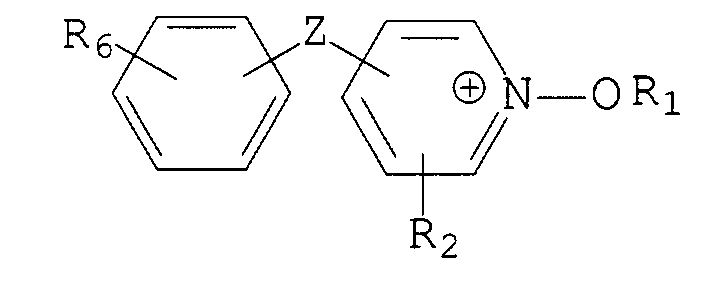
- In the scope of the invention, each of the above formulae can comprise one or more R2, R22 or R6 groups.
- Useful N-oxyazinium compounds can also be represented by the following formulawherein A+ is the N-oxyazinium moiety. The linking alkyl chain can have additional substituents, e.g., ether, ester, amide, etc.

- According to one embodiment, the N-oxyazinium compound is a compound having one of the following formulae:wherein R1 is an alkyl, an aryl or an acyl, R2 or R22 are independently a hydrogen atom, alkyl, aryl, heterocyclic, carboxylic, carboxylate, carbonamido, sulfonamido, nitryl, groups, -CO-R3 wherein R3 is an alkyl group or aryl group, or -(CH=CH)m-R4 group wherein R4 is an aryl or heterocyclic group ; X is an alkylene group, preferably -(CH2)n- wherein n is from 1 to 12.
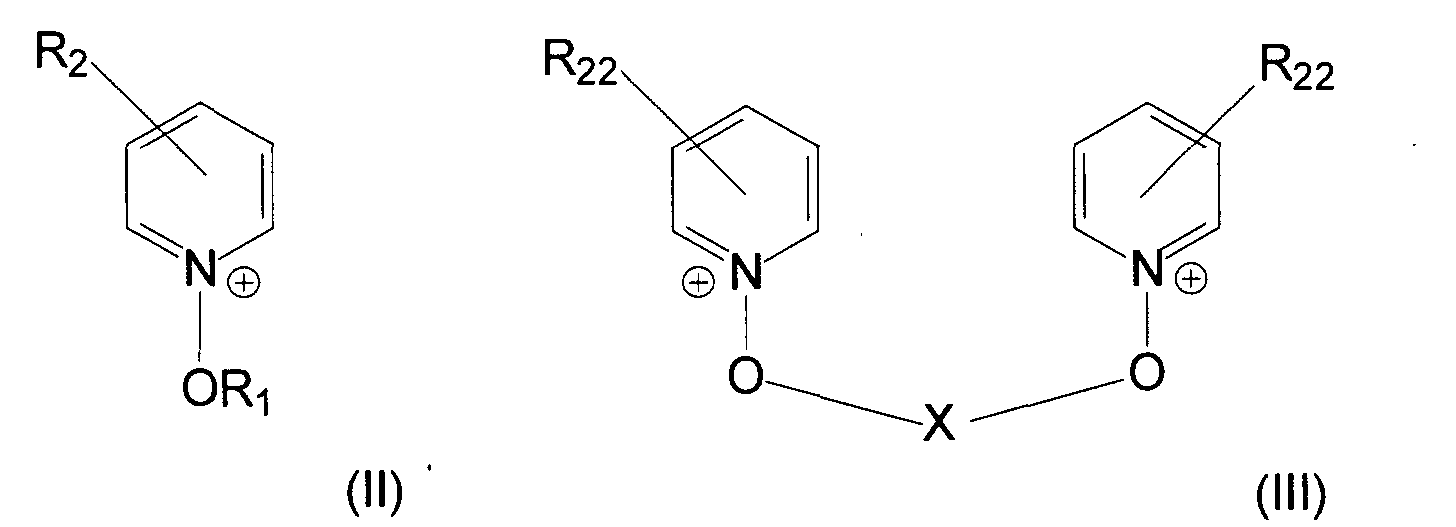
- According to a specific embodiment, R1 is preferably an alkyl having from 1 to 18 carbon atoms or an aryl group having from 6 to 18 carbon atoms.
- Illustrative examples of N-oxyazinium compounds useful in the present invention are one of the following compounds:


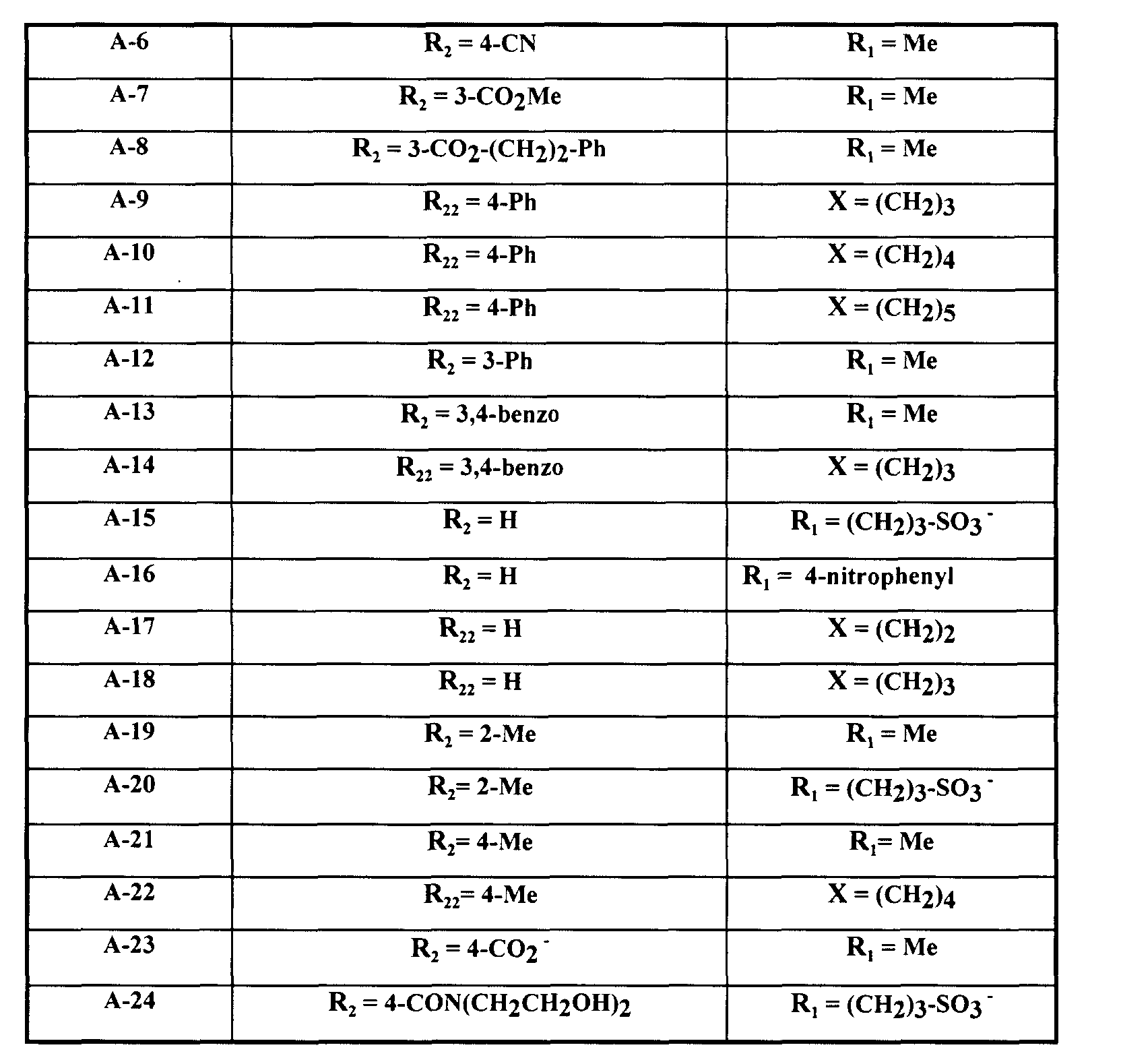
- According to a preferred embodiment, the N-oxyazinium compound has a reduction potential less negative than -1.4 V, and comprises an N-oxy group capable of releasing an oxy radical that reacts with the photobleachable dye to produce bleached compound. In this patent application, reduction potentials are reported as "V" which represents "volts versus a saturated calomel reference electrode". Reduction potentials of N-oxyazinium compounds can be measured by standard methods well known to those of skill in the art.
- The composition of the invention can contain one or more of any of the N-oxyazinium compounds disclosed therein.
- The N-oxyazinium compounds are associated with a counter ion that is not involved in the activity of the present composition and can be any of the conventional anions, e.g., halide, fluoroborate, hexafluorophosphate, toluene sulfonate, etc. It can also be an oligomeric or polymeric species.
- In the scope of the invention, the photobleachable dye is any dye that by reaction with an N-oxyazinium compound gives a bleached compound. According to the invention, a bleached compound is a colorless compound or a compound less colored than the dye.
- The photobleachable composition is substantially free of polymerizable monomer, for example polymerizable monomer preferably is present in an amount less than 10% of the photobleachable composition, more preferable less than 5% and most preferably less than 1%.
- The photobleachable dyes useful in the invention can be for example, cyanine dyes, complex cyanine dyes, merocyanine dyes, complex merocyanine dyes, homopolar cyanine dyes, styryl dyes, oxonol dyes, hemioxonol dyes, and hemicyanine dyes, squarilium dyes, coumarin dyes, rhodamine dyes, acridine dyes, oxanol dyes etc. Representative bleachable dyes are discussed in Research Disclosure, Item 36544, September 1996. These dyes may be synthesized by those skilled in the art according to the procedures described herein or F. M. Hamer, The Cyanine Dyes and Related Compounds (Interscience Publishers, New York, 1964).
- Photobleachable cyanine or merocyanine dyes can be represented by the general formulae Dl - D5 below:wherein:

- E1 and E2 represent the atoms necessary to form a substituted or unsubstituted hetero ring and may be the same or different,
- each J independently represents a methine group,
- q is a positive integer of from 1 to 4,
- p and r each independently represents 0 or 1,
- D1 and D2 each independently represents alkyl or aryl groups, and
- W2 is a counterion as necessary to balance the charge;
wherein E1, D1, J, p, q and W2 are as defined above for formula D1 and G represents
 wherein E4 represents the atoms necessary to complete a substituted or unsubstituted heterocyclic nucleus, and F and F' each independently represents a cyano group, an ester group, an acyl group, a carbamoyl group or an alkylsulfonyl group;
 wherein D1, E1, J, p, q and W2 are as defined above for formula D1, and G2 represents an amino group or a substituted or unsubstituted aryl group;
 wherein D1, E1, D2, E1, J, p, q, r and W2 are as defined for formula D1 above, and E3 is defined the same as E4 for formula D2 above;
 wherein D1, E1, J, G, p, q, r, W2 and E3 are as defined above.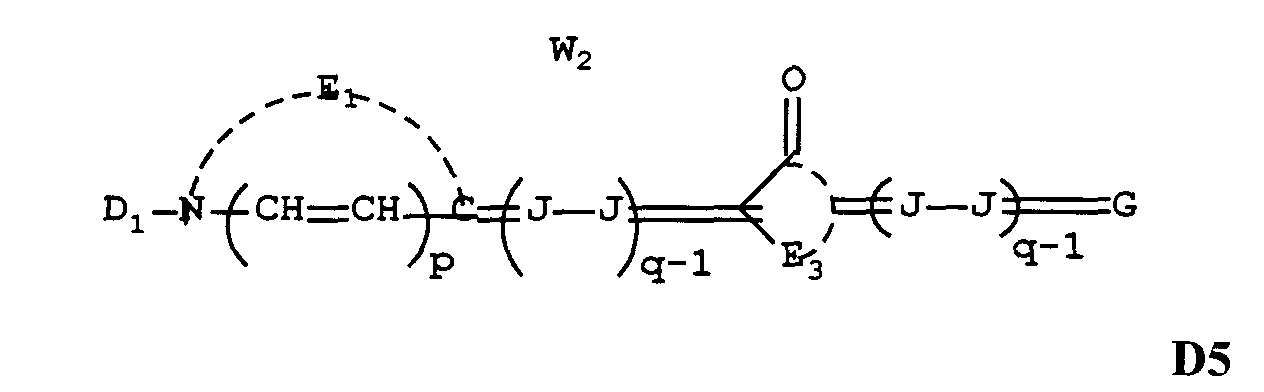
-
- In the above formulas, E1 and E2 each independently represents the atoms necessary to complete a substituted or unsubstituted 5- or 6-membered heterocyclic nucleus. These include a substituted or unsubstituted: thiazole nucleus, oxazole nucleus, selenazole nucleus, quinoline nucleus, tellurazole nucleus, pyridine nucleus, thiazoline nucleus, indoline nucleus, oxadiazole nucleus, thiadiazole nucleus, or imidazole nucleus. This nucleus may be substituted with known substituents, such as halogen (e.g., chloro, fluoro, bromo), alkoxy (e.g., methoxy, ethoxy), substituted or unsubstituted alkyl (e.g., methyl, trifluoromethyl), substituted or unsubstituted aryl, substituted or unsubstituted aralkyl, sulfonate, and others known in the art.
- In one embodiment of the invention, when dyes according to formula D1 are used E1 and E2 each independently represent the atoms necessary to complete a substituted or unsubstituted thiazole nucleus, a substituted or unsubstituted selenazole nucleus, a substituted or unsubstituted imidazole nucleus, or a substituted or unsubstituted oxazole nucleus.
- Examples of useful nuclei for E1 and E2 include: a thiazole nucleus, e.g., thiazole, 4-methylthiazole, 4-phenylthiazole, 5-methylthiazole, 5-phenylthiazole, 4,5-dimethyl-thiazole, 4,5-diphenylthiazole, 4-(2-thienyl)thiazole, benzothiazole, 4-chlorobenzothiazole, 5-chlorobenzothiazole, 6-chlorobenzothiazole, 7-chlorobenzothiazole, 4-methylbenzothiazole, 5-methylbenzothiazole, 6-methylbenzothiazole, 5-bromobenzothiazole, 6-bromobenzothiazole, 5-phenylbenzothiazole, 6-phenylbenzothiazole, 4-methoxybenzothiazole, 5-methoxybenzothiazole, 6-methoxybenzothiazole, 4-ethoxybenzothiazole, 5-ethoxybenzothiazole, tetrahydrobenzothiazole, 5,6-dimethoxybenzothiazole, 5,6-dioxymethylbenzothiazole, 5-hydroxybenzothiazole, 6-5-dihydroxybenzothiazole, naphtho[2,1-d]thiazole, 5-ethoxynaphtho[2,3-d]thiazole, 8-methoxynaphtho[2,3-d]thiazole, 7-methoxynaphtho[2,3-d]thiazole, 4'-methoxythianaphtheno-7', 6'-4,5-thiazole, etc.; an oxazole nucleus, e.g., 4-methyloxazole, 5-methyloxazole, 4-phenyloxazole, 4,5-diphenyloxazole, 4-ethyloxazole, 4,5-dimethyloxazole, 5-phenyloxazole, benzoxazole, 5-chlorobenzoxazole, 5-methylbenzoxazole, 5-phenylbenzoxazole, 6-methylbenzoxazole,, 5,6-dimethylbenzoxazole, 4,6-dimethylbenzoxazole, 5-ethoxybenzoxazole, 5-chlorobenzoxazole, 6-methoxybenzoxazole, 5-hydroxybenzoxazole, 6-hydroxybenzoxazole,, naphtho[2,1-d]oxazole, naphtho[1,2-d]oxazole, etc.; a selenazole nucleus, e.g., 4-methylselenazole, 4-phenylselenazole, benzoselenazole, 5-chlorobenzoselenazole, 5-methoxybenzoselenazole, 5-hydroxybenzoselenazole, tetrahydrobenzoselenazole, naphtho[2,1-d]selenazole, naphtho[1,2-d]selenazole, etc.; a pyridine nucleus, e.g., 2-pyridine, 5-methyl-2-pyridine, 4-pyridine, 3-methyl-4-pyridine, 3-methyl-4-pyridine, etc.; a quinoline nucleus, e.g., 2-quinoline, 3-methyl-2-quinoline, 5-ethyl-2-quinoline, 6-chloro-2-quinoline, 8-chloro-2-quinoline, 6-methoxy-2-quinoline, 8-ethoxy-2-quinoline, 8-hydroxy-2-quinoline, 4-quinoline, 6-methoxy-4-quinoline, 7-methyl-4-quinoline, 8-chloro-4-quinoline, etc.; a tellurazole nucleus, e.g., benzotellurazole, naphtho[1.2-d]benzotellurazole, 5,6-dimethoxybenzotellurazole, 5-methoxybenzotellurazole, 5-methylbenzotellurazole; a thiazoline nucleus, e.g.,thiazoline, 4-methylthiazoline, etc.; a benzimidazole nucleus, e.g., benzimidazole, 5-trifluoromethylbenzimidazole, 5,6-dichlorobenzimidazole; and indole nucleus, 3,3-dimethylindole, 3,3-diethylindole, 3,3,5-trimethylindole; or a diazole nucleus, e.g., 5-phenyl-1,3,4-oxadiazole, 5-methyl-1,3,4-thiadiazole.
- F and F' are each a cyano group, an ester group such as ethoxy carbonyl, methoxycarbonyl, etc., an acyl group, a carbamoyl group, or an alkylsulfonyl group such as ethylsulfonyl, methylsulfonyl, etc. Examples of useful nuclei for E4 include a 2-thio-2,4-oxazolidinedione nucleus (i.e., those of the 2-thio-2,4-(3H,5H)-oxaazolidinone series) (e.g., 3-ethyl-2-thio-2,4 oxazolidinedione, 3-(2-sulfoethyl)-2-thio-2,4 oxazolidinedione, 3-(4-sulfobutyl)-2-thio-2,4 oxazolidinedione, 3-(3-carboxypropyl)-2-thio-2,4 oxazolidinedione, etc.; a thianaphthenone nucleus (e.g., 2-(2H)-thianaphthenone, etc.), a 2-thio-2,5-thiazolidinedione nucleus (i.e., the 2-thio-2,5-(3H,4H)-thiazoledeione series) (e.g., 3-ethyl-2-thio-2,5-thiazolidinedione, etc.); a 2,4-thiazolidinedione nucleus (e.g., 2,4-thiazolidinedione, 3-ethyl-2,4-thiazolidinedione, 3-phenyl-2,4-thiazolidinedione, 3-a-naphthyl-2,4-thiazolidinedione, etc.); a thiazolidinone nucleus (e.g., 4-thiazolidinone, 3-ethyl-4-thiazolidinone, 3-phenyl-4-thiazolidinone, 3-a-naphthyl-4-thiazolidinone, etc.); a 2-thiazolin-4-one series (e.g., 2-ethylmercapto-2-thiazolin-4-one, 2-alkylphenyamino-2-thiazolin-4-one, 2-diphenylamino-2-thiazolin-4-one, etc.) a 2-imino-4-oxazolidinone (i.e., pseudohydantoin) series (e.g., 2,4-imidazolidinedione (hydantoin) series (e.g., 2,4-imidazolidinedione, 3-ethyl-2,4-imidazolidinedione, 3-phenyl-2,4-imidazolidinedione, 3-a-naphthyl-2,4-imidazolidinedione, 1,3-diethyl-2,4-imidazolidinedione, 1-ethyl-3-phenyl-2,4-imidazolidinedione, 1-ethyl-2-a-naphthyl-2,4-imidazolidinedione, 1,3-diphenyl-2,4-imidazolidinedione, etc.); a 2-thio-2,4-imidazolidinedione (i.e., 2-thiohydantoin) nucleus (e.g., 2-thio-2,4-imidazolidinedione, 3-ethyl-2-thio-2,4-imidazolidinedione, 3-(2-carboxyethyl)-2-thio-2,4-imidazolidinedione, 3-phenyl-2-thio-2,4-imidazolidinedione, 1,3-diethyl-2-thio-2,4-imidazolidinedione, 1-ethyl-3-phenyl-2-thio-2,4-imidazolidinedione, 1-ethyl-3-naphthyl-2-thio-2,4-imidazolidinedione, 1,3-diphenyl-2-thio-2,4-imidazolidinedione, etc.); a 2-imidazolin-5-one nucleus.
- G2 represents an amino group (e.g., primary amino, anilino), or an aryl group (e.g., phenyl, naphthyl, dialkylaminophenyl, tolyl, chlorophenyl, nitrophenyl).
- According to the formulas D1 - D5, each J represents a methine group. Examples of substituents for the methine groups include alkyl (preferably of from 1 to 6 carbon atoms, e.g., methyl, ethyl, etc.) and aryl (e.g., phenyl). Additionally, substituents on the methine groups may form bridged linkages.
- W2 represents a counterion as necessary to balance the charge of the sensitizing dye. Such counterions include cations and anions for example sodium, potassium, triethylammonium, tetramethylguanidinium, diisopropylammonium and tetrabutylammonium, chloride, bromide, iodide, paratoluene sulfonate and the like.
- D1 and D2 are each independently aryl groups (preferably of 6 to 15 carbon atoms), or more preferably, alkyl groups (preferably of from 1 to 6 carbon atoms). Examples of aryl include phenyl, tolyl, p-chlorophenyl, and p-methoxyphenyl. Examples of alkyl include methyl, ethyl, propyl, isopropyl, butyl, hexyl, cyclohexyl, decyl, dodecyl, etc., and substituted alkyl groups (preferably a substituted lower alkyl containing from 1 to 6 carbon atoms), such as a hydroxyalkyl group, e.g., 2-hydroxyethyl, 4-hydroxybutyl, etc., a carboxyalkyl group, e.g., 2-carboxyethyl, 4-carboxybutyl, etc., a sulfoalkyl group, e.g., 2-sulfoethyl, 3-sulfobutyl, 4-sulfobutyl, etc., a sulfatoalkyl group, etc., an acyloxyalkyl group, e.g., 2-acetoxyethyl, 3-acetoxypropyl, 4-butyroxybutyl, etc., an alkoxycarbonlyalkyl group, e.g., 2-methoxycarbonlyethyl, 4-ethoxycarbonylbutyl, etc.,or an aralkyl group, e.g., benzyl, phenethyl, etc.
- According to a different embodiment, the photobleachable dye useful in the composition of the invention is an oxonol dye. Oxonol dyes can be a methine oxonol dye having the following formula:wherein n is 0, 1, or 2; R1, R2, R3, and R4 are the same or different alkyl or aryl groups, one or more of R1, R2, R3, and R4 contains carboxy substituent -CO2 Z, wherein Z+ is a statistical mixture of hydrogen (H+) and alkali or tetraalkylammonium cations (M+) such that Z+ =xH+ +(1-x)M+, where x is a decimal ranging from about 0.33 to about 0.95. These dyes have been disclosed in details in US 5,274,109.
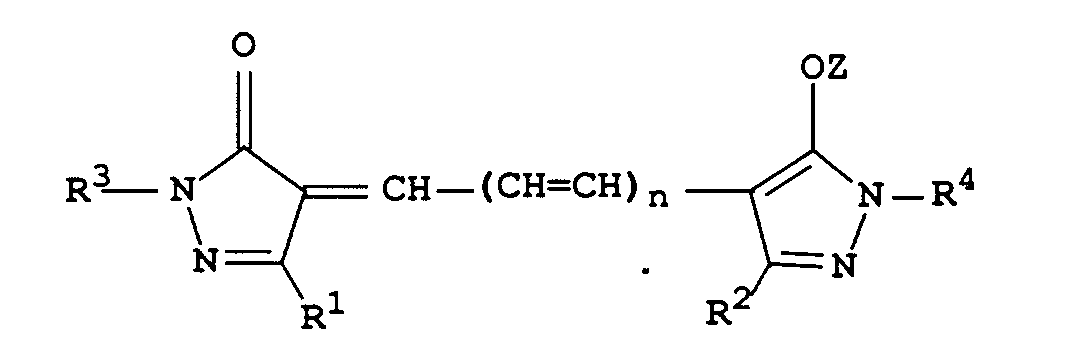
- Other oxonols useful in the present invention can be any oxonol dyes disclosed in US 4,877,721, US 5,674,669, EP 740,200, EP 549,486, EP 246,553.
- The photobleachable dyes can also be a photographic filter dye of the structurewherein A represents a nucleus having a carboxyphenyl or sulfonamidophenyl substituent selected from the group consisting of 2-pryazolin-5-ones free of any substituent bonded thereto through a carboxyl group, rhodanines, hydantoins, 2-thiohydantoins, 4-thiohydantoins, 2,4-oxazolidindiones, 2-thio-2,4-oxazolidindiones, isoxazolinones, barbiturics, 2-thiobarbiturics, and indandiones, R represent hydrogen, substituted or unsubstituted alkyl of 1 to 4 carbon atoms, or benzyl, R1 and R2 each independently represents substituted or unsubstituted alkyl or aryl, or taken together with R5, R6, N and the carbon atoms to which they are attached, represent the atoms needed to complete a julolydyl ring, R3 represents H, or substituted or unsubstituted alkyl or aryl, R5 and R6 each independently represents H, or R5 taken together with R1, or R6 taken together with R2, represent the atoms necessary to complete a carbocyclic ring such as tetrahydroquinoyl, and m is 0 or 1. These filter dyes have been disclosed in US 4,857,446.

- Bleachable dyes can be azomethine dyes as disclosed in US 5,177,052, or US 5,871,890.
- The photobleachable dyes useful in the composition of the present invention can also be is squarilium dyes. The squarilium can have the following formula:wherein: R1, R2, R3 and R4 each independently represents hydrogen, hydroxy, halogen, cyano, alkoxy, aryloxy, acyloxy, aryloxycarbonyl, alkoxycarbonyl, sulfonyl, carbamoyl, acyl, acylamido, alkylamino, arylamino or a substituted or unsubstituted alkyl, aryl or hetaryl group; or any of said R1, R2, R3 or R4 groups may be combined with R5, R6, R7 or R8 or with each other to form a 5 to 7-membered substituted or unsubstituted carbocyclic or heterocyclic ring; R5, R6, R7 and Rg each independently represents hydrogen, a substituted or unsubstituted alkyl or cycloalkyl group having from 1 to about 6 carbon atoms or an aryl or hetaryl group having from about 5 to about 10 atoms; or R5 and R6 or R7 and R8 may be joined together to form a 5 to 7-membered substituted or unsubstituted nitrogen-containing heterocyclic ring; and n and m are each independently 1 to 4. These dyes have been disclosed in details in US 4,942,141.
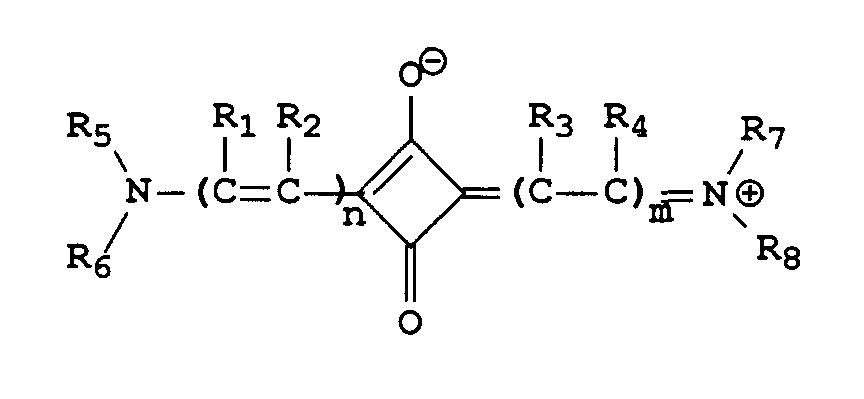
- Examples of bleachable dyes useful in the invention are:


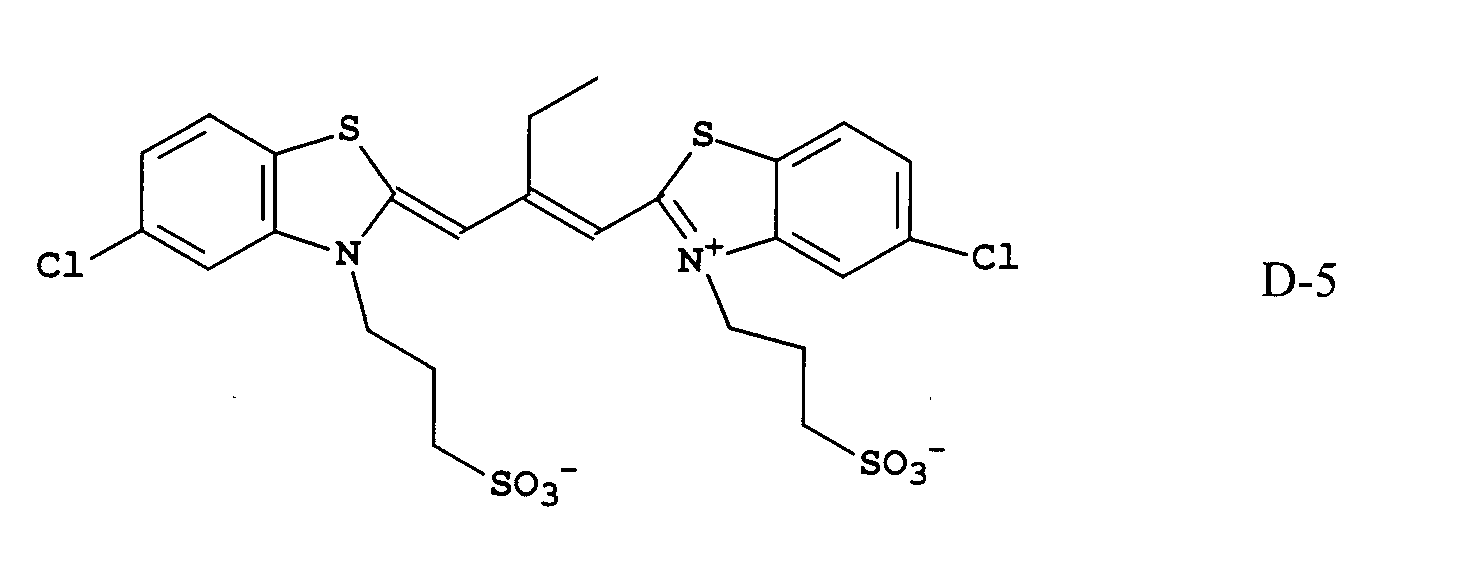
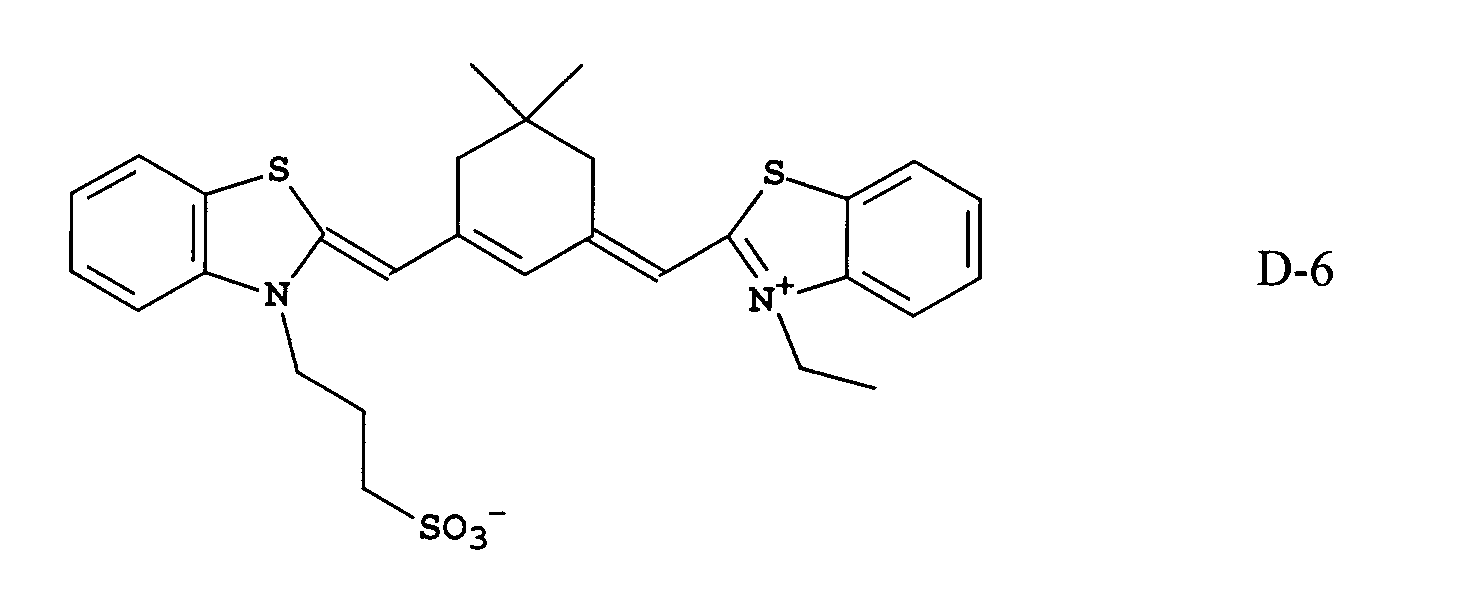
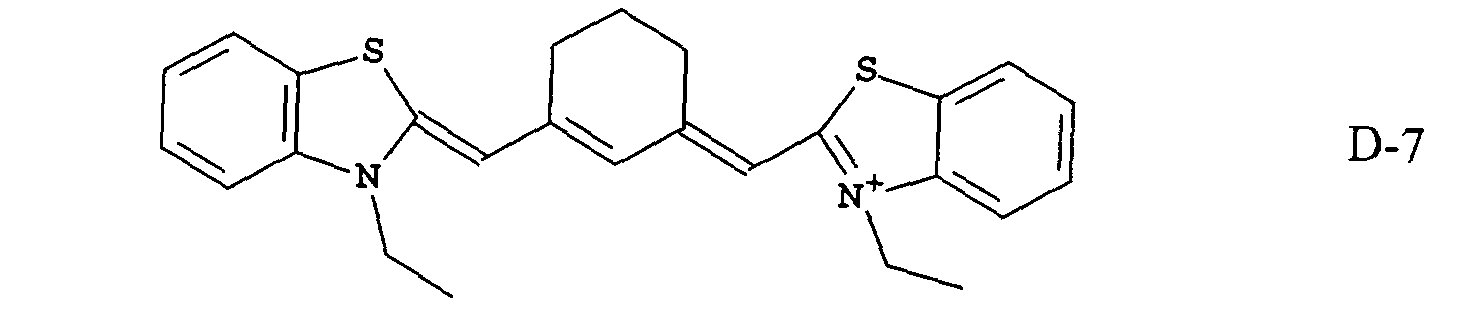
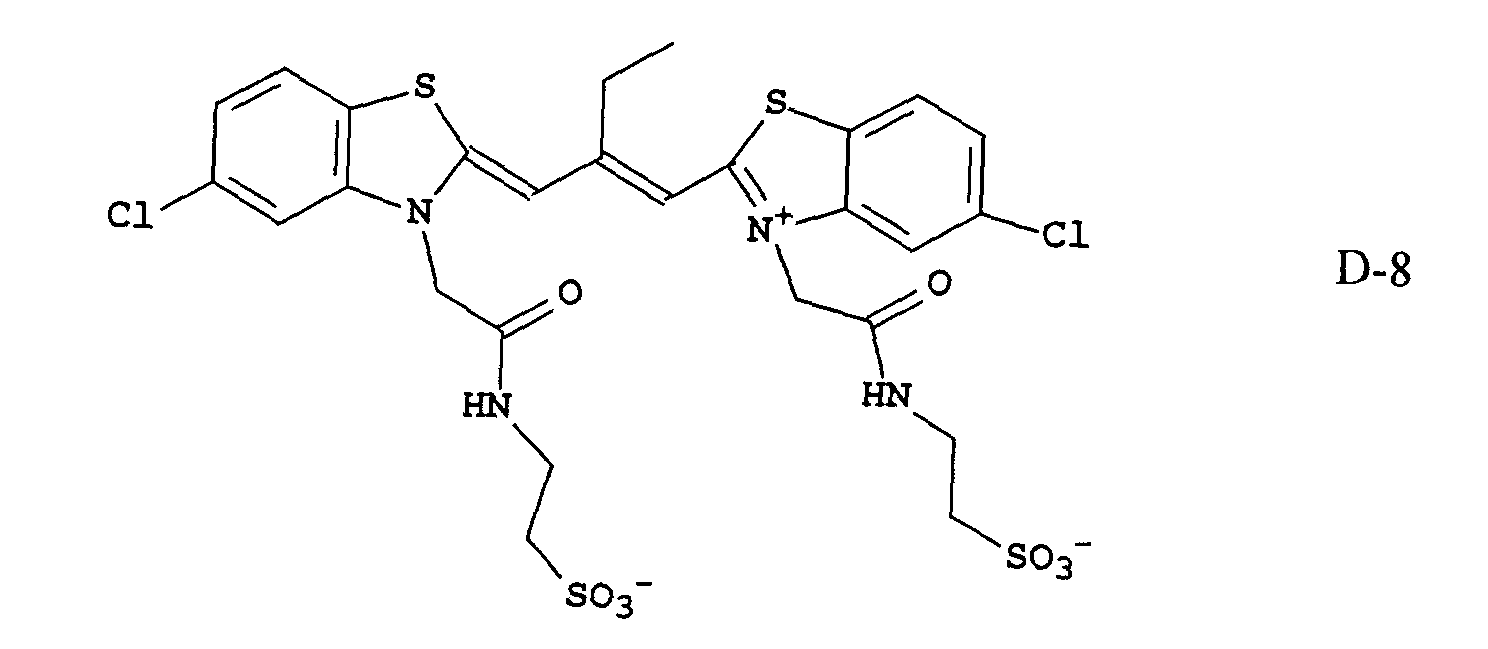
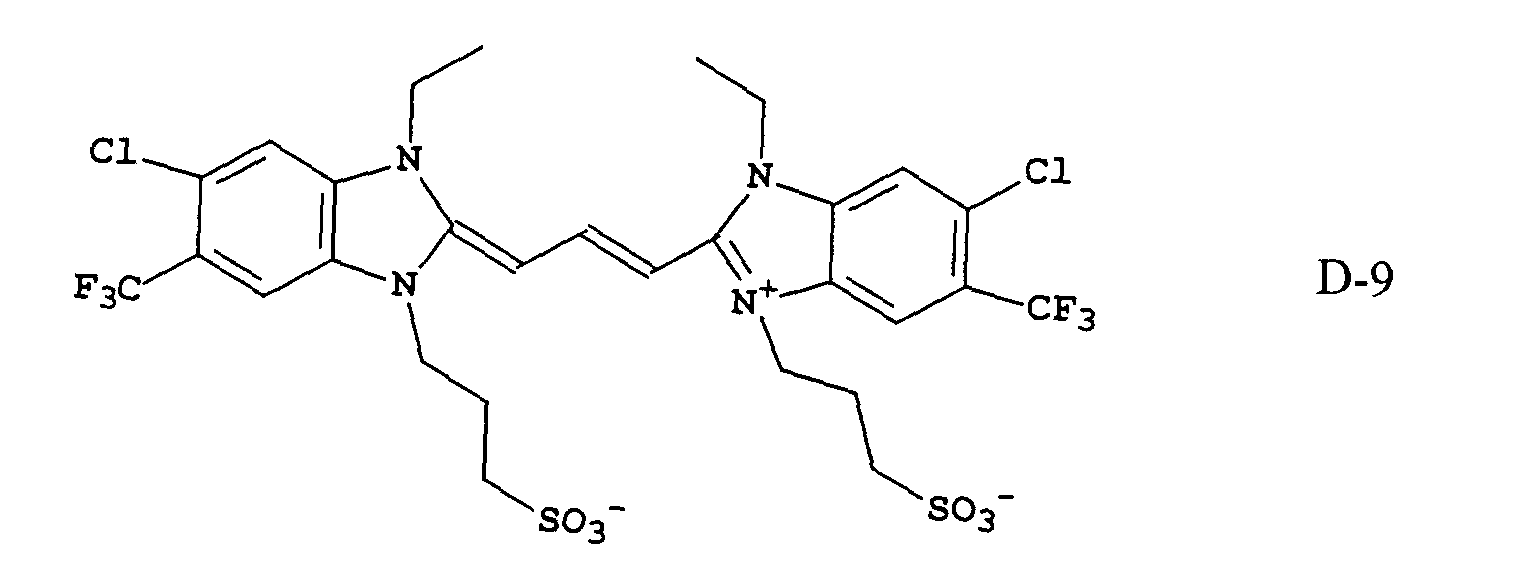
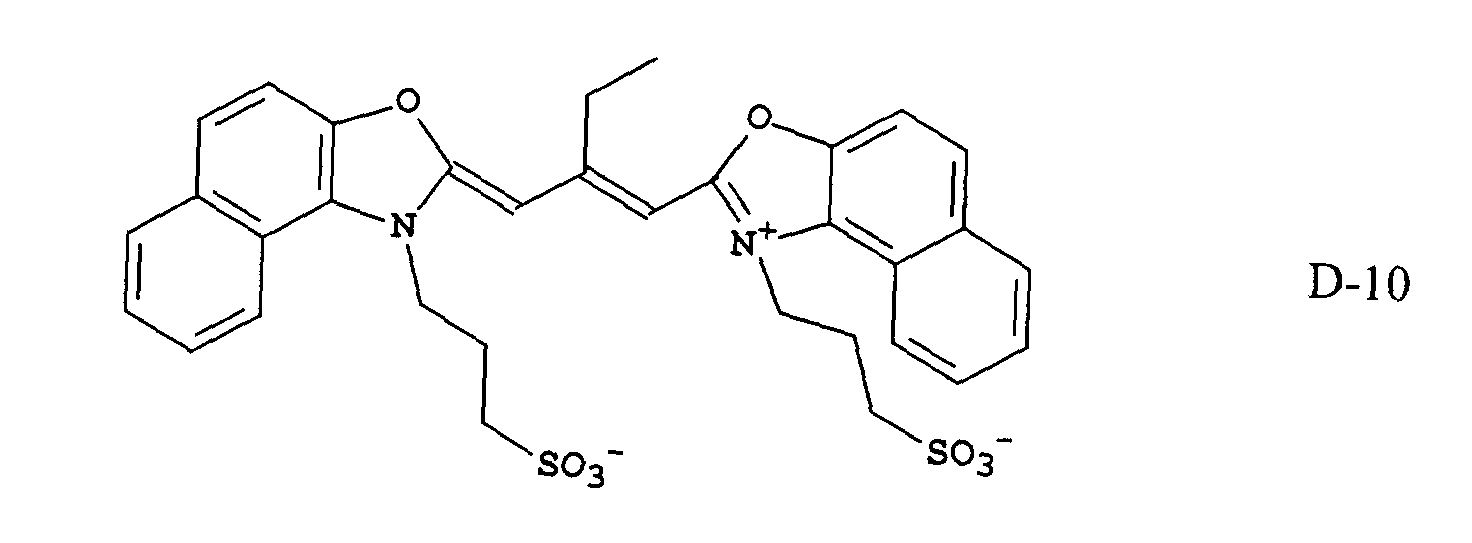


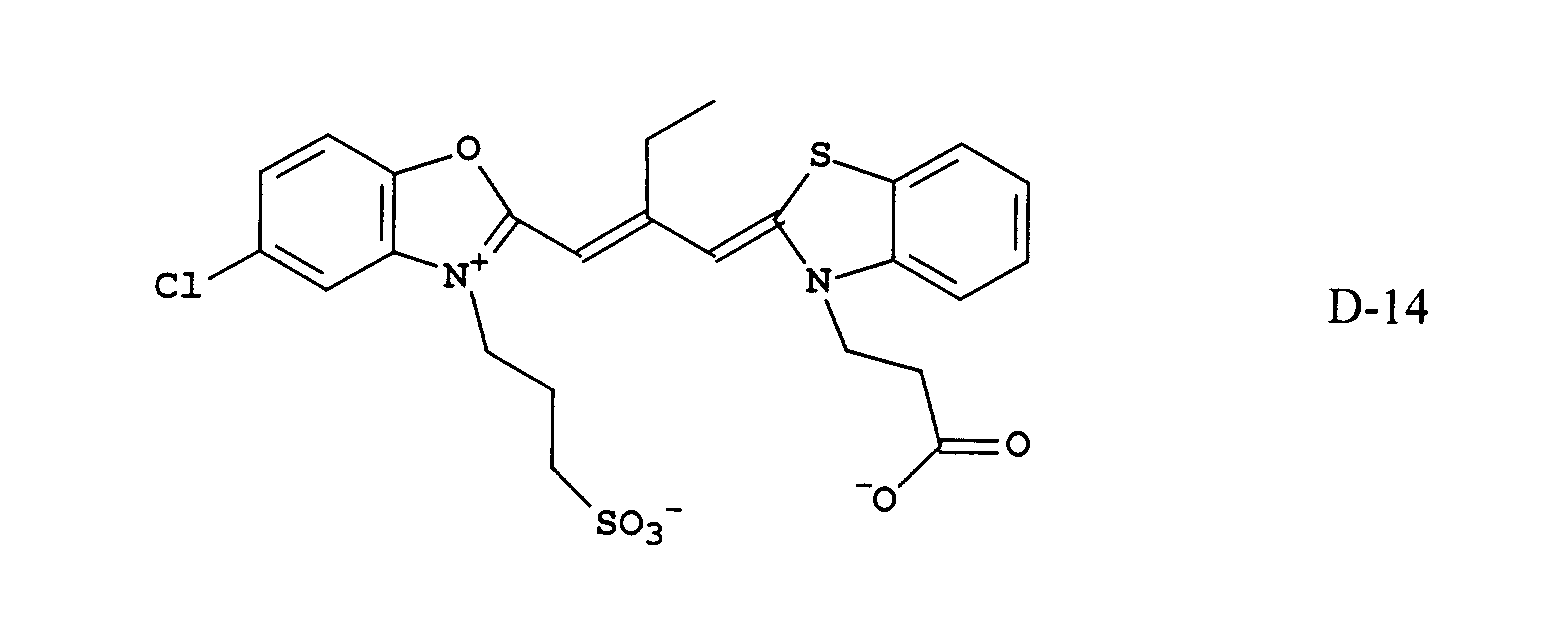


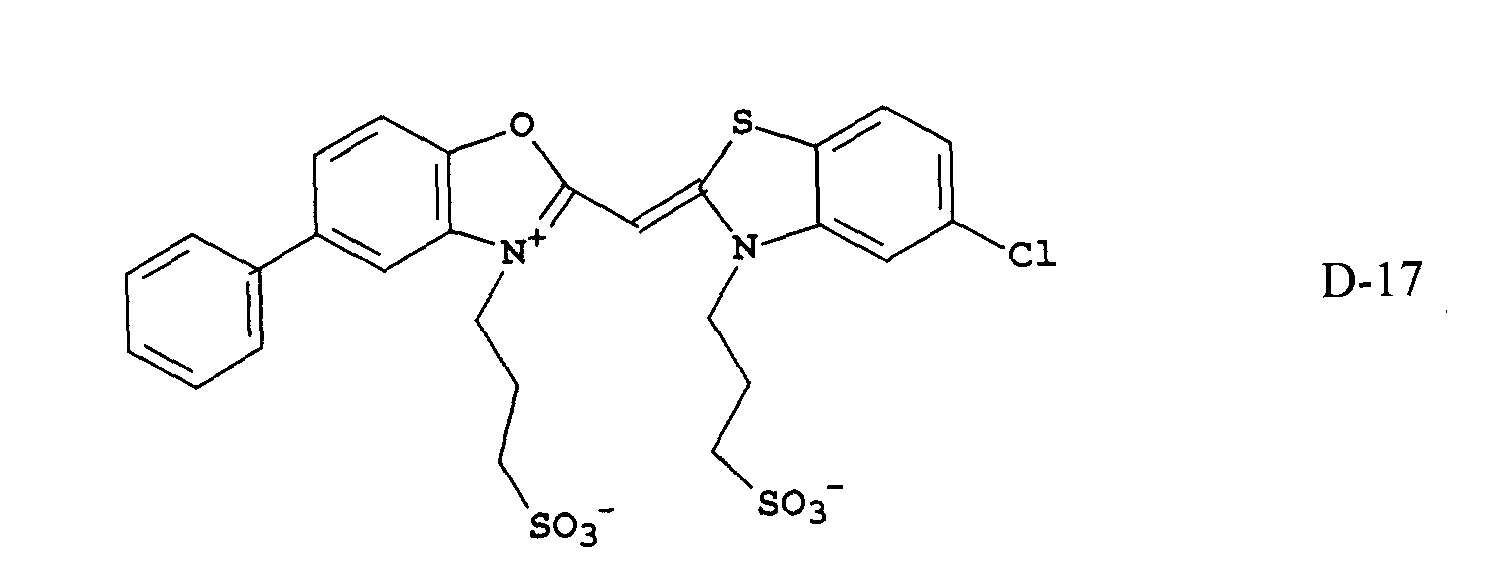
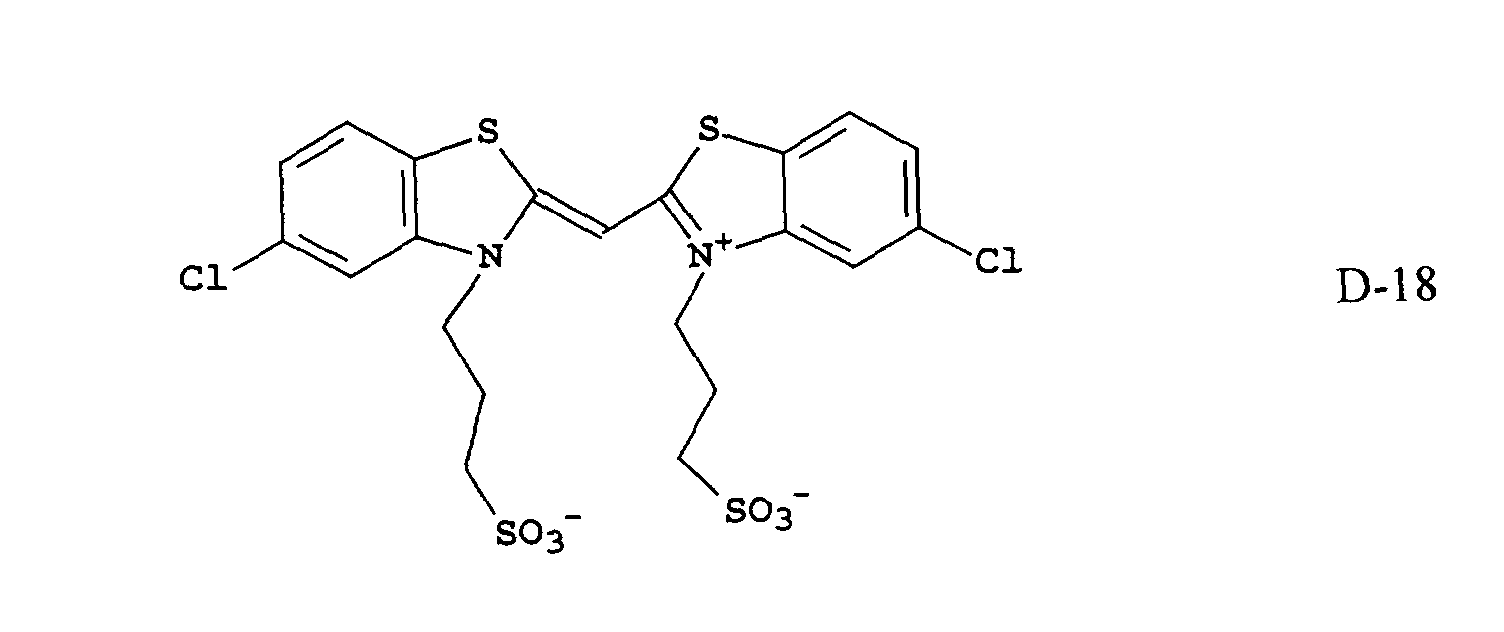


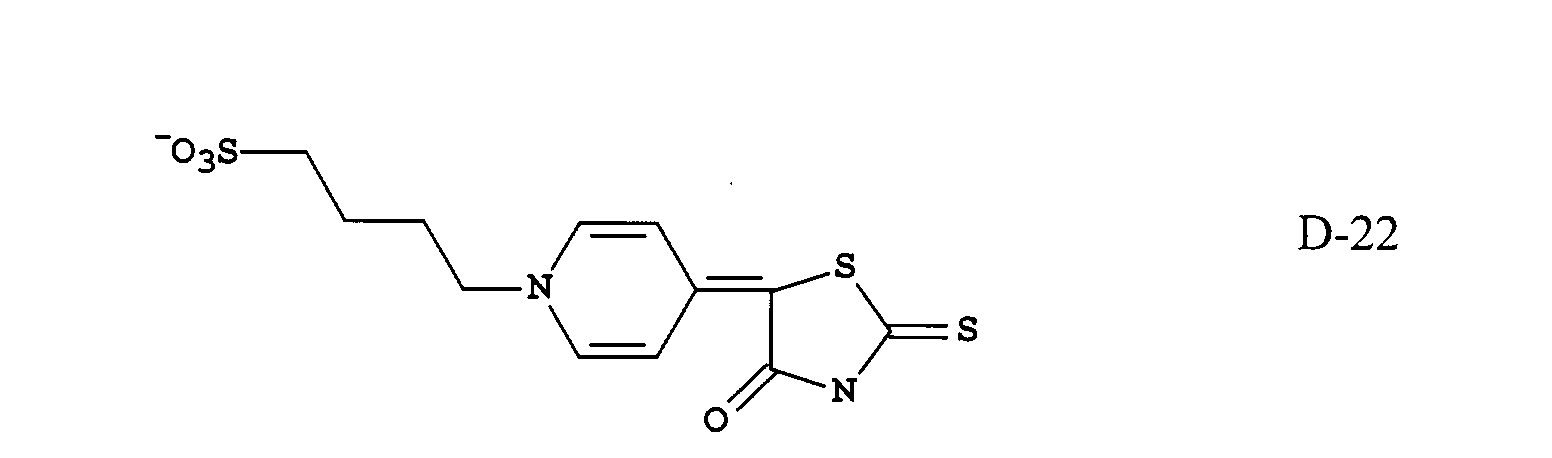

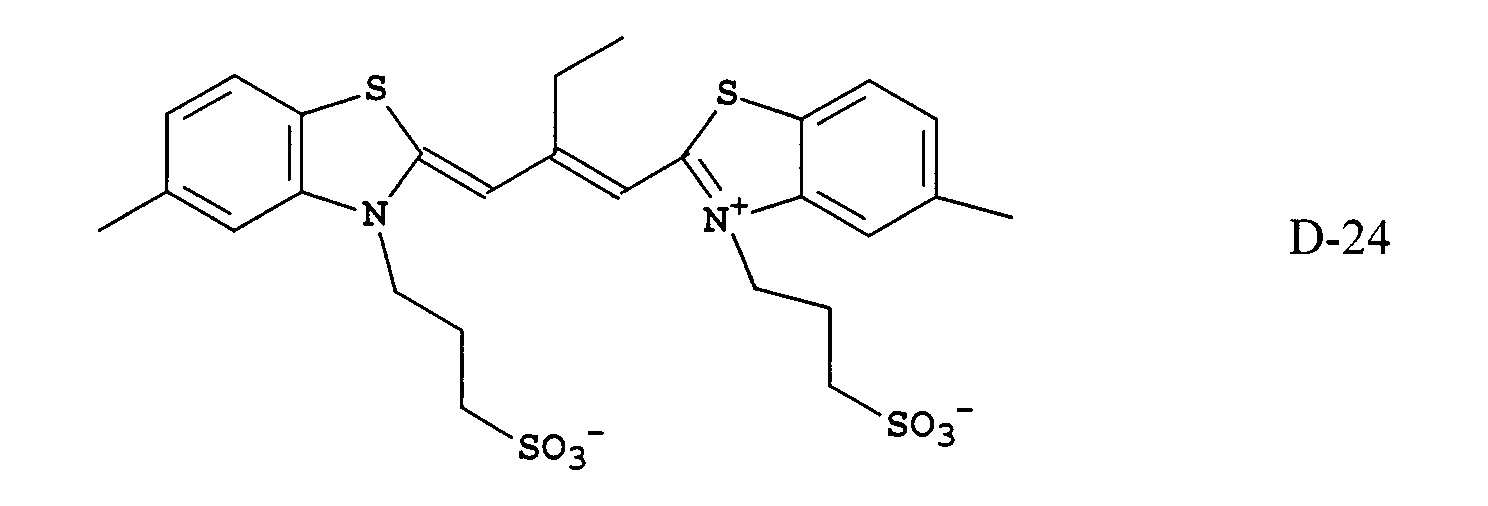
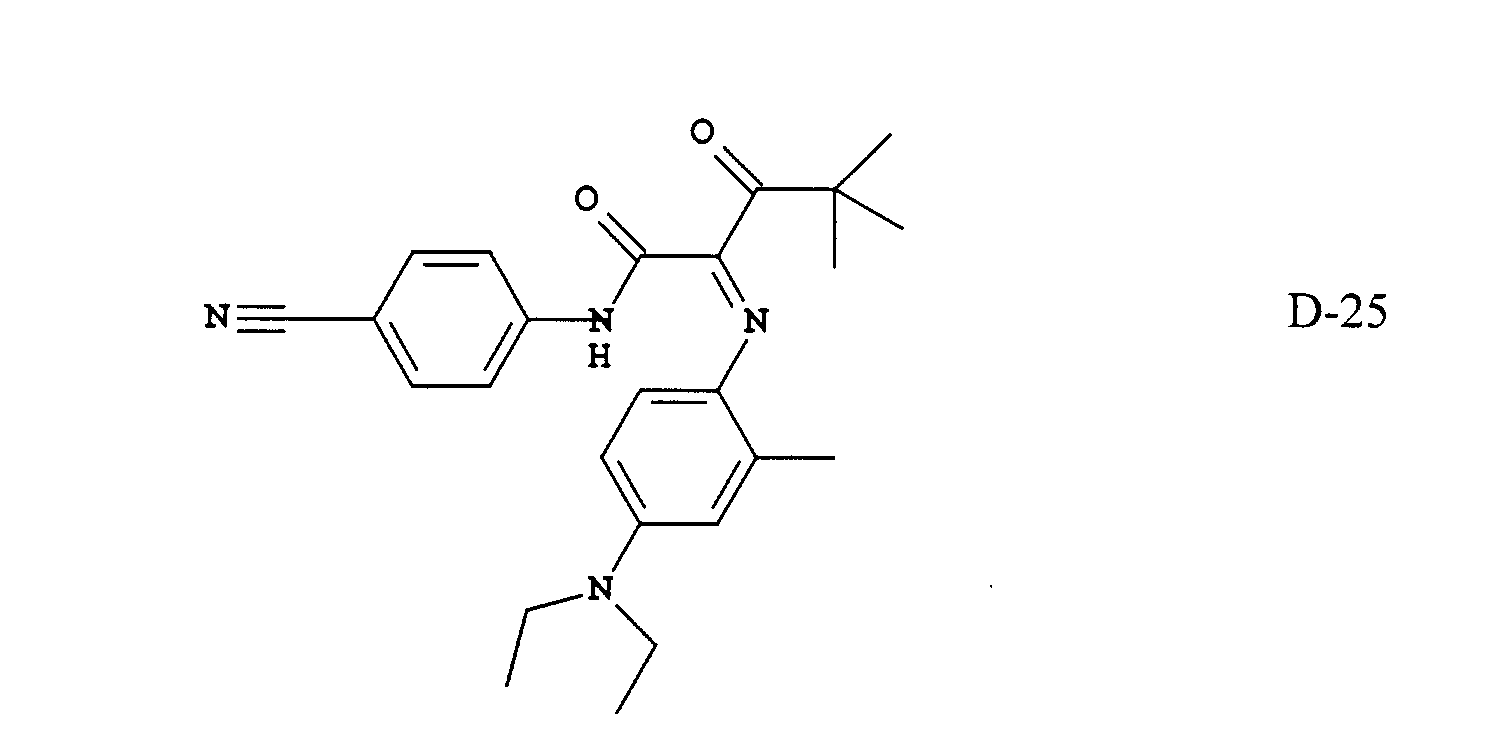


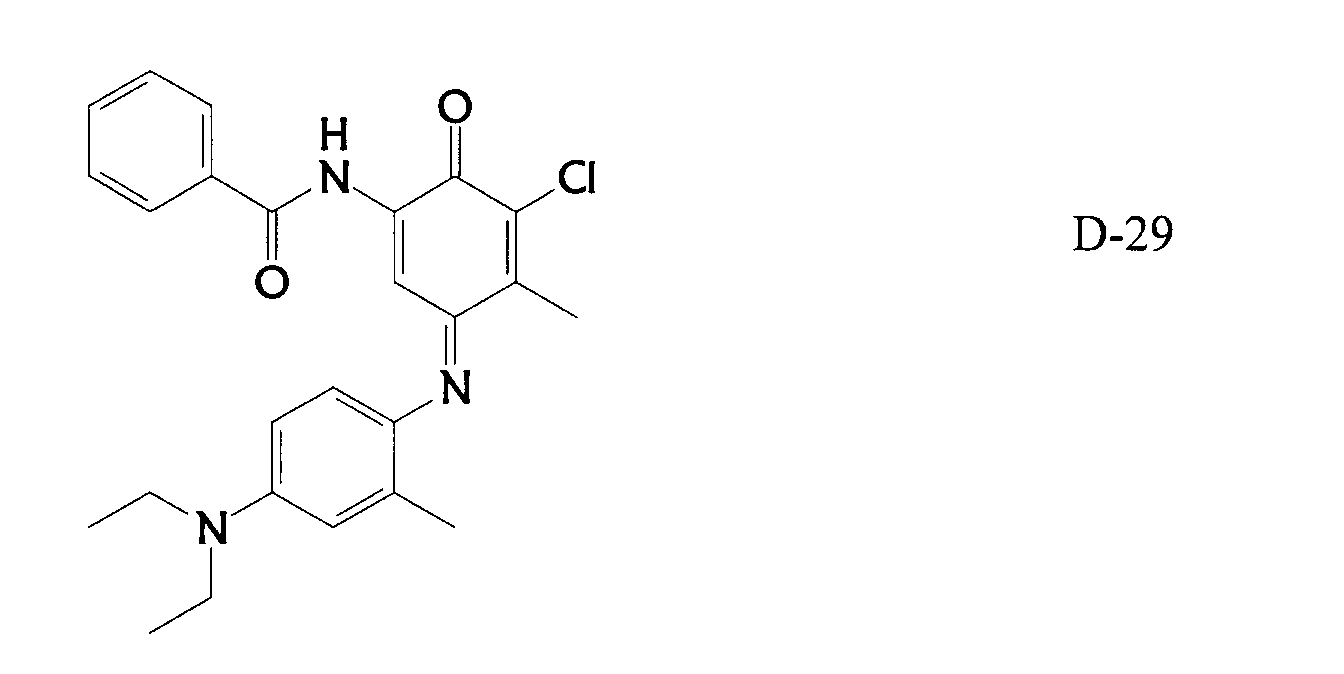
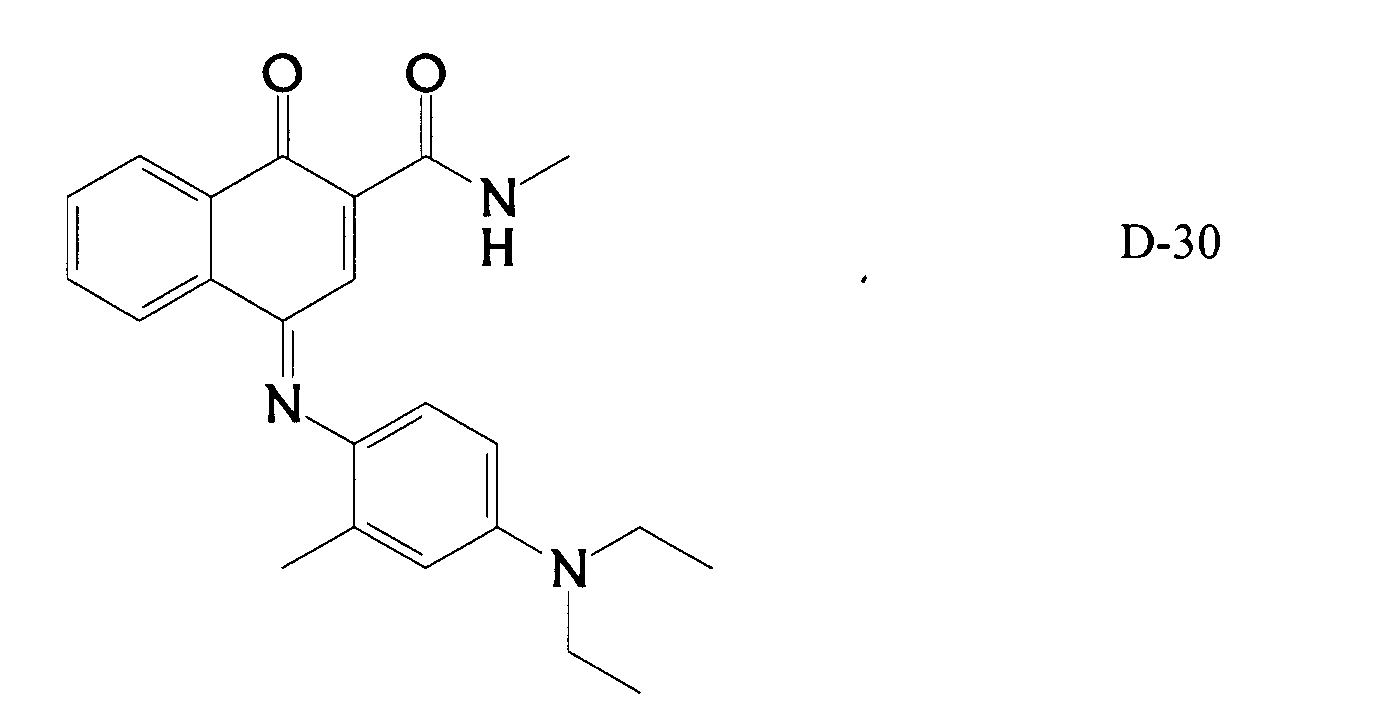


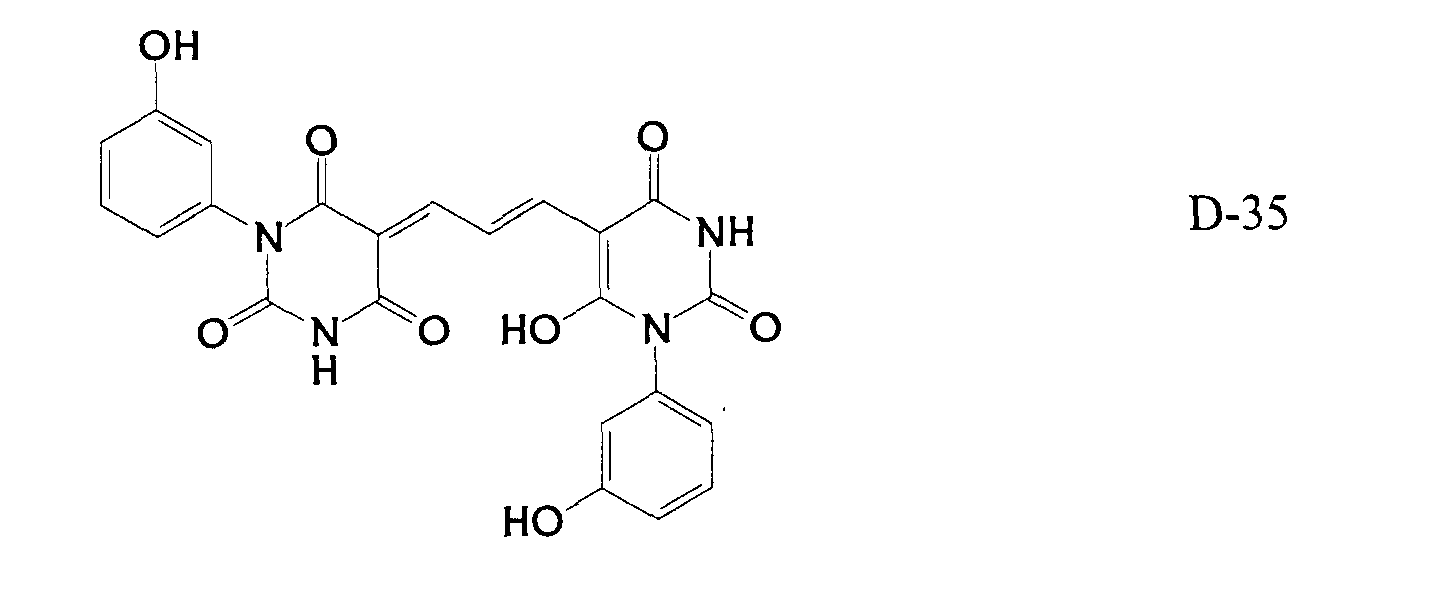


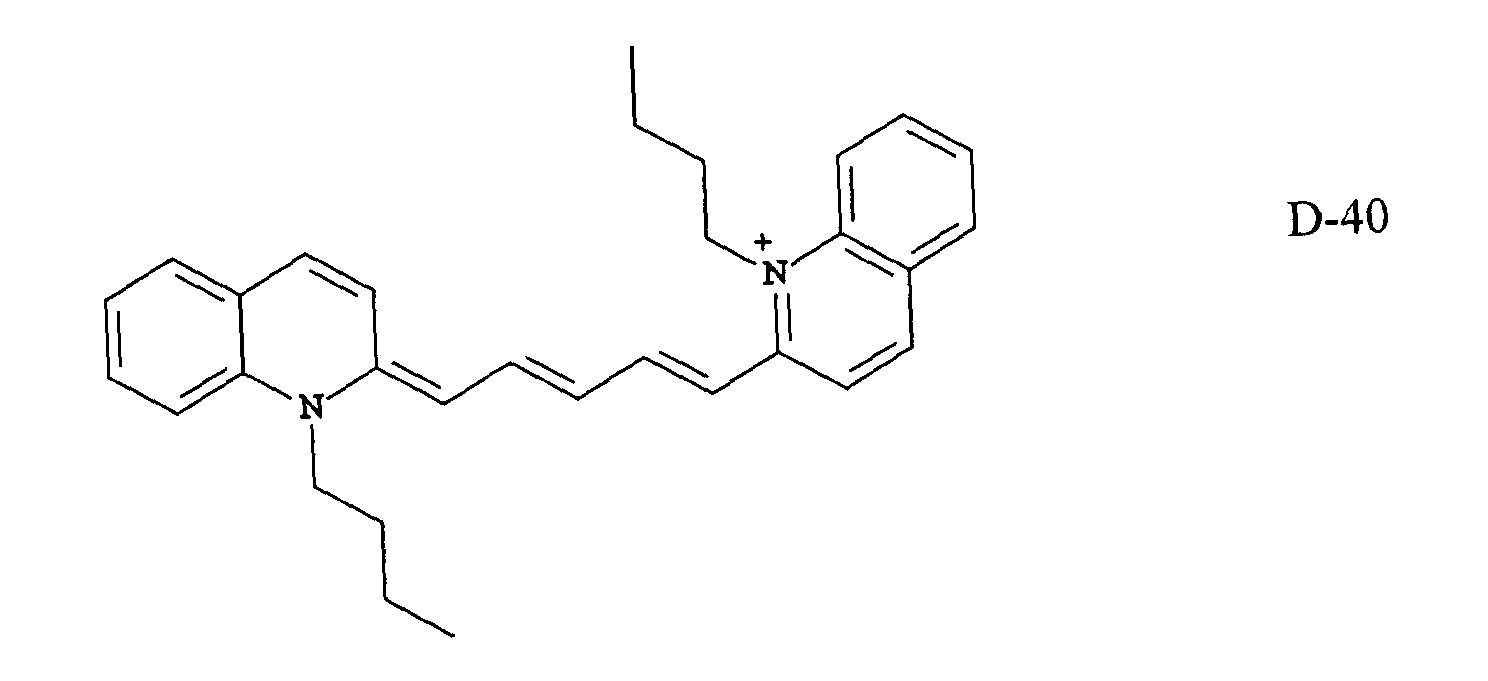


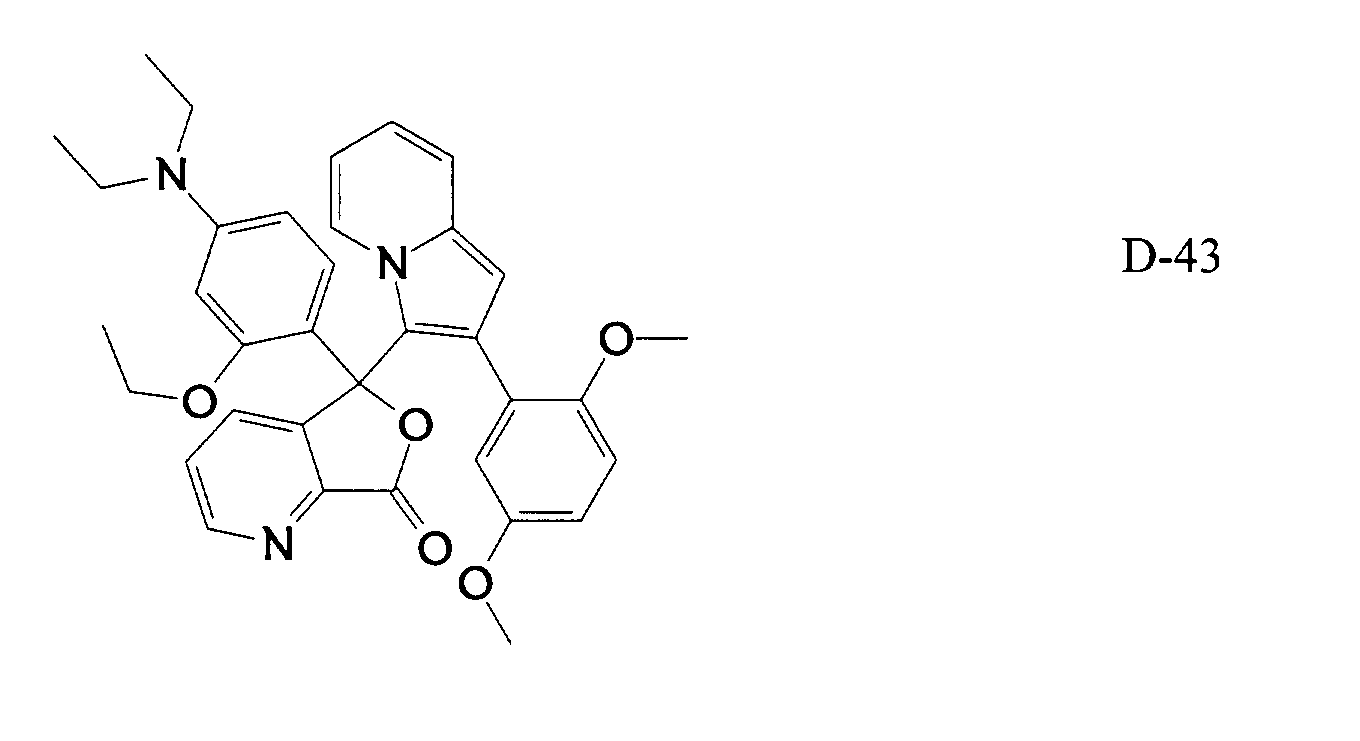


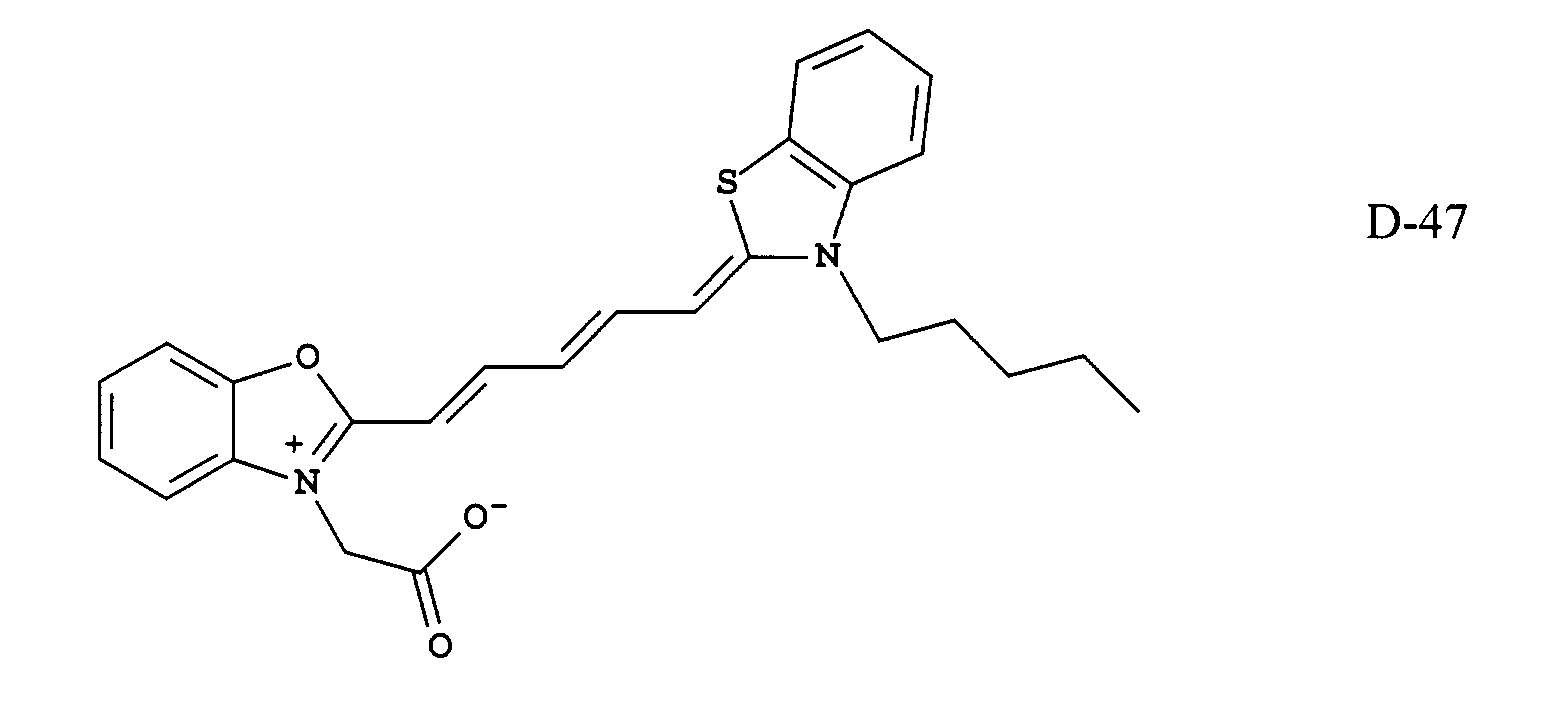
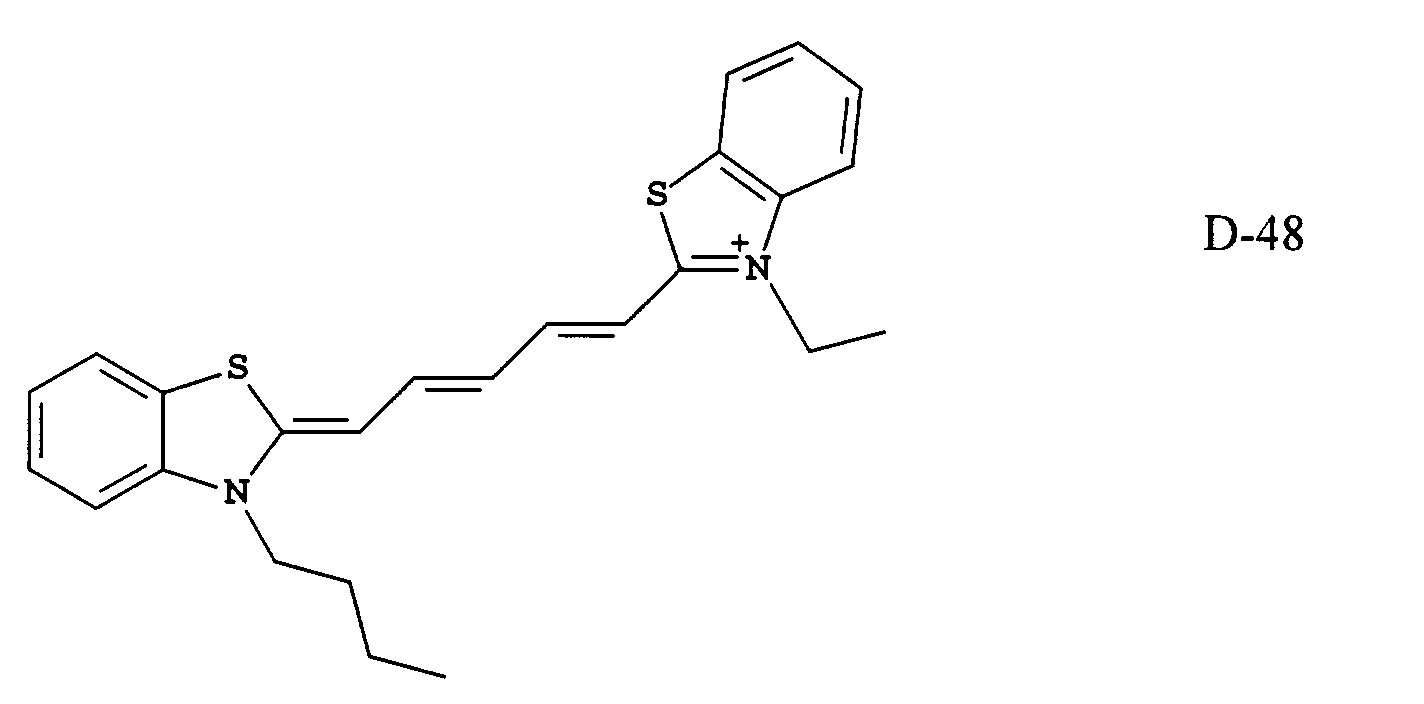


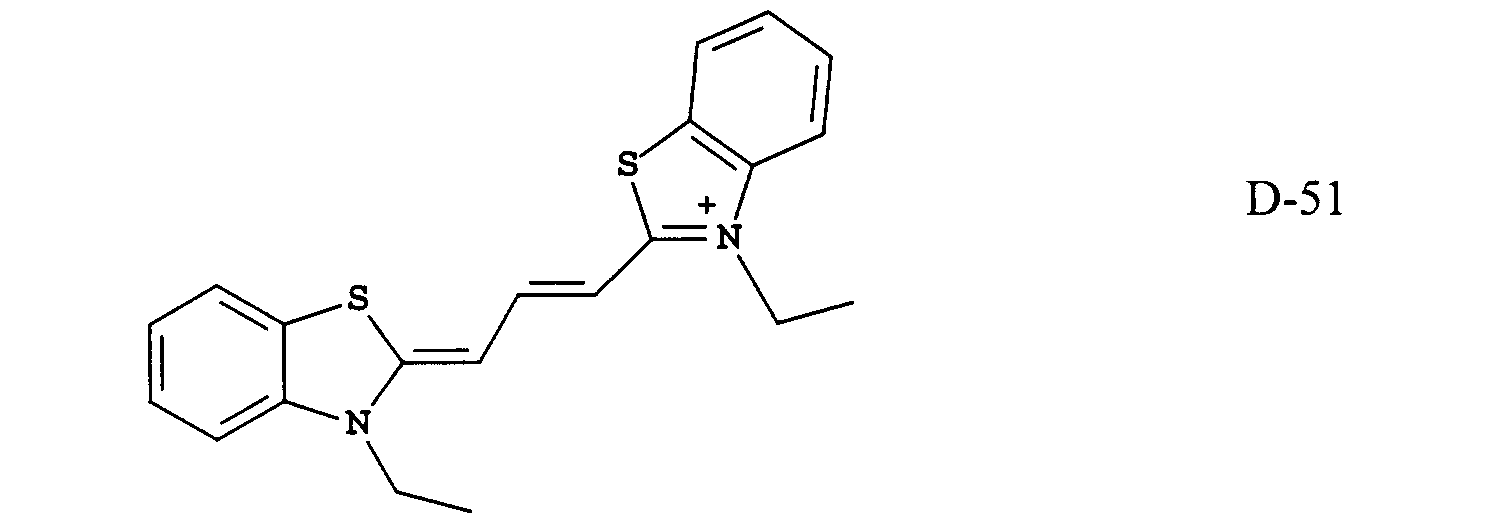


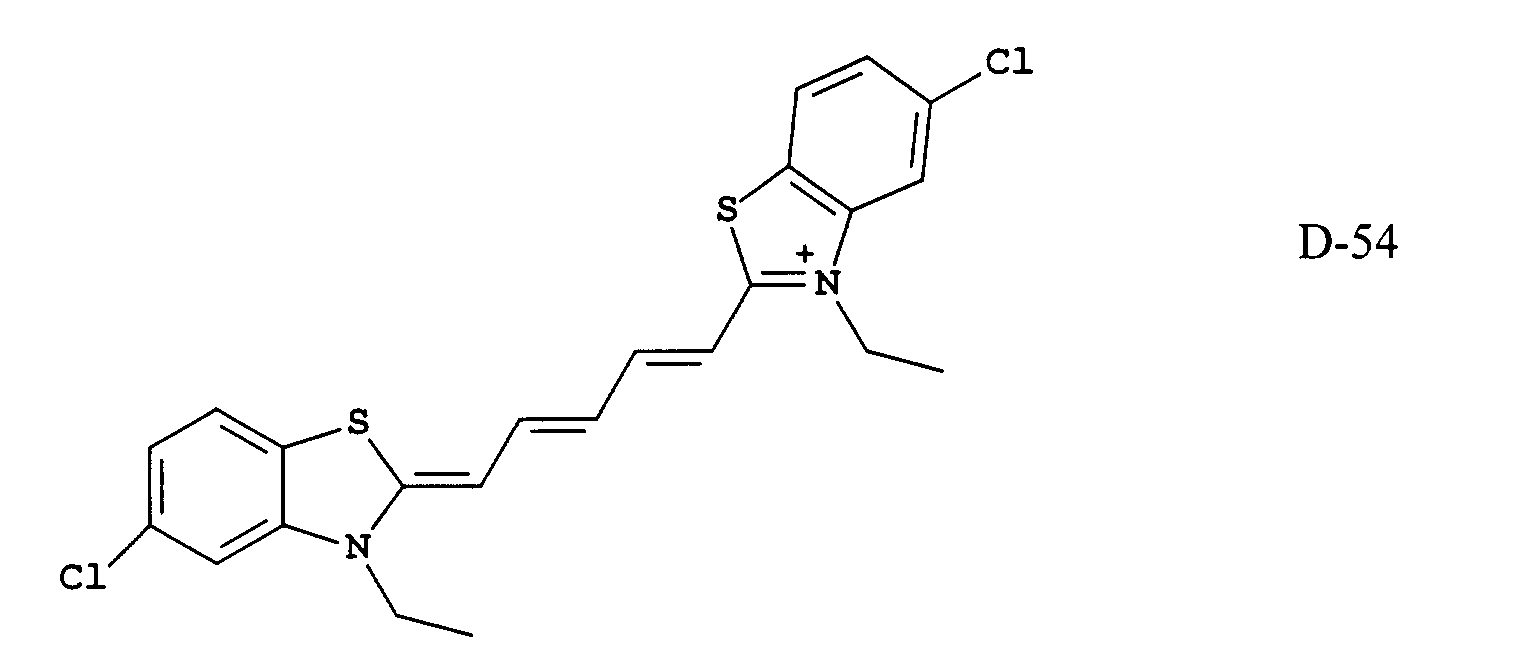

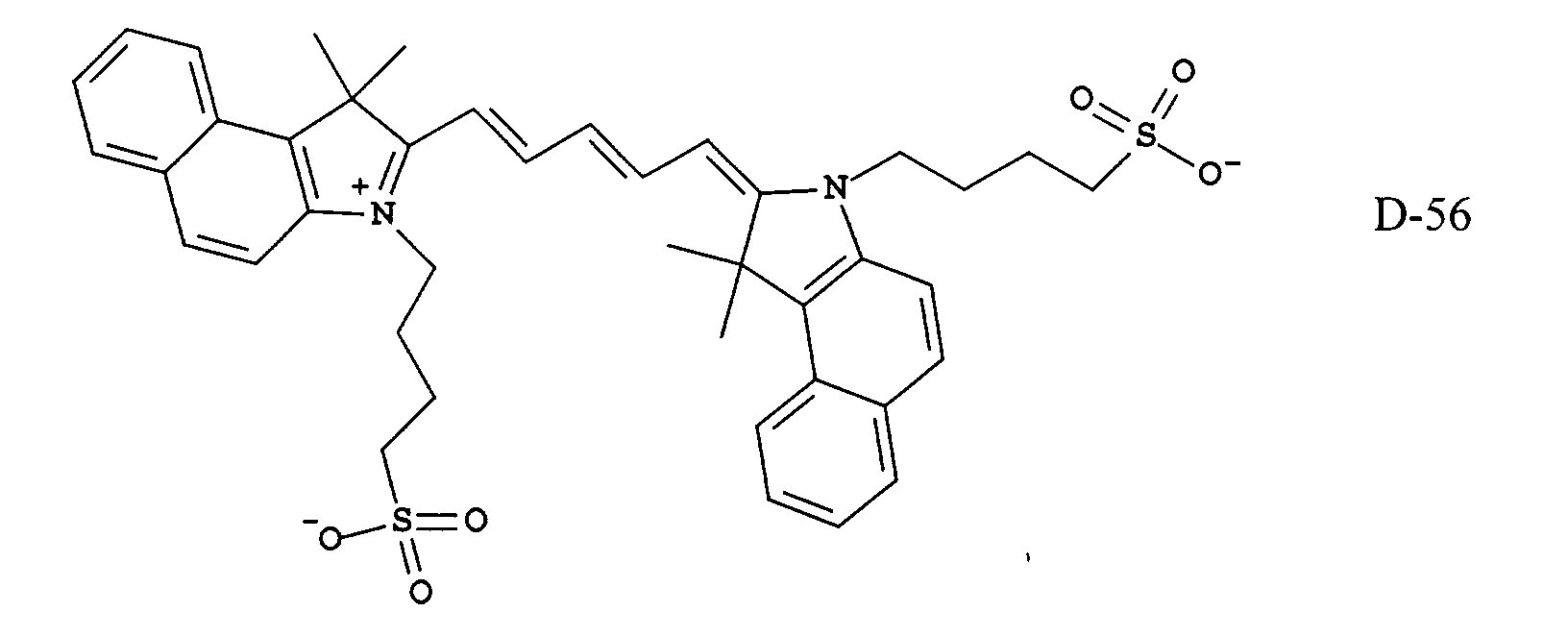

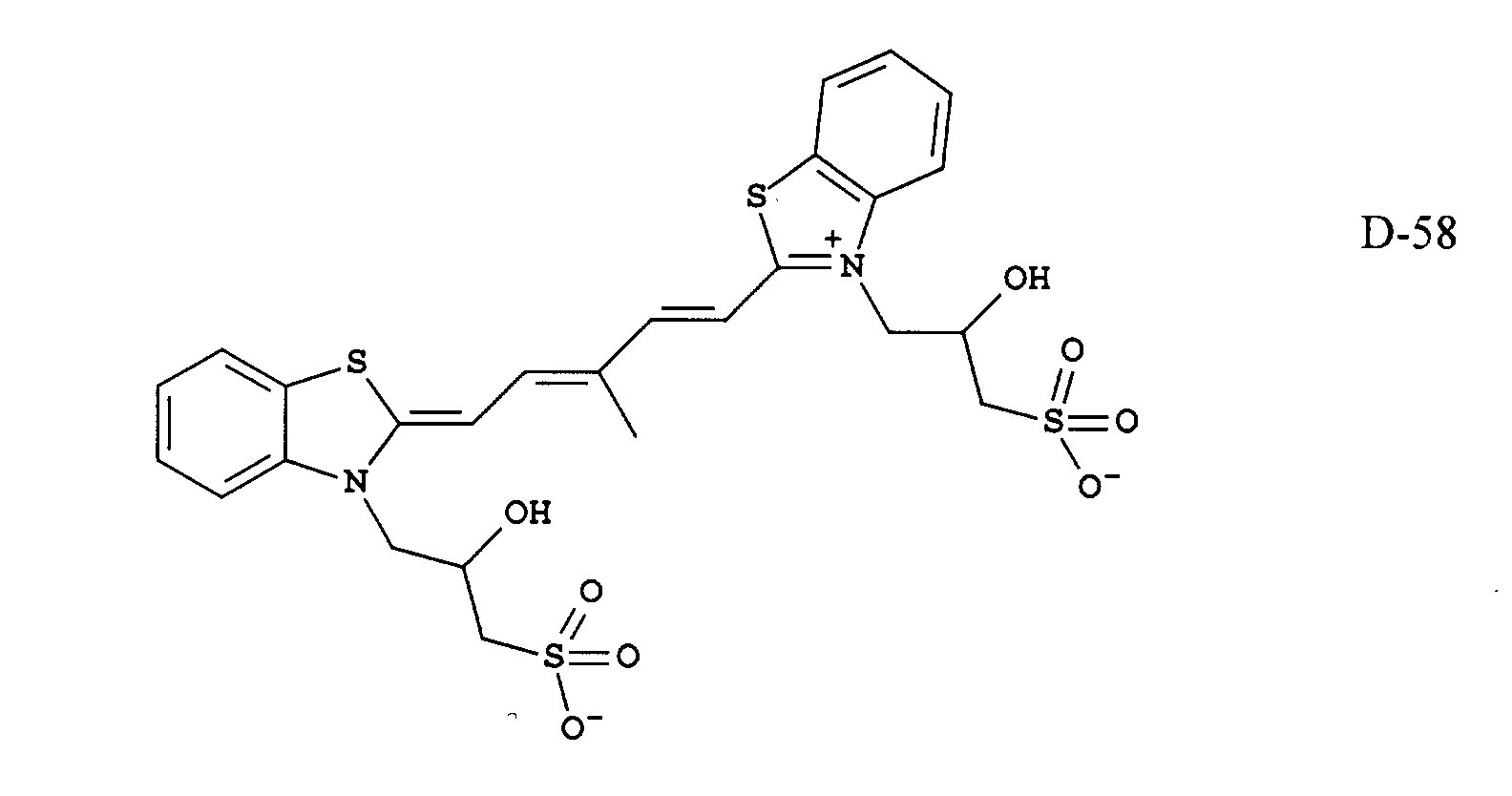

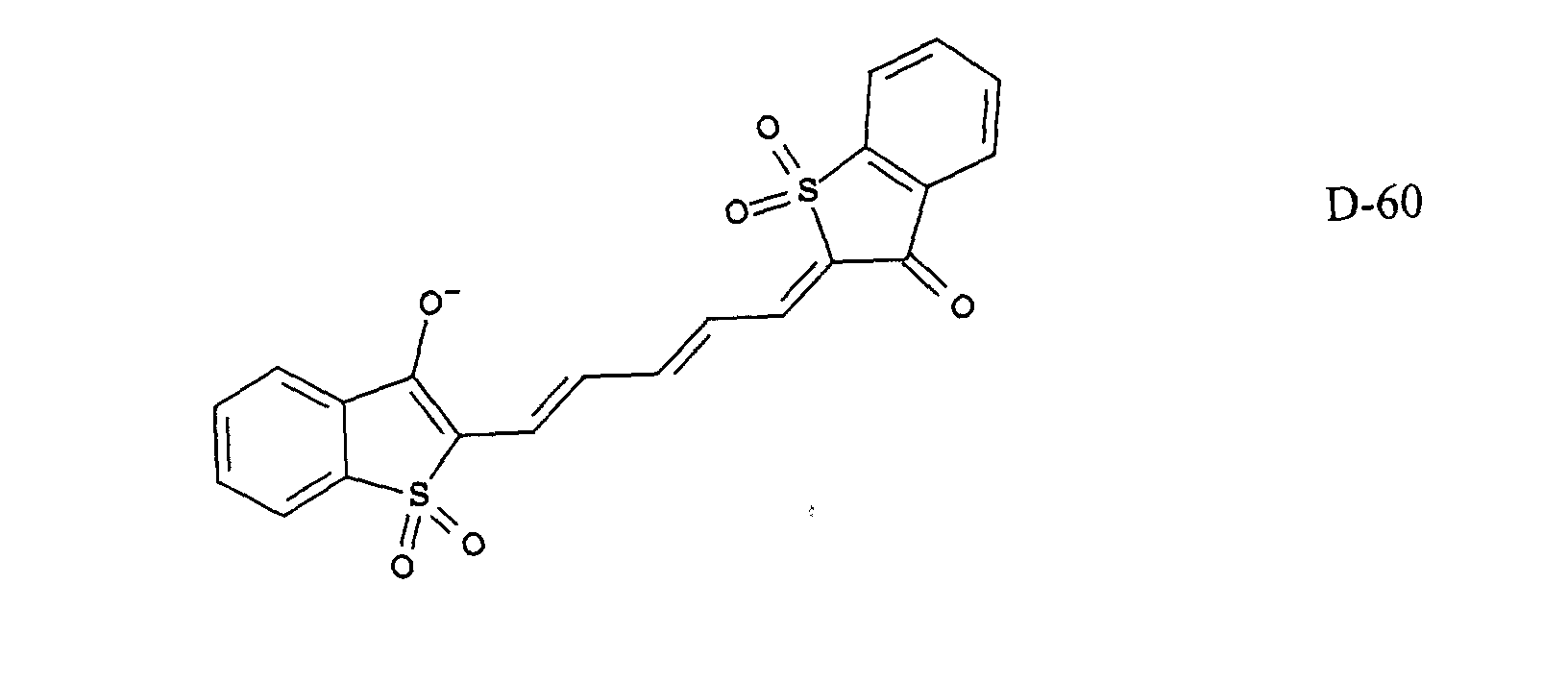
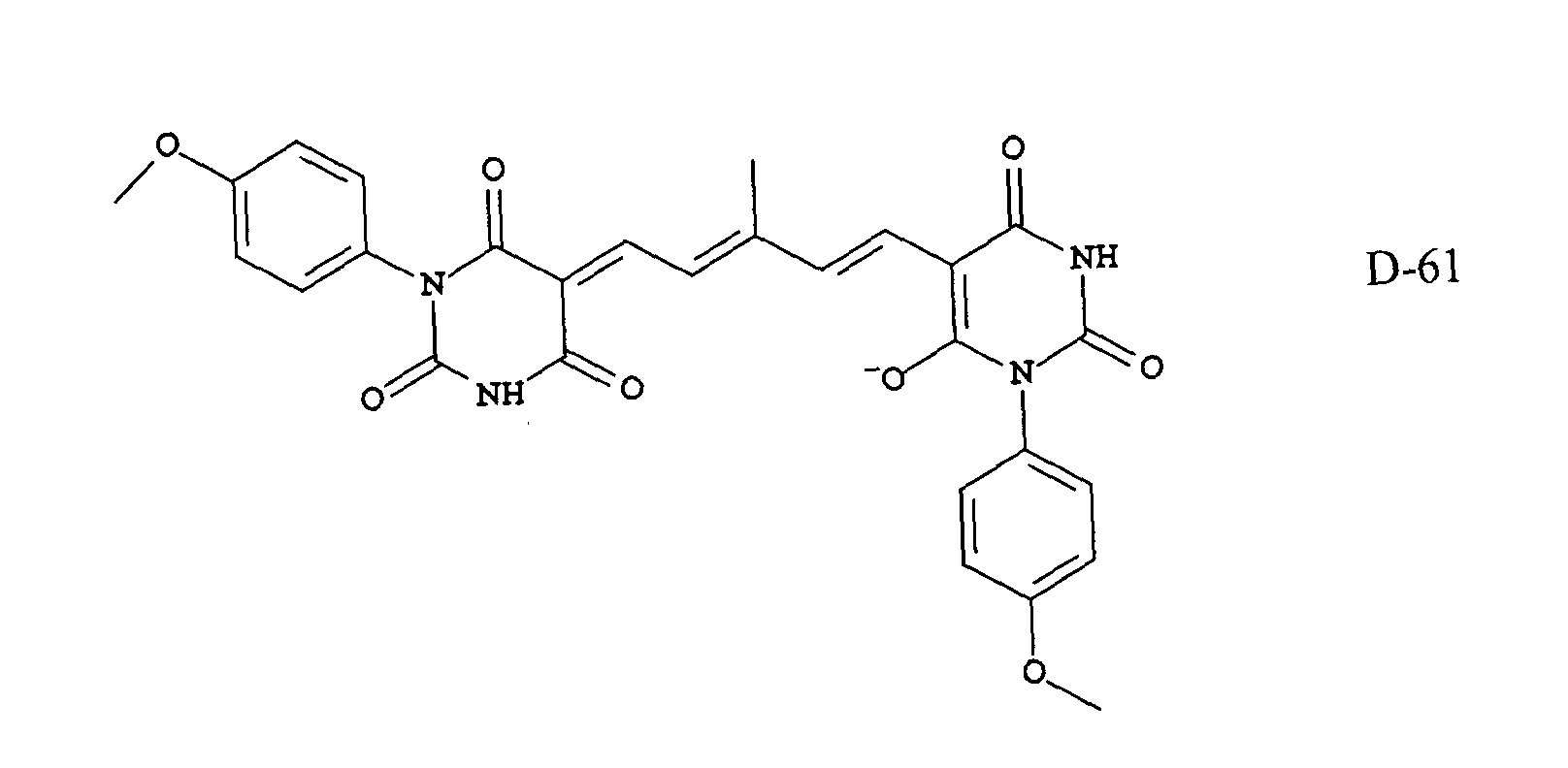


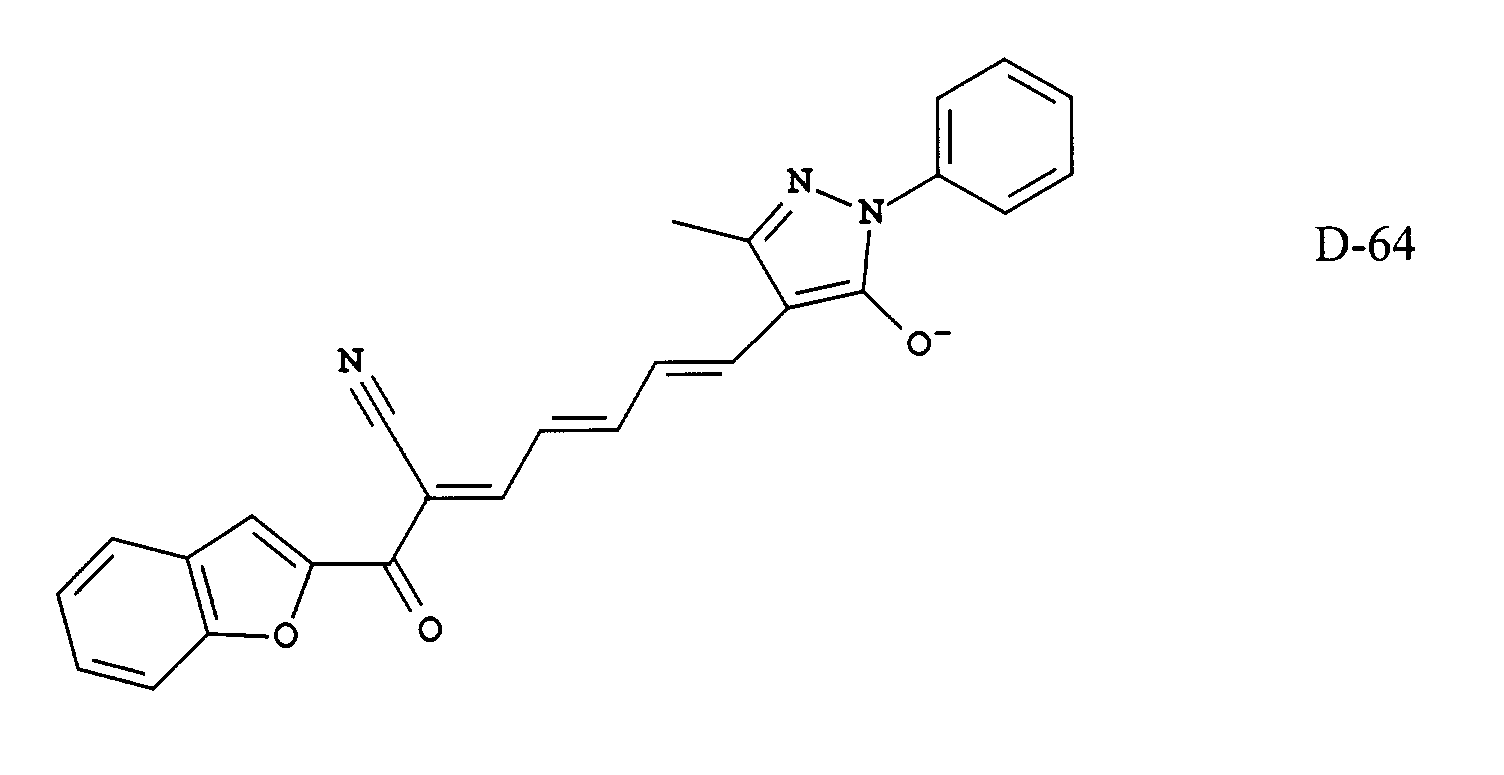


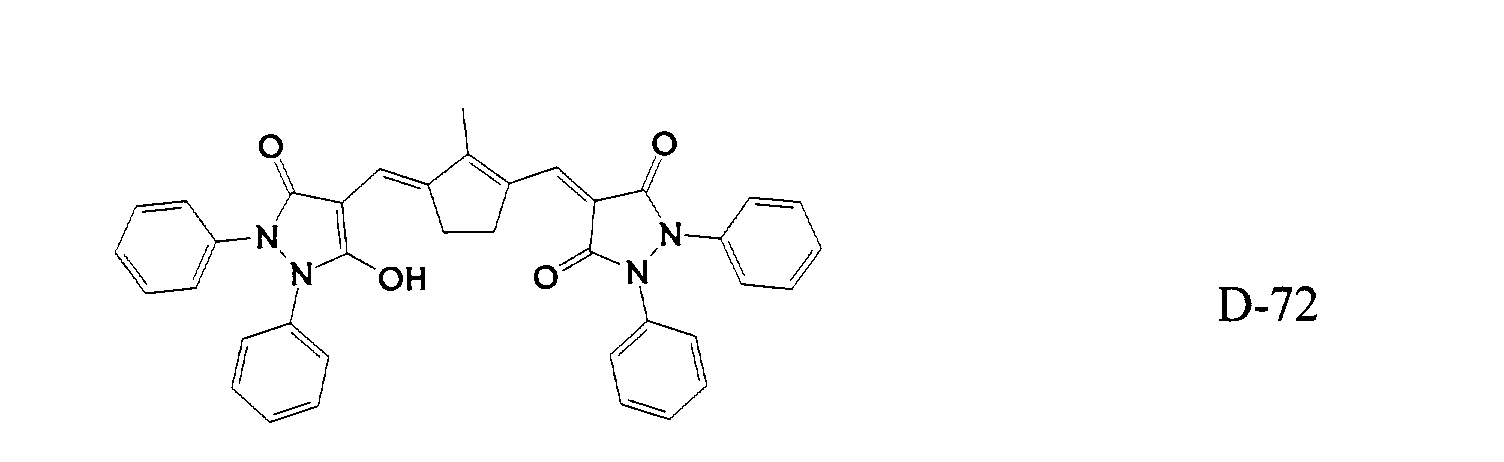
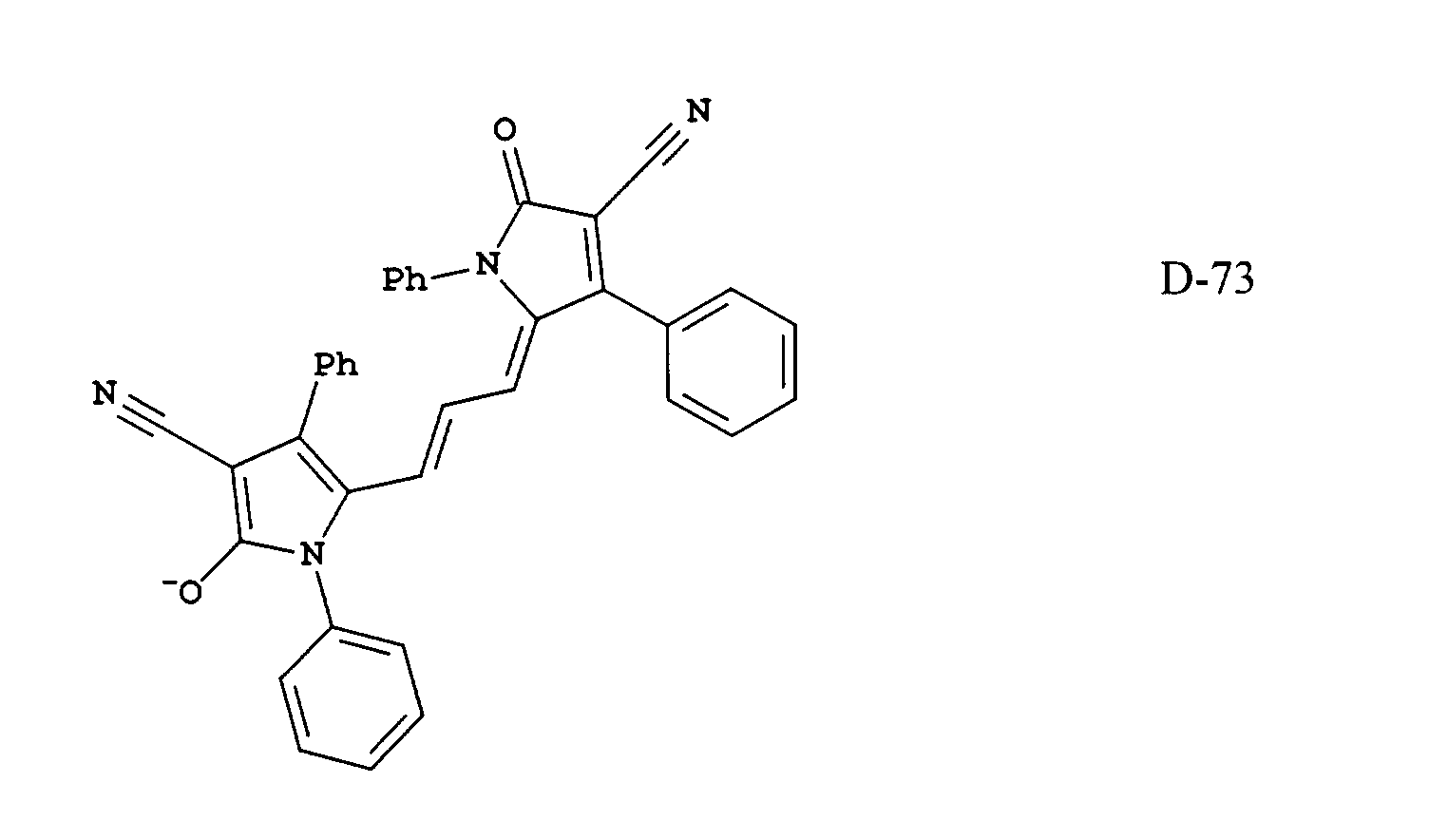
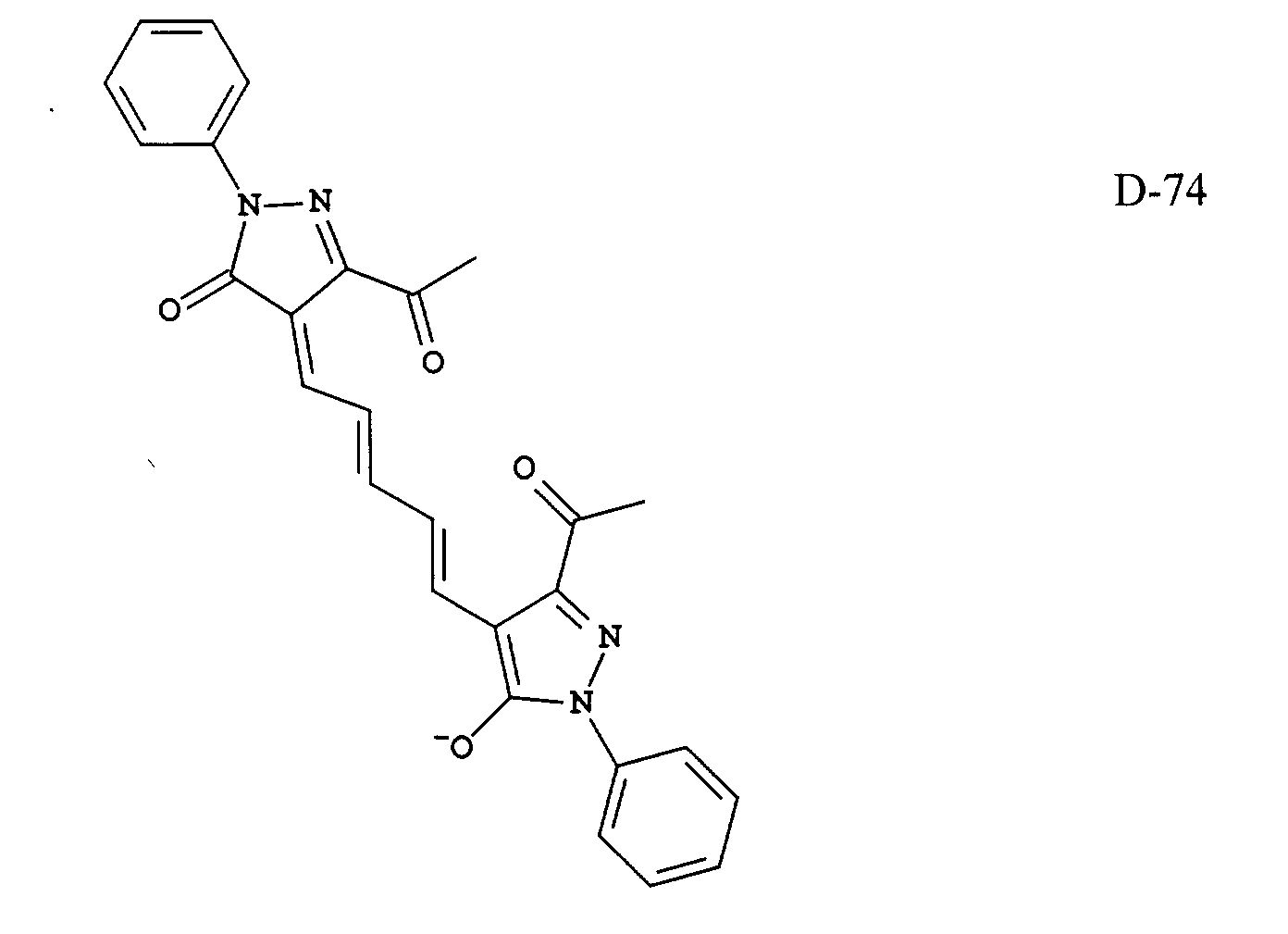
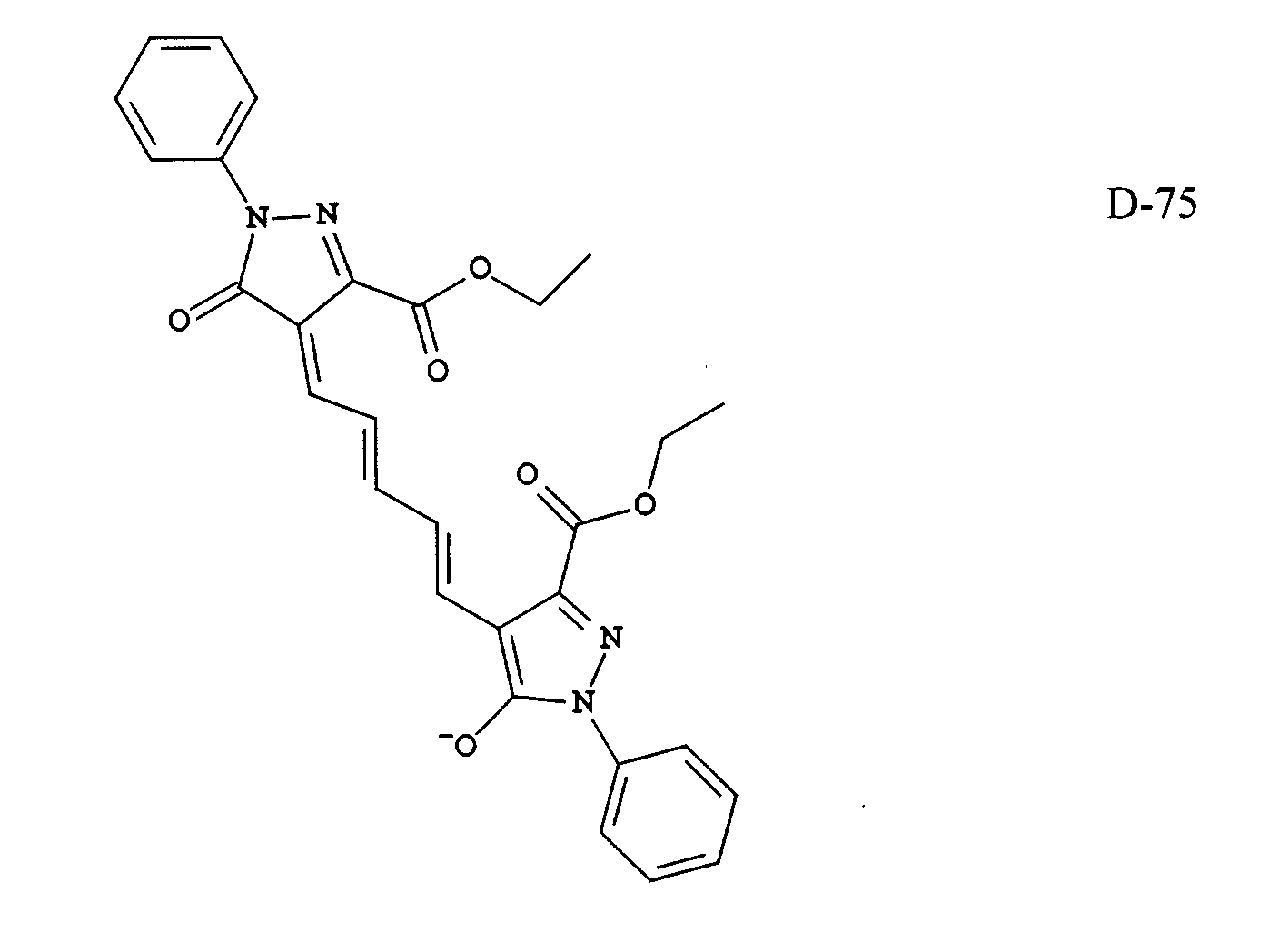
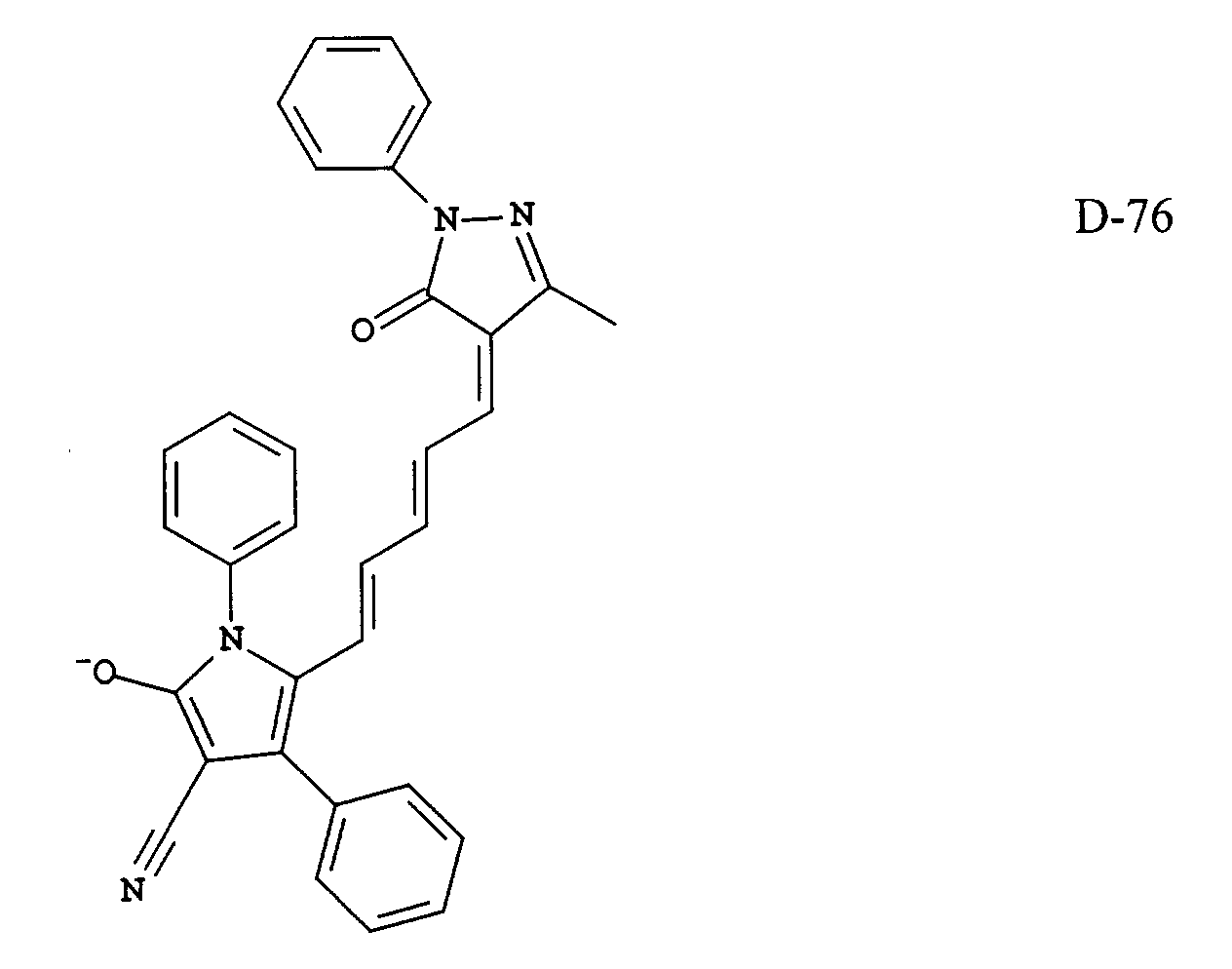


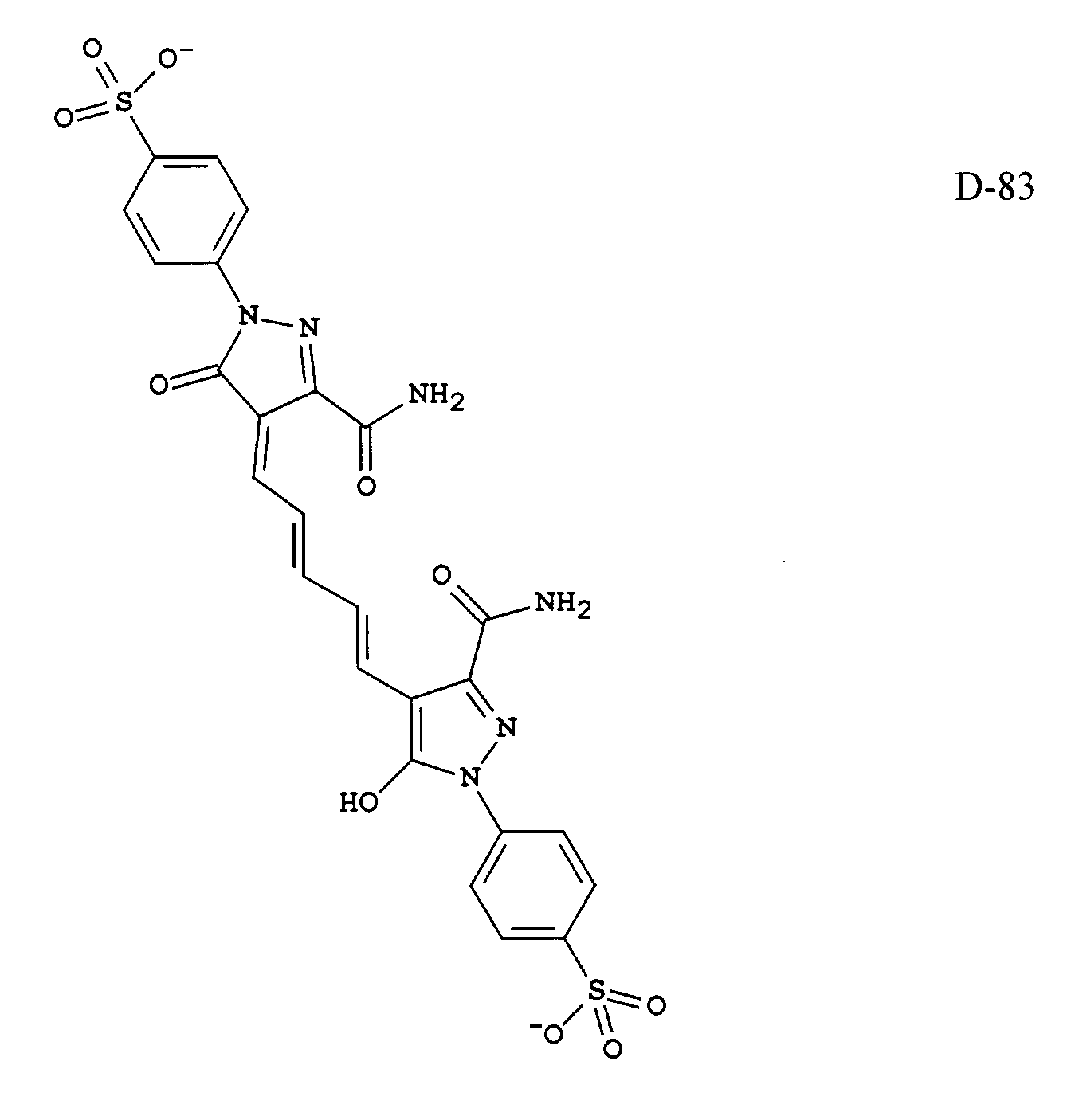
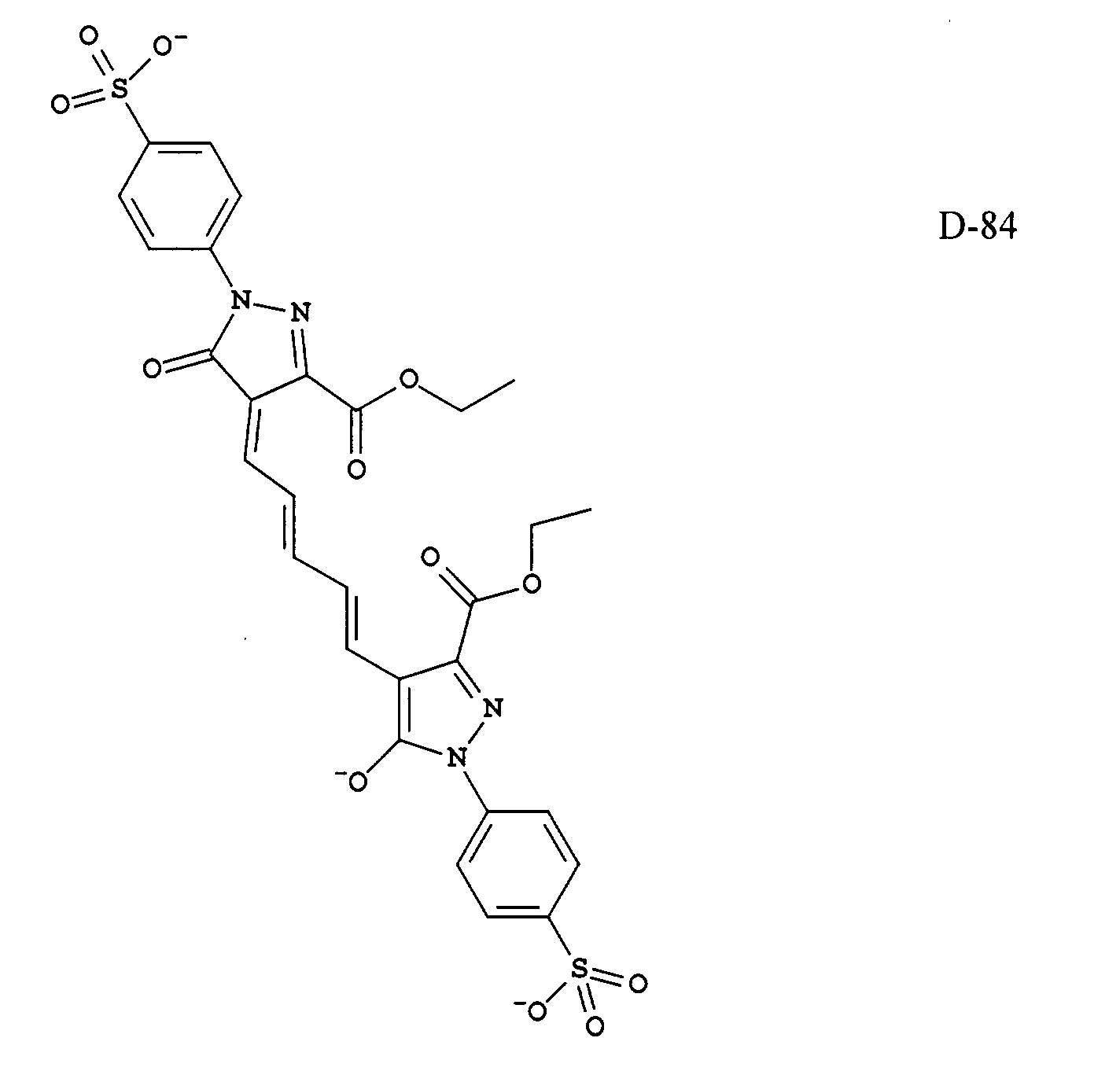
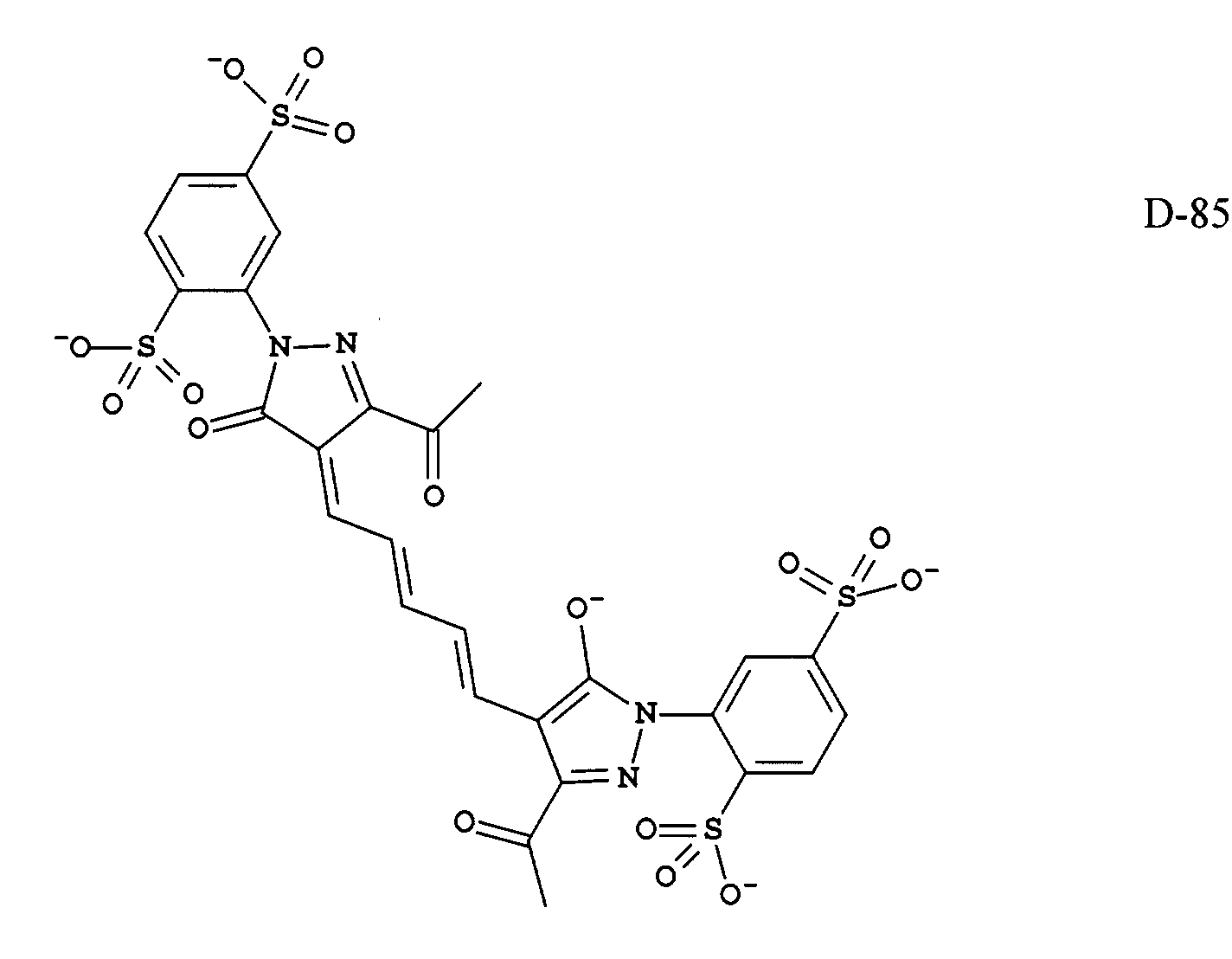
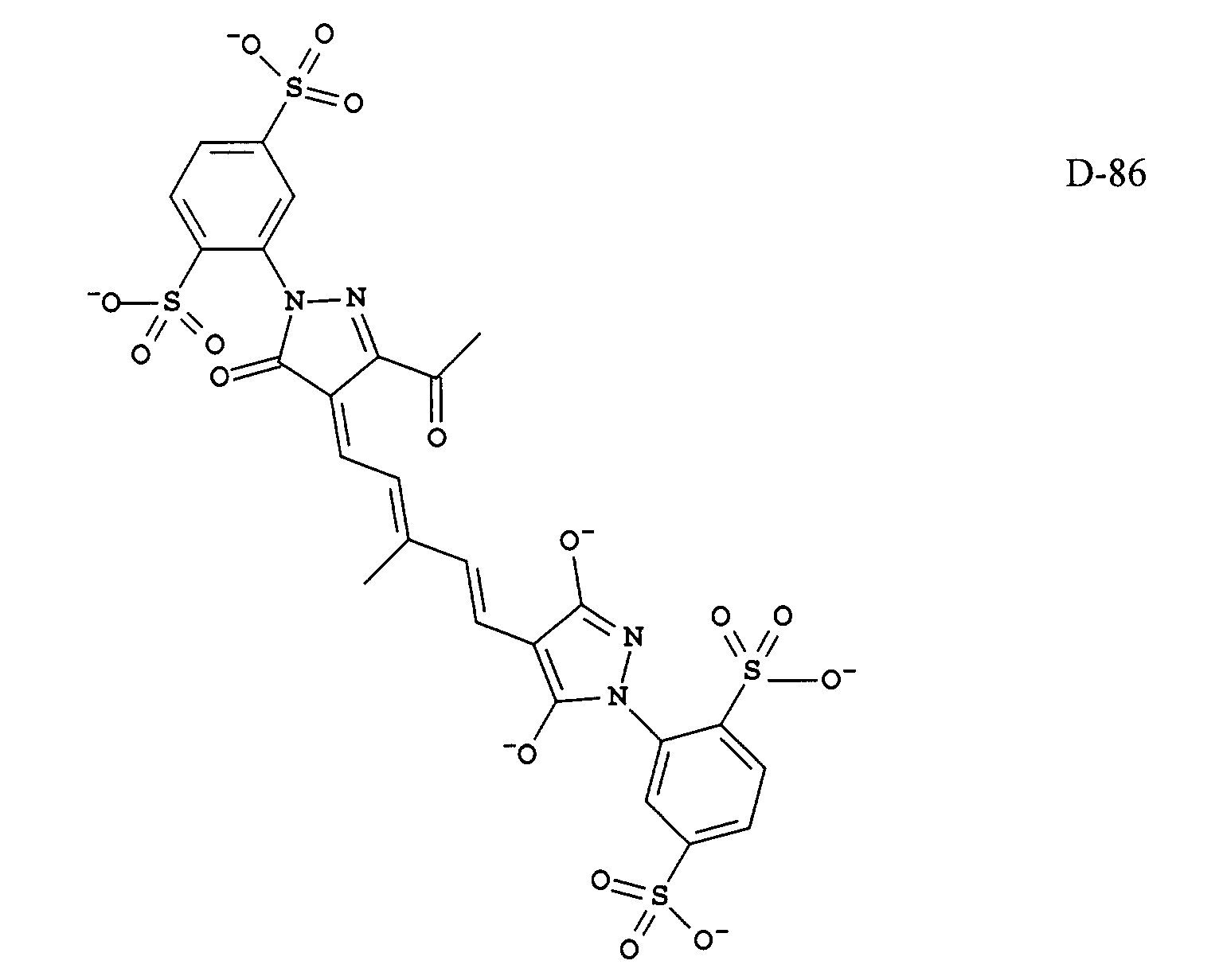
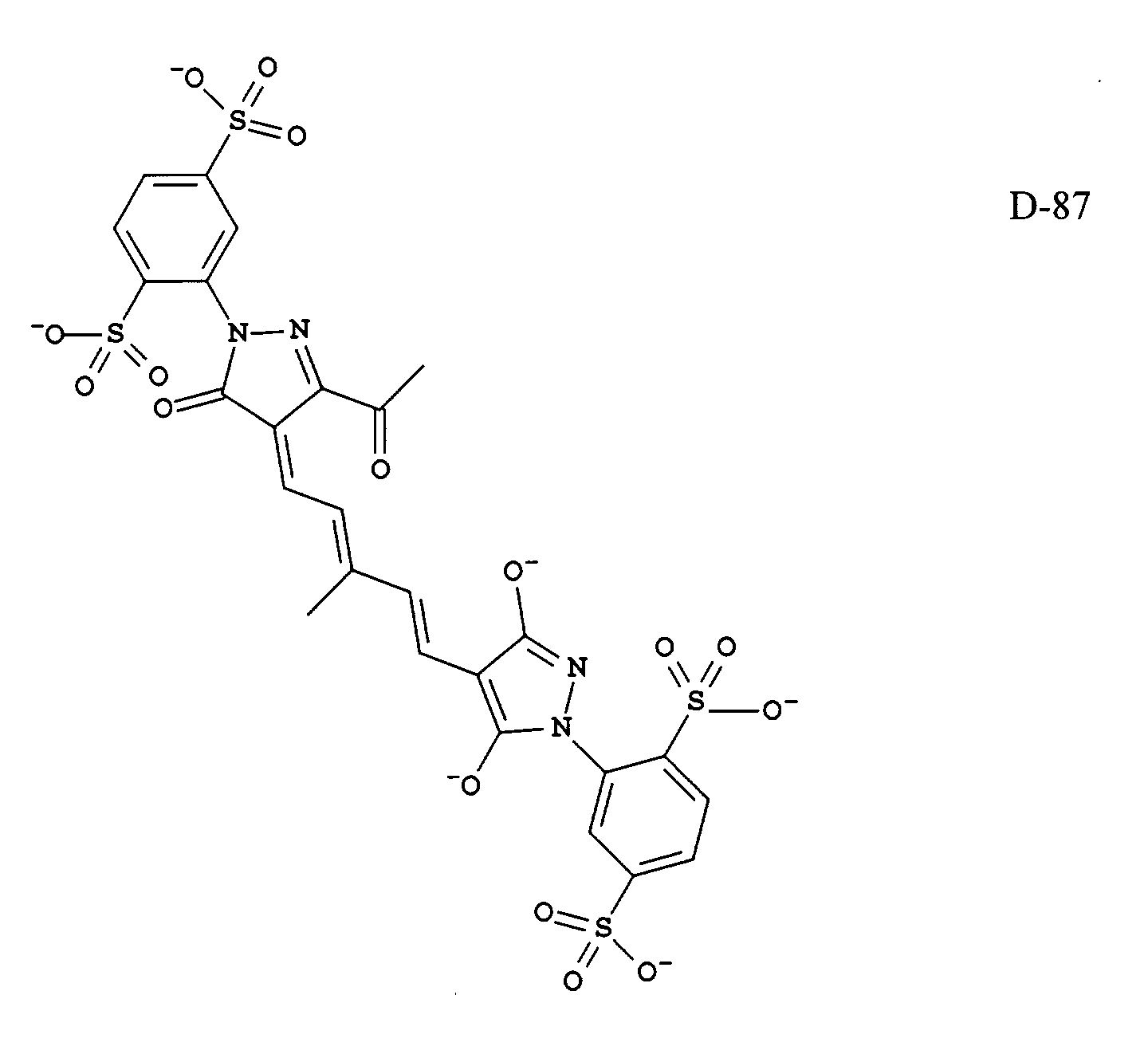


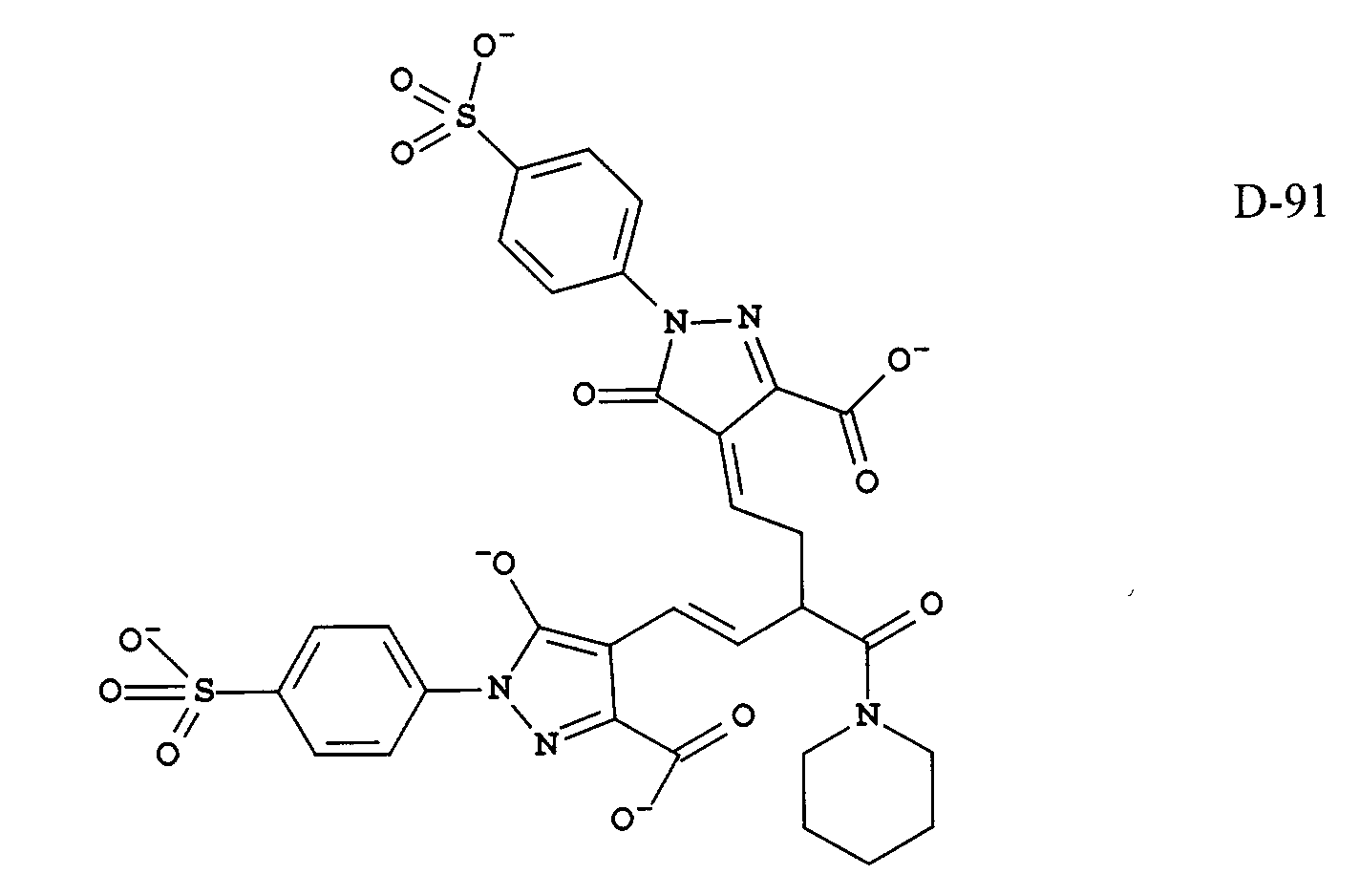
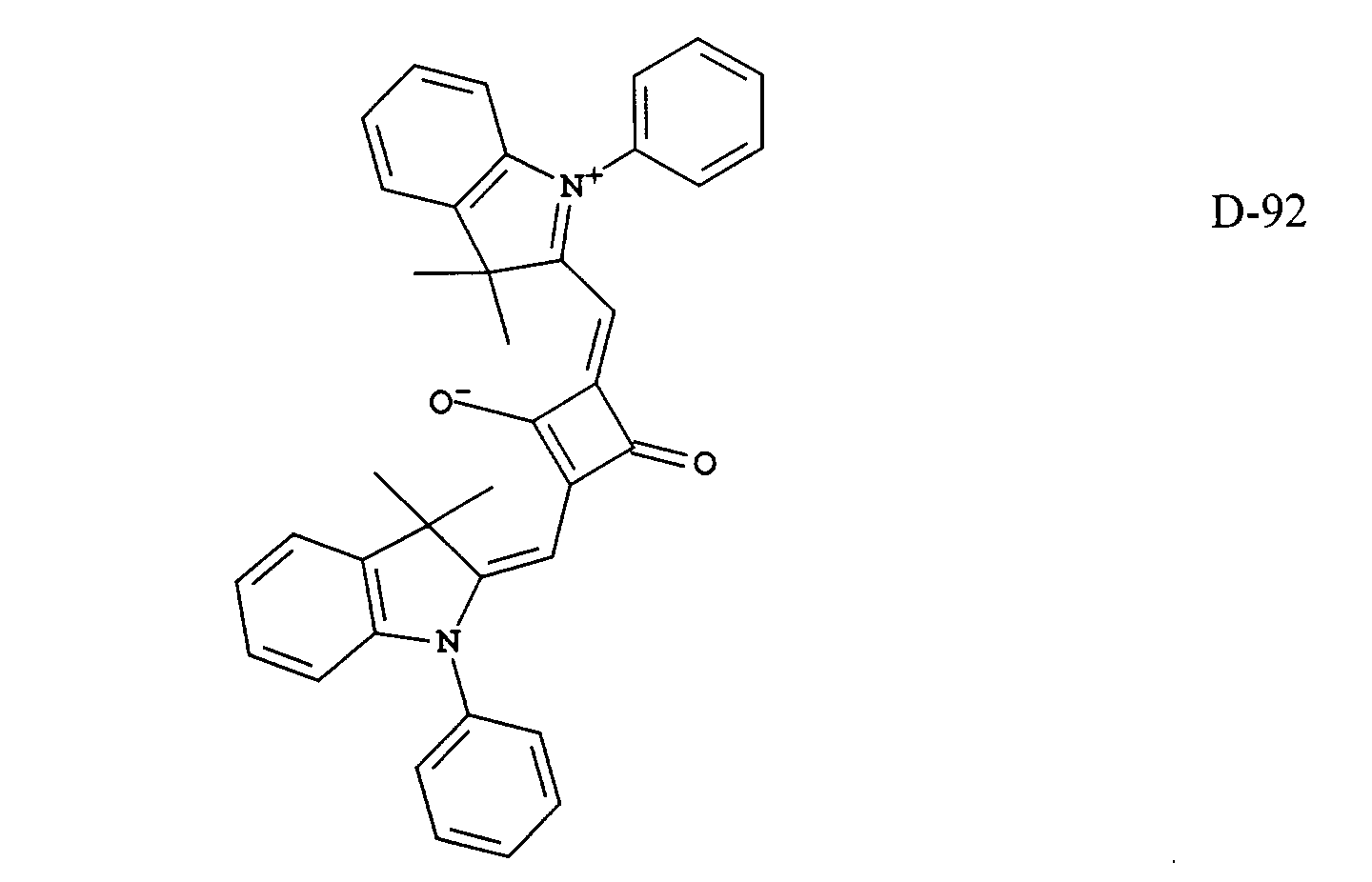
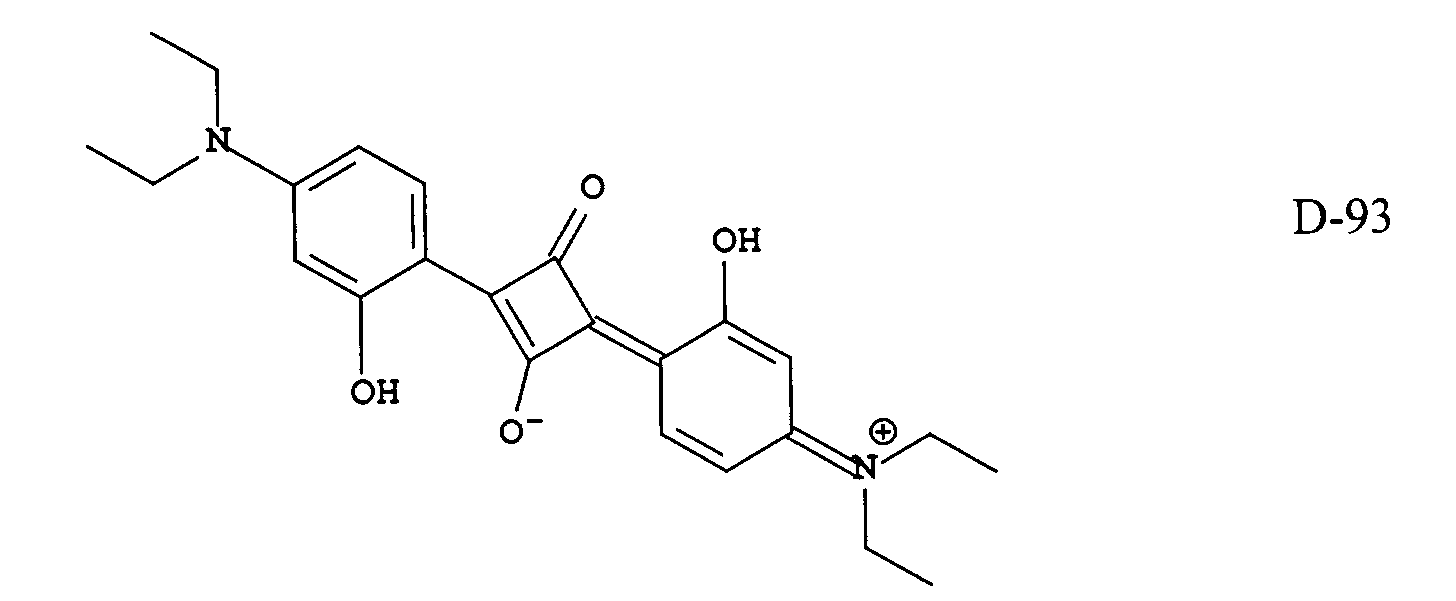

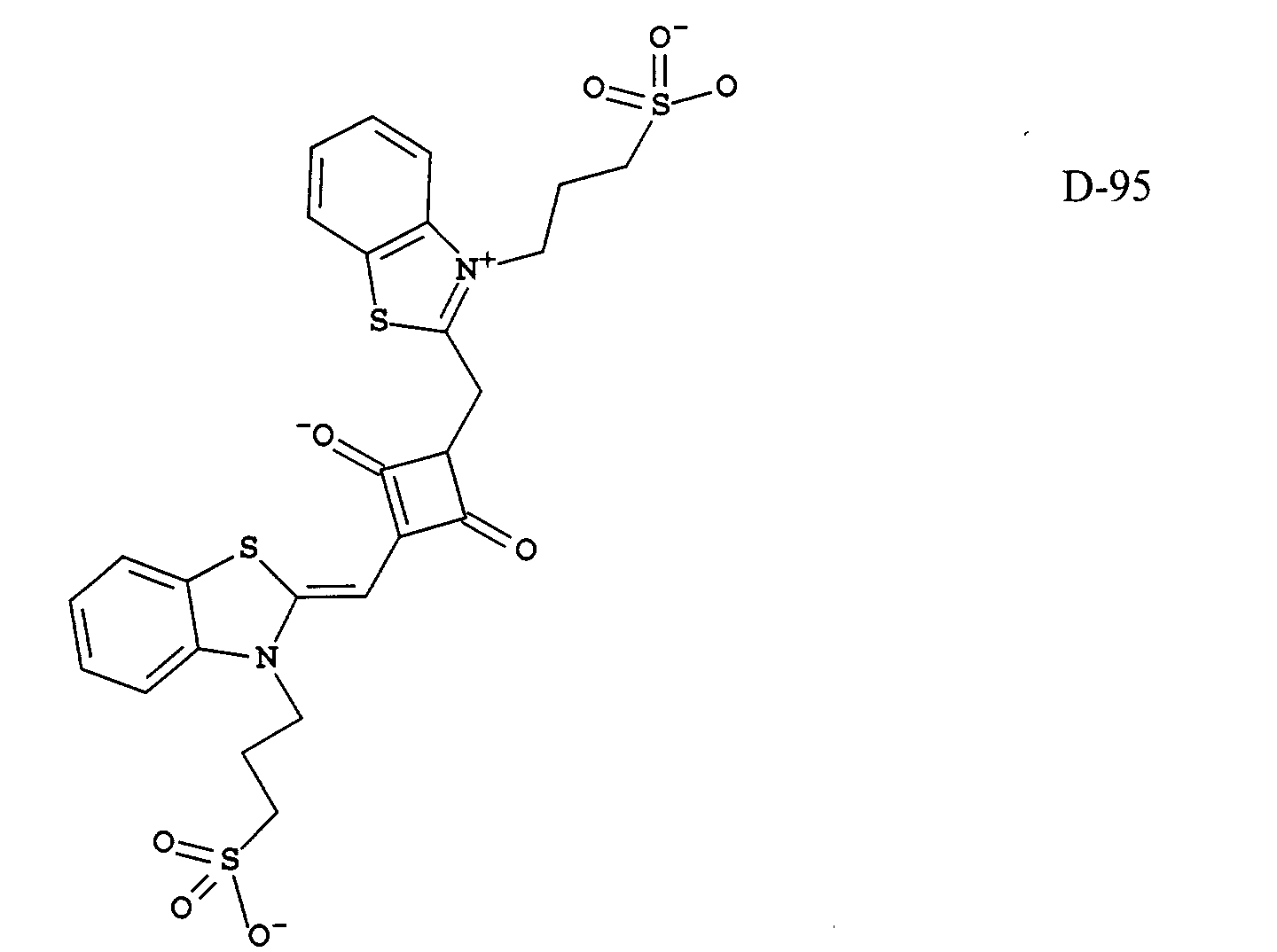

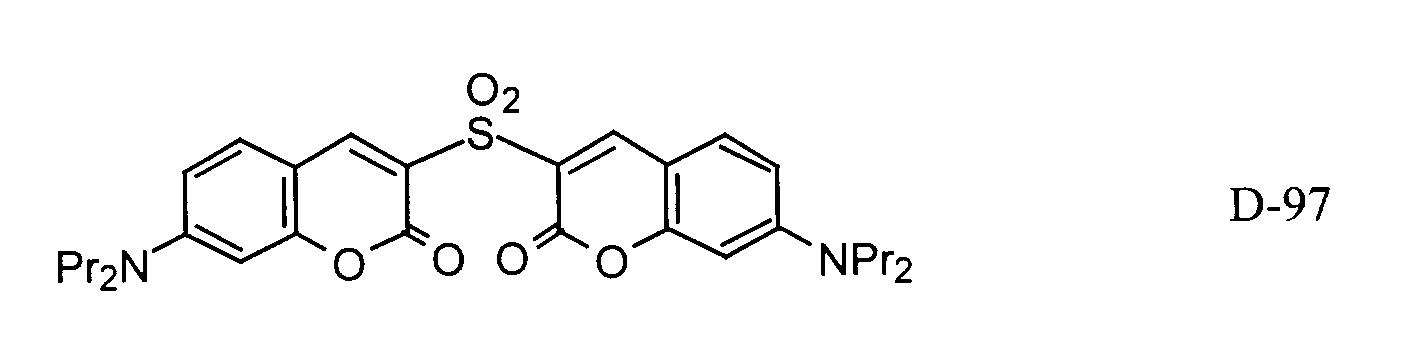

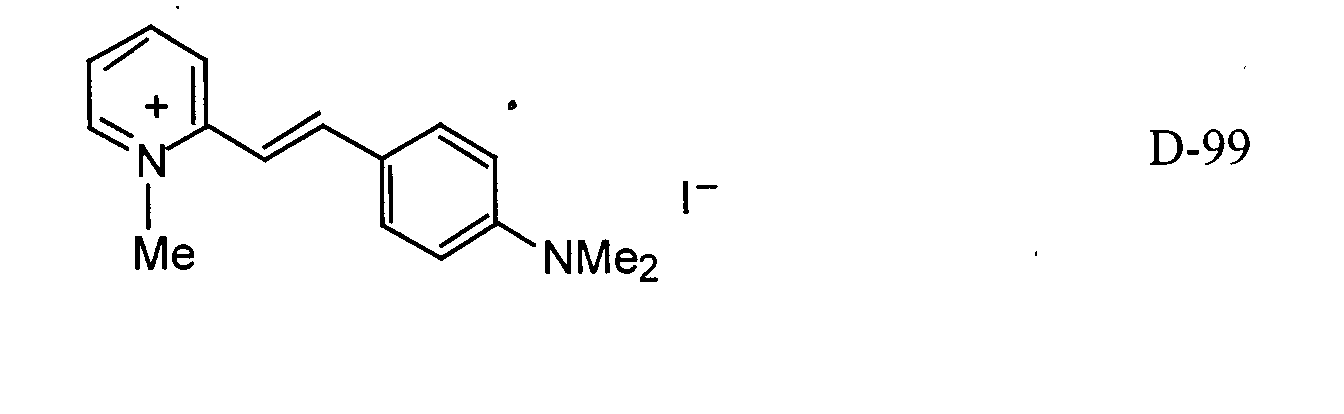

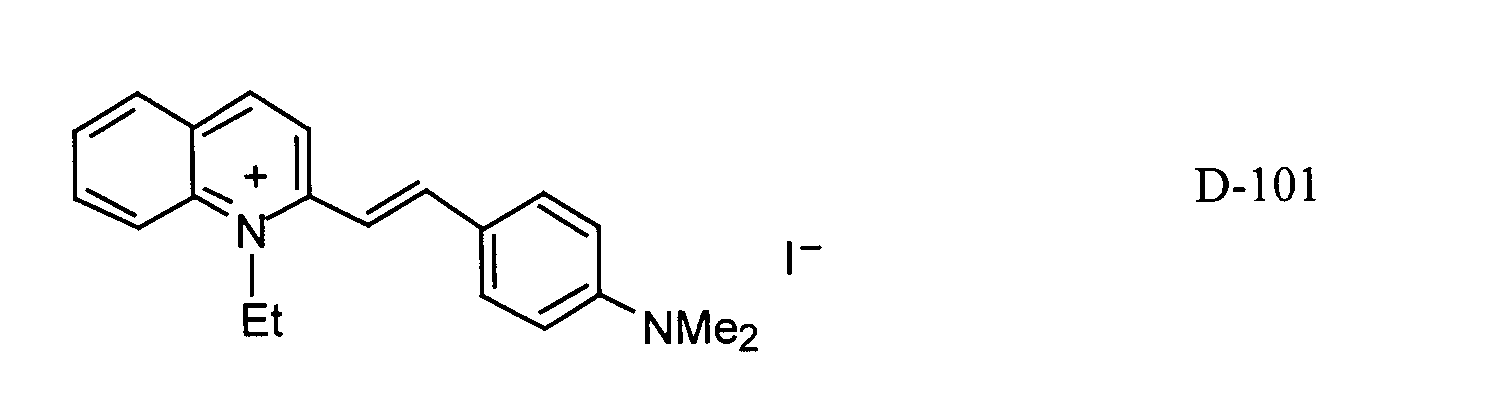
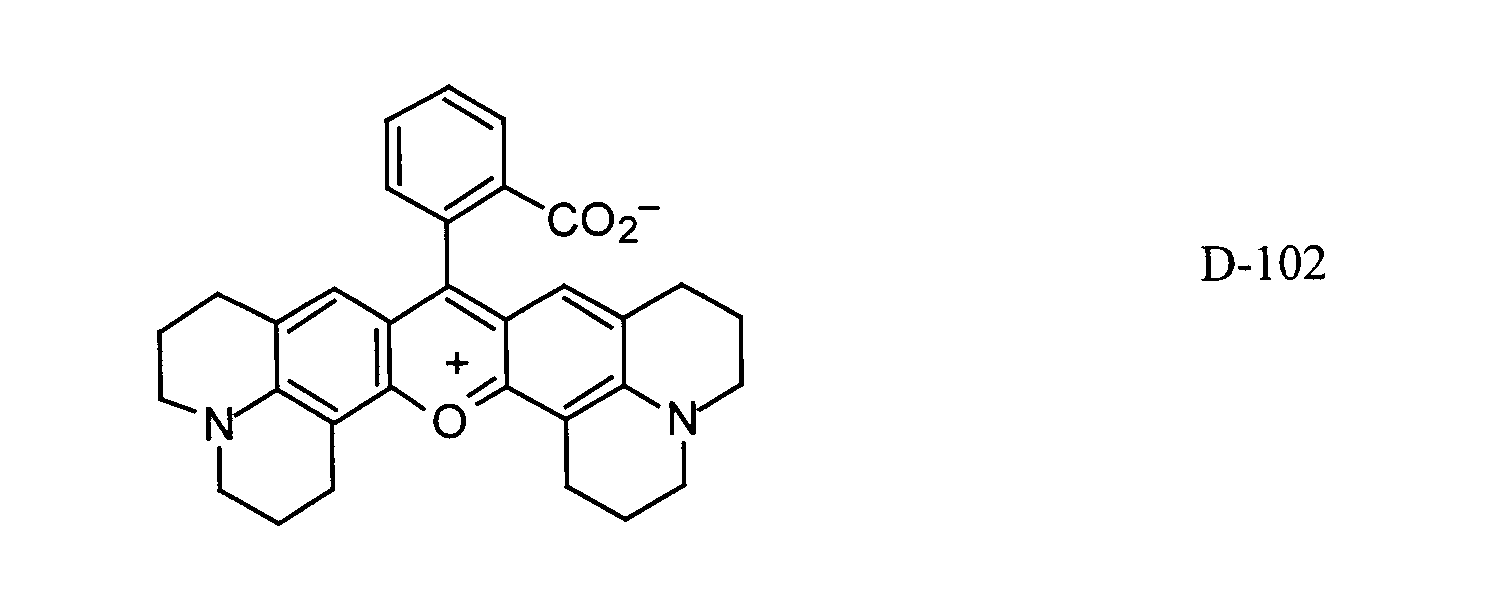
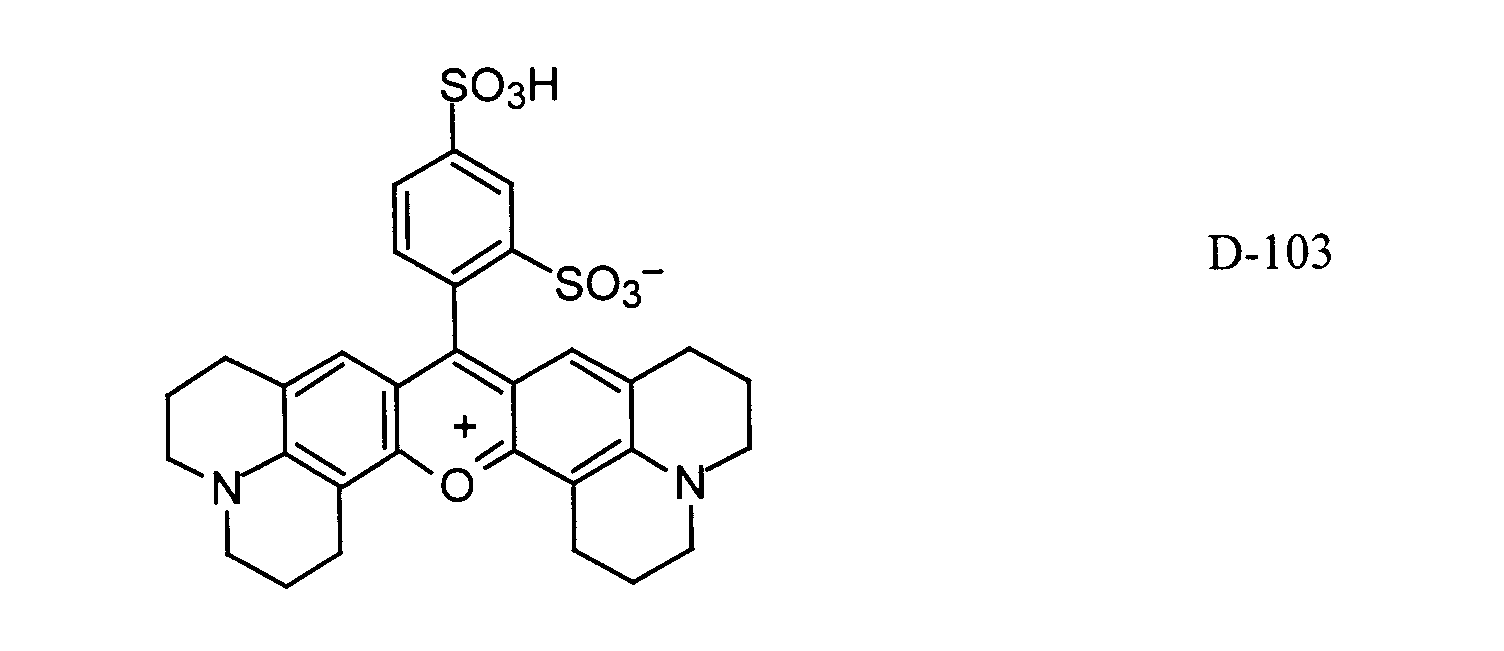
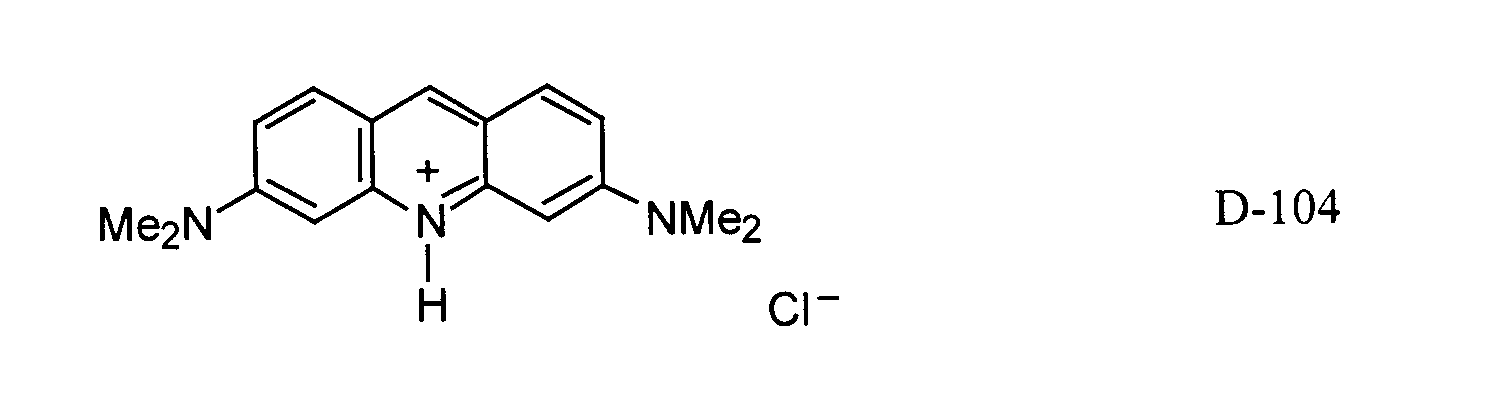


- The composition of the invention can further comprise additional additives such as plasticizers, solvents, or binders. According to a specific embodiment, the composition of the invention further comprises a polymeric binder such as a polyacrylate, polymethacrylate, poly(acrylate co methacrylate) or a mixture thereof.
- The photographic elements useful in the present invention can be any known photographic elements such as black and white elements, single color elements or multicolor elements. Conventionally multicolor elements contain dye image-forming units sensitive to each of the three primary regions of the spectrum. Each unit can be comprised of a single emulsion layer or of multiple emulsion layers sensitive to a given region of the spectrum. The layers of the element, including the layers of the image-forming units, can be arranged in various orders as known in the art. In an alternative format, the emulsions sensitive to each of the three primary regions of the spectrum can be disposed as a single segmented layer.
- A typical multicolor photographic element comprises a support bearing a cyan dye image-forming unit comprised of at least one red-sensitive silver halide emulsion layer having associated therewith at least one cyan dye-forming coupler, a magenta dye image-forming unit comprising at least one green-sensitive silver halide emulsion layer having associated therewith at least one magenta dye-forming coupler, and a yellow dye image-forming unit comprising at least one blue-sensitive silver halide emulsion layer having associated therewith at least one yellow dye-forming coupler. The element can contain additional layers, such as filter layers, interlayers, overcoat layers, subbing layers, and the like. All of these can be coated on a support that can be transparent or reflective (for example, a paper support).
- The composition of the invention can be contained in any of the layers of the photographic element. According to one embodiment, the element of the invention is a photothermographic element comprising conventionally a support, preferably a transparent support, having thereon at least one photosensitive layer and a antihalation layer. In the photothermographic element of the invention, the photosensitive layer can be a silver photosensitive layer or a non-silver photosensitive layer. Non photosensitive layer can be for example a layer containing a diazo compound. According to a specific embodiment, the composition containing the N-oxyazinium is incorporated in a non image-forming layer of the photographic element of the invention, preferably in an antihalation layer.
- Photographic elements comprising the composition of the invention can be processed in any of a number of well-known photographic processes utilizing any of a number of well-known processing compositions, described, for example, in T.H. James, editor, The Theory of the Photographic Process, 4th Edition, Macmillan, New York, 1977. In the case of processing a negative working element, the element is treated with a color developer (that is one which will form the colored image dyes with the color couplers), and then with a oxidizer and a solvent to remove silver and silver halide. In the case of processing a reversal color element, the element is first treated with a black and white developer (that is, a developer which does not form colored dyes with the coupler compounds) followed by a treatment to fog silver halide (usually chemical fogging or light fogging), followed by treatment with a color developer. Preferred color developing agents are p-phenylenediamines. Development is followed by bleach-fixing, to remove silver or silver halide, washing and drying.
- In the method of the invention, the photobleaching can be carried out by photoexcitation of the photobleachable dye (i.e., visible to infrared light, depending on the absorption range of the dye) or by photoexcitation of the N-oxyazinium (mostly ultraviolet light). The bleaching reaction is believed to occur as a result of reaction of an alkoxy radical that results from cleavage of the N-O bond of the N-oxyazinium compound.
- In the following reaction, the successive reactions are disclosed from a pyridinium compound as N-oxyazinium compound, however it should be understood that the useful compound can be any N-oxyazinium compounds useful in the scope of the invention.
- In reactions induced by photoexcitation of a dye, it is believed that the excited dye (dye*) transfers an electron to the N-oxyazinium compound to yield an oxidized dye (a dye radical cation, dye•+) and a reduced N-oxyazinium compound (the radical, A•). The alkoxy radical (A•) fragments to give an oxy radical (•OR1) and a nitrogen heterocycle (A). Reaction of the oxy radical with the dye, or with the oxidized dye (dye•+), leads to a colorless compound or a compound less colored than the dye thus providing a bleached compound.
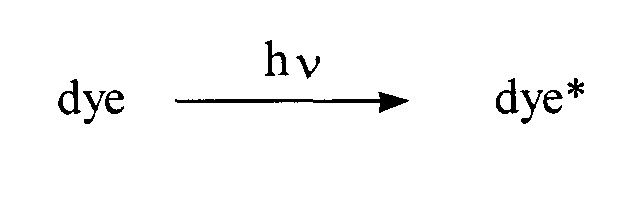


- The feasibility of electron transfer from an excited dye to an N-oxyazinium compound depends on the energetics of the reaction. The reaction energetics are determined by the relative reduction potentials of the photobleachable dye and the N-oxyazinium compound. According to a preferred embodiment, the reduction potential of the N-oxyazinium compound is less negative than that of the photobleachable dye. However the reaction will still take place, although with a somewhat smaller rate constant, if the reduction potential of the N-oxyazinium compound is equal to or is slightly (ca. 0.1 V) more negative than that of the dye to be bleached.
- For spectral sensitization of silver halide to occur efficiently using a sensitizing dye, the dye has to have a reduction potential which is either equal to or is more negative than ca ― 0.9 V, vs. SCE (saturated calomel electrode). Thus, in this embodiment, any N-oxyazinium compound with a reduction potential less negative than ca. - 1.2 V would react with all sensitizing dyes.
- For sensitizing dyes that have reduction potentials that are more negative than - 0.9 V, the range of the reduction potentials of the N-oxyazinium compounds can be extended in accordance with the general requirement mentioned above.
- The reduction potential of the N-oxyazinium compounds can be measured by conventional electrochemical techniques. Alternatively, it can be estimated from the reduction potentials of the corresponding N-alkylazinium compounds that are reported in the literature, the reduction potential of N-oxyazinium compound being always less negative than the reduction potential of the corresponding N-alkylazinium compound. The N-oxyazinium compounds listed above have reduction potentials of- 0.9 V or less negative.
- As mentioned above, to function as sensitizing dyes, these usually have reduction potentials of ca. - 0.9 V or more negative. Thus the energetic requirements mentioned above are met for any dye that is capable of sensitizing silver halide.
- It is also believed that reactions via excitation of the N-oxyazinium compounds proceed via fragmentation of the N-O bond of the photoexcited N-oxyazinium compound to yield the radical cation of the nitrogen heterocycle (A•+) and an oxy radical (•OR1). The radical cation (A•+) can accept an electron from a dye to yield the nitrogen heterocycle (A) and the oxidized dye (a dye radical cation, dye•+). Thus, the same intermediates are ultimately formed (•OR1 and dye•+) whether the reactions are initiated by dye excitation or by excitation of the N-oxyazinium compounds.
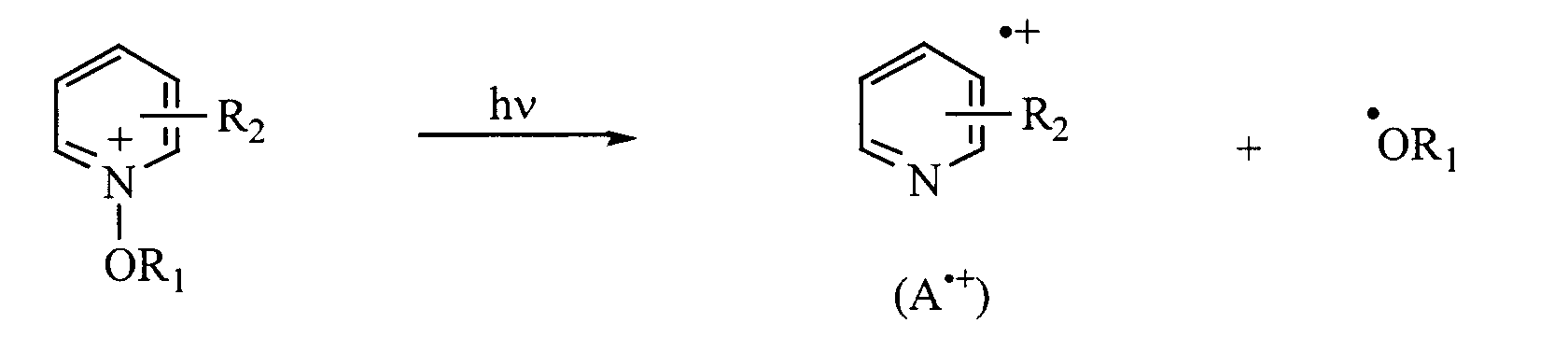
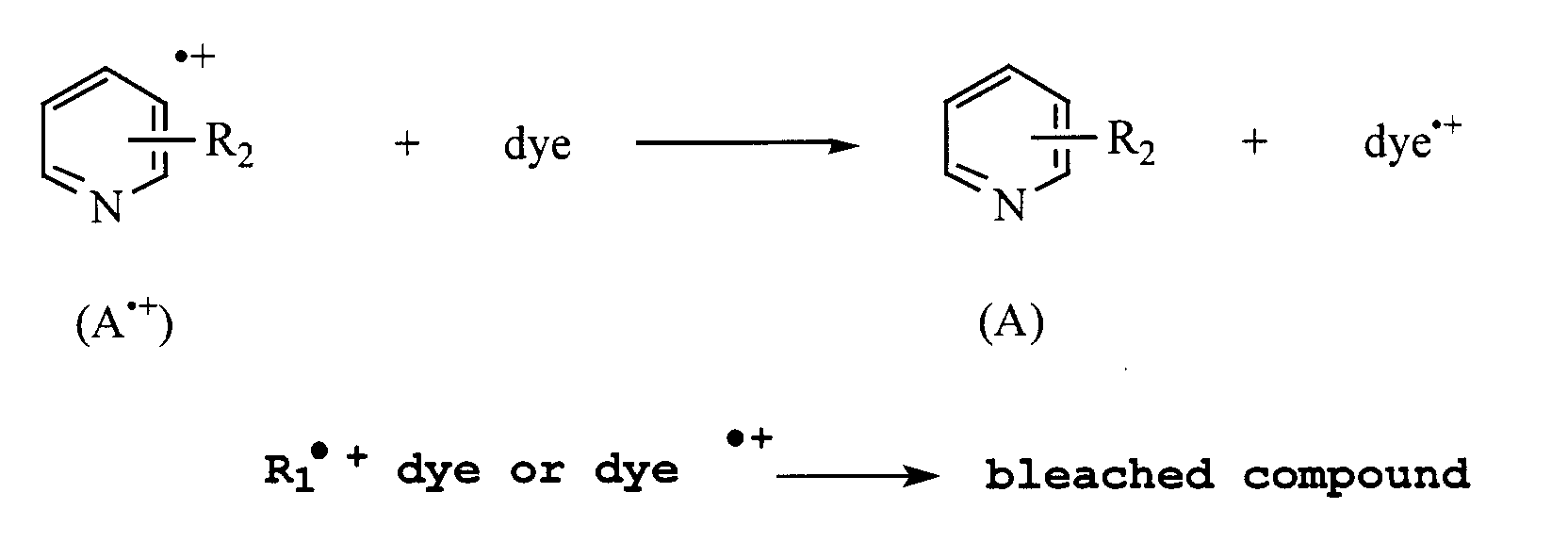
- In the other embodiment of the invention the N-oxyazinium salt can be photochemically excited, where bond cleavage yielding an oxy radical and the radical cation of the parent compound as mentioned above. It was found that this excitation mode could also lead to bleaching of the dyes. The energetic requirements mentioned above for reactions initiated by the photoexcited dye do not apply to the reactions initiated by photoexcitation of the N-oxyazinium compound. The latter reactions proceed via N-O bond cleavage of the N-oxyazinium compound. The energetics of this reaction depend on the excitation energy of the N-oxyazinium compound and the N-O bond dissociation energy. N-oxyazinium compounds with first absorption maxima in the UV range or around 400 nm have excitation energies far exceeding the energy required to break the N-O bond.
- In the method of the present invention, the exposed and processed photographic element is then exposed to radiation. Radiations that can be used are any radiation capable of producing the photobleaching of the dye. Radiations are selected according to the nature of the dye and for the N-oxyazinium compound. The method of the invention can be accomplished by a number of light sources. These include ambient room light from a fluorescent or incandescent lamps, from flash light, mercury or xenon light sources. The UV light may be filtered out by appropriate filters for selective exposure of the dyes, or unfiltered light may be used to excite both the dyes and the N-oxyazinium compounds. Alternatively, mostly UV light sources such as phosphor-coated low-pressure mercury lamps (300 to 350 nm) could be used. The exposure time varies from a few milliseconds when flash lamps are used to several tens of seconds when low intensity light sources are used.
- When the composition of the invention contains a polymeric binder, it is preferred to carry out the method at a temperature higher than the glass transition of the polymeric binder present in the composition. If the glass transition temperature of the binder is above room temperature, exposure can be carried out at an elevated temperature or when lasers are used, the local temperature may rise to the desired level. Alternatively, an additive can be added to the composition to bring down the glass transition temperature of the composition. Such additives are well known in the art.
- Next, a more detailed description of the invention will be made. However, it is to be understood that the present invention is not limited to the following examples.
- In the following experiments, solutions containing N-methoxy-4-phenylpyridinium tosylate and various photobleachable dyes were conducted in order to monitor the photo-bleaching efficiencies.
- A methanolic solution of a dye indicated below (1.5 ml) was added to a methanolic solution of N-methoxy-4-phenylpyridinium tosylate (3.5 ml of 56 mM solution) in a clear glass vial. The concentration of the dye solution was such that the resulting mixture had an optical density of approximately 1.0 at the λmax. of the dye. The resulting mixture was shaken to allow complete mixing. The vial was placed on top of a regular Light Table (normal 40 Watt Cool White fluorescent lamp illumination) for 15 minutes.
- A vial containing the dye solution and the appropriate amount of methanol but free of N-methoxy 4-phenylpyridinium was subjected to the same Light Table exposure. This was used as the control. Absorption spectrum was run for the experimental solution and the control.
- The percent bleaching was calculated by comparing the optical densities of the experimental solution and the control at the λmax of the dye.
- Tables 1, 2 and 3 contain the solution photo-bleaching data for the sensitizing dyes, image dyes and filter dyes.
Solution Photo-bleaching Data for spectral Sensitizing Dyes Red Sensitizing Dyes Green Sensitizing Dyes Blue Sensitizing Dyes Merocyanine Sensitizing Dyes Dye ID % Bleach. Dye ID % Bleach Dye ID % Bleach Dye ID % Bleach D-1 93 D-9 97 D-16 72 D-21 66 D-2 100 D-10 93 D-17 64 D-22 45 D-3 94 D-11 83 D-18 83 D-23 100 D-4 100 D-12 93 D-19 76 D-5 92 D-13 95 D-20 86 D-6 96 D-14 65 D-7 50 D-15 92 D-8 99 D-24 98 Solution Photo-bleaching Data for the Image Dyes: Dye ID % Bleaching D-25 94 D-26 95 D-27 51 D-29 96 D-30 92 Solution Photo-bleaching Data for Filter Dyes: Dye ID % Bleaching D-31 75 D-32 100 D-33 79 D-34 94 D-35 100 D-36 100 D-37 98 - These data show that a large variety of dyes can be photobleached with a photobleaching solution containing N-methoxy-4-phenyl pyridinium.
- In these experiments, solutions containing as N-oxyazinium, the compounds listed in table 4 below and the sensitizing dye D-1 were conducted in order to monitor the photo-bleaching efficiencies under similar conditions of example 1.
- The photo-bleaching data of each of the solutions are given in Table 4.
Photo-bleaching Data for various N-oxyazinium compounds N-oxyazinium Bleachings% N-oxyazinium Bleachings % A-1 100 A-17 95 A-2 99 A-18 97 A-3 98 A-19 27 A-10 100 A-20 40 A-12 95 A-21 30 A-13 100 A-22 64 A-15 75 A-23 14 A-16 100 A-24 52 - A solution containing 10 mg of the dye indicated in the following Table 5 below, 50 mg of N-methoxy-4-phenylpyridinium tetrafluoroborate, 250 mg dibutylphthalate, 1 g acetonitrile and, 9 g of a solution of poly(2-hydroxyethyl methacrylate) (Elvacite™ commercialized by DuPont, 8 wt% Elvacite/methylene chloride) was coated on a 5 mil clear Estar support. After drying, the films were exposed to a camera flash to determine bleachabilility of the dye layer.
- The camera flash used for bleaching was a Promatic TCL 3200® with an illuminance of 428 lux and an irradiance of 3.63 watt/m2 at a distance of 1 m with a flash time of 820 µsec +/-5%.
- Table 5 shows that substantial bleaching occurred with all three of the listed dyes in an Elvacite™ binder.
Dye λmax Dmax 5 Flash 20 Flash D-39 659 1.04 0.34 0.12 D-40 710 1.15 0.88 0.69 D-41 666 1.93 1.17 032 - Experiments 4A - 4I were obtained from a solution containing 10 mg of the dye indicated in Table 6 below, 50 mg of N-methoxy-4-phenylpyridinium tetrafluoroborate, 250 mg dibutylphthalate, 1 g acetonitrile, and 9 g of a Butvar B-76 solution commercialized by Monsanto (8 wt% /acetone), coated on a 5 mil clear Estar support.
- Experiments 4J - 4N were obtained from a solution containing 15 mg of the dye indicated in Table 6 below, 50 mg of N-methoxy-4-phenylpyridinium tetrafluoroborate, 250 mg dibutylphthalate, 1 g acetonitrile, and 9 g of a Butvar B-76 solution commercialized by Monsanto (8 wt% /acetone) coated on a 5 mil clear Estar support.
- Exposure to camera flash was performed as previously disclosed. Good bleaching was also observed with Butvar B-76 binder.
Exp. Dye λmax Dmax 5/15 Flash 4A D-42 675 0.92 0.42 4B D-43 652 036 0.02 4C D-44 681 1.11 0.6 4D D-45 633 0.22 0.06 4E D-46 655 0.76 0.34 4F D-47 634 0.21 0.11 4G D-48 672 1.48 0.39 4H D-49 658 0.06 0.03 4I D-50 675 0.38 0.34 4J D-51 5.73 0.24 0.10 (5f) 4K D-52 5.70 0.45 0. 16 (5f) 4L D-53 685 0.69 0.21 (5f) 4M D-54 700 0.08 0.06 (15f) 4N D-55 3.74 0.06 0.05(15f) - Experiments 5A-5B were obtained from a solution containing 10 mg dye indicated in Table 7 below, 50 mg of N-methoxy-4-phenylpyridinium tosylate, 500 mg of a glycerol solution in water (50 wt%), 1 g water, 9.5 g of a poly(vinylalcohol) PVA solution in water (6.2 wt. %), coated on a 5 mil clear Estar support.
- Experiments 5C-5D were obtained from a solution containing 15 mg dye indicated in Table 7 below, 50 mg of N-methoxy-4-phenylpyridinium tetrafluoroborate, 500 mg of a glycerol solution in water (50 wt. %), 1 g water, 9.5 g of a PVA solution in water (6.2 wt. %), coated on a 5 mil clear Estar support. Bleaching was preformed as disclosed in example 3.
- Exposure and processing were as disclosed in example 4.
- As shown in Table 7, rapid bleaching was seen.
Exp. Dye λmax Dmax 5 or15- Flash 5A D-56 693 1.36 0.92 (5f) 5B D-57 673 1.03 0.23 (5f) 5C D-58 672 1.30 0.71 (5f) 5D D-59 570 1.30 0.42 (15f) - On the backside of a clear Estar support coated with a standard photothermographic emulsion (composition shown below) sensitized to 633 nm and an overcoat layer, was coated a mixture of 11.9 mg of the antihalation dye D-92, 50 mg N-methoxy-4-phenylpyridinium tetrafluoroborate, 1 g acetonitrile, 9 g of a Butvar solution (8% acetone), 250 mg dibutylphthalate with a 5 mil knife under pan lights.
- After drying, the article was exposed with an EG&G sensitometer for 10-3 sec through Wratten 29 and 47 filters and processed for 5 sec at 119°C using a comstar processor.
- The control, with no halation protection, showed blurry edges in the step tablets. The present invention shows sharp images in the red exposure areas. The cyan color of the antihalation dye was still present after processing, but could be bleached on exposure to a camera flash.
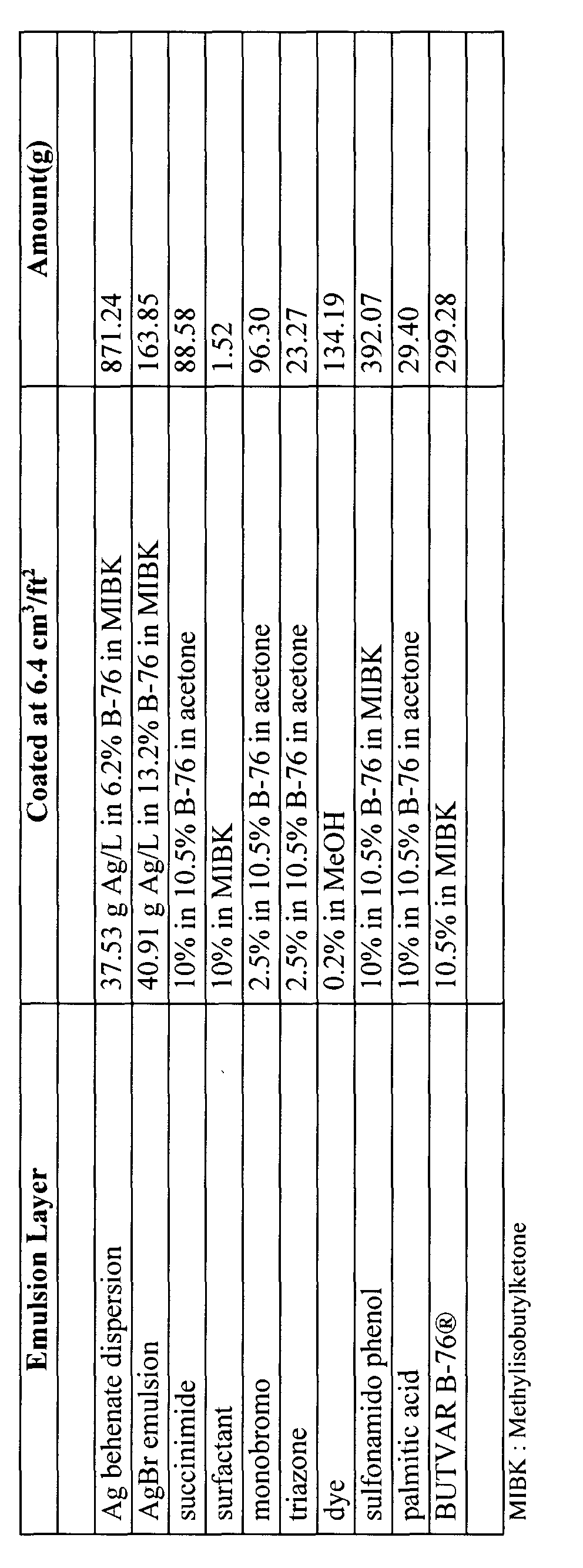

- A solution containing 10 mg of dye D-60 , 20 equivalent of the N-oxyazinium compound bleaching agent indicated in the Table 8 below, 250 mg dibutylphthalate, 1g acetonitrile, and 9 g of a solution of Elvacite™ (8 wt%) was coated on a 5 mil clear Estar support. After drying, the films were then exposed to a camera flash to determine bleachabilility of this antihalation layer according to the method disclosed in example 3.
- The camera flash used for bleaching was a Promatic TCL 3200® with an illuminance of 428 lux and an irradiance of 3.63 watt/ m2 at a distance of 1 m with a flash time of 820 µsec +/- 5%. The Hg lamp was a 200 watt high pressure, short arc Hg lamp. The exposure to the Hg lamp was 30 sec.
- Table 8 shows that N-oxyazinium with phenyl substituents, allowed bleaching to proceed efficiently when subjected to 20 flashes. The methyl analog, was much less efficient. However, all three N-oxyazinium allowed complete bleaching when irradiated for 30 sec with the Hg lamp.
N-oxyazinium Dmax 5 Flash 20 Flash Hg lamp 2.27 0.40 0.01 0.01 2.38 1.38 0.01 0.01 2.26 2.00 1.22 0.01 - In these experiments, a solution containing 10 mg of dye D-60, 50 mg of N-methoxy-4-phenylpyridinium tetrafluoroborate, 250 mg dibutylphthalate, 1 g acetonitrile, and 9 g of a binder solution indicated in the following Table 9 was coated on a 5 mil clear Estar support. Bleaching was performed as previously disclosed.
- Table 9 shows that all five substantially different binders allowed good photobleaching of the antihalation layer.
Binder (°C) Dmax 5 Flash 20 Flash Hg Lamp Elvacite 109 2.21 0.32 0.09 0.01 Butvar 68 1.53 0.20 0.01 0.01 114 2.20 0.10 0.01 0.01 Polycarbonate 149 2.19 0.21 0.09 0.01 136 2.40 0.27 0.03 0.01 - A solution containing 10 mg of the dye indicated in Table 10 below, 50 mg of N-methoxy-4-phenylpyridinium tetrafluoroborate, 250 mg dibutylphthalate, 1g acetonitrile, 9 g Elvacite™ (8 wt%) was coated on a 5 mil clear Estar support. After drying, bleaching was performed as previously disclosed.
- The bleaching results are given Table 10, below.
Dye λmax Dmax 5 Flash 20 Flash D-61 715 0.06 0.05 0.05 D-62 663 2.34 0.86 0.12 D-63 631 0.24 0.09 0.05 D-64 660/490 0.40/0.53 0.18/0.35 0.07/0.21 D-65 637 1.15 1.00 0.09 D-66 660/558 0.20/0.23 0.06/0.10 0.04/0.08 D-67 665/420 0.17/0.26 0.06/0.26 0.04/0.24 D-68 660/560 0.06/0.19 0.02/0.09 0.02/0.02 D-69 659 1.49 0.20 0.08 D-70 560 0.27 0.05 0.03 D-71 665/480 0.12/0.17 0.08/0.14 0.04/0.10 D-72 670 1.45 1.02 0.04 D-73 700 0.03 0.00 0.00 D-74 681 2.00 0.11 0.04 D-75 684 0.14 0.02 0.00 D-76 514 0.48 0.34 0.20 D-77 654 1.50 0.13 0.04 D-78 477 1.05 1.02 0.82 - A solution containing 10 mg of the dye indicated in Table 11 below, 50 mg N-methoxy-4-phenylpyridinium tetrafluoroborate, 500 mg of a glycerol water solution (50%), 1 g water, 9 g of a solution PVA in water (6.1 wt %) was coated on a 5 mil clear Estar support. After drying for 2 minutes, bleaching was performed as already disclosed. The bleaching results are given Table 11 below.
Dye λmax Dmax* 5 Flash D-83 663 0.59 0.15 D-84 671 1.11 0.54 D-85 681 0.47 0.03 D-86 702 0.41 0.03 D-87 702 0.57 0.05 D-88 703 0.16 0.01 D-89 710 0.20 0.05 D-90 696 0.79 0.05 D-91 689 0.23 0.08 - In experiments 11A and 11B, a solution containing 10 mg of the dyes as indicated in table 12, 50 mg N-methoxy-4-phenylpyridinium tetrafluoroborate, 1g acetonitrile, 250 mg of dibutylphthalate and 9 g of a 8 wt% solution of Elvacite™ was coated on a 5 mil clear Estar support. After drying for 2 minutes, the bleaching was performed as disclosed in example 7.
- In experiment 11C, the coating solution was the solution of Example 11A wherein Elvacite™ was replaced by a Butvar solution and the dye was as indicated below
- In Experiment 11D, the coated solution was a solution containing 10 mg of the dye, 56 mg N- methoxy-4-phenylpyridinium tosylate, 1 g water, 500 mg of 50% glycerol in water and 9 g of 6.1% PVA and the dye was as indicated below.
Dye Experiment λmax Dmax* Hg Lamp (30 sec) 5 Flash D-92 11A 649 nm 1.06 0.05 D-93 11B 650 nm 2.42 0.53 D-94 11C 671 nm 1.11 ― 0.76 D-95 11D 669 nm 0.36 0.01 - The backside of the phototermographic element described in Example 6, was coated with a mixture of 5 mg of dye D-92, 50 mg N-methoxy-4-phenylpyridinium tetrafluoroborate, 1 g acetonitrile, 9 g (8%) solution of Elvacite™, 250 mg dibutylphthalate with a 5 mil knife under pan lights. After drying the sensitometer for 10-3 sec through a Wratten 29 and 47 filters and processed for 5 sec at 119°C.
- The control with no halation protection, showed blurry edges in the step tablets. The present invention shows sharp images in the red exposure areas. The cyan color of the antihalation dye was still present after processing but could be bleached on exposure to a camera flash to go from D = 0.41 to D = 0.23. Residual density is due to the emulsion sensitizing dye remaining in the film.
- A solution containing D-28 and 0.12 M of N-methoxy-4-phenylpyridinium tetrafluoroborate in acetonitrile was irradiated with a xenon lamp (λ> 600 nm). Upon 7.5 min. of irradiation, the optical density at 805 nm dropped from 1.6 to less than 0.10.
Claims (9)
- A photobleachable dye composition substantially free of polymerisable monomer comprising a photobleachable dye and an N-oxyazinium compound.
- The composition of claim 1 wherein the N-oxyazinium compound has a reduction potential less negative than -1.4 V, and comprises an N-oxy group capable of releasing an oxy radical that reacts with the photobleachable dye to produce a bleached compound.
- The composition of claim 1 or claim 2 wherein the N-oxyazinium compound has one of the following formulae :
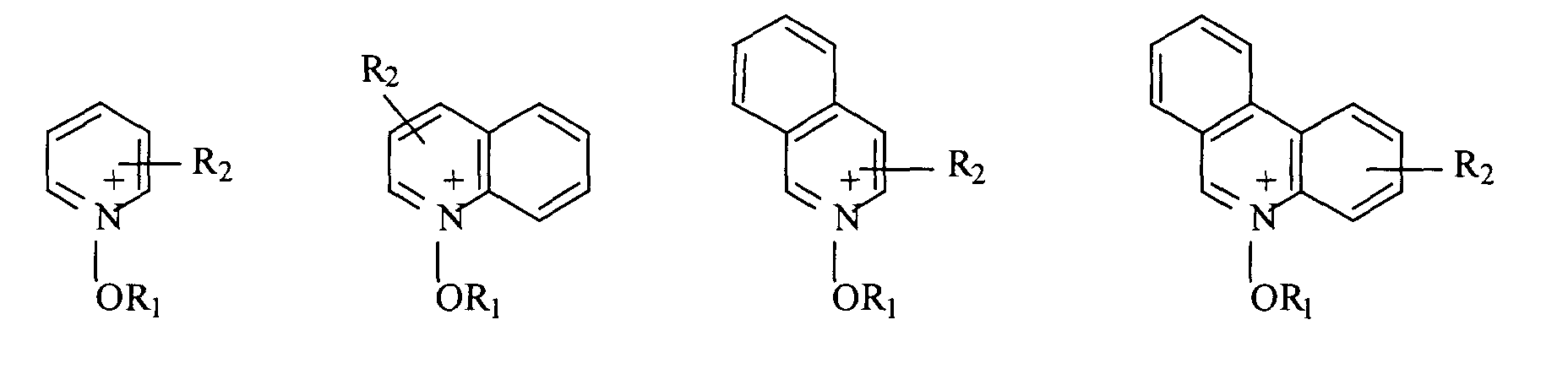

 wherein R1 represents alkyl group of 1-12 carbons, or alkyl group substituted with one or more groups selected from the group consisting of acyloxy, alkoxy, aryloxy, alkylthio, arylthio, alkylsulfonyl, thiocyano, cyano, halogen, alkoxycarbonyl, aryloxycarbonyl, acetyl, aroyl, alkylaminocarbonyl, arylaminicarbonyl, alkylaminocarbonyloxy, arylaminocarbonyloxy, acylamino, carboxy, sulfo, trihalomethyl, alkyl, aryl, heteroaryl, alkylureido, arylureido, succinimido, and phthalimido substituent; aryl group, or acyl group ; R2, R22 or R6 represents independently hydrogen, an alkyl group of 1-12 carbons, an aryl or heteroaryl group, unsubstituted or substituted with one or more substituents selected from the group consisting of an acyloxy, alkoxy, aryloxy, alkylthio, arylthio, alkylsulfonyl, thiocyano, cyano, halogen, alkoxycarbonyl, aryloxycarbonyl, acetyl, aroyl, alkylaminocarbonyl, arylaminicarbonyl, alkylaminocarbonyloxy, arylaminocarbonyloxy, acylamino, carboxy, sulfo, trihalomethyl, alkyl, aryl, heteroaryl, alkylureido, arylureido, succinimido and phthalimido substituent, or an acyloxy, hydroxy, alkoxy, aryloxy, alkylthio, arylthio, alkylsulfonyl, thiocyano, cyano, halogen, alkoxycarbonyl, aryloxycarbonyl, acetyl, aroyl, alkylaminocarbonyl, arylaminicarbonyl, alkylaminocarbonyloxy, arylaminocarbonyloxy, acylamino, amino, alkylamino, arylamino, carboxy, sulfo, trihalomethyl, alkyl, aryl, heteroaryl, alkylureido, arylureido, succinimido, phthalimido group, -CO-R3 wherein R3 is an alkyl or an aryl group, or -(CH=CH)m-R4 wherein R4 is an aryl or heterocyclic group ; m is 1 or 2 ; Y is selected from the group consisting of S, O, Se, -C(R1)2, and -NR1; X is a divalent linking group selected from a group consisting of substituted or unsubstituted methylenes, (-CR5R7-)n and [(-CR5R7)n-X1-(CR5R7-)p] wherein R5 or R7 are independently hydrogen, alkyl, substituted alkyl, aryl, substituted aryl, heteroaryl, substituted heteroaryl group, n and p are from 1-12, X1 is aryl or heteroaryl nuclei, carbonyl, sulfo, thio, oxy ; and Z is an alkylidene group.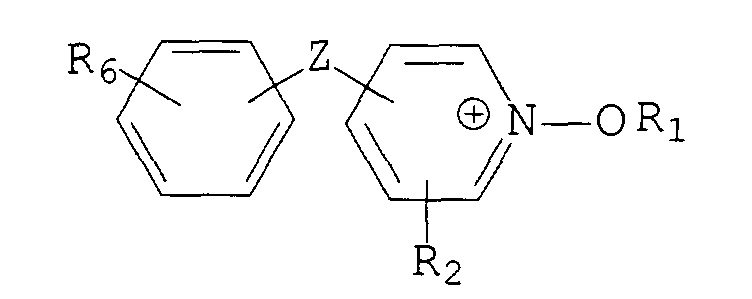
- The composition of any preceding claim wherein the N-oxyazinium compound is an N-alkyloxyazinium compound, preferably represented by one of the following formulae:wherein R1 is an alkyl, an aryl or an acyl group, R2 or R22 are independently a hydrogen atom, alkyl, aryl, heterocyclic, carboxylic, carboxylate, carbonamido, sulfonamido, nitryl groups, -CO-R3 group wherein R3 is an alkyl group or aryl group, or -(CH=CH)m-R4 group wherein R4 is an aryl or heterocyclic group or R2 or R22 can form a fused ring system with the phenyl group to which they are attached; X is an alkylidene group.

- The composition of any preceding claim wherein the photobleachable dye is a filter dye, an antihalation dye, a sensitizing dye, an image dye, or an infra-red dye of an imaging element.
- An imaging element comprising a support having thereon at least one image forming layer, and at least one non-image forming layer wherein the element further comprises a visible-light sensitive photobleachable composition of any preceding claim.
- The element of claim 6, wherein the photobleachable composition is incorporated in the non image-forming layer, preferably an antihalation layer.
- The element of claim 6 or claim 7 wherein the element is a silver halide photographic element or a photothermographic element.
- A method for bleaching a photographic of any one of claims 6 through 8, the method comprisingexposing and processing the photographic element, andexposing the exposed and processed element, to radiation that can be absorbed either by the photobleachable dye or by the N-oxyazinium compound.
Applications Claiming Priority (2)
| Application Number | Priority Date | Filing Date | Title |
|---|---|---|---|
| US09/510,002 US6376163B1 (en) | 2000-02-22 | 2000-02-22 | Photobleachable composition, photographic element containing the composition and photobleachable method |
| US510002 | 2000-02-22 |
Publications (1)
| Publication Number | Publication Date |
|---|---|
| EP1134613A1 true EP1134613A1 (en) | 2001-09-19 |
Family
ID=24028955
Family Applications (1)
| Application Number | Title | Priority Date | Filing Date |
|---|---|---|---|
| EP01200472A Withdrawn EP1134613A1 (en) | 2000-02-22 | 2001-02-12 | Photobleachable composition, photographic element containing the composition and photobleach method |
Country Status (3)
| Country | Link |
|---|---|
| US (1) | US6376163B1 (en) |
| EP (1) | EP1134613A1 (en) |
| JP (1) | JP2001242584A (en) |
Cited By (1)
| Publication number | Priority date | Publication date | Assignee | Title |
|---|---|---|---|---|
| WO2013041117A1 (en) | 2011-09-23 | 2013-03-28 | Illumina Cambrigde Ltd. | Dyes for labelling molecular ligands |
Families Citing this family (3)
| Publication number | Priority date | Publication date | Assignee | Title |
|---|---|---|---|---|
| US7365104B2 (en) * | 2005-03-31 | 2008-04-29 | Eastman Kodak Company | Light curable articles containing azinium salts |
| US8052829B2 (en) * | 2007-10-26 | 2011-11-08 | Dymax Corporation | Photopolymerizable compositions containing an oxonol dye |
| EP2483358B1 (en) * | 2009-09-29 | 2014-12-10 | Covalon Technologies Inc. | System and method for coating medical devices |
Citations (3)
| Publication number | Priority date | Publication date | Assignee | Title |
|---|---|---|---|---|
| US4075017A (en) * | 1976-05-24 | 1978-02-21 | Eastman Kodak Company | Photothermographic material containing a combination of energy-sensitive organic dyes and process of forming a positive or negative image with the material |
| GB2083832A (en) * | 1980-09-10 | 1982-03-31 | Eastman Kodak Co | Photopolymerization initiator compositions containing N-oxy-N- heterocyclic activator compounds |
| US4743528A (en) * | 1986-11-21 | 1988-05-10 | Eastman Kodak Company | Enhanced imaging composition containing an azinium activator |
Family Cites Families (15)
| Publication number | Priority date | Publication date | Assignee | Title |
|---|---|---|---|---|
| US3615432A (en) | 1968-10-09 | 1971-10-26 | Eastman Kodak Co | Energy-sensitive systems |
| US3745009A (en) | 1968-10-09 | 1973-07-10 | Eastman Kodak Co | Photographic elements and light-absorbing layers |
| US3988156A (en) * | 1974-02-19 | 1976-10-26 | Eastman Kodak Company | Photographic supports and elements utilizing photobleachable o-nitroarylidene dyes |
| US4111699A (en) * | 1977-06-06 | 1978-09-05 | Eastman Kodak Company | O-nitro-o-azaarylidene photobleachable dyes and photographic elements utilizing them |
| GB2136590B (en) | 1983-03-15 | 1986-01-02 | Minnesota Mining & Mfg | Dye-bleach materials and process |
| GB8307022D0 (en) | 1983-03-15 | 1983-04-20 | Minnesota Mining & Mfg | Photothermographic element |
| US4701402A (en) | 1984-02-13 | 1987-10-20 | Minnesota Mining And Manufacturing Company | Oxidative imaging |
| US4769459A (en) | 1985-12-30 | 1988-09-06 | Minnesota Mining And Manufacturing Company | Oxidative imaging |
| JP2516586B2 (en) | 1986-01-14 | 1996-07-24 | 富士写真フイルム株式会社 | Liquid development method for electrophotographic film |
| US4895880A (en) | 1986-05-06 | 1990-01-23 | The Mead Corporation | Photocurable compositions containing photobleachable ionic dye complexes |
| US4743531A (en) | 1986-11-21 | 1988-05-10 | Eastman Kodak Company | Dye sensitized photographic imaging system |
| US4743530A (en) | 1986-11-21 | 1988-05-10 | Eastman Kodak Company | Negative working photoresists responsive to longer wavelengths and novel coated articles |
| US4743529A (en) | 1986-11-21 | 1988-05-10 | Eastman Kodak Company | Negative working photoresists responsive to shorter visible wavelengths and novel coated articles |
| WO1993004411A1 (en) | 1991-08-16 | 1993-03-04 | Eastman Kodak Company | Migration imaging with dyes or pigments to effect bleaching |
| DE4142956C2 (en) | 1991-12-24 | 1996-08-14 | Du Pont Deutschland | Bleachable antihalation system for photographic materials |
-
2000
- 2000-02-22 US US09/510,002 patent/US6376163B1/en not_active Expired - Fee Related
-
2001
- 2001-02-12 EP EP01200472A patent/EP1134613A1/en not_active Withdrawn
- 2001-02-22 JP JP2001046176A patent/JP2001242584A/en active Pending
Patent Citations (3)
| Publication number | Priority date | Publication date | Assignee | Title |
|---|---|---|---|---|
| US4075017A (en) * | 1976-05-24 | 1978-02-21 | Eastman Kodak Company | Photothermographic material containing a combination of energy-sensitive organic dyes and process of forming a positive or negative image with the material |
| GB2083832A (en) * | 1980-09-10 | 1982-03-31 | Eastman Kodak Co | Photopolymerization initiator compositions containing N-oxy-N- heterocyclic activator compounds |
| US4743528A (en) * | 1986-11-21 | 1988-05-10 | Eastman Kodak Company | Enhanced imaging composition containing an azinium activator |
Cited By (1)
| Publication number | Priority date | Publication date | Assignee | Title |
|---|---|---|---|---|
| WO2013041117A1 (en) | 2011-09-23 | 2013-03-28 | Illumina Cambrigde Ltd. | Dyes for labelling molecular ligands |
Also Published As
| Publication number | Publication date |
|---|---|
| JP2001242584A (en) | 2001-09-07 |
| US6376163B1 (en) | 2002-04-23 |
Similar Documents
| Publication | Publication Date | Title |
|---|---|---|
| US3758309A (en) | -pyrazolo(3,2-c)-s-triazole silver halide emulsions containing sensitizing dyes derived from a 1h | |
| JPH0356616B2 (en) | ||
| BE738230A (en) | ||
| US3988155A (en) | Silver halide photographic emulsion | |
| JPH06202281A (en) | Near-infrared absorbing dyem prepared from stenhouse salt | |
| US6376163B1 (en) | Photobleachable composition, photographic element containing the composition and photobleachable method | |
| EP0887700B1 (en) | Sensitizing dyes for enhanced light absorption | |
| JPH03120535A (en) | Infrared ray sensitive photographic element containing at least two photosensitive layers | |
| EP0467370B1 (en) | Sensitizing dyes for photographic materials | |
| US3615610A (en) | Silver halide direct positive emulsions spectrally sensitized with a combination of a desensitizing dye with a 2-phenylindole methine dye | |
| JPH03171134A (en) | Photographic element | |
| EP0439356A1 (en) | Spectrally sensitized silver halide photographic material | |
| EP0472004B1 (en) | Sensitizing dye combination for photographic materials | |
| JPH03138638A (en) | Infrared intensifying dyestuff for photosensitive material | |
| US6436624B2 (en) | Method for reducing the dye stain in photographic elements | |
| JP3631261B2 (en) | Photographic silver halide element containing infrared sensitizing dye | |
| US4105454A (en) | Silver halide photographic emulsion spectrally sensitized with merocyanine dyes | |
| US3432303A (en) | Silver halide emulsions containing dye combinations for supersensitization | |
| US3125448A (en) | J-ethyl-z | |
| US3985563A (en) | Silver halide photographic emulsion | |
| US4073652A (en) | Direct-positive silver halide emulsions | |
| US3963494A (en) | Photographic multilayer direct-positive silver halide element | |
| US3970461A (en) | Fogged, direct-positive silver halide emulsion containing carbocyanine dye having indolenine nucleus | |
| US5077191A (en) | Photographic sensitizing dyes | |
| EP0329491A2 (en) | Photographic elements incorporating antihalation and/or acutance dyes |
Legal Events
| Date | Code | Title | Description |
|---|---|---|---|
| PUAI | Public reference made under article 153(3) epc to a published international application that has entered the european phase |
Free format text: ORIGINAL CODE: 0009012 |
|
| AK | Designated contracting states |
Kind code of ref document: A1 Designated state(s): DE FR GB Kind code of ref document: A1 Designated state(s): AT BE CH CY DE DK ES FI FR GB GR IE IT LI LU MC NL PT SE TR |
|
| AX | Request for extension of the european patent |
Free format text: AL;LT;LV;MK;RO;SI |
|
| 17P | Request for examination filed |
Effective date: 20020226 |
|
| AKX | Designation fees paid |
Free format text: DE FR GB |
|
| 17Q | First examination report despatched |
Effective date: 20020523 |
|
| RIC1 | Information provided on ipc code assigned before grant |
Ipc: 7A 61P 25/24 B Ipc: 7A 63B 1/00 B Ipc: 7G 03C 1/498 B Ipc: 7A 62C 8/00 B Ipc: 7G 03C 1/83 A |
|
| STAA | Information on the status of an ep patent application or granted ep patent |
Free format text: STATUS: THE APPLICATION IS DEEMED TO BE WITHDRAWN |
|
| 18D | Application deemed to be withdrawn |
Effective date: 20060928 |