EP1134071A2 - Process for preparing ultraviolet-ray-absorbable and low water-containing soft contact lens - Google Patents
Process for preparing ultraviolet-ray-absorbable and low water-containing soft contact lens Download PDFInfo
- Publication number
- EP1134071A2 EP1134071A2 EP01105783A EP01105783A EP1134071A2 EP 1134071 A2 EP1134071 A2 EP 1134071A2 EP 01105783 A EP01105783 A EP 01105783A EP 01105783 A EP01105783 A EP 01105783A EP 1134071 A2 EP1134071 A2 EP 1134071A2
- Authority
- EP
- European Patent Office
- Prior art keywords
- ultraviolet
- contact lens
- low water
- soft contact
- ray
- Prior art date
- Legal status (The legal status is an assumption and is not a legal conclusion. Google has not performed a legal analysis and makes no representation as to the accuracy of the status listed.)
- Granted
Links
Classifications
-
- B—PERFORMING OPERATIONS; TRANSPORTING
- B29—WORKING OF PLASTICS; WORKING OF SUBSTANCES IN A PLASTIC STATE IN GENERAL
- B29D—PRODUCING PARTICULAR ARTICLES FROM PLASTICS OR FROM SUBSTANCES IN A PLASTIC STATE
- B29D11/00—Producing optical elements, e.g. lenses or prisms
- B29D11/00009—Production of simple or compound lenses
- B29D11/00038—Production of contact lenses
Definitions
- the present invention relates to a process for preparing an ultraviolet-ray-absorbable and low water-containing soft contact lens. More particularly, the present invention relates to a process for preparing an ultraviolet-ray-absorbable and low water-containing soft contact lens, by which an ultraviolet-ray absorbing agent can be physically captured to the inside of a low water-containing soft contact lens to impart ultraviolet-ray absorbability to the soft contact lens without elution of ultraviolet-ray absorbing agent.
- a process for preparing an ultraviolet-ray-absorbable contact lens is disclosed.
- a polymer having hydroxyl group in its side chain and the shape of lens, in which an ultraviolet-ray absorbing agent substituted with at least one anhydride group is dispersed and contained, is prepared.
- the polymer is under the basic condition which is effective for reaction of the hydroxyl group with the anhydride group in the ultraviolet-ray absorbing agent.
- covalent ester bond is formed by the ultraviolet-ray absorbing agent, so that the ultraviolet-ray absorbing agent is fixed to the polymer.
- a process for preparing an ultraviolet-ray-absorbable lens is disclosed.
- a lens made of a polymer lens material is contacted with a basic solution containing the specific ultraviolet-ray absorbing agent which can bond to the lens material in the effective amount for absorbing ultraviolet-ray. Then, after the specific period of time passes, the above lens is picked up from the basic solution.
- both ultraviolet-ray absorbing agent and polymer lens material need a functional group which is capable of reacting with each other.
- temperature of the basic solution is specified.
- An object of the present invention is to provide a process for preparing an ultraviolet-ray-absorbable contact lens, by which an ultraviolet-ray absorbing agent can be physically captured to the inside of a contact lens to impart ultraviolet-ray absorbability to the contact lens without elution of ultraviolet-ray absorbing agent and inhibition of polymerization.
- the ultraviolet-ray absorbing agent can be physically captured to the inside of the contact lens to impart ultraviolet-ray absorbability to the contact lens without elution of ultraviolet-ray absorbing agent and the ultraviolet-ray-absorbable and low water-containing soft contact lens can be prepared without inhibition of polymerization.
- the low water-containing soft contact lens used in the present invention is a soft contact lens having low water content.
- the "low water content” shows that possibility of elution does not become high.
- the water content of the low water-containing soft contact lens is at most 15 % by weight, preferably at most 10 % by weight.
- a lens material which composes the above low water-containing soft contact lens is not particularly limited.
- absorption rate for the swelling solution of the lens material is at least 12 %, preferably at least 15 %, or that linear swelling rate of the lens material in the solution (I) is at least 1.04, preferably at least 1.05.
- absorption rate for the swelling solution of the lens material is at most 50 %, preferably at most 45 %, or that linear swelling rate of the lens material in the solution (I) is at most 1.15, preferably at most 1.14.
- Examples of the lens material used in the present invention are a siloxane-containing polymer prepared by polymerizing a monomer mixture containing a siloxane macromonomer (A) having at least two active unsaturated groups and number average molecular weight of 2000 to 100000 and a vinyl ester of lower fatty acid (B), and the like.
- A siloxane macromonomer
- B vinyl ester of lower fatty acid
- the active unsaturated group in the siloxane macromonomer (A) is an active unsaturated group which can be subjected to radical polymerization.
- Examples of the active unsaturated group are (meth)acryloyl group, vinyl group, allyl group, (meth)acryloyloxy group, vinyl carbamate group and the like.
- number average molecular weight of the siloxane macromonomer (A) is at least 2000, preferably at least 2500. From the viewpoint of shape recovery of the lens material, it is desired that number average molecular weight of the siloxane macromonomer (A) is at most 100000, preferably at most 50000.
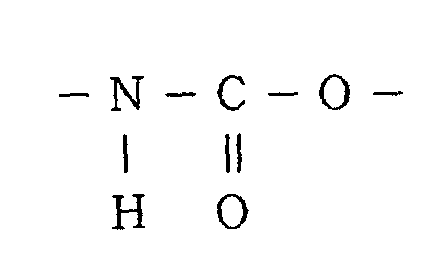
- siloxane macromonomers are bad in water-wettability and relatively lack mechanical strength when each of macromonomers is homopolymerized. Accordingly, as the siloxane macromonomer (A) used in the present invention, in order to improve water-wettability, a siloxane macromonomer having urethane group represented by the formula: in the macromonomer structure is preferable. It is desired that the average number of the urethane group in the macromonomer structure is at least 2, preferably at least 4, and is at most 20, preferably at most 14.
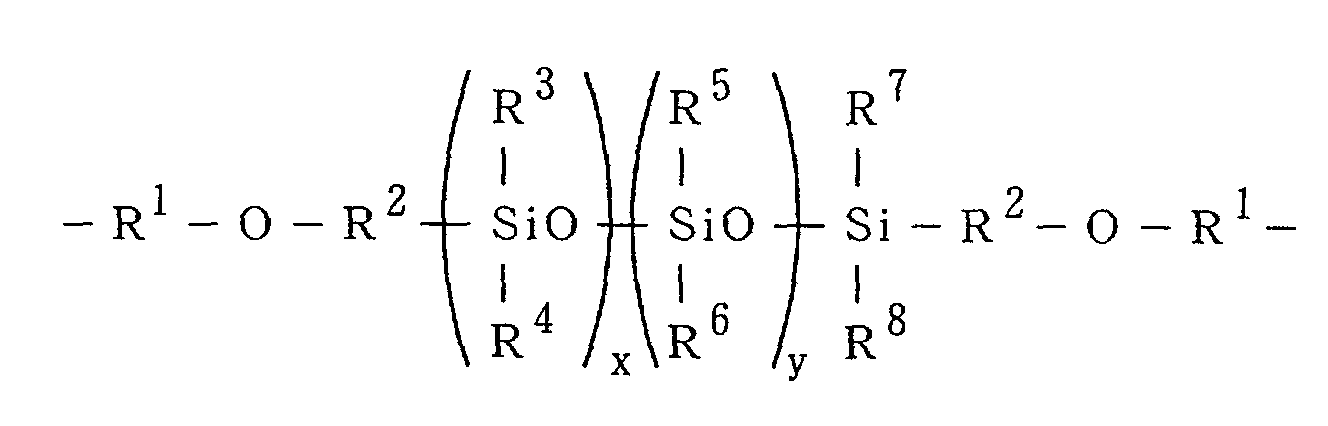
- siloxane macromonomer (A) a macromonomer represented by the following formula (I-1) and a macromonomer represented by the following formula (I-2) are preferably used. That is, the former macromonomer is represented by the formula (I-1): A 1 -(-U 1 -S 1 -) n -U 2 -S 2 -U 3 -A 2
- examples of the active unsaturated group represented by A 1 and A 2 are (meth)acryloyl group, vinyl group, allyl group, (meth)acryloyloxy group, vinyl carbamate group and the like. Among them, because more excellent flexibility can be imparted to the lens material and copolymerizability with the other monomers is excellent, acryloyloxy group and vinyl group are preferable, and acryloyloxy group is particularly preferable.
- the above active unsaturated group contains an alkylene group or an alkylene glycol group
- the number of carbon atoms of the alkylene group or the alkylene glycol group is 1 to 20, preferably 1 to 10 carbon atoms.
- each of R 1 , R 2 , R 3 , R 4 , R 5 , R 6 , R 7 , R 8 , x and y is the same as above, each of R 1 and R 2 is preferably an alkylene group having 1 to 5 carbon atoms, and each of R 3 , R 4 , R 5 , R 6 , R 7 and R 8 is preferably an alkyl group having 1 to 5 carbon atoms.
- R 3 , R 4 , R 5 , R 6 , R 7 or R 8 represented by the formula: A 3 -U 4 -R 1 -O-R 2 -, A 3 is the same active unsaturated group as the above exemplified one.
- the active unsaturated group contains an alkylene group or an alkylene glycol group
- the number of carbon atoms of the alkylene group or the alkylene glycol group is 1 to 20, preferably 1 to 10 carbon atoms.
- x is an integer of 1 to 500
- y is 0 or an integer of 1 to 499
- x+y is an integer of 1 to 500.
- n is 0 or an integer of 1 to 5.
- examples of the active unsaturated group having urethane bond, represented by B 1 are (meth)acryloylisocyanate group, (meth)acryloyloxyisocyanate group, allylisocyanate group, vinylbenzylisocyanate group and the like.
- the group represented by S 3 in the formula (I-2) is the same as the group represented by S 1 or S 2 in the above formula (I-1).
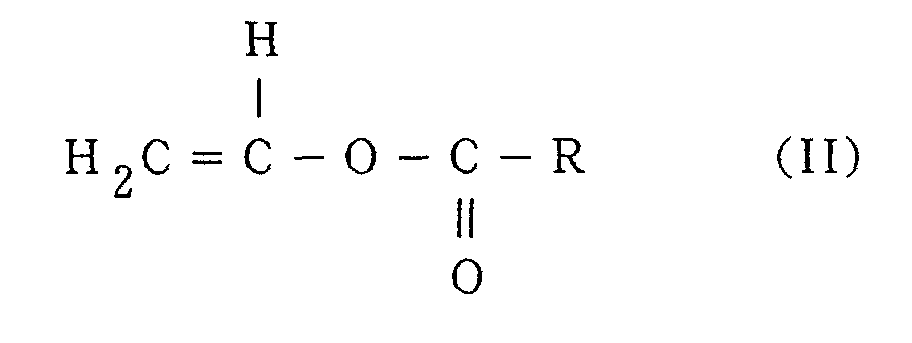
- Typical preferable example of the vinyl ester of lower fatty acid (B) is a compound represented by the formula (II): wherein R is hydrogen atom or an alkyl group having 1 to 5 carbon atoms, which may be substituted with a halogen atom.
- R is hydrogen atom or an alkyl group having 1 to 5 carbon atoms, which may be substituted with a halogen atom.
- the compound are vinyl formate, vinyl acetate, vinyl propionate, vinyl butyrate, vinyl pivalate, vinyl versatate, vinyl laurate, vinyl stearate, vinyl monochloroacetate, vinyl monofluoroacetate, vinyl trichloroacetate, vinyl trifluoroacetate and the like. These can be used alone or in admixture thereof.
- vinyl esters of lower fatty acid (B) because shape recovery and hydrophilic property can be greatly imparted to the lens material, vinyl acetate, vinyl propionate and vinyl pivalate are preferable. In particular, vinyl acetate is preferable.
- the siloxane-containing polymer which is the lens material used in the present invention is prepared by polymerizing the monomer mixture containing the siloxane macromonomer (A) and the vinyl ester of lower fatty acid (B).
- the monomer mixture can contain also, for instance, a silicon-containing monomer (C).
- silicon-containing monomer (C) are a silicon-containing (meth)acrylate such as pentamethyldisiloxanylmethyl (meth)acrylate, trimethylsiloxydimethylsilylpropyl (meth)acrylate, methylbis(trimethylsiloxy)silylpropyl (meth)acrylate, tris(trimethylsiloxy)silylpropyl (meth)acrylate, mono [methylbis(trimethylsiloxy) siloxy]bis(trimethylsiloxy) silylpropyl (meth)acrylate, tris[methylbis(trimethylsiloxy)siloxy]silylpropyl (meth)acrylate, trimethylsilylmethyl (meth)acrylate, trimethylsilylpropyl (meth)acrylate, methylbis(trimethylsiloxy)silylethyltetramethyldisiloxanylmethyl (meth)acrylate, tetramethyltriisopropylcyclotetrasi
- the silicon-containing (meth)acrylate is preferable.
- tris(trimethylsiloxy)silylpropyl acrylate is preferable.
- --(meth)acrylate means “--acrylate and/or methacrylate", and the same is also true for the other (meth)acrylate derivatives.
- the monomer mixture can contain also, for instance, a fluorine-containing monomer (D), in addition to the siloxane macromonomer (A), the vinyl ester of lower fatty acid (B) and the silicon-containing monomer (C).
- a fluorine-containing monomer D
- the siloxane macromonomer A
- the vinyl ester of lower fatty acid B
- the silicon-containing monomer C
- fluorine-containing monomer (D) are 2,2,2-trifluoroethyl (meth)acrylate, 2,2,3,3-tetrafluoropropyl (meth)acrylate, 2,2,3,3-tetrafluoro-t-pentyl (meth)acrylate, 2,2,3,4,4,4-hexafluorobutyl (meth)acrylate, 2,2,3,4,4,4-hexafluoro-t-hexyl (meth)acrylate, 2,3,4,5,5,5-hexafluoro-2,4-bis(trifluoromethyl)pentyl (meth)acrylate, 2,2,3,3,4,4-hexafluorobutyl (meth)acrylate, 2,2,2,2',2',2'-hexafluoroisopropyl (meth)acrylate, 2,2,3,3,4,4,4-heptafluorobutyl (meth)acrylate, 2,2,3,3,4,4,5,5-octa
- the fluoroalkyl acrylate is preferable.
- fluorine-containing compounds can impart oxygen permeability and lipid-stain resistance to a material, the compounds are bad in water-wettability.
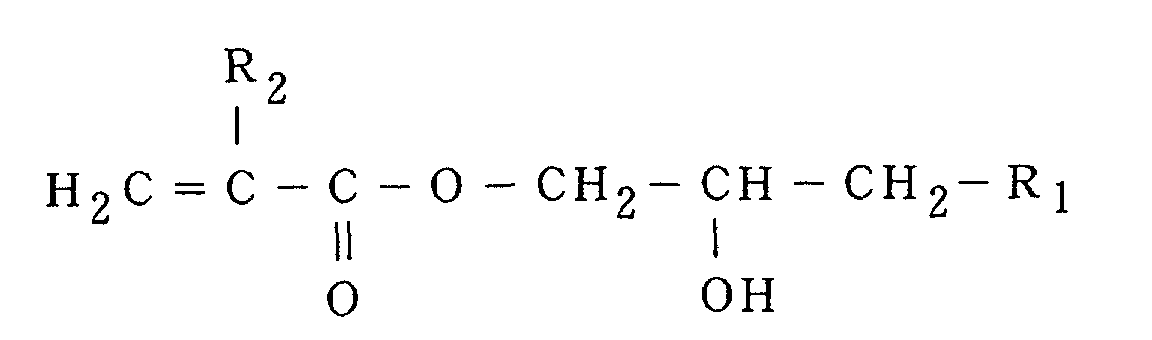
- a fluoroalkyl acrylate having hydroxyl group represented by the formula: wherein R' 1 is a perfluoroalkyl group having 3 to 15, preferably 3 to 8, more preferably 4 to 6 carbon atoms is particularly preferable.
- the proportion of the siloxane macromonomer (A), the vinyl ester of lower fatty acid (B) and the silicon-containing monomer (C) used as occasion demands is preferably defined as mentioned below. That is, in order to sufficiently impart flexibility, mechanical strength and oxygen permeability to the lens material, it is desired that the weight ratio of the total amount of siloxane macromonomer (A) and silicon-containing monomer (C) to the amount of vinyl ester of lower fatty acid (B) (total amount of (A) and (C)/amount of (B), that is, when the silicon-containing monomer (C) is not used, amount of (A)/amount of (B)), is at least 30/70, preferably at least 50/50. In order to sufficiently impart shape recovery and hydrophilic property to the lens material, it is desired that the above weight ratio is at most 90/10, preferably at most 80/20.
- the proportion of the siloxane macromonomer (A) and the silicon-containing monomer (C) is preferably defined as mentioned below. That is, in order to sufficiently impart mechanical strength to the lens material without lowering shape recovery, it is desired that the weight ratio of the amount of siloxane macromonomer (A) to the amount of silicon-containing monomer (C) (amount of (A)/amount of (C)), is at least 20/80, preferably at least 25/75. In order to sufficiently impart oxygen permeability to the lens material, it is desired that the above weight ratio is at most 90/10, preferably at most 80/20.
- the proportion of the siloxane macromonomer (A), the vinyl ester of lower fatty acid (B), and the silicon-containing monomer (C) and the fluorine-containing monomer (D) which are used as occasion demands is preferably defined as mentioned below. That is, in order to sufficiently exhibit effects from the siloxane macromonomer (A), the vinyl ester of lower fatty acid (B) and the silicon-containing monomer (C), it is desired that the weight ratio of the total amount of siloxane macromonomer (A), vinyl ester of lower fatty acid (B) and silicon-containing monomer (C) to the amount of fluorine-containing monomer (D) (total amount of (A), (B) and (C)/amount of (D)), is at least 20/80, preferably at least 40/60. In order to sufficiently impart, in particular, lipid-stain resistance to the lens material, it is desired that the above weight ratio is at most 90/10, preferably at most 85/15.
- the monomer mixture can also contain a crosslinkable compound having at least 2 polymerizable groups (E) (hereinafter referred to as "crosslinkable compound (E)").
- crosslinkable compound (E) a crosslinkable compound having at least 2 polymerizable groups
- crosslinkable compound (E) are ethylene glycol di(meth)acrylate, diethylene glycol di(meth)acrylate, triethylene glycol di(meth)acrylate, propylene glycol di(meth)acrylate, dipropylene glycol di(meth)acrylate, allyl (meth)acrylate, vinyl (meth)acrylate, trimethylolpropane tri(meth)acrylate, methacryloyloxydiethyl acrylate, divinylbenzene, diallyl phthalate, diallyl adipate, diethylene glycol diallyl ether, triallylisocyanurate, ⁇ -methylene-N-vinylpyrrolidone, 4-vinylbenzyl (meth)acrylate, 3-vinylbenzyl (meth)acrylate, 2,2-bis(p-(meth)acryloyloxyphenyl)hexafluoropropane, 2,2-bis(m-(meth)acryloyloxy
- crosslinkable compounds (E) because optical property and mechanical strength can be greatly imparted to the lens material and handling is easy, ethylene glycol di(meth)acrylate, diethylene glycol di(meth)acrylate, diallyl adipate and diethylene glycol diallyl ether are preferable. In particular, ethylene glycol di(meth)acrylate and diethylene glycol diallyl ether are preferable.
- the amount of the crosslinkable compound (E) in the monomer mixture is at least 0.01 % by weight, preferably at least 0.05 % by weight. In order to remove fear that flexibility of the lens material is lowered although mechanical strength is imparted to the lens material, it is desired that the amount of the crosslinkable compound (E) in the monomer mixture is at most 15 % by weight, preferably at most 10 % by weight.
- the monomer mixture is suitably adjusted to the desired kind and amount of monomer. Then, usually in accordance with a radical polymerization method such as a thermal polymerization method or a photo polymerization method, in which radical generates in an active unsaturated group and polymerization reaction is carried out, a radical polymerization initiator, a photo sensitizer and the like are added to the monomer mixture to give a lens material.
- a radical polymerization method such as a thermal polymerization method or a photo polymerization method, in which radical generates in an active unsaturated group and polymerization reaction is carried out
- a radical polymerization initiator, a photo sensitizer and the like are added to the monomer mixture to give a lens material.
- radical polymerization initiator examples include a thermal polymerization initiator such as azobisisobutyronitrile, azobisdimethylvaleronitrile, benzoyl peroxide, t-butyl hydroperoxide, cumene peroxide; a benzoin photo polymerization initiator such as methylorthobenzoyl benzoate, methylbenzoyl formate, benzoin methyl ether, benzoin ethyl ether, benzoin isopropyl ether, benzoin isobutyl ether or benzoin n-butyl ether; a phenone photo polymerization initiator such as 2-hydroxy-2-methyl-1-phenylpropane-1-one, p-isopropyl- ⁇ -hydroxyisobutylphenone, p-t-butyltrichloroacetophenone, 2,2-dimethoxy-2-phenylacetophenone, ⁇ , ⁇ -dichloro-4-
- the photo sensitizer is not activated alone by irradiation of ultraviolet-ray, the photo sensitizer effects as a promotor when used together with a photo initiator, so that more excellent effects can be exhibited than the photo initiator alone.
- the photo sensitizer are 1,2-benzoanthraquinone; an amine compound such as n-butylamine, di-n-butylamine or triethylamine; tri-n-butylphosphine; allylthiourea; s-benzylisothiuronium-p-toluenesulfinate; diethylaminoethyl methacrylate; and the like.
- the radical polymerization initiator and the photo sensitizer can be suitably selected and used alone or in admixture thereof. It is desired that the amount of the radical polymerization initiator and the photo sensitizer is about 0.002 to 2 parts by weight (hereinafter referred to as "part(s)”), preferably about 0.01 to 1 part, based on 100 parts of the total amount of monomer mixture.
- the radical polymerization initiator and the photo sensitizer may be merely used for polymerization of the monomer mixture.
- a diluent can be used.
- Typical examples of the diluent are an alcohol such as methanol, ethanol, propanol, butanol, pentanol or hexanol; a ketone such as acetone or methyl ethyl ketone; an ether such as diethyl ether or tetrahydrofuran; and the like. These can be used alone or in admixture thereof.
- n-propanol, n-butanol and n-pentanol are preferable.
- the monomer mixture is admixed with the diluent according to the following proportion. That is, in order to sufficiently dissolve the monomer mixture in the diluent, it is desired that the weight ratio of the amount of monomer mixture to the amount of diluent (amount of monomer mixture/amount of diluent) is at most 90/10, preferably at most 80/20. In order to remove fear that the aimed polymer becomes cloud in white to lower optical property and the polymer lacks mechanical strength, it is desired that the above weight ratio is at least 30/70, preferably at least 50/50.
- the lens material can be prepared by means of every conventional method. From the viewpoint that properties of the lens material can be maximally utilized, in particular, it is preferable that the lens material is prepared by the following method. That is, the monomer mixture and the diluent used as occasion demands are injected into a mold composed of two parts which are one part corresponding to the front shape of a soft contact lens and the other part corresponding to the back shape of the lens, and the mold is sealed. Then, polymerization is carried out to give a polymer for the lens material.
- polymerization is carried out to give a polymer.
- the polymerization method is not particularly limited. Usual methods can be employed.
- thermal polymerization method a mixture of the monomer mixture containing the radical polymerization initiator and the diluent used as occasion demands is heated at about 30° to 60°C for several hours to several 10 hours and the monomer mixture is polymerized. Then, the temperature of reaction system is gradually increased to about 120° to 140°C during several hours to several 10 hours to complete the polymerization.
- the above mixture is irradiated with ray such as ultraviolet-ray, which has wavelength corresponding to absorption band of activation of the radical polymerization initiator and then, the monomer mixture is polymerized.
- ray such as ultraviolet-ray
- the photo polymerization method is preferable because polymerization can be carried out within a short period of time.
- the above mixture can be heated in a thermostat container or a thermostat room, and can be irradiated with electromagnetic wave such as microwave.
- the temperature of the mixture may be increased stepwise.
- the photo sensitizer may be further added to the mixture.
- the obtained polymer is put out from the mold to give a lens material.
- the lens material can be subjected to, as occasion demands, mechanical process such as cutting process or polishing process.
- the lens material has excellent properties which are sufficient as a soft contact lens material. However, in order to more improve water-wettability, it is preferred that the surface of the lens material is subjected to saponification.
- the saponification is carried out according to the conventionally known saponification method of polyvinyl ester.
- units derived from the vinyl ester of lower fatty acid (B) which can decompose by saponification, are subjected to alkali treatment with an alkaline compound or to acid treatment with, for instance, sulfuric acid to form vinyl alcohol.
- alkali treatment there are defects that saponification speed is late, uniform saponification is difficult and side reaction occurs. Accordingly, saponification by the alkali treatment is preferred.
- hydrophilic property surface water-wettability
- alkaline compound used for the alkali treatment examples include ammonia, a alkaline metal hydroxide, an alkaline earth metal hydroxide and the like. Concrete examples of the alkaline compound are ammonium hydroxide, sodium hydroxide, potassium hydroxide, calcium hydroxide and the like. Because most alkaline compounds are solids, it is preferred that these alkaline compounds are dissolved in water, an alcohol or an ether to give an alkaline solution and the alkaline solution is used for saponification.
- Examples of the alcohol are methanol, ethanol, propanol, butanol and the like.
- Examples of the ether are diethyl ether, tetrahydrofuran and the like.
- an alcohol is preferably used.
- a methanol solution of sodium hydroxide having a concentration of 0.01 to 1 mol/l is more preferable.
- a methanol solution of sodium hydroxide in which the volume ratio of methanol to water (methanol/water) is 10/90 to 90/10, is preferable.
- the lens material is subjected to saponification by immersing the polymer in the alkaline solution or the solution of acidic compound.
- the temperature in saponification is not particularly limited. In general, it is desired that the temperature is 0° to 100°C, preferably 10° to 70°C.
- the treatment time for saponification is decided in accordance with the kind of alkaline compound or acidic compound, the concentration of alkaline compound or acidic compound, or the temperature in saponification.
- the treatment time is at least 0.1 hour, preferably at least 0.5 hour.
- the treatment time is at most 30 hours, preferably at most 15 hours.
- the saponified lens material (low water-containing soft contact lens) can be boiled in physiological saline (0.9 % sodium chloride aqueous solution) for several hours.
- the lens material is composed of a vinyl acetate polymer.
- the solution (I) used in the present invention is prepared by dissolving the ultraviolet-ray absorbing agent in the swelling solution.
- Examples of the ultraviolet-ray absorbing agent are a benzotriazole ultraviolet-ray absorbing agent such as 2-(2'-hydroxy-5'-methacryloxyethyleneoxy-t-butylphenyl)-5-methylbenzotriazole or a compound represented by the formula (III): wherein Z 1 is hydrogen atom, a halogen atom such as chlorine atom, bromine atom or iodine atom, an alkyl group having 1 to 6 carbon atoms or an alkoxyl group having 1 to 6 carbon atoms, and each of Z 2 and Z 3 is independently hydrogen atom or an alkyl group having 1 to 6 carbon atoms, such as 2-(2'-hydroxy-5'-methylphenyl)benzotriazole, 5-chloro-2-(3'-t-butyl-2'-hydroxy-5'-methylphenyl)benzotriazole or 2-(5-chloro-2H-benzotirazole-2-yl)-6-(1,1-dimethyl)-4-methylphenol;
- the benzotriazole ultraviolet-ray absorbing agent is preferable.
- the compound represented by the formula (III) such as 2-(5-chloro-2H-benzotirazole-2-yl)-6-(1,1-dimethyl)-4-methylphenol is preferable.
- the above ultraviolet-ray absorbing agent may or not have a polymerizable group. There is no limitation.
- the ultraviolet-ray absorbing agent because elution hardly occurs, it is desired that a compound having a molecular weight of at least 200, preferably at least 250 is used. Because permeability to the inside of the low water-containing soft contact lens is excellent, it is desired that a compound having a molecular weight of at most 1200, preferably at most 1000 is used.
- the kind of swelling solution is not particularly limited.
- a solution which can dissolve the ultraviolet-ray absorbing agent and swell the low water-containing soft contact lens can be used.
- the kind and concentration of swelling solution can be suitably selected and decided so that absorption rate for the swelling solution of the lens material (linear swelling rate of the lens material in the solution (I)) is adjusted in the prescribed range.
- the swelling solution because solubility of the ultraviolet-ray absorbing agent and swelling property of the low water-containing soft contact lens are excellent, an alcohol such as methanol, ethanol or 2-propanol; an alcohol solution such as a mixed solution of alcohol and water are preferable.
- the concentration of the ultraviolet-ray absorbing agent in the solution (I) is at least 500 ppm, preferably at least 700 ppm on the basis of weight.
- the concentration of the ultraviolet-ray absorbing agent in the solution(I) is at most 2000 ppm, preferably at most 1200 ppm on the basis of weight.
- the low water-containing soft contact lens is immersed in the prepared solution (I) and the low water-containing soft contact lens is swollen with the swelling solution in the solution (I). Then, the ultraviolet-ray absorbing agent permeates to the inside of the swollen low water-containing soft contact lens.
- the low water-containing soft contact lens in order to more easily permeate the ultraviolet-ray absorbing agent to the inside of the low water-containing soft contact lens, before the low water-containing soft contact lens is immersed in the solution (I), the low water-containing soft contact lens can be previously immersed in a swelling solution such as methanol, ethanol or 2-propanol, which can excessively swell the low water-containing soft contact lens, so that the low water-containing soft contact lens can be swollen to a certain extent.
- a swelling solution such as methanol, ethanol or 2-propanol
- the temperature of the solution (I) and immersing time are not particularly limited.
- the temperature of the solution (I) and immersing time are adjusted so that the low water-containing soft contact lens can be sufficiently swollen and the ultraviolet-ray absorbing agent can sufficiently permeate to the inside of the low water-containing soft contact lens.
- the temperature of the solution (I) is about 15° to 35°C and the immersing time is about 0.5 to 5 hours.
- the non-reacted monomers can be extracted by immersing the low water-containing soft contact lens in an alcohol solution such as methanol, ethanol or 2-propanol.
- the swelling solution with which the low water-containing soft contact lens has been swollen is removed.
- the swelling solution can recover the original lens shape which has been remained before swelling.
- the swelling solution can be removed by immersing the low water-containing soft contact lens in distilled water.
- the ultraviolet-ray-absorbable and low water-containing soft contact lens which has the desired original lens shape can be prepared.
- the ultraviolet-ray-absorbable and low water-containing soft contact lens shows no elution of the ultraviolet-ray absorbing agent in spite of no chemical bond of the ultraviolet-ray absorbing agent with the lens material. This is caused from the fact that the ultraviolet-ray absorbing agent is physically captured to the inside of the lens material.
- the ultraviolet-ray absorbing agent is not necessitated during polymerization of the monomer mixture for preparing the lens material, there is no fear of inhibition of polymerization even if photo polymerization method is employed.
- a monomer mixture, a photo polymerization initiator and a solvent, shown in TABLE 1 were uniformly mixed with each other to give a mixture. Then, the mixture was injected into a mold made of polypropylene, having contact lens shape. The shape of the mold corresponds to a plate having a diameter of 15 mm and a thickness of 0.2 mm.
- test plate A the test plate in PREPARATION EXAMPLE 1
- Test plate B the test plate in PREPARATION EXAMPLE 2
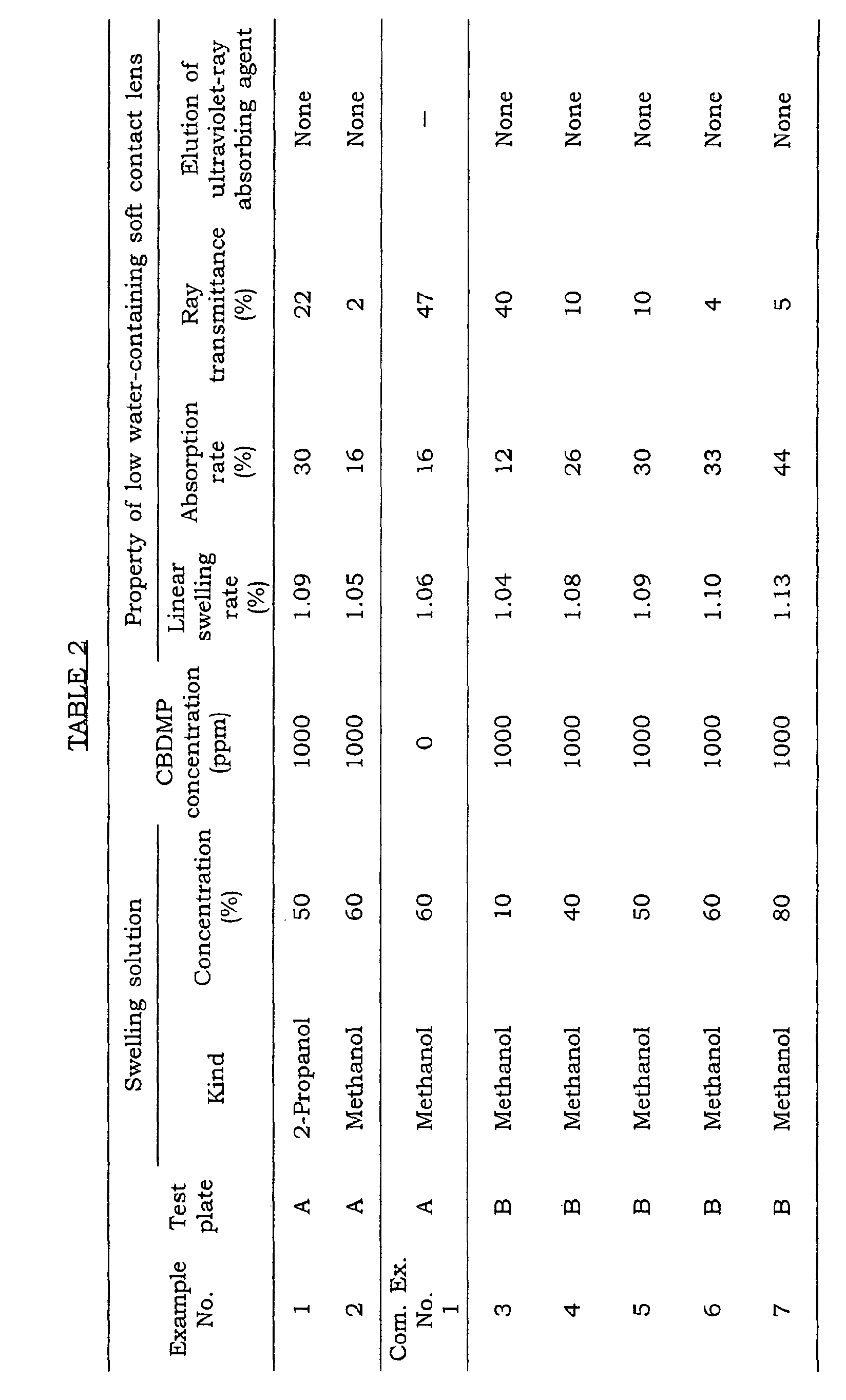
- the water content of Test plate A was 3 % by weight and the water content of Test plate B was 9 % by weight.
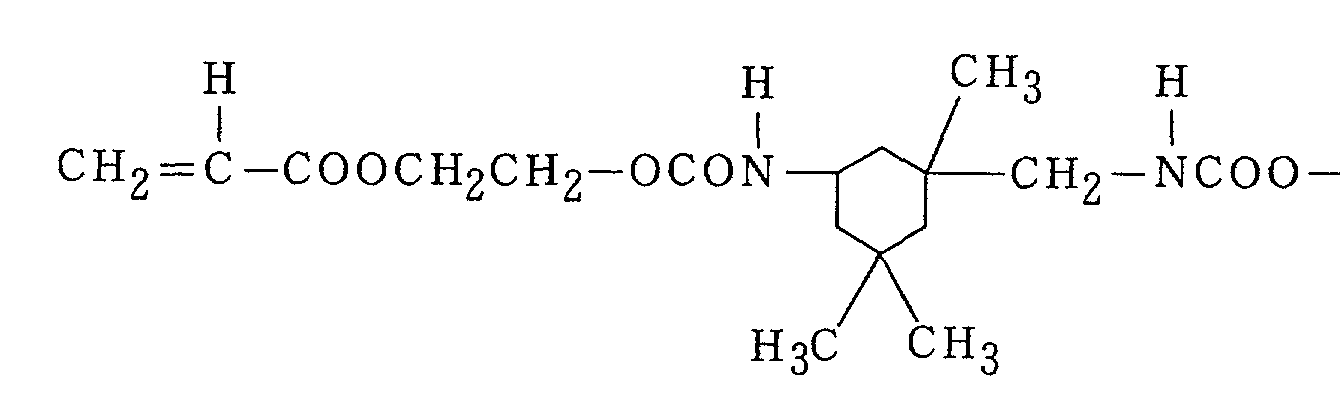
- Macromer Acrylate type dimethylsiloxane macromonomer containing urethane group, represented by the formula: (made by Menicon Co., Ltd., average molecular weight: 5500 to 7000)
- a solution (I-1) was previously prepared by dissolving 2-(5-chloro-2H-benzotriazole-2-yl)-6-(1,1-dimethy)-4-methylphenol (hereinafter referred to as "CBDMP") in 50 % 2-propanol solution.
- CBDMP concentration in the solution (I-1) was 1000 ppm on the basis of weight.
- Test plate A was immersed in the solution (I-1) at room temperature for about 2 hours.
- Test plate A After Test plate A was put out from the solution (I-1), Test plate A was immersed in 60 % methanol solution of 0.5 mol/l sodium hydroxide at room temperature for about 2 hours, so that Test plate A was saponified.
- Test plate A was immersed in distilled water at room temperature for about 16 hours, so that Test plate A was hydrated to give an ultraviolet-ray-absorbable and low water-containing soft contact lens material.
- a solution (I-2) was previously prepared by dissolving CBDMP in 60 % methanol solution of 0.5 mol/1 sodium hydroxide.
- the CBDMP concentration in the solution (I-2) was 1000 ppm on the basis of weight.
- Test plate A was immersed in the solution (I-2) at room temperature for about 2 hours.
- Test plate A After Test plate A was put out from the solution (I-2), Test plate A was immersed in distilled water at room temperature for about 16 hours, so that Test plate A was hydrated to give an ultraviolet-ray-absorbable and low water-containing soft contact lens material.
- Solutions (I-3) to (I-7) were previously prepared by dissolving CBDMP in methanol solution of 0.5 mol/l sodium hydroxide.
- the CBDMP concentration in each of solutions (I-3) to (I-7) was 1000 ppm on the basis of weight.
- Each methanol concentration in the methanol solution used for the solutions (I-3) to (I-7) was 10 % (solution (I-3) in EXAMPLE 3), 40 % (solution (I-4) in EXAMPLE 4), 50 % (solution (I-5) in EXAMPLE 5), 60 % (solution (I-6) in EXAMPLE 6) or 80 % (solution (I-7) in EXAMPLE 7).
- Each Test plate B was immersed in each of the solutions (I-3) to (I-7) at room temperature for about 2 hours.
- each Test plate B was put out from each of the solutions (I-3) to (I-7), each Test plate B was immersed in distilled water at room temperature for about 16 hours, so that each Test plate B was hydrated to give an ultraviolet-ray-absorbable and low water-containing soft contact lens material.
- Test plate A was immersed in 60 % methanol solution of 0.5 mol/l sodium hydroxide at room temperature for about 2 hours.
- Test plate A After Test plate A was put out from the methanol solution, Test plate A was immersed in distilled water at room temperature for about 16 hours, so that Test plate A was hydrated to give a low water-containing soft contact lens material.
- UV-ray absorbability In order to judge whether ultraviolet-ray absorbability could be exhibited by dispersion of CBDMP in Test plate A or B, or not, ray transmission spectra was measured. Distilled water was used as a control.
- the measuring apparatus was Ultraviolet-ray and Visible-ray automatic recording spectrophotometer made by SHIMAZU CORPORATION (UV-3100). The measuring conditions were as follows: Measuring wavelength: 190 to 800 nm
- Test plate A or B was autoclaved in distilled water at 121°C for 20 minutes.
- the ray transmittance of the autoclaved Test plate A or B was calculated in the same manner as in the above item (3).
- the ray transmittance of the autoclaved Test plate A or B was compared with the ray transmittance of Test plate A or B before autoclave, calculated in the above item (3). Then, the judgment whether the ultraviolet-ray absorbing agent eluted or not was given.
- the ray transmittance is not lowered. On the other hand, if the ultraviolet-ray absorbing agent elutes, the ray transmittance is lowered.
- a process for preparing an ultraviolet-ray-absorbable and low water-containing soft contact lens characterized by immersing a low water-containing soft contact lens in a solution (I) prepared by dissolving an ultraviolet-ray absorbing agent in a swelling solution, permeating the ultraviolet-ray absorbing agent to the inside of a swollen low water-containing soft contact lens, and then removing the swelling solution used for swelling of the low water-containing soft contact lens.
- the ultraviolet-ray absorbing agent can be physically captured to the inside of the contact lens to impart ultraviolet-ray absorbability to the contact lens without elution of ultraviolet-ray absorbing agent and the ultraviolet-ray-absorbable and low water-containing soft contact lens can be prepared without inhibition of polymerization.
Landscapes
- Engineering & Computer Science (AREA)
- Health & Medical Sciences (AREA)
- Manufacturing & Machinery (AREA)
- Ophthalmology & Optometry (AREA)
- Mechanical Engineering (AREA)
- Eyeglasses (AREA)
- Addition Polymer Or Copolymer, Post-Treatments, Or Chemical Modifications (AREA)
- Treatments Of Macromolecular Shaped Articles (AREA)
- Compositions Of Macromolecular Compounds (AREA)
Abstract
Description






Claims (10)
- A process for preparing an ultraviolet-ray-absorbable and low water-containing soft contact lens, characterized by immersing a low water-containing soft contact lens in a solution (I) prepared by dissolving an ultraviolet-ray absorbing agent in a swelling solution,permeating the ultraviolet-ray absorbing agent to the inside of a swollen low water-containing soft contact lens, and thenremoving the swelling solution used for swelling of the low water-containing soft contact lens.
- The process of Claim 1, wherein non-reacted monomers in the swollen low water-containing soft contact lens are extracted when the ultraviolet-ray absorbing agent permeates to the inside of the swollen low water-containing soft contact lens.
- The process of Claim 1, wherein the ultraviolet-ray absorbing agent is a benzotriazole ultraviolet-ray absorbing agent.
- The process of Claim 3, wherein the benzotriazole ultraviolet-ray absorbing agent is a compound represented by the formula (III):wherein Z1 is hydrogen atom, a halogen atom, an alkyl group having 1 to 6 carbon atoms or an alkoxyl group having 1 to 6 carbon atoms, and each of Z2 and Z3 is independently hydrogen atom or an alkyl group having 1 to 6 carbon atoms.

- The process of Claim 1, wherein the ultraviolet-ray absorbing agent is a compound having a molecular weight of 200 to 1200.
- The process of Claim 1, wherein the concentration of the ultraviolet-ray absorbing agent in the solution (I) is 500 to 2000 ppm on the basis of weight.
- The process of Claim 1, wherein the swelling solution is an alcohol solution.
- The process of Claim 1, wherein the water content of the low water-containing soft contact lens is at most 15 % by weight.
- The process of Claim 1, wherein the low water-containing soft contact lens comprises a lens material of which absorption rate for the swelling solution is 12 to 50 %.
- The process of Claim 1, wherein the low water-containing soft contact lens comprises a vinyl acetate polymer.
Applications Claiming Priority (2)
| Application Number | Priority Date | Filing Date | Title |
|---|---|---|---|
| JP2000065010 | 2000-03-09 | ||
| JP2000065010A JP2001255498A (en) | 2000-03-09 | 2000-03-09 | Manufacturing method of UV absorbing low water content soft contact lens |
Publications (3)
| Publication Number | Publication Date |
|---|---|
| EP1134071A2 true EP1134071A2 (en) | 2001-09-19 |
| EP1134071A3 EP1134071A3 (en) | 2003-08-13 |
| EP1134071B1 EP1134071B1 (en) | 2006-06-28 |
Family
ID=18584609
Family Applications (1)
| Application Number | Title | Priority Date | Filing Date |
|---|---|---|---|
| EP01105783A Expired - Lifetime EP1134071B1 (en) | 2000-03-09 | 2001-03-08 | Process for preparing ultraviolet-ray-absorbable and low water-containing soft contact lens |
Country Status (5)
| Country | Link |
|---|---|
| US (1) | US20010031318A1 (en) |
| EP (1) | EP1134071B1 (en) |
| JP (1) | JP2001255498A (en) |
| DE (1) | DE60121080T2 (en) |
| HK (1) | HK1040216A1 (en) |
Cited By (1)
| Publication number | Priority date | Publication date | Assignee | Title |
|---|---|---|---|---|
| WO2019212657A1 (en) * | 2018-05-01 | 2019-11-07 | Bausch & Lomb Incorporated | Ophthalmic devices containing uv blocker and methods for their preparation |
Families Citing this family (2)
| Publication number | Priority date | Publication date | Assignee | Title |
|---|---|---|---|---|
| CN102695601B (en) * | 2009-12-17 | 2016-01-06 | 诺华股份有限公司 | The method of weight feed eyeglass moulding material in mould |
| CA2851668C (en) * | 2011-10-12 | 2016-08-16 | Novartis Ag | Method for making uv-absorbing ophthalmic lenses by coating |
Family Cites Families (1)
| Publication number | Priority date | Publication date | Assignee | Title |
|---|---|---|---|---|
| US5681871A (en) * | 1995-05-24 | 1997-10-28 | Johnson & Johnson Vision Products, Inc. | Method for preparing ultraviolet radiation absorbing contact lenses |
-
2000
- 2000-03-09 JP JP2000065010A patent/JP2001255498A/en active Pending
-
2001
- 2001-03-06 US US09/799,037 patent/US20010031318A1/en not_active Abandoned
- 2001-03-08 DE DE60121080T patent/DE60121080T2/en not_active Expired - Fee Related
- 2001-03-08 EP EP01105783A patent/EP1134071B1/en not_active Expired - Lifetime
-
2002
- 2002-03-09 HK HK02101818.6A patent/HK1040216A1/en unknown
Cited By (4)
| Publication number | Priority date | Publication date | Assignee | Title |
|---|---|---|---|---|
| WO2019212657A1 (en) * | 2018-05-01 | 2019-11-07 | Bausch & Lomb Incorporated | Ophthalmic devices containing uv blocker and methods for their preparation |
| CN112041350A (en) * | 2018-05-01 | 2020-12-04 | 鲍希与洛姆伯股份有限公司 | Ophthalmic devices containing UV blockers and methods of making the same |
| US11066530B2 (en) | 2018-05-01 | 2021-07-20 | Bausch & Lomb Incorporated | Ophthalmic devices containing UV blocker and methods for their preparation |
| CN112041350B (en) * | 2018-05-01 | 2023-10-03 | 鲍希与洛姆伯股份有限公司 | Ophthalmic device containing UV blocker and method of making same |
Also Published As
| Publication number | Publication date |
|---|---|
| EP1134071B1 (en) | 2006-06-28 |
| JP2001255498A (en) | 2001-09-21 |
| US20010031318A1 (en) | 2001-10-18 |
| DE60121080D1 (en) | 2006-08-10 |
| HK1040216A1 (en) | 2002-05-31 |
| DE60121080T2 (en) | 2006-12-07 |
| EP1134071A3 (en) | 2003-08-13 |
Similar Documents
| Publication | Publication Date | Title |
|---|---|---|
| EP1176454B1 (en) | Ocular lens materials and process for producing the same | |
| CA1187645A (en) | Contact lens and process for preparing the same | |
| JPWO2000070388A1 (en) | Ophthalmic lens material and its manufacturing method | |
| KR100810819B1 (en) | Surface Treated Plastic Articles and Surface Treatment Methods | |
| JP3625097B2 (en) | Colored contact lens and manufacturing method thereof | |
| US5729322A (en) | Ocular device comprising a uv-absorbing benzotriazoles having a styrene group | |
| NO318658B1 (en) | Prepolymer, polymer, process for making such, as well as contact lens consisting essentially of the polymer. | |
| JP4782508B2 (en) | High oxygen permeation hydrous ophthalmic lens | |
| CN112703213A (en) | Polymer material | |
| EP0381005B1 (en) | Ocular lens material | |
| JP4832910B2 (en) | Ophthalmic lens surface coating agent and ophthalmic lens obtained thereby | |
| EP1134071B1 (en) | Process for preparing ultraviolet-ray-absorbable and low water-containing soft contact lens | |
| JP3727035B2 (en) | Benzotriazole compound, ultraviolet absorber comprising the same, and ophthalmic lens containing the same | |
| CN112352170A (en) | Water extractable ophthalmic device | |
| EP0589430B1 (en) | Water-absorptive contact lens | |
| JP4418541B2 (en) | Method for producing UV-absorbing ophthalmic lens | |
| JPH031647B2 (en) | ||
| EP0794440B1 (en) | Ocular lens and a method for its production | |
| HK1044382A (en) | Ocular lens materials and process for producing the same | |
| JP2804279B2 (en) | Ophthalmic lens materials | |
| JP3150771B2 (en) | Ophthalmic lens materials | |
| JP3558421B2 (en) | Ophthalmic lens material and manufacturing method thereof | |
| JP3084161B2 (en) | Ophthalmic lens materials | |
| JP2659885B2 (en) | Hydrous lens | |
| JP2803232B2 (en) | contact lens |
Legal Events
| Date | Code | Title | Description |
|---|---|---|---|
| PUAI | Public reference made under article 153(3) epc to a published international application that has entered the european phase |
Free format text: ORIGINAL CODE: 0009012 |
|
| AK | Designated contracting states |
Kind code of ref document: A2 Designated state(s): AT BE CH CY DE DK ES FI FR GB GR IE IT LI LU MC NL PT SE TR |
|
| AX | Request for extension of the european patent |
Free format text: AL;LT;LV;MK;RO;SI |
|
| PUAL | Search report despatched |
Free format text: ORIGINAL CODE: 0009013 |
|
| AK | Designated contracting states |
Designated state(s): AT BE CH CY DE DK ES FI FR GB GR IE IT LI LU MC NL PT SE TR |
|
| AX | Request for extension of the european patent |
Extension state: AL LT LV MK RO SI |
|
| RIC1 | Information provided on ipc code assigned before grant |
Ipc: 7G 02B 1/04 B Ipc: 7B 29C 71/00 B Ipc: 7B 29D 11/00 A |
|
| 17P | Request for examination filed |
Effective date: 20030926 |
|
| AKX | Designation fees paid |
Designated state(s): DE FR GB |
|
| GRAP | Despatch of communication of intention to grant a patent |
Free format text: ORIGINAL CODE: EPIDOSNIGR1 |
|
| GRAS | Grant fee paid |
Free format text: ORIGINAL CODE: EPIDOSNIGR3 |
|
| GRAA | (expected) grant |
Free format text: ORIGINAL CODE: 0009210 |
|
| AK | Designated contracting states |
Kind code of ref document: B1 Designated state(s): DE FR GB |
|
| REG | Reference to a national code |
Ref country code: GB Ref legal event code: FG4D |
|
| REF | Corresponds to: |
Ref document number: 60121080 Country of ref document: DE Date of ref document: 20060810 Kind code of ref document: P |
|
| ET | Fr: translation filed | ||
| PLBE | No opposition filed within time limit |
Free format text: ORIGINAL CODE: 0009261 |
|
| STAA | Information on the status of an ep patent application or granted ep patent |
Free format text: STATUS: NO OPPOSITION FILED WITHIN TIME LIMIT |
|
| 26N | No opposition filed |
Effective date: 20070329 |
|
| GBPC | Gb: european patent ceased through non-payment of renewal fee |
Effective date: 20070308 |
|
| REG | Reference to a national code |
Ref country code: FR Ref legal event code: ST Effective date: 20071130 |
|
| PG25 | Lapsed in a contracting state [announced via postgrant information from national office to epo] |
Ref country code: DE Free format text: LAPSE BECAUSE OF NON-PAYMENT OF DUE FEES Effective date: 20071002 |
|
| PG25 | Lapsed in a contracting state [announced via postgrant information from national office to epo] |
Ref country code: GB Free format text: LAPSE BECAUSE OF NON-PAYMENT OF DUE FEES Effective date: 20070308 |
|
| PG25 | Lapsed in a contracting state [announced via postgrant information from national office to epo] |
Ref country code: FR Free format text: LAPSE BECAUSE OF NON-PAYMENT OF DUE FEES Effective date: 20070402 |
|
| REG | Reference to a national code |
Ref country code: HK Ref legal event code: WD Ref document number: 1040216 Country of ref document: HK |