EP1134036A2 - Method for treating coating film - Google Patents
Method for treating coating film Download PDFInfo
- Publication number
- EP1134036A2 EP1134036A2 EP01103369A EP01103369A EP1134036A2 EP 1134036 A2 EP1134036 A2 EP 1134036A2 EP 01103369 A EP01103369 A EP 01103369A EP 01103369 A EP01103369 A EP 01103369A EP 1134036 A2 EP1134036 A2 EP 1134036A2
- Authority
- EP
- European Patent Office
- Prior art keywords
- coating film
- primer
- window glass
- organic
- adhesive
- Prior art date
- Legal status (The legal status is an assumption and is not a legal conclusion. Google has not performed a legal analysis and makes no representation as to the accuracy of the status listed.)
- Withdrawn
Links
Images




Classifications
-
- C—CHEMISTRY; METALLURGY
- C09—DYES; PAINTS; POLISHES; NATURAL RESINS; ADHESIVES; COMPOSITIONS NOT OTHERWISE PROVIDED FOR; APPLICATIONS OF MATERIALS NOT OTHERWISE PROVIDED FOR
- C09J—ADHESIVES; NON-MECHANICAL ASPECTS OF ADHESIVE PROCESSES IN GENERAL; ADHESIVE PROCESSES NOT PROVIDED FOR ELSEWHERE; USE OF MATERIALS AS ADHESIVES
- C09J5/00—Adhesive processes in general; Adhesive processes not provided for elsewhere, e.g. relating to primers
- C09J5/02—Adhesive processes in general; Adhesive processes not provided for elsewhere, e.g. relating to primers involving pretreatment of the surfaces to be joined
-
- C—CHEMISTRY; METALLURGY
- C08—ORGANIC MACROMOLECULAR COMPOUNDS; THEIR PREPARATION OR CHEMICAL WORKING-UP; COMPOSITIONS BASED THEREON
- C08J—WORKING-UP; GENERAL PROCESSES OF COMPOUNDING; AFTER-TREATMENT NOT COVERED BY SUBCLASSES C08B, C08C, C08F, C08G or C08H
- C08J5/00—Manufacture of articles or shaped materials containing macromolecular substances
- C08J5/12—Bonding of a preformed macromolecular material to the same or other solid material such as metal, glass, leather, e.g. using adhesives
- C08J5/124—Bonding of a preformed macromolecular material to the same or other solid material such as metal, glass, leather, e.g. using adhesives using adhesives based on a macromolecular component
Definitions
- the present invention relates to a method for treating coating film which is employed for bonding an object to a substrate furnished with a hydrophilized coating film.
- hydrophilicity of the film's surface will attract water (e.g., rainwater), which will penetrate between the coating film and any primers which are usually applied thereto.
- water e.g., rainwater
- the adhesive strength between the primer and the coating film tends to decrease as a result; therefore, the concern arises that substrates furnished with hydrophilized coating films will not allow any materials to be securely bonded thereto.
- an invention pertaining to claim 1 comprises a method for treating coating film which contains a hydrophilizing agent, to be conducted before an object is bonded to the coating film with an organic adhesive, which comprises a step of applying a primer to the coating film, wherein said primer has an organic reactive group reactable with organic elements, and contains an additive capable of forming a covalent bond with the hydrophilizing agent in the coating film.
- an invention pertaining to claim 2 comprises a method for treating coating film which contains a hydrophilizing agent, to be conducted before an object is bonded to the coating film with an organic adhesive, which comprises a step of applying a primer to the coating film, wherein said hydrophilizing agent in the coating films is an organosilane compound, and said primer has an organic reactive group reactable with organic elements, and contains an organosilane compound as an additive.
- an invention pertaining to claim 3 comprises a method for treating coating film which contains a hydrophilizing agent, to be conducted before an object is bonded to the coating film with an organic adhesive, which comprises a step of applying a primer to the coating film, wherein said primer is composed of a first primer which has an organic reactive group reactable with organic elements, and contains an organosilane compound as an additive, and a second primer which has an organic reactive group reactable with organic elements, and contains no organosilane compound.
- the primer when a primer is applied on a coating film which contains a hydrophilizing agent before an object is bonded to the coating film with an organic adhesive, the primer contains both organic reactive groups which can react with organic elements and an additive which can form covalent bonds with the hydrophilizing agent within the coating film, so as to ensure not only that the organic reactive groups bond with the organic adhesive, but that the additive in the primer forms covalent bonds with the hydrophilizing agent in said coating film.
- This will allow the bonding between the primer and the coating film to be securely maintained, even if any water (e.g., rainwater) attracted by the hydrophilicity of the coating film penetrates between the coating film and the primer. Accordingly, any object which is to be bonded to a substrate, can be securely bonded, even if it is provided with a hydrophilized coating film.
- an organosilane compound is used as the hydrophilizing agent in said coating film and the primer used herein contains both organic reactive groups which can react with the organic elements and an organosilane compound as an additive, so as to ensure not only that the organic reactive groups bond with the organic adhesive, but for the coating film and the primer that the organosilane compound in the primer forms with the organosilane compound in said coating film, bonds which are strong enough to resist being broken by a film of water or the like (covalent bonds).
- any object which is to be bonded to a substrate can be securely bonded, even if it is provided with a hydrophilized coating film.
- a first primer which contains both organic reactive groups reactable with organic elements and an organosilane compound as an additive, and a second primer which contains organic reactive groups reactable with organic elements but does not contain an organosilane compound are employed. Therefore, when the organosilane compound, which serves as a hydrophilizing agent, has imparted the coating film with hydrophilic property, bonds which are strong enough to resist being broken by a film of water or the like (covalent bonds) are formed between the coating film and the first primer by the organosilane compound in said coating film and the organosilane compound in said first primer, and the first and the second primers and an organic adhesive all bond together via their respective organic reactive groups.
- the second primer permeates the first primer and effects adhesion (bonding) with the coating film, and the first and the second primers and an organic adhesive all bond together via their respective organic reactive groups. Accordingly, the adhesive can be bonded to the coating film via the first and the second primers not only when the coating film is hydrophilic, but also when the coating film is not hydrophilic, therefore, the primer coating steps can be performed in the same process.
- a first primer is applied to a coating film, thereby forming a first primer film on said coating film, and a second primer is applied onto the first primer film, so that the method pertaining to aforedescribed claim 3 is obtained specifically and assuredly.
- a first and a second primers are blended together directly prior to being applied to the coating film, so that the method pertaining to aforedescribed claim 3 is obtained specifically and assuredly.
- the first and the second primers are applied as one step, while keeping control of any decline in manageability (coatability etc.) brought on by a reaction (polymerization, etc.) between the first and the second primers prior to be applied onto the coating film.
- the coating film is formed on an automobile body panel, and therefore, if the automobile body panel is the substrate, an object to be bonded can be bonded thereto using an organic adhesive.
- Figs. 1 to 8 depict the first embodiment.
- This first embodiment illustrates the case where a window glass (object to be bonded) 14 is bonded to an automobile body panel (substrate) 1, which has been furnished with a hydrophilized coating film, at the edge of the opening where a window glass is to be bonded (referring to the areas where the object is to be bonded; in the present embodiment, it is furnished on the front and rear areas) 4, using a window glass adhesive (organic adhesive) 16.
- a window glass adhesive organic adhesive
- an automobile body panel 1 such as is illustrated in Fig. 1 is sequentially subjected to an base-coat coating treatment (which is not shown, but which comprises an base-coat coating step and a baking step (e.g., for 30 min at 160°C)) and an middle-coat coating treatment (comprising middle-coat coating step M1 and baking step (e.g., 20 min at 140°C) M2), as illustrated in Fig. 2.
- an base-coat coating treatment which is not shown, but which comprises an base-coat coating step and a baking step (e.g., for 30 min at 160°C))
- an middle-coat coating treatment comprising middle-coat coating step M1 and baking step (e.g., 20 min at 140°C) M2
- the base-coat coating film 2 and the middle-coat coating film 3 are formed in layered manner on the automobile body panel 1, as illustrated in Figure 3, whereupon, inclusive of the edge of the opening where the window glass is to be bonded 4, a complete top-coat coating treatment (comprising top-coat coating step O1 and baking step (e.g., 20 min at 140°C) 02) is performed (as in Fig. 2) on the middle-coat coating film 3.
- the top-coat coating film 5 is formed to provide the automobile body panel 1 with a finished surface.
- the top-coat coating treatment comprises two stages.
- the first stage top-coat coating treatment comprises forming an top-coat base coating film 6 (first coating film) and the second stage top-coat coating treatment comprises covering the top-coat base coating film 6 with a clear top-coat coating film 7 (second coating film).
- the second stage top-coat coating treatment is performed before the top-coat base coating film 6 obtained in the first stage top-coat coating treatment has cured (known as "wet on wet").
- any well-known coating can be used to form the aforedescribed top-coat base coating film 6 (e.g., combinations of an amino resin and an acrylic and/or polyester resin; more specifically, acrylic resin/amino resin, polyester resin/amino resin, acrylic resin-polyester resin/amino resin and the like), and any well-known coating resin (e.g., an acrylic melamine-urethane-acid/epoxy system coating) which contains an organosilane compound; i.e., a silicate compound RO(Si(OR) 2 ) n OR (where n is an integer from 1 to 70 and R is hydrogen or an organic group with 1 to 50 carbons, or contains all or a part of the aforedescribed coating resin), as a hydrophilizing agent 8 in a uniformly dispersed state can be used to form the aforedescribed clear top-coat coating film 7.
- any well-known coating can be used to form the aforedescribed clear top-coat coating film 7.
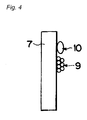
- This configuration allows the clear top-coat coating film 7 to contain the hydrophilizing agent 8 in an uniformly dispersed state, the presence of which imparts hydrophilic property to the clear top-coat coating film 7 as long as the clear top-coat coating film 7 is present, thereby enables it to function as a hydrophilized coating film.
- the fact that the hydrophilizing agent 8 is uniformly dispersed within the coating film (coating) enables the coating film to be enhanced by the hydrophilizing agent.
- a body primer film (primer film) 12 is formed on the clear top-coat coating film 7 by applying a body primer (primer) to the edge of the opening where the window glass is to be bonded 4 (Fig. 1) (body primer treatment step BP). This step is performed in order to enhance the adhesion of the window glass adhesive 16 to the clear top-coat coating film 7.
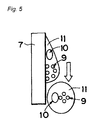
- the body primer contains both organic reactive groups which can react with organic resins and an additive 13 which can form covalent bonds with the hydrophilizing agent within the clear top-coat coating film 7. This ensures not only that the body primer film 12 will be able to bond with the window glass adhesive 16 which is used as an organic adhesive, via the organic reactive groups, but that the covalent bonds CB between the hydrophilizing agent 8 in the aforedescribed clear top-coat coating film 7 and the additive 13 in the body primer film 12, as illustrated in Fig. 7, will ensure a bond that cannot be broken by a film of water, even between the clear top-coat coating film 7 used as the hydrophilized coating film and the body primer film 12.
- the hydrophilic property of the clear top-coat coating film 7 will thereby reduce the amount of washing which may need to be done, and in addition, the bonds between the body primer film 12 and the clear top-coat coating film 7 will be securely maintained by the covalent bonds CB, as shown in Fig. 8, even if any water (e.g., rainwater) 11 (H 2 O) attracted by the hydrophilic property of the clear top-coat coating film 7, penetrates between the clear top-coat coating film 7 and the body primer film 12.
- any water e.g., rainwater
- H 2 O water
- the body primer may be those which comprise 0.1 to 10% by weight of organosilane compound; i.e., a silane coupling agent, 2 to 20% by weight of carbon black as a pigment, and 70 to 97.9% by weight of alcohol medium as a solvent when an organosilane compound; i.e., a silicate compound RO(Si(OR) 2 ) n OR, is used as the hydrophilizing agent 8 in the coating which forms the aforedescribed clear top-coat coating film 7, and an organic adhesive is used as the window glass adhesive 16.
- organosilane compound i.e., a silane coupling agent, 2 to 20% by weight of carbon black as a pigment
- alcohol medium as a solvent
- an organosilane compound i.e., a silicate compound RO(Si(OR) 2 ) n OR
- silane coupling agent is typically represented as XSi(OR) 3 , where X is vinyl, methacrylic, epoxy, amino, mercapto or other organic reactive group which can react with an organic resin and R is a methyl, ethyl or other alkyl group.
- This configuration allows the relationship with the silicate compound used for the hydrophilizing agent 8 to be such that the Si-OR in the silicate compound RO(Si(OR) 2 ) n OR forms with the Si-OR in the silane coupling agent XSi(OR) 3 in the body primer in the presence of humidity or moisture present in the air, covalent bonds which cannot be broken by a film of water 11.
- silane coupling agent XSi(OR) 3 causes the following reaction in the presence of humidity or moisture in the air.
- reaction product X-Si(OH) 3 is believed to form a covalent bond with the Si-OR in the silicate compound RO(Si(OR) 2 ) n OR.
- the window glass (Fig. 3) 14 is prepared while the aforedescribed automobile body panel 1 is being subjected to the treatments, and a window glass primer is applied on its periphery to form a window glass primer film 15.
- a window glass adhesive 16 is further applied to the window glass primer film 15.
- the window glass primer is applied in order to improve the adhesion between the window glass 14 and the window glass adhesive 16, and the window glass adhesive 16 is applied in order to allow the window glass 14 to adhere to the edge of the opening where the window glass is to be bonded 4.
- the aforedescribed window glass primer is selected with a view towards improving the adhesion between the window glass 14, which is an inorganic material, and the window glass adhesive 16, which is an organic material.
- the window glass primer is the same one used as the aforedescribed body primer; i.e., it comprises 0.1 to 10% by weight of organosilane compound; i.e., silane coupling agent, 2 to 20% by weight of carbon black as a pigment, and 70 to 97.9% by weight of alcohol medium as a solvent.
- silane coupling agent is typically represented as XSi(OR) 3 , where X is a vinyl, methacrylic, epoxy, amino, mercapto or other organic reactive group which can react with an organic resin and R is a methyl, ethyl or other alkyl group.
- the aforedescribed window glass adhesive 16 is selected in view of adhesion between the aforedescribed window glass primer film 15 and the aforedescribed body primer film 12 (both are the same in the present embodiment).
- a common one-part moist curing polyurethane adhesive is used in the present embodiment; i.e., the adhesive contains 10 to 54% by weight of prepolymer as a resin, 10 to 20% by weight of calcium carbonate as an inorganic filler, 10 to 40% by weight of carbon black as a pigment, 1 to 10% by weight of xylene as a solvent, dibutyltin laurate or the like and 5 to 20% by weight of DOP (dioctyl phthalate) as a plasticizer.
- DOP dioctyl phthalate
- a prepolymer used in the above configuration is that synthesized from polyol (e.g., polyoxypropylene triol or polyoxypropylene diol) and diisocyanate (e.g., tolylene diisocyanate (TDI) or 4-4'-diphenylmethane diisocyanate (MDI)), and contains isocyanate groups.
- polyol e.g., polyoxypropylene triol or polyoxypropylene diol
- diisocyanate e.g., tolylene diisocyanate (TDI) or 4-4'-diphenylmethane diisocyanate (MDI)
- the aforedescribed window glass 14 is fitted to the automobile body panel 1 in a window glass assembling step P, after the body panel has finished being subjected to the aforedescribed body primer treatment step BP.
- a robot or the like is used to fit the window glass 14 to the aforedescribed edge of the opening where the window glass is to be bonded 4, which has been coated with the body primer.
- the window glass adhesive 16 is bonded to the window glass 14, at the edge of the opening where the window glass is to be bonded 4, via the window glass primer, by means of the bonding between the isocyanate groups (-NCO) in the resin in the adhesive and the organic reactive groups (X) in the silane coupling agent in the window glass primer.
- the aforedescribed bonding relationship with the body primer also allows the window glass adhesive 16 to adhere to the aforedescribed clear top-coat coating film 7 (at the edge of the opening where the window glass is to be bonded 4 on the automobile body panel 1) via the body primer film 12.
- the applying of the aforedescribed body primer to the clear top-coat coating film 7 will enable the window glass 14 to be securely bonded to the edge of the opening where the window glass is to be bonded 4 by using the window glass adhesive 16.
- Figs. 9 to 10 illustrate the second embodiment.
- the structural elements and reference numbers are the same as in the previous embodiment, and their attendant descriptions are thus omitted here.
- the bonding of the window glass 14 which is to be bonded is performed in the same process.
- a first primer is applied to the clear top-coat coating film 7 to form a first primer film 17 thereon (Fig. 10)
- a second primer is applied to the first primer film 17 to form a second primer film 18 (Fig. 10), at the edge of the opening where the window glass is to be bonded 4, regardless of whether the clear top-coat coating film 7 has hydrophilicity or not.
- the first primer contains organic groups which can react with the organic resins, and an organosilane compound as an additive 13, while the second primer contains organic groups which can react with the organic resins, but not an organosilane compound (a body primer which is usually used on non-hydrophilized clear top-coat coating films 7).
- an organosilane compound has been included as a hydrophilizing agent 8 in the clear top-coat coating film 7 to make it a hydrophilic coating film
- bonds e.g, covalent bonds
- the material used for the first primer in the present embodiment is the same as that used as the body primer in the aforedescribed embodiment, while the material used for the second primer is the same as the existing body primer used on the non-hydrophilic clear top-coat coating film 7; i.e., the second primer may contain 1 to 20% by weight of isocyanate compounds and urethane resin as film forming agents, 2 to 20% by weight of carbon black as a pigment, and 60 to 97% by weight of ethyl acetate, toluene or the like as a solvent.
- the second primer is preferably applied subsequent to the formation of the first primer film 17 on the clear top-coat coating film 7. If the first and the second primers are blended together prior to their application on the clear top-coat coating film 7, the first and the second primers react with each other (e.g., polymerization), and coatability, manageability, and the like become poor.
- first and the second primers are blended together just before application, for example within 2 hours, preferably 1 to 1.5 hours before application, the reaction between the first and second primers does not reach critical level, thereby coatability and manageability do not become poor, and the blended primer may be applied to the clear top-coat coating film 7.
- a window glass 14 is prepared by applying a window glass adhesive 16 to its periphery, by means of a window glass primer film 15. The glass is then fitted to the edge of the opening where the window glass is to be bonded 4 (which has been treated with the first and the second primers).
- the above configuration allows the window glass adhesive 16 to adhere to the window glass at the edge of the opening where the window glass is to be bonded 4, by means of the window glass primer, through the action of bonding between isocyanate groups (-NCO) in the resin and organic reactive groups (X) in the silane coupling agent contained in the window glass primer.
- the action of bonding between isocyanate groups (-NCO) in the resin in the window glass adhesive 16, organic reactive groups (X) in the silane coupling agent contained in the first primer and isocyanate groups (-NCO) in the resin in the second primer enable the window glass adhesive 16 to adhere to the aforedescribed clear top-coat coating film 7 (in the edge of the opening where the window glass is to be bonded 4 on the automobile body panel 1), by means of the first and the second primers.
- the clear top-coat coating film 7 was formed on the outermost surface of a test plate.
- a silicate compound i.e., CH 3 O-(Si(OCH 3 ) 2 ) 10 -CH 3
- the body primer of the first embodiment (a first primer in the second embodiment) and the second primer of the second embodiment (a conventional primer for use in non-hydrophilized coating films) were used alternatively or in combined form (in the latter case, the second primer was applied after the first primer had been applied).
- a test piece 20 was prepared by applying a primer onto a clear top-coat coating film 7 on a test plate and then applying an adhesive 16 in the form of a round bead having 8 ⁇ 2 mm in diameter and at least 100 mm long, onto the primer.
- the sample was maintained at room temperature for 7 days, and their initial properties (evaluated just after the 7 day period) and water resistance (the samples were immersed in 40 ⁇ 2°C warm water for 7 days) were evaluated by a manual peeling test. As illustrated in Fig. 11, the manual peeling test was conducted by making cut into a peeling surface, at a pitch of 2 to 3 mm and at an approximately 45 degree angle with a knife 19, while the adhesive was pulled in 180 degree direction, to determine whether or not the surface peeling had occurred.
- the second primer (conventional primer for use in non-hydrophilized coating films) yielded poor results in both the initial properties and the water-resistance tests, that is, surface peeling. Whereas, surface peeling did not occur in either the initial properties or water-resistance tests when the first primer was used alone, or when the first and the second primers were both used, yielding a good result.
- These results are believed to have been significantly affected by whether or not the covalent bonds had been formed by the silicate compound (hydrophilizing agent) in the clear top-coat coating film 7 and the silicate compound in the first primer.
- the non-hydrophilized clear top-coat coating films yielded good results in both the initial properties and the water-resistance tests either when the second primer (conventional primer for use in non-hydrophilized coating films) was used or when the first and second primers were both used. These results show that when both the first and the second primers are used, the fact that the second primer, which is effective on non-hydrophilized coating films, has permeated throughout the first primer is believed to contribute strongly to the adhesion with the clear top-coat coating film 7.
- the first primer is effective on hydrophilized coating films, but it does not contain any reactive groups which will bond with the non-hydrophilized coating film, and thus surface peeling occurred in the initial properties and the water-resistance tests.
- the object of the present invention is not limited to that which has been described in the foregoing; it can incorporate any configuration which provides an essentially preferred or otherwise merited result.
Landscapes
- Chemical & Material Sciences (AREA)
- Organic Chemistry (AREA)
- Engineering & Computer Science (AREA)
- Manufacturing & Machinery (AREA)
- Materials Engineering (AREA)
- Health & Medical Sciences (AREA)
- Chemical Kinetics & Catalysis (AREA)
- Medicinal Chemistry (AREA)
- Polymers & Plastics (AREA)
- Application Of Or Painting With Fluid Materials (AREA)
- Paints Or Removers (AREA)
- Adhesives Or Adhesive Processes (AREA)
Abstract
Description
| Combination of primer/adhesive | Second primer and adhesive | First/second primer and adhesive | First primer and adhesive | |||
| Test | Initial | Water | Initial | Water | Initial | Water |
| Clear top-coat (hydrophilized) | X | X | O | O | O | O |
| Clear top-coat (non-hydrophilized) | O | O | O | O | X | X |
Claims (6)
- A method for treating coating film which contains a hydrophilizing agent, to be conducted before an object is bonded to the coating film with an organic adhesive, which comprises a step of applying a primer to the coating film, wherein
said primer has an organic reactive group reactable with organic elements, and contains an additive capable of forming a covalent bond with the hydrophilizing agent in the coating film. - The method for treating coating film according to claim 1, wherein said hydrophilizing agent in the coating film is an organosilane compound, and said primer has an organic reactive group reactable with organic elements, and contains an organosilane compound as an additive.
- A method for treating coating film, to be conducted before an object is bonded to the coating film with an organic adhesive, which comprises a step of applying a primer to the coating film, wherein
said primer is composed of a first primer which has an organic reactive group reactable with organic elements, and contains an organosilane compound as an additive, and a second primer which has an organic reactive group reactable with organic elements, and contains no organosilane compound. - The method for treating coating film according to claim 3, wherein the first primer is applied onto the coating film to form a first primer film on the coating film, and the second primer is applied onto the first primer film.
- The method for treating coating film according to claim 3, wherein the first primer and the second primer are blended just before being applied onto the coating film.
- The method for treating coating film according to any one of claims 1 to 5, wherein said coating film is formed on an automobile body panel.
Applications Claiming Priority (2)
| Application Number | Priority Date | Filing Date | Title |
|---|---|---|---|
| JP2000076818 | 2000-03-17 | ||
| JP2000076818A JP2001262082A (en) | 2000-03-17 | 2000-03-17 | Coating method |
Publications (2)
| Publication Number | Publication Date |
|---|---|
| EP1134036A2 true EP1134036A2 (en) | 2001-09-19 |
| EP1134036A3 EP1134036A3 (en) | 2003-10-01 |
Family
ID=18594496
Family Applications (1)
| Application Number | Title | Priority Date | Filing Date |
|---|---|---|---|
| EP01103369A Withdrawn EP1134036A3 (en) | 2000-03-17 | 2001-02-13 | Method for treating coating film |
Country Status (3)
| Country | Link |
|---|---|
| US (1) | US20010033898A1 (en) |
| EP (1) | EP1134036A3 (en) |
| JP (1) | JP2001262082A (en) |
Families Citing this family (4)
| Publication number | Priority date | Publication date | Assignee | Title |
|---|---|---|---|---|
| DE102005045150A1 (en) | 2005-09-22 | 2007-04-05 | Basf Coatings Ag | Use of phosphonic diesters and diphosphonic diesters and thermally curable mixtures containing phosphonic diester and Diphosphonsäurediester |
| DE102006024823A1 (en) | 2006-05-29 | 2007-12-06 | Basf Coatings Ag | Use of curable mixtures containing silane-containing compounds and phosphonic or Diphosphonsäurediester as adhesion promoters |
| JP2008094175A (en) * | 2006-10-10 | 2008-04-24 | Yachiyo Industry Co Ltd | Glass sunroof panel with sealing member |
| JP2024060412A (en) * | 2022-10-19 | 2024-05-02 | ダイハツ工業株式会社 | Adhesion method, manufacturing method of laminate, and two-component adhesive |
Family Cites Families (5)
| Publication number | Priority date | Publication date | Assignee | Title |
|---|---|---|---|---|
| US4247354A (en) * | 1978-10-02 | 1981-01-27 | Union Carbide Corporation | Bonding thermoplastic or thermosetting resins |
| US5437937A (en) * | 1988-11-01 | 1995-08-01 | Richard A. Cayless | Surface treatment of metals |
| JPH10140077A (en) * | 1996-11-14 | 1998-05-26 | Kansai Paint Co Ltd | Automotive top coating and coating film forming method using the same |
| CN1085760C (en) * | 1997-12-22 | 2002-05-29 | 日本建机株式会社 | Coating protection method for rotary construction machinery |
| DE19818962A1 (en) * | 1998-04-28 | 1999-11-04 | Degussa | Method for connecting two solid bodies and the component produced in this way |
-
2000
- 2000-03-17 JP JP2000076818A patent/JP2001262082A/en active Pending
-
2001
- 2001-02-13 EP EP01103369A patent/EP1134036A3/en not_active Withdrawn
- 2001-02-14 US US09/782,514 patent/US20010033898A1/en not_active Abandoned
Also Published As
| Publication number | Publication date |
|---|---|
| JP2001262082A (en) | 2001-09-26 |
| EP1134036A3 (en) | 2003-10-01 |
| US20010033898A1 (en) | 2001-10-25 |
Similar Documents
| Publication | Publication Date | Title |
|---|---|---|
| US6036997A (en) | Pressure sensitive adhesive laminate | |
| EP1429919B1 (en) | Stain resistant protect film and adhesive sheet having the same thereon | |
| JPH0337590B2 (en) | ||
| US20010033898A1 (en) | Method for treating coating film | |
| JP4611683B2 (en) | Deposition film having coating liquid and protective layer | |
| JPH0789011A (en) | Laminated pane and manufacturing method thereof | |
| KR100623951B1 (en) | Adhesive sheet and adhesion structure | |
| JP7298181B2 (en) | Laminates and flooring | |
| AU2001257110A1 (en) | Adhesive sheet and adhesion structure | |
| KR960701962A (en) | AQUEOUS POLYMER DISPERSIONS AND THEIR USE IN THE PRODUCTION OF COATINGS WHICH ARE PERMEABLE TO WATER VAPOUR | |
| JP2008260881A (en) | Adherend and bonding method using moisture-curing adhesive | |
| JP4104229B2 (en) | Water-based polyurethane resin composition | |
| KR101382475B1 (en) | Sunshade of sunroof for automobile and its manufacturing method | |
| JPH07205374A (en) | Laminated glass and method for manufacturing laminated glass | |
| US20250002749A1 (en) | Pvc-based multilayer surface covering with pvoh barrier | |
| JP2003213572A (en) | Reinforcing members for flooring | |
| JP3927196B2 (en) | Method for producing hydrophilic polyurethane resin | |
| CA1128380A (en) | Foaming urethane composite | |
| US12486400B2 (en) | Removable moisture barrier | |
| JPH0839733A (en) | Sheet of plastic material for panes and pane containing this sheet | |
| JP2001259508A (en) | Coating method | |
| JPH1143385A (en) | Lightweight foamed concrete and its production | |
| JP2005220321A (en) | Fine particle silica-dispersed hydrophilic polyurethane resin composition and method for producing the same | |
| JP2005226052A (en) | Fine particle silica-dispersed hydrophilic polyurethane resin composition and method for producing the same | |
| JP3846841B2 (en) | Laminated waterproof structure |
Legal Events
| Date | Code | Title | Description |
|---|---|---|---|
| PUAI | Public reference made under article 153(3) epc to a published international application that has entered the european phase |
Free format text: ORIGINAL CODE: 0009012 |
|
| AK | Designated contracting states |
Kind code of ref document: A2 Designated state(s): AT BE CH CY DE DK ES FI FR GB GR IE IT LI LU MC NL PT SE TR |
|
| AX | Request for extension of the european patent |
Free format text: AL;LT;LV;MK;RO;SI |
|
| PUAL | Search report despatched |
Free format text: ORIGINAL CODE: 0009013 |
|
| AK | Designated contracting states |
Kind code of ref document: A3 Designated state(s): AT BE CH CY DE DK ES FI FR GB GR IE IT LI LU MC NL PT SE TR |
|
| AX | Request for extension of the european patent |
Extension state: AL LT LV MK RO SI |
|
| RIC1 | Information provided on ipc code assigned before grant |
Ipc: 7B 05D 7/14 B Ipc: 7B 05D 5/10 B Ipc: 7C 09J 5/02 A |
|
| STAA | Information on the status of an ep patent application or granted ep patent |
Free format text: STATUS: THE APPLICATION IS DEEMED TO BE WITHDRAWN |
|
| 18D | Application deemed to be withdrawn |
Effective date: 20030829 |