EP1133156A2 - Method and apparatus for controlling a use of specific communications service - Google Patents
Method and apparatus for controlling a use of specific communications service Download PDFInfo
- Publication number
- EP1133156A2 EP1133156A2 EP00311622A EP00311622A EP1133156A2 EP 1133156 A2 EP1133156 A2 EP 1133156A2 EP 00311622 A EP00311622 A EP 00311622A EP 00311622 A EP00311622 A EP 00311622A EP 1133156 A2 EP1133156 A2 EP 1133156A2
- Authority
- EP
- European Patent Office
- Prior art keywords
- information
- service
- indicating
- specific communications
- usable
- Prior art date
- Legal status (The legal status is an assumption and is not a legal conclusion. Google has not performed a legal analysis and makes no representation as to the accuracy of the status listed.)
- Granted
Links
- 238000004891 communication Methods 0.000 title claims abstract description 135
- 238000000034 method Methods 0.000 title claims description 49
- 230000015654 memory Effects 0.000 claims abstract description 44
- 230000007246 mechanism Effects 0.000 claims abstract description 19
- 230000008569 process Effects 0.000 description 22
- 230000006870 function Effects 0.000 description 11
- 239000000969 carrier Substances 0.000 description 4
- 230000008859 change Effects 0.000 description 4
- 230000005540 biological transmission Effects 0.000 description 3
- 230000006835 compression Effects 0.000 description 2
- 238000007906 compression Methods 0.000 description 2
- 230000006837 decompression Effects 0.000 description 2
- 238000010586 diagram Methods 0.000 description 2
- 101100328887 Caenorhabditis elegans col-34 gene Proteins 0.000 description 1
- 230000009471 action Effects 0.000 description 1
- 238000006243 chemical reaction Methods 0.000 description 1
- 230000003247 decreasing effect Effects 0.000 description 1
- 238000001514 detection method Methods 0.000 description 1
- 230000002452 interceptive effect Effects 0.000 description 1
- 239000004973 liquid crystal related substance Substances 0.000 description 1
- 238000004519 manufacturing process Methods 0.000 description 1
- 238000012986 modification Methods 0.000 description 1
- 230000004048 modification Effects 0.000 description 1
- 238000003825 pressing Methods 0.000 description 1
- 230000004044 response Effects 0.000 description 1
- 230000003936 working memory Effects 0.000 description 1
Images


Classifications
-
- H—ELECTRICITY
- H04—ELECTRIC COMMUNICATION TECHNIQUE
- H04N—PICTORIAL COMMUNICATION, e.g. TELEVISION
- H04N1/00—Scanning, transmission or reproduction of documents or the like, e.g. facsimile transmission; Details thereof
- H04N1/0035—User-machine interface; Control console
- H04N1/00405—Output means
- H04N1/00408—Display of information to the user, e.g. menus
-
- H—ELECTRICITY
- H04—ELECTRIC COMMUNICATION TECHNIQUE
- H04N—PICTORIAL COMMUNICATION, e.g. TELEVISION
- H04N1/00—Scanning, transmission or reproduction of documents or the like, e.g. facsimile transmission; Details thereof
- H04N1/32—Circuits or arrangements for control or supervision between transmitter and receiver or between image input and image output device, e.g. between a still-image camera and its memory or between a still-image camera and a printer device
- H04N1/32609—Fault detection or counter-measures, e.g. original mis-positioned, shortage of paper
- H04N1/32614—Fault detection or counter-measures, e.g. original mis-positioned, shortage of paper related to a single-mode communication, e.g. at the transmitter or at the receiver
-
- H—ELECTRICITY
- H04—ELECTRIC COMMUNICATION TECHNIQUE
- H04N—PICTORIAL COMMUNICATION, e.g. TELEVISION
- H04N1/00—Scanning, transmission or reproduction of documents or the like, e.g. facsimile transmission; Details thereof
- H04N1/32—Circuits or arrangements for control or supervision between transmitter and receiver or between image input and image output device, e.g. between a still-image camera and its memory or between a still-image camera and a printer device
- H04N1/32609—Fault detection or counter-measures, e.g. original mis-positioned, shortage of paper
- H04N1/32625—Fault detection
- H04N1/32641—Fault detection of transmission or transmitted data, e.g. interruption or wrong number of pages
-
- H—ELECTRICITY
- H04—ELECTRIC COMMUNICATION TECHNIQUE
- H04N—PICTORIAL COMMUNICATION, e.g. TELEVISION
- H04N1/00—Scanning, transmission or reproduction of documents or the like, e.g. facsimile transmission; Details thereof
- H04N1/32—Circuits or arrangements for control or supervision between transmitter and receiver or between image input and image output device, e.g. between a still-image camera and its memory or between a still-image camera and a printer device
- H04N1/32609—Fault detection or counter-measures, e.g. original mis-positioned, shortage of paper
- H04N1/32646—Counter-measures
- H04N1/32651—Indicating or reporting
- H04N1/32657—Indicating or reporting locally
-
- H—ELECTRICITY
- H04—ELECTRIC COMMUNICATION TECHNIQUE
- H04N—PICTORIAL COMMUNICATION, e.g. TELEVISION
- H04N1/00—Scanning, transmission or reproduction of documents or the like, e.g. facsimile transmission; Details thereof
- H04N1/32—Circuits or arrangements for control or supervision between transmitter and receiver or between image input and image output device, e.g. between a still-image camera and its memory or between a still-image camera and a printer device
- H04N1/333—Mode signalling or mode changing; Handshaking therefor
- H04N1/33307—Mode signalling or mode changing; Handshaking therefor prior to start of transmission, input or output of the picture signal only
- H04N1/33323—Mode signalling or mode changing; Handshaking therefor prior to start of transmission, input or output of the picture signal only transmission mode only, e.g. speed
-
- H—ELECTRICITY
- H04—ELECTRIC COMMUNICATION TECHNIQUE
- H04N—PICTORIAL COMMUNICATION, e.g. TELEVISION
- H04N2201/00—Indexing scheme relating to scanning, transmission or reproduction of documents or the like, and to details thereof
- H04N2201/32—Circuits or arrangements for control or supervision between transmitter and receiver or between image input and image output device, e.g. between a still-image camera and its memory or between a still-image camera and a printer device
- H04N2201/333—Mode signalling or mode changing; Handshaking therefor
- H04N2201/33307—Mode signalling or mode changing; Handshaking therefor of a particular mode
- H04N2201/33342—Mode signalling or mode changing; Handshaking therefor of a particular mode of transmission mode
- H04N2201/33364—Type of modulation; Type of channel, e.g. digital or analog; Type of communication, e.g. half-duplex or full-duplex
Definitions
- the present invention relates to a method and apparatus for communications, and more particularly to a method and apparatus for communications that effectively controls a use of specific communications services.
- communications terminals such as facsimile machines are configured to be able to fit to communications services provided by a plurality of communication service carriers. But, in some cases, the communications terminals cannot perform a communications operation using specific communications services with a regular setting of conditions.
- SPID service profile identifier
- the communications terminal is generally provided with selectively-usable settings of conditions suitable for a variety of communications services and carriers.
- the user selects the communications service to use on a communications terminal, the user merely needs to change the setting of conditions to a suitable one.
- a communications terminal connected to an ISDN is classified according to its attribute as a Group 4 facsimile machine or a digital telephone machine.
- a facsimile machine uses a plurality of different communications services provided by different communications service providers or a single provider.
- the ISDN notifies a call-disconnection-cause such as "a called terminal is busy" or "a called number is incorrect" in a form of a CPS (call processing signal) code to a communications terminal.
- a call-disconnection-cause such as "a called terminal is busy" or "a called number is incorrect" in a form of a CPS (call processing signal) code to a communications terminal.
- a communications terminal When a communications terminal receives a call-disconnection-cause code which is not readable by human, if the contents of the cause is understandable by the user, the communications terminal converts the contents into a human-readable message, such as "a called terminal is busy,” "a called number is incorrect,” and so on, and indicates these messages to the user. But, if the contents of the cause is not understandable by the user, or if the cause is the one rarely occurred, or if the cause is of unusual, the communications terminal merely indicates a number corresponding to the cause to the user.
- the communications terminal is caused to converts a call-disconnection-cause code notified from the network side into a message and to indicate it to the user.
- Such an message indication may properly be indicated to the user only when the communications terminal has the proper setting of the conditions suitable for the specific communications services used. That is, when the communications terminal does not have the proper setting for the specific communications services used, the communications terminal will naturally fail in the call connection and will receive a cause code which is not reliable. Thereby, the user will receive the notification based on such an unreliable cause, which accordingly increases a number of inquiries about this trouble from the users to the manufacture of the communications terminal.
- the present invention provides a novel communications terminal connected to at least one of a telephone line and a local area network.
- the communications terminal includes a first memory, a second memory, a detector, and an indicating mechanism.
- the first memory stores service information including availability information representing availability of a specific communications service provided by a service provider through at least one of the telephone line and the local area network and condition information suitable for the specific communications service.
- the second memory stores message information indicating that the specific communications service is not usable.
- the detector is configured to detect as to whether the service information stored in the first memory is appropriate at each time when the communications terminal starts a call connection operation to use the specific communications service based on the condition information.
- the indicating mechanism is configured to read the first memory and to indicate the message information indicating that the specific communications service is not usable when the detector detects that the service information stored in the first memory is inappropriate.
- the above-mentioned facsimile apparatus further includes a third memory which stores guidance information for guiding a way to eliminate a cause of an event in that the specific communications service is not usable.
- the indicating mechanism is further configured to read the third memory and to indicate the guidance information upon a predetermined input for starting a guidance indication operation after the indicating mechanism indicates the message information indicating that the specific communications service is not usable.
- the above-mentioned communications terminal further includes a third memory which stores guidance information for guiding a way to eliminate a cause of an event in that the specific communications service is not usable.
- the indicating mechanism is further configured to read the third memory and to indicate the guidance information when a predetermined time has elapsed after the indicating mechanism indicates the message information indicating that the specific communications service is not usable.
- the second memory may further store guidance information for guiding a way to eliminate a cause of an event in that the specific communications service is not usable and the indicating mechanism indicates the message information indicating that the specific communications service is not usable and the guidance information when the detector detects that the service information stored in the first memory is inappropriate.
- the indicating mechanism may indicate the message information and the guidance information with a display.
- the indicating mechanism may send the message information and the guidance information to a sound mechanism so as to output the message information and the guidance information in a voice message, or to a printing apparatus so as to output the message information and the guidance information on a recording sheet.
- a novel method includes the steps of providing, a first storing step, detecting, reading, and indicating.
- the providing step provides service information including availability information representing availability of the specific communications service on a communications terminal connected to at least one of a telephone line and a local area network and condition information suitable for the specific communications service.
- the first storing step stores message information indicating that the specific communications service is not usable.
- the detecting step detects as to whether the service information provided in the providing step is appropriate at each time when a call connection operation is started on the communications terminal to use the specific communications service based on the condition information.
- the reading step reads the service information.
- the indicating step indicates that the specific communications service is not usable when the detecting step detects an event in that the service information provided in the providing step is inappropriate.
- the present invention further provides a novel computer readable medium which stores computer instructions for performing the steps recited in the above-mentioned novel method.
- Fig. 1 shows a block diagram of the facsimile apparatus 1 which includes a system controller 2, a ROM 3, a RAM 4, a scanner 5, a printer 6, an EEPROM (electrically erasable programmable ROM) 7, an image memory 8, a display panel unit 9, an encoding/decoding unit 10, a Modem 11, a network controller 12, and an internal bus 13.
- a system controller 2 a ROM 3, a RAM 4, a scanner 5, a printer 6, an EEPROM (electrically erasable programmable ROM) 7, an image memory 8, a display panel unit 9, an encoding/decoding unit 10, a Modem 11, a network controller 12, and an internal bus 13.
- EEPROM electrically erasable programmable ROM
- the system controller 2 controls the operations of the facsimile apparatus 1, including a facsimile data transmission control for transmitting and receiving image information and arbitrary data files according to a predefined communications procedure (i.e., a Group-3 facsimile communications procedure).
- the ROM (read only memory) 3 includes an electrically reprogrammable read only memory (i.e., a flash ROM) and stores control (or application) programs to be executed by the system controller 2 and a plurality of lookup tables used when executing the control programs.
- the lookup tables in the ROM 3 include a font table 3a, as shown in Fig. 1. When the system controller 2 converts a row of characters into image information, it uses font information stored in the font table 3a. Other lookup tables than the font table 3a are explained later.
- the RAM (random access memory) 4 of Fig. 1 includes a working memory area reserved for use by the system controller 2.
- the scanner 5 reads an image of a document at one of predetermined image reading resolutions (i.e., 3.85 lines per mm, 7.7 lines per mm, 15.4 lines per mm, etc.).
- the printer 6 produces an image output at a predefined print resolution in accordance with the predetermined image reading resolution, based on image data obtained either through a facsimile receiving operation or a scanning operation with the scanner 5.
- the printer 6 records image information, received from other facsimile machines or scanned by the scanner 5, on a recording sheet in accordance with a linear density of the image information.
- the EEPROM 7 is an electrically reprogrammable read-only memory for storing various parameters necessary for operations of the facsimile apparatus 1, even when the main power of the facsimile apparatus 1 is turned off.
- the image memory 8 temporarily stores image information to be transmitted to and which are sent from other facsimile terminals, and is used for a bitmapping of image information each time when various kinds of facsimile reports, explained later, are generated.
- the display panel unit 9 includes various kinds of operational keys and a display that interface between an operator and the facsimile apparatus 1, which will be explained later.
- the encoding/decoding unit 10 encodes image information to be transmitted to other facsimile terminals such that the information is compressed. Also, the encoding/decoding unit 11 decodes the compressed image information, which are transmitted from other facsimile terminals, back into original image information. For these compression and decompression operations, the encoding/decoding unit 11 uses various compression and decompression methods such as MH (modified Huffman), MR (modified READ), and MMR (modified modified READ) methods conformable to requirements of the Group 3 facsimile communications procedure.
- MH modified Huffman
- MR modified READ
- MMR modified modified READ
- the Modem 11 is preferably a Group 3 facsimile modem that performs the functions of a modem for the Group 3 facsimile machine. More specifically, the modem 11 modulates a data signal to be transmitted to other facsimile machines while it converts a modulated data signal received from other facsimile machines back into an original data signal which is unmodulated. Also, the modem 11 produces a DTMF (dial tone multi-frequency) signal having a dial tone in response to a telephone number entered by an operator and sends the signal to other facsimile machines. In addition, the modem 11 has a feature of a low-speed modem such as a V.21 modem for transmitting and receiving communication protocols and a feature of a high-speed modem such as V. 17, V.34, V.29, or V.27ter modems for mainly transmitting and receiving image information.
- a low-speed modem such as a V.21 modem for transmitting and receiving communication protocols
- the network controller 12 is connected to an outside line such as a public switched telephone network (PSTN), and has a direct internal connection to the Modem 11.
- the network controller 12 includes an automatic transmitting and receiving function, and controls the connection of the facsimile apparatus 1 to various telephone networks such as the PSTN. More specifically, when the facsimile apparatus 1 is connected to the PSTN, the network controller 12 performs a variety of functions including controls of connection and disconnection of the line by forming a direct current loop through the line.
- the functions of the network controller 12 further include controls, related to the connection to the line, such as detection of an event in that a polarity of the line is reversed, disconnection of the line, dialing tones, tone signals such as a busy tone, and a calling signal.
- the network controller 12 generates dialing pulses.
- the network controller 12 controls the connection to the ISDN.
- the network controller 12 controls the connection to the LAN.
- the network controller 12 controls a dial-up connection in accordance with a control function of this network.
- the above-described various units of the facsimile apparatus 1 communicate with each other through the respective connections to the internal bus 13, as shown in Fig. 1.
- the display panel unit 9 includes various components such as a ten-key pad 9a, a YES key 9b, a NO key 9c, a STOP key 9d, a START key 9e, a FUNCTION key 9f, a cursor-key pad 9g including a LEFT key 9gl, a RIGHT 9gr, an UP key 9gu, and a DOWN key 9gd, an LCD (liquid crystal display) 9h, and a HELP key 9i.
- the ten-key pad 9a enters a numeric code representing, for example, a facsimile number of a destination facsimile machine.
- the YES and NO keys 9b and 9c respectively enter a user determination at each selection step throughout various operational procedures.
- the STOP key 9d enters an instruction for stopping an action.
- the START key 9e enters instructions for starting facsimile communications operations and a copying operation.
- the FUNCTION key 9f calls up a variety of functions by entering a numeric code through the ten-key pad 9a after pressing the FUNCTION key 9f.
- the user can perform facsimile number registrations for a one-touch-dialing operation and for a short-dialing operation, and an entry of user parameters.
- the user can perform non-standard enhanced functions such as a transmission operation to be performed at a designated time, a transmission operation which requires an entry of a sender code, a polling operation, and so forth.
- the UP key 9gu and the DOWN key 9gd of the cursor-key pad 9g respectively change the position of the cursor shown in the LCD 9h or the contents of the LCD 9h, or scroll the contents of the LCD 9h up and down.
- the LEFT key 9gl and the RIGHT key 9gr of the cursor-key pad 9g respectively selects one of subjects or functions shown in the LCD 9h.
- the LCD 9h indicates various kinds of information such as information of operational statuses, a variety of messages to an operator, and so forth.
- the HELP key 9i activates a guidance operation for indicating various kinds of guidance messages corresponding to an operation under processed.
- the facsimile apparatus 1 of Fig. 1 is able to use various kinds of communications services provided by the network (i.e., the ISDN) to which the network controller 12 of the facsimile apparatus 1 is connected.
- the network controller 12 is connected to the ISDN, as shown in Fig. 1.
- the facsimile apparatus 1 is needed to perform the communications operation differently from regular communications services.
- the facsimile apparatus 1 is needed to send specific ID (identification) information to the ISDN at a calling process.
- the facsimile apparatus 1 is configured to have a specific service registration table 7a, as shown in Fig. 3, in the EEPROM 7.
- the specific service registration table 7a is previously input into the EEPROM 7 with the display panel unit 9 through an interactive input operation, for example.
- the specific service registration table 7a of Fig. 3 includes a plurality of the communications services which can be used by the facsimile apparatus 1 and which are referred to as specific services 1, 2, 3, and so on.
- each of the specific communications services is provided with three kinds of information, as shown in Fig. 3.
- First information relates to availability of the corresponding specific communications service, which indicates whether the facsimile apparatus 1 can use this specific communications service.
- Second information provides pertinent information which includes an ID number, for example, reserved for use of the corresponding specific communications services. The pertinent information is registered in a form such as information 1, 2, 3, and so on.
- Third information contains a dummy call-disconnection-cause code representing a cause of disconnection due to the registration of incorrect pertinent information.
- the specific communications services 1 is given "available" in the availability information, information 1 of the pertinent information is needed to be correct.
- the above-mentioned dummy call-disconnection-cause codes for incorrect pertinent information may be stored in the ROM 3 as long as these codes are appropriately linked to the respective specific communications services, since they are fixed codes for the system.
- the cause of a call disconnection is normally notified from the network (i.e., the ISDN) with a code of CPS (call processing signal) which code is called the call-disconnection-cause code.
- CPS call processing signal
- the call-disconnection-cause code a code of CPS (call processing signal) which code is called the call-disconnection-cause code.
- incorrect pertinent information which is an internal problem and leads to a call disconnection is also handled as a cause of a call disconnection.
- Such a call-disconnection caused by incorrect pertinent information is notified by the facsimile apparatus 1 itself with a code of a call disconnection.
- the code is referred to as a dummy call-disconnection-cause code.
- the network controller 12 judges that a call-disconnection is caused, wherein the call-disconnection is represented by a call-disconnection-cause code 0xf3.
- a call connection error caused by the incorrect pertinent information can be treated in a manner similar to those call connection errors caused by common call-disconnection causes, such as "a called terminal is busy,” "a call number is incorrect,” and so on, notified from the network (i.e., the ISDN).
- the facsimile apparatus 1 is also provided with a code/number reference table 3b of Fig. 4, which is stored in the ROM 3.
- the code/number reference table 3b includes code information representing a plurality of the call-disconnection-cause codes such as 11, 12, 13, and so on sent from the network (i.e., the ISDN) and a plurality of the dummy call-disconnection-cause codes such as N1, N2, N3, and so on generated by the facsimile apparatus 1 itself.
- the code/number reference table 3b further includes number information representing notification numbers corresponding to the code information on a one-to-one basis, as shown in Fig. 4.
- Some call-disconnection-cause codes are associated with the same notification number.
- the codes 12 and 13 correspond to the notification number 3. This is because in some cases different call-disconnection-cause codes possibly represent the same call-disconnection-cause such as "the called party is busy," for example.
- the facsimile apparatus 1 is also provided with a number/contents reference table 3c of Fig. 5, which is stored in the ROM 3.
- the number/contents reference table 3c includes contents information associated with the notification numbers on a one-to-one basis.
- the contents information includes a row of characters representing messages.
- the notification contents provides a message such as "a called number is incorrect" for the notification number 1, "a called terminal is busy" for the notification number 2, and so forth.
- the corresponding contents information indicates non-availability of the corresponding specific service.
- the corresponding specific service becomes not available due to incorrectness of the corresponding pertinent information.
- the character row of the contents information assigned to the notification number N1 indicates a message that "AAA service is not available" and the one assigned to the notification number N2, for another example, indicates a message that "BBB service is not available.”
- these specific services appeared in the number/contents reference table 3c are registered in the specific service registration table 7a which are linked to the number/contents reference table 3c via the code/number reference table 3b.
- the facsimile apparatus 1 is further provided with a number/guidance reference table 3d of Fig. 6, which is stored in the ROM 3. As shown in Fig. 6, the number/guidance reference table 3d includes guidance information associated with the notification numbers for the dummy call-disconnection-cause code on a one-to-one basis.
- the guidance information indicates an appropriate guidance corresponding to the specific service which is not available due to incorrectness of the corresponding pertinent information.
- the character row of the guidance information assigned to the notification number N1 indicates a message that "Please check if XXX is properly registered" and the one assigned to the notification number N2 indicates a message that "Please check if YYY is properly registered," as shown in Fig. 6.
- these specific services appeared in the number/guidance reference table 3d are registered in the specific service registration table 7a which is linked to the number/guidance reference table 3d via the code/number reference table 3b.
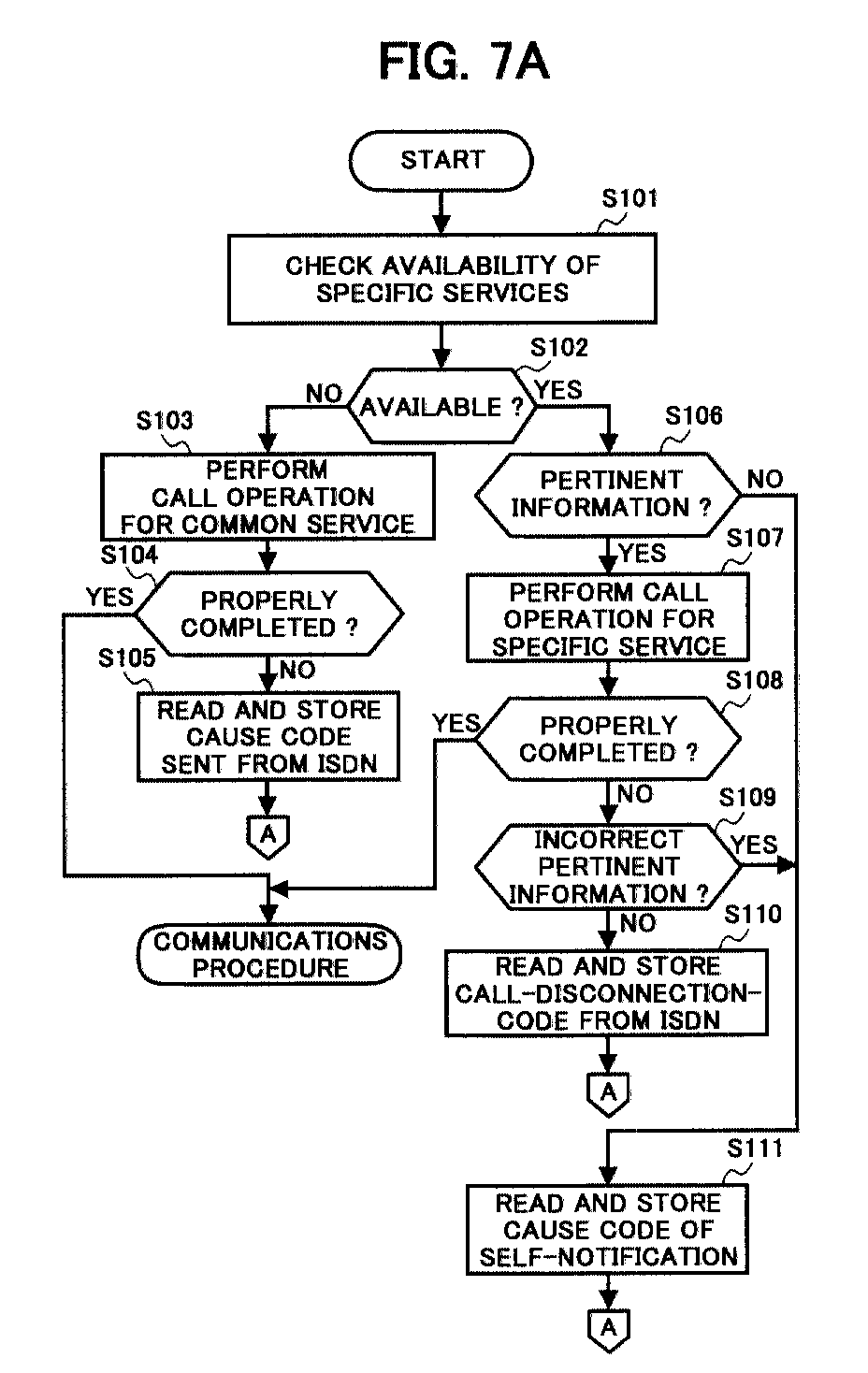
- Step S101 the system controller 2 reads the information registered in the availability column of the specific service registration table 7a, in Step S101, and checks which specific service is registered as available in the specific service registration table 7a, in Step S102. If the system controller 2 reads no specific service registered as available in the specific service registration table 7a and the check result of Step S102 is NO, the system controller 2 judges that the facsimile apparatus 1 use no specific communications service and, in Step S103, performs the call operation which is a general communications service. Then, the system controller 2 checks if the call operation is properly performed. If the call operation is properly performed and the check result of Step S104 is YES, the system controller 2 proceeds to the communications procedure.
- Step S104 If the call operation is not properly performed and the check result of Step S104 is NO, the system controller 2 stores the general call-disconnection-cause then notified from the ISDN, in Step S105. Then, the process proceeds to a call disconnection process in Step S201 (Fig. 7B), explained later.
- Step S102 If the system controller 2 reads a specific service registered as available in the specific service registration table 7a and the check result of Step S102 is YES, the system controller 2 judges that the facsimile apparatus 1 can use that specific communications service. The system controller 2 further checks in Step S106 if the pertinent information corresponding to the available specific service exists in the pertinent information column of the specific service registration table 7a. At this time, the system controller 2 does not check if the contents of the pertinent information is appropriate.
- Step S106 judges it as a specific service registration error.
- the system controller 2 reads and stores the corresponding call-disconnection-cause code registered in the specific service registration table 7a, in Step S111, and proceeds to the call disconnection process in Step S201 (Fig. 7B).
- Step S106 the process proceeds to Step S107 in which the system controller 2 performs the call operation for the available specific service and sends necessary information from the pertinent information to the ISDN.
- Step S108 the system controller 2 checks if the call operation for the available specific service is properly completed. If the call operation for the available specific service is properly completed and the check result of Step S108 is YES, the process proceeds to the call disconnection process of Step S201 (Fig. 7B).
- Step S109 the system controller 2 further checks if the cause of the improperly-completed call operation is incorrectness of the corresponding pertinent information. If the cause of the improperly-completed call operation is incorrectness of the pertinent information and the check result of Step S109 is YES, the proceeds to Step S111 in which the system controller 2 reads and stores the corresponding dummy code of the self-notification call-disconnection-cause registered in the specific service registration table 7a. Then, the process proceeds to the call-disconnection process in Step S201 (Fig. 7B).
- Step S110 the system controller 2 judges as that the error is the common call-disconnection. Therefore, in Step S110, the system controller 2 reads and stores the common call-disconnection-cause code notified from the ISDN. Then, the process proceeds to the call-disconnection process in Step S201 of Fig. 7B.
- the cases in which the corresponding pertinent information is not registered and in which the corresponding pertinent information is incorrectly registered are commonly represented by a single call-disconnection-cause code.
- these two cases may be represented by different call-disconnection-cause codes so that more detailed care can be taken against an error caused by the self-notification call-disconnection-cause. Accordingly, registration of the notification numbers, the contents of notification, and the guidance information are needed to be different for these two cases.
- Step S201 of Fig. 7B the system controller 2 performs the call-disconnection operation.
- Step S202 the system controller 2 reads and specifies the notification number in the code/number reference table 3b corresponding to the call-disconnection-cause code stored in Step S105, S110, or S111 of Fig. 7A.
- Step S203 the system controller 2 reads and specifies the contents of the notification in the number/contents reference table 3c corresponding to the notification number specified in Step S202.
- Step S204 the system controller 2 arranges to indicate the contents of the notification, specified in Step S203, with the LCD 9h.
- Fig. 8 An exemplary indication with the LCD 9h in Step S204 for a case of the self-notification call-disconnection-cause is shown in Fig. 8. As shown, the indication indicates that the XXX service is not available, wherein the XXX service is the specified specific service.
- the message may be printed on the recording sheet with the printer 6 or may be transformed into a voice message.
- the number/voice reference table 3c may be replaced with a number/voice reference table 3e in the ROM 3.
- the number/voice reference table 3e includes voice data representing a message corresponding to each of the notification number registered in the number/contents reference table 3c.
- Step S205 the system controller 2 checks in Step S205 if the call-disconnection-cause code is the self-notification type call-disconnection-cause code. If the call-disconnection-cause code is not the self-notification type call-disconnection-cause code but is the one sent from the ISDN and the check result of Step S205 is NO, the process ends. If the call-disconnection-cause code is the self-notification type call-disconnection-cause code and the check result of Step S205 is YES, the process proceeds to Step S206 in which the system controller 2 reads and specifies the guidance information in the number/guidance reference table 3d corresponding to the notification number specified in Step S202. After that, the system controller 2 performs notification of the guidance information in Step S207, and the process then ends.
- Fig. 10 shows an exemplary procedure of the guidance operation performed in Step S207.
- the system controller 2 checks in Step S301 if the HELP key 9i is pressed. Since Step 301 forms a NO loop, the process proceeds to the next step when the HELP key 9i is pressed.
- Step S302 the system controller 2 arranges to indicate the guidance information specified in Step S206 with the LCD 9h. Then, the guidance operation ends.
- Fig. 11 shows another exemplary procedure of the guidance operation performed in Step S207.
- the system controller 2 waits a predetermined time period (i.e., a 5-second time period) in Step S401.
- the system controller 2 arranges to indicate the guidance information specified in Step S206 with the LCD 9h. Then, the guidance operation ends.
- Step S302 of Fig. 10 or S402 of Fig. 11 An example of the indication performed in Step S302 of Fig. 10 or S402 of Fig. 11 is shown in Fig. 12.
- the facsimile apparatus 1 can inform the user of a way how the user is able to use the specific service which is presently unusable due to the problem in that the pertinent information is not registered or incorrect.
- the indication of the guidance information with the LCD 9h may alternatively be change to a printing of the guidance information with the printer 6, or a voice message of the guidance information.
- a number/contents and guidance reference table 3f of Fig. 13 may be used in place of the number/contents reference table 3c of Fig. 5 and the number/guidance reference table 3d of Fig. 6. In this case, the procedure of Fig. 7B is changed to that shown in Fig. 14.
- the number/contents and guidance reference table 3f of Fig. 13 combines the number/contents reference table 3c of Fig. 5 and the number/guidance reference table 3d of Fig. 6, with which the system controller 2 can increase the efficiency of reading the required information.
- Step S501 of Fig. 14 the system controller 2 performs the call-disconnection operation.
- Step S502 the system controller 2 reads and specifies the notification number in the code/number reference table 3b corresponding to the call-disconnection-cause code stored in Step S105, S110, or S111 of Fig. 7A.
- Step S503 the system controller 2 checks if the call-disconnection-cause code is the self-notification type call-disconnection-cause code. If the call-disconnection-cause code is not the self-notification type call-disconnection-cause code but is the one sent from the ISDN and the check result of Step S205 is NO, the process proceeds to Step S504.
- Step S504 the system controller 2 reads and specifies the contents of the notification in the number/contents and guidance reference table 3f corresponding to the notification number specified in Step S502. In this case, there is no corresponding guidance information.
- Step S505 the system controller 2 arranges to indicate the contents of the notification, specified in Step S504, with the LCD 9h. Then, the process ends.
- the indication of the guidance information with the LCD 9h performed in Step S505 may alternatively be change to a printing of the guidance information with the printer 6, or a voice message of the guidance information.
- Step S506 the system controller 2 reads and specifies the contents and the guidance in the number/contents and guidance reference table 3f corresponding to the notification number specified in Step S502. After that, the system controller 2 performs notification of the contents and the guidance in Step S507, and the process then ends.
- Step S601 the system controller 2 arranges the indication of the contents and the guidance, specified in Step S506, with the LCD 9h.
- the LCD 9h indicates the contents and the guidance in a manner as shown in Fig. 16, for example.
- the facsimile apparatus 1 can inform the user what specific service is presently unusable due to the problem in that the pertinent information is not registered or incorrect and a way how the user can solve the problem to use that specific service.
- Fig. 17 shows another exemplary procedure of the notification of the contents and the guidance performed in Step S507.
- the system controller 2 extends in the image memory 8 the image data of the error report containing the information of the contents and the guidance specified in Step S506 of Fig. 14, using the font table 3a, so as to generate a bit-mapped image of the error report. Then, the system controller 2 instructs the printer 6 to print the error report, in Step S702. The process then end.
- the facsimile apparatus 1 can inform the user what specific service is presently unusable due to the problem in that the pertinent information is not registered or incorrect and a way how the user can solve the problem to use that specific service. Furthermore, such a printed error report can remind the user of the problem in that the specific service cannot be used.
- the notification of the contents and the guidance in Step S505 may be performed with a voice message. Thereby, the user can recognize the notification of the contents and the guidance without the needs of paying attention to the LCD 9h.
- the facsimile apparatus 1 can inform the user what specific service is presently unusable due to the problem in that the pertinent information is not registered or incorrect. Furthermore, the facsimile apparatus 1 can show the user a way how the user can solve the problem to use that specific service so that the user can try to solve the problem by himself. Thereby, the number of inquires from the users about troubles on the communications services may be decreased.
- the facsimile apparatus 1 is connected to the ISDN as an example of a communications network.
- the present invention is not limited to it but is also applicable to a case where the facsimile apparatus 1 is connected to other networks such as a public switched telephone network (PSTN), a local area network (LAN), or the like.
- PSTN public switched telephone network
- LAN local area network
Landscapes
- Engineering & Computer Science (AREA)
- Multimedia (AREA)
- Signal Processing (AREA)
- Human Computer Interaction (AREA)
- Facsimiles In General (AREA)
- Telephonic Communication Services (AREA)
- Monitoring And Testing Of Exchanges (AREA)
- Exchange Systems With Centralized Control (AREA)
- Data Exchanges In Wide-Area Networks (AREA)
- Facsimile Transmission Control (AREA)
- Communication Control (AREA)
Abstract
Description
Claims (18)
- A communications terminal connected to at least one of a telephone line and a local area network, the terminal comprising:a first memory which stores service information including availability information representing availability of a specific communications service provided by a service provider through said at least one of the telephone line and the local area network and condition information suitable for said specific communications service;a second memory which stores message information indicating that said specific communications service is not usable;a detector configured to detect as to whether said service information stored in said first memory is appropriate at each time when said communications terminal starts a call connection operation to use said specific communications service based on said condition information; andan indicating mechanism configured to read said first memory and to indicate said message information indicating that said specific communications service is not usable when said detector detects that said service information stored in said first memory is inappropriate.
- A communications terminal according to Claim 1, further comprising a third memory which stores guidance information for guiding a way to eliminate a cause of an event in that said specific communications service is not usable, wherein said indicating mechanism is further configured to read said third memory and to indicate said guidance information when a predetermined time has elapsed after said indicating mechanism indicates said message information indicating that said specific communications service is not usable.
- A communications terminal according to Claim 1, wherein said second memory further stores guidance information for guiding a way to eliminate a cause of an event in that said specific communications service is not usable and said indicating mechanism indicates said message information indicating that said specific communications service is not usable and said guidance information when said detector detects that said service information stored in said first memory is inappropriate.
- A communications terminal connected to at least one of a telephone line and a local area network, comprising:first memory means for storing service information including availability information representing availability of a specific communications service provided by a service provider through said at least one of the telephone line and the local area network and condition information suitable for said specific communications service;second memory means for storing message information indicating that said specific communications service is not usable;detecting means for detecting as to whether said service information stored in said first memory means is appropriate at each time when said communications terminal starts a call connection operation to use said specific communications service based on said condition information; andindicating means for reading said first memory means and indicating said message information indicating that said specific communications service is not usable when said detecting means detects that said service information stored in said first memory means is inappropriate.
- A communications terminal according to Claim 4, further comprising third memory means for storing guidance information for guiding a way to eliminate a cause of an event in that said specific communications service is not usable, wherein said indicating means further reads said third memory means and indicates said guidance information when a predetermined time has elapsed after said indicating mechanism indicates said message information indicating that said specific communications service is not usable.
- A communications terminal according to Claim 4, wherein said second memory means further stores guidance information for guiding a way to eliminate a cause of an event in that said specific communications service is not usable and said indicating means indicates said message information indicating that said specific communications service is not usable and said guidance information when said detecting means detects that said service information stored in said first memory means is inappropriate.
- A communications terminal according to any one of the preceding claims, wherein said indicating means indicates said message information and said guidance information with a display.
- A communications terminal according to any one of the preceding claims, wherein said indicating means sends said message information and said guidance information to a sound mechanism so as to output said message information and said guidance information in a voice message.
- A communications terminal according to any one of the preceding claims, wherein said indicating means sends said message information and said guidance information to a printing apparatus so as to output said message information and said guidance information on a recording sheet.
- A facsimile apparatus comprising a communications terminal according to any one of the preceding claims.
- A method of using a specific communications service provided by a service provider, comprising the steps of:providing service information including availability information representing availability of said specific communications service on a communications terminal connected to at least one of a telephone line and a local area network and condition information suitable for said specific communications service;a first storing step of storing message information indicating that said specific communications service is not usable;detecting as to whether said service information provided in said providing step is appropriate at each time when a call connection operation is started on said communications terminal to use said specific communications service based on said condition information;reading said service information; andindicating that said specific communications service is not usable when said detecting step detects an event in that said service information provided in said providing step is inappropriate.
- A method as defined in Claim 11, further comprising a second storing step for storing guidance information for guiding a way to eliminate a cause of an event in that said specific communications service is not usable, wherein said reading step reads said guidance information and said indicating step indicates said guidance information upon a predetermined input for starting a guidance indication operation after said indicating step indicates said message information indicating that said specific communications service is not usable.
- A method as defined in Claim 11, further comprising a second storing step for storing guidance information for guiding a way to eliminate a cause of an event in that said specific communications service is not usable, wherein said reading step reads said guidance information and said indicating step indicates said guidance information when a predetermined time has elapsed after said indicating step indicates said message information indicating that said specific communications service is not usable.
- A method as defined in Claim 11, wherein said first storing step further stores guidance information for guiding a way to eliminate a cause of an event in that said specific communications service is not usable and said indicating step indicates said message information indicating that said specific communications service is not usable and said guidance information when said detecting step detects that said service information provided in said providing step is inappropriate.
- A method as defined in Claim 14, wherein said indicating step indicates said message information and said guidance information with a display.
- A method as defined in Claim 14, wherein said indicating step sends said message information and said guidance information to a sound mechanism so as to output said message information and said guidance information in a voice message.
- A method as defined in Claim 14, wherein said indicating step sends said message information and said guidance information to a printing apparatus so as to output said message information and said guidance information on a recording sheet.
- A computer readable medium storing computer instructions for performing the steps recited in anyone of Claims 11 - 17.
Applications Claiming Priority (2)
| Application Number | Priority Date | Filing Date | Title |
|---|---|---|---|
| JP37214799A JP2001189805A (en) | 1999-12-28 | 1999-12-28 | Communication terminal device |
| JP37214799 | 1999-12-28 |
Publications (3)
| Publication Number | Publication Date |
|---|---|
| EP1133156A2 true EP1133156A2 (en) | 2001-09-12 |
| EP1133156A3 EP1133156A3 (en) | 2002-05-29 |
| EP1133156B1 EP1133156B1 (en) | 2006-10-18 |
Family
ID=18499935
Family Applications (1)
| Application Number | Title | Priority Date | Filing Date |
|---|---|---|---|
| EP00311622A Expired - Lifetime EP1133156B1 (en) | 1999-12-28 | 2000-12-22 | Method and apparatus for controlling a use of specific communications service |
Country Status (4)
| Country | Link |
|---|---|
| US (1) | US7106466B2 (en) |
| EP (1) | EP1133156B1 (en) |
| JP (1) | JP2001189805A (en) |
| DE (1) | DE60031367T2 (en) |
Cited By (1)
| Publication number | Priority date | Publication date | Assignee | Title |
|---|---|---|---|---|
| EP1865703A3 (en) * | 2005-09-27 | 2008-02-20 | Canon Kabushiki Kaisha | Data communication apparatus and method of controlling same |
Families Citing this family (7)
| Publication number | Priority date | Publication date | Assignee | Title |
|---|---|---|---|---|
| US7051099B2 (en) * | 2001-05-31 | 2006-05-23 | Level 3 Communications, Inc. | ISDN disconnect alarm generation tool for use in voice over IP (VoIP) networks |
| JP4177275B2 (en) * | 2003-11-13 | 2008-11-05 | 株式会社リコー | Communication device |
| US7529354B2 (en) * | 2004-08-10 | 2009-05-05 | Nokia Corporation | Method of managing a connection release, corresponding system and device |
| JP4901161B2 (en) * | 2005-09-06 | 2012-03-21 | 日本電信電話株式会社 | Session control system and computer program |
| JP2007221355A (en) * | 2006-02-15 | 2007-08-30 | Fujitsu Ltd | Mobile phone having infrared communication function |
| US8131720B2 (en) * | 2008-07-25 | 2012-03-06 | Microsoft Corporation | Using an ID domain to improve searching |
| JP2019198978A (en) * | 2018-05-14 | 2019-11-21 | 東芝テック株式会社 | Printer |
Family Cites Families (24)
| Publication number | Priority date | Publication date | Assignee | Title |
|---|---|---|---|---|
| JPS5929905B2 (en) | 1981-02-13 | 1984-07-24 | 富士通株式会社 | Voice guidance method |
| JPS63313965A (en) | 1987-06-16 | 1988-12-22 | Nec Corp | Facsimile transmitter |
| JPH01125146A (en) * | 1987-11-10 | 1989-05-17 | Ricoh Co Ltd | Store and forward exchange |
| JP2700559B2 (en) | 1988-07-06 | 1998-01-21 | 株式会社リコー | Facsimile machine |
| JPH0257044A (en) | 1988-08-23 | 1990-02-26 | Canon Inc | ISDN terminal equipment |
| JPH0514469A (en) | 1991-01-31 | 1993-01-22 | Fuji Xerox Co Ltd | Mis-dial number correction device |
| JPH0550719A (en) | 1991-08-21 | 1993-03-02 | Hokuriku Nippon Denki Software Kk | Printer capable of displaying error treating method |
| JPH05145681A (en) * | 1991-11-18 | 1993-06-11 | Matsushita Graphic Commun Syst Inc | Picture communication equipment |
| JP3288411B2 (en) | 1991-12-10 | 2002-06-04 | 株式会社リコー | Communication device |
| JP3419799B2 (en) | 1992-02-24 | 2003-06-23 | 株式会社リコー | ISDN terminal device control method and ISDN terminal device |
| JP3202056B2 (en) | 1992-02-25 | 2001-08-27 | 沖電気工業株式会社 | Telephone terminal system |
| JPH05327990A (en) | 1992-05-22 | 1993-12-10 | Fujitsu Ltd | Facsimile device |
| JP3251721B2 (en) | 1993-07-01 | 2002-01-28 | 大塚化学株式会社 | Reaction curable hard coating composition |
| JPH0934837A (en) | 1995-07-14 | 1997-02-07 | Oki Electric Ind Co Ltd | Information input terminal equipment |
| JPH09284524A (en) * | 1996-02-16 | 1997-10-31 | Tec Corp | Facsimile equipment |
| US5758077A (en) * | 1996-08-02 | 1998-05-26 | Hewlett-Packard Company | Service-centric monitoring system and method for monitoring of distributed services in a computing network |
| DE19744627B4 (en) * | 1997-10-09 | 2004-04-08 | Siemens Ag | Method for switching calls from a communication system via a feeder network to connected communication terminals |
| JP3426122B2 (en) | 1997-11-05 | 2003-07-14 | パナソニック コミュニケーションズ株式会社 | Data communication device |
| JPH11205506A (en) | 1998-01-16 | 1999-07-30 | Murata Mach Ltd | Communication terminal equipment provided with fault information display function and storage medium |
| JPH11217030A (en) | 1998-02-02 | 1999-08-10 | Yazaki Corp | Information multiplex display |
| US6208658B1 (en) * | 1998-09-25 | 2001-03-27 | Vertical Networks, Inc. | Systems and methods for multiple mode voice and data communications using intelligently bridged TDM and packet buses and methods for performing telephony and data functions using the same |
| US6654453B1 (en) * | 1998-12-03 | 2003-11-25 | Bellsouth Intellectual Property Corporation | Method and system for minimizing database structure overhead in handling large volume advanced intelligent network services |
| US6671508B1 (en) * | 1999-03-31 | 2003-12-30 | Fujitsu Limited | Communication control method, status notification method and mobile communication terminal using same |
| US6618478B1 (en) * | 1999-09-27 | 2003-09-09 | Ameritech Corporation | Telephone set having a help key and methods and systems for use therewith |
-
1999
- 1999-12-28 JP JP37214799A patent/JP2001189805A/en active Pending
-
2000
- 2000-12-22 EP EP00311622A patent/EP1133156B1/en not_active Expired - Lifetime
- 2000-12-22 DE DE60031367T patent/DE60031367T2/en not_active Expired - Lifetime
- 2000-12-28 US US09/751,253 patent/US7106466B2/en not_active Expired - Fee Related
Cited By (2)
| Publication number | Priority date | Publication date | Assignee | Title |
|---|---|---|---|---|
| EP1865703A3 (en) * | 2005-09-27 | 2008-02-20 | Canon Kabushiki Kaisha | Data communication apparatus and method of controlling same |
| US7643167B2 (en) | 2005-09-27 | 2010-01-05 | Canon Kabushiki Kaisha | Data communication apparatus and method of controlling same |
Also Published As
| Publication number | Publication date |
|---|---|
| EP1133156B1 (en) | 2006-10-18 |
| DE60031367D1 (en) | 2006-11-30 |
| DE60031367T2 (en) | 2007-05-16 |
| US20010021029A1 (en) | 2001-09-13 |
| JP2001189805A (en) | 2001-07-10 |
| US7106466B2 (en) | 2006-09-12 |
| EP1133156A3 (en) | 2002-05-29 |
Similar Documents
| Publication | Publication Date | Title |
|---|---|---|
| EP1133156B1 (en) | Method and apparatus for controlling a use of specific communications service | |
| KR100194455B1 (en) | How to send a reservation to the fax system | |
| KR100318742B1 (en) | Method for inform transmitter of receiver error in facsimile | |
| JP2001077993A (en) | Communication terminal device, facsimile device, and control method thereof | |
| US5724156A (en) | Facsimile apparatus and method having function of relay transmission or relay result report transmission | |
| US7145993B2 (en) | Communication apparatus | |
| JP3691248B2 (en) | Facsimile machine | |
| KR100264324B1 (en) | Method and apparatus for identifying the transmission status of fax data | |
| KR100477631B1 (en) | How to Display Callback Messages in a Fax | |
| KR19980066107A (en) | How to opt out from the fax | |
| KR100264330B1 (en) | Method for managing the received data of facsimile | |
| CN1195941A (en) | Method for receiving facsimile message in facsimile connected to external telephone | |
| KR100296597B1 (en) | Apparatus for printing data transmitting time after modifying in facsimile | |
| CN1190306A (en) | Method of Recording Fax Receipt Information in a Facsimile Machine | |
| JPH05136974A (en) | Facsimile equipment | |
| JPH11205564A (en) | Facsimile machine | |
| JPH0630215A (en) | Facsimile communication system | |
| JPH0823434A (en) | Fax machine | |
| JPH08331349A (en) | Fax machine | |
| JP2002314775A (en) | Facsimile machine | |
| JP2000069263A (en) | Facsimile machine | |
| JP2002101283A (en) | Image information communication apparatus and control method thereof | |
| KR19990019404A (en) | How to manage voice message transmission result of multifunction device | |
| JPH10285410A (en) | Facsimile equipment, image information communication system, image information communication method, and recording medium recording image information communication control program | |
| JPH06244988A (en) | Fax machine |
Legal Events
| Date | Code | Title | Description |
|---|---|---|---|
| PUAI | Public reference made under article 153(3) epc to a published international application that has entered the european phase |
Free format text: ORIGINAL CODE: 0009012 |
|
| AK | Designated contracting states |
Kind code of ref document: A2 Designated state(s): AT BE CH CY DE DK ES FI FR GB GR IE IT LI LU MC NL PT SE TR |
|
| AX | Request for extension of the european patent |
Free format text: AL;LT;LV;MK;RO;SI |
|
| PUAL | Search report despatched |
Free format text: ORIGINAL CODE: 0009013 |
|
| AK | Designated contracting states |
Kind code of ref document: A3 Designated state(s): AT BE CH CY DE DK ES FI FR GB GR IE IT LI LU MC NL PT SE TR |
|
| AX | Request for extension of the european patent |
Free format text: AL;LT;LV;MK;RO;SI |
|
| 17P | Request for examination filed |
Effective date: 20021108 |
|
| AKX | Designation fees paid |
Designated state(s): DE FR IT |
|
| 17Q | First examination report despatched |
Effective date: 20030313 |
|
| GRAP | Despatch of communication of intention to grant a patent |
Free format text: ORIGINAL CODE: EPIDOSNIGR1 |
|
| GRAS | Grant fee paid |
Free format text: ORIGINAL CODE: EPIDOSNIGR3 |
|
| GRAA | (expected) grant |
Free format text: ORIGINAL CODE: 0009210 |
|
| AK | Designated contracting states |
Kind code of ref document: B1 Designated state(s): DE FR IT |
|
| RIN1 | Information on inventor provided before grant (corrected) |
Inventor name: TAKAOKA, TATSUO |
|
| REF | Corresponds to: |
Ref document number: 60031367 Country of ref document: DE Date of ref document: 20061130 Kind code of ref document: P |
|
| ET | Fr: translation filed | ||
| PLBE | No opposition filed within time limit |
Free format text: ORIGINAL CODE: 0009261 |
|
| STAA | Information on the status of an ep patent application or granted ep patent |
Free format text: STATUS: NO OPPOSITION FILED WITHIN TIME LIMIT |
|
| 26N | No opposition filed |
Effective date: 20070719 |
|
| REG | Reference to a national code |
Ref country code: FR Ref legal event code: PLFP Year of fee payment: 16 |
|
| REG | Reference to a national code |
Ref country code: FR Ref legal event code: PLFP Year of fee payment: 17 |
|
| PGFP | Annual fee paid to national office [announced via postgrant information from national office to epo] |
Ref country code: DE Payment date: 20161213 Year of fee payment: 17 |
|
| PGFP | Annual fee paid to national office [announced via postgrant information from national office to epo] |
Ref country code: FR Payment date: 20161222 Year of fee payment: 17 |
|
| PGFP | Annual fee paid to national office [announced via postgrant information from national office to epo] |
Ref country code: IT Payment date: 20161223 Year of fee payment: 17 |
|
| REG | Reference to a national code |
Ref country code: DE Ref legal event code: R119 Ref document number: 60031367 Country of ref document: DE |
|
| REG | Reference to a national code |
Ref country code: FR Ref legal event code: ST Effective date: 20180831 |
|
| PG25 | Lapsed in a contracting state [announced via postgrant information from national office to epo] |
Ref country code: IT Free format text: LAPSE BECAUSE OF NON-PAYMENT OF DUE FEES Effective date: 20171222 Ref country code: DE Free format text: LAPSE BECAUSE OF NON-PAYMENT OF DUE FEES Effective date: 20180703 Ref country code: FR Free format text: LAPSE BECAUSE OF NON-PAYMENT OF DUE FEES Effective date: 20180102 |