EP1133121A2 - Line card for supporting circuit and packet switching - Google Patents
Line card for supporting circuit and packet switching Download PDFInfo
- Publication number
- EP1133121A2 EP1133121A2 EP01301723A EP01301723A EP1133121A2 EP 1133121 A2 EP1133121 A2 EP 1133121A2 EP 01301723 A EP01301723 A EP 01301723A EP 01301723 A EP01301723 A EP 01301723A EP 1133121 A2 EP1133121 A2 EP 1133121A2
- Authority
- EP
- European Patent Office
- Prior art keywords
- line card
- atm
- recited
- circuit
- communications
- Prior art date
- Legal status (The legal status is an assumption and is not a legal conclusion. Google has not performed a legal analysis and makes no representation as to the accuracy of the status listed.)
- Withdrawn
Links
- 230000001360 synchronised effect Effects 0.000 claims abstract description 12
- 238000006243 chemical reaction Methods 0.000 claims description 8
- 238000012546 transfer Methods 0.000 claims description 7
- 238000004891 communication Methods 0.000 abstract description 28
- 239000004744 fabric Substances 0.000 abstract description 5
- 230000015654 memory Effects 0.000 description 8
- 238000012545 processing Methods 0.000 description 7
- 230000008901 benefit Effects 0.000 description 4
- 230000005540 biological transmission Effects 0.000 description 3
- 238000010586 diagram Methods 0.000 description 3
- 238000000034 method Methods 0.000 description 3
- 238000005516 engineering process Methods 0.000 description 2
- 238000012986 modification Methods 0.000 description 2
- 230000004048 modification Effects 0.000 description 2
- 230000002093 peripheral effect Effects 0.000 description 2
- 102100040338 Ubiquitin-associated and SH3 domain-containing protein B Human genes 0.000 description 1
- 101710143616 Ubiquitin-associated and SH3 domain-containing protein B Proteins 0.000 description 1
- 238000013461 design Methods 0.000 description 1
- 238000005538 encapsulation Methods 0.000 description 1
- 230000006870 function Effects 0.000 description 1
- RGNPBRKPHBKNKX-UHFFFAOYSA-N hexaflumuron Chemical compound C1=C(Cl)C(OC(F)(F)C(F)F)=C(Cl)C=C1NC(=O)NC(=O)C1=C(F)C=CC=C1F RGNPBRKPHBKNKX-UHFFFAOYSA-N 0.000 description 1
- 230000007246 mechanism Effects 0.000 description 1
- 230000008569 process Effects 0.000 description 1
- 230000011218 segmentation Effects 0.000 description 1
- 238000012360 testing method Methods 0.000 description 1
Images
Classifications
-
- H—ELECTRICITY
- H04—ELECTRIC COMMUNICATION TECHNIQUE
- H04L—TRANSMISSION OF DIGITAL INFORMATION, e.g. TELEGRAPHIC COMMUNICATION
- H04L12/00—Data switching networks
- H04L12/54—Store-and-forward switching systems
- H04L12/56—Packet switching systems
- H04L12/5601—Transfer mode dependent, e.g. ATM
-
- H—ELECTRICITY
- H04—ELECTRIC COMMUNICATION TECHNIQUE
- H04L—TRANSMISSION OF DIGITAL INFORMATION, e.g. TELEGRAPHIC COMMUNICATION
- H04L12/00—Data switching networks
- H04L12/50—Circuit switching systems, i.e. systems in which the path is physically permanent during the communication
-
- H—ELECTRICITY
- H04—ELECTRIC COMMUNICATION TECHNIQUE
- H04L—TRANSMISSION OF DIGITAL INFORMATION, e.g. TELEGRAPHIC COMMUNICATION
- H04L12/00—Data switching networks
- H04L12/64—Hybrid switching systems
- H04L12/6418—Hybrid transport
-
- H—ELECTRICITY
- H04—ELECTRIC COMMUNICATION TECHNIQUE
- H04L—TRANSMISSION OF DIGITAL INFORMATION, e.g. TELEGRAPHIC COMMUNICATION
- H04L12/00—Data switching networks
- H04L12/54—Store-and-forward switching systems
- H04L12/56—Packet switching systems
- H04L12/5601—Transfer mode dependent, e.g. ATM
- H04L2012/5614—User Network Interface
- H04L2012/5615—Network termination, e.g. NT1, NT2, PBX
-
- H—ELECTRICITY
- H04—ELECTRIC COMMUNICATION TECHNIQUE
- H04L—TRANSMISSION OF DIGITAL INFORMATION, e.g. TELEGRAPHIC COMMUNICATION
- H04L12/00—Data switching networks
- H04L12/54—Store-and-forward switching systems
- H04L12/56—Packet switching systems
- H04L12/5601—Transfer mode dependent, e.g. ATM
- H04L2012/5638—Services, e.g. multimedia, GOS, QOS
- H04L2012/5663—Support of N-ISDN
Definitions
- the present invention relates generally to line cards for interfacing two telecommunication systems and more particularly, to a line card for supporting circuit switching and packet switching and for supporting high speed multimedia applications.
- Multimedia applications may include voice communications, video communications and data communications. These high speed applications similarly require a number of dedicated transmission devices.
- Line cards provide the interface between a transmission line or bus and other electronic devices, such as digital signal processors.
- line cards are also designed and manufactured to support specific types of communication formats and applications.
- service providers are unfortunately required to have dedicated line cards for specific applications. If service providers desire to add additional, higher speed services, they must acquire new line cards.
- a line card is provided with supports both ircuit switching and packet data switching.
- the line card may comprise a multimedia circuit for supporting multimedia applications.
- the multimedia applications may comprise any one or more of video, voice and data.
- An interface circuit provides an interface between high speed applications, such as any of asynchronous transfer mode, ethernet and frame relay.
- the line card may comprise a conversion circuit for performing synchronous to asynchronous traffic conversion.
- the conversion circuit may be a synchronous to asynchronous converter-time slot interchange.
- a line card comprising a multimedia circuit for supporting multimedia applications; and a conversion circuit for converting synchronous traffic to asynchronous traffic is provided.
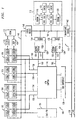
- FIG. 1 is a block diagram of a line card in accordance with the present invention for supporting circuit and packet switching.
- a line card 100 or intelligent carrier card, is shown in accordance with the present invention which supports both circuit switching and packet data switching.
- the line card 100 supports high speed multimedia applications, such as voice, video and data signals.
- the line card 100 is thus able to address the needs of compute-intensive or protocol-intensive applications.
- the line card 100 advantageously provides customizable application funcitionality including, but not limited to, OC3/STM-1, channelized T1/E1, digital signal processing (DSP) and high-capacity network interface PMCs, such as 100baseFX ad SONET.SDH facilities.
- the line card of the present invention may be advantageously employed in communication hardware as disclosed in commonly assigned U.S. Patent Application Ser. No. entitled "Hardware Configuration, Support Node and Method For Implementing General Packet Radio Services Over GSM", by Chakrabarti et al and filed concomitant with this disclosure, the disclosure of the co-pending application being hereby incorporated by reference.
- the line card 100 provides a common asynchronous transfer mode (ATM), time domain multiplex (TDM) and processing resources for four sets, or slots, 102, 104, 106 and 108 of four PCI Mezzanine Cards (PMC) 102a -102d, 104a - 104d, 106a - 106d and 108a - 108d.
- the PMC 108d is shown for exemplary purposes to be connected to a digital signal processor (DSP) 109 which is, in turn, connected to a public switched telephone network (PSTN) 111. Further, the PMC 108c is shown connected directly to the PSTN 111 through a T1/E1 interface card 113.
- DSP digital signal processor
- PSTN public switched telephone network
- a processor configuration 110 provides computing power for the line card 100.
- the processor configuration 110 preferably includes a first, or main, processor group 112 comprised of first and second processors 114 and 116 connected to respective first and second memories 118 and 120, which are shown as high speed synchronized dynamic random access memories (SDRAMs).
- the first processor group 112 further includes a cache memory mechanism, shown as first and second backside Layer 2 (Link Layer) caches 122 and 124, associated with the respective first and second processors 114 and 116.
- the first and second processors 114 and 116 are multimedia PC (MPC) PowerPC® processors manufactured by Motorola, Inc. located in Schaumburg, Illinois.
- the processor configuration 110 further comprises a second, or protocol, processor group comprised of first and second processors, or devices, 126 and 128, which are preferably PowerQUICC II (PQII), or Quad Integrated Communications Controller, devices manufactured by Motorola, Inc.
- the devices 126 and 128 have associated high speed memories, or SDRAMs 130 and 132 respectively, and respective bridges 134 and 136.
- the devices 126 and 128 contain a number of I/O interfaces including Universal Test and Operations Interface for ATM (UTOPIA) 131 and 133, TDM, serial and parallel interfaces.
- the devices 126 and 128 further have an integrated hardware ATM Segmentation And Reassembly (SAR) and Time Slot Interchange (TSI) functions.
- SAR Universal Test and Operations Interface
- TSI Time Slot Interchange
- Within each device 126 and 128 is also a programmable Reduced Instruction Set Computing (RISC) protocol engine and a PowerPC® processor.
- the line card 100 may further have power converters for providing power to the
- the line card 100 includes a Synchronous to Asynchronous Converter - Time Slot Interchange (SAC-TSI) that allows TDM traffic to be routed into the ATM fabric, thus avoiding the need for a TDM bus in the backplane of the line card 100.
- the line card 100 includes an ATM bus 138 for supporting ATM communications and a compact Peripheral Component Interconnect (cPCI) bus 140 for supporting communications with peripheral components.
- SAC-TSI Synchronous to Asynchronous Converter - Time Slot Interchange
- cPCI Peripheral Component Interconnect
- the ATM bus 138 is connected to a bus interface (BI) unit 139 which interconnects the ATM bus 138 with an ATM switch 141.
- the ATM switch 141 is preferably an Atlanta manufactured by Lucent Technologies, Inc.
- a backplane bridge 142 provides communications between the various elements comprising the line card 100 and the ATM and cPCI busses 138 and 140.
- a central bus 144 interconnects the backplane bridge 142 and the processor configuration 110.
- a local bridge 146 is connected to the central bus 144 and provides communications to and from a local PCI bus 148 which is connected to the four sets 102, 104, 106 and 108 of PMCs.
- a TDM bus 150 which may be a H.110 TDM bus, provides TDM communications between the devices 126 and 128, a SAC-TSI 151 and the four sets 102, 104, 106 and 108 of PMCs.
- the SAC-TSI 151 provides an interface between the TDM bus 150 and the ATM switch 141. Since the SAC-TSI 151 routes TDM traffic from the local PCI bus 148 into the ATM switch 141, there is no need for a TDM bus in the backplane of the line card 100.
- the ATM switch 141 has first, second, third and fourth ATM output busses 152, 154, 156 and 158 connected to each of the four sets 102, 104, 106 and 108 of PMCs.
- First and second ATM switch busses 160 and 162 provide ATM communications between the ATM switch 141 and the respective first and second devices 126 and 128.
- the ATM switch 141 may be comprised of an ATM switch core based on a Atlanta Switch Fabric chipset sold by Lucent Technologies which provides the ATM switching between the backplane, the two devices 126 and 128 and the four sets 102, 104, 106 and 108 of PMCs.
- the line card 100 provides data paths and processing resources on top of which application hardware and software can be located.
- the PMC slots 102, 104, 106 and 108 provide the flexibility to populate the line card 100 with additional hardware specific to the needs of a particular application.
- Each PCM slot 102, 104, 106 and 108 has full access into each of the major internal data paths, such as ATM, H.110, cPCI bus and central bus, of the line card 100.
- the PMC slot configuration may be implemented to take advantage of this design flexibility.
- the PMC cards may be implemented for channelized T1/E1 PMC, ATM T1/E1 PMC, OC3/STM-1 PMC, DSP PMC, fast ethernet with PowerQUICC PMC and channelized STS-1 PMC.
- the ATM switch 141 may be implemented as part of the Atlanta Switch Fabric chipset.
- the ATM switch 141 may be implemented as the portion of the Atlanta Switch Fabric chipset known as an Atlanta Layer Manager/Atlanta Buffer Manager (ALM/ABM) plus supporting logic.
- ALM/ABM Atlanta Layer Manager/Atlanta Buffer Manager
- This implementation provides the functional equivalent of an ATM switch with OC-12 class aggregate bandwidth to the PMC slots, both devices 126 and 128 and the SAC-TSI 151.
- the ATM switch 141 may span across multiple line cards.
- the H. 110 TDM bus 150 may be a standard 4096 (unidirectional) slot TDM bus designed to carry constant bit rate (CBR) traffic. Access is available to it form each PMC slot 102, 104, 106 and 108, both devices 126 and 128 and the SAC-TSI 151.
- the SAC-TSI 151 is a hardware-accelerated solution for carrying TDM-style traffic over ATM.
- the SAC-TSI 151 provides a bridge between the asynchronous ATM domain and the synchronous TDM domain. This permits TDM traffic to travel between different line cards via encapsulation over ATM through the ATM switch 141. No processor resources are used in sustaining the traffic across the SAC-TSI 151.
- the processors 114 and 116 is the central point of control for the line card.
- the main processor has direct access to the control path for all other onboard resources including the ability to see the contents of the memories 118 and 120 and full access to the PMC slots 102, 104, 106 and 108.
- the memories 118 and 120 associated with the processors 114 and 116 are 64MB.
- the PowerQUICC II devices 126 and 128 are specifically tailored for carrying traffic.
- the line card 100 has two of these devices 126 and 128 which are symmetric in their implementation, having full direct access to the ATM switch 141, the H.110 TDM bus 150 and the SDRAMs 118 and 120.
- Each of the devices 126 and 128 are coupled to separate banks of 64MB memory.
- Each of the devices 126 and 128 also provides a Media Independent Interface (MII) to the backplane connector.
- MII Media Independent Interface
- the MII may be connected to an ethernet for certain applications.
- the PowerQUICC II devices 126 and 128 advantageously have an architecture which has significant on-chip hardware to accelerate several capabilities, such as hardware support for HDLC protocols and AAL2 and AAL5 over ATM.
- the frames of the voice communications arrive on the ATM bus 138 from an external network. Typically, these frames may be of type AAL2 using ATM as a transport.
- the BI unit 139 converts the frames into a format compatible with the components on the line card 100.
- the UTOPIA bus 131 and 133 transfers the frames to the ATM switch 141. From the ATM switch 141, the frames move over the UTOPIA bus 131 and 133 to the serial interface which is part of the communications processor module (CPM) of the PowerQUICC II device 126 and 128.
- the serial interface then transfers the frames over the cPCI bus 140 using FCC channels to the RISC engine running micro-code. Micro-code converts the AAL2 frames into AAL0 format.
- the RISC engine transfers the AAL0 frames over dedicated channels on the cPCI bus 140 to the memory caches 122 and 124 for processing by the processors 114 and 116.
- the processors 114 and 116 process the AAL0 frames and writes to the SDRAMs 118 and 120.
- the processors 114 and 16 may run in load shared mode and may perform frame selection or any other application level processing.
- the processors 114 and 116 put the frames on the PPC bus 144 which pass through the local bridge 146 onto the local PCI bus 148.
- the DSP 109 connected to the PMC 108d performs EVRC processing on the frames and places the frames on the TDM bus 150.
- the frames are then transferred from the TDM bus 150, to the BI unit 139 to the ATM switch 141.
- the ATM switch 141 sends the frames to the T1/E1 interface card 113 using UTOPIA 131 and 133.
Landscapes
- Engineering & Computer Science (AREA)
- Computer Networks & Wireless Communication (AREA)
- Signal Processing (AREA)
- Data Exchanges In Wide-Area Networks (AREA)
- Telephonic Communication Services (AREA)
Abstract
Description
- The present invention relates generally to line cards for interfacing two telecommunication systems and more particularly, to a line card for supporting circuit switching and packet switching and for supporting high speed multimedia applications.
- Electronic communication systems are quickly becoming essential to today's society. Current communication systems utilize a number of high speed communication formats. Packet based formats are becoming more and more popular. Both synchronous and asynchronous communications formats have been used in a variety of different applications. These communication formats include asynchronous transfer mode (ATM), ethernet and frame relay. Each of these formats have different protocols and, in current communication systems, require different transmission systems. Additionally, a significant portion of communications continue to be provided over plain old telephone services (POTS) or circuit based switching systems.
- Complicating matters even more, different communication formats are used to support different multimedia applications. Multimedia applications may include voice communications, video communications and data communications. These high speed applications similarly require a number of dedicated transmission devices.
- One of the electronic devices which are important to these communication systems are line cards. Line cards provide the interface between a transmission line or bus and other electronic devices, such as digital signal processors. Currently, line cards are also designed and manufactured to support specific types of communication formats and applications. Thus, service providers are unfortunately required to have dedicated line cards for specific applications. If service providers desire to add additional, higher speed services, they must acquire new line cards.
- Accordingly, there is a need in the art for a line card for supporting circuit switching and packet switching applications and for supporting multimedia applications.
- In accordance with an aspect of a present invention, a line card is provided with supports both ircuit switching and packet data switching. The line card may comprise a multimedia circuit for supporting multimedia applications. The multimedia applications may comprise any one or more of video, voice and data.
- An interface circuit provides an interface between high speed applications, such as any of asynchronous transfer mode, ethernet and frame relay. The line card may comprise a conversion circuit for performing synchronous to asynchronous traffic conversion. The conversion circuit may be a synchronous to asynchronous converter-time slot interchange.
- In accordance with another aspect of the present invention, a line card comprising a multimedia circuit for supporting multimedia applications; and a conversion circuit for converting synchronous traffic to asynchronous traffic is provided.
- These and other features and advantages of the present invention will become apparent from the following detailed description, the accompanying drawing and the appended claims.
- The foregoing and other advantages of the invention will become apparent upon reading the following detailed description and upon reference to the drawing in which:
FIG. 1 is a block diagram of a line card in accordance with the present invention for supporting circuit and packet switching. - Referring now to FIG. 1, a
line card 100, or intelligent carrier card, is shown in accordance with the present invention which supports both circuit switching and packet data switching. Theline card 100 supports high speed multimedia applications, such as voice, video and data signals. Theline card 100 is thus able to address the needs of compute-intensive or protocol-intensive applications. Theline card 100 advantageously provides customizable application funcitionality including, but not limited to, OC3/STM-1, channelized T1/E1, digital signal processing (DSP) and high-capacity network interface PMCs, such as 100baseFX ad SONET.SDH facilities. The line card of the present invention may be advantageously employed in communication hardware as disclosed in commonly assigned U.S. Patent Application Ser. No. entitled "Hardware Configuration, Support Node and Method For Implementing General Packet Radio Services Over GSM", by Chakrabarti et al and filed concomitant with this disclosure, the disclosure of the co-pending application being hereby incorporated by reference. - For clarity and ease of description, the structure, control and arrangement of the conventional components and circuits have, for the most part, been illustrated in the drawings by readily understandable block representations and schematic diagrams, which show only those specific details that are pertinent to the present invention. These block representations and schematic diagrams have been employed in order not to obscure the disclosure with structural details which will be readily apparent to those skilled in the art having the benefit of the description herein.
- The
line card 100 provides a common asynchronous transfer mode (ATM), time domain multiplex (TDM) and processing resources for four sets, or slots, 102, 104, 106 and 108 of four PCI Mezzanine Cards (PMC) 102a -102d, 104a - 104d, 106a - 106d and 108a - 108d. ThePMC 108d is shown for exemplary purposes to be connected to a digital signal processor (DSP) 109 which is, in turn, connected to a public switched telephone network (PSTN) 111. Further, thePMC 108c is shown connected directly to thePSTN 111 through a T1/E1 interface card 113. As those skilled in the art will readily comprehend, the PMCs may be connected to any number of different devices. Aprocessor configuration 110 provides computing power for theline card 100. Theprocessor configuration 110 preferably includes a first, or main,processor group 112 comprised of first andsecond processors second memories first processor group 112 further includes a cache memory mechanism, shown as first and second backside Layer 2 (Link Layer)caches second processors second processors - The
processor configuration 110 further comprises a second, or protocol, processor group comprised of first and second processors, or devices, 126 and 128, which are preferably PowerQUICC II (PQII), or Quad Integrated Communications Controller, devices manufactured by Motorola, Inc. Thedevices SDRAMs respective bridges devices devices device line card 100 may further have power converters for providing power to the respective components mounted thereon. - As discussed more fully below, the
line card 100 includes a Synchronous to Asynchronous Converter - Time Slot Interchange (SAC-TSI) that allows TDM traffic to be routed into the ATM fabric, thus avoiding the need for a TDM bus in the backplane of theline card 100. Theline card 100 includes anATM bus 138 for supporting ATM communications and a compact Peripheral Component Interconnect (cPCI)bus 140 for supporting communications with peripheral components. - The
ATM bus 138 is connected to a bus interface (BI)unit 139 which interconnects theATM bus 138 with anATM switch 141. TheATM switch 141 is preferably an Atlanta manufactured by Lucent Technologies, Inc. Abackplane bridge 142 provides communications between the various elements comprising theline card 100 and the ATM andcPCI busses central bus 144 interconnects thebackplane bridge 142 and theprocessor configuration 110. - A
local bridge 146 is connected to thecentral bus 144 and provides communications to and from alocal PCI bus 148 which is connected to the foursets TDM bus 150, which may be a H.110 TDM bus, provides TDM communications between thedevices TSI 151 and the foursets TDM bus 150 and theATM switch 141. Since the SAC-TSI 151 routes TDM traffic from thelocal PCI bus 148 into theATM switch 141, there is no need for a TDM bus in the backplane of theline card 100. - The
ATM switch 141 has first, second, third and fourthATM output busses sets ATM switch 141 and the respective first andsecond devices ATM switch 141 may be comprised of an ATM switch core based on a Atlanta Switch Fabric chipset sold by Lucent Technologies which provides the ATM switching between the backplane, the twodevices sets - A detailed discussion of the operation of the
line card 100 and its components will now be provided. In a general basic principle of operation, theline card 100 provides data paths and processing resources on top of which application hardware and software can be located. ThePMC slots line card 100 with additional hardware specific to the needs of a particular application. EachPCM slot line card 100. The PMC slot configuration may be implemented to take advantage of this design flexibility. - Along with support for available PMC-compatible cards, the PMC cards may be implemented for channelized T1/E1 PMC, ATM T1/E1 PMC, OC3/STM-1 PMC, DSP PMC, fast ethernet with PowerQUICC PMC and channelized STS-1 PMC. As noted, the
ATM switch 141 may be implemented as part of the Atlanta Switch Fabric chipset. In particular, theATM switch 141 may be implemented as the portion of the Atlanta Switch Fabric chipset known as an Atlanta Layer Manager/Atlanta Buffer Manager (ALM/ABM) plus supporting logic. This implementation provides the functional equivalent of an ATM switch with OC-12 class aggregate bandwidth to the PMC slots, bothdevices TSI 151. As will be apparent to those skilled in the art, theATM switch 141 may span across multiple line cards. - The H. 110
TDM bus 150 may be a standard 4096 (unidirectional) slot TDM bus designed to carry constant bit rate (CBR) traffic. Access is available to it form eachPMC slot devices TSI 151. The SAC-TSI 151 is a hardware-accelerated solution for carrying TDM-style traffic over ATM. The SAC-TSI 151 provides a bridge between the asynchronous ATM domain and the synchronous TDM domain. This permits TDM traffic to travel between different line cards via encapsulation over ATM through theATM switch 141. No processor resources are used in sustaining the traffic across the SAC-TSI 151. - The
processors memories PMC slots memories processors - The PowerQUICC II
devices line card 100 has two of thesedevices ATM switch 141, the H.110TDM bus 150 and theSDRAMs devices devices devices - An exemplary procedure for processing voice communications will now be described. The frames of the voice communications arrive on the
ATM bus 138 from an external network. Typically, these frames may be of type AAL2 using ATM as a transport. TheBI unit 139 converts the frames into a format compatible with the components on theline card 100. TheUTOPIA bus ATM switch 141. From theATM switch 141, the frames move over theUTOPIA bus PowerQUICC II device cPCI bus 140 using FCC channels to the RISC engine running micro-code. Micro-code converts the AAL2 frames into AAL0 format. - The RISC engine transfers the AAL0 frames over dedicated channels on the
cPCI bus 140 to thememory caches processors processors SDRAMs processors 114 and 16 may run in load shared mode and may perform frame selection or any other application level processing. - The
processors PPC bus 144 which pass through thelocal bridge 146 onto thelocal PCI bus 148. TheDSP 109 connected to thePMC 108d performs EVRC processing on the frames and places the frames on theTDM bus 150. The frames are then transferred from theTDM bus 150, to theBI unit 139 to theATM switch 141. TheATM switch 141 sends the frames to the T1/E1 interface card 113 usingUTOPIA - While the invention may be susceptible to various modifications and alternative forms, specific embodiments have been shown by way of example in the drawings and have been described in detail herein. However, it should be understood that the invention is not intended to be limited to the particular forms disclosed. Rather, the invention is to cover all modification, equivalents and alternatives falling within the spirit and scope of the invention as defined by the following appended claims.
Claims (10)
- A line card comprising:
a switching circuit for supporting circuit switching and packet data switching. - The line card as recited in claim 1 comprising:
a multimedia circuit for supporting multimedia applications. - The line card as recited in claim 1 comprising a conversion circuit for performing synchronous to asynchronous traffic conversion.
- A line card comprising:a multimedia circuit for supporting multimedia applications; anda conversion circuit for converting synchronous traffic to asynchronous traffic.
- The line card as recited in claim 2 or 4 wherein the multimedia applications comprise video.
- The line card as recited in claim 2 or 4 wherein the multimedia applications comprise data.
- The line card as recited in claim 2 or 4 wherein the multimedia applications comprise voice.
- The line card as recited in claim 1 or 4 comprising:
an interface circuit for providing an interface between high speed applications. - The line card as recited in claim 8 wherein the high speed applications comprise any of asynchronous transfer mode, ethernet and frame relay.
- The line card as recited in claim 3 or 4 wherein the conversion circuit comprises a synchronous to asynchronous converter - time slot interchange.
Applications Claiming Priority (2)
| Application Number | Priority Date | Filing Date | Title |
|---|---|---|---|
| US09/520,557 US6807167B1 (en) | 2000-03-08 | 2000-03-08 | Line card for supporting circuit and packet switching |
| US520557 | 2000-03-08 |
Publications (2)
| Publication Number | Publication Date |
|---|---|
| EP1133121A2 true EP1133121A2 (en) | 2001-09-12 |
| EP1133121A3 EP1133121A3 (en) | 2006-01-18 |
Family
ID=24073117
Family Applications (1)
| Application Number | Title | Priority Date | Filing Date |
|---|---|---|---|
| EP01301723A Withdrawn EP1133121A3 (en) | 2000-03-08 | 2001-02-26 | Line card for supporting circuit and packet switching |
Country Status (5)
| Country | Link |
|---|---|
| US (1) | US6807167B1 (en) |
| EP (1) | EP1133121A3 (en) |
| JP (1) | JP3789762B2 (en) |
| KR (1) | KR100776066B1 (en) |
| CA (1) | CA2332399C (en) |
Cited By (7)
| Publication number | Priority date | Publication date | Assignee | Title |
|---|---|---|---|---|
| EP1435754A1 (en) * | 2002-12-31 | 2004-07-07 | Ezlinx Technology Incorporation | Converter/bridge and method of operation between Ethernet and ATM interfaces |
| EP1889418A4 (en) * | 2005-05-31 | 2008-11-05 | Verizon Business Global Llc | APPARATUS AND METHOD FOR PROVIDING A NETWORK ARRIVAL POINT |
| US7821929B2 (en) | 2004-04-05 | 2010-10-26 | Verizon Business Global Llc | System and method for controlling communication flow rates |
| US8218569B2 (en) | 2004-04-05 | 2012-07-10 | Verizon Business Global Llc | Apparatus and method for terminating service emulation instances |
| US8249082B2 (en) | 2004-04-05 | 2012-08-21 | Verizon Business Global Llc | System method for a communications access network |
| US8289973B2 (en) | 2004-04-05 | 2012-10-16 | Verizon Business Global Llc | System and method for indicating classification of a communications flow |
| US8948207B2 (en) | 2004-04-05 | 2015-02-03 | Verizon Patent And Licensing Inc. | System and method for transporting time-division multiplexed communications through a packet-switched access network |
Families Citing this family (19)
| Publication number | Priority date | Publication date | Assignee | Title |
|---|---|---|---|---|
| DE10119472A1 (en) * | 2001-04-20 | 2002-10-31 | Harman Becker Automotive Sys | Interface for data transmission between two bus systems and operating procedures therefor |
| US7006518B2 (en) * | 2001-05-25 | 2006-02-28 | Integrated Device Technology, Inc. | Method and apparatus for scheduling static and dynamic traffic through a switch fabric |
| US7197042B2 (en) * | 2001-06-01 | 2007-03-27 | 4198638 Canada Inc. | Cell-based switch fabric with cell-to-line-card control for regulating injection of packets |
| US7277429B2 (en) * | 2001-06-01 | 2007-10-02 | 4198638 Canada Inc. | Cell-based switch fabric with distributed scheduling |
| KR20030019823A (en) * | 2001-08-31 | 2003-03-07 | 주식회사 현대시스콤 | Apparatus and method for interfacing between block in ATM system |
| KR100459541B1 (en) * | 2001-11-12 | 2004-12-03 | 삼성전자주식회사 | Message processing method according to interfaces of the network |
| US20030105799A1 (en) * | 2001-12-03 | 2003-06-05 | Avaz Networks, Inc. | Distributed processing architecture with scalable processing layers |
| US20030112758A1 (en) * | 2001-12-03 | 2003-06-19 | Pang Jon Laurent | Methods and systems for managing variable delays in packet transmission |
| KR100431194B1 (en) * | 2001-12-13 | 2004-05-12 | 주식회사 케이티 | A structure of media gateway logical port id in open architectured atm switching system and a method for configuring the same |
| KR100549596B1 (en) * | 2002-10-07 | 2006-02-03 | 주식회사데이콤 | Ethernet Signals-Class 3 Signal Multiple / Demultiplex |
| US20050038949A1 (en) * | 2003-01-06 | 2005-02-17 | Lynn Patterson | Apparatus for enabling distributed processing across a plurality of circuit cards |
| US6954810B2 (en) * | 2003-06-30 | 2005-10-11 | Lsi Logic Corporation | Transparent switch |
| CN1868174A (en) * | 2003-08-15 | 2006-11-22 | 汤姆森特许公司 | Changeable functionality in a broadcast router |
| KR100567326B1 (en) | 2003-12-24 | 2006-04-04 | 한국전자통신연구원 | SONET / SDH, PDH, and Ethernet switching / transmission device and method thereof |
| US7869450B2 (en) | 2004-04-05 | 2011-01-11 | Verizon Business Global Llc | Method and apparatus for processing labeled flows in a communication access network |
| WO2006121472A1 (en) * | 2005-01-10 | 2006-11-16 | Quartics, Inc. | Integrated architecture for the unified processing of visual media |
| US20080288709A1 (en) * | 2007-05-15 | 2008-11-20 | Imagestream Internet Solutions | Wide area network connection platform |
| US8942559B2 (en) | 2010-05-20 | 2015-01-27 | Hewlett-Packard Development, L.P. | Switching in a network device |
| CN107808281A (en) * | 2017-11-20 | 2018-03-16 | 广东电网有限责任公司电网规划研究中心 | A kind of project of transmitting and converting electricity digitlization is transferred and display systems |
Family Cites Families (19)
| Publication number | Priority date | Publication date | Assignee | Title |
|---|---|---|---|---|
| US4535448A (en) * | 1982-12-10 | 1985-08-13 | At&T Bell Laboratories | Dual bus communication system |
| US5058111A (en) * | 1989-06-19 | 1991-10-15 | Oki Electric Industry Co., Ltd. | Subscriber line interface circuit in a switching system |
| JPH05235959A (en) * | 1992-02-18 | 1993-09-10 | Nippon Telegr & Teleph Corp <Ntt> | Hybrid communication equipment |
| US5513174A (en) * | 1994-12-07 | 1996-04-30 | At&T Corp. | Telecommunication system with detection and control of packet collisions |
| US6055238A (en) * | 1995-03-17 | 2000-04-25 | Hitachi, Ltd. | Packet terminal and packet communication network |
| US5963564A (en) * | 1995-06-13 | 1999-10-05 | Telefonaktiebolaget Lm Ericsson | Synchronizing the transmission of data via a two-way link |
| US5949791A (en) * | 1996-03-19 | 1999-09-07 | Lucent Technologies Inc. | Method and apparatus for converting synchronous narrowband signals into broadband asynchronous transfer mode signals in an integrated telecommunications network |
| US5809022A (en) * | 1996-03-19 | 1998-09-15 | Lucent Technologies Inc. | Method and apparatus for converting synchronous narrowband signals into broadband asynchronous transfer mode signals |
| US5892764A (en) | 1996-09-16 | 1999-04-06 | Sphere Communications Inc. | ATM LAN telephone system |
| US5920546A (en) * | 1997-02-28 | 1999-07-06 | Excel Switching Corporation | Method and apparatus for conferencing in an expandable telecommunications system |
| DE19757598A1 (en) * | 1997-12-23 | 1999-07-08 | Siemens Ag | Data exchange method in ATM exchange |
| US6208637B1 (en) * | 1997-04-14 | 2001-03-27 | Next Level Communications, L.L.P. | Method and apparatus for the generation of analog telephone signals in digital subscriber line access systems |
| US6128300A (en) * | 1997-12-03 | 2000-10-03 | Nokia High Speed Access Products Inc. | Line card with modem interace |
| US6154465A (en) * | 1998-10-06 | 2000-11-28 | Vertical Networks, Inc. | Systems and methods for multiple mode voice and data communications using intelligenty bridged TDM and packet buses and methods for performing telephony and data functions using the same |
| EP1068693B1 (en) * | 1998-04-03 | 2011-12-21 | Vertical Networks, Inc. | System and method for transmitting voice and data using intelligent bridged tdm and packet buses |
| US6208658B1 (en) * | 1998-09-25 | 2001-03-27 | Vertical Networks, Inc. | Systems and methods for multiple mode voice and data communications using intelligently bridged TDM and packet buses and methods for performing telephony and data functions using the same |
| US6343074B1 (en) * | 1998-09-29 | 2002-01-29 | Vertical Networks, Inc. | Systems and methods for multiple mode voice and data communications using intelligenty bridged TDM and packet buses and methods for performing telephony and data functions using the same |
| US6181694B1 (en) * | 1998-04-03 | 2001-01-30 | Vertical Networks, Inc. | Systems and methods for multiple mode voice and data communciations using intelligently bridged TDM and packet buses |
| US6567399B1 (en) * | 1999-05-05 | 2003-05-20 | 3Com Corporation | Hi-fidelity line card |
-
2000
- 2000-03-08 US US09/520,557 patent/US6807167B1/en not_active Expired - Lifetime
-
2001
- 2001-01-26 CA CA002332399A patent/CA2332399C/en not_active Expired - Fee Related
- 2001-02-26 EP EP01301723A patent/EP1133121A3/en not_active Withdrawn
- 2001-03-06 KR KR1020010011331A patent/KR100776066B1/en not_active Expired - Fee Related
- 2001-03-08 JP JP2001064539A patent/JP3789762B2/en not_active Expired - Fee Related
Non-Patent Citations (1)
| Title |
|---|
| None * |
Cited By (10)
| Publication number | Priority date | Publication date | Assignee | Title |
|---|---|---|---|---|
| EP1435754A1 (en) * | 2002-12-31 | 2004-07-07 | Ezlinx Technology Incorporation | Converter/bridge and method of operation between Ethernet and ATM interfaces |
| SG137659A1 (en) * | 2002-12-31 | 2007-12-28 | Ezlinx Technology Inc | Ethernet interface over atm cell, utopia, xdsl in single and multiple channels converter/bridge on a single chip and method of operation |
| US7821929B2 (en) | 2004-04-05 | 2010-10-26 | Verizon Business Global Llc | System and method for controlling communication flow rates |
| US8218569B2 (en) | 2004-04-05 | 2012-07-10 | Verizon Business Global Llc | Apparatus and method for terminating service emulation instances |
| US8249082B2 (en) | 2004-04-05 | 2012-08-21 | Verizon Business Global Llc | System method for a communications access network |
| US8289973B2 (en) | 2004-04-05 | 2012-10-16 | Verizon Business Global Llc | System and method for indicating classification of a communications flow |
| US8340102B2 (en) | 2004-04-05 | 2012-12-25 | Verizon Business Global Llc | Apparatus and method for providing a network termination point |
| US8913621B2 (en) | 2004-04-05 | 2014-12-16 | Verizon Patent And Licensing Inc. | System and method for a communications access network |
| US8948207B2 (en) | 2004-04-05 | 2015-02-03 | Verizon Patent And Licensing Inc. | System and method for transporting time-division multiplexed communications through a packet-switched access network |
| EP1889418A4 (en) * | 2005-05-31 | 2008-11-05 | Verizon Business Global Llc | APPARATUS AND METHOD FOR PROVIDING A NETWORK ARRIVAL POINT |
Also Published As
| Publication number | Publication date |
|---|---|
| JP3789762B2 (en) | 2006-06-28 |
| US6807167B1 (en) | 2004-10-19 |
| KR20010088391A (en) | 2001-09-26 |
| EP1133121A3 (en) | 2006-01-18 |
| KR100776066B1 (en) | 2007-11-16 |
| JP2001308852A (en) | 2001-11-02 |
| CA2332399A1 (en) | 2001-09-08 |
| CA2332399C (en) | 2005-12-06 |
Similar Documents
| Publication | Publication Date | Title |
|---|---|---|
| US6807167B1 (en) | Line card for supporting circuit and packet switching | |
| US6351452B1 (en) | Telecommunication device with centralized processing, redundancy protection, and on-demand insertion of signaling bits | |
| US5425022A (en) | Data switching nodes | |
| EP2056573B1 (en) | Integrated cut-in system and method and integrated cut-in module | |
| US7317725B2 (en) | System and method for implementing combined packetized TDM streams and TDM cross connect functions | |
| JP2002513534A (en) | Signaling network gateway device and its use in signaling networks | |
| JP2001510002A (en) | ATM cell transmission | |
| US6229808B1 (en) | Method of communication for a computer using packet switches for internal data transfer | |
| WO2000076258A1 (en) | System and method for communicating data using modified header bits to identify a port | |
| JP3132564B2 (en) | ATM switch | |
| US6373837B1 (en) | System for transmitting data between circuit boards in a housing | |
| US20030091070A1 (en) | Methods and systems for improving utilization of high-speed time division multiplexed communications links at signal transfer point | |
| JPH09172456A (en) | Multiplexing circuit, multiplexing method, and data service unit | |
| WO2000011880B1 (en) | Common access platform | |
| AU659743B2 (en) | Switching element | |
| US7269167B2 (en) | Direct end-office trunking | |
| JPH077520A (en) | Local network and bridge elements | |
| US6980557B1 (en) | Communications system with communication terminals which are connected to a switching system via a packet-oriented communication network | |
| EA005826B1 (en) | Transport of voice information over digital subscriber line with an embedded voice gateway module | |
| KR100772808B1 (en) | Telecommunication carrier processor subsystem with in-band control and addressing via cell header fields | |
| JP2904992B2 (en) | ATM control information transfer method | |
| AU751091B2 (en) | Switching means of a circuit switched network | |
| EP0477242A1 (en) | DATA SWITCHING NODES. | |
| JP2519329B2 (en) | Subscriber switch subscriber circuit | |
| JP3375055B2 (en) | Public technical integrated switchboard |
Legal Events
| Date | Code | Title | Description |
|---|---|---|---|
| PUAI | Public reference made under article 153(3) epc to a published international application that has entered the european phase |
Free format text: ORIGINAL CODE: 0009012 |
|
| AK | Designated contracting states |
Kind code of ref document: A2 Designated state(s): AT BE CH CY DE DK ES FI FR GB GR IE IT LI LU MC NL PT SE TR |
|
| AX | Request for extension of the european patent |
Free format text: AL;LT;LV;MK;RO;SI |
|
| PUAL | Search report despatched |
Free format text: ORIGINAL CODE: 0009013 |
|
| AK | Designated contracting states |
Kind code of ref document: A3 Designated state(s): AT BE CH CY DE DK ES FI FR GB GR IE IT LI LU MC NL PT SE TR |
|
| AX | Request for extension of the european patent |
Extension state: AL LT LV MK RO SI |
|
| RIC1 | Information provided on ipc code assigned before grant |
Ipc: H04L 12/56 20060101ALI20051128BHEP Ipc: H04L 12/64 20060101AFI20010621BHEP |
|
| 17P | Request for examination filed |
Effective date: 20060712 |
|
| AKX | Designation fees paid |
Designated state(s): AT BE CH CY DE DK ES FI FR GB GR IE IT LI LU MC NL PT SE TR |
|
| 17Q | First examination report despatched |
Effective date: 20060912 |
|
| GRAP | Despatch of communication of intention to grant a patent |
Free format text: ORIGINAL CODE: EPIDOSNIGR1 |
|
| DBV | Designated contracting states (deleted) | ||
| RBV | Designated contracting states (corrected) |
Designated state(s): DE FR GB |
|
| REG | Reference to a national code |
Ref country code: DE Ref legal event code: 8566 |
|
| STAA | Information on the status of an ep patent application or granted ep patent |
Free format text: STATUS: THE APPLICATION IS DEEMED TO BE WITHDRAWN |
|
| 18D | Application deemed to be withdrawn |
Effective date: 20070717 |