EP1133068A2 - Guard codes for S-CDMA systems - Google Patents
Guard codes for S-CDMA systems Download PDFInfo
- Publication number
- EP1133068A2 EP1133068A2 EP01200078A EP01200078A EP1133068A2 EP 1133068 A2 EP1133068 A2 EP 1133068A2 EP 01200078 A EP01200078 A EP 01200078A EP 01200078 A EP01200078 A EP 01200078A EP 1133068 A2 EP1133068 A2 EP 1133068A2
- Authority
- EP
- European Patent Office
- Prior art keywords
- codes
- sequence
- cdma
- sources
- cdma systems
- Prior art date
- Legal status (The legal status is an assumption and is not a legal conclusion. Google has not performed a legal analysis and makes no representation as to the accuracy of the status listed.)
- Granted
Links
Images

Classifications
-
- H—ELECTRICITY
- H04—ELECTRIC COMMUNICATION TECHNIQUE
- H04B—TRANSMISSION
- H04B1/00—Details of transmission systems, not covered by a single one of groups H04B3/00 - H04B13/00; Details of transmission systems not characterised by the medium used for transmission
- H04B1/69—Spread spectrum techniques
- H04B1/707—Spread spectrum techniques using direct sequence modulation
-
- H—ELECTRICITY
- H04—ELECTRIC COMMUNICATION TECHNIQUE
- H04B—TRANSMISSION
- H04B2201/00—Indexing scheme relating to details of transmission systems not covered by a single group of H04B3/00 - H04B13/00
- H04B2201/69—Orthogonal indexing scheme relating to spread spectrum techniques in general
- H04B2201/707—Orthogonal indexing scheme relating to spread spectrum techniques in general relating to direct sequence modulation
- H04B2201/7097—Direct sequence modulation interference
- H04B2201/709709—Methods of preventing interference
Definitions
- the present invention relates to a common Synchronous-CDMA (S-CDMA) system.
- S-CDMA Synchronous-CDMA
- the present invention provides a method for relaxing the timing accuracy requirements in Synchronous Code Division Multiple Access (S-CDMA) systems.
- the relaxation is done by keeping some of the spreading codes as "guard codes", i.e., not using some of the codes. In this way, interference due to timing error may be decreased.
- This invention allows for a relaxation of the synchronization requirements at the cost of small decrease in the data throughput of the system, thus decreasing the cost and risk of S-CDMA systems.
- FIG. 1 shows a common Synchronous-CDMA (S-CDMA) system.
- S-CDMA Synchronous-CDMA
- N data symbols are transmitted at the same time from up to N different synchronized sources (each source can transmit one or more data symbols at a given time).
- Each of these symbols is multiplied by a different spreading code (consisting of N bits).
- the invention is also applicable in cases where the spreading codes are not exactly shifted versions of the basic code, but are highly correlated with the shifted versions. It is also applicable when a few (n ⁇ N) codes are not shifted versions of the basic code at all.
- the chips are fed into a pulse-shaping filter and transmitted to the channel.
- the signal is fed into a matched filter and sampled.
- the convolution of transmitter's shaping filter with the receiver's matched filter is a Nyquist-I filter (e.g. raised-cosine), i.e. there is no inter-symbol interference between the chips (when the sources are synchronized). If we assume that all the transmitting sources are perfectly synchronized, (i.e. the symbol timing at the receiver is identical for all the sources), then the sequence at the matched filter output is p (plus channel noise). Multiplying the matched filter output by the transpose of the spreading matrix would recover the transmitted symbols. This operation is called despreading:
- the recovered symbol sequence will be as follows (for the case of two transmitting sources): where g is the Nyquist-I pulse shape (e.g. raised cosine) and ⁇ is the timing difference between the two sources.
- a method for providing reduced interference between S/CDMA chips comprising; selecting a first sequence of spreader functions for a first channel, and selecting a second sequence of spreader functions for a second channel, wherein said second sequence is non-overlapping with and spaced from first said sequence.
Landscapes
- Engineering & Computer Science (AREA)
- Computer Networks & Wireless Communication (AREA)
- Signal Processing (AREA)
- Mobile Radio Communication Systems (AREA)
- Radio Relay Systems (AREA)
Abstract
S/CDMA channels (chips) by selecting a first sequence of spreader functions for a first channel, and selecting a second sequence of spreader functions for a second channel, wherein said second sequence is non-overlapping with and spaced from first said sequence.
Description

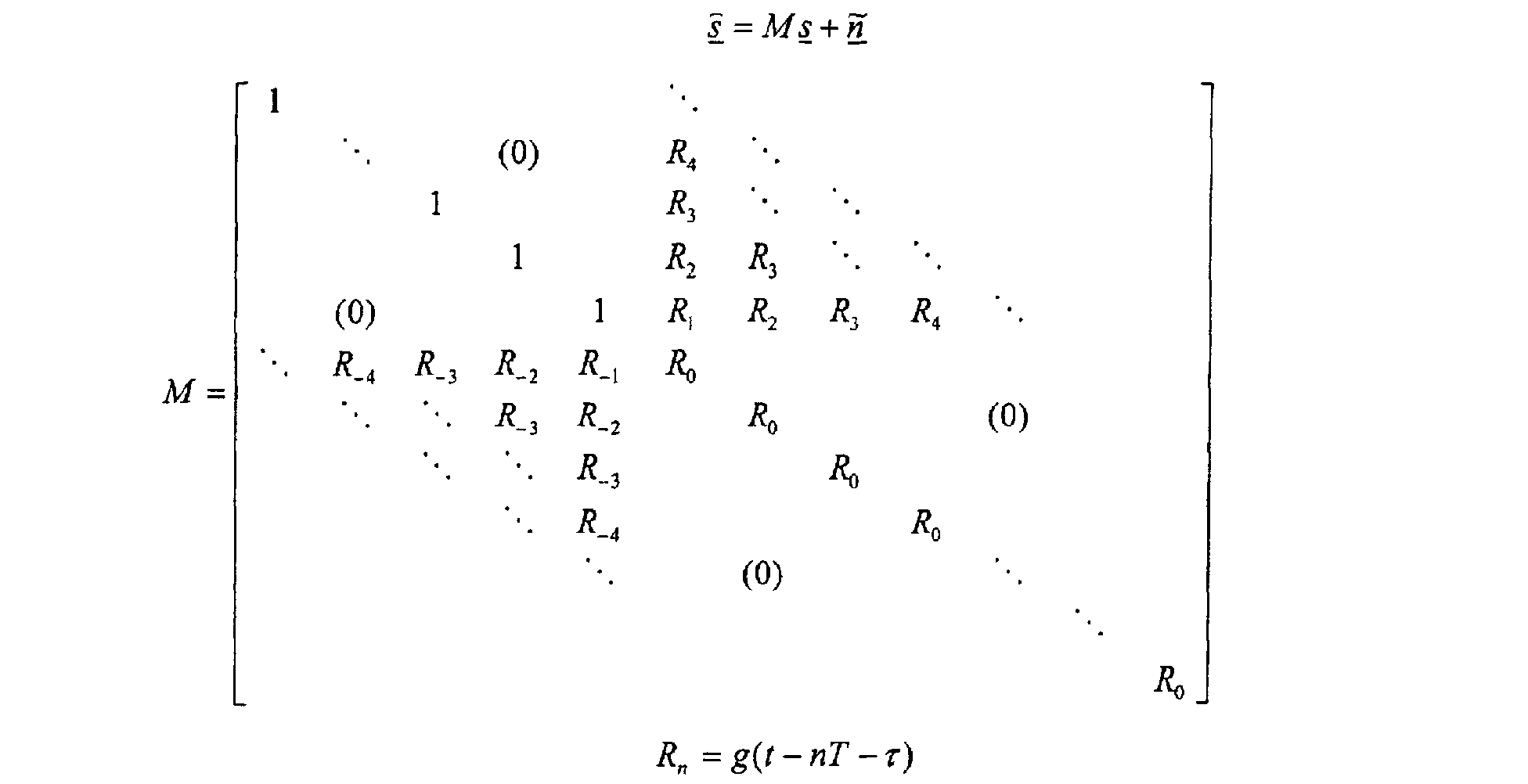
This method allows a significant relaxation of the timing requirements of the transmitting sources, at a cost of slight decrease in the data throughput (less than 2% in the above two source examples).
Claims (1)
- A method for providing reduced interference between S/CDMA channel, comprising;selecting a first sequence of spreader functions for a first channel, andselecting a second sequence of spreader functions for a second channel, wherein said second sequence is non-overlapping with and spaced from first said sequence.
Applications Claiming Priority (2)
| Application Number | Priority Date | Filing Date | Title |
|---|---|---|---|
| US48131700A | 2000-01-11 | 2000-01-11 | |
| US481317 | 2000-01-11 |
Publications (3)
| Publication Number | Publication Date |
|---|---|
| EP1133068A2 true EP1133068A2 (en) | 2001-09-12 |
| EP1133068A3 EP1133068A3 (en) | 2003-01-22 |
| EP1133068B1 EP1133068B1 (en) | 2008-07-30 |
Family
ID=23911486
Family Applications (1)
| Application Number | Title | Priority Date | Filing Date |
|---|---|---|---|
| EP20010200078 Expired - Lifetime EP1133068B1 (en) | 2000-01-11 | 2001-01-11 | Guard codes for S-CDMA systems |
Country Status (3)
| Country | Link |
|---|---|
| EP (1) | EP1133068B1 (en) |
| JP (1) | JP2001237801A (en) |
| DE (1) | DE60135052D1 (en) |
Family Cites Families (2)
| Publication number | Priority date | Publication date | Assignee | Title |
|---|---|---|---|---|
| US5210770A (en) * | 1991-09-27 | 1993-05-11 | Lockheed Missiles & Space Company, Inc. | Multiple-signal spread-spectrum transceiver |
| WO1999059266A1 (en) * | 1998-05-12 | 1999-11-18 | Motorola Inc. | Method and apparatus for short spreading in a code division multiple access communication system |
-
2001
- 2001-01-11 JP JP2001003469A patent/JP2001237801A/en not_active Abandoned
- 2001-01-11 EP EP20010200078 patent/EP1133068B1/en not_active Expired - Lifetime
- 2001-01-11 DE DE60135052T patent/DE60135052D1/en not_active Expired - Lifetime
Also Published As
| Publication number | Publication date |
|---|---|
| EP1133068B1 (en) | 2008-07-30 |
| EP1133068A3 (en) | 2003-01-22 |
| DE60135052D1 (en) | 2008-09-11 |
| JP2001237801A (en) | 2001-08-31 |
Similar Documents
| Publication | Publication Date | Title |
|---|---|---|
| US5555268A (en) | Multicode direct sequence spread spectrum | |
| KR100604732B1 (en) | Channel Estimation in Time Division Duplex Communication Systems | |
| US6097712A (en) | Multi-carrier CDMA communications systems | |
| US20020154680A1 (en) | Method for two-level variable chip rate spreading and despreading used in CDMA system | |
| JP2001136103A (en) | Fixed pattern detector | |
| US6779009B1 (en) | Enhanced time-shared data correlator architecture and method | |
| US6130906A (en) | Parallel code matched filter | |
| US8014483B2 (en) | Method of acquiring initial synchronization in impulse wireless communication and receiver | |
| US7085313B2 (en) | Multiple channel joint decoding at mobile handset | |
| KR100669573B1 (en) | How to send data bits | |
| EP0932954B1 (en) | A class of low cross correlation non-palindromic synchronization sequences for code tracking in synchronous multiple access communication systems | |
| US5926471A (en) | CDMA communication method, CDMA transmitter and CMDA receiver | |
| JP2916457B1 (en) | Spread spectrum communication equipment | |
| US4866735A (en) | Spread spectrum communicating method | |
| US20050174978A1 (en) | Guard codes for S-CDMA systems | |
| JP2003517737A (en) | Spread spectrum multiple access coding | |
| EP1133068B1 (en) | Guard codes for S-CDMA systems | |
| WO2000065759A1 (en) | Cdma communication system having pilot-supporting interference separating function | |
| KR100320828B1 (en) | Matched filter and timing detection method | |
| EP1128624A2 (en) | Code selection for suppression of adjacent channel interference in FDM DPSK | |
| US20040083253A1 (en) | Method and apparatus for efficient matrix multiplication in a direct sequence CDMA system | |
| JPS6334663B2 (en) | ||
| EP1065799A1 (en) | Multi-user detection for wideband CDMA | |
| US7321609B1 (en) | System and method for detecting PN code phase | |
| CN1898881A (en) | Umts receiver symbol synchronization |
Legal Events
| Date | Code | Title | Description |
|---|---|---|---|
| PUAI | Public reference made under article 153(3) epc to a published international application that has entered the european phase |
Free format text: ORIGINAL CODE: 0009012 |
|
| AK | Designated contracting states |
Kind code of ref document: A2 Designated state(s): AT BE CH CY DE DK ES FI FR GB GR IE IT LI LU MC NL PT SE TR |
|
| AX | Request for extension of the european patent |
Free format text: AL;LT;LV;MK;RO;SI |
|
| PUAL | Search report despatched |
Free format text: ORIGINAL CODE: 0009013 |
|
| AK | Designated contracting states |
Kind code of ref document: A3 Designated state(s): AT BE CH CY DE DK ES FI FR GB GR IE IT LI LU MC NL PT SE TR |
|
| AX | Request for extension of the european patent |
Free format text: AL;LT;LV;MK;RO;SI |
|
| RIC1 | Information provided on ipc code assigned before grant |
Free format text: 7H 04B 1/707 A, 7H 04J 13/00 B |
|
| 17P | Request for examination filed |
Effective date: 20030722 |
|
| AKX | Designation fees paid |
Designated state(s): DE FR GB |
|
| GRAP | Despatch of communication of intention to grant a patent |
Free format text: ORIGINAL CODE: EPIDOSNIGR1 |
|
| GRAS | Grant fee paid |
Free format text: ORIGINAL CODE: EPIDOSNIGR3 |
|
| GRAA | (expected) grant |
Free format text: ORIGINAL CODE: 0009210 |
|
| AK | Designated contracting states |
Kind code of ref document: B1 Designated state(s): DE FR GB |
|
| REG | Reference to a national code |
Ref country code: GB Ref legal event code: FG4D |
|
| REF | Corresponds to: |
Ref document number: 60135052 Country of ref document: DE Date of ref document: 20080911 Kind code of ref document: P |
|
| PLBE | No opposition filed within time limit |
Free format text: ORIGINAL CODE: 0009261 |
|
| STAA | Information on the status of an ep patent application or granted ep patent |
Free format text: STATUS: NO OPPOSITION FILED WITHIN TIME LIMIT |
|
| 26N | No opposition filed |
Effective date: 20090506 |
|
| REG | Reference to a national code |
Ref country code: FR Ref legal event code: PLFP Year of fee payment: 16 |
|
| PGFP | Annual fee paid to national office [announced via postgrant information from national office to epo] |
Ref country code: GB Payment date: 20151230 Year of fee payment: 16 |
|
| PGFP | Annual fee paid to national office [announced via postgrant information from national office to epo] |
Ref country code: DE Payment date: 20160127 Year of fee payment: 16 |
|
| PGFP | Annual fee paid to national office [announced via postgrant information from national office to epo] |
Ref country code: FR Payment date: 20151230 Year of fee payment: 16 |
|
| REG | Reference to a national code |
Ref country code: DE Ref legal event code: R119 Ref document number: 60135052 Country of ref document: DE |
|
| GBPC | Gb: european patent ceased through non-payment of renewal fee |
Effective date: 20170111 |
|
| REG | Reference to a national code |
Ref country code: FR Ref legal event code: ST Effective date: 20170929 |
|
| PG25 | Lapsed in a contracting state [announced via postgrant information from national office to epo] |
Ref country code: FR Free format text: LAPSE BECAUSE OF NON-PAYMENT OF DUE FEES Effective date: 20170131 |
|
| PG25 | Lapsed in a contracting state [announced via postgrant information from national office to epo] |
Ref country code: GB Free format text: LAPSE BECAUSE OF NON-PAYMENT OF DUE FEES Effective date: 20170111 Ref country code: DE Free format text: LAPSE BECAUSE OF NON-PAYMENT OF DUE FEES Effective date: 20170801 |