EP1132271A2 - Apparatus and method for assessing condition of road surface - Google Patents
Apparatus and method for assessing condition of road surface Download PDFInfo
- Publication number
- EP1132271A2 EP1132271A2 EP01302137A EP01302137A EP1132271A2 EP 1132271 A2 EP1132271 A2 EP 1132271A2 EP 01302137 A EP01302137 A EP 01302137A EP 01302137 A EP01302137 A EP 01302137A EP 1132271 A2 EP1132271 A2 EP 1132271A2
- Authority
- EP
- European Patent Office
- Prior art keywords
- vehicle
- coefficient
- road
- acceleration
- deceleration
- Prior art date
- Legal status (The legal status is an assumption and is not a legal conclusion. Google has not performed a legal analysis and makes no representation as to the accuracy of the status listed.)
- Withdrawn
Links
Images




Classifications
-
- G—PHYSICS
- G01—MEASURING; TESTING
- G01N—INVESTIGATING OR ANALYSING MATERIALS BY DETERMINING THEIR CHEMICAL OR PHYSICAL PROPERTIES
- G01N19/00—Investigating materials by mechanical methods
- G01N19/02—Measuring coefficient of friction between materials
-
- B—PERFORMING OPERATIONS; TRANSPORTING
- B60—VEHICLES IN GENERAL
- B60T—VEHICLE BRAKE CONTROL SYSTEMS OR PARTS THEREOF; BRAKE CONTROL SYSTEMS OR PARTS THEREOF, IN GENERAL; ARRANGEMENT OF BRAKING ELEMENTS ON VEHICLES IN GENERAL; PORTABLE DEVICES FOR PREVENTING UNWANTED MOVEMENT OF VEHICLES; VEHICLE MODIFICATIONS TO FACILITATE COOLING OF BRAKES
- B60T8/00—Arrangements for adjusting wheel-braking force to meet varying vehicular or ground-surface conditions, e.g. limiting or varying distribution of braking force
- B60T8/17—Using electrical or electronic regulation means to control braking
- B60T8/172—Determining control parameters used in the regulation, e.g. by calculations involving measured or detected parameters
-
- B—PERFORMING OPERATIONS; TRANSPORTING
- B60—VEHICLES IN GENERAL
- B60T—VEHICLE BRAKE CONTROL SYSTEMS OR PARTS THEREOF; BRAKE CONTROL SYSTEMS OR PARTS THEREOF, IN GENERAL; ARRANGEMENT OF BRAKING ELEMENTS ON VEHICLES IN GENERAL; PORTABLE DEVICES FOR PREVENTING UNWANTED MOVEMENT OF VEHICLES; VEHICLE MODIFICATIONS TO FACILITATE COOLING OF BRAKES
- B60T2210/00—Detection or estimation of road or environment conditions; Detection or estimation of road shapes
- B60T2210/10—Detection or estimation of road conditions
- B60T2210/12—Friction
Definitions
- the present invention relates to an apparatus and method for assessing the condition of a road surface. More particularly, the invention relates to an apparatus and method for assessing a condition of a road surface, which can increase the performance and safety of a vehicle by judging a coefficient of friction occurring between a road and a tyre (road friction coefficient) by using rotational information of four tyres.
- ABS antilock braking system
- a slip ratio is calculated from a judged vehicle speed and a detected wheel speed (rotational speed) and, after that, braking force is controlled so that the calculated slip ratio coincides with a preset reference slip ratio. In such a manner, the maximum braking force is followed.
- a coefficient ⁇ of friction on a road is used. Specifically, according to the coefficient ⁇ of friction on a road (road friction coefficient ⁇ ), that is, whether the road friction coefficient ⁇ is high or low, the contents of a control are changed to thereby perform the optimum control.
- vehicle acceleration is calculated from a following wheel at the time of occurrence of a slip, and the road friction coefficient ⁇ is judged by using the acceleration.
- the road friction coefficient ⁇ obtained by the equation is, however a road friction coefficient ⁇ at the time when the vehicle acceleration A is calculated by replacing the acceleration of the following wheel derived by simply differentiating the rotational speed of the following wheel with the vehicle acceleration A. It is not known whether or not the road friction coefficient ⁇ is the actual coefficient ⁇ of friction between the road and the tyre. The probability that it is not the actual road friction coefficient ⁇ is overwhelmingly high.
- An object of the invention is to provide an apparatus and method for assessing a condition of a road surface, which can increase the performance and safety of a vehicle by judging a coefficient of friction occurring between a road and tyres by using rotational information of four tyres.
- an apparatus for assessing a condition of a road surface comprising: rotational speed detecting means for periodically detecting rotational speeds of four tyres of a vehicle; first computing means for computing a slip ratio from measurement values of the rotational speed detecting means; second computing means for obtaining a relation formula between the slip ratio and acceleration/deceleration of the vehicle; and friction coefficient judging means for judging a coefficient of friction occurring between a road and a tyre on the basis of a slope of the relational formula obtained by the second computing means.
- a method for assessing a condition of a road surface comprising the steps of: periodically detecting rotational speeds of four tyres of a vehicle; computing a slip ratio from the measured rotational speeds; obtaining a relational formula between the slip ratio and acceleration/deceleration of the vehicle; comparing a slope of the relational formula with a present threshold; and judging a coefficient of friction occurring between a road and a tyre from a result of the comparison.
- an apparatus for presuming a condition of a road surface comprising; rotational speed detecting means for periodically detecting rotational speeds of four tyres of a vehicle; first computing means for computing acceleration/deceleration of the vehicle and a slip ratio of tyres from measurement values of the rotational speed detecting means; moving-average calculating means for calculating a moving average from the acceleration/deceleration of the vehicle and the slip ratio in predetermined time; weighted moving-average calculating means for performing moving average on the moving average value obtained by the mover-average calculating means; second computing means for obtaining a relational formula between the acceleration/deceleration of the vehicle and the slip ratio from weighted moving averages obtained by the weighted moving average calculating means; and friction coefficient judging means for judging a coefficient of friction occurring between a road and a tyre on the basis of a slip of the relational formula obtained by the second computing means.
- a method for presuming a condition of a road surface comprising the steps of: periodically detecting rotational speeds of four tyres of a vehicle; computing acceleration/deceleration of the vehicle and a slip ratio of tyres from the measured rotational speed; calculating a moving average of the acceleration/deceleration of the vehicle and the slip ratio in predetermined time; performing moving average on the moving average value obtained in the moving average calculating step; obtaining a relational formula between the acceleration/deceleration of the vehicle and the slip ratio from the weighted moving averages obtained by the weighted moving average calculating means; comparing a slope of the relational formula with a preset threshold; and judging a coefficient of friction occurring between a road and a tyre from a result of the comparison.
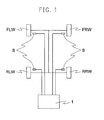
- an apparatus for assessing a condition of a road surface has rotational speed detecting means S provided for each of the tyres FLW, FRW, RLW and RRW of a four-wheeled vehicle to periodically detect the rotational speeds of the tyres.
- Outputs of the rotational speed detecting means S are transmitted to a control unit 1 such as ABS.
- a control unit 1 such as ABS.
- an alarm display 2 as display means constructed by a liquid crystal display device, plasma display device, CRT or the like is connected.
- Reference numeral 3 denotes an initialisation switch operated by the driver.
- the rotational speed detecting means S takes the form of, for example, a wheel speed sensor for measuring rotational speed from the number of rotation pulses generated by using an electromagnetic pickup or the like, or an angular velocity sensor for measuring a rotational speed from a voltage generated by using rotation of an electric dynamo.
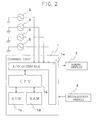
- the control unit 1 includes, a shown in Figure 2, an I/O interface 1a necessary for the transmission/reception of signals to/from an external device, a CPU 1b functioning as the centre of computing processes, a ROM 1c in which a control operation program of the CPU 1b is stored, and a RAM 1d to which data is temporarily written when the CPU 1b performs a control operation and from which the written data or the like is read.
- the control unit 1 is provided with, as first solving means, first computing means for computing a slip ratio (ratio between the wheel speed of a front tyre and the wheel speed of a rear tyre) from measurement values obtained by the rotational speed detecting means S, second computing means for obtaining a relational formula between the slip ration and acceleration/deceleration of the vehicle, and friction coefficient judging means for judging coefficient ⁇ of friction occurring between a road and a tyre on the basis of a slope of the relational formula obtained by the second computing means.
- the friction coefficient judging means includes comparing means for comparing comparing a slope e of the relational formula obtained by the second computing means with a preset threshold.
- the rotational speeds of the four tyres are detected within 0.1 second or less, preferably, 0.05 second or less.
- the acceleration/deceleration of the vehicle can be measured by a G sensor, from the view point of costs, it is preferable to calculate it from an average wheel speed of four wheels or following wheels.
- the slip ratio and the acceleration/deceleration of the vehicle are subjected to moving average every sampling time as an average value of data of predetermined time, for example, data of 0.1 second or longer.
- moving average predetermined number of data pieces of the slip ratio and acceleration/deceleration of the vehicle
- a relational formula between the slip ratio and the acceleration/deceleration of the vehicle is obtained.
- a linear regression coefficient and a correlation coefficient between the slip ratio and the acceleration/deceleration of the vehicle are calculated.
- the slip ratio obtained by the moving average is a predetermined value or higher, or a predetermined value or smaller (for instance 0.07 or higher, or -0.07 or lower)
- the slip ratio is not used for the calculation of the regression coefficient and an alarm of slip might be issued.
- the regression coefficient is updated and held.
- a coefficient of friction occurring between a tyre and a road is judged.
- condition of the road is used for the controls of an ABS, TRC or the like.
- Studless tyres for instance, Graspic DS-1 made by Sumitomo Rubber Industries Ltd
- the vehicle was driven on a dry asphalt road R1, a snowy road R2, and a frozen asphalt road R3.
- the vehicle was driven at 50 km/h on each respective road surface.
- one second of the sampling time of wheel speed is too long, so that the sampling time was set as 40 ms.
- step S1, S2 and S3 On the basis of the wheel speed pulses outputted from the rotational speed detecting means, the wheel speed was captured, and the average wheel acceleration/deceleration of a following wheel (acceleration/deceleration of the vehicle) and the slip ratio of the front/rear wheels were calculated every 40 ms (steps S1, S2 and S3).
- step S4 and S5 25 pieces of data of one second with respect of the average wheel acceleration/deceleration of the following wheel and the slip ratio between the front and rear wheels were averaged and a moving average value was obtained every sampling time (40 ms) (steps S4 and S5).
- a moving average value was obtained every sampling time (40 ms) (steps S4 and S5).
- an alarm of slip was issued at the time point (step S6).
- step S7 the linear regression coefficient K1 of the average wheel acceleration/deceleration of the following wheel to the slip ratio was obtained (step S7).
- the correlation coefficient R at this time was calculated (step S8).
- the value of the regression coefficient K was updated and held (step S9).
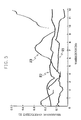
- Figure 5 shows the changed with time of the regression coefficients obtained on the roads.
- the regression coefficient K1 changed always lower than 0.12.
- the regression coefficient K1 changed in the range from about 0.1 to about 0.2.
- the value of the regression coefficient K1 largely fluctuated since the condition of the road was not constant. Although the road actually evaluated seemed dark and looked like an asphalt road at a glance, when the road was observed will, it was frozen here and there as was very slippery.
- the regression coefficient K1 was compared with the present thresholds (0.12 and 0.18), to judge the coefficient ⁇ of friction between a tyre and a road.
- the regression coefficient K1 and the correlation coefficient R were calculated every sampling time (40 ms), and the road friction coefficient ⁇ was judged by using the following thresholds (steps S10, S11 and S12).
- the number of data pieces for calculating the regression line was 50 in the embodiment, the invention is not limited to the value. However, if the number of data pieces is too small, a reliable result cannot be obtained. Consequently, at least five pieces of data are necessary. On the contrary, when the number of data pieces is too large, the sampling time becomes long. In the case where the conditions of a road change often, data varies, the correlation coefficient becomes low, and the case where the road friction coefficient ⁇ cannot be determined increases as a result. It is therefore desirable to determine the number of data pieces in consideration of the sampling time.
- the road friction coefficient ⁇ can be judged with precision in a short time, and the slippery dangerous state can be notified to the driver.
- the control unit 1 is provided with: moving-average calculating means for calculating a moving average of the acceleration/deceleration of the vehicle and the first slip ratio in predetermined time from the measurement value obtained by the rotational speed detecting means; weighted moving-average calculating means for performing moving average on the moving average value obtained by the moving-average calculating means; second computing means for obtaining a relation formula between the acceleration/deceleration of the vehicle and the second slip ratio from weighted moving average values obtained by the weighted moving average calculating means; and friction coefficient judging means for judging a coefficient of friction occurring between a road and a tyre on the basis of a slope of the relation formula obtained by the second computing means.
- the friction coefficient judging means includes comparing means for comparing the slope of the relational formula obtained by the second computing means with a preset threshold.
- the rotational speeds of the four tyres are periodically detected every 0.2 second or lass.
- the acceleration/deceleration of the vehicle can be measured by a G sensor, it is preferable to calculate the acceleration/deceleration of the vehicle from an average wheel speed of the four wheels or driven wheels from the view point of costs.
- the acceleration/deceleration of the vehicle and the slip ratios are subjected to moving average every sampling time as an average value of data of predetermined time, for example, data of at least 0.1 second.
- a moving average value is obtained by calculating a moving average on data of predetermined time every sampling time.
- the linear regression coefficient and correlation coefficient of the slip ratio to the acceleration/deceleration of the vehicle are calculated.
- the sampling time has to be 0.2 second or less. More preferably, it is 0.05 second or less. It is preferable that the average time of moving average of the first time is 0.1 to 2 seconds and that of the second time and subsequent times is 0.1 to 1 second.
- the regression coefficient is updated and held.
- the coefficient of friction occurring between the tyre and the road is judged.
- the operations of the apparatus for assessing the condition of the road surface of the embodiment are performed in the same procedures 1 to 5 in the foregoing embodiment.
- the correlation coefficient is low, and the precision of the regression coefficient deteriorates.
- the calculation result (regression coefficient) is not updated but the previous calculation result is used.
- the ratio that the correlation coefficient is low and the calculation result is not updated is high, it means that the ratio that the road friction coefficient ⁇ cannot be estimated is high. It is therefore important to suppress variations in data (to eliminate noise) and reduce the ratio that the correlation coefficient is low.
- the moving average process is performed for this purpose.
- the variations in data occur due to may causes.
- One of the important factors is a fluctuation associated with the rotation of a tyre.
- the fluctuation appears at the same frequency as the rotational cycles of the tyre.
- the radius of a general tyre of an ordinary-sized vehicle is about 300 mm
- the circumference of a tyre is about 1.9 m.
- a frequency fluctuation of about 4.4 Hz occurs. That is, since the fluctuation occurs according to driving speed, it is feared that the fluctuations are not sufficiently suppressed by the moving average process.
- DAF n+m-1 MAf n + DAf n+1 + ⁇ + MAf n+m-1
- DAf n+m MAf n+1 + MAf n+2 + ⁇ + MAf n+m M
- DAF n+m+1 MAf n+2 + MAf n+3 + ⁇ + MAf n+m+1 M
- DS n+m-1 MS n + MS n+1 + ⁇ + MS n+m-1
- DS n+m MS n+1 + MS n+2 + ⁇ + MS n+m
- D n+m+1 MS n+2 + MS n+3 + ⁇ + MS n+m+1 M
- a front-wheel-drive vehicle was prepared and studless tyres (for instance, Graspic DS-1 made by Sumitomo Rubber Industries Ltd) were attached thereto.
- the vehicle was driven on a dry asphalt road R1, a snowy road R2, and a frozen asphalt road R3.
- the driving condition on each of the road was around 20 to 80 km/h.
- one second of the sampling time of wheel speed is too long, so that the sampling time was set as 40 ms.
- the correlation coefficient R at this time was calculated.
- the coefficient R correlation was 0.6 or higher, the value of the regression coefficient K was updated and held.
- the coefficient R correlation was lower than 0.6, the value of the regression coefficient K1 was not updated.
- the shortest time (response time) since the start of sampling until the regression coefficient K1 was obtained was 3.44 seconds by adding one second of the process start time of the first moving average (No. 25), 0.52 second of the processing time of the second moving average (No. 37), and 2 seconds of the processing time for storing the 50 pieces of data (No. 37 to 86) for regression and subtracting overlap time 0.08 (2 x 0.04) second of data (Nos. 25 and 27).
- the regression coefficient K1 was compared with the preset thresholds (0.12 and 0.18). thereby judging the coefficient ⁇ of friction between a tyre and the road.
- the regression coefficient K1 and the correlation coefficient R were calculated every sampling time (40 ms), and the road friction coefficient ⁇ was judged by using the following thresholds.
- Example 3 the weighted moving average was performed twice in the process of computing the same data as that in Example 2. Specifically, data of 0.76 second (19 pieces) with respect to the average wheel acceleration/deceleration of the following wheel and the slip ratio between the front and read wheels was averaged and a moving-average value was calculated every sampling time (40 ms).
- weighted moving averaged data of 0.16 second (4 pieces) with respect to the average wheel acceleration/deceleration of the following wheel and slip ratio between the front and rear wheels was averaged, and the weighted moving average value was calculated every sampling time (40 ms).
- the procedure after that is the same as that in Example 2.
- Example 2 The same data as that in Example 2 of 0.8 second (20 pieces) with respect to the average wheel acceleration/deceleration of the following wheel and the slip ratio between the front and rear wheels was averaged without performing weighted moving average, and a moving-average value of only once was calculated every sampling time (40 ms).
- Example 2 The same data as that in Example 2 of 1.2 second (30 pieces) with respect to the average wheel acceleration/deceleration of the following wheel and the slip ratio between the front and rear wheels was averaged without performing weighted moving average, and a moving-average value of only once was calculated every sampling time (40 ms).
- Example 2 The same data as that in Example 2 of 1.6 seconds (40 pieces) with respect to the average wheel acceleration/deceleration of the following wheel and the slip ratio between the front and read wheels was averaged without performing weighted moving average, and a moving-average value of only once was calculated every sampling time (40 ms).
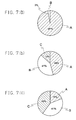
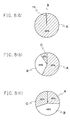
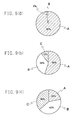
- Figures 6(a) to 10(a) show the proportion of the regression coefficients K1 on the dry asphalt road in Examples 2 and 3 and Comparative Examples 1 to 3
- Figures 6(b) to 10(b) show the proportion of the regression coefficients K1 on the snowy asphalt road
- Figures 6(c) and 10(c) show the proportion of the regression coefficients K1 on the frozen asphalt road.
- the high, intermediate, and low road friction coefficients ⁇ by the following thresholds are indicated by A, B and C respectively.
- the coefficient ⁇ of friction on a road can be sufficiently judged without executing the weighted moving averaging.
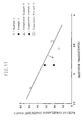
- Table 3 and Figure 11 show the relation between the shortest time from the start of sampling until the regression coefficient K1 was obtained, that is, the response time and the ratio that the correlation coefficient R was lower than 0.6 and the value of the regression coefficient K1 was not updated in Examples 2 and 3 and Comparative Examples 1 to 3.
- the ratio of the correlation coefficient R ⁇ 0.6 is an average of the coefficients on the dry asphalt road, snowy road, and frozen asphalt road.
- Example 2 Example 3 Comp.
- Example 1 Comp.
- Example 2 Comp.
- Example 3 Response time (seconds) 3.44 3.16 2.76 3.16 3.56 Ratio (%) of R ⁇ 0.6 15 21 49 32 23
- the invention is not limited to this value. However if the number of data pieces is too small, the value of the regression coefficient K1 might fluctuate, the case where the correlation coefficient R is lower than 0.6 increases, and the value of the regression coefficient K1 is not smoothly updated. Consequently, at least five pieces of data are necessary. On the contrary, when the number of data pieces is too large, the sampling time becomes long. Moreover, in the case where the conditions of a road change often, data varies largely, the correlation coefficient R becomes low, and the case where the road friction coefficient ⁇ cannot be determined often occurs as a result. It is therefore desirable to determine the number of data pieces in consideration of the sampling time.
- the road friction coefficient ⁇ can be judged with precision in a short time, and slippery, dangerous conditions can be notified to the driver.
- the road friction coefficient ⁇ can be judged with high accuracy in a short time by using only the wheel rotational speed information of four wheels.
- the performance and safety of a vehicle can be increased.
Landscapes
- Engineering & Computer Science (AREA)
- Transportation (AREA)
- Mechanical Engineering (AREA)
- Automation & Control Theory (AREA)
- Physics & Mathematics (AREA)
- Health & Medical Sciences (AREA)
- Life Sciences & Earth Sciences (AREA)
- Chemical & Material Sciences (AREA)
- Analytical Chemistry (AREA)
- Biochemistry (AREA)
- General Health & Medical Sciences (AREA)
- General Physics & Mathematics (AREA)
- Immunology (AREA)
- Pathology (AREA)
- Regulating Braking Force (AREA)
- Control Of Driving Devices And Active Controlling Of Vehicle (AREA)
Abstract
Description

- K1 ≤ 0.1
- a high road friction coefficient µ (µ = 0.7 or higher)
- 0.1 < K1 ≤ 0.16
- an intermediate road friction coefficient µ (µ = 0.3 to 0.7)
- 0.16 < K1
- a low road friction coefficient µ (µ = 0.3 or lower)
- K1 ≤ 0.12
- high road coefficient µ (neither alarm nor attention is issued)
- 0.12<K1 ≤ 0.18
- intermediate road friction coefficient µ (attention to low grip or slippery is called)
- 0.18 < K1
- low road friction coefficient µ (alarm about low grip or slippery is issued)
| No | Time (Second) | Raw data obtained every 40 ms | First moving average | Second moving average | Regression coefficient |
| 1 | 0.04 | 0.04 | |||
| 2 | 0.08 | 0.06 | |||
| 3 | 0.12 | -0.03 | |||
| 4 | 0.16 | 0.12 | |||
| 5 | 0.20 | -0.01 | |||
| 6 | 0.24 | 0.07 | |||
| 7 | 0.28 | 0.03 | |||
| 8 | 0.32 | 0.01 | |||
| 9 | 0.36 | 0.05 | |||
| 10 | 0.40 | 0.00 | |||
| 11 | 0.44 | 0.00 | |||
| 12 | 0.48 | 0.04 | |||
| 13 | 0.52 | -0.01 | |||
| 14 | 0.56 | 0.04 | |||
| 15 | 0.60 | 0.05 | |||
| 16 | 0.64 | -0.03 | |||
| 17 | 0.68 | 0.07 | |||
| 18 | 0.72 | -0.02 | |||
| 19 | 0.76 | -0.04 | |||
| 20 | 0.80 | 0.01 | |||
| 21 | 0.84 | -0.10 | |||
| 22 | 0.88 | -0.05 | |||
| 23 | 0.92 | 0.08 | |||
| 24 | 0.96 | 0.02 | |||
| 25 | 1.00 | 0.08 | 0.02 | ||
| 26 | 1.04 | 0.02 | 0.02 | ||
| 27 | 1.08 | 0.00 | 0.02 | ||
| 28 | 1.12 | 0.00 | 0.02 | ||
| 29 | 1.16 | 0.00 | 0.01 | ||
| 30 | 1.20 | 0.08 | 0.02 | ||
| 31 | 1.24 | 0.02 | 0.01 | ||
| 32 | 1.28 | 0.00 | 0.01 | ||
| 33 | 1.32 | 0.07 | 0.01 | ||
| 34 | 1.36 | -0.02 | 0.01 | ||
| 35 | 1.40 | 0.01 | 0.01 | ||
| 36 | 1.44 | 0.01 | 0.01 | ||
| 37 | 1.48 | -0.05 | 0.01 | 0.01 | |
| 38 | 1.52 | 0.00 | 0.01 | 0.01 | |
| 39 | 1.56 | 0.05 | 0.01 | 0.01 | |
| 40 | 1.60 | 0.04 | 0.01 | 0.01 | |
| 41 | 1.64 | 0.06 | 0.01 | 0.01 | |
| 42 | 1.68 | 0.01 | 0.01 | 0.01 | |
| 43 | 1.72 | 0.08 | 0.01 | 0.01 | |
| 44 | 1.76 | 0.03 | 0.02 | 0.01 | |
| 45 | 1.80 | 0.00 | 0.02 | 0.01 | |
| 46 | 1.84 | 0.09 | 0.03 | 0.01 | |
| 47 | 1.88 | -0.01 | 0.02 | 0.01 | |
| 48 | 1.92 | 0.03 | 0.02 | 0.02 | |
| 49 | 1.96 | 0.02 | 0.02 | 0.02 | |
| 50 | 2.00 | -0.03 | 0.02 | 0.02 | |
| 51 | 2.04 | 0.07 | 0.02 | 0.02 | |
| 52 | 2.08 | 0.02 | 0.02 | 0.02 | |
| 53 | 2.12 | 0.02 | 0.02 | 0.02 | |
| 54 | 2.16 | 0.06 | 0.03 | 0.02 | |
| 55 | 2.20 | -0.02 | 0.02 | 0.02 | |
| 56 | 2.24 | 0.08 | 0.02 | 0.02 | |
| 57 | 2.28 | 0.01 | 0.02 | 0.02 | |
| 58 | 2.32 | 0.04 | 0.02 | 0.02 | |
| 59 | 2.36 | 0.09 | 0.03 | 0.02 | |
| 60 | 2.40 | 0.01 | 0.03 | 0.02 | |
| 61 | 2.44 | 0.07 | 0.03 | 0.02 | |
| 62 | 2.48 | 0.04 | 0.03 | 0.02 | |
| 63 | 2.52 | 0.00 | 0.03 | 0.03 | |
| 64 | 2.56 | 0.09 | 0.04 | 0.03 | |
| 65 | 2.60 | 0.01 | 0.03 | 0.03 | |
| 66 | 2.64 | 0.04 | 0.03 | 0.03 | |
| 67 | 2.68 | 0.04 | 0.03 | 0.03 | |
| 68 | 2.72 | 0.00 | 0.03 | 0.03 | |
| 69 | 2.76 | 0.09 | 0.03 | 0.03 | |
| 70 | 2.80 | 0.02 | 0.03 | 0.03 | |
| 71 | 2.84 | 0.03 | 0.03 | 0.03 | |
| 72 | 2.88 | 0.03 | 0.03 | 0.03 | |
| 73 | 2.92 | 0.04 | 0.03 | 0.03 | |
| 74 | 2.96 | 0.11 | 0.04 | 0.03 | |
| 75 | 3.00 | 0.03 | 0.04 | 0.03 | |
| 76 | 3.04 | 0.04 | 0.04 | 0.03 | |
| 77 | 3.08 | 0.07 | 0.04 | 0.04 | |
| 78 | 3.12 | -0.01 | 0.04 | 0.04 | |
| 79 | 3.16 | 0.08 | 0.04 | 0.04 | |
| 80 | 3.20 | 0.02 | 0.04 | 0.04 | |
| 81 | 3.24 | 0.03 | 0.04 | 0.04 | |
| 82 | 3.28 | 0.08 | 0.04 | 0.04 | |
| 83 | 3.32 | 0.01 | 0.04 | 0.04 | |
| 84 | 3.36 | 0.07 | 0.04 | 0.04 | |
| 85 | 3.40 | 0.01 | 0.04 | 0.04 | |
| 86 | 3.44 | 0.04 | 0.04 | 0.04 | 0.04 |
- K1 ≤ 0.12
- high road friction coefficient µ (neither alarm nor attention is issued)
- 0.12 < K1 ≤ 0.18
- intermediate road friction coefficient µ (attention to slippery is called)
- 0.18 < K1
- low road friction coefficient µ (alarm about slippery is issued)
- K1 ≤ 0.12
- high road friction coefficient µ (neither alarm nor attention is issued).
- 0.12 < K1 ≤0.18
- intermediate road friction coefficient µ (attention to slippery is called).
- 0.18 < K1
- low road friction coefficient µ (alarm about slippery is issued).
| Example 2 | Example 3 | Comp. Example 1 | Comp. Example 2 | Comp. Example 3 | |
| Response time (seconds) | 3.44 | 3.16 | 2.76 | 3.16 | 3.56 |
| Ratio (%) of R <0.6 | 15 | 21 | 49 | 32 | 23 |
Claims (9)
- An apparatus for assessing the condition of a road surface comprising rotational speed detecting means for periodically detecting rotational speeds of four tyres of a vehicle; first computing means for computing a slip ratio from measurement values of the rotational speed detecting means; second computing means for obtaining a relational formula between the slip ratio and acceleration/deceleration of the vehicle; and friction coefficient judging means for judging coefficient friction occurring between a road and a tyre on the basis of a slope of the relational formula obtained by the second computing means.
- A method for assessing the condition of a road surface comprising the steps of periodically detecting rotational speeds of four tyres of a vehicle; computing a slip ratio from the measured rotational speeds; obtaining a relational formula between the slip ratio and acceleration/deceleration of the vehicle; comparing a slope of the relational formula with a preset threshold; and judging coefficient of friction occurring between a road and a tyre from a result of the comparison.
- The method of claim 2, characterised in that the rotational speeds of four tyres are detected within 0.1 second or less.
- The method of claim 2, characterised in that the acceleration/deceleration of the vehicle is calculated from measured values of the rotational speed detecting means of four tyres.
- The method of claim 2, 3 or 4, characterised in that the slip ratio and the acceleration/deceleration of the vehicle are subjected to moving average every sampling time as an average value of data of predetermined time, and on the basis of the value obtained by the moving average, a relational formula between the slip ratio and the acceleration/deceleration of the vehicle is obtained.
- The method of claim 5, characterised in that a linear regression coefficient and a correlation coefficient between the slip ratio and the acceleration/deceleration of the vehicle are calculated by using data of the slip ratio and the acceleration/deceleration of the vehicle, and wherein the regression coefficient is updated and held when the value of the correlation coefficient is the set value or larger, and by comparing the value of the regression coefficient with a preset threshold, a coefficient of friction occurring between a tyre and a road is judged.
- An apparatus for assessing the condition of a road surface comprising rotational speed detecting means for periodically detecting rotational speeds of four tyres of a vehicle; first computing means for computing acceleration/deceleration of the vehicle and a slip ratio of tyres from measurement values of the rotational speed detecting means; moving-average calculating means for calculating a moving average from the acceleration/deceleration of the vehicle and the slip ratio in predetermined time; weighted moving-average calculating means for performing moving average on the moving average value obtained by the moving-average calculating means; second computing means for obtaining a relational formula between the acceleration/deceleration of the vehicle and the slip ratio from weighted moving averages obtained by the weighted moving average calculating means; and friction coefficient judging means for judging a coefficient of friction occurring between a road and a tyre on the basis of a slope of the relational formula obtained by the second computing means.
- A method for assessing the condition of a road surface comprising the steps of periodically detecting rotational speeds of four tyres of a vehicle; computing acceleration/deceleration of the vehicle and a slip ratio of tyres from the measured rotational speed; calculating a moving average of the acceleration/deceleration of the vehicle and the slip ration in predetermined time; performing moving average on the moving average value obtained in the moving average calculating step; obtaining a relational formula between the acceleration/deceleration of the vehicle and the slip ratio from the weighted moving averages obtained by the weighted moving average calculating means; comparing a slope of the relational formula with a preset threshold; and judging a coefficient of friction occurring between a road and a tyre from a result of the comparison.
- The method of claim 8; characterised in that a linear regression coefficient and a correlation coefficient between the slip ratio and the acceleration/deceleration of the vehicle are calculated by using data of the slip ratio and the acceleration/deceleration of the vehicle, and wherein the regression coefficient is updated and held when the value of the correlation coefficient is the set value or larger, and by comparing the value of the regression coefficient with a preset threshold, a coefficient of friction occurring between a tyre and a road is judged.
Applications Claiming Priority (4)
| Application Number | Priority Date | Filing Date | Title |
|---|---|---|---|
| JP2000064963A JP3515040B2 (en) | 2000-03-09 | 2000-03-09 | Road surface friction coefficient determination method |
| JP2000064963 | 2000-03-09 | ||
| JP2000155719 | 2000-05-26 | ||
| JP2000155719A JP3535076B2 (en) | 2000-05-26 | 2000-05-26 | Road surface friction coefficient determining apparatus and method |
Publications (2)
| Publication Number | Publication Date |
|---|---|
| EP1132271A2 true EP1132271A2 (en) | 2001-09-12 |
| EP1132271A3 EP1132271A3 (en) | 2002-10-02 |
Family
ID=26587096
Family Applications (1)
| Application Number | Title | Priority Date | Filing Date |
|---|---|---|---|
| EP01302137A Withdrawn EP1132271A3 (en) | 2000-03-09 | 2001-03-08 | Apparatus and method for assessing condition of road surface |
Country Status (5)
| Country | Link |
|---|---|
| US (1) | US6577941B2 (en) |
| EP (1) | EP1132271A3 (en) |
| KR (1) | KR100600466B1 (en) |
| CN (1) | CN1288014C (en) |
| TW (1) | TW486438B (en) |
Cited By (9)
| Publication number | Priority date | Publication date | Assignee | Title |
|---|---|---|---|---|
| WO2002032733A1 (en) * | 2000-10-20 | 2002-04-25 | Dufournier Technologies Sas | Device and method for detecting a motor vehicle tyre adherence on the ground |
| EP1215096A3 (en) * | 2000-12-14 | 2003-06-04 | Sumitomo Rubber Industries, Ltd. | Apparatus and method for identifying tires and apparatus and method for evaluating road surface conditions |
| EP1529703A1 (en) * | 2003-11-06 | 2005-05-11 | Sumitomo Rubber Industries Limited | A method for judging road surface condition and device thereof, and program for judging road surface condition |
| EP1932734A1 (en) * | 2006-12-13 | 2008-06-18 | Societe de Technologie Michelin | Method for estimating a risk of failure in the ground contact of a motor vehicle |
| EP2189347A1 (en) | 2008-11-25 | 2010-05-26 | Ford Global Technologies, LLC | Electronic arrangement and method for comparing used friction with available friction |
| EP1502805A4 (en) * | 2002-05-07 | 2013-08-28 | Bridgestone Corp | Method and device for controlling vehicle |
| US9834203B2 (en) * | 2013-09-27 | 2017-12-05 | Toyota Jidosha Kabushiki Kaisha | Vehicle control system |
| EP2599680A4 (en) * | 2010-07-30 | 2018-04-25 | Isuzu Motors Limited | Coasting control device |
| CN111076951A (en) * | 2019-12-05 | 2020-04-28 | 江苏大学 | A test method for the steering slip rate of a tracked vehicle |
Families Citing this family (27)
| Publication number | Priority date | Publication date | Assignee | Title |
|---|---|---|---|---|
| US6344378B1 (en) * | 1999-03-01 | 2002-02-05 | Micron Technology, Inc. | Field effect transistors, field emission apparatuses, thin film transistors, and methods of forming field effect transistors |
| CN1307064C (en) * | 2002-03-28 | 2007-03-28 | 倍耐力轮胎公司 | A method and system for monitoring the condition of tires during operation of a motor vehicle |
| DE60317290T2 (en) * | 2002-11-13 | 2008-08-28 | Sumitomo Rubber Industries Ltd., Kobe | Method, device and program for determining road conditions |
| JP4703953B2 (en) * | 2003-08-26 | 2011-06-15 | 富士重工業株式会社 | Vehicle road friction coefficient estimation device |
| JP4294415B2 (en) * | 2003-08-26 | 2009-07-15 | 富士重工業株式会社 | Vehicle surface condition determination device |
| EP1510427B1 (en) * | 2003-08-26 | 2007-01-03 | Fuji Jukogyo Kabushiki Kaisha | Apparatus and method of judging tire type and road surface conditions for vehicle |
| CN100497053C (en) * | 2003-10-31 | 2009-06-10 | 倍耐力轮胎公司 | A method and system for determining the roughness of a tyre rolling surface |
| KR100622441B1 (en) * | 2004-02-23 | 2006-09-18 | 서종대 | Table with chairs |
| JP4254586B2 (en) | 2004-03-15 | 2009-04-15 | 日産自動車株式会社 | Deceleration control device |
| EP1577147B1 (en) | 2004-03-15 | 2011-12-28 | Nissan Motor Company Limited | Deceleration control apparatus and method for automotive vehicle |
| JP5103066B2 (en) * | 2007-06-21 | 2012-12-19 | 富士重工業株式会社 | Vehicle road surface state estimating device |
| JP4994405B2 (en) * | 2009-03-05 | 2012-08-08 | Hoya株式会社 | Method for determining quality of release film of press mold and method for manufacturing optical element |
| US8618921B2 (en) * | 2009-11-10 | 2013-12-31 | GM Global Technology Operations LLC | Method and system for identifying wet pavement using tire noise |
| US8340881B2 (en) * | 2010-05-07 | 2012-12-25 | GM Global Technology Operations LLC | Method and system for assessing vehicle movement |
| US20120133202A1 (en) * | 2010-11-29 | 2012-05-31 | Gm Global Technology Operations, Inc. | Dynamic regenerative braking torque control |
| DE102011003298A1 (en) * | 2011-01-28 | 2012-07-12 | Audi Ag | Method for detecting and correcting vehicle reference speed and vehicle system |
| CN102490705B (en) * | 2011-12-15 | 2015-06-10 | 奇瑞汽车股份有限公司 | Electronic mechanical brake system and automobile adopting same |
| KR101716835B1 (en) | 2013-02-07 | 2017-03-27 | 주식회사 만도 | Apparatus and method for estimating friction coefficient of road surface |
| DE102013217478A1 (en) * | 2013-09-03 | 2015-03-05 | Bert Grundmann | An acceleration sensor, arrangement and method for detecting a loss of adhesion of a vehicle wheel |
| FR3014807B1 (en) * | 2013-12-18 | 2016-02-05 | Michelin & Cie | ESTIMATION OF ADHESION POTENTIAL BY EVALUATION OF BEARING RAY |
| CN105346708B (en) * | 2015-11-10 | 2017-05-10 | 西安航空制动科技有限公司 | Determination method for tyre and ground optimum brake slipping point |
| CN105334158B (en) * | 2015-11-28 | 2018-01-09 | 重庆交通大学 | A kind of surface friction coefficient detecting system |
| RU2703822C1 (en) * | 2016-04-15 | 2019-10-22 | Ниссан Мотор Ко., Лтд. | Braking force control method and braking force control device |
| US10513248B2 (en) * | 2017-06-30 | 2019-12-24 | Veoneer Nissin Brake Systems Japan Co., Ltd. | Brake fluid pressure filtering and control systems and methods |
| DE102017214030A1 (en) * | 2017-08-11 | 2019-02-14 | Robert Bosch Gmbh | A method for determining a coefficient of friction for a contact between a tire of a vehicle and a road and method for controlling a vehicle function of a vehicle |
| CN111414587A (en) * | 2020-04-10 | 2020-07-14 | 中国标准化研究院 | Urban construction road assessment method |
| KR102469439B1 (en) * | 2021-04-14 | 2022-11-21 | 군산대학교산학협력단 | Road surface friction coefficient estimation method using ANN Classifier based on longitudinal vehicle speed and wheel speed |
Family Cites Families (9)
| Publication number | Priority date | Publication date | Assignee | Title |
|---|---|---|---|---|
| DE3705983A1 (en) * | 1986-03-04 | 1987-09-10 | Volkswagen Ag | DEVICE FOR MONITORING THE DEGREE OF EXPLOITATION OF THE PRESENT DRIVING VALUE WHEN BRAKING AND / OR ACCELERATING A MOTOR VEHICLE |
| US4755945A (en) * | 1986-09-24 | 1988-07-05 | General Motors Corporation | Adaptive mode anti-lock brake controller |
| JP3059826B2 (en) * | 1992-06-24 | 2000-07-04 | 本田技研工業株式会社 | Road surface friction coefficient calculator |
| JP3352497B2 (en) * | 1993-04-14 | 2002-12-03 | マツダ株式会社 | Anti-skid brake system for vehicles |
| JP3409389B2 (en) * | 1993-10-18 | 2003-05-26 | 株式会社デンソー | Road surface friction coefficient estimation device |
| US5586028A (en) * | 1993-12-07 | 1996-12-17 | Honda Giken Kogyo Kabushiki Kaisha | Road surface condition-detecting system and anti-lock brake system employing same |
| JP3338537B2 (en) * | 1993-12-27 | 2002-10-28 | 株式会社リコー | Image tilt detector |
| JPH08216862A (en) * | 1995-02-09 | 1996-08-27 | Nissan Motor Co Ltd | Anti-skid controller |
| JP3150893B2 (en) * | 1996-01-12 | 2001-03-26 | 住友ゴム工業株式会社 | Tire identification method and device |
-
2001
- 2001-02-16 TW TW090103519A patent/TW486438B/en not_active IP Right Cessation
- 2001-02-23 KR KR1020010009154A patent/KR100600466B1/en not_active Expired - Fee Related
- 2001-03-08 EP EP01302137A patent/EP1132271A3/en not_active Withdrawn
- 2001-03-09 CN CNB011113030A patent/CN1288014C/en not_active Expired - Fee Related
- 2001-03-09 US US09/801,643 patent/US6577941B2/en not_active Expired - Fee Related
Cited By (12)
| Publication number | Priority date | Publication date | Assignee | Title |
|---|---|---|---|---|
| WO2002032733A1 (en) * | 2000-10-20 | 2002-04-25 | Dufournier Technologies Sas | Device and method for detecting a motor vehicle tyre adherence on the ground |
| EP1215096A3 (en) * | 2000-12-14 | 2003-06-04 | Sumitomo Rubber Industries, Ltd. | Apparatus and method for identifying tires and apparatus and method for evaluating road surface conditions |
| EP1502805A4 (en) * | 2002-05-07 | 2013-08-28 | Bridgestone Corp | Method and device for controlling vehicle |
| EP1529703A1 (en) * | 2003-11-06 | 2005-05-11 | Sumitomo Rubber Industries Limited | A method for judging road surface condition and device thereof, and program for judging road surface condition |
| US7512473B2 (en) | 2003-11-06 | 2009-03-31 | Sumitomo Rubber Industries, Ltd. | Method for judging road surface condition and device thereof, and program for judging road surface condition |
| EP1932734A1 (en) * | 2006-12-13 | 2008-06-18 | Societe de Technologie Michelin | Method for estimating a risk of failure in the ground contact of a motor vehicle |
| FR2909946A1 (en) * | 2006-12-13 | 2008-06-20 | Michelin Soc Tech | METHOD FOR ESTIMATING A GROUND BOND FAULT RISK OF A MOTOR VEHICLE |
| US7487669B2 (en) | 2006-12-13 | 2009-02-10 | Michelin Recherche Et Technique S.A. | Method of estimating a risk of a lack of connecting with the ground for a motor vehicle |
| EP2189347A1 (en) | 2008-11-25 | 2010-05-26 | Ford Global Technologies, LLC | Electronic arrangement and method for comparing used friction with available friction |
| EP2599680A4 (en) * | 2010-07-30 | 2018-04-25 | Isuzu Motors Limited | Coasting control device |
| US9834203B2 (en) * | 2013-09-27 | 2017-12-05 | Toyota Jidosha Kabushiki Kaisha | Vehicle control system |
| CN111076951A (en) * | 2019-12-05 | 2020-04-28 | 江苏大学 | A test method for the steering slip rate of a tracked vehicle |
Also Published As
| Publication number | Publication date |
|---|---|
| US20010029420A1 (en) | 2001-10-11 |
| KR100600466B1 (en) | 2006-07-13 |
| US6577941B2 (en) | 2003-06-10 |
| TW486438B (en) | 2002-05-11 |
| CN1288014C (en) | 2006-12-06 |
| EP1132271A3 (en) | 2002-10-02 |
| CN1319520A (en) | 2001-10-31 |
| KR20010088352A (en) | 2001-09-26 |
Similar Documents
| Publication | Publication Date | Title |
|---|---|---|
| EP1132271A2 (en) | Apparatus and method for assessing condition of road surface | |
| EP1271098B1 (en) | Apparatus and method for judging road surface gradients, and program for judging gradients | |
| EP1302378B1 (en) | Method and apparatus for judging road surface conditions | |
| GB2320788A (en) | Low tyre warning system | |
| JP3515040B2 (en) | Road surface friction coefficient determination method | |
| JP3409389B2 (en) | Road surface friction coefficient estimation device | |
| JP4256797B2 (en) | Tire pressure drop warning method and apparatus, and tire decompression determination program | |
| EP1350641B1 (en) | Method and apparatus for alarming decrease in tire air-pressure, and program for judging decompression of tire | |
| JP3535076B2 (en) | Road surface friction coefficient determining apparatus and method | |
| US6530271B2 (en) | Apparatus and method for detecting decrease in air-pressure for use in two-wheeled vehicle, and program for judging decompression for use in two-wheeled vehicle | |
| EP1396356A1 (en) | Method and apparatus for detecting decrease in tire air-pressure and program for judging decompression of tire | |
| EP1371507B1 (en) | Method and apparatus for detecting decrease in tire air-pressure and for judging decompression of tire | |
| EP1486358A1 (en) | Method and apparatus for detecting decrease in tire air-pressure, and program for judging decompression of tire | |
| CN101448660B (en) | Tire pressure drop warning method | |
| JP2002362345A (en) | Road surface condition determination apparatus and method, and road surface determination program | |
| EP1361081A2 (en) | Method and apparatus for detecting decrease in tire air-pressure, and program for judging decompression of tire | |
| JP2001247027A (en) | Road surface friction coefficient determining apparatus and method | |
| EP1306235A1 (en) | Method and apparatus for detecting decrease in tire air-pressure | |
| JP4425478B2 (en) | Road surface state estimation method and apparatus | |
| JP2001163211A (en) | Road surface friction coefficient determining apparatus and method | |
| EP1557295A2 (en) | Method, device and program for detecting decompression of tires | |
| JP2004284403A (en) | Road surface state determination device and method, and road surface state determination program | |
| JP2003160041A (en) | Road surface state determination method and apparatus, and road surface state determination program | |
| JP2001247026A (en) | Road surface friction coefficient determining apparatus and method | |
| JP2004314760A (en) | Road surface state determination device and method, and road surface state determination program |
Legal Events
| Date | Code | Title | Description |
|---|---|---|---|
| PUAI | Public reference made under article 153(3) epc to a published international application that has entered the european phase |
Free format text: ORIGINAL CODE: 0009012 |
|
| AK | Designated contracting states |
Kind code of ref document: A2 Designated state(s): AT BE CH CY DE DK ES FI FR GB GR IE IT LI LU MC NL PT SE TR |
|
| AX | Request for extension of the european patent |
Free format text: AL;LT;LV;MK;RO;SI |
|
| PUAL | Search report despatched |
Free format text: ORIGINAL CODE: 0009013 |
|
| AK | Designated contracting states |
Kind code of ref document: A3 Designated state(s): AT BE CH CY DE DK ES FI FR GB GR IE IT LI LU MC NL PT SE TR |
|
| AX | Request for extension of the european patent |
Free format text: AL;LT;LV;MK;RO;SI |
|
| 17P | Request for examination filed |
Effective date: 20030224 |
|
| AKX | Designation fees paid |
Designated state(s): DE FR GB SE |
|
| 17Q | First examination report despatched |
Effective date: 20070320 |
|
| GRAP | Despatch of communication of intention to grant a patent |
Free format text: ORIGINAL CODE: EPIDOSNIGR1 |
|
| RIC1 | Information provided on ipc code assigned before grant |
Ipc: B60T 8/17 20060101AFI20100922BHEP |
|
| STAA | Information on the status of an ep patent application or granted ep patent |
Free format text: STATUS: THE APPLICATION IS DEEMED TO BE WITHDRAWN |
|
| 18D | Application deemed to be withdrawn |
Effective date: 20110301 |