EP1130022B1 - 3-Aza-6,8-dioxabicyclo[3.2.1]octanes and analogues and combinatorial libraries containing them - Google Patents
3-Aza-6,8-dioxabicyclo[3.2.1]octanes and analogues and combinatorial libraries containing them Download PDFInfo
- Publication number
- EP1130022B1 EP1130022B1 EP00104135A EP00104135A EP1130022B1 EP 1130022 B1 EP1130022 B1 EP 1130022B1 EP 00104135 A EP00104135 A EP 00104135A EP 00104135 A EP00104135 A EP 00104135A EP 1130022 B1 EP1130022 B1 EP 1130022B1
- Authority
- EP
- European Patent Office
- Prior art keywords
- cooh
- phch
- meo
- alkyl
- aryl
- Prior art date
- Legal status (The legal status is an assumption and is not a legal conclusion. Google has not performed a legal analysis and makes no representation as to the accuracy of the status listed.)
- Expired - Lifetime
Links
- FYTFCKSXUKINKK-UHFFFAOYSA-N 6,8-dioxa-3-azabicyclo[3.2.1]octane Chemical class C1NCC2COC1O2 FYTFCKSXUKINKK-UHFFFAOYSA-N 0.000 title 1
- 125000001797 benzyl group Chemical group [H]C1=C([H])C([H])=C(C([H])=C1[H])C([H])([H])* 0.000 claims description 158
- 150000001875 compounds Chemical class 0.000 claims description 59
- 229910052760 oxygen Inorganic materials 0.000 claims description 45
- CBOIHMRHGLHBPB-UHFFFAOYSA-N hydroxymethyl Chemical compound O[CH2] CBOIHMRHGLHBPB-UHFFFAOYSA-N 0.000 claims description 41
- 239000011347 resin Substances 0.000 claims description 38
- 229920005989 resin Polymers 0.000 claims description 38
- 150000001413 amino acids Chemical class 0.000 claims description 36
- -1 C1-8 alkyloxyaryl Chemical group 0.000 claims description 25
- 125000000753 cycloalkyl group Chemical group 0.000 claims description 24
- 125000003118 aryl group Chemical group 0.000 claims description 21
- 238000000034 method Methods 0.000 claims description 21
- 238000002360 preparation method Methods 0.000 claims description 19
- 125000000623 heterocyclic group Chemical group 0.000 claims description 18
- 239000002253 acid Substances 0.000 claims description 17
- 125000004209 (C1-C8) alkyl group Chemical group 0.000 claims description 15
- 239000007787 solid Substances 0.000 claims description 14
- 239000002904 solvent Substances 0.000 claims description 13
- 238000006243 chemical reaction Methods 0.000 claims description 12
- 125000006239 protecting group Chemical group 0.000 claims description 12
- VYPSYNLAJGMNEJ-UHFFFAOYSA-N Silicium dioxide Chemical compound O=[Si]=O VYPSYNLAJGMNEJ-UHFFFAOYSA-N 0.000 claims description 11
- 238000003786 synthesis reaction Methods 0.000 claims description 11
- 229910052757 nitrogen Inorganic materials 0.000 claims description 10
- RWRDLPDLKQPQOW-UHFFFAOYSA-N Pyrrolidine Chemical compound C1CCNC1 RWRDLPDLKQPQOW-UHFFFAOYSA-N 0.000 claims description 9
- DMEGYFMYUHOHGS-UHFFFAOYSA-N heptamethylene Natural products C1CCCCCC1 DMEGYFMYUHOHGS-UHFFFAOYSA-N 0.000 claims description 9
- RAXXELZNTBOGNW-UHFFFAOYSA-N imidazole Natural products C1=CNC=N1 RAXXELZNTBOGNW-UHFFFAOYSA-N 0.000 claims description 9
- 239000000463 material Substances 0.000 claims description 9
- 125000001997 phenyl group Chemical group [H]C1=C([H])C([H])=C(*)C([H])=C1[H] 0.000 claims description 9
- 125000003903 2-propenyl group Chemical group [H]C([*])([H])C([H])=C([H])[H] 0.000 claims description 8
- 125000000113 cyclohexyl group Chemical group [H]C1([H])C([H])([H])C([H])([H])C([H])(*)C([H])([H])C1([H])[H] 0.000 claims description 8
- ZUOUZKKEUPVFJK-UHFFFAOYSA-N diphenyl Chemical group C1=CC=CC=C1C1=CC=CC=C1 ZUOUZKKEUPVFJK-UHFFFAOYSA-N 0.000 claims description 8
- IJGRMHOSHXDMSA-UHFFFAOYSA-N Atomic nitrogen Chemical compound N#N IJGRMHOSHXDMSA-UHFFFAOYSA-N 0.000 claims description 6
- RGSFGYAAUTVSQA-UHFFFAOYSA-N Cyclopentane Chemical compound C1CCCC1 RGSFGYAAUTVSQA-UHFFFAOYSA-N 0.000 claims description 6
- SIKJAQJRHWYJAI-UHFFFAOYSA-N Indole Chemical compound C1=CC=C2NC=CC2=C1 SIKJAQJRHWYJAI-UHFFFAOYSA-N 0.000 claims description 6
- JUJWROOIHBZHMG-UHFFFAOYSA-N Pyridine Chemical compound C1=CC=NC=C1 JUJWROOIHBZHMG-UHFFFAOYSA-N 0.000 claims description 6
- KAESVJOAVNADME-UHFFFAOYSA-N Pyrrole Chemical compound C=1C=CNC=1 KAESVJOAVNADME-UHFFFAOYSA-N 0.000 claims description 6
- 229910052739 hydrogen Inorganic materials 0.000 claims description 6
- 125000005647 linker group Chemical group 0.000 claims description 6
- JOXIMZWYDAKGHI-UHFFFAOYSA-N toluene-4-sulfonic acid Chemical compound CC1=CC=C(S(O)(=O)=O)C=C1 JOXIMZWYDAKGHI-UHFFFAOYSA-N 0.000 claims description 6
- NQRYJNQNLNOLGT-UHFFFAOYSA-N Piperidine Chemical compound C1CCNCC1 NQRYJNQNLNOLGT-UHFFFAOYSA-N 0.000 claims description 5
- QAOWNCQODCNURD-UHFFFAOYSA-N Sulfuric acid Chemical compound OS(O)(=O)=O QAOWNCQODCNURD-UHFFFAOYSA-N 0.000 claims description 5
- DTQVDTLACAAQTR-UHFFFAOYSA-N Trifluoroacetic acid Chemical compound OC(=O)C(F)(F)F DTQVDTLACAAQTR-UHFFFAOYSA-N 0.000 claims description 5
- 125000000217 alkyl group Chemical group 0.000 claims description 5
- 229910052736 halogen Inorganic materials 0.000 claims description 5
- 239000000741 silica gel Substances 0.000 claims description 5
- 229910002027 silica gel Inorganic materials 0.000 claims description 5
- 125000001424 substituent group Chemical group 0.000 claims description 5
- 229910052717 sulfur Inorganic materials 0.000 claims description 5
- 125000000175 2-thienyl group Chemical group S1C([*])=C([H])C([H])=C1[H] 0.000 claims description 4
- 125000004172 4-methoxyphenyl group Chemical group [H]C1=C([H])C(OC([H])([H])[H])=C([H])C([H])=C1* 0.000 claims description 4
- SNDPXSYFESPGGJ-BYPYZUCNSA-N L-2-aminopentanoic acid Chemical compound CCC[C@H](N)C(O)=O SNDPXSYFESPGGJ-BYPYZUCNSA-N 0.000 claims description 4
- SNDPXSYFESPGGJ-UHFFFAOYSA-N L-norVal-OH Natural products CCCC(N)C(O)=O SNDPXSYFESPGGJ-UHFFFAOYSA-N 0.000 claims description 4
- LRQKBLKVPFOOQJ-YFKPBYRVSA-N L-norleucine Chemical compound CCCC[C@H]([NH3+])C([O-])=O LRQKBLKVPFOOQJ-YFKPBYRVSA-N 0.000 claims description 4
- ORILYTVJVMAKLC-UHFFFAOYSA-N adamantane Chemical compound C1C(C2)CC3CC1CC2C3 ORILYTVJVMAKLC-UHFFFAOYSA-N 0.000 claims description 4
- 150000001412 amines Chemical class 0.000 claims description 4
- UCMIRNVEIXFBKS-UHFFFAOYSA-N beta-alanine Chemical compound NCCC(O)=O UCMIRNVEIXFBKS-UHFFFAOYSA-N 0.000 claims description 4
- 239000004305 biphenyl Chemical group 0.000 claims description 4
- 235000010290 biphenyl Nutrition 0.000 claims description 4
- 125000000319 biphenyl-4-yl group Chemical group [H]C1=C([H])C([H])=C([H])C([H])=C1C1=C([H])C([H])=C([*])C([H])=C1[H] 0.000 claims description 4
- 239000003153 chemical reaction reagent Substances 0.000 claims description 4
- 150000002367 halogens Chemical class 0.000 claims description 4
- 125000001624 naphthyl group Chemical group 0.000 claims description 4
- 125000004169 (C1-C6) alkyl group Chemical group 0.000 claims description 3
- 125000004648 C2-C8 alkenyl group Chemical group 0.000 claims description 3
- PMPVIKIVABFJJI-UHFFFAOYSA-N Cyclobutane Chemical compound C1CCC1 PMPVIKIVABFJJI-UHFFFAOYSA-N 0.000 claims description 3
- XDTMQSROBMDMFD-UHFFFAOYSA-N Cyclohexane Chemical compound C1CCCCC1 XDTMQSROBMDMFD-UHFFFAOYSA-N 0.000 claims description 3
- LVZWSLJZHVFIQJ-UHFFFAOYSA-N Cyclopropane Chemical compound C1CC1 LVZWSLJZHVFIQJ-UHFFFAOYSA-N 0.000 claims description 3
- 150000001298 alcohols Chemical class 0.000 claims description 3
- 125000006193 alkinyl group Chemical group 0.000 claims description 3
- QVGXLLKOCUKJST-UHFFFAOYSA-N atomic oxygen Chemical compound [O] QVGXLLKOCUKJST-UHFFFAOYSA-N 0.000 claims description 3
- 150000001735 carboxylic acids Chemical class 0.000 claims description 3
- 125000004093 cyano group Chemical group *C#N 0.000 claims description 3
- WJTCGQSWYFHTAC-UHFFFAOYSA-N cyclooctane Chemical compound C1CCCCCCC1 WJTCGQSWYFHTAC-UHFFFAOYSA-N 0.000 claims description 3
- 239000004914 cyclooctane Substances 0.000 claims description 3
- PZOUSPYUWWUPPK-UHFFFAOYSA-N indole Natural products CC1=CC=CC2=C1C=CN2 PZOUSPYUWWUPPK-UHFFFAOYSA-N 0.000 claims description 3
- RKJUIXBNRJVNHR-UHFFFAOYSA-N indolenine Natural products C1=CC=C2CC=NC2=C1 RKJUIXBNRJVNHR-UHFFFAOYSA-N 0.000 claims description 3
- 125000000449 nitro group Chemical group [O-][N+](*)=O 0.000 claims description 3
- UMRZSTCPUPJPOJ-KNVOCYPGSA-N norbornane Chemical compound C1C[C@H]2CC[C@@H]1C2 UMRZSTCPUPJPOJ-KNVOCYPGSA-N 0.000 claims description 3
- 239000001301 oxygen Substances 0.000 claims description 3
- 229920000642 polymer Polymers 0.000 claims description 3
- UMJSCPRVCHMLSP-UHFFFAOYSA-N pyridine Natural products COC1=CC=CN=C1 UMJSCPRVCHMLSP-UHFFFAOYSA-N 0.000 claims description 3
- 150000003573 thiols Chemical class 0.000 claims description 3
- 150000003852 triazoles Chemical class 0.000 claims description 3
- 125000004178 (C1-C4) alkyl group Chemical group 0.000 claims description 2
- 125000004182 2-chlorophenyl group Chemical group [H]C1=C([H])C(Cl)=C(*)C([H])=C1[H] 0.000 claims description 2
- 125000004800 4-bromophenyl group Chemical group [H]C1=C([H])C(*)=C([H])C([H])=C1Br 0.000 claims description 2
- ZGUNAGUHMKGQNY-SSDOTTSWSA-N D-alpha-phenylglycine Chemical compound OC(=O)[C@H](N)C1=CC=CC=C1 ZGUNAGUHMKGQNY-SSDOTTSWSA-N 0.000 claims description 2
- 150000008574 D-amino acids Chemical class 0.000 claims description 2
- ZGUNAGUHMKGQNY-ZETCQYMHSA-N L-alpha-phenylglycine zwitterion Chemical compound OC(=O)[C@@H](N)C1=CC=CC=C1 ZGUNAGUHMKGQNY-ZETCQYMHSA-N 0.000 claims description 2
- 150000008575 L-amino acids Chemical class 0.000 claims description 2
- 239000004698 Polyethylene Substances 0.000 claims description 2
- 239000004793 Polystyrene Substances 0.000 claims description 2
- 230000002378 acidificating effect Effects 0.000 claims description 2
- 125000002015 acyclic group Chemical group 0.000 claims description 2
- 229910001573 adamantine Inorganic materials 0.000 claims description 2
- 125000003342 alkenyl group Chemical group 0.000 claims description 2
- 125000005001 aminoaryl group Chemical group 0.000 claims description 2
- 229940000635 beta-alanine Drugs 0.000 claims description 2
- 125000005026 carboxyaryl group Chemical group 0.000 claims description 2
- 239000007822 coupling agent Substances 0.000 claims description 2
- 125000004122 cyclic group Chemical group 0.000 claims description 2
- 125000002887 hydroxy group Chemical group [H]O* 0.000 claims description 2
- 125000005027 hydroxyaryl group Chemical group 0.000 claims description 2
- RDOXTESZEPMUJZ-UHFFFAOYSA-N methyl phenyl ether Natural products COC1=CC=CC=C1 RDOXTESZEPMUJZ-UHFFFAOYSA-N 0.000 claims description 2
- 125000003854 p-chlorophenyl group Chemical group [H]C1=C([H])C(*)=C([H])C([H])=C1Cl 0.000 claims description 2
- 125000001037 p-tolyl group Chemical group [H]C1=C([H])C(=C([H])C([H])=C1*)C([H])([H])[H] 0.000 claims description 2
- 239000002798 polar solvent Substances 0.000 claims description 2
- 229920000573 polyethylene Polymers 0.000 claims description 2
- 229920002223 polystyrene Polymers 0.000 claims description 2
- 239000011343 solid material Substances 0.000 claims description 2
- 239000001117 sulphuric acid Substances 0.000 claims description 2
- 235000011149 sulphuric acid Nutrition 0.000 claims description 2
- 125000000896 monocarboxylic acid group Chemical group 0.000 claims 105
- 125000003178 carboxy group Chemical group [H]OC(*)=O 0.000 description 114
- 125000002496 methyl group Chemical group [H]C([H])([H])* 0.000 description 100
- YMWUJEATGCHHMB-UHFFFAOYSA-N Dichloromethane Chemical compound ClCCl YMWUJEATGCHHMB-UHFFFAOYSA-N 0.000 description 32
- 125000001160 methoxycarbonyl group Chemical group [H]C([H])([H])OC(*)=O 0.000 description 31
- YXFVVABEGXRONW-UHFFFAOYSA-N Toluene Chemical compound CC1=CC=CC=C1 YXFVVABEGXRONW-UHFFFAOYSA-N 0.000 description 30
- HEDRZPFGACZZDS-MICDWDOJSA-N Trichloro(2H)methane Chemical compound [2H]C(Cl)(Cl)Cl HEDRZPFGACZZDS-MICDWDOJSA-N 0.000 description 30
- 229940024606 amino acid Drugs 0.000 description 25
- 235000001014 amino acid Nutrition 0.000 description 22
- 239000000243 solution Substances 0.000 description 21
- JGFZNNIVVJXRND-UHFFFAOYSA-N N,N-Diisopropylethylamine (DIPEA) Chemical compound CCN(C(C)C)C(C)C JGFZNNIVVJXRND-UHFFFAOYSA-N 0.000 description 18
- 239000000203 mixture Substances 0.000 description 18
- RTZKZFJDLAIYFH-UHFFFAOYSA-N Diethyl ether Chemical compound CCOCC RTZKZFJDLAIYFH-UHFFFAOYSA-N 0.000 description 17
- ZMXDDKWLCZADIW-UHFFFAOYSA-N N,N-dimethylformamide Substances CN(C)C=O ZMXDDKWLCZADIW-UHFFFAOYSA-N 0.000 description 13
- 238000005160 1H NMR spectroscopy Methods 0.000 description 12
- OKKJLVBELUTLKV-UHFFFAOYSA-N Methanol Chemical compound OC OKKJLVBELUTLKV-UHFFFAOYSA-N 0.000 description 11
- 230000015572 biosynthetic process Effects 0.000 description 9
- 239000012043 crude product Substances 0.000 description 8
- 239000000725 suspension Substances 0.000 description 8
- 125000001449 isopropyl group Chemical group [H]C([H])([H])C([H])(*)C([H])([H])[H] 0.000 description 7
- UHOVQNZJYSORNB-UHFFFAOYSA-N Benzene Chemical compound C1=CC=CC=C1 UHOVQNZJYSORNB-UHFFFAOYSA-N 0.000 description 6
- 239000003875 Wang resin Substances 0.000 description 6
- 125000001495 ethyl group Chemical group [H]C([H])([H])C([H])([H])* 0.000 description 6
- 125000001436 propyl group Chemical group [H]C([*])([H])C([H])([H])C([H])([H])[H] 0.000 description 6
- 125000000999 tert-butyl group Chemical group [H]C([H])([H])C(*)(C([H])([H])[H])C([H])([H])[H] 0.000 description 6
- FKLJPTJMIBLJAV-UHFFFAOYSA-N Compound IV Chemical compound O1N=C(C)C=C1CCCCCCCOC1=CC=C(C=2OCCN=2)C=C1 FKLJPTJMIBLJAV-UHFFFAOYSA-N 0.000 description 5
- 239000000126 substance Substances 0.000 description 5
- 238000001644 13C nuclear magnetic resonance spectroscopy Methods 0.000 description 4
- HEDRZPFGACZZDS-UHFFFAOYSA-N Chloroform Chemical compound ClC(Cl)Cl HEDRZPFGACZZDS-UHFFFAOYSA-N 0.000 description 4
- XEKOWRVHYACXOJ-UHFFFAOYSA-N Ethyl acetate Chemical compound CCOC(C)=O XEKOWRVHYACXOJ-UHFFFAOYSA-N 0.000 description 4
- UIIMBOGNXHQVGW-UHFFFAOYSA-M Sodium bicarbonate Chemical compound [Na+].OC([O-])=O UIIMBOGNXHQVGW-UHFFFAOYSA-M 0.000 description 4
- 238000004587 chromatography analysis Methods 0.000 description 4
- 239000012230 colorless oil Substances 0.000 description 4
- 150000004702 methyl esters Chemical class 0.000 description 4
- 239000003921 oil Substances 0.000 description 4
- 239000003208 petroleum Substances 0.000 description 4
- 239000007832 Na2SO4 Substances 0.000 description 3
- PMZURENOXWZQFD-UHFFFAOYSA-L Sodium Sulfate Chemical compound [Na+].[Na+].[O-]S([O-])(=O)=O PMZURENOXWZQFD-UHFFFAOYSA-L 0.000 description 3
- 229910052681 coesite Inorganic materials 0.000 description 3
- 238000004440 column chromatography Methods 0.000 description 3
- 229910052906 cristobalite Inorganic materials 0.000 description 3
- 150000002148 esters Chemical class 0.000 description 3
- 238000001914 filtration Methods 0.000 description 3
- 239000000047 product Substances 0.000 description 3
- 238000010992 reflux Methods 0.000 description 3
- 239000000377 silicon dioxide Substances 0.000 description 3
- 229910052938 sodium sulfate Inorganic materials 0.000 description 3
- 238000003756 stirring Methods 0.000 description 3
- 229910052682 stishovite Inorganic materials 0.000 description 3
- 239000000758 substrate Substances 0.000 description 3
- 230000001225 therapeutic effect Effects 0.000 description 3
- 229910052905 tridymite Inorganic materials 0.000 description 3
- VQTUBCCKSQIDNK-UHFFFAOYSA-N Isobutene Chemical compound CC(C)=C VQTUBCCKSQIDNK-UHFFFAOYSA-N 0.000 description 2
- 229910010084 LiAlH4 Inorganic materials 0.000 description 2
- QQONPFPTGQHPMA-UHFFFAOYSA-N Propene Chemical compound CC=C QQONPFPTGQHPMA-UHFFFAOYSA-N 0.000 description 2
- CDBYLPFSWZWCQE-UHFFFAOYSA-L Sodium Carbonate Chemical compound [Na+].[Na+].[O-]C([O-])=O CDBYLPFSWZWCQE-UHFFFAOYSA-L 0.000 description 2
- 150000001408 amides Chemical class 0.000 description 2
- 238000004873 anchoring Methods 0.000 description 2
- WGQKYBSKWIADBV-UHFFFAOYSA-N benzylamine Chemical compound NCC1=CC=CC=C1 WGQKYBSKWIADBV-UHFFFAOYSA-N 0.000 description 2
- 239000000460 chlorine Substances 0.000 description 2
- 238000003776 cleavage reaction Methods 0.000 description 2
- UKJLNMAFNRKWGR-UHFFFAOYSA-N cyclohexatrienamine Chemical group NC1=CC=C=C[CH]1 UKJLNMAFNRKWGR-UHFFFAOYSA-N 0.000 description 2
- NLFBCYMMUAKCPC-KQQUZDAGSA-N ethyl (e)-3-[3-amino-2-cyano-1-[(e)-3-ethoxy-3-oxoprop-1-enyl]sulfanyl-3-oxoprop-1-enyl]sulfanylprop-2-enoate Chemical compound CCOC(=O)\C=C\SC(=C(C#N)C(N)=O)S\C=C\C(=O)OCC NLFBCYMMUAKCPC-KQQUZDAGSA-N 0.000 description 2
- 235000019439 ethyl acetate Nutrition 0.000 description 2
- 238000001704 evaporation Methods 0.000 description 2
- 230000008020 evaporation Effects 0.000 description 2
- 239000012467 final product Substances 0.000 description 2
- 239000012280 lithium aluminium hydride Substances 0.000 description 2
- 239000012299 nitrogen atmosphere Substances 0.000 description 2
- 230000003647 oxidation Effects 0.000 description 2
- 238000007254 oxidation reaction Methods 0.000 description 2
- 230000001590 oxidative effect Effects 0.000 description 2
- 238000010647 peptide synthesis reaction Methods 0.000 description 2
- 239000002243 precursor Substances 0.000 description 2
- 150000003141 primary amines Chemical class 0.000 description 2
- 125000002924 primary amino group Chemical group [H]N([H])* 0.000 description 2
- 238000007363 ring formation reaction Methods 0.000 description 2
- 150000003839 salts Chemical class 0.000 description 2
- 229920006395 saturated elastomer Polymers 0.000 description 2
- 230000007017 scission Effects 0.000 description 2
- 238000012216 screening Methods 0.000 description 2
- 229910000030 sodium bicarbonate Inorganic materials 0.000 description 2
- 239000007858 starting material Substances 0.000 description 2
- 238000006467 substitution reaction Methods 0.000 description 2
- 238000010626 work up procedure Methods 0.000 description 2
- GHYOCDFICYLMRF-UTIIJYGPSA-N (2S,3R)-N-[(2S)-3-(cyclopenten-1-yl)-1-[(2R)-2-methyloxiran-2-yl]-1-oxopropan-2-yl]-3-hydroxy-3-(4-methoxyphenyl)-2-[[(2S)-2-[(2-morpholin-4-ylacetyl)amino]propanoyl]amino]propanamide Chemical compound C1(=CCCC1)C[C@@H](C(=O)[C@@]1(OC1)C)NC([C@H]([C@@H](C1=CC=C(C=C1)OC)O)NC([C@H](C)NC(CN1CCOCC1)=O)=O)=O GHYOCDFICYLMRF-UTIIJYGPSA-N 0.000 description 1
- WGYGSZOQGYRGIP-VVLHAWIVSA-N (3r,4s,5r)-3-hydroxy-5-[(s)-hydroxy(phenyl)methyl]-1-methyl-4-phenylpyrrolidin-2-one Chemical compound C1([C@H](O)[C@@H]2N(C([C@H](O)[C@H]2C=2C=CC=CC=2)=O)C)=CC=CC=C1 WGYGSZOQGYRGIP-VVLHAWIVSA-N 0.000 description 1
- 125000003088 (fluoren-9-ylmethoxy)carbonyl group Chemical group 0.000 description 1
- VXNZUUAINFGPBY-UHFFFAOYSA-N 1-Butene Chemical compound CCC=C VXNZUUAINFGPBY-UHFFFAOYSA-N 0.000 description 1
- ZYHQGITXIJDDKC-UHFFFAOYSA-N 2-[2-(2-aminophenyl)ethyl]aniline Chemical group NC1=CC=CC=C1CCC1=CC=CC=C1N ZYHQGITXIJDDKC-UHFFFAOYSA-N 0.000 description 1
- PPPIAEPDQPCIIM-UHFFFAOYSA-N 2-chloro-1-(4-hydroxyphenyl)ethanone Chemical compound OC1=CC=C(C(=O)CCl)C=C1 PPPIAEPDQPCIIM-UHFFFAOYSA-N 0.000 description 1
- 125000004204 2-methoxyphenyl group Chemical group [H]C1=C([H])C(*)=C(OC([H])([H])[H])C([H])=C1[H] 0.000 description 1
- 125000004199 4-trifluoromethylphenyl group Chemical group [H]C1=C([H])C(=C([H])C([H])=C1*)C(F)(F)F 0.000 description 1
- ZCYVEMRRCGMTRW-UHFFFAOYSA-N 7553-56-2 Chemical compound [I] ZCYVEMRRCGMTRW-UHFFFAOYSA-N 0.000 description 1
- HBAQYPYDRFILMT-UHFFFAOYSA-N 8-[3-(1-cyclopropylpyrazol-4-yl)-1H-pyrazolo[4,3-d]pyrimidin-5-yl]-3-methyl-3,8-diazabicyclo[3.2.1]octan-2-one Chemical class C1(CC1)N1N=CC(=C1)C1=NNC2=C1N=C(N=C2)N1C2C(N(CC1CC2)C)=O HBAQYPYDRFILMT-UHFFFAOYSA-N 0.000 description 1
- 239000004475 Arginine Substances 0.000 description 1
- DCXYFEDJOCDNAF-UHFFFAOYSA-N Asparagine Natural products OC(=O)C(N)CC(N)=O DCXYFEDJOCDNAF-UHFFFAOYSA-N 0.000 description 1
- WKBOTKDWSSQWDR-UHFFFAOYSA-N Bromine atom Chemical compound [Br] WKBOTKDWSSQWDR-UHFFFAOYSA-N 0.000 description 1
- MJBPUQUGJNAPAZ-UHFFFAOYSA-N Butine Natural products O1C2=CC(O)=CC=C2C(=O)CC1C1=CC=C(O)C(O)=C1 MJBPUQUGJNAPAZ-UHFFFAOYSA-N 0.000 description 1
- ZAMOUSCENKQFHK-UHFFFAOYSA-N Chlorine atom Chemical compound [Cl] ZAMOUSCENKQFHK-UHFFFAOYSA-N 0.000 description 1
- KRKNYBCHXYNGOX-UHFFFAOYSA-K Citrate Chemical compound [O-]C(=O)CC(O)(CC([O-])=O)C([O-])=O KRKNYBCHXYNGOX-UHFFFAOYSA-K 0.000 description 1
- YXHKONLOYHBTNS-UHFFFAOYSA-N Diazomethane Chemical compound C=[N+]=[N-] YXHKONLOYHBTNS-UHFFFAOYSA-N 0.000 description 1
- QMMFVYPAHWMCMS-UHFFFAOYSA-N Dimethyl sulfide Chemical compound CSC QMMFVYPAHWMCMS-UHFFFAOYSA-N 0.000 description 1
- VGGSQFUCUMXWEO-UHFFFAOYSA-N Ethene Chemical compound C=C VGGSQFUCUMXWEO-UHFFFAOYSA-N 0.000 description 1
- 239000005977 Ethylene Substances 0.000 description 1
- KRHYYFGTRYWZRS-UHFFFAOYSA-M Fluoride anion Chemical compound [F-] KRHYYFGTRYWZRS-UHFFFAOYSA-M 0.000 description 1
- PXGOKWXKJXAPGV-UHFFFAOYSA-N Fluorine Chemical compound FF PXGOKWXKJXAPGV-UHFFFAOYSA-N 0.000 description 1
- BDAGIHXWWSANSR-UHFFFAOYSA-M Formate Chemical compound [O-]C=O BDAGIHXWWSANSR-UHFFFAOYSA-M 0.000 description 1
- WHUUTDBJXJRKMK-UHFFFAOYSA-N Glutamic acid Natural products OC(=O)C(N)CCC(O)=O WHUUTDBJXJRKMK-UHFFFAOYSA-N 0.000 description 1
- 239000007821 HATU Substances 0.000 description 1
- VEXZGXHMUGYJMC-UHFFFAOYSA-N Hydrochloric acid Chemical compound Cl VEXZGXHMUGYJMC-UHFFFAOYSA-N 0.000 description 1
- QNAYBMKLOCPYGJ-REOHCLBHSA-N L-alanine Chemical compound C[C@H](N)C(O)=O QNAYBMKLOCPYGJ-REOHCLBHSA-N 0.000 description 1
- DCXYFEDJOCDNAF-REOHCLBHSA-N L-asparagine Chemical compound OC(=O)[C@@H](N)CC(N)=O DCXYFEDJOCDNAF-REOHCLBHSA-N 0.000 description 1
- CKLJMWTZIZZHCS-REOHCLBHSA-N L-aspartic acid Chemical compound OC(=O)[C@@H](N)CC(O)=O CKLJMWTZIZZHCS-REOHCLBHSA-N 0.000 description 1
- AGPKZVBTJJNPAG-WHFBIAKZSA-N L-isoleucine Chemical compound CC[C@H](C)[C@H](N)C(O)=O AGPKZVBTJJNPAG-WHFBIAKZSA-N 0.000 description 1
- ROHFNLRQFUQHCH-YFKPBYRVSA-N L-leucine Chemical compound CC(C)C[C@H](N)C(O)=O ROHFNLRQFUQHCH-YFKPBYRVSA-N 0.000 description 1
- FFEARJCKVFRZRR-BYPYZUCNSA-N L-methionine Chemical compound CSCC[C@H](N)C(O)=O FFEARJCKVFRZRR-BYPYZUCNSA-N 0.000 description 1
- COLNVLDHVKWLRT-QMMMGPOBSA-N L-phenylalanine Chemical compound OC(=O)[C@@H](N)CC1=CC=CC=C1 COLNVLDHVKWLRT-QMMMGPOBSA-N 0.000 description 1
- QIVBCDIJIAJPQS-VIFPVBQESA-N L-tryptophane Chemical compound C1=CC=C2C(C[C@H](N)C(O)=O)=CNC2=C1 QIVBCDIJIAJPQS-VIFPVBQESA-N 0.000 description 1
- OUYCCCASQSFEME-QMMMGPOBSA-N L-tyrosine Chemical compound OC(=O)[C@@H](N)CC1=CC=C(O)C=C1 OUYCCCASQSFEME-QMMMGPOBSA-N 0.000 description 1
- KZSNJWFQEVHDMF-BYPYZUCNSA-N L-valine Chemical compound CC(C)[C@H](N)C(O)=O KZSNJWFQEVHDMF-BYPYZUCNSA-N 0.000 description 1
- ROHFNLRQFUQHCH-UHFFFAOYSA-N Leucine Natural products CC(C)CC(N)C(O)=O ROHFNLRQFUQHCH-UHFFFAOYSA-N 0.000 description 1
- 239000004472 Lysine Substances 0.000 description 1
- KDXKERNSBIXSRK-UHFFFAOYSA-N Lysine Natural products NCCCCC(N)C(O)=O KDXKERNSBIXSRK-UHFFFAOYSA-N 0.000 description 1
- SJRJJKPEHAURKC-UHFFFAOYSA-N N-Methylmorpholine Chemical compound CN1CCOCC1 SJRJJKPEHAURKC-UHFFFAOYSA-N 0.000 description 1
- 229910019142 PO4 Inorganic materials 0.000 description 1
- MTCFGRXMJLQNBG-UHFFFAOYSA-N Serine Natural products OCC(N)C(O)=O MTCFGRXMJLQNBG-UHFFFAOYSA-N 0.000 description 1
- QAOWNCQODCNURD-UHFFFAOYSA-L Sulfate Chemical compound [O-]S([O-])(=O)=O QAOWNCQODCNURD-UHFFFAOYSA-L 0.000 description 1
- 239000012317 TBTU Substances 0.000 description 1
- AYFVYJQAPQTCCC-UHFFFAOYSA-N Threonine Natural products CC(O)C(N)C(O)=O AYFVYJQAPQTCCC-UHFFFAOYSA-N 0.000 description 1
- 239000004473 Threonine Substances 0.000 description 1
- ZMANZCXQSJIPKH-UHFFFAOYSA-N Triethylamine Chemical compound CCN(CC)CC ZMANZCXQSJIPKH-UHFFFAOYSA-N 0.000 description 1
- QIVBCDIJIAJPQS-UHFFFAOYSA-N Tryptophan Natural products C1=CC=C2C(CC(N)C(O)=O)=CNC2=C1 QIVBCDIJIAJPQS-UHFFFAOYSA-N 0.000 description 1
- KZSNJWFQEVHDMF-UHFFFAOYSA-N Valine Natural products CC(C)C(N)C(O)=O KZSNJWFQEVHDMF-UHFFFAOYSA-N 0.000 description 1
- NERFNHBZJXXFGY-UHFFFAOYSA-N [4-[(4-methylphenyl)methoxy]phenyl]methanol Chemical compound C1=CC(C)=CC=C1COC1=CC=C(CO)C=C1 NERFNHBZJXXFGY-UHFFFAOYSA-N 0.000 description 1
- CLZISMQKJZCZDN-UHFFFAOYSA-N [benzotriazol-1-yloxy(dimethylamino)methylidene]-dimethylazanium Chemical compound C1=CC=C2N(OC(N(C)C)=[N+](C)C)N=NC2=C1 CLZISMQKJZCZDN-UHFFFAOYSA-N 0.000 description 1
- 150000001241 acetals Chemical class 0.000 description 1
- 239000012190 activator Substances 0.000 description 1
- 235000004279 alanine Nutrition 0.000 description 1
- HSFWRNGVRCDJHI-UHFFFAOYSA-N alpha-acetylene Natural products C#C HSFWRNGVRCDJHI-UHFFFAOYSA-N 0.000 description 1
- 150000001371 alpha-amino acids Chemical class 0.000 description 1
- 235000008206 alpha-amino acids Nutrition 0.000 description 1
- 230000000202 analgesic effect Effects 0.000 description 1
- 239000007864 aqueous solution Substances 0.000 description 1
- ODKSFYDXXFIFQN-UHFFFAOYSA-N arginine Natural products OC(=O)C(N)CCCNC(N)=N ODKSFYDXXFIFQN-UHFFFAOYSA-N 0.000 description 1
- 235000009582 asparagine Nutrition 0.000 description 1
- 229960001230 asparagine Drugs 0.000 description 1
- 235000003704 aspartic acid Nutrition 0.000 description 1
- 125000004429 atom Chemical group 0.000 description 1
- 239000011324 bead Substances 0.000 description 1
- OQFSQFPPLPISGP-UHFFFAOYSA-N beta-carboxyaspartic acid Natural products OC(=O)C(N)C(C(O)=O)C(O)=O OQFSQFPPLPISGP-UHFFFAOYSA-N 0.000 description 1
- 125000002619 bicyclic group Chemical group 0.000 description 1
- UWTDFICHZKXYAC-UHFFFAOYSA-N boron;oxolane Chemical compound [B].C1CCOC1 UWTDFICHZKXYAC-UHFFFAOYSA-N 0.000 description 1
- 239000012267 brine Substances 0.000 description 1
- GDTBXPJZTBHREO-UHFFFAOYSA-N bromine Substances BrBr GDTBXPJZTBHREO-UHFFFAOYSA-N 0.000 description 1
- 229910052794 bromium Inorganic materials 0.000 description 1
- IAQRGUVFOMOMEM-UHFFFAOYSA-N butene Natural products CC=CC IAQRGUVFOMOMEM-UHFFFAOYSA-N 0.000 description 1
- 125000000484 butyl group Chemical group [H]C([*])([H])C([H])([H])C([H])([H])C([H])([H])[H] 0.000 description 1
- 238000001460 carbon-13 nuclear magnetic resonance spectrum Methods 0.000 description 1
- 125000002915 carbonyl group Chemical group [*:2]C([*:1])=O 0.000 description 1
- 150000001732 carboxylic acid derivatives Chemical group 0.000 description 1
- 230000003197 catalytic effect Effects 0.000 description 1
- 239000003638 chemical reducing agent Substances 0.000 description 1
- 239000003795 chemical substances by application Substances 0.000 description 1
- 229910052801 chlorine Inorganic materials 0.000 description 1
- 229940125797 compound 12 Drugs 0.000 description 1
- 238000001816 cooling Methods 0.000 description 1
- 230000008878 coupling Effects 0.000 description 1
- 238000010168 coupling process Methods 0.000 description 1
- 238000005859 coupling reaction Methods 0.000 description 1
- 235000018417 cysteine Nutrition 0.000 description 1
- XUJNEKJLAYXESH-UHFFFAOYSA-N cysteine Natural products SCC(N)C(O)=O XUJNEKJLAYXESH-UHFFFAOYSA-N 0.000 description 1
- VKFAUCPBMAGVRG-UHFFFAOYSA-N dipivefrin hydrochloride Chemical compound [Cl-].C[NH2+]CC(O)C1=CC=C(OC(=O)C(C)(C)C)C(OC(=O)C(C)(C)C)=C1 VKFAUCPBMAGVRG-UHFFFAOYSA-N 0.000 description 1
- 230000000694 effects Effects 0.000 description 1
- 125000002534 ethynyl group Chemical group [H]C#C* 0.000 description 1
- 238000003818 flash chromatography Methods 0.000 description 1
- 229910052731 fluorine Inorganic materials 0.000 description 1
- 239000011737 fluorine Substances 0.000 description 1
- 125000002485 formyl group Chemical class [H]C(*)=O 0.000 description 1
- 235000013922 glutamic acid Nutrition 0.000 description 1
- 239000004220 glutamic acid Substances 0.000 description 1
- ZDXPYRJPNDTMRX-UHFFFAOYSA-N glutamine Natural products OC(=O)C(N)CCC(N)=O ZDXPYRJPNDTMRX-UHFFFAOYSA-N 0.000 description 1
- 125000003187 heptyl group Chemical group [H]C([*])([H])C([H])([H])C([H])([H])C([H])([H])C([H])([H])C([H])([H])C([H])([H])[H] 0.000 description 1
- 125000004051 hexyl group Chemical group [H]C([H])([H])C([H])([H])C([H])([H])C([H])([H])C([H])([H])C([H])([H])* 0.000 description 1
- HNDVDQJCIGZPNO-UHFFFAOYSA-N histidine Natural products OC(=O)C(N)CC1=CN=CN1 HNDVDQJCIGZPNO-UHFFFAOYSA-N 0.000 description 1
- NPZTUJOABDZTLV-UHFFFAOYSA-N hydroxybenzotriazole Substances O=C1C=CC=C2NNN=C12 NPZTUJOABDZTLV-UHFFFAOYSA-N 0.000 description 1
- 239000011630 iodine Substances 0.000 description 1
- 229910052740 iodine Inorganic materials 0.000 description 1
- 229960000310 isoleucine Drugs 0.000 description 1
- AGPKZVBTJJNPAG-UHFFFAOYSA-N isoleucine Natural products CCC(C)C(N)C(O)=O AGPKZVBTJJNPAG-UHFFFAOYSA-N 0.000 description 1
- 238000005907 ketalization reaction Methods 0.000 description 1
- CFHGBZLNZZVTAY-UHFFFAOYSA-N lawesson's reagent Chemical compound C1=CC(OC)=CC=C1P1(=S)SP(=S)(C=2C=CC(OC)=CC=2)S1 CFHGBZLNZZVTAY-UHFFFAOYSA-N 0.000 description 1
- VNWKTOKETHGBQD-UHFFFAOYSA-N methane Natural products C VNWKTOKETHGBQD-UHFFFAOYSA-N 0.000 description 1
- 229930182817 methionine Natural products 0.000 description 1
- 239000002808 molecular sieve Substances 0.000 description 1
- WGYGSZOQGYRGIP-UHFFFAOYSA-N neoclausenamide Natural products C=1C=CC=CC=1C1C(O)C(=O)N(C)C1C(O)C1=CC=CC=C1 WGYGSZOQGYRGIP-UHFFFAOYSA-N 0.000 description 1
- 125000004433 nitrogen atom Chemical group N* 0.000 description 1
- 230000000269 nucleophilic effect Effects 0.000 description 1
- 125000002347 octyl group Chemical group [H]C([*])([H])C([H])([H])C([H])([H])C([H])([H])C([H])([H])C([H])([H])C([H])([H])C([H])([H])[H] 0.000 description 1
- 239000012074 organic phase Substances 0.000 description 1
- 125000000636 p-nitrophenyl group Chemical group [H]C1=C([H])C(=C([H])C([H])=C1*)[N+]([O-])=O 0.000 description 1
- 239000002245 particle Substances 0.000 description 1
- 125000001147 pentyl group Chemical group C(CCCC)* 0.000 description 1
- LIGACIXOYTUXAW-UHFFFAOYSA-N phenacyl bromide Chemical compound BrCC(=O)C1=CC=CC=C1 LIGACIXOYTUXAW-UHFFFAOYSA-N 0.000 description 1
- COLNVLDHVKWLRT-UHFFFAOYSA-N phenylalanine Natural products OC(=O)C(N)CC1=CC=CC=C1 COLNVLDHVKWLRT-UHFFFAOYSA-N 0.000 description 1
- NBIIXXVUZAFLBC-UHFFFAOYSA-K phosphate Chemical compound [O-]P([O-])([O-])=O NBIIXXVUZAFLBC-UHFFFAOYSA-K 0.000 description 1
- 239000010452 phosphate Substances 0.000 description 1
- BXRNXXXXHLBUKK-UHFFFAOYSA-N piperazine-2,5-dione Chemical compound O=C1CNC(=O)CN1 BXRNXXXXHLBUKK-UHFFFAOYSA-N 0.000 description 1
- CHKVPAROMQMJNQ-UHFFFAOYSA-M potassium bisulfate Chemical compound [K+].OS([O-])(=O)=O CHKVPAROMQMJNQ-UHFFFAOYSA-M 0.000 description 1
- 229910000343 potassium bisulfate Inorganic materials 0.000 description 1
- 150000003138 primary alcohols Chemical group 0.000 description 1
- 108090000765 processed proteins & peptides Proteins 0.000 description 1
- 238000000425 proton nuclear magnetic resonance spectrum Methods 0.000 description 1
- 239000011541 reaction mixture Substances 0.000 description 1
- 125000002914 sec-butyl group Chemical group [H]C([H])([H])C([H])([H])C([H])(*)C([H])([H])[H] 0.000 description 1
- URGAHOPLAPQHLN-UHFFFAOYSA-N sodium aluminosilicate Chemical compound [Na+].[Al+3].[O-][Si]([O-])=O.[O-][Si]([O-])=O URGAHOPLAPQHLN-UHFFFAOYSA-N 0.000 description 1
- 229910000029 sodium carbonate Inorganic materials 0.000 description 1
- HPALAKNZSZLMCH-UHFFFAOYSA-M sodium;chloride;hydrate Chemical compound O.[Na+].[Cl-] HPALAKNZSZLMCH-UHFFFAOYSA-M 0.000 description 1
- 239000007790 solid phase Substances 0.000 description 1
- 238000005556 structure-activity relationship Methods 0.000 description 1
- 150000003892 tartrate salts Chemical class 0.000 description 1
- 125000005931 tert-butyloxycarbonyl group Chemical group [H]C([H])([H])C(OC(*)=O)(C([H])([H])[H])C([H])([H])[H] 0.000 description 1
- 125000001712 tetrahydronaphthyl group Chemical group C1(CCCC2=CC=CC=C12)* 0.000 description 1
- 238000003420 transacetalization reaction Methods 0.000 description 1
- RIOQSEWOXXDEQQ-UHFFFAOYSA-N triphenylphosphine Chemical compound C1=CC=CC=C1P(C=1C=CC=CC=1)C1=CC=CC=C1 RIOQSEWOXXDEQQ-UHFFFAOYSA-N 0.000 description 1
- OUYCCCASQSFEME-UHFFFAOYSA-N tyrosine Natural products OC(=O)C(N)CC1=CC=C(O)C=C1 OUYCCCASQSFEME-UHFFFAOYSA-N 0.000 description 1
- 239000004474 valine Substances 0.000 description 1
Classifications
-
- C—CHEMISTRY; METALLURGY
- C07—ORGANIC CHEMISTRY
- C07D—HETEROCYCLIC COMPOUNDS
- C07D513/00—Heterocyclic compounds containing in the condensed system at least one hetero ring having nitrogen and sulfur atoms as the only ring hetero atoms, not provided for in groups C07D463/00, C07D477/00 or C07D499/00 - C07D507/00
- C07D513/02—Heterocyclic compounds containing in the condensed system at least one hetero ring having nitrogen and sulfur atoms as the only ring hetero atoms, not provided for in groups C07D463/00, C07D477/00 or C07D499/00 - C07D507/00 in which the condensed system contains two hetero rings
- C07D513/08—Bridged systems
Definitions
- the present invention refers to heterobicycle derivatives of general formula (I) wherein:
- the process of discovering new therapeutically active compounds involves the screening of a large number of compounds, in order to develop a structure-activity relationships and select the structures which could represent a new lead for the biological target.
- Fast methods are necessary to prepare a large collection of compounds to submit to the screening and this, in recent years, can be achieved by preparation of combinatorial chemical libraries of well designed chemical compounds by using immobilization techniques on soluble or insoluble resins.
- Heterocycles compounds, bearing different substituents, and functionalised with reactive groups suitable for anchoring on resins are very useful for this new type of synthetic strategy (for example see US 5,925,527 ).
- Another important point for a well designed chemical library is the complete control of the configuration of the sterogenic centers and the possibility to have enantiopure compounds.
- the application refers to a new straightforward process which, in only two steps, can produce compounds I, where R 1 is different from H, by starting from ⁇ -aminoketone II and acid derivative III, commercially available or easily prepared by reported procedures. Moreover, this procedure, allowing the immobilization of each the precursors II or III to a soluble or insoluble resin support, is suitable for the synthesis of combinatorial chemical libraries (see for examples J Med Chem 1999, 42, 3743 ; US 5,958,792 , US 5,302,589 ) either as separate synthesis, in mixture synthesis, split and recombine synthesis, parallel synthesis with manual or automated fashion.
- the present invention allows to overcome the above said problems thanks to the compounds of formula (I) as above defined useful either as individual compounds or for generation of combinatorial chemical libraries either in mixture synthesis or parallel synthesis with manual or automated fashion.
- the invention refers to a new an advantageous process for the preparation of the above defined compounds of formula (I) and their use for discovering new leads for therapeutical applications.
- Protecting group means any group capable of preventing the atom to which it is attached from participating in an undesired reaction or bonding, as commonly used in synthesis reactions.
- Amino acid side-chain means the side chain moieties of the natural occurring L or D amino acids or the non naturally occurring amino acids;
- the resin is a polymeric material derivatised with a reactive group such as, for example, a -NH 2 group or other electron donating group such as an hydroxyl group.
- Preferred solid support materials comprise polymeric compounds such as polyethylene and polystyrene compounds and related inert polymeric compounds.
- the substrate may be in any shape including sheets, the inside of a cylindrical vessel, or pins but are preferably in the form of spherical beads less than 1.0 cm in diameter more preferably less than 1.0 mm in diameter.
- a "substrate" or solid support is a conventional solid support material used in peptide synthesis.
- Non-limiting examples of such substrates or supports include a variety of support resins and connectors to the support resins such as those which are photocleavable, DKP-forming linkers (DKP is diketopiperazine; see, e.g., WO90/09395 incorporated herein by reference), TFA cleavable, HF cleavable, fluoride ion cleavable, reductively cleavable and base-labile linkers.
- a solid support resin comprises a plurality of solid support particles which can be split into portions for separate reactions and recombined as desired.
- Preferred protecting groups are those which prevent reaction or bonding of oxygen, nitrogen, carboxylic acids, thiols, alcohols, amines and the like.
- Such groups and their preparation and introduction are conventional in the art and include, for example, for the reactive function OH: benzyl, tert -butyl; acetals, esters, trialkylsilylethers; for COOH group: methyl, tert-butyl, benzyl, allyl esters; for the NH group: t-Boc, Fmoc, CBz, Bn, Bz.
- Amino acid side-chain means the different amino acid side-chain moieties attached to an "amino acid".
- amino acid includes any one of the twenty L or D natural ⁇ -amino acids having as " side chain”:, -H of glycine; -CH 3 of alanine; -CH(CH 3 ) 2 of valine; -CH 2 CH(CH 3 ) 2 of leucine; -CH(CH 3 )CH 2 CH 3 of isoleucine; -CH 2 OH of serine; -CH(OH)CH 3 of threonine; --CH 2 SH of cysteine;-CH 2 CH 2 SCH 3 of methionine; -CH 2 -(phenyl) of phenylalanine; -CH 2 -(phenyl)-OH of tyrosine; -CH 2 -(indole group) of tryptophan; -CH 2 COOH of aspartic acid;-CH 2 C(O)(NH 2
- amino acid include also non naturally occurring amino acids, like norleucine (Nle), norvaline (NVa), ⁇ -alanine, L or D ⁇ -phenyl glycine and others well known in the peptide art.
- groups C 1-8 alkyl, C 2-8 alkenyl and C 2-8 alkinyl represent linear or branched alkyl radicals as for example: methyl, ethyl, propyl, isopropyl, butyl, pentyl, hexyl, heptyl, octyl, ethylene, propene, butene, isobutene, acetylene, propine, butine etc
- cycloalkyl represents: cyclopropane, cyclobutane, cyclopentane, cyclohexane, cycloheptane, cyclooctane, norbornane, canphane, adamantane.
- aryl specifies phenyl, biphenyl and naphtyl groups substituted with one or more, and preferably one or two moieties chosen from the groups consisting of halogen, cyano, nitro, C 1-6 alkyl.
- heterocycle represents in particular: saturated or aromatic heterocycles containing one or more N atoms, more particularly: pyridine, imidazole, pyrrole, indole, triazoles, pyrrolidine, pyperidine.
- halogen represent fluorine, chlorine, bromine, iodine.
- library used interchangeably throughout the description to mean a series of separate individual components or mixture of the compounds I, synthesized in solution or on a solid support from one or more solid phase bound resin starting materials. and their pharmaceutically acceptable salts or esters.
- the synthetic process according to the invention involves only two steps and moreover uses, as starting compounds, an ⁇ -aminoketone and a carboxylic acid derivative bearing two vicinal nucleophilic groups like OH, SH, or NHR, preferably belonging to the classes of ⁇ , ⁇ -dihydroxy acid or ⁇ -amino- ⁇ -hydroxy acid or ⁇ -hydroxy- ⁇ -amino acid or ⁇ , ⁇ -dithiol acid derivatives.
- esters and salts according to the present invention the following can be mentioned: hydrochloride, sulfate, citrate, formiate, phosphate.
- the above defined compounds of formula (I) can be prepared starting from compounds of general formula II wherein R 1 , R 2 , R 3 , are as above defined and III wherein R 4 , R 5 , R 6 , Y and Z are as above defined, and R 7 R 8 represent H or suitable protecting groups, (Pg) which can be same or different, cyclic or acyclic, and which can be cleaved in acidic conditions.
- ⁇ -amino ketones II are commercially available or can be prepared as shown in the scheme 2, for example starting from an ⁇ -halogen-ketone V and a primary amine VI according to known procedures (see for example Tetrahedron Letters 1987, 28, 1287 and references cited therein)
- the acid derivatives III are commercial available o can be prepared according know procedures.
- Step 1 the preparation of the compounds (I) according to the invention involves, in the Step 1, the reaction of the ⁇ -amino ketone II with the acid derivative III to give the amide derivative IV in the presence of a coupling reagent. Because Step I involves the formation of an amide bond , all the reagents commonly used for the peptide synthesis can be applied to this step.
- the reaction is performed in an aprotic polar solvent, preferably CH 2 Cl 2 or DMF, at a temperature comprised between 0°C - 100°C, preferably at 25°C, for a time comprised between 1 and 24 hours, preferably in the presence of a coupling agent and activator of the carboxy group, as PyBrOP, PyBOP, HATU, HOBt, HBTU, TBTU, DCC, DIC, EDC etc. and a tertiary base as NEt 3 , DIPEA, NMM.
- an aprotic polar solvent preferably CH 2 Cl 2 or DMF
- the intermediate amide IV is then cyclized into the final compound I in the Step 2, by action of an acid, which, allows the ketalization of the functions Z and Y with the carbonyl group by also removing the protecting groups Pg, when present. Also for this step the reaction conditions (temperature and time) and the type of acid and solvent are important.
- the formed compound IV is also bound to a resin, and the following step 2 can be performed either maintaining the final product I bound to the resin or with a simultaneous cleavage from the resin.
- the starting ⁇ -amino ketone II can be easily prepared from an ⁇ -halogen ketone V and a primary amine VI (as reported in the Scheme 2), this can increase the molecular diversity of compounds II, by starting from of one of the two components V or VI, already immobilized on the resin-support.
- H HN O 4-OH-Ph Me PhCH 2 H H CH 3 177.
- H HN O 4-OH-Ph Bn PhCH 2 H H CH 3 178.
- H HN O Ph H HO 2 C-CH 2 H H CH 3 179.
- H HN O Ph Me HO 2 C-CH 2 H H CH 3 180.
- H HN O Ph Bn HO 2 C-CH 2 H H CH 3 181.
- H HN O 4-OH-Ph H HO 2 C-CH 2 H H CH 3 182.
- H HN O 4-OH-Ph Me HO 2 C-CH 2 H H CH 3 183.
- H HN O 4-OH-Ph Bn HO 2 C-CH 2 H H CH 3 184.
- H HN O 4-OH-Ph H Ph H H CH 3 194.
- H HN O 4-OH-Ph Me Ph H H CH 3 195.
- H HN O 4-OH-Ph Bn Ph H H CH 3 196.
- H HN O 4-OH-Ph H CH 3 -Ph H H CH 3 200.
- H HN O 4-OH-Ph Me CH 3 -Ph H H CH 3 201.
- H HN O 4-OH-Ph Bn CH 3 -Ph H H CH 3 202.
- H HN S 4-OH-Ph H PhCH 2 H H H H 256. H HN S 4-OH-Ph Me PhCH 2 H H H 257. H HN S 4-OH-Ph Bn PhCH 2 H H H 258. H HN S Ph H HOCH 2 H H H 259. H HN S Ph Me HOCH 2 H H H 260. H HN S Ph Bn HOCH 2 H H H 261. H HN S 4-OH-Ph H HOCH 2 H H H 262. H HN S 4-OH-Ph Me HOCH 2 H H H 263. H HN S 4-OH-Ph Bn HOCH 2 H H H 264. H HN S Ph H Bn(HOH 2 C)CH H H H 265.
- H HN S Ph Me Bn(HOH 2 C)CH H H H 266. H HN S Ph Bn Bn(HOH 2 C)CH H H H 267. H HN S 4-OH-Ph H Bn(HOH 2 C)CH H H H 268. H HN S 4-OH-Ph Me Bn(HOH 2 C)CH H H H H
- the cyclization step was performed on 250 mg of resin IV as follows: resin IV (250 mg) and p -TsOH (6 mg) were suspended in toluene and the mixture refluxed for 15 min. Then part of the solvent (25 mL) was distilled off and the residual suspension filtered.
- the cyclization step was performed on 1 g of resin IV as follows: resin IV (1 g) and p -TsOH (95 mg) were suspended in toluene and the mixture refluxed for 15 min. Then part of the solvent (50 mL) was distilled off and the residual suspension filtered.
Landscapes
- Chemical & Material Sciences (AREA)
- Organic Chemistry (AREA)
- Organic Low-Molecular-Weight Compounds And Preparation Thereof (AREA)
- Plural Heterocyclic Compounds (AREA)
- Indole Compounds (AREA)
- Steroid Compounds (AREA)
Description
- The present invention refers to heterobicycle derivatives of general formula (I)

- R1, is chosen in the group consisting of C1-8alkyl, C2-8alkenyl, C2-8alkinyl, cycloalkyl, aryl, heterocycle, arylC1-8alkyl; heterocycleC1-8alkyl; RR'N-C1-8alkyl, RR'N-aryl, RO-aryl, R(O)C-aryl, RO(O)C-aryl, RR'N(O)C-aryl, (P)-W-NR-aryl, (P)-W-O-aryl, (P)-W-C(O)O-aryl, (P)-W-O(O)C-aryl, (P)-W-C(O)RN-aryl, (P)-W-NR(O)C-aryl;
- R2, is chosen in the group consisting of H, C1-8alkyl, C2-8alkenyl, C2-8alkinyl, cycloalkyl, aryl, arylC1-8alkyl; heterocycleC1-8alkyl; aminoC1-8alkyl, aminoaryl, C1-8 alkyloxyaryl, hydroxyaryl, carboxyaryl, carboalkyloxyaryl, alkylcarbamoylaryl,-(side chain), -(side chain)-W-(P) or
- R1 and R2 taken together are a C1-4alkyl, C2-4alkenyl, cycloalkyl, benzofused cycloalkyl, to form a bridge of 3, 4, 5, 6 terms;
- R3, is chosen in the group consisting H, C1-8alkyl, C2-8alkenyl, C2-8alkinyl, cycloalkyl, aryl, arylC1-8alkyl; heterocycleC1-8alkyl; RR'NC1-8alkyl, RR'Naryl, RO-C1-8alkyl, RO(O)C-C1-8alkyl, R(O)C-C1-8alkyl, RC(O)O-C1-8alkyl, RC(O)N(R)C1-8alkyl RO-aryl, RO(O)C-aryl, R(O)C-aryl RC(O)O-aryl, RC(O)N(R)aryl, -CH(amino acid side-chain)CO2R, -CH(amino acid side-chain)C(O)NR, -CH(amino acid side-chain)-C(O)O-W-(P), -CH(amino acid side-chain)-C(O)N(R)-W-(P), CH(CO2R)-amino acid side-chain-W-(P), CH(CONRR')-amino acid side-chain-W-(P), protecting group;
- R4 and R5, same or different, are chosen in the group consisting H, C1-8alkyl, C2-8 alkenyl, C2-8alkinyl, cycloalkyl, aryl, heterocycle, arylC1-8alkyl; heterocycleC1-8alkyl;
- R6 is chosen in the group consisting, H, C1-8alkyl, C2-8alkenyl, C2-8alkinyl, cycloalkyl, aryl, arylC1-8alkyl, heterocycle, heterocycleC1-8alkyl; -C(O)R, -C(O)OR, -C(O)NRR', CH2OR, CH2NRR', -C(O)NH-CH(amino acid side-chain)C(O)OR, - C(O)O-W-(P),-C(O)N(R)-W-(P), -CH2O-W-(P), -CH2N(R)-W-(P);
- R and R', same or different, are chosen in the group consisting of: H, C1-8alkyl, C2-8alkenyl, C2-8alkinyl, cycloalkyl, aryl, heterocycle, arylC1-8alkyl; heterocycleC1-8 alkyl; a protecting group, -C(O)CH-(amino acid side-chain)-NHR, -NH-CH(amino acid side-chain)COOR, -CH(amino acid side-chain)COOR;
- P is resin, both soluble or bound to a solid support;
- W is as linker;
- X is O, S, when a is a double bond, or X is H and a is single bond.
- Y and Z, same or different, are O, S, SO, SO2, N-R, wherein R is as above defined;
- wherein the term cycloalkyl represents: cyclopropane, cyclobutane, cyclopentane, cyclohexane, cycloheptane, cyclooctane, norbornane, canphane, adamantine; the term aryl specifies phenyl, biphenyl and naphtyl groups substituted with one or two moieties chosen from the groups consisting of halogen, cyano, nitro, C1-6 alkyl; the term heterocycle represents pyridine, imidazole, pyrrole, indole, triazoles, pyrrolidine, pyperidine and the term protecting group refers to known groups capable of preventing reaction or bonding of oxygen, nitrogen, carboxylic acids, thiols, alcohols, amines;
- the above said alkyl-, alkenyl-, alkinyl-, cycloalkyl-, aryl- and heterocycle-groups, being possibly substituted with the proviso that:
- when: Z = Y = X = O, R2= R4 = R5 = H, R3 = CH3 and R6 = Ph then R1=is not Ph; and
- when X = R2 = H and Y = Z = O then at least one R4, R5 or R6 is not H.
- Compounds of formula I and their libraries are useful to discover new leads for therapeutical applications.
- The process of discovering new therapeutically active compounds involves the screening of a large number of compounds, in order to develop a structure-activity relationships and select the structures which could represent a new lead for the biological target. Fast methods are necessary to prepare a large collection of compounds to submit to the screening and this, in recent years, can be achieved by preparation of combinatorial chemical libraries of well designed chemical compounds by using immobilization techniques on soluble or insoluble resins. Heterocycles compounds, bearing different substituents, and functionalised with reactive groups suitable for anchoring on resins, are very useful for this new type of synthetic strategy (for example see
US 5,925,527 ). Another important point for a well designed chemical library is the complete control of the configuration of the sterogenic centers and the possibility to have enantiopure compounds. All these above mentioned features can be incorporated in compounds of general formula (I) which can be obtained with only two reaction steps starting from easily prepared precursors, available also as pure enantiomers. This new type of compounds, having a rigid bicyclic structure, can be functionalised in several positions and allows the easy anchoring on resin support, thus representing a new scaffold for the generation of combinatorial libraries. Thus compounds of general formula (I) can be used for the discover of new leads for therapeutical applications. - In
BE 892.853 - Analogously in J. Chem. Soc. Perkin Trans. 1, no 2, 1996, pages 209-12 a compound of formula (I) is described (see page 210 compound 12) as an intermediate compound in the synthesis of neoclausenamide.
- Compounds of general formula (I) having R1 = H, Y and Z = O, have been already prepared as it is described by us in JOC 1999, 64, 7347 by a process involving various steps starting from a suitable α-amino alcohol which is coupled with a tartaric acid derivative. The prepared intermediate required an oxidation of the primary alcohol function to the corresponding aldehyde and a subsequent trans-acetalization to arrive to compounds I having R1 = H and X,Y and Z = O. However, it can be seen that the above described process involves many steps which can have a negative effect on the final yields of the desired compounds and the application cannot be extended to compound having R1 different from H, and Z and Y different from O. Moreover this above described process is limited because, involving also an oxidative step, is compatible only with the functions resistant to the oxidative conditions and requires the protection of the all function sensitive to oxidation.
- Therefore the application refers to a new straightforward process which, in only two steps, can produce compounds I, where R1 is different from H, by starting from α-aminoketone II
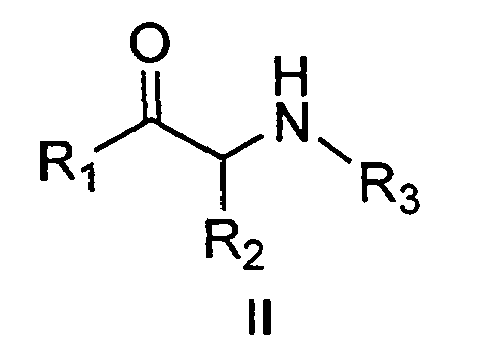

US 5,958,792 ,US 5,302,589 ) either as separate synthesis, in mixture synthesis, split and recombine synthesis, parallel synthesis with manual or automated fashion. - The present invention allows to overcome the above said problems thanks to the compounds of formula (I) as above defined useful either as individual compounds or for generation of combinatorial chemical libraries either in mixture synthesis or parallel synthesis with manual or automated fashion.
- Moreover the invention refers to a new an advantageous process for the preparation of the above defined compounds of formula (I) and their use for discovering new leads for therapeutical applications.
- According to the present invention in the compounds of formula (I) as above defined:
- Resin (P) means any polymeric material either soluble in the solvents commonly used in organic synthesis or bound to the solid support;
- Solid support is any solid material (at room temperature) to which starting resin materials (reactive groups) may be bound;
- W is any molecule which can be used as linker to bound the resin P to the reagents and the products of formula (I);
- Protecting group means any group capable of preventing the atom to which it is attached from participating in an undesired reaction or bonding, as commonly used in synthesis reactions.
- Amino acid side-chain means the side chain moieties of the natural occurring L or D amino acids or the non naturally occurring amino acids;
- More preferably the resin is a polymeric material derivatised with a reactive group such as, for example, a -NH2 group or other electron donating group such as an hydroxyl group.
- Preferred solid support materials comprise polymeric compounds such as polyethylene and polystyrene compounds and related inert polymeric compounds. The substrate may be in any shape including sheets, the inside of a cylindrical vessel, or pins but are preferably in the form of spherical beads less than 1.0 cm in diameter more preferably less than 1.0 mm in diameter. A "substrate" or solid support is a conventional solid support material used in peptide synthesis. Non-limiting examples of such substrates or supports include a variety of support resins and connectors to the support resins such as those which are photocleavable, DKP-forming linkers (DKP is diketopiperazine; see, e.g.,
WO90/09395 - Amino acid side-chain means the different amino acid side-chain moieties attached to an "amino acid". The term "amino acid" includes any one of the twenty L or D natural α-amino acids having as " side chain":, -H of glycine; -CH3 of alanine; -CH(CH3)2 of valine; -CH2CH(CH3)2 of leucine; -CH(CH3)CH2CH3 of isoleucine; -CH2OH of serine; -CH(OH)CH3 of threonine; --CH2SH of cysteine;-CH2CH2SCH3 of methionine; -CH2-(phenyl) of phenylalanine; -CH2-(phenyl)-OH of tyrosine; -CH2-(indole group) of tryptophan; -CH2 COOH of aspartic acid;-CH2C(O)(NH2) of asparagine; -CH2CH2COOH of glutamic acid; - CH2CH2C(O)NH2 of glutamine; -CH2CH2CH2-N(H)C(NH2)NH of arginine; -CH2-(imidazole) group of histidine; and -CH2(CH2)3NH2 of lysine, comprising the same amino acid side-chain moieties bearing suitable protecting groups (Pg). In addition, the term "amino acid" include also non naturally occurring amino acids, like norleucine (Nle), norvaline (NVa), β-alanine, L or D α-phenyl glycine and others well known in the peptide art.
- In the compounds of formula (I), as above defined, groups C1-8 alkyl, C2-8 alkenyl and C2-8 alkinyl represent linear or branched alkyl radicals as for example: methyl, ethyl, propyl, isopropyl, butyl, pentyl, hexyl, heptyl, octyl, ethylene, propene, butene, isobutene, acetylene, propine, butine etc
- The term cycloalkyl represents: cyclopropane, cyclobutane, cyclopentane, cyclohexane, cycloheptane, cyclooctane, norbornane, canphane, adamantane. The term aryl specifies phenyl, biphenyl and naphtyl groups substituted with one or more, and preferably one or two moieties chosen from the groups consisting of halogen, cyano, nitro, C1-6 alkyl. The term heterocycle represents in particular: saturated or aromatic heterocycles containing one or more N atoms, more particularly: pyridine, imidazole, pyrrole, indole, triazoles, pyrrolidine, pyperidine.
- The term halogen represent fluorine, chlorine, bromine, iodine.
- The terms "library", "combinatorial library", "resin-derived library" and the like are used interchangeably throughout the description to mean a series of separate individual components or mixture of the compounds I, synthesized in solution or on a solid support from one or more solid phase bound resin starting materials. and their pharmaceutically acceptable salts or esters.
- The synthetic process according to the invention involves only two steps and moreover uses, as starting compounds, an α-aminoketone and a carboxylic acid derivative bearing two vicinal nucleophilic groups like OH, SH, or NHR, preferably belonging to the classes of α,β-dihydroxy acid or α-amino-β-hydroxy acid or α-hydroxy-β-amino acid or α,β-dithiol acid derivatives.
- In particular, the process according to the present invention allows the preparation of the compounds of formula (I) wherein:
- a = double bond, and X = O or a = single bond and X = H
- Y and Z, same or different are O, S, NR wherein R is above described
- R1 = methyl, ethyl, propyl, isopropyl, t-butyl, benzyl, phenyl, 4-hydrophenyl, 4-methoxy-phenyl, 4-carboxy-phenyl, 4-nitro-phenyl, 4-amino-phenyl, 4-halogen-phenyl, 4-trifluoromethylphenyl, 2-hydrophenyl, 2-methoxy-phenyl, 2-carboxy-phenyl, 2-nitro-phenyl, 2-amino-phenyl, 2-halogen-phenyl, 2-trifluoromethylphenyl C1-8alkylOC(O)phenyl, hydroxy-C1-8alkylphenyl, methoxy-C1-8alkylphenyl, RR'NC(O)-phenyl, RR'N-C1-8alkylphenyl, biphenyl, naphtyl, tetrahydronapthyl, decahydronaphtyl, cycloalkyl, heterocycle, (P)-W-NR-phenyl, (P)-W-O-phenyl, (P)-W-C(O)O-phenyl, (P)-W-O(O)C-phenyl, (P)-W-C(O)RN-phenyl, (P)-W-NR(O)C-phenyl, wherein (P), W, R and R' are defined as above;
- R2, which can be bound with R1 through a C1-C5alkyl chain, is chosen in the group consisting of H, methyl, ethyl, propyl, isopropyl, t-butyl, phenyl, 4-hydrophenyl, 4-methoxy-phenyl, 4-carboxy-phenyl, 4-amino-phenyl, benzyl, amino acid side chain-; (P)-W-amino acid side-chain;
- R3, H, methyl, ethyl, propyl, isopropyl, t-butyl, phenyl, benzyl, cycloalkyl, aryl, arylC1-8alkyl; heterocycle, heterocycleC1-8alkyl-CH(amino acid side-chain)CO2R, CH(amino acid side-chain)C(O)NR, -CH(amino acid side-chain)-C(O)O-W-(P),-CH(amino acid side-chain)-C(O)N(R)-W-(P), CH(CO2R)-amino acid side-chain-W-(P), CH(CONRR')- amino acid side-chain-W-(P), Pg, wherein (P), (amino acid side-chain), W, R and R' are defined as above;
- R4, R5, same or different, are chosen in the group consisting H, methyl, ethyl, propyl, isopropyl, phenyl, benzyl, heterocycle
- R6 is chosen in the group consisting, H, methyl, ethyl, propyl, isopropyl, t-butyl, phenyl, benzyl, cycloalkyl, aryl, benzyl, heterocycle, heterocycleC1-8alkyl; COOH, COOR, C(O)R, CONHR CONRR', CH2OH, CH2OR CH2NHR, CH2NRR', -C(O)NH-CH(amino acid side-chain)C(O)OR, -C(O)O-W-(P), -C(O)N(R)-W-(P), -CH2O-W-(P), -CH2N(R)-W-(P), wherein R and R' same or different and the terms "(amino acid side-chain)", "(P)", and "W" are as above defined
- Among the pharmaceutically acceptable esters and salts according to the present invention the following can be mentioned: hydrochloride, sulfate, citrate, formiate, phosphate.
- According to the invention the above defined compounds of formula (I) can be prepared starting from compounds of general formula II
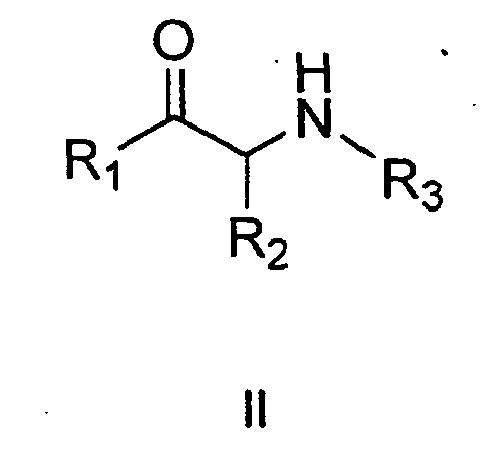
and III
and R7 R8 represent H or suitable protecting groups, (Pg) which can be same or different, cyclic or acyclic, and which can be cleaved in acidic conditions. - The α-amino ketones II are commercially available or can be prepared as shown in the scheme 2, for example starting from an α-halogen-ketone V and a primary amine VI according to known procedures (see for example Tetrahedron Letters 1987, 28, 1287 and references cited therein)
- The acid derivatives III are commercial available o can be prepared according know procedures.
- As it can be seen from the Scheme 1 the preparation of the compounds (I) according to the invention involves, in the Step 1, the reaction of the α-amino ketone II with the acid derivative III to give the amide derivative IV in the presence of a coupling reagent. Because Step I involves the formation of an amide bond , all the reagents commonly used for the peptide synthesis can be applied to this step. Preferably the reaction is performed in an aprotic polar solvent, preferably CH2Cl2 or DMF, at a temperature comprised between 0°C - 100°C, preferably at 25°C, for a time comprised between 1 and 24 hours, preferably in the presence of a coupling agent and activator of the carboxy group, as PyBrOP, PyBOP, HATU, HOBt, HBTU, TBTU, DCC, DIC, EDC etc. and a tertiary base as NEt3, DIPEA, NMM.
- The intermediate amide IV is then cyclized into the final compound I in the Step 2, by action of an acid, which, allows the ketalization of the functions Z and Y with the carbonyl group by also removing the protecting groups Pg, when present. Also for this step the reaction conditions (temperature and time) and the type of acid and solvent are important.
- The best results were obtained using a stechiometric or preferably catalytic amount of a strong acid, preferably sulphuric acid adsorbed on silica gel, p-toluen sulphonic acid, trifluoroacetic acid, trifluorometansulphonic acid and performing the reaction at a temperature comprised between 0°C - 150°C, preferably at refluxing-solvent temperature, in an organic apolar solvent (for example methylene chloride, chloroform, benzene or toluene) for a time comprised between 15 min and 24 hours, preferably 30 min -2 hours, preferably with the simultaneous removal of a portion of the solvent and eventually in the presence of molecular sieves. In these condition the final product I is obtained having X=O and a double bond. The subsequent reaction on the amide bond either with usual reducing agents, for example LiAlH4, BH3.THF, BH3.Me2S and like, produce compounds I wherein X=H and a is single bond, or by the use of sulphurating agents, like the Lawesson reagent, produce compounds I wherein X=S and a is double bond. Owing to the importance to produce combinatorial chemical libraries, the above reported procedure can be modified by using one of the two components II and III of the Step 1 bound to a resin through a suitable linker. In this case, the formed compound IV is also bound to a resin, and the following step 2 can be performed either maintaining the final product I bound to the resin or with a simultaneous cleavage from the resin. Because the starting α-amino ketone II can be easily prepared from an α-halogen ketone V and a primary amine VI (as reported in the Scheme 2), this can increase the molecular diversity of compounds II, by starting from of one of the two components V or VI, already immobilized on the resin-support.
- Specific compounds I prepared according to the process of the invention are reported in the following table:
Comp. X Z Y R1 R2 R3 R4 R5 R6 1. O O O Ph H PhCH2 H H COOH 2. O O O 4-HO-Ph H PhCH2 H H COOH 3. O O O 4-O2N-Ph H PhCH2 H H COOH 4. O O O 4-H2N-Ph H PhCH2 H H COOH 5. O O O 4-MeO(O)C-Ph H PhCH2 H H COOH 6. O O O 4-Me-Ph H PhCH2 H H COOH 7. O O O 4-MeO-Ph H PhCH2 H H COOH 8. O O O 4-Cl-Ph H PhCH2 H H COOH 9. O O O 4-Br-Ph H PhCH2 H H COOH 10. O O O 2-HO-Ph H PhCH2 H H COOH 11. O O O 2-O2N-Ph H PhCH2 H H COOH 12. O O O 2-H2N-Ph H PhCH2 H H COOH 13. O O O 2-MeO(O)C-Ph H PhCH2 H H COOH 14. O O O 2-Me-Ph H PhCH2 H H COOH 15. O O O 2-MeO-Ph H PhCH2 H H COOH 16. O O O 2-Cl-Ph H PhCH2 H H COOH 17. O O O 2-Br-Ph H PhCH2 H H COOH 18. O O O 2-Nafthyl H PhCH2 H H COOH 19. O O O 2-thienyl H PhCH2 H H COOH 20. O O O 4-biphenyl H PhCH2 H H COOH 21. O O O Ph H Me H H COOH 22. O O O Ph H CH3(CH2)2 H H COOH 23. O O O Ph H cyclohexyl H H COOH 24. O O O Ph H allyl H H COOH 25. O O O Ph H Ph H H COOH 26. O O O Ph H 4-HO-Ph H H COOH 27. O O O Ph H 4-O2N-Ph H H COOH 28. O O O Ph H 4-MeO2C-Ph H H COOH 29. O O O Ph H 4-Me-Ph H H COOH 30. O O O Ph H 4-MeO-Ph H H COOH 31. O O O Ph H 4-Cl-Ph H H COOH 32. O O O Ph H 4-Br-Ph H H COOH 33. O O O Ph H 2-HO-Ph H H COOH 34. O O O Ph H 2-O2N-Ph H H COOH 35. O O O Ph H 2-MeO2C-Ph H H COOH 36. O O O Ph H 2-Me-Ph H H COOH 37. O O O Ph H 2-MeO-Ph H H COOH 38. O O O Ph H 2-Cl-Ph H H COOH 39. O O O Ph H 2-Br-Ph H H COOH 40. O O O Ph H 2-Nafthyl H H COOH 41. O O O Ph H 2-thienyl H H COOH 42. O O O Ph H 4-biphenyl H H COOH 43. O O O Ph H 4-MeO2C-PhCH2 H H COOH 44. O O O Ph H 4-Me-PhCH2 H H COOH 45. O O O Ph H 4-MeOPhCH2 H H COOH 46. O O O Ph H 4-Cl-PhCH2 H H COOH 47. O O O Ph H 4-Br-PhCH2 H H COOH 48. O O O Ph H 2-HO-PhCH2 H H COOH 49. O O O Ph H 2-O2N-PhCH2 H H COOH 50. O O O Ph H 2-MeO2C-PhCH2 H H COOH 51. O O O Ph H 2-Me-PhCH2 H H COOH 52. O O O Ph H 2-MeO-PhCH2 H H COOH 53. O O O Ph H 2-Cl-PhCH2 H H COOH 54. O O O Ph H 2-Br-PhCH2 H H COOH 55: O O O 4-HO-Ph H 4-HO-Ph CH2 H H COOH 56. O O O 4-HO-Ph H 4-O2N-PhCH2 H H COOH 57. O O O 4-HO-Ph H 4-MeO2C-PhCH2 H H COOH 58. O O O 4-HO-Ph H 4-Me-PhCH2 H H COOH 59. O O O 4-HO-Ph H 4-MeOPhCH2 H H COOH 60. O O O 4-HO-Ph H 4-Cl-PhCH2 H H COOH 61. O O O 4-HO-Ph H 4-Br-PhCH2 H H COOH 62. O O O 4-HO-Ph H 2-HO-PhCH2 H H COOH 63. O O O 4-HO-Ph H 2-O2N-PhCH2 H H COOH 64. O O O 4-HO-Ph H 2-MeO2C-PhCH2 H H COOH 65. O O O 4-HO-Ph H 2-Me-PhCH2 H H COOH 66. O O O 4-HO-Ph H 2-MeO-PhCH2 H H COOH 67. O O O 4-HO-Ph H 2-Cl-PhCH2 H H COOH 68. O O O 4-HO-Ph H 2-Br-PhCH2 H H COOH 69. O O O 4-HO-Ph H Me H H COOH 70. O O O 4-HO-Ph H CH3(CH2)2 H H COOH 71. O O O 4-HO-Ph H cyclohexyl H H COOH 72. O O O 4-HO-Ph H allyl H H COOH 73. O O O Ph H HO2C-CH2 H H COOH 74. O O O Ph H Bn(HO2C)CH H H COOH 75. O O O Ph H HOCH2(HO2C)CH H H COOH 76. O O O Ph H CH3(HO)CH(HO2C)CH H H COOH 77. O O O Ph H MeS(CH2)2(HO2C)CH H H COOH 78. O O O Ph H H2N(CH2)3(HO2C)CH H H COOH 79. O O O Ph H HO2CCH2(HO2C)CH H H COOH 80. O O O Ph H imidazole-CH2(HO2C)CH H H COOH 81. O O O Ph H indole-CH2(HO2C)CH H COOH 82. O O O 4-HO-Ph H HO2C-CH2 H H COOH 83. O O O 4-HO-Ph H Me(HO2C)CH H H COOH 84. O O O 4-HO-Ph H (CH3)2CH(HO2C)CH H H COOH 85. O O O 4-HO-Ph H Bn(HO2C)CH H H COOH 86. O O O 4-HO-Ph H HOCH2(HO2C)CH H H COOH 87. O O O 4-HO-Ph H CH3(HO)CH(HO2C)CH H H COOH 88. O O O 4-HO-Ph H MeS(CH2)2(HO2C)CH H H COOH 89. O O O 4-HO-Ph H H2N(CH2)3(HO2C)CH H H COOH 90. O O O 4-HO-Ph H HO2CCH2(HO2C)CH H H COOH 91. O O O 4-HO-Ph H i imidazole-CH2(HO2C)CH H H COOH 92. O O O 4-HO-Ph H indole-CH2(HO2C)CH H H COOH 93. O O O Ph Me PhCH2 H H COOH 94. O O O 4-HO-Ph Me PhCH2 H H COOH 95. O O O Ph Bn PhCH2 H H COOH 96. O O O 4-HO-Ph Bn PhCH2 H H COOH 97. O O O Ph Me HO2C-CH2 H H COOH 98. O O O 4-HO-Ph Me HO2C-CH2 H H COOH 99. O O O Ph Bn HO2C-CH2 H H COOH 100. O O O 4-HO-Ph Bn HO2C-CH2 H H COOH 101. O O O Ph Me Bn(HO2C)CH H H COOH 102. O O O 4-HO-Ph Me Bn(HO2C)CH H H COOH 103. O HN O Ph H PhCH2 H H CH3 104. O HN O Ph Me PhCH2 H H CH3 105. O HN O Ph Bn PhCH2 H H CH3 106. O HN O 4-OH-Ph H PhCH2 H H CH3 107. O HN O 4-OH-Ph Me PhCH2 H H CH3 108. O HN O 4-OH-Ph Bn PhCH2 H H CH3 109. O HN O Ph H Ph H H CH3 110. O HN O Ph Me Ph H H CH3 111. O HN O Ph Bn Ph H H CH3 112. O HN O 4-OH-Ph H Ph H H CH3 113. O HN O 4-OH-Ph Me Ph H H CH3 114. O HN O 4-OH-Ph Bn Ph H H CH3 115. O HN O Ph H CH3-Ph H H CH3 116. O HN O Ph Me CH3-Ph H H CH3 117. O HN O Ph Bn CH3-Ph H H CH3 118. O HN O 4-OH-Ph H CH3-Ph H H CH3 119. O HN O 4-OH-Ph Me CH3-Ph H H CH3 120. O HN O 4-OH-Ph Bn CH3-Ph H H CH3 121. O HN O Ph H 4-MeO-PhCH2 H H CH3 122. O HN O Ph Me 4-MeO-PhCH2 H H CH3 123. O HN O Ph Bn 4-MeO-PhCH2 H H CH3 124. O HN O 4-OH-Ph H 4-MeO-PhCH2 H H CH3 125. O HN O 4-OH-Ph Me 4-MeO-PhCH2 H H CH3 126. O HN O 4-OH-Ph Bn 4-MeO-PhCH2 H H CH3 127. O HN O Ph H CH3-PhCH2 H H CH3 128. O HN O Ph Me CH3-PhCH2 H H CH3 129. O HN O Ph Bn CH3-PhCH2 H H CH3 130. O HN O 4-OH-Ph H CH3-PhCH2 H H CH3 131. O HN O 4-OH-Ph Me CH3-PhCH2 H H CH3 132. O HN O 4-OH-Ph Bn CH3-PhCH2 H H CH3 133. O HN O Ph H Me H H CH3 134. O HN O Ph H CH3(CH2)2 H H CH3 135. O HN O Ph H cyclohexyl H H CH3 136. O HN O Ph H alkyl H H CH3 137. O HN O 4-OH-Ph H Me H H CH3 138. O HN O 4-OH-Ph H CH3(CH2)2 H H CH3 139. O HN O 4-OH-Ph H cyclohexyl H H CH3 140. O HN O 4-OH-Ph H allyl H H CH3 141. O HN O Ph H HO2C-CH2 H H CH3 142. O HN O Ph Me HO2C-CH2 H H CH3 143. O HN O Ph Bn HO2C-CH2 H H CH3 144. O HN O 4-OH-Ph H HO2C-CH2 H H CH3 145. O HN O 4-OH-Ph Me HO2C-CH2 H H CH3 146. O HN O 4-OH-Ph Bn HO2C-CH2 H H CH3 147. O HN O Ph H Bn(HO2C)CH H H CH3 148. O HN O Ph Me Bn(HO2C)CH H H CH3 149. O HN O Ph Bn Bn(HO2C)CH H H CH3 150. O HN O 4-OH-Ph H Bn(HO2C)CH H H CH3 151. O HN O 4-OH-Ph Me Bn(HO2C)CH H H CH3 152. O HN O 4-OH-Ph Bn Bn(HO2C)CH H H CH3 153. H O O Ph H PhCH2 H H COOH 154. H O O Ph Me PhCH2 H H COOH 155. H O O Ph Bn PhCH2 H H COOH 156. H O O 4-HO-Ph H PhCH2 H H COOH 157. H O O 4-HO-Ph Me PhCH2 H H COOH 158. H O O 4-HO-Ph Bn PhCH2 H H COOH 159. H O O Ph H HO2C-CH2 H H COOH 160. H O O Ph Me HO2C-CH2 H H COOH 161. H O O Ph Bn HO2C-CH2 H H COOH 162. H O O 4-HO-Ph H HO2C-CH2 H H COOH 163. H O O 4-HO-Ph Me HO2C-CH2 H H COOH 164. H O O 4-HO-Ph Bn HO2C-CH2 H H COOH 165. H O O Ph H Bn(HO2C)CH H H COOH 166. H O O Ph Me Bn(HO2C)CH H H COOH 167. H O O Ph Bn Bn(HO2C)CH H H COOH 168. H O O 4-HO-Ph H Bn(HO2C)CH H H COOH 169. H O O 4-HO-Ph Me Bn(HO2C)CH H H COOH 170. H O O 4-HO-Ph Bn Bn(HO2C)CH H H COOH 171. H HN O Ph H PhCH2 H H CH3 172. H HN O Ph H 4-MeO-PhCH2 H H CH3 173. H HN O Ph Me PhCH2 H H CH3 174. H HN O Ph Bn PhCH2 H H CH3 175. H HN O 4-OH-Ph H PhCH2 H H CH3 176. H HN O 4-OH-Ph Me PhCH2 H H CH3 177. H HN O 4-OH-Ph Bn PhCH2 H H CH3 178. H HN O Ph H HO2C-CH2 H H CH3 179. H HN O Ph Me HO2C-CH2 H H CH3 180. H HN O Ph Bn HO2C-CH2 H H CH3 181. H HN O 4-OH-Ph H HO2C-CH2 H H CH3 182. H HN O 4-OH-Ph Me HO2C-CH2 H H CH3 183. H HN O 4-OH-Ph Bn HO2C-CH2 H H CH3 184. H HN O Ph H Bn(HO2C)CH H H CH3 185. H HN O Ph Me Bn(HO2C)CH H H CH3 186. H HN O Ph Bn Bn(HO2C)CH H H CH3 187. H HN O 4-OH-Ph H Bn(HO2C)CH H H CH3 188. H HN O 4-OH-Ph Me Bn(HO2C)CH H H CH3 189. H HN O 4-OH-Ph Bn Bn(HO2C)CH H H CH3 190. H HN O Ph H Ph H H CH3 191. H HN O Ph Me Ph H H CH3 192. H HN O Ph Bn Ph H H CH3 193. H HN O 4-OH-Ph H Ph H H CH3 194. H HN O 4-OH-Ph Me Ph H H CH3 195. H HN O 4-OH-Ph Bn Ph H H CH3 196. H HN O Ph H CH3-Ph H H CH3 197. H HN O Ph Me CH3-Ph H H CH3 198. H HN O Ph Bn CH3-Ph H H CH3 199. H HN O 4-OH-Ph H CH3-Ph H H CH3 200. H HN O 4-OH-Ph Me CH3-Ph H H CH3 201. H HN O 4-OH-Ph Bn CH3-Ph H H CH3 202. H HN O Ph H 4-MeO-PhCH2 H H CH3 203. H HN O Ph Me 4-MeO-PhCH2 H H CH3 204. H HN O Ph Bn 4-MeO-PhCH2 H H CH3 205. H HN O 4-OH-Ph H 4-MeO-PhCH2 H H CH3 206. H HN O 4-OH-Ph Me 4-MeO-PhCH2 H H CH3 207. H HN O 4-OH-Ph Bn 4-MeO-PhCH2 H H CH3 208. H HN O Ph H CH3-PhCH2 H H CH3 209. H HN O Ph Me CH3-PhCH2 H H CH3 210. H HN O Ph Bn CH3-PhCH2 H H CH3 211. H HN O 4-OH-Ph H CH3-PhCH2 H H CH3 212. H HN O 4-OH-Ph Me CH3-PhCH2 H H CH3 213. H HN O 4-OH-Ph Bn CH3-PhCH2 H H CH3 214. H O O Ph H PhCH2 H H CH2OH 215. H O O Ph H 4-MeOPhCH2 H H CH2OH 216. H O O Ph Me PhCH2 H H CH2OH 217. H O O Ph Bn PhCH2 H H CH2OH 218. H O O 4-HO-Ph H PhCH2 H H CH2OH 219. H O O 4-HO-Ph Me PhCH2 H H CH2OH 220. H O O 4-HO-Ph Bn PhCH2 H H CH2OH 221. H O O Ph H HOCH2 H H CH2OH 222. H O O Ph Me HOCH2 H H CH2OH 223. H O O Ph Bn HOCH2 H H CH2OH 224. H O O 4-HO-Ph H HOCH2 H H CH2OH 225. H O O 4-HO-Ph Me HOCH2 H H CH2OH 226. H O O 4-HO-Ph Bn HOCH2 H H CH2OH 227. H O O Ph H Bn(HOH2C)CH H H CH2OH 228. H O O Ph Me Bn(HOH2C)CH H H CH2OH 229. H O O Ph Bn Bn(HOH2C)CH H H CH2OH 230. H O O 4-HO-Ph H Bn(HOH2C)CH H H CH2OH 231. H O O 4-HO-Ph Me Bn(HOH2C)CH H H CH2OH 232. H O O 4-HO-Ph Bn Bn(HOH2C)CH H H CH2OH 233. H HN O Ph H PhCH2 H H H 234. H HN O Ph H 4-MeO-PhCH2 H H H 235. H HN O Ph Me PhCH2 H H H 236. H HN O Ph Bn PhCH2 H H H 237. H HN O 4-OH-Ph H PhCH2 H H H 238. H HN O 4-OH-Ph Me PhCH2 H H H 239. H HN O 4-OH-Ph Bn PhCH2 H H H 240. H HN O Ph H HOCH2 H H H 241. H HN O Ph Me HOOCH2 H H H 242. H HN O Ph Bn HOCH2 H H H 243. H HN O 4-OH-Ph H HOCH2 H H H 244. H HN O 4-OH-Ph Me HOCH2 H H H 245. H HN O 4-OH-Ph Bn HOCH2 H H H 246. H HN O Ph H Bn(HOH2C)CH H H H 247. H HN O Ph Me Bn(HOH2C)CH H H H 248. H HN O Ph Bn Bn(HOH2C)CH H H H 249. H HN O 4-OH-Ph H Bn(HOH2C)CH H H H 250. H HN O 4-OH-Ph Me Bn(HOH2C)CH H H H 251. H HN S Ph H PhCH2 H H H 252. H HN S Ph H 4-MeO-PhCH2 H H H 253. H HN S Ph Me PhCH2 H H H 254. H HN S Ph Bn PhCH2 H H H 255. H HN S 4-OH-Ph H PhCH2 H H H 256. H HN S 4-OH-Ph Me PhCH2 H H H 257. H HN S 4-OH-Ph Bn PhCH2 H H H 258. H HN S Ph H HOCH2 H H H 259. H HN S Ph Me HOCH2 H H H 260. H HN S Ph Bn HOCH2 H H H 261. H HN S 4-OH-Ph H HOCH2 H H H 262. H HN S 4-OH-Ph Me HOCH2 H H H 263. H HN S 4-OH-Ph Bn HOCH2 H H H 264. H HN S Ph H Bn(HOH2C)CH H H H 265. H HN S Ph Me Bn(HOH2C)CH H H H 266. H HN S Ph Bn Bn(HOH2C)CH H H H 267. H HN S 4-OH-Ph H Bn(HOH2C)CH H H H 268. H HN S 4-OH-Ph Me Bn(HOH2C)CH H H H - The invention will be better understood in the light of the following Examples.
- To a solution of II (wherein R1 = Ph, R2 = H, R3 = PhCH2) (1.2 g, 5.33 mmol) in anhydrous CH2Cl2 (10 ml) (CH2Cl2 was filtered through a short pad of anhydrous Na2CO3 just before being used) were added, under a nitrogen atmosphere, III (wherein R4=H, R5=H, R6 = COOMe, Z = O, Y = O, R7-R8 = CH2-CH2) (1.088 g, 5.33 mmol), PyBrOP (2.49 g, 5.33 mmol), and DIPEA (2.73 mL, 15.99 mmol). The mixture was stirred at room temperature for 2 h, and then the solvent was removed to give an oil that was dissolved in EtOAc. This solution was washed with aqueous 5% KHSO4, 5% NaHCO3, and brine and dried over Na2SO4. After evaporation of the solvent, the crude product obtained was purified by chromatography (EtOAc-petroleum ether, 1:3, Rf 0.32), yielding IV (wherein R1 = Ph, R2 = H, R3 = PhCH2, R4=H, R5=H, R6 = COOMe, Z = O, Y = O, R7-R8 = CH2-CH2) (1.645 g, 75%) as a colorless oil:
- 1H NMR (CDCl3): 7.90-7.85 (m, 2H), 7.61-7.22 (m, 8H), 5.39 (d, J = 5.1Hz, 1H), 5.11 (d, J = 5.1Hz, 1 H), 4.88-4.10 (m, 4H), 3.80 (s, 3 H), 1.49 (s, 3 H), 1.31 (s, 3 H).
- A solution of IV (prepared according the example 1, wherein R1 = Ph, R2 = H, R3 = PhCH2, R4=H, R5=H, R6 = COOMe, Z = O, Y = O, R7-R8 = CH2-CH2) (1.645 g, 4.00 mmol) in toluene (40 mL) was quickly added to a refluxing suspension of H2SO4/SiO2 (30% w/w, 700 mg) in toluene (60 mL). The mixture was allowed to react for 15 min, and afterward, one-third of the solvent was distilled off. The hot reaction mixture was filtered through a short layer of NaHCO3, and after evaporation of the solvent, the crude product was purified by chromatography as above affording pure I (wherein R1 = Ph, R2 = H, R3 = PhCH2, R4 = H, R5 = H, R6 = COOMe, X = O, Z = O, Y = O) (1.200 g, 85%): mp 112 -114 °C;
[α]25 D - 64.3 (c 0.8, CDCl3);
1H NMR (CDCI3) 7.62-7.59 (m, 2H), 7.41-7.24 (m, 8H), 5.16 (s, 1H), 4.92 (s, 1H), 4.61 (AB system, J = 11.0 Hz, 2H), 3.74 (s, 3 H), 3.46 (AB system, J = 25.2 Hz, 2H).
13C NMR (CDCl3); 169.0 (s), 165.4(s), 137.8 (s), 135.0 (s), 129.5 (d), 128.8 (d), 128.3 (d), 127.9, 127.8 (d), 125.4 (d), 107.7 (s), 79.1 (d), 78.3 (d), 55.5 (t), 52.6 (q), 48.6 (t)
IR (CDCl3): 1762, 1678 cm-1
MS (m/z, %): 353 (M+, 3), 147 (5), 120(36), 306 (13), 105 (80), 91 (100). - A solution of II (wherein R1 = Ph, R2 = H, R3 = 4-MeO-C6H4CH2) (0.5 g, 2.09 mmol) in anhydrous CH2Cl2 (5 ml), III (wherein R4=H, R5=H, R6 = COOMe, Z = O, Y = O, R7-R8 = CH2-CH2) (0.427 g, 2.09 mmol), PyBrOP (0.976 g, 2.09 mmol), and DIPEA (1.07 mL, 6.27 mmol) was treated as in the example 1. The crude product obtained was purified by chromatography (EtOAc-petroleum ether, 1:3, Rf 0.32), yielding IV (wherein R1 = Ph, R2 = H, R3 = 4-MeO-C6H4CH2, R4=H, R5=H, R6 = COOMe, Z = O, Y = O, R7-R8 = CH2-CH2) (0.370 g, 40%) as a colorless oil:
- 1H NMR (CDCl3): 7.90-7.85 (m, 2H), 7.61-7.43 (m, 3H), 7.21-7.15 (m, 2H), 6.90-6.82 (m, 2H), 5.39 (d, J = 5.1Hz, 1H), 5.13 (d, J = 5.1Hz, 1 H), 4.75 (m, 2H), 4.11 (m, 2H), 3.82 (s, 3 H), 3.79 (s, 3 H), 1.52 (s, 3 H), 1.36 (s, 3 H).
- A solution of IV (wherein R1 = Ph, R2 = H, R3 = 4-MeO-C6H4CH2, R4=H, R5=H, R6 = COOMe, Z = O, Y = O, R7-R8 = CH2-CH2) (0.370 g, 0.84 mmol) in toluene (10 mL) was treated as reported in example 2. The crude product was purified by chromatography as above affording pure I (wherein R1 = Ph, R2 = H, R3 = 4-MeO-C6H4CH2, R4 = H, R5 = H, R6 = COOMe, X = O, Z = O, Y = O) (0.177 g, 55 %): mp 134 - 136 °C;
[α]25 D - 62.3 (c 0.6, CDCl3);
1H NMR (CDCI3) 7.62-7.59 (m, 2H), 7.41-7.24 (m, 5H), 7.11-6.91 (m, 2H), 5.14 (s, 1H), 4.89 (s, 1H), 4.24 (AB system, J = 11.0 Hz, 2H), 3.78 (s, 3 H), 3.74 (s, 3 H), 3.56 (AB system, J = 23.4 Hz, 2H).
13C NMR (CDCl3); 169.4 (s), 165.3(s), 159.8 (s), 137.8 (s), 135.0 (s), 129.5 (d), 128.1 (d), 127.1 (d), 126.4 (d), 119.2 (d), 107.1 (s), 79.8 (d), 78.0 (d), 58.5 (t), 55.1 (q), 52.6 (q), 48.1 (t).
IR (CDCl3): 1768, 1682 cm-1
MS (m/z, %): 383 (M+, 5), 121 (100). - Preparation of (1R,5S,7R)-3-Benzyl-2-oxo-5-(4-hydroxyphenyl)-6,8-dioxa-3-azabicyclo[3.2.1]octane-7-exo-carboxylic Acid [compound I wherein R1 = 4-OH-C6H4, R2 = H, R3 = PhCH2, R4 = H, R5 = H, R6 = COOH, X = O, Z = O, Y = O] Wang resin (1 g, 200-400 mesh, substitution 0.64 mmol/g) was suspended in CH2Cl2 (10 mL) and magnetically stirred for 15 min. After filtration, a solution of Ph3P (1.024g, 3.904 mmol) and 4'-hydroxy-2-chloroacetophenone (compound V wherein Hal = Cl, R1 = 4-OH-C6H4, R2 = H), (0.568 g, 3.33 mmol) in a mixture of CH2Cl2 (10 mL) and Et2O (4 mL) was added to the expanded resin. After 5 min, DEAD (607 mL, 3.904 mmol) was added drop-wise and the resulting suspension stirred at room temperature. After 24 h the suspension was filtered and the resin washed with DMF (3 x 10 mL), CH2Cl2 (3 x 10 mL), MeOH (3 x 10 mL) and again DMF (3 x 10 mL). Then, the resin (1.00 g), suspended in CH2Cl2 (1 mL), was treated with benzylamine (compound VI wherein R3 = PhCH2) (10 mL) and left under stirring at room temperature for 12 h. After filtration, the resin II (R1 = Wang-4-OH-C6H4, R2 = H, R3 = PhCH2) obtained was washed as above with DMF, CH2Cl2, MeOH and again DMF. Resin II (R1 = Wang-4-OH-C6H4, R2 = H, R3 = PhCH2) was then coupled with III [wherein R4=H, R5=H, R6 = COOMe, Z = O, Y = O, R7-R8 = CH2-CH2] as follows: compound III (261 mg, 1.28 mmol) and PyBroP (597 mg, 1.28 mmol) were added to resin II (500 mg) suspended in DMF (10 mL), then DIPEA (438 µL, 1.28 mmol) was added slowly at room temperature and the resulting suspension stirred for 12 h. After the usual work-up, resin IV [R1 = Wang-4-OH-C6H4, R2 = H, R3 = PhCH2, R4=R5=H, R6 = COOMe, Z = O, Y = O, R7-R8 = CH2-CH2] was obtained. The cyclization step was performed on 250 mg of resin IV as follows: resin IV (250 mg) and p-TsOH (6 mg) were suspended in toluene and the mixture refluxed for 15 min. Then part of the solvent (25 mL) was distilled off and the residual suspension filtered. The solution was concentrated obtaining, as a yellow oil, compound I [wherein R1 = 4-OH-C6H4, R2 = H, R3 = PhCH2, R4 = H, R5 = H, R6 = COOH, X = O, Z = O, Y = O] (33 mg). with complete cleavage from the resin.
1H NMR (CDCl3) δ: 7.78 (d, J = 8.8 Hz, 2 H), 7.60 (d, J = 7.2 Hz, 2 H), 7.40-7.00 (m, 3 H), 6.80 (d, J = 8.8 Hz, 2 H), 5.13 (s, 1 H), 4.86 (s, 1H), 4.58 (AB system, J = 15.0 Hz, 2 H), 3.57 (d, J = 11.8 Hz, 1 H), 3.38 (d, J = 11.8 Hz, 1 H). - To a solution of III (wherein R4=H, R5=H, R6 = COOMe, Z = O, Y = O, R7-R8 = CH2-CH2) (366 mg, 1.8 mmol) in methylene chloride (1.8 ml) and PyBrop (839 mg, 1.8 mmol) was added II (wherein R1 = Ph, R2 = H, R3 = 4-Me-C6H4) (406mg, 1.8 mmol) and DIPEA (0.765 mL, 3.6 mmol). The mixture was treated as reported in Example 1. The crude product was purified by column chromatography on silica gel (AcOEt- Petroleum Ether. 1:2, Rf = 0.37) to give IV (R1 = Ph, R2 = H, R3 = 4-Me-C6H4, R4=R5= H, R6 = COOMe, Z = O, Y = O, R7-R8 = CH2-CH2) as yellow oil (440 mg, 62%).
1H NMR δ 8.00-7.90 (m, 2H), 7.62-7.39 (m, 4H), 7.36-7.12 (m, 3H), 5.26 (J=17.2 Hz part A of AB system, 1H) 4.96 (J=17.2 Hz part B of AB system, 1H), 5.07 (J=6.6 Hz part A of AB system, 1H) 4.66 (J=6.6 Hz part B of AB system, 1H),3.74 (s, 3H), 2.36 (s, 3H), 1.53 (s, 3H), 1.36 (s, 3H). MS (m/z, %): 411 (M+, 4), 352 (6), 306 (13), 120(100). - A solution of IV (prepared in the example 6, wherein R1 = Ph, R2 = H, R3 = 4-Me-C6H4, R4=H, R5= H, R6 = COOMe, Z = O, Y = O, R7-R8 = CH2-CH2) (310 mg, 0.75 mmol) in toluene (32 ml) was quickly added to a refluxing solution of H2SO4/SiO2 (175 mg) in toluene (16 ml). The mixture was treated as reported in Example 2. The product I [wherein R1 = Ph, R2 = H, R3 = 4-Me-C6H4, R4 = H, R5 = H, R6 = COOMe, X = O, Z = O, Y = O] was obtained in pure form (260 mg, 97%). 1H NMR δ: 7.78-7.66 (m, 2H), 7.48-7.36 (m, 4H), 7.30-7.10 (m, 3H), 5.23 (s, 1H), 5.02 (s, 1H), 4.02 (J=12 Hz part A of AB system, 1H) 3.90 (J=12 Hz part B of AB system, 1H), 3.73 (s, 3H), 2.35 (s, 3H).13C NMR δ: 168.9(s), 165.1(s), 137.4 (s), 136.8 (s), 135.1(s), 129.9 (d), 129.6 (d), 128.4 (d), 125.4 (d), 125.3(d), 107.6 (s),79.4 (d), 78.4 (d), 59.2 (t), 52.7 (q), 20.9 (q). MS (m/z, %): 353 (M+,4), 294 (2), 119 (100).
- To a solution of III (wherein R4=H, R5=H, R6 = COOMe, Z = O, Y = O, R7-R8 = CH2-CH2) (118 mg, 0.58 mmol) in CH2Cl2 (0.5 mL), and PyBrOP (270 mg, 0.58 mmol) was added II (wherein R1 = Ph, R2 = H, R3 = CH(COOMe)CH2Ph) (120 mg, 0.4 mmol) and DIPEA (0.255 mL, 1.2 mmol). The mixture was treated as reported in Example 1. The crude product was purified by column chromatography on silica gel (CH2Cl2 - MeOH (40:1) to afford IV (wherein R1 = Ph, R2 = H, R3 = CH(COOMe)CH2Ph, R4=H, R5 = H, R6 = COOMe, Z = O, Y = O, R7-R8 = CH2-CH2) (160mg, 82%).
- The 1H and 13C NMR spectrums show two set of signals in 2:1 ratio. 1H NMR (CDCl3) δ: 8.04-7.90 (m, 2H), 7.70-7.42 (m,.4H), 7.38-7.20 (m, 4H), 5.48-4.74 (m, 5H), 3.76 and 3.75 (s,3H), 3.59 (s,3H), 3.38-3.30 (m, 2H), 1.56 and 1.46, 1.33, 1.28 (s, 6H). 13C NMR (CDCl3) δ:193.6, 192.3, 170.7, 170.6, 169.9, 169.4, 168.5, 136.6, 135.9, 135.0, 134.5, 133.7, 129.1, 129.0, 128.7, 128.5, 128.4, 128.3, 127.8, 127.6, 126.8, 126.6, 113.2, 77.2, 76.9, 75.4, 60.3, 59.3, 52.5, 52.3, 51.7, 49.2, 36.4, 35.6, 26.5, 26.3, 26.2, 25.9. MS m/z (%): 483 (M+, 2), 424 (4), 378 (7), 320 (16), 206 (34), 192 (50), 162 (63), 105 (100)
- A solution of IV (prepared according the example 8, wherein R1 = Ph, R2 = H, R3 = CH(COOMe)CH2Ph, R4=H, R5= H, R6 = COOMe, Z = O, Y = O, R7-R8 = CH2-CH2) (150 mg, 0.30 mmol) in toluene (5 ml) was quickly added to a refluxing solution of H2SO4/SiO2 (60 mg) in toluene (33 ml) The mixture was treated as reported in Example 2. The crude product was purified by flash chromatography (AcOEt-Petroleum Ether 1:1, R f = 0.41) to afford I (wherein R1 = Ph, R2 = H, R3 = CH(COOMe)CH2Ph, R4 = H, R5 = H, R6 = COOMe, X = O, Z = O, Y = O) as 2:1 mixture of epimers (82 mg, 65%).
1H NMR (CDCl3) major epimer: δ 7.60 (m, 2 H), 7.90-7.30 (m, 8 H), 5.11 (dd, J = 5.6, 10.8 Hz, 1 H), 4.99 (s, 1 H), 4.84 (s 1 H), 3.78 (s, 3 H), 3.72 (s, 3 H), 3.75-3.34 (m, 3 H), 3.08 (m, 1 H).
MS m/z (%):425 (M+, 2), 366 (19), 306 (7), 192 (32), 105 (100), 91 (88), 77 (62). - To a solution of III (R4 = H, R5 = H, R6 = Me, R7 = Boc, R8 = H, Z = N, Y = O) in CH2Cl2 (5 mL) and PyBrOP (531 mg, 1.14 mmol) was added II (wherein R1 = Ph, R2 = H, R3 = p-CH3O-C6H4CH2) (333 mg, 1.14 mmol) and DIPEA (0.585 mL, 3.42 mmol). The mixture The mixture was treated as reported in Example 1. The crude product was purified by column chromatography on silica gel (EtOAc-petrolrum ether, 1:1.5, R f = 0.23) to afford IV (wherein R1 = Ph, R2 = H, R3 = p-CH3O-C6H4CH2, R4 = H, R5 = H, R6 = Me, R7 = Boc, R8 = H, Z = N, Y = O) (232 mg, 44%) as an oil.
1H NMR (CDCl3) (1:1 mixture of rotamers) δ 7.85 (d, J = 7.3 Hz, 2 H), 7.55 (m, 1 H), 7.42 (m, 2 H), 7.11(m, 2 H), 6.82 (m, 2 H), 5.50 (m, 1 H), 5.29 (d, J = 14.3 Hz, 1 H), 5.00-4.20 (m, 5 H), 4.00 (m, 1 H), 3.78 (s, 3 H), 3.76 (s, 3 H), 1.38 (s, 9 H), 1.31 (s, 9 H), 1.19 (d, J = 6.2 Hz, 3 H), 1.07 (d, J = 6.2 Hz, 3 H). - A solution of IV (wherein R1 = Ph, R2 = H, R3 = p-CH3O-C6H4CH2, R4 = H, R5 = H, R6 = Me, R7 = Boc, R8 = H, Z = N, Y = O) (78.3 mg, 0.172 mmol) and p-TsOH (36 mg, 0.189 mmol) in benzene (10 ml) is refluxed for 30 min, then 8 ml of solvent were distilled off. The resulting solution was concentrated obtaining compound I (I wherein R1 = Ph, R2 = H R3 = p-CH3O-C6H4CH2, R4 = H, R5 = H, R6 = Me, X = O, Z = N, Y = O) as p-TsOH salt (60 mg, 76%). This was treated with 0.1 M aqueous solution of KOH end the free amine extracted with CHCl3 to give, after concentration, compound I (I wherein R1 = Ph, R2 = H R3 = p-CH3O-C6H4CH2, R4 = H, R5 = H, R6 = Me, X = O, Z = N, Y = O) as a colorless oil (41 mg, 70%).
1H NMR (CDCl3) δ 7.70 (m, 2 H), 7.52-7.20 (m, 5 H), 6.83 (m, 2 H), 5.07 (s, 1 H), 4.79 (d, J = 14.1 Hz, 1 H), 4.55 (d, J = 14.1 Hz, 1 H), 3.78 (s, 3 H), 3.78 (m, 2 H), 2.84 (q, J = 7.4 Hz, 1 H), 1.60 (d, J = 7.4 Hz, 3 H). - To a suspension of LiAlH4 (50 mg, mmol) in anhydrous THF (10 mL) was added dropwise at 0 °C and under nitrogen atmosphere a solution of compound I, [prepared according the example 2, wherein R1 = Ph, R2 = H, R3 = PhCH2, R4 = H, R5 = H, R6 = COOMe, X = O, Z = O, Y = O] (22 mg, 0.568 mmol) in dry THF (12 ml). The mixture was refluxed for 2h, and then, after cooling to 0 °C, diethyl ether (2 mL) were added. The mixture was filtered through a short layer of anhydrous Na2SO4, and the residue was suspended in 1 M KOH solution (30 mL), saturated with NaCI, and extracted with Et2O and EtOAc. The organic phases were combined, dried over anhydrous Na2SO4 and concentrated to give compound I (wherein R1 = Ph, R2 = H, R3 = PhCH2, R4 = H, R5 = H, R6 = CH2OH, X = H , Z = O, Y = O) as a colorless oil (35 mg, 0.112 mmol, 79 %).
1H NMR (CDCl3) δ 7.53-7.30 (m, 2 H), 7.29-7.23 (m, 8 H), 4.66-4.34 (m, 2 H), 3.34-3.46 (m, 4 H), 3.06-2.43 (m. 4 H), 1.82 (br s, 1 H). - Fmoc-(S)-phenylalanine-O-Wang resin (2 g, 200-400 mesh, substitution 1 mmol/g) was treated with piperidine (30%) in DMF (10 mL) under stirring, for 15 min, to obtain compound VI [wherein R3 =CH(COO-Wang resin)CH2Ph]. After filtration, the resin suspended in DMF (10 mL), was treated with 2-bromo-acetophenone (compound V wherein Hal = Br, R1 = Ph, R2 = H), (1.09 g, 6.0 mmol) and DIPEA (340 µL, 2 mmol) and left under stirring at room temperature for 48 h. The resin II [R1 =Ph, R2 = H R3 =CH(COO-Wang resin)CH2Ph] obtained was washed as reported in example 5 with DMF, CH2Cl2, MeOH and again DMF. Resin II [R1 = Ph, R2 = H R3 =CH(COO-Wang resin)CH2Ph] was then coupled with III [wherein R4=H, R5=H, R6 = COOMe, Z = O, Y = O, R7-R8 = CH2-CH2] as follows: compound III (816 mg, 4 mmol) and PyBroP (1.86 g, 4 mmol) were added to resin II (1.00 g) suspended in DMF (10 mL), then DIPEA (680 µL, 4 mmol) was added slowly at room temperature and the resulting suspension stirred for 12 h. After the usual work-up, resin IV [R1 = Ph, R2 = H, R3 =CH(COO-Wang resin)CH2Ph, R4=H, R5=H, R6 = COOMe, Z = O, Y = O, R7-R8 = CH2-CH2] was obtained. The cyclization step was performed on 1 g of resin IV as follows: resin IV (1 g) and p-TsOH (95 mg) were suspended in toluene and the mixture refluxed for 15 min. Then part of the solvent (50 mL) was distilled off and the residual suspension filtered. The solution was concentrated obtaining, a solid residue (170 mg) contaning compound I [wherein R1 = Ph, R2 = H, R3 = CH(COOH)CH2Ph, R4 = H, R5 = H, R6 = COOH, X = O, Z = O, Y = O].
Crude compound I [wherein R1 = Ph, R2 = H, R3 = CH(COOH)CH2Ph, R4 = H, R5 = H, R6 = COOH, X = O, Z = O, Y = O] treated with solution of diazomethane in ether gave compound I [wherein R1 = Ph, R2 = H, R3 = CH(COOMe)CH2Ph, R4 = H, R5 = H, R6 = COOMe, X = O, Z = O, Y = O] identical with the product (major epimer) as described in example 8.

Claims (10)
- Heterobicycle derivatives of general formula (I)
 R1, is chosen in the group consisting of C1-8alkyl, C2-8alkenyl, C2-8alkinyl, cycloalkyl, aryl, heterocycle, arylC1-8alkyl; heterocycleC1-8alkyl; RR'N-C1-8alkyl, RR'N-aryl, RO-aryl, R(O)C-aryl, RO(O)C-aryl, RR'N(O)C-aryl, (P)-W-NR-aryl, (P)-W-O-aryl, (P)-W-C(O)O-aryl, (P)-W-O(O)C-aryl, (P)-W-C(O)RN-aryl, (P)-W-NR(O)C-aryl;R2, is chosen in the group consisting of H, C1-8alkyl, C2-8alkenyl, C2-8alkinyl, cycloalkyl, aryl, arylC1-8alkyl; heterocycleC1-8alkyl; aminoC1-8alkyl, aminoaryl, C1-8 alkyloxyaryl, hydroxyaryl, carboxyaryl, carboalkyloxyaryl, alkylcarbamoylaryl,-(side chain), -(side chain)-W-(P) orR1 and R2 taken together are a C1-4alkyl, C2-4alkenyl, cycloalkyl, benzofused cycloalkyl, to form a bridge of 3, 4, 5, 6 terms;R3, is chosen in the group consisting H, C1-8alkyl, C2-8alkenyl, C2-8alkinyl, cycloalkyl, aryl, arylC1-8alkyl; heterocycleC1-8alkyl; RR'NC1-8alkyl, RR'Naryl, RO-C1-8 alkyl, RO(O)C-C1-8alkyl, R(O)C-C1-8alkyl, RC(O)O-C1-8alkyl, RC(O)N(R)C1-8alkyl RO-aryl, RO(O)C-aryl, R(O)C-aryl RC(O)O-aryl, RC(O)N(R)aryl, -CH(amino acid side- chain)CO2R, -CH(amino acid side-chain)C(O)NR, -CH(amino acid side-chain)-C(O)O-W-(P), -CH(amino acid side-chain)-C(O)N(R)-W-(P), CH(CO2R)-amino acid side-chain-W-(P), CH(CONRR')-amino acid side-chain-W-(P), protecting group;R4 and R5, same or different, are chosen in the group consisting H, C1-8alkyl, C2-8 alkenyl, C2-8alkinyl, cycloalkyl, aryl, heterocycle, arylC1-8alkyl; heterocycleC1-8alkyl;R6 is chosen in the group consisting, H, C1-8alkyl, C2-8alkenyl, C2-8alkinyl, cycloalkyl, aryl, arylC1-8alkyl, heterocycle, heterocycleC1-8alkyl; -C(O)R, -C(O)OR, -C(O)NRR', CH2OR, CH2NRR', -C(O)NH-CH(amino acid side-chain)C(O)OR, - C(O)O-W-(P), -C(O)N(R)-W-(P), -CH2O-W-(P), -CH2N(R)-W-(P);R and R', same or different, are chosen in the group consisting of: H, C1-8alkyl, C2-8alkenyl, C2-8alkinyl, cycloalkyl, aryl, heterocycle, arylC1-8alkyl; heterocycleC1-8 alkyl; a protecting group, -C(O)CH-(amino acid side-chain)-NHR, -NH-CH(amino acid side-chain)COOR, -CH(amino acid side-chain)COOR;P is resin, both soluble or bound to a solid support;W is as linker;X is O, S, when a is a double bond, or X is H and a is single bond,Y and Z, same or different, are O, S, SO, SO2, N-R, wherein R is as above defined;wherein the term cycloalkyl represents: cyclopropane, cyclobutane, cyclopentane, cyclohexane, cycloheptane, cyclooctane, norbornane, canphane, adamantine; the term aryl specifies phenyl, biphenyl and naphtyl groups substituted with one or two moieties chosen from the groups consisting of halogen, cyano, nitro, C1-6 alkyl; the term heterocycle represents pyridine, imidazole, pyrrole, indole, triazoles, pyrrolidine, pyperidine and the term protecting group refers to known groups capable of preventing reaction or bonding of oxygen, nitrogen, carboxylic acids, thiols, alcohols, amines and the like;the above said alkyl-, alkenyl-, alkinyl-, cycloalkyl-, aryl- and heterocycle-groups, being possibly substituted with the proviso that:when: Z = Y = X = O, R2= R4 = R5 = H, R3 = CH3 and R6 = Ph then R1=is not Ph;andwhen X = R2 = H and Y = Z = O then at least one R4, R5 or R6 is not H.
 - Heterobicycle derivatives according to Claim 1 wherein:the resin P is a polymeric material soluble in the solvents commonly used in organic synthesis or bound to a solid support;the solid support is a solid material (at room temperature) to which starting resin materials (reactive groups) may be bound;W is a molecule capable of binding the resin P to the reagents and the products of formula (I);Amino acid side-chain means the side chain moieties of the natural occurring L or D amino acids or the non naturally occurring amino acids;and the other substituents are as definied in Claim 1.
- Heterobicycle derivatives according to Claim 2 wherein:the resin is a polymeric material derivatised with a -NH2 group or an hydroxyl group possibly bound to a solid support materials chosen among polyethylene and polystyrene compounds and related inert polymeric compounds;the amino acid side-chain is the side chain of a naturally or non naturally occurring amino acid and the other substituents are as defined in Claim 1.
- Heterobicycle derivatives according to Claim 3 wherein the non naturally occurring amino acids are chosen among. norleucine (Nle), norvaline (NVa), β-alanine, L or D α-phenyl glycine and the like and the other substituents are as described in Claim 1.
- Heterobicycle derivatives according to Claim 4 represented by the following formulae:
Comp. X Z Y R1 R2 R3 R4 R5 R6 1. O O O Ph H PhCH2 H H COOH 2. O O O 4-HO-Ph H PhCH2 H H COOH 3. O O O 4-O2N-Ph H PhCH2 H H COOH 4. O O O 4-H2N-Ph H PhCH2 H H COOH 5. O O O 4-MeO(O)C-Ph H PhCH2 H H COOH 6. O O O 4-Me-Ph H PhCH2 H H COOH 7. O O O 4-MeO-Ph H PhCH2 H H COOH 8. O O O 4-Cl-Ph H PhCH2 H H COOH 9. O O O 4-Br-Ph H PhCH2 H H COOH 10. O O O 2-HO-Ph H PhCH2 H H COOH 11. O O O 2-O2N-Ph H PhCH2 H H COOH 12. O O O 2-H2N-Ph H PhCH2 H H COOH 13. O O O 2-MeO(O)C-Ph H PhCH2 H H COOH 14. O O O 2-Me-Ph H PhCH2 H H COOH 15. O O O 2-MeO-Ph H PhCH2 H H COOH 16. O O O 2-Cl-Ph H PhCH2 H H COOH 17. O O O 2-Br-Ph H PhCH2 H H COOH 18. O O O 2-Nafthyl H PhCH2 H H COOH 19. O O O 2-thienyl H PhCH2 H H COOH 20. O O O 4-biphenyl H PhCH2 H H COOH 21. O O O Ph H Me H H COOH 22. O O O Ph H CH3(CH2)2 H H COOH 23. O O O Ph H cyclohexyl H H COOH 24. O O O Ph H allyl H H COOH 25. O O O Ph H Ph H H COOH 26. O O O Ph H 4-HO-Ph H H COOH 27. O O O Ph H 4-O2N-Ph H H COOH 28. O O O Ph H 4-MeO2C-Ph H H COOH 29. O O O Ph H 4-Me-Ph H H COOH 30. O O O Ph H 4-MeO-Ph H H COOH 31. O O O Ph H 4-Cl-Ph H H COOH 32. O O O Ph H 4-Br-Ph H H COOH 33. O O O Ph H 2-HO-Ph H H COOH 34. O O O Ph H 2-O2N-Ph H H COOH 35. O O O Ph H 2-MeO2C-Ph H H COOH 36. O O O Ph H 2-Me-Ph H H COOH 37. O O O Ph H 2-MeO-Ph H H COOH 38. O O O Ph H 2-Cl-Ph H H COOH 39. O O O Ph H 2-Br-Ph H H COOH 40. O O O Ph H 2-Nafthyl H H COOH 41. O O O Ph H 2-thienyl H H COOH 42. O O O Ph H 4-biphenyl H H COOH 43. O O O Ph H 4-MeO2C-PhCH2 H H COOH 44. O O O Ph H 4-Me-PhCH2 H H COOH 45. O O O Ph H 4-MeOPhCH2 H H COOH 46. O O O Ph H 4-Cl-PhCH2 H H COOH 47. O O O Ph H 4-Br-PhCH2 H H COOH 48. O O O Ph H 2-HO-PhCH2 H H COOH 49. O O O Ph H 2-O2N-PhCH2 H H COOH 50. O O O Ph H 2-MeO2C-PhCH2 H H COOH 51. O O O Ph H 2-Me-PhCH2 H H COOH 52. O O O Ph H 2-MeO-PhCH2 H H COOH 53. O O O Ph H 2-Cl-PhCH2 H H COOH 54. O O O Ph H 2-Br-PhCH2 H H COOH 55. O O O 4-HO-Ph H 4-HO-Ph CH2 H H COOH 56. O O O 4-HO-Ph H 4-O2N-PhCH2 H H COOH 57. O O O 4-HO-Ph H 4-MeO2C-PhCH2 H H COOH 58. O O O 4-HO-Ph H 4-Me-PhCH2 H H COOH 59. O O O 4-HO-Ph H 4-MeOPhCH2 H H COOH 60. O O O 4-HO-Ph H 4-Cl-PhCH2 H H COOH 61. O O O 4-HO-Ph H 4-Br-PhCH2 H H COOH 62. O O O 4-HO-Ph H 2-HO-PhCH2 H H COOH 63. O O O 4-HO-Ph H 2-O2N-PhCH2 H H COOH 64. O O O 4-HO-Ph H 2-MeO2C-PhCH2 H H COOH 65. O O O 4-HO-Ph H 2-Me-PhCH2 H H COOH 66. O O O 4-HO-Ph H 2-MeO-PhCH2 H H COOH 67. O O O 4-HO-Ph H 2-Cl-PhCH2 H H COOH 68. O O O 4-HO-Ph H 2-Br-PhCH2 H H COOH 69. O O O 4-HO-Ph H Me H H COOH 70. O O O 4-HO-Ph H CH3(CH2)2 H H COOH 71. O O O 4-HO-Ph H cyclohexyl H H COOH 72. O O O 4-HO-Ph H allyl H H COOH 73. O O O Ph H HO2C-CH2 H H COOH 74. O O O Ph H Bn(HO2C)CH H H COOH 75. O O O Ph H HOCH2(HO2C)CH H H COOH 76. O O O Ph H CH3(HO)CH(HO2C)CH H H COOH 77. O O O Ph H MeS(CH2)2(HO2C)CH H H COOH 78. O O O Ph H H2N(CH2)3(HO2C)CH H H COOH 79. O O O Ph H HO2CCH2(HO2C)CH H H COOH 80. O O O Ph H imidazole-CH2(HO2C)CH H H COOH 81. O O O Ph H indole-CH2(HO2C)CH H H COOH 82. O O O 4-HO-Ph H HO2C-CH2 H H COOH 83. O O O 4-HO-Ph H Me(HO2C)CH H H COOH 84. O O O 4-HO-Ph H (CH3)2CH(HO2C)CH H H COOH 85. O O O 4-HO-Ph H Bn(HO2C)CH H H COOH 86. O O O 4-HO-Ph H HOCH2(HO2C)CH H H COOH 87. O O O 4-HO-Ph H CH3(HO)CH(HO2C)CH H H COOH 88. O O O 4-HO-Ph H MeS(CH2)2(HO2C)CH H H COOH 89. O O O 4-HO-Ph H H2N(CH2)3(HO2C)CH H H COOH 90. O O O 4-HO-Ph H HO2CCH2(HO2C)CH H H COOH 91. O O O 4-HO-Ph H imidazole-CH2(HO2C)CH H H COOH 92. O O O 4-HO-Ph H indole-CH2(HO2C)CH H H COOH 93. O O O Ph Me PhCH2 H H COOH 94. O O O 4-HO-Ph Me PhCH2 H H COOH 95. O O O Ph Bn PhCH2 H H COOH 96. O O O 4-HO-Ph Bn PhCH2 H H COOH 97. O O O Ph Me HO2C-CH2 H H COOH 98. O O O 4-HO-Ph Me HO2C-CH2 H H COOH 99. O O O Ph Bn HO2C-CH2 H H COOH 100. O O O 4-HO-Ph Bn HO2C-CH2 H H COOH 101. O O O Ph Me Bn(HO2C)CH H H COOH 102. O O O 4-HO-Ph Me Bn(HO2C)CH H H COOH 103. O HN O Ph H PhCH2 H H CH3 104. O HN O Ph Me PhCH2 H H CH3 105. O HN O Ph Bn PhCH2 H H CH3 106. O HN O 4-OH-Ph H PhCH2 H H CH3 107. O HN O 4-OH-Ph Me PhCH2 H H CH3 108. O HN O 4-OH-Ph Bn PhCH2 H H CH3 109. O HN O Ph H Ph H H CH3 110. O HN O Ph Me Ph H H CH3 111. O HN O Ph Bn Ph H H CH3 112. O HN O 4-OH-Ph H Ph H H CH3 113. O HN O 4-OH-Ph Me Ph H H CH3 114. O HN O 4-OH-Ph Bn Ph H H CH3 115. O HN O Ph H CH3-Ph H H CH3 116. O HN O Ph Me CH3-Ph H H CH3 117. O HN O Ph Bn CH3-Ph H H CH3 118. O HN O 4-OH-Ph H CH3-Ph H H CH3 119. O HN O 4-OH-Ph Me CH3-Ph H H CH3 120. O HN O 4-OH-Ph Bn CH3-Ph H H CH3 121. O HN O Ph H 4-MeO-PhCH2 H H CH3 122. O HN O Ph Me 4-MeO-PhCH2 H H CH3 123. O HN O Ph Bn 4-MeO-PhCH2 H H CH3 124. O HN O 4-OH-Ph H 4-MeO-PhCH2 H H CH3 125. O HN O 4-OH-Ph Me 4-MeO-PhCH2 H H CH3 126. O HN O 4-OH-Ph Bn 4-MeO-PhCH2 H H CH3 127. O HN O Ph H CH3-PhCH2 H H CH3 128. O HN O Ph Me CH3-PhCH2 H H CH3 129. O HN O Ph Bn CH3-PhCH2 H H CH3 130. O HN O 4-OH-Ph H CH3-PhCH2 H H CH3 131. O HN O 4-OH-Ph Me CH3-PhCH2 H H CH3 132. O HN O 4-OH-Ph Bn CH3-PhCH2 H H CH3 133. HN O Ph H Me H H CH3 134. O HN O Ph H CH3(CH2)2 H H CH3 135. O HN O Ph H cyclohexyl H H CH3 136. O HN O Ph H allyl H H CH3 137. O HN O 4-OH-Ph H Me H H CH3 138. O HN O 4-OH-Ph H CH3(CH2)2 H H CH3 139. O HN O 4-OH-Ph H cyclohexyl H H CH3 140. O HN O 4-OH-Ph H allyl H H CH3 141. O HN O Ph H HO2C-CH2 H H CH3 142. O HN O Ph Me HO2-CH2 H H CH3 143. O HN O Ph Bn HO2C-CH2 H H CH3 144. O HN O 4-OH-Ph H HO2C-CH2 H H CH3 145. O HN O 4-OH-Ph Me HO2C-CH2 H H CH3 146. O HN O 4-OH-Ph Bn HO2C-CH2 H H CH3 147. O HN O Ph H Bn(HO2C)CH H H CH3 148. O HN O Ph Me Bn(HO2C)CH H H CH3 149. O HN O Ph Bn Bn(HO2C)CH H H CH3 150. O HN O 4-OH-Ph H Bn(HO2C)CH H H CH3 151. O HN O 4-OH-Ph Me Bn(HO2C)CH H H CH3 152. O HN O 4-OH-Ph Bn Bn(HO2C)CH H H CH3 153. H O O Ph H PhCH2 H H COOH 154. H O O Ph Me PhCH2 H H COOH 155. H O O Ph Bn PhCH2 H H COOH 156. H O O 4-HO-Ph H PhCH2 H H COOH 157. H O O 4-HO-Ph Me PhCH2 H H COOH 158. H O O 4-HO-Ph Bn PhCH2 H H COOH 159. H O O Ph H HO2C-CH2 H H COOH 160. H O O Ph Me HO2C-CH2 H H COOH 161. H O O Ph Bn HO2C-CH2 H H COOH 162. H O O 4-HO-Ph H HO2C-CH2 H H COOH 163. H O O 4-HO-Ph Me HO2C-CH2 H H COOH 164. H O O 4-HO-Ph Bn HO2C-CH2 H H COOH 165. H O O Ph H Bn(HO2C)CH H H COOH 166. H O O Ph Me Bn(HO2C)CH H H COOH 167. H O O Ph Bn Bn(HO2C)CH H H COOH 168. H O O 4-HO-Ph H Bn(HO2C)CH H H COOH 169. H O O 4-HO-Ph Me Bn(HO2C)CH H H COOH 170. H O O 4-HO-Ph Bn Bn(HO2C)CH H H COOH 171. H HN O Ph H PhCH2 H H CH3 172. H HN O Ph H 4-MeO-PhCH2 H H CH3 173. H HN O Ph Me PhCH2 H H CH3 174. H HN O Ph Bn PhCH2 H H CH3 175. H HN O 4-OH-Ph H PhCH2 H H CH3 176. H HN O 4-OH-Ph Me PhCH2 H H CH3 177. H HN O 4-OH-Ph Bn PhCH2 H H CH3 178. H HN O Ph H HO2C-CH2 H H CH3 179. H HN O Ph Me HO2C-CH2 H H CH3 180. H HN O Ph Bn HO2C-CH2 H H CH3 181. H HN O 4-OH-Ph H HO2C-CH2 H H CH3 182. H HN O 4-OH-Ph Me HO2C-CH2 H H CH3 183. H HN O 4-OH-Ph Bn HO2C-CH2 H H CH3 184. H HN O Ph H Bn(HO2C)CH H H CH3 185. H HN O Ph Me Bn(HO2C)CH H H CH3 186. H HN O Ph Bn Bn(HO2C)CH H H CH3 187. H HN O 4-OH-Ph H Bn(HO2C)CH H H CH3 188. H HN O 4-OH-Ph Me Bn(HO2C)CH H H CH3 189. H HN 0 4-OH-Ph Bn Bn(HO2C)CH H H CH3 190. H HN O Ph H Ph H H CH3 191. H HN O Ph Me Ph H H CH3 192. H HN O Ph Bn Ph H H CH3 193. H HN O 4-OH-Ph H Ph H H CH3 194. H HN O 4-OH-Ph Me Ph H H CH3 195. H HN 0 4-OH-Ph Bn Ph H H CH3 196. H HN O Ph H CH3-Ph H H CH3 197. H HN O Ph Me CH3-Ph H H CH3 198. H HN O Ph Bn CH3-Ph H H CH3 199. H HN O 4-OH-Ph H CH3-Ph H H CH3 200. H HN O 4-OH-Ph Me CH3-Ph H H CH3 201. H HN O 4-OH-Ph Bn CH3-Ph H H CH3 202. H HN O Ph H 4-MeO-PhCH2 H H CH3 203. H HN O Ph Me 4-MeO-PhCH2 H H CH3 204. H HN O Ph Bn 4-MeO-PhCH2 H H CH3 205. H HN O 4-OH-Ph H 4-MeO-PhCH2 H H CH3 206. H HN O 4-OH-Ph Me 4-MeO-PhCH2 H H CH3 207. H HN O 4-OH-Ph Bn 4-MeO-PhCH2 H H CH3 208. H HN O Ph H CH3-PhCH2 H H CH3 209. H HN O Ph Me CH3-PhCH2 H H CH3 210. H HN O Ph Bn CH3-PhCH2 H H CH3 211. H HN O 4-OH-Ph H CH3-PhCH2 H H CH3 212. H HN O 4-OH-Ph Me CH3-PhCH2 H H CH3 213. H HN O 4-OH-Ph Bn CH3-PhCH2 H H CH3 214. H O O Ph H PhCH2 H H CH2OH 215. H O O Ph H 4-MeOPhCH2 H H CH2OH 216. H O O Ph Me PhCH2 H H CH2OH 217. H O O Ph Bn PhCH2 H H CH2OH 218. H O O 4-HO-Ph H PhCH2 H H CH2OH 219. H O O 4-HO-Ph Me PhCH2 H H CH2OH 220. H O O 4-HO-Ph Bn PhCH2 H H CH2OH 221. H O O Ph H HOCH2 H H CH2OH 222. H O O Ph Me HOCH2 H H CH2OH 223. H O O Ph Bn HOCH2 H H CH2OH 224. H O O 4-HO-Ph H HOCH2 H H CH2OH 225. H O O 4-HO-Ph Me HOCH2 H H CH2OH 226. H O O 4-HO-Ph Bn HOCH2 H H CH2OH 227. H O O Ph H Bn(HOH2C)CH H H CH2OH 228. H O O Ph Me Bn(HOH2C)CH H H CH2OH 229. H O O Ph Bn Bn(HOH2C)CH H H CH2OH 230. H O O 4-HO-Ph H Bn(HOH2C)CH H H CH2OH 231. H O O 4-HO-Ph Me Bn(HOH2C)CH H H CH2OH 232. H O O 4-HO-Ph Bn Bn(HOH2C)CH H H CH2OH 233. H HN O Ph H PhCH2 H H H 234. H HN O Ph H 4-MeO-PhCH2 H H H 235. H HN O Ph Me PhCH2 H H H 236. H HN O Ph Bn PhCH2 H H H 237. H HN O 4-OH-Ph H PhCH2 H H H 238. H HN O 4-OH-Ph Me PhCH2 H H H 239. H HN O 4-OH-Ph Bn PhCH2 H H H 240. H HN O Ph H HOCH2 H H H 241. H HN O Ph Me HOCH2 H H H 242. H HN O Ph Bn HOCH2 H H H 243. H HN O 4-OH-Ph H HOCH2 H H H 244. H HN O 4-OH-Ph Me HOCH2 H H H 245. H HN O 4-OH-Ph Bn HOCH2 H H H 246. H HN O Ph H Bn(HOH2C)CH H H H 247. H HN O Ph Me Bn(HOH2C)CH H H H 248. H HN O Ph Bn Bn(HOH2C)CH H H H 249. H HN O 4-OH-Ph H Bn(HOH2C)CH H H H 250. H HN O 4-OH-Ph Me Bn(HOH2C)CH H H H 251. H HN S Ph H PhCH2 H H H 252. H HN S Ph H 4-MeO-PhCH2 H H H 253. H HN S Ph Me PhCH2 H H H 254. H HN S Ph Bn PhCH2 H H H 255. H HN S 4-OH-Ph H PhCH2 H H H 256. H HN S 4-OH-Ph Me PhCH2 H H H 257. H HN S 4-OH-Ph Bn PhCH2 H H H 258. H HN S Ph H HOCH2 H H H 259. H HN S Ph Me HOCH2 H H H 260. H HN S Ph Bn HOCH2 H H H 261. H HN S 4-OH-Ph H HOCH2 H H H 262. H HN S 4-OH-Ph Me HOCH2 H H H 263. H HN S 4-OH-Ph Bn HOCH2 H H H 264. H HN S Ph H Bn(HOH2C)CH H H H 265. H HN S Ph Me Bn(HOH2C)CH H H H 266. H HN S Ph Bn Bn(HOH2C)CH H H H 267. H HN S 4-OH-Ph H Bn(HOH2C)CH H H H 268. H HN S 4-OH-Ph Me Bn(HOH2C)CH H H H - Process for the preparation of compounds of formula (I) according to Claim 1 wherein a compound of formula (II)

is reacted with a compound of formula (III)

- Process according to Claim 6 wherein the first step is performed in an aprotic polar solvent at a temperature comprised between 0 - 100°C for 1 - 24 hours.
- Process according to Claim 7 wherein the reaction is performed in the presence of a coupling agent.
- Process according to Claim 6 wherein the second step is performed in the presence of a strong acid at a temperature of 0°-150°C for 15min - 24 hours
- Process according to Claim 9 wherein the acid is chosen in the group consisting of: sulphuric acid adsorbed on silica gel, p-toluen sulphonic acid, trifluoroacetic acid, trifluorometansulphonic acid.
Priority Applications (7)
| Application Number | Priority Date | Filing Date | Title |
|---|---|---|---|
| DE60042585T DE60042585D1 (en) | 2000-02-29 | 2000-02-29 | 3-aza-6,8-dioxabicycloÄ3.2.1Üoctane and analogs and combinatorial libraries containing them |
| EP00104135A EP1130022B1 (en) | 2000-02-29 | 2000-02-29 | 3-Aza-6,8-dioxabicyclo[3.2.1]octanes and analogues and combinatorial libraries containing them |
| AU2001242436A AU2001242436B8 (en) | 2000-02-29 | 2001-02-27 | 3-AZA-6, 8-dioxabicyclo [3.2.1] octanes and analogues and combinatorial libraries |
| US10/220,556 US20030176414A1 (en) | 2000-02-29 | 2001-02-27 | 3-aza-6,8-dioxabicyclo [3.2.1] octanes and analogues and combinatorial libraries |
| PCT/EP2001/002185 WO2001064686A1 (en) | 2000-02-29 | 2001-02-27 | 3-aza-6,8-dioxabicyclo[3.2.1]octanes and analogues and combinatorial libraries |
| AU4243601A AU4243601A (en) | 2000-02-29 | 2001-02-27 | 3-aza-6,8-dioxabicyclo(3.2.1)octanes and analogues and combinatorial libraries |
| CA2401693A CA2401693C (en) | 2000-02-29 | 2001-02-27 | 3-aza-6,8-dioxabicyclo[3.2.1]octanes and analogues and combinatorial libraries |
Applications Claiming Priority (1)
| Application Number | Priority Date | Filing Date | Title |
|---|---|---|---|
| EP00104135A EP1130022B1 (en) | 2000-02-29 | 2000-02-29 | 3-Aza-6,8-dioxabicyclo[3.2.1]octanes and analogues and combinatorial libraries containing them |
Publications (2)
| Publication Number | Publication Date |
|---|---|
| EP1130022A1 EP1130022A1 (en) | 2001-09-05 |
| EP1130022B1 true EP1130022B1 (en) | 2009-07-22 |
Family
ID=8167979
Family Applications (1)
| Application Number | Title | Priority Date | Filing Date |
|---|---|---|---|
| EP00104135A Expired - Lifetime EP1130022B1 (en) | 2000-02-29 | 2000-02-29 | 3-Aza-6,8-dioxabicyclo[3.2.1]octanes and analogues and combinatorial libraries containing them |
Country Status (6)
| Country | Link |
|---|---|
| US (1) | US20030176414A1 (en) |
| EP (1) | EP1130022B1 (en) |
| AU (2) | AU2001242436B8 (en) |
| CA (1) | CA2401693C (en) |
| DE (1) | DE60042585D1 (en) |
| WO (1) | WO2001064686A1 (en) |
Families Citing this family (16)
| Publication number | Priority date | Publication date | Assignee | Title |
|---|---|---|---|---|
| DE19828113A1 (en) | 1998-06-24 | 2000-01-05 | Probiodrug Ges Fuer Arzneim | Prodrugs of Dipeptidyl Peptidase IV Inhibitors |
| DE19940130A1 (en) | 1999-08-24 | 2001-03-01 | Probiodrug Ges Fuer Arzneim | New effectors of Dipeptidyl Peptidase IV for topical use |
| US20030130199A1 (en) | 2001-06-27 | 2003-07-10 | Von Hoersten Stephan | Dipeptidyl peptidase IV inhibitors and their uses as anti-cancer agents |
| DE10154689A1 (en) * | 2001-11-09 | 2003-05-22 | Probiodrug Ag | Substituted amino ketone compounds |
| US7368421B2 (en) | 2001-06-27 | 2008-05-06 | Probiodrug Ag | Use of dipeptidyl peptidase IV inhibitors in the treatment of multiple sclerosis |
| WO2003018587A1 (en) * | 2001-08-29 | 2003-03-06 | Myriad Genetics, Inc. | Helix mimetics and composition and methods related thereto |
| US6844316B2 (en) | 2001-09-06 | 2005-01-18 | Probiodrug Ag | Inhibitors of dipeptidyl peptidase I |
| ITFI20020107A1 (en) * | 2002-06-19 | 2003-12-19 | Antonio Guarna | PHARMACEUTICAL COMPOSITIONS SUITABLE FOR USE IN THE TREATMENT OF DISEASES RELATED TO THE ACTION OF NEUTROFINS AND ACTIVE COMPOUNDS CONTAINED IN THEM |
| JP4806628B2 (en) | 2003-05-05 | 2011-11-02 | プロビオドルグ エージー | Glutaminyl cyclase inhibitor |
| NZ568459A (en) | 2003-05-05 | 2009-06-26 | Probiodrug Ag | Use of effectors of glutaminyl and glutamate cyclases |
| CA2542419C (en) | 2003-10-15 | 2013-06-04 | Probiodrug Ag | Use of glutamyl cyclase inhibitors in the treatment of familial british dementia and familial danish dementia |
| AU2005305210B2 (en) * | 2004-11-04 | 2012-01-19 | SpecGx LLC | Opiate intermediates and methods of synthesis |
| US7511060B2 (en) | 2005-10-21 | 2009-03-31 | Mallinckrodt Inc. | Opiate intermediates and methods of synthesis |
| US7622586B2 (en) * | 2005-10-21 | 2009-11-24 | Mallinckrodt Inc. | Opiate intermediates and methods of synthesis |
| KR101673886B1 (en) * | 2008-06-06 | 2016-11-08 | 사노피 | Macrocyclic urea and sulfamide derivatives as inhibitors of TAFIa |
| ITFI20120062A1 (en) * | 2012-03-21 | 2013-09-22 | Minerva Patents S A | COMPONENTS FOR THE TREATMENT OF DISEASES RELATED TO ISCHEMIA-REPERFUSION. |
Family Cites Families (2)
| Publication number | Priority date | Publication date | Assignee | Title |
|---|---|---|---|---|
| FR2504141A1 (en) | 1981-04-21 | 1982-10-22 | Delalande Sa | Di:oxa-aza bi:cyclo-octane, nonane and decane derivs. - useful as analgesics, and their precursors |
| US5925527A (en) | 1997-02-04 | 1999-07-20 | Trega Biosciences, Inc. | Tricyclic Tetrahydroquinoline derivatives and tricyclic tetrahydroquinoline combinatorial libraries |
-
2000
- 2000-02-29 DE DE60042585T patent/DE60042585D1/en not_active Expired - Lifetime
- 2000-02-29 EP EP00104135A patent/EP1130022B1/en not_active Expired - Lifetime
-
2001
- 2001-02-27 AU AU2001242436A patent/AU2001242436B8/en not_active Ceased
- 2001-02-27 US US10/220,556 patent/US20030176414A1/en not_active Abandoned
- 2001-02-27 AU AU4243601A patent/AU4243601A/en active Pending
- 2001-02-27 WO PCT/EP2001/002185 patent/WO2001064686A1/en not_active Ceased
- 2001-02-27 CA CA2401693A patent/CA2401693C/en not_active Expired - Fee Related
Also Published As
| Publication number | Publication date |
|---|---|
| CA2401693A1 (en) | 2001-09-07 |
| CA2401693C (en) | 2012-03-20 |
| WO2001064686A1 (en) | 2001-09-07 |
| AU4243601A (en) | 2001-09-12 |
| US20030176414A1 (en) | 2003-09-18 |
| EP1130022A1 (en) | 2001-09-05 |
| AU2001242436B8 (en) | 2005-09-29 |
| AU2001242436B2 (en) | 2005-09-15 |
| DE60042585D1 (en) | 2009-09-03 |
Similar Documents
| Publication | Publication Date | Title |
|---|---|---|
| US20030176414A1 (en) | 3-aza-6,8-dioxabicyclo [3.2.1] octanes and analogues and combinatorial libraries | |
| AU2001242436A1 (en) | 3-AZA-6, 8-dioxabicyclo [3.2.1] octanes and analogues and combinatorial libraries | |
| Jackson et al. | Template-constrained cyclic peptides: design of high-affinity ligands for GPIIb/IIIa | |
| DE69030315T2 (en) | SMALL CYCLIC INHIBITORS OF THE BLOOD PLATE AGGREGATION | |
| AU2002348649B9 (en) | Reverse-turn mimetics and method relating thereto | |
| PT96109A (en) | METHOD FOR PREPARING PEPTIDIC COMPOUNDS SUBSTITUTED WITH A BICYCLIC HETEROCYLIC GROUP | |
| WO1998049168A1 (en) | Reverse-turn mimetics and methods relating thereto | |
| ES2217615T3 (en) | USE OF BENZOXACINIC COMPOUNDS TO STIMULATE THE SYNAPTIC RESPONSE. | |
| AU2021300831B2 (en) | RIP1k inhibitors | |
| AU2004279553A1 (en) | Certain substituted spirocyclic lactams and use thereof as pharmaceuticals | |
| Kedrowski et al. | Thiazoline ring formation from 2-methylcysteines and 2-halomethylalanines | |
| EP2064208B1 (en) | Alkylene bridged sultam compounds useful as modulators of nuclear hormone receptor function | |
| US6982315B2 (en) | Process for the preparation of carboxamides | |
| FI68623C (en) | FRAMEWORK FOR THE FRAMEWORK OF THERAPEUTIC ACTIVITIES OF ACTIVE HALOGENVINCAMONDERIVAT | |
| Engel et al. | Regiospecific synthesis of 3, 5-bis (bromomethyl) benzoic acid, a cysteine crosslinking agent | |
| HUP0102548A2 (en) | Indane derivatives, medicinal preparations containing them and their use for MRP1 inhibition | |
| WO2005063758A1 (en) | C2-FLUORO PYRROLO[2,1-c][1,4]BENZODIAZEPINE DIMERS | |
| NZ247914A (en) | Peptides having bradykinin antagonist activity, their preparation and compositions | |
| Ashton et al. | Inhibitors of human renin with C-termini derived from amides and esters of. alpha.-mercaptoalkanoic acids | |
| Lamazzi et al. | Synthesis of 4-substituted indolizidin-9-one amino acid derivatives | |
| US20040072738A1 (en) | Analogues of thiocoraline and be-22179 | |
| Atmuri et al. | Ring-closing metathesis/transannular cyclization to azabicyclo [XY 0] alkanone dipeptide turn mimics for biomedical applications | |
| EP1917266A1 (en) | Preparation of diazapentalene derivatives via epoxydation of dihydropyrroles | |
| AU2012268119A1 (en) | [1,2,4]thiadiazine 1,1-dioxide compounds for lowering serum uric acid | |
| Dhaon et al. | Synthesis of (MeAla) TANDEM, the bis (N-methylalanine) analog of des-N-tetramethyltriostin A |
Legal Events
| Date | Code | Title | Description |
|---|---|---|---|
| PUAI | Public reference made under article 153(3) epc to a published international application that has entered the european phase |
Free format text: ORIGINAL CODE: 0009012 |
|
| AK | Designated contracting states |
Kind code of ref document: A1 Designated state(s): AT BE CH CY DE DK ES FI FR GB GR IE IT LI LU MC NL PT SE |
|
| AX | Request for extension of the european patent |
Free format text: AL;LT;LV;MK;RO;SI |
|
| 17P | Request for examination filed |
Effective date: 20020301 |
|
| AKX | Designation fees paid |
Free format text: AT BE CH CY DE DK ES FI FR GB GR IE IT LI LU MC NL PT SE |
|
| 17Q | First examination report despatched |
Effective date: 20070404 |
|
| RTI1 | Title (correction) |
Free format text: 3-AZA-6,8-DIOXABICYCLO??3.2.1 OCTANES AND ANALOGUES AND COMBINATORIAL LIBRARIES CONTAINING THEM |
|
| GRAP | Despatch of communication of intention to grant a patent |
Free format text: ORIGINAL CODE: EPIDOSNIGR1 |
|
| RTI1 | Title (correction) |
Free format text: 3-AZA-6,8-DIOXABICYCLO(3.2.1)OCTANES AND ANALOGUES AND COMBINATORIAL LIBRARIES CONTAINING THEM |
|
| RIC1 | Information provided on ipc code assigned before grant |
Ipc: C07D 498/08 20060101AFI20090116BHEP |
|
| GRAS | Grant fee paid |
Free format text: ORIGINAL CODE: EPIDOSNIGR3 |
|
| GRAA | (expected) grant |
Free format text: ORIGINAL CODE: 0009210 |
|
| AK | Designated contracting states |
Kind code of ref document: B1 Designated state(s): AT BE CH CY DE DK ES FI FR GB GR IE IT LI LU MC NL PT SE |
|
| REG | Reference to a national code |
Ref country code: GB Ref legal event code: FG4D |
|
| REG | Reference to a national code |
Ref country code: CH Ref legal event code: EP |
|
| REG | Reference to a national code |
Ref country code: IE Ref legal event code: FG4D |
|
| REF | Corresponds to: |
Ref document number: 60042585 Country of ref document: DE Date of ref document: 20090903 Kind code of ref document: P |
|
| REG | Reference to a national code |
Ref country code: CH Ref legal event code: NV Representative=s name: N&G PATENT SERVICES SA |
|
| NLV1 | Nl: lapsed or annulled due to failure to fulfill the requirements of art. 29p and 29m of the patents act | ||
| PG25 | Lapsed in a contracting state [announced via postgrant information from national office to epo] |
Ref country code: FI Free format text: LAPSE BECAUSE OF FAILURE TO SUBMIT A TRANSLATION OF THE DESCRIPTION OR TO PAY THE FEE WITHIN THE PRESCRIBED TIME-LIMIT Effective date: 20090722 Ref country code: SE Free format text: LAPSE BECAUSE OF FAILURE TO SUBMIT A TRANSLATION OF THE DESCRIPTION OR TO PAY THE FEE WITHIN THE PRESCRIBED TIME-LIMIT Effective date: 20090722 Ref country code: ES Free format text: LAPSE BECAUSE OF FAILURE TO SUBMIT A TRANSLATION OF THE DESCRIPTION OR TO PAY THE FEE WITHIN THE PRESCRIBED TIME-LIMIT Effective date: 20091102 Ref country code: AT Free format text: LAPSE BECAUSE OF FAILURE TO SUBMIT A TRANSLATION OF THE DESCRIPTION OR TO PAY THE FEE WITHIN THE PRESCRIBED TIME-LIMIT Effective date: 20090722 |
|
| PG25 | Lapsed in a contracting state [announced via postgrant information from national office to epo] |
Ref country code: NL Free format text: LAPSE BECAUSE OF FAILURE TO SUBMIT A TRANSLATION OF THE DESCRIPTION OR TO PAY THE FEE WITHIN THE PRESCRIBED TIME-LIMIT Effective date: 20090722 |
|
| PG25 | Lapsed in a contracting state [announced via postgrant information from national office to epo] |
Ref country code: PT Free format text: LAPSE BECAUSE OF FAILURE TO SUBMIT A TRANSLATION OF THE DESCRIPTION OR TO PAY THE FEE WITHIN THE PRESCRIBED TIME-LIMIT Effective date: 20091122 |
|
| PG25 | Lapsed in a contracting state [announced via postgrant information from national office to epo] |
Ref country code: DK Free format text: LAPSE BECAUSE OF FAILURE TO SUBMIT A TRANSLATION OF THE DESCRIPTION OR TO PAY THE FEE WITHIN THE PRESCRIBED TIME-LIMIT Effective date: 20090722 |
|
| PLBE | No opposition filed within time limit |
Free format text: ORIGINAL CODE: 0009261 |
|
| STAA | Information on the status of an ep patent application or granted ep patent |
Free format text: STATUS: NO OPPOSITION FILED WITHIN TIME LIMIT |
|
| PG25 | Lapsed in a contracting state [announced via postgrant information from national office to epo] |
Ref country code: BE Free format text: LAPSE BECAUSE OF FAILURE TO SUBMIT A TRANSLATION OF THE DESCRIPTION OR TO PAY THE FEE WITHIN THE PRESCRIBED TIME-LIMIT Effective date: 20090722 |
|
| 26N | No opposition filed |
Effective date: 20100423 |
|
| PG25 | Lapsed in a contracting state [announced via postgrant information from national office to epo] |
Ref country code: GR Free format text: LAPSE BECAUSE OF FAILURE TO SUBMIT A TRANSLATION OF THE DESCRIPTION OR TO PAY THE FEE WITHIN THE PRESCRIBED TIME-LIMIT Effective date: 20091023 Ref country code: MC Free format text: LAPSE BECAUSE OF NON-PAYMENT OF DUE FEES Effective date: 20100331 |
|
| PGRI | Patent reinstated in contracting state [announced from national office to epo] |
Ref country code: IT Effective date: 20110501 |
|
| PG25 | Lapsed in a contracting state [announced via postgrant information from national office to epo] |
Ref country code: CY Free format text: LAPSE BECAUSE OF FAILURE TO SUBMIT A TRANSLATION OF THE DESCRIPTION OR TO PAY THE FEE WITHIN THE PRESCRIBED TIME-LIMIT Effective date: 20090722 |
|
| PG25 | Lapsed in a contracting state [announced via postgrant information from national office to epo] |
Ref country code: LU Free format text: LAPSE BECAUSE OF NON-PAYMENT OF DUE FEES Effective date: 20100228 |
|
| PGFP | Annual fee paid to national office [announced via postgrant information from national office to epo] |
Ref country code: IE Payment date: 20130117 Year of fee payment: 14 Ref country code: CH Payment date: 20130117 Year of fee payment: 14 |
|
| REG | Reference to a national code |
Ref country code: CH Ref legal event code: PL |
|
| PG25 | Lapsed in a contracting state [announced via postgrant information from national office to epo] |
Ref country code: LI Free format text: LAPSE BECAUSE OF NON-PAYMENT OF DUE FEES Effective date: 20140228 Ref country code: CH Free format text: LAPSE BECAUSE OF NON-PAYMENT OF DUE FEES Effective date: 20140228 |
|
| PGFP | Annual fee paid to national office [announced via postgrant information from national office to epo] |
Ref country code: DE Payment date: 20140901 Year of fee payment: 15 |
|
| PGFP | Annual fee paid to national office [announced via postgrant information from national office to epo] |
Ref country code: GB Payment date: 20140828 Year of fee payment: 15 Ref country code: FR Payment date: 20140828 Year of fee payment: 15 |
|
| PGFP | Annual fee paid to national office [announced via postgrant information from national office to epo] |
Ref country code: IT Payment date: 20140828 Year of fee payment: 15 |
|
| PG25 | Lapsed in a contracting state [announced via postgrant information from national office to epo] |
Ref country code: IE Free format text: LAPSE BECAUSE OF NON-PAYMENT OF DUE FEES Effective date: 20140228 |
|
| REG | Reference to a national code |
Ref country code: DE Ref legal event code: R119 Ref document number: 60042585 Country of ref document: DE |
|
| GBPC | Gb: european patent ceased through non-payment of renewal fee |
Effective date: 20150228 |
|
| REG | Reference to a national code |
Ref country code: FR Ref legal event code: ST Effective date: 20151030 |
|
| PG25 | Lapsed in a contracting state [announced via postgrant information from national office to epo] |
Ref country code: IT Free format text: LAPSE BECAUSE OF NON-PAYMENT OF DUE FEES Effective date: 20150228 |
|
| PG25 | Lapsed in a contracting state [announced via postgrant information from national office to epo] |
Ref country code: DE Free format text: LAPSE BECAUSE OF NON-PAYMENT OF DUE FEES Effective date: 20150901 Ref country code: GB Free format text: LAPSE BECAUSE OF NON-PAYMENT OF DUE FEES Effective date: 20150228 |
|
| PG25 | Lapsed in a contracting state [announced via postgrant information from national office to epo] |
Ref country code: FR Free format text: LAPSE BECAUSE OF NON-PAYMENT OF DUE FEES Effective date: 20150302 |