EP1129995A2 - A method and a device for treatment of liquids - Google Patents
A method and a device for treatment of liquids Download PDFInfo
- Publication number
- EP1129995A2 EP1129995A2 EP01850032A EP01850032A EP1129995A2 EP 1129995 A2 EP1129995 A2 EP 1129995A2 EP 01850032 A EP01850032 A EP 01850032A EP 01850032 A EP01850032 A EP 01850032A EP 1129995 A2 EP1129995 A2 EP 1129995A2
- Authority
- EP
- European Patent Office
- Prior art keywords
- tank
- mixer
- water
- flocks
- flow
- Prior art date
- Legal status (The legal status is an assumption and is not a legal conclusion. Google has not performed a legal analysis and makes no representation as to the accuracy of the status listed.)
- Withdrawn
Links
- 238000000034 method Methods 0.000 title claims abstract description 11
- 239000007788 liquid Substances 0.000 title claims abstract description 7
- XLYOFNOQVPJJNP-UHFFFAOYSA-N water Substances O XLYOFNOQVPJJNP-UHFFFAOYSA-N 0.000 claims abstract description 28
- 244000144992 flock Species 0.000 claims abstract description 14
- 239000010865 sewage Substances 0.000 claims abstract description 9
- 239000008394 flocculating agent Substances 0.000 claims abstract description 8
- 239000000126 substance Substances 0.000 claims abstract description 7
- 230000012010 growth Effects 0.000 claims abstract description 6
- 230000007423 decrease Effects 0.000 claims abstract description 4
- 239000013049 sediment Substances 0.000 claims abstract description 4
- 239000003651 drinking water Substances 0.000 claims abstract description 3
- 235000020188 drinking water Nutrition 0.000 claims abstract description 3
- 238000004519 manufacturing process Methods 0.000 claims abstract description 3
- 239000003344 environmental pollutant Substances 0.000 claims description 2
- 231100000719 pollutant Toxicity 0.000 claims description 2
- 238000005189 flocculation Methods 0.000 description 5
- 230000016615 flocculation Effects 0.000 description 5
- 238000004062 sedimentation Methods 0.000 description 3
- 239000008346 aqueous phase Substances 0.000 description 2
- 230000003247 decreasing effect Effects 0.000 description 2
- 239000000725 suspension Substances 0.000 description 2
- 239000003795 chemical substances by application Substances 0.000 description 1
- 238000000354 decomposition reaction Methods 0.000 description 1
- 230000000694 effects Effects 0.000 description 1
- 235000014366 other mixer Nutrition 0.000 description 1
- 239000007787 solid Substances 0.000 description 1
Images
Classifications
-
- C—CHEMISTRY; METALLURGY
- C02—TREATMENT OF WATER, WASTE WATER, SEWAGE, OR SLUDGE
- C02F—TREATMENT OF WATER, WASTE WATER, SEWAGE, OR SLUDGE
- C02F1/00—Treatment of water, waste water, or sewage
- C02F1/52—Treatment of water, waste water, or sewage by flocculation or precipitation of suspended impurities
-
- B—PERFORMING OPERATIONS; TRANSPORTING
- B01—PHYSICAL OR CHEMICAL PROCESSES OR APPARATUS IN GENERAL
- B01D—SEPARATION
- B01D21/00—Separation of suspended solid particles from liquids by sedimentation
- B01D21/01—Separation of suspended solid particles from liquids by sedimentation using flocculating agents
Definitions
- the invention concerns a method and a device for treatment of liquids such as drinking water, sewage water, industrial process water etc.
- liquids such as drinking water, sewage water, industrial process water etc.
- the treatment of municipal sewage water will be dealt with.
- Step one is a mechanical treatment, where heavy solids are filtered.
- Step two is a biological treatment and step three a chemical treatment.
- chemicals are added to the sewage water, which cause flocculation, meaning that pollutants are collected in lumps which sink to the bottom and a relatively clean aqueous phase can be diverted from the water tank.
- the chemical treatment is often divided into several steps in several tanks or chambers.
- chemicals are added during an intensive, swift mixing by help of one or several mixers arranged within the tank.
- the flocculation starts, the flocks being kept in suspension by help of other mixers.
- the volumes of the flocks are successively increased. In order not to disturb the flocculation, their suspension being taken care of by slowly rotating mixers.
- the final tank there is no mixing and the flocks sink to the bottom to be collected by help of special means, while clean water is diverted from the upper part of the tank.
- the purpose of subject invention is therefore to obtain a method and a device for a rational treatment of sewage water, where a minimum of tanks and mixers are necessary and where the growths of the flocks and the sedimentation are not interrupted during the process.
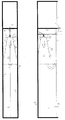
- the invention is disclosed more closely below with reference to drawings of which Fig 1 shows a preferred embodiment seen from above and Fig 2 the same embodiment seen from one side.
- FIG. 1 stands for a tank having side walls 2 and 3, end walls 4 and 5 and a bottom 6.
- 7 stands for an inlet, 8 an outlet for clean water and 9 an outlet for sediment.
- 10 stands for a mixer, 11 feeding means for a flocculating agent, while 12 and 13 stand for flow arrows.
- the entire process for treatment of the sewage water takes place in one single tank, the latter having a length which exceeds twice its width, alternatively its depth.
- Water is fed through the inlet 7.
- the water may then be entirely untreated or alternatively already being fed with flocculation agent in a pre tank not shown.
- a mixer 10 is arranged within the tank 1, said mixer having a relatively large cross section area as compared with that of the tank 1. According to e preferred embodiment, the mixer is rotating slowly. The mixer is located close to the inlet at one of the end walls 4 and so arranged, that a current is created which is directed towards the opposite end wall 5. If the incoming water is untreated, a flocculating agent is added adjacent the mixer.
- the mixer 10 creates a flow in and a mixing of the water within the tank according to a pattern shown in Figs 1 and 2.
- the forward directed flow is indicated by the arrows 12.
- a part of said backward flow shown by the arrows 13, obtains an intensive mixing within the area of the mixer causing an effective admixture of the flocculating agent.
- the flow pattern created is, as can be seen in Figs 1 and 2, diverging in the direction away from the mixer 10.
- the cross section area thus increases and thereby the amount of water that takes part in the mixing process also increases. This means that the part of the total water volume that comes from the back flowing water decreases further away from the mixer.
- the mixing intensity then goes down and the growths of the flocks are stimulated.
- the flow is however kept at such a level, that there is no particular sedimentation.
- the pattern described above with a continuously decreasing flow intensity in the tank is valid up to a point about 2.5 times the width or the depth of the tank away from the mixer, depending on which measure is the largest. Beyond that point, the effect decreases drastically and a quick sedimentation of the flocks takes place. The flocks are taken away through the outlet 9 and the clean water through the outlet 8.
- the tank must be elongated and have a length that exceeds 2.5 times the width or depth of the tank.
- the cross section may be rectangular or circular.
Landscapes
- Chemical & Material Sciences (AREA)
- Life Sciences & Earth Sciences (AREA)
- Hydrology & Water Resources (AREA)
- Engineering & Computer Science (AREA)
- Environmental & Geological Engineering (AREA)
- Water Supply & Treatment (AREA)
- Organic Chemistry (AREA)
- Chemical Kinetics & Catalysis (AREA)
- Separation Of Suspended Particles By Flocculating Agents (AREA)
Abstract
Description
- The invention concerns a method and a device for treatment of liquids such as drinking water, sewage water, industrial process water etc. In the specification below, the treatment of municipal sewage water will be dealt with.
- The treatment of sewage water is normally performed in three steps. Step one is a mechanical treatment, where heavy solids are filtered. Step two is a biological treatment and step three a chemical treatment. In said last step, chemicals are added to the sewage water, which cause flocculation, meaning that pollutants are collected in lumps which sink to the bottom and a relatively clean aqueous phase can be diverted from the water tank.
- The chemical treatment is often divided into several steps in several tanks or chambers. In a first tank chemicals are added during an intensive, swift mixing by help of one or several mixers arranged within the tank. In a second tank the flocculation starts, the flocks being kept in suspension by help of other mixers. In the following tank or tanks the volumes of the flocks are successively increased. In order not to disturb the flocculation, their suspension being taken care of by slowly rotating mixers. In the final tank, there is no mixing and the flocks sink to the bottom to be collected by help of special means, while clean water is diverted from the upper part of the tank.
- The reason for using several treatment tanks with successively decreasing mixing intensity, is that the growths of the flocks are believed to be maximized in this way. One disadvantage is however, that the costs for tanks and mixers are considerable. In addition, the flocculation started in one tank is being interrupted when the water enters next tank. This may cause decomposition of the flocks and making the aqueous phase muddy.
- The purpose of subject invention is therefore to obtain a method and a device for a rational treatment of sewage water, where a minimum of tanks and mixers are necessary and where the growths of the flocks and the sedimentation are not interrupted during the process. The invention is disclosed more closely below with reference to drawings of which Fig 1 shows a preferred embodiment seen from above and Fig 2 the same embodiment seen from one side.
- In the drawings 1 stands for a tank having
side walls end walls - According to the invention the entire process for treatment of the sewage water takes place in one single tank, the latter having a length which exceeds twice its width, alternatively its depth. Water is fed through the
inlet 7. The water may then be entirely untreated or alternatively already being fed with flocculation agent in a pre tank not shown. - A
mixer 10 is arranged within the tank 1, said mixer having a relatively large cross section area as compared with that of the tank 1. According to e preferred embodiment, the mixer is rotating slowly. The mixer is located close to the inlet at one of theend walls 4 and so arranged, that a current is created which is directed towards theopposite end wall 5. If the incoming water is untreated, a flocculating agent is added adjacent the mixer. - The
mixer 10 creates a flow in and a mixing of the water within the tank according to a pattern shown in Figs 1 and 2. The forward directed flow is indicated by thearrows 12. As the flow far exceeds the amount of incoming water through theinlet 7, a backward flow towards the mixer will occur along the periphery. A part of said backward flow, shown by thearrows 13, obtains an intensive mixing within the area of the mixer causing an effective admixture of the flocculating agent. - The flow pattern created is, as can be seen in Figs 1 and 2, diverging in the direction away from the
mixer 10. The cross section area thus increases and thereby the amount of water that takes part in the mixing process also increases. This means that the part of the total water volume that comes from the back flowing water decreases further away from the mixer. The mixing intensity then goes down and the growths of the flocks are stimulated. The flow is however kept at such a level, that there is no particular sedimentation. - The pattern described above with a continuously decreasing flow intensity in the tank is valid up to a point about 2.5 times the width or the depth of the tank away from the mixer, depending on which measure is the largest. Beyond that point, the effect decreases drastically and a quick sedimentation of the flocks takes place. The flocks are taken away through the outlet 9 and the clean water through the outlet 8.
- As previously mentioned, the tank must be elongated and have a length that exceeds 2.5 times the width or depth of the tank. The cross section may be rectangular or circular.
- By help of the method and the device according to the invention it is possible to obtain an effective and less expensive way to chemically treat polluted water. In the description sewage water has been mentioned, but also other types of liquids are possible to treat according to the invention. In the description and in the drawings an embodiment has been shown where the flocculating agent is added to the area close to the mixer. It is however also possible to add the flocculating agent in a pre-chamber where a separate mixer is arranged for the admixture. Essential is however, that the flocking starts in the main tank so that there is no interruption of the growth between the tanks.
Claims (5)
- A method to obtain chemical treatment of liquids such as drinking water, sewage water, industrial process water etc, where chemicals are being added to the liquid for creating flocks containing pollutants, which flocks and the end of the process sediment and are brought away, while clean water is separated from a higher level,
characterized in,that mixing of the liquid is carried out in an elongated tank (1) by help of a mixer (10) located close to one of the ends (4) of said tank, the mixer creating a flow directed towards the opposite end (5) of the tank,that return flows (13) occur along the side walls (2), (3) of the tank and/or the bottom (6) and/or the surface,that a flocculating agent is added in a separate pre-chamber or within the area of the mixer (10) where an intensive mixing takes place,that the growths of the flocks take place successively downstream of the mixer (10),that the mixing intensity gradually decreases downstream and finally stop entirely after a distance of at least twice the depth or width of the tank, depending on which measure is the largest. - A device for carrying out the method according to claim 1, characterized in, that it comprises,an elongated tank (1), the length of which is at least twice the width, alternatively the depth, of the tank,a mixer (10) arranged close to one of the end walls (4) of the tank and directed towards the opposite end wall (5) of the tank,one or several means for addition of flocculating agent within the area of the mixer (10) or in a pre-chamberand means (8) and (9) for diversion of water and sediment respectively.
- A device according to claim 2, characterized in,
that the tank (1) has a square cross section as seen in the direction of the flow. - A device according to claim 2, characterized in,
that the tank has a rectangular cross section as seen in the direction of the flow. - A device according to claim 2, characterized in,
that the tank has a circular cross section as seen in the direction of the flow.
Applications Claiming Priority (2)
| Application Number | Priority Date | Filing Date | Title |
|---|---|---|---|
| SE0000666 | 2000-03-01 | ||
| SE0000666A SE520068C2 (en) | 2000-03-01 | 2000-03-01 | Methods and apparatus for treating liquids |
Publications (2)
| Publication Number | Publication Date |
|---|---|
| EP1129995A2 true EP1129995A2 (en) | 2001-09-05 |
| EP1129995A3 EP1129995A3 (en) | 2002-12-18 |
Family
ID=20278638
Family Applications (1)
| Application Number | Title | Priority Date | Filing Date |
|---|---|---|---|
| EP01850032A Withdrawn EP1129995A3 (en) | 2000-03-01 | 2001-02-13 | A method and a device for treatment of liquids |
Country Status (5)
| Country | Link |
|---|---|
| EP (1) | EP1129995A3 (en) |
| CZ (1) | CZ2001681A3 (en) |
| HU (1) | HUP0100907A3 (en) |
| PL (1) | PL346210A1 (en) |
| SE (1) | SE520068C2 (en) |
Citations (1)
| Publication number | Priority date | Publication date | Assignee | Title |
|---|---|---|---|---|
| US3628667A (en) * | 1969-09-23 | 1971-12-21 | Buckau Wolf Maschf R | Decantation apparatus |
Family Cites Families (6)
| Publication number | Priority date | Publication date | Assignee | Title |
|---|---|---|---|---|
| US2378799A (en) * | 1942-03-12 | 1945-06-19 | Worthington Pump & Mach Corp | Water treating apparatus |
| US4046684A (en) * | 1974-06-21 | 1977-09-06 | Ebara Infilco Kabushiki Kaisha | Process for the treatment of a colloidal suspension |
| US4303517A (en) * | 1979-01-15 | 1981-12-01 | Sydlo Inc. | Liquid treatment apparatus |
| US4193871A (en) * | 1979-02-26 | 1980-03-18 | Alar Engineering Corporation | Clarifier |
| ES2042219T3 (en) * | 1989-10-13 | 1993-12-01 | Alcan International Limited | PROCEDURE AND APPARATUS FOR THE DECANTATION OF SUSPENSIONS. |
| US5407561A (en) * | 1993-05-07 | 1995-04-18 | Alcan International Limited | Pressure decanter |
-
2000
- 2000-03-01 SE SE0000666A patent/SE520068C2/en not_active IP Right Cessation
-
2001
- 2001-02-13 EP EP01850032A patent/EP1129995A3/en not_active Withdrawn
- 2001-02-22 CZ CZ2001681A patent/CZ2001681A3/en unknown
- 2001-02-27 HU HU0100907A patent/HUP0100907A3/en unknown
- 2001-03-01 PL PL01346210A patent/PL346210A1/en not_active Application Discontinuation
Patent Citations (1)
| Publication number | Priority date | Publication date | Assignee | Title |
|---|---|---|---|---|
| US3628667A (en) * | 1969-09-23 | 1971-12-21 | Buckau Wolf Maschf R | Decantation apparatus |
Also Published As
| Publication number | Publication date |
|---|---|
| SE0000666D0 (en) | 2000-03-01 |
| SE0000666L (en) | 2001-09-02 |
| EP1129995A3 (en) | 2002-12-18 |
| HUP0100907A3 (en) | 2005-01-28 |
| HUP0100907A2 (en) | 2004-04-28 |
| SE520068C2 (en) | 2003-05-20 |
| HU0100907D0 (en) | 2001-05-28 |
| PL346210A1 (en) | 2001-09-10 |
| CZ2001681A3 (en) | 2001-10-17 |
Similar Documents
| Publication | Publication Date | Title |
|---|---|---|
| US20180099890A1 (en) | Automated wastewater treatment system and methods | |
| AU2006227100B2 (en) | Activated sludge process wtth ballasted flocculation | |
| FI83864B (en) | FOERFARANDE FOER RENANDE AV EN VAETSKA FRAON FASTA OCH UPPLOESTA FOERORENINGAR MED ETT FLOTATIONSKLARNING-FLOCKNINGSFOERFARANDE. | |
| KR20130012009A (en) | Water-treatment device | |
| EP2040812B1 (en) | A method and device for purifying wastewater | |
| EP0010337A1 (en) | A plant for gathering and purifying water and waste water | |
| KR101545538B1 (en) | Stormwater runoff treatment system using hybrid-type upflow-filter | |
| JP2008207163A (en) | Muddy water treatment method | |
| DE4413895A1 (en) | Purification and detoxification of waste water from tanneries | |
| KR200377629Y1 (en) | Compact waste water treatment apparatus | |
| JP2003181465A (en) | Water bottom purification method | |
| SE520068C2 (en) | Methods and apparatus for treating liquids | |
| Logsdon et al. | Filtration processes—A distinguished history and a promising future | |
| CN102105407B (en) | System and method for treating wastewater | |
| Van der Graaf et al. | Particle size analysis as a tool for performance measurements in high rate effluent filtration | |
| JP5080734B2 (en) | Muddy water treatment method, muddy water treatment device, and seaweed paste for muddy water treatment | |
| KR100697394B1 (en) | Separation method and device for separation of soil in polluted water | |
| CA1074928A (en) | Water treatment system | |
| JPS6135201Y2 (en) | ||
| KR100709321B1 (en) | Flocculation | |
| JP2001087790A (en) | Membrane separation biological treatment equipment | |
| RU2208593C2 (en) | Method of water purification and device for method embodiment | |
| WO2012168950A1 (en) | Waste water treatment device | |
| US20090314699A1 (en) | Water Purification Apparatus | |
| RU2113413C1 (en) | Effluent purification method |
Legal Events
| Date | Code | Title | Description |
|---|---|---|---|
| PUAI | Public reference made under article 153(3) epc to a published international application that has entered the european phase |
Free format text: ORIGINAL CODE: 0009012 |
|
| AK | Designated contracting states |
Kind code of ref document: A2 Designated state(s): AT BE CH CY DE DK ES FI FR GB GR IE IT LI LU MC NL PT SE TR |
|
| AX | Request for extension of the european patent |
Free format text: AL;LT;LV;MK;RO;SI |
|
| PUAL | Search report despatched |
Free format text: ORIGINAL CODE: 0009013 |
|
| AK | Designated contracting states |
Kind code of ref document: A3 Designated state(s): AT BE CH CY DE DK ES FI FR GB GR IE IT LI LU MC NL PT SE TR |
|
| AX | Request for extension of the european patent |
Free format text: AL;LT;LV;MK;RO;SI |
|
| 17P | Request for examination filed |
Effective date: 20030311 |
|
| 17Q | First examination report despatched |
Effective date: 20030610 |
|
| AKX | Designation fees paid |
Designated state(s): AT BE CH CY DE DK ES FI FR GB GR IE IT LI LU MC NL PT SE TR |
|
| STAA | Information on the status of an ep patent application or granted ep patent |
Free format text: STATUS: THE APPLICATION IS DEEMED TO BE WITHDRAWN |
|
| 18D | Application deemed to be withdrawn |
Effective date: 20050901 |