EP1128212A2 - Chemically amplified positive resist composition - Google Patents

Chemically amplified positive resist composition Download PDF

Info

Publication number
EP1128212A2
EP1128212A2 EP01103680A EP01103680A EP1128212A2 EP 1128212 A2 EP1128212 A2 EP 1128212A2 EP 01103680 A EP01103680 A EP 01103680A EP 01103680 A EP01103680 A EP 01103680A EP 1128212 A2 EP1128212 A2 EP 1128212A2
Authority
EP
European Patent Office
Prior art keywords
formula
adamantyl
polymeric unit
acrylate
resist composition
Prior art date
Legal status (The legal status is an assumption and is not a legal conclusion. Google has not performed a legal analysis and makes no representation as to the accuracy of the status listed.)
Withdrawn
Application number
EP01103680A
Other languages
German (de)
French (fr)
Other versions
EP1128212A3 (en
Inventor
Yasunori Uetani
Hiroaki Fujishima
Yoshiyuki Takata
Current Assignee (The listed assignees may be inaccurate. Google has not performed a legal analysis and makes no representation or warranty as to the accuracy of the list.)
Sumitomo Chemical Co Ltd
Original Assignee
Sumitomo Chemical Co Ltd
Priority date (The priority date is an assumption and is not a legal conclusion. Google has not performed a legal analysis and makes no representation as to the accuracy of the date listed.)
Filing date
Publication date
Application filed by Sumitomo Chemical Co Ltd filed Critical Sumitomo Chemical Co Ltd
Publication of EP1128212A2 publication Critical patent/EP1128212A2/en
Publication of EP1128212A3 publication Critical patent/EP1128212A3/en
Withdrawn legal-status Critical Current

Links

Classifications

    • GPHYSICS
    • G03PHOTOGRAPHY; CINEMATOGRAPHY; ANALOGOUS TECHNIQUES USING WAVES OTHER THAN OPTICAL WAVES; ELECTROGRAPHY; HOLOGRAPHY
    • G03FPHOTOMECHANICAL PRODUCTION OF TEXTURED OR PATTERNED SURFACES, e.g. FOR PRINTING, FOR PROCESSING OF SEMICONDUCTOR DEVICES; MATERIALS THEREFOR; ORIGINALS THEREFOR; APPARATUS SPECIALLY ADAPTED THEREFOR
    • G03F7/00Photomechanical, e.g. photolithographic, production of textured or patterned surfaces, e.g. printing surfaces; Materials therefor, e.g. comprising photoresists; Apparatus specially adapted therefor
    • G03F7/004Photosensitive materials
    • G03F7/039Macromolecular compounds which are photodegradable, e.g. positive electron resists
    • GPHYSICS
    • G03PHOTOGRAPHY; CINEMATOGRAPHY; ANALOGOUS TECHNIQUES USING WAVES OTHER THAN OPTICAL WAVES; ELECTROGRAPHY; HOLOGRAPHY
    • G03FPHOTOMECHANICAL PRODUCTION OF TEXTURED OR PATTERNED SURFACES, e.g. FOR PRINTING, FOR PROCESSING OF SEMICONDUCTOR DEVICES; MATERIALS THEREFOR; ORIGINALS THEREFOR; APPARATUS SPECIALLY ADAPTED THEREFOR
    • G03F7/00Photomechanical, e.g. photolithographic, production of textured or patterned surfaces, e.g. printing surfaces; Materials therefor, e.g. comprising photoresists; Apparatus specially adapted therefor
    • G03F7/004Photosensitive materials
    • G03F7/0045Photosensitive materials with organic non-macromolecular light-sensitive compounds not otherwise provided for, e.g. dissolution inhibitors
    • YGENERAL TAGGING OF NEW TECHNOLOGICAL DEVELOPMENTS; GENERAL TAGGING OF CROSS-SECTIONAL TECHNOLOGIES SPANNING OVER SEVERAL SECTIONS OF THE IPC; TECHNICAL SUBJECTS COVERED BY FORMER USPC CROSS-REFERENCE ART COLLECTIONS [XRACs] AND DIGESTS
    • Y10TECHNICAL SUBJECTS COVERED BY FORMER USPC
    • Y10STECHNICAL SUBJECTS COVERED BY FORMER USPC CROSS-REFERENCE ART COLLECTIONS [XRACs] AND DIGESTS
    • Y10S430/00Radiation imagery chemistry: process, composition, or product thereof
    • Y10S430/1053Imaging affecting physical property or radiation sensitive material, or producing nonplanar or printing surface - process, composition, or product: radiation sensitive composition or product or process of making binder containing
    • Y10S430/1055Radiation sensitive composition or product or process of making
    • Y10S430/106Binder containing
    • Y10S430/111Polymer of unsaturated acid or ester

Definitions

  • a lens used in an ArF excimer laser exposure machine or an exposure machine using a light -source of shorter wave-length has a shorter lifetime as compared with lenses for conventional exposure light sources. Accordingly, a shorter time required for exposure to ArF excimer laser light is desirable. For this reason, it is necessary to enhance the sensitivity of a resist. Consequently, there has been used a so-called chemical amplifying type resist, which utilizes the catalytic action of an acid generated due to exposure, and contains a resin having a group cleavable by the acid.
  • resins used in a resist for ArF excimer laser exposure have no aromatic ring in order to ensure the transmittance of the resist, but have an alicyclic ring in place of an aromatic ring in order to impart dry etching resistance thereto.
  • resins such as those described in Journal of Photopolymer Science and Technology, Vol. 9, No. 3, pages 387-398 (1996) by D. C. Hofer, are heretofore known as such resins.
  • An object of the present invention is to provide a chemically amplified positive resist composition containing a resin component and an acid generating agent which is suitable for use in excimer laser lithography utilizing e.g. ArF or KrF and is satisfactory in various excellent resist performance characteristics such as sensitivity and resolution and, particularly, is excellent in adhesion to a substrate.
  • an acid generating agent which is suitable for use in excimer laser lithography utilizing e.g. ArF or KrF and is satisfactory in various excellent resist performance characteristics such as sensitivity and resolution and, particularly, is excellent in adhesion to a substrate.
  • carboxylate residue,-COOR 7 represented by R 5 and R 6
  • Specific examples of the carboxylate residue,-COOR 7 , represented by R 5 and R 6 include methoxycarbonyl, ethoxycarbonyl, 2-hydroxyethoxycarbonyl, tert-butoxycarbonyl, 2-oxoxolane-3-yloxycarbonyl, 2-oxoxolane-4-yloxycarbonyl, 1,1,2-trimethylpropoxycarbonyl, 1-cyclohexyl-1-methylethoxycarbonyl, 1-(4-methylcyclohexyl)-1-methylethoxycarbonyl, and 1-(1-adamantyl)-1-methylethoxycarbonyl.
  • the resin (X) comprised in the resist composition of the present invention may optionally contain other polymeric units in addition to a polymeric unit represented by the formula(I), a polymeric unit represented by the formula(II), a polymeric unit represented by the formula(III) and a polymeric unit derived from an unsaturated dicarboxylic acid anhydride selected from maleic anhydride and itaconic anhydride.
  • the amount of the 2-alkyl-2-adamantyl (meth)acrylate is 5 to 60 % by mol
  • the amount of the 3-hydroxy-1-adamantyl (meth)acrylate is 5 to 50 % by mol
  • the total amount of the alicyclic olefin and the unsaturated dicarboxylic acid anhydride is 10 to 90 % by mol based on total amount of all monomers used in the copolymerization, although the preferable ranges may vary depending on the kind of radiation used for patterning exposure and the kind of the optional monomers used if desired.
  • the alicyclic olefin and the unsaturated dicarboxylic acid anhydride form an alternating copolymer.
  • the total amount of the 2-alkyl-2-adamantyl (meth)acrylate, the alicyclic olefin and the unsaturated dicarboxylic acid anhydride is 40 % by mol or more, more preferably 50 % by mol or more, based on the total amount of all monomers including the optional monomers used in the copolymerization.
  • the amount of the 3-hydroxy-1-adamantyl (meth)acrylate from which a polymeric unit of formula(II) is derived is preferably 5-40 % by mol based on the total amount of all monomers used in the copolymerization.
  • the copolymerization can be conducted according to a conventional method.
  • the resin (X) can be obtained by dissolving the monomers in an organic solvent, then conducting a polymerization reaction in the presence of a polymerization initiator, such as an azo compound.
  • a polymerization initiator such as an azo compound.
  • the azo compound include 2,2'-azobisisobutyronitrile and 2,2'-azobis(2-methylpropionate). It is advantageous that the reaction product is purified e.g by re-precipitation after completion of the polymerization reaction.
  • the acid generating agent which is another component is decomposed to generate an acid by irradiating the component itself or a resist composition including the component with radioactive rays such as light and an electron beam.
  • the acid generated from the acid generating agent acts on the resin to cleave the group which is to be cleaved by the action of an acid present in the resin .
  • Examples of such acid generating agents include onium salt compounds, organic halogen compounds, sulfone compounds, and sulfonate compounds. Specifically, the following compounds can be mentioned:
  • the resist composition of the present invention generally becomes a resist solution in the state in which the above-described components are dissolved in a solvent to be applied on a substrate such as a silicon wafer.
  • the solvent herein used may be one which dissolves each component, has an appropriate drying rate, and provides a uniform and smooth coating after evaporation of the solvent, and can be one which is generally used in this field.
  • Resin Synthesis 1 Synthesis of a 2-ethyl-2-adamantyl methacrylate/3-hydroxy-1-adamantyl acrylate /norbornene/maleic anhydride copolymer: Resin A1)
  • Resin Synthesis 6 Synthesis of a 2-methyl-2-adamantyl acrylate/norbornene/maleic anhydride copolymer: Resin AY
  • the reaction solution was mixed with a large quantity of iso-propanol to precipitate the polymer product, which was then filtered.
  • the polymer product obtained by the filtration was dissolved in tetrahydrofuran, and the obtained solution was mixed with a large quantity of iso-propanol to re-precipitate the polymer product, which was then filtered.
  • the above procedure from dissolution of the polymer product to re-precipitation was repeated once more in order to purify the product. 26.5 g of a copolymer having weight-average molecular weight of about 7,260 and a degree of dispersion of 1.49 was obtained (yield of 64.0%).
  • the copolymer thus obtained referred to as resin AZ.
  • the chemical amplifying type positive resist composition of the present invention is conspicuously excellent in adhesion to a substrate, as well as good in dry-etching resistance and various resist performance characteristics such as sensitivity and resolution. Accordingly, the resist composition is suitable for use in excimer laser lithography utilizing ArF, KrF or the like, and capable of giving a resist pattern with high performance.

Landscapes

  • Physics & Mathematics (AREA)
  • Spectroscopy & Molecular Physics (AREA)
  • General Physics & Mathematics (AREA)
  • Materials For Photolithography (AREA)
  • Addition Polymer Or Copolymer, Post-Treatments, Or Chemical Modifications (AREA)

Abstract

A chemically amplified positive resist composition excellent in adhesion to a substrate, as well as good in dry-etching resistance;
suitable for use in excimer laser lithography utilizing ArF, KrF or the like; and
comprising
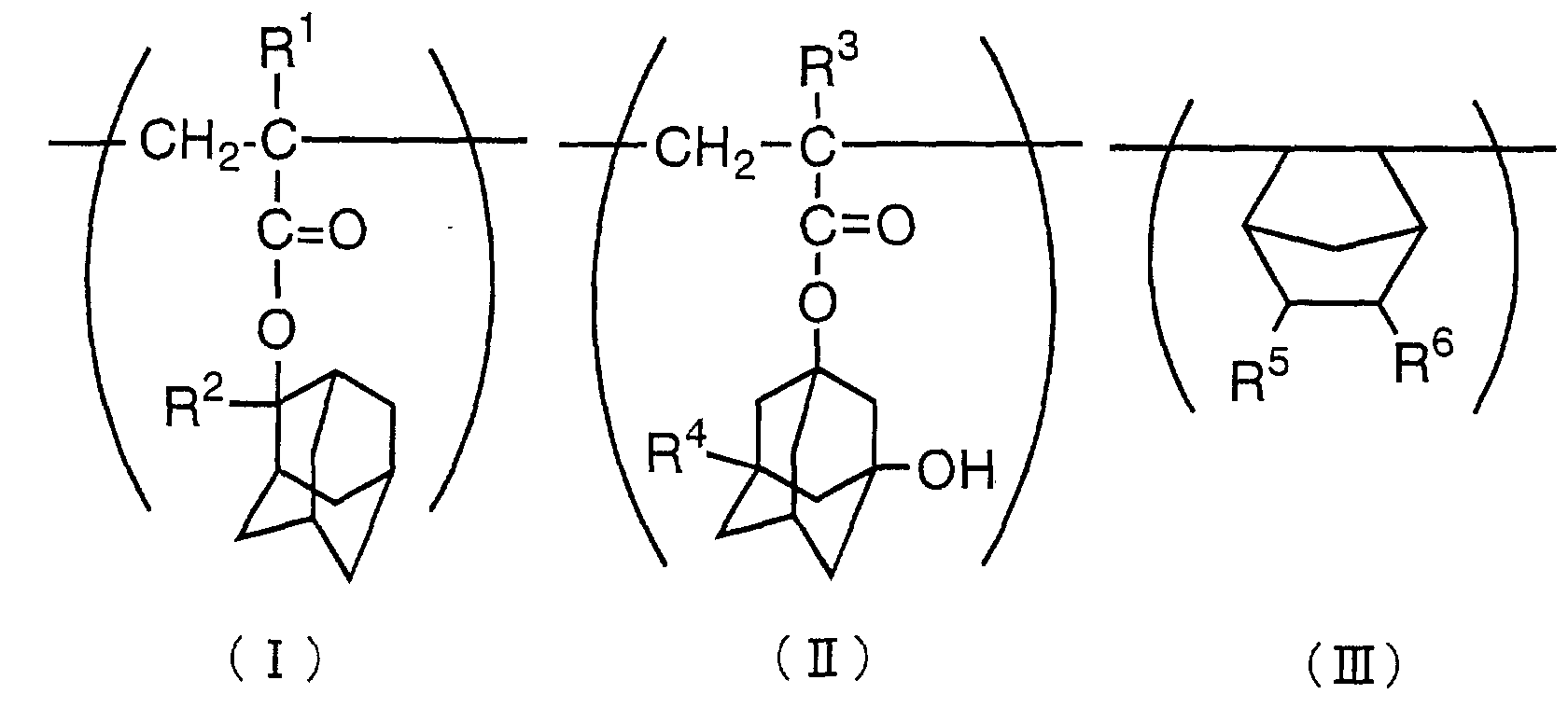
   a resin (X) which, per se, is insoluble in alkali but becomes soluble in alkali when subjected to an action of acid, and has a polymeric unit represented by the formula(I), a polymeric unit represented by the formula(II) and a polymeric unit represented by the formula(III):
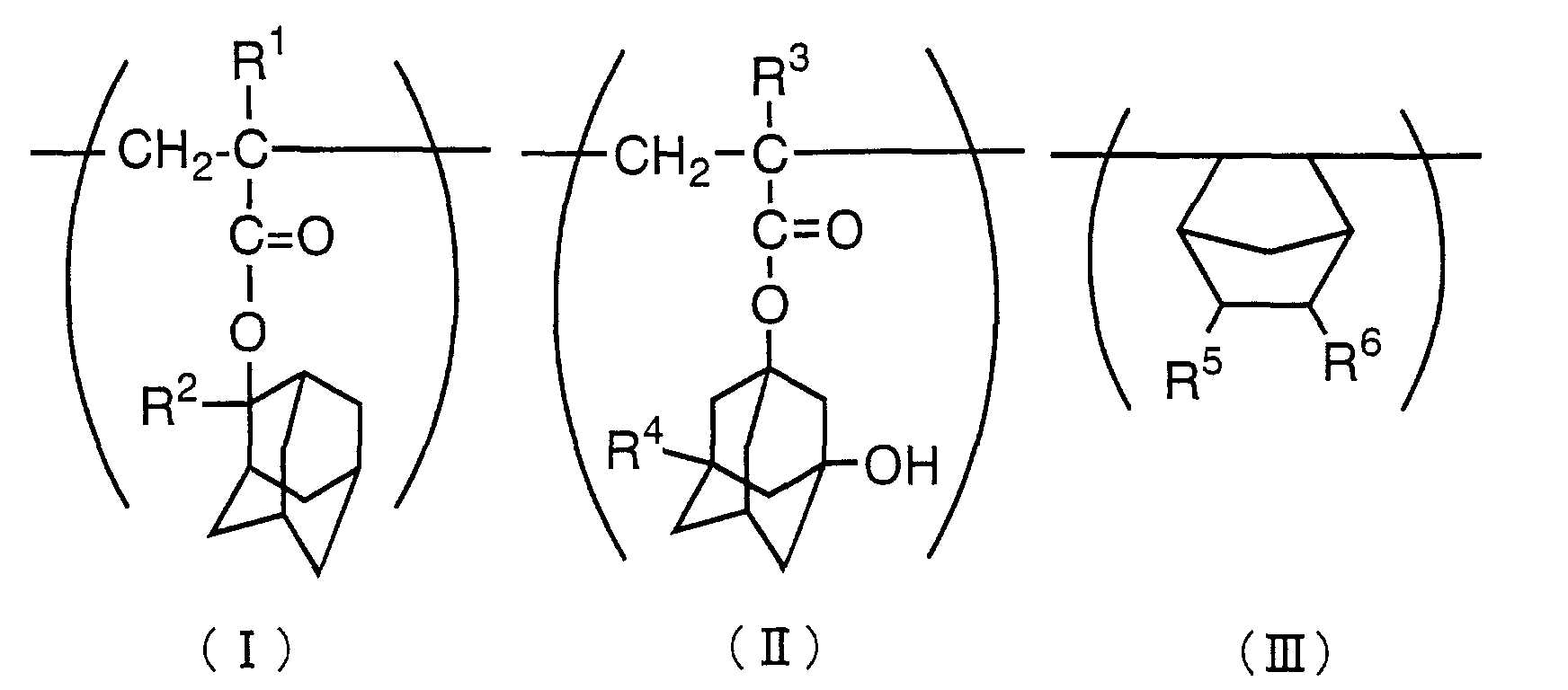
Figure 80000001
   wherein R1 and R3 each independently represent hydrogen or methyl, R2 represents alkyl, R4 represents hydrogen or hydroxyl, and R5 and R6 each independently represent hydrogen, alkyl having 1 to 3 carbon atoms, hydroxyalkyl having 1 to 3 carbon atoms, carboxyl, cyano or a group represented by -COOR7, wherein R7 represents an alcohol residue, or R5 and R6 together form a carboxylic acid anhydride residue represented by -C(=O)OC(=O)-, and a polymeric unit derived from unsaturated dicarboxylic acid anhydride selected from maleic anhydride and itaconic anhydride; and
an acid generating agent (Y).

Description

The present invention relates to a chemical amplifying type positive resist composition used in the minute processing of a semiconductor.
In general, a lithography process using a resist composition has been adopted in the minute processing of a semiconductor. In lithography, the resolution can be improved with a decrease in wavelength of exposure light in principle as expressed by the equation of Rayleigh's diffraction limited. Ag-line with a wavelength of 436 nm, an i-line with a wavelength of 365 nm, and a KrF excimer laser with a wavelength of 248 nm have been adopted as exposure light sources for lithography used in the manufacture of a semiconductor. Thus, the wavelength has become shorter year by year. An ArF excimer laser having a wavelength of 193 nm is considered to be promising as a next-generation exposure light source.
A lens used in an ArF excimer laser exposure machine or an exposure machine using a light -source of shorter wave-length has a shorter lifetime as compared with lenses for conventional exposure light sources. Accordingly, a shorter time required for exposure to ArF excimer laser light is desirable. For this reason, it is necessary to enhance the sensitivity of a resist. Consequently, there has been used a so-called chemical amplifying type resist, which utilizes the catalytic action of an acid generated due to exposure, and contains a resin having a group cleavable by the acid.
It is known that, desirably, resins used in a resist for ArF excimer laser exposure have no aromatic ring in order to ensure the transmittance of the resist, but have an alicyclic ring in place of an aromatic ring in order to impart dry etching resistance thereto. Various kinds of resins such as those described in Journal of Photopolymer Science and Technology, Vol. 9, No. 3, pages 387-398 (1996) by D. C. Hofer, are heretofore known as such resins. Also, use of an alternating copolymer consisting of polymeric units derived from alicyclic olefin and a polymeric unit derived from unsaturated di-carboxylic acid anhydride in a resist for an ArF excimer laser lithography is described in Proc. SPIE, Vol. 2724, pages 355-364 (1996) by T.I. Wallow et al.
However, using such a conventional resin, peeling off of the pattern is liable to occur on the developing process due to insufficient adhesion, particularly when its polarity is insufficient.
An object of the present invention is to provide a chemically amplified positive resist composition containing a resin component and an acid generating agent which is suitable for use in excimer laser lithography utilizing e.g. ArF or KrF and is satisfactory in various excellent resist performance characteristics such as sensitivity and resolution and, particularly, is excellent in adhesion to a substrate.
It has been found that adhesion to a substrate is improved by using a resin having a polymeric unit derived from a 2-alkyl-2-adamantyl-(meth)acrylate, a polymeric unit derived from an unsaturated di-carboxylic acid anhydride and a polymeric unit derived from an alicyclic olefin as a part of the polymeric units in the resin composing a chemical amplifying type positive resist composition; (see JP-A-11-305444). The present invention is based on the further finding that a specific resin having a polymeric unit derived from 3-hydroxy-1-adamantyl-(meth)acrylate, in addition to the above mentioned polymeric units, is more effective for improving adhesion to a substrate.
The present invention provides a chemically amplified positive resist composition comprising
a resin (X) which, per se, is insoluble in alkali but becomes soluble in alkali when subjected to an action of acid, and has
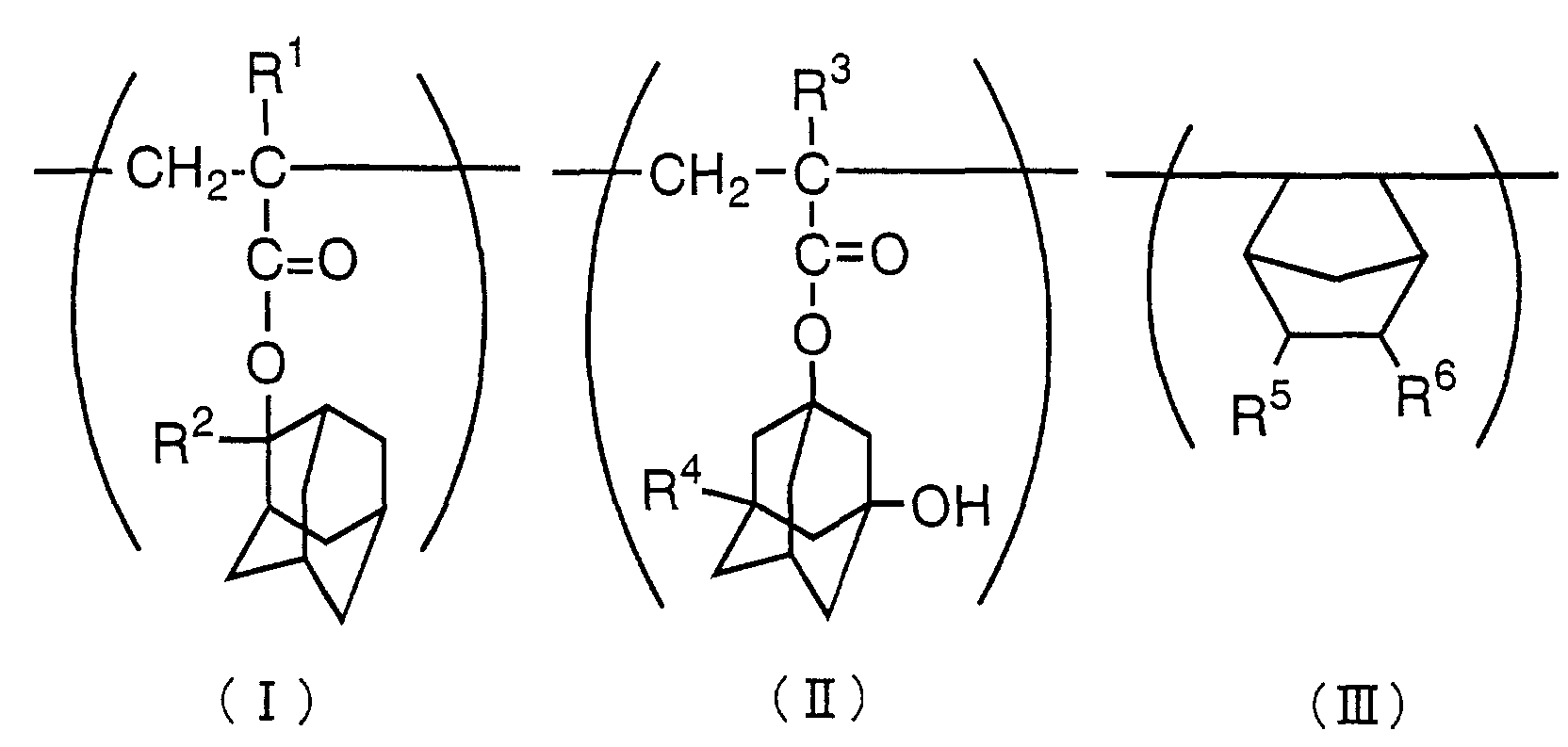
  • (a) a polymeric unit, derived from a2-alkyl-2-adamantyl (meth)acrylate, represented by the formula(I),
  • (b) a polymeric unit, derived from a 3-hydro-1-adamantyl (meth)acrylate, represented by the formula(II),
  • (c) a polymeric unit, derived from an alicyclic olefin, represented by the formula(III):
    Figure 00040001
    wherein R1 and R3 each independently represent hydrogen or methyl, R2 represents alkyl, R4 represents hydrogen or hydroxyl, and R5 and R6 each independently represent hydrogen, alkyl having 1 to 3 carbon atoms, hydroxyalkyl having 1 to 3 carbon atoms, carboxyl, cyano or a group represented by -COOR7, wherein R7 represents an alcohol residue, or R5 and R6 together form a carboxylic acid anhydride residue represented by -C(=O)OC(=O)-, and
  • (d) a polymeric unit derived from an unsaturated dicarboxylic acid anhydride selected from maleic anhydride and itaconic anhydride; and
  • an acid generating agent (Y).
    R1 in the formula (I) and R3 in the formula (II) is hydrogen or alkyl. It is preferred that at least one of R1 and R3 is hydrogen, since a resin (X) having a polymeric unit derived from an acrylate exhibits more remarkable improving effects of adhesion to a substrate and dry-etching resistance than a resin not having such a polymeric unit. R4 represents alkyl having 1 to 4 carbon atoms. It is usually advantageous that the alkyl represented by R4 is straight chain, although the alkyl may be branched. Specific examples of the alkyl include methyl, ethyl, propyl, isopropyl and butyl. Particularly, ethyl is preferred considering balance of sensitivity and heat resistance.
    Examples of monomers used for deriving the polymeric unit of formula (I) include 2-methyl-2-adamantyl acrylate, 2-methyl-2-adamantyl methacrylate, 2-ethyl-2-adamantyl acrylate, 2-ethyl-2-adamantyl methacrylate and 2-n-butyl-2-adamantyl methacrylate. These monomers can be produced, for example, by reacting corresponding 2-methyl-2-adamantanols and (meth)acrylic acids.
    Examples of monomers used for deriving the polymeric unit of formula (II) include 3-hydroxy-1-adamantyl acrylate, 3-hydroxy-1-adamantyl methacrylate, 3,-5-dihydroxy-1-adamantyl acrylate and 3,5-dihydroxy-1-adamantyl methacrylate. These monomers can be produced, for example, by reacting corresponding hydroxyl adamantans and (meth)acrylic acids (JP-A-63-33350).
    R5 and R6 in the formula(III) each independently represent hydrogen, alkyl having 1 to 3 carbon atoms, hydroxyalkyl having 1 to 3 carbon atoms, carboxyl, cyano or a carboxylate residue represented by -COOR7, wherein R7 represents an alcohol residue. Alternatively, R5 and R6 may together form a carboxylic acid anhydride residue represented by -C(=O)OC(=O)-. Examples of the alkyl represented by R5 or R6 include methyl, ethyl and propyl. Examples of the hydroxyalkyl represented by R5 and R6 include hydroxymethyl and 2-hydroxyethyl. Examples of the alcohol residue represented by R7 include unsubstituted or substituted alkyl having about 1 to 8 carbon atoms and 2-oxoxolane-3- or -4-yl. Examples of the substituents of the substituted alkyl include hydroxyl and an alicyclic hydrocarbon residue. Specific examples of the carboxylate residue,-COOR7, represented by R5 and R6 include methoxycarbonyl, ethoxycarbonyl, 2-hydroxyethoxycarbonyl, tert-butoxycarbonyl, 2-oxoxolane-3-yloxycarbonyl, 2-oxoxolane-4-yloxycarbonyl, 1,1,2-trimethylpropoxycarbonyl, 1-cyclohexyl-1-methylethoxycarbonyl, 1-(4-methylcyclohexyl)-1-methylethoxycarbonyl, and 1-(1-adamantyl)-1-methylethoxycarbonyl.
    Examples of monomers used for deriving the polymeric unit of formula (III) include 2-norbornene, 2-hydroxy-5-norbornene, 5-norbornene-2-carboxylic acid, methyl 5-norbornene-2-carboxylate, t-butyl 5-norbornene-2-carboxylate, 1-cyclohexyl-1-methylethyl 5-norbornene-2-carboxylate, 1-(4-methylcyclohexyl)-1-methylethyl 5-norbornene-2-carboxylate, 1-(4-hydroxylcyclohexyl)-1-methylethyl 5-norbornene-2-carboxylate, 1-methyl-1-(4-oxocyclohexyl)ethyl 5-norbornene-2-carboxylate, 1-(1-adamantyl)-1-methylethyl 5-norbornene-2-carboxylate, 1-methylcyclohexyl 5-norbornene-2-carboxylate, 2-methyl-2-adamantyl 5-norbornene-2-carboxylate, 2-ethyl-2-adamantyl 5-norbornene-2-carboxylate, 2-hydroxyl-1-ethyl 5-norbornene-2-carboxylate, 5-norbornene-2-methanol and 5-norbornene-2,3-dicarboxylic acid anhydride.
    The polymeric unit derived from an unsaturated dicarboxylic acid anhydride selected from maleic anhydride and itaconic anhydride is represented by the following formula (IV) or (V):
    Figure 00070001
    The resin (X) comprised in the resist composition of the present invention may optionally contain other polymeric units in addition to a polymeric unit represented by the formula(I), a polymeric unit represented by the formula(II), a polymeric unit represented by the formula(III) and a polymeric unit derived from an unsaturated dicarboxylic acid anhydride selected from maleic anhydride and itaconic anhydride.
    Usually, resins used in chemically amplified positive resist compositions are per se insoluble or only slightly soluble in alkali but become soluble in alkali when subjected to an action of acid, since a part of groups in the resin is cleaved by the action of acid. In the resin (X) comprised in the resist composition of the present invention, the ester group in the polymeric unit of formula (I) is cleaved by the action of acid, and the resin (X) becomes soluble in alkali. Therefore, the resist composition of the present invention functions as positive type. If desired, the resin (X) may further have other polymeric units cleavable by the action of acid.
    Various kinds of carboxylic acid ester groups may be a group cleavable by the action of acid in such other polymeric units. Examples of the carboxylic acid ester groups include alkyl esters having about 1 to 6 carbon atoms such as tert-butylester, acetal type esters such as methoxymethylester, ethoxymethylester, 1-ethoxyethylester, 1-isobutoxyethylester, 1-isopropoxyethylester, 1-ethoxypropylester, 1-(2-methoxyethoxy)ethylester, 1-(2-acetoxyethoxy)ethylester, 1-[2-(1-adamantyloxy)ethoxy]ethylester, 1-[2-(1-adamantancarbonyloxy)ethoxy]ethylester, tetrahydro-2-furylester and tetrahydro-2-pyranylester, and alicyclic ester such as isobornylester. Monomers used for deriving such carboxylic acid ester groups may be acrylic type monomer, such as acrylate and methacrylate, alicyclic type monomers bonding to a carboxylic acid ester group, such as norbornene carboxylate, tricyclodecene carboxylic acid ester and tetracyclodecene carboxylic acid ester, and alicyclic acid esters in which an acrylic acid or a methacrylic acid and an alicyclic group form an ester group, such as those described in Journal of Photopolymer Science and Technology, vol.9, No.3, pages 447-456 (1996) by Iwasa et al.
    The resin (X) comprised in the resist composition of the present invention can be produced by copolymerization of a 2-alkyl-2-adamantyl (meth)acrylate from which a polymeric unit of formula(I) is derived; a 3-hydroxy-1-adamantyl (meth)acrylate from which a polymeric unit of formula(II) is derived; an alicyclic olefin from which a polymeric unit of formula(III) is derived; and an unsaturated dicarboxylic acid anhydride selected from maleic anhydride and itaconic anhydride; and optional monomers used if desired.
    It is usually preferred thatthe amount of the 2-alkyl-2-adamantyl (meth)acrylate is 5 to 60 % by mol, the amount of the 3-hydroxy-1-adamantyl (meth)acrylate is 5 to 50 % by mol, and the total amount of the alicyclic olefin and the unsaturated dicarboxylic acid anhydride is 10 to 90 % by mol based on total amount of all monomers used in the copolymerization, although the preferable ranges may vary depending on the kind of radiation used for patterning exposure and the kind of the optional monomers used if desired. Usually, the alicyclic olefin and the unsaturated dicarboxylic acid anhydride form an alternating copolymer.
    It is advantageous that the total amount of the 2-alkyl-2-adamantyl (meth)acrylate, the alicyclic olefin and the unsaturated dicarboxylic acid anhydride is 40 % by mol or more, more preferably 50 % by mol or more, based on the total amount of all monomers including the optional monomers used in the copolymerization. The amount of the 3-hydroxy-1-adamantyl (meth)acrylate from which a polymeric unit of formula(II) is derived is preferably 5-40 % by mol based on the total amount of all monomers used in the copolymerization.
    The copolymerization can be conducted according to a conventional method. For example, the resin (X) can be obtained by dissolving the monomers in an organic solvent, then conducting a polymerization reaction in the presence of a polymerization initiator, such as an azo compound. Examples of the azo compound include 2,2'-azobisisobutyronitrile and 2,2'-azobis(2-methylpropionate). It is advantageous that the reaction product is purified e.g by re-precipitation after completion of the polymerization reaction.
    The acid generating agent which is another component is decomposed to generate an acid by irradiating the component itself or a resist composition including the component with radioactive rays such as light and an electron beam. The acid generated from the acid generating agent acts on the resin to cleave the group which is to be cleaved by the action of an acid present in the resin . Examples of such acid generating agents include onium salt compounds, organic halogen compounds, sulfone compounds, and sulfonate compounds. Specifically, the following compounds can be mentioned:
  • diphenyliodonium trifluoromethanesulfonate,
  • 4-methoxyphenylphenyliodonium hexafluoroantimonate,
  • 4-mthoxyphenylphenyliodonium trifluoromethanesulfonate,
  • bis(4-tert-butylphenyl)iodonium tetrafluoroborate,
  • bis(4-tert-butylphenyl)iodonium hexafluorophosphate,
  • bis(4-tert-butylphenyl)iodonium hexafluoroantimonate,
  • bis(4-tert-butylphenyl)iodonium trifluoromethanesulfonate,
  • triphenylsulfonium hexafluorophosphate,
  • triphenylsulfonium hexafluoroantimonate,
  • triphenylsulfonium trifluoromethanesulfonate,
  • 4-methoxyphenyldiphenylsulfonium hexafluoroantimonate,
  • 4-methoxyphenyldiphenylsulfonium
  • trifluoromethanesulfonate,
  • p-tolyldiphenylsulfonium trifluoromethanesulfonate,
  • p-tolyldiphenylsulfonium perfluorobutanesulfonate,
  • p-tolyldiphenylsulfonium perfluorooctanesulfonate,
  • 2,4,6-trimethylphenyldiphenylsulfonium
  • trifluoromethanesulfonate,
  • 4-tert-butylphenyldiphenylsulfonium
  • trifluoromethanesulfonate,
  • 4-phenylthiophenyldiphenylsulfonium hexafluorophosphate,
  • 4-phenylthiophenyldiphenylsulfonium hexafluoroantimonate,
  • 1-(2-naphthoylmethyl)thiolanium hexafluoroantimonate,
  • 1-(2-naphthoylmethyl)thiolanium trifluoromethanesulfonate,
  • 4-hydroxy-1-naphthyldimethylsulfonium
  • hexafluoroantimonate,
  • 4-hydroxy-1-naphthyldimethylsulfonium
  • trifluoromethanesulfonate,
  • 2-methyl-4,6-bis(trichloromethyl)-1,3,5-triazine,
  • 2,4,6-tris(trichloromethyl)-1,3,5-triazine,
  • 2-phenyl-4,6-bis(trichloromethyl)-1,3,5-triazine,
  • 2-(4-chlorophenyl)-4,6-bis(trichloromethyl)-1,3,5-triazine,
  • 2-(4-methoxyphenyl)-4,6-bis(trichloromethyl)-1,3,5-triazine,
  • 2-(4-methoxy-1-naphthyl)-4,6-bis(trichloromethyl)-1,3,5-triazine,
  • 2-(benzo[d][1,3]dioxolane-5-yl)-4,6-bis(trichloromethyl)-1,3,5-triazine,
  • 2-(4-methoxystyryl)-4,6-bis(trichloromethyl)-1,3,5-triazine,
  • 2-(3,4,5-trimethoxystyryl)-4,6-bis(trichloromethyl)-1,3,5 - triazine,
  • 2-(3,4-dimethoxystyryl)-4,6-bis(trichloromethyl)-1,3,5-triazine,
  • 2-(2,4-dimethoxystyryl)-4,6-bis(trichloromethyl)-1,3,5-triazine,
  • 2-(2-methoxystyryl)-4,6-bis(trichloromethyl)-1,3,5-triazine,
  • 2-(4-butoxystyryl)-4,6-bis(trichloromethyl)-1,3,5-triazine,
  • 2-(4-pentyloxystyryl)-4,6-bis(trichloromethyl)-1,3,5-triazine,
  • diphenyl disulfone,
  • di-p-tolyl disulfone,
  • bis(phenylsulfonyl)diazomethane,
  • bis(4-chlorophenylsulfonyl)diazomethane,
  • bis(p-tolylsulfonyl)diazomethane,
  • bis(4-tert-butylphenylsulfonyl)diazomethane,
  • bis(2,4-xylylsulfonyl)diazomethane,
  • bis(cyclohexylsulfonyl)diazomethane,
  • (benzoyl)(phenylsulfonyl)diazomethane,
  • 1-benzoyl-1-phenylmethyl p-toluenesulfonate (so-called benzointosylate),
  • 2-benzoyl-2-hydroxy-2-phenylethyl p-toluenesulfonate (so-called α -methylolbenzointosylate),
  • 1,2,3-benzenetriyl trimethanesulfonate,
  • 2,6-dinitrobenzyl p-toluenesulfonate,
  • 2-nitrobenzyl p-toluenesulfonate,
  • 4-nitrobenzyl p-toluenesulfonate,
  • N-(phenylsulfonyloxy)succinimide,
  • N-(trifluoromethylsulfonyloxy)succinimide,
  • N-(trifluoromethylsulfonyloxy)phthalimide,
  • N-(trifluoromethylsulfonyloxy)-5-norbornene-2,3-dicarboxy imide,
  • N-(trifluoromethylsulfonyloxy)naphthalimide, and
  • N-(10-camphorsulfonyloxy)naphthalimide.
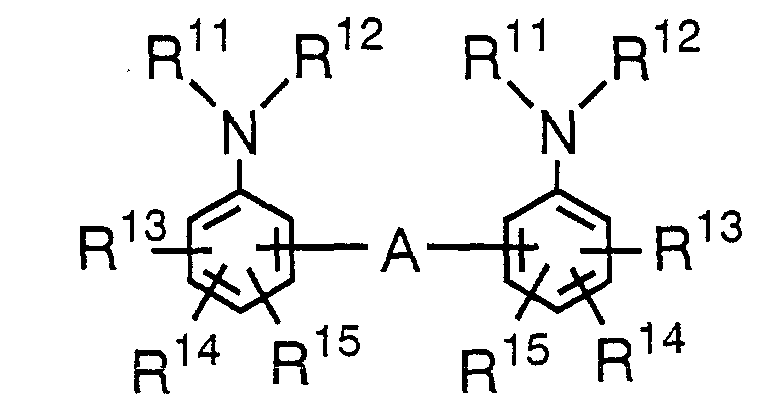
  • It is also known that, generally in a chemical amplifying type positive resist composition, performance deterioration due to the deactivation of an acid associated with leaving after exposure can be reduced by adding basic compounds, especially basic nitrogen-containing organic compounds such as amines as quenchers. It is also preferable in the present invention that such basic compounds are added. Concrete examples of the basic compounds to be used as quenchers include the ones represented by the following formulae:
    Figure 00140001
    Figure 00140002
    Figure 00140003
    Figure 00140004
    Figure 00140005
    wherein R11 and R12 represent, independently each other, hydrogen, cycloalkyl, aryl or alkyl which may be optionally substituted with a hydroxyl; R13, R14 and R15, which are same or different from each other, represent hydrogen, cycloalkyl, aryl, alkoxy or alkyl which may be optionally substituted with a hydroxyl; R16 represents cycloalkyl or alkyl which may be optionally substituted with a hydroxyl; A represents alkylene, carbonyl or imino. The alkyl represented by R11 to R16 and alkoxy represented by R13 to R15 may have about 1 to 6 carbon atoms. The cycloalkyl may have about 5 to 10 carbon atoms and the aryl may have about 6 to 10 carbon atoms. The aryl represented by R11 to R15 may have about 6 to 10 carbon atoms. The alkylene represented by A may have about 1 to 6 carbon atoms and may be straight-chained or branched.
    The resist composition of the present invention preferably contains the resin(X) in an amount in the range of 80 to 99.9 % by weight, and the acid generating agent(Y) in an of 0.1 to 20 % by weight based on the total amount of the resin(X) and the acid generating agent(Y). When a basic compound is used as a quencher, it is preferably contained in an amount in the range of 0.0001 to 0.1 % by weight based on the total solid component weight of the resist composition. The composition may also contain, if required, various additives such as sensitizers, dissolution inhibitors, resins other than resin(X), surfactants, stabilizers, and dyes so far as the objets of the present invention is not harmed.
    The resist composition of the present invention generally becomes a resist solution in the state in which the above-described components are dissolved in a solvent to be applied on a substrate such as a silicon wafer. The solvent herein used may be one which dissolves each component, has an appropriate drying rate, and provides a uniform and smooth coating after evaporation of the solvent, and can be one which is generally used in this field. Examples thereof include glycol ether esters such as ethylcellosolve acetate, methylcellosolve acetate, and propylene glycol monomethyl ether acetate; esters such as ethyl lactate, butyl acetate, amyl acetate, and ethyl pyruvate; ketones such as acetone, methyl isobutyl ketone, 2-heptanone, and cyclohexanone; and cyclic esters such as γ-butyrolactone. These solvents can be used alone or in combination of two or more thereof.
    The resist film applied on a substrate, and dried is subjected to an exposure treatment for patterning. Then, after a heat-treatment for promoting a protecting deblocking reaction, development by an alkali developer is conducted. The alkali developer herein used can be various kinds of alkaline aqueous solutions used in this field. In general, an aqueous solution of tetramethylammoniumhydroxide or (2-hydroxyethyl)trimethylammoniumhydroxide (so-called colline) is often used.
    The present invention will be described in more detail by way of examples, which should not be construed as limiting the scope of the present invention. All parts in examples are by weight unless otherwise stated. The weight-average molecular weight is a value determined from gel permeation chromatography using polystyrene as a reference standard.
    Monomer synthesis example 1 (Synthesis of 2-methyl-2-adamantyl acrylate)
    166 g of 2-Methyl-2-adamantanol, 303 g of triethylamine and 500 g of methylisobutyl ketone were mixed by stirring at 60°C. While stirring, 136 g of acrylic acid chloride was added dropwise to the mixture. After completion of the dropwise addition, the mixture was stirred for six more hours. Then, extraction and distillation were conducted to obtain 2-methyl-2-adamantyl acrylate at the yield of 92 %.
    Monomer synthesis example 2 (Synthesis of 2-ethyl-2-adamantyl methacrylate)
    180 g of 2-Ethyl-2-adamantanol, 303 g of triethylamine and 500 g of methylisobutyl ketone were mixed by stirring at 90°C. While stirring, 157 g of methacrylic acid chloride was added dropwise to the mixture. After completion of the dropwise addition , the mixture was further stirred for 72 hours . Then, extraction and distillation were conducted to obtain 2-ethyl-2-adamantyl methacrylate at the yield of 60 %.
    Monomer synthesis example 3 (Synthesis of 2-ethyl-2-adamantyl acrylate)
    180 g of 2-Ethyl-2-adamantanol, 303 g of triethylamine and 500 g of methylisobutyl ketone were mixed by stirring at 40°C. While stirring, 136 g of acrylic acid chloride was added dropwise to the mixture. After completion of the dropwise addition, the mixture was stirred for three more hours. Then, extraction and distillation were conducted to obtain 2-ethyl-2-adamantyl acrylate at the yield of 80 %.
    Resin Synthesis 1 (Synthesis of a 2-ethyl-2-adamantyl methacrylate/3-hydroxy-1-adamantyl acrylate /norbornene/maleic anhydride copolymer: Resin A1)
    In a reaction vessel were charged 10.0 g of 2-ethyl-2-adamantyl methacrylate, 9.0 g of 3-hydroxy-1-adamantyl acrylate, 5.7 g of norbornene and 5.9 g of maleic anhydride (molar ratio of 2 : 2 : 3 : 3). Thereto, methylisobutyl ketone, the amount thereof being two times by weight based on the total amount of the monomers, was added to form a monomer solution, and the resultant solution was heated to 80 °C under nitrogen atmosphere. Then, 2,2'-azobisisobutyronitrile, the amount thereof being 3% by mol based on the total amount of the monomers, was added, and the resulting solution was further stirred for about 15 hours at 80 °C. Thereafter, the reaction solution was mixed with a large quantity of methanol to precipitate the polymer product, which was then filtered. The polymer product obtained by the filtration was dissolved in methylisobutyl ketone, and the obtained solution was mixed with a large quantity of methanol tore-precipitate the polymer product, which was then filtered. The above procedure from dissolution of the polymer product to re-precipitation was repeated two more times in order to purify the product. 17.1 g of a copolymer having weight-average molecular weight of about 12,160 and a degree of dispersion of 1.90 was obtained (yield of 55.9%). The copolymer thus obtained referred to as resin A1.
    Resin Synthesis 2 (Synthesis of a 2-ethyl-2-adamantyl acrylate/3-hydroxy-1-adamantyl acrylate /norbornene/maleic anhydride copolymer: Resin A2)
    In a reaction vessel were charged 10.0 g of 2-ethyl-2-adamantyl acrylate, 9.5 g of 3-hydroxy-1-adamantyl acrylate, 6.0 g of norbornene and 6.3 g of maleic anhydride (molar ratio of 2 : 2 : 3 : 3). Thereto, methylisobutyl ketone, the amount thereof being two times by weight based on the total amount of the monomers, was added to form a monomer solution, and the resultant solution was heated to 80 °C under nitrogen atmosphere. Then, 2,2'-azobisisobutyronitrile, the amount thereof being 3% by mol based on the total amount of the monomers , was added, and the resulting solution was further stirred for about 15 hours at 80 °C. Thereafter, the reaction solution was mixed with a large quantity of heptane to precipitate the polymer product, which was then filtered. The polymer product obtained by the filtration was dissolved in methylisobutyl ketone, and the obtained solution was mixed with a large quantity of heptane to re-precipitate the polymer product, which was then filtered. The above procedure from dissolution of the polymer product to re-precipitation was repeated once more in order to purify the product. 21.2 g of a copolymer having weight-average molecular weight of about 6,090 and a degree of dispersion of 1.71 was obtained (yield of 66.6%). The copolymer thus obtained referred to as resin A2.
    Resin Synthesis 3 (Synthesis of a 2-methyl-2-adamantyl acrylate/3-hydroxy-1-adamantyl acrylate /norbornene/maleic anhydride copolymer: Resin A3)
    In a reaction vessel were charged 20.0 g of 2-methyl-2-adamantyl acrylate, 10.2 g of 3-hydroxy-1-adamantyl acrylate, 4.3 g of norbornene and 4.5 g of maleic anhydride (molar ratio of 4 : 2 : 2 : 2). Thereto, tetrahydrofuran, the amount thereof being two times by weight based on the total amount of the monomers, was added to form a monomer solution, and the resultant solution was heated to 65 °C under nitrogen atmosphere. Then, 2,2'-azobisisobutyronitrile, the amount thereof being 3% by mol based on the total amount of the monomers, was added, and the resulting solution was further stirred for about 15 hours at 67 °C. Thereafter, the reaction solution was mixed with a large quantity of n-heptane to precipitate the polymer product, which was then filtered. The polymer product obtained by the filtration was dissolved in tetrahydrofuran, and the obtained solution was mixed with a large quantity of n-heptane to re-precipitate the polymer product, which was then filtered. The above procedure from dissolution of the polymer product to re-precipitation was repeated once more in order to purify the product. 19.6 g of a copolymer having weight-average molecular weight of about 8,270 and a degree of dispersion of 1.61 was obtained (yield of 50.2%). The copolymer thus obtained referred to as resin A3.
    Resin Synthesis 4 (Synthesis of a 2-methyl-2-adamantyl acrylate/3-hydroxy-1-adamantyl acrylate /norbornene/maleic anhydride copolymer: Resin A4)
    In a reaction vessel were charged 20.0 g of 2-methyl-2-adamantyl acrylate, 5.0 g of 3-hydroxy-1-adamantyl acrylate, 5.3 g of norbornene and 5.6 g of maleic anhydride (molar ratio of 4 : 1 : 2.5 : 2.5). Thereto, methylisobutyl ketone, the amount thereof being two times by weight based on the total amount of the monomers, was added to form a monomer solution, and the resultant solution was heated to 70 °C under nitrogen atmosphere. Then, 2,2'-azobisisobutyronitrile, the amount thereof being 3% by mol based on the total amount of the monomers, was added, and the resulting solution was further stirred for about 15 hours at 70 °C. Thereafter, the reaction solution was mixed with a large quantity of methanol to precipitate the polymer product, which was then filtered. The polymer product obtained by the filtration was dissolved in methylisobutyl ketone, and the obtained solution was mixed with a large quantity of methanol to re-precipitate the polymer product, which was then filtered. The above procedure from dissolution of the polymer product to re-precipitation was repeated once more in order to purify the product. 23.9 g of a copolymer having weight-average molecular weight of about 13,840 and a degree of dispersion of 1.87 was obtained (yield of 66.1%). The copolymer thus obtained referred to as resin A4.
    Resin Synthesis 5 (Synthesis of a tert-butyl 5-norbornene-2-carboxylate/maleic anhydride copolymer: Resin AX)
    In a reaction vessel , 15.0 g (77.2 m mol) of tert-butyl 5-norbornene-2-carboxylate,7.57 g (77.2 m mol) of maleic anhydride and 45.0 g of 1,4-dioxane were mixed to form a monomer solution, and the resultant solution was heated to 80 °C under nitrogen atmosphere. Thereto, 0.25 g of 2,2'-azobisisobutyronitrile was added, and the resulting solution was further stirred for about 48 hours . After cooling, the reaction solution was mixed with a large quantity of heptane to precipitate the polymer product, which was then filtered. The polymer product obtained by the filtration was dissolved in 1,4-dioxane, and the obtained solution was mixed with a large quantity of heptane to re-precipitate the polymer product, which was then filtered. The above procedure from dissolution of the polymer product to re-precipitation was repeated once more in order to purify the product. A copolymer having weight-average molecular weight of about 4,750 and a degree of dispersion of 1.6 was obtained. The copolymer thus obtained referred to as resin AX.
    Resin Synthesis 6 (Synthesis of a 2-methyl-2-adamantyl acrylate/norbornene/maleic anhydride copolymer: Resin AY)
    In a reaction vessel were charged 58.2 g of 2-methyl-2-adamantyl acrylate, 18.8 g of norbornene and 19.6 g of maleic anhydride (molar ratio of 4 : 3 : 3). Thereto, tetrahydrofuran, the amount thereof being two times by weight based on the total amount of the monomers, was added to form a monomer solution, and the resultant solution was heated to 65 °C under nitrogen atmosphere. Then, 2,2'-azobisisobutyronitrile, the amount thereof being 3% by mol based on the total amount of the monomers, was added, and the resulting solution was further stirred for about 20 hours at 65 °C. Thereafter, the reaction solution was mixed with a large quantity of methanol to precipitate the polymer product, which was then filtered. The polymer product obtained by the filtration was dissolved in tetrahydrofuran, and the obtained solution was mixed with a large quantity of methanol to re-precipitate the polymer product, which was then filtered. The above procedure from dissolution of the polymer product to re-precipitation was repeated once more in order to purify the product. 61.9 g of a copolymer having weight-average molecular weight of about 4,710 and a degree of dispersion of 1.49 was obtained (yield of 64.1%). The copolymer thus obtained referred to as resin AY.
    Resin Synthesis 7 (Synthesis of a 2-methyl-2-adamantyl acrylate/norbornene/maleic anhydride copolymer: Resin AZ)
    In a reaction vessel were charged 15.0 g of 2-methyl-2-adamantyl acrylate, 12.9 g of norbornene and 13.5 g of maleic anhydride (molar ratio of 2 : 4 : 4). Thereto, methylisobutyl ketone, the amount thereof being two times by weight based on the total amount of the monomers, was added to form a monomer solution, and the resultant solution was heated to 80 °C under nitrogen atmosphere. Then, 2,2'-azobisisobutyronitrile, the amount thereof being 3% by mol based on the total amount of the monomers, was added, and the resulting solution was further stirred for about 8 hours at 80 °C. Thereafter, the reaction solution was mixed with a large quantity of iso-propanol to precipitate the polymer product, which was then filtered. The polymer product obtained by the filtration was dissolved in tetrahydrofuran, and the obtained solution was mixed with a large quantity of iso-propanol to re-precipitate the polymer product, which was then filtered. The above procedure from dissolution of the polymer product to re-precipitation was repeated once more in order to purify the product. 26.5 g of a copolymer having weight-average molecular weight of about 7,260 and a degree of dispersion of 1.49 was obtained (yield of 64.0%). The copolymer thus obtained referred to as resin AZ.
    Resin Synthesis 8 (Synthesis of a 2-ethyl-2-adamantyl methacrylate/3-hydroxy-1-adamantyl acrylate /norbornene/maleic anhydride copolymer: Resin A5)
    In a reaction vessel were charged 10.0 g of 2-ethyl-2-adamantyl methacrylate, 9.0 g of 3-hydroxy-1-adamantyl acrylate, 5.7 g of norbornene and 5.9 g of maleic anhydride (molar ratio of 2 : 2 : 3 : 3). Thereto, methylisobutyl ketone, the amount thereof being two times by weight based on the total amount of the monomers, was added to form a monomer solution, and the resultant solution was heated to 80 °C under nitrogen atmosphere. Then, 2,2'-azobisisobutyronitrile, the amount thereof being 1% by mol based on the total amount of the monomers, was added, and the resulting solution was further stirred for about 15 hours at 80 °C. Thereafter, the reaction solution was mixed with a large quantity of methanol to precipitate the polymer product, which was then filtered. The polymer product obtained by the filtration was dissolved in methylisobutyl ketone, and the obtained solution was mixed with a large quantity of methanol to re-precipitate the polymer product, which was then filtered. The above procedure from dissolution of the polymer product to re-precipitation was repeated two more times in order to purify the product. 12.2 g of a copolymer having weight-average molecular weight of about 7,000 and a degree of dispersion of 1.60 was obtained (yield of 40.0%). The copolymer thus obtained referred to as resin A5.
    Resist compositions are prepared using the resins obtained in the above Resin Synthesis examples and the following acid generating agents and quenchers.
    Acid generating agent
  • B1 : p-tolyldiphenylsulfonium trifluoromethanesulfonate
  • B2 : p-tolyldiphenylsulfonium trifluorobutanesulfonate
  • B3 : p-tolyldiphenylsulfonium perfluorooctanesulfonate
  • B4 : cyclohexylmethyl(2-oxocyclohexyl) sulfonium trifluoromethanesulfonate
  • Quencher
  • C1 : 2,6-diisopropylaniline
  • C2 : 2,6-lutidine
  • Examples and Comparative Examples
    Components listed below were mixed and dissolved. The resultant solution was filtered through a fluorine resin filter having a pore diameter of 0.2 µm to give a resist solution. In Example 3, two kinds of acid generating agents and two kinds of quenchers were used in combination.
    Resin (listed in Table 1) 10 parts
    Acid generating agent
    (Amounts and kinds thereof are listed in Table 1):
    Quencher
    (Amounts and kinds thereof are listed in Table 1):
    Solvent: propyleneglycol monomethylether acetate 57 parts
    γ -butyrolactone 3 parts
    A silicon wafer treated with hexamethyldisilazane (Contact angle to water : 60°) was coated with a composition "DUV-30J-14" (a composition for forming organic reflection-preventing membrane, manufactured by Brewer Co. Ltd.) and baked under conditions of 215°C for 60 seconds so that an organic reflection-preventing membrane having a thickness of 1,600 angstrom was formed on the wafer. On the silicon wafer thus prepared, was applied the resist solution obtained above was applied by spin-coating so that the film thickness after drying was 0.39 µm (in all Examples and Comparative examples except for Example 4) or 0.335 µm(in Example 4). After applying the resist solution, the wafer was pre-baked on a direct hotplate at a temperature shown in Table 1, column "PB" for 60 seconds.
    The wafer having a resist film formed thereon was irradiated with an ArF eximer stepper ["NSR-ArF", manufactured by Nikon, NA = 0.55, σ = 0.6] through a line-and-space pattern, changing the exposure amount stepwise. The exposed wafer was subjected to post-exposure baking (PEB) on a hot plate at a temperature shown in Table 1, column "PEB" for 60 seconds. Then the wafer was subjected to paddle development with 2.38% by weight aqueous tetramethyl ammonium hydroxide solution for 60 seconds.
    The developed bright field pattern formed on a substrate with an organic reflection-preventing membrane was observed by a scanning electron microscope and assessed for the effective sensitivity and the resolution by the following methods:
    Effective sensitivity: This is expressed in the minimum amount of exposure which gave 1 : 1 line-and-space pattern of 0.18 µm.
    Resolution : This is expressed in the minimum size which gave line-and-space pattern spitted at the exposure amount of the effective sensitivity.
    Adhesion to a substrate was also evaluated by observing the pattern formed on the wafer with optical microscope according to the following criteria:
  • o ○ : Excellent in peeling at development (fine patterns are hardly peeled even at high exposure amount.)
  • ○ : Peeling of large patterns are not observed, though peeling of some fine patterns are observed at high exposure amount.
  • × : Resist patterns including large patterns are completely peeled
  • The results are shown in Table 2.
    A bright field pattern is obtained by exposure and development through a reticle comprising an outer frame formed of a chromium layer (lightproof layer) and linear chromium layers (lightproof layers) formed on a surface of a glass substrate (light-transmissive portion). Accordingly, after exposure and development, portions of the resist layer surrounding a line and space pattern is removed with a portion of the resist layer corresponding to the outer frame being left outside the line and space pattern.
    Resin Acid Generating agent (parts) Quencher (parts) PB (°C) PEB (°C)
    Example 1 A1 B1(0.1) C1
    (0.0075)
    140 130
    Example 2 A1 B2(0.15) C1
    (0.0075)
    130 130
    Example 3 A1 B3(0.2) C1(0.015) 140 130
    Example 4 A1 B3(0.2)
    B4(0.5)
    C1(0.015)
    C2(0.01)
    110 115
    Example 5 A2 B3(0.2) C1
    (0.0075)
    130 130
    Example 6 A3 B1(0.1) C1
    (0.0075)
    140 130
    Example 7 A4 B1(0.1) C1
    (0.0075)
    140 130
    Example 8 A5 B3(0.2) C1
    (0.0075)
    120 120
    Comparative Example 1 AX B1(0.1) C1
    (0.0075)
    130 130
    Comparative Example 2 AY B1(0.1) C1
    (0.0075)
    140 115
    Comparative Example 3 AZ B1(0.1) C1
    (0.0075)
    140 130
    Effective sensitivity (mJ/cm2) Resolution (µm) Adhesion to a substrate
    Example 1 28 0.16 o ○
    Example 2 31 0.15 o ○
    Example 3 34 0.15 o ○
    Example 4 57 0.15 o ○
    Example 5 39 0.15 o ○
    Example 6 48 0.17 o ○
    Example 7 34 0.17 o ○
    Example 8 33 0.15 o ○
    Comparative Example 1 82 0.18 ×
    Comparative Example 2 30 0.17
    Comparative Example 3 42 0.18
    Apparent from the Tables, the resists of Examples 1-8 are not only excellent in balance of sensitivity and resolution but also particularly excellent in adhesion to a substrate. Further, they exhibit good hydrophilicity (wettablity with respect to a developer) and dry-etching resistance.
    The chemical amplifying type positive resist composition of the present invention is conspicuously excellent in adhesion to a substrate, as well as good in dry-etching resistance and various resist performance characteristics such as sensitivity and resolution. Accordingly, the resist composition is suitable for use in excimer laser lithography utilizing ArF, KrF or the like, and capable of giving a resist pattern with high performance.

    Claims (7)

    1. A chemically amplified positive resist composition comprising
      a resin (X) which, per se, is insoluble in alkali but becomes soluble in alkali when subjected to an action of acid, and has
      (a) a polymeric unit, derived from a 2-alkyl-2-adamantyl (meth)acrylate, represented by the formula(I),
      (b) a polymeric unit, derived from a 3-hydroxy-1-adamantyl (meth)acrylate, represented by the formula(II),
      (c) a polymeric unit, derived from an alicyclic olefin, represented by the formula(III):
      Figure 00310001
      wherein R1 and R3 each independently represent hydrogen or methyl, R2 represents alkyl, R4 represents hydrogen or hydroxyl, and R5 and R6 each independently represent hydrogen, alkyl having 1 to 3 carbon atoms, hydroxyalkyl having 1 to 3 carbon atoms, carboxyl, cyano or a group represented by -COOR7, wherein R7 represents an alcohol residue, or R5 and R6 together form a carboxylic acid anhydride residue represented by -C(=O)OC(=O)-, and
      (d) a polymeric unit derived from an unsaturated dicarboxylic acid anhydride selected from maleic anhydride and itaconic anhydride; and
      an acid generating agent (Y).
    2. The chemically amplified positive resist composition according to claim 1, wherein R2 in the formula (I) is methyl, ethyl, propyl, isopropyl or butyl.
    3. The chemically amplified positive resist composition according to claim 2, wherein R2 in the formula (I) is ethyl.
    4. The chemically amplified positive resist composition according to claim 1, wherein at least one of R1 in the formula (I) and R3 in the formula (II) is hydrogen.
    5. The chemically amplified positive resist composition according to claim 1 which is produced by a copolymerization of monomers comprising a 2-alkyl-2-adamantyl (meth)acrylate from which a polymeric unit of formula(I) is derived; a
      3-hydroxy-1-adamantyl (meth)acrylate from which a polymeric unit of formula(II) is derived;
      an alicyclic olefin from which a polymeric unit of formula(III) is derived; and an
      unsaturated dicarboxylic acid anhydride selected from maleic anhydride and itaconic anhydride;
      wherein the amount of the 2-alkyl-2-adamantyl (meth)acrylate is 5 to 60 % by mol, the amount of the 3-hydroxy-1-adamantyl (meth)acrylate is 5 to 50 % by mol, and the total amount of the alicyclic olefin and the unsaturated dicarboxylic acid anhydride is 10 to 90 % by mol based on the total amount of all monomers used in the copolymerization.
    6. The chemically amplified positive resist composition according to claim 5, wherein the total amount of the
      2-alkyl-2-adamantyl (meth)acrylate, the alicyclic olefin and the unsaturated dicarboxylic acid anhydride is 40 % by mol or more based on the total amount of all monomers used in the copolymerization.
    7. The chemically amplified positive resist composition according to claim 5, wherein the amount of the
      3-hydroxy-1-adamantyl (meth)acrylate from which a polymeric unit of formula(II) is derived is 5-40 % by mol, based on the total amount of all monomers used in the copolymerization.
    EP01103680A 2000-02-28 2001-02-23 Chemically amplified positive resist composition Withdrawn EP1128212A3 (en)

    Applications Claiming Priority (2)

    Application Number Priority Date Filing Date Title
    JP2000051018 2000-02-28
    JP2000051018 2000-02-28

    Publications (2)

    Publication Number Publication Date
    EP1128212A2 true EP1128212A2 (en) 2001-08-29
    EP1128212A3 EP1128212A3 (en) 2001-09-19

    Family

    ID=18572727

    Family Applications (1)

    Application Number Title Priority Date Filing Date
    EP01103680A Withdrawn EP1128212A3 (en) 2000-02-28 2001-02-23 Chemically amplified positive resist composition

    Country Status (6)

    Country Link
    US (1) US6495307B2 (en)
    EP (1) EP1128212A3 (en)
    KR (1) KR100687464B1 (en)
    CN (1) CN1259595C (en)
    SG (1) SG87205A1 (en)
    TW (1) TW573225B (en)

    Cited By (2)

    * Cited by examiner, † Cited by third party
    Publication number Priority date Publication date Assignee Title
    US6503687B2 (en) * 1999-12-08 2003-01-07 Samsung Electronics Co., Ltd. Alicyclic photosensitive polymer, resist composition containing the same and method of preparing the resist composition
    EP1128213A3 (en) * 2000-02-26 2003-11-19 Shipley Company LLC Photoresist compositions comprising novel copolymers

    Families Citing this family (22)

    * Cited by examiner, † Cited by third party
    Publication number Priority date Publication date Assignee Title
    JP4529245B2 (en) * 1999-12-03 2010-08-25 住友化学株式会社 Chemically amplified positive resist composition
    JP4329214B2 (en) * 2000-03-28 2009-09-09 住友化学株式会社 Chemically amplified positive resist composition
    JP3962893B2 (en) * 2001-02-09 2007-08-22 信越化学工業株式会社 Polymer compound, resist material, and pattern forming method
    JP2002341541A (en) * 2001-05-18 2002-11-27 Fuji Photo Film Co Ltd Positive resist composition
    US6635401B2 (en) * 2001-06-21 2003-10-21 International Business Machines Corporation Resist compositions with polymers having 2-cyano acrylic monomer
    JP4149154B2 (en) * 2001-09-28 2008-09-10 富士フイルム株式会社 Positive resist composition
    JP3822101B2 (en) * 2001-12-26 2006-09-13 株式会社ルネサステクノロジ Radiation-sensitive composition, pattern forming method, and semiconductor device manufacturing method
    WO2004059392A1 (en) * 2002-12-26 2004-07-15 Tokyo Ohka Kogyo Co., Ltd. Positive resist composition and method for forming resist pattern
    JP2004333548A (en) * 2003-04-30 2004-11-25 Tokyo Ohka Kogyo Co Ltd Positive photoresist composition and method for forming resist pattern
    JP4439270B2 (en) * 2003-06-18 2010-03-24 富士フイルム株式会社 Positive resist composition and pattern forming method using the same
    JP4401840B2 (en) * 2003-07-07 2010-01-20 東京応化工業株式会社 Positive resist composition and resist pattern forming method using the same
    EP1666971A1 (en) * 2003-09-25 2006-06-07 Tokyo Ohka Kogyo Co., Ltd. Positive resist composition and resist laminate for low-acceleration electron beam and method of pattern formation
    KR100591007B1 (en) * 2004-01-14 2006-06-22 금호석유화학 주식회사 Novel polymers and chemically amplified resists containing them
    JP2005258438A (en) * 2004-03-08 2005-09-22 Rohm & Haas Electronic Materials Llc Cyanoadamantyl compounds and polymers and photoresists containing the same
    JP4279237B2 (en) 2004-05-28 2009-06-17 東京応化工業株式会社 Positive resist composition and resist pattern forming method
    KR20060056237A (en) * 2004-11-19 2006-05-24 동우 화인켐 주식회사 Chemically Amplified Positive Type Resist Compositions
    CN1779569B (en) * 2004-11-22 2010-09-29 北京科华微电子材料有限公司 Fluorinated cyclic olefin polymer and application thereof in deep ultraviolet photoresist
    TW200715067A (en) * 2005-09-06 2007-04-16 Koninkl Philips Electronics Nv Lithographic method
    TW200715068A (en) * 2005-09-06 2007-04-16 Koninkl Philips Electronics Nv Lithographic method
    JP2007199412A (en) * 2006-01-26 2007-08-09 Tokyo Ohka Kogyo Co Ltd Positive resist composition for liquid immersion lithography, and resist pattern forming method
    JP7144797B2 (en) * 2018-04-05 2022-09-30 青島海爾洗衣机有限公司 vertical washing machine
    CN111378082B (en) * 2018-12-30 2021-10-22 中国科学院沈阳自动化研究所 A kind of preparation method and application of double-group photosensitive gelatin

    Family Cites Families (16)

    * Cited by examiner, † Cited by third party
    Publication number Priority date Publication date Assignee Title
    JP2881969B2 (en) 1990-06-05 1999-04-12 富士通株式会社 Radiation-sensitive resist and pattern forming method
    US6004720A (en) * 1993-12-28 1999-12-21 Fujitsu Limited Radiation sensitive material and method for forming pattern
    JP3751065B2 (en) 1995-06-28 2006-03-01 富士通株式会社 Resist material and resist pattern forming method
    US6013416A (en) * 1995-06-28 2000-01-11 Fujitsu Limited Chemically amplified resist compositions and process for the formation of resist patterns
    JP3380128B2 (en) 1996-11-29 2003-02-24 富士通株式会社 Resist material and method of forming resist pattern
    US5843624A (en) 1996-03-08 1998-12-01 Lucent Technologies Inc. Energy-sensitive resist material and a process for device fabrication using an energy-sensitive resist material
    JPH10739A (en) 1996-06-12 1998-01-06 Hideki Nishioka Belt conveyor aboard load carrying deck of truck
    KR100261022B1 (en) * 1996-10-11 2000-09-01 윤종용 Chemically Amplified Resist Composition
    US6030747A (en) 1997-03-07 2000-02-29 Nec Corporation Chemically amplified resist large in transparency and sensitivity to exposure light less than 248 nanometer wavelength and process of forming mask
    JP2973998B2 (en) 1997-03-07 1999-11-08 日本電気株式会社 Photosensitive resin composition and pattern forming method using the same
    JP3972438B2 (en) * 1998-01-26 2007-09-05 住友化学株式会社 Chemically amplified positive resist composition
    JP3738562B2 (en) * 1998-02-19 2006-01-25 住友化学株式会社 Chemically amplified positive resist composition
    JP4434358B2 (en) 1998-05-25 2010-03-17 ダイセル化学工業株式会社 Photoresist compound and photoresist resin composition
    EP1443363B1 (en) 1998-05-25 2013-07-10 Daicel Chemical Industries, Ltd. Photoresist composition
    KR100574574B1 (en) * 1998-08-26 2006-04-28 스미또모 가가꾸 가부시키가이샤 A chemical amplifying type positive resist composition
    KR100704423B1 (en) * 1999-03-31 2007-04-06 스미또모 가가꾸 가부시키가이샤 Chemically amplified positive resist

    Cited By (2)

    * Cited by examiner, † Cited by third party
    Publication number Priority date Publication date Assignee Title
    US6503687B2 (en) * 1999-12-08 2003-01-07 Samsung Electronics Co., Ltd. Alicyclic photosensitive polymer, resist composition containing the same and method of preparing the resist composition
    EP1128213A3 (en) * 2000-02-26 2003-11-19 Shipley Company LLC Photoresist compositions comprising novel copolymers

    Also Published As

    Publication number Publication date
    KR100687464B1 (en) 2007-02-27
    US20010046641A1 (en) 2001-11-29
    CN1259595C (en) 2006-06-14
    US6495307B2 (en) 2002-12-17
    EP1128212A3 (en) 2001-09-19
    CN1311459A (en) 2001-09-05
    TW573225B (en) 2004-01-21
    SG87205A1 (en) 2002-03-19
    KR20010085612A (en) 2001-09-07

    Similar Documents

    Publication Publication Date Title
    EP1143299B1 (en) Chemically amplified positive resist composition
    US6495307B2 (en) Chemically amplified positive resist composition
    US6239231B1 (en) Chemical amplifying type positive resist composition
    US6537726B2 (en) Chemically amplified positive resist composition
    US6475699B2 (en) Chemically amplified positive resist composition
    US6495306B2 (en) Chemically amplified positive resist composition
    US6835527B2 (en) Chemical amplifying type positive resist composition
    EP0856773B1 (en) Chemical amplification type positive resist composition
    JP3890989B2 (en) Resist composition
    JP3994680B2 (en) Chemically amplified positive resist composition
    KR100888557B1 (en) Chemical amplifying type positive resist composition
    JP2001318466A (en) Chemically amplified positive resist composition
    JP4517524B2 (en) Chemically amplified positive resist composition

    Legal Events

    Date Code Title Description
    PUAI Public reference made under article 153(3) epc to a published international application that has entered the european phase

    Free format text: ORIGINAL CODE: 0009012

    PUAL Search report despatched

    Free format text: ORIGINAL CODE: 0009013

    AK Designated contracting states

    Kind code of ref document: A2

    Designated state(s): BE DE FR GB IT NL

    Kind code of ref document: A2

    Designated state(s): AT BE CH CY DE DK ES FI FR GB GR IE IT LI LU MC NL PT SE TR

    AX Request for extension of the european patent

    Free format text: AL;LT;LV;MK;RO;SI

    AK Designated contracting states

    Kind code of ref document: A3

    Designated state(s): AT BE CH CY DE DK ES FI FR GB GR IE IT LI LU MC NL PT SE TR

    AX Request for extension of the european patent

    Free format text: AL;LT;LV;MK;RO;SI

    17P Request for examination filed

    Effective date: 20020301

    AKX Designation fees paid

    Free format text: BE DE FR GB IT NL

    RAP1 Party data changed (applicant data changed or rights of an application transferred)

    Owner name: SUMITOMO CHEMICAL COMPANY, LIMITED

    17Q First examination report despatched

    Effective date: 20090127

    STAA Information on the status of an ep patent application or granted ep patent

    Free format text: STATUS: THE APPLICATION IS DEEMED TO BE WITHDRAWN

    18D Application deemed to be withdrawn

    Effective date: 20090609