EP1127941A1 - Novel dna fragment elevating gene expression dose - Google Patents
Novel dna fragment elevating gene expression dose Download PDFInfo
- Publication number
- EP1127941A1 EP1127941A1 EP00953495A EP00953495A EP1127941A1 EP 1127941 A1 EP1127941 A1 EP 1127941A1 EP 00953495 A EP00953495 A EP 00953495A EP 00953495 A EP00953495 A EP 00953495A EP 1127941 A1 EP1127941 A1 EP 1127941A1
- Authority
- EP
- European Patent Office
- Prior art keywords
- gene
- expression
- sequence
- dna fragment
- atg
- Prior art date
- Legal status (The legal status is an assumption and is not a legal conclusion. Google has not performed a legal analysis and makes no representation as to the accuracy of the status listed.)
- Withdrawn
Links
- 230000014509 gene expression Effects 0.000 title claims abstract description 120
- 239000012634 fragment Substances 0.000 title claims abstract description 82
- 230000003028 elevating effect Effects 0.000 title 1
- 108090000623 proteins and genes Proteins 0.000 claims abstract description 90
- 239000002773 nucleotide Substances 0.000 claims abstract description 75
- 125000003729 nucleotide group Chemical group 0.000 claims abstract description 75
- 230000002708 enhancing effect Effects 0.000 claims abstract description 18
- 108020004414 DNA Proteins 0.000 claims description 94
- 238000000034 method Methods 0.000 claims description 26
- 108091081024 Start codon Proteins 0.000 claims description 6
- 238000012217 deletion Methods 0.000 claims description 6
- 230000037430 deletion Effects 0.000 claims description 6
- 238000003780 insertion Methods 0.000 claims description 6
- 230000037431 insertion Effects 0.000 claims description 6
- 238000007792 addition Methods 0.000 claims description 5
- 238000006467 substitution reaction Methods 0.000 claims description 5
- 230000001131 transforming effect Effects 0.000 claims description 3
- 108020004705 Codon Proteins 0.000 claims 1
- 238000012986 modification Methods 0.000 claims 1
- 230000004048 modification Effects 0.000 claims 1
- 239000002299 complementary DNA Substances 0.000 description 43
- 102000053187 Glucuronidase Human genes 0.000 description 37
- 108010060309 Glucuronidase Proteins 0.000 description 37
- 230000000694 effects Effects 0.000 description 34
- 210000000056 organ Anatomy 0.000 description 34
- 239000000047 product Substances 0.000 description 33
- 230000005026 transcription initiation Effects 0.000 description 29
- 241000196324 Embryophyta Species 0.000 description 26
- 239000013612 plasmid Substances 0.000 description 24
- 210000004027 cell Anatomy 0.000 description 23
- 239000013598 vector Substances 0.000 description 18
- 241000209094 Oryza Species 0.000 description 15
- 108091032973 (ribonucleotides)n+m Proteins 0.000 description 14
- 235000007164 Oryza sativa Nutrition 0.000 description 14
- 239000000872 buffer Substances 0.000 description 14
- 235000009566 rice Nutrition 0.000 description 14
- 238000011144 upstream manufacturing Methods 0.000 description 13
- 238000009396 hybridization Methods 0.000 description 12
- 239000000523 sample Substances 0.000 description 11
- 108091028043 Nucleic acid sequence Proteins 0.000 description 10
- 230000003389 potentiating effect Effects 0.000 description 10
- 238000013519 translation Methods 0.000 description 10
- 238000012216 screening Methods 0.000 description 9
- 102000004190 Enzymes Human genes 0.000 description 8
- 108090000790 Enzymes Proteins 0.000 description 8
- 238000004458 analytical method Methods 0.000 description 8
- 101150054900 gus gene Proteins 0.000 description 8
- 239000000203 mixture Substances 0.000 description 8
- 210000001938 protoplast Anatomy 0.000 description 8
- 239000011541 reaction mixture Substances 0.000 description 8
- 238000003757 reverse transcription PCR Methods 0.000 description 8
- 206010020649 Hyperkeratosis Diseases 0.000 description 7
- 238000006243 chemical reaction Methods 0.000 description 7
- 238000002474 experimental method Methods 0.000 description 7
- 229930024421 Adenine Natural products 0.000 description 6
- GFFGJBXGBJISGV-UHFFFAOYSA-N Adenine Chemical compound NC1=NC=NC2=C1N=CN2 GFFGJBXGBJISGV-UHFFFAOYSA-N 0.000 description 6
- LFQSCWFLJHTTHZ-UHFFFAOYSA-N Ethanol Chemical compound CCO LFQSCWFLJHTTHZ-UHFFFAOYSA-N 0.000 description 6
- 229960000643 adenine Drugs 0.000 description 6
- 108091008146 restriction endonucleases Proteins 0.000 description 6
- 239000000243 solution Substances 0.000 description 6
- RWQNBRDOKXIBIV-UHFFFAOYSA-N thymine Chemical group CC1=CNC(=O)NC1=O RWQNBRDOKXIBIV-UHFFFAOYSA-N 0.000 description 6
- 210000001519 tissue Anatomy 0.000 description 6
- HEMHJVSKTPXQMS-UHFFFAOYSA-M Sodium hydroxide Chemical compound [OH-].[Na+] HEMHJVSKTPXQMS-UHFFFAOYSA-M 0.000 description 5
- 240000008042 Zea mays Species 0.000 description 5
- 235000005824 Zea mays ssp. parviglumis Nutrition 0.000 description 5
- 235000002017 Zea mays subsp mays Nutrition 0.000 description 5
- 238000003556 assay Methods 0.000 description 5
- 230000000295 complement effect Effects 0.000 description 5
- 235000005822 corn Nutrition 0.000 description 5
- 238000004520 electroporation Methods 0.000 description 5
- 210000001672 ovary Anatomy 0.000 description 5
- 102000004169 proteins and genes Human genes 0.000 description 5
- HEDRZPFGACZZDS-UHFFFAOYSA-N Chloroform Chemical compound ClC(Cl)Cl HEDRZPFGACZZDS-UHFFFAOYSA-N 0.000 description 4
- TWRXJAOTZQYOKJ-UHFFFAOYSA-L Magnesium chloride Chemical compound [Mg+2].[Cl-].[Cl-] TWRXJAOTZQYOKJ-UHFFFAOYSA-L 0.000 description 4
- 239000004677 Nylon Substances 0.000 description 4
- 108091034117 Oligonucleotide Proteins 0.000 description 4
- 241000574138 Ozothamnus diosmifolius Species 0.000 description 4
- FAPWRFPIFSIZLT-UHFFFAOYSA-M Sodium chloride Chemical compound [Na+].[Cl-] FAPWRFPIFSIZLT-UHFFFAOYSA-M 0.000 description 4
- 239000011543 agarose gel Substances 0.000 description 4
- 238000010276 construction Methods 0.000 description 4
- OPTASPLRGRRNAP-UHFFFAOYSA-N cytosine Chemical compound NC=1C=CNC(=O)N=1 OPTASPLRGRRNAP-UHFFFAOYSA-N 0.000 description 4
- LEQAOMBKQFMDFZ-UHFFFAOYSA-N glyoxal Chemical compound O=CC=O LEQAOMBKQFMDFZ-UHFFFAOYSA-N 0.000 description 4
- 239000007788 liquid Substances 0.000 description 4
- KWGKDLIKAYFUFQ-UHFFFAOYSA-M lithium chloride Chemical compound [Li+].[Cl-] KWGKDLIKAYFUFQ-UHFFFAOYSA-M 0.000 description 4
- 239000012528 membrane Substances 0.000 description 4
- 229920001778 nylon Polymers 0.000 description 4
- 239000003161 ribonuclease inhibitor Substances 0.000 description 4
- 230000035897 transcription Effects 0.000 description 4
- 238000013518 transcription Methods 0.000 description 4
- 230000001052 transient effect Effects 0.000 description 4
- QKNYBSVHEMOAJP-UHFFFAOYSA-N 2-amino-2-(hydroxymethyl)propane-1,3-diol;hydron;chloride Chemical compound Cl.OCC(N)(CO)CO QKNYBSVHEMOAJP-UHFFFAOYSA-N 0.000 description 3
- 102000007260 Deoxyribonuclease I Human genes 0.000 description 3
- 108010008532 Deoxyribonuclease I Proteins 0.000 description 3
- IAZDPXIOMUYVGZ-UHFFFAOYSA-N Dimethylsulphoxide Chemical compound CS(C)=O IAZDPXIOMUYVGZ-UHFFFAOYSA-N 0.000 description 3
- KCXVZYZYPLLWCC-UHFFFAOYSA-N EDTA Chemical compound OC(=O)CN(CC(O)=O)CCN(CC(O)=O)CC(O)=O KCXVZYZYPLLWCC-UHFFFAOYSA-N 0.000 description 3
- 108060001084 Luciferase Proteins 0.000 description 3
- 229930006000 Sucrose Natural products 0.000 description 3
- CZMRCDWAGMRECN-UGDNZRGBSA-N Sucrose Chemical compound O[C@H]1[C@H](O)[C@@H](CO)O[C@@]1(CO)O[C@@H]1[C@H](O)[C@@H](O)[C@H](O)[C@@H](CO)O1 CZMRCDWAGMRECN-UGDNZRGBSA-N 0.000 description 3
- 239000002253 acid Substances 0.000 description 3
- 230000003466 anti-cipated effect Effects 0.000 description 3
- 238000010790 dilution Methods 0.000 description 3
- 239000012895 dilution Substances 0.000 description 3
- 238000001962 electrophoresis Methods 0.000 description 3
- 239000000499 gel Substances 0.000 description 3
- 238000001556 precipitation Methods 0.000 description 3
- 230000001737 promoting effect Effects 0.000 description 3
- 230000001105 regulatory effect Effects 0.000 description 3
- 238000012163 sequencing technique Methods 0.000 description 3
- 238000002741 site-directed mutagenesis Methods 0.000 description 3
- 238000009331 sowing Methods 0.000 description 3
- 239000005720 sucrose Substances 0.000 description 3
- 230000009466 transformation Effects 0.000 description 3
- 230000017260 vegetative to reproductive phase transition of meristem Effects 0.000 description 3
- 238000005406 washing Methods 0.000 description 3
- HRPVXLWXLXDGHG-UHFFFAOYSA-N Acrylamide Chemical compound NC(=O)C=C HRPVXLWXLXDGHG-UHFFFAOYSA-N 0.000 description 2
- 102000007469 Actins Human genes 0.000 description 2
- 108010085238 Actins Proteins 0.000 description 2
- IJGRMHOSHXDMSA-UHFFFAOYSA-N Atomic nitrogen Chemical compound N#N IJGRMHOSHXDMSA-UHFFFAOYSA-N 0.000 description 2
- 241000894006 Bacteria Species 0.000 description 2
- 241000701489 Cauliflower mosaic virus Species 0.000 description 2
- 108020004635 Complementary DNA Proteins 0.000 description 2
- ZHNUHDYFZUAESO-UHFFFAOYSA-N Formamide Chemical compound NC=O ZHNUHDYFZUAESO-UHFFFAOYSA-N 0.000 description 2
- 102100034343 Integrase Human genes 0.000 description 2
- 239000005089 Luciferase Substances 0.000 description 2
- CSNNHWWHGAXBCP-UHFFFAOYSA-L Magnesium sulfate Chemical compound [Mg+2].[O-][S+2]([O-])([O-])[O-] CSNNHWWHGAXBCP-UHFFFAOYSA-L 0.000 description 2
- ISWSIDIOOBJBQZ-UHFFFAOYSA-N Phenol Chemical compound OC1=CC=CC=C1 ISWSIDIOOBJBQZ-UHFFFAOYSA-N 0.000 description 2
- 108010092799 RNA-directed DNA polymerase Proteins 0.000 description 2
- 108020005038 Terminator Codon Proteins 0.000 description 2
- JLCPHMBAVCMARE-UHFFFAOYSA-N [3-[[3-[[3-[[3-[[3-[[3-[[3-[[3-[[3-[[3-[[3-[[5-(2-amino-6-oxo-1H-purin-9-yl)-3-[[3-[[3-[[3-[[3-[[3-[[5-(2-amino-6-oxo-1H-purin-9-yl)-3-[[5-(2-amino-6-oxo-1H-purin-9-yl)-3-hydroxyoxolan-2-yl]methoxy-hydroxyphosphoryl]oxyoxolan-2-yl]methoxy-hydroxyphosphoryl]oxy-5-(5-methyl-2,4-dioxopyrimidin-1-yl)oxolan-2-yl]methoxy-hydroxyphosphoryl]oxy-5-(6-aminopurin-9-yl)oxolan-2-yl]methoxy-hydroxyphosphoryl]oxy-5-(6-aminopurin-9-yl)oxolan-2-yl]methoxy-hydroxyphosphoryl]oxy-5-(6-aminopurin-9-yl)oxolan-2-yl]methoxy-hydroxyphosphoryl]oxy-5-(6-aminopurin-9-yl)oxolan-2-yl]methoxy-hydroxyphosphoryl]oxyoxolan-2-yl]methoxy-hydroxyphosphoryl]oxy-5-(5-methyl-2,4-dioxopyrimidin-1-yl)oxolan-2-yl]methoxy-hydroxyphosphoryl]oxy-5-(4-amino-2-oxopyrimidin-1-yl)oxolan-2-yl]methoxy-hydroxyphosphoryl]oxy-5-(5-methyl-2,4-dioxopyrimidin-1-yl)oxolan-2-yl]methoxy-hydroxyphosphoryl]oxy-5-(5-methyl-2,4-dioxopyrimidin-1-yl)oxolan-2-yl]methoxy-hydroxyphosphoryl]oxy-5-(6-aminopurin-9-yl)oxolan-2-yl]methoxy-hydroxyphosphoryl]oxy-5-(6-aminopurin-9-yl)oxolan-2-yl]methoxy-hydroxyphosphoryl]oxy-5-(4-amino-2-oxopyrimidin-1-yl)oxolan-2-yl]methoxy-hydroxyphosphoryl]oxy-5-(4-amino-2-oxopyrimidin-1-yl)oxolan-2-yl]methoxy-hydroxyphosphoryl]oxy-5-(4-amino-2-oxopyrimidin-1-yl)oxolan-2-yl]methoxy-hydroxyphosphoryl]oxy-5-(6-aminopurin-9-yl)oxolan-2-yl]methoxy-hydroxyphosphoryl]oxy-5-(4-amino-2-oxopyrimidin-1-yl)oxolan-2-yl]methyl [5-(6-aminopurin-9-yl)-2-(hydroxymethyl)oxolan-3-yl] hydrogen phosphate Polymers Cc1cn(C2CC(OP(O)(=O)OCC3OC(CC3OP(O)(=O)OCC3OC(CC3O)n3cnc4c3nc(N)[nH]c4=O)n3cnc4c3nc(N)[nH]c4=O)C(COP(O)(=O)OC3CC(OC3COP(O)(=O)OC3CC(OC3COP(O)(=O)OC3CC(OC3COP(O)(=O)OC3CC(OC3COP(O)(=O)OC3CC(OC3COP(O)(=O)OC3CC(OC3COP(O)(=O)OC3CC(OC3COP(O)(=O)OC3CC(OC3COP(O)(=O)OC3CC(OC3COP(O)(=O)OC3CC(OC3COP(O)(=O)OC3CC(OC3COP(O)(=O)OC3CC(OC3COP(O)(=O)OC3CC(OC3COP(O)(=O)OC3CC(OC3COP(O)(=O)OC3CC(OC3COP(O)(=O)OC3CC(OC3COP(O)(=O)OC3CC(OC3CO)n3cnc4c(N)ncnc34)n3ccc(N)nc3=O)n3cnc4c(N)ncnc34)n3ccc(N)nc3=O)n3ccc(N)nc3=O)n3ccc(N)nc3=O)n3cnc4c(N)ncnc34)n3cnc4c(N)ncnc34)n3cc(C)c(=O)[nH]c3=O)n3cc(C)c(=O)[nH]c3=O)n3ccc(N)nc3=O)n3cc(C)c(=O)[nH]c3=O)n3cnc4c3nc(N)[nH]c4=O)n3cnc4c(N)ncnc34)n3cnc4c(N)ncnc34)n3cnc4c(N)ncnc34)n3cnc4c(N)ncnc34)O2)c(=O)[nH]c1=O JLCPHMBAVCMARE-UHFFFAOYSA-N 0.000 description 2
- ZKHQWZAMYRWXGA-KNYAHOBESA-N [[(2r,3s,4r,5r)-5-(6-aminopurin-9-yl)-3,4-dihydroxyoxolan-2-yl]methoxy-hydroxyphosphoryl] dihydroxyphosphoryl hydrogen phosphate Chemical compound C1=NC=2C(N)=NC=NC=2N1[C@@H]1O[C@H](COP(O)(=O)OP(O)(=O)O[32P](O)(O)=O)[C@@H](O)[C@H]1O ZKHQWZAMYRWXGA-KNYAHOBESA-N 0.000 description 2
- 238000009825 accumulation Methods 0.000 description 2
- RJURFGZVJUQBHK-UHFFFAOYSA-N actinomycin D Natural products CC1OC(=O)C(C(C)C)N(C)C(=O)CN(C)C(=O)C2CCCN2C(=O)C(C(C)C)NC(=O)C1NC(=O)C1=C(N)C(=O)C(C)=C2OC(C(C)=CC=C3C(=O)NC4C(=O)NC(C(N5CCCC5C(=O)N(C)CC(=O)N(C)C(C(C)C)C(=O)OC4C)=O)C(C)C)=C3N=C21 RJURFGZVJUQBHK-UHFFFAOYSA-N 0.000 description 2
- 230000003321 amplification Effects 0.000 description 2
- 238000010805 cDNA synthesis kit Methods 0.000 description 2
- 238000005119 centrifugation Methods 0.000 description 2
- 229940104302 cytosine Drugs 0.000 description 2
- 238000011161 development Methods 0.000 description 2
- 230000018109 developmental process Effects 0.000 description 2
- 108010030074 endodeoxyribonuclease MluI Proteins 0.000 description 2
- 238000010353 genetic engineering Methods 0.000 description 2
- 229940015043 glyoxal Drugs 0.000 description 2
- 238000001727 in vivo Methods 0.000 description 2
- 230000010354 integration Effects 0.000 description 2
- 238000002955 isolation Methods 0.000 description 2
- 238000002372 labelling Methods 0.000 description 2
- 229910001629 magnesium chloride Inorganic materials 0.000 description 2
- 239000003550 marker Substances 0.000 description 2
- 230000035772 mutation Effects 0.000 description 2
- 238000003199 nucleic acid amplification method Methods 0.000 description 2
- 108020004707 nucleic acids Proteins 0.000 description 2
- 102000039446 nucleic acids Human genes 0.000 description 2
- 150000007523 nucleic acids Chemical class 0.000 description 2
- 238000004806 packaging method and process Methods 0.000 description 2
- 239000002245 particle Substances 0.000 description 2
- 239000013600 plasmid vector Substances 0.000 description 2
- 239000011780 sodium chloride Substances 0.000 description 2
- 230000002194 synthesizing effect Effects 0.000 description 2
- 229940113082 thymine Drugs 0.000 description 2
- 230000002103 transcriptional effect Effects 0.000 description 2
- 239000005631 2,4-Dichlorophenoxyacetic acid Substances 0.000 description 1
- JXCKZXHCJOVIAV-UHFFFAOYSA-N 6-[(5-bromo-4-chloro-1h-indol-3-yl)oxy]-3,4,5-trihydroxyoxane-2-carboxylic acid;cyclohexanamine Chemical compound [NH3+]C1CCCCC1.O1C(C([O-])=O)C(O)C(O)C(O)C1OC1=CNC2=CC=C(Br)C(Cl)=C12 JXCKZXHCJOVIAV-UHFFFAOYSA-N 0.000 description 1
- 101710197633 Actin-1 Proteins 0.000 description 1
- 229920001817 Agar Polymers 0.000 description 1
- 241000589155 Agrobacterium tumefaciens Species 0.000 description 1
- 101710187578 Alcohol dehydrogenase 1 Proteins 0.000 description 1
- USFZMSVCRYTOJT-UHFFFAOYSA-N Ammonium acetate Chemical compound N.CC(O)=O USFZMSVCRYTOJT-UHFFFAOYSA-N 0.000 description 1
- 239000005695 Ammonium acetate Substances 0.000 description 1
- 108020005544 Antisense RNA Proteins 0.000 description 1
- 101100411821 Arabidopsis thaliana RBG8 gene Proteins 0.000 description 1
- 241000972773 Aulopiformes Species 0.000 description 1
- 108010053835 Catalase Proteins 0.000 description 1
- FBPFZTCFMRRESA-KVTDHHQDSA-N D-Mannitol Chemical compound OC[C@@H](O)[C@@H](O)[C@H](O)[C@H](O)CO FBPFZTCFMRRESA-KVTDHHQDSA-N 0.000 description 1
- 102000053602 DNA Human genes 0.000 description 1
- 102000012410 DNA Ligases Human genes 0.000 description 1
- 108010061982 DNA Ligases Proteins 0.000 description 1
- 108010014303 DNA-directed DNA polymerase Proteins 0.000 description 1
- 102000016928 DNA-directed DNA polymerase Human genes 0.000 description 1
- 108010092160 Dactinomycin Proteins 0.000 description 1
- 241000588724 Escherichia coli Species 0.000 description 1
- 241000233866 Fungi Species 0.000 description 1
- 108010010803 Gelatin Proteins 0.000 description 1
- 108700039691 Genetic Promoter Regions Proteins 0.000 description 1
- 101001110286 Homo sapiens Ras-related C3 botulinum toxin substrate 1 Proteins 0.000 description 1
- 101000740205 Homo sapiens Sal-like protein 1 Proteins 0.000 description 1
- 229930195725 Mannitol Natural products 0.000 description 1
- 101100409013 Mesembryanthemum crystallinum PPD gene Proteins 0.000 description 1
- 101500006448 Mycobacterium bovis (strain ATCC BAA-935 / AF2122/97) Endonuclease PI-MboI Proteins 0.000 description 1
- 108091000041 Phosphoenolpyruvate Carboxylase Proteins 0.000 description 1
- NBIIXXVUZAFLBC-UHFFFAOYSA-N Phosphoric acid Chemical compound OP(O)(O)=O NBIIXXVUZAFLBC-UHFFFAOYSA-N 0.000 description 1
- 108700001094 Plant Genes Proteins 0.000 description 1
- 102000001253 Protein Kinase Human genes 0.000 description 1
- 101150058540 RAC1 gene Proteins 0.000 description 1
- 102100022122 Ras-related C3 botulinum toxin substrate 1 Human genes 0.000 description 1
- 108700008625 Reporter Genes Proteins 0.000 description 1
- 240000000528 Ricinus communis Species 0.000 description 1
- 235000004443 Ricinus communis Nutrition 0.000 description 1
- 102100037204 Sal-like protein 1 Human genes 0.000 description 1
- 108091081021 Sense strand Proteins 0.000 description 1
- 238000002105 Southern blotting Methods 0.000 description 1
- 108700026226 TATA Box Proteins 0.000 description 1
- 108010006785 Taq Polymerase Proteins 0.000 description 1
- 239000007983 Tris buffer Substances 0.000 description 1
- 108090000848 Ubiquitin Proteins 0.000 description 1
- 102000044159 Ubiquitin Human genes 0.000 description 1
- 101000662549 Zea mays Sucrose synthase 1 Proteins 0.000 description 1
- 150000007513 acids Chemical class 0.000 description 1
- RJURFGZVJUQBHK-IIXSONLDSA-N actinomycin D Chemical compound C[C@H]1OC(=O)[C@H](C(C)C)N(C)C(=O)CN(C)C(=O)[C@@H]2CCCN2C(=O)[C@@H](C(C)C)NC(=O)[C@H]1NC(=O)C1=C(N)C(=O)C(C)=C2OC(C(C)=CC=C3C(=O)N[C@@H]4C(=O)N[C@@H](C(N5CCC[C@H]5C(=O)N(C)CC(=O)N(C)[C@@H](C(C)C)C(=O)O[C@@H]4C)=O)C(C)C)=C3N=C21 RJURFGZVJUQBHK-IIXSONLDSA-N 0.000 description 1
- 239000008272 agar Substances 0.000 description 1
- 125000003275 alpha amino acid group Chemical group 0.000 description 1
- 125000000539 amino acid group Chemical group 0.000 description 1
- 229940043376 ammonium acetate Drugs 0.000 description 1
- 235000019257 ammonium acetate Nutrition 0.000 description 1
- 210000004102 animal cell Anatomy 0.000 description 1
- 239000003963 antioxidant agent Substances 0.000 description 1
- 230000003078 antioxidant effect Effects 0.000 description 1
- 230000033228 biological regulation Effects 0.000 description 1
- 238000009395 breeding Methods 0.000 description 1
- 230000001488 breeding effect Effects 0.000 description 1
- 210000000845 cartilage Anatomy 0.000 description 1
- 239000003153 chemical reaction reagent Substances 0.000 description 1
- 210000000349 chromosome Anatomy 0.000 description 1
- 238000010367 cloning Methods 0.000 description 1
- 239000003184 complementary RNA Substances 0.000 description 1
- 238000003271 compound fluorescence assay Methods 0.000 description 1
- 238000011109 contamination Methods 0.000 description 1
- 238000007796 conventional method Methods 0.000 description 1
- 230000009089 cytolysis Effects 0.000 description 1
- 229960000640 dactinomycin Drugs 0.000 description 1
- 238000001514 detection method Methods 0.000 description 1
- 238000007865 diluting Methods 0.000 description 1
- 238000001035 drying Methods 0.000 description 1
- 230000002255 enzymatic effect Effects 0.000 description 1
- ZMMJGEGLRURXTF-UHFFFAOYSA-N ethidium bromide Chemical compound [Br-].C12=CC(N)=CC=C2C2=CC=C(N)C=C2[N+](CC)=C1C1=CC=CC=C1 ZMMJGEGLRURXTF-UHFFFAOYSA-N 0.000 description 1
- 229960005542 ethidium bromide Drugs 0.000 description 1
- 230000001747 exhibiting effect Effects 0.000 description 1
- 238000010195 expression analysis Methods 0.000 description 1
- 239000013604 expression vector Substances 0.000 description 1
- 238000000605 extraction Methods 0.000 description 1
- 239000011536 extraction buffer Substances 0.000 description 1
- 239000008273 gelatin Substances 0.000 description 1
- 229920000159 gelatin Polymers 0.000 description 1
- 235000019322 gelatine Nutrition 0.000 description 1
- 235000011852 gelatine desserts Nutrition 0.000 description 1
- PCHJSUWPFVWCPO-UHFFFAOYSA-N gold Chemical compound [Au] PCHJSUWPFVWCPO-UHFFFAOYSA-N 0.000 description 1
- 239000010931 gold Substances 0.000 description 1
- 229910052737 gold Inorganic materials 0.000 description 1
- 238000011534 incubation Methods 0.000 description 1
- 208000015181 infectious disease Diseases 0.000 description 1
- 239000006166 lysate Substances 0.000 description 1
- 229910052943 magnesium sulfate Inorganic materials 0.000 description 1
- 210000001161 mammalian embryo Anatomy 0.000 description 1
- 239000000594 mannitol Substances 0.000 description 1
- 235000010355 mannitol Nutrition 0.000 description 1
- 239000000463 material Substances 0.000 description 1
- 230000013011 mating Effects 0.000 description 1
- 108020004999 messenger RNA Proteins 0.000 description 1
- 238000002156 mixing Methods 0.000 description 1
- 238000010369 molecular cloning Methods 0.000 description 1
- 229910052757 nitrogen Inorganic materials 0.000 description 1
- 108091027963 non-coding RNA Proteins 0.000 description 1
- 102000042567 non-coding RNA Human genes 0.000 description 1
- 230000003287 optical effect Effects 0.000 description 1
- 230000002572 peristaltic effect Effects 0.000 description 1
- NONJJLVGHLVQQM-JHXYUMNGSA-N phenethicillin Chemical compound N([C@@H]1C(N2[C@H](C(C)(C)S[C@@H]21)C(O)=O)=O)C(=O)C(C)OC1=CC=CC=C1 NONJJLVGHLVQQM-JHXYUMNGSA-N 0.000 description 1
- 238000007747 plating Methods 0.000 description 1
- 101150063097 ppdK gene Proteins 0.000 description 1
- 239000002244 precipitate Substances 0.000 description 1
- 108060006633 protein kinase Proteins 0.000 description 1
- 238000010791 quenching Methods 0.000 description 1
- 230000000171 quenching effect Effects 0.000 description 1
- 230000014493 regulation of gene expression Effects 0.000 description 1
- 230000037425 regulation of transcription Effects 0.000 description 1
- 238000010839 reverse transcription Methods 0.000 description 1
- 235000019515 salmon Nutrition 0.000 description 1
- 239000002689 soil Substances 0.000 description 1
- 239000007787 solid Substances 0.000 description 1
- 239000000126 substance Substances 0.000 description 1
- 239000000758 substrate Substances 0.000 description 1
- 230000002195 synergetic effect Effects 0.000 description 1
- 230000014621 translational initiation Effects 0.000 description 1
- LENZDBCJOHFCAS-UHFFFAOYSA-N tris Chemical compound OCC(N)(CO)CO LENZDBCJOHFCAS-UHFFFAOYSA-N 0.000 description 1
- 238000002525 ultrasonication Methods 0.000 description 1
- 108700026220 vif Genes Proteins 0.000 description 1
- DGVVWUTYPXICAM-UHFFFAOYSA-N β‐Mercaptoethanol Chemical compound OCCS DGVVWUTYPXICAM-UHFFFAOYSA-N 0.000 description 1
Images

Classifications
-
- C—CHEMISTRY; METALLURGY
- C12—BIOCHEMISTRY; BEER; SPIRITS; WINE; VINEGAR; MICROBIOLOGY; ENZYMOLOGY; MUTATION OR GENETIC ENGINEERING
- C12N—MICROORGANISMS OR ENZYMES; COMPOSITIONS THEREOF; PROPAGATING, PRESERVING, OR MAINTAINING MICROORGANISMS; MUTATION OR GENETIC ENGINEERING; CULTURE MEDIA
- C12N15/00—Mutation or genetic engineering; DNA or RNA concerning genetic engineering, vectors, e.g. plasmids, or their isolation, preparation or purification; Use of hosts therefor
- C12N15/09—Recombinant DNA-technology
- C12N15/11—DNA or RNA fragments; Modified forms thereof; Non-coding nucleic acids having a biological activity
-
- C—CHEMISTRY; METALLURGY
- C07—ORGANIC CHEMISTRY
- C07K—PEPTIDES
- C07K14/00—Peptides having more than 20 amino acids; Gastrins; Somatostatins; Melanotropins; Derivatives thereof
- C07K14/415—Peptides having more than 20 amino acids; Gastrins; Somatostatins; Melanotropins; Derivatives thereof from plants
-
- C—CHEMISTRY; METALLURGY
- C12—BIOCHEMISTRY; BEER; SPIRITS; WINE; VINEGAR; MICROBIOLOGY; ENZYMOLOGY; MUTATION OR GENETIC ENGINEERING
- C12N—MICROORGANISMS OR ENZYMES; COMPOSITIONS THEREOF; PROPAGATING, PRESERVING, OR MAINTAINING MICROORGANISMS; MUTATION OR GENETIC ENGINEERING; CULTURE MEDIA
- C12N15/00—Mutation or genetic engineering; DNA or RNA concerning genetic engineering, vectors, e.g. plasmids, or their isolation, preparation or purification; Use of hosts therefor
- C12N15/09—Recombinant DNA-technology
- C12N15/63—Introduction of foreign genetic material using vectors; Vectors; Use of hosts therefor; Regulation of expression
- C12N15/79—Vectors or expression systems specially adapted for eukaryotic hosts
- C12N15/82—Vectors or expression systems specially adapted for eukaryotic hosts for plant cells, e.g. plant artificial chromosomes (PACs)
- C12N15/8216—Methods for controlling, regulating or enhancing expression of transgenes in plant cells
Definitions
- This invention relates to a novel DNA fragment which has the effect of remarkably enhancing the expression of a gene.
- DNA fragments having a nucleotide sequence capable of promoting gene expression can be mentioned.
- these DNA fragments include 5'-untranslated leader sequences and intron sequences.
- the expression of a foreign gene can be promoted by inserting the first exon (5'-untranslated leader sequence) of corn Shrunken-1 gene (Maas et al., Plant Mol. Biol. 16:199-207, 1991) or the first intron of castor bean catalase gene (JP (Kokai) HEI 3-103182) into the upstream of the foreign gene and then expressing the foreign gene.
- JP castor bean catalase gene
- the effect of promoting gene expression of an intron sequence is affected by the length of the adjacent exon sequences.
- a maximum effect is established when a 76 bp exon is located in the 5'-side adjacent to the intron and a 53 bp exon is located in the 3'-side adjacent thereto (Mascarenhas et al. Plant Mol. Biol. 15:913-920, 1990).
- the amplification of gene expression by an intron is affected by various factors such as the promoter used, the plant species involved, and the nucleotide sequence of a structural gene (Koziel et al. Plant Mol. Biol. 32:393-405, 1996). It is to be noted that not every 5'-untranslated leader sequence or intron sequence promotes gene expression. Accordingly, it is strongly desired to further identify various types of 5'-untranslated leader sequences and intron sequences capable of sufficiently amplifying gene expression.
- An object of the present invention is to provide a novel DNA fragment which is capable of remarkably enhancing gene expression.
- Another object of the present invention is to provide a method of remarkably enhancing gene expression, in particular expression of a foreign gene, in a host by using the novel DNA fragment.
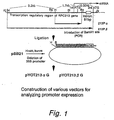
- Fig. 1 shows a process of constructing vectors for analyzing the expression of a promoter.
- B, Bg, H, Sc and S1 respectively stand for BamHI, BglII, HindIII, SacI and SalI.
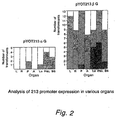
- Fig. 2 consists of graphs wherein a summary of the results is shown of the analysis of the expression sites of the 213 promoter by using GUS.
- the abscissa indicates the organs of transformants wherein the GUS expression is examined, while the ordinate indicates the number of transformants showing the expression in the corresponding organ.
- a black bar represents strong expression; a striped bar moderate to weak expression; a gray bar very weak expression; and a white bar no expression in addition, L denotes leaf; R root; P pistil; A for anther; Lo lodicule; P&L palea/lemma; and BS spikelet base.
- Fig. 3 shows a process of preparing an ATG-free fragment.
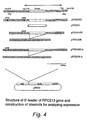
- Fig. 4 shows the structures of the plasmids used in the transient assay.
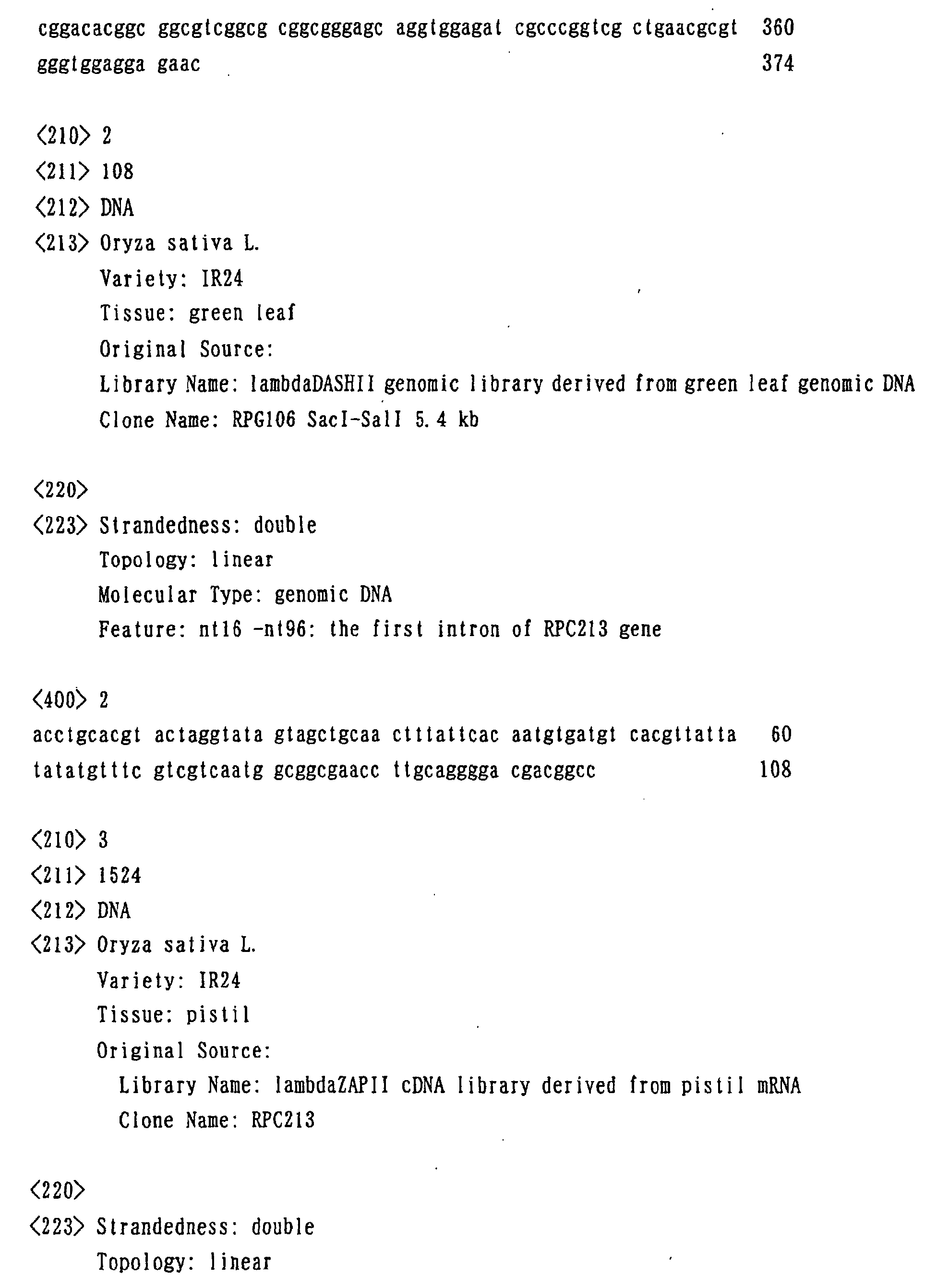
- a DNA fragment which comprises the sequence (SEQ ID NO:1) from around the transcription initiation point to immediately before the third ATG of a gene (PRC213 gene; SEQ ID NO:3) which can be isolated as the gene expressed predominantly in rice flower organs, or a part of said DNA fragment strongly promoted gene expression regardless of an intron whether is contained in the DNA fragment, whereby the present invention has been accomplished.
- the DNA fragment of the present invention was observed to have the effect of enhancing gene expression during the course of analyzing the promoter expression of RPC213 gene.
- the DNA fragment was inserted between a cauliflower mosaic virus 35S RNA gene promoter and ⁇ -glucuronidase (GUS) gene and introduced into a corn protoplast expression system whereby it has confirm that a remarkable potentiation of GUS activity was attained as compared with a system where the novel fragment is not introduced.
- GUS ⁇ -glucuronidase
- This effect is not specific to rice flower organs but is reproduced in many plant cells.
- the RPC213 gene can be isolated as a gene predominantly expressed in rice flower organs from, for example, a paddy rice variety IR24 as will be described in Example 1 hereinafter.
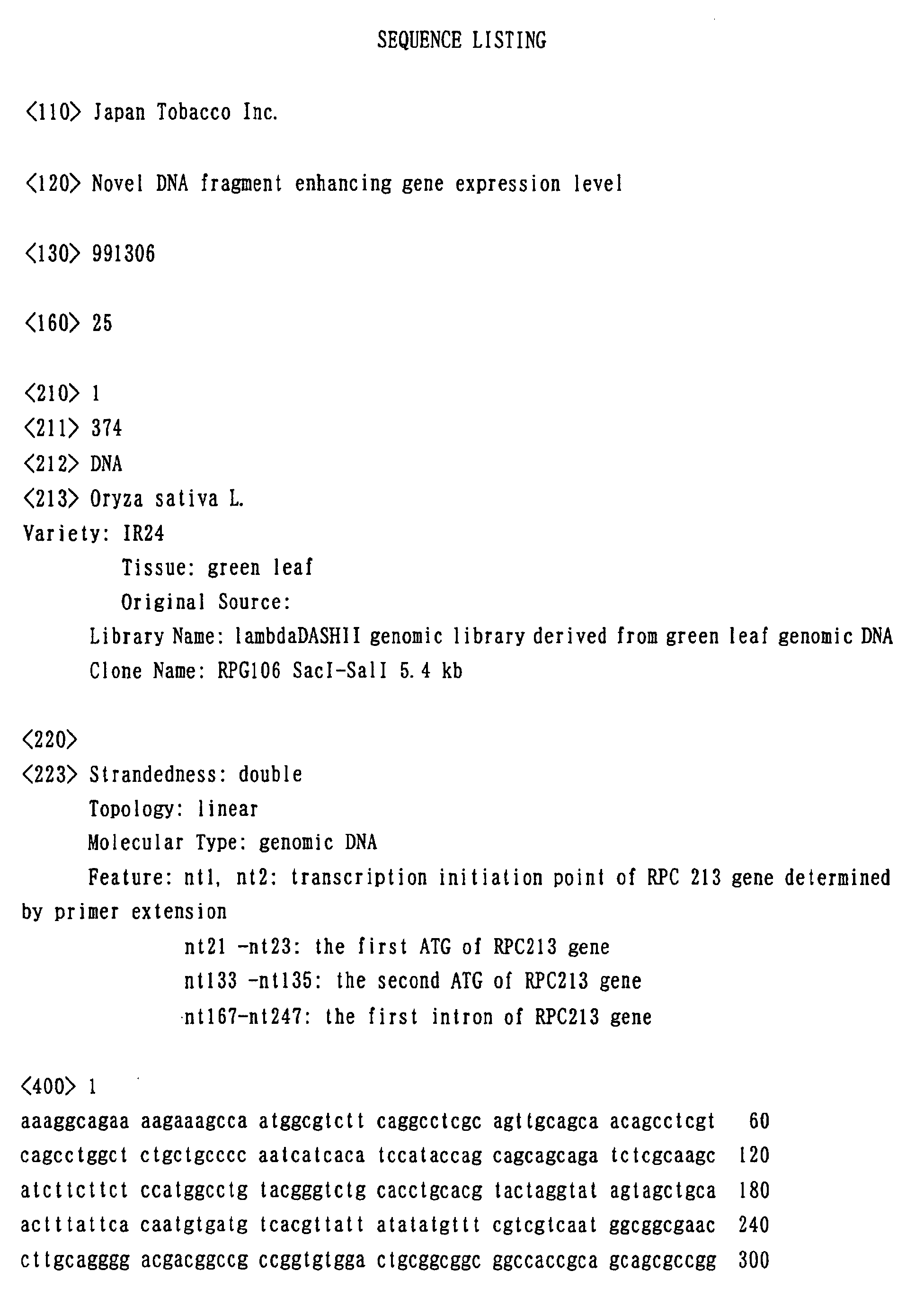
- a genomic sequences provided from the transcription initiation point to immediately before the third ATG of the RPC213 gene represented by SEQ ID NO:1 in Sequence Listing.
- This sequence contains an 81 bp intron and consists of 374 nucleotides. It has been confirmed that gene expression can be enhanced by 90-fold or more by inserting this sequence between the promoter and the gene to be expressed, using the above-described expression system, as compared with a case where no such insertion is performed.
- the sequence corresponds to the nucleotide sequence of the positions from 4996 to 5369 in SEQ ID NO:4, which is the nucleotide sequence of the RPC213 genomic clone (RPG106; see Example 2 E) as will be given hereinafter).
- a modified genomic sequence represented by SEQ ID NO:7 is almost the same as the genomic sequence represented by SEQ ID NO:1 derived from the RPC213 gene, but the T (thymine) residues of two ATGs located in different reading frames have been converted into A (adenine). After splicing the intron from this sequence, therefore, the resultant sequence contains no ATG. Thus the possibility that the translation of the gene would be initiated from the ATG of RPC213-origin is eliminated. It has been confirmed that this sequence very strongly potentiates gene expression, using the above-described expression system (i.e., about 60-fold).
- This sequence consists of 325 nucleotides formed by deleting 34 bp in the 5'-side and 15 bp in the 3'-side from the sequence represented by SEQ ID NO:1, and by converting T (thymine) in the sole ATG (i.e., the second ATG of RPC213) contained in SEQ ID NO:1 into A (adenine).
- the 81 bp intron is contained therein.
- the sequence corresponds to the nucleotide sequence of the positions from 5030 to 5354 in the sequence represented by SEQ ID NO:4, and it has been confirmed that the sequence strongly potentiates gene expression (i.e., by about 11-fold). After splicing the intron from this sequence, the resultant sequence contained no ATG. Thus the possibility that the translation of the gene would be initiated from the ATG of RPC213-origin is eliminated.
- a sequence represented by SEQ ID NO:2 This sequence consists of 108 nucleotides formed by adding a 15 bp exon sequence to the 5'-side and a 12 bp exon sequence to the 3'-side of the 81 bp intron sequence of the RPC213 gene.
- the sequence corresponds to the nucleotide sequence of the positions from 5147 to 5254 in the sequence represented by SEQ ID NO:4, and it has been confirmed that the sequence potentiates gene expression by about 4-fold. After splicing the intron from this sequence, the resultant sequence contains no ATG.
- a cDNA sequence represented by SEQ ID NO:8 corresponds to cDNA of RPC213 gene from the transcription initiation point to immediately before the third ATG.
- the sequence contains no intron and consists of 293 nucleotides, and corresponds to the nucleotide sequence of the positions from 2 to 294 in the sequence represented by SEQ ID NO:3; but the T (thymine) residues of two ATGs located in different reading frames have been converted into A (adenine).
- T (thymine) residues of two ATGs located in different reading frames have been converted into A (adenine).
- the present invention provides the DNA fragment comprising the sequence represented by SEQ ID NO:1 or a part thereof, DNA fragments comprising the above-described sequence either containing or not containing the intron, and DNA fragments which can be easily obtained by modifying the above-described DNA fragment and maintain potentiation of gene expression (for example, a DNA fragment containing a nucleotide of from one of the nucleotides at around from 1- to 151-positions to one of the nucleotides at around from 259- to 374-positions, which may or may not contain the intron, and which is capable of enhancing the expression a gene).
- the DNA fragment comprising the sequence represented by SEQ ID NO:1 can be isolated from rice as will be described in Examples given hereinafter. Alternatively, it can be easily obtained by PCR, using rice genome as a template and two oligonucleotides complementary to each end of the sequence respectively, represented by SEQ ID NO:1, as primers. Alternatively, the fragment can be prepared by synthesizing the full sequence or parts thereof by using a DNA synthesizer, followed by appropriate ligation. Also, the sequences comprising the nucleotides represented by SEQ ID NOS:2, 5, 7 or 8 can be prepared as will be described in Examples, or it is possible to prepare these sequences by synthesizing the full sequence or parts thereof by using a DNA synthesizer followed by appropriate ligation.
- DNA fragments having sequences derived from the sequences represented by SEQ ID NOS:1, 2, 5, 7 or 8 or ⁇ part thereof by deletion, substitution, insertion or addition of one or more nucleotides also fall within the scope of the present invention, so long as they potentiate gene expression.
- the deletion, substitution, insertion or addition of nucleotide(s) can be performed by, for example, site-directed mutagenesis which is a well known technique (see, for example, Nucl. Acids Res. 10:6487-6500, 1982).
- one or more nucleotides means a number of nucleotides such as allows deletion, substitution, insertion or addition by the site-directed mutagenesis method. For instance, the deletion, substitution, insertion or addition of 10 or less nucleotides, preferably 5 or less nucleotides.
- Site-directed mutagenesis can be carried out in the following manner with the use of a synthetic oligonucleotide primer which is complementary to the single-stranded phage DNA to be mutated, excluding a specific disagreement corresponding to the desired mutation.
- a complementary chain is synthesized by the phage with the use of the above-described synthetic oligonucleotide as the primer, and then a bacteria host carrying the phage is transformed by the double-stranded DNA thus obtained.
- the culture of the transformed bacterium is plated on agar, and plaques are formed from individual cells carrying the phage.
- plaques are hybridized with a synthetic probe, having been treated with a kinase, at a temperature at which the plaques having the same sequence as the above-described mutated DNA are hybridizable but those having the intact sequence are not.
- the plaques hybridizable with the probe are taken up and incubated to thereby collect the DNA.
- DNA fragments which have the same effect of potentiating gene expression as the DNA fragment according to the present invention but which differ somewhat in sequence from the sequence represented by SEQ ID NO:1 may be obtained by PCR with the use of a plant genome other than rice as a template, and two oligonucleotides respectively complementary to both ends of the sequence represented by SEQ ID NO:1 as primers.
- DNA fragments are hybridizable under stringent conditions with a DNA fragment comprising the sequence represented by SEQ ID NO:1. Accordingly, such DNA fragments are also included in the scope of the present invention, so long as they are capable of enhancing the expression of a gene.
- stringent conditions as used herein means, for example, from room temperature to 42°C in the presence of 6 x SSC, 5 x Denhart's solution, 0.1% SDS and 50% formamide.
- the DNA fragment according to the present invention potentiates gene expression.
- potentiating or enhancing gene expression mean that, when a DNA fragment according to the present invention is integrated into the upstream, downstream, or preferably between a promoter and a gene controlled by this promoter, expression of the gene is elevated at least 1-fold (preferably 2-fold, still preferably 3-fold or more) compared with a case where no such integration is made.
- the gene to be potentiated with regard to the expression thereof is preferably a foreign gene, it may be a gene inherent to the cell.
- any expression system may be used.
- the present invention further provides a method which comprises integrating one of the DNA fragments of the present invention into a DNA construct comprising a DNA fragment wherein a foreign gene to be expressed in host cells is located downstream of a promoter and then transforming the host cells by the DNA construct, thereby potentiating a higher expression of the foreign gene in the host cells compared with the case where the host cells are transformed by a DNA construct free from the DNA fragment.
- Examples of the host cells include eucaryotic cells such as animal cells, plant cells and fungus cells. It is preferred to use plant cells, still preferably monocotyledonous cells.
- the foreign gene may be any gene which can be expressed in the host cells employed. It may be a gene either encoding or not encoding a protein, for example, a gene for allowing the transcription of an antisense RNA.
- the promoter may be any promoter capable of functioning in the host cells employed.
- the DNA fragment according to the present invention can be integrated by ligating the DNA fragment of the present invention together with a promoter and a foreign gene under control of acid promoter to a vector or a plasmid compatible with the host and then transforming the host cells with this vector or plasmid. It is preferred that the vector or plasmid has a marker for screening the transformant.
- the DNA fragment of the present invention is integrated preferably between the promoter and the foreign gene, the integration site is not limited thereto so long as the DNA fragment can achieve its effect of potentiating gene expression.
- the transformed host cells may carry the DNA fragment the promoter and the foreign gene in a state where they are either integrated into the chromosome or integrated into the expression vector.
- the expression of the foreign gene may be either the transcription rate of the foreign gene, the accumulation of the transcriptional product, the accumulation of a protein or in the case where the protein is an enzyme an enzymatic activity.
- Paddy rice varieties "Tsukinohikari” and “IR24” were grown in a greenhouse and subjected to the following experiments.
- the tissues to be used in the reverse transcription PCR experiment were treated with DNase I (FPLCpure, manufactured by Pharmacia) in the presence of RNase inhibitor (RNAguard, manufactured by Pharmacia), rather than being subjected to lithium chloride precipitation, so as to minimize the contamination with any trace amount of DNA.
- DNase I FPLCpure, manufactured by Pharmacia
- RNase inhibitor RNAguard, manufactured by Pharmacia
- 0.375 ⁇ g/ ⁇ l of the total nucleic acid and 1.75 U/ ⁇ l of RNase inhibitor were added in a buffer (40 mM Tris-Cl pH 7.5, 6mM MgCl 2 ) and 0.375 U/ ⁇ l of DNase I (each expressed in the final concentration) was added thereto. After maintaining at 37°C for 10 to 30 minutes, DNase I was inactivated by extracting with phenol/chloroform.
- the leaf and root [expressed in root(soil) in Table 1 as will be given hereinafter] were collected from a plant grown for 1 month a the greenhouse after sowing.
- the immature pistil was collected from a plant 1 to 2 weeks before earing.
- the mature pistil, anther, lodicule and palea and lemma were collected from a plant immediately to several days before flowering.
- the immature seed was collected from a plant 1 to 2 weeks after flowering.
- the germinating seed and root were obtained from a plant aseptically grown on an N6 medium (Chu et al. Scientia Sinica, 18, 659-668, 1975) respectively for 1 and 3 weeks after sowing.
- the callus was induced from a seed in an N6 solid medium containing 2 mg/l of 2,4-D and then cultured before use in a liquid medium of the same composition under shaking for 3 weeks.
- the total RNA of the pistil and leaf was purified to provide polyA+RNA by using Oligotex-dT30 super (manufactured by Takara Shuzo Co., Ltd.) in accordance with the manufacturer's instructions.
- cDNA About 1 ⁇ g of polyA+RNA isolated and purified from pistil was employed as a template to synthesize the cDNA by using ZAP-cDNA Synthesis Kit (manufactured by STRATAGENE).
- the cDNA was connected to an EcoRI adapter in accordance with the manufacturer's instructions, digested with XhoI and then ligated into a vector UniZAP XR.
- the phage DNA was packaged into phage particles by using Giga pack Gold packaging extract (manufactured by STRATAGENE).
- plaques selected by the primary screening were stored in 200 ⁇ l of SM buffer (0.1 M NaCl, 7 mM MgSO 4 , 50 mM Tris-Cl pH 7.5, 0.01% gelatin) containing one drop of chloroform at 4°C.
- SM buffer 0.1 M NaCl, 7 mM MgSO 4 , 50 mM Tris-Cl pH 7.5, 0.01% gelatin
- the thus stored liquid was diluted and the phage was plated so as to give a considerably low plaque density (10 to 100 pfu/plate).
- a single plaque was isolated and stored in the same buffer.
- a plating lysate containing the phage at a high concentration was prepared and in vivo excision was performed in accordance with the instructions attached to ZAP cDNA Synthesis Kit.
- a plasmid [pBluescriptSK(-)] was prepared from the phage genome.
- the cDNA clone "RPC213" screened in the above C) was subjected to Northern hybridization to examine the expression patterns and expression levels in various organs. Filters were prepared in the following manner.
- RNA was transferred onto a nylon membrane Gene Screen Plus (manufactured by DU PONT) by the conventional method. After drying in vacuo at 80°C for 1 hour, the filter was boiled in 20 mM Tris-Cl (pH 8.0) for 5 minutes to remove Glyoxal.
- the 1.5 kb EcoRI-XhoI fragment of the above-mentioned cDNA was RI-labeled by using Multiprime Labeling System (manufactured by Amersham). Pre-hybridization and hybridization were carried out in accordance with the manufacturer's instructions attached to the filter.
- the filter was successively washed with 2 x SSC, 1% SDS and 0.2 x SSC, 1% SDS at room temperature each for 5 minutes, then twice with 0.16 x SSC, 1% SDS at 65°C for 15 minutes, and then with 2 x SSC at room temperature for 1 minute. Subsequently, Kodak X-Omat Film was exposed to the filter at -70°C overnight.
- the nucleotide sequence was determined from both of the 5'-(EcoRI) and 3'-(XhoI) sides. Based on the DNA sequence of about 400 nucleotides (mRNA sense strand) in the 3'-side, the following primers: and were synthesized with DNA Synthesizer (manufactured by ABI), purified by OPC Cartilage (manufactured by ABI) and employed in the reverse transcription PCR experiment, it is expected that a product of about 250 bp might be amplified with these primers. Also, the following primers synthesized on the basis of the sequence of rice actin 1 gene (RAc1, McElroy et al. Plant Mol. Biol.
- the mixture was maintained at 37°C for 60 minutes in 100 ⁇ l of a reaction mixture comprising 1 x 1st strand buffer (manufactured by BRL), 0.5 mM of dNTPmix, 10 mM of DTT, 2 U/ ⁇ l of RNase inhibitor (RNAguard, manufactured by Pharmacia) and 10 U/ ⁇ l of reverse transcriptase Superscript (manufactured by BRL) (each expressed in the final concentration).
- RNAguard RNase inhibitor
- BRL reverse transcriptase Superscript
- PCR was carried out under the following conditions. 1 ⁇ l of the cDNA dilution was mixed with 0.5 pmole/ ⁇ l of primer, 0.2 mM dNTP, 1 x PCR buffer and 0.05 U Taq Polymerase (manufactured by Takara Shuzo) (each expressed in the final concentration) to give 20 ⁇ l of a reaction mixture.
- GeneAmp 9600 manufactured by Perkin Elmer
- the reaction mixture was subjected to PCR consisting of 3 minutes at 94°C for 1 cycle, 0.5 minutes at 94°C, 1 minute at 60°C and 1 minute at 72°C for 30 cycles and 6 minutes at 72°C for 1 cycle.
- the PCR product was electrophoresed on an agarose gel, stained with ethidium bromide and then photographed. Bands were compared with each other in density and 2 samples showing the same density were evaluated as containing cDNA originating from RPC213 gene in the same amount.
- PCR was carried out for the reverse transcription product of the total RNA prepared from each of the organs by using the Rac1 gene primers seemingly expressed constitutionally in all of rice organs.
- the expected 267 bp PCR product was detected from all of the organs examined while the 350 bp product was not detected. Therefore it was considered that the template cDNA was not contaminated with genomic DNA.
- Leaf, germinating seed and root showed no PCR product, when the template cDNA was diluted to less than 100 ng. It was estimated based on the presence or absence or the densities of the band that the expression level in palea and lemma was about 1 to 1/10, those in anther, immature seed and callus were about 1/10 and those in other organs were about 1/100, taking the expression level in mature pistil as 1.
- cDNAs prepared from whole mature pistil, stigma of mature pistil, ovary of mature pistil, whole immature pistil and lodicule were employed as templates. Also, use was made of leaf cDNA and plasmid DNA as controls.
- PCR as a control experiment was carried out by using the actin primers. As a result, the 267 bp product was amplified from all of the template cDNAs. Then PCR was carried out with the use of RPC213-specific primers. As a result, when 10 ng of cDNA was employed as a template, the PCR product was detected in all of the organs but leaf.
- immature pistil, stigma and lodicule showed the PCR product even though the template was diluted to 0.1 ng, while mature pistil and its ovary showed the PCR product only up to the template dilution of 1 ng.
- the results of the reverse transcription PCR indicate that the RPC213 gene is strongly and predominantly expressed in immature pistil, mature pistil stigma and lodicule but weakly in mature pistil ovary and palea and lemma and scarcely in other organs.
- Table 1 summarizes the results of the Northern analysis and the results of the RT-PCR.
- the entire nucleotide sequence of the cDNA clone RPC213 (about 1.5 kb), which is expressed specifically in flower organs, was determined in the following manner with the use of Fluorescence Sequencer (Model 373A, manufactured by Applied Biosystems). Based on the nucleotide sequence data obtained by using the M13 primers (manufactured by Takara Shuzo Co., Ltd.) described above, primers were synthesized and the nucleotide sequence in the undecoded region was determined. By repeating this primer walking procedure, the nucleotide sequence of RPC213 having 1496 bp in total was determined. The reading frame with the largest ORF was identified by the ORF analysis.
- polyA signal-like sequences (Heidecker and Messing, Annu. Rev. Plant Physiol. 37, 439-466, 1986) were located about 70 bp and 90 bp downstream of the terminator codon TGA.
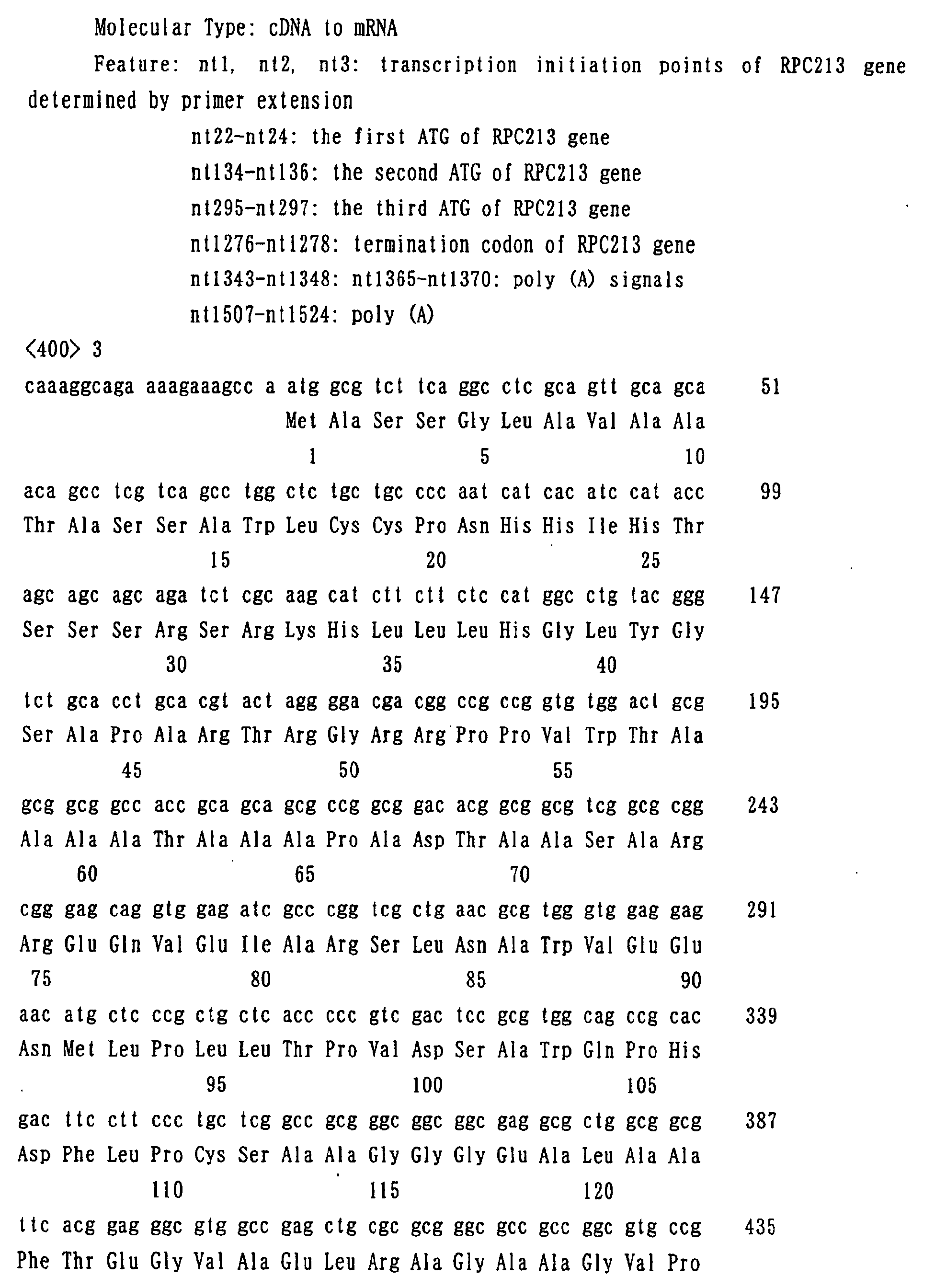
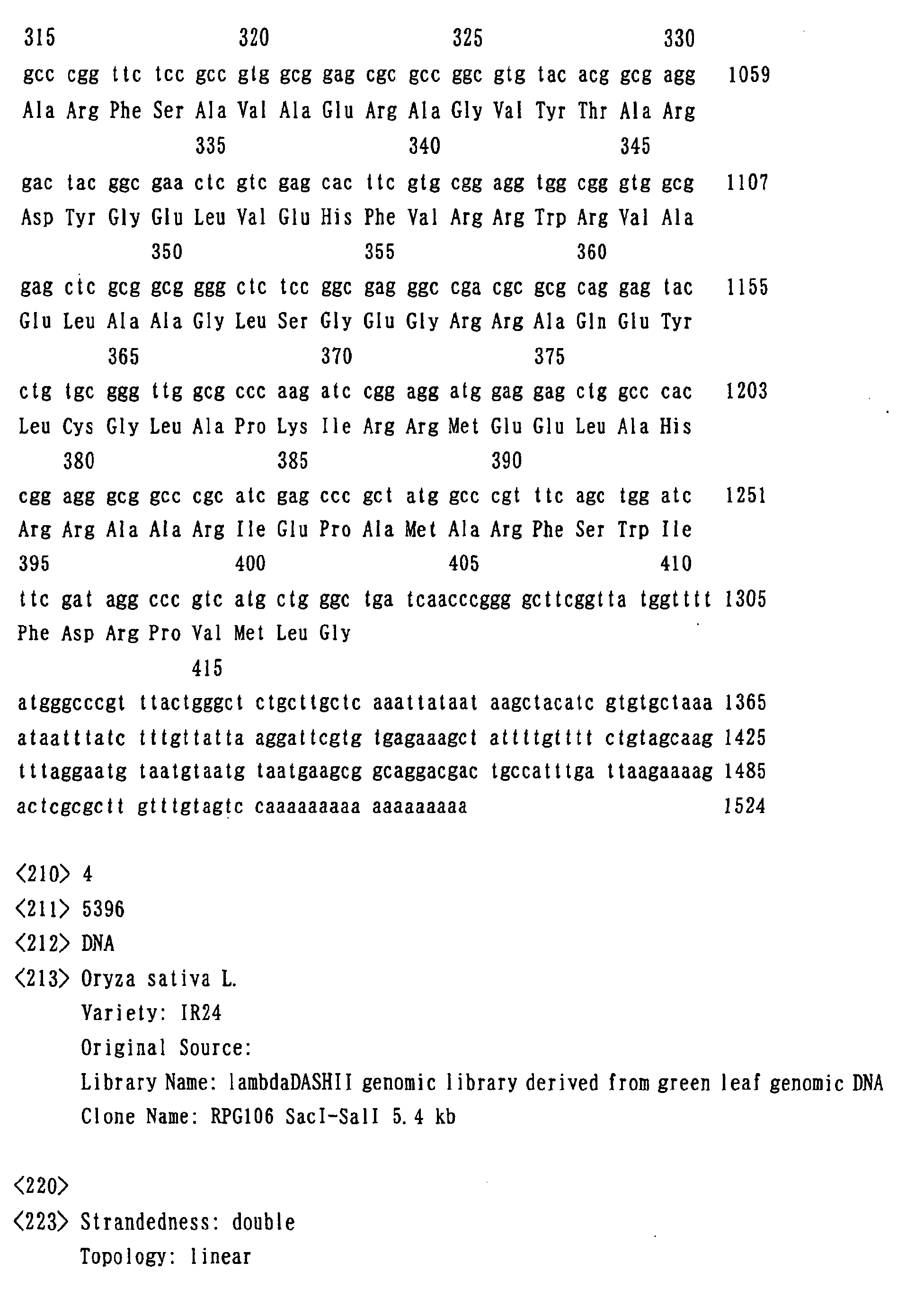
- the entire nucleotide sequence of RPC213 is presented in SEQ ID NO:3.
- the nucleotide sequence of SEQ ID NO:3 has 1524 bp including 28 bp following the transcription initiation points which were added by reference to the nucleotide sequence of genome clone as will be described hereinafter.
- Genomic DNA was isolated by the SDS-phenol method and purified by the lithium chloride precipitation method from "IR24" rice leaves about 2 months after sowing.
- the DNA was first partly digested with a restriction enzyme MboI (manufactured by Takara Shuzo Co., Ltd.) and then subjected to centrifugation on a sucrose density gradient.
- Sucrose was dissolved in a buffer (20 mM Tris-HCl pH 8.0, 1 mM EDTA, 200 mM NaCl) to give a gradient of 5 concentrations (10, 17.5, 25, 32.5 and 40%).
- sucrose solutions were layered in this order from the bottom in a centrifugation tube (40PA, manufactured by Hitachi) and finally the partly digested DNA solution was layered on top of the gradient.
- a centrifugation tube 40PA, manufactured by Hitachi
- the mixture was fractioned into 80 portions (0.5 ml each) with a peristaltic pump to provide a fraction containing DNA fragments of 16 to 23 kb in the largest amount.
- This DNA fraction was then ligated into a vector ⁇ DASH II/BamH (manufactured by STRATAGENE) with the use of T4 DNA ligase (manufactured by BOEHRINGER MANNHEIM) and then packaged into phage particles by using a Gigapack II Gold packaging extract (manufactured by STRATAGENE).
- a nylon membrane filter Hybond N+ (manufactured by Amersham) was brought into contact with the plaque surface and then processed in accordance with the manufacturer's instructions attached to the filter.
- the probe used in the plaque hybridization was a 0.6 kb EcoRI-SalI fragment in the 5'-side of the rice flower organ-specific cDNA (RPC213) which was used after being RI-labeled with the use of Multiprime Labeling System (manufactured by Amersham).
- Example 1 C The hybridization and washing were effected under the same conditions as those specified in the above Example 1 C). From 100,000 plaques, six positive clones were thus selected. Next, phage DNAs were prepared from these plaques. They served as templates in the PCR which was performed with the use of the RPC213-specific primers 213S and 213AS. As a result, the expected product of about 250 bp was found to have been amplified in two clones named RPG106 and RPG107.
- DNA was extracted from the above-mentioned two RPC213 genomic clones, digested with SacI and HindIII (manufactured by Takara Shuzo Co., Ltd.) and then fractionated on a 0.8% agarose gel. Also, DNA was isolated and purified by the phenol-SDS method (Komari et al. Theor. Appl. Genet. 77, 547-552, 1989) from paddy rice plants of varieties "Akihikari" and "IR24" about 1 month after sawing. About 5 ⁇ g of DNA was digested with SacI and HindIII and electrophoresed similarly to the above case.
- DNA bands were blotted onto a nylon membrane filter HybondN+ (manufactured by Amersham) and Southern hybridization was performed by using as a probe the above-mentioned cDNA fragment of 0.6 kb having been RI-labeled as in Example 1 D).
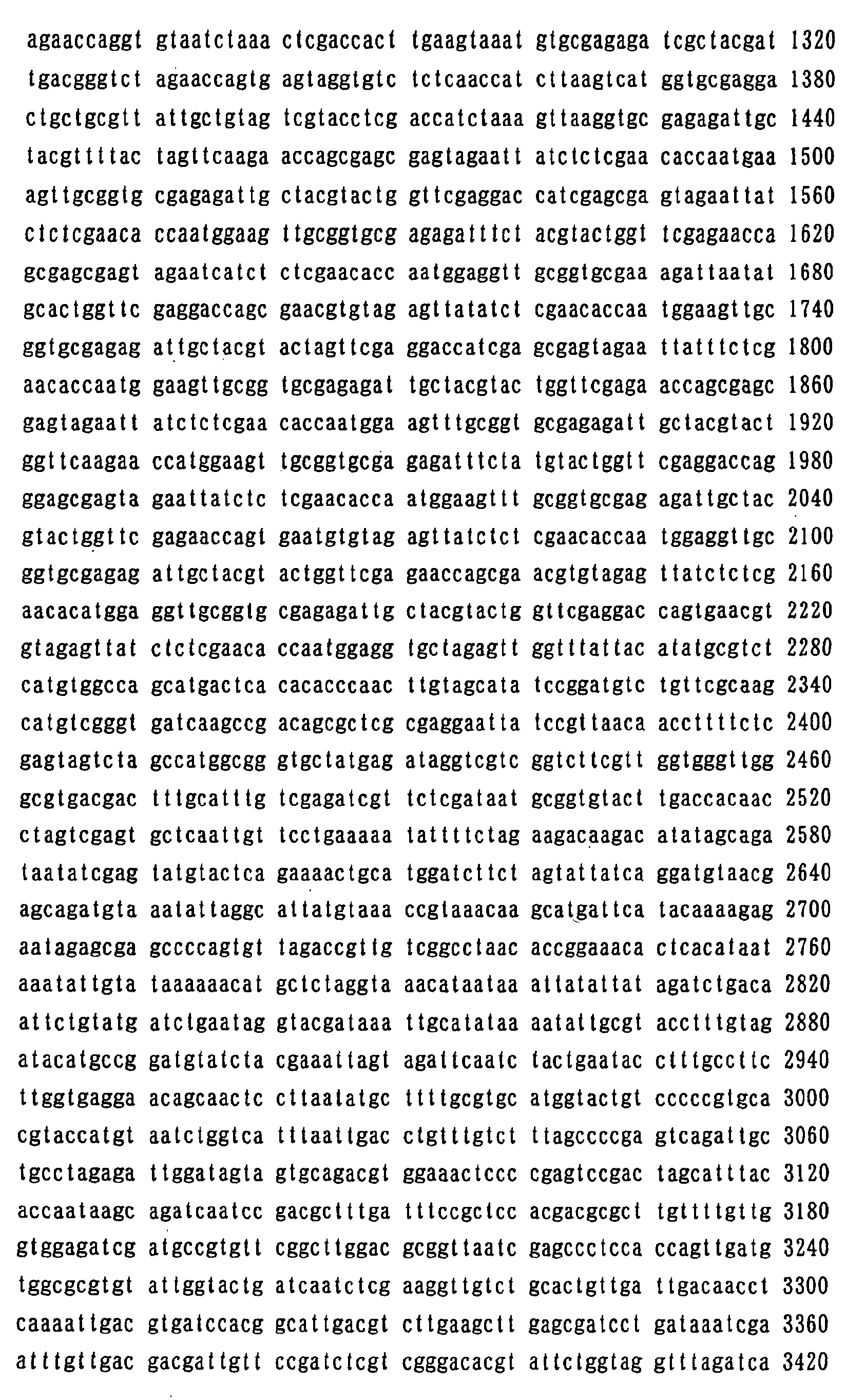
- the genomic clone RPG106 has four BglII sites. By using these restriction sites, subcloning was carried out. Then the nucleotide sequences of both strands were determined by using M13 primer (manufactured by Takara Shuzo Co., Ltd.) with Fluorescence Sequencer (Model 373A, manufactured by Applied Biosystems). The nucleotide sequences in regions which could not be decoded by this method and in the vicinities of restriction sites used in the subcloning were determined by the primer walking method and thus the entire nucleotide sequence of RPG106 SacI-SalI 5.4 kb (total nucleotide sequences of 5396 bp) was determined.
- This nucleotide sequence is represented in SEQ ID NO:4.
- a comparison of this nucleotide sequence with the nucleotide sequence of the RPC213 cDNA clone indicated that the cDNA clone isolated by the differential screening was a partial length cDNA but contained the almost complete ORF. Namely, ATG was present 7 nucleotides upstream of the 5'-end of the isolated cDNA clone. The reading frame containing this ATG agreed with the cDNA reading frame as described above. It was also clarified that an 81 bp intron was located between the first ATG and the third ATG present in the same reading frame of the RPC213 gene. Further, the second ATG was located not in frame between the first ATG and the intron.
- RNAguard RNAguard, manufactured by Pharmacia
- a buffer 0.25 M KCl, 2 mM Tris-HCl pH 8.0, 0.2 mM EDTA
- vectors having a GUS reporter gene ligated therein were constructed in the following manner (Fig. 1).
- the vector used in this example was pSB21 (Komari et al. Plant J., 10, 165-174, 1996). Use was made of a single HindIII site and BamHI site located at both ends of the 35S promoter contained in this vector.
- RPG106 SacI 6.0 kbp (pBluescript) was co-digested with HindIII and BglII to give a promoter fragment which is the upstream reagion (about 1.8 kb) of the BglII site located at 87 bp downstream of the first ATG in the RPC213 gene.
- This fragment was ligated to vector pSB21 having been digested with the same enzymes to delete the 35S promoter.
- the obtained plasmid vector was named pYOT213aG.
- the first ATG of RPC gene and the ATG of the GUS gene are located in the same reading frame.
- the PCR was performed in a reaction system of 100 ⁇ l including these primers (100 pmole each), about 1 ⁇ g of DNA obtained by preliminarily alkali-denaturing the template RPG106 and Extaq (manufactured by Takara Shuzo Co., Ltd.).
- the reaction mixture was subjected to PCR consisting of 3 minutes at 94°C for 1 cycle, 1 minute at 94°C, 1 minute at 60°C and 2.5 minutes at 72°C for 20 cycles and 6 minutes at 72°C for 1 cycle.
- the amplification product was cloned into pCRII (manufactured by Invitrogen) and then the nucleotide sequence was confirmed.
- This plasmid was digested with HindIII and BamHI and the RPC213 promoter fragment of 2.0 kb was isolated therefrom. Next, it was ligated to the vector pSB21 having been treated with the same enzymes to delete the 35S promoter.
- the plasmid thus obtained was further digested with HindIII and dephosphorylated, to which was inserted an RPG106 HindIII fragment of 3.3 kb prepared by digesting RPG106 SacI 6.Okb (pBluescript) with HindIII.
- the resultant plasmid vector was named pYOT213 ⁇ G.
- This vector had the GUS gene located downstream to the promoter which comprised a fragment of about 5.3 kb immediately upstream of the third ATG of the RPC213 gene.
- Rice transformation was carried out using calli developed from immature rice embryo of the variety "Tsukinohikari" in accordance with the method of Hiei et al. (Plant J., 6, 271-282, 1994).
- the 13 individuals having pYOT213 ⁇ G introduced thereinto were examined.
- five individuals pYOT213 ⁇ G-3, 7, 8, 16 and 17
- two individuals pYOT213 ⁇ G-7 and 8) presented results well agreeing to the results of Northern hybridization and RT-PCR, i.e., relatively strong GUS expression in pistil and lodicule and very weak expression in anther.
- eight transformants other than those showing the flower organ-specific expression while the GUS expression in leaf and root was also observed, relatively strong promoter activity in flower organs was observed.
- pYOT213 ⁇ G-6 which showed the GUS expression in leaf and root, exhibited much stronger expression in inter alia pistil. Also, weak expression was observed in palea and lemma, anther, lodicule and spikelet base. pYOT213 ⁇ G-17 showed very weak or no expression in leaf and root but relatively strong expression in pistil. In pistil of the transformants having pYOT213 ⁇ G introduced thereinto, the GUS expression was observed mainly in stigma, i.e., stigma axis and hairy tissues in stigma.
- the expression of the GUS gene by the promoter activity was observed in about 2/3 of the all individuals and more than 1/2 thereof (five and six individuals, respectively) showed strong GUS expression. Also, two individuals showed strong expression in spikelet base.
- the RPC213 gene has the first ATG 21 bp downstream to the most upstream transcription initiation point.
- An 81 bp intron (first intron) is located 146 bp downstream to the first ATG while the third ATG is located 354 bp downstream to the first ATG.
- first intron an 81 bp intron
- second ATG another ATG
- TGA termination codon
- the first intron of the RPC213 gene and the exon sequence containing the same from the transcription initiation point to immediately before the third ATG were cloned.
- a pair of primers as shown below were synthesized for amplifying the first intron: and Moreover, a pair of primers as shown below were synthesized for amplifying the sequence containing the first intron from the transcription initiation point to immediately before the third ATG: and These primers each had an XbaI or SmaI restriction site integrated for the subsequent cloning.
- a 15 bp exon and a 12 bp exon were added respectively to the 5'-side and the 3'-side, in addition to the 81 bp intron.
- the DNA fragment containing the first intron and obtained by using the primers for amplifying the sequence from the transcription initiation point to immediately before the third ATG consisted of 374 bp.
- the PCR mixture comprised, in 50 ⁇ l of the reaction mixture, 10 ng of the template DNA (RPG106 SacI 6.0 kb), 10 pmoles of the primers, 0.2 mM of dNTPs, 1 x GC buffer (takara) and 2.5 U of Ex-taq.
- the PCR consisted of 3 minutes at 96°C for 1 cycle, 1 minute at 96°C, 1 minute at 55°C and 1 minute at 72°C for 30 cycles and finally 6 minutes at 72°C for 1 cycle.
- the PCR product was once cloned into a vector pCRII (manufactured by Invitrogen) to thereby confirm the nucleotide sequence.
- the nucleotide sequence of each of the PCR products completely agreed with the nucleotide sequence of the corresponding template DNA.
- a primer comprising the sequence around the first ATG of the RPC213 gene wherein ATG had been substituted by AAG: was synthesized. This was used in combination with the above-described 2131edRV1 and PCR was carried out by using RPG106 SacI 6.0 kb as a template (Fig. 3A). The composition of the PCR mixture and the reaction conditions were as in the case of pYT213RI and pYT213I. The PCR product was cloned into pCRII and the nucleotide sequence was confirmed. Then it was co-digested with restriction enzymes XbaI and SmaI and the obtained fragment was integrated into vector pBI221 having been digested with the same enzymes (plasmid A).
- a restriction site StuI is present 11 bp downstream to the first ATG and another restriction site MluI is present 20 bp upstream to the third ATG. Further, a restriction site BglII is located between the first ATG and the intron and another restriction site Eco52I is located between the intron and the third ATG, as shown in Fig. 3.
- the above-described RPG106 SacI 6.0 kb was co-digested with restriction enzymes StuI and MluI and the obtained fragment (about 0.32 kb) was blunted at both ends by treating with klenow (takara).
- this fragment was ligated to a plasmid prepared by digesting pBI221 with SmaI and CIP-treating to thereby construct a plasmid in which a sequence comprising the first intron and the adjacent exon were integrated in the correct direction between the 35S promoter and the GUS gene (plasmid B).
- a primer comprising the sequence around the second ATG wherein the ATG had been substituted by AAG: and a primer complementary thereto: were synthesized.
- PCR was carried out separately by the combination of 213FWlink and 213RV3E52 or, 213FW5Bg and 213RVlink (first PCR, Figs. 3B and 3C).
- 800 ng of the template DNA [RPG106 SacI 6.0 kb (Fig. 3B) or RPC213 cDNA (Fig.
- the PCR product obtained by the combination of 213FWlink and 213RV3E52 and the PCR product obtained by the combination of 213FW5Bg and 213RVlink were introduced into a single tube.
- the second PCR was carried out.
- 213FW5Bg and 213RV3E52 were used as external primers.
- 100 to 500 ng of the template DNA, 100 pmoles of the primers, 0.2 mM of dNTPs, 1 x Ex-taq buffer (takara) and 5.0 U of Ex-taq were used in 100 ⁇ l of reaction mixture.
- the PCR consisted of 3 minutes at 98°C for 1 cycle, 1 minute at 98°C, 1 minute at 60°C and 1 minute at 72°C for 10 cycles and finally 6 minutes at 72°C for 1 cycle.
- a 201 bp fragment (frg. 3 in Fig. 3B) was amplified in case of using the genomic clone (RPG106b SacI 6.0 kb) as the template while a 120 bp fragment (frg. 6 in Fig. 3C) was amplified in case of using the cDNA clone (RPC213 cDNA) each as expected.
- the 201 bp fragment derived from the genomic sequence as the linking PCR product was co-digested with restriction enzymes BglII and Eco52I and then integrated into the plasmid A or the plasmid B having been digested with the same enzymes, thereby providing pYT213RI-A and pYT213dRI respectively (Fig. 4).
- the 120 bp fragment derived from the cDNA sequence was co-digested with BglII and Eco52I and then integrated into the plasmid A and the plasmid B having been digested with the same enzymes to thereby provide pYT213R-A and pYT213dR respectively (Fig. 4).
- the nucleotide sequences of the RPC213 gene-origin DNAs integrated into pYT213dRI, pYT213dR, pYT213RI-A and pYT213R-A are represented respectively by SEQ ID NOS:5 to 8 in Sequence Listing.
- the RPC213-origin sequence contained in pYT213RI-A comprises the full sequence from the transcription initiation point to immediately before the third ATG containing the intron and thymine (T) residues in the first ATG and the second ATG have been substituted by A (adenine). In pTY213R-A, no intron is contained.
- pYT213dRI 32 bp in the 5'-side and 20 bp in the 3'-side in the sequence of the RPC213 gene-origin sequence of pYT213RI-A have been deleted (i.e., first ATG not contained). Further, the intron sequence has been deleted in pYT213dR.
- Protoplasts were isolated form ethiolated corn leaf.
- the plant material, the growth conditions and the procedure of isolating the protoplasts were basically determined in accordance with Sheen's report (Sheen, Plant Cell 3, 225-245, 1991).
- the isolated protoplasts were suspended in an electroporation buffer (4 mM Mes-NaOH containing 0.6 M of mannitol and 20 mM of KCl, pH 5.7).
- the electroporation was performed by using Gene Pulser (manufactured by Biorad) at 125 ⁇ F and 400 V/cm.
- Lysis Reagent Luc manufactured by Toyo Ink MFG., Tokyo, Japan
- the mixture was disrupted by ultrasonication to thereby extract the enzymes.
- GUS assay fluorescence assay
- the luciferase activity was assayed by using PicaGene (Toyo Ink MFG.).
- the GUS activity was standardized by the co-transformed luciferase activity (Leckie et al. Biotechniques 17:52-3, 56-7, 1994).
- Table 2 summarizes the results of the transient assay.
- Gene expression potentiating effects of first intron of RPC213 gene, sequence of from transcription initiation point to immediately before third ATG, and sequence containing first intron of from transcription initiation point to immediately before third ATG Plasmid Constrution Relative GUS activity pBI221 35Spro-GUS-NOS 1 pYT213RI 35Spro-2131eader+intron-GUS-NOS 92.9 pYT213I 35Spro-213intron-GUS-NOS 3.9 pYT213dRI 35Spro-213 ⁇ 5'&3'leader+intron-GUS-NOS 11.3 pYT213dR 35Spro-213 ⁇ 5'&3'leader-GUS-NOS 0.3 pYT213RI-A 35Spro-2131eader(-ATG)+intron-GUS-NOS 60.4 pYT213R-A 35Spro-2131eader(-ATG
- pYT2113RI showed a GUS activity 90 times or more higher than the pBI221 employed as the control. This fact indicates that the sequence containing the first intron of from the transcription initiation point to immediately before the third ATG of the RPC213 gene very strongly potentiates gene expression. The intron sequence alone showed a GUS activity 3.9 times higher than the control (pYT213I).
- the GUS protein generally sustains its activity when expressed as a fused protein.
- translation is initiated from the first ATG in the protoplasts originating in corn leaf
- an amino acid sequence consisting of 90 residues might be added to the N-end of the GUS protein.
- the GUS protein might be thus stabilized thereby resulting in the detection of the high GUS activity.
- another construct (ATG-free construct) wherein the translation was not initiated from the RPC213 gene-origin fragment was also tested.
- this ATG-free pYT213RI-A also showed a GUS activity 60 times or more higher than the control.
Landscapes
- Health & Medical Sciences (AREA)
- Genetics & Genomics (AREA)
- Life Sciences & Earth Sciences (AREA)
- Chemical & Material Sciences (AREA)
- Engineering & Computer Science (AREA)
- Organic Chemistry (AREA)
- Biomedical Technology (AREA)
- General Engineering & Computer Science (AREA)
- Biotechnology (AREA)
- Zoology (AREA)
- Molecular Biology (AREA)
- Wood Science & Technology (AREA)
- Bioinformatics & Cheminformatics (AREA)
- Biophysics (AREA)
- Biochemistry (AREA)
- General Health & Medical Sciences (AREA)
- Plant Pathology (AREA)
- Microbiology (AREA)
- Physics & Mathematics (AREA)
- Cell Biology (AREA)
- Botany (AREA)
- Gastroenterology & Hepatology (AREA)
- Proteomics, Peptides & Aminoacids (AREA)
- Medicinal Chemistry (AREA)
- Breeding Of Plants And Reproduction By Means Of Culturing (AREA)
- Measuring Or Testing Involving Enzymes Or Micro-Organisms (AREA)
- Micro-Organisms Or Cultivation Processes Thereof (AREA)
Abstract
Description








The remaining individuals showed very weak or no expression in these tissues. In flower organs, in contrast, strong promoter activity was observed in all organs except anther (i.e., pistil, lodicule, palea and lemma and spikelet base). In particular, all of the 13 individuals showed clear GUS expression in pistil and one of them showed an intense blue-stained GUS image, thus indicating strong expression. In lodicule and palea and lemma, the expression of the GUS gene by the promoter activity was observed in about 2/3 of the all individuals and more than 1/2 thereof (five and six individuals, respectively) showed strong GUS expression. Also, two individuals showed strong expression in spikelet base.
Thus, the effect of potentiating gene expression of this region was analyzed.








The 201 bp fragment derived from the genomic sequence as the linking PCR product was co-digested with restriction enzymes BglII and Eco52I and then integrated into the plasmid A or the plasmid B having been digested with the same enzymes, thereby providing pYT213RI-A and pYT213dRI respectively (Fig. 4). Similarly, the 120 bp fragment derived from the cDNA sequence was co-digested with BglII and Eco52I and then integrated into the plasmid A and the plasmid B having been digested with the same enzymes to thereby provide pYT213R-A and pYT213dR respectively (Fig. 4). The nucleotide sequences of the RPC213 gene-origin DNAs integrated into pYT213dRI, pYT213dR, pYT213RI-A and pYT213R-A are represented respectively by SEQ ID NOS:5 to 8 in Sequence Listing. The RPC213-origin sequence contained in pYT213RI-A comprises the full sequence from the transcription initiation point to immediately before the third ATG containing the intron and thymine (T) residues in the first ATG and the second ATG have been substituted by A (adenine). In pTY213R-A, no intron is contained. In pYT213dRI, 32 bp in the 5'-side and 20 bp in the 3'-side in the sequence of the RPC213 gene-origin sequence of pYT213RI-A have been deleted (i.e., first ATG not contained). Further, the intron sequence has been deleted in pYT213dR.
| Gene expression potentiating effects of first intron of RPC213 gene, sequence of from transcription initiation point to immediately before third ATG, and sequence containing first intron of from transcription initiation point to immediately before third ATG | ||
| Plasmid | Constrution | Relative GUS activity |
| pBI221 | 35Spro-GUS-NOS | 1 |
| pYT213RI | 35Spro-2131eader+intron-GUS-NOS | 92.9 |
| pYT213I | 35Spro-213intron-GUS-NOS | 3.9 |
| pYT213dRI | 35Spro-213Δ5'&3'leader+intron-GUS-NOS | 11.3 |
| pYT213dR | 35Spro-213Δ5'&3'leader-GUS-NOS | 0.3 |
| pYT213RI-A | 35Spro-2131eader(-ATG)+intron-GUS-NOS | 60.4 |
| pYT213R-A | 35Spro-2131eader(-ATG)-GUS-NOS | 10.5 |




Claims (9)
- A DNA fragment comprising a nucleotide sequence of from one of the nucleotides at around positions 1- to 152 to one of the nucleotides at around positions 259 to 374 in the sequence represented by SEQ ID NO:1 and being capable of enhancing the expression level of a gene.
- A DNA fragment comprising a nucleotide sequence of from the nucleotide at around position 1 to the nucleotide at around position 374 in the sequence represented by SEQ ID NO:1 and being capable of enhancing the expression level of a gene.
- A DNA fragment comprising a nucleotide sequence of from the nucleotide at around the position 35 to the nucleotide at around position 359 in the sequence represented by SEQ ID NO:1 and being capable of enhancing the expression level of a gene.
- A DNA fragment comprising a nucleotide sequence of from the nucleotide at around position 152 to the nucleotide at around position 259 in the sequence represented by SEQ ID NO:1 and being capable of enhancing the expression level of a gene.
- A DNA fragment comprising a nucleotide sequence derived from the nucleotide sequence as defined in any of claims 1 to 4 by the deletion of the part of the sequence from at around position 167 to at around position 247 in the sequence represented by SEQ ID NO:1 and being capable of enhancing the expression level of a gene.
- A DNA fragment comprising a nucleotide sequence derived from the nucleotide sequence as defined in any of claims 1 to 5 by the modification of one or both of the initiation codon ATG appearing first and the initiation codon ATG appearing secondly with a codon other than an initiation codon and being capable of enhancing the expression level of a gene.
- A DNA fragment containing a nucleotide sequence represented by SEQ ID NO:1, 2, 5, 7 or 8 or a nucleotide sequence derived therefrom by deletion, substitution, insertion or addition of one or more nucleotides and being capable of enhancing the expression level of a gene.
- A DNA fragment which hybridizes under stringent conditions with a DNA fragment comprising a nucleotide sequence represented by SEQ ID NO:1, 2, 5, 7 or 8, and capable of enhancing the expression level of a gene.
- A method of enhancing the expression of a foreign gene comprising introducing the DNA fragment as claimed in any of claims 1 to 8 into a DNA construct which is a DNA fragment having the foreign gene to be expressed in host cells at a location downstream of a promoter, and transforming the host cells with said DNA construct to thereby enhance the expression of the foreign gene as compared with a case where the host cells are transformed by the same DNA construct except that it does not contain the DNA fragment as claimed in any of claims 1 to 8.
Applications Claiming Priority (3)
| Application Number | Priority Date | Filing Date | Title |
|---|---|---|---|
| JP11232815A JP2001057886A (en) | 1999-08-19 | 1999-08-19 | Novel DNA fragment that increases gene expression |
| JP23281599 | 1999-08-19 | ||
| PCT/JP2000/005539 WO2001014543A1 (en) | 1999-08-19 | 2000-08-18 | Novel dna fragment elevating gene expression dose |
Publications (2)
| Publication Number | Publication Date |
|---|---|
| EP1127941A1 true EP1127941A1 (en) | 2001-08-29 |
| EP1127941A4 EP1127941A4 (en) | 2005-08-24 |
Family
ID=16945218
Family Applications (1)
| Application Number | Title | Priority Date | Filing Date |
|---|---|---|---|
| EP00953495A Withdrawn EP1127941A4 (en) | 1999-08-19 | 2000-08-18 | Novel dna fragment elevating gene expression dose |
Country Status (8)
| Country | Link |
|---|---|
| US (1) | US6660851B1 (en) |
| EP (1) | EP1127941A4 (en) |
| JP (1) | JP2001057886A (en) |
| KR (1) | KR20010075640A (en) |
| CN (1) | CN1211484C (en) |
| AU (1) | AU784399B2 (en) |
| CA (1) | CA2347218A1 (en) |
| WO (1) | WO2001014543A1 (en) |
Families Citing this family (4)
| Publication number | Priority date | Publication date | Assignee | Title |
|---|---|---|---|---|
| AU745131B2 (en) * | 1998-02-25 | 2002-03-14 | Japan Tobacco Inc. | Novel DNA fragments ordering gene expression predominant in flower organ |
| JP3776362B2 (en) * | 2002-02-18 | 2006-05-17 | キユーピー株式会社 | Frozen legume soup and method for producing the same |
| WO2003104452A1 (en) * | 2002-06-06 | 2003-12-18 | 日本たばこ産業株式会社 | Method of distinguishing gene participating in stigma exposure ratio in rice and method of modifying stigma exposure ratio in rice |
| JP5480785B2 (en) * | 2010-11-25 | 2014-04-23 | 三菱電機株式会社 | High frequency circuit board |
Family Cites Families (5)
| Publication number | Priority date | Publication date | Assignee | Title |
|---|---|---|---|---|
| JPH03103182A (en) | 1989-09-14 | 1991-04-30 | Mitsubishi Kasei Corp | Dna fragment to promote manifestation of adventitious gene |
| US5151866A (en) | 1990-03-30 | 1992-09-29 | The Dow Chemical Company | High speed power analyzer |
| US6235888B1 (en) * | 1994-10-05 | 2001-05-22 | The General Hospital Corporation | Hepatitis C virus vaccine |
| JPH1198986A (en) * | 1997-09-29 | 1999-04-13 | Japan Tobacco Inc | Gene expressed specifically in pistil and genomic DNA fragment in upstream region of said gene |
| AU745131B2 (en) * | 1998-02-25 | 2002-03-14 | Japan Tobacco Inc. | Novel DNA fragments ordering gene expression predominant in flower organ |
-
1999
- 1999-08-19 JP JP11232815A patent/JP2001057886A/en active Pending
-
2000
- 2000-08-18 CN CNB008022763A patent/CN1211484C/en not_active Expired - Fee Related
- 2000-08-18 AU AU65956/00A patent/AU784399B2/en not_active Ceased
- 2000-08-18 EP EP00953495A patent/EP1127941A4/en not_active Withdrawn
- 2000-08-18 KR KR1020017004829A patent/KR20010075640A/en not_active Abandoned
- 2000-08-18 WO PCT/JP2000/005539 patent/WO2001014543A1/en not_active Ceased
- 2000-08-18 CA CA002347218A patent/CA2347218A1/en not_active Abandoned
- 2000-08-18 US US09/807,897 patent/US6660851B1/en not_active Expired - Fee Related
Also Published As
| Publication number | Publication date |
|---|---|
| US6660851B1 (en) | 2003-12-09 |
| CN1211484C (en) | 2005-07-20 |
| CA2347218A1 (en) | 2001-03-01 |
| JP2001057886A (en) | 2001-03-06 |
| AU6595600A (en) | 2001-03-19 |
| CN1327479A (en) | 2001-12-19 |
| EP1127941A4 (en) | 2005-08-24 |
| AU784399B2 (en) | 2006-03-23 |
| WO2001014543A1 (en) | 2001-03-01 |
| KR20010075640A (en) | 2001-08-09 |
Similar Documents
| Publication | Publication Date | Title |
|---|---|---|
| EP0913469B1 (en) | Floral organ-specific promoter sequences | |
| KR20170098953A (en) | How to perform site-specific mutations in whole plants through transient gene expression | |
| CN1387572A (en) | Plant regulatory sequences that selectively control gene expression | |
| US20030165947A1 (en) | Plant regulatory sequences for selective control of gene expression | |
| JP3538428B2 (en) | Plant promoter and gene expression method using the promoter | |
| US7109321B2 (en) | DNA fragment directing gene expression predominant in flower organ | |
| US6576815B1 (en) | Promoter sequence expressed in anthers and pollens | |
| AU2010214718A1 (en) | Method for screening genomic DNA fragments | |
| US6660851B1 (en) | DNA fragment elevating gene expression dose | |
| CN120648703A (en) | Plant drought-enduring related protein FYVE4 and application of coding gene thereof | |
| CN120350027A (en) | Rape BnaA09.SCL28 gene and promoter and application thereof | |
| KR100769960B1 (en) | Dna fragment specific to cytoplasmic male sterile pepper and use thereof | |
| US5530185A (en) | Use of ovary-tissue transcriptional factors | |
| EP1117812B1 (en) | Plant promoters and plant terminators | |
| WO1990013658A1 (en) | Plant hormone regulated expression of genetically engineered gene products in plant cells | |
| JP4920865B2 (en) | Green tissue specific promoter | |
| JP2000166570A (en) | Genes resistant to plant diseases caused by microorganisms belonging to Magnapothe grisea, plants transformed with the genes and methods for producing the same | |
| CN121380086A (en) | Application of BnKAN protein or coding gene thereof in regulation and control of agronomic characters of brassica plants | |
| JPWO1999043818A1 (en) | A novel DNA fragment directing predominant gene expression in floral organs | |
| JPH1198986A (en) | Gene expressed specifically in pistil and genomic DNA fragment in upstream region of said gene | |
| WO2025251280A1 (en) | Gene for regulating seed dormancy and germination of gramineae plant and use thereof | |
| JPWO1997035984A1 (en) | Plant phosphate transporter gene and method for controlling plant growth using said gene | |
| KR100848430B1 (en) | Apple-derived drug specific genes, promoters thereof, and methods for producing transformed plants using the same | |
| CN117887733A (en) | Rice gene and method for enhancing rice ear germination resistance using the rice gene | |
| JPH10179167A (en) | Cold-resistant rice into which catalase gene has been introduced and cold-resistant catalase derived from the cold-resistant rice |
Legal Events
| Date | Code | Title | Description |
|---|---|---|---|
| PUAI | Public reference made under article 153(3) epc to a published international application that has entered the european phase |
Free format text: ORIGINAL CODE: 0009012 |
|
| 17P | Request for examination filed |
Effective date: 20010418 |
|
| AK | Designated contracting states |
Kind code of ref document: A1 Designated state(s): AT BE CH CY DE DK ES FI FR GB GR IE IT LI LU MC NL PT SE |
|
| AX | Request for extension of the european patent |
Free format text: AL;LT;LV;MK;RO;SI |
|
| RIC1 | Information provided on ipc code assigned before grant |
Ipc: 7C 12P 21/02 B Ipc: 7C 12N 15/82 B Ipc: 7C 12N 15/11 A |
|
| A4 | Supplementary search report drawn up and despatched |
Effective date: 20050712 |
|
| 17Q | First examination report despatched |
Effective date: 20060720 |
|
| STAA | Information on the status of an ep patent application or granted ep patent |
Free format text: STATUS: THE APPLICATION IS DEEMED TO BE WITHDRAWN |
|
| 18D | Application deemed to be withdrawn |
Effective date: 20090324 |