EP1126836B1 - Benzamide potassium channel inhibitors - Google Patents
Benzamide potassium channel inhibitors Download PDFInfo
- Publication number
- EP1126836B1 EP1126836B1 EP99971316A EP99971316A EP1126836B1 EP 1126836 B1 EP1126836 B1 EP 1126836B1 EP 99971316 A EP99971316 A EP 99971316A EP 99971316 A EP99971316 A EP 99971316A EP 1126836 B1 EP1126836 B1 EP 1126836B1
- Authority
- EP
- European Patent Office
- Prior art keywords
- alkyl
- aryl
- defined above
- oxo
- alkenyl
- Prior art date
- Legal status (The legal status is an assumption and is not a legal conclusion. Google has not performed a legal analysis and makes no representation as to the accuracy of the status listed.)
- Expired - Lifetime
Links
- 0 C[C@](CNC(C(C=C*)=CC=C)=O)C(C1=C=C1C)=CC=C Chemical compound C[C@](CNC(C(C=C*)=CC=C)=O)C(C1=C=C1C)=CC=C 0.000 description 8
- GNHILMFQMGXHKN-UHFFFAOYSA-N CCC(CC)(CNC(c1c2OCCc2ccc1)O)c1cccc(C(C)=O)c1 Chemical compound CCC(CC)(CNC(c1c2OCCc2ccc1)O)c1cccc(C(C)=O)c1 GNHILMFQMGXHKN-UHFFFAOYSA-N 0.000 description 1
- PEFKFWODDDYRTH-UHFFFAOYSA-N CCC(CC)(CNC(c1cccc2c1OCC2)=O)c1cccc(Br)c1 Chemical compound CCC(CC)(CNC(c1cccc2c1OCC2)=O)c1cccc(Br)c1 PEFKFWODDDYRTH-UHFFFAOYSA-N 0.000 description 1
- RXEYWESUNZWKTQ-UHFFFAOYSA-N CCC(CNC(c1c(/C=[O]/C)cccc1)=O)P Chemical compound CCC(CNC(c1c(/C=[O]/C)cccc1)=O)P RXEYWESUNZWKTQ-UHFFFAOYSA-N 0.000 description 1
Classifications
-
- C—CHEMISTRY; METALLURGY
- C07—ORGANIC CHEMISTRY
- C07D—HETEROCYCLIC COMPOUNDS
- C07D307/00—Heterocyclic compounds containing five-membered rings having one oxygen atom as the only ring hetero atom
- C07D307/77—Heterocyclic compounds containing five-membered rings having one oxygen atom as the only ring hetero atom ortho- or peri-condensed with carbocyclic rings or ring systems
- C07D307/78—Benzo [b] furans; Hydrogenated benzo [b] furans
- C07D307/79—Benzo [b] furans; Hydrogenated benzo [b] furans with only hydrogen atoms, hydrocarbon or substituted hydrocarbon radicals, directly attached to carbon atoms of the hetero ring
-
- A—HUMAN NECESSITIES
- A61—MEDICAL OR VETERINARY SCIENCE; HYGIENE
- A61K—PREPARATIONS FOR MEDICAL, DENTAL OR TOILETRY PURPOSES
- A61K45/00—Medicinal preparations containing active ingredients not provided for in groups A61K31/00 - A61K41/00
- A61K45/06—Mixtures of active ingredients without chemical characterisation, e.g. antiphlogistics and cardiaca
-
- A—HUMAN NECESSITIES
- A61—MEDICAL OR VETERINARY SCIENCE; HYGIENE
- A61P—SPECIFIC THERAPEUTIC ACTIVITY OF CHEMICAL COMPOUNDS OR MEDICINAL PREPARATIONS
- A61P1/00—Drugs for disorders of the alimentary tract or the digestive system
-
- A—HUMAN NECESSITIES
- A61—MEDICAL OR VETERINARY SCIENCE; HYGIENE
- A61P—SPECIFIC THERAPEUTIC ACTIVITY OF CHEMICAL COMPOUNDS OR MEDICINAL PREPARATIONS
- A61P1/00—Drugs for disorders of the alimentary tract or the digestive system
- A61P1/02—Stomatological preparations, e.g. drugs for caries, aphtae, periodontitis
-
- A—HUMAN NECESSITIES
- A61—MEDICAL OR VETERINARY SCIENCE; HYGIENE
- A61P—SPECIFIC THERAPEUTIC ACTIVITY OF CHEMICAL COMPOUNDS OR MEDICINAL PREPARATIONS
- A61P1/00—Drugs for disorders of the alimentary tract or the digestive system
- A61P1/04—Drugs for disorders of the alimentary tract or the digestive system for ulcers, gastritis or reflux esophagitis, e.g. antacids, inhibitors of acid secretion, mucosal protectants
-
- A—HUMAN NECESSITIES
- A61—MEDICAL OR VETERINARY SCIENCE; HYGIENE
- A61P—SPECIFIC THERAPEUTIC ACTIVITY OF CHEMICAL COMPOUNDS OR MEDICINAL PREPARATIONS
- A61P1/00—Drugs for disorders of the alimentary tract or the digestive system
- A61P1/16—Drugs for disorders of the alimentary tract or the digestive system for liver or gallbladder disorders, e.g. hepatoprotective agents, cholagogues, litholytics
-
- A—HUMAN NECESSITIES
- A61—MEDICAL OR VETERINARY SCIENCE; HYGIENE
- A61P—SPECIFIC THERAPEUTIC ACTIVITY OF CHEMICAL COMPOUNDS OR MEDICINAL PREPARATIONS
- A61P11/00—Drugs for disorders of the respiratory system
-
- A—HUMAN NECESSITIES
- A61—MEDICAL OR VETERINARY SCIENCE; HYGIENE
- A61P—SPECIFIC THERAPEUTIC ACTIVITY OF CHEMICAL COMPOUNDS OR MEDICINAL PREPARATIONS
- A61P11/00—Drugs for disorders of the respiratory system
- A61P11/06—Antiasthmatics
-
- A—HUMAN NECESSITIES
- A61—MEDICAL OR VETERINARY SCIENCE; HYGIENE
- A61P—SPECIFIC THERAPEUTIC ACTIVITY OF CHEMICAL COMPOUNDS OR MEDICINAL PREPARATIONS
- A61P13/00—Drugs for disorders of the urinary system
- A61P13/12—Drugs for disorders of the urinary system of the kidneys
-
- A—HUMAN NECESSITIES
- A61—MEDICAL OR VETERINARY SCIENCE; HYGIENE
- A61P—SPECIFIC THERAPEUTIC ACTIVITY OF CHEMICAL COMPOUNDS OR MEDICINAL PREPARATIONS
- A61P17/00—Drugs for dermatological disorders
-
- A—HUMAN NECESSITIES
- A61—MEDICAL OR VETERINARY SCIENCE; HYGIENE
- A61P—SPECIFIC THERAPEUTIC ACTIVITY OF CHEMICAL COMPOUNDS OR MEDICINAL PREPARATIONS
- A61P17/00—Drugs for dermatological disorders
- A61P17/06—Antipsoriatics
-
- A—HUMAN NECESSITIES
- A61—MEDICAL OR VETERINARY SCIENCE; HYGIENE
- A61P—SPECIFIC THERAPEUTIC ACTIVITY OF CHEMICAL COMPOUNDS OR MEDICINAL PREPARATIONS
- A61P17/00—Drugs for dermatological disorders
- A61P17/10—Anti-acne agents
-
- A—HUMAN NECESSITIES
- A61—MEDICAL OR VETERINARY SCIENCE; HYGIENE
- A61P—SPECIFIC THERAPEUTIC ACTIVITY OF CHEMICAL COMPOUNDS OR MEDICINAL PREPARATIONS
- A61P17/00—Drugs for dermatological disorders
- A61P17/14—Drugs for dermatological disorders for baldness or alopecia
-
- A—HUMAN NECESSITIES
- A61—MEDICAL OR VETERINARY SCIENCE; HYGIENE
- A61P—SPECIFIC THERAPEUTIC ACTIVITY OF CHEMICAL COMPOUNDS OR MEDICINAL PREPARATIONS
- A61P19/00—Drugs for skeletal disorders
- A61P19/02—Drugs for skeletal disorders for joint disorders, e.g. arthritis, arthrosis
-
- A—HUMAN NECESSITIES
- A61—MEDICAL OR VETERINARY SCIENCE; HYGIENE
- A61P—SPECIFIC THERAPEUTIC ACTIVITY OF CHEMICAL COMPOUNDS OR MEDICINAL PREPARATIONS
- A61P19/00—Drugs for skeletal disorders
- A61P19/08—Drugs for skeletal disorders for bone diseases, e.g. rachitism, Paget's disease
- A61P19/10—Drugs for skeletal disorders for bone diseases, e.g. rachitism, Paget's disease for osteoporosis
-
- A—HUMAN NECESSITIES
- A61—MEDICAL OR VETERINARY SCIENCE; HYGIENE
- A61P—SPECIFIC THERAPEUTIC ACTIVITY OF CHEMICAL COMPOUNDS OR MEDICINAL PREPARATIONS
- A61P21/00—Drugs for disorders of the muscular or neuromuscular system
- A61P21/04—Drugs for disorders of the muscular or neuromuscular system for myasthenia gravis
-
- A—HUMAN NECESSITIES
- A61—MEDICAL OR VETERINARY SCIENCE; HYGIENE
- A61P—SPECIFIC THERAPEUTIC ACTIVITY OF CHEMICAL COMPOUNDS OR MEDICINAL PREPARATIONS
- A61P25/00—Drugs for disorders of the nervous system
-
- A—HUMAN NECESSITIES
- A61—MEDICAL OR VETERINARY SCIENCE; HYGIENE
- A61P—SPECIFIC THERAPEUTIC ACTIVITY OF CHEMICAL COMPOUNDS OR MEDICINAL PREPARATIONS
- A61P25/00—Drugs for disorders of the nervous system
- A61P25/06—Antimigraine agents
-
- A—HUMAN NECESSITIES
- A61—MEDICAL OR VETERINARY SCIENCE; HYGIENE
- A61P—SPECIFIC THERAPEUTIC ACTIVITY OF CHEMICAL COMPOUNDS OR MEDICINAL PREPARATIONS
- A61P25/00—Drugs for disorders of the nervous system
- A61P25/22—Anxiolytics
-
- A—HUMAN NECESSITIES
- A61—MEDICAL OR VETERINARY SCIENCE; HYGIENE
- A61P—SPECIFIC THERAPEUTIC ACTIVITY OF CHEMICAL COMPOUNDS OR MEDICINAL PREPARATIONS
- A61P27/00—Drugs for disorders of the senses
- A61P27/02—Ophthalmic agents
-
- A—HUMAN NECESSITIES
- A61—MEDICAL OR VETERINARY SCIENCE; HYGIENE
- A61P—SPECIFIC THERAPEUTIC ACTIVITY OF CHEMICAL COMPOUNDS OR MEDICINAL PREPARATIONS
- A61P27/00—Drugs for disorders of the senses
- A61P27/16—Otologicals
-
- A—HUMAN NECESSITIES
- A61—MEDICAL OR VETERINARY SCIENCE; HYGIENE
- A61P—SPECIFIC THERAPEUTIC ACTIVITY OF CHEMICAL COMPOUNDS OR MEDICINAL PREPARATIONS
- A61P29/00—Non-central analgesic, antipyretic or antiinflammatory agents, e.g. antirheumatic agents; Non-steroidal antiinflammatory drugs [NSAID]
-
- A—HUMAN NECESSITIES
- A61—MEDICAL OR VETERINARY SCIENCE; HYGIENE
- A61P—SPECIFIC THERAPEUTIC ACTIVITY OF CHEMICAL COMPOUNDS OR MEDICINAL PREPARATIONS
- A61P3/00—Drugs for disorders of the metabolism
- A61P3/04—Anorexiants; Antiobesity agents
-
- A—HUMAN NECESSITIES
- A61—MEDICAL OR VETERINARY SCIENCE; HYGIENE
- A61P—SPECIFIC THERAPEUTIC ACTIVITY OF CHEMICAL COMPOUNDS OR MEDICINAL PREPARATIONS
- A61P3/00—Drugs for disorders of the metabolism
- A61P3/08—Drugs for disorders of the metabolism for glucose homeostasis
- A61P3/10—Drugs for disorders of the metabolism for glucose homeostasis for hyperglycaemia, e.g. antidiabetics
-
- A—HUMAN NECESSITIES
- A61—MEDICAL OR VETERINARY SCIENCE; HYGIENE
- A61P—SPECIFIC THERAPEUTIC ACTIVITY OF CHEMICAL COMPOUNDS OR MEDICINAL PREPARATIONS
- A61P31/00—Antiinfectives, i.e. antibiotics, antiseptics, chemotherapeutics
-
- A—HUMAN NECESSITIES
- A61—MEDICAL OR VETERINARY SCIENCE; HYGIENE
- A61P—SPECIFIC THERAPEUTIC ACTIVITY OF CHEMICAL COMPOUNDS OR MEDICINAL PREPARATIONS
- A61P31/00—Antiinfectives, i.e. antibiotics, antiseptics, chemotherapeutics
- A61P31/10—Antimycotics
-
- A—HUMAN NECESSITIES
- A61—MEDICAL OR VETERINARY SCIENCE; HYGIENE
- A61P—SPECIFIC THERAPEUTIC ACTIVITY OF CHEMICAL COMPOUNDS OR MEDICINAL PREPARATIONS
- A61P31/00—Antiinfectives, i.e. antibiotics, antiseptics, chemotherapeutics
- A61P31/12—Antivirals
-
- A—HUMAN NECESSITIES
- A61—MEDICAL OR VETERINARY SCIENCE; HYGIENE
- A61P—SPECIFIC THERAPEUTIC ACTIVITY OF CHEMICAL COMPOUNDS OR MEDICINAL PREPARATIONS
- A61P35/00—Antineoplastic agents
-
- A—HUMAN NECESSITIES
- A61—MEDICAL OR VETERINARY SCIENCE; HYGIENE
- A61P—SPECIFIC THERAPEUTIC ACTIVITY OF CHEMICAL COMPOUNDS OR MEDICINAL PREPARATIONS
- A61P37/00—Drugs for immunological or allergic disorders
- A61P37/02—Immunomodulators
- A61P37/04—Immunostimulants
-
- A—HUMAN NECESSITIES
- A61—MEDICAL OR VETERINARY SCIENCE; HYGIENE
- A61P—SPECIFIC THERAPEUTIC ACTIVITY OF CHEMICAL COMPOUNDS OR MEDICINAL PREPARATIONS
- A61P37/00—Drugs for immunological or allergic disorders
- A61P37/02—Immunomodulators
- A61P37/06—Immunosuppressants, e.g. drugs for graft rejection
-
- A—HUMAN NECESSITIES
- A61—MEDICAL OR VETERINARY SCIENCE; HYGIENE
- A61P—SPECIFIC THERAPEUTIC ACTIVITY OF CHEMICAL COMPOUNDS OR MEDICINAL PREPARATIONS
- A61P37/00—Drugs for immunological or allergic disorders
- A61P37/08—Antiallergic agents
-
- A—HUMAN NECESSITIES
- A61—MEDICAL OR VETERINARY SCIENCE; HYGIENE
- A61P—SPECIFIC THERAPEUTIC ACTIVITY OF CHEMICAL COMPOUNDS OR MEDICINAL PREPARATIONS
- A61P43/00—Drugs for specific purposes, not provided for in groups A61P1/00-A61P41/00
-
- A—HUMAN NECESSITIES
- A61—MEDICAL OR VETERINARY SCIENCE; HYGIENE
- A61P—SPECIFIC THERAPEUTIC ACTIVITY OF CHEMICAL COMPOUNDS OR MEDICINAL PREPARATIONS
- A61P5/00—Drugs for disorders of the endocrine system
- A61P5/14—Drugs for disorders of the endocrine system of the thyroid hormones, e.g. T3, T4
-
- A—HUMAN NECESSITIES
- A61—MEDICAL OR VETERINARY SCIENCE; HYGIENE
- A61P—SPECIFIC THERAPEUTIC ACTIVITY OF CHEMICAL COMPOUNDS OR MEDICINAL PREPARATIONS
- A61P7/00—Drugs for disorders of the blood or the extracellular fluid
-
- A—HUMAN NECESSITIES
- A61—MEDICAL OR VETERINARY SCIENCE; HYGIENE
- A61P—SPECIFIC THERAPEUTIC ACTIVITY OF CHEMICAL COMPOUNDS OR MEDICINAL PREPARATIONS
- A61P7/00—Drugs for disorders of the blood or the extracellular fluid
- A61P7/02—Antithrombotic agents; Anticoagulants; Platelet aggregation inhibitors
-
- A—HUMAN NECESSITIES
- A61—MEDICAL OR VETERINARY SCIENCE; HYGIENE
- A61P—SPECIFIC THERAPEUTIC ACTIVITY OF CHEMICAL COMPOUNDS OR MEDICINAL PREPARATIONS
- A61P7/00—Drugs for disorders of the blood or the extracellular fluid
- A61P7/10—Antioedematous agents; Diuretics
-
- A—HUMAN NECESSITIES
- A61—MEDICAL OR VETERINARY SCIENCE; HYGIENE
- A61P—SPECIFIC THERAPEUTIC ACTIVITY OF CHEMICAL COMPOUNDS OR MEDICINAL PREPARATIONS
- A61P9/00—Drugs for disorders of the cardiovascular system
- A61P9/08—Vasodilators for multiple indications
-
- A—HUMAN NECESSITIES
- A61—MEDICAL OR VETERINARY SCIENCE; HYGIENE
- A61P—SPECIFIC THERAPEUTIC ACTIVITY OF CHEMICAL COMPOUNDS OR MEDICINAL PREPARATIONS
- A61P9/00—Drugs for disorders of the cardiovascular system
- A61P9/10—Drugs for disorders of the cardiovascular system for treating ischaemic or atherosclerotic diseases, e.g. antianginal drugs, coronary vasodilators, drugs for myocardial infarction, retinopathy, cerebrovascula insufficiency, renal arteriosclerosis
-
- C—CHEMISTRY; METALLURGY
- C07—ORGANIC CHEMISTRY
- C07C—ACYCLIC OR CARBOCYCLIC COMPOUNDS
- C07C235/00—Carboxylic acid amides, the carbon skeleton of the acid part being further substituted by oxygen atoms
- C07C235/42—Carboxylic acid amides, the carbon skeleton of the acid part being further substituted by oxygen atoms having carbon atoms of carboxamide groups bound to carbon atoms of six-membered aromatic rings and singly-bound oxygen atoms bound to the same carbon skeleton
- C07C235/44—Carboxylic acid amides, the carbon skeleton of the acid part being further substituted by oxygen atoms having carbon atoms of carboxamide groups bound to carbon atoms of six-membered aromatic rings and singly-bound oxygen atoms bound to the same carbon skeleton with carbon atoms of carboxamide groups and singly-bound oxygen atoms bound to carbon atoms of the same non-condensed six-membered aromatic ring
- C07C235/58—Carboxylic acid amides, the carbon skeleton of the acid part being further substituted by oxygen atoms having carbon atoms of carboxamide groups bound to carbon atoms of six-membered aromatic rings and singly-bound oxygen atoms bound to the same carbon skeleton with carbon atoms of carboxamide groups and singly-bound oxygen atoms bound to carbon atoms of the same non-condensed six-membered aromatic ring with carbon atoms of carboxamide groups and singly-bound oxygen atoms, bound in ortho-position to carbon atoms of the same non-condensed six-membered aromatic ring
- C07C235/60—Carboxylic acid amides, the carbon skeleton of the acid part being further substituted by oxygen atoms having carbon atoms of carboxamide groups bound to carbon atoms of six-membered aromatic rings and singly-bound oxygen atoms bound to the same carbon skeleton with carbon atoms of carboxamide groups and singly-bound oxygen atoms bound to carbon atoms of the same non-condensed six-membered aromatic ring with carbon atoms of carboxamide groups and singly-bound oxygen atoms, bound in ortho-position to carbon atoms of the same non-condensed six-membered aromatic ring having the nitrogen atoms of the carboxamide groups bound to hydrogen atoms or to acyclic carbon atoms
-
- C—CHEMISTRY; METALLURGY
- C07—ORGANIC CHEMISTRY
- C07C—ACYCLIC OR CARBOCYCLIC COMPOUNDS
- C07C271/00—Derivatives of carbamic acids, i.e. compounds containing any of the groups, the nitrogen atom not being part of nitro or nitroso groups
- C07C271/06—Esters of carbamic acids
- C07C271/08—Esters of carbamic acids having oxygen atoms of carbamate groups bound to acyclic carbon atoms
- C07C271/10—Esters of carbamic acids having oxygen atoms of carbamate groups bound to acyclic carbon atoms with the nitrogen atoms of the carbamate groups bound to hydrogen atoms or to acyclic carbon atoms
- C07C271/20—Esters of carbamic acids having oxygen atoms of carbamate groups bound to acyclic carbon atoms with the nitrogen atoms of the carbamate groups bound to hydrogen atoms or to acyclic carbon atoms to carbon atoms of hydrocarbon radicals substituted by nitrogen atoms not being part of nitro or nitroso groups
Definitions
- the present invention relates to a class of compounds that are useful as potassium channel inhibitors to treat autoimmune disorders, cardiac arrhythmias, and the like.
- Immunoregulatory abnormalities have been shown to exist in a wide variety of autoimmune and chronic inflammatory diseases, including systemic lupus erythematosis, chronic rheumatoid arthritis, type I and II diabetes mellitus, inflammatory bowel disease, biliary cirrhosis, uveitis, multiple sclerosis and other disorders such as Crohn's disease, ulcerative colitis, bullous pemphigoid, sarcoidosis, psoriasis, ichthyosis, Graves ophthalmopathy and asthma.
- Potassium channels have turned out to be the most diverse family of ion channels discovered to date. They modulate a number of cellular events such as muscle contraction, neuro-endocrine secretion, frequency and duration of action potentials, electrolyte homeostasis, and resting membrane potential.
- Potassium channels have been classified according to their biophysical and pharmacological characteristics. Salient among these are the voltage dependent potassium channels, such as K v 1.
- the K v 1 class of potassium channels is further subdivided depending on the molecular sequence of the channel, for example K v 1.1, K v 1.3, K v 1.5.
- Functional voltage-gated K + channels can exist as multimeric structures formed by the association of either identical or dissimilar subunits. This phenomena is thought to account for the wide diversity of K + channels. However, subunit compositions of native K + channels and the physiologic role that particular channels play are, in most cases, still unclear.
- the K v 1.3 voltage-gated potassium channel is found in neurons, blood cells, osteoclasts and T-lymphocytes.
- the Chandy and Cahalan laboratories proposed a hypothesis that blocking the K v 1.3 channel would elicit an immunosuppressant response. (Chandy et al., J. Exp. Med. 160, 369, 1984; Decoursey et al., Nature, 307, 465, 1984).
- the K+ channel blockers employed in their studies were non-selective.
- a peptide found in scorpion venom no specific inhibitor of the K v 1.3 channel existed to test this hypothesis.
- a laboratory Price et al., Proc. Natl.
- DE-A-2500157 discloses benzoic acids and its derivatives as well as their application in the field of diabetes.
- Atrial fibrillation is the most common sustained cardiac arrhythmia in clinical practice and is likely to increase in prevalence with the aging of the population.
- AF Atrial fibrillation
- AF is rarely a lethal arrhythmia, it is responsible for substantial morbidity and can lead to complications such as the development of congestive heart failure or thromboembolism.
- Class I and Class III antiarrhythmic drugs reduce the rate of recurrence of AF, but are of limited use because of a variety of potentially adverse effects including ventricular proarrhythmia. Because current therapy is inadequate and fraught with side effects, there is a clear need to develop new therapeutic approaches.
- the ultra-rapidly activating delayed rectifier K + current (I kur ) is believed to represent the native counterpart to a cloned potassium channel designated Kv1.5 and, while present in human atrium, it appears to be absent in human ventricle. Furthermore, because of its rapidity of activation and limited slow inactivation, I kur is believed to contribute significantly to repolarization in human atrium. Consequently, a specific blocker of I kur , that is a compound which blocks Kv1.5, would overcome the short coming of other compounds by prolonging refractoriness by retarding repolarization in the human atrium without causing the delays in ventricular reporlarization that underlie arrhythmogenic afterdepolarizations and acquired long QT syndrome observed during treatment with current Class III drugs.
- the method of treatment of atrial arrhythmia presented herein provides for greater safety and efficacy as well preferentially providing treatment at fast heart rates when treatment of this type is most desired.
- This invention relates to benzamide potassium channel inhibitors of general structural Formula I.
- the compounds of this invention are useful in the treatment of autoimmune diseases, the prevention of rejection of foreign organ transplants and related afflictions, diseases and illnesses, and cardiac arrhythmias. Also within the scope of this invention are combinations comprising a compound of Formula I, one or more immunosuppressive compounds and a pharmaceutical carrier.
- An embodiment of the present invention is the use of a compound of structural Formula I: or a pharmaceutically acceptable salt, crystal form, or hydrate, wherein:
- a preferred embodiment is the use as hereinbefore described of the compound of Formula I, wherein R 1 , R 2 , R 5 , R 6 and R 7 are independently:
- a compound which is selected from the group consisting of: 1-(2-methoxyphenyl)-1-oxo-2-aza-(S)-4-i-butyl-4-phenylbutane, 1-(2-methoxyphenyl)-1-oxo-2-aza-4-(S)-((3-allyloxycarbonyloxy)propyl))-4-phenylbutane, 1-(2-methoxyphenyl)-l-oxo-2-aza-4,4-diethyl-4-phenylbutane, 1-(2,3-dihydrobenzofuran-7-yl)-1-oxo-2-aza-4,4-diethyl-4-(phenyl)-butane, and 1-(2-methoxyphenyl)-l-oxo-2-aza-4-(S)-(3-hydroxypropyl)-4-phenylbutane, or a pharmaceutically acceptable salt thereof.
- a further embodiment of the invention is the use of a compound of formula I or a pharmaceutically acceptable salt, crystal form or hydrate thereof for the manufacture of a medicament for preventing or treating resistance to transplantation or transplantation rejection of organs or tissues or for suppressing the immune system or for preventing or treating cardiac arrhythmias.
- Another embodiment is a combination of the compound of Formula 1 or a pharmaceutically acceptable salt, crystal form or hydrate thereof and a second immunosuppressive agent for separate, simultaneous or sequential administration.
- Preferred immunosuppressive agents include azathioprine, brequinar sodium, deoxyspergualin, mizaribine, mycophenolic acid morpholino ester, cyclosporin, FK-506 and rapamycin.
- the compounds of the present invention have asymmetric centers and this invention includes all of the optical isomers and mixtures thereof. Unless specifically mentioned otherwise, reference to one isomer applies to both isomers.
- alkyl includes those alkyl groups of a designated number of carbon atoms of either a straight, branched, or cyclic configuration (carbocycles).
- alkyl include methyl, ethyl, propyl, isopropyl, butyl, sec-and tert-butyl, pentyl, hexyl, heptyl, cyclopropyl, cyclobutyl, cyclopentyl, cyclohexyl, cycloheptyl, norbornyl, and the like.
- Alkoxy represents an alkyl group of indicated number of carbon atoms attached through an oxygen bridge, such as methoxy, ethoxy, propoxy, butoxy and pentoxy.
- "O-(C 1 -C 3 )-alkyl” may be methoxy, ethoxy, n-propoxy, i-propoxy, or cyclopropoxy.
- a C 0 designation is used, as in "-(C 0 -C 2 )-alkyl-phenyl.”
- the substituent is intended to be any of the following: phenyl, benzyl, 1-phenylethyl, or 2-phenylethyl.
- the alkyl may be substituted with one or more substituents.
- a definition which reads "(C 1 -C 2 )-alkyl, substituted with one or two substitutents selected from oxo, hydroxy, and halo" is intended to include C(O)CH 3 , CH 2 BrCH 3 , CO 2 H, C(OH)CH 3 , CH 2 CH 2 (OH), CH 2 CO 2 H, CHBrCH 2 Cl, CHO, and so on.
- Alkenyl is intended to include hydrocarbon chains of a specified number of carbon atoms of either a straight- or branched- configuration and at least one unsaturation, which may occur at any point along the chain, such as ethenyl, propenyl, butenyl, pentenyl, dimethyl pentenyl, and the like, and includes E and Z forms, where applicable.
- Hydrogen and halo as used herein, mean fluoro, chloro, bromo and iodo.
- aryl unless specifically defined otherwise, defined as phenyl or naphthyl, unsubstituted or substituted with one, two or three of the substituents selected from the group consisting of halo, hydroxy, alkyl, perfluoroalkyl, alkenyl, alkynyl, alkyloxy, alkyl-S(O) n -, phenyl, phenoxy, cyano, nitro, CO 2 H, CO-alkyl, CO 2 -alkyl, CONR 8 R 9 ,and NR 8 R 9 .
- heteroaryl as utilized herein, unless specifically defmed otherwise; is intended to include the following: an unsubstituted, monosubstituted, or disubstituted five or six membered aromatic heterocycle containing from I to 3 heteroatoms selected from the group consisting of O, N and S and wherein the substituent is halo, hydroxy, alkyl, perfluoroalkyl, alkenyl, alkynyl, alkyloxy, -alkyl-S(O) n -, phenyl, phenoxy, cyano, nitro, CO 2 H, CO-alkyl, CO 2 -alkyl, CONR 8 R 9 , NR 8 R 9 , or a fused benzo or pyridyl group.
- Heteroaryl groups within the scope of this definition include but are not limited to: acridinyl, carbazolyl, cinnolinyl, quinoxalinyl, pyrrazolyl, indolyl, benzotriazolyl, furanyl, thienyl, benzothienyl, benzofuranyl, quinolinyl, isoquinolinyl, pyrazinyl, pyridazinyl, pyridinyl, pyrimidinyl, and pyrrolyl which are substituted or unsubstituted as defined above.
- the heteroaryl or aryl groups may be optionally substituted with the substituents listed above at any available carbon atom or nitrogen atom (if present), but compounds bearing certain substitutents, directly substituted to a nitrogen may be relatively unstable and are not preferred.
- the heteroaryl may also be fused to a second 5-, 6-, or 7-membered ring containing one or two oxygens such as: dioxolanyl, dihydrofuranyl, dihydropyranyl, and dioxanyl. Disubstituted aryl groups may be ortho, para or meta and all three are intended unless specifically defined otherwise.
- Heterocyclyl is defined as a 3 to 7 atom cyclic, non-aromatic substituent containing from 1 to 3 heteroatoms selected from the group consisting of O, N, and S, which is unsubstituted or substituted with one, two or three substituents selected from the group consisting of halo, hydroxy, alkyl, perfluoroalkyl, alkenyl, alkynyl, alkyloxy, alkyl-S(O) n -, phenyl, phenoxy, cyano, nitro, CO 2 H, COalkyl, CO 2 -alkyl, CONR 8 R 9 , NR 8 R 9 , NR 8 CO-alkyl, oxo, fused benzo, and fused pyridyl group.
- Pharmaceutically acceptable salts include both the metallic (inorganic) salts and organic salts; a list of which is given in Remington's Pharmaceutical Sciences, 17th Edition, pg. 1418 (1985). It is well known to one skilled in the art that an appropriate salt form is chosen based on physical and chemical stability, flowability, hydro-scopicity and solubility.
- pharmaceutically acceptable salts include, but are not limited to salts of inorganic acids such as hydrochloride, sulfate, phosphate, diphosphate, hydrobromide, and nitrate or salts of an organic acid such as malate, maleate, fumarate, tartrate, succinate, citrate, acetate, lactate, methanesulfonate, p-toluenesulfonate or palmoate, salicylate and stearate.
- pharmaceutically acceptable cations include, but are not limited to sodium, potassium, calcium, aluminum, lithium and ammonium (especially ammonium salts with secondary amines).
- Preferred salts of this invention for the reasons cited above include potassium, sodium, calcium and ammonium salts.
- crystal forms, hydrates and solvates of the compounds of Formula I are crystal forms, hydrates and solvates of the compounds of Formula I.
- phenylacetonitrile precursors that serve as starting materials for the compounds of this invention.
- the substituted or unsubstituted phenylacetonitrile substrates shown in Scheme A are commercially available or can be prepared by procedures well known in the art.
- the phenylacetonitrile precursors are deprotonated with bases such as potassium t-butoxide (KOtBu) or sodium hydride (NaH) in an aprotic solvent such as THF and alkylated with alkyl halides. This leads primarily to bis-alkylation.
- the resulting arylacetonitriles are then reduced to amines with suitable reducing agents such as excess lithium aluminum hydride (LiAlH 4 ) in an aprotic solvent such as THF, preferably at elevated temperatures.
- suitable reducing agents such as excess lithium aluminum hydride (LiAlH 4 ) in an aprotic solvent such as THF, preferably at elevated temperatures.
- Amine intermediates are also prepared from substituted phenylacetic acid precursors, many which are commercially available in chiral or racemic form.
- the acid substrate is reduced with LiAlH 4 in THF to give the alcohol.
- the hydroxy group is derivatized as the methanesulfonate with methanesulfonyl chloride in pyridine or in THF or dichloromethane with triethylamine or pyridine.
- This intermediate is then reacted with sodium azide in a polar aprotic solvent such as dimethylformamide.
- lithium azide in THF can be used.
- the azide is reduced to the corresponding amino group by hydrogenation using a palladium catalyst. This and other procedures are described in March, J.; Advanced Organic Chemistry, 4th ed., John Wiley & Sons, New York, pp. 428 and 1219 (1992).
- reaction Scheme B R 4 groups are appended by asymmetric alkylation of phenylacetyloxazolidinone imides as reviewed by Evans, Asymmetric Synthesis, vol. 3, Academic Press Inc., New York, p 2-101 (1984).
- alkylation using (R)-(-)-4-phenyl-2-oxazolidinone provides the R 4 substituent in the (S)-configuration.
- the (S)-(-)-4-phenyl-2-oxazolidinone gives R 4 in the (R)-configuration.
- the oxazolidinone group is removed with LiAlH 4 to give the hydroxy intermediate which is then converted as described in Reaction Scheme A.
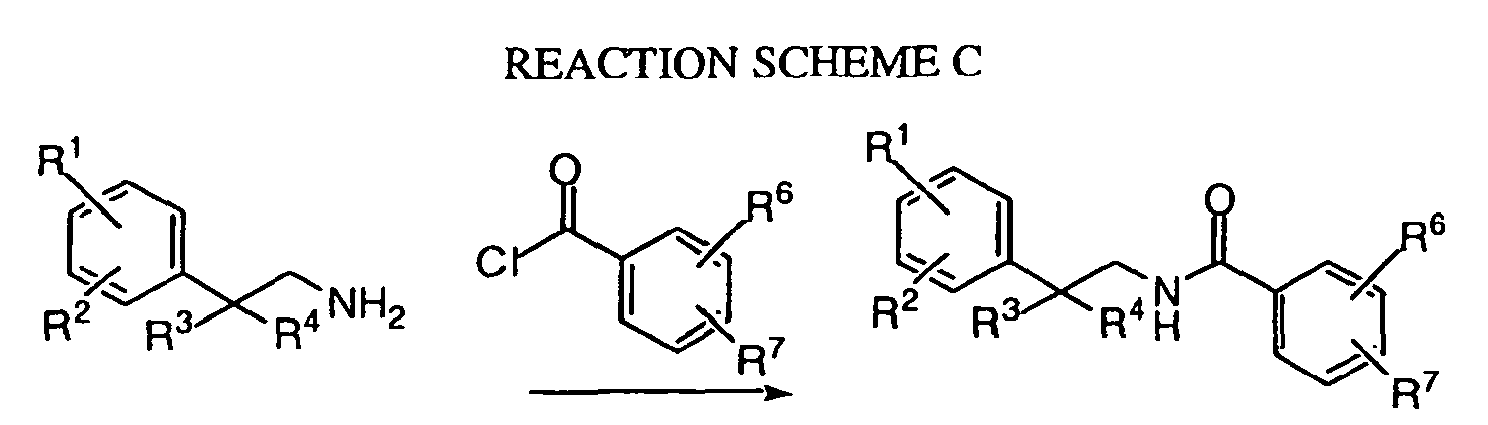
- the amine intermediates are then acylated with acid chlorides in aprotic solvents such as THF and CH 2 Cl 2 with a base such as triethylamine to give the corresponding benzamides.
- the acid chlorides when not purchased, are prepared by stirring the carboxylic acids in reagents such as oxalyl chloride or thionyl chloride.
- reagents such as oxalyl chloride or thionyl chloride.
- amides can be prepared by reaction of benzoic acids with the amine using the standard coupling conditions as described in March, J.; Advanced Organic Chemistry, 4th ed., John Wiley & Sons, New York, pp. 417-424 (1992).
- One such coupling reagent is dicyclohexyl carbodiimide as reviewed by Bodanski, The Practice of Peptide Synthesis, Springer, New York, (1984).
- derivatives containing olefins are hydroborated to give primary alcohols as reviewed in March, J.; Advanced Organic Chemistry, 4th ed., John Wiley & Sons, New York, pp. 783-789 (1992).
- a substituted borane reagent such as 9-borabicyclo(3.3.1)nonane (9-BBN) is preferred. Cleavage of the borane intermediate with hydrogen peroxide provides the alcohol.
- the primary alcohol is then converted to an aldehyde by a Swern oxidation procedure with oxalyl chloride in DMSO as reviewed by Mancuso and Swern, Synthesis, 165-185 (1981).
- the primary alcohol or aldehyde is converted to a carboxylic acid by a variety of oxidation procedures as referenced by Larock, Comprehensive Organic Transformation, VCH, New York, pp 93-97 (1989).
- the olefin group can be oxidatively cleaved with ozone.
- the ozonide can be reduced with sodium borohydride to give the corresponding alcohol, or it can be decomposed to the corresponding aldehyde as described in March, J.; Advanced Organic Chemistry, 4th ed., John Wiley & Sons, New York, pp. 1177-1181 (1992).
- the aldehyde is prepared by cleavage with catalytic osmium tetroxide and periodate. The aldehyde is then converted to the corresponding acid as described in Reaction Scheme D.
- the olefin can be cleaved to the carboxylic acid directly with ruthenium tetroxide and periodate.
- esters can be prepared by reaction of an acid chloride with the hydroxy group in a basic solvent such as pyridine. It should be understood that R 4' is used to represent a portion of the R 4 definition.
- the acid chlorides when not purchased, are prepared by stirring the carboxylic acids in reagents such as oxalyl chloride or thionyl chloride.
- Esters may also be prepared by reaction of the acid chloride and the hydroxy group with silver cyanide (AgCN) in an aprotic solvent such as HMPA.
- C1 sulfonate derivatives are prepared in a similar manner by reaction with sulfonyl chlorides.
- Carbonate and carbamate derivatives are prepared by first reacting the alcohol derivative with carbonyldiimidazole (CDI) to obtain the imidazolecarbonyl intermediate which is then reacted with an alcohol (R 4' OH) or amine (R 4' R 4" NH to give the corresponding carbonate or carbamate derivatives.
- CDI carbonyldiimidazole
- R 4' OH an alcohol
- R 4' R 4" NH to give the corresponding carbonate or carbamate derivatives.
- reaction of the hydroxy group with 4-nitrochloroformate provides the 4-nitrophenylcarbonate which then can be reacted with amines to give carbamates or with alcohols to give carbonate derivatives.
- Carbamate derivatives are also prepared with commercially available carbamoyl chlorides or isocyanates.
- Ether derivatives can also be prepared.
- a particulary useful procedure involves reacting an alcohol with trifluoromethane sulfonic anhydride (Tf 2 O, triflic anhydride) in dichloromethane at reduced temperature, preferably -78°C to obtain the preformed triflate.
- Tf 2 O trifluoromethane sulfonic anhydride
- dichloromethane preferably -78°C
- Ethers may also be prepared by heating a mixture of alcohol, the appropriate alkylhalide and an excess of silver oxide (Ag 2 O) in an aprotic invert solvent such as THF.
- the hydroxy group is converted to the corresponding amino group by well-known procedures.
- the hydroxy group is first derivatized as the methanesulfonate with methanesulfonyl chloride in pyridine or in THF or dichloromethane with triethylamine or pyridine.
- This intermediate is then reacted with sodium azide in a polar aprotic solvent such as dimethylformamide.
- a polar aprotic solvent such as dimethylformamide.
- lithium azide in THF can be used.
- the azide displacement occurs with inversion, so that the beta hydroxy group gives the alpha azide derivative and vice versa.
- the azide is reduced to the corresponding amino group by hydrogenation using a palladium catalyst. This and other procedures are described in March, J.; Advanced Organic Chemistry, 4th ed., John Wiley & Sons, New York, pp. 428 and 1219 (1992).
- amides are prepared by reaction of an acid chloride with the amino group in a basic solvent such as pyridine.
- the acid chlorides when not purchased, are prepared by stirring the carboxylic acids in reagents such as oxalyl chloride or thionyl chloride.
- Amides may also be prepared from carboxylic acids by using coupling reagents such as dicyclohexyl carbodiimide as reviewed by Bodanski, The Practive of Peptide Synthesis, Springer, New York, (1984).
- C1 sulfonamide derivatives are prepared in a similar manner by reaction with sulfonyl chlorides.
- Urea derivatives are prepared by first reacting the C4 amino derivative with carbonyldiimidazole (CDI) to obtain the imidazolecarbonyl intermediate which is then reacted with an amine (R 4' R 4" NH) to give the corresponding urea derivatives.
- CDI carbonyldiimidazole
- R 4' R 4" NH an amine
- reaction of the amino group with 4-nitrochloroformate provides the 4-nitrophenyl carbamate which then can be reacted with amines to give urea derivatives.
- Urea derivatives are also prepared with commercially available carbamoyl chlorides or isocyanates.
- Carbamate derivatives are prepared in a similar manner. Reacting the C4 amino derivative with carbonyldiimidazole (CDI) gives the imidazolecarbonyl intermediate which is then reacted with an alcohol to give the corresponding carbamate derivatives. In an alternate approach, reaction of the amino group with 4-nitrochloroformate provides the 4-nitrophenylcarbamate which then can be reacted with alcohols. Carbamate derivatives are also prepared with chloroformates. For instance, reaction with ethylchloroformate will give the ethylcarbamate derivative.
- the amino group can be alkylated by reductive amination procedures. For instance, the amino group is reacted with an aldehyde or ketone in the presence of sodium cyanoborohydride or sodium triacetoxyborohydride. This transformation may also be accomplished with hydrogen and a catalyst.
- the present invention is related to compounds of Formula I, which are useful in a mammalian subject for the treatment and prevention of immunemediated diseases and cardiac arrhythmias.
- MNC Peripheral blood mononuclear
- LSM ficoll-hypaque
- SRBC neuraminidase treated sheep red blood cells
- the cell suspension was immediately distributed into 96 well round-bottom microculture plates (Costar) at 200 ⁇ L/well. The various dilutions of test compound were then added in triplicate wells at 25 ⁇ L/well, incubated for 30 min at 37°C. Ionomycin (125 ng/mL), and PMA (1 or 5 ng/mL), were added to the appropriate wells. The culture plates were then incubated at 37°C in a humidified atmosphere of 5% CO 2 - 95% air for 18-24 hours.
- the supernatants were removed, and assayed for IL-2 with an IL-2 capture ELISA, using monoclonal anti-IL-2, and biotinylated goat anti-IL-2 antibodies (unconjugated antibodies purchased from R&D System, Minneapolis, MN).
- the ELISA was developed with streptavidin conjugated peroxidase (Zymed, San Francisco, CA) and substrate for peroxidase (Sigma). Mean OD and units of IL-2 of the replicate wells were calculated from standard curve, created with recombinant IL-2 (Collaborative Biomedical Products, Bedford, MA) and the results were expressed as concentration of compound required to inhibit IL-2 production of T cells by 50%.
- MNC Peripheral blood mononuclear cells from healthy donors were separated by density centrifugation with ficoll-hypaque (LSM, Organon Teknika, Durham, NC). After washing the MNC with complete media (RPMI 1640 medium with 5% fetal calf serum, 100 mM glutamine, 1 mM sodium pyruvate, 0.1 mM non-essential amino acid, and 1% penn-strep, obtained from GIBCO, Grand Island, NY), they were then irradiated at 7500 RADS, and resuspended at 4-4.5 x 10 6 cells/mL in complete media. Another aliquot of MNC were rosetted with neuraminidase treated SRBC.
- the sheep red blood cells (SRBC) of these rosetted T cells were then lysed with ammonium chloride lysing buffer (GIBCO, Grand Island, NY). After washing 2X with complete media, these purified T cells were also resuspended at 2-2.5 x 10 6 cells/mL in complete media. The various dilutions of the compound were added in triplicates at 50 ul/well of a 96 well flat-bottom microculture plate (Costar, Cambridge, MA). T cell suspension was then immediately distributed into the wells at 100 ul/well. After incubating the cells with compound for 30 min.
- T lymphocytes were assessed by measurement of tritiated thymidine incorporation. During the last 18-24 hrs. of culturing, the cells were pulse-labeled with 2 ⁇ Ci/well of tritiated thymidine (NEN, Cambridge, MA).
- the cultures were harvested on glass fiber filters using a multiple sample harvester (MACH-II, Wallac,Gaithersburg, MD). Radioactivity of filter discs corresponding to individual wells was measured by standard liquid scintillation counting methods (Betaplate Scint Counter, Wallac). Mean counts per minute of replicate wells were calculated and the results were expressed as concentration of compound required to inhibit tritiated thymidine uptake of T cells by 50%.
- CHO cells transfected with K v 1.3 channels at site densities of approximately 40,000 sites/cell are plated into 96 well culture plates and maintained in Iscove's Modified Dulbecco's Medium (IMDM, with L-Glutamine and HEPES, JRH Biosciences). Cells are incubated overnight with 86 Rb + (3 ⁇ Ci/mL, Dupont-NEN) in the glutamine supplemented IMDM.
- IMDM Iscove's Modified Dulbecco's Medium
- the K v 1.3 channels are opened by depolarization of the cells with High K Buffer (final concentrations, in mM, 63.25 KCl, 68.25 NaCl, 1 CaCl 2 , 2 MgCl 2 , 10 HEPES, pH adjusted to 7.2 with NaOH) also containing test compounds.
- High K Buffer final concentrations, in mM, 63.25 KCl, 68.25 NaCl, 1 CaCl 2 , 2 MgCl 2 , 10 HEPES, pH adjusted to 7.2 with NaOH
- To measure 86 Rb + efflux through the channels aliquots of 100 ⁇ L are taken from each well after a given time and added to plates containing 100 ⁇ L MicroScint-40 (Packard) for counting by liquid scintillation techniques. MicroScint-40 (100 ⁇ L) is then added to each well of the cell plate to determine the remaining 86 Rb + activity.
- MgTX margatoxin
- IC 50 100 pM
- the Kvl.5 86 Rb + (a potassium ion surrogate) efflux assay utilizes HEK 293 cells engineered to stably express the human Kv1.5 potassium channel. Cells are seeded at a density of 25000 cells/well in poly-D-lysine coated 96-well Packard CulturPlates one to three days prior to the assay and loaded with 86 Rb + (0.05 microcuries/well) the day before assay.
- the plates are incubated for an additional ten minutes at room temperature at which time one hundred microliters of each supernatant is transferred to a 96-well Packard OptiPlate.
- the cell plates are immediately washed one time with low KCl buffer followed by the addition of one hundred microliters of low KCl buffer to each well.
- One hundred microliters of Microscint scintillation cocktail is added to each well of the supernatant and cell plates and radioactivity is determined on a Packard TopCount scintillation counter.
- the reduction of supernatant 86 Rb + is used to quantitate the degree of inhibition of the Kv1.5 potassium channel.
- DiTC is also known as L-765,910 and is a natural product analogue which binds specifically to Kv1.x channels, such as Kvl.3 and Kv1.5.
- HEK cells expressing either human Kvl.3 or Kvl.5 channels were grown by Analytical Biological Services in bioreactors containing MEM supplemented with FBS, Penicillin, Streptomycin, and Geneticin. Seven tubes of frozen cell pellets (25 L of cells) were then thawed and 20 mL Homogenization Buffer was added to each tube. The contents of the tubes were pooled into a 50 mL glass/Teflon homogenizer. The cells were homogenized for 10 strokes (500 rpm) and transferred to 50 mL tubes. The tubes were then centrifuged at 1000 rpm for 5 min at 4 °C (253 xg, Beckman GPR). The supernatant was collected and set aside on ice.
- the pellets were resuspended in a total of 40 mL Lysis Buffer, homogenized as described above, and the homogenate was centrifuged as described above. The supernatant was added to the set aside supernatant. The pooled supernatant was then centrifuged at 40,000 rpm for 45 min at 4 °C (186,000 xg, Beckman 45TI). The pellet was resuspended in 70 mL Storage Buffer by homogenization as described above. Aliquots were flash frozen using liquid nitrogen and stored at -70 °C.
- these compounds are useful in the treatment of autoimmune diseases, the prevention of rejection of foreign organ transplants and/or related afflictions, diseases and illnesses.
- the compounds of this invention can be administered for the treatment of autoimmune diseases, the prevention of rejection of foreign organ transplants and/or related afflictions, diseases and illnesses according to the invention by any means that effects contact of the active ingredient compound with the site of action in the body of a warm-blooded animal.
- administration can be oral, topical, including transdermal, ocular, buccal, intranasal, inhalation, intravaginal, rectal, intracisternal and parenteral.
- parenteral refers to modes of administration which include subcutaneous, intravenous, intramuscular, intraarticular injection or infusion, intrasternal and intraperitoneal.
- the compounds can be administered by any conventional means available for use in conjunction with pharmaceuticals, either as individual therapeutic agents or in a combination of therapeutic agents. They can be administered alone, but are generally administered with a pharmaceutical carrier selected on the basis of the chosen route of administration and standard pharmaceutical practice.
- a warm-blooded animal is a member of the animal kingdom possessed of a homeostatic mechanism and includes mammals and birds.
- the dosage administered will be dependent on the age, health and weight of the recipient, the extent of disease, kind of concurrent treatment, if any, frequency of treatment and the nature of the effect desired.
- a daily dosage of active ingredient compound will be from about 1-500 milligrams per day. Ordinarily, from 10 to 100 milligrams per day in one or more applications is effective to obtain desired results.
- These dosages are the effective amounts for the treatment of autoimmune diseases, the prevention of rejection of foreign organ transplants and/or related afflictions, diseases and illnesses.
- the active ingredient can be administered orally in solid dosage forms, such as capsules, tablets, troches, dragées, granules and powders, or in liquid dosage forms, such as elixirs, syrups, emulsions, dispersions, and suspensions.
- the active ingredient can also be administered parenterally, in sterile liquid dosage forms, such as dispersions, suspensions or solutions.
- dosages forms that can also be used to administer the active ingredient as an ointment, cream, drops, transdermal patch or powder for topical administration, as an ophthalmic solution or suspension formation, i.e., eye drops, for ocular administration, as an aerosol spray or powder composition for inhalation or intranasal administration, or as a cream, ointment, spray or suppository for rectal or vaginal administration.
- Gelatin capsules contain the active ingredient and powdered carriers, such as lactose, starch, cellulose derivatives, magnesium stearate, stearic acid, and the like. Similar diluents can be used to make compressed tablets. Both tablets and capsules can be manufactured as sustained release products to provide for continuous release of medication over a period of hours. Compressed tablets can be sugar coated or film coated to mask any unpleasant taste and protect the tablet from the atmosphere, or enteric coated for selective disintegration in the gastrointestinal tract.
- powdered carriers such as lactose, starch, cellulose derivatives, magnesium stearate, stearic acid, and the like. Similar diluents can be used to make compressed tablets. Both tablets and capsules can be manufactured as sustained release products to provide for continuous release of medication over a period of hours. Compressed tablets can be sugar coated or film coated to mask any unpleasant taste and protect the tablet from the atmosphere, or enteric coated for selective disintegration in the gastrointestinal tract.
- Liquid dosage forms for oral administration can contain coloring and flavoring to increase patient acceptance.
- water a suitable oil, saline, aqueous dextrose (glucose), and related sugar solutions and glycols such as propylene glycol or polyethylene gycols are suitable carriers for parenteral solutions.
- Solutions for parenteral administration preferably contain a water soluble salt of the active ingredient, suitable stabilizing agents, and if necessary, buffer substances.
- Antioxidizing agents such as sodium bisulfite, sodium sulfite, or ascorbic acid, either alone or combined, are suitable stabilizing agents.
- citric acid and its salts and sodium EDTA are also used.
- parenteral solutions can contain preservatives, such as benzalkonium chloride, methyl- or propylparaben, and chlorobutanol.
- Suitable pharmaceutical carriers are described in Remington's Pharmaceutical Sciences, A. Osol, a standard reference text in this field.
- the compounds of the present invention may be conveniently delivered in the form of an aerosol spray presentation from pressurized packs or nebulisers.
- the compounds may also be delivered as powders which may be formulated and the powder composition may be inhaled with the aid of an insufflation powder inhaler device.
- the preferred delivery system for inhalation is a metered dose inhalation (MDI) aerosol, which may be formulated as a suspension or solution of a compound of Formula I in suitable propellants, such as fluorocarbons or hydrocarbons.
- MDI metered dose inhalation
- an ophthalmic preparation may be formulated with an appropriate weight percent solution or suspension of the compounds of Formula I in an appropriate ophthalmic vehicle, such that the compound is maintained in contact with the ocular surface for a sufficient time period to allow the compound to penetrate the corneal and internal regions of the eye.
- Useful pharmaceutical dosage-forms for administration of the compounds of this invention can be illustrated as follows:
- a large number of unit capsules are prepared by filling standard two-piece hard gelatin capsules each with 100 milligrams of powdered active ingredient, 150 milligrams of lactose, 50 milligrams of cellulose, and 6 milligrams magnesium stearate.
- a mixture of active ingredient in a digestible oil such as soybean oil, cottonseed oil or olive oil is prepared and injected by means of a positive displacement pump into gelatin to form soft gelatin capsules containing 100 milligrams of the active ingredient.
- the capsules are washed and dried.
- a large number of tablets are prepared by conventional procedures so that the dosage unit is 100 milligrams of active ingredient, 0.2 milligrams of colloidal silicon dioxide, 5 milligrams of magnesium stearate, 275 milligrams of microcrystalline cellulose, 11 milligrams of starch and 98.8 milligrams of lactose.
- Appropriate coatings may be applied to increase palatability or delay absorption.
- a parenteral composition suitable for administration by injection is prepared by stirring 1.5% by weight of active ingredient in 10% by volume propylene glycol. The solution is made to volume with water for injection and sterilized.
- An aqueous suspension is prepared for oral administration so that each 5 milliliters contain 100 milligrams of finely divided active ingredient, 100 milligrams of sodium carboxymethyl cellulose, 5 milligrams of sodium benzoate, 1.0 grams of sorbitol solution, U.S.P., and 0.025 milliliters of vanillin.
- the same dosage forms can generally be used when the compounds of this invention are administered stepwise or in conjunction with another therapeutic agent.
- the dosage form and administration route should be selected depending on the compatibility of the combined drugs.
- coadministration is understood to include the administration of the two agents concomitantly or sequentially, or alternatively as a fixed dose combination of the two active components.
- Step 1 To a solution of 3,3-diethyl-3-phenethylamine (Step 1) in 5 mL of dichloromethane at room temperature was added 0.405 mL of 2-methoxybenzoyl chloride (2.7 mmol), 0.164 mL of pyridine (2.02 mmol) and 10 mg of 4,4-dimethylaminopyridine (DMAP). After stirring for 12 hr, the reaction mixture was concentrated in vacuo and purified by chromatography (silica, 2:1 hexanes: ethyl acetate).
- Step 1 4-cyano-4-phenylcyclohexanone ethyleneglycol ketal
- Step 3 4-Phenyl-4-(3-(2-methoxyphenyl)-3-oxo-2-azaprop-1-yl) cyclohexanone
- reaction mixture were stirred for 3 hr at 40 °C. Then it was poured into 200 ml of ether. The organic layer was washed with aq NaHCO 3 , dried over MgSO 4 and concentrated. The residue was purified by chromatography (silica, hexanes: ethyl acetate , 1:1) to afford the compound as a solid.
- Step 5 1-(2-methoxyphenyl)-1-oxo-2-aza-4-hydroxyethyl-4-(4-oxy-3-oxo-pentanyl)-4-phenylbutane
- the title compound was prepared from 30.6 mg 5-phenyl-4-(3-(2-methoxyophenyl)3-oxo-2-azapropyl)-1-oxy-2-oxocycloheptane as in Example 28 with the exception that allyl alcohol was used and the reaction was stirred at 40 °C for 14 hr.
- the title compound was prepared (from 27.1 mg of 5-phenyl-4-(3-(2-methoxyophenyl)3-oxo-2-aza-propyl)-1-oxy-2-oxocycloheptane (0.077 mmol) according to procedures described in Example 28 with the exception that the reaction was carried out in a solution of 2M methylamine in THF.
- Step 4 1-(2-methoxyphenyl)-l-oxo-2-aza-4,4-diethyl-4-(4-tributyltinphenyl)-butane
- Step 1 1-(2,3-dihydrobenzofuran-7-yl)-1-oxo-2-aza-4,4-diethyl-4-(4-tributyltinphenyl)-butane
- the title compound was prepared from 1-(2,3-dihydrobenzofuran-7-yl)-1-oxo-2-aza-4,4-diethyl-4-(3-tributyltinphenyl)-butane according to procedures described in Examples 38 and 40.
Landscapes
- Health & Medical Sciences (AREA)
- Chemical & Material Sciences (AREA)
- Organic Chemistry (AREA)
- Life Sciences & Earth Sciences (AREA)
- General Health & Medical Sciences (AREA)
- Public Health (AREA)
- Medicinal Chemistry (AREA)
- Veterinary Medicine (AREA)
- Animal Behavior & Ethology (AREA)
- Pharmacology & Pharmacy (AREA)
- Chemical Kinetics & Catalysis (AREA)
- General Chemical & Material Sciences (AREA)
- Nuclear Medicine, Radiotherapy & Molecular Imaging (AREA)
- Engineering & Computer Science (AREA)
- Bioinformatics & Cheminformatics (AREA)
- Immunology (AREA)
- Diabetes (AREA)
- Physical Education & Sports Medicine (AREA)
- Hematology (AREA)
- Dermatology (AREA)
- Pulmonology (AREA)
- Orthopedic Medicine & Surgery (AREA)
- Neurology (AREA)
- Rheumatology (AREA)
- Oncology (AREA)
- Biomedical Technology (AREA)
- Neurosurgery (AREA)
- Communicable Diseases (AREA)
- Heart & Thoracic Surgery (AREA)
- Epidemiology (AREA)
- Pain & Pain Management (AREA)
- Cardiology (AREA)
- Endocrinology (AREA)
- Urology & Nephrology (AREA)
- Obesity (AREA)
- Virology (AREA)
- Child & Adolescent Psychology (AREA)
- Ophthalmology & Optometry (AREA)
- Vascular Medicine (AREA)
- Transplantation (AREA)
Abstract
Description
- The present invention relates to a class of compounds that are useful as potassium channel inhibitors to treat autoimmune disorders, cardiac arrhythmias, and the like.
- Immunoregulatory abnormalities have been shown to exist in a wide variety of autoimmune and chronic inflammatory diseases, including systemic lupus erythematosis, chronic rheumatoid arthritis, type I and II diabetes mellitus, inflammatory bowel disease, biliary cirrhosis, uveitis, multiple sclerosis and other disorders such as Crohn's disease, ulcerative colitis, bullous pemphigoid, sarcoidosis, psoriasis, ichthyosis, Graves ophthalmopathy and asthma.
- Potassium channels have turned out to be the most diverse family of ion channels discovered to date. They modulate a number of cellular events such as muscle contraction, neuro-endocrine secretion, frequency and duration of action potentials, electrolyte homeostasis, and resting membrane potential.
- Potassium channels have been classified according to their biophysical and pharmacological characteristics. Salient among these are the voltage dependent potassium channels, such as Kv1. The Kv1 class of potassium channels is further subdivided depending on the molecular sequence of the channel, for example Kv1.1, Kv1.3, Kv1.5. Functional voltage-gated K+ channels can exist as multimeric structures formed by the association of either identical or dissimilar subunits. This phenomena is thought to account for the wide diversity of K+ channels. However, subunit compositions of native K+ channels and the physiologic role that particular channels play are, in most cases, still unclear.
- The Kv1.3 voltage-gated potassium channel is found in neurons, blood cells, osteoclasts and T-lymphocytes. The Chandy and Cahalan laboratories proposed a hypothesis that blocking the Kv1.3 channel would elicit an immunosuppressant response. (Chandy et al., J. Exp. Med. 160, 369, 1984; Decoursey et al., Nature, 307, 465, 1984). However, the K+ channel blockers employed in their studies were non-selective. Until research with the peptide margatoxin, a peptide found in scorpion venom, no specific inhibitor of the Kv1.3 channel existed to test this hypothesis. Although a laboratory (Price et al., Proc. Natl. Acad. Sci. USA, 86, 10171, 1989) showed that charybdotoxin would block Kv1.3 in human T cells, charybdotoxin was subsequently shown to inhibit four different K+ channels (Kv1.3 and three distinct small conductance Ca++ activated K+ channels) in human T-lymphocytes, limiting the use of this toxin as a probe for the physiological role of Kv1.3 (Leonard et al., Proc. Natl. Acad. Sci. USA, 89, 10094, 1992). Margatoxin, on the other hand, blocks only Kv1.3 in T-cells, and has immunosuppressant activity in both in vitro and in vivo models. (Lin et al., J. Exp. Med, 177, 637, 1993). The therapeutic utility of this compound, however, is limited by its potent toxicity. Recently, a class of compounds has been reported that may be an attractive alternative to the above-mentioned drugs, see for example U.S. Patent Nos. 5,670,504; 5,631,282; 5,679,705; and 5,696,156. While addressing some of the activity/toxicity problems of previous drugs, these compounds tend to be of large molecular weight and are generally produced by synthetic manipulation of a natural product, isolation of which is cumbersome and labor intensive.
- DE-A-2500157 discloses benzoic acids and its derivatives as well as their application in the field of diabetes.
- The foregoing problems are solved to a large extent by the practice of the invention as herein disclosed for immunosuppression.
- Atrial fibrillation (AF) is the most common sustained cardiac arrhythmia in clinical practice and is likely to increase in prevalence with the aging of the population. Currently, AF affects more than 1 million Americans annually, represents over 5% of all admissions for cardiovascular diseases and causes more than 80,000 strokes each year in the United States. While AF is rarely a lethal arrhythmia, it is responsible for substantial morbidity and can lead to complications such as the development of congestive heart failure or thromboembolism. Currently available Class I and Class III antiarrhythmic drugs reduce the rate of recurrence of AF, but are of limited use because of a variety of potentially adverse effects including ventricular proarrhythmia. Because current therapy is inadequate and fraught with side effects, there is a clear need to develop new therapeutic approaches.
- The ultra-rapidly activating delayed rectifier K+ current (Ikur) is believed to represent the native counterpart to a cloned potassium channel designated Kv1.5 and, while present in human atrium, it appears to be absent in human ventricle. Furthermore, because of its rapidity of activation and limited slow inactivation, Ikur is believed to contribute significantly to repolarization in human atrium. Consequently, a specific blocker of Ikur, that is a compound which blocks Kv1.5, would overcome the short coming of other compounds by prolonging refractoriness by retarding repolarization in the human atrium without causing the delays in ventricular reporlarization that underlie arrhythmogenic afterdepolarizations and acquired long QT syndrome observed during treatment with current Class III drugs.
- The method of treatment of atrial arrhythmia presented herein provides for greater safety and efficacy as well preferentially providing treatment at fast heart rates when treatment of this type is most desired.
- This invention relates to benzamide potassium channel inhibitors of general structural Formula I.

- The compounds of this invention are useful in the treatment of autoimmune diseases, the prevention of rejection of foreign organ transplants and related afflictions, diseases and illnesses, and cardiac arrhythmias. Also within the scope of this invention are combinations comprising a compound of Formula I, one or more immunosuppressive compounds and a pharmaceutical carrier.
- An embodiment of the present invention is the use of a compound of structural Formula I:

- n is:
- 0, 1, 2 or 3;
- r is:
- 0 or 1;
- s is:
- 0 or 1;
- R1, R2; R5, R6 and R7 are independently:
- (1) halo, wherein halo is fluoro, chloro, bromo, or iodo,
- (2) hydroxy,
- (3) (C1-C6)-alkyl,
- (4) HO(C1-C6)-alkyloxy,
- (5) (C1-C4)-perfluoroalkyl,
- (6) (C2-C6)-alkenyl,
- (7) O[(C=O)Or]s(C1-C6)-alkyl, wherein the alkyl may be cyclic or straight-chained,
- (8) phenyl,
- (9) CO(C1-C6)-alkyl,
- (10) CO2(C1-C6)-alkyl,
- (11) CONR8R9,
- (12) NR8R9,
- (13) (C2-C6)-alkenyloxy,
- (14) benzyloxy,
- (15) hydrogen,
- (16) OCF3,
- (17) R1 and R2 or R6 and R7 can an be taken together when on adjacent carbons to form a fused benzo, dihydrofuranyl, furanyl, pyrrolidyl, dihydropyrrolidyl or 1,3-dioxolan group;
- R3 and R4 are independently:
- (1) halo, wherein halo is fluoro, chloro, bromo, or iodo,
- (2) hydroxy,
- (3) HO(C1-C6)-alkyloxy,
- (4) (C1-C4)-perfluoroalkyl,
- (5) O(CO)CCl3,
- (6) (C1-C6)-alkyl-S(O)n-,
- (7) phenyl-(CH2)r-S(O)n-.
- (8) cyano,
- (9) nitro,
- (10) CO2H,
- (11) CO(C1-C6)-alkyl,
- (12) CO2(C1-C6)-alkyl,
- (13) CONR8R9,
- (14) NR8R9,
- (15) O(CO)NR8R9,
- (16) azido,
- (17) NR8(CO)NR8R9,
- (18) hydrogen,
- (19) (C1-C6)-alkyl, wherein alkyl includes cyclic as well as acyclic groups and is unsubstituted or substituted with one or two of the substituents selected from the group consisting of:
- (a) halo, wherein halo is fluoro, chloro, bromo, or iodo,
- (b) hydroxy,
- (c) oxo,
- (d) O[(C=O)Or]s(C1-C6)-alkyl,
- (e) aryl-(C1-C6)-alkyloxy,
- (f) NR8R9,
- (g) O(CO)NR8R9,
- (h) CHO,
- (i) CO2H,
- (j) CO(C1-C6)-alkyl,
- (k) CO2(C1-C6)-alkyl, wherein alkyl may be substituted with phenyl,
- (l) CO2(C1-C6)-alkenyl,
- (m) CONR8R9,
- (n) aryl, wherein aryl is defined as phenyl or naphthyl, unsubstituted or substituted with a substituent selected from the group consisting of:
- (a') halo, as defined above,
- (b') hydroxy,
- (c') (C1-C6-alkyl,
- (d') (C1-C6)-alkyloxy,
- (e') (C1-C6)-alkyl-S(O)n-,
- (f') phenyl,
- (g') phenoxy,
- (h') cyano,
- (i') CO2H,
- (j') CO(C1-C6)-alkyl,
- (k') CO2(C1-C6)-alkyl,
- (l') CONR8R9,
- (m') NR8R9, and
- (o) benzyl-S(O)n-,
- (p) O[(C=O)Or]s(C2-C6)-alkenyl,
- (q) O[(C=O)Or]saryl,
- (r) O[(C=O)Or]sheteroaryl.
- (s) O(CH2)nheteroaryl, or
- (t) O(CH2)naryl;
- (20) (C2-C6)-alkenyl, wherein alkenyl is unsubstituted or substituted with a substituent selected from the group consisting of:
- (a) halo, wherein halo is fluoro, chloro, bromo, or iodo,
- (b) hydroxy,
- (c) oxo,
- (d) phenyl-(C1-C6)-alkyloxy,
- (e) NR8R9,
- (f) CHO,
- (g) CO2H,
- (h) CO(C1-C6)-alkyl,
- (i) CO2(C1-C6)-alkyl,
- (j) CONR8R9,
- (k) aryl, wherein aryl is as defined above,
- (l) O[(C=O)Or]s(C1-C6)-alkyl, alkyl as defined above,
- (m) O[(C=O)Or]saryl, aryl as defined above,
- (n) O[(C=O)Or]sheteroaryl, wherein heteroaryl is defined as an unsubstituted, monosubstituted, or disubstituted five or six membered aromatic heterocycle containing from 1 to 3 heteroatoms selected from the group consisting of O, N and S and wherein the substituents are members selected from the group consisting of:
- (a') halo, as defined above,
- (b') hydroxy,
- (c') (C1-C6)-alkyl,
- (d') (C1-C4)-perfluoroalkyl,
- (e') (C2-C6)-alkenyl,
- (f') (C2-C6)-alkynyl,
- (g') (C1-C6)-alkyloxy,
- (h') (C1-C6)-alkyl-S(O)n-
- (i') phenyl,
- (j') phenoxy,
- (k') cyano,
- (l') nitro,
- (m') CO2H,
- (n') CO(C1-C6)-alkyl,
- (o') CO2(C1-C6)-alkyl,
- (p') CONR8R9,
- (q') NR8R9, and
- (r') fused benzo or pyridyl group,
- (o) O(CH2)nheteroaryl, heteroaryl as defined above, and
- (p) O(CH2)naryl, aryl as defined above;
- (21) O[(C=O)Or]s(C1-C6)-alkyl, alkyl as defined above,
- (22) O((C=O)Or]s(C2-C6)-alkenyl, as defined above,
- (23) O[(C=O)Or]saryl, aryl as defined above,
- (24) O[(C=O)Or]sheteroaryl, heteroaryl as defined above
- (25) O(CH2)heteroaryl, heteroaryl as defined above,
- (26) aryl, wherein aryl is as defined above or
- (27) O(CH2)naryl, aryl as defined above;
- R3 can also be any of the following when R4 is absent:
- (28) oxo,
- (29) =CH-(C1-C6)-alkyl, wherein alkyl is as defined above,
- (30) =CH-(C2-C6)-alkenyl, wherein alkenyl is as defined above,
- (31) =CH-aryl, wherein aryl is as defined above, or
- (32) =CH2;
- R8 and R9 are independently selected from the group consisting of:
- (1) hydrogen,
- (2) [(C=O)Or]saryl, wherein aryl is as defined above,
- (3) [(C=O)Or]s(C2-C8)-alkenyl, wherein alkenyl is as defined above, and
- (4) [(C=O)Or]s(C1-C8)-alkyl, wherein alkyl is as defined above, and
- R10 is:
- (1) hydrogen, or
- (2) [(C=O)Or]s(C1-C6)-alkyl, wherein alkyl is as defined above,
- A preferred embodiment is the use as hereinbefore described of the compound of Formula I, wherein R1, R2, R5, R6 and R7 are independently:
- (1) halo, wherein halo is fluoro, chloro, bromo, or iodo,
- (2) hydroxy,
- (3) (C1-C3)-alkyl,
- (4) (C2-C3)-alkenyl,
- (5) O(C1-C4)-alkyl, wherein the alkyl may be cyclic or straight-chained,
- (6) O(CO)CH3,
- (7) CO(C1-C3)-alkyl,
- (8) CO2(C1-C3)-alkyl,
- (9) hydrogen,
- (10) R1 and R2 or R6 and R7 can an be taken together when on adjacent carbons to form a fused benzo, dihydrofuranyl, furanyl, pyrrolidyl, dihydropyrrolidyl or 1,3-dioxolan group;
- R3 and R4 are independently:
- (1) hydrogen,
- (2) (C1-C6)-alkyl, wherein alkyl includes cyclic as well as acyclic groups and is unsubstituted or substituted with one or two of the substituents selected from the group consisting of:
- (a) halo, wherein halo is fluoro, chloro, bromo, or iodo,
- (b) hydroxy,
- (c) oxo,
- (d) O[(C=O)Or]s(C1-C6)-alkyl, wherein r and s are independently 0 or 1,
- (e) CO2(C2-C3)-alkenyl,
- (f) O[(C=O)Or]s(C1-C6)-alkenyl, wherein r and s are independently 0 or 1,
- (g) NR8R9,
- (h) O(CO)NR8R9,
- (i) CHO,
- (j) CO2H,
- (k) CO(C1-C6)-alkyl,
- (l) CO2(C1-C6)-alkyl, wherein alkyl may be substituted with phenyl,
- (m) CONR8R9,
- (n) aryl, wherein aryl is defined as phenyl, unsubstituted or substituted with a substituent selected from the group consisting of:
- (a') halo, as defined above,
- (b') hydroxy,
- (c') (C1-C6)-alkyl, and
- (d') (C1-C6)-alkyloxy, and
- (o) O[(C=O)Or]s(C2-C6)-alkenyl, wherein r and s are independently 0 or 1,
- (3) (C2-C6)-alkenyl,
- (4) aryl, wherein aryl is as defined above or
- (5) O(CH2)naryl, wherein aryl is as defined above;
- R3 can also be any of the following when R4 is absent:
- (6) =CH-(C1-C6)-alkyl, wherein alkyl is as defined above,
- (7) =CH-(C2-C6)-alkenyl, wherein alkenyl is as defined above,
- R8 and R9 are independently selected from the group consisting of:
- (1) hydrogen,
- (2) [(C=O)Or]saryl, wherein aryl is as defined above and r and s are independently 0 or 1,
- (3) (C2-C8)-alkenyl, wherein alkenyl is as defined above, and
- (4) (C1-C6)-alkyl, wherein alkyl is as defined above, and
- R10 is:
- (1) hydrogen, or
- (2) (C=O)(C1-C3)-alkyl, wherein alkyl is as defined above.
- In another aspect of the invention, there is provided a compound which is selected from the group consisting of: 1-(2-methoxyphenyl)-1-oxo-2-aza-(S)-4-i-butyl-4-phenylbutane, 1-(2-methoxyphenyl)-1-oxo-2-aza-4-(S)-((3-allyloxycarbonyloxy)propyl))-4-phenylbutane, 1-(2-methoxyphenyl)-l-oxo-2-aza-4,4-diethyl-4-phenylbutane, 1-(2,3-dihydrobenzofuran-7-yl)-1-oxo-2-aza-4,4-diethyl-4-(phenyl)-butane, and 1-(2-methoxyphenyl)-l-oxo-2-aza-4-(S)-(3-hydroxypropyl)-4-phenylbutane, or a pharmaceutically acceptable salt thereof. These specific compunds of fomula (I) may be used as hereinbefore described.
- A further embodiment of the invention is the use of a compound of formula I or a pharmaceutically acceptable salt, crystal form or hydrate thereof for the manufacture of a medicament for preventing or treating resistance to transplantation or transplantation rejection of organs or tissues or for suppressing the immune system or for preventing or treating cardiac arrhythmias.
- Another embodiment is a combination of the compound of Formula 1 or a pharmaceutically acceptable salt, crystal form or hydrate thereof and a second immunosuppressive agent for separate, simultaneous or sequential administration. Preferred immunosuppressive agents include azathioprine, brequinar sodium, deoxyspergualin, mizaribine, mycophenolic acid morpholino ester, cyclosporin, FK-506 and rapamycin.
- The compounds of the present invention have asymmetric centers and this invention includes all of the optical isomers and mixtures thereof. Unless specifically mentioned otherwise, reference to one isomer applies to both isomers.
- In addition compounds with carbon-carbon double bonds may occur in Z- and E- forms with all isomeric forms of the compounds being included in the present invention.
- As used herein, the term "alkyl", unless otherwise indicated, includes those alkyl groups of a designated number of carbon atoms of either a straight, branched, or cyclic configuration (carbocycles). Examples of "alkyl" include methyl, ethyl, propyl, isopropyl, butyl, sec-and tert-butyl, pentyl, hexyl, heptyl, cyclopropyl, cyclobutyl, cyclopentyl, cyclohexyl, cycloheptyl, norbornyl, and the like. "Alkoxy" represents an alkyl group of indicated number of carbon atoms attached through an oxygen bridge, such as methoxy, ethoxy, propoxy, butoxy and pentoxy. The following illustrate the foregoing definitions: "(C1-C3)-alkyl" may be methyl, ethyl, propyl, isopropyl, or cyclopropyl. Similarly, "O-(C1-C3)-alkyl" may be methoxy, ethoxy, n-propoxy, i-propoxy, or cyclopropoxy. In some cases, a C0 designation is used, as in "-(C0-C2)-alkyl-phenyl." In such a case, the substituent is intended to be any of the following: phenyl, benzyl, 1-phenylethyl, or 2-phenylethyl. In certain definitions, the alkyl may be substituted with one or more substituents. For example a definition which reads "(C1-C2)-alkyl, substituted with one or two substitutents selected from oxo, hydroxy, and halo" is intended to include C(O)CH3, CH2BrCH3, CO2H, C(OH)CH3, CH2CH2(OH), CH2CO2H, CHBrCH2Cl, CHO, and so on.
- "Alkenyl" is intended to include hydrocarbon chains of a specified number of carbon atoms of either a straight- or branched- configuration and at least one unsaturation, which may occur at any point along the chain, such as ethenyl, propenyl, butenyl, pentenyl, dimethyl pentenyl, and the like, and includes E and Z forms, where applicable. "Halogen" and "halo", as used herein, mean fluoro, chloro, bromo and iodo.
- The term "aryl," unless specifically defined otherwise, defined as phenyl or naphthyl, unsubstituted or substituted with one, two or three of the substituents selected from the group consisting of halo, hydroxy, alkyl, perfluoroalkyl, alkenyl, alkynyl, alkyloxy, alkyl-S(O)n-, phenyl, phenoxy, cyano, nitro, CO2H, CO-alkyl, CO2-alkyl, CONR8R9,and NR8R9.
- The term "heteroaryl" as utilized herein, unless specifically defmed otherwise; is intended to include the following: an unsubstituted, monosubstituted, or disubstituted five or six membered aromatic heterocycle containing from I to 3 heteroatoms selected from the group consisting of O, N and S and wherein the substituent is halo, hydroxy, alkyl, perfluoroalkyl, alkenyl, alkynyl, alkyloxy, -alkyl-S(O)n-, phenyl, phenoxy, cyano, nitro, CO2H, CO-alkyl, CO2-alkyl, CONR8R9, NR8R9, or a fused benzo or pyridyl group. Heteroaryl groups within the scope of this definition include but are not limited to: acridinyl, carbazolyl, cinnolinyl, quinoxalinyl, pyrrazolyl, indolyl, benzotriazolyl, furanyl, thienyl, benzothienyl, benzofuranyl, quinolinyl, isoquinolinyl, pyrazinyl, pyridazinyl, pyridinyl, pyrimidinyl, and pyrrolyl which are substituted or unsubstituted as defined above.
- In the compounds of Formula I, the heteroaryl or aryl groups may be optionally substituted with the substituents listed above at any available carbon atom or nitrogen atom (if present), but compounds bearing certain substitutents, directly substituted to a nitrogen may be relatively unstable and are not preferred. The heteroaryl may also be fused to a second 5-, 6-, or 7-membered ring containing one or two oxygens such as: dioxolanyl, dihydrofuranyl, dihydropyranyl, and dioxanyl. Disubstituted aryl groups may be ortho, para or meta and all three are intended unless specifically defined otherwise. "Heterocyclyl" is defined as a 3 to 7 atom cyclic, non-aromatic substituent containing from 1 to 3 heteroatoms selected from the group consisting of O, N, and S, which is unsubstituted or substituted with one, two or three substituents selected from the group consisting of halo, hydroxy, alkyl, perfluoroalkyl, alkenyl, alkynyl, alkyloxy, alkyl-S(O)n-, phenyl, phenoxy, cyano, nitro, CO2H, COalkyl, CO2-alkyl, CONR8R9, NR8R9, NR8CO-alkyl, oxo, fused benzo, and fused pyridyl group.
- Pharmaceutically acceptable salts include both the metallic (inorganic) salts and organic salts; a list of which is given in Remington's Pharmaceutical Sciences, 17th Edition, pg. 1418 (1985). It is well known to one skilled in the art that an appropriate salt form is chosen based on physical and chemical stability, flowability, hydro-scopicity and solubility. As will be understood by those skilled in the art, pharmaceutically acceptable salts include, but are not limited to salts of inorganic acids such as hydrochloride, sulfate, phosphate, diphosphate, hydrobromide, and nitrate or salts of an organic acid such as malate, maleate, fumarate, tartrate, succinate, citrate, acetate, lactate, methanesulfonate, p-toluenesulfonate or palmoate, salicylate and stearate. Similarly pharmaceutically acceptable cations include, but are not limited to sodium, potassium, calcium, aluminum, lithium and ammonium (especially ammonium salts with secondary amines). Preferred salts of this invention for the reasons cited above include potassium, sodium, calcium and ammonium salts. Also included within the scope of this invention are crystal forms, hydrates and solvates of the compounds of Formula I.
- Methods for preparing the compounds of this invention are illustrated in the following schemes and examples. Other synthetic routes would be readily apparent to those skilled in the art.

- Many methods are available to prepare the amine precursors that serve as starting materials for the compounds of this invention. The substituted or unsubstituted phenylacetonitrile substrates shown in Scheme A are commercially available or can be prepared by procedures well known in the art. As shown in Scheme A, the phenylacetonitrile precursors are deprotonated with bases such as potassium t-butoxide (KOtBu) or sodium hydride (NaH) in an aprotic solvent such as THF and alkylated with alkyl halides. This leads primarily to bis-alkylation. The resulting arylacetonitriles are then reduced to amines with suitable reducing agents such as excess lithium aluminum hydride (LiAlH4) in an aprotic solvent such as THF, preferably at elevated temperatures.
- Amine intermediates are also prepared from substituted phenylacetic acid precursors, many which are commercially available in chiral or racemic form. The acid substrate is reduced with LiAlH4 in THF to give the alcohol. The hydroxy group is derivatized as the methanesulfonate with methanesulfonyl chloride in pyridine or in THF or dichloromethane with triethylamine or pyridine. This intermediate is then reacted with sodium azide in a polar aprotic solvent such as dimethylformamide. Alternatively, lithium azide in THF can be used. Finally, the azide is reduced to the corresponding amino group by hydrogenation using a palladium catalyst. This and other procedures are described in March, J.; Advanced Organic Chemistry, 4th ed., John Wiley & Sons, New York, pp. 428 and 1219 (1992).

- In reaction Scheme B, R4 groups are appended by asymmetric alkylation of phenylacetyloxazolidinone imides as reviewed by Evans, Asymmetric Synthesis, vol. 3, Academic Press Inc., New York, p 2-101 (1984). Thus, alkylation using (R)-(-)-4-phenyl-2-oxazolidinone provides the R4 substituent in the (S)-configuration. The (S)-(-)-4-phenyl-2-oxazolidinone gives R4 in the (R)-configuration. The oxazolidinone group is removed with LiAlH4 to give the hydroxy intermediate which is then converted as described in Reaction Scheme A.
- As shown in Scheme C, the amine intermediates are then acylated with acid chlorides in aprotic solvents such as THF and CH2Cl2 with a base such as triethylamine to give the corresponding benzamides. The acid chlorides, when not purchased, are prepared by stirring the carboxylic acids in reagents such as oxalyl chloride or thionyl chloride. Alternatively, amides can be prepared by reaction of benzoic acids with the amine using the standard coupling conditions as described in March, J.; Advanced Organic Chemistry, 4th ed., John Wiley & Sons, New York, pp. 417-424 (1992). One such coupling reagent is dicyclohexyl carbodiimide as reviewed by Bodanski, The Practice of Peptide Synthesis, Springer, New York, (1984).

- As shown in Scheme D, in an embodiment of this invention, derivatives containing olefins are hydroborated to give primary alcohols as reviewed in March, J.; Advanced Organic Chemistry, 4th ed., John Wiley & Sons, New York, pp. 783-789 (1992). For optimal regioselectivity, a substituted borane reagent such as 9-borabicyclo(3.3.1)nonane (9-BBN) is preferred. Cleavage of the borane intermediate with hydrogen peroxide provides the alcohol.
- The primary alcohol is then converted to an aldehyde by a Swern oxidation procedure with oxalyl chloride in DMSO as reviewed by Mancuso and Swern, Synthesis, 165-185 (1981).
- The primary alcohol or aldehyde is converted to a carboxylic acid by a variety of oxidation procedures as referenced by Larock, Comprehensive Organic Transformation, VCH, New York, pp 93-97 (1989).

- In Reaction Scheme E, the olefin group can be oxidatively cleaved with ozone. The ozonide can be reduced with sodium borohydride to give the corresponding alcohol, or it can be decomposed to the corresponding aldehyde as described in March, J.; Advanced Organic Chemistry, 4th ed., John Wiley & Sons, New York, pp. 1177-1181 (1992). Alternatively, the aldehyde is prepared by cleavage with catalytic osmium tetroxide and periodate. The aldehyde is then converted to the corresponding acid as described in Reaction Scheme D. The olefin can be cleaved to the carboxylic acid directly with ruthenium tetroxide and periodate.

- As depicted in Reaction Scheme F, esters can be prepared by reaction of an acid chloride with the hydroxy group in a basic solvent such as pyridine. It should be understood that R4' is used to represent a portion of the R4 definition. The acid chlorides, when not purchased, are prepared by stirring the carboxylic acids in reagents such as oxalyl chloride or thionyl chloride. Esters may also be prepared by reaction of the acid chloride and the hydroxy group with silver cyanide (AgCN) in an aprotic solvent such as HMPA. C1 sulfonate derivatives are prepared in a similar manner by reaction with sulfonyl chlorides.
- Carbonate and carbamate derivatives are prepared by first reacting the alcohol derivative with carbonyldiimidazole (CDI) to obtain the imidazolecarbonyl intermediate which is then reacted with an alcohol (R4'OH) or amine (R4'R4"NH to give the corresponding carbonate or carbamate derivatives. In an alternate approach, reaction of the hydroxy group with 4-nitrochloroformate provides the 4-nitrophenylcarbonate which then can be reacted with amines to give carbamates or with alcohols to give carbonate derivatives. Carbamate derivatives are also prepared with commercially available carbamoyl chlorides or isocyanates.
- Ether derivatives can also be prepared. A particulary useful procedure involves reacting an alcohol with trifluoromethane sulfonic anhydride (Tf2O, triflic anhydride) in dichloromethane at reduced temperature, preferably -78°C to obtain the preformed triflate. To this solution is added the alcohol, the reaction mixture is warmed to room temperature and stirring is continued until reaction is complete. Ethers may also be prepared by heating a mixture of alcohol, the appropriate alkylhalide and an excess of silver oxide (Ag2O) in an aprotic invert solvent such as THF.

- In Reaction Scheme G, the hydroxy group is converted to the corresponding amino group by well-known procedures. The hydroxy group is first derivatized as the methanesulfonate with methanesulfonyl chloride in pyridine or in THF or dichloromethane with triethylamine or pyridine. This intermediate is then reacted with sodium azide in a polar aprotic solvent such as dimethylformamide. Alternatively, lithium azide in THF can be used. The azide displacement occurs with inversion, so that the beta hydroxy group gives the alpha azide derivative and vice versa. Finally, the azide is reduced to the corresponding amino group by hydrogenation using a palladium catalyst. This and other procedures are described in March, J.; Advanced Organic Chemistry, 4th ed., John Wiley & Sons, New York, pp. 428 and 1219 (1992).

- As depicted in Reaction Scheme H, amides are prepared by reaction of an acid chloride with the amino group in a basic solvent such as pyridine. The acid chlorides, when not purchased, are prepared by stirring the carboxylic acids in reagents such as oxalyl chloride or thionyl chloride. Amides may also be prepared from carboxylic acids by using coupling reagents such as dicyclohexyl carbodiimide as reviewed by Bodanski, The Practive of Peptide Synthesis, Springer, New York, (1984). C1 sulfonamide derivatives are prepared in a similar manner by reaction with sulfonyl chlorides.
- Urea derivatives are prepared by first reacting the C4 amino derivative with carbonyldiimidazole (CDI) to obtain the imidazolecarbonyl intermediate which is then reacted with an amine (R4'R4"NH) to give the corresponding urea derivatives. In an alternate approach, reaction of the amino group with 4-nitrochloroformate provides the 4-nitrophenyl carbamate which then can be reacted with amines to give urea derivatives. Urea derivatives are also prepared with commercially available carbamoyl chlorides or isocyanates.
- Carbamate derivatives are prepared in a similar manner. Reacting the C4 amino derivative with carbonyldiimidazole (CDI) gives the imidazolecarbonyl intermediate which is then reacted with an alcohol to give the corresponding carbamate derivatives. In an alternate approach, reaction of the amino group with 4-nitrochloroformate provides the 4-nitrophenylcarbamate which then can be reacted with alcohols. Carbamate derivatives are also prepared with chloroformates. For instance, reaction with ethylchloroformate will give the ethylcarbamate derivative.
- The amino group can be alkylated by reductive amination procedures. For instance, the amino group is reacted with an aldehyde or ketone in the presence of sodium cyanoborohydride or sodium triacetoxyborohydride. This transformation may also be accomplished with hydrogen and a catalyst.
- The present invention is related to compounds of Formula I, which are useful in a mammalian subject for the treatment and prevention of immunemediated diseases and cardiac arrhythmias.
- Using the methodologies described below, representative compounds of the invention were evaluated and found to exhibit activity thereby demonstrating and confirming the utility of the compounds of the invention as Kv1.3/-Kv1.5 inhibitors and therefore as immunosuppressants and antiarrhythmics.
- Peripheral blood mononuclear (MNC) cells from healthy donors were separated by density centrifugation with ficoll-hypaque (LSM, Organon Teknika, Durham, NC), followed by rosetted with neuraminidase treated sheep red blood cells (SRBC). After another centrifugation with leucocyte separation medium (LSM), the SRBC of the rosetted T cells were then lysed with ammonium chloride lysing buffer (GIBCO, Grand Island, NY). Such purified T cells were resuspended at 3 X 10⁶/ mL in RPMI 1640 culture medium (GIBCO) supplemented with 10% fetal calf serum (Sigma, St. Louis, MO), 100 mM glutamine, 1 mM sodium pyruvate, 0.1 mM non-essential amino acids, and 1 % penn-strep (GIBCO). The cell suspension was immediately distributed into 96 well round-bottom microculture plates (Costar) at 200 µL/well. The various dilutions of test compound were then added in triplicate wells at 25 µL/well, incubated for 30 min at 37°C. Ionomycin (125 ng/mL), and PMA (1 or 5 ng/mL), were added to the appropriate wells. The culture plates were then incubated at 37°C in a humidified atmosphere of 5% CO2 - 95% air for 18-24 hours. The supernatants were removed, and assayed for IL-2 with an IL-2 capture ELISA, using monoclonal anti-IL-2, and biotinylated goat anti-IL-2 antibodies (unconjugated antibodies purchased from R&D System, Minneapolis, MN). The ELISA was developed with streptavidin conjugated peroxidase (Zymed, San Francisco, CA) and substrate for peroxidase (Sigma). Mean OD and units of IL-2 of the replicate wells were calculated from standard curve, created with recombinant IL-2 (Collaborative Biomedical Products, Bedford, MA) and the results were expressed as concentration of compound required to inhibit IL-2 production of T cells by 50%.
- Peripheral blood mononuclear cells (MNC) from healthy donors were separated by density centrifugation with ficoll-hypaque (LSM, Organon Teknika, Durham, NC). After washing the MNC with complete media (RPMI 1640 medium with 5% fetal calf serum, 100 mM glutamine, 1 mM sodium pyruvate, 0.1 mM non-essential amino acid, and 1% penn-strep, obtained from GIBCO, Grand Island, NY), they were then irradiated at 7500 RADS, and resuspended at 4-4.5 x 10⁶cells/mL in complete media. Another aliquot of MNC were rosetted with neuraminidase treated SRBC. After another centrifugation with LSM, the sheep red blood cells (SRBC) of these rosetted T cells were then lysed with ammonium chloride lysing buffer (GIBCO, Grand Island, NY). After washing 2X with complete media, these purified T cells were also resuspended at 2-2.5 x 10⁶cells/mL in complete media. The various dilutions of the compound were added in triplicates at 50 ul/well of a 96 well flat-bottom microculture plate (Costar, Cambridge, MA). T cell suspension was then immediately distributed into the wells at 100 ul/well. After incubating the cells with compound for 30 min. at 37°C in a humidified atmosphere of 5% CO2 - 95% air, 20 µΛ/well of anti-CD3 (Ortho Diagnostic, NJ) at final conc. of 0.3 ng/mL was added, followed by 50 µΛ of the irradiated MNC. The culture plates were then incubated at 37°C in a humidified atmosphere of 5% CO2 - 95% air for 72 hours. The proliferation of T lymphocytes was assessed by measurement of tritiated thymidine incorporation. During the last 18-24 hrs. of culturing, the cells were pulse-labeled with 2 µCi/well of tritiated thymidine (NEN, Cambridge, MA). The cultures were harvested on glass fiber filters using a multiple sample harvester (MACH-II, Wallac,Gaithersburg, MD). Radioactivity of filter discs corresponding to individual wells was measured by standard liquid scintillation counting methods (Betaplate Scint Counter, Wallac). Mean counts per minute of replicate wells were calculated and the results were expressed as concentration of compound required to inhibit tritiated thymidine uptake of T cells by 50%.
- CHO cells transfected with Kv1.3 channels at site densities of approximately 40,000 sites/cell are plated into 96 well culture plates and maintained in Iscove's Modified Dulbecco's Medium (IMDM, with L-Glutamine and HEPES, JRH Biosciences). Cells are incubated overnight with 86Rb+ (3 µCi/mL, Dupont-NEN) in the glutamine supplemented IMDM. After aspiration of the media, 100 µL of Low K Buffer (in mM, 6.5 KCI, 125 NaCl, 1 CaCl2, 2 MgCl2, 10 HEPES, pH adjusted to 7.2 with NaOH) is added to each well followed by 100 µL test samples in Low K Buffer also containing 0.2% BSA and 2 mM ouabain. Samples are tested at either 1 µg/mL for routine screening or at a variety of concentrations encompassing at least 1/10 to 10 times the putative IC50 of test compound to determine potency. After a fixed preincubation time, which is usually 10 min, the samples are aspirated. The Kv1.3 channels are opened by depolarization of the cells with High K Buffer (final concentrations, in mM, 63.25 KCl, 68.25 NaCl, 1 CaCl2, 2 MgCl2, 10 HEPES, pH adjusted to 7.2 with NaOH) also containing test compounds. To measure 86Rb+ efflux through the channels, aliquots of 100 µL are taken from each well after a given time and added to plates containing 100 µL MicroScint-40 (Packard) for counting by liquid scintillation techniques. MicroScint-40 (100 µL) is then added to each well of the cell plate to determine the remaining 86Rb+ activity. The efflux counts are normalized for the total amount of 86Rb+ that was in the cells by adding the efflux counts to the cell plate counts. Activity is determined by % inhibition of the efflux window that is established using a saturating concentration of margatoxin (MgTX), a 39 amino acid peptide that is a potent blocker of Kv1.3 channels (IC50 = 100 pM).
- The Kvl.5 86Rb+ (a potassium ion surrogate) efflux assay utilizes HEK 293 cells engineered to stably express the human Kv1.5 potassium channel. Cells are seeded at a density of 25000 cells/well in poly-D-lysine coated 96-well Packard CulturPlates one to three days prior to the assay and loaded with 86Rb+ (0.05 microcuries/well) the day before assay. On the day of assay, plates are washed three times using a Skatron 96-well plate washer and two hundred microliters of low KCI buffer (125mM NaCl, 6.5mM KCl, 1mM CaCl2, 2mM MgCl2, 0.02% bovine serum albumin, 10mM HEPES,pH 7.2) with or without inhibitor is added to each well. After ten minutes at room temperature, the plates are washed one time with low KCI buffer and two hundred microliters of high KCl buffer (same as low KCl buffer except KCI is 60mM and NaCl is 65mM) with or without inhibitor is added to the appropriate wells to activate the Kv1.5 channel. The plates are incubated for an additional ten minutes at room temperature at which time one hundred microliters of each supernatant is transferred to a 96-well Packard OptiPlate. The cell plates are immediately washed one time with low KCl buffer followed by the addition of one hundred microliters of low KCl buffer to each well. One hundred microliters of Microscint scintillation cocktail is added to each well of the supernatant and cell plates and radioactivity is determined on a Packard TopCount scintillation counter. The reduction of supernatant 86Rb+ is used to quantitate the degree of inhibition of the Kv1.5 potassium channel.
- Activity of compounds can be evaluated by determining their effect on DiTC binding to either Kvl.3 or Kvl.5 channels expressed in human embryonic kidney cells (HEK). The Kvl.3 and Kv1.5 channels used are cloned human channels. DiTC is also known as L-765,910 and is a natural product analogue which binds specifically to Kv1.x channels, such as Kvl.3 and Kv1.5. In general, compounds are incubated at given concentrations in the presence of 20 nM DiTC (10 µM cold ligand is used to define non-specific binding) and either HEK/Kv1.3 or HEK/Kv1.5 membranes, in a buffer containing 135 mM NaCl, 4.6 mM KCI, 20 mM Tris, pH = 7.4 (tris[hydroxymethyl]aminomethane), and 0.02% bovine serum albumin (BSA). Binding is allowed to reach equilibrium by incubation of the samples at room temperature for 24 hrs. Separation of bound from free ligand is achieved by filtration through GF/C filters and washing with ice-cold buffer containing 100 mM NaCl, 20 mM Tris (pH = 7.4), and 0.04% BSA. Scintilltion fluid is added to the samples and radioactivity associated with filters determined by liquid scintillation techniques. Specific DiTC binding is the difference between total and non-specific binding. The activity of a given compound is assessed relative to an untreated control.
- HEK cells expressing either human Kvl.3 or Kvl.5 channels were grown by Analytical Biological Services in bioreactors containing MEM supplemented with FBS, Penicillin, Streptomycin, and Geneticin. Seven tubes of frozen cell pellets (25 L of cells) were then thawed and 20 mL Homogenization Buffer was added to each tube. The contents of the tubes were pooled into a 50 mL glass/Teflon homogenizer. The cells were homogenized for 10 strokes (500 rpm) and transferred to 50 mL tubes. The tubes were then centrifuged at 1000 rpm for 5 min at 4 °C (253 xg, Beckman GPR). The supernatant was collected and set aside on ice. The pellets were resuspended in a total of 40 mL Lysis Buffer, homogenized as described above, and the homogenate was centrifuged as described above. The supernatant was added to the set aside supernatant. The pooled supernatant was then centrifuged at 40,000 rpm for 45 min at 4 °C (186,000 xg, Beckman 45TI). The pellet was resuspended in 70 mL Storage Buffer by homogenization as described above. Aliquots were flash frozen using liquid nitrogen and stored at -70 °C. (Homogenization Buffer: 250 mM Sucrose, 5 mM MgCl2, 20 mM Tris, pH = 7.4; Storage Buffer: 100 mM NaCl, 20 mM HEPES, pH = 7.4).
- As an immunosuppressive, these compounds are useful in the treatment of autoimmune diseases, the prevention of rejection of foreign organ transplants and/or related afflictions, diseases and illnesses.
- The compounds of this invention can be administered for the treatment of autoimmune diseases, the prevention of rejection of foreign organ transplants and/or related afflictions, diseases and illnesses according to the invention by any means that effects contact of the active ingredient compound with the site of action in the body of a warm-blooded animal. For example, administration, can be oral, topical, including transdermal, ocular, buccal, intranasal, inhalation, intravaginal, rectal, intracisternal and parenteral. The term "parenteral" as used herein refers to modes of administration which include subcutaneous, intravenous, intramuscular, intraarticular injection or infusion, intrasternal and intraperitoneal.
- The compounds can be administered by any conventional means available for use in conjunction with pharmaceuticals, either as individual therapeutic agents or in a combination of therapeutic agents. They can be administered alone, but are generally administered with a pharmaceutical carrier selected on the basis of the chosen route of administration and standard pharmaceutical practice.
- For the purpose of this disclosure, a warm-blooded animal is a member of the animal kingdom possessed of a homeostatic mechanism and includes mammals and birds.
- The dosage administered will be dependent on the age, health and weight of the recipient, the extent of disease, kind of concurrent treatment, if any, frequency of treatment and the nature of the effect desired. Usually, a daily dosage of active ingredient compound will be from about 1-500 milligrams per day. Ordinarily, from 10 to 100 milligrams per day in one or more applications is effective to obtain desired results. These dosages are the effective amounts for the treatment of autoimmune diseases, the prevention of rejection of foreign organ transplants and/or related afflictions, diseases and illnesses.
- The active ingredient can be administered orally in solid dosage forms, such as capsules, tablets, troches, dragées, granules and powders, or in liquid dosage forms, such as elixirs, syrups, emulsions, dispersions, and suspensions. The active ingredient can also be administered parenterally, in sterile liquid dosage forms, such as dispersions, suspensions or solutions. Other dosages forms that can also be used to administer the active ingredient as an ointment, cream, drops, transdermal patch or powder for topical administration, as an ophthalmic solution or suspension formation, i.e., eye drops, for ocular administration, as an aerosol spray or powder composition for inhalation or intranasal administration, or as a cream, ointment, spray or suppository for rectal or vaginal administration.
- Gelatin capsules contain the active ingredient and powdered carriers, such as lactose, starch, cellulose derivatives, magnesium stearate, stearic acid, and the like. Similar diluents can be used to make compressed tablets. Both tablets and capsules can be manufactured as sustained release products to provide for continuous release of medication over a period of hours. Compressed tablets can be sugar coated or film coated to mask any unpleasant taste and protect the tablet from the atmosphere, or enteric coated for selective disintegration in the gastrointestinal tract.
- Liquid dosage forms for oral administration can contain coloring and flavoring to increase patient acceptance.
- In general, water, a suitable oil, saline, aqueous dextrose (glucose), and related sugar solutions and glycols such as propylene glycol or polyethylene gycols are suitable carriers for parenteral solutions. Solutions for parenteral administration preferably contain a water soluble salt of the active ingredient, suitable stabilizing agents, and if necessary, buffer substances. Antioxidizing agents such as sodium bisulfite, sodium sulfite, or ascorbic acid, either alone or combined, are suitable stabilizing agents. Also used are citric acid and its salts and sodium EDTA. In addition, parenteral solutions can contain preservatives, such as benzalkonium chloride, methyl- or propylparaben, and chlorobutanol.
- Suitable pharmaceutical carriers are described in Remington's Pharmaceutical Sciences, A. Osol, a standard reference text in this field.
- For administration by inhalation, the compounds of the present invention may be conveniently delivered in the form of an aerosol spray presentation from pressurized packs or nebulisers. The compounds may also be delivered as powders which may be formulated and the powder composition may be inhaled with the aid of an insufflation powder inhaler device. The preferred delivery system for inhalation is a metered dose inhalation (MDI) aerosol, which may be formulated as a suspension or solution of a compound of Formula I in suitable propellants, such as fluorocarbons or hydrocarbons.
- For ocular administration, an ophthalmic preparation may be formulated with an appropriate weight percent solution or suspension of the compounds of Formula I in an appropriate ophthalmic vehicle, such that the compound is maintained in contact with the ocular surface for a sufficient time period to allow the compound to penetrate the corneal and internal regions of the eye.
- Useful pharmaceutical dosage-forms for administration of the compounds of this invention can be illustrated as follows:
- A large number of unit capsules are prepared by filling standard two-piece hard gelatin capsules each with 100 milligrams of powdered active ingredient, 150 milligrams of lactose, 50 milligrams of cellulose, and 6 milligrams magnesium stearate.
- A mixture of active ingredient in a digestible oil such as soybean oil, cottonseed oil or olive oil is prepared and injected by means of a positive displacement pump into gelatin to form soft gelatin capsules containing 100 milligrams of the active ingredient. The capsules are washed and dried.
- A large number of tablets are prepared by conventional procedures so that the dosage unit is 100 milligrams of active ingredient, 0.2 milligrams of colloidal silicon dioxide, 5 milligrams of magnesium stearate, 275 milligrams of microcrystalline cellulose, 11 milligrams of starch and 98.8 milligrams of lactose. Appropriate coatings may be applied to increase palatability or delay absorption.
- A parenteral composition suitable for administration by injection is prepared by stirring 1.5% by weight of active ingredient in 10% by volume propylene glycol. The solution is made to volume with water for injection and sterilized.
- An aqueous suspension is prepared for oral administration so that each 5 milliliters contain 100 milligrams of finely divided active ingredient, 100 milligrams of sodium carboxymethyl cellulose, 5 milligrams of sodium benzoate, 1.0 grams of sorbitol solution, U.S.P., and 0.025 milliliters of vanillin.
- The same dosage forms can generally be used when the compounds of this invention are administered stepwise or in conjunction with another therapeutic agent. When drugs are administered in physical combination, the dosage form and administration route should be selected depending on the compatibility of the combined drugs. Thus the term coadministration is understood to include the administration of the two agents concomitantly or sequentially, or alternatively as a fixed dose combination of the two active components.
- The following examples illustrate the preparation of the compounds of Formula I. EXAMPLE 1: 1-(2-methoxyphenyl)-1-oxo-2-aza-4-phenylbutane

- To a solution of 0.5 gm of phenethylamine (4.12 mmol) in 5 mL of dichloromethane and 0.978 mL of pyridine (8.2 mmol) at 0°C was added 1.39 gm of 2-methoxybenzoyl chloride (1.14 mL, 8.2 mmol). The reaction was allowed to warm to room temperature and was stirred for 4 hr. The reaction mixture was concentrated, 5mL of heptane were added and the mixture was evaporated to dryness this being repeated one more time. The residue was purified by HPLC (RCM SepPak, silica 25x100, 3.6% CH3CN, 14.4% tBuOCH3, 82% hexane) to give the title compound. 1H NMR (CDCl3) δ2.95 (m, 2H), 3.8 (s,m, 5H), 6.95 (d, 1H), 7.1 (t, 1H), 7.4 (m, 6H), 7.9 (br s, 1H), 8.2 (dd, 1H), Mass Spectrum m/e 256 (M+1).
-

- To a solution of 0.25 gm of 2,2-diethylphenylacetonitrile (1.44 mmol, purchased from Sigma-Aldrich Rare Chemicals) in 10 mL of THF at room temperature, was added 7.22 mL of a 1 M solution of lithium aluminum hydride (LAH) in THF (7.22 mmol). After stirring for 12 hr, the reaction was quenched with with the successive addition of 1 mL of water, 1 mL of 15% NaOH solution and a 1 mL of water. The aluminum salts were removed by filtration and washed with 100mL of ethylacetate. The filtrate was dried over MgSO4, filtered and concentrated. The title compound was used without further purification.
- To a solution of 3,3-diethyl-3-phenethylamine (Step 1) in 5 mL of dichloromethane at room temperature was added 0.405 mL of 2-methoxybenzoyl chloride (2.7 mmol), 0.164 mL of pyridine (2.02 mmol) and 10 mg of 4,4-dimethylaminopyridine (DMAP). After stirring for 12 hr, the reaction mixture was concentrated in vacuo and purified by chromatography (silica, 2:1 hexanes: ethyl acetate). The residue was repurified by HPLC (RCM SepPak, silica 25x100, 2.6% CH3CN, 10.6% tBuOCH3, 86.8% hexane) to afford the title compound. 1H NMR (CDCl3) δ 0.8 (t, 6H), 1.8 (m, 4H), 1.8 (m, 1H), 3.55 (s, 3H), 3.8 (d, 2H), 6.85 (d, 1H), 7.05 (t, 1H). 7.35 (m, 1H), 7.4 (m, 5H), 7.65 (br s, 1H), 8.2 (dd, 1H), Mass Spectrum m/e 312 (M+1).
-

- To a solution of 1 gm of phenylacetonitrile (8.5 mmol) in 10 mL of anhydrous DMSO, at 0°C, was added 0.043 gm of NaH (17.1 mmol). After stirring for 0.5 hr, 1.2 mL of methyl iodide (19.6 mmol) was slowly added to the reaction mixture. After 6 hours, TLC indicated that the reaction was complete. The reaction was quenched with H2O. The acqueous layer was extracted 3 times with ether. The combined organic fractions were dried over MgSO4, filtered through a thin layer of silica gel and concentrated in vacuo to provide the title compound which was used without further purification.
- 2,2-dimethylphenylacetonitrile was converted to the title compound according to procedures described in Example 2. 1H NMR (CDCl3) δ 1.4 (s, 6H), 3.55 (s, 3H), 3.75 (d, 2H), 6.85 (d, 1H), 7.05 (t, 1H), 7.3 (m, 1H), 7.4 (m, 5H), 7.65 (br s, 1H), 8.2 (dd, 1H), Mass Spectrum m/e 284 (M+1).
-

- The title compound was prepared from 2,2-dibenzyl acetonitrile (Sigma-Aldrich Rare Chemicals) according to procedures described in Example 2. 1H NMR (CDCl3) δ 3.15 (s, 4H), 3.55 (s, 3H), 3.8 (d, 2H), 6.9 (m, 5H), 7.1 (m, 1H), 7.15 (m, 5H), 7.35 (m, 5H), 7.4 (m, 1H), 8.0 (br s, 1H), 8.2 (dd, 1H). Mass Spectrum m/e 436 (M+1).
-

- The title compound was prepared from phenylacetonitrile, allyl chloride and NaH as described in Example 3.
- The title compound was prepared from 2,2-diallylphenyl acetonitrile as described in Example 2. 1H NMR (CDCl3) δ 0.8 2.55 (m, 4H), 3.6 (s, 3H), 3.8 (d, 2H), 5.1 (m, 4H), 5.7 (m, 2H), 6.85 (d, 1H), 7.05 (t, 1H), 7.30 (m, 1H), 7.4 (m, 5H), 7. (br 70s, 1H), 8.2 (dd, 1H), Mass Spectrum m/e 336 (M+1).
-

- A mixture of 0.2 gm of 1-(2-methoxyphenyl)-l-oxo-2-aza-4,4-diallyl-4-phenylbutane (Example 5) in 10 mL of methanol and 0.025 gm of 5% Pd/C was hydrogenated at 40 psi (Parr Apparatus). After 12 hr, the reaction mixture was filtered through a thin pad of silica and concentrated in vacuo to afford the title compound. 1H NMR (CDCl3) δ 0.85 t, 6H), 1.15 (m, 2H), 1.3 (m, 2H), 1.7 (m, 4H), 3.55 (s, 3H), 3.8 (d, 2H), 6.85 (d, 1H), 7.05 (t, 1H), 7.3 (m, 1H), 7.4 (m, 5H), 7.65 (br s, 1H), 8.2 (dd, 1H), Mass Spectrum m/e 340 (M+1).
-

- To 0.512 gm of 1-(2-methoxyphenyl)-1-oxo-2-aza-4,4-diallyl-4-phenylbutane (Example 5, 1.5 mmol) in a nitrogen atmosphere, was added 12 mL of a 0.5 M solution of 9-borabicyclo(3.3.1)nonane (9-BBN) in hexanes, and the reaction mixture was stirred at 35 °C. After 4 hr, the reaction mixture was cooled to 0 °C and to it was added 5 mL of 15% NaOH solution, 2 mL of hydrogen peroxide solution (30% in water) and 3 mL of THF. After 3 hr at room temperature, the reaction mixture was extracted 3 times with ethyl acetate. The combined organic fractions were washed with 1N HCl and sat. NaHCO3, dried over MgSO4, filtered and concentrated. The residue was purified by chromatography (silica, 4:1, ethyl acetate: hexanes) to give the title compound. 1H NMR (CDCl3) δ 1.4 (m, 2H), 1.6 (m, 2H), 1.8 (m, 4H), 2.2 (br s, 2H), 3.55 (s, 3H), 3.6 (m, 4H), 3.8 (d, 2H), 6.85 (d, 1H). 7.05 (t, 1H), 7.3 (m, 1H). 7.4 (m, 5H), 7.65 (br s, 1H), 8.2 (dd, 1H). Mass Spectrum m/e 372 (M+1).
-

- A solution of 0.085 gm of 1-(2-methoxyphenyl)-1-oxo-2-aza-4,4-di-(3-hydroxypropyl)-4-phenylbutane (Example 7, 0.23 mmol), 0.082 mL of acetic anhydride (0.69 mmol) and 0.056 mL of pyridine (0.69 mmol) in 2 mL of DMF was stirred for 12h. The reaction mixture was concentrated, 5mL of heptane were added and the mixture was evaporated to dryness this being reapeated one more time. The residue was purified by HPLC (RCM SepPak, silica 25x100, 5% CH3CN, 20% tBuOCH3, 75% hexane) to give the title compound. 1H NMR (CDCl3) δ 1.5 (m, 2H), 1.6 (m, 2H), 1.8 (m, 4H), 2.0 (s, 6H), 3.55 (s, 3H), 3.8 (d, 2H), 4.0 (t, 4H) 6.85 (d, 1H), 7.05 (t, 1H), 7.3 (m, 1H), 7.4 (m, 5H), 7.65 (br s, 1H), 8.2 (dd, 1H): Mass Spectrum m/e 456 (M+1).
-

- A solution of 500 mg of 1-(2-methoxyphenyl)-1-oxo-2-aza-4,4-diallyl-4-phenylbutane (1.5 mmol) in 5 mL of methanol and 5mL of methylene chloride was cooled to -78 °C. Ozone was bubbled through the reaction mixture for 20 min. until tlc (silica, 9:1 CH2Cl2:CH3OH) showed no more starting material. 0.5 gm of NaBH4 was then added to the reaction mixture and it was warmed to room temperature. After 0.5 hr 20 mL of 1N aqueous HCl were carefully added and the mixture extracted with CH2Cl2. The combined organic extracts were washed with brine, dried over magnesium sulfate, filtered, and concentrated. The residue was purified by chromatography (silica, 9:1 ethyl acetate : hexanes) to give the title compound. 1H NMR (CDCl3) δ 2.0 (t, 4H), 3.55 (m, 4H), 3.7 (s, 3H), 3.9 (s, 2H), 4.0 (t, 4H), 7.0 (m, 2H), 7.3 (m, 1H), 7.4 (m, 6H), 8.0 (dd, 1H), Mass Spectrum m/e 344 (M+1).
-

- The title compound was prepared from 1-(2-methoxyphenyl)-1-oxo-2-aza-4,4-di-(2-hydroxyethyl)-4-phenylbutane (Example 9) according to procedures described in Example 8. 1H NMR (CDCl3) δ 2.0 (s, 6H), 2.2 (t, 4H), 3.6 (s, 3H), 3.9 (d, 2H), 4.1 (m, 4H) 6.85 (d, 1H), 7.05 (t, 1H), 7.3 (m, 1H), 7.4 (m, 5H), 7.65 (br s, 1H), 8.2 (dd, 1H), Mass Spectrum m/e 428 (M+1).
-

- To a suspension of 2.3 gm of LAH (60.6 mmol) in 70 mL of THF was slowly added a solution of 5 gm of (R)-(-)-2-phenylbutyric acid (30.45 mmol, Aldrich) in 30 mL of THF. The reaction mixture was heated to 60 °C for 3 hr. The reaction was cooled to 0 °C and to it was successively added 2 mL of water, 2 mL of 1N KOH and 2mL of water. The aluminum salts were removed by filtration and washed with 100mL of ethylacetate. The filtrate was dried over MgS04, filtered and concentrated to give the title compound which was used without purification. 1H NMR (CDCl3) δ 0.9 (t, 3H), 1.6 (m, 2H), 1.8 (m, 2H), 2.2 (be s, 1H), 2.7 (m, 1H), 3.75 (m, 2H), 7.3 (m, 5H).
- To a solution of 4.7 gm of (R)-(-)-2-phenylbutanol (31.78 mmol) and 7.6 mL of pyridine (95 mmol) in 40 mL of CH2Cl2 was added 10 gm of methanesulfonic anhydride (64 mmol). After stirring at room temperature for 5 hr, 100 mL of water was added and the mixture was extracted 3 times with ether. The combined organic fractions were washed with 1N HCl, sat. NaHCO3 and sat. NaCl solutions. The organic fractions were dried over MgS04, filtered through a thin layer of silica and concentrated in vacuo. The methanesulfonate was used without further purification. 1H NMR (CDCl3) δ 0.85 (t, 3H), 1.65 (m, 2H), 1.85 (m, 2H), 2.75 (s, 3H), 2.9 (m, 1H), 4.35 (d, 2H), 7.3 (m, 5H). A solution of the methanesulfonate, 10 gm of sodium azide (154 mmol) and a trace amount of sodium iodide in 50 mL of DMF was stirred at 80 °C for 12 hr. The reaction mixture was then cooled and 200 mL of ether was added. The mixture was washed 3 times with water, then with sat. NaCl solution, dried over MgSO4, filtered and concentrated. To a solution of the azide in 20 mL of THF was added 50 mL of a 1M solution of LAH in THF and the reaction mixture was stirred at room temperature. After 2 hours, the reaction was quenched with successive additions of 5 mL of water, 5 mL of 10% KOH and 5 mL of water. The aluminum salts were removed by filtration and washed with 200 mL of ethylacetate. The filtrate was dried over MgSO4, filtered and concentrated. The residue was purified by vacuum distillation in a Kugelrohr apparatus (bp 145 °C, 0.2 Torr) to give the title compound as a clear liquid.
- The title compound was prepared from 0.2 gm of (R)-(-)-2-phenylbutyl amine and 2-mL of 4 methoxybenzoyl chloride according to procedures described in Example 2. 1H NMR (CDCl3) δ 0.87 (t, 3H), 1.66 (m, 1H), 1.8 (m, 1H), 2.8 (m, 1H), 3.4 (m, 1H), 3.55 (s, 3H), 4.05 (m, 1H), 6.87 (d, 1H), 7.03 (t, 1H), 7.3 (m, 6H), 7.75 (br s, 1H), 8.2 (dd, 1H), Mass Spectrum m/e 284 (M+1), αD (CHCl3) = +30.2.
-

- The title compound was prepared from (S)-(+)-2-phenyl butyric acid according to procedures described in Example 11. 1H NMR (CDCl3) same as Example 11, Step 3 Mass Spectrum m/e 284(M+1), αD (CHCl3) = -29.7
-

- The title compound was prepared from (R)-(-)-2-phenyl propionic acid according to procedures described in Example 11. 1H NMR (CDCl3) δ 1.4 (d, 3H), 3.1 (m, 1H), 3.5 (m, 1H), 3.6 (s, 3H), 3.95 (m, 1H), 6.85 (d, 1H), 7.05 (t, H), 7.35 (m, 6H), 7.8 (br s, 1H), 8.2 (dd, 1H), Mass Spectrum m/e 270 (M+1), αD (CHCl3) =+34.25.
-

- The title compound was prepared from (S)-(+)-2-phenyl propionic acid according to procedures described in Example 11. 1H NMR (CDCl3) same as Example 13. Mass Spectrum m/e 270 (M+1), αD (CHCl3)= -35.05.
-

- The title compound was prepared from (S)-(+)-2-phenyl-3-methylbutyric acid (Aldrich) according to procedures described in Example 11. 1H NMR (CDCl3) δ 0.75 (d, 3H), 1.0 (d, 3H), 1.85 (m. 1H), 2.5 (m, 1H), 3.35 (m, 4H), 4.2 (m, 1H), 6.7 (d, 1H), 6.95 (t, 1H), 7.2 (m, 6H), 7.6 (br s, 1H), 8.14 (dd, 1H). Mass Spectrum m/e 298 (M+1), αD (CHCl3) = -19.8.
-

- A solution of 10 gm of phenylacetic acid (73 mmol) and 12.2 mL of triethylamine (87.6 mmol) in 200 mL of THF was cooled to -78 °C. To this solution was added 9.8 mL of trimethylacetyl chloride (80 mmol) and the reaction was warmed to 0 °C and stirred for 1 hr. This solution was recooled to -78 °C. (Solution #1) Meanwhile, to a solution of 14.2 gm of (S)-(-)-4-benzyl-2-oxazolidinone in 200 mL of THF at -78 °C, was added 50 mL of a 1.6M solution of n-butyl lithium in THF (80 mmol) over 20 min. (Solution #2) After stirring for 20 min., this solution (#2) was slowly cannulated into the solution (#1) containing the mixed anhydride at -78 °C. This reaction mixture was allowed to warm to room temperature and stirred for 2 hr. The reaction was quenched with a solution of saturated NH4Cl and extracted with ethyl acetate. The combined organic fractions were washed with water, sat. NaHCO3 solution, sat. NaCl solution, dried over MgSO4, filtered and concentrated. The crude product was purified by chromatograpy (silica, hexanes : ethyl; acetate = 4 : 1) to give the title compound.
- To a solution of 15.5 gm of 3-phenylacetyl-4-(S)-benzyl-2-oxazolidinone (52 mmol) in 100 mL of THF at -78 °C in a nitrogen atmosphere was added dropwise 63 mL of a 1M solution of lithium bis(trimethylsilyl)azide (63 mmol). The reaction mixture was warmed to 0 °C over the period of 1 hr and then recooled to -78 °C. To the reaction mixture was added 5.3 mL of allyl iodide (57 mmol). The reaction mixture was slowly warmed to room temperature and stirred for 12 hr. The reaction was quenched with saturated NH4Cl solution and the mixture was extracted with ethyl acetate. The combined organic fractions were washed with solutions of saturated NaHCO3 and NaCl, dried over MgSO4, filtered and concentrated. The residue was purified by chromatography (silica, 2:1 hexanes:ethyl acetate) to give the title compound. 1H NMR (CDCl3) δ 2.5 (m, 1H). 2.8 (ABq, 1H), 3.00 (m, 1H), 3.35 (d, 1H), 4.1 (m, 2H), 5.1 (d, 1H). 5.1.5 (d, 1H), 5.2(t, 1H), 5.8 (m, 1H), 7.3 (m, 10H).
- To a suspension of 4.57 gm of LAH (115 mmol) in 150 mL of THF at 0 °C was added a solution of 19.2 gm of 3-(2-Phenyl-2-(S)-allylacetyl)-4-(S)-benzyl-2-oxazolidinone (57 mmol) in 100 mL of THF. The reaction mixture was stirred for 12 hr at room temperature. The reaction was quenched with 10 mL of water, and the pH was lowered to pH=1 with a 2N solution of H2SO4. The mixture was extracted with ethyl acetate and the combined organic fractions were dried over MgSO4, filtered and concentrated. The title compound was used without further purification. 1H NMR (CDCl3) δ 1.4 (br s, 1H), 2.45 (m, 2H), 2.9 (m, 1H), 3.8 (m, 2H), 5.0 (d, 1H), 5.05 (d, 1H), 5.75 (m, 1H), 7.3 (m, 5H).
- To a solution of 18.5 gm of triphenylphosphine (70.6 mmol) in 200 mL of anhydrous ether at room temperature was added 23.3 gm of carbon tetrabromide (70.6 mmol). After stirring for 30 min, a solution of 6.76 gm of 3-(2-Phenyl-2-(S)-allylethanol (44.1 mmol) in 50 mL of ether was added dropwise and the reaction was allowed to stir for 12 hr. The reaction mixture was filtered and the filtercake was washed with ether. The combined ether fractions were washed with solutions of saturated NaHCO3 and NaCl, dried over MgSO4, filtered and concentrated. The residue was purified by chromatography (silica, 4:1, hexanes: ethyl acetate) to give the title compound. 1H NMR (CDCl3) δ 2.5 (m, 1H), 2.65 (m, 1H), 3.05 (m, 1H), 3.6 (m, 2H), 5.0 (d,1H), 5.05 (d, 1H), 5.65 (m, 1H), 7.3 (m, 5H).
- To a solution of 8.6 gm of 2-(S)-allyl-2-phenethyl bromide (37 mmol) in 60 mL of DMF was added 13.7 gm of potassium phthalimide (74 mmol, Aldrich) and the reaction mixture was heated at 78 °C for 12 hr. The reaction was quenched with water and the mixture was extracted with ethyl acetate. The combined organic fractions were washed with solutions of saturated NaHCO3 and NaCl, dried over MgS04, filtered and concentrated. The residue was purified by chromatography (silica, 9: 1, hexanes: ethyl acetate) to give 4.77 gm of the phthalimide inetrmediate. A solution of the phthalimide and 2.2 mL of hydrazine hydrate (70.5 mmol) in 50mL of ethanol was stirred for 3 hr. The reaction mixture was diluted with water, made acidic with HCl and washed with ethyl acetate. The aqueous layer was then made basic with a solution of 1N KOH and extracted with ether. The combined ether fractions were washed with solutions of saturated NaHCO3 and NaCl, dried over MgS04, filtered and concentrated to give the title compound, which was used without further purification. 1H NMR (CDCl3) δ 1.9 (br S, 2H), 2.4 (m, 2H), 2.7 (m, 1H). 2.8(m, 1H), 3.0 (m, 1H), 4.95 (d, 1H), 5.0 (d, 1H), 5.7 (m, 1H), 7.3 (m, 5H).
- The title compound was prepared from 2-(S)-allyl-2-phenethyl amine and 4 methoxybenzoyl chloride according to procedures described in Example 2. 1H NMR (CDCl3) δ 2.45 (m, 2H), 3.0 (m, 1H), 3.45 (m, 1H), 3.55 (s, 3H), 4.05 (m, 1H), 4.95 (d, 1H), 5.05 (d, 1H), 5.7 (m, 1H), 6.8 (d, 1H), 7.0 (t, 1H), 7.3 (m, 6H), 7.8 (br s, 1H), 8.2 (dd, 1H), Mass Spectrum m/e 296 (M+1), αD (CHCl3) = -14.3.
-

- The title compound was prepared according to procedures described in Example 16, with the exception that (R)-(-)4-benzyl-2-oxazolidinone was:used as the chiral auxiliary. 1H NMR (CDCl3) same as for Example 16, Step 5. Mass Spectrum m/e.296 (M+1), αD (CHCl3) = +14.27.
-

- The title compound was prepared according to procedures described in Example 16, Steps 1-3.
- 2-(S)-i-butyl-2-phenethanol was converted to the title compound according to procedures described in Example 11, Steps 2 and 3. 1H NMR (CDCl3) δ 0.9 (t, 6H), 1.5 (m, 3H), 1.65 (m, 2H), 3.0 (m, 1H), 3.35 (m, 1H), 3.55 (s, 3H), 6.8 (d, 1H), 7.0 (t, 1H), 7.3 (m, 6H), 7.8 (br s, 1H), 8.2 (dd, 1H), Mass Spectrum m/e 312 (M+1), αD (CHCl3) = -21.4
-

- The title compound was prepared from 1-(2-methoxyphenyl)-1-oxo-2-aza-3-(S)-allyl-4-phenylbutane according to procedures described in Example 6. 1H NMR (CDCl3) δ 0.9 (t, 3H), 1.3 (m, 2H), 1.7 (m, 3H), 2.9 (m, 1H), 3.4 (m, 1H), 3.6 (s, 3H), 4.05 (m, 1H), 6.85 (d, 1H), 7.05 (t, 1H), 7.35 (m, 6H), 7.8 (br s, 1H), 8.2 (dd, 1H), Mass Spectrum m/e 298 (M+1), αD (CHCl3) = -22.4
-

- The title compound was prepared from 1-(2-methoxyphenyl)-1-oxo-2-aza-4-(S)-allyl-4-phenylbutane according to procedures described in Example 7. 1H NMR (CDCl3) δ 1.5 (m, 2H), 1.6 (Br s, 1H), 1.85 (m, 2H) 2.9 (m, 1H), 3.45 (m, 1H), 3.6 (s, m, 5H), 4.00 (m, 1H), 6.85 (d, 1H), 7.05 (t, 1H), 7.35 (m, 6H), 7.8 (br s, 1H), 8.2 (dd, 1H). Mass Spectrum m/e 314 (M+1), αD (CHCl3) = -19.6.
-

- To solution of 0.2 gm of 1-(2-methoxyphenyl)-1-oxo-2-aza-4-(S)-(3-hydroxypropyl)-4-phenylbutane (0.638 mmol) in 5 mL of dichloromethane and 0.176 mL of triethylamine (1.27 mmol) and 0.116 gm of DMAP (0.96 mmol) was added 0.19 gm of 4-nitrophenyl chloroformate and the reaction was stirred at rt. After 3 hr, the reaction mixture was concentrated and purified by chromatography (silica ,hexane : ethyl acetate = 1: 1) to give the 4-nitrophenyl carbonate intermediate. The carbonate was redissolved in 2 mL of dichloromethane and to it was added 0.18 mL of allylamine (2.4 mmol) and the reaction was stirred for 12 hr at rt. The reaction mixture was washed with saturated NaHCO3, 3N HCl and NaCl, dried over MgSO4, filtered and concentrated. The residue was purified by chromatography (silica, silica ,hexane : ethyl acetate = 1: 1) to give the title compound. 1H NMR (CDCl3) 5 1.6 (m, 2H), 1.7 (m, 1H), 1.85 (m, 1H) 2.9 (m, 1H), 3.4 (m, 1H), 3.6 (s, 3H), 3.8 (m, 1H), 4.1 (m, 4H), 4.95 (br s, 1H), 5.1 (d, 1H), 5.2 (d, 1H), 5.8 (br s, 1H), 6.85 (d, 1H), 7.05 (t, 1H), 7.3 (m, 6H), 7.8 (br s, 1H), 8.2 (dd, 1H), Mass Spectrum m/e 397 (M+1), αD (CHCl3) = -21.4
-

- The title compound was prepared from 1-(2-methoxyphenyl)-1-oxo-2-aza-4-(S)-(3-hydroxypropyl)-4-phenylbutane according to procedures described in Example 21 with the exception that allylchloroformate was used 1H NMR (CDCl3): δ 1.6 (m, 1H); 1.65 (m, 1H), 1.7 (m,1H), 1.9 (m, 1H) 2.9 (m, 1H), 3.4 (m, 1H), 3.6 (s, 3H), 4.0 (m, 1H), 4.1 (m, 2H); 4.6 (d, 2H); 5.25 (d, 1H), 5.35 (d, 1H), 5.9 (m; 1H); 6.85 (d, 1H), 7.05 (t, 1H), 7.3 (m ,6H), 7:8 (br s, 1H), 8.2 (dd, 1H), Mass Spectrum m/e 398 (M+1), αD (CHCl3) = -12.6
-

- The title compound was prepared from 1-(2-methoxyphenyl)-1-oxo-2-aza-4-(R)-allyl-4-phenylbutane (Example 17) according to procedures described in Example 6. 1H NMR (CDCl3) δ 0.9 (t, 3H), 1.3 (m, 2H), 1.7 (m, 3H), 2.9 (m, 1H), 3.4 (m, 1H), 3.6 (s, 3H), 4.05 (m, 1H), 6.85 (d, 1H), 7.05 (t, 1H), 7.35 (m, 6H), 7.8 (br s, 1H), 8.2 (dd, 1H): Mass Spectrum m/e 298 (M+1), αD (CHCl3) =+22.7
-

- The title compound was prepared from 1-(2-methoxyphenyl)-1-oxo-2-aza-4-(R)-allyl-4-phenylbutane according to procedures described in Example 7. 1H NMR (CDCl3) δ 1.5 (m, 2H), 1.6 (Br s, 1H), 1.85 (m, 2H) 2.9 (m, 1H), 3.45 (m, 1H), 3.6 (s, m, 5H), 4.00 (m, 1H), 6.85 (d, 1H), 7.05 (t, 1H), 7.35 (m, 6H), 7.8 (br s, 1H), 8.2 (dd, 1H), Mass Spectrum m/e 314 (M+1), αD (CHCl3) = +18.2
-

- The title compound was prepared from 1-(2-methoxyphenyl)-1-oxo-2-aza-4-(R)-(3-hydroxypropyl)-4-phenylbutane according to procedures described to Example 21. 1H NMR (CDCl3) δ 1.6 (m, 2H), 1.7 (m, 1H), 1.85 (m, 1H) 2.9 (m, 1H), 3.4 (m, 1H), 3.6 (s, 3H), 3.8 (m, 1H), 4.1 (m, 4H), 4.95 (br s, 1H), 5.1 (d, 1H), 5.2 (d, 1H), 5.8 (br s, 1H). 6.85 (d, 1H), 7.05 (t, 1H), 7.3 (m, 6H), 7.8 (br s, 1H), 8.2 (dd, 1H), Mass Spectrum m/e 397 (M+1), αD (CHCl3) = +19.8
-

- The title compound was prepared from 1-(2-methoxyphenyl)-1-oxo-2-aza-4-(R)-(3-hydroxypropyl)-4-phenylbutane according to procedures described in Example 21 with the exception that allylchloroformate was used. 1H NMR (CDCl3) δ 1.6 (m, 1H), 1.65 (m, 1H), 1.7 (m,1H), 1.9 (m, 1H) 2.9 (m, 1H). 3.4 (m, 1H), 3.6 (s, 3H), 4.0 (m, 1H), 4.1 (m, 2H), 4.6 (d, 2H), 5.25 (d, 1H), 5.35 (d, 1H), 5.9 (m, 1H), 6.85 (d, 1H). 7.05 (t, 1H), 7.3 (m ,6H), 7.8 (br s, 1H), 8.2 (dd, 1H), Mass Spectrum m/e 398 (M+1), αD (CHCl3) =+12.6.
-

- A solution of 20 gm of 4-cyano-4-phenylcyclohexanone (Aldrich, 100.5 mmol), 60 ml of ethylene glycol, and 1.10 gm of TsOH in 65 ml of toluene was refluxed for 12 hr. The water formed during the reaction was removed via a Dean-Stark distillation receiver. The reaction mixture was concentrated under reduced pressure to remove the solvent and the residue was poured into 200 ml of ether. It was washed with water (20 ml x 3), dried over MgSO4 and concentrated. The residue was purified by recrystallization with hexanes: ether to afford the title compound as a white solid.
- To a suspension of 10.00 g (41.1 mmol) of 4-cyano-4-phenylcyclohexanone ethylene glycol ketal in 50 ml of dry THF was slowly added 61.65 ml of lithium aluminum hydride (1.0 M in THF, 61.65 mmol) and the reaction mixture was refluxed for 3 hr. When TLC showed no starting material the reaction mixture was cooled to 0 °C and quenched with 4 ml of 4N NaOH at 0 °C. The reaction mixture was filtered through a plug of Na2SO4 and concentrated to give the title compound as a colorless oil.
- To a solution of 6.06 g (24.5 mmol) of 4-aminomethyl-4-phenylcyclohexanone ethyleneglycol ketal and 6.50 ml of triethylamine (49.0 mmol) in 60 ml of methylene chloride was added 5.44 g (31.9 mmol) of o-anisoyl chloride at 0 °C. The reaction mixture was stirred for 3 hr and was poured into 200 ml of ether. It was washed with aq NaHCO3, dried over MgSO4 and concentrated. Then 150 ml of THF and 50 ml of 2N HCl was added into the residue. The reaction mixture were stirred for 3 hr at 40 °C. Then it was poured into 200 ml of ether. The organic layer was washed with aq NaHCO3, dried over MgSO4 and concentrated. The residue was purified by chromatography (silica, hexanes: ethyl acetate , 1:1) to afford the compound as a solid.
-

- A solution of 0.044 gm of 4-phenyl-4-(3-(2-methoxyphenyl)3-oxo-2-aza-propyl)-cyclohexanone (Lancaster Chemical Co., 0.13 mmol) and 0.15 gm of 3-chloro peroxybenzoic acid (0.87 mmol) in 10 mL of CH2Cl2 was stirred at rt for 72 hr and was filtered through a plug of silica gel. The residue was purified by HPLC (Waters RCM 25x10, with CH3CN:tBuOMe:Hexane (1:4:5)/Hexane = 6.75/6.0 mL/min) to give the title compound as a white solid. 1H NMR (CDCl3) δ 8.16 (d of d, 1H, J = 1.3, 7.7 Hz); 7.63 (t, 1H, J = 5.5 Hz), 7.47 (t, 2H, J = 7.6 Hz), 7.41 (t of d, 1H, J= 1.1, 8.2 Hz), 7.34-7.39 (m, 3H), 4.36 (d of d, 1H, J = 7.1, 13.3 Hz), 4.13 (d of d, 1H, J = 9.1, 13.2 Hz), 3.64 3.73 (m, 2H), 3.62 (s, 3H), 2.72 (d of d, 1H, J = 9.1, 14.2 Hz), 2.54 - 2.61 (m, 2H), 2.45 (d of d, 1H, J = 14.2, 8.9 Hz), 2.11 (d of d, 1H, J = 9.1, 16 Hz), 2.02 (d of d, 1H, J = 11.6, 14.4 Hz); Mass Spectrum (CI) m/e 354 (M+1)
- A solution of 0.0081 gm of 5-phenyl-4-(3-(2-methoxyophenyl)3-oxo-2-aza-propyl)-1-oxy-2-oxocycloheptane (0.023 mmol) and 0.0065 gm of potassium carbonate (0.047 mmol) in 4 mL of methanol was stirred at rt for 14 hr and solvent was removed. The residue was dissolved in EtOAc and filtered through a plug of silica gel to give the title compound. 1H NMR (CDCl3) δ 8.19 (d of d, 1H, J = 1.7, 7.8 Hz); 7.99 (bs 1H), 7.37 - 7.45 (m, 5H), 7.27 - 7.29 (m, 1H), 7.07 (t, 1H, J = 7.7 Hz), 6.90 (d, 1H, J = 8.5 Hz), 4.05 (d of d, 1H, J = 7.1, 13.8 Hz), 3.80 (d of d, 1H, J = 5.5, 14.0 Hz), 3.60 - 3.73 (m, 2H), 3.66 (s, 3H), 3.62 (s, 3H), 1.98 - 2.25 (m, 7H); Mass Spectrum (CI) m/e 386 (M+1)
-

- A solution of 0.01 gm of 5-phenyl-4-(3-(2-methoxyophenyl)-3-oxo-2-aza-propyl)-1-oxy-2-oxocycloheptane (0.028 mmol), 0.005 mg potassium carbonate (0.036 mmol) and (0.042 gm, 0.28 mmol) of 4-phenyl-1-butanol in 1.0 mL of DMF was heated to 80 °C for 14 hr and solvent was removed. The residue was dissolved in EtOAc and filtered through a plug of silica gel. It was purified by HPLC (Waters RCM 25x10, with CH3CN:tBuOMe:Hexane (1:4:5)/Hexane = 6.75/6.0 mL/min) to give the title compound. 1H NMR (CDCl3) δ 8.19 (d, 1H, J = 7.8 Hz), 8.01 (t, 1H, J = 5.8 Hz), 7.16 - 7.44 (m, 11H), 7.06 (t, 1H, J = 7.5 Hz), 6.89 (d, 1H, J = 8.5 Hz), 4.01 - 4.04 (m, 3H), 3.80 (d of d, 1H,J= 5.5, 13.8 Hz), 3.62 - 3.75 (m, 2H), 3.65 (s, 3H), 2.79 (bs, 1H), 2.63 (t, 2H, J = 7.0 Hz), 1.98 - 2.25 (m, 6H), 1.63 - 1.67 (m, 4H); Mass Spectrum (CI) m/e 504 (M+1).
-

- The title compound was prepared from 30.6 mg 5-phenyl-4-(3-(2-methoxyophenyl)3-oxo-2-azapropyl)-1-oxy-2-oxocycloheptane as in Example 28 with the exception that allyl alcohol was used and the reaction was stirred at 40 °C for 14 hr. 1H NMR (CDCl3) δ 8.16 (d of d, 1H, J = 1.4, 7.8 Hz); 8.01 (t, 1H, J = 5.5 Hz), 7.37- 7.42 (m, 5H), 7.25- 7.28 (m, 1H), 7.03 (t, 1H, J = 7.5 Hz), 6.87 (d, 1H, J = 8.2 Hz), 5.85 (m, 1H), 5.28 (d of d, 1H, J = 1.3, 17.2Hz), 5.19 (d, 1H, J = 11.4 Hz), 4.50 (d, 2H, J = 5.7 Hz), 4.01 (d of d, 1H, J = 6.8, 13.7 Hz), 3.77 (d of d, 1H, J = 5.5, 13.7 Hz), 3.59 - 3.72 (m, 2H), 3.64 (s, 3H), 2.96 (bs, 1H), 1.97 - 2.27 (m, 6H); Mass Spectrum (CI) m/e 412 (M+1)
-

- A solution of 0.0095 gm of 1-(2-methoxyphenyl)-1-oxo-2-aza-4-hydroxyethyl-4-(4-oxy-3-oxo-hept-6-enyl)-4-phenylbutane (0.023 mmol), 0.0018 gm of DMAP, 0.05 mL of Ac2O and 0.1 mL of pyridine in 2.0 mL of THF was stirred at rt for 14 hr and volatiles were removed under vacuum. The residue was dissolved in CH2Cl2 and filtered through a plug of silica gel, purified by HPLC (Waters RCM 25x10, with CH3CN:tBuOMe:Hexane (1:4:5)/Hexane = 6.75/6.0 mL/min) conditions) to afford the title compound. 1H NMR (CDCl3) δ 8.18 (d of d, 1H, J = 1.8, 7.8 Hz), 7.80 (t, 1H, J = 5.3 Hz), 7.39 - 7.42 (m, 5H), 7.27 - 7.32 (m, 1H), 7.05 (t, 1H, J = 7.8 Hz), 6.88 (d, 1H, J = 8.2 Hz), 5.83 - 5.90 (m, 1H), 5.27 (d, 1H, J = 15.2 Hz), 5.20 (d, 1H, J = 10.3Hz), 4.52 (d, 2H, J = 5.7Hz), 4.07 (t, 2H, J = 7.1 Hz), 3.91 (d of d, 1H, J = 6.0, 13.8 Hz), 3.83 (d of d, 1H, J = 5.5, 13.7 Hz), 3.63 (s, 3H), 2.29 - 2.38 (m, 2H), 2.11 - 2.18 (m, 4H), 1.96 (s, 3H); Mass Spectrum (CI) m/e 454 (M+1).
-

- The title compound was prepared (from 27.1 mg of 5-phenyl-4-(3-(2-methoxyophenyl)3-oxo-2-aza-propyl)-1-oxy-2-oxocycloheptane (0.077 mmol) according to procedures described in Example 28 with the exception that the reaction was carried out in a solution of 2M methylamine in THF. 1H NMR (CDCl3) δ 8.25 (t, 1H, J = 5.7 Hz), 8.12 (d, 1H, J = 6.8 Hz); 7.42 (t, 1H, J = 7.0 Hz), 7.32 - 7.36 (m, 4H), 7.21 - 7.23 (m, 1H), 7.04 (t, 1H, J = 7.3 Hz), 6.89 (d, 1H, J = 8.2 Hz), 6.60 (q, 1H, J = 4.1 Hz), 3.89 (d, 2H, J= 6.2 Hz), 3.68 (s, 3H), 3.58 - 3.62 (m, 1H), 3.41 - 3.46 (m, 1H), 3.25 (bs, 1H), 2.66 (d, 4.8 Hz), 1.89 - 2.18 (m, 6H); Mass Spectrum (CI) m/e 385 (M+1)
-

- To a solution of 0.106 gm (0.58 mmol) of 1-amino diphenylmethane in 5 mL of dichloromethane and 0.1 mL of pyridine (1.16 mmol) at 0 °C was added 0.198 gm of 2-methoxybenzoyl chloride (0.172 mL, 1.16 mmol). The reaction was allowed to warm to rt and was stirred for 4 hr. The reaction mixture was concentrated, 5mL of heptane were added and the mixture was evaporated to dryness this being repeated one more time. The residue was purified by HPLC (RCM SepPak, silica 25x100, 1.25% CH3CN, 5% tBuOCH3, 93.75% hexane) to give the title compound. 1H NMR (500MHz, CDCl3) δ 3.95 (s, 3H), 6.58 (d, 1H), 7.01 (d, 1H), 7.06 (t, 1H), 7.25- 7.50 (m, 9H), 8.2 (d, 1H), 8.7 (d, 1H); 13C NMR (CDCl3) δ 55.82, 57.15, 164.16; Mass Spectrum m/e 318 (M+1).
- The following examples 33 to 37 were prepared as described in Examples 3 and 2.
-

- 1H NMR (CDCl3) δ 0.8 t, 6H), 1.8 (m, 2H), 2.0 (m, 2H), 3.5 (s, 3H), 3.85 (s, 3H), 4.0 (d, 2H), 6.83 (d, 1H), 6.94 (d, 1H), 6.98 (t, 1H), 7.04 (t, 1H), 7.28 (m, 1H), 7.31 (m, 1H), 7.37 (m, 1H), 7.6 (br s, 1H), 8.2 (dd, 1H), Mass Spectrum m/e 342 (M+1).
-

- 1H NMR (CDCl3) δ 0.8 t, 6H), 1.78 (m, 4H), 3.6 (s, 3H), 3.76 (d, 2H), 3.83 (t, 3H), 6.8 (dd, 1H). 6.86 (d, 1H), 6.97 (t, 1H). 7.02 (m, 1H), 7.04 (m, 1H), 7.32 (t, 1H). 7.4 (m, 1H), 7.66 (br s, 1H), 8.2 (dd, 1H), Mass Spectrum m/e 342 (M+1).
-

- 1H NMR (CDCl3) δ 0.8. t, 6H), 1.76 (m, 4H), 3.6 (s, 3H), 3.77 (d, 2H), 3.83 (t, 3H), 6.88 (d, 1H), 6.94 (m, 2H), 7.05 (t, 1H), 7.32 (m, 2H), 7.4 (m, 1H), 7.65 (br s, 1H), 8.2 (dd, 1H): Mass Spectrum m/e 342 (M+1).
-

- 1H NMR (CDCl3) δ 0.8. t, 6H), 2.2 (m, 4H), 3.4 (s, 3H), 4.2 (d, 2H), 6.78 (d, 1H), 7.02 (t, 1H), 7.36 (dt, 1H), 7.5 (m, 3H), 7.56 (d, 1H), 7.7 (br s, 1H), 7.8 (d, 1H), 7.92 (dd, 1H), 8.2 (dd, 1H), 8.55 (s, 1H), Mass Spectrum m/e 340 (M+1).
-

- 1H NMR (CDCl3) δ 0.8 (t, 6H), 1.76 (m, 4H), 2.3 (s, 3H), 2.5 (s, 3H), 3.5 (s, 3H), 3.9 (d, 2H), 6.84 (d, 1H), 7.02 (m, 1H), 7.05 (t, 1H), 7.25 (d, 1H), 7.39 (m, 1H), 7.7 (br s, 1H), 8.22 (dd, 1H). Mass Spectrum m/e 362 (M+1).
-

-

- To a solution of 10 gm of 4-bromophenylacetonitrile (50 mmol) in 400 mL THF at -90°C was added 100 mL of t-butyl lithium (1 M in hexanes 170 mmol). To this was added a solution of 19.5 gm of tributyltin chloride (60 mmol) in 10 mL THF and the reaction mixture was allowed to warm to -70 °C. The reaction mixture was stirred for 30 min and then poured into 400 mL water. The reaction mixture was extracted with 500 mL of 1:1 ether-hexanes and the layers were separated. The organic layer was washed with water and brine, dried over Na2SO4, filtered and concentrated. The residue was purified by chromatography (silica, 30% ether-hexanes) to afford the title compound as a colorless oil. 1H NMR (CDCl3) δ 0.80 (t, 9H), 1.06 (m, 6H), 1.32 (m, 6H), 1.52 (m, 6H), 3.73 (s, 2H), 7.28 (d, 2H), 7.47 (d, 2H).
-

- To a solution of 10.1 gm of 2-(4-tributyltinphenyl)acetonitrile (Step 1, 25 mmol) in 250 mL of tetrahydrofuran at -20 °C was added 75 mL t-BuOK (1M in t-butanol, 75 mmol), and the reaction mixture was stirred for 5 min. To the reaction mixture was then added 10.1 gm of ethyl iodide (65 mmol) and stirring was continued for 1 hr as the temperature was warmed to rt. The reaction mixture was then partitioned between NH4Cl (sat) and ether. The organic fraction was washed with H2O, brine, dried over Na2SO4, filtered and concentrated. The residue was purified by chromatography (silica, 5-15% ether-hexane) to afford the title compound as a colorless oil. 1H NMR (CDCl3) δ 0.80 - 0.95 (m, 15H), 1.06 (m, 6H), 1.32 (m, 6H), 1.52 (m, 6H), 1.82- 2.05 (m, 4H), 7.28 (m, 2H), 7.47 (m, 2H).
-

- To a solution of 0.3 gm of 2-(4-Tributyltinphenyl)-2,2-diethylacetonitrile (Step 2, (1.1 mmol)) in 5 mL of MeOH and 0.5 mL of THF was added 0.1 gm (0.78 mmol) of CoCl2. After stirring for for 5 min., 0.065 of NaBH4 (1.75 mmol) was added portionwise over 3 hrs. When the reaction was complete (TLC 90:10:1 CHCl3-MeOH-NH4OH), it was partitioned between NH4Cl (sat) and ether. The organic fraction was washed with water and brine, dried over Na2SO4, filtered and concentrated. The residue was used without further purification.
-

- To a solution of 2-(4-tributyltinphenyl)-(2,2-diethyl)thylamine (∼1 mmol) in 5 mL dichloromethane was added 0.12 mL of pyridine (3 mmol), 0.024 gm of DMAP (0.2 mmol) and 0.34 gm of o-anisoyl chloride (2 mmol). After stirring for 1 hr, the reaction mixture was partitioned between ethyl ether and water. The organic fraction was washed with water and brine, dried over NaSO4, filtered and concentrated. The residue was purified by chromatography (silica, 20-25% ether-hexane) to afford the title compound as a colorless oil. 1H NMR (CDCl3) δ 0.82 (t, 6H), 0.91 (t, 9H), 1.07 (t, 6H), 1.36(m, 6H), 1.56(m, 6H), 1.79(q, 4H), 3.62 (s, 3H), 3.77 (d, 2H), 6.84 (d, 1H). 7.04 (t, 1H), 7.35 -7.40 (m, 3H), 7.49 (d, 2H) 7.68 (br s, 1H), 8.21 (dd, 1H).
-

- To a solution of 0.24 gm of 1-(2-methoxyphenyl)-1-oxo-2-aza-4,4-diethyl-4-(4-tributyltinphenyl)butane (0.04 mmol) in 1 mL of dichloromethane was added 4 mg triethylamine (0.04 mmol), 0.01 gm of K2CO3, 0.002 gm, Pd2(dba)3-CHCl3 (5 mole%) and 0.004 gm of acetyl chloride (0.05 mmol), the reaction mixture was stirred for 4 hr at ambient temperature. The reaction mixture was partitioned between water and ether and the organic fraction was dried over MgSO4, filtered and concentrated. The residue was purified by HPLC (Waters RCM, Nova-Pak silica, 8 mm X 10 cm, using a mixture of 2:1 (6:3:1 hexane-methyl tert-butyl ether-acetonitrile:hexane) to afford the title compound. 1H NMR (CDCl3) δ 0.82 (t, 6H), 1.83 (m, 4H), 2.63 (s, 3H), 3.60 (s, 3H), 3.84 (d, 2H), 6.86 (d, 1H), 7.06 (t, 1H), 7.40(m, 1H), 7.52 (d, 2H) 7.65 (m, 1H). 7.99 (m, 2H), 8.22 (dd, 1H) Mass Spectrum (CI) m/e 354 (M+1)
-

- To a solution of 0.24 of 1-(2-methoxyphenyl)- l-oxo-2-aza-4,4-diethyl-4-(4-tributyltinphenyl)-butane (0.04 mmol) in 1 mL dichloromethane was added 0.008 gm triethylamine (0.08 mmol) and 0.08 mL of a 1M solution of bromine in dichloromethane. After stirring for 15 min., the reaction was quenched with water and a drop of sat. NaHSO3. The organic fraction was dried over MgSO4, filtered and concentrated. The residue was purified by HPLC (Waters RCM, Nova-Pak silica, 8 mm X 10 cm) using a mixture of 2:1 (6:3:1 hexane-methyl tert-butyl ether-acetonitrile:hexane) to afford the title compound. 1H NMR (CDCl3) δ 0.81 (t, 6H), 1.76 (m, 4H), 3.62 (s, 3H), 3.77 (d, 2H), 6.87 (d, 1H), 7.06 (t, 1H), 7.29 (d, 2H), 7.40(m, 1H), 7.52 (d, 2H) 7.63 (br s, 1H), 8.22 (dd, 1H). d Mass Spectrum (CI) m/e 390,392 (M+1).
-

- The title compound was prepared from 3-bromophenyl acetonitrile according to procedures described in Example 38. 1H NMR (CDCl3) δ 0.81 (t, 6H), 1.85 (m, 4H), 2.63 (s, 3H), 3.59 (s, 3H), 3.84 (d, 2H), 6.86 (d, 1H), 7.06 (t, 1H), 7.40(m, 1H), 7.50 (d, 1H) 7.64 (m, 2H), 7.86 (m, 1H), 8.03 (m. 1H), 8.22 (dd, 1H) Mass Spectrum (CI) m/e 354 (M+1)
-

- The title compound was prepared from 1-(2-methoxyphenyl)-1-oxo-2-aza-4,4-diethyl-4-(3-tributyltinphenyl)-butane according to procedures described in Example 39. 1H NMR (CDCl3) δ 0.82 (t, 6H), 1.78 (m, 4H), 3.65 (s, 3H), 3.77 (d, 2H), 6.88 (d, 1H), 7.06 (t, 1H), 7.28 (m, 1H), 7.35 - 7.45 (m, 3H), 7.55 (m, 1H) 7.63 (br s, 1H), 8.22 (dd, 1H). d Mass Spectrum (CI) m/e 390,392 (M+1)
-

- To a solution of 0.024 gm of 1-(2-methoxyphenyl)-1-oxo-2-aza-4,4-diethyl-4-(3-tributyltinphenyl)-butane (0.04 mmol) in 1 mL of dichloromethane was added 0.008 gm of triethylamine (0.08 mmol) and 1.2 mL of a 1M solution of bromine in dichloromethane. After stirring for 45 min. the reaction mixture was partitioned into water and a drop of sat. NaHSO3. The organic fraction was dried over MgSO4, filtered and concentrated. The residue was purified by HPLC (Waters RCM, Nova-Pak silica, 8 mm X 10 cm) using a mixture of 2:1 (6:3:1 hexane-methyl tert-butyl ether-acetonitrile:hexane) to afford the title compound. 1H NMR (CDCl3) δ 0.82 (t, 6H), 1.77 (m, 4H), 3.63 (s, 3H), 3.75 (d, 2H), 6.77 (d, 1H), 7.28 (t, 1H), 7.35 (d, 1H), 7.42 (d, 1H), 7.49 (dd,1H), 7.50-7.56 (br m, 2H), 8.32 (dd, 1H). d Mass Spectrum (CD m/e
-

-

- To a solution of 2-(4-tributyltinphenyl)-(2,2-diethyl) ethylamine (Example 38, Step 3, ~1 mmol) in 5 mL dichloromethane was added 0.12 mL pyridine (3 mmol), 0.024 gm of DMAP (0.2 mmol) and 0.36 gm of 7-dihydrobenzofuranyl chloride (2 mmol) and the reaction mixture stirred for 1 hr. The mixture was partitioned between ethyl ether and water and the organic fraction was washed with water and brine, dried over NaSO4 filtered and concentrated. The residue was purified by chromatography (silica, 20-25% ether-hexane) to afford the title compound as a colorless oil. 1H NMR (CDCl3) δ 0.82 (t, 6H), 0.91 (t, 9H), 1.07 (t, 6H), 1.36(m, 6H), 1.56(m, 6H), 1.79(q, 4H), 3.17(t, 2H), 3.77 (d, 2H), 4.43 (t,2H), 6.92 (t, 1H), 7.32 -7.40 (m, 3H), 7.50 (d, 2H) 7.69 (br s, 1H), 7.91 (dd, 1H)
- A solution of 0.025 gm 1-(2,3-dihydrobenzofuran-7-yl)-1-oxo-2-aza-4,4-diethyl-4-(4-tributyltinphenyl)-butane (0.04 mmol) in 1 mL dichloromethane and 0.1 1 mL of 1M HCl in ether was stirred for 15 min. The reaction mixture was partitioned between 5 mL ether and 2 mL of sat. Na2CO3 and organic fraction was washed with water and brine, dried over NaSO4 filtered and concentrated. The residue was purified by HPLC (Waters RCM, Nova-Pak silica, 8 mm X 10 cm) using a mixture of 2:1 (6:3:1 hexane-methyl tert-butyl ether-acetonitrile:hexane) to afford the title compound. 1H NMR (CDCl3) δ 0.81 (t, 6H), 1.80 (m, 4H), 3.17 (t, 2h), 3.76 (d, 2H), 4.44 (t, 2H), 6.93 (t, 1H), 7.26 (m, 2H), 7.32 - 7.42 (m, 5H), 7.9 (d, 1H). d Mass Spectrum (CI) m/e 324 (M+1)
-

- A solution of 0.12 gm of 1-(2,3-dihydrobenzofuran-7-yl)-1-oxo-2-aza-4,4-diethyl-4-(phenyl)-butane (0.02 mmol) in n-propanol and 5% Pd/C was stirred at reflux for 3 hr. The reaction mixture was cooled, filtered and concentrated. The residue was purified by HPLC (Waters RCM, Nova-Pak silica, 8 mm X 10 cm) using a mixture of 2:1 (6:3:1 hexane-methyl tert-butyl ether-acetonitrile:hexane) to afford the title compound. 1H NMR (CDCl3) δ 0.85 (t, 6H), 1.86 (m, 4H), 3.17 (t, 2h), 3.86 (d, 2H), 6.79 (d, 1H), 7.26 (m, 2H), 7.32 - 7.42 (m, 5H), 7.9 (d, 1H) d Mass Spectrum (CI) m/e 326 (M+1)
-

- The title compound was prepared from 1-(2,3-dihydrobenzofuran-7-yl)-1-oxo-2-aza-4,4-diethyl-4-(3-tributyltinphenyl)-butane according to procedures described in Examples 38 and 40. 1H NMR (CDCl3) δ 0.81 (t, 6H), 1.85 (m, 4H), 2.63 (s, 3H), 3.19 (t, 2H), 3.80 (d, 2H), 4.42 (t, 2H), 6.93 (d, 1H), 7.24- 7.36 (m, 3H), 7.48 (t, 1H), 7.63 (m, 1H), 7.86 (dd, 1H), 8.02 (m, 1H), Mass Spectrum (CI) m/e 366 (M+1)
-
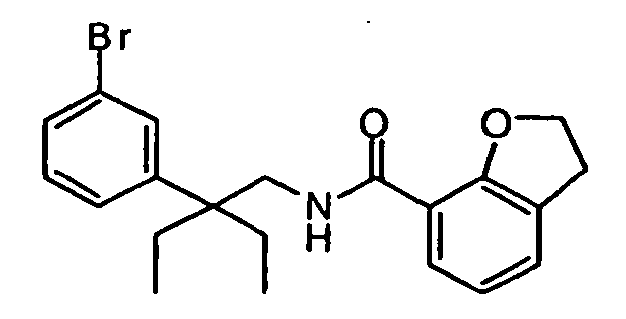
- The title compound was prepared from 1-(2,3-dihydrobenzofuran-7-yl)-l-oxo-2-aza-4,4-diethyl-4-(3-tributyltinphenyl)-butane according to procedures described in Example 41. 1H NMR (CDCl3) δ 0.81 (t, 6H), 1.79 (m, 4H), 3.20 (t, 2h), 3.73(d, 2H), 4.56 (t, 2H), 6.93 (t, 1H), 7.24 - 7.42 (m, 5H), 7.53 (m, 1H), 7.9 (d, 1H). Mass Spectrum (CI) m/e 401,403 (m+1)
Claims (7)
- Use of a compound of structural Formula I:
 n is: 0, 1, 2 or 3;r is: 0 or 1;s is: 0 or 1;R1, R2, R5, R6 and R7 are independently:(1) halo, wherein halo is fluoro, chloro, bromo, or iodo,(2) hydroxy,(3) (C1-C6)-alkyl,(4) HO(C1-C6)-alkyloxy,(5) (C1-C4)-perfluoroalkyl,(6) (C2-C6)-alkenyl,(7) O[(C=O)Or]s(C1-C6)-alkyl, wherein the alkyl may be cyclic or straight-chained,(8) phenyl,(9) CO(C1-C6)-alkyl,(10) CO2(C1-C6)-alkyl,(11) CONR8R9,(12) NR8R9,(13) (C2-C6)-alkenyloxy,(14) benzyloxy,(15) hydrogen,(16) OCF3,(17) R1 and R2 or R6 and R7 can an be taken together when on adjacent carbons to form a fused benzo, dihydrofuranyl, furanyl, pyrrolidyl, dihydropyrrolidyl or 1,3-dioxolan group;R3 and R4 are independently:(1) halo, wherein halo is fluoro, chloro, bromo, or iodo,(2) hydroxy,(3) HO(C1-C6)-alkyloxy,(4) (C1-C4)-perfluoroalkyl,(5) O(CO)CCl3,(6) (C1-C6)-alkyl-S(O)n-,(7) phenyl-(CH2)r-S(O)n-,(8) cyano,(9) nitro,(10) CO2H,(11) CO(C1-C6)-alkyl,(12) CO2(C1-C6)-alkyl,(13) CONR8R9,(14) NR8R9,(15) O(CO)NR8R9,(16) azido,(17) NR8(CO)NR8R9,(18) hydrogen,(19) (C1-C6)-alkyl, wherein alkyl includes cyclic as well as acyclic groups and is unsubstituted or substituted with one or two of the substituents selected from the group consisting of:(a) halo, wherein halo is fluoro, chloro, bromo, or iodo,(b) hydroxy,(c) oxo,(d) O((C=O)Or]s(C1-C6)-alkyl,(e) aryl-(C1-C6)-alkyloxy,(f) NR8R9,(g) O(CO)NR8R9,(h) CHO,(i) CO2H,(j) CO(C1-C6)-alkyl,(k) CO2(C1-C6)-alkyl, wherein alkyl may be substituted with phenyl,(l) CO2(C1-C6)-alkenyl,(m) CONR8R9,(n) aryl, wherein aryl is defined as phenyl or naphthyl, unsubstituted or substituted with a substituent selected from the group consisting of:(a') halo, as defined above,(b') hydroxy,(c') (C1-C6)-alkyl,(d') (C1-C6)-alkyloxy,(e') (C1-C6)-alkyl-S(O)n-,(f') phenyl,(g') phenoxy,(h') cyano,(i') CO2H,(j') CO(C1-C6)-alkyl,(k') CO2(C1-C6)-alkyl,(l') CONR8R9,(m') NR8R9, and(o) benzyl-S(O)n-,(p) O[(C=O)Or]s(C2-C6)-alkenyl,(q) O[(C=O)Or]saryl,(r) O[(C=O)Or]sheteroaryl,(s) O(CH2)nheteroaryl, or(t) O(CH2)naryl;(20) (C2-C6)-alkenyl, wherein alkenyl is unsubstituted or substituted with a substituent selected from the group consisting of:(a) halo, wherein halo is fluoro, chloro, bromo, or iodo,(b) hydroxy,(c) oxo,(d) phenyl-(C1-C6)-alkyloxy,(e) NR8R9,(f) CHO,(g) CO2H,(h) CO(C1-C6)-alkyl,(i) CO2(C1-C6)-alkyl,(j) CONR8R9,(k) aryl, wherein aryl is as defined above,(l) O[(C=O)Or]s(C1-C6)-alkyl, alkyl as defined above,(m) O[(C=O)Or]saryl, aryl as defined above,(n) O[(C=O)Or]sheteroaryl, wherein heteroaryl is defined as an unsubstituted, monosubstituted, or disubstituted five or six membered aromatic heterocycle containing from 1 to 3 heteroatoms selected from the group consisting of 0, N and S and wherein the substituents are members selected from the group consisting of:(a') halo, as defined above,(b') hydroxy,(c') (C1-C6)-alkyl,(d') (C1-C4)-perfluoroalkyl,(e') (C2-C6)-alkenyl,(f') (C2-C6)-Alkynyl,(g') (C1-C6)-alkyloxy,(h') (C1-C6)-alkyl-S(O)n-,(i') phenyl,(j') phenoxy,(k') cyano,(l') nitro,(m') CO2H,(n') CO(C1-C6)-alkyl,(o') CO2(C1-C6)-alkyl,(p') CONR8R9,(q') NR8R9, and(r') fused benzo or pyridyl group,(o) O(CH2)nheteroaryl, heteroaryl as defined above, and(p) O(CH2)naryl, aryl as defined above;(21) O((C=O)Or]s(C1-C6)-alkyl, alkyl as defined above,(22) O[(C=O)Or]s(C2-C6)-alkenyl, as defined above,(23) O[(C=O)Or]saryl, aryl as defined above,(24) O[(C=O)Or]sheteroaryl, heteroaryl as defined above(25) O(CH2)nheteroaryl, heteroaryl as defined above,(26) aryl, wherein aryl is as defined above or(27) O(CH2)naryl, aryl as defined above;R3 can also be any of the following when R4 is absent:(28) oxo,(29) =CH-(C1-C6)-alkyl, wherein alkyl is as defined above,(30) =CH-(C2-C6)-alkenyl, wherein alkenyl is as defined above,(31) =CH-aryl, wherein aryl is as defined above, or(32) =CH2;R8 and R9 are independently selected from the group consisting of:(1) hydrogen,(2) [(C=O)Or]saryl, wherein aryl is as defined above,(3) [(C=O)Or]s(C2-C8)-alkenyl, wherein alkenyl is as defined above, and(4) [(C=O)Or]s(C1-C8)-alkyl, wherein alkyl is as defined above, andR10 is:for the manufacture of a medicament for treating or preventing resistance by transplantation of organs or tissue, graft-versus-host diseases brought about by medulla ossium transplantation, rheumatoid arthritis, systemic lupus erythematosus, Hashimoto's thyroiditis, multiple sclerosis, myasthenia gravis, type I diabetes uveitis, juvenile-onset or recent-onset diabetes mellitus, posterior uveitis, allergic encephalomyelitis, glomerulonephritis, infectious diseases caused by pathogenic microorganisms, inflammatory and hyperproliferative skin diseases, psoriasis, atopical dermatitis, contact dermatitis, eczematous dermatitises, seborrhoeis dermatitis, Lichen planus, Pemphigus, bullous pemphigoid, Epidermolysis bullosa, urticaria, angioedemas, vasculitides, erythemas, cutaneous eosinophilias, Lupus erythematosus, acne, Alopecia areata, keratoconjunctivitis, vernal conjunctivitis, uveitis associated with Behcet's disease, keratitis, herpetic keratitis, conical cornea, dystrophia epithelialis corneae, corneal leukoma, ocular pemphigus, Mooren's ulcer, Scleritis, Graves' opthalmopathy, Vogt-Koyanagi-Harada syndrome, sarcoidosis, pollen allergies, reversible obstructive airway disease, bronchial asthma, allergic asthma, intrinsic asthma, extrinsic asthma, dust asthma, chronic or inveterate asthma, late asthma and airway hyper-responsiveness, bronchitis, gastric ulcers, vascular damage caused by ischemic diseases and thrombosis, ischemic bowel diseases, inflammatory bowel diseases, necrotizing enterocolitis, intestinal lesions associated with thermal burns and leukotriene B4-mediated diseases, Coeliac diseases, proctitis, eosinophilic gastroenteritis, mastocytosis, Crohn's disease, ulcerative colitis, migraine, rhinitis, eczema, interstitial nephritis, Good-pasture's syndrome, hemolytic-uremic syndrome, diabetic nephropathy, multiple myositis, Guillain-Barre syndrome, Meniere's disease, polyneuritis, multiple neuritis, mononeuritis, radiculopathy, hyperthyroidism, Basedow's disease, pure red cell aplasia, aplastic anemia, hypoplastic anemia, idiopathic thrombocytopenic purpura, autoimmune hemolytic anemia, agranulocytosis, pernicious anemia, megaloblastic anemia, anerythroplasia, osteoporosis, sarcoidosis, fibroid lung, idiopathic interstitial pneumonia, dermatomyositis, leukoderma vulgaris, ichthyosis vulgaris, photoallergic sensitivity, cutaneous T cell lymphoma, arteriosclerosis, atherosclerosis, aortitis syndrome, polyarteritis nodosa, myocardosis, scleroderma, Wegener's granuloma, Sjogren's syndrome, adiposis, eosinophilic fascitis, lesions of gingiva, periodontium, alveolar bone, substantia ossea dentis, glomerulonephritis, male pattern alopecia or alopecia senilis by preventing epilation or providing hair germination and/or promoting hair generation and hair growth, muscular dystrophy; Pyoderma and Sezary's syndrome, Addison's disease, ischemia-reperfusion injury of organs which occurs upon preservation, transplantation or ischemic disease, endotoxin-shock, pseudomembranous colitis, colitis caused by drug or radiation, ischemic acute renal insufficiency, chronic renal insufficiency, toxinosis caused by lung-oxygen or drugs, lung cancer, pulmonary emphysema, cataracta, siderosis, retinitis pigmentosa, senile macular degeneration, vitreal scarring, corneal alkali burn, dermatitis erythema multiforme, linear IgA ballous dermatitis and cement dermatitis; gingivitis, periodontitis, sepsis, pancreatitis, diseases caused by environmental pollution, aging, carcinogenis, metastasis of carcinoma and hypobaropathy, disease caused by histamine or leukotriene-C4 release, Behcet's disease, autoimmune hepatitis, primary biliary cirrhosis sclerosing cholangitis, partial liver resection, acute liver necrosis, necrosis caused by toxin, viral hepatitis, shock, or anoxia, B-virus hepatitis, non-A/non-B hepatitis, cirrhosis, alcoholic cirrhosis, hepatic failure, fulminant hepatic failure, late-onset hepatic failure, "acute-on-chronic" liver failure, augmentation of chemotherapeutic effect, cytomegalovirus infection, HCMV infection, AIDS, cancer, senile dementia, trauma, chronic bacterial infection, and cardiac arrhythmias.(1) hydrogen, or(2) [(C=O)Or]s(C1-C6)-alkyl, wherein alkyl is as defined above.,
 - Use of a compound according to claim 1, wherein:R1, R2, R5, R6 and R7 are independently:(1) halo, wherein halo is fluoro, chloro, bromo, or iodo,(2) hydroxy,(3) (C1-C3)-alkyl,(4) (C2-C3)-alkenyl,(5) O(C1-C4)-alkyl, wherein the alkyl may be cyclic or straight-chained,(6) O(CO)CH3,(7) CO(C1-C3)-alkyl,(8) CO2(C1-C3)-alkyl,(9) hydrogen,(10) R1 and R2 or R6 and R7 can an be taken together when on adjacent carbons to form a fused benzo, dihydrofuranyl, furanyl, pyrrolidyl, dihydropyrrolidyl or 1,3-dioxolan group;R3 and R4 are independently:(1) hydrogen,(2) (C1-C6)-alkyl, wherein alkyl includes cyclic as well as acyclic groups and is unsubstituted or substituted with one or two of the substituents selected from the group consisting of:(a) halo, wherein halo is fluoro, chloro, bromo, or iodo,(b) hydroxy,(c) oxo,(d) O[(C=O)Or]s(C1-C6)-alkyl, wherein r and s are independently 0 or 1,(e) CO2(C2-C3)-alkenyl,(f) O[(C=O)Or]s(C1-C6)-alkenyl, wherein r and s are independently 0 or 1,(g) NR8R9,(h) O(CO)NR8R9,(i) CHO,(j) CO2H,(k) CO(C1-C6)-alkyl,(l) CO2(C1-C6)-alkyl, wherein alkyl may be substituted with phenyl,(m) CONR8R9,(n) aryl, wherein aryl is defined as phenyl, unsubstituted or substituted with a substituent selected from the group consisting of:(a') halo, as defined above,(b') hydroxy,(c') (C1-C6)-alkyl, and(d') (C1-C6)-alkyloxy, and(o) O[(C=O)Or]s(C2-C6)-alkenyl, wherein r and s are independently 0 or 1,(3) (C2-C6)-alkenyl,(4) aryl, wherein aryl is as defined above or(5) O(CH2)naryl, wherein aryl is as defined above;R3 can also be any of the following when R4 is absent:(6) =CH-(C1-C6)-alkyl, wherein alkyl is as defined above,(7) =CH-(C2-C6)-alkenyl, wherein alkenyl is as defined above,R8 and R9 are independently selected from the group consisting of:(1) hydrogen,(2) [(C=O)Or]saryl, wherein aryl is as defined above and r and s are independently 0 or 1,(3) (C2-C8)-alkenyl, wherein alkenyl is as defined above,and(4) (C1-C6)-alkyl, wherein alkyl is as defined above, andR10 is:(1) hydrogen, or(2) (C=O)(C1-C3)-alkyl, wherein alkyl is as defined above.
- Use of a compound according to claim 1 or claim 2 which is selected from the group consisting of1-(2-methoxyphenyl)-1-oxo-2-aza-(S)-4-i-butyl-4-phenylbutane,1-(2-methoxyphenyl)-1-oxo-2-aza-4-(S)-((3-allyloxycarbonyloxy)propyl))-4-phenylbutane,1-(2-methoxyphenyl)-1-oxo-2-aza-4,4-diethyl-4-phenylbutane,1-(2,3-dihydrobenzofuran-7-yl)-1-oxo-2-aza-4,4-diethyl-4-(phenyl)-butane, and1-(2-methoxyphenyl)-1-oxo-2-aza-4-(S)-(3-hydroxypropyl)-4-phenylbutane,or a pharmaceutically acceptable salt thereof.
- The use of a compound as defined in any one of claims 1 to 3 or a pharmaceutically acceptable salt, crystal form or hydrate thereof for the manufacture of a medicament for preventing or treating resistance to transplantation or transplantation rejection of organs or tissues or for suppressing the immune system or for preventing or treating cardiac arrhythmias.
- A combination of a compound as defined in any one of claims 1 to 3 or a pharmaceutically acceptable salt, crystal form or hydrate thereof and a second immunosuppressive agent for separate, simultaneous or sequential administration.
- The combination of claim 5 wherein the second immunosuppressive agent is azathioprine, brequinar sodium, deoxyspergualin, mizaribine, mycophenolic acid morpholino ester, cyclosporin, FK-506 or rapamycin.
- A compound which is selected from the group consisting of1-(2-methoxyphenyl)-1-oxo-2-aza-(S)-4-i-butyl-4-phenylbutane,1-(2-methoxyphenyl)-1-oxo-2-aza-4-(S)-((3-allyloxycarbonyloxy)propyl))-4-phenylbutane,1-(2,methoxyphenyl)-1-oxo-2-aza-4,4-diethyl-4-phenylbutane,1-(2,3-dihydrobenzofuran-7-yl)-1-oxo-2-aza-4,4-diethyl-4-(phenyl)-butane, and1-(2-methoxyphenyl)-1-oxo-2-aza-4-(S)-(3-hydroxypropyl)-4-phenylbutane,or a pharmaceutically acceptable salt thereof.
Applications Claiming Priority (3)
| Application Number | Priority Date | Filing Date | Title |
|---|---|---|---|
| US10642298P | 1998-10-30 | 1998-10-30 | |
| US106422P | 1998-10-30 | ||
| PCT/US1999/025042 WO2000025774A1 (en) | 1998-10-30 | 1999-10-26 | Benzamide potassium channel inhibitors |
Publications (3)
| Publication Number | Publication Date |
|---|---|
| EP1126836A1 EP1126836A1 (en) | 2001-08-29 |
| EP1126836A4 EP1126836A4 (en) | 2002-09-04 |
| EP1126836B1 true EP1126836B1 (en) | 2007-02-14 |
Family
ID=22311337
Family Applications (1)
| Application Number | Title | Priority Date | Filing Date |
|---|---|---|---|
| EP99971316A Expired - Lifetime EP1126836B1 (en) | 1998-10-30 | 1999-10-26 | Benzamide potassium channel inhibitors |
Country Status (9)
| Country | Link |
|---|---|
| US (1) | US6194458B1 (en) |
| EP (1) | EP1126836B1 (en) |
| JP (1) | JP2002528493A (en) |
| AT (1) | ATE353641T1 (en) |
| AU (1) | AU775108B2 (en) |
| CA (1) | CA2348446A1 (en) |
| DE (1) | DE69935153T2 (en) |
| ES (1) | ES2281207T3 (en) |
| WO (1) | WO2000025774A1 (en) |
Families Citing this family (30)
| Publication number | Priority date | Publication date | Assignee | Title |
|---|---|---|---|---|
| US6632836B1 (en) * | 1998-10-30 | 2003-10-14 | Merck & Co., Inc. | Carbocyclic potassium channel inhibitors |
| DE19923086A1 (en) * | 1999-05-20 | 2000-11-23 | Aventis Pharma Gmbh | New cinnamoylaminoalkyl-substituted benzenesulfonamide derivatives, are ATP-sensitive potassium channel inhibitors and vagal nervous system stimulants useful for treating cardiovascular disorders |
| JP4854909B2 (en) | 2000-09-20 | 2012-01-18 | メルク・シャープ・エンド・ドーム・コーポレイション | Isoquinolinone potassium channel inhibitor |
| EP1435964B1 (en) * | 2001-10-16 | 2009-12-09 | The University of Kansas | Novel prodrugs of n-h bond-containing compounds and methods of making thereof |
| TW200307539A (en) * | 2002-02-01 | 2003-12-16 | Bristol Myers Squibb Co | Cycloalkyl inhibitors of potassium channel function |
| AU2003226149A1 (en) * | 2002-04-05 | 2003-10-27 | Merck & Co., Inc. | Substituted aryl amides |
| US7122580B2 (en) * | 2002-08-09 | 2006-10-17 | Transtech Pharma, Inc. | Aryl and heteroaryl compounds and methods to modulate coagulation |
| GB0315950D0 (en) | 2003-06-11 | 2003-08-13 | Xention Discovery Ltd | Compounds |
| US7208601B2 (en) * | 2003-08-08 | 2007-04-24 | Mjalli Adnan M M | Aryl and heteroaryl compounds, compositions, and methods of use |
| WO2005014533A2 (en) * | 2003-08-08 | 2005-02-17 | Transtech Pharma, Inc. | Aryl and heteroaryl compounds, compositions, and methods of use |
| US7501538B2 (en) * | 2003-08-08 | 2009-03-10 | Transtech Pharma, Inc. | Aryl and heteroaryl compounds, compositions and methods of use |
| US20050054673A1 (en) * | 2003-09-08 | 2005-03-10 | Aventis Pharma Deutschland Gmbh | Combination of phenylcarboxylic acid amides with beta-adrenoreceptor blockers and their use for the treatment of atrial arrhythmias |
| DE10341233A1 (en) * | 2003-09-08 | 2005-03-24 | Aventis Pharma Deutschland Gmbh | Composition, useful to treat e.g. atrial fibrillation, atrial flutter and atrial arrhythmia, comprises at least one beta-blocker and at least one compound of a phenylcarboxylic acid amide derivative |
| GB0412986D0 (en) | 2004-06-10 | 2004-07-14 | Xention Discovery Ltd | Compounds |
| US7569589B2 (en) | 2004-07-29 | 2009-08-04 | Merck & Co., Inc. | Potassium channel inhibitors |
| US7576212B2 (en) | 2004-12-09 | 2009-08-18 | Xention Limited | Thieno[2,3-B] pyridines as potassium channel inhibitors |
| GB0525164D0 (en) | 2005-12-09 | 2006-01-18 | Xention Discovery Ltd | Compounds |
| TWI435863B (en) * | 2006-03-20 | 2014-05-01 | Nihon Nohyaku Co Ltd | N-2-(hetero) arylethylcarboxamide derivative and pest controlling |
| GB0815782D0 (en) | 2008-08-29 | 2008-10-08 | Xention Ltd | Novel potassium channel blockers |
| GB0815781D0 (en) * | 2008-08-29 | 2008-10-08 | Xention Ltd | Novel potassium channel blockers |
| GB0815784D0 (en) * | 2008-08-29 | 2008-10-08 | Xention Ltd | Novel potassium channel blockers |
| GB0909672D0 (en) * | 2009-06-04 | 2009-07-22 | Xention Discovery Ltd | Compounds |
| GB0909671D0 (en) | 2009-06-04 | 2009-07-22 | Xention Discovery Ltd | Compounds |
| GB201105659D0 (en) | 2011-04-01 | 2011-05-18 | Xention Ltd | Compounds |
| NO3175985T3 (en) | 2011-07-01 | 2018-04-28 | ||
| NZ627942A (en) | 2012-01-27 | 2016-03-31 | Gilead Sciences Inc | Combination therapies using late sodium ion channel blockers and potassium ion channel blockers |
| WO2013130808A1 (en) | 2012-02-29 | 2013-09-06 | D.E. Shaw Research, Llc | Methods for screening voltage gated proteins |
| TW201427947A (en) | 2012-10-12 | 2014-07-16 | Lundbeck & Co As H | Cyclic amines |
| TWI598325B (en) * | 2012-10-12 | 2017-09-11 | H 朗德貝克公司 | Benzoamide |
| JP7097435B2 (en) * | 2017-08-23 | 2022-07-07 | アセシオン ファーマ エイピーエス | Benzimidazole derivative useful as a potassium channel inhibitor |
Family Cites Families (14)
| Publication number | Priority date | Publication date | Assignee | Title |
|---|---|---|---|---|
| DE2500157C2 (en) * | 1975-01-03 | 1983-09-15 | Hoechst Ag, 6230 Frankfurt | N-acyl-4- (2-aminoethyl) benzoic acids, their salts and esters, process for their preparation and their use |
| IL88314A (en) | 1987-11-18 | 1994-05-30 | Tanabe Seiyaku Co | Sulphonylamino indane derivatives, their preparation and pharmaceutical compositions containing them |
| DE3830054A1 (en) * | 1988-09-03 | 1990-03-15 | Boehringer Mannheim Gmbh | PHENYLAMIDES - PROCESS FOR PRODUCING THE SAME AND MEDICINAL PRODUCTS CONTAINING THESE COMPOUNDS |
| IE903957A1 (en) | 1989-11-06 | 1991-05-08 | Sanofi Sa | Aromatic amine compounds, their method of preparation and¹pharmaceutical compositions in which they are present |
| DE3937169A1 (en) * | 1989-11-08 | 1991-05-16 | Nattermann A & Cie | BENZYLSELENOBENZAMIDES OF ANILINE AND BENZYLAMINE |
| ATE167473T1 (en) | 1990-08-20 | 1998-07-15 | Eisai Co Ltd | SULFONAMIDE DERIVATIVES |
| US5312031A (en) * | 1991-07-08 | 1994-05-17 | Nigrelli Systems Inc. | Sheet feeder |
| GB9212693D0 (en) * | 1992-06-15 | 1992-07-29 | Celltech Ltd | Chemical compounds |
| US5696123A (en) * | 1994-09-17 | 1997-12-09 | Boehringer Ingelheim Kg | Neurokinin antagonists |
| ZA96211B (en) | 1995-01-12 | 1996-07-26 | Teva Pharma | Compositions containing and methods of using 1- aminoindan and derivatives thereof and process for preparing optically active 1-aminoindan derivatives |
| GB9511694D0 (en) * | 1995-06-09 | 1995-08-02 | Fujisawa Pharmaceutical Co | Benzamide derivatives |
| NO307879B1 (en) * | 1995-09-18 | 2000-06-13 | Sankyo Co | New urea derivatives with ACAT inhibitory activity and pharmaceuticals containing them |
| US6083986A (en) | 1996-07-26 | 2000-07-04 | Icagen, Inc. | Potassium channel inhibitors |
| TW467902B (en) | 1996-07-31 | 2001-12-11 | Bristol Myers Squibb Co | Diphenyl heterocycles as potassium channel modulators |
-
1999
- 1999-10-21 US US09/422,499 patent/US6194458B1/en not_active Expired - Fee Related
- 1999-10-26 WO PCT/US1999/025042 patent/WO2000025774A1/en not_active Ceased
- 1999-10-26 AT AT99971316T patent/ATE353641T1/en not_active IP Right Cessation
- 1999-10-26 EP EP99971316A patent/EP1126836B1/en not_active Expired - Lifetime
- 1999-10-26 CA CA002348446A patent/CA2348446A1/en not_active Abandoned
- 1999-10-26 DE DE69935153T patent/DE69935153T2/en not_active Expired - Fee Related
- 1999-10-26 AU AU12320/00A patent/AU775108B2/en not_active Ceased
- 1999-10-26 ES ES99971316T patent/ES2281207T3/en not_active Expired - Lifetime
- 1999-10-26 JP JP2000579215A patent/JP2002528493A/en not_active Withdrawn
Also Published As
| Publication number | Publication date |
|---|---|
| EP1126836A4 (en) | 2002-09-04 |
| CA2348446A1 (en) | 2000-05-11 |
| EP1126836A1 (en) | 2001-08-29 |
| DE69935153D1 (en) | 2007-03-29 |
| DE69935153T2 (en) | 2007-11-22 |
| ES2281207T3 (en) | 2007-09-16 |
| ATE353641T1 (en) | 2007-03-15 |
| AU775108B2 (en) | 2004-07-15 |
| AU1232000A (en) | 2000-05-22 |
| US6194458B1 (en) | 2001-02-27 |
| JP2002528493A (en) | 2002-09-03 |
| WO2000025774A1 (en) | 2000-05-11 |
Similar Documents
| Publication | Publication Date | Title |
|---|---|---|
| EP1143965B1 (en) | Carbocyclic potassium channel inhibitors | |
| US6194458B1 (en) | Benzamide potassium channel inhibitors | |
| US6303637B1 (en) | Heterocyclic potassium channel inhibitors | |
| CN100491368C (en) | Dioxane-2-alkylcarbamate derivatives, their preparation and their use in therapeutics | |
| EP1720872B1 (en) | Aryl and heteroaryl-piperidinecarboxylate derivatives, the preparation and the use thereof in the form of faah enzyme inhibitors | |
| CN1244862A (en) | Endothelin antagonists: N-[[2'-[[(4,5-dimethyl-3-isoxazolyl)amino]sulfonyl]-4-(2-oxazolyl)[1,1' Biphenyl]-2-yl]methyl]-N,3,3-trimethylbutanamide and N-(4,5-dimethyl-3-isoxazolyl)-2'-[3, 3-Dimethyl-2-oxo-1-pyrrolidinyl)methyl]-4'-2-oxazolyl)[1,1'-biphenyl]-2-sulfonamide and its salts | |
| US5679705A (en) | Triterpene derivatives with immunosuppressant activity | |
| ES2344454T3 (en) | DERIVATIVES OF ARILALQUILCARBAMATOS, ITS PREPARATION AND ITS APPLICATION IN THERAPEUTICS. | |
| US5696156A (en) | Triterpene derivatives with immunosuppressant activity | |
| US6051590A (en) | Immunosuppressant tricyclic compounds | |
| AU708667B2 (en) | Triterpene derivatives with immunosuppressant activity | |
| AU707991B2 (en) | Triterpene derivatives with immunosuppressant activity | |
| US5998408A (en) | Triterpene derivatives with immunosuppressant activity | |
| US5874594A (en) | Triterpene derivatives with immunosuppressant activity | |
| US5883119A (en) | Triterpene derivatives with immunosuppressant activity | |
| EP0721930A1 (en) | Benzoylethylene derivative | |
| MXPA04011910A (en) | Pharmaceutical combination. | |
| EP1647545A1 (en) | Antiviral protease inhibitors | |
| JP2009263261A (en) | Pyrrolidine derivatives | |
| AU2024314133A1 (en) | Combination therapies of fasn inhibitors with thyroid hormone receptor agonists | |
| US6100293A (en) | Tetracyclic triterpene derivatives with immunosuppressant activity | |
| JPH11246511A (en) | Sulfuric ester derivatives | |
| HK1055945B (en) | Cyclohexyl(alkyl)-propanolamines, preparation method and pharmaceutical compositions containing same | |
| HK1055945A1 (en) | Cyclohexyl(alkyl)-propanolamines, preparation method and pharmaceutical compositions containing same | |
| EP1857440A1 (en) | Novel compounds, isomer thereof, or pharmaceutically acceptable salts thereof as vanilloid receptor antagonist; and pharmaceutical compositions containing the same |
Legal Events
| Date | Code | Title | Description |
|---|---|---|---|
| PUAI | Public reference made under article 153(3) epc to a published international application that has entered the european phase |
Free format text: ORIGINAL CODE: 0009012 |
|
| 17P | Request for examination filed |
Effective date: 20010530 |
|
| AK | Designated contracting states |
Kind code of ref document: A1 Designated state(s): AT BE CH CY DE DK ES FI FR GB GR IE IT LI LU MC NL PT SE |
|
| AX | Request for extension of the european patent |
Free format text: AL PAYMENT 20010530;LT PAYMENT 20010530;LV PAYMENT 20010530;MK PAYMENT 20010530;RO PAYMENT 20010530;SI PAYMENT 20010530 |
|
| A4 | Supplementary search report drawn up and despatched |
Effective date: 20020722 |
|
| AK | Designated contracting states |
Kind code of ref document: A4 Designated state(s): AT BE CH CY DE DK ES FI FR GB GR IE IT LI LU MC NL PT SE |
|
| 17Q | First examination report despatched |
Effective date: 20040220 |
|
| GRAP | Despatch of communication of intention to grant a patent |
Free format text: ORIGINAL CODE: EPIDOSNIGR1 |
|
| GRAS | Grant fee paid |
Free format text: ORIGINAL CODE: EPIDOSNIGR3 |
|
| GRAA | (expected) grant |
Free format text: ORIGINAL CODE: 0009210 |
|
| AK | Designated contracting states |
Kind code of ref document: B1 Designated state(s): AT BE CH CY DE DK ES FI FR GB GR IE IT LI LU MC NL PT SE |
|
| AX | Request for extension of the european patent |
Extension state: AL LT LV MK RO SI |
|
| PG25 | Lapsed in a contracting state [announced via postgrant information from national office to epo] |
Ref country code: NL Free format text: LAPSE BECAUSE OF FAILURE TO SUBMIT A TRANSLATION OF THE DESCRIPTION OR TO PAY THE FEE WITHIN THE PRESCRIBED TIME-LIMIT Effective date: 20070214 Ref country code: FI Free format text: LAPSE BECAUSE OF FAILURE TO SUBMIT A TRANSLATION OF THE DESCRIPTION OR TO PAY THE FEE WITHIN THE PRESCRIBED TIME-LIMIT Effective date: 20070214 Ref country code: DK Free format text: LAPSE BECAUSE OF FAILURE TO SUBMIT A TRANSLATION OF THE DESCRIPTION OR TO PAY THE FEE WITHIN THE PRESCRIBED TIME-LIMIT Effective date: 20070214 Ref country code: BE Free format text: LAPSE BECAUSE OF FAILURE TO SUBMIT A TRANSLATION OF THE DESCRIPTION OR TO PAY THE FEE WITHIN THE PRESCRIBED TIME-LIMIT Effective date: 20070214 Ref country code: AT Free format text: LAPSE BECAUSE OF FAILURE TO SUBMIT A TRANSLATION OF THE DESCRIPTION OR TO PAY THE FEE WITHIN THE PRESCRIBED TIME-LIMIT Effective date: 20070214 |
|
| REG | Reference to a national code |
Ref country code: GB Ref legal event code: FG4D |
|
| REG | Reference to a national code |
Ref country code: CH Ref legal event code: EP |
|
| REF | Corresponds to: |
Ref document number: 69935153 Country of ref document: DE Date of ref document: 20070329 Kind code of ref document: P |
|
| REG | Reference to a national code |
Ref country code: IE Ref legal event code: FG4D |
|
| PG25 | Lapsed in a contracting state [announced via postgrant information from national office to epo] |
Ref country code: SE Free format text: LAPSE BECAUSE OF FAILURE TO SUBMIT A TRANSLATION OF THE DESCRIPTION OR TO PAY THE FEE WITHIN THE PRESCRIBED TIME-LIMIT Effective date: 20070514 |
|
| REG | Reference to a national code |
Ref country code: CH Ref legal event code: NV Representative=s name: RITSCHER & PARTNER AG |
|
| PG25 | Lapsed in a contracting state [announced via postgrant information from national office to epo] |
Ref country code: PT Free format text: LAPSE BECAUSE OF FAILURE TO SUBMIT A TRANSLATION OF THE DESCRIPTION OR TO PAY THE FEE WITHIN THE PRESCRIBED TIME-LIMIT Effective date: 20070716 |
|
| LTIE | Lt: invalidation of european patent or patent extension |
Effective date: 20070214 |
|
| NLV1 | Nl: lapsed or annulled due to failure to fulfill the requirements of art. 29p and 29m of the patents act | ||
| ET | Fr: translation filed | ||
| REG | Reference to a national code |
Ref country code: ES Ref legal event code: FG2A Ref document number: 2281207 Country of ref document: ES Kind code of ref document: T3 |
|
| PLBE | No opposition filed within time limit |
Free format text: ORIGINAL CODE: 0009261 |
|
| STAA | Information on the status of an ep patent application or granted ep patent |
Free format text: STATUS: NO OPPOSITION FILED WITHIN TIME LIMIT |
|
| PGFP | Annual fee paid to national office [announced via postgrant information from national office to epo] |
Ref country code: GB Payment date: 20070918 Year of fee payment: 9 |
|
| 26N | No opposition filed |
Effective date: 20071115 |
|
| PGFP | Annual fee paid to national office [announced via postgrant information from national office to epo] |
Ref country code: ES Payment date: 20071019 Year of fee payment: 9 Ref country code: DE Payment date: 20071031 Year of fee payment: 9 |
|
| PGFP | Annual fee paid to national office [announced via postgrant information from national office to epo] |
Ref country code: CH Payment date: 20071009 Year of fee payment: 9 Ref country code: IT Payment date: 20071019 Year of fee payment: 9 |
|
| REG | Reference to a national code |
Ref country code: CH Ref legal event code: PCAR Free format text: RITSCHER & PARTNER AG;RESIRAIN 1;8125 ZOLLIKERBERG (CH) |
|
| PG25 | Lapsed in a contracting state [announced via postgrant information from national office to epo] |
Ref country code: GR Free format text: LAPSE BECAUSE OF FAILURE TO SUBMIT A TRANSLATION OF THE DESCRIPTION OR TO PAY THE FEE WITHIN THE PRESCRIBED TIME-LIMIT Effective date: 20070515 |
|
| PGFP | Annual fee paid to national office [announced via postgrant information from national office to epo] |
Ref country code: FR Payment date: 20071004 Year of fee payment: 9 |
|
| PG25 | Lapsed in a contracting state [announced via postgrant information from national office to epo] |
Ref country code: MC Free format text: LAPSE BECAUSE OF NON-PAYMENT OF DUE FEES Effective date: 20071031 |
|
| PG25 | Lapsed in a contracting state [announced via postgrant information from national office to epo] |
Ref country code: IE Free format text: LAPSE BECAUSE OF NON-PAYMENT OF DUE FEES Effective date: 20071026 |
|
| REG | Reference to a national code |
Ref country code: CH Ref legal event code: PL |
|
| GBPC | Gb: european patent ceased through non-payment of renewal fee |
Effective date: 20081026 |
|
| REG | Reference to a national code |
Ref country code: FR Ref legal event code: ST Effective date: 20090630 |
|
| PG25 | Lapsed in a contracting state [announced via postgrant information from national office to epo] |
Ref country code: CY Free format text: LAPSE BECAUSE OF FAILURE TO SUBMIT A TRANSLATION OF THE DESCRIPTION OR TO PAY THE FEE WITHIN THE PRESCRIBED TIME-LIMIT Effective date: 20070214 |
|
| PG25 | Lapsed in a contracting state [announced via postgrant information from national office to epo] |
Ref country code: LU Free format text: LAPSE BECAUSE OF NON-PAYMENT OF DUE FEES Effective date: 20071026 Ref country code: IT Free format text: LAPSE BECAUSE OF NON-PAYMENT OF DUE FEES Effective date: 20081026 Ref country code: DE Free format text: LAPSE BECAUSE OF NON-PAYMENT OF DUE FEES Effective date: 20090501 |
|
| PG25 | Lapsed in a contracting state [announced via postgrant information from national office to epo] |
Ref country code: LI Free format text: LAPSE BECAUSE OF NON-PAYMENT OF DUE FEES Effective date: 20081031 Ref country code: FR Free format text: LAPSE BECAUSE OF NON-PAYMENT OF DUE FEES Effective date: 20081031 Ref country code: CH Free format text: LAPSE BECAUSE OF NON-PAYMENT OF DUE FEES Effective date: 20081031 |
|
| PG25 | Lapsed in a contracting state [announced via postgrant information from national office to epo] |
Ref country code: GB Free format text: LAPSE BECAUSE OF NON-PAYMENT OF DUE FEES Effective date: 20081026 |
|
| REG | Reference to a national code |
Ref country code: ES Ref legal event code: FD2A Effective date: 20081027 |
|
| PG25 | Lapsed in a contracting state [announced via postgrant information from national office to epo] |
Ref country code: ES Free format text: LAPSE BECAUSE OF NON-PAYMENT OF DUE FEES Effective date: 20081027 |