EP1126685A2 - System und Verfahren zur Bekanntmachung beim Hinzufügen oder Löschen eines TAPI-Anschlusses oder Endgeräts ohne diese Nachricht von der Vermittlungsanlage zu erhalten - Google Patents
System und Verfahren zur Bekanntmachung beim Hinzufügen oder Löschen eines TAPI-Anschlusses oder Endgeräts ohne diese Nachricht von der Vermittlungsanlage zu erhalten Download PDFInfo
- Publication number
- EP1126685A2 EP1126685A2 EP01300918A EP01300918A EP1126685A2 EP 1126685 A2 EP1126685 A2 EP 1126685A2 EP 01300918 A EP01300918 A EP 01300918A EP 01300918 A EP01300918 A EP 01300918A EP 1126685 A2 EP1126685 A2 EP 1126685A2
- Authority
- EP
- European Patent Office
- Prior art keywords
- tapi
- configuration
- deleted
- configuration information
- table object
- Prior art date
- Legal status (The legal status is an assumption and is not a legal conclusion. Google has not performed a legal analysis and makes no representation as to the accuracy of the status listed.)
- Granted
Links
Images


Classifications
-
- H—ELECTRICITY
- H04—ELECTRIC COMMUNICATION TECHNIQUE
- H04Q—SELECTING
- H04Q3/00—Selecting arrangements
- H04Q3/42—Circuit arrangements for indirect selecting controlled by common circuits, e.g. register controller, marker
- H04Q3/54—Circuit arrangements for indirect selecting controlled by common circuits, e.g. register controller, marker in which the logic circuitry controlling the exchange is centralised
- H04Q3/545—Circuit arrangements for indirect selecting controlled by common circuits, e.g. register controller, marker in which the logic circuitry controlling the exchange is centralised using a stored programme
- H04Q3/54508—Configuration, initialisation
- H04Q3/54516—Initialization, software or data downloading
-
- H—ELECTRICITY
- H04—ELECTRIC COMMUNICATION TECHNIQUE
- H04M—TELEPHONIC COMMUNICATION
- H04M3/00—Automatic or semi-automatic exchanges
- H04M3/42—Systems providing special services or facilities to subscribers
- H04M3/42314—Systems providing special services or facilities to subscribers in private branch exchanges
- H04M3/42323—PBX's with CTI arrangements
-
- H—ELECTRICITY
- H04—ELECTRIC COMMUNICATION TECHNIQUE
- H04Q—SELECTING
- H04Q3/00—Selecting arrangements
- H04Q3/42—Circuit arrangements for indirect selecting controlled by common circuits, e.g. register controller, marker
- H04Q3/54—Circuit arrangements for indirect selecting controlled by common circuits, e.g. register controller, marker in which the logic circuitry controlling the exchange is centralised
- H04Q3/545—Circuit arrangements for indirect selecting controlled by common circuits, e.g. register controller, marker in which the logic circuitry controlling the exchange is centralised using a stored programme
- H04Q3/54508—Configuration, initialisation
- H04Q3/54533—Configuration data, translation, passwords, databases
-
- H—ELECTRICITY
- H04—ELECTRIC COMMUNICATION TECHNIQUE
- H04Q—SELECTING
- H04Q3/00—Selecting arrangements
- H04Q3/58—Arrangements providing connection between main exchange and sub-exchange or satellite
- H04Q3/62—Arrangements providing connection between main exchange and sub-exchange or satellite for connecting to private branch exchanges
-
- H—ELECTRICITY
- H04—ELECTRIC COMMUNICATION TECHNIQUE
- H04Q—SELECTING
- H04Q2213/00—Indexing scheme relating to selecting arrangements in general and for multiplex systems
- H04Q2213/13003—Constructional details of switching devices
-
- H—ELECTRICITY
- H04—ELECTRIC COMMUNICATION TECHNIQUE
- H04Q—SELECTING
- H04Q2213/00—Indexing scheme relating to selecting arrangements in general and for multiplex systems
- H04Q2213/13034—A/D conversion, code compression/expansion
-
- H—ELECTRICITY
- H04—ELECTRIC COMMUNICATION TECHNIQUE
- H04Q—SELECTING
- H04Q2213/00—Indexing scheme relating to selecting arrangements in general and for multiplex systems
- H04Q2213/1305—Software aspects
-
- H—ELECTRICITY
- H04—ELECTRIC COMMUNICATION TECHNIQUE
- H04Q—SELECTING
- H04Q2213/00—Indexing scheme relating to selecting arrangements in general and for multiplex systems
- H04Q2213/13093—Personal computer, PC
-
- H—ELECTRICITY
- H04—ELECTRIC COMMUNICATION TECHNIQUE
- H04Q—SELECTING
- H04Q2213/00—Indexing scheme relating to selecting arrangements in general and for multiplex systems
- H04Q2213/13103—Memory
-
- H—ELECTRICITY
- H04—ELECTRIC COMMUNICATION TECHNIQUE
- H04Q—SELECTING
- H04Q2213/00—Indexing scheme relating to selecting arrangements in general and for multiplex systems
- H04Q2213/13109—Initializing, personal profile
-
- H—ELECTRICITY
- H04—ELECTRIC COMMUNICATION TECHNIQUE
- H04Q—SELECTING
- H04Q2213/00—Indexing scheme relating to selecting arrangements in general and for multiplex systems
- H04Q2213/1322—PBX
Definitions
- the present invention relates to communications systems and, in particular, to a communication system employing a private branch exchange (PBX) and a TAPI interface.
- PBX private branch exchange
- TAPI TAPI interface
- TAPI Telephony Application Programming Interface
- WindowsTM The Telephony Application Programming Interface
- TAPI allows a communication application to support numerous telephony operations through a variety of mediums by making a function call to TAPI which will drive the hardware (fax/modem card, DSP card, network switch, and the like) coupled thereto.
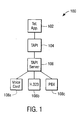
- the TAPI architecture 100 is illustrated in FIG. 1. As shown, the TAPI architecture 100 includes a TAPI implementation 104 interfaced to telephony'application programs 102. TAPI 104 provides a connection to a TAPI service provider, such as a TAPI server 106, which then interfaces to hardware such as voices cards 108a, H.323 interfaces 108b, or PBX'S 108c.
- a TAPI service provider such as a TAPI server 106
- hardware such as voices cards 108a, H.323 interfaces 108b, or PBX'S 108c.
- the TAPI specification requires that device configuration information be available at the startup of the TAPI service provider. If unsolicited addition and deletion events from a telephony device hardware, such as a PBX, are not supported (i.e., the hardware does not automatically inform the TAPI service provider of updates), the TAPI service provider can only do configuration change updates at start up. The TAPI service provider does so by requesting the static device configuration from the PBX, building the initial internal database and reporting all the devices to the TAPI. If changes are made on the PBX, the telephony server system administrator would be required to shut down the TAPI service provider and restart it again. This has the disadvantage of disrupting service to all users of the TAPI service provider.
- embodiments of the present invention provide a method whereby a TAPI service provider may request configuration information from hardware such as a PBX. Configuration information received from the hardware may be stored in a list and compared to the existing configuration list. Two new lists are then generated: an added list and a deleted list. All devices in the deleted list are deleted from the internal database and deleted messages are sent to the TAPI service provider. All new devices are temporarily added to the internal database and addition messages are sent to the TAPI service provider. The new device configuration list is then saved, and the added devices are marked as permanent.
- FIGS. 2-4 illustrate an improved system and method for a TAPI service provider to request and update configuration information from hardware such as a PBX.
- Configuration information received from the hardware is stored in a list and compared to the existing configuration list.
- Two new lists are then generated: an added list and a deleted list. All devices in the deleted list are deleted from the internal database and deleted messages are sent to the TAPI service provider. All new devices are temporarily added to the internal database and addition messages are sent to the TAPI service provider.
- the new device configuration list is then saved, and the added devices are marked as permanent.
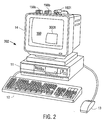
- the TAPI client 202 may be embodied as a personal computer, including a system unit 11, a keyboard 12, a mouse 13, and a display 140. Also shown are one or more speakers 150a, 150b, and a microphone 1601.
- the screen 160 of the display device 14 is used to present a graphical user interface (GUI) and particularly, a TAPI client window 3008.
- GUI graphical user interface
- the graphical user interface supported by the operating system allows the user to employ a point and click method of input, i.e., by moving the mouse pointer or cursor (not shown) to an icon representing a data object at a particular location on the screen 160 and pressing one or more of the mouse buttons to perform a user command or selection.
- the GUI may be any of the Windows GUIs available from Microsoft Corporation or the Macintosh OS, available from Apple Computer.
- FIG. 3 shows a block diagram of the components of the personal computer shown in FIG. 2.
- the system unit 11 includes a system bus or a plurality of system buses 21 to which various components are coupled and by which communication between the various components is accomplished.
- the microprocessor 22 is coupled to the system bus 21 and is supported by the read only memory (ROM) 23 and the random access memory (RAM) 24 also connected to the system bus 21.
- the microprocessor 22 may be embodied as any of a variety of microprocessors, including Intel x86, Pentium or Pentium II or compatible processors.
- the ROM 23 contains among other code the basic input output system (BIOS) which controls basic hardware operations such as the interaction of the disk drives and the keyboard.
- BIOS basic input output system
- the RAM 24 is the main memory into which the operating system and applications programs are loaded.
- the memory management chip 25 is connected to the system bus 21 and controls direct memory access operations including passing data between the RAM 24 and hard disk drive 26 and floppy disk drive 27.
- a CD ROM drive (or DVD or other optical drive) 32 may also be coupled to the system bus 21 and is used to store a large amount of data, such as a multimedia program or a large database.
- the keyboard controller 28, the mouse controller 29, the video controller 30, and the audio controller 31 are also connected to the system bus 21.
- the keyboard controller 28 provides the hardware interface for the keyboard;
- the mouse controller 29 provides the hardware interface for the mouse 13;
- the video controller 30 is the hardware interface for the video display 14;
- the audio controller 31 is the hardware interface for the speakers 15 and microphone 16.
- the speakers 150a, b and the microphone 1601 allow for audio communication during telephony operation.
- keyboard strokes are detected by the keyboard controller 28 and corresponding signals are transmitted to the microprocessor 22; similarly, mouse movements and button clicks are detected by the mouse controller and provided to the microprocessor 22.
- the keyboard controller 28 and the mouse controller 29 assert interrupts at the microprocessor 22.
- the microprocessor 22 executes a corresponding interrupt routine, as is known. Additionally, an interrupt controller (not shown) may be provided to arbitrate among interrupt requests.
- An I/O controller or network interface 40 enables communication over a network 46, such as a packet network.
- One embodiment of the present invention is as a set of instructions in a code module resident in the RAM 24. Until required by the computer system, the set of instructions may be stored in another computer memory, such as the hard disk 26, on an optical disk for use in the CD ROM drive 32, or a floppy disk for use in the floppy disk drive 27.
- the operating system 50 the TAPI application 52, the TAPI service provider 53, and one or more configuration table objects 56 are resident in the RAM 24.
- the operating system 50 functions to generate a graphical user interface on the display 14.
- the TAPI application program 52 performs TAPI functionality, including generation of a TAPI client window 3008 (FIG. 2) in the GUI.
- the TAPI service provider 53 implements an interface to the hardware, as will be described in greater detail below.
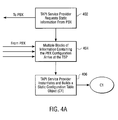
- the TAPI service provider 53 Upon startup, in a step 402, the TAPI service provider 53 requests static configuration information from the PBX (not shown) or other telephony hardware.
- static configuration information can be static line or static phone device information.
- the configuration information includes the device ID and the number of addresses on the line.
- the information includes the device ID.
- the PBX returns multiple blocks of information of PBX configuration information to the TAPI service provider 53.
- the TAPI service provider 53 instantiates and builds a static configuration table object (C1).
- the administrator may request the TAPI service provider 53 to check for PBX configuration changes.
- the TAPI service provider 53 requests static information from the PBX.
- multiple blocks of information containing the PBX configuration data arrive at the TAPI service provider 53.
- the TAPI service provider 53 instantiates and builds a new static configuration table object (C2). This new object becomes the current TAPI configuration object.
- the TAPI service provider 53 takes the C2 object as an input and produces two new configuration table objects: deleted objects (C3) and added devices (C4).
- a step 418 for each device in C3, the TAPI application 52 is notified that the corresponding line device has been deleted.
- a step 420 for each device in C3, the TAPI application 52 is notified that the corresponding phone device has been deleted.
- the TAPI application 52 is notified that the corresponding line device has been added.
- the TAPI application 52 is notified that the corresponding phone device has been added.
Landscapes
- Engineering & Computer Science (AREA)
- Computer Networks & Wireless Communication (AREA)
- Databases & Information Systems (AREA)
- Signal Processing (AREA)
- Physics & Mathematics (AREA)
- Astronomy & Astrophysics (AREA)
- General Physics & Mathematics (AREA)
- Telephonic Communication Services (AREA)
Applications Claiming Priority (2)
| Application Number | Priority Date | Filing Date | Title |
|---|---|---|---|
| US09/501,134 US6975715B1 (en) | 2000-02-09 | 2000-02-09 | System and method for reporting the addition and deletion of TAPI line and phone devices in absence of such notifiction from a PBX |
| US501134 | 2000-02-09 |
Publications (3)
| Publication Number | Publication Date |
|---|---|
| EP1126685A2 true EP1126685A2 (de) | 2001-08-22 |
| EP1126685A3 EP1126685A3 (de) | 2005-04-06 |
| EP1126685B1 EP1126685B1 (de) | 2016-04-13 |
Family
ID=23992262
Family Applications (1)
| Application Number | Title | Priority Date | Filing Date |
|---|---|---|---|
| EP01300918.8A Expired - Lifetime EP1126685B1 (de) | 2000-02-09 | 2001-02-01 | System und Verfahren zur Bekanntmachung beim Hinzufügen oder Löschen eines TAPI-Anschlusses oder Endgeräts ohne diese Nachricht von der Vermittlungsanlage zu erhalten |
Country Status (2)
| Country | Link |
|---|---|
| US (1) | US6975715B1 (de) |
| EP (1) | EP1126685B1 (de) |
Cited By (8)
| Publication number | Priority date | Publication date | Assignee | Title |
|---|---|---|---|---|
| US6691302B1 (en) | 2000-05-31 | 2004-02-10 | Siemens Information & Communications Networks, Inc. | Interfacing a service component to a native API |
| US6725229B2 (en) * | 2000-12-29 | 2004-04-20 | Bellsouth Intellectual Property Corp. | Configuration utility |
| WO2004068830A1 (de) * | 2003-01-17 | 2004-08-12 | Siemens Aktiengesellschaft | Verfahren und anordnung zur steuerung und/oder überwachung eines an ein kommunikations-system angeschlossenen endgerätes |
| US7130261B1 (en) | 2000-05-31 | 2006-10-31 | Siemens Communications, Inc. | Hierarchical dependability for open distributed environments |
| US7167893B1 (en) | 2001-10-03 | 2007-01-23 | Bellsouth Intellectual Property Corp. | Methods and systems for processing a plurality of errors |
| EP1560409A3 (de) * | 2004-02-02 | 2008-05-28 | Dialogic Corporation | Gerät und Verfahren zum Multiplexen von Kommunikationssignalen |
| CN102368232A (zh) * | 2011-06-29 | 2012-03-07 | 奇智软件(北京)有限公司 | 一种装机配置单的生成方法及装置 |
| US8249066B2 (en) | 2008-02-19 | 2012-08-21 | Dialogic Corporation | Apparatus and method for allocating media resources |
Family Cites Families (7)
| Publication number | Priority date | Publication date | Assignee | Title |
|---|---|---|---|---|
| US4972453A (en) * | 1989-02-28 | 1990-11-20 | At&T Bell Laboratories | Autonomous expert system for directly maintaining remote telephone switching systems |
| US5574888A (en) | 1993-12-28 | 1996-11-12 | Intel Corporation | A method and apparatus for establishing compatibility between communication applications producing at commands and a telephony application programming interface |
| US6009162A (en) | 1996-10-31 | 1999-12-28 | Lucent Technologies Inc. | Telecommunication feature for exchange of translation information between a computer and a telecommunication switching system |
| US5940488A (en) | 1996-11-15 | 1999-08-17 | Active Voice Corporation | Telecommunication management system and user interface |
| GB2341291B (en) | 1998-09-02 | 2003-07-23 | Mitel Corp | Line information security interface for tapi service provider |
| US6356631B1 (en) * | 1998-09-24 | 2002-03-12 | Ericsson Inc. | Multi-client object-oriented interface layer |
| US7010110B2 (en) * | 1999-03-31 | 2006-03-07 | Walker Digital, Llc | Method and apparatus for monitoring telephone status |
-
2000
- 2000-02-09 US US09/501,134 patent/US6975715B1/en not_active Expired - Fee Related
-
2001
- 2001-02-01 EP EP01300918.8A patent/EP1126685B1/de not_active Expired - Lifetime
Cited By (11)
| Publication number | Priority date | Publication date | Assignee | Title |
|---|---|---|---|---|
| US6691302B1 (en) | 2000-05-31 | 2004-02-10 | Siemens Information & Communications Networks, Inc. | Interfacing a service component to a native API |
| US7130261B1 (en) | 2000-05-31 | 2006-10-31 | Siemens Communications, Inc. | Hierarchical dependability for open distributed environments |
| US6725229B2 (en) * | 2000-12-29 | 2004-04-20 | Bellsouth Intellectual Property Corp. | Configuration utility |
| US7167893B1 (en) | 2001-10-03 | 2007-01-23 | Bellsouth Intellectual Property Corp. | Methods and systems for processing a plurality of errors |
| US8041762B2 (en) | 2001-10-03 | 2011-10-18 | At&T Intellectual Property I, Lp | Methods and systems for processing a plurality of errors |
| WO2004068830A1 (de) * | 2003-01-17 | 2004-08-12 | Siemens Aktiengesellschaft | Verfahren und anordnung zur steuerung und/oder überwachung eines an ein kommunikations-system angeschlossenen endgerätes |
| US7415103B2 (en) | 2003-01-17 | 2008-08-19 | Siemens Aktiengesellschaft | Method and configuration for controlling and/or monitoring a terminal connected to a communications system |
| EP1560409A3 (de) * | 2004-02-02 | 2008-05-28 | Dialogic Corporation | Gerät und Verfahren zum Multiplexen von Kommunikationssignalen |
| US8054947B2 (en) | 2004-02-02 | 2011-11-08 | Eicon Networks Corporation | Apparatus and method for multiplexing communication signals |
| US8249066B2 (en) | 2008-02-19 | 2012-08-21 | Dialogic Corporation | Apparatus and method for allocating media resources |
| CN102368232A (zh) * | 2011-06-29 | 2012-03-07 | 奇智软件(北京)有限公司 | 一种装机配置单的生成方法及装置 |
Also Published As
| Publication number | Publication date |
|---|---|
| US6975715B1 (en) | 2005-12-13 |
| EP1126685B1 (de) | 2016-04-13 |
| EP1126685A3 (de) | 2005-04-06 |
Similar Documents
| Publication | Publication Date | Title |
|---|---|---|
| US7225409B1 (en) | Graphical user interface for a screen telephone | |
| US10530925B2 (en) | Methods, systems, and products for processing communications | |
| US6442619B1 (en) | Software architecture for message processing in a distributed architecture computing system | |
| US7222304B2 (en) | Multitasking graphical user interface | |
| US7251315B1 (en) | Speech processing for telephony API | |
| US6343116B1 (en) | Computer telephony application programming interface | |
| US8335301B2 (en) | Video on hold for VoIP system | |
| US20090175264A1 (en) | User interface | |
| EP1331556B9 (de) | Serverbasierte Rechnerumgebung | |
| AU2005251380B2 (en) | Method and apparatus for synchronizing contact data stores | |
| KR20020056774A (ko) | 엠베드 시스템의 타임정보 관리방법 및 시스템 | |
| EP1126685B1 (de) | System und Verfahren zur Bekanntmachung beim Hinzufügen oder Löschen eines TAPI-Anschlusses oder Endgeräts ohne diese Nachricht von der Vermittlungsanlage zu erhalten | |
| EP1119167B1 (de) | Ein Objekt-orientiertes System für Anbieter von Programmierungsschnittstellen für Fernsprechanwendungen | |
| US20030228004A1 (en) | Method for generating a telephone number | |
| KR100313277B1 (ko) | 단축아이콘에 의한 화면선택기능을 갖는 pc통신 서비스 수신장치 및 그 방법 | |
| AU778428B2 (en) | Local sound and graphic feedback | |
| JPH1174976A (ja) | 自動発信制御装置 | |
| JP2009044310A (ja) | キーテレホンシステム、仮想内線番号の発呼状態通知方法及びコンピュータプログラム | |
| CN118331433A (zh) | 使虚拟应用使用本地输入法的方法及装置 | |
| KR100477595B1 (ko) | 멀티미디어시스템의서버구조 | |
| KR100518186B1 (ko) | 웹상의 상담용 메신저 시스템 | |
| JPH04372036A (ja) | 多言語対応メッセージ表示方式 | |
| WO2000048378A1 (en) | System for establishing a telephone connection | |
| KR20030057666A (ko) | 통합사용환경을 갖는 사설교환시스템 및 그 제어방법 | |
| JP2001184284A (ja) | モバイルコードを使った要求・回答型サーバのリモート管理方法 |
Legal Events
| Date | Code | Title | Description |
|---|---|---|---|
| PUAI | Public reference made under article 153(3) epc to a published international application that has entered the european phase |
Free format text: ORIGINAL CODE: 0009012 |
|
| AK | Designated contracting states |
Kind code of ref document: A2 Designated state(s): AT BE CH CY DE DK ES FI FR GB GR IE IT LI LU MC NL PT SE TR |
|
| AX | Request for extension of the european patent |
Free format text: AL;LT;LV;MK;RO;SI |
|
| PUAL | Search report despatched |
Free format text: ORIGINAL CODE: 0009013 |
|
| AK | Designated contracting states |
Kind code of ref document: A3 Designated state(s): AT BE CH CY DE DK ES FI FR GB GR IE IT LI LU MC NL PT SE TR |
|
| AX | Request for extension of the european patent |
Extension state: AL LT LV MK RO SI |
|
| RIC1 | Information provided on ipc code assigned before grant |
Ipc: 7H 04Q 3/00 B Ipc: 7H 04Q 3/545 B Ipc: 7H 04Q 3/62 B Ipc: 7H 04M 3/42 A |
|
| 17P | Request for examination filed |
Effective date: 20051004 |
|
| AKX | Designation fees paid |
Designated state(s): DE FR GB IT |
|
| RAP1 | Party data changed (applicant data changed or rights of an application transferred) |
Owner name: SIEMENS COMMUNICATION, INC. |
|
| RAP1 | Party data changed (applicant data changed or rights of an application transferred) |
Owner name: SIEMENS COMMUNICATIONS, INC. |
|
| 17Q | First examination report despatched |
Effective date: 20080311 |
|
| RAP1 | Party data changed (applicant data changed or rights of an application transferred) |
Owner name: SIEMENS COMMUNICATIONS, INC. |
|
| RAP1 | Party data changed (applicant data changed or rights of an application transferred) |
Owner name: SIEMENS ENTERPRISE COMMUNICATIONS, INC. |
|
| RAP1 | Party data changed (applicant data changed or rights of an application transferred) |
Owner name: UNIFY INC. |
|
| GRAP | Despatch of communication of intention to grant a patent |
Free format text: ORIGINAL CODE: EPIDOSNIGR1 |
|
| INTG | Intention to grant announced |
Effective date: 20151016 |
|
| RIN1 | Information on inventor provided before grant (corrected) |
Inventor name: HETTISH, MARK BERNARD |
|
| GRAS | Grant fee paid |
Free format text: ORIGINAL CODE: EPIDOSNIGR3 |
|
| GRAA | (expected) grant |
Free format text: ORIGINAL CODE: 0009210 |
|
| INTG | Intention to grant announced |
Effective date: 20160219 |
|
| AK | Designated contracting states |
Kind code of ref document: B1 Designated state(s): DE FR GB IT |
|
| REG | Reference to a national code |
Ref country code: GB Ref legal event code: FG4D |
|
| REG | Reference to a national code |
Ref country code: DE Ref legal event code: R096 Ref document number: 60149873 Country of ref document: DE |
|
| PG25 | Lapsed in a contracting state [announced via postgrant information from national office to epo] |
Ref country code: IT Free format text: LAPSE BECAUSE OF FAILURE TO SUBMIT A TRANSLATION OF THE DESCRIPTION OR TO PAY THE FEE WITHIN THE PRESCRIBED TIME-LIMIT Effective date: 20160413 |
|
| REG | Reference to a national code |
Ref country code: DE Ref legal event code: R097 Ref document number: 60149873 Country of ref document: DE |
|
| PLBE | No opposition filed within time limit |
Free format text: ORIGINAL CODE: 0009261 |
|
| STAA | Information on the status of an ep patent application or granted ep patent |
Free format text: STATUS: NO OPPOSITION FILED WITHIN TIME LIMIT |
|
| 26N | No opposition filed |
Effective date: 20170116 |
|
| REG | Reference to a national code |
Ref country code: DE Ref legal event code: R119 Ref document number: 60149873 Country of ref document: DE |
|
| GBPC | Gb: european patent ceased through non-payment of renewal fee |
Effective date: 20170201 |
|
| REG | Reference to a national code |
Ref country code: FR Ref legal event code: ST Effective date: 20171031 |
|
| PG25 | Lapsed in a contracting state [announced via postgrant information from national office to epo] |
Ref country code: FR Free format text: LAPSE BECAUSE OF NON-PAYMENT OF DUE FEES Effective date: 20170228 Ref country code: DE Free format text: LAPSE BECAUSE OF NON-PAYMENT OF DUE FEES Effective date: 20170901 |
|
| PG25 | Lapsed in a contracting state [announced via postgrant information from national office to epo] |
Ref country code: GB Free format text: LAPSE BECAUSE OF NON-PAYMENT OF DUE FEES Effective date: 20170201 |