EP1126326A2 - Toner and developer for electrophotography - Google Patents
Toner and developer for electrophotography Download PDFInfo
- Publication number
- EP1126326A2 EP1126326A2 EP01300933A EP01300933A EP1126326A2 EP 1126326 A2 EP1126326 A2 EP 1126326A2 EP 01300933 A EP01300933 A EP 01300933A EP 01300933 A EP01300933 A EP 01300933A EP 1126326 A2 EP1126326 A2 EP 1126326A2
- Authority
- EP
- European Patent Office
- Prior art keywords
- toner
- wax
- developer
- ethyl
- ethyl polysaccharide
- Prior art date
- Legal status (The legal status is an assumption and is not a legal conclusion. Google has not performed a legal analysis and makes no representation as to the accuracy of the status listed.)
- Granted
Links
Images
Classifications
-
- G—PHYSICS
- G03—PHOTOGRAPHY; CINEMATOGRAPHY; ANALOGOUS TECHNIQUES USING WAVES OTHER THAN OPTICAL WAVES; ELECTROGRAPHY; HOLOGRAPHY
- G03G—ELECTROGRAPHY; ELECTROPHOTOGRAPHY; MAGNETOGRAPHY
- G03G9/00—Developers
- G03G9/08—Developers with toner particles
- G03G9/087—Binders for toner particles
- G03G9/08775—Natural macromolecular compounds or derivatives thereof
- G03G9/08782—Waxes
-
- G—PHYSICS
- G03—PHOTOGRAPHY; CINEMATOGRAPHY; ANALOGOUS TECHNIQUES USING WAVES OTHER THAN OPTICAL WAVES; ELECTROGRAPHY; HOLOGRAPHY
- G03G—ELECTROGRAPHY; ELECTROPHOTOGRAPHY; MAGNETOGRAPHY
- G03G9/00—Developers
- G03G9/08—Developers with toner particles
- G03G9/087—Binders for toner particles
- G03G9/08775—Natural macromolecular compounds or derivatives thereof
- G03G9/08777—Cellulose or derivatives thereof
Definitions
- the present invention relates to a toner and a developer for use in an electrophotographic copying machine, facsimile machine, and printer.
- a toner is softened or melted when heat is applied to the toner in an image fixing unit.
- the toner can be fixed to paper in such a way that the softened or melted toner is embedded in fibers of paper because pressure is also applied to the toner in the image fixing unit.
- the surface of the softened or melted toner tends to become sticky by the application of heat, so that the toner can be fixed to the paper.
- the melting point or softening point of a resin for use in a toner composition is required to be equal to or lower than the image fixing temperature.
- a so-called spent toner phenomenon namely, a softened or melted toner is deposited on the surface of a carrier. Further, the toner tends to adhere to the surface of a development roller to produce a toner filming phenomenon, and the toner is easily deposited on a doctor blade in the developer unit.
- image-bearing sheets after completion of image fixing, unfavorably stick to each other, which is referred to as a blocking phenomenon, depending on the environmental conditions.
- the first object is to provide a toner capable of coping with a lower image fixing temperature than the conventional image fixing temperature to achieve energy-saving, exhibiting excellent preservation stability, producing no change with time in the interaction between the toner and an external additive, and causing no problems of the spent toner phenomenon and toner filming phenomenon. Further, the first object is to provide toner particles which can be obtained by efficiently pulverizing a toner composition and a toner capable of producing toner images with preservation stability after the toner is fixed to an image receiving member.
- the first object of the present invention can be achieved by a toner for electrophotography comprising a coloring agent and a binder which comprises a wax and an ethyl polysaccharide,
- ethyl polysaccharide comprise D-glucose units linked together by a linkage of 1,2-, 1,3-, 1,4-, or 1,6-glycosidic bond with an ⁇ configuration, or by a linkage of 1,2-, 1,3-, 1,4- or 1,6-glycosidic bond with a ⁇ configuration, with at least one alcohol hydroxyl group in each of the O-glucose units being ethyl-etherified.
- the above-mentioned toner may be fixable at a temperature lower than a melting point of the ethyl polysaccharide and higher than or equal to a melting point of the wax.
- a second object of the present invention is to provide a developer for electrophotography.
- the second object of the present invention can be achieved by a one-component developer for electrophotography comprising a toner which comprises a coloring agent and a binder comprising a wax and an ethyl polysaccharide.
- a two-component developer comprising a carrier and the above-mentioned toner.
- a third object of the present invention is to provide a developer container for storing a developer therein.
- the third object of the present invention can be achieved by a developer container containing the above-mentioned one- or two-component developer for electrophotography.
- a fourth object of the present invention is to provide an image forming apparatus.
- the fourth object can be achieved by an image forming apparatus comprising a developer unit which comprises developer storage means for storing a developer therein and developer supply means for supplying the developer to a latent-image bearing surface, wherein the developer may be a one-component developer comprising a toner comprising a coloring agent and a binder which comprises a wax and an ethyl polysaccharide, or a two-component developer comprising the above-mentioned toner and a carrier.
- the developer may be a one-component developer comprising a toner comprising a coloring agent and a binder which comprises a wax and an ethyl polysaccharide, or a two-component developer comprising the above-mentioned toner and a carrier.
- a fifth object of the present invention is to provide a process unit with a developer unit.
- the fifth object can be achieved by a process unit comprising a developer unit which comprises developer storage means for storing a developer therein and developer supply means for supplying the developer to a latent-image bearing surface, wherein the developer may be the above-mentioned one-component developer or two-component developer.
- a binder agent for use in a toner of the present invention comprises a wax and an ethyl polysaccharide.
- the above-mentioned ethyl polysaccharide has a high melting point, high preservation stability, and high resistance to the spent toner phenomenon and the toner filming phenomenon.
- a toner comprises a binder comprising an ethyl polysaccharide and a wax.
- the ethyl polysaccharide is dissolved in the wax at a temperature higher than the melting point of the wax.
- the image fixing temperature does not attain to the melting point of the ethyl polysaccharide
- the ethyl polysaccharide is softened or dissolved in the wax, whereby the fixing properties are exhibited.
- the melting point of ethyl polysaccharide is so high that the binder resin mainly comprising ethyl polysaccharide does not become too flexible. The result is that the toner composition comprising such a binder resin can be efficiently pulverized to have desired toner particles.
- the wax and the ethyl polysaccharide are homogeneously compatible with each other in the toner composition of the present invention.
- the wax and the ethyl polysaccharide are homogeneously compatible to such a degree that ethyl polysaccharide can be dissolved in the wax at a temperature higher than or equal to the melting point of the wax in the image fixing step.
- the image fixing temperature does not attain to the melting point of the ethyl polysaccharide, the ethyl polysaccharide is softened or dissolved in the wax so as to exhibit the fixing properties.
- the composition ratio of the ethyl polysaccharide to the wax With respect to the composition ratio of the ethyl polysaccharide to the wax, the more the amount ratio of wax, the lower the viscosity of the resulting wax solution of ethyl polysaccharide. With the decrease in amount ratio of the ethyl polysaccharide, other resins than ethyl polysaccharide, if contained in the toner composition, cannot be dissolved in the wax, so that the wax component is separated from the resin component, thereby making the preparation of toner difficult. With the increase in an amount ratio of the ethyl polysaccharide, the viscosity of the wax solution becomes high.
- ethyl polysaccharide and the wax be mixed at a ratio by weight of 97:3 to 5:95.
- the fixing of toner image is not always carried out in an air-conditioned place such as an office.
- the ethyl polysaccharide and the wax be mixed at a ratio by weight of (95:5) to (20:80), and further preferably (90:10) to (30:70).
- the most preferable mixing ratio of the ethyl polysaccharide to the wax is in the range of (80:20) to (40:60).
- the binder may further comprise conventional resins in addition to the ethyl polysaccharide.
- the ethyl polysaccharide be contained in the binder in an amount of 10 wt.% or more, more preferably 15 wt.% or more, 20 wt.% or more, 30 wt.% or more, 40 wt.% or more, and further preferably 50 wt.% or more, of the total weight of the binder.
- the amount of ethyl polysaccharide is less than 10 wt.% of the total weight of the binder, the melting point of the obtained toner cannot be sufficiently decreased. The result is that defective image fixing cannot be inhibited.
- the melting point of the employed wax be lower than that of the ethyl polysaccharide.
- the wax can be melted at a temperature lower than the melting point of the ethyl polysaccharide, and the ethyl polysaccharide can be dissolved in the wax.
- the melting point of the obtained toner can be decreased.
- the melting point of the wax be 50 to 130°C, more preferably 50 to 110°C, further preferably 50 to 100°C, and most further preferably 50 to 90°C.
- the wax have a melt viscosity of 1 to 1,000,000 centipoise (cP) at 150°C.
- CP centipoise
- the wax When the melt viscosity of the wax exceeds 1,000,000 centipoise, defective image fixing easily occurs because of excessively high viscosity of the wax solution of ethyl polysaccharide. Further, in fact, the image fixing is not always carried out under air-conditioned circumstances, with various image fixing environments being taken into consideration such as high and low temperatures and high and low humidities, it is preferable that the wax have a melt viscosity of 1 to 1,000,000 centipoise (cP), more preferably 1 to 100,000 cP, further preferably 1 to 10,000 cP, and further more preferably 1 to 1,000 cP at 150°C. In view of the degree of freedom in the image fixing conditions, the wax with a melt viscosity of 1 to 100 cP is most preferable.
- cP centipoise
- the ethyl polysaccharide For obtaining satisfactory image fixing performance and grindability, it is preferable that the ethyl polysaccharide have an average molecular weight of 500 to 1,000,000, and more preferably 1,000 to 100,000 in terms of a polystyrene-reduced value by gel permeation chromatography (GPC).
- GPC gel permeation chromatography
- the molecular weight of the ethyl polysaccharide increases, the viscosity of a wax solution obtained by dissolving the ethyl polysaccharide in a wax increases. As a result, it is necessary to increase the amount of wax. Further, when the molecular weight of the ethyl polysaccharide is excessively high, the flexibility of the obtained toner composition becomes too high, with the result that the grindability of toner composition is lowered.
- the molecular weight of the ethyl polysaccharide In measurement of the molecular weight of the ethyl polysaccharide, other methods than the GPC are usable for determining the molecular weight. For instance, based on a principle that the molecular weight is in proportion to the viscosity, an ethyl polysaccharide is dissolved in a solvent and the molecular weight of the ethyl polysaccharide may be expressed by the viscosity of the resulting solution of ethyl polysaccharide. The molecular weight may be represented by the equivalent amount by use of a chemical agent. In principle, the value obtained by the GPC method is the same as that measured by other methods mentioned above.
- the ethyl polysaccharide has an average ethoxyl group content of 1 to 3, the advantageous properties of ethyl polysaccharide can be obtained.
- the ethoxyl group content is too low, the solubility of ethyl polysaccharide in waxes is lowered.
- the number of alcohol hydroxyl groups is three in a D-glucose structural unit.
- the average ethoxyl group content of ethyl polysaccharide be 1.5 to 3, and further preferably 2 to 3.
- the employed wax exhibit a penetration of 0 to 40 at 25°C.
- a wax with a high penetration exhibits high adhesion properties, so that such a wax is not suitable for the toner composition in consideration of the spent-toner phenomenon, toner filming phenomenon, and the like.
- the penetration of the employed wax be 0 to 20 at 25°C.
- wax for use in the present invention examples include paraffin wax, oxidized paraffin wax, microcrystalline wax, oxidized microcrystalline wax, rice wax, candelilla wax, montan acid, montan wax, carnauba wax, a wax derived from esparto, castor wax, Japan wax, beedswax, jojoba wax, sterol wax, ketone wax, fatty acid wax, fatty alcohol wax, fatty ester wax, fatty amide wax, and olefin wax.
- paraffin wax oxidized paraffin wax
- microcrystalline wax oxidized microcrystalline wax
- rice wax candelilla wax
- fatty acid wax fatty alcohol wax
- fatty ester wax fatty ester wax
- fatty amide wax preferably employed in the present invention.
- the solubility of the ethyl polysaccharide in any of the above-mentioned waxes is so high that the ethyl polysaccharide can be speedily dissolved in the wax in the preparation of a toner. It is considered that the compatibility of ethoxyl group in the ethyl polysaccharide with the waxes are very high because of remarkably low polarities of those waxes.
- the inventor of the present invention has found an image fixing system capable of being effected at a temperature that is lower than the melting point of a resin used in the toner composition.
- the wax can work as a solvent or plasticizer at temperatures above the melting point of the wax, and the resin is dissolved on a molecular level in the wax.
- the toner of the present invention is fixable at temperatures adjacent to the melting point of the employed wax, and by far lower than the melting point of the employed resin.
- the melting point of the resin is measured by a flow tester method in the present invention.
- the melting point of the wax is a temperature where the crystals are made practically amorphous to assume a transparent state. Namely, the melting point of the wax defined in the present invention is different from the glass transition temperature (Tg) by DSC method, or a top peak in an endothermic curve.
- the use of a wax in a toner composition is conventionally known.
- the wax is dispersed in a resin in the preparation of a toner composition in order to prevent the obtained toner from adhering to the surface of an image fixing roller.
- the wax dispersed in the resin oozes out in the image fixing step to improve the release properties of the obtained toner from the image fixing roller.
- the resins conventionally used for the toner composition have no solubility in the wax, so that those resins themselves cannot be dissolved or softened therein.
- the ethyl polysaccharide is dissolved or softened in a wax of a liquid state at temperatures higher than the melting point of the wax.
- polysaccharides are not melted by the application of heat, and are completely insoluble in water, waxes, or organic solvents. This is because hydrogen bonding properties resulting from the presence of hydroxyl groups in a molecule of the polysaccharides are remarkably strong, and crystallizability is extremely high.
- the toner composition for use in the present invention employs an ethyl polysaccharide.
- ethyl polysaccharide ethoxyl group is substituted for hydroxyl group in a molecule thereof, so that the above-mentioned strong hydrogen bonding properties caused by the hydroxyl group as in polysaccharides are lost, with the result that the crystallizability of ethyl polysaccharide is decreased.
- An ethyl polysaccharide is thus synthesized as an absolutely different type of resin from a polysaccharide.
- Japanese Laid-Open Patent Application 62-94853 discloses a toner composition comprising an ethyl polysaccharide.
- the ethyl polysaccharide in a small amount is added to other resins to improve the cohesion of a binder resin as a whole.
- an ethyl polysaccharide is used as the main binder resin in the present invention.
- the cohesion of the binder resin for use in the present invention tends to decrease because the ethyl polysaccharide is dissolved in a wax to decrease the viscosity.
- the image fixing temperature is as high as the conventional image fixing temperatures.
- the fixing properties of toner are determined by the fact that the ethyl polysaccharide serving as the main binder resin is dissolved in a wax. Namely, the image fixing temperature can be remarkably decreased.
- a polysaccharide that is, a precursor of the ethyl polysaccharide for use in the present invention, is not soluble in a wax
- the polysaccharides have D-glucose units linked together by a linkage of 1,2-, 1,3-, 1,4-, or 1,6-glycosidic bond with an ⁇ configuration, or by a linkage of 1,2-, 1,3-, 1,4- or 1,6-glycosidic bond with a ⁇ configuration.
- three alcohol hydroxyl groups in each of the D-glucose units are partially or entirely replaced by ethoxyl group.
- the reason why the polysaccharides are not melted when heated and why the polysaccharides are not soluble in water, waxes, and a variety of organic solvents is that the hydrogen bonding properties of alcohol hydroxyl groups in the D-glucose unit are too strong. Therefore, the intermolecular bond strength is remarkably high and the crystallizability is high, with the result that the molecular chain is rigid.
- the polysaccharides show a strong polarity due to strong polarity of hydroxyl groups in the molecule thereof, while the polarity of a wax is relatively low. A great difference in polarity is a cause of insolubility of polysaccharide in waxes.
- ethyl polysaccharide can be dissolved in waxes.
- three alcohol hydroxyl groups in a D-glucose unit are partially or entirely replaced by ethoxyl groups.
- the number of locations for hydrogen bonding is decreased, and the crystallizability is also decreased.
- the polarity of ethoxyl group is low, the affinity of ethyl polysaccharide for the wax with a low polarity is increased, and therefore, ethyl polysaccharide is easily dissolved in the wax.
- Waxes for general use have a straight-chain paraffin, branched olefin, fatty acid, fatty ester, fatty ketone, amine, amide, alcohol, and sterol. However, each of those portions is just a linkage or group in a part of a molecule.
- An alkyl group moiety as the main structure in the wax is quite long, so that the polarity of the wax becomes low as a whole.
- An ethyl polysaccharide for use in the present invention is produced, for example, by the following method.
- An alkali polysaccharide is made from a polysaccharide. Ethyl chloride is allowed to react with the alkali polysaccharide in a pressure application vessel, and the resultant polysaccharide is washed with hot water and dried.
- the obtained polysaccharide consists of chains of glucose anhydride. Each unit has originally three hydroxyl groups, but the three hydrcxyl groups are partially or entirely replaced by ethoxyl groups by use of ethyl chloride.
- ethyl polysaccharides can be prepared: C 6 H 7 O 2 (OH) 2 ONa + ClC 2 H 5 ⁇ C 6 H 7 O 2 (OH) 2 OC 2 H 5 + NaCl C 6 H 7 O 2 (ONa) 3 + 3ClC 2 H 5 ⁇ C 6 H 7 O 2 (OC 2 H 5 ) 3 + 3NaCl
- the ethyl polysaccharides may be used in combination with other resins to prepare a toner composition in the present invention
- resins for use in the toner include homopolymers of styrene and substituted styrenes such as polystyrene, poly-p-chlorostyrene, and polyvinyltoluene; styrene-based copolymers such as styrene - p-chlorostyrene copolymer, styrene - propylene copolymer, styrene - vinyltoluene copolymer, styrene - vinylnaphthalene copolymer, styrene - methyl acrylate copolymer, styrene - ethyl acrylate copolymer, styrene - butyl acrylate copolymer, styrene - oc
- a coloring agent such as carbon black or a color pigment may be kneaded and dispersed in the above-mentioned resin.
- a charge control agent may also be contained in the toner composition.
- a toner composition thus prepared is subjected to pulverized to produce toner particles.
- an additive such as silica, titanium, or strontium may be added to the toner particles.
- a one-component developer for electrophotography can be prepared using the above-mentioned toner containing the mixture of ethyl polysaccharide and a wax. Further, such a toner may be mixed with a carrier to prepare a two-component developer.
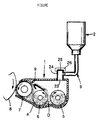
- a single figure is a schematic cross sectional view which shows one embodiment of an image forming apparatus provided with a developer container according to the present invention.
- a development section 1 developer supply means
- a developer container 2 developer storage means which stores therein an electrophotographic developer to be sent to the development section 1 are connected by developer transporting means 3.
- the development section 1 is composed of a developer housing 4 for holding a two-component developer D therein, first and second stirring screws 5 and 6 for mixing and stirring the developer D in the developer housing 4, and a development roller 7.
- the development roller 7 is opposite to a latent image bearing member, that is, an electrophotographic photoconductor 8.
- the photoconductor 8 is driven in rotation in a direction of the arrow, with the surface of the photoconductor bearing latent electrostatic images thereon.
- a connecting member 24 is connected to a developer inlet 23, and a cap 26 is fit in the connecting member 24 via a filter 25,
- the filter 25 may be inserted or not.
- charging means In the image forming apparatus, charging means, light exposure means, image transfer means, quenching means, cleaning means, and other conventional means are arranged, although not shown in the figure, around the photoconductor 8.
- the developer D is stirred by the rotating action of the stirring screws 5 and 6, whereby the toner and the carrier are charged to the opposite polarities by triboelectric charging.
- the two-component developer D is thus supplied toward the development roller 7 that is driven in rotation in a direction of the arrow, and supported on the periphery of the development roller 7.
- the developer D on the development roller 7 travels along the rotating direction of the development roller 7 while the amount of the developer D is regulated by a doctor blade 9.
- the developer D is transported to a gap between the development roller 7 and the photoconductor 8, where the toner component in the two-component developer D is electrostatically attracted' to latent electrostatic images formed on the surface of the photoconductor 8.
- the toner component is transferred to the latent electrostatic images, thereby achieving development of the latent electrostatic images with a toner to form visible toner images on the photoconductor 8.
- the cooled mixture was pulverized to prepare toner particles. 100 parts by weight of the toner particles were mixed with one part by weight of silica serving as an external additive, whereby a toner No. 1 according to the present invention was obtained.
- the cooled mixture was pulverized to prepare toner particles. 100 parts by weight of the toner particles were mixed with one part by weight of silica serving as an external additive, whereby a toner No. 2 according to the present invention was obtained.
- the cooled mixture was pulverized to prepare toner particles. 100 parts by weight of the toner particles were mixed with one part by weight of silica serving as an external additive, whereby a toner No. 3 according to the present invention was obtained.
- the cooled mixture was pulverized to prepare toner particles. 100 parts by weight of the toner particles were mixed with one part by weight of silica serving as an external additive, whereby a toner No. 4 according to the present invention was obtained.
- the cooled mixture was pulverized to prepare toner particles. 100 parts by weight of the toner particles were mixed with one part by weight of silica serving as an external additive, whereby a toner No. 5 according to the present invention was obtained.
- the cooled mixture was pulverized to prepare toner particles. 100 parts by weight of the toner particles were mixed with one part by weight of silica serving as an external additive, whereby a toner No. 6 according to the present invention was obtained.
- the cooled mixture was pulverized to prepare toner particles. 100 parts by weight of the toner particles were mixed with one part by weight of silica serving as an external additive, whereby a toner No. 7 according to the present invention was obtained.
- the cooled mixture was pulverized to prepare toner particles. 100 parts by weight of the toner particles were mixed with one part by weight of silica serving as an external additive, whereby a toner No. 8 according to the present invention was obtained.
- the cooled mixture was pulverized to prepare toner particles. 100 parts by weight of the toner particles were mixed with one part by weight of silica serving as an external additive, whereby a toner No. 9 according to the present invention was obtained.
- the cooled mixture was pulverized to prepare toner particles. 100 parts by weight of the toner particles were mixed with one part by weight of silica serving as an external additive, whereby a toner No. 10 according to the present invention was obtained.
- the cooled mixture was pulverized to prepare toner particles. 100 parts by weight of the toner particles were mixed with one part by weight of silica serving as an external additive, whereby a comparative toner No. 1 was obtained.
- the cooled mixture was pulverized to prepare toner particles. 100 parts by weight of the toner particles were mixed with one part by weight of silica serving as an external additive, whereby a comparative toner No. 2 was obtained.
- the cooled mixture was pulverized to prepare toner particles. 100 parts by weight of the toner particles were mixed with one part by weight of silica serving as an external additive, whereby a comparative toner No. 3 was obtained.
- the resin component was separated from the wax component, and therefore, it was impossible to prepare a toner.
- the lower limit image fixing temperature ranges from 80 to 120°C.
- each of the toners was subjected to a preservation test by allowing each toner to stand at 40°C for 2 weeks.
- the preservation stability of toner was evaluated in terms of the following two points:
- the comparative toner No. 2 comprising a low-melting point polyester resin as the binder caused complete caking during the storage. Therefore, the measurement was not carried out after the storage.
- Each of the toners was subjected to a running test by making 2,000 copies.
- the change in charge quantity and the change in degree of toner deposition on background of the photoconductor were checked before and after the running test.
- the charge quantity and the toner deposition on the background of the photoconductor were measured in the same manner as mentioned above in the preservation test.
- the charge quantity tends to lower and the toner deposition on the background tends to increase after the running test.
- the charge quantity drastically decreases and the degree of toner deposition on the background is not acceptable for practical use.
- Each toner was used in combination with a carrier to prepare a two-component developer. Using each two-component developer, 2,000 copies were made to examine whether toner particles adhered to the surface of the carrier or not (spent toner phenomenon). Furthermore, after 2,000 copies were made using a one-component developer, it was examined whether the surface of a development roller was coated with a film of toner (toner filming phenomenon) and whether the toner particles were deposited on a doctor blade in the developer unit.
- the evaluation level 1 means that no problem occurred; the evaluation level 2, the phenomenon slightly occurred, but acceptable for practical use; and the evaluation level 3, the phenomenon was so serious that image quality was adversely affected.
- the toner filming phenomenon, the spent toner phenomenon, and the deposition of toner on the doctor blade were slightly observed.
- the toner filming phenomenon, the spent toner phenomenon, and the deposition of toner on the doctor blade were very noticeable. Because of those problems, defective images were produced. For example, the image density was uneven, the toner deposition appeared on the background of a sheet of image-receiving paper, and non-printed white stripes were observed in image portions.
- the preservability of the toner-image-bearing sheets was examined by continuously performing image formation on one side of a sheet, and on both sides of a sheet.
- the evaluation level 1 means that no problem occurred; the evaluation level 2, the rear surface of a sheet was slightly stained with toner because of transfer of toner from the underlying sheet; and the evaluation level 3, the toner deposited on the front side of one sheet the toner deposited on the rear side of the overlying sheet produced a blocking problem.
- the sheets were stained with toner and the blocking phenomenon occurred when the comparative toner No. 2 was employed.
- the efficiency of the pulverizing step was evaluated in the course of preparation of toner particles, To be more specific, the period of time required to obtain a fixed amount of toner particles with a predetermined particle size was measured, and the inside of a pulverizer was visually observed.
- the toner of the present invention is fixable at a temperature lower than the melting point of the ethyl polysaccharide, thereby realizing energy saving. Even though the toner is fused at a lower temperature, the preservation stability of toner is improved because the melting point of ethyl polysaccharide itself is high. Further, the change in properties of toner can be minimized because ethyl polysaccharide for use in the toner is a rigid resin. More specifically, the external additive can be prevented from being pushed into the toner particle, and being stained with a low-molecular-weight resin.
- the spent toner phenomenon, toner filming phenomenon and the like can be effectively inhibited because the ethyl polysaccharide is rigid and has no adhesive properties.
- the obtained toner-image-bearing material does not cause any blocking problem.
- the toner composition of the present invention is appropriately rigid due to the ethly polysaccharide, so that the toner particles can be efficiently produced by pulverizing.
Landscapes
- Physics & Mathematics (AREA)
- Spectroscopy & Molecular Physics (AREA)
- General Physics & Mathematics (AREA)
- Developing Agents For Electrophotography (AREA)
Abstract
Description
a single figure is a schematic view which shows one embodiment of an image forming apparatus provided with a developer container according to the present invention,
| wt. % | |
| Ethyl polysaccharide | 78 |
| Sazol wax | 16 |
| Carbon black | 5 |
| Charge control agent | 1 |
| wt. % | |
| Ethyl polysaccharide | 50 |
| Sazol wax | 10 |
| Magnetic material | 39 |
| Charge control agent | 1 |
| wt.% | |
| Ethyl polysaccharide | 72 |
| Carnauba wax | 22 |
| Carbon black | 5 |
| Charge control agent | 1 |
| wt.% | |
| Ethyl polysaccharide | 72 |
| Montan wax | 39 |
| Carbon black | 5 |
| Charge control agent | 1 |
| wt. % | |
| Ethyl polysaccharide | 78 |
| Paraffin wax | 16 |
| Carbon black | 5 |
| Charge control agent | 1 |
| wt. % | |
| Ethyl polysaccharide | 74 |
| Rice wax | 20 |
| Carbon black | 5 |
| Charge control agent | 1 |
| wt. % | |
| Ethyl polysaccharide | 74 |
| Oxidized paraffin | 20 |
| Carbon black | 5 |
| Charge control agent | 1 |
| wt. % | |
| Ethyl polysaccharide | 74 |
| Oxidized paraffin | 20 |
| Cyan pigment | 5 |
| Charge control agent | 1 |
| wt. % | |
| Ethyl polysaccharide | 72 |
| Carnauba wax | 22 |
| Yellow pigment | 5 |
| Charge control agent | 1 |
| wt. % | |
| Ethyl polysaccharide | 42 |
| High-melting point polyester (mp:155°C) | 30 |
| Carnauba wax | 22 |
| Carbon black | 5 |
| Charge control agent | 1 |
| wt. % | |
| High-melting point polyester (mp:155°C) | 94 |
| Carbon black | 5 |
| Charge control agent | 1 |
| wt. % | |
| Low-melting point polyester (mp:94°C) | 94 |
| Carbon black | 5 |
| Charge control agent | 1 |
| wt. % | |
| Ethyl polysaccharide | 94 |
| Carbon black | 5 |
| Charge control agent | 1 |
| wt. % | |
| High-melting point polyester (mp:155°C) | 78 |
| Sazol wax | 16 |
| Carbon black | 5 |
| Charge control agent | 1 |
| Surface Temperature of Image Fixing Unit (°C) | |||||||
| 70 | 80 | 90 | 100 | 120 | 140 | 160 | |
| Ex. 1 | × | × | ○ | ○ | |||
| Ex. 2 | × | × | ○ | ○ | |||
| Ex. 3 | × | ○ | ○ | ||||
| Ex. 4 | × | ○ | ○ | ||||
| Ex. 5 | × | ○ | ○ | ||||
| Ex. 6 | × | ○ | ○ | ||||
| Ex. 7 | × | ○ | ○ | ||||
| Ex. 8 | × | ○ | ○ | ||||
| Ex. 9 | × | ○ | ○ | ||||
| Ex. 10 | × | ○ | ○ | ||||
| Comp. Ex. 1 | × | × | ○ | ||||
| Comp. Ex. 2 | × | ○ | ○ | ||||
| Comp. Ex. 3 | × | × | ○ |
| Condition after Storage | Charge Quantity (µC/g) | Toner Deposition on Background of OPC | |||
| Before storage | After storage | Before storage | After storage | ||
| Ex. 1 | ○ | -19 | -19 | 0.01 | 0.01 |
| Ex. 2 | ○ | -21 | -20 | 0.01 | 0.02 |
| Ex. 3 | ○ | -22 | -20 | 0.01 | 0.01 |
| Ex. 4 | ○ | -21 | -20 | 0.01 | 0.01 |
| Ex. 5 | ○ | -22 | -21 | 0.01 | 0.01 |
| Ex. 6 | ○ | -20 | -22 | 0.01 | 0.01 |
| EX. 7 | ○ | -22 | -22 | 0.01 | 0.01 |
| Ex. 8 | ○ | -20 | -22 | 0.01 | 0.02 |
| Ex. 9 | ○ | -19 | -20 | 0.01 | 0.02 |
| Ex. 10 | ○ | -20 | -18 | 0.02 | 0.03 |
| Comp. Ex. 1 | ○ | -23 | -17 | 0.01 | 0.04 |
| Comp. Ex. 2 | Completely solidified | -20 | not measured | 0.01 | not measured |
| Comp. Ex. 3 | ○ | -20 | -20 | 0.02 | 0.02 |
| Charge Quantity (µC/g) | Toner Deposition on Background of OPC | |||
| Before running test | After running test | Before running test | After running test | |
| Ex. 1 | -20 | -21 | 0.01 | 0.01 |
| Ex. 2 | -21 | -21 | 0.01 | 0.01 |
| Ex. 3 | -21 | -22 | 0.01 | 0.01 |
| Ex. 4 | -21 | -20 | 0.01 | 0.01 |
| Ex. 5 | -20 | -21 | 0.01 | 0.01 |
| Ex. 6 | -21 | -20 | 0.01 | 0.01 |
| EX. 7 | -23 | -22 | 0.01 | 0.01 |
| Ex. 8 | -21 | -21 | 0.01 | 0.01 |
| Ex. 9 | -21 | -22 | 0.01 | 0.01 |
| Ex. 10 | -21 | -18 | 0.02 | 0.04 |
| Comp. Ex. 1 | -23 | -15 | 0.01 | 0.06 |
| Comp. Ex. 2 | -20 | -10 | 0.01 | 0.12 |
| Comp. Ex. 3 | -22 | -21 | 0.01 | 0.01 |
| Spent Toner Phenomenon | Toner Filming | Toner Deposition on Developer Blade | |
| Ex. 1 | 1 | 1 | 1 |
| Ex. 2 | 1 | 1 | 1 |
| Ex. 3 | 1 | 1 | 1 |
| Ex. 4 | 1 | 1 | 1 |
| Ex. 5 | 1 | 1 | 1 |
| Ex. 6 | 1 | 1 | 1 |
| Ex. 7 | 1 | 1 | 1 |
| Ex. 8 | 1 | 1 | 1 |
| Ex. 9 | 1 | 1 | 1 |
| Ex. 10 | 1 | 2 | 1 |
| Comp. Ex. 1 | 2 | 2 | 2 |
| Comp. Ex. 2 | 3 | 3 | 3 |
| Comp. Ex. 3 | 1 | 1 | 1 |
| Printing on One Side | Printing on Both Sides | |
| Ex. 1 | 1 | 1 |
| Ex. 2 | 1 | 1 |
| Ex. 3 | 1 | 1 |
| Ex. 4 | 1 | 1 |
| Ex. 5 | 1 | 1 |
| Ex. 6 | 1 | 1 |
| Ex. 7 | 1 | 1 |
| Ex. 8 | 1 | 1 |
| Ex. 9 | 1 | 1 |
| Ex. 10 | 1 | 1 |
| Comp. Ex. 1 | 1 | 1 |
| Comp. Ex. 2 | 2 | 3 |
| Comp. Ex. 3 | 1 | 1 |
| Time Required for Pulverizing (hr.) | Toner Deposition on Inner Wall of Pulverizer | |
| Ex. 1 | 0.25 | None |
| Ex. 2 | 0.25 | None |
| Ex. 3 | 0.25 | None |
| Ex. 4 | 0.25 | None |
| Ex. 5 | 0.25 | None |
| Ex. 6 | 0.25 | None |
| Ex. 7 | 0.25 | None |
| Ex. 8 | 0.25 | None |
| Ex. 9 | 0.25 | None |
| Ex. 10 | 0.50 | None |
| Comp. Ex. 1 | 0.75 | None |
| Comp. Ex. 2 | 2.00 | Toner particles were accumulated on the detector of the pulverizer. |
| Comp. Ex. 3 | 0.25 | None |
Claims (22)
- A toner for electrophotography comprising:a coloring agent anda binder comprising a wax and an ethyl polysaccharide.
- The toner as claimed in claim 1, wherein said ethyl polysaccharide comprises D-glucose units linked together by a linkage of 1,2-, 1,3-, 1,4-, or 1,6-glycosidic bond with an α configuration, or by a linkage of 1,2-, 1,3-, 1,4- or 1,6-glycosidic bond with a β configuration, with at least one alcohol hydroxyl group in each of said D-glucose units being ethyl-etherified,
- The toner as claimed in claim 1, wherein said toner is fixable at a temperature lower than a melting point of said ethyl polysaccharide and higher than or equal to a melting point of said wax.
- The toner as claimed in claim 1, wherein said ethyl polysaccharide is contained in said binder in an amount of 10 wt.% or more of the total weight of said binder.
- The toner as claimed in claim 1, wherein said ethyl polysaccharide and said wax are mixed at a ratio by weight of 97:3 to 5:95.
- The toner as claimed in claim 1, wherein said wax has a melting point that is lower than a melting point of said ethyl polysaccharide.
- The toner as claimed in claim 1, wherein said wax has a melt viscosity of 1 to 1,000,000 centipoise (cP) at 150°C.
- The toner as claimed in claim 1, wherein said ethyl polysaccharide has an average molecular weight of 500 to 1,000,000 in terms of a polystyrene-reduced value by gel permeation chromatography (GPC).
- The toner as claimed in claim 1, wherein said ethyl polysaccharide has an average ethoxyl group content of one to three.
- The toner as claimed in claim 1, wherein said wax exhibits a penetration of 0 to 40 at 25°C.
- The toner as claimed in claim 10, wherein said wax is selected from the group consisting of paraffin wax, oxidized paraffin wax, microcrystalline wax, oxidized microcrystalline wax, rice wax, candelilla wax, fatty acid wax, fatty alcohol wax, fatty ester wax, fatty amide wax, and olefin wax.
- The toner as claimed in claim 1, further comprising a charge control agent.
- A one-component developer for electrophotography comprising a toner which comprises a coloring agent and a binder comprising a wax and an ethyl polysaccharide.
- The one-component developer as claimed in claim 13, wherein said ethyl polysaccharide comprises D-glucose units linked together by a linkage of 1,2-, 1,3-, 1,4-, or 1,6-glycosidic bond with an α configuration, or by a linkage of 1,2-, 1,3-, 1,4- or 1,6-glycosidic bond with a β configuration, with at least one alcohol hydroxyl group in each of said D-glucose units being ethyl-etherified.
- A two-component developer for electrophotography comprising a carrier and a toner which comprises a coloring agent and a binder comprising a wax and an ethyl polysaccharide.
- The two-component developer as claimed in claim 15, wherein said ethyl polysaccharide comprises D-glucose units linked together by a linkage of 1,2-, 1,3-, 1,4-, or 1,6-glycosidic bond with an α configuration, or by a linkage of 1,2-, 1,3-, 1,4- or 1,6-glycosidic bond with a β configuration, with at least one alcohol hydroxyl group in each of said D-glucose units being ethyl-etherified.
- A developer container containing a one-component developer for electrophotography comprising a toner which comprises a coloring agent and a binder comprising a wax and an ethyl polysaccharide.
- A developer container containing a two-component developer for electrophotography comprising a carrier and a toner which comprises a coloring agent and a binder comprising a wax and an ethyl polysaccharide.
- An image forming apparatus comprising a developer unit which comprises developer storage means for storing a one-component developer therein and developer supply means for supplying said developer to a latent-image bearing surface, said one-component developer comprising a toner comprising a coloring agent and a binder which comprises a wax and an ethyl polysaccharide.
- An image forming apparatus comprising a developer unit which comprises a developer storage means for storing a two-component developer therein and a developer supply means for supplying said developer to a latent-image bearing surface, said two-component developer comprising a carrier and a toner which comprises a coloring agent and a binder comprising a wax and an ethyl polysaccharide.
- A process unit comprising a developer unit which comprises developer storage means for storing a one-component developer therein and developer supply means for supplying said developer to a latent-image bearing surface, said one-component developer comprising a toner which comprises a coloring agent and a binder comprising a wax and an ethyl polysaccharide.
- A process unit comprising a developer unit which comprises developer storage means for storing a two-component developer therein and developer supply means for supplying said developer to a latent-image bearing surface, said two-component developer comprising a carrier and a toner which comprises a coloring agent and a binder comprising a wax and an ethyl polysaccharide.
Applications Claiming Priority (4)
| Application Number | Priority Date | Filing Date | Title |
|---|---|---|---|
| JP2000026723 | 2000-02-03 | ||
| JP2000026723A JP2001215754A (en) | 2000-02-03 | 2000-02-03 | Developer |
| JP2000030313 | 2000-02-08 | ||
| JP2000030313A JP2001222136A (en) | 2000-02-08 | 2000-02-08 | Developer |
Publications (3)
| Publication Number | Publication Date |
|---|---|
| EP1126326A2 true EP1126326A2 (en) | 2001-08-22 |
| EP1126326A3 EP1126326A3 (en) | 2001-08-29 |
| EP1126326B1 EP1126326B1 (en) | 2005-11-16 |
Family
ID=26584816
Family Applications (1)
| Application Number | Title | Priority Date | Filing Date |
|---|---|---|---|
| EP01300933A Expired - Lifetime EP1126326B1 (en) | 2000-02-03 | 2001-02-01 | Toner and developer for electrophotography |
Country Status (3)
| Country | Link |
|---|---|
| US (1) | US6413690B2 (en) |
| EP (1) | EP1126326B1 (en) |
| DE (1) | DE60114900T2 (en) |
Families Citing this family (15)
| Publication number | Priority date | Publication date | Assignee | Title |
|---|---|---|---|---|
| JP2002229366A (en) | 2000-08-21 | 2002-08-14 | Ricoh Co Ltd | Fixing device and image forming device |
| EP1280013B1 (en) | 2001-07-23 | 2008-10-15 | Ricoh Company, Ltd. | Oilless toner |
| JP3781650B2 (en) | 2001-09-21 | 2006-05-31 | 株式会社リコー | Image fixing method and image fixing apparatus |
| JP2003345064A (en) * | 2002-05-28 | 2003-12-03 | Ricoh Co Ltd | Electrophotographic toner |
| JP3763569B2 (en) * | 2002-06-10 | 2006-04-05 | 株式会社リコー | Heating / pressurizing medium for fixing, fixing device and electrophotographic apparatus using the same |
| JP2004206079A (en) | 2002-12-13 | 2004-07-22 | Ricoh Co Ltd | Fixing device and image forming device |
| US7254360B2 (en) * | 2004-04-15 | 2007-08-07 | Ricoh Company, Ltd. | Image fixing apparatus, and, image forming apparatus having the same, and image forming process |
| JP2007121653A (en) * | 2005-01-26 | 2007-05-17 | Ricoh Co Ltd | Fixing method, fixing device, image forming method, and image forming apparatus |
| KR100629486B1 (en) * | 2005-06-27 | 2006-09-28 | 삼성전자주식회사 | Printer and Duplex Printing Control Method |
| JP2008225393A (en) * | 2007-03-15 | 2008-09-25 | Ricoh Co Ltd | Non-magnetic one-component toner |
| US20090184283A1 (en) * | 2008-01-18 | 2009-07-23 | Deborah Duen Ling Chung | Antioxidants for phase change ability and thermal stability enhancement |
| US8178269B2 (en) | 2010-03-05 | 2012-05-15 | Xerox Corporation | Toner compositions and methods |
| JP2013003517A (en) | 2011-06-21 | 2013-01-07 | Ricoh Co Ltd | Glossiness applying device, fixing device and image forming apparatus |
| JP5822061B2 (en) | 2011-06-21 | 2015-11-24 | 株式会社リコー | Glossiness imparting device, image forming device, color image forming device |
| JP2013007801A (en) | 2011-06-22 | 2013-01-10 | Ricoh Co Ltd | Glossing device and image forming apparatus |
Family Cites Families (4)
| Publication number | Priority date | Publication date | Assignee | Title |
|---|---|---|---|---|
| US3556998A (en) * | 1967-10-06 | 1971-01-19 | Gaf Corp | Dry developer for electrostatic copying |
| ZA765807B (en) * | 1975-10-07 | 1977-09-28 | Sublistatic Holding Sa | Developers |
| US6017386A (en) * | 1996-07-25 | 2000-01-25 | Kabushiki Kaisha Toshiba | Decolorizable ink and printer |
| US6203603B1 (en) * | 1998-08-04 | 2001-03-20 | Kabushiki Kaisha Toshiba | Erasable image forming material |
-
2001
- 2001-02-01 EP EP01300933A patent/EP1126326B1/en not_active Expired - Lifetime
- 2001-02-01 DE DE60114900T patent/DE60114900T2/en not_active Expired - Lifetime
- 2001-02-02 US US09/773,916 patent/US6413690B2/en not_active Expired - Fee Related
Also Published As
| Publication number | Publication date |
|---|---|
| US20020006566A1 (en) | 2002-01-17 |
| DE60114900T2 (en) | 2006-08-10 |
| US6413690B2 (en) | 2002-07-02 |
| EP1126326B1 (en) | 2005-11-16 |
| EP1126326A3 (en) | 2001-08-29 |
| DE60114900D1 (en) | 2005-12-22 |
Similar Documents
| Publication | Publication Date | Title |
|---|---|---|
| EP1126327B1 (en) | Toner and developer for electrophotography | |
| EP1168089B1 (en) | Toner for developing electrostatic latent image, toner container containing the toner, and image forming method and apparatus using the toner | |
| EP1126326B1 (en) | Toner and developer for electrophotography | |
| EP0992859B1 (en) | Electrostatic image formation method | |
| US4795689A (en) | Electrostatic image developing toner for use in heat-roller fixing | |
| EP1152297B1 (en) | Toner for use in electrophotography and image formation method using the toner | |
| US6479204B1 (en) | Magnetic toner with negative polarity for developing latent electrostatic images, and image forming apparatus using the same | |
| EP3358417B1 (en) | Electrostatic-latent-image developing toner | |
| JP3158713B2 (en) | Electrophotographic toner | |
| JPS632074A (en) | Toner for developing electrostatic images | |
| JP4597417B2 (en) | Toner for electrophotography | |
| JPH01303447A (en) | Toner for developing electrostatic charge image | |
| JP4089863B2 (en) | Developer | |
| JP3911620B2 (en) | Electrostatic image developing binder, electrostatic image developing toner, and image forming method using the same | |
| JP2003098742A (en) | Toner for developing electrostatic images | |
| JP2001215754A (en) | Developer | |
| JP4049547B2 (en) | Developer | |
| JP2001222136A (en) | Developer | |
| JP2595269B2 (en) | Toner for developing electrostatic latent images | |
| HK1041932B (en) | Toner for use in electrophotography and image formation method using the toner | |
| JP2001296699A (en) | Electrophotographic toner | |
| JP2725001B2 (en) | Dry toner | |
| JPS62166361A (en) | Blue toner for electrophotography | |
| JPH10274859A (en) | Developer and method for producing developer | |
| JPH03103863A (en) | Color toner for developing electrostatic images |
Legal Events
| Date | Code | Title | Description |
|---|---|---|---|
| PUAI | Public reference made under article 153(3) epc to a published international application that has entered the european phase |
Free format text: ORIGINAL CODE: 0009012 |
|
| PUAL | Search report despatched |
Free format text: ORIGINAL CODE: 0009013 |
|
| 17P | Request for examination filed |
Effective date: 20010301 |
|
| AK | Designated contracting states |
Kind code of ref document: A2 Designated state(s): AT BE CH CY DE DK ES FI FR GB GR IE IT LI LU MC NL PT SE TR |
|
| AX | Request for extension of the european patent |
Free format text: AL;LT;LV;MK;RO;SI |
|
| AK | Designated contracting states |
Kind code of ref document: A3 Designated state(s): AT BE CH CY DE DK ES FI FR GB GR IE IT LI LU MC NL PT SE TR |
|
| AX | Request for extension of the european patent |
Free format text: AL;LT;LV;MK;RO;SI |
|
| AKX | Designation fees paid |
Free format text: DE FR GB |
|
| 17Q | First examination report despatched |
Effective date: 20040628 |
|
| GRAP | Despatch of communication of intention to grant a patent |
Free format text: ORIGINAL CODE: EPIDOSNIGR1 |
|
| GRAS | Grant fee paid |
Free format text: ORIGINAL CODE: EPIDOSNIGR3 |
|
| GRAA | (expected) grant |
Free format text: ORIGINAL CODE: 0009210 |
|
| AK | Designated contracting states |
Kind code of ref document: B1 Designated state(s): DE FR GB |
|
| REG | Reference to a national code |
Ref country code: GB Ref legal event code: FG4D |
|
| REF | Corresponds to: |
Ref document number: 60114900 Country of ref document: DE Date of ref document: 20051222 Kind code of ref document: P |
|
| ET | Fr: translation filed | ||
| PLBE | No opposition filed within time limit |
Free format text: ORIGINAL CODE: 0009261 |
|
| STAA | Information on the status of an ep patent application or granted ep patent |
Free format text: STATUS: NO OPPOSITION FILED WITHIN TIME LIMIT |
|
| 26N | No opposition filed |
Effective date: 20060817 |
|
| PGFP | Annual fee paid to national office [announced via postgrant information from national office to epo] |
Ref country code: DE Payment date: 20140219 Year of fee payment: 14 |
|
| PGFP | Annual fee paid to national office [announced via postgrant information from national office to epo] |
Ref country code: FR Payment date: 20140219 Year of fee payment: 14 |
|
| PGFP | Annual fee paid to national office [announced via postgrant information from national office to epo] |
Ref country code: GB Payment date: 20140218 Year of fee payment: 14 |
|
| REG | Reference to a national code |
Ref country code: DE Ref legal event code: R119 Ref document number: 60114900 Country of ref document: DE |
|
| GBPC | Gb: european patent ceased through non-payment of renewal fee |
Effective date: 20150201 |
|
| REG | Reference to a national code |
Ref country code: FR Ref legal event code: ST Effective date: 20151030 |
|
| PG25 | Lapsed in a contracting state [announced via postgrant information from national office to epo] |
Ref country code: GB Free format text: LAPSE BECAUSE OF NON-PAYMENT OF DUE FEES Effective date: 20150201 Ref country code: DE Free format text: LAPSE BECAUSE OF NON-PAYMENT OF DUE FEES Effective date: 20150901 |
|
| PG25 | Lapsed in a contracting state [announced via postgrant information from national office to epo] |
Ref country code: FR Free format text: LAPSE BECAUSE OF NON-PAYMENT OF DUE FEES Effective date: 20150302 |