EP1123979A1 - Process for producing coenzyme q 10? - Google Patents
Process for producing coenzyme q 10? Download PDFInfo
- Publication number
- EP1123979A1 EP1123979A1 EP00954944A EP00954944A EP1123979A1 EP 1123979 A1 EP1123979 A1 EP 1123979A1 EP 00954944 A EP00954944 A EP 00954944A EP 00954944 A EP00954944 A EP 00954944A EP 1123979 A1 EP1123979 A1 EP 1123979A1
- Authority
- EP
- European Patent Office
- Prior art keywords
- dna
- coenzyme
- protein
- seq
- diphosphate synthase
- Prior art date
- Legal status (The legal status is an assumption and is not a legal conclusion. Google has not performed a legal analysis and makes no representation as to the accuracy of the status listed.)
- Granted
Links
- ACTIUHUUMQJHFO-UPTCCGCDSA-N coenzyme Q10 Chemical compound COC1=C(OC)C(=O)C(C\C=C(/C)CC\C=C(/C)CC\C=C(/C)CC\C=C(/C)CC\C=C(/C)CC\C=C(/C)CC\C=C(/C)CC\C=C(/C)CC\C=C(/C)CCC=C(C)C)=C(C)C1=O ACTIUHUUMQJHFO-UPTCCGCDSA-N 0.000 title claims abstract description 49
- 238000000034 method Methods 0.000 title description 25
- 230000008569 process Effects 0.000 title description 5
- 108090000623 proteins and genes Proteins 0.000 claims abstract description 54
- 108010017455 decaprenyl pyrophosphate synthetase Proteins 0.000 claims abstract description 42
- 239000002773 nucleotide Substances 0.000 claims abstract description 29
- 125000003729 nucleotide group Chemical group 0.000 claims abstract description 29
- 102000004169 proteins and genes Human genes 0.000 claims abstract description 23
- 230000000694 effects Effects 0.000 claims abstract description 13
- 238000007792 addition Methods 0.000 claims abstract description 11
- 238000012217 deletion Methods 0.000 claims abstract description 11
- 230000037430 deletion Effects 0.000 claims abstract description 11
- 238000003780 insertion Methods 0.000 claims abstract description 11
- 230000037431 insertion Effects 0.000 claims abstract description 11
- 238000006467 substitution reaction Methods 0.000 claims abstract description 11
- 241000588724 Escherichia coli Species 0.000 claims description 25
- 244000005700 microbiome Species 0.000 claims description 25
- 239000013604 expression vector Substances 0.000 claims description 20
- 125000003275 alpha amino acid group Chemical group 0.000 claims description 15
- 241000620209 Escherichia coli DH5[alpha] Species 0.000 claims description 7
- 150000001413 amino acids Chemical class 0.000 claims description 6
- 238000012258 culturing Methods 0.000 claims description 6
- 238000010367 cloning Methods 0.000 claims description 5
- 238000003306 harvesting Methods 0.000 claims description 3
- 230000001131 transforming effect Effects 0.000 claims description 3
- 108090000790 Enzymes Proteins 0.000 abstract description 14
- 102000004190 Enzymes Human genes 0.000 abstract description 10
- 241000222838 Saitoella Species 0.000 abstract description 8
- 230000008901 benefit Effects 0.000 abstract description 7
- 238000004519 manufacturing process Methods 0.000 abstract description 7
- 230000002538 fungal effect Effects 0.000 abstract description 6
- 230000002194 synthesizing effect Effects 0.000 abstract description 5
- 230000000813 microbial effect Effects 0.000 abstract description 2
- 108020004414 DNA Proteins 0.000 description 38
- 239000012634 fragment Substances 0.000 description 24
- HEMHJVSKTPXQMS-UHFFFAOYSA-M Sodium hydroxide Chemical compound [OH-].[Na+] HEMHJVSKTPXQMS-UHFFFAOYSA-M 0.000 description 15
- FAPWRFPIFSIZLT-UHFFFAOYSA-M Sodium chloride Chemical compound [Na+].[Cl-] FAPWRFPIFSIZLT-UHFFFAOYSA-M 0.000 description 14
- 239000000047 product Substances 0.000 description 10
- 238000009396 hybridization Methods 0.000 description 9
- 108091008146 restriction endonucleases Proteins 0.000 description 9
- 239000000243 solution Substances 0.000 description 9
- 239000000499 gel Substances 0.000 description 8
- 239000013598 vector Substances 0.000 description 8
- 230000015572 biosynthetic process Effects 0.000 description 7
- 238000006243 chemical reaction Methods 0.000 description 7
- 238000005516 engineering process Methods 0.000 description 7
- 239000013615 primer Substances 0.000 description 7
- 239000011780 sodium chloride Substances 0.000 description 7
- 241000222839 Saitoella complicata Species 0.000 description 6
- 230000014509 gene expression Effects 0.000 description 6
- 239000000523 sample Substances 0.000 description 6
- 239000006137 Luria-Bertani broth Substances 0.000 description 5
- 108091028043 Nucleic acid sequence Proteins 0.000 description 5
- 210000004027 cell Anatomy 0.000 description 5
- 210000000349 chromosome Anatomy 0.000 description 5
- 238000001378 electrochemiluminescence detection Methods 0.000 description 5
- 108020004707 nucleic acids Proteins 0.000 description 5
- 102000039446 nucleic acids Human genes 0.000 description 5
- 150000007523 nucleic acids Chemical class 0.000 description 5
- 101100064076 Deinococcus radiodurans (strain ATCC 13939 / DSM 20539 / JCM 16871 / LMG 4051 / NBRC 15346 / NCIMB 9279 / R1 / VKM B-1422) dps1 gene Proteins 0.000 description 4
- LFQSCWFLJHTTHZ-UHFFFAOYSA-N Ethanol Chemical compound CCO LFQSCWFLJHTTHZ-UHFFFAOYSA-N 0.000 description 4
- QAOWNCQODCNURD-UHFFFAOYSA-N Sulfuric acid Chemical compound OS(O)(=O)=O QAOWNCQODCNURD-UHFFFAOYSA-N 0.000 description 4
- 239000007864 aqueous solution Substances 0.000 description 4
- 238000001514 detection method Methods 0.000 description 4
- 238000004128 high performance liquid chromatography Methods 0.000 description 4
- 238000002955 isolation Methods 0.000 description 4
- 238000002372 labelling Methods 0.000 description 4
- 239000002609 medium Substances 0.000 description 4
- 239000013612 plasmid Substances 0.000 description 4
- 238000000746 purification Methods 0.000 description 4
- FSCYHDCTHRVSKN-DJNGBRKISA-N (2Z,6Z,10Z,14Z,18Z,22Z,26Z,30Z,34E)-decaprenyl diphosphate Chemical compound CC(C)=CCC\C(C)=C\CC\C(C)=C/CC\C(C)=C/CC\C(C)=C/CC\C(C)=C/CC\C(C)=C/CC\C(C)=C/CC\C(C)=C/CC\C(C)=C/COP(O)(=O)OP(O)(O)=O FSCYHDCTHRVSKN-DJNGBRKISA-N 0.000 description 3
- QKNYBSVHEMOAJP-UHFFFAOYSA-N 2-amino-2-(hydroxymethyl)propane-1,3-diol;hydron;chloride Chemical compound Cl.OCC(N)(CO)CO QKNYBSVHEMOAJP-UHFFFAOYSA-N 0.000 description 3
- 229920001817 Agar Polymers 0.000 description 3
- 238000007400 DNA extraction Methods 0.000 description 3
- 241000233866 Fungi Species 0.000 description 3
- 238000002105 Southern blotting Methods 0.000 description 3
- 239000008272 agar Substances 0.000 description 3
- 239000011543 agarose gel Substances 0.000 description 3
- 239000003513 alkali Substances 0.000 description 3
- AVKUERGKIZMTKX-NJBDSQKTSA-N ampicillin Chemical compound C1([C@@H](N)C(=O)N[C@H]2[C@H]3SC([C@@H](N3C2=O)C(O)=O)(C)C)=CC=CC=C1 AVKUERGKIZMTKX-NJBDSQKTSA-N 0.000 description 3
- 229960000723 ampicillin Drugs 0.000 description 3
- 238000005119 centrifugation Methods 0.000 description 3
- 230000029087 digestion Effects 0.000 description 3
- ICFIZJQGJAJRSU-SGHXUWJISA-N ubiquinone-8 Chemical compound COC1=C(OC)C(=O)C(C\C=C(/C)CC\C=C(/C)CC\C=C(/C)CC\C=C(/C)CC\C=C(/C)CC\C=C(/C)CC\C=C(/C)CCC=C(C)C)=C(C)C1=O ICFIZJQGJAJRSU-SGHXUWJISA-N 0.000 description 3
- VWFJDQUYCIWHTN-YFVJMOTDSA-N 2-trans,6-trans-farnesyl diphosphate Chemical compound CC(C)=CCC\C(C)=C\CC\C(C)=C\CO[P@](O)(=O)OP(O)(O)=O VWFJDQUYCIWHTN-YFVJMOTDSA-N 0.000 description 2
- FJKROLUGYXJWQN-UHFFFAOYSA-N 4-hydroxybenzoic acid Chemical compound OC(=O)C1=CC=C(O)C=C1 FJKROLUGYXJWQN-UHFFFAOYSA-N 0.000 description 2
- 229920000936 Agarose Polymers 0.000 description 2
- 241000894006 Bacteria Species 0.000 description 2
- 238000001712 DNA sequencing Methods 0.000 description 2
- 102000016928 DNA-directed DNA polymerase Human genes 0.000 description 2
- 108010014303 DNA-directed DNA polymerase Proteins 0.000 description 2
- 241000196324 Embryophyta Species 0.000 description 2
- VWFJDQUYCIWHTN-FBXUGWQNSA-N Farnesyl diphosphate Natural products CC(C)=CCC\C(C)=C/CC\C(C)=C/COP(O)(=O)OP(O)(O)=O VWFJDQUYCIWHTN-FBXUGWQNSA-N 0.000 description 2
- CSNNHWWHGAXBCP-UHFFFAOYSA-L Magnesium sulfate Chemical compound [Mg+2].[O-][S+2]([O-])([O-])[O-] CSNNHWWHGAXBCP-UHFFFAOYSA-L 0.000 description 2
- 240000004808 Saccharomyces cerevisiae Species 0.000 description 2
- 235000014680 Saccharomyces cerevisiae Nutrition 0.000 description 2
- 101710158136 Trans-prenyltransferase Proteins 0.000 description 2
- XSQUKJJJFZCRTK-UHFFFAOYSA-N Urea Chemical compound NC(N)=O XSQUKJJJFZCRTK-UHFFFAOYSA-N 0.000 description 2
- 238000002835 absorbance Methods 0.000 description 2
- 239000002585 base Substances 0.000 description 2
- 239000004202 carbamide Substances 0.000 description 2
- 239000003153 chemical reaction reagent Substances 0.000 description 2
- 239000005515 coenzyme Substances 0.000 description 2
- ZYBWTEQKHIADDQ-UHFFFAOYSA-N ethanol;methanol Chemical compound OC.CCO ZYBWTEQKHIADDQ-UHFFFAOYSA-N 0.000 description 2
- 238000005194 fractionation Methods 0.000 description 2
- 238000003209 gene knockout Methods 0.000 description 2
- PCHJSUWPFVWCPO-UHFFFAOYSA-N gold Chemical compound [Au] PCHJSUWPFVWCPO-UHFFFAOYSA-N 0.000 description 2
- 239000010931 gold Substances 0.000 description 2
- 229910052737 gold Inorganic materials 0.000 description 2
- 238000010438 heat treatment Methods 0.000 description 2
- QKGYJVXSKCDGOK-UHFFFAOYSA-N hexane;propan-2-ol Chemical compound CC(C)O.CCCCCC QKGYJVXSKCDGOK-UHFFFAOYSA-N 0.000 description 2
- 238000011835 investigation Methods 0.000 description 2
- NUHSROFQTUXZQQ-UHFFFAOYSA-N isopentenyl diphosphate Chemical compound CC(=C)CCO[P@](O)(=O)OP(O)(O)=O NUHSROFQTUXZQQ-UHFFFAOYSA-N 0.000 description 2
- 101150044508 key gene Proteins 0.000 description 2
- 239000006166 lysate Substances 0.000 description 2
- 239000000203 mixture Substances 0.000 description 2
- 108010045638 octaprenyl pyrophosphate synthetase Proteins 0.000 description 2
- 239000012044 organic layer Substances 0.000 description 2
- 238000004806 packaging method and process Methods 0.000 description 2
- 230000037361 pathway Effects 0.000 description 2
- 125000001844 prenyl group Chemical group [H]C([*])([H])C([H])=C(C([H])([H])[H])C([H])([H])[H] 0.000 description 2
- 238000000926 separation method Methods 0.000 description 2
- 238000012163 sequencing technique Methods 0.000 description 2
- 239000002904 solvent Substances 0.000 description 2
- UNFWWIHTNXNPBV-WXKVUWSESA-N spectinomycin Chemical compound O([C@@H]1[C@@H](NC)[C@@H](O)[C@H]([C@@H]([C@H]1O1)O)NC)[C@]2(O)[C@H]1O[C@H](C)CC2=O UNFWWIHTNXNPBV-WXKVUWSESA-N 0.000 description 2
- 229960000268 spectinomycin Drugs 0.000 description 2
- 238000012546 transfer Methods 0.000 description 2
- 238000013519 translation Methods 0.000 description 2
- 229940090248 4-hydroxybenzoic acid Drugs 0.000 description 1
- 108091026890 Coding region Proteins 0.000 description 1
- 108020001019 DNA Primers Proteins 0.000 description 1
- 230000004544 DNA amplification Effects 0.000 description 1
- 239000003155 DNA primer Substances 0.000 description 1
- 241000701959 Escherichia virus Lambda Species 0.000 description 1
- 241000206602 Eukaryota Species 0.000 description 1
- 241000589232 Gluconobacter oxydans Species 0.000 description 1
- WQZGKKKJIJFFOK-GASJEMHNSA-N Glucose Natural products OC[C@H]1OC(O)[C@H](O)[C@@H](O)[C@@H]1O WQZGKKKJIJFFOK-GASJEMHNSA-N 0.000 description 1
- 241001465754 Metazoa Species 0.000 description 1
- 244000061176 Nicotiana tabacum Species 0.000 description 1
- 235000002637 Nicotiana tabacum Nutrition 0.000 description 1
- 239000004677 Nylon Substances 0.000 description 1
- 102000045595 Phosphoprotein Phosphatases Human genes 0.000 description 1
- 108700019535 Phosphoprotein Phosphatases Proteins 0.000 description 1
- 241000235347 Schizosaccharomyces pombe Species 0.000 description 1
- 108020005038 Terminator Codon Proteins 0.000 description 1
- 239000002253 acid Substances 0.000 description 1
- 150000007513 acids Chemical class 0.000 description 1
- 238000005273 aeration Methods 0.000 description 1
- 238000001042 affinity chromatography Methods 0.000 description 1
- 238000000246 agarose gel electrophoresis Methods 0.000 description 1
- 238000013019 agitation Methods 0.000 description 1
- 150000001412 amines Chemical class 0.000 description 1
- 238000004458 analytical method Methods 0.000 description 1
- 210000004899 c-terminal region Anatomy 0.000 description 1
- 238000004364 calculation method Methods 0.000 description 1
- 235000017471 coenzyme Q10 Nutrition 0.000 description 1
- 150000001875 compounds Chemical class 0.000 description 1
- 238000012790 confirmation Methods 0.000 description 1
- 230000008878 coupling Effects 0.000 description 1
- 238000010168 coupling process Methods 0.000 description 1
- 238000005859 coupling reaction Methods 0.000 description 1
- 238000000502 dialysis Methods 0.000 description 1
- 239000003814 drug Substances 0.000 description 1
- 238000001502 gel electrophoresis Methods 0.000 description 1
- 238000002523 gelfiltration Methods 0.000 description 1
- 238000010353 genetic engineering Methods 0.000 description 1
- 239000008103 glucose Substances 0.000 description 1
- 239000000413 hydrolysate Substances 0.000 description 1
- 230000003301 hydrolyzing effect Effects 0.000 description 1
- 238000000338 in vitro Methods 0.000 description 1
- 238000004255 ion exchange chromatography Methods 0.000 description 1
- 238000001155 isoelectric focusing Methods 0.000 description 1
- BPHPUYQFMNQIOC-NXRLNHOXSA-N isopropyl beta-D-thiogalactopyranoside Chemical compound CC(C)S[C@@H]1O[C@H](CO)[C@H](O)[C@H](O)[C@H]1O BPHPUYQFMNQIOC-NXRLNHOXSA-N 0.000 description 1
- 229910052943 magnesium sulfate Inorganic materials 0.000 description 1
- 238000005259 measurement Methods 0.000 description 1
- 239000012528 membrane Substances 0.000 description 1
- 238000010369 molecular cloning Methods 0.000 description 1
- 238000002703 mutagenesis Methods 0.000 description 1
- 231100000350 mutagenesis Toxicity 0.000 description 1
- 229920001778 nylon Polymers 0.000 description 1
- 239000002245 particle Substances 0.000 description 1
- 238000002264 polyacrylamide gel electrophoresis Methods 0.000 description 1
- 238000001556 precipitation Methods 0.000 description 1
- 239000002243 precursor Substances 0.000 description 1
- CBIDRCWHNCKSTO-UHFFFAOYSA-N prenyl diphosphate Chemical compound CC(C)=CCO[P@](O)(=O)OP(O)(O)=O CBIDRCWHNCKSTO-UHFFFAOYSA-N 0.000 description 1
- 125000004151 quinonyl group Chemical group 0.000 description 1
- 238000009790 rate-determining step (RDS) Methods 0.000 description 1
- 238000004007 reversed phase HPLC Methods 0.000 description 1
- 238000005185 salting out Methods 0.000 description 1
- 239000000126 substance Substances 0.000 description 1
- 125000001424 substituent group Chemical group 0.000 description 1
- 230000000153 supplemental effect Effects 0.000 description 1
- 239000000725 suspension Substances 0.000 description 1
- 230000009466 transformation Effects 0.000 description 1
- 238000000108 ultra-filtration Methods 0.000 description 1
- 238000011144 upstream manufacturing Methods 0.000 description 1
Images


Classifications
-
- C—CHEMISTRY; METALLURGY
- C12—BIOCHEMISTRY; BEER; SPIRITS; WINE; VINEGAR; MICROBIOLOGY; ENZYMOLOGY; MUTATION OR GENETIC ENGINEERING
- C12N—MICROORGANISMS OR ENZYMES; COMPOSITIONS THEREOF; PROPAGATING, PRESERVING, OR MAINTAINING MICROORGANISMS; MUTATION OR GENETIC ENGINEERING; CULTURE MEDIA
- C12N9/00—Enzymes; Proenzymes; Compositions thereof; Processes for preparing, activating, inhibiting, separating or purifying enzymes
- C12N9/10—Transferases (2.)
- C12N9/1085—Transferases (2.) transferring alkyl or aryl groups other than methyl groups (2.5)
-
- C—CHEMISTRY; METALLURGY
- C12—BIOCHEMISTRY; BEER; SPIRITS; WINE; VINEGAR; MICROBIOLOGY; ENZYMOLOGY; MUTATION OR GENETIC ENGINEERING
- C12P—FERMENTATION OR ENZYME-USING PROCESSES TO SYNTHESISE A DESIRED CHEMICAL COMPOUND OR COMPOSITION OR TO SEPARATE OPTICAL ISOMERS FROM A RACEMIC MIXTURE
- C12P7/00—Preparation of oxygen-containing organic compounds
- C12P7/66—Preparation of oxygen-containing organic compounds containing the quinoid structure
Definitions
- the present invention relates to a process for producing coenzyme Q 10 for pharmaceutical and other uses. More particularly, the invention relates to a process for producing coenzyme Q 10 which comprises isolating a gene coding for the coenzyme Q 10 side-chain synthase, which is a key enzyme involved in the biosynthesis of coenzyme Q 10 , i.e. decaprenyl diphosphate synthase, from a fungal strain of the genus Saitoella and introducing it into a host microorganism to let it elaborate coenzyme Q 10 .
- a process for producing coenzyme Q 10 which comprises isolating a gene coding for the coenzyme Q 10 side-chain synthase, which is a key enzyme involved in the biosynthesis of coenzyme Q 10 , i.e. decaprenyl diphosphate synthase, from a fungal strain of the genus Saitoella and introducing it into a host microorganism to let it
- the conventional technology for commercial production of coenzyme Q 10 comprises isolating the coenzyme from a tobacco or other plant and modifying the length of its side chain by a synthetic technique.
- coenzyme Q 10 is produced by a broad spectrum of organisms ranging from microorganisms, such as bacteria and yeasts, to higher animals and plants
- the method comprising culturing a microorganism and extracting coenzyme Q 10 from the microorganism is regarded as one of the most effective production methods andhas actuallybeen exploited commercially.
- the prior art methods are invariably poor in productivity, providing only low yields and/or involving time-consuming procedures.
- the pathways for biosynthesis of coenzyme Q 10 in organisms are partly different between the prokaryotes and the eukaryotes but invariably comprise a complicated cascade of reactions involving many kinds of enzymes.
- these pathways are basically comprised of three fundamental steps, namely the step of synthesizing decaprenyl diphosphate as the precursor of the prenyl side-chain of coenzyme Q 10 , the step of synthesizing p-hydroxybenzoic acid as the basis of the quinone ring of coenzyme Q 10 , and the step of coupling these two compounds together and effecting a serial substituent transformation to complete coenzyme Q 10 .
- the reaction determining the length of the side-chain of coenzyme Q 10 and acknowledged to be the rate-determining step of its biosynthesis i.e. the reaction catalyzed by decaprenyl diphosphate synthase
- the reaction catalyzed by decaprenyl diphosphate synthase is considered to be the most important reaction. Therefore, in order that coenzyme Q 10 may be produced with good efficiency, it seems worthwhile to isolate the key gene involved in said biosynthesis, namely the gene coding for decaprenyl diphosphate synthase, and utilize it for enhanced production of the enzyme.
- fungi capable of producing coenzyme Q 10 in comparatively large amounts can be regarded as useful candidates.
- genes coding for decaprenyl diphosphate synthase have been isolated from several kinds of microorganisms, such as Schizosacc h aromyces pombe (JP09-173076A) and Gluconobacter suboxydans (JP10-57072A), etc., but the inherent coenzyme Q 10 productivity of these microorganisms cannot be consideredhigh enough and neither an efficient cultural protocol for these microorganisms nor an efficient isolation and purification procedure has been established as yet. Therefore, there has been a standing demand for isolation of a coenzyme Q 10 -encoding gene from a microorganism capable of highly producing a coenzyme Q 10 .
- the present invention has for its object to isolate a gene coding for the enzyme synthesizing the coenzyme Q 10 side chain from a fungal strain of the genus Saitoella and exploit it to advantage for the efficient microbial production of coenzyme Q 10 .
- the key gene involved in the biosynthesis of coenzyme Q 10 namely the gene coding for decaprenyl diphosphate synthase, was isolated from a fungal strain of the genus Saitoella in the first place. Then, this gene was introduced and allowed to be expressed in a host microorganism, such as Escherichia coli , to thereby enable the host to produce coenzyme Q 10 with efficiency.
- the inventors of the present invention made intensive investigations for isolating such genes coding for decaprenyl diphosphate synthase from fungal strains of the genus Saitoella capable of producing comparatively large amounts of coenzyme Q 10 and have succeeded in isolating said genes.
- the present invention is concerned with a DNA of the following (a), (b) or (c):
- the present invention is further concerned with a protein of the following (d) or (e).
- the invention is further concerned with a DNA coding for this protein.
- the present invention is further concerned with an expression vector containing said DNA.
- expression vector of the invention various vector systems heretofore known can be utilized and, therefore, may for example be pNTSa1 as constructed by cloning the DNA having the sequence of SEQ ID NO:1 into the vector pUCNT for expression.
- the present invention is further concerned with a transformant as constructed by transforming a host microorganism with said DNA.
- Escherichia coli can be used with advantage.
- the invention is further concerned with a process for producing coenzyme Q 10 , which comprises culturing said transformant in a culture broth and harvesting the coenzyme Q 10 produced and accumulated in the resulting culture.
- the host microorganism for this process is not particularly restricted but may be Escherichia coli to mention a preferred example.
- the coenzyme Q produced by Escherichia coli is coenzyme Q 8 but the invention enables this microorganism to produce coenzyme Q 10 .
- the inventors made intensive investigations on the isolation of the enzyme gene from a fungal strain which belongs to the genus Saitoella and is capable of producing comparatively large amounts of coenzyme Q 10 and succeeded in acquiring a fragment of the particular gene by the PCR technique.
- the inventors compared the sequence of the known gene coding for decaprenyl diphosphate synthase with the genes coding for polyprenyl diphosphate synthases, namely long-chain prenyl synthases which are analogous to said known enzyme gene but differ from the same in chain length and, for the region of high homology and synthesized various PCR primers. Using these primers in various combinations, they studied PCR conditions.
- the chromosome gene of Saitoella complicata IFO 10748 is digested with the restriction enzyme EcoRI and inserted into a ⁇ phage vector to construct a recombinant phage library.
- the plaque hybridization is carried out using the labeled PCR fragment, whereby a clone having the full-length decaprenyl diphosphate synthase gene can be obtained.
- Sequencing of the decaprenyl diphosphate synthase gene occurring in the above clone reveals that the gene has the nucleotide sequence shown under SEQ ID NO:1 of SEQUENCE LISTING.
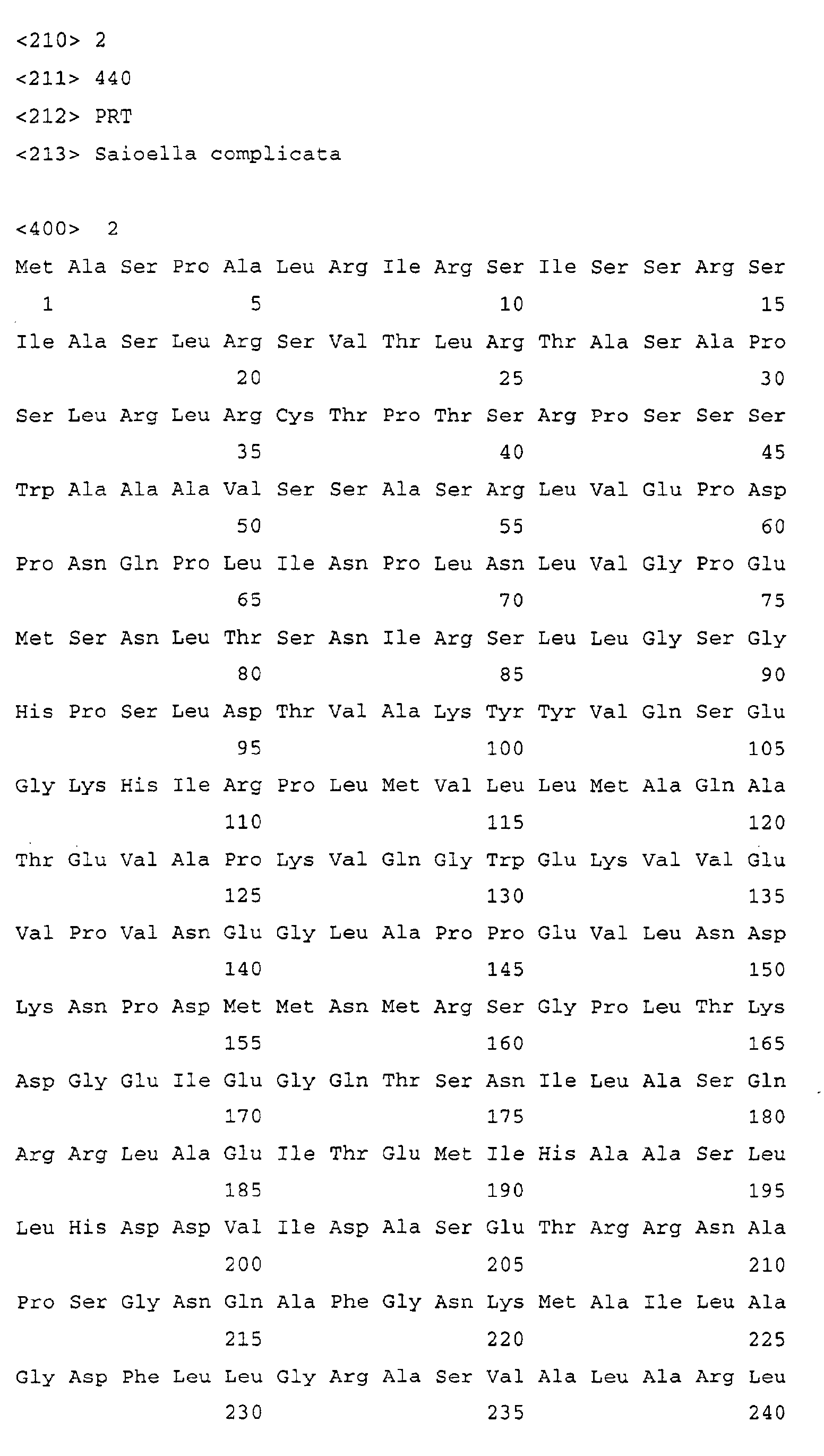
- the amino acid sequence deduced from the above nucleotide sequence is shown under SEQ ID NO:2.
- SEQ ID NO:2 The amino acid sequence deduced from the above nucleotide sequence is shown under SEQ ID NO:2.
- a sequence characteristic of a gene coding for decaprenyl diphosphate synthase is observed.
- the DNA of the invention may be any of the DNA having the nucleotide sequence shown under SEQ ID NO:1, the DNA having a nucleotide sequence derived from the sequence of SEQ ID NO:1 by deletion, addition, insertion and/or substitution of one or a plurality of nucleotides and coding for a protein having decaprenyl diphosphate synthase activity, and the DNA which hybridizes with the DNA having the nucleotide sequence of SEQ ID NO:1 under stringent conditions and codes for a protein having decaprenyl diphosphate synthase activity.
- nucleotide sequence derived by deletion, addition, insertion and/or substitution of one or a plurality of nucleotides means any nucleotide sequence derived by deletion, addition, insertion and/or substitution of a number of nucleotides of the order which can be deleted, added, inserted and/or substituted by the methods well known in the art, for example as described in, inter alia , Protein, Nucleic Acid, Enzyme, Supplemental Issue: Gene Amplification PCR Technology TAKKAJ 35 (17), 2951-3178 (1990) and Henry A. Erlich (ed.), PCR Technology (the translation edited by Ikunoshin Kato) (1990).
- protein having decaprenyl diphosphate synthase activity means a protein capable of synthesizing decaprenyl diphosphate in a yield of not less than 10%, preferably not less than 40%, more preferably not less than 60%, still more preferably not less than 80%, relative to the protein having the amino acid sequence shown under SEQ ID NO:2.
- Such yield measurements can be made by the technique which comprises reacting FDP (farnesyl diphosphate) and 14 C-IPP (radiolabeled isopentenyl diphosphate) with the enzyme of interest, hydrolyzing the resulting 14 C-DPP (decaprenyl diphosphate) with phosphatase, fractionating the hydrolysate by TLC, and assaying the amounts taken up in spots corresponding to the respective chain lengths (Okada et al., Eur. J. Biochem., 255, 55 to 59).
- the "DNA which hybridizes with the DNA having the nucleotide sequence of SEQ ID NO:1 under stringent conditions means a DNA obtained by colony hybridization, plaque hybridization, Southern hybridization or the like hybridization techniques using the DNA having the nucleotide sequence of SEQ ID NO : 1 as the probe.
- DNA having the nucleotide sequence of SEQ ID NO : 1 as the probe.
- the protein of the present invention may have the amino acid sequence shown under SEQ ID NO:2 or an amino acid sequence derived from the amino acid sequence shown under SEQ ID NO:2 by deletion, addition, insertion and/or substitution of one or a plurality of amino acids and having decaprenyl diphosphate synthase activity.
- the amino acid sequence derived by deletion, addition, insertion and/or substitution of one or a plurality of amino acids can be obtained by effecting such deletion, addition, insertion and/or substitution by the technology well known in the art, such as region-specific mutagenesis techniques. Specific procedures are described in Nucleic Acid Res. 10 , 6487 (1982), Methods in Enzymology, 100 , 448 (1983) and other literature.
- the protein of the present invention preferably has an amino acid sequence showing a homology of not less than 60%, preferably not less than 70%, more preferably not less than 80%, still more preferably not less than 90%, further still more preferably not less than 95%, to the amino acid sequence shown under SEQ ID NO:2.
- the "homology” is calculated by aligning two nucleotide sequences to be compared in the optimum format, counting the matched base positions (A, T, C, G, U or I) between the two sequences, dividing the count by the total number of bases compared, and multiplying the product by 100.
- this calculation can be made using an analytical software such as Hitachi Soft Engineering's DNASIS, Software Development's GENETYX, or Finland CSC's Clustal X, for instance.
- an expression vector can be constructed, for example by excising a DNA fragment containing the gene with a restriction enzyme or amplifying the enzyme-encoding gene selectively by PCR, followed by cloning it into a vector having a promoter.
- the expression vector into which the DNA coding for the protein having decaprenyl diphosphate synthase activity may be inserted is not particularly restricted but may for example be one constructed by ligating a suitable promoter to a plasmid derived from E . coli . The plasmid of E .
- coli origin includes pBR322, pBR325, pUC19 and pUC119, while the promoter includes T7 promoter, trp promoter, tac promoter, lac promoter and ⁇ PL promoter.
- the expression vector of this invention pGEX-2T, pGEX-3T, pGEX-3X (all from Pharmacia), pBluescript, pUC19 (from Toyobo), pMALC2, pET-3T and pUCNT (described in WO 94/03613), etc. can also be mentioned.
- pUCNT can be used with advantage.
- the vector pNTSal for the expression of a decaprenyl diphosphate synthase gene can be constructed by inserting the gene having the DNA sequence shown under SEQ ID NO:1 into the expression vector pUCNT.
- this enzyme gene expression vector is introduced into a suitable microorganism, whereby the microorganism is rendered capable of producing coenzyme Q 10 .
- the host microorganism is not particularly restricted but Escherichia coli can be used with advantage.
- the Escherichia coli is not particularly restricted but includes such strains as XL1-Blue, BL-21, JM109, NM522, DH5 ⁇ , HB101 and DH5, among others.
- E . coli DH5 ⁇ can be used with particular advantage .
- the expression vector pNTSa1 containing the decaprenyl diphosphate synthase gene is introduced into this E . coli strain, the coenzyme Q 10 , which the intact E .
- E . coli DH5 ⁇ (pNTSa1) has been deposited with National Institute of Bioscience and Human-Technology (Higashi 1-1-3, Tsukuba-shi, Ibaraki, Japan) under the accession number of FERM BP-6844.
- Escherichia coli KO229 Journal of Bacteriology, 179 , 3058-3060 (1997), the octaprenyl diphosphate synthase gene-knockout E . coli strain constructed by Kawamukai et al. as the host microorganism, is incapable of producing coenzyme Q 8 and can be utilized as the host for higher production of coenzyme Q 10 .
- the gene can be used not only singly but may be introduced together with another biosynthesis-related gene into a microorganism to thereby obtain still more satisfactory results.
- Coenzyme Q 10 can be produced by culturing the transformant obtained according to the invention and harvesting the product coenzyme Q 10 in a per se known manner .
- the host microorganism is a strain of Escherichia coli
- either LB broth or M9 broth containing glucose and casamino acids can be used as the culture broth.
- the broth may be supplemented with a certain chemical such as isopropyl-thiogalactoside or indolyl-3-acrylic acid.
- Culture can be carried out at 37 °C for 17 to 24 hours, for instance, optionally under aeration or agitation.
- the product coenzyme Q 10 may be used after purification or as it is in the crude form, depending on the intended use. Isolation of coenzyme Q 10 from the culture can be made-by using known separation and purification procedures in a suitable combination.
- solubilities such as salting-out and solvent precipitation
- techniques chiefly utilizing differences in molecular weight such as dialysis, ultrafiltration, gel filtration and (SDS-)polyacrylamide gel electrophoresis
- techniques utilizing differences in charge such as ion exchange chromatography
- techniques utilizing specific affinity such as affinity chromatography
- techniques utilizing differences in hydrophobicity such as reversed-phase high performance liquid chromatography
- techniques utilizing differences in isoelectric point such as isoelectric focusing, among others.
- the use for the coenzyme Q 10 obtained according to the invention is not particularly restricted but the enzyme can be applied to pharmaceuticals with advantage.
- Fig. 1 is a restriction map of the pNTSa1 vector containing the decaprenyl diphosphate synthase gene.
- Fig. 2 is an HPLC chart of the coenzyme Q 10 produced by the recombinant Escherichia coli DH5 ⁇ as transformed with the decaprenyl diphosphate synthase gene.
- Fig. 3 is an HPLC chart of the coenzyme Q 10 produced by the recombinant Escherichia coli KO229 as transformed with the decaprenyl diphosphate synthase gene.
- PCR primers i.e. DPS-1 (5'-AAGGATCCTNYTNCAYGAYGAYGT-3') and DPS-1 1AS (5'-ARYTGNADRAAYTCNCC-3'), were designed.
- R stands for A or G
- Y stands for C or T
- N stands for G, A, T or C.
- PCR was carried out under the conditions of heat treatment at 94 °C, 3 min. followed by 40 cycles of 94 °C, 1 min. ⁇ 43 °C, 2 min. ⁇ 72 °C, 2 min., and the PCR product was analyzed by 1.2% agarose gel electrophoresis.
- the ca. 220 bp fragment thus obtained was excised from the gel and purified using a DNA extraction kit (SephaglasTM BrandPrep Kit, Amersham Pharmacia Biotech). Then, using a PCR product direct cloning kit (pT7BlueT-Vector Kit, NOVAGEN), the DNA was cloned into the E . coli expression vector to givepT7-SaDPS. Then, using a DNA sequencer (Model 377, Perkin-Elmer) and a DNA sequencing kit (Perkin-Elmer; ABI PRISMTM BigDyeTM Terminator Cycle Sequence Ready Reaction Kit with AmptiTaqTM DNA Polymerase, FS), DNA sequencing was carried out according to the kit manufacturer's protocol.
- a DNA sequencer Model 377, Perkin-Elmer
- a DNA sequencing kit Perkin-Elmer; ABI PRISMTM BigDyeTM Terminator Cycle Sequence Ready Reaction Kit with AmptiTaqTM DNA Polymerase, FS
- the translation sequence thus obtained contained "GDFLLGRA" which is a characteristic region of polyprenyl diphosphate synthases and, therefore, was considered to be part of the decaprenyl diphosphate synthase gene.
- PCR using primers Sa-1S (which has the sequence of 5'-GAGACCAGACGAAACGCACCA-3') and Sa-2AS (which has the sequence of 5'-TGGTGCGTTTCGTCTGGTCTC-3') was carried out [94 °C, 3 min. ⁇ (94 °C, 30 sec. ⁇ 55 °C, 30 sec. ⁇ 72 °C, 1 min.) ⁇ 25 cycles ⁇ 72 °C, 5 min. ⁇ 4 °C].
- the PCR product was subjected to gel electrophoresis using 1.2% agarose (Takara) and a ca. 145 bp fragment was excised from the gel and purified using a DNA extraction kit (SephaglasTM BrandPrep Kit; Amersham Pharmacia Biotech). Using about 100 ng of this DNA fragment, chemiluminescence labeling was performed using ECL Direct Nucleic Acid Labeling System (Amersham Pharmacia Biotech).
- the chromosome DNA of Saitoella complicata IFO 10748 was digested with the restriction enzyme EcoRI and electrophoresed through 0.8% agarose gel. This gel was denatured with alkali (0.5 M NaOH, 1.5 M NaCl) and neutralized (0.5 M Tris-HCl (pH 7.5), 1.5 M NaCl), after which HYBOND N + filter (Amersham) was placed on the gel and the Southern transfer was carried out using 20 x SSC overnight. This filter was dried and heated at 80 °C for 2 hours and using ECL Direct Nucleic Acid Labeling/Detection System (Amersham Pharmacia Biotech), Southern hybridization and detection were carried out. Thus, using Gold Hybridizatioon Solution (Amercham Pharmacia Biotech), prehybridization was performed at 42 °C for 1 hour.
- the chemiluminescence-labeled probe was heated at 95 °C for 5 minutes, quenched on ice, and added to the prehybridization solution used for filter prehybridized and the hybridization was carried out at 42 °C for 22 hours.
- This filter was washed with 0.5 ⁇ SSC solution containing 6 M urea and 0.4% SDS at 42 °C twice for 20 minutes each and, then, washed with 2 ⁇ SSC solution at room temperature twice for 5 minutes each.
- This filter was immersed in Enhanced Chemiluminescence Reagent (product of Amersham Pharmacia Biotech) and, then, exposed in intimate contact with X-ray film to detect a black exposure band.
- the probe was found to have firmly hybridized with a ca. 10 kbp EcoRI restriction fragment.
- the chromosome DNA of Saitoella complicata IFO 10748 was digested with the restriction enzyme EcoRI and electrophoresed through 0.8% agarose and a ca. 10 kbp fragment of the DNA was excised from the gel and purified to prepare a DNA fragment for cloning.
- ⁇ -DASHII Phage Kit product of Stratagene
- the above DNA fragment was inserted into the EcoRI site of its phage and the packaging was made using In Vitro Packaging Kit (Amersham).
- Escherichia coli XL1-Blue MRA (P2) was infected and layered on NZY plate medium (5g/L NaCl, 2 g/L MgSO 4 ⁇ 7H 2 O, 5 g/Lyeast extract, 10 g/L NZ amine, 18 g/L agar (pH 7.5)) together with NZY soft agar (the agar only of NZY plate medium, 8 g/L) for use as a plaque.
- NZY plate medium 5g/L NaCl, 2 g/L MgSO 4 ⁇ 7H 2 O, 5 g/Lyeast extract, 10 g/L NZ amine, 18 g/L agar (pH 7.5)
- NZY soft agar the agar only of NZY plate medium, 8 g/L
- Example 3 Using 9 filters heated as above, the prehybridization and the hybridization using the chemiluminescence-labeled probe were carried out as in Example 3 and the filters were rinsed. Each filter was then dried and exposed in intimate contact with X-ray film and the phage plaque corresponding to the black exposure spot was separated. The phage of the separated plaque was used to infect E . coli in the same manner as above and transferred to the filter and the hybridization was carried out again for confirmation. As a result, 6 phage clones could be selected.
- the phage DNA was prepared from the recombinant ⁇ -DASHII phage particles according to Laboratory Manual for Genetic Engineering (Masami Muramatsu, Maruzen, 1990).
- the phage DNA thus prepared was digested with the restriction enzymes SalI and SacI and electrophoresed through 0.8% agarose gel. This gel was denatured with alkali (0.5 M NaOH, 1.5 M NaCl) and neutralized (0.5 M Tris-HCl (pH 7.5), 1.5 M NaCl).
- HYBOND N + filter (Amersham) was placed on the gel and subjected to Southern transfer using 20 x SSC overnight. This filter was dried and heated at 80°C for 2 hours, after which the Southern hybridization and detection were carried out using ECL Direct Nucleic Acid Labeling/Detection System (Amersham Pharmacia Biotech). Thus, using Gold Hybridizatioon Solution (Amersham Pharmacia Biotech), the prehybridization was carried out at 42 °C for 1 hour.
- the chemiluminescence-labeled probe was heated at 95 °C for 5 minutes, quenched on ice, and added to the prehybridization solution used for filter prehybridized and the hybridization was carried out at 42 °C for 22 hours.
- This filter was washed with 0.5 ⁇ SSC containing 6 M urea and 0.4% SDS at 42 °C twice for 20 minutes each and, then, with 2 ⁇ SSC at room temperature twice for 5 minutes each.
- the filter was immersed in Enhanced Chemiluminescence Reagent (Amersham Pharmacia Biotech) and exposed in intimate contact with X-ray film to detect a black exposure band.
- the probe was found to have intimately hybridized with a ca. 4.5 kb fragment as obtained by digestion with the restriction enzyme SalI and a ca. 3.5 kb fragment as obtained by digestion with SacI.
- the phage DNA was digested with the restriction enzymes SalI and SacI and electrophoresed through 0.8% agarose gel.
- the restriction fragment corresponding to the position and size of the black exposure band was excised from the gel and purified using a DNA extraction kit (SephaglasTM Brand Prep Kit; Amersham Pharmacia Biotech). Then, using a DNA sequencer (Model 377, Perkin-Elmer Corp.) and a DNA sequence kit (Perkin-Elmer Corp., ABI PRISMTM BigDyeTM Terminator Cycle Sequence Ready Reaction Kit with AmptiTaqTM DNA polymerase, FS), the sequencing was carried out in accordance with the manufacturer's protocol.
- PCR was carried out using synthetic DNA primers Sa-N1 (which has the sequence of 5'-AACATATGGCCTCACCAGCACTGCGG-3') and Sa-C (which has the sequence of 5'-AAGAATTCCTATCTTGACCTAGTCAACAC-3') in otherwise the same manner as in Example 3.
- the fragment was inserted into the expression vector pUCNT (disclosed in WO 94/03613) to construct the decaprenyl diphosphate synthase gene expression vector pNTSal.
- the restriction map of the expression vector pNTSa1 thus obtained is shown in Fig. 1. It is to be noted that DPS represents the coding region of the decaprenyl diphosphate synthase gene.
- the decaprenyl diphosphate synthase gene expression vector pNTSa1 constructed as above was introduced into Escherichia coli DH5 ⁇ .
- the microorganism was shake-cultured in 10 mL of LB broth at 37°C overnight and the cells were harvested by centrifugation (3000 rpm, 20 min.).
- the cells were suspended in 1 mL of 3% aqueous solution of sulfuric acid and heat-treated at 120°C for 30 minutes . Then, 2 mL of 14% aqueous solution of sodium hydroxide was added and the mixture was further heat-treated at 120 °C for 15 minutes.
- the lysate obtained was extracted with 3 mL of hexane-isopropyl alcohol (10:2), and after centrifugation, 1.5 mL of the organic layer was separated and evaporated to dryness under reduced pressure. The residue was dissolved in 200 ⁇ L of ethanol and a 20 ⁇ L portion of the solution was subjected to HPLC analysis (LC-10A, Shimadzu Corporation).
- E . coli DH5 ⁇ (pNTSa1) obtained as above has been deposited with National Institute of Bioscience and Human-Technology (Higashi 1-1-3, Tsukuba-shi, Ibaraki, Japan) as of Heisei 11, August 17 (accession number FERM BP-6844).
- the octaprenyl diphosphate synthase gene-knockout Escherichia coli KO229 constructed by Kawamukai et al. is known to retain the gene supported on the spectinomycin-resistant plasmid (pKA3) and die on dropout of said plasmid (Journal of Bacteriology, 179 , 3058-3060 (1997).
- the pNTSa1 was introduced into the above knockout strain, culturing the microorganism in 10 mL of ampicillin-containing LB broth by shake culture at 37 °C overnight, subculturing 1% of the culture in 10 mL of fresh ampicillin-containing LB broth and culturing the microorganism further by shake-culture at 37 °C overnight, and after 9 cycles of the above cultural procedure, selecting the strain growing on ampicillin-containing LB plate medium but not growing on spectinomycin-containing LB plate medium.
- the pNTSa1-transfected strain constructed in Example 7 was shake-cultured in 10 mL of LB broth at 37 °C overnight and the cells were harvested by centrifugation (3000 rpm, 20 min.).
- the cells were suspended in 1 mL of 3% aqueous solution of sulfuric acid and heat-treated at 120 °C for 30 min. Then, 2 mL of 14% aqueous solution of sodium hydroxide was added and the mixture was further heat-treated at 120 °C for 15 minutes.
- the lysate cells were extracted with 3 mL of hexane-isopropyl alcohol (10:2) and centrifuged to recover 1.5 mL of the organic layer and the solvent was evaporated to dryness under reduced pressure. The residue was dissolved in 200 ⁇ L of ethanol and a 20 ⁇ L portion of the solution was subjected to HPLC analysis (LC-10A, Shimadzu Corporation).
- the gene coding for the key enzyme associated with the biosynthesis of coenzyme Q 10 was isolated from fungi of the genus Saitoella and its nucleotide sequence was elucidated. Furthermore, the gene was successfully introduced and expressed in Escherichia coli . By utilizing the technology of the invention, coenzyme Q 10 in use as a pharmaceutical can be producedwith improved efficiency.
Landscapes
- Chemical & Material Sciences (AREA)
- Organic Chemistry (AREA)
- Life Sciences & Earth Sciences (AREA)
- Engineering & Computer Science (AREA)
- Health & Medical Sciences (AREA)
- Zoology (AREA)
- Wood Science & Technology (AREA)
- Genetics & Genomics (AREA)
- Bioinformatics & Cheminformatics (AREA)
- General Health & Medical Sciences (AREA)
- Microbiology (AREA)
- Biochemistry (AREA)
- Biotechnology (AREA)
- General Engineering & Computer Science (AREA)
- Medicinal Chemistry (AREA)
- General Chemical & Material Sciences (AREA)
- Chemical Kinetics & Catalysis (AREA)
- Molecular Biology (AREA)
- Biomedical Technology (AREA)
- Preparation Of Compounds By Using Micro-Organisms (AREA)
- Micro-Organisms Or Cultivation Processes Thereof (AREA)
- Organic Low-Molecular-Weight Compounds And Preparation Thereof (AREA)
- Enzymes And Modification Thereof (AREA)
Abstract
Description



Claims (12)
- A DNA of the following (a), (b) or (c):(a) a DNA having the nucleotide sequence shown under SEQ ID NO:1;(b) a DNA having a nucleotide sequence derived from the nucleotide sequence of SEQ ID NO:1 by deletion, addition, insertion and/or substitution of one or a plurality of nucleotides and coding for a protein having decaprenyl diphosphate synthase activity;(c) a DNA which hybridizes with the DNA having the nucleotide sequence of SEQ ID NO:1 under stringent conditions and codes for a protein having decaprenyl diphosphate synthase activity.
- A protein of the following (d) or (e):(d) a protein having the amino acid sequence shown under SEQ ID NO:2;(e) a protein having an amino acid sequence derived from the amino acid sequence of SEQ ID NO:2 by deletion, addition, insertion and/or substitution of one or a plurality of amino acids and having decaprenyl diphosphate synthase activity.
- A DNA coding for the protein according to Claim 2.
- An expression vector constructed by cloning the DNA according to Claim 1 or 3 in an expression vector.
- The expression vector according to Claim 4
wherein the expression vector is pUCNT. - The expression vector according to Claim 5
wherein the expression vector is pNTSa1. - A transformant as obtainable by transforming a host microorganism with the DNA according to Claim 1 or 3.
- A transformant as obtainable by transforming a host microorganism using the expression vector according to Claim 4, 5 or 6.
- The transformant according to Claim 7 or 8 wherein the host microorganism is Escherichia coli.
- The transformant according to Claim 9 wherein the Escherichia coli is Escherichia coli DH5α.
- The transformant according to Claim 10 which is E. coli DH5α (pNTSa1) (FERM BP-6844).
- Aprocess for producing a coenzyme Q10, which comprises culturing the transformant according to Claim 7, 8, 9, 10 or 11 in a culture broth and harvesting the coenzyme Q10 produced and accumulated in the resulting culture.
Applications Claiming Priority (3)
| Application Number | Priority Date | Filing Date | Title |
|---|---|---|---|
| JP23756199 | 1999-08-24 | ||
| JP23756199A JP3941998B2 (en) | 1999-08-24 | 1999-08-24 | Method for producing Coenzyme Q10 |
| PCT/JP2000/005659 WO2001014567A1 (en) | 1999-08-24 | 2000-08-24 | Process for producing coenzyme q¿10? |
Publications (3)
| Publication Number | Publication Date |
|---|---|
| EP1123979A1 true EP1123979A1 (en) | 2001-08-16 |
| EP1123979A4 EP1123979A4 (en) | 2002-03-27 |
| EP1123979B1 EP1123979B1 (en) | 2006-12-13 |
Family
ID=17017149
Family Applications (1)
| Application Number | Title | Priority Date | Filing Date |
|---|---|---|---|
| EP00954944A Expired - Lifetime EP1123979B1 (en) | 1999-08-24 | 2000-08-24 | Process for producing coenzyme q10 |
Country Status (9)
| Country | Link |
|---|---|
| US (1) | US6762037B1 (en) |
| EP (1) | EP1123979B1 (en) |
| JP (1) | JP3941998B2 (en) |
| AT (1) | ATE348172T1 (en) |
| AU (1) | AU6727000A (en) |
| CA (1) | CA2348161A1 (en) |
| DE (1) | DE60032328T2 (en) |
| NO (1) | NO20011995L (en) |
| WO (1) | WO2001014567A1 (en) |
Cited By (4)
| Publication number | Priority date | Publication date | Assignee | Title |
|---|---|---|---|---|
| WO2003056024A1 (en) * | 2001-12-27 | 2003-07-10 | Kaneka Corporation | Processes for producing coenzyme q10 |
| EP1354957A4 (en) * | 2000-12-27 | 2005-01-26 | Kaneka Corp | Process for producing coenzyme q 10 |
| EP1336657A4 (en) * | 2000-11-20 | 2005-07-27 | Kaneka Corp | Process for producing coenzyme q 10? |
| US7402413B2 (en) | 2001-05-11 | 2008-07-22 | Kaneka Corporation | Method of expressing long-chain prenyl diphosphate synthase |
Families Citing this family (3)
| Publication number | Priority date | Publication date | Assignee | Title |
|---|---|---|---|---|
| JP2002345469A (en) * | 2001-04-25 | 2002-12-03 | Kanegafuchi Chem Ind Co Ltd | Method for producing coenzyme Q10 |
| TW200604159A (en) * | 2001-07-13 | 2006-02-01 | Kaneka Corp | Method of producing reduced coenzyme Q10 as oily product |
| US11471426B2 (en) | 2019-10-16 | 2022-10-18 | American River Nutrition, Llc | Compositions comprising quinone and/or quinol and methods of preparations and use thereof |
Family Cites Families (3)
| Publication number | Priority date | Publication date | Assignee | Title |
|---|---|---|---|---|
| JPH09173076A (en) * | 1995-12-27 | 1997-07-08 | Alpha- Shokuhin Kk | Method for producing heterogeneous ubiquinone |
| JPH1156372A (en) | 1997-08-27 | 1999-03-02 | Alpha- Shokuhin Kk | Method for producing ubiquinone-10 |
| JP4307609B2 (en) * | 1999-02-10 | 2009-08-05 | 株式会社カネカ | Method for producing coenzyme Q10 |
-
1999
- 1999-08-24 JP JP23756199A patent/JP3941998B2/en not_active Expired - Fee Related
-
2000
- 2000-08-24 US US09/830,111 patent/US6762037B1/en not_active Expired - Lifetime
- 2000-08-24 EP EP00954944A patent/EP1123979B1/en not_active Expired - Lifetime
- 2000-08-24 DE DE60032328T patent/DE60032328T2/en not_active Expired - Lifetime
- 2000-08-24 AT AT00954944T patent/ATE348172T1/en not_active IP Right Cessation
- 2000-08-24 CA CA002348161A patent/CA2348161A1/en not_active Abandoned
- 2000-08-24 WO PCT/JP2000/005659 patent/WO2001014567A1/en not_active Ceased
- 2000-08-24 AU AU67270/00A patent/AU6727000A/en not_active Abandoned
-
2001
- 2001-04-23 NO NO20011995A patent/NO20011995L/en not_active Application Discontinuation
Cited By (14)
| Publication number | Priority date | Publication date | Assignee | Title |
|---|---|---|---|---|
| EP1336657A4 (en) * | 2000-11-20 | 2005-07-27 | Kaneka Corp | Process for producing coenzyme q 10? |
| US7320883B2 (en) | 2000-12-27 | 2008-01-22 | Kaneka Corporation | Process for producing coenzyme Q10 |
| EP1354957A4 (en) * | 2000-12-27 | 2005-01-26 | Kaneka Corp | Process for producing coenzyme q 10 |
| US8163525B2 (en) | 2001-05-11 | 2012-04-24 | Kaneka Corporation | Method of expressing long-chain prenyl diphosphate synthase |
| US7402413B2 (en) | 2001-05-11 | 2008-07-22 | Kaneka Corporation | Method of expressing long-chain prenyl diphosphate synthase |
| EP1466983A4 (en) * | 2001-12-27 | 2005-11-09 | Kaneka Corp | Processes for producing coenzyme q10 |
| AU2002357526B2 (en) * | 2001-12-27 | 2007-10-18 | Kaneka Corporation | Processes for producing coenzyme Q10 |
| RU2298035C2 (en) * | 2001-12-27 | 2007-04-27 | Канека Корпорейшн | Method for production of reduced q10 coenzyme and method for production of oxidized q10 coenzyme |
| CN100523205C (en) * | 2001-12-27 | 2009-08-05 | 钟渊化学工业株式会社 | Processes for producing coenzyme Q10 |
| KR100913464B1 (en) * | 2001-12-27 | 2009-08-25 | 가부시키가이샤 가네카 | Method for preparing coenzyme 90 |
| US7910340B2 (en) | 2001-12-27 | 2011-03-22 | Kaneka Corporation | Processes for producing coenzyme Q10 |
| WO2003056024A1 (en) * | 2001-12-27 | 2003-07-10 | Kaneka Corporation | Processes for producing coenzyme q10 |
| US9315839B2 (en) | 2001-12-27 | 2016-04-19 | Kaneka Corporation | Processes for producing coenzyme Q10 |
| US9926580B2 (en) | 2001-12-27 | 2018-03-27 | Kaneka Corporation | Process for producing coenzyme Q10 |
Also Published As
| Publication number | Publication date |
|---|---|
| JP2001061478A (en) | 2001-03-13 |
| DE60032328T2 (en) | 2007-07-12 |
| NO20011995D0 (en) | 2001-04-23 |
| US6762037B1 (en) | 2004-07-13 |
| WO2001014567A1 (en) | 2001-03-01 |
| EP1123979A4 (en) | 2002-03-27 |
| AU6727000A (en) | 2001-03-19 |
| DE60032328D1 (en) | 2007-01-25 |
| CA2348161A1 (en) | 2001-03-01 |
| EP1123979B1 (en) | 2006-12-13 |
| ATE348172T1 (en) | 2007-01-15 |
| JP3941998B2 (en) | 2007-07-11 |
| NO20011995L (en) | 2001-05-30 |
Similar Documents
| Publication | Publication Date | Title |
|---|---|---|
| KR100512080B1 (en) | Novel carbonyl reductase, gene thereof and method of using the same | |
| AU2003221082B2 (en) | Novel carbonyl reductase, gene encoding it and process for producing optically active alcohols using the same | |
| EP1123979B1 (en) | Process for producing coenzyme q10 | |
| US20080064074A1 (en) | Process for producing coenzyme q10 | |
| US20090130727A1 (en) | Method of expressing long-chain prenyl diphosphate synthase | |
| EP4227410A1 (en) | Method for manufacturing ketose using novel ketose-3-epimerase | |
| JP4205496B2 (en) | Novel carbonyl reductase, DNA encoding the same, and method for producing optically active alcohol using the same | |
| JP4307609B2 (en) | Method for producing coenzyme Q10 | |
| EP1306438B1 (en) | Novel carbonyl reductase, gene thereof and method of using the same | |
| EP1391515A1 (en) | Process for producing coenzyme q 10 | |
| JP4295531B2 (en) | Novel carbonyl reductase, DNA encoding the same, and method for producing optically active alcohol using the same | |
| US7320883B2 (en) | Process for producing coenzyme Q10 | |
| WO2005123921A1 (en) | Novel glycerol dehydrogenase, gene therefor, and method of utilizing the same | |
| JP2005027552A (en) | Process for producing novel optically active 2-hydroxymethyl-3-arylpropionic acid | |
| WO2020213374A1 (en) | Recombinant production of peroxidase | |
| JP2001069983A (en) | Alcohol dehydrogenase gene, recombinant vector containing the same, transformant containing the recombinant vector and production of alcohol dehydrogenase using the transformant |
Legal Events
| Date | Code | Title | Description |
|---|---|---|---|
| PUAI | Public reference made under article 153(3) epc to a published international application that has entered the european phase |
Free format text: ORIGINAL CODE: 0009012 |
|
| 17P | Request for examination filed |
Effective date: 20010522 |
|
| AK | Designated contracting states |
Kind code of ref document: A1 Designated state(s): AT BE CH CY DE DK ES FI FR GB GR IE IT LI LU MC NL PT |
|
| AX | Request for extension of the european patent |
Free format text: AL;LT;LV;MK;RO;SI |
|
| RTI1 | Title (correction) |
Free format text: PROCESS FOR PRODUCING COENZYME Q 10 |
|
| RTI1 | Title (correction) |
Free format text: PROCESS FOR PRODUCING COENZYME Q10 |
|
| A4 | Supplementary search report drawn up and despatched |
Effective date: 20020212 |
|
| AK | Designated contracting states |
Kind code of ref document: A4 Designated state(s): AT BE CH CY DE DK ES FI FR GB GR IE IT LI LU MC NL PT |
|
| 16A | New documents despatched to applicant after publication of the search report |
Effective date: 20020327 |
|
| RA4 | Supplementary search report drawn up and despatched (corrected) |
Effective date: 20020327 |
|
| 17Q | First examination report despatched |
Effective date: 20021028 |
|
| GRAP | Despatch of communication of intention to grant a patent |
Free format text: ORIGINAL CODE: EPIDOSNIGR1 |
|
| RBV | Designated contracting states (corrected) |
Designated state(s): AT BE CH CY DE DK ES FI FR GB GR IE IT LI LU MC NL PT SE |
|
| GRAS | Grant fee paid |
Free format text: ORIGINAL CODE: EPIDOSNIGR3 |
|
| GRAA | (expected) grant |
Free format text: ORIGINAL CODE: 0009210 |
|
| AK | Designated contracting states |
Kind code of ref document: B1 Designated state(s): AT BE CH CY DE DK ES FI FR GB GR IE IT LI LU MC NL PT SE |
|
| PG25 | Lapsed in a contracting state [announced via postgrant information from national office to epo] |
Ref country code: BE Free format text: LAPSE BECAUSE OF FAILURE TO SUBMIT A TRANSLATION OF THE DESCRIPTION OR TO PAY THE FEE WITHIN THE PRESCRIBED TIME-LIMIT Effective date: 20061213 Ref country code: FI Free format text: LAPSE BECAUSE OF FAILURE TO SUBMIT A TRANSLATION OF THE DESCRIPTION OR TO PAY THE FEE WITHIN THE PRESCRIBED TIME-LIMIT Effective date: 20061213 Ref country code: DK Free format text: LAPSE BECAUSE OF FAILURE TO SUBMIT A TRANSLATION OF THE DESCRIPTION OR TO PAY THE FEE WITHIN THE PRESCRIBED TIME-LIMIT Effective date: 20061213 Ref country code: AT Free format text: LAPSE BECAUSE OF FAILURE TO SUBMIT A TRANSLATION OF THE DESCRIPTION OR TO PAY THE FEE WITHIN THE PRESCRIBED TIME-LIMIT Effective date: 20061213 |
|
| REG | Reference to a national code |
Ref country code: GB Ref legal event code: FG4D |
|
| REG | Reference to a national code |
Ref country code: CH Ref legal event code: EP |
|
| REG | Reference to a national code |
Ref country code: IE Ref legal event code: FG4D |
|
| REF | Corresponds to: |
Ref document number: 60032328 Country of ref document: DE Date of ref document: 20070125 Kind code of ref document: P |
|
| PG25 | Lapsed in a contracting state [announced via postgrant information from national office to epo] |
Ref country code: SE Free format text: LAPSE BECAUSE OF FAILURE TO SUBMIT A TRANSLATION OF THE DESCRIPTION OR TO PAY THE FEE WITHIN THE PRESCRIBED TIME-LIMIT Effective date: 20070313 |
|
| PG25 | Lapsed in a contracting state [announced via postgrant information from national office to epo] |
Ref country code: ES Free format text: LAPSE BECAUSE OF FAILURE TO SUBMIT A TRANSLATION OF THE DESCRIPTION OR TO PAY THE FEE WITHIN THE PRESCRIBED TIME-LIMIT Effective date: 20070324 |
|
| REG | Reference to a national code |
Ref country code: CH Ref legal event code: NV Representative=s name: BOVARD AG PATENTANWAELTE |
|
| PG25 | Lapsed in a contracting state [announced via postgrant information from national office to epo] |
Ref country code: PT Free format text: LAPSE BECAUSE OF FAILURE TO SUBMIT A TRANSLATION OF THE DESCRIPTION OR TO PAY THE FEE WITHIN THE PRESCRIBED TIME-LIMIT Effective date: 20070514 |
|
| EN | Fr: translation not filed | ||
| PGFP | Annual fee paid to national office [announced via postgrant information from national office to epo] |
Ref country code: IE Payment date: 20070821 Year of fee payment: 8 |
|
| PLBE | No opposition filed within time limit |
Free format text: ORIGINAL CODE: 0009261 |
|
| STAA | Information on the status of an ep patent application or granted ep patent |
Free format text: STATUS: NO OPPOSITION FILED WITHIN TIME LIMIT |
|
| 26N | No opposition filed |
Effective date: 20070914 |
|
| PGFP | Annual fee paid to national office [announced via postgrant information from national office to epo] |
Ref country code: CH Payment date: 20070815 Year of fee payment: 8 |
|
| PGFP | Annual fee paid to national office [announced via postgrant information from national office to epo] |
Ref country code: NL Payment date: 20070815 Year of fee payment: 8 |
|
| GBPC | Gb: european patent ceased through non-payment of renewal fee |
Effective date: 20070824 |
|
| PG25 | Lapsed in a contracting state [announced via postgrant information from national office to epo] |
Ref country code: GR Free format text: LAPSE BECAUSE OF FAILURE TO SUBMIT A TRANSLATION OF THE DESCRIPTION OR TO PAY THE FEE WITHIN THE PRESCRIBED TIME-LIMIT Effective date: 20070314 Ref country code: FR Free format text: LAPSE BECAUSE OF FAILURE TO SUBMIT A TRANSLATION OF THE DESCRIPTION OR TO PAY THE FEE WITHIN THE PRESCRIBED TIME-LIMIT Effective date: 20070803 Ref country code: MC Free format text: LAPSE BECAUSE OF NON-PAYMENT OF DUE FEES Effective date: 20070831 |
|
| PG25 | Lapsed in a contracting state [announced via postgrant information from national office to epo] |
Ref country code: FR Free format text: LAPSE BECAUSE OF FAILURE TO SUBMIT A TRANSLATION OF THE DESCRIPTION OR TO PAY THE FEE WITHIN THE PRESCRIBED TIME-LIMIT Effective date: 20061213 Ref country code: GB Free format text: LAPSE BECAUSE OF NON-PAYMENT OF DUE FEES Effective date: 20070824 |
|
| REG | Reference to a national code |
Ref country code: CH Ref legal event code: PL |
|
| NLV4 | Nl: lapsed or anulled due to non-payment of the annual fee |
Effective date: 20090301 |
|
| PG25 | Lapsed in a contracting state [announced via postgrant information from national office to epo] |
Ref country code: NL Free format text: LAPSE BECAUSE OF NON-PAYMENT OF DUE FEES Effective date: 20090301 |
|
| PG25 | Lapsed in a contracting state [announced via postgrant information from national office to epo] |
Ref country code: CH Free format text: LAPSE BECAUSE OF NON-PAYMENT OF DUE FEES Effective date: 20080831 Ref country code: LI Free format text: LAPSE BECAUSE OF NON-PAYMENT OF DUE FEES Effective date: 20080831 |
|
| PG25 | Lapsed in a contracting state [announced via postgrant information from national office to epo] |
Ref country code: IE Free format text: LAPSE BECAUSE OF NON-PAYMENT OF DUE FEES Effective date: 20080825 |
|
| PG25 | Lapsed in a contracting state [announced via postgrant information from national office to epo] |
Ref country code: CY Free format text: LAPSE BECAUSE OF FAILURE TO SUBMIT A TRANSLATION OF THE DESCRIPTION OR TO PAY THE FEE WITHIN THE PRESCRIBED TIME-LIMIT Effective date: 20061213 Ref country code: LU Free format text: LAPSE BECAUSE OF NON-PAYMENT OF DUE FEES Effective date: 20070824 |
|
| PG25 | Lapsed in a contracting state [announced via postgrant information from national office to epo] |
Ref country code: IT Free format text: LAPSE BECAUSE OF NON-PAYMENT OF DUE FEES Effective date: 20070824 |
|
| PGFP | Annual fee paid to national office [announced via postgrant information from national office to epo] |
Ref country code: DE Payment date: 20090821 Year of fee payment: 10 |
|
| REG | Reference to a national code |
Ref country code: DE Ref legal event code: R119 Ref document number: 60032328 Country of ref document: DE Effective date: 20110301 |
|
| PG25 | Lapsed in a contracting state [announced via postgrant information from national office to epo] |
Ref country code: DE Free format text: LAPSE BECAUSE OF NON-PAYMENT OF DUE FEES Effective date: 20110301 |