EP1122803A1 - Carbonaceous material for cell and cell containing the carbonaceous material - Google Patents
Carbonaceous material for cell and cell containing the carbonaceous material Download PDFInfo
- Publication number
- EP1122803A1 EP1122803A1 EP99970512A EP99970512A EP1122803A1 EP 1122803 A1 EP1122803 A1 EP 1122803A1 EP 99970512 A EP99970512 A EP 99970512A EP 99970512 A EP99970512 A EP 99970512A EP 1122803 A1 EP1122803 A1 EP 1122803A1
- Authority
- EP
- European Patent Office
- Prior art keywords
- powder
- graphite powder
- less
- lithium battery
- carbon material
- Prior art date
- Legal status (The legal status is an assumption and is not a legal conclusion. Google has not performed a legal analysis and makes no representation as to the accuracy of the status listed.)
- Withdrawn
Links
Images

Classifications
-
- H—ELECTRICITY
- H01—ELECTRIC ELEMENTS
- H01M—PROCESSES OR MEANS, e.g. BATTERIES, FOR THE DIRECT CONVERSION OF CHEMICAL ENERGY INTO ELECTRICAL ENERGY
- H01M4/00—Electrodes
- H01M4/02—Electrodes composed of, or comprising, active material
- H01M4/36—Selection of substances as active materials, active masses, active liquids
- H01M4/58—Selection of substances as active materials, active masses, active liquids of inorganic compounds other than oxides or hydroxides, e.g. sulfides, selenides, tellurides, halogenides or LiCoFy; of polyanionic structures, e.g. phosphates, silicates or borates
- H01M4/583—Carbonaceous material, e.g. graphite-intercalation compounds or CFx
-
- H—ELECTRICITY
- H01—ELECTRIC ELEMENTS
- H01M—PROCESSES OR MEANS, e.g. BATTERIES, FOR THE DIRECT CONVERSION OF CHEMICAL ENERGY INTO ELECTRICAL ENERGY
- H01M4/00—Electrodes
- H01M4/02—Electrodes composed of, or comprising, active material
- H01M4/36—Selection of substances as active materials, active masses, active liquids
- H01M4/58—Selection of substances as active materials, active masses, active liquids of inorganic compounds other than oxides or hydroxides, e.g. sulfides, selenides, tellurides, halogenides or LiCoFy; of polyanionic structures, e.g. phosphates, silicates or borates
- H01M4/583—Carbonaceous material, e.g. graphite-intercalation compounds or CFx
- H01M4/587—Carbonaceous material, e.g. graphite-intercalation compounds or CFx for inserting or intercalating light metals
-
- H—ELECTRICITY
- H01—ELECTRIC ELEMENTS
- H01M—PROCESSES OR MEANS, e.g. BATTERIES, FOR THE DIRECT CONVERSION OF CHEMICAL ENERGY INTO ELECTRICAL ENERGY
- H01M4/00—Electrodes
- H01M4/02—Electrodes composed of, or comprising, active material
- H01M2004/021—Physical characteristics, e.g. porosity, surface area
-
- H—ELECTRICITY
- H01—ELECTRIC ELEMENTS
- H01M—PROCESSES OR MEANS, e.g. BATTERIES, FOR THE DIRECT CONVERSION OF CHEMICAL ENERGY INTO ELECTRICAL ENERGY
- H01M4/00—Electrodes
- H01M4/02—Electrodes composed of, or comprising, active material
- H01M4/13—Electrodes for accumulators with non-aqueous electrolyte, e.g. for lithium-accumulators; Processes of manufacture thereof
- H01M4/133—Electrodes based on carbonaceous material, e.g. graphite-intercalation compounds or CFx
-
- Y—GENERAL TAGGING OF NEW TECHNOLOGICAL DEVELOPMENTS; GENERAL TAGGING OF CROSS-SECTIONAL TECHNOLOGIES SPANNING OVER SEVERAL SECTIONS OF THE IPC; TECHNICAL SUBJECTS COVERED BY FORMER USPC CROSS-REFERENCE ART COLLECTIONS [XRACs] AND DIGESTS
- Y02—TECHNOLOGIES OR APPLICATIONS FOR MITIGATION OR ADAPTATION AGAINST CLIMATE CHANGE
- Y02E—REDUCTION OF GREENHOUSE GAS [GHG] EMISSIONS, RELATED TO ENERGY GENERATION, TRANSMISSION OR DISTRIBUTION
- Y02E60/00—Enabling technologies; Technologies with a potential or indirect contribution to GHG emissions mitigation
- Y02E60/10—Energy storage using batteries
Definitions
- the present invention relates to a carbon material for a lithium battery, more specifically, the present invention relates to a carbon material for a lithium battery having high discharge capacity, high charge and discharge efficiency and excellent cycle property.
- a nonaqueous solvent-type lithium secondary battery using lithium which is the basest metal, may allow realization of a compact lightweight high energy density battery. Accordingly, research and development thereof are proceeding aggressively.
- a lithium secondary battery using metal lithium as a negative electrode is, however, disadvantageous in that dendritic acicular lithium crystals are readily generated and break through the separator and cause short-circuits.
- a lithium ion secondary battery using a carbonized or graphitized carbon material for the negative electrode and a nonaqueous solvent containing lithium ion for the electrolytic solution has been proposed and is used in practice.
- the charge and discharge reaction is designed to take place in such a manner that when the carbon is doped, intercalated or the like by lithium ion, charging occurs, whereas when the lithium ion is dedoped or deintercalated, discharging occurs, so that the metal lithium can be prevented from precipitating and can be completely used.
- This reaction mechanism is being aggressively studied but has not yet been completely elucidated.
- carbon materials such as natural graphite, artificial graphite, pitch type carbon particles, pitch type carbon fibers, vapor grown carbon fibers, or non-graphitizable products baked under low temperature, are used as the negative electrode, and lithium is used as an active material thereof.
- JP-A-8-31422 discloses a technique of adding boron (B) to carbon powder and graphitizing the mixed powder, thereby elevating the crystallinity.
- JP-A-9-259886 discloses a technique of processing a specific carbon to thereby improve the crystallinity of the graphite powder and reduce the specific surface area.
- graphite powder formed into a paste using a binder is coated on a metal foil, a metal mesh or the like to form an electrode (negative electrode).
- the powder used preferably has a small specific surface area.
- a passive film comprising an electrolytic solution or the like is formed on the surface of the graphite powder and as the specific surface area of the powder becomes larger, the production of the passive film increases.
- the passive film is a significant cause of reduction of the use efficiency of lithium.
- the carbon material has a high activity, the electrolytic solution is decomposed, resulting in a short cycle life. Therefore, the activity of the carbon material is preferably decreased as much as possible.
- a carbon material having a lower chemical activity (reactivity) and a smaller specific surface area is preferably employed. Also, when the specific surface area of the powder becomes large, the amount of binder used in the formation of the powder into a poled plate increases and the coverage of binder on the graphite particles proportionally increases. As a result, the contact ratio between the graphite particles and the electrolytic solution is reduced and the charge and discharge capacity decreases.
- the battery charges and discharges more current, and the required conductivity of the electrode increases compared with those of conventional batteries. More specifically, when the material requires a large amount of binder because of the low conductivity or poor coating performance, the resistance of the electrode plate itself is increased. As a result, this causes not only a decreases of the discharge capacity and Coulomb efficiency, but also a increase of heat generation and partial heat generation, as well as the possibility of dendrite generation, which is not preferable from the view point of safety. Accordingly, it is necessary to develop a carbon material which has the high conductivity of carbon itself, excellent coating performance, and increased charge and discharge capacity.
- the method for obtaining graphite powder includes a method of pulverizing coke and the like and then graphitizing the powder and a method of graphitizing coke or the like and then pulverizing it.
- JP-A-6-295725 employs the latter method.
- graphite When graphite is first formed and then pulverized, the graphite becomes highly crystallized having increased hardness and strength, which makes pulverization thereof difficult.
- the pulverization of graphite requires large force. When a large force is applied in pulverization, a greater amount of fine powder is produced, the particles are more liable to have scaly shapes, and the aspect ratio is increased. Due to the increased aspect ratio, more particles of flat shaped crystals are included, the specific area of the powder is increased, and the battery performance decreases.
- the discharge capacity may be increased by increasing the crystallinity of the graphite and reducing the specific surface area of the graphite powder.
- the permeability of the electrolytic solution attributable to the shape of graphite powder, or the filling ratio of graphite particles during formation into an electrode, affect the battery properties.
- these problems are not specifically addressed.
- the activity (reactivity) of the graphite powder, conductivity or the like should be considered.
- the object of the present invention is to provide a carbon material for a lithium battery, ensuring a large discharge capacity, high charge and discharge efficiency, excellent cycle property, good coating performance and an increase in the carbon density in the electrode, in which the carbon powder is graphitized after the properties thereof have been controlled.
- Another object of the present invention is to provide a paste for a negative electrode using the above carbon material as a main material, and a battery using a negative electrode employing it.
- the present invention comprises the following inventions.
- the graphite powder of the present invention has a small aspect ratio and the amount of scaly particles therein is small.
- particles When particles have the shape of scales, they are oriented parallel to a surface layer of the electrode and the permeability of electrolytic solution is reduced.
- the particles of the graphite powder of the present invention are spherelike and exhibit excellent permeability of the electrolytic solution.
- the bulk density of the powder is increased because there is a reduction in the amount of scaly particles or removal of fine particles having a size of 5 ⁇ m or less.
- the bulk density is increased, more graphite particles are included per unit volume, and therefore, the intercalation rate of lithium may be increased.
- the graphite powder of the present invention has small specific surface area because it is graphitized after pulverization of cokes and the like. Therefore, a passive film is not formed on the surface of the particles by electrolytic solution. In addition, due to the small specific surface area, a small amount of binder is required when forming electrodes, and the binder is less prone to interfere with the contact between the graphite particles and the electrolytic solution.
- the graphitization rate (crystallinity) can be improved, and as a result the intercalation rate of lithium into the graphite lattice is increased.
- Another important aspect of the present invention is that the addition of B improves the antioxidation properties, reduces the electric resistance of the powder, and remarkably improves the conductivity.
- the improvement in resistance to oxidation decreases the activity of the surface of the particles, and the improvement in conductivity increases the intercalation capacity.
- Fig. 1 shows a curve indicating the amount of heat generated and the decrease of weight determined by TG/DTA determination.
- Fig. 2 is a cross section diagram illustrating the apparatus for determining the electric resistance of the graphite powder.
- the first aspect of the present invention is the above-described carbon material for a lithium battery, comprising graphite carbon having a specific surface area, aspect ration, and tapping bulk density as specified above.
- This carbon material is particularly suitable as the negative electrode of a lithium battery.
- the specific surface area of the graphite powder as the electrode of a lithium battery is preferably smaller.
- the graphite powder for use in the present invention has a specific surface area (BET method) of 3 m 2 /g or less. If the specific surface area exceeds 3 m 2 /g, the surface activity of the graphite powder is increased and due to the decomposition of electrolytic solution or the like, the Coulombic efficiency decreases. Furthermore, a large amount of binder is required in the formation of the electrode, which gives rise to a high coverage of binder on the graphite particles which in turn reduces the discharge capacity of the produced battery. In addition, as described above, if the activity is increased, the surface of graphite particle enters the passive state and the performance is liable to decrease. Important factors for reducing the specific surface area are the particle size, the particle shape, the particle size distribution, the surface properties and the like. In particular, the graphite. particles are preferably formed into a nearly spherical shape.
- the graphite powder particles In order to increase the capacity of a battery, it is important to raise the filling density of the graphite particles.
- the graphite powder particles preferably have a nearly spherical shape, and not a scaly shape. If the particle shape is expressed by an aspect ratio, the graphite powder particles for use in the present invention have an aspect ratio of 6 or less, preferably 5 or less.
- the aspect ratio is generally the (length of long axis)/(length of short axis) ratio of the particles and the value thereof may be obtained from a microphotograph of the particle, however, in the present invention, the aspect ratio is determined as follows.
- the resulting particles are liable to be scale-shaped in many cases.
- the higher the processing temperature the stronger the tendency to form scaly particles and moreover, the smaller the particle size of the powder, the more liable the formation of scaly particles since stronger forces are applied during pulverization.
- the electrode plate of a battery is formed by coating a paste containing graphite powder on a metal mesh or a metal sheet of a metal such as aluminum and then press-bonding it. At this time, if the aspect ratio of the graphite powder exceeds 6, the scaly graphite particles are oriented to readily form a mirror surface.
- the battery can have a higher discharge capacity.
- the graphite powder for use in the present invention has a tapping bulk density of 0.8 g/cm 3 or more, preferably 0.9 g/cm 3 or more.
- the tapping bulk density is measured as follows.
- a fixed amount of graphite powder (6.0 g) is weighed and placed in a 15-mm ⁇ cell for measurement and the cell is set in a tapping apparatus. After free dropping 400 times from a height of 45 mm at a tapping rate of 2 sec/time, the volume is measured and from the relationship between the weight and the volume, the bulk density is calculated.
- the tapping bulk density of graphite powder is related to the particle size, the shape and the surface properties of the particles, and varies according to the particle size distribution even if the average particle size is the same. If the number of scaly particles or fine particles is large, the tapping bulk density may not be high. For example, after merely pulverizing a graphite material to have an average particle size of from 10 to 30 ⁇ m, many fine particles are produced and a tapping bulk density of 0.8 g/cm 3 or more is very difficult to attain using the powder.
- the graphite powder for use in the present invention has as low a content of fine powder as possible, a high tapping density and at the same time, has a small aspect ratio for the graphite powder, namely, it is not scale-shaped, or is scaliness, so as not to impede the permeation of the electrolytic solution and so that the filling density can be increased.
- the graphite powder preferably has a low activity and a high conductivity.
- the oxidation initiation temperature of graphite can be used. In general, when the activity is high, the oxidation initiation temperature is low.
- the oxidation initiation temperature is preferably 600 °C or more.
- the conductivity represented by the specific electric resistance is preferably 0.06 ⁇ cm or less.
- the second aspect of the present invention is a carbon material for lithium battery having the specified oxidation initiation temperature and tapping bulk density as described above.
- the oxidation initiation temperature of the graphite powder is one of the indices for the graphite activity.
- the graphite powder having a high oxidation initiation temperature has a low activity and it is preferable for use in a battery.
- the oxidation initiation temperature is measured according to the following method and conditions. Using a general TG/DTA measurement apparatus (thermogravimetry/differential thermal analysis), the amount of heat generated and decrease in weight by oxidation are measured when the temperature is increased in the air flow. This state is qualitatively shown in Fig.1.
- Fig. 1 the axis of abscissas indicates the temperature elevated by the predetermined elevation rate
- Curve A is the curve of heat generation as determined by differential thermal analysis (the left scale of the axis of ordinates)
- Curve B is the curve of the decrease in weight (the right scale of the axis of ordinates).
- the oxidation initiation temperature is referred to as the initiation Point T of heat generation.
- the conditions of measurement are samples of 5 mg, an air flow rate of 100 ml/min., and a temperature increase rate of 10°C/min.
- the samples are graphite powders having various particle sizes used for lithium batteries. Even if the graphite powders are produced from the same material, the graphite powders with smaller particle sizes tend to initiate oxidation at lower temperatures, for example.
- the oxidation initiation temperature of the second graphite powder is 600°C or more according to the above measurement method.
- the oxidation initiation temperature has a correlation with not only the chemical activity of the graphite powder, but also with the shapes of the particles, the specific surface area or the like.
- graphite made from easily-graphitized carbon materials such as cokes is preferable.
- the shape of the particles the aspect ratio determined as the above is 6 or less, and the specific surface area is 3m 2 /g or less.
- the bulk density of the graphite powder is 0.8 g/cm 3 or more, preferably 0.9 g/cm 3 or more, as in the first invention, in order to increase the capacity of the battery.
- the specific electric resistance which is described below, may be 0.06 ⁇ cm or less.
- the third aspect of the present invention is a carbon material for a lithium battery, which has the specific electric resistance, specific surface area, and tapping bulk density as specified above.
- the graphite powder has high specific electric resistance, namely, a low conductivity, it causes not only a decrease in the discharge capacity and Coulombic efficiency, but also an increase in heat generation.
- the specific electric resistance in the third invention is 0.06Qcm or less, which is measured according to the following method, shown in Fig. 2.
- symbol 1 designates an electrode consisting of a copper plate
- symbol 2 a compressing rod consisting of resin
- symbol 3 a dish of resin
- symbol 4 a side frame of resin
- symbol 5 a sample of the graphite powder
- symbol 6 a terminal for measuring the voltage provided at the lower end of the sample and the central portion along the vertical direction of the page.
- the specific electric resistance of the sample is measured as follows.
- the sample is compressed by the compressing rod 2.
- the current (I) is made to flow from electrode 1.
- the voltage (V) between the terminals is measured by the terminal 6. This voltage is the voltage determined when the bulk density of the sample becomes 1.5 g/cm 3 by the compressing rod.
- R ( ⁇ ) the electric resistance (between terminals) is R ( ⁇ )
- ⁇ designates the specific electric resistance
- S designates a sectional area (cm 2 ) along the direction of the current through the sample, that is, perpendicular to the direction of the pressure
- L designates the distance between terminals 6 (cm).
- the perpendicular cross section of the sample is about 1 cm (width) x about 0.5 to 1 cm (long or height), and the length along the current direction is 4 cm, and the distance (L) between terminals is 1 cm.
- the conductivity of the graphite itself In order to increase the conductivity of the graphite powder, the conductivity of the graphite itself must be increased, and therefore, an improvement in the crystallinity is necessary.
- it is effective to use the graphite produced from an easily-graphitizable material, or to increase the graphitizing temperature, for example.
- it is effective to improve the crystallinity of the graphite by using a graphitizing catalyst such as boron (B). It is also effective to decrease the number of contact points between the particles of the graphite, that is, to decrease the content of fine powder.
- the particles of the graphite are preferably large.
- the specific surface area, and the tapping bulk density are 3m 2 /g or less, and 0.8 g/cm 3 or more, preferably 0.9 g/cm 3 or more, respectively.
- the aspect ratio is preferably 6 or less, more preferably 5 or less.
- the oxidation initiation temperature may be 600° C or more, as described above.
- the graphite powder of the present invention (the above first to third inventions) preferably has as high a crystallinity as possible.
- the lattice distance (Co) of the graphite structure, in which the hexagon network layers are laminated is preferably 6.745 ⁇ or less, more preferably 6.730 ⁇ or less, still more preferably 6.720 ⁇ or less.
- the graphite powder may contain a graphite catalyst such as boron (B), beryllium, aluminum, silicon, or the like.
- boron is effective, and by adding B to carbon powder and graphitizing, the graphitization degree (crystallinity) is increased and Co value is decreased.
- the graphitization with the addition of B can be conducted at lower temperature, compared with the graphitization without the addition of B.
- the content of B may be within a range in which boron is solid-dissolved in the graphite crystal. Even if the content exceeds this range, the function of catalyst is not increased.
- the upper limit thereof is about 10 % by weight.
- the graphite powder may contain an amount of B of about 10 % by weight or less, preferably 5 % by weight or less.
- the graphite powder for use in the present invention preferably has a particle size in terms of the average particle size of from 8 to 30 ⁇ m, more preferably from 10 to 25 ⁇ m.
- This average particle size is determined by the laser diffraction scattering method, more specifically, using a Macrotrack HRA apparatus manufactured by Nikkiso KK.
- the measuring conditions are such that 50 mg of a sample is weighed and added to 50 ml of distilled water, 0.2 ml of a 2% aqueous TritonTM (surface active agent) solution is further added thereto, the mixed solution is ultrasonic dispersed for 3 minutes and then, the average particle size is determined by the apparatus.
- the average particle size of the graphite powder is less than 8 ⁇ m, not only is a large aspect ratio liable to result, but also, the specific surface area increases and it becomes difficult to control it to the value of 3 m 2 /g or less specified in the present invention and also the tapping bulk density of powder is not increased. As a result, the voltage flatness becomes deteriorated and this is disadvantageous in fabricating a battery.
- the voltage flatness means the flatness of the charge and discharge curve. More specifically, in the case of a battery where metal Li is used as the standard electrode and Li is intercalated/deintercalated into the carbon electrode, the charge and discharge curve has a long continuing plateau region in vicinity of 100 mV.
- This part is preferably small in the voltage change and continues long and this is an index of the flatness.
- the capacity of the battery is the sum of this plateau region and the subsequent trapping region where adsorption/desorption of Li onto the particle surface takes place involving an abrupt increase in the voltage.
- the trapping region increases as the surface area of the particles becomes larger, as a result, the flatness decreases.
- the decrease in the flatness comes out as a voltage fluctuation when the electrode is loaded into a battery and in the case of an apparatus where a stable voltage is required, disadvantageously narrows the usable region and causes a reduction in the capacity.
- the average particle size of the powder is preferably 8 ⁇ m or more.
- the average particle size is less than 8 ⁇ m, or particles less than 3 ⁇ m are contained, the activity of the powder increases, and the specific electric resistance increases. It is more preferred to remove particles having a particle size of less than 8 ⁇ m by classification or the like.
- the upper limit of the particle size of the graphite powder is restricted by the fact that the thickness of the graphite powder layer formed of the above-described paste is usually from about 50 to 200 ⁇ m.
- the average particle size of graphite powder is preferably 30 ⁇ m or less. If coarse particles having a particle size of 53 ⁇ m or more are mixed into the graphite powder, many irregularities are generated on the electrode surface and give rise to damage of the separator used in the battery.
- the graphite powder of the present invention preferably has an average particle size of from 8 to 30 ⁇ m.
- the graphite powder more preferably contains substantially no (5 % by weight or less) particles having a particle size of 3 ⁇ m or less and/or no particle having a particle size of 53 ⁇ m or more, as a result of removing those particles.
- the average particle size of graphite powder is from 10 to 25 ⁇ m.
- the graphite powder of the present invention can be produced as follows.
- coke is usually produced first.
- the raw material for the coke is petroleum pitch or coal pitch, and by carbonizing the raw material, coke is produced.
- a method of pulverizing the coke and then graphitizing the particles a method of graphitizing the coke itself and then pulverizing it, a method of adding a binder to coke, molding and calcining the mixture, graphitizing the calcined product (the coke and this calcined product are collectively called coke and the like) and then pulverizing it into powder is usually used.
- the coke and the like are graphitized and then pulverized, a scaly powder is likely to be produced at the time of pulverization because crystals are grown. Therefore, in order to obtain powder particles having a small aspect ratio, namely, as close to spherical as possible, for use in the present invention, it is preferred to pulverize the coke and the like before graphitization, classify the particles into predetermined particle sizes and specific surface areas, and then graphitize the particles.
- the raw material coke and the like preferably have no grown crystals, accordingly, those heat-treated at 2,000°C or less, preferably 1,200°C or less are suitably used.
- the aspect ratio after the pulverization varies depending on the kind of raw material coke.
- Coke is known to include easily graphitizable coke, i.e., so-called needle coke, and non-needle coke having a graphitizability inferior to that of needle coke.
- needle coke i.e., so-called needle coke
- non-needle coke having a graphitizability inferior to that of needle coke.
- the raw material coke is preferably non-needle coke heat-treated at 2,000°C or less, preferably 1,200°C or less.
- a coke powder having an average particle size of about 10 ⁇ m obtained by pulverizing coke has a specific surface area of about 14 m 2 /g.
- the specific surface area is reduced to from 2 to 3 m 2 /g.
- the specific area is at least 5 m 2 /g or more and in some cases, 10 m 2 /g or more, though it may vary according to the particle size.
- the carbon atoms are re-oriented by the graphitization and furthermore, a part of the surface evaporates due to the high-temperature processing, therefore, the surface is cleaned or smoothed and thereby the specific area is reduced.
- a high-speed rotation pulverizer e.g., hammer mill, pin mill, cage mill
- a ball mill of various types e.g., rolling mill, vibrating mill, planetary mill
- a stirring mill e.g., bead mill, attritor, circulating tube-type mill, annular mill
- a screw mill, turbo-mill, supermicron mill or jet mill of a pulverizer may also be used by selecting the conditions.
- the coke and the like are pulverized by means of such a pulverizer and at this time, the average particle size is preferably adjusted to from 8 to 30 ⁇ m by selecting the pulverization conditions and if desired, classifying the powder. More preferably, particles having a particle size of 3 ⁇ m or less and/or particles having a particle size of 53 ⁇ m or more are substantially removed to reduce the amount of the particles having these particle sizes to 5 % by weight or less of each, preferably 1 % by weight or less. When particles having a particle size of 3 ⁇ m or less and particles having a particle size of 53 ⁇ m or more are removed, the resulting particles have an average particle size of from 10 to 25 ⁇ m.
- the classification of coke powder and the like may be performed by any method as far as the particles can be separated.
- a sieve classification method or an air classifier such as a forced vortex-type centrifugal classifier (e.g., micron separator, turbo-plex, turbo-classifier, superseparator) or inertial classifier (e.g., modified virtual impactor, elbow jet) may be used.
- a wet sedimentation or centrifugal classification method may also be used.
- the temperature for the graphitization of coke and the like powder is preferably high, however, there are limits due to the apparatus used or the like. Accordingly, the graphitization temperature is preferably 2,500 to 3,200°C.
- the graphitization may be performed by a method of using an Acheson furnace where coke and the like powder is placed in a graphite crucible and electricity is passed directly therethrough, or a method of heating the powder by a graphite heating element.
- boron (B) In the case of incorporating boron (B) into the graphite powder, a boron source such as B single element, H 3 BO 3 , B 2 O 3 , B 4 C or BN is added to the coke and the like powder, and the powder is well mixed and then graphitized. If the B compound is non-uniformly mixed, the product itself is disproportionated and moreover, the compound is likely to sinter during graphitization.
- the amount of B added is small, therefore, the boron source is preferably formed into a powder having a particle size of 50 ⁇ m or less, preferably 20 ⁇ m or less before mixing it with the coke and the like powder.
- the amount of boron in the graphite powder is sufficient if it is 10 % by weight or less. Therefore, the amount of the boron source added to coke and the like is set such that the graphite powder after graphitization has a B element content of 10 % by weight or less.
- the specific surface area of the graphite powder can be adjusted to 3 m 2 /g or less by the above-described control of the average particle size, the removal of fine particles, the graphitization of coke powder after pulverization or a combination thereof.
- a small aspect ratio of the graphite powder particles can be obtained by pulverizing the coke and the like before graphitization, when the crystals are not fully grown, and thereby reducing the amount of scaly particles.
- the aspect ratio may be increased by removing fine particles having a particle size of 3 ⁇ m or less. In this way, the aspect ratio of the graphite powder can be adjusted to 6 or less, preferably to 5 or less.
- the bulk density of the graphite powder becomes higher as the aspect ratio becomes smaller.
- the bulk density decreases as the amount of fine particles having a small particle size increases. Even with the same average particle size, the bulk density varies depending on the particle size distribution of the powder.
- the tapping bulk density is increased to 0.8 g/cm 3 or more, preferably 0.9 g/cm 3 or more.
- the battery of the present invention is the battery which is produced by using the above graphite powder as a main material of negative electrode.
- positive electrode materials such as metallic oxides, metallic sulfides, electrically conducting polymers, or carbon materials, which are electrode active materials (positive electrode active materials) having a high oxidation-reduction potential, are preferably used because the battery with a high voltage and high capacity can be obtained.
- metallic oxides such as cobalt oxide, manganese oxide, vanadium oxide, nickel oxide, and molybdenum oxide, metallic sulfides such as molybdenum sulfide, titanium sulfide, and vanadium sulfide are preferred; in particular, manganese oxide, nickel oxide, cobalt oxide, or the like is preferred in view of high capacity and high voltage.
- the manufacturing methods of metallic oxides or metallic sulfides are not limited, for example these may be produced according to the usual electrolysis or heating, as described in Electrochemistry, vol. 22, page 574, 1954.
- Li elements are used preferably in an inserted state (in a complex state) in metallic oxide or metallic sulfide, for example, in the form of Li x CoO 2 , Li x MnO 2 or the like, at the time of manufacturing the battery.
- the method is for inserting Li is not limited, for example, may be a method of electrochemically inserting Li ions, or a method in which salts such as Li 2 CO 3 and metallic oxides are mixed and heat treated as described in U.S. Patent No. 4357215.
- electrically conducting polymers are preferred as the positive electrode material.
- examples thereof are polyaniline, polyacetylene and derivatives thereof, polyparaphenylene and derivatives thereof, polypyrrole (polypyrrolylene) and derivatives thereof, polythienylene and derivatives thereof, polypyridinediyl and derivatives thereof, polyisothianaphtenylene and derivatives thereof, polyfurilene and derivatives thereof, polyselenophene and derivatives thereof, polyarylenevinylene such as polyparaphenylenevinylene, polythienylenevinylene, polyfurilenevinylene, polynaphtelenevinylene, polyselenophenevinylene, polypyridinediylvinylene, and derivatives thereof.
- polymers of aniline derivatives which are soluble in organic solvents are particularly preferred.
- the electrically conducting polymers used as the electrode active material in the battery or electrode may be produced according to chemical or electrochemical methods or other conventional
- disulfide compounds such as 2,5-dimercapto-1,3,4-thiadiazol, mixtures of disulfide compounds, and electrically conducting polymers have high capacity and are preferred.
- the examples of the electrolytic solution used in the present invention may include oligoethers such as triethyleneglycol dimethylether, tetraethyleneglycol dimethylether; carbonates such as ethylene carbonate, propylene carbonate, dimethylcarbonate, diethylcarbonate, vinylene carbonate, (meth)acrylonitril carbonate; lactones such as ⁇ -butylolactone; aromatic nitriles such as benzonitrile, tolunitrile; sulfur containing or nitrogen containing compounds such as dimethylformamide, dimethylsulfoxide, N-methylpyrolidone, N-vinylpyrolidone, sulfolane; phosphoric esters; alcohols such as ethanol, propanol, butanol.
- oligoethers, carbonates, and lactones are preferred.
- porous membranes of polyethylene (PE), porous membranes of polypropylene (PP), porous membranes of PP/PE/PP, and films of solid polyelectrolyte containing an ethyleneoxide group may be used.
- the cokes used in the Examples and Comparative Examples are LPC-S coke produced by Shin Nittetsu Kagaku K.K. as non-needle coke (calcined product) (hereinafter referred to as Coke A) and LPC-UL coke produced by the same company as a needle coke (calcined product) (hereinafter referred to as Coke B).
- Coke A non-needle coke
- Coke B needle coke
- a graphite powder having added thereto 3 % by weight of polyvinylidene fluoride powder and a small quantity of N-methylpyrrolidone, was kneaded and press-bonded to a copper mesh to form a negative electrode.
- a three-pole cell using lithium metal for the counter electrode and the reference electrode was manufactured.
- the electrolytic solution used was a mixed solution of ethylene carbonate having dissolved therein 1 mol/l of LiPF 6 with dimethylene carbonate (1:1 by volume).
- the assembly of the batteries was conducted in a glove box in an argon atmosphere regulated for dryness to have a dew point of -60°C or less.
- the electric potential was controlled within a range of 0 to 1.5 V, and the current density was 0.2 mA/cm 2 in both the charging and the discharging.
- the battery properties are shown in Table 1. In the table, the charge and discharge efficiency indicate the ratio of the electric capacity discharged to the electric capacity charged.
- Coke A was coarsely pulverized in a pulverizer (manufactured by Hosokawa micron K.K.) into a size of from 2 to 3 mm or less.
- This coarsely pulverized product was finely pulverized in a jet mill (IDS2UR, manufactured by Nippon Neumatic K.K.).
- IDS2UR manufactured by Nippon Neumatic K.K.
- 96% (% means % by weight, hereinafter the same) of the coarse particles having a particle size of 35 ⁇ m or more were continuously removed.
- the powder particles were air-classified in a turbo-classifier (TC15N, manufactured by Nisshin Engineering K.K.) to remove particles having a particle size of 5 ⁇ m or less.
- the average aspect ratio was 4.0.
- the powder which was obtained by pulverizing, size-regulating, and then graphitizing, was satisfactory in specific surface area, aspect ratio, and bulk density, and had excellent coating performance, and increased carbon density.
- boron (B) was not used, the discharge capacity was 281 mAh/g, which was, however, higher than that of Comparative Example 1.
- Coke A was coarsely pulverized in a pulverizer (manufactured by Hosokawa micron K.K.) into a size of from 2 to 3 mm or less.
- This coarsely pulverized product was finely pulverized in a jet mill (IDS2UR, manufactured by Nippon Neumatic K.K.).
- IDS2UR manufactured by Nippon Neumatic K.K.
- 95% of the coarse particles having a particle size of 50 ⁇ m or more were continuously removed.
- the powder particles were air-classified in a turbo-classifier (TC15N, manufactured by Nisshin Engineering K.K.) to remove particles having a particle size of 5 ⁇ m or less.
- the average aspect ratio was 3.9.
- Coke A was coarsely pulverized in a pulverizer (manufactured by Hosokawa micron K.K.) into a size of from 2 to 3 mm or less.
- This coarsely pulverized product was finely pulverized in a jet mill (IDS2UR, manufactured by Nippon Neumatic K.K.).
- IDS2UR manufactured by Nippon Neumatic K.K.
- 95% of the coarse particles having a particle size of 50 ⁇ m or more were continuously removed.
- the powder particles were air-classified in a turbo-classifier (TC15N, manufactured by Nisshin Engineering K.K.) to remove particles having a particle size of 5 ⁇ m or less.
- the average aspect ratio was 4.0.
- the powder was obtained by size-regulating, adding B 4 C, and graphitizing, and the negative electrode material had excellent coating performance and excellent battery performance such as a discharge capacity of 335 mAh/g and an initial efficiency of 91 %.
- the material had excellent conductivity and stability, having a powder resistance as low as 0.0030 ⁇ cm, and an oxidation initial temperature as high as 631 ° C, which are not obtained in the usual graphitized powders of cokes.
- Coke A was coarsely pulverized in a pulverizer (manufactured by Hosokawa micron K.K.) into a size of from 2 to 3 mm or less.
- This coarsely pulverized product was finely pulverized in a jet mill (IDS2UR, manufactured by Nippon Neumatic K.K.). At this time, 95% of the coarse particles having a particle size of 50 ⁇ m or more were continuously removed. At this time, the average aspect ratio was 3.9.
- B 4 C in an amount of 4 % by weight was mixed with this pulverized product, a part of this mixture (15 kg) was sealed into a graphite crucible with a cover having an internal diameter of 40 cm and a volume of 40 1, the crucible was placed in a graphitizing furnace with a graphite heater and the powder was graphitized at a temperature of 2,800°C. The powder was left standing to cool and taken out to obtain 14 kg of powder.
- This powder was passed through a 270 mesh (53 ⁇ m) according to the ASTM Standards to remove particles having a particle size of 53 ⁇ m or more.
- the properties of the graphite powder obtained are shown in Table 1.
- the obtained electrode had excellent conductivity and stability.
- Coke A was coarsely pulverized in a pulverizer (manufactured by Hosokawa micron K.K.) into a size of from 2 to 3 mm or less.
- This coarsely pulverized product was finely pulverized in a jet mill (IDS2UR, manufactured by Nippon Neumatic K.K.) into a size of 50 ⁇ m or less.
- IDS2UR jet mill
- This fine powder was sealed into a similar graphite crucible with a cover having an internal diameter of 40 cm and a volume of 40 1, the crucible was placed in a graphitizing furnace as above and the powder was graphitized at a temperature of 2,900°C. The powder was left standing to cool, taken out, and finely pulverized by a jet mill, and the fine powder of 5 ⁇ m or less was removed using a T-PLEX (manufactured by Hosokawa micron K.K.). This powder was passed through a 270 mesh (53 ⁇ m) according to the ASTM Standards to remove particles having a particle size of 53 ⁇ m or more. The properties of the graphite powder obtained are shown in Table 1.
- this powder was obtained by pulverization after graphitization as in Comparative Examples 1 and 2, the powder had an aspect ratio of 6.1 and a specific surface area of 4.1 m 2 /g, which were not satisfactory. However, since B 4 C was added and graphitized, the powder had a discharge capacity of 345 mAh/g, an initial efficiency of 89%, and had a high powder resistance of 0.0033 Qcm and a high oxidation initiation temperature of 633°C, exhibiting performance as good as in Examples 3 and 4.
- Coke A was coarsely pulverized in a pulverizer (manufactured by Hosokawa micron K.K.) into a size of from 2 to 3 mm or less.
- This coarsely pulverized product was finely pulverized in a jet mill (IDS2UR, manufactured by Nippon Neumatic K.K.).
- IDS2UR manufactured by Nippon Neumatic K.K.
- 95% of the coarse particles having a particle size of 50 ⁇ m or more were continuously removed.
- the powder particles were air-classified in a turbo-classifier (TC15N, manufactured by Nisshin Engineering K.K.) to remove particles having a particle size of 5 ⁇ m or less.
- the average aspect ratio was 4.5.
- Coke A was coarsely pulverized in a pulverizer (manufactured by Hosokawa micron K.K.) into a size of from 2 to 3 mm or less.
- This coarsely pulverized product was finely pulverized in a jet mill (IDS2UR, manufactured by Nippon Neumatic K.K.) into a size of 15 ⁇ m or less.
- the fine powder of 3 ⁇ m or less was removed using T-PLEX (manufactured by Hosokawa micron K.K.).
- the average aspect ratio was 6.2.
- Coke A was coarsely pulverized in a pulverizer (manufactured by Hosokawa micron K.K.) into a size of from 2 to 3 mm or less.
- This coarsely pulverized product was finely pulverized in a jet mill (IDS2UR, manufactured by Nippon Neumatic K.K.) into an average size of 50 ⁇ m or less.
- the powder particles were air-classified in a turbo-classifier (TC15N, manufactured by Nisshin Engineering K.K.) to remove 98% of the particles having a particle size of 3 ⁇ m or less. At this time, the average aspect ratio was 4.1.
- Coke A was placed, without any pretreatment, in a graphitizing furnace as described above and the powder was graphitized at a temperature of 2,800°C. The powder was left standing to cool and taken out. Thereafter, 15 kg of the powder was coarsely pulverized in a pulverizer (manufactured by Hosokawa micron K.K.) into a size of from 2 to 3 mm or less. This coarsely pulverized product was finely pulverized in a jet mill (IDS2UR, manufactured by Nippon Neumatic K.K.). At this time, 95% of the coarse particles having a particle size of 35 ⁇ m or more were continuously removed.
- a pulverizer manufactured by Hosokawa micron K.K.
- the powder particles were then air-classified in a turbo-classifier (TC15N, manufactured by Nisshin Engineering K.K.) to remove 95% of the particles having a particle size of 5 ⁇ m or less. At this time, the average aspect ratio was 5.1.
- This powder was passed through a 270 mesh (53 ⁇ m) according to the ASTM Standards to remove particles having a particle size of 53 ⁇ m or more.
- the properties of the graphite powder obtained are shown in Table 1. Since this powder was obtained by pulverization after graphitization, the specific surface area was large, bulk density was small, the discharge capacity was small, and the powder resistance was as much as 0.101 ⁇ cm.
- Coke A was placed in a graphitizing furnace as above and the powder was graphitized at a temperature of 2,900°C. The powder was left standing to cool and taken out. Thereafter, 15 kg of the powder was coarsely pulverized in a pulverizer (manufactured by Hosokawa micron K.K.) into a size of from 2 to 3 mm or less. 15 kg of this coarsely pulverized product was finely pulverized in a jet mill (IDS2UR, manufactured by Nippon Neumatic K.K.). At this time, 95% of the coarse particles having a particle size of 50 ⁇ m or more were continuously removed.
- a pulverizer manufactured by Hosokawa micron K.K.
- the powder particles were then air-classified in a turbo-classifier (TC15N, manufactured by Nisshin Engineering K.K.) to remove 98% of the particles having a particle size of 8 ⁇ m or less. At this time, the average aspect ratio was 5.4.
- This powder was passed through a 270 mesh (53 ⁇ m) according to the ASTM Standards to remove particles having a particle size of 53 ⁇ m or more.
- the properties of the graphite powder obtained are shown in Table 1. Although this powder was obtained by pulverization after graphitization, as in Example 1, the specific area was large, bulk density was small, and therefore, the discharge capacity was not sufficient.
- Coke B was coarsely pulverized in a pulverizer (manufactured by Hosokawa micron K.K.) into a size of from 2 to 3 mm or less.
- This coarsely pulverized product was finely pulverized in a jet mill (IDS2UR, manufactured by Nippon Neumatic K.K.) into a size of 15 ⁇ m or less.
- IDS2UR jet mill
- 95% of the coarse particles having a particle size of 10 ⁇ m or more were continuously removed.
- the powder particles were air-classified in a turbo-classifier (TC15N, manufactured by Nisshin Engineering K.K.) to remove 98% of the particles having a particle size of 1.0 ⁇ m or less.
- the average aspect ratio was 7.8.
- Coke B was coarsely pulverized in a pulverizer (manufactured by Hosokawa micron K.K.) into a size of from 2 to 3 mm or less.
- This coarsely pulverized product was finely pulverized in a jet mill (IDS2UR, manufactured by Nippon Neumatic K.K.).
- IDS2UR manufactured by Nippon Neumatic K.K.
- 95% of the coarse particles having a particle size of 50 ⁇ m or more were continuously removed.
- the powder particles were air-classified in a turbo-classifier (TC15N, manufactured by Nisshin Engineering K.K.) to remove 98% of the particles having a particle size of 5 ⁇ m or less.
- the average aspect ratio was 6.4.
- Coke B was coarsely pulverized in a pulverizer (manufactured by Hosokawa micron K.K.) into a size of from 2 to 3 mm or less.
- This coarsely pulverized product was finely pulverized in a jet mill (IDS2UR, manufactured by Nippon Neumatic K.K.) into an average size of 40 ⁇ m or less. At this time, the average aspect ratio was 6.0.
- this pulverized product (15 kg) was sealed into a graphite crucible with a cover having an internal diameter of 40 cm and a volume of 40 1, the crucible was placed in a graphitizing furnace with a graphite heater and the powder was graphitized at a temperature of 2,800°C.
- the powder was left standing to cool and taken out to obtain 14 kg of powder.
- This powder was passed through a 270 mesh (53 ⁇ m) according to the ASTM Standards to remove particles having a particle size of 53 ⁇ m or more.
- the properties of the graphite powder obtained are shown in Table 1. This powder had large particle size, however, it contained a large amount of fine powder, and had small bulk density.
- a lithium battery using the graphite powder of the present invention for the negative electrode is advantageous in that the discharge capacity is large, the cycle property (battery life) is good, and the initial charge and discharge efficiency (discharge capacity to charge capacity of initial 1 to 3 times) is high.
Landscapes
- Chemical & Material Sciences (AREA)
- Inorganic Chemistry (AREA)
- Chemical Kinetics & Catalysis (AREA)
- Electrochemistry (AREA)
- General Chemical & Material Sciences (AREA)
- Battery Electrode And Active Subsutance (AREA)
- Carbon And Carbon Compounds (AREA)
- Secondary Cells (AREA)
Abstract
The present invention relates to graphite powder and to a
battery using it as a negative electrode material, the powder
having a specific surface area of not more than 3 m2/g, an
aspect ratio of not more than 6, and a tapping bulk density of
not less than 0.8 g/cm3; or a tapping bulk density of not less
than 0.8 g/cm3 and an oxidation initiation temperature of not
less than 600°C; or a specific surface area of not more than 3
m2/g and a tapping bulk density of not less than 0.8 g/cm3, a
specific electrical resistance of the powder not more than
0.06 Ωcm in the specified condition. The battery obtained
thus has a large discharge capacity, good cycle property and
high charge and discharge efficiency.
Description
The present invention relates to a carbon material for a
lithium battery, more specifically, the present invention
relates to a carbon material for a lithium battery having high
discharge capacity, high charge and discharge efficiency and
excellent cycle property.
This application is based on Japanese Patent Application
No. Hei 10-287397, the contents of which are incorporated
herein by reference.
In recent years, portable tools such as pocket telephones,
compact video cameras and notebook-type personal computers
have developed remarkably, and demands for a compact secondary
battery such as Ni-hydrogen secondary battery or lithium
secondary battery, as a powder source therefor are increasing.
In particular, a nonaqueous solvent-type lithium
secondary battery using lithium, which is the basest metal,
may allow realization of a compact lightweight high energy
density battery. Accordingly, research and development
thereof are proceeding aggressively.
A lithium secondary battery using metal lithium as a
negative electrode is, however, disadvantageous in that
dendritic acicular lithium crystals are readily generated and
break through the separator and cause short-circuits. ,
As an effective means for solving this problem, a lithium
ion secondary battery using a carbonized or graphitized carbon
material for the negative electrode and a nonaqueous solvent
containing lithium ion for the electrolytic solution has been
proposed and is used in practice.
More specifically, the charge and discharge reaction is
designed to take place in such a manner that when the carbon
is doped, intercalated or the like by lithium ion, charging
occurs, whereas when the lithium ion is dedoped or
deintercalated, discharging occurs, so that the metal lithium
can be prevented from precipitating and can be completely used.
This reaction mechanism is being aggressively studied but has
not yet been completely elucidated.
In the lithium secondary battery, carbon materials such
as natural graphite, artificial graphite, pitch type carbon
particles, pitch type carbon fibers, vapor grown carbon fibers,
or non-graphitizable products baked under low temperature, are
used as the negative electrode, and lithium is used as an
active material thereof.
In order to increase the discharge capacity of lithium
batteries, the amount of lithium taken in into the carbon must
be increased as much as possible. On the other hand, the
lithium taken in must be easily released. These intake and
release actions preferably proceed smoothly and are not
subject to any large change in the balance therebetween even
if the actions are repeated. When this is successfully
accomplished, a high current efficiency and a long cycle life
can be attained.
It is said that as the graphite has a higher
crystallinity, the amount of lithium taken in into a carbon
(graphite) material increases. In general, the graphite can
have further improved crystallinity when the graphitization
temperature is higher. However, the graphitization
temperature is generally about 3,200°C at the highest and
there is a definite limit to improving the crystallization of
graphite by only temperature regulation. In order to solve
this problem, JP-A-8-31422 (the term "JP-A" as used herein
means an "unexamined published Japanese patent application")
discloses a technique of adding boron (B) to carbon powder and
graphitizing the mixed powder, thereby elevating the
crystallinity. Also, JP-A-9-259886 discloses a technique of
processing a specific carbon to thereby improve the
crystallinity of the graphite powder and reduce the specific
surface area.
In a lithium battery, graphite powder formed into a paste
using a binder is coated on a metal foil, a metal mesh or the
like to form an electrode (negative electrode). The powder
used preferably has a small specific surface area. The
reasons therefor are described below. A passive film
comprising an electrolytic solution or the like is formed on
the surface of the graphite powder and as the specific surface
area of the powder becomes larger, the production of the
passive film increases. The passive film is a significant
cause of reduction of the use efficiency of lithium. When the
carbon material has a high activity, the electrolytic solution
is decomposed, resulting in a short cycle life. Therefore,
the activity of the carbon material is preferably decreased as
much as possible. For this purpose, a carbon material having
a lower chemical activity (reactivity) and a smaller specific
surface area is preferably employed. Also, when the specific
surface area of the powder becomes large, the amount of binder
used in the formation of the powder into a poled plate
increases and the coverage of binder on the graphite particles
proportionally increases. As a result, the contact ratio
between the graphite particles and the electrolytic solution
is reduced and the charge and discharge capacity decreases.
As the capacity of the battery increases, the battery
charges and discharges more current, and the required
conductivity of the electrode increases compared with those of
conventional batteries. More specifically, when the material
requires a large amount of binder because of the low
conductivity or poor coating performance, the resistance of
the electrode plate itself is increased. As a result, this
causes not only a decreases of the discharge capacity and
Coulomb efficiency, but also a increase of heat generation and
partial heat generation, as well as the possibility of
dendrite generation, which is not preferable from the view
point of safety. Accordingly, it is necessary to develop a
carbon material which has the high conductivity of carbon
itself, excellent coating performance, and increased charge
and discharge capacity.
The method for obtaining graphite powder includes a
method of pulverizing coke and the like and then graphitizing
the powder and a method of graphitizing coke or the like and
then pulverizing it. JP-A-6-295725 employs the latter method.
When graphite is first formed and then pulverized, the
graphite becomes highly crystallized having increased hardness
and strength, which makes pulverization thereof difficult. In
addition, the pulverization of graphite requires large force.
When a large force is applied in pulverization, a greater
amount of fine powder is produced, the particles are more
liable to have scaly shapes, and the aspect ratio is increased.
Due to the increased aspect ratio, more particles of flat
shaped crystals are included, the specific area of the powder
is increased, and the battery performance decreases.
The discharge capacity may be increased by increasing the
crystallinity of the graphite and reducing the specific
surface area of the graphite powder. However, not only these
factors but also the permeability of the electrolytic solution,
attributable to the shape of graphite powder, or the filling
ratio of graphite particles during formation into an electrode,
affect the battery properties. In the patent publications
described above, these problems are not specifically addressed.
In addition, the activity (reactivity) of the graphite powder,
conductivity or the like should be considered.
The object of the present invention is to provide a
carbon material for a lithium battery, ensuring a large
discharge capacity, high charge and discharge efficiency,
excellent cycle property, good coating performance and an
increase in the carbon density in the electrode, in which the
carbon powder is graphitized after the properties thereof have
been controlled. Another object of the present invention is
to provide a paste for a negative electrode using the above
carbon material as a main material, and a battery using a
negative electrode employing it.
The present invention comprises the following inventions.
The graphite powder of the present invention has a small
aspect ratio and the amount of scaly particles therein is
small. When particles have the shape of scales, they are
oriented parallel to a surface layer of the electrode and the
permeability of electrolytic solution is reduced. The
particles of the graphite powder of the present invention are
spherelike and exhibit excellent permeability of the
electrolytic solution.
The bulk density of the powder is increased because there
is a reduction in the amount of scaly particles or removal of
fine particles having a size of 5 µm or less. When the bulk
density is increased, more graphite particles are included per
unit volume, and therefore, the intercalation rate of lithium
may be increased.
The graphite powder of the present invention has small
specific surface area because it is graphitized after
pulverization of cokes and the like. Therefore, a passive
film is not formed on the surface of the particles by
electrolytic solution. In addition, due to the small specific
surface area, a small amount of binder is required when
forming electrodes, and the binder is less prone to interfere
with the contact between the graphite particles and the
electrolytic solution.
Furthermore, by adding boron to the powder of cokes or the
like and then graphitizing, the graphitization rate
(crystallinity) can be improved, and as a result the
intercalation rate of lithium into the graphite lattice is
increased.
Another important aspect of the present invention is that
the addition of B improves the antioxidation properties,
reduces the electric resistance of the powder, and remarkably
improves the conductivity.
Further, the improvement in resistance to oxidation
decreases the activity of the surface of the particles, and
the improvement in conductivity increases the intercalation
capacity.
Fig. 1 shows a curve indicating the amount of heat
generated and the decrease of weight determined by TG/DTA
determination.
Fig. 2 is a cross section diagram illustrating the
apparatus for determining the electric resistance of the
graphite powder.
The first aspect of the present invention is the above-described
carbon material for a lithium battery, comprising
graphite carbon having a specific surface area, aspect ration,
and tapping bulk density as specified above. This carbon
material is particularly suitable as the negative electrode of
a lithium battery.
The specific surface area of the graphite powder as the
electrode of a lithium battery is preferably smaller. The
graphite powder for use in the present invention has a
specific surface area (BET method) of 3 m2/g or less. If the
specific surface area exceeds 3 m2/g, the surface activity of
the graphite powder is increased and due to the decomposition
of electrolytic solution or the like, the Coulombic efficiency
decreases. Furthermore, a large amount of binder is required
in the formation of the electrode, which gives rise to a high
coverage of binder on the graphite particles which in turn
reduces the discharge capacity of the produced battery. In
addition, as described above, if the activity is increased,
the surface of graphite particle enters the passive state and
the performance is liable to decrease. Important factors for
reducing the specific surface area are the particle size, the
particle shape, the particle size distribution, the surface
properties and the like. In particular, the graphite.
particles are preferably formed into a nearly spherical shape.
In order to increase the capacity of a battery, it is
important to raise the filling density of the graphite
particles. Also to this purpose, the graphite powder
particles preferably have a nearly spherical shape, and not a
scaly shape. If the particle shape is expressed by an aspect
ratio, the graphite powder particles for use in the present
invention have an aspect ratio of 6 or less, preferably 5 or
less. The aspect ratio is generally the (length of long
axis)/(length of short axis) ratio of the particles and the
value thereof may be obtained from a microphotograph of the
particle, however, in the present invention, the aspect ratio
is determined as follows.
The average particle size A calculated by the laser
diffraction scattering method and the average particle size B
calculated by the electrical detection method (Coulter-Counter
method) are obtained. From the principles of respective
measurements, A is recognized as the diameter of a sphere
corresponding to the largest length of the particle and B is
recognized as the diameter of a sphere having the same volume
as the particle. Assuming that the particle is a disk, the
bottom face diameter of disk is A, the volume is 4/3×(B/2) 3π=C
and then, the thickness of disk can be calculated by
T=C/(A/2) 2π. Accordingly, the aspect ratio is A/T.
In general, when the graphite is pulverized, the
resulting particles are liable to be scale-shaped in many
cases. In particular, when graphite is first formed and then
pulverized, the higher the processing temperature, the
stronger the tendency to form scaly particles and moreover,
the smaller the particle size of the powder, the more liable
the formation of scaly particles since stronger forces are
applied during pulverization. The electrode plate of a
battery is formed by coating a paste containing graphite
powder on a metal mesh or a metal sheet of a metal such as
aluminum and then press-bonding it. At this time, if the
aspect ratio of the graphite powder exceeds 6, the scaly
graphite particles are oriented to readily form a mirror
surface. If a mirror face is formed, the permeability of the
electrolytic solution into the electrode plate is deteriorated
and the discharge capacity of the battery decreases.
Furthermore, scaly graphite has a poor particle filling
property, and therefore reduces the density of graphite in the
electrode.
As the graphite powder used as the electrode of a lithium
battery has a more satisfactory filling property, namely, a
higher bulk density, the battery can have a higher discharge
capacity. The graphite powder for use in the present
invention has a tapping bulk density of 0.8 g/cm3 or more,
preferably 0.9 g/cm3 or more.
In the present invention, the tapping bulk density is
measured as follows.
A fixed amount of graphite powder (6.0 g) is weighed and
placed in a 15-mm cell for measurement and the cell is set in
a tapping apparatus. After free dropping 400 times from a
height of 45 mm at a tapping rate of 2 sec/time, the volume is
measured and from the relationship between the weight and the
volume, the bulk density is calculated.
The tapping bulk density of graphite powder is related to
the particle size, the shape and the surface properties of the
particles, and varies according to the particle size
distribution even if the average particle size is the same.
If the number of scaly particles or fine particles is large,
the tapping bulk density may not be high. For example, after
merely pulverizing a graphite material to have an average
particle size of from 10 to 30 µm, many fine particles are
produced and a tapping bulk density of 0.8 g/cm3 or more is
very difficult to attain using the powder. The graphite
powder for use in the present invention has as low a content
of fine powder as possible, a high tapping density and at the
same time, has a small aspect ratio for the graphite powder,
namely, it is not scale-shaped, or is scaliness, so as not to
impede the permeation of the electrolytic solution and so that
the filling density can be increased.
As described above, the graphite powder preferably has a
low activity and a high conductivity. As an index of the
activity, the oxidation initiation temperature of graphite can
be used. In general, when the activity is high, the oxidation
initiation temperature is low.
In the graphite powder of the present invention, having
the above described specific surface area, aspect ratio, and
tapping bulk density, the oxidation initiation temperature
(measured under the conditions explained below) is preferably
600 °C or more. The conductivity represented by the specific
electric resistance (measured under the conditions explained
below) is preferably 0.06 Ωcm or less.
The second aspect of the present invention is a carbon
material for lithium battery having the specified oxidation
initiation temperature and tapping bulk density as described
above. The oxidation initiation temperature of the graphite
powder is one of the indices for the graphite activity. The
graphite powder having a high oxidation initiation temperature
has a low activity and it is preferable for use in a battery.
In the present invention, the oxidation initiation
temperature is measured according to the following method and
conditions. Using a general TG/DTA measurement apparatus
(thermogravimetry/differential thermal analysis), the amount
of heat generated and decrease in weight by oxidation are
measured when the temperature is increased in the air flow.
This state is qualitatively shown in Fig.1. In Fig. 1, the
axis of abscissas indicates the temperature elevated by the
predetermined elevation rate, Curve A is the curve of heat
generation as determined by differential thermal analysis (the
left scale of the axis of ordinates), and Curve B is the curve
of the decrease in weight (the right scale of the axis of
ordinates). When the temperature of the sample is elevated,
heat generation occurs by oxidation, and the initiation
temperature thereof appears at Point T in Fig. 1. When the
sample is oxidized, the weight decreases, as shown in Curve B,
but the initiation point thereof, which comes a little after
Point T, does not appear as sharply as the initiation point of
heat generation. Accordingly, in the present invention, the
oxidation initiation temperature is referred to as the
initiation Point T of heat generation. The conditions of
measurement are samples of 5 mg, an air flow rate of 100
ml/min., and a temperature increase rate of 10°C/min. The
samples are graphite powders having various particle sizes
used for lithium batteries. Even if the graphite powders are
produced from the same material, the graphite powders with
smaller particle sizes tend to initiate oxidation at lower
temperatures, for example.
The oxidation initiation temperature of the second
graphite powder is 600°C or more according to the above
measurement method. The oxidation initiation temperature has
a correlation with not only the chemical activity of the
graphite powder, but also with the shapes of the particles,
the specific surface area or the like. In order to reduce the
chemical activity, graphite made from easily-graphitized
carbon materials such as cokes is preferable. Regarding the
shapes of the particles, the aspect ratio determined as the
above is 6 or less, and the specific surface area is 3m2/g or
less.
The bulk density of the graphite powder is 0.8 g/cm3 or
more, preferably 0.9 g/cm3 or more, as in the first invention,
in order to increase the capacity of the battery. In addition,
the specific electric resistance, which is described below,
may be 0.06 Ωcm or less.
The third aspect of the present invention is a carbon
material for a lithium battery, which has the specific
electric resistance, specific surface area, and tapping bulk
density as specified above. When the graphite powder has high
specific electric resistance, namely, a low conductivity, it
causes not only a decrease in the discharge capacity and
Coulombic efficiency, but also an increase in heat generation.
The specific electric resistance in the third invention is
0.06Qcm or less, which is measured according to the following
method, shown in Fig. 2.
In Fig. 2, symbol 1 designates an electrode consisting of
a copper plate, symbol 2 a compressing rod consisting of resin,
symbol 3 a dish of resin, symbol 4 a side frame of resin,
symbol 5 a sample of the graphite powder, and symbol 6 a
terminal for measuring the voltage provided at the lower end
of the sample and the central portion along the vertical
direction of the page.
According to the four terminal method, shown in Fig. 2,
the specific electric resistance of the sample is measured as
follows. The sample is compressed by the compressing rod 2.
The current (I) is made to flow from electrode 1. The voltage
(V) between the terminals is measured by the terminal 6. This
voltage is the voltage determined when the bulk density of the
sample becomes 1.5 g/cm3 by the compressing rod. When the
electric resistance (between terminals) is R (Ω), the formula
R=V/I is obtained. From this formula, the specific electric
resistance can be obtained by using the formula ρ= R · S/L,
wherein ρ designates the specific electric resistance; S
designates a sectional area (cm2) along the direction of the
current through the sample, that is, perpendicular to the
direction of the pressure; and L designates the distance
between terminals 6 (cm). In actual measurement, the
perpendicular cross section of the sample is about 1 cm
(width) x about 0.5 to 1 cm (long or height), and the length
along the current direction is 4 cm, and the distance (L)
between terminals is 1 cm.
In order to increase the conductivity of the graphite
powder, the conductivity of the graphite itself must be
increased, and therefore, an improvement in the crystallinity
is necessary. For this purpose, it is effective to use the
graphite produced from an easily-graphitizable material, or to
increase the graphitizing temperature, for example. In
addition, it is effective to improve the crystallinity of the
graphite by using a graphitizing catalyst such as boron (B).
It is also effective to decrease the number of contact points
between the particles of the graphite, that is, to decrease
the content of fine powder. In view of the conductivity, the
particles of the graphite are preferably large. However,
since there is a limit regarding the thickness of graphite
powdery layer to be applied for an electrode of a battery, it
is not possible to use graphite powder having very large
particles. Therefore, the average particle size of the
graphite is increased as much as possible provided that it
does not cause problems in the electrode.
In the third invention, as in the first invention, the
specific surface area, and the tapping bulk density are 3m2/g
or less, and 0.8 g/cm3 or more, preferably 0.9 g/cm3 or more,
respectively. The aspect ratio is preferably 6 or less, more
preferably 5 or less. Furthermore, the oxidation initiation
temperature may be 600° C or more, as described above.
The graphite powder of the present invention (the above
first to third inventions) preferably has as high a
crystallinity as possible. The lattice distance (Co) of the
graphite structure, in which the hexagon network layers are
laminated, is preferably 6.745 Å or less, more preferably
6.730 Å or less, still more preferably 6.720 Å or less. By
improving the crystallinity of the graphite powder, the charge
and discharge capacity of battery can be increased, and the
specific electric resistance can be decreased.
The graphite powder may contain a graphite catalyst such
as boron (B), beryllium, aluminum, silicon, or the like.
Among these, boron is effective, and by adding B to carbon
powder and graphitizing, the graphitization degree
(crystallinity) is increased and Co value is decreased. In
addition, for obtaining graphite having the same crystallinity,
the graphitization with the addition of B can be conducted at
lower temperature, compared with the graphitization without
the addition of B. The content of B may be within a range in
which boron is solid-dissolved in the graphite crystal. Even
if the content exceeds this range, the function of catalyst is
not increased. The upper limit thereof is about 10 % by
weight. Namely, the graphite powder may contain an amount of
B of about 10 % by weight or less, preferably 5 % by weight or
less.
The graphite powder for use in the present invention
preferably has a particle size in terms of the average
particle size of from 8 to 30 µm, more preferably from 10 to
25 µm. This average particle size is determined by the laser
diffraction scattering method, more specifically, using a
Macrotrack HRA apparatus manufactured by Nikkiso KK. The
measuring conditions are such that 50 mg of a sample is
weighed and added to 50 ml of distilled water, 0.2 ml of a 2%
aqueous Triton™ (surface active agent) solution is further
added thereto, the mixed solution is ultrasonic dispersed for
3 minutes and then, the average particle size is determined by
the apparatus.
If the average particle size of the graphite powder is
less than 8 µm, not only is a large aspect ratio liable to
result, but also, the specific surface area increases and it
becomes difficult to control it to the value of 3 m2/g or less
specified in the present invention and also the tapping bulk
density of powder is not increased. As a result, the voltage
flatness becomes deteriorated and this is disadvantageous in
fabricating a battery. The voltage flatness means the
flatness of the charge and discharge curve. More specifically,
in the case of a battery where metal Li is used as the
standard electrode and Li is intercalated/deintercalated into
the carbon electrode, the charge and discharge curve has a
long continuing plateau region in vicinity of 100 mV. This
part is preferably small in the voltage change and continues
long and this is an index of the flatness. The capacity of
the battery is the sum of this plateau region and the
subsequent trapping region where adsorption/desorption of Li
onto the particle surface takes place involving an abrupt
increase in the voltage. The trapping region increases as the
surface area of the particles becomes larger, as a result, the
flatness decreases. The decrease in the flatness comes out as
a voltage fluctuation when the electrode is loaded into a
battery and in the case of an apparatus where a stable voltage
is required, disadvantageously narrows the usable region and
causes a reduction in the capacity.
When forming an electrode using graphite powder, a method
of forming the graphite powder into a paste with a binder and
coating the paste onto a metal plate or the like is generally
used. If the average particle size of the powder is less than
8 µm, this means that fine powder particles having a particle
size of less than 8 µm are contained in a fairly large amount,
and the paste suffers from increased viscosity and poor
coatability. Therefore, also from this point of view, the
average particle size of the powder is preferably 8 µm or more.
When the average particle size is less than 8 µm, or particles
less than 3 µm are contained, the activity of the powder
increases, and the specific electric resistance increases. It
is more preferred to remove particles having a particle size
of less than 8 µm by classification or the like.
The upper limit of the particle size of the graphite
powder is restricted by the fact that the thickness of the
graphite powder layer formed of the above-described paste is
usually from about 50 to 200 µm. In order to distribute
graphite the particles as uniformly as possible, the average
particle size of graphite powder is preferably 30 µm or less.
If coarse particles having a particle size of 53 µm or more
are mixed into the graphite powder, many irregularities are
generated on the electrode surface and give rise to damage of
the separator used in the battery.
From these aspects, the graphite powder of the present
invention preferably has an average particle size of from 8 to
30 µm. The graphite powder more preferably contains
substantially no (5 % by weight or less) particles having a
particle size of 3 µm or less and/or no particle having a
particle size of 53 µm or more, as a result of removing those
particles. When particles having a particle size of 3 µm or
less or 53 µm or more are removed, the average particle size
of graphite powder is from 10 to 25 µm.
The graphite powder of the present invention can be
produced as follows.
In order to obtain graphite powder, coke is usually
produced first. The raw material for the coke is petroleum
pitch or coal pitch, and by carbonizing the raw material, coke
is produced. For forming graphite powder from coke, a method
of pulverizing the coke and then graphitizing the particles, a
method of graphitizing the coke itself and then pulverizing it,
a method of adding a binder to coke, molding and calcining the
mixture, graphitizing the calcined product (the coke and this
calcined product are collectively called coke and the like)
and then pulverizing it into powder is usually used.
However, when the coke and the like are graphitized and
then pulverized, a scaly powder is likely to be produced at
the time of pulverization because crystals are grown.
Therefore, in order to obtain powder particles having a small
aspect ratio, namely, as close to spherical as possible, for
use in the present invention, it is preferred to pulverize the
coke and the like before graphitization, classify the
particles into predetermined particle sizes and specific
surface areas, and then graphitize the particles. The raw
material coke and the like preferably have no grown crystals,
accordingly, those heat-treated at 2,000°C or less, preferably
1,200°C or less are suitably used.
The aspect ratio after the pulverization varies depending
on the kind of raw material coke. Coke is known to include
easily graphitizable coke, i.e., so-called needle coke, and
non-needle coke having a graphitizability inferior to that of
needle coke. According to the knowledge of the present
inventors, it has been found that when coke is pulverized,
non-needle coke is suitable for obtaining powder particles
having a small aspect ratio, namely, nearly spherical
particles. Therefore, the raw material coke is preferably
non-needle coke heat-treated at 2,000°C or less, preferably
1,200°C or less.
When the powder of coke and the like is graphitized, not
only does crystallization proceed but also the surface area of
the particles is also reduced, thus, the above-described
method is also preferred from this point of view. For example,
a coke powder having an average particle size of about 10 µm
obtained by pulverizing coke has a specific surface area of
about 14 m2/g. When this powder is graphitized at 2,800°C or
more, the specific surface area is reduced to from 2 to 3 m2/g.
On the other hand, if the coke is graphitized and then
pulverized, the specific area is at least 5 m2/g or more and
in some cases, 10 m2/g or more, though it may vary according
to the particle size. It is considered that in the method of
pulverizing coke and then graphitizing particles, the carbon
atoms are re-oriented by the graphitization and furthermore, a
part of the surface evaporates due to the high-temperature
processing, therefore, the surface is cleaned or smoothed and
thereby the specific area is reduced.
For pulverizing the coke and the like, a high-speed
rotation pulverizer (e.g., hammer mill, pin mill, cage mill),
a ball mill of various types (e.g., rolling mill, vibrating
mill, planetary mill), a stirring mill (e.g., bead mill,
attritor, circulating tube-type mill, annular mill) or the
like may be used. Furthermore, a screw mill, turbo-mill,
supermicron mill or jet mill of a pulverizer may also be used
by selecting the conditions.
The coke and the like are pulverized by means of such a
pulverizer and at this time, the average particle size is
preferably adjusted to from 8 to 30 µm by selecting the
pulverization conditions and if desired, classifying the
powder. More preferably, particles having a particle size of
3 µm or less and/or particles having a particle size of 53 µm
or more are substantially removed to reduce the amount of the
particles having these particle sizes to 5 % by weight or less
of each, preferably 1 % by weight or less. When particles
having a particle size of 3 µm or less and particles having a
particle size of 53 µm or more are removed, the resulting
particles have an average particle size of from 10 to 25 µm.
The classification of coke powder and the like may be
performed by any method as far as the particles can be
separated. For example, a sieve classification method or an
air classifier such as a forced vortex-type centrifugal
classifier (e.g., micron separator, turbo-plex, turbo-classifier,
superseparator) or inertial classifier (e.g.,
modified virtual impactor, elbow jet) may be used.
Furthermore, a wet sedimentation or centrifugal classification
method may also be used.
The temperature for the graphitization of coke and the
like powder is preferably high, however, there are limits due
to the apparatus used or the like. Accordingly, the
graphitization temperature is preferably 2,500 to 3,200°C.
The graphitization may be performed by a method of using an
Acheson furnace where coke and the like powder is placed in a
graphite crucible and electricity is passed directly
therethrough, or a method of heating the powder by a graphite
heating element.
In the case of incorporating boron (B) into the graphite
powder, a boron source such as B single element, H3BO3, B2O3,
B4C or BN is added to the coke and the like powder, and the
powder is well mixed and then graphitized. If the B compound
is non-uniformly mixed, the product itself is
disproportionated and moreover, the compound is likely to
sinter during graphitization. The amount of B added is small,
therefore, the boron source is preferably formed into a powder
having a particle size of 50 µm or less, preferably 20 µm or
less before mixing it with the coke and the like powder. The
amount of boron in the graphite powder is sufficient if it is
10 % by weight or less. Therefore, the amount of the boron
source added to coke and the like is set such that the
graphite powder after graphitization has a B element content
of 10 % by weight or less.
The specific surface area of the graphite powder can be
adjusted to 3 m2/g or less by the above-described control of
the average particle size, the removal of fine particles, the
graphitization of coke powder after pulverization or a
combination thereof.
A small aspect ratio of the graphite powder particles can
be obtained by pulverizing the coke and the like before
graphitization, when the crystals are not fully grown, and
thereby reducing the amount of scaly particles. The aspect
ratio may be increased by removing fine particles having a
particle size of 3 µm or less. In this way, the aspect ratio
of the graphite powder can be adjusted to 6 or less,
preferably to 5 or less.
The bulk density of the graphite powder becomes higher as
the aspect ratio becomes smaller. On the other hand, the bulk
density decreases as the amount of fine particles having a
small particle size increases. Even with the same average
particle size, the bulk density varies depending on the
particle size distribution of the powder. When the graphite
material is pulverized and then graphitized, the surface is
smoothed as the crystallization progresses and the unevenness
is reduced. By this method, the bulk density is increased.
Using such controlling of the aspect ratio and the
average particle size and adjustment of the particle size
distribution by classification or the like, the tapping bulk
density is increased to 0.8 g/cm3 or more, preferably 0.9
g/cm3 or more.
The battery of the present invention is the battery which
is produced by using the above graphite powder as a main
material of negative electrode. In the battery of the present
invention, positive electrode materials such as metallic
oxides, metallic sulfides, electrically conducting polymers,
or carbon materials, which are electrode active materials
(positive electrode active materials) having a high oxidation-reduction
potential, are preferably used because the battery
with a high voltage and high capacity can be obtained. Among
these electrode active materials, in view of the improvement
of the filling density and volumetric capacity density,
metallic oxides such as cobalt oxide, manganese oxide,
vanadium oxide, nickel oxide, and molybdenum oxide, metallic
sulfides such as molybdenum sulfide, titanium sulfide, and
vanadium sulfide are preferred; in particular, manganese oxide,
nickel oxide, cobalt oxide, or the like is preferred in view
of high capacity and high voltage.
In this case, the manufacturing methods of metallic oxides
or metallic sulfides are not limited, for example these may be
produced according to the usual electrolysis or heating, as
described in Electrochemistry, vol. 22, page 574, 1954. In
addition, when they are used as electrode active materials in
a lithium battery, Li elements are used preferably in an
inserted state (in a complex state) in metallic oxide or
metallic sulfide, for example, in the form of LixCoO2, LixMnO2
or the like, at the time of manufacturing the battery. The
method is for inserting Li is not limited, for example, may be
a method of electrochemically inserting Li ions, or a method
in which salts such as Li2CO3 and metallic oxides are mixed
and heat treated as described in U.S. Patent No. 4357215.
In view of softness and ease of forming a film,
electrically conducting polymers are preferred as the positive
electrode material. Examples thereof are polyaniline,
polyacetylene and derivatives thereof, polyparaphenylene and
derivatives thereof, polypyrrole (polypyrrolylene) and
derivatives thereof, polythienylene and derivatives thereof,
polypyridinediyl and derivatives thereof,
polyisothianaphtenylene and derivatives thereof, polyfurilene
and derivatives thereof, polyselenophene and derivatives
thereof, polyarylenevinylene such as polyparaphenylenevinylene,
polythienylenevinylene, polyfurilenevinylene,
polynaphtelenevinylene, polyselenophenevinylene,
polypyridinediylvinylene, and derivatives thereof. Among
these, polymers of aniline derivatives which are soluble in
organic solvents are particularly preferred. The electrically
conducting polymers used as the electrode active material in
the battery or electrode may be produced according to chemical
or electrochemical methods or other conventional methods.
In addition, as other organic compounds, disulfide
compounds such as 2,5-dimercapto-1,3,4-thiadiazol, mixtures of
disulfide compounds, and electrically conducting polymers have
high capacity and are preferred.
The examples of the electrolytic solution used in the
present invention may include oligoethers such as
triethyleneglycol dimethylether, tetraethyleneglycol
dimethylether; carbonates such as ethylene carbonate,
propylene carbonate, dimethylcarbonate, diethylcarbonate,
vinylene carbonate, (meth)acrylonitril carbonate; lactones
such as γ-butylolactone; aromatic nitriles such as
benzonitrile, tolunitrile; sulfur containing or nitrogen
containing compounds such as dimethylformamide,
dimethylsulfoxide, N-methylpyrolidone, N-vinylpyrolidone,
sulfolane; phosphoric esters; alcohols such as ethanol,
propanol, butanol. Among these, oligoethers, carbonates, and
lactones are preferred.
As separators, porous membranes of polyethylene (PE),
porous membranes of polypropylene (PP), porous membranes of
PP/PE/PP, and films of solid polyelectrolyte containing an
ethyleneoxide group may be used.
The examples of alkali metal salts which can be used as
electrolytes include LiCF3, SO3, LiPF3, LiPF6, LiClO4, LiI,
LiBF4, LiSCN, LiAsF6, LiN(CF3SO2)3, and the like.
The present invention is described in greater detail
below by referring to the Examples.
The cokes used in the Examples and Comparative Examples
are LPC-S coke produced by Shin Nittetsu Kagaku K.K. as non-needle
coke (calcined product) (hereinafter referred to as
Coke A) and LPC-UL coke produced by the same company as a
needle coke (calcined product) (hereinafter referred to as
Coke B). In the respective Examples and Comparative Examples,
30 kg of the coke was used for the test.
In the following examples and comparative examples, the
measurements of the battery properties were performed under
the same condition after the following batteries were produced.
A graphite powder, having added thereto 3 % by weight of
polyvinylidene fluoride powder and a small quantity of N-methylpyrrolidone,
was kneaded and press-bonded to a copper
mesh to form a negative electrode. For evaluating the
properties of this electrode as a single pole, a three-pole
cell using lithium metal for the counter electrode and the
reference electrode was manufactured.
The electrolytic solution used was a mixed solution of
ethylene carbonate having dissolved therein 1 mol/l of LiPF6
with dimethylene carbonate (1:1 by volume). The assembly of
the batteries was conducted in a glove box in an argon
atmosphere regulated for dryness to have a dew point of -60°C
or less. During the charging and discharging of the battery,
the electric potential was controlled within a range of 0 to
1.5 V, and the current density was 0.2 mA/cm2 in both the
charging and the discharging. The battery properties are
shown in Table 1. In the table, the charge and discharge
efficiency indicate the ratio of the electric capacity
discharged to the electric capacity charged.
Coke A was coarsely pulverized in a pulverizer
(manufactured by Hosokawa micron K.K.) into a size of from 2
to 3 mm or less. This coarsely pulverized product was finely
pulverized in a jet mill (IDS2UR, manufactured by Nippon
Neumatic K.K.). At this time, 96% (% means % by weight,
hereinafter the same) of the coarse particles having a
particle size of 35 µm or more were continuously removed. The
powder particles were air-classified in a turbo-classifier
(TC15N, manufactured by Nisshin Engineering K.K.) to remove
particles having a particle size of 5 µm or less. At this
time, the average aspect ratio was 4.0. A part of this
pulverized product (15 kg) was sealed into a graphite crucible
with a cover having an internal diameter of 40 cm and a volume
of 40 1, the crucible was placed in a graphitizing furnace
with a graphite heater and the powder was graphitized at a
temperature of 2,800°C. The powder was left standing to cool
and taken out to obtain 14 kg of powder. This powder was
passed through a 270 mesh (53 µm) according to the ASTM
Standards to remove particles having a particle size of 53 µm
or more which were produced to a small extent due to
coagulation during the graphitization. The properties of the
graphite powder obtained are shown in Table 1.
The powder, which was obtained by pulverizing, size-regulating,
and then graphitizing, was satisfactory in
specific surface area, aspect ratio, and bulk density, and had
excellent coating performance, and increased carbon density.
However, since boron (B) was not used, the discharge capacity
was 281 mAh/g, which was, however, higher than that of
Comparative Example 1.
Coke A was coarsely pulverized in a pulverizer
(manufactured by Hosokawa micron K.K.) into a size of from 2
to 3 mm or less. This coarsely pulverized product was finely
pulverized in a jet mill (IDS2UR, manufactured by Nippon
Neumatic K.K.). At this time, 95% of the coarse particles
having a particle size of 50 µm or more were continuously
removed. The powder particles were air-classified in a turbo-classifier
(TC15N, manufactured by Nisshin Engineering K.K.)
to remove particles having a particle size of 5 µm or less.
At this time, the average aspect ratio was 3.9. A part of
this pulverized product (15 kg) was sealed into a graphite
crucible with a cover having an internal diameter of 40 cm and
a volume of 40 1, the crucible was placed in an Acheson
furnace and the powder was graphitized at a temperature of
2,900°C. The powder was left standing to cool, taken out, and
unbinded using SPARTAN-RYUZER to obtain 14 kg of powder. This
powder was passed through a 270 mesh (53 µm) according to the
ASTM Standard to remove particles having a particle size of 53
µm or more. The properties of the graphite powder obtained
are shown in Table 1. The powder, which was obtained by
pulverizing and then graphitizing as in Example 1, had a
satisfactory specific surface area, aspect ratio, and bulk
density.
Coke A was coarsely pulverized in a pulverizer
(manufactured by Hosokawa micron K.K.) into a size of from 2
to 3 mm or less. This coarsely pulverized product was finely
pulverized in a jet mill (IDS2UR, manufactured by Nippon
Neumatic K.K.). At this time, 95% of the coarse particles
having a particle size of 50 µm or more were continuously
removed. The powder particles were air-classified in a turbo-classifier
(TC15N, manufactured by Nisshin Engineering K.K.)
to remove particles having a particle size of 5 µm or less.
At this time, the average aspect ratio was 4.0. To a part of
this pulverized product (14.4 kg), 0.6 kg of boron carbide
(B4C) was added and mixed in a Henschel mixer at 800 rpm for 5
minutes. The mixed powder was sealed into a graphite crucible
with a cover having an internal diameter of 40 cm and a volume
of 40 1, the crucible was placed in a graphitizing furnace
with a graphite heater and the powder was graphitized at a
temperature of 2,900°C. The powder was left standing to cool
and taken out to obtain 14 kg of powder. This powder was
passed through a 270 mesh (53 µm) according to the ASTM
Standards to remove particles having a particle size of 53 µm
or more. The properties of the graphite powder obtained are
shown in Table 1.
In this Example, the powder was obtained by size-regulating,
adding B4C, and graphitizing, and the negative
electrode material had excellent coating performance and
excellent battery performance such as a discharge capacity of
335 mAh/g and an initial efficiency of 91 %. In addition, the
material had excellent conductivity and stability, having a
powder resistance as low as 0.0030 Ωcm, and an oxidation
initial temperature as high as 631 ° C, which are not obtained
in the usual graphitized powders of cokes.
Coke A was coarsely pulverized in a pulverizer
(manufactured by Hosokawa micron K.K.) into a size of from 2
to 3 mm or less.
This coarsely pulverized product was finely pulverized in
a jet mill (IDS2UR, manufactured by Nippon Neumatic K.K.). At
this time, 95% of the coarse particles having a particle size
of 50 µm or more were continuously removed. At this time, the
average aspect ratio was 3.9. B4C in an amount of 4 % by
weight was mixed with this pulverized product, a part of this
mixture (15 kg) was sealed into a graphite crucible with a
cover having an internal diameter of 40 cm and a volume of 40
1, the crucible was placed in a graphitizing furnace with a
graphite heater and the powder was graphitized at a
temperature of 2,800°C. The powder was left standing to cool
and taken out to obtain 14 kg of powder. This powder was
passed through a 270 mesh (53 µm) according to the ASTM
Standards to remove particles having a particle size of 53 µm
or more. The properties of the graphite powder obtained are
shown in Table 1. By using material, as in Example 3, the
obtained electrode had excellent conductivity and stability.
Coke A was coarsely pulverized in a pulverizer
(manufactured by Hosokawa micron K.K.) into a size of from 2
to 3 mm or less. This coarsely pulverized product was finely
pulverized in a jet mill (IDS2UR, manufactured by Nippon
Neumatic K.K.) into a size of 50 µm or less. To a part of
this pulverized product (14.4 kg), 0.6 kg of boron carbide
(B4C) was added and mixed as in Example 3. This fine powder
was sealed into a similar graphite crucible with a cover
having an internal diameter of 40 cm and a volume of 40 1, the
crucible was placed in a graphitizing furnace as above and the
powder was graphitized at a temperature of 2,900°C. The
powder was left standing to cool, taken out, and finely
pulverized by a jet mill, and the fine powder of 5 µm or less
was removed using a T-PLEX (manufactured by Hosokawa micron
K.K.). This powder was passed through a 270 mesh (53 µm)
according to the ASTM Standards to remove particles having a
particle size of 53 µm or more. The properties of the
graphite powder obtained are shown in Table 1. Since this
powder was obtained by pulverization after graphitization as
in Comparative Examples 1 and 2, the powder had an aspect
ratio of 6.1 and a specific surface area of 4.1 m2/g, which
were not satisfactory. However, since B4C was added and
graphitized, the powder had a discharge capacity of 345 mAh/g,
an initial efficiency of 89%, and had a high powder resistance
of 0.0033 Qcm and a high oxidation initiation temperature of
633°C, exhibiting performance as good as in Examples 3 and 4.
Coke A was coarsely pulverized in a pulverizer
(manufactured by Hosokawa micron K.K.) into a size of from 2
to 3 mm or less. This coarsely pulverized product was finely
pulverized in a jet mill (IDS2UR, manufactured by Nippon
Neumatic K.K.). At this time, 95% of the coarse particles
having a particle size of 50 µm or more were continuously
removed. The powder particles were air-classified in a turbo-classifier
(TC15N, manufactured by Nisshin Engineering K.K.)
to remove particles having a particle size of 5 µm or less.
At this time, the average aspect ratio was 4.5. To a part of
this pulverized product (14.4 kg), 0.6 kg of boron carbide'
(B4C) was added and mixed in a Henschel mixer at 800 rpm for 5
minutes. The mixture powder was sealed into a graphite
crucible with a cover having an internal diameter of 40 cm and
a volume of 40 1, the crucible was placed in a graphitizing
furnace as above and the powder was graphitized at a
temperature of 2,850°C. The powder was left standing to cool
and taken out to obtain 14 kg of powder. This powder was
passed through a 270 mesh (53 µm) according to the ASTM
Standards to remove particles having a particle size of 53 µm
or more. The properties of the graphite powder obtained are
shown in Table 1. As in Examples 3 and 4, good results were
obtained.
Coke A was coarsely pulverized in a pulverizer
(manufactured by Hosokawa micron K.K.) into a size of from 2
to 3 mm or less. This coarsely pulverized product was finely
pulverized in a jet mill (IDS2UR, manufactured by Nippon
Neumatic K.K.) into a size of 15 µm or less. At this time,
the fine powder of 3 µm or less was removed using T-PLEX
(manufactured by Hosokawa micron K.K.). At this time, the
average aspect ratio was 6.2. To a part of this pulverized
product (14.4 kg), 0.6 kg of boron carbide (B4C) was added and
mixed. A part of this pulverized product (15 kg) was sealed
into a similar graphite crucible with a cover having an
internal diameter of 40 cm and a volume of 40 1, the crucible
was placed in an Acheson furnace and the powder was
graphitized at a temperature of 2,800°C. The powder was left
standing to cool, taken out, and unbinded using SPARTAN-RYUZER.
This powder was passed through a 270 mesh (53 µm) according to
the ASTM Standards to remove particles having a particle size
of 53 µm or more. The properties of the graphite powder
obtained are shown in Table 1. Although this powder was fine,
the powder was obtained by pulverization, addition of B, and
graphitization. Even though the aspect ratio was 6 or more,
the capacity, efficiency, powder resistance, and oxidation
initiation temperature were satisfactory.
Coke A was coarsely pulverized in a pulverizer
(manufactured by Hosokawa micron K.K.) into a size of from 2
to 3 mm or less. This coarsely pulverized product was finely
pulverized in a jet mill (IDS2UR, manufactured by Nippon
Neumatic K.K.) into an average size of 50 µm or less. The
powder particles were air-classified in a turbo-classifier
(TC15N, manufactured by Nisshin Engineering K.K.) to remove
98% of the particles having a particle size of 3 µm or less.
At this time, the average aspect ratio was 4.1. To a part of
this pulverized product (14.4 kg), 0.6 kg of boron carbide
(B4C) was added and mixed in a Henschel mixer at 800 rpm for 5
minutes. This fine powder was sealed into a similar graphite
crucible with a cover having an internal diameter of 40 cm and
a volume of 40 1, the crucible was placed in a graphitizing
furnace and the powder was graphitized at a temperature of
2,900°C. The powder was left standing to cool, taken out, and
unbinded using SPARTAN-RYUZER to obtain 14 kg of powder. This
powder was passed through a 270 mesh (53 µm) according to the
ASTM Standards to remove particles having a particle size of
53 µm or more. The properties of the graphite powder obtained
are shown in Table 1. Although this powder contained about
4.1 % of fine powder, the powder had large particle size, so
the specific surface area, aspect ratio, capacity, efficiency,
powder resistance, and oxidation initiation temperature were
satisfactory.
Coke A was placed, without any pretreatment, in a
graphitizing furnace as described above and the powder was
graphitized at a temperature of 2,800°C. The powder was left
standing to cool and taken out. Thereafter, 15 kg of the
powder was coarsely pulverized in a pulverizer (manufactured
by Hosokawa micron K.K.) into a size of from 2 to 3 mm or less.
This coarsely pulverized product was finely pulverized in a
jet mill (IDS2UR, manufactured by Nippon Neumatic K.K.). At
this time, 95% of the coarse particles having a particle size
of 35 µm or more were continuously removed. The powder
particles were then air-classified in a turbo-classifier
(TC15N, manufactured by Nisshin Engineering K.K.) to remove
95% of the particles having a particle size of 5 µm or less.
At this time, the average aspect ratio was 5.1. This powder
was passed through a 270 mesh (53 µm) according to the ASTM
Standards to remove particles having a particle size of 53 µm
or more. The properties of the graphite powder obtained are
shown in Table 1. Since this powder was obtained by
pulverization after graphitization, the specific surface area
was large, bulk density was small, the discharge capacity was
small, and the powder resistance was as much as 0.101 Ωcm.
Coke A was placed in a graphitizing furnace as above and
the powder was graphitized at a temperature of 2,900°C. The
powder was left standing to cool and taken out. Thereafter,
15 kg of the powder was coarsely pulverized in a pulverizer
(manufactured by Hosokawa micron K.K.) into a size of from 2
to 3 mm or less. 15 kg of this coarsely pulverized product
was finely pulverized in a jet mill (IDS2UR, manufactured by
Nippon Neumatic K.K.). At this time, 95% of the coarse
particles having a particle size of 50 µm or more were
continuously removed. The powder particles were then air-classified
in a turbo-classifier (TC15N, manufactured by
Nisshin Engineering K.K.) to remove 98% of the particles
having a particle size of 8 µm or less. At this time, the
average aspect ratio was 5.4. This powder was passed through
a 270 mesh (53 µm) according to the ASTM Standards to remove
particles having a particle size of 53 µm or more. The
properties of the graphite powder obtained are shown in Table
1. Although this powder was obtained by pulverization after
graphitization, as in Example 1, the specific area was large,
bulk density was small, and therefore, the discharge capacity
was not sufficient.
Coke B was coarsely pulverized in a pulverizer
(manufactured by Hosokawa micron K.K.) into a size of from 2
to 3 mm or less. This coarsely pulverized product was finely
pulverized in a jet mill (IDS2UR, manufactured by Nippon
Neumatic K.K.) into a size of 15 µm or less. At this time,
95% of the coarse particles having a particle size of 10 µm or
more were continuously removed. The powder particles were
air-classified in a turbo-classifier (TC15N, manufactured by
Nisshin Engineering K.K.) to remove 98% of the particles
having a particle size of 1.0 µm or less. At this time, the
average aspect ratio was 7.8. A part of this pulverized
product (15 kg) was sealed into a graphite crucible with a
cover having an internal diameter of 40 cm and a volume of 40
1, the crucible was placed in a graphitizing furnace and the
powder was graphitized at a temperature of 2,800°C. The
powder was left standing to cool and taken out to obtain 14 kg
of powder. This powder was passed through a 270 mesh (53 µm)
according to the ASTM Standards to remove particles having a
particle size of 53 µm or more. The properties of the
graphite powder obtained are shown in Table 1. This powder
had very poor discharge capacity because of the large specific
surface area compared with Examples 1 and 2.
Coke B was coarsely pulverized in a pulverizer
(manufactured by Hosokawa micron K.K.) into a size of from 2
to 3 mm or less. This coarsely pulverized product was finely
pulverized in a jet mill (IDS2UR, manufactured by Nippon
Neumatic K.K.). At this time, 95% of the coarse particles
having a particle size of 50 µm or more were continuously
removed. The powder particles were air-classified in a turbo-classifier
(TC15N, manufactured by Nisshin Engineering K.K.)
to remove 98% of the particles having a particle size of 5 µm
or less. At this time, the average aspect ratio was 6.4.
A part of this pulverized product (15 kg) was sealed into
a graphite crucible with a cover having an internal diameter
of 40 cm and a volume of 40 l, the crucible was placed in an
Acheson furnace and the powder was graphitized at a
temperature of 2,800°C. The powder was left standing to cool
and taken out to obtain 14 kg of powder. This powder was
passed through a 270 mesh (53 µm) according to the ASTM
Standards to remove particles having a particle size of 53 µm
or more. The properties of the graphite powder obtained are
shown in Table 1. This powder had large aspect ratio of 6.4
and therefore a small bulk density of 0.71 m2/g.
Coke B was coarsely pulverized in a pulverizer
(manufactured by Hosokawa micron K.K.) into a size of from 2
to 3 mm or less. This coarsely pulverized product was finely
pulverized in a jet mill (IDS2UR, manufactured by Nippon
Neumatic K.K.) into an average size of 40 µm or less. At this
time, the average aspect ratio was 6.0. Apart of this
pulverized product (15 kg) was sealed into a graphite crucible
with a cover having an internal diameter of 40 cm and a volume
of 40 1, the crucible was placed in a graphitizing furnace
with a graphite heater and the powder was graphitized at a
temperature of 2,800°C. The powder was left standing to cool
and taken out to obtain 14 kg of powder. This powder was
passed through a 270 mesh (53 µm) according to the ASTM
Standards to remove particles having a particle size of 53 µm
or more. The properties of the graphite powder obtained are
shown in Table 1. This powder had large particle size,
however, it contained a large amount of fine powder, and had
small bulk density.
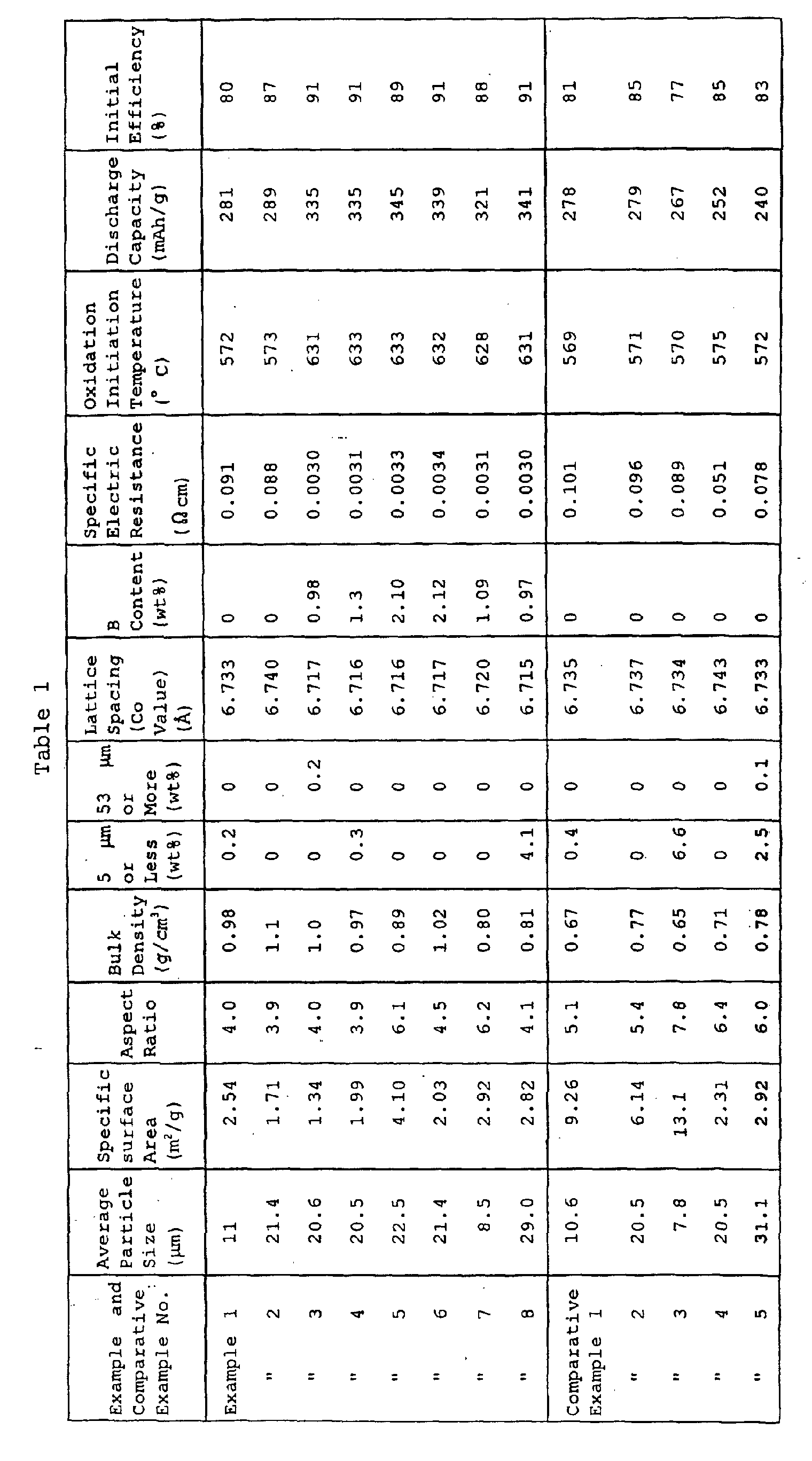
A lithium battery using the graphite powder of the
present invention for the negative electrode is advantageous
in that the discharge capacity is large, the cycle property
(battery life) is good, and the initial charge and discharge
efficiency (discharge capacity to charge capacity of initial 1
to 3 times) is high.
Claims (33)
- A carbon material for a lithium battery, comprising graphite powder having a specific surface area of not more than 3 m2/g, an aspect ratio of not more than 6, and a tapping bulk density of not less than 0.8 g/cm3.
- The carbon material for a lithium battery as claimed in claim 1, wherein an oxidation initiation temperature of said graphite powder is not less than 600°C.
- The carbon material for a lithium battery as claimed in claim 1 or 2, wherein when said powder is subject to pressure to give said powder a bulk density of 1.5 g/cm3, a specific electrical resistance of said powder along a direction perpendicular to the direction of the pressure is not more than 0.06 Ωcm.
- A carbon material for a lithium battery, consisting of graphite powder having a tapping bulk density of not less than 0.8 g/cm3 and an oxidation initiation temperature of not less than 600°C.
- The carbon material for a lithium battery as claimed in claim 4, wherein a specific surface area is not more than 3 m2/g.
- The carbon material for a lithium battery as claimed in claim 4 or 5, wherein an aspect ratio is not more than 6.
- A carbon material for a lithium battery, comprising graphite powder having a specific surface area of not more than 3 m2/g and a tapping bulk density of not less than 0.8 g/cm3, wherein when said powder is put under pressure to give said powder a bulk density of 1.5 g/cm3, a specific electrical resistance of said powder along a direction perpendicular to the direction of the pressure is not more than 0.06 Ωcm.
- The carbon material for a lithium battery as claimed in one of claims 1, 2, 4, 5, and 7, wherein the graphite powder has an average particle size of from 8 to 30 µm.
- The carbon material for a lithium battery as claimed in claim 3, wherein the graphite powder has an average particle size of from 8 to 30 µm.
- The carbon material for a lithium battery as claimed in one of claims 1, 2, 4, 5, and 7, wherein the graphite powder contains substantially no particles having a particle size of 3 µm or less and/or 53 µm or more.
- The carbon material for a lithium battery as claimed in claim 3, wherein the graphite powder contains substantially no particles having a particle size of 3 µm or less and/or 53 µm or more.
- The carbon material for a lithium battery as claimed in claim 8, wherein the graphite powder contains substantially no particles having a particle size of 3 µm or less and/or 53 µm or more.
- The carbon material for a lithium battery as claimed in claim 9, wherein the graphite powder contains substantially no particles having a particle size of 3 µm or less and/or 53 µm or more.
- The carbon material for a lithium battery as claimed in one of claims 1, 2, 4, 5, and 7, wherein the graphite powder has a Co value of 6.745 Å or less.
- The carbon material for a lithium battery as claimed in claim 3, wherein the graphite powder has a Co value of 6.745 Å or less.
- The carbon material for a lithium battery as claimed in claim 8, wherein the graphite powder has a Co value of 6.745 Å or less.
- The carbon material for a lithium battery as claimed in claim 9, wherein the graphite powder has a Co value of 6.745 Å or less.
- The carbon material for a lithium battery as claimed in claim 10, wherein the graphite powder has a Co value of 6.745 Å or less.
- The carbon material for a lithium battery as claimed in claim 11, wherein the graphite powder has a Co value of 6.745 Å or less.
- The carbon material for a lithium battery as claimed in claim 12, wherein the graphite powder has a Co value of 6.745 Å or less.
- The carbon material for a lithium battery as claimed in claim 13, wherein the graphite powder has a Co value of 6.745 Å or less.
- The carbon material'for a lithium battery as claimed in one of claims 1, 2, 4, 5, and 7, wherein the graphite powder contains boron.
- The carbon material for a lithium battery as claimed in claim 3, wherein the graphite powder contains boron.
- The carbon material for a lithium battery as claimed in claim 8, wherein the graphite powder contains boron.
- The carbon material for a lithium battery as claimed in claim 9, wherein the graphite powder contains boron.
- The carbon material for a lithium battery as claimed in claim 10, wherein the graphite powder contains boron.
- The carbon material for a lithium battery as claimed in claim 11, wherein the graphite powder contains boron.
- A paste for a negative electrode of a battery, wherein said paste is obtained from the graphite powder as claimed in one of claims 1, 2, 4, 5, and 7 as a main material by adding polyvinylidene fluoride powder thereto and kneading.
- A paste for a negative electrode of a battery, wherein said paste is obtained from the graphite powder as claimed in claim 3 as a main material by adding polyvinylidene fluoride powder thereto and kneading.
- A battery comprising a negative electrode produced from the graphite powder as claimed in one of claims 1, 2, 4, 5, and 7 as a main material.
- A battery comprising a negative electrode produced from the graphite powder as claimed in claim 3 as a main material.
- A lithium battery comprising a negative electrode produced from the graphite powder as claimed in one of claims 1, 2, 4, 5, and 7 as a main material.
- A lithium battery comprising a negative electrode produced from the graphite powder as claimed in claim 3 as a main material.
Applications Claiming Priority (5)
| Application Number | Priority Date | Filing Date | Title |
|---|---|---|---|
| JP28739798 | 1998-10-09 | ||
| JP28739798 | 1998-10-09 | ||
| US12143699P | 1999-02-23 | 1999-02-23 | |
| US121436P | 1999-02-23 | ||
| PCT/JP1999/005614 WO2000022687A1 (en) | 1998-10-09 | 1999-10-12 | Carbonaceous material for cell and cell containing the carbonaceous material |
Publications (2)
| Publication Number | Publication Date |
|---|---|
| EP1122803A1 true EP1122803A1 (en) | 2001-08-08 |
| EP1122803A4 EP1122803A4 (en) | 2005-04-13 |
Family
ID=26556713
Family Applications (1)
| Application Number | Title | Priority Date | Filing Date |
|---|---|---|---|
| EP99970512A Withdrawn EP1122803A4 (en) | 1998-10-09 | 1999-10-12 | Carbonaceous material for cell and cell containing the carbonaceous material |
Country Status (6)
| Country | Link |
|---|---|
| EP (1) | EP1122803A4 (en) |
| JP (1) | JP4393712B2 (en) |
| KR (1) | KR100450348B1 (en) |
| CN (1) | CN1184709C (en) |
| CA (2) | CA2694838A1 (en) |
| WO (1) | WO2000022687A1 (en) |
Cited By (1)
| Publication number | Priority date | Publication date | Assignee | Title |
|---|---|---|---|---|
| WO2004075319A1 (en) | 2003-02-20 | 2004-09-02 | Mitsubishi Chemical Corporation | Active substance for negative electrode of lithium secondary battery, negative electrode of lithium secondary battery and lithium secondary battery |
Families Citing this family (13)
| Publication number | Priority date | Publication date | Assignee | Title |
|---|---|---|---|---|
| JP4973247B2 (en) * | 1998-11-27 | 2012-07-11 | 三菱化学株式会社 | Carbon material for electrodes |
| JP4945029B2 (en) * | 2001-03-06 | 2012-06-06 | 新日鐵化学株式会社 | Material for negative electrode of lithium secondary battery, method for producing the same, and lithium secondary battery |
| JP4729716B2 (en) * | 2003-02-20 | 2011-07-20 | 三菱化学株式会社 | Lithium secondary battery negative electrode and lithium secondary battery |
| WO2005038966A1 (en) * | 2003-10-17 | 2005-04-28 | Sanyo Electric Co., Ltd. | Nonaqueous electrolyte battery |
| US20070128518A1 (en) * | 2004-02-12 | 2007-06-07 | Mitsubishi Chemical Corporation | Negative electrode material for lithium secondary battery, method for producing same, negative electrode for lithium secondary battery using same, and lithium secondary battery |
| JP5033325B2 (en) * | 2005-12-05 | 2012-09-26 | 昭和電工株式会社 | Graphite material, carbon material for battery electrode, and battery |
| KR101971448B1 (en) * | 2013-07-29 | 2019-04-23 | 쇼와 덴코 가부시키가이샤 | Carbon material, cell electrode material, and cell |
| KR102079987B1 (en) * | 2014-05-30 | 2020-02-21 | 쇼와 덴코 가부시키가이샤 | Carbon material, method for manufacturing same, and application of same |
| JP2016035913A (en) | 2014-07-31 | 2016-03-17 | 富士フイルム株式会社 | All-solid secondary battery, inorganic solid electrolyte particles, solid electrolyte composition, battery electrode sheet, and method for producing all-solid secondary battery |
| WO2018097213A1 (en) * | 2016-11-22 | 2018-05-31 | 三菱ケミカル株式会社 | Negative electrode material for nonaqueous secondary battery, negative electrode for nonaqueous secondary battery, and nonaqueous secondary battery |
| JPWO2021182488A1 (en) * | 2020-03-11 | 2021-09-16 | ||
| JP7605010B2 (en) * | 2020-04-27 | 2024-12-24 | artience株式会社 | Boron-containing carbon material, resin composition, and conductive film |
| KR20240173227A (en) * | 2023-06-01 | 2024-12-11 | (주)포스코퓨처엠 | Anode active materil for lithium secondary battery, manufacturing method of the same and lithium secondary battery comprising the same |
Family Cites Families (9)
| Publication number | Priority date | Publication date | Assignee | Title |
|---|---|---|---|---|
| JPH05101818A (en) * | 1991-08-07 | 1993-04-23 | Mitsubishi Gas Chem Co Inc | Carbon molded body for negative electrode and lithium secondary battery |
| DE69224739T2 (en) * | 1991-11-20 | 1998-07-02 | Honda Motor Co Ltd | CARBON-BASED MATERIAL |
| US5340670A (en) * | 1992-06-01 | 1994-08-23 | Kabushiki Kaisha Toshiba | Lithium secondary battery and method of manufacturing carbonaceous material for negative electrode of the battery |
| JP3188033B2 (en) * | 1993-04-02 | 2001-07-16 | 三洋電機株式会社 | Non-aqueous secondary battery |
| JPH0831422A (en) * | 1994-07-19 | 1996-02-02 | Nippon Steel Corp | Carbon material for negative electrode of lithium secondary battery and manufacturing method thereof |
| JPH09306489A (en) * | 1996-05-14 | 1997-11-28 | Sony Corp | Negative electrode material for non-aqueous electrolyte secondary battery, method for producing the negative electrode material for non-aqueous electrolyte secondary battery, and non-aqueous electrolyte secondary battery using the same |
| JP3172444B2 (en) * | 1996-05-16 | 2001-06-04 | 三洋電機株式会社 | Negative electrode for non-aqueous electrolyte secondary battery and non-aqueous electrolyte secondary battery provided with the same |
| CN1311575C (en) * | 1996-06-28 | 2007-04-18 | 索尼株式会社 | Anode material and non-aqueous electrolyte secondary battery using such anode material |
| JP3213575B2 (en) * | 1996-10-30 | 2001-10-02 | 日立化成工業株式会社 | Negative electrode for lithium secondary battery, method for producing the same, and lithium secondary battery |
-
1999
- 1999-10-12 CN CNB998114588A patent/CN1184709C/en not_active Expired - Lifetime
- 1999-10-12 JP JP2000576503A patent/JP4393712B2/en not_active Expired - Lifetime
- 1999-10-12 CA CA2694838A patent/CA2694838A1/en not_active Abandoned
- 1999-10-12 CA CA2346752A patent/CA2346752C/en not_active Expired - Lifetime
- 1999-10-12 EP EP99970512A patent/EP1122803A4/en not_active Withdrawn
- 1999-10-12 WO PCT/JP1999/005614 patent/WO2000022687A1/en not_active Ceased
- 1999-10-12 KR KR10-2001-7004490A patent/KR100450348B1/en not_active Expired - Lifetime
Cited By (2)
| Publication number | Priority date | Publication date | Assignee | Title |
|---|---|---|---|---|
| WO2004075319A1 (en) | 2003-02-20 | 2004-09-02 | Mitsubishi Chemical Corporation | Active substance for negative electrode of lithium secondary battery, negative electrode of lithium secondary battery and lithium secondary battery |
| US7208248B2 (en) * | 2003-02-20 | 2007-04-24 | Mitsubushi Chemical Corporation | Negative-electrode active material for lithium secondary battery, negative electrode for lithium secondary battery, and lithium secondary battery |
Also Published As
| Publication number | Publication date |
|---|---|
| CA2346752C (en) | 2010-08-17 |
| KR100450348B1 (en) | 2004-09-30 |
| CN1184709C (en) | 2005-01-12 |
| JP4393712B2 (en) | 2010-01-06 |
| CA2694838A1 (en) | 2000-04-20 |
| WO2000022687A1 (en) | 2000-04-20 |
| CN1320284A (en) | 2001-10-31 |
| KR20010080071A (en) | 2001-08-22 |
| CA2346752A1 (en) | 2000-04-20 |
| EP1122803A4 (en) | 2005-04-13 |
Similar Documents
| Publication | Publication Date | Title |
|---|---|---|
| EP4220772B1 (en) | Positive electrode active material for lithium secondary battery, method for preparing the same and lithium secondary battery comprising the same | |
| KR100446828B1 (en) | Graphite particles and lithium secondary battery using them as negative electrode | |
| JP6352363B2 (en) | Method for producing graphite material for electrode material for lithium ion battery | |
| EP3678236B1 (en) | Positive electrode active material for lithium secondary batteries, positive electrode for lithium secondary batteries, and lithium secondary battery | |
| CN1751405B (en) | Negative electrode for lithium secondary battery and lithium secondary battery | |
| US20240250254A1 (en) | Positive Electrode Active Material for Lithium Secondary Battery and Lithium Secondary Battery Comprising the Same | |
| EP3503267A1 (en) | Negative electrode active material for lithium secondary battery, negative electrode including the same, and lithium secondary battery including the negative electrode | |
| EP4261938B1 (en) | Positive electrode active material for lithium secondary battery, method for preparing the same, and positive electrode and lithium secondary battery comprising the same | |
| KR101380730B1 (en) | Manufacturing method of electrode material for lithium ion battery | |
| EP3896758A1 (en) | Negative electrode carbon material for lithium ion secondary battery, production method therefor, and negative electrode and lithium ion secondary battery using same | |
| US20230361292A1 (en) | Electrode, nonaqueous electrolyte battery, and battery pack | |
| CA2346752C (en) | Carbon material for battery and battery containing the carbon material | |
| KR20220100545A (en) | Positive electrode active material, positive electrode and lithium secondary battery compring the same | |
| US20100273055A1 (en) | Lithium-ion electrochemical cell | |
| CN116888764A (en) | Cathode active material, cathode and lithium secondary battery containing same | |
| JPWO2000022687A1 (en) | Carbon material for batteries and batteries using said carbon material | |
| US6989137B1 (en) | Carbonaceous material for cell and cell containing the carbonaceous material | |
| JP2001089118A (en) | Graphite particle, method for producing the same, negative electrode for lithium secondary battery and lithium secondary battery | |
| EP4228030A1 (en) | Cathode active material and lithium secondary battery using same | |
| JP3732654B2 (en) | Graphite particles, negative electrode for lithium secondary battery, and lithium secondary battery | |
| EP4411876A1 (en) | Cathode material, and cathode and lithium secondary battery comprising same | |
| JP5567232B1 (en) | Composite carbon particles and lithium ion secondary battery using the same | |
| CN114342110A (en) | Negative electrode for secondary battery and nonaqueous electrolyte secondary battery | |
| EP4614600A1 (en) | Anode active material and lithium secondary battery | |
| KR20260051955A (en) | Positive electrode active material, positive electrode and lithium secondary battery comprising the same |
Legal Events
| Date | Code | Title | Description |
|---|---|---|---|
| PUAI | Public reference made under article 153(3) epc to a published international application that has entered the european phase |
Free format text: ORIGINAL CODE: 0009012 |
|
| 17P | Request for examination filed |
Effective date: 20010502 |
|
| AK | Designated contracting states |
Kind code of ref document: A1 Designated state(s): AT BE CH CY DE DK ES FI FR GB GR IE IT LI LU MC NL PT SE |
|
| A4 | Supplementary search report drawn up and despatched |
Effective date: 20050302 |
|
| STAA | Information on the status of an ep patent application or granted ep patent |
Free format text: STATUS: THE APPLICATION HAS BEEN WITHDRAWN |
|
| 18W | Application withdrawn |
Effective date: 20050428 |