EP1120279A2 - Method for improving light fastness of inkjet images by adding salts into inkjet inks and print media - Google Patents
Method for improving light fastness of inkjet images by adding salts into inkjet inks and print media Download PDFInfo
- Publication number
- EP1120279A2 EP1120279A2 EP01300346A EP01300346A EP1120279A2 EP 1120279 A2 EP1120279 A2 EP 1120279A2 EP 01300346 A EP01300346 A EP 01300346A EP 01300346 A EP01300346 A EP 01300346A EP 1120279 A2 EP1120279 A2 EP 1120279A2
- Authority
- EP
- European Patent Office
- Prior art keywords
- ink
- light fastness
- additive
- basecoat
- topcoat
- Prior art date
- Legal status (The legal status is an assumption and is not a legal conclusion. Google has not performed a legal analysis and makes no representation as to the accuracy of the status listed.)
- Granted
Links
Images

Classifications
-
- B—PERFORMING OPERATIONS; TRANSPORTING
- B41—PRINTING; LINING MACHINES; TYPEWRITERS; STAMPS
- B41M—PRINTING, DUPLICATING, MARKING, OR COPYING PROCESSES; COLOUR PRINTING
- B41M5/00—Duplicating or marking methods; Sheet materials for use therein
- B41M5/50—Recording sheets characterised by the coating used to improve ink, dye or pigment receptivity, e.g. for ink-jet or thermal dye transfer recording
- B41M5/52—Macromolecular coatings
-
- C—CHEMISTRY; METALLURGY
- C09—DYES; PAINTS; POLISHES; NATURAL RESINS; ADHESIVES; COMPOSITIONS NOT OTHERWISE PROVIDED FOR; APPLICATIONS OF MATERIALS NOT OTHERWISE PROVIDED FOR
- C09D—COATING COMPOSITIONS, e.g. PAINTS, VARNISHES OR LACQUERS; FILLING PASTES; CHEMICAL PAINT OR INK REMOVERS; INKS; CORRECTING FLUIDS; WOODSTAINS; PASTES OR SOLIDS FOR COLOURING OR PRINTING; USE OF MATERIALS THEREFOR
- C09D11/00—Inks
- C09D11/30—Inkjet printing inks
- C09D11/38—Inkjet printing inks characterised by non-macromolecular additives other than solvents, pigments or dyes
-
- B—PERFORMING OPERATIONS; TRANSPORTING
- B41—PRINTING; LINING MACHINES; TYPEWRITERS; STAMPS
- B41M—PRINTING, DUPLICATING, MARKING, OR COPYING PROCESSES; COLOUR PRINTING
- B41M5/00—Duplicating or marking methods; Sheet materials for use therein
- B41M5/50—Recording sheets characterised by the coating used to improve ink, dye or pigment receptivity, e.g. for ink-jet or thermal dye transfer recording
- B41M5/52—Macromolecular coatings
- B41M5/5218—Macromolecular coatings characterised by inorganic additives, e.g. pigments, clays
-
- B—PERFORMING OPERATIONS; TRANSPORTING
- B41—PRINTING; LINING MACHINES; TYPEWRITERS; STAMPS
- B41M—PRINTING, DUPLICATING, MARKING, OR COPYING PROCESSES; COLOUR PRINTING
- B41M5/00—Duplicating or marking methods; Sheet materials for use therein
- B41M5/50—Recording sheets characterised by the coating used to improve ink, dye or pigment receptivity, e.g. for ink-jet or thermal dye transfer recording
- B41M5/52—Macromolecular coatings
- B41M5/5227—Macromolecular coatings characterised by organic non-macromolecular additives, e.g. UV-absorbers, plasticisers, surfactants
Definitions
- the present application is a continuation-in-part application of Serial No. 09/491,642, filed January 27, 2000. That application discloses and claims the formation of a porous basecoat on a non-permeable substrate, followed by the formation of a topcoat on the porous basecoat, with application of a re-wet liquid to the porous basecoat prior to applying the topcoat thereon.
- the present invention is directed to including a specified colorant stabilizer in the re-wet liquid to stabilize the colorant of ink printed on the ink-receiving layer.
- the present application is related to application Serial No. , filed on even date herewith [PD-10992276-1]. That invention is directed to including a specified colorant stabilizer in a re-wet liquid to stabilize the colorant of ink printed on an ink-receiving layer formed on a porous glossy print medium. The present invention is directed to printing an ink on the glossy print media, wherein the ink also includes one of the specified colorant stabilizers.
- the present invention relates generally to inkjet printing, and, more particularly, to stabilizing colorants printed onto an ink-receiving layer applied to a non-absorbant substrate.
- Inkjet receiving layers need to absorb the ink vehicle delivered during the printing process.
- the substrate provides no absorption capacity and as a result, the ink-receiving layer must be the sole absorbing material.
- an absorbent basecoat has been described in the prior art that serves to increase the capacity of the coating, much as a substrate functions in paper-based inkjet media.
- a topcoat is applied to control surface properties such as gloss, tackiness, surface energy, and durability, as well as to function in concert with the adsorbent basecoat.
- the topcoat must be free of defects that would contribute to perceived irregularities or non-uniformities in the coating.
- U.S. Patent 5,275,867 describes a two-layer coating and a coating process where a topcoat is laminated on the precoat.
- U.S. Patent 5,605,750 describes a three-layer coating and a coating process where the topcoats are applied to the precoat by coating both fluids before drying in a multi-slot hopper or a slide hopper.
- U.S. Patent 5,576,088 describes a two layer coating and a coating process where a topcoat is cast coated on a precoat. All these examples describe a process that involves specialized equipment and coatings engineered to be compatible with the processes. In addition, production efficiencies may be lower.
- topcoat with basic coating equipment such as mayer rod and slot die coaters
- An on-going problem in the application of a topcoat with basic coating equipment is the formation of bubbles in the topcoat when it is coated on a porous basecoat that has been applied to a non-porous substrate.
- These bubbles are formed when the air voids in the pores of the basecoat are filled with fluid from the topcoat application process which results in the air being forced to surface of the basecoat where they coalesce into bubbles in a still fluid topcoat.
- These bubbles can then form defects in the topcoat as that coating is dried.
- Another challenge when developing coating fluids and chemistries is avoiding problems associated with incompatible chemistries that result in solution gelling or phase separation in the dried coatings.
- Porous inkjet media provides superior image quality and essentially instant drying, which permits high throughput in inkjet printing.
- dyes residing on the porous media can be easily accessed by oxygen and moisture.
- the dyes have very poor stability when exposed to light, especially ultraviolet (UV) light.
- a light-fast dye printed on well-designed swellable media can have a lifetime of five or more years; however, such a dye may last only few weeks, or even only a few days, on porous media. It is important to improve the light-fastness of inkjet ink on porous media to obtain the many positive attributes of porous media.
- pigmented inks provide good light/oxygen resistance, they do not render the high image quality of a dye-based ink.
- colorant stabilizers including (1) certain aryliminealkenes, (2) heavy metal ions, such as iodide ions, (3) certain derivatives of phenols, (4) reducing agents, such as sodium thiosulfate, sodium sulfite, cysteine, sodium nitrite, sodium phosphite, and citric acid, (5) certain molecular includants, such as clathrates, zeolites, crown ethers, calix-arenes, valinomycin-type natural antibiotics, various polyether compounds, nigericin-type natural antibiotics, and cyclic compounds containing a plurality of pyranose rings such as cyclodextrins, (6) certain porphines, (7) metals or metal salts alone or in combination with at lest one other colorant stabilizer, wherein the metal or metal salt is a lanthanide element or salt, respectively, magnesium, iron, zinc, other transition metals, and heavy metals,
- the colorant stabilizer may be added to (1) solvent- or oil-based colorant compositions or (2) water-based colorant compositions or may be formed on the surface of a print medium, such as inkjet paper.
- print media include a wood product or composite, woven fabric, nonwoven fabric, textile, plastic, and glass.
- plastic substrates include plastic films, plastic nonwoven webs, and plastic woven webs.
- the preferred substrate is paper, including printing and writing papers, packaging and industrial papers, paperboard, and tissue papers.
- glossy paper such as used in photographic-quality reproduction. Further, it turns out that glossy paper may not simply be coated with one of the above-listed colorant stabilizers, due to chemistry considerations, namely, the possible loss of gloss, the possible adverse impact on print quality, the possible drift in pH, and the possible agglomeration of pigment (colorant) and/or polymer.
- At least one of the following compounds is applied as a re-wet solution to media: potassium iodide, sodium thiosulfate, and sodium thiocyanate.
- potassium iodide sodium thiosulfate
- sodium thiocyanate sodium thiocyanate
- the addition of at least one of these three compounds to the re-wet solution can improve light fastness on the order of eight to thirteen times on porous glossy media.
- These additives are particularly effective with dyes such as Reactive Black 31 (Pacified) (RB31), Direct Blue 199 (DB199), Magenta 377 (M377), and Direct Yellow 132 (DY132).
- an improved process for applying at least one ink-receiving layer to a non-permeable substrate.
- the ink-receiving layer is used to stabilize at least one colorant in at least one ink printed thereon.
- the ink-receiving layer comprises a non-permeable substrate, a porous basecoat formed thereon and comprising a plurality of pores, and a topcoat formed on said porous base coat.
- the process comprises:
- the basecoat and the topcoat each comprise one or more pigments and one or more binders, which are polymeric compounds soluble or dispersible in the solvent in which the basecoat and topcoat are applied to the substrate.
- the basecoat may employ opaque, colorless pigments, but the topcoat employs translucent colorless pigments.
- pigments include silica and alumina and its various hydrates, titania, carbonates (e.g., calcium carbonate, magnesium carbonate), glass beads, and organic pigments (e.g., plastic or polymer pigments such as cross-linked SBR latexes, micronized polyethylene or polypropylene wax, acrylic beads, and methacrylic beads).
- the pigment may be the same in both the basecoat and topcoat or different.
- the binder is a polymeric matrix which serves, among other things, to hold the pigment(s) in place.
- the binder can be water-soluble or water-dispersible.
- water-soluble binders include polyvinyl alcohol and its derivatives, polyvinyl pyrrolidone/polyvinyl acetate copolymer, cellulose derivatives, polyamides, and polyethylene oxide.
- water-dispersed binders include styrene-butadiene latexes, polyacrylics, polyurethanes, and the like.
- the binder may be the same in both the basecoat and topcoat or different.
- the basecoat and topcoat are separately applied in solution to the substrate and allowed to dry.
- the substrate comprises non-permeable (non-air permeable) material, such as a film-based material, e.g., Mylar, or a resin-coated papers (e.g., photobase paper).
- non-permeable (non-air permeable) material such as a film-based material, e.g., Mylar, or a resin-coated papers (e.g., photobase paper).
- pores in the basecoat are saturated, or nearly saturated, with a liquid, also called a re-wetting solution herein, before the topcoat solution is applied.
- a liquid also called a re-wetting solution herein
- the pores in the basecoat are saturated with liquid before the topcoat solution is applied.
- a solvent that is compatible with the solvent in the topcoating is believed to give the best adhesion between coating layers.
- the re-wet liquid comprises at least one of the additive compounds of potassium or sodium iodide, sodium or potassium thiosulfate, and sodium thiocyanate.
- a thiosulfate is employed, most preferably, sodium thiosulfate.
- the concentration of the additive compound in the re-wet liquid is in the range of about 1 to 10 wt%, preferably 4 wt%, based on the total re-wet composition. Each of these compounds, when included in the re-wet liquid, has been found to provide colorant stabilization against fading due to long term exposure to light.
- these compounds have been found to improve light-fastness by a factor of 8 to 13 times, for example, on porous glossy media.
- These additives are effective with water-based dyes such as Reactive Black 31, Direct Blue 199, Magenta 377, and Direct Yellow 132, as well as with other water-soluble dyes.
- the re-wet liquid may comprise one or more solvents.
- the re-wet liquid may be heated or chemically modified to increase the penetration rate in the precoat.
- the liquid is heated to any temperature below its boiling point (or the minimum boiling point if two or more solvents are used).
- chemically modified is meant the addition of one or more surfactants, adhesion promoters, pH modifiers, polymers, crosslinkers, pigments, and/or dye stabilizers to the liquid.
- the chemically modified re-wet solution thus serves to modify the properties of the basecoat, topcoat, the coating process, or the performance of the coatings as it relates to its use as a printing media.
- Any of the usual surfactants, pH modifiers, and/or crosslinkers may be used in the practice of the present invention.
- a suitable crosslinker added to the liquid is a borate or glyoxyl. This process is especially useful for chemistries that are not compatible with the coating fluids or process.
- excess fluid on the surface of the basecoat be removed before topcoating. This can be accomplished by a nip, doctoring blade, or the like.
- the sole Figure shows apparatus 10 useful in the process of the present invention.
- the apparatus 10 which is a conventional coater, comprises a container 12 for containing a re-wetting solution 14.
- a web 16 comprises the non-absorbent substrate and a porous basecoat thereon and the solution 14 is introduced onto the surface of the porous basecoat by means of an applicator roller 18.
- a hold-down roller 20 urges the web 16 against the top of the applicator roller 18.
- the applicator roller 18 applies the liquid 14 to the web 16.
- the liquid 14 is metered onto the applicator roller 18 by a metering roller 22, provided with a doctor 24, or other suitable means.
- the excess re-wet solution may be doctored off of the web.
- the re-wet solution can be metered by a pump directly onto the moving web 16, thus eliminating the need for doctoring.
- the uptake of the liquid 14 depends on the speed of the web 16. It is desired to move the web 16 as fast as possible to maximize the coating efficiency.
- the dwell time of the re-wet fluid is defined as the time interval between application of the re-wet fluid and application of the coating.
- the dwell time thus determines the length of time available for the re-wet solution to penetrate into the basecoat.
- the dwell time can be modified by the web speed and web distance between the re-wet station and the coating station.
- the length of time required to obtain adequate saturation of the basecoat is determined by the design of the re-wet station, the basecoat properties, the topcoat properties, and the re-wet fluid properties. For this process to be effective, all of these parameters need to be accounted for when designing the coating process.
- a re-wetting step provides a number of advantages.
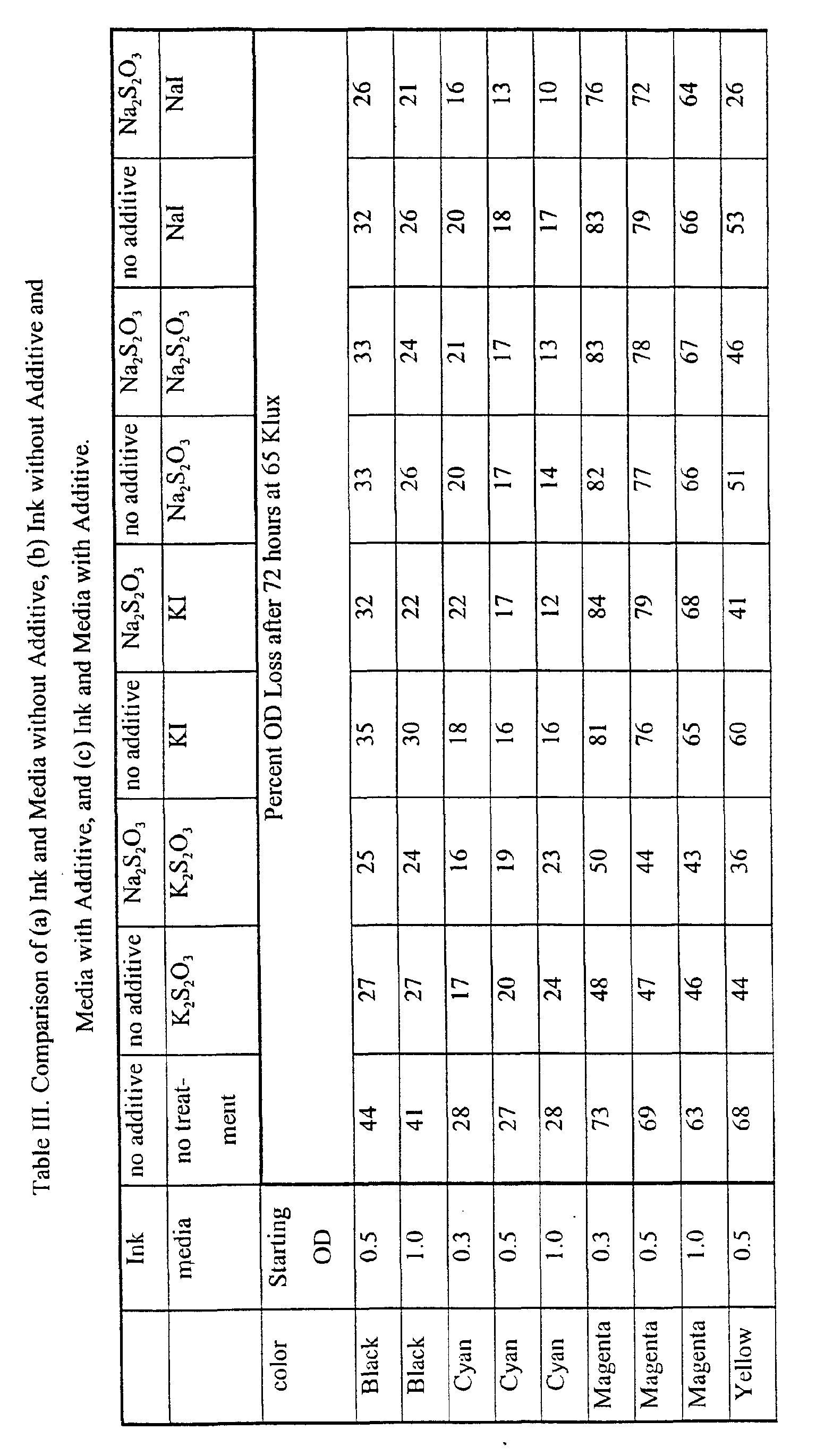
- Additional improved lightfastness is achieved by incorporating in the ink itself one or more of the above-listed additive compounds of potassium or sodium iodide, sodium or potassium thiosulfate, and sodium thiocyanate.
- the same additive is used in both the print media and in the ink.
- the concentration of the additive ranges from about 1 to 8 wt%, preferably about 3 to 4 wt%, of the total ink composition.
- the salt solution was applied to the print media in the media coating process.
- the current coating had two layers (basecoat and topcoat, as described above).
- the basecoat was coated on the medium and then dried; the topcoat was coated after rewetting the basecoat.
- the additive salt (potassium or sodium iodide, sodium or potassium thiosulfate, and/or sodium thiocyanate) was included in the re-wet solution, as described above.
- MOPS is 4-morpholinepropanesulfonic acid.
- DDI water is distilled deionized water: pH adjusted with KOH for the vehicle to 7.1 to 7.2. pH adjusted with KOH or HNO 3 for final ink to 7.5.
- Proxel GXL is a biocide.
- Table II sets forth a comparison of the combination of (1) both ink and media containing the additive and (2) both the ink and media without the additive.
- the ink included 0.5 wt% KI plus 4 wt% sodium thiosulfate and the media was treated with a re-wet solution containing 1.01 M sodium thiosulfate.
- the last two columns list the percent OD loss from the initial OD.
- the ink set was the one listed in Table I, but with the addition of the additive, as noted above.
- the light fastness was measured on an H-P fadeometer, having an intensity of 58 to 70 Klux, for 72 hours.
- the OD was measured prior to and subsequent to the light exposure.
- the OD loss was determined by the ANSI standard IT 9.9 method (1996). Comparison of Ink and Media with Additive to Ink and Media without Additive.
- the ink contained 4 wt% sodium thiosulfate.
- the paper was treated with a pre-wet solution containing 4 wt% of one of the additives (a)-(d).
- the ink was the same base composition as in Example 1, and the print medium was the same as in Example 1.
- the measurement of light fastness was the same as in Example 1.
- a color followed by a letter indicates the component for that color, where M is magenta, Y is yellow, and C is cyan.
- Red comprises magenta and yellow; green comprises cyan and yellow; and blue comprises cyan and magenta.
- the values for OD loss refer to the measured loss of that component (e.g., "Red M” signifies the OD loss of magenta from red, while “Green Y” signifies the OD loss of yellow from green, and so forth).
- the use of the three additives, alone or in combination both in the ink and on the print medium, is expected to find use in increasing the light fastness of inks on porous glossy media.
Landscapes
- Chemical & Material Sciences (AREA)
- Life Sciences & Earth Sciences (AREA)
- Engineering & Computer Science (AREA)
- Materials Engineering (AREA)
- Wood Science & Technology (AREA)
- Organic Chemistry (AREA)
- Ink Jet Recording Methods And Recording Media Thereof (AREA)
- Ink Jet (AREA)
- Inks, Pencil-Leads, Or Crayons (AREA)
Abstract
Description
| Ink Formulations. | |||||
| Component/Color | Cyan (C), wt% | Magenta (M), wt% | Yellow (Y), wt% | Light C, wt% | Light M, wt% |
| EDTA, Na salt | 0.1 | 0.1 | 0.1 | 0.1 | 0.1 |
| Proxel GXL | 0.15 | 0.15 | 0.15 | 0.15 | 0.15 |
| MOPS | 0.05 | 0.05 | 0.05 | 0.05 | 0.05 |
| ZONYL FSA | 0.8 | 0.8 | 0.8 | 0.8 | 0.8 |
| DOWFAX 2A1 | 0.32 | 0.32 | 0.32 | 0.32 | 0.32 |
| SURFYNOL CT-111 | 0.16 | 0.16 | 0.16 | 0.16 | 0.16 |
| 1,6-hexanediol | 9 | 9 | 9 | 9 | 9 |
| 2-pyrrolidone | 4 | 4 | 4 | 4 | 4 |
| Na-DB199@1/10K | A=0.10 | 30% of C A=0.03 | |||
| Na-M377 @1/10K | A=0.079 | 30% of M A=0.0237 | |||
| Na-AR52@1/10K | A=0.038 | 30% of M A=0.0114 | |||
| Na-DY132 @1/10K | A=0.119 | ||||
| DDI Water | Balance | Balance | Balance | Balance | Balance |
| Total | 100 wt% | 100 wt% | 100 wt% | 100 wt% | 100 wt% |
| Notes: EDTA is ethylene diamine tetraacetate. MOPS is 4-morpholinepropanesulfonic acid. DDI water is distilled deionized water: pH adjusted with KOH for the vehicle to 7.1 to 7.2. pH adjusted with KOH or HNO3 for final ink to 7.5. Proxel GXL is a biocide. |
| Comparison of Ink and Media with Additive to Ink and Media without Additive. | |||
| OD Loss | |||
| Color | Initial OD | Ink with Additive | Ink without Additive |
| Treated Media | Untreated Media | ||
| Black | 0.5 | 14 | 24 |
| Black | 1.0 | 11 | 18 |
| Cyan | 0.5 | 1 | 11 |
| Cyan | 1.0 | 2 | 10 |
| Magenta | 0.5 | 10 | 37 |
| Magenta | 1.0 | 9 | 32 |
| Yellow | 0.5 | 26 | 45 |
| Yellow | 1.0 | 21 | 41 |
| Blue (cyan-magenta) | 0.5 | -8 | -21 |
| Blue (cyan-magenta) | 1.0 | -9 | -19 |
| Green (cyan-yellow) | 0.5 | -7 | -14 |
| Green (cyan-yellow) | 1.0 | -2 | -7 |
| Red (magenta-yellow) | 0.5 | -2 | 13 |
| Red (magenta-yellow) | 1.0 | 1 | 14 |

Claims (9)
- In combination, (1) a print medium comprising an ink-receiving layer formed on a non-permeable substrate, said ink-receiving layer for stabilizing at least one colorant in at least one ink printed thereon, said ink-receiving layer a porous basecoat formed thereon and comprising a plurality of pores, a topcoat formed on said porous base coat, and a re-wet layer between said basecoat and said topcoat that includes at least one first light fastness additive, and (2) an inkjet ink comprising a vehicle and at least one colorant, said ink further comprising at least one second light fastness additive, said combination resulting in a light fast image upon printing said inkjet ink on said print medium that has a greater degree of light fastness than print media and inkjet inks not containing said additive.
- The combination of Claim 1 wherein said at least one first light fastness additive and said at least one second light fastness additive are either the same or different.
- The combination of Claim 1 wherein said at least one first light fastness additive and said second light fastness additive are selected from the group consisting of potassium iodide, sodium iodide, sodium thiosulfate, potassium thiosulfate, and sodium thiocyanate.
- The combination of Claim 1 wherein said at least one first light fastness additive in said re-wet layer has a concentration of about 1 to 10 wt% and wherein said at least one second light fastness additive in said inkjet ink has a concentration of about 1 to 8 wt%.
- The combination of Claim 1 wherein said colorant is a water-soluble dye.
- A method for forming a light fast image on said print medium of Claim 1 from said inkjet ink of Claim 1 printed thereon, said process comprising(a) providing said print medium with a re-wet layer comprising at least one first light fastness additive; and(b) providing said inkjet ink with at least one second light fastness additive, which may be the same or different as said first light fastness additive.
- The method of Claim 6 wherein said print medium comprises an ink-receiving layer formed on a non-permeable substrate, said ink-receiving layer for stabilizing at least one colorant in at least one ink printed thereon, said ink-receiving layer comprising a porous basecoat formed thereon and comprising a plurality of pores, a topcoat formed on said porous base coat, and a layer between said basecoat and said topcoat that includes said at least one additive.
- The method of Claim 7 wherein said ink-receiving layer is formed by:(a) applying said porous basecoat to a surface of said non-permeable substrate;(b) applying a re-wet liquid (14) to said porous basecoat to form said re-wet layer, said re-wet liquid (14) containing said at least one first light fastness additive; and(c) applying a topcoat on said re-wet liquid (14).
- The method of Claim 8 wherein said re-wet liquid (14) contains about 1 to 10 wt% of said at least one first light fastness additive.
Applications Claiming Priority (4)
| Application Number | Priority Date | Filing Date | Title |
|---|---|---|---|
| US09/491,642 US6475612B1 (en) | 2000-01-27 | 2000-01-27 | Process for applying a topcoat to a porous basecoat |
| US491642 | 2000-01-27 | ||
| US09/693,531 US6432523B1 (en) | 2000-01-27 | 2000-10-19 | Light fastness of inkjet images by adding salts into inkjet inks and print media |
| US693531 | 2000-10-19 |
Publications (3)
| Publication Number | Publication Date |
|---|---|
| EP1120279A2 true EP1120279A2 (en) | 2001-08-01 |
| EP1120279A3 EP1120279A3 (en) | 2001-09-12 |
| EP1120279B1 EP1120279B1 (en) | 2004-11-24 |
Family
ID=27050510
Family Applications (1)
| Application Number | Title | Priority Date | Filing Date |
|---|---|---|---|
| EP20010300346 Expired - Lifetime EP1120279B1 (en) | 2000-01-27 | 2001-01-16 | Method for improving light fastness of inkjet images by adding salts into inkjet inks and print media |
Country Status (3)
| Country | Link |
|---|---|
| EP (1) | EP1120279B1 (en) |
| JP (1) | JP3741958B2 (en) |
| DE (1) | DE60107300T2 (en) |
Cited By (1)
| Publication number | Priority date | Publication date | Assignee | Title |
|---|---|---|---|---|
| WO2006023792A1 (en) * | 2004-08-18 | 2006-03-02 | E.I. Dupont De Nemours And Company | Inkjet ink with long latency |
Families Citing this family (2)
| Publication number | Priority date | Publication date | Assignee | Title |
|---|---|---|---|---|
| JP4713850B2 (en) * | 2003-05-29 | 2011-06-29 | 株式会社リコー | Ink for inkjet recording |
| JP4546947B2 (en) * | 2006-09-22 | 2010-09-22 | 株式会社リコー | Recording equipment |
Family Cites Families (4)
| Publication number | Priority date | Publication date | Assignee | Title |
|---|---|---|---|---|
| WO1984003295A1 (en) * | 1983-02-15 | 1984-08-30 | Burroughs Corp | Ink-jet printing ink containing iodine and potassium iodide |
| DE69504570T2 (en) * | 1994-05-25 | 1999-03-04 | Asahi Glass Co. Ltd., Tokio/Tokyo | Record sheet and record |
| US5919291A (en) * | 1996-04-10 | 1999-07-06 | Minolta Co., Ltd. | Aqueous recording solution for ink jet |
| US6465086B1 (en) * | 1997-05-15 | 2002-10-15 | Oji Paper Co., Ltd. | Ink jet recording material and process for producing same |
-
2001
- 2001-01-16 EP EP20010300346 patent/EP1120279B1/en not_active Expired - Lifetime
- 2001-01-16 DE DE2001607300 patent/DE60107300T2/en not_active Expired - Lifetime
- 2001-01-29 JP JP2001019853A patent/JP3741958B2/en not_active Expired - Fee Related
Cited By (1)
| Publication number | Priority date | Publication date | Assignee | Title |
|---|---|---|---|---|
| WO2006023792A1 (en) * | 2004-08-18 | 2006-03-02 | E.I. Dupont De Nemours And Company | Inkjet ink with long latency |
Also Published As
| Publication number | Publication date |
|---|---|
| DE60107300D1 (en) | 2004-12-30 |
| EP1120279A3 (en) | 2001-09-12 |
| EP1120279B1 (en) | 2004-11-24 |
| DE60107300T2 (en) | 2005-11-03 |
| JP2001253167A (en) | 2001-09-18 |
| JP3741958B2 (en) | 2006-02-01 |
Similar Documents
| Publication | Publication Date | Title |
|---|---|---|
| US6432523B1 (en) | Light fastness of inkjet images by adding salts into inkjet inks and print media | |
| EP1308491B1 (en) | Ink compositions and methods of ink-jet printing on hydrophobic media | |
| JPH0313376A (en) | Recording material and inkjet recording method using the same | |
| KR20080080403A (en) | Pigment dispersion, recording ink, ink cartridge, inkjet recording method and inkjet recording apparatus | |
| EP2408624B1 (en) | Variable printing medium having high glossiness, and recording method | |
| CN102510808A (en) | Coated media for inkjet printing | |
| JP2003320751A (en) | High quality image producing printing medium product and manufacturing method therefor | |
| EP1157847A1 (en) | Recording medium and aqueous ink composition | |
| EP3452298B1 (en) | Inkjet receptive compositions and methods therefor | |
| EP1134087B1 (en) | Image forming method and recorded matter using same | |
| EP1120279B1 (en) | Method for improving light fastness of inkjet images by adding salts into inkjet inks and print media | |
| JP2021070819A (en) | Aqueous ink or lacquer composition, in particular for coating or printing substrate | |
| EP1193079B1 (en) | Lightfastness improvements of inkjet print media through the addition of photoinitiators | |
| JPH10211763A (en) | Ink jet recording method for back print recording medium | |
| JP3690505B2 (en) | Recording medium and water-based recording ink | |
| US7972666B2 (en) | Coating compositions for forming inkjet-receptive coatings on a substrate | |
| US20030049419A1 (en) | Inkjet recording material having improved light fastness | |
| EP1120280B1 (en) | Method for increasing dot size on porous media printed with pigmented inks | |
| JP2003138185A (en) | Ink composition, recording medium, inkjet recording method, and recorded matter | |
| JPH01222987A (en) | Recording material and recording method using it | |
| JP2004131740A (en) | Water-based recording ink | |
| JPH04211984A (en) | Inkjet recording method | |
| JP2003001925A (en) | recoding media | |
| JP2006160785A (en) | Fine particle dispersion, ink composition and method of inkjet recording | |
| HK1051552B (en) | Ink compositions and methods of ink-jet printing on hydrophobic media |
Legal Events
| Date | Code | Title | Description |
|---|---|---|---|
| PUAI | Public reference made under article 153(3) epc to a published international application that has entered the european phase |
Free format text: ORIGINAL CODE: 0009012 |
|
| PUAL | Search report despatched |
Free format text: ORIGINAL CODE: 0009013 |
|
| AK | Designated contracting states |
Kind code of ref document: A2 Designated state(s): DE FR GB Kind code of ref document: A2 Designated state(s): AT BE CH CY DE DK ES FI FR GB GR IE IT LI LU MC NL PT SE TR |
|
| AX | Request for extension of the european patent |
Free format text: AL;LT;LV;MK;RO;SI |
|
| RIC1 | Information provided on ipc code assigned before grant |
Free format text: 7B 41M 5/00 A, 7C 09D 11/00 B |
|
| AK | Designated contracting states |
Kind code of ref document: A3 Designated state(s): AT BE CH CY DE DK ES FI FR GB GR IE IT LI LU MC NL PT SE TR |
|
| AX | Request for extension of the european patent |
Free format text: AL;LT;LV;MK;RO;SI |
|
| 17P | Request for examination filed |
Effective date: 20011106 |
|
| AKX | Designation fees paid |
Free format text: DE FR GB |
|
| GRAP | Despatch of communication of intention to grant a patent |
Free format text: ORIGINAL CODE: EPIDOSNIGR1 |
|
| GRAS | Grant fee paid |
Free format text: ORIGINAL CODE: EPIDOSNIGR3 |
|
| GRAA | (expected) grant |
Free format text: ORIGINAL CODE: 0009210 |
|
| AK | Designated contracting states |
Kind code of ref document: B1 Designated state(s): DE FR GB |
|
| REG | Reference to a national code |
Ref country code: GB Ref legal event code: FG4D |
|
| REF | Corresponds to: |
Ref document number: 60107300 Country of ref document: DE Date of ref document: 20041230 Kind code of ref document: P |
|
| PLBE | No opposition filed within time limit |
Free format text: ORIGINAL CODE: 0009261 |
|
| STAA | Information on the status of an ep patent application or granted ep patent |
Free format text: STATUS: NO OPPOSITION FILED WITHIN TIME LIMIT |
|
| ET | Fr: translation filed | ||
| 26N | No opposition filed |
Effective date: 20050825 |
|
| REG | Reference to a national code |
Ref country code: GB Ref legal event code: 732E Free format text: REGISTERED BETWEEN 20120329 AND 20120404 |
|
| PGFP | Annual fee paid to national office [announced via postgrant information from national office to epo] |
Ref country code: FR Payment date: 20120130 Year of fee payment: 12 |
|
| PGFP | Annual fee paid to national office [announced via postgrant information from national office to epo] |
Ref country code: DE Payment date: 20120127 Year of fee payment: 12 |
|
| PGFP | Annual fee paid to national office [announced via postgrant information from national office to epo] |
Ref country code: GB Payment date: 20120126 Year of fee payment: 12 |
|
| GBPC | Gb: european patent ceased through non-payment of renewal fee |
Effective date: 20130116 |
|
| REG | Reference to a national code |
Ref country code: FR Ref legal event code: ST Effective date: 20130930 |
|
| PG25 | Lapsed in a contracting state [announced via postgrant information from national office to epo] |
Ref country code: DE Free format text: LAPSE BECAUSE OF NON-PAYMENT OF DUE FEES Effective date: 20130801 |
|
| REG | Reference to a national code |
Ref country code: DE Ref legal event code: R119 Ref document number: 60107300 Country of ref document: DE Effective date: 20130801 |
|
| PG25 | Lapsed in a contracting state [announced via postgrant information from national office to epo] |
Ref country code: GB Free format text: LAPSE BECAUSE OF NON-PAYMENT OF DUE FEES Effective date: 20130116 Ref country code: FR Free format text: LAPSE BECAUSE OF NON-PAYMENT OF DUE FEES Effective date: 20130131 |