EP1119928B1 - Method for equalization of complementary carriers in an am compatible digital audio broadcast system - Google Patents
Method for equalization of complementary carriers in an am compatible digital audio broadcast system Download PDFInfo
- Publication number
- EP1119928B1 EP1119928B1 EP99945484A EP99945484A EP1119928B1 EP 1119928 B1 EP1119928 B1 EP 1119928B1 EP 99945484 A EP99945484 A EP 99945484A EP 99945484 A EP99945484 A EP 99945484A EP 1119928 B1 EP1119928 B1 EP 1119928B1
- Authority
- EP
- European Patent Office
- Prior art keywords
- signals
- signal
- complementary
- interpolation
- coefficients
- Prior art date
- Legal status (The legal status is an assumption and is not a legal conclusion. Google has not performed a legal analysis and makes no representation as to the accuracy of the status listed.)
- Expired - Lifetime
Links
- 230000000295 complement effect Effects 0.000 title claims abstract description 76
- 238000000034 method Methods 0.000 title claims abstract description 34
- 239000000969 carrier Substances 0.000 title description 59
- 238000001228 spectrum Methods 0.000 claims abstract description 22
- 238000012545 processing Methods 0.000 claims abstract description 9
- 230000004044 response Effects 0.000 description 17
- 238000010586 diagram Methods 0.000 description 5
- 230000000694 effects Effects 0.000 description 4
- 230000008569 process Effects 0.000 description 4
- 230000003595 spectral effect Effects 0.000 description 4
- 230000002238 attenuated effect Effects 0.000 description 3
- 239000002131 composite material Substances 0.000 description 3
- 238000012935 Averaging Methods 0.000 description 2
- 230000003044 adaptive effect Effects 0.000 description 2
- 238000013459 approach Methods 0.000 description 2
- 230000009977 dual effect Effects 0.000 description 2
- 230000036039 immunity Effects 0.000 description 2
- 230000007774 longterm Effects 0.000 description 2
- 238000012937 correction Methods 0.000 description 1
- 230000003111 delayed effect Effects 0.000 description 1
- 238000009499 grossing Methods 0.000 description 1
- 230000007246 mechanism Effects 0.000 description 1
- 238000011084 recovery Methods 0.000 description 1
- 230000005236 sound signal Effects 0.000 description 1
- 230000003068 static effect Effects 0.000 description 1
- 230000001052 transient effect Effects 0.000 description 1
Images


Classifications
-
- H—ELECTRICITY
- H04—ELECTRIC COMMUNICATION TECHNIQUE
- H04H—BROADCAST COMMUNICATION
- H04H20/00—Arrangements for broadcast or for distribution combined with broadcast
- H04H20/28—Arrangements for simultaneous broadcast of plural pieces of information
- H04H20/30—Arrangements for simultaneous broadcast of plural pieces of information by a single channel
-
- H—ELECTRICITY
- H04—ELECTRIC COMMUNICATION TECHNIQUE
- H04L—TRANSMISSION OF DIGITAL INFORMATION, e.g. TELEGRAPHIC COMMUNICATION
- H04L25/00—Baseband systems
- H04L25/02—Details ; arrangements for supplying electrical power along data transmission lines
- H04L25/03—Shaping networks in transmitter or receiver, e.g. adaptive shaping networks
- H04L25/03006—Arrangements for removing intersymbol interference
- H04L25/03159—Arrangements for removing intersymbol interference operating in the frequency domain
-
- H—ELECTRICITY
- H04—ELECTRIC COMMUNICATION TECHNIQUE
- H04L—TRANSMISSION OF DIGITAL INFORMATION, e.g. TELEGRAPHIC COMMUNICATION
- H04L25/00—Baseband systems
- H04L25/02—Details ; arrangements for supplying electrical power along data transmission lines
- H04L25/03—Shaping networks in transmitter or receiver, e.g. adaptive shaping networks
- H04L25/03006—Arrangements for removing intersymbol interference
- H04L2025/0335—Arrangements for removing intersymbol interference characterised by the type of transmission
- H04L2025/03375—Passband transmission
- H04L2025/03414—Multicarrier
-
- H—ELECTRICITY
- H04—ELECTRIC COMMUNICATION TECHNIQUE
- H04L—TRANSMISSION OF DIGITAL INFORMATION, e.g. TELEGRAPHIC COMMUNICATION
- H04L25/00—Baseband systems
- H04L25/02—Details ; arrangements for supplying electrical power along data transmission lines
- H04L25/03—Shaping networks in transmitter or receiver, e.g. adaptive shaping networks
- H04L25/03006—Arrangements for removing intersymbol interference
- H04L2025/03433—Arrangements for removing intersymbol interference characterised by equaliser structure
- H04L2025/03439—Fixed structures
- H04L2025/03522—Frequency domain
Definitions
- This invention relates to radio broadcasting and, more particularly, to methods of and apparatus for equalizing the demodulated signal in a receiver for an amplitude modulated compatible digital broadcasting system.
- a first group of the digitally modulated carrier signals lies within the first frequency spectrum and is modulated in quadrature with the first carrier signal.
- Second and third groups of the digitally modulated carrier signals lie outside of the first frequency spectrum and are modulated both in-phase and in-quadrature with the first carrier signal.
- Monophonic detectors for consumer AM radios respond only to the envelope and not the phase of the received signal. Because of the use of the multiple digitally modulated carriers, there is a need for a means to reduce the envelope distortion caused by this hybrid signal.
- United States Patent Application 5,859,876 discloses a method for reducing envelope distortion in an AM compatible digital audio broadcasting system. Certain digital carriers that are above the frequency of the analog AM carrier have an associated digital carrier that is at an equal frequency offset below the analog AM carrier. The data and modulation placed on the upper digital carrier and its counterpart are such that the signal resulting from their addition has no component that is in-phase with the analog AM carrier. Digital carrier pairs arranged in this way are said to be complementary. This configuration delivers dramatic fidelity improvements to analog AM reception of AM compatible digital broadcast signals.
- the digital signal is demodulated by means of a Fast Fourier Transform (FFT).
- FFT Fast Fourier Transform
- AM DAB AM compatible digital audio broadcasting
- OFDM orthogonal frequency division multiplexed
- the received multi-carrier signal requires equalization in the presence of dynamic channel response variations. Without such equalization, a very distorted signal would be detected and the digital broadcasting signal information would be unrecoverable.
- An equalizer enhances the recoverability of the digital audio broadcasting signal information.
- One such equalizer is disclosed in United States Patent No. 5,559,830 (WO 96/23374).
- the equalizer disclosed therein includes means for receiving an AM compatible digital audio broadcasting waveform and storing that waveform as a waveform vector. The equalizer then processes that waveform by multiplying the waveform vector by an equalization vector.
- This equalization vector comprises a plurality of equalizer coefficients, each of the coefficients initially set to a predetermined value.
- the equalizer compares each location of the processed waveform vector with a stored waveform vector.
- the equalizer selects as the signal that vector location closest to the stored waveform vector.
- the equalizer includes means for updating the equalizer coefficients using the waveform vector, the processed waveform vector, and the stored waveform vector to provide immunity to noise.
- frequency domain information is presented to the equalizer as a frequency domain vector.
- Each block of frequency domain information is stored in a storage array.
- This storage array vector is multiplied by a plurality of equalizer coefficients.
- the resulting product of this multiplication is the equalized signal.
- a set of exact values is known a priori in the equalizer against which each vector location of the equalized signal can be compared. The ideal value closest to that described in the vector location is chosen as the actual signal value.
- the vector of decisions is stored in a decision array.
- an equalizer coefficient estimator uses the received signal, the equalized signal and decision array, an equalizer coefficient estimator calculates coefficient estimates.
- the rate of coefficient update determines equalizer noise immunity and convergence rate. Coefficients in different parts of the band may be updated at different rates depending on knowledge of the distortion mechanism.
- the dual FFT technique can improve system performance in a channel that has symmetric magnitude and anti-symmetric phase about the AM carrier frequency over the frequency range of the complementary carriers, for channels with non-symmetric magnitude or non- anti-symmetric phase, the process of combining the complementary carrier FFT outputs destroys the non-symmetric magnitude and non- anti-symmetric phase information and the signal that drives the equalizer is not correct.
- the present invention seeks to provide an improved equalization method and receivers which include the method.
- the present invention provides a method of updating the equalizer coefficients for the complementary carriers while still retaining the benefits of combining the information from the complementary carrier FFT outputs.
- the method uses information from the non-complementary carriers to update via interpolation, the equalizer coefficients for the complementary carriers.
- the present invention provides a method of equalizing an amplitude modulated compatible digital broadcasting signal including an amplitude modulated radio frequency signal having a first frequency spectrum, the amplitude modulated radio frequency signal having a first carrier modulated by an analog program signal, a plurality of digitally modulated carrier signals positioned within a bandwidth which encompasses the first frequency spectrum, a first group of the digitally modulated carrier signals including complementary carriers and lying within the first frequency spectrum, and second and third groups of the digitally modulated carrier signals including non-complementary carriers and lying outside of the first frequency spectrum.
- the method comprises the steps of producing a first signal representative of in-phase components of the amplitude modulated compatible digital broadcasting signal; producing a second signal representative of the quadrature-phase components of the amplitude modulated compatible digital broadcasting signal; using the first and second signals as the real and imaginary inputs to take the Fast Fourier Transform of the first and second signals to produce a plurality of transformed signals representative of frequency domain data; and processing said transformed signals by multiplying the transformed signals by an equalization vector, the equalization vector comprising a plurality of equalizer coefficients; characterized by the step of updating the equalizer coefficients used for the complementary signals by interpolating coefficients of the vector for the non-complementary signals.
- the invention also encompasses an apparatus that performs the above method.
- This invention provides a method for equalizing carriers in a broadcast signal which includes both an analog amplitude modulated signal and a digital signal on the same channel assignment as the existing analog AM broadcasting allocation.
- the technique of broadcasting the digital signal in the same channel as an analog AM signal is called in-band on-channel (IBOC) broadcasting.
- IBOC in-band on-channel
- This broadcasting is accomplished by transmitting a digital waveform by way of a plurality of orthogonal frequency division modulated (OFDM) carriers, some of which are modulated in-quadrature with the analog AM signal and are positioned within the spectral region where the standard AM broadcasting signal has significant energy.
- OFDM orthogonal frequency division modulated
- the remaining digital carriers are modulated both in-phase and in-quadrature with the analog AM signal and are positioned in the same channel as the analog AM signal, but in spectral regions where the analog AM signal does not have significant energy.
- FCC Federal Communications Commission
- the emissions of AM broadcasting stations are restricted in accordance with Federal Communications Commission (FCC) regulations to lie within a signal level mask defined such that: emissions 10.2 kHz to 20 kHz removed from the analog carrier must be attenuated at least 25 dB below the unmodulated analog carrier level, emissions 20 kHz to 30 kHz removed from the analog carrier must be attenuated at least 35 dB below the unmodulated analog carrier level, and emissions 30 kHz to 60 kHz removed from the analog carrier must be attenuated at least [35 dB + 1 dB/kHz] below the unmodulated analog carrier level.
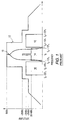
- Figure 1 shows the spectrum of an AM digital audio broadcasting signal of a type which can be utilized by the present invention.
- Curve 10 represents the magnitude spectrum of a standard broadcasting amplitude modulated signal, wherein the carrier has a frequency of f 0 .
- the FCC emissions mask is represented by item number 12.
- a first group of twenty four of the digitally modulated carriers are positioned within a frequency band extending from (f 0 - 12 f 1 ) to (f 0 + 12 f 1 ), as illustrated by the envelope labeled 14 in Figure 1.
- All other carriers in this first group have a level of - 39.4 dBc and are modulated using complementary 32 QAM for the 48 and 32 kbps encoding rates.
- Complementary 8 PSK modulation is used on carriers ranging from (f 0 - 11 f 1 ) to (f 0 - 2 f 1 ) and from (f 0 + 2f 1 ) to (f 0 + 11 f 1 ) for the 16 kbps encoding rate.
- the carriers at (f 0 - 12 f 1 ) and (f 0 + 12 f 1 ) carry supplementary data and may be modulated using complementary 32 QAM.
- the carriers in a second and a third group may be modulated using, for example, 32 QAM for the 48 and 32 kbps rates, and 8 PSK for the 16 kbps rate.
- the carriers are set at levels of -30 dBc for all encoding rates.
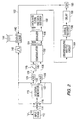
- FIG. 2 is a block diagram of a receiver constructed to receive the composite digital and analog signals of Figure 1.
- An antenna 110 receives the composite waveform containing the digital and analog signals and passes the signal to conventional input stages 112, which may include a radio frequency preselector, an amplifier, a mixer and a local oscillator.
- An intermediate frequency signal is produced by the input stages on line 114.
- This intermediate frequency signal is passed through an automatic gain control circuit 116 to an I/Q signal generator 118.
- the I/Q signal generator produces an in-phase signal on line 120 and a quadrature signal on line 122.
- the in-phase channel output on line 120 is input to an analog-to-digital converter 124.
- the quadrature channel output on line 122 is input to another analog-to-digital converter 126.
- Feedback signals on lines 120 and 122 are used to control the automatic gain control circuit 116.
- the signal on line 120 includes the analog AM signal which is separated out as illustrated by block 140 and passed to an output stage 142 and subsequently
- An optional highpass filter 146 may be used to filter the in-phase components on line 128 to eliminate the energy of the analog AM signal and to provide a filtered signal on line 148. If the highpass filter is not used, the signal on line 148 is the same as that on line 128.
- a demodulator 150 receives the digital signals on lines 148 and 130, and produces output signals on lines 154. These output signals are passed to an equalizer 156 and to a data rate filter and data decoder 158. To obtain higher signal-to-noise ratios (SNR) for the complementary carriers, the FFT outputs for pairs of complementary carriers are combined. The output of the data decoder is sent to a deinterleaving circuit and forward error correction decoder 164 in order to improve data integrity.
- SNR signal-to-noise ratios
- the output of the deinterleaver/forward error correcting circuit is passed to a source decoder 166.
- the output of the source decoder is delayed by circuit 168 to compensate for the delay of the analog signal at the transmitter and to time align analog and digital signals at the receiver.
- the output of delay circuit 168 is converted to an analog signal by a digital-to-analog converter 160 to produce a signal on 162 which goes to the output stage 142.
- FIG. 3 is a functional block diagram which illustrates the operation of a demodulator 150 and an adaptive equalizer 156 in accordance with the present invention.
- Both in-phase (I) and quadrature (Q) signals are provided on lines 148 and 130 as inputs to a windowing and guard interval removal circuit. These signals may be provided by using down converter elements similar to those shown in Figure 2.
- the window should be applied such that the digital carriers remain orthogonal, or at least the lack of orthogonality among the digital carriers is small enough not to impact system performance.
- a method of applying a window that preserves orthogonality among the carriers has been developed. In a specific implementation of the method, a root-raised cosine window is applied at the transmitter and receiver.
- the tapering occurs on the first and last seven samples of the 135 samples in a baud.
- the last seven samples are added to the first seven samples, where the 129th sample is added to the first sample, the 130th sample is added to the second sample, and this pattern continues with the 135th sample being added to the seventh sample.
- the resulting 128 points are input to an FFT.
- the outputs from the windowing and guard interval removal circuit 151 are input to the FFT 153.
- the output of the FFT is input by way of lines 154 to the coefficient multiplier 157.
- the coefficient multiplier operates on the frequency domain data and adjusts the magnitude and phase of each OFDM carrier to counteract the effects of channel perturbations, transmitter and receiver filters, the transmit and receive antennas, and other factors and processing that affect the magnitude and phase of the signal.
- the information for pairs of the complementary carriers is combined as illustrated by block 178. Specifically, this may be accomplished by taking the average of the frequency domain data for each pair of complementary carriers, where the negative conjugate of the frequency domain data for one of the carriers is used. Combining the complementary carrier information in this manner results in increased signal-to-noise ratios for the complementary carriers.
- Block 186 can utilize a known algorithm such as the least mean squares (LMS) or recursive least squares (RLS) to update the equalizer coefficients.
- LMS least mean squares
- RLS recursive least squares
- the output of equalizer 156 of Figure 2 can consist of the combination of the outputs on lines 174, 176, 180, and 182, or it can consist of the output of the symbol decisions processing 185, where lines 185 contain decisions for the complementary and non-complementary carriers.
- the output used depends on the type of data required for further processing, which may especially depend on the type of FEC used in the system.
- Patent Number 5,559,830, issued September 24, 1996 describes one mode of operation for an equalizer having an equalizer coefficient update algorithm.
- the present invention enhances the operation of the equalizer and equalizer coefficient update algorithm by considering the effects that occur when the equalizer coefficients should have non-symmetric magnitude or non- anti-symmetric phase about the center of the FFT.
- the output of the FFT which is input to the equalizer coefficient update algorithm, has certain symmetry properties. Specifically, since the in-phase part of the FFT input has nearly zero energy for the complementary carriers, the output of the FFT will be have nearly anti-hermitian symmetry for the complementary carriers. The output of the symbol decision processor for the complementary carriers will have the same property. Since these two anti-hermitian signals serve as the input to the equalizer coefficient update routine, the equalizer coefficients will be constrained to have a magnitude response that is symmetric and a phase response that is anti-symmetric about the center frequency of the FFT.
- Figure 4 illustrates an example of this situation.
- the channel magnitude response is not symmetric about the center frequency of the FFT.
- Figure 4 actually shows the inverse of the channel response 188 because this is the desired response for the equalizer.
- the response 190 that would be obtained from the equalizer magnitude is also shown in Figure 4.
- the illustrated equalizer response is displaced upward slightly so it can be distinguished from the inverse channel response. Note that the response follows the inverse channel response in the regions 192 and 194 of the non-complementary carriers. However, the equalizer response is not correct in the region 196 of the complementary carriers because it is forced to have a symmetric magnitude response in this spectral region.
- the FFT output for the non-complementary carriers could be noisy due to leakage of the analog signal into the non-complementary carriers that are closest to the analog AM carrier frequency.
- the equalizer coefficients should have symmetric magnitude and anti-symmetric phase about the analog AM carrier, the lack of a highpass filter leads to noisier estimates of the equalizer coefficients for the complementary carriers than when a highpass filter is used.
- equalizer coefficients should have non-symmetric magnitude or non- anti-symmetric phase about the analog AM carrier frequency
- estimation of the equalizer coefficients for the complementary carriers becomes difficult because the analog signal and complementary carriers are no longer separated into the in-phase and quadrature-phase components, respectively.
- Long term averaging could be used to obtain the proper equalizer coefficients for static phenomenon that require the equalizer coefficients to have non-symmetric magnitude or non- anti-symmetric phase about the center of the FFT.
- channel perturbations frequently have non-symmetric magnitude or non- anti-symmetric phase about the center of the FFT. These perturbations are transient in nature and occur too rapidly to be corrected by long term averaging.
- the equalizer coefficients for the complementary carriers will not be useful when the ideal equalizer coefficients for the complementary carriers should have a non-symmetric magnitude or non- anti-symmetric phase about the center of the FFT.
- the coefficient multiplier 157 outputs the equalized signals for the non-complementary carriers on lines 180 and 182 and equalized signals for the complementary carriers on lines 174 and 176.
- the symbol decisions processor 184 outputs decisions for only the non-complementary carriers on lines 187, in contrast to the case where interpolation is not used and lines 187 include the decisions for the complementary carriers.
- the equalizer coefficient update circuit 186 updates the coefficients for the non-complementary carriers. Then the coefficients for the complementary carriers are updated by interpolation using the known value at the center of the channel and the values of the coefficients for the non-complementary carriers.
- Figure 5 shows an example where linear interpolation is used to determine the equalizer coefficients across the center of the channel. As can be seen, if the channel response 198 is relatively smooth, the interpolated equalizer coefficients are near to the ideal values and the equalizer magnitude response 200 closely follows the inverse channel magnitude response.
- the value of the equalizer coefficient for the first OFDM carriers outside of the complementary region could be used to linearly interpolate from their values to the value at the center of the channel.
- Linear interpolation has been found to be satisfactory in the large majority of cases where the signal is in the commercial AM broadcast band (530 kHz to 1710 kHz) and the width of the complementary region is less than 10 kHz.
- interpolation algorithms other than linear could be used. Some of the well known interpolation algorithms include cubic spline, polynomial interpolation, FFT based interpolation, and exponential or logarithmic curve fitting.
- the non-complementary equalizer coefficients used for the interpolation and the complementary equalizer coefficients obtained from the interpolation can be averaged over time to reduce the effects of noise. Smoothing across frequency can also be used to reduce the effects of noise.
- interpolation on a log magnitude scale may be advantageous.
- This invention provides a system for adaptively equalizing an amplitude modulated compatible digital audio broadcast signal.
Landscapes
- Engineering & Computer Science (AREA)
- Signal Processing (AREA)
- Power Engineering (AREA)
- Computer Networks & Wireless Communication (AREA)
- Cable Transmission Systems, Equalization Of Radio And Reduction Of Echo (AREA)
- Digital Transmission Methods That Use Modulated Carrier Waves (AREA)
- Circuits Of Receivers In General (AREA)
- Noise Elimination (AREA)
Abstract
Description
Claims (10)
- A method of equalizing an amplitude modulated compatible digital broadcasting signal including an amplitude modulated radio frequency signal having a first frequency spectrum, the amplitude modulated radio frequency signal (10) having a first carrier modulated by an analog program signal, a plurality of digitally modulated carrier signals positioned within a bandwidth which encompasses the first frequency spectrum, a first group of the digitally modulated carrier signals including complementary signals and lying within the first frequency spectrum (14), and second and third groups of the digitally modulated carrier signals including non-complementary signals and lying outside of the first frequency spectrum, said method comprising the steps of producing a first signal representative of in-phase components of the amplitude modulated compatible digital broadcasting signal; producing a second signal representative of quadrature-phase components of the amplitude modulated compatible digital broadcasting signal; using the first and second signals as the real and imaginary inputs to take the Fast Fourier Transform of the first and second signals to produce a plurality of transformed signals representative of frequency domain data; and processing said plurality of transformed signals by multiplying said plurality of transformed signals by an equalization vector, said equalization vector comprising a plurality of equalizer coefficients; characterized by the step of:updating said equalizer coefficients used for the complementary signals by interpolation using coefficients of said vector for the non-complementary signals.
- The method of claim 1 further characterized in that said coefficients of said vector for the non-complementary signals are interpolated using one of: linear interpolation, cubic spline interpolation, polynomial interpolation, Fast Fourier transform based interpolation, or logarithmic curve fitting.
- The method of claim 1 further characterized in that said interpolation is averaged over time.
- The method of claim 1 further characterized in that said interpolation results in linear changes to the magnitude and phase of the coefficients as a function of frequency.
- The method of claim 1 further characterized in that said interpolation results in logarithmic changes to the magnitude of the coefficients.
- An apparatus (156) for equalizing an amplitude modulated compatible digital broadcasting signal including an amplitude modulated radio frequency signal (10) having a first frequency spectrum, the amplitude modulated radio frequency signal having a first carrier modulated by an analog program signal, a plurality of digitally modulated carrier signals positioned within a bandwidth (14) which encompasses the first frequency spectrum, a first group of the digitally modulated carrier signals including complementary signals and lying within the first frequency spectrum, and second and third groups of the digitally modulated carrier signals including non-complementary signals and lying outside of the first frequency spectrum, said apparatus comprising means (118) for producing a first signal representative of in-phase components of the amplitude modulated compatible digital broadcasting signal; means (118) for producing a second signal representative of quadrature-phase components of the amplitude modulated compatible digital broadcasting signal; means (150) for using the first and second signals as the real and imaginary inputs to take the Fast Fourier Transform of the first and second signals to produce a plurality of transformed signals representative of frequency domain data; and means (156) for processing said plurality of transformed signals by multiplying said plurality of transformed signals by an equalization vector, said equalization vector comprising a plurality of equalizer coefficients; characterized by:means (186) for updating said equalizer coefficients used for the complementary signals by interpolating coefficients of said vector for the non-complementary signals.
- The apparatus of claim 6, further characterized in that said coefficients of said vector for the non-complementary signals are interpolated using one of: linear interpolation, cubic spline interpolation, polynomial interpolation, Fast Fourier transform based interpolation, or logarithmic curve fitting.
- The apparatus of claim 6, further characterized in that said interpolation is averaged over time.
- The apparatus of claim 6, further characterized in that said interpolation results in linear changes to the magnitude and phase of the coefficients as a function of frequency.
- The apparatus of claim 6, further characterized in that said interpolation results in logarithmic changes to the magnitude of the coefficients.
Applications Claiming Priority (3)
| Application Number | Priority Date | Filing Date | Title |
|---|---|---|---|
| US207894 | 1998-10-02 | ||
| US09/207,894 US6292511B1 (en) | 1998-10-02 | 1998-10-02 | Method for equalization of complementary carriers in an AM compatible digital audio broadcast system |
| PCT/US1999/020277 WO2000021228A1 (en) | 1998-10-02 | 1999-09-02 | Method for equalization of complementary carriers in an am compatible digital audio broadcast system |
Publications (2)
| Publication Number | Publication Date |
|---|---|
| EP1119928A1 EP1119928A1 (en) | 2001-08-01 |
| EP1119928B1 true EP1119928B1 (en) | 2004-05-26 |
Family
ID=22772412
Family Applications (1)
| Application Number | Title | Priority Date | Filing Date |
|---|---|---|---|
| EP99945484A Expired - Lifetime EP1119928B1 (en) | 1998-10-02 | 1999-09-02 | Method for equalization of complementary carriers in an am compatible digital audio broadcast system |
Country Status (13)
| Country | Link |
|---|---|
| US (2) | US6292511B1 (en) |
| EP (1) | EP1119928B1 (en) |
| JP (1) | JP2002527933A (en) |
| KR (1) | KR20010075490A (en) |
| CN (2) | CN1134127C (en) |
| AT (1) | ATE268077T1 (en) |
| AU (1) | AU763811B2 (en) |
| BR (1) | BR9914261A (en) |
| CA (1) | CA2345616A1 (en) |
| DE (1) | DE69917665T2 (en) |
| MX (1) | MXPA01003332A (en) |
| RU (1) | RU2222871C2 (en) |
| WO (1) | WO2000021228A1 (en) |
Cited By (1)
| Publication number | Priority date | Publication date | Assignee | Title |
|---|---|---|---|---|
| DE102007056163A1 (en) * | 2007-11-21 | 2009-06-04 | Ali Corporation | Digital video-broadcasting satellite receiver for displaying e.g. quality, of radio frequency signal utilized in TV, has Fast Fourier transformation unit, where quality display signal is determined based on signal from transformation unit |
Families Citing this family (65)
| Publication number | Priority date | Publication date | Assignee | Title |
|---|---|---|---|---|
| US6292511B1 (en) * | 1998-10-02 | 2001-09-18 | Usa Digital Radio Partners, Lp | Method for equalization of complementary carriers in an AM compatible digital audio broadcast system |
| KR100362571B1 (en) * | 1999-07-05 | 2002-11-27 | 삼성전자 주식회사 | Frequency offset compensation apparatus and method using pilot symbol in orthogonal frequency division multiplex system |
| JP2001313594A (en) * | 2000-04-28 | 2001-11-09 | Fujitsu Ltd | DMT system time domain equalizer coefficient updating method, receiving method, DMT system and DMT modem |
| FR2808635B1 (en) * | 2000-05-02 | 2002-08-02 | Sagem | CANCELLATION OF INTERFERING SIGNALS IN AN XDSL MODEM RECEIVER |
| US6671340B1 (en) * | 2000-06-15 | 2003-12-30 | Ibiquity Digital Corporation | Method and apparatus for reduction of interference in FM in-band on-channel digital audio broadcasting receivers |
| GB2364866B (en) | 2000-07-12 | 2004-05-19 | Conexant Systems Inc | Television receiver |
| DE60037583T2 (en) * | 2000-08-24 | 2009-01-08 | Sony Deutschland Gmbh | Communication device for transmitting and receiving OFDM signals in a radio communication system |
| US7099385B2 (en) * | 2001-07-18 | 2006-08-29 | Massana Research Limited | Compensation for interference in data receivers |
| US7158567B2 (en) * | 2001-09-11 | 2007-01-02 | Vitesse Semiconductor Corporation | Method and apparatus for improved high-speed FEC adaptive equalization |
| EP1370017A1 (en) * | 2002-06-07 | 2003-12-10 | Sony International (Europe) GmbH | Interference reduction for simulcast signals |
| US7116726B2 (en) | 2002-08-12 | 2006-10-03 | Cubic Corporation | Method and apparatus for transferring multiple symbol streams at low bit-error rates in a narrowband channel |
| US6898249B2 (en) * | 2002-12-17 | 2005-05-24 | Ibiquity Digital Corporation | Method and apparatus for AM digital audio broadcasting with amplitude scaled tertiary subcarriers |
| US6922440B2 (en) * | 2002-12-17 | 2005-07-26 | Scintera Networks, Inc. | Adaptive signal latency control for communications systems signals |
| US7321550B2 (en) * | 2004-02-17 | 2008-01-22 | Industrial Technology Research Institute | Method of equalization in an OFDM system |
| US7193802B2 (en) * | 2004-03-25 | 2007-03-20 | Hitachi Global Storage Technologies Netherlands, B.V. | Apparatus for providing dynamic equalizer optimization |
| US8462963B2 (en) * | 2004-08-10 | 2013-06-11 | Bongiovi Acoustics, LLCC | System and method for processing audio signal |
| US9413321B2 (en) | 2004-08-10 | 2016-08-09 | Bongiovi Acoustics Llc | System and method for digital signal processing |
| US9281794B1 (en) | 2004-08-10 | 2016-03-08 | Bongiovi Acoustics Llc. | System and method for digital signal processing |
| US8565449B2 (en) * | 2006-02-07 | 2013-10-22 | Bongiovi Acoustics Llc. | System and method for digital signal processing |
| US10848118B2 (en) | 2004-08-10 | 2020-11-24 | Bongiovi Acoustics Llc | System and method for digital signal processing |
| US20070195971A1 (en) * | 2006-02-07 | 2007-08-23 | Anthony Bongiovi | Collapsible speaker and headliner |
| US8284955B2 (en) | 2006-02-07 | 2012-10-09 | Bongiovi Acoustics Llc | System and method for digital signal processing |
| US8160274B2 (en) | 2006-02-07 | 2012-04-17 | Bongiovi Acoustics Llc. | System and method for digital signal processing |
| US11431312B2 (en) | 2004-08-10 | 2022-08-30 | Bongiovi Acoustics Llc | System and method for digital signal processing |
| US7254243B2 (en) * | 2004-08-10 | 2007-08-07 | Anthony Bongiovi | Processing of an audio signal for presentation in a high noise environment |
| US10158337B2 (en) | 2004-08-10 | 2018-12-18 | Bongiovi Acoustics Llc | System and method for digital signal processing |
| KR100626370B1 (en) * | 2004-12-29 | 2006-09-20 | 삼성전자주식회사 | Multi-subcarrier communication system with improved frequency equalization performance and method |
| US7697620B2 (en) * | 2005-11-14 | 2010-04-13 | Ibiquity Digital Corporation | Equalizer for AM in-band on-channel radio receivers |
| US7706474B2 (en) * | 2005-11-14 | 2010-04-27 | Ibiquity Digital Corporation | Carrier tracking for AM in-band on-channel radio receivers |
| US9615189B2 (en) | 2014-08-08 | 2017-04-04 | Bongiovi Acoustics Llc | Artificial ear apparatus and associated methods for generating a head related audio transfer function |
| US9195433B2 (en) | 2006-02-07 | 2015-11-24 | Bongiovi Acoustics Llc | In-line signal processor |
| US9348904B2 (en) | 2006-02-07 | 2016-05-24 | Bongiovi Acoustics Llc. | System and method for digital signal processing |
| US10069471B2 (en) | 2006-02-07 | 2018-09-04 | Bongiovi Acoustics Llc | System and method for digital signal processing |
| US8229136B2 (en) * | 2006-02-07 | 2012-07-24 | Anthony Bongiovi | System and method for digital signal processing |
| US20080152184A1 (en) * | 2006-02-07 | 2008-06-26 | Anthony Bongiovi | Collapsible speaker system |
| US11202161B2 (en) | 2006-02-07 | 2021-12-14 | Bongiovi Acoustics Llc | System, method, and apparatus for generating and digitally processing a head related audio transfer function |
| US10848867B2 (en) | 2006-02-07 | 2020-11-24 | Bongiovi Acoustics Llc | System and method for digital signal processing |
| US20090296959A1 (en) * | 2006-02-07 | 2009-12-03 | Bongiovi Acoustics, Llc | Mismatched speaker systems and methods |
| US10701505B2 (en) | 2006-02-07 | 2020-06-30 | Bongiovi Acoustics Llc. | System, method, and apparatus for generating and digitally processing a head related audio transfer function |
| US8705765B2 (en) * | 2006-02-07 | 2014-04-22 | Bongiovi Acoustics Llc. | Ringtone enhancement systems and methods |
| US8374556B2 (en) * | 2007-11-01 | 2013-02-12 | National Public Radio, Inc. | Method for determining audio broadcast transmission signal coverage |
| DK2502428T3 (en) | 2009-11-17 | 2014-08-04 | Phonak Ag | Hearing assistance system and method |
| WO2011060813A1 (en) | 2009-11-17 | 2011-05-26 | Phonak Ag | Hearing assistance system and method |
| US8948272B2 (en) | 2012-12-03 | 2015-02-03 | Digital PowerRadio, LLC | Joint source-channel decoding with source sequence augmentation |
| US9191256B2 (en) | 2012-12-03 | 2015-11-17 | Digital PowerRadio, LLC | Systems and methods for advanced iterative decoding and channel estimation of concatenated coding systems |
| US8595590B1 (en) | 2012-12-03 | 2013-11-26 | Digital PowerRadio, LLC | Systems and methods for encoding and decoding of check-irregular non-systematic IRA codes |
| US9344828B2 (en) | 2012-12-21 | 2016-05-17 | Bongiovi Acoustics Llc. | System and method for digital signal processing |
| EP2770635A1 (en) * | 2013-02-25 | 2014-08-27 | Fraunhofer-Gesellschaft zur Förderung der angewandten Forschung e.V. | Equalization filter coefficient determinator, apparatus, equalization filter coefficient processor, system and methods |
| US9883318B2 (en) | 2013-06-12 | 2018-01-30 | Bongiovi Acoustics Llc | System and method for stereo field enhancement in two-channel audio systems |
| US9264004B2 (en) | 2013-06-12 | 2016-02-16 | Bongiovi Acoustics Llc | System and method for narrow bandwidth digital signal processing |
| US9398394B2 (en) | 2013-06-12 | 2016-07-19 | Bongiovi Acoustics Llc | System and method for stereo field enhancement in two-channel audio systems |
| US9906858B2 (en) | 2013-10-22 | 2018-02-27 | Bongiovi Acoustics Llc | System and method for digital signal processing |
| US9397629B2 (en) | 2013-10-22 | 2016-07-19 | Bongiovi Acoustics Llc | System and method for digital signal processing |
| US9615813B2 (en) | 2014-04-16 | 2017-04-11 | Bongiovi Acoustics Llc. | Device for wide-band auscultation |
| US10639000B2 (en) | 2014-04-16 | 2020-05-05 | Bongiovi Acoustics Llc | Device for wide-band auscultation |
| US10820883B2 (en) | 2014-04-16 | 2020-11-03 | Bongiovi Acoustics Llc | Noise reduction assembly for auscultation of a body |
| US9564146B2 (en) | 2014-08-01 | 2017-02-07 | Bongiovi Acoustics Llc | System and method for digital signal processing in deep diving environment |
| US9638672B2 (en) | 2015-03-06 | 2017-05-02 | Bongiovi Acoustics Llc | System and method for acquiring acoustic information from a resonating body |
| US9906867B2 (en) | 2015-11-16 | 2018-02-27 | Bongiovi Acoustics Llc | Surface acoustic transducer |
| US9621994B1 (en) | 2015-11-16 | 2017-04-11 | Bongiovi Acoustics Llc | Surface acoustic transducer |
| US11211043B2 (en) | 2018-04-11 | 2021-12-28 | Bongiovi Acoustics Llc | Audio enhanced hearing protection system |
| WO2020028833A1 (en) | 2018-08-02 | 2020-02-06 | Bongiovi Acoustics Llc | System, method, and apparatus for generating and digitally processing a head related audio transfer function |
| CN119094934B (en) * | 2024-08-30 | 2025-07-25 | 深圳市金富强技术科技有限公司 | Microphone balance self-adaptive adjustment method, device and equipment |
| CN119788055B (en) * | 2025-03-12 | 2025-05-16 | 山东云海国创云计算装备产业创新中心有限公司 | Adaptive combination equalization circuit and adaptive circuit, method, device and equipment thereof |
| CN120338290B (en) * | 2025-06-18 | 2025-09-19 | 江苏省设备成套股份有限公司 | Carbon metering system and computing method based on edge computing |
Family Cites Families (39)
| Publication number | Priority date | Publication date | Assignee | Title |
|---|---|---|---|---|
| US4379947A (en) * | 1979-02-02 | 1983-04-12 | Teleprompter Corporation | System for transmitting data simultaneously with audio |
| US4534054A (en) * | 1980-11-28 | 1985-08-06 | Maisel Douglas A | Signaling system for FM transmission systems |
| US4425642A (en) * | 1982-01-08 | 1984-01-10 | Applied Spectrum Technologies, Inc. | Simultaneous transmission of two information signals within a band-limited communications channel |
| US4881245A (en) * | 1983-07-01 | 1989-11-14 | Harris Corporation | Improved signalling method and apparatus |
| US4660193A (en) * | 1983-10-11 | 1987-04-21 | Regency Electronics, Inc. | Digital modulation method for standard broadcast FM subcarrier |
| AU589119B2 (en) * | 1984-04-17 | 1989-10-05 | Nec Corporation | Digital radio communication system utilizing quadrature modulated carrier waves |
| US5128933A (en) * | 1985-07-29 | 1992-07-07 | Baranoff Rossine Dimitri | Process and device for the radio transmission of coded data superimposed on a traditional frequency-modulated broadcast |
| US4881241A (en) * | 1988-02-24 | 1989-11-14 | Centre National D'etudes Des Telecommunications | Method and installation for digital communication, particularly between and toward moving vehicles |
| US5311550A (en) * | 1988-10-21 | 1994-05-10 | Thomson-Csf | Transmitter, transmission method and receiver |
| US5134630A (en) * | 1989-04-12 | 1992-07-28 | National Research Development Corporation | Method and apparatus for transparent tone-in-band transmitter, receiver and system processing |
| US5134634A (en) * | 1989-08-31 | 1992-07-28 | Nec Corporation | Multilevel quadrature amplitude demodulator capable of compensating for a quadrature phase deviation of a carrier signal pair |
| FR2658016B1 (en) * | 1990-02-06 | 1994-01-21 | Etat Francais Cnet | METHOD FOR BROADCASTING DIGITAL DATA, ESPECIALLY FOR BROADBAND BROADCASTING TO MOBILES, WITH TIME-FREQUENCY INTERLACING AND CONSISTENT DEMODULATION, AND CORRESPONDING RECEIVER. |
| US5179576A (en) * | 1990-04-12 | 1993-01-12 | Hopkins John W | Digital audio broadcasting system |
| US5020076A (en) * | 1990-05-21 | 1991-05-28 | Motorola, Inc. | Hybrid modulation apparatus |
| JP2749456B2 (en) * | 1991-03-06 | 1998-05-13 | 三菱電機株式会社 | Wireless communication equipment |
| DE4111855C2 (en) * | 1991-04-11 | 1994-10-20 | Inst Rundfunktechnik Gmbh | Method for the radio transmission of a digitally coded data stream |
| US5315583A (en) * | 1991-04-11 | 1994-05-24 | Usa Digital Radio | Method and apparatus for digital audio broadcasting and reception |
| US5117195A (en) * | 1991-05-17 | 1992-05-26 | General Instrument Corporation | Data referenced demodulation of multiphase modulated data |
| EP0610313B1 (en) * | 1991-11-01 | 1998-02-04 | Thomson Consumer Electronics Sales GmbH | Radio transmission system and radio receiver |
| JP2904986B2 (en) * | 1992-01-31 | 1999-06-14 | 日本放送協会 | Orthogonal frequency division multiplex digital signal transmitter and receiver |
| US5465396A (en) * | 1993-01-12 | 1995-11-07 | Usa Digital Radio Partners, L.P. | In-band on-channel digital broadcasting |
| US5588022A (en) * | 1994-03-07 | 1996-12-24 | Xetron Corp. | Method and apparatus for AM compatible digital broadcasting |
| US5673292A (en) | 1994-10-07 | 1997-09-30 | Northrop Grumman Corporation | AM-PSK system for broadcasting a composite analog and digital signal using adaptive M-ary PSK modulation |
| US5559830A (en) | 1995-01-23 | 1996-09-24 | Xetron Corp. | Equalization system for AM compatible digital receiver |
| US5606576A (en) | 1995-01-23 | 1997-02-25 | Northrop Grumman Corporation | Adaptive mode control system for AM compatible digital broadcast |
| JP3145003B2 (en) * | 1995-03-23 | 2001-03-12 | 株式会社東芝 | Orthogonal frequency division multiplexing transmission system and transmitter and receiver thereof |
| US5592471A (en) * | 1995-04-21 | 1997-01-07 | Cd Radio Inc. | Mobile radio receivers using time diversity to avoid service outages in multichannel broadcast transmission systems |
| US5633896A (en) | 1996-02-21 | 1997-05-27 | Usa Digital Radio Partners, L.P. | AM compatible digital waveform demodulation using a dual FFT |
| US5764706A (en) | 1995-08-31 | 1998-06-09 | Usa Digital Radio Partners, L.P. | AM compatible digital waveform frame timing recovery and frame synchronous power measurement |
| US5809065A (en) | 1996-02-20 | 1998-09-15 | Usa Digital Radio Partners, L.P. | Method and apparatus for improving the quality of AM compatible digital broadcast system signals in the presence of distortion |
| US5703954A (en) | 1996-02-20 | 1997-12-30 | Usa Digital Radio Partners, L.P. | Method and apparatus for improving the quality of AM compatible digital broadcast system signals in the presence of distortion |
| US5949796A (en) | 1996-06-19 | 1999-09-07 | Kumar; Derek D. | In-band on-channel digital broadcasting method and system |
| BR9712722A (en) | 1996-10-31 | 1999-10-26 | Discovision Ass | Digital receiver for multiport signals, and, process to estimate a channel's frequency response. |
| US6128334A (en) * | 1997-02-21 | 2000-10-03 | Usa Digital Radio, Inc. | Receiver addressable AM compatible digital broadcast system |
| KR100224863B1 (en) | 1997-08-20 | 1999-10-15 | 윤종용 | Equalization Methods and Equalizers for OFDM Receivers |
| JP3981898B2 (en) * | 1998-02-20 | 2007-09-26 | ソニー株式会社 | Signal receiving apparatus and method, and recording medium |
| US6452977B1 (en) * | 1998-09-15 | 2002-09-17 | Ibiquity Digital Corporation | Method and apparatus for AM compatible digital broadcasting |
| US6295317B1 (en) * | 1998-10-02 | 2001-09-25 | Usa Digital Radio Partners, Lp | Method and apparatus for demodulating and equalizing an AM compatible digital audio broadcast signal |
| US6292511B1 (en) * | 1998-10-02 | 2001-09-18 | Usa Digital Radio Partners, Lp | Method for equalization of complementary carriers in an AM compatible digital audio broadcast system |
-
1998
- 1998-10-02 US US09/207,894 patent/US6292511B1/en not_active Expired - Lifetime
-
1999
- 1999-09-02 RU RU2001111836/09A patent/RU2222871C2/en not_active IP Right Cessation
- 1999-09-02 EP EP99945484A patent/EP1119928B1/en not_active Expired - Lifetime
- 1999-09-02 WO PCT/US1999/020277 patent/WO2000021228A1/en not_active Ceased
- 1999-09-02 MX MXPA01003332A patent/MXPA01003332A/en unknown
- 1999-09-02 AU AU58075/99A patent/AU763811B2/en not_active Ceased
- 1999-09-02 AT AT99945484T patent/ATE268077T1/en not_active IP Right Cessation
- 1999-09-02 CN CNB998117188A patent/CN1134127C/en not_active Expired - Fee Related
- 1999-09-02 BR BR9914261-9A patent/BR9914261A/en not_active IP Right Cessation
- 1999-09-02 DE DE69917665T patent/DE69917665T2/en not_active Expired - Fee Related
- 1999-09-02 CN CNA2003101149104A patent/CN1529432A/en active Pending
- 1999-09-02 JP JP2000575245A patent/JP2002527933A/en active Pending
- 1999-09-02 KR KR1020017004078A patent/KR20010075490A/en not_active Abandoned
- 1999-09-02 CA CA002345616A patent/CA2345616A1/en not_active Abandoned
-
2001
- 2001-09-14 US US09/952,450 patent/US6570943B2/en not_active Expired - Lifetime
Cited By (1)
| Publication number | Priority date | Publication date | Assignee | Title |
|---|---|---|---|---|
| DE102007056163A1 (en) * | 2007-11-21 | 2009-06-04 | Ali Corporation | Digital video-broadcasting satellite receiver for displaying e.g. quality, of radio frequency signal utilized in TV, has Fast Fourier transformation unit, where quality display signal is determined based on signal from transformation unit |
Also Published As
| Publication number | Publication date |
|---|---|
| WO2000021228A1 (en) | 2000-04-13 |
| DE69917665D1 (en) | 2004-07-01 |
| US6570943B2 (en) | 2003-05-27 |
| ATE268077T1 (en) | 2004-06-15 |
| US6292511B1 (en) | 2001-09-18 |
| AU5807599A (en) | 2000-04-26 |
| KR20010075490A (en) | 2001-08-09 |
| CN1331871A (en) | 2002-01-16 |
| DE69917665T2 (en) | 2005-06-16 |
| AU763811B2 (en) | 2003-07-31 |
| RU2222871C2 (en) | 2004-01-27 |
| US20020012392A1 (en) | 2002-01-31 |
| EP1119928A1 (en) | 2001-08-01 |
| CA2345616A1 (en) | 2000-04-13 |
| BR9914261A (en) | 2001-07-03 |
| MXPA01003332A (en) | 2004-02-17 |
| JP2002527933A (en) | 2002-08-27 |
| CN1529432A (en) | 2004-09-15 |
| CN1134127C (en) | 2004-01-07 |
Similar Documents
| Publication | Publication Date | Title |
|---|---|---|
| US6292511B1 (en) | Method for equalization of complementary carriers in an AM compatible digital audio broadcast system | |
| US6532258B1 (en) | Method for estimating signal-to-noise ratio of digital carriers in an AM compatible digital audio broadcasting system | |
| EP1118195B1 (en) | Method and apparatus for demodulating and equalizing an am compatible digital audio broadcast signal | |
| JP4414621B2 (en) | Method and apparatus for determining transmission mode and synchronization of digital audio broadcast signal | |
| EP0752177B1 (en) | Joint equalization system for am compatible digital receiver | |
| US6400758B1 (en) | Method and apparatus for training sequence identification in an AM compatible digital audio broadcasting system | |
| CN101310494B (en) | Equalizer for AM In-Band On-Channel Wireless Receiver |
Legal Events
| Date | Code | Title | Description |
|---|---|---|---|
| PUAI | Public reference made under article 153(3) epc to a published international application that has entered the european phase |
Free format text: ORIGINAL CODE: 0009012 |
|
| 17P | Request for examination filed |
Effective date: 20010404 |
|
| AK | Designated contracting states |
Kind code of ref document: A1 Designated state(s): AT BE CH CY DE DK ES FI FR GB GR IE IT LI LU MC NL PT SE |
|
| AX | Request for extension of the european patent |
Free format text: AL;LT;LV;MK;RO;SI |
|
| GRAP | Despatch of communication of intention to grant a patent |
Free format text: ORIGINAL CODE: EPIDOSNIGR1 |
|
| GRAP | Despatch of communication of intention to grant a patent |
Free format text: ORIGINAL CODE: EPIDOSNIGR1 |
|
| GRAS | Grant fee paid |
Free format text: ORIGINAL CODE: EPIDOSNIGR3 |
|
| GRAA | (expected) grant |
Free format text: ORIGINAL CODE: 0009210 |
|
| AK | Designated contracting states |
Kind code of ref document: B1 Designated state(s): AT BE CH CY DE DK ES FI FR GB GR IE IT LI LU MC NL PT SE |
|
| PG25 | Lapsed in a contracting state [announced via postgrant information from national office to epo] |
Ref country code: LI Free format text: LAPSE BECAUSE OF FAILURE TO SUBMIT A TRANSLATION OF THE DESCRIPTION OR TO PAY THE FEE WITHIN THE PRESCRIBED TIME-LIMIT Effective date: 20040526 Ref country code: FI Free format text: LAPSE BECAUSE OF FAILURE TO SUBMIT A TRANSLATION OF THE DESCRIPTION OR TO PAY THE FEE WITHIN THE PRESCRIBED TIME-LIMIT Effective date: 20040526 Ref country code: ES Free format text: LAPSE BECAUSE OF FAILURE TO SUBMIT A TRANSLATION OF THE DESCRIPTION OR TO PAY THE FEE WITHIN THE PRESCRIBED TIME-LIMIT Effective date: 20040526 Ref country code: CY Free format text: LAPSE BECAUSE OF FAILURE TO SUBMIT A TRANSLATION OF THE DESCRIPTION OR TO PAY THE FEE WITHIN THE PRESCRIBED TIME-LIMIT Effective date: 20040526 Ref country code: CH Free format text: LAPSE BECAUSE OF FAILURE TO SUBMIT A TRANSLATION OF THE DESCRIPTION OR TO PAY THE FEE WITHIN THE PRESCRIBED TIME-LIMIT Effective date: 20040526 Ref country code: BE Free format text: LAPSE BECAUSE OF FAILURE TO SUBMIT A TRANSLATION OF THE DESCRIPTION OR TO PAY THE FEE WITHIN THE PRESCRIBED TIME-LIMIT Effective date: 20040526 Ref country code: AT Free format text: LAPSE BECAUSE OF FAILURE TO SUBMIT A TRANSLATION OF THE DESCRIPTION OR TO PAY THE FEE WITHIN THE PRESCRIBED TIME-LIMIT Effective date: 20040526 |
|
| REG | Reference to a national code |
Ref country code: GB Ref legal event code: FG4D |
|
| REG | Reference to a national code |
Ref country code: CH Ref legal event code: EP |
|
| REG | Reference to a national code |
Ref country code: IE Ref legal event code: FG4D |
|
| REF | Corresponds to: |
Ref document number: 69917665 Country of ref document: DE Date of ref document: 20040701 Kind code of ref document: P |
|
| PG25 | Lapsed in a contracting state [announced via postgrant information from national office to epo] |
Ref country code: SE Free format text: LAPSE BECAUSE OF FAILURE TO SUBMIT A TRANSLATION OF THE DESCRIPTION OR TO PAY THE FEE WITHIN THE PRESCRIBED TIME-LIMIT Effective date: 20040826 Ref country code: GR Free format text: LAPSE BECAUSE OF FAILURE TO SUBMIT A TRANSLATION OF THE DESCRIPTION OR TO PAY THE FEE WITHIN THE PRESCRIBED TIME-LIMIT Effective date: 20040826 Ref country code: DK Free format text: LAPSE BECAUSE OF FAILURE TO SUBMIT A TRANSLATION OF THE DESCRIPTION OR TO PAY THE FEE WITHIN THE PRESCRIBED TIME-LIMIT Effective date: 20040826 |
|
| PG25 | Lapsed in a contracting state [announced via postgrant information from national office to epo] |
Ref country code: LU Free format text: LAPSE BECAUSE OF NON-PAYMENT OF DUE FEES Effective date: 20040902 Ref country code: IE Free format text: LAPSE BECAUSE OF NON-PAYMENT OF DUE FEES Effective date: 20040902 |
|
| PGFP | Annual fee paid to national office [announced via postgrant information from national office to epo] |
Ref country code: GB Payment date: 20040908 Year of fee payment: 6 |
|
| PGFP | Annual fee paid to national office [announced via postgrant information from national office to epo] |
Ref country code: NL Payment date: 20040916 Year of fee payment: 6 |
|
| PGFP | Annual fee paid to national office [announced via postgrant information from national office to epo] |
Ref country code: FR Payment date: 20040920 Year of fee payment: 6 |
|
| PG25 | Lapsed in a contracting state [announced via postgrant information from national office to epo] |
Ref country code: MC Free format text: LAPSE BECAUSE OF NON-PAYMENT OF DUE FEES Effective date: 20040930 |
|
| PGFP | Annual fee paid to national office [announced via postgrant information from national office to epo] |
Ref country code: DE Payment date: 20041102 Year of fee payment: 6 |
|
| LTIE | Lt: invalidation of european patent or patent extension |
Effective date: 20040526 |
|
| REG | Reference to a national code |
Ref country code: CH Ref legal event code: PL |
|
| ET | Fr: translation filed | ||
| PLBE | No opposition filed within time limit |
Free format text: ORIGINAL CODE: 0009261 |
|
| STAA | Information on the status of an ep patent application or granted ep patent |
Free format text: STATUS: NO OPPOSITION FILED WITHIN TIME LIMIT |
|
| 26N | No opposition filed |
Effective date: 20050301 |
|
| REG | Reference to a national code |
Ref country code: IE Ref legal event code: MM4A |
|
| PG25 | Lapsed in a contracting state [announced via postgrant information from national office to epo] |
Ref country code: IT Free format text: LAPSE BECAUSE OF NON-PAYMENT OF DUE FEES Effective date: 20050902 Ref country code: GB Free format text: LAPSE BECAUSE OF NON-PAYMENT OF DUE FEES Effective date: 20050902 |
|
| PG25 | Lapsed in a contracting state [announced via postgrant information from national office to epo] |
Ref country code: NL Free format text: LAPSE BECAUSE OF NON-PAYMENT OF DUE FEES Effective date: 20060401 Ref country code: DE Free format text: LAPSE BECAUSE OF NON-PAYMENT OF DUE FEES Effective date: 20060401 |
|
| GBPC | Gb: european patent ceased through non-payment of renewal fee |
Effective date: 20050902 |
|
| PG25 | Lapsed in a contracting state [announced via postgrant information from national office to epo] |
Ref country code: FR Free format text: LAPSE BECAUSE OF NON-PAYMENT OF DUE FEES Effective date: 20060531 |
|
| NLV4 | Nl: lapsed or anulled due to non-payment of the annual fee |
Effective date: 20060401 |
|
| REG | Reference to a national code |
Ref country code: FR Ref legal event code: ST Effective date: 20060531 |
|
| PG25 | Lapsed in a contracting state [announced via postgrant information from national office to epo] |
Ref country code: PT Free format text: LAPSE BECAUSE OF NON-PAYMENT OF DUE FEES Effective date: 20041026 |