EP1118956A2 - Verfahren zur Erkennung von Objekten in Bildern auf der Bildpixelebene - Google Patents
Verfahren zur Erkennung von Objekten in Bildern auf der Bildpixelebene Download PDFInfo
- Publication number
- EP1118956A2 EP1118956A2 EP00124269A EP00124269A EP1118956A2 EP 1118956 A2 EP1118956 A2 EP 1118956A2 EP 00124269 A EP00124269 A EP 00124269A EP 00124269 A EP00124269 A EP 00124269A EP 1118956 A2 EP1118956 A2 EP 1118956A2
- Authority
- EP
- European Patent Office
- Prior art keywords
- image
- images
- classification
- pixel
- pixel point
- Prior art date
- Legal status (The legal status is an assumption and is not a legal conclusion. Google has not performed a legal analysis and makes no representation as to the accuracy of the status listed.)
- Ceased
Links
Images



Classifications
-
- G—PHYSICS
- G06—COMPUTING OR CALCULATING; COUNTING
- G06F—ELECTRIC DIGITAL DATA PROCESSING
- G06F18/00—Pattern recognition
- G06F18/20—Analysing
- G06F18/25—Fusion techniques
- G06F18/254—Fusion techniques of classification results, e.g. of results related to same input data
Definitions
- the invention relates to a method for recognizing objects of at least one predefined object class in digital images at the image pixel level, in particular for automatic evaluation of image information.
- different object classes are used at the same time. This makes an assessment of the input images for several object classes carried out.
- a decision is made for each object class, where both the position and the type of the recognized object are delivered becomes.
- the invention are based on representative Examples learned rules as well as a feature vector to form the classifiers used from a predetermined environment of the pixel point in question of the respective filter image is formed.
- the method according to the invention is a robust, practical method for Detection of a large number of complex different object classes, e.g. Vehicles, people, buildings, etc.
- the invention can be used in large numbers Image sources, e.g. Video cameras, infrared cameras, etc., are used.
- each input or single image 1 is analyzed separately.
- Each Single image or input image 1 becomes a first method step, one Coarse classification 10.
- This rough classification 10 the input image 1 viewed as a whole, i.e. there is still no decomposition of the input image 1 made.
- the input image 1 is relevant by the rough classification 10 and negligible image pixels separated.
- An appropriately chosen rough classifier determines the relevance of the pixel for the for each pixel of the input image 1 subsequent process steps.
- the pixels of the input image 1 become according to a given criterion according to their importance with regard to cognizing objects classified.
- Criteria determines whether the image is of interest, i.e. objects to be recognized or Parts of the same.
- An example of such a criterion is the relative homogeneity of the neighborhood of the viewed pixel.
- the assumption is made that homogeneous Image areas contain no objects to be recognized.
- the neighborhood of one Pixel is defined according to a predetermined grid in the image.
- the homogeneity of the neighborhood of the pixel under consideration is checked whether a Range of pixels similar to predefined properties, e.g. similar color values, having. Do these properties of the area correspond to the given one Homogeneity criterion, this pixel is considered for the following Process steps classified uninteresting and not processed further. Will that No presence of the criterion, i.e. there is an inhomogeneous neighborhood, the pixel is classified as interesting for further processing.
- An input image 1 from a low-flying aircraft serves as an example was recorded and shows a scenario of landscape and vehicles
- the Vehicles can be recognized automatically by means of the method according to the invention.
- a check is carried out for each of its pixel points as to whether this has a certain neighborhood with similar color values.
- the fields in the image represent homogeneous image regions, which result from very similar color values put together.
- the vehicles show very different localities Color values and the corresponding pixel points fulfill the given Homogeneity criterion is not.
- all image pixel points e.g. to the fields classified as unimportant for further processing and all image pixel points, e.g. belong to vehicles, used in the following process steps.
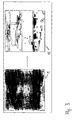
- FIG. 2 A representation of an exemplary input image 1 and that based on the The reduced classification 11 resulting from the rough classification is shown in FIG. 2. That there Input image 1 shown was recorded and shown by an infrared sensor a road in an area with vehicles that appear as three dark spots can be seen in the lower half of the left image in FIG. Due to the Coarse classification 10 were uninteresting pixels for further analysis identified. These are identified as white areas in the right image in FIG. The method steps 20, 30, 40, 50 described below ignore them Areas and edit only for further analysis of the reduced image 11 the image areas or pixels that are not marked in white.
- a next step in the decomposition or filtering 20 in Signal representations are preferred from each reduced image 11 by one multiple filtering according to known criteria multiple filter images 21, 22, 23 generated that each encompass the entire scene contained in the reduced image 11, as far as it is relevant for object recognition.
- the filter images 21, 22, 23 correspond with the content shown. Any reduced image can 11 are generally broken down into at least two corresponding filter images. In the The embodiment according to FIG Corresponding filter images 21, 22, 23.
- the filtering is preferred two-dimensional.
- the filtering can also be one-dimensional, i.e. for the lines or Columns of the reduced image 11 take place.
- the resulting from the breakdown 20 Corresponding filter images 21, 22, 23 preferably correspond to complementary ones Information from the reduced image 11.
- the information of the complementary Filter images 21, 22, 23 can be taken together again Form overall information of the reduced image 11. There are all components of the reduced image 11 is subjected to filtering.
- a reduced image 11 in method step 20 could be converted into a first one corresponding filter image 21 with small elements, in a second corresponding filter image 22 with larger elements and in one corresponding filter image 23 with the remaining even larger elements be disassembled.
- the scene shown in reduced image 11 is retained, i.e. the relevant picture components and their assignments remain relative to each other preserved, with uninteresting image components such as cultural information of the site no longer have to appear in the filter images.
- the rough scenario of the reduced Image 11 remains in the filter images 21, 22, 23.
- the Filter image 21 of the vehicle's object details, such as the tires and the Headlights included e.g. the Filter image 21 of the vehicle's object details, such as the tires and the Headlights included.
- the middle structures of the Vehicles such as Windshield, hood, etc., highlighted and that Filter image 23 then only contains the rough outline of the vehicles.
- the whole scene with the road and the vehicles is in each filter images 21, 22, 23 contain.
- the decomposition 20 of the reduced image 11 can after Color areas or according to gray values.
- Another example of a possible decomposition 20 of the reduced image 11 into individual corresponding ones Filter images or representatives represent a pyramid of images. Each representative is one Image pyramid, i.e. each level of this pyramid corresponds to a different one in the general lower resolution of the input image.
- An ensemble consists of at least two classifiers.
- the result of testing by an ensemble of classifiers is that for each filter image 21, 22, 23 a group of classification images 31a, 31b, 31c and 32a, 32b, 32c and 33a, 33b, 33c (Fig. 1) arise.
- the result of the ensemble for a certain object class a e.g. a certain type of vehicle Classification images 31b, 32b, 33b and 31c, 32c, 33c correspond to others Object classes (b and c), e.g. other vehicle types.
- the process is not based on that exemplary three object classes limited. With each individual classification picture for each pixel point different values, which are a measure or an evaluation of the corresponding classifier regarding the affiliation of the considered Represent pixel point to an object class assigned. This Evaluation measures can e.g. Probabilities or a fixed quality order his.
- Each classifier works in the following way: Each classifier orders Input values, i.e. each pixel point of the respective filter image 21, 22, 23 under Consideration of its surroundings, according to a predetermined rule Baseline values in the form of evaluation measures. The initial values of the Classifiers roughly indicate how safe the classifier is at Class of the pixel point under consideration is. Classifiers can e.g. Polynomial classifiers, support vector machines or neural networks.
- each neural network is exactly one of the filter images 21, 22, 23 assigned with respect to which the corresponding neural network operates.
- Each neural network of the ensemble assigns each pixel of the assigned filter image 21, 22, 23 a corresponding evaluation measure for every object class, e.g. a probability value in the corresponding Classification image 31a, 31b, 31c or 32a, 32b, 32c or 33a, 33b, 33c too, i.e. it saves this value and visualizes it, e.g. by color coding in which Classification image 31a, 31b, 31c or 32a, 32b, 32c or 33a, 33b, 33c.
- the rule of a classifier is preferably based on existing and prior to application of the method shown in FIG. 1 analyzed examples of representative Input values obtained.
- the classifier is generally iterative to the Given examples adapted and thus the rule contained in the examples extracted. In neural networks, this adaptation phase is in the corresponding Technical literature referred to as "training” or "learning a rule”. For others Classifiers are e.g. statistical methods used.
- the classification 30 For example, if different vehicle types are to be used based on the input images can be classified, for example, for the classification 30 as classes "Small Cars", “Sedans” and “Transporters” can be set.
- Be in step 20 first extracted various characteristics of the vehicles from the images. From these Features a feature vector is formed for each pixel point, the Components are fed to the classifier used as input values and serve as the basis for a class allocation.
- the classifier orders one accordingly predefined rule each feature vector an evaluation measure for each of the Classes "small car", “limousine” or "transport”.
- training neural network classifiers before applying the procedure can e.g. the required feature vectors from available representative Example input images can be obtained. These feature vectors are used for learning the rules only from those pixel points in the filter images (21, 22, 23) chosen, which in the rough classification (10) of the sample images as interesting Pixel points have been classified.
- each classifier is based on the neighborhood of the considered pixel of the corresponding filter image 21, 22, 23 together. This means that a local environment, e.g. the left, right, upper and lower neighboring pixels of the pixel under consideration.
- the choice of Environment can take place depending on the objects to be recognized or be given.
- the selection criteria relate to the properties of the recognizing objects. For example, large objects require larger environments, since more features are generally required to recognize large objects than for smaller objects.
- These neighboring pixel points are given according to Rules are sorted into a feature vector. Based on this feature vector the corresponding classifier of the ensemble provides output values for everyone Pixel point, which is used as a rating or a measure of class membership be interpreted.
- Feature vectors are the values of the surroundings of the pixel point of the respective Filter images (21, 22, 23) are spirally sorted into a coefficient vector a fast Fourier transform is applied and the feature vector is then formed from the amount of the transformation coefficients.
- the filter images 21, 22, 23 delivers, for example, small, medium and large object features included, then the classification 30 can proceed as follows: For everyone The pixel point of a filter image 21, 22, 23 is extracted from its neighborhood, e.g. from one 5x5 pixel environment, the center of which is the pixel point under consideration Feature vector formed. This feature vector exists in accordance with the selected one Environment of 25 components, which are derived from the coded values of the Put together the corresponding filter image 21,22,23. Another possible one Regulation for generating a feature vector from the 5x5 pixel environment consists e.g. in it, the columns of the 5x5 pixel environment one after the other into the feature vector to classify.
- the filter image assigned classifier output values which is an assessment of the affiliation of the considered pixel point to the object classes, e.g. "Small car", "limousine” or "Transport".
- the feature vectors of the filter image 22 relate analogously on medium vehicle structures and the feature vectors of the filter image 23 on the rough vehicle structures that the respective classifiers as the basis for their Serve decision.
- the classifier provides one for each object class Baseline, i.e. e.g. the probability of the considered pixel point for one Class membership.
- classification picture 31a, 32a, 33a or 31b, 32b, 33b or 31c, 32c, 33c can be saved by Color coding of the value range, e.g. by assigning the color black to a Probability of 0 percent and the color white for a probability of 100 percent, can be visualized.
- the first classifier the is assigned to the filter image 21, based on the feature vector of a certain one Pixel point the initial values 13 percent for the object class "small car", 17th Percent for the "Sedan” property class and 70 percent for the property class "Transporters" deliver, if probabilities are defined as evaluation measures were.
- These three probabilities are shown in the classification images 31 a, 31 b, 31c saved and visualized.
- the classification images 32a, 32b, 32c and 33a, 33b, 33c arise in an analogous manner.
- a fusion 40 of the object classes takes place Classification images 31a, 32a, 33a and 31b, 32b, 33b and 31c, 32c, 33c.
- the individual evaluation measures of the classifiers of an ensemble are based on predetermined and known mathematical methods combined. For example, the mean of the individual assessment measures can be calculated and as Overall valuation measure can be used. If you make a decision Classifiers as a probability statement, statistical methods such as e.g. the Bayes fusion or the Dempster-Shafer fusion. there the output values of the classifiers are approximated as probabilities and can with the help of probability theory and known a priori probabilities be merged. These a priori probabilities can for example from context information about the type, location and content of the input image (1) to be evaluated.
- the probability values the ensemble's classifiers are pixel by pixel for each object class the statistical procedures summarized. The merger result for one The object class corresponds to a final probability statement for the considered pixel with respect to the given object class.
- Fusion 40 of the ensemble's individual valuation measures can be used for one any pixel point of the reduced image 11 e.g. proceed as follows. For every Object class are the evaluation measures of the different classifiers of the corresponding pixel points of the classification images 31a, 32a, 33a or 31b, 32b, 33b and 31c, 32c, 33c combined algorithmically.
- One sets as valuation measures e.g. Probabilities underlie and provide the classifiers of the ensemble for a certain object class pixel by pixel e.g. the probabilities 87 percent, 83 Percent and 95 percent, so could the merger result for that pixel point and this object class e.g. than the mean of the three probabilities, 88.3 percent, be determined.
- a first classifier of the ensemble which is assigned to the filter image 21, delivers for a certain object class and the viewed pixel point of the reduced image 11 the probability value 87 percent, i.e. the classifier orders the one under consideration Pixel point based on the features from the filter image 21 the probability of 87 Percent that this pixel point belongs to an object class, e.g. object class a, heard.
- the other probability values of the remaining ones are corresponding Interpret classifiers and pixel points.
- the merged Overall probability per pixel point means that the ensemble is considered Pixel point a probability of e.g. 88.3 percent for belonging to one certain object class, e.g. a, assigns.
- The is running for the other object classes Fusion from analog.
- a decision result image 51 is created.
- the fusion images 41a, 41b, 41c for each pixel point reduce the Figure 11 determines whether and to which of the given object classes listened to.
- the overall evaluation measures of the corresponding pixel points of the fusion images 41a, 41b, 41c with one another compared, e.g. by taking the maximum of the total valuation measures for the different object classes is determined. It becomes the object class selected, the total evaluation measure has the highest value. So that certain maximum overall assessment measure for an object class is then made compared with a predetermined threshold and if the value is above the Threshold value, the corresponding pixel point in the Decision result image 51 appropriately encodes the corresponding object class assigned.
- the pre-selected threshold value for each pixel determines whether this pixel is part of an object of a certain object class or not.
- a possible creation of the decision result image 51 is as follows described. For example, if you assume three object classes to be recognized, e.g. "Kleinwagen”, “Limousine” and “Transportef” has that for a certain pixel point Total evaluation measure e.g. the highest value for the "Transporter” object class and this evaluation measure is above a predetermined threshold value, then the pixel point under consideration is assigned to the "Transporter” object class. Is that Total evaluation measure below the threshold, it is assumed that the pixel point does not belong to any of the given object classes.
- Total evaluation measure e.g. the highest value for the "Transporter” object class and this evaluation measure is above a predetermined threshold value
- Sample object classes can be the pixel points of the decision result image 51 for example, an identification number from the number range from zero to Three are assigned, where the number zero means that the pixel point does not belong to any of the searched object classes, the number one that the pixel point belongs to the object class "Small car" heard, etc.
- the recognized objects are represented by pixel clusters represents.
- a cluster is generally characterized by a larger number of neighboring ones Pixel points with identical properties, e.g. Color values, formed.
- Decision result image 51 with an exemplary coding from the Numerical range from zero to three of the three object classes mentioned, stands out Cluster characterized in that the neighboring pixel points predominantly a certain Object class are assigned and therefore predominantly via the same coding feature.
- the decision result image 51 contains, for example, clusters in the vehicles Image areas that correspond to certain vehicle types. The size of this cluster corresponds approximately to the expansion of the vehicles in the picture.
- FIG. 3 shows a possible decision result image 51, which includes three Clusters that consist of several pixel points with mostly the same coding put together and each an object of a certain object class correspond.
- the decision result image 51 can be used for further processing at the object level be used.
- the inventive method relates only to the Image pixel level.
- the process steps leading to the transition from the iconic pixel level to the symbolic object level are required State of the art and are widely known.
- decision frame 51 can decide for each cluster whether this cluster is a real object of a given object class in the Input image 1 represented or not on the symbolic object level.
- the pixel points form a cluster in the decision result image 51, the size of which a certain value, e.g. over 100 pixel points, the cluster will be recognized Object equated to the corresponding object class.
- the positions of the recognized Objects in input image 1 can e.g. from the main positions of the clusters to be approached.
- the reduced image 11, the filter images 21, 22, 23, the classification images 31a, 32a, 33a or 31b, 32b, 33b or 31c, 32c, 33c, the fusion images 41 a, 41b, 41c and that Decision result image 51 need not be images in a descriptive sense, but can also be done using mathematical methods, e.g. by means of matrices, be formulated.
- the method according to the invention can vary depending on the application Numbers of object classes and in the simplest case for only one object class be performed.
- Figure 4 shows the method for the latter case, in which only one object class is relevant or sought.
Landscapes
- Engineering & Computer Science (AREA)
- Data Mining & Analysis (AREA)
- Theoretical Computer Science (AREA)
- Computer Vision & Pattern Recognition (AREA)
- Bioinformatics & Cheminformatics (AREA)
- Bioinformatics & Computational Biology (AREA)
- Artificial Intelligence (AREA)
- Evolutionary Biology (AREA)
- Evolutionary Computation (AREA)
- Physics & Mathematics (AREA)
- General Engineering & Computer Science (AREA)
- General Physics & Mathematics (AREA)
- Life Sciences & Earth Sciences (AREA)
- Image Analysis (AREA)
Abstract
Description
Claims (7)
- Verfahren zur Erkennung von Objekten mindestens einer vorbestimmten Objektklasse auf der Pixelebene in Eingangsbildern,dadurch gekennzeichnet, daßbei dem für jedes Eingangsbild (1) jeder Pixelpunkt in einer Grobklassifikation (10) aufgrund vorgegebener Kriterien als für die Objekterkennung relevant eingestuft wird und daraufhin ein auf die relevanten Pixelpunkte reduziertes Bild (11) gebildet wird,bei dem in einem Klassifikationsschritt (30) Klassifikationsbilder (31 a, 32a, 33a; 31 b, 32b, 33b; 31c, 32c, 33c) gebildet werden,bei dem in einer Fusion (40) die Klassifikationsbilder (31 a, 32a, 33a; 31 b, 32b, 33b; 31c, 32c, 33c) algorithmisch zu einer kombinierten Gesamtentscheidung (41a, 41b, 41c) für jede Objektklasse zusammengefaßt werden,bei dem in einer Erstellung des Entscheidungsergebnisses (50) für jeden Pixelpunkt des reduzierten Bildes (11) anhand der Fusionsbilder (41a, 41b, 41c) entschieden wird, ob und zu welcher Objektklasse der Pixelpunkt gehört,jedes reduzierte Bild (11) in einer Zerlegung (20) durch Filterung nach vorgegebenen Kriterien in zumindest zwei korrespondierende Filterbilder (21, 22, 23) zerlegt wird, wobei die für die Erkennung der Objekte relevanten Bildbestandteile und deren gegenseitigen Zuordnungen erhalten bleiben,bei dem in dem Klassifikationsschritt (30) aus jedem Filterbild (21, 22, 23) mittels eines Ensembles von sich voneinander verschiedenen Klassifikatoren, die nach vorab aufgrund repräsentativer Beispiele gelernten Regeln arbeiten, Klassifikationsbilder (31a, 32a, 33a; 31 b, 32b, 33b; 31c, 32c, 33c) für jede Objektklasse gebildet werden, wobei als Eingangsinformation für einen Klassifikator ein Merkmalsvektor verwendet wird, der aus einer vorab festgelegten Umgebung des betreffenden Pixelpunkes des jeweiligen Filterbildes (21, 22, 23) gebildet wird.
- Verfahren zur Erkennung von Objekten nach dem Anspruch 1, dadurch gekennzeichnet, daß bei der Klassifikation (30) jedem Pixelpunkt des reduzierten Bildes (11) bestimmte Bewertungsmaßzahlen in Bezug auf eine Zugehörigkeit dieses Pixelpunktes zu den zu erkennenden Objektklassen zugeordnet werden.
- Verfahren zur Erkennung von Objekten nach Anspruch 2, dadurch gekennzeichnet, daß bei der Bildung des Merkmalsvektors die Werte der Umgebung des Pixelpunktes der jeweiligen Filterbilder (21, 22, 23) spiralförmig in einen Koeffizientenvektor einsortiert werden, auf den eine schnelle Fouriertransformation angewendet wird und der Merkmalsvektor aus dem Betrag der Transformationskoeffizienten gebildet wird.
- Verfahren zur Erkennung von Objekten nach einem oder mehreren der voranstehenden Ansprüche, dadurch gekennzeichnet, daß als Klassifikator für die Klassifikation (30) ein lernfähiges Neuronales Netz eingesetzt wird.
- Verfahren zur Erkennung von Objekten nach Anspruch 4, dadurch gekennzeichnet, daß bei der Bestimmung der Regeln für die Neuronalen Netze die Merkmalsvektoren aus denjenigen Pixelpunkten in den Filterbildern (21, 22, 23) gewählt werden, die in der Grobklassifikation (10) als interessante Pixelpunkte des Eingangsbildes (1) eingestuft worden sind.
- Verfahren zur Erkennung von Objekten nach einem oder mehreren der voranstehenden Ansprüche, dadurch gekennzeichnet, daß bei der Fusion (40) die Klassifikationsbilder gemäß einem statistischen Verfahren 40 zu einer Gesamtentscheidung zusammengeführt werden und dabei zusätzlich noch Kontextinformationen über die Art, Lage und Inhalt des auszuwertenden Bildes einfließen.
- Verfahren zur Erkennung von Objekten nach einem oder mehreren der voranstehenden Ansprüche, dadurch gekennzeichnet, daß bei der Erstellung (50) des Entscheidungsergebnisses die erkannten Objekte auf der Bildpixelebene durch Pixelcluster in dem Entscheidungsergebnisbild (51) repräsentiert werden.
Applications Claiming Priority (2)
| Application Number | Priority Date | Filing Date | Title |
|---|---|---|---|
| DE19955919 | 1999-11-20 | ||
| DE19955919A DE19955919C1 (de) | 1999-11-20 | 1999-11-20 | Verfahren zur Erkennung von Objekten in Bildern auf der Bildpixelebene |
Publications (2)
| Publication Number | Publication Date |
|---|---|
| EP1118956A2 true EP1118956A2 (de) | 2001-07-25 |
| EP1118956A3 EP1118956A3 (de) | 2003-05-07 |
Family
ID=7929768
Family Applications (1)
| Application Number | Title | Priority Date | Filing Date |
|---|---|---|---|
| EP00124269A Ceased EP1118956A3 (de) | 1999-11-20 | 2000-11-13 | Verfahren zur Erkennung von Objekten in Bildern auf der Bildpixelebene |
Country Status (3)
| Country | Link |
|---|---|
| US (1) | US6944342B1 (de) |
| EP (1) | EP1118956A3 (de) |
| DE (1) | DE19955919C1 (de) |
Families Citing this family (26)
| Publication number | Priority date | Publication date | Assignee | Title |
|---|---|---|---|---|
| DE19832974A1 (de) * | 1998-07-22 | 2000-01-27 | Siemens Ag | Vorrichtung und Verfahren zur Erstellung eines virtuellen Anlagenmodells |
| US7099510B2 (en) * | 2000-11-29 | 2006-08-29 | Hewlett-Packard Development Company, L.P. | Method and system for object detection in digital images |
| JP3817174B2 (ja) * | 2001-12-28 | 2006-08-30 | 矢崎総業株式会社 | 車両用画像修整装置及び夜間運転視界支援装置 |
| DE10348109A1 (de) | 2003-10-16 | 2005-05-19 | Bayerische Motoren Werke Ag | Verfahren und Vorrichtung zur Sichtbarmachung einer Fahrzeugumgebung |
| US7606420B1 (en) * | 2005-10-31 | 2009-10-20 | Adobe Systems, Incorporated | Method and apparatus for improving the speed of belief propagation |
| DE102006060612B4 (de) * | 2006-12-21 | 2008-08-28 | Eads Deutschland Gmbh | Verfahren zur Überwachung von Zielobjekten und Multispektralkamera dazu |
| WO2008110962A1 (en) * | 2007-03-09 | 2008-09-18 | Koninklijke Philips Electronics N.V. | Visualization of parametric maps |
| DE102007021578A1 (de) * | 2007-05-08 | 2008-11-13 | Hella Kgaa Hueck & Co. | Verfahren und Vorrichtung zum Klassifizieren mindestens eines Verkehrszeichens |
| DE102007021579A1 (de) * | 2007-05-08 | 2008-11-13 | Hella Kgaa Hueck & Co. | Verfahren und Vorrichtung zur Klassifikation mindestens eines Verkehrszeichens |
| JP4586891B2 (ja) * | 2008-06-10 | 2010-11-24 | コニカミノルタビジネステクノロジーズ株式会社 | 減色方法、減色処理装置、画像形成装置、およびコンピュータプログラム |
| DE102008038527A1 (de) | 2008-08-20 | 2010-02-25 | Eads Deutschland Gmbh | Verfahren zur Auswertung von Bildern mit einer Multispektralkamera oder einem SAR-Radar sowie Verfahren zur Fusionierung von Bildern einer Stereo-Multispektralkamera und eines SAR Gerätes |
| GB2471886A (en) * | 2009-07-16 | 2011-01-19 | Buhler Sortex Ltd | Inspection apparatus |
| US8634653B1 (en) * | 2010-06-02 | 2014-01-21 | The Boeing Company | Object identification system |
| DE102011010334B4 (de) | 2011-02-04 | 2014-08-28 | Eads Deutschland Gmbh | Kamerasystem und Verfahren zur Beobachtung von Objekten in großer Entfernung, insbesondere zur Überwachung von Zielobjekten bei Nacht, Dunst, Staub oder Regen |
| JP5814700B2 (ja) * | 2011-08-25 | 2015-11-17 | キヤノン株式会社 | 画像処理システム及び画像処理方法 |
| DE102012002321B4 (de) | 2012-02-06 | 2022-04-28 | Airbus Defence and Space GmbH | Verfahren zur Erkennung eines vorgegebenen Musters in einem Bilddatensatz |
| US9002095B2 (en) | 2012-12-20 | 2015-04-07 | Wal-Mart Stores, Inc. | Faulty cart wheel detection |
| US9940545B2 (en) * | 2013-09-20 | 2018-04-10 | Change Healthcare Llc | Method and apparatus for detecting anatomical elements |
| SG10201403293TA (en) * | 2014-06-16 | 2016-01-28 | Ats Group Ip Holdings Ltd | Fusion-based object-recognition |
| JP6361387B2 (ja) * | 2014-09-05 | 2018-07-25 | オムロン株式会社 | 識別装置および識別装置の制御方法 |
| DE102014113174A1 (de) * | 2014-09-12 | 2016-03-17 | Connaught Electronics Ltd. | Verfahren zum Bestimmen von charakteristischen Bildpunkten, Fahrerassistenzsystem und Kraftfahrzeug |
| GB2549554A (en) * | 2016-04-21 | 2017-10-25 | Ramot At Tel-Aviv Univ Ltd | Method and system for detecting an object in an image |
| US11461919B2 (en) * | 2016-04-21 | 2022-10-04 | Ramot At Tel Aviv University Ltd. | Cascaded neural network |
| CN108304775B (zh) * | 2017-12-26 | 2021-06-11 | 北京市商汤科技开发有限公司 | 遥感图像识别方法、装置、存储介质以及电子设备 |
| CN110363224B (zh) * | 2019-06-19 | 2021-07-06 | 创新奇智(北京)科技有限公司 | 一种基于图像的物体分类方法、系统及电子设备 |
| CN118898809A (zh) * | 2024-08-13 | 2024-11-05 | 江苏康珞生物医药科技有限公司 | 智慧医疗服务画面鉴别系统 |
Family Cites Families (19)
| Publication number | Priority date | Publication date | Assignee | Title |
|---|---|---|---|---|
| US4881270A (en) * | 1983-10-28 | 1989-11-14 | The United States Of America As Represented By The Secretary Of The Navy | Automatic classification of images |
| US5274714A (en) * | 1990-06-04 | 1993-12-28 | Neuristics, Inc. | Method and apparatus for determining and organizing feature vectors for neural network recognition |
| DE4100500A1 (de) * | 1991-01-10 | 1992-07-16 | Bodenseewerk Geraetetech | Signalverarbeitungsanordnung zur klassifizierung von objekten aufgrund der signale von sensoren |
| DE69330021T2 (de) * | 1992-12-18 | 2001-10-31 | Raytheon Co., El Segundo | Verbessertes System zur Mustererkennung für Sonar und andere Anwendungen |
| US5835901A (en) * | 1994-01-25 | 1998-11-10 | Martin Marietta Corporation | Perceptive system including a neural network |
| US5640468A (en) * | 1994-04-28 | 1997-06-17 | Hsu; Shin-Yi | Method for identifying objects and features in an image |
| DE4438235B4 (de) * | 1994-10-26 | 2005-04-07 | LFK Lenkflugkörpersysteme GmbH | Verfahren zur automatischen Detektion von kleinen beweglichen Objekten in natürlicher Umgebung, vorzugsweise einer Echtzeitbildfolge |
| US5956427A (en) * | 1995-06-15 | 1999-09-21 | California Institute Of Technology | DFT encoding of oriented filter responses for rotation invariance and orientation estimation in digitized images |
| JPH0991430A (ja) | 1995-09-27 | 1997-04-04 | Hitachi Ltd | パターン認識装置 |
| US6038337A (en) * | 1996-03-29 | 2000-03-14 | Nec Research Institute, Inc. | Method and apparatus for object recognition |
| US5937078A (en) * | 1996-04-10 | 1999-08-10 | The United States Of America As Represented By The Secretary Of The Navy | Target detection method from partial image of target |
| JP2815045B2 (ja) * | 1996-12-16 | 1998-10-27 | 日本電気株式会社 | 画像特徴抽出装置,画像特徴解析装置,および画像照合システム |
| US5963653A (en) * | 1997-06-19 | 1999-10-05 | Raytheon Company | Hierarchical information fusion object recognition system and method |
| GB9808712D0 (en) * | 1997-11-05 | 1998-06-24 | British Aerospace | Automatic target recognition apparatus and process |
| US6556708B1 (en) * | 1998-02-06 | 2003-04-29 | Compaq Computer Corporation | Technique for classifying objects within an image |
| US6529614B1 (en) * | 1998-08-05 | 2003-03-04 | California Institute Of Technology | Advanced miniature processing handware for ATR applications |
| US6263103B1 (en) * | 1998-11-30 | 2001-07-17 | Mitsubishi Electric Research Laboratories, Inc. | Estimating scenes using statistical properties of images and scenes |
| US6042050A (en) * | 1999-02-16 | 2000-03-28 | The United States Of America As Represented By The Secretary Of The Army | Synthetic discriminant function automatic target recognition system augmented by LADAR |
| US6393137B1 (en) * | 1999-06-17 | 2002-05-21 | Raytheon Company | Multi-resolution object classification method employing kinematic features and system therefor |
-
1999
- 1999-11-20 DE DE19955919A patent/DE19955919C1/de not_active Expired - Fee Related
-
2000
- 2000-11-13 EP EP00124269A patent/EP1118956A3/de not_active Ceased
- 2000-11-20 US US09/721,457 patent/US6944342B1/en not_active Expired - Lifetime
Also Published As
| Publication number | Publication date |
|---|---|
| US6944342B1 (en) | 2005-09-13 |
| DE19955919C1 (de) | 2001-05-31 |
| EP1118956A3 (de) | 2003-05-07 |
Similar Documents
| Publication | Publication Date | Title |
|---|---|---|
| DE19955919C1 (de) | Verfahren zur Erkennung von Objekten in Bildern auf der Bildpixelebene | |
| DE69427567T2 (de) | Verfahren zum Auffinden eines Histogrammbereichs von Interesse für die verbesserte Grauskalenwiedergabe von Röntgenbildern | |
| DE102019127282A1 (de) | System und Verfahren zum Analysieren einer dreidimensionalen Umgebung durch tiefes Lernen | |
| EP2130174B1 (de) | Verfahren und vorrichtung zur ermittlung einer zellkontur einer zelle | |
| DE102018128531A1 (de) | System und Verfahren zum Analysieren einer durch eine Punktwolke dargestellten dreidimensionalen Umgebung durch tiefes Lernen | |
| DE102007050568A1 (de) | Verfahren und Einrichtung zur Objekterkennung in einem Bild | |
| DE112021006649T5 (de) | Verfahren und vorrichtung zur grenzverfeinerung bei der instanzsegmentierung | |
| DE10239801A1 (de) | Verfahren zum Extrahieren von Texturmerkmalen aus einem mehrkanaligen Bild | |
| EP4026058B1 (de) | Verfahren zum komprimieren eines neuronalen netzes | |
| DE112023003170B4 (de) | Verfahren und vorrichtung zur erkennung von fahrzeugschäden, elektronisches gerät und speichermedium | |
| DE102016014783A1 (de) | Verfahren zur Detektion von Objekten | |
| DE102017215718A1 (de) | Verfahren zum Auswerten eines optischen Erscheinungsbildes in einer Fahrzeugumgebung und Fahrzeug | |
| DE102021204040A1 (de) | Verfahren, Vorrichtung und Computerprogramm zur Erstellung von Trainingsdaten im Fahrzeug | |
| DE102017124600A1 (de) | Semantische Segmentierung eines Objekts in einem Bild | |
| EP1989662B1 (de) | Verfahren zum erkennen von objekten und objekterkennungssystem | |
| DE102019129029A1 (de) | System und verfahren zur objektdetektion | |
| DE102018132627A1 (de) | Verfahren zum Erfassen einer Umgebung eines Kraftfahrzeugs mittels zeitlicher Fusion von Bildern durch ein künstliches neuronales Netz; Steuereinheit, Fahrerassistenzsystem; Computerprogrammprodukt | |
| DE102018207923A1 (de) | Verbessertes Training eines Klassifikators | |
| EP4097647A1 (de) | Verfahren zur qualitätssicherung eines beispielbasierten systems | |
| EP3734557A1 (de) | Verfahren zur bereitstellung von trainingsdaten für adaptierbare situationserkennungsalgorithmen sowie verfahren zur automatisierten situationserkennung von betriebssituationen eines fahrzeugs zur öffentlichen personenbeförderung | |
| EP3876157A1 (de) | Computerimplementiertes verfahren und system zum erzeugen synthetischer sensordaten und trainingsverfahren | |
| DE19834718C2 (de) | Digitale Bildverarbeitung für ein Qualitätskontrollsystem | |
| EP2399241B1 (de) | Verfahren zur entropie-basierten bestimmung von objektrandkurven | |
| DE102016124123A1 (de) | Verfahren zum Erzeugen eines Clusters von Bildbereichen zum Erfassen eines Zielobjekts in einem Bild, Computerprogrammprodukt, Kamerasystem und Kraftfahrzeug | |
| DE102022209113A1 (de) | Training von instanzsegmentierungsalgorithmen mit partiell annotierten bildern |
Legal Events
| Date | Code | Title | Description |
|---|---|---|---|
| PUAI | Public reference made under article 153(3) epc to a published international application that has entered the european phase |
Free format text: ORIGINAL CODE: 0009012 |
|
| AK | Designated contracting states |
Kind code of ref document: A2 Designated state(s): AT BE CH CY DE DK ES FI FR GB GR IE IT LI LU MC NL PT SE TR |
|
| AX | Request for extension of the european patent |
Free format text: AL;LT;LV;MK;RO;SI |
|
| PUAL | Search report despatched |
Free format text: ORIGINAL CODE: 0009013 |
|
| RAP1 | Party data changed (applicant data changed or rights of an application transferred) |
Owner name: EADS DEUTSCHLAND GMBH |
|
| AK | Designated contracting states |
Designated state(s): AT BE CH CY DE DK ES FI FR GB GR IE IT LI LU MC NL PT SE TR |
|
| AX | Request for extension of the european patent |
Extension state: AL LT LV MK RO SI |
|
| 17P | Request for examination filed |
Effective date: 20030523 |
|
| AKX | Designation fees paid |
Designated state(s): AT BE CH CY DE DK ES FI FR GB GR IE IT LI LU MC NL PT SE TR |
|
| 17Q | First examination report despatched |
Effective date: 20080313 |
|
| STAA | Information on the status of an ep patent application or granted ep patent |
Free format text: STATUS: THE APPLICATION HAS BEEN REFUSED |
|
| 18R | Application refused |
Effective date: 20110509 |