EP1118638A1 - Flexible syndiotactic polypropylene compositions and molded object - Google Patents
Flexible syndiotactic polypropylene compositions and molded object Download PDFInfo
- Publication number
- EP1118638A1 EP1118638A1 EP00915458A EP00915458A EP1118638A1 EP 1118638 A1 EP1118638 A1 EP 1118638A1 EP 00915458 A EP00915458 A EP 00915458A EP 00915458 A EP00915458 A EP 00915458A EP 1118638 A1 EP1118638 A1 EP 1118638A1
- Authority
- EP
- European Patent Office
- Prior art keywords
- polymer
- olefin
- ethylene
- syndiotactic
- propylene
- Prior art date
- Legal status (The legal status is an assumption and is not a legal conclusion. Google has not performed a legal analysis and makes no representation as to the accuracy of the status listed.)
- Withdrawn
Links
- 229920001155 polypropylene Polymers 0.000 title claims abstract description 519
- -1 polypropylene Polymers 0.000 title claims abstract description 354
- 239000000203 mixture Substances 0.000 title claims abstract description 313
- 239000004743 Polypropylene Substances 0.000 title claims abstract description 247
- 239000004711 α-olefin Substances 0.000 claims abstract description 276
- 239000005977 Ethylene Substances 0.000 claims abstract description 240
- VGGSQFUCUMXWEO-UHFFFAOYSA-N Ethene Chemical compound C=C VGGSQFUCUMXWEO-UHFFFAOYSA-N 0.000 claims abstract description 239
- 229920001577 copolymer Polymers 0.000 claims abstract description 216
- 229920000642 polymer Polymers 0.000 claims abstract description 172
- 229920000098 polyolefin Polymers 0.000 claims abstract description 118
- 239000003484 crystal nucleating agent Substances 0.000 claims abstract description 68
- 229920002554 vinyl polymer Polymers 0.000 claims abstract description 36
- 125000000391 vinyl group Chemical group [H]C([*])=C([H])[H] 0.000 claims abstract description 16
- 229920005992 thermoplastic resin Polymers 0.000 claims abstract description 11
- 125000004805 propylene group Chemical group [H]C([H])([H])C([H])([*:1])C([H])([H])[*:2] 0.000 claims description 295
- QQONPFPTGQHPMA-UHFFFAOYSA-N propylene Natural products CC=C QQONPFPTGQHPMA-UHFFFAOYSA-N 0.000 claims description 267
- 229920001038 ethylene copolymer Polymers 0.000 claims description 106
- 125000004432 carbon atom Chemical group C* 0.000 claims description 105
- NNBZCPXTIHJBJL-UHFFFAOYSA-N decalin Chemical compound C1CCCC2CCCCC21 NNBZCPXTIHJBJL-UHFFFAOYSA-N 0.000 claims description 92
- 150000001875 compounds Chemical class 0.000 claims description 76
- 150000003623 transition metal compounds Chemical class 0.000 claims description 55
- 229920000089 Cyclic olefin copolymer Polymers 0.000 claims description 51
- PXXNTAGJWPJAGM-UHFFFAOYSA-N vertaline Natural products C1C2C=3C=C(OC)C(OC)=CC=3OC(C=C3)=CC=C3CCC(=O)OC1CC1N2CCCC1 PXXNTAGJWPJAGM-UHFFFAOYSA-N 0.000 claims description 43
- FBPFZTCFMRRESA-FSIIMWSLSA-N D-Glucitol Natural products OC[C@H](O)[C@H](O)[C@@H](O)[C@H](O)CO FBPFZTCFMRRESA-FSIIMWSLSA-N 0.000 claims description 39
- 239000000600 sorbitol Substances 0.000 claims description 39
- 238000005227 gel permeation chromatography Methods 0.000 claims description 37
- 239000012968 metallocene catalyst Substances 0.000 claims description 35
- 238000009826 distribution Methods 0.000 claims description 27
- 230000009477 glass transition Effects 0.000 claims description 27
- 239000003446 ligand Substances 0.000 claims description 25
- 229910052710 silicon Inorganic materials 0.000 claims description 24
- 229910052726 zirconium Inorganic materials 0.000 claims description 24
- 229910052719 titanium Inorganic materials 0.000 claims description 21
- 229910052757 nitrogen Inorganic materials 0.000 claims description 17
- JRZJOMJEPLMPRA-UHFFFAOYSA-N olefin Natural products CCCCCCCC=C JRZJOMJEPLMPRA-UHFFFAOYSA-N 0.000 claims description 16
- 229910052717 sulfur Inorganic materials 0.000 claims description 16
- 125000004429 atom Chemical group 0.000 claims description 15
- 150000003624 transition metals Chemical class 0.000 claims description 15
- 150000001336 alkenes Chemical class 0.000 claims description 14
- 229910052760 oxygen Inorganic materials 0.000 claims description 14
- 238000002844 melting Methods 0.000 claims description 13
- 230000008018 melting Effects 0.000 claims description 13
- 229910052723 transition metal Inorganic materials 0.000 claims description 13
- 229910052799 carbon Inorganic materials 0.000 claims description 12
- 125000000058 cyclopentadienyl group Chemical group C1(=CC=CC1)* 0.000 claims description 12
- 125000003454 indenyl group Chemical group C1(C=CC2=CC=CC=C12)* 0.000 claims description 12
- 229910052796 boron Inorganic materials 0.000 claims description 11
- 229910052732 germanium Inorganic materials 0.000 claims description 11
- 229910052735 hafnium Inorganic materials 0.000 claims description 11
- 229910052718 tin Inorganic materials 0.000 claims description 11
- 238000007127 saponification reaction Methods 0.000 claims description 9
- 125000003983 fluorenyl group Chemical group C1(=CC=CC=2C3=CC=CC=C3CC12)* 0.000 claims description 8
- XTXRWKRVRITETP-UHFFFAOYSA-N Vinyl acetate Chemical compound CC(=O)OC=C XTXRWKRVRITETP-UHFFFAOYSA-N 0.000 claims description 7
- 239000002879 Lewis base Substances 0.000 claims description 6
- 229910052779 Neodymium Inorganic materials 0.000 claims description 6
- 229910052772 Samarium Inorganic materials 0.000 claims description 6
- 125000000129 anionic group Chemical group 0.000 claims description 6
- 150000007527 lewis bases Chemical class 0.000 claims description 6
- 230000007935 neutral effect Effects 0.000 claims description 6
- 229910052698 phosphorus Inorganic materials 0.000 claims description 6
- 229910052704 radon Inorganic materials 0.000 claims description 6
- 229910052707 ruthenium Inorganic materials 0.000 claims description 6
- 125000004430 oxygen atom Chemical group O* 0.000 claims description 5
- 125000004434 sulfur atom Chemical group 0.000 claims description 5
- NIXOWILDQLNWCW-UHFFFAOYSA-N acrylic acid group Chemical group C(C=C)(=O)O NIXOWILDQLNWCW-UHFFFAOYSA-N 0.000 claims description 4
- 125000004433 nitrogen atom Chemical group N* 0.000 claims description 4
- 125000004437 phosphorous atom Chemical group 0.000 claims description 4
- 239000002952 polymeric resin Substances 0.000 claims description 4
- CERQOIWHTDAKMF-UHFFFAOYSA-N Methacrylic acid Chemical compound CC(=C)C(O)=O CERQOIWHTDAKMF-UHFFFAOYSA-N 0.000 claims description 3
- 229920006026 co-polymeric resin Polymers 0.000 claims description 2
- 229920005672 polyolefin resin Polymers 0.000 claims description 2
- 229920003002 synthetic resin Polymers 0.000 claims description 2
- VPGLGRNSAYHXPY-UHFFFAOYSA-L zirconium(2+);dichloride Chemical compound Cl[Zr]Cl VPGLGRNSAYHXPY-UHFFFAOYSA-L 0.000 description 199
- 230000015572 biosynthetic process Effects 0.000 description 134
- 238000003786 synthesis reaction Methods 0.000 description 134
- YXFVVABEGXRONW-UHFFFAOYSA-N Toluene Chemical compound CC1=CC=CC=C1 YXFVVABEGXRONW-UHFFFAOYSA-N 0.000 description 66
- 239000000243 solution Substances 0.000 description 66
- 238000006116 polymerization reaction Methods 0.000 description 64
- 239000003054 catalyst Substances 0.000 description 49
- VXNZUUAINFGPBY-UHFFFAOYSA-N 1-Butene Chemical compound CCC=C VXNZUUAINFGPBY-UHFFFAOYSA-N 0.000 description 44
- 239000004698 Polyethylene Substances 0.000 description 44
- 125000002496 methyl group Chemical group [H]C([H])([H])* 0.000 description 41
- 150000002430 hydrocarbons Chemical class 0.000 description 38
- 229920001400 block copolymer Polymers 0.000 description 37
- IAQRGUVFOMOMEM-UHFFFAOYSA-N butene Natural products CC=CC IAQRGUVFOMOMEM-UHFFFAOYSA-N 0.000 description 37
- KAKZBPTYRLMSJV-UHFFFAOYSA-N vinyl-ethylene Natural products C=CC=C KAKZBPTYRLMSJV-UHFFFAOYSA-N 0.000 description 37
- 238000000034 method Methods 0.000 description 35
- RRHGJUQNOFWUDK-UHFFFAOYSA-N Isoprene Natural products CC(=C)C=C RRHGJUQNOFWUDK-UHFFFAOYSA-N 0.000 description 34
- XLYOFNOQVPJJNP-UHFFFAOYSA-N water Substances O XLYOFNOQVPJJNP-UHFFFAOYSA-N 0.000 description 32
- 229920005604 random copolymer Polymers 0.000 description 31
- 229910019142 PO4 Inorganic materials 0.000 description 30
- 150000001993 dienes Chemical class 0.000 description 30
- NBIIXXVUZAFLBC-UHFFFAOYSA-K phosphate Chemical compound [O-]P([O-])([O-])=O NBIIXXVUZAFLBC-UHFFFAOYSA-K 0.000 description 30
- 239000010452 phosphate Substances 0.000 description 30
- KWKAKUADMBZCLK-UHFFFAOYSA-N 1-octene Chemical compound CCCCCCC=C KWKAKUADMBZCLK-UHFFFAOYSA-N 0.000 description 29
- IJGRMHOSHXDMSA-UHFFFAOYSA-N Atomic nitrogen Chemical compound N#N IJGRMHOSHXDMSA-UHFFFAOYSA-N 0.000 description 26
- CSCPPACGZOOCGX-UHFFFAOYSA-N Acetone Chemical compound CC(C)=O CSCPPACGZOOCGX-UHFFFAOYSA-N 0.000 description 24
- XUIMIQQOPSSXEZ-UHFFFAOYSA-N Silicon Chemical compound [Si] XUIMIQQOPSSXEZ-UHFFFAOYSA-N 0.000 description 24
- 238000007334 copolymerization reaction Methods 0.000 description 23
- IMNFDUFMRHMDMM-UHFFFAOYSA-N N-Heptane Chemical compound CCCCCCC IMNFDUFMRHMDMM-UHFFFAOYSA-N 0.000 description 22
- 150000008040 ionic compounds Chemical class 0.000 description 22
- 230000008569 process Effects 0.000 description 22
- 229920000219 Ethylene vinyl alcohol Polymers 0.000 description 21
- OKKJLVBELUTLKV-UHFFFAOYSA-N Methanol Chemical compound OC OKKJLVBELUTLKV-UHFFFAOYSA-N 0.000 description 21
- UFRKOOWSQGXVKV-UHFFFAOYSA-N ethene;ethenol Chemical compound C=C.OC=C UFRKOOWSQGXVKV-UHFFFAOYSA-N 0.000 description 21
- 239000004715 ethylene vinyl alcohol Substances 0.000 description 21
- AFFLGGQVNFXPEV-UHFFFAOYSA-N 1-decene Chemical compound CCCCCCCCC=C AFFLGGQVNFXPEV-UHFFFAOYSA-N 0.000 description 20
- WSSSPWUEQFSQQG-UHFFFAOYSA-N 4-methyl-1-pentene Chemical compound CC(C)CC=C WSSSPWUEQFSQQG-UHFFFAOYSA-N 0.000 description 20
- RTAQQCXQSZGOHL-UHFFFAOYSA-N Titanium Chemical compound [Ti] RTAQQCXQSZGOHL-UHFFFAOYSA-N 0.000 description 20
- 239000002904 solvent Substances 0.000 description 20
- 229920000573 polyethylene Polymers 0.000 description 19
- 239000000126 substance Substances 0.000 description 19
- 239000010936 titanium Substances 0.000 description 19
- LIKMAJRDDDTEIG-UHFFFAOYSA-N 1-hexene Chemical compound CCCCC=C LIKMAJRDDDTEIG-UHFFFAOYSA-N 0.000 description 18
- DIOQZVSQGTUSAI-UHFFFAOYSA-N decane Chemical compound CCCCCCCCCC DIOQZVSQGTUSAI-UHFFFAOYSA-N 0.000 description 18
- 125000005843 halogen group Chemical group 0.000 description 18
- 239000012071 phase Substances 0.000 description 18
- 239000010703 silicon Substances 0.000 description 18
- 230000000052 comparative effect Effects 0.000 description 17
- 125000000118 dimethyl group Chemical group [H]C([H])([H])* 0.000 description 17
- 238000000465 moulding Methods 0.000 description 17
- 125000004435 hydrogen atom Chemical group [H]* 0.000 description 16
- 150000005671 trienes Chemical class 0.000 description 16
- UHOVQNZJYSORNB-UHFFFAOYSA-N Benzene Chemical compound C1=CC=CC=C1 UHOVQNZJYSORNB-UHFFFAOYSA-N 0.000 description 15
- 229930195733 hydrocarbon Natural products 0.000 description 15
- 239000004215 Carbon black (E152) Substances 0.000 description 14
- TVMXDCGIABBOFY-UHFFFAOYSA-N n-Octanol Natural products CCCCCCCC TVMXDCGIABBOFY-UHFFFAOYSA-N 0.000 description 14
- 238000007789 sealing Methods 0.000 description 14
- BTBUEUYNUDRHOZ-UHFFFAOYSA-N Borate Chemical compound [O-]B([O-])[O-] BTBUEUYNUDRHOZ-UHFFFAOYSA-N 0.000 description 13
- QCWXUUIWCKQGHC-UHFFFAOYSA-N Zirconium Chemical compound [Zr] QCWXUUIWCKQGHC-UHFFFAOYSA-N 0.000 description 13
- 125000000217 alkyl group Chemical group 0.000 description 13
- XAGFODPZIPBFFR-UHFFFAOYSA-N aluminium Chemical group [Al] XAGFODPZIPBFFR-UHFFFAOYSA-N 0.000 description 13
- 125000003118 aryl group Chemical group 0.000 description 13
- 238000003756 stirring Methods 0.000 description 13
- CRSBERNSMYQZNG-UHFFFAOYSA-N 1-dodecene Chemical compound CCCCCCCCCCC=C CRSBERNSMYQZNG-UHFFFAOYSA-N 0.000 description 12
- VEXZGXHMUGYJMC-UHFFFAOYSA-N Hydrochloric acid Chemical compound Cl VEXZGXHMUGYJMC-UHFFFAOYSA-N 0.000 description 12
- 239000008346 aqueous phase Substances 0.000 description 12
- 239000007864 aqueous solution Substances 0.000 description 12
- 150000008282 halocarbons Chemical class 0.000 description 12
- 239000000155 melt Substances 0.000 description 12
- VLKZOEOYAKHREP-UHFFFAOYSA-N n-Hexane Chemical compound CCCCCC VLKZOEOYAKHREP-UHFFFAOYSA-N 0.000 description 12
- 238000000926 separation method Methods 0.000 description 12
- 150000003839 salts Chemical class 0.000 description 11
- 239000004793 Polystyrene Substances 0.000 description 10
- PPBRXRYQALVLMV-UHFFFAOYSA-N Styrene Natural products C=CC1=CC=CC=C1 PPBRXRYQALVLMV-UHFFFAOYSA-N 0.000 description 10
- 239000004840 adhesive resin Substances 0.000 description 10
- 229920006223 adhesive resin Polymers 0.000 description 10
- 150000004945 aromatic hydrocarbons Chemical class 0.000 description 10
- 229910052748 manganese Inorganic materials 0.000 description 10
- VAMFXQBUQXONLZ-UHFFFAOYSA-N n-alpha-eicosene Natural products CCCCCCCCCCCCCCCCCCC=C VAMFXQBUQXONLZ-UHFFFAOYSA-N 0.000 description 10
- 229920002223 polystyrene Polymers 0.000 description 10
- 238000002360 preparation method Methods 0.000 description 10
- YBRBMKDOPFTVDT-UHFFFAOYSA-N tert-butylamine Chemical compound CC(C)(C)N YBRBMKDOPFTVDT-UHFFFAOYSA-N 0.000 description 10
- SSBZEFBGQCOEIH-UHFFFAOYSA-L [Cl-].[Cl-].C1(=CC=CC=C1)C(C1=CC=CC=C1)=[Zr+2](C1=CC=CC=2C3=CC=CC=C3CC1=2)C1C=CC=C1 Chemical compound [Cl-].[Cl-].C1(=CC=CC=C1)C(C1=CC=CC=C1)=[Zr+2](C1=CC=CC=2C3=CC=CC=C3CC1=2)C1C=CC=C1 SSBZEFBGQCOEIH-UHFFFAOYSA-L 0.000 description 9
- 238000004519 manufacturing process Methods 0.000 description 9
- QVGXLLKOCUKJST-UHFFFAOYSA-N atomic oxygen Chemical compound [O] QVGXLLKOCUKJST-UHFFFAOYSA-N 0.000 description 8
- SNRUBQQJIBEYMU-UHFFFAOYSA-N dodecane Chemical compound CCCCCCCCCCCC SNRUBQQJIBEYMU-UHFFFAOYSA-N 0.000 description 8
- 125000001495 ethyl group Chemical group [H]C([H])([H])C([H])([H])* 0.000 description 8
- 238000001914 filtration Methods 0.000 description 8
- 229910052731 fluorine Inorganic materials 0.000 description 8
- CPOFMOWDMVWCLF-UHFFFAOYSA-N methyl(oxo)alumane Chemical compound C[Al]=O CPOFMOWDMVWCLF-UHFFFAOYSA-N 0.000 description 8
- OFBQJSOFQDEBGM-UHFFFAOYSA-N n-pentane Natural products CCCCC OFBQJSOFQDEBGM-UHFFFAOYSA-N 0.000 description 8
- 239000001301 oxygen Substances 0.000 description 8
- YWAKXRMUMFPDSH-UHFFFAOYSA-N pentene Chemical compound CCCC=C YWAKXRMUMFPDSH-UHFFFAOYSA-N 0.000 description 8
- 239000007787 solid Substances 0.000 description 8
- HBPSHRBTXIZBDI-UHFFFAOYSA-N 4-ethylidene-8-methylnona-1,7-diene Chemical compound C=CCC(=CC)CCC=C(C)C HBPSHRBTXIZBDI-UHFFFAOYSA-N 0.000 description 7
- RGSFGYAAUTVSQA-UHFFFAOYSA-N Cyclopentane Chemical compound C1CCCC1 RGSFGYAAUTVSQA-UHFFFAOYSA-N 0.000 description 7
- GNPVGFCGXDBREM-UHFFFAOYSA-N germanium atom Chemical compound [Ge] GNPVGFCGXDBREM-UHFFFAOYSA-N 0.000 description 7
- 229910052751 metal Inorganic materials 0.000 description 7
- 239000002184 metal Substances 0.000 description 7
- 239000002667 nucleating agent Substances 0.000 description 7
- PRBHEGAFLDMLAL-UHFFFAOYSA-N 1,5-Hexadiene Natural products CC=CCC=C PRBHEGAFLDMLAL-UHFFFAOYSA-N 0.000 description 6
- GQEZCXVZFLOKMC-UHFFFAOYSA-N 1-hexadecene Chemical compound CCCCCCCCCCCCCCC=C GQEZCXVZFLOKMC-UHFFFAOYSA-N 0.000 description 6
- ZMZGFLUUZLELNE-UHFFFAOYSA-N 2,3,5-triiodobenzoic acid Chemical compound OC(=O)C1=CC(I)=CC(I)=C1I ZMZGFLUUZLELNE-UHFFFAOYSA-N 0.000 description 6
- QGZKDVFQNNGYKY-UHFFFAOYSA-O Ammonium Chemical compound [NH4+] QGZKDVFQNNGYKY-UHFFFAOYSA-O 0.000 description 6
- ZOXJGFHDIHLPTG-UHFFFAOYSA-N Boron Chemical compound [B] ZOXJGFHDIHLPTG-UHFFFAOYSA-N 0.000 description 6
- YMWUJEATGCHHMB-UHFFFAOYSA-N Dichloromethane Chemical compound ClCCl YMWUJEATGCHHMB-UHFFFAOYSA-N 0.000 description 6
- RTZKZFJDLAIYFH-UHFFFAOYSA-N Diethyl ether Chemical compound CCOCC RTZKZFJDLAIYFH-UHFFFAOYSA-N 0.000 description 6
- YCKRFDGAMUMZLT-UHFFFAOYSA-N Fluorine atom Chemical compound [F] YCKRFDGAMUMZLT-UHFFFAOYSA-N 0.000 description 6
- NINIDFKCEFEMDL-UHFFFAOYSA-N Sulfur Chemical compound [S] NINIDFKCEFEMDL-UHFFFAOYSA-N 0.000 description 6
- ATJFFYVFTNAWJD-UHFFFAOYSA-N Tin Chemical compound [Sn] ATJFFYVFTNAWJD-UHFFFAOYSA-N 0.000 description 6
- ZUOUZKKEUPVFJK-UHFFFAOYSA-N diphenyl Chemical compound C1=CC=CC=C1C1=CC=CC=C1 ZUOUZKKEUPVFJK-UHFFFAOYSA-N 0.000 description 6
- 239000012153 distilled water Substances 0.000 description 6
- 229940069096 dodecene Drugs 0.000 description 6
- 239000011737 fluorine Substances 0.000 description 6
- 239000007789 gas Substances 0.000 description 6
- 239000001257 hydrogen Substances 0.000 description 6
- 229910052739 hydrogen Inorganic materials 0.000 description 6
- 239000007791 liquid phase Substances 0.000 description 6
- 238000005259 measurement Methods 0.000 description 6
- 125000001434 methanylylidene group Chemical group [H]C#[*] 0.000 description 6
- GDOPTJXRTPNYNR-UHFFFAOYSA-N methylcyclopentane Chemical compound CC1CCCC1 GDOPTJXRTPNYNR-UHFFFAOYSA-N 0.000 description 6
- ZGEGCLOFRBLKSE-UHFFFAOYSA-N methylene hexane Natural products CCCCCC=C ZGEGCLOFRBLKSE-UHFFFAOYSA-N 0.000 description 6
- 239000011259 mixed solution Substances 0.000 description 6
- 239000000178 monomer Substances 0.000 description 6
- CCCMONHAUSKTEQ-UHFFFAOYSA-N octadec-1-ene Chemical compound CCCCCCCCCCCCCCCCC=C CCCMONHAUSKTEQ-UHFFFAOYSA-N 0.000 description 6
- 125000001997 phenyl group Chemical group [H]C1=C([H])C([H])=C(*)C([H])=C1[H] 0.000 description 6
- 229920005989 resin Polymers 0.000 description 6
- 239000011347 resin Substances 0.000 description 6
- 239000011593 sulfur Substances 0.000 description 6
- 238000012546 transfer Methods 0.000 description 6
- 238000005406 washing Methods 0.000 description 6
- 229940106006 1-eicosene Drugs 0.000 description 5
- FIKTURVKRGQNQD-UHFFFAOYSA-N 1-eicosene Natural products CCCCCCCCCCCCCCCCCC=CC(O)=O FIKTURVKRGQNQD-UHFFFAOYSA-N 0.000 description 5
- LDTAOIUHUHHCMU-UHFFFAOYSA-N 3-methylpent-1-ene Chemical compound CCC(C)C=C LDTAOIUHUHHCMU-UHFFFAOYSA-N 0.000 description 5
- ZCYVEMRRCGMTRW-UHFFFAOYSA-N 7553-56-2 Chemical compound [I] ZCYVEMRRCGMTRW-UHFFFAOYSA-N 0.000 description 5
- UFHFLCQGNIYNRP-UHFFFAOYSA-N Hydrogen Chemical compound [H][H] UFHFLCQGNIYNRP-UHFFFAOYSA-N 0.000 description 5
- 230000032683 aging Effects 0.000 description 5
- 150000008431 aliphatic amides Chemical class 0.000 description 5
- 238000009835 boiling Methods 0.000 description 5
- 238000006243 chemical reaction Methods 0.000 description 5
- 238000004132 cross linking Methods 0.000 description 5
- 125000000113 cyclohexyl group Chemical group [H]C1([H])C([H])([H])C([H])([H])C([H])(*)C([H])([H])C1([H])[H] 0.000 description 5
- HEAMQYHBJQWOSS-UHFFFAOYSA-N ethene;oct-1-ene Chemical compound C=C.CCCCCCC=C HEAMQYHBJQWOSS-UHFFFAOYSA-N 0.000 description 5
- HQQADJVZYDDRJT-UHFFFAOYSA-N ethene;prop-1-ene Chemical group C=C.CC=C HQQADJVZYDDRJT-UHFFFAOYSA-N 0.000 description 5
- 238000001125 extrusion Methods 0.000 description 5
- VBJZVLUMGGDVMO-UHFFFAOYSA-N hafnium atom Chemical compound [Hf] VBJZVLUMGGDVMO-UHFFFAOYSA-N 0.000 description 5
- 238000010438 heat treatment Methods 0.000 description 5
- 229920001519 homopolymer Polymers 0.000 description 5
- 229910052740 iodine Inorganic materials 0.000 description 5
- 239000011630 iodine Substances 0.000 description 5
- 125000001449 isopropyl group Chemical group [H]C([H])([H])C([H])(*)C([H])([H])[H] 0.000 description 5
- 125000001424 substituent group Chemical group 0.000 description 5
- XWJBRBSPAODJER-UHFFFAOYSA-N 1,7-octadiene Chemical compound C=CCCCCC=C XWJBRBSPAODJER-UHFFFAOYSA-N 0.000 description 4
- HFDVRLIODXPAHB-UHFFFAOYSA-N 1-tetradecene Chemical compound CCCCCCCCCCCCC=C HFDVRLIODXPAHB-UHFFFAOYSA-N 0.000 description 4
- 238000001644 13C nuclear magnetic resonance spectroscopy Methods 0.000 description 4
- YBYIRNPNPLQARY-UHFFFAOYSA-N 1H-indene Natural products C1=CC=C2CC=CC2=C1 YBYIRNPNPLQARY-UHFFFAOYSA-N 0.000 description 4
- 239000005062 Polybutadiene Substances 0.000 description 4
- ATUOYWHBWRKTHZ-UHFFFAOYSA-N Propane Chemical compound CCC ATUOYWHBWRKTHZ-UHFFFAOYSA-N 0.000 description 4
- BLRPTPMANUNPDV-UHFFFAOYSA-N Silane Chemical compound [SiH4] BLRPTPMANUNPDV-UHFFFAOYSA-N 0.000 description 4
- WYURNTSHIVDZCO-UHFFFAOYSA-N Tetrahydrofuran Chemical compound C1CCOC1 WYURNTSHIVDZCO-UHFFFAOYSA-N 0.000 description 4
- 239000000654 additive Substances 0.000 description 4
- 150000001338 aliphatic hydrocarbons Chemical class 0.000 description 4
- 239000000969 carrier Substances 0.000 description 4
- NEHMKBQYUWJMIP-NJFSPNSNSA-N chloro(114C)methane Chemical compound [14CH3]Cl NEHMKBQYUWJMIP-NJFSPNSNSA-N 0.000 description 4
- MVPPADPHJFYWMZ-UHFFFAOYSA-N chlorobenzene Chemical compound ClC1=CC=CC=C1 MVPPADPHJFYWMZ-UHFFFAOYSA-N 0.000 description 4
- 238000010924 continuous production Methods 0.000 description 4
- 230000000694 effects Effects 0.000 description 4
- 238000010528 free radical solution polymerization reaction Methods 0.000 description 4
- 238000012685 gas phase polymerization Methods 0.000 description 4
- 230000000977 initiatory effect Effects 0.000 description 4
- 150000002500 ions Chemical class 0.000 description 4
- 125000000959 isobutyl group Chemical group [H]C([H])([H])C([H])(C([H])([H])[H])C([H])([H])* 0.000 description 4
- 239000003607 modifier Substances 0.000 description 4
- JFNLZVQOOSMTJK-KNVOCYPGSA-N norbornene Chemical compound C1[C@@H]2CC[C@H]1C=C2 JFNLZVQOOSMTJK-KNVOCYPGSA-N 0.000 description 4
- 239000003921 oil Substances 0.000 description 4
- 239000000049 pigment Substances 0.000 description 4
- 238000011084 recovery Methods 0.000 description 4
- 229910000077 silane Inorganic materials 0.000 description 4
- 125000003808 silyl group Chemical group [H][Si]([H])([H])[*] 0.000 description 4
- 238000010557 suspension polymerization reaction Methods 0.000 description 4
- XBFJAVXCNXDMBH-UHFFFAOYSA-N tetracyclo[6.2.1.1(3,6).0(2,7)]dodec-4-ene Chemical compound C1C(C23)C=CC1C3C1CC2CC1 XBFJAVXCNXDMBH-UHFFFAOYSA-N 0.000 description 4
- 229910052720 vanadium Inorganic materials 0.000 description 4
- LEONUFNNVUYDNQ-UHFFFAOYSA-N vanadium atom Chemical compound [V] LEONUFNNVUYDNQ-UHFFFAOYSA-N 0.000 description 4
- PRBHEGAFLDMLAL-GQCTYLIASA-N (4e)-hexa-1,4-diene Chemical compound C\C=C\CC=C PRBHEGAFLDMLAL-GQCTYLIASA-N 0.000 description 3
- OJOWICOBYCXEKR-KRXBUXKQSA-N (5e)-5-ethylidenebicyclo[2.2.1]hept-2-ene Chemical compound C1C2C(=C/C)/CC1C=C2 OJOWICOBYCXEKR-KRXBUXKQSA-N 0.000 description 3
- PBKONEOXTCPAFI-UHFFFAOYSA-N 1,2,4-trichlorobenzene Chemical compound ClC1=CC=C(Cl)C(Cl)=C1 PBKONEOXTCPAFI-UHFFFAOYSA-N 0.000 description 3
- HECLRDQVFMWTQS-RGOKHQFPSA-N 1755-01-7 Chemical compound C1[C@H]2[C@@H]3CC=C[C@@H]3[C@@H]1C=C2 HECLRDQVFMWTQS-RGOKHQFPSA-N 0.000 description 3
- YVQDJVQSDNSPFR-UHFFFAOYSA-N 4,8-dimethyldeca-1,4,8-triene Chemical compound CC=C(C)CCC=C(C)CC=C YVQDJVQSDNSPFR-UHFFFAOYSA-N 0.000 description 3
- NRLFFJGFLKJBFL-UHFFFAOYSA-N 4-ethylideneocta-1,6-diene Chemical compound CC=CCC(=CC)CC=C NRLFFJGFLKJBFL-UHFFFAOYSA-N 0.000 description 3
- OKTJSMMVPCPJKN-UHFFFAOYSA-N Carbon Chemical compound [C] OKTJSMMVPCPJKN-UHFFFAOYSA-N 0.000 description 3
- XDTMQSROBMDMFD-UHFFFAOYSA-N Cyclohexane Chemical compound C1CCCCC1 XDTMQSROBMDMFD-UHFFFAOYSA-N 0.000 description 3
- 238000005481 NMR spectroscopy Methods 0.000 description 3
- CTQNGGLPUBDAKN-UHFFFAOYSA-N O-Xylene Chemical compound CC1=CC=CC=C1C CTQNGGLPUBDAKN-UHFFFAOYSA-N 0.000 description 3
- CBENFWSGALASAD-UHFFFAOYSA-N Ozone Chemical compound [O-][O+]=O CBENFWSGALASAD-UHFFFAOYSA-N 0.000 description 3
- 125000005073 adamantyl group Chemical group C12(CC3CC(CC(C1)C3)C2)* 0.000 description 3
- 150000007933 aliphatic carboxylic acids Chemical class 0.000 description 3
- 125000003545 alkoxy group Chemical group 0.000 description 3
- PNEYBMLMFCGWSK-UHFFFAOYSA-N aluminium oxide Inorganic materials [O-2].[O-2].[O-2].[Al+3].[Al+3] PNEYBMLMFCGWSK-UHFFFAOYSA-N 0.000 description 3
- 239000002216 antistatic agent Substances 0.000 description 3
- 235000010290 biphenyl Nutrition 0.000 description 3
- 239000004305 biphenyl Substances 0.000 description 3
- FQUNFJULCYSSOP-UHFFFAOYSA-N bisoctrizole Chemical compound N1=C2C=CC=CC2=NN1C1=CC(C(C)(C)CC(C)(C)C)=CC(CC=2C(=C(C=C(C=2)C(C)(C)CC(C)(C)C)N2N=C3C=CC=CC3=N2)O)=C1O FQUNFJULCYSSOP-UHFFFAOYSA-N 0.000 description 3
- 238000000071 blow moulding Methods 0.000 description 3
- 238000001460 carbon-13 nuclear magnetic resonance spectrum Methods 0.000 description 3
- 238000001816 cooling Methods 0.000 description 3
- 229910052593 corundum Inorganic materials 0.000 description 3
- 125000000753 cycloalkyl group Chemical group 0.000 description 3
- 230000001627 detrimental effect Effects 0.000 description 3
- 239000000975 dye Substances 0.000 description 3
- 229920001971 elastomer Polymers 0.000 description 3
- 239000011521 glass Substances 0.000 description 3
- 239000012760 heat stabilizer Substances 0.000 description 3
- DMEGYFMYUHOHGS-UHFFFAOYSA-N heptamethylene Natural products C1CCCCCC1 DMEGYFMYUHOHGS-UHFFFAOYSA-N 0.000 description 3
- 125000004051 hexyl group Chemical group [H]C([H])([H])C([H])([H])C([H])([H])C([H])([H])C([H])([H])C([H])([H])* 0.000 description 3
- 238000002347 injection Methods 0.000 description 3
- 239000007924 injection Substances 0.000 description 3
- 238000001746 injection moulding Methods 0.000 description 3
- JEIPFZHSYJVQDO-UHFFFAOYSA-N iron(III) oxide Inorganic materials O=[Fe]O[Fe]=O JEIPFZHSYJVQDO-UHFFFAOYSA-N 0.000 description 3
- 239000003350 kerosene Substances 0.000 description 3
- 238000002156 mixing Methods 0.000 description 3
- 125000002868 norbornyl group Chemical group C12(CCC(CC1)C2)* 0.000 description 3
- 125000002347 octyl group Chemical group [H]C([*])([H])C([H])([H])C([H])([H])C([H])([H])C([H])([H])C([H])([H])C([H])([H])C([H])([H])[H] 0.000 description 3
- 230000000737 periodic effect Effects 0.000 description 3
- 229920002587 poly(1,3-butadiene) polymer Polymers 0.000 description 3
- 150000004291 polyenes Chemical class 0.000 description 3
- 230000003449 preventive effect Effects 0.000 description 3
- 239000003381 stabilizer Substances 0.000 description 3
- 229920001897 terpolymer Polymers 0.000 description 3
- 125000003944 tolyl group Chemical group 0.000 description 3
- MCULRUJILOGHCJ-UHFFFAOYSA-N triisobutylaluminium Chemical compound CC(C)C[Al](CC(C)C)CC(C)C MCULRUJILOGHCJ-UHFFFAOYSA-N 0.000 description 3
- 150000003682 vanadium compounds Chemical class 0.000 description 3
- 239000008096 xylene Substances 0.000 description 3
- 229910001845 yogo sapphire Inorganic materials 0.000 description 3
- HFVZWWUGHWNHFL-FMIVXFBMSA-N (4e)-5,9-dimethyldeca-1,4,8-triene Chemical compound CC(C)=CCC\C(C)=C\CC=C HFVZWWUGHWNHFL-FMIVXFBMSA-N 0.000 description 2
- VHIVJUNIYOCPSI-JLHYYAGUSA-N (5e)-6,10-dimethylundeca-1,5,9-triene Chemical compound CC(C)=CCC\C(C)=C\CCC=C VHIVJUNIYOCPSI-JLHYYAGUSA-N 0.000 description 2
- AFVDZBIIBXWASR-AATRIKPKSA-N (E)-1,3,5-hexatriene Chemical compound C=C\C=C\C=C AFVDZBIIBXWASR-AATRIKPKSA-N 0.000 description 2
- PMJHHCWVYXUKFD-SNAWJCMRSA-N (E)-1,3-pentadiene Chemical compound C\C=C\C=C PMJHHCWVYXUKFD-SNAWJCMRSA-N 0.000 description 2
- WSLDOOZREJYCGB-UHFFFAOYSA-N 1,2-Dichloroethane Chemical compound ClCCCl WSLDOOZREJYCGB-UHFFFAOYSA-N 0.000 description 2
- RFFLAFLAYFXFSW-UHFFFAOYSA-N 1,2-dichlorobenzene Chemical compound ClC1=CC=CC=C1Cl RFFLAFLAYFXFSW-UHFFFAOYSA-N 0.000 description 2
- DCTOHCCUXLBQMS-UHFFFAOYSA-N 1-undecene Chemical compound CCCCCCCCCC=C DCTOHCCUXLBQMS-UHFFFAOYSA-N 0.000 description 2
- SDJHPPZKZZWAKF-UHFFFAOYSA-N 2,3-dimethylbuta-1,3-diene Chemical compound CC(=C)C(C)=C SDJHPPZKZZWAKF-UHFFFAOYSA-N 0.000 description 2
- SMZOUWXMTYCWNB-UHFFFAOYSA-N 2-(2-methoxy-5-methylphenyl)ethanamine Chemical compound COC1=CC=C(C)C=C1CCN SMZOUWXMTYCWNB-UHFFFAOYSA-N 0.000 description 2
- YHQXBTXEYZIYOV-UHFFFAOYSA-N 3-methylbut-1-ene Chemical compound CC(C)C=C YHQXBTXEYZIYOV-UHFFFAOYSA-N 0.000 description 2
- ZKNNSVGJXBRHRN-UHFFFAOYSA-N 4-ethylidene-6,7-dimethylnona-1,6-diene Chemical compound CCC(C)=C(C)CC(=CC)CC=C ZKNNSVGJXBRHRN-UHFFFAOYSA-N 0.000 description 2
- RMTZWXLMKQEBRG-UHFFFAOYSA-N 4-ethylidene-6,7-dimethylocta-1,6-diene Chemical compound C=CCC(=CC)CC(C)=C(C)C RMTZWXLMKQEBRG-UHFFFAOYSA-N 0.000 description 2
- PKACLNMVXGSHKE-UHFFFAOYSA-N 4-ethylidene-6-propan-2-ylidenenon-1-ene Chemical compound CCCC(=C(C)C)CC(=CC)CC=C PKACLNMVXGSHKE-UHFFFAOYSA-N 0.000 description 2
- NJYHDOBAWAPTCQ-UHFFFAOYSA-N 4-ethylidene-7-methyldeca-1,6-diene Chemical compound CCCC(C)=CCC(=CC)CC=C NJYHDOBAWAPTCQ-UHFFFAOYSA-N 0.000 description 2
- OLBNUAAKBZOEAZ-UHFFFAOYSA-N 4-ethylidene-7-methylnona-1,6-diene Chemical compound CCC(C)=CCC(=CC)CC=C OLBNUAAKBZOEAZ-UHFFFAOYSA-N 0.000 description 2
- FCRAPARCDIBORN-UHFFFAOYSA-N 4-ethylidene-7-methylocta-1,6-diene Chemical compound C=CCC(=CC)CC=C(C)C FCRAPARCDIBORN-UHFFFAOYSA-N 0.000 description 2
- KQLYKUOOOHJKCH-UHFFFAOYSA-N 4-ethylidenedeca-1,6-diene Chemical compound CCCC=CCC(=CC)CC=C KQLYKUOOOHJKCH-UHFFFAOYSA-N 0.000 description 2
- IUHXXTKUQIFRLV-UHFFFAOYSA-N 4-ethylidenenona-1,7-diene Chemical compound CC=CCCC(=CC)CC=C IUHXXTKUQIFRLV-UHFFFAOYSA-N 0.000 description 2
- RYDLGQCQPYTDKW-UHFFFAOYSA-N 4-ethylideneundeca-1,7-diene Chemical compound CCCC=CCCC(=CC)CC=C RYDLGQCQPYTDKW-UHFFFAOYSA-N 0.000 description 2
- INYHZQLKOKTDAI-UHFFFAOYSA-N 5-ethenylbicyclo[2.2.1]hept-2-ene Chemical compound C1C2C(C=C)CC1C=C2 INYHZQLKOKTDAI-UHFFFAOYSA-N 0.000 description 2
- YMYRUCIQAUEVDW-UHFFFAOYSA-N 6,8,9-trimethyldeca-1,5,8-triene Chemical compound CC(C)=C(C)CC(C)=CCCC=C YMYRUCIQAUEVDW-UHFFFAOYSA-N 0.000 description 2
- GWFSROOCJZYGFP-UHFFFAOYSA-N 6,9-dimethyldeca-1,5,8-triene Chemical compound CC(C)=CCC(C)=CCCC=C GWFSROOCJZYGFP-UHFFFAOYSA-N 0.000 description 2
- ZVHKKFFUMSEDTE-UHFFFAOYSA-N 6-ethyl-10-methylundeca-1,5,9-triene Chemical compound CC(C)=CCCC(CC)=CCCC=C ZVHKKFFUMSEDTE-UHFFFAOYSA-N 0.000 description 2
- IFKFMPUNGADJML-UHFFFAOYSA-N 7-ethyl-4-ethylidenenona-1,6-diene Chemical compound CCC(CC)=CCC(=CC)CC=C IFKFMPUNGADJML-UHFFFAOYSA-N 0.000 description 2
- UCKITPBQPGXDHV-UHFFFAOYSA-N 7-methylocta-1,6-diene Chemical compound CC(C)=CCCCC=C UCKITPBQPGXDHV-UHFFFAOYSA-N 0.000 description 2
- NLZUEZXRPGMBCV-UHFFFAOYSA-N Butylhydroxytoluene Chemical compound CC1=CC(C(C)(C)C)=C(O)C(C(C)(C)C)=C1 NLZUEZXRPGMBCV-UHFFFAOYSA-N 0.000 description 2
- ODINCKMPIJJUCX-UHFFFAOYSA-N Calcium oxide Chemical compound [Ca]=O ODINCKMPIJJUCX-UHFFFAOYSA-N 0.000 description 2
- VYZAMTAEIAYCRO-UHFFFAOYSA-N Chromium Chemical compound [Cr] VYZAMTAEIAYCRO-UHFFFAOYSA-N 0.000 description 2
- RWNKSTSCBHKHTB-UHFFFAOYSA-N Hexachloro-1,3-butadiene Chemical compound ClC(Cl)=C(Cl)C(Cl)=C(Cl)Cl RWNKSTSCBHKHTB-UHFFFAOYSA-N 0.000 description 2
- 239000002841 Lewis acid Substances 0.000 description 2
- TWRXJAOTZQYOKJ-UHFFFAOYSA-L Magnesium chloride Chemical compound [Mg+2].[Cl-].[Cl-] TWRXJAOTZQYOKJ-UHFFFAOYSA-L 0.000 description 2
- CPLXHLVBOLITMK-UHFFFAOYSA-N Magnesium oxide Chemical compound [Mg]=O CPLXHLVBOLITMK-UHFFFAOYSA-N 0.000 description 2
- ZOKXTWBITQBERF-UHFFFAOYSA-N Molybdenum Chemical compound [Mo] ZOKXTWBITQBERF-UHFFFAOYSA-N 0.000 description 2
- 241000428199 Mustelinae Species 0.000 description 2
- MZRVEZGGRBJDDB-UHFFFAOYSA-N N-Butyllithium Chemical compound [Li]CCCC MZRVEZGGRBJDDB-UHFFFAOYSA-N 0.000 description 2
- OAICVXFJPJFONN-UHFFFAOYSA-N Phosphorus Chemical compound [P] OAICVXFJPJFONN-UHFFFAOYSA-N 0.000 description 2
- 239000004952 Polyamide Substances 0.000 description 2
- VYPSYNLAJGMNEJ-UHFFFAOYSA-N Silicium dioxide Chemical compound O=[Si]=O VYPSYNLAJGMNEJ-UHFFFAOYSA-N 0.000 description 2
- GWEVSGVZZGPLCZ-UHFFFAOYSA-N Titan oxide Chemical compound O=[Ti]=O GWEVSGVZZGPLCZ-UHFFFAOYSA-N 0.000 description 2
- XLOMVQKBTHCTTD-UHFFFAOYSA-N Zinc monoxide Chemical compound [Zn]=O XLOMVQKBTHCTTD-UHFFFAOYSA-N 0.000 description 2
- MCMNRKCIXSYSNV-UHFFFAOYSA-N Zirconium dioxide Chemical compound O=[Zr]=O MCMNRKCIXSYSNV-UHFFFAOYSA-N 0.000 description 2
- PGOXJIBERNIRFR-UHFFFAOYSA-L [Cl-].[Cl-].C(C)(C)[Hf+2]C1=C(C=CC=2C3=CC=CC=C3CC1=2)C1C=CC=C1 Chemical compound [Cl-].[Cl-].C(C)(C)[Hf+2]C1=C(C=CC=2C3=CC=CC=C3CC1=2)C1C=CC=C1 PGOXJIBERNIRFR-UHFFFAOYSA-L 0.000 description 2
- PDBMBIIQRMIHJS-UHFFFAOYSA-L [Cl-].[Cl-].C(C)(C)[Zr+2]C1=C(C=CC=2C3=CC=CC=C3CC1=2)C1C=CC=C1 Chemical compound [Cl-].[Cl-].C(C)(C)[Zr+2]C1=C(C=CC=2C3=CC=CC=C3CC1=2)C1C=CC=C1 PDBMBIIQRMIHJS-UHFFFAOYSA-L 0.000 description 2
- VHEKIALTVUNQIH-UHFFFAOYSA-L [Cl-].[Cl-].C1(=CC=CC=C1)C(C1=CC=CC=C1)=[Hf+2](C1C=CC=C1)C1=CC=CC=2C3=CC=CC=C3CC1=2 Chemical compound [Cl-].[Cl-].C1(=CC=CC=C1)C(C1=CC=CC=C1)=[Hf+2](C1C=CC=C1)C1=CC=CC=2C3=CC=CC=C3CC1=2 VHEKIALTVUNQIH-UHFFFAOYSA-L 0.000 description 2
- 238000005299 abrasion Methods 0.000 description 2
- 125000005234 alkyl aluminium group Chemical group 0.000 description 2
- 229910052782 aluminium Inorganic materials 0.000 description 2
- 150000003863 ammonium salts Chemical class 0.000 description 2
- 125000005428 anthryl group Chemical group [H]C1=C([H])C([H])=C2C([H])=C3C(*)=C([H])C([H])=C([H])C3=C([H])C2=C1[H] 0.000 description 2
- 125000001204 arachidyl group Chemical group [H]C([*])([H])C([H])([H])C([H])([H])C([H])([H])C([H])([H])C([H])([H])C([H])([H])C([H])([H])C([H])([H])C([H])([H])C([H])([H])C([H])([H])C([H])([H])C([H])([H])C([H])([H])C([H])([H])C([H])([H])C([H])([H])C([H])([H])C([H])([H])[H] 0.000 description 2
- 125000003710 aryl alkyl group Chemical group 0.000 description 2
- 125000004104 aryloxy group Chemical group 0.000 description 2
- 230000004888 barrier function Effects 0.000 description 2
- JEHKKBHWRAXMCH-UHFFFAOYSA-M benzenesulfinate Chemical group [O-]S(=O)C1=CC=CC=C1 JEHKKBHWRAXMCH-UHFFFAOYSA-M 0.000 description 2
- WPYMKLBDIGXBTP-UHFFFAOYSA-N benzoic acid Chemical compound OC(=O)C1=CC=CC=C1 WPYMKLBDIGXBTP-UHFFFAOYSA-N 0.000 description 2
- 125000001797 benzyl group Chemical group [H]C1=C([H])C([H])=C(C([H])=C1[H])C([H])([H])* 0.000 description 2
- 230000000903 blocking effect Effects 0.000 description 2
- UORVGPXVDQYIDP-BJUDXGSMSA-N borane Chemical class [10BH3] UORVGPXVDQYIDP-BJUDXGSMSA-N 0.000 description 2
- 239000001273 butane Substances 0.000 description 2
- 125000000484 butyl group Chemical group [H]C([*])([H])C([H])([H])C([H])([H])C([H])([H])[H] 0.000 description 2
- 235000010354 butylated hydroxytoluene Nutrition 0.000 description 2
- 150000001732 carboxylic acid derivatives Chemical class 0.000 description 2
- 239000003795 chemical substances by application Substances 0.000 description 2
- 239000003426 co-catalyst Substances 0.000 description 2
- 239000002537 cosmetic Substances 0.000 description 2
- 238000002425 crystallisation Methods 0.000 description 2
- 230000008025 crystallization Effects 0.000 description 2
- RWGFKTVRMDUZSP-UHFFFAOYSA-N cumene Chemical compound CC(C)C1=CC=CC=C1 RWGFKTVRMDUZSP-UHFFFAOYSA-N 0.000 description 2
- LPIQUOYDBNQMRZ-UHFFFAOYSA-N cyclopentene Chemical compound C1CC=CC1 LPIQUOYDBNQMRZ-UHFFFAOYSA-N 0.000 description 2
- 125000001511 cyclopentyl group Chemical group [H]C1([H])C([H])([H])C([H])([H])C([H])(*)C1([H])[H] 0.000 description 2
- 125000005131 dialkylammonium group Chemical group 0.000 description 2
- 229940087101 dibenzylidene sorbitol Drugs 0.000 description 2
- 125000003438 dodecyl group Chemical group [H]C([H])([H])C([H])([H])C([H])([H])C([H])([H])C([H])([H])C([H])([H])C([H])([H])C([H])([H])C([H])([H])C([H])([H])C([H])([H])C([H])([H])* 0.000 description 2
- 238000010101 extrusion blow moulding Methods 0.000 description 2
- 239000000835 fiber Substances 0.000 description 2
- 125000001153 fluoro group Chemical group F* 0.000 description 2
- PYGSKMBEVAICCR-UHFFFAOYSA-N hexa-1,5-diene Chemical compound C=CCCC=C PYGSKMBEVAICCR-UHFFFAOYSA-N 0.000 description 2
- DCAYPVUWAIABOU-UHFFFAOYSA-N hexadecane Chemical compound CCCCCCCCCCCCCCCC DCAYPVUWAIABOU-UHFFFAOYSA-N 0.000 description 2
- 238000005984 hydrogenation reaction Methods 0.000 description 2
- 239000003999 initiator Substances 0.000 description 2
- 238000010102 injection blow moulding Methods 0.000 description 2
- 238000004898 kneading Methods 0.000 description 2
- 150000007517 lewis acids Chemical class 0.000 description 2
- 239000000463 material Substances 0.000 description 2
- 125000001570 methylene group Chemical group [H]C([H])([*:1])[*:2] 0.000 description 2
- IJDNQMDRQITEOD-UHFFFAOYSA-N n-butane Chemical compound CCCC IJDNQMDRQITEOD-UHFFFAOYSA-N 0.000 description 2
- 125000004123 n-propyl group Chemical group [H]C([H])([H])C([H])([H])C([H])([H])* 0.000 description 2
- 229910052758 niobium Inorganic materials 0.000 description 2
- 239000010955 niobium Substances 0.000 description 2
- GUCVJGMIXFAOAE-UHFFFAOYSA-N niobium atom Chemical compound [Nb] GUCVJGMIXFAOAE-UHFFFAOYSA-N 0.000 description 2
- QJGQUHMNIGDVPM-UHFFFAOYSA-N nitrogen group Chemical group [N] QJGQUHMNIGDVPM-UHFFFAOYSA-N 0.000 description 2
- 239000004745 nonwoven fabric Substances 0.000 description 2
- 125000001400 nonyl group Chemical group [H]C([*])([H])C([H])([H])C([H])([H])C([H])([H])C([H])([H])C([H])([H])C([H])([H])C([H])([H])C([H])([H])[H] 0.000 description 2
- 125000003518 norbornenyl group Chemical group C12(C=CC(CC1)C2)* 0.000 description 2
- RZJRJXONCZWCBN-UHFFFAOYSA-N octadecane Chemical compound CCCCCCCCCCCCCCCCCC RZJRJXONCZWCBN-UHFFFAOYSA-N 0.000 description 2
- 125000002524 organometallic group Chemical group 0.000 description 2
- 239000005022 packaging material Substances 0.000 description 2
- 230000035515 penetration Effects 0.000 description 2
- QYZLKGVUSQXAMU-UHFFFAOYSA-N penta-1,4-diene Chemical compound C=CCC=C QYZLKGVUSQXAMU-UHFFFAOYSA-N 0.000 description 2
- 125000001147 pentyl group Chemical group C(CCCC)* 0.000 description 2
- 125000005561 phenanthryl group Chemical group 0.000 description 2
- 125000000286 phenylethyl group Chemical group [H]C1=C([H])C([H])=C(C([H])=C1[H])C([H])([H])C([H])([H])* 0.000 description 2
- 125000004344 phenylpropyl group Chemical group 0.000 description 2
- 239000011574 phosphorus Substances 0.000 description 2
- 229920002647 polyamide Polymers 0.000 description 2
- 229920000515 polycarbonate Polymers 0.000 description 2
- 239000004417 polycarbonate Substances 0.000 description 2
- 229920000728 polyester Polymers 0.000 description 2
- 229920001195 polyisoprene Polymers 0.000 description 2
- 229920002742 polystyrene-block-poly(ethylene/propylene) -block-polystyrene Polymers 0.000 description 2
- 239000001294 propane Substances 0.000 description 2
- 125000001436 propyl group Chemical group [H]C([*])([H])C([H])([H])C([H])([H])[H] 0.000 description 2
- 230000035484 reaction time Effects 0.000 description 2
- 230000001105 regulatory effect Effects 0.000 description 2
- 125000002914 sec-butyl group Chemical group [H]C([H])([H])C([H])([H])C([H])(*)C([H])([H])[H] 0.000 description 2
- 238000001179 sorption measurement Methods 0.000 description 2
- 229920006132 styrene block copolymer Polymers 0.000 description 2
- 229920001935 styrene-ethylene-butadiene-styrene Polymers 0.000 description 2
- 239000000758 substrate Substances 0.000 description 2
- 239000000725 suspension Substances 0.000 description 2
- GUVRBAGPIYLISA-UHFFFAOYSA-N tantalum atom Chemical compound [Ta] GUVRBAGPIYLISA-UHFFFAOYSA-N 0.000 description 2
- 125000000999 tert-butyl group Chemical group [H]C([H])([H])C(*)(C([H])([H])[H])C([H])([H])[H] 0.000 description 2
- YLQBMQCUIZJEEH-UHFFFAOYSA-N tetrahydrofuran Natural products C=1C=COC=1 YLQBMQCUIZJEEH-UHFFFAOYSA-N 0.000 description 2
- XOLBLPGZBRYERU-UHFFFAOYSA-N tin dioxide Chemical compound O=[Sn]=O XOLBLPGZBRYERU-UHFFFAOYSA-N 0.000 description 2
- 125000004665 trialkylsilyl group Chemical group 0.000 description 2
- 125000000026 trimethylsilyl group Chemical group [H]C([H])([H])[Si]([*])(C([H])([H])[H])C([H])([H])[H] 0.000 description 2
- WFKWXMTUELFFGS-UHFFFAOYSA-N tungsten Chemical compound [W] WFKWXMTUELFFGS-UHFFFAOYSA-N 0.000 description 2
- 229910052721 tungsten Inorganic materials 0.000 description 2
- 239000010937 tungsten Substances 0.000 description 2
- 238000001291 vacuum drying Methods 0.000 description 2
- OJOWICOBYCXEKR-APPZFPTMSA-N (1S,4R)-5-ethylidenebicyclo[2.2.1]hept-2-ene Chemical compound CC=C1C[C@@H]2C[C@@H]1C=C2 OJOWICOBYCXEKR-APPZFPTMSA-N 0.000 description 1
- RWPFLARVZWFRBO-DAIXLEOSSA-N (2R,3R)-2-(2,4-difluorophenyl)-1-(1,2,4-triazol-1-yl)butane-2,3-diol methanesulfonic acid Chemical compound CS(O)(=O)=O.C[C@@H](O)[C@](O)(Cn1cncn1)c1ccc(F)cc1F RWPFLARVZWFRBO-DAIXLEOSSA-N 0.000 description 1
- AHAREKHAZNPPMI-AATRIKPKSA-N (3e)-hexa-1,3-diene Chemical compound CC\C=C\C=C AHAREKHAZNPPMI-AATRIKPKSA-N 0.000 description 1
- JBVMSEMQJGGOFR-FNORWQNLSA-N (4e)-4-methylhexa-1,4-diene Chemical compound C\C=C(/C)CC=C JBVMSEMQJGGOFR-FNORWQNLSA-N 0.000 description 1
- HYBLFDUGSBOMPI-BQYQJAHWSA-N (4e)-octa-1,4-diene Chemical compound CCC\C=C\CC=C HYBLFDUGSBOMPI-BQYQJAHWSA-N 0.000 description 1
- HITROERJXNWVOI-SOFGYWHQSA-N (5e)-octa-1,5-diene Chemical compound CC\C=C\CCC=C HITROERJXNWVOI-SOFGYWHQSA-N 0.000 description 1
- RJUCIROUEDJQIB-GQCTYLIASA-N (6e)-octa-1,6-diene Chemical compound C\C=C\CCCC=C RJUCIROUEDJQIB-GQCTYLIASA-N 0.000 description 1
- SYTBZMRGLBWNTM-SNVBAGLBSA-N (R)-flurbiprofen Chemical compound FC1=CC([C@H](C(O)=O)C)=CC=C1C1=CC=CC=C1 SYTBZMRGLBWNTM-SNVBAGLBSA-N 0.000 description 1
- 125000004955 1,4-cyclohexylene group Chemical group [H]C1([H])C([H])([H])C([H])([*:1])C([H])([H])C([H])([H])C1([H])[*:2] 0.000 description 1
- VDNSZPNSUQRUMS-UHFFFAOYSA-N 1-cyclohexyl-4-ethenylbenzene Chemical compound C1=CC(C=C)=CC=C1C1CCCCC1 VDNSZPNSUQRUMS-UHFFFAOYSA-N 0.000 description 1
- WJNKJKGZKFOLOJ-UHFFFAOYSA-N 1-dodecyl-4-ethenylbenzene Chemical compound CCCCCCCCCCCCC1=CC=C(C=C)C=C1 WJNKJKGZKFOLOJ-UHFFFAOYSA-N 0.000 description 1
- IZYHZMFAUFITLK-UHFFFAOYSA-N 1-ethenyl-2,4-difluorobenzene Chemical compound FC1=CC=C(C=C)C(F)=C1 IZYHZMFAUFITLK-UHFFFAOYSA-N 0.000 description 1
- JZHGRUMIRATHIU-UHFFFAOYSA-N 1-ethenyl-3-methylbenzene Chemical compound CC1=CC=CC(C=C)=C1 JZHGRUMIRATHIU-UHFFFAOYSA-N 0.000 description 1
- JHTICDZLXFNVKL-UHFFFAOYSA-N 1-ethenyl-4-(4-phenylbutyl)benzene Chemical compound C1=CC(C=C)=CC=C1CCCCC1=CC=CC=C1 JHTICDZLXFNVKL-UHFFFAOYSA-N 0.000 description 1
- VVTGQMLRTKFKAM-UHFFFAOYSA-N 1-ethenyl-4-propylbenzene Chemical compound CCCC1=CC=C(C=C)C=C1 VVTGQMLRTKFKAM-UHFFFAOYSA-N 0.000 description 1
- WXTAHNGYXUGGTE-UHFFFAOYSA-N 2,3,4,5,6-pentafluorobenzenesulfinic acid Chemical group OS(=O)C1=C(F)C(F)=C(F)C(F)=C1F WXTAHNGYXUGGTE-UHFFFAOYSA-N 0.000 description 1
- IKMBXKGUMLSBOT-UHFFFAOYSA-M 2,3,4,5,6-pentafluorobenzenesulfonate Chemical compound [O-]S(=O)(=O)C1=C(F)C(F)=C(F)C(F)=C1F IKMBXKGUMLSBOT-UHFFFAOYSA-M 0.000 description 1
- GVCBZKLCRIRKKA-UHFFFAOYSA-N 2,3,4-trimethylbenzenesulfinic acid Chemical group CC1=CC=C(S(O)=O)C(C)=C1C GVCBZKLCRIRKKA-UHFFFAOYSA-N 0.000 description 1
- XNJVIJQATFJERB-UHFFFAOYSA-N 2,3,4-trimethylbenzenesulfonic acid Chemical group CC1=CC=C(S(O)(=O)=O)C(C)=C1C XNJVIJQATFJERB-UHFFFAOYSA-N 0.000 description 1
- CMAOLVNGLTWICC-UHFFFAOYSA-N 2-fluoro-5-methylbenzonitrile Chemical compound CC1=CC=C(F)C(C#N)=C1 CMAOLVNGLTWICC-UHFFFAOYSA-N 0.000 description 1
- VSKJLJHPAFKHBX-UHFFFAOYSA-N 2-methylbuta-1,3-diene;styrene Chemical compound CC(=C)C=C.C=CC1=CC=CC=C1.C=CC1=CC=CC=C1 VSKJLJHPAFKHBX-UHFFFAOYSA-N 0.000 description 1
- VSYZXASVWVQEMR-UHFFFAOYSA-N 2-methylbuta-1,3-dienylalumane Chemical compound CC(=C[AlH2])C=C VSYZXASVWVQEMR-UHFFFAOYSA-N 0.000 description 1
- OLGHJTHQWQKJQQ-UHFFFAOYSA-N 3-ethylhex-1-ene Chemical compound CCCC(CC)C=C OLGHJTHQWQKJQQ-UHFFFAOYSA-N 0.000 description 1
- YPVPQMCSLFDIKA-UHFFFAOYSA-N 3-ethylpent-1-ene Chemical compound CCC(CC)C=C YPVPQMCSLFDIKA-UHFFFAOYSA-N 0.000 description 1
- 125000003542 3-methylbutan-2-yl group Chemical group [H]C([H])([H])C([H])(*)C([H])(C([H])([H])[H])C([H])([H])[H] 0.000 description 1
- SUJVAMIXNUAJEY-UHFFFAOYSA-N 4,4-dimethylhex-1-ene Chemical compound CCC(C)(C)CC=C SUJVAMIXNUAJEY-UHFFFAOYSA-N 0.000 description 1
- KLCNJIQZXOQYTE-UHFFFAOYSA-N 4,4-dimethylpent-1-ene Chemical compound CC(C)(C)CC=C KLCNJIQZXOQYTE-UHFFFAOYSA-N 0.000 description 1
- JLBJTVDPSNHSKJ-UHFFFAOYSA-N 4-Methylstyrene Chemical compound CC1=CC=C(C=C)C=C1 JLBJTVDPSNHSKJ-UHFFFAOYSA-N 0.000 description 1
- DXFURPHVJQITAC-UHFFFAOYSA-N 4-benzyl-1-ethenyl-2-ethylbenzene Chemical compound C1=C(C=C)C(CC)=CC(CC=2C=CC=CC=2)=C1 DXFURPHVJQITAC-UHFFFAOYSA-N 0.000 description 1
- RJWBTWIBUIGANW-UHFFFAOYSA-N 4-chlorobenzenesulfonic acid Chemical compound OS(=O)(=O)C1=CC=C(Cl)C=C1 RJWBTWIBUIGANW-UHFFFAOYSA-N 0.000 description 1
- OPMUAJRVOWSBTP-UHFFFAOYSA-N 4-ethyl-1-hexene Chemical compound CCC(CC)CC=C OPMUAJRVOWSBTP-UHFFFAOYSA-N 0.000 description 1
- FXJVNINSOKCNJP-UHFFFAOYSA-M 4-methylbenzenesulfinate Chemical group CC1=CC=C(S([O-])=O)C=C1 FXJVNINSOKCNJP-UHFFFAOYSA-M 0.000 description 1
- SUWJESCICIOQHO-UHFFFAOYSA-N 4-methylhex-1-ene Chemical compound CCC(C)CC=C SUWJESCICIOQHO-UHFFFAOYSA-N 0.000 description 1
- KLAWFKRMCIXRFS-UHFFFAOYSA-N 5-ethenylidenebicyclo[2.2.1]hept-2-ene Chemical compound C1C2C(=C=C)CC1C=C2 KLAWFKRMCIXRFS-UHFFFAOYSA-N 0.000 description 1
- QHJIJNGGGLNBNJ-UHFFFAOYSA-N 5-ethylbicyclo[2.2.1]hept-2-ene Chemical compound C1C2C(CC)CC1C=C2 QHJIJNGGGLNBNJ-UHFFFAOYSA-N 0.000 description 1
- VSQLAQKFRFTMNS-UHFFFAOYSA-N 5-methylhexa-1,4-diene Chemical compound CC(C)=CCC=C VSQLAQKFRFTMNS-UHFFFAOYSA-N 0.000 description 1
- AEXFUHQVPCYDHK-UHFFFAOYSA-N 6-ethylidenedec-1-ene Chemical compound CCCCC(=CC)CCCC=C AEXFUHQVPCYDHK-UHFFFAOYSA-N 0.000 description 1
- DNONEECSMXNNSS-UHFFFAOYSA-N 6-ethylidenenon-1-ene Chemical compound CCCC(=CC)CCCC=C DNONEECSMXNNSS-UHFFFAOYSA-N 0.000 description 1
- ARODYGPJEOHODE-UHFFFAOYSA-N 6-ethylnona-1,6-diene Chemical compound CCC=C(CC)CCCC=C ARODYGPJEOHODE-UHFFFAOYSA-N 0.000 description 1
- GFDIPZYKPMOUJP-UHFFFAOYSA-N 6-ethylocta-1,6-diene Chemical compound CCC(=CC)CCCC=C GFDIPZYKPMOUJP-UHFFFAOYSA-N 0.000 description 1
- FVIPRCZHTALTBN-UHFFFAOYSA-N 6-methyldeca-1,6-diene Chemical compound CCCC=C(C)CCCC=C FVIPRCZHTALTBN-UHFFFAOYSA-N 0.000 description 1
- XLBYLWWBYKAJEF-UHFFFAOYSA-N 6-methylnona-1,6-diene Chemical compound CCC=C(C)CCCC=C XLBYLWWBYKAJEF-UHFFFAOYSA-N 0.000 description 1
- DHBQJICESILRNK-UHFFFAOYSA-N 6-methylocta-1,6-diene Chemical compound CC=C(C)CCCC=C DHBQJICESILRNK-UHFFFAOYSA-N 0.000 description 1
- MDYDTHWBLULRKI-UHFFFAOYSA-N 6-methylundeca-1,6-diene Chemical compound CCCCC=C(C)CCCC=C MDYDTHWBLULRKI-UHFFFAOYSA-N 0.000 description 1
- NWHILBVHTNRAQV-UHFFFAOYSA-N 7-ethylnona-1,6-diene Chemical compound CCC(CC)=CCCCC=C NWHILBVHTNRAQV-UHFFFAOYSA-N 0.000 description 1
- ZUFACNOGDICBBY-UHFFFAOYSA-N 7-methyldeca-1,6-diene Chemical compound CCCC(C)=CCCCC=C ZUFACNOGDICBBY-UHFFFAOYSA-N 0.000 description 1
- KQTMAWXLVLZCJM-UHFFFAOYSA-N 7-methylnona-1,6-diene Chemical compound CCC(C)=CCCCC=C KQTMAWXLVLZCJM-UHFFFAOYSA-N 0.000 description 1
- NLHHRLWOUZZQLW-UHFFFAOYSA-N Acrylonitrile Chemical compound C=CC#N NLHHRLWOUZZQLW-UHFFFAOYSA-N 0.000 description 1
- 229910011255 B2O3 Inorganic materials 0.000 description 1
- KXDAEFPNCMNJSK-UHFFFAOYSA-N Benzamide Chemical compound NC(=O)C1=CC=CC=C1 KXDAEFPNCMNJSK-UHFFFAOYSA-N 0.000 description 1
- LSNNMFCWUKXFEE-UHFFFAOYSA-M Bisulfite Chemical compound OS([O-])=O LSNNMFCWUKXFEE-UHFFFAOYSA-M 0.000 description 1
- WKBOTKDWSSQWDR-UHFFFAOYSA-N Bromine atom Chemical compound [Br] WKBOTKDWSSQWDR-UHFFFAOYSA-N 0.000 description 1
- MOBNLAWYKFVFSS-UHFFFAOYSA-N C1(=CC=CC=C1)C(C1=CC=CC=C1)=[Zr](C1=CC=CC=2C3=CC=CC=C3CC1=2)C1C=CC=C1 Chemical compound C1(=CC=CC=C1)C(C1=CC=CC=C1)=[Zr](C1=CC=CC=2C3=CC=CC=C3CC1=2)C1C=CC=C1 MOBNLAWYKFVFSS-UHFFFAOYSA-N 0.000 description 1
- FSEJDQDUQSOASR-UHFFFAOYSA-N CBBBBBBBBBB Chemical compound CBBBBBBBBBB FSEJDQDUQSOASR-UHFFFAOYSA-N 0.000 description 1
- QXAZVXSPMRQWCL-UHFFFAOYSA-L CC1=CC(=C(C=C1C(C)(C)C)OP(=O)([O-])[O-])C1=CC(=CC(=C1)C)C(C)(C)C.[Na+].[Na+] Chemical compound CC1=CC(=C(C=C1C(C)(C)C)OP(=O)([O-])[O-])C1=CC(=CC(=C1)C)C(C)(C)C.[Na+].[Na+] QXAZVXSPMRQWCL-UHFFFAOYSA-L 0.000 description 1
- FLFNHHSXSLXYQB-UHFFFAOYSA-L CC1=CC(C(=CC=C2)C=3C=CC=CC=3)=C2C1[Zr](Cl)(Cl)(=[Si](C)C)C1C(C)=CC2=C1C=CC=C2C1=CC=CC=C1 Chemical compound CC1=CC(C(=CC=C2)C=3C=CC=CC=3)=C2C1[Zr](Cl)(Cl)(=[Si](C)C)C1C(C)=CC2=C1C=CC=C2C1=CC=CC=C1 FLFNHHSXSLXYQB-UHFFFAOYSA-L 0.000 description 1
- 229920004939 Cariflex™ Polymers 0.000 description 1
- 102100023444 Centromere protein K Human genes 0.000 description 1
- 229910004664 Cerium(III) chloride Inorganic materials 0.000 description 1
- ZAMOUSCENKQFHK-UHFFFAOYSA-N Chlorine atom Chemical compound [Cl] ZAMOUSCENKQFHK-UHFFFAOYSA-N 0.000 description 1
- LFQSCWFLJHTTHZ-UHFFFAOYSA-N Ethanol Chemical compound CCO LFQSCWFLJHTTHZ-UHFFFAOYSA-N 0.000 description 1
- 239000004716 Ethylene/acrylic acid copolymer Substances 0.000 description 1
- 229920013645 Europrene Polymers 0.000 description 1
- 229920006385 Geon Polymers 0.000 description 1
- 101000907931 Homo sapiens Centromere protein K Proteins 0.000 description 1
- 239000004831 Hot glue Substances 0.000 description 1
- 238000004566 IR spectroscopy Methods 0.000 description 1
- AFVFQIVMOAPDHO-UHFFFAOYSA-M Methanesulfonate Chemical group CS([O-])(=O)=O AFVFQIVMOAPDHO-UHFFFAOYSA-M 0.000 description 1
- 229920000459 Nitrile rubber Polymers 0.000 description 1
- 229930182556 Polyacetal Natural products 0.000 description 1
- 229920013623 Solprene Polymers 0.000 description 1
- 238000000944 Soxhlet extraction Methods 0.000 description 1
- 239000004809 Teflon Substances 0.000 description 1
- 229920006362 Teflon® Polymers 0.000 description 1
- 229910052775 Thulium Inorganic materials 0.000 description 1
- 101000693961 Trachemys scripta 68 kDa serum albumin Proteins 0.000 description 1
- BZHJMEDXRYGGRV-UHFFFAOYSA-N Vinyl chloride Chemical compound ClC=C BZHJMEDXRYGGRV-UHFFFAOYSA-N 0.000 description 1
- 238000002441 X-ray diffraction Methods 0.000 description 1
- UDVQFHNEKSLVJA-UHFFFAOYSA-M [Ca+].C1=CC(C(C)(C)C)=CC=C1OP([O-])(=O)OC1=CC=C(C(C)(C)C)C=C1 Chemical compound [Ca+].C1=CC(C(C)(C)C)=CC=C1OP([O-])(=O)OC1=CC=C(C(C)(C)C)C=C1 UDVQFHNEKSLVJA-UHFFFAOYSA-M 0.000 description 1
- XTWINLLVYIEWNL-UHFFFAOYSA-L [Cl-].[Cl-].C1(=CC=CC=2C3=CC=CC=C3CC1=2)[Hf+2]C1C=CC=C1 Chemical compound [Cl-].[Cl-].C1(=CC=CC=2C3=CC=CC=C3CC1=2)[Hf+2]C1C=CC=C1 XTWINLLVYIEWNL-UHFFFAOYSA-L 0.000 description 1
- RBQGALRSGWYFMO-UHFFFAOYSA-L [Cl-].[Cl-].C1(C=CC=C1)[Zr+2]C1=CC=CC=2C3=CC=CC=C3CC1=2 Chemical compound [Cl-].[Cl-].C1(C=CC=C1)[Zr+2]C1=CC=CC=2C3=CC=CC=C3CC1=2 RBQGALRSGWYFMO-UHFFFAOYSA-L 0.000 description 1
- 239000000853 adhesive Substances 0.000 description 1
- 230000001070 adhesive effect Effects 0.000 description 1
- 125000002723 alicyclic group Chemical group 0.000 description 1
- 125000001931 aliphatic group Chemical group 0.000 description 1
- 125000003342 alkenyl group Chemical group 0.000 description 1
- 125000003282 alkyl amino group Chemical group 0.000 description 1
- 125000004947 alkyl aryl amino group Chemical group 0.000 description 1
- 125000002947 alkylene group Chemical group 0.000 description 1
- XYLMUPLGERFSHI-UHFFFAOYSA-N alpha-Methylstyrene Chemical compound CC(=C)C1=CC=CC=C1 XYLMUPLGERFSHI-UHFFFAOYSA-N 0.000 description 1
- ZGNIGAHODXRWIT-UHFFFAOYSA-K aluminum;4-tert-butylbenzoate Chemical compound [Al+3].CC(C)(C)C1=CC=C(C([O-])=O)C=C1.CC(C)(C)C1=CC=C(C([O-])=O)C=C1.CC(C)(C)C1=CC=C(C([O-])=O)C=C1 ZGNIGAHODXRWIT-UHFFFAOYSA-K 0.000 description 1
- CSJKPFQJIDMSGF-UHFFFAOYSA-K aluminum;tribenzoate Chemical compound [Al+3].[O-]C(=O)C1=CC=CC=C1.[O-]C(=O)C1=CC=CC=C1.[O-]C(=O)C1=CC=CC=C1 CSJKPFQJIDMSGF-UHFFFAOYSA-K 0.000 description 1
- 150000001412 amines Chemical class 0.000 description 1
- 125000003277 amino group Chemical group 0.000 description 1
- 150000001450 anions Chemical class 0.000 description 1
- 125000002102 aryl alkyloxo group Chemical group 0.000 description 1
- 125000001769 aryl amino group Chemical group 0.000 description 1
- 125000005104 aryl silyl group Chemical group 0.000 description 1
- 239000010426 asphalt Substances 0.000 description 1
- QVQLCTNNEUAWMS-UHFFFAOYSA-N barium oxide Inorganic materials [Ba]=O QVQLCTNNEUAWMS-UHFFFAOYSA-N 0.000 description 1
- SRSXLGNVWSONIS-UHFFFAOYSA-M benzenesulfonate Chemical group [O-]S(=O)(=O)C1=CC=CC=C1 SRSXLGNVWSONIS-UHFFFAOYSA-M 0.000 description 1
- 230000005540 biological transmission Effects 0.000 description 1
- HQMRIBYCTLBDAK-UHFFFAOYSA-M bis(2-methylpropyl)alumanylium;chloride Chemical compound CC(C)C[Al](Cl)CC(C)C HQMRIBYCTLBDAK-UHFFFAOYSA-M 0.000 description 1
- SIPUZPBQZHNSDW-UHFFFAOYSA-N bis(2-methylpropyl)aluminum Chemical compound CC(C)C[Al]CC(C)C SIPUZPBQZHNSDW-UHFFFAOYSA-N 0.000 description 1
- 229910000085 borane Inorganic materials 0.000 description 1
- WTEOIRVLGSZEPR-UHFFFAOYSA-N boron trifluoride Chemical compound FB(F)F WTEOIRVLGSZEPR-UHFFFAOYSA-N 0.000 description 1
- GDTBXPJZTBHREO-UHFFFAOYSA-N bromine Substances BrBr GDTBXPJZTBHREO-UHFFFAOYSA-N 0.000 description 1
- 229910052794 bromium Inorganic materials 0.000 description 1
- 238000012662 bulk polymerization Methods 0.000 description 1
- MTAZNLWOLGHBHU-UHFFFAOYSA-N butadiene-styrene rubber Chemical compound C=CC=C.C=CC1=CC=CC=C1 MTAZNLWOLGHBHU-UHFFFAOYSA-N 0.000 description 1
- 125000004106 butoxy group Chemical group [*]OC([H])([H])C([H])([H])C(C([H])([H])[H])([H])[H] 0.000 description 1
- OCFSGVNHPVWWKD-UHFFFAOYSA-N butylaluminum Chemical compound [Al].[CH2]CCC OCFSGVNHPVWWKD-UHFFFAOYSA-N 0.000 description 1
- 238000003490 calendering Methods 0.000 description 1
- 239000002775 capsule Substances 0.000 description 1
- 125000002915 carbonyl group Chemical group [*:2]C([*:1])=O 0.000 description 1
- VYLVYHXQOHJDJL-UHFFFAOYSA-K cerium trichloride Chemical compound Cl[Ce](Cl)Cl VYLVYHXQOHJDJL-UHFFFAOYSA-K 0.000 description 1
- 239000000460 chlorine Substances 0.000 description 1
- 229910052801 chlorine Inorganic materials 0.000 description 1
- HYZXMVILOKSUKA-UHFFFAOYSA-K chloro(dimethyl)alumane;dichloro(methyl)alumane Chemical compound C[Al](C)Cl.C[Al](Cl)Cl HYZXMVILOKSUKA-UHFFFAOYSA-K 0.000 description 1
- LKRBKNPREDAJJQ-UHFFFAOYSA-M chloro-di(propan-2-yl)alumane Chemical compound [Cl-].CC(C)[Al+]C(C)C LKRBKNPREDAJJQ-UHFFFAOYSA-M 0.000 description 1
- 229910052804 chromium Inorganic materials 0.000 description 1
- 239000011651 chromium Substances 0.000 description 1
- 238000000576 coating method Methods 0.000 description 1
- 229910052681 coesite Inorganic materials 0.000 description 1
- 238000004737 colorimetric analysis Methods 0.000 description 1
- 239000000470 constituent Substances 0.000 description 1
- 238000007796 conventional method Methods 0.000 description 1
- CYKLGTUKGYURDP-UHFFFAOYSA-L copper;hydrogen sulfate;hydroxide Chemical compound O.[Cu+2].[O-]S([O-])(=O)=O CYKLGTUKGYURDP-UHFFFAOYSA-L 0.000 description 1
- 230000008878 coupling Effects 0.000 description 1
- 239000007822 coupling agent Substances 0.000 description 1
- 238000010168 coupling process Methods 0.000 description 1
- 238000005859 coupling reaction Methods 0.000 description 1
- 229910052906 cristobalite Inorganic materials 0.000 description 1
- 125000006165 cyclic alkyl group Chemical group 0.000 description 1
- ZXIJMRYMVAMXQP-UHFFFAOYSA-N cycloheptene Chemical compound C1CCC=CCC1 ZXIJMRYMVAMXQP-UHFFFAOYSA-N 0.000 description 1
- 125000000596 cyclohexenyl group Chemical group C1(=CCCCC1)* 0.000 description 1
- WJTCGQSWYFHTAC-UHFFFAOYSA-N cyclooctane Chemical compound C1CCCCCCC1 WJTCGQSWYFHTAC-UHFFFAOYSA-N 0.000 description 1
- 239000004914 cyclooctane Substances 0.000 description 1
- QRUYYSPCOGSZGQ-UHFFFAOYSA-L cyclopentane;dichlorozirconium Chemical compound Cl[Zr]Cl.[CH]1[CH][CH][CH][CH]1.[CH]1[CH][CH][CH][CH]1 QRUYYSPCOGSZGQ-UHFFFAOYSA-L 0.000 description 1
- 229930007927 cymene Natural products 0.000 description 1
- NLDGJRWPPOSWLC-UHFFFAOYSA-N deca-1,9-diene Chemical compound C=CCCCCCCC=C NLDGJRWPPOSWLC-UHFFFAOYSA-N 0.000 description 1
- 238000007872 degassing Methods 0.000 description 1
- 239000003599 detergent Substances 0.000 description 1
- UHOVQNZJYSORNB-MICDWDOJSA-N deuteriobenzene Chemical compound [2H]C1=CC=CC=C1 UHOVQNZJYSORNB-MICDWDOJSA-N 0.000 description 1
- BUACSMWVFUNQET-UHFFFAOYSA-H dialuminum;trisulfate;hydrate Chemical compound O.[Al+3].[Al+3].[O-]S([O-])(=O)=O.[O-]S([O-])(=O)=O.[O-]S([O-])(=O)=O BUACSMWVFUNQET-UHFFFAOYSA-H 0.000 description 1
- JKWMSGQKBLHBQQ-UHFFFAOYSA-N diboron trioxide Chemical compound O=BOB=O JKWMSGQKBLHBQQ-UHFFFAOYSA-N 0.000 description 1
- JGFBRKRYDCGYKD-UHFFFAOYSA-N dibutyl(oxo)tin Chemical compound CCCC[Sn](=O)CCCC JGFBRKRYDCGYKD-UHFFFAOYSA-N 0.000 description 1
- FLFGMNFGOKXUQY-UHFFFAOYSA-L dichloro(propan-2-yl)alumane Chemical compound [Cl-].[Cl-].CC(C)[Al+2] FLFGMNFGOKXUQY-UHFFFAOYSA-L 0.000 description 1
- HJXBDPDUCXORKZ-UHFFFAOYSA-N diethylalumane Chemical compound CC[AlH]CC HJXBDPDUCXORKZ-UHFFFAOYSA-N 0.000 description 1
- YNLAOSYQHBDIKW-UHFFFAOYSA-M diethylaluminium chloride Chemical compound CC[Al](Cl)CC YNLAOSYQHBDIKW-UHFFFAOYSA-M 0.000 description 1
- WNVQCJNZEDLILP-UHFFFAOYSA-N dimethyl(oxo)tin Chemical compound C[Sn](C)=O WNVQCJNZEDLILP-UHFFFAOYSA-N 0.000 description 1
- XNMQEEKYCVKGBD-UHFFFAOYSA-N dimethylacetylene Natural products CC#CC XNMQEEKYCVKGBD-UHFFFAOYSA-N 0.000 description 1
- ZGMHEOLLTWPGQX-UHFFFAOYSA-M dimethylalumanylium;bromide Chemical compound C[Al](C)Br ZGMHEOLLTWPGQX-UHFFFAOYSA-M 0.000 description 1
- JGHYBJVUQGTEEB-UHFFFAOYSA-M dimethylalumanylium;chloride Chemical compound C[Al](C)Cl JGHYBJVUQGTEEB-UHFFFAOYSA-M 0.000 description 1
- CZZYITDELCSZES-UHFFFAOYSA-N diphenylmethane Chemical group C=1C=CC=CC=1CC1=CC=CC=C1 CZZYITDELCSZES-UHFFFAOYSA-N 0.000 description 1
- KPUWHANPEXNPJT-UHFFFAOYSA-N disiloxane Chemical class [SiH3]O[SiH3] KPUWHANPEXNPJT-UHFFFAOYSA-N 0.000 description 1
- 239000002270 dispersing agent Substances 0.000 description 1
- 238000006073 displacement reaction Methods 0.000 description 1
- 239000003814 drug Substances 0.000 description 1
- 239000000806 elastomer Substances 0.000 description 1
- PFBWBEXCUGKYKO-UHFFFAOYSA-N ethene;n-octadecyloctadecan-1-amine Chemical compound C=C.CCCCCCCCCCCCCCCCCCNCCCCCCCCCCCCCCCCCC PFBWBEXCUGKYKO-UHFFFAOYSA-N 0.000 description 1
- 150000002170 ethers Chemical class 0.000 description 1
- MGDOJPNDRJNJBK-UHFFFAOYSA-N ethylaluminum Chemical compound [Al].C[CH2] MGDOJPNDRJNJBK-UHFFFAOYSA-N 0.000 description 1
- JFICPAADTOQAMU-UHFFFAOYSA-L ethylaluminum(2+);dibromide Chemical compound CC[Al](Br)Br JFICPAADTOQAMU-UHFFFAOYSA-L 0.000 description 1
- UAIZDWNSWGTKFZ-UHFFFAOYSA-L ethylaluminum(2+);dichloride Chemical compound CC[Al](Cl)Cl UAIZDWNSWGTKFZ-UHFFFAOYSA-L 0.000 description 1
- 229920006242 ethylene acrylic acid copolymer Polymers 0.000 description 1
- 239000010419 fine particle Substances 0.000 description 1
- 238000009408 flooring Methods 0.000 description 1
- 235000013305 food Nutrition 0.000 description 1
- 235000021189 garnishes Nutrition 0.000 description 1
- 239000003502 gasoline Substances 0.000 description 1
- 238000005469 granulation Methods 0.000 description 1
- 230000003179 granulation Effects 0.000 description 1
- 150000004820 halides Chemical class 0.000 description 1
- 125000003187 heptyl group Chemical group [H]C([*])([H])C([H])([H])C([H])([H])C([H])([H])C([H])([H])C([H])([H])C([H])([H])[H] 0.000 description 1
- UQEAIHBTYFGYIE-UHFFFAOYSA-N hexamethyldisiloxane Chemical group C[Si](C)(C)O[Si](C)(C)C UQEAIHBTYFGYIE-UHFFFAOYSA-N 0.000 description 1
- 150000002431 hydrogen Chemical class 0.000 description 1
- DOUHZFSGSXMPIE-UHFFFAOYSA-N hydroxidooxidosulfur(.) Chemical group [O]SO DOUHZFSGSXMPIE-UHFFFAOYSA-N 0.000 description 1
- 125000002887 hydroxy group Chemical group [H]O* 0.000 description 1
- 230000006872 improvement Effects 0.000 description 1
- 125000003392 indanyl group Chemical group C1(CCC2=CC=CC=C12)* 0.000 description 1
- 230000010354 integration Effects 0.000 description 1
- 125000004491 isohexyl group Chemical group C(CCC(C)C)* 0.000 description 1
- 125000001972 isopentyl group Chemical group [H]C([H])([H])C([H])(C([H])([H])[H])C([H])([H])C([H])([H])* 0.000 description 1
- 238000010030 laminating Methods 0.000 description 1
- 229910052747 lanthanoid Inorganic materials 0.000 description 1
- 150000002602 lanthanoids Chemical class 0.000 description 1
- 150000002642 lithium compounds Chemical class 0.000 description 1
- LLUXWTMBMUHPJN-UHFFFAOYSA-M lithium;bis(4-tert-butylphenyl) phosphate Chemical compound [Li+].C1=CC(C(C)(C)C)=CC=C1OP([O-])(=O)OC1=CC=C(C(C)(C)C)C=C1 LLUXWTMBMUHPJN-UHFFFAOYSA-M 0.000 description 1
- 239000010687 lubricating oil Substances 0.000 description 1
- 229920002521 macromolecule Polymers 0.000 description 1
- 229910001629 magnesium chloride Inorganic materials 0.000 description 1
- DHRRIBDTHFBPNG-UHFFFAOYSA-L magnesium dichloride hexahydrate Chemical compound O.O.O.O.O.O.[Mg+2].[Cl-].[Cl-] DHRRIBDTHFBPNG-UHFFFAOYSA-L 0.000 description 1
- 229920003145 methacrylic acid copolymer Polymers 0.000 description 1
- 229940117841 methacrylic acid copolymer Drugs 0.000 description 1
- XNEFVTBPCXGIRX-UHFFFAOYSA-N methanesulfinic acid Chemical group CS(O)=O XNEFVTBPCXGIRX-UHFFFAOYSA-N 0.000 description 1
- YSTQWZZQKCCBAY-UHFFFAOYSA-L methylaluminum(2+);dichloride Chemical compound C[Al](Cl)Cl YSTQWZZQKCCBAY-UHFFFAOYSA-L 0.000 description 1
- 230000004048 modification Effects 0.000 description 1
- 238000012986 modification Methods 0.000 description 1
- 239000012778 molding material Substances 0.000 description 1
- 229910052750 molybdenum Inorganic materials 0.000 description 1
- 239000011733 molybdenum Substances 0.000 description 1
- 125000004108 n-butyl group Chemical group [H]C([H])([H])C([H])([H])C([H])([H])C([H])([H])* 0.000 description 1
- 125000001624 naphthyl group Chemical group 0.000 description 1
- 125000001971 neopentyl group Chemical group [H]C([*])([H])C(C([H])([H])[H])(C([H])([H])[H])C([H])([H])[H] 0.000 description 1
- LKNLEKUNTUVOML-UHFFFAOYSA-L nickel(2+);sulfate;hydrate Chemical compound O.[Ni+2].[O-]S([O-])(=O)=O LKNLEKUNTUVOML-UHFFFAOYSA-L 0.000 description 1
- 150000002848 norbornenes Chemical class 0.000 description 1
- 229940038384 octadecane Drugs 0.000 description 1
- 150000002899 organoaluminium compounds Chemical class 0.000 description 1
- 125000001181 organosilyl group Chemical group [SiH3]* 0.000 description 1
- XSXHWVKGUXMUQE-UHFFFAOYSA-N osmium dioxide Inorganic materials O=[Os]=O XSXHWVKGUXMUQE-UHFFFAOYSA-N 0.000 description 1
- HFPZCAJZSCWRBC-UHFFFAOYSA-N p-cymene Chemical compound CC(C)C1=CC=C(C)C=C1 HFPZCAJZSCWRBC-UHFFFAOYSA-N 0.000 description 1
- RZXMPPFPUUCRFN-UHFFFAOYSA-N p-toluidine Chemical compound CC1=CC=C(N)C=C1 RZXMPPFPUUCRFN-UHFFFAOYSA-N 0.000 description 1
- 229920006280 packaging film Polymers 0.000 description 1
- 239000012785 packaging film Substances 0.000 description 1
- 238000004806 packaging method and process Methods 0.000 description 1
- 239000002245 particle Substances 0.000 description 1
- 239000003208 petroleum Substances 0.000 description 1
- 125000001828 phenalenyl group Chemical group C1(C=CC2=CC=CC3=CC=CC1=C23)* 0.000 description 1
- 125000000109 phenylethoxy group Chemical group [H]C1=C([H])C([H])=C(C([H])=C1[H])C([H])([H])C([H])([H])O* 0.000 description 1
- NIXKBAZVOQAHGC-UHFFFAOYSA-N phenylmethanesulfonic acid Chemical group OS(=O)(=O)CC1=CC=CC=C1 NIXKBAZVOQAHGC-UHFFFAOYSA-N 0.000 description 1
- XMGMFRIEKMMMSU-UHFFFAOYSA-N phenylmethylbenzene Chemical group C=1C=CC=CC=1[C]C1=CC=CC=C1 XMGMFRIEKMMMSU-UHFFFAOYSA-N 0.000 description 1
- PMJHHCWVYXUKFD-UHFFFAOYSA-N piperylene Natural products CC=CC=C PMJHHCWVYXUKFD-UHFFFAOYSA-N 0.000 description 1
- 229920002857 polybutadiene Polymers 0.000 description 1
- 230000037048 polymerization activity Effects 0.000 description 1
- 230000000379 polymerizing effect Effects 0.000 description 1
- 229920006324 polyoxymethylene Polymers 0.000 description 1
- 229920000915 polyvinyl chloride Polymers 0.000 description 1
- 239000004800 polyvinyl chloride Substances 0.000 description 1
- MRIUYXDCNPFYLN-UHFFFAOYSA-M potassium;bis(4-tert-butylphenyl) phosphate Chemical compound [K+].C1=CC(C(C)(C)C)=CC=C1OP([O-])(=O)OC1=CC=C(C(C)(C)C)C=C1 MRIUYXDCNPFYLN-UHFFFAOYSA-M 0.000 description 1
- 239000000843 powder Substances 0.000 description 1
- ZYTJPPRBIGGXRO-UHFFFAOYSA-N propan-2-ylalumane Chemical compound C(C)(C)[AlH2] ZYTJPPRBIGGXRO-UHFFFAOYSA-N 0.000 description 1
- 125000004368 propenyl group Chemical group C(=CC)* 0.000 description 1
- 230000001681 protective effect Effects 0.000 description 1
- 238000010298 pulverizing process Methods 0.000 description 1
- 125000001725 pyrenyl group Chemical group 0.000 description 1
- 239000011342 resin composition Substances 0.000 description 1
- 239000005060 rubber Substances 0.000 description 1
- 239000000565 sealant Substances 0.000 description 1
- 229920006300 shrink film Polymers 0.000 description 1
- WFSPUOYRSOLZIS-UHFFFAOYSA-N silane zirconium Chemical compound [SiH4].[Zr] WFSPUOYRSOLZIS-UHFFFAOYSA-N 0.000 description 1
- 239000000377 silicon dioxide Substances 0.000 description 1
- KYKFCSHPTAVNJD-UHFFFAOYSA-L sodium adipate Chemical compound [Na+].[Na+].[O-]C(=O)CCCCC([O-])=O KYKFCSHPTAVNJD-UHFFFAOYSA-L 0.000 description 1
- 239000001601 sodium adipate Substances 0.000 description 1
- 235000011049 sodium adipate Nutrition 0.000 description 1
- ZHROMWXOTYBIMF-UHFFFAOYSA-M sodium;1,3,7,9-tetratert-butyl-11-oxido-5h-benzo[d][1,3,2]benzodioxaphosphocine 11-oxide Chemical compound [Na+].C1C2=CC(C(C)(C)C)=CC(C(C)(C)C)=C2OP([O-])(=O)OC2=C1C=C(C(C)(C)C)C=C2C(C)(C)C ZHROMWXOTYBIMF-UHFFFAOYSA-M 0.000 description 1
- VOJOXNPTBDGNQO-UHFFFAOYSA-M sodium;1h-pyrrole-2-carboxylate Chemical compound [Na+].[O-]C(=O)C1=CC=CN1 VOJOXNPTBDGNQO-UHFFFAOYSA-M 0.000 description 1
- NBKOZXITSWYBMP-UHFFFAOYSA-M sodium;bis(4-ethylphenyl) phosphate Chemical compound [Na+].C1=CC(CC)=CC=C1OP([O-])(=O)OC1=CC=C(CC)C=C1 NBKOZXITSWYBMP-UHFFFAOYSA-M 0.000 description 1
- NUNDGQKDNLVKNA-UHFFFAOYSA-M sodium;bis(4-methylphenyl) phosphate Chemical compound [Na+].C1=CC(C)=CC=C1OP([O-])(=O)OC1=CC=C(C)C=C1 NUNDGQKDNLVKNA-UHFFFAOYSA-M 0.000 description 1
- HFUXUDSIYWNMEA-UHFFFAOYSA-M sodium;bis(4-propylphenyl) phosphate Chemical compound [Na+].C1=CC(CCC)=CC=C1OP([O-])(=O)OC1=CC=C(CCC)C=C1 HFUXUDSIYWNMEA-UHFFFAOYSA-M 0.000 description 1
- SNAQARSCIHDMGI-UHFFFAOYSA-M sodium;bis(4-tert-butylphenyl) phosphate Chemical compound [Na+].C1=CC(C(C)(C)C)=CC=C1OP([O-])(=O)OC1=CC=C(C(C)(C)C)C=C1 SNAQARSCIHDMGI-UHFFFAOYSA-M 0.000 description 1
- LXOHIDZTIQGVDY-UHFFFAOYSA-M sodium;bis[4-(2,4,4-trimethylpentan-2-yl)phenyl] phosphate Chemical compound [Na+].C1=CC(C(C)(C)CC(C)(C)C)=CC=C1OP([O-])(=O)OC1=CC=C(C(C)(C)CC(C)(C)C)C=C1 LXOHIDZTIQGVDY-UHFFFAOYSA-M 0.000 description 1
- LKYIPGJOXSVWPX-UHFFFAOYSA-M sodium;thiophene-2-carboxylate Chemical compound [Na+].[O-]C(=O)C1=CC=CS1 LKYIPGJOXSVWPX-UHFFFAOYSA-M 0.000 description 1
- 239000011949 solid catalyst Substances 0.000 description 1
- 238000001228 spectrum Methods 0.000 description 1
- 239000007858 starting material Substances 0.000 description 1
- 229910052682 stishovite Inorganic materials 0.000 description 1
- 230000035882 stress Effects 0.000 description 1
- 150000003440 styrenes Chemical class 0.000 description 1
- 125000000547 substituted alkyl group Chemical group 0.000 description 1
- 125000003107 substituted aryl group Chemical group 0.000 description 1
- 125000001273 sulfonato group Chemical group [O-]S(*)(=O)=O 0.000 description 1
- 229910052715 tantalum Inorganic materials 0.000 description 1
- 125000001973 tert-pentyl group Chemical group [H]C([H])([H])C([H])([H])C(*)(C([H])([H])[H])C([H])([H])[H] 0.000 description 1
- 238000012360 testing method Methods 0.000 description 1
- 125000001712 tetrahydronaphthyl group Chemical group C1(CCCC2=CC=CC=C12)* 0.000 description 1
- 125000003698 tetramethyl group Chemical group [H]C([H])([H])* 0.000 description 1
- 125000000383 tetramethylene group Chemical group [H]C([H])([*:1])C([H])([H])C([H])([H])C([H])([H])[*:2] 0.000 description 1
- ZWYDDDAMNQQZHD-UHFFFAOYSA-L titanium(ii) chloride Chemical compound [Cl-].[Cl-].[Ti+2] ZWYDDDAMNQQZHD-UHFFFAOYSA-L 0.000 description 1
- JOXIMZWYDAKGHI-UHFFFAOYSA-N toluene-4-sulfonic acid Chemical group CC1=CC=C(S(O)(=O)=O)C=C1 JOXIMZWYDAKGHI-UHFFFAOYSA-N 0.000 description 1
- YGRHYJIWZFEDBT-UHFFFAOYSA-N tridecylaluminum Chemical compound CCCCCCCCCCCCC[Al] YGRHYJIWZFEDBT-UHFFFAOYSA-N 0.000 description 1
- 229910052905 tridymite Inorganic materials 0.000 description 1
- VOITXYVAKOUIBA-UHFFFAOYSA-N triethylaluminium Chemical compound CC[Al](CC)CC VOITXYVAKOUIBA-UHFFFAOYSA-N 0.000 description 1
- ITMCEJHCFYSIIV-UHFFFAOYSA-M triflate Chemical group [O-]S(=O)(=O)C(F)(F)F ITMCEJHCFYSIIV-UHFFFAOYSA-M 0.000 description 1
- 125000002023 trifluoromethyl group Chemical group FC(F)(F)* 0.000 description 1
- UORVGPXVDQYIDP-UHFFFAOYSA-N trihydridoboron Substances B UORVGPXVDQYIDP-UHFFFAOYSA-N 0.000 description 1
- JLTRXTDYQLMHGR-UHFFFAOYSA-N trimethylaluminium Chemical compound C[Al](C)C JLTRXTDYQLMHGR-UHFFFAOYSA-N 0.000 description 1
- LFXVBWRMVZPLFK-UHFFFAOYSA-N trioctylalumane Chemical compound CCCCCCCC[Al](CCCCCCCC)CCCCCCCC LFXVBWRMVZPLFK-UHFFFAOYSA-N 0.000 description 1
- MXSVLWZRHLXFKH-UHFFFAOYSA-N triphenylborane Chemical compound C1=CC=CC=C1B(C=1C=CC=CC=1)C1=CC=CC=C1 MXSVLWZRHLXFKH-UHFFFAOYSA-N 0.000 description 1
- FHAOCGKAMRAFMM-UHFFFAOYSA-N tris(2-ethylhexyl)alumane Chemical compound CCCCC(CC)C[Al](CC(CC)CCCC)CC(CC)CCCC FHAOCGKAMRAFMM-UHFFFAOYSA-N 0.000 description 1
- YFDAMRSZJLWUSQ-UHFFFAOYSA-N tris(2-methylphenyl)borane Chemical compound CC1=CC=CC=C1B(C=1C(=CC=CC=1)C)C1=CC=CC=C1C YFDAMRSZJLWUSQ-UHFFFAOYSA-N 0.000 description 1
- AGOOAFIKKUZTEB-UHFFFAOYSA-N tris(3,5-difluorophenyl)borane Chemical compound FC1=CC(F)=CC(B(C=2C=C(F)C=C(F)C=2)C=2C=C(F)C=C(F)C=2)=C1 AGOOAFIKKUZTEB-UHFFFAOYSA-N 0.000 description 1
- OHSAEOPCBBOWPU-UHFFFAOYSA-N tris(3,5-dimethylphenyl)borane Chemical compound CC1=CC(C)=CC(B(C=2C=C(C)C=C(C)C=2)C=2C=C(C)C=C(C)C=2)=C1 OHSAEOPCBBOWPU-UHFFFAOYSA-N 0.000 description 1
- YPVVTWIAXFPZLS-UHFFFAOYSA-N tris(4-fluorophenyl)borane Chemical compound C1=CC(F)=CC=C1B(C=1C=CC(F)=CC=1)C1=CC=C(F)C=C1 YPVVTWIAXFPZLS-UHFFFAOYSA-N 0.000 description 1
- LEIHCYASDULBKZ-UHFFFAOYSA-N tris(4-methylphenyl)borane Chemical compound C1=CC(C)=CC=C1B(C=1C=CC(C)=CC=1)C1=CC=C(C)C=C1 LEIHCYASDULBKZ-UHFFFAOYSA-N 0.000 description 1
- OBAJXDYVZBHCGT-UHFFFAOYSA-N tris(pentafluorophenyl)borane Chemical compound FC1=C(F)C(F)=C(F)C(F)=C1B(C=1C(=C(F)C(F)=C(F)C=1F)F)C1=C(F)C(F)=C(F)C(F)=C1F OBAJXDYVZBHCGT-UHFFFAOYSA-N 0.000 description 1
- OSMBUUFIZBTSNO-UHFFFAOYSA-N tris[4-(fluoromethyl)phenyl]borane Chemical compound C1=CC(CF)=CC=C1B(C=1C=CC(CF)=CC=1)C1=CC=C(CF)C=C1 OSMBUUFIZBTSNO-UHFFFAOYSA-N 0.000 description 1
- 239000004636 vulcanized rubber Substances 0.000 description 1
- 238000004804 winding Methods 0.000 description 1
- DUNKXUFBGCUVQW-UHFFFAOYSA-J zirconium tetrachloride Chemical compound Cl[Zr](Cl)(Cl)Cl DUNKXUFBGCUVQW-UHFFFAOYSA-J 0.000 description 1
Classifications
-
- B—PERFORMING OPERATIONS; TRANSPORTING
- B32—LAYERED PRODUCTS
- B32B—LAYERED PRODUCTS, i.e. PRODUCTS BUILT-UP OF STRATA OF FLAT OR NON-FLAT, e.g. CELLULAR OR HONEYCOMB, FORM
- B32B27/00—Layered products comprising a layer of synthetic resin
- B32B27/32—Layered products comprising a layer of synthetic resin comprising polyolefins
-
- B—PERFORMING OPERATIONS; TRANSPORTING
- B32—LAYERED PRODUCTS
- B32B—LAYERED PRODUCTS, i.e. PRODUCTS BUILT-UP OF STRATA OF FLAT OR NON-FLAT, e.g. CELLULAR OR HONEYCOMB, FORM
- B32B27/00—Layered products comprising a layer of synthetic resin
- B32B27/06—Layered products comprising a layer of synthetic resin as the main or only constituent of a layer, which is next to another layer of the same or of a different material
- B32B27/08—Layered products comprising a layer of synthetic resin as the main or only constituent of a layer, which is next to another layer of the same or of a different material of synthetic resin
-
- B—PERFORMING OPERATIONS; TRANSPORTING
- B32—LAYERED PRODUCTS
- B32B—LAYERED PRODUCTS, i.e. PRODUCTS BUILT-UP OF STRATA OF FLAT OR NON-FLAT, e.g. CELLULAR OR HONEYCOMB, FORM
- B32B27/00—Layered products comprising a layer of synthetic resin
- B32B27/18—Layered products comprising a layer of synthetic resin characterised by the use of special additives
-
- B—PERFORMING OPERATIONS; TRANSPORTING
- B32—LAYERED PRODUCTS
- B32B—LAYERED PRODUCTS, i.e. PRODUCTS BUILT-UP OF STRATA OF FLAT OR NON-FLAT, e.g. CELLULAR OR HONEYCOMB, FORM
- B32B27/00—Layered products comprising a layer of synthetic resin
- B32B27/30—Layered products comprising a layer of synthetic resin comprising vinyl (co)polymers; comprising acrylic (co)polymers
- B32B27/306—Layered products comprising a layer of synthetic resin comprising vinyl (co)polymers; comprising acrylic (co)polymers comprising vinyl acetate or vinyl alcohol (co)polymers
-
- C—CHEMISTRY; METALLURGY
- C08—ORGANIC MACROMOLECULAR COMPOUNDS; THEIR PREPARATION OR CHEMICAL WORKING-UP; COMPOSITIONS BASED THEREON
- C08K—Use of inorganic or non-macromolecular organic substances as compounding ingredients
- C08K5/00—Use of organic ingredients
- C08K5/0008—Organic ingredients according to more than one of the "one dot" groups of C08K5/01 - C08K5/59
- C08K5/0083—Nucleating agents promoting the crystallisation of the polymer matrix
-
- C—CHEMISTRY; METALLURGY
- C08—ORGANIC MACROMOLECULAR COMPOUNDS; THEIR PREPARATION OR CHEMICAL WORKING-UP; COMPOSITIONS BASED THEREON
- C08L—COMPOSITIONS OF MACROMOLECULAR COMPOUNDS
- C08L23/00—Compositions of homopolymers or copolymers of unsaturated aliphatic hydrocarbons having only one carbon-to-carbon double bond; Compositions of derivatives of such polymers
- C08L23/02—Compositions of homopolymers or copolymers of unsaturated aliphatic hydrocarbons having only one carbon-to-carbon double bond; Compositions of derivatives of such polymers not modified by chemical after-treatment
- C08L23/04—Homopolymers or copolymers of ethene
-
- C—CHEMISTRY; METALLURGY
- C08—ORGANIC MACROMOLECULAR COMPOUNDS; THEIR PREPARATION OR CHEMICAL WORKING-UP; COMPOSITIONS BASED THEREON
- C08L—COMPOSITIONS OF MACROMOLECULAR COMPOUNDS
- C08L23/00—Compositions of homopolymers or copolymers of unsaturated aliphatic hydrocarbons having only one carbon-to-carbon double bond; Compositions of derivatives of such polymers
- C08L23/02—Compositions of homopolymers or copolymers of unsaturated aliphatic hydrocarbons having only one carbon-to-carbon double bond; Compositions of derivatives of such polymers not modified by chemical after-treatment
- C08L23/04—Homopolymers or copolymers of ethene
- C08L23/08—Copolymers of ethene
-
- C—CHEMISTRY; METALLURGY
- C08—ORGANIC MACROMOLECULAR COMPOUNDS; THEIR PREPARATION OR CHEMICAL WORKING-UP; COMPOSITIONS BASED THEREON
- C08L—COMPOSITIONS OF MACROMOLECULAR COMPOUNDS
- C08L23/00—Compositions of homopolymers or copolymers of unsaturated aliphatic hydrocarbons having only one carbon-to-carbon double bond; Compositions of derivatives of such polymers
- C08L23/02—Compositions of homopolymers or copolymers of unsaturated aliphatic hydrocarbons having only one carbon-to-carbon double bond; Compositions of derivatives of such polymers not modified by chemical after-treatment
- C08L23/10—Homopolymers or copolymers of propene
- C08L23/12—Polypropene
-
- B—PERFORMING OPERATIONS; TRANSPORTING
- B32—LAYERED PRODUCTS
- B32B—LAYERED PRODUCTS, i.e. PRODUCTS BUILT-UP OF STRATA OF FLAT OR NON-FLAT, e.g. CELLULAR OR HONEYCOMB, FORM
- B32B2323/00—Polyalkenes
- B32B2323/04—Polyethylene
-
- B—PERFORMING OPERATIONS; TRANSPORTING
- B32—LAYERED PRODUCTS
- B32B—LAYERED PRODUCTS, i.e. PRODUCTS BUILT-UP OF STRATA OF FLAT OR NON-FLAT, e.g. CELLULAR OR HONEYCOMB, FORM
- B32B2323/00—Polyalkenes
- B32B2323/10—Polypropylene
-
- B—PERFORMING OPERATIONS; TRANSPORTING
- B32—LAYERED PRODUCTS
- B32B—LAYERED PRODUCTS, i.e. PRODUCTS BUILT-UP OF STRATA OF FLAT OR NON-FLAT, e.g. CELLULAR OR HONEYCOMB, FORM
- B32B2331/00—Polyvinylesters
- B32B2331/04—Polymers of vinyl acetate, e.g. PVA
-
- B—PERFORMING OPERATIONS; TRANSPORTING
- B32—LAYERED PRODUCTS
- B32B—LAYERED PRODUCTS, i.e. PRODUCTS BUILT-UP OF STRATA OF FLAT OR NON-FLAT, e.g. CELLULAR OR HONEYCOMB, FORM
- B32B2439/00—Containers; Receptacles
- B32B2439/80—Medical packaging
-
- C—CHEMISTRY; METALLURGY
- C08—ORGANIC MACROMOLECULAR COMPOUNDS; THEIR PREPARATION OR CHEMICAL WORKING-UP; COMPOSITIONS BASED THEREON
- C08L—COMPOSITIONS OF MACROMOLECULAR COMPOUNDS
- C08L2207/00—Properties characterising the ingredient of the composition
- C08L2207/10—Peculiar tacticity
- C08L2207/12—Syndiotactic polypropylene
-
- C—CHEMISTRY; METALLURGY
- C08—ORGANIC MACROMOLECULAR COMPOUNDS; THEIR PREPARATION OR CHEMICAL WORKING-UP; COMPOSITIONS BASED THEREON
- C08L—COMPOSITIONS OF MACROMOLECULAR COMPOUNDS
- C08L23/00—Compositions of homopolymers or copolymers of unsaturated aliphatic hydrocarbons having only one carbon-to-carbon double bond; Compositions of derivatives of such polymers
- C08L23/02—Compositions of homopolymers or copolymers of unsaturated aliphatic hydrocarbons having only one carbon-to-carbon double bond; Compositions of derivatives of such polymers not modified by chemical after-treatment
- C08L23/04—Homopolymers or copolymers of ethene
- C08L23/08—Copolymers of ethene
- C08L23/0807—Copolymers of ethene with unsaturated hydrocarbons only containing four or more carbon atoms
- C08L23/0815—Copolymers of ethene with unsaturated hydrocarbons only containing four or more carbon atoms with aliphatic 1-olefins containing one carbon-to-carbon double bond
-
- C—CHEMISTRY; METALLURGY
- C08—ORGANIC MACROMOLECULAR COMPOUNDS; THEIR PREPARATION OR CHEMICAL WORKING-UP; COMPOSITIONS BASED THEREON
- C08L—COMPOSITIONS OF MACROMOLECULAR COMPOUNDS
- C08L23/00—Compositions of homopolymers or copolymers of unsaturated aliphatic hydrocarbons having only one carbon-to-carbon double bond; Compositions of derivatives of such polymers
- C08L23/02—Compositions of homopolymers or copolymers of unsaturated aliphatic hydrocarbons having only one carbon-to-carbon double bond; Compositions of derivatives of such polymers not modified by chemical after-treatment
- C08L23/10—Homopolymers or copolymers of propene
Definitions
- the present invention relates to soft syndiotactic polypropylene compositions, and more particularly to soft syndiotactic polypropylene compositions having a good balance among transparency, flexibility and heat resistance and molded products comprising the compositions.
- Films comprising isotactic polypropylene obtained by copolymerizing propylene, ethylene and optionally an ⁇ -olefin of 4 to 20 carbon atoms are widely employed for various packaging materials because they are inexpensive and have excellent flexibility, moisture resistance and heat resistance.
- the film thickness is increased in order to prevent damage of the contents, transparency, flexibility and heat sealing properties of the film become poor.
- the tacky component increases to cause lowering of blocking resistance. Therefore, it is difficult to produce packaging materials of excellent transparency, flexibility and heat sealing properties from films of large thickness.
- syndiotactic polypropylene is obtained by low-temperature polymerization in the presence of a catalyst comprising a vanadium compound, ether and organoaluminum.
- the polymer obtained by this process has low syndiotacticity and does not possess such elastic properties as the syndiotactic polypropylene inherently has.
- the syndiotactic polypropylene has a low crystallizing rate and thereby has a problem of winding round a take-up roll in the T-die film molding, and therefore improvement of the crystallizing rate has been desired.
- a soft syndiotactic polypropylene composition (1) comprising a specific syndiotactic propylene polymer, an ⁇ -olefin polymer, and a crystal nucleating agent and/or an ethylene-based polymer has a good balance among transparency, flexibility, heat resistance and scratch resistance.
- a soft syndiotactic polypropylene composition (2) comprising a specific syndiotactic propylene polymer, an ⁇ -olefin polymer, an isotactic propylene polymer, and a crystal nucleating agent and/or an ethylene-based polymer has a good balance among transparency, flexibility, heat resistance and scratch resistance
- a soft syndiotactic polypropylene composition (2) comprising a specific syndiotactic propylene polymer, an ⁇ -olefin polymer, an isotactic propylene polymer and an ethylene-based polymer has a good balance among transparency, flexibility, heat resistance and scratch resistance and shows excellent moldability.
- a soft syndiotactic polypropylene composition (3) comprising a specific syndiotactic propylene polymer, an ⁇ -olefin polymer, an ethylene-based polymer, an isotactic propylene polymer and a copolymer of polar group-containing vinyl and ethylene has a good balance among transparency, flexibility, heat resistance and impact resistance and shows excellent moldability, and that films obtained from the composition have excellent tearability.
- the present inventors have found that a laminate having a layer of a thermoplastic resin and a layer of any one of the syndiotactic polypropylene compositions (1) to (3) have various useful properties. Based on the finding, the present invention has been accomplished.
- the soft syndiotactic polypropylene composition (1) of the invention is a composition comprising:
- the soft syndiotactic polypropylene composition (1) is, in an embodiment, a composition comprising the syndiotactic propylene polymer (A), the ⁇ -olefin polymer (B) and the crystal nucleating agent (C), wherein:
- the soft syndiotactic polypropylene composition has a good balance among transparency, flexibility, heat resistance and scratch resistance.
- the soft syndiotactic polypropylene composition is, in another embodiment, a composition comprising the syndiotactic propylene polymer (A) and two or more kinds of the ⁇ -olefin polymers (B), wherein:
- This soft syndiotactic polypropylene composition is preferably a composition further comprising the crystal nucleating agent (C), wherein:
- the soft syndiotactic polypropylene composition has a good balance among transparency, flexibility, heat resistance and scratch resistance.
- the ⁇ -olefin polymer (B) for forming the soft syndiotactic polypropylene composition (1) preferably is:
- the ⁇ -olefin polymer (B) for forming the soft syndiotactic polypropylene composition (1) preferably is one obtained in the presence of a metallocene catalyst (1) comprising:
- the soft syndiotactic polypropylene composition (2) of the invention is a composition comprising:
- the soft syndiotactic polypropylene composition (2) is, in an embodiment, a composition comprising the syndiotactic propylene polymer (A), the ⁇ -olefin polymer (B) and the isotactic propylene polymer (E), wherein:
- the soft syndiotactic polypropylene composition preferably is a composition further comprising the crystal nucleating agent (C), wherein the crystal nucleating agent (C) is contained in an amount of 0.01 to 1 part by weight based on 100 parts by weight of the total of the polymers (A), (B) and (E).
- the soft syndiotactic polypropylene composition has a good balance among transparency, flexibility, heat. resistance and scratch resistance.
- the soft syndiotactic polypropylene composition (2) is, in another embodiment, a composition comprising the syndiotactic propylene polymer (A), two or more kinds of the ⁇ -olefin copolymers (B) and the isotactic propylene polymer (E), wherein:
- This soft syndiotactic polypropylene composition preferably is a composition further comprising the crystal nucleating agent (C), wherein the agent (C) is contained in an amount of 0.01 to 1 part by weight based on 100 parts by weight of the total of the polymer (A), the two or more kinds of the copolymers (B) and the polymer (E).
- the ⁇ -olefin polymer (B) preferably has an intrinsic viscosity ( ⁇ ), as measured in decalin at 135°C, of 0.01 to 10 dl/g, Mw/Mn, as determined by GPC, of not more than 4 and Tg of not higher than -5°C.
- the soft syndiotactic polypropylene composition has a good balance among transparency, flexibility, heat resistance and scratch resistance.
- the soft syndiotactic polypropylene composition (2) is, in a further embodiment, a composition comprising the syndiotactic propylene polymer (A), the ⁇ -olefin polymer (B), the isotactic propylene polymer (E) and the ethylene-based polymer (D), wherein:
- the polymer (D) is contained in an amount of 0.01 to 5 parts by weight based on 100 parts by weight of the total of the polymers (A), (B) and (E).
- the ⁇ -olefin polymer (B) preferably has an intrinsic viscosity ( ⁇ ), as measured in decalin at 135°C, of 0.01 to 10 dl/g, Mw/Mn, as determined by GPC, of not more than 4 and Tg of not higher than -5°C.
- the soft syndiotactic polypropylene composition has a good balance among transparency, flexibility, heat resistance and scratch resistance.
- the soft syndiotactic polypropylene composition (2) is, in a still further embodiment, a composition comprising the syndiotactic propylene polymer (A), the ⁇ -olefin polymer (B), the isotactic propylene polymer (E) and the ethylene-based polymer (D), wherein:
- the amorphous ⁇ -olefin polymer (B2) preferably is a copolymer comprising recurring units derived from propylene in amounts of 50 to 99 % by mol and recurring units derived from at least one olefin selected from ethylene and ⁇ -olefins of 4 to 20 carbon atoms in amounts of 1 to 50 % by mol.
- the soft syndiotactic polypropylene composition has a good balance among transparency, flexibility, heat resistance and scratch resistance.
- the ⁇ -olefin polymer (B) for forming the soft syndiotactic polypropylene composition (2) preferably is:
- the isotactic propylene polymer (E) for forming the soft syndiotactic polypropylene composition (2) preferably has a microisotacticity, that is based on triad sequences of the propylene units, of not less than 0.8.
- the ⁇ -olefin polymer (B) for forming the soft syndiotactic polypropylene composition (2) preferably is one obtained in the presence of the aforesaid metallocene catalyst (1).
- the soft syndiotactic polypropylene composition (3) of the invention is a composition comprising:
- the ⁇ -olefin polymer (B) for forming the soft syndiotactic polypropylene composition (3) preferably is:
- the isotactic propylene polymer (E) for forming the soft syndiotactic polypropylene composition (3) preferably has a microisotacticity, that is based on triad sequences of the propylene units, of not less than 0.8.
- the ⁇ -olefin polymer (B) for forming the soft syndiotactic polypropylene composition (3) preferably is one obtained in the presence of the aforesaid metallocene catalyst (1).
- the polar group-containing vinyl used for preparing the copolymer (F) of polar group-containing vinyl and ethylene for forming the soft syndiotactic polypropylene composition (3) is preferably selected from acrylic acid, methacrylic acid, vinyl acetate and derivatives thereof.
- the soft syndiotactic polypropylene composition (3) has a good balance among transparency, flexibility, heat resistance and scratch resistance and shows excellent moldability, and films obtained from the composition has excellent transparency, impact resistance and tearability.
- the laminate of the invention comprises:
- the thermoplastic resin is, for example, a polyolefin resin such as an ethylene-based polymer resin or an isotactic propylene polymer resin, an ethylene/vinyl acetate copolymer resin, or an ethylene/vinyl acetate copolymer saponification product.
- a polyolefin resin such as an ethylene-based polymer resin or an isotactic propylene polymer resin, an ethylene/vinyl acetate copolymer resin, or an ethylene/vinyl acetate copolymer saponification product.
- the laminate is hardly decomposed thermally and is excellent in various properties such as extensibility, water resistance and gas permeation resistance.
- the molded product of the invention comprises any one of the soft syndiotactic polypropylene compositions (1) to (3).
- the molded product has a good balance among transparency, flexibility, heat resistance and scratch resistance.
- the soft syndiotactic polypropylene composition (1) of the invention comprises a specific syndiotactic propylene polymer (A), a specific ⁇ -olefin polymer (B), and optionally, a crystal nucleating agent (C) and/or an ethylene-based polymer (D).
- the syndiotactic propylene polymer (A) is a homopolymer of propylene or a propylene random copolymer obtained from propylene and at least one olefin selected from ethylene and ⁇ -olefins of 4 to 20 carbon atoms.
- the syndiotactic propylene polymer (A) is a (co)polymer comprising recurring units (U pr ) derived from propylene, and optionally, recurring units (U et ) derived from ethylene and/or recurring units (U ol ) derived from an ⁇ -olefin of 4 to 20 carbon atoms, and contains the recurring units (U pr ) in amounts of 90 to 100 % by mol, preferably 92 to 100 % by mol, more preferably 92 to 98 % by mol, the recurring units (U et ) in amounts of 0 to 10 % by mol, preferably 0 to 8 % by mol, more preferably 0.2 to 8 % by mol, and the recurring units (U ol ) in amounts of 0 to 9.5 % by mol, preferably 0 to 8.5 % by mol, more preferably 0 to 7 % by mol.
- Examples of the ⁇ -olefins of 4 to 20 carbon atoms include 1-butene, 1-pentene, 1-hexene, 1-octene, 4-methyl-1-pentene, 3-methyl-1-pentene, 1-decene, 1-dodecene, 1-tetradecene, 1-hexadecene, 1-octadecene and 1-eicosene. Of these, 1-butene is preferable.
- the syndiotactic propylene polymer (A) desirably has an intrinsic viscosity ( ⁇ ), as measured in decalin at 135°C, of 0.5 to 10 dl/g, preferably 1.0 to 6 dl/g, more preferably 1.0 to 4 dl/g.
- ⁇ intrinsic viscosity
- the syndiotactic propylene polymer (A) exhibits good flowability and is readily blended with other components, and from the resulting composition, molded products having excellent mechanical strength tend to be obtained.
- the propylene units to constitute the syndiotactic propylene polymer (A) for use in the invention have a substantially syndiotactic structure, and the syndiotacticity of the polymer (A), that is based on triad sequences of the propylene units, is not less than 0.6, preferably not less than 0.7.
- the syndiotacticity is in the above range, the composition has a high crystallizing rate and excellent processability.
- “have a substantially syndiotactic structure” used in this specification is meant that the syndiotacticity that is based on triad sequences of the propylene units is not less than 0.6.
- the triad syndiotacticity (sometimes referred to as "rr fraction" hereinafter) of the syndiotactic propylene polymer (A) is determined by a 13 C-NMR spectrum of the polymer (A) and the following formula (1), and is obtained as an intensity(area) ratio of a side chain methyl group of the second unit in the head-to-tail linked triad sequence portion.
- rr fraction PPP(rr)/(PPP(mm)+PPP(mr)+PPP(rr)) wherein PPP(mm), PPP(mr) and PPP(rr) are areas of side chain methyl groups of the second units in the head-to-tail linked triad sequence portion observed in the following shift regions of the 13 C-NMR spectrum, respectively.
- the PPP(mm), PPP(mr) and PPP(rr) indicate the following head-to-tail linked three-propylene unit sequences, respectively.
- peaks of the following side chain methyl groups of the propylene units in other sequences are observed.
- peak areas of the methyl groups not based on the triad sequences are corrected in the following manner.
- P indicates a recurring unit derived from propylene
- E indicates a recurring unit derived from ethylene.
- a methyl group C peak, a methyl group D peak and a methyl group D' peak are observed, and in the third region, a methyl group E peak and a methyl group E' peak are observed.
- a peak of the methyl group A and a peak of the methyl group B are observed at 17.3 ppm and 17.0 ppm, respectively, but they are not observed in the first to the third regions.
- the peak area of the methyl group C can be determined from the peak area of the adjacent methine group (which resonates at about 31.3 ppm).
- the peak area of the methyl group D can be determined from 1/2 of the total of the areas of the peaks based on ⁇ methylene carbons of the structure (ii) (which resonate at about 34.3 ppm and about 34.5 ppm).
- the peak area of the methyl group D' can be determined from the area of the peak based on a methine group adjacent to the methyl group E' of the structure (iii) (which resonates at about 33.3 ppm).
- the peak area of the methyl group E can be determined from the peak area of the adjacent methine group (which resonates at about 33.7 ppm).
- the peak area of the methyl group E' can be determined from the peak area of the adjacent methine group (which resonates at about 33.3 ppm).
- the peak area of the side chain methyl group of the second propylene unit in the head-to-tail linked propylene 3-unit sequence can be determined.
- a metallocene catalyst (1) that is used for preparing the later-described ⁇ -olefin polymer (B) is preferably used as a catalyst.
- a catalyst system descried in the literature "J. Am. Chem. Soc.”, 1988, 110, 6255-6256, by J.A. Ewen, et al., that is mentioned in the above section "BACKGROUND ART”, is also employable.
- a catalyst system having a structure different from that of the compound described in the above literature is also employable, provided that use of the catalyst system makes it possible to prepare a polymer of relatively high tacticity having a syndiotactic triad fraction (A. Zambelli, et. al, “Macromolecules", vol. 6, 687 (1973), vol. 8, 925 (1975)) of the aforesaid value, for example, about 0.5 or higher.
- a catalyst system comprising a crosslinked transition metal compound having an asymmetric ligand and a co-catalyst such as organoaluminum is available.
- crosslinked transition metal compounds having an asymmetric ligand to constitute such a catalyst system examples include compounds described in the above literature, such as
- co-catalysts examples include the same ionizing ionic compound, organoaluminum oxy-compound (also referred to as “aluminoxane” or “alumoxane”) and organoaluminum compound as those to constitute the metallocene catalyst (1) that is used in the preparation of the later-described ⁇ -olefin polymer (B).
- organoaluminum oxy-compound also referred to as "aluminoxane” or “alumoxane”
- organoaluminum compound as those to constitute the metallocene catalyst (1) that is used in the preparation of the later-described ⁇ -olefin polymer (B).
- the polymerization can be carried out as any of liquid phase polymerization such as suspension polymerization or solution polymerization and gas phase polymerization.
- an inert hydrocarbon solvent can be used as a polymerization medium.
- the inert hydrocarbon solvents include aliphatic hydrocarbons, such as propane, butane, pentane, hexane, heptane, octane, decane, dodecane and kerosine; alicyclic hydrocarbons, such as cyclopentane, cyclohexane and methylcyclopentane; aromatic hydrocarbons, such as benzene, toluene and xylene; halogenated hydrocarbons, such as ethylene chloride, chlorobenzene and dichloromethane; and mixtures thereof.
- Propylene may be used as a solvent.
- the polymerization is desirably conducted at a temperature of usually -50 to 100°C, preferably 0 to 90°C.
- the polymerization is desirably conducted at a temperature of usually 0 to-250°C, preferably 20 to 200°C.
- the polymerization is desirably conducted at a temperature of usually 0 to 120°C, preferably 20 to 100°C.
- the polymerization is carried out at a pressure of usually atmospheric pressure to 100 kg/cm 2 , preferably atmospheric pressure to 50 kg/cm 2 .
- the polymerization can be carried out by any of batchwise, semi-continuous and continuous processes. It is possible to conduct the polymerization in two or more stages under different reaction conditions.
- the molecular weight of the resulting syndiotactic propylene polymer (A) can be regulated by allowing hydrogen to be present in the polymerization system or changing the reaction conditions such as polymerization temperature and polymerization pressure.
- the syndiotactic propylene polymer (A) can be used singly or in combination of two or more kinds.
- the ⁇ -olefin polymer (B) is a homopolymer of one ⁇ -olefin selected from ⁇ -olefins of 2 to 20 carbon atoms or a random copolymer of two or more ⁇ -olefins selected from ⁇ -olefins of 2 to 20 carbon atoms.
- the ⁇ -olefin polymer (B) comprises at least one kind of recurring units derived from an ⁇ -olefin selected from ⁇ -olefins of 2 to 20 carbon atoms, and contains one kind of the recurring units out of said one or more kinds of recurring units in amounts of 50 to 100 % by mol, preferably 60 to 90 % by mol, more preferably 65 to 85 % by mol.
- the ⁇ -olefin polymer (B) containing the ⁇ -olefin units in the above amounts has good compatibility with the syndiotactic propylene polymer (A), and the resulting soft syndiotactic polypropylene composition tends to exhibit sufficient flexibility, heat-sealing properties and impact resistance.
- the ⁇ -olefin polymer (B) is amorphous and has a Young's modulus of not more than 150 MPa, preferably not more than 100 MPa, more preferably not more than 50 MPa.
- the Young's modulus of the syndiotactic propylene polymer (A) is usually not less than 300 MPa.
- Examples of the ⁇ -olefin copolymers (B) include ethylene bipolymers, such as ethylene/propylene copolymer (the former mentioned ⁇ -olefin is the main component, as well as hereinafter), ethylene/butene copolymer, ethylene/pentene copolymer, ethylene/4-methyl-1-pentene copolymer, ethylene/hexene copolymer, ethylene/heptene copolymer, ethylene/octene copolymer, ethylene/nonene copolymer, ethylene/decene copolymer, ethylene/norbornene copolymer, ethylene/tetracyclododecene copolymer, ethylene/butadiene copolymer, ethylene/isoprene copolymer, ethylene/1,5-hexadiene copolymer, ethylene/acrylic acid copolymer, ethylene/methacrylic acid copolymer,
- the ⁇ -olefin polymer (B) desirably has an intrinsic viscosity ( ⁇ ), as measured in decalin at 135°C, of usually 0.01 to 10 dl/g, preferably 0.5 to 10 dl/g, more preferably 1 to 8 dl/g.
- ⁇ intrinsic viscosity
- the resulting soft syndiotactic polypropylene composition is excellent in properties such as weathering resistance, ozone resistance, heat aging resistance, low-temperature properties and dynamic fatigue resistance.
- the ⁇ -olefin polymer (B) desirably has a single glass transition temperature, and the glass transition temperature (Tg) as measured by a differential scanning calorimeter (DSC) is desired to be usually not higher than -5°C, preferably -80 to -5°C, more preferably -80 to -10°C, still more preferably -80 to -20°C.
- Tg glass transition temperature
- DSC differential scanning calorimeter
- the molecular weight distribution (Mw/Mn, in terms of polystyrene, Mw: weight-average molecular weight, Mn: number-average molecular weight) of the polymer (B), as measured by gel permeation chromatography (GPC), is preferably not more than 4.0, more preferably not more than 3.5.
- the ⁇ -olefin copolymer (B) can be used singly or in combination of two or more kinds. When two kinds of the ⁇ -olefin copolymers (B) are used, their compatibility with the syndiotactic propylene polymer (A) becomes good, and the resulting syndiotactic polypropylene composition tends to exhibit sufficient flexibility, heat-sealing properties and impact resistance.
- the copolymers are desired to be different in their regularity.
- combinations of the copolymers include a combination of an isotactic propylene/ethylene copolymer and an atactic propylene/ethylene copolymer, a combination of an isotactic propylene/ethylene copolymer and a syndiotactic propylene/ethylene copolymer, a combination of an atactic propylene/ethylene copolymer and a syndiotactic propylene/ethylene copolymer, a combination of an isotactic propylene/butene copolymer and an atactic propylene/butene copolymer, a combination of an isotactic propylene/butene copolymer and a syndiotactic propylene/butene copolymer, and a combination of an atactic
- the ⁇ -olefin copolymer (B) is obtained, for example, by (co)polymerizing at least one kind ⁇ -olefin selected from ⁇ -olefins of 2 to 20 carbon atoms in the presence of the below mentioned metallocene catalyst (1).
- At least one catalyst system comprising
- transition metal compound represented by the general formula (I) which form the metallocene catalyst (1) is explained below.
- a transition metal compound used as the transition metal compound (a1) is represented by the following general formula (I).
- M is Ti, Zr, Hf, Rn, Nd, Sm or Ru, preferably Ti, Zr or Hf.
- Cp 1 and Cp 2 are each a cyclopentadienyl group, an indenyl group, a fluorenyl group or a derivative group thereof which is ⁇ -bonded with M, and in a detailed explanation, Cp 1 and Cp 2 are each a ligand coordinating with a transition metal and a ligand having a cyclopentadienyl skeleton, such as a cyclopentadienyl group, an indenyl group, a 4,5,6,7-tetrahydroindenyl group, or a fluorenyl group, provided that the ligand having a cyclopentadienyl skeleton may have a substituent such as an alkyl group, a cycloalkyl group, a trialkylsilyl group, a halogen atom and the like.
- X 1 and X 2 are each an. anionic ligand or a neutral Lewis base ligand.
- Examples include a hydrocarbon group of 1 to 12 carbon atoms, an alkoxy group, an aryloxy group, a sulfonic acid-containing group (-SO 3 R a , wherein R a is an alkyl group, an alkyl group substituted by a halogen atom, an aryl group, an aryl group substituted by a halogen atom or an aryl group substituted by an alkyl group.), a halogen atom, a hydrogen atom and the like.
- Z is a C, O, B, S, Ge, Si or Sn atom, or a group containing these atoms, such as a divalent hydrocarbon group of 1 to 20 carbon atoms, a divalent, halogenated hydrocarbon group of 1 to 20 carbon atoms, a divalent silicon-containing group, a divalent germanium-containing group, a divalent tin-containing group, -CO-, -SO-, -SO 2 - and -BR 5 -, wherein R 5 is a hydrogen atom, a halogen atom, a hydrocarbon group of 1 to 20 carbon atoms or a halogenated hydrocarbon group of 1 to 20 carbon atoms.
- groups represented by Z may form a ring. Of these, Z is preferably a group containing O, Si or C.
- transition metal compound represented by the general formula (I) examples include diphenylmethylene(cyclopentadienyl)(fluorenyl)hafnium dichloride, diphenylmethylene(cyclopentadienyl)(fluorenyl)zirconium dichloride, isopropyl(cyclopentadienyl-1-fluorenyl)hafnium dichloride, isopropyl(cyclopentadienyl-1-fluorenyl)zirconium dichloride, diphenylmethylene(cyclopentadienyl)fluorenylzirconium dichloride, rac-dimethylsilylene-bis(1-(2,7-dimethyl-4-ethylindenyl))zirconium dichloride, rac-dimethylsilylene-bis(1-(2,7-dimethyl-4-n-propylindenyl))zirconium dichloride, rac-dimethylsilylene
- transition metal compounds wherein a zirconium metal of the above-mentioned compounds is substituted by a titanium metal or a hafnium metal.
- a transition metal compound used as the transition metal compound (a1) is represented by the following general formula (II).
- M is a transition metal of Group 4 of the periodic table or a lanthanide type, specifically Ti, Zr, Hf, Rn, Nd, Sm or Ru, preferably Ti, Zr or Hf.
- Cp 1 is a cyclopentadienyl group, an indenyl group, a fluorenyl group or a derivative group thereof which is ⁇ -bonded with M, and in a detailed explanation, Cp 1 is a ligand coordinating with a transition metal and a ligand having a cyclopentadienyl skeleton, such as a cyclopentadienyl group, an indenyl group, a fluorenyl group or a derivative group thereof, provided that the ligand having a cyclopentadienyl skeleton may have a substituent such as an alkyl group, a cycloalkyl group, a trialkylsilyl group, a halogen atom and the like.
- X 1 and X 2 are each an anionic ligand or a neutral Lewis base ligand, may be the same or different, and are each a hydrogen atom or halogen atom, or a hydrocarbon group of 20 or less carbon atoms, a silyl group of 20 or less silicon atoms or a germill group of 20 or less germanium atoms.
- Z is carbon, oxygen, sulfur, boron or an atom of the Group 14 of the periodic table, such as silicon, germanium and tin, preferably carbon, oxygen, or silicon.
- Z may contain a substituent, such as an alkyl group and an alkoxy group, and these substituents may bond each other to form a ring. Further, Z and Y may bond each other to form a fuzed ring.
- transition metal compound represented by the general formula (II) examples include (t-butylamide)dimethyl(fluorenyl)silanetitane dimethyl, (t-butylamide)dimethyl(fluorenyl)silanetitane dichloride, (t-butylamide)dimethyl(fluorenyl)silanezirconium dimethyl, (t-butylamide)dimethyl(fluorenyl)silanezirconium dichloride, dimethyl(t-butylamide)(tetramethyl- ⁇ 5 yclopentadienyl)silylene)titane dichloride, ((t-butylamide)(tetramethyl- ⁇ 5 cyclopentadienyl)-1,2-ethanediyl)titane dichloride, (dimethyl(phenylamide)(tetramethyl- ⁇ 5 cyclopentadienyl)silylene)titan
- the transition metal compounds can be used singly or in combination of two or more kinds.
- the above mentioned transition metal compounds (al) can be supported on a particle carrier.
- the particulate carrier examples include inorganic carriers such as SiO 2 , Al 2 O 3 , B 2 O 3 , MgO, ZrO 2 , CaO, TiO 2 , ZnO, SnO 2 , BaO, ThO and organic carriers such as polyethylene, polypropylene, poly-1-butene, poly-4-methyl-1-pentene, styrene-divinylbenzene copolymer.
- the particulate carrier can be used singly or in combination of two or more kinds.
- the component (b) forming the metallocene catalyst (1) that is a ionizing ionic compound (b-1), an organoaluminum-oxy compound (b-2) and a organoaluminium compound (b-3), is explained.
- the ionizing ionic compound (b-1) is a compound which reacts with the transition metal M in the transition metal compound (a1) to form an ion complex.
- Examples of such compounds includes Lewis acids, an ionic compounds, borane compounds and carborane compounds described in Japanese Patent Laid-Open Publications No. 501950/1989, No. 502036/1989, No. 179005/1991, No. 179006/1991, No. 207703/1991 and No. 207704/1991, and U.S. Patent No. 5,321,106.
- the Lewis acids are, for example, compounds represented by BR 3 (R is a fluorine atom or a phenyl group which may have a substituent such as a fluorine atom, a methyl group or a trifluoromethyl group).
- Examples of such compounds include trifluoroboron, triphenylboron, tris(4-fluorophenyl)boron, tris(3,5-difluorophenyl)boron, tris(4-fluoromethylphenyl)boron, tris(pentafluorophenyl)boron, tris(p-tolyl)boron, tris(o-tolyl)boron, tris(3,5-dimethylphenyl)boron, MgCl 2 , Al 2 O 3 and SiO 2 -Al 2 O 3 .
- ionic compound is trialkyl-substituted ammonium salt, N,N-dialkylanilinium salt, dialkylammonium salt or triarylphosphonium salt.
- trialkyl-substituted ammonium salts examples include triethylammoniumtetra(phenyl)boron, tripropylammoniumtetra(phenyl)boron and tri(n-butyl)ammoniumtetra(phenyl)boron.
- dialkylammonium salts examples include di(1-propyl)ammoniumtetra(pentafluorophenyl)boron and dicyclohexylammoniumtetra(phenyl)boron.
- ionic compounds are triphenylcarbeniumtetrakis(pentafluorophenyl)borate, tri(n-butyl)ammoniumtetrakis(pentafluorophenyl)borate, N,N-dimethylaniliniumtetrakis(pentafluorophenyl)borate, and ferroceniumtetra(pentafluorophenyl)borate.
- borane compounds include salts of metallic borane anions, such as decaborane(14), bis[tri(n-butyl)ammonium]nonaborate, bis(tri(n-butyl)ammonium]decaborate, and bis[tri(n-butyl)ammonium]bis-(dodecahydridododecaborate)nickelate(III).
- metallic borane anions such as decaborane(14), bis[tri(n-butyl)ammonium]nonaborate, bis(tri(n-butyl)ammonium]decaborate, and bis[tri(n-butyl)ammonium]bis-(dodecahydridododecaborate)nickelate(III).
- carborane compounds include salts of metallic carborane anions, such as 4-carbanonaborane(14), 1,3-dicarbanonaborane(13), bis[tri(n-butyl)ammonium]bis(undecahydrido-7-carbaundecaborate)nickelate(IV), dodecaborane, 1-carbaundecaborane, bis(n-butyl)ammounium(1-carbedodeca)borate, tri(n-butyl)ammonium(7,8-dicarbaundeca)borate, and tri(n-butyl)ammonium(tridecahydrido-7-carbaundeca)borate.
- metallic carborane anions such as 4-carbanonaborane(14), 1,3-dicarbanonaborane(13), bis[tri(n-butyl)ammonium]bis(undecahydrido-7-carbaundecaborate)nickelate(IV), dode
- the above mentioned ionizing ionic compounds (b-1) can be used singly or in combination of two or more kinds.
- the ionizing ionic compound (b-1) can be supported on the above particulate carrier.
- the organoaluminum oxy-compound (b-2) may be aluminoxane hitherto known or such a benzene-insoluble organoaluminum oxy-compound as exemplified in Japanese Patent Laid-Open Publication No. 78687/1990.
- aluminoxane is represented by the following formula: wherein R is a hydrocarbon group, such as methyl, ethyl, propyl or butyl, preferably methyl or ethyl, particularly preferably methyl; and m is an integer of 5 or more, preferably an integer of 5 to 40, particularly preferably an integer of 10 to 40.
- the aluminoxane may be composed of mixed alkyloxyaluminum units consisting of alkyloxyaluminum units represented by the formula OAl(R 1 ) and alkyloxyaluminum units represented by the formula OAl(R 2 ) (each of R 1 and R 2 is the same hydrocarbon group as indicated by R, and R 1 and R 2 are groups different from each other).
- the hitherto known aluminoxane can be prepared by, for example, the following processes.
- the aluminoxane may contain a small amount of an organometallic component. Further, it is possible that the solvent or the unreacted organoaluminum compound is distilled off from the recovered solution of aluminoxane and then the remainder is dissolved in a solvent or suspended in a poor solvent for aluminoxane.
- organoaluminum compounds used for preparing the aluminoxane include the same compounds as described later with respect to the organoaluminum compound (b-3).
- the organoaluminum compounds are used singly or in combination of two or more kinds.
- solvents used for preparing the aluminoxane include aromatic hydrocarbons, such as benzene, toluene, xylene, cumene and cymene; aliphatic hydrocarbons, such as pentane, hexane, heptane, octane, decane, dodecane, hexadecane and octadecane; alicyclic hydrocarbons, such as cyclopentane, cyclohexane, cyclooctane and methylcyclopentane; petroleum fractions, such as gasoline, kerosine and gas oil; and halogenated products of these aromatic, aliphatic and alicyclic hydrocarbons (e.g., chlorinated or brominated products thereof). Also employable are ethers such as ethyl ether and tetrahydrofuran. Of the solvents, particularly preferable are aromatic hydrocarbons and aliphatic hydrocarbons.
- organoaluminum oxy-compounds mentioned above can be used singly or in combination of two or more kinds.
- the organoaluminum oxy-compound (b-2) may be used in the supported form on the aforesaid particulate carrier.
- organoalminum compound (b-3) a compound containing one or more A1-carbon bond(s) in a molecular can be employable.
- the compound include an organoaluminum compound represented by the following general formula (III), R 9 n AlX 3-n wherein R 9 is a hydrocarbon group of 1 to 12 carbon atoms, X is a halogen atom or a hydrogen atom, and n is an integer of 1 to 3.
- R 9 is a hydrocarbon group of 1 to 12 carbon atoms such as an alkyl group, a cycloalkyl group or an aryl group.
- R 9 include a methyl group, an ethyl group, a n-propyl group, an isopropyl group, an isobutyl group, a pentyl group, a hexyl group, an octyl group, a cyclopentyl group, a cyclohexyl group, a phenyl group, and a tolyl group.
- organoaluminum compound examples include the following compounds; trialkylaluminums such as trimethylaluminum, triethylaluminum, triisopropylaluminum, triisobutylaluminum, trioctylaluminum, tri(2-ethylhexyl)aluminum and tridecylaluminum;
- organoaluminum compound (b-3) may include a compound represented by the following formula (IV), R 9 n AlL 3-n wherein R 9 has the same meanings as those of the above;
- L is -OR 10 group, -OSiR 11 3 group, -OAlR 12 2 group, -NR 13 2 group, -SiR 14 3 group or -N(R 15 )AlR 16 2 group;
- n is an integer of 1 or 2;
- R 10 , R 11 , R 12 and R 16 are each a methyl group, an ethyl group, an isopropyl group, an isobutyl group, a cyclohexyl group and a phenyl group;
- R 13 is a hydrogen atom, a methyl group, an ethyl group, an isopropyl group, a phenyl group or a trimethylsilyl group; and
- R 14 and R 15 are each a methyl group and an eth
- organoaluminum compounds preferable is a compound represented by the formula R 9 n Al(OAlR 10 2 ) 3-n such as Et 2 AlOAlEt 2 and (iso-Bu) 2 AlOAl(iso-Bu) 2 .
- organoaluminum compounds represented by the above formulas (III) and (IV) preferable is a compound represented by the formula R 9 3 Al, particularly preferable is a compound wherein R 9 is an isoalkyl group.
- the metallocene catalyst (1) is preferably used as a catalyst for preparing the ⁇ -olefin polymer (B), but besides the metallocene catalyst (1), there can be also used:
- At least one ⁇ -olefin selected from ⁇ -olefins of 2 to 20 carbon atoms is copolymerized in the presence of the metallocene catalyst (1) usually in a liquid phase.
- the metallocene catalyst (1) usually in a liquid phase.
- an inert hydrocarbon solvent is generally used, but propylene may be used as a solvent.
- the copolymerization can be carried out by any of batchwise and continuous processes.
- Examples of the inert hydrocarbon solvents for preparing the ⁇ -olefin polymer (B) include the same inert hydrocarbon solvents as used for preparing the syndiotactic propylene polymer (A).
- the transition metal compound (a1) is used in the polymerization system in an amount of usually 0.00005 to 1 mmol, preferably 0.0001 to 0.5 mmol, based on 1 liter of the polymerization volume.
- the ionizing ionic compound (b-1) is used in such an amount that the molar ratio ((b-1)/(a1)) of the ionizing ionic compound to the transition metal compound (a1) becomes 0.5 to 20, preferably 1 to 10.
- the organoaluminum oxy-compound (b-2) is used in such an amount that the molar ratio (Al/M) of the aluminum atom (Al) to the transition metal atom (M) in the transition metal compound (a1) becomes 1 to 10000, preferably 10 to 5000.
- the organoaluminum compound (b-3) is used in an amount of usually about 0 to 5 mmol, preferably about 0 to 2 mmol, based on 1 liter of the polymerization volume.
- the copolymerization reaction is carried out under the conditions of a temperature of usually -20 to 150°C, preferably 0 to 120°C, more preferably 0 to 100°C, and a pressure of more than 0 kg/cm 2 and not more than 80 kg/cm 2 , preferably more than 0 kg/cm 2 and not more than 50 kg/cm 2 .
- the reaction time (average residence time in case of continuous polymerization) is in the range of usually 5 minutes to 3 hours, preferably 10 minutes to 1.5 hours, though it varies depending upon the conditions such as catalyst concentration and polymerization temperature.
- At least one olefin selected from ⁇ -olefins of 2 to 20 carbon atoms is fed to the polymerization system in such an amount that the ⁇ -olefin polymer (B) having the aforesaid specific composition can be obtained.
- a molecular weight modifier such as hydrogen may be used.
- the ⁇ -olefin polymer (B) is obtained usually as a polymer solution containing it.
- the polymer solution is then treated in a conventional way to obtain the ⁇ -olefin polymer (B).
- the crystal nucleating agent (C) optionally used in the invention can be various kinds of conventionally known crystal nucleating agents and is not limited to specific one.
- Preferable examples of nucleating agents are represented by the following formulas.
- R 1 is an oxygen atom, a sulfur atom or a hydrocarbon group of 1 to 10 carbon atoms
- R 2 and R 3 are each a hydrogen atom or hydrocarbon group of 1 to 10 carbon atoms and may be the same or different, and R 2 s, R 3 s or R 2 and R 3 may be bonded to each other to form a ring
- M is a metal atom having a valency of 1 to 3
- n is an integer of 1 to 3.
- nucleating agents include sodium-2,2'-methylene-bis(4,6-di-t-butylphenyl)phosphate, sodium-2,2'-ethylidene-bis(4,6-di-t-butylphenyl)phosphate, lithium-2,2'-methylene-bis(4,6-di-t-butylphenyl)phosphate, lithium-2,2'-ethylidene-bis(4,6-di-t-butylphenyl)phosphate, sodium-2,2'-ethylidene-bis(4-i-propyl-6-t-butylphenyl)phosphate, lithium-2,2'-methylene-bis(4-methyl-6-t-butylphenyl)phosphate, lithium-2,2'-methylene-bis(4-ethyl-6-t-butylphenyl)phosphate, calcium-bis(2,2'-thiobis(4-methyl-6-t-butylphenyl)
- R 4 is a hydrogen atom or hydrocarbon group of 1 to 10 carbon atoms; M is a metal atom having a valency of 1 to 3; and n is an integer of 1 to 3.
- nucleating agents include sodium-bis(4-t-butylphenyl)phosphate, sodium-bis(4-methylphenyl)phosphate, sodium-bis(4-ethylphenyl)phosphate, sodium-bis(4-i-propylphenyl)phosphate, sodium-bis(4-t-octylphenyl)phosphate, potassium-bis(4-t-butylphenyl)phosphate, calcium-bis(4-t-butylphenyl)phosphate, magnecium-bis(4-t-butylphenyl)phosphate, lithium-bis(4-t-butylphenyl)phosphate, aluminum-bis(4-t-butylphenyl)phosphate, and mixtures of two or more thereof.
- R 5 is a hydrogen atom or hydrocarbon group of 1 to 10 carbon atoms.
- nucleating agents examples include:
- crystal nucleating agents examples include aliphatic amides, metallic salts of aromatic carboxylic acids and metallic salts of aliphatic carboxylic acids.
- aliphatic amides metallic salts of aromatic carboxylic acids
- metallic salts of aliphatic carboxylic acids metallic salts of aliphatic carboxylic acids.
- ethylene bis-stearylamide aluminum benzoate, aluminum p-t-butylbenzoate, sodium adipate, sodium thiophenecarboxylate and sodium pyrrolecarboxylate.
- a fluorine-containing polymer such as Teflon is employable as the crystal nucleating agent.
- Examples of the ethylene-based polymers (D) optionally used in the invention include an ethylene homopolymer; bipolymers, such as an ethylene/propylene copolymer, an ethylene/butene copolymer, an ethylene/4-methyl-1-pentene copolymer and an ethylene/hexene copolymer; and terpolymers, such as an ethylene/butene/4-methyl-1-pentene copolymer. Of these, an ethylene homopolymer and an ethylene/propylene copolymer are preferable.
- the density of the ethylene-based polymer (D) is desired to be in the range of 0.91 to 0.97 g/cm 3 , preferably 0.92 to 0.97 g/cm 3 , more preferably 0.93 to 0.97 g/cm 3 .
- the intrinsic viscosity ( ⁇ ) thereof as measured in decalin at 135°C is desired to be in the range of 0.5 to 20 dl/g, preferably 1 to 20 dl/g, more preferably 1 to 15 dl/g.
- the catalyst used for preparing the ethylene-based polymer (D) is not specifically limited, and any catalyst such as a titanium catalyst or a metallocene catalyst is employable.
- the soft syndiotactic polypropylene composition (1) of the invention comprises the syndiotactic propylene polymer (A), the ⁇ -olefin polymer (B), and if necessary, the crystal nucleating agent (C) and/or the ethylene-based polymer (D).
- the weight ratio (A/B) of the component (A) to the component (B) is desired to be in the range of 90/10 to 10/90, preferably 80/20 to 20/80, more preferably 75/25 to 40/60.
- the component (C) is desirably contained in an amount of 0.01 to 1 part by weight, preferably 0.1 to 0.8 part by weight, based on 100 parts by weight of the total of the components (A) and (B).
- the component (D) is desirably contained in an amount of 0.01 to 5 parts by weight, preferably 0.01 to 4 parts by weight, more preferably 0.01 to 3 parts by weight, based on 100 parts by weight of the total of the components (A) and (B).
- the soft syndiotactic polypropylene composition (1) comprising the components (A) and (B) in the above proportion and optionally further comprising the component (C) and/or the component (D) tends to have excellent transparency, flexibility, heat resistance and scratch resistance.
- the soft syndiotactic polypropylene composition (1) in a preferred embodiment, comprises the syndiotactic propylene polymer (A), the ⁇ -olefin polymer (B) and the crystal nucleating agent (C).
- the component (C) is desirably contained in an amount of 0.01 to 1 part by weight, preferably 0.1 to 0.8 part by weight, based on 100 parts by weight of the total of the components (A) and (B).
- the crystal nucleating agent (C) a sorbitol type compound is preferable.
- the soft syndiotactic polypropylene composition (1) comprising the components (A), (B) and (C) in the above proportion tends to have a good balance among transparency, flexibility, heat resistance and impact resistance. Further, the composition tends to also have excellent heat-sealing properties and impact resistance.
- the soft syndiotactic polypropylene composition (1) in another preferred embodiment, comprises the syndiotactic propylene polymer (A), two or more kinds of the ⁇ -olefin polymers (B), and if necessary, the crystal nucleating agent (C).
- the weight ratio (A/total of B) of the component (A) to the total of two or more kinds of the components (B) is desired to be in the range of 90/10 to 10/90, preferably 80/20 to 20/80, more preferably 75/25 to 40/60, and each of the components (B) is desirably contained in an amount of not less than 1 % by weight, more preferably not less than 2 % by weight, particularly preferably not less than 4 % by weight.
- the component (C) is desirably contained in an amount of 0.01 to 1 part by weight, preferably 0.01 to 0.8 part by weight, based on 100 parts by weight of the total of the components (A) and (B).
- a sorbitol type compound is preferable.
- the soft syndiotactic polypropylene composition (1) comprising the components (A) and (B) in the above proportion and further optionally comprising the component (C) tends to have a good balance among transparency, flexibility, heat resistance and impact resistance. Further, the composition tends to also have excellent heat-sealing properties and impact resistance.
- the soft syndiotactic polypropylene composition (1) has a melt flow rate (ASTM D 1238, 230°C, load of 2.16 kg) of usually 0.0001 to 1000 g/10 min, preferably 0.0001 to 900 g/10 min, more preferably 0.0001 to 800 g/10 min, and an intrinsic viscosity ( ⁇ ), as measured in decahydronaphthalene at 135°C, of usually 0.01 to 10 dl/g, preferably 0.05 to 10 dl/g, more preferably 0.1 to 10 dl/g.
- ASTM D 1238 230°C, load of 2.16 kg
- ⁇ intrinsic viscosity
- the soft syndiotactic polypropylene composition (1) of the invention has a melt tension (MT) of usually 0.5 to 10 g, preferably 1 to 10 g, the moldability of the composition such as film molding properties is excellent.
- the melt tension (MT) is determined by measuring a tension that is applied to a filament when a strand extruded under the conditions of a measuring temperature of 200°C and an extrusion rate of 15 mm/min is taken off at a given rate (10 m/min), and the tension is measured by a melt tension tester (manufactured by Toyo Seiki Seisakusho K.K.).
- the soft syndiotactic polypropylene composition (1) can be prepared by mixing the above components in the above amounts by various known means such as a Henschel mixer, a V-blender, a ribbon blender and a tumbling blender, or after mixing, by melt kneading the mixture using a single-screw extruder, a twin-screw extruder, a kneader, a Banbury mixer or the like, followed by granulation or pulverization.
- various known means such as a Henschel mixer, a V-blender, a ribbon blender and a tumbling blender, or after mixing, by melt kneading the mixture using a single-screw extruder, a twin-screw extruder, a kneader, a Banbury mixer or the like, followed by granulation or pulverization.
- additives such as heat stabilizer, weathering stabilizer, antistatic agent, pigment, dye, rust preventive and the below-described "other copolymers" may be added in amounts not detrimental to the objects of the invention.
- Examples of the "other copolymers" which may be optionally contained in the soft syndiotactic polypropylene composition (1) include the following aromatic hydrocarbon block copolymer (P) which may be hydrogenated, the following ethylene/ ⁇ -olefin block copolymer (Q), the following ethylene/triene copolymer (R), an ethylene/styrene copolymer and an ethylene diene copolymer. These copolymers are used singly or in combination of two or more kinds.
- the "other copolymers” are used in amounts of usually 0 to 40 parts by weight, preferably 0 to 30 parts by weight, based on 100 parts by weight of the soft syndiotactic polypropylene composition.
- Aromatic hydrocarbon block copolymer (P) which may be hydrogenated
- the aromatic hydrocarbon block copolymer (P) which may be hydrogenated, that is optionally used in the invention, is an aromatic vinyl/conjugated diene block copolymer (P1) comprising a block polymer unit (X) derived from aromatic vinyl and a block polymer unit (Y) derived from conjugated diene, or its hydrogenated product (P2).
- the aromatic vinyl/conjugated diene block copolymer (P1) of the above structure is represented by, for example, X(YX)n or (XY)n (n is an integer of 1 or more).
- a block copolymer of X(YX)n, particularly X-Y-X is preferable, and specifically, a styrene block copolymer in the form of polystyrene-polybutadiene (or polyisoprene or polyisoprene/butadiene)-polystyrene is preferable.
- the aromatic vinyl block polymer unit (X) that is a hard segment is present as a crosslinking point of the conjugated diene block polymer unit (Y) and forms physical crosslinking (domain).
- the conjugated diene block polymer unit (Y) present between the aromatic vinyl block polymer units (X) is a soft segment and has elastomeric properties.
- aromatic vinyls for forming the aromatic vinyl block polymer units (X) include styrene and styrene derivatives such as ⁇ -methylstyrene, 3-methylstyrene, p-methylstyrene, 4-propylstyrene, 4-dodecylstyrene, 4-cyclohexylstyrene, 2-ethyl-4-benzylstyrene and 4-(phenylbutyl)styrene. Of these, styrene is preferable.
- conjugated dienes for forming the conjugated diene block polymer units (Y) include butadiene, isoprene, pentadiene, 2,3-dimethylbutadiene and combinations thereof. Of these, butadiene, isoprene or a combination of butadiene and isoprene is preferable.
- the conjugated diene block polymer units (Y) are derived from butadiene and isoprene
- the units derived from isoprene are desirably contained in amounts of not less than 40 % by mol.
- the conjugated diene block polymer units (Y) comprising the butadiene/isoprene copolymer units may be random copolymer units of butadiene and isoprene, block copolymer units thereof, or tapered copolymer units thereof.
- the aromatic vinyl block polymer units (X) are contained in amounts of not more than 22 % by weight, preferably 5 to 22 % by weight.
- the content of the aromatic vinyl polymer units can be measured by a conventional method such as infrared spectrometry or NMR spectrometry.
- the aromatic vinyl/conjugated diene block copolymer (P1) has a melt flow rate (MFR, ASTM D 1238, 200°C, load of 2.16 kg) of usually 5 g/10 min, preferably 5 to 100 g/10 min.
- the aromatic vinyl/conjugated diene copolymer (P1) can be prepared by various processes, for example, the following processes.
- the hydrogenated product (P2) of the aromatic vinyl/conjugated diene block copolymer can be obtained by hydrogenating the aromatic vinyl/conjugated diene block copolymer (P1) in a conventional manner.
- the hydrogenated product (P2) of the aromatic vinyl/conjugated diene block copolymer has a degree of hydrogenation of usually not less than 90 %.
- the degree of hydrogenation is a value given when the whole amount of the carbon-to-carbon double bonds in the conjugated diene block polymer units (Y) is 100 %.
- Examples of the hydrogenated products (P2) of the aromatic vinyl/conjugated diene block copolymers include a styrene/isoprene block copolymer hydrogenated product (SEP), a styrene/isoprene/styrene block copolymer hydrogenated product (SEPS, polystyrene/polyethylene/propylene/polystyrene block copolymer), and a styrene/butadiene block copolymer hydrogenated product (SEBS, polystyrene/polyethylene/butylene/polystyrene block copolymer).
- SEP styrene/isoprene block copolymer hydrogenated product
- SEPS styrene/isoprene/styrene block copolymer hydrogenated product
- SEBS styrene/butadiene block copolymer hydrogenated product
- HYBRAR available from Kraray Co., Ltd.
- Crayton available from Shell Japan, Ltd.
- Cariflex TR available from Shell Japan, Ltd.
- Solprene available from Philips Petrolifam Co.
- Europrene SOLT available from Annitch Co.
- Toughprene available from Asahi Chemical Industry Co., Ltd.
- Solprene-T available from Nippon Elastomer Co.
- JSR-TR available from JSR Co., Ltd.
- Denka STR available from Denki Kagaku Kogyo K.K.
- Quintac available from Nippon Geon Co., Ltd.
- Crayton G available from Shell Japan, Ltd.
- Toughtech available from Asahi Chemical Industry Co., Ltd.
- SEBS or SEPS is preferably used as the hydrogenated product (P2) of an aromatic vinyl/conjugated diene block copolymer.
- the aromatic hydrocarbon block copolymer (P) which may be hydrogenated is desirably used in an amount of usually 0 to 30 % by weight, preferably 0 to 25 % by weight, based on 100 parts by weight of the soft syndiotactic polypropylene composition.
- an aromatic hydrocarbon block copolymer (P) which may be hydrogenated is used in the above amount, a composition capable of producing molded products having a good balance among rigidity, hardness, transparency and impact resistance is obtained.
- the ethylene/ ⁇ -olefin block copolymer (Q) that is optionally used in the invention comprises:
- an ethylene/ ⁇ -olefin block copolymer comprising 30 to 95 % by mol of recurring units derived from ethylene and 70 to 5 % by mol of recurring units derived from ⁇ -olefins of 3 to 20 carbon atoms is preferable.
- an ethylene/ ⁇ -olefin block copolymer comprising 60 to 90 % by mol of recurring units derived from ethylene and 40 to 10 % by mol of recurring units derived from ⁇ -olefins of 3 to 20 carbon atoms is preferable.
- Examples of the ⁇ -olefins of 3 to 20 carbon atoms include propylene, 1-butene, 1-pentene, 1-hexene, 4-methyl-1-pentene, 3-methyl-1-pentene, 1-octene, 3-methyl-1-butene, 1-decene, 1-dodecene, 1-tetradodecene, 1-hexadecene, 1-octadecene, 1-eicosene, cyclopentene, cycloheptene, norbornene, 5-ethyl-2-norbornene, tetracyclododecene and 2-ethyl-1,4,5,8-dimethano-1,2,3,4,4a,5,8,8a-octahydronaphthalene.
- crystalline polyethylene portion two or more kinds of recurring units derived from the ⁇ -olefins of 3 to 20 carbon atoms may be contained.
- recurring units derived from a diene compound of 4 to 20 carbon atoms may be contained in amounts of not more than 5 % by mol.
- diene compounds examples include 1,3-butadiene, 1,3-pentadiene, 1,4-pentadiene, 1,3-hexadiene, 1,4-hexadiene, 1,5-hexadiene, 4-methyl-1,4-hexadiene, 5-methyl-1,4-hexadiene, 6-methyl-1,6-octadiene, 7-methyl-1,6-octadiene, 6-ethyl-1,6-octadiene, 6-propyl-1,6-octadiene, 6-butyl-1,6-octadiene, 6-methyl-1,6-nonadiene, 7-methyl-1,6-nonadiene, 6-ethyl-1,6-nonadiene, 7-ethyl-1,6-nonadiene, 6-methyl-1,6-decadiene, 7-methyl-1,6-decadiene, 6-methyl-1,6-undecadiene, 1,7-octa
- the ethylene/ ⁇ -olefin block copolymer (Q) has a melt flow rate (MFR, ASTM D 1238, 190°C, load of 2.16 kg) of usually 0.0001 to 500 g/10 min, preferably 0.0001 to 300 g/10 min, more preferably 0.0001 to 200 g/10 min, and a density (ASTM D 1505) of 0.85 to 0.90 g/cm 3 , preferably 0.85 to 0.89 g/cm 3 , more preferably 0.86 to 0.89 g/cm 3 .
- the ethylene/ ⁇ -olefin block copolymer (Q) has a crystallinity of usually 0 to 30 %, preferably 0 to 28 %, more preferably 0 to 25 %.
- the crystallinity of the ethylene/ ⁇ -olefin block copolymer (Q) is determined by X-ray diffractometry of a boiling heptane-insoluble component.
- the boiling heptane-insoluble component is prepared in the following manner.
- 3 g of a polymer sample, 20 mg of 2,6-di-tert-butyl-4-methylphenol and 500 ml of n-decane are placed, and they are heated in an oil bath at 145°C to dissolve the polymer sample.
- the solution is cooled to room temperature over a period of about 8 hours and then kept in a water bath at 23°C for 8 hours.
- the n-decane suspension containing a precipitated polymer 23°C decane-insoluble component
- G-4 glass filter of G-4 (or G-2)
- vacuum drying 1.5 g of the polymer was subjected to Soxhlet extraction for 6 hours or more using heptane to obtain a boiling heptane-insoluble component.
- the crystallinity is measured in the following manner using the above-obtained boiling heptane-insoluble component as a sample.
- the sample is molded at 180°C by a pressure molding machine to prepare a square bar of 1 mm thickness, immediately followed by water cooling, to obtain a pressed sheet.
- the crystallinity is measured by a rotor flex RU300 measuring device manufactured by Rigaku Denki K.K. (output: 50 kV, 250 mA).
- a transmission method is used, and the measurement is carried out with rotating the sample.
- the boiling heptane-insoluble component in the ethylene/ ⁇ -olefin block copolymer (Q) has a density of usually not less than 0.86 g/cm 3 , preferably not less than 0.87 g/cm 3 .
- the quantity of the 23°C n-decane-soluble component in the ethylene/ ⁇ -olefin block copolymer (Q) is in the range of 0.1 to 99 %, preferably 0.5 to 99 %, more preferably 1 to 99 %.
- the quantity of the 23°C n-decane-soluble component in the ethylene/ ⁇ -olefin block copolymer (Q) is measured in the following manner.
- 3 g of a polymer sample, 20 mg of 2,6-di-tert-butyl-4-methylphenol and 500 ml of n-decane are placed, and they are heated in an oil bath at 145°C to dissolve the polymer sample.
- the solution is cooled to room temperature over a period of about 8 hours and then kept in a water bath at 23°C for 8 hours.
- the n-decane solution containing a dissolved polymer is separated from a precipitated polymer by filtration using a glass filter of G-4 (or G-2).
- the resulting solution is heated under the conditions of 10 mmHg and 150°C to dry the polymer dissolved in the n-decane solution until the constant weight is reached. This weight is taken as the quantity of the 23°C decane-soluble component, and the quantity of the 23°C n-decane-soluble component in the ethylene/ ⁇ -olefin block copolymer (Q) is calculated as percentage to the weight of the polymer sample.
- the ethylene/ ⁇ -olefin block copolymer (Q) that is optionally used can be prepared by a hitherto known process.
- the ethylene/ ⁇ -olefin block copolymer (Q) is desirably used in an amount of usually 0 to 40 % by weight, preferably 0 to 35 % by weight, based on 100 parts by weight of the soft syndiotactic polypropylene composition.
- a composition capable of producing molded products having a good balance among rigidity, hardness, transparency and impact resistance is obtained.
- the ethylene/triene copolymer (R) that is optionally used in the invention is a random copolymer of ethylene and triene.
- trienes examples include non-conjugated trienes, such as 6,10-dimethyl-1,5,9-undecatriene, 4,8-dimethyl-1,4,8-decatriene, 5,9-dimethyl-1,4,8-decatriene, 6,9-dimethyl-1,5,8-decatriene, 6,8,9-trimethyl-1,5,8-decatriene, 6-ethyl-10-methyl-1,5,9-undecatriene, 4-ethylidene-1,6-octadiene, 7-methyl-4-ethylidene-1,6-octadiene, 4-ethylidene-8-methyl-1,7-nonadiene (EMND), 7-methyl-4-ethylidene-1,6-nonadiene, 7-ethyl-4-ethylidene-1,6-nonadiene, 6,7-dimethyl-4-ethylidene-1,6-octadiene, 6,7
- the above trienes can be prepared by hitherto known processes such as those described in EPO691354A1 and WO96/20150.
- constituent units derived from triene are desirably contained in amounts of usually 0.1 to 30 % by mol, preferably 0.1 to 20 % by mol, more preferably 0.5 to 15 % by mol.
- the ethylene/triene copolymer (R) desirably has an iodine value of usually 1 to 200, preferably 1 to 100, more preferably 1 to 50.
- the ethylene/triene copolymer (R) desirably has an intrinsic viscosity ( ⁇ ), as measured in decahydronaphthalene at 135°C, of 0.01 to 10 dl/g, preferably 0.05 to 10 dl/g, more preferably 0.1 to 10 dl/g.
- the ethylene/triene copolymer (R) can be prepared by a hitherto known process.
- the ethylene/triene copolymer (R) is desirably used in an amount of usually 0 to 40 % by weight, preferably 0 to 35 % by weight, based on 100 parts by weight of the soft syndiotactic polypropylene composition.
- a composition capable of producing molded products having a good balance among rigidity, hardness, transparency and impact resistance is obtained.
- the soft syndiotactic polypropylene composition (2) of the invention comprises a specific syndiotactic propylene polymer (A), a specific ⁇ -olefin polymer (B), a specific isotactic propylene polymer (E), and optionally, a crystal nucleating agent (C) and/or an ethylene-based polymer (D).
- the syndiotactic propylene polymer (A), the ⁇ -olefin polymer (B), the crystal nucleating agent (C) and the ethylene-based polymer (D) for forming the soft syndiotactic polypropylene composition (2) are the same as the aforesaid components (A), (B), (C) and (D) used for forming the soft syndiotactic polypropylene composition (1).
- the isotactic propylene polymer (E) is a homopolymer of propylene or a propylene random copolymer obtained from propylene and at least one olefin selected from ethylene and ⁇ -olefins of 4 to 20 carbon atoms.
- the isotactic propylene polymer (E) comprises recurring units (U pr ) derived from propylene, and optionally, recurring units (U et ) derived from ethylene and/or recurring units (U ol ) derived from an ⁇ -olefin of 4 to 20 carbon atoms, and contains the recurring units (U pr ) in amounts of 90 to 100 % by mol, preferably 90 to 99 % by mol, more preferably 92 to 98 % by mol, the recurring units (U et ) in amounts of 0 to 10 % by mol, preferably 0.5 to 9 % by mol, more preferably 1.5 to 8 % by mol, and the recurring units (U ol ) in amounts of 0 to 9.5 % by mol, preferably 0 to 8.5 % by mol, more preferably 0 to 7 % by mol.
- Examples of the ⁇ -olefins of 4 to 20 carbon atoms include 1-butene, 1-pentene, 1-hexene, 1-octene, 4-methyl-1-pentene, 3-methyl-1-pentene, 1-decene, 1-dodecene, 1-tetradecene, 1-hexadecene, 1-octadecene and 1-eicosene. Of these 1-butene is preferable.
- the isotactic propylene polymer (E) desirably has an intrinsic viscosity ( ⁇ ), as measured in decalin at 135°C, of 0.5 to 6 dl/g, preferably 1.0 to 4 dl/g.
- ⁇ intrinsic viscosity
- the isotactic propylene polymer (E) exhibits good flowability and is readily blended with other components, and from the resulting composition, molded products having excellent mechanical strength tend to be obtained.
- the melting point (Tm (°C)) of the isotactic propylene polymer (E), as measured by a scanning calorimeter (DSC), is desired to be in the following range: 70 ⁇ Tm ⁇ 155-5.5(100-P) preferably 90 ⁇ Tm ⁇ 155-5.5(100-P), more preferably 100 ⁇ Tm ⁇ 155-5.5(100-P) wherein P is a propylene unit content (% by mol) in the polymer.
- Tm melting point
- the propylene units to constitute the isotactic propylene polymer (E) for use in the invention have a substantially isotactic structure, and the microisotacticity of the polymer (E), that is based on triad sequences of the propylene units, is not less than 0.8, preferably not less than 0.85.
- the microisotacticity is in the above range, the crystallizing rate is increased and the processability becomes excellent.
- microisotacticity based on the triad sequences of the propylene units is described below.
- the triad isotacticity (sometimes referred to as "mm fraction" hereinafter) of the isotactic propylene polymer (E) is determined by a 13 C-NMR spectrum of the polymer (E) and the following formula (2), and is obtained as an intensity(area) ratio of a side chain methyl group of the second unit in the head-to-tail linked triad sequence portion.
- mm fraction PPP(mm)/(PPP(mm)+PPP(mr)+PPP(rr)) wherein PPP(mm), PPP(mr) and PPP(rr) have the same meanings as those of PPP(mm), PPP(mr) and PPP(rr) in the aforesaid formula (1).
- a conventionally known titanium catalyst or metallocene catalyst (2) can be used as a catalyst.
- metallocene catalyst (2) for example, employable is a catalyst comprising
- the transition metal compound (a2) is represented by the following formula (V).
- M is a transition metal of the Group 4 to 6 of the periodic table, and concretely titanium, zirconium, hafnium, vanadium, niobium, tantalum, chromium, molybdenum and tungsten.
- R 1 and R 2 may be the same or different, and are each a hydrogen atom, a halogen atom, a hydrocarbon group of 1 to 20 carbon atoms, a halogenated hydrocarbon group of 1 to 20 carbon atoms, a silicon-containing group, an oxygen-containing group, a sulfur-containing group, a nitrogen-containing group and a phosphorus-containing group.
- R 1 is preferably a hydrogen atom, a methyl group, a hydrocarbon group of 2 to 6 carbon atoms and an aromatic group and particularly preferable are a methyl group and a hydrocarbon group of 2 to 6 carbon atoms.
- R 2 is preferably a hydrogen atom and a hydrocarbon group and particularly preferable is a hydrogen atom.
- R 3 is a hydrocarbon group of 1 to 20 carbon atoms or a group where the hydrocarbon group may be substituted with a halogen atom or a silicon-containing group, and of these, desirable is a secondary or tertiary alkyl group of 3 to 20 carbon atoms or an aromatic group.
- Examples of a secondary or tertiary alkyl groups include i-propyl, i-butyl, sec-butyl, tert-butyl, 1,2-dimethylpropyl, 2,3-dimethylbutyl, iso-pentyl, tert-pentyl, neopentyl, cyclopentyl, cyclohexyl, 4-methylcyclohexyl, iso-hexyl, norbornyl and adamantyl.
- an aromatic groups include aryl groups such as phenyl, tolyl, dimethylphenyl, trimethylphenyl, ethylphenyl, propylphenyl, biphenyl, ⁇ -or ⁇ -naphthyl, methylnaphthyl, anthryl, phenanthryl, benzylphenyl, pyrenyl , acenaphthyl, phenalenyl, aceanthrylenyl , tetrahydronaphthyl, indanyl and biphenyl; and arylalkyl groups such as benzyl, phenylethyl, phenylpropyl and tolylmethyl, and these may contain a double bond and a triple bond.
- aryl groups such as phenyl, tolyl, dimethylphenyl, trimethylphenyl, ethylphenyl, propylphenyl, biphenyl, ⁇ -
- These groups may be substituted with the halogen atom or silicon-containing group, as defined in R 1 .
- R 4 is a hydrogen atom or an alkyl group of 1 to 20 carbon atoms.
- alkyl groups include straight-chain alkyl groups and cyclic alkyl groups such as methyl, ethyl, n-propyl, i-propyl, n-butyl,. i-butyl, sec-butyl, tert-butyl, pentyl, hexyl, cyclohexyl, heptyl, octyl, nonyl, dodecyl, eicosyl, norbornyl and adamantyl.
- These groups may be substituted with the halogen atom or silicon-containing group, as defined in R 1 .
- X 1 and X 2 are each a hydrogen atom, a halogen atom, a hydrocarbon group of 1 to 20 carbon atoms, a halogenated hydrocarbon group of 1 to 20 carbon atoms, an oxygen-containing group and a sulfur-containing group.
- halogen atom oxygen-containing group
- hydrocarbon group of 1 to 20 carbon atoms examples of the halogenated hydrocarbon group of 1 to 20 carbon atoms are the same as those defined in R 1 .
- sulfur-containing group are those defined in R 1 , and further sulfonate groups such as methylsulfonate, trifluoromethanesulfonate, phenylsulfonate, benzylsulfonate, p-toluenesulfonate, trimethylbenzenesulfonate, triisobutylbenzenesulfonate, p-chlorobenzenesulfonate and pentafluorobenzenesulfonate; and sulfinate groups such as methylsulfinate, phenylsulfinate, benzenesulfinate, p-toluenesulfinate, trimethylbenzenesulfinate and pentafluorobenzenesulfinate.
- sulfonate groups such as methylsulfonate, trifluoromethanesulfonate, phenylsulfonate, benzylsulfonate
- Y is a divalent hydrocarbon group of 1 to 20 carbon atoms, a divalent halogenated hydrocarbon group of 1 to 20 carbon atoms, a divalent silicon-containing group, a divalent germanium-containing group, a divalent tin-containing group, -O-, -CO-, -S-, -SO-, -SO 2 -, -NR 5 -,-P(R 5 )-, -P(O)(R 5 )-, -BR 5 - or -AlR 5 -, wherein R 5 is a hydrogen atom, a halogen atom, a hydrocarbon group of 1 to 20 carbon atoms and a halogenated hydrocarbon group of. 1 to 20 carbon atoms.
- R 5 is a halogen atom, a hydrocarbon group of 1 to 20 carbon atoms and a halogenated hydrocarbon group of 1 to 20 carbon atoms which are the same as previously described with respect to R 1 .
- divalent silicon-containing groups divalent germanium-containing groups and divalent tin-containing groups. More preferable are divalent silicon-containing groups, and particularly preferable examples include alkylsilylene, alkylarylsilylene and arylsilylene.
- transition metal compounds represented by the formula (V) include rac-dimethylsilylene-bis(1-(2,7-dimethyl-4-ethylindenyl))zirconium dichloride, rac-dimethylsilylene-bis(1-(2,7-dimethyl-4-n-propylindenyl))zirconium dichloride, rac-dimethylsilylene-bis(1-(2,7-dimethyl-4-i-propylindenyl))zirconium dichloride, rac-dimethylsilylene-bis(1-(2,7-dimethyl-4-n-butylindenyl))zirconium dichloride, rac-dimethylsilylene-bis(1-(2,7-dimethyl-4-sec-butylindenyl))zirconium dichloride, rac-dimethylsilylene-bis(1-(2,7-dimethyl-4-t-butylindenyl))zirconium dichlor
- transition metal compounds represented by the formula (V) preferably employable is a transition metal compound represented by the following formula (VI), wherein M, X 1 , X 2 , R 1 , R 3 and Y are each the same as those defined in M, X 1 , X 2 , R 1 , R 3 and Y in the formula (V), and preferably R 1 is a hydrogen atom, a methyl group and an aromatic group.
- transition metal compounds represented by the general formula (VI) include rac-dimethylsilylene-bis(1-(4-phenyl-1-indenyl))zirconium dichloride, rac-dimethylsilylene-bis(1-(2-methyl-4-phenylindenyl))zirconium dichloride, rac-dimethylsilylene-bis(1-(2-methyl-4-( ⁇ -naphthyl)indenyl))zirconium dichloride, rac-dimethylsilylene-bis(1-(2-methyl-4-( ⁇ -naphthyl)indenyl))zirconium dichloride, rac-dimethylsilylene-bis(1-(2-methyl-4-(1-anthryl)indenyl))zirconium dichloride, rac-dimethylsilylene-bis(1-(2-methyl-4-(1-anthryl)indenyl))zirconium dichloride, rac-
- R 1 is a methyl group.
- a transition metal compound represented by the formula (VI) in which R 1 is a hydrocarbon group of 2 to 6 carbon atoms and R 3 is an aryl group of 6 to 16 carbon atoms is also preferably used.
- the preferable compounds include rac-dimethylsilylene-bis(1-(2-ethyl-4-phenylindenyl))zirconium dichloride, rac-dimethylsilylene-bis(1-(2-ethyl-4-( ⁇ -naphthyl)indenyl))zirconium dichloride, rac-dimethylsilylene-bis(1-(2-ethyl-4-( ⁇ -naphthyl)indenyl))zirconium dichloride, rac-dimethylsilylene-bis(1-(2-ethyl-4-(2-methyl-1-naphthyl)indenyl))zirconium dichloride, rac-dimethylsilylene-bis(1
- transition metal compounds wherein the zirconium metal is replaced with a titanium metal, a hafnium metal, a vanadium metal, a niobium metal, a tantalum metal, a chromium metal, a molybdenum metal or a tungsten metal in the above compounds are also employable.
- the transition metal compound is usually used in the. form of a racemic modification as an olefin polymerization compound, but R-form or S-form is also available.
- transition metal compound (a2) represented by the formula (V) can be prepared in accordance with "Journal of Organometallic Chem.”, 288 (1985), pp. 63-67 and the specification and the examples of European Patent Laid-Open Publication No. 0,320,762.
- the same compound as the compound (b-1) for forming the metallocene catalyst (1) is employable.
- the same compounds as the organoaluminum oxy-compound (b-2) and the organoaluminum compound (b-2) are employable.
- the metallocene catalyst (2) that is used for preparing the isotactic propylene polymer (E) can be prepared by mixing the component (a2) with the component (b) in an inert hydrocarbon solvent or an olefin solvent.
- inert hydrocarbon solvents used in the preparation of the catalyst include aliphatic hydrocarbons, such as propane, butane, pentane, hexane, heptane, octane, decane, dodecane and kerosine; alicyclic hydrocarbons, such as cyclopentane, cyclohexane and methylcyclopentane; aromatic hydrocarbons, such as benzene, toluene and xylene; halogenated hydrocarbons, such as ethylene chloride, chlorobenzene and dichloromethane; and mixtures thereof.
- aliphatic hydrocarbons such as propane, butane, pentane, hexane, heptane, octane, decane, dodecane and kerosine
- alicyclic hydrocarbons such as cyclopentane, cyclohexane and methylcyclopentane
- aromatic hydrocarbons such as benz
- the components can be contacted in any order, but preferable is:
- the transition metal compound (a2) is used in an amount of about 10 -8 to 10 -1 mol/liter-polymerization volume, preferably 10 -7 to 5 ⁇ 10 -2 mol/liter.
- the component (b-1) When the component (b-1) is adopted, the component (b-1) is used in such an amount that the molar ratio ((a2)/(b-1)) of the component (a2) to the component (b-1) becomes usually 0.01 to 10, preferably 0.1 to 5.
- the component (b-2) is used in such an amount that the molar ratio (Al/transition metal) of the aluminum atom in the component (b-2) to the transition metal in the component (a2) becomes 10 to 10000, preferably 20 to 5000.
- the component (b-3) is used in such an amount that the atomic ratio (Al b-3 /Alb-2) of the aluminum atom (Al b-3 ) in the component (b-3) to the aluminum atom (Al b-2 ) in the component (b-2) becomes usually 0.02 to 20, preferably 0.2 to 10.
- the catalyst components may be mixed in a polymerization reactor to contact them, or they may be previously contacted and then fed to a polymerization reactor.
- the previous contact is carried out at a temperature of usually -50 to 150°c, preferably -20 to 120°C, for 1 to 1000 minutes, preferably 5 to 600 minutes.
- the contact temperature may be changed.
- At least one of the component (a2) and the component (b) may be supported on a particulate carrier in the form of grain or fine particle to form a solid catalyst.
- particulate carriers examples include those exemplified as the inorganic and organic carriers which may be used for the metallocene catalyst (1).
- an olefin such as propylene, ethylene or 1-butene, or a mixture of the olefin and other olefins may be prepolymerized.
- the metallocene catalyst (2) for use in the invention may contain, in addition to the above components, other components useful for the olefin polymerization, such as water as a catalyst component.
- the isotactic propylene polymer (E) for use in the invention can be prepared by homopolymerizing propylene or copolymerizing propylene and at least one olefin selected from ethylene and ⁇ -olefins of 4 to 20 carbon atoms in the presence of the metallocene catalyst (2) so as to finally impart the aforesaid properties to the resulting polymer.
- the polymerization can be carried out as any of liquid phase polymerization such as suspension polymerization or solution polymerization and gas phase polymerization.
- the same inert hydrocarbon solvent as used in the preparation of the aforesaid catalyst is employable, or propylene may be used as a solvent.
- the polymerization is desirably conducted at a temperature of usually -50 to 100°C, preferably 0 to 90°C.
- the polymerization is desirably conducted at a temperature of usually 0 to 250°C, preferably 20 to 200°C.
- the polymerization is desirably conducted at a temperature of usually 0 to 120°C, preferably 20 to 100°C.
- the polymerization is carried out at a pressure of usually atmospheric pressure to 100 kg/cm 2 , preferably atmospheric pressure to 50 kg/cm 2 .
- the polymerization can be carried out by any of batchwise, semi-continuous and continuous processes. It is possible to conduct the polymerization in two ore more stages under different reaction conditions.
- the molecular weight of the resulting isotactic propylene polymer (E) can be regulated by allowing hydrogen to be present in the polymerization system or changing the reaction conditions such as polymerization temperature and polymerization pressure.
- the soft syndiotactic polypropylene composition (2) of the invention comprises the syndiotactic propylene polymer (A), the ⁇ -olefin polymer (B), the isotactic propylene polymer (E), and if necessary, the crystal nucleating agent (C) and/or the ethylene-based polymer (D).
- the weight ratio (A/E) of the component (A) to the component (E) is desired to be in the range of 99/1 to 1/99, preferably 95/5 to 10/90, more preferably 90/10 to 30/70, and the weight ratio ((A+E)/B) of the total of the components (A) and (E) to the component (B) is desired to be in the range of 90/10 to 10/90, preferably 80/20 to 20/80, more preferably 75/25 to 40/60.
- the component (C) is desirably contained in an amount of 0.01 to 1 part by weight, preferably 0.1 to 0.8 part by weight, based on 100 parts by weight of the total of the components (A), (B) and (E).
- the component (D) is desirably contained in an amount of 0.01 to 5 parts by weight, preferably 0.01 to 4 parts by weight, more preferably 0.01 to 3 parts by weight, based on 100 parts by weight of the total of the components (A), (B) and (E).
- the soft syndiotactic polypropylene composition (2) comprising the components (A), (B) and (E) in the above proportion and optionally further comprising the component (C) and/or the component (D) tends to have a good balance among transparency, flexibility, heat resistance and scratch resistance.
- the soft syndiotactic polypropylene composition (2) in a preferred embodiment, comprises the syndiotactic propylene polymer (A), the ⁇ -olefin polymer (B), the isotactic propylene polymer (E), and if necessary, the crystal nucleating agent (C).
- the component (C) is desirably contained in an amount of 0.01 to 1 part by weight, preferably 0.1 to 0.8 part by weight, based on 100 parts by weight of the total of the components (A), (B) and (E).
- the crystal nucleating agent (C) a sorbitol type compound is preferable.
- the soft syndiotactic polypropylene composition (2) comprising the components (A), (B) and (E) in the above proportion and optionally further comprising the component (C) tends to have a good balance among transparency, flexibility, heat resistance and impact resistance. Further, the composition tends to also have excellent heat-sealing properties and impact resistance.
- the soft syndiotactic polypropylene composition (2) in another preferred embodiment, comprises the syndiotactic propylene polymer (A), two or more kinds of the ⁇ -olefin polymers (B), the isotactic propylene polymer (E), and if necessary, the crystal nucleating agent (C).
- the weight ratio ((A+E)/total of B) of the total of the components (A) and (E) to the total of two or more kinds of the components (B) is desired to be in the range of 90/10 to 10/90, preferably 80/20 to 20/80, more preferably 75/25 to 40/60, and each of the components (B) is desirably contained in an amount of not less than 1 % by weight, more preferably not less than 2 % by weight, particularly preferably not less than 4 % by weight.
- the component (C) is desirably contained in an amount of 0.01 to 1 part by weight, preferably 0.1 to 0.8 part by weight, based on 100 parts by weight of the total of the components (A), (B) and (E).
- a sorbitol type compound is preferable.
- the soft syndiotactic polypropylene composition comprising the components (A), (B) and (E) in the above proportion tends to have a good balance among transparency, flexibility, heat resistance and scratch resistance. Further, the composition tends to also have excellent heat-sealing properties and impact resistance.
- the soft syndiotactic polypropylene composition (2) comprising the components (A), (B) and (E) in the above proportion and optionally further comprising the component (C) tends to have a good balance among transparency, flexibility, heat resistance and scratch resistance. Further, the composition tends to also have excellent heat-sealing properties and impact resistance.
- the soft syndiotactic polypropylene composition (2) in another preferred embodiment, comprises the syndiotactic propylene polymer (A), the ⁇ -olefin polymer (B), the isotactic propylene polymer (E) and the ethylene-based polymer (D).
- the crystal nucleating agent (C) is used in this composition, a crystal nucleating agent, such as the aforesaid aliphatic amide, metallic salt of. aromatic carboxylic acid, metallic salt of aliphatic carboxylic acid or fluorine-containing polymer, is employable, and it is preferable to use the aliphatic amide or the fluorine-containing polymer.
- the soft syndiotactic polypropylene composition (2) comprising the components (A), (B), (D) and (E) in the above proportion has a good balance among transparency, flexibility, heat resistance and scratch resistance, and shows excellent moldability. Further, the composition tends to also have excellent heat-sealing properties and impact resistance.
- the soft syndiotactic polypropylene composition (2) of the invention in another preferred embodiment, is a composition comprising the syndiotactic propylene polymer (A), the ⁇ -olefin polymer (B), the isotactic propylene polymer (E) and the ethylene-based polymer (D), wherein the ⁇ -olefin polymer (B) consists of the following syndiotactic-structure propylene/ethylene copolymer (B1), the following amorphous ⁇ -olefin copolymer (B2) and the following ethylene/ ⁇ -olefin copolymer (B3).
- the syndiotactic-structure propylene/ethylene copolymer (B1) contains propylene units having syndiotactic structure in amounts of not less than 60 % by mol and less than 90 % by mol, preferably not less than 63 % by mol and less than 90 % by mol, more preferably not less than 65 % by mol and less than 90 % by mol, and contains ethylene units in amounts of more than 10 % by mol and not more than 40 % by mol, preferably more than 10 % by mol and not more than 37 % by mol, more preferably more than 10 % by mol and not more than 35 % by mol.
- syndiotactic-structure propylene/ethylene copolymer (B1) containing the ethylene units and the propylene units in the above amounts has good compatibility with the syndiotactic propylene polymer (A), and the resulting soft syndiotactic polypropylene composition (2) tends to exhibit sufficient transparency, flexibility and scratch resistance.
- the syndiotactic-structure propylene/ethylene copolymer (B1) desirably has an intrinsic viscosity ( ⁇ ), as measured in decalin at 135°C, of usually 0.01 to 10 dl/g, preferably 0.05 to 10 dl/g.
- ⁇ intrinsic viscosity
- this copolymer is excellent in properties such as weathering resistance, ozone resistance, heat aging resistance, low-temperature properties and dynamic fatigue resistance.
- the syndiotactic-structure propylene/ethylene copolymer (B1) desirably has a single glass transition temperature, and the glass transition temperature (Tg) as measured by a differential scanning calorimeter (DSC). is desired to be usually not higher than -15°C, preferably not higher than -20°C.
- Tg glass transition temperature
- DSC differential scanning calorimeter
- the molecular weight distribution (Mw/Mn, in terms of polystyrene, Mw: weight-average molecular weight, Mn: number-average molecular weight) as measured by GPC is preferably not more than 4.0.
- the peak strength of the syndiotactic-structure propylene/ethylene copolymer (B1) is desired to be not less than 0.3, preferably not less than 0.5, particularly preferably not less than 0.6, as a ratio to the strength of the peaks assigned to all the methyl groups of the propylene units.
- the peak strength is not less than 0.3, the transparency, scratch resistance and impact resistance become excellent, so that the above range is preferable.
- the syndiotactic structure is measured in the following manner.
- a sample of 0.35 g is dissolved in 2.0 ml of hexachlorobutadiene under heating.
- the solution is filtered through a glass filter (G2), then 0.5 ml of deuterobenzene is added, and the mixture is introduced into a NMR tube of 10 mm diameter.
- measurement of 13 C-NMR is conducted at 120°C using a Japan Electron Optics Laboratory GX-500 model NMR measuring device.
- the number of integration times is 10,000 or more.
- the syndiotactic-structure propylene/ethylene copolymer (B1) can be prepared by copolymerizing propylene and ethylene in the presence of the metallocene catalyst (1).
- the metallocene catalyst (1) is preferably used as a catalyst for preparing the syndiotactic-structure propylene/ethylene copolymer (B1), but catalysts other than the metallocene catalyst (1) are also employable.
- catalysts such as a titanium catalyst comprising a solid titanium catalyst component and an organoaluminum compound and a vanadium catalyst comprising a soluble vanadium compound and an organoaluminum compound are also employable.
- the syndiotactic-structure propylene/ethylene copolymer (B1) for use in the invention can be prepared by copolymerizing propylene and ethylene in the presence of preferably the metallocene catalyst (1), usually in a liquid phase.
- a hydrocarbon solvent is generally used, but propylene may be used as a solvent.
- the copolymerization can be carried out by any of batchwise and continuous processes.
- the transition metal compound (a1) is used in the polymerization system in an amount of usually 0.00005 to 1 mmol, preferably 0.0001 to 0.5 mmol, based on 1 liter of the polymerization volume.
- the ionizing ionic compound (b-1) When the ionizing ionic compound (b-1) is used as the component (b), it is desirable to use the ionizing ionic compound (b-1) in such an amount that the molar ratio ((b-1)/(a1)) of the ionizing ionic compound (b-1) to the transition metal compound (a1) becomes 0.5 to 20, preferably 1 to 10.
- the organoaluminum oxy-compound (b-2) When the organoaluminum oxy-compound (b-2) is used as the component (b), it is desirable to use the organoaluminum oxy-compound (b-2) in such an amount that the molar ratio (Al/M) of the aluminum atom (Al) in the organoaluminum oxy-compound (b-2) to the transition metal atom (M) in the transition metal compound (al) becomes 1 to 10000, preferably 10 to 5000.
- the organoaluminum compound (b-3) is desirably used in an amount of usually about 0 to 5 mmol, preferably about 0 to 2 mmol, based on 1 liter of the polymerization volume.
- the copolymerization reaction is carried out under the conditions of a temperature of usually -20 to 150°C, preferably 0 to 120°C, more preferably 0 to 100°C, and a pressure of more than 0 kg/cm 2 and not more than 80 kg/cm 2 , preferably more than 0 kg/cm 2 and not more than 50 kg/cm 2 .
- the reaction time (average residence time in case of continuous polymerization) is in the range of usually 5 minutes to 3 hours, preferably 10 minutes to 1.5 hours, though it varies depending upon the conditions such as catalyst concentration and polymerization temperature.
- the monomers i.e., propylene and ethylene
- the monomers are each fed to the polymerization system in such an amount that the aforesaid syndiotactic-structure propylene/ethylene copolymer (B1) can be obtained.
- a molecular weight modifier such as hydrogen may be used.
- the syndiotactic-structure propylene/ethylene copolymer (B1) is obtained usually as a polymer solution containing it.
- the polymer solution is then treated in a conventional way to obtain the syndiotactic-structure propylene/ethylene copolymer (B1).
- the amorphous ⁇ -olefin copolymer (B2) is a copolymer containing recurring units derived from an ⁇ -olefin of 3 to 20 carbon atoms in amounts of not less than 50 % by mol, and is preferably a copolymer containing propylene units in amounts of 50 to 99 % by mol and recurring units derived from at least one olefin selected from ethylene and ⁇ -olefins of 4 to 20 carbon atoms in amounts of 1 to 50 % by mol (with the proviso that the total of all recurring units in the copolymer (B2) is 100 % by mol).
- the amorphous ⁇ -olefin copolymer (B2) containing recurring units derived from the ⁇ -olefin of 3 to 20 carbon atoms in the above amounts has good compatibility with the syndiotactic propylene polymer (A), and the resulting soft syndiotactic polypropylene composition tends to exhibit sufficient flexibility, impact resistance and heat-sealing properties.
- the ⁇ -olefin of 3 to 20 carbon atoms used for preparing the amorphous ⁇ -olefin copolymer (B2) may be linear or branched.
- Examples of the ⁇ -olefins of 3 to 20 carbon atoms include propylene, 1-butene, 2-butene, 1-pentene, 1-hexene, 1-heptene, 1-octene, 1-nonene, 1-decene, 1-undecene, 1-dodecene, 3-methyl-1-butene, 3-methyl-1-pentene, 4-methyl-1-pentene, 4-methyl-1-hexene, 4,4-dimethyl-1-hexene, 4,4-dimethyl-1-pentene, 4-ethyl-1-hexene and 3-ethyl-1-hexene.
- propylene 1,3-butene, 1,3-butene, 1,3-hexene, 1-octene, 1-decene and 4-methyl-1-pentene
- propylene 1,3-butene, 1,3-butene, 1,3-butene, 1,3-hexene, 1-octene and 1-decene.
- the ⁇ -olefins of 3 to 20 carbon atoms may be used singly or in combination of two or more kinds.
- ethylene units recurring units derived from a polyene unsaturated compound having two or more double bonds and recurring units derived from alcohol, carboxylic acid, amine and derivatives thereof may be contained in addition to the recurring units derived from the ⁇ -olefin of 3 to 20 carbon atoms.
- polyene unsaturated compounds examples include chain ethylenically unsaturated bond group-containing norbornenes, such as ethylidene norbornene (e.g., 5-ethylidene-2-norbornene) and 5-vinylidene-2-norbornene; chain ethylenically unsaturated compounds, such as butadiene, isoprene, 1,4-hexadiene, 4-ethylidene-1,6-octadiene, 4-ethylidene-8-methyl-1,7-nonadiene (EMND) and 4,8-diemthyl-1,4,8-decatriene; and alicyclic ethylenically unsaturated compounds, such as dicyclopentadiene.
- ethylidene norbornene e.g., 5-ethylidene-2-norbornene
- 5-vinylidene-2-norbornene-2-norbornene
- the amorphous ⁇ -olefin copolymer (B2) is, for example, one comprising:
- the amorphous ⁇ -olefin copolymer (B2) comprising the various recurring units in the above amounts has good efficiency of crosslinking, and a vulcanized molded product of the soft syndiotactic polypropylene composition (2) containing the copolymer tends to have excellent scratch resistance and oil resistance.
- a melting peak of the amorphous ⁇ -olefin copolymer (B2) is not substantially observed when measured using a differential scanning calorimeter (DSC).
- the soft syndiotactic polypropylene composition (2) containing such an amorphous ⁇ -olefin copolymer (B2) tends to have excellent flexibility, transparency and impact resistance.
- the amorphous ⁇ -olefin copolymer (B2) desirably has an iodine value of usually 0 to 150, preferably 0 to 100.
- the iodine value of the amorphous ⁇ -olefin copolymer (B2) is in the above range, the crosslinking rate in the crosslinking process is high, and the resulting crosslinked product has excellent low-temperature properties.
- the amorphous ⁇ -olefin copolymer (B2) desirably has an intrinsic viscosity ( ⁇ ), as measured in decalin at 135°C, of usually 0.01 to 10 dl/g, preferably 0.05 to 10 dl/g.
- ⁇ intrinsic viscosity
- the resulting soft syndiotactic polypropylene composition (2) is excellent in properties such as weathering resistance, ozone resistance, heat aging resistance, low-temperature properties and dynamic fatigue resistance.
- the amorphous ⁇ -olefin copolymer (B2) desirably has a single glass transition temperature, and the glass transition temperature (Tg) as measured by a differential scanning calorimeter (DSC) is desired to be usually not higher than 40°C, preferably not higher than 20°C.
- Tg glass transition temperature
- DSC differential scanning calorimeter
- the molecular weight distribution (Mw/Mn, in terms of polystyrene, Mw: weight-average molecular weight, Mn: number-average molecular weight) of the amorphous ⁇ -olefin copolymer (B2), as measured by GPC, is preferably not more than 4.0, more preferably not more than 3.5.
- the amorphous ⁇ -olefin copolymer (B2) can be prepared by copolymerizing not less than 50 % by mol of an ⁇ -olefin of 3 to 20 carbon atoms, preferably an ⁇ -olefin of 3 to 12 carbon atoms, particularly preferably propylene, and if necessary, not more than 50 % by mol of ethylene.
- the amorphous ⁇ -olefin copolymer (B2) can be prepared by copolymerizing the above monomers in the presence of the metallocene catalyst (1).
- Preparation of the amorphous ⁇ -olefin copolymer (B2) can be carried out under the same conditions as previously described in detail in the preparation of the syndiotactic-structure propylene/ethylene copolymer (B1).
- the ethylene/ ⁇ -olefin copolymer (B3) comprises ethylene and at least one monomer selected from the group consisting of ⁇ -olefin of 3 to 20 carbon atoms, diene and triene.
- Examples of ⁇ -olefins of 3 to 20 carbon atoms include propylene, 1-butene, 1-hexene, 3-methyl-1-pentene, 3-ethyl-1-pentene, 4-methyl-1-pentene, 1-octene, 1-decene, 1-dodecene and 1-eicosene.
- Preferable are propylene, 1-butene, 1-hexene, 4-methyl-1-pentene, 1-octene, 1-decene, 1-dodecene and 1-eicosene.
- ⁇ -olefins of 4 to 10 carbon atoms such as 1-butene, 1-hexene, 4-methyl-1-pentene and 1-octene.
- dienes examples include non-conjugated dienes such as 1,4-pentadiene, 1,5-hexadiene, 1,4-hexadiene, 1,4-octadiene, 1,5-octadiene, 1,6-octadiene, 1,7-octadiene, ethylidenenorbornene, vinylnorbornene, dicyclopentadiene, 7-methyl-1,6-octadiene and 4-ethylidene-8-methyl-1,7-nonadiene; and conjugated dienes such as butadiene and isoprene. Of these, preferable are dienes having a norbornene skeleton.
- the above mentioned dienes can be used singly or in combination of two or more kinds.
- trienes examples include nonconjugated trienes such as 6,10-dimethyl-1,5,9-undecatriene, 4,8-dimethyl-1,4,8-decatriene, 5,9-dimethyl-1,4,8-decatriene, 6,9-dimethyl-1,5,8-decatriene, 6,8,9-trimethyl-1,5,8-decatriene, 6-ethyl-10-methyl-1,5,9-undecatriene, 4-ethylidene-1,6-octadiene, 7-methyl-4-ethylidene-1,6-octadiene, 4-ethylidene-8-methyl-1,7-nonadiene (EMND), 7-methyl-4-ethylidene-1,6-nonadiene, 7-ethyl-4-ethylidene-1,6-nonadiene, 6,7-dimethyl-4-ethylidene-1,6-octadiene, 6,7-d
- the trienes mentioned above can be used singly or in combination of two or more kinds.
- the dienes and the trienes may be used in combination.
- particularly preferable are those having norbornene skeleton.
- the ethylene/ ⁇ -olefin copolymer (B3) desirably has a density of 0.855 to 0.895 g/cm 3 , preferably 0.860 to 0.890 g/cm 3 , more preferably 0.860 to 0.885 g/cm 3 .
- the ethylene unit content in the ethylene/ ⁇ -olefin copolymer (B3) is desired to be not less than 60 % by mol, preferably 60 to 100 % by mol, more preferably 70 to 90 % by mol.
- the ethylene/ ⁇ -olefin copolymer (B3) desirably has a melt flow rate (MFR, ASTM D 1238, 190°C, load of 2.16 kg) of usually 0.01 to 200 g/10 min, preferably 0.05 to 100 g/10 min, more preferably 0.05 to 80 g/10 min.
- MFR melt flow rate
- the ethylene/ ⁇ -olefin copolymer (B3) has a molecular weight distribution (Mw/Mn, in terms of polystyrene, Mw: weight-average molecular weight, Mn: number-average molecular weight), as measured by GPC, of preferably not more than 4.0, more preferably not more than 3.5.
- the ethylene/ ⁇ -olefin copolymer (B3) using the above diene or triene as a starting material has an iodine value of usually not more than 80, preferably 5 to 60.
- an unmodified copolymer is preferably used, but a copolymer modified with a polar group-containing monomer such as an unsaturated carboxylic acid or its derivative is also employable.
- the ethylene/ ⁇ -olefin copolymer (B3) can be prepared by, for example, using ethylene and at least one monomer selected from ⁇ -olefins of 3 to 20 carbon atoms, dienes and trienes in such amounts as to satisfy the aforesaid ethylene content, and copolymerizing these monomers in the presence of the metallocene catalyst (1).
- the copolymerization to prepare the ethylene/ ⁇ -olefin copolymer (B3) can be carried out under the same conditions as previously described in detail in the preparation of the syndiotactic-structure propylene/ethylene copolymer (B1).
- the soft syndiotactic polypropylene composition (2) comprises the syndiotactic propylene polymer (A), the syndiotactic-structure propylene/ethylene copolymer (B1), the amorphous ⁇ -olefin copolymer (B2), the ethylene/ ⁇ -olefin copolymer (B3), the isotactic propylene polymer (E) and the ethylene-based polymer (D), the composition (2) desirably contains:
- the soft syndiotactic polypropylene composition (2) comprising the components (A), (B1), (B2), (B3), (C) and (D) in the above proportion is excellent not only in balance among transparency, flexibility, heat resistance and scratch resistance but also in strain recovery properties, low-temperature impact resistance and moldability.
- crystal nucleating agent (C) When the crystal nucleating agent (C) is used in this composition, a crystal nucleating agent, such as the aforesaid aliphatic amide, metallic salt of aromatic carboxylic acid, metallic salt of aliphatic carboxylic acid or fluorine-containing polymer, is employable, and it is preferable to use an aliphatic amide or a fluorine-containing polymer.
- the soft syndiotactic polypropylene composition (2) has a melt flow rate (ASTM D 1238, 230°C, load of 2.16 kg) of usually 0.0001 to 1000 g/10 min, preferably 0.0001 to 900 g/10 min, more preferably 0.0001 to 800 g/10 min, and an intrinsic viscosity ( ⁇ ), as measured in decahydronaphthalene at 135°C, of usually 0.01 to 10 dl/g, preferably 0.05 to 10 dl/g, more preferably 0.1 to 10 dl/g.
- ASTM D 1238 230°C, load of 2.16 kg
- ⁇ intrinsic viscosity
- the soft syndiotactic polypropylene composition (2) of the invention has a melt tension (MT) of usually 0.5 to 10 g, preferably 1 to 10 g, and is excellent in moldability such as film molding properties.
- MT melt tension
- the soft syndiotactic polypropylene composition (2) can be prepared by various known processes, for example, the same process for preparing the composition (1) as previously described, using the above components in the above amounts.
- additives such as heat stabilizer, weathering stabilizer, antistatic agent, pigment, dye, rust preventive and the aforesaid "other copolymers" may be added when needed in amounts not detrimental to the objects of the invention.
- the "other copolymers” are used in amounts of usually 0 to 40 parts by weight, preferably 0 to 30 parts by weight, based on 100 parts by weight of the soft syndiotactic polypropylene composition (2).
- the soft syndiotactic polypropylene composition (3) of the invention comprises a specific syndiotactic propylene polymer (A), a specific ⁇ -olefin polymer (B), a specific isotactic propylene polymer (E), a copolymer (F) of polar group-containing vinyl and ethylene, and a specific ethylene-based polymer (D)..
- the syndiotactic propylene polymer (A), the ⁇ -olefin polymer (B), the isotactic propylene polymer (E) and the ethylene-based polymer (D) for forming the soft syndiotactic polypropylene composition (3) are the same as the aforesaid components (A), (B), (E) and (D) used for forming the soft syndiotactic polypropylene composition (1).
- the copolymer (F) of polar group-containing vinyl and ethylene for use in the invention is a copolymer of polar group-containing vinyl selected from methacrylic acid, acrylic acid, vinyl acetate and their derivatives, and ethylene.
- recurring units derived from the polar group-containing vinyl are desirably contained in amounts of usually 5 to 40 % by weight, preferably 10 to 35 % by weight.
- the content of the recurring units can be calculated from a strength ratio between the methylene chain and the carbonyl chain by means of IR.
- the copolymer (F) desirably has a density of usually 0.92 to 0.97 g/cm 3 , preferably 0.93 to 0.96 g/cm 3 .
- the copolymer (F) desirably has an intrinsic viscosity ( ⁇ ), as measured in decalin at 135°C, of usually 0.5 to 20 dl/g, preferably 1 to 20 dl/g, more preferably 1 to 15 dl/g.
- ⁇ intrinsic viscosity
- the soft syndiotactic polypropylene composition (3) of the invention comprises the syndiotactic propylene polymer (A), the ⁇ -olefin polymer (B), the isotactic propylene polymer (E), the copolymer (F) of polar group-containing vinyl and ethylene, and the ethylene-based polymer (D).
- the component (F) is desirably contained in an amount of 10 to 40 parts by weight, preferably 10 to 30 parts by weight, based on 100 parts by weight of the total of the components (A), (E) and (B).
- the component (D) is desirably contained in an amount of 0.01 to 5 parts by weight, preferably 0.01 to 4 parts by weight, more preferably 0.01 to 3 parts by weight, based on 100 parts by weight of the total of the components (A), (E) and (B).
- the soft syndiotactic polypropylene composition (3) comprising the components (A), (B), (E), (D) and (F) in the above proportion has a good balance among transparency, flexibility, heat resistance and scratch resistance, and shows excellent moldability and tearability.
- the soft syndiotactic polypropylene composition (3) has an intrinsic viscosity ( ⁇ ), as measured in decalin at 135°C, of usually 0.01 to 10 dl/g, preferably 0.05 to 10 dl/g, more preferably 0.1 to 10 dl/g.
- the soft syndiotactic polypropylene composition (3) of the invention has a melt tension (MT) of usually 0.5 to 10 g, preferably 1 to 10 g, and is excellent in moldability such as film molding properties.
- MT melt tension
- the soft syndiotactic polypropylene composition (3) can be prepared by various known processes, for example, the same process for preparing the composition (1) as previously described, using the above components in the above amounts.
- additives such as heat stabilizer, weathering stabilizer, antistatic agent, pigment, dye, rust preventive and the aforesaid "other copolymers" may be added when needed in amounts not detrimental to the objects of the invention.
- the "other copolymers” are used in amounts of usually 0 to 40 parts by weight, preferably 0 to 30 parts by weight, based on 100 parts by weight of the soft syndiotactic polypropylene composition (3).
- the laminate of the invention comprises a layer comprising a thermoplastic resin and a layer comprising the syndiotactic polypropylene composition (1), (2) or (3).
- the layer comprising the thermoplastic resin is preferably a layer containing at least one resin selected from polyolefin, polyamide, polyester, polyacetal, polyvinyl chloride, polystyrene, an acrylonitrile/butadiene/styrene copolymer (ABS) and polycarbonate, more preferably a layer containing polyolefin, polyester, polycarbonate or polyamide, particularly preferably a layer containing polyolefin.
- the polyolefin is preferably an ethylene-based polymer or an isotactic propylene polymer, more preferably an ethylene/vinyl acetate copolymer or an ethylene/vinyl acetate copolymer saponification product.
- the ethylene/vinyl acetate copolymer desirably has an ethylene unit content of 15 to 60 % by mol, preferably 25 to 50 % by mol, and desirably has a melt flow rate, as measured at 190°C, of 0.1 to 500 g/10 min, preferably 0.1 to 400 g/10 min, more preferably 1 to 300 g/10 min.
- the ethylene/vinyl acetate copolymer saponification product is desired to be one obtained by saponifying an ethylene/vinyl acetate copolymer having an ethylene unit content of 15 to 60 % by mol, preferably 25 to 50 % by mol, in such a manner that the degree of saponification of the resulting product becomes not less than 50 %, preferably not less than 90 %.
- the saponification product is hardly thermally decomposed, can be readily melt molded and has excellent extensibility, water resistance and gas permeation resistance.
- the degree of saponification is not less than 50%, the saponificaiton product has excellent gas permeation resistance.
- the layer comprising the thermoplastic resin and the layer comprising the syndiotactic polypropylene composition may be directly laminated to each other, but between those layers, a layer comprising an adhesive resin such as a maleic anhydride-graft copolymerized ethylene-based polymer or propylene-based polymer may be interposed.
- an adhesive resin such as a maleic anhydride-graft copolymerized ethylene-based polymer or propylene-based polymer may be interposed.
- a coextrusion molding method in which the thermoplastic resin, the adhesive resin and the syndiotactic polypropylene composition are melted in separate extruders, fed to a die of three-layer structure and coextruded so as to form an intermediate layer of the adhesive resin, and a sandwich laminating method, in which a film or sheet of the thermoplastic resin and a film or sheet of the syndiotactic polypropylene composition are previously formed and between those films or sheets the adhesive resin is melt extruded, are adoptable.
- the coextrusion molding method is preferable because excellent interlaminar strength is obtained.
- the coextrusion molding method includes a T-die method using a flat die and an inflation method using a circular die.
- a flat die any of a die of single-manifold type using a black box and a die of multi-manifold type may be used.
- the die for the inflation method any of known dies is employable.
- each layer of the laminate can be appropriately determined according to the use of the laminate, but when the laminate is obtained as a sheet or a film, the thickness of the layer comprising the thermoplastic resin is usually in the range of 0.005 to 1 mm, the thickness of the layer comprising the adhesive resin is usually in the range of 0.005 to 1 mm, and the thickness of the layer comprising the syndiotactic polypropylene composition is usually in the range of about 0.005 to 5 mm.
- the soft syndiotactic polypropylene compositions of the invention mentioned above can be widely applied to not only laminates but also polyolefin uses hitherto known, and for example, they can be used after molded into variously shaped products including sheets, unstretched or stretched films and filaments.
- Examples of the molded products include those obtained by known thermal-molding methods such as extrusion molding, injection molding, inflation molding, blow molding, extrusion blow molding, injection blow molding, press molding, vacuum molding, calendering and expansion molding.
- the shape and type of the product are not specifically limited.
- the molded products include sheets, films (unstretched), pipes, hoses, wire coatings and filaments. Of these, particularly preferable are sheets, films and filaments.
- the stretched film can be obtained by stretching the extruded sheet or the extruded film (unstretched) by a known method such as tentering (lengthwise-crosswise stretching, crosswise-lengthwise stretching), simultaneous biaxial orientation or monoaxial stretching.
- the stretch ratio is in the range of usually about 20 to 70 times in case of biaxial orientation, and about 2 to 10 times in case of monoaxial stretching. It is desirable to obtain a stretched film having a thickness of about 5 to 200 ⁇ m.
- An inflation film may be produced as the molded product in the form of a film.
- the molded products in the form of sheet or film comprising the soft syndiotactic polypropylene composition of the invention are hardly electrostatically charged, are excellent in flexibility such as tensile modulus, heat resistance, heat-sealing properties, impact resistance, aging resistance, transparency, see-through, gloss, rigidity, moisture resistance and gas barrier properties, and can be widely used as packaging films and the like. Because of particularly excellent moisture resistance, they can be favorably used as press-through packs for packaging medicine tablets or capsules.
- the filament can be produced by, for example, extruding a molten soft syndiotactic polypropylene composition, through a spinneret.
- the thus obtained filament may be further subjected to stretching.
- the stretching has only to be carried out to such an extent that molecular orientation may be made at least monoaxially, and is desirably carried out in a stretch ratio of usually about 5 to 10 times.
- the filament comprising the soft syndiotactic polypropylene composition of the invention is hardly electrostatically charged and has excellent transparency, rigidity, heat resistance and impact resistance.
- the injection molded products can be produced by injection molding the soft syndiotactic polypropylene composition of the invention into various shapes using hitherto known injection molding machines under the known conditions.
- the injection molded products comprising the soft syndiotactic polypropylene composition of the invention are hardly electrostatically charged and have excellent rigidity, heat resistance, impact resistance, surface gloss, chemical resistance and abrasion resistance. Hence, they can be widely used for automobile interior trim, automobile exterior trim, housings of electrical appliances and containers.
- blow molded products can be produced by blow molding the soft syndiotactic polypropylene composition of the invention using hitherto known blow molding machines under the known conditions.
- the syndiotactic polypropylene composition in a molten state is extruded from a die at a resin temperature of 100 to 300°C to form a tubular parison, then the parison is held in a mold of desired shape, and air is blown to fit the parison into the mold at a resin temperature of 130 to 300°C, whereby a blow molded product can be produced.
- the stretch (blow) ratio is desired to be in the range of about 1.5 to 5 times in the cross direction.
- the syndiotactic polypropylene composition is injected into a parison mold at a resin temperature of 100 to 300°C to form a parison, then the parison is held in a mold of desired shape, and air is blown to fit the parison into the mold at a resin temperature of 120 to 300°C, whereby a blow molded product can be produced.
- the stretch (blow) ratio is desired to be in the range of 1.1 to 1.8 times in the machine direction and 1.3 to 2.5 times in the cross direction.
- blow molded products comprising the soft syndiotactic polypropylene composition of the invention are excellent in moisture resistance as well as in transparency, rigidity, heat resistance and impact resistance.
- the press molded product is, for example, a mold stamping product, and when a substrate material and a skin material are pressed at the same time to perform integral molding (mold stamping), the substrate can be formed from the soft syndiotactic polypropylene composition of the invention.
- mold stamping products examples include automobile interior trim such as door trim, rear package trim, sheet back garnish and instrument panel.
- the soft syndiotactic polypropylene composition of the invention exhibits transparency and high rigidity.
- the composition contains an elastomer component, it exhibits sufficiently high rigidity, and hence it can be favorably used especially for automobile interior trim, housings of electrical appliances and various containers.
- the press molded products comprising the soft syndiotactic polypropylene composition of the invention are hardly electrostatically charged and have excellent rigidity, heat resistance, transparency, impact resistance, aging resistance, surface gloss, chemical resistance and abrasion resistance.
- the soft syndiotactic polypropylene composition of the invention is molded by the above-mentioned various molding methods and can be favorably applied to, for example, the following uses:
- the soft syndiotactic polypropylene composition (1) of the invention has an excellent balance among transparency, flexibility, heat resistance and scratch resistance.
- the soft syndiotactic polypropylene composition (2) of the invention has an excellent balance among transparency, flexibility, heat resistance and scratch resistance.
- the soft syndiotactic polypropylene composition (3) of the invention has an excellent balance among transparency, flexibility, heat resistance and scratch resistance, and shows excellent moldability. From this composition, films or sheets having excellent tearability can be produced.
- the laminate of the invention is hardly thermally decomposed and is excellent in various properties such as extensibility, water resistance and gas permeation resistance.
- the tensile modulus was measured using a JIS No. 3 dumbbell under the conditions of a span of 30 mm and a stress rate of 30 mm/min in accordance with JIS K6301.
- a pressure of 2 kg/cm 2 was applied to a flat penetrator having a diameter of 1.8 mm on a specimen of 2 mm thickness at a heating rate of 5°C/min in accordance with JIS K7196 to obtain a TMA curve, from which the penetration temperature (°C) was determined.
- the haze was measured by a digital hazeometer (NDH-20D) manufactured by Nippon Denshoku Kogyo K.K. using a specimen of 1 mm thickness.
- the measurement was carried out by placing a sample in an aluminum pan, heating the sample up to 200°C at a rate of 100°C/min, keeping it at 200°C for 5 minutes, then cooling it to -150°C at a rate of 10°C/min and heating it at a rate of 10°C/min to obtain an endothermic curve, from which Tm was determined.
- the intrinsic viscosity was measured in decalin at 135°C.
- the molecular weight distribution was measured by GPC (Gel permeation chromatography) using an orthodichlorobenzene solvent at 140°C.
- An exothermic curve of DSC was obtained, from which a temperature corresponding to 1/2 of the peak area was read off.
- the measurement was carried out by placing a sample in an aluminum pan, heating the sample up to 200°C at a rate of 320°C/min, keeping it at 200°C for 5 minutes, cooling it to 100°C at a rate of 320°C/min and keeping it at that temperature to obtain an exothermic curve.
- a cast film of 20 ⁇ m thickness was produced by a single-screw extruder of 30 mm ⁇ under the conditions of a die temperature of 230°C, a roll temperature of 40°C and a take-up rate of 10 m/min. The film was measured on the film properties.
- the film haze (%) was measured by a digital hazeometer NDH-20D manufactured by Nippon Denshoku Kogyo K.K.
- the film impact (KJ/m) was measured at -30°C in accordance with ASTM D3420.
- Syndiotactic polypropylene was obtained by bulk polymerization of propylene in the presence of hydrogen using a catalyst consisting of diphenylmethylene(cyclopentadienyl)fluorenylzirconium dichloride and methylaluminoxane in accordance with a process described in Japanese Patent Laid-Open Publication No. 274763/1990.
- the syndiotactic polypropylene obtained above had a melt flow index of 4.4 g/10 min, a molecular weight distribution, as measured by GPC, of 2.3, a syndiotactic triad fraction, as measured by 13 C-NMR, of 0.823, Tm, as measured by differential scanning colorimetry, of 127°C, and Tc of 57°C.
- a concentration of (dimethyl(t-butylamido)(tetramethyl- ⁇ 5 -cyclopentadienyl)silane)dichloride titanium in the whole system was 0.0005 mmol/liter
- a concentration of triphenylcarbeniumtetra(pentafluorophenyl)borate in the whole system was 0.002 mmol/liter.
- ethylene was continuously fed to maintain the internal pressure at 5.9 kg/cm 2 -G. After 15 minutes, methyl alcohol was added to terminate the polymerization reaction.
- the polymer solution was drawn out and then washed with an aqueous solution of 5 ml of concentrated hydrochloric acid in 1 liter of water using those solutions in a ratio of 1:1 (polymer solution:aqueous solution), to transfer the catalyst residue into the aqueous phase.
- the aqueous phase was removed by separation, and the remainder was washed twice with distilled water, followed by oil-water separation, to separate the polymer solution phase.
- the thus separated polymer solution phase was contacted with acetone in an amount of 3 times as much as the polymer solution phase with vigorous stirring to precipitate a polymer, followed by sufficient washing with acetone.
- the solid (copolymer) was collected by filtration and dried at 130°C and 350 mmHg for 12 hours in a stream of nitrogen.
- the yield of the atactic propylene/ethylene copolymer obtained above was 29 g, and this copolymer had an intrinsic viscosity ( ⁇ ), as measured in decalin at 135°C, of 3.2 dl/g, a glass transition temperature (Tg) of -22°C, an ethylene content of 16.0 % by mol, an activity of 310 kg/mmol-Zr ⁇ hr, and a molecular weight distribution, as measured by GPC, of 2.6.
- the Young's modulus was 3 MPa.
- a concentration of rac-dimethylsilylene-bis(1-(2-methyl-4-phenylindenyl))zirconium dichloride in the whole system was 0.0005 mmol/liter, and a concentration of methylaluminoxane in the whole system was 0.125 mmol/liter.
- ethylene was continuously fed to maintain the internal pressure at 5.9 kg/cm 2 -G. After 15 minutes, methyl alcohol was added to terminate the polymerization reaction.
- the polymer solution was drawn out and then washed with an aqueous solution of 5 ml of concentrated hydrochloric acid in 1 liter of water using those solutions in a ratio of 1:1 (polymer solution:aqueous solution), to transfer the catalyst residue into the aqueous phase.
- the aqueous phase was removed by separation, and the remainder was washed twice with distilled water, followed by oil-water separation, to separate the polymer solution phase.
- the thus separated polymer solution phase was contacted with acetone in an amount of 3 times as much as the polymer solution phase with vigorous stirring to precipitate a polymer, followed by sufficient washing with acetone.
- the solid (copolymer) was collected by filtration and dried at 130°C and 350 mmHg for 12 hours in a stream of nitrogen.
- the yield of the isotactic propylene/ethylene copolymer obtained above was 26 g, and this copolymer had an intrinsic viscosity ( ⁇ ), as measured in decalin at 135°C, of 2.8 dl/g, a glass transition temperature (Tg) of -47°C, an ethylene content of 30.0 % by mol, an activity of 276 kg/mmol-Zr ⁇ hr, and a molecular weight distribution, as measured by GPC, of 2.7.
- a concentration of diphenylmethylene(cyclopentadienyl)fluorenylzirconium dichloride in the whole system was 0.001 mmol/liter
- a concentration of triphenylcarbeniumtetra(pentafluorophenyl)borate in the whole system was 0.004 mmol/liter.
- ethylene was continuously fed to maintain the internal pressure at 5.5 kg/cm 2 -G.
- methyl alcohol was added to terminate the polymerization reaction.
- the polymer solution was drawn out and then washed with an aqueous solution of 5 ml of concentrated hydrochloric acid in 1 liter of water using those solutions in a ratio of 1:1 (polymer solution:aqueous solution), to transfer the catalyst residue into the aqueous phase.
- the contact mixed solution was allowed to stand still, the aqueous phase was removed by separation, and the remainder was washed twice with distilled water, followed by oil-water separation, to separate the polymer solution phase.
- the thus separated polymer solution phase was contacted with acetone in an amount of 3 times as much as the polymer solution phase with vigorous stirring to precipitate a polymer, followed by sufficient washing with acetone. Then, the solid (copolymer) was collected by filtration and dried at 130°C and 350 mmHg for 12 hours in a stream of nitrogen.
- the yield of the syndiotactic propylene/ethylene copolymer obtained above was 50 g, and this copolymer had an intrinsic viscosity ( ⁇ ), as measured in decalin at 135°C, of 2.4 dl/g, a glass transition temperature (Tg) of -28°C, an ethylene content of 24.0 % by mol, and a molecular weight distribution, as measured by GPC, of 2.9.
- the Young's modulus was 2 MPa. Under the aforesaid DSC measuring conditions, no melting peak was substantially observed.
- the system was pressurized to 6.0 kg/cm 2 -G with propylene, and 0.75 ml of a toluene solution of (dimethyl(t-butylamido)(tetramethyl- ⁇ 5 -cyclopentadienyl)silane)dichloride titanium (0.01 mM/ml) synthesized by a known process and 4.5 ml of a toluene solution of methylaluminoxane (1 mM/ml) were added to initiate copolymerization of propylene and 1-butene.
- a toluene solution of (dimethyl(t-butylamido)(tetramethyl- ⁇ 5 -cyclopentadienyl)silane)dichloride titanium (0.01 mM/ml) synthesized by a known process and 4.5 ml of a toluene solution of methylaluminoxane (1 mM/ml) were added to initiate
- a concentration of (dimethyl(t-butylamido) (tetramethyl- ⁇ 5 -cyclopentadienyl)silane)dichloride titanium in the whole system was 0.01 mmol/liter, and a concentration of methylaluminoxane in the whole system was 6.0 mmol/liter.
- the thus separated polymer solution phase was contacted with acetone in an amount of 3 times as much as the polymer solution phase with vigorous stirring to precipitate a polymer, followed by sufficient washing with acetone. Then, the solid (copolymer) was collected by filtration and dried at 130°C and 350 mmHg for 12 hours in a stream of nitrogen.
- the yield of the atactic propylene/butene copolymer obtained above was 130 g, and this copolymer had an intrinsic viscosity ( ⁇ ), as measured in decalin at 135°C, of 1.1 dl/g, a glass transition temperature (Tg) of -18°C, a butene content of 6.2 % by mol, and a molecular weight distribution, as measured by GPC, of 2.8.
- the Young's modulus was 5 MPa. Under the aforesaid DSC measuring conditions, no melting peak was substantially observed.
- the system was pressurized to 6.0 kg/cm 2 -G with propylene, and 0.75 ml of a toluene solution of diphenylmethylene(cyclopentadienyl)fluorenylzirconium dichloride (0.01 mM/ml) synthesized by a known process and 4.5 ml of a toluene solution of methylaluminoxane (1.0 mM/ml) were added to initiate copolymerization of propylene and 1-butene.
- the catalyst concentration in the copolymerization a concentration of diphenylmethylene(cyclopentadienyl)fluorenylzirconium. dichloride in the whole system was 0.01 mmol/liter, and a concentration of methylaluminoxane in the whole system was 6.0 mmol/liter.
- the thus separated polymer solution phase was contacted with acetone in an amount of 3 times as much as the polymer solution phase with vigorous stirring to precipitate a polymer, followed by sufficient washing with acetone. Then, the solid (copolymer) was collected by filtration and dried at 130°C and 350 mmHg for 12 hours in a stream of nitrogen.
- the yield of the syndiotactic propylene/butene copolymer obtained above was 75 g, and this copolymer had an intrinsic viscosity ( ⁇ ), as measured in decalin at 135°C, of 2.7 dl/g, a glass transition temperature (Tg) of -5.3°C, a melting heat quantity of 20 J/g, a butene content of 11 % by mol, and a molecular weight distribution, as measured by GPC, of 2.4.
- the Young's modulus was 145 MPa.
- a concentration of diphenylmethylene(cyclopentadienyl)fluorenylzirconium dichloride in the whole system was 0.01 mmol/liter
- a concentration of triphenylcarbeniumtetra(pentafluorophenyl)borate in the whole system was 0.04 mmol/liter.
- the thus separated polymer solution phase was contacted with acetone in an amount of 3 times as much as the polymer solution phase with vigorous stirring to precipitate a polymer, followed by sufficient washing with acetone. Then, the solid (copolymer) was collected by filtration and dried at 130°C and 350 mmHg for 12 hours in a stream of nitrogen.
- the yield of the syndiotactic propylene/octene copolymer obtained above was 53 g, and this copolymer had an intrinsic viscosity ( ⁇ ), as measured in decalin at 135°C, of 2.7 dl/g, a glass transition temperature (Tg) of -18°C, an octene content of 18 % by mol, and a molecular weight distribution, as measured by GPC, of 2.4.
- the Young's modulus was 2 MPa. Under the aforesaid DSC measuring conditions, no melting peak was substantially observed.
- a soft syndiotactic polypropylene composition was obtained in the same manner as in Example 1, except that the isotactic propylene/ethylene copolymer obtained in Synthesis Example 3 was used instead of the atactic propylene/ethylene copolymer obtained in Synthesis Example 2, the amount of the syndiotactic polypropylene was 50 parts by weight, and the amount of the isotactic propylene/ethylene copolymer was 50 parts by weight.
- a soft syndiotactic polypropylene composition was obtained in the same manner as in Example 1, except that the syndiotactic propylene/ethylene copolymer obtained in Synthesis Example 4 was used instead of the atactic propylene/ethylene copolymer obtained in Synthesis Example 2, the amount of the syndiotactic polypropylene was 60 parts by weight, and the amount of the syndiotactic propylene/ethylene copolymer was 40 parts by weight.
- a soft syndiotactic polypropylene composition was obtained in the same manner as in Example 1, except that the atactic propylene/ethylene copolymer obtained in Synthesis Example 5 was used instead of the atactic propylene/ethylene copolymer obtained in Synthesis Example 2.
- a soft syndiotactic polypropylene composition was obtained in the same manner as in Example 1, except that the syndiotactic propylene/butene copolymer obtained in Synthesis Example 6 was used instead of the atactic propylene/ethylene copolymer obtained in Synthesis Example 2, the amount of the syndiotactic polypropylene was 10 parts by weight, and the amount of the syndiotactic propylene/butene copolymer was 90 parts by weight.
- a soft syndiotactic polypropylene composition was obtained in the same manner as in Example 1, except that the syndiotactic propylene/octene copolymer obtained in Synthesis Example 7 was used instead of the atactic propylene/ethylene copolymer obtained in Synthesis Example 2.
- a polypropylene composition was obtained in the same manner as in Example 1, except that no sorbitol type crystal nucleating agent was used.
- a polypropylene composition was obtained in the same manner as in Example 2, except that no sorbitol type crystal nucleating agent was used.
- a polypropylene composition was obtained in the same manner as in Example 3, except that no sorbitol type crystal nucleating agent was used.
- a polypropylene composition was obtained in the same manner as in Example 4, except that no sorbitol type crystal nucleating agent was used.
- a polypropylene composition was obtained in the same manner as in Example 5, except that no sorbitol type crystal nucleating agent was used.
- a polypropylene composition was obtained in the same manner as in Example 6, except that no sorbitol type crystal nucleating agent was used.
- compositions obtained in the above examples and comparative examples were measured on various properties. The results are set forth in Table 1.
- compositions obtained in the above examples were measured on various properties. The results are set forth in Table 2.
- a propylene/ethylene random copolymer was obtained in an amount of 7.0 kg, and the polymerization activity was 117 kg-polymer/mmol-Zr ⁇ hr. From the 13 C-NMR measurement, this polymer was found to have an isotactic structure.
- the polymer had a molecular weight distribution Mw/Mn of 2.0, contained units derived from ethylene in amounts of 4.7 % by mol, and had an intrinsic viscosity ( ⁇ ) of 2.7 dl/g and a melting point of 123°C.
- a kneader In a kneader, 56 parts by weight of the syndiotactic propylene polymer obtained in Synthesis Example 1, 30 parts by weight of the atactic propylene/ethylene copolymer obtained in Synthesis Example 2, 14 parts by weight,of the propylene/ethylene random copolymer obtained in Synthesis Example 8 and 0.02 part by weight of a sorbitol type nucleating agent Gelol MD (available from Shinnihon Rikagaku) were placed, and they were melt kneaded to obtain a soft syndiotactic polypropylene composition.
- Gelol MD available from Shinnihon Rikagaku
- a kneader 48 parts by weight of the syndiotactic propylene polymer obtained in Synthesis Example 1, 40 parts by weight of the syndiotactic propylene/ethylene copolymer obtained in Synthesis Example 4 and 12 parts by weight of the propylene/ethylene random copolymer obtained in Synthesis Example 8 (total: 100 parts by weight) were placed, and they were melt kneaded to obtain a soft syndiotactic polypropylene composition.
- a kneader 48 parts by weight of the syndiotactic propylene polymer obtained in Synthesis Example 1, 40 parts by weight of the syndiotactic propylene/ethylene copolymer obtained in Synthesis Example 4, 12 parts by weight of the propylene/ethylene random copolymer obtained in Synthesis Example 8 and 0.02 part by weight of a sorbitol type nucleating agent Gelol MD (available from Shinnihon Rikagaku) were placed, and they were melt kneaded to obtain a soft syndiotactic polypropylene composition.
- Gelol MD available from Shinnihon Rikagaku
- a kneader In a kneader, 56 parts by weight of the syndiotactic propylene polymer obtained in Synthesis Example 1, 30 parts by weight of the atactic propylene/butene copolymer obtained in Synthesis Example 5, 14 parts by weight of the propylene/ethylene random copolymer obtained in Synthesis Example 8 and 0.02 part by weight of a sorbitol type nucleating agent Gelol MD (available from Shinnihon Rikagaku) were placed, and they were melt kneaded to obtain a soft syndiotactic polypropylene composition.
- Gelol MD available from Shinnihon Rikagaku
- compositions obtained in the above examples and comparative examples were measured on various properties. The results are set forth in Table 3.
- compositions obtained in the above examples were measured on various properties. The results are set forth in Table 4.
- compositions obtained in the above examples and comparative example were measured on various properties. The results are set forth in Table 5.
- the yield of the propylene/ethylene copolymer obtained above was 33 g, and this copolymer had an intrinsic viscosity ( ⁇ ), as measured in decalin at 135°C, of 2.0 dl/g, a glass transition temperature (Tg) of -54°C, an ethylene content of 45 % by mol, and a molecular weight distribution, as measured by GPC, of 2.9.
- the yield of the propylene/ethylene copolymer obtained above was 39 g, and this copolymer had an intrinsic viscosity ( ⁇ ), as measured in decalin at 135°C, of 2.9 dl/g, a glass transition temperature (Tg) of -31°C, an ethylene content of 24 % by mol (ethylene: 17.4 % by weight), an activity of 412 kg/mmol-Zr ⁇ hr, and a molecular weight distribution, as measured by GPC, of 2.4. A melting peak measured by DSC was not substantially observed.
- compositions obtained in the above examples and comparative examples and the films produced from the compositions were measured on various properties. The results are set forth in Table 6.
- compositions obtained in the above examples and the films produced from the compositions were measured on various properties. The results are set forth in Table 7.
- the interlaminar strength (F EVOH) between the EVOH layer and the M-PE layer was 650 g/15 mm
- the interlaminar strength (F SP-1) between the SP-1 layer and the M-PE layer was 770 g/15 mm.
- the interlaminar strength (F EVOH) between the EVOH layer and the M-PE layer was 640 g/15 mm
- the interlaminar strength (F SP-2) between the SP-2 layer and the M-PE layer was 830 g/15 mm.
- the interlaminar strength (F EVOH) between the EVOH layer and the M-PE layer was 620 g/15 mm
- the interlaminar strength (F SP-3) between the SP-3 layer and the M-PE layer was 860 g/15 mm.
- the interlaminar strength (F EVOH) between the EVOH layer and the M-PE layer was 580 g/15 mm
- the interlaminar strength (F SP-4) between the SP-4 layer and the M-PE layer was 760 g/15 mm.
- a 3-layer sheet was produced under the following conditions in the same manner as in Example 32, except that an ethylene/vinyl acetate copolymer (MFR: 2.5 g/10 min, vinyl acetate content: 25 % by weight, referred to as "EVA” hereinafter) was used instead of the ethylene/vinyl acetate copolymer saponification product (EVOH), and the adhesive resin M-PE was not used.
- EVA ethylene/vinyl acetate copolymer saponification product
- the interlaminar strength (F EVA) between the EVA layer and the SP-1 layer was 460 g/15 mm.
Landscapes
- Chemical & Material Sciences (AREA)
- Health & Medical Sciences (AREA)
- Chemical Kinetics & Catalysis (AREA)
- Medicinal Chemistry (AREA)
- Polymers & Plastics (AREA)
- Organic Chemistry (AREA)
- Crystallography & Structural Chemistry (AREA)
- Compositions Of Macromolecular Compounds (AREA)
- Addition Polymer Or Copolymer, Post-Treatments, Or Chemical Modifications (AREA)
- Laminated Bodies (AREA)
- Transition And Organic Metals Composition Catalysts For Addition Polymerization (AREA)
Abstract
The present invention is intended to provide a soft
syndiotactic polypropylene composition having a good
balance of properties such as transparency, flexibility
and heat resistance and a laminate having a layer
comprising the composition and a layer comprising a
thermoplastic resin. The composition (1) comprises a
syndiotactic propylene polymer (A), an α-olefin polymer
(B), and a small amount of a crystal nucleating agent (C)
and/or an ethylene-based polymer (D). The composition
(2) comprises a syndiotactic propylene polymer (A), an α-olefin
polymer (B), an isotactic propylene polymer (E),
and a small amount of a crystal nucleating agent (C)
and/or an ethylene-based polymer (D). The composition
(3) comprises a syndiotactic propylene polymer (A), an α-olefin
polymer (B), an isotactic propylene polymer (E), a
copolymer (F) of polar group-containing vinyl and
ethylene, and a small amount of an ethylene-based polymer
(D).
Description
The present invention relates to soft syndiotactic
polypropylene compositions, and more particularly to soft
syndiotactic polypropylene compositions having a good
balance among transparency, flexibility and heat
resistance and molded products comprising the
compositions.
Films comprising isotactic polypropylene obtained by
copolymerizing propylene, ethylene and optionally an α-olefin
of 4 to 20 carbon atoms are widely employed for
various packaging materials because they are inexpensive
and have excellent flexibility, moisture resistance and
heat resistance. However, if the film thickness is
increased in order to prevent damage of the contents,
transparency, flexibility and heat sealing properties of
the film become poor. If the comonomer content in the
isotactic polypropylene is increased in order to improve
these properties, the tacky component increases to cause
lowering of blocking resistance. Therefore, it is
difficult to produce packaging materials of excellent
transparency, flexibility and heat sealing properties
from films of large thickness.
It is known that the syndiotactic polypropylene is
obtained by low-temperature polymerization in the
presence of a catalyst comprising a vanadium compound,
ether and organoaluminum. The polymer obtained by this
process, however, has low syndiotacticity and does not
possess such elastic properties as the syndiotactic
polypropylene inherently has.
Recently, it has been discovered by J.A. Ewen, et aI.
that high-tacticity polypropylene having a syndiotactic
triad fraction of more than 0.7 is obtained in the
presence of a catalyst comprising a transition metal
catalyst having an asymmetric ligand and aluminoxane (see
J.A. Chem. Soc., 1988, 110, 6255-6256). The polymer
obtained by the process of J.A. Ewen, et al. has a high
syndiotacticity and shows more elastic properties than
the isotactic polypropylene. However, if the polymer is
used as a soft molding material in, for example, a field
where non-rigid vinyl chloride or a vulcanized rubber is
used, the polymer is not satisfactory in its flexibility,
elastomeric properties and mechanical strength.
Thus far, attempts to improve flexibility and impact
resistance of propylene-based polymers have been made by
adding thereto ethylene/propylene copolymer rubbers in
which the stereoregularity of propylene units is
isotactic, but molded products comprising a resin
composition obtained by this process do not have
sufficient flexibility and impact resistance though these
properties have been improved to a certain extent.
Further, the syndiotactic polypropylene has a low
crystallizing rate and thereby has a problem of winding
round a take-up roll in the T-die film molding, and
therefore improvement of the crystallizing rate has been
desired.
Under such circumstances as described above, the
present inventors have made earnest studies, and as a
result, they have found that a soft syndiotactic
polypropylene composition (1) comprising a specific
syndiotactic propylene polymer, an α-olefin polymer, and
a crystal nucleating agent and/or an ethylene-based
polymer has a good balance among transparency,
flexibility, heat resistance and scratch resistance.
The present inventors have further found that a soft
syndiotactic polypropylene composition (2) comprising a
specific syndiotactic propylene polymer, an α-olefin
polymer, an isotactic propylene polymer, and a crystal
nucleating agent and/or an ethylene-based polymer has a
good balance among transparency, flexibility, heat
resistance and scratch resistance, particularly a soft
syndiotactic polypropylene composition (2) comprising a
specific syndiotactic propylene polymer, an α-olefin
polymer, an isotactic propylene polymer and an ethylene-based
polymer has a good balance among transparency,
flexibility, heat resistance and scratch resistance and
shows excellent moldability.
The present inventors have furthermore found that a
soft syndiotactic polypropylene composition (3)
comprising a specific syndiotactic propylene polymer, an
α-olefin polymer, an ethylene-based polymer, an isotactic
propylene polymer and a copolymer of polar group-containing
vinyl and ethylene has a good balance among
transparency, flexibility, heat resistance and impact
resistance and shows excellent moldability, and that
films obtained from the composition have excellent
tearability.
Moreover, the present inventors have found that a
laminate having a layer of a thermoplastic resin and a
layer of any one of the syndiotactic polypropylene
compositions (1) to (3) have various useful properties.
Based on the finding, the present invention has been
accomplished.
The soft syndiotactic polypropylene composition (1)
of the invention is a composition comprising:
and optionally,
The soft syndiotactic polypropylene composition (1)
is, in an embodiment, a composition comprising the
syndiotactic propylene polymer (A), the α-olefin polymer
(B) and the crystal nucleating agent (C), wherein:
In this soft syndiotactic polypropylene composition,
The soft syndiotactic polypropylene composition has
a good balance among transparency, flexibility, heat
resistance and scratch resistance.
The soft syndiotactic polypropylene composition is,
in another embodiment, a composition comprising the
syndiotactic propylene polymer (A) and two or more kinds
of the α-olefin polymers (B), wherein:
This soft syndiotactic polypropylene composition is
preferably a composition further comprising the crystal
nucleating agent (C), wherein:
In this soft syndiotactic polypropylene composition,
The soft syndiotactic polypropylene composition has
a good balance among transparency, flexibility, heat
resistance and scratch resistance.
The α-olefin polymer (B) for forming the soft
syndiotactic polypropylene composition (1) preferably is:
The α-olefin polymer (B) for forming the soft
syndiotactic polypropylene composition (1) preferably is
one obtained in the presence of a metallocene catalyst
(1) comprising:

and
The soft syndiotactic polypropylene composition (2)
of the invention is a composition comprising:
and optionally,
- the weight ratio (A/E) of the polymer (A) to the polymer (E) is in the range of 99/1 to 1/99, and
- the weight ratio ((A+E)/B) of the total of the polymer (A) and the polymer (E) to the polymer (B) is in the range of 90/10 to 10/90.
The soft syndiotactic polypropylene composition (2)
is, in an embodiment, a composition comprising the
syndiotactic propylene polymer (A), the α-olefin polymer
(B) and the isotactic propylene polymer (E), wherein:
The soft syndiotactic polypropylene composition
preferably is a composition further comprising the
crystal nucleating agent (C), wherein the crystal
nucleating agent (C) is contained in an amount of 0.01 to
1 part by weight based on 100 parts by weight of the
total of the polymers (A), (B) and (E).
In this soft syndiotactic polypropylene composition,
The soft syndiotactic polypropylene composition has
a good balance among transparency, flexibility, heat.
resistance and scratch resistance.
The soft syndiotactic polypropylene composition (2)
is, in another embodiment, a composition comprising the
syndiotactic propylene polymer (A), two or more kinds of
the α-olefin copolymers (B) and the isotactic propylene
polymer (E), wherein:
This soft syndiotactic polypropylene composition
preferably is a composition further comprising the
crystal nucleating agent (C), wherein the agent (C) is
contained in an amount of 0.01 to 1 part by weight based
on 100 parts by weight of the total of the polymer (A),
the two or more kinds of the copolymers (B) and the
polymer (E).
In this soft syndiotactic polypropylene composition,
the α-olefin polymer (B) preferably has an intrinsic
viscosity (η), as measured in decalin at 135°C, of 0.01
to 10 dl/g, Mw/Mn, as determined by GPC, of not more than
4 and Tg of not higher than -5°C.
The soft syndiotactic polypropylene composition has
a good balance among transparency, flexibility, heat
resistance and scratch resistance.
The soft syndiotactic polypropylene composition (2)
is, in a further embodiment, a composition comprising the
syndiotactic propylene polymer (A), the α-olefin polymer
(B), the isotactic propylene polymer (E) and the
ethylene-based polymer (D), wherein:
the polymer (D) is contained in an amount of 0.01 to
5 parts by weight based on 100 parts by weight of the
total of the polymers (A), (B) and (E).
In this soft syndiotactic polypropylene composition,
the α-olefin polymer (B) preferably has an intrinsic
viscosity (η), as measured in decalin at 135°C, of 0.01
to 10 dl/g, Mw/Mn, as determined by GPC, of not more than
4 and Tg of not higher than -5°C.
The soft syndiotactic polypropylene composition has
a good balance among transparency, flexibility, heat
resistance and scratch resistance.
The soft syndiotactic polypropylene composition (2)
is, in a still further embodiment, a composition
comprising the syndiotactic propylene polymer (A), the α-olefin
polymer (B), the isotactic propylene polymer (E)
and the ethylene-based polymer (D), wherein:
In this soft syndiotactic polypropylene composition,
The amorphous α-olefin polymer (B2) preferably is a
copolymer comprising recurring units derived from
propylene in amounts of 50 to 99 % by mol and recurring
units derived from at least one olefin selected from
ethylene and α-olefins of 4 to 20 carbon atoms in amounts
of 1 to 50 % by mol.
The soft syndiotactic polypropylene composition has
a good balance among transparency, flexibility, heat
resistance and scratch resistance.
The α-olefin polymer (B) for forming the soft
syndiotactic polypropylene composition (2) preferably is:
The isotactic propylene polymer (E) for forming the
soft syndiotactic polypropylene composition (2)
preferably has a microisotacticity, that is based on
triad sequences of the propylene units, of not less than
0.8.
The α-olefin polymer (B) for forming the soft
syndiotactic polypropylene composition (2) preferably is
one obtained in the presence of the aforesaid metallocene
catalyst (1).
The soft syndiotactic polypropylene composition (3)
of the invention is a composition comprising:
and
- the weight ratio (A/E) of the polymer (A) to the polymer (E) is in the range of 99/1 to 1/99,
- the weight ratio ((A+E)/B) of the total of the polymer (A) and the polymer (E) to the polymer (B) is in the range of 90/10 to 10/90, and
- the polymer (D) is contained in an amount of 0.01 to 5 parts by weight and the copolymer (F) is contained in an amount of 10 to 40 parts by weight, each amount being based on 100 parts by weight of the total of the components (A), (E) and (B).
In this soft syndiotactic polypropylene composition,
The α-olefin polymer (B) for forming the soft
syndiotactic polypropylene composition (3) preferably is:
The isotactic propylene polymer (E) for forming the
soft syndiotactic polypropylene composition (3)
preferably has a microisotacticity, that is based on
triad sequences of the propylene units, of not less than
0.8.
The α-olefin polymer (B) for forming the soft
syndiotactic polypropylene composition (3) preferably is
one obtained in the presence of the aforesaid metallocene
catalyst (1).
The polar group-containing vinyl used for preparing
the copolymer (F) of polar group-containing vinyl and
ethylene for forming the soft syndiotactic polypropylene
composition (3) is preferably selected from acrylic acid,
methacrylic acid, vinyl acetate and derivatives thereof.
The soft syndiotactic polypropylene composition (3)
has a good balance among transparency, flexibility, heat
resistance and scratch resistance and shows excellent
moldability, and films obtained from the composition has
excellent transparency, impact resistance and tearability.
The laminate of the invention comprises:
The thermoplastic resin is, for example, a
polyolefin resin such as an ethylene-based polymer resin
or an isotactic propylene polymer resin, an
ethylene/vinyl acetate copolymer resin, or an
ethylene/vinyl acetate copolymer saponification product.
The laminate is hardly decomposed thermally and is
excellent in various properties such as extensibility,
water resistance and gas permeation resistance.
The molded product of the invention comprises any
one of the soft syndiotactic polypropylene compositions
(1) to (3).
The molded product has a good balance among
transparency, flexibility, heat resistance and scratch
resistance.
The soft syndiotactic polypropylene compositions of
the invention and the molded products comprising the
compositions are described in detail hereinafter.
The soft syndiotactic polypropylene composition (1)
of the invention comprises a specific syndiotactic
propylene polymer (A), a specific α-olefin polymer (B),
and optionally, a crystal nucleating agent (C) and/or an
ethylene-based polymer (D).
First, the components contained in the soft
syndiotactic polypropylene composition (1) are described.
The syndiotactic propylene polymer (A) is a
homopolymer of propylene or a propylene random copolymer
obtained from propylene and at least one olefin selected
from ethylene and α-olefins of 4 to 20 carbon atoms.
The syndiotactic propylene polymer (A) is a
(co)polymer comprising recurring units (Upr) derived from
propylene, and optionally, recurring units (Uet) derived
from ethylene and/or recurring units (Uol) derived from
an α-olefin of 4 to 20 carbon atoms, and contains the
recurring units (Upr) in amounts of 90 to 100 % by mol,
preferably 92 to 100 % by mol, more preferably 92 to 98 %
by mol, the recurring units (Uet) in amounts of 0 to 10 %
by mol, preferably 0 to 8 % by mol, more preferably 0.2
to 8 % by mol, and the recurring units (Uol) in amounts
of 0 to 9.5 % by mol, preferably 0 to 8.5 % by mol, more
preferably 0 to 7 % by mol.
Examples of the α-olefins of 4 to 20 carbon atoms
include 1-butene, 1-pentene, 1-hexene, 1-octene, 4-methyl-1-pentene,
3-methyl-1-pentene, 1-decene, 1-dodecene,
1-tetradecene, 1-hexadecene, 1-octadecene and
1-eicosene. Of these, 1-butene is preferable.
The syndiotactic propylene polymer (A) desirably has
an intrinsic viscosity (η), as measured in decalin at
135°C, of 0.5 to 10 dl/g, preferably 1.0 to 6 dl/g, more
preferably 1.0 to 4 dl/g. When the intrinsic viscosity
(η) is in the above range, the syndiotactic propylene
polymer (A) exhibits good flowability and is readily
blended with other components, and from the resulting
composition, molded products having excellent mechanical
strength tend to be obtained.
The propylene units to constitute the syndiotactic
propylene polymer (A) for use in the invention have a
substantially syndiotactic structure, and the
syndiotacticity of the polymer (A), that is based on
triad sequences of the propylene units, is not less than
0.6, preferably not less than 0.7. When the
syndiotacticity is in the above range, the composition
has a high crystallizing rate and excellent
processability. By the expression "have a substantially
syndiotactic structure" used in this specification is
meant that the syndiotacticity that is based on triad
sequences of the propylene units is not less than 0.6.
The triad syndiotacticity (sometimes referred to as
"rr fraction" hereinafter) of the syndiotactic propylene
polymer (A) is determined by a 13C-NMR spectrum of the
polymer (A) and the following formula (1), and is
obtained as an intensity(area) ratio of a side chain
methyl group of the second unit in the head-to-tail
linked triad sequence portion.
rr fraction = PPP(rr)/(PPP(mm)+PPP(mr)+PPP(rr))
wherein PPP(mm), PPP(mr) and PPP(rr) are areas of side
chain methyl groups of the second units in the head-to-tail
linked triad sequence portion observed in the
following shift regions of the 13C-NMR spectrum,
respectively.
| First Region 21.0 - 21.9 ppm | Second Region 20.3 - 21.0 ppm | Third Region 19.5 - 20.3 ppm |
| PPP(mm) | PPP(mr) | PPP(rr) |
The PPP(mm), PPP(mr) and PPP(rr) indicate the
following head-to-tail linked three-propylene unit
sequences, respectively.

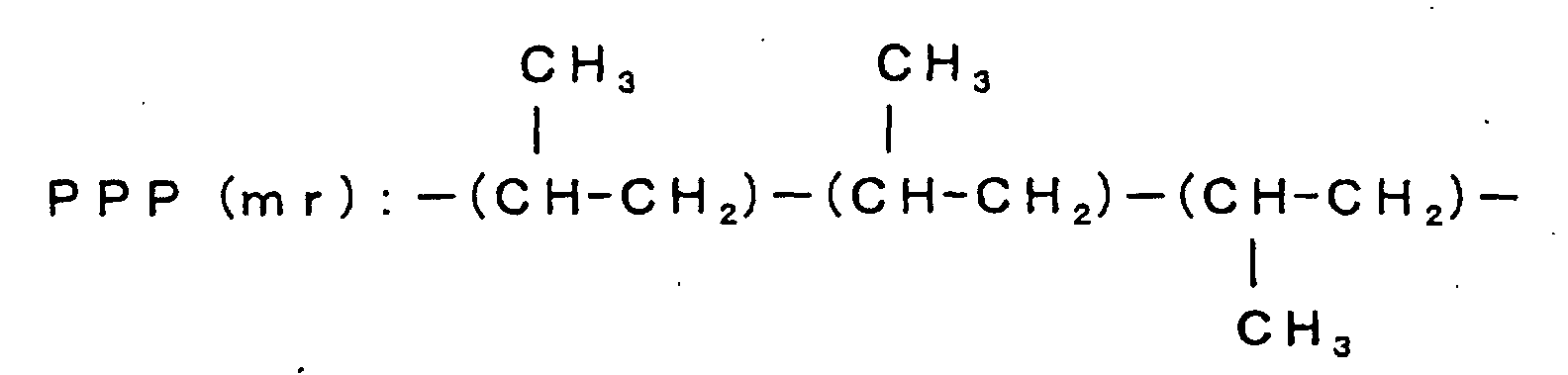

In the methyl carbon region (19 - 23 ppm),
additionally to the side chain methyl groups of the
propylene units in the above-mentioned head-to-tail
linked triad sequences, peaks of the following side chain
methyl groups of the propylene units in other sequences
are observed. To determine the rr fraction, peak areas
of the methyl groups not based on the triad sequences are
corrected in the following manner. In the following
description, P indicates a recurring unit derived from
propylene, and E indicates a recurring unit derived from
ethylene.
In the second region, a methyl group C peak, a
methyl group D peak and a methyl group D' peak are
observed, and in the third region, a methyl group E peak
and a methyl group E' peak are observed.
Of the methyl groups in the regio-irregular units
(i) to (iii), a peak of the methyl group A and a peak of
the methyl group B are observed at 17.3 ppm and 17.0 ppm,
respectively, but they are not observed in the first to
the third regions.


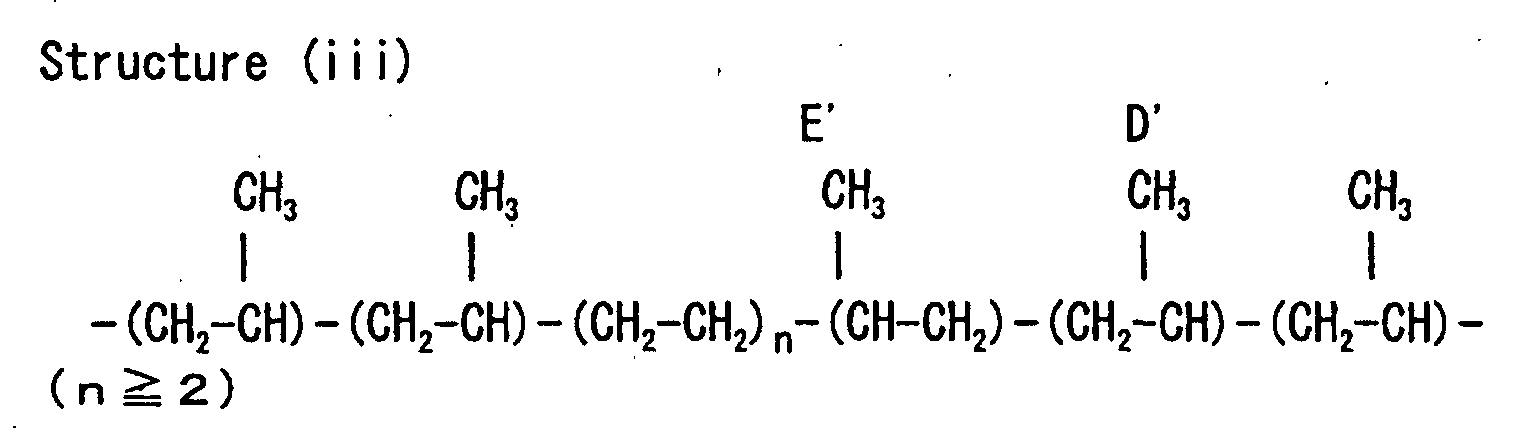
The peak area of the methyl group C can be
determined from the peak area of the adjacent methine
group (which resonates at about 31.3 ppm).
The peak area of the methyl group D can be
determined from 1/2 of the total of the areas of the
peaks based on αβ methylene carbons of the structure (ii)
(which resonate at about 34.3 ppm and about 34.5 ppm).
The peak area of the methyl group D' can be
determined from the area of the peak based on a methine
group adjacent to the methyl group E' of the structure
(iii) (which resonates at about 33.3 ppm).
The peak area of the methyl group E can be
determined from the peak area of the adjacent methine
group (which resonates at about 33.7 ppm).
The peak area of the methyl group E' can be
determined from the peak area of the adjacent methine
group (which resonates at about 33.3 ppm).
Accordingly, by subtracting these peak areas from
the total of all peak areas of the second and the third
regions, the peak area of the side chain methyl group of
the second propylene unit in the head-to-tail linked
propylene 3-unit sequence can be determined.
Each carbon peak in the spectrum can be assigned
referring to the literature (Polymer, 30, 1350 (1989)).
In the preparation of the syndiotactic propylene
polymer (A), a metallocene catalyst (1) that is used for
preparing the later-described α-olefin polymer (B) is
preferably used as a catalyst.
In the preparation of the syndiotactic propylene
polymer (A), catalyst systems described in Japanese
Patent Laid-Open Publications No. 41303/1990, No.
41305/1990. No. 274703/1990, No. 274704/1990, No.
179005/1991, No. 179006/1991, No. 69394/1992, No.
17589/1993 and No. 120127/1996 can be used instead of the
above-mentioned catalyst system.
More specifically, a catalyst system descried in the
literature "J. Am. Chem. Soc.", 1988, 110, 6255-6256, by
J.A. Ewen, et al., that is mentioned in the above section
"BACKGROUND ART", is also employable. Further, even a
catalyst system having a structure different from that of
the compound described in the above literature is also
employable, provided that use of the catalyst system
makes it possible to prepare a polymer of relatively high
tacticity having a syndiotactic triad fraction (A.
Zambelli, et. al, "Macromolecules", vol. 6, 687 (1973),
vol. 8, 925 (1975)) of the aforesaid value, for example,
about 0.5 or higher. For example, a catalyst system
comprising a crosslinked transition metal compound having
an asymmetric ligand and a co-catalyst such as
organoaluminum is available.
Examples of the crosslinked transition metal
compounds having an asymmetric ligand to constitute such
a catalyst system include compounds described in the
above literature, such as
Examples of the co-catalysts include the same
ionizing ionic compound, organoaluminum oxy-compound
(also referred to as "aluminoxane" or "alumoxane") and
organoaluminum compound as those to constitute the
metallocene catalyst (1) that is used in the preparation
of the later-described α-olefin polymer (B).
To prepare the syndiotactic propylene polymer (A)
for use in the invention in the presence of the above
catalyst, propylene and if necessary at least one olefin
selected from ethylene and α-olefins of 4 to 20 carbon
atoms are so polymerized that the resulting polymer
finally has the aforesaid properties. The polymerization
can be carried out as any of liquid phase polymerization
such as suspension polymerization or solution
polymerization and gas phase polymerization.
In the liquid phase polymerization, an inert
hydrocarbon solvent can be used as a polymerization
medium. Examples of the inert hydrocarbon solvents
include aliphatic hydrocarbons, such as propane, butane,
pentane, hexane, heptane, octane, decane, dodecane and
kerosine; alicyclic hydrocarbons, such as cyclopentane,
cyclohexane and methylcyclopentane; aromatic hydrocarbons,
such as benzene, toluene and xylene; halogenated
hydrocarbons, such as ethylene chloride, chlorobenzene
and dichloromethane; and mixtures thereof. Propylene may
be used as a solvent.
When the suspension polymerization is adopted, the
polymerization is desirably conducted at a temperature of
usually -50 to 100°C, preferably 0 to 90°C. When the
solution polymerization is adopted, the polymerization is
desirably conducted at a temperature of usually 0 to-250°C,
preferably 20 to 200°C. When the gas phase
polymerization is adopted, the polymerization is
desirably conducted at a temperature of usually 0 to
120°C, preferably 20 to 100°C. The polymerization is
carried out at a pressure of usually atmospheric pressure
to 100 kg/cm2, preferably atmospheric pressure to 50
kg/cm2.
The polymerization can be carried out by any of
batchwise, semi-continuous and continuous processes. It
is possible to conduct the polymerization in two or more
stages under different reaction conditions.
The molecular weight of the resulting syndiotactic
propylene polymer (A) can be regulated by allowing
hydrogen to be present in the polymerization system or
changing the reaction conditions such as polymerization
temperature and polymerization pressure.
The syndiotactic propylene polymer (A) can be used
singly or in combination of two or more kinds.
The α-olefin polymer (B) is a homopolymer of one α-olefin
selected from α-olefins of 2 to 20 carbon atoms or
a random copolymer of two or more α-olefins selected from
α-olefins of 2 to 20 carbon atoms. The α-olefin polymer
(B) comprises at least one kind of recurring units
derived from an α-olefin selected from α-olefins of 2 to
20 carbon atoms, and contains one kind of the recurring
units out of said one or more kinds of recurring units in
amounts of 50 to 100 % by mol, preferably 60 to 90 % by
mol, more preferably 65 to 85 % by mol.
The α-olefin polymer (B) containing the α-olefin
units in the above amounts has good compatibility with
the syndiotactic propylene polymer (A), and the resulting
soft syndiotactic polypropylene composition tends to
exhibit sufficient flexibility, heat-sealing properties
and impact resistance.
The α-olefin polymer (B) is amorphous and has a
Young's modulus of not more than 150 MPa, preferably not
more than 100 MPa, more preferably not more than 50 MPa.
For reference, the Young's modulus of the syndiotactic
propylene polymer (A) is usually not less than 300 MPa.
Examples of the α-olefin copolymers (B) include
ethylene bipolymers, such as ethylene/propylene copolymer
(the former mentioned α-olefin is the main component, as
well as hereinafter), ethylene/butene copolymer,
ethylene/pentene copolymer, ethylene/4-methyl-1-pentene
copolymer, ethylene/hexene copolymer, ethylene/heptene
copolymer, ethylene/octene copolymer, ethylene/nonene
copolymer, ethylene/decene copolymer, ethylene/norbornene
copolymer, ethylene/tetracyclododecene copolymer,
ethylene/butadiene copolymer, ethylene/isoprene copolymer,
ethylene/1,5-hexadiene copolymer, ethylene/acrylic acid
copolymer, ethylene/methacrylic acid copolymer,
ethylene/ester acrylate copolymer and ethylene/ester
methacrylate copolymer,
propylene bipolymers, such as isotactic propylene/ethylene copolymer, atactic propylene/ethylene copolymer, syndiotactic propylene/ethylene copolymer, isotactic propylene/butene copolymer, atactic propylene/butene copolymer, syndiotactic propylene/butene copolymer, isotactic propylene/pentene copolymer, atactic propylene/pentene copolymer, syndiotactic propylene/pentene copolymer, isotactic propylene/hexene copolymer, atactic propylene/hexene copolymer, syndiotactic propylene/hexene copolymer, isotactic propylene/heptene copolymer, atactic propylene/heptene copolymer, syndiotactic propylene/heptene copolymer, isotactic propylene/octene copolymer, atactic propylene/octene copolymer, syndiotactic propylene/octene copolymer, isotactic propylene/decene copolymer, atactic propylene/decene copolymer, syndiotactic propylene/decene copolymer, isotactic propylene/styrene copolymer, atactic propylene/styrene copolymer, syndiotactic propylene/styrene copolymer, isotactic propylene/norbornene copolymer, atactic propylene/norbornene copolymer, syndiotactic propylene/norbornene copolymer, isotactic propylene/tetracyclododecene copolymer, atactic propylene/tetracyclododecene copolymer, syndiotactic propylene/tetracyclododecene copolymer, isotactic propylene/butadiene copolymer, atactic propylene/butadiene copolymer, syndiotactic propylene/butadiene copolymer, isotactic propylene/isoprene copolymer, atactic propylene/isoprene copolymer, syndiotactic propylene/isoprene copolymer, isotactic propylene/1,5-hexadiene copolymer, atactic propylene/1,5-hexadiene copolymer and syndiotactic propylene/1,5-hexadiene copolymer,
ethylene terpolymers, such as ethylene/propylene/norbornene copolymer, ethylene/butene/norbornene copolymer, ethylene/octene/norbornene copolymer, ethylene/propylene/tetracyclododecene copolymer, ethylene/butene/tetracyclododecene copolymer, ethylene/octene/tetracyclododecene copolymer, ethylene/propylene/butadiene copolymer, ethylene/butene/butadiene copolymer, ethylene/octene/butadiene copolymer, ethylene/propylene/isoprene copolymer, ethylene/butene/isoprene copolymer, ethylene/octene/isoprene copolymer, ethylene/propylene/ethylidenenorbornene copolymer, ethylene/butene/ethylidenenorbornene copolymer and ethylene/octene/ethylidenenorbornene copolymer, and
propylene terpolymers, such as isotactic propylene/butene/ethylene copolymer, atactic propylene/butene/ethylene copolymer, syndiotactic propylene/butene/ethylene copolymer, isotactic propylene/octene/ethylene copolymer, atactic propylene/octene/ethylene copolymer, syndiotactic propylene/octene/ethylene copolymer, isotactic propylene/octene/ethylene copolymer, atactic propylene/octene/ethylene copolymer, syndiotactic propylene/octene/ethylene copolymer, isotactic propylene/norbornene/ethylene copolymer, atactic propylene/norbornene/ethylene copolymer, syndiotactic propylene/norbornene/ethylene copolymer, isotactic propylene/tetracyclododecene/ethylene copolymer, atactic propylene/tetracyclododecene/ethylene copolymer, syndiotactic propylene/tetracyclododecene/ethylene copolymer, isotactic propylene/butadiene/ethylene copolymer, atactic propylene/butadiene/ethylene copolymer, syndiotactic propylene/butadiene/ethylene copolymer, isotactic propylene/isoprene/ethylene copolymer, atactic propylene/isoprene/ethylene copolymer and syndiotactic propylene/isoprene/ethylene copolymer.
propylene bipolymers, such as isotactic propylene/ethylene copolymer, atactic propylene/ethylene copolymer, syndiotactic propylene/ethylene copolymer, isotactic propylene/butene copolymer, atactic propylene/butene copolymer, syndiotactic propylene/butene copolymer, isotactic propylene/pentene copolymer, atactic propylene/pentene copolymer, syndiotactic propylene/pentene copolymer, isotactic propylene/hexene copolymer, atactic propylene/hexene copolymer, syndiotactic propylene/hexene copolymer, isotactic propylene/heptene copolymer, atactic propylene/heptene copolymer, syndiotactic propylene/heptene copolymer, isotactic propylene/octene copolymer, atactic propylene/octene copolymer, syndiotactic propylene/octene copolymer, isotactic propylene/decene copolymer, atactic propylene/decene copolymer, syndiotactic propylene/decene copolymer, isotactic propylene/styrene copolymer, atactic propylene/styrene copolymer, syndiotactic propylene/styrene copolymer, isotactic propylene/norbornene copolymer, atactic propylene/norbornene copolymer, syndiotactic propylene/norbornene copolymer, isotactic propylene/tetracyclododecene copolymer, atactic propylene/tetracyclododecene copolymer, syndiotactic propylene/tetracyclododecene copolymer, isotactic propylene/butadiene copolymer, atactic propylene/butadiene copolymer, syndiotactic propylene/butadiene copolymer, isotactic propylene/isoprene copolymer, atactic propylene/isoprene copolymer, syndiotactic propylene/isoprene copolymer, isotactic propylene/1,5-hexadiene copolymer, atactic propylene/1,5-hexadiene copolymer and syndiotactic propylene/1,5-hexadiene copolymer,
ethylene terpolymers, such as ethylene/propylene/norbornene copolymer, ethylene/butene/norbornene copolymer, ethylene/octene/norbornene copolymer, ethylene/propylene/tetracyclododecene copolymer, ethylene/butene/tetracyclododecene copolymer, ethylene/octene/tetracyclododecene copolymer, ethylene/propylene/butadiene copolymer, ethylene/butene/butadiene copolymer, ethylene/octene/butadiene copolymer, ethylene/propylene/isoprene copolymer, ethylene/butene/isoprene copolymer, ethylene/octene/isoprene copolymer, ethylene/propylene/ethylidenenorbornene copolymer, ethylene/butene/ethylidenenorbornene copolymer and ethylene/octene/ethylidenenorbornene copolymer, and
propylene terpolymers, such as isotactic propylene/butene/ethylene copolymer, atactic propylene/butene/ethylene copolymer, syndiotactic propylene/butene/ethylene copolymer, isotactic propylene/octene/ethylene copolymer, atactic propylene/octene/ethylene copolymer, syndiotactic propylene/octene/ethylene copolymer, isotactic propylene/octene/ethylene copolymer, atactic propylene/octene/ethylene copolymer, syndiotactic propylene/octene/ethylene copolymer, isotactic propylene/norbornene/ethylene copolymer, atactic propylene/norbornene/ethylene copolymer, syndiotactic propylene/norbornene/ethylene copolymer, isotactic propylene/tetracyclododecene/ethylene copolymer, atactic propylene/tetracyclododecene/ethylene copolymer, syndiotactic propylene/tetracyclododecene/ethylene copolymer, isotactic propylene/butadiene/ethylene copolymer, atactic propylene/butadiene/ethylene copolymer, syndiotactic propylene/butadiene/ethylene copolymer, isotactic propylene/isoprene/ethylene copolymer, atactic propylene/isoprene/ethylene copolymer and syndiotactic propylene/isoprene/ethylene copolymer.
The α-olefin polymer (B) desirably has an intrinsic
viscosity (η), as measured in decalin at 135°C, of
usually 0.01 to 10 dl/g, preferably 0.5 to 10 dl/g, more
preferably 1 to 8 dl/g. When the intrinsic viscosity (η)
of the α-olefin polymer (B) is in the above range, the
resulting soft syndiotactic polypropylene composition is
excellent in properties such as weathering resistance,
ozone resistance, heat aging resistance, low-temperature
properties and dynamic fatigue resistance.
The α-olefin polymer (B) desirably has a single
glass transition temperature, and the glass transition
temperature (Tg) as measured by a differential scanning
calorimeter (DSC) is desired to be usually not higher
than -5°C, preferably -80 to -5°C, more preferably -80 to
-10°C, still more preferably -80 to -20°C. When the
glass transition temperature (Tg) of the α-olefin polymer
(B) is in the above range, the cold temperature
resistance and the low-temperature properties become
excellent.
The molecular weight distribution (Mw/Mn, in terms
of polystyrene, Mw: weight-average molecular weight, Mn:
number-average molecular weight) of the polymer (B), as
measured by gel permeation chromatography (GPC), is
preferably not more than 4.0, more preferably not more
than 3.5.
The α-olefin copolymer (B) can be used singly or in
combination of two or more kinds. When two kinds of the
α-olefin copolymers (B) are used, their compatibility
with the syndiotactic propylene polymer (A) becomes good,
and the resulting syndiotactic polypropylene composition
tends to exhibit sufficient flexibility, heat-sealing
properties and impact resistance.
If two or more kinds of the α-olefin copolymers (B)
are used and if their main components are the same,. the
copolymers are desired to be different in their
regularity. Examples of combinations of the copolymers
include a combination of an isotactic propylene/ethylene
copolymer and an atactic propylene/ethylene copolymer, a
combination of an isotactic propylene/ethylene copolymer
and a syndiotactic propylene/ethylene copolymer, a
combination of an atactic propylene/ethylene copolymer
and a syndiotactic propylene/ethylene copolymer, a
combination of an isotactic propylene/butene copolymer
and an atactic propylene/butene copolymer, a combination
of an isotactic propylene/butene copolymer and a
syndiotactic propylene/butene copolymer, and a
combination of an atactic propylene/butene copolymer and
a syndiotactic propylene/butene copolymer.
The α-olefin copolymer (B) is obtained, for example,
by (co)polymerizing at least one kind α-olefin selected
from α-olefins of 2 to 20 carbon atoms in the presence of
the below mentioned metallocene catalyst (1).
As the metallocene catalyst, employable is at least
one catalyst system comprising
First, the transition metal compound represented by
the general formula (I) which form the metallocene
catalyst (1) is explained below.
In the present invention, a transition metal
compound used as the transition metal compound (a1) is
represented by the following general formula (I).
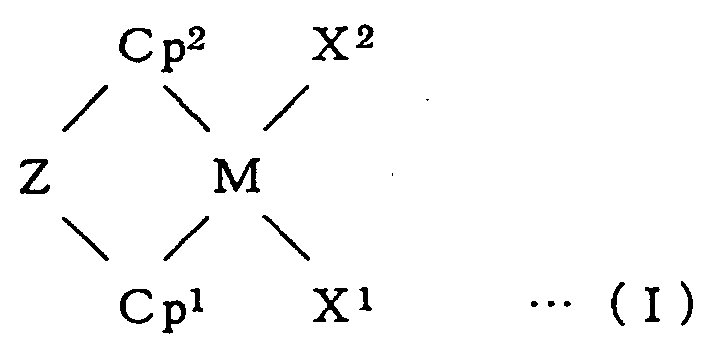
In the formula, M is Ti, Zr, Hf, Rn, Nd, Sm or Ru,
preferably Ti, Zr or Hf.
Cp1 and Cp2 are each a cyclopentadienyl group, an
indenyl group, a fluorenyl group or a derivative group
thereof which is π-bonded with M, and in a detailed
explanation, Cp1 and Cp2 are each a ligand coordinating
with a transition metal and a ligand having a
cyclopentadienyl skeleton, such as a cyclopentadienyl
group, an indenyl group, a 4,5,6,7-tetrahydroindenyl
group, or a fluorenyl group, provided that the ligand
having a cyclopentadienyl skeleton may have a substituent
such as an alkyl group, a cycloalkyl group, a
trialkylsilyl group, a halogen atom and the like.
X1 and X2 are each an. anionic ligand or a neutral
Lewis base ligand. Examples include a hydrocarbon group
of 1 to 12 carbon atoms, an alkoxy group, an aryloxy
group, a sulfonic acid-containing group (-SO3Ra, wherein
Ra is an alkyl group, an alkyl group substituted by a
halogen atom, an aryl group, an aryl group substituted by
a halogen atom or an aryl group substituted by an alkyl
group.), a halogen atom, a hydrogen atom and the like.
Z is a C, O, B, S, Ge, Si or Sn atom, or a group
containing these atoms, such as a divalent hydrocarbon
group of 1 to 20 carbon atoms, a divalent, halogenated
hydrocarbon group of 1 to 20 carbon atoms, a divalent
silicon-containing group, a divalent germanium-containing
group, a divalent tin-containing group, -CO-, -SO-, -SO2-
and -BR5-, wherein R5 is a hydrogen atom, a halogen atom,
a hydrocarbon group of 1 to 20 carbon atoms or a
halogenated hydrocarbon group of 1 to 20 carbon atoms.
Further, groups represented by Z may form a ring. Of
these, Z is preferably a group containing O, Si or C.
Examples of the transition metal compound
represented by the general formula (I) include
diphenylmethylene(cyclopentadienyl)(fluorenyl)hafnium
dichloride,
diphenylmethylene(cyclopentadienyl)(fluorenyl)zirconium
dichloride,
isopropyl(cyclopentadienyl-1-fluorenyl)hafnium dichloride,
isopropyl(cyclopentadienyl-1-fluorenyl)zirconium
dichloride,
diphenylmethylene(cyclopentadienyl)fluorenylzirconium
dichloride,
rac-dimethylsilylene-bis(1-(2,7-dimethyl-4-ethylindenyl))zirconium
dichloride,
rac-dimethylsilylene-bis(1-(2,7-dimethyl-4-n-propylindenyl))zirconium
dichloride,
rac-dimethylsilylene-bis(1-(2,7-dimethyl-4-i-propylindenyl))zirconium
dichloride,
rac-dimethylsilylene-bis(1-(2,7-dimethyl-4-n-butylindenyl))zirconium
dichloride,
rac-dimethylsilylene-bis(1-(2,7-dimethyl-4-sec-butylindenyl))zirconium
dichloride,
rac-dimethylsilylene-bis(1-(2,7-dimethyl-4-t-butylindenyl))zirconium
dichloride,
rac-dimethylsilylene-bis(1-(2,7-dimethyl-4-n-pentylindenyl))zirconium
dichloride,
rac-dimethylsilylene-bis(1-(2,7-dimethyl-4-n-hexylindenyl))zirconium
dichloride,
rac-dimethylsilylene-bis(1-(2,7-dimethyl-4-cyclohexylindenyl))zirconium
dichloride,
rac-dimethylsilylene-bis(1-(2,7-dimethyl-4-methylcyclohexylindenyl))zirconium
dichloride,
rac-dimethylsilylene-bis(1-(2,7-dimethyl-4-phenylethylindenyl))zirconium
dichloride,
rac-dimethylsilylene-bis(1-(2,7-dimethyl-4-phenyldichloromethylindenyl))zirconium
dichloride,
rac-dimethylsilylene-bis(1-(2,7-dimethyl-4-chloromethylindenyl))zirconium
dichloride,
rac-dimethylsilylene-bis(1-(2,7-dimethyl-4-trimethylsilylenemethylindenyl))zirconium
dichloride,
rac-dimethylsilylene-bis(1-(2,7-dimethyl-4-trimethylsiloxymethylindenyl))zirconium
dichloride,
rac-diethylsilylene-bis(1-(2,7-dimethyl-4-i-propylindenyl))zirconium
dichloride,
rac-di(i-propyl)silylenebis(1-(2,7-dimethyl-4-i-propylindenyl))zirconium
dichloride,
rac-di(n-butyl)silylene-bis(1-(2,7-dimethyl-4-i-propylindenyl))zirconium
dichloride,
rac-di(cyclohexyl)silylenebis(1-(2,7-dimethyl-4-i-propylindenyl))zirconium
dichloride,
rac-methylphenylsilylenebis(1-(2,7-dimethyl-4-i-propylindenyl))zirconium
dichloride,
rac-methylphenylsilylenebis(1-(2,7-dimethyl-4-t-butylindenyl))zirconium
dichloride,
rac-diphenylsilylenebis(1-(2,7-dimethyl-4-t-butylindenyl))zirconium
dichloride,
rac-diphenylsilylenebis(1-(2,7-dimethyl-4-i-propylindenyl))zirconium
dichloride,
rac-diphenylsilylenebis(1-(2,7-dimethyl-4-ethylindenyl))zirconium
dichloride,
rac-di(p-tolyl)silylenebis(1-(2,7-dimethyl-4-i-propylindenyl))zirconium
dichloride,
rac-di(p-chlorophenyl)silylenebis(1-(2,7-dimethyl-4-i-propylindenyl))zirconium
dichloride,
rac-dimethylsilylenebis(1-(2-methyl-4-i-propyl-7-ethylindenyl))zirconium
dibromide,
rac-dimethylsilylene-bis(1-(2,7-dimethyl-4-i-propyl-1-indenyl))zirconium
dimethyl,
rac-dimethylsilylene-bis(1-(2,7-dimethyl-4-i-propyl-1-indenyl))zirconium
methylchloride,
rac-dimethylsilylene-bis(1-(2,7-dimethyl-4-i-propyl-1-indenyl))zirconium-bis(1-(trifluoromethanesulfonato)),
rac-dimethylsilylene-bis(1-(2,7-dimethyl-4-i-propyl-1-indenyl))zirconium-bis(1-(p-phenylsulfinato)),
rac-dimethylsilylene-bis(1-(2-phenyl-4-i-propyl-7-methyl-1-indenyl))zirconium
dichloride,
(cyclopentadienyl)(fluorenyl)hafnium dichloride,
(cyclopentadienyl)(fluorenyl)zirconium dichloride,
bis(1-(2,7-dimethyl-4-ethylindenyl)zirconium dichloride,
bis(cyclopentadienyl)hafnium dichloride,
bis(cyclopentadienyl)zirconium dichloride,
bisindenylhafnium dichloride,
bisindenylzirconium dichloride,
bis(1-(2,7-dimethyl-4-n-propylindenyl))zirconium
dichloride,
bis(1-(2,7-dimethyl-4-i-propylindenyl))zirconium
dichloride,
bis(1-(2,7-dimethyl-4-n-butylindenyl))zirconium
dichloride,
bis(1-(2,7-dimethyl-4-sec-butylindenyl))zirconium
dichloride,
bis(1-(2,7-dimethyl-4-t-butylindenyl))zirconium
dichloride,
bis(1-(2,7-dimethyl-4-n-pentylindenyl))zirconium
dichloride,
bis(1-(2,7-dimethyl-4-n-hexylindenyl))zirconium
dichloride,
bis(1-(2,7-dimethyl-4-cyclohexylindenyl))zirconium
dichloride,
bis(1-(2,7-dimethyl-4-methylcyclohexylindenyl))zirconium
dichloride,
bis (1- (2, 7-dimethyl-4-phenylethylindenyl))zirconium
dichloride,
bis(1-(2,7-dimethyl-4-phenyldichloromethylindenyl))zirconium
dichloride,
bis(1-(2,7-dimethyl-4-chloromethylindenyl))zirconium
dichloride,
bis(1-(2,7-dimethyl-4-trimethylsilylenemethylindenyl))zirconium
dichloride,
bis(1-(2,7-dimethyl-4-trimethylsiloxymethylindenyl))zirconium
dichloride,
bis(1-(2,7-dimethyl-4-ethylindenyl))zirconium dichloride,
bis(1-(2-methyl-4-i-propyl-7-ethylindenyl))zirconium
dibromide,
bis(1-(2,7-dimethyl-4-i-propyl-1-indenyl))zirconium
dimethyl,
bis(1-(2,7-dimethyl-4-i-propyl-1-indenyl))zirconium
methylchloride,
bis(1-(2,7-dimethyl-4-i-propyl-1-indenyl))zirconium-bis(1-(trifluoromethanesulfonato)),
bis(1-(2,7-dimethyl-4-i-propyl-1-indenyl))zirconium-bis(1-(p-phenylsulfinato))
and
bis(1-(2-phenyl-4-i-propyl-7-methyl-1-indenyl))zirconium
dichloride.
Further, there can be mentioned transition metal
compounds wherein a zirconium metal of the above-mentioned
compounds is substituted by a titanium metal or
a hafnium metal.
In the present invention, a transition metal
compound used as the transition metal compound (a1) is
represented by the following general formula (II).

In the formula (II), M is a transition metal of
Group 4 of the periodic table or a lanthanide type,
specifically Ti, Zr, Hf, Rn, Nd, Sm or Ru, preferably Ti,
Zr or Hf.
Cp1 is a cyclopentadienyl group, an indenyl group,
a fluorenyl group or a derivative group thereof which is
π-bonded with M, and in a detailed explanation, Cp1 is a
ligand coordinating with a transition metal and a ligand
having a cyclopentadienyl skeleton, such as a
cyclopentadienyl group, an indenyl group, a fluorenyl
group or a derivative group thereof, provided that the
ligand having a cyclopentadienyl skeleton may have a
substituent such as an alkyl group, a cycloalkyl group, a
trialkylsilyl group, a halogen atom and the like.
X1 and X2 are each an anionic ligand or a neutral
Lewis base ligand, may be the same or different, and are
each a hydrogen atom or halogen atom, or a hydrocarbon
group of 20 or less carbon atoms, a silyl group of 20 or
less silicon atoms or a germill group of 20 or less
germanium atoms.
Z is carbon, oxygen, sulfur, boron or an atom of
the Group 14 of the periodic table, such as silicon,
germanium and tin, preferably carbon, oxygen, or silicon.
Z may contain a substituent, such as an alkyl group and
an alkoxy group, and these substituents may bond each
other to form a ring. Further, Z and Y may bond each
other to form a fuzed ring.
Examples of the transition metal compound
represented by the general formula (II) include
(t-butylamide)dimethyl(fluorenyl)silanetitane dimethyl,
(t-butylamide)dimethyl(fluorenyl)silanetitane dichloride,
(t-butylamide)dimethyl(fluorenyl)silanezirconium dimethyl,
(t-butylamide)dimethyl(fluorenyl)silanezirconium
dichloride,
dimethyl(t-butylamide)(tetramethyl-η 5yclopentadienyl)silylene)titane
dichloride,
((t-butylamide)(tetramethyl-η 5cyclopentadienyl)-1,2-ethanediyl)titane
dichloride,
(dimethyl(phenylamide)(tetramethyl-η 5cyclopentadienyl)silylene)titane
dichloride,
(dimethyl(t-butylamide)(tetramethyl-η 5cyclopentadienyl)silylene)titane
dimethyl,
(dimethyl(4-methylphenylamide)(tetramethyl-η5cyclopentadienyl)silylene)titane
dichloride,
(dimethyl(t-butylamide)(η 5cyclopentadienyl)
silylene)titane dichloride,
(tetramethyl(t-butylamide)(tetramethyl-η 5cyclopentadienyl)disilylene)titane
dichloride and
(t-butylamide)dimethyl(fluorenyl)silanetitane dimethyl.
The transition metal compounds can be used singly or
in combination of two or more kinds.
The above mentioned transition metal compounds (al)
can be supported on a particle carrier.
Examples of the particulate carrier include
inorganic carriers such as SiO2, Al2O3, B2O3, MgO, ZrO2,
CaO, TiO2, ZnO, SnO2, BaO, ThO and organic carriers such
as polyethylene, polypropylene, poly-1-butene, poly-4-methyl-1-pentene,
styrene-divinylbenzene copolymer. The
particulate carrier can be used singly or in combination
of two or more kinds.
Next, the component (b) forming the metallocene
catalyst (1), that is a ionizing ionic compound (b-1), an
organoaluminum-oxy compound (b-2) and a organoaluminium
compound (b-3), is explained.
The ionizing ionic compound (b-1) is a compound
which reacts with the transition metal M in the
transition metal compound (a1) to form an ion complex.
Examples of such compounds includes Lewis acids, an
ionic compounds, borane compounds and carborane compounds
described in Japanese Patent Laid-Open Publications No.
501950/1989, No. 502036/1989, No. 179005/1991, No.
179006/1991, No. 207703/1991 and No. 207704/1991, and U.S.
Patent No. 5,321,106.
The Lewis acids are, for example, compounds
represented by BR3 (R is a fluorine atom or a phenyl
group which may have a substituent such as a fluorine
atom, a methyl group or a trifluoromethyl group).
Examples of such compounds include trifluoroboron,
triphenylboron, tris(4-fluorophenyl)boron, tris(3,5-difluorophenyl)boron,
tris(4-fluoromethylphenyl)boron,
tris(pentafluorophenyl)boron, tris(p-tolyl)boron, tris(o-tolyl)boron,
tris(3,5-dimethylphenyl)boron, MgCl2, Al2O3
and SiO2-Al2O3.
Employable as the ionic compound is trialkyl-substituted
ammonium salt, N,N-dialkylanilinium salt,
dialkylammonium salt or triarylphosphonium salt.
Examples of the trialkyl-substituted ammonium salts
include triethylammoniumtetra(phenyl)boron,
tripropylammoniumtetra(phenyl)boron and
tri(n-butyl)ammoniumtetra(phenyl)boron.
Examples of the dialkylammonium salts include
di(1-propyl)ammoniumtetra(pentafluorophenyl)boron and
dicyclohexylammoniumtetra(phenyl)boron.
Further employable as the ionic compounds are
triphenylcarbeniumtetrakis(pentafluorophenyl)borate,
tri(n-butyl)ammoniumtetrakis(pentafluorophenyl)borate,
N,N-dimethylaniliniumtetrakis(pentafluorophenyl)borate,
and ferroceniumtetra(pentafluorophenyl)borate.
Examples of the borane compounds include salts of
metallic borane anions, such as decaborane(14),
bis[tri(n-butyl)ammonium]nonaborate,
bis(tri(n-butyl)ammonium]decaborate, and
bis[tri(n-butyl)ammonium]bis-(dodecahydridododecaborate)nickelate(III).
Examples of the carborane compounds include salts of
metallic carborane anions, such as 4-carbanonaborane(14),
1,3-dicarbanonaborane(13),
bis[tri(n-butyl)ammonium]bis(undecahydrido-7-carbaundecaborate)nickelate(IV),
dodecaborane,
1-carbaundecaborane,
bis(n-butyl)ammounium(1-carbedodeca)borate,
tri(n-butyl)ammonium(7,8-dicarbaundeca)borate, and
tri(n-butyl)ammonium(tridecahydrido-7-carbaundeca)borate.
The above mentioned ionizing ionic compounds (b-1)
can be used singly or in combination of two or more kinds.
The ionizing ionic compound (b-1) can be supported
on the above particulate carrier.
The organoaluminum oxy-compound (b-2) may be
aluminoxane hitherto known or such a benzene-insoluble
organoaluminum oxy-compound as exemplified in Japanese
Patent Laid-Open Publication No. 78687/1990.
The hitherto known aluminoxane (alumoxane) is
represented by the following formula:
 wherein R is a hydrocarbon group, such as methyl, ethyl,
propyl or butyl, preferably methyl or ethyl, particularly
preferably methyl; and m is an integer of 5 or more,
preferably an integer of 5 to 40, particularly preferably
an integer of 10 to 40.
wherein R is a hydrocarbon group, such as methyl, ethyl,
propyl or butyl, preferably methyl or ethyl, particularly
preferably methyl; and m is an integer of 5 or more,
preferably an integer of 5 to 40, particularly preferably
an integer of 10 to 40.
The aluminoxane may be composed of mixed
alkyloxyaluminum units consisting of alkyloxyaluminum
units represented by the formula OAl(R1) and
alkyloxyaluminum units represented by the formula OAl(R2)
(each of R1 and R2 is the same hydrocarbon group as
indicated by R, and R1 and R2 are groups different from
each other).
The hitherto known aluminoxane can be prepared by,
for example, the following processes.
The aluminoxane may contain a small amount of an
organometallic component. Further, it is possible that
the solvent or the unreacted organoaluminum compound is
distilled off from the recovered solution of aluminoxane
and then the remainder is dissolved in a solvent or
suspended in a poor solvent for aluminoxane.
Examples of the organoaluminum compounds used for
preparing the aluminoxane include the same compounds as
described later with respect to the organoaluminum
compound (b-3).
The organoaluminum compounds are used singly or in
combination of two or more kinds.
Examples of the solvents used for preparing the
aluminoxane include aromatic hydrocarbons, such as
benzene, toluene, xylene, cumene and cymene; aliphatic
hydrocarbons, such as pentane, hexane, heptane, octane,
decane, dodecane, hexadecane and octadecane; alicyclic
hydrocarbons, such as cyclopentane, cyclohexane,
cyclooctane and methylcyclopentane; petroleum fractions,
such as gasoline, kerosine and gas oil; and halogenated
products of these aromatic, aliphatic and alicyclic
hydrocarbons (e.g., chlorinated or brominated products
thereof). Also employable are ethers such as ethyl ether
and tetrahydrofuran. Of the solvents, particularly
preferable are aromatic hydrocarbons and aliphatic
hydrocarbons.
The organoaluminum oxy-compounds mentioned above can
be used singly or in combination of two or more kinds.
The organoaluminum oxy-compound (b-2) may be used in
the supported form on the aforesaid particulate carrier.
As the organoalminum compound (b-3), a compound
containing one or more A1-carbon bond(s) in a molecular
can be employable. Examples of the compound include an
organoaluminum compound represented by the following
general formula (III),
R9 nAlX3-n
wherein R9 is a hydrocarbon group of 1 to 12 carbon atoms,
X is a halogen atom or a hydrogen atom, and n is an
integer of 1 to 3.)
In the formula (III), R9 is a hydrocarbon group of 1
to 12 carbon atoms such as an alkyl group, a cycloalkyl
group or an aryl group. Concrete examples of R9 include a
methyl group, an ethyl group, a n-propyl group, an
isopropyl group, an isobutyl group, a pentyl group, a
hexyl group, an octyl group, a cyclopentyl group, a
cyclohexyl group, a phenyl group, and a tolyl group.
Examples of the organoaluminum compound include the
following compounds; trialkylaluminums such as
trimethylaluminum, triethylaluminum, triisopropylaluminum,
triisobutylaluminum, trioctylaluminum, tri(2-ethylhexyl)aluminum
and tridecylaluminum;
Further examples of the organoaluminum compound (b-3)
may include a compound represented by the following
formula (IV),
R9 nAlL3-n
wherein R9 has the same meanings as those of the above; L
is -OR10 group, -OSiR11 3 group, -OAlR12 2 group, -NR13 2 group,
-SiR14 3 group or -N(R15)AlR16 2 group; n is an integer of 1
or 2; R10, R11, R12 and R16 are each a methyl group, an
ethyl group, an isopropyl group, an isobutyl group, a
cyclohexyl group and a phenyl group; R13 is a hydrogen
atom, a methyl group, an ethyl group, an isopropyl group,
a phenyl group or a trimethylsilyl group; and R14 and R15
are each a methyl group and an ethyl group.
Of the organoaluminum compounds, preferable is a
compound represented by the formula R9 nAl(OAlR10 2)3-n such
as Et2AlOAlEt2 and (iso-Bu)2AlOAl(iso-Bu)2.
Of the organoaluminum compounds represented by the
above formulas (III) and (IV), preferable is a compound
represented by the formula R9 3Al, particularly preferable
is a compound wherein R9 is an isoalkyl group.
In the present invention, the metallocene catalyst
(1) is preferably used as a catalyst for preparing the α-olefin
polymer (B), but besides the metallocene catalyst
(1), there can be also used:
In the present invention, at least one α-olefin
selected from α-olefins of 2 to 20 carbon atoms is
copolymerized in the presence of the metallocene catalyst
(1) usually in a liquid phase. In the copolymerization,
an inert hydrocarbon solvent is generally used, but
propylene may be used as a solvent. The copolymerization
can be carried out by any of batchwise and continuous
processes.
Examples of the inert hydrocarbon solvents for
preparing the α-olefin polymer (B) include the same inert
hydrocarbon solvents as used for preparing the
syndiotactic propylene polymer (A).
When the copolymerization is carried out by a
batchwise process using the metallocene catalyst (1), the
transition metal compound (a1) is used in the
polymerization system in an amount of usually 0.00005 to
1 mmol, preferably 0.0001 to 0.5 mmol, based on 1 liter
of the polymerization volume.
The ionizing ionic compound (b-1) is used in such an
amount that the molar ratio ((b-1)/(a1)) of the ionizing
ionic compound to the transition metal compound (a1)
becomes 0.5 to 20, preferably 1 to 10.
The organoaluminum oxy-compound (b-2) is used in
such an amount that the molar ratio (Al/M) of the
aluminum atom (Al) to the transition metal atom (M) in
the transition metal compound (a1) becomes 1 to 10000,
preferably 10 to 5000.
The organoaluminum compound (b-3) is used in an
amount of usually about 0 to 5 mmol, preferably about 0
to 2 mmol, based on 1 liter of the polymerization volume.
The copolymerization reaction is carried out under
the conditions of a temperature of usually -20 to 150°C,
preferably 0 to 120°C, more preferably 0 to 100°C, and a
pressure of more than 0 kg/cm2 and not more than 80
kg/cm2, preferably more than 0 kg/cm2 and not more than
50 kg/cm2.
The reaction time (average residence time in case of
continuous polymerization) is in the range of usually 5
minutes to 3 hours, preferably 10 minutes to 1.5 hours,
though it varies depending upon the conditions such as
catalyst concentration and polymerization temperature.
At least one olefin selected from α-olefins of 2 to
20 carbon atoms is fed to the polymerization system in
such an amount that the α-olefin polymer (B) having the
aforesaid specific composition can be obtained. In the
copolymerization, a molecular weight modifier such as
hydrogen may be used.
When at least one α-olefin selected from α-olefins
of 2 to 20 carbon atoms is polymerized, the α-olefin
polymer (B) is obtained usually as a polymer solution
containing it. The polymer solution is then treated in a
conventional way to obtain the α-olefin polymer (B).
The crystal nucleating agent (C) optionally used in
the invention can be various kinds of conventionally
known crystal nucleating agents and is not limited to
specific one. Preferable examples of nucleating agents
are represented by the following formulas.

In the above formula, R1 is an oxygen atom, a sulfur
atom or a hydrocarbon group of 1 to 10 carbon atoms; R2
and R3 are each a hydrogen atom or hydrocarbon group of 1
to 10 carbon atoms and may be the same or different, and
R2s, R3s or R2 and R3 may be bonded to each other to form
a ring; M is a metal atom having a valency of 1 to 3; and
n is an integer of 1 to 3.
Concrete examples of the above nucleating agents
include
sodium-2,2'-methylene-bis(4,6-di-t-butylphenyl)phosphate,
sodium-2,2'-ethylidene-bis(4,6-di-t-butylphenyl)phosphate,
lithium-2,2'-methylene-bis(4,6-di-t-butylphenyl)phosphate,
lithium-2,2'-ethylidene-bis(4,6-di-t-butylphenyl)phosphate,
sodium-2,2'-ethylidene-bis(4-i-propyl-6-t-butylphenyl)phosphate,
lithium-2,2'-methylene-bis(4-methyl-6-t-butylphenyl)phosphate,
lithium-2,2'-methylene-bis(4-ethyl-6-t-butylphenyl)phosphate,
calcium-bis(2,2'-thiobis(4-methyl-6-t-butylphenyl)phosphate),
calcium-bis(2,2'-thiobis(4-ethyl-6-t-butylphenyl)phosphate),
calcium-bis(2,2'-thiobis(4,6-di-t-butylphenyl)phosphate),
magnecium-bis(2,2'-thiobis(4,6-di-t-butylphenyl)phosphate),
magnecium-bis(2,2'-thiobis(4-t-octylphenyl)phosphate),
sodium-2,2'-butylidene-bis(4,6-di-methylphenyl)phosphate,
sodium-2,2'-butylidene-bis(4,6-di-t-buthylphenyl)phosphate,
sodium-2,2'-t-octylmethylene-bis(4,6-dimethylphenyl)phosphate,
sodium-2,2'-t-octylmethylene-bis(4,6-di-t-butylphenyl)phosphate,
calcium-bis(2,2'-methylene-bis(4,6-di-t-butylphenyl)phosphate),
magnecium-bis(2,2'-methylene-bis(4,6-di-t-butylphenyl)phosphate),
barium-bis(2,2'-methylene-bis(4,6-di-t-butylphenyl)phosphate),
sodium-2,2'-methylene-bis(4-methyl-6-t-butylphenyl)phosphate,
sodium-2,2'-methylene-bis(4-ethyl-6-t-butylphenyl)phosphate,
sodium-(4,4'-dimethyl-5,6'-di-t-butyl-2,2'-biphenylyl)phosphate,
calcium-bis-((4,4'-dimethyl-6,6'-di-t-butyl-2,2'-biphenylyl)phosphate),
sodium-2,2'-ethylidene-bis(4-m-butyl-6-t-butylphenyl)phosphate,
sodium-2,2'-methylene-bis(4,6-di-methylphenyl)phosphate,
sodium-2,2'-methylene-bis(4,6-di-ethylphenyl)phosphate,
potassium-2,2'-ethylidene-bis(4,6-di-t-butylphenyl)phosphate,
calcium-bis(2,2'-ethylidene-bis(4,6-di-t-butylphenyl)phosphate),
magnecium-bis(2,2'-ethylidene-bis(4,6-di-t-butylphenyl)phosphate),
barium-bis(2,2'-ethylidene-bis(4,6-di-t-butylphenyl)phosphate),
aluminium-tris(2,2'-methylene-bis(4,6-di-t-butylphenyl)phosphate)
and
aluminium-tris(2,2'-ethylidene-bis(4,6-di-t-butylphenyl)phosphate),
and mixtures of two or more
thereof.

In the above formula, R4 is a hydrogen atom or
hydrocarbon group of 1 to 10 carbon atoms; M is a metal
atom having a valency of 1 to 3; and n is an integer of 1
to 3.
Concrete examples of the above nucleating agents
include
sodium-bis(4-t-butylphenyl)phosphate,
sodium-bis(4-methylphenyl)phosphate,
sodium-bis(4-ethylphenyl)phosphate,
sodium-bis(4-i-propylphenyl)phosphate,
sodium-bis(4-t-octylphenyl)phosphate,
potassium-bis(4-t-butylphenyl)phosphate,
calcium-bis(4-t-butylphenyl)phosphate,
magnecium-bis(4-t-butylphenyl)phosphate,
lithium-bis(4-t-butylphenyl)phosphate,
aluminum-bis(4-t-butylphenyl)phosphate, and
mixtures of two or more thereof.
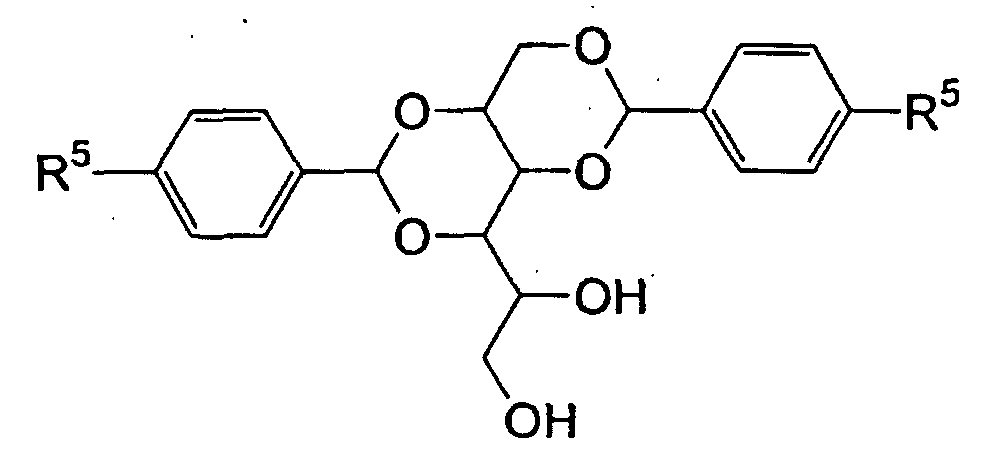
In the above formula, R5 is a hydrogen atom or
hydrocarbon group of 1 to 10 carbon atoms.
Concrete examples of the above nucleating agents
include
- 1,3,2,4-di(p-methylbenzylidene)sorbitol,
- 1,3,2,4-di(p-ethylbenzylidene)sorbitol,
- 1,3-p-chlorobenzylidene-2,4-p-methylbenzylidene sorbitol,
- 1,3,2,4-di(p-chlorobenzylidene)sorbitol, and
Examples of other crystal nucleating agents include
aliphatic amides, metallic salts of aromatic carboxylic
acids and metallic salts of aliphatic carboxylic acids.
Specifically, there can be mentioned ethylene bis-stearylamide,
aluminum benzoate, aluminum p-t-butylbenzoate,
sodium adipate, sodium
thiophenecarboxylate and sodium pyrrolecarboxylate. Also
a fluorine-containing polymer such as Teflon is
employable as the crystal nucleating agent.
Examples of the ethylene-based polymers (D)
optionally used in the invention include an ethylene
homopolymer; bipolymers, such as an ethylene/propylene
copolymer, an ethylene/butene copolymer, an ethylene/4-methyl-1-pentene
copolymer and an ethylene/hexene
copolymer; and terpolymers, such as an ethylene/butene/4-methyl-1-pentene
copolymer. Of these, an ethylene
homopolymer and an ethylene/propylene copolymer are
preferable.
The density of the ethylene-based polymer (D) is
desired to be in the range of 0.91 to 0.97 g/cm3,
preferably 0.92 to 0.97 g/cm3, more preferably 0.93 to
0.97 g/cm3.
The intrinsic viscosity (η) thereof as measured in
decalin at 135°C is desired to be in the range of 0.5 to
20 dl/g, preferably 1 to 20 dl/g, more preferably 1 to 15
dl/g.
The catalyst used for preparing the ethylene-based
polymer (D) is not specifically limited, and any catalyst
such as a titanium catalyst or a metallocene catalyst is
employable.
The soft syndiotactic polypropylene composition (1)
of the invention comprises the syndiotactic propylene
polymer (A), the α-olefin polymer (B), and if necessary,
the crystal nucleating agent (C) and/or the ethylene-based
polymer (D).
In the soft syndiotactic polypropylene composition
(1), the weight ratio (A/B) of the component (A) to the
component (B) is desired to be in the range of 90/10 to
10/90, preferably 80/20 to 20/80, more preferably 75/25
to 40/60.
The component (C) is desirably contained in an
amount of 0.01 to 1 part by weight, preferably 0.1 to 0.8
part by weight, based on 100 parts by weight of the total
of the components (A) and (B).
The component (D) is desirably contained in an
amount of 0.01 to 5 parts by weight, preferably 0.01 to 4
parts by weight, more preferably 0.01 to 3 parts by
weight, based on 100 parts by weight of the total of the
components (A) and (B).
The soft syndiotactic polypropylene composition (1)
comprising the components (A) and (B) in the above
proportion and optionally further comprising the
component (C) and/or the component (D) tends to have
excellent transparency, flexibility, heat resistance and
scratch resistance.
The soft syndiotactic polypropylene composition (1),
in a preferred embodiment, comprises the syndiotactic
propylene polymer (A), the α-olefin polymer (B) and the
crystal nucleating agent (C).
In this case, the component (C) is desirably
contained in an amount of 0.01 to 1 part by weight,
preferably 0.1 to 0.8 part by weight, based on 100 parts
by weight of the total of the components (A) and (B). As
the crystal nucleating agent (C), a sorbitol type
compound is preferable.
The soft syndiotactic polypropylene composition (1)
comprising the components (A), (B) and (C) in the above
proportion tends to have a good balance among
transparency, flexibility, heat resistance and impact
resistance. Further, the composition tends to also have
excellent heat-sealing properties and impact resistance.
The soft syndiotactic polypropylene composition (1),
in another preferred embodiment, comprises the
syndiotactic propylene polymer (A), two or more kinds of
the α-olefin polymers (B), and if necessary, the crystal
nucleating agent (C).
In this case, the weight ratio (A/total of B) of the
component (A) to the total of two or more kinds of the
components (B) is desired to be in the range of 90/10 to
10/90, preferably 80/20 to 20/80, more preferably 75/25
to 40/60, and each of the components (B) is desirably
contained in an amount of not less than 1 % by weight,
more preferably not less than 2 % by weight, particularly
preferably not less than 4 % by weight.
The component (C) is desirably contained in an
amount of 0.01 to 1 part by weight, preferably 0.01 to
0.8 part by weight, based on 100 parts by weight of the
total of the components (A) and (B). As the crystal
nucleating agent (C), a sorbitol type compound is
preferable.
The soft syndiotactic polypropylene composition (1)
comprising the components (A) and (B) in the above
proportion and further optionally comprising the
component (C) tends to have a good balance among
transparency, flexibility, heat resistance and impact
resistance. Further, the composition tends to also have
excellent heat-sealing properties and impact resistance.
The soft syndiotactic polypropylene composition (1)
has a melt flow rate (ASTM D 1238, 230°C, load of 2.16
kg) of usually 0.0001 to 1000 g/10 min, preferably 0.0001
to 900 g/10 min, more preferably 0.0001 to 800 g/10 min,
and an intrinsic viscosity (η), as measured in
decahydronaphthalene at 135°C, of usually 0.01 to 10 dl/g,
preferably 0.05 to 10 dl/g, more preferably 0.1 to 10
dl/g.
When the soft syndiotactic polypropylene composition
(1) of the invention has a melt tension (MT) of usually
0.5 to 10 g, preferably 1 to 10 g, the moldability of the
composition such as film molding properties is excellent.
The melt tension (MT) is determined by measuring a
tension that is applied to a filament when a strand
extruded under the conditions of a measuring temperature
of 200°C and an extrusion rate of 15 mm/min is taken off
at a given rate (10 m/min), and the tension is measured
by a melt tension tester (manufactured by Toyo Seiki
Seisakusho K.K.).
The soft syndiotactic polypropylene composition (1)
can be prepared by mixing the above components in the
above amounts by various known means such as a Henschel
mixer, a V-blender, a ribbon blender and a tumbling
blender, or after mixing, by melt kneading the mixture
using a single-screw extruder, a twin-screw extruder, a
kneader, a Banbury mixer or the like, followed by
granulation or pulverization.
To the soft syndiotactic polypropylene composition
(1), additives such as heat stabilizer, weathering
stabilizer, antistatic agent, pigment, dye, rust
preventive and the below-described "other copolymers" may
be added in amounts not detrimental to the objects of the
invention.
Examples of the "other copolymers" which may be
optionally contained in the soft syndiotactic
polypropylene composition (1) include the following
aromatic hydrocarbon block copolymer (P) which may be
hydrogenated, the following ethylene/α-olefin block
copolymer (Q), the following ethylene/triene copolymer
(R), an ethylene/styrene copolymer and an ethylene diene
copolymer. These copolymers are used singly or in
combination of two or more kinds.
The "other copolymers" are used in amounts of
usually 0 to 40 parts by weight, preferably 0 to 30 parts
by weight, based on 100 parts by weight of the soft
syndiotactic polypropylene composition.
When the "other copolymers" are used in the above
amounts, a composition capable of producing molded
products having a good balance among rigidity, hardness,
transparency and impact resistance is obtained.
The aromatic hydrocarbon block copolymer (P) which
may be hydrogenated, that is optionally used in the
invention, is an aromatic vinyl/conjugated diene block
copolymer (P1) comprising a block polymer unit (X)
derived from aromatic vinyl and a block polymer unit (Y)
derived from conjugated diene, or its hydrogenated
product (P2).
The aromatic vinyl/conjugated diene block copolymer
(P1) of the above structure is represented by, for
example, X(YX)n or (XY)n (n is an integer of 1 or more).
Above all, a block copolymer of X(YX)n, particularly
X-Y-X, is preferable, and specifically, a styrene block
copolymer in the form of polystyrene-polybutadiene (or
polyisoprene or polyisoprene/butadiene)-polystyrene is
preferable.
In the aromatic hydrocarbon block copolymer, the
aromatic vinyl block polymer unit (X) that is a hard
segment is present as a crosslinking point of the
conjugated diene block polymer unit (Y) and forms
physical crosslinking (domain). The conjugated diene
block polymer unit (Y) present between the aromatic vinyl
block polymer units (X) is a soft segment and has
elastomeric properties.
Examples of the aromatic vinyls for forming the
aromatic vinyl block polymer units (X) include styrene
and styrene derivatives such as α-methylstyrene, 3-methylstyrene,
p-methylstyrene, 4-propylstyrene, 4-dodecylstyrene,
4-cyclohexylstyrene, 2-ethyl-4-benzylstyrene
and 4-(phenylbutyl)styrene. Of these,
styrene is preferable.
Examples of the conjugated dienes for forming the
conjugated diene block polymer units (Y) include
butadiene, isoprene, pentadiene, 2,3-dimethylbutadiene
and combinations thereof. Of these, butadiene, isoprene
or a combination of butadiene and isoprene is preferable.
When the conjugated diene block polymer units (Y)
are derived from butadiene and isoprene, the units
derived from isoprene are desirably contained in amounts
of not less than 40 % by mol.
The conjugated diene block polymer units (Y)
comprising the butadiene/isoprene copolymer units may be
random copolymer units of butadiene and isoprene, block
copolymer units thereof, or tapered copolymer units
thereof.
In the aromatic vinyl/conjugated diene block
copolymer (P1), the aromatic vinyl block polymer units
(X) are contained in amounts of not more than 22 % by
weight, preferably 5 to 22 % by weight. The content of
the aromatic vinyl polymer units can be measured by a
conventional method such as infrared spectrometry or NMR
spectrometry.
The aromatic vinyl/conjugated diene block copolymer
(P1) has a melt flow rate (MFR, ASTM D 1238, 200°C, load
of 2.16 kg) of usually 5 g/10 min, preferably 5 to 100
g/10 min.
The aromatic vinyl/conjugated diene copolymer (P1)
can be prepared by various processes, for example, the
following processes.
The hydrogenated product (P2) of the aromatic
vinyl/conjugated diene block copolymer can be obtained by
hydrogenating the aromatic vinyl/conjugated diene block
copolymer (P1) in a conventional manner. The
hydrogenated product (P2) of the aromatic
vinyl/conjugated diene block copolymer has a degree of
hydrogenation of usually not less than 90 %.
The degree of hydrogenation is a value given when
the whole amount of the carbon-to-carbon double bonds in
the conjugated diene block polymer units (Y) is 100 %.
Examples of the hydrogenated products (P2) of the
aromatic vinyl/conjugated diene block copolymers include
a styrene/isoprene block copolymer hydrogenated product
(SEP), a styrene/isoprene/styrene block copolymer
hydrogenated product (SEPS,
polystyrene/polyethylene/propylene/polystyrene block
copolymer), and a styrene/butadiene block copolymer
hydrogenated product (SEBS,
polystyrene/polyethylene/butylene/polystyrene block
copolymer). More specifically, there can be mentioned
HYBRAR (available from Kraray Co., Ltd.), Crayton
(available from Shell Japan, Ltd.), Cariflex TR
(available from Shell Japan, Ltd.), Solprene (available
from Philips Petrolifam Co.), Europrene SOLT (available
from Annitch Co.), Toughprene (available from Asahi
Chemical Industry Co., Ltd.), Solprene-T (available from
Nippon Elastomer Co.), JSR-TR (available from JSR Co.,
Ltd.), Denka STR (available from Denki Kagaku Kogyo K.K.),
Quintac (available from Nippon Geon Co., Ltd.), Crayton G
(available from Shell Japan, Ltd.) and Toughtech
(available from Asahi Chemical Industry Co., Ltd.), all
of which are trade names.
Of these, SEBS or SEPS is preferably used as the
hydrogenated product (P2) of an aromatic vinyl/conjugated
diene block copolymer.
The aromatic hydrocarbon block copolymer (P) which
may be hydrogenated is desirably used in an amount of
usually 0 to 30 % by weight, preferably 0 to 25 % by
weight, based on 100 parts by weight of the soft
syndiotactic polypropylene composition. When the
aromatic hydrocarbon block copolymer (P) which may be
hydrogenated is used in the above amount, a composition
capable of producing molded products having a good
balance among rigidity, hardness, transparency and impact
resistance is obtained.
The ethylene/α-olefin block copolymer (Q) that is
optionally used in the invention comprises:
In the present invention, an ethylene/α-olefin block
copolymer comprising 30 to 95 % by mol of recurring units
derived from ethylene and 70 to 5 % by mol of recurring
units derived from α-olefins of 3 to 20 carbon atoms is
preferable. In particular, an ethylene/α-olefin block
copolymer comprising 60 to 90 % by mol of recurring units
derived from ethylene and 40 to 10 % by mol of recurring
units derived from α-olefins of 3 to 20 carbon atoms is
preferable.
Examples of the α-olefins of 3 to 20 carbon atoms
include propylene, 1-butene, 1-pentene, 1-hexene, 4-methyl-1-pentene,
3-methyl-1-pentene, 1-octene, 3-methyl-1-butene,
1-decene, 1-dodecene, 1-tetradodecene, 1-hexadecene,
1-octadecene, 1-eicosene, cyclopentene,
cycloheptene, norbornene, 5-ethyl-2-norbornene,
tetracyclododecene and 2-ethyl-1,4,5,8-dimethano-1,2,3,4,4a,5,8,8a-octahydronaphthalene.
In the crystalline polyethylene portion, two or more
kinds of recurring units derived from the α-olefins of 3
to 20 carbon atoms may be contained.
In the ethylene/α-olefin block copolymer (Q) for use
in the invention, recurring units derived from a diene
compound of 4 to 20 carbon atoms may be contained in
amounts of not more than 5 % by mol.
Examples of the diene compounds include 1,3-butadiene,
1,3-pentadiene, 1,4-pentadiene, 1,3-hexadiene,
1,4-hexadiene, 1,5-hexadiene, 4-methyl-1,4-hexadiene, 5-methyl-1,4-hexadiene,
6-methyl-1,6-octadiene, 7-methyl-1,6-octadiene,
6-ethyl-1,6-octadiene, 6-propyl-1,6-octadiene,
6-butyl-1,6-octadiene, 6-methyl-1,6-nonadiene,
7-methyl-1,6-nonadiene, 6-ethyl-1,6-nonadiene, 7-ethyl-1,6-nonadiene,
6-methyl-1,6-decadiene, 7-methyl-1,6-decadiene,
6-methyl-1,6-undecadiene, 1,7-octadiene, 1,9-decadiene,
isoprene, butadiene, ethylidene norbornene,
vinyl norbornene and dicyclopentadiene.
The ethylene/α-olefin block copolymer (Q) has a melt
flow rate (MFR, ASTM D 1238, 190°C, load of 2.16 kg) of
usually 0.0001 to 500 g/10 min, preferably 0.0001 to 300
g/10 min, more preferably 0.0001 to 200 g/10 min, and a
density (ASTM D 1505) of 0.85 to 0.90 g/cm3, preferably
0.85 to 0.89 g/cm3, more preferably 0.86 to 0.89 g/cm3.
The ethylene/α-olefin block copolymer (Q) has a
crystallinity of usually 0 to 30 %, preferably 0 to 28 %,
more preferably 0 to 25 %.
The crystallinity of the ethylene/α-olefin block
copolymer (Q) is determined by X-ray diffractometry of a
boiling heptane-insoluble component.
The boiling heptane-insoluble component is prepared
in the following manner. In a 1-liter flask equipped
with a stirrer, 3 g of a polymer sample, 20 mg of 2,6-di-tert-butyl-4-methylphenol
and 500 ml of n-decane are
placed, and they are heated in an oil bath at 145°C to
dissolve the polymer sample. After the polymer sample is
dissolved, the solution is cooled to room temperature
over a period of about 8 hours and then kept in a water
bath at 23°C for 8 hours. The n-decane suspension
containing a precipitated polymer (23°C decane-insoluble
component) is separated by filtration using a glass
filter of G-4 (or G-2), followed by vacuum drying. Then,
1.5 g of the polymer was subjected to Soxhlet extraction
for 6 hours or more using heptane to obtain a boiling
heptane-insoluble component.
The crystallinity is measured in the following
manner using the above-obtained boiling heptane-insoluble
component as a sample. The sample is molded at 180°C by
a pressure molding machine to prepare a square bar of 1
mm thickness, immediately followed by water cooling, to
obtain a pressed sheet. Using the pressed sheet, the
crystallinity is measured by a rotor flex RU300 measuring
device manufactured by Rigaku Denki K.K. (output: 50 kV,
250 mA). For the measurement, a transmission method is
used, and the measurement is carried out with rotating
the sample.
The boiling heptane-insoluble component in the
ethylene/α-olefin block copolymer (Q) has a density of
usually not less than 0.86 g/cm3, preferably not less
than 0.87 g/cm3.
The quantity of the 23°C n-decane-soluble component
in the ethylene/α-olefin block copolymer (Q) is in the
range of 0.1 to 99 %, preferably 0.5 to 99 %, more
preferably 1 to 99 %.
The quantity of the 23°C n-decane-soluble component
in the ethylene/α-olefin block copolymer (Q) is measured
in the following manner. In a 1-liter flask equipped
with a stirrer, 3 g of a polymer sample, 20 mg of 2,6-di-tert-butyl-4-methylphenol
and 500 ml of n-decane are
placed, and they are heated in an oil bath at 145°C to
dissolve the polymer sample. After the polymer sample is
dissolved, the solution is cooled to room temperature
over a period of about 8 hours and then kept in a water
bath at 23°C for 8 hours. The n-decane solution
containing a dissolved polymer is separated from a
precipitated polymer by filtration using a glass filter
of G-4 (or G-2). The resulting solution is heated under
the conditions of 10 mmHg and 150°C to dry the polymer
dissolved in the n-decane solution until the constant
weight is reached. This weight is taken as the quantity
of the 23°C decane-soluble component, and the quantity of
the 23°C n-decane-soluble component in the ethylene/α-olefin
block copolymer (Q) is calculated as percentage to
the weight of the polymer sample.
The ethylene/α-olefin block copolymer (Q) that is
optionally used can be prepared by a hitherto known
process.
The ethylene/α-olefin block copolymer (Q) is
desirably used in an amount of usually 0 to 40 % by
weight, preferably 0 to 35 % by weight, based on 100
parts by weight of the soft syndiotactic polypropylene
composition. When the ethylene/α-olefin block copolymer
(Q) is used in this amount, a composition capable of
producing molded products having a good balance among
rigidity, hardness, transparency and impact resistance is
obtained.
The ethylene/triene copolymer (R) that is optionally
used in the invention is a random copolymer of ethylene
and triene.
Examples of the trienes include non-conjugated
trienes, such as 6,10-dimethyl-1,5,9-undecatriene, 4,8-dimethyl-1,4,8-decatriene,
5,9-dimethyl-1,4,8-decatriene,
6,9-dimethyl-1,5,8-decatriene, 6,8,9-trimethyl-1,5,8-decatriene,
6-ethyl-10-methyl-1,5,9-undecatriene, 4-ethylidene-1,6-octadiene,
7-methyl-4-ethylidene-1,6-octadiene,
4-ethylidene-8-methyl-1,7-nonadiene (EMND), 7-methyl-4-ethylidene-1,6-nonadiene,
7-ethyl-4-ethylidene-1,6-nonadiene,
6,7-dimethyl-4-ethylidene-1,6-octadiene,
6,7-dimethyl-4-ethylidene-1,6-nonadiene, 4-ethylidene-1,6-decadiene,
7-methyl-4-ethylidene-1,6-decadiene, 7-methyl-6-propyl-4-ethylidene-1,6-octadiene,
4-ethylidene-1,7-nonadiene,
8-methyl-4-ethylidene-1,7-nonadiene and 4-ethylidene-1,7-undecadiene;
and conjugated trienes, such
as 1,3,5-hexatriene. These trienes can be used singly or
in combination of two or more kinds.
The above trienes can be prepared by hitherto known
processes such as those described in EPO691354A1 and
WO96/20150.
In the ethylene/triene copolymer (R), constituent
units derived from triene are desirably contained in
amounts of usually 0.1 to 30 % by mol, preferably 0.1 to
20 % by mol, more preferably 0.5 to 15 % by mol. The
ethylene/triene copolymer (R) desirably has an iodine
value of usually 1 to 200, preferably 1 to 100, more
preferably 1 to 50.
The ethylene/triene copolymer (R) desirably has an
intrinsic viscosity (η), as measured in
decahydronaphthalene at 135°C, of 0.01 to 10 dl/g,
preferably 0.05 to 10 dl/g, more preferably 0.1 to 10
dl/g.
The ethylene/triene copolymer (R) can be prepared by
a hitherto known process.
The ethylene/triene copolymer (R) is desirably used
in an amount of usually 0 to 40 % by weight, preferably 0
to 35 % by weight, based on 100 parts by weight of the
soft syndiotactic polypropylene composition. When the
ethylene/triene copolymer (R) is used in this amount, a
composition capable of producing molded products having a
good balance among rigidity, hardness, transparency and
impact resistance is obtained.
The soft syndiotactic polypropylene composition (2)
of the invention comprises a specific syndiotactic
propylene polymer (A), a specific α-olefin polymer (B), a
specific isotactic propylene polymer (E), and optionally,
a crystal nucleating agent (C) and/or an ethylene-based
polymer (D).
The syndiotactic propylene polymer (A), the α-olefin
polymer (B), the crystal nucleating agent (C) and the
ethylene-based polymer (D) for forming the soft
syndiotactic polypropylene composition (2) are the same
as the aforesaid components (A), (B), (C) and (D) used
for forming the soft syndiotactic polypropylene
composition (1).
The isotactic propylene polymer (E) is a homopolymer
of propylene or a propylene random copolymer obtained
from propylene and at least one olefin selected from
ethylene and α-olefins of 4 to 20 carbon atoms. The
isotactic propylene polymer (E) comprises recurring units
(Upr) derived from propylene, and optionally, recurring
units (Uet) derived from ethylene and/or recurring units
(Uol) derived from an α-olefin of 4 to 20 carbon atoms,
and contains the recurring units (Upr) in amounts of 90
to 100 % by mol, preferably 90 to 99 % by mol, more
preferably 92 to 98 % by mol, the recurring units (Uet)
in amounts of 0 to 10 % by mol, preferably 0.5 to 9 % by
mol, more preferably 1.5 to 8 % by mol, and the recurring
units (Uol) in amounts of 0 to 9.5 % by mol, preferably 0
to 8.5 % by mol, more preferably 0 to 7 % by mol.
Examples of the α-olefins of 4 to 20 carbon atoms
include 1-butene, 1-pentene, 1-hexene, 1-octene, 4-methyl-1-pentene,
3-methyl-1-pentene, 1-decene, 1-dodecene,
1-tetradecene, 1-hexadecene, 1-octadecene and
1-eicosene. Of these 1-butene is preferable.
The isotactic propylene polymer (E) desirably has an
intrinsic viscosity (η), as measured in decalin at 135°C,
of 0.5 to 6 dl/g, preferably 1.0 to 4 dl/g. When the
intrinsic viscosity (η) is in the above range, the
isotactic propylene polymer (E) exhibits good flowability
and is readily blended with other components, and from
the resulting composition, molded products having
excellent mechanical strength tend to be obtained.
The melting point (Tm (°C)) of the isotactic
propylene polymer (E), as measured by a scanning
calorimeter (DSC), is desired to be in the following
range:
70 < Tm < 155-5.5(100-P)
preferably 90 < Tm < 155-5.5(100-P),
more preferably 100 < Tm < 155-5.5(100-P)
wherein P is a propylene unit content (% by mol) in the polymer.
70 < Tm < 155-5.5(100-P)
preferably 90 < Tm < 155-5.5(100-P),
more preferably 100 < Tm < 155-5.5(100-P)
wherein P is a propylene unit content (% by mol) in the polymer.
When the melting point (Tm) is in the above range,
the transparency and the blocking resistance tend to be
excellent.
The propylene units to constitute the isotactic
propylene polymer (E) for use in the invention have a
substantially isotactic structure, and the
microisotacticity of the polymer (E), that is based on
triad sequences of the propylene units, is not less than
0.8, preferably not less than 0.85. When the
microisotacticity is in the above range, the
crystallizing rate is increased and the processability
becomes excellent. By the expression "have a
substantially isotactic structure" used in this
specification is meant that the isotacticity based on
triad sequences of the propylene units is not less than
0.8.
The microisotacticity based on the triad sequences
of the propylene units is described below.
The triad isotacticity (sometimes referred to as "mm
fraction" hereinafter) of the isotactic propylene polymer
(E) is determined by a 13C-NMR spectrum of the polymer
(E) and the following formula (2), and is obtained as an
intensity(area) ratio of a side chain methyl group of the
second unit in the head-to-tail linked triad sequence
portion.
mm fraction = PPP(mm)/(PPP(mm)+PPP(mr)+PPP(rr))
wherein PPP(mm), PPP(mr) and PPP(rr) have the same
meanings as those of PPP(mm), PPP(mr) and PPP(rr) in the
aforesaid formula (1).
In the process for preparing of such an isotactic
propylene polymer (E), for example, a conventionally
known titanium catalyst or metallocene catalyst (2) can
be used as a catalyst.
As the metallocene catalyst (2), for example,
employable is a catalyst comprising
The transition metal compound (a2) is represented by
the following formula (V).

In the formula, M is a transition metal of the Group
4 to 6 of the periodic table, and concretely titanium,
zirconium, hafnium, vanadium, niobium, tantalum, chromium,
molybdenum and tungsten. Of these, preferable are
titanium, zirconium and hafnium, and particularly
preferable is zirconium.
R1 and R2 may be the same or different, and are each
a hydrogen atom, a halogen atom, a hydrocarbon group of 1
to 20 carbon atoms, a halogenated hydrocarbon group of 1
to 20 carbon atoms, a silicon-containing group, an
oxygen-containing group, a sulfur-containing group, a
nitrogen-containing group and a phosphorus-containing
group.
Concretely there can be mentioned
silicon substituted alkyl groups, e.g., trimethylsilylmethyl; and silicon substituted aryl groups, e.g., trimethylphenyl;
Of these, R1 is preferably a hydrogen atom, a methyl
group, a hydrocarbon group of 2 to 6 carbon atoms and an
aromatic group and particularly preferable are a methyl
group and a hydrocarbon group of 2 to 6 carbon atoms.
Of these, R2 is preferably a hydrogen atom and a
hydrocarbon group and particularly preferable is a
hydrogen atom.
R3 is a hydrocarbon group of 1 to 20 carbon atoms or
a group where the hydrocarbon group may be substituted
with a halogen atom or a silicon-containing group, and of
these, desirable is a secondary or tertiary alkyl group
of 3 to 20 carbon atoms or an aromatic group.
Examples of a secondary or tertiary alkyl groups
include i-propyl, i-butyl, sec-butyl, tert-butyl, 1,2-dimethylpropyl,
2,3-dimethylbutyl, iso-pentyl, tert-pentyl,
neopentyl, cyclopentyl, cyclohexyl, 4-methylcyclohexyl,
iso-hexyl, norbornyl and adamantyl.
And examples of an aromatic groups include aryl
groups such as phenyl, tolyl, dimethylphenyl,
trimethylphenyl, ethylphenyl, propylphenyl, biphenyl, α-or
β-naphthyl, methylnaphthyl, anthryl, phenanthryl,
benzylphenyl, pyrenyl, acenaphthyl, phenalenyl,
aceanthrylenyl, tetrahydronaphthyl, indanyl and biphenyl;
and arylalkyl groups such as benzyl, phenylethyl,
phenylpropyl and tolylmethyl, and these may contain a
double bond and a triple bond.
These groups may be substituted with the halogen
atom or silicon-containing group, as defined in R1.
R4 is a hydrogen atom or an alkyl group of 1 to 20
carbon atoms.
Examples of alkyl groups include straight-chain
alkyl groups and cyclic alkyl groups such as methyl,
ethyl, n-propyl, i-propyl, n-butyl,. i-butyl, sec-butyl,
tert-butyl, pentyl, hexyl, cyclohexyl, heptyl, octyl,
nonyl, dodecyl, eicosyl, norbornyl and adamantyl.
These groups may be substituted with the halogen
atom or silicon-containing group, as defined in R1.
X1 and X2 are each a hydrogen atom, a halogen atom, a
hydrocarbon group of 1 to 20 carbon atoms, a halogenated
hydrocarbon group of 1 to 20 carbon atoms, an oxygen-containing
group and a sulfur-containing group.
Specifically, examples of the halogen atom, oxygen-containing
group, hydrocarbon group of 1 to 20 carbon
atoms and halogenated hydrocarbon group of 1 to 20 carbon
atoms are the same as those defined in R1.
Employable as the sulfur-containing group are those
defined in R1, and further sulfonate groups such as
methylsulfonate, trifluoromethanesulfonate,
phenylsulfonate, benzylsulfonate, p-toluenesulfonate,
trimethylbenzenesulfonate, triisobutylbenzenesulfonate,
p-chlorobenzenesulfonate and pentafluorobenzenesulfonate;
and sulfinate groups such as methylsulfinate,
phenylsulfinate, benzenesulfinate, p-toluenesulfinate,
trimethylbenzenesulfinate and pentafluorobenzenesulfinate.
Y is a divalent hydrocarbon group of 1 to 20 carbon
atoms, a divalent halogenated hydrocarbon group of 1 to
20 carbon atoms, a divalent silicon-containing group, a
divalent germanium-containing group, a divalent tin-containing
group, -O-, -CO-, -S-, -SO-, -SO2-, -NR5-,-P(R5)-,
-P(O)(R5)-, -BR5- or -AlR5-, wherein R5 is a
hydrogen atom, a halogen atom, a hydrocarbon group of 1
to 20 carbon atoms and a halogenated hydrocarbon group of.
1 to 20 carbon atoms.
Concretely, there can be mentioned
R5 is a halogen atom, a hydrocarbon group of 1 to 20
carbon atoms and a halogenated hydrocarbon group of 1 to
20 carbon atoms which are the same as previously
described with respect to R1.
Of these, preferable are divalent silicon-containing
groups, divalent germanium-containing groups and divalent
tin-containing groups. More preferable are divalent
silicon-containing groups, and particularly preferable
examples include alkylsilylene, alkylarylsilylene and
arylsilylene.
Specific examples of transition metal compounds
represented by the formula (V) include
rac-dimethylsilylene-bis(1-(2,7-dimethyl-4-ethylindenyl))zirconium
dichloride,
rac-dimethylsilylene-bis(1-(2,7-dimethyl-4-n-propylindenyl))zirconium
dichloride,
rac-dimethylsilylene-bis(1-(2,7-dimethyl-4-i-propylindenyl))zirconium
dichloride,
rac-dimethylsilylene-bis(1-(2,7-dimethyl-4-n-butylindenyl))zirconium
dichloride,
rac-dimethylsilylene-bis(1-(2,7-dimethyl-4-sec-butylindenyl))zirconium
dichloride,
rac-dimethylsilylene-bis(1-(2,7-dimethyl-4-t-butylindenyl))zirconium
dichloride,
rac-dimethylsilylene-bis(1-(2,7-dimethyl-4-n-pentylindenyl))zirconium
dichloride,
rac-dimethylsilylene-bis(1-(2,7-dimethyl-4-n-hexylindenyl))zirconium
dichloride,
rac-dimethylsilylene-bis(1-(2,7-dimethyl-4-cyclohexylindenyl))zirconium
dichloride,
rac-dimethylsilylene-bis(1-(2,7-dimethyl-4-methylcyclohexylindenyl))zirconium
dichloride,
rac-dimethylsilylene-bis(1-(2,7-dimethyl-4-phenylethylindenyl))zirconium
dichloride,
rac-dimethylsilylene-bis(1-(2,7-dimethyl-4-phenyldichloromethylindenyl))zirconium
dichloride,
rac-dimethylsilylene-bis(1-(2,7-dimethyl-4-chloromethylindenyl))zirconium
dichloride,
rac-dimethylsilylene-bis(1-(2,7-dimethyl-4-trimethylsilylenemethylindenyl))zirconium
dichloride,
rac-dimethylsilylene-bis(1-(2,7-dimethyl-4-trimethylsiloxymethylindenyl))zirconium
dichloride,
rac-diethylsilylene-bis(1-(2,7-dimethyl-4-i-propylindenyl))zirconium
dichloride,
rac-di(i-propyl)silylenebis(1-(2,7-dimethyl-4-i-propylindenyl))zirconium
dichloride,
rac-di(n-butyl)silylene-bis(1-(2,7-dimethyl-4-i-propylindenyl))zirconium
dichloride,
rac-di(cyclohexyl)silylenebis(1-(2,7-dimethyl-4-i-propylindenyl))zirconium
dichloride,
rac-methylphenylsilylenebis(1-(2,7-dimethyl-4-i-propylindenyl))zirconium
dichloride,
rac-methylphenylsilylenebis(1-(2,7-dimethyl-4-t-butylindenyl))zirconium
dichloride,
rac-diphenylsilylenebis(1-(2,7-dimethyl-4-t-butylindenyl))zirconium
dichloride,
rac-diphenylsilylenebis(1-(2,7-dimethyl-4-i-propylindenyl))zirconium
dichloride,
rac-diphenylsilylenebis(1-(2,7-dimethyl-4-ethylindenyl))zirconium
dichloride,
rac-di(p-tolyl)silylenebis(1-(2,7-dimethyl-4-i-propylindenyl))zirconium
dichloride,
rac-di(p-chlorophenyl)silylenebis(1-(2,7-dimethyl-4-i-propylindenyl))zirconium
dichloride,
rac-dimethylsilylenebis(1-(2-methyl-4-i-propyl-7-ethylindenyl))zirconium
dibromide,
rac-dimethylsilylene-bis(1-(2,7-dimethyl-4-i-propyl-1-indenyl))zirconium
dimethyl,
rac-dimethylsilylene-bis(1-(2,7-dimethyl-4-i-propyl-1-indenyl))zirconium
methylchloride,
rac-dimethylsilylene-bis(1-(2,7-dimethyl-4-i-propyl-1-indenyl))zirconium-bis(1-(trifluoromethanesulfonato)),
rac-dimethylsilylene-bis(1-(2,7-dimethyl-4-i-propyl-1-indenyl))zirconium-bis(1-(p-phenylsulfinato))
and
rac-dimethylsilylene-bis(1-(2-phenyl-4-i-propyl-7-methyl-1-indenyl))zirconium
dichloride.
In the present invention, of the transition metal
compounds represented by the formula (V), preferably
employable is a transition metal compound represented by
the following formula (VI),
 wherein M, X1, X2, R1, R3 and Y are each the same as those
defined in M, X1, X2, R1, R3 and Y in the formula (V), and
preferably R1 is a hydrogen atom, a methyl group and an
aromatic group.
wherein M, X1, X2, R1, R3 and Y are each the same as those
defined in M, X1, X2, R1, R3 and Y in the formula (V), and
preferably R1 is a hydrogen atom, a methyl group and an
aromatic group.
Preferable examples of the transition metal
compounds represented by the general formula (VI) include
rac-dimethylsilylene-bis(1-(4-phenyl-1-indenyl))zirconium
dichloride,
rac-dimethylsilylene-bis(1-(2-methyl-4-phenylindenyl))zirconium
dichloride,
rac-dimethylsilylene-bis(1-(2-methyl-4-(α-naphthyl)indenyl))zirconium
dichloride,
rac-dimethylsilylene-bis(1-(2-methyl-4-(β-naphthyl)indenyl))zirconium
dichloride,
rac-dimethylsilylene-bis(1-(2-methyl-4-(1-anthryl)indenyl))zirconium
dichloride,
rac-dimethylsilylene-bis(1-(2-methyl-4-(2-anthryl)indenyl))zirconium
dichloride,
rac-dimethylsilylene-bis(1-(2-methyl-4-(9-anthryl)indenyl))zirconium
dichloride,
rac-dimethylsilylene-bis(1-(2-methyl-4-(9-phenanthryl)indenyl))zirconium
dichloride,
rac-dimethylsilylene-bis(1-(2-methyl-4-(p-fluorophenyl)indenyl))zirconium
dichloride,
rac-dimethylsilylene-bis(1-(2-methyl-4-(pentafluorophenyl)indenyl))zirconium
dichloride,
rac-dimethylsilylene-bis(1-(2-methyl-4-(p-chlorophenyl)indenyl))zirconium
dichloride,
rac-dimethylsilylene-bis(1-(2-methyl-4-(m-chlorophenyl)indenyl))zirconium
dichloride,
rac-dimethylsilylene-bis(1-(2-methyl-4-(o-chlorophenyl)indenyl))zirconium
dichloride,
rac-dimethylsilylene-bis(1-(2-methyl-4-(o,p-dichlorophenyl)phenyl-1-indenyl))zirconium
dichloride,
rac-dimethylsilylene-bis(1-(2-methyl-4-(p-bromophenyl)indenyl))zirconium
dichloride,
rac-dimethylsilylene-bis(1-(2-methyl-4-(p-tolyl)-1-indenyl))zirconium
dichloride,
rac-dimethylsilylene-bis(1-(2-methyl-4-(m-tolyl)-1-indenyl))zirconium
dichloride,
rac-dimethylsilylene-bis(1-(2-methyl-4-(o-tolyl)-1-indenyl))zirconium
dichloride,
rac-dimethylsilylene-bis(1-(2-methyl-4-(o,o'-dimethylphenyl)-1-indenyl))zirconium
dichloride,
rac-dimethylsilylene-bis(1-(2-methyl-4-(p-ethylphenyl)indenyl))zirconium
dichloride,
rac-dimethylsilylene-bis(1-(2-methyl-4-(p-i-propylphenyl)indenyl))zirconium
dichloride,
rac-dimethylsilylene-bis(1-(2-methyl-4-(p-benzylphenyl)indenyl))zirconium
dichloride,
rac-dimethylsilylene-bis(1-(2-methyl-4-(p-biphenylyl)indenyl))zirconium
dichloride,
rac-dimethylsilylene-bis(1-(2-methyl-4-(m-biphenylyl)indenyl))zirconium
dichloride,
rac-dimethylsilylene-bis(1-(2-methyl-4-(p-trimethylsilylenephenyl)indenyl))zirconium
dichloride,
rac-dimethylsilylene-bis(1-(2-methyl-4-(m-trimethylsilylenephenyl)-1-indenyl))zirconium
dichloride,
rac-dimethylsilylene-bis(2-phenyl-4-phenylindenyl))zirconium
dichloride,
rac-dimethylsilylene-bis(1-(2-methyl-4-phenylindenyl))zirconium
dichloride,
rac-di(i-propyl)silylene-bis(1-(2-methyl-4-phenylindenyl))zirconium
dichloride,
rac-di(n-butyl)silylene-bis(1-(2-methyl-4-phenylindenyl))zirconium
dichloride,
rac-dicyclohexylsilylene-bis(1-(2-methyl-4-phenylindenyl))zirconium
dichloride,
rac-methylphenylsilylene-bis(1-(2-methyl-4-phenylindenyl))zirconium
dichloride,
rac-diphenylsilylene-bis(1-(2-methyl-4-phenylindenyl))zirconium
dichloride,
rac-di(p-tolyl)silylene-bis(1-(2-methyl-4-phenylindenyl))zirconium
dichloride,
rac-di(p-chlorophenyl)silylene-bis(1-(2-methyl-4-phenylindenyl))zirconium
dichloride,
rac-methylene-bis(1-(2-methyl-4-phenylindenyl))zirconium
dichloride,
rac-ethylene-bis(1-(2-methyl-4-phenylindenyl))zirconium
dichloride,
rac-dimethylgermylene-bis(1-(2-methyl-4-phenylindenyl))zirconium
dichloride,
rac-dimethylstannylene-bis(1-(2-methyl-4-phenylindenyl))zirconium
dichloride,
rac-dimethylsilylene-bis(1-(2-methyl-4-phenylindenyl))zirconium
dibromide,
rac-dimethylsilylene-bis(1-(2-methyl-4-phenylindenyl))zirconium
dimethyl,
rac-dimethylsilylene-bis(1-(2-methyl-4-phenylindenyl))zirconium
methylchloride,
rac-dimethylsilylene-bis(1-(2-methyl-4-phenylindenyl))zirconium
chloride SO2Me,
rac-dimethylsilylene-bis(1-(2-methyl-4-phenylindenyl))zirconium
chloride OSO2Me,
rac-dimethylsilylene-bis(1-(2-methyl-4-phenylindenyl))titanium
dichloride and
rac-dimethylsilylene-bis(1-(2-methyl-4-phenylindenyl))hafnium
dichloride.
Of these, preferable is a compound where R1 is a
methyl group.
Further, a transition metal compound represented by
the formula (VI) in which R1 is a hydrocarbon group of 2
to 6 carbon atoms and R3 is an aryl group of 6 to 16
carbon atoms is also preferably used. Examples of the
preferable compounds include
rac-dimethylsilylene-bis(1-(2-ethyl-4-phenylindenyl))zirconium
dichloride,
rac-dimethylsilylene-bis(1-(2-ethyl-4-(α-naphthyl)indenyl))zirconium
dichloride,
rac-dimethylsilylene-bis(1-(2-ethyl-4-(β-naphthyl)indenyl))zirconium
dichloride,
rac-dimethylsilylene-bis(1-(2-ethyl-4-(2-methyl-1-naphthyl)indenyl))zirconium
dichloride,
rac-dimethylsilylene-bis(1-(2-ethyl-4-(5-acenaphthyl)indenyl))zirconium
dichloride,
rac-dimethylsilylene-bis(1-(2-ethyl-4-(9-anthryl)indenyl))zirconium
dichloride,
rac-dimethylsilylene-bis(1-(2-ethyl-4-(9-phenanthryl)indenyl))zirconium
dichloride,
rac-dimethylsilylene-bis(1-(2-ethyl-4-(o-methylphenyl)indenyl))zirconium
dichloride,
rac-dimethylsilylene-bis(1-(2-ethyl-4-(m-methylphenyl)indenyl))zirconium
dichloride,
rac-dimethylsilylene-bis(1-(2-ethyl-4-(p-methylphenyl)indenyl))zirconium
dichloride,
rac-dimethylsilylene-bis(1-(2-ethyl-4-(2,3-dimethylphenyl)indenyl))zirconium
dichloride,
rac-dimethylsilylene-bis(1-(2-ethyl-4-(2,4-dimethylphenyl)indenyl))zirconium
dichloride,
rac-dimethylsilylene-bis(1-(2-ethyl-4-(2,5-dimethylphenyl)indenyl))zirconium
dichloride,
rac-dimethylsilylene-bis(1-(2-ethyl-4-(2,4,6-trimethylphenyl)indenyl))zirconium
dichloride,
rac-dimethylsilylene-bis(1-(2-ethyl-4-(o-chlorophenyl)indenyl))zirconium
dichloride,
rac-dimethylsilylene-bis(1-(2-ethyl-4-(m-chlorophenyl)indenyl))zirconium
dichloride,
rac-dimethylsilylene-bis(1-(2-ethyl-4-(p-chlorophenyl)indenyl))zirconium
dichloride,
rac-dimethylsilylene-bis(1-(2-ethyl-4-(2,3-dichlorophenyl)indenyl))zirconium
dichloride,
rac-dimethylsilylene-bis(1-(2-ethyl-4-(2,6-dichlorophenyl)indenyl))zirconium
dichloride,
rac-dimethylsilylene-bis(1-(2-ethyl-4-(3,5-dichlorophenyl)indenyl))zirconium
dichloride,
rac-dimethylsilylene-bis(1-(2-ethyl-4-(2-bromophenyl)indenyl))zirconium
dichloride,
rac-dimethylsilylene-bis(1-(2-ethyl-4-(3-bromophenyl)indenyl))zirconium
dichloride,
rac-dimethylsilylene-bis(1-(2-ethyl-4-(4-bromophenyl)indenyl))zirconium
dichloride,
rac-dimethylsilylene-bis(1-(2-ethyl-4-(4-biphenylyl)indenyl))zirconium
dichloride,
rac-dimethylsilylene-bis(1-(2-ethyl-4-(4-trimethylsilylenephenyl)indenyl))zirconium
dichloride,
rac-dimethylsilylene-bis(1-(2-n-propyl-4-phenylindenyl))zirconium
dichloride,
rac-dimethylsilylene-bis(1-(2-n-propyl-4-(α-naphthyl)indenyl))zirconium
dichloride,
rac-dimethylsilylene-bis(1-(2-n-propyl-4-(β-naphthyl)indenyl))zirconium
dichloride,
rac-dimethylsilylene-bis(1-(2-n-propyl-4-(2-methyl-1-naphthyl)indenyl))zirconium
dichloride,
rac-dimethylsilylene-bis(1-(2-n-propyl-4-(5-acenaphthyl)indenyl))zirconium
dichloride,
rac-dimethylsilylene-bis(1-(2-n-propyl-4-(9-anthryl)indenyl))zirconium
dichloride,
rac-dimethylsilylene-bis(1-(2-n-propyl-4-(9-phenanthryl)indenyl))zirconium
dichloride,
rac-dimethylsilylene-bis(1-(2-i-propyl-4-phenylindenyl))zirconium
dichloride,
rac-dimethylsilylene-bis(1-(2-i-propyl-4-(α-naphthyl)indenyl))zirconium
dichloride,
rac-dimethylsilylene-bis(1-(2-i-propyl-4-(β-naphthyl)indenyl))zirconium
dichloride,
rac-dimethylsilylene-bis(1-(2-i-propyl-4-(2-methyl-1-naphthyl)indenyl))zirconium
dichloride,
rac-dimethylsilylene-bis(1-(2-i-propyl-4-(5-acenaphthyl)indenyl))zirconium
dichloride,
rac-dimethylsilylene-bis(1-(2-i-propyl-4-(9-anthryl)indenyl))zirconium
dichloride,
rac-dimethylsilylene-bis(1-(2-i-propyl-4-(9-phenanthryl)indenyl))zirconium
dichloride,
rac-dimethylsilylene-bis(1-(2-s-butyl-4-phenylindenyl))zirconium
dichloride,
rac-dimethylsilylene-bis(1-(2-s-butyl-4-(α-naphthyl)indenyl))zirconium
dichloride,
rac-dimethylsilylene-bis(1-(2-s-butyl-4-(β-naphthyl)indenyl))zirconium
dichloride,
rac-dimethylsilylene-bis(1-(2-s-butyl-4-(8-methyl-9-naphthyl)indenyl))zirconium
dichloride,
rac-dimethylsilylene-bis(1-(2-s-butyl-4-(5-acenaphthyl)indenyl))zirconium
dichloride,
rac-dimethylsilylene-bis(1-(2-s-butyl-4-(9-anthryl)indenyl))zirconium
dichloride,
rac-dimethylsilylene-bis(1-(2-s-butyl-4-(9-phenanthryl)indenyl))zirconium
dichloride,
rac-dimethylsilylene-bis(1-(2-n-pentyl-4-phenylindenyl))zirconium
dichloride,
rac-dimethylsilylene-bis(1-(2-n-pentyl-4-(α-naphthyl)indenyl))zirconium
dichloride,
rac-dimethylsilylene-bis(1-(2-n-butyl-4-phenylindenyl))zirconium
dichloride,
rac-dimethylsilylene-bis(1-(2-n-butyl-4-(α-naphthyl)indenyl))zirconium
dichloride,
rac-dimethylsilylene-bis(1-(2-n-butyl-4-(β-naphthyl)indenyl))zirconium
dichloride,
rac-dimethylsilylene-bis(1-(2-n-butyl-4-(2-methyl-1-naphthyl)indenyl))zirconium
dichloride,
rac-dimethylsilylene-bis(1-(2-n-butyl-4-(5-acenaphthyl)indenyl))zirconium
dichloride,
rac-dimethylsilylene-bis(1-(2-n-butyl-4-(9-anthryl)indenyl))zirconium
dichloride,
rac-dimethylsilylene-bis(1-(2-n-butyl-4-(9-phenanthryl)indenyl))zirconium
dichloride,
rac-dimethylsilylene-bis(1-(2-i-butyl-4-phenylindenyl))zirconium
dichloride,
rac-dimethylsilylene-bis(1-(2-i-butyl-4-(α-naphthyl)indenyl))zirconium
dichloride,
rac-dimethylsilylene-bis(1-(2-i-butyl-4-(β-naphthyl)indenyl))zirconium
dichloride,
rac-dimethylsilylene-bis(1-(2-i-butyl-4-(2-methyl-1-naphthyl)indenyl))zirconium
dichloride,
rac-dimethylsilylene-bis(1-(2-i-butyl-4-(5-acenaphthyl)indenyl))zirconium
dichloride,
rac-dimethylsilylene-bis(1-(2-i-butyl-4-(9-anthryl)indenyl))zirconium
dichloride,
rac-dimethylsilylene-bis(1-(2-i-butyl-4-(9-phenanthryl)indenyl))zirconium
dichloride,
rac-dimethylsilylene-bis(1-(2-neopentyl-4-phenylindenyl))zirconium
dichloride,
rac-dimethylsilylene-bis(1-(2-neopentyl-4-(α-naphthyl)indenyl))zirconium
dichloride,
rac-dimethylsilylene-bis(1-(2-n-hexyl-4-phenylindenyl))zirconium
dichloride,
rac-dimethylsilylene-bis(1-(2-n-hexyl-4-(α-naphthyl)indenyl))zirconium
dichloride,
rac-methylphenylsilylene-bis(1-(2-ethyl-4-phenylindenyl))zirconium
dichloride,
rac-methylphenylsilylene-bis(1-(2-ethyl-4-(α-naphthyl)indenyl))zirconium
dichloride,
rac-methylphenylsilylene-bis(1-(2-ethyl-4-(9-anthryl)indenyl))zirconium
dichloride,
rac-methylphenylsilylene-bis(1-(2-ethyl-4-(9-phenanthryl)indenyl))zirconium
dichloride,
rac-diphenylsilylene-bis(1-(2-ethyl-4-phenylindenyl))zirconium
dichloride,
rac-diphenylsilylene-bis(1-(2-ethyl-4-(α-naphthyl)indenyl))zirconium
dichloride,
rac-diphenylsilylene-bis(1-(2-ethyl-4-(9-anthryl)indenyl))zirconium
dichloride,
rac-diphenylsilylene-bis(1-(2-ethyl-4-(9-phenanthryl)indenyl))zirconium
dichloride,
rac-diphenylsilylene-bis(1-(2-ethyl-4-(4-biphenylyl)indenyl))zirconium
dichloride,
rac-methylene-bis(1-(2-ethyl-4-phenylindenyl))zirconium
dichloride,
rac-methylene-bis(1-(2-ethyl-4-(α-naphthyl)indenyl))zirconium
dichloride,
rac-ethylene-bis(1-(2-ethyl-4-phenylindenyl))zirconium
dichloride,
rac-ethylene-bis(1-(2-ethyl-4-(α-naphthyl)indenyl))zirconium
dichloride,
rac-ethylene-bis(1-(2-n-propyl-4-(α-naphthyl)indenyl))zirconium
dichloride,
rac-dimethylgermylene-bis(1-(2-ethyl-4-phenylindenyl))zirconium
dichloride,
rac-dimethylgermylene-bis(1-(2-ethyl-4-(α-naphthyl)indenyl))zirconium
dichloride,
rac-dimethylgermylene-bis(1-(2-n-propyl-4-phenylindenyl))zirconium
dichloride,
rac-dimethylstannylene-bis(1-(2-ethyl-4-phenylindenyl))zirconium
dichloride,
rac-dimethylstannylene-bis(1-(2-ethyl-4-(α-naphthyl)indenyl))zirconium
dichloride,
rac-dimethylstannylene-bis(1-(2-n-ethyl-4-(9-phenanthryl)indenyl))zirconium
dichloride, and
rac-dimethylstannylene-bis(1-(2-n-propyl-4-phenylindenyl))zirconium
dichloride.
In the present invention, transition metal compounds
wherein the zirconium metal is replaced with a titanium
metal, a hafnium metal, a vanadium metal, a niobium metal,
a tantalum metal, a chromium metal, a molybdenum metal or
a tungsten metal in the above compounds are also
employable.
The transition metal compound is usually used in the.
form of a racemic modification as an olefin
polymerization compound, but R-form or S-form is also
available.
The transition metal compound (a2) represented by
the formula (V) can be prepared in accordance with
"Journal of Organometallic Chem.", 288 (1985), pp. 63-67
and the specification and the examples of European Patent
Laid-Open Publication No. 0,320,762.
As the compound (b-1) which forms an ion pair by the
reaction with the transition metal compound (a2) for
forming the metallocene catalyst that is used for
preparing the isotactic propylene polymer (E), the same
compound as the compound (b-1) for forming the
metallocene catalyst (1) is employable. As the
organoaluminum oxy-compound (b-2) and the organoaluminum
compound (b-2), the same compounds as the organoaluminum
oxy-compound (b-2) and the organoaluminum compound (b-2) for forming the metallocene catalyst (1) are employable.
oxy-compound (b-2) and the organoaluminum compound (b-2) for forming the metallocene catalyst (1) are employable.
The metallocene catalyst (2) that is used for
preparing the isotactic propylene polymer (E) can be
prepared by mixing the component (a2) with the component
(b) in an inert hydrocarbon solvent or an olefin solvent.
Examples of the inert hydrocarbon solvents used in
the preparation of the catalyst include aliphatic
hydrocarbons, such as propane, butane, pentane, hexane,
heptane, octane, decane, dodecane and kerosine; alicyclic
hydrocarbons, such as cyclopentane, cyclohexane and
methylcyclopentane; aromatic hydrocarbons, such as
benzene, toluene and xylene; halogenated hydrocarbons,
such as ethylene chloride, chlorobenzene and
dichloromethane; and mixtures thereof.
In the preparation of the catalyst from the above
components, the components can be contacted in any order,
but preferable is:
In the contact of the above components, the
transition metal compound (a2) is used in an amount of
about 10-8 to 10-1 mol/liter-polymerization volume,
preferably 10-7 to 5×10⁻² mol/liter.
When the component (b-1) is adopted, the component
(b-1) is used in such an amount that the molar ratio
((a2)/(b-1)) of the component (a2) to the component (b-1)
becomes usually 0.01 to 10, preferably 0.1 to 5.
The component (b-2) is used in such an amount that
the molar ratio (Al/transition metal) of the aluminum
atom in the component (b-2) to the transition metal in
the component (a2) becomes 10 to 10000, preferably 20 to
5000.
The component (b-3) is used in such an amount that
the atomic ratio (Alb-3/Alb-2) of the aluminum atom (Alb-3)
in the component (b-3) to the aluminum atom (Alb-2) in
the component (b-2) becomes usually 0.02 to 20,
preferably 0.2 to 10.
The catalyst components may be mixed in a
polymerization reactor to contact them, or they may be
previously contacted and then fed to a polymerization
reactor.
The previous contact is carried out at a temperature
of usually -50 to 150°c, preferably -20 to 120°C, for 1
to 1000 minutes, preferably 5 to 600 minutes. In the
contact process, the contact temperature may be changed.
In the preparation of the metallocene catalyst (2),
at least one of the component (a2) and the component (b)
may be supported on a particulate carrier in the form of
grain or fine particle to form a solid catalyst.
Examples of the particulate carriers include those
exemplified as the inorganic and organic carriers which
may be used for the metallocene catalyst (1).
Onto the metallocene catalyst (2) for use in the
invention, an olefin, such as propylene, ethylene or 1-butene,
or a mixture of the olefin and other olefins may
be prepolymerized.
The metallocene catalyst (2) for use in the
invention may contain, in addition to the above
components, other components useful for the olefin
polymerization, such as water as a catalyst component.
The isotactic propylene polymer (E) for use in the
invention can be prepared by homopolymerizing propylene
or copolymerizing propylene and at least one olefin
selected from ethylene and α-olefins of 4 to 20 carbon
atoms in the presence of the metallocene catalyst (2) so
as to finally impart the aforesaid properties to the
resulting polymer. The polymerization can be carried out
as any of liquid phase polymerization such as suspension
polymerization or solution polymerization and gas phase
polymerization.
In the liquid phase polymerization, the same inert
hydrocarbon solvent as used in the preparation of the
aforesaid catalyst is employable, or propylene may be
used as a solvent.
When the suspension polymerization is adopted, the
polymerization is desirably conducted at a temperature of
usually -50 to 100°C, preferably 0 to 90°C. When the
solution polymerization is adopted, the polymerization is
desirably conducted at a temperature of usually 0 to
250°C, preferably 20 to 200°C. When the gas phase
polymerization is adopted, the polymerization is
desirably conducted at a temperature of usually 0 to
120°C, preferably 20 to 100°C. The polymerization is
carried out at a pressure of usually atmospheric pressure
to 100 kg/cm2, preferably atmospheric pressure to 50
kg/cm2.
The polymerization can be carried out by any of
batchwise, semi-continuous and continuous processes. It
is possible to conduct the polymerization in two ore more
stages under different reaction conditions.
The molecular weight of the resulting isotactic
propylene polymer (E) can be regulated by allowing
hydrogen to be present in the polymerization system or
changing the reaction conditions such as polymerization
temperature and polymerization pressure.
The soft syndiotactic polypropylene composition (2)
of the invention comprises the syndiotactic propylene
polymer (A), the α-olefin polymer (B), the isotactic
propylene polymer (E), and if necessary, the crystal
nucleating agent (C) and/or the ethylene-based polymer
(D).
In the soft syndiotactic polypropylene composition
(2), the weight ratio (A/E) of the component (A) to the
component (E) is desired to be in the range of 99/1 to
1/99, preferably 95/5 to 10/90, more preferably 90/10 to
30/70, and the weight ratio ((A+E)/B) of the total of the
components (A) and (E) to the component (B) is desired to
be in the range of 90/10 to 10/90, preferably 80/20 to
20/80, more preferably 75/25 to 40/60.
The component (C) is desirably contained in an
amount of 0.01 to 1 part by weight, preferably 0.1 to 0.8
part by weight, based on 100 parts by weight of the total
of the components (A), (B) and (E).
The component (D) is desirably contained in an
amount of 0.01 to 5 parts by weight, preferably 0.01 to 4
parts by weight, more preferably 0.01 to 3 parts by
weight, based on 100 parts by weight of the total of the
components (A), (B) and (E).
The soft syndiotactic polypropylene composition (2)
comprising the components (A), (B) and (E) in the above
proportion and optionally further comprising the
component (C) and/or the component (D) tends to have a
good balance among transparency, flexibility, heat
resistance and scratch resistance.
The soft syndiotactic polypropylene composition (2),
in a preferred embodiment, comprises the syndiotactic
propylene polymer (A), the α-olefin polymer (B), the
isotactic propylene polymer (E), and if necessary, the
crystal nucleating agent (C).
In this case, the component (C) is desirably
contained in an amount of 0.01 to 1 part by weight,
preferably 0.1 to 0.8 part by weight, based on 100 parts
by weight of the total of the components (A), (B) and (E).
As the crystal nucleating agent (C), a sorbitol type
compound is preferable.
The soft syndiotactic polypropylene composition (2)
comprising the components (A), (B) and (E) in the above
proportion and optionally further comprising the
component (C) tends to have a good balance among
transparency, flexibility, heat resistance and impact
resistance. Further, the composition tends to also have
excellent heat-sealing properties and impact resistance.
The soft syndiotactic polypropylene composition (2),
in another preferred embodiment, comprises the
syndiotactic propylene polymer (A), two or more kinds of
the α-olefin polymers (B), the isotactic propylene
polymer (E), and if necessary, the crystal nucleating
agent (C).
In this case, the weight ratio ((A+E)/total of B) of
the total of the components (A) and (E) to the total of
two or more kinds of the components (B) is desired to be
in the range of 90/10 to 10/90, preferably 80/20 to 20/80,
more preferably 75/25 to 40/60, and each of the
components (B) is desirably contained in an amount of not
less than 1 % by weight, more preferably not less than
2 % by weight, particularly preferably not less than 4 %
by weight.
The component (C) is desirably contained in an
amount of 0.01 to 1 part by weight, preferably 0.1 to 0.8
part by weight, based on 100 parts by weight of the total
of the components (A), (B) and (E). As the crystal
nucleating agent (C), a sorbitol type compound is
preferable.
The soft syndiotactic polypropylene composition
comprising the components (A), (B) and (E) in the above
proportion tends to have a good balance among
transparency, flexibility, heat resistance and scratch
resistance. Further, the composition tends to also have
excellent heat-sealing properties and impact resistance.
The soft syndiotactic polypropylene composition (2)
comprising the components (A), (B) and (E) in the above
proportion and optionally further comprising the
component (C) tends to have a good balance among
transparency, flexibility, heat resistance and scratch
resistance. Further, the composition tends to also have
excellent heat-sealing properties and impact resistance.
The soft syndiotactic polypropylene composition (2),
in another preferred embodiment, comprises the
syndiotactic propylene polymer (A), the α-olefin polymer
(B), the isotactic propylene polymer (E) and the
ethylene-based polymer (D). If the crystal nucleating
agent (C) is used in this composition, a crystal
nucleating agent, such as the aforesaid aliphatic amide,
metallic salt of. aromatic carboxylic acid, metallic salt
of aliphatic carboxylic acid or fluorine-containing
polymer, is employable, and it is preferable to use the
aliphatic amide or the fluorine-containing polymer.
The soft syndiotactic polypropylene composition (2)
comprising the components (A), (B), (D) and (E) in the
above proportion has a good balance among transparency,
flexibility, heat resistance and scratch resistance, and
shows excellent moldability. Further, the composition
tends to also have excellent heat-sealing properties and
impact resistance.
The soft syndiotactic polypropylene composition (2)
of the invention, in another preferred embodiment, is a
composition comprising the syndiotactic propylene polymer
(A), the α-olefin polymer (B), the isotactic propylene
polymer (E) and the ethylene-based polymer (D), wherein
the α-olefin polymer (B) consists of the following
syndiotactic-structure propylene/ethylene copolymer (B1),
the following amorphous α-olefin copolymer (B2) and the
following ethylene/α-olefin copolymer (B3).
The syndiotactic-structure propylene/ethylene
copolymer (B1) contains propylene units having
syndiotactic structure in amounts of not less than 60 %
by mol and less than 90 % by mol, preferably not less
than 63 % by mol and less than 90 % by mol, more
preferably not less than 65 % by mol and less than 90 %
by mol, and contains ethylene units in amounts of more
than 10 % by mol and not more than 40 % by mol,
preferably more than 10 % by mol and not more than 37 %
by mol, more preferably more than 10 % by mol and not
more than 35 % by mol.
The syndiotactic-structure propylene/ethylene
copolymer (B1) containing the ethylene units and the
propylene units in the above amounts has good
compatibility with the syndiotactic propylene polymer (A),
and the resulting soft syndiotactic polypropylene
composition (2) tends to exhibit sufficient transparency,
flexibility and scratch resistance.
The syndiotactic-structure propylene/ethylene
copolymer (B1) desirably has an intrinsic viscosity (η),
as measured in decalin at 135°C, of usually 0.01 to 10
dl/g, preferably 0.05 to 10 dl/g. When the intrinsic
viscosity (η) of the syndiotactic-structure
propylene/ethylene copolymer (B1) is in the above range,
this copolymer is excellent in properties such as
weathering resistance, ozone resistance, heat aging
resistance, low-temperature properties and dynamic
fatigue resistance.
The syndiotactic-structure propylene/ethylene
copolymer (B1) desirably has a single glass transition
temperature, and the glass transition temperature (Tg) as
measured by a differential scanning calorimeter (DSC). is
desired to be usually not higher than -15°C, preferably
not higher than -20°C. When the glass transition.
temperature (Tg) of the syndiotactic-structure
propylene/ethylene copolymer (B1) is in the above range,
the resulting soft syndiotactic polypropylene composition
(2) has excellent cold temperature resistance and low-temperature
properties.
The molecular weight distribution (Mw/Mn, in terms
of polystyrene, Mw: weight-average molecular weight, Mn:
number-average molecular weight) as measured by GPC is
preferably not more than 4.0.
The peak strength of the syndiotactic-structure
propylene/ethylene copolymer (B1), that is observed at
about 20.2 ppm in 13C-NMR measured using a 1,2,4-trichlorobenzene
solution of the copolymer, is desired to
be not less than 0.3, preferably not less than 0.5,
particularly preferably not less than 0.6, as a ratio to
the strength of the peaks assigned to all the methyl
groups of the propylene units. When the peak strength is
not less than 0.3, the transparency, scratch resistance
and impact resistance become excellent, so that the above
range is preferable.
The syndiotactic structure is measured in the
following manner.
A sample of 0.35 g is dissolved in 2.0 ml of
hexachlorobutadiene under heating. The solution is
filtered through a glass filter (G2), then 0.5 ml of
deuterobenzene is added, and the mixture is introduced
into a NMR tube of 10 mm diameter. Then, measurement of
13C-NMR is conducted at 120°C using a Japan Electron
Optics Laboratory GX-500 model NMR measuring device. The
number of integration times is 10,000 or more.
The syndiotactic-structure propylene/ethylene
copolymer (B1) can be prepared by copolymerizing
propylene and ethylene in the presence of the metallocene
catalyst (1).
In the present invention, the metallocene catalyst
(1) is preferably used as a catalyst for preparing the
syndiotactic-structure propylene/ethylene copolymer (B1),
but catalysts other than the metallocene catalyst (1) are
also employable. For example, hitherto known catalysts
such as a titanium catalyst comprising a solid titanium
catalyst component and an organoaluminum compound and a
vanadium catalyst comprising a soluble vanadium compound
and an organoaluminum compound are also employable.
The syndiotactic-structure propylene/ethylene
copolymer (B1) for use in the invention can be prepared
by copolymerizing propylene and ethylene in the presence
of preferably the metallocene catalyst (1), usually in a
liquid phase. In the copolymerization, a hydrocarbon
solvent is generally used, but propylene may be used as a
solvent. The copolymerization can be carried out by any
of batchwise and continuous processes.
When the copolymerization of propylene and ethylene
is carried out by a batchwise process using the
metallocene catalyst (1), the transition metal compound
(a1) is used in the polymerization system in an amount of
usually 0.00005 to 1 mmol, preferably 0.0001 to 0.5 mmol,
based on 1 liter of the polymerization volume.
When the ionizing ionic compound (b-1) is used as
the component (b), it is desirable to use the ionizing
ionic compound (b-1) in such an amount that the molar
ratio ((b-1)/(a1)) of the ionizing ionic compound (b-1)
to the transition metal compound (a1) becomes 0.5 to 20,
preferably 1 to 10.
When the organoaluminum oxy-compound (b-2) is used
as the component (b), it is desirable to use the
organoaluminum oxy-compound (b-2) in such an amount that
the molar ratio (Al/M) of the aluminum atom (Al) in the
organoaluminum oxy-compound (b-2) to the transition metal
atom (M) in the transition metal compound (al) becomes 1
to 10000, preferably 10 to 5000.
The organoaluminum compound (b-3) is desirably used
in an amount of usually about 0 to 5 mmol, preferably
about 0 to 2 mmol, based on 1 liter of the polymerization
volume.
The copolymerization reaction is carried out under
the conditions of a temperature of usually -20 to 150°C,
preferably 0 to 120°C, more preferably 0 to 100°C, and a
pressure of more than 0 kg/cm2 and not more than 80
kg/cm2, preferably more than 0 kg/cm2 and not more than
50 kg/cm2.
The reaction time (average residence time in case of
continuous polymerization) is in the range of usually 5
minutes to 3 hours, preferably 10 minutes to 1.5 hours,
though it varies depending upon the conditions such as
catalyst concentration and polymerization temperature.
The monomers, i.e., propylene and ethylene, are each
fed to the polymerization system in such an amount that
the aforesaid syndiotactic-structure propylene/ethylene
copolymer (B1) can be obtained. In the copolymerization,
a molecular weight modifier such as hydrogen may be used.
Through the above polymerization, the syndiotactic-structure
propylene/ethylene copolymer (B1) is obtained
usually as a polymer solution containing it. The polymer
solution is then treated in a conventional way to obtain
the syndiotactic-structure propylene/ethylene copolymer
(B1).
The amorphous α-olefin copolymer (B2) is a copolymer
containing recurring units derived from an α-olefin of 3
to 20 carbon atoms in amounts of not less than 50 % by
mol, and is preferably a copolymer containing propylene
units in amounts of 50 to 99 % by mol and recurring units
derived from at least one olefin selected from ethylene
and α-olefins of 4 to 20 carbon atoms in amounts of 1 to
50 % by mol (with the proviso that the total of all
recurring units in the copolymer (B2) is 100 % by mol).
The amorphous α-olefin copolymer (B2) containing
recurring units derived from the α-olefin of 3 to 20
carbon atoms in the above amounts has good compatibility
with the syndiotactic propylene polymer (A), and the
resulting soft syndiotactic polypropylene composition
tends to exhibit sufficient flexibility, impact
resistance and heat-sealing properties.
The α-olefin of 3 to 20 carbon atoms used for
preparing the amorphous α-olefin copolymer (B2) may be
linear or branched.
Examples of the α-olefins of 3 to 20 carbon atoms
include propylene, 1-butene, 2-butene, 1-pentene, 1-hexene,
1-heptene, 1-octene, 1-nonene, 1-decene, 1-undecene,
1-dodecene, 3-methyl-1-butene, 3-methyl-1-pentene,
4-methyl-1-pentene, 4-methyl-1-hexene, 4,4-dimethyl-1-hexene,
4,4-dimethyl-1-pentene, 4-ethyl-1-hexene
and 3-ethyl-1-hexene. Of these, preferable are
propylene, 1-butene, 1-hexene, 1-octene, 1-decene and 4-methyl-1-pentene,
and particularly preferable are
propylene, 1-butene, 1-hexene, 1-octene and 1-decene.
The α-olefins of 3 to 20 carbon atoms may be used singly
or in combination of two or more kinds.
In the amorphous α-olefin copolymer (B2), ethylene
units, recurring units derived from a polyene unsaturated
compound having two or more double bonds and recurring
units derived from alcohol, carboxylic acid, amine and
derivatives thereof may be contained in addition to the
recurring units derived from the α-olefin of 3 to 20
carbon atoms.
Examples of the polyene unsaturated compounds
include chain ethylenically unsaturated bond group-containing
norbornenes, such as ethylidene norbornene
(e.g., 5-ethylidene-2-norbornene) and 5-vinylidene-2-norbornene;
chain ethylenically unsaturated compounds,
such as butadiene, isoprene, 1,4-hexadiene, 4-ethylidene-1,6-octadiene,
4-ethylidene-8-methyl-1,7-nonadiene (EMND)
and 4,8-diemthyl-1,4,8-decatriene; and alicyclic
ethylenically unsaturated compounds, such as
dicyclopentadiene.
The amorphous α-olefin copolymer (B2) is, for
example, one comprising:
The amorphous α-olefin copolymer (B2) comprising the
various recurring units in the above amounts has good
efficiency of crosslinking, and a vulcanized molded
product of the soft syndiotactic polypropylene
composition (2) containing the copolymer tends to have
excellent scratch resistance and oil resistance.
A melting peak of the amorphous α-olefin copolymer
(B2) is not substantially observed when measured using a
differential scanning calorimeter (DSC). The soft
syndiotactic polypropylene composition (2) containing
such an amorphous α-olefin copolymer (B2) tends to have
excellent flexibility, transparency and impact resistance.
The amorphous α-olefin copolymer (B2) desirably has
an iodine value of usually 0 to 150, preferably 0 to 100.
When the iodine value of the amorphous α-olefin copolymer
(B2) is in the above range, the crosslinking rate in the
crosslinking process is high, and the resulting
crosslinked product has excellent low-temperature
properties.
The amorphous α-olefin copolymer (B2) desirably has
an intrinsic viscosity (η), as measured in decalin at
135°C, of usually 0.01 to 10 dl/g, preferably 0.05 to 10
dl/g. When the intrinsic viscosity (η) of the amorphous
α-olefin copolymer (B2) is in the above range, the
resulting soft syndiotactic polypropylene composition (2)
is excellent in properties such as weathering resistance,
ozone resistance, heat aging resistance, low-temperature
properties and dynamic fatigue resistance.
The amorphous α-olefin copolymer (B2) desirably has
a single glass transition temperature, and the glass
transition temperature (Tg) as measured by a differential
scanning calorimeter (DSC) is desired to be usually not
higher than 40°C, preferably not higher than 20°C. When
the glass transition temperature (Tg) of the amorphous α-olefin
copolymer (B2) is in the above range, this
copolymer has excellent low-temperature impact resistance.
The molecular weight distribution (Mw/Mn, in terms
of polystyrene, Mw: weight-average molecular weight, Mn:
number-average molecular weight) of the amorphous α-olefin
copolymer (B2), as measured by GPC, is preferably
not more than 4.0, more preferably not more than 3.5.
The amorphous α-olefin copolymer (B2) can be
prepared by copolymerizing not less than 50 % by mol of
an α-olefin of 3 to 20 carbon atoms, preferably an α-olefin
of 3 to 12 carbon atoms, particularly preferably
propylene, and if necessary, not more than 50 % by mol of
ethylene.
The amorphous α-olefin copolymer (B2) can be
prepared by copolymerizing the above monomers in the
presence of the metallocene catalyst (1).
Preparation of the amorphous α-olefin copolymer (B2)
can be carried out under the same conditions as
previously described in detail in the preparation of the
syndiotactic-structure propylene/ethylene copolymer (B1).
The ethylene/α-olefin copolymer (B3) comprises
ethylene and at least one monomer selected from the group
consisting of α-olefin of 3 to 20 carbon atoms, diene and
triene.
Examples of α-olefins of 3 to 20 carbon atoms
include propylene, 1-butene, 1-hexene, 3-methyl-1-pentene,
3-ethyl-1-pentene, 4-methyl-1-pentene, 1-octene, 1-decene,
1-dodecene and 1-eicosene. Preferable are propylene, 1-butene,
1-hexene, 4-methyl-1-pentene, 1-octene, 1-decene,
1-dodecene and 1-eicosene. Of these, preferably used are
α-olefins of 4 to 10 carbon atoms such as 1-butene, 1-hexene,
4-methyl-1-pentene and 1-octene.
Examples of dienes include non-conjugated dienes
such as 1,4-pentadiene, 1,5-hexadiene, 1,4-hexadiene,
1,4-octadiene, 1,5-octadiene, 1,6-octadiene, 1,7-octadiene,
ethylidenenorbornene, vinylnorbornene,
dicyclopentadiene, 7-methyl-1,6-octadiene and 4-ethylidene-8-methyl-1,7-nonadiene;
and conjugated dienes
such as butadiene and isoprene. Of these, preferable are
dienes having a norbornene skeleton.
The above mentioned dienes can be used singly or in
combination of two or more kinds.
Examples of trienes include nonconjugated trienes
such as 6,10-dimethyl-1,5,9-undecatriene, 4,8-dimethyl-1,4,8-decatriene,
5,9-dimethyl-1,4,8-decatriene, 6,9-dimethyl-1,5,8-decatriene,
6,8,9-trimethyl-1,5,8-decatriene,
6-ethyl-10-methyl-1,5,9-undecatriene, 4-ethylidene-1,6-octadiene,
7-methyl-4-ethylidene-1,6-octadiene,
4-ethylidene-8-methyl-1,7-nonadiene (EMND), 7-methyl-4-ethylidene-1,6-nonadiene,
7-ethyl-4-ethylidene-1,6-nonadiene,
6,7-dimethyl-4-ethylidene-1,6-octadiene,
6,7-dimethyl-4-ethylidene-1,6-nonadiene, 4-ethylidene-1,6-decadiene,
7-methyl-4-ethylidene-1,6-decadiene, 7-methyl-6-propyl-4-ethylidene-1,6-octadiene,
4-ethylidene-1,7-nonadiene,
8-methyl-4-ethylidene-1,7-nonadiene and 4-ethylidene-1,7-undecanediene;
and conjugated trienes such
as 1,3,5-hexatriene and the like. Of these, preferable
are 4,8-dimethyl-1,4,8-decatriene and 4-ethylidene-8-methyl-1,7-nonadiene
(EMND).
The trienes mentioned above can be used singly or in
combination of two or more kinds.
The dienes and the trienes may be used in
combination. Of the above dienes and trienes,
particularly preferable are those having norbornene
skeleton.
The ethylene/α-olefin copolymer (B3) desirably has a
density of 0.855 to 0.895 g/cm3, preferably 0.860 to
0.890 g/cm3, more preferably 0.860 to 0.885 g/cm3.
The ethylene unit content in the ethylene/α-olefin
copolymer (B3) is desired to be not less than 60 % by mol,
preferably 60 to 100 % by mol, more preferably 70 to 90 %
by mol.
The ethylene/α-olefin copolymer (B3) desirably has a
melt flow rate (MFR, ASTM D 1238, 190°C, load of 2.16 kg)
of usually 0.01 to 200 g/10 min, preferably 0.05 to 100
g/10 min, more preferably 0.05 to 80 g/10 min.
The ethylene/α-olefin copolymer (B3) has a molecular
weight distribution (Mw/Mn, in terms of polystyrene, Mw:
weight-average molecular weight, Mn: number-average
molecular weight), as measured by GPC, of preferably not
more than 4.0, more preferably not more than 3.5.
The ethylene/α-olefin copolymer (B3) using the above
diene or triene as a starting material has an iodine
value of usually not more than 80, preferably 5 to 60.
As the ethylene/α-olefin copolymer (B3), an
unmodified copolymer is preferably used, but a copolymer
modified with a polar group-containing monomer such as an
unsaturated carboxylic acid or its derivative is also
employable.
The ethylene/α-olefin copolymer (B3) can be prepared
by, for example, using ethylene and at least one monomer
selected from α-olefins of 3 to 20 carbon atoms, dienes
and trienes in such amounts as to satisfy the aforesaid
ethylene content, and copolymerizing these monomers in
the presence of the metallocene catalyst (1).
The copolymerization to prepare the ethylene/α-olefin
copolymer (B3) can be carried out under the same
conditions as previously described in detail in the
preparation of the syndiotactic-structure
propylene/ethylene copolymer (B1).
When the soft syndiotactic polypropylene composition
(2) comprises the syndiotactic propylene polymer (A), the
syndiotactic-structure propylene/ethylene copolymer (B1),
the amorphous α-olefin copolymer (B2), the ethylene/α-olefin
copolymer (B3), the isotactic propylene polymer
(E) and the ethylene-based polymer (D), the composition
(2) desirably contains:
and
The soft syndiotactic polypropylene composition (2)
comprising the components (A), (B1), (B2), (B3), (C) and
(D) in the above proportion is excellent not only in
balance among transparency, flexibility, heat resistance
and scratch resistance but also in strain recovery
properties, low-temperature impact resistance and
moldability.
When the crystal nucleating agent (C) is used in
this composition, a crystal nucleating agent, such as the
aforesaid aliphatic amide, metallic salt of aromatic
carboxylic acid, metallic salt of aliphatic carboxylic
acid or fluorine-containing polymer, is employable, and
it is preferable to use an aliphatic amide or a fluorine-containing
polymer.
The soft syndiotactic polypropylene composition (2)
has a melt flow rate (ASTM D 1238, 230°C, load of 2.16
kg) of usually 0.0001 to 1000 g/10 min, preferably 0.0001
to 900 g/10 min, more preferably 0.0001 to 800 g/10 min,
and an intrinsic viscosity (η), as measured in
decahydronaphthalene at 135°C, of usually 0.01 to 10 dl/g,
preferably 0.05 to 10 dl/g, more preferably 0.1 to 10
dl/g.
The soft syndiotactic polypropylene composition (2)
of the invention has a melt tension (MT) of usually 0.5
to 10 g, preferably 1 to 10 g, and is excellent in
moldability such as film molding properties.
The soft syndiotactic polypropylene composition (2)
can be prepared by various known processes, for example,
the same process for preparing the composition (1) as
previously described, using the above components in the
above amounts.
To the soft syndiotactic polypropylene composition
(2), additives such as heat stabilizer, weathering
stabilizer, antistatic agent, pigment, dye, rust
preventive and the aforesaid "other copolymers" may be
added when needed in amounts not detrimental to the
objects of the invention.
The "other copolymers" are used singly or in
combination.
The "other copolymers" are used in amounts of
usually 0 to 40 parts by weight, preferably 0 to 30 parts
by weight, based on 100 parts by weight of the soft
syndiotactic polypropylene composition (2).
When the "other copolymers" are used in the above
amounts, a soft syndiotactic polypropylene composition
capable of producing molded products having an excellent
balance among heat-sealing properties, transparency and
heat resistance is obtained, so that the above amounts
are preferable.
The soft syndiotactic polypropylene composition (3)
of the invention comprises a specific syndiotactic
propylene polymer (A), a specific α-olefin polymer (B), a
specific isotactic propylene polymer (E), a copolymer (F)
of polar group-containing vinyl and ethylene, and a
specific ethylene-based polymer (D)..
The syndiotactic propylene polymer (A), the α-olefin
polymer (B), the isotactic propylene polymer (E) and the
ethylene-based polymer (D) for forming the soft
syndiotactic polypropylene composition (3) are the same
as the aforesaid components (A), (B), (E) and (D) used
for forming the soft syndiotactic polypropylene
composition (1).
The copolymer (F) of polar group-containing vinyl
and ethylene for use in the invention is a copolymer of
polar group-containing vinyl selected from methacrylic
acid, acrylic acid, vinyl acetate and their derivatives,
and ethylene.
In the copolymer (F), recurring units derived from
the polar group-containing vinyl are desirably contained
in amounts of usually 5 to 40 % by weight, preferably 10
to 35 % by weight. The content of the recurring units
can be calculated from a strength ratio between the
methylene chain and the carbonyl chain by means of IR.
The copolymer (F) desirably has a density of usually
0.92 to 0.97 g/cm3, preferably 0.93 to 0.96 g/cm3.
The copolymer (F) desirably has an intrinsic
viscosity (η), as measured in decalin at 135°C, of
usually 0.5 to 20 dl/g, preferably 1 to 20 dl/g, more
preferably 1 to 15 dl/g.
The soft syndiotactic polypropylene composition (3)
of the invention comprises the syndiotactic propylene
polymer (A), the α-olefin polymer (B), the isotactic
propylene polymer (E), the copolymer (F) of polar group-containing
vinyl and ethylene, and the ethylene-based
polymer (D).
In the soft syndiotactic polypropylene composition
(3),
The component (F) is desirably contained in an
amount of 10 to 40 parts by weight, preferably 10 to 30
parts by weight, based on 100 parts by weight of the
total of the components (A), (E) and (B).
The component (D) is desirably contained in an
amount of 0.01 to 5 parts by weight, preferably 0.01 to 4
parts by weight, more preferably 0.01 to 3 parts by
weight, based on 100 parts by weight of the total of the
components (A), (E) and (B).
The soft syndiotactic polypropylene composition (3)
comprising the components (A), (B), (E), (D) and (F) in
the above proportion has a good balance among
transparency, flexibility, heat resistance and scratch
resistance, and shows excellent moldability and
tearability.
The soft syndiotactic polypropylene composition (3)
has an intrinsic viscosity (η), as measured in decalin at
135°C, of usually 0.01 to 10 dl/g, preferably 0.05 to 10
dl/g, more preferably 0.1 to 10 dl/g.
The soft syndiotactic polypropylene composition (3)
of the invention has a melt tension (MT) of usually 0.5
to 10 g, preferably 1 to 10 g, and is excellent in
moldability such as film molding properties.
The soft syndiotactic polypropylene composition (3)
can be prepared by various known processes, for example,
the same process for preparing the composition (1) as
previously described, using the above components in the
above amounts.
To the soft syndiotactic polypropylene composition
(3), additives such as heat stabilizer, weathering
stabilizer, antistatic agent, pigment, dye, rust
preventive and the aforesaid "other copolymers" may be
added when needed in amounts not detrimental to the
objects of the invention.
The "other copolymers" are used singly or in
combination.
The "other copolymers" are used in amounts of
usually 0 to 40 parts by weight, preferably 0 to 30 parts
by weight, based on 100 parts by weight of the soft
syndiotactic polypropylene composition (3).
When the "other copolymers" are used in the above
amounts, a soft syndiotactic polypropylene composition
capable of producing molded products having a good
balance among heat-sealing properties, transparency and
heat resistance is obtained, so that the above amounts
are preferable.
Next, the laminate according to the invention is
described.
The laminate of the invention comprises a layer
comprising a thermoplastic resin and a layer comprising
the syndiotactic polypropylene composition (1), (2) or
(3).
The layer comprising the thermoplastic resin is
preferably a layer containing at least one resin selected
from polyolefin, polyamide, polyester, polyacetal,
polyvinyl chloride, polystyrene, an
acrylonitrile/butadiene/styrene copolymer (ABS) and
polycarbonate, more preferably a layer containing
polyolefin, polyester, polycarbonate or polyamide,
particularly preferably a layer containing polyolefin.
The polyolefin is preferably an ethylene-based
polymer or an isotactic propylene polymer, more
preferably an ethylene/vinyl acetate copolymer or an
ethylene/vinyl acetate copolymer saponification product.
The ethylene/vinyl acetate copolymer desirably has
an ethylene unit content of 15 to 60 % by mol, preferably
25 to 50 % by mol, and desirably has a melt flow rate, as
measured at 190°C, of 0.1 to 500 g/10 min, preferably 0.1
to 400 g/10 min, more preferably 1 to 300 g/10 min.
The ethylene/vinyl acetate copolymer saponification
product is desired to be one obtained by saponifying an
ethylene/vinyl acetate copolymer having an ethylene unit
content of 15 to 60 % by mol, preferably 25 to 50 % by
mol, in such a manner that the degree of saponification
of the resulting product becomes not less than 50 %,
preferably not less than 90 %. When the ethylene unit
content is in the above range, the saponification product
is hardly thermally decomposed, can be readily melt
molded and has excellent extensibility, water resistance
and gas permeation resistance.
When the degree of saponification is not less than
50%, the saponificaiton product has excellent gas
permeation resistance.
In the laminate of the invention, the layer
comprising the thermoplastic resin and the layer
comprising the syndiotactic polypropylene composition may
be directly laminated to each other, but between those
layers, a layer comprising an adhesive resin such as a
maleic anhydride-graft copolymerized ethylene-based
polymer or propylene-based polymer may be interposed.
In order to produce the laminate of the invention, a
coextrusion molding method, in which the thermoplastic
resin, the adhesive resin and the syndiotactic
polypropylene composition are melted in separate
extruders, fed to a die of three-layer structure and
coextruded so as to form an intermediate layer of the
adhesive resin, and a sandwich laminating method, in
which a film or sheet of the thermoplastic resin and a
film or sheet of the syndiotactic polypropylene
composition are previously formed and between those films
or sheets the adhesive resin is melt extruded, are
adoptable. Of these, the coextrusion molding method is
preferable because excellent interlaminar strength is
obtained.
The coextrusion molding method includes a T-die
method using a flat die and an inflation method using a
circular die. As the flat die, any of a die of single-manifold
type using a black box and a die of multi-manifold
type may be used. As the die for the inflation
method, any of known dies is employable.
The thickness of each layer of the laminate can be
appropriately determined according to the use of the
laminate, but when the laminate is obtained as a sheet or
a film, the thickness of the layer comprising the
thermoplastic resin is usually in the range of 0.005 to 1
mm, the thickness of the layer comprising the adhesive
resin is usually in the range of 0.005 to 1 mm, and the
thickness of the layer comprising the syndiotactic
polypropylene composition is usually in the range of
about 0.005 to 5 mm.
The soft syndiotactic polypropylene compositions of
the invention mentioned above can be widely applied to
not only laminates but also polyolefin uses hitherto
known, and for example, they can be used after molded
into variously shaped products including sheets,
unstretched or stretched films and filaments.
Examples of the molded products include those
obtained by known thermal-molding methods such as
extrusion molding, injection molding, inflation molding,
blow molding, extrusion blow molding, injection blow
molding, press molding, vacuum molding, calendering and
expansion molding.
Some examples of the molded products are described
below.
When the molded product of the invention is an
extrusion molded product, the shape and type of the
product are not specifically limited. Examples of the
molded products include sheets, films (unstretched),
pipes, hoses, wire coatings and filaments. Of these,
particularly preferable are sheets, films and filaments.
In the extrusion molding of the soft syndiotactic
polypropylene composition, hitherto known extruders and
molding conditions are adoptable. For example, using a
single-screw extruder, a kneading extruder, a ram
extruder, a gear extruder or the like, a molten
syndiotactic polypropylene composition is extruded from a
T-die to form a sheet or a film (unstretched).
The stretched film can be obtained by stretching the
extruded sheet or the extruded film (unstretched) by a
known method such as tentering (lengthwise-crosswise
stretching, crosswise-lengthwise stretching),
simultaneous biaxial orientation or monoaxial stretching.
When the sheet or the unstretched film is stretched,
the stretch ratio is in the range of usually about 20 to
70 times in case of biaxial orientation, and about 2 to
10 times in case of monoaxial stretching. It is
desirable to obtain a stretched film having a thickness
of about 5 to 200 µm.
An inflation film may be produced as the molded
product in the form of a film. When the soft
syndiotactic polypropylene composition of the invention
is subjected to inflation molding, drawdown hardly takes
place.
The molded products in the form of sheet or film
comprising the soft syndiotactic polypropylene
composition of the invention are hardly electrostatically
charged, are excellent in flexibility such as tensile
modulus, heat resistance, heat-sealing properties, impact
resistance, aging resistance, transparency, see-through,
gloss, rigidity, moisture resistance and gas barrier
properties, and can be widely used as packaging films and
the like. Because of particularly excellent moisture
resistance, they can be favorably used as press-through
packs for packaging medicine tablets or capsules.
The filament can be produced by, for example,
extruding a molten soft syndiotactic polypropylene
composition, through a spinneret. The thus obtained
filament may be further subjected to stretching. The
stretching has only to be carried out to such an extent
that molecular orientation may be made at least
monoaxially, and is desirably carried out in a stretch
ratio of usually about 5 to 10 times. The filament
comprising the soft syndiotactic polypropylene
composition of the invention is hardly electrostatically
charged and has excellent transparency, rigidity, heat
resistance and impact resistance.
The injection molded products can be produced by
injection molding the soft syndiotactic polypropylene
composition of the invention into various shapes using
hitherto known injection molding machines under the known
conditions. The injection molded products comprising the
soft syndiotactic polypropylene composition of the
invention are hardly electrostatically charged and have
excellent rigidity, heat resistance, impact resistance,
surface gloss, chemical resistance and abrasion
resistance. Hence, they can be widely used for
automobile interior trim, automobile exterior trim,
housings of electrical appliances and containers.
The blow molded products can be produced by blow
molding the soft syndiotactic polypropylene composition
of the invention using hitherto known blow molding
machines under the known conditions.
For example, in the extrusion blow molding, the
syndiotactic polypropylene composition in a molten state
is extruded from a die at a resin temperature of 100 to
300°C to form a tubular parison, then the parison is held
in a mold of desired shape, and air is blown to fit the
parison into the mold at a resin temperature of 130 to
300°C, whereby a blow molded product can be produced.
The stretch (blow) ratio is desired to be in the
range of about 1.5 to 5 times in the cross direction.
In the injection blow molding, the syndiotactic
polypropylene composition is injected into a parison mold
at a resin temperature of 100 to 300°C to form a parison,
then the parison is held in a mold of desired shape, and
air is blown to fit the parison into the mold at a resin
temperature of 120 to 300°C, whereby a blow molded
product can be produced.
The stretch (blow) ratio is desired to be in the
range of 1.1 to 1.8 times in the machine direction and
1.3 to 2.5 times in the cross direction.
The blow molded products comprising the soft
syndiotactic polypropylene composition of the invention
are excellent in moisture resistance as well as in
transparency, rigidity, heat resistance and impact
resistance.
The press molded product is, for example, a mold
stamping product, and when a substrate material and a
skin material are pressed at the same time to perform
integral molding (mold stamping), the substrate can be
formed from the soft syndiotactic polypropylene
composition of the invention.
Examples of the mold stamping products include
automobile interior trim such as door trim, rear package
trim, sheet back garnish and instrument panel.
The soft syndiotactic polypropylene composition of
the invention exhibits transparency and high rigidity.
For example, even if the composition contains an
elastomer component, it exhibits sufficiently high
rigidity, and hence it can be favorably used especially
for automobile interior trim, housings of electrical
appliances and various containers.
The press molded products comprising the soft
syndiotactic polypropylene composition of the invention
are hardly electrostatically charged and have excellent
rigidity, heat resistance, transparency, impact
resistance, aging resistance, surface gloss, chemical
resistance and abrasion resistance.
The soft syndiotactic polypropylene composition of
the invention is molded by the above-mentioned various
molding methods and can be favorably applied to, for
example, the following uses:
The soft syndiotactic polypropylene composition (1)
of the invention has an excellent balance among
transparency, flexibility, heat resistance and scratch
resistance.
The soft syndiotactic polypropylene composition (2)
of the invention has an excellent balance among
transparency, flexibility, heat resistance and scratch
resistance.
The soft syndiotactic polypropylene composition (3)
of the invention has an excellent balance among
transparency, flexibility, heat resistance and scratch
resistance, and shows excellent moldability. From this
composition, films or sheets having excellent tearability
can be produced.
The laminate of the invention is hardly thermally
decomposed and is excellent in various properties such as
extensibility, water resistance and gas permeation
resistance.
The present invention is further described with
reference to the following examples, but it should be
construed that the invention is in no way limited to
those examples.
The property measuring conditions are described
below.
The tensile modulus was measured using a JIS No. 3
dumbbell under the conditions of a span of 30 mm and a
stress rate of 30 mm/min in accordance with JIS K6301.
Using a Martens' scratch hardness tester
manufactured by Tokyo Shoki, a specimen of 3 mm thickness
was scratched by a scratch indenter with applying a load
of 20 g to the indenter to form a scratch mark, and the
width of the scratch mark was measured. A reciprocal
number of the obtained value was calculated.
A pressure of 2 kg/cm2 was applied to a flat
penetrator having a diameter of 1.8 mm on a specimen of 2
mm thickness at a heating rate of 5°C/min in accordance
with JIS K7196 to obtain a TMA curve, from which the
penetration temperature (°C) was determined.
The haze was measured by a digital hazeometer (NDH-20D)
manufactured by Nippon Denshoku Kogyo K.K. using a
specimen of 1 mm thickness.
An endothermic curve of DSC was obtained, and the
temperature at the maximum peak position on the curve was
taken as Tm.
The measurement was carried out by placing a sample
in an aluminum pan, heating the sample up to 200°C at a
rate of 100°C/min, keeping it at 200°C for 5 minutes,
then cooling it to -150°C at a rate of 10°C/min and
heating it at a rate of 10°C/min to obtain an endothermic
curve, from which Tm was determined.
The intrinsic viscosity was measured in decalin at
135°C.
The molecular weight distribution was measured by
GPC (Gel permeation chromatography) using an
orthodichlorobenzene solvent at 140°C.
An exothermic curve of DSC was obtained, from which
a temperature corresponding to 1/2 of the peak area was
read off. The measurement was carried out by placing a
sample in an aluminum pan, heating the sample up to 200°C
at a rate of 320°C/min, keeping it at 200°C for 5 minutes,
cooling it to 100°C at a rate of 320°C/min and keeping it
at that temperature to obtain an exothermic curve.
A cast film of 20 µm thickness was produced by a
single-screw extruder of 30 mmØ under the conditions of a
die temperature of 230°C, a roll temperature of 40°C and
a take-up rate of 10 m/min. The film was measured on the
film properties.
The film haze (%) was measured by a digital
hazeometer NDH-20D manufactured by Nippon Denshoku Kogyo
K.K.
The film impact (KJ/m) was measured at -30°C in
accordance with ASTM D3420.
To an unstretched cast film having a thickness of 20
µ and a diameter of 50 mm, displacement of 15 mm was
given by a 1/2 inch ejector rod at a speed of 100 mm/min
to measure a permanent set, and the strain recovery was
calculated from the following formula.
Strain recovery (%) = (15mm - permanent set
(mm))/15mm × 100
As an Elmendorf tear strength (N/cm), a tear
strength of the film in the perpendicular direction to
the stream of the resin was measured in accordance with
JIS Z1702.
Syndiotactic polypropylene was obtained by bulk
polymerization of propylene in the presence of hydrogen
using a catalyst consisting of
diphenylmethylene(cyclopentadienyl)fluorenylzirconium
dichloride and methylaluminoxane in accordance with a
process described in Japanese Patent Laid-Open
Publication No. 274763/1990.
The syndiotactic polypropylene obtained above had a
melt flow index of 4.4 g/10 min, a molecular weight
distribution, as measured by GPC, of 2.3, a syndiotactic
triad fraction, as measured by 13C-NMR, of 0.823, Tm, as
measured by differential scanning colorimetry, of 127°C,
and Tc of 57°C.
In a 1.5-liter autoclave vacuum dried and purged
with nitrogen, 750 ml of heptane was placed at room
temperature. Successively, 0.3 ml of a toluene solution
of triisobutylaluminum (abbreviated to TIBA hereinafter)
(concentration: 1.0 mmol/ml) was added so that the amount
of aluminum atom would become 0.3 mmol, and 30 liters of
propylene (25°C, 1 atm.) was fed with stirring. Then,
raising of temperature was started, and a temperature of
60°C was attained. Thereafter, the system was
pressurized to 5.9 kg/cm2-G with ethylene, and 3.75 ml of
a toluene solution of (dimethyl(t-butylamido)
(tetramethyl-η5-cyclopentadienyl)silane)dichloride
titanium (0.0001
mM/ml) synthesized by a known process and 2.0 ml of a
toluene solution of
triphenylcarbeniumtetra(pentafluorophenyl)borate (0.001
mM/ml) were added to initiate copolymerization of
propylene and ethylene. As for the catalyst
concentration in the copolymerization, a concentration of
(dimethyl(t-butylamido)(tetramethyl-η5-cyclopentadienyl)silane)dichloride
titanium in the whole
system was 0.0005 mmol/liter, and a concentration of
triphenylcarbeniumtetra(pentafluorophenyl)borate in the
whole system was 0.002 mmol/liter. During the
polymerization, ethylene was continuously fed to maintain
the internal pressure at 5.9 kg/cm2-G. After 15 minutes,
methyl alcohol was added to terminate the polymerization
reaction. After the pressure release, the polymer
solution was drawn out and then washed with an aqueous
solution of 5 ml of concentrated hydrochloric acid in 1
liter of water using those solutions in a ratio of 1:1
(polymer solution:aqueous solution), to transfer the
catalyst residue into the aqueous phase. After the
contact mixed solution was allowed to stand still, the
aqueous phase was removed by separation, and the
remainder was washed twice with distilled water, followed
by oil-water separation, to separate the polymer solution
phase. The thus separated polymer solution phase was
contacted with acetone in an amount of 3 times as much as
the polymer solution phase with vigorous stirring to
precipitate a polymer, followed by sufficient washing
with acetone. Then, the solid (copolymer) was collected
by filtration and dried at 130°C and 350 mmHg for 12
hours in a stream of nitrogen.
The yield of the atactic propylene/ethylene
copolymer obtained above was 29 g, and this copolymer had
an intrinsic viscosity (η), as measured in decalin at
135°C, of 3.2 dl/g, a glass transition temperature (Tg)
of -22°C, an ethylene content of 16.0 % by mol, an
activity of 310 kg/mmol-Zr·hr, and a molecular weight
distribution, as measured by GPC, of 2.6. The Young's
modulus was 3 MPa.
In a 1.5-liter autoclave vacuum dried and purged
with nitrogen, 750 ml of heptane was placed at room
temperature. Successively, 0.3 ml of a toluene solution
of TIBA (concentration: 1.0 mmol/ml) was added so that
the amount of aluminum atom would become 0.3 mmol, and 28
liters of propylene (25°C, 1 atm.) was fed with stirring.
Then, raising of temperature was started, and a
temperature of 60°C was attained. Thereafter, the system
was pressurized to 5.9 kg/cm2-G with ethylene, and 3.75
ml of a toluene solution of rac-dimethylsilylene-bis(1-(2-methyl-4-phenylindenyl))zirconium
dichloride (0.0001
mM/ml) synthesized by a known process and 9.38 ml of a
toluene solution of methylaluminoxane (0.01 mM/ml) were
added to initiate copolymerization of propylene and
ethylene. As for the catalyst concentration in the
copolymerization, a concentration of rac-dimethylsilylene-bis(1-(2-methyl-4-phenylindenyl))zirconium
dichloride in the whole system
was 0.0005 mmol/liter, and a concentration of
methylaluminoxane in the whole system was 0.125
mmol/liter. During the polymerization, ethylene was
continuously fed to maintain the internal pressure at 5.9
kg/cm2-G. After 15 minutes, methyl alcohol was added to
terminate the polymerization reaction. After the
pressure release, the polymer solution was drawn out and
then washed with an aqueous solution of 5 ml of
concentrated hydrochloric acid in 1 liter of water using
those solutions in a ratio of 1:1 (polymer
solution:aqueous solution), to transfer the catalyst
residue into the aqueous phase. After the contact mixed
solution was allowed to stand still, the aqueous phase
was removed by separation, and the remainder was washed
twice with distilled water, followed by oil-water
separation, to separate the polymer solution phase. The
thus separated polymer solution phase was contacted with
acetone in an amount of 3 times as much as the polymer
solution phase with vigorous stirring to precipitate a
polymer, followed by sufficient washing with acetone.
Then, the solid (copolymer) was collected by filtration
and dried at 130°C and 350 mmHg for 12 hours in a stream
of nitrogen.
The yield of the isotactic propylene/ethylene
copolymer obtained above was 26 g, and this copolymer had
an intrinsic viscosity (η), as measured in decalin at
135°C, of 2.8 dl/g, a glass transition temperature (Tg)
of -47°C, an ethylene content of 30.0 % by mol, an
activity of 276 kg/mmol-Zr·hr, and a molecular weight
distribution, as measured by GPC, of 2.7.
Although a melting peak measured by DSC was observed,
quantitative determination thereof could not be made
because the peak was broad. The Young's modulus was 3
MPa.
In a 1.5-liter autoclave vacuum dried and purged
with nitrogen, 750 ml of heptane was placed at room
temperature. Successively, 0.3 ml of a toluene solution
of TIBA (concentration: 1.0 mmol/ml) was added so that
the amount of aluminum atom would become 0.3 mmol, and
50.7 liters of propylene (25°C, 1 atm.) was fed with
stirring. Then, raising of temperature was started, and
a temperature of 30°C was attained. Thereafter, the
system was pressurized to 5.5 kg/cm2-G with ethylene, and
3.75 ml of a heptane solution of
diphenylmethylene(cyclopentadienyl)fluorenylzirconium
dichloride (0.0002 mM/ml) synthesized by a known process
and 2.0 ml of a toluene solution of
triphenylcarbeniumtetra(pentafluorophenyl)borate (0.002
mM/ml) were added to initiate copolymerization of
propylene and ethylene. As for the catalyst
concentration in the copolymerization, a concentration of
diphenylmethylene(cyclopentadienyl)fluorenylzirconium
dichloride in the whole system was 0.001 mmol/liter, and
a concentration of
triphenylcarbeniumtetra(pentafluorophenyl)borate in the
whole system was 0.004 mmol/liter.
During the polymerization, ethylene was continuously
fed to maintain the internal pressure at 5.5 kg/cm2-G.
After 30 minutes from initiation of the polymerization,
methyl alcohol was added to terminate the polymerization
reaction. After the pressure release, the polymer
solution was drawn out and then washed with an aqueous
solution of 5 ml of concentrated hydrochloric acid in 1
liter of water using those solutions in a ratio of 1:1
(polymer solution:aqueous solution), to transfer the
catalyst residue into the aqueous phase. After the
contact mixed solution was allowed to stand still, the
aqueous phase was removed by separation, and the
remainder was washed twice with distilled water, followed
by oil-water separation, to separate the polymer solution
phase. The thus separated polymer solution phase was
contacted with acetone in an amount of 3 times as much as
the polymer solution phase with vigorous stirring to
precipitate a polymer, followed by sufficient washing
with acetone. Then, the solid (copolymer) was collected
by filtration and dried at 130°C and 350 mmHg for 12
hours in a stream of nitrogen.
The yield of the syndiotactic propylene/ethylene
copolymer obtained above was 50 g, and this copolymer had
an intrinsic viscosity (η), as measured in decalin at
135°C, of 2.4 dl/g, a glass transition temperature (Tg)
of -28°C, an ethylene content of 24.0 % by mol, and a
molecular weight distribution, as measured by GPC, of 2.9.
The Young's modulus was 2 MPa. Under the aforesaid DSC
measuring conditions, no melting peak was substantially
observed.
In a 1.5-liter autoclave vacuum dried and purged
with nitrogen, 710 ml of heptane was placed at room
temperature. Successively, 1.0 ml of a toluene solution
of TIBA (concentration: 1.0 mmol/ml) was added so that
the amount of aluminum atom would become 1.0 mmol, and 25
g of 1-butene was fed with stirring. Then, raising of
temperature was started, and a temperature of 30°C was
attained. Thereafter, the system was pressurized to 6.0
kg/cm2-G with propylene, and 0.75 ml of a toluene
solution of (dimethyl(t-butylamido)(tetramethyl-η5-cyclopentadienyl)silane)dichloride
titanium (0.01 mM/ml)
synthesized by a known process and 4.5 ml of a toluene
solution of methylaluminoxane (1 mM/ml) were added to
initiate copolymerization of propylene and 1-butene. As
for the catalyst concentration in the copolymerization, a
concentration of (dimethyl(t-butylamido) (tetramethyl-η5-cyclopentadienyl)silane)dichloride
titanium in the whole
system was 0.01 mmol/liter, and a concentration of
methylaluminoxane in the whole system was 6.0 mmol/liter.
During the polymerization, propylene was
continuously fed to maintain the internal pressure at 6.0
kg/cm2-G. After 15 minutes from initiation of the
polymerization, methyl alcohol was added to terminate the
polymerization reaction. After the pressure release, the
polymer solution was drawn out and then washed with an
aqueous solution of 5 ml of concentrated hydrochloric
acid in 1 liter of water using those solutions in a ratio
of 1:1 (polymer solution:aqueous solution), to transfer
the catalyst residue into the aqueous phase. After the
contact mixed solution was allowed to stand still, the
aqueous phase was removed by separation, and the
remainder was washed twice with distilled water, followed
by oil-water separation, to separate the polymer solution
phase. The thus separated polymer solution phase was
contacted with acetone in an amount of 3 times as much as
the polymer solution phase with vigorous stirring to
precipitate a polymer, followed by sufficient washing
with acetone. Then, the solid (copolymer) was collected
by filtration and dried at 130°C and 350 mmHg for 12
hours in a stream of nitrogen.
The yield of the atactic propylene/butene copolymer
obtained above was 130 g, and this copolymer had an
intrinsic viscosity (η), as measured in decalin at 135°C,
of 1.1 dl/g, a glass transition temperature (Tg) of -18°C,
a butene content of 6.2 % by mol, and a molecular weight
distribution, as measured by GPC, of 2.8. The Young's
modulus was 5 MPa. Under the aforesaid DSC measuring
conditions, no melting peak was substantially observed.
In a 1.5-liter autoclave vacuum dried and purged
with nitrogen, 675 ml of heptane was placed at room
temperature. Successively, 1.0 ml of a toluene solution
of TIBA (concentration: 1.0 mmol/ml) was added so that
the amount of aluminum atom would become 1.0 mmol, and 30
g of 1-butene was fed with stirring. Then, raising of
temperature was started, and a temperature of 30°C was
attained. Thereafter, the system was pressurized to 6.0
kg/cm2-G with propylene, and 0.75 ml of a toluene
solution of
diphenylmethylene(cyclopentadienyl)fluorenylzirconium
dichloride (0.01 mM/ml) synthesized by a known process
and 4.5 ml of a toluene solution of methylaluminoxane
(1.0 mM/ml) were added to initiate copolymerization of
propylene and 1-butene. As for the catalyst
concentration in the copolymerization, a concentration of
diphenylmethylene(cyclopentadienyl)fluorenylzirconium.
dichloride in the whole system was 0.01 mmol/liter, and a
concentration of methylaluminoxane in the whole system
was 6.0 mmol/liter.
During the polymerization, propylene was
continuously fed to maintain the internal pressure at 6.0
kg/cm2-G. After 15 minutes from initiation of the
polymerization, methyl alcohol was added to terminate the
polymerization reaction. After the pressure release, the
polymer solution was drawn out and then washed with an
aqueous solution of 5 ml of concentrated hydrochloric
acid in 1 liter of water using those solutions in a ratio
of 1:1 (polymer solution:aqueous solution), to transfer
the catalyst residue into the aqueous phase. After the
contact mixed solution was allowed to stand still, the
aqueous phase was removed by separation, and the
remainder was washed twice with distilled water, followed
by oil-water separation, to separate the polymer solution
phase. The thus separated polymer solution phase was
contacted with acetone in an amount of 3 times as much as
the polymer solution phase with vigorous stirring to
precipitate a polymer, followed by sufficient washing
with acetone. Then, the solid (copolymer) was collected
by filtration and dried at 130°C and 350 mmHg for 12
hours in a stream of nitrogen.
The yield of the syndiotactic propylene/butene
copolymer obtained above was 75 g, and this copolymer had
an intrinsic viscosity (η), as measured in decalin at
135°C, of 2.7 dl/g, a glass transition temperature (Tg)
of -5.3°C, a melting heat quantity of 20 J/g, a butene
content of 11 % by mol, and a molecular weight
distribution, as measured by GPC, of 2.4. The Young's
modulus was 145 MPa.
In a 1.5-liter autoclave vacuum dried and purged
with nitrogen, 535 ml of heptane was placed at room
temperature. Successively, 0.23 ml of a toluene solution
of TIBA (concentration: 1.0 mmol/ml) was added so that
the amount of aluminum atom would become 0.3 mmol, and
150 g of 1-octene was fed with stirring. Then, raising
of temperature was started, and a temperature of 30°C was
attained. Thereafter, the system was pressurized to 6.0
kg/cm2-G with propylene, and 0.75 ml of a toluene
solution of
diphenylmethylene(cyclopentadienyl)fluorenylzirconium
dichloride (0.01 mM/ml) synthesized by a known process
and 1.5 ml of a toluene solution of
triphenylcarbeniumtetra(pentafluorophenyl)borate (0.02
mM/ml) were added to initiate copolymerization of
propylene and 1-octene. As for the catalyst
concentration in the copolymerization, a concentration of
diphenylmethylene(cyclopentadienyl)fluorenylzirconium
dichloride in the whole system was 0.01 mmol/liter, and a
concentration of
triphenylcarbeniumtetra(pentafluorophenyl)borate in the
whole system was 0.04 mmol/liter.
During the polymerization, propylene was
continuously fed to maintain the internal pressure at 6.0
kg/cm2-G. After 15 minutes from initiation of the
polymerization, methyl alcohol was added to terminate the
polymerization reaction. After the pressure release, the
polymer solution was drawn out and then washed with an
aqueous solution of 5 ml of concentrated hydrochloric
acid in 1 liter of water using those solutions in a ratio
of 1:1 (polymer solution:aqueous solution), to transfer
the catalyst residue into the aqueous phase. After the
contact mixed solution was allowed to stand still, the
aqueous phase was removed by separation, and the
remainder was washed twice with distilled water, followed
by oil-water separation, to separate the polymer solution
phase. The thus separated polymer solution phase was
contacted with acetone in an amount of 3 times as much as
the polymer solution phase with vigorous stirring to
precipitate a polymer, followed by sufficient washing
with acetone. Then, the solid (copolymer) was collected
by filtration and dried at 130°C and 350 mmHg for 12
hours in a stream of nitrogen.
The yield of the syndiotactic propylene/octene
copolymer obtained above was 53 g, and this copolymer had
an intrinsic viscosity (η), as measured in decalin at
135°C, of 2.7 dl/g, a glass transition temperature (Tg)
of -18°C, an octene content of 18 % by mol, and a
molecular weight distribution, as measured by GPC, of 2.4.
The Young's modulus was 2 MPa. Under the aforesaid DSC
measuring conditions, no melting peak was substantially
observed.
70 Parts by weight of the syndiotactic polypropylene
obtained in Synthesis Example 1, 30 parts by weight of
the atactic propylene/ethylene copolymer obtained in
Synthesis Example 2 and 0.02 part by weight of a sorbitol
type crystal nucleating agent (trade name: Gelol MD,
available from Shinnihon Rikagaku) were mixed and melt
kneaded to obtain a soft syndiotactic polypropylene
composition.
A soft syndiotactic polypropylene composition was
obtained in the same manner as in Example 1, except that
the isotactic propylene/ethylene copolymer obtained in
Synthesis Example 3 was used instead of the atactic
propylene/ethylene copolymer obtained in Synthesis
Example 2, the amount of the syndiotactic polypropylene
was 50 parts by weight, and the amount of the isotactic
propylene/ethylene copolymer was 50 parts by weight.
A soft syndiotactic polypropylene composition was
obtained in the same manner as in Example 1, except that
the syndiotactic propylene/ethylene copolymer obtained in
Synthesis Example 4 was used instead of the atactic
propylene/ethylene copolymer obtained in Synthesis
Example 2, the amount of the syndiotactic polypropylene
was 60 parts by weight, and the amount of the
syndiotactic propylene/ethylene copolymer was 40 parts by
weight.
A soft syndiotactic polypropylene composition was
obtained in the same manner as in Example 1, except that
the atactic propylene/ethylene copolymer obtained in
Synthesis Example 5 was used instead of the atactic
propylene/ethylene copolymer obtained in Synthesis
Example 2.
A soft syndiotactic polypropylene composition was
obtained in the same manner as in Example 1, except that
the syndiotactic propylene/butene copolymer obtained in
Synthesis Example 6 was used instead of the atactic
propylene/ethylene copolymer obtained in Synthesis
Example 2, the amount of the syndiotactic polypropylene
was 10 parts by weight, and the amount of the
syndiotactic propylene/butene copolymer was 90 parts by
weight.
A soft syndiotactic polypropylene composition was
obtained in the same manner as in Example 1, except that
the syndiotactic propylene/octene copolymer obtained in
Synthesis Example 7 was used instead of the atactic
propylene/ethylene copolymer obtained in Synthesis
Example 2.
A polypropylene composition was obtained in the same
manner as in Example 1, except that no sorbitol type
crystal nucleating agent was used.
A polypropylene composition was obtained in the same
manner as in Example 2, except that no sorbitol type
crystal nucleating agent was used.
A polypropylene composition was obtained in the same
manner as in Example 3, except that no sorbitol type
crystal nucleating agent was used.
A polypropylene composition was obtained in the same
manner as in Example 4, except that no sorbitol type
crystal nucleating agent was used.
A polypropylene composition was obtained in the same
manner as in Example 5, except that no sorbitol type
crystal nucleating agent was used.
A polypropylene composition was obtained in the same
manner as in Example 6, except that no sorbitol type
crystal nucleating agent was used.
The compositions obtained in the above examples and
comparative examples were measured on various properties.
The results are set forth in Table 1.

To the total (100 parts by weight) of 70 parts by
weight of the syndiotactic polypropylene obtained in
Synthesis Example 1, 24 parts by weight of the atactic
propylene/ethylene copolymer obtained in Synthesis
Example 2 and 6 parts by weight of the syndiotactic
propylene/ethylene copolymer obtained in Synthesis
Example 4, 0.02 part by weight of a sorbitol type crystal
nucleating agent Gelol MD (available from Shinnihon
Rikagaku) was added, and they were melt kneaded to obtain
a soft syndiotactic polypropylene composition.
To the total (100 parts by weight) of 70 parts by
weight of the syndiotactic polypropylene obtained in
Synthesis Example 1, 24 parts by weight of the
syndiotactic propylene/ethylene copolymer obtained in
Synthesis Example 4 and 6 parts by weight of the
isotactic propylene/ethylene copolymer obtained in
Synthesis Example 3, 0.02 part by weight of a sorbitol
type crystal nucleating agent Gelol MD (available from
Shinnihon Rikagaku) was added, and they were melt kneaded
to obtain a soft syndiotactic polypropylene composition.
To the total (100 parts by weight) of 70 parts by
weight of the syndiotactic polypropylene obtained in
Synthesis Example 1, 24 parts by weight of the atactic
propylene/ethylene copolymer obtained in Synthesis
Example 2 and 6 parts by weight of the isotactic
propylene/ethylene copolymer obtained in Synthesis
Example 3, 0.02 part by weight of a sorbitol type crystal
nucleating agent Gelol MD (available from Shinnihon
Rikagaku) was added, and they were melt kneaded to obtain
a soft syndiotactic polypropylene composition.
To the total (100 parts by weight) of 70 parts by
weight of the syndiotactic polypropylene obtained in
Synthesis Example 1, 24 parts by weight of the atactic
propylene/butene copolymer obtained in Synthesis Example
5 and 6 parts by weight of the syndiotactic
propylene/butene copolymer obtained in Synthesis Example
6, 0.02 part by weight of a sorbitol type crystal
nucleating agent Gelol MD (available from Shinnihon
Rikagaku) was added, and they were melt kneaded to obtain
a soft syndiotactic polypropylene composition.
The compositions obtained in the above examples were
measured on various properties. The results are set
forth in Table 2.

In a 200-liter polymerization reactor equipped with
a stirring blade and thoroughly purged with nitrogen, 80
liters of hexane, 80 mmol of triisobutylaluminum, 0.25
liter of hydrogen, 9 kg of ethylene and 0.3 kg of
propylene were placed, and the temperature was raised to
70°C. Then, 18 mmol of methylaluminoxane and 0.06 mmol
(in terms of Zr atom) of rac-dimethylsilylene-bis(2-methyl-4-phenyl-1-indenyl)zirconium
dichloride were added,
and propylene and ethylene were fed in amounts of 13.7 kg
and 0.5 kg, respectively. After the polymerization,
degasification was performed, and the resulting polymer
was recovered in a large amount of methanol, followed by
vacuum drying at 80°C for 10 hours.
Thus, a propylene/ethylene random copolymer was
obtained in an amount of 7.0 kg, and the polymerization
activity was 117 kg-polymer/mmol-Zr·hr. From the 13C-NMR
measurement, this polymer was found to have an isotactic
structure. The polymer had a molecular weight
distribution Mw/Mn of 2.0, contained units derived from
ethylene in amounts of 4.7 % by mol, and had an intrinsic
viscosity (η) of 2.7 dl/g and a melting point of 123°C.
In a kneader, 56 parts by weight of the syndiotactic
propylene polymer obtained in Synthesis Example 1, 30
parts by weight of the atactic propylene/ethylene
copolymer obtained in Synthesis Example 2 and 14 parts by
weight of the propylene/ethylene random copolymer
obtained in Synthesis Example 8 were placed, and they
were melt kneaded to obtain a soft syndiotactic
polypropylene composition.
In a kneader, 56 parts by weight of the syndiotactic
propylene polymer obtained in Synthesis Example 1, 30
parts by weight of the atactic propylene/ethylene
copolymer obtained in Synthesis Example 2, 14 parts by
weight,of the propylene/ethylene random copolymer
obtained in Synthesis Example 8 and 0.02 part by weight
of a sorbitol type nucleating agent Gelol MD (available
from Shinnihon Rikagaku) were placed, and they were melt
kneaded to obtain a soft syndiotactic polypropylene
composition.
In a kneader, 48 parts by weight of the syndiotactic
propylene polymer obtained in Synthesis Example 1, 40
parts by weight of the syndiotactic propylene/ethylene
copolymer obtained in Synthesis Example 4 and 12 parts by
weight of the propylene/ethylene random copolymer
obtained in Synthesis Example 8 (total: 100 parts by
weight) were placed, and they were melt kneaded to obtain
a soft syndiotactic polypropylene composition.
In a kneader, 48 parts by weight of the syndiotactic
propylene polymer obtained in Synthesis Example 1, 40
parts by weight of the syndiotactic propylene/ethylene
copolymer obtained in Synthesis Example 4, 12 parts by
weight of the propylene/ethylene random copolymer
obtained in Synthesis Example 8 and 0.02 part by weight
of a sorbitol type nucleating agent Gelol MD (available
from Shinnihon Rikagaku) were placed, and they were melt
kneaded to obtain a soft syndiotactic polypropylene
composition.
In a kneader, 56 parts by weight of the syndiotactic
propylene polymer obtained in Synthesis Example 1, 30
parts by weight of the atactic propylene/butene copolymer
obtained in Synthesis Example 5 and 14 parts by weight of
the propylene/ethylene random copolymer obtained in
Synthesis Example 8 were placed, and they were melt
kneaded to obtain a soft syndiotactic polypropylene
composition.
In a kneader, 56 parts by weight of the syndiotactic
propylene polymer obtained in Synthesis Example 1, 30
parts by weight of the atactic propylene/butene copolymer
obtained in Synthesis Example 5, 14 parts by weight of
the propylene/ethylene random copolymer obtained in
Synthesis Example 8 and 0.02 part by weight of a sorbitol
type nucleating agent Gelol MD (available from Shinnihon
Rikagaku) were placed, and they were melt kneaded to
obtain a soft syndiotactic polypropylene composition.
In a kneader, 30 parts by weight of the atactic
propylene/ethylene copolymer obtained in Synthesis
Example 2 and 70 parts by weight of the
propylene/ethylene random copolymer obtained in Synthesis
Example 8 were placed, and they were melt kneaded to
obtain a polypropylene composition.
In a kneader, 40 parts by weight of the syndiotactic
propylene/ethylene copolymer obtained in Synthesis
Example 4 and 60 parts by weight of the
propylene/ethylene random copolymer obtained in Synthesis
Example 8 were placed, and they were melt kneaded to
obtain a polypropylene composition.
In a kneader, 30 parts by weight of the atactic
propylene/butene copolymer obtained in Synthesis Example
5 and 70 parts by weight of the propylene/ethylene random
copolymer obtained in Synthesis Example 8 were placed,
and they were melt kneaded to obtain a polypropylene
composition.
The compositions obtained in the above examples and
comparative examples were measured on various properties.
The results are set forth in Table 3.
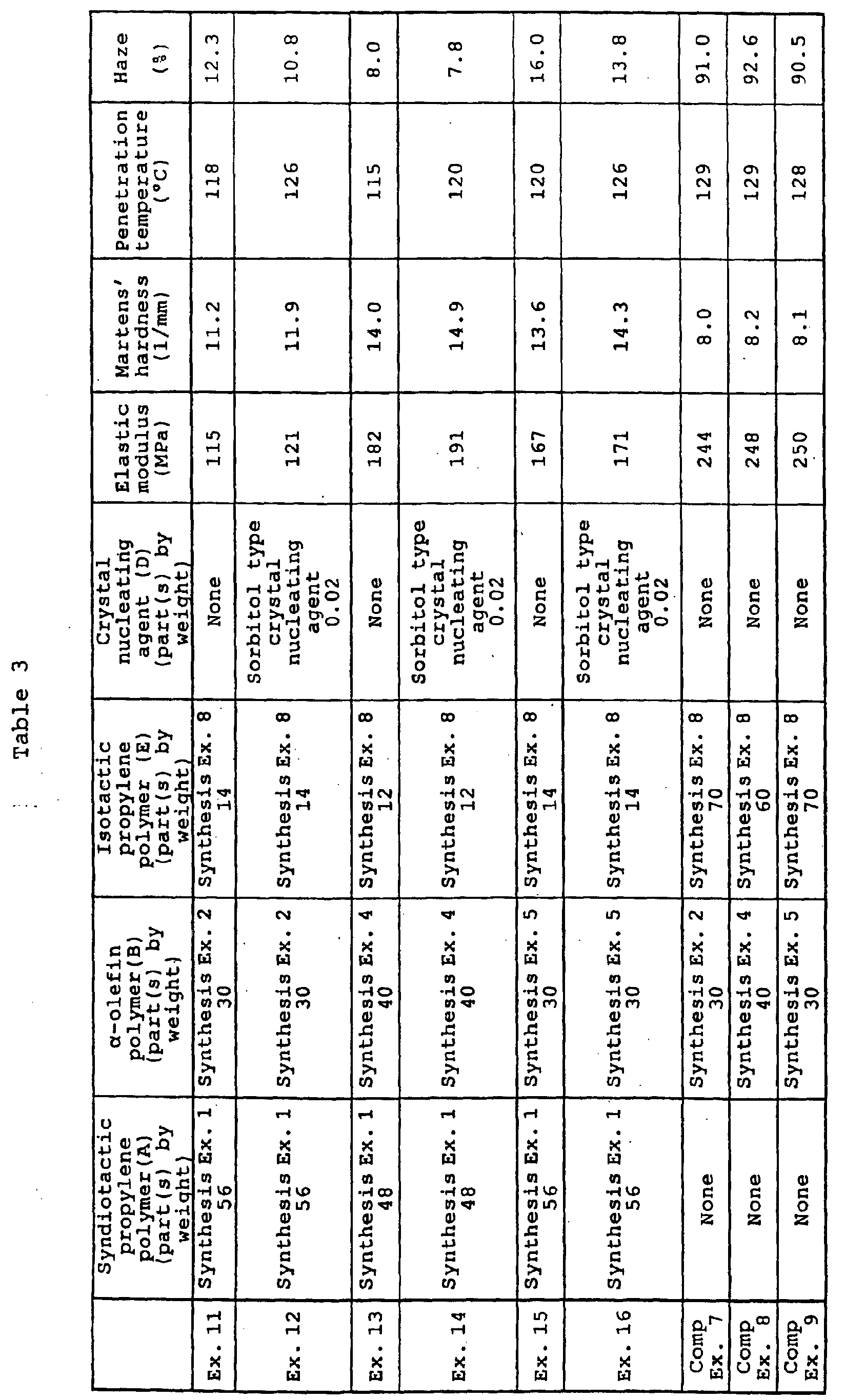
To the total (100 parts by weight) of 42 parts by
weight of the syndiotactic polypropylene obtained in
Synthesis Example 1, 28 parts by weight of the isotactic
propylene (co)polymer obtained in Synthesis Example 8, 24
parts by weight of the atactic propylene/ethylene
copolymer obtained in Synthesis Example 2 and 6 parts by
weight of the syndiotactic propylene/ethylene copolymer
obtained in Synthesis Example 4, 0.02 part by weight of a
sorbitol type crystal nucleating agent Gelol MD
(available from Shinnihon Rikagaku) was added, and they
were melt kneaded to obtain a soft syndiotactic
polypropylene composition.
To the total (100 parts by weight) of 42 parts by
weight of the syndiotactic polypropylene obtained in
Synthesis Example 1, 28 parts by weight of the isotactic
propylene (co)polymer obtained in Synthesis Example 8, 24
parts by weight of the syndiotactic propylene/ethylene
copolymer obtained in Synthesis Example 4 and 6 parts by
weight of the isotactic propylene/ethylene copolymer
obtained in Synthesis Example 3, 0.02 part by weight of a
sorbitol type crystal nucleating agent Gelol MD
(available from Shinnihon Rikagaku) was added, and they
were melt kneaded to obtain a soft syndiotactic
polypropylene composition.
To the total (100 parts by weight) of 42 parts by
weight of the syndiotactic polypropylene obtained in
Synthesis Example 1, 28 parts by weight of the isotactic
propylene (co)polymer obtained in Synthesis Example 8, 24
parts by weight of the atactic propylene/ethylene
copolymer obtained in Synthesis Example 2 and 6 parts by
weight of the isotactic propylene/ethylene copolymer
obtained in Synthesis Example 3, 0.02 part by weight of a
sorbitol type crystal nucleating agent Gelol MD
(available from Shinnihon Rikagaku) was added, and they
were melt kneaded to obtain a soft syndiotactic
polypropylene composition.
To the total (100 parts by weight) of 42 parts by
weight of the syndiotactic polypropylene obtained in
Synthesis Example 1, 28 parts by weight of the isotactic
propylene (co)polymer obtained in Synthesis Example 8, 24
parts by weight of the atactic propylene/butene copolymer
obtained in Synthesis Example 5 and 6 parts by weight of
the syndiotactic propylene/butene copolymer obtained in
Synthesis Example 6, 0.02 part by weight of a sorbitol
type crystal nucleating agent Gelol MD (available from
Shinnihon Rikagaku) was added, and they were melt kneaded
to obtain a soft syndiotactic polypropylene composition.
36 Parts by weight of the syndiotactic propylene
polymer obtained in Synthesis Example 1, 35 parts by
weight of the syndiotactic-structure propylene/ethylene
copolymer obtained in Synthesis Example 2, 5 parts by
weight of an ethylene/butene copolymer (density: 0.891
g/cm3, ethylene content: 90 % by mol) and 24 parts by
weight of the isotactic propylene/ethylene random
copolymer obtained in Synthesis Example 8 were blended
and melt kneaded to obtain a soft syndiotactic
polypropylene composition.
The compositions obtained in the above examples were
measured on various properties. The results are set
forth in Table 4.

With the total (100 parts by weight) of 42 parts by
weight of the syndiotactic propylene polymer obtained in
Synthesis Example 1, 30 parts by weight of the atactic
propylene/ethylene copolymer obtained in Synthesis
Example 2 and 28 parts by weight of the isotactic
propylene/ethylene random copolymer obtained in Synthesis
Example 8, 0.5 part by weight of polyethylene (trade
name: 2200J, available from Mitsui Chemicals, Inc.,
density: 0.96 g/cm3) was blended, and the blend was melt
kneaded to obtain a soft syndiotactic polypropylene
composition.
With the total (100 parts by weight) of 36 parts by
weight of the syndiotactic propylene polymer obtained in
Synthesis Example 1, 40 parts by weight of the
syndiotactic propylene/ethylene copolymer obtained in
Synthesis Example 4 and 24 parts by weight of the
isotactic propylene/ethylene random copolymer obtained in
Synthesis Example 8, 0.5 part by weight of polyethylene
(trade name: 2200J) was blended, and the blend was melt
kneaded to obtain a soft syndiotactic polypropylene
composition.
With the total (100 parts by weight) of 42 parts by
weight of the syndiotactic propylene polymer obtained in
Synthesis Example 1, 30 parts by weight of the atactic
propylene/butene copolymer obtained in Synthesis Example
5 and 28 parts by weight of the isotactic
propylene/ethylene random copolymer obtained in Synthesis
Example 8, 0.5 part by weight of polyethylene (trade
name: 2200J) was blended, and the blend was melt kneaded
to obtain a soft syndiotactic polypropylene composition.
In a kneader, 40 parts by weight of the syndiotactic
propylene/ethylene copolymer obtained in Synthesis
Example 4 and 60 parts by weight of the isotactic
propylene/ethylene random copolymer obtained in Synthesis
Example 8 were placed, and they were melt kneaded to
obtain a polypropylene composition.
The compositions obtained in the above examples and
comparative example were measured on various properties.
The results are set forth in Table 5.
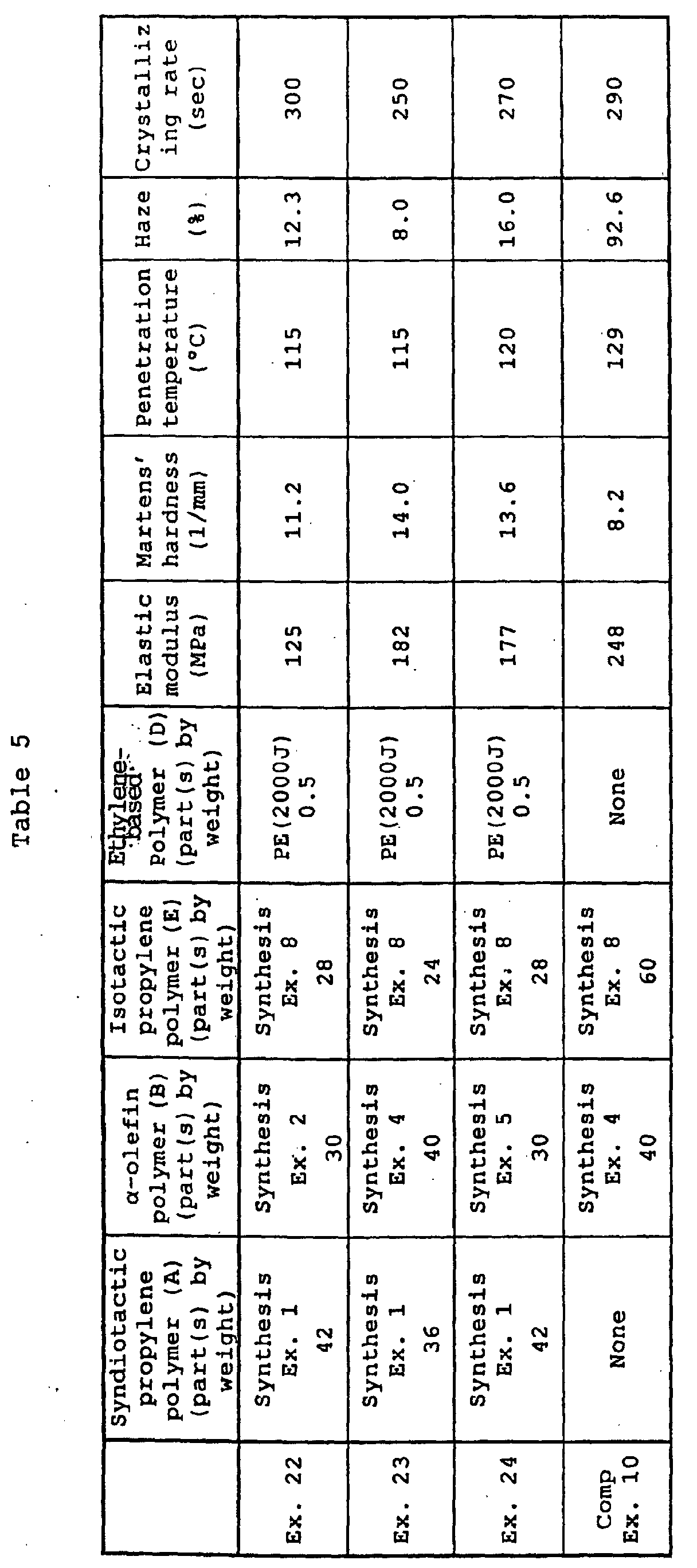
The procedure of Synthesis Example 4 was repeated,
except that the polymerization temperature was changed to
10°C, the pressure of ethylene was changed to 7 kg/cm2,
and the polymerization time was changed to 15 minutes.
The yield of the propylene/ethylene copolymer
obtained above was 33 g, and this copolymer had an
intrinsic viscosity (η), as measured in decalin at 135°C,
of 2.0 dl/g, a glass transition temperature (Tg) of -54°C,
an ethylene content of 45 % by mol, and a molecular
weight distribution, as measured by GPC, of 2.9.
The procedure of Synthesis Example 2 was repeated,
except that the amount of propylene was changed to 28.5
liters (25°C, 1 atom).
The yield of the propylene/ethylene copolymer
obtained above was 39 g, and this copolymer had an
intrinsic viscosity (η), as measured in decalin at 135°C,
of 2.9 dl/g, a glass transition temperature (Tg) of -31°C,
an ethylene content of 24 % by mol (ethylene: 17.4 % by
weight), an activity of 412 kg/mmol-Zr·hr, and a
molecular weight distribution, as measured by GPC, of 2.4.
A melting peak measured by DSC was not substantially
observed.
With the total (100 parts by weight) of 36 parts by
weight of the syndiotactic propylene polymer obtained in
Synthesis Example 1, 6 parts by weight of the
syndiotactic-structure propylene/ethylene copolymer
obtained in Synthesis Example 4, 24 parts by weight of
the atactic propylene/ethylene copolymer obtained in
Synthesis Example 2, 10 parts by weight of an
ethylene/octene copolymer (trade name: H430, available
from Mitsui Chemicals, Inc., density: 0.872 g/cm3) and 24
parts by weight of the isotactic propylene/ethylene
random copolymer obtained in Synthesis Example 8, 1 part
by weight of polyethylene (trade name: 2200J) was blended,
and the blend was melt kneaded to obtain a soft
syndiotactic polypropylene composition.
With the total (100 parts by weight) of 36 parts by
weight of the syndiotactic propylene polymer obtained in
Synthesis Example 1, 6 parts by weight of the
syndiotactic propylene/ethylene copolymer obtained in
Synthesis Example 4, 24 parts by weight of the atactic
propylene/ethylene copolymer obtained in Synthesis
Example 10, 10 parts by weight of an ethylene/octene
copolymer (trade name: H430, available from Mitsui
Chemicals, Inc.) and 24 parts by weight of the isotactic
propylene/ethylene random copolymer obtained in Synthesis
Example 8, 1 part by weight of polyethylene (trade name:
2200J, available from Mitsui Chemicals, Inc.) was blended,
and the blend was melt kneaded to obtain a soft
syndiotactic polypropylene composition.
With the total (100 parts by weight) of 42 parts by
weight of the syndiotactic propylene polymer obtained in
Synthesis Example 1, 4 parts by weight of the
syndiotactic propylene/ethylene copolymer obtained in
Synthesis Example 4, 16 parts by weight of the atactic
propylene/ethylene copolymer obtained in Synthesis
Example 2, 10 parts by weight of an ethylene/octene
copolymer (trade name: H430, available from Mitsui
Chemicals, Inc.) and 28 parts by weight of the isotactic
propylene/ethylene random copolymer obtained in Synthesis
Example 8, 1 part by weight of polyethylene (trade name:
2200J, available from Mitsui Chemicals, Inc.) was blended,
and the blend was melt kneaded to obtain a soft
syndiotactic polypropylene composition.
With the total (100 parts by weight) of 36 parts by
weight of the syndiotactic propylene polymer obtained in
Synthesis Example 1, 6 parts by weight of the
syndiotactic propylene/ethylene copolymer obtained in
Synthesis Example 9, 24 parts by weight of the atactic
propylene/ethylene copolymer obtained in Synthesis
Example 2, 10 parts by weight of an ethylene/octene
copolymer (trade name: H430, available from Mitsui
Chemicals, Inc.) and 24 parts by weight of the
propylene/ethylene random copolymer obtained in Synthesis
Example 8, 1 part by weight of polyethylene (trade name:
2200J, available from Mitsui Chemicals, Inc.) was blended,
and the blend was melt kneaded to obtain a polypropylene
composition.
With the total (100 parts by weight) of 36 parts by
weight of the syndiotactic propylene polymer obtained in
Synthesis Example 1, 40 parts by weight of the
syndiotactic propylene/ethylene copolymer obtained in
Synthesis Example 9 and 24 parts by weight of the
propylene/ethylene random copolymer obtained in Synthesis
Example 8, 1 part by weight of polyethylene (trade name:
2200J, available from Mitsui Chemicals, Inc.) was blended,
and the blend was melt kneaded to obtain a polypropylene
composition.
With the total (100 parts by weight) of 42 parts by
weight of the syndiotactic propylene polymer obtained in
Synthesis Example 1, 30 parts by weight of the atactic
propylene/ethylene copolymer obtained in Synthesis
Example 2 and 28 parts by weight of the
propylene/ethylene random copolymer obtained in Synthesis
Example 8, 1 part by weight of polyethylene (trade name:
2200J, available from Mitsui Chemicals, Inc.) was blended,
and the blend was melt kneaded to obtain a polypropylene
composition.
The compositions obtained in the above examples and
comparative examples and the films produced from the
compositions were measured on various properties. The
results are set forth in Table 6.
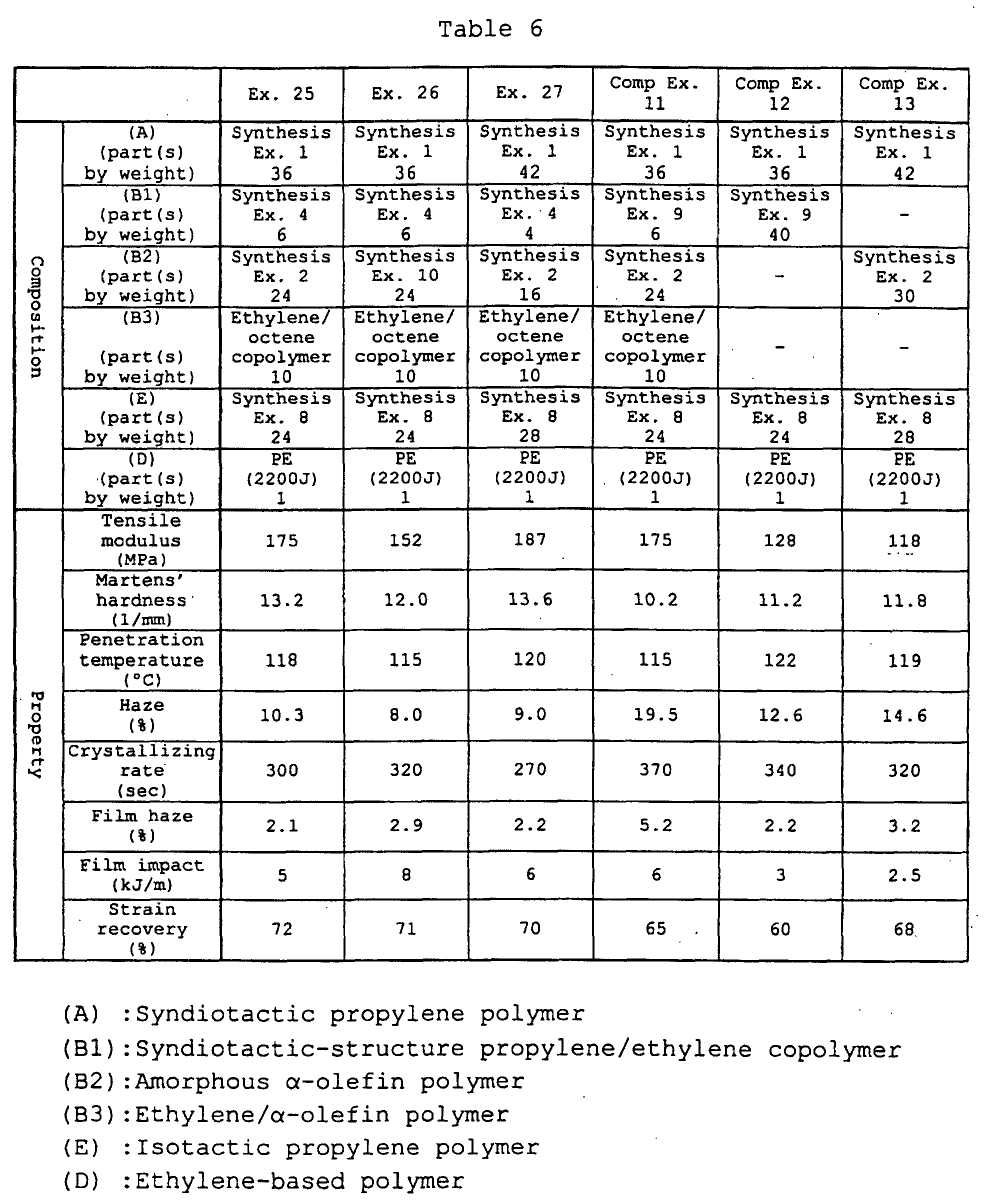
With the total (100 parts by weight) of 42 parts by
weight of the syndiotactic propylene polymer obtained in
Synthesis Example 1, 30 parts by weight of the
syndiotactic-structure propylene/ethylene copolymer
obtained in Synthesis Example 4 and 28 parts by weight of
the isotactic propylene/ethylene random copolymer
obtained in Synthesis Example 5, 20 parts by weight of an
ethylene/vinyl acetate copolymer (trade name: EV460,
available from Mitsui Dupont Polychemical K.K., vinyl
acetate content: 19 % by weight, density: 0.94 g/cm3) and
1 part by weight of polyethylene (trade name: 2200J,
available from Mitsui Chemicals, Inc.) were blended, and
the blend was melt kneaded to obtain a soft syndiotactic
polypropylene composition.
With the total (100 parts by weight) of 42 parts by
weight of the syndiotactic propylene polymer obtained in
Synthesis Example 1, 30 parts by weight of the
syndiotactic propylene/ethylene copolymer obtained in
Synthesis Example 9 and 28 parts by weight of the
isotactic propylene/ethylene random copolymer obtained in
Synthesis Example 5, 20 parts by weight of an
ethylene/vinyl acetate copolymer (trade name: EV460,
available from Mitsui Dupont Polychemical K.K.) and 1
part by weight of polyethylene (trade name: 2200J,
available from Mitsui Chemicals, Inc.) were blended, and
the blend was melt kneaded to obtain a soft syndiotactic
polypropylene composition.
With the total (100 parts by weight) of 42 parts by
weight of the syndiotactic propylene polymer obtained in
Synthesis Example 1, 30 parts by weight of the atactic
propylene/ethylene copolymer obtained in Synthesis
Example 2 and 28 parts by weight of the isotactic
propylene/ethylene random copolymer obtained in Synthesis
Example 5, 20 parts by weight of an ethylene/vinyl
acetate copolymer (trade name: EV460, available from
Mitsui Dupont Polychemical K.K.) and 1 part by weight of
polyethylene (trade name: 2200J, available from Mitsui
Chemicals, Inc.) were blended, and the blend was melt
kneaded to obtain a soft syndiotactic polypropylene
composition.
With the total (100 parts by weight) of 42 parts by
weight of the syndiotactic propylene polymer obtained in
Synthesis Example 1, 30 parts by weight of the atactic
propylene/ethylene copolymer obtained in Synthesis
Example 10 and 28 parts by weight of the isotactic
propylene/ethylene random copolymer obtained in Synthesis
Example 5, 20 parts by weight of an ethylene/vinyl
acetate copolymer (trade name: EV460, available from
Mitsui Dupont Polychemical K.K.) and 1 part by weight of
polyethylene (trade name: 2200J, available from Mitsui
Chemicals, Inc.) were blended, and the blend was melt
kneaded to obtain a soft syndiotactic polypropylene
composition.
The compositions obtained in the above examples and
the films produced from the compositions were measured on
various properties. The results are set forth in Table 7.

Using the syndiotactic polypropylene composition
(SP-1) obtained in Example 28, an ethylene/vinyl acetate
copolymer saponification product (trade name: Kraray Eval
EP-F, available from Kraray Co., Ltd., MFR: 1.3 g/10 min,
density: 1.19 g/cm3, ethylene unit content: 32 % by mol,
referred to as "EVOH" hereinafter) and maleic acid-modified
polyethylene (trade name: Admer HX-210,
available from Mitsui Chemicals, Inc., referred to as "M-PE"
hereinafter) as an adhesive resin, a 5-layer sheet
was produced under the following conditions.
In the 5-layer sheet thus obtained, the interlaminar
strength (F EVOH) between the EVOH layer and the M-PE
layer was 650 g/15 mm, and the interlaminar strength (F
SP-1) between the SP-1 layer and the M-PE layer was 770
g/15 mm.
Using the syndiotactic polypropylene composition
(SP-2) obtained in Example 29, EVOH and M-PE as an
adhesive resin, a 5-layer sheet was produced under the
following conditions.
In the 5-layer sheet thus obtained, the interlaminar
strength (F EVOH) between the EVOH layer and the M-PE
layer was 640 g/15 mm, and the interlaminar strength (F
SP-2) between the SP-2 layer and the M-PE layer was 830
g/15 mm.
Using the syndiotactic polypropylene composition
(SP-3) obtained in Example 30, EVOH and M-PE as an
adhesive resin, a 5-layer sheet was produced under the
following conditions.
In the 5-layer sheet thus obtained, the interlaminar
strength (F EVOH) between the EVOH layer and the M-PE
layer was 620 g/15 mm, and the interlaminar strength (F
SP-3) between the SP-3 layer and the M-PE layer was 860
g/15 mm.
Using the syndiotactic polypropylene composition
(SP-4) obtained in Example 31, EVOH and M-PE as an
adhesive resin, a 5-layer sheet was produced under the
following conditions.
In the 5-layer sheet thus obtained, the interlaminar
strength (F EVOH) between the EVOH layer and the M-PE
layer was 580 g/15 mm, and the interlaminar strength (F
SP-4) between the SP-4 layer and the M-PE layer was 760
g/15 mm.
A 3-layer sheet was produced under the following
conditions in the same manner as in Example 32, except
that an ethylene/vinyl acetate copolymer (MFR: 2.5 g/10
min, vinyl acetate content: 25 % by weight, referred to
as "EVA" hereinafter) was used instead of the
ethylene/vinyl acetate copolymer saponification product
(EVOH), and the adhesive resin M-PE was not used.
In the 3-layer sheet thus obtained, the interlaminar
strength (F EVA) between the EVA layer and the SP-1 layer
was 460 g/15 mm.
Claims (39)
- A soft syndiotactic polypropylene composition (1) comprising:wherein the weight ratio (A/B) of the syndiotactic propylene polymer (A) to the α-olefin polymer (B) is in the range of 90/10 to 10/90.(A) a syndiotactic propylene polymer which comprises recurring units (Upr) derived from propylene having a substantially syndiotactic structure, and optionally, recurring units (Uet) derived from ethylene and/or recurring units (Uol) derived from an α-olefin of 4 to 20 carbon atoms, contains the recurring units (Upr) in amounts of 90 to 100 % by mol, the recurring units (Uet) in amounts of 0 to 10 % by mol and the recurring units (Uol) in amounts of 0 to 9.5 % by mol, and has an intrinsic viscosity (η), as measured in decalin at 135°C, of 0.5 to 10 dl/g,(B) an α-olefin polymer which comprises at least one kind of recurring units derived from an α-olefin selected from α-olefins of 2 to 20 carbon atoms, contains one kind of recurring units out of said one or more kinds of recurring units in amounts of 50 to 100 % by mol, and has a Young's modulus of not more than 150 MPa,
and optionally,(C) a crystal nucleating agent and/or (D) an ethylene-based polymer having a density of 0.91 to 0.97 g/cm3, - The soft syndiotactic polypropylene composition as claimed in claim 1, wherein:said composition comprises the syndiotactic propylene polymer (A), the α-olefin polymer (B) and the crystal nucleating agent (C),the weight ratio (A/B) of the syndiotactic propylene polymer (A) to the α-olefin polymer (B) is in the range of 90/10 to 10/90, andthe crystal nucleating agent (C) is contained in an amount of 0.01 to 1 part by weight based on 100 parts by weight of the total of the syndiotactic propylene polymer (A) and the α-olefin polymer (B).
- The soft syndiotactic polypropylene composition as claimed in claim 2, wherein:the syndiotactic propylene polymer (A) has a syndiotacticity, that is based on triad sequences of the propylene units, of not less than 0.6,the α-olefin polymer (B) has an intrinsic viscosity (η), as measured in decalin at 135°C, of 0.01 to 10 dl/g, a molecular weight distribution (Mw/Mn), as determined by gel permeation chromatography, of not more than 4 and a glass transition temperature of not higher than -5°C, andthe crystal nucleating agent (C) is a sorbitol type crystal nucleating agent.
- The soft syndiotactic polypropylene composition as claimed in claim 1, wherein:said composition comprises the syndiotactic propylene polymer (A) and two or more kinds of the α-olefin polymers (B),the weight ratio (A/(total of B)) of the syndiotactic propylene polymer (A) to the total of the two or more kinds of the α-olefin polymers (B) is in the range of 90/10 to 10/90, andeach content of the two or more kinds of the α-olefin polymers (B) is at least 1 % by weight.
- The soft syndiotactic polypropylene composition as claimed in claim 1, wherein:said composition comprises the syndiotactic propylene polymer (A), two or more kinds of the α-olefin polymers (B) and the crystal nucleating agent (C),the weight ratio (A/(total of B)) of the syndiotactic propylene polymer (A) to the total of the two or more kinds of the α-olefin polymers (B) is in the range of 90/10 to 10/90,each content of the two or more kinds of the α-olefin polymers (B) is at least 1 % by weight, andthe crystal nucleating agent (C) is contained in an amount of 0.01 to 1 part by weight based on 100 parts by weight of the total of the syndiotactic propylene polymer (A) and the two or more kinds of the α-olefin polymers (B).
- The soft syndiotactic polypropylene composition as claimed in claim 4 or 5, wherein:the syndiotactic propylene polymer (A) has a syndiotacticity, that is based on triad sequences of the propylene units, of not less than 0.6, andthe α-olefin polymer (B) has an intrinsic viscosity (η), as measured in decalin at 135°C, of 0.01 to 10 dl/g, a molecular weight distribution (Mw/Mn), as determined by gel permeation chromatography (GPC), of not more than 4 and a glass transition temperature of not higher than-5°C.
- The soft syndiotactic polypropylene composition as claimed in any one of claims 1 to 6, wherein the α-olefin polymer (B) is a copolymer comprising recurring units derived from ethylene in amounts of 50 to 99 % by mol and recurring units derived from at least one α-olefin selected from α-olefins of 3 to 20 carbon atoms in amounts of 1 to 50 % by mol.
- The soft syndiotactic polypropylene composition as claimed in any one of claims 1 to 6, wherein the α-olefin polymer (B) is a copolymer comprising recurring units derived from propylene in amounts of 50 to 99 % by mol and recurring units derived from at least one α-olefin selected from ethylene and α-olefins of 4 to 20 carbon atoms in amounts of 1 to 50 % by mol.
- The soft syndiotactic polypropylene composition as claimed in any one of claims 1 to 8, wherein the α-olefin polymer (B) is one obtained in the presence of a metallocene catalyst comprising:(a1) a transition metal compound represented by the following formula (I) or (II):wherein M is Ti, Zr, Hf, Rn, Nd, Sm or Ru; Cp1 and Cp2 are each a cyclopentadienyl group, an indenyl group, a fluorenyl group or a derivative group thereof, each of which is π-bonded to M; X1 and X2 are each an anionic ligand or a neutral Lewis base ligand; Y is a ligand containing a nitrogen atom, an oxygen atom, a phosphorus atom or a sulfur atom; and Z is an atom of C, O, B, S, Ge, Si or Sn, or a group containing any of these atoms,
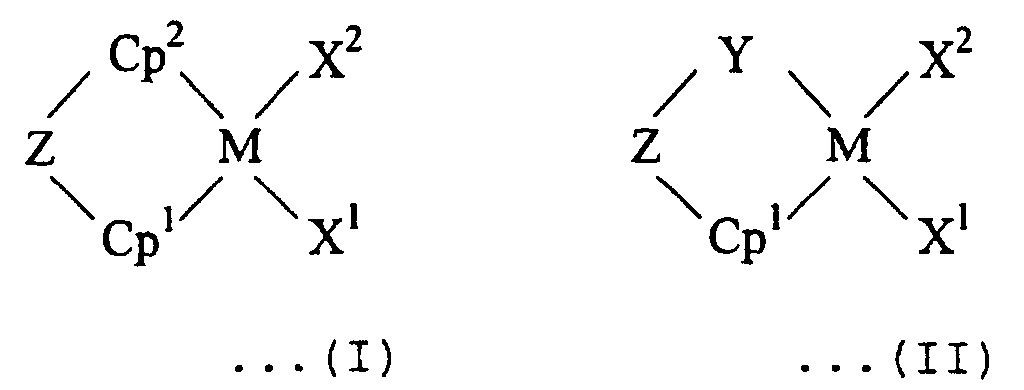
and(b) at least one compound selected from:(b-1) a compound which reacts with a transition metal M in the transition metal compound (a1) to form an ionic complex,(b-2) an organoaluminum oxy-compound, and(b-3) an organoaluminum compound. - A soft syndiotactic polypropylene composition comprising:wherein:(A) a syndiotactic propylene polymer which comprises recurring units (Upr) derived from propylene having a substantially syndiotactic structure, and optionally, recurring units (Uet) derived from ethylene and/or recurring units (Uol) derived from an α-olefin of 4 to 20 carbon atoms, contains the recurring units (Upr) in amounts of 90 to 100 % by mol, the recurring units (Uet) in amounts of 0 to 10 % by mol and the recurring units (Uol) in amounts of 0 to 9.5 % by mol, and has an intrinsic viscosity (η), as measured in decalin at 135°C, of 0.5 to 10 dl/g,(B) an α-olefin polymer which comprises at least one kind of recurring units derived from an α-olefin selected from α-olefins of 2 to 20 carbon atoms, contains one kind of recurring units out of said one or more kinds of recurring units in amounts of 50 to 100 % by mol, and has a Young's modulus of not more than 150 MPa,(E) an isotactic propylene polymer which comprises recurring units (Upr) derived from propylene having a substantially isotactic structure, and optionally, recurring units (Uet) derived from ethylene and/or recurring units (Uol) derived from an α-olefin of 4 to 20 carbon atoms, contains the recurring units (Upr) in amounts of 90 to 100 % by mol, the recurring units (Uet) in amounts of 0 to 10 % by mol and the recurring units (Uol) in amounts of 0 to 9.5 % by mol, and has an intrinsic viscosity (η), as measured in decalin at 135°C, of 0.5 to 6 dl/g,
and optionally,(C) a crystal nucleating agent and/or (D) an ethylene-based polymer having a density of 0.91 to 0.97 g/cm3,the weight ratio (A/E) of the syndiotactic propylene polymer (A) to the isotactic propylene polymer (E) is in the range of 99/1 to 1/99, andthe weight ratio ((A+E)/B) of the total of the syndiotactic propylene polymer (A) and the isotactic propylene polymer (E) to the α-olefin polymer (B) is in the range of 90/10 to 10/90. - The soft syndiotactic polypropylene composition as claimed in claim 10, wherein:said composition comprises the syndiotactic propylene polymer (A), the α-olefin polymer (B) and the isotactic propylene polymer (E),the weight ratio (A/E) of the syndiotactic propylene polymer (A) to the isotactic propylene polymer (E) is in the range of 99/1 to 1/99, andthe weight ratio ((A+E)/B) of the total of the syndiotactic propylene polymer (A) and the isotactic propylene polymer (E) to the α-olefin polymer (B) is in the range of 90/10 to 10/90.
- The soft syndiotactic polypropylene composition as claimed in claim 10, wherein:said composition comprises the syndiotactic propylene polymer (A), the α-olefin polymer (B), the isotactic propylene polymer (E) and the crystal nucleating agent (C),the weight ratio (A/E) of the syndiotactic propylene polymer (A) to the isotactic propylene polymer (E) is in the range of 99/1 to 1/99,the weight ratio ((A+E)/B) of the total of the syndiotactic propylene polymer (A) and the isotactic propylene polymer (E) to the α-olefin polymer (B) is in the range of 90/10 to 10/90, andthe crystal nucleating agent (C) is contained in an amount of 0.01 to 1 part by weight based on 100 parts by weight of the total of the syndiotactic propylene polymer (A), the α-olefin polymer (B) and the isotactic propylene polymer (E).
- The soft syndiotactic polypropylene composition as claimed in claim 12, wherein the crystal nucleating agent (C) is a sorbitol type crystal nucleating agent.
- The soft syndiotactic polypropylene composition as claimed in any one of claims 11 to 13, wherein:the syndiotactic propylene polymer (A) has a syndiotacticity, that is based on triad sequences of the propylene units, of not less than 0.6, andthe α-olefin polymer (B) has an intrinsic viscosity (η), as measured in decalin at 135°C, of 0.01 to 10 dl/g, a molecular weight distribution (Mw/Mn), as determined by gel permeation chromatography (GPC), of not more than 4 and a glass transition temperature of not higher than -5°C.
- The soft syndiotactic polypropylene composition as claimed in claim 10, wherein:said composition comprises the syndiotactic propylene polymer (A), two or more kinds of the α-olefin copolymers (B) and the isotactic propylene polymer (E),the weight ratio (A/E) of the syndiotactic propylene polymer (A) to the isotactic propylene polymer (E) is in the range of 99/1 to 1/99,the weight ratio ((A+E)/(total of B)) of the total of the syndiotactic propylene polymer (A) and the isotactic propylene polymer (E) to the total of the two or more kinds of the α-olefin copolymers (B) is in the range of 90/10 to 10/90, andeach content of the two or more kinds of the α-olefin polymers (B) is at least 1 % by weight.
- The soft syndiotactic polypropylene composition as claimed in claim 10, wherein:said composition comprises the syndiotactic propylene polymer (A), two or more kinds of the α-olefin copolymers (B), the isotactic propylene polymer (E) and the crystal nucleating agent (C),the weight ratio (A/E) of the syndiotactic propylene polymer (A) to the isotactic propylene polymer (E) is in the range of 99/1 to 1/99,the weight ratio ((A+E)/(total of B)) of the total of the syndiotactic propylene polymer (A) and the isotactic propylene polymer (E) to the total of the two or more kinds of the α-olefin copolymers (B) is in the range of 90/10 to 10/90,each content of the two or more kinds of the α-olefin polymers (B) is at least 1 % by weight, andthe crystal nucleating agent (C) is contained in an amount of 0.01 to 1 part by weight based on 100 parts by weight of the total of the syndiotactic propylene polymer (A), the two or more kinds of the α-olefin copolymers (B) and the isotactic propylene polymer (E).
- The soft syndiotactic polypropylene composition as claimed in claim 15 or 16, wherein the α-olefin polymer (B) has an intrinsic viscosity (η), as measured in decalin at 135°C, of 0.01 to 10 dl/g, a molecular weight distribution (Mw/Mn), as determined by gel permeation chromatography, of not more than 4 and a glass transition temperature of not higher than -5°C.
- The soft syndiotactic polypropylene composition as claimed in claim 10, wherein:said composition comprises the syndiotactic propylene polymer (A), the α-olefin polymer (B), the isotactic propylene polymer (E) and the ethylene-based polymer (D),the weight ratio (A/E) of the syndiotactic propylene polymer (A) to the isotactic propylene polymer (E) is in the range of 99/1 to 1/99,the weight ratio ((A+E)/B) of the total of the syndiotactic propylene polymer (A) and the isotactic propylene polymer (E) to the α-olefin polymer (B) is in the range of 90/10 to 10/90, andthe ethylene-based polymer (D) is contained in an amount of 0.01 to 5 parts by weight based on 100 parts by weight of the total of the syndiotactic propylene polymer (A), the α-olefin polymer (B) and the isotactic propylene polymer (E).
- The soft syndiotactic polypropylene composition as claimed in claim 18, wherein the α-olefin polymer (B) has an intrinsic viscosity (η), as measured in decalin at 135°C, of 0.01 to 10 dl/g, a molecular weight distribution (Mw/Mn), as determined by gel permeation chromatography, of not more than 4 and a glass transition temperature of not higher than -5°C.
- The soft syndiotactic polypropylene composition as claimed in claim 10, wherein:said composition comprises the syndiotactic propylene polymer (A), the α-olefin polymer (B), the isotactic propylene polymer (E) and the ethylene-based polymer (D),the α-olefin polymer (B) consists of:(B1) a syndiotactic-structure propylene/ethylene copolymer containing a propylene component having a substantially syndiotactic structure in an amount of not less than 60 % by mol and less than 90 % by mol,(B2) an amorphous α-olefin copolymer which contains recurring units derived from an α-olefin of 3 to 20 carbon atoms in amounts of not less than 50 % by mol (with the proviso that the amount of all recurring units in the copolymer is 100 % by mol), whose melting peak is not substantially observed when measured by a differential scanning colorimeter (DSC), and which has an intrinsic viscosity (η), as measured in decalin at 135°C, of 0.01 to 10 dl/g, a molecular weight distribution, as determined by gel permeation chromatography, of not more than 4 and a glass transition temperature of not higher than 40°C, and(B3) an ethylene/α-olefin copolymer which is a copolymer of ethylene and an α-olefin of 3 to 20 carbon atoms, contains recurring units derived from ethylene in amounts of not less than 60 % by mol, and has a molecular weight distribution (Mw/Mn), as determined by gel permeation chromatography, of not more than 4 and a density of 0.855 to 0.895 g/cm3,the syndiotactic propylene polymer (A) is contained in an amount of 20 to 60 parts by weight,the syndiotactic-structure propylene/ethylene copolymer (B1) is contained in an amount of 1 to 30 parts by weight,the amorphous α-olefin copolymer (B2) is contained in an amount of 1 to 30 parts by weight,the ethylene/α-olefin copolymer (B3) is contained in an amount of 5 to 30 parts by weight,the isotactic propylene polymer (E) is contained in an amount of 1 to 40 parts by weight, andthe ethylene-based polymer (D) is contained in an amount of 0.01 to 5 parts by weight based on 100 parts by weight of the total of the components (A), (B1), (B2), (B3) and (E).
- The soft syndiotactic polypropylene composition as claimed in claim 20, wherein:the syndiotactic propylene polymer (A) has a syndiotacticity, that is based on triad sequences of the propylene units, of not less than 0.6, andthe syndiotactic-structure propylene/ethylene copolymer (B1) has an intrinsic viscosity (η), as measured in decalin at 135°C, of 0.5 to 10 dl/g, a molecular weight distribution (Mw/Mn), as determined by gel permeation chromatography, of not more than 4 and a glass transition temperature of not higher than -5°C.
- The soft syndiotactic polypropylene composition as claimed in claim 20 or 21, wherein the amorphous α-olefin polymer (B2) is a copolymer comprising recurring units derived from propylene in amounts of 50 to 99 % by mol and recurring units derived from at least one olefin selected from ethylene and α-olefins of 4 to 20 carbon atoms in amounts of 1 to 50 % by mol.
- The soft syndiotactic polypropylene composition as claimed in any one of claims 10 to 19, wherein the α-olefin polymer (B) is a copolymer comprising recurring units derived from ethylene in amounts of 50 to 99 % by mol and recurring units derived from at least one α-olefin selected from α-olefins of 3 to 20 carbon atoms in amounts of 1 to 50 % by mol.
- The soft syndiotactic polypropylene composition as claimed in any one of claims 10 to 19, wherein the α-olefin polymer (B) is a copolymer comprising recurring units derived from propylene in amounts of 50 to 99 % by mol and recurring units derived from at least one α-olefin selected from ethylene and α-olefins of 4 to 20 carbon atoms in amounts of 1 to 50 % by mol.
- The soft syndiotactic polypropylene composition as claimed in any one of claims 10 to 24, wherein the isotactic propylene polymer (E) has a microisotacticity, that is based on triad sequences of the propylene units, of not less than 0.8.
- The soft syndiotactic polypropylene composition as claimed in any one of claims 10 to 25, wherein the α-olefin polymer (B) is one obtained in the presence of a metallocene catalyst comprising:(a1) a transition metal compound represented by the following formula (I) or (II):wherein M is Ti, Zr, Hf, Rn, Nd, Sm or Ru; Cp1 and Cp2 are each a cyclopentadienyl group, an indenyl group, a fluorenyl group or a derivative group thereof, each of which is π-bonded to M; X1 and X2 are each an anionic ligand or a neutral Lewis base ligand; Y is a ligand containing a nitrogen atom, an oxygen atom, a phosphorus atom or a sulfur atom; and Z is an atom of C, O, B, S, Ge, Si or Sn, or a group containing any of these atoms,

and(b) at least one compound selected from:(b-1) a compound which reacts with a transition metal M in the transition metal compound (a1) to form an ionic complex,(b-2) an organoaluminum oxy-compound, and(b-3) an organoaluminum compound. - A soft syndiotactic polypropylene composition comprising:wherein:(A) a syndiotactic propylene polymer which comprises recurring units (Upr) derived from propylene having a substantially syndiotactic structure, and optionally, recurring units (Uet) derived from ethylene and/or recurring units (Uol) derived from an α-olefin of 4 to 20 carbon atoms, contains the recurring units (Upr) in amounts of 90 to 100 % by mol, the recurring units (Uet) in amounts of 0 to 10 % by mol and the recurring units (Uol) in amounts of 0 to 9.5 % by mol, and has an intrinsic viscosity (η), as measured in decalin at 135°C, of 0.5 to 10 dl/g,(B) an α-olefin polymer which comprises at least one kind of recurring units derived from an α-olefin selected from α-olefins of 2 to 20 carbon atoms, contains one kind of recurring units out of said one or more kinds of recurring units in amounts of 50 to 100 % by mol, and has a Young's modulus of not more than 150 MPa,(D) an ethylene-based polymer having a density of 0.91 g/cm3 to 0.97 g/cm3,(E) an isotactic propylene polymer which comprises recurring units (Upr) derived from propylene having a substantially isotactic structure, and optionally, recurring units (Uet) derived from ethylene and/or recurring units (Uol) derived from an α-olefin of 4 to 20 carbon atoms, contains the recurring units (Upr) in amounts of 90 to 100 % by mol, the recurring units (Uet) in amounts of 0 to 10 % by mol and the recurring units (Uol) in amounts of 0 to 9.5 % by mol, and has an intrinsic viscosity (η), as measured in decalin at 135°C, of 0.5 to 6 dl/g,
and(F) a copolymer of polar group-containing vinyl and ethylene,the weight ratio (A/E) of the syndiotactic propylene polymer (A) to the isotactic propylene polymer (E) is in the range of 99/1 to 1/99,the weight ratio ((A+E)/B) of the total of the syndiotactic propylene polymer (A) and the isotactic propylene polymer (E) to the α-olefin polymer (B) is in the range of 90/10 to 10/90, andthe ethylene-based polymer (D) is contained in an amount of 0.01 to 5 parts by weight and the copolymer (F) of polar group-containing vinyl and ethylene is contained in an amount of 10 to 40 parts by weight, each amount being based on 100 parts by weight of the total of the syndiotactic propylene polymer (A), the isotactic propylene polymer (E) and the α-olefin polymer (B). - The soft syndiotactic polypropylene composition as claimed in claim 27, wherein:the syndiotactic propylene polymer (A) has a syndiotacticity, that is based on triad sequences of the propylene units, of not less than 0.6, andthe α-olefin polymer (B) has an intrinsic viscosity (η), as measured in decalin at 135°C, of 0.01 to 10 dl/g, a molecular weight distribution (Mw/Mn), as determined by gel permeation chromatography, of not more than 4 and a glass transition temperature of not higher than -5°C.
- The soft syndiotactic polypropylene composition as claimed in claim 27 or 28, wherein the α-olefin polymer (B) is a copolymer comprising recurring units derived from ethylene in amounts of 50 to 99 % by mol and recurring units derived from at least one α-olefin selected from α-olefins of 3 to 20 carbon atoms in amounts of 1 to 50 % by mol.
- The soft syndiotactic polypropylene composition as claimed in claim 27 or 28, wherein the α-olefin polymer (B) is a copolymer comprising recurring units derived from propylene in amounts of 50 to 99 % by mol and recurring units derived from at least one α-olefin selected from ethylene and α-olefins of 4 to 20 carbon atoms in amounts of 1 to 50 % by mol.
- The soft syndiotactic polypropylene composition as claimed in any one of claims 27 to 30, wherein the isotactic propylene polymer (E) has a microisotacticity, that is based on triad sequences of the propylene units, of not less than 0.8.
- The soft syndiotactic polypropylene composition as claimed in any one of claims 27 to 31, wherein the α-olefin polymer (B) is one obtained in the presence of a metallocene catalyst comprising:(a1) a transition metal compound represented by the following formula (I) or (II):wherein M is Ti, Zr, Hf, Rn, Nd, Sm or Ru; Cp1 and Cp2 are each a cyclopentadienyl group, an indenyl group, a fluorenyl group or a derivative group thereof, each of which is π-bonded to M; X1 and X2 are each an anionic ligand or a neutral Lewis base ligand; Y is a ligand containing a nitrogen atom, an oxygen atom, a phosphorus atom or a sulfur atom; and Z is an atom of C, O, B, S, Ge, Si or Sn, or a group containing any of these atoms,
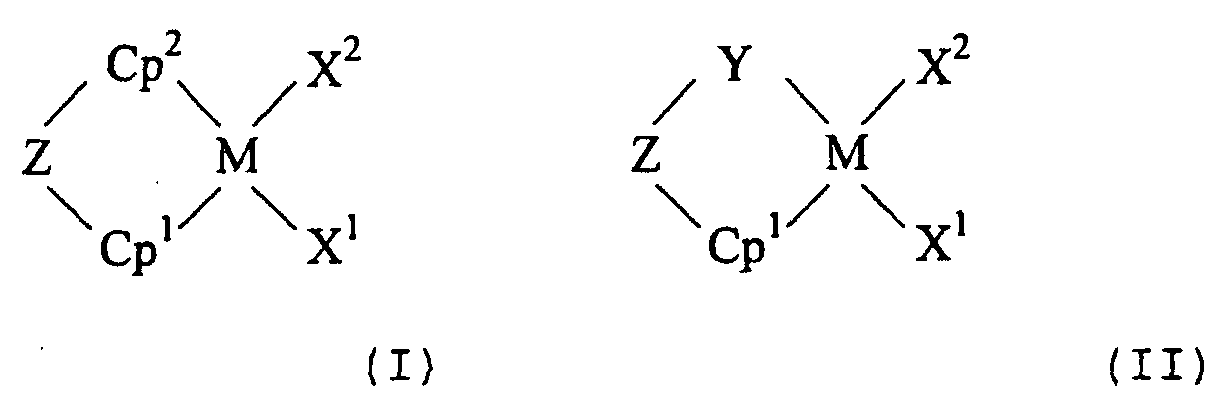
and(b) at least one compound selected from:(b-1) a compound which reacts with a transition metal M in the transition metal compound (a1) to form an ionic complex,(b-2) an organoaluminum oxy-compound, and(b-3) an organoaluminum compound. - The soft syndiotactic polypropylene composition as claimed in any one of claims 27 to 32, wherein the polar group-containing vinyl used for preparing the copolymer (F) of polar group-containing vinyl and ethylene is selected from acrylic acid, methacrylic acid, vinyl acetate and derivatives thereof.
- A laminate comprising:a layer which comprises a thermoplastic resin, anda layer which comprises the soft syndiotactic polypropylene composition of any one of claims 1 to 33.
- A laminate comprising:a layer which comprises a polyolefin resin, anda layer which comprises the soft syndiotactic polypropylene composition of any one of claims 1 to 33.
- A laminate comprising:a layer which comprises an ethylene-based polymer resin or an isotactic propylene polymer resin, anda layer which comprises the soft syndiotactic polypropylene composition of any one of claims 1 to 33.
- A laminate comprising:a layer which comprises an ethylene/vinyl acetate copolymer resin, anda layer which comprises the soft syndiotactic polypropylene composition of any one of claims 1 to 33.
- A laminate comprising:a layer which comprises an ethylene/vinyl acetate copolymer saponification product, anda layer which comprises the soft syndiotactic polypropylene composition of any one of claims 1 to 33.
- A molded product comprising the soft syndiotactic polypropylene composition of any one of claims 1 to 33.
Applications Claiming Priority (7)
| Application Number | Priority Date | Filing Date | Title |
|---|---|---|---|
| JP10593199 | 1999-04-13 | ||
| JP10593199 | 1999-04-13 | ||
| JP10593299 | 1999-04-13 | ||
| JP10593299 | 1999-04-13 | ||
| JP23469199 | 1999-08-20 | ||
| JP23469199A JP4514856B2 (en) | 1999-08-20 | 1999-08-20 | Soft syndiotactic polypropylene composition |
| PCT/JP2000/002321 WO2000061678A1 (en) | 1999-04-13 | 2000-04-10 | Flexible syndiotactic polypropylene compositions and molded object |
Publications (2)
| Publication Number | Publication Date |
|---|---|
| EP1118638A1 true EP1118638A1 (en) | 2001-07-25 |
| EP1118638A4 EP1118638A4 (en) | 2003-05-14 |
Family
ID=27310616
Family Applications (1)
| Application Number | Title | Priority Date | Filing Date |
|---|---|---|---|
| EP00915458A Withdrawn EP1118638A4 (en) | 1999-04-13 | 2000-04-10 | Flexible syndiotactic polypropylene compositions and molded object |
Country Status (3)
| Country | Link |
|---|---|
| EP (1) | EP1118638A4 (en) |
| CN (1) | CN1187404C (en) |
| WO (1) | WO2000061678A1 (en) |
Cited By (10)
| Publication number | Priority date | Publication date | Assignee | Title |
|---|---|---|---|---|
| EP1609833A1 (en) * | 2004-06-25 | 2005-12-28 | Clariant GmbH | Hot melt adhesives |
| EP1630196A1 (en) * | 2004-08-25 | 2006-03-01 | Mitsui Chemicals, Inc. | Resin composition and film obtained therefrom |
| EP1669403A1 (en) * | 2004-12-07 | 2006-06-14 | Borealis Technology OY | Novel propylene polymer blends |
| WO2007068766A1 (en) * | 2006-05-16 | 2007-06-21 | Ciba Holding Inc. | Mono- and multi-layer blown films |
| EP1630197A4 (en) * | 2003-05-28 | 2007-10-24 | Mitsui Chemicals Inc | Propylene polymer composition and use thereof |
| US7411017B2 (en) | 2002-08-27 | 2008-08-12 | Mitsui Chemicals, Inc. | Thermoplastic elastomer and molded article thereof |
| WO2010104628A1 (en) * | 2009-03-12 | 2010-09-16 | Exxonmobil Chemical Patents Inc. | Polyolefin masterbatches and films |
| EP2053086A4 (en) * | 2006-08-11 | 2010-12-22 | Mitsui Chemicals Inc | PROPYLENE RESIN COMPOSITION FOR PACKAGING MATERIAL |
| WO2014206437A1 (en) * | 2013-06-24 | 2014-12-31 | Abb Technology Ltd | A new process for preparing insulation materials for high voltage power applications and new insulation materials |
| EP4516853A4 (en) * | 2022-04-28 | 2025-12-10 | Toppan Holdings Inc | SEALING FILM, PACKAGING MATERIAL AND PACKAGING |
Families Citing this family (3)
| Publication number | Priority date | Publication date | Assignee | Title |
|---|---|---|---|---|
| WO2013081181A1 (en) * | 2011-11-30 | 2013-06-06 | 住友化学株式会社 | Propylene polymer composition and molded article thereof |
| CN108473622A (en) * | 2016-01-13 | 2018-08-31 | 道达尔研究技术弗吕公司 | Pipes comprising syndiotactic polypropylene |
| EP4702093A1 (en) * | 2023-04-26 | 2026-03-04 | Basell Poliolefine Italia S.r.l. | Propylene-based copolymer compositon |
Family Cites Families (10)
| Publication number | Priority date | Publication date | Assignee | Title |
|---|---|---|---|---|
| JP2818199B2 (en) * | 1989-06-12 | 1998-10-30 | 三井化学株式会社 | Syndiotactic polypropylene resin composition and method for producing the same |
| DE3942365A1 (en) * | 1989-12-21 | 1991-06-27 | Hoechst Ag | METHOD FOR PRODUCING A POLYPROPYLENE MOLDING MATERIAL |
| EP0770644A1 (en) * | 1991-02-15 | 1997-05-02 | Mitsui Toatsu Chemicals, Incorporated | Transparent impact-resistant molded articles |
| JP3135304B2 (en) * | 1991-09-05 | 2001-02-13 | 三井化学株式会社 | Impact resistant polypropylene resin composition |
| JP3328360B2 (en) * | 1993-03-31 | 2002-09-24 | 三井化学株式会社 | Thermoplastic elastomer |
| JPH07126453A (en) * | 1993-11-04 | 1995-05-16 | Mitsui Toatsu Chem Inc | Method for improving moldability of syndiotactic polypropylene |
| KR0159685B1 (en) * | 1995-01-19 | 1998-12-15 | 사토 아키오 | Polypropylene Multilayer Blow Molding Body |
| JPH0952328A (en) * | 1995-08-18 | 1997-02-25 | Mitsui Toatsu Chem Inc | Polyolefin laminate |
| JP2865598B2 (en) * | 1995-10-02 | 1999-03-08 | 横浜ゴム株式会社 | Thermoplastic elastomer composition |
| EP0850756A3 (en) * | 1996-12-25 | 1999-02-03 | Japan Polychem Corporation | Container and sheet of propylene polymer laminate |
-
2000
- 2000-04-10 WO PCT/JP2000/002321 patent/WO2000061678A1/en not_active Ceased
- 2000-04-10 CN CNB00801096XA patent/CN1187404C/en not_active Expired - Lifetime
- 2000-04-10 EP EP00915458A patent/EP1118638A4/en not_active Withdrawn
Cited By (17)
| Publication number | Priority date | Publication date | Assignee | Title |
|---|---|---|---|---|
| US7411017B2 (en) | 2002-08-27 | 2008-08-12 | Mitsui Chemicals, Inc. | Thermoplastic elastomer and molded article thereof |
| US8329824B2 (en) | 2003-05-28 | 2012-12-11 | Mitsui Chemicals, Inc. | Propylene polymer compositions and uses thereof |
| EP1630197A4 (en) * | 2003-05-28 | 2007-10-24 | Mitsui Chemicals Inc | Propylene polymer composition and use thereof |
| EP1609833A1 (en) * | 2004-06-25 | 2005-12-28 | Clariant GmbH | Hot melt adhesives |
| EP1630196A1 (en) * | 2004-08-25 | 2006-03-01 | Mitsui Chemicals, Inc. | Resin composition and film obtained therefrom |
| US7488777B2 (en) | 2004-08-25 | 2009-02-10 | Mitsui Chemicals, Inc. | Resin composition and film obtained therefrom |
| EA011587B1 (en) * | 2004-12-07 | 2009-04-28 | Бореалис Текнолоджи Ой | Propylene polymer blend, process for producing the blend and use thereof |
| WO2006061109A1 (en) * | 2004-12-07 | 2006-06-15 | Borealis Technology Oy | Novel propylene polymer blends |
| CN101087843B (en) * | 2004-12-07 | 2011-01-12 | 博里利斯技术有限公司 | Novel propylene polymer blends |
| EP1669403A1 (en) * | 2004-12-07 | 2006-06-14 | Borealis Technology OY | Novel propylene polymer blends |
| WO2007068766A1 (en) * | 2006-05-16 | 2007-06-21 | Ciba Holding Inc. | Mono- and multi-layer blown films |
| US9278487B2 (en) | 2006-05-16 | 2016-03-08 | Basf Se | Mono-and multi-layer blown films |
| US9732198B2 (en) | 2006-05-16 | 2017-08-15 | Basf Se | Mono- and multi-layer blown films |
| EP2053086A4 (en) * | 2006-08-11 | 2010-12-22 | Mitsui Chemicals Inc | PROPYLENE RESIN COMPOSITION FOR PACKAGING MATERIAL |
| WO2010104628A1 (en) * | 2009-03-12 | 2010-09-16 | Exxonmobil Chemical Patents Inc. | Polyolefin masterbatches and films |
| WO2014206437A1 (en) * | 2013-06-24 | 2014-12-31 | Abb Technology Ltd | A new process for preparing insulation materials for high voltage power applications and new insulation materials |
| EP4516853A4 (en) * | 2022-04-28 | 2025-12-10 | Toppan Holdings Inc | SEALING FILM, PACKAGING MATERIAL AND PACKAGING |
Also Published As
| Publication number | Publication date |
|---|---|
| EP1118638A4 (en) | 2003-05-14 |
| CN1313880A (en) | 2001-09-19 |
| WO2000061678A1 (en) | 2000-10-19 |
| CN1187404C (en) | 2005-02-02 |
Similar Documents
| Publication | Publication Date | Title |
|---|---|---|
| US6632885B2 (en) | Soft syndiotactic polypropylene composition and molded product | |
| KR100495176B1 (en) | Polypropylene resin composition and non-stretched film thereof | |
| KR100341366B1 (en) | Polypropylene Composite Film | |
| EP0841372B1 (en) | Propylene polymer compositions | |
| EP1241191B1 (en) | Ethylene copolymer and ethylene/alpha-olefin copolymer composition and propylene polymer composition both containing the ethylene copolymer | |
| US20010012562A1 (en) | Laminating propylene/1-butene random copolymer composition and composite film using the same | |
| JP2000191862A (en) | Flexible polypropylene polymer composition and molded article thereof | |
| JP2001172448A (en) | Soft syndiotactic polypropylenic composition | |
| JP2000191858A (en) | Flexible transparent syndiotactic polypropylene composition | |
| JP4074024B2 (en) | Polypropylene resin composition and unstretched film | |
| JP4869514B2 (en) | Soft syndiotactic polypropylene composition and molded article comprising the composition | |
| JPH08238729A (en) | Polypropylene biaxially oriented composite film | |
| WO2000061678A1 (en) | Flexible syndiotactic polypropylene compositions and molded object | |
| JP4387517B2 (en) | Soft transparent syndiotactic polypropylene composition | |
| JP3795275B2 (en) | Soft polypropylene composition | |
| JP4019487B2 (en) | Polypropylene composite film | |
| JP4860027B2 (en) | Soft syndiotactic polypropylene composition | |
| JP4916628B2 (en) | Syndiotactic polypropylene composition laminate | |
| JP2000198893A (en) | Crystalline α-olefin copolymer composition and thermoplastic resin composition containing the composition | |
| JP4592848B2 (en) | Soft transparent syndiotactic polypropylene composition | |
| JP2001172452A (en) | Syndiotactic polypropylenic composition | |
| JP2000191854A (en) | Soft transparent syndiotactic polypropylene composition | |
| JP4514856B2 (en) | Soft syndiotactic polypropylene composition | |
| JP2001172449A (en) | Soft syndiotactic polypropylenic composition and laminated body | |
| JP2000191857A (en) | Flexible transparent syndiotactic polypropylene composition |
Legal Events
| Date | Code | Title | Description |
|---|---|---|---|
| PUAI | Public reference made under article 153(3) epc to a published international application that has entered the european phase |
Free format text: ORIGINAL CODE: 0009012 |
|
| 17P | Request for examination filed |
Effective date: 20010112 |
|
| AK | Designated contracting states |
Kind code of ref document: A1 Designated state(s): BE DE FR |
|
| A4 | Supplementary search report drawn up and despatched |
Effective date: 20030401 |
|
| RAP1 | Party data changed (applicant data changed or rights of an application transferred) |
Owner name: MITSUI CHEMICALS, INC. |
|
| 17Q | First examination report despatched |
Effective date: 20050620 |
|
| STAA | Information on the status of an ep patent application or granted ep patent |
Free format text: STATUS: THE APPLICATION IS DEEMED TO BE WITHDRAWN |
|
| 18D | Application deemed to be withdrawn |
Effective date: 20101228 |