EP1118422A2 - Method of welding high nitrogen containing stainless steel and welding material therefor - Google Patents
Method of welding high nitrogen containing stainless steel and welding material therefor Download PDFInfo
- Publication number
- EP1118422A2 EP1118422A2 EP01300057A EP01300057A EP1118422A2 EP 1118422 A2 EP1118422 A2 EP 1118422A2 EP 01300057 A EP01300057 A EP 01300057A EP 01300057 A EP01300057 A EP 01300057A EP 1118422 A2 EP1118422 A2 EP 1118422A2
- Authority
- EP
- European Patent Office
- Prior art keywords
- welding
- stainless steel
- base metal
- metal
- corrosion resistance
- Prior art date
- Legal status (The legal status is an assumption and is not a legal conclusion. Google has not performed a legal analysis and makes no representation as to the accuracy of the status listed.)
- Withdrawn
Links
Images





Classifications
-
- B—PERFORMING OPERATIONS; TRANSPORTING
- B23—MACHINE TOOLS; METAL-WORKING NOT OTHERWISE PROVIDED FOR
- B23K—SOLDERING OR UNSOLDERING; WELDING; CLADDING OR PLATING BY SOLDERING OR WELDING; CUTTING BY APPLYING HEAT LOCALLY, e.g. FLAME CUTTING; WORKING BY LASER BEAM
- B23K35/00—Rods, electrodes, materials, or media, for use in soldering, welding, or cutting
- B23K35/22—Rods, electrodes, materials, or media, for use in soldering, welding, or cutting characterised by the composition or nature of the material
- B23K35/24—Selection of soldering or welding materials proper
- B23K35/30—Selection of soldering or welding materials proper with the principal constituent melting at less than 1550°C
- B23K35/3053—Fe as the principal constituent
- B23K35/308—Fe as the principal constituent with Cr as next major constituent
- B23K35/3086—Fe as the principal constituent with Cr as next major constituent containing Ni or Mn
Definitions
- This invention concerns a method of welding a high nitrogen containing stainless steel and a welding material therefor.
- this invention concerns an improved novel method of welding high nitrogen containing stainless steel having excellent corrosion resistance and capable of preventing occurrence of blow holes in the weld portion and a welding material therefor.
- PRE When PRE is 38 or more, they have sufficient corrosion resistance under sea water circumstance and those having PRE of 38 or more are referred to as super stainless steel.
- the corrosion resistance is sometimes deteriorated compared with that of the base metal e.g., from localized lowering of the concentration of alloy ingredients due to solidifying segregation, so that it has been attempted to use Ni-based alloys containing 20 - 25% of Cr and 10 - 20% of Mo for the welding material (welding consumables) as the countermeasure.
- welding consumables welding consumables
- this invention provides, at first, a method of welding a high nitrogen containing stainless steel using, as a base metal, a high nitrogen stainless steel containing nitrogen at or above a solubility equilibrated with N 2 at 1 atm (1.01 x 10 5 Pa) when melted, wherein the method comprises conducting welding while setting a composition of a welding material (welding consumables) and a dilution rate to be defined latter so as to satisfy the following two relations (A) and (B): (A) %N P ⁇ D ⁇ 0. 028 ⁇ (%Cr P ⁇ D + % Cr F ⁇ (1-D) ) +0.
- dilution rate D is defined as a ratio of a base metal melted portion cross sectional area to a weld metal cross sectional area on every one pass of welding
- concentrations of Cr, Ni, Mo and N are defined as %Cr P , %Ni P , %Mo P and %N P
- concentrations of Cr, Ni and Mo are defined as %Cr F , %Ni F and %N P and the concentrations of Cr, Ni and Mo (on the weight basis) of a welding material (welding consumables) are defined as %Cr F , %Ni F and %
- a preferred embodiment of this invention provides a method of welding a high nitrogen containing stainless steel described above wherein the composition of alloy elements of the welding material (welding consumables) comprises Cr 20 - 32%, Ni 5 - 25%, Mo 2 - 8%, C ⁇ 0.03%, Si ⁇ 0.6%, Mn ⁇ 2.5%, P ⁇ 0.03%, S ⁇ 0.03% and the balance of Fe in which other inevitable impurities may also be contained.
- This invention also provides a welding material in the welding method described above.
- the high nitrogen containing stainless steel of the base metal as a material used for the welding method of this invention exhibits excellent corrosion resistance equivalent to or superior to that of known super stainless steels and enables to reduce the cost and save resources by economization for Cr, Ni and Mo by increasing the N content to about 1%, with Cr, Ni, Mo contents being at an identical level with that of existent type 316 stainless steels, by taking note that N is an alloy element contributing to the improvement of corrosion resistance instead of Cr and Mo and has a function of stabilizing the austenitic phase.
- the material in a molten state, contains N at or above a solubility equilibrated with an N 2 gas at 1 atm (1.01 x 10 5 Pa) (hereinafter simply referred to as supersaturated), when a base metal is melted by usual welding, supersaturated N is gasified to form blow holes in a weld metal as shown in Fig. 7 to bring about a problem of deteriorating mechanical characteristics of welded joints.
- N is an essential alloy element for obtaining high corrosion resistance
- the nitrogen concentration in the weld metal after the completion of welding is remarkably lowered compared with the concentration in the base metal to deteriorate the corrosion resistance. This is because of dilution with the added welding material, formation of blow holes and release from the surface of the molten metal into atmospheric air during melting.
- This invention provides a method capable of preventing formation of blow holes and degradation of corrosion resistance in the welding of high N stainless steels having the foregoing characteristics. Then, this invention has been achieved based on the finding that blow holes due to supersaturated N are formed when only the base metal is melted autogenously in welding, whereas a portion of the base metal is melted while supplying the welding material (welding consumables), the molten base metal and the welding material are mixed rapidly and blow holes are not formed unless the mixed molten metal composition reaches N supersaturation.
- this invention has a feature of conducting welding while supplying a sufficient amount of welding material by decreasing the volume of a base metal molten portion and defining a volume ratio of the base metal melted portion to the volume of an entire molten metal including the welding material on every one path of welding (the value is defined as a dilution rate) within a certain range in welding.
- the dilution rate defined herein is represented, for example, in the change from the state of the cross sectional shape of groove before welding exemplified in Fig.
- Nitrogen is an element contributing greatly to corrosion resistance but, in the welding of high N stainless steel , the nitrogen concentration in the weld metal lowers to an equilibrated solubility or less with an N 2 gas at 1 a tm (1.01 x 10 5 Pa) upon melting.
- PRE described above is 38 or more even when the N concentration is lowered in the welded metal composition mixed with the molten base metal by making the welding material (welding consumables) composition of high Cr, Mo content.
- other elements, Mn, Si, Al, C, O, P and S give undesired effects on the corrosion resistance, it is necessary that they are limited to an amount at the level defined in accordance with type 316L stainless steel or less and not added positively.
- the dilution rate and the composition of the welding material are defined as follows: (A) %N P ⁇ D ⁇ 0.028 ⁇ (%Cr P ⁇ D+%Cr F ⁇ (1-D) ) + 0.014 (%Mo P ⁇ D + %Mo F x (1-D) ) - 0.0060 ⁇ (%Ni P ⁇ D+%Ni F ⁇ (1-D) ) - 0. 26 (B) (%Cr P ⁇ D + %Cr F (1-D) ) +3 ⁇ (%Mo P ⁇ D+%Mo F x (1-D) ) +8 ⁇ %N P ⁇ D ⁇ 38
- the concentrations of Cr, Ni, Mo and N of the base metal are defined as %Cr P , %Ni P , %HO P and %N P and the concentrations of Cr, Ni and Mo of a weld material (on the weight basis) are defined as %Cr F , %Ni F and %Ho F . Further, the dilution ratio is defined as D. The unit for the concentration is on the weight percent basis .
- the welding material is a stainless steel containing Cr, Mo, Ni, Mn, Si, C, P, S, O, Al and other inevitable impurities and the range for the composition is preferably defined as: Cr 20 - 32% by weight (hereinafter referred to as %), Mo 2 - 10%, Ni 5 - 25%, Mn, Si, C, P, S, O, Al are the prescribed values in type 316L stainless steel or less.
- the compositional definition is directed only to Cr, Ni, Mo and N contained in the base metal and Cr, Ni, Mo contained in the welding material (welding consumables), while other elements are substantially negligible since their amount is small to give less effects.
- the saturation solubility of N equilibrated with N2 at 1 atm (1.01 x 10 5 Pa) in an Fe-based alloy in a molten state can be defined, for example, according to calculation equations for recommended values of the Japan Society for the Promotion of Science but an approximate equation may also be used for Fe-based alloys in the compositional concerned here.
- the condition that the molten metal does not reach N supersaturation in a molten state is defined by the equation (A) above.
- PRE of 38 or more of the molten metal is defined by the equation (B) above. This is based on the result of an experiment that about 20% of nitrogen in the weld metal is released into atmospheric air upon melting.
- the dilution rate upon welding and the range for the composition of the welding material (welding consumables) are defined based on the composition of the base metal in this invention. This enables stainless steels of high nitrogen content to be welded with no formation of blow holes and without degradation of the corrosion resistance of the base metal.
- a material of an alloy composition corresponding to type 316L stainless steel and containing 1.0% of N was prepared as the base metal by a pressure type electro slag remelting (hereinafter pressure ESR), and hot rolled into a plate of 4 mm thickness.
- pressure ESR pressure type electro slag remelting
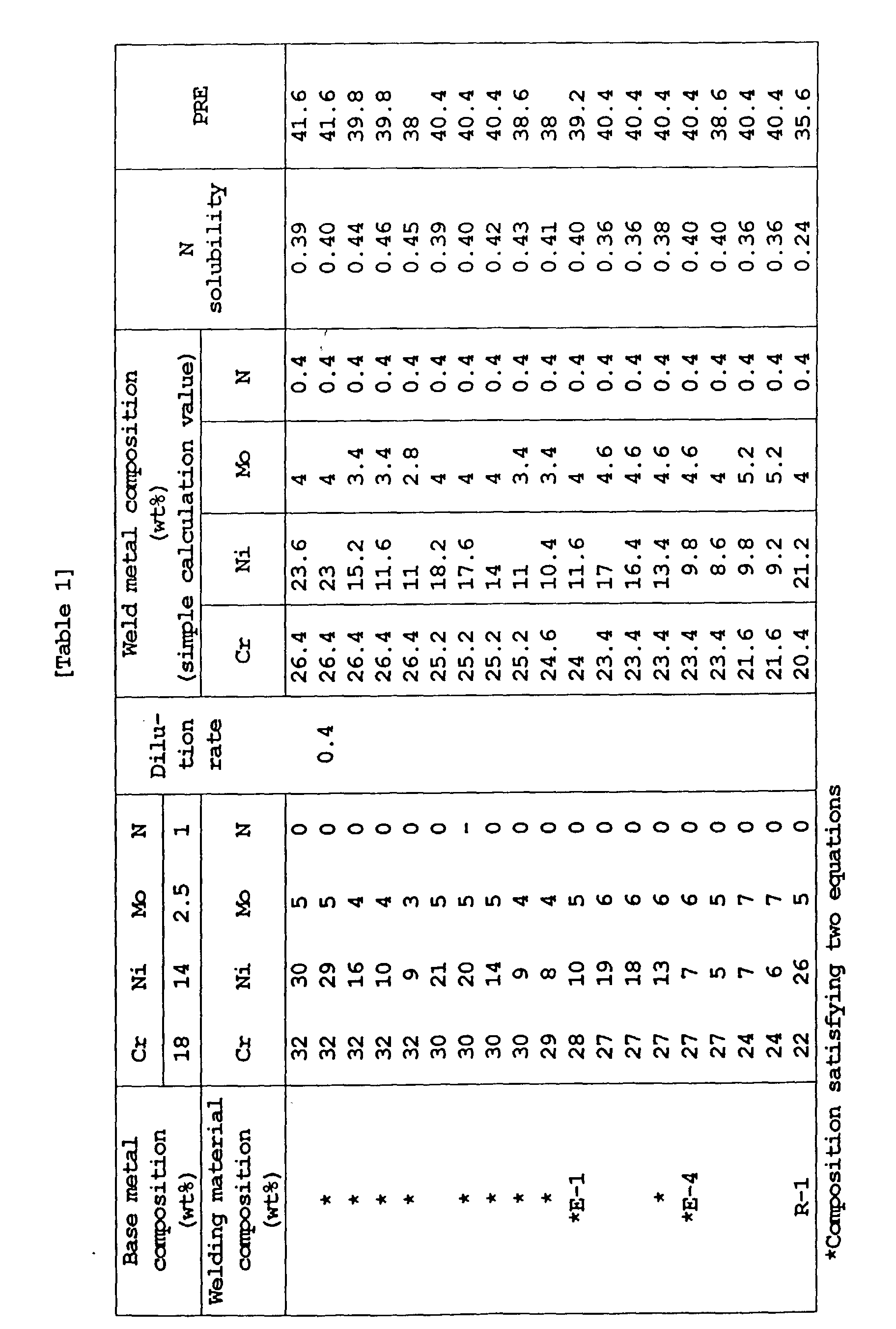
- compositions for the welding material capable of satisfying the definition equations (A) and (B) of this invention in a case of welding at 40% dilution rate those marked with “ * " in Table 1 can be mentioned.
- the composition shown by E-1 in Table 1 was vacuum melted, and drawn into a rod-like welding material of 1.2 mm diameter.
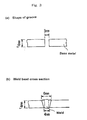
- Two sheets of base metal plates were cut out each into a size of 50 x 100 x 4mm, abutted against each other with fabrication of a groove shape shown in Fig. 3 (a) and were welded in flat position under the welding conditions described above.
- Fig. 1 the composition shown by E-1 in Table 1 was vacuum melted, and drawn into a rod-like welding material of 1.2 mm diameter.
- Two sheets of base metal plates were cut out each into a size of 50 x 100 x 4mm, abutted against each other with fabrication of a groove shape shown in Fig. 3 (a) and were welded in flat position under the welding conditions described above.
- 3(b) shows the result of observation for the weld bead cross section, in which the dilution rate calculated from the metal cross sectional area in the weld zone and the cross sectional area of the base metal molten portion was 40%.
- the portion of weld metal was cut out and the pitting corrosion potential in artificial sea water was measured.
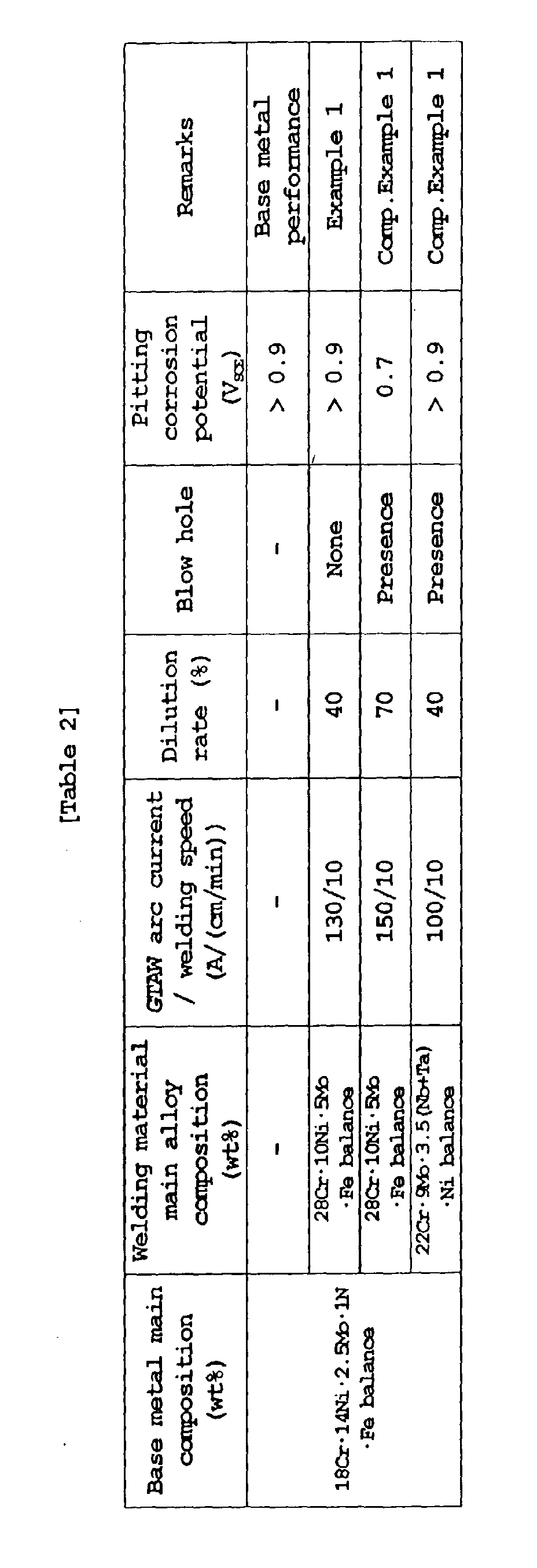
- occurrence of pitting corrosion was not observed at 45°C. Formation of blow holes can be prevented completely and the corrosion resistance of the weld metal was excellent being comparable with that of the base metal according to the welding method of this invention.
- Identical GTA welding was conducted using the base metal and the welding material of identical compositions with those in Example 1 under the conditions an at arc current of 150A and a welding speed of 10 cm/min, at a dilution ratio of 70% and evaluation was conducted in the same manner.
- the definition equations (A) and (B) were not satisfied, formation of blow holes were observed in the weld zone and the pitting corrosion potential in artificial sea water at 45°C was 0.7 V and the corrosion resistance was also degraded.
- a test was conducted under the same welding conditions by using a base metal of the identical composition with that in Example 1 and using a commercially available (welding consumables as an N-based material (Name of product: 625) of 1.2 mm diameter and excellent in corrosion resistance. As a result, although the corrosion resistance was excellent in the weld metal portion, blow holes were formed. This is considered to be attributable to that the definition equation (A) is not satisfied and solubility of N in the Ni-based alloy is low upon melting.
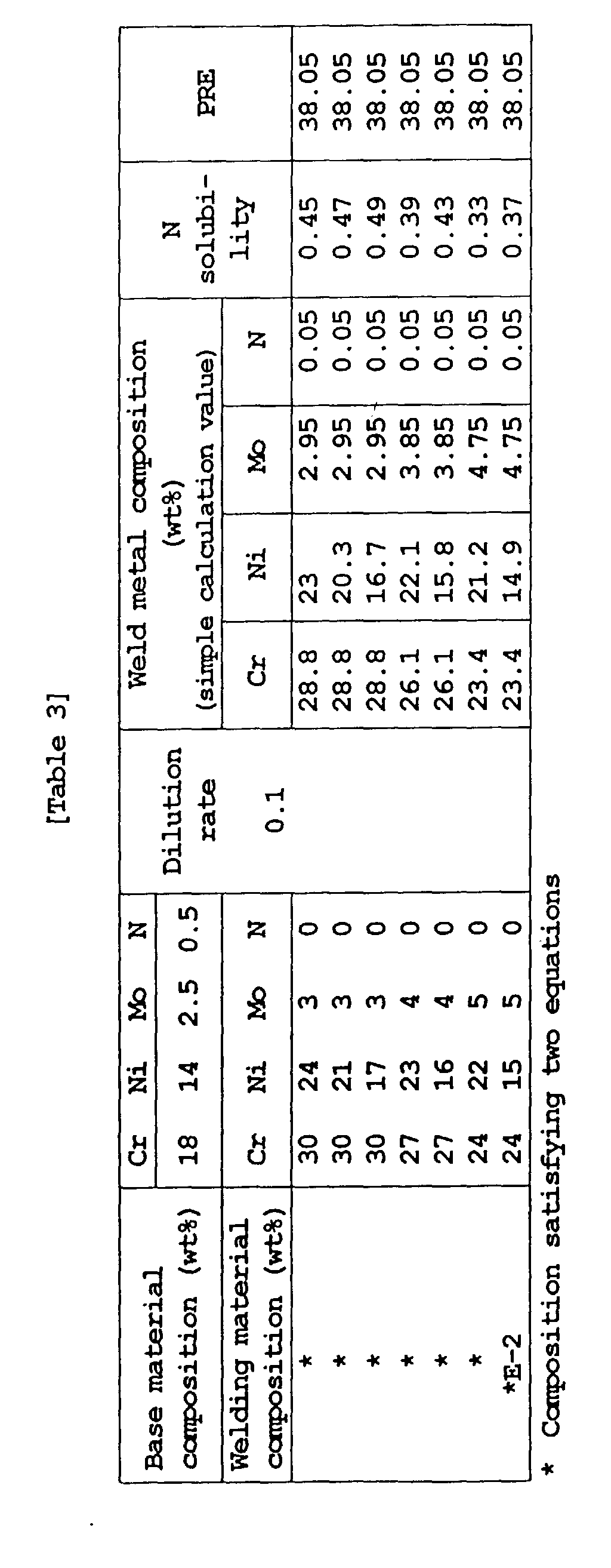
- a base metal plate metal of 4 mm thickness was prepared in the same manner as in Example 1 in which the base metal was also based on type 316L stainless steel and contained 0.5% N.
- GTA welding was conducted under the condition of providing 10% dilution rate.
- the composition of the welding material capable of satisfying the definition equations (A) and (B) under the conditions those marked with " * " in Table 3 may be considered.
- the material of the composition shown by E-2 was vacuum melted and drawn into a wire of 1.2 mm diameter. Welding with the groove shape shown in Fig. 4 was conducted under the conditions at an arc current of 140A and a welding speed of 10 cm/min.
- Table 4 shows the results of evaluation for the presence or absence of blow holes in the weld metal, and pitting corrosion potential in artificial sea water at 45°C. There were no blow holes and the corrosion resistance was also favorable.
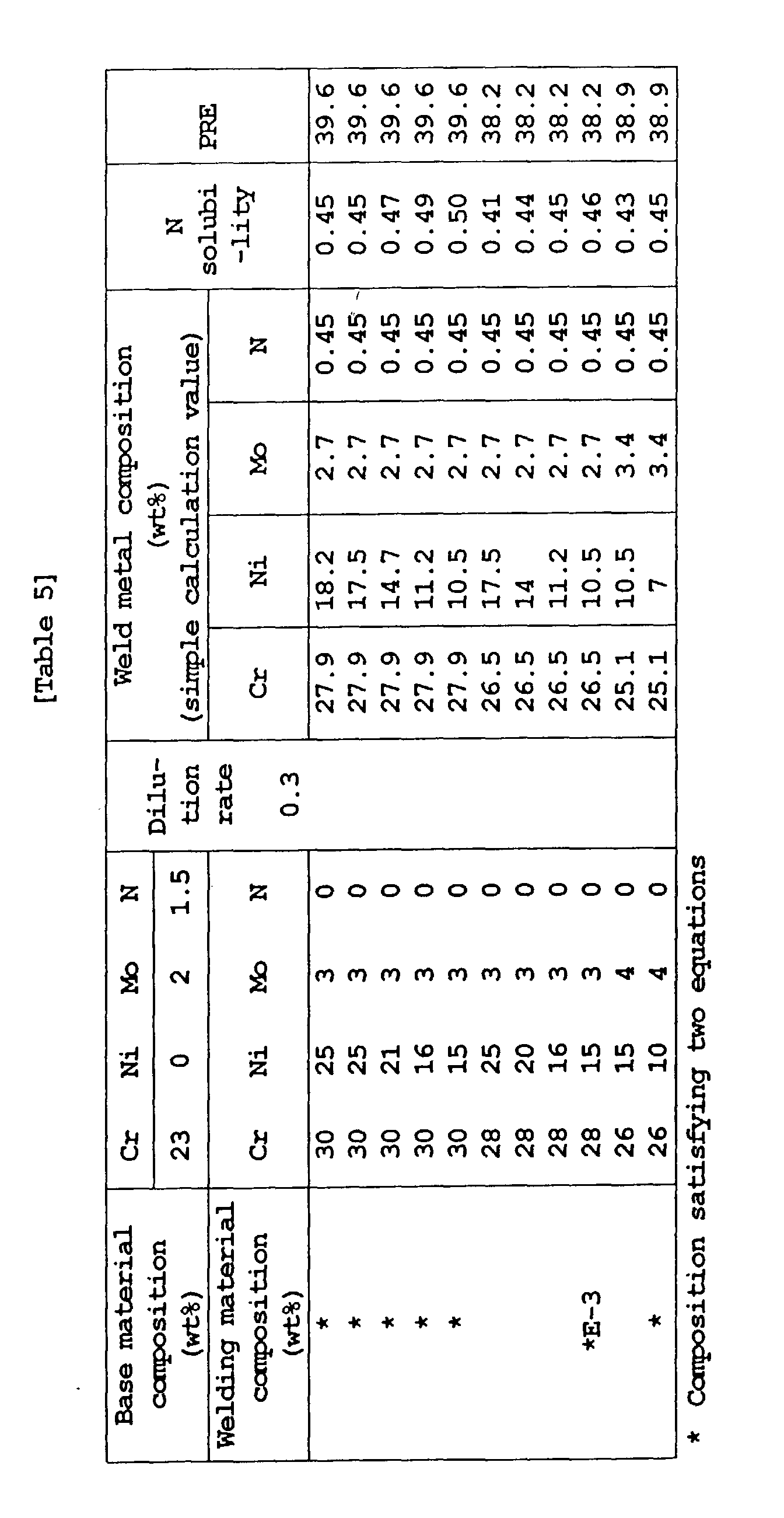
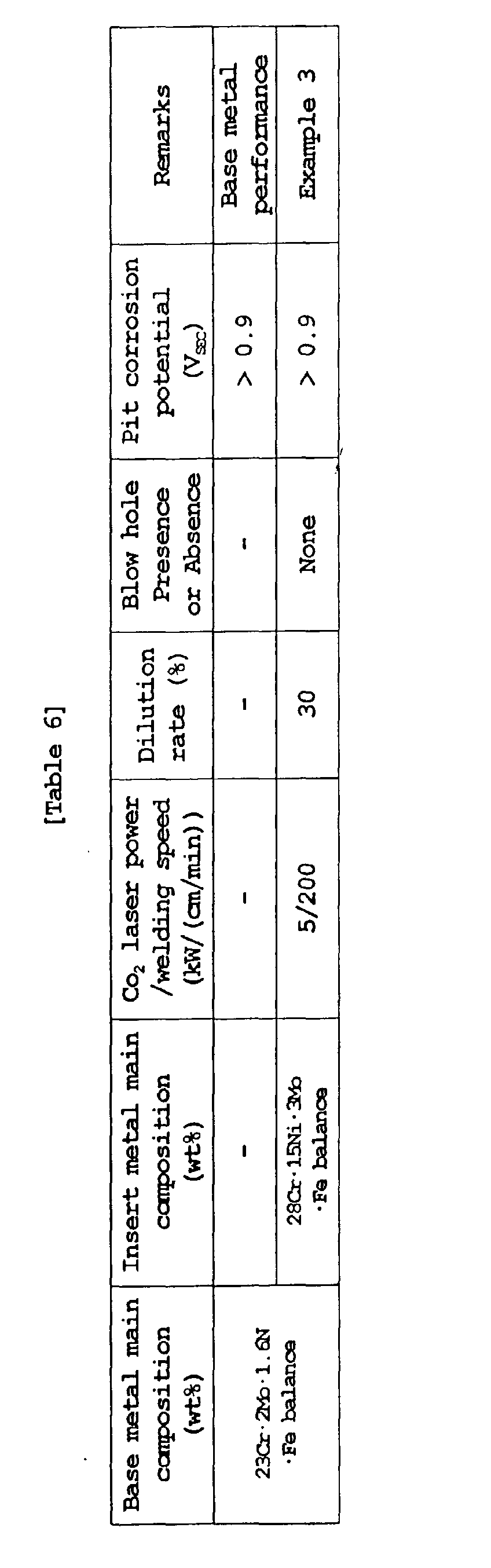
- CO 2 laser welding was conducted using a base metal of a composition comprising 23Cr-2Mo-1.5N-Fe (balance).
- the base metal was prepared in the same manner as in Example 1 and fabricated into 4 mm thickness.
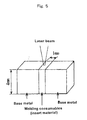
- an insert metal of 1 mm x 4 mm rectangular cross section was put between base metals each of 4 mm thickness as a specimen and conditions were selected such that the dilution rate was 30%.
- Compositions of the insert metal material include those of the compositions marked with " * " in Table 5. Among them, the material of the composition shown by E-3 was vacuum melted and rolled, cut out into the cross sectional shape described above and put as an insert metal between base metals.
- the welding conditions were at a CO 2 laser power of 5 kW and a welding speed of 2 m/min . The results are shown in Table 6. A weld metal with no blow holes and of excellent corrosion resistance was obtained.
- the base metal is formed by preparing an ingot by pressure ESR and then rolled into a plate material of 8 mm thickness.
- the base metals were fabricated with the groove shape shown in Fig. 6 (b) abutted against each other and, as a result of investigation for the welding conditions by using a marketed welding wire of 1.6 mm diameter, 40% dilution ratio was obtained under the conditions at an arc current of 300 A, an arc voltage of 30 V, a welding speed of 40 cm/min and a sealed gas flow rate of 20 1/min.
- Example 4 GMA welding was conducted in the same manner as in Example 4.
- the welding material of the composition shown by R-1 in Table 1 was vacuum melted with identical composition of the base metal, plate thickness, groove shape and under welding conditions, drawn and used as a wire of 1.6 mm diameter. As a result, formation of blow holes and degradation of corrosion resistance of the weld metal were observed.
- Table 7 collectively shows the results of Example 4 and Comparative Example 4.
- this invention enables welding of high nitrogen stainless steel of excellent corrosion resistance and capable of preventing formation of blow holes in the weld metal.
- Application to ocean structures and equipments for sea water circumstances can be expected.
- the steel material requires neither sacrificial protection nor electric protection, can economize Cr, Mo and Ni as the main alloy elements, can reduce the cost, as well as economize source and energy.
Landscapes
- Engineering & Computer Science (AREA)
- Mechanical Engineering (AREA)
- Arc Welding In General (AREA)
Abstract
Description


Claims (3)
- A method of welding a high nitrogen containing stainless steel using, as a base metal, a high nitrogen stainless steel containing nitrogen at or above a solubility equilibrated with N2 at 1 atm (1.01x10⁵Pa) when melted, wherein welding is conducted while setting a composition of a welding material (welding consumables) and a dilution rate to be defined latter so as to satisfy the following two relations (A) and (B):
- A method of welding a high nitrogen containing stainless steel as defined in claim 1, wherein the composition of alloy elements of the welding material comprises Cr 20 - 32%, Ni 5 - 25%, Mo 2 - 8%, C ≤ 0.03%, Si ≤ 0.6%, Mn ≤ 2.5%, P ≤ 0.03%, S ≤ 0.03% and the balance being Fe in which other inevitable impurities may also be contained.
- A welding material (welding consumables) in the welding method as defined in claim 1 or 2.
Applications Claiming Priority (2)
| Application Number | Priority Date | Filing Date | Title |
|---|---|---|---|
| JP2000006218 | 2000-01-11 | ||
| JP2000006218A JP2001198694A (en) | 2000-01-11 | 2000-01-11 | Welding method of high nitrogen containing stainless steel and its welding materials |
Publications (2)
| Publication Number | Publication Date |
|---|---|
| EP1118422A2 true EP1118422A2 (en) | 2001-07-25 |
| EP1118422A3 EP1118422A3 (en) | 2004-01-28 |
Family
ID=18534781
Family Applications (1)
| Application Number | Title | Priority Date | Filing Date |
|---|---|---|---|
| EP01300057A Withdrawn EP1118422A3 (en) | 2000-01-11 | 2001-01-04 | Method of welding high nitrogen containing stainless steel and welding material therefor |
Country Status (5)
| Country | Link |
|---|---|
| US (1) | US20010030221A1 (en) |
| EP (1) | EP1118422A3 (en) |
| JP (1) | JP2001198694A (en) |
| CN (1) | CN1201895C (en) |
| TW (1) | TW480201B (en) |
Cited By (3)
| Publication number | Priority date | Publication date | Assignee | Title |
|---|---|---|---|---|
| RU2437746C1 (en) * | 2010-09-22 | 2011-12-27 | Российская Федерация, От Имени Которой Выступает Министерство Образования И Науки Российской Федерации | Composition of wise for automated assembly |
| RU2768949C1 (en) * | 2021-04-16 | 2022-03-25 | Федеральное государственное бюджетное учреждение науки Институт металлургии и материаловедения им. А.А. Байкова Российской академии наук (ИМЕТ РАН) | Welding wire with high nitrogen content |
| RU2796568C1 (en) * | 2022-05-19 | 2023-05-25 | Российская Федерация, от имени которой выступает Министерство промышленности и торговли Российской Федерации (Минпромторг России) | WIRE MARK ”Св-08Х16Н5М3АБ” FOR WELDING HIGH-STRESS STEEL |
Families Citing this family (14)
| Publication number | Priority date | Publication date | Assignee | Title |
|---|---|---|---|---|
| JP4460085B2 (en) | 1999-07-06 | 2010-05-12 | 出光興産株式会社 | Refrigerating machine oil composition for carbon dioxide refrigerant |
| JP4754780B2 (en) * | 2003-11-28 | 2011-08-24 | 日本冶金工業株式会社 | Metal plate welding method |
| JP4975948B2 (en) * | 2003-11-28 | 2012-07-11 | Jfeスチール株式会社 | Welding coating method of corrosion-resistant thin metal sheet on thick metal substrate surface |
| US8710405B2 (en) * | 2005-04-15 | 2014-04-29 | Nippon Steel & Sumikin Stainless Steel Corporation | Austenitic stainless steel welding wire and welding structure |
| JP4845109B2 (en) * | 2005-07-19 | 2011-12-28 | 独立行政法人物質・材料研究機構 | Nickel-free high-nitrogen stainless steel, living body or medical implants using the same, jewelry, kitchen appliances, etc. |
| CN101092914A (en) * | 2007-07-20 | 2007-12-26 | 山东滨州渤海活塞股份有限公司 | Welding type single piece piston in forged steel with close internal cooling oil pocket and fabricating method |
| CN103769765B (en) * | 2012-10-17 | 2016-04-06 | 沈阳工业大学 | A kind of surfacing welding alloy containing Mo, Cr element ceramic phase and preparation technology thereof |
| WO2015037071A1 (en) * | 2013-09-11 | 2015-03-19 | 株式会社日立製作所 | Friction stir welding method, friction stir welding device and friction stir welded object |
| CN105665927A (en) * | 2016-03-30 | 2016-06-15 | 内蒙古第一机械集团有限公司 | Protection method of high nitrogen austenitic stainless steel welded joint |
| CN111604619B (en) * | 2018-09-27 | 2021-09-14 | 华北水利水电大学 | Vanadium-plated graphene reinforcing agent for high-nitrogen steel brazing |
| CN109128417B (en) * | 2018-10-15 | 2021-06-01 | 华北水利水电大学 | A beam-electron beam composite brazing method for high nitrogen steel |
| CN110253112B (en) * | 2019-07-12 | 2022-09-13 | 中船桂江造船有限公司 | Welding method for 917 steel plate and 1Cr18Ni9Ti dissimilar steel |
| CN115401216B (en) * | 2022-09-21 | 2024-03-05 | 华北理工大学 | A method for preparing high-nitrogen stainless steel by selective laser melting of alloy over-matched powder |
| CN118926656B (en) * | 2024-09-05 | 2026-03-20 | 首钢集团有限公司 | A welding method for high-strength steel plates |
Family Cites Families (2)
| Publication number | Priority date | Publication date | Assignee | Title |
|---|---|---|---|---|
| SE453838B (en) * | 1985-09-05 | 1988-03-07 | Santrade Ltd | HIGH-QUALITY FERRIT-AUSTENITIC STAINLESS STEEL |
| DE4110695A1 (en) * | 1991-04-03 | 1992-10-08 | Thyssen Schweisstechnik | STOLE |
-
2000
- 2000-01-11 JP JP2000006218A patent/JP2001198694A/en not_active Withdrawn
-
2001
- 2001-01-04 EP EP01300057A patent/EP1118422A3/en not_active Withdrawn
- 2001-01-08 US US09/755,094 patent/US20010030221A1/en not_active Abandoned
- 2001-01-08 TW TW090100331A patent/TW480201B/en not_active IP Right Cessation
- 2001-01-08 CN CN01111314.6A patent/CN1201895C/en not_active Expired - Fee Related
Cited By (3)
| Publication number | Priority date | Publication date | Assignee | Title |
|---|---|---|---|---|
| RU2437746C1 (en) * | 2010-09-22 | 2011-12-27 | Российская Федерация, От Имени Которой Выступает Министерство Образования И Науки Российской Федерации | Composition of wise for automated assembly |
| RU2768949C1 (en) * | 2021-04-16 | 2022-03-25 | Федеральное государственное бюджетное учреждение науки Институт металлургии и материаловедения им. А.А. Байкова Российской академии наук (ИМЕТ РАН) | Welding wire with high nitrogen content |
| RU2796568C1 (en) * | 2022-05-19 | 2023-05-25 | Российская Федерация, от имени которой выступает Министерство промышленности и торговли Российской Федерации (Минпромторг России) | WIRE MARK ”Св-08Х16Н5М3АБ” FOR WELDING HIGH-STRESS STEEL |
Also Published As
| Publication number | Publication date |
|---|---|
| CN1201895C (en) | 2005-05-18 |
| US20010030221A1 (en) | 2001-10-18 |
| EP1118422A3 (en) | 2004-01-28 |
| TW480201B (en) | 2002-03-21 |
| JP2001198694A (en) | 2001-07-24 |
| CN1306896A (en) | 2001-08-08 |
Similar Documents
| Publication | Publication Date | Title |
|---|---|---|
| US20010030221A1 (en) | Method of welding high nitrogen containing stainless steel and welding material therefor | |
| CA1326143C (en) | Ferritic stainless steel and processing therefore | |
| CA2674091C (en) | Austenitic stainless steel welded joint and austenitic stainless steel welding material | |
| Saluja et al. | The emphasis of phase transformations and alloying constituents on hot cracking susceptibility of type 304L and 316L stainless steel welds | |
| CA2335894C (en) | Welding alloy and articles for use in welding, weldments and methods for producing weldments | |
| AU2012218659B2 (en) | Welded duplex stainless joint | |
| JP6614785B2 (en) | Alloy-saving duplex stainless steel laser welded member with good laser weld characteristics and manufacturing method of alloy-saving duplex stainless steel laser welded member | |
| KR101004909B1 (en) | Liquid Diffusion Bonding Alloy | |
| Zhang et al. | Influence of CaF2 on microstructural characteristics and mechanical properties of 304 stainless steel underwater wet welding using flux-cored wire | |
| Ku et al. | Properties of electron beam welded SAF 2205 duplex stainless steel | |
| JP7188646B1 (en) | submerged arc welded fittings | |
| JP6999479B2 (en) | Complete austenitic stainless steel | |
| CN102317489A (en) | Austenitic stainless steel | |
| JP5622707B2 (en) | Welding materials for cryogenic steel | |
| KR20150015506A (en) | Steel material having excellent toughness in weld-heat-affected zone | |
| JP7188647B1 (en) | TIG welded joint | |
| Anbarasan et al. | Effect of pulse frequency on microstructural and corrosion properties of inconel 718 gas tungsten arc weldments | |
| JP3329261B2 (en) | Welding materials and welded joints for high temperature high strength steel | |
| Yu et al. | Resistance of austenitic stainless steels to ductility-dip cracking: mechanisms | |
| JP5469648B2 (en) | Welding materials for cryogenic steel | |
| JP2006075853A (en) | Laser welded joint of austenitic alloy steel and manufacturing method thereof | |
| El Nayal et al. | Relationship between composition, impurity content, cooling rate, and solidification in austenitic stainless steels | |
| JP2005336602A (en) | High HAZ toughness steel for high heat input welding with heat input of 20-100 kJ / mm | |
| JP4879688B2 (en) | Steel arc welded joint with excellent fatigue strength, its welding method and steel structure | |
| US20240018635A1 (en) | Use of a titanium-free nickel-chromium-iron-molybdenum alloy |
Legal Events
| Date | Code | Title | Description |
|---|---|---|---|
| PUAI | Public reference made under article 153(3) epc to a published international application that has entered the european phase |
Free format text: ORIGINAL CODE: 0009012 |
|
| AK | Designated contracting states |
Kind code of ref document: A2 Designated state(s): AT BE CH CY DE DK ES FI FR GB GR IE IT LI LU MC NL PT SE TR |
|
| AX | Request for extension of the european patent |
Free format text: AL;LT;LV;MK;RO;SI |
|
| PUAL | Search report despatched |
Free format text: ORIGINAL CODE: 0009013 |
|
| AK | Designated contracting states |
Kind code of ref document: A3 Designated state(s): AT BE CH CY DE DK ES FI FR GB GR IE IT LI LU MC NL PT SE TR |
|
| AX | Request for extension of the european patent |
Extension state: AL LT LV MK RO SI |
|
| 17P | Request for examination filed |
Effective date: 20040719 |
|
| AKX | Designation fees paid |
Designated state(s): DE FR GB |
|
| STAA | Information on the status of an ep patent application or granted ep patent |
Free format text: STATUS: THE APPLICATION IS DEEMED TO BE WITHDRAWN |
|
| 18D | Application deemed to be withdrawn |
Effective date: 20060209 |