EP1117141A1 - Carbon powder having enhanced electrical characteristics and use of the same - Google Patents
Carbon powder having enhanced electrical characteristics and use of the same Download PDFInfo
- Publication number
- EP1117141A1 EP1117141A1 EP00944371A EP00944371A EP1117141A1 EP 1117141 A1 EP1117141 A1 EP 1117141A1 EP 00944371 A EP00944371 A EP 00944371A EP 00944371 A EP00944371 A EP 00944371A EP 1117141 A1 EP1117141 A1 EP 1117141A1
- Authority
- EP
- European Patent Office
- Prior art keywords
- carbon powder
- acid
- carbon
- sulfur
- secondary battery
- Prior art date
- Legal status (The legal status is an assumption and is not a legal conclusion. Google has not performed a legal analysis and makes no representation as to the accuracy of the status listed.)
- Withdrawn
Links
Images


Classifications
-
- H—ELECTRICITY
- H01—ELECTRIC ELEMENTS
- H01M—PROCESSES OR MEANS, e.g. BATTERIES, FOR THE DIRECT CONVERSION OF CHEMICAL ENERGY INTO ELECTRICAL ENERGY
- H01M10/00—Secondary cells; Manufacture thereof
- H01M10/42—Methods or arrangements for servicing or maintenance of secondary cells or secondary half-cells
- H01M10/4242—Regeneration of electrolyte or reactants
-
- C—CHEMISTRY; METALLURGY
- C01—INORGANIC CHEMISTRY
- C01B—NON-METALLIC ELEMENTS; COMPOUNDS THEREOF; METALLOIDS OR COMPOUNDS THEREOF NOT COVERED BY SUBCLASS C01C
- C01B32/00—Carbon; Compounds thereof
- C01B32/05—Preparation or purification of carbon not covered by groups C01B32/15, C01B32/20, C01B32/25, C01B32/30
-
- H—ELECTRICITY
- H01—ELECTRIC ELEMENTS
- H01M—PROCESSES OR MEANS, e.g. BATTERIES, FOR THE DIRECT CONVERSION OF CHEMICAL ENERGY INTO ELECTRICAL ENERGY
- H01M10/00—Secondary cells; Manufacture thereof
- H01M10/42—Methods or arrangements for servicing or maintenance of secondary cells or secondary half-cells
- H01M10/4235—Safety or regulating additives or arrangements in electrodes, separators or electrolyte
-
- H—ELECTRICITY
- H01—ELECTRIC ELEMENTS
- H01M—PROCESSES OR MEANS, e.g. BATTERIES, FOR THE DIRECT CONVERSION OF CHEMICAL ENERGY INTO ELECTRICAL ENERGY
- H01M4/00—Electrodes
- H01M4/02—Electrodes composed of, or comprising, active material
- H01M4/62—Selection of inactive substances as ingredients for active masses, e.g. binders, fillers
-
- H—ELECTRICITY
- H01—ELECTRIC ELEMENTS
- H01M—PROCESSES OR MEANS, e.g. BATTERIES, FOR THE DIRECT CONVERSION OF CHEMICAL ENERGY INTO ELECTRICAL ENERGY
- H01M4/00—Electrodes
- H01M4/02—Electrodes composed of, or comprising, active material
- H01M4/62—Selection of inactive substances as ingredients for active masses, e.g. binders, fillers
- H01M4/624—Electric conductive fillers
- H01M4/625—Carbon or graphite
-
- Y—GENERAL TAGGING OF NEW TECHNOLOGICAL DEVELOPMENTS; GENERAL TAGGING OF CROSS-SECTIONAL TECHNOLOGIES SPANNING OVER SEVERAL SECTIONS OF THE IPC; TECHNICAL SUBJECTS COVERED BY FORMER USPC CROSS-REFERENCE ART COLLECTIONS [XRACs] AND DIGESTS
- Y02—TECHNOLOGIES OR APPLICATIONS FOR MITIGATION OR ADAPTATION AGAINST CLIMATE CHANGE
- Y02E—REDUCTION OF GREENHOUSE GAS [GHG] EMISSIONS, RELATED TO ENERGY GENERATION, TRANSMISSION OR DISTRIBUTION
- Y02E60/00—Enabling technologies; Technologies with a potential or indirect contribution to GHG emissions mitigation
- Y02E60/10—Energy storage using batteries
Definitions
- This invention relates to a carbon powder which enhanced the adhesive strength or electrophoretic nature to an electrode , and its application.
- the carbon powder of this invention is suitable for the activator of secondary batteries, such as a lead storage battery, etc., and can prolong its cell life, exhibit the outstanding charge/discharge performance, regenerate the secondary battery, by adding to the electrolytic solution of the secondary battery, mixing to the electrode active material, or making to adhere to the electrode surface.
- the lead battery which is a typical secondary battery, uses lead as a negative electrode, and uses lead, which has lead oxide on its surface, as a positive electrode, and has the structure dipping these electrodes in the dilute sulfuric acid.
- lead (Pb) on the surface of the negative electrode reacts with sulfate ion, and become lead sulfate (PbSO 4 ), and discharges electron.
- PbO 2 lead oxide on the surface of the positive electrode reacts with sulfiric acid, and becomes lead sulfate.
- the secondary battery has the advantage, which can be used for a long period of time, by repeating the charge and the discharge. However, the secondary battery loses activity gradually to become impossible to use.
- the activation method of this secondary battery it is conventionally known to add the suspension of a good conductive carbon fine particle to an electrolytic solution to recover an electrical capacity.
- the secondary battery used the suspension of the carbon fine particles obtained by electrolytic oxidation (Tokukai Hei 09-045379) or the hydrophilic electric conductive particles which have an extremely fine (600nm or less of median sizes) particle size (Tokukai Hei 10-228922).
- the secondary battery using the carbon fine particles obtained by electrolytic oxidation has the problems that the manufacture of said carbon particles is difficult and needs much power consumption to be high price. Moreover, it is said that this carbon particles has a hydrophilic nature by the carbonyl group and carboxyl group which modified on the surface of said carbon particles, and has the property to adsorb to the positive electrode at the time of the charge. However, it is hard to adsorb this carbon particle to the positive electrode in fact. On the other hand, since such extremely fine carbon particles are easy to aggregate, its dispersibility is low and difficult to use. Furthermore, the former activator is unstable in an acid electrolytic solution, and the effect is decreased comparatively in a short time by the repeat of the charge/discharge, so that the said activator does not have durability.
- This invention offers the carbon powder being suitable as the secondary battery activator, which solves the conventional above-mentioned problems, and its applications. That is to say, the object of this invention offers the carbon powder, which has good adhesive strength or electrophoretic nature to the electrode, excellent effect for prolonging the cell life and for regeneration of charge of the cell, when said carbon powder is added to the secondary battery. Moreover, the object of this invention offers the secondary battery, which is added the secondary battery activator comprising this carbon powder and this carbon powder.
- this invention is relates to the carbon powder characterized enhancing the adhesive strength to the negative electrode, by including 0.1 - 2 wt % of one or more than two of sulfur, nitrogen, boron, phosphorus, and fluorine, with 1 - 20wt% of oxygen.
- These oxygen, sulfur, and nitrogen, etc. introduced in the carbon powder are fixed in a surface structure and, in an X-ray diffraction pattern, when a Cu-K ⁇ radiation source was used as X radiation source, said carbon powder has graphite structure, in which the diffraction line having a loose gradient toward the diffraction peak of [002] face, in the area from 20 degrees of diffraction angle (2 ⁇ ) to the diffraction peak of [002] face.
- This loose gradient is the loose continuous standup, in which, for example, said gradient passes the point that, the relative intensity of the diffraction line to the diffraction line [002] face shows 1/50 times or more, and tends toward the diffraction peak of [002] face, in the range of the diffraction angle (2 ⁇ ) is 23.5 - 24.5 degrees.
- the detail example of this carbon powder is the carbon powder, in which the surface structure at least included 1 - 20 wt % of oxygen and 0.1 - 2 wt % of sulfur.
- the carbon powder of this invention which has the excellent adhesive strength or electrophoretic nature to the negative electrode, can be obtained by doing the surface treatment of the carbon powder, with strong acid having strong oxidation work and including one or more of sulfur, nitrogen, boron, phosphorus, and fluorine, or with strong acid which is added the oxidizing agent and including one or more of said elements.
- the carbon powder of this invention includes such ones that have been done the surface treatment.
- the carbon powder which is done the surface treatment by the following acids for example, (1) strong acids that are added the oxidizing agent in sulfuric-acid system strong acids, poly-phosphoric acid and fluorine acid, and (2) the mixed acids of nitric acid and sulfuric acid system strong acids, poly-phosphoric acid, fluorine acid, boric acid or phosphoric acid.
- acids for example, (1) strong acids that are added the oxidizing agent in sulfuric-acid system strong acids, poly-phosphoric acid and fluorine acid, and (2) the mixed acids of nitric acid and sulfuric acid system strong acids, poly-phosphoric acid, fluorine acid, boric acid or phosphoric acid.
- These carbon powders of this invention is suitable as the activator of the secondary battery.
- This secondary battery activator is used as the following activators, i.e., for example, the secondary battery activator characterizes to comprise a dispersed composition which was made to disperse these carbon powders in the polar solvent, and the lead cell activator is characterized to comprise the dispersed composition which was made to disperse these carbon powder in the sulfuric acid aqueous solution. Whichever the state of a paste and a liquid is sufficient as these dispersed compositions.
- this invention offers the secondary batteries, which characterizes to be added these carbon powders to the electrolytic solution, to be added these carbon powders to an electrode active material, and to make these carbon powders to adhere to the electrode surface.
- These secondary batteries have a long life and the excellent charge/discharge regeneration ability.
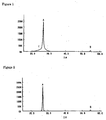
- Fig. 1 is the X-ray diffraction figure of the carbon powder of this invention.
- Fig. 2 is the X-ray diffraction figure of the conventional graphite powder.
- Fig. 3 is the graph showing the result of Example 2.
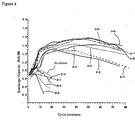
- Fig. 4 is the graph showing the result of Example 3.
- Fig. 5 is the graph showing the result of Example 4.
- the carbon powder of this invention characterizes to enhance the adhesive strength to the negative electrode, by making to include one or more of 0.1 - 2wt% of sulfur, nitrogen, boron, phosphorus, and fluorine, with 1 - 20wt% of oxygen.
- This carbon powder includes the amorphous (non-crystalline) carbon powder, which comprises a graphitizing carbon (soft carbon ) or a non-graphitizing carbon (hard carbon), other than the graphite (crystalline substance) carbon powder, which comprises natural graphite or man-made graphite.
- the carbon powders including graphite, coke, resin baking carbon, carbon fiber, pyrolysis vapor-growth carbon, meso-carbon micro bead, furfuryl-alcohol-resin cracking carbon, poly-acene, pitch based carbon fiber, graphite whisker, carbon nanofiber, and carbon nanotube, etc.
- the hydrophilic carbon powder is obtained by doing the surface modification treatment, which introduced sulfur, nitrogen, etc., with oxygen to the carbon powder, and so that, when the carbon powder is added to the electrolytic solution etc., the said powder becomes the suspension, in which said powder is dispersed homogeneously in the liquid.
- the carbon powder obtained by electrolytic oxidation is adsorbed to the anode (positive electrode).
- the carbon powder of this invention is suspended in the electrolytic solution, and adheres to the negative electrode at the time of the charge.
- the carbon powder of this invention is added to the lead storage battery electrolytic solution (dilute sulfuric acid) and the electric potential of 1-2V is applied for 5 minutes or more, the suspended carbon powder in the liquid adheres to the negative electrode.
- the conductivity of the electrode active material is improved by this electrodeposition and, moreover, an ion exchange performance increases and an electronic exchange between the electrolytic solution and the electrode is activated, by generating the bubbles near the electrode. Then, consequently, the life of the cell is prolonged and its electrical capacity is increased.
- the carbon powder of this invention is mixed in the electrode active material, the same effect is obtained.
- the carbon powder includes sulfur, nitrogen, etc. with oxygen and it means that these elements at least have been fixed to the surface structure of the carbon powder. Therefore, since said powder differs from the carbon powder, in which these elements are only adsorbed on the surface of it, for example, even if said powder is boiled to wash, these elements are not eluted substantially.
- the carbon powder of this invention was added to distilled water to boil, filtered after cooled, and dried to obtain the carbon powder, which remained on the filter paper, the amount of included elements was investigated. Consequently, the amount of the included elements, such as oxygen, sulfur, and nitrogen, was not substantially changed with before the test. Moreover, both of the amount of the sulfur, nitrogen, etc. in the filtrated solution is less than 0.01wt%.
- the diffraction line has the loose gradient toward to the diffraction peak of [002] face, in the range from 20 degrees of diffraction angle (2 ⁇ ) to the diffraction peak of [002] face.
- Fig. 1 is the X-ray diffraction pattern of the carbon (graphite) powder, which was introduced the predetermined amount of oxygen and sulfur.
- the loose gradient of the diffraction line which is from 20 degrees of the diffraction angle (2 ⁇ ) to the diffraction peak A of [002] face, is seen with the diffraction peak A of [002] face and B of [004] face of the graphite (hexagonal system).
- the diffraction line passes the point, which shows that the relative intensity of diffraction peak to the diffraction peak of [002] face is 1/50 times or more, and continues the diffraction peak A of [002] face, in the range of 23.5 - 24.5 of diffraction angle (2 ⁇ ).
- the amount of oxygen included in the carbon powder is suitable for 1 - 20wt% and 0.1 - 2wt% of sulfur and nitrogen, etc., included with oxygen is suitable.
- the amount of oxygen included in the carbon powder is less than 1wt%, the effect does not exist, and even if the amounts of oxygen is more than 20wt%, the effect does not change substantially.
- the included amount of sulfur, nitrogen, boron, phosphorus, or fluorine is less than 0.1wt%, the dispersibility in the electrolytic solution becomes inferior, and when the included amount of said elements is more than 2wt%, the dispersibility falls remarkably, so that they are not desirable.
- the carbon powder including two or more of these elements such as sulfur, nitrogen, etc., it is desirable that the amount of sums is less than 2wt%.
- the particle size of the carbon powder is 0.5-0.01 microns (5-460 m 2 /g of BET specific surface areas). If the particle size is too smaller than said value, the dispersibility is low and an adjustment of the particle size also becomes difficult. Moreover, if the particle size is too larger than said value, the dispersibility falls, so that they are not desirable. Moreover, as the carbon particle, graphite is desirable and the tabular crystal is more desirable.
- the carbon particle of this invention includes the predetermined amount of sulfur, nitrogen, etc., respectively with oxygen and the said particle has the high adhesive strength to the electrode (negative electrode) in the electrolytic solution, such as the dilute sulfuric acid, etc. Moreover, this oxygen, sulfur and nitrogen, etc. is not eluted substantially by the boiling test.
- this carbon particle has the diffraction line which shows the specific diffraction profile in X-ray diffraction, it is thought that these oxygen, sulfur and nitrogen, etc., are different from ones which is only being stuck to the carbon-particle surface, and at least has been fixed to the surface structure of the carbon particle. Moreover, it is thought that the surface charge on the carbon powders increases remarkably by fixing in this surface structure, and so that the strong electrophoresis to the negative electrode occurs and the carbon particle of this invention adheres to the negative electrode strongly.
- the carbon powder of this invention that is characterized to enhance the adhesive nature to the negative electrode by including 0.1-2wt% of one or more of sulfur, nitrogen, boron, phosphorus, and fluorine, can be obtained, by doing the surface treatment of the carbon powder to use strong acid which has the oxidation work including one or more of sulfur, nitrogen, boron, phosphorus, and fluorine, or, the strong acid which is added the oxidizing agent with including one or more of said elements.
- the surface treatments i.e., (A) the surface treatment by the strong acid which is added the oxidizing agent in strong acids of sulfuric acid group, poly-phosphoric acid, or hydrofluoric acid, and (B) the surface treatment by the mixed acids of nitric acid and the strong acids of sulfuric acid group, poly-phosphoric acid, hydrofluoric acid, boric acid, or phosphoric acid.
- the arbitrary oxidizing agents which indicate the oxidizing property in strong acids
- permanganate such as potassium permanganate and sodium permanganate
- chromic acid such as potassium permanganate and sodium permanganate
- ozone such as hydrogen peroxide
- lead dioxide etc.
- nitrate such as potassium nitrate and sodium nitrate
- nitric acid is preferable, and the nitric acid aqueous solution over 30wt% is more preferable.
- the typical one of sulfur including strong acid is sulfuric acid and, in this invention, it can be used that sulfuric acid or a sulfur including inorganic acid or a sulfur including organic acid which have more oxidizing property than sulfuric acid.
- As a stronger acid (super acid) than sulfuric acid there is fuming sulfuric acid, chlorosulfuric acid, fluorosulfuric acid, boric sulfuric acid [HB(HSO 4 ) 4 ], or trifluoromethane sulfonic acid (these are called for strong acids of sulfuric acid group).
- the sulfuric nitric acid which is mixed with sulfuric acid and nitric acid, is the most general strong acid of sulfuric acid group, which is added with oxidizing agent.
- nitric acid is mainly used. Condensed nitric acid can be used independently as the strong acid which has the oxidation work.
- the boron including strong acid the above-mentioned boric sulfuric acid, a boric acid compound [HB [HB (OC 2 H 5 ) 4 ], etc. can be used.
- the phosphorus including strong acid poly-phosphoric acid [(P n O 3n+1 ) (n+2)- (n ⁇ 2)] etc. can be used.
- fluorine including strong acid fluorosulfuric acid, trifluoromethane sulfonic acid, magic acid, hydrofluoric acid, etc. can be used. These strong acids are chosen according to the kind of elements introduced with oxygen.
- boric acid and phosphoric acid are weak acids, these can be used as strong acid of oxidizing by mixing nitric acid so much more than these acids. For example, it is good to mix to use 5-100 moles of nitric acid to 1 mole of boric acid or 1 mole of phosphoric acid.
- the acids used for this surface treatment pure form (100% solution) is good, or the solution, which is diluted with the solvent, is also good.
- water is usually used as a diluting solvent
- an organic solvent can also be used if it does not react with acid or the oxidizing agent, which are used for the surface treatment.
- the organic solvent there are lower aliphatic carboxylic acid (acetic acid etc.), sulfonic acid (benzenesulfonic acid, toluensulfonic acid, etc.), hydrogenated aromatic hydrocarbon (chlorotoluene etc.), and nitrogenated solvents (nitromethane, nitrotoluene, nitrobenzene, etc.).
- the concentration of the treatment solution is suitable over 25wt%, preferably over 50wt%, and more preferably over 90wt%.
- the concentration having the acidity which corresponds to the concentration of said sulfuric acid solution, is good. If the acidity is high, it is good that the concentration is lower than said sulfuric acid concentration.
- the acidity of this surface treatment solution becomes higher, the ratio of oxygen and sulfur, etc., which were introduced in the carbon powder, becomes also higher.
- the additional amount of the oxidizing agent to the acid of the surface treatment solution is preferable for the range, where the mole ratio of oxidizing agent / acid is 0.001-100, on the content basis, which does not include the solvent, and more preferably 0.1-20.
- the solution in which 0.001-100 moles of nitric acid is mixed with sulfuric acid 1 mole, is preferable, and more preferably 0.1-20.
- the amount, in which the weight ratio of oxidizing agent/carbon powder becomes over 0.01 is preferable, and more preferably over 0.1.
- Surface treatment of the carbon powder can be done at the temperature from the room temperature to the boiling point. In general, the heat treatment under 60-180°C is suitable. Stirring of the liquid under the treatment is not necessarily required. The surface treatment is done until the predetermined amount of oxygen, sulfur and nitrogen is introduced into the carbon powder. For example, when the oxidizing agent is nitric acid or nitrate, the guideline of the completion of the treatment can be judged by stopping emitting of the nitrous acid, which is the reduction product of nitric acid, to the atmospheric air. The treatment time becomes short, when the treatment temperature is high. For example, when treatment temperature is 70°C, the treatment time is required for several hours, but when the temperature is 140°C, the treatment may be completed in about several ten minutes.
- the dry-type treatment using the gas including the target elements can also be done, other than the surface treatment using the strong acid solution of the oxidizing property mentioned above. That is to say, the mixed gas of fluorine and at least one kind of gases, which are chosen from oxygen, carbon dioxide, or sulfur dioxide, etc., is contacted to the carbon powder, and fluorine is introduced to the carbon powder.
- the gas which is diluted by inert gases, such as nitrogen gas and argon gas etc. is also suitable.
- fluorine gas is contacted after making sulfur dioxide gas to adhere to the carbon powder beforehand, the treatment can be done more efficiently and lastingly.
- the carbon powder of this invention is suitable as the activator of the secondary battery.
- This secondary battery activator can be used as the dispersed composition, which made to disperse the carbon powder to the polar solvent.
- the polar solvent the following solvents are used, i.e., water, alcohols (methanol, ethanol, propanol, isopropanol, butanol, etc.), ethers (diethyl ether, etc.), ketones (methyl ethyl ketone, methyl isobutyl ketone, isophorone, etc.), lower aliphatic carboxylic acid (acetic acid, etc.), polar solvents including nitrogen (N, N,- dimethylformamide, hexamethylphosphoramide, nitromethane, N-methyl-pyrrolidone, etc.), polar solvents including sulfur (dimethyl sulfoxide, etc.) ,etc., are used.
- the polar solvents one kind of single solvent or any of two or more of mixed solvents is sufficient respectively. In addition, if it is small amount (50wt% or less of the whole solvent), it is possible that the polar solvent for use and the nonpolar solvent having compatibility with said polar solvent are mixed to be used.
- the dispersed composition which made the carbon powder of this invention to disperse in the sulfuric acid aqueous solution, can be used as the lead storage battery activator. In the lead storage battery, since sulfuric acid is the electrolytic solution, which works as the active material, it becomes easy to adjust the solution, which made the carbon powder to disperse in the sulfuric acid aqueous solution, at the time of adding to the lead storage battery.
- the content of the carbon powder in the dispersed composition is suitable for 0.001 - 100wt%, and preferably 0.01 - 10wt%.
- Said composition of liquid state has good compatibility to the electrolytic solution, and has the advantage to disperse homogeneously and quickly. Moreover, since the paste state of said composition can control the addition with very small amount, keeping the good compatibility with the electrolytic solution, so that it does not have the concern which breaks down the concentration balance of the electrolytic solution.
- the carbon powder of this invention is used as the secondary battery, which is added with said carbon powder in the electrolytic solution or to the electrode active material, or made these carbon powders to adhere to the electrode surface.
- This amount of addition of the carbon powder is the amount, in which the cell does not make the electric short circuit. Concretely, for example, said amount of addition is the amount including 0.001-1wt% in the electrolytic solution. This amount of use is less than the conventional carbon powder, and even when this amount of use is little, the sufficient activation effect is demonstrated.
- the secondary battery, which is added with the carbon powder of this invention beforehand has the long cell life.
- the charge/discharge ability can be reproduced by adding the carbon powder of this invention to the secondary battery which became the charge/discharge disable. Concretely, 50% or more of the rated capacity of the secondary battery can be made to recover discharge capacity, by adding the carbon powder of this invention to the secondary battery, in which the discharge capacity fell to less than 50% of the rated capacity.
- the surface modified carbon powders can be obtained by using the treatment solution in Table 2, doing the surface treatment by heat-processing according to the process conditions of the Table 2, cooling to the room temperature to wash after heating, and drying.
- the dry process instead of this wet acid process (Process 1), the dry process (Process 2) was done, where the mixed gas of fluorine gas (3vol%), oxygen gas (5vol%), sulfur dioxide gas (5vol%), and nitrogen gas (5vol%) were contacted for 3 minutes with the above-mentioned carbon powders.
- the surface treatment was similarly done to this carbon powder, by using 63% concentration of nitric acid, fuming-sulfuric-acid solution, and 98% concentration of sulfuric acid (reference examples B1-B3).
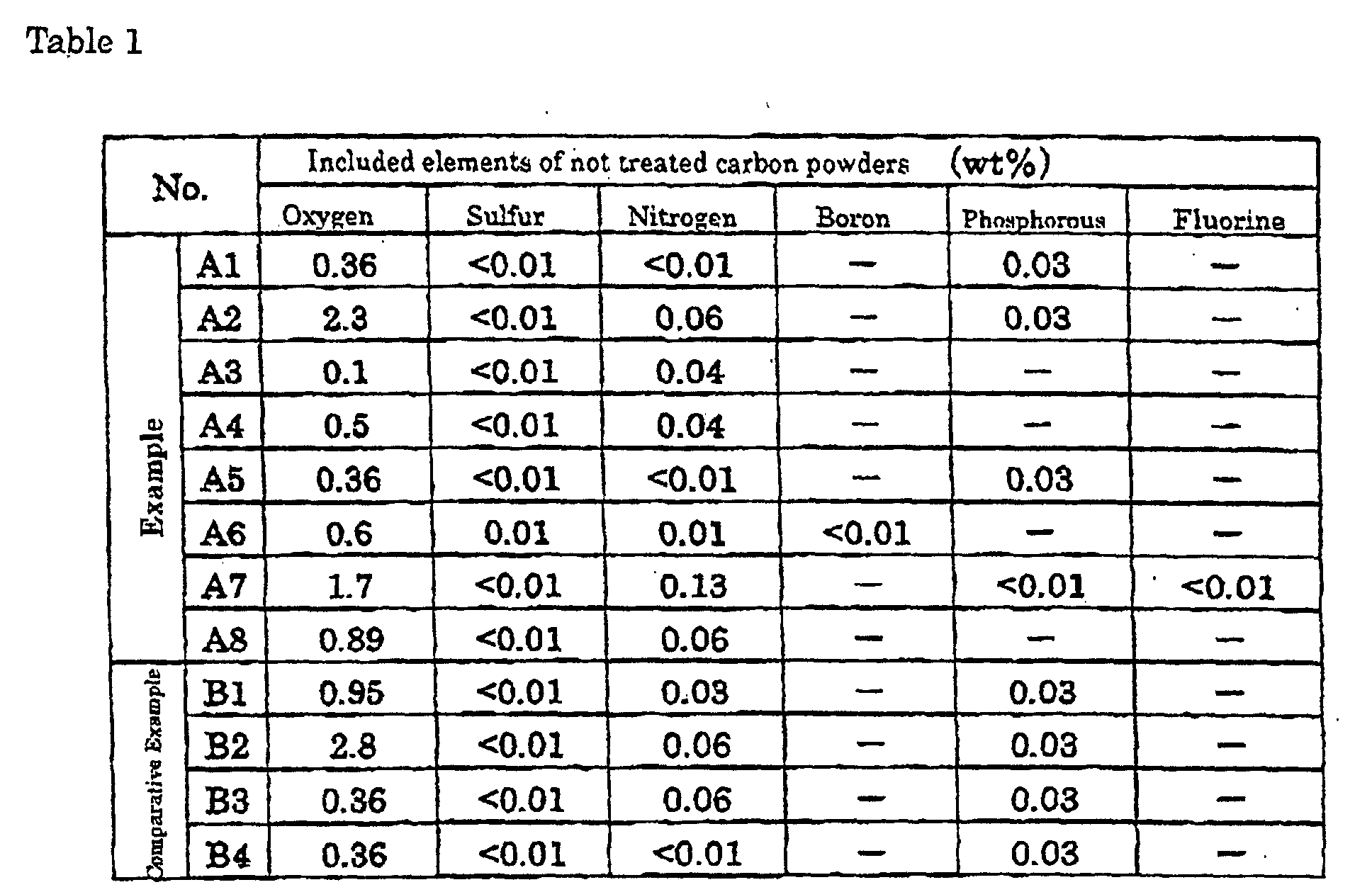
- concentration of these oxygen, sulfur, nitrogen, boron, phosphorus, and fluorine in the carbon powder these values before the process was shown in Table 1, and said values after the process was shown in Table 3, with the oxygen ratio and dispersibility. From this Table 3, it is clearly shown that the samples concerning this invention (No.A1-A8) have excellent dispersibility, but the reference sample (No.B1) has little few amounts of nitrogen, and its dispersibility is low.
- the reference sample (No.B-2) also has few amounts of sulfur and nitrogen, and its dispersibility is inferior.
- the reference sample (No.B3) in which the oxidizing agent was not used, since it has few amounts of oxygen, its dispersibility is inferior.
- the surface-modified carbon powders obtained in Example 1 was added to the dilute-sulfuric-acid solution, and dispersed by impressing the supersonic wave.
- the lead storage battery was filled up, using this distributed liquid (0.01wt% of solid-content and 37.7% concentration of sulfuric acid) as the electrolytic solution, and was charged, so that the lead storage battery, in which the modified carbon powders adhered to the electrode surface, was obtained.
- the charge/discharge test was done about this lead storage battery. This result was shown in Fig. 3.
- all samples (No.A1-A8) which were added with the carbon powder of this invention, had the large discharge capacity of the cell, and even when the charge/discharge was repeated about 120 times, there was very small fall of discharge capacity.
- the discharge capacity of the reference sample No.B1-B4 fell rapidly.
- Example 2 The dispersed liquid of Example 2, which dispersed the carbon powder, was added to the electrolytic solution of the lead storage battery, in which the charge/discharge became the disable (the amount of charge discharges was less than 50% of the rated capacity), and the charge/discharge test was done about this lead storage battery.
- Fig. 4 As shown in the figure, discharge capacity of the said battery, which was added the carbon powder of this invention (No.A1-A8), recovered rapidly by repeating the charge/discharge about 10 times, and high discharge capacity was kept, while repeating the charge/discharge about 80 times.
- the charge/discharge capacity of any reference samples using the carbon powders out of this invention No.B1-B4) was not recovered, and discharge capacity fell further by repeating the charge/discharge.
- Example 1 0.03wt% of the surface modified carbon powder obtained in Example 1 and dilute sulfuric acid were added to mix with the lead powder, to obtain the paste.
- the electrode material in which the surface modified carbon powders were added to the active material, was obtained by filling up with this paste in the lattice-like lead alloy, aging after drying only the surface, dipping in the dilute-sulfuric-acid electrolytic solution, and oxidizing/reducing through the direct current.
- the fine hole polypropylene separator and the fiberglass mat were inserted between the positive electrode and the negative electrode to built the cell, and the dilute sulfuric acid was poured in said cell as the electrolytic solution.
- the surface modified carbon powder of this invention has the good adhesive strength or clectrophoretic nature to the negative electrode, and exhibits the excellent effect in the prolongation of life and the charge regeneration of the secondary battery. Therefore, the surface modified carbon powder of this invention is suitable as the activator of the secondary battery.
- this surface modified carbon powder is used as the dispersed compositions which has the state of the paste or liquid, in which this carbon powder is dispersed in the polar solution, it is easy to handle.
- the mode of application to the secondary battery is not restricted, so that the said battery can use this carbon powder in various modes, such as adding to the electrolytic solution, adding to the electrode active material, or the state adhering to the electrode surface.
Landscapes
- Chemical & Material Sciences (AREA)
- Chemical Kinetics & Catalysis (AREA)
- Electrochemistry (AREA)
- General Chemical & Material Sciences (AREA)
- Engineering & Computer Science (AREA)
- Manufacturing & Machinery (AREA)
- Organic Chemistry (AREA)
- Inorganic Chemistry (AREA)
- Carbon And Carbon Compounds (AREA)
- Battery Electrode And Active Subsutance (AREA)
- Electric Double-Layer Capacitors Or The Like (AREA)
Abstract
Description


Claims (14)
- The carbon powder characterized by enhancing the adhesive strength to the negative electrode, and said powder including,
0.1 - 2wt% of one or more than two of sulfur, nitrogen, boron, phosphorus, and fluorine, with 1 - 20wt% of oxygen. - The carbon powder characterized by enhancing the adhesive strength to the negative electrode, and said carbon powder including,one or more than two of sulfur, nitrogen, boron and phosphorus, with oxygen, and said powder having,a diffraction line which has a loose gradient toward the diffraction peak of [002] face, in the range from 20 degrees of the diffraction angle (2) to the diffraction peak of [002] face, in an X-ray diffraction figure, when the source of Cu-K A rays is used as X radiation source.
- The carbon powder according to claim 2 having,
the diffraction line which has the gradient passing the point, in which the relative intensity to the diffraction line strength of [002] face shows 1/50 times or more, and tends toward the diffraction peak of [002] face, in the range from 23.5 to 24.5 degrees of the diffraction angle (2). - The carbon powder according to claims 1, 2, or 3 at least including,
1 - 20wt% of oxygen and 0.1 - 2wt% sulfur in the surface structure. - The carbon powder according to the claims 1, 2, or 3 characterized by enhancing the adhesive strength to the negative electrode, and said carbon powder including,0.1 - 2wt% of one or more than two of sulfur, nitrogen, boron, phosphorus, and fluorine with 1 - 20wt% of oxygen,and said carbon powder being done,by the surface treatment with the strong acid which having the oxidation work including one or more than two of sulfur, nitrogen, boron, phosphorus, and fluorine, orby the surface treatment with the strong acid which is added the oxidizing agent including one or more than two of said elements.
- The carbon powder according to claim 5 being done,
by the surface treatment with the strong acid which is added the oxidizing agent in the strong acid of sulfuric acid system, poly phosphoric acid, or hydrofluoric acid. - The carbon powder according to claim 5 being done,
by the surface treatment by the sulfuric acid system strong acid, poly phosphoric acid, hydrofluoric acid, boric acid, or the mixed acid of phosphoric acid and nitric acid. - The carbon powder according to one of the claims 1-7 being used as the activator of the secondary battery.
- The secondary battery activator characterized with the dispersed composition material and said material comprising,
the dispersed carbon powder according to one of the claims 1-7 in the polar solvent. - The lead storage battery activator characterized with the dispersed composition material and said material comprising,
the dispersed carbon powder of one of the claims 1-7 in the sulfuric acid aqueous solution. - The secondary battery activator according to claims 9 or 10, wherein the dispersed composition material is the shape of the paste or liquefied.
- The secondary battery characterized by being added with the carbon powder of one of the claims 1-7 in the electrolytic solution.
- The secondary battery characterized by being added with the carbon powder of one of the claims 1-7 to the electrode active material.
- The secondary battery characterized by making the carbon powder of one of the claims 1-7 to adhere to the electrode surface.
Applications Claiming Priority (3)
| Application Number | Priority Date | Filing Date | Title |
|---|---|---|---|
| JP20649099 | 1999-07-21 | ||
| JP20649099 | 1999-07-21 | ||
| PCT/JP2000/004590 WO2001006583A1 (en) | 1999-07-21 | 2000-07-10 | Carbon powder having enhanced electrical characteristics and use of the same |
Publications (2)
| Publication Number | Publication Date |
|---|---|
| EP1117141A1 true EP1117141A1 (en) | 2001-07-18 |
| EP1117141A4 EP1117141A4 (en) | 2007-02-21 |
Family
ID=16524246
Family Applications (1)
| Application Number | Title | Priority Date | Filing Date |
|---|---|---|---|
| EP00944371A Withdrawn EP1117141A4 (en) | 1999-07-21 | 2000-07-10 | Carbon powder having enhanced electrical characteristics and use of the same |
Country Status (6)
| Country | Link |
|---|---|
| EP (1) | EP1117141A4 (en) |
| KR (1) | KR20010073177A (en) |
| CN (1) | CN1162928C (en) |
| AU (1) | AU5851600A (en) |
| TW (1) | TW494591B (en) |
| WO (1) | WO2001006583A1 (en) |
Cited By (3)
| Publication number | Priority date | Publication date | Assignee | Title |
|---|---|---|---|---|
| WO2010008392A1 (en) * | 2008-07-18 | 2010-01-21 | Meadwestvaco Corporation | Enhanced negative plates for lead acid batteries |
| EP2752520A4 (en) * | 2011-09-30 | 2015-07-08 | Mitsubishi Materials Corp | Carbon nanofibers, and dispersion liquid and composition thereof |
| US11239465B2 (en) | 2016-08-11 | 2022-02-01 | Lg Energy Solution, Ltd. | Sulfur-carbon composite, preparation method therefor, and lithium-sulfur battery comprising same |
Families Citing this family (9)
| Publication number | Priority date | Publication date | Assignee | Title |
|---|---|---|---|---|
| JP4579513B2 (en) * | 2003-07-24 | 2010-11-10 | 古河電池株式会社 | Lead acid battery |
| JP4536561B2 (en) * | 2005-03-18 | 2010-09-01 | 住友大阪セメント株式会社 | Method for producing electrode material |
| JP5018213B2 (en) * | 2006-06-14 | 2012-09-05 | カルゴンカーボンジャパン株式会社 | Phosphorus compound composite activated carbon for electric double layer capacitor and method for producing the same |
| JPWO2008015779A1 (en) * | 2006-08-02 | 2009-12-17 | 新日鐵化学株式会社 | Carbonaceous conductive material for battery and battery |
| CN102649288A (en) * | 2011-02-23 | 2012-08-29 | 诸暨市光裕竹业有限公司 | Bamboo-wood composite carriage baffle for truck as well as manufacturing method of same |
| CN102903887B (en) * | 2011-07-28 | 2015-06-03 | 中国科学院大连化学物理研究所 | Sulfur electrode, and preparation and application thereof |
| JP5885984B2 (en) * | 2011-09-30 | 2016-03-16 | 三菱マテリアル株式会社 | Electrode forming material and electrode manufacturing method using the electrode forming material |
| JP5660730B2 (en) * | 2011-11-08 | 2015-01-28 | 株式会社豊田自動織機 | Positive electrode active material for non-aqueous electrolyte secondary battery, method for producing the same, and non-aqueous electrolyte secondary battery |
| JP7819140B2 (en) * | 2023-03-20 | 2026-02-24 | 株式会社東芝 | Electrode, secondary battery, battery pack and vehicle |
Family Cites Families (15)
| Publication number | Priority date | Publication date | Assignee | Title |
|---|---|---|---|---|
| US4073869A (en) * | 1975-06-05 | 1978-02-14 | Celanese Corporation | Internal chemical modification of carbon fibers to yield a product of reduced electrical conductivity |
| US4923637A (en) * | 1987-06-24 | 1990-05-08 | Yazaki Corporation | High conductivity carbon fiber |
| JP3060471B2 (en) * | 1990-02-21 | 2000-07-10 | ソニー株式会社 | Negative electrode for battery, method for producing the same, and nonaqueous electrolyte battery using the same |
| DE4422431A1 (en) * | 1994-06-28 | 1996-03-07 | Franz Dietrich Oeste | New spheres based on fullerene and hetero-fullerene fragments |
| US5900189A (en) * | 1994-04-07 | 1999-05-04 | Nippon Steel Chemical Co., Ltd. | Needle coke for graphite electrodes and process for producing same |
| JP2595903B2 (en) * | 1994-07-05 | 1997-04-02 | 日本電気株式会社 | Method for purifying and opening carbon nanotubes in liquid phase and method for introducing functional groups |
| US5698341A (en) * | 1995-08-18 | 1997-12-16 | Petoca, Ltd. | Carbon material for lithium secondary battery and process for producing the same |
| GB2305772B (en) * | 1995-09-28 | 1998-09-16 | Kenichi Fujita | Electrolyte solution and lead-acid batteries using the same |
| US5756062A (en) * | 1996-05-29 | 1998-05-26 | Ucar Carbon Technology Corporation | Chemically modified graphite for electrochemical cells |
| JPH1081889A (en) * | 1996-09-06 | 1998-03-31 | Bridgestone Corp | Powder for electroviscous fluid |
| WO1998024134A1 (en) * | 1996-11-26 | 1998-06-04 | Kao Corporation | Negative electrode material for nonaqueous secondary battery |
| US5958623A (en) * | 1996-12-13 | 1999-09-28 | Kozawa; Akiya | Electrochemical cell employing a fine carbon additive |
| JPH1121116A (en) * | 1997-06-30 | 1999-01-26 | Nippon Steel Corp | Carbonaceous powder and carbonaceous fiber coated with boron nitride |
| CA2326178A1 (en) * | 1998-03-31 | 1999-10-07 | Axiva Gmbh | Lithium battery and electrode |
| JP4379925B2 (en) * | 1998-04-21 | 2009-12-09 | 住友金属工業株式会社 | Graphite powder suitable for anode material of lithium ion secondary battery |
-
2000
- 2000-07-06 TW TW089113436A patent/TW494591B/en not_active IP Right Cessation
- 2000-07-10 EP EP00944371A patent/EP1117141A4/en not_active Withdrawn
- 2000-07-10 WO PCT/JP2000/004590 patent/WO2001006583A1/en not_active Ceased
- 2000-07-10 CN CNB008014698A patent/CN1162928C/en not_active Expired - Fee Related
- 2000-07-10 AU AU58516/00A patent/AU5851600A/en not_active Abandoned
- 2000-07-10 KR KR1020017003550A patent/KR20010073177A/en not_active Withdrawn
Cited By (4)
| Publication number | Priority date | Publication date | Assignee | Title |
|---|---|---|---|---|
| WO2010008392A1 (en) * | 2008-07-18 | 2010-01-21 | Meadwestvaco Corporation | Enhanced negative plates for lead acid batteries |
| EP2752520A4 (en) * | 2011-09-30 | 2015-07-08 | Mitsubishi Materials Corp | Carbon nanofibers, and dispersion liquid and composition thereof |
| US9321650B2 (en) | 2011-09-30 | 2016-04-26 | Mitsubishi Materials Corporation | Carbon nanofiber, dispersion liquid and composition thereof |
| US11239465B2 (en) | 2016-08-11 | 2022-02-01 | Lg Energy Solution, Ltd. | Sulfur-carbon composite, preparation method therefor, and lithium-sulfur battery comprising same |
Also Published As
| Publication number | Publication date |
|---|---|
| TW494591B (en) | 2002-07-11 |
| KR20010073177A (en) | 2001-07-31 |
| AU5851600A (en) | 2001-02-05 |
| WO2001006583A1 (en) | 2001-01-25 |
| CN1318209A (en) | 2001-10-17 |
| EP1117141A4 (en) | 2007-02-21 |
| CN1162928C (en) | 2004-08-18 |
Similar Documents
| Publication | Publication Date | Title |
|---|---|---|
| US8691441B2 (en) | Graphene-enhanced cathode materials for lithium batteries | |
| EP3405431B1 (en) | Carbonaceous materials and methods of use thereof | |
| US8765302B2 (en) | Graphene-enabled vanadium oxide cathode and lithium cells containing same | |
| JP5175011B2 (en) | New high surface conductivity electrode materials | |
| KR101998905B1 (en) | Electrode-forming composition | |
| JP2020100556A (en) | Method for producing graphene dispersion | |
| RU2598930C2 (en) | Composite of iron (iii) orthophosphate and carbon | |
| WO2017047523A1 (en) | Graphene dispersion, process for producing same, process for producing particles of graphene/active material composite, and process for producing electrode paste | |
| EP0613197A1 (en) | Carbonaceous electrode material for secondary battery | |
| JP6863099B2 (en) | Graphene / Organic Solvent Dispersion, Graphene-Active Material Complex Particle Production Method and Electrode Paste Production Method | |
| TWI782192B (en) | Positive electrode active material for lithium ion secondary battery, positive electrode material for lithium ion secondary battery, and lithium ion secondary battery | |
| CN1162928C (en) | Carbon Powder with Enhanced Electrical Properties and Its Application | |
| KR20240006863A (en) | Conductive composite material based on low-defect carbon nanotubes, anode slurry using it, anode and lithium secondary battery | |
| JP4495531B2 (en) | Granular composite carbon material and method for producing the same, negative electrode material for lithium ion secondary battery, negative electrode for lithium ion secondary battery, and lithium ion secondary battery | |
| EP1921698A2 (en) | Method of processing active materials for use in secondary electrochemical cells | |
| CN115714167B (en) | A manganese dioxide chemically modified carbon fluoride material and its preparation method and application | |
| CN114497516A (en) | A kind of egg yolk-shell carbon-coated silicon composite negative electrode material and preparation method | |
| EP3001485B1 (en) | Method for producing polyanionic positive electrode active material composite particles, and polyanionic positive electrode active material precursor-graphite oxide composite granulated bodies | |
| JP2025175012A (en) | Powder for use in battery negative electrodes, method for preparing such powder, and battery containing such powder | |
| KR102952047B1 (en) | Reduced graphene oxide for secondary batteries, its manufacturing method, electrodes and secondary batteries using the same | |
| KR102897995B1 (en) | Silicon nano anode material, manufacturing method thereof, and lithium secondary batteries containing the same | |
| JP2000331672A (en) | Battery electrode and battery having carbon particles containing nano-sized inclusions, and methods for their production and electrolysis | |
| CN115974061B (en) | A three-dimensional graphene/SiO composite material and its preparation method and application | |
| KR20230030652A (en) | Manufacturing method of carbon-coated silicon particles for lithium-ion batteries | |
| KR102757637B1 (en) | Silicon and nanotube-type titanium dioxide oxide composite anode material and method of manufacturing therof and lithium secondary battery including the same |
Legal Events
| Date | Code | Title | Description |
|---|---|---|---|
| PUAI | Public reference made under article 153(3) epc to a published international application that has entered the european phase |
Free format text: ORIGINAL CODE: 0009012 |
|
| 17P | Request for examination filed |
Effective date: 20010212 |
|
| AK | Designated contracting states |
Kind code of ref document: A1 Designated state(s): BE CH DE FR GB IT LI SE |
|
| RBV | Designated contracting states (corrected) |
Designated state(s): DE FR GB IT SE |
|
| A4 | Supplementary search report drawn up and despatched |
Effective date: 20070123 |
|
| RIC1 | Information provided on ipc code assigned before grant |
Ipc: H01M 4/62 20060101AFI20010129BHEP Ipc: C01B 31/00 20060101ALI20070116BHEP Ipc: H01M 10/42 20060101ALI20070116BHEP |
|
| 17Q | First examination report despatched |
Effective date: 20071106 |
|
| STAA | Information on the status of an ep patent application or granted ep patent |
Free format text: STATUS: THE APPLICATION IS DEEMED TO BE WITHDRAWN |
|
| 18D | Application deemed to be withdrawn |
Effective date: 20080517 |