EP1116796A2 - High chromium ferritic heat resisting steel and method of heat treatment for the same - Google Patents
High chromium ferritic heat resisting steel and method of heat treatment for the same Download PDFInfo
- Publication number
- EP1116796A2 EP1116796A2 EP01300136A EP01300136A EP1116796A2 EP 1116796 A2 EP1116796 A2 EP 1116796A2 EP 01300136 A EP01300136 A EP 01300136A EP 01300136 A EP01300136 A EP 01300136A EP 1116796 A2 EP1116796 A2 EP 1116796A2
- Authority
- EP
- European Patent Office
- Prior art keywords
- steel
- heat
- temperature
- elements
- ferritic
- Prior art date
- Legal status (The legal status is an assumption and is not a legal conclusion. Google has not performed a legal analysis and makes no representation as to the accuracy of the status listed.)
- Withdrawn
Links
Images




Classifications
-
- C—CHEMISTRY; METALLURGY
- C21—METALLURGY OF IRON
- C21D—MODIFYING THE PHYSICAL STRUCTURE OF FERROUS METALS; GENERAL DEVICES FOR HEAT TREATMENT OF FERROUS OR NON-FERROUS METALS OR ALLOYS; MAKING METAL MALLEABLE, e.g. BY DECARBURISATION OR TEMPERING
- C21D6/00—Heat treatment of ferrous alloys
- C21D6/002—Heat treatment of ferrous alloys containing Cr
-
- C—CHEMISTRY; METALLURGY
- C21—METALLURGY OF IRON
- C21D—MODIFYING THE PHYSICAL STRUCTURE OF FERROUS METALS; GENERAL DEVICES FOR HEAT TREATMENT OF FERROUS OR NON-FERROUS METALS OR ALLOYS; MAKING METAL MALLEABLE, e.g. BY DECARBURISATION OR TEMPERING
- C21D1/00—General methods or devices for heat treatment, e.g. annealing, hardening, quenching or tempering
- C21D1/18—Hardening; Quenching with or without subsequent tempering
-
- C—CHEMISTRY; METALLURGY
- C21—METALLURGY OF IRON
- C21D—MODIFYING THE PHYSICAL STRUCTURE OF FERROUS METALS; GENERAL DEVICES FOR HEAT TREATMENT OF FERROUS OR NON-FERROUS METALS OR ALLOYS; MAKING METAL MALLEABLE, e.g. BY DECARBURISATION OR TEMPERING
- C21D2211/00—Microstructure comprising significant phases
- C21D2211/004—Dispersions; Precipitations
Definitions
- This invention relates to high chromium ferritic heat resisting steel and a method of heat treatment for the same. More particularly, this invention relates to high chromium ferritic heat resisting steel of which both a long-term creep property at high temperatures and toughness at room temperature or lower are improved regardless of compositions, and a method of heat treatment for improving those properties of the high chromium ferritic steel.
- High strength, high toughness, high temperature corrosion resistivity, and oxidation resistivity are required for heat resisting steel which is applied to boilers or high temperature heat resisting and pressure resisting members in nuclear or chemical industry.
- austenitic stainless steel such as JIS-SUS321H and JIS-SUS347H
- low alloy steel such as JIS-STBA24 (2 ⁇ 1/4Cr-1Mo steel)
- ferritic steel containing chromium in amount of 9 ⁇ 12 weight % such as JIS-STBA26 have been provided.
- temperature and pressure enhancement of steam in the boilers has been particularly considered for the purpose of improving thermal efficiency.
- a ultra supercritical condition of 650 °C and 350 bar is planning.
- Austenitic stainless steel is one of the candidates that meet those conditions. However, since the austenitic stainless steel is expensive, its use in commercial plants is very limited from the economic point of view. In addition, the austenitic stainless steel has a large coefficient of thermal expansion and therefore thermal stress increases as temperature changes, for example, with start and stop operations, which leads to deterioration of a heat resisting fatigue property, scale peeling and stress corrosion cracking.
- the MX carbonitrides include single carbides and nitrides such as VC, NbC, VN and NbN, and composite carbonitrides such as V (C,N) and Nb (C,N).
- Complete solid-solution to amatrix takes place for each of the single carbides by heating at around 1,100 °C, but, complete solid-solution at 1,100 °C does not occur for any of the single nitrides and composite carbonitrides.
- solid-solution temperature of the MX carbonitrides is elevated in steel in which at least one of the elements such as boron, titanium and hafnium are doped. For example, solid-solution temperature is increased by 1,200 °C or higher in the case of the steel to which titanium or hafnium is added.
- the increase of solid-solution temperature results in insufficient solid-solution of the MX carbonitrides by normalizing at 1,100 °C or lower and suppression of precipitation of fine MX carbonitrides during subsequent tempering.
- it brings about not uniform distribution of fine MX carbonitrides in steel. All of them are causes of decrease of the improvement effect of creep strength by the MX carbonitride.
- this invention provides a method of heat treatment for high chromium ferritic heat resisting steel, which comprises the steps of heat-treating high chromium ferritic steel containing chromium (Cr) in amount of 7 ⁇ 12 weight %, one or two elements of molybdenum (Mo) and tungsten (W) as a solid-solution strengthening element, and one or more of elements for forming a MX carbonitride (s) at a temperature higher than both solid-solution temperature of said element(s) for forming the MX carbonitride(s) and a precipitation starting temperature of ⁇ ferrite for 5 seconds or longer, cooling said steel at a rate of 0.5 °C/s or faster, and subsequently tempering the steel.
- Cr chromium
- Mo molybdenum
- W tungsten
- this invention provides a modification of the above-mentioned method in which a temperature of the steel before heat-treating is preserved at a temperature range of an austenitic single-phase region for homogenization of an initial structure.
- this invention provides another modification of the above-mentioned method in which a temperature of the steel is preserved at a temperature range of an austenitic single-phaseregionduring cooling.
- this invention provides further another modification of the above-mentioned method in which the steel is heat-treated for 30 seconds or longer.
- this invention provides high Cr ferritic heat resisting steel heat-treated according to the above-mentioned method.
- high Cr ferritic steel containing Cr in amount of 7 ⁇ 12 weight %, one or two elements of Mo and W as a solid-solution strengthening element, and one or more of elements for forming a MX carbonitride(s) is heat-treated at a temperature higher than both solid-solution temperature of said element (s) for forming the MX carbonitride(s) and a precipitation starting temperature of ⁇ ferrite for 5 seconds or longer, cooling said steel at a rate of 0.5 °C/s or faster, and subsequently tempering the steel.
- any composition of high Cr ferritic steel is objective for this invention.
- Conventional steel maybe used.
- a composition with the ratio of ingredients is exemplified for the high Cr ferritic steel.
- the MX carbonitride is expressed MC, i.e., metal element combines with carbon at a ratio of 1:1, among carbides formed when an alloy element M is added to a Fe-C steel.
- M(C,N) nitrogen (N) is contained in steel
- the MX carbonitride is expressed M(C,N).
- the element for forming the MX type carbonitride is an alloy element(s) M, which is added to steel.
- the element M can be selected from elements that belong to the III, IV, and V groups in the periodic table. For example, vanadium (V), niobium (Nb), tantalum (Ta), hafnium (Hf), titanium (Ti), and zirconium (Zr) are preferably selected for the M.
- the high Cr ferritic steel with such a composition is given to a shape by casting or hot working.
- Casting or hot working is well-known as a means for giving steel a shape and its purpose is to facilitate heat treatment at high temperatures.
- the manner is not restricted to any special one.
- Various kinds of manners such melting and hot forging as have generally performed can be adopted.
- the heat treatment is performed at a temperature higher than both solid-solution temperature of the above-mentioned element(s) for forming the MX carbonitride(s) and a precipitation starting temperature of ⁇ ferrite for 5 seconds or longer.
- a heating rate of the heat treatment rapid heating, for example, around 10°C/s, is preferable because it can prevent from recrystallization of coarse austenite and formation of ⁇ ferrite.
- high-frequency induction heating can be used.
- the existing high-frequency induction heating system for local heating can be also applied to the heat treatment in this invention because an allowable range of cooling rate in the subsequent cooling step is relatively wide.
- the temperature of the heat treatment is one that can carry out perfect solid-solution of the MX carbonitride.
- the temperature can be at least 20 °C higher than solid-solution temperature of the MX carbonitride. 30 °C higher than the solid-solution temperature is more preferable.
- Precipitation of ⁇ ferrite is also important in the heat treatment of this invention.
- the heat treatment at a higher temperature than the ⁇ ferrite precipitation starting temperature causes ⁇ ferrite phases to precipitate at triple point of austenitic grain boundaries.
- the precipitated ⁇ ferritic phases are possible to suppress grain growth of austenite.
- As the conventional heat treatment has been carried out only at a temperature range of an austenite single-phase region, there is no brake on austenite grain growth and austenite grains easily become coarse, resulting in decrease of toughness of high Cr ferritic steel.
- coarse grains are suppressed by precipitating the ⁇ ferritic phases, which have been thought to be one of the causes of toughness decrease, at triple point of austenitic grain boundaries.
- the temperature of the heat treatment is, therefore, higher than ⁇ ferrite precipitation starting temperature.
- the heat treatment is carried out at a higher temperature between solid-solution temperature of the element(s) for forming the MX carbonitride and ⁇ ferrite precipitation starting temperature.
- improper treatment at an excessively higher Lemperature induces coarser grains and excessive formation of ferrite.
- Designing heat treatment time can suppress coarser grains and excessive formation of ⁇ ferrite and realize sufficient solid-solution of the MX carbonitride.
- the high Cr ferritic steel is cooled.
- cooling it may be concerned that the solid-solved MX carbonitride would be precipitated and that a slight amount of the ⁇ ferritic phases formed during heat treatment at a much higher temperature than ⁇ ferrite precipitation starting temperature would become coarse.
- a cooling rate is slow such as 0.1 °C/s, a large amount of the MX carbonitride precipitates between interfaces of ⁇ ferrite/austenite and the precipitation also occurs in martensite grains which are transformed from austenite.
- a cooling rate is 0.5 °C/s or faster, only a slight amount of the MX carbonitride precipitates in the 6 ferritic phases formed during the heat treatment or between the interfaces of ⁇ ferrite/austenite.
- a cooling rate is 1 °C/s or slower, an amount of ⁇ ferritic phase sometimes increases as the cooling rate decreases, but when a cooling rate is 5 °C/s is faster, difference on an amount of ⁇ ferritic phase disappears. Consequently, a cooling rate can be 0.5 /s or faster and approximately 5 °C/s is more preferable.
- the high Cr ferritic steel is tempered.
- the condition of tempering is not specified and is appropriately devised so as to meet tensile strength that is required at room temperature.
- this invention provides a method of heat treatment for high Cr ferritic heat resisting steel, which allows compatibility of solid-solution of the MX carbonitride with suppression of causes of toughness deterioration and improves both a long-time creep property at high temperatures and toughness at room temperature or lower.
- Homogenization of an initial structure changes the initial structure into a complete martensitic structure not including ⁇ ferritic phase, and eliminates micro segregation.
- Formation of ⁇ ferrite in high Cr ferriticheat resisting steel is often affected by an initial structure of the steel before heat-treating. If ⁇ ferritic phases exist in an initial structure of steel, ⁇ ferrite easily grows from nuclear ⁇ ferritic phases during the above-mentioned heat treatment. Therefore, even if the above-mentioned heat treatment is carried out at the same conditions, a volume percentage of ⁇ ferritic phase in a final structure is different, i.e., the volume percentage is extremely larger in the case of existing ⁇ ferritic phases in an initial structure than in the case of complete martensitic structure. This suggests us that a complete martensitic initial structure would be effective for suppressing formation of ⁇ ferritic phase.
- Existence of micro segregation is given to a portion in steel where ⁇ ferrite is easily formed. Consequently, elimination of the micro segregation is also effective.
- Homogenization is, for example, carried out by preserving high Cr ferritic heat resisting steel at a temperature range of an austenitic single-phase region and subsequently cooling in air. Preserving time can be adjusted based on a situation of ⁇ ferritic phase formation in an initial structure, for example. Any appropriate condition for homogenization will be devised.
- Homogenization can make an initial structure of high Cr ferritic heat resisting steel before the above-mentioned heat treatment a complete martensitic structure, which is effective for decreasing ⁇ ferritic phases during heat-treating.
- ⁇ ferritic phases in amount of a few % ⁇ 10% are formed. Since, as above-mentioned, a complete martensitic structure is preferable for ensuring more stable toughness, reaustenitizing of residual ⁇ ferritic phases formed during the above-mentioned heat treatment is effective when high Cr ferritic heat resisting steel is applied to use which especially requires toughness.
- Reaustenitizing is achieved by continuously preserving high Cr ferritic heat resisting sLeel in a temperature range of an austenite single-phase region in the course of cooling after the above-mentioned heat treatment. Preserving time can be also adjusted according to existence of residual ⁇ ferritic phases. Any appropriate condition for homogenization will be devised.
- reaustenitizing when reaustenitizing is subsequently carried out after cooling to nearly room temperature, a final structure is apt to become a duplex grain structure because two different structure changes simultaneously take place, i.e., reverse transformation from martensite to austenite and transformation from ferrite into austenite. From this point of view, reaustenitizing is preferably carried out in the course of cooling as above-mentioned.
- High Cr ferritic heat resisting steel obtained by the method with several manners above-mentioned has a martensite single-phase structure with uniform grain size and is excellent in long-time creep strength at high temperatures and toughness at room temperature or lower. Therefore, the obtained steel can be applied to materials for boilers or apparatus materials used under high temperatures and high pressures, for example, materials for nuclear power plants and chemical industry apparatuses. More specifically, the obtained steel is applied to steel pipes for heat exchanging, steel plates for pressure vessels and materials for turbines such as disks.
- the steel with weight of 10 kg whose composition was 0.15C-0.5Mn-0.3Si-9Cr-3.3W-0.2V-0.05Nb-0.05Ti, was melted, and hot forging and rolling at 1200°C was carried out to make as roll specimen A with a shape of 6 mm square.
- the as roll specimen was heated at 1,050 °C for an hour and subsequently cooled in water to make a specimen B.
- the adopted operation is conventional normalizing.
- the as roll specimen was preserved at 1,050 °C for 10 minutes and subsequently heated by high-frequency induction heating to heat treatment temperatures as temperature was increased at the rate of 50 °C/s.
- the heat treatment temperatures were kept for 5 seconds and then rapid cooling with helium (He) gas was carried out.
- the heat treatment temperatures were 1,200 °C, 1250 °C, 1300 °C, 1350 °C, respectively.
- the resultant specimens were named specimen C ⁇ specimen F.
- Example 1 The as roll specimen of Example 1 was subjected to the conventional normalizing. That is, the specimen was heated at 1,100 °C for an hour and subsequently cooling in air. After the normalizing, tempering in which the specimen was heated at 780 °C for an hour and subsequently cooling in air was carried out to make specimen G.
- the above-mentioned as roll specimen was heated at 1,300 °C for an hour, subsequently rapid-cooling with He gas according to this invention.
- the resultant specimen was subjected to tempering in which the specimen was heated at 780 °C for an hour and subsequently cooling in air to make specimen H.
- Table 1 shows the results of a creep test of specimens G and H. Creep rupture time (h) Test conditions 660°C, 110Mpa 700°C, 80Mpa Specimen G 4280 1088 Specimen H 8653 2350
- the as forging specimen was subjected to homogenization by preserving the specimen at 1,050 °C for 24 hours. After homogenization, the specimen was preserved at 1,100 °C for an hour and subsequently cooled in air in order to adjust grain size to be approximately 50 ⁇ m.
- the resultant specimen a2 was a two-step heat-treated specimen.
- the as forging specimen (specimen a1) was subjected to the conventional normalizing, in which the specimen was heated at 1,100 °C for an hour and subsequently cooled in water, to make specimen b1.
- the resultant specimen was further subjected to heat treatment, in which the specimen was preserved at 1,200 °C, 1,250 °C, 1, 300 °C, and 1,350 °C for 5 seconds, respectively, to make specimens c1 ⁇ f1.
- the two-step heat-treated specimen (specimen a2) was subjected to such conventional treatment to make specimen b2 and was further preserved at the above-mentioned temperatures for 5 seconds to make specimens c2 ⁇ f2.
- An elevation rate of temperature was 50 °C/s in each heat treatment.
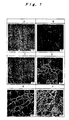
- ⁇ ferrite is formed in an initial structure of the as forging specimen (specimen al), ⁇ ferrite is not formed in an initial structure of the two-step heat-treated specimen (specimen a2).
- solid-solution temperature of MX carbonitrides is about 1,220 °C and ⁇ ferrite precipitation starting temperature when heating was carried out at the rate of 50 °C /s is about 1,240 °C. From these facts, it is confirmed that solid-solution of MX carbonitrides can be sufficiently promoted by the heat treatment according to this invention.
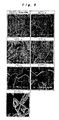
- the Ti-added steel with the same composition as in Example 3 was preserved at 1, 300°C for 60 seconds and subsequently cooled .
- the cooling rate was changed in seven-grade from rapid cooling of 200 °C/s with He gas to slow cooling of 0.1 °C/s.
- the results of structure observation are shown in Fig. 4.
- a cooling rate after preserving at temperatures is required to be 0.5 °C/s or faster.
- the amount of ⁇ ferritic phases is not different remarkably, but the amount of ⁇ ferritic phases extremely increases when a cooing rate is 1 °C/s or slower.
- the Ti-added steel with the same composition as in example 3 was subjected to the conventional normalizing in which the specimen was heated at 1,050 °C for an hour and subsequently tempering at 760 °C for an hour to make specimen A.
- the same Ti-added steel was preserving at 1,300 °C for 30 seconds and subsequently cooled at the rate of 5 °C/s. Then, the steel was subjected to tempering at 760 °C for an hour to make specimen B.
- any of coarse MX carbonitrides does not exist and a large amount of fine MX carbonitrides is precipitated in a matrix.
- high Cr ferritic heat resisting steel When high Cr ferritic heat resisting steel is used for thick parts such as main steampipes for boilers, high toughness is particularly required. In this case, it is preferable that no 6 ferritic phase is contained in the high Cr ferritic heat resisting steel. A slight amount of ⁇ ferritic phases that are formed by heat treatment will be dangerous.
- Example 3 The same two-step heat-treated specimen as in Example 3 was preserved at 1,300°C for 60 seconds and subsequently cooled to room temperature at the rate of 5 °C/s. Then, the specimen was again heated at 1,100 °C for reaustenitizing to make a reheated material A.
- the two-step heat-treated specimen was preserved at 1,300 °C for 60 seconds and subsequently cooled to 1,100 °C at the rate of 5 °C/s. Then, the specimen was preserved at 1,100 °C for 5 seconds and rapidly cooled for reaustenitizing to make continuously heat-treated material B.
- the reheated material A of which grain sizes varies largely, has duplex grain structure.
- continuously heat-treated material B of which grain sizes rarely varies, and has a remarkably good and ordered structure.
Landscapes
- Chemical & Material Sciences (AREA)
- Engineering & Computer Science (AREA)
- Physics & Mathematics (AREA)
- Thermal Sciences (AREA)
- Crystallography & Structural Chemistry (AREA)
- Mechanical Engineering (AREA)
- Materials Engineering (AREA)
- Metallurgy (AREA)
- Organic Chemistry (AREA)
- Heat Treatment Of Steel (AREA)
Abstract
Description
| Creep rupture time (h) | ||
| Test conditions | 660°C, 110Mpa | 700°C, 80Mpa |
| Specimen G | 4280 | 1088 |
| Specimen H | 8653 | 2350 |
Claims (11)
- A method of heat-treatment for high chromium ferritic heat resisting steel, which comprises the steps of:(a) heat-treating for 5 seconds or longer high chromium ferritic steel containing chromium (Cr) in amount of 7-12 weight %; one or two elements of molybdenum (Mo) and tungsten (W) as a solid-solution strengthening element; and one or more of elements for forming (a) MX carbonitride(s) at a temperature higher than both solid-solution temperature of said element(s) for forming the MX carbonitride(s) and a precipitation starting temperature of 5 ferrite;(b) cooling said steel at a rate of 0.5°C/s or faster; and(c) subsequently tempering said steel.
- A method as claimed in claim 1 wherein at least one of said elements is added to steel whereby to form a MX carbonitride expressed as MC, i.e. wherein said element combines with carbon at a ratio of 1:1.
- A method as claimed in claim 1 wherein at least one of said elements is added to steel in which nitrogen is contained whereby to form a MX carbonitride expressed as M(C,N).
- A method as claimed in any one of claims 1 to 3 wherein said element or elements are alloy elements.
- A method as claimed in any preceding claim wherein said element or elements M is selected from elements of groups III, IV and V in the periodic table.
- A method as claimed in claim 5 wherein said element or elements M are selected from vanadium, niobium, tantalum, hafnium, titanium and zirconium.
- The method as claimed in any preceding claim, wherein a temperature of the steel before heat-treating is preserved at a temperature range of an austenitic single-phase region for homogenization of an initial structure.
- The method as claimed in any preceding claim, wherein a temperature of the steel is preserved at a temperature range of an austenitic single-phase region during cooling.
- The method as claimed in any preceding claim, wherein the steel is heat-treated for 30 seconds or longer.
- High Cr ferritic heat resisting steel, which is characterised in that said steel is heat-treated according to the method as claimed in any preceding claim.
- Use of the high Cr Ferritic heat resisting steel of claim 10 in the manufacture of boilers or high temperature heat resisting and pressure resisting members in nuclear or chemical industry.
Applications Claiming Priority (2)
| Application Number | Priority Date | Filing Date | Title |
|---|---|---|---|
| JP2000006219A JP2001192730A (en) | 2000-01-11 | 2000-01-11 | High Cr ferritic heat resistant steel and heat treatment method thereof |
| JP2000006219 | 2000-01-11 |
Publications (2)
| Publication Number | Publication Date |
|---|---|
| EP1116796A2 true EP1116796A2 (en) | 2001-07-18 |
| EP1116796A3 EP1116796A3 (en) | 2003-12-17 |
Family
ID=18534782
Family Applications (1)
| Application Number | Title | Priority Date | Filing Date |
|---|---|---|---|
| EP01300136A Withdrawn EP1116796A3 (en) | 2000-01-11 | 2001-01-08 | High chromium ferritic heat resisting steel and method of heat treatment for the same |
Country Status (3)
| Country | Link |
|---|---|
| US (1) | US20020033210A1 (en) |
| EP (1) | EP1116796A3 (en) |
| JP (1) | JP2001192730A (en) |
Cited By (2)
| Publication number | Priority date | Publication date | Assignee | Title |
|---|---|---|---|---|
| EP1557477A4 (en) * | 2002-11-01 | 2006-05-03 | Nat Inst For Materials Science | PROCESS FOR PRODUCING HIGH-HEAT CRYSTAL FERRITIC STEEL RESISTANT TO HEAT AND OXIDATION |
| CN109628712A (en) * | 2019-01-17 | 2019-04-16 | 河北敬业中厚板有限公司 | A kind of heat treatment process of steel plate of pressure vessel |
Families Citing this family (11)
| Publication number | Priority date | Publication date | Assignee | Title |
|---|---|---|---|---|
| US20070131319A1 (en) * | 2005-12-08 | 2007-06-14 | Pullman Industries, Inc. | Flash tempering process and apparatus |
| JP4878511B2 (en) * | 2006-06-28 | 2012-02-15 | 独立行政法人物質・材料研究機構 | MX type carbonitride precipitation strengthened heat resistant steel |
| US7620147B2 (en) * | 2006-12-13 | 2009-11-17 | Oraya Therapeutics, Inc. | Orthovoltage radiotherapy |
| JP5362764B2 (en) | 2011-04-18 | 2013-12-11 | 株式会社日本製鋼所 | Low alloy metal for geothermal power turbine rotor |
| UA111115C2 (en) | 2012-04-02 | 2016-03-25 | Ейкей Стіл Пропертіс, Інк. | cost effective ferritic stainless steel |
| CN104109809B (en) * | 2014-06-20 | 2018-11-06 | 宝钢不锈钢有限公司 | A kind of high formability low chrome ferritic stainless steel and manufacturing method |
| CN104073729A (en) * | 2014-06-26 | 2014-10-01 | 兰州理工大学 | High-strength 316L stainless steel and manufacturing method thereof |
| CN104651589B (en) * | 2015-02-05 | 2017-02-22 | 北京科技大学 | Process for hot deformation of fine 316LN austenite stainless steel grains |
| CN110358898A (en) * | 2019-08-27 | 2019-10-22 | 天长市华海电子科技有限公司 | A kind of heat treatment process of more alloy forging parts |
| CN114184536B (en) * | 2021-11-04 | 2023-05-30 | 苏州热工研究院有限公司 | Analysis method for ferrite thermal aging amplitude modulation decomposition condition |
| CN120924863B (en) * | 2025-10-13 | 2026-01-30 | 中国兵器科学研究院宁波分院 | High-strength super-thick steel plate and preparation method thereof |
Family Cites Families (6)
| Publication number | Priority date | Publication date | Assignee | Title |
|---|---|---|---|---|
| JPS58110661A (en) * | 1981-12-25 | 1983-07-01 | Hitachi Ltd | Heat resistant steel |
| JPH0621323B2 (en) * | 1989-03-06 | 1994-03-23 | 住友金属工業株式会社 | High strength and high chrome steel with excellent corrosion resistance and oxidation resistance |
| JPH0734202A (en) * | 1993-07-23 | 1995-02-03 | Toshiba Corp | Rotor for steam turbine |
| EP0770696B1 (en) * | 1995-04-12 | 1999-01-13 | Mitsubishi Jukogyo Kabushiki Kaisha | High strength and high toughness heat resisting steel and its manufacturing method |
| ATE250152T1 (en) * | 1997-01-27 | 2003-10-15 | Mitsubishi Heavy Ind Ltd | HIGH CHROME, HEAT RESISTANT CAST STEEL AND PRESSURE VESSEL MADE THEREFROM |
| JP4026228B2 (en) * | 1998-05-12 | 2007-12-26 | 大同特殊鋼株式会社 | Martensitic heat resistant steel |
-
2000
- 2000-01-11 JP JP2000006219A patent/JP2001192730A/en active Pending
-
2001
- 2001-01-08 US US09/755,098 patent/US20020033210A1/en not_active Abandoned
- 2001-01-08 EP EP01300136A patent/EP1116796A3/en not_active Withdrawn
Cited By (2)
| Publication number | Priority date | Publication date | Assignee | Title |
|---|---|---|---|---|
| EP1557477A4 (en) * | 2002-11-01 | 2006-05-03 | Nat Inst For Materials Science | PROCESS FOR PRODUCING HIGH-HEAT CRYSTAL FERRITIC STEEL RESISTANT TO HEAT AND OXIDATION |
| CN109628712A (en) * | 2019-01-17 | 2019-04-16 | 河北敬业中厚板有限公司 | A kind of heat treatment process of steel plate of pressure vessel |
Also Published As
| Publication number | Publication date |
|---|---|
| US20020033210A1 (en) | 2002-03-21 |
| JP2001192730A (en) | 2001-07-17 |
| EP1116796A3 (en) | 2003-12-17 |
Similar Documents
| Publication | Publication Date | Title |
|---|---|---|
| US7520942B2 (en) | Nano-scale nitride-particle-strengthened high-temperature wrought ferritic and martensitic steels | |
| EP0989196B1 (en) | High-strength heat-resistant steel, process for producing high-strength heat-resistant steel, and process for producing high-strength heat-resistant pipe | |
| CA2316771C (en) | Heat resistant cr-mo alloy steel | |
| JP4221518B2 (en) | Ferritic heat resistant steel | |
| JP6562476B2 (en) | Ferritic heat resistant steel and its manufacturing method | |
| US20030024609A1 (en) | High cr ferritic heat resistance steel | |
| KR20170020483A (en) | Nickel-chromium-iron-molybdenum corrosion resistant alloy and article of manufacture and method of manufacturing thereof | |
| US20020033210A1 (en) | High chromium ferritic heat resisting steel and method of heat treatment for the same | |
| CN101545076A (en) | Martensite refractory stainless steel and manufacturing method thereof | |
| CN102086494A (en) | High-chromium martensitic heat-resistant steel and manufacturing method thereof | |
| JPH10265914A (en) | Completely martensitic heat-tempered steel, its use and heat treatment method for obtaining it | |
| JP4212132B2 (en) | Ferritic heat resistant steel having martensitic structure and method for producing the same | |
| CN113166901A (en) | Chromium-molybdenum steel plate with excellent creep strength and preparation method thereof | |
| JP2000204434A (en) | Ferritic heat-resistant steel excellent in high-temperature strength and its manufacturing method | |
| JPH0569885B2 (en) | ||
| JP3848463B2 (en) | High strength austenitic heat resistant steel with excellent weldability and method for producing the same | |
| JP7734653B2 (en) | Chromium steel plate with excellent creep strength and high-temperature ductility and its manufacturing method | |
| JPS60165359A (en) | High strength and high toughness steel for high and medium pressure rotor of steam turbine | |
| JP3368413B2 (en) | Manufacturing method of high Cr ferritic heat resistant steel | |
| KR102411794B1 (en) | Ti-RAFM having good mechanical properties, and manufacturing method thereof | |
| JPS5887224A (en) | Production of boiler tube made of austenitic stainless steel | |
| JPH0735548B2 (en) | Method for producing high-Cr ferritic heat-resistant steel pipe having high creep rupture strength | |
| KR20220027391A (en) | Chromium steel having excellent creep strength and impact toughness and method for manufacturing thereof | |
| JP3250263B2 (en) | Manufacturing method of martensitic stainless steel seamless steel pipe excellent in toughness and stress corrosion cracking resistance | |
| RU2789958C1 (en) | Method for processing heat-resistant low-carbon martensitic steels |
Legal Events
| Date | Code | Title | Description |
|---|---|---|---|
| PUAI | Public reference made under article 153(3) epc to a published international application that has entered the european phase |
Free format text: ORIGINAL CODE: 0009012 |
|
| AK | Designated contracting states |
Kind code of ref document: A2 Designated state(s): AT BE CH CY DE DK ES FI FR GB GR IE IT LI LU MC NL PT SE TR |
|
| AX | Request for extension of the european patent |
Free format text: AL;LT;LV;MK;RO;SI |
|
| PUAL | Search report despatched |
Free format text: ORIGINAL CODE: 0009013 |
|
| AK | Designated contracting states |
Kind code of ref document: A3 Designated state(s): AT BE CH CY DE DK ES FI FR GB GR IE IT LI LU MC NL PT SE TR |
|
| AX | Request for extension of the european patent |
Extension state: AL LT LV MK RO SI |
|
| 17P | Request for examination filed |
Effective date: 20040614 |
|
| 17Q | First examination report despatched |
Effective date: 20040722 |
|
| AKX | Designation fees paid |
Designated state(s): DE FR GB |
|
| STAA | Information on the status of an ep patent application or granted ep patent |
Free format text: STATUS: THE APPLICATION IS DEEMED TO BE WITHDRAWN |
|
| 18D | Application deemed to be withdrawn |
Effective date: 20041202 |