EP1116735A1 - Monomer composition for optical plastic material, optical plastic material, and lens - Google Patents
Monomer composition for optical plastic material, optical plastic material, and lens Download PDFInfo
- Publication number
- EP1116735A1 EP1116735A1 EP00931600A EP00931600A EP1116735A1 EP 1116735 A1 EP1116735 A1 EP 1116735A1 EP 00931600 A EP00931600 A EP 00931600A EP 00931600 A EP00931600 A EP 00931600A EP 1116735 A1 EP1116735 A1 EP 1116735A1
- Authority
- EP
- European Patent Office
- Prior art keywords
- compound
- optical material
- monomer composition
- meth
- plastic optical
- Prior art date
- Legal status (The legal status is an assumption and is not a legal conclusion. Google has not performed a legal analysis and makes no representation as to the accuracy of the status listed.)
- Withdrawn
Links
Classifications
-
- C—CHEMISTRY; METALLURGY
- C08—ORGANIC MACROMOLECULAR COMPOUNDS; THEIR PREPARATION OR CHEMICAL WORKING-UP; COMPOSITIONS BASED THEREON
- C08G—MACROMOLECULAR COMPOUNDS OBTAINED OTHERWISE THAN BY REACTIONS ONLY INVOLVING UNSATURATED CARBON-TO-CARBON BONDS
- C08G18/00—Polymeric products of isocyanates or isothiocyanates
- C08G18/06—Polymeric products of isocyanates or isothiocyanates with compounds having active hydrogen
- C08G18/28—Polymeric products of isocyanates or isothiocyanates with compounds having active hydrogen characterised by the compounds used containing active hydrogen
- C08G18/30—Low-molecular-weight compounds
- C08G18/38—Low-molecular-weight compounds having heteroatoms other than oxygen
-
- G—PHYSICS
- G02—OPTICS
- G02B—OPTICAL ELEMENTS, SYSTEMS OR APPARATUS
- G02B1/00—Optical elements characterised by the material of which they are made; Optical coatings for optical elements
- G02B1/04—Optical elements characterised by the material of which they are made; Optical coatings for optical elements made of organic materials, e.g. plastics
- G02B1/041—Lenses
-
- C—CHEMISTRY; METALLURGY
- C08—ORGANIC MACROMOLECULAR COMPOUNDS; THEIR PREPARATION OR CHEMICAL WORKING-UP; COMPOSITIONS BASED THEREON
- C08F—MACROMOLECULAR COMPOUNDS OBTAINED BY REACTIONS ONLY INVOLVING CARBON-TO-CARBON UNSATURATED BONDS
- C08F222/00—Copolymers of compounds having one or more unsaturated aliphatic radicals, each having only one carbon-to-carbon double bond, and at least one being terminated by a carboxyl radical and containing at least one other carboxyl radical in the molecule; Salts, anhydrides, esters, amides, imides, or nitriles thereof
- C08F222/10—Esters
- C08F222/1006—Esters of polyhydric alcohols or polyhydric phenols
- C08F222/104—Esters of polyhydric alcohols or polyhydric phenols of tetraalcohols, e.g. pentaerythritol tetra(meth)acrylate
-
- C—CHEMISTRY; METALLURGY
- C08—ORGANIC MACROMOLECULAR COMPOUNDS; THEIR PREPARATION OR CHEMICAL WORKING-UP; COMPOSITIONS BASED THEREON
- C08G—MACROMOLECULAR COMPOUNDS OBTAINED OTHERWISE THAN BY REACTIONS ONLY INVOLVING UNSATURATED CARBON-TO-CARBON BONDS
- C08G18/00—Polymeric products of isocyanates or isothiocyanates
- C08G18/06—Polymeric products of isocyanates or isothiocyanates with compounds having active hydrogen
- C08G18/28—Polymeric products of isocyanates or isothiocyanates with compounds having active hydrogen characterised by the compounds used containing active hydrogen
- C08G18/30—Low-molecular-weight compounds
- C08G18/38—Low-molecular-weight compounds having heteroatoms other than oxygen
- C08G18/3855—Low-molecular-weight compounds having heteroatoms other than oxygen having sulfur
- C08G18/3876—Low-molecular-weight compounds having heteroatoms other than oxygen having sulfur containing mercapto groups
-
- C—CHEMISTRY; METALLURGY
- C08—ORGANIC MACROMOLECULAR COMPOUNDS; THEIR PREPARATION OR CHEMICAL WORKING-UP; COMPOSITIONS BASED THEREON
- C08G—MACROMOLECULAR COMPOUNDS OBTAINED OTHERWISE THAN BY REACTIONS ONLY INVOLVING UNSATURATED CARBON-TO-CARBON BONDS
- C08G18/00—Polymeric products of isocyanates or isothiocyanates
- C08G18/06—Polymeric products of isocyanates or isothiocyanates with compounds having active hydrogen
- C08G18/70—Polymeric products of isocyanates or isothiocyanates with compounds having active hydrogen characterised by the isocyanates or isothiocyanates used
- C08G18/71—Monoisocyanates or monoisothiocyanates
-
- C—CHEMISTRY; METALLURGY
- C08—ORGANIC MACROMOLECULAR COMPOUNDS; THEIR PREPARATION OR CHEMICAL WORKING-UP; COMPOSITIONS BASED THEREON
- C08G—MACROMOLECULAR COMPOUNDS OBTAINED OTHERWISE THAN BY REACTIONS ONLY INVOLVING UNSATURATED CARBON-TO-CARBON BONDS
- C08G18/00—Polymeric products of isocyanates or isothiocyanates
- C08G18/06—Polymeric products of isocyanates or isothiocyanates with compounds having active hydrogen
- C08G18/70—Polymeric products of isocyanates or isothiocyanates with compounds having active hydrogen characterised by the isocyanates or isothiocyanates used
- C08G18/81—Unsaturated isocyanates or isothiocyanates
- C08G18/8108—Unsaturated isocyanates or isothiocyanates having only one isocyanate or isothiocyanate group
- C08G18/8116—Unsaturated isocyanates or isothiocyanates having only one isocyanate or isothiocyanate group esters of acrylic or alkylacrylic acid having only one isocyanate or isothiocyanate group
-
- C—CHEMISTRY; METALLURGY
- C08—ORGANIC MACROMOLECULAR COMPOUNDS; THEIR PREPARATION OR CHEMICAL WORKING-UP; COMPOSITIONS BASED THEREON
- C08L—COMPOSITIONS OF MACROMOLECULAR COMPOUNDS
- C08L75/00—Compositions of polyureas or polyurethanes; Compositions of derivatives of such polymers
- C08L75/04—Polyurethanes
-
- C—CHEMISTRY; METALLURGY
- C09—DYES; PAINTS; POLISHES; NATURAL RESINS; ADHESIVES; COMPOSITIONS NOT OTHERWISE PROVIDED FOR; APPLICATIONS OF MATERIALS NOT OTHERWISE PROVIDED FOR
- C09J—ADHESIVES; NON-MECHANICAL ASPECTS OF ADHESIVE PROCESSES IN GENERAL; ADHESIVE PROCESSES NOT PROVIDED FOR ELSEWHERE; USE OF MATERIALS AS ADHESIVES
- C09J4/00—Adhesives based on organic non-macromolecular compounds having at least one polymerisable carbon-to-carbon unsaturated bond ; adhesives, based on monomers of macromolecular compounds of groups C09J183/00 - C09J183/16
- C09J4/06—Organic non-macromolecular compounds having at least one polymerisable carbon-to-carbon unsaturated bond in combination with a macromolecular compound other than an unsaturated polymer of groups C09J159/00 - C09J187/00
Definitions
- the present invention relates to a monomer composition which provides a plastic optical material having high refractive index and Abbe number, a low specific gravity and excellent physical properties, such as dyeing properties, heat resistance, impact resistance and the like, a plastic optical material and a lens.
- PADC polydiethylene glycol bisallyl carbonate
- PMMA polymethyl methacrylate
- PC polycarbonate
- PADC and PMMA are more excellent than inorganic glass in respect of the low specific gravity, the impact resistance and the dyeing properties.
- the refractive index of each of PADC and PMMA is about 1.49, and the refractive index is lower than that of the general inorganic glass which is 1.52. Therefore, there has been a drawback in that, when the lens becomes stronger, the thickness of the lens becomes larger.
- the refractive index is as high as about 1.58, but the Abbe number is as low as 29.
- PC is shaped by a melt molding method, and thus, PC had other problems about optical anisotropy, discoloration and the like.
- a plastic lens having a higher refractive index and a higher Abbe number is disclosed.
- a copolymer of dimethacrylate of a bisphenol A derivative and styrene is disclosed.
- Japanese Unexamined Patent Publication No. Sho 55-69543 a polymer of dimethacrylate of a halogenated bisphenol A derivative is disclosed.
- Japanese Unexamined Patent Publication No. Sho 63-23908 for the purpose of further increasing the refractive index, a polymer of diallyl diphenate is disclosed.
- Japanese Patent No. 2707613 a polymer comprising an isocyanate compound having an unsaturated group and polythiol is disclosed.
- Japanese Unexamined Patent Publication No. Sho 62-267316 a thiourethane resin comprising polyisocyanate and polythiol is disclosed.
- the refractive index is about 1.55 and was not satisfactory.
- the refractive index is as high as about 1.60; however, the specific gravity was high due to halogenation, and the weathering resistance was poor.
- the Abbe number was as low as about 29, and the impact resistance was poor.
- the refractive index is about 1.58 and was not satisfactory, and the heat resistance also was poor.
- the resin disclosed in Japanese Unexamined Patent Publication No. Sho 62-267316 had a high specific gravity and a poor heat resistance.
- the first embodiment of the present invention provides a monomer composition for a plastic optical material, which comprises: a di(meth)acrylate compound; at least one of divinylbenzene and divinylbiphenyl; a crosslinking-type isocyanate compound; a compound having two or more thiol groups; and a thiourethane bonding accelerating compound.
- the second embodiment of the present invention provides a monomer composition for a plastic optical material, which comprises: a di(meth)acrylate compound; at least one of divinylbenzene and divinylbiphenyl; and a reaction product of a crosslinking-type isocyanate compound with a compound having two or more thiol groups.
- the di(meth)acrylate is preferably represented by the following chemical formula (1): wherein R 1 represents a hydrogen atom or a methyl group, Ph represents a phenylene group, x and z may be the same or different and each represent an integer of 1 to 5, and y is 0 or 1.
- the thiourethane bonding accelerating compound is preferably at least one compound selected from the group consisting of an amine compound, an amine salt compound and an organometallic compound.
- the third embodiment of the present invention provides a plastic optical material obtained by curing a mixture of the above-mentioned monomer composition and a radical polymerization initiator.
- the fourth embodiment of the present invention provides a lens produced from the above-mentioned plastic optical material.
- the above lens preferably has a hard coat layer on a surface thereof.
- the monomer composition for a plastic optical material of the present embodiment comprises, as essential components, the following components: a di(meth)acrylate compound, divinylbenzene and/or divinylbiphenyl (hereinafter, referred to as "divinylphenyl compound”), a crosslinking-type isocyanate compound, and a compound having two or more thiol groups (hereinafter, referred to as "polythiol compound”). And, a thiourethane bonding accelerating compound can be further added.
- a di(meth)acrylate compound divinylbenzene and/or divinylbiphenyl
- polythiol compound a compound having two or more thiol groups
- the di(meth)acrylate compound means a compound having two (meth)acryloyloxy groups per molecule.
- Specific examples include ethylene glycol di(meth)acrylate, diethylene glycol di(meth)acrylate, polyethylene glycol di(meth)acrylate, propylene di(meth)acrylate and polypropylene glycol di(meth)acrylate.
- the term "di(meth)acrylate” means dimethacrylate and diacrylate. From the viewpoint of improving the refractive index of the plastic optical material, di(meth)acrylate represented by chemical formula (1) is preferably used.
- R 1 represents a hydrogen atom or a methyl group
- y is 0 or 1
- x and z may be the same or different and each represent an integer of 1 to 5, preferably integer of 1 to 3.
- x and/or z is 6 or more, the refractive index and the heat resistance of the resultant resin become considerably low.
- di(meth)acrylate represented by chemical formula (1) for example, there can be mentioned 2,2-bis(4-methacryloxyethoxyphenyl)propane, 2,2-bis[4-(2-methacryloxyethoxy)ethoxy]propane, 2,2-bis[4-(2-methacryloxyethoxy)diethoxy]propane, 2,2-bis[4-(2-methacryloxyethoxy)triethoxyphenyl]propane, 2,2-bis[4-(2-methacryloxyethoxy)tetraethoxyphenyl]propane, 2,2-bis[4-(2-methacryloxyethoxycarbonyloxy)phenyl]propane, and 2,2-bis ⁇ 4-[(2-methacryloxyethoxy)ethoxycarbonyloxy]phenyl ⁇ propane.
- Di(meth)acrylate can be used singly or in combination.
- the content of the di(meth)acrylate in the monomer composition is generally 5 to 50 % by weight, preferably in the range of from 15 to 45 % by weight.
- the content is less than 5 % by weight, the effect of imparting impact resistance and dyeing properties to the optical material cannot be satisfactorily obtained, and, when the content exceeds 50 % by weight, the refractive index of the resultant optical material tends to lower.
- the divinylphenyl compound includes divinylbenzene and divinylbiphenyl.
- the content of the divinylphenyl compound in the monomer composition is generally 5 to 40 % by weight, preferably 7 to 30 % by weight. When the content is less than 5 % by weight, the effect of improving the refractive index of the optical material and imparting heat resistance to the optical material cannot be satisfactorily obtained, and, when the content exceeds 40 % by weight, the impact resistance of the resultant optical material tends to lower.
- the divinylphenyl compounds can be used singly or in combination.
- the crosslinking-type isocyanate compound includes a crosslinking-type monoisocyanate compound having both of a vinyl group and an isocyanate group, a diisocyanate compound, and a compound having one isocyanate group and two or more vinyl groups or isocyanate groups.
- crosslinking-type monoisocyanate compounds such as 3-isopropenyl- ⁇ , ⁇ -dimethylbenzyl isocyanate, isocyanatoethyl methacrylate and the like, can be used.
- diisocyanate compounds such as hexamethylene diisocyanate, 4,4'-dicyclohexylmethane diisocyanate, m-xylene diisocyanate, m-tetramethylxylene diisocyanate, isophorone diisocyanate and the like, can be used. Of these, preferred is a compound which is in the form of liquid at room temperature and suffers no discoloration after curing. The above-mentioned compounds can be used singly or in combination.
- the content of the crosslinking-type isocyanate compound in the monomer composition is generally 10 to 50 % by weight, preferably 20 to 40 % by weight.
- the content is less than 10 % by weight, the effect of improving the refractive index of the optical material and controlling the vigorous polymerization reaction cannot be satisfactorily obtained, and, when the content exceeds 50 % by weight, a curing failure of the optical material tends to occur.
- polythiol compounds for example, there can be mentioned dithiol, such as ethanedithiol, 1,4-butanedithiol, 1,6-hexanedithiol, 3,3'-dithiodipropionic acid, ethylene glycol dithioglycolate, 2,2'-thiodiethanethiol, 2,2'-oxyethanethiol, dimercaptotriethylene disulfide, 1,2-dithioglycerol, 1,3-dithioglycerol, 1,4-benzenedithiol, 1,2-benzenedithiol, 1,3-benzenedithiol, 1,2-bis(mercaptomethylene)benzene, 1,3-bis(mercaptomethylene)benzene, 1,4-bis(mercaptomethylene)benzene, or the like, and polythiol, such as pentaerythritol tetrakis(thioglycolate), trimethylolpropane
- the content of the polythiol compound in the monomer composition is generally 10 to 40 % by weight, preferably 15 to 30 % by weight.
- the compound is reacted with the isocyanate compound to form a urethane linkage, so that the effect of improving the refractive index of the optical material cannot be satisfactorily obtained, and, when the content exceeds 40 % by weight, a curing failure of the optical material tends to occur and the weathering resistance tends to lower.
- the thiourethane bonding accelerating compound is used for accelerating the addition polymerization reaction of the crosslinking-type isocyanate compound and the polythiol compound.
- amine compounds such as tetramethylbutanediamine, triethylenediamine, triethyleneamine, pyridine, 1,8-diazabicyclo[5.4.0] undecene-7, N,N-diethylaminoethyl (meth)acrylate and the like
- amine salt compounds such as triethylenediamine salt of (meth)acrylic acid, 1,8-diazabicyclo[5.4.0]undecene-7 salt of (meth)acrylic acid, and the like
- organometallic compounds such as dibutyltin diphthalate, dibutyltin dilaurate, dimethyltin dichloride, lead octanoate and the like, can be used.
- the amount of the thiourethane bonding accelerating compound added is generally 1 to 1000 ppm, preferably in the range of from 10 to 300 ppm, relative to the monomer composition. When the amount is less than 1 ppm, the curing is unsatisfactory, and, when the amount exceeds 1000 ppm, the cured optical material tends to suffer strain.
- the monomer composition of the present invention may comprise, as essential components, the above-mentioned di(meth)acrylate and divinylphenyl compound, and a reaction product of the crosslinking-type isocyanate compound with the compound having two or more thiol groups.
- This reaction product means one that is obtained by allowing a mixture, which contains the crosslinking-type isocyanate compound, the compound having two or more thiol groups and the above-mentioned thiourethane bonding accelerating compound, to undergo reaction.
- the amount of the thiourethane bonding accelerating compound added is in the range of from 1 to 500 ppm, preferably 5 to 300 ppm, relative to the reaction composition.
- the reaction is conducted in the range of from room temperature to 80°C for 10 minutes to 3 hours, preferably 15 minutes to 2 hours.
- the content of the reaction product in the monomer composition is generally 20 to 70 % by weight, preferably 30 to 65 % by weight.
- the content is less than 20 % by weight, the effect of improving the refractive index of the optical material cannot be satisfactorily obtained, and, when the content exceeds 70 % by weight, a curing failure of the optical material tends to occur and the heat resistance tends to lower.
- the content of the above-mentioned di(meth)acrylate in the monomer composition containing the reaction product of the crosslinking-type isocyanate compound with the compound having two or more thiol groups is 10 to 50 % by weight, preferably 15 to 45 % by weight.
- the content is less than 10 % by weight, the effect of imparting impact resistance and dyeing properties to the optical material cannot be satisfactorily obtained, and, when the content exceeds 50 % by weight, the refractive index of the optical material tends to lower.
- the content of the divinylphenyl compound in the monomer composition containing the above-mentioned reaction product is generally 5 to 30 % by weight, preferably 7 to 25 % by weight.
- the content is less than 5 % by weight, the effect of improving the refractive index of the optical material and imparting heat resistance to the optical material cannot be satisfactorily obtained, and, when the content exceeds 30 % by weight, the impact resistance of the optical material tends to lower.
- R 2 represents a -Ph-C(CH 3 ) 2 - group or a -CO 2 CH 2 CH 2 - group
- R 3 represents a Ph group or a -Ph-Ph-group
- n represents an integer of 1 to 4 (wherein Ph represents a phenylene group).
- the monomer composition may further contain other copoylmerizable vinyl monomers.
- vinyl monomers there can be mentioned styrene, halogen nucleus substituted styrene, methyl nucleus substituted styrene, ⁇ -methylstyrene, ⁇ -methylstyrene dimer, vinylnaphthalene, methyl (meth)acrylate, ethyl (meth)acrylate, 2-hydroxyethyl (meth)acrylate, various urethane poly(meth)acrylate, diallylphthalate, glyceloyl (meth)acrylate, (meth)acrylic acid, (meth)acrylic acid amide, N,N-dimethylacrylamide and the like.
- a single monomer or two or more monomers mixed are appropriately selected in accordance with the refractive index.
- the plastic optical material of the present embodiment is obtained by adding to the above-mentioned monomer composition a radical polymerization initiator, and then, curing by a heating curing method or an active energy rays curing method.
- the radical polymerization initiator is used for curing the vinyl monomers, and for example, there can be mentioned benzoyl peroxide, lauroyl peroxide, diisopropyl dicarbonate, t-butylperoxy-2-ethyl hexanoate, t-butyl peroxypivalate, t-butyl peroxyneodecanoate, t-peroxydiisobutyrate, azobisisobutyronitrile, azobisdimethylvaleronitrile and the like. These can be used singly or in combination.
- the amount of the polymerization initiator added is generally 0.01 to 10 % by weight, preferably 0.1 to 5 % by weight, based on the weight of the monomer composition. When the amount is less than 0.01 % by weight, the curing is unsatisfactory, and, when the amount exceeds 10 % by weight, the cured optical material tends to suffer strain.
- an additive such as an ultraviolet absorber, a photochromic dye, a coloring agent, a releasing agent, a surfactant, an antioxidant, an anti-fungus agent or the like, in the range of the amount generally used.
- the plastic optical material and lens of the present invention are produced as follows.
- a radical polymerization initiator is added to the monomer composition.
- the resultant mixture is charged into a mold having a desired lens shape, made of metal, glass, plastic or the like, followed by heating. This heating causes the monomer composition to undergo polymerization and be cured, to thereby form a crosslinked resin mass (plastic optical material) which is colorless and transparent, and insoluble in a solvent. Then, the resin mass is removed from the mold, to thereby obtain a lens which is colorless and transparent, and insoluble in a solvent.
- the polymerization is conducted in the range of from 30 to 100°C for 5 to 72 hours, preferably 10 to 36 hours.
- the polymerization temperature may be gradually increased in the range of from 30 to 100°C.
- the lens removed from the mold is subjected to annealing treatment in an atmosphere of nitrogen or air at 80 to 120°C for 1 to 5 hours.
- the monomer composition is cured without using a mold, and the resultant plastic optical material mass can be processed by cutting into a desired lens shape, to thereby obtain a lens.
- the lens of the present invention can be provided with a hard coat layer on a surface thereof for improving the resistance to scuffing of the surface.
- a hard coat agent for example, preferred is a coating composition comprised mainly of at least one of silane compounds having a functional group, such as an epoxy group, an alkoxy group, a vinyl group or the like, and at least one of colloids of metal oxides, such as silicon oxide, titanium oxide, antimony oxide, tin oxide, tungsten oxide, aluminum oxide and the like.
- the coating composition is applied onto the surface of the lens by the known application method, such as a dipping method, a spin coating method or the like, and cured by heating or UV irradiation, to thereby form a hard coat layer.
- the thickness of the hard coat layer is about 0.5 to 10 ⁇ m.
- a primer layer can also be formed between the hard coat layer and the lens.
- a reflection preventing layer can also be formed on the surface of the hard coat layer.
- the reflection preventing layer is formed by vacuum deposition or sputtering of a metal oxide or a metal fluoride, such as silicon oxide, magnesium fluoride, aluminum oxide, zirconium oxide, titanium oxide, tantalum oxide, yttrium oxide or the like.
- the lens of the present embodiment can also be subjected to coloring treatment by a disperse dye or a photochromic dye for imparting fashion properties to the lens if desired.
- the plastic optical material of the present embodiment has excellent optical characteristics such that the refractive index is 1.55 or higher and the Abbe number is 30 or higher, and has a specific gravity as low as 1.3 or less and is excellent in respect of various physical properties required for the lens, such as dyeing properties, heat resistance, impact resistance and the like. Further, the lens of the present invention is thin and has an optical homogeneity.
- the composition was charged into a mold comprised of two circular plates made of glass having a diameter of 7 cm and a gasket made of an ethylene-propylene rubber having a thickness of 2 mm. Then, the temperature of the mold was elevated in a hot air thermostatic chamber provided with a programmed temperature controller from 30°C to 100°C over 18 hours. Subsequently, the mold was maintained at 100°C for 2 hours. Then, the mold was cooled to 40°C over 2 hours. Thus, the composition in the mold was cured, and removed from the mold, to thereby obtain a resin mass in a disc shape. Further, the resin mass was subjected to annealing treatment at 100°C for 2 hours, to thereby obtain a cured resin plate.
- Examples 17 to 23 The properties and the formulations of raw material mixtures in Examples 17 to 23 are shown in Table 3.
- the procedure was substantially the same as in Examples 1 to 8 except that to 20 g of a raw material mixture in Table 3 was added 0.4 g of t-butyl peroxyneodecanoate.
- a test piece was prepared from a mixture of 14 g of diallyl diphenate (DADP), 6 g of diallyl isophthalate (DAIP) and 0.6 g of isopropyl peroxycarbonate in the same manner as in Examples 1 to 8, and with respect to the prepared test piece, the physical properties were examined.
- DADP diallyl diphenate
- DAIP diallyl isophthalate
- isopropyl peroxycarbonate 0.6 g
- a lens having high refractive index and Abbe number as well as excellent physical properties such as specific gravity, dyeing properties, heat resistance, impact resistance and the like.
Landscapes
- Chemical & Material Sciences (AREA)
- Organic Chemistry (AREA)
- Health & Medical Sciences (AREA)
- Chemical Kinetics & Catalysis (AREA)
- Medicinal Chemistry (AREA)
- Polymers & Plastics (AREA)
- Physics & Mathematics (AREA)
- General Physics & Mathematics (AREA)
- Optics & Photonics (AREA)
- Polyurethanes Or Polyureas (AREA)
- Addition Polymer Or Copolymer, Post-Treatments, Or Chemical Modifications (AREA)
- Polymers With Sulfur, Phosphorus Or Metals In The Main Chain (AREA)
- Macromonomer-Based Addition Polymer (AREA)
Abstract
A monomer composition which provides a plastic optical
material having high refractive index and Abbe number, a
low specific gravity and excellent physical properties,
such as dyeing properties, heat resistance, impact
resistance and the like. The composition comprises a
di(meth)acrylate compound, divinylbenzene and/or
divinylbiphenyl, a crosslinking-type isocyanate compound, a
polythiol compound having two or more thiol groups, and a
thiourethane bonding accelerating compound. The plastic
optical material obtained by the reaction of the above
composition with a radical polymerization initiator is used
as a material for a lens.
Description
The present invention relates to a monomer composition
which provides a plastic optical material having high
refractive index and Abbe number, a low specific gravity
and excellent physical properties, such as dyeing
properties, heat resistance, impact resistance and the
like, a plastic optical material and a lens.
In recent years, in the field of optical materials used
for lenses and the like, the properties for reduced weight,
safety, fashion and the like are being regarded as great
importance, and the material is changing from the
conventional inorganic glass to synthetic resins. As
representative synthetic resin materials, polydiethylene
glycol bisallyl carbonate (hereinafter, referred to simply
as "PADC"), polymethyl methacrylate (hereinafter, referred
to simply as "PMMA"), polycarbonate (hereinafter, referred
to simply as "PC"), and the like are well known.
PADC and PMMA are more excellent than inorganic glass
in respect of the low specific gravity, the impact
resistance and the dyeing properties. However, the
refractive index of each of PADC and PMMA is about 1.49,
and the refractive index is lower than that of the general
inorganic glass which is 1.52. Therefore, there has been a
drawback in that, when the lens becomes stronger, the
thickness of the lens becomes larger. In addition, in PC,
the refractive index is as high as about 1.58, but the Abbe
number is as low as 29. Further, PC is shaped by a melt
molding method, and thus, PC had other problems about
optical anisotropy, discoloration and the like.
For solving these problems, a plastic lens having a
higher refractive index and a higher Abbe number is
disclosed. For example, in Japanese Unexamined Patent
Publication No. Sho 55-13747, a copolymer of dimethacrylate
of a bisphenol A derivative and styrene is disclosed. In
Japanese Unexamined Patent Publication No. Sho 55-69543, a
polymer of dimethacrylate of a halogenated bisphenol A
derivative is disclosed.
In Japanese Unexamined Patent Publication No. Sho 63-23908,
for the purpose of further increasing the refractive
index, a polymer of diallyl diphenate is disclosed. In
Japanese Patent No. 2707613, a polymer comprising an
isocyanate compound having an unsaturated group and
polythiol is disclosed. In Japanese Unexamined Patent
Publication No. Sho 62-267316, a thiourethane resin
comprising polyisocyanate and polythiol is disclosed.
However, with respect to the copolymer disclosed in
Japanese Unexamined Patent Publication No. Sho 55-13747,
the refractive index is about 1.55 and was not
satisfactory. With respect to the polymer disclosed in
Japanese Unexamined Patent Publication No. Sho 55-69543,
the refractive index is as high as about 1.60; however, the
specific gravity was high due to halogenation, and the
weathering resistance was poor.
Further, with respect to the polymer disclosed in
Japanese Unexamined Patent Publication No. Sho 63-23908,
the Abbe number was as low as about 29, and the impact
resistance was poor. With respect to the polymer in
Japanese Patent No. 2707613, the refractive index is about
1.58 and was not satisfactory, and the heat resistance also
was poor. The resin disclosed in Japanese Unexamined
Patent Publication No. Sho 62-267316 had a high specific
gravity and a poor heat resistance.
It is an object of the present invention to provide a
monomer composition for a plastic optical material, a
plastic optical material and a lens, which are excellent in
respect of refractive index, Abbe number, specific gravity,
heat resistance, dyeing properties and impact resistance.
For attaining the above object, the first embodiment of
the present invention provides a monomer composition for a
plastic optical material, which comprises: a
di(meth)acrylate compound; at least one of divinylbenzene
and divinylbiphenyl; a crosslinking-type isocyanate
compound; a compound having two or more thiol groups; and a
thiourethane bonding accelerating compound.
The second embodiment of the present invention provides
a monomer composition for a plastic optical material, which
comprises: a di(meth)acrylate compound; at least one of
divinylbenzene and divinylbiphenyl; and a reaction product
of a crosslinking-type isocyanate compound with a compound
having two or more thiol groups.
The di(meth)acrylate is preferably represented by the
following chemical formula (1):
 wherein R1 represents a hydrogen atom or a methyl group, Ph
represents a phenylene group, x and z may be the same or
different and each represent an integer of 1 to 5, and y is
0 or 1.
wherein R1 represents a hydrogen atom or a methyl group, Ph
represents a phenylene group, x and z may be the same or
different and each represent an integer of 1 to 5, and y is
0 or 1.
The thiourethane bonding accelerating compound is
preferably at least one compound selected from the group
consisting of an amine compound, an amine salt compound and
an organometallic compound.
The third embodiment of the present invention provides
a plastic optical material obtained by curing a mixture of
the above-mentioned monomer composition and a radical
polymerization initiator.
The fourth embodiment of the present invention provides
a lens produced from the above-mentioned plastic optical
material.
The above lens preferably has a hard coat layer on a
surface thereof.
The monomer composition for a plastic optical material
of the present embodiment comprises, as essential
components, the following components: a di(meth)acrylate
compound, divinylbenzene and/or divinylbiphenyl
(hereinafter, referred to as "divinylphenyl compound"), a
crosslinking-type isocyanate compound, and a compound
having two or more thiol groups (hereinafter, referred to
as "polythiol compound"). And, a thiourethane bonding
accelerating compound can be further added.
The di(meth)acrylate compound means a compound having
two (meth)acryloyloxy groups per molecule. Specific
examples include ethylene glycol di(meth)acrylate,
diethylene glycol di(meth)acrylate, polyethylene glycol
di(meth)acrylate, propylene di(meth)acrylate and
polypropylene glycol di(meth)acrylate. In the present
specification, the term "di(meth)acrylate" means
dimethacrylate and diacrylate. From the viewpoint of
improving the refractive index of the plastic optical
material, di(meth)acrylate represented by chemical formula
(1) is preferably used.
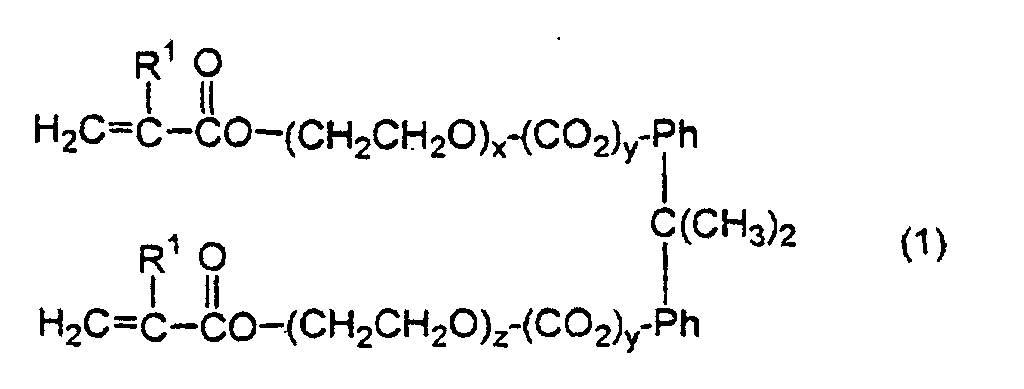
In chemical formula (1), R1 represents a hydrogen atom
or a methyl group, y is 0 or 1, and x and z may be the same
or different and each represent an integer of 1 to 5,
preferably integer of 1 to 3. When x and/or z is 6 or
more, the refractive index and the heat resistance of the
resultant resin become considerably low.
As di(meth)acrylate represented by chemical formula
(1), for example, there can be mentioned 2,2-bis(4-methacryloxyethoxyphenyl)propane,
2,2-bis[4-(2-methacryloxyethoxy)ethoxy]propane,
2,2-bis[4-(2-methacryloxyethoxy)diethoxy]propane,
2,2-bis[4-(2-methacryloxyethoxy)triethoxyphenyl]propane,
2,2-bis[4-(2-methacryloxyethoxy)tetraethoxyphenyl]propane,
2,2-bis[4-(2-methacryloxyethoxycarbonyloxy)phenyl]propane,
and 2,2-bis{4-[(2-methacryloxyethoxy)ethoxycarbonyloxy]phenyl}
propane. Di(meth)acrylate can be used singly or in
combination. The content of the di(meth)acrylate in the
monomer composition is generally 5 to 50 % by weight,
preferably in the range of from 15 to 45 % by weight. When
the content is less than 5 % by weight, the effect of
imparting impact resistance and dyeing properties to the
optical material cannot be satisfactorily obtained, and,
when the content exceeds 50 % by weight, the refractive
index of the resultant optical material tends to lower.
The divinylphenyl compound includes divinylbenzene and
divinylbiphenyl. The content of the divinylphenyl compound
in the monomer composition is generally 5 to 40 % by
weight, preferably 7 to 30 % by weight. When the content
is less than 5 % by weight, the effect of improving the
refractive index of the optical material and imparting heat
resistance to the optical material cannot be satisfactorily
obtained, and, when the content exceeds 40 % by weight, the
impact resistance of the resultant optical material tends
to lower. The divinylphenyl compounds can be used singly
or in combination.
The crosslinking-type isocyanate compound includes a
crosslinking-type monoisocyanate compound having both of a
vinyl group and an isocyanate group, a diisocyanate
compound, and a compound having one isocyanate group and
two or more vinyl groups or isocyanate groups. As specific
examples, crosslinking-type monoisocyanate compounds, such
as 3-isopropenyl-α,α-dimethylbenzyl isocyanate,
isocyanatoethyl methacrylate and the like, can be used.
Further, diisocyanate compounds, such as hexamethylene
diisocyanate, 4,4'-dicyclohexylmethane diisocyanate, m-xylene
diisocyanate, m-tetramethylxylene diisocyanate,
isophorone diisocyanate and the like, can be used. Of
these, preferred is a compound which is in the form of
liquid at room temperature and suffers no discoloration
after curing. The above-mentioned compounds can be used
singly or in combination. The content of the crosslinking-type
isocyanate compound in the monomer composition is
generally 10 to 50 % by weight, preferably 20 to 40 % by
weight. When the content is less than 10 % by weight, the
effect of improving the refractive index of the optical
material and controlling the vigorous polymerization
reaction cannot be satisfactorily obtained, and, when the
content exceeds 50 % by weight, a curing failure of the
optical material tends to occur.
As the polythiol compounds, for example, there can be
mentioned dithiol, such as ethanedithiol, 1,4-butanedithiol,
1,6-hexanedithiol, 3,3'-dithiodipropionic
acid, ethylene glycol dithioglycolate, 2,2'-thiodiethanethiol,
2,2'-oxyethanethiol,
dimercaptotriethylene disulfide, 1,2-dithioglycerol, 1,3-dithioglycerol,
1,4-benzenedithiol, 1,2-benzenedithiol,
1,3-benzenedithiol, 1,2-bis(mercaptomethylene)benzene, 1,3-bis(mercaptomethylene)benzene,
1,4-bis(mercaptomethylene)benzene,
or the like, and polythiol,
such as pentaerythritol tetrakis(thioglycolate),
trimethylolpropane tris(β-mercaptopropionate), or the like.
These polythiol compounds can be used singly or in
combination. In addition, the content of the polythiol
compound in the monomer composition is generally 10 to 40 %
by weight, preferably 15 to 30 % by weight. When the
content is less than 10 % by weight, the compound is
reacted with the isocyanate compound to form a urethane
linkage, so that the effect of improving the refractive
index of the optical material cannot be satisfactorily
obtained, and, when the content exceeds 40 % by weight, a
curing failure of the optical material tends to occur and
the weathering resistance tends to lower.
The thiourethane bonding accelerating compound is used
for accelerating the addition polymerization reaction of
the crosslinking-type isocyanate compound and the polythiol
compound. Specifically, for example, amine compounds, such
as tetramethylbutanediamine, triethylenediamine,
triethyleneamine, pyridine, 1,8-diazabicyclo[5.4.0]
undecene-7, N,N-diethylaminoethyl (meth)acrylate and the
like, amine salt compounds, such as triethylenediamine salt
of (meth)acrylic acid, 1,8-diazabicyclo[5.4.0]undecene-7
salt of (meth)acrylic acid, and the like, and
organometallic compounds, such as dibutyltin diphthalate,
dibutyltin dilaurate, dimethyltin dichloride, lead
octanoate and the like, can be used. Preferred are
triethylenediamine, 1,8-diazabicyclo[5.4.0]undecene-7, 1,8-diazabicyclo[5.4.0]undecene-7
salt and dibutyltin
dilaurate. These thiourethane bonding accelerating
compounds can be used singly or in combination.
The amount of the thiourethane bonding accelerating
compound added is generally 1 to 1000 ppm, preferably in
the range of from 10 to 300 ppm, relative to the monomer
composition. When the amount is less than 1 ppm, the
curing is unsatisfactory, and, when the amount exceeds 1000
ppm, the cured optical material tends to suffer strain.
Further, the monomer composition of the present
invention may comprise, as essential components, the above-mentioned
di(meth)acrylate and divinylphenyl compound, and
a reaction product of the crosslinking-type isocyanate
compound with the compound having two or more thiol groups.
This reaction product means one that is obtained by
allowing a mixture, which contains the crosslinking-type
isocyanate compound, the compound having two or more thiol
groups and the above-mentioned thiourethane bonding
accelerating compound, to undergo reaction. The amount of
the thiourethane bonding accelerating compound added is in
the range of from 1 to 500 ppm, preferably 5 to 300 ppm,
relative to the reaction composition. The reaction is
conducted in the range of from room temperature to 80°C for
10 minutes to 3 hours, preferably 15 minutes to 2 hours.
The content of the reaction product in the monomer
composition is generally 20 to 70 % by weight, preferably
30 to 65 % by weight. When the content is less than 20 %
by weight, the effect of improving the refractive index of
the optical material cannot be satisfactorily obtained,
and, when the content exceeds 70 % by weight, a curing
failure of the optical material tends to occur and the heat
resistance tends to lower.
The content of the above-mentioned di(meth)acrylate in
the monomer composition containing the reaction product of
the crosslinking-type isocyanate compound with the compound
having two or more thiol groups is 10 to 50 % by weight,
preferably 15 to 45 % by weight. When the content is less
than 10 % by weight, the effect of imparting impact
resistance and dyeing properties to the optical material
cannot be satisfactorily obtained, and, when the content
exceeds 50 % by weight, the refractive index of the optical
material tends to lower. Further, the content of the
divinylphenyl compound in the monomer composition
containing the above-mentioned reaction product is
generally 5 to 30 % by weight, preferably 7 to 25 % by
weight. When the content is less than 5 % by weight, the
effect of improving the refractive index of the optical
material and imparting heat resistance to the optical
material cannot be satisfactorily obtained, and, when the
content exceeds 30 % by weight, the impact resistance of
the optical material tends to lower.
It has been confirmed that an intermediate compound
represented by chemical formula (2) is formed in the
polymerization reaction using the thiourethane bonding
accelerating compound and a radical polymerization
initiator.

In the above formula, R2 represents a -Ph-C(CH3)2- group
or a -CO2CH2CH2- group, R3 represents a Ph group or a -Ph-Ph-group,
and n represents an integer of 1 to 4 (wherein Ph
represents a phenylene group). The intermediate compounds
represented by chemical formula (2) include, for example,
the following compounds:
[CH2=C(CH3)-Ph-C (CH3)2-NH-CO-S(CH2)2S(CH2)2-]2Ph
[CH2=C(CH3)-Ph-C(CH3)2-NH-CO-S(CH2)2S(CH2)2S(CH2)2]2Ph
[CH2=C(CH3)-Ph-C(CH3)2-NH-CO-S(CH2)2S(CH2)2S(CH2)2-]2(Ph)2
[CH2=C(CH3)-Ph-C(CH3)2-NH-CO-S(CH2)2S(CH2)2S(CH2)2S(CH2)2-]2Ph
[CH2=C(CH3)-CO2CH2CH2-NH-CO-S(CH2)2S(CH2)2-]2Ph
[CH2=C(CH3)-CO2CH2CH2-NH-CO-S(CH2)2S(CH2)2S(CH2)2-]2Ph
[CH2=C(CH3)-CO2CH2CH2-NH-CO-S(CH2)2S(CH2)2S(CH2)2-]2(Ph)2.
The monomer composition may further contain other
copoylmerizable vinyl monomers. As other vinyl monomers,
there can be mentioned styrene, halogen nucleus substituted
styrene, methyl nucleus substituted styrene, α-methylstyrene,
α-methylstyrene dimer, vinylnaphthalene,
methyl (meth)acrylate, ethyl (meth)acrylate, 2-hydroxyethyl
(meth)acrylate, various urethane poly(meth)acrylate,
diallylphthalate, glyceloyl (meth)acrylate, (meth)acrylic
acid, (meth)acrylic acid amide, N,N-dimethylacrylamide and
the like. A single monomer or two or more monomers mixed
are appropriately selected in accordance with the
refractive index.
The plastic optical material of the present embodiment
is obtained by adding to the above-mentioned monomer
composition a radical polymerization initiator, and then,
curing by a heating curing method or an active energy rays
curing method.
The radical polymerization initiator is used for curing
the vinyl monomers, and for example, there can be mentioned
benzoyl peroxide, lauroyl peroxide, diisopropyl
dicarbonate, t-butylperoxy-2-ethyl hexanoate, t-butyl
peroxypivalate, t-butyl peroxyneodecanoate, t-peroxydiisobutyrate,
azobisisobutyronitrile,
azobisdimethylvaleronitrile and the like. These can be
used singly or in combination.
The amount of the polymerization initiator added is
generally 0.01 to 10 % by weight, preferably 0.1 to 5 % by
weight, based on the weight of the monomer composition.
When the amount is less than 0.01 % by weight, the curing
is unsatisfactory, and, when the amount exceeds 10 % by
weight, the cured optical material tends to suffer strain.
In addition, to the monomer composition of the present
invention can be further added an additive, such as an
ultraviolet absorber, a photochromic dye, a coloring agent,
a releasing agent, a surfactant, an antioxidant, an anti-fungus
agent or the like, in the range of the amount
generally used.
The plastic optical material and lens of the present
invention are produced as follows.
First, a radical polymerization initiator is added to
the monomer composition. The resultant mixture is charged
into a mold having a desired lens shape, made of metal,
glass, plastic or the like, followed by heating. This
heating causes the monomer composition to undergo
polymerization and be cured, to thereby form a crosslinked
resin mass (plastic optical material) which is colorless
and transparent, and insoluble in a solvent. Then, the
resin mass is removed from the mold, to thereby obtain a
lens which is colorless and transparent, and insoluble in a
solvent.
The polymerization is conducted in the range of from 30
to 100°C for 5 to 72 hours, preferably 10 to 36 hours. The
polymerization temperature may be gradually increased in
the range of from 30 to 100°C.
It is desired that the lens removed from the mold is
subjected to annealing treatment in an atmosphere of
nitrogen or air at 80 to 120°C for 1 to 5 hours.
Further, as another method, the monomer composition is
cured without using a mold, and the resultant plastic
optical material mass can be processed by cutting into a
desired lens shape, to thereby obtain a lens.
The lens of the present invention can be provided with
a hard coat layer on a surface thereof for improving the
resistance to scuffing of the surface. As the hard coat
agent, for example, preferred is a coating composition
comprised mainly of at least one of silane compounds having
a functional group, such as an epoxy group, an alkoxy
group, a vinyl group or the like, and at least one of
colloids of metal oxides, such as silicon oxide, titanium
oxide, antimony oxide, tin oxide, tungsten oxide, aluminum
oxide and the like. The coating composition is applied
onto the surface of the lens by the known application
method, such as a dipping method, a spin coating method or
the like, and cured by heating or UV irradiation, to
thereby form a hard coat layer. The thickness of the hard
coat layer is about 0.5 to 10 µm.
In addition, for the purpose of improving the adherence
of the hard coat layer to the lens and the impact
resistance of the lens, a primer layer can also be formed
between the hard coat layer and the lens. A reflection
preventing layer can also be formed on the surface of the
hard coat layer. The reflection preventing layer is formed
by vacuum deposition or sputtering of a metal oxide or a
metal fluoride, such as silicon oxide, magnesium fluoride,
aluminum oxide, zirconium oxide, titanium oxide, tantalum
oxide, yttrium oxide or the like.
The lens of the present embodiment can also be
subjected to coloring treatment by a disperse dye or a
photochromic dye for imparting fashion properties to the
lens if desired.
The plastic optical material of the present embodiment
has excellent optical characteristics such that the
refractive index is 1.55 or higher and the Abbe number is
30 or higher, and has a specific gravity as low as 1.3 or
less and is excellent in respect of various physical
properties required for the lens, such as dyeing
properties, heat resistance, impact resistance and the
like. Further, the lens of the present invention is thin
and has an optical homogeneity.
Hereinbelow, the present invention will be described in
more detail with reference to Examples and Comparative
Examples, which should not be construed as limiting the
scope of the present invention.
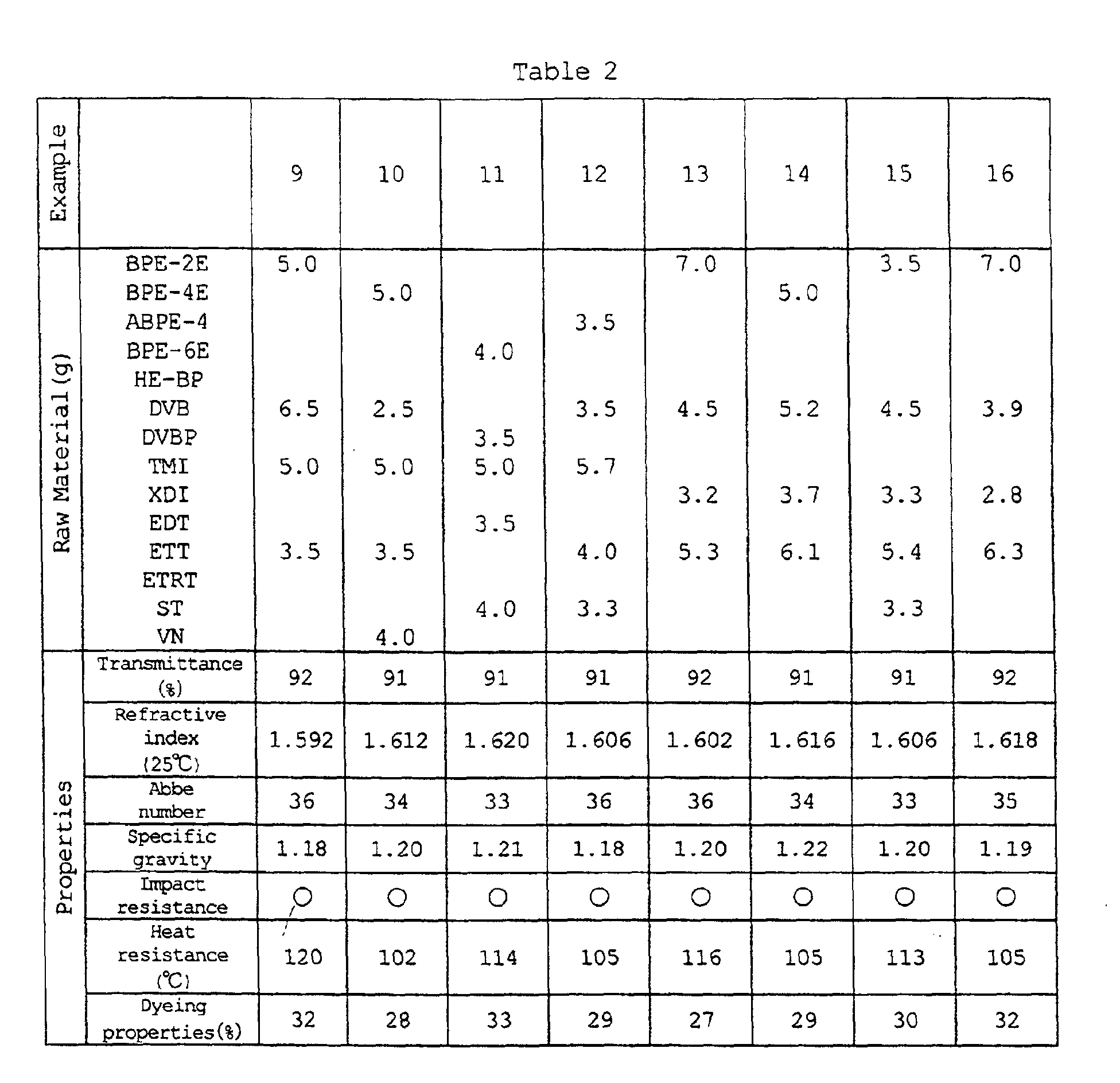
The formulations in Examples 1 to 23 and Comparative
Examples 1 to 9 are shown in Tables 1 to 4. The
abbreviations in the tables indicate the names of the
following compounds.
- BPE-2E:
- 2,2-Bis(4-methacryloxyethoxyphenyl)propane
- BPE-4E:
- 2,2-Bis[4-(2-methacryloxyethoxy)ethoxy]propane
- BPE-6E:
- 2,2-Bis[4-(2-methacryloxyethoxy)diethoxy]propane
- ABPE-4:
- 2,2-Bis[4-(2-acryloxyethoxy)ethoxy]propane
- HE-BP:
- 2,2-Bis[4-(2-methacryloxyethoxycarbonyloxy)-phenyl] propane
- DVB:
- Divinylbenzene
- DVBP:
- Divinylbiphenyl
- TMI:
- 3-Isopropenyl-α,α-dimethylbenzyl isocyanate
- mTMDI:
- Tetramethylxylylene diisocyanate
- XDI:
- m-Xylylene diisocyanate
- EDT:
- Ethanedithiol
- ETT:
- 2,2'-Thiodiethanethiol
- ETRT:
- Dimercaptotriethylene disulfide
- ST:
- Styrene
- BzMA:
- Benzyl methacrylate
- VN:
- 1-Vinylnaphthalene
- PETT:
- Pentaerythritol tetrakis(β-thiopropionate)
The formulations of the raw material mixtures in
Examples are shown in Table 1. To 20 g of a raw material
mixture were added 100 ppm of 1,8-diazabicyclo[5.4.0]undece
ne-7 as a thiourethane bonding accelerating compound and
0.4 g of t-butyl peroxyneodecanoate as a polymerization
initiator, followed by stirring, to thereby obtain a
monomer composition.
The composition was charged into a mold comprised of
two circular plates made of glass having a diameter of 7 cm
and a gasket made of an ethylene-propylene rubber having a
thickness of 2 mm. Then, the temperature of the mold was
elevated in a hot air thermostatic chamber provided with a
programmed temperature controller from 30°C to 100°C over 18
hours. Subsequently, the mold was maintained at 100°C for
2 hours. Then, the mold was cooled to 40°C over 2 hours.
Thus, the composition in the mold was cured, and removed
from the mold, to thereby obtain a resin mass in a disc
shape. Further, the resin mass was subjected to annealing
treatment at 100°C for 2 hours, to thereby obtain a cured
resin plate.
The properties of the obtained resin plate were
evaluated by the following test methods. The results are
shown in Table 1.
The procedure was substantially the same as in Examples
1 to 8 except that to 20 g of a raw material mixture having
the formulation shown in Table 2 were added 200 ppm of
dibutyltin dilaurate and 0.4 g of t-butyl
peroxyneodecanoate. The properties are shown in Table 2.
Into a 100 ml four-necked flask equipped with a
thermometer, a dropping funnel and a stirrer were charged
0.2 mol of ethanedithiol as a polythiol compound and 100
ppm of 1,8-diazabicyclo[5.4.0]undecene-7 as a thiourethane
bonding accelerating compound. The resultant mixture was
stirred and maintained at 20°C. While stirring, 3-isopropenyl-α,α-dimethylbenzyl
isocyanate as a
crosslinking-type isocyanate contained in the dropping
funnel was added dropwise over 1 hour, to thereby effect a
reaction. After completion of the reaction, toluene was
removed from the reaction liquid by vacuum distillation.
From the infrared absorption spectrum analysis of the thus
obtained compound, the presence of the absorption ascribed
to a urethane linkage and the disappearance of the
absorption ascribed to an isocyanate linkage were
confirmed. From this fact, it has been confirmed that the
obtained compound is the intended compound TM-2S.
3-Isopropenyl-α,α-dimethylbenzyl isocyanate and 2,2-thiodiethanethiol,
and isocyanatoethyl methacrylate and
2,2'-thiodiethanethiol were respectively reacted with each
other in the same manner, to thereby obtain compounds TM-3S
and KM-3S.
The properties and the formulations of raw material
mixtures in Examples 17 to 23 are shown in Table 3. In
Examples 17 to 23, the procedure was substantially the same
as in Examples 1 to 8 except that to 20 g of a raw material
mixture in Table 3 was added 0.4 g of t-butyl
peroxyneodecanoate.
As Comparative Examples 1 to 4, using commercially
available 2 mm plates made of ADC, PMMA and PC and urethane
resin lens (raw material: MR-6), the physical properties
were examined in the same manner as in Examples 1 to 8.
As Comparative Example 5, a test piece was prepared
from a mixture of 14 g of diallyl diphenate (DADP), 6 g of
diallyl isophthalate (DAIP) and 0.6 g of isopropyl
peroxycarbonate in the same manner as in Examples 1 to 8,
and with respect to the prepared test piece, the physical
properties were examined.
As Comparative Examples 6 to 9, as shown in Table 4, to
20 g of a raw material mixture containing TMI was added 0.4
g of t-butyl peroxyneodecanoate, and test pieces were
prepared in the same manner as in Examples 1 to 8, and with
respect to each of the prepared test pieces, the physical
properties were examined. The results are shown in Table
4.



As described above, according to the composition of the
present invention, there can be provided a lens having high
refractive index and Abbe number as well as excellent
physical properties, such as specific gravity, dyeing
properties, heat resistance, impact resistance and the
like.
Claims (8)
- A monomer composition for a plastic optical material, comprising:a di(meth)acrylate compound;at least one of divinylbenzene and divinylbiphenyl;a crosslinking-type isocyanate compound;a compound having two or more thiol groups; anda thiourethane bonding accelerating compound.
- A monomer composition for a plastic optical material, comprising:a di(meth)acrylate compound;at least one of divinylbenzene and divinylbiphenyl; anda reaction product of a crosslinking-type isocyanate compound with a compound having two or more thiol groups.
- The monomer composition for a plastic optical material according to claim 1, wherein said di(meth)acrylate is represented by the following chemical formula (1):wherein R1 represents a hydrogen atom or a methyl group, Ph represents a phenylene group, x and z may be the same or different and each represent an integer of 1 to 5, and y is 0 or 1.

- The monomer composition for a plastic optical material according to claim 1, wherein said thiourethane bonding accelerating compound is at least one selected from the group consisting of an amine compound, an amine salt compound and an organometallic compound.
- A plastic optical material obtained by curing a mixture containing a monomer composition which comprises a di(meth)acrylate compound, at least one of divinylbenzene and divinylbiphenyl, a crosslinking-type isocyanate compound, a compound having two or more thiol groups and a thiourethane bonding accelerating compound, and a radical polymerization initiator.
- A plastic optical material obtained by curing a mixture containing a monomer composition which comprises a di(meth)acrylate compound, at least one of divinylbenzene and divinylbiphenyl and a reaction product of a crosslinking-type isocyanate compound with a compound having two or more thiol groups, and a radical polymerization initiator.
- A lens produced from the plastic optical material according to any one of claims 5 and 6.
- The lens according to claim 7, which has a hard coat layer on the surface thereof.
Applications Claiming Priority (9)
| Application Number | Priority Date | Filing Date | Title |
|---|---|---|---|
| JP14775799 | 1999-05-27 | ||
| JP14775799 | 1999-05-27 | ||
| JP15628399 | 1999-06-03 | ||
| JP15628499 | 1999-06-03 | ||
| JP15628499 | 1999-06-03 | ||
| JP15628399 | 1999-06-03 | ||
| JP31773399 | 1999-11-09 | ||
| JP31773399 | 1999-11-09 | ||
| PCT/JP2000/003438 WO2000073365A1 (en) | 1999-05-27 | 2000-05-29 | Monomer composition for optical plastic material, optical plastic material, and lens |
Publications (2)
| Publication Number | Publication Date |
|---|---|
| EP1116735A1 true EP1116735A1 (en) | 2001-07-18 |
| EP1116735A4 EP1116735A4 (en) | 2003-07-23 |
Family
ID=27472805
Family Applications (1)
| Application Number | Title | Priority Date | Filing Date |
|---|---|---|---|
| EP00931600A Withdrawn EP1116735A4 (en) | 1999-05-27 | 2000-05-29 | MONOMERIC COMPOSITION FOR OPTICAL PLASTIC MATERIAL, OPTICAL PLASTIC MATERIAL AND LENS |
Country Status (6)
| Country | Link |
|---|---|
| US (1) | US6417273B1 (en) |
| EP (1) | EP1116735A4 (en) |
| KR (1) | KR100411379B1 (en) |
| CN (1) | CN1304421A (en) |
| AU (1) | AU4950600A (en) |
| WO (1) | WO2000073365A1 (en) |
Cited By (3)
| Publication number | Priority date | Publication date | Assignee | Title |
|---|---|---|---|---|
| WO2004085447A3 (en) * | 2003-03-24 | 2004-11-11 | Essilor Int | Thiophosphine compounds and method of making polymerisable compositions containing them and their use for making ophtalmic lenses |
| FR2883880A1 (en) * | 2005-03-31 | 2006-10-06 | Essilor Int | THERMOSETTING POLY (THIO) URETHANE FORMULATION COMPRISING AT LEAST ONE BLOCK COPOLYMER AND ITS APPLICATION IN THE OPTICS FOR THE MANUFACTURE OF ORGANIC GLASSES WITH IMPROVED TENACITY |
| WO2007078550A3 (en) * | 2005-12-16 | 2008-02-07 | Ppg Ind Ohio Inc | Sulfur-containing oligomers and high index polyurethanes prepared therefrom |
Families Citing this family (10)
| Publication number | Priority date | Publication date | Assignee | Title |
|---|---|---|---|---|
| CN101059567B (en) * | 2001-11-30 | 2010-05-26 | 株式会社尼康 | Precursor composition for optical resin, resin for optical use, optical element, and optical article |
| EP2698664B1 (en) * | 2011-04-13 | 2015-09-16 | Hoya Corporation | Photochromic lens for eye glasses |
| US20120329905A1 (en) * | 2011-06-24 | 2012-12-27 | Nunez Ivan M | High Refractive Index Lenses |
| TWI582117B (en) * | 2012-04-03 | 2017-05-11 | Arakawa Chemical Industries Ltd | A polyfunctional thio (meth) acrylate resin, an active energy ray-hardening hard coat resin composition having a hardened film obtained by hardening it, a plastic film having a hardened film laminated, and a plastic film Molding and processing products |
| US9568643B2 (en) | 2012-12-13 | 2017-02-14 | Ppg Industries Ohio, Inc. | Polyurethane urea-containing compositions and optical articles and methods for preparing them |
| US9845373B2 (en) * | 2013-08-02 | 2017-12-19 | Mitsui Chemicals, Inc. | Polymerizable composition for photochromic optical materials |
| JP6275247B2 (en) * | 2014-04-25 | 2018-02-07 | 三井化学株式会社 | Polymerizable composition for optical material, optical material and method for producing optical material |
| JP6664347B2 (en) * | 2017-03-31 | 2020-03-13 | 富士フイルム株式会社 | Manufacturing method of lens |
| EP3816202A4 (en) * | 2018-06-29 | 2022-03-16 | Hoya Lens Thailand Ltd. | HARDENED OBJECT FOR OPTICAL ELEMENT AND OPTICAL ELEMENT |
| EP3816200A4 (en) * | 2018-06-29 | 2022-03-16 | Hoya Lens Thailand Ltd. | POLYMERIZABLE COMPOSITION FOR OPTICAL ELEMENT, OPTICAL ELEMENT AND METHOD FOR PRODUCTION OF OPTICAL ELEMENT |
Family Cites Families (14)
| Publication number | Priority date | Publication date | Assignee | Title |
|---|---|---|---|---|
| JPS5817527B2 (en) | 1978-07-17 | 1983-04-07 | 株式会社保谷レンズ | Copolymers for high refractive index lenses and lenses made from them |
| US4256669A (en) | 1978-11-08 | 1981-03-17 | Mallinckrodt, Inc. | Para-aminophenol derivatives |
| CA1239739A (en) | 1985-07-19 | 1988-07-26 | Hideo Nakamoto | Plastic lens |
| JPS62267316A (en) | 1986-05-16 | 1987-11-20 | Mitsui Toatsu Chem Inc | Resin for plastic lens having high refractive index |
| DE3903279A1 (en) * | 1988-02-03 | 1989-08-10 | Mitsubishi Gas Chemical Co | AROMATIC VINYL COMPOUND WITH SULFUR |
| JP2707613B2 (en) | 1988-07-12 | 1998-02-04 | 三菱瓦斯化学株式会社 | Plastic lens |
| JP3028009B2 (en) | 1992-04-13 | 2000-04-04 | セイコーエプソン株式会社 | Composition for high refractive index optical material and manufacturing method |
| JPH06211960A (en) * | 1993-01-14 | 1994-08-02 | Daiso Co Ltd | Polymerizable composition and high refractive index plastic lens obtained therefrom |
| AU665480B2 (en) * | 1993-01-29 | 1996-01-04 | Tokuyama Corporation | Polymerizable composition, polymer, organic glass and ophthalmic lens |
| JPH08198932A (en) * | 1994-11-24 | 1996-08-06 | Toray Ind Inc | Plastic lens |
| JPH08198934A (en) * | 1995-01-23 | 1996-08-06 | Nippon Oil & Fats Co Ltd | Prepolymer and optical material |
| JP3256415B2 (en) * | 1995-06-30 | 2002-02-12 | 三井化学株式会社 | Photopolymerized sulfur-containing urethane plastic lens |
| US5908876A (en) * | 1996-04-19 | 1999-06-01 | Mitsui Chemicals, Inc. | Optical resin composition comprising a thiourethane prepolymer and use thereof |
| JPH10332901A (en) * | 1997-06-02 | 1998-12-18 | Seed:Kk | Synthetic resin lens |
-
2000
- 2000-05-29 AU AU49506/00A patent/AU4950600A/en not_active Abandoned
- 2000-05-29 US US09/744,368 patent/US6417273B1/en not_active Expired - Fee Related
- 2000-05-29 WO PCT/JP2000/003438 patent/WO2000073365A1/en not_active Ceased
- 2000-05-29 EP EP00931600A patent/EP1116735A4/en not_active Withdrawn
- 2000-05-29 CN CN00800866A patent/CN1304421A/en active Pending
- 2000-05-29 KR KR10-2001-7000240A patent/KR100411379B1/en not_active Expired - Fee Related
Cited By (8)
| Publication number | Priority date | Publication date | Assignee | Title |
|---|---|---|---|---|
| WO2004085447A3 (en) * | 2003-03-24 | 2004-11-11 | Essilor Int | Thiophosphine compounds and method of making polymerisable compositions containing them and their use for making ophtalmic lenses |
| US7129321B2 (en) | 2003-03-24 | 2006-10-31 | Essilor International Compagnie Generale D'optique | Thiophosphine compounds and methods of making polymerizable compositions containing them and their use for making ophthalmic lenses |
| US7378556B2 (en) | 2003-03-24 | 2008-05-27 | Essilor International Compagnie Generale D'optique | Process for making thiophosphine compounds |
| US7446228B2 (en) | 2003-03-24 | 2008-11-04 | Essilor International Compagnie Generale D'optique | Thiophosphine compounds |
| FR2883880A1 (en) * | 2005-03-31 | 2006-10-06 | Essilor Int | THERMOSETTING POLY (THIO) URETHANE FORMULATION COMPRISING AT LEAST ONE BLOCK COPOLYMER AND ITS APPLICATION IN THE OPTICS FOR THE MANUFACTURE OF ORGANIC GLASSES WITH IMPROVED TENACITY |
| WO2006103371A3 (en) * | 2005-03-31 | 2006-12-14 | Essilor Int | Thermosetting poly(thio)urethane formulation comprising at least one block copolymer and use thereof in optics for the production of organic lenses having improved toughness |
| US8299176B2 (en) | 2005-03-31 | 2012-10-30 | Essilor International (Compagnie Generale D'optique) | Thermosetting poly(thio)urethane formulation comprising at least one block copolymer and use thereof in optics for the production of organic lenses having improved toughness |
| WO2007078550A3 (en) * | 2005-12-16 | 2008-02-07 | Ppg Ind Ohio Inc | Sulfur-containing oligomers and high index polyurethanes prepared therefrom |
Also Published As
| Publication number | Publication date |
|---|---|
| AU4950600A (en) | 2000-12-18 |
| KR100411379B1 (en) | 2003-12-18 |
| KR20010071770A (en) | 2001-07-31 |
| CN1304421A (en) | 2001-07-18 |
| WO2000073365A1 (en) | 2000-12-07 |
| EP1116735A4 (en) | 2003-07-23 |
| US6417273B1 (en) | 2002-07-09 |
Similar Documents
| Publication | Publication Date | Title |
|---|---|---|
| US6369269B2 (en) | Thiol and sulfur-containing O-(meth)acrylate compounds and use thereof | |
| US6417273B1 (en) | Monomer composition for optical plastic optical material, optical plastic material, and lens | |
| JPH0379614A (en) | Plastic lens material having high refractive index and low specific gravity | |
| EP0134861B1 (en) | Resin material for plastic lens and lens composed thereof | |
| JPH11349658A (en) | Curable composition and optical material obtained by using the same | |
| JP3556027B2 (en) | Sulfur-containing (meth) acrylate compounds and uses thereof | |
| JPH1114801A (en) | Synthetic resin lens | |
| JPH06294901A (en) | Plastic lens material | |
| JP2002020433A (en) | Monomer composition and cured product thereof | |
| JPH01242612A (en) | Material for plastic lens | |
| JP2003105227A (en) | Bluing agent for plastic optical materials | |
| JPH11100428A (en) | Composition for optical material and plastic lens and its production | |
| JP2002241464A (en) | Monomer composition for optical material and cured product | |
| JPH0665190A (en) | Vinylbenzyl compound | |
| JPH10298260A (en) | Synthetic resin lens | |
| JPWO2000073365A1 (en) | Monomer composition for plastic optical materials, plastic optical materials and lenses | |
| JP2001040045A (en) | Monomer composition for plastic optical material, cured product thereof and lens | |
| JPH10231343A (en) | Curable composition and optical material comprising the same | |
| JPH10330450A (en) | Curable composition and optical material consisting of the same | |
| JP2002014201A (en) | Synthetic resin lens | |
| JP2609474B2 (en) | Manufacturing method of high refractive index resin | |
| JPH10231344A (en) | Curable composition and optical material comprising the same | |
| JPS6329701A (en) | Resin lens having high refractive index | |
| JPH06116337A (en) | Polymerizable composition | |
| JPH01163702A (en) | Plastic lens material |
Legal Events
| Date | Code | Title | Description |
|---|---|---|---|
| PUAI | Public reference made under article 153(3) epc to a published international application that has entered the european phase |
Free format text: ORIGINAL CODE: 0009012 |
|
| 17P | Request for examination filed |
Effective date: 20010118 |
|
| AK | Designated contracting states |
Kind code of ref document: A1 Designated state(s): AT BE CH CY DE DK ES FI FR GB GR IE IT LI LU MC NL PT SE |
|
| AX | Request for extension of the european patent |
Free format text: AL;LT;LV;MK;RO;SI |
|
| A4 | Supplementary search report drawn up and despatched |
Effective date: 20030606 |
|
| RBV | Designated contracting states (corrected) |
Designated state(s): DE FR GB |
|
| STAA | Information on the status of an ep patent application or granted ep patent |
Free format text: STATUS: THE APPLICATION IS DEEMED TO BE WITHDRAWN |
|
| 18D | Application deemed to be withdrawn |
Effective date: 20041102 |