EP1115033A1 - Use of alkylated polyamines in photoresist developers - Google Patents
Use of alkylated polyamines in photoresist developers Download PDFInfo
- Publication number
- EP1115033A1 EP1115033A1 EP01100010A EP01100010A EP1115033A1 EP 1115033 A1 EP1115033 A1 EP 1115033A1 EP 01100010 A EP01100010 A EP 01100010A EP 01100010 A EP01100010 A EP 01100010A EP 1115033 A1 EP1115033 A1 EP 1115033A1
- Authority
- EP
- European Patent Office
- Prior art keywords
- polyamine
- developer composition
- tetramethylammonium hydroxide
- photoresist
- developer
- Prior art date
- Legal status (The legal status is an assumption and is not a legal conclusion. Google has not performed a legal analysis and makes no representation as to the accuracy of the status listed.)
- Withdrawn
Links
- 229920002120 photoresistant polymer Polymers 0.000 title claims abstract description 45
- 229920000768 polyamine Polymers 0.000 title claims abstract description 38
- 239000000203 mixture Substances 0.000 claims abstract description 43
- 239000004094 surface-active agent Substances 0.000 claims abstract description 27
- XLYOFNOQVPJJNP-UHFFFAOYSA-N water Substances O XLYOFNOQVPJJNP-UHFFFAOYSA-N 0.000 claims abstract description 20
- 238000004140 cleaning Methods 0.000 claims abstract description 14
- 150000001875 compounds Chemical class 0.000 claims abstract description 10
- 125000002347 octyl group Chemical group [H]C([*])([H])C([H])([H])C([H])([H])C([H])([H])C([H])([H])C([H])([H])C([H])([H])C([H])([H])[H] 0.000 claims abstract description 7
- 125000002947 alkylene group Chemical group 0.000 claims abstract description 6
- 125000004122 cyclic group Chemical group 0.000 claims abstract description 6
- WGTYBPLFGIVFAS-UHFFFAOYSA-M tetramethylammonium hydroxide Chemical compound [OH-].C[N+](C)(C)C WGTYBPLFGIVFAS-UHFFFAOYSA-M 0.000 claims description 48
- 239000000243 solution Substances 0.000 claims description 25
- 238000000034 method Methods 0.000 claims description 21
- RPNUMPOLZDHAAY-UHFFFAOYSA-N Diethylenetriamine Chemical compound NCCNCCN RPNUMPOLZDHAAY-UHFFFAOYSA-N 0.000 claims description 15
- NTIZESTWPVYFNL-UHFFFAOYSA-N Methyl isobutyl ketone Chemical compound CC(C)CC(C)=O NTIZESTWPVYFNL-UHFFFAOYSA-N 0.000 claims description 13
- UIHCLUNTQKBZGK-UHFFFAOYSA-N Methyl isobutyl ketone Natural products CCC(C)C(C)=O UIHCLUNTQKBZGK-UHFFFAOYSA-N 0.000 claims description 12
- 230000008569 process Effects 0.000 claims description 12
- 238000005932 reductive alkylation reaction Methods 0.000 claims description 11
- FFWSICBKRCICMR-UHFFFAOYSA-N 5-methyl-2-hexanone Chemical compound CC(C)CCC(C)=O FFWSICBKRCICMR-UHFFFAOYSA-N 0.000 claims description 10
- PIICEJLVQHRZGT-UHFFFAOYSA-N Ethylenediamine Chemical compound NCCN PIICEJLVQHRZGT-UHFFFAOYSA-N 0.000 claims description 5
- OTBHHUPVCYLGQO-UHFFFAOYSA-N bis(3-aminopropyl)amine Chemical compound NCCCNCCCN OTBHHUPVCYLGQO-UHFFFAOYSA-N 0.000 claims description 5
- 239000007864 aqueous solution Substances 0.000 claims description 3
- 230000006872 improvement Effects 0.000 claims description 3
- 206010073306 Exposure to radiation Diseases 0.000 claims description 2
- 150000002989 phenols Chemical class 0.000 claims description 2
- WSNMPAVSZJSIMT-UHFFFAOYSA-N COc1c(C)c2COC(=O)c2c(O)c1CC(O)C1(C)CCC(=O)O1 Chemical compound COc1c(C)c2COC(=O)c2c(O)c1CC(O)C1(C)CCC(=O)O1 WSNMPAVSZJSIMT-UHFFFAOYSA-N 0.000 claims 2
- VGGSQFUCUMXWEO-UHFFFAOYSA-N Ethene Chemical compound C=C VGGSQFUCUMXWEO-UHFFFAOYSA-N 0.000 claims 2
- 239000005977 Ethylene Substances 0.000 claims 2
- QVYARBLCAHCSFJ-UHFFFAOYSA-N butane-1,1-diamine Chemical compound CCCC(N)N QVYARBLCAHCSFJ-UHFFFAOYSA-N 0.000 claims 2
- YMHQVDAATAEZLO-UHFFFAOYSA-N cyclohexane-1,1-diamine Chemical compound NC1(N)CCCCC1 YMHQVDAATAEZLO-UHFFFAOYSA-N 0.000 claims 2
- SYECJBOWSGTPLU-UHFFFAOYSA-N hexane-1,1-diamine Chemical compound CCCCCC(N)N SYECJBOWSGTPLU-UHFFFAOYSA-N 0.000 claims 2
- GGHDAUPFEBTORZ-UHFFFAOYSA-N propane-1,1-diamine Chemical compound CCC(N)N GGHDAUPFEBTORZ-UHFFFAOYSA-N 0.000 claims 2
- QQONPFPTGQHPMA-UHFFFAOYSA-N propylene Natural products CC=C QQONPFPTGQHPMA-UHFFFAOYSA-N 0.000 claims 2
- 125000004805 propylene group Chemical group [H]C([H])([H])C([H])([*:1])C([H])([H])[*:2] 0.000 claims 2
- 238000010348 incorporation Methods 0.000 abstract description 2
- 230000002829 reductive effect Effects 0.000 abstract description 2
- 239000006260 foam Substances 0.000 description 19
- 239000000047 product Substances 0.000 description 14
- 150000001412 amines Chemical class 0.000 description 11
- 229910052757 nitrogen Inorganic materials 0.000 description 11
- 239000010408 film Substances 0.000 description 10
- KDLHZDBZIXYQEI-UHFFFAOYSA-N Palladium Chemical compound [Pd] KDLHZDBZIXYQEI-UHFFFAOYSA-N 0.000 description 8
- IJGRMHOSHXDMSA-UHFFFAOYSA-N Atomic nitrogen Chemical compound N#N IJGRMHOSHXDMSA-UHFFFAOYSA-N 0.000 description 7
- 238000004821 distillation Methods 0.000 description 7
- 238000009472 formulation Methods 0.000 description 7
- 238000009736 wetting Methods 0.000 description 7
- 238000000769 gas chromatography-flame ionisation detection Methods 0.000 description 6
- 239000000463 material Substances 0.000 description 6
- 238000002360 preparation method Methods 0.000 description 6
- 229910001220 stainless steel Inorganic materials 0.000 description 6
- 239000010935 stainless steel Substances 0.000 description 6
- 230000015572 biosynthetic process Effects 0.000 description 5
- 238000011161 development Methods 0.000 description 5
- 238000005187 foaming Methods 0.000 description 5
- 230000005855 radiation Effects 0.000 description 5
- XFNJVJPLKCPIBV-UHFFFAOYSA-N trimethylenediamine Chemical compound NCCCN XFNJVJPLKCPIBV-UHFFFAOYSA-N 0.000 description 5
- UFHFLCQGNIYNRP-UHFFFAOYSA-N Hydrogen Chemical compound [H][H] UFHFLCQGNIYNRP-UHFFFAOYSA-N 0.000 description 4
- 239000001257 hydrogen Substances 0.000 description 4
- 229910052739 hydrogen Inorganic materials 0.000 description 4
- 238000004519 manufacturing process Methods 0.000 description 4
- KIDHWZJUCRJVML-UHFFFAOYSA-N putrescine Chemical compound NCCCCN KIDHWZJUCRJVML-UHFFFAOYSA-N 0.000 description 4
- 239000000080 wetting agent Substances 0.000 description 4
- -1 Polysiloxanes Polymers 0.000 description 3
- XUIMIQQOPSSXEZ-UHFFFAOYSA-N Silicon Chemical compound [Si] XUIMIQQOPSSXEZ-UHFFFAOYSA-N 0.000 description 3
- 125000000217 alkyl group Chemical group 0.000 description 3
- 238000006243 chemical reaction Methods 0.000 description 3
- SSJXIUAHEKJCMH-UHFFFAOYSA-N cyclohexane-1,2-diamine Chemical compound NC1CCCCC1N SSJXIUAHEKJCMH-UHFFFAOYSA-N 0.000 description 3
- 230000007547 defect Effects 0.000 description 3
- NAQMVNRVTILPCV-UHFFFAOYSA-N hexane-1,6-diamine Chemical compound NCCCCCCN NAQMVNRVTILPCV-UHFFFAOYSA-N 0.000 description 3
- 229910017464 nitrogen compound Inorganic materials 0.000 description 3
- 230000009467 reduction Effects 0.000 description 3
- 238000006722 reduction reaction Methods 0.000 description 3
- 229920005989 resin Polymers 0.000 description 3
- 239000011347 resin Substances 0.000 description 3
- 239000004065 semiconductor Substances 0.000 description 3
- 229910052710 silicon Inorganic materials 0.000 description 3
- 239000010703 silicon Substances 0.000 description 3
- 239000002904 solvent Substances 0.000 description 3
- 239000000758 substrate Substances 0.000 description 3
- QQZOPKMRPOGIEB-UHFFFAOYSA-N 2-Oxohexane Chemical compound CCCCC(C)=O QQZOPKMRPOGIEB-UHFFFAOYSA-N 0.000 description 2
- ZPVFWPFBNIEHGJ-UHFFFAOYSA-N 2-octanone Chemical compound CCCCCCC(C)=O ZPVFWPFBNIEHGJ-UHFFFAOYSA-N 0.000 description 2
- SYBYTAAJFKOIEJ-UHFFFAOYSA-N 3-Methylbutan-2-one Chemical compound CC(C)C(C)=O SYBYTAAJFKOIEJ-UHFFFAOYSA-N 0.000 description 2
- RHLVCLIPMVJYKS-UHFFFAOYSA-N 3-octanone Chemical compound CCCCCC(=O)CC RHLVCLIPMVJYKS-UHFFFAOYSA-N 0.000 description 2
- HCFAJYNVAYBARA-UHFFFAOYSA-N 4-heptanone Chemical compound CCCC(=O)CCC HCFAJYNVAYBARA-UHFFFAOYSA-N 0.000 description 2
- HYTRYEXINDDXJK-UHFFFAOYSA-N Ethyl isopropyl ketone Chemical compound CCC(=O)C(C)C HYTRYEXINDDXJK-UHFFFAOYSA-N 0.000 description 2
- IAYPIBMASNFSPL-UHFFFAOYSA-N Ethylene oxide Chemical compound C1CO1 IAYPIBMASNFSPL-UHFFFAOYSA-N 0.000 description 2
- GOOHAUXETOMSMM-UHFFFAOYSA-N Propylene oxide Chemical compound CC1CO1 GOOHAUXETOMSMM-UHFFFAOYSA-N 0.000 description 2
- 239000000654 additive Substances 0.000 description 2
- 125000001931 aliphatic group Chemical group 0.000 description 2
- 125000005263 alkylenediamine group Chemical group 0.000 description 2
- 239000012736 aqueous medium Substances 0.000 description 2
- 230000005540 biological transmission Effects 0.000 description 2
- 230000007423 decrease Effects 0.000 description 2
- URQUNWYOBNUYJQ-UHFFFAOYSA-N diazonaphthoquinone Chemical compound C1=CC=C2C(=O)C(=[N]=[N])C=CC2=C1 URQUNWYOBNUYJQ-UHFFFAOYSA-N 0.000 description 2
- 238000004090 dissolution Methods 0.000 description 2
- CATSNJVOTSVZJV-UHFFFAOYSA-N heptan-2-one Chemical compound CCCCCC(C)=O CATSNJVOTSVZJV-UHFFFAOYSA-N 0.000 description 2
- NGAZZOYFWWSOGK-UHFFFAOYSA-N heptan-3-one Chemical compound CCCCC(=O)CC NGAZZOYFWWSOGK-UHFFFAOYSA-N 0.000 description 2
- FXHGMKSSBGDXIY-UHFFFAOYSA-N heptanal Chemical compound CCCCCCC=O FXHGMKSSBGDXIY-UHFFFAOYSA-N 0.000 description 2
- 150000002576 ketones Chemical class 0.000 description 2
- 239000002609 medium Substances 0.000 description 2
- QSHDDOUJBYECFT-UHFFFAOYSA-N mercury Chemical compound [Hg] QSHDDOUJBYECFT-UHFFFAOYSA-N 0.000 description 2
- 229910052753 mercury Inorganic materials 0.000 description 2
- NUJGJRNETVAIRJ-UHFFFAOYSA-N octanal Chemical compound CCCCCCCC=O NUJGJRNETVAIRJ-UHFFFAOYSA-N 0.000 description 2
- XNLICIUVMPYHGG-UHFFFAOYSA-N pentan-2-one Chemical compound CCCC(C)=O XNLICIUVMPYHGG-UHFFFAOYSA-N 0.000 description 2
- FDPIMTJIUBPUKL-UHFFFAOYSA-N pentan-3-one Chemical compound CCC(=O)CC FDPIMTJIUBPUKL-UHFFFAOYSA-N 0.000 description 2
- 238000003892 spreading Methods 0.000 description 2
- 230000007480 spreading Effects 0.000 description 2
- 125000006313 (C5-C8) alkyl group Chemical group 0.000 description 1
- ULPMRIXXHGUZFA-UHFFFAOYSA-N (R)-4-Methyl-3-hexanone Natural products CCC(C)C(=O)CC ULPMRIXXHGUZFA-UHFFFAOYSA-N 0.000 description 1
- BHVGMUDWABJNRC-UHFFFAOYSA-N (±)-2-methylhexanal Chemical compound CCCCC(C)C=O BHVGMUDWABJNRC-UHFFFAOYSA-N 0.000 description 1
- CYSGHNMQYZDMIA-UHFFFAOYSA-N 1,3-Dimethyl-2-imidazolidinon Chemical compound CN1CCN(C)C1=O CYSGHNMQYZDMIA-UHFFFAOYSA-N 0.000 description 1
- LGYNIFWIKSEESD-UHFFFAOYSA-N 2-ethylhexanal Chemical compound CCCCC(CC)C=O LGYNIFWIKSEESD-UHFFFAOYSA-N 0.000 description 1
- PFCHFHIRKBAQGU-UHFFFAOYSA-N 3-hexanone Chemical compound CCCC(=O)CC PFCHFHIRKBAQGU-UHFFFAOYSA-N 0.000 description 1
- WTQZSMDDRMKJRI-UHFFFAOYSA-N 4-diazoniophenolate Chemical compound [O-]C1=CC=C([N+]#N)C=C1 WTQZSMDDRMKJRI-UHFFFAOYSA-N 0.000 description 1
- ZMGMDXCADSRNCX-UHFFFAOYSA-N 5,6-dihydroxy-1,3-diazepan-2-one Chemical compound OC1CNC(=O)NCC1O ZMGMDXCADSRNCX-UHFFFAOYSA-N 0.000 description 1
- RZVAJINKPMORJF-UHFFFAOYSA-N Acetaminophen Chemical compound CC(=O)NC1=CC=C(O)C=C1 RZVAJINKPMORJF-UHFFFAOYSA-N 0.000 description 1
- NLWXVBUESHEUII-UHFFFAOYSA-N C(CCCCC)(N)N.C1CCCCC1 Chemical compound C(CCCCC)(N)N.C1CCCCC1 NLWXVBUESHEUII-UHFFFAOYSA-N 0.000 description 1
- OKTJSMMVPCPJKN-UHFFFAOYSA-N Carbon Chemical group [C] OKTJSMMVPCPJKN-UHFFFAOYSA-N 0.000 description 1
- 102000012688 DDA1 Human genes 0.000 description 1
- 101100008681 Glycine max DHPS1 gene Proteins 0.000 description 1
- 239000011149 active material Substances 0.000 description 1
- 150000001298 alcohols Chemical class 0.000 description 1
- 150000001299 aldehydes Chemical class 0.000 description 1
- 239000003513 alkali Substances 0.000 description 1
- 239000012670 alkaline solution Substances 0.000 description 1
- 238000004458 analytical method Methods 0.000 description 1
- 239000002585 base Substances 0.000 description 1
- 239000006227 byproduct Substances 0.000 description 1
- 229910052799 carbon Inorganic materials 0.000 description 1
- 125000004432 carbon atom Chemical group C* 0.000 description 1
- 150000001728 carbonyl compounds Chemical class 0.000 description 1
- 239000003638 chemical reducing agent Substances 0.000 description 1
- 239000003795 chemical substances by application Substances 0.000 description 1
- 229940125773 compound 10 Drugs 0.000 description 1
- 229940118056 cresol / formaldehyde Drugs 0.000 description 1
- 101150044395 dda1 gene Proteins 0.000 description 1
- 238000013461 design Methods 0.000 description 1
- 235000013870 dimethyl polysiloxane Nutrition 0.000 description 1
- 229910001873 dinitrogen Inorganic materials 0.000 description 1
- 230000000694 effects Effects 0.000 description 1
- 238000005516 engineering process Methods 0.000 description 1
- JARKCYVAAOWBJS-UHFFFAOYSA-N hexanal Chemical compound CCCCCC=O JARKCYVAAOWBJS-UHFFFAOYSA-N 0.000 description 1
- 239000007788 liquid Substances 0.000 description 1
- 238000001393 microlithography Methods 0.000 description 1
- AZSDSQJWQAGLHU-UHFFFAOYSA-N n'-(4-methylpentan-2-yl)-n-[2-(4-methylpentan-2-ylamino)ethyl]ethane-1,2-diamine Chemical compound CC(C)CC(C)NCCNCCNC(C)CC(C)C AZSDSQJWQAGLHU-UHFFFAOYSA-N 0.000 description 1
- NPGFLNHPZRUPOR-UHFFFAOYSA-N n'-(4-methylpentan-2-yl)-n-[3-(4-methylpentan-2-ylamino)propyl]propane-1,3-diamine Chemical compound CC(C)CC(C)NCCCNCCCNC(C)CC(C)C NPGFLNHPZRUPOR-UHFFFAOYSA-N 0.000 description 1
- RBUWPBLCPMXGEC-UHFFFAOYSA-N n'-(5-methylhexan-2-yl)-n-[2-(5-methylhexan-2-ylamino)ethyl]ethane-1,2-diamine Chemical compound CC(C)CCC(C)NCCNCCNC(C)CCC(C)C RBUWPBLCPMXGEC-UHFFFAOYSA-N 0.000 description 1
- RRHLGOOTLYHTEW-UHFFFAOYSA-N n'-[2-(dodecylamino)ethyl]ethane-1,2-diamine Chemical compound CCCCCCCCCCCCNCCNCCN RRHLGOOTLYHTEW-UHFFFAOYSA-N 0.000 description 1
- IJDNQMDRQITEOD-UHFFFAOYSA-N n-butane Chemical compound CCCC IJDNQMDRQITEOD-UHFFFAOYSA-N 0.000 description 1
- 125000004433 nitrogen atom Chemical group N* 0.000 description 1
- 150000002830 nitrogen compounds Chemical class 0.000 description 1
- 229920003986 novolac Polymers 0.000 description 1
- YWXLSHOWXZUMSR-UHFFFAOYSA-N octan-4-one Chemical compound CCCCC(=O)CCC YWXLSHOWXZUMSR-UHFFFAOYSA-N 0.000 description 1
- HGBOYTHUEUWSSQ-UHFFFAOYSA-N pentanal Chemical compound CCCCC=O HGBOYTHUEUWSSQ-UHFFFAOYSA-N 0.000 description 1
- PJGSXYOJTGTZAV-UHFFFAOYSA-N pinacolone Chemical compound CC(=O)C(C)(C)C PJGSXYOJTGTZAV-UHFFFAOYSA-N 0.000 description 1
- 229920000435 poly(dimethylsiloxane) Polymers 0.000 description 1
- 229920000642 polymer Polymers 0.000 description 1
- 229920001296 polysiloxane Polymers 0.000 description 1
- 238000012545 processing Methods 0.000 description 1
- 239000010453 quartz Substances 0.000 description 1
- VYPSYNLAJGMNEJ-UHFFFAOYSA-N silicon dioxide Inorganic materials O=[Si]=O VYPSYNLAJGMNEJ-UHFFFAOYSA-N 0.000 description 1
- 239000000126 substance Substances 0.000 description 1
- 238000012360 testing method Methods 0.000 description 1
- 239000010409 thin film Substances 0.000 description 1
Classifications
-
- G—PHYSICS
- G03—PHOTOGRAPHY; CINEMATOGRAPHY; ANALOGOUS TECHNIQUES USING WAVES OTHER THAN OPTICAL WAVES; ELECTROGRAPHY; HOLOGRAPHY
- G03F—PHOTOMECHANICAL PRODUCTION OF TEXTURED OR PATTERNED SURFACES, e.g. FOR PRINTING, FOR PROCESSING OF SEMICONDUCTOR DEVICES; MATERIALS THEREFOR; ORIGINALS THEREFOR; APPARATUS SPECIALLY ADAPTED THEREFOR
- G03F7/00—Photomechanical, e.g. photolithographic, production of textured or patterned surfaces, e.g. printing surfaces; Materials therefor, e.g. comprising photoresists; Apparatus specially adapted therefor
- G03F7/26—Processing photosensitive materials; Apparatus therefor
- G03F7/42—Stripping or agents therefor
-
- G—PHYSICS
- G03—PHOTOGRAPHY; CINEMATOGRAPHY; ANALOGOUS TECHNIQUES USING WAVES OTHER THAN OPTICAL WAVES; ELECTROGRAPHY; HOLOGRAPHY
- G03F—PHOTOMECHANICAL PRODUCTION OF TEXTURED OR PATTERNED SURFACES, e.g. FOR PRINTING, FOR PROCESSING OF SEMICONDUCTOR DEVICES; MATERIALS THEREFOR; ORIGINALS THEREFOR; APPARATUS SPECIALLY ADAPTED THEREFOR
- G03F7/00—Photomechanical, e.g. photolithographic, production of textured or patterned surfaces, e.g. printing surfaces; Materials therefor, e.g. comprising photoresists; Apparatus specially adapted therefor
- G03F7/26—Processing photosensitive materials; Apparatus therefor
- G03F7/30—Imagewise removal using liquid means
- G03F7/32—Liquid compositions therefor, e.g. developers
- G03F7/322—Aqueous alkaline compositions
Definitions
- the invention relates to the use of alkylated polyamines as a wetting agent in aqueous photoresist developer and electronics cleaning compositions.
- Tetramethylammonium hydroxide is the chemical of choice in aqueous alkaline solutions for developing photoresists according to Microlithography, Science and Technology, edited by J. R. Sheats and B. W. Smith, Marcel Dekker, Inc., 1998, pp 551-553. Surfactants are added to the aqueous TMAH solutions to reduce development time and scumming and to improve surface wetting.
- US 5 939 476 discloses the use of alkylated polyamines for reducing equilibrium and dynamic surface tension of water-based compositions.
- EP 0 930 346 corresponding to US Application 09/009099 filed 20 January 1998 discloses the use of N,N'-dialkyl alkylenediamines for reducing equilibrium and dynamic surface tension of water-based compositions.
- JP 10-319606 discloses that commercially available ethylene oxide (EO)/ propylene oxide (PO) block polymers give good wetting and low foam.
- JP 03-062034 discloses polyoxyalkylene dimethyl polysiloxanes as good surfactants with low foam in developer formulations. Polysiloxanes are known to rearrange or decompose under conditions of high pH.
- US 4 997 748 discloses cyclic nitrogen compounds at levels of 0.1 to 10 wt% to decrease scum formation and enhance image sharpness during photoresist development.
- cyclic nitrogen compounds taught is the cyclic urea 1,3-dimethyl-2-imidazolidinone. Since the nitrogen compounds are not amphipathic, it is not likely that they will lower surface tensions at low concentrations, and their utility appears to be based on properties other than surface tension reduction.
- 1,3-dimethyl-2-imidazolidinone is well known as a very good solvent and not as a surface-active material.
- US 4 828 965 discloses the use of lower alkanolamines (1-4 carbons) in combination with alcohols at concentrations of 0.40-5 wt%.
- US 4 741 989 discloses the use of small amounts of amines to modify the reaction chemistry of the quinonediazide photoactive compounds in photoresists, but only small chain amines are used and no surface active amines are cited.
- US 4 628 023 discloses water soluble amines as the alkali source for developer solutions. Because the preferred pH range is above 12.5, the use of organic amines would necessarily be at high concentrations.
- JP 61-179651 discloses the use of amine-containing developer solutions with surface tensions of between 25 and 50 dyne/cm. These surface tensions are achieved by the use of relatively large amounts of non-surface-active amines (3-5 wt%) in combination with tetramethylammonium hydroxide as the base.
- This invention provides water-based photoresist developing, or electronics cleaning, compositions having reduced equilibrium and dynamic surface tension by incorporation of an effective amount of an alkylated polyamine compound of the following structures I and II: where R and R' are independently C5 to C8 alkyl, G is a C2-C6 linear or cyclic alkylene group which may contain C1-C4 alkyl substituents, m is 2-6, and n is 2 or 3.
- water-based aqueous or “aqueous medium” we mean, for purposes of this invention, a solvent or liquid dispersing medium which comprises at least about 90 wt%, preferably at least about 95 wt%, water. Obviously, an all water medium is also included and is most preferred. Also for purposes of the present invention, the terms “photoresist developing” and “electronics cleaning” are interchangeable.
- This invention relates to the use of compounds of the formulas I and II where R and R' are independently C5 to C8 alkyl, and G is a C2-C6 linear or cyclic alkylene group which may contain C1-C4 alkyl substituents, and where R and R' are independently C5 to C8 alkyl groups and m is 2-6 and n is 2 or 3, with m being 2 or 3 preferred; for the reduction of equilibrium and dynamic surface tension and low foaming in water-based photoresist developer formulations.
- an aqueous solution of the dialkylated polyamine demonstrates a dynamic surface tension of less than 45 dynes/cm at a concentration of ⁇ 5 wt% in water at 23°C and 1 bubble/second according to the maximum-bubble-pressure method.
- the maximum-bubble-pressure method of measuring surface tension is described in Langmuir 1986 , 2 , 428-432, which is incorporated by reference.
- dialkylated polyamines comprising N,N'-dialkyl alkylenediamines and N,N"-dialkyl dialkylenetriamines which are suitable for use in the present invention are those alkylated polyamines taught in EP 0 930 346 and US 5 939 476, respectively. These references also teach how to make these dialkyl polyamines.
- alkylated polyamines having a solubility in water of at least 0.001 wt%, preferably from 0.001 to 1 wt%, and most preferably from 0.005 to 0.5 wt%.
- the alkyl groups may be the same or different. They may be linear or branched, and the point of attachment to the nitrogen of the polyamine may be on either an internal or terminal carbon.
- Suitable alkyl groups are derived from reductive alkylation reactions of a C5 to C8 aldehyde or ketone, preferably derived from reductive alkylation reactions of methyl isobutyl ketone or methyl isoamyl ketone.
- suitable C5 to C8 aldehydes and ketones include 1-pentanal, 2-pentanone, 3-pentanone, methyl isopropyl ketone, 1-hexanal, 2-hexanone, 3-hexanone, methyl tert -butyl ketone, ethyl isopropyl ketone, 1-heptanal, 2-methylhexanal, 2-heptanone, 3-heptanone, 4-heptanone, 1-octanal, 2-octanone, 3-octanone, 4-octanone, 2-ethylhexanal, and so on.
- the specific carbonyl compound chosen and the number attached to the polyamine derivative will depend on the surfactant properties required for a particular application.
- an amount of the dialkylated polyamine compound that is effective to reduce the equilibrium and/or dynamic surface tension of the water-based photoresist developer/electronics cleaning composition is added.
- Such effective amount may range from 0.001 to 1 g/100ml, preferably 0.005 to 0.5 g/100ml, of the aqueous composition. Naturally, the most effective amount will depend on the particular application and the solubility of the dialkylated polyamine.
- dialkylated polyamine as a surfactant is particularly advantageous in the developers for photoresists that are employed in the semiconductor industry. Such developers and their use are well known in the art and do not need to be described in detail.
- the improvement provided by this invention involves the use in these developer formulations of certain dialkylated polyamines containing 5 to 8 carbon atoms in each alkyl group on the nitrogen atoms.
- water-based photoresist developer, or electronic cleaning, composition containing a dialkylated polyamine according to the invention other optional components of such compositions are those materials well known to the workers in the art.
- a typical water-based photoresist developer, or electronic cleaning, composition to which the dialkylated polyamines may be added would comprise an aqueous medium containing the following components: Water-Based Photoresist Developer Composition 0.1 to 3 wt% Tetramethylammonium Hydroxide 0 to 4 wt% Phenolic Compound 10 to 10,000 ppm Alkylated Polyamine
- the process for manufacture of integrated circuits involves the application of a film of photoresist composition to a suitable substrate, such as a silicon wafer, which is then exposed to actinic radiation in a design pattern that is imposed upon the photoresist film.
- a suitable substrate such as a silicon wafer
- actinic radiation in a design pattern that is imposed upon the photoresist film.
- the radiation either increases or decreases its solubility in a subsequently applied developer solution. Consequently, in a positive-working photoresist the areas masked from the radiation remain after development while the exposed areas are dissolved away. In the negative-working photoresist the opposite occurs.
- the surfactant of this invention can be used in developers for either type of photoresist.
- the character of the developer is very important in determining the quality of the circuits formed and precise control of developing is essential. To achieve better surface wetting by the developer is has been common to add surfactant to the formulation in order to reduce surface tension of the solution. This addition, however, can cause the developer to foam which leads to circuit defects. This foaming problem is also recognized in the art and considerable attention in the industry has been directed toward its solution.
- TMAH tetramethylammonium hydroxide
- These developers are also well known in the art.
- Commercial developers usually contain low levels of surfactant on the order of 50 to 1000 ppm by weight.
- Surfactant level should not exceed that required to achieve the desired surface tension of the solution. For example, surface tensions of about 40 to 45 dynes/cm would be appropriate for novolac-based photoresist resins.
- Advanced resins that often incorporate aliphatic groups might require a developer with lower surface tension to enhance wetting.
- One of the advantages of the surfactants of this invention is that suitable surface tensions can be obtained at lower levels than is required by other wetting agents. This in itself is a step toward solving the foaming problem in the manufacture of microcircuitry.
- This example illustrates the procedure for the preparation of the reductive alkylation product of diethylenetriamine and methyl isobutyl ketone (DETA/MIBK2) having the following structure:
- Diethylenetriamine (0.5 mole), methyl isobutyl ketone (2.0 mole) and 5% Pd/C (4 wt% of total charge) were charged to a one liter stainless steel autoclave.
- the reactor was sealed and purged with nitrogen then hydrogen.
- the contents of the reactor were heated to 90° C under 7 bar (100 psig) H 2 .
- the pressure was increased to 55 bar (800 psig) and maintained throughout the reaction (9 hours) by the admission of hydrogen from a 1 gallon ballast on demand by a dome regulator.
- the reactor contents were analyzed by GC/FID and found to be 92.4 area% dialkylated and 2.7% trialkylated diethylenetriamine.
- the dialkylated product 2,4,12,14-tetramethyl-5,8,11-triazapentadecane was purified by distillation at 145-146° C, 6.6 millibar (5 Torr).
- This example illustrates the procedure for the preparation of the reductive alkylation product of diethylenetriamine and methyl isoamyl ketone (DETA/MIAK2) having the following structure:
- Diethylenetriamine (1.5 mole), methyl isoamyl ketone (3.2 mole) and 10% Pd/C (2.4 wt% of total charge) were charged to a one liter stainless steel autoclave and reacted as in Example 1 for 5 hours.
- the reactor contents were analyzed by GC/FID and found to be 92.4 area% dialkylated diethylenetriamine.
- the product 2,5,13,16-tetramethyl-6,9,12-triazaheptadecane was purified by distillation at 155-157° C, 2.7 millibar (2 Torr).
- This example illustrates the procedure for the preparation of the reductive alkylation product of di-(3-aminopropyl)amine and methyl isobutyl ketone (DAPA/MIBK2) having the following structure:
- This example illustrates the preparation of the reductive alkylation product of 1,2-ethylenediamine and methyl isobutyl ketone (EDA/MIBK2).
- 1,2-Ethylenediamine (1.6 mole), methyl isobutyl ketone (3.7 mole) and 5% Pd/C (2 wt% of total charge) were charged to a one liter stainless steel autoclave.
- the reactor was sealed and purged with nitrogen then hydrogen.
- the contents of the reactor were heated to 90°C under 7 bar (100 psig) H 2.
- the pressure was increased to 55 bar (800 psig) and maintained throughout the reaction (31 hours) by the admission of hydrogen from a 1 gallon ballast on demand by a dome regulator.
- the reactor contents were analyzed by GC/FID and found to be 87.6 area% N,N'-dialkylated ethylenediamine.
- the product was purified by distillation at 112-114°C, 6.6 millibar (5 Torr).
- This example illustrates the preparation of the reductive alkylation product of 1,3-propanediamine and methyl isobutyl ketone (PDA/MIBK).
- 1,3-Propanediamine (1.0 mole), methyl isobutyl ketone (2.2 mole) and 10% Pd/C (4 wt% of total charge) were charged to a one liter stainless steel autoclave and reacted as in Example 1 for 5 hours.
- the reactor contents were analyzed by GC/FID and found to be 92.6 area% N,N'-dialkylated 1,3-propanediamine.
- the product was purified by distillation at 113-115°C, 2.7 millibar (2 Torr).
- This example illustrates the preparation of the reductive alkylation product of a butane-, cyclohexane- and hexanediamine mixture.
- a 1,6-hexanediamine process byproduct stream containing a mixture of 1,4-butanediamine, 1,2-cyclohexanediamine, and 1,6-hexanediamine (0.9 mole), methyl isobutyl ketone (2.0 mole) and 10% Pd/C (4 wt% of total charge) were charged to a one liter stainless steel autoclave and reacted as in Example 1 for 4 hours.
- the reactor contents were analyzed by GC/FID and found to be 11.3 area% monoalkylated 1,2-cyclohexanediamine and 77.4% dialkylated materials.
- the monoalkylated product was removed by distillation at 126-128°C, 2.7 millibar (2 Torr).
- the dialkylated product was purified by distillation at 130-137°C, 1.3 millibar (1Torr) to provide a sample containing (GC FID area% analysis) the reductive alkylation products of 1,4-butanediamine (11.5%), 1,2-cyclohexandiamine (46.6%), and 1,6-hexanediamine (38.7%).
- GC FID area% analysis the reductive alkylation products of 1,4-butanediamine (11.5%), 1,2-cyclohexandiamine (46.6%), and 1,6-hexanediamine (38.7%).
- the structures of these materials are shown below.
- Table 3 presents additional data indicating the low foam associated with the alkylated polyamine wetting agents in a 0.262N TMAH solution were obtained using the Ross-Miles technique.
- Polyamine Conc ppm
- R-M Foam Initial t to 0
- EDA/MIBK2 175 1.0 cm (13 s)
- DETA/MIBK2 400 2.0 cm (18 s)
- N-dodecyl diethylenetriamine (DETA/DDA1), a derivative with a long linear side-chain, at a concentration of only 40 ppm showed an initial foam height of 8.3 cm which was almost completely stable for five minutes at which time the foam was still 7.5 cm in height.
- the invention provides compositions suitable for use in photoresist developer/electronics cleaning compositions.
Landscapes
- Physics & Mathematics (AREA)
- General Physics & Mathematics (AREA)
- Photosensitive Polymer And Photoresist Processing (AREA)
- Exposure Of Semiconductors, Excluding Electron Or Ion Beam Exposure (AREA)
- Cleaning Or Drying Semiconductors (AREA)
- Materials For Photolithography (AREA)
- Organic Low-Molecular-Weight Compounds And Preparation Thereof (AREA)
Abstract
Description
- The invention relates to the use of alkylated polyamines as a wetting agent in aqueous photoresist developer and electronics cleaning compositions.
- The demands of semiconductor manufacture have required the use of high performance surfactants and wetting agents in photoresist developer formulations. As line features shrink to smaller sizes and photoresist substrate materials become more aliphatic in nature (i.e. having lower surface energy), aqueous developer solutions are being formulated with surface tension reducing agents. Another requirement for these developers is that they have a low tendency to foam. This is accentuated by the movement toward larger wafer sizes. Low foam formation is particularly important when using spray-puddle techniques because microbubble entrainment during spreading of the solution over the photoresist surface can lead to defects. Surfactants that have been used in the past to increase wetting of the photoresist typically lead to higher foam formation. For the most part the industry has focused on the effect of surfactant on photoresist performance, such as contrast, critical dimension, and feature sharpness. Although the cleaning ability of underlying substrates is enhanced by typical surfactants, foam formation still remains a problem.
- Tetramethylammonium hydroxide (TMAH) is the chemical of choice in aqueous alkaline solutions for developing photoresists according to Microlithography, Science and Technology, edited by J. R. Sheats and B. W. Smith, Marcel Dekker, Inc., 1998, pp 551-553. Surfactants are added to the aqueous TMAH solutions to reduce development time and scumming and to improve surface wetting.
- US 5 939 476 discloses the use of alkylated polyamines for reducing equilibrium and dynamic surface tension of water-based compositions.
- EP 0 930 346 corresponding to US Application 09/009099 filed 20 January 1998 discloses the use of N,N'-dialkyl alkylenediamines for reducing equilibrium and dynamic surface tension of water-based compositions.
- There are few references describing low foam surfactants in developer compositions. JP 10-319606 discloses that commercially available ethylene oxide (EO)/ propylene oxide (PO) block polymers give good wetting and low foam.
- JP 03-062034 discloses polyoxyalkylene dimethyl polysiloxanes as good surfactants with low foam in developer formulations. Polysiloxanes are known to rearrange or decompose under conditions of high pH.
- Although there are a few references to the use of amines in photoresist developer compositions, they are not related to the use of surface active agents. US 5 252 436 discloses the use of relatively high levels of amine additives (3-30 wt%) and US 5 039 595 uses amine additives at levels of 5-50 wt%. Both of these disclosures appear to be using the amines to alter the bulk solvent properties of the developer solution.
- US 4 997 748 discloses cyclic nitrogen compounds at levels of 0.1 to 10 wt% to decrease scum formation and enhance image sharpness during photoresist development. Among the cyclic nitrogen compounds taught is the cyclic urea 1,3-dimethyl-2-imidazolidinone. Since the nitrogen compounds are not amphipathic, it is not likely that they will lower surface tensions at low concentrations, and their utility appears to be based on properties other than surface tension reduction. 1,3-dimethyl-2-imidazolidinone is well known as a very good solvent and not as a surface-active material.
- US 4 828 965 discloses the use of lower alkanolamines (1-4 carbons) in combination with alcohols at concentrations of 0.40-5 wt%.
- US 4 741 989 discloses the use of small amounts of amines to modify the reaction chemistry of the quinonediazide photoactive compounds in photoresists, but only small chain amines are used and no surface active amines are cited.
- US 4 628 023 discloses water soluble amines as the alkali source for developer solutions. Because the preferred pH range is above 12.5, the use of organic amines would necessarily be at high concentrations.
- JP 61-179651 discloses the use of amine-containing developer solutions with surface tensions of between 25 and 50 dyne/cm. These surface tensions are achieved by the use of relatively large amounts of non-surface-active amines (3-5 wt%) in combination with tetramethylammonium hydroxide as the base.
- This invention provides water-based photoresist developing, or electronics cleaning, compositions having reduced equilibrium and dynamic surface tension by incorporation of an effective amount of an alkylated polyamine compound of the following structures I and II:
 where R and R' are independently C5 to C8 alkyl, G is a C2-C6 linear or cyclic alkylene group which may contain C1-C4 alkyl substituents, m is 2-6, and n is 2 or 3.
- By "water-based", "aqueous" or "aqueous medium" we mean, for purposes of this invention, a solvent or liquid dispersing medium which comprises at least about 90 wt%, preferably at least about 95 wt%, water. Obviously, an all water medium is also included and is most preferred. Also for purposes of the present invention, the terms "photoresist developing" and "electronics cleaning" are interchangeable.
- Also provided is a method for developing a photoresist after exposure to radiation by applying to the photoresist surface a water-based developer composition containing an effective amount of an alkylated polyamine compound of the above structures for reducing the dynamic surface tension of the developer composition.
- There are significant advantages associated with the use of these alkylated polyamine compounds in water-based photoresist developer, or electronics cleaning, compositions and these advantages include:
- an ability to control the foaming characteristics of the water-based compositions; and
- an ability to formulate low surface tension aqueous electronics cleaning and processing solutions, including photoresist developer solutions, for the semiconductor manufacturing industry with good wetting and extremely low foam.
- The use of these materials in photoresist developer formulations is of particular importance because of their ability to provide all the advantages of surface tension lowering plus outstanding performance in reducing the formation of foam and doing so while maintaining good contrast for photoresist developing applications.
- This invention relates to the use of compounds of the formulas I and IIwhere R and R' are independently C5 to C8 alkyl, and G is a C2-C6 linear or cyclic alkylene group which may contain C1-C4 alkyl substituents, and
 where R and R' are independently C5 to C8 alkyl groups and m is 2-6 and n is 2 or 3, with m being 2 or 3 preferred;
for the reduction of equilibrium and dynamic surface tension and low foaming in water-based photoresist developer formulations. It is desirable that an aqueous solution of the dialkylated polyamine demonstrates a dynamic surface tension of less than 45 dynes/cm at a concentration of ≤5 wt% in water at 23°C and 1 bubble/second according to the maximum-bubble-pressure method. The maximum-bubble-pressure method of measuring surface tension is described in Langmuir 1986, 2, 428-432, which is incorporated by reference. - The dialkylated polyamines comprising N,N'-dialkyl alkylenediamines and N,N"-dialkyl dialkylenetriamines which are suitable for use in the present invention are those alkylated polyamines taught in EP 0 930 346 and US 5 939 476, respectively. These references also teach how to make these dialkyl polyamines.
- Generally, in the practice of this invention, it is desirable to use alkylated polyamines having a solubility in water of at least 0.001 wt%, preferably from 0.001 to 1 wt%, and most preferably from 0.005 to 0.5 wt%.
- The alkyl groups may be the same or different. They may be linear or branched, and the point of attachment to the nitrogen of the polyamine may be on either an internal or terminal carbon. Suitable alkyl groups are derived from reductive alkylation reactions of a C5 to C8 aldehyde or ketone, preferably derived from reductive alkylation reactions of methyl isobutyl ketone or methyl isoamyl ketone. Specific examples of suitable C5 to C8 aldehydes and ketones include 1-pentanal, 2-pentanone, 3-pentanone, methyl isopropyl ketone, 1-hexanal, 2-hexanone, 3-hexanone, methyl tert-butyl ketone, ethyl isopropyl ketone, 1-heptanal, 2-methylhexanal, 2-heptanone, 3-heptanone, 4-heptanone, 1-octanal, 2-octanone, 3-octanone, 4-octanone, 2-ethylhexanal, and so on. The specific carbonyl compound chosen and the number attached to the polyamine derivative will depend on the surfactant properties required for a particular application.
- An amount of the dialkylated polyamine compound that is effective to reduce the equilibrium and/or dynamic surface tension of the water-based photoresist developer/electronics cleaning composition is added. Such effective amount may range from 0.001 to 1 g/100ml, preferably 0.005 to 0.5 g/100ml, of the aqueous composition. Naturally, the most effective amount will depend on the particular application and the solubility of the dialkylated polyamine.
- The use of the dialkylated polyamine as a surfactant is particularly advantageous in the developers for photoresists that are employed in the semiconductor industry. Such developers and their use are well known in the art and do not need to be described in detail. The improvement provided by this invention, which could not have been foreseen, involves the use in these developer formulations of certain dialkylated polyamines containing 5 to 8 carbon atoms in each alkyl group on the nitrogen atoms.
- In the following water-based photoresist developer, or electronic cleaning, composition containing a dialkylated polyamine according to the invention, other optional components of such compositions are those materials well known to the workers in the art. A typical water-based photoresist developer, or electronic cleaning, composition to which the dialkylated polyamines may be added would comprise an aqueous medium containing the following components:
Water-Based Photoresist Developer Composition 0.1 to 3 wt% Tetramethylammonium Hydroxide 0 to 4 wt% Phenolic Compound 10 to 10,000 ppm Alkylated Polyamine - Briefly, the process for manufacture of integrated circuits involves the application of a film of photoresist composition to a suitable substrate, such as a silicon wafer, which is then exposed to actinic radiation in a design pattern that is imposed upon the photoresist film. Depending upon whether the photoresist is positive or negative-working, the radiation either increases or decreases its solubility in a subsequently applied developer solution. Consequently, in a positive-working photoresist the areas masked from the radiation remain after development while the exposed areas are dissolved away. In the negative-working photoresist the opposite occurs. The surfactant of this invention can be used in developers for either type of photoresist. The character of the developer is very important in determining the quality of the circuits formed and precise control of developing is essential. To achieve better surface wetting by the developer is has been common to add surfactant to the formulation in order to reduce surface tension of the solution. This addition, however, can cause the developer to foam which leads to circuit defects. This foaming problem is also recognized in the art and considerable attention in the industry has been directed toward its solution.
- The aqueous developer, or electronics cleaning, solutions in which use of the dialkylated polyamines is preferred are the aqueous solutions of tetramethylammonium hydroxide (TMAH). These developers are also well known in the art. Commercial developers usually contain low levels of surfactant on the order of 50 to 1000 ppm by weight. Surfactant level should not exceed that required to achieve the desired surface tension of the solution. For example, surface tensions of about 40 to 45 dynes/cm would be appropriate for novolac-based photoresist resins. Advanced resins that often incorporate aliphatic groups might require a developer with lower surface tension to enhance wetting. One of the advantages of the surfactants of this invention is that suitable surface tensions can be obtained at lower levels than is required by other wetting agents. This in itself is a step toward solving the foaming problem in the manufacture of microcircuitry.
- The disclosures of US 5 939 476 and US Application 09/009,099 filed 20 January 1998, which patents relate to the use of dialkylated polyamines as surfactants in aqueous compositions, are hereby incorporated by reference.
- This example illustrates the procedure for the preparation of the reductive alkylation product of diethylenetriamine and methyl isobutyl ketone (DETA/MIBK2) having the following structure:

- Diethylenetriamine (0.5 mole), methyl isobutyl ketone (2.0 mole) and 5% Pd/C (4 wt% of total charge) were charged to a one liter stainless steel autoclave. The reactor was sealed and purged with nitrogen then hydrogen. The contents of the reactor were heated to 90° C under 7 bar (100 psig) H2. The pressure was increased to 55 bar (800 psig) and maintained throughout the reaction (9 hours) by the admission of hydrogen from a 1 gallon ballast on demand by a dome regulator. The reactor contents were analyzed by GC/FID and found to be 92.4 area% dialkylated and 2.7% trialkylated diethylenetriamine. The dialkylated product 2,4,12,14-tetramethyl-5,8,11-triazapentadecane was purified by distillation at 145-146° C, 6.6 millibar (5 Torr).
- This example illustrates the procedure for the preparation of the reductive alkylation product of diethylenetriamine and methyl isoamyl ketone (DETA/MIAK2) having the following structure:
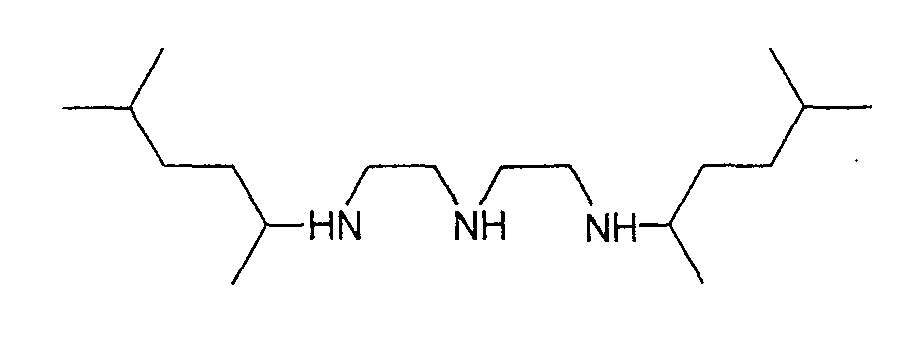
- Diethylenetriamine (1.5 mole), methyl isoamyl ketone (3.2 mole) and 10% Pd/C (2.4 wt% of total charge) were charged to a one liter stainless steel autoclave and reacted as in Example 1 for 5 hours. The reactor contents were analyzed by GC/FID and found to be 92.4 area% dialkylated diethylenetriamine. The product 2,5,13,16-tetramethyl-6,9,12-triazaheptadecane was purified by distillation at 155-157° C, 2.7 millibar (2 Torr).
- This example illustrates the procedure for the preparation of the reductive alkylation product of di-(3-aminopropyl)amine and methyl isobutyl ketone (DAPA/MIBK2) having the following structure:

- Di-(3-aminopropyl)amine (0.8 mole), methyl isobutyl ketone (1.5 mole) and 10% Pd/C (4 wt% of total charge) were charged to a one liter stainless steel autoclave and reacted as in Example 1 for 6 hours. The reactor contents were analyzed by GC/FID and found to be 95.8 area% dialkylated di-(3-aminopropyl)amine. The product 2,4,14,16-tetramethyl-5,9,13-triazaheptadecane was purified by distillation at 125-130 C, 0.53 millibar (0.4 Torr).
- This example illustrates the preparation of the reductive alkylation product of 1,2-ethylenediamine and methyl isobutyl ketone (EDA/MIBK2).
- 1,2-Ethylenediamine (1.6 mole), methyl isobutyl ketone (3.7 mole) and 5% Pd/C (2 wt% of total charge) were charged to a one liter stainless steel autoclave. The reactor was sealed and purged with nitrogen then hydrogen. The contents of the reactor were heated to 90°C under 7 bar (100 psig) H2. The pressure was increased to 55 bar (800 psig) and maintained throughout the reaction (31 hours) by the admission of hydrogen from a 1 gallon ballast on demand by a dome regulator. The reactor contents were analyzed by GC/FID and found to be 87.6 area% N,N'-dialkylated ethylenediamine. The product was purified by distillation at 112-114°C, 6.6 millibar (5 Torr).
- This example illustrates the preparation of the reductive alkylation product of 1,3-propanediamine and methyl isobutyl ketone (PDA/MIBK).
- 1,3-Propanediamine (1.0 mole), methyl isobutyl ketone (2.2 mole) and 10% Pd/C (4 wt% of total charge) were charged to a one liter stainless steel autoclave and reacted as in Example 1 for 5 hours. The reactor contents were analyzed by GC/FID and found to be 92.6 area% N,N'-dialkylated 1,3-propanediamine. The product was purified by distillation at 113-115°C, 2.7 millibar (2 Torr).
- This example illustrates the preparation of the reductive alkylation product of a butane-, cyclohexane- and hexanediamine mixture.
- A 1,6-hexanediamine process byproduct stream containing a mixture of 1,4-butanediamine, 1,2-cyclohexanediamine, and 1,6-hexanediamine (0.9 mole), methyl isobutyl ketone (2.0 mole) and 10% Pd/C (4 wt% of total charge) were charged to a one liter stainless steel autoclave and reacted as in Example 1 for 4 hours. The reactor contents were analyzed by GC/FID and found to be 11.3 area% monoalkylated 1,2-cyclohexanediamine and 77.4% dialkylated materials. The monoalkylated product was removed by distillation at 126-128°C, 2.7 millibar (2 Torr). The dialkylated product was purified by distillation at 130-137°C, 1.3 millibar (1Torr) to provide a sample containing (GC FID area% analysis) the reductive alkylation products of 1,4-butanediamine (11.5%), 1,2-cyclohexandiamine (46.6%), and 1,6-hexanediamine (38.7%). The structures of these materials are shown below.

- Example 7
- (a) A commercial photoresist based on a novolac-type cresol/formaldehyde resin and a diazonaphthoquinone (DNQ) photosensitive agent (SPR510A, Shipley) was coated on a 4 inch silicon wafer to a thickness of approximately 1 micron following the manufacturer's instructions. The photoresist was exposed to UV radiation centered at 365 nm (mercury i-line) through a variable transmission filter (from Opto-Line Associates, Wilmington MA), which consisted of a circular area on a quartz plate broken up into wedges of varying transmission levels. The resulting exposed wafer was developed (60 seconds) in a puddle of 0.262 M tetramethylammonium hydroxide (TMAH) containing sufficient EDA/MIBK2 (0.0225 wt%, 225 ppm) to lower the surface tension of the developer to 42 dynes/cm. The various portions of the wafer were then examined for film thickness using a Filmetrics F20 Thin-Film Measuring System (San Diego CA) and the results were compared to the film thicknesses before exposure and developing. The Normalized Film Thickness is a dimensionless ratio and was calculated by dividing the pre-exposure film thickness by the post-development film thickness. The results are shown in Table 1, Example 7(a). These data show outstanding selectivity of the developer solution for dissolution of the highly exposed resist vs. mildly exposed resist.
- (b) Another commercially available photoresist (OCG 825 20 cS, Olin
Corporation) was used to coat a 4 inch silicon wafer with a film thickness of
approximately 1 micron. This resist is designed to be much more soluble in developer
solutions and was used with 0.131M TMAH. Different areas of the resist were then
exposed to UV radiation centered at 365 nm (mercury i-line) at various levels of intensity
by positioning the wafer under an aperture opening and operating a shutter. Table 1,
Example 7(b) shows data for the dissolution of exposed resist with 0.131 M TMAH
containing EDA/MIBK2 (0.0175 wt%; 175 ppm) after 60 seconds development time.
Again, the data show outstanding selectivity, even with this highly sensitive photoresist
formulation.
Example 7(a) EDA/MIBK2 Example 7(b) EDA/MIBK2 Dose (mJ/cm2) Normalized Film Thickness Dose (mJ/cm2) Normalized Film Thickness 2.67 1.00 8.9 0.98 2.82 1.00 10.6 0.98 3.27 1.00 12.4 0.97 10.02 1.00 15.9 0.93 11.95 1.01 19.5 0.87 17.52 1.00 24.8 0.71 25.47 0.98 31.9 0.50 36.38 0.92 40.7 0.39 53.09 0.35 49.6 0.26 66.60 0.21 63.7 0.07 92.73 0.06 79.7 0 118.27 0 100.9 0 153.32 0 197.34 0 222.51 0 -
- Foam tests were made in TMAH developer solutions formulated with EDA/MIBK2 and DETA/MIBK2 as surfactant and with three commercial developer solutions containing surfactants. Data were collected utilizing a foam generating apparatus whereby nitrogen gas was passed through a frit and bubbled through 100 mL of the solutions at 50 mL/min. Except for the commercial developer solutions which were used as received, all solutions contained 2.4 wt% TMAH in water with enough surfactant to lower surface tension to about 43 dyne/cm. The results are given in Table 2.
Foam Volume (mL) Time (min) EDA/MIBK2 DETA/MIBK2 OCG 934 3:2 MF-702b MF-319 0 0 0 0 0 0 1 7.8 13.6 15.6 39.5 51.1 2 7.8 12.4 17.2 72.6 91.4 3 8.0 12.9 24.2 107.4 135.3 4 8.0 13.6 22.9 156.4 176.8 5 8.1 14.2 22.3 172.8 237.8 6 8.3 14.6 22.0 236.2 275.1 7 8.3 15.2 25.8 287.0 321.3 8 8.5 15.4 25.8 307.6 372.6 9 8.6 15.6 25.5 326.9 416.7 10 8.6 15.8 26.2 301.3 460.6 11 8.5 15.6 26.5 340.2 502.0 12 8.5 15.8 26.9 404.8 544.9 13 8.5 15.8 26.9 438.6 594.7 14 8.6 15.8 26.9 488.6 647.5 15 8.7 16.2 27.3 514.9 681.1 - The above data in Table 2 show that TMAH developer solutions containing the EDA/MIBK2 and DETA/MIBK2 as the surfactant developed considerably less foam than the commercial developer solutions containing other types of surfactant. It is quite surprising that alkylated polyamines containing C5-C8 alkyl groups increases the ability of these materials to reduce both surface tension and foaming tendency in TMAH developer solutions while maintaining good contrast for photoresist developing applications. These goals are achieved while lowering the level of alkylated polyamine required for a desired surface tension reduction.
- Table 3 presents additional data indicating the low foam associated with the alkylated polyamine wetting agents in a 0.262N TMAH solution were obtained using the Ross-Miles technique.
Polyamine Conc (ppm) R-M Foam Initial (t to 0) EDA/MIBK2 175 1.0 cm (13 s) DETA/MIBK2 400 2.0 cm (18 s) - By comparison, N-dodecyl diethylenetriamine (DETA/DDA1), a derivative with a long linear side-chain, at a concentration of only 40 ppm showed an initial foam height of 8.3 cm which was almost completely stable for five minutes at which time the foam was still 7.5 cm in height.
- In sum, the ability of a surfactant to reduce surface tension under both equilibrium and dynamic conditions is of great importance in the performance of waterbased photoresist developers. Low dynamic surface tension results in enhanced wetting and spreading under the dynamic conditions of application, resulting in more efficient use of the compositions and fewer defects. Foam control is a particularly important attribute in photoresist developer/electronics cleaning compositions. The present invention affords these attributes while maintaining good contrast for photoresist developing application.
- The invention provides compositions suitable for use in photoresist developer/electronics cleaning compositions.
Claims (21)
- In an aqueous photoresist developer composition containing a surfactant, the improvement which comprises employing as the surfactant a dialkyl polyamine compound of the structure I or II
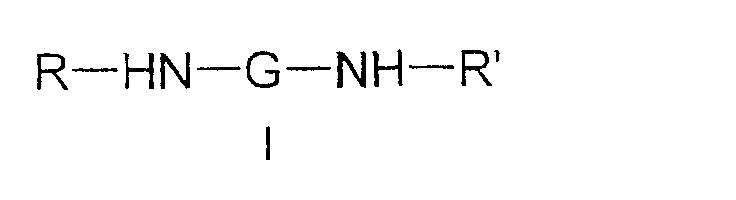 where R and R' are independently C5 to C8 alkyl, G is a C2-C6 linear or cyclic alkylene group which may contain C1-C4 alkyl substituents, m is 2-6, and n is 2 or 3.
- The developer composition of Claim 1 in which an aqueous solution of the dialkyl polyamine demonstrates a dynamic surface tension of less than 45 dynes/cm at a concentration of ≤5 wt% in water at 23°C and 1 bubble/second according to the maximum-bubble-pressure method.
- The developer composition of Claim 1 in which the polyamine has structure I.
- The developer composition of Claim 1 in which the polyamine has structure II.
- The developer composition of Claim 3 in which G is ethylene or propylene.
- The developer composition of Claim 4 in which m is 2 or 3.
- The developer composition of Claim 2 in which the alkylated polyamine is the reductive alkylation product of diethylenetriamine, di-(3-aminopropyl)amine, ethylenediamine, propanediamine, butanediamine, cyclohexanediamine or hexanediamine with methyl isobutyl ketone or methyl isoamyl ketone.
- The developer composition of Claim 1 which contains tetramethylammonium hydroxide.
- The developer composition of Claim 5 which contains tetramethylammonium hydroxide.
- The developer composition of Claim 6 which contains tetramethylammonium hydroxide.
- In a process for developing a photoresist after exposure to radiation by applying to the photoresist surface a developer solution containing a surface tension lowering amount of a surfactant, the improvement which comprises using as the surfactant a dialkyl polyamine compound having structure I or II
 where R and R' are independently C5 to C8 alkyl, G is a C2-C6 linear or cyclic alkylene group which may contain C1-C4 alkyl substituents, m is 2-6, and n is 2 or 3.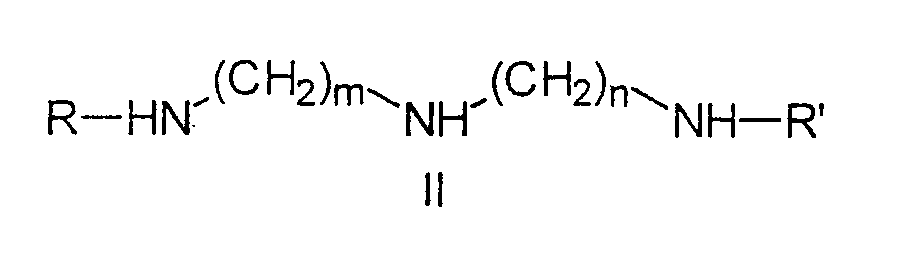
- The process of Claim 11 in which the polyamine has structure I.
- The process of Claim 11 in which the polyamine has structure II.
- The process of Claim 12 in which G is ethylene or propylene.
- The process of Claim 13 in which m is 2 or 3.
- The process of Claim 12 in which the alkylated polyamine is the reductive alkylation product of diethylenetriamine, di-(3-aminopropyl)amine, ethylenediamine, propanediamine, butanediamine, cyclohexanediamine or hexanediamine with methyl isobutyl ketone or methyl isoamyl ketone.
- The process of Claim 11 which contains tetramethylammonium hydroxide.
- The process of Claim 14 which contains tetramethylammonium hydroxide.
- The process of Claim 15 which contains tetramethylammonium hydroxide.
- The process of Claim 16 which contains tetramethylammonium hydroxide.
- An aqueous electronics cleaning composition comprising in water the following componentsthe dialkyl polyamine compound having structure I or II0.1 to 3 wt% tetramethylammonium hydroxide,0 to 4 wt% phenolic compound; and10 to 10,000 ppm dialkyl polyamine,
 where R and R' are independently C5 to C8 alkyl, G is a C2-C6 linear or cyclic alkylene group which may contain C1-C4 alkyl substituents, m is 2-6, and n is 2 or 3.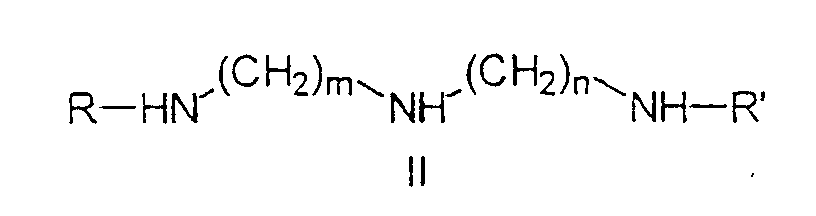
Applications Claiming Priority (2)
| Application Number | Priority Date | Filing Date | Title |
|---|---|---|---|
| US478483 | 2000-01-06 | ||
| US09/478,483 US6268115B1 (en) | 2000-01-06 | 2000-01-06 | Use of alkylated polyamines in photoresist developers |
Publications (1)
| Publication Number | Publication Date |
|---|---|
| EP1115033A1 true EP1115033A1 (en) | 2001-07-11 |
Family
ID=23900134
Family Applications (1)
| Application Number | Title | Priority Date | Filing Date |
|---|---|---|---|
| EP01100010A Withdrawn EP1115033A1 (en) | 2000-01-06 | 2001-01-03 | Use of alkylated polyamines in photoresist developers |
Country Status (5)
| Country | Link |
|---|---|
| US (1) | US6268115B1 (en) |
| EP (1) | EP1115033A1 (en) |
| JP (1) | JP3433187B2 (en) |
| KR (1) | KR20010070405A (en) |
| TW (1) | TW574635B (en) |
Cited By (2)
| Publication number | Priority date | Publication date | Assignee | Title |
|---|---|---|---|---|
| EP1580607A3 (en) * | 2004-03-19 | 2005-10-12 | Air Products And Chemicals, Inc. | Process solutions containing surfactants |
| US7129199B2 (en) | 2002-08-12 | 2006-10-31 | Air Products And Chemicals, Inc. | Process solutions containing surfactants |
Families Citing this family (10)
| Publication number | Priority date | Publication date | Assignee | Title |
|---|---|---|---|---|
| US20040029395A1 (en) * | 2002-08-12 | 2004-02-12 | Peng Zhang | Process solutions containing acetylenic diol surfactants |
| JP4639567B2 (en) * | 2001-09-28 | 2011-02-23 | 三菱瓦斯化学株式会社 | Photoresist stripping composition |
| US20050161644A1 (en) | 2004-01-23 | 2005-07-28 | Peng Zhang | Immersion lithography fluids |
| TWI259319B (en) | 2004-01-23 | 2006-08-01 | Air Prod & Chem | Immersion lithography fluids |
| KR100574349B1 (en) * | 2004-02-03 | 2006-04-27 | 삼성전자주식회사 | Cleaning liquid composition and cleaning method of semiconductor device using same |
| US20070299176A1 (en) * | 2005-01-28 | 2007-12-27 | Markley Thomas J | Photodefinable low dielectric constant material and method for making and using same |
| KR101088568B1 (en) * | 2005-04-19 | 2011-12-05 | 아반토르 퍼포먼스 머티리얼스, 인크. | Non-aqueous photoresist stripper suppresses galvanic corrosion |
| US20070196773A1 (en) * | 2006-02-22 | 2007-08-23 | Weigel Scott J | Top coat for lithography processes |
| US20080264672A1 (en) * | 2007-04-26 | 2008-10-30 | Air Products And Chemicals, Inc. | Photoimprintable Low Dielectric Constant Material and Method for Making and Using Same |
| KR102158580B1 (en) * | 2019-02-01 | 2020-09-22 | (주)화백엔지니어링 | Developing Solution Composition to come true precision circuit |
Citations (4)
| Publication number | Priority date | Publication date | Assignee | Title |
|---|---|---|---|---|
| JPS6334542A (en) * | 1986-07-30 | 1988-02-15 | Sumitomo Chem Co Ltd | Developing solution for positive type resist |
| US5252436A (en) * | 1989-12-15 | 1993-10-12 | Basf Aktiengesellschaft | Process for developing a positive-working photoresist containing poly(p-hydroxystyrene) and sulfonium salt with an aqueous developer containing basic organic compounds |
| EP0916392A1 (en) * | 1997-11-12 | 1999-05-19 | Air Products And Chemicals, Inc. | Surface tension reduction with alkylated polyamines |
| EP0930346A1 (en) * | 1998-01-20 | 1999-07-21 | Air Products And Chemicals, Inc. | Surface tension reduction with N,N'-dialkylalkylenediamines |
Family Cites Families (7)
| Publication number | Priority date | Publication date | Assignee | Title |
|---|---|---|---|---|
| US4628023A (en) | 1981-04-10 | 1986-12-09 | Shipley Company Inc. | Metal ion free photoresist developer composition with lower alkyl quaternary ammonium hydrozide as alkalai agent and a quaternary ammonium compound as surfactant |
| JPS59182444A (en) | 1983-04-01 | 1984-10-17 | Sumitomo Chem Co Ltd | Improved developing solution for positive type photoresist |
| DE3827567A1 (en) | 1988-08-13 | 1990-02-22 | Basf Ag | WAITER DEVELOPER SOLUTION FOR POSITIVELY WORKING PHOTORE RESTS |
| US4997748A (en) | 1988-08-26 | 1991-03-05 | Tokyo Ohka Kogyo Co., Ltd. | Developer solution for positive-working resist composition |
| JP2582901B2 (en) | 1989-07-31 | 1997-02-19 | 富士写真フイルム株式会社 | Positive photoresist developer for semiconductor manufacturing |
| JP3062034B2 (en) | 1995-02-23 | 2000-07-10 | 株式会社イノアックコーポレーション | Headrest manufacturing method |
| US5855811A (en) * | 1996-10-03 | 1999-01-05 | Micron Technology, Inc. | Cleaning composition containing tetraalkylammonium salt and use thereof in semiconductor fabrication |
-
2000
- 2000-01-06 US US09/478,483 patent/US6268115B1/en not_active Expired - Fee Related
-
2001
- 2001-01-02 TW TW90100045A patent/TW574635B/en not_active IP Right Cessation
- 2001-01-03 EP EP01100010A patent/EP1115033A1/en not_active Withdrawn
- 2001-01-04 KR KR1020010000333A patent/KR20010070405A/en not_active Ceased
- 2001-01-09 JP JP2001001755A patent/JP3433187B2/en not_active Expired - Fee Related
Patent Citations (4)
| Publication number | Priority date | Publication date | Assignee | Title |
|---|---|---|---|---|
| JPS6334542A (en) * | 1986-07-30 | 1988-02-15 | Sumitomo Chem Co Ltd | Developing solution for positive type resist |
| US5252436A (en) * | 1989-12-15 | 1993-10-12 | Basf Aktiengesellschaft | Process for developing a positive-working photoresist containing poly(p-hydroxystyrene) and sulfonium salt with an aqueous developer containing basic organic compounds |
| EP0916392A1 (en) * | 1997-11-12 | 1999-05-19 | Air Products And Chemicals, Inc. | Surface tension reduction with alkylated polyamines |
| EP0930346A1 (en) * | 1998-01-20 | 1999-07-21 | Air Products And Chemicals, Inc. | Surface tension reduction with N,N'-dialkylalkylenediamines |
Non-Patent Citations (1)
| Title |
|---|
| PATENT ABSTRACTS OF JAPAN vol. 012, no. 243 (P - 728) 9 July 1988 (1988-07-09) * |
Cited By (7)
| Publication number | Priority date | Publication date | Assignee | Title |
|---|---|---|---|---|
| US7129199B2 (en) | 2002-08-12 | 2006-10-31 | Air Products And Chemicals, Inc. | Process solutions containing surfactants |
| EP1389746A3 (en) * | 2002-08-12 | 2007-05-30 | Air Products And Chemicals, Inc. | Process solutions containing surfactants |
| US7521405B2 (en) | 2002-08-12 | 2009-04-21 | Air Products And Chemicals, Inc. | Process solutions containing surfactants |
| US7591270B2 (en) | 2002-08-12 | 2009-09-22 | Air Products And Chemicals, Inc. | Process solutions containing surfactants |
| US8227395B2 (en) | 2002-08-12 | 2012-07-24 | Air Products And Chemicals, Inc. | Process solutions containing surfactants |
| EP1580607A3 (en) * | 2004-03-19 | 2005-10-12 | Air Products And Chemicals, Inc. | Process solutions containing surfactants |
| CN1699530B (en) * | 2004-03-19 | 2011-03-30 | 气体产品与化学公司 | Treatment solutions containing surfactants |
Also Published As
| Publication number | Publication date |
|---|---|
| KR20010070405A (en) | 2001-07-25 |
| JP2001194777A (en) | 2001-07-19 |
| JP3433187B2 (en) | 2003-08-04 |
| US6268115B1 (en) | 2001-07-31 |
| TW574635B (en) | 2004-02-01 |
Similar Documents
| Publication | Publication Date | Title |
|---|---|---|
| US6268115B1 (en) | Use of alkylated polyamines in photoresist developers | |
| EP2605069B1 (en) | Rinse liquid for lithography and method for forming pattern using same | |
| KR100594708B1 (en) | Anti-reflective coating composition | |
| JPH0451020B2 (en) | ||
| JP2002049161A (en) | Surfactant aqueous solution for coating layer development | |
| EP0062733B1 (en) | Metal ion-free photoresist developer composition | |
| CN1392973A (en) | Developing solution for photoresist | |
| US6127101A (en) | Alkylated aminoalkylpiperazine surfactants and their use in photoresist developers | |
| US4808513A (en) | Method of developing a high contrast, positive photoresist using a developer containing alkanolamine | |
| US6120978A (en) | Use of N,N-dialkyl ureas in photoresist developers | |
| US6238849B1 (en) | Cyclic ureas in photoresist developers | |
| WO2006115013A1 (en) | Developer composition, process for producing the same, and method of forming resist pattern | |
| JP2001159824A (en) | Method of forming photoresist pattern with suppressed occurrence of defects and developer for reducing defects | |
| US5747224A (en) | Stock developer solutions for photoresists and developer solutions prepared by dilution thereof | |
| JPH04346351A (en) | Developing solution for photoresist | |
| JP2543348B2 (en) | Developer for positive resist | |
| JP4522626B2 (en) | Rinse solution | |
| JP3528429B2 (en) | Chemically amplified positive resist material | |
| JP2947370B2 (en) | Photoresist developer | |
| EP0364895B1 (en) | Positive type photoresist developer | |
| JPH1124285A (en) | Developer for resist | |
| JPS6232452A (en) | Developing solution for improved positive type photoresist | |
| JP2819568B2 (en) | Positive photoresist developer | |
| JPS61124589A (en) | Composition for etching agent | |
| JPH096008A (en) | Water-soluble pattern forming material |
Legal Events
| Date | Code | Title | Description |
|---|---|---|---|
| PUAI | Public reference made under article 153(3) epc to a published international application that has entered the european phase |
Free format text: ORIGINAL CODE: 0009012 |
|
| AK | Designated contracting states |
Kind code of ref document: A1 Designated state(s): AT BE CH CY DE DK ES FI FR GB GR IE IT LI LU MC NL PT SE TR |
|
| AX | Request for extension of the european patent |
Free format text: AL;LT;LV;MK;RO;SI |
|
| 17P | Request for examination filed |
Effective date: 20010816 |
|
| AKX | Designation fees paid |
Free format text: AT BE CH CY DE DK ES FI FR GB GR IE IT LI LU MC NL PT SE TR |
|
| 17Q | First examination report despatched |
Effective date: 20020909 |
|
| STAA | Information on the status of an ep patent application or granted ep patent |
Free format text: STATUS: THE APPLICATION IS DEEMED TO BE WITHDRAWN |
|
| 18D | Application deemed to be withdrawn |
Effective date: 20080424 |