EP1114923A2 - Fuel additive dosing method and system for onboard vehicle use - Google Patents
Fuel additive dosing method and system for onboard vehicle use Download PDFInfo
- Publication number
- EP1114923A2 EP1114923A2 EP00311452A EP00311452A EP1114923A2 EP 1114923 A2 EP1114923 A2 EP 1114923A2 EP 00311452 A EP00311452 A EP 00311452A EP 00311452 A EP00311452 A EP 00311452A EP 1114923 A2 EP1114923 A2 EP 1114923A2
- Authority
- EP
- European Patent Office
- Prior art keywords
- fuel
- amount
- vehicle
- additive
- added
- Prior art date
- Legal status (The legal status is an assumption and is not a legal conclusion. Google has not performed a legal analysis and makes no representation as to the accuracy of the status listed.)
- Granted
Links
Images

Classifications
-
- F—MECHANICAL ENGINEERING; LIGHTING; HEATING; WEAPONS; BLASTING
- F02—COMBUSTION ENGINES; HOT-GAS OR COMBUSTION-PRODUCT ENGINE PLANTS
- F02D—CONTROLLING COMBUSTION ENGINES
- F02D19/00—Controlling engines characterised by their use of non-liquid fuels, pluralities of fuels, or non-fuel substances added to the combustible mixtures
- F02D19/12—Controlling engines characterised by their use of non-liquid fuels, pluralities of fuels, or non-fuel substances added to the combustible mixtures peculiar to engines working with non-fuel substances or with anti-knock agents, e.g. with anti-knock fuel
-
- Y—GENERAL TAGGING OF NEW TECHNOLOGICAL DEVELOPMENTS; GENERAL TAGGING OF CROSS-SECTIONAL TECHNOLOGIES SPANNING OVER SEVERAL SECTIONS OF THE IPC; TECHNICAL SUBJECTS COVERED BY FORMER USPC CROSS-REFERENCE ART COLLECTIONS [XRACs] AND DIGESTS
- Y02—TECHNOLOGIES OR APPLICATIONS FOR MITIGATION OR ADAPTATION AGAINST CLIMATE CHANGE
- Y02T—CLIMATE CHANGE MITIGATION TECHNOLOGIES RELATED TO TRANSPORTATION
- Y02T10/00—Road transport of goods or passengers
- Y02T10/10—Internal combustion engine [ICE] based vehicles
- Y02T10/12—Improving ICE efficiencies
Definitions
- Measuring means 22 directly measure the amount of fuel added to fuel tank 14 during refuelling.
- Measuring means 22 may be an onboard flow measuring device such as a turbine 26 located at the inlet 28 of fuel tank 14 as shown in Figure 2, an onboard flow measuring device such as a venture 30 located at the inlet of the fuel tank as shown in Figure 3, a rotary meter, or a thermal flow meter.
- turbine 26 and venture 30 directly monitor the fuel added to a vehicle to provide a more accurate indication of the fuel in and added into the vehicle.
Landscapes
- Engineering & Computer Science (AREA)
- Chemical & Material Sciences (AREA)
- Combustion & Propulsion (AREA)
- Mechanical Engineering (AREA)
- General Engineering & Computer Science (AREA)
- Combined Controls Of Internal Combustion Engines (AREA)
- Cooling, Air Intake And Gas Exhaust, And Fuel Tank Arrangements In Propulsion Units (AREA)
- Output Control And Ontrol Of Special Type Engine (AREA)
Abstract
Description
Claims (10)
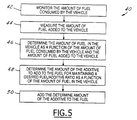
- A method for adding an additive to fuel in a vehicle having an electronic control unit, the method comprising: monitoring the amount of fuel consumed by the vehicle prior to refuelling using the electronic control unit; measuring the amount of fuel added to the vehicle during refuelling; determining the amount of fuel in the vehicle after refuelling as a function of the amount of fuel consumed by the vehicle prior to refuelling and the amount of fuel added to the vehicle during refuelling; and determining the amount of the additive to add to the fuel in the vehicle to maintain a desired fuel/additive ratio as a function of the amount of fuel added to the vehicle by refuelling.
- A method as claimed in claim 1, further comprising:
adding the determined amount of the additive to the fuel in the vehicle. - A method as claimed in claim 1, wherein measuring the amount of fuel added to the vehicle during refuelling comprises: using a fuel pump to add fuel to the vehicle during refuelling; and transmitting a signal indicative of the amount of fuel added to the vehicle during refuelling from the fuel pump to the vehicle.
- A method as claimed in claim 1 wherein measuring the amount of fuel added to the vehicle during refuelling comprises: measuring the amount of fuel added to the vehicle during refuelling using a venture, a turbine, a rotary meter, or a thermal flow meter
- A system for adding an additive to fuel in a vehicle having a fuel tank, the system comprising: an electronic control unit (20) for monitoring the amount of fuel consumed by the vehicle prior to refuelling; measuring means (22) for measuring the amount of fuel added to the fuel tank (14) of the vehicle during refuelling; and a processor (18) operable with the electronic control unit (20) and the measuring means (22) for determining the amount of fuel in the fuel tank(14) after refuelling as a function of the amount of fuel consumed by the vehicle prior to refuelling and the amount of fuel added to the fuel tank (14) during refuelling, wherein the processor determines an amount of the additive to add to the fuel tank (14) as a function of the determined amount of fuel added to the fuel tank to maintain a desired fuel/additive ratio.
- A system as claimed in claim 5, further comprising: a dispenser operable with the processor for adding the determined amount of the additive to the fuel tank of the vehicle.
- A system as claimed in claim 5, wherein the measuring means comprise: a receiver for receiving a signal from a fuel pump indicative of the amount of fuel added to the fuel tank during refuelling.
- A system as claimed in claim 5, wherein the measuring means comprise: a venture, a turbine, a rotary meter or a thermal flow meter, positioned in the fuel tank inlet.
- A system as claimed in claim 8, wherein the vehicle has an engine having at least one cylinder, wherein the electronic control unit monitors the amount of fuel consumed by the vehicle prior to refuelling by calculating the fuel required for each injection into each cylinder of the engine.
- A system for adding an additive to fuel in a vehicle having a fuel tank, the system for use with a fuel pump, the system comprising: an electronic control unit for monitoring the amount of fuel consumed by the vehicle; measuring means for measuring the amount of fuel added from the fuel pump into the fuel tank; and a processor operable with the electronic control unit and the measuring means for determining the amount of fuel in the fuel tank as a function of the amount of fuel consumed by the vehicle and the amount of fuel added to the fuel tank, wherein the processor determines an amount of the additive to add to the fuel tank as a function of the determined amount of fuel added to the fuel tank to maintain a desired fuel/additive ratio.
Applications Claiming Priority (2)
| Application Number | Priority Date | Filing Date | Title |
|---|---|---|---|
| US479533 | 2000-01-07 | ||
| US09/479,533 US6276310B1 (en) | 2000-01-07 | 2000-01-07 | Fuel additive dosing method and system for onboard vehicle use |
Publications (3)
| Publication Number | Publication Date |
|---|---|
| EP1114923A2 true EP1114923A2 (en) | 2001-07-11 |
| EP1114923A3 EP1114923A3 (en) | 2002-05-02 |
| EP1114923B1 EP1114923B1 (en) | 2004-07-21 |
Family
ID=23904411
Family Applications (1)
| Application Number | Title | Priority Date | Filing Date |
|---|---|---|---|
| EP00311452A Revoked EP1114923B1 (en) | 2000-01-07 | 2000-12-20 | Fuel additive dosing method and system for onboard vehicle use |
Country Status (3)
| Country | Link |
|---|---|
| US (1) | US6276310B1 (en) |
| EP (1) | EP1114923B1 (en) |
| DE (1) | DE60012298T2 (en) |
Cited By (5)
| Publication number | Priority date | Publication date | Assignee | Title |
|---|---|---|---|---|
| WO2002097256A3 (en) * | 2001-05-31 | 2003-03-13 | Ass Octel | Process for dosing an additive into a fuel |
| FR2865239A1 (en) * | 2004-01-19 | 2005-07-22 | Jean Claude Fayard | System for the filtration of exhaust gases from diesel motors by the association of a combustion additive in nanoparticle form and a surface particle filter |
| EP2142769A4 (en) * | 2007-05-10 | 2014-03-05 | Sk Innovation Co Ltd | SYSTEM AND METHOD FOR EXHAUST GAS PURIFICATION FOR A DIESEL-ENGINE VEHICLE COMPRISING A CATALYST DISPENSED BY THE FUEL |
| FR3008140A1 (en) * | 2013-07-02 | 2015-01-09 | Peugeot Citroen Automobiles Sa | DEVICE FOR ADDING AN ADDITIVE TO A FUEL |
| FR3010730A1 (en) * | 2013-09-17 | 2015-03-20 | Peugeot Citroen Automobiles Sa | EXHAUST GAS CLEANING SYSTEM AND VEHICLE EQUIPPED WITH SUCH A SYSTEM |
Families Citing this family (20)
| Publication number | Priority date | Publication date | Assignee | Title |
|---|---|---|---|---|
| US6497095B2 (en) * | 2000-12-21 | 2002-12-24 | Ford Global Technologies, Inc. | Regeneration of diesel engine particulate filter only above low fuel levels |
| FR2834004B1 (en) * | 2001-12-20 | 2004-05-28 | Marwal Systems | ADDITIVE FEEDING DEVICE FOR FUEL ON-BOARD IN A MOTOR VEHICLE |
| US6898929B2 (en) * | 2003-06-25 | 2005-05-31 | Daimlerchrysler Corporation | Method and apparatus for supplying a reductant to an engine exhaust treatment system |
| FR2858355B1 (en) * | 2003-07-31 | 2005-10-28 | Peugeot Citroen Automobiles Sa | METHOD AND DEVICE FOR DEPOLLUTING THE EXHAUST GASES OF AN INTERNAL COMBUSTION ENGINE |
| DE102004009643A1 (en) * | 2004-02-27 | 2005-09-15 | Fafnir Gmbh | Ventilation mast monitoring system for gas stations |
| US7170035B2 (en) * | 2004-08-04 | 2007-01-30 | Hottboxx Llc | Heated construction box |
| KR20070098996A (en) * | 2004-12-23 | 2007-10-08 | 클린 디젤 테크놀로지스, 인코포레이티드 | Engine-on-pulse fuel additive concentrate dosing system and controller |
| US7270088B2 (en) * | 2005-03-08 | 2007-09-18 | William Trace Whitehall | System and method for storage and delivery of a fuel additive to a fuel tank |
| US20060254536A1 (en) * | 2005-03-09 | 2006-11-16 | Waters Paul F | Engine control module linked additive injection system |
| US20060259230A1 (en) * | 2005-03-14 | 2006-11-16 | Waters Paul F | Wireless additive injection system |
| US7428890B2 (en) * | 2005-08-22 | 2008-09-30 | Envirofuels Llc | On-board fuel additive injection systems |
| US20070119390A1 (en) * | 2005-11-30 | 2007-05-31 | Herrmann Mark L | System and method for operating an internal combustion engine |
| US7523770B2 (en) * | 2005-12-12 | 2009-04-28 | Exxonmobil Research And Enginnering Company | Service station for serving requirements of multiple vehicle technologies |
| WO2007106416A2 (en) * | 2006-03-10 | 2007-09-20 | Ethanol Boosting Systems, Llc. | Fuel tank system for direct ethanol injection octane boosted gasoline engine |
| US20100018476A1 (en) * | 2007-05-31 | 2010-01-28 | Svetlana Mikhailovna Zemskova | On-board hydrogen generator |
| US8584691B2 (en) | 2008-10-03 | 2013-11-19 | Hammonds Technical Services, Inc. | Additive dispensing system and method |
| WO2010040132A1 (en) * | 2008-10-03 | 2010-04-08 | Hammonds Technical Services, Inc. | Additive dispensing system and method |
| US9422874B2 (en) * | 2012-12-05 | 2016-08-23 | Electromotive, Inc. | Simplified method to inject ethanol or other solution additives into diesel engines equipped with a digital data bus |
| EP3524460B1 (en) * | 2018-02-13 | 2020-01-01 | Magna Steyr Fuel Systems GesmbH | Filling device |
| US11313292B1 (en) * | 2021-03-25 | 2022-04-26 | Real Time Automated Technologies Llc | Methods and systems for real-time dosing of additives into a fuel supply unit |
Family Cites Families (17)
| Publication number | Priority date | Publication date | Assignee | Title |
|---|---|---|---|---|
| US4253436A (en) * | 1979-06-21 | 1981-03-03 | Dudrey Lawrence L | Fuel additive system for vehicles |
| US4329945A (en) * | 1980-08-11 | 1982-05-18 | Beech Harvey E | Apparatus for metering fuel additives to internal combustion engines |
| US4568248A (en) * | 1984-04-26 | 1986-02-04 | Harders Mark R | Additive feedback monitoring system |
| US4596277A (en) | 1984-11-01 | 1986-06-24 | Stanadyne, Inc. | Additive metering system |
| US4621593A (en) | 1984-12-24 | 1986-11-11 | Ford Motor Company | Automotive dispensing apparatus for fuel additive |
| US4727827A (en) * | 1986-11-25 | 1988-03-01 | General Motors Corporation | Fuel additive metering system |
| FR2668203A1 (en) * | 1990-10-23 | 1992-04-24 | Peugeot | Method and device for the automatic introduction of an additive into the fuel tank of a motor vehicle, and their use in the case of a vehicle with a diesel engine |
| DE4117148C1 (en) | 1991-05-25 | 1992-07-23 | Mercedes-Benz Aktiengesellschaft, 7000 Stuttgart, De | |
| US5303842A (en) * | 1992-07-23 | 1994-04-19 | Tammie Harp | Fuel meter and theft prevention device |
| EP0590814B1 (en) | 1992-09-28 | 1996-12-18 | Ford Motor Company Limited | A particulate and exhaust gas emission control system |
| FR2702009B1 (en) | 1993-02-23 | 1995-05-19 | Rhone Poulenc Chimie | Method and device for automatically injecting an additive into the fuel tank of a motor vehicle. |
| US5331994A (en) | 1993-04-13 | 1994-07-26 | Bryan Iii John F | Fuel additive dispensing system |
| WO1995003482A1 (en) * | 1993-07-21 | 1995-02-02 | Timber Traders Pty. Limited | Dosing system |
| US5441072A (en) * | 1994-02-28 | 1995-08-15 | Rhone-Poulenc Inc. | Fuel additive metering system |
| JP3057470B2 (en) | 1994-04-15 | 2000-06-26 | 株式会社ユニシアジェックス | Vehicle engine refueling determination device and fuel supply device |
| IT1284450B1 (en) * | 1996-06-27 | 1998-05-21 | Hoga Italia S P A | DEVICE FOR CHECKING THE QUANTITY OF PETROLS, DIESELS, FUELS OR LIQUIDS IN GENERAL DURING THE INTRODUCTION INTO THE TANKS |
| DE19805311B4 (en) * | 1997-02-18 | 2010-06-10 | Walbro Corp., Cass City | Apparatus and method for adding fuel additives |
-
2000
- 2000-01-07 US US09/479,533 patent/US6276310B1/en not_active Expired - Fee Related
- 2000-12-20 EP EP00311452A patent/EP1114923B1/en not_active Revoked
- 2000-12-20 DE DE60012298T patent/DE60012298T2/en not_active Revoked
Cited By (6)
| Publication number | Priority date | Publication date | Assignee | Title |
|---|---|---|---|---|
| WO2002097256A3 (en) * | 2001-05-31 | 2003-03-13 | Ass Octel | Process for dosing an additive into a fuel |
| US7134405B2 (en) | 2001-05-31 | 2006-11-14 | The Associated Octel Company Limited | Process |
| FR2865239A1 (en) * | 2004-01-19 | 2005-07-22 | Jean Claude Fayard | System for the filtration of exhaust gases from diesel motors by the association of a combustion additive in nanoparticle form and a surface particle filter |
| EP2142769A4 (en) * | 2007-05-10 | 2014-03-05 | Sk Innovation Co Ltd | SYSTEM AND METHOD FOR EXHAUST GAS PURIFICATION FOR A DIESEL-ENGINE VEHICLE COMPRISING A CATALYST DISPENSED BY THE FUEL |
| FR3008140A1 (en) * | 2013-07-02 | 2015-01-09 | Peugeot Citroen Automobiles Sa | DEVICE FOR ADDING AN ADDITIVE TO A FUEL |
| FR3010730A1 (en) * | 2013-09-17 | 2015-03-20 | Peugeot Citroen Automobiles Sa | EXHAUST GAS CLEANING SYSTEM AND VEHICLE EQUIPPED WITH SUCH A SYSTEM |
Also Published As
| Publication number | Publication date |
|---|---|
| DE60012298T2 (en) | 2006-07-13 |
| EP1114923B1 (en) | 2004-07-21 |
| EP1114923A3 (en) | 2002-05-02 |
| US6276310B1 (en) | 2001-08-21 |
| DE60012298D1 (en) | 2004-08-26 |
Similar Documents
| Publication | Publication Date | Title |
|---|---|---|
| US6276310B1 (en) | Fuel additive dosing method and system for onboard vehicle use | |
| US6941746B2 (en) | Mobile diesel selective catalytic reduction systems and methods | |
| KR100840431B1 (en) | Reductant metering feed method and apparatus for removing nitrogen oxides from exhaust gases | |
| CN101738233B (en) | Method for calculating average fuel consumption, remaining fuel and driving range | |
| US6253601B1 (en) | System and method for determining oil change interval | |
| KR102230828B1 (en) | Method and apparatus for monitoring tank contents of storage tank of exhaust gas treatment system | |
| US6209315B1 (en) | Method and device for exhaust gas after-treatment in an internal combustion engine equipped with an SCR catalyst | |
| AU2008361679B2 (en) | Method for estimating soot loading in a diesel particulate filter, and engine and aftertreatment system | |
| US4862393A (en) | Oil change interval monitor | |
| EP1760666A1 (en) | Fuel use categorization for fuel tax reporting on commercial vehicles | |
| US20080319605A1 (en) | Fuel monitoring device, system, and method | |
| CN111537412B (en) | Emission monitoring device, system and method | |
| US8656700B2 (en) | Filter failure detection apparatus of an internal combustion engine | |
| US6397668B1 (en) | Fuel level monitor | |
| US5668310A (en) | Vehicle fuel usage tracking device | |
| KR101707820B1 (en) | Method and device for controlling an scr-exhaust gas aftertreatment system of an internal combustion engine | |
| CN105069860A (en) | Method for vehicle oil consumption statistics | |
| KR20130031749A (en) | System for monitoring carbon gas of vehicle based of carbon emission, device thereof | |
| WO2014090497A1 (en) | On board diagnosis of the condition of an exhaust particle filter | |
| KR20180113170A (en) | Method for monitoring the volume flow rate of a dosing valve of a fluidic dosing system of an internal combustion engine especially for a motor vehicle | |
| US11208925B2 (en) | Diagnostic system for a lubrication circuit | |
| US7346448B2 (en) | Measuring arrangement and method to determine at intervals the usability potential of at least one operational fluid in an engine | |
| US20060254536A1 (en) | Engine control module linked additive injection system | |
| FR2949136A1 (en) | METHOD FOR MANAGING SCR CATALYST | |
| KR100195991B1 (en) | How to measure the fuel consumption of a car |
Legal Events
| Date | Code | Title | Description |
|---|---|---|---|
| PUAI | Public reference made under article 153(3) epc to a published international application that has entered the european phase |
Free format text: ORIGINAL CODE: 0009012 |
|
| AK | Designated contracting states |
Kind code of ref document: A2 Designated state(s): AT BE CH CY DE DK ES FI FR GB GR IE IT LI LU MC NL PT SE TR Kind code of ref document: A2 Designated state(s): DE GB SE |
|
| AX | Request for extension of the european patent |
Free format text: AL;LT;LV;MK;RO;SI |
|
| PUAL | Search report despatched |
Free format text: ORIGINAL CODE: 0009013 |
|
| AK | Designated contracting states |
Kind code of ref document: A3 Designated state(s): AT BE CH CY DE DK ES FI FR GB GR IE IT LI LU MC NL PT SE TR |
|
| AX | Request for extension of the european patent |
Free format text: AL;LT;LV;MK;RO;SI |
|
| 17P | Request for examination filed |
Effective date: 20021004 |
|
| AKX | Designation fees paid |
Free format text: DE GB SE |
|
| 17Q | First examination report despatched |
Effective date: 20030210 |
|
| GRAP | Despatch of communication of intention to grant a patent |
Free format text: ORIGINAL CODE: EPIDOSNIGR1 |
|
| GRAS | Grant fee paid |
Free format text: ORIGINAL CODE: EPIDOSNIGR3 |
|
| GRAA | (expected) grant |
Free format text: ORIGINAL CODE: 0009210 |
|
| AK | Designated contracting states |
Kind code of ref document: B1 Designated state(s): DE GB SE |
|
| REG | Reference to a national code |
Ref country code: GB Ref legal event code: FG4D |
|
| REG | Reference to a national code |
Ref country code: GB Ref legal event code: 732E |
|
| REG | Reference to a national code |
Ref country code: IE Ref legal event code: FG4D |
|
| REF | Corresponds to: |
Ref document number: 60012298 Country of ref document: DE Date of ref document: 20040826 Kind code of ref document: P |
|
| REG | Reference to a national code |
Ref country code: SE Ref legal event code: TRGR |
|
| PGFP | Annual fee paid to national office [announced via postgrant information from national office to epo] |
Ref country code: GB Payment date: 20041104 Year of fee payment: 5 |
|
| RAP2 | Party data changed (patent owner data changed or rights of a patent transferred) |
Owner name: FORD GLOBAL TECHNOLOGIES, LLC |
|
| PGFP | Annual fee paid to national office [announced via postgrant information from national office to epo] |
Ref country code: SE Payment date: 20041202 Year of fee payment: 5 |
|
| PLAQ | Examination of admissibility of opposition: information related to despatch of communication + time limit deleted |
Free format text: ORIGINAL CODE: EPIDOSDOPE2 |
|
| PLBQ | Unpublished change to opponent data |
Free format text: ORIGINAL CODE: EPIDOS OPPO |
|
| PLBI | Opposition filed |
Free format text: ORIGINAL CODE: 0009260 |
|
| PLAQ | Examination of admissibility of opposition: information related to despatch of communication + time limit deleted |
Free format text: ORIGINAL CODE: EPIDOSDOPE2 |
|
| PLAR | Examination of admissibility of opposition: information related to receipt of reply deleted |
Free format text: ORIGINAL CODE: EPIDOSDOPE4 |
|
| PLBQ | Unpublished change to opponent data |
Free format text: ORIGINAL CODE: EPIDOS OPPO |
|
| PLAB | Opposition data, opponent's data or that of the opponent's representative modified |
Free format text: ORIGINAL CODE: 0009299OPPO |
|
| PLAX | Notice of opposition and request to file observation + time limit sent |
Free format text: ORIGINAL CODE: EPIDOSNOBS2 |
|
| 26 | Opposition filed |
Opponent name: INERGY AUTOMOTIVE SYSTEMS RESEARCH S.A. Effective date: 20050421 |
|
| R26 | Opposition filed (corrected) |
Opponent name: INERGY AUTOMOTIVE SYSTEMS RESEARCH S.A. Effective date: 20050421 |
|
| PG25 | Lapsed in a contracting state [announced via postgrant information from national office to epo] |
Ref country code: GB Free format text: LAPSE BECAUSE OF NON-PAYMENT OF DUE FEES Effective date: 20051220 |
|
| PG25 | Lapsed in a contracting state [announced via postgrant information from national office to epo] |
Ref country code: SE Free format text: LAPSE BECAUSE OF NON-PAYMENT OF DUE FEES Effective date: 20051221 |
|
| PGFP | Annual fee paid to national office [announced via postgrant information from national office to epo] |
Ref country code: DE Payment date: 20051230 Year of fee payment: 6 |
|
| RAP2 | Party data changed (patent owner data changed or rights of a patent transferred) |
Owner name: FORD GLOBAL TECHNOLOGIES, LLC. |
|
| EUG | Se: european patent has lapsed | ||
| GBPC | Gb: european patent ceased through non-payment of renewal fee |
Effective date: 20051220 |
|
| RDAF | Communication despatched that patent is revoked |
Free format text: ORIGINAL CODE: EPIDOSNREV1 |
|
| RDAG | Patent revoked |
Free format text: ORIGINAL CODE: 0009271 |
|
| STAA | Information on the status of an ep patent application or granted ep patent |
Free format text: STATUS: PATENT REVOKED |
|
| 27W | Patent revoked |
Effective date: 20060929 |
|
| PLAB | Opposition data, opponent's data or that of the opponent's representative modified |
Free format text: ORIGINAL CODE: 0009299OPPO |