EP1113806B1 - Anionic or cationic dendrimer antimicrobial or antiparasitic compositions - Google Patents
Anionic or cationic dendrimer antimicrobial or antiparasitic compositions Download PDFInfo
- Publication number
- EP1113806B1 EP1113806B1 EP99945773A EP99945773A EP1113806B1 EP 1113806 B1 EP1113806 B1 EP 1113806B1 EP 99945773 A EP99945773 A EP 99945773A EP 99945773 A EP99945773 A EP 99945773A EP 1113806 B1 EP1113806 B1 EP 1113806B1
- Authority
- EP
- European Patent Office
- Prior art keywords
- terminated dendrimers
- dendrimer
- dendrimers
- solution
- acid
- Prior art date
- Legal status (The legal status is an assumption and is not a legal conclusion. Google has not performed a legal analysis and makes no representation as to the accuracy of the status listed.)
- Expired - Lifetime
Links
- 239000000412 dendrimer Substances 0.000 title claims abstract description 205
- 229920000736 dendritic polymer Polymers 0.000 title claims abstract description 205
- 125000002091 cationic group Chemical group 0.000 title claims description 14
- 125000000129 anionic group Chemical group 0.000 title abstract description 6
- 239000000203 mixture Substances 0.000 title description 70
- 230000000845 anti-microbial effect Effects 0.000 title 1
- 230000002141 anti-parasite Effects 0.000 title 1
- 239000003096 antiparasitic agent Substances 0.000 title 1
- 239000003795 chemical substances by application Substances 0.000 claims abstract description 18
- 230000003071 parasitic effect Effects 0.000 claims abstract description 13
- SQVRNKJHWKZAKO-UHFFFAOYSA-N beta-N-Acetyl-D-neuraminic acid Natural products CC(=O)NC1C(O)CC(O)(C(O)=O)OC1C(O)C(O)CO SQVRNKJHWKZAKO-UHFFFAOYSA-N 0.000 claims abstract description 10
- SQVRNKJHWKZAKO-OQPLDHBCSA-N sialic acid Chemical compound CC(=O)N[C@@H]1[C@@H](O)C[C@@](O)(C(O)=O)OC1[C@H](O)[C@H](O)CO SQVRNKJHWKZAKO-OQPLDHBCSA-N 0.000 claims abstract description 9
- 125000002924 primary amino group Chemical group [H]N([H])* 0.000 claims abstract description 8
- CERZMXAJYMMUDR-UHFFFAOYSA-N neuraminic acid Natural products NC1C(O)CC(O)(C(O)=O)OC1C(O)C(O)CO CERZMXAJYMMUDR-UHFFFAOYSA-N 0.000 claims abstract description 6
- 230000001580 bacterial effect Effects 0.000 claims abstract description 5
- 240000004808 Saccharomyces cerevisiae Species 0.000 claims abstract description 3
- 230000002538 fungal effect Effects 0.000 claims abstract description 3
- 229920000962 poly(amidoamine) Polymers 0.000 claims description 175
- 229910052757 nitrogen Inorganic materials 0.000 claims description 38
- 239000002253 acid Substances 0.000 claims description 22
- 125000002496 methyl group Chemical group [H]C([H])([H])* 0.000 claims description 19
- KXDAEFPNCMNJSK-UHFFFAOYSA-N Benzamide Chemical compound NC(=O)C1=CC=CC=C1 KXDAEFPNCMNJSK-UHFFFAOYSA-N 0.000 claims description 13
- 230000005764 inhibitory process Effects 0.000 claims description 13
- 125000000217 alkyl group Chemical group 0.000 claims description 11
- 230000001225 therapeutic effect Effects 0.000 claims description 11
- 229910052708 sodium Inorganic materials 0.000 claims description 9
- 125000003118 aryl group Chemical group 0.000 claims description 8
- 239000003814 drug Substances 0.000 claims description 8
- 108010039918 Polylysine Proteins 0.000 claims description 6
- 229910052739 hydrogen Inorganic materials 0.000 claims description 6
- 229920000656 polylysine Polymers 0.000 claims description 6
- 230000000069 prophylactic effect Effects 0.000 claims description 6
- ISWSIDIOOBJBQZ-UHFFFAOYSA-N Phenol Chemical compound OC1=CC=CC=C1 ISWSIDIOOBJBQZ-UHFFFAOYSA-N 0.000 claims description 5
- NBIIXXVUZAFLBC-UHFFFAOYSA-N Phosphoric acid Chemical compound OP(O)(O)=O NBIIXXVUZAFLBC-UHFFFAOYSA-N 0.000 claims description 5
- ABLZXFCXXLZCGV-UHFFFAOYSA-N Phosphorous acid Chemical compound OP(O)=O ABLZXFCXXLZCGV-UHFFFAOYSA-N 0.000 claims description 5
- 125000002795 guanidino group Chemical group C(N)(=N)N* 0.000 claims description 5
- 125000005647 linker group Chemical group 0.000 claims description 5
- 125000000896 monocarboxylic acid group Chemical group 0.000 claims description 5
- LSNNMFCWUKXFEE-UHFFFAOYSA-M Bisulfite Chemical compound OS([O-])=O LSNNMFCWUKXFEE-UHFFFAOYSA-M 0.000 claims description 4
- ZADPBFCGQRWHPN-UHFFFAOYSA-N boronic acid Chemical compound OBO ZADPBFCGQRWHPN-UHFFFAOYSA-N 0.000 claims description 4
- 229920000831 ionic polymer Polymers 0.000 claims description 4
- UMGDCJDMYOKAJW-UHFFFAOYSA-N thiourea Chemical compound NC(N)=S UMGDCJDMYOKAJW-UHFFFAOYSA-N 0.000 claims description 4
- MDAXKAUIABOHTD-UHFFFAOYSA-N 1,4,8,11-tetraazacyclotetradecane Chemical compound C1CNCCNCCCNCCNC1 MDAXKAUIABOHTD-UHFFFAOYSA-N 0.000 claims description 3
- AAUJGTSNOHLCRY-UHFFFAOYSA-N 4-(aminomethyl)-2-hydroxybenzoic acid Chemical compound NCC1=CC=C(C(O)=O)C(O)=C1 AAUJGTSNOHLCRY-UHFFFAOYSA-N 0.000 claims description 3
- 230000002378 acidificating effect Effects 0.000 claims description 3
- 125000000909 amidinium group Chemical group 0.000 claims description 3
- UKYZWASSXSSTCI-UHFFFAOYSA-N c1cc[nH+]cc1.CCCCCCCCCCCCC([NH-])=O Chemical compound c1cc[nH+]cc1.CCCCCCCCCCCCC([NH-])=O UKYZWASSXSSTCI-UHFFFAOYSA-N 0.000 claims description 3
- 150000001732 carboxylic acid derivatives Chemical class 0.000 claims description 3
- 125000003916 ethylene diamine group Chemical group 0.000 claims description 3
- 125000000623 heterocyclic group Chemical group 0.000 claims description 3
- 125000004435 hydrogen atom Chemical group [H]* 0.000 claims description 3
- 239000003999 initiator Substances 0.000 claims description 3
- 238000004519 manufacturing process Methods 0.000 claims description 3
- 229920000333 poly(propyleneimine) Polymers 0.000 claims description 3
- JUJWROOIHBZHMG-UHFFFAOYSA-O pyridinium Chemical compound C1=CC=[NH+]C=C1 JUJWROOIHBZHMG-UHFFFAOYSA-O 0.000 claims description 3
- GETQZCLCWQTVFV-UHFFFAOYSA-N trimethylamine Chemical compound CN(C)C GETQZCLCWQTVFV-UHFFFAOYSA-N 0.000 claims description 3
- BCFOOQRXUXKJCL-UHFFFAOYSA-N 4-amino-4-oxo-2-sulfobutanoic acid Chemical compound NC(=O)CC(C(O)=O)S(O)(=O)=O BCFOOQRXUXKJCL-UHFFFAOYSA-N 0.000 claims description 2
- ALYNCZNDIQEVRV-UHFFFAOYSA-N 4-aminobenzoic acid Chemical compound NC1=CC=C(C(O)=O)C=C1 ALYNCZNDIQEVRV-UHFFFAOYSA-N 0.000 claims description 2
- FNMPWSYBWQWZSF-UHFFFAOYSA-N 4-carbamoylbenzenesulfonic acid Chemical compound NC(=O)C1=CC=C(S(O)(=O)=O)C=C1 FNMPWSYBWQWZSF-UHFFFAOYSA-N 0.000 claims description 2
- KBZFDRWPMZESDI-UHFFFAOYSA-N 5-aminobenzene-1,3-dicarboxylic acid Chemical compound NC1=CC(C(O)=O)=CC(C(O)=O)=C1 KBZFDRWPMZESDI-UHFFFAOYSA-N 0.000 claims description 2
- QGZKDVFQNNGYKY-UHFFFAOYSA-N Ammonia Chemical group N QGZKDVFQNNGYKY-UHFFFAOYSA-N 0.000 claims description 2
- XSQUKJJJFZCRTK-UHFFFAOYSA-N Urea Natural products NC(N)=O XSQUKJJJFZCRTK-UHFFFAOYSA-N 0.000 claims description 2
- 150000001408 amides Chemical class 0.000 claims description 2
- ZHXTWWCDMUWMDI-UHFFFAOYSA-N dihydroxyboron Chemical compound O[B]O ZHXTWWCDMUWMDI-UHFFFAOYSA-N 0.000 claims description 2
- MGHPNCMVUAKAIE-UHFFFAOYSA-N diphenylmethanamine Chemical compound C=1C=CC=CC=1C(N)C1=CC=CC=C1 MGHPNCMVUAKAIE-UHFFFAOYSA-N 0.000 claims description 2
- ZRALSGWEFCBTJO-UHFFFAOYSA-O guanidinium Chemical compound NC(N)=[NH2+] ZRALSGWEFCBTJO-UHFFFAOYSA-O 0.000 claims description 2
- 229910052760 oxygen Inorganic materials 0.000 claims description 2
- ROSDSFDQCJNGOL-UHFFFAOYSA-N protonated dimethyl amine Natural products CNC ROSDSFDQCJNGOL-UHFFFAOYSA-N 0.000 claims description 2
- 229940081974 saccharin Drugs 0.000 claims description 2
- 235000019204 saccharin Nutrition 0.000 claims description 2
- 239000000901 saccharin and its Na,K and Ca salt Substances 0.000 claims description 2
- 229910052717 sulfur Inorganic materials 0.000 claims description 2
- CERZMXAJYMMUDR-QBTAGHCHSA-N 5-amino-3,5-dideoxy-D-glycero-D-galacto-non-2-ulopyranosonic acid Chemical compound N[C@@H]1[C@@H](O)CC(O)(C(O)=O)O[C@H]1[C@H](O)[C@H](O)CO CERZMXAJYMMUDR-QBTAGHCHSA-N 0.000 claims 2
- OOEZTTCJYIGGPQ-UHFFFAOYSA-N [4-(carbamothioylamino)phenyl] dihydrogen phosphate Chemical compound NC(=S)NC1=CC=C(OP(O)(O)=O)C=C1 OOEZTTCJYIGGPQ-UHFFFAOYSA-N 0.000 claims 2
- DVZWMDIRFMBWSC-UHFFFAOYSA-N 2-[(4-amino-4-oxobutanoyl)amino]ethanesulfonic acid Chemical compound NC(=O)CCC(=O)NCCS(O)(=O)=O DVZWMDIRFMBWSC-UHFFFAOYSA-N 0.000 claims 1
- QPVSSARHYZXAPM-UHFFFAOYSA-N 2-amino-2-oxoethanesulfonic acid Chemical compound NC(=O)CS(O)(=O)=O QPVSSARHYZXAPM-UHFFFAOYSA-N 0.000 claims 1
- KHMVPPUPOGJSFK-UHFFFAOYSA-N 4-(carbamothioylamino)benzenesulfonic acid Chemical compound NC(=S)NC1=CC=C(S(O)(=O)=O)C=C1 KHMVPPUPOGJSFK-UHFFFAOYSA-N 0.000 claims 1
- DZQZJJXVAMIPNR-UHFFFAOYSA-N 4-(carbamothioylamino)naphthalene-1-sulfonic acid Chemical compound C1=CC=C2C(NC(=S)N)=CC=C(S(O)(=O)=O)C2=C1 DZQZJJXVAMIPNR-UHFFFAOYSA-N 0.000 claims 1
- MFBPZROATHHERV-UHFFFAOYSA-N 4-(carbamothioylamino)naphthalene-2,7-disulfonic acid Chemical compound OS(=O)(=O)C1=CC=C2C(NC(=S)N)=CC(S(O)(=O)=O)=CC2=C1 MFBPZROATHHERV-UHFFFAOYSA-N 0.000 claims 1
- XJJDJRSMXUUIKJ-UHFFFAOYSA-N 4-(carbamoylamino)benzenesulfonic acid Chemical compound NC(=O)NC1=CC=C(S(O)(=O)=O)C=C1 XJJDJRSMXUUIKJ-UHFFFAOYSA-N 0.000 claims 1
- NILHACLJODBATD-UHFFFAOYSA-N 4-(propanoylamino)benzenesulfonic acid Chemical compound CCC(=O)NC1=CC=C(S(O)(=O)=O)C=C1 NILHACLJODBATD-UHFFFAOYSA-N 0.000 claims 1
- VHHHYFRIANJFAT-UHFFFAOYSA-N 5-(carbamothioylamino)benzene-1,3-dicarboxylic acid Chemical compound NC(=S)NC1=CC(C(O)=O)=CC(C(O)=O)=C1 VHHHYFRIANJFAT-UHFFFAOYSA-N 0.000 claims 1
- KIQNQOQMGFSEMM-UHFFFAOYSA-N 5-(carbamothioylamino)benzene-1,3-disulfonic acid Chemical compound NC(=S)NC1=CC(S(O)(=O)=O)=CC(S(O)(=O)=O)=C1 KIQNQOQMGFSEMM-UHFFFAOYSA-N 0.000 claims 1
- NDWQMRYDEZSGEF-UHFFFAOYSA-N 8-(carbamothioylamino)naphthalene-1,3,6-trisulfonic acid Chemical compound OS(=O)(=O)C1=CC(S(O)(=O)=O)=C2C(NC(=S)N)=CC(S(O)(=O)=O)=CC2=C1 NDWQMRYDEZSGEF-UHFFFAOYSA-N 0.000 claims 1
- JDFHYYZTUNBHCA-UHFFFAOYSA-N [4-(carbamothioylamino)phenyl]methylphosphonic acid Chemical compound NC(=S)NC1=CC=C(CP(O)(O)=O)C=C1 JDFHYYZTUNBHCA-UHFFFAOYSA-N 0.000 claims 1
- GDBQRUMLUQFAPB-UHFFFAOYSA-N [4-(carbamothioylamino)phenyl]phosphonic acid Chemical compound NC(=S)NC1=CC=C(P(O)(O)=O)C=C1 GDBQRUMLUQFAPB-UHFFFAOYSA-N 0.000 claims 1
- JRROFPKPQONCSD-UHFFFAOYSA-N [4-[carbamothioyl(ethyl)amino]phenyl]methylphosphonic acid Chemical compound CCN(C(N)=S)C1=CC=C(CP(O)(O)=O)C=C1 JRROFPKPQONCSD-UHFFFAOYSA-N 0.000 claims 1
- 150000001412 amines Chemical group 0.000 claims 1
- 125000004005 formimidoyl group Chemical group [H]\N=C(/[H])* 0.000 claims 1
- 125000002887 hydroxy group Chemical group [H]O* 0.000 claims 1
- CVHZOJJKTDOEJC-UHFFFAOYSA-N saccharin Chemical compound C1=CC=C2C(=O)NS(=O)(=O)C2=C1 CVHZOJJKTDOEJC-UHFFFAOYSA-N 0.000 claims 1
- 125000003396 thiol group Chemical group [H]S* 0.000 claims 1
- 125000003368 amide group Chemical group 0.000 abstract description 2
- 125000000852 azido group Chemical group *N=[N+]=[N-] 0.000 abstract description 2
- 125000004093 cyano group Chemical group *C#N 0.000 abstract description 2
- 150000002016 disaccharides Chemical class 0.000 abstract 1
- 150000002482 oligosaccharides Polymers 0.000 abstract 1
- 238000006467 substitution reaction Methods 0.000 abstract 1
- 239000000243 solution Substances 0.000 description 197
- XLYOFNOQVPJJNP-UHFFFAOYSA-N water Substances O XLYOFNOQVPJJNP-UHFFFAOYSA-N 0.000 description 117
- 239000007787 solid Substances 0.000 description 97
- IJGRMHOSHXDMSA-UHFFFAOYSA-N Atomic nitrogen Chemical compound N#N IJGRMHOSHXDMSA-UHFFFAOYSA-N 0.000 description 68
- YMWUJEATGCHHMB-UHFFFAOYSA-N Dichloromethane Chemical compound ClCCl YMWUJEATGCHHMB-UHFFFAOYSA-N 0.000 description 60
- 238000002360 preparation method Methods 0.000 description 49
- 238000002523 gelfiltration Methods 0.000 description 41
- ZMXDDKWLCZADIW-UHFFFAOYSA-N N,N-Dimethylformamide Chemical compound CN(C)C=O ZMXDDKWLCZADIW-UHFFFAOYSA-N 0.000 description 40
- XEKOWRVHYACXOJ-UHFFFAOYSA-N Ethyl acetate Chemical compound CCOC(C)=O XEKOWRVHYACXOJ-UHFFFAOYSA-N 0.000 description 39
- IAZDPXIOMUYVGZ-UHFFFAOYSA-N Dimethylsulphoxide Chemical compound CS(C)=O IAZDPXIOMUYVGZ-UHFFFAOYSA-N 0.000 description 37
- XELZGAJCZANUQH-UHFFFAOYSA-N methyl 1-acetylthieno[3,2-c]pyrazole-5-carboxylate Chemical compound CC(=O)N1N=CC2=C1C=C(C(=O)OC)S2 XELZGAJCZANUQH-UHFFFAOYSA-N 0.000 description 37
- OKKJLVBELUTLKV-UHFFFAOYSA-N Methanol Chemical compound OC OKKJLVBELUTLKV-UHFFFAOYSA-N 0.000 description 33
- 239000003921 oil Substances 0.000 description 27
- 150000001875 compounds Chemical class 0.000 description 23
- 238000000034 method Methods 0.000 description 23
- 239000000047 product Substances 0.000 description 21
- CDBYLPFSWZWCQE-UHFFFAOYSA-L Sodium Carbonate Chemical compound [Na+].[Na+].[O-]C([O-])=O CDBYLPFSWZWCQE-UHFFFAOYSA-L 0.000 description 20
- DTQVDTLACAAQTR-UHFFFAOYSA-N Trifluoroacetic acid Chemical compound OC(=O)C(F)(F)F DTQVDTLACAAQTR-UHFFFAOYSA-N 0.000 description 20
- 239000012043 crude product Substances 0.000 description 20
- 239000002904 solvent Substances 0.000 description 19
- 239000011734 sodium Substances 0.000 description 18
- 239000000725 suspension Substances 0.000 description 18
- 239000000706 filtrate Substances 0.000 description 17
- HEDRZPFGACZZDS-UHFFFAOYSA-N Chloroform Chemical compound ClC(Cl)Cl HEDRZPFGACZZDS-UHFFFAOYSA-N 0.000 description 16
- ZMANZCXQSJIPKH-UHFFFAOYSA-N Triethylamine Chemical compound CCN(CC)CC ZMANZCXQSJIPKH-UHFFFAOYSA-N 0.000 description 15
- 244000045947 parasite Species 0.000 description 15
- 238000012360 testing method Methods 0.000 description 15
- 229920001429 chelating resin Polymers 0.000 description 14
- 239000000463 material Substances 0.000 description 14
- 230000000694 effects Effects 0.000 description 13
- GEHJYWRUCIMESM-UHFFFAOYSA-L sodium sulfite Chemical compound [Na+].[Na+].[O-]S([O-])=O GEHJYWRUCIMESM-UHFFFAOYSA-L 0.000 description 12
- QTBSBXVTEAMEQO-UHFFFAOYSA-N Acetic acid Chemical compound CC(O)=O QTBSBXVTEAMEQO-UHFFFAOYSA-N 0.000 description 11
- -1 alkaline earth metal salts Chemical class 0.000 description 11
- 210000003743 erythrocyte Anatomy 0.000 description 11
- 230000012010 growth Effects 0.000 description 11
- 238000000338 in vitro Methods 0.000 description 11
- XKRFYHLGVUSROY-UHFFFAOYSA-N Argon Chemical compound [Ar] XKRFYHLGVUSROY-UHFFFAOYSA-N 0.000 description 10
- UIIMBOGNXHQVGW-UHFFFAOYSA-M Sodium bicarbonate Chemical compound [Na+].OC([O-])=O UIIMBOGNXHQVGW-UHFFFAOYSA-M 0.000 description 10
- 238000004108 freeze drying Methods 0.000 description 10
- 229910000029 sodium carbonate Inorganic materials 0.000 description 10
- WEVYAHXRMPXWCK-UHFFFAOYSA-N Acetonitrile Chemical compound CC#N WEVYAHXRMPXWCK-UHFFFAOYSA-N 0.000 description 9
- 241000223960 Plasmodium falciparum Species 0.000 description 9
- BQINXKOTJQCISL-GRCPKETISA-N keto-neuraminic acid Chemical compound OC(=O)C(=O)C[C@H](O)[C@@H](N)[C@@H](O)[C@H](O)[C@H](O)CO BQINXKOTJQCISL-GRCPKETISA-N 0.000 description 9
- 230000000813 microbial effect Effects 0.000 description 9
- WFIYPADYPQQLNN-UHFFFAOYSA-N 2-[2-(4-bromopyrazol-1-yl)ethyl]isoindole-1,3-dione Chemical compound C1=C(Br)C=NN1CCN1C(=O)C2=CC=CC=C2C1=O WFIYPADYPQQLNN-UHFFFAOYSA-N 0.000 description 8
- 238000006243 chemical reaction Methods 0.000 description 8
- 239000010410 layer Substances 0.000 description 8
- 239000002609 medium Substances 0.000 description 8
- 239000011541 reaction mixture Substances 0.000 description 8
- DMXCRDDZLQVVPL-UHFFFAOYSA-N 2-[(4-amino-4-oxobutanoyl)amino]ethanesulfonic acid;sodium Chemical compound [Na].NC(=O)CCC(=O)NCCS(O)(=O)=O DMXCRDDZLQVVPL-UHFFFAOYSA-N 0.000 description 7
- VEXZGXHMUGYJMC-UHFFFAOYSA-N Hydrochloric acid Chemical compound Cl VEXZGXHMUGYJMC-UHFFFAOYSA-N 0.000 description 7
- 239000000872 buffer Substances 0.000 description 7
- 239000006260 foam Substances 0.000 description 7
- 239000000843 powder Substances 0.000 description 7
- FWFOGSAFCVEOFH-UHFFFAOYSA-N 4-(carbamothioylamino)benzenesulfonic acid;sodium Chemical compound [Na].NC(=S)NC1=CC=C(S(O)(=O)=O)C=C1 FWFOGSAFCVEOFH-UHFFFAOYSA-N 0.000 description 6
- BCYXJQPCUFSMMK-UHFFFAOYSA-N 4-(carbamothioylamino)naphthalene-2,7-disulfonic acid;sodium Chemical compound [Na].OS(=O)(=O)C1=CC=C2C(NC(=S)N)=CC(S(O)(=O)=O)=CC2=C1 BCYXJQPCUFSMMK-UHFFFAOYSA-N 0.000 description 6
- FPCFPKWXJQIBQB-UHFFFAOYSA-N 4-amino-4-oxo-2-sulfobutanoic acid;sodium Chemical compound [Na].NC(=O)CC(C(O)=O)S(O)(=O)=O FPCFPKWXJQIBQB-UHFFFAOYSA-N 0.000 description 6
- LFQSCWFLJHTTHZ-UHFFFAOYSA-N Ethanol Chemical compound CCO LFQSCWFLJHTTHZ-UHFFFAOYSA-N 0.000 description 6
- JUJWROOIHBZHMG-UHFFFAOYSA-N Pyridine Chemical compound C1=CC=NC=C1 JUJWROOIHBZHMG-UHFFFAOYSA-N 0.000 description 6
- PMZURENOXWZQFD-UHFFFAOYSA-L Sodium Sulfate Chemical compound [Na+].[Na+].[O-]S([O-])(=O)=O PMZURENOXWZQFD-UHFFFAOYSA-L 0.000 description 6
- WQDUMFSSJAZKTM-UHFFFAOYSA-N Sodium methoxide Chemical compound [Na+].[O-]C WQDUMFSSJAZKTM-UHFFFAOYSA-N 0.000 description 6
- 125000003277 amino group Chemical group 0.000 description 6
- 229940079593 drug Drugs 0.000 description 6
- GBCKRQRXNXQQPW-UHFFFAOYSA-N n,n-dimethylprop-2-en-1-amine Chemical compound CN(C)CC=C GBCKRQRXNXQQPW-UHFFFAOYSA-N 0.000 description 6
- 230000002829 reductive effect Effects 0.000 description 6
- 238000001542 size-exclusion chromatography Methods 0.000 description 6
- 235000010265 sodium sulphite Nutrition 0.000 description 6
- JKERPIAGYYBORB-UHFFFAOYSA-N 1-hydroxypyrrolidine-2,5-dione;octanoic acid Chemical compound ON1C(=O)CCC1=O.CCCCCCCC(O)=O JKERPIAGYYBORB-UHFFFAOYSA-N 0.000 description 5
- 229920000536 2-Acrylamido-2-methylpropane sulfonic acid Polymers 0.000 description 5
- XHZPRMZZQOIPDS-UHFFFAOYSA-N 2-Methyl-2-[(1-oxo-2-propenyl)amino]-1-propanesulfonic acid Chemical compound OS(=O)(=O)CC(C)(C)NC(=O)C=C XHZPRMZZQOIPDS-UHFFFAOYSA-N 0.000 description 5
- RTZKZFJDLAIYFH-UHFFFAOYSA-N Diethyl ether Chemical compound CCOCC RTZKZFJDLAIYFH-UHFFFAOYSA-N 0.000 description 5
- DGAQECJNVWCQMB-PUAWFVPOSA-M Ilexoside XXIX Chemical compound C[C@@H]1CC[C@@]2(CC[C@@]3(C(=CC[C@H]4[C@]3(CC[C@@H]5[C@@]4(CC[C@@H](C5(C)C)OS(=O)(=O)[O-])C)C)[C@@H]2[C@]1(C)O)C)C(=O)O[C@H]6[C@@H]([C@H]([C@@H]([C@H](O6)CO)O)O)O.[Na+] DGAQECJNVWCQMB-PUAWFVPOSA-M 0.000 description 5
- NQTADLQHYWFPDB-UHFFFAOYSA-N N-Hydroxysuccinimide Chemical compound ON1C(=O)CCC1=O NQTADLQHYWFPDB-UHFFFAOYSA-N 0.000 description 5
- 239000004480 active ingredient Substances 0.000 description 5
- 229910052786 argon Inorganic materials 0.000 description 5
- 238000003556 assay Methods 0.000 description 5
- 210000004027 cell Anatomy 0.000 description 5
- 239000002244 precipitate Substances 0.000 description 5
- PJUPKRYGDFTMTM-UHFFFAOYSA-N 1-hydroxybenzotriazole;hydrate Chemical compound O.C1=CC=C2N(O)N=NC2=C1 PJUPKRYGDFTMTM-UHFFFAOYSA-N 0.000 description 4
- QOSSAOTZNIDXMA-UHFFFAOYSA-N Dicylcohexylcarbodiimide Chemical compound C1CCCCC1N=C=NC1CCCCC1 QOSSAOTZNIDXMA-UHFFFAOYSA-N 0.000 description 4
- JCYZMTMYPZHVBF-UHFFFAOYSA-N Melarsoprol Chemical compound NC1=NC(N)=NC(NC=2C=CC(=CC=2)[As]2SC(CO)CS2)=N1 JCYZMTMYPZHVBF-UHFFFAOYSA-N 0.000 description 4
- 239000004952 Polyamide Substances 0.000 description 4
- 229920005654 Sephadex Polymers 0.000 description 4
- 239000012507 Sephadex™ Substances 0.000 description 4
- HEDRZPFGACZZDS-MICDWDOJSA-N Trichloro(2H)methane Chemical compound [2H]C(Cl)(Cl)Cl HEDRZPFGACZZDS-MICDWDOJSA-N 0.000 description 4
- 230000000844 anti-bacterial effect Effects 0.000 description 4
- 239000012298 atmosphere Substances 0.000 description 4
- 238000001460 carbon-13 nuclear magnetic resonance spectrum Methods 0.000 description 4
- PFKFTWBEEFSNDU-UHFFFAOYSA-N carbonyldiimidazole Chemical compound C1=CN=CN1C(=O)N1C=CN=C1 PFKFTWBEEFSNDU-UHFFFAOYSA-N 0.000 description 4
- 229960001760 dimethyl sulfoxide Drugs 0.000 description 4
- 239000007789 gas Substances 0.000 description 4
- 239000001963 growth medium Substances 0.000 description 4
- 208000015181 infectious disease Diseases 0.000 description 4
- 230000002401 inhibitory effect Effects 0.000 description 4
- 230000009545 invasion Effects 0.000 description 4
- BDAGIHXWWSANSR-UHFFFAOYSA-N methanoic acid Natural products OC=O BDAGIHXWWSANSR-UHFFFAOYSA-N 0.000 description 4
- FEMOMIGRRWSMCU-UHFFFAOYSA-N ninhydrin Chemical compound C1=CC=C2C(=O)C(O)(O)C(=O)C2=C1 FEMOMIGRRWSMCU-UHFFFAOYSA-N 0.000 description 4
- 244000052769 pathogen Species 0.000 description 4
- 229920002647 polyamide Polymers 0.000 description 4
- 238000000425 proton nuclear magnetic resonance spectrum Methods 0.000 description 4
- 238000013268 sustained release Methods 0.000 description 4
- 239000012730 sustained-release form Substances 0.000 description 4
- NCHUMJFHIHGJQD-UHFFFAOYSA-N 4-isothiocyanatobenzenesulfonic acid;sodium;hydrate Chemical compound O.[Na].OS(=O)(=O)C1=CC=C(N=C=S)C=C1 NCHUMJFHIHGJQD-UHFFFAOYSA-N 0.000 description 3
- GUMVGMHNKVWUOK-UHFFFAOYSA-N 4-isothiocyanatonaphthalene-2,7-disulfonic acid;sodium Chemical compound [Na].S=C=NC1=CC(S(O)(=O)=O)=CC2=CC(S(=O)(=O)O)=CC=C21 GUMVGMHNKVWUOK-UHFFFAOYSA-N 0.000 description 3
- GWJGPQHULWCBNX-UHFFFAOYSA-M 4-oxo-4-(2-sulfoethylamino)butanoate tetrabutylazanium Chemical compound OS(=O)(=O)CCNC(=O)CCC([O-])=O.CCCC[N+](CCCC)(CCCC)CCCC GWJGPQHULWCBNX-UHFFFAOYSA-M 0.000 description 3
- NIVXZLFSLZKZMK-UHFFFAOYSA-N 5-(carbamothioylamino)benzene-1,3-disulfonic acid;sodium Chemical compound [Na].NC(=S)NC1=CC(S(O)(=O)=O)=CC(S(O)(=O)=O)=C1 NIVXZLFSLZKZMK-UHFFFAOYSA-N 0.000 description 3
- YLSFGWKHQBFESU-UHFFFAOYSA-N 8-(carbamothioylamino)naphthalene-1,3,6-trisulfonic acid;sodium Chemical compound [Na].OS(=O)(=O)C1=CC(S(O)(=O)=O)=C2C(NC(=S)N)=CC(S(O)(=O)=O)=CC2=C1 YLSFGWKHQBFESU-UHFFFAOYSA-N 0.000 description 3
- WFDIJRYMOXRFFG-UHFFFAOYSA-N Acetic anhydride Chemical compound CC(=O)OC(C)=O WFDIJRYMOXRFFG-UHFFFAOYSA-N 0.000 description 3
- 108010026799 BRI 2999 Proteins 0.000 description 3
- 108010076839 BRI 6741 Proteins 0.000 description 3
- 241000894006 Bacteria Species 0.000 description 3
- CPELXLSAUQHCOX-UHFFFAOYSA-M Bromide Chemical compound [Br-] CPELXLSAUQHCOX-UHFFFAOYSA-M 0.000 description 3
- ROQFOMSXHJEUAI-UHFFFAOYSA-M CCCC[N+](CCCC)(CCCC)CCCC.[O-][N+](=O)C1=CC=C(OC(=O)CCC(=O)NCCS([O-])(=O)=O)C=C1 Chemical compound CCCC[N+](CCCC)(CCCC)CCCC.[O-][N+](=O)C1=CC=C(OC(=O)CCC(=O)NCCS([O-])(=O)=O)C=C1 ROQFOMSXHJEUAI-UHFFFAOYSA-M 0.000 description 3
- VEXZGXHMUGYJMC-UHFFFAOYSA-M Chloride anion Chemical compound [Cl-] VEXZGXHMUGYJMC-UHFFFAOYSA-M 0.000 description 3
- 241000588724 Escherichia coli Species 0.000 description 3
- KDXKERNSBIXSRK-UHFFFAOYSA-N Lysine Natural products NCCCCC(N)C(O)=O KDXKERNSBIXSRK-UHFFFAOYSA-N 0.000 description 3
- 239000007864 aqueous solution Substances 0.000 description 3
- NDKBVBUGCNGSJJ-UHFFFAOYSA-M benzyltrimethylammonium hydroxide Chemical compound [OH-].C[N+](C)(C)CC1=CC=CC=C1 NDKBVBUGCNGSJJ-UHFFFAOYSA-M 0.000 description 3
- 239000002775 capsule Substances 0.000 description 3
- 238000003271 compound fluorescence assay Methods 0.000 description 3
- 239000003085 diluting agent Substances 0.000 description 3
- 238000001704 evaporation Methods 0.000 description 3
- 230000008020 evaporation Effects 0.000 description 3
- 238000001914 filtration Methods 0.000 description 3
- 244000053095 fungal pathogen Species 0.000 description 3
- 238000011534 incubation Methods 0.000 description 3
- 239000002054 inoculum Substances 0.000 description 3
- 150000002540 isothiocyanates Chemical class 0.000 description 3
- 229960001728 melarsoprol Drugs 0.000 description 3
- 210000003936 merozoite Anatomy 0.000 description 3
- 230000001717 pathogenic effect Effects 0.000 description 3
- UMJSCPRVCHMLSP-UHFFFAOYSA-N pyridine Natural products COC1=CC=CN=C1 UMJSCPRVCHMLSP-UHFFFAOYSA-N 0.000 description 3
- 229910052938 sodium sulfate Inorganic materials 0.000 description 3
- 235000011152 sodium sulphate Nutrition 0.000 description 3
- 241000894007 species Species 0.000 description 3
- 239000011550 stock solution Substances 0.000 description 3
- 239000006188 syrup Substances 0.000 description 3
- 235000020357 syrup Nutrition 0.000 description 3
- 239000003826 tablet Substances 0.000 description 3
- DXBSSZZSUDLTBY-UHFFFAOYSA-N (4-carbamoylphenyl)methanesulfonic acid;sodium Chemical compound [Na].NC(=O)C1=CC=C(CS(O)(=O)=O)C=C1 DXBSSZZSUDLTBY-UHFFFAOYSA-N 0.000 description 2
- HVNXGOPARVAZNX-UHFFFAOYSA-N (4-nitrophenyl) 2-bromoacetate Chemical compound [O-][N+](=O)C1=CC=C(OC(=O)CBr)C=C1 HVNXGOPARVAZNX-UHFFFAOYSA-N 0.000 description 2
- PZYASZYBNYYMGH-UHFFFAOYSA-N (4-nitrophenyl) 4-(chloromethyl)benzoate Chemical compound C1=CC([N+](=O)[O-])=CC=C1OC(=O)C1=CC=C(CCl)C=C1 PZYASZYBNYYMGH-UHFFFAOYSA-N 0.000 description 2
- FALRKNHUBBKYCC-UHFFFAOYSA-N 2-(chloromethyl)pyridine-3-carbonitrile Chemical compound ClCC1=NC=CC=C1C#N FALRKNHUBBKYCC-UHFFFAOYSA-N 0.000 description 2
- ANKMOVBHANYOJM-UHFFFAOYSA-N 2-amino-2-oxoethanesulfonic acid;sodium Chemical compound [Na].NC(=O)CS(O)(=O)=O ANKMOVBHANYOJM-UHFFFAOYSA-N 0.000 description 2
- OSWFIVFLDKOXQC-UHFFFAOYSA-N 4-(3-methoxyphenyl)aniline Chemical compound COC1=CC=CC(C=2C=CC(N)=CC=2)=C1 OSWFIVFLDKOXQC-UHFFFAOYSA-N 0.000 description 2
- WGYUENQKWFVWMD-UHFFFAOYSA-N 4-(carbamoylamino)benzenesulfonic acid;sodium Chemical compound [Na].NC(=O)NC1=CC=C(S(O)(=O)=O)C=C1 WGYUENQKWFVWMD-UHFFFAOYSA-N 0.000 description 2
- NCUSXFZBMSIFQJ-UHFFFAOYSA-N 4-(propanoylamino)benzenesulfonic acid;sodium Chemical compound [Na].CCC(=O)NC1=CC=C(S(O)(=O)=O)C=C1 NCUSXFZBMSIFQJ-UHFFFAOYSA-N 0.000 description 2
- IVAGVEGCJPHTDR-UHFFFAOYSA-N 5-(carbamothioylamino)benzene-1,3-dicarboxylic acid;sodium Chemical compound [Na].NC(=S)NC1=CC(C(O)=O)=CC(C(O)=O)=C1 IVAGVEGCJPHTDR-UHFFFAOYSA-N 0.000 description 2
- WAFTXRPMYZLDCL-UHFFFAOYSA-N 5-isothiocyanatobenzene-1,3-disulfonic acid;sodium Chemical compound [Na].OS(=O)(=O)C1=CC(N=C=S)=CC(S(O)(=O)=O)=C1 WAFTXRPMYZLDCL-UHFFFAOYSA-N 0.000 description 2
- BKJFDZSBZWHRNH-UHFFFAOYSA-N 8-bromooctanoic acid Chemical compound OC(=O)CCCCCCCBr BKJFDZSBZWHRNH-UHFFFAOYSA-N 0.000 description 2
- NLXLAEXVIDQMFP-UHFFFAOYSA-N Ammonium chloride Substances [NH4+].[Cl-] NLXLAEXVIDQMFP-UHFFFAOYSA-N 0.000 description 2
- VHUUQVKOLVNVRT-UHFFFAOYSA-N Ammonium hydroxide Chemical compound [NH4+].[OH-] VHUUQVKOLVNVRT-UHFFFAOYSA-N 0.000 description 2
- OKTJSMMVPCPJKN-UHFFFAOYSA-N Carbon Chemical compound [C] OKTJSMMVPCPJKN-UHFFFAOYSA-N 0.000 description 2
- RWSOTUBLDIXVET-UHFFFAOYSA-N Dihydrogen sulfide Chemical compound S RWSOTUBLDIXVET-UHFFFAOYSA-N 0.000 description 2
- 241000194032 Enterococcus faecalis Species 0.000 description 2
- 239000004472 Lysine Substances 0.000 description 2
- OCBQMGPZOQQHPY-UHFFFAOYSA-N ON1C(=O)CCC1=O.OB(O)C1=CC=C(C(O)=O)C=C1 Chemical compound ON1C(=O)CCC1=O.OB(O)C1=CC=C(C(O)=O)C=C1 OCBQMGPZOQQHPY-UHFFFAOYSA-N 0.000 description 2
- 241000224016 Plasmodium Species 0.000 description 2
- ZLMJMSJWJFRBEC-UHFFFAOYSA-N Potassium Chemical compound [K] ZLMJMSJWJFRBEC-UHFFFAOYSA-N 0.000 description 2
- OFOBLEOULBTSOW-UHFFFAOYSA-N Propanedioic acid Natural products OC(=O)CC(O)=O OFOBLEOULBTSOW-UHFFFAOYSA-N 0.000 description 2
- ULUAUXLGCMPNKK-UHFFFAOYSA-N Sulfobutanedioic acid Chemical compound OC(=O)CC(C(O)=O)S(O)(=O)=O ULUAUXLGCMPNKK-UHFFFAOYSA-N 0.000 description 2
- 241000223104 Trypanosoma Species 0.000 description 2
- BLGQGEYKPJMTME-UHFFFAOYSA-N [4-(carbamothioylamino)-7-phosphononaphthalen-1-yl]phosphonic acid;sodium Chemical compound [Na].OP(=O)(O)C1=CC=C2C(NC(=S)N)=CC=C(P(O)(O)=O)C2=C1 BLGQGEYKPJMTME-UHFFFAOYSA-N 0.000 description 2
- GCGPPMITJASYAT-UHFFFAOYSA-N [4-(carbamothioylamino)phenyl] dihydrogen phosphate;sodium Chemical compound [Na].NC(=S)NC1=CC=C(OP(O)(O)=O)C=C1 GCGPPMITJASYAT-UHFFFAOYSA-N 0.000 description 2
- 125000003342 alkenyl group Chemical group 0.000 description 2
- 125000000304 alkynyl group Chemical group 0.000 description 2
- 235000011114 ammonium hydroxide Nutrition 0.000 description 2
- 125000003710 aryl alkyl group Chemical group 0.000 description 2
- 230000015572 biosynthetic process Effects 0.000 description 2
- 239000006071 cream Substances 0.000 description 2
- 230000001419 dependent effect Effects 0.000 description 2
- HPNMFZURTQLUMO-UHFFFAOYSA-N diethylamine Chemical compound CCNCC HPNMFZURTQLUMO-UHFFFAOYSA-N 0.000 description 2
- 239000012153 distilled water Substances 0.000 description 2
- DOMNIPGGSWBJPW-UHFFFAOYSA-N dodecanoyl bromide pyridine Chemical compound C1=CC=NC=C1.CCCCCCCCCCCC(Br)=O DOMNIPGGSWBJPW-UHFFFAOYSA-N 0.000 description 2
- 239000003937 drug carrier Substances 0.000 description 2
- 239000003480 eluent Substances 0.000 description 2
- 239000000839 emulsion Substances 0.000 description 2
- 238000011156 evaluation Methods 0.000 description 2
- 238000002474 experimental method Methods 0.000 description 2
- 235000019253 formic acid Nutrition 0.000 description 2
- 238000009472 formulation Methods 0.000 description 2
- XMBWDFGMSWQBCA-UHFFFAOYSA-N hydrogen iodide Chemical compound I XMBWDFGMSWQBCA-UHFFFAOYSA-N 0.000 description 2
- NPZTUJOABDZTLV-UHFFFAOYSA-N hydroxybenzotriazole Substances O=C1C=CC=C2NNN=C12 NPZTUJOABDZTLV-UHFFFAOYSA-N 0.000 description 2
- 238000000099 in vitro assay Methods 0.000 description 2
- 238000002347 injection Methods 0.000 description 2
- 239000007924 injection Substances 0.000 description 2
- 239000007788 liquid Substances 0.000 description 2
- 239000007937 lozenge Substances 0.000 description 2
- 201000004792 malaria Diseases 0.000 description 2
- VZCYOOQTPOCHFL-UPHRSURJSA-N maleic acid Chemical compound OC(=O)\C=C/C(O)=O VZCYOOQTPOCHFL-UPHRSURJSA-N 0.000 description 2
- 239000011976 maleic acid Substances 0.000 description 2
- FPYJFEHAWHCUMM-UHFFFAOYSA-N maleic anhydride Chemical compound O=C1OC(=O)C=C1 FPYJFEHAWHCUMM-UHFFFAOYSA-N 0.000 description 2
- 229910052751 metal Inorganic materials 0.000 description 2
- 239000002184 metal Substances 0.000 description 2
- 239000000346 nonvolatile oil Substances 0.000 description 2
- 239000012044 organic layer Substances 0.000 description 2
- 238000007911 parenteral administration Methods 0.000 description 2
- 230000036961 partial effect Effects 0.000 description 2
- 239000008188 pellet Substances 0.000 description 2
- XDRYMKDFEDOLFX-UHFFFAOYSA-N pentamidine Chemical compound C1=CC(C(=N)N)=CC=C1OCCCCCOC1=CC=C(C(N)=N)C=C1 XDRYMKDFEDOLFX-UHFFFAOYSA-N 0.000 description 2
- 230000000737 periodic effect Effects 0.000 description 2
- 239000008363 phosphate buffer Substances 0.000 description 2
- 239000002953 phosphate buffered saline Substances 0.000 description 2
- 229920000642 polymer Polymers 0.000 description 2
- 229910052700 potassium Inorganic materials 0.000 description 2
- 239000011591 potassium Substances 0.000 description 2
- 230000010076 replication Effects 0.000 description 2
- 238000004007 reversed phase HPLC Methods 0.000 description 2
- 210000001563 schizont Anatomy 0.000 description 2
- 229910000030 sodium bicarbonate Inorganic materials 0.000 description 2
- 235000017557 sodium bicarbonate Nutrition 0.000 description 2
- 159000000000 sodium salts Chemical class 0.000 description 2
- 125000006850 spacer group Chemical group 0.000 description 2
- 239000007921 spray Substances 0.000 description 2
- KDYFGRWQOYBRFD-UHFFFAOYSA-N succinic acid Chemical compound OC(=O)CCC(O)=O KDYFGRWQOYBRFD-UHFFFAOYSA-N 0.000 description 2
- 229940014800 succinic anhydride Drugs 0.000 description 2
- 230000001629 suppression Effects 0.000 description 2
- FIAFUQMPZJWCLV-UHFFFAOYSA-N suramin Chemical compound OS(=O)(=O)C1=CC(S(O)(=O)=O)=C2C(NC(=O)C3=CC=C(C(=C3)NC(=O)C=3C=C(NC(=O)NC=4C=C(C=CC=4)C(=O)NC=4C(=CC=C(C=4)C(=O)NC=4C5=C(C=C(C=C5C(=CC=4)S(O)(=O)=O)S(O)(=O)=O)S(O)(=O)=O)C)C=CC=3)C)=CC=C(S(O)(=O)=O)C2=C1 FIAFUQMPZJWCLV-UHFFFAOYSA-N 0.000 description 2
- 230000000699 topical effect Effects 0.000 description 2
- VZCYOOQTPOCHFL-UHFFFAOYSA-N trans-butenedioic acid Natural products OC(=O)C=CC(O)=O VZCYOOQTPOCHFL-UHFFFAOYSA-N 0.000 description 2
- 210000003812 trophozoite Anatomy 0.000 description 2
- 244000000190 yeast pathogen Species 0.000 description 2
- SIFCHNIAAPMMKG-UHFFFAOYSA-N (2,5-dioxopyrrolidin-1-yl) acetate Chemical compound CC(=O)ON1C(=O)CCC1=O SIFCHNIAAPMMKG-UHFFFAOYSA-N 0.000 description 1
- FBHZJVVONCHGGJ-UHFFFAOYSA-N (4-isothiocyanato-7-phosphononaphthalen-1-yl)phosphonic acid;sodium Chemical compound [Na].S=C=NC1=CC=C(P(O)(O)=O)C2=CC(P(O)(=O)O)=CC=C21 FBHZJVVONCHGGJ-UHFFFAOYSA-N 0.000 description 1
- OADDKJSTWDXVHX-UHFFFAOYSA-N (4-isothiocyanatophenyl) dihydrogen phosphate Chemical compound OP(O)(=O)OC1=CC=C(N=C=S)C=C1 OADDKJSTWDXVHX-UHFFFAOYSA-N 0.000 description 1
- PAOSCWLVMPQMQI-UHFFFAOYSA-N (4-isothiocyanatophenyl) dihydrogen phosphate;sodium Chemical compound [Na].OP(O)(=O)OC1=CC=C(N=C=S)C=C1 PAOSCWLVMPQMQI-UHFFFAOYSA-N 0.000 description 1
- ABSCJOMHUVQXBG-UHFFFAOYSA-N (4-isothiocyanatophenyl)methylphosphonic acid;sodium Chemical compound [Na].OP(O)(=O)CC1=CC=C(N=C=S)C=C1 ABSCJOMHUVQXBG-UHFFFAOYSA-N 0.000 description 1
- LFUDYUUKPGOQLD-UHFFFAOYSA-N (4-isothiocyanatophenyl)phosphonic acid Chemical compound OP(O)(=O)C1=CC=C(N=C=S)C=C1 LFUDYUUKPGOQLD-UHFFFAOYSA-N 0.000 description 1
- WRIDQFICGBMAFQ-UHFFFAOYSA-N (E)-8-Octadecenoic acid Natural products CCCCCCCCCC=CCCCCCCC(O)=O WRIDQFICGBMAFQ-UHFFFAOYSA-N 0.000 description 1
- WHTVZRBIWZFKQO-AWEZNQCLSA-N (S)-chloroquine Chemical compound ClC1=CC=C2C(N[C@@H](C)CCCN(CC)CC)=CC=NC2=C1 WHTVZRBIWZFKQO-AWEZNQCLSA-N 0.000 description 1
- ZBUAVZSZARDXGN-UHFFFAOYSA-N 2-(carbamoylamino)benzene-1,4-disulfonic acid;sodium Chemical group [Na].NC(=O)NC1=CC(S(O)(=O)=O)=CC=C1S(O)(=O)=O ZBUAVZSZARDXGN-UHFFFAOYSA-N 0.000 description 1
- UNIUWDMDEAWCGT-UHFFFAOYSA-N 2-(carbamoylamino)terephthalic acid;sodium Chemical group [Na].NC(=O)NC1=CC(C(O)=O)=CC=C1C(O)=O UNIUWDMDEAWCGT-UHFFFAOYSA-N 0.000 description 1
- AJTORLKGSDNAPJ-UHFFFAOYSA-N 2-acetyloxyethyl-(carboxymethyl)-dimethylazanium;bromide Chemical compound [Br-].CC(=O)OCC[N+](C)(C)CC(O)=O AJTORLKGSDNAPJ-UHFFFAOYSA-N 0.000 description 1
- YWLHQBNWPCKZSB-UHFFFAOYSA-M 2-aminoethanesulfonate;tetrabutylazanium Chemical compound NCCS([O-])(=O)=O.CCCC[N+](CCCC)(CCCC)CCCC YWLHQBNWPCKZSB-UHFFFAOYSA-M 0.000 description 1
- LQJBNNIYVWPHFW-UHFFFAOYSA-N 20:1omega9c fatty acid Natural products CCCCCCCCCCC=CCCCCCCCC(O)=O LQJBNNIYVWPHFW-UHFFFAOYSA-N 0.000 description 1
- LJGHYPLBDBRCRZ-UHFFFAOYSA-N 3-(3-aminophenyl)sulfonylaniline Chemical compound NC1=CC=CC(S(=O)(=O)C=2C=C(N)C=CC=2)=C1 LJGHYPLBDBRCRZ-UHFFFAOYSA-N 0.000 description 1
- FPQQSJJWHUJYPU-UHFFFAOYSA-N 3-(dimethylamino)propyliminomethylidene-ethylazanium;chloride Chemical compound Cl.CCN=C=NCCCN(C)C FPQQSJJWHUJYPU-UHFFFAOYSA-N 0.000 description 1
- NYFXWPJMCHFCNX-UHFFFAOYSA-N 3-oxobutanethioamide Chemical compound CC(=O)CC(N)=S NYFXWPJMCHFCNX-UHFFFAOYSA-N 0.000 description 1
- BUJKPCCFTULZBO-UHFFFAOYSA-N 4-(1,4,8,11-tetrazacyclotetradec-1-ylmethyl)benzoic acid;tetrahydrochloride Chemical compound Cl.Cl.Cl.Cl.C1=CC(C(=O)O)=CC=C1CN1CCNCCCNCCNCCC1 BUJKPCCFTULZBO-UHFFFAOYSA-N 0.000 description 1
- NSYNVMOSTKJELU-UHFFFAOYSA-N 4-(carbamoylamino)naphthalene-2,7-disulfonic acid;sodium Chemical group [Na].OS(=O)(=O)C1=CC=C2C(NC(=O)N)=CC(S(O)(=O)=O)=CC2=C1 NSYNVMOSTKJELU-UHFFFAOYSA-N 0.000 description 1
- OVILZFVTUVWJTO-UHFFFAOYSA-N 4-(chloromethyl)benzamide Chemical compound NC(=O)C1=CC=C(CCl)C=C1 OVILZFVTUVWJTO-UHFFFAOYSA-N 0.000 description 1
- YPMURTAHTVMZGN-UHFFFAOYSA-N 4-(prop-2-enoylamino)benzenesulfonic acid;sodium Chemical compound [Na].OS(=O)(=O)C1=CC=C(NC(=O)C=C)C=C1 YPMURTAHTVMZGN-UHFFFAOYSA-N 0.000 description 1
- IGWIEYXEWVUGCK-UHFFFAOYSA-N 4-aminobenzenesulfonic acid;sodium Chemical compound [Na].NC1=CC=C(S(O)(=O)=O)C=C1 IGWIEYXEWVUGCK-UHFFFAOYSA-N 0.000 description 1
- DCZPINHIVRYHAB-UHFFFAOYSA-N 4-carbamoylbenzenesulfonic acid;sodium Chemical group [Na].NC(=O)C1=CC=C(S(O)(=O)=O)C=C1 DCZPINHIVRYHAB-UHFFFAOYSA-N 0.000 description 1
- SIAVMDKGVRXFAX-UHFFFAOYSA-N 4-carboxyphenylboronic acid Chemical compound OB(O)C1=CC=C(C(O)=O)C=C1 SIAVMDKGVRXFAX-UHFFFAOYSA-N 0.000 description 1
- JQSSYLDZHAPSJO-UHFFFAOYSA-N 4-formylsalicylic acid Chemical compound OC(=O)C1=CC=C(C=O)C=C1O JQSSYLDZHAPSJO-UHFFFAOYSA-N 0.000 description 1
- RBEFRYQKJYMLCC-UHFFFAOYSA-N 4-isothiocyanatobenzoic acid Chemical compound OC(=O)C1=CC=C(N=C=S)C=C1 RBEFRYQKJYMLCC-UHFFFAOYSA-N 0.000 description 1
- UPPMBIZNESALIJ-UHFFFAOYSA-N 4-isothiocyanatonaphthalene-2,7-disulfonic acid Chemical compound S=C=NC1=CC(S(O)(=O)=O)=CC2=CC(S(=O)(=O)O)=CC=C21 UPPMBIZNESALIJ-UHFFFAOYSA-N 0.000 description 1
- HWAQOZGATRIYQG-UHFFFAOYSA-N 4-sulfobenzoic acid Chemical compound OC(=O)C1=CC=C(S(O)(=O)=O)C=C1 HWAQOZGATRIYQG-UHFFFAOYSA-N 0.000 description 1
- VKXNSANQAPEDDG-UHFFFAOYSA-N 5-isothiocyanatobenzene-1,3-dicarboxylic acid Chemical compound OC(=O)C1=CC(N=C=S)=CC(C(O)=O)=C1 VKXNSANQAPEDDG-UHFFFAOYSA-N 0.000 description 1
- QRHOOEWHBMPINR-UHFFFAOYSA-N 5-isothiocyanatobenzene-1,3-dicarboxylic acid;sodium Chemical compound [Na].OC(=O)C1=CC(N=C=S)=CC(C(O)=O)=C1 QRHOOEWHBMPINR-UHFFFAOYSA-N 0.000 description 1
- QTXKEGVOHVFNIG-UHFFFAOYSA-N 8-isothiocyanatonaphthalene-1,3,6-trisulfonic acid;sodium Chemical compound [Na].OS(=O)(=O)C1=CC(S(O)(=O)=O)=CC2=CC(S(=O)(=O)O)=CC(N=C=S)=C21 QTXKEGVOHVFNIG-UHFFFAOYSA-N 0.000 description 1
- QSBYPNXLFMSGKH-UHFFFAOYSA-N 9-Heptadecensaeure Natural products CCCCCCCC=CCCCCCCCC(O)=O QSBYPNXLFMSGKH-UHFFFAOYSA-N 0.000 description 1
- QTBSBXVTEAMEQO-UHFFFAOYSA-M Acetate Chemical compound CC([O-])=O QTBSBXVTEAMEQO-UHFFFAOYSA-M 0.000 description 1
- 241001225321 Aspergillus fumigatus Species 0.000 description 1
- BTBUEUYNUDRHOZ-UHFFFAOYSA-N Borate Chemical compound [O-]B([O-])[O-] BTBUEUYNUDRHOZ-UHFFFAOYSA-N 0.000 description 1
- 241000389783 Bulbonaricus brucei Species 0.000 description 1
- PMCDTAVSOLFRIG-UHFFFAOYSA-N CC(c(cc1)ccc1NI)=O Chemical compound CC(c(cc1)ccc1NI)=O PMCDTAVSOLFRIG-UHFFFAOYSA-N 0.000 description 1
- 241000222120 Candida <Saccharomycetales> Species 0.000 description 1
- KRKNYBCHXYNGOX-UHFFFAOYSA-K Citrate Chemical compound [O-]C(=O)CC(O)(CC([O-])=O)C([O-])=O KRKNYBCHXYNGOX-UHFFFAOYSA-K 0.000 description 1
- 235000005979 Citrus limon Nutrition 0.000 description 1
- 244000131522 Citrus pyriformis Species 0.000 description 1
- 241000193403 Clostridium Species 0.000 description 1
- SNRUBQQJIBEYMU-UHFFFAOYSA-N Dodecane Natural products CCCCCCCCCCCC SNRUBQQJIBEYMU-UHFFFAOYSA-N 0.000 description 1
- 101100326341 Drosophila melanogaster brun gene Proteins 0.000 description 1
- 206010013709 Drug ineffective Diseases 0.000 description 1
- KRHYYFGTRYWZRS-UHFFFAOYSA-M Fluoride anion Chemical compound [F-] KRHYYFGTRYWZRS-UHFFFAOYSA-M 0.000 description 1
- 241000233866 Fungi Species 0.000 description 1
- 108010010803 Gelatin Proteins 0.000 description 1
- 229930194076 Germanin Natural products 0.000 description 1
- 229910004373 HOAc Inorganic materials 0.000 description 1
- JGFZNNIVVJXRND-UHFFFAOYSA-N N,N-Diisopropylethylamine (DIPEA) Chemical compound CCN(C(C)C)C(C)C JGFZNNIVVJXRND-UHFFFAOYSA-N 0.000 description 1
- 125000003047 N-acetyl group Chemical group 0.000 description 1
- 241000588653 Neisseria Species 0.000 description 1
- MDKCWWBFKHOJAT-UHFFFAOYSA-N ON1C(CCC1=O)=O.C1(=CC=C(C=C1)C(=O)O)C Chemical compound ON1C(CCC1=O)=O.C1(=CC=C(C=C1)C(=O)O)C MDKCWWBFKHOJAT-UHFFFAOYSA-N 0.000 description 1
- LWQDPFRVOFVJNB-UHFFFAOYSA-N ON1C(CCC1=O)=O.CCCCCCCCCCC(=O)O Chemical compound ON1C(CCC1=O)=O.CCCCCCCCCCC(=O)O LWQDPFRVOFVJNB-UHFFFAOYSA-N 0.000 description 1
- 239000005642 Oleic acid Substances 0.000 description 1
- ZQPPMHVWECSIRJ-UHFFFAOYSA-N Oleic acid Natural products CCCCCCCCC=CCCCCCCCC(O)=O ZQPPMHVWECSIRJ-UHFFFAOYSA-N 0.000 description 1
- 241000223980 Plasmodium falciparum NF54 Species 0.000 description 1
- 206010035500 Plasmodium falciparum infection Diseases 0.000 description 1
- 241000233872 Pneumocystis carinii Species 0.000 description 1
- 239000002202 Polyethylene glycol Substances 0.000 description 1
- 241000589516 Pseudomonas Species 0.000 description 1
- 241000293869 Salmonella enterica subsp. enterica serovar Typhimurium Species 0.000 description 1
- 241000607768 Shigella Species 0.000 description 1
- VYPSYNLAJGMNEJ-UHFFFAOYSA-N Silicium dioxide Chemical compound O=[Si]=O VYPSYNLAJGMNEJ-UHFFFAOYSA-N 0.000 description 1
- FAPWRFPIFSIZLT-UHFFFAOYSA-M Sodium chloride Chemical compound [Na+].[Cl-] FAPWRFPIFSIZLT-UHFFFAOYSA-M 0.000 description 1
- 241000191940 Staphylococcus Species 0.000 description 1
- 241000191967 Staphylococcus aureus Species 0.000 description 1
- 241000194017 Streptococcus Species 0.000 description 1
- NINIDFKCEFEMDL-UHFFFAOYSA-N Sulfur Chemical compound [S] NINIDFKCEFEMDL-UHFFFAOYSA-N 0.000 description 1
- 239000005864 Sulphur Substances 0.000 description 1
- 241000223997 Toxoplasma gondii Species 0.000 description 1
- XRICQUGWKQNRNJ-UHFFFAOYSA-N [2-(2,5-dioxopyrrolidin-1-yl)acetyl]sulfanyl acetate Chemical compound CC(=O)OSC(=O)CN1C(=O)CCC1=O XRICQUGWKQNRNJ-UHFFFAOYSA-N 0.000 description 1
- IURSEHNPPMRYFP-UHFFFAOYSA-N [4-(carbamothioylamino)phenyl]methylphosphonic acid;sodium Chemical compound [Na].NC(=S)NC1=CC=C(CP(O)(O)=O)C=C1 IURSEHNPPMRYFP-UHFFFAOYSA-N 0.000 description 1
- YLOCTQLBEOXFNG-UHFFFAOYSA-N [4-(carbamothioylamino)phenyl]phosphonic acid;sodium Chemical compound [Na].NC(=S)NC1=CC=C(P(O)(O)=O)C=C1 YLOCTQLBEOXFNG-UHFFFAOYSA-N 0.000 description 1
- ZABBKQZOIMIITK-UHFFFAOYSA-N [4-(carbamoylamino)phenyl] dihydrogen phosphate;sodium Chemical group [Na].NC(=O)NC1=CC=C(OP(O)(O)=O)C=C1 ZABBKQZOIMIITK-UHFFFAOYSA-N 0.000 description 1
- KLIXVYRXDJNMHX-UHFFFAOYSA-N [4-(carbamoylamino)phenyl]phosphonic acid;sodium Chemical group [Na].NC(=O)NC1=CC=C(P(O)(O)=O)C=C1 KLIXVYRXDJNMHX-UHFFFAOYSA-N 0.000 description 1
- IAHXTXSDUKSVCL-UHFFFAOYSA-N [4-[carbamothioyl(ethyl)amino]phenyl]methylphosphonic acid;sodium Chemical compound [Na].CCN(C(N)=S)C1=CC=C(CP(O)(O)=O)C=C1 IAHXTXSDUKSVCL-UHFFFAOYSA-N 0.000 description 1
- NOHGBDNLMMVZPY-UHFFFAOYSA-N [Na].CCC1=CC(CP(O)(O)=O)=CC=C1N=C=S Chemical compound [Na].CCC1=CC(CP(O)(O)=O)=CC=C1N=C=S NOHGBDNLMMVZPY-UHFFFAOYSA-N 0.000 description 1
- 239000003070 absorption delaying agent Substances 0.000 description 1
- 159000000021 acetate salts Chemical class 0.000 description 1
- 150000001242 acetic acid derivatives Chemical class 0.000 description 1
- 239000013543 active substance Substances 0.000 description 1
- 230000002411 adverse Effects 0.000 description 1
- 239000000443 aerosol Substances 0.000 description 1
- 239000012773 agricultural material Substances 0.000 description 1
- 229910052784 alkaline earth metal Inorganic materials 0.000 description 1
- 125000003545 alkoxy group Chemical group 0.000 description 1
- 125000004414 alkyl thio group Chemical group 0.000 description 1
- 230000029936 alkylation Effects 0.000 description 1
- 238000005804 alkylation reaction Methods 0.000 description 1
- 238000002399 angioplasty Methods 0.000 description 1
- 150000008064 anhydrides Chemical class 0.000 description 1
- 150000001450 anions Chemical class 0.000 description 1
- 239000003242 anti bacterial agent Substances 0.000 description 1
- 238000002801 anti-parasitic assay Methods 0.000 description 1
- 239000003429 antifungal agent Substances 0.000 description 1
- 229940121375 antifungal agent Drugs 0.000 description 1
- 239000006286 aqueous extract Substances 0.000 description 1
- 239000013011 aqueous formulation Substances 0.000 description 1
- 229940091771 aspergillus fumigatus Drugs 0.000 description 1
- 244000052616 bacterial pathogen Species 0.000 description 1
- WPYMKLBDIGXBTP-UHFFFAOYSA-N benzoic acid Chemical compound OC(=O)C1=CC=CC=C1 WPYMKLBDIGXBTP-UHFFFAOYSA-N 0.000 description 1
- 230000008512 biological response Effects 0.000 description 1
- 210000004369 blood Anatomy 0.000 description 1
- 239000008280 blood Substances 0.000 description 1
- 210000000481 breast Anatomy 0.000 description 1
- 238000002815 broth microdilution Methods 0.000 description 1
- BNNQNALSLWKHIV-UHFFFAOYSA-N butanoic acid;1-hydroxypyrrolidine-2,5-dione Chemical compound CCCC(O)=O.ON1C(=O)CCC1=O BNNQNALSLWKHIV-UHFFFAOYSA-N 0.000 description 1
- 159000000007 calcium salts Chemical class 0.000 description 1
- 150000001718 carbodiimides Chemical class 0.000 description 1
- 229910052799 carbon Inorganic materials 0.000 description 1
- 239000000969 carrier Substances 0.000 description 1
- 239000012876 carrier material Substances 0.000 description 1
- 150000001768 cations Chemical class 0.000 description 1
- 239000006285 cell suspension Substances 0.000 description 1
- 239000002738 chelating agent Substances 0.000 description 1
- 229960003677 chloroquine Drugs 0.000 description 1
- WHTVZRBIWZFKQO-UHFFFAOYSA-N chloroquine Natural products ClC1=CC=C2C(NC(C)CCCN(CC)CC)=CC=NC2=C1 WHTVZRBIWZFKQO-UHFFFAOYSA-N 0.000 description 1
- 238000000576 coating method Methods 0.000 description 1
- 238000013329 compounding Methods 0.000 description 1
- 239000012141 concentrate Substances 0.000 description 1
- 235000008504 concentrate Nutrition 0.000 description 1
- 231100000135 cytotoxicity Toxicity 0.000 description 1
- 230000003013 cytotoxicity Effects 0.000 description 1
- 238000011161 development Methods 0.000 description 1
- 235000014113 dietary fatty acids Nutrition 0.000 description 1
- 238000010790 dilution Methods 0.000 description 1
- 239000012895 dilution Substances 0.000 description 1
- LOKCTEFSRHRXRJ-UHFFFAOYSA-I dipotassium trisodium dihydrogen phosphate hydrogen phosphate dichloride Chemical compound P(=O)(O)(O)[O-].[K+].P(=O)(O)([O-])[O-].[Na+].[Na+].[Cl-].[K+].[Cl-].[Na+] LOKCTEFSRHRXRJ-UHFFFAOYSA-I 0.000 description 1
- 239000002270 dispersing agent Substances 0.000 description 1
- 239000002612 dispersion medium Substances 0.000 description 1
- 239000002552 dosage form Substances 0.000 description 1
- 229940032049 enterococcus faecalis Drugs 0.000 description 1
- 150000002148 esters Chemical class 0.000 description 1
- 230000007717 exclusion Effects 0.000 description 1
- 239000000194 fatty acid Substances 0.000 description 1
- 229930195729 fatty acid Natural products 0.000 description 1
- 150000004665 fatty acids Chemical class 0.000 description 1
- 239000000945 filler Substances 0.000 description 1
- 238000003818 flash chromatography Methods 0.000 description 1
- 238000005188 flotation Methods 0.000 description 1
- 239000012530 fluid Substances 0.000 description 1
- MHMNJMPURVTYEJ-UHFFFAOYSA-N fluorescein-5-isothiocyanate Chemical compound O1C(=O)C2=CC(N=C=S)=CC=C2C21C1=CC=C(O)C=C1OC1=CC(O)=CC=C21 MHMNJMPURVTYEJ-UHFFFAOYSA-N 0.000 description 1
- 125000000524 functional group Chemical group 0.000 description 1
- 239000008273 gelatin Substances 0.000 description 1
- 229920000159 gelatin Polymers 0.000 description 1
- 235000019322 gelatine Nutrition 0.000 description 1
- 235000011852 gelatine desserts Nutrition 0.000 description 1
- 238000009650 gentamicin protection assay Methods 0.000 description 1
- 239000008187 granular material Substances 0.000 description 1
- 230000009036 growth inhibition Effects 0.000 description 1
- 125000000717 hydrazino group Chemical group [H]N([*])N([H])[H] 0.000 description 1
- 238000002513 implantation Methods 0.000 description 1
- 230000002458 infectious effect Effects 0.000 description 1
- 239000004615 ingredient Substances 0.000 description 1
- 239000003112 inhibitor Substances 0.000 description 1
- 229940102223 injectable solution Drugs 0.000 description 1
- 229940102213 injectable suspension Drugs 0.000 description 1
- 230000003993 interaction Effects 0.000 description 1
- 238000007918 intramuscular administration Methods 0.000 description 1
- 238000010255 intramuscular injection Methods 0.000 description 1
- 238000007913 intrathecal administration Methods 0.000 description 1
- 238000001990 intravenous administration Methods 0.000 description 1
- 238000010253 intravenous injection Methods 0.000 description 1
- QXJSBBXBKPUZAA-UHFFFAOYSA-N isooleic acid Natural products CCCCCCCC=CCCCCCCCCC(O)=O QXJSBBXBKPUZAA-UHFFFAOYSA-N 0.000 description 1
- 239000007951 isotonicity adjuster Substances 0.000 description 1
- 239000002502 liposome Substances 0.000 description 1
- 125000003588 lysine group Chemical group [H]N([H])C([H])([H])C([H])([H])C([H])([H])C([H])([H])C([H])(N([H])[H])C(*)=O 0.000 description 1
- FSQQTNAZHBEJLS-UPHRSURJSA-N maleamic acid Chemical class NC(=O)\C=C/C(O)=O FSQQTNAZHBEJLS-UPHRSURJSA-N 0.000 description 1
- 239000011159 matrix material Substances 0.000 description 1
- 230000035800 maturation Effects 0.000 description 1
- 239000012528 membrane Substances 0.000 description 1
- NNBBQNFHCVVQHZ-UHFFFAOYSA-N methyl carbamimidothioate;sulfuric acid Chemical compound CSC(N)=N.OS(O)(=O)=O NNBBQNFHCVVQHZ-UHFFFAOYSA-N 0.000 description 1
- 125000006362 methylene amino carbonyl group Chemical group [H]N(C([*:2])=O)C([H])([H])[*:1] 0.000 description 1
- 238000002156 mixing Methods 0.000 description 1
- 239000003607 modifier Substances 0.000 description 1
- 230000004899 motility Effects 0.000 description 1
- 239000012457 nonaqueous media Substances 0.000 description 1
- 231100000252 nontoxic Toxicity 0.000 description 1
- 230000003000 nontoxic effect Effects 0.000 description 1
- 238000010899 nucleation Methods 0.000 description 1
- 239000002674 ointment Substances 0.000 description 1
- ZQPPMHVWECSIRJ-KTKRTIGZSA-N oleic acid Chemical compound CCCCCCCC\C=C/CCCCCCCC(O)=O ZQPPMHVWECSIRJ-KTKRTIGZSA-N 0.000 description 1
- 125000000636 p-nitrophenyl group Chemical group [H]C1=C([H])C(=C([H])C([H])=C1*)[N+]([O-])=O 0.000 description 1
- 239000003973 paint Substances 0.000 description 1
- 231100000255 pathogenic effect Toxicity 0.000 description 1
- 229960004448 pentamidine Drugs 0.000 description 1
- 239000012466 permeate Substances 0.000 description 1
- 150000004965 peroxy acids Chemical class 0.000 description 1
- 239000008194 pharmaceutical composition Substances 0.000 description 1
- 239000008024 pharmaceutical diluent Substances 0.000 description 1
- 229920001223 polyethylene glycol Polymers 0.000 description 1
- VYQLXFDWYFQLHL-UHFFFAOYSA-M potassium;2-thiophen-2-ylacetate Chemical compound [K+].[O-]C(=O)CC1=CC=CS1 VYQLXFDWYFQLHL-UHFFFAOYSA-M 0.000 description 1
- 238000001556 precipitation Methods 0.000 description 1
- 230000008569 process Effects 0.000 description 1
- 238000000746 purification Methods 0.000 description 1
- 238000011002 quantification Methods 0.000 description 1
- 230000009467 reduction Effects 0.000 description 1
- 229920005989 resin Polymers 0.000 description 1
- 239000011347 resin Substances 0.000 description 1
- 230000004044 response Effects 0.000 description 1
- 150000003839 salts Chemical class 0.000 description 1
- 238000005070 sampling Methods 0.000 description 1
- 238000013207 serial dilution Methods 0.000 description 1
- 210000002966 serum Anatomy 0.000 description 1
- 238000007493 shaping process Methods 0.000 description 1
- 125000005629 sialic acid group Chemical group 0.000 description 1
- 239000000741 silica gel Substances 0.000 description 1
- 229910002027 silica gel Inorganic materials 0.000 description 1
- 239000002002 slurry Substances 0.000 description 1
- BEOOHQFXGBMRKU-UHFFFAOYSA-N sodium cyanoborohydride Chemical compound [Na+].[B-]C#N BEOOHQFXGBMRKU-UHFFFAOYSA-N 0.000 description 1
- 239000011343 solid material Substances 0.000 description 1
- 238000001228 spectrum Methods 0.000 description 1
- 238000010186 staining Methods 0.000 description 1
- 239000008174 sterile solution Substances 0.000 description 1
- 238000003756 stirring Methods 0.000 description 1
- 238000007920 subcutaneous administration Methods 0.000 description 1
- 238000010254 subcutaneous injection Methods 0.000 description 1
- 239000000126 substance Substances 0.000 description 1
- 239000000758 substrate Substances 0.000 description 1
- 239000001384 succinic acid Substances 0.000 description 1
- 229960005314 suramin Drugs 0.000 description 1
- 239000000375 suspending agent Substances 0.000 description 1
- 230000001360 synchronised effect Effects 0.000 description 1
- 230000009885 systemic effect Effects 0.000 description 1
- 125000005931 tert-butyloxycarbonyl group Chemical group [H]C([H])([H])C(OC(*)=O)(C([H])([H])[H])C([H])([H])[H] 0.000 description 1
- 238000010998 test method Methods 0.000 description 1
- JOXIMZWYDAKGHI-UHFFFAOYSA-N toluene-4-sulfonic acid Chemical compound CC1=CC=C(S(O)(=O)=O)C=C1 JOXIMZWYDAKGHI-UHFFFAOYSA-N 0.000 description 1
- 239000003981 vehicle Substances 0.000 description 1
- 239000003039 volatile agent Substances 0.000 description 1
- 239000000080 wetting agent Substances 0.000 description 1
Images


Classifications
-
- A—HUMAN NECESSITIES
- A61—MEDICAL OR VETERINARY SCIENCE; HYGIENE
- A61K—PREPARATIONS FOR MEDICAL, DENTAL OR TOILETRY PURPOSES
- A61K31/00—Medicinal preparations containing organic active ingredients
- A61K31/74—Synthetic polymeric materials
-
- A—HUMAN NECESSITIES
- A61—MEDICAL OR VETERINARY SCIENCE; HYGIENE
- A61K—PREPARATIONS FOR MEDICAL, DENTAL OR TOILETRY PURPOSES
- A61K31/00—Medicinal preparations containing organic active ingredients
-
- A—HUMAN NECESSITIES
- A61—MEDICAL OR VETERINARY SCIENCE; HYGIENE
- A61P—SPECIFIC THERAPEUTIC ACTIVITY OF CHEMICAL COMPOUNDS OR MEDICINAL PREPARATIONS
- A61P31/00—Antiinfectives, i.e. antibiotics, antiseptics, chemotherapeutics
-
- A—HUMAN NECESSITIES
- A61—MEDICAL OR VETERINARY SCIENCE; HYGIENE
- A61P—SPECIFIC THERAPEUTIC ACTIVITY OF CHEMICAL COMPOUNDS OR MEDICINAL PREPARATIONS
- A61P31/00—Antiinfectives, i.e. antibiotics, antiseptics, chemotherapeutics
- A61P31/04—Antibacterial agents
-
- A—HUMAN NECESSITIES
- A61—MEDICAL OR VETERINARY SCIENCE; HYGIENE
- A61P—SPECIFIC THERAPEUTIC ACTIVITY OF CHEMICAL COMPOUNDS OR MEDICINAL PREPARATIONS
- A61P31/00—Antiinfectives, i.e. antibiotics, antiseptics, chemotherapeutics
- A61P31/04—Antibacterial agents
- A61P31/06—Antibacterial agents for tuberculosis
-
- A—HUMAN NECESSITIES
- A61—MEDICAL OR VETERINARY SCIENCE; HYGIENE
- A61P—SPECIFIC THERAPEUTIC ACTIVITY OF CHEMICAL COMPOUNDS OR MEDICINAL PREPARATIONS
- A61P31/00—Antiinfectives, i.e. antibiotics, antiseptics, chemotherapeutics
- A61P31/04—Antibacterial agents
- A61P31/08—Antibacterial agents for leprosy
-
- A—HUMAN NECESSITIES
- A61—MEDICAL OR VETERINARY SCIENCE; HYGIENE
- A61P—SPECIFIC THERAPEUTIC ACTIVITY OF CHEMICAL COMPOUNDS OR MEDICINAL PREPARATIONS
- A61P31/00—Antiinfectives, i.e. antibiotics, antiseptics, chemotherapeutics
- A61P31/10—Antimycotics
-
- A—HUMAN NECESSITIES
- A61—MEDICAL OR VETERINARY SCIENCE; HYGIENE
- A61P—SPECIFIC THERAPEUTIC ACTIVITY OF CHEMICAL COMPOUNDS OR MEDICINAL PREPARATIONS
- A61P33/00—Antiparasitic agents
-
- A—HUMAN NECESSITIES
- A61—MEDICAL OR VETERINARY SCIENCE; HYGIENE
- A61P—SPECIFIC THERAPEUTIC ACTIVITY OF CHEMICAL COMPOUNDS OR MEDICINAL PREPARATIONS
- A61P33/00—Antiparasitic agents
- A61P33/02—Antiprotozoals, e.g. for leishmaniasis, trichomoniasis, toxoplasmosis
-
- A—HUMAN NECESSITIES
- A61—MEDICAL OR VETERINARY SCIENCE; HYGIENE
- A61P—SPECIFIC THERAPEUTIC ACTIVITY OF CHEMICAL COMPOUNDS OR MEDICINAL PREPARATIONS
- A61P33/00—Antiparasitic agents
- A61P33/02—Antiprotozoals, e.g. for leishmaniasis, trichomoniasis, toxoplasmosis
- A61P33/04—Amoebicides
-
- A—HUMAN NECESSITIES
- A61—MEDICAL OR VETERINARY SCIENCE; HYGIENE
- A61P—SPECIFIC THERAPEUTIC ACTIVITY OF CHEMICAL COMPOUNDS OR MEDICINAL PREPARATIONS
- A61P33/00—Antiparasitic agents
- A61P33/02—Antiprotozoals, e.g. for leishmaniasis, trichomoniasis, toxoplasmosis
- A61P33/06—Antimalarials
-
- Y—GENERAL TAGGING OF NEW TECHNOLOGICAL DEVELOPMENTS; GENERAL TAGGING OF CROSS-SECTIONAL TECHNOLOGIES SPANNING OVER SEVERAL SECTIONS OF THE IPC; TECHNICAL SUBJECTS COVERED BY FORMER USPC CROSS-REFERENCE ART COLLECTIONS [XRACs] AND DIGESTS
- Y10—TECHNICAL SUBJECTS COVERED BY FORMER USPC
- Y10S—TECHNICAL SUBJECTS COVERED BY FORMER USPC CROSS-REFERENCE ART COLLECTIONS [XRACs] AND DIGESTS
- Y10S424/00—Drug, bio-affecting and body treating compositions
- Y10S424/16—Dendrimers and dendritic polymers
Definitions
- This invention relates to inhibition of microbial and parasitic agents, and in particular it relates to the use of dendrimers as inhibitors of infection of human and non-human animal patients by pathogens such as bacteria, fungi or parasites.
- Dendrimers are 3-dimensional polymeric materials of low polydispersity which are characterised by a large number of surface terminal groups. In addition, the manner in which these materials are prepared allows tight control over the size, shape, and number and type of surface groups. Dendritic materials have several features that are useful for use as therapeutic materials: fixed shape which presents a large and defined surface with which to interact with biological surfaces and receptors; and the large number of terminal groups allow for multiple interactions with the biological targets.
- the present invention provides the use of dendritic polymers in the inhibition of microbial agents including bacterial and fungal pathogens, and parasitic agents.
- a method of prophylactic or therapeutic inhibition of a microbial or parasitic agent in a human or non-human animal patient which comprises administration to the patient of an effective amount of a dendrimer having a plurality of terminal groups wherein at least one of said terminal groups has an anionic- or cationic-containing moiety bonded or linked thereto.
- Particularly preferred compounds for use in the method of the present invention are dendrimers having sulfonic acid-containing moieties, carboxylic acid-containing moieties, phosphoric or phosphonic acid-containing moieties, boronic acid-containing moieties, neuraminic or sialic acid-containing moieties or moieties containing neuraminic or sialic acid; primary, secondary, tertiary or quaternary amino-containing moieties, pyridinium-containing moieties; guanidinium-containing moieties; amidinium-containing moieties; phenol-containing moieties; heterocycles possessing acidic or basic hydrogens; zwitterionic-containing moieties; or mixtures of the above moieties, linked to terminal groups thereof.
- polyionic dendrimers The compounds used in the method of this invention are referred to herein as polyionic dendrimers, and this term is used throughout this specification to include not only the dendrimers per se, but also their pharmaceutically or veterinarily acceptable salts, for example the alkaline metal or alkaline earth metal salts such as the sodium, potassium or calcium salts as well as pharmaceutically acceptable anions such as fluoride, chloride, bromide, iodide, citrate, acetate, p-toluene sulfonate and the like.
- alkaline metal or alkaline earth metal salts such as the sodium, potassium or calcium salts
- pharmaceutically acceptable anions such as fluoride, chloride, bromide, iodide, citrate, acetate, p-toluene sulfonate and the like.
- Preferred compounds used in accordance with the present invention include polyionic dendrimers of the general formula I: wherein: I is an initiator core; Z is an interior branching unit; n is an integer which represents the number of generations of the dendrimer; and A is an anionic- or cationic-containing moiety which may be linked to interior branching unit Z through an optional linking group X.
- Dendrimers are macromolecular highly branched compounds formed by reiterative reaction sequences starting from an initial core molecule with successive layers or stages being added in successive "generations" to build up a three-dimensional, highly ordered polymeric compound.
- Dendrimers are characterised by the following features: I an initator core (I) which may have one or more reactive sites and be point-like or of significant size so as to effect the final topology of the dendrimer; ii layers of branched repeating units (Z) attached to the initiator core; iii functional terminal groups (such as moieties A) attached to the surface of the dendrimer, optionally through linking groups (such as linking groups X).
- the present invention uses dendritic structures as frameworks for the attachment of ionic moieties; the invention is not limited to the spherical dendrimers described in detail herein but can be based on any dendritic structure.
- the variety of dendrimers in both shape and constitution are well known to persons skilled in the art.
- dendrimers The preparation of dendrimers is well known, and is described by way of example in U.S. Patents Nos. 4289872 and 4410688 (describing dendrimers based on layers of lysine units), as well as U.S. Patents Nos. 4,507,466 , 4,558,120 , 4,568,737 and 4,587,329 (describing dendrimers based on other units including polyamidoamine or PAMAM dendrimers).
- the dendrimers disclosed in these US patents are described as being suitable for uses such as surface modifying agents, as metal chelating agents, as demulsifiers or oil/water emulsions, wet strength agents in the manufacture of paper, and as agents for modifying viscosity in aqueous formulations such as paints. It is also suggested in U.S. Patents Nos. 4,289,872 and 4,410,688 that the dendrimers based on lysine units can be used as substrates for the preparation of pharmaceutical dosages.
- dendrimer as used herein is to be understood in its broadest sense, and to include within its scope all forms and compositions of these dendrimers as disclosed in Patent Publications Nos. WO 88/01178 , WO 88/01179 and WO 88/01180 .
- the term also includes linked or bridged dendrimers as disclosed in these patent publications.
- the preferred dendrimers of the present invention comprise a polyvalent core covalently bonded to at least two dendritic branches, and preferably extend through at least two generations.
- Particularly preferred dendrimers are polyamidoamine (PAMAM) dendrimers, PAMAM (EDA) dendrimers, poly(Propyleneimine) (PPI) dendrimers and polylysine dendrimers.
- At least one, and preferably a substantial number, of the terminal groups on the surface of the dendrimer has an anionic- or cationic-containing moiety covalently bonded thereto.
- the branches of the dendrimer may terminate in amino groups or other functional reactive groups such as OH, SH, or the like, which subsequently can be reacted with the anionic or cationic moieties.
- the terminal groups of the dendrimer are amine groups
- the anionic- or cationic-containing moiety may be linked to the dendrimer by a variety of functional groups including amide and thiourea linkages.
- Preferred anionic- or cationic-containing moieties which may be bonded to the terminal groups of the dendrimer include sulfonic acid-containing moieties, carboxylic acid-containing moieties (including neuraminic and sialic acid-containing moieties and modified neuraminic and sialic acid-containing moieties), boronic acid-containing moieties, phosphoric and phosphonic acid-containing moieties (including esterified phosphoric and phosphonic acid-containing moieties) and primary, secondary, tertiary or quaternary amino-containing moieties, pyridinium-containing moieties; guauidinium-containing moieties; amidinium-containing moieties; phenol-containing moieties; heterocycles possessing acidic or basic hydrogens; zwitterionic-containing moieties; or mixtures of the above moieties.
- various neuraminic or sialic acid-containing moieties or modified neuraminic or sialic acid-containing moieties may be bonded or linked to the dendrimers in accordance with this invention.
- These moieties include the various N- and O-substituted derivatives of neuraminic acid, particularly N- and O-acyl derivatives such as N-acetyl, O-acetyl and N-glycolyl derivatives, as well as moieties in which the neuraminic acid group is modified.
- Suitable modified neuramine acid groups include groups which are substituted in the 4-position with an amino, amido, cyano, azido or guanidino group, as well as unsaturated neuraminic acid groups.
- These moieties may be linked to the dendrimers through the 2-, 7-, 9- or 5-NAc positions.
- n is an integer of from 1 to 20 or more, more preferably from 1 to 10.
- the dendrimers include at least three or more terminal groups.
- the optional linking group X which may be present to act as a spacer between the dendrimer and the moiety A, may consist of an alkyl chain (optionally substituted or branched), an alkoxy, polyalkoxy, alkylthio or polyalkylthio chain (optionally substituted), or an alkenyl, multiple alkenyl, alkynyl or multiple alkynyl chain (optionally substituted).
- anionic or cationic dendrimers of this invention may be prepared by standard chemical methods which are well known to persons skilled in this art. Suitable methods are described by way of the example in Examples below.
- the anionic or cationic dendrimers of the present invention have been found to inhibit microbial and parasitic agents.
- microbial agent as used herein is intended to refer to both bacterial and yeast or fungal agents, particularly bacterial and yeast or fungal pathogens.
- the term includes, but is not limited to, Gram-positive and Gram-negative bacteria such as Eschericia coli, Salmonella typhimurium, and Streptococcus, Staphylococcus, Shigella, Pseudomonas, Clostridium, Neisseria and Pneumococcus species.
- yeast pathogens such as Candida and fungal pathogens such as Aspergillus fumigatus.
- parasitic agent is used herein to refer in particular to parasitic pathogens, including but not limited to parasitic agents such as Plasmodium, Trypanosoma and Leischmania species, Toxoplasma gondii, Pneumocystis carinii and Criptosporidium parvum.
- inhibitor is used herein in its broadest sense to include either full or partial inhibition or suppression of infection of a human or non-human animal patient by a microbial or parasitic pathogen, or full or partial inhibition or suppression of the pathogenic effects of infection of such a patient by a microbial or parasitic pathogen.
- the term is also used to encompass both prophylactic and therapeutic treatment.
- the present invention provides a pharmaceutical or veterinary composition for prophylactic or therapeutic inhibition of a microbial or parasitic agent in a human or non-human animal patient, which comprises a dendrimer as broadly described above, in association with at least one pharmaceutically or veterinarily acceptable carrier or diluent.
- Suitable pharmaceutically acceptable carriers and/or diluents include any and all conventional solvents, dispersion media, fillers, solid carriers, aqueous solutions, coatings, antibacterial and antifungal agents, isotonic and absorption delaying agents, and the like.
- the use of such media and agents for pharmaceutically active substances is well known in the art, and it is described, by way of example, in Remington's Pharmaceutical Sciences, 18th Edition, Mack Publishing Company, Pennsylvania, USA . Except insofar as any conventional media or agent is incompatible with the active ingredient, use thereof in the pharmaceutical compositions of the present invention is contemplated. Supplementary active ingredients can also be incorporated into the compositions.
- Dosage unit form refers to physically discrete units suited as unitary dosages for the human subjects to be treated; each unit containing a predetermined quantity of active ingredient calculated to produce the desired therapeutic effect in association with the required pharmaceutical carrier and/or diluent.
- the specifications for the novel dosage unit forms of the invention are dictated by and directly dependent on (a) the unique characteristics of the active ingredient and the particular therapeutic effect to be achieved, and (b) the limitations inherent in the art of compounding such an active ingredient for the particular treatment.
- this invention provides the use of an effective amount of a dendrimer as broadly described above in the prophylactic or therapeutic treatment of, or in the manufacture of a medicament for prophylactic or therapeutic treatment of a human or non-human animal patient by inhibition of a microbial or parasitic agent.
- a variety of administration routes are available. The particular mode selected will depend, of course, upon the particular condition being treated and the dosage required for therapeutic efficacy.
- the methods of this invention may be practised using any mode of administration that is medically acceptable, meaning any mode that produces therapeutic levels of the active component of the invention without causing clinically unacceptable adverse effects.
- modes of administration include oral, rectal, topical, nasal, inhalation, transdermal or parenteral (e.g. subcutaneous, intramuscular and intravenous) routes.
- Formulations for oral administration include discrete units such as capsules, tablets, lozenges and the like.
- Other routes include intrathecal administration directly into spinal fluid, direct introduction such as by various catheter and balloon angioplasty devices well known to those of ordinary skill in the art, and intraparenchymal injection into targeted areas.
- compositions may conveniently be presented in unit dosage form and may be prepared by any of the methods well known in the art of pharmacy. Such methods include the step of bringing the active component into association with a carrier which constitutes one or more accessory ingredients. In general, the compositions are prepared by uniformly and intimately bringing the active component into association with a liquid carrier, a finely divided solid carrier, or both, and then, if necessary, shaping the product.
- compositions of the present invention suitable for oral administration may be presented as discrete units such as capsules, cachets, tablets or lozenges, each containing a predetermined amount of the active component, in liposomes or as a suspension in an aqueous liquor or non-aqueous liquid such as a syrup, an elixir, or an emulsion.
- compositions suitable for parenteral administration conveniently comprise a sterile aqueous preparation of the active component which is preferably isotonic with the blood of the recipient.
- This aqueous preparation may be formulated according to known methods using those suitable dispersing or wetting agents and suspending agents.
- the sterile injectable preparation may also be a sterile injectable solution or suspension in a non-toxic parenterally-acceptable diluent or solvent, for example as a solution in polyethylene glycol.
- the acceptable vehicles and solvents that may be employed are water, Ringer's solution and isotonic sodium chloride solution.
- sterile, fixed oils are conventionally employed as a solvent or suspending medium.
- any bland fixed oil may be employed including synthetic mono-or di-glycerides.
- fatty acids such as oleic acid find use in the preparation of injectables.
- the active component may also be formulated for delivery in a system designed to administer the active component intranasally or by inhalation, for example as a finely dispersed aerosol spray containing the active component.
- sustained release delivery systems can include sustained release delivery systems.
- Preferred sustained release delivery systems are those which can provide for release of the active component of the invention in sustained release pellets or capsules.
- Many types of sustained release delivery systems are available. These include, but are not limited to: (a) erosional systems in which the active component is contained within a matrix, and (b) diffusional systems in which the active component permeates at a controlled rate through a polymer.
- a pump-based hardware delivery system can be used, some of which are adapted for implantation.
- the active component is administered in prophylactically or therapeutically effective amounts.
- a prophylactically or therapeutically effective amount means that amount necessary at least partly to attain the desired effect, or to delay the onset of, inhibit the progression of, or halt altogether, the onset or progression of the particular condition being treated. Such amounts will depend, of course, on the particular condition being treated, the severity of the condition and individual patient parameters including age, physical condition, size, weight and concurrent treatment. These factors are well known to those of ordinary skill in the art and can be addressed with no more than routine experimentation. It is preferred generally that a maximum dose be used, that is, the highest safe dose according to sound medical judgement. It will be understood by those of ordinary skill in the art, however, that a lower dose or tolerable dose may be administered for medical reasons, psychological reasons or for virtually any other reasons.
- daily oral doses of active component will be from about 0.01 mg/kg per day to 1000 mg/kg per day.
- Small doses (0.01-1 mg) may be administered initially, followed by increasing doses up to about 1000 mg/kg per day.
- higher doses or effective higher doses by a different, more localised delivery route
- Multiple doses per day are contemplated to achieve appropriate systemic levels of compounds.
- the active component according to the invention may also be presented for use in the form of veterinary compositions, which may be prepared, for example, by methods that are conventional in the art.
- veterinary compositions include those adapted for:
- PAMAM dendrimers refer to polyamidoamine dendrimers based on an ammonia core as detailed in US Patents Nos. 4,507,466 , 4,558,120 , 4,568,737 and 4,587,329 ;
- PAMAM (EDA) dendrimers refer to polyamidoamine dendrimers based on an ethylene diamine core;
- BHAlys x lys y lys z dendrimers refer to polylysine unsymmetrical dendrimers based on a benzhydrylamine core and lysine branching units as described in US Patents Nos.
- Solid sodium 4-sulfonapthylisothiocyanate (180mg; 0.5mmol) was added to a solution of PAMAM 4.0 (51mg; 0.01mmol) in water (5ml) and the mixture heated under nitrogen at 53° for two hours and then cooled. The water was distilled under reduced pressure from the resulting suspension and the off white solid residue purified by gel filtration (Sephadex LH20; water). The pure fractions were combined and freeze dried to give the sodium 4-sulfonapthylthiourea terminated PAMAM 4.0 dendrimer as a fluffy white solid (60mg).
- Solid sodium 3,5-disulfophenylisothiocyanate (110mg; 0.32mmol) was added to a solution of PAMAM 4.0 (63mg; 0.012mmol) in water (3ml) and the resulting solution heated under nitrogen at 53° for two hours and then cooled. The solution was concentrated and the brownish solid residue purified by gel filtration (Sephadex G25; water). The pure fractions were combined and concentrated to give PAMAM 4.0 terminated with 24 sodium 3,5-disulfophenylthiourea groups as an off-white solid (110mg).
- 1 H nmr (D 2 O) ⁇ 2.53; 3.08; 3.36; 3.66; 7.90; 7.95.
- C nmr (D 2 O) ⁇ 34.8; 41.0; 43.1; 48.0; 53.7; 56.2; 124.1; 128.6; 143.5; 148.8; 177.6; 185.0.
- Solid sodium 3, 6, 8-trisulfonaphthylisothiocyanate (250mg; 0.5mmol) was added to a solution of PAMAM 4.0 (51mg; 0.01 mmol) and N,N-dimethyl-N-allylamine buffer (pH 9.5; 1ml) in water (2ml) and the mixture heated under nitrogen at 53° for two hours and then cooled. The mixture was concentrated under reduced pressure to give an orange solid. The residual solid was dissolved in water (2ml) and passed through a short column of Amberlite IR-120(Na). The filtrate was then concentrated and the residue purified by gel filtration (Sephadex LH20; water).
- Solid potassium N-hydroxysuccinimidyl 4-sulfobenzoate (100mg; 0.3mmol) was added to a solution of PAMAM 4.0 (EDA) (35mg; 0.005mmol) in 0.1M pH 8.5 borate buffer (5ml) and the solution stirred at room temperature for two hours. The resulting milky solution at this stage had a pH of 4.5. 1 M Sodium carbonate solution (1ml) was then added to give a clear solution which was concentrated to give the crude product as a white solid. The crude product was purified by gel filtration (Sephadex G25; water) to give PAMAM 4.0 (EDA) terminated with 32 sodium 4-sulfobenzamide groups (47mg).
- Solid sodium N-(4-sulfophenyl)acrylamide 250mg; 1mmol
- solid sodium carbonate 106mg; 1mmol
- PAMAM 4.0 solid sodium carbonate
- the resulting solution was stirred under nitrogen for four days and then freeze dried to give a fluffy white solid.
- the crude product was purified by gel filtration (Sephadex LH20; water to give PAMAM 4.0 (EDA) terminated with 64 sodium N-(4-sulfophenyl)propanamide groups (206mg). 13 C nmr showed a faint trace of what was taken to be mono alkylated terminal amino groups.
- Trifluoroacetic acid (4ml) was added to a suspension of BHAlyslys 2 lys 4 lys 8 DBL 16 (220mg; 30 ⁇ mol) in dry dichloromethane (2ml) and the resulting solution stirred at room temperature under nitrogen for two hours and then concentrated. The residue was dissolved in dry DMSO (5ml) and the pH adjusted to 8.5 with triethylamine. Solid 4-nitrophenyl N,N,N-trimethylglycinate chloride (0.50g; 1.8mmol)was then added and the mixture stirred overnight at room temperature. The cloudy solution was then concentrated (50°/10 -5 mmHg) and the residue partitioned between water and dichloromethane.
- 1,1'-Carbonyldiimidazole (85mg; 0.52mmol) was added to a solution of 4-trimethylammoniumbenzoic acid iodide (154mg; 0.5mmol) in dry DMF (4ml) and the mixture stirred at room temperature under argon for two hours. During this time a white solid separated from the solution. A solution of PAMAM 4.0 (58mg; 0.011mmol) in dry DMF (2ml) was then added and the mixture stirred overnight at room temperature. After this time most of the precipitate had dissolved and a ninhydrin test of the solution was negative. The mixture was concentrated (10 -4 mmHg; 30 o ) to give a white solid residue.
- PAMAM 4.0 Sodium cyanoborohydride (32mg; 0.5mmol) was added to a mixture of PAMAM 4.0 (EDA) (69mg; 0.01mmol), 4-formyl-2-hydroxybenzoic acid (83mg; 0.5mmol), and sodium hydrogen carbonate (42mg; 0.5mmol) in water (4ml).
- EDA Sodium cyanoborohydride
- the inhomogeneous orange mixture was stirred for four hours at room temperature, during which time it became homogeneous.
- the orange solution was then concentrated and the residue purified by gel filtration (Sephadex LH20; water) to give PAMAM 4.0 (EDA) terminated with ca. 32 4-carboxy-3-hydroxybenzylamine groups (91mg).
- 13 C nmr (D 2 O) shows mostly mono alkylation but with some signs of dialkylation of the terminal amino groups, both spectra show broad peaks.
- 13 C nmr (D 2 O) ⁇ 37.0; 41.1; 50.9; 53.4; 55.5; 55.8; 61.5; 120.9; 122.2; 122.4; 132.3; 132.7; 135.0; 135.8; 163.5; 163.7; 169.0; 178.6; 179.3.
- 1 H nmr (D 2 O) ⁇ 2.20; 2.35; 2.60; 3.15; 3.30; 3.55; 4.25; 6.68; 7.12; 7.55.
- Solid sodium 4-phosphonooxyphenylisothiocyanate (251mg) was added to a solution of PAMAM 4.0 (EDA) (69mg; 0.01 mmol) in water (20ml). The resulting solution (pH 9) was stirted for 24 hours at room temperature under nitrogen. The reaction mixture was then concentrated to give a white solid residue, which was purified by gel filtration (Sephadex LH20; water) and then freeze dried to give the product as a fluffy white solid (86mg).
- Solid sodium 4-(phosphonomethyl)phenylisothiocyanate (97mg) was added to a solution of PAMAM 4.0 (EDA) (69mg; 0.01mmol) in water (30ml). The resulting solution was stirred for 3 days at room temperature under nitrogen, maintaining the pH at 8 with periodic addition of saturated NaHCO 3 solution. The reaction mixture was then concentrated to give a white solid residue, which was purified by gel filtration (Sephadex LH20; water) and then freeze dried to give the product as a fluffy white solid (102mg).
- Solid sodium ethyl 4-(phosphonomethyl)phenylisothiocyanate (109mg) was added to a solution of PAMAM 4.0 (EDA) (69mg; 0.01mmol) in DMF (30ml). The resulting solution was stirred for 17 hours at room temperature under nitrogen, maintaining the pH at 8 with periodic addition of saturated NaHCO 3 solution. The reaction mixture was then concentrated to give a white solid residue, which was purified by gel filtration (Sephadex LH20; water) and then freeze dried to give the product as a fluffy white solid (30mg).
- EDA PAMAM 4.0
- Methyl [(8-octanoic acid N-hydroxysuccinimide ester) 5-acetamido-4,7,8,9-tetra-O-acetyl-3,5-dideoxy-2-thio-D-glycero-a-D-galacto-2-nonulopyranosid]onate was prepared by the following procedure.
- Methyl 4-azido-5-acetamido-7,8,9-tri-O-acetyl-2-S-acetyl-3,4,5-trideoxy-2-thio-D-glycero- ⁇ -D-galacto-2-nonulopyranosonate was prepared by the following procedure.
- Methyl [(8-octanoic acid N-hydroxysuccinimide ester) 4-azido-5-acetamido-7,8,9-tri-O-acetyl-3,4,5-trideoxy-2-thio-D-glycero- ⁇ -D-galacto-2-nonulopyranosid]onate was prepared by the following procedure.
- a slow steam of hydrogen sulphide gas was passed into a solution of PAMAM [EDA] 4.0 [(8-octanamido)- 4-azido-5-acetamido-3,4,5-trideoxy-2-thio-D-glycero- ⁇ -D-galacto-2-nonulopyranosidoic acid] 32 (25mg.) in a mixture of pyridine (40ml.) and water (20ml.) at 20°C for 5 days. The solution was then bubbled with nitrogen for 2 hours to remove excess hydrogen sulphide. The solution was evaporated to dryness and the residue taken up in water (5 ml) and filtered through a 0.45 ⁇ m. membrane filter to remove sulphur.
- PAMAM [EDA] 4.0 [(8-octanamido)- 4-azido-5-acetamido-3,4,5-trideoxy-2-thio-D-glycero- ⁇ -D-galacto-2-nonul
- Trifluoroacetic acid (2ml) was added to a stirred suspension of BHAlyslys 2 lys 4 lys 8 lys 16 DBL 32 (147mg) in dry dichloromethane (2ml) and the resulting solution stirred at room temperature under nitrogen for two hours and then concentrated. The residue was dissolved in N,N-dimethyl-N-allylamine buffer (pH 9.5; 5ml) and then solid 3,6-disulfonaphthyl isothiocyanate (400mg) added. The pH of the mixture was then adjusted to 9.5 by the addition of 1M sodium carbonate and the solution heated at 53 °C for three hours under nitrogen.
- the reaction mixture was concentrated and the residue redissolved in water and the solution passed through a column of Amberlite IR 120 (Na).
- the filtrate was concentrate was concentrated to give the crude product, which was purified by gel filtration (Sephadex LH20; water) to give BHAlyslys 2 lys 4 lys 8 lys 16 lys 32 with 64 sodium 3,6-disulfonaphthylurea groups as a white fluffy solid (175mg).
- Trifluoroacetic acid (3ml) was added to a stirred suspension of BHAlyslys 2 lys 4 lys 8 lys 16 DBL 32 (300mg; 0.02mmol) in dry dichloromethane (3ml) and the resulting solution stirred at room temperature under nitrogen for two hours and then concentrated. The residue was dissolved in water and the solution passed through a column of Amberlite IRA 401 (OH) and the filtrate concentrated to give a viscous oil (187mg). The oil was dissolved in a 1:1 mixture of pyridine/water (8ml) and solid sodium 3,5-disulfophenyl isothiocyanate (680mg; 2mmol) added. The resulting solution was heated at 53°C for three hours under nitrogen.
- Trifluoroacetic acid (3ml) was added to a stirred suspension of BHAlyslys 2 lys 4 lys 8 lys 16 DBL 32 (300mg; 0.02mmol) in dry dichloromethane (3ml) and the resulting solution stirred at room temperature under nitrogen for two hours and then concentrated. The residue was dissolved in water and the solution passed through a column of Amberlite IRA 401 (OH) and the filtrate concentrated to give a viscous oil (186mg). The oil was dissolved in a 1:1 mixture of pyridine/water (8ml) and sodium 3,5-dicarboxyphenyl isothiocyanate (450mg; 2mmol) added. The resulting solution was heated at 53 °C for 13 hours under nitrogen.
- Trifluoroacetic acid (2ml) was added to a stirred suspension of BHAlyslys 2 lys 4 lys 8 lys 16 DBL 32 (147mg; 0.01 mmol) in dry dichloromethane (2ml) and the resulting solution stirred at room temperature under nitrogen for two hours and then concentrated to give a viscous oil.
- the oil was dissolved in N,N-dimethyl-N-allylamine buffer (pH 9.5; 5ml) and solid 4-phosphonooxyphenyl isothiocyanate (250mg) added.
- the pH of the resulting solution was adjusted to 10 with 1M sodium carbonate and the mixture heated at 53°C for three hours under nitrogen. The solution was then concentrated to give a white solid residue.
- Trifluoroacetic acid (2ml) was added to a stirred suspension of BHAlyslys 2 lys 4 lys s lys 16 DBL 32 (147mg; 0.01 mmol) in dry dichloromethane (2ml) and the resulting solution stirred at room temperature under nitrogen for two hours and then concentrated to give a viscous oil.
- the oil was dissolved in N,N-dimethyl-N-allylamine buffer (pH 9.5; 5ml) and solid 4-phosphonophenyl isothiocyanate (250mg) added.
- the pH of the resulting solution was adjusted to 9 with saturated sodium bicarbonate solution and the mixture heated at 53 °C for three hours under nitrogen. The solution was then concentrated to give a white solid residue.
- the pH of the mixture was adjusted to 9.5 with saturated sodium bicarbonate solution and the mixture vigorously stirred for one hour at room temperature and then heated at 53 °C for three hours under nitrogen.
- the mixture was then filtered and the filtrate concentrated to give a brown solid residue.
- the crude product was purified by gel filtration (Sephadex G25; water) to give PAMAM 4.0 terminated with 24 sodium 4,6-diphosphononaphthylthiourea groups as a brown solid (81mg) after freeze drying.
- Solid fluorescein isothiocyanate (188mg) was added to a solution of PAMAM 4.0 (EDA) (74mg; 0.01mmol) in water (3ml). Saturated sodium bicarbonate solution was added to adjust the pH to 9 and the resulting homogenous solution stirred overnight at room temperature and then concentrated. The orange residue was purified by gel filtration (Sephadex LH20; water) to give PAMAM 4.0 (EDA) terminated with 21 fluoresceinthiourea groups as a fluffy orange solid (193mg) after freeze drying.
- Solid (phenyl-3-boronic acid) isothiocyanate (100mg; 0.5mmol) was added to a solution of PAMAM 4.0 (EDA) (69mg; 0.01mmol) in water (5ml). 1M sodium carbonate was added to the isothiocyanate dissolved (pH ca.10). The mixture was then heated at 53 °C for two hours under nitrogen, and then filtered and the filtrate concentrated to give a brownish solid residue. The crude product was purified by gel filtration (Sephadex LH20; water) to give PAMAM 4.0 (EDA) terminated with 32 (phenyl-3-boronic acid)thiourea groups as a white fluffy solid (87mg) after freeze drying.
- PAMAM generation 2.0 core (0.0479mmol; 50mg) was evaporated from a 0.5ml solution in MeOH and then re-dissolved in 10 ml of water.
- 1-N- pyridinium 12-dodecanoic acid bromide (0.14g; 0.384mmol), N-hydroxybenzotriazole hydrate [HOBT] (52mg; 0.384mmol) ; triethylamine (53 ⁇ l 0.384mmol) and 1-(3-diethylaminopropyl-3-ethyl) carbodiimide .HCl [EDC] (74mg; 0.384mmol), were added to the solution. This reaction mixture was stirred overnight at room temperature.
- PAMAM 4.0 dendrimer BRI-6809.
- PAMAM generation 4.0 core (0.05mmol; 69mg) was evaporated from a 1.0ml solution in MeOH and then re-dissolved in 15 ml of water.
- 1-N- pyridinium 12-dodecanoic acid bromide (0.143g; 0. 4mmol
- N-hydroxybenzotriazole hydrate [HOBT] (77mg; 0.4mmol)
- triethylamine 56 ⁇ l 0. 4mmol
- 1-(3-diethylaminopropyl-3-ethyl carbodiimide HCl [EDC] (77mg; 0.4mmol) were added to the solution. This reaction mixture was stirred overnight at room temperature.
- BRI Number MOL Name Type of compound BRI 2923 PAMAM 4.0(NHCSNHNapth[SO 3 Na] 2 ) 24 dendrimer BRI 2998 PAMAM 4.0(NHCSNHNapth-3,6,8-triSO 3 Na) 24 dendrimer BRI 6039 PAMAM 4.0(NHCSNH-1-Ph-3,5-[SO 3 Na] 2 ) 24 dendrimer BRI 6041 PAMAM 4.0(NHCOPhCH 2 cyclam.4HCl) 32 dendrimer BRI 6042 PAMAM 4.0(NHC NHNH 2 .HOAc) 24 dendrimer (i) In vitro activity of 4 compounds tested against T.b.
- rhodesiense (STIB 900) in a 72 hr fluorescence assay. All compounds were dissolved in distilled water at a concentration of 4 mg/ml and then diluted to the desired concentration in complete cultivation medium.
- BRI Number MOL Name BRI 6157 PAMAM 4.0 EDA(NHCSNH SaccharinNa) 32 Polyamide amine core saccharin substituted dendrimer BRI 6181 BHAlys 31 lys 32 (NHCSNHPhOP[O] [ONa] 2 ) 64 Lysine core phenyl phosphate substituted dendrimer BRI 6195 PAMAM 4.0 EDA(NHCSNH-3,5 Ph [COOH] 2 ) 32 Polyamide amine core phenyl carboxylate substitute dendrimer
- Bacteria used in this assay were :
- MIC minimum inhibitory concentrations
- MBC minimum bactericidal concentrations
- NCCLS - M7A3 1993 Cation Adjusted Mueller-Hinton Broth (pH 7) using inoculum 2-5 x 10 4 cfu (log phase) and incubation for 24 and 48 h at 35°C, aerobically.
- MBC is taken as titre showing 3 log reduction of inoculum. The results are set out in the following table (all units in ⁇ g/ml).
- Malaria Parasites. 3D7 is a well characterised in vitro culture-adapted line of P. falciparum.
- the parasite undergoes repeating cycles of growth and replication within human red blood cells. The duration of each cycle is 48 hours beginning with young ring-stage parasites that mature through pigmented trophozoites (during the first 24 hours of the cycle) to segmented schizonts that burst to release infectious merozoites that rapidly invade fresh red cells. Newly invaded merozoites become ring forms and the cycle repeats.
- P. falciparum (line 3D7) parasites were maintained in synchronous in vitro culture in freshly collected human red blood cells using well-established techniques. For invasion assays, red cells containing mature, pigmented trophozoites were purified by gelatin flotation then resuspended in fresh human red blood cells so that approximately one in every 200 red blood cells was parasitised (0.5 % parasitaemia). Fresh culture media was then added to give a final red cell concentration of 2 x 10 8 red cells/ml.
- test compounds were first dissolved at 20mg/ml in sterile isotonic phosphate-buffered saline (pH 7.2), then further diluted to make concentrated stock solutions ranging between 1mg/ml and 200 ⁇ g/ml. Stock solutions were stored at 4°C throughout the duration of an assay and diluted appropriately in parasite culture media when required.
Landscapes
- Health & Medical Sciences (AREA)
- Veterinary Medicine (AREA)
- General Health & Medical Sciences (AREA)
- Pharmacology & Pharmacy (AREA)
- Chemical & Material Sciences (AREA)
- Animal Behavior & Ethology (AREA)
- Medicinal Chemistry (AREA)
- Life Sciences & Earth Sciences (AREA)
- Public Health (AREA)
- Organic Chemistry (AREA)
- General Chemical & Material Sciences (AREA)
- Chemical Kinetics & Catalysis (AREA)
- Nuclear Medicine, Radiotherapy & Molecular Imaging (AREA)
- Tropical Medicine & Parasitology (AREA)
- Oncology (AREA)
- Communicable Diseases (AREA)
- Epidemiology (AREA)
- Pulmonology (AREA)
- Pharmaceuticals Containing Other Organic And Inorganic Compounds (AREA)
- Polyamides (AREA)
- Macromolecular Compounds Obtained By Forming Nitrogen-Containing Linkages In General (AREA)
- Medicines Containing Antibodies Or Antigens For Use As Internal Diagnostic Agents (AREA)
- Saccharide Compounds (AREA)
- Medicines That Contain Protein Lipid Enzymes And Other Medicines (AREA)
- Acyclic And Carbocyclic Compounds In Medicinal Compositions (AREA)
- Medicines Containing Material From Animals Or Micro-Organisms (AREA)
Abstract
Description
- This invention relates to inhibition of microbial and parasitic agents, and in particular it relates to the use of dendrimers as inhibitors of infection of human and non-human animal patients by pathogens such as bacteria, fungi or parasites.
- Dendrimers are 3-dimensional polymeric materials of low polydispersity which are characterised by a large number of surface terminal groups. In addition, the manner in which these materials are prepared allows tight control over the size, shape, and number and type of surface groups. Dendritic materials have several features that are useful for use as therapeutic materials: fixed shape which presents a large and defined surface with which to interact with biological surfaces and receptors; and the large number of terminal groups allow for multiple interactions with the biological targets.
- International Patent Applications No.
PCT/AU95/00350 WO 95/34595 PCT/AU97/00447 WO 98/03573 - The present invention provides the use of dendritic polymers in the inhibition of microbial agents including bacterial and fungal pathogens, and parasitic agents.
- According to the present invention, there is provided a method of prophylactic or therapeutic inhibition of a microbial or parasitic agent in a human or non-human animal patient, which comprises administration to the patient of an effective amount of a dendrimer having a plurality of terminal groups wherein at least one of said terminal groups has an anionic- or cationic-containing moiety bonded or linked thereto.
- Particularly preferred compounds for use in the method of the present invention are dendrimers having sulfonic acid-containing moieties, carboxylic acid-containing moieties, phosphoric or phosphonic acid-containing moieties, boronic acid-containing moieties, neuraminic or sialic acid-containing moieties or moieties containing neuraminic or sialic acid; primary, secondary, tertiary or quaternary amino-containing moieties, pyridinium-containing moieties; guanidinium-containing moieties; amidinium-containing moieties; phenol-containing moieties; heterocycles possessing acidic or basic hydrogens; zwitterionic-containing moieties; or mixtures of the above moieties, linked to terminal groups thereof.
- The compounds used in the method of this invention are referred to herein as polyionic dendrimers, and this term is used throughout this specification to include not only the dendrimers per se, but also their pharmaceutically or veterinarily acceptable salts, for example the alkaline metal or alkaline earth metal salts such as the sodium, potassium or calcium salts as well as pharmaceutically acceptable anions such as fluoride, chloride, bromide, iodide, citrate, acetate, p-toluene sulfonate and the like.
- Preferred compounds used in accordance with the present invention include polyionic dendrimers of the general formula I:

Z is an interior branching unit;
n is an integer which represents the number of generations of the dendrimer; and
A is an anionic- or cationic-containing moiety which may be linked to interior branching unit Z through an optional linking group X. - Dendrimers are macromolecular highly branched compounds formed by reiterative reaction sequences starting from an initial core molecule with successive layers or stages being added in successive "generations" to build up a three-dimensional, highly ordered polymeric compound. Dendrimers are characterised by the following features: I an initator core (I) which may have one or more reactive sites and be point-like or of significant size so as to effect the final topology of the dendrimer; ii layers of branched repeating units (Z) attached to the initiator core; iii functional terminal groups (such as moieties A) attached to the surface of the dendrimer, optionally through linking groups (such as linking groups X). The present invention uses dendritic structures as frameworks for the attachment of ionic moieties; the invention is not limited to the spherical dendrimers described in detail herein but can be based on any dendritic structure. The variety of dendrimers in both shape and constitution are well known to persons skilled in the art.
- The preparation of dendrimers is well known, and is described by way of example in
U.S. Patents Nos. 4289872 and4410688 (describing dendrimers based on layers of lysine units), as well asU.S. Patents Nos. 4,507,466 ,4,558,120 ,4,568,737 and4,587,329 (describing dendrimers based on other units including polyamidoamine or PAMAM dendrimers). The dendrimers disclosed in these US patents are described as being suitable for uses such as surface modifying agents, as metal chelating agents, as demulsifiers or oil/water emulsions, wet strength agents in the manufacture of paper, and as agents for modifying viscosity in aqueous formulations such as paints. It is also suggested inU.S. Patents Nos. 4,289,872 and4,410,688 that the dendrimers based on lysine units can be used as substrates for the preparation of pharmaceutical dosages. -
International Patent Publications Nos. WO 88/01178 WO 88/01179 WO 88/01180 addition, International Patent Publication No. WO 95/24221 - The term "dendrimer" as used herein is to be understood in its broadest sense, and to include within its scope all forms and compositions of these dendrimers as disclosed in Patent Publications Nos.
WO 88/01178 WO 88/01179 WO 88/01180 - The preferred dendrimers of the present invention comprise a polyvalent core covalently bonded to at least two dendritic branches, and preferably extend through at least two generations. Particularly preferred dendrimers are polyamidoamine (PAMAM) dendrimers, PAMAM (EDA) dendrimers, poly(Propyleneimine) (PPI) dendrimers and polylysine dendrimers.
- In accordance with the present invention, at least one, and preferably a substantial number, of the terminal groups on the surface of the dendrimer has an anionic- or cationic-containing moiety covalently bonded thereto. The branches of the dendrimer may terminate in amino groups or other functional reactive groups such as OH, SH, or the like, which subsequently can be reacted with the anionic or cationic moieties. Where the terminal groups of the dendrimer are amine groups, the anionic- or cationic-containing moiety may be linked to the dendrimer by a variety of functional groups including amide and thiourea linkages. Preferred anionic- or cationic-containing moieties which may be bonded to the terminal groups of the dendrimer include sulfonic acid-containing moieties, carboxylic acid-containing moieties (including neuraminic and sialic acid-containing moieties and modified neuraminic and sialic acid-containing moieties), boronic acid-containing moieties, phosphoric and phosphonic acid-containing moieties (including esterified phosphoric and phosphonic acid-containing moieties) and primary, secondary, tertiary or quaternary amino-containing moieties, pyridinium-containing moieties; guauidinium-containing moieties; amidinium-containing moieties; phenol-containing moieties; heterocycles possessing acidic or basic hydrogens; zwitterionic-containing moieties; or mixtures of the above moieties.
- Suitable anionic- and cationic-containing moieties which may be bonded or linked to the amino or other terminal groups include, by way of example, the following groups (in which n is zero or a positive integer, more particularly n is zero or an integer of from 1 to 20):
-NH(CH2)nSO3 - -(CH2)nSO3 - -Ar(SO3 -)n
-CH2CH(SO3)COOH -CH(SO3)CH2COOH -ArX(CH2)nSO3 - X=O, S, NH


-ArXP(=O)(OR1)(NR2R3) X=O, CH2, CHF, CF2 R1=alkyl, aryl, H, Na R2, R3=alkyl, aryl
-Ar[P(=O)(OR)2]n R=alkyl, aryl, H, Na n=1-3
-Ar[B(OH)2]n n=1-3 -Ar[COOH]n n=1-3

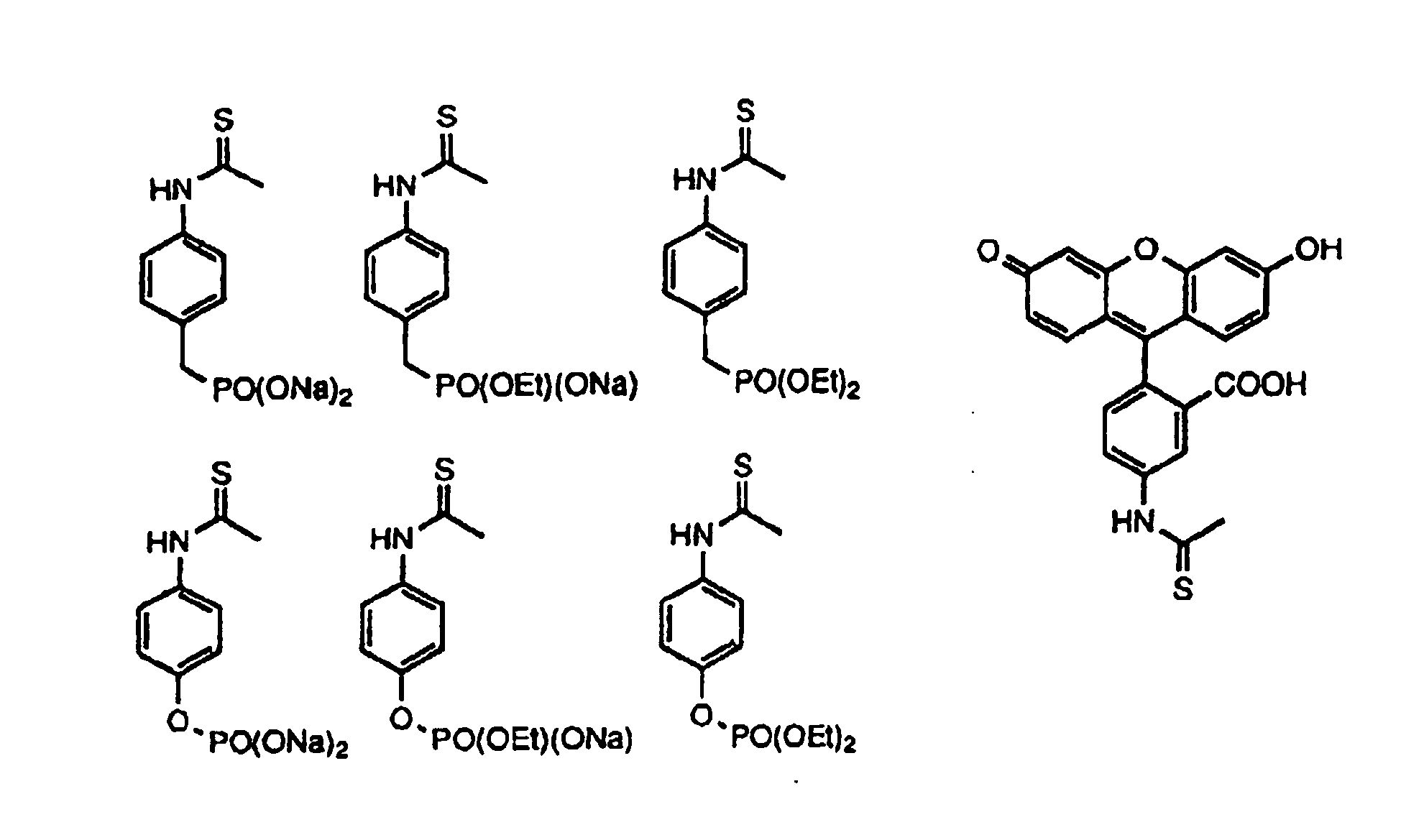


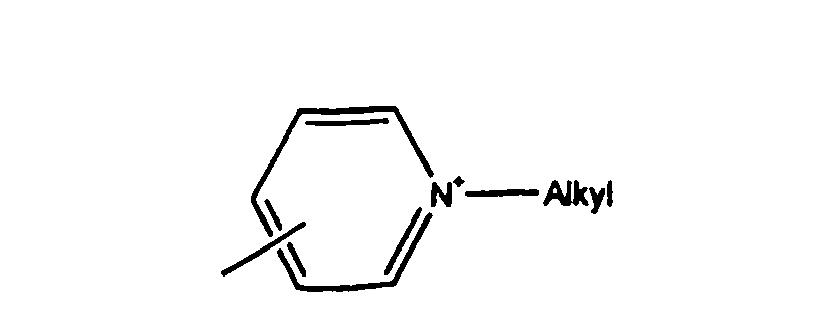
- In addition to the above, various neuraminic or sialic acid-containing moieties or modified neuraminic or sialic acid-containing moieties may be bonded or linked to the dendrimers in accordance with this invention. These moieties include the various N- and O-substituted derivatives of neuraminic acid, particularly N- and O-acyl derivatives such as N-acetyl, O-acetyl and N-glycolyl derivatives, as well as moieties in which the neuraminic acid group is modified. Suitable modified neuramine acid groups include groups which are substituted in the 4-position with an amino, amido, cyano, azido or guanidino group, as well as unsaturated neuraminic acid groups. These moieties may be linked to the dendrimers through the 2-, 7-, 9- or 5-NAc positions.
- Preferably, in the polyionic dendrimers of the general formula I, n is an integer of from 1 to 20 or more, more preferably from 1 to 10. Preferably also, the dendrimers include at least three or more terminal groups.
- The optional linking group X which may be present to act as a spacer between the dendrimer and the moiety A, may consist of an alkyl chain (optionally substituted or branched), an alkoxy, polyalkoxy, alkylthio or polyalkylthio chain (optionally substituted), or an alkenyl, multiple alkenyl, alkynyl or multiple alkynyl chain (optionally substituted). Suitable spacer chains include groups of the formula -(CH2)m-Z-(CH2)m-, wherein Z is -CH2-, -CH=CH-, -C=C-, -O- or -S- and m is an integer of from 1 to 15.
- The anionic or cationic dendrimers of this invention may be prepared by standard chemical methods which are well known to persons skilled in this art. Suitable methods are described by way of the example in Examples below.
- As previously described, the anionic or cationic dendrimers of the present invention have been found to inhibit microbial and parasitic agents. The term "microbial agent" as used herein is intended to refer to both bacterial and yeast or fungal agents, particularly bacterial and yeast or fungal pathogens. Thus, the term includes, but is not limited to, Gram-positive and Gram-negative bacteria such as Eschericia coli, Salmonella typhimurium, and Streptococcus, Staphylococcus, Shigella, Pseudomonas, Clostridium, Neisseria and Pneumococcus species. In addition, this term includes yeast pathogens such as Candida and fungal pathogens such as Aspergillus fumigatus.
- The term "parasitic agent" is used herein to refer in particular to parasitic pathogens, including but not limited to parasitic agents such as Plasmodium, Trypanosoma and Leischmania species, Toxoplasma gondii, Pneumocystis carinii and Criptosporidium parvum.
- The term "inhibition" is used herein in its broadest sense to include either full or partial inhibition or suppression of infection of a human or non-human animal patient by a microbial or parasitic pathogen, or full or partial inhibition or suppression of the pathogenic effects of infection of such a patient by a microbial or parasitic pathogen. The term is also used to encompass both prophylactic and therapeutic treatment.
- Thus, in another aspect the present invention provides a pharmaceutical or veterinary composition for prophylactic or therapeutic inhibition of a microbial or parasitic agent in a human or non-human animal patient, which comprises a dendrimer as broadly described above, in association with at least one pharmaceutically or veterinarily acceptable carrier or diluent.
- The formulation of such compositions is well known to persons skilled in this field. Suitable pharmaceutically acceptable carriers and/or diluents include any and all conventional solvents, dispersion media, fillers, solid carriers, aqueous solutions, coatings, antibacterial and antifungal agents, isotonic and absorption delaying agents, and the like. The use of such media and agents for pharmaceutically active substances is well known in the art, and it is described, by way of example, in Remington's Pharmaceutical Sciences, 18th Edition, Mack Publishing Company, Pennsylvania, USA. Except insofar as any conventional media or agent is incompatible with the active ingredient, use thereof in the pharmaceutical compositions of the present invention is contemplated. Supplementary active ingredients can also be incorporated into the compositions.
- It is especially advantageous to formulate compositions in dosage unit form for ease of administration and uniformity of dosage. Dosage unit form as used herein refers to physically discrete units suited as unitary dosages for the human subjects to be treated; each unit containing a predetermined quantity of active ingredient calculated to produce the desired therapeutic effect in association with the required pharmaceutical carrier and/or diluent. The specifications for the novel dosage unit forms of the invention are dictated by and directly dependent on (a) the unique characteristics of the active ingredient and the particular therapeutic effect to be achieved, and (b) the limitations inherent in the art of compounding such an active ingredient for the particular treatment.
- In yet another aspect, this invention provides the use of an effective amount of a dendrimer as broadly described above in the prophylactic or therapeutic treatment of, or in the manufacture of a medicament for prophylactic or therapeutic treatment of a human or non-human animal patient by inhibition of a microbial or parasitic agent.
- A variety of administration routes are available. The particular mode selected will depend, of course, upon the particular condition being treated and the dosage required for therapeutic efficacy. The methods of this invention, generally speaking, may be practised using any mode of administration that is medically acceptable, meaning any mode that produces therapeutic levels of the active component of the invention without causing clinically unacceptable adverse effects. Such modes of administration include oral, rectal, topical, nasal, inhalation, transdermal or parenteral (e.g. subcutaneous, intramuscular and intravenous) routes. Formulations for oral administration include discrete units such as capsules, tablets, lozenges and the like. Other routes include intrathecal administration directly into spinal fluid, direct introduction such as by various catheter and balloon angioplasty devices well known to those of ordinary skill in the art, and intraparenchymal injection into targeted areas.
- The compositions may conveniently be presented in unit dosage form and may be prepared by any of the methods well known in the art of pharmacy. Such methods include the step of bringing the active component into association with a carrier which constitutes one or more accessory ingredients. In general, the compositions are prepared by uniformly and intimately bringing the active component into association with a liquid carrier, a finely divided solid carrier, or both, and then, if necessary, shaping the product.
- Compositions of the present invention suitable for oral administration may be presented as discrete units such as capsules, cachets, tablets or lozenges, each containing a predetermined amount of the active component, in liposomes or as a suspension in an aqueous liquor or non-aqueous liquid such as a syrup, an elixir, or an emulsion.
- Compositions suitable for parenteral administration conveniently comprise a sterile aqueous preparation of the active component which is preferably isotonic with the blood of the recipient. This aqueous preparation may be formulated according to known methods using those suitable dispersing or wetting agents and suspending agents. The sterile injectable preparation may also be a sterile injectable solution or suspension in a non-toxic parenterally-acceptable diluent or solvent, for example as a solution in polyethylene glycol. Among the acceptable vehicles and solvents that may be employed are water, Ringer's solution and isotonic sodium chloride solution. In addition, sterile, fixed oils are conventionally employed as a solvent or suspending medium. For this purpose, any bland fixed oil may be employed including synthetic mono-or di-glycerides. In addition, fatty acids such as oleic acid find use in the preparation of injectables.
- The active component may also be formulated for delivery in a system designed to administer the active component intranasally or by inhalation, for example as a finely dispersed aerosol spray containing the active component.
- Other delivery systems can include sustained release delivery systems. Preferred sustained release delivery systems are those which can provide for release of the active component of the invention in sustained release pellets or capsules. Many types of sustained release delivery systems are available. These include, but are not limited to: (a) erosional systems in which the active component is contained within a matrix, and (b) diffusional systems in which the active component permeates at a controlled rate through a polymer. In addition, a pump-based hardware delivery system can be used, some of which are adapted for implantation.
- The active component is administered in prophylactically or therapeutically effective amounts. A prophylactically or therapeutically effective amount means that amount necessary at least partly to attain the desired effect, or to delay the onset of, inhibit the progression of, or halt altogether, the onset or progression of the particular condition being treated. Such amounts will depend, of course, on the particular condition being treated, the severity of the condition and individual patient parameters including age, physical condition, size, weight and concurrent treatment. These factors are well known to those of ordinary skill in the art and can be addressed with no more than routine experimentation. It is preferred generally that a maximum dose be used, that is, the highest safe dose according to sound medical judgement. It will be understood by those of ordinary skill in the art, however, that a lower dose or tolerable dose may be administered for medical reasons, psychological reasons or for virtually any other reasons.
- Generally, daily oral doses of active component will be from about 0.01 mg/kg per day to 1000 mg/kg per day. Small doses (0.01-1 mg) may be administered initially, followed by increasing doses up to about 1000 mg/kg per day. In the event that the response in a subject is insufficient at such doses, even higher doses (or effective higher doses by a different, more localised delivery route) may be employed to the extent patient tolerance permits. Multiple doses per day are contemplated to achieve appropriate systemic levels of compounds.
- The active component according to the invention may also be presented for use in the form of veterinary compositions, which may be prepared, for example, by methods that are conventional in the art. Examples of such veterinary compositions include those adapted for:
- (a) oral administration, external application, for example drenches (e.g. aqueous or non-aqueous solutions or suspensions); tablets or boluses; powders, granules or pellets for admixture with feed stuffs; pastes for application to the tongue;
- (b) parenteral administration for example by subcutaneous, intramuscular or intravenous injection, e.g. as a sterile solution or suspension; or (when appropriate) by intramammary injection where a suspension or solution is introduced into the udder via the teat;
- (c) topical application, e.g. as a cream, ointment or spray applied to the skin; or
- (d) intravaginally, e.g. as a pessary, cream or foam.
Throughout this specification and the claims which follow, unless the context requires otherwise, the word "comprise", or variations such as "comprises" or "comprising", will be understood to imply the inclusion of a stated integer or group of integers but not the exclusion of any other integer or group of integers. - In the accompanying drawings:
- Figure 1 shows the effect of
BRI 2999 on growth of P. falciparum in human red blood cells in vitro. - Figure 2 shows the effect of
BRI 6741 on growth of P. falciparum in human red blood cells in vitro. - Figure 3 shows the effect of
BRI 2998 on growth of P. falciparum in human red blood cells in vitro. - Figure 4 shows the effect of
BRI 7011 on growth of P. falciparum in human red blood cells in vitro. - Figure 5 shows the effect of
BRI 6181 on growth of P. falciparum in human red blood cells in vitro. - Further features of the present invention will be apparent from the following Examples which are included by way of illustration, not limitation of the invention. In the following Examples, PAMAM dendrimers refer to polyamidoamine dendrimers based on an ammonia core as detailed in
US Patents Nos. 4,507,466 ,4,558,120 ,4,568,737 and4,587,329 ; PAMAM (EDA) dendrimers refer to polyamidoamine dendrimers based on an ethylene diamine core; and BHAlysxlysylysz dendrimers refer to polylysine unsymmetrical dendrimers based on a benzhydrylamine core and lysine branching units as described inUS Patents Nos. 4,289,872 and4,410,688 . The polyamidoamine dendrimers PAMAM 1.0, PAMAM 2.0, PAMAM 3.0, PAMAM 4.0, PAMAM 5.0 or higher generation, PAMAM 4.0 (EDA), and the polylysine dendrimers BHAlyslys2, BHAlyslys2lys4, BHAlyslys2lys4lys8 and BHAlyslys2lys4lys8lys16, BHAlyslys2lys4lys8lys16lys32, BHAlyslys2lys4lys8lys16lys32lys64, or higher generations prepared as described inUS Patents Nos. 4289872 ,4410688 ,4507466 ,4558120 ,4568737 and4578239 andInternational Patent Publications Nos. WO 88/01178 WO 88/01179 WO 88/01180 WO 95/24221 -
- A
- PAMAM 1.0 Solid sodium carbonate (0.13g; 1.0mmol) was added slowly to a stirred solution of 2-acrylamido-2-methyl propane sulfonic acid (0.41g; 2.0mmol) in water (3ml). After the evolution of gas had ceased, the pH of the solution was 8.0. A solution of PAMAM 1.0 (0.12g; 0.33mmol) in water (1ml) was then added to the solution followed by the addition of four drops of a 40% aq. solution of benzyl trimethylammonium hydroxide. The solution was then heated under nitrogen at 60° for three days and then concentrated. The residue was purified by gel filtration (Sephadex G10; water) and then freeze dried to give the sulfonated PAMAM 1.0 dendrimer as an off white solid (0.51g). 1H and 13C nmr spectra showed a mixture of dialkylated and monoalkylated PAMAM 1.0 dendrimer (ca. 70:30). 13C nmr (D2O): δ 31.0, 31.1, 37.1, 37.7, 41.3, 48.6, 51.5, 53.1, 53.4, 55.6, 56.2, 61.2, 61.5, 178.3, 179.0, 179.8.
- B
- PAMAM 2.0
PAMAM 2.0 was reacted with 2-acrylamido-2-methyl propane sulfonic acid as described above. The crude product was purified by gel filtration (Sephadex G10; water) and then freeze dried to give an off white solid. 1H and 13C nmr spectra showed a mixture of dialkylated and monoalkylated PAMAM 2.0 dendrimer (ca. 65:35). 13C nmr (D2O): δ 31.0, 31.1, 37.1, 37.7, 41.3, 48.7, 51.5, 53.4, 55.6, 56.2, 61.2, 61.5, 178.4, 179.0, 179.1, 179.6.
When the above reaction was repeated omitting the benzyltrimethylammonium hydroxide a similar result was obtained. - C
- PAMAM 3.0 BRI2783
PAMAM 3.0 was reacted with 2-acrylamido-2-methyl propane sulfonic acid as above except that a slight excess of sodium carbonate was used and the benzyltrimethylammonium hydroxide was omitted. 1H and 13C nmr spectra showed a mixture of dialkylated and monoalkylated PAMAM 3.0 dendrimer (ca. 50:50). 13C nmr (D2O): δ 31.0, 31.1, 36.9, 37.4, 41.1, 48.6, 51.5, 53.4, 55.7, 56.2, 61.1, 61.5, 178.2, 178.9, 179.0, 179.8. - D
- PAMAM 4.0 BRI2784
PAMAM 4.0 was reacted with 2-acrylamido-2-methyl propane sulfonic acid as described for PAMAM 3.0. 1H and 13C nmr spectra showed a mixture of dialkylated and monoalkylated PAMAM 4.0 dendrimer (ca. 35:65). 13C nmr (D2O): δ 31.0, 31.1, 36.9, 37.3, 41.1, 48.5, 51.5, 53.5, 55.7, 56.2, 61.1, 61.5, 178.1, 178.9, 179.0, 179.8. -
- A
- PAMAM 1.0
A solution of 4-nitrophenyl bromoacetate (0.40g; 1.5mmol) in dry DMF (1ml) was added to a stirred solution of PAMAM 1.0 (0.18g; 0.5mmol) in DMF (3ml). The resulting yellow solution was stirred for 20 hours at room temperature, when a ninhydrin test was negative. The solution was concentrated (30°/ 0.1mmHg) to give a yellow oil. This oil was partitioned between water and chloroform and the aqueous layer separated and washed with chloroform (2X) and finally with ethyl acetate. The aqueous solution was concentrated (35°/ 25mmHg) to give the bromoacetylated PAMAM 1.0 dendrimer as a yellow oil (0.36g;100%). 13C nmr (D2O): δ 32.8, 33.3, 43.0, 43.5, 54.4, 174.5, 176.4.
A solution of sodium sulfite (0.2g; 1.6mmol) in water (1ml) was added to a solution of the bromoacetylated PAMAM 1.0 dendrimer described above (0.36g; 0.5mmol) in water (5ml) and the solution left to stand at room temperature for eleven days. The yellow solution was concentrated to give a yellowish solid (0.60g). 13C nmr (D2O): δ 34.4, 43.1, 43.4, 54.0, 61.7, 171.3, 177.2.
The above reaction sequence could be carried out without isolating the bromoacetylated dendrimer by simply adding the sodium sulfite solution to the crude aqueous extract obtained from the first reaction. - B
- PAMAM 2.0
Method 1:
A solution of 4-nitrophenyl bromoacetate (0.18g; 0.7mmol) in dry DMF (1ml) was added to a stirred solution of PAMAM 2.0 (0.10g; 0.1mmol) in DMF (3ml). The resulting yellow solution was stirred for 20 hours at room temperature, when a ninhydrin test was negative. The solution was then added with swirling to water (150ml) and the mixture extracted with chloroform (3X) and ethyl acetate. A solution of sodium sulfite (0.1g; 0.8mmol) in water (1ml) was added to the crude bromoacetylated dendrimer solution and the mixture allowed to stand for three days at room temperature. The yellowish solution was then concentrated to give a yellow solid residue, which was purified by gel filtration (Sephadex LH20; water) to give the sodium sulfoacetamide terminated PAMAM 2.0 dendrimer (103mg). 13C nmr (D2O): δ 33.0, 35.7, 36.0, 37.7, 40.3, 43.0, 43.2, 53.4, 53.7, 56.0, 61.6, 171.2, 174.6, 178.5.
Method 2:
Solid succinimidyl acetylthioacetate (67mg; 0.33mmol) was added to a solution of PAMAM 2.0 (52mg; 0.05mmol) in dry DMF (2ml) and the resulting solution stirred at room temperature for two days. The mixture was then concentrated (30o/10-3 mmHg) to give an oily residue. The residue was partitioned between water and chloroform, and the water layer separated and concentrated to give a viscous oil (117mg). 1H and 13C nmr showed the oil to be a mixture of the acylated dendrimer and N-hydroxy succinimide. Gel filtration (Sephadex G10; water) provide a pure sample of the acetylthioacetamide terminated PAMAM 2.0 dendrimer (29mg). 13C nmr (D2O): δ 34.0, 34.2, 37.3, 43.0, 43.1, 43.3, 53.5, 54.0, 56.3, 175.4, 177.2, 177.5.
A solution of the above functionalised dendrimer in 40% aqueous formic acid (7ml) was then added to an ice cold freshly prepared solution of performic acid (1.6mmol) in formic acid (2ml). The mixture was stirred for one hour at 0° and then for twenty hours at room temperature. A small amount of activated charcoal was then added to decompose any excess peracid, the mixture stirred for 30 minutes then filtered and concentrated to give a viscous oil. - The crude product was dissolved in water, the pH adjusted to 9.0 with aqueous sodium bicarbonate and the material desalted by passage through a column of Sephadex G10. A white solid (20mg;) was obtained after lyophylisation which was spectroscopically essentially the same as the material obtained by method 1. 13C nmr (D2O): δ 33.0, 38.7, 42.9, 43.0, 43.1, 53.9, 54.3, 56.5, 61.6, 171.2, 176.4, 177.0.
-
- A
- PAMAM 1.0
Solid maleic anhydride (0.11g; 1.1mmol) was added to a stirred solution of PAMAM 1.0 (0.12g; 0.33mmol) in dry DMF (3ml). The mixture became a little warm and brownish as the anhydride dissolved and the resulting solution was stirred overnight at room temperature. The solution was then concentrated (30°/10-4 mmHg) to give a viscous oil. 1H and 13C nmr (D2O) showed complete conversion of the PAMAM 1.0 to the trisamide together with some maleic acid. 13C nmr (D2O): δ 33.1, 42.8, 43.1, 54.3, 135.0, 137.1, 169.1, 171.9, 173.3.
The crude trisamide was then dissolved in water (4ml) and solid sodium sulfite (0.20g; 1.6mmol) added. The resulting solution was allowed to stand at room temperature for four days and then concentrated. 1H and 13C nmr (D2O) showed a 1:1 mixture of the regioisomeric sodium sulfosuccinamic acid terminated PAMAM 1.0 dendrimers together with some sulfosuccinic acid. The crude product was purified by gel filtration (Sephadex G10; water) to afford a sample of the sodium sulfosuccinamic acid terminated PAMAM 1.0 dendrimers (107mg). 13C nmr (D2O): δ 33.3, 39.6, 40.0, 42.9, 43.1, 54.0, 67.9, 69.4, 173.8, 176.3, 177.6, 181.8. - B
- PAMAM 2.0
A mixture of the regioisomeric sodium sulfosuccinamic acid terminated PAMAM 2.0 dendrimers was prepared as described above. 13C nmr PAMAM 2.0 maleamic acid derivative (D2O): δ 32.8, 33.0, 38.7, 42.9, 53.8, 54.3, 56.5, 135.2, 136.8, 169.2, 171.9, 173.5, 174.6. 13C nmr PAMAM 2.0 sodium sulfosuccinamic acid derivatives (D2O): δ 37.0, 40.1, 41.1, 43.0, 43.2, 43.9, 53.0, 53.3, 55.5, 68.0, 69.4, 173.8, 177.6, 179.1, 179.5, 179.8, 182.3. - C
- PAMAM 4.0 BRI6038
Solid maleic anhydride (60mg; 0.6mmol) was added to a stirred solution of PAMAM 4.0 (51mg; 0.01mmol) in dry DMF (2ml). The mixture initially became cloudy but soon gave a clear solution which was stirred overnight at room temperature. The solution was then concentrated (35°/10-4 mmHg) to give a viscous oil. 1H and13C nmr (D2O) showed complete conversion of the PAMAM 4.0 to the polyamide together with some maleic acid. The crude polyamide was then dissolved in water (2ml) and a solution of sodium sulfite (126mg; 1.0mmol) in water (2ml) added. The resulting solution was allowed to stand at room temperature for two days and then concentrated. 1H and 13C nmr (D2O) showed a mixture of the regioisomeric sodium sulfosuccinamic acid terminated PAMAM 4.0 dendrimers together with some sulfosuccinic acid. The crude product was purified by gel filtration (Sephadex LH20; water) to afford a sample of PAMAM 4.0 terminated with 24 regioisomeric sulfosuccinamic acid groups (90mg). 1H nmr (D2O): δ 2.4-2.6; 2.7-3.1; 3.2-3.4; 3.9-4.0.13C nmr (D2O): δ 36.2; 39.8; 40.5; 43.0; 43.2; 53.5; 55.8; 68.1; 69.5; 173.8; 177.4; 177.6; 178.7; 182.3. -
- a
- Preparation of tetrabutylammonium N-(2-sulfoethyl)succinamic acid Solid succinic anhydride (0.5g; 5.0mmol) was added to a stirred solution of tetrabutylammonium 2-aminoethylsulfonic acid (1.83g; 5.0mmol) in dry dichloromethane (30ml). The succinic anhydride slowly dissolved and the resulting cloudy solution was stirred overnight at room temperature. The mixture was filtered and the filtrate concentrated to give a viscous oil (2.41g). 13C nmr showed complete conversion to the desired monoamide together with a small amount of succinic acid. Repeated precipitation of the product by dropwise addition of a dichloromethane solution to a large excess of diethyl ether gave tetrabutylammonium N-(2-sulfoethyl)succinamic acid as a white solid (1.762g; 76%), mp 125-127°C. 1H nmr (CDCl3): δ 0.86 (t, 12h, 4xCH3), 1.28 (m, 8H, 4xCH2), 1.50 (m, 8H, 4xCH2), 2.33 (m, 2H, CH2COOH), 2.44 (m, 2H, CH2CONH), 2.76 (m, 2H, CH2NHCO), 3.12 (m, 8H, 4xCH2N), 3.50 (m, 2H, CH2SO3 -), 7.53 (br t, 1H, NH). 13C nmr (CDCl3): δ 13.5 ,19.5,23.8, 30.1, 30.9, 35.6, 50.0, 58.5, 172.0, 174.1.
- b
- Preparation of tetrabutylammonium 4-nitrophenyl N-(2-sulfoethyl)succinamate A solution of dicyclohexylcarbodiimide (45mg; 0.22mmol) in dry dichloromethane (1ml) was added to a stirred solution of tetrabutylammonium N-(2-sulfoethyl)succinamic acid (94mg; 0.20mmol) in dichloromethane (2ml), and the mixture stirred overnight at room temperature. The resulting suspension was filtered and the filtrate concentrated to give the crude active ester, which was used without further purification.
- A
- Preparation of sodium N-(2-sulfoethyl)succinamide terminated PAMAM dendrimers
PAMAM 4.0 BRI2786
A solution of the crude tetrabutylammonium 4-nitrophenyl N-(2-sulfoethyl)succinamate (0.30mmol) in dry DMF (1ml) was added to a stirred solution of PAMAM 4.0 (51.5mg; 0.01mmol) dissolved in 50% aqueous DMF (3ml) and the resulting yellow solution stirred overnight at room temperature. The mixture was then concentrated (35°/10-5 mmHg) and the yellow residue partitioned between water and chloroform. The water layer was separated, washed with chloroform (2X) and ethyl acetate, and then concentrated to give a yellow oil (134mg). The crude product was converted to the sodium salt by passage through a column of Amberlite IR 120(Na) to yield 85mg of material. This material was further purified by gel filtration (Sephadex LH20; water) to give the sodium N-(2-sulfoethyl)succinamide terminated PAMAM 4.0 dendrimer (45mg). 13C nmr (D2O): δ 33.2, 33.6, 35.5, 39.0, 39.5, 42.8, 43.2, 53.8, 54.1, 54.4, 56.6, 176.5, 176.9, 177.2, 178.9, 179.4.
The corresponding PAMAM 1.0 and PAMAM 3.0 (BRI2785) dendrimers terminated with sodium N-(2-sulfoethyl)succinamide groups were similarly prepared.
13C nmr PAMAM 3.0 derivative (D2O): δ 33.4, 35.5, 39.0, 39.5, 42.9, 43.2, 53.8, 54.1, 54.3, 56.5, 176.4, 176.9, 177.4, 178.9, 179.4.
13C nmr PAMAM 1.0 derivative (D2O): δ 34.9, 35.5, 39.5, 42.9, 43.1, 53.7, 54.1, 179.0,179.1,179.3. - B
- Preparation of sodium N-(2-sulfoethyl)succinamide terminated polylysine dendrimers
BHAlyslys2lys4lys8lys16 BRI2789
Trifluoroacetic acid (1ml) was added to a suspension of BHAlyslys2lys4lys8DBL16 (36.5mg; 5.0µmol) in dry dichloromethane (1ml) and the resulting solution stirred at room temperature under nitrogen for two hours and then concentrated. The residue was dissolved in dry DMSO (2ml) and the pH adjusted to 8.5 with triethylamine. A solution of the crude tetrabutylammonium 4-nitrophenyl N-(2-sulfoethyl)succinamate (ca. 0.2mmol) in DMSO (1ml) was then added dropwise and the mixture stirred overnight at room temperature. The yellow solution was then concentrated (50°/10-5 mmHg) and the yellow residue partitioned between water and chloroform. The aqueous layer was separated, washed with chloroform (3X) and ethyl acetate, and then concentrated to give an oil (99mg). The crude product was converted to the sodium salt by passage through a column of Amberlite IR 120(Na) to yield 81mg of material. This material was further purified by gel filtration (Sephadex LH20; water) to give the sodium N-(2-sulfoethyl)succinamide terminated BHAlyslys2lys4lys8lys16 dendrimer (39mg). 13C nmr (D2O): δ 27.0, 32.3, 35.2, 35.3, 35.6, 35.7, 39.5, 43.5, 54.1, 58.5, 131.5, 132.0, 133.3, 145.1, 177.8, 178.0, 178.4, 178.8, 178.9, 179.2, 179.7, 179.8.
The corresponding BHAlyslys2, BHAlyslys2lys4 (BRI2787) and BHAlyslys2lys4lys8 (BRI2788) terminated with sodium N-(2-sulfoethyl)succinamide groups were similarly prepared.
13C nmr BHAlyslys2lys4lys8 derivative (D2O): δ 26.9, 32.3, 35.1, 35.3, 35.6, 35.7, 39.5, 43.5, 54.1, 58.5, 131.6, 131.9, 132.2, 132.3, 133.2, 133.3, 145.0, 145.2, 177.2, 177.8, 177.9, 178.0, 178.2, 178.3, 178.6, 178.7, 178.8, 178.9, 179.2, 179.3, 179.7, 179.8.
13C nmr BHAlyslys2lys4 derivative (D2O): δ 26.9, 32.3, 35.1, 35.4, 35.7, 35.8, 39.5, 43.5, 54.1, 58.5, 61.8, 131.7, 132.0, 132.2, 132.3, 133.2, 133.3, 145.0, 145.1, 177.3, 178.0, 178.3, 178.4, 178.7, 178.9, 179.0, 179.3, 179.7, 179.8.
13C nmr BHAlyslys2 derivative (D2O): δ 26.9, 27.1, 32.2, 32.3, 34.7, 34.8, 35.1, 35.3, 35.6, 35.7, 39.5, 43.4, 54.1, 58.6, 61.8, 131.7, 131.9, 132.2, 132.3, 133.3, 144.9, 145.0, 177.7, 178.4, 178.8, 179.0, 179.3, 180.0. -
- A
- PAMAM 4.0 BRI2791
Solid sodium 4-sulfophenylisothiocyanate monohydrate (500mg; 1.96mmol) was added to a solution of PAMAM 4.0 (300mg; 0.0582mmol) in water (10ml) and the resulting solution heated under nitrogen at 53° for two hours and then cooled. The solution was concentrated and the yellow solid residue purified by gel filtration (Sephadex LH20; water). The pure fractions were combined and freeze dried to give the sodium 4-sulfophenylthiourea terminated PAMAM 4.0 dendrimer as a fluffy white solid (370mg). 1H nmr (D2O) : δ 2.28; 2.52; 2.69; 3.15; 3.27; 3.60; 7.32 (d, J=9Hz); 7.72 (d, J=9Hz). 13C nmr (D2O) : δ 36.9; 41.1; 43.1; 48.3; 53.6; 55.8; 129.0; 131.1; 144.4; 178.5; 179.1; 184.4.
The corresponding PAMAM 1.0, PAMAM 2.0 (BRI2790), PAMAM 3.0, and PAMAM 5.0 (BRI2991) dendrimers terminated with 3, 6, 12, and 48 sodium 4-sulfophenylthiourea groups respectively were similarly prepared. - B
- PAMAM 4.0 (EDA) BRI6045
Solid sodium 4-sulfophenylisothiocyanate monohydrate (130mg; 0.5mmol) was added to a solution of PAMAM 4.0 (EDA) (69mg; 0.01mmol) in water (4ml) and the resulting solution heated under nitrogen at 53° for two hours and then cooled. The solution was concentrated and the solid residue purified by gel filtration (Sephadex LH20; water). The pure fractions were combined and freeze dried to give PAMAM 4.0 terminated with 32 sodium 4-sulfophenylthiourea groups as a fluffy white solid (136mg). 1H nmr (D2O) : δ 2.30; 2.50; 2.70; 3.18; 3.62; 7.35 (d, J=9Hz); 7.72 (d, J=9Hz). 13C nmr (D2O) : δ 36.8; 41.0; 43.1; 48.4; 53.6; 55.7; 128.9; 131.0; 144.3; 178.5; 179.0; 184.5. - C
- BHAlyslys2lys4lys8lys16 BRI2792
Trifluoroacetic acid (4ml) was added to a suspension of BHAlyslys2lys4lys8DBL16 (0.73g; 0.1mmol) in dry dichloromethane (4ml) under nitrogen. A vigorous evolution of gas was observed for a short time and the resulting solution was stirred at room temperature for two hours and then concentrated. The residual syrup was dissolved in water (5ml), the solution passed through a column of Amberlite IRA-401 (OH) and the filtrate concentrated to give BHAlyslys2lys4lys8lys16 as a viscous oil (0.49g). The oil was redissolved in water (5ml) and N,N-dimethyl-N-allylamine buffer (pH 9.5; 3ml) added. Solid sodium 4-sulfophenylisothiocyanate monohydrate (1.30g; 5.1mmol) was then added and the resulting solution heated under nitrogen at 53° for two hours and then cooled. The solution was concentrated and the brownish solid residue purified by gel filtration (Sephadex LH20; water). The pure fractions were combined, passed through a column of Amberlite IR 120(Na) and freeze dried to give the sodium 4-sulfophenylthiourea terminated BHAlyslys2lys4lys8lys16 dendrimer as a fluffy white solid (374mg). 1H nmr (D2O) : δ 1.40; 1.72; 3.08; 3.42; 4.24; 4.60; 7.30; 7.40 (d, J=9Hz); 7.78 (d, J=9Hz). 13C nmr (D2O) : δ 27.3; 32.5; 35.9; 43.7; 48.9; 58.6; 63.3; 128.8; 131.0; 143.7; 144.7; 145.1; 177.7; 178.1; 183.8; 185.2.
The corresponding BHAlyslys2lys4lys8, BHAlyslys2lys4lys8lys16lys32 (BRI2992), and BHAlyslys2lys4lys8lys16lys32lys64 (BRI2993) dendrimers terminated with 16, 64, and 128 sodium 4-sulfophenylthiourea groups respectively were similarly prepared. -
- A
- PAMAM 4.0 BRI2923
Solid sodium 3,6-disulfonapthylisothiocyanate (160mg; 0.41mmol) was added to a solution of PAMAM 4.0 (51mg; 0.01mmol) in water (3ml) and the resulting solution heated under nitrogen at 53° for two hours and then cooled. The solution was concentrated and the brown solid residue purified by gel filtration (Sephadex LH20; water). The pure fractions were combined and concentrated to give thesodium 3,6-disulfonapthylthiourea terminated PAMAM 4.0 dendrimer as a brownish solid (73mg). 1H nmr (D2O) : δ 2.30; 2.60; 2.74; 3.20; 3.57; 7.75; 7.86; 8.28. 13C nmr (D2O) : δ 35.0; 39.9; 43.1; 48.1; 53.8; 56.1; 128.4; 128.6; 129.3; 131.0; 131.3; 136.0; 136.8; 138.2; 145.5; 146.0; 177.2; 177.8; 185.5.
The corresponding PAMAM 2.0 dendrimer terminated withsodium 3,6-disulfonapthylthiourea groups was similarly prepared. - B
- PAMAM 4.0 (EDA) BRI6046
Solid sodium 3,6-disulfonapthylisothiocyanate (220mg; 0.57mmol) was added to a solution of PAMAM 4.0 (EDA) (74mg; 0.0 1 mmol) in water (4ml) and the resulting solution heated under nitrogen at 53° for two hours and then cooled. The solution was concentrated and the brownish solid residue purified by gel filtration (Sephadex LH20; water). The pure fractions were combined and concentrated to give PAMAM 4.0 terminated with 32sodium 3,6-disulfonapthylthiourea groups as a tan solid (148mg). 1H nmr (D2O): δ 2.30; 2.80; 3.20; 3.54; 7.74; 7.85; 8.25. 13C nmr (D2O): δ 36.0; 40.8; 43.1; 48.3; 53.6; 55.9; 128.5; 129.4; 131.0; 131.3; 136.0; 136.8; 138.3; 145.5; 146.0; 178.2; 185.6. - C
- BHAlyslys2lys4lys8lys16 BRI2999
Trifluoroacetic acid (2ml) was added to a suspension of BHAlyslys2lys4lys8DBL16 (73mg; 0.01mmol) in dry dichloromethane (2ml) under nitrogen. A vigorous evolution of gas was observed for a short time and the resulting solution was stirred at room temperature for two hours and then concentrated. The residual syrup was dissolved in water (5ml), the solution passed through a column of Amberlite IRA-401(OH) and the filtrate concentrated to give BHAlyslys2lys4lys8lys16 as a viscous oil. The oil was redissolved in water (5ml) and N,N-dimethyl-N-allylamine buffer (pH 9.5; 3ml) added.Solid sodium 3,6-disulfonapthylisothiocyanate (234mg; 0.60mmol) was then added and the resulting solution heated under nitrogen at 53° for two hours and then cooled. The solution was concentrated and the brownish solid residue purified by gel filtration (Sephadex LH20; water). The pure fractions were combined, passed-through a column of Amberlite IR 120(Na) and freeze dried to give BHAlyslys2lys4lys8lys16 terminated with 32sodium 3,6-disulfonapthylthiourea groups as a fluffy off-white solid (119mg). 1H nmr (D2O) : δ 1.0-2.0; 3.18; 3.43; 4.31; 7.22; 7.80; 7.89; 8.25. 13C nmr (D2O) : δ 27.2; 32.4; 35.3; 43.7; 49.0; 58.5; 63.6; 128.4; 129.1; 131.4; 136.1; 136.6; 138.6; 139.0; 145.1; 145.6; 178.4; 184.8; 186.7. - Solid sodium 4-sulfonapthylisothiocyanate (180mg; 0.5mmol) was added to a solution of PAMAM 4.0 (51mg; 0.01mmol) in water (5ml) and the mixture heated under nitrogen at 53° for two hours and then cooled. The water was distilled under reduced pressure from the resulting suspension and the off white solid residue purified by gel filtration (Sephadex LH20; water). The pure fractions were combined and freeze dried to give the sodium 4-sulfonapthylthiourea terminated PAMAM 4.0 dendrimer as a fluffy white solid (60mg). 1H nmr (D2O) : δ 2.20; 2.60; 3.14; 3.48; 7.23; 7.47; 7.56; 7.77; 7.93 (d, J=6Hz); 8.56 (d, J=6Hz). 13C nmr (D2O) : δ 35.8; 40.5; 43.1; 48.4; 53.6; 55.9; 127.6; 128.6; 130.3; 131.9; 132.5; 133.5; 134.7; 140.5; 142.7; 177.8; 178.0; 185.4.
-
Solid sodium 3,5-disulfophenylisothiocyanate (110mg; 0.32mmol) was added to a solution of PAMAM 4.0 (63mg; 0.012mmol) in water (3ml) and the resulting solution heated under nitrogen at 53° for two hours and then cooled. The solution was concentrated and the brownish solid residue purified by gel filtration (Sephadex G25; water). The pure fractions were combined and concentrated to give PAMAM 4.0 terminated with 24sodium 3,5-disulfophenylthiourea groups as an off-white solid (110mg). 1H nmr (D2O) : δ 2.53; 3.08; 3.36; 3.66; 7.90; 7.95. 13C nmr (D2O) : δ 34.8; 41.0; 43.1; 48.0; 53.7; 56.2; 124.1; 128.6; 143.5; 148.8; 177.6; 185.0. -
Solid sodium 3, 6, 8-trisulfonaphthylisothiocyanate (250mg; 0.5mmol) was added to a solution of PAMAM 4.0 (51mg; 0.01 mmol) and N,N-dimethyl-N-allylamine buffer (pH 9.5; 1ml) in water (2ml) and the mixture heated under nitrogen at 53° for two hours and then cooled. The mixture was concentrated under reduced pressure to give an orange solid. The residual solid was dissolved in water (2ml) and passed through a short column of Amberlite IR-120(Na). The filtrate was then concentrated and the residue purified by gel filtration (Sephadex LH20; water). The pure fractions were combined and freeze dried to give thesodium 3, 6, 8-trisulfonaphthylthiourea terminated PAMAM 4.0 dendrimer as an off-white solid (102mg). 1H nmr (D2O): δ 2.65; 3.02; 3.30; 3.66; 8.05; 8.42; 8.59; 8.67. 13C nmr (D2O): δ 33.2; 38.7; 43.2; 43.7; 47.8; 54.0; 54.3; 56.7; 131.0; 131.3; 131.9; 135.9; 138.0; 139.6; 143.8; 144.1; 145.6; 176.2; 176.5; 186.0. - The corresponding
sodium 3,6,8-trisulfonaphthylthiourea terminated dendrimer BHAlys.lys2lys4lys8lys16 BRI7011 was prepared similarly. - Solid 4-nitrophenyl 4-(chloromethyl)benzoate (200mg; 0.68mmol) was added to a stirred solution of PAMAM 4.0 (70mg; 0.014mmol) in dry DMSO (4ml) and the resulting yellow solution stirred at room temperature for two hours. The solution was then concentrated (10-4 mmHg; 40°) and the residue extracted with a mixture of water and dichloromethane (1:1). The remaining solid material was dissolved in DMSO (5ml) and a solution of sodium sulfite (130mg; 1mmol) in water (3ml) added. The slightly cloudy mixture that resulted was left to stand for four days, after which time the addition of more water (2ml) resulted in the formation of a clear homogeneous yellow solution. The solution was then concentrated, first at 25mmHg and 40° then at 10-4mmHg and 50° to give the crude product. The crude product was purified by gel filtration (Sephadex G25; water) to give PAMAM 4.0 terminated with 24 sodium 4-(sulfomethyl)benzamide groups (24mg). 1H nmr (D2O) : δ 2.25; 2.66; 3.08; 3.20; 3.33; 3.38; 4.01; 7.40 (br d); 7.62 (br d). 13C nmr (D2O): δ 36.7; 40.9; 43.0; 43.6; 53.5; 55.5; 61.0; 131.6; 135.0; 137.2; 140.4; 174.5; 178.6; 179.2.
- Solid potassium N-hydroxysuccinimidyl 4-sulfobenzoate (100mg; 0.3mmol) was added to a solution of PAMAM 4.0 (EDA) (35mg; 0.005mmol) in 0.1M pH 8.5 borate buffer (5ml) and the solution stirred at room temperature for two hours. The resulting milky solution at this stage had a pH of 4.5. 1 M Sodium carbonate solution (1ml) was then added to give a clear solution which was concentrated to give the crude product as a white solid. The crude product was purified by gel filtration (Sephadex G25; water) to give PAMAM 4.0 (EDA) terminated with 32 sodium 4-sulfobenzamide groups (47mg). 1H nmr (D2O) : δ 2.25; 2.42; 2.63; 3.05; 3.18; 3.31;-3.38; 7.72 (d, J=8Hz); 7.78 (d, J=8Hz). 13C nmr (D2O) : δ 36.0; 40.4; 43.0; 43.7; 53.7; 55.8; 130.2; 132.2; 140.4; 150.1; 173.6; 178.0; 178.5.
- Solid sodium N-(4-sulfophenyl)acrylamide (250mg; 1mmol) and solid sodium carbonate (106mg; 1mmol) were added successively to a stirred solution of PAMAM 4.0 (EDA) (78mg; 0.011mmol) in water (4ml). The resulting solution was stirred under nitrogen for four days and then freeze dried to give a fluffy white solid. The crude product was purified by gel filtration (Sephadex LH20; water to give PAMAM 4.0 (EDA) terminated with 64 sodium N-(4-sulfophenyl)propanamide groups (206mg). 13C nmr showed a faint trace of what was taken to be mono alkylated terminal amino groups. 1H nmr (D2O) : δ 2.10; 2.48 ; 2.58; 2.79; 3.20; 7.42 (d, J=7Hz); 7.65 (d, J=7Hz). 13C nmr (D2O) : δ 36.5; 37.9; 41.1; 53.4; 55.6; 124.8; 130.9; 143.0; 144.2; 177.4; 178.5.
- A solution of sodium sulfanilic acid (195mg; 1mmol) in dry DMSO (3ml) was added dropwise to a solution ofN,N'- disuccinimidyl carbonate (530mg; 2mmol) in dry DMSO (4ml) and the resulting brownish solution stirred at room temperature for 20 hours. A solution of PAMAM 4.0 (EDA) (75mg; 0.01 1mmol) in dry DMSO (1ml) added and the solution stirred for a further 18 hours. The solution was then concentrated under high vacuum (10-5 mmHg; 35°) to give a yellowish semi-solid. The crude product was dissolved in DMSO (4ml) and the solution added to 200ml of well stirred ethyl acetate. The precipitated white solid was collected by filtration and washed with ethyl acetate (2X) and ether (2X), then dried to give a white powder (275mg). This material was further purified by gel filtration (Sephadex LH20; water) to give PAMAM 4.0 (EDA) terminated with 32 sodium 4-sulfophenylurea groups (106mg). 1H nmr (D2O) : δ 2.31; 2.55; 2.75; 3.19; 7.32 (d, J=9Hz); 7.63 (d, J=9Hz). 13C nmr (D2O) : δ 36.3; 40.7; 43.3; 43.8; 53.7; 55.7; 123.3; 130.9; 140.9; 146.0; 161.4; 178.2; 178.6.
- Trifluoroacetic acid (4ml) was added to a suspension of BHAlyslys2lys4lys8DBL16 (220mg; 30µmol) in dry dichloromethane (2ml) and the resulting solution stirred at room temperature under nitrogen for two hours and then concentrated. The residue was dissolved in dry DMSO (5ml) and the pH adjusted to 8.5 with triethylamine. Solid 4-nitrophenyl N,N,N-trimethylglycinate chloride (0.50g; 1.8mmol)was then added and the mixture stirred overnight at room temperature. The cloudy solution was then concentrated (50°/10-5 mmHg) and the residue partitioned between water and dichloromethane. The aqueous layer was separated, washed with dichloromethane (3X) and ethyl acetate, and then concentrated to give an oil (1.128g). The crude product was purified by gel filtration (Sephadex LH20; water) to give the N,N,N-trimethylglycinamide terminated BHAlyslys2lys4lys8lys16 dendrimer (116mg). 13C nmr (D2O): δ 25.5, 30.5, 30.8, 33.4, 42.1, 56.5, 57.1, 67.5, 68.1, 166.7, 167.0, 167.1, 176.0, 176.2.
- 1,1'-Carbonyldiimidazole (85mg; 0.52mmol) was added to a solution of 4-trimethylammoniumbenzoic acid iodide (154mg; 0.5mmol) in dry DMF (4ml) and the mixture stirred at room temperature under argon for two hours. During this time a white solid separated from the solution. A solution of PAMAM 4.0 (58mg; 0.011mmol) in dry DMF (2ml) was then added and the mixture stirred overnight at room temperature. After this time most of the precipitate had dissolved and a ninhydrin test of the solution was negative. The mixture was concentrated (10-4 mmHg; 30o) to give a white solid residue. The crude product was purified by gel filtration (Sephadex LH20; 10% AcOH) to give PAMAM 4.0 terminated with 24 4-trimethylammoniumbenzamide groups as the acetic acid salt (89mg). 1H nmr (D2O) : δ 1.96; 2.65-2.85; 3.25-3.55; 3.64; 7.92. 13C nmr (D2O) : δ 25.8; 33.1; 33.5; 38.7; 43.1; 43.5; 53.5; 54.1; 56.4; 61.2; 124.8; 133.6; 139.9; 153.2; 173.2; 176.3; 176.8; 182.6.
- The corresponding PAMAM 2.0 dendrimer terminated with 6 4-trimethylammonium benzamide groups was similarly prepared.
- Solid 4-nitrophenyl 4-(chloromethyl)benzoate (150mg; 0.5mmol) was added to a stirred solution of PAMAM 4.0 (52mg; 0.01mmol) in dry DMSO (3ml). The resulting yellow solution was stirred at room temperature for 20 hours, when a ninhydrin test was negative (pH ca.8.5). The solution was then concentrated (10-5mmHg; 40°) and the residue shaken with a mixture of water and dichloromethane (1:1). The insoluble gel-like material was collected by filtration, washed with water (2X) and dichloromethane (2X), and then air dried. The crude 4-(chloromethyl)-benzamide terminated dendrimer was dissolved in 25% aq. trimethylamine (20ml) and the yellow solution left to stand overnight. The solution was then concentrated, the residue dissolved in water (5ml) and the solution passed through a column of Amberlite IRA-401 (OH). The colourless filtrate was concentrated to give a viscous oil which was purified by gel filtration (Sephadex G10; 10% AcOH) to give PAMAM 4.0 terminated with 24 4-(trimethylammoniummethyl)benzamide groups (90mg). 1H nmr (D2O) : δ 1.88; 2.65-2.80; 2.98; 3.10-3.60; 7.52 (br d, J=9Hz); 7.72 (br d, J=9Hz). 13C nmr (D2O) : δ 26.6; 33.4; 38.8; 43.2; 43.5; 53.6; 53.6; 54.1; 56.8; 62.8; 73.0; 132.1; 135.3; 137.5; 140.0; 176.4; 176.9; 183.6.
- Solid 1,1'-carbonyldiimidazole (85mg; 0.52mmol) was added to a solution of N-(2-acetoxyethyl)-N-(carboxymethyl)-N,N-dimethylammonium bromide (135mg; 0.5mmol) in dry DMF (3ml) and the resulting solution stirred under nitrogen for two hours. A solution of PAMAM 4.0 (60mg; 0.012mmol) in DMF (2ml) was then added, which caused the immediate formation of a flocculant precipitate which slowly redissolved. The mixture was stirred for two days and then concentrated (10-4mmHg; 40°) to give a viscous oil. The crude product was purified by gel filtration (Sephadex G10; 10% AcOH) to give PAMAM 4.0 terminated with 24 N-(2-Acetoxyethyl)-N,N-(dimethylammonium)methylcarboxamide groups (64mg). 1H nmr (D2O) : δ 1.93; 2.05; 2.70; 3.10-3.60; 3.28; 3.93 (m); 4.14; 4.48 (m). 13C nmr (D2O) : δ 24.6; 26.2; 33.2; 38.7; 42.8; 42.9; 53.9; 57.4; 62.6; 67.3; 67.5; 168.9; 176.4; 176.8; 177.3; 183.2.
- A solution of PAMAM 4.0 (63mg; 0.012mmol) and methylthiopseudourea sulfate (170mg; 0.61mmol) in water (5ml) (pH 10.5) was heated under nitrogen at 80° for two hours. The solution was then concentrated and the residue purified by gel filtration (Sephadex G10; 10% AcOH) to give PAMAM 4.0 terminated with 24 guanidino groups as the acetate salt (107mg). 1H nmr (D2O) : δ 2.00; 2.80 (br t); 3.09 (br t); 3.32; 3.45 (br t); 3.60 (br t). 13C nmr (D2O): δ 25.2; 33.2; 33.4; 38.7; 41.2; 42.6; 43.4; 44.7; 53.5; 54.0; 56.3; 176.5; 176.7; 176.9; 181.6.
- The corresponding PAMAM 2.0 dendrimer terminated with 6 guanidino groups was similarly prepared.
- A solution of 1-(4-carboxyphenyl)methyl-1,4,8,11-tetraazacyclotetradecane tetra hydrochloride (120mg; 0.25mmol), N-hydroxysuccinimide (60mg; 0.52mmol) and 1-(3-dimethylaminopropyl)-3-ethylcarbodiimide hydrochloride (250mg; 1.3mmol) in pH 7 phosphate buffer (10ml) was allowed to stand a room temperature for one hour and then a solution of PAMAM 4.0 (32mg; 0.006mmol) in pH 7 phosphate buffer (10ml) added. The mixture was allowed to stand for two days and then concentrated. The residue was purified by gel filtration (Sephadex LH20; 10% AcOH) to give PAMAM 4.0 terminated with ca. 12 4-([1,4,8,11-tetraazacyclotetradecane]methyl)-benzamide groups as determined by 1H and 13C nmr (80mg). The product was then dissolved in water and passed through a column of Amberlite IRA-401 (Cl) resin and then concentrated. The residue was dissolved in water (1ml), concentrated HCl (1ml) added, and the solution diluted with ethanol (30ml) to precipitate a white solid. The solid was collected by filtration (68mg). Once again 1H and 13C nmr showed ca. 50% functionalisation of the terminal amino groups. 1H nmr (D2O): δ 2.17; 2.36; 2.50; 2.78; 2.85; 3.25; 3.40; 3.50; 3.60; 3.62; 4.49; 7.63 (br d); 7.78 (br d). 13C nmr (D2O): δ 22.7; 23.1; 33.2; 38.8; 39.9; 40.2; 40.3; 41.0; 41.2; 42.0; 42.9; 43.2; 43.6; 45.5; 46.1; 49.1; 52.2; 53.9; 54.3; 56.6; 62.7; 132.5; 135.7; 137.1; 139.7; 174.3; 176.2; 176.3; 176.7; 177.0; 178.2; 178.5.
- Sodium cyanoborohydride (32mg; 0.5mmol) was added to a mixture of PAMAM 4.0 (EDA) (69mg; 0.01mmol), 4-formyl-2-hydroxybenzoic acid (83mg; 0.5mmol), and sodium hydrogen carbonate (42mg; 0.5mmol) in water (4ml). The inhomogeneous orange mixture was stirred for four hours at room temperature, during which time it became homogeneous. The orange solution was then concentrated and the residue purified by gel filtration (Sephadex LH20; water) to give PAMAM 4.0 (EDA) terminated with ca. 32 4-carboxy-3-hydroxybenzylamine groups (91mg). 1H and 13C nmr (D2O) shows mostly mono alkylation but with some signs of dialkylation of the terminal amino groups, both spectra show broad peaks. 13C nmr (D2O):δ 37.0; 41.1; 50.9; 53.4; 55.5; 55.8; 61.5; 120.9; 122.2; 122.4; 132.3; 132.7; 135.0; 135.8; 163.5; 163.7; 169.0; 178.6; 179.3. 1H nmr (D2O) : δ 2.20; 2.35; 2.60; 3.15; 3.30; 3.55; 4.25; 6.68; 7.12; 7.55.
- Solid 4-carboxyphenylisothiocyanate (86mg; 0.48mmol) was added to a solution of PAMAM 4.0 (EDA) (69mg; 0.01mmol) in water (20ml). The pH of the resulting cloudy solution was adjusted to 9 with saturated NaHCO3 solution and left to stir at room temperature for 24 hours. The reaction mixture was then filtered and the filtrate concentrated to give a white solid residue, which was purified by gel filtration (Sephadex LH20; water) and then freeze dried to give the product as a white fluffy solid (68mg).
- Solid 3,5-dicarboxyphenylisothiocyanate (112mg; 0.5mmol) was added to a solution of PAMAM 4.0 (EDA) (70mg; 0.01mmol) in water (5ml). The pH of the resulting cloudy solution was adjusted to 10 with 1M Na2CO3 solution and heated under nitrogen at 53° for 2 hours. The reaction mixture was then filtered and the filtrate concentrated to give a brownish solid residue, which was purified by gel filtration (Sephadex LH20; water) and then freeze dried to give the product as a pale brown solid (112mg).
- Solid sodium 4-phosphonooxyphenylisothiocyanate (251mg) was added to a solution of PAMAM 4.0 (EDA) (69mg; 0.01 mmol) in water (20ml). The resulting solution (pH 9) was stirted for 24 hours at room temperature under nitrogen. The reaction mixture was then concentrated to give a white solid residue, which was purified by gel filtration (Sephadex LH20; water) and then freeze dried to give the product as a fluffy white solid (86mg).
- Solid sodium 4-(phosphonomethyl)phenylisothiocyanate (97mg) was added to a solution of PAMAM 4.0 (EDA) (69mg; 0.01mmol) in water (30ml). The resulting solution was stirred for 3 days at room temperature under nitrogen, maintaining the pH at 8 with periodic addition of saturated NaHCO3 solution. The reaction mixture was then concentrated to give a white solid residue, which was purified by gel filtration (Sephadex LH20; water) and then freeze dried to give the product as a fluffy white solid (102mg).
- Solid sodium ethyl 4-(phosphonomethyl)phenylisothiocyanate (109mg) was added to a solution of PAMAM 4.0 (EDA) (69mg; 0.01mmol) in DMF (30ml). The resulting solution was stirred for 17 hours at room temperature under nitrogen, maintaining the pH at 8 with periodic addition of saturated NaHCO3 solution. The reaction mixture was then concentrated to give a white solid residue, which was purified by gel filtration (Sephadex LH20; water) and then freeze dried to give the product as a fluffy white solid (30mg).
- Methyl [(8-octanoic acid N-hydroxysuccinimide ester) 5-acetamido-4,7,8,9-tetra-O-acetyl-3,5-dideoxy-2-thio-D-glycero-a-D-galacto-2-nonulopyranosid]onate was prepared by the following procedure.
- To a solution of methyl 5-acetamido-4,7,8,9-tetra-O-acetyl-2-S-acetyl-3,5-dideoxy-2-thio-D-glycero-α-D-galacto-2-nonulopyranosonate (Hasegawa et al, 1986) (100mg.) in dry dimethylformamide (1ml) was added 8-bromooctanoic acid (41mg.) and diethylamine (280mg.) and the solution stirred at 20° C for 17 hours.
- Solvent was removed under vacuum and the residue partitioned between ethyl acetate and ice cold 5% hydrochloric acid. The organic layer was washed with water, dried over sodium sulphate, and evaporated to give a residue (130mg.).This was dissolved in ethyl acetate (5ml.) and N-hydroxysuccinimide (26mg.) and dicyclohexylcarbodiimide (46mg.) were added. The mixture was stirred at 20°C for 17 hours then the white precipitate was filtered off. The filtrate was concentrated and purified by flash chromatography on silica gel eluting with ethyl acetate. Fractions containing product were combined and evaporated to give a white foam 97mg. 71 % .
- Similarly were prepared:
- Methyl [(11-undecanoic acid N-hydroxysuccinimide ester) 5-acetamido-4,7,8,9-tetra-O-acetyl-3,5-dideoxy-2-thio-D-glycero-α-D-galacto-2-nonulopyranosid]onate.
- Methyl [(acetic acid N-hydroxysuccinimide ester) 5-acetamido-4,7,8,9-tetra-O-acetyl-3,5-dideoxy-2-thio-D-glycero-α-D-galacto-2-nonulopyranosid]onate.
- Methyl [(4-butanoic acid N-hydroxysuccinimide ester) 5-acetamido-4,7,8,9-tetra-O-acetyl-3,5-dideoxy-2-thio-D-glycero-α-D-galacto-2-nonulopyranosid]onate.
- Methyl [(4-methylbenzoic acid N-hydroxysuccinimide ester) 5-acetamido-4,7,8,9-tetra-O-acetyl-3,5-dideoxy-2-thio-D-glycero-α-D-galacto-2-nonulopyranosid]onate.
- A
- PAMAM [EDA] 4.0 [(8-octanamido)- 5-acetamido-3,5-dideoxy-2-thio-D-glycero-α-D-galacto-2-nonulopyranosidoic acid]32 BRI 6112
To a solution of the PAMAM [EDA] 4.0 (50mg.) in dry dimethyl sulphoxide(4ml.) under an inert atmosphere was added methyl [(8-octanoic acid N-hydroxysuccinimide ester) 5-acetamido-4,7,8,9-tetra-O-acetyl-3,5-dideoxy-2-thio-D-glycero-a-D-galacto-2-nonulopyranosid]onate(300mg.) and the solution stirred for 60 hours at 20°C. The solvent was removed under vacuum and the residue was dissolved in methanol (2ml.). This solution was subjected to size exclusion chromatography on Sephadex LH20 eluting with methanol. On evaporation of solvent, the product, PAMAM [EDA] 4.0 [methyl [(8-octanamido) 5-acetamido-4,7, 8,9-tetra-O-acetyl-3,5-dideoxy-2-thio-D-glycero-α-D-galacto-2-nonulopyranosid]onate]32was obtained as a white powder. 182mg. 93%
This was converted to the free sialoside by the following method:
To a solution of PAMAM [EDA ] 4.0 [methyl [(8-octanamido) 5-acetamido-4,7,8,9-tetra-O-acetyl-3,5-dideoxy-2-thio-D-glycero-a-D-galacto-2-nonulopyranosid]onate]32 (182mg.) in dry methanol (3ml.) under argon at 20°C was added a freshly prepared 0.19M solution of sodium methoxide in methanol (7ml.) and the mixture stirred for 2.5 hours. The solvent was evaporated and the residue dissolved in water (10ml.) and stirred for 3 hours. This solution was subjected to size exclusion chromatography on Sephadex LH20 eluting with water. On lyophilisation, the product, PAMAM [EDA] 4.0 [(8-octanamido)- 5-acetamido-3,5-dideoxy-2-thio-D-glycero-α-D-galacto-2-nonulopyranosidoic acid]32 was obtained as a pale lemon powder 110mg. 77%
By a similar procedure were prepared:- PAMAM [EDA] 4.0 [(11-undecanamido)-5-acetamido-3 ,5-dideoxy-2-thio-D-glycero-α-D-galacto-2-nonulopyranosidoic acid]32 BRI 6147
- PAMAM [EDA] 4.0 [(acetamido)- 5-acetamido-3,5-dideoxy-2-thio-D-glycero-α-D-galacto-2-nonulopyranosidoic acid]32 BRI 6121 PAMAM [EDA] 4.0 [(4-methylbenzamido)- 5-acetamido-3,5-dideoxy-2-thio-D-glycero-α-D-galacto-2-nonulopyranosidoic acid]32 BRI 6120
- B
- BHA lyslys2lys4lys8lys16 [(8-octanamido)- 5-acetamido-3,5-dideoxy-2-thio-D-glycero-α-D-galacto-2-nonulopyranosidoic acid]32 BRI 6169
- A solution of BHA lyslys2lys4lys8lys16 (t-Boc)32 (20.3mg.) in a mixture of trifluoroacetic acid (2ml.) and dichloromethane (2ml.) was stirred at 20°C for 2 hours then solvent was removed under vacuum. The residue was dissolved in dry dimethyl sulphoxide (1ml.) and di-isopropylethylamine (25mg.) and methyl [(8-octanoic acid N-hydroxysuccinimide ester) 5-acetamido-4,7,8,9-tetra-O-acetyl-3,5-dideoxy-2-thio-D-glycero-α-D-galacto-2-nonulopyranosid]onate (78mg.) were added. The mixture was stirred under argon at 20°C for 60 hours then solvent was removed under vacuum. The residue was dissolved in a freshly prepared 0.1M solution of sodium methoxide in methanol (2.5ml.) and the mixture stirred for 3 hours under argon at 20°C. The solvent was evaporated and the residue dissolved in water (1ml.) and stirred for 17 hours. This solution was subjected to size exclusion chromatography on Sephadex LH20 eluting with water. After lyophilisation ,the product, BHA lyslys2lys4lys8lys16 [(8-octanamido)- 5-acetamido-3,5-dideoxy-2-thio-D-glycero-α-D-galacto-2-nonulopyranosidoic acid]32 was obtained as a white powder 44mg. 86%.
- Methyl 4-azido-5-acetamido-7,8,9-tri-O-acetyl-2-S-acetyl-3,4,5-trideoxy-2-thio-D-glycero-α-D-galacto-2-nonulopyranosonate was prepared by the following procedure. To a solution of methyl 4-azido-5-acetamido-7,8,9-tri-O-acetyl-2-chloro-3,4,5-trideoxy-D-glycero-β-D-galacto-2-nonulopyranosonate (Sabesan, 1994) (5g.) in dry dichloromethane (150ml.) was added finely powdered potassium thiolacetate (5.8g.) and the suspension stirred vigorously at 20°C for 48 hours. The mixture was filtered and evaporated to give a light brown foam (5.2g.). The required product was isolated by preparative reversed phase HPLC [C18, 30% acetonitrile/water] as a white foam 3.9g. 72%.
- Methyl [(8-octanoic acid N-hydroxysuccinimide ester) 4-azido-5-acetamido-7,8,9-tri-O-acetyl-3,4,5-trideoxy-2-thio-D-glycero-α-D-galacto-2-nonulopyranosid]onate was prepared by the following procedure.
- To a solution of methyl 4-azido-5-acetamido-7,8,9-tri-O-acetyl-2-S-acetyl-3,4,5-trideoxy-2-thio-D-glycero-α-D-galacto-2-nonulopyranosonate (300mg.) in dry dimethylformamide (3.5ml.) was added 8-bromooctanoic acid (155mg.) and diethylamine (1.26ml.) and the solution stirred at 20° C for 17 hours. Solvent was removed under vacuum and the residue partitioned between ethyl acetate and ice cold 10% hydrochloric acid. The organic layer was washed with water, dried over sodium sulphate, and evaporated to give a yellow foam (385mg.).This was dissolved in ethyl acetate (20ml.) and N-hydroxysuccinimide (95mg.) and dicyclohexylcarbodiimide (175mg.) were added. The mixture was stirred at 20°C for 17 hours then the white precipitate was filtered off. The filtrate was concentrated and purified by preparative reversed phase HPLC [C18, 30% acetonitrile/water] to give a white foam 340mg. 83 %.
- A
- PAMAM [EDA] 4.0 [(8-octanamido)- 4-azido-5-acetamido-3,4,5-trideoxy-2-thio-D-glycero-α-D-galacto-2-nonulopyranosidoic acid]32 BRI 6146
To a solution of the PAMAM [EDA] 4.0 (72mg.) in dry dimethyl sulphoxide (5ml.) under an inert atmosphere was added methyl [(8-octanoic acid N-hydroxysuccinimide ester) 4-azido-5-acetamido-7,8,9-tri-O-acetyl-3,4,5-trideoxy-2-thio-D-glycero-α-D-galacto-2-nonulopyranosid]onate (318 mg) and the solution stirred for 60 hours at 20°C. The solvent was removed under vacuum and the residue was dissolved in methanol (2ml.). This solution was subjected to size exclusion chromatography on Sephadex LH20 eluting with methanol. On evaporation of solvent, the product, PAMAM [EDA] 4.0 [methyl [(8-octanamido) 4-azido-5-acetamido-7,8,9-tri-O-acetyl-3,4,5-trideoxy-2-thio-D-glycero-α-D-galacto-2-nonulopyranosid]onate]32 was obtained as a white foam. 225mg. 81 %
The free sialoside was obtained by the following method:- To a solution of PAMAM [EDA] 4.0 [methyl [(8-octanamido) 4-azido-5-acetamido-7,8,9-tri-O-acetyl-3,4,5-trideoxy-2-thio-D-glycero-α-D-galacto-2-nonulopyranosid]onate]32 (215mg.) in dry methanol (1ml.) under argon at 20°C was added a freshly prepared 1M solution of sodium methoxide in methanol (1ml.) and the mixture stirred for 3 hours. The solvent was evaporated and the residue dissolved in water (2ml.) and stirred for 17 hours. This solution was subjected to size exclusion chromatography on Sephadex LH20 eluting with water. On lyophilisation, the product, PAMAM [EDA] 4.0 [(8-octanamido)- 4-azido-5-acetamido-3,4,5-trideoxy-2-thio-D-glycero-α-D-galacto-2-nonulopyranosidoic acid]32 was obtained as a fluffy white powder 160mg. 90%
- B
- PAMAM [EDA] 4.0 [(8-octanamido)- 4-amino-5-acetamido-3,4,5-trideoxy-2-thio-D-glycero-α-D-galacto-2-nonulopyranosidoic acid]32 BRI 6149
- A slow steam of hydrogen sulphide gas was passed into a solution of PAMAM [EDA] 4.0 [(8-octanamido)- 4-azido-5-acetamido-3,4,5-trideoxy-2-thio-D-glycero-α-D-galacto-2-nonulopyranosidoic acid]32 (25mg.) in a mixture of pyridine (40ml.) and water (20ml.) at 20°C for 5 days. The solution was then bubbled with nitrogen for 2 hours to remove excess hydrogen sulphide. The solution was evaporated to dryness and the residue taken up in water (5 ml) and filtered through a 0.45µm. membrane filter to remove sulphur. On lyophilisation, the product, PAMAM [EDA] 4.0 [(8-octanamido)- 4-amino-5-acetamido-3,4,5-trideoxy-2-thio-D-glycero-α-D-galacto-2-nonulopyranosidoic acid]32 was obtained as a fluffy white powder 23mg. 96 %
- To a solution of 4-carboxyphenylboronic acid (500mg.) in dry dimethyl formamide (5ml) were added N-hydroxysuccinimide (380mg.) and dicyclohexylcarbodiimide (680mg) The mixture was stirred at 20° C for 64 hours then the white precipitate was filtered off. The solvent was removed under vacuum and the residue dissolve in ethyl acetate (100ml.). This solution was washed with water, dried over sodium sulphate and evaporated to give a white solid which was crystallised from acetonitrile/water as fine needles 730mg. 92%
- To a solution of the PAMAM [EDA] 4.0 (69mg.) in dry dimethyl sulphoxide (5ml) under an inert atmosphere was added 4-carboxyphenylboronic acid N-hydroxysuccinimide ester (130mg.) and the solution stirred for 65 hours at 20°C. To the thick slurry was added 1M sodium carbonate solution (1ml.) and the clear solution stirred an additional 24 hours. The solvent was removed under vacuum and the residue was dissolved in 10% ammonia solution (5ml.). This solution was subjected to size exclusion chromatography on Sephadex LH20 eluting with 10% ammonia solution . On evaporation of solvent, the product, PAMAM [EDA] 4.0
[4-benzamidoboronic acid]32 was obtained as a white fluffy solid. 110mg. 94%. - Trifluoroacetic acid (2ml) was added to a stirred suspension of BHAlyslys2lys4lys8lys16DBL32 (147mg) in dry dichloromethane (2ml) and the resulting solution stirred at room temperature under nitrogen for two hours and then concentrated. The residue was dissolved in N,N-dimethyl-N-allylamine buffer (pH 9.5; 5ml) and then solid 3,6-disulfonaphthyl isothiocyanate (400mg) added. The pH of the mixture was then adjusted to 9.5 by the addition of 1M sodium carbonate and the solution heated at 53 °C for three hours under nitrogen. The reaction mixture was concentrated and the residue redissolved in water and the solution passed through a column of Amberlite IR 120 (Na). The filtrate was concentrate was concentrated to give the crude product, which was purified by gel filtration (Sephadex LH20; water) to give BHAlyslys2lys4lys8lys16lys32 with 64
sodium 3,6-disulfonaphthylurea groups as a white fluffy solid (175mg). - Trifluoroacetic acid (3ml) was added to a stirred suspension of BHAlyslys2lys4lys8lys16DBL32 (300mg; 0.02mmol) in dry dichloromethane (3ml) and the resulting solution stirred at room temperature under nitrogen for two hours and then concentrated. The residue was dissolved in water and the solution passed through a column of Amberlite IRA 401 (OH) and the filtrate concentrated to give a viscous oil (187mg). The oil was dissolved in a 1:1 mixture of pyridine/water (8ml) and
solid sodium 3,5-disulfophenyl isothiocyanate (680mg; 2mmol) added. The resulting solution was heated at 53°C for three hours under nitrogen. The solution was then concentrated to give a white solid residue. The crude product was purified by gel filtration (Sephadex LH20; water) to give BHAlyslys2lys4lys8lys16lys32 with 64sodium 3,6-disulfophenylurea groups as a white fluffy solid. - Trifluoroacetic acid (3ml) was added to a stirred suspension of BHAlyslys2lys4lys8lys16DBL32 (300mg; 0.02mmol) in dry dichloromethane (3ml) and the resulting solution stirred at room temperature under nitrogen for two hours and then concentrated. The residue was dissolved in water and the solution passed through a column of Amberlite IRA 401 (OH) and the filtrate concentrated to give a viscous oil (186mg). The oil was dissolved in a 1:1 mixture of pyridine/water (8ml) and
sodium 3,5-dicarboxyphenyl isothiocyanate (450mg; 2mmol) added. The resulting solution was heated at 53 °C for 13 hours under nitrogen. The solution was then concentrated to give a white solid residue. The crude product was purified by gel filtration (Sephadex LH20; water) to give BHAlyslys2lys4lys8lys16lys32 with 64sodium 3,6-dicarboxyphenylurea groups as a white fluffy solid. - The corresponding
sodium 3,5-dicarboxyphenylthiourea terminated dendrimer PAMAM 4.0 (EDA) BRI 6195 was similarly prepared. - Trifluoroacetic acid (2ml) was added to a stirred suspension of BHAlyslys2lys4lys8lys16DBL32 (147mg; 0.01 mmol) in dry dichloromethane (2ml) and the resulting solution stirred at room temperature under nitrogen for two hours and then concentrated to give a viscous oil. The oil was dissolved in N,N-dimethyl-N-allylamine buffer (pH 9.5; 5ml) and solid 4-phosphonooxyphenyl isothiocyanate (250mg) added. The pH of the resulting solution was adjusted to 10 with 1M sodium carbonate and the mixture heated at 53°C for three hours under nitrogen. The solution was then concentrated to give a white solid residue. The residue was redissolved in water and the solution passed through a column of Amberlite IR 120 (Na) and the filtrate concentrated. The residue was then purified by gel filtration (Sephadex LH20; water) to give BHAlyslys2lys4lys8lys16lys32 with 64 sodium 4-phosphonooxyphenylurea groups as a white fluffy solid (150mg).
- Trifluoroacetic acid (2ml) was added to a stirred suspension of BHAlyslys2lys4lysslys16DBL32 (147mg; 0.01 mmol) in dry dichloromethane (2ml) and the resulting solution stirred at room temperature under nitrogen for two hours and then concentrated to give a viscous oil. The oil was dissolved in N,N-dimethyl-N-allylamine buffer (pH 9.5; 5ml) and solid 4-phosphonophenyl isothiocyanate (250mg) added. The pH of the resulting solution was adjusted to 9 with saturated sodium bicarbonate solution and the mixture heated at 53 °C for three hours under nitrogen. The solution was then concentrated to give a white solid residue. The residue was redissolved in water and the solution passed through a column of Amberlite IR 120 (Na) and the filtrate concentrated. The residue was then purified by gel filtration (Sephadex LH20; water) to give BHAlyslys2lys4lys8lys16lys32 with 64 sodium 4-phosphonophenylurea groups BRI 6196 as a white fluffy solid (152mg) after freeze drying.
- A solution of
sodium 4,6-diphosphononaphthyl isothiocyanate (165mg) in water (2ml) was added to a solution of PAMAM 4.0 (51mg; 0.01mmol) in water (2ml). The pH of the mixture was adjusted to 9.5 with saturated sodium bicarbonate solution and the mixture vigorously stirred for one hour at room temperature and then heated at 53 °C for three hours under nitrogen. The mixture was then filtered and the filtrate concentrated to give a brown solid residue. The crude product was purified by gel filtration (Sephadex G25; water) to give PAMAM 4.0 terminated with 24sodium 4,6-diphosphononaphthylthiourea groups as a brown solid (81mg) after freeze drying. - Solid fluorescein isothiocyanate (188mg) was added to a solution of PAMAM 4.0 (EDA) (74mg; 0.01mmol) in water (3ml). Saturated sodium bicarbonate solution was added to adjust the pH to 9 and the resulting homogenous solution stirred overnight at room temperature and then concentrated. The orange residue was purified by gel filtration (Sephadex LH20; water) to give PAMAM 4.0 (EDA) terminated with 21 fluoresceinthiourea groups as a fluffy orange solid (193mg) after freeze drying.
- Solid (phenyl-3-boronic acid) isothiocyanate (100mg; 0.5mmol) was added to a solution of PAMAM 4.0 (EDA) (69mg; 0.01mmol) in water (5ml). 1M sodium carbonate was added to the isothiocyanate dissolved (pH ca.10). The mixture was then heated at 53 °C for two hours under nitrogen, and then filtered and the filtrate concentrated to give a brownish solid residue. The crude product was purified by gel filtration (Sephadex LH20; water) to give PAMAM 4.0 (EDA) terminated with 32 (phenyl-3-boronic acid)thiourea groups as a white fluffy solid (87mg) after freeze drying.
- PAMAM generation 2.0 core (0.0479mmol; 50mg) was evaporated from a 0.5ml solution in MeOH and then re-dissolved in 10 ml of water. 1-N- pyridinium 12-dodecanoic acid bromide (0.14g; 0.384mmol), N-hydroxybenzotriazole hydrate [HOBT] (52mg; 0.384mmol) ; triethylamine (53µl 0.384mmol) and 1-(3-diethylaminopropyl-3-ethyl) carbodiimide .HCl [EDC] (74mg; 0.384mmol), were added to the solution. This reaction mixture was stirred overnight at room temperature. The volume was reduced to a third under reduced pressure and the solution was chromatographed on a LH20 column using water as the eluent. Fractions containing the product were collected and pyridinium dodecylcarboxamide PAMAM 2.0 bromide isolated as a fluffy white solid by freeze drying. 1H nmr (D2O) : δ 1.15, 1.45, 1.9, 2.15, 2.75, 2.8, 3.15, 3.35, 3.5, 4.55, 8.05, 8.5, 8,8.
- PAMAM generation 4.0 core (0.05mmol; 69mg) was evaporated from a 1.0ml solution in MeOH and then re-dissolved in 15 ml of water. 1-N- pyridinium 12-dodecanoic acid bromide (0.143g; 0. 4mmol), N-hydroxybenzotriazole hydrate [HOBT] (77mg; 0.4mmol); triethylamine (
56µl 0. 4mmol) and 1-(3-diethylaminopropyl-3-ethyl carbodiimide HCl [EDC] (77mg; 0.4mmol) were added to the solution.
This reaction mixture was stirred overnight at room temperature. The volume was reduced to a third under reduced pressure and the solution was chromatographed on a LH20 column using 1% triethylamine in water as the eluent. Fractions containing the product were collected and the pyridinium dodecylcarboxamide PAMAM 4.0 bromide was isolated as fluffy white solid by freeze drying.
A small amount of the product was reacted with acetic anhydride to confirm the complete capping of the NH2 end groups of the dendrimer core.
1H nmr (D2O) : δ 1.10, 1.45, 1.9, 2.1, 2.30, 2.5, 2.7, 3.2, 4.5, 8.00, 8.45, 8.80. - To a solution of ethylenediamine core PAMAM 4.0 dendrimer core (275mg; 39.8uM) in dry dimethyl formamide (25ml) was added 6-(benzosulfimido) isothiocyanate (400mg; 1.67mM) and the mixture stirred at room temperature for 24 h. The cloudy solution was clarified by the adjustment of the pH with sodium carbonate solution to pH10-10.5. This solution was stirred for a further 24 h and volatiles removed on a rotary evaporator. The solution was chromatographed on a large Sephadex LH20 column and front fraction collected. The remaining fractions were collected and re-chromatographed on a smaller column. The combined front fractions were evaporated and freeze dried to yield the saccharin-terminated dendrimer product (450mg; 78%) as a fluffy white solid.
1H nmr (D2O) : δ 2.20, 2.50 3.23, 3.46, 3.63, 7.52, 7.87. - The corresponding saccharin-terminated BHA.Lys.Lys2Lys4.Lys8.Lys16.Lys32 ... dendrimer BRI-6189 was similarly prepared.
-
- I: The following assay was performed as an in vitro assay to test for inhibition of trypanosomes.
-
- Medium
- "Balz-MEM" plus 10% heat-inactivated horse serum.
- Trypanosome strains
- STIB 900 (T.b. rhodesiense cloned from STIB 704)
STIB 920 (T.b. brucei cloned from STIB 348)
STIB 930 (T.b. gambiense cloned from STIB 754). - Standard drugs
- Melarsoprol (Arsobal, Specia, France), Pentamidine (Pentacarinat, Rhone-Poulenc), Suramin (Germanin, Bayer, Germany).
- Incubation conditions
- 72 hours at 37°C and 5% CO2 in a humid atmosphere.
- Test system
- 96 well microtitre plate, 100 µl per well, 200-1000 trypanosomes per well (depending on the strain) and evaluation with two end point readings.
- Evaluation
- a. By microscopical determination of the MIC
b. Fluorescent reading after BCECF/AM addition or counting the cells with Coulter Counter or CASY. - Drug preparation
- Stock solution of 10 mM in 10% solvent (DMSO, ethanol etc.), highest drug concentration is 50 µM.
- Detailed Test Procedure
- The test is based on LILIT: Low Inoculum Long Incubation Test (Brun and Lun Vet. Par. 52 (1994) 37-46).
- 1. Add 50µl of complete medium into wells of rows B-H, column numbers 2-10 of a 96 well plate (marked wells).
- 2. Add 75µl of medium containing two times the highest drug concentration to be tested in wells B-D (D1) and F-H (D2) column number 11.
- 3. Prepare serial dilutions using a multipipette by transferring 25µl from wells number 11 into
wells number 10 and mix by sucking and dispensing medium a minimum of 10 times. - 4. Continue with the dilution from right to left direction until 25 µl is added from
well number 5 intowell number 4. After mixing the remaining 25 µl is discarded.Wells number - 5. Add 50µl of trypanosome suspension into wells B, C and F, G numbers 2-11 of the plate with a seeding density of 4x10³/ml (makes 200/well). Add 50µl of Baltz medium without trypanosomes to wells 2-11 of rows D and E as background controls for the fluorescence assay.
- 6. Incubate plate for 72 hours at 37°C, 5% CO2.
- 7. Observe the plate under an inverted microscope to determine microscopically the MIC (Minimal Inhibitory Concentration): lowest drug concentration at which no trypanosome with normal morphology and motility as compared to control wells can be seen or the concentration at which no trypanosome survived.
- 8. The test can be further evaluated by fluorescence reading after the addition of BCECF/AM or by growth inhibition assessment by Coulter Counter.
- The following dendrimers were tested.
BRI Number MOL Name Type of compound BRI 2923 PAMAM 4.0(NHCSNHNapth[SO3Na]2)24 dendrimer BRI 2998 PAMAM 4.0(NHCSNHNapth-3,6,8-triSO3Na)24 dendrimer BRI 6039 PAMAM 4.0(NHCSNH-1-Ph-3,5-[SO3Na]2)24 dendrimer BRI 6041 PAMAM 4.0(NHCOPhCH2cyclam.4HCl)32 dendrimer BRI 6042 PAMAM 4.0(NHC=NHNH2.HOAc)24 dendrimer
(i) In vitro activity of 4 compounds tested against T.b. rhodesiense (STIB 900) in a 72 hr fluorescence assay. All compounds were dissolved in distilled water at a concentration of 4 mg/ml and then diluted to the desired concentration in complete cultivation medium.Compound MTC (µg/ml) MIC (µg/ml) EC50 (µg/ml) BRI 2998>100 3.7 7 333 4.1 6.3 - MIC =
- minimum inhibition concentration (no trypanosomes alive)
- MTC =
- maximum tolerated concentration (no drug effect).
- The following compounds were tested:
BRI Number MOL Name BRI 6157 PAMAM 4.0 EDA(NHCSNH SaccharinNa)32 Polyamide amine core saccharin substituted dendrimer BRI 6181 BHAlys31lys32(NHCSNHPhOP[O] [ONa]2)64 Lysine core phenyl phosphate substituted dendrimer BRI 6195 PAMAM 4.0 EDA(NHCSNH-3,5 Ph [COOH]2)32 Polyamide amine core phenyl carboxylate substitute dendrimer - The tests were conducted using the following strains:
Parasite Strain Stage Standard T.b.rhodesiense STIB 900 trypomastigotes Melarsoprol P.falciparum NF54 all Chloroquine -
Compound T.b. rhodesiense P.falciparum Cytotoxicity MIC IC-50 IC-50 MIC BRI6157 33 5 22 >100 BRI6181 >100 >100 24 >100 BRI6195 >100 >100 20 >100 - Bacteria used in this assay were :
- Staphylococcus aureus (ATCC 29213)
- Enterococcus faecalis (ATCC29212)
- Escherichia coli (ATCC 25922)
- Minimum inhibitory concentrations (MIC) and minimum bactericidal concentrations (MBC) were determined by micro broth dilution (NCCLS - M7A3 1993) in Cation Adjusted Mueller-Hinton Broth (pH 7) using inoculum 2-5
x 104 cfu (log phase) and incubation for 24 and 48 h at 35°C, aerobically. MBC is taken as titre showing 3 log reduction of inoculum. The results are set out in the following table (all units in µg/ml).Test Compound S. aureus E. faecalis E. coli BRI-6807 32 ; (128) >256 128 BRI-6809 8; (8) 128 (128) >256 - MIC= Minimum Inhibitory Concentration
- (MBC)= Minimum Bactericidal Concentration
- Malaria Parasites. 3D7 is a well characterised in vitro culture-adapted line of P. falciparum. The parasite undergoes repeating cycles of growth and replication within human red blood cells. The duration of each cycle is 48 hours beginning with young ring-stage parasites that mature through pigmented trophozoites (during the first 24 hours of the cycle) to segmented schizonts that burst to release infectious merozoites that rapidly invade fresh red cells. Newly invaded merozoites become ring forms and the cycle repeats.
- Parasite culture and growth assays. P. falciparum (line 3D7) parasites were maintained in synchronous in vitro culture in freshly collected human red blood cells using well-established techniques. For invasion assays, red cells containing mature, pigmented trophozoites were purified by gelatin flotation then resuspended in fresh human red blood cells so that approximately one in every 200 red blood cells was parasitised (0.5 % parasitaemia). Fresh culture media was then added to give a final red cell concentration of 2 x 10⁸ red cells/ml.
- Aliquots of the red cell suspension (each of 95µl) were dispensed in duplicate into 96 well plates. 5µl of parasite culture media containing either the test compound (
BRI 2999;BRI 6741;BRI 2998;BRI 7011; BRI 6181) or PBS (control) was added to appropriate wells and the plates incubated at 37°C and 1% O2. Thin smears from each of the wells were made immediately (time = 0) then subsequently after 24, 48 and 72 hours of culture. From each smear parasitaemia and stage of parasite maturation was quantified by microscopic examination of the smears after staining with Giemsa at pH 7.2. This allowed invasion, parasite development and subsequent re-invasion to be quantified. At each sampling time point, the culture media (either with or without compound) in the remaining wells was completely replaced. - The test compounds were first dissolved at 20mg/ml in sterile isotonic phosphate-buffered saline (pH 7.2), then further diluted to make concentrated stock solutions ranging between 1mg/ml and 200µg/ml. Stock solutions were stored at 4°C throughout the duration of an assay and diluted appropriately in parasite culture media when required.
- Separate invasion/growth experiments were performed for each compound and the results are presented graphically in Figures 1 to 5. The effect of each compound was tested at final concentrations of 10, 25 and 50 µg/ml. Each of the five compounds showed a concentration-dependent inhibitory effect on parasite invasion, growth and replication, for any given concentration, the absolute level of inhibition did vary between the different compounds. At all concentrations tested (up to and including 50 µg/ml), none of the five test compounds had any obvious unfavourable effect on red blood cell morphology. In experiments in which
BRI 7011 andBRI 6181 were tested (Figs. 4 & 5), the level of re-invasion of parasites in control wells at 72 hours was lower than normally observed. This was due to an apparent retardation in parasite growth sometime after 48 hours of culture such that at 72 hours, a large proportion of the schizonts had not yet burst to release invasive merozoites.
(ii) In vitro activity of 5 compounds tested against T.b.rhodesiense (STIB 900) in a 72 hr fluorescence assay. All compounds were dissolved in distilled water at a concentration of 20 µg/ml and then diluted 1:10 in complete cultivation medium (BMEM plus 10% HI horse).
| Compound | MTC | MIC | EC50 | |||
| µg/ml | µM | µg/ml | µM | µg/ml | µM | |
| BRI 6042 | 666 | 87.7 | 74 | 9.7 | 120 | 15.8 |
| BRI 6041 | 666 | 62.3 | 74 | 6.9 | 190 | |
| BRI 6039 | 1000 | 75.2 | 12.3 | 0.9 | 22 | 1.65 |
| BRI 2923 | >1000 | >70 | 37 | 2.5 | 170 | |
II The following assay results were obtained in an in vitro assay to test for inhibition of Trypanosoma (T) and Plasmodium (P) species.
Claims (11)
- Use of a dendrimer having a plurality of terminal groups wherein at least one of said terminal groups has an anionic- or cationic-containing moiety bonded or linked thereto in the manufacture of a medicament for the prophylactic or therapeutic inhibition of a bacterial, yeast, fungal or parasitic agent.
- Use according to claim 1, wherein said dendrimer comprises a polyvalent core covalently bonded to at least two dendritic branches, and extends through at least two generations.
- Use according to claim 2 wherein said dendrimer is a polyamidoamine dendrimer based on an ammonia core.
- Use according to claim 2 wherein said dendrimer is a polyamidoamine dendrimer based on an ethylene diamine core.
- Use according to claim 2 wherein said dendrimer is a polylysine dendrimer based on a benzhydrylamine or other suitable core.
- Use according to claim 2 wherein said dendrimer is a poly(propyleneimine) dendrimer.
- Use according to claim 2 wherein said dendrimer is a polyionic dendrimer of the general formula I:
 I is an initiator core;Z is an interior branching unit;n is an integer which represents the number of generations of the dendrimer; andA is an anionic- or cationic- containing moiety which may be linked to interior branching unit Z through an optional linking group X.
 - Use according to any of claims 1 to 7 wherein said anionic- or cationic-containing moiety or moieties are bonded to amine, sulfhydryl, hydroxy or other reactive terminal groups of the dendrimer by amide or thiourea linkages.
- Use according to any of claims 1 to 8, wherein said anionic- or cationic-containing moieties are selected from the group consisting of sulfonic acid-containing moieties, carboxylic acid-containing moieties (including neuraminic and sialic acid-containing moieties and modified neuraminic and sialic acid-containing moieties), boronic acid-containing moieties, phosphoric and phosphonic acid-containing moieties (including esterified phosphoric and phosphonic acid-containing moieties), primary, secondary, tertiary or quaternary amino-containing moieties, pyridinium-containing moieties, guanidinium-containing moieties, amidinium-containing moieties, phenol-containing moieties, heterocycles possessing acidic or basic hydrogens, and zwitterionic-containing moieties.
- Use according to any of claims 1 to 9 wherein in said dendrimer the moiety or moieties which are bonded to amino or other reactive terminal groups of the dendrimer are selected from the following groups, in which n is zero or a positive integer:
-NH(CH2)nSO3 - -(CH2)nSO3 - -Ar(SO3)n
-CH2CH(SO3)COOH -CH(SO3)CH2COOH -ArX(CH2)nSO3 - X = O, S, NH
-(CH2)+ nNMe3 -Ar+(NMe3)n -Ar(CH2N+Me3)n




-ArXP(=O)(OR1)(NR2R3) X=O, CH2, CHF, CF2 R1=alkyl, aryl, H, Na R2, R3=alkyl, aryl
-Ar[P(=O)(OR)2]n R=alkyl, aryl, H, Na n=1-3
-Ar[B(OH)2]n n=1-3 -Ar[COOH]n n=1-3


- Use according to any of claims 1 to 10, wherein said dendrimer is selected from the group consisting of:i. alkylsulfonic acid terminated dendrimers;ii. sulfoacetamide terminated dendrimers;iii. sulfosuccinamic acid terminated dendrimers;iv. N-(2-sulfoethyl) succinamide terminated dendrimers;v. 4-sulfophenylthiourea terminated dendrimers;vi. 3,6-di-sulfonaphthylthiourea terminated dendrimers;vii. 4-sulfonaphthylthiourea terminated dendrimers;viii. 3,5-di-sulfophenylthiourea terminated dendrimers;ix. 3,6,8-tri-sulfonaphthylthiourea terminated dendrimers;x. 4-(sulfomethyl) benzamide terminated dendrimers;xi. 4-sulfobenzamide terminated dendrimers;xii. N-(4-sulfophenyl) propanamide terminated dendrimers;xiii. 4-sulfophenylurea terminated dendrimers;xiv. N,N,N-tri-methylglycinamide terminated dendrimers;XV. 4-trimethylammonium benzamide terminated dendrimers;xvi. 4-(trimethylammoniummethyl)benzamide terminated dendrimers;xvii. N-(2-acetoxyethyl)-N,N-(dimethylammonium)methyl-carboxamide terminated dendrimers;xviii. guanidino terminated dendrimers;xix. 4-([1,4,8,11-tetraazacyclotetradecane]methyl)benzamide terminated dendrimers;xx. 4-carboxy-3-hydroxy-benzylamine terminated dendrimers;xxi. 4-carboxyphenylamide terminated dendrimers;xxii. 3,5-dicarboxyphenylamide terminated dendrimers;xxiii. 4-phosphonooxyphenylthiourea terminated dendrimers;xxiv. 4-(phosphonomethyl)phenylthiourea terminated dendrimers;xxv. ethyl-4-(phosphonomethyl)phenylthiourea terminated dendrimers;xxvi. (8-octanamido)-5-acetamido-3,5-dideoxy-2-thio-D-glycero-α-D-galacto-2-nonulopyranosidoic acid terminated dendrimers;xxvii. (11-undecanamido)-5-acetamido-3,5-dideoxy-2-thio-D-glycero-α-D-galacto-2-nonulopyranosidoic acid terminated dendrimers;xxviii. (acetamido)-5-acetamido-3,5-dideoxy-2-thio-D-glycero-α-D-galacto-2-nonulopyranosidoic acid terminated dendrimers;xxix. (4-butanamido)-5-acetamido-3,5-dideoxy-2-thio-D-glycero-α-D-galacto-2-nonulopyranosidoic acid terminated dendrimers;xxx. (4-methylbenzamido)-5-acetamido-3,5-dideoxy-2-thio-D-glycero-α-D-galacto-2-nonulopyranosidoic acid terminated dendrimers;xxxi. (8-octanamido)-4-azido-5-acetamido-3,4,5-trideoxy-2-thio-D-glycero-α-D-galacto-2-nonulopyranosidoic acid terminated dendrimers;xxxii. (8-octanamido)-4-amino-5-acetamido-3,4,5-trideoxy-2-thio-D-glycero-α-D-galacto-2-nonulopyranosidoic acid terminated dendrimers;xxxiii. 4-benzamidoboronic acid terminated dendrimers;xxxiv. 3,5-dicarboxyphenylthiourea terminated dendrimers;xxxv. 4-phosphonooxyphenylthiourea terminated dendrimers;xxxvi. 4-phosphonophenylthiourea terminated dendrimers;xxxvii.4,6-diphosphononaphthylthiourea terminated dendrimers;xxxviii. fluoresceinthiourea terminated dendrimers;xxxix. (phenyl-3-boronic acid)-thiourea terminated dendrimers;xl. pyridinium dodecylcarboxamide terminated dendrimers; andxli. saccharin terminated dendrimers.
Applications Claiming Priority (3)
| Application Number | Priority Date | Filing Date | Title |
|---|---|---|---|
| AUPP584298 | 1998-09-14 | ||
| AUPP5842A AUPP584298A0 (en) | 1998-09-14 | 1998-09-14 | Antimicrobial and antiparasitic agents |
| PCT/AU1999/000763 WO2000015240A1 (en) | 1998-09-14 | 1999-09-13 | Anionic or cationic dendrimer antimicrobial or antiparasitic compositions |
Publications (3)
| Publication Number | Publication Date |
|---|---|
| EP1113806A1 EP1113806A1 (en) | 2001-07-11 |
| EP1113806A4 EP1113806A4 (en) | 2003-06-25 |
| EP1113806B1 true EP1113806B1 (en) | 2007-09-05 |
Family
ID=3810064
Family Applications (1)
| Application Number | Title | Priority Date | Filing Date |
|---|---|---|---|
| EP99945773A Expired - Lifetime EP1113806B1 (en) | 1998-09-14 | 1999-09-13 | Anionic or cationic dendrimer antimicrobial or antiparasitic compositions |
Country Status (12)
| Country | Link |
|---|---|
| US (1) | US6464971B1 (en) |
| EP (1) | EP1113806B1 (en) |
| JP (1) | JP4979848B2 (en) |
| KR (1) | KR100720905B1 (en) |
| CN (2) | CN1323214A (en) |
| AT (1) | ATE372123T1 (en) |
| AU (1) | AUPP584298A0 (en) |
| BR (1) | BR9913712A (en) |
| CA (1) | CA2343113C (en) |
| DE (1) | DE69937059T2 (en) |
| NZ (1) | NZ510289A (en) |
| WO (1) | WO2000015240A1 (en) |
Cited By (2)
| Publication number | Priority date | Publication date | Assignee | Title |
|---|---|---|---|---|
| RU2478106C2 (en) * | 2010-11-25 | 2013-03-27 | Федеральное государственное автономное образовательное учреждение высшего профессионального образования "Казанский (Приволжский) Федеральный Университет" (ФГАОУ ВПО КФУ) | COMPOUNDS OF HYPERBRANCHED POLYMER Boltorn H COMPLEXES POSSESSING ANTI-CANDIDA ACTIVITY AND METHOD FOR PREPARING THEM |
| CN110041523A (en) * | 2019-04-15 | 2019-07-23 | 同济大学 | Low generation dendroid polylysine class antibacterial peptide and preparation method thereof |
Families Citing this family (50)
| Publication number | Priority date | Publication date | Assignee | Title |
|---|---|---|---|---|
| US7572459B2 (en) * | 1998-09-14 | 2009-08-11 | Starpharma Pty Ltd. | Anionic or cationic dendrimer antimicrobial or antiparasitic compositions |
| KR100413532B1 (en) * | 2001-02-14 | 2003-12-31 | 학교법인 포항공과대학교 | Polyamine terminated dendrimers and preparing method thereof |
| AUPR412901A0 (en) * | 2001-03-30 | 2001-05-03 | Starpharma Limited | Agents for the prevention and treatment of sexually transmitted disease s - II |
| AUPR412801A0 (en) | 2001-03-30 | 2001-05-03 | Starpharma Limited | Agent for the prevention and treatment of sexually transmitted disease s - I |
| CA2469336C (en) * | 2001-12-11 | 2013-06-11 | The Board Of Trustees Of The Leland Stanford Junior University | Guanidinium transport reagents and conjugates |
| US20050271615A1 (en) * | 2002-08-30 | 2005-12-08 | Doron Shabat | Self-immolative dendrimers releasing many active moieties upon a single activating event |
| US20040234496A1 (en) * | 2003-02-06 | 2004-11-25 | Stockel Richard F. | Biocidal compositions |
| US7074459B2 (en) * | 2003-05-23 | 2006-07-11 | Stockel Richard F | Method for preserving wood |
| FR2862650B1 (en) * | 2003-11-24 | 2007-04-20 | Rhodia Cons Spec Ltd | NEW MONOPHOSPHONIC TERMINATED DENDRIMERS, PROCESS FOR PREPARING SAME AND USE THEREOF |
| FR2862651B1 (en) * | 2003-11-24 | 2006-03-31 | Rhodia Cons Spec Ltd | NOVEL DENDRIMERS WITH BISPHOSPHONIC AND DERIVED TERMINATIONS, PROCESS FOR PREPARING SAME AND USE THEREOF |
| CN1296711C (en) * | 2004-05-14 | 2007-01-24 | 沈阳迈迪生物医学技术有限公司 | Her-2 Immunohistochemical Diagnosis Kit for Breast Cancer |
| JP4553354B2 (en) * | 2004-10-04 | 2010-09-29 | 正隆 井原 | Antitrypanosoma agent |
| US8790672B2 (en) * | 2005-02-22 | 2014-07-29 | Nina M. Lamba-Kohli | Generation of antimicrobial surfaces using dendrimer biocides |
| US20060269480A1 (en) * | 2005-05-31 | 2006-11-30 | Ramot At Tel Aviv University Ltd. | Multi-triggered self-immolative dendritic compounds |
| EP1904436A1 (en) * | 2005-07-08 | 2008-04-02 | Janssen Pharmaceutica N.V. | Modified poly(propylene-imine) dendrimers and their use as transfection agents for anionic bioactive factors |
| MX2008005048A (en) * | 2005-10-18 | 2008-11-18 | Starpharma Pty Ltd | Microbicidal dendrimer composition delivery system. |
| WO2007045010A1 (en) * | 2005-10-21 | 2007-04-26 | Starpharma Pty Limited | Inhibitory compounds |
| US8067402B2 (en) | 2005-12-12 | 2011-11-29 | Allaccem, Inc. | Methods and systems for coating an oral surface |
| CN101420962A (en) | 2006-01-20 | 2009-04-29 | 星药股份有限公司 | modified macromolecules |
| WO2007106944A1 (en) * | 2006-03-22 | 2007-09-27 | Starpharma Pty Limited | Contraceptive composition |
| EP2125026B1 (en) | 2007-02-21 | 2014-09-24 | AllAccem, Inc. | Bridged polycyclic compound based compositions for the inhibition and amelioration of disease |
| US20080282480A1 (en) * | 2007-05-15 | 2008-11-20 | The Hong Kong Polytechnic University | Multifunction Finishing Liquids Containing Dendrimers and the Application of the Liquids in Textile Finishing |
| WO2009045237A1 (en) * | 2007-05-21 | 2009-04-09 | California Institute Of Technology | Extraction of actinides from mixtures and ores using dendritic macromolecules |
| US8153617B2 (en) * | 2007-08-10 | 2012-04-10 | Allaccem, Inc. | Bridged polycyclic compound based compositions for coating oral surfaces in humans |
| US8153618B2 (en) * | 2007-08-10 | 2012-04-10 | Allaccem, Inc. | Bridged polycyclic compound based compositions for topical applications for pets |
| US8188068B2 (en) * | 2007-08-10 | 2012-05-29 | Allaccem, Inc. | Bridged polycyclic compound based compositions for coating oral surfaces in pets |
| US20090074833A1 (en) * | 2007-08-17 | 2009-03-19 | Whiteford Jeffery A | Bridged polycyclic compound based compositions for controlling bone resorption |
| US20100016270A1 (en) * | 2008-06-20 | 2010-01-21 | Whiteford Jeffery A | Bridged polycyclic compound based compositions for controlling cholesterol levels |
| US20100004218A1 (en) * | 2008-06-20 | 2010-01-07 | Whiteford Jeffery A | Bridged polycyclic compound based compositions for renal therapy |
| US20100008864A1 (en) * | 2008-07-10 | 2010-01-14 | Andreas Meijer | Aromatic multimers |
| WO2010040117A2 (en) * | 2008-10-03 | 2010-04-08 | California Institute Of Technology | Extraction of anions from solutions and mixtures using hyperbranched macromolecules |
| US9815712B2 (en) | 2008-10-03 | 2017-11-14 | California Institute Of Technology | High capacity perchlorate-selective resins from hyperbranched macromolecules |
| US20120101041A1 (en) | 2009-07-01 | 2012-04-26 | Japan Science And Technology Agency | Polyionic dendrimer and hydrogel comprising same |
| JP5212656B2 (en) * | 2009-09-02 | 2013-06-19 | 日産化学工業株式会社 | Method for producing isothiocyanato compound |
| WO2011084719A2 (en) | 2009-12-17 | 2011-07-14 | California Institute Of Technology | Soluble anion exchangers from hyperbranched macromolecules |
| CN103179855B (en) * | 2010-06-30 | 2015-07-08 | 刘慧文 | Antimicrobial complexes |
| US9102602B2 (en) | 2010-11-29 | 2015-08-11 | Nissan Chemical Industries, Ltd. | Method for producing isothiocyanate compound |
| PT2709633T (en) * | 2011-05-16 | 2019-11-18 | Starpharma Pty Ltd | Method of treatment or prophylaxis of bacterial vaginosis |
| US8962662B2 (en) | 2011-11-15 | 2015-02-24 | Byocoat Enterprises, Inc. | Antimicrobial compositions and methods of use thereof |
| DK2895161T3 (en) * | 2012-09-13 | 2017-08-21 | Starpharma Pty Ltd | METHOD OF TREATMENT OR PROPHYLAXATION OF EYE INFECTIONS |
| WO2014130655A2 (en) * | 2013-02-20 | 2014-08-28 | Biolog, Inc. | Compositions and methods to inactivate and/or reduce production of microbial toxins |
| BR112015022224A2 (en) * | 2013-03-15 | 2017-07-18 | Genzyme Corp | functional amine polyamides |
| GB201405660D0 (en) * | 2014-03-28 | 2014-05-14 | Gama Healthcare Ltd | A liquid disinfecting composition |
| CN103999853B (en) * | 2014-06-11 | 2015-07-22 | 中国农业大学 | Application of fluorescence arborization nanometer macromolecule in preparing drug carrier |
| US9854806B2 (en) | 2015-05-19 | 2018-01-02 | International Business Machines Corporation | Antimicrobial guanidinium and thiouronium functionalized polymers |
| EP3442587B1 (en) * | 2016-04-14 | 2021-08-18 | Boehringer Ingelheim Animal Health USA Inc. | Multi-dose compositions containing an antimicrobial polyamide or octenidine preservative |
| WO2018081845A1 (en) | 2016-11-02 | 2018-05-11 | The University Of Melbourne | Antibacterial compositions and methods |
| WO2018081861A1 (en) * | 2016-11-02 | 2018-05-11 | The University Of Melbourne | Antimicrobial composition combinations comprising star shaped peptide polymers |
| US10953039B2 (en) | 2018-09-27 | 2021-03-23 | International Business Machines Corporation | Utilizing polymers and antibiotics to enhance antimicrobial activity and inhibit antibiotic resistance |
| CN114053392B (en) * | 2020-07-30 | 2024-06-21 | 广州朗圣药业有限公司 | Application of novel compound in preparation of medicine for preventing and/or treating HPV infection |
Family Cites Families (7)
| Publication number | Priority date | Publication date | Assignee | Title |
|---|---|---|---|---|
| AUPM623994A0 (en) * | 1994-06-15 | 1994-07-07 | Biomolecular Research Institute Limited | Antiviral dendrimers |
| US5736533A (en) * | 1995-06-07 | 1998-04-07 | Neose Technologies, Inc. | Bacterial inhibition with an oligosaccharide compound |
| US5658574A (en) * | 1995-10-13 | 1997-08-19 | Chesebrough-Pond's Usa Co., Division Of Conopco, Inc. | Cleansing compositions with dendrimers as mildness agents |
| DE19624705A1 (en) * | 1996-06-20 | 1998-01-08 | Deutsches Krebsforsch | Saccharide-based dendrimers |
| AUPO104496A0 (en) * | 1996-07-17 | 1996-08-08 | Biomolecular Research Institute Limited | Angiogenic inhibitory compounds |
| AU5610198A (en) * | 1996-12-19 | 1998-07-15 | Penn State Research Foundation, The | Compounds and methods for treating and preventing bacterial and viral disease |
| AUPP584398A0 (en) * | 1998-09-14 | 1998-10-08 | Starpharma Limited | Inhibition of toxic materials or substances |
-
1998
- 1998-09-14 AU AUPP5842A patent/AUPP584298A0/en not_active Abandoned
-
1999
- 1999-09-13 KR KR1020017003211A patent/KR100720905B1/en not_active Expired - Lifetime
- 1999-09-13 WO PCT/AU1999/000763 patent/WO2000015240A1/en not_active Ceased
- 1999-09-13 CN CN99812270A patent/CN1323214A/en active Pending
- 1999-09-13 DE DE69937059T patent/DE69937059T2/en not_active Expired - Lifetime
- 1999-09-13 US US09/786,913 patent/US6464971B1/en not_active Expired - Lifetime
- 1999-09-13 CA CA002343113A patent/CA2343113C/en not_active Expired - Lifetime
- 1999-09-13 EP EP99945773A patent/EP1113806B1/en not_active Expired - Lifetime
- 1999-09-13 NZ NZ510289A patent/NZ510289A/en not_active IP Right Cessation
- 1999-09-13 CN CNA2008100874448A patent/CN101352451A/en active Pending
- 1999-09-13 JP JP2000569824A patent/JP4979848B2/en not_active Expired - Lifetime
- 1999-09-13 AT AT99945773T patent/ATE372123T1/en not_active IP Right Cessation
- 1999-09-13 BR BR9913712-7A patent/BR9913712A/en not_active Application Discontinuation
Cited By (3)
| Publication number | Priority date | Publication date | Assignee | Title |
|---|---|---|---|---|
| RU2478106C2 (en) * | 2010-11-25 | 2013-03-27 | Федеральное государственное автономное образовательное учреждение высшего профессионального образования "Казанский (Приволжский) Федеральный Университет" (ФГАОУ ВПО КФУ) | COMPOUNDS OF HYPERBRANCHED POLYMER Boltorn H COMPLEXES POSSESSING ANTI-CANDIDA ACTIVITY AND METHOD FOR PREPARING THEM |
| CN110041523A (en) * | 2019-04-15 | 2019-07-23 | 同济大学 | Low generation dendroid polylysine class antibacterial peptide and preparation method thereof |
| CN110041523B (en) * | 2019-04-15 | 2021-04-30 | 同济大学 | Low-generation dendritic polylysine antibacterial peptide and preparation method thereof |
Also Published As
| Publication number | Publication date |
|---|---|
| KR100720905B1 (en) | 2007-05-25 |
| CA2343113A1 (en) | 2000-03-23 |
| EP1113806A4 (en) | 2003-06-25 |
| EP1113806A1 (en) | 2001-07-11 |
| AUPP584298A0 (en) | 1998-10-08 |
| CA2343113C (en) | 2009-11-24 |
| CN101352451A (en) | 2009-01-28 |
| JP4979848B2 (en) | 2012-07-18 |
| JP2002524524A (en) | 2002-08-06 |
| BR9913712A (en) | 2001-05-29 |
| NZ510289A (en) | 2002-10-25 |
| DE69937059D1 (en) | 2007-10-18 |
| KR20010075066A (en) | 2001-08-09 |
| US6464971B1 (en) | 2002-10-15 |
| ATE372123T1 (en) | 2007-09-15 |
| DE69937059T2 (en) | 2008-05-29 |
| CN1323214A (en) | 2001-11-21 |
| WO2000015240A1 (en) | 2000-03-23 |
Similar Documents
| Publication | Publication Date | Title |
|---|---|---|
| CA2343113C (en) | Anionic or cationic dendrimer antimicrobial or antiparasitic compositions | |
| EP0927217B1 (en) | Angiogenic inhibitory compounds | |
| EP0765357B9 (en) | Antiviral dendrimers | |
| DE69737232T2 (en) | IONIC POLYMERS AS ANTI-INFECTIOUS MEDIUM | |
| WO2000015239A1 (en) | Inhibition of toxic materials or substances using dendrimers | |
| JPH04298508A (en) | Cholesterol controlling composition and method | |
| AU730899B2 (en) | Antiviral linear polymers | |
| US20030129158A1 (en) | Anionic or cationic dendrimer antimicrobial or antiparasitic compositions | |
| US5300288A (en) | Composition and method for controlling cholesterol | |
| CN101027066B (en) | Amphiphilic polynorbornene derivatives and methods of using the same | |
| AU767970B2 (en) | Anionic or cationic dendrimer antimicrobial or antiparasitic compositions | |
| AU767971B2 (en) | Inhibition of toxic materials or substances using dendrimers | |
| AU715761C (en) | Angiogenic inhibitory compounds | |
| MXPA01002667A (en) | Anionic or cationic dendrimer antimicrobial or antiparasitic compositions | |
| AU682970B2 (en) | Antiviral dendrimers | |
| HK1002899B (en) | Antiviral dendrimers | |
| MXPA01002665A (en) | Inhibition of toxic materials or substances using dendrimers | |
| US4351830A (en) | Polymeric compound, MF-300, with protective activity against bacterial infections and its preparation |
Legal Events
| Date | Code | Title | Description |
|---|---|---|---|
| PUAI | Public reference made under article 153(3) epc to a published international application that has entered the european phase |
Free format text: ORIGINAL CODE: 0009012 |
|
| 17P | Request for examination filed |
Effective date: 20010403 |
|
| AK | Designated contracting states |
Kind code of ref document: A1 Designated state(s): AT BE CH CY DE DK ES FI FR GB GR IE IT LI LU MC NL PT SE |
|
| AX | Request for extension of the european patent |
Free format text: AL;LT;LV;MK;RO;SI |
|
| A4 | Supplementary search report drawn up and despatched |
Effective date: 20030509 |
|
| RIC1 | Information provided on ipc code assigned before grant |
Ipc: 7A 61K 38/04 B Ipc: 7A 61K 31/795 B Ipc: 7A 61K 31/785 B Ipc: 7A 61K 31/74 A |
|
| RAP1 | Party data changed (applicant data changed or rights of an application transferred) |
Owner name: STARPHARMA PTY LTD |
|
| GRAP | Despatch of communication of intention to grant a patent |
Free format text: ORIGINAL CODE: EPIDOSNIGR1 |
|
| RIC1 | Information provided on ipc code assigned before grant |
Ipc: A61P 33/00 20060101ALI20070112BHEP Ipc: A61P 31/08 20060101ALI20070112BHEP Ipc: A61P 31/06 20060101ALI20070112BHEP Ipc: A61P 31/04 20060101ALI20070112BHEP Ipc: A61K 38/04 20060101ALI20070112BHEP Ipc: A61K 31/795 20060101ALI20070112BHEP Ipc: A61K 31/785 20060101ALI20070112BHEP Ipc: A61K 31/74 20060101AFI20070112BHEP |
|
| GRAS | Grant fee paid |
Free format text: ORIGINAL CODE: EPIDOSNIGR3 |
|
| GRAA | (expected) grant |
Free format text: ORIGINAL CODE: 0009210 |
|
| AK | Designated contracting states |
Kind code of ref document: B1 Designated state(s): AT BE CH CY DE DK ES FI FR GB GR IE IT LI LU MC NL PT SE |
|
| REG | Reference to a national code |
Ref country code: GB Ref legal event code: FG4D |
|
| REG | Reference to a national code |
Ref country code: CH Ref legal event code: EP |
|
| RAP2 | Party data changed (patent owner data changed or rights of a patent transferred) |
Owner name: STARPHARMA PTY LTD |
|
| REF | Corresponds to: |
Ref document number: 69937059 Country of ref document: DE Date of ref document: 20071018 Kind code of ref document: P |
|
| REG | Reference to a national code |
Ref country code: IE Ref legal event code: FG4D |
|
| PG25 | Lapsed in a contracting state [announced via postgrant information from national office to epo] |
Ref country code: FI Free format text: LAPSE BECAUSE OF FAILURE TO SUBMIT A TRANSLATION OF THE DESCRIPTION OR TO PAY THE FEE WITHIN THE PRESCRIBED TIME-LIMIT Effective date: 20070905 Ref country code: ES Free format text: LAPSE BECAUSE OF FAILURE TO SUBMIT A TRANSLATION OF THE DESCRIPTION OR TO PAY THE FEE WITHIN THE PRESCRIBED TIME-LIMIT Effective date: 20071216 |
|
| PG25 | Lapsed in a contracting state [announced via postgrant information from national office to epo] |
Ref country code: AT Free format text: LAPSE BECAUSE OF FAILURE TO SUBMIT A TRANSLATION OF THE DESCRIPTION OR TO PAY THE FEE WITHIN THE PRESCRIBED TIME-LIMIT Effective date: 20070905 Ref country code: CH Free format text: LAPSE BECAUSE OF FAILURE TO SUBMIT A TRANSLATION OF THE DESCRIPTION OR TO PAY THE FEE WITHIN THE PRESCRIBED TIME-LIMIT Effective date: 20070905 Ref country code: LI Free format text: LAPSE BECAUSE OF FAILURE TO SUBMIT A TRANSLATION OF THE DESCRIPTION OR TO PAY THE FEE WITHIN THE PRESCRIBED TIME-LIMIT Effective date: 20070905 |
|
| NLV1 | Nl: lapsed or annulled due to failure to fulfill the requirements of art. 29p and 29m of the patents act | ||
| PG25 | Lapsed in a contracting state [announced via postgrant information from national office to epo] |
Ref country code: BE Free format text: LAPSE BECAUSE OF FAILURE TO SUBMIT A TRANSLATION OF THE DESCRIPTION OR TO PAY THE FEE WITHIN THE PRESCRIBED TIME-LIMIT Effective date: 20070905 |
|
| REG | Reference to a national code |
Ref country code: CH Ref legal event code: PL |
|
| PG25 | Lapsed in a contracting state [announced via postgrant information from national office to epo] |
Ref country code: NL Free format text: LAPSE BECAUSE OF FAILURE TO SUBMIT A TRANSLATION OF THE DESCRIPTION OR TO PAY THE FEE WITHIN THE PRESCRIBED TIME-LIMIT Effective date: 20070905 Ref country code: MC Free format text: LAPSE BECAUSE OF NON-PAYMENT OF DUE FEES Effective date: 20070930 Ref country code: GR Free format text: LAPSE BECAUSE OF FAILURE TO SUBMIT A TRANSLATION OF THE DESCRIPTION OR TO PAY THE FEE WITHIN THE PRESCRIBED TIME-LIMIT Effective date: 20071206 |
|
| EN | Fr: translation not filed | ||
| PG25 | Lapsed in a contracting state [announced via postgrant information from national office to epo] |
Ref country code: PT Free format text: LAPSE BECAUSE OF FAILURE TO SUBMIT A TRANSLATION OF THE DESCRIPTION OR TO PAY THE FEE WITHIN THE PRESCRIBED TIME-LIMIT Effective date: 20080206 |
|
| PG25 | Lapsed in a contracting state [announced via postgrant information from national office to epo] |
Ref country code: SE Free format text: LAPSE BECAUSE OF FAILURE TO SUBMIT A TRANSLATION OF THE DESCRIPTION OR TO PAY THE FEE WITHIN THE PRESCRIBED TIME-LIMIT Effective date: 20071205 |
|
| ET | Fr: translation filed | ||
| PLBE | No opposition filed within time limit |
Free format text: ORIGINAL CODE: 0009261 |
|
| REG | Reference to a national code |
Ref country code: FR Ref legal event code: EERR Free format text: CORRECTION DE BOPI 08/18 - BREVETS EUROPEENS DONT LA TRADUCTION N A PAS ETE REMISE A L INPI. IL Y A LIEU DE SUPPRIMER : LA MENTION DE LA NON-REMISE. LA REMISE DE LA TRADUCTION EST PUBLIEE DANS LE PRESENT BOPI. |
|
| STAA | Information on the status of an ep patent application or granted ep patent |
Free format text: STATUS: NO OPPOSITION FILED WITHIN TIME LIMIT |
|
| PG25 | Lapsed in a contracting state [announced via postgrant information from national office to epo] |
Ref country code: DK Free format text: LAPSE BECAUSE OF FAILURE TO SUBMIT A TRANSLATION OF THE DESCRIPTION OR TO PAY THE FEE WITHIN THE PRESCRIBED TIME-LIMIT Effective date: 20070905 |
|
| 26N | No opposition filed |
Effective date: 20080606 |
|
| PG25 | Lapsed in a contracting state [announced via postgrant information from national office to epo] |
Ref country code: FR Free format text: LAPSE BECAUSE OF FAILURE TO SUBMIT A TRANSLATION OF THE DESCRIPTION OR TO PAY THE FEE WITHIN THE PRESCRIBED TIME-LIMIT Effective date: 20080502 |
|
| PG25 | Lapsed in a contracting state [announced via postgrant information from national office to epo] |
Ref country code: IE Free format text: LAPSE BECAUSE OF NON-PAYMENT OF DUE FEES Effective date: 20070913 |
|
| PG25 | Lapsed in a contracting state [announced via postgrant information from national office to epo] |
Ref country code: CY Free format text: LAPSE BECAUSE OF FAILURE TO SUBMIT A TRANSLATION OF THE DESCRIPTION OR TO PAY THE FEE WITHIN THE PRESCRIBED TIME-LIMIT Effective date: 20070905 |
|
| PG25 | Lapsed in a contracting state [announced via postgrant information from national office to epo] |
Ref country code: LU Free format text: LAPSE BECAUSE OF NON-PAYMENT OF DUE FEES Effective date: 20070913 |
|
| REG | Reference to a national code |
Ref country code: FR Ref legal event code: PLFP Year of fee payment: 18 |
|
| REG | Reference to a national code |
Ref country code: FR Ref legal event code: PLFP Year of fee payment: 19 |
|
| REG | Reference to a national code |
Ref country code: FR Ref legal event code: PLFP Year of fee payment: 20 |
|
| PGFP | Annual fee paid to national office [announced via postgrant information from national office to epo] |
Ref country code: DE Payment date: 20180828 Year of fee payment: 20 Ref country code: IT Payment date: 20180918 Year of fee payment: 20 Ref country code: FR Payment date: 20180917 Year of fee payment: 20 |
|
| PGFP | Annual fee paid to national office [announced via postgrant information from national office to epo] |
Ref country code: GB Payment date: 20180925 Year of fee payment: 20 |
|
| REG | Reference to a national code |
Ref country code: DE Ref legal event code: R071 Ref document number: 69937059 Country of ref document: DE |
|
| REG | Reference to a national code |
Ref country code: GB Ref legal event code: PE20 Expiry date: 20190912 |
|
| PG25 | Lapsed in a contracting state [announced via postgrant information from national office to epo] |
Ref country code: GB Free format text: LAPSE BECAUSE OF EXPIRATION OF PROTECTION Effective date: 20190912 |