EP1113692A1 - Système et procédé de localisation d'un appareil mobile, et appareil mobile pour un tel système - Google Patents
Système et procédé de localisation d'un appareil mobile, et appareil mobile pour un tel système Download PDFInfo
- Publication number
- EP1113692A1 EP1113692A1 EP00403690A EP00403690A EP1113692A1 EP 1113692 A1 EP1113692 A1 EP 1113692A1 EP 00403690 A EP00403690 A EP 00403690A EP 00403690 A EP00403690 A EP 00403690A EP 1113692 A1 EP1113692 A1 EP 1113692A1
- Authority
- EP
- European Patent Office
- Prior art keywords
- mobile
- network
- response
- telephone
- telephone set
- Prior art date
- Legal status (The legal status is an assumption and is not a legal conclusion. Google has not performed a legal analysis and makes no representation as to the accuracy of the status listed.)
- Withdrawn
Links
- 238000000034 method Methods 0.000 title claims description 9
- 230000004044 response Effects 0.000 claims description 17
- 230000004913 activation Effects 0.000 claims description 16
- 230000001413 cellular effect Effects 0.000 claims description 7
- 230000003213 activating effect Effects 0.000 claims description 4
- 230000005540 biological transmission Effects 0.000 claims description 2
- 238000012550 audit Methods 0.000 claims 1
- 230000004807 localization Effects 0.000 description 8
- 238000010586 diagram Methods 0.000 description 3
- 238000006677 Appel reaction Methods 0.000 description 1
- 230000000295 complement effect Effects 0.000 description 1
- 238000002955 isolation Methods 0.000 description 1
- 230000000737 periodic effect Effects 0.000 description 1
- 230000002093 peripheral effect Effects 0.000 description 1
Images

Classifications
-
- H—ELECTRICITY
- H04—ELECTRIC COMMUNICATION TECHNIQUE
- H04W—WIRELESS COMMUNICATION NETWORKS
- H04W64/00—Locating users or terminals or network equipment for network management purposes, e.g. mobility management
-
- H—ELECTRICITY
- H04—ELECTRIC COMMUNICATION TECHNIQUE
- H04W—WIRELESS COMMUNICATION NETWORKS
- H04W52/00—Power management, e.g. Transmission Power Control [TPC] or power classes
- H04W52/02—Power saving arrangements
- H04W52/0209—Power saving arrangements in terminal devices
- H04W52/0251—Power saving arrangements in terminal devices using monitoring of local events, e.g. events related to user activity
- H04W52/0254—Power saving arrangements in terminal devices using monitoring of local events, e.g. events related to user activity detecting a user operation or a tactile contact or a motion of the device
-
- Y—GENERAL TAGGING OF NEW TECHNOLOGICAL DEVELOPMENTS; GENERAL TAGGING OF CROSS-SECTIONAL TECHNOLOGIES SPANNING OVER SEVERAL SECTIONS OF THE IPC; TECHNICAL SUBJECTS COVERED BY FORMER USPC CROSS-REFERENCE ART COLLECTIONS [XRACs] AND DIGESTS
- Y02—TECHNOLOGIES OR APPLICATIONS FOR MITIGATION OR ADAPTATION AGAINST CLIMATE CHANGE
- Y02D—CLIMATE CHANGE MITIGATION TECHNOLOGIES IN INFORMATION AND COMMUNICATION TECHNOLOGIES [ICT], I.E. INFORMATION AND COMMUNICATION TECHNOLOGIES AIMING AT THE REDUCTION OF THEIR OWN ENERGY USE
- Y02D30/00—Reducing energy consumption in communication networks
- Y02D30/70—Reducing energy consumption in communication networks in wireless communication networks
Definitions
- the present invention relates to a system for locating a mobile device and a method for locating this device using such a device system.
- a mobile telephone exchange information with the mobile network in which it is located so that this the latter can locate it, i.e. it can identify the network cell in which it is located, in order to be able to perform all operations switch required for routing a call to a mobile unit called.
- the object of the invention is to provide a system and a method for location of a device interrogable by a user and using the location information available in the network or in the device.
- a location system of a mobile device provided with at least one radio wave transmitter, via a network cell phone including a set of cells each with a base station, the apparatus being adapted to communicate with each of the base stations, characterized in that it has a center server interrogable by means of a telephone set and adapted for interrogate said device, directly or indirectly, to recover, by response, positioning information of the device in the network.
- Another object of the invention is a mobile device for a system of location as defined above, characterized in that it is constituted by a radio wave transmitter adapted to communicate with base stations of a telecommunications network and arranged in a housing.
- the invention also relates to a method for locating a mobile device with at least one radio wave transmitter, using a mobile network comprising a set of cells each with a base station, the apparatus being adapted to communicate with each of said stations, characterized in that it comprises the steps of calling a host center by means of a telephone, direct interrogation or device indirectly, by the host to obtain, in response, device positioning information; and transmission of information position retrieved to the telephone set.
- the device being provided with a radio wave receiver and being adapted to receive information relating to its positioning, information is retrieved by interrogating the device.
- the device prior to the interrogation of the device, it is activated by piloting an activation device of this device.
- the location information is retransmitted in response to the call from the host center.
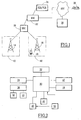
- a telecommunications network is shown for cellular mobile stations. This network is subdivided into geographic areas called cells.
- the cells are generally grouped into geographic areas, called local areas.
- Each cell has a base station 14 and 16, generally called BTS, which communicates by radio waves with mobile devices 18 located in the cell or possibly in the neighboring cells.
- BTS base station 14 and 16
- mobile devices 18 located in the cell or possibly in the neighboring cells.
- the BTS 14 and 16 base stations are connected to a base station 20 (BSC), itself connected to a switching center for mobile services 22 (MSC) capable of performing all switching necessary to establish a telephone connection between a mobile device located in a cell and a mobile device located in another cell.
- BSC base station 20
- MSC switching center for mobile services 22
- Each mobile services switching center 22 is associated with a nominal location recorder (HLR) and a location of visitors passing through a cell (VLR).
- HLR nominal location recorder
- VLR location of visitors passing through a cell
- These recorders consist of one or more databases data 24.
- the HLR nominal location recorder manages the all of the mobile devices 18 assigned to it, that is to say mobile devices 18 whose nominal location is in cells 10 and 12 corresponding to the HLR recorder.
- the HLR recorder contains an identification code of each mobile assigned to it and information relating to the position in real-time of this mobile device 18, that is to say, for example, information indicating the cell in which this device is located.
- the VLR recorder contains a list of mobile devices passing through an area separate from the area to which they are assigned.
- a mobile device 18 is activated, that is to say on or put in standby, a communication is established between this device and the network, so that the cell in which it is located is identified.
- the MSC 22 mobile services switching center is therefore in able to carry out all the switching required to route a call between two mobile devices regardless of their position.
- the switching center MSC 22 is also connected to the PSTN switched telephone network which incorporates, as is conventional, a set of telephone sets, such as 26.
- the location system comprises a server center 28 can be called by a user using a telephone set fixed or mobile.
- this center server is connected to the switched telephone network.
- the server center is constituted by a conventional server. He ... not will therefore not be described in detail below. Note, however, that it incorporates all software means suitable for interrogating directly or indirectly a mobile device 18 in order to obtain information relating to its position, for example in response to a request made by a user, and particular the indication of the cell in which the device is located, and for provide this indication to the user, for example by text-to-speech.
- a user using a landline telephone or mobile, dial the telephone number of the server center 28 so that establish a telephone connection with it, followed by a number indicating the mobile station sought.
- the server 28 establishes communication with a data center. switching of mobile services MSC 22 so as to interrogate the HLR nominal location register to retrieve, in response, the indication of the cell in which the device 18 is located. Information collected are then processed at the server center 28 in order to convert the information indicating the cell identified as information understandable by the user, this converted information then being retransmitted to the user's telephone set.
- the server 28 interrogates the nearest MSC.
- any type of device mobile comprising, at least, a transmitter adapted to communicate with the telephone network base stations, and in particular a telephone mobile phone.
- the mobile station and a “trace” type station that is to say that it includes means of integrated localization incorporating specific software allowing it to know the cell in which it is located
- the host interrogates directly this mobile station, and not through the switching MSC 22 and the HLR recorder. It thus recovers directly the indication of the cell in which the station is located.
- FIG 2 there is shown the block diagram of an example of mobile telephone set capable of being located by means of a localization according to the invention.
- station 18 mainly comprises a microcontroller 30 to which peripheral devices 32, 34 are connected and 36, consisting respectively of a display, a keyboard and a vocoder, even associated with a microphone 38 and an earpiece 40.
- the microcontroller 30 is also connected to a transmitter 42 and a receiver 44 of radio waves.
- a battery 46 supplies the microcontroller 30 as well as all the elements of the telephone set.
- this position can be supplemented by a receiver of a global positioning system (GPS), designated by the reference general digital 48, connected to microcontroller 30.
- GPS global positioning system
- the mobile station 18 has location information complementary, with an accuracy of around fifty meters. In response to a call from mobile station 18 by server 28, this information are transmitted to the user's telephone set 26.
- This embodiment has the advantage of allowing localization relatively precise mobile station 18. It is advantageous in the case where the cell in which the position is located covers a geographic area relatively extensive.
- the system which has just been described does not work only when the device to be located is switched on or is in standby.
- the station 18 can be provided with an activation device 50 connected to the microcontroller 30 and, if necessary, to the transmitter and to the GPS receiver 48.
- this activation device 50 is constituted by a product of unilateral radio messaging (RMU).
- RMU unilateral radio messaging
- FIG. 3 it mainly comprises a microcontroller 52 connected to a receiver 54 capable of receiving waves emitted by base stations 14 and 16, to a display 56 provided with its commands 58 and 60 and a bell 62.
- the microcontroller 52 is connected to the microcontroller 30 of the station mobile 18 and, if necessary, to the receiver 48 of the positioning system global GPS.
- This activation device 50 has a simplified structure and therefore less consumption. Its autonomy is therefore much greater than that of the mobile station to which it is connected.
- the server center 28 directly calls the activation device 50.
- the latter in response, controls the activation of the mobile station 18 so as to what it can be located in the network.
- location information is transmitted to the host 28, as mentioned previously.
- the server center 28 After receiving this information, the server center 28 transmits to the activation device a command to cut off the power to the mobile station 18. Consequently, only the activation device 50 remains on standby.
- microcontroller 30 of the mobile station 18 of an algorithm capable of causing its periodic standby so that the network is periodically able to know the position of position 18, the information or location being retransmitted to the user's station, in response to the call from the center server by the latter.
- the mobile station 18 can include, stored in memory, the number call center 28.
- a specific touch can be provided on the keyboard of the mobile station so as to automatically establish communication with the host.
- This communication is considered by the latter as a call from relief.
- the mobile station 18 From the location of the mobile station 18, it is possible to initiate appropriate rescue procedures.
- this station could be connected to the battery of a motor vehicle.
- the location system to determine the position of a post cell phone.
- the invention also applies to the location of any portable device with a transmitter capable of establishing a communication with the base stations of the telephone network.
- the device can be arranged in the form a box incorporating only a radio wave transmitter entering communication with base stations. It can thus be presented under a very compact shape.
- the mobile device can be in the form of a accessory, such as keychain, pin, ...
- the caller sends a signal interrogation to the device which returns, via the server, its contact details localization, according to the process indicated above.
Landscapes
- Engineering & Computer Science (AREA)
- Computer Networks & Wireless Communication (AREA)
- Signal Processing (AREA)
- Mobile Radio Communication Systems (AREA)
Abstract
Description
- le réseau de mobiles comprenant des contrôleurs de stations de base avec lesquels communiquent les stations de base et qui sont raccordés à des commutateurs associés à un enregistreur de localisation nominale et à un enregistreur de localisation de postes mobiles de passage dans une cellule, le centre serveur comprend des moyens pour interroger au moins l'un desdits enregistreurs, par l'intermédiaire de l'un desdits commutateurs, pour récupérer, en réponse, l'indication de la cellule dans laquelle se situe l'appareil,
- l'appareil comportant en outre un récepteur d'ondes radio adapté pour recevoir les ondes radio émises par une station de base, et des moyens d'identification de la cellule dans laquelle il se situe, le centre serveur comporte des moyens pour établir une liaison téléphonique avec l'appareil et pour interroger les moyens d'identification pour récupérer, en réponse, l'indication de la cellule dans laquelle se situe l'appareil,
- l'appareil étant en outre muni d'un récepteur d'un système de positionnement global, le centre serveur comporte des moyens pour récupérer les informations de positionnement délivrées par le système de positionnement global,
- l'appareil comporte un poste téléphonique mobile,
- l'appareil comporte en outre un dispositif d'activation du poste téléphonique mobile, comprenant un récepteur d'ondes radio adapté pour recevoir les ondes radio émises par une station de base et raccordé à une unité centrale de traitement adaptée pour l'activation dudit appareil, en réponse à un appel du dispositif, par le centre serveur,
- le dispositif d'activation est constitué par un dispositif de radio-messagerie unilatérale.
- la figure 1 représente schématiquement l'architecture d'un réseau de télécommunications permettant la localisation d'un appareil ;
- la figure 2 est un schéma synoptique montrant schématiquement la structure d'un exemple d'un appareil localisable au moyen d'un système selon l'invention ; et
- la figure 3 est un schéma synoptique du dispositif d'activation de cet appareil.
Claims (9)
- Système de localisation d'un appareil (18) mobile muni de moyens (42) pour communiquer avec un réseau téléphonique cellulaire de mobiles, ledit réseau téléphonique cellulaire comportant des moyens (24) pour enregistrer des informations de positionnement pour chaque appareil mobile tel que l'appareil mobile (18), ledit système comprenant un centre serveur (28) interrogeable au moyen d'un poste téléphonique (26) raccordé audits moyens d'enregistrement (24), caractérisé en ce que le centre serveur (28) est adapté pour interroger le moyen d'enregistrement (24) de façon à récupérer, en réponse, des informations de positionnement de l'appareil (18) dans le réseau téléphonique.
- Système selon la revendication 1, caractérisé en ce que le réseau de mobiles comprenant des contrôleurs de station de base (20) avec lesquels communiquent les stations de base (14, 16) et qui sont raccordés à des commutateurs (22) associés à un enregistreur de localisation nominale (HLR) et à un enregistreur (VLR) de localisation de postes mobiles de passage dans une cellule; le centre serveur (28) comprend des moyens pour interroger au moins l'un desdits enregistreurs (22), par l'intermédiaire de l'un desdits commutateurs, pour récupérer, en réponse, l'indication de la cellule dans laquelle se situe l'appareil (18).
- Système selon l'une quelconque des revendications précédentes caractérisé en ce que l'appareil comporte un poste téléphonique mobile (18).
- Système selon la revendication 3, caractérisé en ce que l'appareil comporte en outre un dispositif (50) d'activation du poste téléphonique (18), comprenant un récepteur (54) d'ondes radio, adapté pour recevoir les ondes radio émises par une station de base et raccordé à une unité centrale de traitement (52) adaptée pour l'activation dudit appareil, en réponse à un appel du dispositif, par le centre serveur (28).
- Système selon la revendication 4, caractérisé en ce que le dispositif d'activation (50) est constitué par un dispositif de radio-messagerie unilatérale.
- Appareil mobile pour système de localisation selon l'une quelconque des revendications précédentes, caractérisé en ce qu'il est constitué par un émetteur d'ondes radio adapté pour entrer en communication avec des stations de base (20) d'un réseau cellulaire de télécommunication, disposé dans un boítier.
- Procédé de localisation d'un appareil mobile (18) muni au moins d'un émetteur (42) d'ondes radio, au moyen d'un réseau téléphonique de mobiles comprenant un ensemble de cellules (10, 12) dotées chacune d'une station de base (14, 16), l'appareil étant adapté pour communiquer avec chacune desdites stations, caractérisé en ce qu'il comporte les étapes suivantes :appel d'un centre serveur (28) au moyen d'un poste téléphonique (26);interrogation indirecte de l'appareil (18), par le centre-serveur (28), pour obtenir, en réponse, des informations de positionnement de l'appareil ; ettransmission des informations de positionnement récupérées, vers le poste téléphonique.
- Procédé selon la revendication 7, caractérisé en ce que préalablement à l'interrogation de l'appareil, on procède à son activation par pilotage d'un dispositif d'activation (50) de cet appareil (18).
- Procédé selon l'une quelconque des revendications 7 à 8, caractérisé en ce que l'interrogation indirecte de l'appareil (18) est réalisée périodiquement, les informations de localisation étant transmises en réponse à l'appel du centre serveur (28).
Applications Claiming Priority (2)
| Application Number | Priority Date | Filing Date | Title |
|---|---|---|---|
| FR9916788 | 1999-12-30 | ||
| FR9916788A FR2803479B1 (fr) | 1999-12-30 | 1999-12-30 | Systeme et procede de localisation d'un appareil mobile, et appareil mobile pour un tel systeme |
Publications (1)
| Publication Number | Publication Date |
|---|---|
| EP1113692A1 true EP1113692A1 (fr) | 2001-07-04 |
Family
ID=9554095
Family Applications (1)
| Application Number | Title | Priority Date | Filing Date |
|---|---|---|---|
| EP00403690A Withdrawn EP1113692A1 (fr) | 1999-12-30 | 2000-12-27 | Système et procédé de localisation d'un appareil mobile, et appareil mobile pour un tel système |
Country Status (2)
| Country | Link |
|---|---|
| EP (1) | EP1113692A1 (fr) |
| FR (1) | FR2803479B1 (fr) |
Citations (2)
| Publication number | Priority date | Publication date | Assignee | Title |
|---|---|---|---|---|
| WO1996026614A1 (fr) * | 1995-02-24 | 1996-08-29 | Global Locating Systems, Inc. | Dispositif de localisation et systeme utilisant des technologies cellulaires |
| WO1998052379A1 (fr) * | 1997-05-16 | 1998-11-19 | Telefonaktiebolaget Lm Ericsson | Protection de l'integrite dans un systeme de telecommunications |
-
1999
- 1999-12-30 FR FR9916788A patent/FR2803479B1/fr not_active Expired - Fee Related
-
2000
- 2000-12-27 EP EP00403690A patent/EP1113692A1/fr not_active Withdrawn
Patent Citations (2)
| Publication number | Priority date | Publication date | Assignee | Title |
|---|---|---|---|---|
| WO1996026614A1 (fr) * | 1995-02-24 | 1996-08-29 | Global Locating Systems, Inc. | Dispositif de localisation et systeme utilisant des technologies cellulaires |
| WO1998052379A1 (fr) * | 1997-05-16 | 1998-11-19 | Telefonaktiebolaget Lm Ericsson | Protection de l'integrite dans un systeme de telecommunications |
Also Published As
| Publication number | Publication date |
|---|---|
| FR2803479B1 (fr) | 2002-05-17 |
| FR2803479A1 (fr) | 2001-07-06 |
Similar Documents
| Publication | Publication Date | Title |
|---|---|---|
| CA1260068A (fr) | Systeme de radiotelephone, notamment pour vehicule automobile | |
| EP0460486B1 (fr) | Procédé de maintenance centralisée, pour un réseau de téléphonie sans fil | |
| EP0072270B1 (fr) | Système enregistreur de perturbations | |
| EP0236180B1 (fr) | Système de communications téléphoniques à combinés portatifs | |
| FR2759237A1 (fr) | Procede et dispositif permettant l'utilisation de systemes de localisation evolues dans des reseaux de communication cellulaire | |
| FR2547141A1 (fr) | Dispositif portatif autonome pour la surveillance d'une zone locale choisie | |
| CN109545224A (zh) | 用于提供反馈的方法和装置 | |
| EP2091017A1 (fr) | Procédé de traçabilité d'un terminal de paiement électronique, en cas de vol de ce dernier, programme d'ordinateur et terminal correspondants | |
| FR2723458A1 (fr) | Dispositif electronique portatif de restitution de signaux sonores multifonctions, notamment applique a l'information des usagers des transports en commun. | |
| FR2805696A1 (fr) | Procede pour echanger, en temps reel ou quasi reel, des informations, notamment des messages ecrits ou des messages audio, entre plusieurs membres d'une population de personnes | |
| FR2803479A1 (fr) | Systeme et procede de localisation d'un appareil mobile, et appareil mobile pour un tel systeme | |
| FR2864279A1 (fr) | Procede pour ajouter des donnees de caracterisation pendant une saisie d'image | |
| EP0978194B1 (fr) | Procede et systeme de radio telephone mobile et terminal utilisable dans un tel system | |
| FR2847416A1 (fr) | Deverrouillage de service pour un dispositif de telecommunications sans fil | |
| EP1802159A1 (fr) | Procédé de configuration d'un terminal mobile en fonction de sa position géographique, et terminal le mettant en oeuvre | |
| EP0098201A2 (fr) | Poste téléphonique universel avec touches de fonctions personnalisables | |
| WO2013007903A2 (fr) | Procede de detection de presence de defibrillateur automatique et dispositif de detection de presence de defibrillateur automatique | |
| FR2484177A1 (fr) | Appareil automatique de transmission d'alarmes par le reseau telephonique autocommute | |
| WO2001082639A1 (fr) | Installation et procede pour l'echange d'informations entre des telephones et des fournisseurs de services | |
| CN100588283C (zh) | 基于gsm/cdma无线公用网监控设备运行的方法和装置 | |
| CA3177395C (fr) | Gestion de l'alimentation electrique par cable ethernet | |
| EP1168785B1 (fr) | Réseau local de téléphonie radio et base radio économique pour ledit réseau | |
| EP0959605A1 (fr) | Combiné téléphonique et appareil téléphonique pour faciliter l'accès aux dispositifs répondeurs | |
| FR2718592A1 (fr) | Dispositif répondeur téléphonique. | |
| WO2000065552A1 (fr) | Dispositif d'appel de detresse |
Legal Events
| Date | Code | Title | Description |
|---|---|---|---|
| PUAI | Public reference made under article 153(3) epc to a published international application that has entered the european phase |
Free format text: ORIGINAL CODE: 0009012 |
|
| AK | Designated contracting states |
Kind code of ref document: A1 Designated state(s): AT BE CH CY DE DK ES FI FR GB GR IE IT LI LU MC NL PT SE TR |
|
| AX | Request for extension of the european patent |
Free format text: AL;LT;LV;MK;RO;SI |
|
| 17P | Request for examination filed |
Effective date: 20011224 |
|
| AKX | Designation fees paid |
Free format text: AT BE CH CY DE DK ES FI FR GB GR IE IT LI LU MC NL PT SE TR |
|
| 17Q | First examination report despatched |
Effective date: 20050331 |
|
| STAA | Information on the status of an ep patent application or granted ep patent |
Free format text: STATUS: THE APPLICATION HAS BEEN WITHDRAWN |
|
| 18W | Application withdrawn |
Effective date: 20050817 |