EP1113606A2 - Method of disseminating broadcast information - Google Patents
Method of disseminating broadcast information Download PDFInfo
- Publication number
- EP1113606A2 EP1113606A2 EP00310258A EP00310258A EP1113606A2 EP 1113606 A2 EP1113606 A2 EP 1113606A2 EP 00310258 A EP00310258 A EP 00310258A EP 00310258 A EP00310258 A EP 00310258A EP 1113606 A2 EP1113606 A2 EP 1113606A2
- Authority
- EP
- European Patent Office
- Prior art keywords
- category
- frame
- frames
- user
- meta
- Prior art date
- Legal status (The legal status is an assumption and is not a legal conclusion. Google has not performed a legal analysis and makes no representation as to the accuracy of the status listed.)
- Granted
Links
Images



Classifications
-
- H—ELECTRICITY
- H04—ELECTRIC COMMUNICATION TECHNIQUE
- H04L—TRANSMISSION OF DIGITAL INFORMATION, e.g. TELEGRAPHIC COMMUNICATION
- H04L12/00—Data switching networks
- H04L12/02—Details
- H04L12/16—Arrangements for providing special services to substations
- H04L12/18—Arrangements for providing special services to substations for broadcast or conference, e.g. multicast
- H04L12/1859—Arrangements for providing special services to substations for broadcast or conference, e.g. multicast adapted to provide push services, e.g. data channels
-
- H—ELECTRICITY
- H04—ELECTRIC COMMUNICATION TECHNIQUE
- H04H—BROADCAST COMMUNICATION
- H04H20/00—Arrangements for broadcast or for distribution combined with broadcast
- H04H20/16—Arrangements for broadcast or for distribution of identical information repeatedly
-
- H—ELECTRICITY
- H04—ELECTRIC COMMUNICATION TECHNIQUE
- H04H—BROADCAST COMMUNICATION
- H04H60/00—Arrangements for broadcast applications with a direct linking to broadcast information or broadcast space-time; Broadcast-related systems
- H04H60/02—Arrangements for generating broadcast information; Arrangements for generating broadcast-related information with a direct linking to broadcast information or to broadcast space-time; Arrangements for simultaneous generation of broadcast information and broadcast-related information
- H04H60/07—Arrangements for generating broadcast information; Arrangements for generating broadcast-related information with a direct linking to broadcast information or to broadcast space-time; Arrangements for simultaneous generation of broadcast information and broadcast-related information characterised by processes or methods for the generation
-
- H—ELECTRICITY
- H04—ELECTRIC COMMUNICATION TECHNIQUE
- H04H—BROADCAST COMMUNICATION
- H04H60/00—Arrangements for broadcast applications with a direct linking to broadcast information or broadcast space-time; Broadcast-related systems
- H04H60/68—Systems specially adapted for using specific information, e.g. geographical or meteorological information
- H04H60/73—Systems specially adapted for using specific information, e.g. geographical or meteorological information using meta-information
-
- H—ELECTRICITY
- H04—ELECTRIC COMMUNICATION TECHNIQUE
- H04N—PICTORIAL COMMUNICATION, e.g. TELEVISION
- H04N21/00—Selective content distribution, e.g. interactive television or video on demand [VOD]
- H04N21/20—Servers specifically adapted for the distribution of content, e.g. VOD servers; Operations thereof
- H04N21/25—Management operations performed by the server for facilitating the content distribution or administrating data related to end-users or client devices, e.g. end-user or client device authentication, learning user preferences for recommending movies
- H04N21/262—Content or additional data distribution scheduling, e.g. sending additional data at off-peak times, updating software modules, calculating the carousel transmission frequency, delaying a video stream transmission, generating play-lists
- H04N21/26266—Content or additional data distribution scheduling, e.g. sending additional data at off-peak times, updating software modules, calculating the carousel transmission frequency, delaying a video stream transmission, generating play-lists for determining content or additional data repetition rate, e.g. of a file in a DVB carousel according to its importance
-
- H—ELECTRICITY
- H04—ELECTRIC COMMUNICATION TECHNIQUE
- H04N—PICTORIAL COMMUNICATION, e.g. TELEVISION
- H04N21/00—Selective content distribution, e.g. interactive television or video on demand [VOD]
- H04N21/20—Servers specifically adapted for the distribution of content, e.g. VOD servers; Operations thereof
- H04N21/25—Management operations performed by the server for facilitating the content distribution or administrating data related to end-users or client devices, e.g. end-user or client device authentication, learning user preferences for recommending movies
- H04N21/262—Content or additional data distribution scheduling, e.g. sending additional data at off-peak times, updating software modules, calculating the carousel transmission frequency, delaying a video stream transmission, generating play-lists
- H04N21/26291—Content or additional data distribution scheduling, e.g. sending additional data at off-peak times, updating software modules, calculating the carousel transmission frequency, delaying a video stream transmission, generating play-lists for providing content or additional data updates, e.g. updating software modules, stored at the client
-
- H—ELECTRICITY
- H04—ELECTRIC COMMUNICATION TECHNIQUE
- H04N—PICTORIAL COMMUNICATION, e.g. TELEVISION
- H04N21/00—Selective content distribution, e.g. interactive television or video on demand [VOD]
- H04N21/40—Client devices specifically adapted for the reception of or interaction with content, e.g. set-top-box [STB]; Operations thereof
- H04N21/41—Structure of client; Structure of client peripherals
- H04N21/414—Specialised client platforms, e.g. receiver in car or embedded in a mobile appliance
- H04N21/41407—Specialised client platforms, e.g. receiver in car or embedded in a mobile appliance embedded in a portable device, e.g. video client on a mobile phone, PDA, laptop
-
- H—ELECTRICITY
- H04—ELECTRIC COMMUNICATION TECHNIQUE
- H04N—PICTORIAL COMMUNICATION, e.g. TELEVISION
- H04N21/00—Selective content distribution, e.g. interactive television or video on demand [VOD]
- H04N21/40—Client devices specifically adapted for the reception of or interaction with content, e.g. set-top-box [STB]; Operations thereof
- H04N21/47—End-user applications
- H04N21/482—End-user interface for programme selection
-
- H—ELECTRICITY
- H04—ELECTRIC COMMUNICATION TECHNIQUE
- H04N—PICTORIAL COMMUNICATION, e.g. TELEVISION
- H04N21/00—Selective content distribution, e.g. interactive television or video on demand [VOD]
- H04N21/60—Network structure or processes for video distribution between server and client or between remote clients; Control signalling between clients, server and network components; Transmission of management data between server and client, e.g. sending from server to client commands for recording incoming content stream; Communication details between server and client
- H04N21/61—Network physical structure; Signal processing
- H04N21/6106—Network physical structure; Signal processing specially adapted to the downstream path of the transmission network
- H04N21/6125—Network physical structure; Signal processing specially adapted to the downstream path of the transmission network involving transmission via Internet
-
- H—ELECTRICITY
- H04—ELECTRIC COMMUNICATION TECHNIQUE
- H04H—BROADCAST COMMUNICATION
- H04H20/00—Arrangements for broadcast or for distribution combined with broadcast
- H04H20/65—Arrangements characterised by transmission systems for broadcast
- H04H20/76—Wired systems
- H04H20/82—Wired systems using signals not modulated onto a carrier
-
- H—ELECTRICITY
- H04—ELECTRIC COMMUNICATION TECHNIQUE
- H04L—TRANSMISSION OF DIGITAL INFORMATION, e.g. TELEGRAPHIC COMMUNICATION
- H04L51/00—User-to-user messaging in packet-switching networks, transmitted according to store-and-forward or real-time protocols, e.g. e-mail
- H04L51/21—Monitoring or handling of messages
- H04L51/212—Monitoring or handling of messages using filtering or selective blocking
Definitions
- the present invention generally relates to user controlled selection and filtration of broadcast information for viewing and in particular to user selection of serially broadcast information which repeatedly cycles.
- Contemporary real-time dissemination of information to large numbers of recipients generally occurs through radio and television broadcasts.
- the content and timing of the information is typically at the discretion of the broadcaster, with the recipients only having the option of selecting a particular channel.
- “Webcasting” or broadcasting real-time on the Internet, and particularly with the increase of wireless devices, such as handheld organizers and mobile telephones, which are capable of providing mobile access to the Internet
- a user entering a grocery store with a handheld device may receive, from a localized transmitter operated by the store, information regarding the store and the items which the grocery store sells.
- the broadcast information may be, for instance, the content of the grocery store's Web site, the pages of which are repeatedly, serially broadcast.
- the pages may include, for example, a page providing search capabilities on the shelf location, price, and nutritional information of items which the store sells.
- the user may wish to view only that search page in order to retrieve data relevant to item(s) in which she is interested, or only information regarding a specified list of items and any special discounts which the grocery store may currently offer.
- the data received by the handheld device in this example is in an architected format readily retrievable for consumption by the user in a preferred form (e.g., display, audio playback, etc.).
- wireless handheld devices currently introduce a number of limitations which must be overcome, including: capability to receive only low- bandwidth transmissions; limited storage; varying capabilities among devices (Palm Pilot, Win CE, etc.); and low processor speed.
- broadcast of information to multiple recipients over shared transmission media does not generally permit customization of broadcast content to individual users or communication of requests from the user(s) to the broadcast device.
- a method of disseminating information comprising: forming one or more category frames containing data for user-selectable categories; forming a meta frame identifying the user-selectable categories corresponding to the one or more category frames; and transmitting broadcast information including the meta frame and the one or more category frames in sequence on a common transmission media shared by a plurality of users.
- broadcast information is classified in categories to facilitate user selection and filtration of the broadcast information which is processed for presentation to the user.
- the broadcast information is transmitted in the form of a meta frame and one or more category frames which are repeated in a continuous cycle.
- Meta frames and category frames are distinguished and identified by major and minor codes following a frame starting delimiter.
- the meta frame contains a description of each of the available categories, together with an identification of respective category major and minor codes, the frequency on which the respective category frame is transmitted if multiple frequencies are employed, and the relative position of the respective category frame within transmission cycle. If multiple frequencies are employed, the meta frame may be repeatedly broadcast on a base frequency while subsets of the category frames are transmitted on different frequencies, or the meta and category frames may be repeated in sequence on all frequencies but with varying offsets.
- the category information within the meta frame is employed to construct or key a filter for the broadcast information.
- the selected category frame data is received and added to a local database, formatted, and presented to the user.
- Data processing system network 102 includes one or more servers 104-106 and one or more clients 108-110 .
- Servers 104-106 and clients 108-110 exchange data, such as HyperText Transmission Protocol (HTTP) requests and responses or HyperText Markup Language (HTML) data and accompanying graphical image or sound data, through the Transmitter 112 in accordance with the known art, utilizing, for example, the Transmission Control Protocol/Internet Protocol (TCP/IP) for data transfers.
- HTTP HyperText Transmission Protocol
- HTTP HyperText Markup Language
- TCP/IP Transmission Control Protocol/Internet Protocol
- One or more clients within data processing system network 102 may be a wireless device such as a mobile telephone or a handheld organizer capable of receiving data on one or more defined frequencies in a predetermined format.
- Data from a server 104 to client 110 may be transmitted over conventional wireless networks connected to Transmitter 112 or from a localized transmitter coupled directly to server 104 and transmitting with a set range covering, for example, space occupied by an enterprise.
- existing wireless communication protocols and devices may be adapted for broadcast and reception of data in the manner described herein.
- Wireless device or client 110 receives information broadcast on a predefined frequency or band by server 104 and includes an application 114 enabling the user to selectively filter the broadcast information which is received.
- the selective filtration enables the wireless device or client 110 to display, play, or otherwise present to the user only user-selected portions of the broadcast information.
- the application 114 may be a browser application with the functionality described herein.
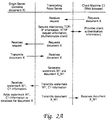
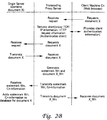
- FIGs 2A through 2C diagrams of a format for broadcasting information to wireless devices in a manner enabling users to selectively filter the broadcast information so that only user-selected portions of the broadcast information are presented to the user by a receiving device in accordance with a preferred embodiment of the present invention are illustrated.
- broadcast data continuously cycles, with either periodic or intermittent updates.
- Figure 2A illustrates the basic broadcast format contemplated, which includes within each cycle a master meta frame and a number of category frames.
- the master meta frame recurs at fixed intervals within each cycle, and contains information describing the format and timing of other frames within the cycle:
- the Major and Minor Codes immediately following the Starting Delimiter identify the frame as a meta frame.
- the Cycle Time indicates the length of time required to repeat a full cycle, which may vary with the number of category frames within a cycle.
- Each category frame 1 through n within the cycle is identified within the meta frame by name and major code (and optionally by Category Minor Code). If multiple frequencies are utilized, the frequency of the category frame is identified within the meta frame. The relative cycle position of the category frame within the cycle is also identified. Where multiple frequencies are employed, the start time for each frequency is specified.
- An error checking code such as a cyclic redundancy check (CRC) character may also be included within the meta frame.
- CRC cyclic redundancy check
- Category frames contain data, and may be preindexed to accelerate database access on the client.
- a suitable format for category frames is:
- the meta frame within each broadcast cycle is employed by the handheld device to present available categories to the user.
- the information regarding that category is employed to create a reception filter within the handheld device.
- the reception filter may simply be keyed, for a selected category, to the Major and/or Minor Codes of the category frame for the selected category. Frequency and timing information for the desired category frame may also be employed as part of the filter.
- the handheld device monitors monitors the broadcast frequency or frequencies to receive and process frames carrying the matching category major (and, optionally, minor) code.
- the received frames are stored in a data base on the handheld device for further parsing and presentation to the user.
- the meta frames are transmitted repeatedly on the base frequency fo, while the category frames are broadcast on extended frequencies fl through fn.
- a specific frequency may be employed for a category or a subset of categories.
- the handheld device alters the monitored frequency to listen for frames of the selected category.
- a given frequency fl or fn may be utilized to transmit only category frames for one category, repeated continuously.
- a particular frequency f2 may be employed to transmit frame for multiple categories in succession, with the sequence repeated continuously.
- the base frequency fo need not be reserved for the meta frames, but may also include interspersed category frames.
- each frequency should contain a unique subset of categories, which will then cycle more quickly and result in better data update latencies.
- the optimal allocation of meta and category frames to different frequencies may be determined at the time the content to be broadcast is specified, encoded within the meta frame, and dynamically updated as the broadcast content is altered.
- step 302 depicts detection of broadcast information for presentation on a handheld device.
- step 304 depicts searching for a meta frame within the broadcast data, identifying the meta frame by the major and minor codes.
- step 306 depicts determining whether the meta frame has been detected. If not, the process returns to step 304 to continuing watching for the meta frame. If so, however, the process proceeds instead to step 308 , which illustrates extracting the category information from the meta frame and presenting the available categories to the user for selection.
- step 310 depicts a determination of whether the user has selected a category for presentation. If not, the process remains at step 310 awaiting user selection of the categories available for display. If so, however, the process proceeds instead to step 312 , which illustrates extracting the selected category data, identified by the major and minor codes for the category selected by the user, from the broadcast data being received. Frequency hopping to a specified frequency bearing the selected category data, or bearing the selected category data at an offset closest to the user selection of the data.
- the selected category data once received, is added to the locally stored database, formatted for presentation to the user, and presented to the user, either by graphic display, audio playback, video playback, or some combination of all three.
- Display of selected category may, optionally, include monitoring the broadcast data for updates to the selected category data, identified by the sequence number of the category frame received. If update monitoring is enabled, the process proceeds next to step 314 , which depicts monitoring the broadcast information for an update to the selected category frame. If an updated category frame is detected, the process proceeds to step 316 , which illustrates extracting the updated category frame from the broadcast, updating the contents for the category within the database, formatting the extracted category frame for presentation to the user, and updating the display or other presentation device. In this manner, the present embodiment may be employed for real-time broadcasts (music, videos, etc.) with user selection of the content viewed or listened to from various alternatives.
- step 318 illustrates a determination of whether another category has been selected by the user.
- the available categories specified within the meta frame may be displayed to the user on the handheld device together with the content of the selected category frame, enabling the user to select a different category at any time.
- the categories displayed may be updated with any changes to the contents of the meta frame. If the user selects a different category, the process returns to step 312 , and extracts the category frame for the newly-selected category from the broadcast, adding the new category frame to handheld device's database, and formatting and presenting the new category data to the user.
- step 320 depicts a determination of whether the application executing within the handheld device which receives broadcast information has been terminated. If not, the process returns to step 314 (if enabled) or 316 , to determine if an update to the category frame has been received or if the user has selected a different category. If so, however, the process proceeds to step 322 , which illustrates the process becoming idle until the application is restarted and another broadcast is detected. The category frames extracted from the broadcast may be discarded.
- the present invention may be employed to enable user selection of information from a content server despite the inability to support client-server type requests from the receiving device.
- Content may be distributed among a number of users by broadcasting on a common frequency or band, or transmission on other common media.
- the present invention is well suited to selective filtration and receipt of information in handheld devices having low bandwidth reception capabilities, limited storage, low processor speed, and varying capabilities or devices. Additionally, the present invention lends itself to the offering of pay- per-view services. It is conceivable that the user may purchase a "key" (e.g., encryption key, frequency specifier, etc.) enabling access to the broadcast information.
- the software could require this key or code prior to receiving the broadcast data, with the key being changed at some predetermined interval.
Landscapes
- Engineering & Computer Science (AREA)
- Signal Processing (AREA)
- Multimedia (AREA)
- Databases & Information Systems (AREA)
- Computer Networks & Wireless Communication (AREA)
- General Engineering & Computer Science (AREA)
- Human Computer Interaction (AREA)
- Mobile Radio Communication Systems (AREA)
- Information Transfer Between Computers (AREA)
- Small-Scale Networks (AREA)
- Data Exchanges In Wide-Area Networks (AREA)
- Nitrogen And Oxygen Or Sulfur-Condensed Heterocyclic Ring Systems (AREA)
- Circuits Of Receivers In General (AREA)
- Two-Way Televisions, Distribution Of Moving Picture Or The Like (AREA)
- Radio Relay Systems (AREA)
- Electrochromic Elements, Electrophoresis, Or Variable Reflection Or Absorption Elements (AREA)
- Details Of Television Systems (AREA)
- Input Circuits Of Receivers And Coupling Of Receivers And Audio Equipment (AREA)
Abstract
Description
- The present invention generally relates to user controlled selection and filtration of broadcast information for viewing and in particular to user selection of serially broadcast information which repeatedly cycles.
- Contemporary real-time dissemination of information to large numbers of recipients generally occurs through radio and television broadcasts. The content and timing of the information is typically at the discretion of the broadcaster, with the recipients only having the option of selecting a particular channel. With the advent of "Webcasting," or broadcasting real-time on the Internet, and particularly with the increase of wireless devices, such as handheld organizers and mobile telephones, which are capable of providing mobile access to the Internet, user selection and/or filtration of the broadcast information received and presented to the user in a manner not requiring the use of "channels"--either real (e.g., frequency-based) or virtual (e.g., different addresses)--is necessary in light of market demands for user control over selection of the content which the user views.
- Excluding, momentarily, broadcast of information intended purely for entertainment, a variety of circumstances arise where dissemination of information to a broad range of users would benefit from user filtration of received data. For example, a user entering a grocery store with a handheld device may receive, from a localized transmitter operated by the store, information regarding the store and the items which the grocery store sells. The broadcast information may be, for instance, the content of the grocery store's Web site, the pages of which are repeatedly, serially broadcast. The pages may include, for example, a page providing search capabilities on the shelf location, price, and nutritional information of items which the store sells. The user may wish to view only that search page in order to retrieve data relevant to item(s) in which she is interested, or only information regarding a specified list of items and any special discounts which the grocery store may currently offer.
- The data received by the handheld device in this example is in an architected format readily retrievable for consumption by the user in a preferred form (e.g., display, audio playback, etc.). However, wireless handheld devices currently introduce a number of limitations which must be overcome, including: capability to receive only low- bandwidth transmissions; limited storage; varying capabilities among devices (Palm Pilot, Win CE, etc.); and low processor speed. Additionally, broadcast of information to multiple recipients over shared transmission media does not generally permit customization of broadcast content to individual users or communication of requests from the user(s) to the broadcast device.
- It would be desirable, therefore, to enable a user to select from information serially broadcast in continuous cycles for viewing.
- According to the present invention, there is provided a method of disseminating information, comprising: forming one or more category frames containing data for user-selectable categories; forming a meta frame identifying the user-selectable categories corresponding to the one or more category frames; and transmitting broadcast information including the meta frame and the one or more category frames in sequence on a common transmission media shared by a plurality of users.
- In an embodiment of the invention broadcast information is classified in categories to facilitate user selection and filtration of the broadcast information which is processed for presentation to the user. The broadcast information is transmitted in the form of a meta frame and one or more category frames which are repeated in a continuous cycle. Meta frames and category frames are distinguished and identified by major and minor codes following a frame starting delimiter. The meta frame contains a description of each of the available categories, together with an identification of respective category major and minor codes, the frequency on which the respective category frame is transmitted if multiple frequencies are employed, and the relative position of the respective category frame within transmission cycle. If multiple frequencies are employed, the meta frame may be repeatedly broadcast on a base frequency while subsets of the category frames are transmitted on different frequencies, or the meta and category frames may be repeated in sequence on all frequencies but with varying offsets. Upon user selection of a category, the category information within the meta frame is employed to construct or key a filter for the broadcast information. The selected category frame data is received and added to a local database, formatted, and presented to the user.
- An embodiment of the invention will now be described, by way of example, with reference to the accompanying drawings, in which:
- Figure 1 depicts a data processing system network in which a preferred embodiment of the present invention may be implemented;
- Figures 2A-2C are diagrams of a format for broadcasting information to wireless devices in a manner enabling users to selectively filter the broadcast information so that only user-selected portions of the broadcast information are presented to the user by a receiving device in accordance with a preferred embodiment of the present invention; and
- Figure 3 depicts a high level flowchart for a process of selectively filtering continuously cycled broadcast information for presentation to a user in accordance with a preferred embodiment of the present invention.
-
- With reference now to the figures, and in particular with reference to Figure 1, a data processing system network in which a preferred embodiment of the present invention may be implemented is depicted. Data
processing system network 102 includes one or more servers 104-106 and one or more clients 108-110. Servers 104-106 and clients 108-110 exchange data, such as HyperText Transmission Protocol (HTTP) requests and responses or HyperText Markup Language (HTML) data and accompanying graphical image or sound data, through theTransmitter 112 in accordance with the known art, utilizing, for example, the Transmission Control Protocol/Internet Protocol (TCP/IP) for data transfers. - One or more clients within data
processing system network 102, such asclient 110, may be a wireless device such as a mobile telephone or a handheld organizer capable of receiving data on one or more defined frequencies in a predetermined format. Data from a server 104 toclient 110 may be transmitted over conventional wireless networks connected to Transmitter 112 or from a localized transmitter coupled directly to server 104 and transmitting with a set range covering, for example, space occupied by an enterprise. In either case, existing wireless communication protocols and devices may be adapted for broadcast and reception of data in the manner described herein. - Wireless device or
client 110 receives information broadcast on a predefined frequency or band by server 104 and includes an application 114 enabling the user to selectively filter the broadcast information which is received. The selective filtration enables the wireless device orclient 110 to display, play, or otherwise present to the user only user-selected portions of the broadcast information. The application 114 may be a browser application with the functionality described herein. - Referring to Figures 2A through 2C, diagrams of a format for broadcasting information to wireless devices in a manner enabling users to selectively filter the broadcast information so that only user-selected portions of the broadcast information are presented to the user by a receiving device in accordance with a preferred embodiment of the present invention are illustrated. In the present embodiment, broadcast data continuously cycles, with either periodic or intermittent updates. Figure 2A illustrates the basic broadcast format contemplated, which includes within each cycle a master meta frame and a number of category frames.
- The master meta frame recurs at fixed intervals within each cycle, and contains information describing the format and timing of other frames within the cycle:
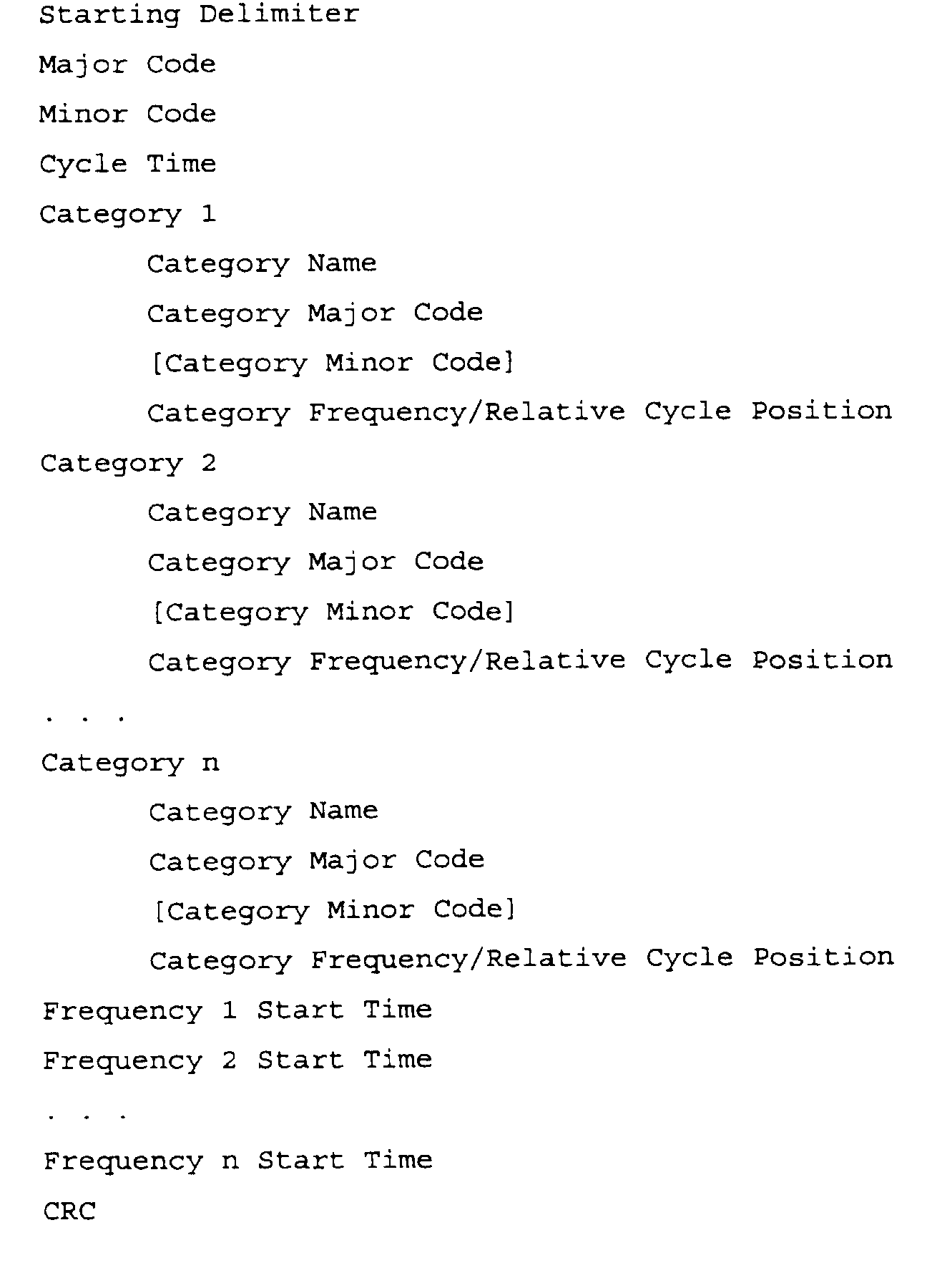
- The Major and Minor Codes immediately following the Starting Delimiter identify the frame as a meta frame. The Cycle Time indicates the length of time required to repeat a full cycle, which may vary with the number of category frames within a cycle. Each category frame 1 through n within the cycle is identified within the meta frame by name and major code (and optionally by Category Minor Code). If multiple frequencies are utilized, the frequency of the category frame is identified within the meta frame. The relative cycle position of the category frame within the cycle is also identified. Where multiple frequencies are employed, the start time for each frequency is specified. An error checking code such as a cyclic redundancy check (CRC) character may also be included within the meta frame. The format described is merely exemplary, intended to illustrate the types of information which should be included within a meta frame.
- Category frames contain data, and may be preindexed to accelerate database access on the client. A suitable format for category frames is:
- Starting Delimiter
- Major Code
- Minor Code
- Sequence Number
- Device Capabilities
- Data
- CRC
- Ending Delimiter The Major and Minor Codes within category frames allow the identity of the category frame as specified within the meta frame to be verified. The Sequence Number may be employed to replace out-of-date content for the category frame. For example, if the content of a category frame is updated, the Sequence Number within that category frame would be incremented to indicate to the receiving device not to utilize cached copies of the category frame, but to receive and utilize the updated version of the entry for its database. The Device Capabilities code specifies requirements of the frame such as color vs. grayscale, speech support, WinCE vs. Palm OS, etc. The same content tailored to different device capabilities in discrete category frames. The Data for a category frame is preferably transmitted in an architected encoding such as HTML which allows the client to generically decode and utilize the information.
-
- In operation, the meta frame within each broadcast cycle is employed by the handheld device to present available categories to the user. When the user selects a category of interest, the information regarding that category is employed to create a reception filter within the handheld device. The reception filter may simply be keyed, for a selected category, to the Major and/or Minor Codes of the category frame for the selected category. Frequency and timing information for the desired category frame may also be employed as part of the filter. Once the filter is created or keyed to the selected category, the handheld device monitors monitors the broadcast frequency or frequencies to receive and process frames carrying the matching category major (and, optionally, minor) code. The received frames are stored in a data base on the handheld device for further parsing and presentation to the user.
- In cases where a large amount of item data for a category needs to be broadcast, broadcast of the cycles of meta and category frames described above may need to be conducted across several frequencies in order to achieve the bandwidth necessary for acceptable throughput. It is envisioned that the meta frame record for each category will contain information on the different frequencies employed for broadcast, together with the relative position of category frames within each frequency broadcast cycle containing frames within the respective category. Two possible configurations for utilizing frequency/timing to achieve broadband throughput, illustrated in Figures 2B and 2C.
- In Figure 2B, the meta frames are transmitted repeatedly on the base frequency fo, while the category frames are broadcast on extended frequencies fl through fn. A specific frequency may be employed for a category or a subset of categories. After the user creates a filter identifying a desired category, the handheld device alters the monitored frequency to listen for frames of the selected category. A given frequency fl or fn may be utilized to transmit only category frames for one category, repeated continuously. Alternatively, a particular frequency f2 may be employed to transmit frame for multiple categories in succession, with the sequence repeated continuously. The base frequency fo need not be reserved for the meta frames, but may also include interspersed category frames. Preferably, however, each frequency should contain a unique subset of categories, which will then cycle more quickly and result in better data update latencies. The optimal allocation of meta and category frames to different frequencies may be determined at the time the content to be broadcast is specified, encoded within the meta frame, and dynamically updated as the broadcast content is altered.
- In Figure 2C, the same content is broadcast on all frequencies, but with varying offsets in timing. Each frequency will thus repeat cycles containing all meta and category frames, but in a manner staggered with respect to time and specified within the meta frame for each category. The handheld device may then utilize this information, along with clocking information in the meta frame, to determine which frequency to jump to in order to achieve the shortest delay before receiving the selected category information. Alternatively, a combination of the configurations of Figures 2B and 2C may be employed. For example, meta frames may be only broadcast on a base frequency f0 and all category frames may be broadcast in staggered fashion on extended frequencies fl through fn.
- With reference now to Figure 3, a high level flowchart for a process of selectively filtering continuously cycled broadcast information for presentation to a user in accordance with a preferred embodiment of the present invention is depicted. The process begins at
step 302, which depicts detection of broadcast information for presentation on a handheld device. The process first passes to step 304, which illustrates searching for a meta frame within the broadcast data, identifying the meta frame by the major and minor codes. The process then passes to step 306, which depicts determining whether the meta frame has been detected. If not, the process returns to step 304 to continuing watching for the meta frame. If so, however, the process proceeds instead to step 308, which illustrates extracting the category information from the meta frame and presenting the available categories to the user for selection. - The process passes next to step 310, which depicts a determination of whether the user has selected a category for presentation. If not, the process remains at
step 310 awaiting user selection of the categories available for display. If so, however, the process proceeds instead to step 312, which illustrates extracting the selected category data, identified by the major and minor codes for the category selected by the user, from the broadcast data being received. Frequency hopping to a specified frequency bearing the selected category data, or bearing the selected category data at an offset closest to the user selection of the data. The selected category data, once received, is added to the locally stored database, formatted for presentation to the user, and presented to the user, either by graphic display, audio playback, video playback, or some combination of all three. - Display of selected category may, optionally, include monitoring the broadcast data for updates to the selected category data, identified by the sequence number of the category frame received. If update monitoring is enabled, the process proceeds next to step 314, which depicts monitoring the broadcast information for an update to the selected category frame. If an updated category frame is detected, the process proceeds to step 316, which illustrates extracting the updated category frame from the broadcast, updating the contents for the category within the database, formatting the extracted category frame for presentation to the user, and updating the display or other presentation device. In this manner, the present embodiment may be employed for real-time broadcasts (music, videos, etc.) with user selection of the content viewed or listened to from various alternatives.
- If the update monitoring option has not been enabled, or if the category frame has not been updated since last extracted and presented to the user, the process proceeds instead to step 318, which illustrates a determination of whether another category has been selected by the user. The available categories specified within the meta frame may be displayed to the user on the handheld device together with the content of the selected category frame, enabling the user to select a different category at any time. The categories displayed may be updated with any changes to the contents of the meta frame. If the user selects a different category, the process returns to step 312, and extracts the category frame for the newly-selected category from the broadcast, adding the new category frame to handheld device's database, and formatting and presenting the new category data to the user.
- If the user has not selected a new category, however, the process proceeds instead to step 320, which depicts a determination of whether the application executing within the handheld device which receives broadcast information has been terminated. If not, the process returns to step 314 (if enabled) or 316, to determine if an update to the category frame has been received or if the user has selected a different category. If so, however, the process proceeds to step 322, which illustrates the process becoming idle until the application is restarted and another broadcast is detected. The category frames extracted from the broadcast may be discarded.
- The present invention may be employed to enable user selection of information from a content server despite the inability to support client-server type requests from the receiving device. Content may be distributed among a number of users by broadcasting on a common frequency or band, or transmission on other common media. The present invention is well suited to selective filtration and receipt of information in handheld devices having low bandwidth reception capabilities, limited storage, low processor speed, and varying capabilities or devices. Additionally, the present invention lends itself to the offering of pay- per-view services. It is conceivable that the user may purchase a "key" (e.g., encryption key, frequency specifier, etc.) enabling access to the broadcast information. The software could require this key or code prior to receiving the broadcast data, with the key being changed at some predetermined interval.
- It is important to note that while the present invention has been described in the context of a fully functional data processing system and/or network, those skilled in the art will appreciate that the mechanism of the present invention is capable of being distributed in the form of a computer usable medium of instructions in a variety of forms, and that the present invention applies equally regardless of the particular type of signal bearing medium used to actually carry out the distribution. Examples of computer usable mediums include: nonvolatile, hard-coded type mediums such as read only memories (ROMs) or erasable, electrically programmable read only (EEPROMs), recordable type mediums such as floppy disks, hard disk drives and CD-ROMs, and transmission type mediums such as digital and analog communication links.
Claims (11)
- A method of disseminating information, comprising:forming one or more category frames containing data for user-selectable categories;forming a meta frame identifying the user-selectable categories corresponding to the one or more category frames; andtransmitting broadcast information including the meta frame and the one or more category frames in sequence on a common transmission media shared by a plurality of users.
- The method of claim 1, further comprising:
responsive to receiving the meta frame and the one or more category frames at a device employed by one of the plurality of users, extracting category information from the meta frame and presenting the user-selectable categories to the user. - The method of claim 2, further comprising:
responsive to selection of a user-selectable category by the user,receiving a category frame corresponding to the user-selectable category from the one or more category frames,formatting data within the category frame for presentation to the user, andpresenting the data from the category frame to the user utilizing the device. - The method of claim 1, wherein the step of forming one or more category frames containing data for user-selectable categories further comprises:
forming each category frame with a starting delimiter identifying a start of the respective category frame, a major code identifying a category to which the respective category frame belongs, encoded data for the respective category frame, and an ending delimiter for the respective category frame. - The method of claim 1, wherein the step of forming a meta frame identifying the user-selectable categories corresponding to the one or more category frames further comprises:
forming the meta frame witha starting delimiter identifying a start of the meta frame,a major code identifying the meta frame,for each category corresponding to one of the one or more category frames,a category name for the respective category,a major code identifying the respective category to which the one of the one or more category frames belongs,position information specifying a position of the one of the one or more category frames within the broadcast information, andan ending delimiter identifying an end of the meta frame. - The method of claim 1, wherein the step of transmitting broadcast information including the meta frame and the one or more category frames in sequence on a common transmission media shared by a plurality of users further comprises:
transmitting the meta frame and the one or more category frames in repetitive succession in one or more continuous cycles on one or more frequencies. - The method of claim 6, wherein the step of transmitting the meta frame and the one or more category frames in repetitive succession in one or more continuous cycles on one or more frequencies further comprises:
transmitting the meta frame and the one or more category frames in repetitive succession in a single continuous cycle on a single frequency. - The method of claim 6, wherein the step of transmitting the meta frame and the one or more category frames in repetitive succession in one or more continuous cycles on one or more frequencies further comprises:transmitting the meta frame in repetitive succession on a first frequency; andtransmitting subsets of the one or more category frames in repetitive succession on one or more other frequencies, wherein a unique subset of the one or more category frames is transmitted on each of the one or more other frequencies.
- The method of claim 6, wherein the step of transmitting the meta frame and the one or more category frames in repetitive succession in one or more continuous cycles on one or more frequencies further comprises:
transmitting the meta frame and the one or more category frames in repetitive succession in a single continuous cycle on each of a plurality of frequencies at different offsets, wherein a different frame from the meta frame and the one or more category frames is transmitted at a given time on each frequency within the plurality of frequencies. - A system of disseminating information, comprising:means for forming one or more category frames containing data for user-selectable categories;means for forming a meta frame identifying the user- selectable categories corresponding to the one or more category frames; andmeans for transmitting broadcast information including the meta frame and the one or more category frames in sequence on a common transmission media shared by a plurality of users.
- A computer program product within a computer usable medium for disseminating information, comprising:instructions for forming one or more category frames containing data for user-selectable categories;instructions for forming a meta frame identifying the user-selectable categories corresponding to the one or more category frames; andinstructions for transmitting broadcast information including the meta frame and the one or more category frames in sequence on a common transmission media shared by a plurality of users.
Applications Claiming Priority (2)
| Application Number | Priority Date | Filing Date | Title |
|---|---|---|---|
| US09/467,418 US6968568B1 (en) | 1999-12-20 | 1999-12-20 | Methods and apparatus of disseminating broadcast information to a handheld device |
| US467418 | 1999-12-20 |
Publications (3)
| Publication Number | Publication Date |
|---|---|
| EP1113606A2 true EP1113606A2 (en) | 2001-07-04 |
| EP1113606A3 EP1113606A3 (en) | 2006-02-22 |
| EP1113606B1 EP1113606B1 (en) | 2010-05-12 |
Family
ID=23855616
Family Applications (1)
| Application Number | Title | Priority Date | Filing Date |
|---|---|---|---|
| EP00310258A Expired - Lifetime EP1113606B1 (en) | 1999-12-20 | 2000-11-17 | Method of disseminating broadcast information |
Country Status (8)
| Country | Link |
|---|---|
| US (1) | US6968568B1 (en) |
| EP (1) | EP1113606B1 (en) |
| JP (1) | JP3449355B2 (en) |
| CN (1) | CN1197299C (en) |
| AT (1) | ATE467956T1 (en) |
| DE (1) | DE60044389D1 (en) |
| SG (1) | SG90763A1 (en) |
| TW (1) | TW501351B (en) |
Cited By (1)
| Publication number | Priority date | Publication date | Assignee | Title |
|---|---|---|---|---|
| EP1988668A2 (en) | 2004-08-09 | 2008-11-05 | Samsung Electronics Co., Ltd | Method and apparatus for distinguishing between services provided in all frequency bands and services provided in a specific frequency band |
Families Citing this family (12)
| Publication number | Priority date | Publication date | Assignee | Title |
|---|---|---|---|---|
| US7849152B2 (en) * | 2002-06-07 | 2010-12-07 | Yahoo! Inc. | Method and system for controlling and monitoring a web-cast |
| JP3992551B2 (en) * | 2002-07-05 | 2007-10-17 | シャープ株式会社 | Receiving apparatus and content transmission system including the same |
| US7486637B2 (en) * | 2002-09-26 | 2009-02-03 | Interdigital Technology Corporation | Wireless communication method and system for efficiently managing paging windows and data messages |
| CN103096150B (en) * | 2003-10-28 | 2016-08-03 | 诺基亚技术有限公司 | Audio block |
| CN1798322B (en) * | 2004-12-20 | 2010-09-08 | 松下电器产业株式会社 | Data transmission system and method |
| US9602512B2 (en) | 2006-05-08 | 2017-03-21 | At&T Intellectual Property I, Lp | Methods and apparatus to distribute media delivery to mobile devices |
| US20070268406A1 (en) * | 2006-05-22 | 2007-11-22 | Broadcom Corporation, A California Corporation | Video processing system that generates sub-frame metadata |
| US9955122B2 (en) * | 2008-04-11 | 2018-04-24 | Mobitv, Inc. | Dynamic advertisement stream replacement |
| KR101539935B1 (en) * | 2008-06-24 | 2015-07-28 | 삼성전자주식회사 | Method and apparatus for processing 3D video image |
| WO2009157707A2 (en) * | 2008-06-24 | 2009-12-30 | Samsung Electronics Co,. Ltd. | Image processing method and apparatus |
| US20090317062A1 (en) * | 2008-06-24 | 2009-12-24 | Samsung Electronics Co., Ltd. | Image processing method and apparatus |
| CN119135616A (en) * | 2018-07-11 | 2024-12-13 | 华为技术有限公司 | Data transmission method and related device |
Family Cites Families (35)
| Publication number | Priority date | Publication date | Assignee | Title |
|---|---|---|---|---|
| US4965825A (en) | 1981-11-03 | 1990-10-23 | The Personalized Mass Media Corporation | Signal processing apparatus and methods |
| DE3436390A1 (en) | 1984-10-04 | 1986-04-10 | Heinz Georg Baus | PRODUCTION INFORMATION AND DISPLAY SYSTEM |
| US4973952A (en) | 1987-09-21 | 1990-11-27 | Information Resources, Inc. | Shopping cart display system |
| US4882724A (en) | 1987-10-14 | 1989-11-21 | Leo Vela | Shoppers communication system and processes relating thereto |
| JPH01190150A (en) | 1988-01-26 | 1989-07-31 | Nippon Telegr & Teleph Corp <Ntt> | Data broadcast system |
| US5195135A (en) * | 1991-08-12 | 1993-03-16 | Palmer Douglas A | Automatic multivariate censorship of audio-video programming by user-selectable obscuration |
| US5250789A (en) | 1991-10-31 | 1993-10-05 | Johnsen Edward L | Shopping cart |
| US6553178B2 (en) * | 1992-02-07 | 2003-04-22 | Max Abecassis | Advertisement subsidized video-on-demand system |
| US5847750A (en) * | 1993-07-09 | 1998-12-08 | Zenith Electronics Corporation | Method of accessing a repetitively transmitted video program |
| US5506904A (en) * | 1993-08-04 | 1996-04-09 | Scientific-Atlanta, Inc. | System and method for transmitting and receiving variable length authorization control for digital services |
| US5606359A (en) * | 1994-06-30 | 1997-02-25 | Hewlett-Packard Company | Video on demand system with multiple data sources configured to provide vcr-like services |
| JP3382021B2 (en) | 1994-08-12 | 2003-03-04 | 株式会社東芝 | Program search device and method |
| US5710815A (en) * | 1995-06-07 | 1998-01-20 | Vtech Communications, Ltd. | Encoder apparatus and decoder apparatus for a television signal having embedded viewer access control data |
| JPH099216A (en) | 1995-06-22 | 1997-01-10 | Sony Corp | Data receiving device and data receiving method |
| JPH098751A (en) | 1995-06-23 | 1997-01-10 | Lsi Japan Kk | Method and device for fetching and recording broadcast program |
| IL114965A (en) | 1995-08-17 | 2001-01-11 | Eldat Comm Ltd | System and method for providing a store customer with personally associated prices for selected items |
| US5918211A (en) | 1996-05-30 | 1999-06-29 | Retail Multimedia Corporation | Method and apparatus for promoting products and influencing consumer purchasing decisions at the point-of-purchase |
| US5821513A (en) | 1996-06-26 | 1998-10-13 | Telxon Corporation | Shopping cart mounted portable data collection device with tethered dataform reader |
| US5821512A (en) | 1996-06-26 | 1998-10-13 | Telxon Corporation | Shopping cart mounted portable data collection device with tethered dataform reader |
| JP3823422B2 (en) | 1997-03-05 | 2006-09-20 | ソニー株式会社 | Program management apparatus and program management method |
| US6047317A (en) * | 1997-03-28 | 2000-04-04 | International Business Machines Corporation | System and method for enabling a user to rapidly access images in cyclically transmitted image streams |
| JPH10327111A (en) * | 1997-05-26 | 1998-12-08 | Alpine Electron Inc | Program reception method for dab receiver |
| US6496228B1 (en) * | 1997-06-02 | 2002-12-17 | Koninklijke Philips Electronics N.V. | Significant scene detection and frame filtering for a visual indexing system using dynamic thresholds |
| JP3527068B2 (en) | 1997-06-24 | 2004-05-17 | 株式会社日立製作所 | Data distribution system |
| JPH11205764A (en) | 1998-01-16 | 1999-07-30 | Nec Corp | Broadcast signal receiver |
| JPH11239305A (en) | 1998-02-24 | 1999-08-31 | Sony Corp | Digital TV broadcast receiver |
| GB2377846B (en) * | 1998-06-12 | 2003-03-05 | British Sky Broadcasting Ltd | Improvements in receivers for television signals |
| KR100617896B1 (en) * | 1998-06-12 | 2006-09-05 | 코닌클리케 필립스 일렉트로닉스 엔.브이. | Transmission system |
| US6230162B1 (en) * | 1998-06-20 | 2001-05-08 | International Business Machines Corporation | Progressive interleaved delivery of interactive descriptions and renderers for electronic publishing of merchandise |
| US6356921B1 (en) * | 1998-06-20 | 2002-03-12 | International Business Machines Corporation | Framework for progressive hierarchial and adaptive delivery rich media presentations and associated meta data |
| JP2000068952A (en) | 1998-08-18 | 2000-03-03 | Sony Corp | Method and apparatus for receiving digital transmission signal |
| US6357042B2 (en) * | 1998-09-16 | 2002-03-12 | Anand Srinivasan | Method and apparatus for multiplexing separately-authored metadata for insertion into a video data stream |
| CN1178508C (en) * | 1999-06-07 | 2004-12-01 | 松下电器产业株式会社 | Data transmitting/receiving system and method thereof |
| JP2001008176A (en) | 1999-06-24 | 2001-01-12 | Matsushita Electric Ind Co Ltd | Broadcast receiver |
| JP2001134225A (en) | 1999-08-26 | 2001-05-18 | Toppan Printing Co Ltd | Advertising providing device and storage medium for the advertising providing device, exhibit, display panel, display case |
-
1999
- 1999-12-20 US US09/467,418 patent/US6968568B1/en not_active Expired - Fee Related
-
2000
- 2000-09-13 TW TW089118656A patent/TW501351B/en not_active IP Right Cessation
- 2000-11-17 AT AT00310258T patent/ATE467956T1/en not_active IP Right Cessation
- 2000-11-17 DE DE60044389T patent/DE60044389D1/en not_active Expired - Lifetime
- 2000-11-17 EP EP00310258A patent/EP1113606B1/en not_active Expired - Lifetime
- 2000-11-30 SG SG200007015A patent/SG90763A1/en unknown
- 2000-12-18 JP JP2000384276A patent/JP3449355B2/en not_active Expired - Fee Related
- 2000-12-19 CN CNB001359665A patent/CN1197299C/en not_active Expired - Fee Related
Non-Patent Citations (1)
| Title |
|---|
| None |
Cited By (2)
| Publication number | Priority date | Publication date | Assignee | Title |
|---|---|---|---|---|
| EP1988668A2 (en) | 2004-08-09 | 2008-11-05 | Samsung Electronics Co., Ltd | Method and apparatus for distinguishing between services provided in all frequency bands and services provided in a specific frequency band |
| EP1988668A3 (en) * | 2004-08-09 | 2008-12-03 | Samsung Electronics Co., Ltd | Method and apparatus for distinguishing between services provided in all frequency bands and services provided in a specific frequency band |
Also Published As
| Publication number | Publication date |
|---|---|
| CN1197299C (en) | 2005-04-13 |
| EP1113606B1 (en) | 2010-05-12 |
| SG90763A1 (en) | 2002-08-20 |
| JP3449355B2 (en) | 2003-09-22 |
| JP2001237830A (en) | 2001-08-31 |
| EP1113606A3 (en) | 2006-02-22 |
| US6968568B1 (en) | 2005-11-22 |
| DE60044389D1 (en) | 2010-06-24 |
| ATE467956T1 (en) | 2010-05-15 |
| TW501351B (en) | 2002-09-01 |
| CN1301098A (en) | 2001-06-27 |
Similar Documents
| Publication | Publication Date | Title |
|---|---|---|
| US6108706A (en) | Transmission announcement system and method for announcing upcoming data transmissions over a broadcast network | |
| JP4903047B2 (en) | Method and apparatus for organizing and reproducing data | |
| CA2806842C (en) | Transmission apparatus and method, reception apparatus and method and transmission and reception system | |
| EP1047005B1 (en) | Method et system for distributing information | |
| US6647389B1 (en) | Search engine to verify streaming audio sources | |
| JP5038295B2 (en) | Technologies and systems that support podcasting | |
| US6968568B1 (en) | Methods and apparatus of disseminating broadcast information to a handheld device | |
| JP4028469B2 (en) | Multimedia broadcast transmitting / receiving apparatus and method | |
| US6463469B1 (en) | Computer-based RDS/MBS receiver system for use with radio broadcast signal | |
| JP4780832B2 (en) | Advanced video programming system and method using local host for network communication | |
| NZ510983A (en) | Method for controlling a computer with an audio signal | |
| KR20100014821A (en) | Systems and methods for music recognition | |
| JP2004140584A (en) | Content distribution / reproduction system, advertisement content insertion method, and client terminal | |
| JP2006522524A (en) | Real-time synchronization of content viewer | |
| US20160381102A1 (en) | Media device and method of enhancing use of media device | |
| JP3986863B2 (en) | Information distribution system, information distribution method, and program for causing computer to execute the method | |
| EP1254549A2 (en) | Distribution of media data using low-level objects and locator tables containing information about the low level objects | |
| CN1781309B (en) | Method and arrangement for automatically searching information sources accessible through a network for contents satisfying predefined criteria | |
| KR100442095B1 (en) | broadcasting system and method through network | |
| JP2003179907A (en) | Program data distribution system and method | |
| KR102611253B1 (en) | Receiving devices, transmitting devices and data processing methods | |
| US20080256176A1 (en) | Internet radio system and the broadcasting method thereof | |
| US7278064B1 (en) | Information delivery system | |
| KR100851987B1 (en) | System for providing moving picture contents using url of web page and method thereof | |
| CA2577552A1 (en) | Program selection system for accessing streamed media content |
Legal Events
| Date | Code | Title | Description |
|---|---|---|---|
| PUAI | Public reference made under article 153(3) epc to a published international application that has entered the european phase |
Free format text: ORIGINAL CODE: 0009012 |
|
| AK | Designated contracting states |
Kind code of ref document: A2 Designated state(s): AT BE CH CY DE DK ES FI FR GB GR IE IT LI LU MC NL PT SE TR |
|
| AX | Request for extension of the european patent |
Free format text: AL;LT;LV;MK;RO;SI |
|
| PUAL | Search report despatched |
Free format text: ORIGINAL CODE: 0009013 |
|
| AK | Designated contracting states |
Kind code of ref document: A3 Designated state(s): AT BE CH CY DE DK ES FI FR GB GR IE IT LI LU MC NL PT SE TR |
|
| AX | Request for extension of the european patent |
Extension state: AL LT LV MK RO SI |
|
| RIC1 | Information provided on ipc code assigned before grant |
Ipc: H04N 7/173 20060101ALI20051230BHEP Ipc: H04H 1/00 20060101AFI20010512BHEP |
|
| 17P | Request for examination filed |
Effective date: 20060328 |
|
| AKX | Designation fees paid |
Designated state(s): AT BE CH CY DE DK ES FI FR GB GR IE IT LI LU MC NL PT SE TR |
|
| 17Q | First examination report despatched |
Effective date: 20061229 |
|
| GRAP | Despatch of communication of intention to grant a patent |
Free format text: ORIGINAL CODE: EPIDOSNIGR1 |
|
| REG | Reference to a national code |
Ref country code: DE Ref legal event code: R079 Ref document number: 60044389 Country of ref document: DE Free format text: PREVIOUS MAIN CLASS: H04H0001000000 Ipc: H04H0020160000 |
|
| RIC1 | Information provided on ipc code assigned before grant |
Ipc: H04H 20/16 20080101AFI20091210BHEP |
|
| GRAS | Grant fee paid |
Free format text: ORIGINAL CODE: EPIDOSNIGR3 |
|
| GRAA | (expected) grant |
Free format text: ORIGINAL CODE: 0009210 |
|
| AK | Designated contracting states |
Kind code of ref document: B1 Designated state(s): AT BE CH CY DE DK ES FI FR GB GR IE IT LI LU MC NL PT SE TR |
|
| REG | Reference to a national code |
Ref country code: GB Ref legal event code: FG4D |
|
| REG | Reference to a national code |
Ref country code: CH Ref legal event code: EP Ref country code: CH Ref legal event code: NV Representative=s name: IBM RESEARCH GMBH ZURICH RESEARCH LABORATORY INTEL |
|
| REG | Reference to a national code |
Ref country code: IE Ref legal event code: FG4D |
|
| REF | Corresponds to: |
Ref document number: 60044389 Country of ref document: DE Date of ref document: 20100624 Kind code of ref document: P |
|
| REG | Reference to a national code |
Ref country code: DE Ref legal event code: R096 Ref document number: 60044389 Country of ref document: DE Effective date: 20100624 |
|
| REG | Reference to a national code |
Ref country code: GB Ref legal event code: 746 Effective date: 20100628 |
|
| REG | Reference to a national code |
Ref country code: NL Ref legal event code: VDEP Effective date: 20100512 |
|
| PG25 | Lapsed in a contracting state [announced via postgrant information from national office to epo] |
Ref country code: NL Free format text: LAPSE BECAUSE OF FAILURE TO SUBMIT A TRANSLATION OF THE DESCRIPTION OR TO PAY THE FEE WITHIN THE PRESCRIBED TIME-LIMIT Effective date: 20100512 Ref country code: SE Free format text: LAPSE BECAUSE OF FAILURE TO SUBMIT A TRANSLATION OF THE DESCRIPTION OR TO PAY THE FEE WITHIN THE PRESCRIBED TIME-LIMIT Effective date: 20100512 Ref country code: ES Free format text: LAPSE BECAUSE OF FAILURE TO SUBMIT A TRANSLATION OF THE DESCRIPTION OR TO PAY THE FEE WITHIN THE PRESCRIBED TIME-LIMIT Effective date: 20100823 |
|
| PG25 | Lapsed in a contracting state [announced via postgrant information from national office to epo] |
Ref country code: AT Free format text: LAPSE BECAUSE OF FAILURE TO SUBMIT A TRANSLATION OF THE DESCRIPTION OR TO PAY THE FEE WITHIN THE PRESCRIBED TIME-LIMIT Effective date: 20100512 Ref country code: FI Free format text: LAPSE BECAUSE OF FAILURE TO SUBMIT A TRANSLATION OF THE DESCRIPTION OR TO PAY THE FEE WITHIN THE PRESCRIBED TIME-LIMIT Effective date: 20100512 |
|
| REG | Reference to a national code |
Ref country code: DE Ref legal event code: R084 Ref document number: 60044389 Country of ref document: DE Effective date: 20100610 |
|
| PG25 | Lapsed in a contracting state [announced via postgrant information from national office to epo] |
Ref country code: CY Free format text: LAPSE BECAUSE OF NON-PAYMENT OF DUE FEES Effective date: 20100512 Ref country code: GR Free format text: LAPSE BECAUSE OF FAILURE TO SUBMIT A TRANSLATION OF THE DESCRIPTION OR TO PAY THE FEE WITHIN THE PRESCRIBED TIME-LIMIT Effective date: 20100813 |
|
| PG25 | Lapsed in a contracting state [announced via postgrant information from national office to epo] |
Ref country code: DK Free format text: LAPSE BECAUSE OF FAILURE TO SUBMIT A TRANSLATION OF THE DESCRIPTION OR TO PAY THE FEE WITHIN THE PRESCRIBED TIME-LIMIT Effective date: 20100512 Ref country code: PT Free format text: LAPSE BECAUSE OF FAILURE TO SUBMIT A TRANSLATION OF THE DESCRIPTION OR TO PAY THE FEE WITHIN THE PRESCRIBED TIME-LIMIT Effective date: 20100913 |
|
| PG25 | Lapsed in a contracting state [announced via postgrant information from national office to epo] |
Ref country code: BE Free format text: LAPSE BECAUSE OF FAILURE TO SUBMIT A TRANSLATION OF THE DESCRIPTION OR TO PAY THE FEE WITHIN THE PRESCRIBED TIME-LIMIT Effective date: 20100512 |
|
| PLBE | No opposition filed within time limit |
Free format text: ORIGINAL CODE: 0009261 |
|
| STAA | Information on the status of an ep patent application or granted ep patent |
Free format text: STATUS: NO OPPOSITION FILED WITHIN TIME LIMIT |
|
| PG25 | Lapsed in a contracting state [announced via postgrant information from national office to epo] |
Ref country code: IT Free format text: LAPSE BECAUSE OF FAILURE TO SUBMIT A TRANSLATION OF THE DESCRIPTION OR TO PAY THE FEE WITHIN THE PRESCRIBED TIME-LIMIT Effective date: 20100512 |
|
| 26N | No opposition filed |
Effective date: 20110215 |
|
| REG | Reference to a national code |
Ref country code: DE Ref legal event code: R097 Ref document number: 60044389 Country of ref document: DE Effective date: 20110214 Ref country code: DE Ref legal event code: R097 Ref document number: 60044389 Country of ref document: DE Effective date: 20110215 |
|
| REG | Reference to a national code |
Ref country code: GB Ref legal event code: 732E Free format text: REGISTERED BETWEEN 20110602 AND 20110608 |
|
| PG25 | Lapsed in a contracting state [announced via postgrant information from national office to epo] |
Ref country code: MC Free format text: LAPSE BECAUSE OF NON-PAYMENT OF DUE FEES Effective date: 20101130 |
|
| REG | Reference to a national code |
Ref country code: CH Ref legal event code: PL Ref country code: DE Ref legal event code: R081 Ref document number: 60044389 Country of ref document: DE Owner name: GOOGLE INC. (N.D.GES.D. STAATES DELAWARE), MOU, US Free format text: FORMER OWNER: INTERNATIONAL BUSINESS MACHINES CORPORATION, ARMONK, N.Y., US Effective date: 20110427 Ref country code: DE Ref legal event code: R081 Ref document number: 60044389 Country of ref document: DE Owner name: GOOGLE INC. (N.D.GES.D. STAATES DELAWARE), MOU, US Free format text: FORMER OWNER: INTERNATIONAL BUSINESS MACHINES CORPORATION, ARMONK, NY, US Effective date: 20110427 |
|
| REG | Reference to a national code |
Ref country code: GB Ref legal event code: S47 Free format text: CANCELLATION OF ENTRY; APPLICATION BY FILING PATENTS FORM 15 WITHIN 4 WEEKS FROM THE DATE OF PUBLICATION OF THIS JOURNAL |
|
| PG25 | Lapsed in a contracting state [announced via postgrant information from national office to epo] |
Ref country code: LI Free format text: LAPSE BECAUSE OF NON-PAYMENT OF DUE FEES Effective date: 20101130 Ref country code: CH Free format text: LAPSE BECAUSE OF NON-PAYMENT OF DUE FEES Effective date: 20101130 |
|
| REG | Reference to a national code |
Ref country code: FR Ref legal event code: TP |
|
| REG | Reference to a national code |
Ref country code: DE Ref legal event code: R082 Ref document number: 60044389 Country of ref document: DE Representative=s name: WUESTHOFF & WUESTHOFF, PATENTANWAELTE PARTG MB, DE Ref country code: DE Ref legal event code: R082 Ref document number: 60044389 Country of ref document: DE Representative=s name: MARKS & CLERK (LUXEMBOURG) LLP, LU |
|
| REG | Reference to a national code |
Ref country code: GB Ref legal event code: S47 Free format text: ENTRY CANCELLED; NOTICE IS HEREBY GIVEN THAT THE ENTRY ON THE REGISTER 'LICENCES OF RIGHT' UPON THE UNDER MENTIONED PATENT WAS CANCELLED ON 26 SEPTEMBER 2011METHOD OF DISSEMINATING BROADCAST INFORMATION |
|
| PG25 | Lapsed in a contracting state [announced via postgrant information from national office to epo] |
Ref country code: IE Free format text: LAPSE BECAUSE OF NON-PAYMENT OF DUE FEES Effective date: 20101117 |
|
| PG25 | Lapsed in a contracting state [announced via postgrant information from national office to epo] |
Ref country code: LU Free format text: LAPSE BECAUSE OF NON-PAYMENT OF DUE FEES Effective date: 20101117 |
|
| PG25 | Lapsed in a contracting state [announced via postgrant information from national office to epo] |
Ref country code: TR Free format text: LAPSE BECAUSE OF FAILURE TO SUBMIT A TRANSLATION OF THE DESCRIPTION OR TO PAY THE FEE WITHIN THE PRESCRIBED TIME-LIMIT Effective date: 20100512 |
|
| REG | Reference to a national code |
Ref country code: DE Ref legal event code: R082 Ref document number: 60044389 Country of ref document: DE Representative=s name: WUESTHOFF & WUESTHOFF, PATENTANWAELTE PARTG MB, DE |
|
| REG | Reference to a national code |
Ref country code: DE Ref legal event code: R082 Ref document number: 60044389 Country of ref document: DE Representative=s name: WUESTHOFF & WUESTHOFF, PATENTANWAELTE PARTG MB, DE |
|
| REG | Reference to a national code |
Ref country code: FR Ref legal event code: PLFP Year of fee payment: 16 |
|
| REG | Reference to a national code |
Ref country code: FR Ref legal event code: PLFP Year of fee payment: 17 |
|
| PGFP | Annual fee paid to national office [announced via postgrant information from national office to epo] |
Ref country code: FR Payment date: 20161123 Year of fee payment: 17 Ref country code: GB Payment date: 20161128 Year of fee payment: 17 Ref country code: DE Payment date: 20161123 Year of fee payment: 17 |
|
| REG | Reference to a national code |
Ref country code: DE Ref legal event code: R119 Ref document number: 60044389 Country of ref document: DE |
|
| GBPC | Gb: european patent ceased through non-payment of renewal fee |
Effective date: 20171117 |
|
| REG | Reference to a national code |
Ref country code: FR Ref legal event code: ST Effective date: 20180731 |
|
| PG25 | Lapsed in a contracting state [announced via postgrant information from national office to epo] |
Ref country code: FR Free format text: LAPSE BECAUSE OF NON-PAYMENT OF DUE FEES Effective date: 20171130 Ref country code: DE Free format text: LAPSE BECAUSE OF NON-PAYMENT OF DUE FEES Effective date: 20180602 |
|
| PG25 | Lapsed in a contracting state [announced via postgrant information from national office to epo] |
Ref country code: GB Free format text: LAPSE BECAUSE OF NON-PAYMENT OF DUE FEES Effective date: 20171117 |
|
| P01 | Opt-out of the competence of the unified patent court (upc) registered |
Effective date: 20230516 |