EP1112973A2 - Process for producing a quartz glass product and the product so produced - Google Patents
Process for producing a quartz glass product and the product so produced Download PDFInfo
- Publication number
- EP1112973A2 EP1112973A2 EP00311652A EP00311652A EP1112973A2 EP 1112973 A2 EP1112973 A2 EP 1112973A2 EP 00311652 A EP00311652 A EP 00311652A EP 00311652 A EP00311652 A EP 00311652A EP 1112973 A2 EP1112973 A2 EP 1112973A2
- Authority
- EP
- European Patent Office
- Prior art keywords
- nozzle
- gas
- flow rate
- raw material
- quartz glass
- Prior art date
- Legal status (The legal status is an assumption and is not a legal conclusion. Google has not performed a legal analysis and makes no representation as to the accuracy of the status listed.)
- Granted
Links
- VYPSYNLAJGMNEJ-UHFFFAOYSA-N Silicium dioxide Chemical compound O=[Si]=O VYPSYNLAJGMNEJ-UHFFFAOYSA-N 0.000 title claims abstract description 144
- 238000000034 method Methods 0.000 title claims abstract description 24
- 239000007789 gas Substances 0.000 claims abstract description 61
- 239000002994 raw material Substances 0.000 claims abstract description 52
- 239000000377 silicon dioxide Substances 0.000 claims abstract description 47
- MYMOFIZGZYHOMD-UHFFFAOYSA-N Dioxygen Chemical compound O=O MYMOFIZGZYHOMD-UHFFFAOYSA-N 0.000 claims abstract description 39
- 229910001882 dioxygen Inorganic materials 0.000 claims abstract description 39
- 239000011159 matrix material Substances 0.000 claims abstract description 36
- QVGXLLKOCUKJST-UHFFFAOYSA-N atomic oxygen Chemical compound [O] QVGXLLKOCUKJST-UHFFFAOYSA-N 0.000 claims abstract description 24
- 239000001301 oxygen Substances 0.000 claims abstract description 24
- 229910052760 oxygen Inorganic materials 0.000 claims abstract description 24
- UFHFLCQGNIYNRP-UHFFFAOYSA-N Hydrogen Chemical compound [H][H] UFHFLCQGNIYNRP-UHFFFAOYSA-N 0.000 claims abstract description 20
- 238000006243 chemical reaction Methods 0.000 claims abstract description 20
- 150000002222 fluorine compounds Chemical class 0.000 claims abstract description 11
- 238000004519 manufacturing process Methods 0.000 claims abstract description 10
- 239000010419 fine particle Substances 0.000 claims abstract description 9
- 239000000758 substrate Substances 0.000 claims abstract description 6
- 125000002887 hydroxy group Chemical group [H]O* 0.000 claims description 10
- 229910052731 fluorine Inorganic materials 0.000 claims description 8
- 125000001153 fluoro group Chemical group F* 0.000 claims description 8
- 238000000151 deposition Methods 0.000 claims description 3
- 230000003301 hydrolyzing effect Effects 0.000 claims description 3
- 238000002834 transmittance Methods 0.000 abstract description 25
- 229910008045 Si-Si Inorganic materials 0.000 abstract description 9
- 229910006411 Si—Si Inorganic materials 0.000 abstract description 9
- 239000002245 particle Substances 0.000 abstract description 2
- 238000006664 bond formation reaction Methods 0.000 abstract 1
- 230000015572 biosynthetic process Effects 0.000 description 14
- 238000010521 absorption reaction Methods 0.000 description 12
- 230000007547 defect Effects 0.000 description 10
- LFQCEHFDDXELDD-UHFFFAOYSA-N tetramethyl orthosilicate Chemical compound CO[Si](OC)(OC)OC LFQCEHFDDXELDD-UHFFFAOYSA-N 0.000 description 9
- ABTOQLMXBSRXSM-UHFFFAOYSA-N silicon tetrafluoride Chemical compound F[Si](F)(F)F ABTOQLMXBSRXSM-UHFFFAOYSA-N 0.000 description 6
- 238000004017 vitrification Methods 0.000 description 6
- 229910008051 Si-OH Inorganic materials 0.000 description 5
- 229910006358 Si—OH Inorganic materials 0.000 description 5
- 239000011521 glass Substances 0.000 description 5
- XKRFYHLGVUSROY-UHFFFAOYSA-N Argon Chemical compound [Ar] XKRFYHLGVUSROY-UHFFFAOYSA-N 0.000 description 4
- 238000001459 lithography Methods 0.000 description 4
- 239000000463 material Substances 0.000 description 4
- 238000005259 measurement Methods 0.000 description 4
- 230000000704 physical effect Effects 0.000 description 4
- XPDWGBQVDMORPB-UHFFFAOYSA-N Fluoroform Chemical compound FC(F)F XPDWGBQVDMORPB-UHFFFAOYSA-N 0.000 description 3
- 206010021143 Hypoxia Diseases 0.000 description 3
- 125000001931 aliphatic group Chemical group 0.000 description 3
- 230000000052 comparative effect Effects 0.000 description 3
- 239000001307 helium Substances 0.000 description 3
- 229910052734 helium Inorganic materials 0.000 description 3
- SWQJXJOGLNCZEY-UHFFFAOYSA-N helium atom Chemical compound [He] SWQJXJOGLNCZEY-UHFFFAOYSA-N 0.000 description 3
- 125000001183 hydrocarbyl group Chemical group 0.000 description 3
- 230000010354 integration Effects 0.000 description 3
- 239000004071 soot Substances 0.000 description 3
- 235000012431 wafers Nutrition 0.000 description 3
- IJGRMHOSHXDMSA-UHFFFAOYSA-N Atomic nitrogen Chemical compound N#N IJGRMHOSHXDMSA-UHFFFAOYSA-N 0.000 description 2
- 229910003849 O-Si Inorganic materials 0.000 description 2
- 229910003872 O—Si Inorganic materials 0.000 description 2
- XUIMIQQOPSSXEZ-UHFFFAOYSA-N Silicon Chemical compound [Si] XUIMIQQOPSSXEZ-UHFFFAOYSA-N 0.000 description 2
- 229910052786 argon Inorganic materials 0.000 description 2
- LIKFHECYJZWXFJ-UHFFFAOYSA-N dimethyldichlorosilane Chemical compound C[Si](C)(Cl)Cl LIKFHECYJZWXFJ-UHFFFAOYSA-N 0.000 description 2
- 230000000694 effects Effects 0.000 description 2
- 238000010438 heat treatment Methods 0.000 description 2
- 230000007062 hydrolysis Effects 0.000 description 2
- 238000006460 hydrolysis reaction Methods 0.000 description 2
- 239000011261 inert gas Substances 0.000 description 2
- 150000003961 organosilicon compounds Chemical class 0.000 description 2
- 230000005855 radiation Effects 0.000 description 2
- 229910052710 silicon Inorganic materials 0.000 description 2
- 239000010703 silicon Substances 0.000 description 2
- FDNAPBUWERUEDA-UHFFFAOYSA-N silicon tetrachloride Chemical compound Cl[Si](Cl)(Cl)Cl FDNAPBUWERUEDA-UHFFFAOYSA-N 0.000 description 2
- -1 siloxane compounds Chemical class 0.000 description 2
- TXEYQDLBPFQVAA-UHFFFAOYSA-N tetrafluoromethane Chemical compound FC(F)(F)F TXEYQDLBPFQVAA-UHFFFAOYSA-N 0.000 description 2
- 125000004178 (C1-C4) alkyl group Chemical group 0.000 description 1
- 125000006656 (C2-C4) alkenyl group Chemical group 0.000 description 1
- 125000005913 (C3-C6) cycloalkyl group Chemical group 0.000 description 1
- 125000003903 2-propenyl group Chemical group [H]C([*])([H])C([H])=C([H])[H] 0.000 description 1
- ZAMOUSCENKQFHK-UHFFFAOYSA-N Chlorine atom Chemical compound [Cl] ZAMOUSCENKQFHK-UHFFFAOYSA-N 0.000 description 1
- VEXZGXHMUGYJMC-UHFFFAOYSA-N Hydrochloric acid Chemical group Cl VEXZGXHMUGYJMC-UHFFFAOYSA-N 0.000 description 1
- 229910003910 SiCl4 Inorganic materials 0.000 description 1
- 229910004014 SiF4 Inorganic materials 0.000 description 1
- BLRPTPMANUNPDV-UHFFFAOYSA-N Silane Chemical compound [SiH4] BLRPTPMANUNPDV-UHFFFAOYSA-N 0.000 description 1
- 238000000137 annealing Methods 0.000 description 1
- 239000000460 chlorine Substances 0.000 description 1
- 229910052801 chlorine Inorganic materials 0.000 description 1
- KOPOQZFJUQMUML-UHFFFAOYSA-N chlorosilane Chemical class Cl[SiH3] KOPOQZFJUQMUML-UHFFFAOYSA-N 0.000 description 1
- 229910052681 coesite Inorganic materials 0.000 description 1
- 238000005056 compaction Methods 0.000 description 1
- 150000001875 compounds Chemical class 0.000 description 1
- 238000001816 cooling Methods 0.000 description 1
- 229910052906 cristobalite Inorganic materials 0.000 description 1
- 125000000113 cyclohexyl group Chemical group [H]C1([H])C([H])([H])C([H])([H])C([H])(*)C([H])([H])C1([H])[H] 0.000 description 1
- 230000002939 deleterious effect Effects 0.000 description 1
- 238000010586 diagram Methods 0.000 description 1
- 238000009792 diffusion process Methods 0.000 description 1
- 125000001495 ethyl group Chemical group [H]C([H])([H])C([H])([H])* 0.000 description 1
- 238000005816 glass manufacturing process Methods 0.000 description 1
- UQEAIHBTYFGYIE-UHFFFAOYSA-N hexamethyldisiloxane Chemical compound C[Si](C)(C)O[Si](C)(C)C UQEAIHBTYFGYIE-UHFFFAOYSA-N 0.000 description 1
- 239000001257 hydrogen Substances 0.000 description 1
- 229910052739 hydrogen Inorganic materials 0.000 description 1
- 125000004435 hydrogen atom Chemical group [H]* 0.000 description 1
- 230000031700 light absorption Effects 0.000 description 1
- 125000002496 methyl group Chemical group [H]C([H])([H])* 0.000 description 1
- GRVDJDISBSALJP-UHFFFAOYSA-N methyloxidanyl Chemical compound [O]C GRVDJDISBSALJP-UHFFFAOYSA-N 0.000 description 1
- BFXIKLCIZHOAAZ-UHFFFAOYSA-N methyltrimethoxysilane Chemical compound CO[Si](C)(OC)OC BFXIKLCIZHOAAZ-UHFFFAOYSA-N 0.000 description 1
- 238000012986 modification Methods 0.000 description 1
- 230000004048 modification Effects 0.000 description 1
- 125000004108 n-butyl group Chemical group [H]C([H])([H])C([H])([H])C([H])([H])C([H])([H])* 0.000 description 1
- 229910052757 nitrogen Inorganic materials 0.000 description 1
- 230000003287 optical effect Effects 0.000 description 1
- 230000003647 oxidation Effects 0.000 description 1
- 238000007254 oxidation reaction Methods 0.000 description 1
- 239000002243 precursor Substances 0.000 description 1
- 125000001436 propyl group Chemical group [H]C([*])([H])C([H])([H])C([H])([H])[H] 0.000 description 1
- 239000010453 quartz Substances 0.000 description 1
- 238000012827 research and development Methods 0.000 description 1
- 239000004065 semiconductor Substances 0.000 description 1
- 229910000077 silane Inorganic materials 0.000 description 1
- 150000004756 silanes Chemical class 0.000 description 1
- 229910052682 stishovite Inorganic materials 0.000 description 1
- 125000000999 tert-butyl group Chemical group [H]C([H])([H])C(*)(C([H])([H])[H])C([H])([H])[H] 0.000 description 1
- 238000012546 transfer Methods 0.000 description 1
- 229910052905 tridymite Inorganic materials 0.000 description 1
- 125000000391 vinyl group Chemical group [H]C([*])=C([H])[H] 0.000 description 1
- 229920002554 vinyl polymer Polymers 0.000 description 1
Images


Classifications
-
- C—CHEMISTRY; METALLURGY
- C03—GLASS; MINERAL OR SLAG WOOL
- C03B—MANUFACTURE, SHAPING, OR SUPPLEMENTARY PROCESSES
- C03B19/00—Other methods of shaping glass
- C03B19/14—Other methods of shaping glass by gas- or vapour- phase reaction processes
- C03B19/1415—Reactant delivery systems
- C03B19/1423—Reactant deposition burners
-
- C—CHEMISTRY; METALLURGY
- C03—GLASS; MINERAL OR SLAG WOOL
- C03C—CHEMICAL COMPOSITION OF GLASSES, GLAZES OR VITREOUS ENAMELS; SURFACE TREATMENT OF GLASS; SURFACE TREATMENT OF FIBRES OR FILAMENTS MADE FROM GLASS, MINERALS OR SLAGS; JOINING GLASS TO GLASS OR OTHER MATERIALS
- C03C3/00—Glass compositions
- C03C3/04—Glass compositions containing silica
- C03C3/06—Glass compositions containing silica with more than 90% silica by weight, e.g. quartz
-
- C—CHEMISTRY; METALLURGY
- C03—GLASS; MINERAL OR SLAG WOOL
- C03B—MANUFACTURE, SHAPING, OR SUPPLEMENTARY PROCESSES
- C03B2201/00—Type of glass produced
- C03B2201/06—Doped silica-based glasses
- C03B2201/07—Impurity concentration specified
- C03B2201/075—Hydroxyl ion (OH)
-
- C—CHEMISTRY; METALLURGY
- C03—GLASS; MINERAL OR SLAG WOOL
- C03B—MANUFACTURE, SHAPING, OR SUPPLEMENTARY PROCESSES
- C03B2201/00—Type of glass produced
- C03B2201/06—Doped silica-based glasses
- C03B2201/08—Doped silica-based glasses doped with boron or fluorine or other refractive index decreasing dopant
- C03B2201/12—Doped silica-based glasses doped with boron or fluorine or other refractive index decreasing dopant doped with fluorine
-
- C—CHEMISTRY; METALLURGY
- C03—GLASS; MINERAL OR SLAG WOOL
- C03B—MANUFACTURE, SHAPING, OR SUPPLEMENTARY PROCESSES
- C03B2201/00—Type of glass produced
- C03B2201/06—Doped silica-based glasses
- C03B2201/20—Doped silica-based glasses doped with non-metals other than boron or fluorine
- C03B2201/23—Doped silica-based glasses doped with non-metals other than boron or fluorine doped with hydroxyl groups
-
- C—CHEMISTRY; METALLURGY
- C03—GLASS; MINERAL OR SLAG WOOL
- C03B—MANUFACTURE, SHAPING, OR SUPPLEMENTARY PROCESSES
- C03B2207/00—Glass deposition burners
- C03B2207/04—Multi-nested ports
- C03B2207/06—Concentric circular ports
-
- C—CHEMISTRY; METALLURGY
- C03—GLASS; MINERAL OR SLAG WOOL
- C03B—MANUFACTURE, SHAPING, OR SUPPLEMENTARY PROCESSES
- C03B2207/00—Glass deposition burners
- C03B2207/20—Specific substances in specified ports, e.g. all gas flows specified
-
- C—CHEMISTRY; METALLURGY
- C03—GLASS; MINERAL OR SLAG WOOL
- C03B—MANUFACTURE, SHAPING, OR SUPPLEMENTARY PROCESSES
- C03B2207/00—Glass deposition burners
- C03B2207/36—Fuel or oxidant details, e.g. flow rate, flow rate ratio, fuel additives
-
- C—CHEMISTRY; METALLURGY
- C03—GLASS; MINERAL OR SLAG WOOL
- C03C—CHEMICAL COMPOSITION OF GLASSES, GLAZES OR VITREOUS ENAMELS; SURFACE TREATMENT OF GLASS; SURFACE TREATMENT OF FIBRES OR FILAMENTS MADE FROM GLASS, MINERALS OR SLAGS; JOINING GLASS TO GLASS OR OTHER MATERIALS
- C03C2201/00—Glass compositions
- C03C2201/06—Doped silica-based glasses
- C03C2201/08—Doped silica-based glasses containing boron or halide
- C03C2201/12—Doped silica-based glasses containing boron or halide containing fluorine
-
- C—CHEMISTRY; METALLURGY
- C03—GLASS; MINERAL OR SLAG WOOL
- C03C—CHEMICAL COMPOSITION OF GLASSES, GLAZES OR VITREOUS ENAMELS; SURFACE TREATMENT OF GLASS; SURFACE TREATMENT OF FIBRES OR FILAMENTS MADE FROM GLASS, MINERALS OR SLAGS; JOINING GLASS TO GLASS OR OTHER MATERIALS
- C03C2201/00—Glass compositions
- C03C2201/06—Doped silica-based glasses
- C03C2201/20—Doped silica-based glasses containing non-metals other than boron or halide
- C03C2201/23—Doped silica-based glasses containing non-metals other than boron or halide containing hydroxyl groups
-
- C—CHEMISTRY; METALLURGY
- C03—GLASS; MINERAL OR SLAG WOOL
- C03C—CHEMICAL COMPOSITION OF GLASSES, GLAZES OR VITREOUS ENAMELS; SURFACE TREATMENT OF GLASS; SURFACE TREATMENT OF FIBRES OR FILAMENTS MADE FROM GLASS, MINERALS OR SLAGS; JOINING GLASS TO GLASS OR OTHER MATERIALS
- C03C2203/00—Production processes
- C03C2203/40—Gas-phase processes
Definitions
- the present invention relates to synthetic quartz glass having a high transmittance to short-wavelength ultraviolet radiation, such as excimer laser light, and particularly in the vacuum ultraviolet region.
- the invention also relates to a process for producing such synthetic quartz glass.
- Synthetic quartz glass because of its low thermal expansion and its high purity and quality, is used in semiconductor manufacturing applications such as process tubes for heat treatment furnaces employed in silicon wafer oxidation and diffusion operations. In addition, it has a high transmittance to ultraviolet light, which makes it an indispensable material in lithography tools used to fabricate large scale integration (LSI) chips.
- the specific role of synthetic quartz glass in lithography tools includes its use as a stepper lens material and a reticle or photomask substrate material in the processes of circuit pattern exposure and transfer onto silicon wafers.
- Quartz glass is generally capable of transmitting ultraviolet light, but transmittance declines in the vacuum ultraviolet region below 200 nm and ceases altogether at wavelengths near 140 nm, which is an absorption region owing to the inherent structure of quartz glass. In the wavelength range above the inherent absorption region, there do exist absorption bands which arise on account of defect structures within the glass. Hence, there can be considerable differences in transmittance depending on the type and extent of defect structures.
- quartz glass has a low transmittance at the wavelength used in a lithography tool, the absorbed ultraviolet light is converted to heat energy within the quartz glass. Irradiation thus causes compaction to occur at the interior of the glass, which makes the refractive index of the glass non-uniform.
- the defect structures within the quartz glass are strongly absorbing near the irradiation wavelength, this can lower the transmittance of the glass and also reduce its durability as a material used in lithography tools.
- Typical defect structures in quartz glass include Si-Si bonds and Si-O-O-Si linkages.
- Si-Si bonds are sometimes called "oxygen deficiency defects," and have absorption bands at 163 nm and 245 nm. Because such oxygen deficiency defects are also precursors of Si defect structures (E' centers) which have an absorption band at 215 nm, they cause serious problems not only when F 2 (157 nm) is used as the light source, but also with the use of KrF (248 nm) or ArF (193 nm).
- Si-O-O-Si linkages are known as "oxygen surplus defects," and have an absorption band at 325 nm.
- Si-OH bonds and Si-Cl bonds exhibit absorption bands near 160 nm. It is therefore important in producing quartz glass having a high transmittance in the vacuum ultraviolet region to suppress the formation of oxygen deficiency defects, and also to hold the hydroxyl groups and chloride groups to low concentrations.
- the production of quartz glass for use in the vacuum ultraviolet region is preferably carried out via the soot technique, which is known to keep down the formation of Si-OH bonds; that is, by a process in which silica soot is generated and deposited to form a porous silica matrix, which is then fused and vitrified.
- the soot technique which is known to keep down the formation of Si-OH bonds; that is, by a process in which silica soot is generated and deposited to form a porous silica matrix, which is then fused and vitrified.
- synthetic quartz glass production using only the soot technique many Si-Si bonds form at a hydroxyl group concentration lower than a few tens of parts per million, resulting in a very large absorption near 163 nm.
- prior-art synthetic quartz glass production processes have included post-treatment steps such as hydrogen annealing of the Si-Si bonds that have formed to convert them to less deleterious structures such as Si-H bonds.
- Another object of the invention is to provide synthetic quartz glass produced by such a process.
- the invention provides a process for producing synthetic quartz glass, comprising the steps of feeding to a reaction zone a silica-forming raw material gas and a fluorine compound gas from a first nozzle at the center of a burner having a plurality of concentric nozzles, oxygen gas from a second nozzle disposed concentrically outside the center nozzle, and oxygen gas or hydrogen gas or both from a third nozzle disposed concentrically outside the second nozzle; flame hydrolyzing the silica-forming raw material gas in the reaction zone to form fine particles of silica; depositing the silica fine particles on a rotatable substrate in the reaction zone so as to create a porous silica matrix; and fusing the silica matrix.
- the oxygen gas fed from the second nozzle is set at a flow rate with respect to the raw material gas flow rate which represents a 1.1- to 3.5-fold stoichiometric excess of oxygen.
- the oxygen gas is fed from the burner at an overall flow rate with respect to the sum of the raw material gas flow rate and the overall hydrogen gas flow rate which represents a 1.1- to 3.5-fold stoichiometric excess of oxygen.
- the oxygen gas fed from the second nozzle is preferably set at a flow rate with respect to the raw material gas flow rate which represents a 1.1- to 3.5-fold stoichiometric excess of oxygen.
- the porous silica matrix in the foregoing processes of the invention preferably has a density of 0.1 to 1.0 g/cm 3 .
- the invention further provides a synthetic quartz glass produced by fusing and vitrifying the porous silica matrix according to either of the foregoing processes of the invention.
- the synthetic quartz glass has a hydroxyl group concentration of at most 20 ppm and a fluorine atom concentration of at least 100 ppm.
- FIG. 1 is schematic cross-sectional view showing an example of a burner which is used to form a porous silica matrix according to the process of the invention.
- FIG. 2 is a graph of vacuum ultraviolet light transmittance plots for synthetic quartz glasses produced in Examples 1 and 2 and Comparative Examples 1 and 2.
- the inventive process for producing synthetic quartz glass uses a burner having a plurality of concentric nozzles including a first or center nozzle at the center of the burner and second, third and further outer nozzles disposed concentrically outside the center nozzle.
- a silica-forming raw material gas and a fluorine compound gas are fed to a reaction zone from the first nozzle.
- an oxygen gas is fed to the reaction zone from the second nozzle, and oxygen gas and/or hydrogen gas are fed to the reaction zone from the third nozzle.
- the silica-forming raw material gas is flame-hydrolyzed in the reaction zone to form fine particles of silica, which particles are deposited onto a substrate that is rotatably disposed in the reaction zone, thereby creating a porous silica matrix.
- the resulting silica matrix is fused to give a quartz glass.
- This process is per se known, and may be carried out in accordance with conventional practice using organosilicon compound as the silica-forming raw material.
- SiCl 4 tetrachlorosilane
- (CH 3 ) 2 SiCl 2 ) dimethyldichlorosilane
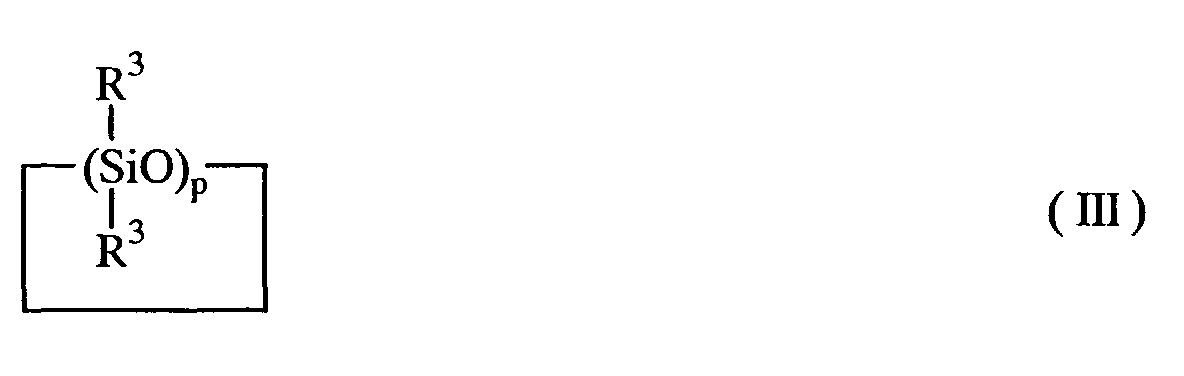
- silane and siloxane compounds of general formulas (I) to (III) below.
- R 1 and R 2 are each independently aliphatic monovalent hydrocarbon groups;
- R 3 is a hydrogen atom or an aliphatic monovalent hydrocarbon group;
- the letter n is an integer from 0 to 3;
- m is an integer of at least 1, and preferably 1 or 2; and
- p is an integer from 3 to 5.
- Illustrative examples of aliphatic monovalent hydrocarbon groups represented by R 1 , R 2 and R 3 include C 1-4 alkyl groups such as methyl, ethyl, propyl, n-butyl and tert-butyl; C 3-6 cycloalkyl groups such as cyclohexyl; and C 2-4 alkenyl groups such as vinyl and allyl.
- silane compounds of above formula (I) include Si(OCH 3 ) 4 , Si(OCH 2 CH 3 ) 4 and CH 3 Si(OCH 3 ) 3 .
- An exemplary siloxane compound of above formula (II) is hexamethyldisiloxane.
- an alkoxysilane containing no chlorine is preferable for avoiding ultraviolet light absorption by Si-Cl bonds.
- fluorine compounds examples include tetrafluorosilane, trifluoromethane and tetrafluoromethane.
- the burner used in the invention has a plurality of concentrically arranged nozzles. Use may be made of any known burner of this type which is capable of supporting flame hydrolysis by feeding to a reaction zone a silica-forming raw material gas and a fluorine compound gas from the center nozzle, feeding oxygen gas from a second nozzle located outside the center nozzle, and feeding oxygen gas and/or hydrogen gas from one or more nozzles located outside the second nozzle.
- FIG. 1 shows a typical burner suitable for use in working the invention.
- a center tube nozzle 1 feeds silica-forming raw material gas and fluorine compound gas
- a first ring tube 2 also referred to herein as the "second nozzle" surrounding the center tube nozzle 1 feeds oxygen gas
- a second ring tube 3 surrounding the first ring tube 2 feeds hydrogen gas
- a third ring tube 4 surrounding the second ring tube 3 feeds oxygen gas.
- the oxygen gas fed from the second nozzle 2 is set at a flow rate with respect to the flow rate of raw material gas which represents a 1.1- to 3.5-fold, and preferably a 1.5- to 2.5-fold, excess of oxygen relative to the stoichiometric ratio.
- the overall flow rate of oxygen gas from the burner with respect to the sum of the raw material gas flow rate and the overall hydrogen gas flow rate is set such as to represent a 1.1- to 3.5-fold, and preferably a 1.5- to 2.5-fold, excess of oxygen relative to the stoichiometric ratio.
- the flow rate of oxygen from the second nozzle relative to the flow rate of the raw material gas is stoichiometric when 6.0 moles of oxygen gas is fed from the second nozzle per mole of the raw material gas.
- These relative flow rates between the two gases are said to be in a "stoichiometric ratio," and the amount of oxygen supplied from the second nozzle with respect to the raw material gas can be referred to as 1.0 times the stoichiometric ratio.
- C is the sum of the flow rates of oxygen gas fed from the first and third ring tubes 2 and 4
- D is the flow rate of hydrogen gas fed from the second ring tube 3.
- Desirable effects in the product have been found to be attainable by having the molar ratio between the flow rate of oxygen gas fed from the second nozzle to the raw material gas flow rate, or the molar ratio between the overall flow rate of oxygen gas from the burner to the sum of the raw material gas flow rate and the overall hydrogen gas flow rate, represent a condition of excess oxygen supply (stoichiometric excess of oxygen). Having both ratios represent conditions of excess oxygen supply can be even more advantageous.
- an inert gas such as argon, nitrogen or helium may be fed from the center nozzle or, along with oxygen gas, from the second nozzle of the burner.
- an inert gas such as argon, nitrogen or helium
- Use may also be made of a plurality of burners, including one or more auxiliary burner, in which case the auxiliary burner may supply only an oxyhydrogen flame or may supply a fluorine compound gas.
- synthetic quartz glass can be produced by conventional flame hydrolysis.
- the feed rate of raw material gas in this case is typically set within a range of 4 to 40 mol/h.
- the porous silica matrix formed in the process described above is vitrified in a high-temperature glassmaking furnace. Vitrification may be carried out using a known method and conditions, such as heating in a vacuum to a temperature of 1,200 to 1,700°C. Instead of a vacuum, the furnace may have an inert gas (e.g., helium, argon) atmosphere. Following vitrification, the furnace interior is cooled to room temperature, either by rapid or gradual cooling.
- inert gas e.g., helium, argon
- the porous silica matrix prefferably has a density of 0.1 to 1.0 g/m 3 , and especially 0.2 to 0.5 g/cm 3 .
- the synthetic quartz glass produced as described above has a hydroxyl group concentration of preferably not more than 20 ppm. Above 20 ppm, the undesirable effects of Si-OH bonds, which absorb radiation near 160 nm, may be too large.
- the porous silica matrix is produced by feeding a fluorine compound such as SiF 4 , CHF 3 or CF 4 together with the raw material gas from a raw material gas feeder in the burner. It is preferable for the fluorine atom concentration within the resulting synthetic quartz glass to be at least 100 ppm. At a fluorine atom concentration of below 100 ppm, the hydroxyl group concentration may exceed 20 ppm, resulting in a larger than desirable influence by Si-OH bonds. The feed rate of fluorine compound gas can be adjusted accordingly.
- a porous silica matrix having a density of 0.25 g/cm 3 was produced using tetramethoxysilane as the raw material.
- the oxygen flow rate from the second nozzle 2 with respect to the raw material gas flow rate was set at 1.96 times the stoichiometric ratio, and the overall oxygen gas flow rate with respect to the sum of the raw material gas flow rate and the overall hydrogen gas flow rate was set at 2.43 times the stoichiometric ratio.
- tetrafluorosilane was fed from the center nozzle 1 of the burner at a flow rate of 1.3 mol/h.
- the resulting porous silica matrix was heated to a temperature of 1,500°C in a helium atmosphere, giving a synthetic quartz glass. Vitrification took 30 hours. The hydroxyl group concentration was 0 ppm, and the fluorine atom concentration was 1,540 ppm. Measurement of light transmittance in the vacuum ultraviolet region indicated that absorption from 160 to 240 nm was very weak, and that transmittance at 157.6 nm was as high as 78.0%. Table 1 gives the gas balance during formation of the porous silica matrix, and the physical properties of the synthetic quartz glass produced. A plot of the transmittance is shown in FIG. 2. The samples used to measure transmittance in this and the subsequent examples had a thickness of 6.3 ⁇ 0.1 mm.
- a porous silica matrix having a density of 0.30 g/cm 3 was produced using tetramethoxysilane as the raw material.
- the oxygen flow rate from the second nozzle 2 with respect to the raw material gas flow rate was set at 3.03 times the stoichiometric ratio, and the overall oxygen gas flow rate with respect to the sum of the raw material gas flow rate and the overall hydrogen gas flow rate was set at 3.42 times the stoichiometric ratio.
- tetrafluorosilane was fed from the center nozzle 1 of the burner at a flow rate of 0.4 mol/h.
- the resulting porous silica matrix was heated to a temperature of 1,500°C in a vacuum, giving a synthetic quartz glass. Vitrification took 30 hours. The hydroxyl group concentration was 5 ppm, and the fluorine atom concentration was 740 ppm. Measurement of light transmittance in the vacuum ultraviolet region indicated that absorption due to Si-Si bonds and Si-OH bonds was very weak, and that transmittance at 157.6 nm was as high as 74.8%. Table 1 gives the gas balance during formation of the porous silica matrix, and the physical properties of the synthetic quartz glass produced. A plot of the transmittance is shown in FIG. 2.
- a porous silica matrix having a density of 0.20 g/cm 3 was produced using tetramethoxysilane as the raw material.
- the oxygen flow rate from the second nozzle 2 with respect to the raw material gas flow rate was set at 0.91 times the stoichiometric ratio, and the overall oxygen gas flow rate with respect to the sum of the raw material gas flow rate and the overall hydrogen gas flow rate was set at 0.98 times the stoichiometric ratio.
- tetrafluorosilane was fed from the center nozzle 1 of the burner at a flow rate of 1.3 mol/h.
- the resulting porous silica matrix was heated to a temperature of 1,500°C in a vacuum, giving a synthetic quartz glass. Vitrification took 30 hours. The hydroxyl group concentration was 0 ppm, and the fluorine atom concentration was 1,610 ppm. Measurement of light transmittance in the vacuum ultraviolet region indicated strong absorption near 163 nm. Transmittance at 157.6 nm was as low as 15.6%. Table 1 gives the gas balance during formation of the porous silica matrix, and the physical properties of the synthetic quartz glass produced. A plot of the transmittance is shown in FIG. 2.
- a porous silica matrix having a density of 0.20 g/cm 3 was produced using tetramethoxysilane as the raw material.
- the oxygen flow rate from the second nozzle 2 with respect to the raw material gas flow rate was set at 0.91 times the stoichiometric ratio, and the overall oxygen gas flow rate with respect to the sum of the raw material gas flow rate and the overall hydrogen gas flow rate was set at 0.98 times the stoichiometric ratio.
- tetrafluorosilane was fed from the center nozzle 1 of the burner at a flow rate of 0.3 mol/h.
- the present process effectively suppresses the formation of Si-Si bonds in the quartz glass, making it possible to produce synthetic quartz glass having a high transmittance in the vacuum ultraviolet region.
Landscapes
- Chemical & Material Sciences (AREA)
- Engineering & Computer Science (AREA)
- Chemical Kinetics & Catalysis (AREA)
- Materials Engineering (AREA)
- Organic Chemistry (AREA)
- Life Sciences & Earth Sciences (AREA)
- General Chemical & Material Sciences (AREA)
- Geochemistry & Mineralogy (AREA)
- Manufacturing & Machinery (AREA)
- Glass Compositions (AREA)
- Glass Melting And Manufacturing (AREA)
- Manufacture, Treatment Of Glass Fibers (AREA)
Abstract
Description
organosilicon compound as the silica-forming raw material.

the second nozzle. FIG. 1 shows a typical burner suitable for use in working the invention.
| Example 1 | Example 2 | Comp.Ex.1 | Comp.Ex.2 | |
| O2 ratio | 1.96 | 3.03 | 0.91 | 0.91 |
| O2 ratio | 2.43 | 3.42 | 0.98 | 0.98 |
| OH concentration (ppm) | 0 | 5 | 0 | 60 |
| F concentration (ppm) | 1,540 | 740 | 1,610 | 630 |
Claims (5)
- A process for producing synthetic quartz glass, comprising the steps of:feeding to a reaction zone a silica-forming raw material gas and a fluorine compound gas from a first nozzle at the center of a burner having a plurality of concentric nozzles, oxygen gas from a second nozzle disposed concentrically outside the center nozzle, and oxygen gas or hydrogen gas or both from a third nozzle disposed concentrically outside the second nozzle,flame hydrolyzing the silica-forming raw material gas in the reaction zone to form fine particles of silica,depositing the silica fine particles on a rotatable substrate in the reaction zone so as to create a porous silica matrix, andfusing the silica matrix;wherein the oxygen gas fed from the second nozzle is set at a flow rate with respect to the raw material gas flow rate which represents a 1.1- to 3.5-fold stoichiometric excess of oxygen.
- A process for producing synthetic quartz glass, comprising the steps of:feeding to a reaction zone a silica-forming raw material gas and a fluorine compound gas from a first nozzle at the center of a burner having a plurality of concentric nozzles, oxygen gas from a second nozzle disposed concentrically outside the center nozzle, and oxygen gas or hydrogen gas or both from a third nozzle disposed concentrically outside the second nozzle,flame hydrolyzing the silica-forming raw material gas in the reaction zone to form fine particles of silica,depositing the silica fine particles on a rotatable substrate in the reaction zone so as to create a porous silica matrix, andfusing the silica matrix;wherein the oxygen gas is fed from the burner at an overall flow rate with respect to the sum of the raw material gas flow rate and the overall hydrogen gas flow rate which represents a 1.1- to 3.5-fold stoichiometric excess of oxygen.
- The synthetic quartz glass production process of claim 2, wherein the oxygen gas fed from the second nozzle is set at a flow rate with respect to the raw material gas flow rate which represents a 1.1- to 3.5-fold stoichiometric excess of oxygen.
- The production process of claim 1 or 2, wherein the porous silica matrix has a density of 0.1 to 1.0 g/cm3.
- A synthetic quartz glass produced by fusing and vitrifying the porous silica matrix according to the process of claim 1 or 2, which synthetic quartz glass has a hydroxyl group concentration of at most 20 ppm and a fluorine atom concentration of at least 100 ppm.
Applications Claiming Priority (2)
| Application Number | Priority Date | Filing Date | Title |
|---|---|---|---|
| JP37145899 | 1999-12-27 | ||
| JP37145899 | 1999-12-27 |
Publications (3)
| Publication Number | Publication Date |
|---|---|
| EP1112973A2 true EP1112973A2 (en) | 2001-07-04 |
| EP1112973A3 EP1112973A3 (en) | 2002-04-17 |
| EP1112973B1 EP1112973B1 (en) | 2005-09-07 |
Family
ID=18498751
Family Applications (1)
| Application Number | Title | Priority Date | Filing Date |
|---|---|---|---|
| EP00311652A Expired - Lifetime EP1112973B1 (en) | 1999-12-27 | 2000-12-22 | Process for producing a quartz glass product and the product so produced |
Country Status (4)
| Country | Link |
|---|---|
| US (1) | US6705115B2 (en) |
| EP (1) | EP1112973B1 (en) |
| AT (1) | ATE303977T1 (en) |
| DE (1) | DE60022461T2 (en) |
Cited By (3)
| Publication number | Priority date | Publication date | Assignee | Title |
|---|---|---|---|---|
| WO2005059972A3 (en) * | 2003-12-17 | 2005-08-04 | Asahi Glass Co Ltd | Synthetic quartz glass for optical member and its production method |
| EP1365439B1 (en) * | 2002-05-20 | 2009-03-25 | Ushiodenki Kabushiki Kaisha | Discharge lamp and process for producing it |
| DE102008063299A1 (en) * | 2008-12-29 | 2010-07-01 | Schott Ag | Method for producing a compact synthetic quartz glass, a muffle furnace for carrying out the method, and the quartz glass thus obtained |
Families Citing this family (7)
| Publication number | Priority date | Publication date | Assignee | Title |
|---|---|---|---|---|
| US6649268B1 (en) * | 1999-03-10 | 2003-11-18 | Nikon Corporation | Optical member made of silica glass, method for manufacturing silica glass, and reduction projection exposure apparatus using the optical member |
| NL1018239C2 (en) * | 2001-06-08 | 2002-12-10 | Draka Fibre Technology Bv | Optical fiber and method for manufacturing an optical fiber. |
| CN1226211C (en) * | 2003-06-27 | 2005-11-09 | 长飞光纤光缆有限公司 | Manufacture of single mode oplical fibers |
| US20050132749A1 (en) * | 2003-12-05 | 2005-06-23 | Shin-Etsu Chmeical Co., Ltd. | Burner and method for the manufacture of synthetic quartz glass |
| EP1853971B1 (en) * | 2005-02-09 | 2010-10-20 | Asahi Glass Company, Limited | Mask blanks |
| US8567214B2 (en) * | 2010-06-28 | 2013-10-29 | Asahi Glass Company, Limited | Method for producing glass body and method for producing optical member for EUV lithography |
| WO2016036550A1 (en) * | 2014-09-05 | 2016-03-10 | Ekomarine Paint Inc. | A method for treating surfaces on marine objects with anti-fouling paint |
Family Cites Families (9)
| Publication number | Priority date | Publication date | Assignee | Title |
|---|---|---|---|---|
| EP0208086A1 (en) * | 1985-05-15 | 1987-01-14 | Siemens Aktiengesellschaft | Method for producing fluorine-doped silicia glass preforms for drawing glass fibres for optical telecommunication |
| US5325230A (en) * | 1989-06-09 | 1994-06-28 | Shin-Etsu Quartz Products Co., Ltd. | Optical members and blanks of synthetic silica glass and method for their production |
| US4940477A (en) * | 1989-07-19 | 1990-07-10 | Corning Incorporated | Method for synthesizing topaz |
| US5326729A (en) * | 1992-02-07 | 1994-07-05 | Asahi Glass Company Ltd. | Transparent quartz glass and process for its production |
| US5679125A (en) * | 1994-07-07 | 1997-10-21 | Nikon Corporation | Method for producing silica glass for use with light in a vacuum ultraviolet wavelength range |
| DE69601749T3 (en) * | 1995-06-07 | 2004-04-29 | Corning Inc. | Process for the thermal treatment and consolidation of silicon dioxide preforms to reduce laser-induced optical defects |
| US6619073B2 (en) * | 1996-03-05 | 2003-09-16 | Corning Incorporated | Method of increasing the initial transmittance of optical glass |
| US6319634B1 (en) * | 1999-03-12 | 2001-11-20 | Corning Incorporated | Projection lithography photomasks and methods of making |
| US6541168B2 (en) * | 2000-04-28 | 2003-04-01 | Corning Incorporated | Vacuum ultraviolet transmitting direct deposit vitrified silicon oxyfluoride lithography glass photomask blanks |
-
2000
- 2000-12-22 DE DE60022461T patent/DE60022461T2/en not_active Expired - Lifetime
- 2000-12-22 AT AT00311652T patent/ATE303977T1/en not_active IP Right Cessation
- 2000-12-22 EP EP00311652A patent/EP1112973B1/en not_active Expired - Lifetime
- 2000-12-27 US US09/747,953 patent/US6705115B2/en not_active Expired - Fee Related
Cited By (5)
| Publication number | Priority date | Publication date | Assignee | Title |
|---|---|---|---|---|
| EP1365439B1 (en) * | 2002-05-20 | 2009-03-25 | Ushiodenki Kabushiki Kaisha | Discharge lamp and process for producing it |
| WO2005059972A3 (en) * | 2003-12-17 | 2005-08-04 | Asahi Glass Co Ltd | Synthetic quartz glass for optical member and its production method |
| US7514382B2 (en) | 2003-12-17 | 2009-04-07 | Asahi Glass Company, Limited | Synthetic quartz glass for optical member and its production method |
| DE102008063299A1 (en) * | 2008-12-29 | 2010-07-01 | Schott Ag | Method for producing a compact synthetic quartz glass, a muffle furnace for carrying out the method, and the quartz glass thus obtained |
| DE102008063299B4 (en) * | 2008-12-29 | 2012-12-06 | J-Fiber Gmbh | Method for producing a compact synthetic quartz glass, a muffle furnace for carrying out the method, and the quartz glass thus obtained |
Also Published As
| Publication number | Publication date |
|---|---|
| DE60022461D1 (en) | 2005-10-13 |
| US20010018834A1 (en) | 2001-09-06 |
| US6705115B2 (en) | 2004-03-16 |
| EP1112973B1 (en) | 2005-09-07 |
| EP1112973A3 (en) | 2002-04-17 |
| ATE303977T1 (en) | 2005-09-15 |
| DE60022461T2 (en) | 2006-05-18 |
Similar Documents
| Publication | Publication Date | Title |
|---|---|---|
| EP1900694B1 (en) | Method for making a synthetic quartz glass substrate for excimer lasers | |
| EP0878451A1 (en) | Synthetic silica glass optical member and method of manufacturing the same | |
| EP0835848A2 (en) | Fluorine-containing silica glass, its method of manufacture and a projection exposure apparatus comprising the glass | |
| EP2377826B1 (en) | OPTICAL MEMBER COMPRISING SILICA GLASS CONTAINING TiO2 | |
| US7954340B2 (en) | Synthetic quartz glass substrate for excimer lasers and making method | |
| EP1112973B1 (en) | Process for producing a quartz glass product and the product so produced | |
| EP1188723B1 (en) | Synthetic quartz glass and method of production | |
| EP1462717A2 (en) | Burner for the manufacture of synthetic quartz glass | |
| EP1281679A2 (en) | Method for making glass by plasma deposition using silica powder, silica powder and photomask obtained by the method | |
| US6807823B2 (en) | Fluorine-containing glass | |
| US20060107693A1 (en) | Method for the production of synthetic silica glass | |
| EP1127857B1 (en) | Fluorine-containing synthetic quartz glass and method of production | |
| EP1178688A2 (en) | Image decoding device and image decoding method | |
| EP1219571B1 (en) | process for producing a synthetic quartz glass article | |
| JP4496421B2 (en) | Method for producing synthetic quartz glass | |
| JP3796653B2 (en) | Fluorine-containing synthetic quartz glass and method for producing the same | |
| JP2002154827A (en) | Manufacturing method of synthetic quartz glass | |
| JP2001322820A (en) | Fluorine-containing synthetic quartz glass and method for producing the same | |
| JP2001322819A (en) | Synthetic quartz glass and method for producing the same | |
| JP2002308630A (en) | Manufacturing method of synthetic quartz glass |
Legal Events
| Date | Code | Title | Description |
|---|---|---|---|
| PUAI | Public reference made under article 153(3) epc to a published international application that has entered the european phase |
Free format text: ORIGINAL CODE: 0009012 |
|
| AK | Designated contracting states |
Kind code of ref document: A2 Designated state(s): AT BE CH CY DE DK ES FI FR GB GR IE IT LI LU MC NL PT SE TR |
|
| AX | Request for extension of the european patent |
Free format text: AL;LT;LV;MK;RO;SI |
|
| PUAL | Search report despatched |
Free format text: ORIGINAL CODE: 0009013 |
|
| AK | Designated contracting states |
Kind code of ref document: A3 Designated state(s): AT BE CH CY DE DK ES FI FR GB GR IE IT LI LU MC NL PT SE TR |
|
| AX | Request for extension of the european patent |
Free format text: AL;LT;LV;MK;RO;SI |
|
| 17P | Request for examination filed |
Effective date: 20020412 |
|
| AKX | Designation fees paid |
Free format text: AT BE CH CY DE DK ES FI FR GB GR IE IT LI LU MC NL PT SE TR |
|
| 17Q | First examination report despatched |
Effective date: 20030728 |
|
| GRAP | Despatch of communication of intention to grant a patent |
Free format text: ORIGINAL CODE: EPIDOSNIGR1 |
|
| GRAS | Grant fee paid |
Free format text: ORIGINAL CODE: EPIDOSNIGR3 |
|
| GRAA | (expected) grant |
Free format text: ORIGINAL CODE: 0009210 |
|
| AK | Designated contracting states |
Kind code of ref document: B1 Designated state(s): AT BE CH CY DE DK ES FI FR GB GR IE IT LI LU MC NL PT SE TR |
|
| PG25 | Lapsed in a contracting state [announced via postgrant information from national office to epo] |
Ref country code: IT Free format text: LAPSE BECAUSE OF FAILURE TO SUBMIT A TRANSLATION OF THE DESCRIPTION OR TO PAY THE FEE WITHIN THE PRESCRIBED TIME-LIMIT;WARNING: LAPSES OF ITALIAN PATENTS WITH EFFECTIVE DATE BEFORE 2007 MAY HAVE OCCURRED AT ANY TIME BEFORE 2007. THE CORRECT EFFECTIVE DATE MAY BE DIFFERENT FROM THE ONE RECORDED. Effective date: 20050907 Ref country code: BE Free format text: LAPSE BECAUSE OF FAILURE TO SUBMIT A TRANSLATION OF THE DESCRIPTION OR TO PAY THE FEE WITHIN THE PRESCRIBED TIME-LIMIT Effective date: 20050907 Ref country code: TR Free format text: LAPSE BECAUSE OF FAILURE TO SUBMIT A TRANSLATION OF THE DESCRIPTION OR TO PAY THE FEE WITHIN THE PRESCRIBED TIME-LIMIT Effective date: 20050907 Ref country code: AT Free format text: LAPSE BECAUSE OF FAILURE TO SUBMIT A TRANSLATION OF THE DESCRIPTION OR TO PAY THE FEE WITHIN THE PRESCRIBED TIME-LIMIT Effective date: 20050907 Ref country code: LI Free format text: LAPSE BECAUSE OF FAILURE TO SUBMIT A TRANSLATION OF THE DESCRIPTION OR TO PAY THE FEE WITHIN THE PRESCRIBED TIME-LIMIT Effective date: 20050907 Ref country code: CH Free format text: LAPSE BECAUSE OF FAILURE TO SUBMIT A TRANSLATION OF THE DESCRIPTION OR TO PAY THE FEE WITHIN THE PRESCRIBED TIME-LIMIT Effective date: 20050907 Ref country code: FI Free format text: LAPSE BECAUSE OF FAILURE TO SUBMIT A TRANSLATION OF THE DESCRIPTION OR TO PAY THE FEE WITHIN THE PRESCRIBED TIME-LIMIT Effective date: 20050907 |
|
| REG | Reference to a national code |
Ref country code: GB Ref legal event code: FG4D |
|
| REG | Reference to a national code |
Ref country code: CH Ref legal event code: EP |
|
| REG | Reference to a national code |
Ref country code: IE Ref legal event code: FG4D |
|
| REF | Corresponds to: |
Ref document number: 60022461 Country of ref document: DE Date of ref document: 20051013 Kind code of ref document: P |
|
| PG25 | Lapsed in a contracting state [announced via postgrant information from national office to epo] |
Ref country code: SE Free format text: LAPSE BECAUSE OF FAILURE TO SUBMIT A TRANSLATION OF THE DESCRIPTION OR TO PAY THE FEE WITHIN THE PRESCRIBED TIME-LIMIT Effective date: 20051207 Ref country code: GR Free format text: LAPSE BECAUSE OF FAILURE TO SUBMIT A TRANSLATION OF THE DESCRIPTION OR TO PAY THE FEE WITHIN THE PRESCRIBED TIME-LIMIT Effective date: 20051207 Ref country code: DK Free format text: LAPSE BECAUSE OF FAILURE TO SUBMIT A TRANSLATION OF THE DESCRIPTION OR TO PAY THE FEE WITHIN THE PRESCRIBED TIME-LIMIT Effective date: 20051207 |
|
| PG25 | Lapsed in a contracting state [announced via postgrant information from national office to epo] |
Ref country code: ES Free format text: LAPSE BECAUSE OF FAILURE TO SUBMIT A TRANSLATION OF THE DESCRIPTION OR TO PAY THE FEE WITHIN THE PRESCRIBED TIME-LIMIT Effective date: 20051218 |
|
| PG25 | Lapsed in a contracting state [announced via postgrant information from national office to epo] |
Ref country code: IE Free format text: LAPSE BECAUSE OF NON-PAYMENT OF DUE FEES Effective date: 20051222 Ref country code: CY Free format text: LAPSE BECAUSE OF FAILURE TO SUBMIT A TRANSLATION OF THE DESCRIPTION OR TO PAY THE FEE WITHIN THE PRESCRIBED TIME-LIMIT Effective date: 20051222 |
|
| PG25 | Lapsed in a contracting state [announced via postgrant information from national office to epo] |
Ref country code: MC Free format text: LAPSE BECAUSE OF NON-PAYMENT OF DUE FEES Effective date: 20051231 Ref country code: LU Free format text: LAPSE BECAUSE OF NON-PAYMENT OF DUE FEES Effective date: 20051231 |
|
| PG25 | Lapsed in a contracting state [announced via postgrant information from national office to epo] |
Ref country code: PT Free format text: LAPSE BECAUSE OF FAILURE TO SUBMIT A TRANSLATION OF THE DESCRIPTION OR TO PAY THE FEE WITHIN THE PRESCRIBED TIME-LIMIT Effective date: 20060207 |
|
| REG | Reference to a national code |
Ref country code: CH Ref legal event code: PL |
|
| ET | Fr: translation filed | ||
| PLBE | No opposition filed within time limit |
Free format text: ORIGINAL CODE: 0009261 |
|
| STAA | Information on the status of an ep patent application or granted ep patent |
Free format text: STATUS: NO OPPOSITION FILED WITHIN TIME LIMIT |
|
| 26N | No opposition filed |
Effective date: 20060608 |
|
| REG | Reference to a national code |
Ref country code: IE Ref legal event code: MM4A |
|
| REG | Reference to a national code |
Ref country code: FR Ref legal event code: PLFP Year of fee payment: 16 |
|
| REG | Reference to a national code |
Ref country code: FR Ref legal event code: PLFP Year of fee payment: 17 |
|
| REG | Reference to a national code |
Ref country code: FR Ref legal event code: PLFP Year of fee payment: 18 |
|
| PGFP | Annual fee paid to national office [announced via postgrant information from national office to epo] |
Ref country code: NL Payment date: 20191114 Year of fee payment: 20 Ref country code: DE Payment date: 20191210 Year of fee payment: 20 |
|
| PGFP | Annual fee paid to national office [announced via postgrant information from national office to epo] |
Ref country code: FR Payment date: 20191115 Year of fee payment: 20 |
|
| PGFP | Annual fee paid to national office [announced via postgrant information from national office to epo] |
Ref country code: GB Payment date: 20191219 Year of fee payment: 20 |
|
| REG | Reference to a national code |
Ref country code: DE Ref legal event code: R071 Ref document number: 60022461 Country of ref document: DE |
|
| REG | Reference to a national code |
Ref country code: NL Ref legal event code: MK Effective date: 20201221 |
|
| REG | Reference to a national code |
Ref country code: GB Ref legal event code: PE20 Expiry date: 20201221 |
|
| PG25 | Lapsed in a contracting state [announced via postgrant information from national office to epo] |
Ref country code: GB Free format text: LAPSE BECAUSE OF EXPIRATION OF PROTECTION Effective date: 20201221 |