EP1112883A2 - Gearing arrangement in hybrid drive apparatus - Google Patents
Gearing arrangement in hybrid drive apparatus Download PDFInfo
- Publication number
- EP1112883A2 EP1112883A2 EP00127436A EP00127436A EP1112883A2 EP 1112883 A2 EP1112883 A2 EP 1112883A2 EP 00127436 A EP00127436 A EP 00127436A EP 00127436 A EP00127436 A EP 00127436A EP 1112883 A2 EP1112883 A2 EP 1112883A2
- Authority
- EP
- European Patent Office
- Prior art keywords
- countershaft
- gear
- gears
- axis
- pair
- Prior art date
- Legal status (The legal status is an assumption and is not a legal conclusion. Google has not performed a legal analysis and makes no representation as to the accuracy of the status listed.)
- Granted
Links
Images


Classifications
-
- B—PERFORMING OPERATIONS; TRANSPORTING
- B60—VEHICLES IN GENERAL
- B60K—ARRANGEMENT OR MOUNTING OF PROPULSION UNITS OR OF TRANSMISSIONS IN VEHICLES; ARRANGEMENT OR MOUNTING OF PLURAL DIVERSE PRIME-MOVERS IN VEHICLES; AUXILIARY DRIVES FOR VEHICLES; INSTRUMENTATION OR DASHBOARDS FOR VEHICLES; ARRANGEMENTS IN CONNECTION WITH COOLING, AIR INTAKE, GAS EXHAUST OR FUEL SUPPLY OF PROPULSION UNITS IN VEHICLES
- B60K6/00—Arrangement or mounting of plural diverse prime-movers for mutual or common propulsion, e.g. hybrid propulsion systems comprising electric motors and internal combustion engines
-
- B—PERFORMING OPERATIONS; TRANSPORTING
- B60—VEHICLES IN GENERAL
- B60K—ARRANGEMENT OR MOUNTING OF PROPULSION UNITS OR OF TRANSMISSIONS IN VEHICLES; ARRANGEMENT OR MOUNTING OF PLURAL DIVERSE PRIME-MOVERS IN VEHICLES; AUXILIARY DRIVES FOR VEHICLES; INSTRUMENTATION OR DASHBOARDS FOR VEHICLES; ARRANGEMENTS IN CONNECTION WITH COOLING, AIR INTAKE, GAS EXHAUST OR FUEL SUPPLY OF PROPULSION UNITS IN VEHICLES
- B60K6/00—Arrangement or mounting of plural diverse prime-movers for mutual or common propulsion, e.g. hybrid propulsion systems comprising electric motors and internal combustion engines
- B60K6/20—Arrangement or mounting of plural diverse prime-movers for mutual or common propulsion, e.g. hybrid propulsion systems comprising electric motors and internal combustion engines the prime-movers consisting of electric motors and internal combustion engines, e.g. HEVs
- B60K6/22—Arrangement or mounting of plural diverse prime-movers for mutual or common propulsion, e.g. hybrid propulsion systems comprising electric motors and internal combustion engines the prime-movers consisting of electric motors and internal combustion engines, e.g. HEVs characterised by apparatus, components or means specially adapted for HEVs
- B60K6/36—Arrangement or mounting of plural diverse prime-movers for mutual or common propulsion, e.g. hybrid propulsion systems comprising electric motors and internal combustion engines the prime-movers consisting of electric motors and internal combustion engines, e.g. HEVs characterised by apparatus, components or means specially adapted for HEVs characterised by the transmission gearings
-
- B—PERFORMING OPERATIONS; TRANSPORTING
- B60—VEHICLES IN GENERAL
- B60K—ARRANGEMENT OR MOUNTING OF PROPULSION UNITS OR OF TRANSMISSIONS IN VEHICLES; ARRANGEMENT OR MOUNTING OF PLURAL DIVERSE PRIME-MOVERS IN VEHICLES; AUXILIARY DRIVES FOR VEHICLES; INSTRUMENTATION OR DASHBOARDS FOR VEHICLES; ARRANGEMENTS IN CONNECTION WITH COOLING, AIR INTAKE, GAS EXHAUST OR FUEL SUPPLY OF PROPULSION UNITS IN VEHICLES
- B60K6/00—Arrangement or mounting of plural diverse prime-movers for mutual or common propulsion, e.g. hybrid propulsion systems comprising electric motors and internal combustion engines
- B60K6/20—Arrangement or mounting of plural diverse prime-movers for mutual or common propulsion, e.g. hybrid propulsion systems comprising electric motors and internal combustion engines the prime-movers consisting of electric motors and internal combustion engines, e.g. HEVs
- B60K6/22—Arrangement or mounting of plural diverse prime-movers for mutual or common propulsion, e.g. hybrid propulsion systems comprising electric motors and internal combustion engines the prime-movers consisting of electric motors and internal combustion engines, e.g. HEVs characterised by apparatus, components or means specially adapted for HEVs
- B60K6/36—Arrangement or mounting of plural diverse prime-movers for mutual or common propulsion, e.g. hybrid propulsion systems comprising electric motors and internal combustion engines the prime-movers consisting of electric motors and internal combustion engines, e.g. HEVs characterised by apparatus, components or means specially adapted for HEVs characterised by the transmission gearings
- B60K6/365—Arrangement or mounting of plural diverse prime-movers for mutual or common propulsion, e.g. hybrid propulsion systems comprising electric motors and internal combustion engines the prime-movers consisting of electric motors and internal combustion engines, e.g. HEVs characterised by apparatus, components or means specially adapted for HEVs characterised by the transmission gearings with the gears having orbital motion
-
- B—PERFORMING OPERATIONS; TRANSPORTING
- B60—VEHICLES IN GENERAL
- B60K—ARRANGEMENT OR MOUNTING OF PROPULSION UNITS OR OF TRANSMISSIONS IN VEHICLES; ARRANGEMENT OR MOUNTING OF PLURAL DIVERSE PRIME-MOVERS IN VEHICLES; AUXILIARY DRIVES FOR VEHICLES; INSTRUMENTATION OR DASHBOARDS FOR VEHICLES; ARRANGEMENTS IN CONNECTION WITH COOLING, AIR INTAKE, GAS EXHAUST OR FUEL SUPPLY OF PROPULSION UNITS IN VEHICLES
- B60K6/00—Arrangement or mounting of plural diverse prime-movers for mutual or common propulsion, e.g. hybrid propulsion systems comprising electric motors and internal combustion engines
- B60K6/20—Arrangement or mounting of plural diverse prime-movers for mutual or common propulsion, e.g. hybrid propulsion systems comprising electric motors and internal combustion engines the prime-movers consisting of electric motors and internal combustion engines, e.g. HEVs
- B60K6/22—Arrangement or mounting of plural diverse prime-movers for mutual or common propulsion, e.g. hybrid propulsion systems comprising electric motors and internal combustion engines the prime-movers consisting of electric motors and internal combustion engines, e.g. HEVs characterised by apparatus, components or means specially adapted for HEVs
- B60K6/40—Arrangement or mounting of plural diverse prime-movers for mutual or common propulsion, e.g. hybrid propulsion systems comprising electric motors and internal combustion engines the prime-movers consisting of electric motors and internal combustion engines, e.g. HEVs characterised by apparatus, components or means specially adapted for HEVs characterised by the assembly or relative disposition of components
-
- B—PERFORMING OPERATIONS; TRANSPORTING
- B60—VEHICLES IN GENERAL
- B60K—ARRANGEMENT OR MOUNTING OF PROPULSION UNITS OR OF TRANSMISSIONS IN VEHICLES; ARRANGEMENT OR MOUNTING OF PLURAL DIVERSE PRIME-MOVERS IN VEHICLES; AUXILIARY DRIVES FOR VEHICLES; INSTRUMENTATION OR DASHBOARDS FOR VEHICLES; ARRANGEMENTS IN CONNECTION WITH COOLING, AIR INTAKE, GAS EXHAUST OR FUEL SUPPLY OF PROPULSION UNITS IN VEHICLES
- B60K6/00—Arrangement or mounting of plural diverse prime-movers for mutual or common propulsion, e.g. hybrid propulsion systems comprising electric motors and internal combustion engines
- B60K6/20—Arrangement or mounting of plural diverse prime-movers for mutual or common propulsion, e.g. hybrid propulsion systems comprising electric motors and internal combustion engines the prime-movers consisting of electric motors and internal combustion engines, e.g. HEVs
- B60K6/42—Arrangement or mounting of plural diverse prime-movers for mutual or common propulsion, e.g. hybrid propulsion systems comprising electric motors and internal combustion engines the prime-movers consisting of electric motors and internal combustion engines, e.g. HEVs characterised by the architecture of the hybrid electric vehicle
- B60K6/44—Series-parallel type
- B60K6/445—Differential gearing distribution type
-
- B—PERFORMING OPERATIONS; TRANSPORTING
- B60—VEHICLES IN GENERAL
- B60L—PROPULSION OF ELECTRICALLY-PROPELLED VEHICLES; SUPPLYING ELECTRIC POWER FOR AUXILIARY EQUIPMENT OF ELECTRICALLY-PROPELLED VEHICLES; ELECTRODYNAMIC BRAKE SYSTEMS FOR VEHICLES IN GENERAL; MAGNETIC SUSPENSION OR LEVITATION FOR VEHICLES; MONITORING OPERATING VARIABLES OF ELECTRICALLY-PROPELLED VEHICLES; ELECTRIC SAFETY DEVICES FOR ELECTRICALLY-PROPELLED VEHICLES
- B60L50/00—Electric propulsion with power supplied within the vehicle
- B60L50/10—Electric propulsion with power supplied within the vehicle using propulsion power supplied by engine-driven generators, e.g. generators driven by combustion engines
- B60L50/16—Electric propulsion with power supplied within the vehicle using propulsion power supplied by engine-driven generators, e.g. generators driven by combustion engines with provision for separate direct mechanical propulsion
-
- B—PERFORMING OPERATIONS; TRANSPORTING
- B60—VEHICLES IN GENERAL
- B60L—PROPULSION OF ELECTRICALLY-PROPELLED VEHICLES; SUPPLYING ELECTRIC POWER FOR AUXILIARY EQUIPMENT OF ELECTRICALLY-PROPELLED VEHICLES; ELECTRODYNAMIC BRAKE SYSTEMS FOR VEHICLES IN GENERAL; MAGNETIC SUSPENSION OR LEVITATION FOR VEHICLES; MONITORING OPERATING VARIABLES OF ELECTRICALLY-PROPELLED VEHICLES; ELECTRIC SAFETY DEVICES FOR ELECTRICALLY-PROPELLED VEHICLES
- B60L50/00—Electric propulsion with power supplied within the vehicle
- B60L50/50—Electric propulsion with power supplied within the vehicle using propulsion power supplied by batteries or fuel cells
- B60L50/60—Electric propulsion with power supplied within the vehicle using propulsion power supplied by batteries or fuel cells using power supplied by batteries
- B60L50/61—Electric propulsion with power supplied within the vehicle using propulsion power supplied by batteries or fuel cells using power supplied by batteries by batteries charged by engine-driven generators, e.g. series hybrid electric vehicles
-
- B—PERFORMING OPERATIONS; TRANSPORTING
- B60—VEHICLES IN GENERAL
- B60W—CONJOINT CONTROL OF VEHICLE SUB-UNITS OF DIFFERENT TYPE OR DIFFERENT FUNCTION; CONTROL SYSTEMS SPECIALLY ADAPTED FOR HYBRID VEHICLES; ROAD VEHICLE DRIVE CONTROL SYSTEMS FOR PURPOSES NOT RELATED TO THE CONTROL OF A PARTICULAR SUB-UNIT
- B60W10/00—Conjoint control of vehicle sub-units of different type or different function
- B60W10/24—Conjoint control of vehicle sub-units of different type or different function including control of energy storage means
- B60W10/26—Conjoint control of vehicle sub-units of different type or different function including control of energy storage means for electrical energy, e.g. batteries or capacitors
-
- Y—GENERAL TAGGING OF NEW TECHNOLOGICAL DEVELOPMENTS; GENERAL TAGGING OF CROSS-SECTIONAL TECHNOLOGIES SPANNING OVER SEVERAL SECTIONS OF THE IPC; TECHNICAL SUBJECTS COVERED BY FORMER USPC CROSS-REFERENCE ART COLLECTIONS [XRACs] AND DIGESTS
- Y02—TECHNOLOGIES OR APPLICATIONS FOR MITIGATION OR ADAPTATION AGAINST CLIMATE CHANGE
- Y02T—CLIMATE CHANGE MITIGATION TECHNOLOGIES RELATED TO TRANSPORTATION
- Y02T10/00—Road transport of goods or passengers
- Y02T10/60—Other road transportation technologies with climate change mitigation effect
- Y02T10/62—Hybrid vehicles
-
- Y—GENERAL TAGGING OF NEW TECHNOLOGICAL DEVELOPMENTS; GENERAL TAGGING OF CROSS-SECTIONAL TECHNOLOGIES SPANNING OVER SEVERAL SECTIONS OF THE IPC; TECHNICAL SUBJECTS COVERED BY FORMER USPC CROSS-REFERENCE ART COLLECTIONS [XRACs] AND DIGESTS
- Y02—TECHNOLOGIES OR APPLICATIONS FOR MITIGATION OR ADAPTATION AGAINST CLIMATE CHANGE
- Y02T—CLIMATE CHANGE MITIGATION TECHNOLOGIES RELATED TO TRANSPORTATION
- Y02T10/00—Road transport of goods or passengers
- Y02T10/60—Other road transportation technologies with climate change mitigation effect
- Y02T10/70—Energy storage systems for electromobility, e.g. batteries
-
- Y—GENERAL TAGGING OF NEW TECHNOLOGICAL DEVELOPMENTS; GENERAL TAGGING OF CROSS-SECTIONAL TECHNOLOGIES SPANNING OVER SEVERAL SECTIONS OF THE IPC; TECHNICAL SUBJECTS COVERED BY FORMER USPC CROSS-REFERENCE ART COLLECTIONS [XRACs] AND DIGESTS
- Y02—TECHNOLOGIES OR APPLICATIONS FOR MITIGATION OR ADAPTATION AGAINST CLIMATE CHANGE
- Y02T—CLIMATE CHANGE MITIGATION TECHNOLOGIES RELATED TO TRANSPORTATION
- Y02T10/00—Road transport of goods or passengers
- Y02T10/60—Other road transportation technologies with climate change mitigation effect
- Y02T10/7072—Electromobility specific charging systems or methods for batteries, ultracapacitors, supercapacitors or double-layer capacitors
-
- Y—GENERAL TAGGING OF NEW TECHNOLOGICAL DEVELOPMENTS; GENERAL TAGGING OF CROSS-SECTIONAL TECHNOLOGIES SPANNING OVER SEVERAL SECTIONS OF THE IPC; TECHNICAL SUBJECTS COVERED BY FORMER USPC CROSS-REFERENCE ART COLLECTIONS [XRACs] AND DIGESTS
- Y10—TECHNICAL SUBJECTS COVERED BY FORMER USPC
- Y10S—TECHNICAL SUBJECTS COVERED BY FORMER USPC CROSS-REFERENCE ART COLLECTIONS [XRACs] AND DIGESTS
- Y10S903/00—Hybrid electric vehicles, HEVS
- Y10S903/902—Prime movers comprising electrical and internal combustion motors
- Y10S903/903—Prime movers comprising electrical and internal combustion motors having energy storing means, e.g. battery, capacitor
-
- Y—GENERAL TAGGING OF NEW TECHNOLOGICAL DEVELOPMENTS; GENERAL TAGGING OF CROSS-SECTIONAL TECHNOLOGIES SPANNING OVER SEVERAL SECTIONS OF THE IPC; TECHNICAL SUBJECTS COVERED BY FORMER USPC CROSS-REFERENCE ART COLLECTIONS [XRACs] AND DIGESTS
- Y10—TECHNICAL SUBJECTS COVERED BY FORMER USPC
- Y10S—TECHNICAL SUBJECTS COVERED BY FORMER USPC CROSS-REFERENCE ART COLLECTIONS [XRACs] AND DIGESTS
- Y10S903/00—Hybrid electric vehicles, HEVS
- Y10S903/902—Prime movers comprising electrical and internal combustion motors
- Y10S903/903—Prime movers comprising electrical and internal combustion motors having energy storing means, e.g. battery, capacitor
- Y10S903/904—Component specially adapted for hev
- Y10S903/906—Motor or generator
-
- Y—GENERAL TAGGING OF NEW TECHNOLOGICAL DEVELOPMENTS; GENERAL TAGGING OF CROSS-SECTIONAL TECHNOLOGIES SPANNING OVER SEVERAL SECTIONS OF THE IPC; TECHNICAL SUBJECTS COVERED BY FORMER USPC CROSS-REFERENCE ART COLLECTIONS [XRACs] AND DIGESTS
- Y10—TECHNICAL SUBJECTS COVERED BY FORMER USPC
- Y10S—TECHNICAL SUBJECTS COVERED BY FORMER USPC CROSS-REFERENCE ART COLLECTIONS [XRACs] AND DIGESTS
- Y10S903/00—Hybrid electric vehicles, HEVS
- Y10S903/902—Prime movers comprising electrical and internal combustion motors
- Y10S903/903—Prime movers comprising electrical and internal combustion motors having energy storing means, e.g. battery, capacitor
- Y10S903/904—Component specially adapted for hev
- Y10S903/909—Gearing
-
- Y—GENERAL TAGGING OF NEW TECHNOLOGICAL DEVELOPMENTS; GENERAL TAGGING OF CROSS-SECTIONAL TECHNOLOGIES SPANNING OVER SEVERAL SECTIONS OF THE IPC; TECHNICAL SUBJECTS COVERED BY FORMER USPC CROSS-REFERENCE ART COLLECTIONS [XRACs] AND DIGESTS
- Y10—TECHNICAL SUBJECTS COVERED BY FORMER USPC
- Y10S—TECHNICAL SUBJECTS COVERED BY FORMER USPC CROSS-REFERENCE ART COLLECTIONS [XRACs] AND DIGESTS
- Y10S903/00—Hybrid electric vehicles, HEVS
- Y10S903/902—Prime movers comprising electrical and internal combustion motors
- Y10S903/903—Prime movers comprising electrical and internal combustion motors having energy storing means, e.g. battery, capacitor
- Y10S903/904—Component specially adapted for hev
- Y10S903/909—Gearing
- Y10S903/91—Orbital, e.g. planetary gears
-
- Y—GENERAL TAGGING OF NEW TECHNOLOGICAL DEVELOPMENTS; GENERAL TAGGING OF CROSS-SECTIONAL TECHNOLOGIES SPANNING OVER SEVERAL SECTIONS OF THE IPC; TECHNICAL SUBJECTS COVERED BY FORMER USPC CROSS-REFERENCE ART COLLECTIONS [XRACs] AND DIGESTS
- Y10—TECHNICAL SUBJECTS COVERED BY FORMER USPC
- Y10S—TECHNICAL SUBJECTS COVERED BY FORMER USPC CROSS-REFERENCE ART COLLECTIONS [XRACs] AND DIGESTS
- Y10S903/00—Hybrid electric vehicles, HEVS
- Y10S903/902—Prime movers comprising electrical and internal combustion motors
- Y10S903/903—Prime movers comprising electrical and internal combustion motors having energy storing means, e.g. battery, capacitor
- Y10S903/951—Assembly or relative location of components
Definitions
- the present invention relates to a hybrid drive apparatus that uses an engine and an electric motor as power sources and, more particularly, to connecting constructions between axes in a hybrid drive apparatus.
- Hybrid drive apparatuses that use an engine (combustion engine) and an electric motor as power sources allow various power train arrangements since powers in two systems are transmitted to a differential device.
- a drive apparatus having a construction that is excellent in the respect of transmitting output from the engine and output from the electric motor to a differential device with an arbitrary gear ratio set is disclosed in the Japanese Patent Application Laid-Open No. HEI 8-183347.
- This drive apparatus adopts an arrangement in which the engine and an electric power generator are disposed on a first axis, and the electric motor is disposed on a second axis, and a countershaft is disposed on a third axis, and the differential device is disposed on a fourth axis, and in which the engine and the electric power generator are connected to the countershaft via a differential gear device, and the electric motor and the differential device are directly connected to the countershaft. Therefore, the gear ratio of a pair of gears connecting the engine and the countershaft and the gear ratio of a pair of gears connecting the electric motor and the countershaft can be arbitrarily set independently of each other.
- the total gear ratio from the engine to wheels needs to be set to a relatively high value.
- the total gear ratio needs to be set to a relatively low value.
- the engine-side total gear ratio is changed, for example, as indicated in FIG. 7, that is, by changing the diameters of a pair of gears connecting the differential gear device and the countershaft, that is, the diameter of a drive gear a on a first axis I and a driven gear b on a third axis III as indicated by broken lines in FIG. 7.
- a hybrid drive apparatus includes an engine and an electric power electric power generator that are disposed on a first axis, an electric motor disposed on a second axis, a countershaft disposed on a third axis, and a differential device disposed on a fourth axis.
- the engine and the electric power generator are connected to the countershaft via a differential gear device, and the electric motor and the differential device are directly connected to the countershaft.
- the differential gear device and the countershaft are connected by a first pair of gears that mesh with each other, and the electric motor and the countershaft are connected by a second pair of gears that mesh with each other, and the countershaft and the differential device are connected by a third pair of gears that mesh with each other.
- the power transmission from the engine side to the countershaft via the first pair of gears and the power transmission from the electric motor side to the countershaft via the second pair of gears are performed in different paths with respect to the countershaft. Therefore, the output from the engine side and the output from the electric motor can be completely independent from each other, and the total gear ratios on the two sides to the differential device can be freely set. Furthermore, when the gear ratios on the two sides are selected or changed, it is unnecessary to change the inter-axis distances between the four axes. As a result, the same casing can be used before and after the gear ratio settings are changed.
- a hybrid drive apparatus includes an engine and an electric power generator that are disposed on a first axis, an electric motor disposed on a second axis, a countershaft disposed on a third axis, and a differential device disposed on a fourth axis.
- the engine and the electric power generator are connected to the countershaft via a differential gear device, and each of the electric motor and the differential device is directly connected to the countershaft.
- the electric motor is connected to the countershaft via a speed reducing mechanism disposed on the second axis, and the differential device is directly connected to the countershaft.
- the differential gear device and the countershaft are connected by a first pair of gears that mesh with each other, and the electric motor and the countershaft are connected by a second pair of gears that mesh with each other, and the countershaft and the differential device are connected by a third pair of gears that mesh with each other.
- the power transmission from the engine side to the countershaft via the first pair of gears and the power transmission from the electric motor to the countershaft via the second pair of gears are performed in different paths with respect to the countershaft. Therefore, the output from the engine side and the output from the electric motor can be completely independent from each other. Hence, the total gear ratio of the engine side to the differential device can be freely set.
- the gear ratio on the electric motor side can be changed without affecting the total gear ratio of the path from the engine side to the differential device.
- a hybrid drive apparatus includes an engine, an electric power generator and an electric motor that are disposed on a first axis, a countershaft disposed on a third axis, and a differential device disposed on a fourth axis.
- the engine and the electric power generator are connected to the countershaft via a differential gear device, and wherein the electric motor and the differential device are directly connected to the countershaft.
- the differential gear device and the countershaft are connected by a first pair of gears that mesh with each other, and the electric motor and the countershaft are connected by a second pair of gears that meshwith each other, and the countershaft and the differential device are connected by a third pair of gears that mesh with each other.
- the power transmission from the engine side to the countershaft via the first pair of gears and the power transmission from the electric motor side to the countershaft via the second pair of gears are performed in different paths with respect to the countershaft. Therefore, the output from the engine side and the output from the electric motor can be completely independent from each other, and the total gear ratios on the two sides to the differential device can be freely set. Furthermore, when the gear ratios on the two sides are selected or changed, it is unnecessary to change the inter-axis distances between the three axes. As a result, the same casing can be used before and after the gear ratio settings are changed.
- each of the first to third pairs of gears may be formed by two gears disposed at different positions in a direction of an axis of the countershaft.
- each of the gears meshes with only one other gear. Therefore, the construction is advantageous in reducing the gear noise, and the man-hours for processing the gears can be reduced.
- the second and third pairs of gears may be formed by three gears consisting of a common gear on the countershaft, and an electric motor-side gear and a differential device-side gear that mesh with the common gear at different positions in a direction of an axis.
- a gear connecting the electric motor and the countershaft and a gear connecting the countershaft and the differential device are one and the same gear.
- the common gear can have different tooth faces. Therefore, this construction, too, is advantageous in reducing the gear noise, and the man-hours for processing the gears can be reduced.
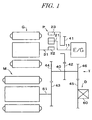
- FIG. 1 shows a power train of a hybrid four-axis drive apparatus of a first embodiment to which the invention is applied, in a skeleton diagram where inter-axis relationships are expanded.
- This apparatus has an engine E/G, an electric motor (hereinafter, referred to as “motor”) M, an electric power generator (hereinafter, referred to as “generator”) G, and a differential device D as main component elements.
- a differential gear device P formed by a single pinion-type planetary gear set, and a counter gear mechanism T are provided between the main component elements.
- this drive apparatus has a four-axis construction as follows. That is, the engine E/G and the generator G are disposed on a first axis I, and the motor M is disposed on a second axis II, and a countershaft 40 is disposed on a third axis III, and the differential device D is disposed on a fourth axis IV.
- the four axes are parallel to one another.
- the engine E/G and the generator G are connected to the countershaft 40 via the differential gear device P.
- the motor M and the differential device D are directly connected to the countershaft 40.
- the engine E/G is connected to the generator G and the counter gear mechanism T by connecting an output shaft 11 of the engine E/G to a carrier 21 of the differential gear device P.
- the genérator G is connected to the engine E/G and the counter gear mechanism T by connecting a rotor shaft 31 of the generator G to a sun gear 22 of the differential gear device P.
- a ring gear 23 of the differential gear device P is connected to a first axis-side counter drive gear 41 that is a member of a first pair of gears.
- a gear on the third axis which is the other member of the first pair of gears is formed by a counter driven gear 42 that is fixed to the countershaft 40 and that meshes with the counter drive gear 41.
- the motor M and the countershaft 40 are directly connected by a second pair of gears. More specifically, a counter drive gear 43 on the second axis that is fixed to a rotor shaft 51 of the motor M meshes with a counter driven gear 44 on the third axis that is fixed to the countershaft 40. In this manner, the rotor shaft 51 and the countershaft 40 are connected.
- the countershaft 40 and the differential device D are directly connected by a third pair of gears.
- the third pair of gears in this case is formed by a differential drive pinion gear 46 on the third axis that is fixed to the countershaft 40, and a differential ring gear 45 on the fourth axis that is fixed to a differential case 60 of the differential device D and that meshes with the differential drive pinion gear 46.
- the differential device D is connected to wheels (not shown) as well known.
- the motor M and the wheels have a directly connected relationship in terms of power transmission although they have a speed reduction relationship corresponding to the gear ratios of the second and third pairs of gears since the countershaft 40 is interposed therebetween.
- the engine E/G and the generator G are connected to each other and to the countershaft 40 via the differential gear device P, thus having an indirectly connected relationship in terms of power transmission.
- the first pair of gears formed by the counter drive gear 41 and the counter driven gear 42 which have a predetermined gear ratio
- the first pair of gears formed by the counter drive gear 41 and the counter driven gear 42 which have a predetermined gear ratio
- the output on the engine E/G side and the output on the motor M side are completely independent from each other, so that the engine-side gear ratio can be freely set.
- the inter-axis distance does not change, so that one and the same casing can be used for any engine-side gear ratio setting.
- the motor-side gear ratio can also be freely set and changed in accordance with need, although such need is considered rare in reality.
- each gear since each gear constitutes a pair on a one-to-one basis, each gear meshes with only one other gear. Therefore, this drive apparatus is advantageous in terms of gear noise, and allows a reduction of the man-hours.
- FIGS. 3 and 4 illustrate a second embodiment in which the idea of the invention is embodied in another form, in techniques similar to the techniques employed to illustrate the first embodiment.
- a motor M is connected to a countershaft 40 via a speed reducing mechanism R that is formed by a planetary gear set and the like disposed on a second axis that is coaxial with a rotor shaft 51 of the motor M.
- a differential device D is directly connected to the countershaft 40.
- An output shaft 52 of the speed reducing mechanism R and the countershaft 40 are connected by a counter drive gear 47 and a gear 48 that are fixed to the output shaft 52 and the countershaft 40 and that mesh with each other.
- the differential device D is connected to the countershaft 40 by meshing a differential ring gear 49 of the differential device D with the gear 48 at a position in a direction of an axis that is different from the position of mesh of the counter drive gear 47 with the gear 48. Therefore, in this construction, the gear 48 functions as a driven gear with respect to the counter drive gear 47. With respect to the differential ring gear 49, the gear 48 functions as a pinion gear that drives the differential ring gear 49. The counter drive gear 47 and the common gear 48 form a second pair of gears. The differential ring gear 49 and the common gear 48 form a third pair of gears.
- Other constructions are substantially the same as those of the first embodiment, and elements concerned are represented by the same reference characters in the drawings and will not be described again.
- the first pair of gears formed by the counter drive gear 41 and the counter driven gear 42 which have a predetermined gear ratio
- each gear does not necessarily constitute a pair on a one-to-one basis in this case.
- measures against gear noise can be achieved through a method in which the common gear 48 are formed by a combination of separate gears that have been formed separately, or a method in which different tooth shapes are formed at the mesh positions on the common gear 48 by separate forming processes, etc.
- FIGS. 5 and 6 illustrate a third embodiment in which the invention is embodied in still another form, in techniques similar to those employed to illustrate the first embodiment.
- This embodiment differs from the first embodiment only in that an engine E/G, a generator G and a motor M are disposed on a first axis I, and a countershaft 40 is disposed on a third axis III (a term "second axis" is avoided in the description of this embodiment to avoid confusions with the other embodiment), and a differential device D is disposed on a fourth axis IV, the three axes being parallel to one another.
- connection relationships of the engine E/G and the generator G to the countershaft 40, and the connection relationship between the motor M and the differential device D are substantially the same as those in the first embodiment. Therefore, other constructions are represented by the same reference characters in the drawings, and will not be described again.
- the third embodiment achieves advantages substantially the same as those stated above in conjunction with the first embodiment.
- a hybrid four-axis drive apparatus has an engine (E/G) and a generator (G) on a first axis, a motor (M) on a second axis, a counter gear mechanism (T) on a third axis, and a differential device (D) on a fourth axis.
- the engine and the generator are connected to the countershaft via a differential gear device (P).
- the motor and the differential device are directly connected to the countershaft.
- the differential gear device and the countershaft are connected by a first pair of gears (41, 42).
- the motor and the countershaft are connected by a second pair of gears (43, 44).
- the countershaft and the differential device are connected by a third pair of gears (45, 46). Therefore, it becomes possible to change the gear ratio of the pair of gears (41, 42) without changing the positions of the four axes relative to one another.
Landscapes
- Engineering & Computer Science (AREA)
- Transportation (AREA)
- Mechanical Engineering (AREA)
- Chemical & Material Sciences (AREA)
- Combustion & Propulsion (AREA)
- Power Engineering (AREA)
- Life Sciences & Earth Sciences (AREA)
- Sustainable Development (AREA)
- Sustainable Energy (AREA)
- Hybrid Electric Vehicles (AREA)
- Arrangement Of Transmissions (AREA)
- Electric Propulsion And Braking For Vehicles (AREA)
- Structure Of Transmissions (AREA)
Abstract
Description
- The disclosure of Japanese Patent Application No. HEI 11-371,847 filed on December 27 , 2000, including the specification, drawings and abstract, is incorporated herein by reference in its entirety.
- The present invention relates to a hybrid drive apparatus that uses an engine and an electric motor as power sources and, more particularly, to connecting constructions between axes in a hybrid drive apparatus.
- Hybrid drive apparatuses that use an engine (combustion engine) and an electric motor as power sources allow various power train arrangements since powers in two systems are transmitted to a differential device. Among such apparatuses, a drive apparatus having a construction that is excellent in the respect of transmitting output from the engine and output from the electric motor to a differential device with an arbitrary gear ratio set is disclosed in the Japanese Patent Application Laid-Open No. HEI 8-183347. This drive apparatus adopts an arrangement in which the engine and an electric power generator are disposed on a first axis, and the electric motor is disposed on a second axis, and a countershaft is disposed on a third axis, and the differential device is disposed on a fourth axis, and in which the engine and the electric power generator are connected to the countershaft via a differential gear device, and the electric motor and the differential device are directly connected to the countershaft. Therefore, the gear ratio of a pair of gears connecting the engine and the countershaft and the gear ratio of a pair of gears connecting the electric motor and the countershaft can be arbitrarily set independently of each other.
- With regard to engines, it is often the case that requirements vary depending on vehicles, for example, a fuel economy-oriented vehicle, an accelerating performance-oriented vehicle, etc. For the fuel economy-oriented vehicle, the total gear ratio from the engine to wheels needs to be set to a relatively high value. For the accelerating performance-oriented vehicle, the total gear ratio needs to be set to a relatively low value. To meet such requirements in the aforementioned hybrid drive apparatus, the engine-side total gear ratio is changed, for example, as indicated in FIG. 7, that is, by changing the diameters of a pair of gears connecting the differential gear device and the countershaft, that is, the diameter of a drive gear a on a first axis I and a driven gear b on a third axis III as indicated by broken lines in FIG. 7. However, together with these changes, a pair of gears connecting the electric motor and the countershaft must be changed. That is, a drive gear c on a second axis II must be changed together with a change in the diameter of the driven gear b on the third axis III. Thus, the electric motor-side gear ratio is affected. Furthermore, as the diameter of the drive gear a is changed to a gear a' indicated in FIG. 7, the inter-axis distance between the countershaft on the third axis III and the differential device on a fourth axis IV changes as indicated by a numeral with a prime representing an axis in FIG. 7. Therefore, the shape of a casing surrounding this arrangement must also be changed.
- Moreover, from standpoint of gear noise, since the drive gears a, b mesh with one and the same tooth face of the common counter driven gear b, a tooth face precision of the drive gear a with respect to the counter driven gear b and a tooth face precision of the drive gear c with respect to the driven gear b must be simultaneously achieved in order to avoid great gear noises. Therefore, a great number of man-hours must be consumed.
- Accordingly, it is an object of the invention to provide a hybrid four-axis drive apparatus that makes it possible to arbitrarily set and change an engine-side total gear ratio and, if necessary, an electric motor-side total gear ratio without changing the positions of the axes relative to one another.
- In accordance with one aspect of the invention, a hybrid drive apparatus includes an engine and an electric power electric power generator that are disposed on a first axis, an electric motor disposed on a second axis, a countershaft disposed on a third axis, and a differential device disposed on a fourth axis. The engine and the electric power generator are connected to the countershaft via a differential gear device, and the electric motor and the differential device are directly connected to the countershaft. The differential gear device and the countershaft are connected by a first pair of gears that mesh with each other, and the electric motor and the countershaft are connected by a second pair of gears that mesh with each other, and the countershaft and the differential device are connected by a third pair of gears that mesh with each other.
- In this hybrid drive apparatus, the power transmission from the engine side to the countershaft via the first pair of gears and the power transmission from the electric motor side to the countershaft via the second pair of gears are performed in different paths with respect to the countershaft. Therefore, the output from the engine side and the output from the electric motor can be completely independent from each other, and the total gear ratios on the two sides to the differential device can be freely set. Furthermore, when the gear ratios on the two sides are selected or changed, it is unnecessary to change the inter-axis distances between the four axes. As a result, the same casing can be used before and after the gear ratio settings are changed.
- In accordance with another aspect of the invention, a hybrid drive apparatus includes an engine and an electric power generator that are disposed on a first axis, an electric motor disposed on a second axis, a countershaft disposed on a third axis, and a differential device disposed on a fourth axis. The engine and the electric power generator are connected to the countershaft via a differential gear device, and each of the electric motor and the differential device is directly connected to the countershaft. The electric motor is connected to the countershaft via a speed reducing mechanism disposed on the second axis, and the differential device is directly connected to the countershaft. The differential gear device and the countershaft are connected by a first pair of gears that mesh with each other, and the electric motor and the countershaft are connected by a second pair of gears that mesh with each other, and the countershaft and the differential device are connected by a third pair of gears that mesh with each other.
- In this hybrid drive apparatus, the power transmission from the engine side to the countershaft via the first pair of gears and the power transmission from the electric motor to the countershaft via the second pair of gears are performed in different paths with respect to the countershaft. Therefore, the output from the engine side and the output from the electric motor can be completely independent from each other. Hence, the total gear ratio of the engine side to the differential device can be freely set. By changing the gear ratio of the speed reducing mechanism, the gear ratio on the electric motor side can be changed without affecting the total gear ratio of the path from the engine side to the differential device. Furthermore, it is unnecessary to change the inter-axis distances between the four axes when the gear ratios on the two sides are selected or changed. As a result, the same casing can be used before and after the gear ratio settings are changed.
- In accordance with still another aspect of the invention, a hybrid drive apparatus includes an engine, an electric power generator and an electric motor that are disposed on a first axis, a countershaft disposed on a third axis, and a differential device disposed on a fourth axis. The engine and the electric power generator are connected to the countershaft via a differential gear device, and wherein the electric motor and the differential device are directly connected to the countershaft. The differential gear device and the countershaft are connected by a first pair of gears that mesh with each other, and the electric motor and the countershaft are connected by a second pair of gears that meshwith each other, and the countershaft and the differential device are connected by a third pair of gears that mesh with each other.
- In this hybrid drive apparatus, the power transmission from the engine side to the countershaft via the first pair of gears and the power transmission from the electric motor side to the countershaft via the second pair of gears are performed in different paths with respect to the countershaft. Therefore, the output from the engine side and the output from the electric motor can be completely independent from each other, and the total gear ratios on the two sides to the differential device can be freely set. Furthermore, when the gear ratios on the two sides are selected or changed, it is unnecessary to change the inter-axis distances between the three axes. As a result, the same casing can be used before and after the gear ratio settings are changed.
- In the hybrid drive apparatus of each of the foregoing aspects of the invention, each of the first to third pairs of gears may be formed by two gears disposed at different positions in a direction of an axis of the countershaft.
- In this construction, each of the gears meshes with only one other gear. Therefore, the construction is advantageous in reducing the gear noise, and the man-hours for processing the gears can be reduced.
- Furthermore, in the invention, the second and third pairs of gears may be formed by three gears consisting of a common gear on the countershaft, and an electric motor-side gear and a differential device-side gear that mesh with the common gear at different positions in a direction of an axis.
- In this construction, a gear connecting the electric motor and the countershaft and a gear connecting the countershaft and the differential device are one and the same gear. However, due to the mesh positions shifted from each other in the direction of the axis, the common gear can have different tooth faces. Therefore, this construction, too, is advantageous in reducing the gear noise, and the man-hours for processing the gears can be reduced.
- The foregoing and further objects, features and advantages of the invention will become apparent from the following description of preferred embodiments with reference to the accompanying drawings, wherein like numerals are used to represent like elements and wherein:
- FIG. 1 is a skeleton diagram of a hybrid four-axis drive apparatus according to a first embodiment of the invention:
- FIG. 2 is a diagram indicating the relationships of meshes between gears on a counter shaft of a drive apparatus of the first embodiment;
- FIG. 3 is a skeleton diagram of a hybrid four-axis drive apparatus according to a second embodiment of the invention;
- FIG. 4 is a diagram indicating the relationships of meshes between gears on a counter shaft of a drive apparatus of the second embodiment;
- FIG. 5 is a skeleton diagram of a hybrid four-axis drive apparatus according to a third embodiment of the invention;
- FIG. 6 is a diagram indicating the relationships of meshes between gears on a counter shaft of a drive apparatus of the third embodiment; and
- FIG. 7 is a diagram indicating the relationships of meshes between gears on a counter shaft of a conventional drive apparatus.
-
- Preferred embodiments of the invention will be described hereinafter with reference to the drawings. FIG. 1 shows a power train of a hybrid four-axis drive apparatus of a first embodiment to which the invention is applied, in a skeleton diagram where inter-axis relationships are expanded. This apparatus has an engine E/G, an electric motor (hereinafter, referred to as "motor") M, an electric power generator (hereinafter, referred to as "generator") G, and a differential device D as main component elements. A differential gear device P formed by a single pinion-type planetary gear set, and a counter gear mechanism T are provided between the main component elements.
- As indicated in FIG. 2, in which an actual positional relationship among axes is indicated, this drive apparatus has a four-axis construction as follows. That is, the engine E/G and the generator G are disposed on a first axis I, and the motor M is disposed on a second axis II, and a
countershaft 40 is disposed on a third axis III, and the differential device D is disposed on a fourth axis IV. The four axes are parallel to one another. The engine E/G and the generator G are connected to thecountershaft 40 via the differential gear device P. The motor M and the differential device D are directly connected to thecountershaft 40. - Further detailed description will be made with reference to FIG. 1 again. The engine E/G is connected to the generator G and the counter gear mechanism T by connecting an
output shaft 11 of the engine E/G to acarrier 21 of the differential gear device P. The genérator G is connected to the engine E/G and the counter gear mechanism T by connecting arotor shaft 31 of the generator G to asun gear 22 of the differential gear device P. Aring gear 23 of the differential gear device P is connected to a first axis-sidecounter drive gear 41 that is a member of a first pair of gears. A gear on the third axis which is the other member of the first pair of gears is formed by a counter drivengear 42 that is fixed to thecountershaft 40 and that meshes with thecounter drive gear 41. - The motor M and the
countershaft 40 are directly connected by a second pair of gears. More specifically, acounter drive gear 43 on the second axis that is fixed to arotor shaft 51 of the motor M meshes with a counter drivengear 44 on the third axis that is fixed to thecountershaft 40. In this manner, therotor shaft 51 and thecountershaft 40 are connected. - The
countershaft 40 and the differential device D are directly connected by a third pair of gears. The third pair of gears in this case is formed by a differentialdrive pinion gear 46 on the third axis that is fixed to thecountershaft 40, and adifferential ring gear 45 on the fourth axis that is fixed to adifferential case 60 of the differential device D and that meshes with the differentialdrive pinion gear 46. The differential device D is connected to wheels (not shown) as well known. - In the hybrid four-axis drive apparatus having the above-described construction, the motor M and the wheels have a directly connected relationship in terms of power transmission although they have a speed reduction relationship corresponding to the gear ratios of the second and third pairs of gears since the
countershaft 40 is interposed therebetween. In contrast, the engine E/G and the generator G are connected to each other and to thecountershaft 40 via the differential gear device P, thus having an indirectly connected relationship in terms of power transmission. Therefore, by adjusting the power generation load of the generator G with respect to thering gear 23, which receives vehicle running load via the differential device D and thecountershaft 40, it becomes possible to achieve a vehicle running in which the engine output utilization proportion between the drive power from engine output and the electric power generating energy (battery charging) from engine output is appropriately adjusted. Furthermore, the reaction force on acarrier 21 reverses when the generator G is driven as a motor. Therefore, if in that case, thecarrier 21 is stopped and engaged with the drive apparatus casing by appropriate means (not shown), the output of the generator G can be transmitted to thering gear 23. Thus, it is possible to achieve enhancement of the drive power at the time of a start of the vehicle based on simultaneous outputs from the motor M and the generator G (parallel mode running). - Next described will be the changing of the engine-side gear ratio, that is, a gist of the invention. As indicated in FIG. 2, which indicates the actual positions of the four axes and the gear mesh relationship, the first pair of gears formed by the
counter drive gear 41 and the counter drivengear 42, which have a predetermined gear ratio, is provided as a pair of gears separate from the second pair of gears formed by thecounter drive gear 43 and the counter drivengear 44, which have a predetermined gear ratio that is different from the gear ratio of the first pair of gears. Therefore, when the diameter of thecounter drive gear 41 is changed in accordance with a gear ratio change requirement, the diameter of the counter drivengear 42 meshing with thecounter drive gear 41 needs to be changed as well. However, no change is needed in the diameters of the pair of thecounter drive gear 43 and the counter drivengear 44. The same applies to the relationship of the pair of the differentialdrive pinion gear 46 and thedifferential ring gear 45. Furthermore, since the changing of the gear ratio does not affect the other pairs of gears as mentioned above, the position of thecountershaft 40 remains unchanged. - Therefore, according to this drive apparatus, the output on the engine E/G side and the output on the motor M side are completely independent from each other, so that the engine-side gear ratio can be freely set. At the time of such setting, the inter-axis distance does not change, so that one and the same casing can be used for any engine-side gear ratio setting. Furthermore, the motor-side gear ratio can also be freely set and changed in accordance with need, although such need is considered rare in reality. Furthermore, since each gear constitutes a pair on a one-to-one basis, each gear meshes with only one other gear. Therefore, this drive apparatus is advantageous in terms of gear noise, and allows a reduction of the man-hours.
- Next, FIGS. 3 and 4 illustrate a second embodiment in which the idea of the invention is embodied in another form, in techniques similar to the techniques employed to illustrate the first embodiment. In this embodiment, a motor M is connected to a
countershaft 40 via a speed reducing mechanism R that is formed by a planetary gear set and the like disposed on a second axis that is coaxial with arotor shaft 51 of the motor M. A differential device D is directly connected to thecountershaft 40. Anoutput shaft 52 of the speed reducing mechanism R and thecountershaft 40 are connected by acounter drive gear 47 and agear 48 that are fixed to theoutput shaft 52 and thecountershaft 40 and that mesh with each other. Furthermore, the differential device D is connected to thecountershaft 40 by meshing adifferential ring gear 49 of the differential device D with thegear 48 at a position in a direction of an axis that is different from the position of mesh of thecounter drive gear 47 with thegear 48. Therefore, in this construction, thegear 48 functions as a driven gear with respect to thecounter drive gear 47. With respect to thedifferential ring gear 49, thegear 48 functions as a pinion gear that drives thedifferential ring gear 49. Thecounter drive gear 47 and thecommon gear 48 form a second pair of gears. Thedifferential ring gear 49 and thecommon gear 48 form a third pair of gears. Other constructions are substantially the same as those of the first embodiment, and elements concerned are represented by the same reference characters in the drawings and will not be described again. - If the above-described construction is adopted, the first pair of gears formed by the
counter drive gear 41 and the counter drivengear 42, which have a predetermined gear ratio, is provided as a pair separate from the second pair of gears formed by thecounter drive gear 47 and thecommon gear 48, which have a predetermined gear ratio that is different from the gear ratio of the first pair of gears, as is the case with the first embodiment. Therefore, when the diameter of thecounter drive gear 41 is changed in accordance with a gear ratio change requirement, a diameter change is needed for the counter drivengear 42 meshing with thecounter drive gear 41 whereas no diameter change is needed for the pair of thecounter drive gear 47 and thecommon gear 48. This also applies to the relationship of the pair of thecommon gear 48 and thedifferential ring gear 49. In this case, the changing of the gear ratio has no effect on the other pairs of gears, and the position of thecountershaft 40 remains unchanged, as mentioned above. - Therefore, this drive apparatus achieves advantages similar to those of the first embodiment. Unlike the first embodiment, each gear does not necessarily constitute a pair on a one-to-one basis in this case. However, since the mesh positions of the two
gears common gear 48 are shifted from each other in the direction of the axis, measures against gear noise can be achieved through a method in which thecommon gear 48 are formed by a combination of separate gears that have been formed separately, or a method in which different tooth shapes are formed at the mesh positions on thecommon gear 48 by separate forming processes, etc. - Next, FIGS. 5 and 6 illustrate a third embodiment in which the invention is embodied in still another form, in techniques similar to those employed to illustrate the first embodiment. This embodiment differs from the first embodiment only in that an engine E/G, a generator G and a motor M are disposed on a first axis I, and a
countershaft 40 is disposed on a third axis III (a term "second axis" is avoided in the description of this embodiment to avoid confusions with the other embodiment), and a differential device D is disposed on a fourth axis IV, the three axes being parallel to one another. The connection relationships of the engine E/G and the generator G to thecountershaft 40, and the connection relationship between the motor M and the differential device D are substantially the same as those in the first embodiment. Therefore, other constructions are represented by the same reference characters in the drawings, and will not be described again. - As indicated by the drive connection relationships that are substantially the same as those in the first embodiment, the third embodiment achieves advantages substantially the same as those stated above in conjunction with the first embodiment.
- While the invention has been described with reference to what are presently considered to be preferred embodiments thereof, it is to be understood that the invention is not limited to the disclosed embodiments or constructions. To the contrary, the invention is intended to cover various modifications and equivalent arrangements.
- A hybrid four-axis drive apparatus has an engine (E/G) and a generator (G) on a first axis, a motor (M) on a second axis, a counter gear mechanism (T) on a third axis, and a differential device (D) on a fourth axis. The engine and the generator are connected to the countershaft via a differential gear device (P). The motor and the differential device are directly connected to the countershaft. The differential gear device and the countershaft are connected by a first pair of gears (41, 42). The motor and the countershaft are connected by a second pair of gears (43, 44). The countershaft and the differential device are connected by a third pair of gears (45, 46). Therefore, it becomes possible to change the gear ratio of the pair of gears (41, 42) without changing the positions of the four axes relative to one another.
Claims (9)
- A hybrid drive apparatus comprising:an engine and an electric power generator that are disposed on a first axis;an electric motor disposed on a second axis;a countershaft disposed on a third axis; anda differential device disposed on a fourth axis,wherein the engine and the electric power generator are connected to the countershaft via a differential gear device, and the electric motor and the differential device are directly connected to the countershaft, andwherein the differential gear device and the countershaft are connected by a first pair of gears that mesh with each other, and the electric motor and the countershaft are connected by a second pair of gears that mesh with each other, and the countershaft and the differential device are connected by a third pair of gears that mesh with each other.
- A hybrid drive apparatus according to claim 1, wherein each of the first to third pairs of gears is formed by two gears disposed at different positions in a direction of an axis of the countershaft.
- A hybrid drive apparatus according to claim 1, 2 or 3, wherein the second and third pairs of gears are formed by three gears consisting of a common gear on the countershaft, and an electric motor-side gear and a differential device-side gear that mesh with the common gear at different positions in a direction of an axis.
- A hybrid drive apparatus comprising:an engine and an electric power generator that are disposed on a first axis;an electric motor disposed on a second axis;a countershaft disposed on a third axis; anda differential device disposed on a fourth axis,wherein the engine and the electric power generator are connected to the countershaft via a differential gear device, and each of the electric motor and the differential device is directly connected to the countershaft, andwherein the electric motor is connected to the countershaft via a speed reducing mechanism disposed on the second axis, and the differential device is directly connected to the countershaft, andwherein the differential gear device and the countershaft are connected by a first pair of gears that mesh with each other, and the electric motor and the countershaft are connected by a second pair of gears that mesh with each other, and the countershaft and the differential device are connected by a third pair of gears that mesh with each other.
- A hybrid drive apparatus according to claim 4, wherein each of the first to third pairs of gears is formed by two gears disposed at different positions in a direction of an axis of the countershaft.
- A hybrid drive apparatus according to claim 4, wherein the second and third pairs of gears are formed by three gears consisting of a common gear on the countershaft, and an electric motor-side gear and a differential device-side gear that mesh with the common gear at different positions in a direction of an axis.
- A hybrid drive apparatus comprising:an engine, an electric power generator and an electric motor that are disposed on a first axis;a countershaft disposed on a third axis; anda differential device disposed on a fourth axis,wherein the engine and the electric power generator are connected to the countershaft via a differential gear device, and wherein the electric motor and the differential device are directly connected to the countershaft, andwherein the differential gear device and the countershaft are connected by a first pair of gears that mesh with each other, and the electric motor and the countershaft are connected by a second pair of gears that mesh with each other, and the countershaft and the differential device are connected by a third pair of gears that mesh with each other.
- A hybrid drive apparatus according to claim 7, wherein each of the first to third pairs of gears is formed by two gears disposed at different positions in a direction of an axis of the countershaft.
- A hybrid drive apparatus according to claim 7, wherein the second and third pairs of gears are formed by three gears consisting of a common gear on the countershaft, and an electric motor-side gear and a differential device-side gear that mesh with the common gear at different positions in a direction of an axis.
Applications Claiming Priority (2)
| Application Number | Priority Date | Filing Date | Title |
|---|---|---|---|
| JP37184799 | 1999-12-27 | ||
| JP37184799A JP3824125B2 (en) | 1999-12-27 | 1999-12-27 | Hybrid drive device |
Publications (3)
| Publication Number | Publication Date |
|---|---|
| EP1112883A2 true EP1112883A2 (en) | 2001-07-04 |
| EP1112883A3 EP1112883A3 (en) | 2005-04-20 |
| EP1112883B1 EP1112883B1 (en) | 2010-04-07 |
Family
ID=18499417
Family Applications (1)
| Application Number | Title | Priority Date | Filing Date |
|---|---|---|---|
| EP00127436A Expired - Lifetime EP1112883B1 (en) | 1999-12-27 | 2000-12-14 | Gearing arrangement in hybrid drive apparatus |
Country Status (5)
| Country | Link |
|---|---|
| US (1) | US6695736B2 (en) |
| EP (1) | EP1112883B1 (en) |
| JP (1) | JP3824125B2 (en) |
| KR (1) | KR100670768B1 (en) |
| DE (1) | DE60044118D1 (en) |
Cited By (1)
| Publication number | Priority date | Publication date | Assignee | Title |
|---|---|---|---|---|
| DE102017207827A1 (en) * | 2017-05-09 | 2018-11-15 | Volkswagen Aktiengesellschaft | Drive arrangement for a hybrid vehicle |
Families Citing this family (23)
| Publication number | Priority date | Publication date | Assignee | Title |
|---|---|---|---|---|
| JP3656841B2 (en) * | 2001-12-27 | 2005-06-08 | アイシン・エィ・ダブリュ株式会社 | Drive unit with electric motor |
| JP3626166B2 (en) * | 2003-01-17 | 2005-03-02 | 日産自動車株式会社 | Hybrid transmission |
| AU2003287020A1 (en) * | 2003-10-03 | 2005-05-19 | James C. Leblanc Jr. | Power plant and driveline for vehicles |
| KR100704788B1 (en) * | 2005-08-18 | 2007-04-10 | 현대자동차주식회사 | Hybrid car |
| US20070135819A1 (en) * | 2005-12-08 | 2007-06-14 | Spiritos Nicholas M | Transvaginal tube |
| US7624828B2 (en) * | 2006-05-04 | 2009-12-01 | Ford Global Technologies, Llc | Vehicle power transfer system and method, and vehicle using the same |
| US7686723B2 (en) * | 2006-08-15 | 2010-03-30 | Ford Global Technologies, Llc | Hybrid electric vehicle and powertrain |
| KR100792859B1 (en) | 2006-08-17 | 2008-01-08 | 현대자동차주식회사 | Hybrid Powertrain Structure |
| US7591749B2 (en) * | 2006-09-15 | 2009-09-22 | Gm Global Technology Operations, Inc. | Electrically variable transmission with one or more off-axis motor/generators |
| JP4369966B2 (en) * | 2007-07-18 | 2009-11-25 | アイシン・エィ・ダブリュ株式会社 | Hybrid vehicle drive device |
| JP5298573B2 (en) * | 2008-03-04 | 2013-09-25 | トヨタ自動車株式会社 | Control device for vehicle power transmission device |
| US8740739B2 (en) * | 2011-08-04 | 2014-06-03 | Ford Global Technologies, Llc | Reconfigurable powersplit powertrain for an electric vehicle |
| JP5937827B2 (en) * | 2012-01-17 | 2016-06-22 | Gknドライブラインジャパン株式会社 | Drive device |
| KR101558351B1 (en) | 2013-12-04 | 2015-10-07 | 현대자동차 주식회사 | Transmission system of hybrid electric vehicle |
| KR101518949B1 (en) | 2013-12-17 | 2015-05-18 | 현대자동차 주식회사 | Transmission system of hybrid electric vehicle |
| KR101518947B1 (en) | 2013-12-18 | 2015-05-18 | 현대자동차 주식회사 | Transmission system of hybrid electric vehicle |
| KR101693940B1 (en) | 2014-11-28 | 2017-01-10 | 현대자동차주식회사 | Transmission for hibrid vehicle |
| KR101734243B1 (en) | 2016-07-21 | 2017-05-11 | 현대자동차 주식회사 | Power transmission system of hybrid electric vehicle |
| KR102383223B1 (en) | 2016-12-12 | 2022-04-05 | 현대자동차 주식회사 | Power transmission system of hybrid electric vehicle |
| US10035414B1 (en) * | 2017-01-18 | 2018-07-31 | GM Global Technology Operations LLC | Automatically-shiftable hybrid transaxle |
| US10744865B2 (en) * | 2018-10-09 | 2020-08-18 | Ford Global Technologies, Llc | Hybrid transaxle |
| JP7011636B2 (en) * | 2019-10-11 | 2022-01-26 | 本田技研工業株式会社 | Drive |
| US12576708B2 (en) * | 2023-03-23 | 2026-03-17 | Dana Automotive Systems Group, Llc | Electric axle with compact electric machine and gearbox arrangement |
Citations (3)
| Publication number | Priority date | Publication date | Assignee | Title |
|---|---|---|---|---|
| JPH08183347A (en) | 1994-12-28 | 1996-07-16 | Aqueous Res:Kk | Hybrid vehicle |
| US5775449A (en) | 1994-06-06 | 1998-07-07 | Kabushikikaisha Equos Research | Hybrid vehicle |
| EP0909675A2 (en) | 1997-10-13 | 1999-04-21 | Toyota Jidosha Kabushiki Kaisha | Secondary battery charge and discharge control device |
Family Cites Families (10)
| Publication number | Priority date | Publication date | Assignee | Title |
|---|---|---|---|---|
| JP2857535B2 (en) * | 1992-05-19 | 1999-02-17 | 株式会社エクォス・リサーチ | Hybrid vehicle |
| JP3289533B2 (en) * | 1995-01-30 | 2002-06-10 | 株式会社エクォス・リサーチ | Hybrid vehicle |
| JP2783983B2 (en) * | 1995-02-03 | 1998-08-06 | 株式会社エクォス・リサーチ | Hybrid vehicle |
| JP3534271B2 (en) * | 1995-04-20 | 2004-06-07 | 株式会社エクォス・リサーチ | Hybrid vehicle |
| JP3289545B2 (en) * | 1995-04-28 | 2002-06-10 | 株式会社エクォス・リサーチ | Hybrid vehicle |
| US5823281A (en) * | 1995-05-25 | 1998-10-20 | Kabushikikaisha Equos Reseach | Hybrid vehicle |
| JP2860772B2 (en) * | 1995-06-06 | 1999-02-24 | 株式会社エクォス・リサーチ | Hybrid vehicle |
| CA2259771C (en) * | 1998-02-19 | 2003-04-01 | Hitachi, Ltd. | Transmission, and vehicle and bicycle using the same |
| JP3536658B2 (en) * | 1998-03-31 | 2004-06-14 | 日産自動車株式会社 | Drive control device for hybrid vehicle |
| JP3879325B2 (en) * | 1999-09-29 | 2007-02-14 | トヨタ自動車株式会社 | Hybrid drive device |
-
1999
- 1999-12-27 JP JP37184799A patent/JP3824125B2/en not_active Expired - Lifetime
-
2000
- 2000-12-08 US US09/731,918 patent/US6695736B2/en not_active Expired - Lifetime
- 2000-12-14 DE DE60044118T patent/DE60044118D1/en not_active Expired - Lifetime
- 2000-12-14 EP EP00127436A patent/EP1112883B1/en not_active Expired - Lifetime
- 2000-12-20 KR KR1020000078904A patent/KR100670768B1/en not_active Expired - Lifetime
Patent Citations (3)
| Publication number | Priority date | Publication date | Assignee | Title |
|---|---|---|---|---|
| US5775449A (en) | 1994-06-06 | 1998-07-07 | Kabushikikaisha Equos Research | Hybrid vehicle |
| JPH08183347A (en) | 1994-12-28 | 1996-07-16 | Aqueous Res:Kk | Hybrid vehicle |
| EP0909675A2 (en) | 1997-10-13 | 1999-04-21 | Toyota Jidosha Kabushiki Kaisha | Secondary battery charge and discharge control device |
Cited By (1)
| Publication number | Priority date | Publication date | Assignee | Title |
|---|---|---|---|---|
| DE102017207827A1 (en) * | 2017-05-09 | 2018-11-15 | Volkswagen Aktiengesellschaft | Drive arrangement for a hybrid vehicle |
Also Published As
| Publication number | Publication date |
|---|---|
| KR100670768B1 (en) | 2007-01-17 |
| EP1112883B1 (en) | 2010-04-07 |
| US6695736B2 (en) | 2004-02-24 |
| JP3824125B2 (en) | 2006-09-20 |
| US20010006919A1 (en) | 2001-07-05 |
| EP1112883A3 (en) | 2005-04-20 |
| JP2001180311A (en) | 2001-07-03 |
| DE60044118D1 (en) | 2010-05-20 |
| KR20010067463A (en) | 2001-07-12 |
Similar Documents
| Publication | Publication Date | Title |
|---|---|---|
| EP1112883B1 (en) | Gearing arrangement in hybrid drive apparatus | |
| EP1690723B1 (en) | Gearing arrangement in hybrid drive apparatus | |
| US6945894B2 (en) | Two range electrically variable power transmission | |
| US7892128B2 (en) | Hybrid electric vehicle and powertrain | |
| EP1279545B1 (en) | Hybrid drivetrain for a vehicle | |
| US6551208B1 (en) | Three-mode, compound-split, electrically-variable transmission | |
| US8152668B2 (en) | Electric variable transmission for hybrid electric vehicles with two forward modes and four fixed gears | |
| EP1743795B1 (en) | Hybrid transmission | |
| US20080171625A1 (en) | Power-Split Transmission for a Hybrid Vehicle | |
| CA2428006A1 (en) | All-wheel drive vehicle with hybrid drive | |
| US10913341B2 (en) | Power transmission apparatus of hybrid electric vehicle | |
| US10744865B2 (en) | Hybrid transaxle | |
| CN105307889A (en) | Drive train for a hybrid vehicle | |
| EP1802480B1 (en) | Vehicle drive unit, and four-wheel-drive vehicle drive unit | |
| US7625307B2 (en) | Mechatronic hybrid transmissions having two planetary gear sets and three motor/generators | |
| Yang et al. | Integrated electro-mechanical transmission systems in hybrid electric vehicles | |
| CN113459790A (en) | Transverse hybrid power transmission and automobile | |
| JP2007008470A (en) | Hybrid drive apparatus | |
| CN219904044U (en) | Dual-motor hybrid system | |
| CN100544165C (en) | Hybrid transmission with three motor/generators and three interconnected planetary gear sets | |
| KR20240075974A (en) | Gearbox for electric vehicles | |
| CN118991399A (en) | Dual-motor hybrid system | |
| KR20230090557A (en) | Power transmission apparatus for hybride vehicle |
Legal Events
| Date | Code | Title | Description |
|---|---|---|---|
| PUAI | Public reference made under article 153(3) epc to a published international application that has entered the european phase |
Free format text: ORIGINAL CODE: 0009012 |
|
| AK | Designated contracting states |
Kind code of ref document: A2 Designated state(s): AT BE CH CY DE DK ES FI FR GB GR IE IT LI LU MC NL PT SE TR |
|
| AX | Request for extension of the european patent |
Free format text: AL;LT;LV;MK;RO;SI |
|
| PUAL | Search report despatched |
Free format text: ORIGINAL CODE: 0009013 |
|
| AK | Designated contracting states |
Kind code of ref document: A3 Designated state(s): AT BE CH CY DE DK ES FI FR GB GR IE IT LI LU MC NL PT SE TR |
|
| AX | Request for extension of the european patent |
Extension state: AL LT LV MK RO SI |
|
| 17P | Request for examination filed |
Effective date: 20050901 |
|
| AKX | Designation fees paid |
Designated state(s): DE FR GB |
|
| GRAP | Despatch of communication of intention to grant a patent |
Free format text: ORIGINAL CODE: EPIDOSNIGR1 |
|
| GRAC | Information related to communication of intention to grant a patent modified |
Free format text: ORIGINAL CODE: EPIDOSCIGR1 |
|
| RIC1 | Information provided on ipc code assigned before grant |
Ipc: B60W 10/00 20060101ALI20091016BHEP Ipc: B60K 6/20 20071001AFI20091016BHEP |
|
| GRAS | Grant fee paid |
Free format text: ORIGINAL CODE: EPIDOSNIGR3 |
|
| GRAA | (expected) grant |
Free format text: ORIGINAL CODE: 0009210 |
|
| AK | Designated contracting states |
Kind code of ref document: B1 Designated state(s): DE FR GB |
|
| REG | Reference to a national code |
Ref country code: GB Ref legal event code: FG4D |
|
| REF | Corresponds to: |
Ref document number: 60044118 Country of ref document: DE Date of ref document: 20100520 Kind code of ref document: P |
|
| PLBE | No opposition filed within time limit |
Free format text: ORIGINAL CODE: 0009261 |
|
| STAA | Information on the status of an ep patent application or granted ep patent |
Free format text: STATUS: NO OPPOSITION FILED WITHIN TIME LIMIT |
|
| 26N | No opposition filed |
Effective date: 20110110 |
|
| REG | Reference to a national code |
Ref country code: FR Ref legal event code: PLFP Year of fee payment: 16 |
|
| REG | Reference to a national code |
Ref country code: FR Ref legal event code: PLFP Year of fee payment: 17 |
|
| REG | Reference to a national code |
Ref country code: FR Ref legal event code: PLFP Year of fee payment: 18 |
|
| PGFP | Annual fee paid to national office [announced via postgrant information from national office to epo] |
Ref country code: DE Payment date: 20191203 Year of fee payment: 20 |
|
| PGFP | Annual fee paid to national office [announced via postgrant information from national office to epo] |
Ref country code: FR Payment date: 20191114 Year of fee payment: 20 |
|
| PGFP | Annual fee paid to national office [announced via postgrant information from national office to epo] |
Ref country code: GB Payment date: 20191213 Year of fee payment: 20 |
|
| REG | Reference to a national code |
Ref country code: DE Ref legal event code: R071 Ref document number: 60044118 Country of ref document: DE |
|
| REG | Reference to a national code |
Ref country code: GB Ref legal event code: PE20 Expiry date: 20201213 |
|
| PG25 | Lapsed in a contracting state [announced via postgrant information from national office to epo] |
Ref country code: GB Free format text: LAPSE BECAUSE OF EXPIRATION OF PROTECTION Effective date: 20201213 |