EP1111219A2 - Mounting an igniter in an augmenter - Google Patents
Mounting an igniter in an augmenter Download PDFInfo
- Publication number
- EP1111219A2 EP1111219A2 EP00311588A EP00311588A EP1111219A2 EP 1111219 A2 EP1111219 A2 EP 1111219A2 EP 00311588 A EP00311588 A EP 00311588A EP 00311588 A EP00311588 A EP 00311588A EP 1111219 A2 EP1111219 A2 EP 1111219A2
- Authority
- EP
- European Patent Office
- Prior art keywords
- igniter
- augmenter
- body portion
- lead
- housing
- Prior art date
- Legal status (The legal status is an assumption and is not a legal conclusion. Google has not performed a legal analysis and makes no representation as to the accuracy of the status listed.)
- Granted
Links
- 238000007654 immersion Methods 0.000 claims abstract description 16
- 238000000034 method Methods 0.000 claims description 11
- 230000008878 coupling Effects 0.000 claims description 4
- 238000010168 coupling process Methods 0.000 claims description 4
- 238000005859 coupling reaction Methods 0.000 claims description 4
- 239000007789 gas Substances 0.000 description 26
- 230000006835 compression Effects 0.000 description 12
- 238000007906 compression Methods 0.000 description 12
- 238000001816 cooling Methods 0.000 description 8
- 230000012010 growth Effects 0.000 description 6
- 239000000446 fuel Substances 0.000 description 3
- 230000007423 decrease Effects 0.000 description 2
- 230000002411 adverse Effects 0.000 description 1
- 239000000567 combustion gas Substances 0.000 description 1
- 230000003247 decreasing effect Effects 0.000 description 1
- 230000000694 effects Effects 0.000 description 1
- 238000012423 maintenance Methods 0.000 description 1
- 238000007789 sealing Methods 0.000 description 1
- 230000008646 thermal stress Effects 0.000 description 1
Images


Classifications
-
- F—MECHANICAL ENGINEERING; LIGHTING; HEATING; WEAPONS; BLASTING
- F02—COMBUSTION ENGINES; HOT-GAS OR COMBUSTION-PRODUCT ENGINE PLANTS
- F02K—JET-PROPULSION PLANTS
- F02K3/00—Plants including a gas turbine driving a compressor or a ducted fan
- F02K3/08—Plants including a gas turbine driving a compressor or a ducted fan with supplementary heating of the working fluid; Control thereof
- F02K3/10—Plants including a gas turbine driving a compressor or a ducted fan with supplementary heating of the working fluid; Control thereof by after-burners
-
- F—MECHANICAL ENGINEERING; LIGHTING; HEATING; WEAPONS; BLASTING
- F02—COMBUSTION ENGINES; HOT-GAS OR COMBUSTION-PRODUCT ENGINE PLANTS
- F02C—GAS-TURBINE PLANTS; AIR INTAKES FOR JET-PROPULSION PLANTS; CONTROLLING FUEL SUPPLY IN AIR-BREATHING JET-PROPULSION PLANTS
- F02C7/00—Features, components parts, details or accessories, not provided for in, or of interest apart form groups F02C1/00 - F02C6/00; Air intakes for jet-propulsion plants
- F02C7/26—Starting; Ignition
- F02C7/264—Ignition
- F02C7/266—Electric
-
- F—MECHANICAL ENGINEERING; LIGHTING; HEATING; WEAPONS; BLASTING
- F05—INDEXING SCHEMES RELATING TO ENGINES OR PUMPS IN VARIOUS SUBCLASSES OF CLASSES F01-F04
- F05D—INDEXING SCHEME FOR ASPECTS RELATING TO NON-POSITIVE-DISPLACEMENT MACHINES OR ENGINES, GAS-TURBINES OR JET-PROPULSION PLANTS
- F05D2240/00—Components
- F05D2240/90—Mounting on supporting structures or systems
Definitions
- This invention relates to augmenters, and more particularly, to augmenter igniters.
- Augmenters are used in gas turbine engines to increase thrust as needed in a flight envelope.
- An igniter is typically located circumferentially near a bottom of the augmenter.
- the ignitor typically includes an igniter mounting assembly and an igniter lead extending from an ignition box to an igniter tip.
- the igniter tip provides an ignition source for the augmenter.
- An igniter mounting assembly secures the igniter to the augmenter.
- the mounting assembly includes an igniter housing secured to the augmenter with a pluality of fasteners.
- the igniter housing includes an opening at both ends which permits the igniter to extend therethrough to the augmenter.
- the igniter is installed such that the igniter tip extends into the augmenter a predetermined immersion depth.
- a gas turbine engine When a gas turbine engine is operating, fuel and air flow through the augmenter at a high temperature and velocity. The high temperatures of the fuel and air subject the augmenter and its associated components to thermal stresses and thermal growths. Such thermal growths often force the igniter radially inward into an ignition zone area which increases the igniter tip temperature and decreases the igniter tip life. As a result, the igniter tip is continually mis-aligned which may decrease the overall performance of the associated gas turbine engine. To correct such igniter tip misalignments, typically a floating ferrule arrangement is included at an interface between the igniter tip and the ignition zone.
- a bulky and adjustable igniter mounting assembly is used.
- Such an assembly includes a plurality of components fastened tightly together to prevent any single component from thermally expanding independently of any other component. As a result, the components thermally expand causing misalignments and improper immersion depths.
- the bulky floating ferrule assembly extends outward from the augmenter ignition zone and blocks cooling air flow used to cool other gas turbine engine components.
- the igniter tip remains in proper alignment with respect to the mounting assembly, it may not remain at a proper immersion depth or at a proper alignment with respect to the augmenter. As a result, overall gas turbine light off performance is decreased.
- an augmenter includes an igniter mounting assembly which maintains an igniter tip at a proper immersion depth.
- the igniter includes an igniter lead and an igniter housing assembly.
- the igniter lead extends from an ignition box and terminates in an igniter tip.
- the housing assembly is secured to an augmenter with a pair of fasteners and the igniter is secured within the housing assembly with a self-locking nut.
- the igniter and igniter housing also include a biasing mechanism coupled between the igniter and the igniter housing.
- the biasing mechanism biases the igniter against the augmenter to ensure that the igniter tip is maintained at a proper immersion depth within an augmenter ignition zone during gas turbine engine operation.
- the igniter includes an alignment support boss sized to be received in a chamfered opening disposed within the augmenter. The combination of the alignment support boss and the chamfered opening automatically aligns the igniter tip for proper operation when the igniter is fully attached to the augmenter.
- the biasing mechanism maintains the igniter tip at a proper immersion depth within the augmenter.
- igniter maintenance efforts are streamlined.
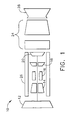
- Figure 1 is a schematic illustration of a gas turbine engine 10 including a low pressure compressor 12, a high pressure compressor 14, and a combustor 16.
- Engine 10 also includes a high pressure turbine 18, a low pressure turbine 20, and an augmenter 24.
- FIG. 2 is a perspective view of an igniter 30 utilized in a gas turbine engine, such as gas turbine engine 10.
- Igniter 30 includes an igniter lead 31 having a first body portion 32 and a second body portion 34.
- First body portion 32 extends from second body portion 34 to a connector 36.
- Connector 36 has a diameter 38 larger than a diameter 40 of igniter lead 31.
- Connector diameter 38 permits connector 36 to attach to a flexible lead (not shown) extending from an ignition box (not shown).
- Second body portion 34 extends from igniter first body portion 32 to an igniter tip 42.
- Igniter first body portion 32 includes a bend 44 extending between igniter first body portion 32 and igniter second body portion 34. Bend 44 is curved such that igniter first body portion 32 is substantially perpendicular to igniter second body portion 34.
- a nut retaining collar 50 extends from igniter lead 31 between igniter bend 44 and igniter second body portion 34.
- Nut retaining collar 50 has a diameter 52 larger than igniter lead diameter 40.
- Diameter 52 is also larger than an inner diameter (not shown in Figure 2) of an opening (not shown in Figure 2) of a self-locking nut 54.
- Self-locking nut 54 is circumferentially disposed around igniter 30 and includes a cap (not shown in Figure 2) and a plurality of threads (not shown). The threads are sized to engage an igniter housing (not shown in Figure 2) to secure self-locking nut 54 to the igniter housing while igniter 30 remains in slidable contact within the igniter housing.
- igniter 30 is capable of sliding with respect to the igniter housing such that nut retaining collar 50 may contact self-locking nut 54.
- the diameter of the cap opening is smaller than diameter 52 of nut retaining collar 50. Accordingly, nut retaining collar 50 limits an amount of travel of igniter second body portion 34 through self-locking nut 54.
- the self-locking nut cap is configured to compress an igniter compression spring 60 as self-locking nut 54 is tightened to the igniter housing.
- Compression spring 60 is a biasing mechanism circumferentially positioned around igniter lead 31 between self-locking nut 54 and an o-ring groove 62.
- a first end (not shown in Figure 2) of compression spring 60 is positioned within self-locking nut 54 adjacent the self-locking nut cap and a second end 61 of compression spring 60 is positioned adjacent an o-ring groove 62.
- O-ring groove 62 is sized to receive an o-ring (not shown in Figure 2) to sealingly contact the igniter housing.
- Igniter second body portion 34 includes a second o-ring groove 66 sized to receive a second o-ring (not shown in Figure 2) to sealingly contact a floating ferrule (not shown in Figure 2).
- Second o-ring groove 66 is positioned between o-ring groove 62 and igniter tip 42.
- An alignment support boss 70 extends radially outward from igniter lead 31 between o-ring groove 66 and igniter tip 42.
- Alignment support boss 70 is spherical and has a spherical cross-sectional profile (not shown in Figure 2) sized to be received in an opening (not shown in Figure 2) disposed within an augmenter flameholder (not shown in Figure 2).
- FIG 3 is a perspective view of igniter 30 attached to augmenter 24 with an igniter mounting assembly 76.
- Igniter mounting assembly 76 includes an igniter housing 82 including an outer surface 83. Outer surface 83 includes a plurality of threads (not shown) sized to receive the igniter self-locking nut threads.
- igniter housing 82 is circumferentially disposed around igniter lead 31.
- Igniter housing 82 includes a first body portion 84 and a second body portion 86.
- First body portion 84 is cylindrical and extends from second body portion 86 to a first end (not shown in Figure 3) of igniter housing 82.
- the igniter housing threads are positioned proximate the igniter housing first end.
- Igniter housing second body portion 86 is a substantially flat member and includes a pair of openings 88 and 90. Igniter housing second body portion 86 is sized to be received within a housing pad 92. Housing pad 92 is positioned within an an augmenter duct 94 and is machined such that igniter housing second body portion 86 fits snuggly to a machined surface (not shown). In one embodiment, housing pad 92 has a parallelogram shape. Openings 88 and 90 are cylindrical and are sized to receive a pair of fasteners (not shown) which extend therethrough into a pair of threaded openings (not shown) disposed within augmenter duct 94. In one embodiment, the fasteners are 0.19 inch diameter bolts.
- FIG. 4 is a cross-sectional view of igniter 30 installed to augmenter 24.
- Augmenter 24 includes augmenter duct 94, an augmenter liner 100, and a flameholder 102.
- Augmenter duct 94 is circumferentially disposed around augmenter liner 100 and provides an outer surface 104 to which igniter housing 82 is anchored.
- Augmenter liner 100 is circumferentially disposed around flameholder 102 and seperates a cooling air annulus 106 from flameholder 102.
- Cooling air annulus 106 is positioned between augmenter duct 94 and augmenter liner 100 and provides a passageway through which cooling air flows to cool an exhaust duct (not shown) and augmenter liner 100 of gas turbine engine 10.
- Flameholder 102 channels hot combustion gases and airflow through augmenter 24 to the gas turbine engine exhaust duct.
- Igniter lead 31 includes a first o-ring 110 and a second o-ring 112.
- First o-ring 110 is sized to fit within o-ring groove 62 and second o-ring 112 is sized to fit within o-ring groove 66.
- O-ring groove 62 has a slightly larger diameter (not shown) than a diameter (not shown) of o-ring groove 66.
- Each groove 62 and 66 is defined within an annular projection 116 and 118 extending radially outward from igniter lead 31.
- Annular projection 116 has a diameter 120 and annular projection 118 has a diameter 122.
- Diameter 120 is slightly smaller than an inner diameter 124 of igniter housing 82 which permits first o-ring 110 to be in sealable contact with igniter housing 82 when igniter lead 31 is fully installed within augmenter 24. O-ring 110 prevents cooling air from escaping through igniter housing 82.
- Igniter second body portion 34 is initially inserted through a first end 130 of a loosely mounted igniter housing first body portion 84 and through igniter housing second body portion 86. Igniter second housing second body portion 86 is inserted within housing pad 92 and igniter housing 82 is secured to augmenter duct 94 with fasteners.
- Igniter lead 31 is then inserted through an opening 132 disposed within augmenter duct 94.
- Opening 132 has a diameter 134 substantially equal to inner diameter 124 of igniter housing 82.
- Housing pad 92 is positioned circumferentially around opening 132.
- Igniter lead 31 is further inserted through cooling air annulus 106 into an opening 140 disposed within augmenter liner 100.
- a floating ferrule 142 extends from opening 140 into cooling air annulus 106.
- Floating ferrule 142 is substantially cylindrical and is substantially co-axial with igniter housing 82 and igniter second body portion 34 after igniter housing 82 is attached to augmenter duct 94.
- Opening 140 and floating ferrule 142 have a diameter 144 which is slightly larger than diameter 122 of annular projection 118. Accordingly, when o-ring 112 is installed within groove 66 and igniter 30 is attached to augmenter 24, o-ring 112 is in sealable contact with floating ferrule 142. The sealable contact between o-ring 112 and floating ferrule 142 prevents fuel from escaping through augmenter liner 100 into cooling air annulus 106.
- Igniter lead 31 is then inserted through a opening 150 disposed within flameholder 102 and extends radially outward from flameholder 102.
- Opening 150 is cylindrical and has a top edge 152 and a base edge 154.
- Base edge 154 extends from flameholder 102 to top edge 152.
- Top edge 152 is conical to receive igniter alignment support boss 70.
- Alignment support boss 70 has a spherical cross-sectional profile 156 which includes a first diameter 160 and a second diameter 162.
- First diameter 160 extends from igniter lead 31 and is substantially equal to igniter lead diameter 40.
- Second diameter 162 is larger than first diameter 160 and extends from igniter lead 31 between first diameter 160 and augmenter liner 100.
- the combination of alignment support boss spherical profile 156 and chamfered opening 150 permits igniter lead 31 to be fully inserted within augmenter 24 while igniter tip 42 is simultaneously self-aligned in proper alignment for gas turbine engine operation.
- Igniter self-locking nut 54 includes a cap 166 which has an opening 168. Opening 168 has a diameter 170 which is larger than igniter diameter 40 and is smaller than diameter 52 of nut retaining collar 50. Cap opening diameter 170 permits igniter lead 31 to pivot with respect to augmenter 24 and igniter housing 82 while maintaining the seal between o-ring 110 and igniter housing 82.
- self-locking nut cap 166 contacts a first end 172 of compression spring 60 while compression spring second end 61 is in contact with annular projection 116. Tightening self-locking nut 54 compresses compression spring 60 and biases igniter 30 against augmenter 24 to maintain igniter tip 42 at a proper immersion depth within flameholder 102. Additionally, as self-locking nut is tightened, o-ring 110 maintains sealable contact with igniter housing 82 and o-ring 112 maintains sealable contact with floating ferrule 142.
- the compression spring 60 can be tapered in that the first end 172, which has a diameter approximately the same as the inner diameter 124 of the igniter housing 82, is smaller or larger than the second end 61.
- augmenter 24 is subjected to high temperatures and pressures which cause thermal growth and tolerance stack-up. As a result of the thermal growth, igniter tip 42 is forced outward from flameholder 102 towards augmenter duct 94.
- Compression spring 60 biases igniter 30 against flameholder to maintain igniter tip 42 at a proper immersion depth within augmenter 24 during gas turbine engine operations.
- compression spring 60 biases alignment support boss 70 to remain in contact with flameholder opening 150 sealing the gas path.
- the combination of spherical and conical alignment support boss 70 and chamfered flameholder opening 150 maintains igniter tip 42 in proper alignment within augmenter 24 during engine operation and permits radial, axial, and tangential movement capability of igniter lead 31.
- the radial movement capablity is approximately equal to 0.45 inches.
- the above-described igniter is cost-effective and highly reliable.
- the igniter includes an igniter housing and a biasing mechanism.
- the igniter is secured to the igniter housing with a self-locking nut and remains in slidable contact with the igniter housing after the self-locking nut is tightened.
- the biasing mechanism permits the igniter to move radially when subjected to thermal strains and growths, while maintaining a proper immersion depth of an igniter tip.
- an igniter is provided which permits an augmenter to operate with a uniform ignition.
- a corresponding gas turbine engine may operate with a high efficiency and performance.
Landscapes
- Engineering & Computer Science (AREA)
- Chemical & Material Sciences (AREA)
- Combustion & Propulsion (AREA)
- Mechanical Engineering (AREA)
- General Engineering & Computer Science (AREA)
- Spark Plugs (AREA)
- Air Bags (AREA)
Abstract
Description
an alignment support boss (70) circumferentially disposed around said igniter lead (31).
Claims (10)
- A method for providing a uniform ignition in an gas turbine engine augmenter (24) using at least one augmenter igniter (30), the augmenter including a flameholder (102) and an augmenter duct (94), each augmenter igniter including a biasing mechanism (60) and an igniter lead (31), the biasing mechanism biasing and coupled to the igniter lead, the igniter lead including a first body portion (32) and a second body portion (34), the first body portion extending from the second body portion to an igniter end, the second body portion extending from the first body portion to an igniter tip, said method comprising the steps of:installing the at least one igniter within the gas turbine engine augmenter;coupling the biasing mechanism to the igniter lead;installing the biasing mechanism to maintain the igniter tip at a constant immersion tip within the augmenter; andoperating the gas turbine engine.
- A method in accordance with Claim 1 wherein the igniter (30) further includes an igniter housing (82) and an igniter self-locking nut (54), the igniter housing circumferentially disposed around the igniter second body portion (34), the igniter self-locking nut configured to engage the igniter housing, said step of coupling the biasing mechanism further comprises the steps of:connecting the igniter housing to the augmenter duct (94); andsecuring the igniter lead (31) within the igniter housing with the igniter self-locking nut.
- An augmenter igniter (30) for a gas turbine engine (10), the engine including a flameholder (102) and an augmenter duct (94), said augmenter igniter comprising:an igniter lead (31) comprising a first body portion (32), a second body portion (34), an igniter tip (42), and an igniter end (130), said first body portion extending from said second body portion to said igniter end, said second body portion extending from said first body portion to said igniter tip; anda biasing mechanism (60) coupled to said igniter lead to bias said igniter lead against the flameholder to maintain said igniter tip at a proper immersion depth during gas turbine engine operation.
- An augmenter igniter (30) in accordance with Claim 3 further comprising an igniter housing (82) and an igniter self-locking nut (54), said igniter housing circumferentially disposed around said igniter second body portion (34) and configured to connect to the augmenter duct (94), said igniter self-locking nut configured to engage said igniter housing and secure said igniter lead within said igniter housing.
- An augmenter igniter (30) in accordance with Claim 3 wherein the engine (10) further includes an augmenter liner (100), said augmenter igniter further comprising a floating ferrule (142) circumferentially disposed around said igniter lead second body portion (34) and configured to permit said igniter to move with respect to the augmenter liner.
- An augmenter igniter (30) in accordance with Claim 5 wherein said igniter second body portion (34) comprises a plurality of grooves (62, 66) circumferentially disposed around said igniter lead (31), said plurality of grooves configured to receive a plurality of o-rings (112,110).
- An augmenter (24) for a gas turbine engine (10) comprising:a flameholder (102) comprising at least one opening (150);an augmenter duct (94) circumferentially disposed around said flame holder and comprising at least one opening (132); andat least one igniter (30) inserted through said flameholder and said augmenter duct, said igniter comprising an igniter lead (31), an igniter tip (42) extending from said igniter lead, and a biasing mechanism (60) coupled to said igniter lead to bias said igniter lead against said augmenter, said biasing mechanism configured to maintain said igniter tip at a constant immersion depth within said augmenter.
- An augmenter (24) in accordance with Claim 7 further comprising an augmenter liner (100), said igniter further comprising an igniter housing (82), an igniter self-locking nut (54), and a floating ferrule (142), said igniter housing circumferentially disposed around said igniter second body portion (34) and configured to connect to said augmenter duct, said igniter self-locking nut securing said igniter lead (31) within said igniter housing, said floating ferrule circumferentially disposed around said igniter lead and configured to permit said igniter to move with respect to said augmenter liner.
- An augmenter (24) in accordance with Claim 7 wherein said flameholder (142) comprises at least one chamfered seat opening (150), said igniter (30) further comprises an alignment support boss (70) circumferentially disposed around said igniter lead (31) proximate said igniter tip (42), said chamfered seat opening configured to receive said alignment support boss.
- An augmenter (24) in accordance with Claim 9 wherein said igniter (30) further comprises a first groove (62) sized to receive a first o-ring (110) and a second groove (66) sized to receive a second o-ring (112), said igniter housing (82) circumferentially disposed around said first groove, said floating ferrule circumferentially disposed around said second seat, said igniter housing in sealable contact with said first o-ring, said floating ferrule in sealable contact with said second o-ring.
Applications Claiming Priority (2)
| Application Number | Priority Date | Filing Date | Title |
|---|---|---|---|
| US467955 | 1995-06-06 | ||
| US09/467,955 US6438940B1 (en) | 1999-12-21 | 1999-12-21 | Methods and apparatus for providing uniform ignition in an augmenter |
Publications (3)
| Publication Number | Publication Date |
|---|---|
| EP1111219A2 true EP1111219A2 (en) | 2001-06-27 |
| EP1111219A3 EP1111219A3 (en) | 2003-03-05 |
| EP1111219B1 EP1111219B1 (en) | 2007-01-10 |
Family
ID=23857834
Family Applications (1)
| Application Number | Title | Priority Date | Filing Date |
|---|---|---|---|
| EP00311588A Expired - Lifetime EP1111219B1 (en) | 1999-12-21 | 2000-12-21 | Mounting an igniter in an augmenter |
Country Status (4)
| Country | Link |
|---|---|
| US (1) | US6438940B1 (en) |
| EP (1) | EP1111219B1 (en) |
| JP (1) | JP4597353B2 (en) |
| DE (1) | DE60032868T2 (en) |
Cited By (14)
| Publication number | Priority date | Publication date | Assignee | Title |
|---|---|---|---|---|
| EP1443190A1 (en) * | 2003-01-14 | 2004-08-04 | General Electric Company | Mounting assembly for igniter in a gas turbine engine combustor having a ceramic matrix composite liner |
| FR2900976A1 (en) * | 2006-05-11 | 2007-11-16 | Snecma Sa | MOUNTING AN IGNITION CANDLE IN A GAS TURBINE ENGINE COMBUSTION CHAMBER |
| EP1936149A1 (en) * | 2006-12-22 | 2008-06-25 | Siemens Aktiengesellschaft | Gas turbine burner |
| US20110113748A1 (en) * | 2009-11-18 | 2011-05-19 | Snecma | Guiding an ignition spark plug in a turbomachine combustion chamber |
| FR2952704A1 (en) * | 2009-11-19 | 2011-05-20 | Snecma | Annular combustion chamber for turbo shaft engine e.g. turbojet-prop engine of airplane, has spark plug equipped in one of two tubular guides, where two tubular guides are placed in chamber by utilizing opening |
| FR2956187A1 (en) * | 2010-02-11 | 2011-08-12 | Snecma | Combustion chamber for turbine engine e.g. turbojet of airplane, has sealing unit whose ring is slidably mounted on spark plug and elastic unit biases ring over annular wall and ring sealably supported against end of chimney |
| EP1798398A3 (en) * | 2005-12-16 | 2013-08-07 | General Electric Company | A cooling apparatus for a gas turbine engine igniter lead |
| CN105091029A (en) * | 2014-07-07 | 2015-11-25 | 池州中宏运环保设备有限公司 | Telescopic device for igniter |
| CN105134385A (en) * | 2015-09-17 | 2015-12-09 | 中国航空工业集团公司沈阳发动机设计研究所 | Expansion-type ignition electric nozzle assembly |
| EP3062020A1 (en) * | 2015-02-25 | 2016-08-31 | United Technologies Corporation | Igniter position for a combustor of a gas turbine engine |
| EP3101251A1 (en) * | 2015-06-05 | 2016-12-07 | General Electric Company | Igniter assembly for a gas turbine engine |
| CN106837558A (en) * | 2017-01-19 | 2017-06-13 | 上海泛智能源装备有限公司 | A kind of igniter device |
| WO2020128292A1 (en) * | 2018-12-21 | 2020-06-25 | Turbotech | Turbomachine combustion chamber |
| CN117167776A (en) * | 2022-05-25 | 2023-12-05 | 中国航发商用航空发动机有限责任公司 | Ignition nozzle installation structure and combustion chamber |
Families Citing this family (26)
| Publication number | Priority date | Publication date | Assignee | Title |
|---|---|---|---|---|
| ITMI20020910A1 (en) * | 2002-04-29 | 2003-10-29 | Nuovo Pignone Spa | SEALING DEVICE FOR COUPLING A PIPE WITH A HOLE |
| US7153023B2 (en) * | 2004-01-12 | 2006-12-26 | General Electric Company | Methods and apparatus for installing process instrument probes |
| US7065956B2 (en) * | 2004-09-08 | 2006-06-27 | Howard Johnson | Two piece jet engine igniter assembly |
| US8044319B2 (en) * | 2005-02-07 | 2011-10-25 | Pratt & Whitney Canada Corp. | Variable arc gap plasma igniter |
| US7437876B2 (en) * | 2005-03-25 | 2008-10-21 | General Electric Company | Augmenter swirler pilot |
| US20090293486A1 (en) * | 2007-10-26 | 2009-12-03 | Honeywell International, Inc. | Combustors with igniters having protrusions |
| US8171719B2 (en) * | 2008-03-21 | 2012-05-08 | Siemens Energy, Inc. | Igniter assembly for a gas turbine |
| US8726631B2 (en) * | 2009-11-23 | 2014-05-20 | Honeywell International Inc. | Dual walled combustors with impingement cooled igniters |
| FR2953908A1 (en) * | 2009-12-16 | 2011-06-17 | Snecma | GUIDING A CANDLE IN A TURBOMACHINE COMBUSTION CHAMBER |
| DE102011016917A1 (en) | 2011-04-13 | 2012-10-18 | Rolls-Royce Deutschland Ltd & Co Kg | Gas turbine combustor with a holder of a seal for an attachment |
| US9140193B2 (en) * | 2011-05-03 | 2015-09-22 | Siemens Energy, Inc. | Gas turbine igniter with structure to reduce radial movement of igniter rod |
| US20130045452A1 (en) * | 2011-08-15 | 2013-02-21 | General Electric Company | Ignition system for a combustor |
| US8893502B2 (en) | 2011-10-14 | 2014-11-25 | United Technologies Corporation | Augmentor spray bar with tip support bushing |
| US9157638B2 (en) * | 2012-01-31 | 2015-10-13 | General Electric Company | Adaptor assembly for removable components |
| US8997453B2 (en) * | 2012-06-29 | 2015-04-07 | United Technologies Corporation | Igniter for a turbomachine and mounting assembly therefor |
| US9273867B2 (en) * | 2013-02-04 | 2016-03-01 | Air Products And Chemicals, Inc. | Retractable ignition system |
| CA2900654C (en) | 2013-03-07 | 2020-03-31 | Rolls-Royce Corporation | Flexible bellows igniter seal for a gas turbine with a ceramic combustion liner |
| US9989254B2 (en) * | 2013-06-03 | 2018-06-05 | General Electric Company | Combustor leakage control system |
| US20160003150A1 (en) * | 2014-07-03 | 2016-01-07 | General Electric Company | Igniter tip with cooling passage |
| WO2016139696A1 (en) * | 2015-03-03 | 2016-09-09 | 株式会社 東芝 | Ignition device and gas turbine burner |
| US10935242B2 (en) | 2016-07-07 | 2021-03-02 | General Electric Company | Combustor assembly for a turbine engine |
| US11286860B2 (en) | 2017-03-03 | 2022-03-29 | General Electric Company | Sealing assembly for components penetrating through CMC liner |
| US10465610B2 (en) | 2017-03-03 | 2019-11-05 | General Electric Company | Sealing assembly for components penetrating through CMC liner |
| US11286861B2 (en) * | 2018-09-12 | 2022-03-29 | Pratt & Whitney Canada Corp. | Igniter for gas turbine engine |
| US11268447B2 (en) * | 2018-09-12 | 2022-03-08 | Pratt & Whitney Canada Corp. | Igniter for gas turbine engine |
| US12055058B2 (en) * | 2022-05-31 | 2024-08-06 | Pratt & Whitney Canada Corp. | Joint between gas turbine engine components with a spring element |
Family Cites Families (16)
| Publication number | Priority date | Publication date | Assignee | Title |
|---|---|---|---|---|
| US3487636A (en) * | 1968-01-02 | 1970-01-06 | Gen Electric | Augmentor spark igniter |
| GB1330638A (en) * | 1969-10-10 | 1973-09-19 | Lucas Industries Ltd | Gas turbine engine |
| BE795529A (en) * | 1972-02-17 | 1973-06-18 | Gen Electric | IGNITER MOUNTED ON A TURBOREACTOR THRUST INCREASING DEVICE AND AIR COOLED |
| US3793838A (en) * | 1972-09-05 | 1974-02-26 | Gen Electric | Augmenter fuel injection mounting system |
| CA992755A (en) * | 1972-10-02 | 1976-07-13 | General Electric Company | Gas turbine engine igniter assembly |
| GB1476414A (en) * | 1974-04-05 | 1977-06-16 | Gen Motors Corp | Combustion apparatus for a gas turbine engine |
| US3910036A (en) * | 1974-04-05 | 1975-10-07 | Gen Motors Corp | Igniter installation for combustor with ceramic liner |
| US4275559A (en) * | 1979-08-31 | 1981-06-30 | General Electric Company | Retractable igniter device for gas turbines |
| US5076062A (en) * | 1987-11-05 | 1991-12-31 | General Electric Company | Gas-cooled flameholder assembly |
| US4798048A (en) * | 1987-12-21 | 1989-01-17 | United Technologies Corporation | Augmentor pilot |
| US4903476A (en) * | 1988-12-27 | 1990-02-27 | General Electric Company | Gas turbine igniter with ball-joint support |
| US5115636A (en) * | 1990-09-12 | 1992-05-26 | General Electric Company | Borescope plug |
| EP0550126A1 (en) * | 1992-01-02 | 1993-07-07 | General Electric Company | Thrust augmentor heat shield |
| US5402637A (en) * | 1993-07-13 | 1995-04-04 | Cooper Industries | Igniter plug extender for a turbine engine combustor |
| FR2708072B1 (en) * | 1993-07-21 | 1995-09-01 | Snecma | Removable cap with three holes in walls at different temperatures. |
| US5813221A (en) * | 1997-01-14 | 1998-09-29 | General Electric Company | Augmenter with integrated fueling and cooling |
-
1999
- 1999-12-21 US US09/467,955 patent/US6438940B1/en not_active Expired - Lifetime
-
2000
- 2000-12-20 JP JP2000386191A patent/JP4597353B2/en not_active Expired - Fee Related
- 2000-12-21 EP EP00311588A patent/EP1111219B1/en not_active Expired - Lifetime
- 2000-12-21 DE DE60032868T patent/DE60032868T2/en not_active Expired - Lifetime
Cited By (21)
| Publication number | Priority date | Publication date | Assignee | Title |
|---|---|---|---|---|
| EP1443190A1 (en) * | 2003-01-14 | 2004-08-04 | General Electric Company | Mounting assembly for igniter in a gas turbine engine combustor having a ceramic matrix composite liner |
| EP1798398A3 (en) * | 2005-12-16 | 2013-08-07 | General Electric Company | A cooling apparatus for a gas turbine engine igniter lead |
| FR2900976A1 (en) * | 2006-05-11 | 2007-11-16 | Snecma Sa | MOUNTING AN IGNITION CANDLE IN A GAS TURBINE ENGINE COMBUSTION CHAMBER |
| EP1936149A1 (en) * | 2006-12-22 | 2008-06-25 | Siemens Aktiengesellschaft | Gas turbine burner |
| US20110113748A1 (en) * | 2009-11-18 | 2011-05-19 | Snecma | Guiding an ignition spark plug in a turbomachine combustion chamber |
| FR2952701A1 (en) * | 2009-11-18 | 2011-05-20 | Snecma | GUIDING AN IGNITION CANDLE IN A COMBUSTION CHAMBER OF A TURBOMACHINE |
| FR2952704A1 (en) * | 2009-11-19 | 2011-05-20 | Snecma | Annular combustion chamber for turbo shaft engine e.g. turbojet-prop engine of airplane, has spark plug equipped in one of two tubular guides, where two tubular guides are placed in chamber by utilizing opening |
| FR2956187A1 (en) * | 2010-02-11 | 2011-08-12 | Snecma | Combustion chamber for turbine engine e.g. turbojet of airplane, has sealing unit whose ring is slidably mounted on spark plug and elastic unit biases ring over annular wall and ring sealably supported against end of chimney |
| CN105091029A (en) * | 2014-07-07 | 2015-11-25 | 池州中宏运环保设备有限公司 | Telescopic device for igniter |
| CN105091029B (en) * | 2014-07-07 | 2017-10-10 | 池州中宏运环保设备有限公司 | A kind of igniter retractor device |
| EP3062020A1 (en) * | 2015-02-25 | 2016-08-31 | United Technologies Corporation | Igniter position for a combustor of a gas turbine engine |
| US9897319B2 (en) | 2015-02-25 | 2018-02-20 | United Technologies Corporation | Igniter position for a combustor of a gas turbine engine |
| EP3101251A1 (en) * | 2015-06-05 | 2016-12-07 | General Electric Company | Igniter assembly for a gas turbine engine |
| CN105134385B (en) * | 2015-09-17 | 2017-04-19 | 中国航空工业集团公司沈阳发动机设计研究所 | Expansion-type ignition electric nozzle assembly |
| CN105134385A (en) * | 2015-09-17 | 2015-12-09 | 中国航空工业集团公司沈阳发动机设计研究所 | Expansion-type ignition electric nozzle assembly |
| CN106837558A (en) * | 2017-01-19 | 2017-06-13 | 上海泛智能源装备有限公司 | A kind of igniter device |
| WO2020128292A1 (en) * | 2018-12-21 | 2020-06-25 | Turbotech | Turbomachine combustion chamber |
| FR3090747A1 (en) * | 2018-12-21 | 2020-06-26 | Turbotech | Combustion chamber of a turbomachine |
| CN113454390A (en) * | 2018-12-21 | 2021-09-28 | 涡轮技术公司 | Turbine engine combustion chamber |
| CN113454390B (en) * | 2018-12-21 | 2023-02-24 | 涡轮技术公司 | Turbine engine combustor |
| CN117167776A (en) * | 2022-05-25 | 2023-12-05 | 中国航发商用航空发动机有限责任公司 | Ignition nozzle installation structure and combustion chamber |
Also Published As
| Publication number | Publication date |
|---|---|
| DE60032868D1 (en) | 2007-02-22 |
| JP4597353B2 (en) | 2010-12-15 |
| US6438940B1 (en) | 2002-08-27 |
| DE60032868T2 (en) | 2007-10-25 |
| EP1111219B1 (en) | 2007-01-10 |
| JP2001221103A (en) | 2001-08-17 |
| EP1111219A3 (en) | 2003-03-05 |
Similar Documents
| Publication | Publication Date | Title |
|---|---|---|
| US6438940B1 (en) | Methods and apparatus for providing uniform ignition in an augmenter | |
| US8104290B2 (en) | Combustion liner damper | |
| EP1253379B1 (en) | Methods and apparatus for cooling gas turbine engine combustors | |
| EP2554905B1 (en) | Assemblies and apparatus related to integrating late lean injection into combustion turbine engines | |
| US10041413B2 (en) | Igniter assembly for a gas turbine engine | |
| US9400114B2 (en) | Combustor support assembly for mounting a combustion module of a gas turbine | |
| US7269957B2 (en) | Combustion liner having improved cooling and sealing | |
| CA2608287C (en) | Fuel nozzle flange with reduced heat transfer | |
| US7153023B2 (en) | Methods and apparatus for installing process instrument probes | |
| EP1619369A2 (en) | Methods and apparatus for cooling turbine engine combustor ignition devices | |
| US6442929B1 (en) | Igniter assembly having spring biasing of a semi-hemispherical mount | |
| US6951112B2 (en) | Methods and apparatus for assembling gas turbine engines | |
| US20100242432A1 (en) | Adjustable igniter mount | |
| EP1493970B1 (en) | Methods and apparatus for operating gas turbine engine combustors | |
| US9702258B2 (en) | Adjustable transition support and method of using the same | |
| EP1211406A1 (en) | Methods and apparatus for sealing gas turbine engine variable nozzles | |
| US5533330A (en) | Ignitor plug guide for a gas turbine engine combustor | |
| KR102756987B1 (en) | Cross fire tube installation/removal methods and apparatus | |
| US6773228B2 (en) | Methods and apparatus for turbine nozzle locks | |
| EP1130305B1 (en) | Flow restrictor for a gas turbine engine, gas turbine engine as well as corresponding assembling method | |
| US12339003B2 (en) | Gas turbine engine and fuel nozzle therefor | |
| KR102367002B1 (en) | Tensioning assembling structure of tie rod and gas turbine comprising the same and Tensioning assembling method of tie rod | |
| KR102725412B1 (en) | Axial retaining assembly for combustor components of gas turbine engines | |
| CN105465832B (en) | Burner arrangement with fastening system for burner components | |
| US12012872B1 (en) | Service tube locking device |
Legal Events
| Date | Code | Title | Description |
|---|---|---|---|
| PUAI | Public reference made under article 153(3) epc to a published international application that has entered the european phase |
Free format text: ORIGINAL CODE: 0009012 |
|
| AK | Designated contracting states |
Kind code of ref document: A2 Designated state(s): AT BE CH CY DE DK ES FI FR GB GR IE IT LI LU MC NL PT SE TR |
|
| AX | Request for extension of the european patent |
Free format text: AL;LT;LV;MK;RO;SI |
|
| PUAL | Search report despatched |
Free format text: ORIGINAL CODE: 0009013 |
|
| AK | Designated contracting states |
Kind code of ref document: A3 Designated state(s): AT BE CH CY DE DK ES FI FR GB GR IE IT LI LU MC NL PT SE TR |
|
| AX | Request for extension of the european patent |
Extension state: AL LT LV MK RO SI |
|
| 17P | Request for examination filed |
Effective date: 20030905 |
|
| AKX | Designation fees paid |
Designated state(s): DE FR GB IT SE |
|
| 17Q | First examination report despatched |
Effective date: 20031127 |
|
| GRAP | Despatch of communication of intention to grant a patent |
Free format text: ORIGINAL CODE: EPIDOSNIGR1 |
|
| GRAS | Grant fee paid |
Free format text: ORIGINAL CODE: EPIDOSNIGR3 |
|
| GRAA | (expected) grant |
Free format text: ORIGINAL CODE: 0009210 |
|
| AK | Designated contracting states |
Kind code of ref document: B1 Designated state(s): DE FR GB IT SE |
|
| REG | Reference to a national code |
Ref country code: GB Ref legal event code: FG4D |
|
| REF | Corresponds to: |
Ref document number: 60032868 Country of ref document: DE Date of ref document: 20070222 Kind code of ref document: P |
|
| REG | Reference to a national code |
Ref country code: SE Ref legal event code: TRGR |
|
| ET | Fr: translation filed | ||
| PLBE | No opposition filed within time limit |
Free format text: ORIGINAL CODE: 0009261 |
|
| STAA | Information on the status of an ep patent application or granted ep patent |
Free format text: STATUS: NO OPPOSITION FILED WITHIN TIME LIMIT |
|
| 26N | No opposition filed |
Effective date: 20071011 |
|
| EUG | Se: european patent has lapsed | ||
| PG25 | Lapsed in a contracting state [announced via postgrant information from national office to epo] |
Ref country code: SE Free format text: LAPSE BECAUSE OF NON-PAYMENT OF DUE FEES Effective date: 20071222 |
|
| REG | Reference to a national code |
Ref country code: FR Ref legal event code: PLFP Year of fee payment: 16 |
|
| PGFP | Annual fee paid to national office [announced via postgrant information from national office to epo] |
Ref country code: GB Payment date: 20151229 Year of fee payment: 16 |
|
| PGFP | Annual fee paid to national office [announced via postgrant information from national office to epo] |
Ref country code: FR Payment date: 20151217 Year of fee payment: 16 |
|
| PGFP | Annual fee paid to national office [announced via postgrant information from national office to epo] |
Ref country code: DE Payment date: 20151229 Year of fee payment: 16 |
|
| PG25 | Lapsed in a contracting state [announced via postgrant information from national office to epo] |
Ref country code: IT Free format text: LAPSE BECAUSE OF NON-PAYMENT OF DUE FEES Effective date: 20151221 |
|
| REG | Reference to a national code |
Ref country code: DE Ref legal event code: R119 Ref document number: 60032868 Country of ref document: DE |
|
| GBPC | Gb: european patent ceased through non-payment of renewal fee |
Effective date: 20161221 |
|
| PG25 | Lapsed in a contracting state [announced via postgrant information from national office to epo] |
Ref country code: IT Free format text: LAPSE BECAUSE OF NON-PAYMENT OF DUE FEES Effective date: 20151221 |
|
| PGFP | Annual fee paid to national office [announced via postgrant information from national office to epo] |
Ref country code: IT Payment date: 20151222 Year of fee payment: 16 |
|
| PGRI | Patent reinstated in contracting state [announced from national office to epo] |
Ref country code: IT Effective date: 20170710 |
|
| REG | Reference to a national code |
Ref country code: FR Ref legal event code: ST Effective date: 20170831 |
|
| PG25 | Lapsed in a contracting state [announced via postgrant information from national office to epo] |
Ref country code: FR Free format text: LAPSE BECAUSE OF NON-PAYMENT OF DUE FEES Effective date: 20170102 Ref country code: IT Free format text: LAPSE BECAUSE OF NON-PAYMENT OF DUE FEES Effective date: 20161221 |
|
| PGRI | Patent reinstated in contracting state [announced from national office to epo] |
Ref country code: IT Effective date: 20170710 |
|
| PG25 | Lapsed in a contracting state [announced via postgrant information from national office to epo] |
Ref country code: GB Free format text: LAPSE BECAUSE OF NON-PAYMENT OF DUE FEES Effective date: 20161221 Ref country code: DE Free format text: LAPSE BECAUSE OF NON-PAYMENT OF DUE FEES Effective date: 20170701 |