EP1110422B1 - Random access in a mobile telecommunications system - Google Patents
Random access in a mobile telecommunications system Download PDFInfo
- Publication number
- EP1110422B1 EP1110422B1 EP99946541A EP99946541A EP1110422B1 EP 1110422 B1 EP1110422 B1 EP 1110422B1 EP 99946541 A EP99946541 A EP 99946541A EP 99946541 A EP99946541 A EP 99946541A EP 1110422 B1 EP1110422 B1 EP 1110422B1
- Authority
- EP
- European Patent Office
- Prior art keywords
- random access
- signature
- access request
- base station
- mobile
- Prior art date
- Legal status (The legal status is an assumption and is not a legal conclusion. Google has not performed a legal analysis and makes no representation as to the accuracy of the status listed.)
- Expired - Lifetime
Links
Images


Classifications
-
- H—ELECTRICITY
- H04—ELECTRIC COMMUNICATION TECHNIQUE
- H04W—WIRELESS COMMUNICATION NETWORKS
- H04W74/00—Wireless channel access
- H04W74/08—Non-scheduled access, e.g. ALOHA
-
- H—ELECTRICITY
- H04—ELECTRIC COMMUNICATION TECHNIQUE
- H04L—TRANSMISSION OF DIGITAL INFORMATION, e.g. TELEGRAPHIC COMMUNICATION
- H04L1/00—Arrangements for detecting or preventing errors in the information received
- H04L1/12—Arrangements for detecting or preventing errors in the information received by using return channel
- H04L1/16—Arrangements for detecting or preventing errors in the information received by using return channel in which the return channel carries supervisory signals, e.g. repetition request signals
- H04L1/18—Automatic repetition systems, e.g. Van Duuren systems
- H04L1/1867—Arrangements specially adapted for the transmitter end
-
- H—ELECTRICITY
- H04—ELECTRIC COMMUNICATION TECHNIQUE
- H04B—TRANSMISSION
- H04B7/00—Radio transmission systems, i.e. using radiation field
- H04B7/24—Radio transmission systems, i.e. using radiation field for communication between two or more posts
- H04B7/26—Radio transmission systems, i.e. using radiation field for communication between two or more posts at least one of which is mobile
-
- H—ELECTRICITY
- H04—ELECTRIC COMMUNICATION TECHNIQUE
- H04J—MULTIPLEX COMMUNICATION
- H04J13/00—Code division multiplex systems
- H04J13/10—Code generation
- H04J13/102—Combining codes
- H04J13/107—Combining codes by concatenation
-
- H—ELECTRICITY
- H04—ELECTRIC COMMUNICATION TECHNIQUE
- H04W—WIRELESS COMMUNICATION NETWORKS
- H04W74/00—Wireless channel access
- H04W74/002—Transmission of channel access control information
- H04W74/004—Transmission of channel access control information in the uplink, i.e. towards network
-
- H—ELECTRICITY
- H04—ELECTRIC COMMUNICATION TECHNIQUE
- H04W—WIRELESS COMMUNICATION NETWORKS
- H04W74/00—Wireless channel access
- H04W74/08—Non-scheduled access, e.g. ALOHA
- H04W74/0833—Random access procedures, e.g. with 4-step access
-
- H—ELECTRICITY
- H04—ELECTRIC COMMUNICATION TECHNIQUE
- H04B—TRANSMISSION
- H04B1/00—Details of transmission systems, not covered by a single one of groups H04B3/00 - H04B13/00; Details of transmission systems not characterised by the medium used for transmission
- H04B1/69—Spread spectrum techniques
- H04B1/707—Spread spectrum techniques using direct sequence modulation
-
- H—ELECTRICITY
- H04—ELECTRIC COMMUNICATION TECHNIQUE
- H04B—TRANSMISSION
- H04B2201/00—Indexing scheme relating to details of transmission systems not covered by a single group of H04B3/00 - H04B13/00
- H04B2201/69—Orthogonal indexing scheme relating to spread spectrum techniques in general
- H04B2201/707—Orthogonal indexing scheme relating to spread spectrum techniques in general relating to direct sequence modulation
- H04B2201/70701—Orthogonal indexing scheme relating to spread spectrum techniques in general relating to direct sequence modulation featuring pilot assisted reception
-
- H—ELECTRICITY
- H04—ELECTRIC COMMUNICATION TECHNIQUE
- H04W—WIRELESS COMMUNICATION NETWORKS
- H04W28/00—Network traffic management; Network resource management
- H04W28/02—Traffic management, e.g. flow control or congestion control
- H04W28/06—Optimizing the usage of the radio link, e.g. header compression, information sizing, discarding information
-
- H—ELECTRICITY
- H04—ELECTRIC COMMUNICATION TECHNIQUE
- H04W—WIRELESS COMMUNICATION NETWORKS
- H04W72/00—Local resource management
- H04W72/04—Wireless resource allocation
- H04W72/044—Wireless resource allocation based on the type of the allocated resource
- H04W72/0466—Wireless resource allocation based on the type of the allocated resource the resource being a scrambling code
Definitions
- the present invention relates generally to the mobile telecommunications field and, in particular, to a method for processing multiple random access mobile-originated calls.
- next generation of mobile communications systems will be required to provide a broad selection of telecommunications services including digital voice, video and data in packet and channel circuit-switched modes.
- the number of calls being made is expected to increase significantly, which will result in much higher traffic density on random access channels (RACHs).
- RACHs random access channels
- this higher traffic density will also result in increased collisions and access failures. Consequently, the new generation of mobile communications systems will have to use much faster and flexible random access procedures, in order to increase their access success rates and reduce their access request processing times.
- a mobile station can gain access to a base station by first determining that the RACH is available for use. Then, the mobile station transmits a series of access request preambles (e.g., single 1023 chip symbols) with increasing power levels, until the base station detects the access request. In response, the base station starts the process of controlling the mobile station's transmitted power via a downlink channel. Once the initial "handshaking" between the mobile station and base station has been completed, the mobile user transmits a random access message.
- a series of access request preambles e.g., single 1023 chip symbols
- a mobile station will attempt to access the base station receiver by using a "power ramping" process that increases the power level of each successive transmitted preamble symbol.
- the base station activates a closed loop power control circuit, which functions to control the mobile station's transmitted power level in order to keep the received signal power from the mobile station at a desired level.
- the mobile station then transmits its specific access request data.
- the base station's receiver "despreads" the received (spread spectrum) signals using a matched filter, and diversity-combines the despread signals to take advantage of antenna diversity.
- the IS-95 mobile station transmits a complete random access packet instead of just the preamble. If the base station does not acknowledge the access request, the IS-95 mobile station re-transmits the access request packet at a higher power level. This process continues until the base station acknowledges the access request.
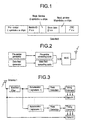
- FIGURE 1 A diagram that illustrates a frame structure for such a random access packet is shown in FIGURE 1.
- the random access packet (“access request data frame”) comprises a preamble and a data field portion.
- the preamble contains a unique signature (bit) pattern, which is "L" symbols long.
- the signature pattern is randomly selected from a set of patterns that are, but not necessarily, orthogonal to each other.
- the unique signature patterns can be transmitted in a different way (e.g., not within a preamble, integrated into the control channel, in parallel with a data field, etc.).
- this unique signature pattern feature as disclosed in WO 98/18280 provides a significantly higher throughput efficiency than prior random access schemes.
- the data field of the random access packet includes certain random access information, including mobile (user) identity information, required service number (number of services to be provided), required air time (time needed to complete a message), short packet data message (to increase transmission efficiency), and an error detection redundancy field (cyclic redundancy code).
- the spreading ratio (spread spectrum modulation) of the preamble is selected to be longer than the spreading ratio of the data field portion. However, situations may be envisioned in which this is not necessarily so.
- the random access packet (e.g., such as the packet shown in FIGURE 1) is transmitted by the mobile station at the beginning of the next available slot.
- a block diagram of an apparatus that can be used in a mobile station to generate and transmit the random access packet illustrated in FIGURE 1 is shown in FIGURE 2.
- the preamble and data field of the random access packet are generated and spread separately (with respective spreading codes) and then multiplexed and transmitted by the mobile station.
- FIGURE 3 is a block diagram of a detection section (for one antenna) of a base station's random access receiver, which functions primarily to estimate the timing of the received signal rays.
- the matched filter which is used only during the preamble period, is tuned to the preamble's spreading code.
- the matched filter is used to detect the presence of the random access request, and despread the preamble part of the random access packet and feed it to the accumulator unit.
- the accumulator (signatures 1- l ) is a unique feature used for the WO 98/18280 random access method to sum the signals at the output of the matched filter during the preamble's (M) symbol periods, in order to increase the received signal-to-interference (S/I) power ratio. Since each received preamble comprises a unique signature pattern, the accumulation operation is carried out with a plurality of accumulators (1- l ), with each accumulator tuned to one of the possible signature patterns to be received.
- FIGURE 4 is a simple block diagram of an accumulator that can be used for the I channel (quadrature detection) in the random access detector section shown in FIGURE 3. A similar accumulator can be used for the Q channel.
- the output of each accumulator (signature 1- l ) is coupled to a peak detection unit.
- each peak detection unit searches the output of its respective matched filter for each signal peak that exceeds a predetermined detection threshold.
- Each peak detection unit registers (detects and stores) the magnitude and relative phase of each of those peak signals, and thereby determines the number of significant signal rays available for demodulation in the receiver.
- FIGURE 5 is a block diagram of a random access demodulator that can be used to demodulate the data field portion of the random access packet. Essentially, the random access demodulator section decodes the data information in the received data field and checks for transmission errors.
- FIGURE 9 is a time sequence diagram that illustrates how two or more random access requests can collide when they arrive simultaneously at a base station receiver.
- the mobile station's time-out period time elapsed before re-transmitting a request
- T d is the maximum allowable time delay.
- the use of a relatively long time interval between re-transmissions reduces the probability of collisions.
- the average delay encountered waiting for a successful random access transmission can be rather long.
- An object of the present invention is to significantly reduce the time interval between random access re-transmissions and thereby increase throughput efficiency.
- the object is achieved by a method and a system that randomly selects new signatures for random access re-transmissions when collisions have occurred.
- the present invention randomizes the re-transmission of random access requests over a signature domain instead of just over the time domain. Consequently, the present invention significantly shortens the random access delays caused by collisions or erroneous arrivals of random access requests at base station receivers, and also significantly reduces the time interval between random access re-transmissions.
- the present invention thus increases random access system throughput efficiency in comparison to prior random access approaches.
- a method for processing random access requests in a mobile telecommunications system that randomly selects new signatures for re-transmissions when collisions have occurred.
- the present invention randomizes the random access re-transmissions over a signature domain instead of just over the time domain. Consequently, the present invention significantly shortens the random access delays caused by the re-transmission delays after collisions or erroneous arrivals of random access requests at base station receivers, and also significantly reduces the interval between random access re-transmissions.
- FIGURE 10 is a time sequence diagram that illustrates how random access collisions and delays can be significantly reduced by randomly selecting signatures for re-transmissions, in accordance with a preferred embodiment of the present invention.
- a random access request packet is re-transmitted with a new signature immediately after the originating mobile station has determined that the previously transmitted random access attempt was unsuccessful.
- each requesting mobile station has received from a target base station (e.g., in an appropriate broadcast message) and stored (in local memory) a plurality of signature patterns to be associated with the preambles of the random access request packets to be transmitted.
- These signature patterns can be orthogonal to each other, and are used by the base station receiver to distinguish between the different random access attempts made by the mobile stations.
- the requesting mobile station randomly selects (e.g., with an internal microprocessor) a signature and transmits a random access request packet with the selected signature included in the preamble of the packet.
- each of four mobile stations have transmitted random access request packets (RA 1 , RA 2 , RA 3 , RA 4 ).
- Three of these random access request packets (RA 1 , RA 2 , RA 3 ) have arrived simultaneously at the base station receiver. Furthermore, all of these three mobile stations have selected the same signature.
- each of the re-transmitting mobile stations selects a random signature again. In this way, the probability that the collision will occur again is reduced (statistically, each mobile station selects a different signature and re-transmits the original random access request packet with the second selected signature included in the preamble, such as, for example, RA 1 ', RA 2 ', RA 3 ').
- a random access attempt acknowledgment message has been received by the originating mobile stations for two of the re-transmitted packets (e.g., RA 1 ', RA 2 '), but no acknowledgment message has been received by the originating mobile station for the third re-transmission (RA 3 ').
- the target base station did not receive and detect the third re-transmitted packet (RA 3 ') due to its collision with the fourth random access request packet (RA 4 ), since both packets used the same signature.
- the originating mobile station for each of these two random access request packets (RA 3 ', RA 4 ) randomly selects another signature from each of the respective stored plurality of signatures, and re-transmits the original request with the new signature included in the preamble (e.g., RA 3 ", RA 4 ').
- These random access requests are then either received successfully at the target base station and thus acknowledged, or the re-transmission process of randomly selecting new signatures is continued.
- the time-out duration ( ⁇ d ) between re-transmissions for a particular mobile station is reduced to the minimum time needed for that particular mobile station to determine that the transmitted random access attempt was unsuccessful.
- the time-out duration ( ⁇ d ) between re-transmissions can be different for each originating mobile station.
- the present invention randomizes the random access re-transmissions for the mobile stations over the signature domain instead of over the time domain. Consequently, the present invention significantly shortens the random access delays caused by collisions or erroneous arrivals at base station receivers, and also significantly reduces the interval between random access re-transmissions, which increases the random access system's throughput efficiency.
- the method assigns each sector in a cell a unique preamble spreading code, and also a unique long-code which is concatenated with the data field's (signature-associated) short spreading code.
- the period selected for the long-code can be relatively long in duration (e.g., up to hours or days in length). Consequently, it can be said that the data field of the random access packet is transmitted in a dedicated channel because no two messages can have the same spreading sequence and phase unless they have chosen the same signature and transmitted their preambles at the same time.
- this problem is solved by the present invention.
- this method of assigning sector/cell-unique spreading codes and long-codes provides a significantly low probability of collision between multiple access random attempts in neighboring sectors or cells.
- the method sets the widths of the transmission time slots equal the length of the preamble (minus, for practical purposes, a predefined guard time). Consequently, the mobile station's random access request can be timed to start at the beginning of the slot, and detected during the preamble period by the matched filter in the base station's random access receiver.
- the data field of the mobile station's random access request is transmitted in the slots succeeding that of the preamble and received by the rake receiver at the base station.
- the matched filter is enabled to receive the preambles of other random access requests made by other mobile stations.
- the matched filter can be utilized continuously and efficiently, and a significantly larger number of random access requests can be processed in comparison with prior random access schemes.
- the communications throughput and efficiency of a random access system using that method are significantly higher than the throughput and efficiency of prior random access systems.
- the length of the data field is not restricted.
- the method of concatenated spreading of the data field portion of the random access packet allows a user to generate a packet which is as long as desired.
- this concatenated spreading approach there is less danger that the resulting packet will collide with other random access request packets.
- System 10 includes a base station transmit/receive antenna 12 and transmitter/receiver section 14, and a plurality of mobile stations 16 and 18. Although only two mobile stations are shown, FIGURE 6 is for illustrative purposes only, and the present invention can be assumed to include more than two mobile stations.
- a mobile station e.g., 16
- the mobile station determines the starting time for each slot from the base station's broadcast/pilot channel information.
- the mobile station also retrieves the number of the slot being processed from the broadcast/pilot channel information, which is to be used by the base station to tag its acknowledgment (ACK) message reply with the slot number to ensure that the correct mobile station receives the acknowledgment.
- ACK acknowledgment
- the target base station also transfers to the requesting mobile station(s) (e.g., over the downlink broadcast channel) each unique random access spreading code and long-code associated with each of the sectors and/or cells defined by the base station transceiver.
- these unique spreading codes and long-codes can be Gold codes or Kasami codes.
- the mobile station stores the spreading code and long-code information in a memory storage area (not explicitly shown), which is to be retrieved and used by the mobile station to spread the preamble and data field of the random access request packets generated.
- the base station also transfers to the requesting mobile station(s) (e.g., in an appropriate broadcast message) the signature patterns associated with the preambles, which can be used to help distinguish between different sectors and/or cells.
- a preamble bit or symbol pattern is used.
- Each requesting mobile station can transmit one of L different preamble bit or symbol patterns ("signatures").
- the different signature patterns used are, but not necessarily, orthogonal to each other.
- each of L accumulators is tuned to detect a specific signature coupled from the output of the receiver's matched filter. This signature preamble in a received signal is used by the base station receiver to effectively distinguish between simultaneous, different multiple access attempts made by the mobile stations.
- FIGURE 7 is a diagram that illustrates the structure and timing of a plurality of random access request packets that can be transmitted by different mobile stations. Although only three random access request packets are shown for illustrative purposes, that invention is not intended to be so limited and can include the transmission and reception of more than three such packets. Essentially, for each of the random access request packets shown (20, 22 and 24), the S-ALOHA procedure used with the present method applies only to the preamble portion of the random access request process. The length of each preamble (20, 22 and 24) is set equal to the width of the time slots (n, n+1,..., n+i), minus (for design purposes) a predefined guard time to minimize potential interference between slots.
- a one symbol guard time can be used.
- the lengths of the data field portions of the random access request packets (20, 22 and 24) can be varied according to the desired application, which provides mobile stations with flexibility in transmitting different length data fields.
- the following spreading method can be used.
- the mobile stations making the random access requests each generate unique preambles using a cell-sector specific spreading code (e.g., retrieved from a respective internal memory area).
- a cell-sector specific spreading code e.g., retrieved from a respective internal memory area.
- these codes can be reused for other cells which are separated by a sufficient distance.
- FIGURE 8 is a simple block diagram of an apparatus that can be used to implement the method for use with a mobile station to generate and transmit a random access packet such as the random access packets shown in FIGURE 7.
- the method can be implemented under the control of a microprocessor (not explicitly shown) located in the mobile station.
- the random access packet generating apparatus 100 includes a signal mixer 104, which spreads a "signature i" 102 (e.g., retrieved from an internal memory area in the mobile station 18) with a specific preamble spreading code for the cell-sector involved (e.g., also retrieved from the internal memory area) to form the cell-sector specific preamble of the random access packet to be transmitted.
- a signal mixer 104 which spreads a "signature i" 102 (e.g., retrieved from an internal memory area in the mobile station 18) with a specific preamble spreading code for the cell-sector involved (e.g., also retrieved from the internal memory area) to form the cell
- the data field of the random access packet to be transmitted is generated with a data field generator 110.
- a mixer 114 spreads the generated data field with a unique short spreading code (112) associated with the "signature i ".
- the resulting data field of the random access packet is then spread with a concatenated code, which can be constructed, for example, by a modulo-2 addition (by mixer 118) of the signature-associated short code (112) with a sector-specific long spreading code 116 (e.g., retrieved from an internal memory area).
- the length of the resulting data field (120) of the random access packet to be transmitted can be flexibly selected at the mobile station (e.g., hours or days long). The length of the resulting data field (120) can be varied at the mobile station, which provides an effective and quick way to establish long data or voice calls.
Landscapes
- Engineering & Computer Science (AREA)
- Computer Networks & Wireless Communication (AREA)
- Signal Processing (AREA)
- Mobile Radio Communication Systems (AREA)
Applications Claiming Priority (3)
| Application Number | Priority Date | Filing Date | Title |
|---|---|---|---|
| US148224 | 1993-11-08 | ||
| US09/148,224 US6597675B1 (en) | 1997-04-30 | 1998-09-04 | Random access in a mobile telecommunications system |
| PCT/SE1999/001495 WO2000014989A1 (en) | 1998-09-04 | 1999-08-31 | Random access in a mobile telecommunications system |
Publications (2)
| Publication Number | Publication Date |
|---|---|
| EP1110422A1 EP1110422A1 (en) | 2001-06-27 |
| EP1110422B1 true EP1110422B1 (en) | 2005-12-21 |
Family
ID=22524835
Family Applications (1)
| Application Number | Title | Priority Date | Filing Date |
|---|---|---|---|
| EP99946541A Expired - Lifetime EP1110422B1 (en) | 1998-09-04 | 1999-08-31 | Random access in a mobile telecommunications system |
Country Status (17)
| Country | Link |
|---|---|
| US (1) | US6597675B1 (enExample) |
| EP (1) | EP1110422B1 (enExample) |
| JP (1) | JP4267827B2 (enExample) |
| KR (1) | KR100653097B1 (enExample) |
| CN (1) | CN1135043C (enExample) |
| AR (1) | AR026093A1 (enExample) |
| AT (1) | ATE313926T1 (enExample) |
| AU (1) | AU765549B2 (enExample) |
| BR (1) | BR9913409B1 (enExample) |
| CA (1) | CA2340695C (enExample) |
| DE (1) | DE69929063T2 (enExample) |
| ES (1) | ES2251841T3 (enExample) |
| MY (1) | MY123462A (enExample) |
| RU (1) | RU2232469C2 (enExample) |
| TW (1) | TW492261B (enExample) |
| WO (1) | WO2000014989A1 (enExample) |
| ZA (1) | ZA200101373B (enExample) |
Cited By (1)
| Publication number | Priority date | Publication date | Assignee | Title |
|---|---|---|---|---|
| EP4395436A4 (en) * | 2021-08-25 | 2025-08-13 | Zte Corp | METHOD AND APPARATUS FOR TRANSMITTING INFORMATION AND FIRST COMMUNICATION NODE AND SECOND COMMUNICATION NODE |
Families Citing this family (107)
| Publication number | Priority date | Publication date | Assignee | Title |
|---|---|---|---|---|
| US7298701B2 (en) * | 2002-10-31 | 2007-11-20 | Nokia Corporation | Apparatus, and associated method, for requesting data retransmission in a packet radio communication system |
| US7936664B2 (en) * | 1991-03-26 | 2011-05-03 | Nokia Corporation | Multi-carrier radio link protocol supervision in a radio communication system |
| GB9603582D0 (en) | 1996-02-20 | 1996-04-17 | Hewlett Packard Co | Method of accessing service resource items that are for use in a telecommunications system |
| US6606313B1 (en) * | 1998-10-05 | 2003-08-12 | Telefonaktiebolaget Lm Ericsson (Publ) | Random access in a mobile telecommunications system |
| EP0993215A1 (en) * | 1998-10-05 | 2000-04-12 | Sony International (Europe) GmbH | Transmission of random access bursts with at least one message part |
| US6256301B1 (en) * | 1998-10-15 | 2001-07-03 | Qualcomm Incorporated | Reservation multiple access |
| US6757293B1 (en) * | 1998-12-02 | 2004-06-29 | Lucent Technologies Inc. | Methods and apparatus for providing short RACH frames for fast latency |
| KR100327104B1 (ko) * | 1998-12-05 | 2002-07-31 | 한국전자통신연구원 | 부호분할다중접속방식에서역방향공통채널의임의접속장치및방법 |
| US6574267B1 (en) * | 1999-03-22 | 2003-06-03 | Golden Bridge Technology, Inc. | Rach ramp-up acknowledgement |
| DK1793638T3 (en) * | 1999-03-24 | 2017-03-13 | Qualcomm Inc | Multiple access reservation |
| US6765894B1 (en) * | 1999-07-05 | 2004-07-20 | Matsushita Electric Industrial Co, Ltd. | Communication terminal apparatus and base station apparatus |
| US6397075B1 (en) * | 1999-11-19 | 2002-05-28 | Siemens Information And Communication Mobile, Llc | System and method for synchronization concept for 2.4 GHz direct sequence spread spectrum cordless telephone system |
| GB0007334D0 (en) * | 2000-03-28 | 2000-05-17 | Koninkl Philips Electronics Nv | Radio communication system |
| GB0007337D0 (en) * | 2000-03-28 | 2000-05-17 | Koninkl Philips Electronics Nv | Radio communication system |
| EP1890517B1 (en) * | 2000-04-04 | 2009-07-08 | Sony Deutschland GmbH | Prioritisation method for users randomly accessing a common communication channel |
| GB0008488D0 (en) * | 2000-04-07 | 2000-05-24 | Koninkl Philips Electronics Nv | Radio communication system and method of operating the system |
| JP2002153184A (ja) * | 2000-11-17 | 2002-05-28 | Shimano Inc | 電動リール |
| BR0204487A (pt) | 2001-03-17 | 2003-03-11 | Koninkl Philips Electronics Nv | Rede, estação base em uma rede sem fio, terminal para uma rede sem fio, e, método de troca de dados de carga útil e dados de controle em uma rede |
| KR20020081528A (ko) * | 2001-04-18 | 2002-10-28 | 광주과학기술원 | 무선 이동통신에서의 트래픽 제어방법 |
| US7801260B2 (en) * | 2001-06-18 | 2010-09-21 | St-Ericsson Sa | Peak detection accuracy |
| KR100452639B1 (ko) * | 2001-10-20 | 2004-10-14 | 한국전자통신연구원 | 위성 이동 통신 시스템에서 공통 패킷 채널 접속 방법 |
| US7590386B2 (en) * | 2002-04-18 | 2009-09-15 | Interdigital Technology Corporation | Method for control of contention-based wireless access |
| JP3922093B2 (ja) * | 2002-05-20 | 2007-05-30 | 日本電気株式会社 | Cdma移動通信システムのネットワークアクセス制御装置及び方法 |
| KR100542039B1 (ko) * | 2002-07-02 | 2006-01-10 | 삼성탈레스 주식회사 | 이동통신장치의 프레임동기신호 발생장치 |
| KR100479864B1 (ko) | 2002-11-26 | 2005-03-31 | 학교법인 중앙대학교 | 이동 통신 시스템에서의 하향링크 신호의 구성 방법과동기화 방법 및 그 장치 그리고 이를 이용한 셀 탐색 방법 |
| US7212809B2 (en) * | 2003-02-06 | 2007-05-01 | Motorola, Inc. | Method and apparatus for service negotiation acceleration |
| US7277441B1 (en) * | 2003-03-24 | 2007-10-02 | Cisco Technology, Inc. | System and method for creating and using unique packet preambles for data communication |
| CN1989747B (zh) * | 2004-09-21 | 2011-06-08 | 株式会社日立制作所 | 节点装置、数据包控制装置、无线通信装置和发送控制方法 |
| US7664076B2 (en) * | 2004-12-13 | 2010-02-16 | Electronics And Telecommunications Research Institute | Random access apparatus and method |
| TWI301381B (en) * | 2005-03-24 | 2008-09-21 | Nokia Corp | Method for controlling transmission over a wireless communication link, and mobile station and network node for a wireless communication network |
| US7729696B2 (en) | 2005-05-26 | 2010-06-01 | Motorola, Inc. | Method and apparatus for accessing a wireless communication network |
| AU2005333761B2 (en) * | 2005-06-29 | 2011-02-03 | Telefonaktiebolaget Lm Ericsson (Publ) | Evaluation of random access preamble codes |
| CN101300757B (zh) | 2005-11-04 | 2017-08-11 | 日本电气株式会社 | 无线电通信系统及用于其的发送功率控制方法 |
| KR101319870B1 (ko) * | 2006-01-05 | 2013-10-18 | 엘지전자 주식회사 | 이동 통신 시스템에서의 핸드오버 방법 |
| KR101203841B1 (ko) * | 2006-01-05 | 2012-11-21 | 엘지전자 주식회사 | 무선 통신 시스템에서의 페이징 메시지 전송 및 수신 방법 |
| KR101211807B1 (ko) * | 2006-01-05 | 2012-12-12 | 엘지전자 주식회사 | 이동통신 시스템에서 무선단말의 동기상태 관리방법 |
| KR101333918B1 (ko) | 2006-01-05 | 2013-11-27 | 엘지전자 주식회사 | 이동 통신 시스템의 점-대-다 서비스 통신 |
| KR101265628B1 (ko) * | 2006-01-05 | 2013-05-22 | 엘지전자 주식회사 | 이동 통신 시스템에서의 무선 자원 스케줄링 방법 |
| US9456455B2 (en) * | 2006-01-05 | 2016-09-27 | Lg Electronics Inc. | Method of transmitting feedback information in a wireless communication system |
| KR101268200B1 (ko) | 2006-01-05 | 2013-05-27 | 엘지전자 주식회사 | 이동통신 시스템에서의 무선자원 할당방법 |
| EP1980062A4 (en) * | 2006-01-05 | 2011-03-30 | Lg Electronics Inc | TRANSFER OF DATA IN A MOBILE COMMUNICATION SYSTEM |
| KR100912784B1 (ko) | 2006-01-05 | 2009-08-18 | 엘지전자 주식회사 | 데이터 송신 방법 및 데이터 재전송 방법 |
| WO2007078165A1 (en) | 2006-01-05 | 2007-07-12 | Lg Electronics Inc. | Transmitting information in mobile communications system |
| CN105515736A (zh) | 2006-01-05 | 2016-04-20 | Lg电子株式会社 | 在移动通信系统中发送数据 |
| KR101187076B1 (ko) * | 2006-01-05 | 2012-09-27 | 엘지전자 주식회사 | 이동 통신 시스템에 있어서 신호 전송 방법 |
| RU2404548C2 (ru) * | 2006-02-07 | 2010-11-20 | ЭлДжи ЭЛЕКТРОНИКС ИНК. | Способ передачи ответной информации в системе связи с подвижными объектами |
| WO2007091841A1 (en) * | 2006-02-07 | 2007-08-16 | Lg Electronics Inc. | Method for avoiding collision using identifier in mobile network |
| KR101358469B1 (ko) | 2006-02-07 | 2014-02-06 | 엘지전자 주식회사 | 무선 네트워크(network) 안에서 상향(uplink)및 하향(downlink) 대역폭(bandwidth)의선택 및 신호 방법 |
| KR101216751B1 (ko) | 2006-02-07 | 2012-12-28 | 엘지전자 주식회사 | 이동 통신 시스템에서 식별자를 이용한 충돌 회피 방법 |
| US8493854B2 (en) * | 2006-02-07 | 2013-07-23 | Lg Electronics Inc. | Method for avoiding collision using identifier in mobile network |
| KR101387475B1 (ko) * | 2006-03-22 | 2014-04-22 | 엘지전자 주식회사 | 복수의 네트워크 엔터티를 포함하는 이동 통신시스템에서의 데이터 처리 방법 |
| JP5193029B2 (ja) * | 2006-04-28 | 2013-05-08 | パナソニック株式会社 | 無線通信システム、移動局装置、基地局装置およびrach送信方法 |
| CN102209395B (zh) * | 2006-06-15 | 2014-04-02 | 知识产权之桥一号有限责任公司 | 发送装置、发送方法和接收装置 |
| WO2007148935A1 (en) | 2006-06-21 | 2007-12-27 | Lg Electronics Inc. | Method of transmitting and receiving radio access information using a message separation in a wireless mobile communications system |
| KR20070121505A (ko) * | 2006-06-21 | 2007-12-27 | 엘지전자 주식회사 | 무선링크 재설정 방법 |
| KR101369135B1 (ko) | 2006-06-21 | 2014-03-05 | 엘지전자 주식회사 | 이동통신 시스템에서의 멀티미디어 및 방송서비스의 품질보장 방법 및 그 단말 |
| EP2030359B1 (en) | 2006-06-21 | 2017-12-20 | LG Electronics Inc. -1- | Method of supporting data retransmission in a mobile communication system |
| KR20070121513A (ko) | 2006-06-21 | 2007-12-27 | 엘지전자 주식회사 | 이동통신 시스템의 상향 접속 방법 |
| ES2439234T3 (es) * | 2006-08-16 | 2014-01-22 | Telefonaktiebolaget Lm Ericsson (Publ) | Proxy de GGSN para una solución de un túnel |
| US8295243B2 (en) | 2006-08-21 | 2012-10-23 | Qualcomm Incorporated | Method and apparatus for random access in an orthogonal multiple-access communication system |
| KR20080018147A (ko) * | 2006-08-23 | 2008-02-27 | 한국전자통신연구원 | 셀룰라 시스템에서 임의 접속에 대한 응답 메시지 전송방법 및 이를 이용한 임의 접속 방법 |
| AU2007303199B2 (en) | 2006-10-03 | 2011-04-14 | Qualcomm Incorporated | Random access signaling transmission for system access in wireless communication |
| US8451781B2 (en) | 2006-10-25 | 2013-05-28 | Samsung Electronics Co., Ltd | Method and apparatus for allocating radio resource using random access procedure in a mobile communication system |
| WO2008050228A2 (en) * | 2006-10-26 | 2008-05-02 | Nokia Corporation | Method for immediate access to a random access channel |
| WO2008053653A1 (fr) | 2006-10-31 | 2008-05-08 | Sharp Kabushiki Kaisha | Système de communication mobile et dispositif de station de base |
| US8265178B2 (en) | 2006-11-07 | 2012-09-11 | Qualcomm Incorporated | Methods and apparatus for signal and timing detection in wireless communication systems |
| US20080107200A1 (en) * | 2006-11-07 | 2008-05-08 | Telecis Wireless, Inc. | Preamble detection and synchronization in OFDMA wireless communication systems |
| CN101202972A (zh) * | 2006-12-13 | 2008-06-18 | 华为技术有限公司 | 确定话语权的系统、装置和方法 |
| JP2010516095A (ja) * | 2007-01-05 | 2010-05-13 | インターデイジタル テクノロジー コーポレーション | ランダムアクセスチャネルにおけるバックオフ機構 |
| US8259701B2 (en) * | 2007-02-05 | 2012-09-04 | Nec Corporation | Wireless communication system, its base station and mobile station, communication synchronization management method and timer control program therefor |
| ATE506820T1 (de) | 2007-05-02 | 2011-05-15 | Ericsson Telefon Ab L M | Verfahren und anordnung in einem kommunikationsnetzwerk |
| US8923867B2 (en) | 2007-05-24 | 2014-12-30 | Huawei Technologies Co., Ltd. | Mobile communication system, base station apparatus and mobile station apparatus |
| EP2154903B1 (en) * | 2007-06-06 | 2015-05-13 | Sharp Kabushiki Kaisha | Mobile communication system, base station device, and mobile station device |
| BRPI0813125A2 (pt) * | 2007-06-20 | 2017-05-23 | Nokia Siemens Networks Oy | impedindo colisões entre alocação semipersistente e alocação dinâmica em redes de acesso de rádio |
| HRP20160017T1 (hr) * | 2007-08-08 | 2016-02-12 | Huawei Technologies Co., Ltd. | Usklađivanje vremena u radio komunikacijskom sustavu |
| KR101430462B1 (ko) * | 2007-08-09 | 2014-08-19 | 엘지전자 주식회사 | Rach 프리엠블 구성방법 및 전송방법 |
| WO2009020213A1 (ja) * | 2007-08-09 | 2009-02-12 | Sharp Kabushiki Kaisha | 移動局装置、基地局装置、通信システム、通信方法、及びプログラム |
| CN101779517B (zh) * | 2007-08-10 | 2013-01-02 | 富士通株式会社 | 无线通信系统中的随机接入方法、无线通信系统、无线终端以及基站装置 |
| US20090067377A1 (en) * | 2007-08-15 | 2009-03-12 | Motorola, Inc. | Medium access control frame structure in wireless communication system |
| KR101193478B1 (ko) * | 2007-09-28 | 2012-10-24 | 인터디지탈 패튼 홀딩스, 인크 | 강화된 랜덤 액세스 채널에서 메세지의 송신을 종료시키기 위한 방법 및 장치 |
| US8532201B2 (en) | 2007-12-12 | 2013-09-10 | Qualcomm Incorporated | Methods and apparatus for identifying a preamble sequence and for estimating an integer carrier frequency offset |
| US8537931B2 (en) | 2008-01-04 | 2013-09-17 | Qualcomm Incorporated | Methods and apparatus for synchronization and detection in wireless communication systems |
| EP2253175B1 (en) * | 2008-02-11 | 2017-01-25 | Nokia Technologies Oy | Rach preamble response with flexible uplink allocation |
| US7733945B2 (en) * | 2008-03-18 | 2010-06-08 | On-Ramp Wireless, Inc. | Spread spectrum with doppler optimization |
| US8477830B2 (en) | 2008-03-18 | 2013-07-02 | On-Ramp Wireless, Inc. | Light monitoring system using a random phase multiple access system |
| US7773664B2 (en) * | 2008-03-18 | 2010-08-10 | On-Ramp Wireless, Inc. | Random phase multiple access system with meshing |
| US8520721B2 (en) | 2008-03-18 | 2013-08-27 | On-Ramp Wireless, Inc. | RSSI measurement mechanism in the presence of pulsed jammers |
| CA2718721C (en) * | 2008-03-18 | 2012-06-19 | On-Ramp Wireless, Inc. | Random phase multiple access system with meshing |
| US8958460B2 (en) | 2008-03-18 | 2015-02-17 | On-Ramp Wireless, Inc. | Forward error correction media access control system |
| US7782926B2 (en) * | 2008-03-18 | 2010-08-24 | On-Ramp Wireless, Inc. | Random phase multiple access communication interface system and method |
| US20100195553A1 (en) | 2008-03-18 | 2010-08-05 | Myers Theodore J | Controlling power in a spread spectrum system |
| US20090239550A1 (en) * | 2008-03-18 | 2009-09-24 | Myers Theodore J | Random phase multiple access system with location tracking |
| JP5029450B2 (ja) | 2008-03-21 | 2012-09-19 | 富士通株式会社 | 通信システムおよび端末装置 |
| US8094616B2 (en) * | 2008-05-02 | 2012-01-10 | Intel Corporation | OFDMA contention-based random access channel design for mobile wireless systems |
| US9374837B2 (en) * | 2008-08-12 | 2016-06-21 | Google Technology Holdings LLC | Preventing misuse of random access procedure in wireless communication system |
| DE102009009163A1 (de) * | 2009-02-16 | 2010-08-19 | Siemens Aktiengesellschaft | Verfahren zum Konfigurieren und Betreiben von Funkknoten eines Funknetzes |
| US7639726B1 (en) * | 2009-03-20 | 2009-12-29 | On-Ramp Wireless, Inc. | Downlink communication |
| US8363699B2 (en) | 2009-03-20 | 2013-01-29 | On-Ramp Wireless, Inc. | Random timing offset determination |
| US8238538B2 (en) | 2009-05-28 | 2012-08-07 | Comcast Cable Communications, Llc | Stateful home phone service |
| DE102010031317A1 (de) * | 2009-09-08 | 2011-04-28 | Electronics And Telecommunications Research Institute | Präambelerzeugungsvorrichtung und -verfahren für digitales Direktübertragungssystem |
| US9386601B2 (en) * | 2010-01-15 | 2016-07-05 | Nokia Technologies Oy | Activating component carriers in a carrier aggregation |
| WO2013025142A1 (en) * | 2011-08-15 | 2013-02-21 | Telefonaktiebolaget L M Ericsson (Publ) | Controlling random access in secondary cells |
| CN103167624B (zh) * | 2011-12-14 | 2015-09-30 | 电信科学技术研究院 | 一种认知无线电系统中的随机接入方法和设备 |
| IL250121A (en) * | 2014-08-11 | 2017-09-28 | Ericsson Telefon Ab L M | Install wires, a network node, and methods to perform cell sponging |
| WO2018001471A1 (en) * | 2016-06-29 | 2018-01-04 | Huawei Technologies Co., Ltd. | Message transmission through a random access scheme |
| CN108024385B (zh) | 2016-11-04 | 2022-04-26 | 华为技术有限公司 | 随机接入的方法、网络设备和用户设备 |
| US10548168B2 (en) | 2016-12-01 | 2020-01-28 | Electronics And Telecommunications Research Institute | Method for random access in wireless communication system and apparatus for the same |
Family Cites Families (3)
| Publication number | Priority date | Publication date | Assignee | Title |
|---|---|---|---|---|
| FI933129A0 (fi) | 1993-07-08 | 1993-07-08 | Nokia Mobile Phones Ltd | Dataoeverfoeringsfoerfarande foer ett digitalt cellulaert mobiltelefonsystem och ett digitalt cellulaert mobiltelefonsystem |
| RU2103822C1 (ru) * | 1996-05-05 | 1998-01-27 | Военная академия связи | Способ передачи пакетной информации |
| US6259724B1 (en) | 1996-10-18 | 2001-07-10 | Telefonaktiebolaget L M Ericsson (Publ) | Random access in a mobile telecommunications system |
-
1998
- 1998-09-04 US US09/148,224 patent/US6597675B1/en not_active Expired - Lifetime
-
1999
- 1999-08-24 MY MYPI99003625A patent/MY123462A/en unknown
- 1999-08-31 KR KR1020017002743A patent/KR100653097B1/ko not_active Expired - Lifetime
- 1999-08-31 CN CNB998105775A patent/CN1135043C/zh not_active Expired - Lifetime
- 1999-08-31 AU AU58936/99A patent/AU765549B2/en not_active Expired
- 1999-08-31 AT AT99946541T patent/ATE313926T1/de not_active IP Right Cessation
- 1999-08-31 RU RU2001109351/09A patent/RU2232469C2/ru active
- 1999-08-31 EP EP99946541A patent/EP1110422B1/en not_active Expired - Lifetime
- 1999-08-31 CA CA2340695A patent/CA2340695C/en not_active Expired - Lifetime
- 1999-08-31 DE DE69929063T patent/DE69929063T2/de not_active Expired - Lifetime
- 1999-08-31 ES ES99946541T patent/ES2251841T3/es not_active Expired - Lifetime
- 1999-08-31 WO PCT/SE1999/001495 patent/WO2000014989A1/en not_active Ceased
- 1999-08-31 JP JP2000569600A patent/JP4267827B2/ja not_active Expired - Lifetime
- 1999-08-31 BR BRPI9913409-8A patent/BR9913409B1/pt not_active IP Right Cessation
- 1999-09-02 AR ARP990104428A patent/AR026093A1/es active IP Right Grant
- 1999-12-09 TW TW088114381A patent/TW492261B/zh not_active IP Right Cessation
-
2001
- 2001-02-19 ZA ZA2001/01373A patent/ZA200101373B/en unknown
Cited By (1)
| Publication number | Priority date | Publication date | Assignee | Title |
|---|---|---|---|---|
| EP4395436A4 (en) * | 2021-08-25 | 2025-08-13 | Zte Corp | METHOD AND APPARATUS FOR TRANSMITTING INFORMATION AND FIRST COMMUNICATION NODE AND SECOND COMMUNICATION NODE |
Also Published As
| Publication number | Publication date |
|---|---|
| DE69929063D1 (de) | 2006-01-26 |
| CA2340695A1 (en) | 2000-03-16 |
| KR20010090437A (ko) | 2001-10-18 |
| ES2251841T3 (es) | 2006-05-01 |
| DE69929063T2 (de) | 2006-08-31 |
| ZA200101373B (en) | 2002-06-26 |
| EP1110422A1 (en) | 2001-06-27 |
| MY123462A (en) | 2006-05-31 |
| US6597675B1 (en) | 2003-07-22 |
| CN1317215A (zh) | 2001-10-10 |
| RU2232469C2 (ru) | 2004-07-10 |
| AU5893699A (en) | 2000-03-27 |
| BR9913409A (pt) | 2001-05-22 |
| JP2002524990A (ja) | 2002-08-06 |
| CN1135043C (zh) | 2004-01-14 |
| BR9913409B1 (pt) | 2012-05-02 |
| KR100653097B1 (ko) | 2006-12-04 |
| JP4267827B2 (ja) | 2009-05-27 |
| AR026093A1 (es) | 2003-01-29 |
| ATE313926T1 (de) | 2006-01-15 |
| AU765549B2 (en) | 2003-09-25 |
| TW492261B (en) | 2002-06-21 |
| WO2000014989A1 (en) | 2000-03-16 |
| CA2340695C (en) | 2015-03-24 |
Similar Documents
| Publication | Publication Date | Title |
|---|---|---|
| EP1110422B1 (en) | Random access in a mobile telecommunications system | |
| EP0979585B1 (en) | Ramdom access in a mobile telecommunications system | |
| US6442153B1 (en) | Random access in a mobile telecommunications system | |
| US6606313B1 (en) | Random access in a mobile telecommunications system | |
| AU720313B2 (en) | Random access in a mobile telecommunications system | |
| US7076262B1 (en) | Message access for radio telecommunications system | |
| RU2214686C2 (ru) | Произвольный доступ в системе мобильной связи | |
| EP1619922A2 (en) | Random access in a mobile telecommunications system | |
| MXPA01002260A (es) | Acceso aleatorio en un sistema de telecomunicaciones movil | |
| MXPA00003791A (es) | Acceso aleatoria en un ssitema de telecomunicaiones movil |
Legal Events
| Date | Code | Title | Description |
|---|---|---|---|
| PUAI | Public reference made under article 153(3) epc to a published international application that has entered the european phase |
Free format text: ORIGINAL CODE: 0009012 |
|
| 17P | Request for examination filed |
Effective date: 20010213 |
|
| AK | Designated contracting states |
Kind code of ref document: A1 Designated state(s): AT BE CH CY DE DK ES FI FR GB GR IE IT LI LU MC NL PT SE |
|
| AX | Request for extension of the european patent |
Free format text: AL;LT;LV;MK;RO;SI |
|
| RAP1 | Party data changed (applicant data changed or rights of an application transferred) |
Owner name: TELEFONAKTIEBOLAGET LM ERICSSON (PUBL) |
|
| 17Q | First examination report despatched |
Effective date: 20040503 |
|
| GRAP | Despatch of communication of intention to grant a patent |
Free format text: ORIGINAL CODE: EPIDOSNIGR1 |
|
| GRAS | Grant fee paid |
Free format text: ORIGINAL CODE: EPIDOSNIGR3 |
|
| GRAA | (expected) grant |
Free format text: ORIGINAL CODE: 0009210 |
|
| AK | Designated contracting states |
Kind code of ref document: B1 Designated state(s): AT BE CH CY DE DK ES FI FR GB GR IE IT LI LU MC NL PT SE |
|
| PG25 | Lapsed in a contracting state [announced via postgrant information from national office to epo] |
Ref country code: LI Free format text: LAPSE BECAUSE OF FAILURE TO SUBMIT A TRANSLATION OF THE DESCRIPTION OR TO PAY THE FEE WITHIN THE PRESCRIBED TIME-LIMIT Effective date: 20051221 Ref country code: FI Free format text: LAPSE BECAUSE OF FAILURE TO SUBMIT A TRANSLATION OF THE DESCRIPTION OR TO PAY THE FEE WITHIN THE PRESCRIBED TIME-LIMIT Effective date: 20051221 Ref country code: CH Free format text: LAPSE BECAUSE OF FAILURE TO SUBMIT A TRANSLATION OF THE DESCRIPTION OR TO PAY THE FEE WITHIN THE PRESCRIBED TIME-LIMIT Effective date: 20051221 Ref country code: BE Free format text: LAPSE BECAUSE OF FAILURE TO SUBMIT A TRANSLATION OF THE DESCRIPTION OR TO PAY THE FEE WITHIN THE PRESCRIBED TIME-LIMIT Effective date: 20051221 Ref country code: AT Free format text: LAPSE BECAUSE OF FAILURE TO SUBMIT A TRANSLATION OF THE DESCRIPTION OR TO PAY THE FEE WITHIN THE PRESCRIBED TIME-LIMIT Effective date: 20051221 |
|
| REG | Reference to a national code |
Ref country code: GB Ref legal event code: FG4D |
|
| REG | Reference to a national code |
Ref country code: CH Ref legal event code: EP |
|
| REG | Reference to a national code |
Ref country code: IE Ref legal event code: FG4D |
|
| REF | Corresponds to: |
Ref document number: 69929063 Country of ref document: DE Date of ref document: 20060126 Kind code of ref document: P |
|
| PG25 | Lapsed in a contracting state [announced via postgrant information from national office to epo] |
Ref country code: SE Free format text: LAPSE BECAUSE OF FAILURE TO SUBMIT A TRANSLATION OF THE DESCRIPTION OR TO PAY THE FEE WITHIN THE PRESCRIBED TIME-LIMIT Effective date: 20060321 Ref country code: GR Free format text: LAPSE BECAUSE OF FAILURE TO SUBMIT A TRANSLATION OF THE DESCRIPTION OR TO PAY THE FEE WITHIN THE PRESCRIBED TIME-LIMIT Effective date: 20060321 Ref country code: DK Free format text: LAPSE BECAUSE OF FAILURE TO SUBMIT A TRANSLATION OF THE DESCRIPTION OR TO PAY THE FEE WITHIN THE PRESCRIBED TIME-LIMIT Effective date: 20060321 |
|
| REG | Reference to a national code |
Ref country code: ES Ref legal event code: FG2A Ref document number: 2251841 Country of ref document: ES Kind code of ref document: T3 |
|
| PG25 | Lapsed in a contracting state [announced via postgrant information from national office to epo] |
Ref country code: PT Free format text: LAPSE BECAUSE OF FAILURE TO SUBMIT A TRANSLATION OF THE DESCRIPTION OR TO PAY THE FEE WITHIN THE PRESCRIBED TIME-LIMIT Effective date: 20060522 |
|
| REG | Reference to a national code |
Ref country code: CH Ref legal event code: PL |
|
| ET | Fr: translation filed | ||
| PG25 | Lapsed in a contracting state [announced via postgrant information from national office to epo] |
Ref country code: MC Free format text: LAPSE BECAUSE OF NON-PAYMENT OF DUE FEES Effective date: 20060831 |
|
| PLBE | No opposition filed within time limit |
Free format text: ORIGINAL CODE: 0009261 |
|
| STAA | Information on the status of an ep patent application or granted ep patent |
Free format text: STATUS: NO OPPOSITION FILED WITHIN TIME LIMIT |
|
| 26N | No opposition filed |
Effective date: 20060922 |
|
| PG25 | Lapsed in a contracting state [announced via postgrant information from national office to epo] |
Ref country code: LU Free format text: LAPSE BECAUSE OF NON-PAYMENT OF DUE FEES Effective date: 20060831 |
|
| PG25 | Lapsed in a contracting state [announced via postgrant information from national office to epo] |
Ref country code: CY Free format text: LAPSE BECAUSE OF FAILURE TO SUBMIT A TRANSLATION OF THE DESCRIPTION OR TO PAY THE FEE WITHIN THE PRESCRIBED TIME-LIMIT Effective date: 20051221 |
|
| REG | Reference to a national code |
Ref country code: FR Ref legal event code: PLFP Year of fee payment: 18 |
|
| REG | Reference to a national code |
Ref country code: FR Ref legal event code: PLFP Year of fee payment: 19 |
|
| REG | Reference to a national code |
Ref country code: DE Ref legal event code: R039 Ref document number: 69929063 Country of ref document: DE Ref country code: DE Ref legal event code: R008 Ref document number: 69929063 Country of ref document: DE |
|
| REG | Reference to a national code |
Ref country code: FR Ref legal event code: PLFP Year of fee payment: 20 |
|
| PGFP | Annual fee paid to national office [announced via postgrant information from national office to epo] |
Ref country code: DE Payment date: 20180829 Year of fee payment: 20 Ref country code: IE Payment date: 20180827 Year of fee payment: 20 Ref country code: FR Payment date: 20180827 Year of fee payment: 20 Ref country code: NL Payment date: 20180826 Year of fee payment: 20 Ref country code: ES Payment date: 20180904 Year of fee payment: 20 Ref country code: IT Payment date: 20180822 Year of fee payment: 20 |
|
| PGFP | Annual fee paid to national office [announced via postgrant information from national office to epo] |
Ref country code: GB Payment date: 20180828 Year of fee payment: 20 |
|
| REG | Reference to a national code |
Ref country code: DE Ref legal event code: R040 Ref document number: 69929063 Country of ref document: DE |
|
| REG | Reference to a national code |
Ref country code: DE Ref legal event code: R071 Ref document number: 69929063 Country of ref document: DE |
|
| REG | Reference to a national code |
Ref country code: NL Ref legal event code: MK Effective date: 20190830 |
|
| REG | Reference to a national code |
Ref country code: GB Ref legal event code: PE20 Expiry date: 20190830 |
|
| REG | Reference to a national code |
Ref country code: IE Ref legal event code: MK9A |
|
| PG25 | Lapsed in a contracting state [announced via postgrant information from national office to epo] |
Ref country code: IE Free format text: LAPSE BECAUSE OF EXPIRATION OF PROTECTION Effective date: 20190831 |
|
| PG25 | Lapsed in a contracting state [announced via postgrant information from national office to epo] |
Ref country code: GB Free format text: LAPSE BECAUSE OF EXPIRATION OF PROTECTION Effective date: 20190830 |
|
| REG | Reference to a national code |
Ref country code: ES Ref legal event code: FD2A Effective date: 20200723 |
|
| PG25 | Lapsed in a contracting state [announced via postgrant information from national office to epo] |
Ref country code: ES Free format text: LAPSE BECAUSE OF EXPIRATION OF PROTECTION Effective date: 20190901 |