EP1109968B1 - Papermaking fabric seam with additional threads in the seam area - Google Patents
Papermaking fabric seam with additional threads in the seam area Download PDFInfo
- Publication number
- EP1109968B1 EP1109968B1 EP99948081A EP99948081A EP1109968B1 EP 1109968 B1 EP1109968 B1 EP 1109968B1 EP 99948081 A EP99948081 A EP 99948081A EP 99948081 A EP99948081 A EP 99948081A EP 1109968 B1 EP1109968 B1 EP 1109968B1
- Authority
- EP
- European Patent Office
- Prior art keywords
- threads
- additional
- fabric
- longitudinal
- thread
- Prior art date
- Legal status (The legal status is an assumption and is not a legal conclusion. Google has not performed a legal analysis and makes no representation as to the accuracy of the status listed.)
- Expired - Lifetime
Links
Images



Classifications
-
- D—TEXTILES; PAPER
- D21—PAPER-MAKING; PRODUCTION OF CELLULOSE
- D21F—PAPER-MAKING MACHINES; METHODS OF PRODUCING PAPER THEREON
- D21F1/00—Wet end of machines for making continuous webs of paper
- D21F1/0027—Screen-cloths
- D21F1/0054—Seams thereof
-
- D—TEXTILES; PAPER
- D21—PAPER-MAKING; PRODUCTION OF CELLULOSE
- D21F—PAPER-MAKING MACHINES; METHODS OF PRODUCING PAPER THEREON
- D21F1/00—Wet end of machines for making continuous webs of paper
- D21F1/0027—Screen-cloths
- D21F1/0036—Multi-layer screen-cloths
-
- Y—GENERAL TAGGING OF NEW TECHNOLOGICAL DEVELOPMENTS; GENERAL TAGGING OF CROSS-SECTIONAL TECHNOLOGIES SPANNING OVER SEVERAL SECTIONS OF THE IPC; TECHNICAL SUBJECTS COVERED BY FORMER USPC CROSS-REFERENCE ART COLLECTIONS [XRACs] AND DIGESTS
- Y10—TECHNICAL SUBJECTS COVERED BY FORMER USPC
- Y10S—TECHNICAL SUBJECTS COVERED BY FORMER USPC CROSS-REFERENCE ART COLLECTIONS [XRACs] AND DIGESTS
- Y10S162/00—Paper making and fiber liberation
- Y10S162/904—Paper making and fiber liberation with specified seam structure of papermaking belt
-
- Y—GENERAL TAGGING OF NEW TECHNOLOGICAL DEVELOPMENTS; GENERAL TAGGING OF CROSS-SECTIONAL TECHNOLOGIES SPANNING OVER SEVERAL SECTIONS OF THE IPC; TECHNICAL SUBJECTS COVERED BY FORMER USPC CROSS-REFERENCE ART COLLECTIONS [XRACs] AND DIGESTS
- Y10—TECHNICAL SUBJECTS COVERED BY FORMER USPC
- Y10T—TECHNICAL SUBJECTS COVERED BY FORMER US CLASSIFICATION
- Y10T428/00—Stock material or miscellaneous articles
- Y10T428/19—Sheets or webs edge spliced or joined
- Y10T428/192—Sheets or webs coplanar
-
- Y—GENERAL TAGGING OF NEW TECHNOLOGICAL DEVELOPMENTS; GENERAL TAGGING OF CROSS-SECTIONAL TECHNOLOGIES SPANNING OVER SEVERAL SECTIONS OF THE IPC; TECHNICAL SUBJECTS COVERED BY FORMER USPC CROSS-REFERENCE ART COLLECTIONS [XRACs] AND DIGESTS
- Y10—TECHNICAL SUBJECTS COVERED BY FORMER USPC
- Y10T—TECHNICAL SUBJECTS COVERED BY FORMER US CLASSIFICATION
- Y10T428/00—Stock material or miscellaneous articles
- Y10T428/24—Structurally defined web or sheet [e.g., overall dimension, etc.]
- Y10T428/24777—Edge feature
- Y10T428/24785—Edge feature including layer embodying mechanically interengaged strands, strand portions or strand-like strips [e.g., weave, knit, etc.]
-
- Y—GENERAL TAGGING OF NEW TECHNOLOGICAL DEVELOPMENTS; GENERAL TAGGING OF CROSS-SECTIONAL TECHNOLOGIES SPANNING OVER SEVERAL SECTIONS OF THE IPC; TECHNICAL SUBJECTS COVERED BY FORMER USPC CROSS-REFERENCE ART COLLECTIONS [XRACs] AND DIGESTS
- Y10—TECHNICAL SUBJECTS COVERED BY FORMER USPC
- Y10T—TECHNICAL SUBJECTS COVERED BY FORMER US CLASSIFICATION
- Y10T442/00—Fabric [woven, knitted, or nonwoven textile or cloth, etc.]
- Y10T442/30—Woven fabric [i.e., woven strand or strip material]
- Y10T442/3707—Woven fabric including a nonwoven fabric layer other than paper
- Y10T442/3724—Needled
Definitions
- the present invention generally relates to an open ended, woven fabric which is designed for use in a papermaking, cellulose or board manufacturing machine.
- the fabric has a plurality of loops at each end to form a seam for rendering the fabric endless.
- papermaking machines generally include three sections commonly referred to as the forming, press and dryer sections.
- the present invention finds particular application in the press section of a papermaking machine.
- press felts include a supporting base, such as a woven fabric, and a paper carrying or supporting layer.
- the paper support layer is a homogeneous, non-woven batt that has been affixed to the base.
- Base fabrics are typically woven fabrics which are used as an endless loop.
- Such an endless loop fabric may be woven endless with no seam or the fabric may be woven with two ends which are joined by a seam.
- Typical seams include pin type seams which utilize a pintle inserted through seam loops to close the fabric.
- an open-ended papermaker's fabric having a paper side and a machine side, the fabric being woven from a longitudinal thread system and a transverse thread system, the longitudinal thread system comprising pairs of stacked longitudinal threads defining a paper side layer and a machine side layer of longitudinal threads, a plurality of seam loops extending between the paper and machine side layers being formed at each end of the fabric by the threads of the longitudinal thread system, wherein a seam zone is formed at each end of said fabric between the respective seam loops and a respective end thread of said transverse thread system, the fabric comprising two additional transverse threads interwoven in at least one seam zone with the longitudinal thread system, characterised in that each of the two additional threads is woven in a repeat pattern that includes a first transition between first paired paper and machine side threads and a second transition between second paired paper and machine side threads, the first transitions defining a first crossover point of the two additional transverse threads and the second transitions defining
- a method of producing a papermaker's fabric comprising the steps of: interweaving a longitudinal thread system with a transverse thread system to define a base fabric having first and second ends and a paper side and a machine side and in which the longitudinal thread system comprises pairs of stacked longitudinal threads defining a paper side layer and a machine side layer of longitudinal threads; forming a plurality of seam loops extending between the paper and machine side layers at each end of the fabric from the threads of the longitudinal thread system and thereby defining a seam zone at each end of said fabric between the respective seam loops and a respective end thread of said transverse thread system; and interweaving two additional transverse threads in at least one seam zone with the longitudinal thread system characterised by interweaving each of the two additional threads in a repeat pattern that includes a first transition between first paired paper and machine side threads and a second transition between second paired paper and machine side threads, the first transitions defining a first crossover point
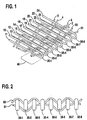
- the base fabric 1 comprises a top layer of MD threads, 10, 12, 14, 16, 18, 20, 22, and 24, and a bottom layer of MD threads, 11, 13, 15, 17, 19, 21, 23 and 25. It will be understood that the top and bottom layers are essentially continuous threads which form the seam loops 35-1 to 35-8 between the top and bottom layers.
- the phantom CMD threads 2-5 are interwoven with the top and bottom MD thread layers in a given repeat pattern to form the body of the fabric.
- the body of the fabric forms no part of the present invention.
- a seam zone 40 exists between the end CMD thread 2 and the seam loops 35-1 to 35-8 .
- two additional threads are used for more uniformity in the paper side surface.
- the two additional CMD threads 50 and 51 are interwoven in the seam zone 40 with both layers of MD threads 10 through 25.
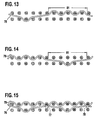
- Additional CMD thread 50 preferably weaves in a repeat that passes over MD threads 10-11 , between threads 12-13, over threads 14 and 15, between pairs of threads 16-17, 18-19 , under threads 20-21 and between pairs of threads 22-23, 24-25.
- the second thread 51 is woven in a mirror image to the thread 50.
- CMD thread 51 weaves in a repeat that passes between the pair of threads 10-11, beneath the threads of pair 12-13, between the pairs 14-15, 16-17, over the threads of pair 18-19, between threads 20 and 21 , over the threads of pair 22-23, and between threads 24-25.
- two threads woven in accordance with Figures 3 and 4 produce a weave repeat structure having two crossover points 53 and 54 which are spaced apart by at least three MD threads.
- MD thread 16 passes over both additional threads 50 and 51. Since the repeat pattern extends over eight pairs of MD threads with only a single interlacing in the machine side MD layer and the threads can shift beneath thread 16, threads 50 and 51 tend to act as one. As a result of the long transition and the spaced crossovers, the threads 50 and 51 can migrate relative to each other so that the resulting sheet side MD and CMD weave repeat appears to be a plain weave. This result is illustrated in Figure 6 where the thread migration results in what appears to be a single thread structure.
- FIG. 7 there is shown a second embodiment in a manner similar to that of Figure 5.
- weave repeats of the CMD threads 55 and 56 result in floats over three machine direction threads 10, 12 and 14 and over three machine direction threads 18, 20, and 22.
- the long transition between pairs of machine direction threads and the interlacing with a single machine side MD thread per repeat is as previously described.
- This embodiment's crossover points 57 and 58 are also spaced apart by three MD threads; however, it also has two MD threads 16 and 24 that pass over, without interweaving, the intersection or crossover points of threads 55 and 56.
- the threads 50 and 51 will migrate relative to each other and produce relatively large, in-line sheet side floats.
- Figure 8 illustrates the migration of threads 55 and 56 in a manner similar to that described with respect to Figure 6.
- Figure 9 illustrates two ends of the fabric of the present invention joined by pintle 60.
- the additional threads 55 and 56 at each end of the fabric provide increased surface contact for better batt adhesion in the seam zone.
- a third embodiment of the present invention is shown in Figures 10-12.
- the fabric of this embodiment repeats on twenty four MD threads 10-33.
- the two additional threads 70 and 71 are interwoven in the seam zone 40 with both layers of longitudinal threads 10 through 33.
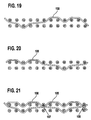
- Additional CMD thread 70 weaves in a repeat pattern that passes between MD threads 10-11, under MD threads 12-13, between MD thread pairs 14-15, 16-17, and then weaves a continuous portion of plain weave with top layer MD threads 18, 20, 22, 24, 26, 28, 30 before transitioning down between MD threads 32-33.
- the second additional thread 71 is woven in a complementary pattern to that of thread 70.
- Additional thread 71 weaves a plain weave construction with top layer threads 10, 12, 14 before transitioning into a mid-plane float between MD thread pairs 16-17, 18-19, 20-21, 22-23, weaving under MD threads 24-25 and transitioning back to a mid-plane float beneath thread pairs 26-27, 28-29, 30-31, 32-33.
- two additional threads interwoven in accordance with figures 10 and 11 produce a weave repeat structure having the appearance of a plain weave in the upper layer and two crossover points 73 and 74 which are spaced apart by at least three MD thread pairs.
- the additional threads can migrate relative to each other to produce the desired sheet side weave pattern while also providing mid-plane floats and long transitions.
- the first additional thread 75 weaves between MD thread pairs 10-11, 12-13, beneath MD threads 14-15, between MD thread pairs 16-17, 18-19, 20-21 , and then in a plain weave repeat with the upper layer MD threads 24, 26, 28, 30, 32 .
- the second additional thread 76 weaves in the mirror image of thread 75.
- the threads 75 and 76 produce a plain weave pattern on the paper sheet side, relatively long transitions which combine to simulate a mid-plane float and cross over points 77, 78 which are spaced by five MD thread pairs. This encourages migration of the threads 75,76 relative to each other.
- this embodiment provides a continuous portion 81 of the weave repeat that extends over at least five adjacent paper side longitudinal threads between transitions from the machine or paper side longitudinal threads.
- Additional CMD thread 100 weaves in a repeat pattern that passes between MD threads 10-11, under MD threads 12-13, between MD thread pairs 14-15, 16-17, floats over MD threads 18-23, between MD threads 24-25, floats over MD threads 26-31 and between MD threads 32-33.
- the second additional thread 101 is woven in a complementary weave pattern to that of thread 100. Additional thread 101 weaves over MD threads 10-15, between MD thread pairs 16-17, 18-19, 20-21, 22-23, under MD threads 24-25 and between MD thread pairs 26-27, 28-29, 30-31, 32-33. It will be noted from Figure 17 that additional thread 101 forms two mid-plane floats between four pairs of MD threads 16-17, 18-19, 20-21, 22-23 and 26-27, 28-29, 30-31, 32-33 .
- the two additional threads 100,101 as interwoven in Figures 16 and 17 produce a weave repeat structure having the appearance of an over three, under one repeat in the upper layer.
- the two crossover points, 103, 104 are spaced apart by at least three MD thread pairs. This creates a long continuous portion of the second additional thread 101 which generally forms mid-plane floats that complement the long transition of the first additional thread 100. Since the repeat pattern extends over twelve pairs of MD threads with only a single interlacing in the machine side MD layer and spaced apart crossover points, and the additional threads can shift relative to each other and threads 100 and 101 tend to act as one thread in a continuous over three, under one weave pattern on the top layer.
- the weave repeat of thread 100 includes a subrepeat of three over one under which repeats twice within the pattern. This weave repeat permits the relatively loose interlacing of the thread 101 but enables the pattern to be continued throughout the upper layer when the threads 100, 101 are combined in accordance with Figure 18.
- the first additional thread 105 weaves between MD thread pairs 10-11, 12-13, beneath MD threads 14-15, between MD thread pairs 16-17, 18-19, 20-21, and then in two repeats of the subrepeat pattern of over two, under one with upper MD threads 22, 24, 26, 28, 30, 32 .
- the second additional thread 106 weaves in the mirror image of thread 105.
- the threads 105 and 106 produce a two over, one under weave pattern on the paper sheet side, relatively long transitions which combine to simulate continuous floats in the mid-plane and crossover points 107,108 which are spaced apart by five MD thread pairs. This encourages migration of the threads relative to each other.
- this embodiment provides a weave repeat that includes two repeats of the subrepeat in adjacent paper side longitudinal threads between the transitions from the machine or paper side longitudinal threads.
- batt adhesion will be most improved on the sheet side surface but that some improvement in machine side surface adhesion will result from the presence of the interlacings and relatively long transitions.
- the additional CMD threads 50, 51; 55, 56; 70, 71; 75, 76; 100, 101; and 105, 106 can be multifilament, spun, braided, knitted, or bicomponent. If the thread is of a bicomponent nature, the bicomponent material may have a core material with a higher melting point surrounded by a covering of a lower melting point material. This allows the covering to melt and adhere to the batt material during finishing without affecting the core structure of the thread.
- Threads may be made from polymeric resins selected from a group consisting of polyamide, polyurethanes, polyesters, polyaramids, polyimides, polyolefins, polyetherketones, polypropylenes, PET, PBT, PTT, phenolics, and copolymers thereof.
Landscapes
- Paper (AREA)
- Woven Fabrics (AREA)
- Yarns And Mechanical Finishing Of Yarns Or Ropes (AREA)
- Sewing Machines And Sewing (AREA)
Abstract
Description
Claims (21)
- An open-ended papermaker's fabric (1) having a paper side and a machine side, the fabric (1) being woven from a longitudinal thread system (10-33) and a transverse thread system (2-5), the longitudinal thread system (10-33) comprising pairs of stacked longitudinal threads (10,11;12,13;14,15;16,17;18,19;20,21;22,23;24,25;26,27;28,29;30,31; 32,33;) defining a paper side layer and a machine side layer of longitudinal threads (10-33), a plurality of seam loops (35-1-35-8) extending between the paper and machine side layers being formed at each end of the fabric (1) by the threads of the longitudinal thread system (10-33), wherein a seam zone (40) is formed at each end of said fabric (1) between the respective seam loops (35-1-35-8) and a respective end thread (2) of said transverse thread system (2-5), the fabric (1) comprising two additional transverse threads (50,51/55,56/70,71/75,76/100,101/105,106) interwoven in at least one seam zone (40) with the longitudinal thread system (2-5), characterised in that each of the two additional threads (50,51/55,56/70,71/75,76/100,101/105,106) is woven in a repeat pattern that includes a first transition between first paired paper and machine side threads and a second transition between second paired paper and machine side threads, the first transitions defining a first crossover point (53/57/73/77/103/107) of the two additional transverse threads (50,51/55,56/70,71/75,76/100,101/105,106) and the second transitions defining a second crossover point (54/58/74/78/104/108) of the two additional transverse threads (50,51/55,56/70,71/75,76/100,101/105,106), the first and second crossover points (53,54/57,58/73,74/77,78/103, 104/107,108) being separated in the transverse direction by at least three paper side longitudinal threads (10,12,14,16,18,20,22,24,26,28,30,32).
- The fabric (1) of claim 1 wherein the crossover points (73,74/77,78/103, 104/107,108) are separated in the transverse direction by at least five paper side longitudinal threads (10,12,14,16,18,20,22,24,26,28,30,32).
- The fabric (1) of claim 1 wherein the additional threads (50,51/55,56/70,71/75,76/100,101/105,106) migrate relative to one another such that a portion of one of the additional threads overlies a portion of the other additional thread.
- The fabric (1) of claim 1 wherein a first one of the two additional transverse threads (70/75/100/105) interwoven in the at least one seam zone (40) is interwoven with the longitudinal thread system (10-33) in a repeat pattern that includes at (east twelve adjacent paper side longitudinal threads (10,12,14,16,18,20,22,24,26,28,30,32), at least one machine side interlacing and a portion that weaves continuously with at least five adjacent paper side longitudinal threads (10,12,14,16,18,20,22,24,26,28,30,32).
- The fabric (1) of claim 4 wherein the portion that weaves continuously with at least five adjacent paper side longitudinal threads (10,12,14,16,18,20,22,24,26,28,30,32) weaves with those threads (10,12,14,16,18,20,22,24,26,28,30,32) in a plain weave pattern.
- The fabric (1) of claim 4 wherein the portion that weaves continuously with at least five adjacent paper side longitudinal threads (10,12,14,16,18,20,22,24,26,28,30,32) weaves with those threads (10,12,14,16,18,20,22,24,26,28,30,32) in a repeated pattern of over two and under one.
- The fabric (1) of claim 4 wherein the portion that weaves continuously with at least five adjacent paper side longitudinal threads (10,12,14,16,18,20,22,24,26,28,30,32) weaves with those threads (10,12,14,16,18,20,22,24,26,28,30,32) in a repeated pattern of over three and under one.
- The fabric (1) of claim 4 wherein a second one of the two additional transverse threads (71/76/101/106) interwoven in the at least one seam zone (40) is woven in a repeat pattern that complements the weave of the first additional thread ((50/55/70/75/100/105) with the result that the combined paper side weave pattern of the additional threads (70,71/75,76/100,101/105,106) is a continuous pattern across the repeat.
- The fabric (1) of claim 8 wherein the continuous paper side weave pattern across the repeat is a plain weave pattern.
- The fabric (1) of claim 8 wherein the continuous paper side weave pattern across the repeat is a repeated pattern of over two and under one.
- The fabric (1) of claim 8 wherein the continuous paper side weave pattern across the repeat is a repeated pattern of over three and under one.
- The fabric (1) of claim 8 wherein the additional threads (70,71/75,76/100,101/105,106) migrate relative to one another such that a portion of one of the additional threads overlies a portion of the other additional thread.
- The fabric of claim 4 wherein said portion of the first additional transverse thread (70/75/100/105) weaves continuously with at least six adjacent paper side longitudinal threads (10,12,14,16,18,20,22,24,26,28,30,32) and includes at least two identical subrepeats.
- The fabric (1) of claim 13 wherein each subrepeat is a pattern of over two and under one.
- The fabric (1) of claim 13 wherein each subrepeat is a pattern of over three and under one.
- The fabric (1) of claim 13 wherein a second one of the two additional transverse (71/76/101/106) threads interwoven with the longitudinal thread system (1-33) in the at least one seam zone (40) is woven in a repeat pattern that complements the first additional thread (70/75/100/105) with the result that the combined paper side weave pattern of the two additional threads (70,71/75,76/100,101/105,106) is a continuous weave including at least three of the subrepeats.
- The fabric (1) of claim 16 wherein each subrepeat is a pattern of over two and under one.
- The fabric (1) of claim 16 wherein each subrepeat is a pattern of over three and under one.
- The fabric (1) of claim 16 wherein the additional threads (70,71/75,76/100,101/105,106) migrate relative to one another such that a portion of one of the additional threads overlies a portion of the other additional thread.
- A method of producing a papermaker's fabric (1) comprising the steps of:-interweaving a longitudinal thread system (10-33) with a transverse thread system (2-5) to define a base fabric having first and second ends and a paper side and a machine side and in which the longitudinal thread system (10-33) comprises pairs of stacked longitudinal threads (10,11;12,13;14,15;16,17;18,19;20,21;22,23;24,25;26,27;28,29;30,31; 32,33;) defining a paper side layer and a machine side layer of longitudinal threads (10-33);forming a plurality of seam loops (35-1-35-8) extending between the paper and machine side layers at each end of the fabric (1) from the threads of the longitudinal thread system (10-33) and thereby defining a seam zone (40) at each end of said fabric (1) between the respective seam loops (35-1-35-8) and a respective end thread (2) of said transverse thread system (2-5); andinterweaving two additional transverse threads (50/55/70/75/100/105) in at least one seam zone (40) with the longitudinal thread system (10-33) characterised by:-interweaving each of the two additional threads (50,51/55,56/70, 71/75,76/100,101/105,106) in a repeat pattern that includes a first transition between first paired paper and machine side threads and a second transition between second paired paper and machine side threads, the first transitions defining a first crossover point (53/57/73/77/103/107) of the two additional transverse threads (50,51/55,56/70,71/75,76/100,101/105,106) and the second transitions defining a second crossover point (54/58/74/78/104/108) of the two additional transverse threads (50,51/55,56/70,71/75,76/100, 101/105,106), and the first and second crossover points (53,54/57,58/73,74/77,78/103, 104/107,108) being separated in the transverse direction by at least three paper side longitudinal threads (10,12,14,16,18,20,22,24,26,28,30,32).
- The method of claim 20 further comprising the steps of interweaving a first of the two additional threads (70/75/100/105) with the longitudinal thread system (10-33) in a repeat pattern that involves at least twelve adjacent paper side longitudinal threads (10,12,14,16,18,20,22,24,26,28,30,32), at least one machine side interlacing and a continuous portion of interweaving with at least five adjacent paper side longitudinal threads (10,12,14,16,18,20,22,24,26,28, 30,32); and
interweaving a second one of the two additional transverse threads (71/76/101/106) in the at least one seam zone (40) with the longitudinal thread system (10-33) in a repeat pattern that complements the first additional thread (70/75/100/105) with the result that the combined paper side weave pattern of the additional threads (70,71/75,76/100, 101/105,106) is a continuous pattern across the repeat.
Applications Claiming Priority (11)
| Application Number | Priority Date | Filing Date | Title |
|---|---|---|---|
| US9856798P | 1998-08-31 | 1998-08-31 | |
| US9857398P | 1998-08-31 | 1998-08-31 | |
| US9856698P | 1998-08-31 | 1998-08-31 | |
| US9854798P | 1998-08-31 | 1998-08-31 | |
| US9783198P | 1998-08-31 | 1998-08-31 | |
| US98547P | 1998-08-31 | ||
| US97831P | 1998-08-31 | ||
| US98566P | 1998-08-31 | ||
| US98567P | 1998-08-31 | ||
| US98573P | 1998-08-31 | ||
| PCT/US1999/019874 WO2000012813A1 (en) | 1998-08-31 | 1999-08-30 | Papermaking fabric seam with additional threads in the seam area |
Publications (2)
| Publication Number | Publication Date |
|---|---|
| EP1109968A1 EP1109968A1 (en) | 2001-06-27 |
| EP1109968B1 true EP1109968B1 (en) | 2003-04-23 |
Family
ID=27536848
Family Applications (2)
| Application Number | Title | Priority Date | Filing Date |
|---|---|---|---|
| EP99945332A Expired - Lifetime EP1109967B1 (en) | 1998-08-31 | 1999-08-30 | Papermaking fabric seam with additional threads in the seam area |
| EP99948081A Expired - Lifetime EP1109968B1 (en) | 1998-08-31 | 1999-08-30 | Papermaking fabric seam with additional threads in the seam area |
Family Applications Before (1)
| Application Number | Title | Priority Date | Filing Date |
|---|---|---|---|
| EP99945332A Expired - Lifetime EP1109967B1 (en) | 1998-08-31 | 1999-08-30 | Papermaking fabric seam with additional threads in the seam area |
Country Status (14)
| Country | Link |
|---|---|
| US (5) | US6267150B1 (en) |
| EP (2) | EP1109967B1 (en) |
| JP (2) | JP2002523652A (en) |
| KR (2) | KR100631247B1 (en) |
| CN (2) | CN1103837C (en) |
| AT (2) | ATE238448T1 (en) |
| AU (5) | AU5794899A (en) |
| BR (2) | BR9913492B1 (en) |
| CA (2) | CA2342220C (en) |
| DE (2) | DE69907225T2 (en) |
| ES (2) | ES2197674T3 (en) |
| ID (2) | ID29628A (en) |
| MX (2) | MXPA01002188A (en) |
| WO (5) | WO2000012812A1 (en) |
Families Citing this family (19)
| Publication number | Priority date | Publication date | Assignee | Title |
|---|---|---|---|---|
| US6349749B1 (en) * | 1999-07-09 | 2002-02-26 | Geschmay Corp. | Woven fabric |
| US6378566B1 (en) | 2001-02-16 | 2002-04-30 | Albany International Corp. | Enhancements for seams in on-machine-seamable papermaker's fabrics |
| GB0107195D0 (en) | 2001-03-22 | 2001-05-16 | Voith Fabrics Heidenheim Gmbh | Improvements in fabrics seams |
| US6508278B1 (en) * | 2001-11-23 | 2003-01-21 | Albany International Corp. | Seam enhancements for seamed papermaker's fabrics |
| JP3870289B2 (en) * | 2002-02-25 | 2007-01-17 | イチカワ株式会社 | Ended base member for press felt for papermaking and press felt for papermaking |
| NO333373B1 (en) * | 2002-05-24 | 2013-05-13 | Nippon Filcon Kk | Industrial tolys fabric |
| US6835284B2 (en) * | 2002-12-30 | 2004-12-28 | Albany International Corp. | Monofilament low caliper one-and-a-half layer seamed press fabric |
| US7135093B2 (en) * | 2003-03-20 | 2006-11-14 | Weavexx Corporation | Pin seamed papermaker's press felt with cross machine direction yarns woven in Dreher weave at seam loops |
| ATE435329T1 (en) * | 2003-04-30 | 2009-07-15 | Voith Patent Gmbh | PAPER MAKER FELT WITH CONNECTING SEAM |
| US7032625B2 (en) * | 2003-06-24 | 2006-04-25 | Albany International Corp. | Multi-layer papermaking fabrics having a single or double layer weave over the seam |
| US7381308B2 (en) * | 2004-05-12 | 2008-06-03 | Albany International Corp. | Seam for multiaxial papermaking fabrics |
| BRPI0515951A (en) * | 2004-09-30 | 2008-08-12 | Roger Danby | high strength dual layer forming fabric of central plane |
| DE102006055824A1 (en) * | 2006-11-27 | 2008-05-29 | Voith Patent Gmbh | Suture strip for a machine for producing web material, in particular paper or cardboard |
| JP4881706B2 (en) * | 2006-12-01 | 2012-02-22 | 日本フエルト株式会社 | Felt with seam for papermaking |
| FI124585B (en) * | 2012-02-10 | 2014-10-31 | Valmet Fabrics Oy | Textile tape, process for making this and use |
| EP3029187A4 (en) * | 2013-07-31 | 2017-05-10 | Nippon Filcon Co., Ltd | Industrial fabric by double-warp and single-weft woven fabric |
| FI20165065A (en) * | 2016-02-01 | 2017-08-02 | Valmet Technologies Oy | Base fabric, press felt and method for making base fabric with stitching |
| FI128025B (en) * | 2017-03-24 | 2019-08-15 | Valmet Technologies Oy | An industrial textile |
| KR102845938B1 (en) * | 2022-04-05 | 2025-08-18 | 유상현 | Coir net |
Citations (1)
| Publication number | Priority date | Publication date | Assignee | Title |
|---|---|---|---|---|
| WO1992011412A1 (en) * | 1990-12-21 | 1992-07-09 | Nordiskafilt Ab | Woven fabric for a papermaking machine or the like, and method of manufacturing such a fabric |
Family Cites Families (16)
| Publication number | Priority date | Publication date | Assignee | Title |
|---|---|---|---|---|
| US3316599A (en) | 1964-04-07 | 1967-05-02 | Huyck Corp | End fastening construction for drier belts |
| US4186780A (en) | 1978-12-15 | 1980-02-05 | Albany International Corp. | Seam construction for multi-layer felts |
| US4438789A (en) | 1981-06-04 | 1984-03-27 | Jwi Ltd. | Woven pin seam in fabric and method |
| SE429982C (en) | 1982-11-02 | 1985-11-18 | Nordiskafilt Ab | FILLED WITH ALSO FOR THE PRESS PARTY IN A PAPER MACHINE AND THE PROCEDURE FOR ITS MANUFACTURING |
| FR2578869B1 (en) * | 1985-03-12 | 1988-09-30 | Binet Feutres Sa | JUNCTION DEVICE FOR WET PRESS FELT AND STATIONARY CANVAS. |
| FR2611764B1 (en) | 1987-03-02 | 1989-05-05 | Cofpa | PROCESS FOR THE MANUFACTURE OF A FELT WITH FLAP |
| US4883096A (en) * | 1988-05-04 | 1989-11-28 | Asten Group, Inc. | Seam design for seamed felts |
| US4979543A (en) | 1989-11-16 | 1990-12-25 | Albany International Corp. | Pin seamed planar press fabric |
| SE468052B (en) * | 1991-03-05 | 1992-10-26 | Scandiafelt Ab | SHARP FOR WOVEN |
| US5188884A (en) | 1991-07-08 | 1993-02-23 | Wangner Systems Corporation | Woven papermaking fabric having low profile seam |
| DE69407365T2 (en) | 1993-03-19 | 1998-07-02 | Jwi Ltd | SEAMS WITH HIGH LOOP DENSITY |
| US5488796A (en) * | 1994-01-07 | 1996-02-06 | Taylor; Jared M. | Fishing line sensor |
| US5799709A (en) | 1997-08-29 | 1998-09-01 | Asten, Inc. | Papermaking fabric seam with seam flap anchor |
| US5913339A (en) * | 1997-09-30 | 1999-06-22 | Asten, Inc. | Papermaker's fabric seam with improved loop alignment |
| US5904187A (en) * | 1997-10-22 | 1999-05-18 | Albany International Corp. | Seam integrity in multiple layer/multiple seam press fabrics |
| US6079454A (en) * | 1997-11-24 | 2000-06-27 | Astenjohnson, Inc. | Loop/tie-back woven loop seam press base |
-
1999
- 1999-08-27 US US09/384,535 patent/US6267150B1/en not_active Expired - Fee Related
- 1999-08-27 US US09/384,355 patent/US6273146B1/en not_active Expired - Fee Related
- 1999-08-27 US US09/384,637 patent/US6273147B1/en not_active Expired - Fee Related
- 1999-08-27 US US09/384,320 patent/US6289940B1/en not_active Expired - Fee Related
- 1999-08-27 US US09/385,583 patent/US6318413B1/en not_active Expired - Lifetime
- 1999-08-30 DE DE69907225T patent/DE69907225T2/en not_active Expired - Lifetime
- 1999-08-30 WO PCT/US1999/019871 patent/WO2000012812A1/en not_active Ceased
- 1999-08-30 ID ID20010479A patent/ID29628A/en unknown
- 1999-08-30 CA CA002342220A patent/CA2342220C/en not_active Expired - Fee Related
- 1999-08-30 JP JP2000567788A patent/JP2002523652A/en not_active Withdrawn
- 1999-08-30 EP EP99945332A patent/EP1109967B1/en not_active Expired - Lifetime
- 1999-08-30 DE DE69904487T patent/DE69904487T2/en not_active Expired - Lifetime
- 1999-08-30 AT AT99948081T patent/ATE238448T1/en active
- 1999-08-30 CN CN99812379A patent/CN1103837C/en not_active Expired - Fee Related
- 1999-08-30 AU AU57948/99A patent/AU5794899A/en not_active Abandoned
- 1999-08-30 ES ES99948081T patent/ES2197674T3/en not_active Expired - Lifetime
- 1999-08-30 BR BRPI9913492-6A patent/BR9913492B1/en not_active IP Right Cessation
- 1999-08-30 AU AU61322/99A patent/AU6132299A/en not_active Abandoned
- 1999-08-30 AU AU57946/99A patent/AU5794699A/en not_active Abandoned
- 1999-08-30 CN CN99812403A patent/CN1103838C/en not_active Expired - Fee Related
- 1999-08-30 MX MXPA01002188A patent/MXPA01002188A/en not_active IP Right Cessation
- 1999-08-30 AU AU57947/99A patent/AU5794799A/en not_active Abandoned
- 1999-08-30 KR KR1020017002695A patent/KR100631247B1/en not_active Expired - Fee Related
- 1999-08-30 ES ES99945332T patent/ES2189479T3/en not_active Expired - Lifetime
- 1999-08-30 AT AT99945332T patent/ATE229589T1/en active
- 1999-08-30 WO PCT/US1999/019879 patent/WO2000012815A1/en not_active Ceased
- 1999-08-30 MX MXPA01002187A patent/MXPA01002187A/en not_active IP Right Cessation
- 1999-08-30 ID ID20010478A patent/ID28509A/en unknown
- 1999-08-30 WO PCT/US1999/019880 patent/WO2000012816A1/en not_active Ceased
- 1999-08-30 AU AU60232/99A patent/AU6023299A/en not_active Abandoned
- 1999-08-30 WO PCT/US1999/019878 patent/WO2000012814A1/en not_active Ceased
- 1999-08-30 KR KR1020017002692A patent/KR100627939B1/en not_active Expired - Fee Related
- 1999-08-30 CA CA002342225A patent/CA2342225C/en not_active Expired - Fee Related
- 1999-08-30 EP EP99948081A patent/EP1109968B1/en not_active Expired - Lifetime
- 1999-08-30 BR BRPI9913655-4A patent/BR9913655B1/en not_active IP Right Cessation
- 1999-08-30 WO PCT/US1999/019874 patent/WO2000012813A1/en not_active Ceased
- 1999-08-30 JP JP2000567791A patent/JP2002523653A/en not_active Withdrawn
Patent Citations (1)
| Publication number | Priority date | Publication date | Assignee | Title |
|---|---|---|---|---|
| WO1992011412A1 (en) * | 1990-12-21 | 1992-07-09 | Nordiskafilt Ab | Woven fabric for a papermaking machine or the like, and method of manufacturing such a fabric |
Also Published As
Similar Documents
| Publication | Publication Date | Title |
|---|---|---|
| US6289940B1 (en) | Papermaking fabric seam with additional threads in the seam area | |
| JP2563842B2 (en) | Fabric for papermaking | |
| CA1283589C (en) | Clothing for the sheet forming section of a papermaking machine | |
| US6237644B1 (en) | Tissue forming fabrics | |
| US6158478A (en) | Wear resistant design for high temperature papermachine applications | |
| KR100853316B1 (en) | Paper machine fabrics sewn on the machine | |
| US5799709A (en) | Papermaking fabric seam with seam flap anchor | |
| CA2229196C (en) | High stability weave | |
| ZA200101758B (en) | Papermaking fabric seam with additional threads in the seam area. | |
| AU2003300929A1 (en) | Multi-layer fabric for paper making machine |
Legal Events
| Date | Code | Title | Description |
|---|---|---|---|
| PUAI | Public reference made under article 153(3) epc to a published international application that has entered the european phase |
Free format text: ORIGINAL CODE: 0009012 |
|
| 17P | Request for examination filed |
Effective date: 20010329 |
|
| AK | Designated contracting states |
Kind code of ref document: A1 Designated state(s): AT BE CH CY DE DK ES FI FR GB GR IE IT LI LU MC NL PT SE |
|
| RIN1 | Information on inventor provided before grant (corrected) |
Inventor name: HERRING, SAMUEL, H. |
|
| 17Q | First examination report despatched |
Effective date: 20020320 |
|
| GRAH | Despatch of communication of intention to grant a patent |
Free format text: ORIGINAL CODE: EPIDOS IGRA |
|
| GRAH | Despatch of communication of intention to grant a patent |
Free format text: ORIGINAL CODE: EPIDOS IGRA |
|
| GRAA | (expected) grant |
Free format text: ORIGINAL CODE: 0009210 |
|
| AK | Designated contracting states |
Designated state(s): AT BE CH CY DE DK ES FI FR GB GR IE IT LI LU MC NL PT SE |
|
| REG | Reference to a national code |
Ref country code: GB Ref legal event code: FG4D |
|
| REG | Reference to a national code |
Ref country code: CH Ref legal event code: EP |
|
| REG | Reference to a national code |
Ref country code: CH Ref legal event code: NV Representative=s name: HANS RUDOLF GACHNANG PATENTANWALT |
|
| REF | Corresponds to: |
Ref document number: 69907225 Country of ref document: DE Date of ref document: 20030528 Kind code of ref document: P |
|
| REG | Reference to a national code |
Ref country code: IE Ref legal event code: FG4D |
|
| REG | Reference to a national code |
Ref country code: SE Ref legal event code: TRGR |
|
| PG25 | Lapsed in a contracting state [announced via postgrant information from national office to epo] |
Ref country code: PT Free format text: LAPSE BECAUSE OF FAILURE TO SUBMIT A TRANSLATION OF THE DESCRIPTION OR TO PAY THE FEE WITHIN THE PRESCRIBED TIME-LIMIT Effective date: 20030723 Ref country code: GR Free format text: LAPSE BECAUSE OF FAILURE TO SUBMIT A TRANSLATION OF THE DESCRIPTION OR TO PAY THE FEE WITHIN THE PRESCRIBED TIME-LIMIT Effective date: 20030723 Ref country code: DK Free format text: LAPSE BECAUSE OF FAILURE TO SUBMIT A TRANSLATION OF THE DESCRIPTION OR TO PAY THE FEE WITHIN THE PRESCRIBED TIME-LIMIT Effective date: 20030723 |
|
| PG25 | Lapsed in a contracting state [announced via postgrant information from national office to epo] |
Ref country code: LU Free format text: LAPSE BECAUSE OF NON-PAYMENT OF DUE FEES Effective date: 20030830 Ref country code: CY Free format text: LAPSE BECAUSE OF FAILURE TO SUBMIT A TRANSLATION OF THE DESCRIPTION OR TO PAY THE FEE WITHIN THE PRESCRIBED TIME-LIMIT Effective date: 20030830 |
|
| PG25 | Lapsed in a contracting state [announced via postgrant information from national office to epo] |
Ref country code: MC Free format text: LAPSE BECAUSE OF NON-PAYMENT OF DUE FEES Effective date: 20030831 |
|
| PG25 | Lapsed in a contracting state [announced via postgrant information from national office to epo] |
Ref country code: IE Free format text: LAPSE BECAUSE OF NON-PAYMENT OF DUE FEES Effective date: 20030901 |
|
| REG | Reference to a national code |
Ref country code: ES Ref legal event code: FG2A Ref document number: 2197674 Country of ref document: ES Kind code of ref document: T3 |
|
| ET | Fr: translation filed | ||
| PLBE | No opposition filed within time limit |
Free format text: ORIGINAL CODE: 0009261 |
|
| STAA | Information on the status of an ep patent application or granted ep patent |
Free format text: STATUS: NO OPPOSITION FILED WITHIN TIME LIMIT |
|
| 26N | No opposition filed |
Effective date: 20040126 |
|
| REG | Reference to a national code |
Ref country code: IE Ref legal event code: MM4A |
|
| PGFP | Annual fee paid to national office [announced via postgrant information from national office to epo] |
Ref country code: NL Payment date: 20100810 Year of fee payment: 12 Ref country code: ES Payment date: 20100915 Year of fee payment: 12 Ref country code: CH Payment date: 20100812 Year of fee payment: 12 |
|
| PGFP | Annual fee paid to national office [announced via postgrant information from national office to epo] |
Ref country code: SE Payment date: 20100812 Year of fee payment: 12 Ref country code: IT Payment date: 20100823 Year of fee payment: 12 Ref country code: FR Payment date: 20100824 Year of fee payment: 12 Ref country code: AT Payment date: 20100812 Year of fee payment: 12 |
|
| PGFP | Annual fee paid to national office [announced via postgrant information from national office to epo] |
Ref country code: GB Payment date: 20100825 Year of fee payment: 12 |
|
| PGFP | Annual fee paid to national office [announced via postgrant information from national office to epo] |
Ref country code: BE Payment date: 20100818 Year of fee payment: 12 |
|
| BERE | Be: lapsed |
Owner name: *ASTENJOHNSON INC. Effective date: 20110831 |
|
| REG | Reference to a national code |
Ref country code: NL Ref legal event code: V1 Effective date: 20120301 |
|
| REG | Reference to a national code |
Ref country code: CH Ref legal event code: PL |
|
| REG | Reference to a national code |
Ref country code: SE Ref legal event code: EUG |
|
| GBPC | Gb: european patent ceased through non-payment of renewal fee |
Effective date: 20110830 |
|
| PG25 | Lapsed in a contracting state [announced via postgrant information from national office to epo] |
Ref country code: LI Free format text: LAPSE BECAUSE OF NON-PAYMENT OF DUE FEES Effective date: 20110831 Ref country code: CH Free format text: LAPSE BECAUSE OF NON-PAYMENT OF DUE FEES Effective date: 20110831 |
|
| REG | Reference to a national code |
Ref country code: FR Ref legal event code: ST Effective date: 20120430 |
|
| PG25 | Lapsed in a contracting state [announced via postgrant information from national office to epo] |
Ref country code: NL Free format text: LAPSE BECAUSE OF NON-PAYMENT OF DUE FEES Effective date: 20120301 Ref country code: IT Free format text: LAPSE BECAUSE OF NON-PAYMENT OF DUE FEES Effective date: 20110830 Ref country code: BE Free format text: LAPSE BECAUSE OF NON-PAYMENT OF DUE FEES Effective date: 20110831 |
|
| PG25 | Lapsed in a contracting state [announced via postgrant information from national office to epo] |
Ref country code: FR Free format text: LAPSE BECAUSE OF NON-PAYMENT OF DUE FEES Effective date: 20110831 Ref country code: GB Free format text: LAPSE BECAUSE OF NON-PAYMENT OF DUE FEES Effective date: 20110830 |
|
| REG | Reference to a national code |
Ref country code: AT Ref legal event code: MM01 Ref document number: 238448 Country of ref document: AT Kind code of ref document: T Effective date: 20110830 |
|
| PG25 | Lapsed in a contracting state [announced via postgrant information from national office to epo] |
Ref country code: AT Free format text: LAPSE BECAUSE OF NON-PAYMENT OF DUE FEES Effective date: 20110830 |
|
| PG25 | Lapsed in a contracting state [announced via postgrant information from national office to epo] |
Ref country code: SE Free format text: LAPSE BECAUSE OF NON-PAYMENT OF DUE FEES Effective date: 20110831 |
|
| REG | Reference to a national code |
Ref country code: ES Ref legal event code: FD2A Effective date: 20130606 |
|
| PG25 | Lapsed in a contracting state [announced via postgrant information from national office to epo] |
Ref country code: ES Free format text: LAPSE BECAUSE OF NON-PAYMENT OF DUE FEES Effective date: 20110831 |
|
| PGFP | Annual fee paid to national office [announced via postgrant information from national office to epo] |
Ref country code: FI Payment date: 20130802 Year of fee payment: 15 |
|
| PGFP | Annual fee paid to national office [announced via postgrant information from national office to epo] |
Ref country code: DE Payment date: 20140901 Year of fee payment: 16 |
|
| PG25 | Lapsed in a contracting state [announced via postgrant information from national office to epo] |
Ref country code: FI Free format text: LAPSE BECAUSE OF NON-PAYMENT OF DUE FEES Effective date: 20140830 |
|
| REG | Reference to a national code |
Ref country code: DE Ref legal event code: R119 Ref document number: 69907225 Country of ref document: DE |
|
| PG25 | Lapsed in a contracting state [announced via postgrant information from national office to epo] |
Ref country code: DE Free format text: LAPSE BECAUSE OF NON-PAYMENT OF DUE FEES Effective date: 20160301 |