EP1108680A2 - Electron emissive material for fluorescent lamp electrodes - Google Patents
Electron emissive material for fluorescent lamp electrodes Download PDFInfo
- Publication number
- EP1108680A2 EP1108680A2 EP00306987A EP00306987A EP1108680A2 EP 1108680 A2 EP1108680 A2 EP 1108680A2 EP 00306987 A EP00306987 A EP 00306987A EP 00306987 A EP00306987 A EP 00306987A EP 1108680 A2 EP1108680 A2 EP 1108680A2
- Authority
- EP
- European Patent Office
- Prior art keywords
- powder
- emissive
- lamp
- emissive mixture
- tungsten
- Prior art date
- Legal status (The legal status is an assumption and is not a legal conclusion. Google has not performed a legal analysis and makes no representation as to the accuracy of the status listed.)
- Withdrawn
Links
- 239000000463 material Substances 0.000 title description 2
- 239000000203 mixture Substances 0.000 claims abstract description 165
- 229910052721 tungsten Inorganic materials 0.000 claims abstract description 72
- 229910052791 calcium Inorganic materials 0.000 claims abstract description 67
- 229910052788 barium Inorganic materials 0.000 claims abstract description 21
- DSAJWYNOEDNPEQ-UHFFFAOYSA-N barium atom Chemical compound [Ba] DSAJWYNOEDNPEQ-UHFFFAOYSA-N 0.000 claims abstract description 21
- 229910052712 strontium Inorganic materials 0.000 claims abstract description 10
- CIOAGBVUUVVLOB-UHFFFAOYSA-N strontium atom Chemical compound [Sr] CIOAGBVUUVVLOB-UHFFFAOYSA-N 0.000 claims abstract description 9
- 239000000843 powder Substances 0.000 claims description 55
- 239000011230 binding agent Substances 0.000 claims description 26
- 238000002156 mixing Methods 0.000 claims description 23
- 238000000034 method Methods 0.000 claims description 19
- 239000000725 suspension Substances 0.000 claims description 18
- 238000003801 milling Methods 0.000 claims description 14
- PBCFLUZVCVVTBY-UHFFFAOYSA-N tantalum pentoxide Inorganic materials O=[Ta](=O)O[Ta](=O)=O PBCFLUZVCVVTBY-UHFFFAOYSA-N 0.000 claims description 13
- VTYYLEPIZMXCLO-UHFFFAOYSA-L Calcium carbonate Chemical compound [Ca+2].[O-]C([O-])=O VTYYLEPIZMXCLO-UHFFFAOYSA-L 0.000 claims description 12
- 238000005245 sintering Methods 0.000 claims description 11
- 239000007858 starting material Substances 0.000 claims description 10
- AYJRCSIUFZENHW-UHFFFAOYSA-L barium carbonate Inorganic materials [Ba+2].[O-]C([O-])=O AYJRCSIUFZENHW-UHFFFAOYSA-L 0.000 claims description 8
- 238000000576 coating method Methods 0.000 claims description 8
- 229910052726 zirconium Inorganic materials 0.000 claims description 8
- QCWXUUIWCKQGHC-UHFFFAOYSA-N Zirconium Chemical compound [Zr] QCWXUUIWCKQGHC-UHFFFAOYSA-N 0.000 claims description 7
- 239000011248 coating agent Substances 0.000 claims description 7
- 229910000019 calcium carbonate Inorganic materials 0.000 claims description 6
- 238000010438 heat treatment Methods 0.000 claims description 5
- 238000004519 manufacturing process Methods 0.000 claims description 5
- 229910010293 ceramic material Inorganic materials 0.000 abstract 2
- 239000011575 calcium Substances 0.000 description 91
- WFKWXMTUELFFGS-UHFFFAOYSA-N tungsten Chemical compound [W] WFKWXMTUELFFGS-UHFFFAOYSA-N 0.000 description 63
- 239000010937 tungsten Substances 0.000 description 63
- OYPRJOBELJOOCE-UHFFFAOYSA-N Calcium Chemical compound [Ca] OYPRJOBELJOOCE-UHFFFAOYSA-N 0.000 description 59
- BJXXCWDIBHXWOH-UHFFFAOYSA-N barium(2+);oxygen(2-);tantalum(5+) Chemical compound [O-2].[O-2].[O-2].[O-2].[O-2].[O-2].[O-2].[O-2].[O-2].[O-2].[O-2].[O-2].[O-2].[O-2].[O-2].[Ba+2].[Ba+2].[Ba+2].[Ba+2].[Ba+2].[Ta+5].[Ta+5].[Ta+5].[Ta+5] BJXXCWDIBHXWOH-UHFFFAOYSA-N 0.000 description 10
- 230000003993 interaction Effects 0.000 description 9
- 239000000243 solution Substances 0.000 description 9
- QVQLCTNNEUAWMS-UHFFFAOYSA-N barium oxide Chemical compound [Ba]=O QVQLCTNNEUAWMS-UHFFFAOYSA-N 0.000 description 8
- BPUBBGLMJRNUCC-UHFFFAOYSA-N oxygen(2-);tantalum(5+) Chemical compound [O-2].[O-2].[O-2].[O-2].[O-2].[Ta+5].[Ta+5] BPUBBGLMJRNUCC-UHFFFAOYSA-N 0.000 description 6
- 238000012546 transfer Methods 0.000 description 6
- 230000004913 activation Effects 0.000 description 5
- 239000002245 particle Substances 0.000 description 5
- 229910052715 tantalum Inorganic materials 0.000 description 5
- 238000012360 testing method Methods 0.000 description 5
- ZNOKGRXACCSDPY-UHFFFAOYSA-N tungsten trioxide Chemical compound O=[W](=O)=O ZNOKGRXACCSDPY-UHFFFAOYSA-N 0.000 description 5
- 150000004649 carbonic acid derivatives Chemical class 0.000 description 4
- 230000000694 effects Effects 0.000 description 4
- 230000006872 improvement Effects 0.000 description 4
- 238000000611 regression analysis Methods 0.000 description 4
- OKKJLVBELUTLKV-UHFFFAOYSA-N Methanol Chemical compound OC OKKJLVBELUTLKV-UHFFFAOYSA-N 0.000 description 3
- 230000007423 decrease Effects 0.000 description 3
- 230000003247 decreasing effect Effects 0.000 description 3
- 238000002474 experimental method Methods 0.000 description 3
- 239000007789 gas Substances 0.000 description 3
- 238000012545 processing Methods 0.000 description 3
- 239000002904 solvent Substances 0.000 description 3
- GUVRBAGPIYLISA-UHFFFAOYSA-N tantalum atom Chemical compound [Ta] GUVRBAGPIYLISA-UHFFFAOYSA-N 0.000 description 3
- XLYOFNOQVPJJNP-UHFFFAOYSA-N water Substances O XLYOFNOQVPJJNP-UHFFFAOYSA-N 0.000 description 3
- 239000000020 Nitrocellulose Substances 0.000 description 2
- 238000004458 analytical method Methods 0.000 description 2
- 238000004364 calculation method Methods 0.000 description 2
- 229920001220 nitrocellulos Polymers 0.000 description 2
- 230000003647 oxidation Effects 0.000 description 2
- 238000007254 oxidation reaction Methods 0.000 description 2
- 230000008569 process Effects 0.000 description 2
- BDERNNFJNOPAEC-UHFFFAOYSA-N propan-1-ol Chemical compound CCCO BDERNNFJNOPAEC-UHFFFAOYSA-N 0.000 description 2
- 230000002195 synergetic effect Effects 0.000 description 2
- 229910000497 Amalgam Inorganic materials 0.000 description 1
- DKPFZGUDAPQIHT-UHFFFAOYSA-N Butyl acetate Natural products CCCCOC(C)=O DKPFZGUDAPQIHT-UHFFFAOYSA-N 0.000 description 1
- LFQSCWFLJHTTHZ-UHFFFAOYSA-N Ethanol Chemical compound CCO LFQSCWFLJHTTHZ-UHFFFAOYSA-N 0.000 description 1
- OAICVXFJPJFONN-UHFFFAOYSA-N Phosphorus Chemical compound [P] OAICVXFJPJFONN-UHFFFAOYSA-N 0.000 description 1
- 229910052776 Thorium Inorganic materials 0.000 description 1
- 229910052782 aluminium Inorganic materials 0.000 description 1
- 229940072049 amyl acetate Drugs 0.000 description 1
- PGMYKACGEOXYJE-UHFFFAOYSA-N anhydrous amyl acetate Natural products CCCCCOC(C)=O PGMYKACGEOXYJE-UHFFFAOYSA-N 0.000 description 1
- QVGXLLKOCUKJST-UHFFFAOYSA-N atomic oxygen Chemical compound [O] QVGXLLKOCUKJST-UHFFFAOYSA-N 0.000 description 1
- AYJRCSIUFZENHW-DEQYMQKBSA-L barium(2+);oxomethanediolate Chemical compound [Ba+2].[O-][14C]([O-])=O AYJRCSIUFZENHW-DEQYMQKBSA-L 0.000 description 1
- 230000009286 beneficial effect Effects 0.000 description 1
- 230000015572 biosynthetic process Effects 0.000 description 1
- BTANRVKWQNVYAZ-UHFFFAOYSA-N butan-2-ol Chemical compound CCC(C)O BTANRVKWQNVYAZ-UHFFFAOYSA-N 0.000 description 1
- 229910052799 carbon Inorganic materials 0.000 description 1
- 230000015556 catabolic process Effects 0.000 description 1
- 238000004814 ceramic processing Methods 0.000 description 1
- 238000006243 chemical reaction Methods 0.000 description 1
- 229940075894 denatured ethanol Drugs 0.000 description 1
- 238000010586 diagram Methods 0.000 description 1
- 238000003618 dip coating Methods 0.000 description 1
- 235000013766 direct food additive Nutrition 0.000 description 1
- 239000002019 doping agent Substances 0.000 description 1
- 238000001035 drying Methods 0.000 description 1
- 239000007772 electrode material Substances 0.000 description 1
- 238000013401 experimental design Methods 0.000 description 1
- 238000013213 extrapolation Methods 0.000 description 1
- 235000011194 food seasoning agent Nutrition 0.000 description 1
- 229910052735 hafnium Inorganic materials 0.000 description 1
- MNWFXJYAOYHMED-UHFFFAOYSA-M heptanoate Chemical compound CCCCCCC([O-])=O MNWFXJYAOYHMED-UHFFFAOYSA-M 0.000 description 1
- FUZZWVXGSFPDMH-UHFFFAOYSA-N hexanoic acid Chemical compound CCCCCC(O)=O FUZZWVXGSFPDMH-UHFFFAOYSA-N 0.000 description 1
- BDAGIHXWWSANSR-NJFSPNSNSA-N hydroxyformaldehyde Chemical compound O[14CH]=O BDAGIHXWWSANSR-NJFSPNSNSA-N 0.000 description 1
- 239000012535 impurity Substances 0.000 description 1
- 238000011065 in-situ storage Methods 0.000 description 1
- 239000007788 liquid Substances 0.000 description 1
- 238000005259 measurement Methods 0.000 description 1
- 239000011368 organic material Substances 0.000 description 1
- 229910052760 oxygen Inorganic materials 0.000 description 1
- 239000001301 oxygen Substances 0.000 description 1
- RVTZCBVAJQQJTK-UHFFFAOYSA-N oxygen(2-);zirconium(4+) Chemical compound [O-2].[O-2].[Zr+4] RVTZCBVAJQQJTK-UHFFFAOYSA-N 0.000 description 1
- LLHKCFNBLRBOGN-UHFFFAOYSA-N propylene glycol methyl ether acetate Chemical compound COCC(C)OC(C)=O LLHKCFNBLRBOGN-UHFFFAOYSA-N 0.000 description 1
- 230000009257 reactivity Effects 0.000 description 1
- 239000002002 slurry Substances 0.000 description 1
- 239000006104 solid solution Substances 0.000 description 1
- LEDMRZGFZIAGGB-UHFFFAOYSA-L strontium carbonate Chemical class [Sr+2].[O-]C([O-])=O LEDMRZGFZIAGGB-UHFFFAOYSA-L 0.000 description 1
- 229910000018 strontium carbonate Inorganic materials 0.000 description 1
- IATRAKWUXMZMIY-UHFFFAOYSA-N strontium oxide Chemical class [O-2].[Sr+2] IATRAKWUXMZMIY-UHFFFAOYSA-N 0.000 description 1
- 229910001928 zirconium oxide Inorganic materials 0.000 description 1
Images

Classifications
-
- H—ELECTRICITY
- H01—ELECTRIC ELEMENTS
- H01J—ELECTRIC DISCHARGE TUBES OR DISCHARGE LAMPS
- H01J9/00—Apparatus or processes specially adapted for the manufacture, installation, removal, maintenance of electric discharge tubes, discharge lamps, or parts thereof; Recovery of material from discharge tubes or lamps
- H01J9/02—Manufacture of electrodes or electrode systems
- H01J9/04—Manufacture of electrodes or electrode systems of thermionic cathodes
- H01J9/042—Manufacture, activation of the emissive part
-
- C—CHEMISTRY; METALLURGY
- C01—INORGANIC CHEMISTRY
- C01G—COMPOUNDS CONTAINING METALS NOT COVERED BY SUBCLASSES C01D OR C01F
- C01G35/00—Compounds of tantalum
-
- C—CHEMISTRY; METALLURGY
- C01—INORGANIC CHEMISTRY
- C01G—COMPOUNDS CONTAINING METALS NOT COVERED BY SUBCLASSES C01D OR C01F
- C01G35/00—Compounds of tantalum
- C01G35/006—Compounds containing tantalum, with or without oxygen or hydrogen, and containing two or more other elements
-
- C—CHEMISTRY; METALLURGY
- C01—INORGANIC CHEMISTRY
- C01G—COMPOUNDS CONTAINING METALS NOT COVERED BY SUBCLASSES C01D OR C01F
- C01G41/00—Compounds of tungsten
- C01G41/006—Compounds containing tungsten, with or without oxygen or hydrogen, and containing two or more other elements
-
- H—ELECTRICITY
- H01—ELECTRIC ELEMENTS
- H01J—ELECTRIC DISCHARGE TUBES OR DISCHARGE LAMPS
- H01J1/00—Details of electrodes, of magnetic control means, of screens, or of the mounting or spacing thereof, common to two or more basic types of discharge tubes or lamps
- H01J1/02—Main electrodes
- H01J1/13—Solid thermionic cathodes
- H01J1/14—Solid thermionic cathodes characterised by the material
- H01J1/144—Solid thermionic cathodes characterised by the material with other metal oxides as an emissive material
-
- C—CHEMISTRY; METALLURGY
- C01—INORGANIC CHEMISTRY
- C01P—INDEXING SCHEME RELATING TO STRUCTURAL AND PHYSICAL ASPECTS OF SOLID INORGANIC COMPOUNDS
- C01P2002/00—Crystal-structural characteristics
- C01P2002/50—Solid solutions
- C01P2002/52—Solid solutions containing elements as dopants
-
- C—CHEMISTRY; METALLURGY
- C01—INORGANIC CHEMISTRY
- C01P—INDEXING SCHEME RELATING TO STRUCTURAL AND PHYSICAL ASPECTS OF SOLID INORGANIC COMPOUNDS
- C01P2002/00—Crystal-structural characteristics
- C01P2002/50—Solid solutions
- C01P2002/52—Solid solutions containing elements as dopants
- C01P2002/54—Solid solutions containing elements as dopants one element only
Definitions
- the present invention is directed generally to an electrode material for fluorescent lamps, and more particularly to an emissive mixture coated on fluorescent lamp cathodes.
- the standard emissive coating currently used on a majority of electrodes of commercial fluorescent lamps contains a mixture of barium, calcium, and strontium oxides ("the triple oxide emissive mixture"). Since these oxides are highly sensitive to CO 2 and water, they are placed on the lamp electrodes initially as a mixture of barium, calcium and strontium carbonates in a slurry suspension containing a binder and a solvent. The mixture of carbonates is then "activated" during the manufacturing process by resistively heating the electrodes until the carbonates decompose, releasing CO 2 and some CO, and leaving behind the triple oxide emission mixture on the lamp electrode. It is believed that barium, in some form, is primarily responsible for the electron emission. It is also known to add a small amount of Al, Hf, Zr, Ta, W and Th dopants to the triple oxide emissive mixture, as discussed in U.S. Patent 3,563,797 to Young.
- the triple oxide emissive mixture suffers from several disadvantages.
- the "activation" requires an undesirably high temperature to convert the carbonates to oxides.
- the conversion of carbonates to oxides undesirably releases CO 2 and some CO.
- lamps having electrodes coated with the triple oxide emissive mixture have a rather short operating lifetime.
- U.S. Patent 4,031,426 It has been previously suggested in U.S. Patent 4,031,426 to Kern to substitute the triple oxide emissive mixture with barium tantalate emissive mixtures having various barium to tantalum ratios.
- the barium tantalate emissive mixtures may be "activated" in less time and at a lower temperature than the triple oxide emissive mixture.
- lamps having electrodes coated with the barium tantalate emissive mixtures have a longer operating lifetime than the lamps with the triple oxide emissive mixture.
- the preferred barium oxide to tantalum pentoxide ratio in U.S. Patent 4,031,426 is 5:1, resulting in an emissive mixture having the following composition: Ba 5 Ta 2 O 10 .
- Emissive mixtures having barium oxide to tantalum pentoxide ratios greater or less than 5:1 were reported in this patent as having a lower electron emission.
- a fluorescent lamp containing the barium tantalate emissive mixture has a somewhat inferior efficacy compared to the triple oxide emissive mixture.
- the present invention is directed to overcoming or at least reducing the effects of one or more problems set forth above.
- composition of matter comprising (A 1-x Ca x ) 6 (Ta 1-y W y ) 2 O 11+y , wherein A comprises one of barium or a combination of barium and strontium, 0 ⁇ x ⁇ 0.5, 0 ⁇ y ⁇ 1, and at least one of x or y is greater than zero.
- Another embodiment of the present invention provides a method of making an emissive mixture comprising a composition of matter having a formula (A 1-x Ca x ) 6 (Ta 1-y W y ) 2 O 11+y , the method comprising determining a desired ratio of a mean lamp efficacy to a mean number of lamp starts by determining the amount of Ca and W to be present in the emissive mixture, mixing predetermined amounts of starting materials based on the determination of the desired ratio to form an emissive mixture and coating the emissive mixture on an electrode, wherein A comprises one of barium or a combination of barium and strontium, 0 ⁇ x ⁇ 0.5, 0 ⁇ y ⁇ 1 and at least one of x or y is greater than zero.
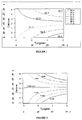
- Figure 1 is a contour plot of predicted efficacy values for different amounts of calcium and tungsten.
- Figure 2 is a contour plot of predicted number of starts until failure for different amounts of calcium and tungsten.
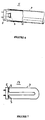
- Figure 3 is a side cross-sectional view of a coil cathode containing an emissive mixture according to a preferred embodiment of the present invention.
- Figure 4 is a side cross-sectional view of a flat member cathode containing an emissive mixture according to a preferred embodiment of the present invention.
- Figure 5 is a side cross-sectional view of a cup shaped cathode containing an emissive mixture according to a preferred embodiment of the present invention.
- Figure 6 is a side cross-sectional view of a linear fluorescent lamp containing an emissive mixture according to a preferred embodiment of the present invention.
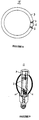
- Figure 7 is a side cross-sectional view of a compact fluorescent lamp_ containing an emissive mixture according to a preferred embodiment of the present invention.
- Figure 8 is a top cross-sectional view of a circular fluorescent lamp containing an emissive mixture according to a preferred embodiment of the present invention.
- Figure 9 is a side cross-sectional view of a high pressure fluorescent lamp containing an emissive mixture according to a preferred embodiment of the present invention.
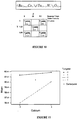
- Figure 10 is a schematic diagram of the experimental design of the specific examples of the present invention.
- Figure 11 is an interaction plot of wire lamp efficacies for various emissive mixtures according to the specific examples of the present invention.
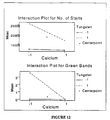
- Figure 12 is an interaction plot of wire lamp number of starts for various emissive mixtures according to the specific examples of the present invention.
- the present inventors have discovered that the efficacy (i.e., lumens per watt) and the operating lifetime of a fluorescent lamp may be unexpectedly improved by adjusting the amount of calcium and tungsten added to a barium tantalate emissive mixture having the formula (A 1-x Ca x ) 6 (Ta 1-y W y ) 2 O 11+y , where A comprises one of barium or a combination of barium and strontium, 0 ⁇ x ⁇ 0.5; and 0 ⁇ y ⁇ 1 and at least one of x or y is greater than zero. Tantalum has a +5 oxidation state, while tungsten has a +6 oxidation state.
- the number of moles of oxygen will depend on the number of moles of tungsten in the emissive mixture, and will vary between 11 and 12.
- the emissive mixture is a solid solution of (A 1-x Ca x ) 6 Ta 2 O 11 and (A 1-x Ca x ) 6 W 2 O 12 when the emissive mixture contains tungsten.
- the properties of the above emissive mixture having a 6:1 barium oxide to tantalum pentoxide molar ratio i.e., a Ba/Ta ratio of 3
- a Ba/Ta ratio of 3 a barium oxide to tantalum pentoxide molar ratio that contains calcium and/or tungsten
- a similar emissive mixture that lacks calcium and/or tungsten as well as compared to emissive mixtures having other barium oxide to tantalum pentoxide molar ratios (such as 5:2 or 4:1 or Ba/Ta ratios of 1.25 or 2, respectively).
- the calcium amount, x, of the emissive mixture is greater than zero and less than 0.3, preferably 0.05 ⁇ x ⁇ 0.1.
- the tungsten amount in this embodiment may be zero or greater than zero.
- the tungsten amount is greater than zero and less than 0.75, preferably 0.25 ⁇ x ⁇ 0.5.
- the calcium amount in this embodiment may be zero or greater than zero.
- the emissive mixture contains non-zero amounts of calcium and tungsten.
- the emissive mixture contains 0.25 ⁇ x ⁇ 0.3 and 0.5 ⁇ y ⁇ 0.75, which is predicted to provide a high efficacy for the fluorescent lamp.
- the emissive mixture contains 0 ⁇ x ⁇ 0.05 and 0.5 ⁇ y ⁇ 0.75, which is predicted to provide a long operating lifetime (greater number of starts before failure) for a fluorescent lamp.
- the emissive mixture contains 0.05 ⁇ x ⁇ 0.1 and 0 ⁇ y ⁇ 0.5, which is predicted to provide an optimum ratio of operating lifetime to efficacy for the fluorescent lamp.
- the present inventors have determined that adding more tungsten to the emissive mixture improves the operating lifetime of the lamp (i.e., increases the number of starts until failure). In contrast, adding more calcium reduces the operating lifetime of the lamp. However, adding more calcium improves lamp efficacy, while adding more tungsten decreases lamp efficacy.
- the present inventors have also discovered an unexpected interaction between the amount of tungsten and the amount of calcium in the emissive mix: adding calcium results in a much larger efficacy improvement when there is some tungsten, as opposed to when there is no tungsten, as will be discussed in more detail below. Therefore, the amounts of calcium and tungsten may be optimized to achieve an optimum desired lamp operating lifetime and efficacy.
- the present inventors have carried out a multiple regression analysis based on the results of the specific examples described below.
- the standard deviation i.e., the variation in lamp efficacies
- Similar transfer functions may be calculated for different lamps.
- Figure 1 illustrates a contour plot showing the predicted efficacy as a function of the levels of the two parameters, calcium and tungsten, extrapolated from formula I.
- the X-axis represents the atomic ratio of tungsten in the emissive mixture, while the Y-axis represents the atomic ratio of calcium in the emissive mixture.
- the lines inside the plot represent values of efficacy in lumens per watt for a given ratio of tungsten to calcium. Increasing the calcium level would be expected to reduce the standard deviation, S.
- the efficacy at calcium atomic ratios above 0.2 is higher than that of a triple oxide emissive mixture and of the barium tantalate emissive mixture containing no calcium.
- the present inventors have also carried out a further multiple regression analysis based on the results from the specific examples described below.
- Figure 2 illustrates a contour plot showing the predicted number of starts until failure as a function of the levels of the two parameters, calcium and tungsten, extrapolated from formula II.
- the X-axis represents the atomic ratio of tungsten in the emissive mixture, while the Y-axis represents the atomic ratio of calcium in the emissive mixture.
- the lines inside the plot represent the number of starts until failure for a given ratio of tungsten to calcium. As illustrated in Figure 2, decreasing the calcium amount while maintaining some tungsten is predicted to yield an improved number of starts compared to simply decreasing the calcium amount without any tungsten being present.
- the increase in number of starts is predicted to be especially pronounced for emissive mixtures containing an atomic ratio of calcium less than 0.10, such as an atomic ratio between 0 and 0.05, and an atomic ratio of tungsten greater than 0.25, such as an atomic ratio between 0.5 and 0.75.
- the addition of zirconium to the emissive mixture also has the effect of reducing or eliminating the formation of the oxide bands.
- the emissive mixture also contains about 2-3 weight percent, preferably 2.3 weight percent of zirconium.
- the zirconium may be omitted, if desired.
- the barium tantalate emissive mixture containing Sr, Ca and/or W according to the preferred embodiments of the present invention may contain unavoidable background impurities and intentional additives other than zirconium, if desired.
- An emissive mixture with an optimum desired ratio of mean lamp efficacy to mean number of lamp starts may be produced by the following method. First, the desired ratio of a mean lamp efficacy to a mean number of lamp starts is determined or calculated based on the amount of Ca and W to be present in the emissive mixture. Then predetermined amounts of starting materials, such as barium carbonate, tantalum pentoxide, calcium carbonate and/or tungsten trioxide, are mixed together based on the determination or calculation step to form the emissive mixture. The emissive mixture is then coated on a lamp electrode.
- starting materials such as barium carbonate, tantalum pentoxide, calcium carbonate and/or tungsten trioxide
- the step of determining the desired ratio of a mean lamp efficacy to a mean number of lamp starts may comprise a variety of different determining methods.
- the step of determining may comprise reviewing the Figures of the present invention to determine the amount of Ca and W that corresponds to the desired ratio.
- the step of determining may comprise calculating the desired ratio and the Ca and/or W content from formulas I and II or from other formulas or plots derived from calculations or experiments.
- the step of determining may also comprise carrying out experiments to determine the relationship between the desired ratio and the Ca and/or W content of the emissive mixture.
- the step of determining may be carried out only once, followed by carrying out a plurality steps of mixing predetermined amounts of starting materials.
- the desired ratio may be calculated only once, followed by the manufacture of plural lamps containing the emissive mixture based on the single determining step.
- the emissive mixture of the present invention may be made by various ceramic processing methods.
- the starting barium, tantalum, calcium and/or tungsten powders such as a BaCO 3 powder, a Ta 2 O 5 powder and at least one of a CaCO 3 powder and a WO 3 powder are mixed in a stoichiometric proportion to obtain a first powder that would lead to an emissive mixture having the desired ratio of efficacy to operating lifetime.
- the tantalum pentoxide powder is milled prior to the mixing step such that its median particle size is 4 microns or less to enhance its reactivity.
- the first (i.e., mixed) powder is then sintered to form a sintered body or "cake."
- the sintering takes place in a furnace at a temperature of about 1500 °C for about 10 hours.
- other appropriate sintering temperatures and duration may be used.
- the sintered body is then milled to form a second powder.
- the second powder is milled until it has a median particle size of 4 microns or less with a narrow particle distribution.
- the second powder is preferably milled in propanol or water as the milling media or liquid and subsequently dried.
- other milling media such as methanol, for example, may be used instead.
- zirconium and/or strontium may be added to the first powder or to the second powder as zirconium oxide or strontium carbonate powders.
- the second powder is then preferably mixed with a binder to form an emissive mixture suspension.
- the binder comprises an organic material, such as nitrocellulose, in a solvent such as butyl acetate, amyl acetate, methyl propanol or propylene glycol mono-methyl ether acetate at a 90-95% level with 1-2% denatured ethanol.
- the binder enhances the adhesion of the powder particles to each other and to the lamp electrode.
- the binder may be omitted to simplify processing, if desired.
- the milling media comprises the binder solution.
- the sintered body is immersed into the binder solution and milled into the second powder directly in the binder solution, thus combining the separate milling and mixing steps into a single step to decrease processing time and cost.
- emissive mixtures prepared by direct milling in the binder solution may result in an increased number of oxide bands on the lamp envelope or cover compared to emissive mixtures prepared by separately milling and mixing with the binder.
- the emissive mixture suspension is then coated onto an electrode, such as a cathode of a fluorescent lamp, by a process such as dip coating or other coating processes.
- the electrode is then resistively heated to evaporate the binder from the emissive mixture suspension to obtain the emissive mixture formed on the electrode (i.e., the emissive mixture is "activated").
- the activation may be carried out for 25-35 seconds at a temperature of 1050-1150 °C. However, other temperatures and duration may be used that are sufficient to evaporate the binder from the emissive mixture.
- the step of sintering in the furnace may be omitted, and instead the sintering and activation steps may be combined into a single step by resistively heating the emissive mixture suspension coated on the lamp electrode to decrease processing time and cost.
- emissive mixtures prepared by an in-situ activation and sintering on the electrode result in a greater amount of oxide bands on the lamp cover and a lower lamp efficacy than emissive mixtures prepared by sintering in a furnace.
- the milling and binder mixing steps may be combined into a single step, as described above, in addition to combining the sintering and activation steps into a single step.
- the emissive mixture 1 is coated on a lamp cathode.
- the cathode may comprise a wire or a coil 3, such as a tungsten coil illustrated in Figure 3, connected to a ballast 5.
- the cathode may comprise a flat member 6 containing the emissive mixture 1 on at least one surface, as illustrated in Figure 4, or a cup 7 containing the emissive mixture 1 inside the hollow interior space, as illustrated in Figure 5.
- the lamp may comprise any lamp, preferably a florescent lamp containing a cathode 3, a ballast 5 and a gas containing envelope or cover 9.
- the interior surface of the envelope may be coated with a luminescent material or phosphor 10, as is known in the art.
- the fluorescent lamp may comprise a linear fluorescent lamp 11 illustrated in Figure 6, a compact fluorescent lamp 13, illustrated in Figure 7 or a circular fluorescent lamp 15, illustrated in Figure 8.
- the lamp may comprise a high pressure lamp 17 containing an inner gas envelope 12 inside the outer cover or bulb 9, as illustrated in Figure 9.
- the present inventors have tested the efficacy and operational lifetime of 48 compact fluorescent lamps using a full 2x2 factorial test that included a center-point, as illustrated in Figure 10.
- the test was designed to examine the effect of varying the levels of calcium and tungsten in the barium tantalate emission mixture.
- the lamp and ballast types used were Triple-BiaxTM 15-Watt Hex lamps with ballasts operating in the Instant Start mode. All electrode structures were 6-ohm type.
- the present inventors compared the prior art triple oxide and Ba 6 Ta 2 O 11 (composition a) emissive mixtures to Ca and/or W containing barium tantalate mixtures (compositions b through e) made according to preferred aspects of the present invention, as illustrated in Figure 10.
- Table 1 shows the breakdown of this experiment, including the duration of the on/off instant start cycle of the test and the levels of Ca and W being varied.
- Emissive Mixture Rapid Cycle (30 sec. on/4.5 min. off) Standard Cycle (3 hour on/20 min. off) Triple Oxide (BaSrCaO) 6 lamps 6 lamps a) Ba 6 Ta 2 O 11 6 lamps b) (Ba. 90 Ca 10 ) 6 Ta 2 O 11 6 lamps c) (Ba. 95 Ca .05 ) 6 (Ta. 75 W .25 ) 2 O 11.25 6 lamps 6 lamps d) Ba 6 TaWO 11.5 6 lamps e) (Ba. 90 Ca .10 ) 6 TaWO 11.5 6 lamps
- Table 2 demonstrates the initial wire-lamp and system (i.e., lamp plus ballast) performance results after 100 hours of lamp operation at 216 mA current and 30 kHz frequency. Wire lamp measurements were made at steady state as measured by a chart recorder output of the lumens signal (typically about 1 hour), with a temperature controlled heater to maintain an amalgam temperature of 90 °C. System efficacy was measured with 120V/60 Hz ballast modified to operate in Instant Start mode.
- the efficacy of the emissive mixtures b)-e), especially mixture b), (Ba. 90 Ca .10 ) 6 Ta 2 O 11 are comparable to the efficacy of the triple oxide mixture and mixture a). Nominally, the presence of the tungsten appears to be a negative contributing factor, while that of calcium appears to be a positive contributing factor to the overall lamp efficacy.
- Figure 11 illustrates an interaction plot of the wire lamp efficacies.
- the low and high tungsten and calcium levels are coded as -1 and +1, respectively.
- Table 3 illustrates the Rapid Cycle and Standard Cycle Instant Start operating lifetime test results, measured in the number of starts until failure. The values following the +/- sign in Table 3 are the number of standard deviations away from 10,000 starts. Table 3 also provides a subjective gauge of the level or extent of dark or "greenish" oxide bands, described above. A subjective gauge of the extent of these oxide bands was made by examining the lamps after their initial 100 hour seasoning period, before they had gone on to the life tests. A scale of 0-5 was used where 0 meant no band and 5 meant a very heavy ( ⁇ 3-4 mm wide) band. Emissive Mixture # of Starts on Rapid Cycle Instant Start mode (30 sec. on/4.5 min. off) # Hours on Standard Cycle Instant Start Mode (3 hours on/20 min.
- compositions c), d) and e) significantly increases the number of starts compared to the triple oxide and the prior art composition a) which contains no tungsten.
- the addition of tungsten also increases the level of oxide bands.
- the addition of calcium, particularly the 0.1 atomic ratio of calcium in composition e) eliminated the oxide bands despite the presence of tungsten, while still maintaining a greater number of starts than the prior art composition a) which contains no tungsten.
- Figure 12 illustrates an interaction plot of the mean number of starts of a lamp based on the amount of calcium and tungsten in the emissive mixture. From the fact that the two lines shown in Figure 12 (for the low and high tungsten levels) are not parallel, it can be concluded that there is a positive interaction between the tungsten and the calcium. Furthermore, by extrapolating the low calcium and tungsten levels shown in Table 3 and Figure 12 to higher calcium and tungsten levels, it becomes apparent that there is an interaction between the tungsten and the calcium. Decreasing the amount of calcium makes a much larger improvement in the operating lifetime of a lamp whose emissive mixture contains some tungsten, compared to a lamp whose emissive mixture contains no tungsten.
Landscapes
- Chemical & Material Sciences (AREA)
- Organic Chemistry (AREA)
- Inorganic Chemistry (AREA)
- Engineering & Computer Science (AREA)
- Manufacturing & Machinery (AREA)
- Discharge Lamp (AREA)
Abstract
There is provided an emissive mixture for cathodes (3) of fluorescent lamps (11)
comprising a ceramic material having a formula (A1-x Cax)6 (Ta1-y Wy)2 O11+y, where
A is barium or a combination of barium and strontium, 0≤ x<0.5, O≤ y<1, and one of
x or y is greater than zero. The ratio of lamp efficacy to number of lamp starts may be
improved by optimizing the amount of Ca and W present in the ceramic material.
Description
- The present invention is directed generally to an electrode material for fluorescent lamps, and more particularly to an emissive mixture coated on fluorescent lamp cathodes.
- The standard emissive coating currently used on a majority of electrodes of commercial fluorescent lamps contains a mixture of barium, calcium, and strontium oxides ("the triple oxide emissive mixture"). Since these oxides are highly sensitive to CO2 and water, they are placed on the lamp electrodes initially as a mixture of barium, calcium and strontium carbonates in a slurry suspension containing a binder and a solvent. The mixture of carbonates is then "activated" during the manufacturing process by resistively heating the electrodes until the carbonates decompose, releasing CO2 and some CO, and leaving behind the triple oxide emission mixture on the lamp electrode. It is believed that barium, in some form, is primarily responsible for the electron emission. It is also known to add a small amount of Al, Hf, Zr, Ta, W and Th dopants to the triple oxide emissive mixture, as discussed in U.S. Patent 3,563,797 to Young.
- However, the triple oxide emissive mixture suffers from several disadvantages. First, the "activation" requires an undesirably high temperature to convert the carbonates to oxides. Second, the conversion of carbonates to oxides undesirably releases CO2 and some CO. Third, lamps having electrodes coated with the triple oxide emissive mixture have a rather short operating lifetime.
- It has been previously suggested in U.S. Patent 4,031,426 to Kern to substitute the triple oxide emissive mixture with barium tantalate emissive mixtures having various barium to tantalum ratios. According to U.S. Patent 4,031,426, the barium tantalate emissive mixtures may be "activated" in less time and at a lower temperature than the triple oxide emissive mixture. Furthermore, lamps having electrodes coated with the barium tantalate emissive mixtures have a longer operating lifetime than the lamps with the triple oxide emissive mixture. The preferred barium oxide to tantalum pentoxide ratio in U.S. Patent 4,031,426 is 5:1, resulting in an emissive mixture having the following composition: Ba5Ta2O10. Emissive mixtures having barium oxide to tantalum pentoxide ratios greater or less than 5:1 were reported in this patent as having a lower electron emission.
- However, a fluorescent lamp containing the barium tantalate emissive mixture has a somewhat inferior efficacy compared to the triple oxide emissive mixture. The present invention is directed to overcoming or at least reducing the effects of one or more problems set forth above.
- One embodiment of the present invention provides a composition of matter, comprising (A1-x Cax)6 (Ta1-y Wy)2 O11+y, wherein A comprises one of barium or a combination of barium and strontium, 0≤ x<0.5, 0≤ y<1, and at least one of x or y is greater than zero.
- Another embodiment of the present invention provides a method of making an emissive mixture comprising a composition of matter having a formula (A1-x Cax)6 (Ta1-y Wy)2 O11+y, the method comprising determining a desired ratio of a mean lamp efficacy to a mean number of lamp starts by determining the amount of Ca and W to be present in the emissive mixture, mixing predetermined amounts of starting materials based on the determination of the desired ratio to form an emissive mixture and coating the emissive mixture on an electrode, wherein A comprises one of barium or a combination of barium and strontium, 0≤ x<0.5, 0≤ y<1 and at least one of x or y is greater than zero.
- Embodiments of the invention will now be described, by way of example, with reference to the accompanying drawings, in which:
- Figure 1 is a contour plot of predicted efficacy values for different amounts of calcium and tungsten.
- Figure 2 is a contour plot of predicted number of starts until failure for different amounts of calcium and tungsten.
- Figure 3 is a side cross-sectional view of a coil cathode containing an emissive mixture according to a preferred embodiment of the present invention.
- Figure 4 is a side cross-sectional view of a flat member cathode containing an emissive mixture according to a preferred embodiment of the present invention.
- Figure 5 is a side cross-sectional view of a cup shaped cathode containing an emissive mixture according to a preferred embodiment of the present invention.
- Figure 6 is a side cross-sectional view of a linear fluorescent lamp containing an emissive mixture according to a preferred embodiment of the present invention.
- Figure 7 is a side cross-sectional view of a compact fluorescent lamp_ containing an emissive mixture according to a preferred embodiment of the present invention.
- Figure 8 is a top cross-sectional view of a circular fluorescent lamp containing an emissive mixture according to a preferred embodiment of the present invention.
- Figure 9 is a side cross-sectional view of a high pressure fluorescent lamp containing an emissive mixture according to a preferred embodiment of the present invention.
- Figure 10 is a schematic diagram of the experimental design of the specific examples of the present invention.
- Figure 11 is an interaction plot of wire lamp efficacies for various emissive mixtures according to the specific examples of the present invention.
- Figure 12 is an interaction plot of wire lamp number of starts for various emissive mixtures according to the specific examples of the present invention.
- The present inventors have discovered that the efficacy (i.e., lumens per watt) and the operating lifetime of a fluorescent lamp may be unexpectedly improved by adjusting the amount of calcium and tungsten added to a barium tantalate emissive mixture having the formula (A1-x Cax)6 (Ta1-y Wy)2 O11+y, where A comprises one of barium or a combination of barium and strontium, 0≤ x<0.5; and 0≤ y<1 and at least one of x or y is greater than zero. Tantalum has a +5 oxidation state, while tungsten has a +6 oxidation state. Therefore, the number of moles of oxygen will depend on the number of moles of tungsten in the emissive mixture, and will vary between 11 and 12. Thus, the emissive mixture is a solid solution of (A1-x Cax)6 Ta2 O11 and (A1-x Cax)6 W2 O12 when the emissive mixture contains tungsten. The present inventors noted that the properties of the above emissive mixture having a 6:1 barium oxide to tantalum pentoxide molar ratio (i.e., a Ba/Ta ratio of 3) that contains calcium and/or tungsten has improved properties compared to a similar emissive mixture that lacks calcium and/or tungsten, as well as compared to emissive mixtures having other barium oxide to tantalum pentoxide molar ratios (such as 5:2 or 4:1 or Ba/Ta ratios of 1.25 or 2, respectively).
- In a first preferred embodiment of the present invention, the calcium amount, x, of the emissive mixture is greater than zero and less than 0.3, preferably 0.05 ≤ x ≤ 0.1. The tungsten amount in this embodiment may be zero or greater than zero. In a second preferred embodiment of the present invention, the tungsten amount is greater than zero and less than 0.75, preferably 0.25 ≤ x ≤ 0.5. The calcium amount in this embodiment may be zero or greater than zero. In a third preferred embodiment of the present invention, the emissive mixture contains non-zero amounts of calcium and tungsten.
- In a fourth preferred embodiment of the present invention, the emissive mixture contains 0.25 ≤ x ≤ 0.3 and 0.5≤ y ≤ 0.75, which is predicted to provide a high efficacy for the fluorescent lamp. In a fifth preferred embodiment of the present invention, the emissive mixture contains 0 ≤ x ≤ 0.05 and 0.5≤ y ≤ 0.75, which is predicted to provide a long operating lifetime (greater number of starts before failure) for a fluorescent lamp. In a sixth preferred embodiment of the present invention, the emissive mixture contains 0.05 ≤ x ≤ 0.1 and 0≤ y ≤ 0.5, which is predicted to provide an optimum ratio of operating lifetime to efficacy for the fluorescent lamp.
- The present inventors have determined that adding more tungsten to the emissive mixture improves the operating lifetime of the lamp (i.e., increases the number of starts until failure). In contrast, adding more calcium reduces the operating lifetime of the lamp. However, adding more calcium improves lamp efficacy, while adding more tungsten decreases lamp efficacy.
- The present inventors have also discovered an unexpected interaction between the amount of tungsten and the amount of calcium in the emissive mix: adding calcium results in a much larger efficacy improvement when there is some tungsten, as opposed to when there is no tungsten, as will be discussed in more detail below. Therefore, the amounts of calcium and tungsten may be optimized to achieve an optimum desired lamp operating lifetime and efficacy.
- The present inventors have carried out a multiple regression analysis based on the results of the specific examples described below. The analysis yields a transfer function (formula I) for mean lamp efficacy (specifically, for a 15 watt lamp operated on a control reference ballast with a 6 ohm electrode ("wire" lamp)):
- Figure 1 illustrates a contour plot showing the predicted efficacy as a function of the levels of the two parameters, calcium and tungsten, extrapolated from formula I. The X-axis represents the atomic ratio of tungsten in the emissive mixture, while the Y-axis represents the atomic ratio of calcium in the emissive mixture. The lines inside the plot represent values of efficacy in lumens per watt for a given ratio of tungsten to calcium. Increasing the calcium level would be expected to reduce the standard deviation, S. Furthermore, as may be seen from Figure 1, the efficacy at calcium atomic ratios above 0.2 is higher than that of a triple oxide emissive mixture and of the barium tantalate emissive mixture containing no calcium.
- Increasing the calcium amount further while maintaining some tungsten is predicted to yield improved efficacy compared to simply increasing the calcium level without tungsten, as shown in Figure 1. Furthermore, the predicted increase in efficacy (based on the extrapolation of the derived transfer function) is especially pronounced for emissive mixtures containing an atomic ratio of calcium greater than 0.15, such as an atomic ratio between 0.25 and 0.3, and an atomic ratio of tungsten greater than 0.25, such as an atomic ratio between 0.5 and 0.75. Thus, Figure 1 illustrates an unexpected, synergistic effect of tungsten and calcium on lamp efficacy.
- The present inventors have also carried out a further multiple regression analysis based on the results from the specific examples described below. This further analysis yields a transfer function (formula II) for the mean number of starts until failure (a measure of the operating lifetime of the lamp) for a 15 watt lamp operated on a control reference ballast with a 6 ohm electrode ("wire" lamp) in a rapid cycle (30 seconds on / 4.5 minutes off) mode:
- Figure 2 illustrates a contour plot showing the predicted number of starts until failure as a function of the levels of the two parameters, calcium and tungsten, extrapolated from formula II. The X-axis represents the atomic ratio of tungsten in the emissive mixture, while the Y-axis represents the atomic ratio of calcium in the emissive mixture. The lines inside the plot represent the number of starts until failure for a given ratio of tungsten to calcium. As illustrated in Figure 2, decreasing the calcium amount while maintaining some tungsten is predicted to yield an improved number of starts compared to simply decreasing the calcium amount without any tungsten being present. Furthermore, the increase in number of starts is predicted to be especially pronounced for emissive mixtures containing an atomic ratio of calcium less than 0.10, such as an atomic ratio between 0 and 0.05, and an atomic ratio of tungsten greater than 0.25, such as an atomic ratio between 0.5 and 0.75.
- As illustrated in Figures 1 and 2, there is a trade off between efficacy and number of starts. However, by optimizing the amount of calcium and tungsten, a desired lamp efficacy and operating lifetime may be obtained. For example, selecting the calcium and tungsten atomic ratios in the ranges of 0.05 ≤ x ≤ 0.1 and 0≤y ≤ 0.5, respectively, provides an emissive mixture which achieves a relatively high lamp efficacy as well as a relatively long lamp operating lifetime. However, other ranges may be selected depending on which of a higher efficacy or a longer operating lifetime is more desirable for a particular application.
- The present inventors have also noted that the addition of calcium to the emissive mixture has a beneficial effect of reducing or eliminating dark or "greenish" oxide bands that have sometimes been found to develop early in lamp life about 1.5 cm from the electrodes on the surface of the lamp envelope or cover. These oxide bands have been found to consist of Hg, O, and C, in roughly equal proportions, and represent an undesirable level of end darkening in a lamp. No oxide bands were observed at 100 hours in lamps containing an emissive mixture with a calcium atomic ratio of x≥0.1. A calcium atomic ratio of x=0.33 is predicted to have the greatest effect on reducing or eliminating the oxide bands.
- The present inventors also noted that the addition of zirconium to the emissive mixture also has the effect of reducing or eliminating the formation of the oxide bands. In a preferred aspect of the present invention, the emissive mixture also contains about 2-3 weight percent, preferably 2.3 weight percent of zirconium. However, the zirconium may be omitted, if desired. It should also be understood that the barium tantalate emissive mixture containing Sr, Ca and/or W according to the preferred embodiments of the present invention may contain unavoidable background impurities and intentional additives other than zirconium, if desired.
- An emissive mixture with an optimum desired ratio of mean lamp efficacy to mean number of lamp starts may be produced by the following method. First, the desired ratio of a mean lamp efficacy to a mean number of lamp starts is determined or calculated based on the amount of Ca and W to be present in the emissive mixture. Then predetermined amounts of starting materials, such as barium carbonate, tantalum pentoxide, calcium carbonate and/or tungsten trioxide, are mixed together based on the determination or calculation step to form the emissive mixture. The emissive mixture is then coated on a lamp electrode.
- The step of determining the desired ratio of a mean lamp efficacy to a mean number of lamp starts may comprise a variety of different determining methods. For example, the step of determining may comprise reviewing the Figures of the present invention to determine the amount of Ca and W that corresponds to the desired ratio. Alternatively, the step of determining may comprise calculating the desired ratio and the Ca and/or W content from formulas I and II or from other formulas or plots derived from calculations or experiments. The step of determining may also comprise carrying out experiments to determine the relationship between the desired ratio and the Ca and/or W content of the emissive mixture.
- Furthermore, the step of determining may be carried out only once, followed by carrying out a plurality steps of mixing predetermined amounts of starting materials. In other words, the desired ratio may be calculated only once, followed by the manufacture of plural lamps containing the emissive mixture based on the single determining step.
- The emissive mixture of the present invention may be made by various ceramic processing methods. In a preferred embodiment of the present invention, the starting barium, tantalum, calcium and/or tungsten powders, such as a BaCO3 powder, a Ta2O5 powder and at least one of a CaCO3 powder and a WO3 powder are mixed in a stoichiometric proportion to obtain a first powder that would lead to an emissive mixture having the desired ratio of efficacy to operating lifetime. Preferably, the tantalum pentoxide powder is milled prior to the mixing step such that its median particle size is 4 microns or less to enhance its reactivity.
- The first (i.e., mixed) powder is then sintered to form a sintered body or "cake." Preferably, the sintering takes place in a furnace at a temperature of about 1500 °C for about 10 hours. However, other appropriate sintering temperatures and duration may be used.
- The sintered body is then milled to form a second powder. Preferably, the second powder is milled until it has a median particle size of 4 microns or less with a narrow particle distribution. The second powder is preferably milled in propanol or water as the milling media or liquid and subsequently dried. However, other milling media, such as methanol, for example, may be used instead. Optionally, zirconium and/or strontium may be added to the first powder or to the second powder as zirconium oxide or strontium carbonate powders.
- The second powder is then preferably mixed with a binder to form an emissive mixture suspension. Preferably, the binder comprises an organic material, such as nitrocellulose, in a solvent such as butyl acetate, amyl acetate, methyl propanol or propylene glycol mono-methyl ether acetate at a 90-95% level with 1-2% denatured ethanol. The binder enhances the adhesion of the powder particles to each other and to the lamp electrode. However, the binder may be omitted to simplify processing, if desired.
- In an alternative aspect of the present invention, the milling media comprises the binder solution. Thus, the sintered body is immersed into the binder solution and milled into the second powder directly in the binder solution, thus combining the separate milling and mixing steps into a single step to decrease processing time and cost. However, emissive mixtures prepared by direct milling in the binder solution may result in an increased number of oxide bands on the lamp envelope or cover compared to emissive mixtures prepared by separately milling and mixing with the binder.
- The emissive mixture suspension is then coated onto an electrode, such as a cathode of a fluorescent lamp, by a process such as dip coating or other coating processes. The electrode is then resistively heated to evaporate the binder from the emissive mixture suspension to obtain the emissive mixture formed on the electrode (i.e., the emissive mixture is "activated"). The activation may be carried out for 25-35 seconds at a temperature of 1050-1150 °C. However, other temperatures and duration may be used that are sufficient to evaporate the binder from the emissive mixture.
- In another alternative aspect of the present invention, the step of sintering in the furnace may be omitted, and instead the sintering and activation steps may be combined into a single step by resistively heating the emissive mixture suspension coated on the lamp electrode to decrease processing time and cost. However, emissive mixtures prepared by an in-situ activation and sintering on the electrode result in a greater amount of oxide bands on the lamp cover and a lower lamp efficacy than emissive mixtures prepared by sintering in a furnace. Furthermore, in order to further reduce process time and cost, the milling and binder mixing steps may be combined into a single step, as described above, in addition to combining the sintering and activation steps into a single step.
- In a preferred aspect of the present invention, the
emissive mixture 1 is coated on a lamp cathode. The cathode may comprise a wire or acoil 3, such as a tungsten coil illustrated in Figure 3, connected to aballast 5. Alternatively, the cathode may comprise aflat member 6 containing theemissive mixture 1 on at least one surface, as illustrated in Figure 4, or a cup 7 containing theemissive mixture 1 inside the hollow interior space, as illustrated in Figure 5. The lamp may comprise any lamp, preferably a florescent lamp containing acathode 3, aballast 5 and a gas containing envelope or cover 9. The interior surface of the envelope may be coated with a luminescent material orphosphor 10, as is known in the art. The fluorescent lamp may comprise a linear fluorescent lamp 11 illustrated in Figure 6, acompact fluorescent lamp 13, illustrated in Figure 7 or acircular fluorescent lamp 15, illustrated in Figure 8. Alternatively, the lamp may comprise a high pressure lamp 17 containing aninner gas envelope 12 inside the outer cover or bulb 9, as illustrated in Figure 9. - It should be understood that the examples below are meant to merely illustrate the present invention and should not be deemed as limiting the scope of the claims.
- The present inventors have tested the efficacy and operational lifetime of 48 compact fluorescent lamps using a full 2x2 factorial test that included a center-point, as illustrated in Figure 10. The test was designed to examine the effect of varying the levels of calcium and tungsten in the barium tantalate emission mixture. The lamp and ballast types used were Triple-Biax™ 15-Watt Hex lamps with ballasts operating in the Instant Start mode. All electrode structures were 6-ohm type. The present inventors compared the prior art triple oxide and Ba6Ta2O11 (composition a) emissive mixtures to Ca and/or W containing barium tantalate mixtures (compositions b through e) made according to preferred aspects of the present invention, as illustrated in Figure 10. Table 1 shows the breakdown of this experiment, including the duration of the on/off instant start cycle of the test and the levels of Ca and W being varied.
Emissive Mixture Rapid Cycle (30 sec. on/4.5 min. off) Standard Cycle (3 hour on/20 min. off) Triple Oxide (BaSrCaO) 6 lamps 6 lamps a) Ba6Ta2O11 6 lamps b) (Ba.90Ca10)6Ta2O11 6 lamps c) (Ba.95Ca.05)6(Ta.75W.25)2 O 11.256 lamps 6 lamps d) Ba6TaWO11.5 6 lamps e) (Ba.90Ca.10)6 TaWO 11.56 lamps - Table 2 demonstrates the initial wire-lamp and system (i.e., lamp plus ballast) performance results after 100 hours of lamp operation at 216 mA current and 30 kHz frequency. Wire lamp measurements were made at steady state as measured by a chart recorder output of the lumens signal (typically about 1 hour), with a temperature controlled heater to maintain an amalgam temperature of 90 °C. System efficacy was measured with 120V/60 Hz ballast modified to operate in Instant Start mode.
Emissive Mixture Number of lamps Lamp Efficacy (steady state LPW) System Efficacy (LPW) System Power (W) Triple Oxide Emissive mixture weight = 3.53 ± 0.09 mg 12 62.9 ± 0.7 60.0 ± 0.3 14.3+0.1 a) Ba6Ta2O11 Emissive mixture weight = 5.34 ± 0.14 mg 6 61.7 ± 1.4 59.1 ± 0.5 14.5 ± 0.1 b) (Ba.90Ca.10)6Ta2O11 emissive mixture weight = 5.33 ± 0.20 mg 6 62.3 ± 1.0 58.8 ± 1.2 14.5 ± 0.2 c) (Ba.95Ca.05)6(Ta.75W.25)2 O 11.2 5 emissive mixture weight = 5.24 ± 0.15mg 12 60.8 ± 1.1 58.0 ± 0.7 14.5 ± 0.1 d) Ba6TaWO11.5 emissive mixture weight = 5.33 ± 0.16 mg 6 56.4 ± 2.7 54.9 ± 1.3 14.6 ± 0.2 e) (Ba.90Ca.10)6TaWO11.5 emissive mixture weight = 5.27 ± 0.20 6 60.5 ± 1.0 57.9 ± 0.6 14.5 ± 0.1 - As may be seen from Table 2, the efficacy of the emissive mixtures b)-e), especially mixture b), (Ba.90Ca.10)6Ta2O11, are comparable to the efficacy of the triple oxide mixture and mixture a). Nominally, the presence of the tungsten appears to be a negative contributing factor, while that of calcium appears to be a positive contributing factor to the overall lamp efficacy.
- Figure 11 illustrates an interaction plot of the wire lamp efficacies. In this plot, the low and high tungsten and calcium levels are coded as -1 and +1, respectively. (For example, a -1 tungsten level and a +1 calcium level would mean y=0 and x=0.1 and the following composition: (Ba.90Ca.10)6Ta2O11 from Tables 1 and 2.) From the fact that the two lines shown in Figure 11 (for the low and high tungsten levels) are not parallel, it can be concluded that there is a positive interaction between the tungsten and the calcium. Furthermore, by extrapolating the low calcium and tungsten levels shown in Table 2 and Figure 11 to higher calcium and tungsten levels, it becomes apparent that there is an interaction between the tungsten and the calcium. Adding calcium makes a much larger improvement to the efficacy when some tungsten is present, compared to a lamp with an emissive mixture containing no tungsten.
- A multiple regression analysis performed on the above data yields formula I described above, which is the transfer function for mean wire-lamp efficacy. Furthermore, the contour plot illustrated in Figure 1 and also described above was extrapolated from the data provided in Table 2.
- Table 3 illustrates the Rapid Cycle and Standard Cycle Instant Start operating lifetime test results, measured in the number of starts until failure. The values following the +/- sign in Table 3 are the number of standard deviations away from 10,000 starts. Table 3 also provides a subjective gauge of the level or extent of dark or "greenish" oxide bands, described above. A subjective gauge of the extent of these oxide bands was made by examining the lamps after their initial 100 hour seasoning period, before they had gone on to the life tests. A scale of 0-5 was used where 0 meant no band and 5 meant a very heavy (∼3-4 mm wide) band.
Emissive Mixture # of Starts on Rapid Cycle Instant Start mode (30 sec. on/4.5 min. off) # Hours on Standard Cycle Instant Start Mode (3 hours on/20 min. off) Level of "green" oxide bands at 100 hrs Triple Oxide 5694 ± 831 >8350 (6 of 6 still running) 0 a) Ba6Ta2O11 12331 ± 2804 NA 0 b) (Ba.90Ca.10)6Ta2O11 11849 ± 1466 NA 0 c) (Ba.95Ca.05)6(Ta.75W.25)2 O 11.2 518650 ± 7083 >8350 (6 of 6 still running) 0.33 ± 0.75 d) Ba6TaWO11.5 25612 ± 5966 NA 3.58 ± 1.56 e) (Ba.90Ca.10)6TaWO11.5 16932 ± 5043 NA 0 - As may be seen from Table 3, the addition of tungsten to compositions c), d) and e) significantly increases the number of starts compared to the triple oxide and the prior art composition a) which contains no tungsten. The addition of tungsten also increases the level of oxide bands. However, the addition of calcium, particularly the 0.1 atomic ratio of calcium in composition e), eliminated the oxide bands despite the presence of tungsten, while still maintaining a greater number of starts than the prior art composition a) which contains no tungsten.
- Figure 12 illustrates an interaction plot of the mean number of starts of a lamp based on the amount of calcium and tungsten in the emissive mixture. From the fact that the two lines shown in Figure 12 (for the low and high tungsten levels) are not parallel, it can be concluded that there is a positive interaction between the tungsten and the calcium. Furthermore, by extrapolating the low calcium and tungsten levels shown in Table 3 and Figure 12 to higher calcium and tungsten levels, it becomes apparent that there is an interaction between the tungsten and the calcium. Decreasing the amount of calcium makes a much larger improvement in the operating lifetime of a lamp whose emissive mixture contains some tungsten, compared to a lamp whose emissive mixture contains no tungsten.
- A multiple regression analysis performed on the above data yields formula II described above, which is the transfer function for mean number of starts until failure. Furthermore, the.-contour plot illustrated in Figure 2 and also described above was extrapolated from the data provided in Table 3.
- The specific examples described above demonstrate the unexpected improvement in lamp efficacy and operating lifetime by adding calcium and/or tungsten to a barium tantalate emissive mixture. The specific examples described above also form the basis of the contour plots illustrated in Figures 1 and 2, which demonstrate the unexpected, synergistic result of adding both calcium and tungsten to the emissive mixture.
- For the completeness, various aspect of the invention are set out in the following numbered clauses:-
- 1. A composition of matter, comprising:
- 0 ≤ x < 0.5;
- 0 ≤ y,1;; and at least one of x or y is greater than zero.
- 2. The composition of
clause 1, wherein 0< x <0.3. - 3. The composition of
clause 2, wherein 0.05≤ x: ≤ 0.1. - 4. The composition of
clause 1, wherein 0<y<0.75. - 5. The composition of
clause 4, wherein 0.25≤ y ≤0.5. - 6. The composition of
clause 1, wherein 0.25≤ x ≤0.3 and 0.05≤ y: ≤ 0.75. - 7. The composition of
clause 1, wherein 0≤ x ≤0.05 and 0.5≤ y ≤0.75. - 8. The composition of
clause 1, wherein 0.05< x ≤0.1 and 0≤ y ≤0.5. - 9. The composition of
clause 1, wherein both x and y are greater than zero. - 10. The composition of
clause 1, comprising (Ba 0.09 Ca 0.10)6 Ta2 O11. - 11. The composition of
clause 1, comprising (Ba 0.95 Ca0.05)6 (Ta 0.75 W 0.25)2 O11.25. - 12. The composition of
clause 1, comprising Ba6 Ta W O11.5. - 13. The composition of
clause 1, comprising (Ba 0.90 Ca 0.10)6 Ta W O11.5. - 14. The composition of
clause 1, further comprising 2-3 weight percent of zirconium. - 15. An electrode, comprising: an electrode base; and an emissive mixture
comprising the composition of matter according to
clause 1 in 10 contact with the base. - 16. The electrode of
clause 15, wherein the base comprises a wire or a coil coated with the emissive mixture. - 17. The electrode of
clause 15, wherein the base comprises a flat member or a cup containing the emissive mixture. - 18. The electrode of
clause 15, wherein the electrode is a cathode. - 19. A fluorescent lamp comprising the cathode of clause 18, an envelope and a gas within the envelope.
- 20. The fluorescent lamp of
clause 19, wherein the lamp is a linear fluorescent lamp, compact fluorescent lamp, a circular fluorescent lamp or a high pressure lamp. - 21. A method of making an emissive mixture comprising a composition of matter
having a formula (A1-x Cax)6 (Ta1-y Wy)2 O11=y, the method comprising:
- determining a desired ratio of a mean lamp efficacy to a mean number of lamp starts by determining the amount of Ca and W to be present in the emissive mixture;
- mixing predetermined amounts of starting materials based on the determination the desired ratio to form the emissive mixture; wherein A comprises one of barium or a combination of barium and strontium;
- 0≤x<0.5;
- 0≤y<1; and
- at least one of x or y is greater than zero.
- 22. The method of clause 21, wherein:
- the mean lamp efficacy is determined from formula (I):
- the mean number of lamp starts is determined from formula (II):
- 23. The method of clause 21, wherein the step of mixing predetermined amounts
of starting materials comprises: mixing a BaC03 powder, a Ta2O5 powder and at least
one of a CaCO3 powder and a WO3 powder to form a first powder;
- sintering the first powder to form a sintered body;
- milling the sintered body to form a second powder; and
- mixing the second powder with a binder to form an emissive mixture suspension; and
- further comprising a step of coating the emissive mixture suspension on an electrode.
- 24. The method of clause 23, wherein the step of sintering comprises sintering the first powder in a furnace and further comprising a step of resistively heating the electrode to evaporate the binder from the emissive mixture suspension after the step of coating the emissive mixture suspension.
- 25. The method of clause 23, wherein the binder comprises a binder solution of nitrocellulose in a solvent.
- 26. The method of
clause 25, wherein the steps of milling the sintered body and mixing the second powder with a binder comprise the steps of: immersing the sintered body into the binder solution; and
milling the sintered body in the binder solution to form the emissive mixture suspension comprising the second powder dispersed in the binder solution. - 27. The method of clause 23, wherein the step of milling comprises milling the sintered body in propanol or water to form the second powder followed by a step of drying the second powder.
- 28. The method of clause 23, further comprising a step of milling the Ta2O5 powder such that the average particle size of the a Ta205 powder is reduced to 4 gm or less prior to the step of mixing to form the first powder.
- 29. The method clause 21, wherein the step of mixing predetermined amounts of
starting materials comprises:
- mixing a BaCO3 powder, a Ta2O5 powder and at least one of a CaCO3 powder and a WO3 powder to form a first powder;
- mixing the first powder with a binder solution to form an emissive mixture
suspension; and
further comprising the step of coating the emissive mixture suspension on an electrode followed by a step of resistively heating the electrode to sinter the first powder and to evaporate the binder from the emissive mixture suspension. - 30. The method of clause 21, wherein the step of determining the desired ratio of the mean lamp efficacy to the mean number of lamp starts is performed once followed by plural steps of mixing predetermined amounts of starting materials.
-
Claims (10)
- A composition of matter, comprising:at least one of x or y is greater than zero.0 ≤ x < 0.5;0 ≤ y,1;; and
- The composition of claim 1, comprising (Ba 0.09 Ca 0.10)6 Ta2 O11.
- The composition of claim 1, comprising (Ba 0.95 Ca0.05)6 (Ta 0.75 W 0.25)2 O11.25.
- The composition of claim 1, comprising Ba6 Ta W O11.5.
- The composition of claim 1, comprising (Ba 0.90 Ca 0.10)6 Ta W O11.5.
- The composition of claim 1, further comprising 2-3 weight percent of zirconium.
- An electrode, comprising: an electrode base; and an emissive mixture comprising the composition of matter according to claim 1 in contact with the base.
- A method of making an emissive mixture comprising a composition of matter having a formula (A1-x Cax)6 (Ta1-y Wy)2 O11+y, the method comprising:wherein A comprises one of barium or a combination of barium and strontium;determining a desired ratio of a mean lamp efficacy to a mean number of lamp starts by determining the amount of Ca and W to be present in the emissive mixture;mixing predetermined amounts of starting materials based on the determination the desired ratio to form the emissive mixture;at least one of x or y is greater than zero.0≤ x<0.5;0≤y<1 ; and
- The method of claim 8, wherein the step of mixing predetermined amounts of starting materials comprises: mixing a BaC03 powder, a Ta2O5 powder and at least one of a CaCO3 powder and a WO3 powder to form a first powder;sintering the first powder to form a sintered body;milling the sintered body to form a second powder; andmixing the second powder with a binder to form an emissive mixture suspension; andfurther comprising a step of coating the emissive mixture suspension on an electrode.
- The method claim 8, wherein the step of mixing predetermined amounts of starting materials comprises:further comprising the step of coating the emissive mixture suspension on an electrode followed by a step of resistively heating the electrode to sinter the first powder and to evaporate the binder from the emissive mixture suspension.mixing a BaCO3 powder, a Ta2O5 powder and at least one of a CaCO3 powder and a WO3 powder to form a first powder;mixing the first powder with a binder solution to form an emissive mixture suspension; and
Applications Claiming Priority (2)
| Application Number | Priority Date | Filing Date | Title |
|---|---|---|---|
| US09/466,009 US6384534B1 (en) | 1999-12-17 | 1999-12-17 | Electrode material for fluorescent lamps |
| US466009 | 1999-12-17 |
Publications (1)
| Publication Number | Publication Date |
|---|---|
| EP1108680A2 true EP1108680A2 (en) | 2001-06-20 |
Family
ID=23850074
Family Applications (1)
| Application Number | Title | Priority Date | Filing Date |
|---|---|---|---|
| EP00306987A Withdrawn EP1108680A2 (en) | 1999-12-17 | 2000-08-16 | Electron emissive material for fluorescent lamp electrodes |
Country Status (3)
| Country | Link |
|---|---|
| US (1) | US6384534B1 (en) |
| EP (1) | EP1108680A2 (en) |
| JP (1) | JP4572397B2 (en) |
Cited By (3)
| Publication number | Priority date | Publication date | Assignee | Title |
|---|---|---|---|---|
| WO2006129279A3 (en) * | 2005-06-02 | 2007-02-22 | Philips Intellectual Property | Light emitting device with electrode comprising a ceramic material |
| EP1492144A3 (en) * | 2003-05-30 | 2007-08-08 | General Electric Company | Electron emissive materials for electric lamps and methods of manufacture thereof |
| EP1492143A3 (en) * | 2003-05-30 | 2007-08-08 | General Electric Company | Electron emissive composition, method of manufacture thereof and electrodes therewith |
Families Citing this family (8)
| Publication number | Priority date | Publication date | Assignee | Title |
|---|---|---|---|---|
| US6749776B2 (en) * | 2000-12-04 | 2004-06-15 | General Electric Company | Method for rapid screening of emission-mix using a combinatorial chemistry approach |
| KR100612570B1 (en) * | 2004-04-21 | 2006-08-11 | 주식회사 엘지화학 | Metal composite oxide with novel crystal structure and their use as ionic conductors |
| CN101297452A (en) * | 2005-09-14 | 2008-10-29 | 力特保险丝有限公司 | Gas-filled surge arrester, activating compound, ignition strip and corresponding method |
| US7652415B2 (en) * | 2005-10-20 | 2010-01-26 | General Electric Company | Electrode materials for electric lamps and methods of manufacture thereof |
| KR100883134B1 (en) * | 2008-02-28 | 2009-02-10 | 우리이티아이 주식회사 | Cold Cathode Fluorescent Lamp |
| US7786661B2 (en) * | 2008-06-06 | 2010-08-31 | General Electric Company | Emissive electrode materials for electric lamps and methods of making |
| CN102142342B (en) * | 2011-03-03 | 2012-07-25 | 广州慧沣电子科技有限公司 | Method for preparing barium tungsten electrode |
| CN114292647B (en) * | 2021-12-07 | 2022-11-18 | 华南理工大学 | Eu (Eu) 2+ Doped tantalate red fluorescent powder and preparation method thereof |
Family Cites Families (15)
| Publication number | Priority date | Publication date | Assignee | Title |
|---|---|---|---|---|
| US3563797A (en) | 1969-06-05 | 1971-02-16 | Westinghouse Electric Corp | Method of making air stable cathode for discharge device |
| US3798492A (en) | 1971-05-17 | 1974-03-19 | Itt | Emissive electrode |
| ZA744074B (en) | 1973-07-23 | 1975-06-25 | Siemens Ag | Improvements in or relating to a mass for a high-temperature-resistant emission electrode and process for the production of said mass |
| US4031426A (en) | 1974-07-10 | 1977-06-21 | International Telephone And Telegraph Corporation | Emissive coating for electrodes |
| US3953376A (en) | 1974-07-10 | 1976-04-27 | International Telephone And Telegraph Corporation | Method for preparing emissive coating for electrodes |
| US3951874A (en) | 1974-07-10 | 1976-04-20 | International Telephone And Telegraph Corporation | Method for preparing electron emissive coatings |
| US3969279A (en) | 1974-08-13 | 1976-07-13 | International Telephone And Telegraph Corporation | Method of treating electron emissive cathodes |
| US3906271A (en) | 1974-08-13 | 1975-09-16 | Itt | Ceramic cup electrode for a gas discharge device |
| US4275330A (en) | 1979-03-08 | 1981-06-23 | General Electric Company | Electric discharge lamp having a cathode with cesium metal oxide |
| SE435332B (en) | 1979-11-07 | 1984-09-17 | Lumalampan Ab | CATHOD UNIT OF LIGHT |
| US5278474A (en) | 1989-01-12 | 1994-01-11 | Tokyo Densoku Kabushiki Kaisha | Discharge tube |
| JP3220472B2 (en) | 1991-05-16 | 2001-10-22 | ウエスト電気株式会社 | Cold cathode fluorescent discharge tube |
| DE4234843A1 (en) | 1992-10-15 | 1994-04-21 | Patent Treuhand Ges Fuer Elektrische Gluehlampen Mbh | Low pressure discharge lamp and manufacturing method for a low pressure discharge lamp |
| DE69507283T2 (en) | 1994-11-08 | 1999-07-01 | Koninklijke Philips Electronics N.V., Eindhoven | LOW PRESSURE DISCHARGE LAMP |
| US5905339A (en) * | 1995-12-29 | 1999-05-18 | Philips Electronics North America Corporation | Gas discharge lamp having an electrode with a low heat capacity tip |
-
1999
- 1999-12-17 US US09/466,009 patent/US6384534B1/en not_active Expired - Fee Related
-
2000
- 2000-08-16 EP EP00306987A patent/EP1108680A2/en not_active Withdrawn
- 2000-08-17 JP JP2000247156A patent/JP4572397B2/en not_active Expired - Fee Related
Cited By (3)
| Publication number | Priority date | Publication date | Assignee | Title |
|---|---|---|---|---|
| EP1492144A3 (en) * | 2003-05-30 | 2007-08-08 | General Electric Company | Electron emissive materials for electric lamps and methods of manufacture thereof |
| EP1492143A3 (en) * | 2003-05-30 | 2007-08-08 | General Electric Company | Electron emissive composition, method of manufacture thereof and electrodes therewith |
| WO2006129279A3 (en) * | 2005-06-02 | 2007-02-22 | Philips Intellectual Property | Light emitting device with electrode comprising a ceramic material |
Also Published As
| Publication number | Publication date |
|---|---|
| US6384534B1 (en) | 2002-05-07 |
| JP2001185075A (en) | 2001-07-06 |
| JP4572397B2 (en) | 2010-11-04 |
Similar Documents
| Publication | Publication Date | Title |
|---|---|---|
| US5309069A (en) | Phosphors with improved lumen output and lamps made therefrom | |
| US6384534B1 (en) | Electrode material for fluorescent lamps | |
| US4136227A (en) | Electrode of discharge lamp | |
| EP1341207B1 (en) | Fluorescent lamp electrode for instant start circuits | |
| US5111108A (en) | Vapor discharge device with electron emissive material | |
| JPH103879A (en) | Ceramic cathode fluorescent lamp | |
| US6380118B1 (en) | Nonlinear dielectric ceramic, pulse generating capacitor, high-pressure vapor discharge lamp circuit, and high-pressure vapor discharge lamp | |
| JPWO2011024924A1 (en) | Discharge lamp electrode, discharge lamp electrode manufacturing method, and discharge lamp | |
| US5258687A (en) | Mercury vapor discharge device | |
| EP1521291A2 (en) | Fluorescent lamp electrode for instant start and rapid start circuits | |
| US6046544A (en) | High-pressure metal halide discharge lamp | |
| CN1298197A (en) | Gas discharge lamp with oxide emitter electrode | |
| JPH1050252A (en) | Discharge lamp electrode | |
| US20130088141A1 (en) | Electrode for hot cathode fluorescent lamp and hot cathode fluorescent lamp | |
| US3953376A (en) | Method for preparing emissive coating for electrodes | |
| CA1145133A (en) | Strontium-calcium fluorapatite phosphors | |
| JP2922485B2 (en) | Low pressure discharge lamp | |
| EP0239923B1 (en) | Fluorescent lamp using multi-layer phosphor coating | |
| US3951874A (en) | Method for preparing electron emissive coatings | |
| EP0982758A2 (en) | Discharge lamp and electrode therefor | |
| US3992645A (en) | Magnesium aluminate gallate phosphors and reprographic lamp containing same | |
| JP2001167687A (en) | Electron-emitting material, electrode and discharge lamp | |
| JP2620827B2 (en) | Discharge lamp device | |
| JP2000348672A (en) | Electrode and discharge lamp | |
| JPS6221219B2 (en) |
Legal Events
| Date | Code | Title | Description |
|---|---|---|---|
| PUAI | Public reference made under article 153(3) epc to a published international application that has entered the european phase |
Free format text: ORIGINAL CODE: 0009012 |
|
| AK | Designated contracting states |
Kind code of ref document: A2 Designated state(s): AT BE CH CY DE DK ES FI FR GB GR IE IT LI LU MC NL PT SE |
|
| AX | Request for extension of the european patent |
Free format text: AL;LT;LV;MK;RO;SI |
|
| STAA | Information on the status of an ep patent application or granted ep patent |
Free format text: STATUS: THE APPLICATION HAS BEEN WITHDRAWN |
|
| 18W | Application withdrawn |
Effective date: 20030410 |